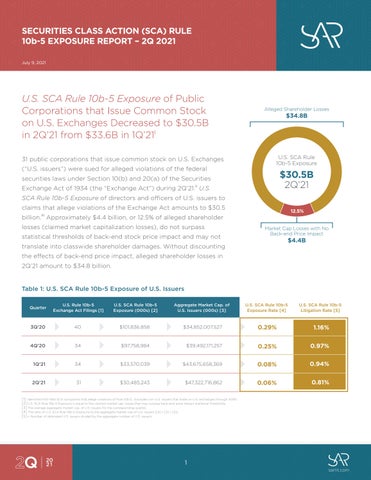
U.S. SCA Rule 10b-5 Exposure of Public Corporations that Issue Common Stock on U.S. Exchanges Decreased to $30.5B in 2Q’21 from $33.6B in 1Q’21
i
31 public corporations that issue common stock on U.S. Exchanges (“U.S. issuers”) were sued for alleged violations of the federal securities laws under Section 10(b) and 20(a) of the Securities Exchange Act of 1934 (the “Exchange Act”) during 2Q’21.ii U.S. SCA Rule 10b-5 Exposure of directors and officers of U.S. issuers to claims that allege violations of the Exchange Act amounts to $30.5 billion.iii Approximately $4.4 billion, or 12.5% of alleged shareholder losses (claimed market capitalization losses), do not surpass statistical thresholds of back-end stock price impact and may not translate into classwide shareholder damages. Without discounting the effects of back-end price impact, alleged shareholder losses in 2Q’21 amount to $34.8 billion.
Table 1: U.S. SCA Rule 10b-5 Exposure of U.S. Issuers
Both frequency of filings and U.S. SCA Rule 10b5 Exposure decreased in 2Q’21. U.S. SCA Rule 10b-5
Exposure of $30.5 billion was the lowest quarterly exposure recorded since 3Q’18 and fell by 9.2% relative to 1Q’21. The U.S. SCA Rule 10b-5 Exposure Rate declined by 2 basis points in 2Q’21 to 0.06%. U.S. SCA Rule 10b-5 Litigation Rate decreased by 13 basis points from 0.94% in 1Q’21 to 0.81% in 2Q’21.
COVID-19 U.S. SCA Rule 10b-5 Litigation Exposure: The SCA Rule 10b-5 Exposure of private securities-fraud litigation related to COVID-19 amounts to $1.2 billion in 2Q’21 stemming from 3 SCAs filed against U.S. issuers.iv COVID-19 related allegations account for 4.0% of the $30.5 billion in aggregate U.S. SCA Rule 10b-5 Exposure. The total SCA Rule 10b-5 Exposure related to COVID-19 since March 2020 amounts to $26.2 billion, of which 4.6% was alleged by shareholders during 2Q’21.
The Goldman Opinion: The Supreme Court’s decision in Goldman Sachs Group, Inc. et al. v. Arkansas Teacher Retirement System, et al. No. 20-222 (the “Goldman Opinion”), clarified the importance and applicability of price impact sufficiency in certifying securities class action lawsuits that allege violations of the Exchange Act and Rule 10b-5.v In doing so, the Supreme Court firmly established the necessity and importance of assessing price impact (front-end and back-end) to evaluate the validity of awarding class action privileges to litigants pursuing private securities-fraud suits that allege fraud on the market on behalf of allegedly similarly situated investors. The Supreme Court affirmed the independent recommendation of the Department of Justice and the SEC by remanding the case back to the 2nd Circuit Court of Appeals for further class certification proceedings to evaluate any and all evidence related to price impact even if such evidence relates to materiality.
2: Back-end Price Impact Summary of Alleged Corrective Disclosures of U.S. Issuers
During 2Q’21, SAR accounted for 58 “stock-drop” SCAs filed against U.S. issuers that allege violations of Rule 10b-5 via 100 claimed corrective disclosures.vi After consolidating cases with seemingly related allegations against individual U.S. issuers, SAR accounted for 31 filed SCAs. A total of 51 corrective disclosures have been alleged in the 31 first-filed SCAs.vii Of the 51 corrective disclosures alleged during 2Q’21, 20 may not translate to classwide shareholder damages since they do not warrant inclusion in a certified class of proposed shareholders (Goldman) as they do not surpass statistical thresholds of back-end price impact (Halliburton II). These alleged stock drops also run afoul of the heightened pleading standards of loss causation
(Dura) because they lack statistical significance after excluding non-company specific effects.viii
While the number of alleged stock drops decreased from 67 in 1Q’21 to 51 in 2Q’21, the number of alleged stock drops that did not exhibit price impact only decreased by 1 relative to 1Q’21. That means that 39% of alleged corrective disclosures included in first-filed complaints in 2Q’21 do not exhibit price impact. However, the shareholder value of the those drops - as calculated by the alleged market capitalization losses stemming from those econometrically deficient alleged stock drops - decreased by nearly half from $8.7 billion in 1Q’21 to $4.4 billion in 2Q’21.ix
SCA RULE 10b-5 EXPOSURE BY INDUSTRY SECTOR
A Single Claim Filed Against a Manufacturing, Farm, and Industrial Company Contributed 51.2% of Alleged Market Cap. Losses that May Not Translate into Shareholder Damages.
Out of the 31 SCAs filed in 2Q’21, 11 (or 35.5%) were filed against Pharma/Biotech companies, 4 (or 12.9%) against Software companies, 3 (or 9.68%) against Electronics, Hardware and Semiconductor companies, and 3 (or 9.68%) against Manufacturing, Farm, and Industrial companies. The sector with the greatest SCA Rule 10b-5 Exposure was the Pharma/Biotech sector which accounted for 31.6% of the U.S. SCA Rule 10b-5 Exposure and amounts to $9.6 billion.
Data and analyses indicate that the industry sectors that were impacted most by alleged corrective disclosures that may not surpass statistical thresholds of back-end price impact are Auto; Transportation and Storage; Manufacturing, Farm, and Industrial; and Retail and Consumer Products. 100% ($37.6 million) of shareholder losses alleged in the single SCA filed against an Auto company did not exhibit stock price impact. 100% ($476.3 million) of shareholder losses alleged in the single SCA against a Transportation and Storage company did not exhibit stock price impact. 59% ($2.2 billion) of shareholder losses alleged in 1 of the 3 SCAs against Manufacturing, Farm, and Industrial companies do not exhibit stock price impact. 34% ($909.3 million) of shareholder losses alleged in the 2 SCAs against Retail and Consumer Products companies do not exhibit stock price impact.
SCA RULE 10b-5 EXPOSURE OF U.S. LARGE CAP CORPORATIONSx
Large Cap SCA Rule 10b-5 Exposure Continued a Notable Decline in 2Q’21, Down 26.1% Relative to 1Q’21.
7 large cap corporations were sued for alleged violations of Rule 10b-5 during 2Q’21 – a decrease of 4 – relative to 1Q’21. The average aggregate market capitalization of U.S. large cap corporations, based on the market capitalization range of the S&P500 Index during 2Q’21, was $44.89 trillion.xi This is an increase in aggregate market cap of $3.51 trillion, or 8.5%, relative to 1Q’21. The decrease in Large Cap Rule 10b-5 Exposure combined with the increase in the aggregate market cap led to a material decrease of the Large Cap SCA Rule 10b-5 Exposure Rate by 2 basis points to 0.04% in 2Q’21. The Large Cap SCA Rule 10b-5 Litigation Rate decreased from 1.06% in 1Q’21 to 0.64% in 2Q’21; a drop of 42 basis points.
The return of the S&P500 Index between April 1, 2021 and June 30, 2021 was 8.55%.
$5.9B 26.1%
2Q’21 U.S. Large Cap Analysis: The Large Cap SCA Rule 10b-5 Exposure of $16.8 billion during 2Q’21 is down 26.1% from 1Q’21 and is the lowest exposure exhibited since 3Q’18. 4 fewer large cap corporations faced Rule 10b-5 allegations in 2Q’21 relative to 1Q’21, resulting in the lowest Large Cap SCA Rule 10b-5 Litigation Rate exhibited since 3Q’18.
SCA RULE 10b-5 EXPOSURE OF U.S. MID CAP CORPORATIONS
xii
Mid Cap SCA Rule 10b-5 Exposure
Mid Cap SCA Rule 10b-5 Exposure Increased Materially by 255.5% in 2Q’21, Amounting to $8.5 Billion.
6 mid cap corporations were sued for alleged violations of Rule 10b-5 during 2Q’21 – a increase of 2 – relative to 1Q’21. The average aggregate market capitalization of U.S. mid cap corporations, based on the market capitalization range of the S&P MidCap 400 Market Index during 2Q’21, was $1.63 trillion.xiii In 2Q’21, the Mid Cap SCA Rule 10b-5 Exposure Rate increased to 0.52%. The Mid Cap Rule 10b-5 Litigation Rate increased quarter-over-quarter to 0.85%
The return of the S&P MidCap 400 between April 1, 2021 and June 30, 2021 was 3.64%.
Mid Cap SCA Rule 10b-5 Exposure Rate Relative to 1Q’21
$6.08B 255.51% $8.5B 2Q’21
Mid Cap SCA Rule 10b-5 Litigation Rate
2Q’21 0.52% 2Q’21
2Q’21 U.S. Mid Cap Analysis: Mid Cap SCA filing frequency and Mid Cap SCA Rule 10b-5 Exposure Rate both increased this quarter. The 2Q’21 Mid Cap SCA Rule 10b-5 Exposure was 3.5 times greater than the Mid Cap SCA Rule 10b-5 Exposure of 1Q’21. The Mid Cap Rule 10b-5 Litigation Rate also increased by 23 basis points relative to 1Q’21.
Table 5: Mid Cap SCA Rule 10b-5 Exposure of U.S. Issuers
$2,746,684 $2,152,848 $2,380,893 $8,464,394 7 4 4 6 3Q’20 4Q’20 1Q’21
2Q’21
$1,629,594,208
SCA RULE 10b-5 EXPOSURE OF U.S. SMALL CAP CORPORATIONS
xiv
Small Cap SCA Rule 10b-5 Exposure Decreased in 2Q’21, Amounting to $5.2 Billion.
18 small cap corporations were sued for alleged violations of Rule 10b-5 during 2Q’21, which is 1 fewer than in 1Q’21. The Small Cap SCA Rule 10b-5 Exposure in 2Q’21 decreased 38.3% relative to 1Q’21. The average aggregate market capitalization of U.S. small cap corporations, based on the market capitalization range of the S&P SmallCap 600 Market Index during 2Q’21, was $800.5 billion. xv In 2Q’21, the Small Cap SCA Rule 10b-5 Exposure Rate was 0.65%, which is 50 basis points lower relative to 1Q’21. The Small Cap Rule 10b-5 Litigation Rate also decreased by 7 basis points to 0.90.
The return of the S&P SmallCap 600 Index between April 1, 2021 and June 30, 2021 was 4.51%.
$5.20B 2Q’21
$3.2B 38.26%
2Q’21 U.S. Small Cap Analysis: Small Cap SCA Rule 10b-5 Exposure decreased by over a third relative to 1Q’21 despite steady filing frequency. The aggregate market cap of small cap corporations also increased throughout the year to $800.5 billion in 2Q’21; an increase of 9.1% relative to 1Q’21.
$733,475,740
The ADR SCA Rule 10b-5 Exposure of non-U.S. issuers in 2Q’21 amounts to $7.2 billion, a Material Increase of 68.2% Relative to 1Q’21.xvi
3 non-U.S. issuers that trade on U.S. exchanges through ADRs (“non-U.S. issuers”) were sued for alleged violations Exchange Act during 2Q’21.xvii ADR SCA Rule 10b-5 Exposure of directors and officers of non-U.S. issuers to claims that allege violations of Rule 10b-5 under the Exchange Act amounts to $7.2 billion.xviii Approximately $0.2 billion of market capitalization declines that have been claimed as investor losses by a proposed class of common stock shareholders may not surpass statistical thresholds of back-end price impact and may not translate into classwide shareholder damages. Without discounting the effects of back-end stock price impact, claimed shareholder losses against directors and officers of non-U.S. issuers amounts to $7.4 billion in 2Q’21.
In 2Q’21, the ADR SCA Rule 10b-5 Exposure Rate increased by 1 basis point to 0.02% relative to 1Q’21. That is the second lowest ADR SCA Rule 10b-5 Exposure Rate recorded since 1Q’20. The ADR SCA Rule 10b-5 Litigation Rate is 0.15% based on the number of non-U.S. issuers that trade in the NYSE, NASDAQ, and over-thecounter in the U.S, which is a decrease of 5 basis points relative to 1Q’21 and the lowest ADR SCA Rule 10b-5 Litigation Rate since 1Q’20.
2Q’21 ADR Analysis: 2Q’21 had the fewest number of ADR Rule 10b-5 Exchange Act Filings since 1Q’20. In spite of the decrease in filings, ADR SCA Rule 10b-5 Exposure of non-U.S. issuers increased materially by 68.2% relative to 1Q’21. Although 60% of the alleged corrective disclosures in the 3 SCAs filed against non-U.S. issuers do not surpass statistical thresholds of back-end price impact, that only amounts to $0.2 billion, or 3.5% of the claimed market capitalization losses that do not surpass statistical thresholds of stock price impact.
Table 8: Price Impact Summary of Alleged Corrective Disclosures of Non-U.S. Issuers
Global SCA Rule 10b-5 Exposure of U.S.-listed corporations (including U.S. issuers of common stock and non-U.S. issuers that trade via ADRs) amounts to $37.7 billion in 2Q’21. That is a decrease of $0.1 billion in global securities class action exposure to Rule 10b-5 private securities fraud litigation relative to 1Q’21.
SCA Rule 10b-5 Exposure
Sources: S&P Global Market Intelligence, S&P Dow Jones Indices, Thomson Reuters, SAR SCA Platform as of June 30th, 2021.
Any reprint of the information or figures presented in this quarterly report should reference SAR. Please direct any technical inquiries to Stephen Sigrist, VP of Data Science, at 202.891.3652 or stephen@sarlit.com. SAR is a software and data analytics company that actively tracks, monitors, and analyzes private securities fraud actions that allege violations of the Exchange Act of 1934.
iFigures of Securities Class Action (SCA) Rule 10b-5 litigation exposure are based on identified first-filed complaints for each claim filed during the corresponding quarter. All federal securities class action complaints are read and screened for allegations that specifically include alleged violations of Rule 10b-5 and define a specific Class Period. Only the claimed stock price declines presented in the first-filed complaint against each defendant company are accounted for to estimate U.S. SCA Rule 10b-5 Exposure. Measures of SCA exposure for each claim may increase or decrease as the case progresses through the class action life cycle. SCA Exposure is not amended retroactively for cases have been dismissed by the Court or voluntarily dismissed by plaintiffs. iiThis tally accounts for U.S. issuers of common stock that are listed as defendants in first-filed SCA complaints that allege shareholder damages for alleged artificial inflation of stock price during the second quarter of 2021. A U.S. issuer of common stock that was sued a second or third time during the current quarter is not accounted for in the current quarter’s tally. The tally excludes SCA complaints against U.S. issuers of common stock that were sued for alleged violations of the federal securities laws in previous quarters. The tally also excludes Exchange Act claims that allege an artificially depressed price of common stock, a novel damages theory (see for example, White Pine Investments v. CVR Refining, LP et al); and Exchange Act claims against Electronic Traded Funds (ETFs). The tally also excludes cases that have been filed against international corporations that are listed on U.S. exchanges through American Depositary Receipts (ADRs). SCAs that allege Class Periods and/or corrective disclosures for which insufficient historical pricing data exists to estimate alleged artificial stock inflation are also excluded from the tally (see for example, Theodore v. Purecycle Technologies Inc. et al, Justin Kojak v. Canoo Inc. et al.)
iiiA public corporation’s exposure to alleged violations of Rule 10b-5 is estimated by tracking the cumulative decline in market capitalization during open market trading sessions that correspond with the timing of the claimed alleged corrective disclosures that surpass statistical thresholds of indirect price impact and are presented in a first-filed SCA complaint. This figure excludes market capitalization declines of non-U.S. issuers that have been sued for violations of the U.S. federal securities laws and trade on U.S. exchanges through American Depositary Receipts (ADRs).
ivFirst identified COVID-19 related SCA filings in 2Q’21 include:
1. Palm Tran, Inc. - Amalgamated Transit Union Local 1577 Pension Plan v. Emergent BioSolutions Inc. et al, Case No. 21-cv-00955
2. Nicanor v. Ocugen, Inc. et al, Case No. 21-cv-02725
3. Benjamin v. Bhatnagar et al, Case No. 21-cv-01001
SCA Rule 10b-5 Exposure related to COVID-19 does not account for Defendants that have been sued multiple times for seemingly related alleged violations of the Exchange Act.
vOpinion of the Court, Goldman Sachs Group Inc. v. Arkansas Teacher Retirement System, No. 20-222 (2021).
viSAR relies on Docket Alert and Court Wire notifications attained from Thomson Reuters Westlaw. SAR professionals actively monitor and track case dockets to attain newly filed and amended claims.
viiThis tally of alleged corrective disclosures includes only those from first-filed SCA complaints identified during 2Q 2021 against U.S. issuers of common stock. The tally excludes securities class action complaints against companies for which there are first-filed complaints in prior quarters.
viiiSee Goldman Sachs Group Inc. v. Arkansas Teacher Retirement System, No. 20-222 (2021), Dura Pharmaceuticals, Inc. v. Broudo, No. 03-932, 2005 WL 885109 (2005), and Halliburton Co. v. Erica P. John Fund, Inc., 134 S. Ct. 2398 (2014).
ixA single-firm multivariate regression analysis with a minimum of 100 observations (if a full 252 observations is unattainable) for a Control Period is applied to evaluate the statistical significance of the logarithmic residual stock price decline on the trading day(s) affected by an alleged corrective disclosure(s) (or the alleged adverse event). Statistical significance is measured by computing the t-statistic of the residual stock price decline during the trading session that is affected by the alleged corrective information. (If the t-statistic is greater than plus or minus 1.96, the likelihood that the daily residual return of the defendant company’s common stock could have been caused by random volatility is less than 5%.) The Control Period ends one trading day prior to the start of the Class Period presented in the corresponding securities class action complaint. Due to proliferation of Rule 10b-5 claims made against companies involved in recent SPAC transactions, beginning in 2Q’21, a single-firm multivariate regression analysis is performed when sufficient trading day observations are available to support an adequate Control Period. If there are between 50 and 100 closing stock price observations before the first alleged corrective disclosure, the VP of Data Science determines whether the raw data sample is sufficiently robust to perform a multivariate regression analysis that surpasses econometric quality controls of SAR.
xLarge cap corporations are the sub-set of defendant corporations that have market capitalizations within the range of the greatest and least market capitalization value of the constituent members of the S&P 500 Market Index at the time of the start of the Class Period alleged in the first-filed complaint.
xiThis is the average total market capitalization of U.S. issuers of common stock that are listed on the NYSE or Nasdaq exchanges with market capitalizations greater than $3.7 billion between April 1st, 2021 and June 30th, 2021.
xiiMid cap corporations are the sub-set of defendant corporations that have market capitalizations within the range of the greatest and least market capitalization value of the constituent members of the S&P MidCap 400 Market Index at the time of the start of the Class Period alleged in the first-filed complaint.
xiiiThis is the average total market capitalization of U.S. issuers of common stock that are listed on the NYSE or Nasdaq exchanges with market capitalizations between $1.26 and $3.7 billion between April 1st, 2021 and June 30th, 2021.
viSmall cap corporations are the sub-set of defendant corporations that have market capitalizations within the range of the greatest and least market capitalization value of the constituent members of the S&P SmallCap 600 Market Index at the time of the start of the Class Period alleged in the first-filed complaint.
xvThis is the average total market capitalization of U.S. issuers of common stock in that are listed on the NYSE or Nasdaq exchanges with market capitalizations less than $1.26 billion April 1st, 2021 and June 30th, 2021.
xviFigures of ADR Securities Class Action (SCA) Rule 10b-5 Exposure are based on the first filed complaint for each claim filed during the corresponding quarter. All federal securities class action complaints that comprise the data and analyses presented herein are read and screened for allegations that specifically include alleged violations of Rule 10b-5 and define a specific Class Period. Only the claimed stock price declines presented in the first filed complaint against each defendant company are accounted for to estimate ADR SCA Rule 10b-5 Exposure. Measures of SCA exposure for each claim may increase or decrease as the case progresses through the class action life cycle.
xviiThis tally only includes securities class action complaints against non-U.S. issuers that trade on U.S. exchanges through ADRs that were sued for alleged violations of the federal securities laws for the first time in the current quarter. A non-U.S. issuer of ADRs that was sued a second or third time during the current quarter is not accounted for in the current quarter’s tally.
xviiiA non-U.S. issuer’s exposure to alleged violations of Rule 10b-5 is estimated by tracking the cumulative decline in market capitalization during open market trading sessions that correspond with the timing of the claimed alleged corrective disclosures that surpass statistical thresholds of indirect price impact and are presented in a first-filed SCA complaint.
xixGlobal SCA Rule 10b-5 Exposure is the sum of U.S. Rule 10b-5 Exposure and ADR Rule 10b-5 Exposure.
To learn more about how SAR data analytics services and data packages can enhance the complex claim resolution capabilities of your organization, please contact:
Carolina M. Doherty
Vice President – Business Development
Direct: 202-926-4434
Email: carolina@sarlit.com