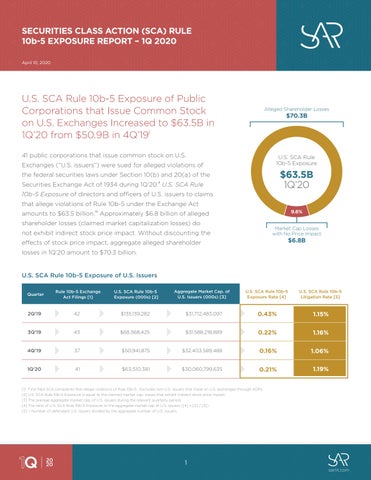
U.S. SCA Rule 10b-5 Exposure of Public Corporations that Issue Common Stock on U.S. Exchanges Increased
to $63.5B in 1Q’20 from $50.9B in 4Q’19i
41 public corporations that issue common stock on U.S. Exchanges (“U.S. issuers”) were sued for alleged violations of the federal securities laws under Section 10(b) and 20(a) of the Securities Exchange Act of 1934 during 1Q’20.ii U.S. SCA Rule 10b-5 Exposure of directors and officers of U.S. issuers to claims that allege violations of Rule 10b-5 under the Exchange Act amounts to $63.5 billion.iii Approximately $6.8 billion of alleged shareholder losses (claimed market capitalization losses) do not exhibit indirect stock price impact. Without discounting the effects of stock price impact, aggregate alleged shareholder losses in 1Q’20 amount to $70.3 billion.
U.S. SCA Rule 10b-5 Exposure of U.S. Issuers
$63.5B 1Q’20
In 1Q’20, aggregate U.S. SCA Rule 10b-5 Exposure increased by $12.6 billion relative to 4Q’19. Notably, the aggregate market capitalization of U.S. issuers decreased by $2.3 trillion, or 7.2% relative to 4Q’19.iv The increase in U.S. SCA Rule 10b-5 Exposure combined with the decrease in the market capitalization of U.S. issuers results in an increase in the U.S. SCA Rule 10b-5 Exposure Rate, amounting to 0.21% basis points.
The 1Q’20 U.S. SCA Rule 10b-5 Exposure Rate is below the 2019 average of 0.26%, or approximately one fifth of a percentage point of the aggregate market capitalization of U.S. issuers listed on U.S. Exchanges. In 1Q’20 there was an increase of 13 basis points in the U.S. SCA Rule 10b-5
Litigation Rate, which amounts to 1.19%. The U.S. SCA Rule 10b-5 Litigation Rate in 1Q’20 is the highest it has been during the preceding three quarters.
COVID-19 U.S. SCA Rule 10b-5 Litigation Exposure: The novel coronavirus has impacted the U.S. equity markets materially, even leading to an automated circuit breaker halting trading in the NYSE on March 9, 2020. Data and analysis indicate that investors have not sued publicly traded corporations indiscriminately over COVID-19 related allegations during 1Q’20. The SCA Rule 10b-5 Exposure of the private securities actions directly related to COVID-19 amounts to $2.7 billion, or 4.32% of $63.5 billion in aggregate U.S. SCA Rule 10b-5 Exposure v
Price Impact Summary of Alleged Corrective Disclosures
During 1Q’20, SAR accounted for 65 SCAs against U.S. issuers that allege violations of Rule 10b-5 via 131 claimed corrective disclosures.vi After consolidating for seemingly related allegations in the filed SCAs against individual U.S. issuers, SAR accounted for 41 filed claims. A total of 72 corrective disclosures have been alleged against 41 U.S. issuers based on the first-filed SCA complaints.vii, viii Of the 72 corrective disclosures alleged during 1Q’20, 16 (22%)
do not exhibit indirect stock price impact (Halliburton II) and do not meet the thresholds of the heightened pleading standards of loss causation (Dura).ix This amounts to $6.8 billion in 1Q’20, just slightly greater than the $6.6 billion exhibited in 4Q’19.x Empirical evidence indicates that over one fifth ($6.8 billion) of alleged stock price declines claimed by shareholders in 1Q’20 do not exhibit indirect stock price impact.
SCA RULE 10b-5 EXPOSURE BY INDUSTRY SECTOR
In 1Q’2020, 9.6% Of Economic Losses Borne by Shareholders Do Not Exhibit Indirect Price Impact
Out of the 41 SCA Exchange Act claims filed in 1Q’20, 9 (or 22%) were filed against Retail and Consumer companies, 8 (or 20%) against Pharma/Biotech companies, and 5 (or 12%) against Health Care companies. The three sectors with the greatest SCA Rule 10b-5 Exposure are Health Care, Retail/Consumer Products, and Hardware/Semiconductor companies. SCA Rule 10b-5 Exposure against U.S. issuers in these three sectors amounts to $40.1 billion (63% of aggregate U.S. SCA Rule 10b-5 Exposure).
Data and analysis indicate that the industry sectors with the greatest effect to claimed shareholder losses for lack of price impact on alleged stock price declines are Auto, Pharma/Biotech, and Hardware/Semiconductor companies. In the single claim against an Auto company, event study results indicate no price impact. 21% ($870 million) of claimed market capitalization losses on the 8 SCAs against Pharma/Biotech companies do not exhibit price impact. 18% ($2.4 billion) of claimed market capitalization losses on the 3 SCAs against Hardware/Semiconductor companies do not exhibit price impact.
U.S. SCA Rule 10b-5 Exposure by Industry Sector in 1Q’20
$2,439,157
$5,057,188
$10,629,528
$16,004,254
$3,154,113
$1,114,545
$1,650,956
$4,178,134
$5,941,331
Industry Sector [1]
% of Market Cap. Losses with No Price Impact
SCA
RULE 10b-5 EXPOSURE OF
U.S. LARGE CAP CORPORATIONS
xi
$55.0B 1Q’20 Large Cap SCA Rule
SCA Rule 10b-5 Exposure of Large Cap Corporations Amounted to Approximately $55 Billion in 1Q’20
This is a notable increase of 33.61%, or $13.8 billion relative to 4Q’19. 18 large cap corporations were sued for alleged violations of Rule 10b-5 during 1Q’20 – an increase of 2 – relative to 4Q’19. The average aggregate market capitalization of U.S. large cap corporations, based on the market capitalization range of the S&P500 Index during 1Q’20, was $28.1 trillion.xii This is a decrease in aggregate market capitalization of $2.3 trillion. or 7.48%, relative to 4Q’19. Given the material increase in exposure combined with the decrease in aggregate market capitalization for large cap corporations, the SCA Rule 10b-5 Exposure Rate increased by 6 basis points to 20 in 1Q’20. The SCA Rule 10b-5 Litigation Rate for large cap corporations surpassed 2%, to 2.01%, for the first time since 1Q’19.
to 4Q’19
$13.8B 34%
1Q’20 U.S. Large Cap Analysis: The SCA Rule 10b-5 Exposure for large cap corporations in 1Q’20 increased by 33.6% but remained far below the peak on 2Q’19 when exposure amounted to $125.4 billion. The increase in the SCA Rule 10b-5 Exposure Rate for large cap corporations is driven by the increase in SCA Rule 10b-5 Exposure and the decrease in the aggregate market capitalization impacted by the equity markets’ reaction to the COVID-19 pandemic. 1Q’20 is also the third consecutive quarter where the number of defendant large cap corporations increased, resulting in a SCA Rule 10b-5 Litigation Rate that is twice what the rate was in 2Q’19 (1.01%). In summary, during 1Q’20 directors and officers of large cap corporations faced a demonstrable increase in shareholder class action litigation exposure.
Large Cap SCA Rule 10b-5 Exposure of U.S. Issuers
SCA RULE 10b-5 EXPOSURE OF U.S. MID CAP CORPORATIONS
xiii
SCA Rule 10b-5 Exposure of Mid Cap Corporations was $5.3 Billion During 1Q’20
This is a notable decrease of 33.58%, or $2.7 billion relative to 4Q’19. 7 mid cap corporations were sued for alleged violations of Rule 10b-5 during 1Q’20. The average aggregate market capitalization of U.S. mid cap corporations, based on the market capitalization range of the S&P MidCap 400 Market Index during 1Q’20, was $1.29 trillion.xiv In 1Q’20, the SCA Rule 10b-5 Exposure Rate of mid caps corporations decreased to 41 basis points. This is a decrease of 18 basis points relative to 4Q’19. The SCA Rule 10b-5 Litigation Rate for mid cap corporations remained steady quarter-overquarter at 1.12%, given the fact that 7 mid cap corporations were also sued in 4Q’19.
1Q’20 U.S. Mid Cap Analysis: The SCA Rule 10b-5 Exposure of mid cap corporations during 1Q’20 was the lowest during the preceding four quarters. The aggregate market cap of mid cap corporations also fell to the lowest amount during the preceding four quarters, driven by the equity market’s reaction to the COVID-19 pandemic. The 4.6% decrease in the aggregate market capitalization of mid cap corporations in 1Q’20 also tempered the decline of the SCA Rule 10b-5 Exposure Rate. In summary, during 1Q’20 directors and officers of mid cap corporations faced a decrease in shareholder class action litigation exposure.
Mid Cap SCA Rule 10b-5 Exposure of U.S. Issuers
SCA RULE 10b-5 EXPOSURE OF U.S. SMALL CAP CORPORATIONSxv
SCA Rule 10b-5 Exposure of Small Cap Corporations Increased Substantially to $3.3 Billion in 1Q’20 from $1.9 Billion in 4Q’19
That is a material increase of 76.25%. The average aggregate market capitalization of U.S. small cap corporations, based on the market capitalization range of the S&P SmallCap 600 Market Index during 1Q’20, was $670 billion.xvi In 1Q’20, the SCA Rule 10b-5 Exposure Rate of small cap corporations was 49 basis points. This is a material increase of 21 basis points relative to 4Q’19. The SCA Rule 10b-5 Litigation Rate for small cap corporations also increased by 14 basis points to 0.83%.
Small Cap SCA Rule 10b-5 Exposure of U.S. Issuers $1.4B 76% $3.3B 1Q’20
1Q’20 U.S. Small Cap Analysis: SCA Rule 10b-5 Exposure of small cap defendants rebounded from the dip experienced in 4Q’19 but was still less than exposure exhibited in 2Q’19 and 3Q’19. The aggregate market cap of small cap corporations continued to fall for the fifth consecutive quarter, which results in an increase in the SCA Rule 10b-5 Exposure Rate for each additional dollar of alleged market capitalization losses.
6 non-U.S. corporations that trade on U.S. exchanges through ADRs (“non-U.S. issuers) were sued for alleged violations of the federal securities laws under Section 10(b) and 20(a) of the Securities Exchange Act of 1934 during 1Q’20.xviii ADR SCA Rule 10b-5 Exposure for directors and officers of non-U.S. issuers to claims that allege violations of Rule 10b-5 under the Exchange Act amounts to $11.7 billion.xix Approximately $824 million of market capitalization declines that have been claimed as investor losses by a proposed class of common stock shareholders do not exhibit indirect price impact. Without discounting the effects of stock price impact, claimed shareholder losses against directors and officers of non-U.S. issuers, amounts to $12.5 billion in 1Q’20.
The ADR SCA Rule 10b-5 Exposure of non-U.S. issuers in 1Q 2020 amounts to $11.7 billionxvii ADR SCA Rule 10b-5 Exposure $11.7B 1Q’20 Alleged ADR Shareholder Losses $12.5B Market Cap Losses with No
In 1Q’20, the ADR SCA Rule 10b-5 Exposure Rate amounts to 5 basis points, based on the aggregate market capitalization of non-U.S. issuers of $25 billion. The ADR SCA Rule 10b-5 Litigation Rate is 0.30% based on the number of non-U.S. issuers that trade in the NYSE, NASDAQ, and over-the-counter in the U.S.
ADR SCA Rule 10b-5 Exposure of Non-US Issuers
Aggregate Market Cap. Of Non-US Issuers [3]
[5] = Number of defendant non-U.S. issuers divided by the aggregate number of non-U.S. issuers.
[3])
Price Impact Summary of Alleged Corrective Disclosures of Non-U.S. Issuers
[1] First-filed SCA complaints that allege violations of Rule 10b-5 against non-U.S. issuers that trade on U.S. exchanges through ADRs. Excludes U.S. issuers.
[2] The total number of alleged corrective disclosures identified in the sample of SCA complaints.
[3] The total number of alleged corrective disclosures that do not exhibit a statistically significant one-day residual stock price return at the 95% confidence standard.
[4] The ratio of the number of alleged corrective disclosures that do not exhibit indirect price impact to the
Sources: S&P Global Market Intelligence, S&P Dow Jones Indices, Thomson Reuters, SAR SCA Platform as of March 31st, 2020.
Any reprint of the information or figures presented in this quarterly report should reference SAR. Please direct any inquiries to Stephen Sigrist, SAR at 202.891.3652 or stephen@sarlit.com. SAR is a software and data analytics company that actively tracks, monitors, and analyzes private securities fraud actions that allege violations of the Exchange Act of 1934.
iFigures of Securities Class Action (SCA) Rule 10b-5 litigation exposure are based on the first-filed complaint for each claim filed during the corresponding quarter. Exposure may increase or decrease throughout the life cycle of each securities class action.
iiThis tally accounts for U.S. issuers of common stock that are listed as defendants in first-filed securities class action complaints identified during the first quarter of 2020. The tally excludes securities class action complaints against U.S. issuers of common stock that were sued for alleged violations of the federal securities laws in previous quarters. A U.S. issuer of common stock that was sued a second or third time during the current quarter is not accounted for in the current quarter’s tally. This tally also excludes cases that have been filed against international corporations that are listed on U.S. exchanges through American Depositary Receipts (ADRs). All federal securities class action complaints are read and screened for allegations that specifically include alleged violations of Rule 10b-5 and define a specific alleged inflationary period (the Class Period) of the corresponding company’s price of common stock. Only the claimed stock price declines presented in the first-filed complaint against each defendant company are accounted for to estimate aggregate U.S. SCA Rule 10b5 exposure. U.S. SCA Rule 10b-5 exposure litigation exposure for each claim may increase or decrease as the case progresses through the class action process.
iiiA public corporation’s exposure to alleged violations of Rule 10b-5 is estimated by tracking the cumulative decline in market capitalization during open market trading sessions that correspond with the timing of the claimed alleged corrective disclosures that surpass thresholds of indirect price impact and are presented in a first-filed SCA complaint. This figure excludes market capitalization declines of non-U.S. issuers that have been sued for violations of the U.S. federal securities laws and trade on U.S. exchanges through American Depositary Receipts (ADRs).
ivFirst quarter aggregate market capitalization is defined as the average of total market capitalization on January 1st, 2020 and March 31st, 2020 for all U.S. issuers. There was 1 Exchange Act claim filed against a U.S. corporation that traded Over-the-Counter in 1Q’20.
vSCA Exposure in McDermid v. Inovio Pharmaceuticals, Inc. et al, Case No. 2:20-cv-01402, amounts to $431.8 million. SCA Exposure in Douglas v. Norwegian Cruise Lines et al, Case No. 1:20-cv-21107, amounts to $2.3 billion. A second Exchange Act claim was filed against Norwegian Cruise Lines on March 31, 2020, in Abraham Atachbarian v. Norwegian Cruise Lines et al, Case no.: 1:20-cv-21386. U.S. SCA Rule 10b-5 Exposure related to COVID-19 does not account for Defendants that have been sued multiple times for seemingly related alleged violations of the Exchange Act.
viSAR relies on Docket Alert and Court Wire notifications attained from Thomson Reuters Westlaw. SAR professionals actively monitor and track case dockets to attain newly filed and amended claims.
viiSAR accounted for a total 131 corrective disclosures alleged in 65 filed claims for alleged violations of Rule 10b-5 against U.S. issuers of common stock in U.S. exchanges during 1Q’20.
viiiThis tally of alleged corrective disclosures includes only those from first-filed SCA complaints identified during 1Q 2020 against U.S. issuers of common stock. The tally excludes securities class action complaints against companies for which there are first-filed complaints in prior quarters.
ixSee Dura Pharmaceuticals, Inc. v. Broudo, No. 03-932, 2005 WL 885109 (2005), and Halliburton Co. v. Erica P. John Fund, Inc., 134 S. Ct. 2398 (2014).
xA single-firm multivariate regression analysis with a minimum of 100 observations (if a full 252 observations is unattainable) for a Control Period is applied to evaluate the statistical significance of the logarithmic residual stock price decline on the trading day(s) affected by an alleged corrective disclosure(s) (or the alleged adverse event). Statistical significance is measured by computing the t-statistic of the residual stock price decline during the trading session that is affected by the alleged corrective information. (If the t-statistic is greater than plus or minus 1.96, the likelihood that the daily residual return of the defendant company’s common stock could have been caused by random volatility is less than 5%.) The Control Period ends one trading day prior to the start of the Class Period presented in the corresponding securities class action complaint.
xiLarge cap corporations are the sub-set of defendant corporations that have market capitalizations within the range of the greatest and least market capitalization value of the constituent members of the S&P 500 Market Index at the time when the first-filed complaint was identified.
xiiThis is the average total market capitalization of U.S. issuers of common stock that are listed on the NYSE or Nasdaq exchanges with market capitalizations greater than $3.7 billion between January 1st, 2020 and March 31st, 2020.
xiiiMid cap corporations are the sub-set of defendant corporations that have market capitalizations within the range of the greatest and least market capitalization value of the constituent members of the S&P MidCap 400 Market Index at the time when the first-filed complaint was identified.
xivThis is the average total market capitalization of U.S. issuers of common stock that are listed on the NYSE or Nasdaq exchanges with market capitalizations between $1.26 and $3.7 billion between January 1st, 2020 and March 31st, 2020.
xvSmall cap corporations are the sub-set of defendant corporations that have market capitalizations within the range of the greatest and least market capitalization value of the constituent members of the S&P SmallCap 600 Market Index at the time when the first-filed complaint was identified.
xviThis is the average total market capitalization of U.S. issuers of common stock in that are listed on the NYSE or Nasdaq exchanges with market capitalizations less than $1.26 billion between January 1st, 2020 and March 31st, 2020.
xviiFigures of ADR Securities Class Action (SCA) Rule 10b-5 litigation exposure are based on the first-filed complaint for each claim filed during the corresponding quarter. Exposure may increase or decrease throughout the life cycle of each securities class action. This tally accounts for non-U.S. issuers that trade on U.S. exchanges through ADRs that are listed as defendants in first-filed securities class action complaints identified during the first quarter of 2020.
xviiiThis tally only includes securities class action complaints against non-U.S. issuers that trade on U.S. exchanges through ADRs that were sued for alleged violations of the federal securities laws for the first time in the current quarter. A non-U.S. issuer of ADRs that was sued a second or third time during the current quarter is not accounted for in the current quarter’s tally. All federal securities class action complaints are read and screened for allegations that specifically include alleged violations of Rule 10b-5 and define a specific alleged inflationary period (the Class Period) of the corresponding company’s ADR price. Only the claimed price declines presented in the first-filed complaint against each defendant company are accounted for to estimate aggregate ADR SCA Rule 10b-5 exposure. ADR SCA Rule 10b-5 exposure litigation exposure for each claim may increase or decrease as the case progresses through the class action process.
xixA non-U.S. issuer’s exposure to alleged violations of Rule 10b-5 is estimated by tracking the cumulative decline in market capitalization during open market trading sessions that correspond to the timing of the claimed alleged corrective disclosures that surpass thresholds of indirect price impact and are presented in a first-filed SCA complaint.