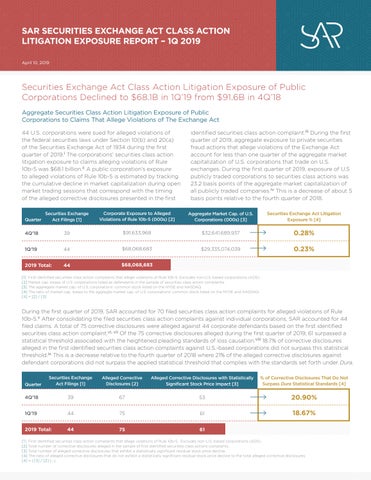
Securities Exchange Act Class Action Litigation Exposure of Public Corporations Declined to $68.1B in 1Q’19 from $91.6B in 4Q’18
Aggregate Securities Class Action Litigation Exposure of Public Corporations to Claims That Allege Violations of The Exchange Act
44 U.S. corporations were sued for alleged violations of the federal securities laws under Section 10(b) and 20(a) of the Securities Exchange Act of 1934 during the first quarter of 2019.i The corporations’ securities class action litigation exposure to claims alleging violations of Rule 10b-5 was $68.1 billion.ii A public corporation’s exposure to alleged violations of Rule 10b-5 is estimated by tracking the cumulative decline in market capitalization during open market trading sessions that correspond with the timing of the alleged corrective disclosures presented in the first
identified securities class action complaint.iii During the first quarter of 2019, aggregate exposure to private securities fraud actions that allege violations of the Exchange Act account for less than one quarter of the aggregate market capitalization of U.S. corporations that trade on U.S. exchanges. During the first quarter of 2019, exposure of U.S publicly traded corporations to securities class actions was 23.2 basis points of the aggregate market capitalization of all publicly traded companies.iv This is a decrease of about 5 basis points relative to the fourth quarter of 2018.
During the first quarter of 2019, SAR accounted for 70 filed securities class action complaints for alleged violations of Rule 10b-5.v After consolidating the filed securities class action complaints against individual corporations, SAR accounted for 44 filed claims. A total of 75 corrective disclosures were alleged against 44 corporate defendants based on the first identified securities class action complaint.vi, vii Of the 75 corrective disclosures alleged during the first quarter of 2019, 61 surpassed a statistical threshold associated with the heightened pleading standards of loss causation.viii 18.7% of corrective disclosures alleged in the first identified securities class action complaints against U.S.-based corporations did not surpass this statistical threshold.ix This is a decrease relative to the fourth quarter of 2018 where 21% of the alleged corrective disclosures against defendant corporations did not surpass the applied statistical threshold that complies with the standards set forth under Dura
Exposure of Large Cap Corporationsx
The Securities Exchange Act class action litigation exposure of large cap corporations was $58.7 billion during the first quarter of 2019. This is a notable decrease of 28.37%, or $23.3 billion relative to the fourth quarter of 2018. 17 large cap corporations were sued for alleged violations of Rule 10b-5 during the first quarter of 2019. The average aggregate market capitalization of U.S.-based large cap
corporations, according to the market capitalization range of the S&P500 Index during 1Q’19, was $27.15 trillion.xi During the first quarter of 2019, exposure to alleged violations of the Exchange Act by large cap corporations was 22 basis points of the aggregate market capitalization of publicly traded large cap corporations. This is a decrease of 5 basis points relative to the fourth quarter of 2018.
Exposure of Large Cap Corporations to Alleged Violations of the Exchange Act
$30,320,314,135
$27,146,931,803
Exposure of Mid Cap Corporationsxii
The Securities Exchange Act class action litigation exposure of mid cap corporations was $6.2 billion during the first quarter of 2019. This is a notable decrease of 25.84%, or $2.1 billion relative to the fourth quarter of 2018. 8 mid cap corporations were sued for alleged violations of Rule 10b-5 during first quarter of 2019. The average aggregate market capitalization of U.S.-based mid cap corporations, according
to the market capitalization range of the S&P MidCap 400 Market Index during 1Q’19, was $1.5 trillion.xiii During the first quarter of 2019, exposure to alleged violations of the Exchange Act by mid cap corporations was 42 basis points of the aggregate market capitalization of publicly traded mid cap corporations. This is a decrease of 11 basis points relative to the fourth quarter of 2018.
Exposure of Mid Cap Corporations to Alleged Violations of the Exchange Act
Aggregate Market Cap. of Mid Caps (000s)
$1,575,924,577
$1,453,996,413
Exposure of Small Cap Corporationsxiv
The Securities Exchange Act class action litigation exposure of small cap corporations was $3.2 billion during the first quarter of 2019. This is a notable increase of 135%, or $1.8 billion relative to the fourth quarter 2018. 19 small cap corporations were sued for alleged violations of Rule 10b-5 during the first quarter of 2019. The average aggregate market capitalization of U.S.-based small cap corporations,
according to the market capitalization range of the S&P SmallCap 600 Market Index during 1Q’19, was $734 billion. xv During the first quarter of 2019, exposure to alleged violations of the Exchange Act by small cap corporations was 43 basis points of the aggregate market capitalization of publicly traded small cap corporations. This is an increase of 25 basis points relative to the fourth quarter of 2018.
Exposure of Small Cap Corporations to Alleged Violations of the Exchange Act
$745,451,195
$3,193,095
$734,145,823
Any reprint of the information or figures presented in this quarterly report should reference SAR, LLC. Please direct any questions to: Stephen Sigrist at 202.891.3652 or stephen@sarlit.com. SAR is a software, technology, and data analytics company that actively tracks, monitors, and analyzes private securities fraud actions that alleged violations of the Exchange Act of 1934.
i This tally accounts for U.S. publicly traded corporations listed as defendants in first-identified securities class action complaints filed in the first quarter of 2019. The tally excludes securities class action complaints against U.S. corporations that were sued for alleged violations of the federal securities laws in previous quarters. A U.S. corporation that was sued a second or third time during the current quarter is not accounted for in the current quarter’s tally.
ii Aggregate measures of exposure exclude market capitalization declines of international companies that have been sued for violations of the U.S. federal securities law and trade on U.S. exchanges through American Depositary Shares.
iii Federal securities class action complaints are screened for allegations that specifically include violations of Rule 10b-5 and define a specific alleged inflationary period of the corresponding company’s price of common stock. Only the alleged corrective disclosures presented in the first filed complaint against each defendant company are used to estimate the cumulative decline in market capitalization.
iv First quarter aggregate market capitalization is defined as the average of total market capitalization on January 1st, 2019 and March 29, 2019 for all U.S.-domiciled equities that trade on the NYSE or Nasdaq.
v SAR relies on class action filing notifications disseminated by Bloomberg Law based on specified descriptive parameters for allegations containing violations of Rule 10b-5.
vi SAR accounted for a total 132 corrective disclosures alleged in 70 filed claims for alleged violations of Rule 10b-5 against U.S.-based corporations.
vii This tally of corrective disclosures includes only those from first-identified complaints filed during the first quarter of 2019 against U.S.-based companies that have publicly traded shares of common stock in the NYSE or NASDAQ. The tally excludes securities class action complaints against companies for which there are first-identified complaints in prior quarters.
viii See Dura Pharmaceuticals, Inc. v. Broudo, No. 03-932, 2005 WL 885109 (U.S. April 19, 2005)
ix A single-firm multivariate regression analysis with a minimum of 100 observations (if a full 252 observations is unattainable) for a Control Period is applied to evaluate the statistical significance of the logarithmic residual stock price decline on the trading day(s) affected by an alleged corrective disclosure(s) (or the alleged adverse event). Statistical significance is measured by computing the t-statistic of the residual stock price decline during the trading session that is affected by the alleged corrective information. (If the t-statistic is greater than the t-statistic value of plus or minus 1.96, the likelihood that the daily residual return of the defendant company’s common stock could have been caused by random volatility is less than 5%.) The Control Period ends one trading day prior to the start of the Class Period presented in the corresponding securities class action complaint.
x Large cap corporations are the sub-set of defendant corporations that have market capitalizations within the range of the greatest and least market capitalization value of the constituent members of the S&P 500 Market Index at the time when the first identified complaint was filed.
xi This is the average total market capitalization of U.S.-based corporations that traded on the NYSE or Nasdaq exchanges with market capitalizations greater than $3.7 billion between January 1st, 2019 and March 29, 2019.
xii Mid cap corporations are the sub-set of defendant corporations that have market capitalizations within the range of the greatest and least market capitalization value of the constituent members of the S&P MidCap 400 Market Index at the time when the first identified complaint was filed.
xiii This is the average total market capitalization of U.S.-based corporations that traded on the NYSE or Nasdaq exchanges with market capitalizations between $1.26 and $3.7 billion between January 1st, 2019 and March 29, 2019.
xiv Small cap corporations are the sub-set of defendant corporations that have market capitalizations within the range of the greatest and least market capitalization value of the constituent members of the S&P SmallCap 600 Market Index at the time when the first identified complaint was filed.
xv This is the average total market capitalization of U.S.-based corporations that traded on the NYSE or Nasdaq exchanges with market capitalizations less than $1.26 billion between January 1st, 2019 and March 29, 2019.
*Sources: Bloomberg Finance L.P., S&P Dow Jones Indices, PACER.