STRATEGIESFORUSINGSHALLOW-WATERBENTHICFORAMINIFERSAS BIOINDICATORSOFPOTENTIALLYTOXICELEMENTS:AREVIEW
MICHAEL MARTINEZ-COLON1,3,PAMELA HALLOCK1 AND CARLOS GREEN-RUIZ2
ABSTRACT
Thisreviewexaminesenvironmentalfactorsaffecting potentiallytoxicelements(PTEs)incoastalwaterswiththe goalofproposingwaystoenhancetheuseofbenthic foraminifersasbioindicatorsofsuchpollution.Pollutionof coastalsystemsbyPTEs,oftenreferredtoasheavymetals,is amajorconcernforscientists,resourcemanagers,and regulatoryagencies.Bioavailability,uptakerates,speciation, claymineralogy,pH,complexation,andotherfactorscontrol thebehaviorofPTEsinmarinesystems,especiallyin estuaries.Whilebreakthroughworkhasexaminedincorporationandassimilationofmetalsintomarinemacroinvertebrates,similarresearchonmarineprotistsisstillinthe developmentalstage.Manystudiesassumeorconcludethat foraminiferalassemblagesandthefrequencyofdeformed testsarefirst-lineindicatorsofpollution,butotherspresent confoundingresults.UnderstandingthecomplexgeochemistriesofPTEs,coastalwaters,andsedimentsiscriticaltothe designandinterpretationofmeaningfulstudies.
Applicationsofforaminifersasbioindicatorsrequirestrong scientificmodelsbasedonbothfieldandlaboratory experimentsandwhichspecificallyexaminetheinfluenceof PTEsandotherpollutantsatcommunity,assemblage, population,individual,andgene-expressionlevels.Genomic studiesofkeyforaminiferaltaxawithstrongpotentialas bioindicatorsarecriticallyneededasabasisforstudiesof geneexpressionindicatingexposuretospecificstressors. Thoughmajorchallengesexisttofullyrealizingthepotential forapplicationofforaminifersasenvironmentalindicators, theirglobalimportanceinthepastandpresentargues stronglyforfurtherdevelopmentofthesepromisingtools.
INTRODUCTION
Waterpollutionhasbeenanenvironmentalconcernsince theonsetoftheIndustrialRevolution.Anthropogenic activities(i.e.,agriculture,mining,industrialization,urbanization)havecontaminatedsurface,ground,andcoastal waterswithexcessivenutrientsandpotentialtoxins(Hunter andArbona,1995;Alve,2000;Elberlingandothers,2003; Farkasandothers,2003;Green-Ruı´zandPa´ez-Osuna, 2004;Haywardandothers,2004).Thesepollutantscan alterecosystemsbyreducingthefecundityandsurvivalof organisms,andtheycanpromotediseasesthatcanbe passedtohumans(SmedleyandKinniburgh,2005).
Historically,pointsourcessuchasindustrialeffluentand sewageoutfallswereamongthemajorsourcesofwater pollution.Becausepointsourcescanbemanaged,non-
1 CollegeofMarineScience,UniversityofSouthFlorida,St. Petersburg,FL33701,USA
2 InstitutodeCienciasdelMaryLimnologı´a,UniversidadNacional Auto´nomadeMe´xico,Mazatla´n-Me´xico
3 Correspondenceauthor.E-mail:mmartin8@mail.usf.edu; foram3438@yahoo.com
pointsourcesofpollutionsuchasatmosphericfalloutand storm-waterrunoffarenowquantitativelymoreimportant thanpointsourcesinmanymanagedareas.Thematerial introducedintoaquaticenvironmentsbynon-pointsources istypicallyneitherwelldefinednorreadilymanaged,even wherethepoliticalwillexiststodoso.
Potentiallytoxicelementsinestuarinesedimentshave beenstudiedbothspatiallyandtemporallyformanyyears. WorkbyTessierandothers(1979),Santosandothers (2005),andmanyothershavelaidthegroundworkfor furtherresearchonhowindividualpollutantsaffectspecific organisms,includingmicrobiota.Complicatingfactorsfor understandingresponsesoforganismsinestuarineenvironmentsincludenaturalvariabilityinpH,salinity, sedimenttextureandmineralogy,andorganicproductivity, allofwhicharelinkedtoclimaticandgeographicregions andtothecomplexityofthesubjectorganisms.Avarietyof approacheshasbeendevelopedtoidentifypollutantsin coastalwaters.Pollutantshavebeenmeasuredinboththe watercolumnandsubstrate(e.g.,Kotandothers,1999; Zhangandothers,2002).Theireffectshavebeenstudiedon manymarineorganisms,includingfish,decapods(Rainbow andWhite,1989;Rainbow,1995),plankticcrustaceans, ostracodes(Eagar,2000),andbenthicforaminifers(Coccioni,2000;Elberlingandothers,2003;Farkasandothers, 2003;LeCadreandDebenay,2006;Frontaliniand Coccioni,2008).Benthicinfaunagenerallyarepreferred forbioassaysandasbioindicatorsbecausetheyaretypically sessileoroflimitedmobilityandthereforearedirectly influencedbynaturalorinducedstressesintheirenvironment(Bilyard,1987).
OBJECTIVES
Thispapercomprisestwosectionsthataddresstwo majorobjectives.Thefirstobjectiveistoprovidean overviewofenvironmentalfactorsinfluencingmobility andbioavailabilityofpotentiallytoxicelements(PTEs)in coastalwaters.Thissectioncanprovideresearchersand resourcemanagers,whoareproposingorbeginningto workwithPTEcontamination,withinsightintothe complexrangeoffactorsandenvironmentalconditions thatmustbeconsidered,keepinginmindthatPTEsaretoo diverseandcomplexintheirchemicalbehaviorstopermita comprehensivetreatmentinareviewpaper.
Theinsightprovidedbythefirstsectionisessentialfor thesecondobjective,whichistoencourageresearchonhow PTEsaffectbenthicforaminifersand,inturn,onhow foraminiferscanbeusedasbioindicatorsofpollution.This sectionexaminespreviousstudiesofbenthicforaminifersin coastalwaterscontaminatedbyPTEs.Benthicforaminifers areidealtoolsinenvironmentalresearchbecausetheyare small,abundant,diverse,andincludestress-toleranttaxa. Inaddition,foraminifershaveshellsthatleavearecordof
pastassemblages,andwhichoftenprovidemorphological orgeochemicalevidenceofenvironmentalchange(Yanko andothers,1999;Schafer,2000).Understandingthecomplex geochemistryofPTEs,aswellastheequallycomplex chemistriesofcoastalwatersandsediments,isvitaltothe designandinterpretationofobservationalandexperimental studiesofPTEcontaminationincoastalenvironments.The secondsectionconcludeswithrecommendationsforfuture experimentstoenhanceunderstandingofindividual,populationandassemblageresponsestotheenvironmental stressesresultingfromPTEcontamination.
POTENTIALLYTOXICELEMENTS
Elementscanbeclassifiedasessentialornon-essential dependinguponwhethertheyarerequiredforbiological activities(i.e.,metabolicprocesses).Organismstolerate non-essentialelements(e.g.,As,Cd,Hg,Pb)atlimited concentrations,whereasessentialelements(e.g.,N,P,Ca, Cu,Fe,Zn)arerequiredformetabolism(e.g.,Venugopal andLuckey,1975).Bothnon-essentialandessential elementscanbetoxicathighconcentrations,depending uponbioavailability.Toleranceofindividualorganismsto PTEsdependsonbiologicalfactors,suchasspecies,size, sex,lifestage,detoxificationmechanisms,intakeroute,and physiologicalstate,anduponabioticfactorssuchasthe chemicalspeciesoftheelement,oxidationstateofthe environment,andadsorptionbyclaymineralsororganic matter.
Theterminologyassociatedwithnaturallyoccurring heavyelementsthatarepotentiallytoxictobiotaisvaried andoftenconfusing.Theterm‘‘heavymetal’’iswidelyused torefertotheseelements(Duffus,2002),whichalsoare commonlybutincorrectlyreferredtoastracemetals (RainbowandFurness,1990).Inthiscontext,‘‘heavy’’ conventionallyreferstodensity(.5gcm 3);however, metalsarecommonlyclassifiedasheavyelementsbased onothercharacteristics,includingatomicweight,atomic number,chemicalproperties,andtoxicity(Duffus,2002; Selinusandothers,2005).Duffus(2002)thereforerecommendedavoidingterminologythatclassifiesmetalsas ‘‘heavy,’’andrevisedtheclassificationschemetoreflect
chemicalpropertiesbasedontheLewisacid-behavior scheme(Lewis,1923).Thisclassificationallowspredictions ofhowametalwillcomplexwithorganicsorminerals basedonoxidationstate(Table1):ClassAmetalsarehard (non-polarizable)metals;ClassBaresoft(more-polarizable)metals;andathirdgroupconsistsofintermediate metals.Thelatterareproblematictoclassifybecausethey haveastrongtendencytoformcomplexeswithbothhard andsoftmetals(Duffus,2002).Less-polarizablemetals havehighercharges(higheroxidationstates)whereasmore polarizablemetalshaveloweroxidationstates.
MostcommonPTEsalsocanbecategorizedbasedon chemicalaffinities.AccordingtoGarrett(2005),lithophilic elementshavestrongaffinityforsilicateminerals,oxides, andcarbonates;whilechalcophilicelementshavestrong affinitytosulfides,arsenides,selenides,andtellurides.The sameelementcanbelithophilicorchalcophilic,depending uponitsvalence(e.g.,As+5 islithophilic,As+3 ischalcophilic).
Forsimplicity,thispaperreferstoPTEsaselements havingpotentiallydetrimentaleffectsonorganismsinan ecosystem.ThisuseofPTEisconsistentwithterminology employedbyDavisandothers(1978),Pescod(1992),and AlHwaitiandothers(2005).Table1liststhemostcommon PTEsconsideredinstudiesofaquaticpollution,indicating, theircommonvalencestates,behavior(lithophilicor chalcophilic),classbasedontheLewisacid-behavior scheme,averageconcentrationsinshaleandseawater,and concentrationatwhichtoxiceffectscanbepredicted (ERM).
SOURCES,TRANSPORT,MOBILITYAND BEHAVIOROF PTES
IgneousandmetamorphicrocksintheEarth’scrustare theultimatesourcesofPTEsinnature(Fig.1).While physicalerosionandsedimenttransportcanmovePTEsin solidforms,chemicalweathering(dissolution,oxidation, andhydrolysis)istheprimarymechanismofreleaseand mobilizationofelementsfromrocks(Siegel,2002).Asrocks weathertoformsedimentsandsoils,solubleionsare mobilizedintosurfacewatersorleachedintogroundwater andtransportedtolargerwaterbodies(i.e.,rivers,lakes, oceans;Fig.1).
TABLE 1.AveragemetalconcentrationsofPTEsinshaleandseawater,andsedimentqualitycriteria(ERM).A:Class-Ametal;B:Class-Bmetal; I-Intermediate;*Lithophilic; {Chalcophilic.
MetalDuffus(2002)Garrett(2005)
ConcentrationinShale (ppm)a
ConcentrationinSeawater (ppm)a ERM(ppm)b AlA*80,0000.003— FeA,I*, { 47,2000.003— MnI*8500.0002— CrI*900.0003370 NiI*, { 680.000551.6 ZnI*, { 950.0003150 CuB*, { 450.0002270 CoI*, { 191310-6 PbB*, { 203310-6 218 As- { 130.001770 CdB*, { 0.38310-5 9.6 HgB { 0.44310-7
a FromKrauskopfandBird(1995). b FromLongandothers(1995).ERM:EffectRangeMedian.
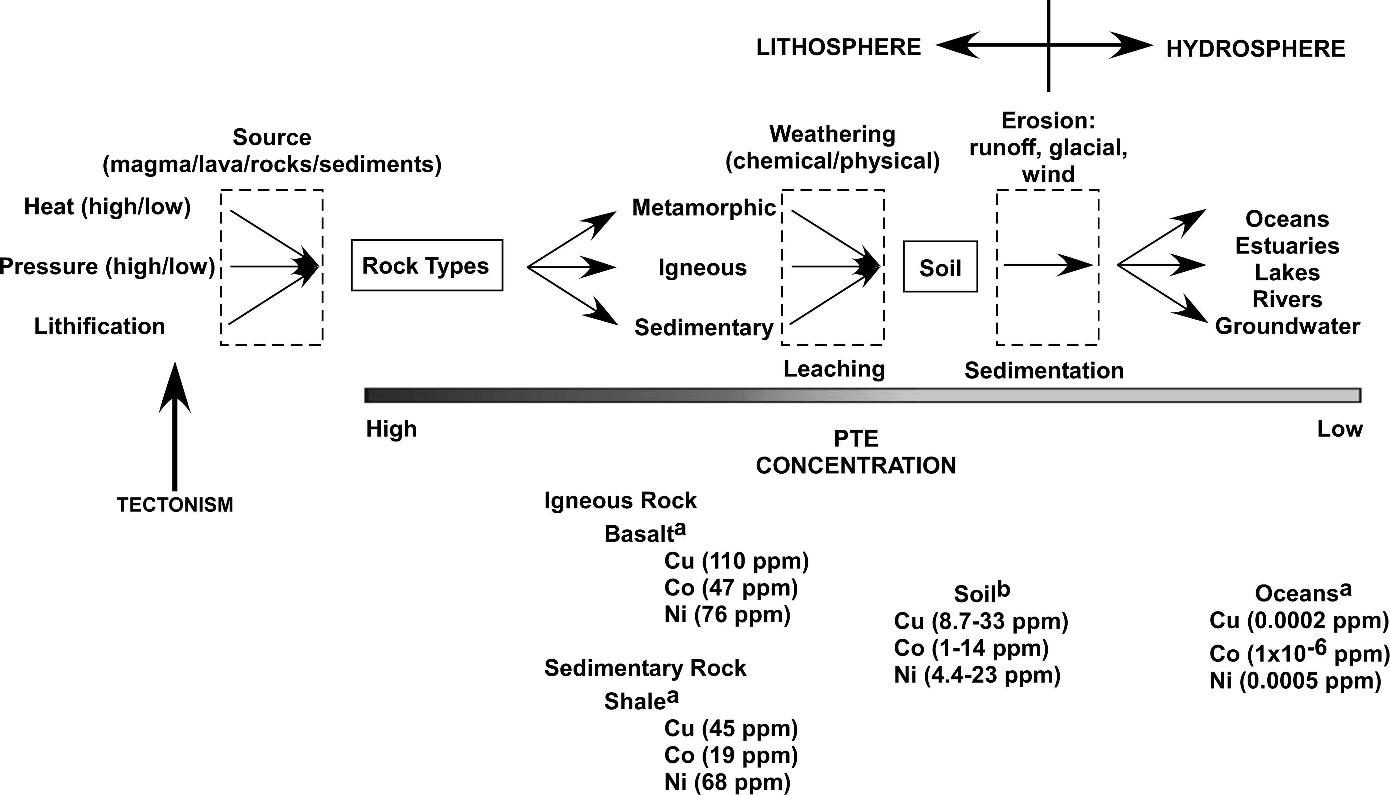
FIGURE 1.Simplifieddiagramofpotentiallytoxicelement(PTE)reservoirsandchangesinconcentrationsfromrocksintowaterbodies.Adapted from aKrauskopfandBird(1995)and bSiegel(2002).
AnimportantmechanismforaquatictransportofPTEs iscomplexedwithclaymineralsandorganicmatter,both dissolvedandparticulate.AsnotedinTable1,PTEstend tobefarmoreconcentratedinshalesthaninnaturalwater bodies,inlargepartbecausePTEstendtohavelow solubilitiesinoxygenatedwatersandmorecommonlyare associatedwithclaymineralsandorganicmatterthatmake upestuarinesedimentsandthatmightlithifyasshale.An increaseovernaturalbackgroundconcentrationsofPTEs ineithersedimentsorwaterbodiesiscommonlyassociated withanthropogenicsourcesandactivitiessuchasagriculture,mining,andurbanorindustrialwastes(Table2). SedimentdepositionisthemajorsinkforPTEsentering aquaticecosystem,butsedimentsalsocanbeasource, dependinguponchemicalcharacteristicsofthedepositional environmentandthepotentialforresuspension(Horowitz, 1991;Yuandothers,2001;Fig.2).
Thechemistryofawaterbody,includingporewaters, influencewhatPTEscanbeincorporatedintosedimentsby authigenicanddiageneticprocesses(e.g.,intoFe/Mn/Mg/ Aloxides,sulfides),adsorptiontoclayminerals,oreither adsorptiontoorabsorptionbyorganicmatter.Adsorption isrelatedtotheassociationofaniontoasurface(organic orinorganic)eitherby(1)chemicalattractions(covalentor ionicbonding)or(2)electrostaticattractioninvolving oppositechargesbetweenanionandasolidsurface (NationalResearchCouncil,2003).Thelatterpromotes displacementbyionsoflikecharge,hence,becoming exchangeable(NationalResearchCouncil,2003).Onthe otherhand,absorptionistheuptakeofaspeciesintothe volumeofanothermaterialandistheprimaryretention
mechanismforPTEsinorganicmatter,althoughadsorptionoccursaswell(NationalResearchCouncil,2003;Du Laingandothers,2009b).
Sedimenttexture,claymineralogy,kindsandquantities oforganicmatter,andpHinfluenceratesandprocessesof removalofPTEsfromcoastalwaters.Whenexposedtothe negativesurfacechargeofclays,lithophilicPTEadsorption willvarydependingontypeofclayanditsadsorption capacity:montmorillonite . vermiculite . illite . chlorite . kaolinite(Horowitz,1991;Table2).Becauseclaystend tocomplexandadsorbPTEs,especiallyunderoxidizing conditions(Luoma,1990),concentrationofPTEsin sedimentstendstobeinverselycorrelatedwithgrainsize (Green-Ruı´zandPaez-Osuna,2004).Sinceclaysare stronglyacidic,adsorptionoflithophilicPTEsgenerally increaseswithincreasingpH(FarrahandPickering,1979; Green-Ruı´z,2005).AbovecertainthresholdpHvalues, dependentonclaymineralogy,ionsofmostlithophilic PTEsareremovedfromsolution(FarrahandPickering, 1979;Zhangandothers,2002).Thus,clayscanactually sequesterPTEsastheyfallthroughthewatercolumnorlie insurficialsediments.
Conversely,lithophilicPTEsmaybemobilizedinacidic orreducingconditions.Pore-waterchemistryandsediment mineralogybothplayimportantrolesinPTEmobilization (Daviesandothers,2005;DuLaingandothers,2009a; Table3).Aerobictodysaerobicbreakdownoforganic matter,whichdecreasesaquaticpH,caninduceremobilizationofsomelithophilicPTEs.Forexample,Znremains adsorbedintoclaysandoxidesatpHgreaterthan6but becomesmobileinlowerpHconditions(Siegel,2002).In
Anthropogenica
TABLE 2.SourcesofanthropogenicandnaturalPTE’s.
AsCdCoCrCuFeHgMnMoNiPbSbSeSnTiVZn
Alloysxxxxx——x—xxxx—x—x
Batteries——————xx—xx—x———x Biocides(agricultural,anti-fouling)x—————xx—————x——— Coatings(anti-corrosives)—x—x————x—x——x——x Pharmaceuticals,Dentalxx—xx—x—x—xxxx——x Fertilizersxx—xx—xx—xx—————x FossilFuelCombustionxx————x———xxx———— Mining,Smelting,Metallurgyxx—xx—xx—xxxx—xxx NuclearReactor—x——————————————— Paintsxxxxx——x—xxxx—x—x PetroleumRefiningx—xxx————xx————xx Plastics—x————————x—————x PulpandPaper———xx—x——xx—————— Semi/Super-Conductorsx——————————x—xx—— Pipes,Sheets————xx————x—————— ElectricalEquipment————x—x————x————— Natural HydrothermalProcessesx———xx—x—x——————— Chromite—FeCr2O4 ———x—x——————————— Pyrite—FeS2‘ x—x——x—x—x——————x Cinnabar—HgS——————x—————————— Azurite—Cu3(OH)2(CO3)2 ————x———————————— Pyroxene—(Mg,Fe)SiO3 —————x——————————— Montmorillonites*——xxxx—x—xx———xxx Illites*—————x—x——————x—— MnOxides*——x——x———xx—————x a Siegel(2002). ‘ BierensdeHaan(1991). *PTE’scommonlyfoundadsorbed(Siegel,2002).
addition,suchPTEsinsedimentscanenterthefoodweb wheningestedbydetritusfeederswhoseacidicdigestive fluidscanmobilizethoseions(Siegel,2002).
PTEconcentrationsinsedimentsandsedimentpore waterscanvarydramaticallyinaverticalprofile.For example,Caplatandothers(2005)reportedthatFe,Mn, Cu,andZnconcentrationsvariedverticallyasafunctionof decompositionoforganicmatterandreductionofoxide phases.AdsorptionofPTEsintoclaymineralsorFe/Mn oxides,hydroxides,oroxyhydroxidescanremovesuch elementsfromtheaqueousphase,therebyreducingtheir accessthroughmetabolicprocessesintoorganisms.However,adsorbedPTEsmightbereleasedintosolution, becomingbioavailableifdepositedinorganic-richenvironmentswheresulfate-reducingbacteriaareactivelyproducingsulfides(Santosandothers,2005),unlessthePTEsare chalcophilesthatprecipitateinorganically(e.g.,CdSand FeS).
REDOX POTENTIALAND PTES
Redoxreactions(Eh)alsoinfluencetheincorporationor releaseofPTEsfrommarinesediments.Ofparticular interestasEhchangesarePTEinteractionswithsulfides (Riedelandothers,1997;Siegel,2002),aswellaswithFe/ Mnoxidesandhydroxides(Horowitz,1991).Moreover,Eh andpHinfluencesco-occur.ResponsestochangesinEh dependuponwhetherthePTEislithophilicorchalcophilic (Fig.3).Hydrogensulfideisproducedbysulfate-reducing bacteriaunderanoxicconditionswhenorganicmatteris present.Althoughmostcommonlyre-oxidized,someH2S
reactstoformmetalsulfides(i.e.,pyrite;MorseandLuther, 1999;DuLiangandothers,2009).Sulfideionsbindwith divalentstatesofdissolvedPTEs(i.e.,CdS,FeS,CuS), therebydetoxifyingthem(DiToroandothers,1992). Sulfidesformedinanoxicenvironmentsarerelatively insolublecompoundsthatoftencontainseveralPTEs (LanderandReuther,2004).However,ifinterstitialwaters becomeevenmorereducingandacidic,solubilityofsome PTEswillthenincrease(Fig.3).
OftenmoreproblematicisthebehaviorofPTEsthatare releasedfromsulfideminerals(sphalerite,pyrite,and chalcopyrite)whenexposedtooxidizingconditions.Commonlysulfidesaredividedintothreemaincategories:acid volatilesulfides(AVS;i.e.,FeS),ironpyrite(FeS2),whichis morestable,andorganicsulfides(DiToroandothers, 1992).ThereleasedPTEsmayeitheradsorbontoFe/Mn hydroxides,clayminerals,ororganicmatter(e.g.,Hansen andothers,1996;Siegel,2002)orbecomebioavailable.For example,MorseandLuther(1999)determinedthat,in anoxicconditions,metalconcentrationsinpyriteminerals decrease(Cd , Pb , Zn , Mn , Ni , Co)accordingto theirincreasingwater-exchangereactions(Pb Cd . Zn . Mn . Co . Ni).Theyfoundthatmetalions(Pb,Zn,and Cd)withwater-exchangereactionsfasterthanthatofFe+2 willprecipitateasmetalsulfidesbeforeironmonosulfides (FeS)andpyrite(FeS2),althoughsmallamountsofthese metalionsalsowillprecipitatedirectlyintopyrite.In addition,releasedPTEslikeCdcancompeteanddisplace Fefromless-stableFeS(AVS)(DiToro,andothers,1992). ThisscenarioiscontrolledinpartbyAVSconcentration (Hansenandothers,1996),inwhichminimalFeSoxidation
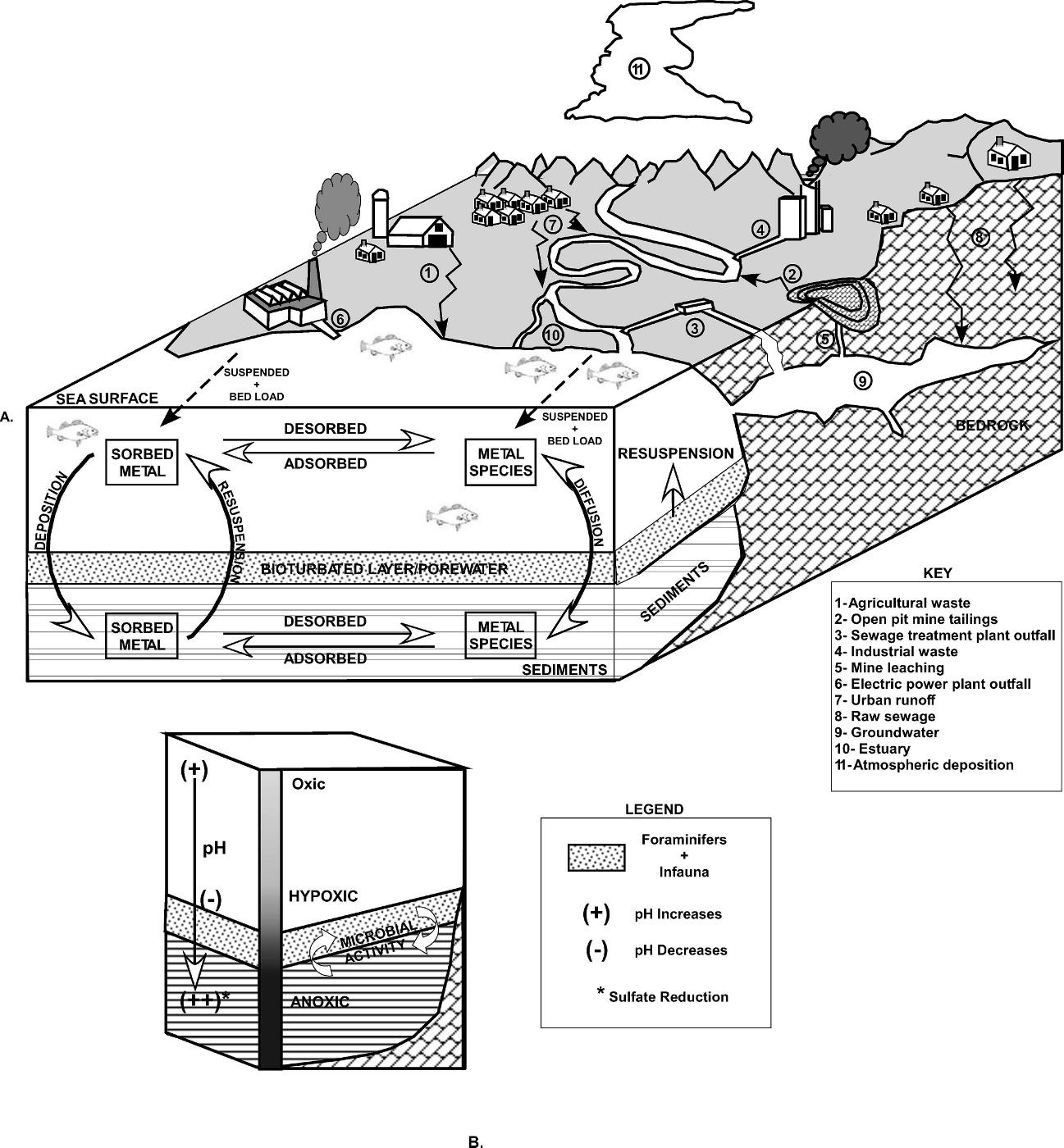
FIGURE 2.AnthropogenicsourcesofPTEsandgeochemicalcyclesinshallowcoastalwaters. A PTEtransportinaquaticenvironments(modified fromSchnoor,1996). B IdealizedPTEandpHvariabilityineutrophicconditions.Shadedbarrepresentsenvironmentalgradient:oxic(lightgray), hypoxic(shadedgray),andanoxic(black).
willincreasethecompetitionandeventualformationof CdS(themineralgreenockite).
Arsenic(As)isanotherPTEwhosebehaviorandtoxicity isquitecomplicatedbecauseitcanoccurinseveralvalence states.Arsenate(As+5)canbeincorporatedintoiron oxyhydroxidesinoxidizingaquaticenvironments,becomingimmobilized(DeVitreandothers,1991;Siegel,2002; SmedleyandKinniburgh,2005).Arsenite(As+3)ismuch moresolubleandtoxicthanarsenateandcanbemobilized inreducingenvironments.However,undersulfidicconditions,arsenitewillbeincorporatedintosulfidemineralsand therebyimmobilized(MorseandLuther,1999).The greatestenvironmentalconcerniswhereAsconcentrations areelevatedandwaterchemistriesaretransitionalbetween oxidizingandanoxic.Forexample,biotalivingina naturallyAs-richenvironmentcouldbeunaffectedbyhigh concentrationsofAs+5 incorporatedinironhydroxidesin well-oxygenatedsurficialsedimentsandAs+3 insubsurface sulfides(Pichlerandothers,1999a,1999b).Themost bioavailableAs+3 likelywouldbeatthehypoxicinterface.
TABLE 3.Mobilityofselectedelements,includingPTEs(*)asinfluencedbyredoxpotentialandpHoftheaquaticmedium.ModifiedfromDavies andothers(2005).
Oxidizing(ph5-8)Oxidizing(ph ,4)Reducing RelativeMobility
HighMobilityCl,*Br,S,C,N,*MoCl,*Br,*S,C,N,BCl,*Br
ModerateMobilityCa,Na,Mg,*Zn,*As,*Sr,*HgCa,Na,Mg,*Sr,*Zn,*Cd,*Hg, *Cu,*Co,*Ni,*As,Mn,P Ca,Na,Mg,*Sr,Ba,Mn
SlightMobilityK,Rb,Mn,P,*Pb,*Cu,*Ni,*Co,*CdK,RbK,Rb,P,Fe ImmobileAl,*Cr,*CsAl,*As,*MoFe,Al,*Cu,*Pb,*Zn,*Cd,*Hg, *Ni,*Co,*As,*Mo,*Cr
IntheirstudyofaeutrophicfjordinNorway,Abdullahand others(1995)foundbioavailableAs+3 variedsubstantially amongbasinsofvaryingredoxconditionsinresponseto releasefromsulfidesfollowedbyslowremovalby oxidation.
SALINITY,IONIC STRENGTH, AND PTES
Salinitychangesinestuariesalsoinfluencethepartitioningofcontaminantsbetweensedimentsandinterstitial waters.Theinfluenceofsalinityisreflectedbyratesof desorptionduetocomplexationwithseawateranions(Cl andSO4 2)orsorptionwithcations(Na+,K+,Ca+2,Mg+2), aswellascoagulation-precipitation-flocculationofclay minerals(Ribaandothers,2003;WangandLiu,2003).The flocculationofclaymineralsishighlyinfluencedbysalinity, providinganimportantmechanismforremovalofPTEs fromestuarinewaters.Increasingsalinityistypically associatedwithincreasingpHandthereforeincreasing potentialforadsorptionofsusceptiblePTEsbyclay minerals,asnotedabove.Astheclaymineralsflocculate, theirsettlingratesincrease,asdoratesofremovalof adsorbedPTEs.
Ionicstrengthisintimatelyrelatedtosalinity.For example,astheconcentrationofmonatomicions(i.e., Na+ andK+)increases,theionicstrengthofseawateralso increases.Asionicstrengthincreases,adsorptioncapacities
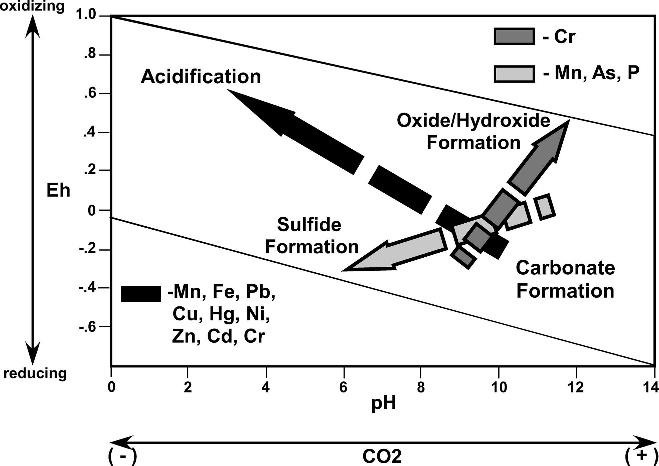
FIGURE 3.pH-Ehdiagramofsomeheavymetalsshowingtheir increasingtrendsinmobility(modifiedandcompiledfrom Siegel,2002).
onorganismsandsedimentcomponents(clayminerals, organiccarbon,carbonates,FeandMnoxidesand hydroxides)arereducedand,hence,thereislessmetal uptake(DuLaingandothers,2008;DuLaingandothers, 2009).ThisisbecauseNa+,K+,Ca+2,andMg+2 willcompete withPTEsforsorptionsitesand,inaddition,somePTEs areimmobilizedaschloridecomplexes(i.e.,CdCl2)(Du Laingandothers,2008).Moutaandothers(2008)noticed thatPTEslikeCu+2 competewithCa+2 foradsorptionsites onsoilparticlesinahighionic-strengthmedium.Similarly, Green-Ruı´z(2009)noticedadecreaseintheadsorption capacityofHg+2 onmontmorillonitewithanincreasein Na+ intheaqueousmedium.
BioavailabilityofPTEscanvarywidelywithinan estuary.ThePTE-ionconcentrationsinestuarinesediments arecommonlyhigherinbrackishareaswherethereis freshwaterinput(Ribaandothers,2003).Kraepieland others(1997)foundaninverserelationshipbetweenthe activityofametalandsalinityinestuariesthatisrelatedto theconservativetosemi-conservativenatureofPTEions. Forexample,theinorganicspeciationofthesemi-conservativetonon-conservativeCu+2 iondoesnotvaryinsaline waterduetoitsweakaffinitytoCl orSO42 (Kraepieland others,1997;Fritioffandothers,2005).Mostcommonly, Cu+2 formsstrongcarbonatecomplexesthatcanremainat equilibriumifpHisrelativelyconstant(Kraepieland others,1997).Incontrast,NiandZn,whicharerelatively conservativeelementsinestuaries,formstrongcomplexes withCl andSO42 ;hence,theirdissolvedconcentrations areexpectedtopeakatpredictablemid-salinities(Kraepiel andothers,1997;Fritioffandothers,2005).Thisstrong affinityresultsindesorptionofNiandZnfromthe particulatefractionandtheircomplexationbyCl as salinityincreases(Kraepielandothers,1997;Ribaand others,2003).
Anapparentcontradictionemergesfromtheobservationsnotedaboveinrelationtotheeffectsofsalinityon PTEbehavior.Thesolutiontotheparadoxisthatboth processes,thatis,flocculationofclayminerals,whichbinds somePTEions,anddesorptionofPTEsthatcomplexwith Cl assalinityincreases,occurinestuarineecosystemsand mustbetakenintoaccountwhenconsideringthepotential behaviorofPTEs.Areasoffreshwaterinputareenrichedin PTEconcentrationwhereflocculationdominates.When sedimentsaretransportedseaward,adsorptioncapacities arereducedanddesorptionprocessescandominate.
PTEASSESSMENT METHODS
Potentiallytoxicelementscanbemeasuredinsediments orwatersamples.Analysesperformedonsedimentscan utilizebulksamplesormudfractions.Becausetheaffinity betweenclaysandPTEsisverystrong,bulksediment analysesgenerallyunderestimateconcentrationsofPTEsas aconsequenceofthecomplexarrayofgrainsizesand compositionsbeinghomogenizedpriortoanalysis.This dilutioneffectcanbeavoidedifonlythefinefractionis studied.Themudfractioncanbeextractedbywetordry sievingusingnon-adsorptivenetmeshesanddeionized watertominimizecontaminationandloss.Thus,researchersmustclearlyreportsedimentgrain-sizedistributionsand whetherbulkorfinefractionswereanalyzedtoreadily enablecomparisonwithdatafromotherstudies.
Anotherapproachistodeterminethe‘‘speciation’’of PTEsinsedimentandwatersamples.Sequentialextraction procedures,usingselectiveleachingmethods,haveshown thatsedimentsarecomposedofseveralfractions:residual (e.g.,lithicminerals),acid-soluble(e.g.,carbonates), reducible(e.g.,Fe/Mnoxides),oxidizable(e.g.,organic matter),andexchangeable(e.g.,clayminerals)(Tessierand others,1979;Perez-Cidandothers,1998).Thistechnique attemptstodifferentiatebetweenformsofPTEandparticle phases(NationalResearchCouncil,2003).Concentrations canvaryinfractionsotherthanthecarbonateandresidual, dependingontheenvironmentalconditionsfromwhicha sampleoriginated.Unfortunately,bioavailabilitycannotbe determinedforeachfractionbecauseofthestrongreactants usedtoextractPTEs.
Analyzingwatersamples(includingporewaters)isas complexasdealingwithsediments.Samplescanbefiltered orleftunfiltered.Theadvantageoffilteringisthatdissolved PTEsgenerallyrepresentthemostreadilybioavailable portion.Samplesmustnotbeacidifiedpriortofiltration becauseacidificationreleasesPTEsintosolution.Filtrate canbeanalyzedbysequentialextractionorbioavailability techniques,oras‘‘bulk’’sedimentormud,dependingon whattypeoffilterisused.Apossibledisadvantageof filteringisthatlargevolumesofwaterareneededtoacquire asufficientamountoffiltratetoanalyze.TheNational ResearchCouncil(2003)providesadetailedexplanationof techniquesandapproaches.
Determiningtheconditionsandconcentrationsunder whichaPTEisdetrimentaltotheenvironmentisessential todevelopingeffectivemanagementstrategies.Several indiceshavebeenproposedandappliedinenvironmental studies.Thosethathavebeenutilizedinforaminiferal studiesarediscussedbelow.
TheEnrichmentFactorIndex(EF)isaratiothatrelates concentrationofaPTEinsedimentsrelativetoits concentrationinthesurroundingregionofthestudyarea (Green-Ruı´zandothers,2005).Valuescalculatedrepresent therelativeconcentrationofthePTEabovebackground level(Green-Ruı´zandothers,2005).ValuesrangefromEF ,1(noenrichment)toEF .50(extremeenrichment) (Acevedo-Figueroa,2006):
EF ~ Mi½ = Ei½ sample ðÞ Mr½ = Er½ background ðÞ ð1Þ
whereMi andMr arethePTEconcentrations,andEi andEr arethenormalizingPTEconcentrations,inthesediment andintheEarth’scrust,respectively.
Thelog-basedGeo-accumulationIndex(GI)takesinto accountanypossiblevariationsinbackgroundvalues obtainedfromtheclayfractionbasedonlithological differences.Indexvaluesranging0–6reflectthedegreeof contamination(Arraes-MoreiraandBoaventura,2003).A valueof6isequivalenttocontaminationlevels100times greaterthanbackgroundvalues.
~ log2 Mi½ sample ðÞ 1:5Mr ½ background ðÞ ð2Þ
whereMi isthePTEconcentrationinthesedimentandMr istheconcentrationintheEarth’scrust.The1.5isa constantusedtominimizebackgroundvariations
Tobetterrelatetheseindexvaluestobackground concentrationsandtodeterminenaturaloranthropogenic toxicity,theycanbenormalizedtoAl,Li,Fe,orgrainsize usingregressionanalysis.Aluminumisusedwidelybecause itisanessentialcomponentofthealumino-silicatemineral group.Inaddition,itisthemostabundantnaturally occurringPTE,itishighlyrefractory,anditsbackground concentrationstypicallyarenotinfluencedbyanthropogenicinputs(SchroppandWindom,1988),exceptunder unusualcircumstancessuchasbauxitemining(Taylorand others,2007).Whenworkingwithglaciallyderived sediments,Liiscommonlyused(Loring1990).Normalizing toFecanbeusefulbecausebackgroundconcentrations tendtobeuniformandFeprimarilyoccursinthefine sedimentfraction(Acevedo-Figueroaandothers,2006). Theaverageconcentrationofthereferenceelementisbased uponvaluesfromdifferentrocktypesinthewatershedor region.However,shalevaluescanbeconsideredasthe globalreferencestandardforunpollutedsediments(Leopoldandothers,2008).
Normalizingconcentrationstograinsizesseemslogical, butinpracticecanbeproblematic.Severalauthors(e.g.,De Groot,1964;Ackermann,1980;Villaescusa-Celayaand others,2000)recommendednormalizingtospecificgrainsizeranges(i.e., , 63 mm, , 20 mm, , 16 mm,or , 2 mm). However,Green-Ruı´z(2000)arguedagainstthisapproach becauseitreflectsneitherthetexturenorthemassofthe entiresample.Thisapproachtendstounderestimateindex values.
RegressionanalysisbetweenaspecificPTEanda normalizingelementhasbeenusedwidelywithprediction limitsof95% (two-standarddeviations).Thisapproachis highlydependentonthecorrelationcoefficientbetween naturallyoccurringconcentrationsofthePTEofinterest andthenormalizingelement(i.e.,Al)inreference environments(SchroppandWindom,1988).Strongcorrelationsprovidenarrowpredictionlimitswithlowthreshold valuesforconsideringwhetherasampleiscontaminated. Sedimentsareconsidered‘‘PTE-enriched’’ifindexvalues exceedthepredictedlimitsor‘‘natural’’iftheyfallwithin thoselimits(SchroppandWindom,1988).
Anotherstrategytoestimatetoxicityinmarineand estuarineenvironmentsistoconsiderestablishedsedimentqualityguidelines.LongandMorgan(1990)proposed
EffectRangeLowandMedium(ERLandERM)criteria for11PTEsandotherpollutantsbasedonsediment analysesandeffectsonspecificbiota(i.e.,amphipods, shrimp,andpolychaetes).Thesetwobenchmarksestablish threeconcentrationrangesforcertainPTEs.ConcentrationslowerthanERLindicatethateffectsofthatPTE likelywillnotbeobserved.ConcentrationsbetweenERL andERMrepresentarangeinwhicheffectsmightoccur. AtconcentrationsgreaterthanERM,thebiotaforwhich thecriteriawereestablishedarelikelytobeimpacted. Similarly,MacDonald(1994)postulatedThresholdEffects Level(TEL)andProbableEffectsLevel(PEL)basedonthe reviseddatasetusedbyLongandothers(1995).Forboth biologicalandgeochemicalreasons,thesebenchmark valuesmightnotbeapplicabletoeverymarineand estuarineenvironment.Therationaleissimple—thephysicochemicalparametersforwhichthevalueswereestablishedaredifferentineachenvironment,andthebiota couldbeverydissimilarandreactdifferentlytotheeffects ofpollutants.Nevertheless,effects-levelcriteriacanbeused asascreeningtoolinenvironmentalassessment.
BIOAVAILABILITYOF PTES
Theterm‘‘bioavailability’’hasbeenusedextensivelybut withvariabledefinitionsthatreflectthecomplexityofhow PTEsinfluencebiota.LanderandReuther(2004)posed severalmeaningsincluding(p.141)‘‘physico-chemical availabilityofmetalsintheexposuremedium’’and ‘‘toxicologicalbehaviorofmetalsinsidetheorganism body.’’Dependingoncontext,theNationalResearch Council(2003,p.21)definedbioavailabilityas‘‘afraction ofachemicalaccessibletoanorganismforabsorption,the rateatwhichasubstanceisabsorbedintoalivingsystem, orameasureofpotentialtocauseatoxiceffect.’’
Severalresearchteamshaveproposedmethodsto estimatetheconcentrationsofPTEsinsedimentsthatare bioavailable.Tessierandothers(1979),Loring(1981),and LuomaandBryan(1981)developedextractiontechniques todeterminefractionationofmetalsindifferentsediment grainsizes.Theirresultsshowedthatconcentrationsof metalsextractedwith1MHClcloselyresembledthose extractedbythedigestionprocessofcertainorganisms. TurnerandOlsen(2000)questionedtheuseofsuch extractantsandarguedthattheuseof1MHCloverestimatesthebioavailabilityofFebyafactorgreaterthan10. Theyalsonotedthatthereleaseofmetalsfromamorphous andcrystallineFe-oxidephases,usingHCl,isnot analogoustoreleaseunderdigestiveconditions.Nevertheless,intheabsenceofabetterextractant,1MHCliswidely usedasauniversalleachingchemicaltoestimatePTE bioavailabilityinsediments(Tessierandothers,1979; MorseandLuther,1999;NationalResearchCouncil, 2003;Green-Ruı´zandPa´ez-Osuna,2004).
Recognizingdifferencesinorganismsusceptibility,Rainbow(1995)tookadifferentapproachtothestudyof bioavailabilitybylookingfororganismsthatbioaccumulate PTEs.Rainbow(1995,p.183)definedtheterm‘‘metal biomonitor’’as‘‘aspecieswhichaccumulatesheavymetals initstissues,andmaythereforebeanalyzedasameasureof thebioavailabilityofthemetalsintheambienthabitat.’’He
assertedthatthistermislesssusceptibletomisinterpretationthantheothers(e.g.,bioindicator,biologicalmonitor). Ithaslimiteduse,however,becausethemetalbiomonitor musteitherbepresentintheenvironmentinquestionor introducedintotheenvironmentorsedimentfromthe environmentforbioassaypurposes.Furthermore,howa bioaccumulatedelementmightinfluenceotherspeciesinthe environmentrequiresfurtherassessment.
Substantialprogressindefiningandassessingbioavailabilityhasbeenmadeusingmacroorganisms(e.g.,Rainbow andWhite,1989;TurnerandOlson,2000)andexperimentalresearchonforaminifershasbecomeincreasingly common.Anexpandingfieldofresearchisinvestigating howasingle-celledforaminiferincorporatesPTEsintoits shellandhowthiscanbeusedasabioindicator(e.g., BreslerandYanko,2000;SamirandEl-Din,2001;Erez, 2003).Thistopicisdiscussedindetailinthesecondsection ofthisreview.
SUMMARYOF PTEBEHAVIORIN COASTAL ENVIRONMENTS
AssurfacewatersorgroundwatercarryingPTEsmix withmarinewatersinestuaries,naturalchangesoccurthat areinherentlyverycomplex.Assalinityrises,sodoesthe potentialforPTEcomplexationwithionsinseawater.And aspHrises,ratesofadsorptionbyclaymineralsincreaseas thoseclaysmineralsflocculateandsettletotheseafloor. Moreover,naturalfreshwaterrunoffalsodeliversnutrients thatstimulatebiologicalproductivity.Theamountof productivitydeterminesthefluxoforganicmattertothe substratumandthereforetheredoxpotentialofthebottom sediments,whichinfluencesPTEbehavior.Asbiotic activityaerobicallybreaksdownorganiccarbon,pH declinesandlithophilicPTEsmobilize.Whenoxygen becomeslimiting,sulfate-reducingbacteriaactivelyproduce H2S.Iftheenvironmentisonlyintermittentlyanoxic,most oftheH2Swillbeoxidized,furtheracidifyingtheimmediate microenvironment.However,theproductionofCO2 during respirationandthedissolutionofcalciumcarbonatein responsetodecliningpHresultsinhighinterstitial alkalinity,whichcaninduceprecipitationofCaCO3 inthe presenceofexcessCa+2.Inmorecalciumlimitedenvironments,suchasestuarieswithpredominantlysiliciclastic sedimentation,precipitationofsulfidesismorelikely, whichremoveschalcophilicPTEs(ScholzandNeumann, 2007).
Theoxic,hypoxic,andanoxiczonesofmicrobialactivity withinthesediments,andtheirinfluencesonPTEremoval ormobilization,areremarkablycomplexeveninpristine systems.Interestingly,PTEstendtobemostmobileinthe hypoxiczone.Theclaysandferricoxidesinoxygenated sedimentsimmobilizelithophilicPTEs.Inanoxicenvironments,thereducedPTEsaresequesteredinsulfides.Any processesthatincreasebothorganicmatterandmixing havethepotentialtoincreasebioavailabilityofPTEs.Thus, sediment-dwellingorganismsplaymultipleroles,including respiringCO 2 ,mixingoxygenatedseawaterintothe sediments,andingestingsediments;allprocessesthat potentiallymobilizePTEs.
Anthropogenicactivitiestendtoincreasevariabilityand complexityofPTEbehaviorinamultitudeofways.
Anthropogenicactivitiesthatchangethenaturalflowof freshwateraccentuatetheseasonalhighsandlowsofinflux toestuaries,resultinginwidersalinityfluctuations. Nutrientandorganicinputareinproportiontothehuman populationofthewatershed(e.g.,Walsh,1984;Vitousek andothers,1997).Asaresult,biologicalproductivity increasesinthesurfacewatersandmoreorganicmatter settlesonthesubstrate,increasingthepotentialforboth hypoxicandanoxiczoneswithinanestuary.Storms, boatingactivities,dredging,andanyothernaturalor anthropogenicactivitiesthatdisturbsedimentscanmix mobilePTEsfromhypoxicporewatersintothewater column,wherethePTEshavegreaterpotentialtoimpact thelocalbiota.Moreover,ifthoseactivitiesmixanoxic sedimentsintooxygenatedenvironments,sulfidesinthose sedimentscanoxidizeandtherebyincreasethebioavailabilityofPTEs.
Thus,monitoringandassessmentoftheriskstocoastal ecosystemsassociatedwithPTEcontaminationarehighly complexproblemsthatrequireinterdisciplinaryteamswith expertiseinbiologyandecologyofestuarineandneritic biotas,biochemistry,geochemistry,andhydrodynamic modeling,WiththiscontextualbackgroundonPTE behavior,toxicity,andmeasurement,wenowexaminethe potentialforusingforaminifersinmonitoringandrisk assessmentofcoastalecosystems.
FORAMINIFERA
ThecharacteristictraitsoftheClassForaminifera enhancetheirpotentialforexposuretoPTEs(i.e.,the extensivesurfaceareaoftheirthread-likegranuloreticulopodia)andtheirpotentialtoprovidearecordofsuch exposure(i.e.,theirprotectivetestorshell).Foraminifers arefoundinvirtuallyallmarineecosystemsthatsupport eukaryoticlife(e.g.,Goldstein,1999).Moreover,afew speciesareamazinglyresilienttoenvironmentalstressesand areoftenamongthelastorganismsfoundlivinginpolluted sites(Schafer,2000).
Awiderangeofenvironmentalfactorsinfluencewhere foraminiferscanliveandwheretheirshellscanaccumu-
late.Theseinfluencesincludetemperature,pH,water motion,salinity,dissolvedoxygen(DO),turbidity,light intensity,foodsupply,substratumtypeincludingsediment texture,bioticinteractions,andtaphonomicprocesses. However,asubstantialnumberofstudieshaveshownthat, givensuitablephysicalandchemicalparameters,food supplyisthepredominantfactorcontrollingbenthic foraminiferalpopulationsandassemblages(Jorissen 1999;Murray2001).
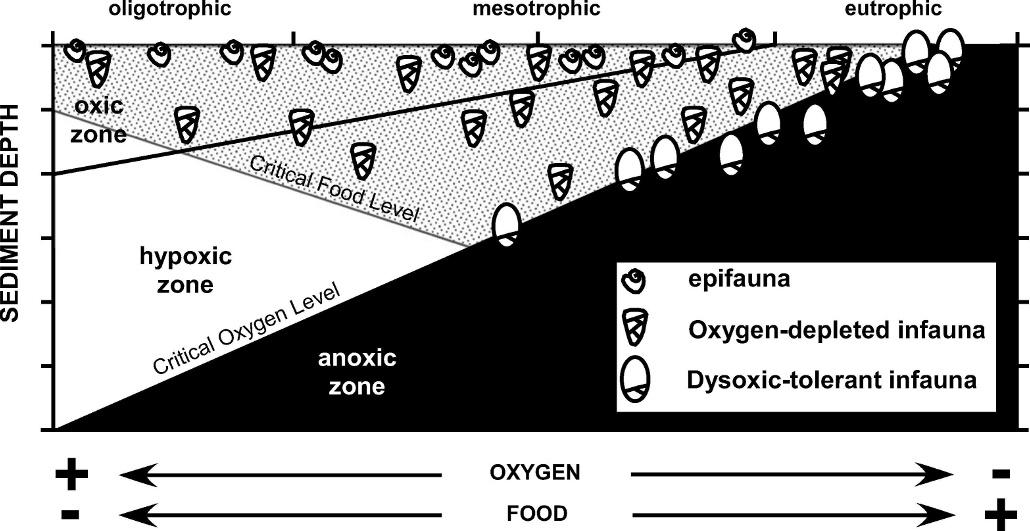
Foodsupply,bothqualityandquantity,notonly providestheenergyandrawmaterialsforpopulation growth,butalsoinfluenceschemicalparameterssuchas DO,pH,alkalinity,andsulfidecontentatthesedimentwaterinterfaceandwithinthesedimentsandporewaters. Jorissen(1999)developedaconceptualmodelofthe distributionofbenthicforaminifersinoligotrophic,mesotrophic,andeutrophicsettingsbasedonfoodsupplyatthe sediment-waterinterface(Fig.4).Heindicatedthat(1)in eutrophicsettings,excessfoodreducesDO,resultingin anoxicandsulfidicporewatersthatlimitinterstitialhabitat depthandmodulateabundance;(2)inoligotrophicsettings, abundanceanddepthdistributionsarelimitedbyfood supply,and(3)inmesotrophicenvironments,organic matterpenetratesdeeperintosedimentsthaninoligotrophicsettings,andoxygenextendsdeeperthanineutrophic settings.Thisexpandsthegradientsinfoodsupply,pHand Ehthatsupportdiverseandabundantepifaunaand infauna,bothshallowanddeep.
Moreover,ifPTEsarepresentinthesediments, mesotrophicconditionscanincreasetheirbioavailability whilealsoincreasingpotentialforexposurebyincreasing theinterstitialdepthrangeinwhichtheforaminiferscan live.Asnotedpreviously,changesinpHandEhinfluence themobilityandbioavailabilityofPTEswithinthe sediments.Forexample,experimentsbyRiedelandothers (1997)determinedthatthedirectionandmagnitudeofMn, As,andCufluxesfromsedimentsarelargelygovernedby oxic–anoxicgradientsinestuarineenvironments.Thus, infaunaltaxainmesotrophictoeutrophicenvironmentsare mostlikelytoencounterbioavailablePTEs.
FORAMINIFERSIN ENVIRONMENTAL ASSESSMENT
Foraminifershavebeenusedinpollutionstudiesin coastalenvironmentsforthepast50years.Therangeof anthropogenicpollutionsourcesexaminedincludesewage outfalls,organicwastes,thermaleffluent,pesticides,oil, agriculture,aquaculture,acidminedrainage,andharbor activities(e.g.,Resig,1960;Seiglie,1968;Yankoandothers, 1994;Alve,1995;SenGuptaandothers,1996;Alveand Olsgard,1999;Yankoandothers,1999;Elberlingand others,2003;Haywardandothers,2004;Tsujimotoand others,2006).Benthicforaminifershaveprovenusefulin assessmentandmonitoringofcoastalandshelfenvironmentsbecauseoftheirtaxonomicdiversity,widedistribution,abundance,relativelysmallsizeandshortreproductivecycles,andbecausetheirshellsareoftenwellpreserved insediments(Yankoandothers,1999).Foraminiferal specieshavespecificecologicalnichesandpopulations reactquicklytoenvironmentalchanges(Hallockand others,2003;Wardandothers,2003).Spatialandtemporal distributionsofbenthicforaminifersvaryinresponseto bothbioticandabioticenvironmentalparameters(Schafer, 2000;ArmynotduChateletandothers,2004).
Nevertheless,numerousresearchershaverecommended cautionwhenusingbenthicforaminifersasproxiesfor environmentalcontaminationbecausethelivingprotistsare respondingtomultipleenvironmentalparameters.Moreover,taphonomicprocessesaltertherecordoftheliving assemblagethatispreservedwithinthesediments.Asnoted intheprevioussection,coastalenvironments,especially estuaries,arecomplexsystemswithmanyparameters simultaneouslyvarying,evenintheabsenceofpollution (Debenayandothers,2000;Murray,2001).Thus,interpretingresponsesofforaminiferstoPTEpollutioninestuaries canbeverychallenging(Alve,1995;Geslinandothers,2000; LeCadreandothers,2003;LeCadreandDebenay,2006). Thesechallengesdonotprecludetheuseofforaminifersin estuaries,butrathernecessitatecarefulformulationof questionsandrecognitionofthepossibilityforinteractions andco-varyingparameters.Moreover,justbecausean organismcanreactinaparticularwaytonaturalvariation doesnotinvalidatethatresponseasanindicatorof anthropogenicstress.Rather,understandinghowapopulationorassemblagerespondsnaturallytoenvironmental stressesprovidesinsightintounderstandingresponseswhen anthropogenicstressesareadded.Thisiswhysampling designshouldincludegradientsandreferencesites,which allowsfornaturalresponsestobecharacterizedand distinguishedfromresponsestoanthropogenicpollutants.
Oneoftheimportantchallengesininterpretingresponses offoraminifersorotherorganismstoPTEpollutionin estuariesishowtomeasurePTEconcentrations.Amajor goalofthefirstsectionwastopresenttherangeof considerations,includingwhethertomeasureporewaters, bulksediments,ormudfractions,andhowtodetermine bioavailability,thresholdsforresponse,andenrichment factors.
ForaminiferalAssemblages
Moststudiesthataddresstheeffectsofpollutionusing foraminifersdosobyexaminingassemblagesofforamin-
ifersinsediments.Presenceorabsenceofkeytaxa,aswell astheirabundanceanddistribution,oftencanbestatisticallylinkedtocontaminantsources.Responsesofforaminiferalassemblagestocontaminantgradientshavebeen describedbymanyauthors(e.g.,Schafer,2000;Samirand El-Din,2001;ArmynotduChateletandothers,2004; Tsujimotoandothers,2006).Suchresponsescanbe representedbydrasticassemblagechanges(Elberlingand others,2003),stepwisefaunalchanges(Haywardand others,2004,2006),orfluctuationsinfaunalassemblages andspeciesabundance(Alve,2000).Characterizationof backgroundconditions,especiallyfoodsupply,isessential tointerpretingresponsestocontaminants.Likewise, thresholdsforinfluence,thoughpoorlyknown,are importanttoconsider.
Ingeneral,anincreaseinpollutantsfirstleadsto decliningspeciesdiversityasthemoresensitivespeciesdie offandmoretoleranttaxaareabletoexploitfoodand spaceresources.Forexample,Yankoandothers(1999) notedthatPTEconcentrationsinsedimentstendedtobe negativelycorrelatedwithforaminiferalabundanceand diversity,andpositivelycorrelatedwithincidencesof deformedtests.Ultimately,evenstress-toleranttaxawill declineindensitiesasthestressintensifies.
However,whenpollutantsincludenutrientsororganic matter(e.g.,fromsewageoragriculturalrunoff),thereis moretypicallyanenrichmenthaloatthemarginof influence.Alve(1995)developedamodeldescribingthe transitionfromoligotrophictoeutrophicconditionsfor foraminiferalassemblagesbasedonorganicpollution. Undernaturalconditions,foodisoftenlimiting,sosome increaseinfoodsupplyactuallyincreasesbothdiversityand abundance.Jorrisen’s(1999)modelexplainshowtheinitial increaseinfoodsupplyincreasesabundanceanddiversity byincreasingnotonlyfoodsupplybutinhabitablerangeof depthwithinthesubstrate.Resig(1960),Seiglie(1971), Mohtahidandothers(2008),andmanyothersreported decreasingspeciesdiversitywithdistancefromsewage outfallsanddisposalsites,suggestingthattrophicresources limitdiversityinnaturalenvironments.However,asapoint sourceisapproached,foodsupplyincreasesandoxygen concentrationsbecomemorevariable,andopportunistic speciesbloomwhilediversitytypicallydeclines(Alve,1995). Ultimately,eventhemoststress-toleranttaxawilldeclinein abundancewhenoxygenbecomeslimiting.Alve’s(1995) modelpredictsafaunalturnover,witha‘‘deadzone’’ devoidofeukaryotesincloseproximitytoapointsource thatischaracterizedbyanoxicporewatersatthesediment surface(MurrayandAlve,2002).
Recognizingthecriticalrolethatfoodsupplyplaysin controllingforaminiferalassemblagesprovidesinsightinto studiesthatreportlittleornodiscernibleresponseto inorganicpollutionsources.Moreover,salinityandpH changesoftenfurthercomplicateinterpretations.For example,intheirmulti-proxystudyonintertidalestuaries inNewZealand,Haywardandothers(2004,2006)found thatstepwiseshiftsindominancefromcalcareousto agglutinatedformswereassociatedwiththearrivaland establishmentofhumans.Differencesinfreshwaterinput andpHwerepredominantfactors.Theyfoundatwo-fold differenceinPTEconcentrations(mudfraction)between
studiedestuarieshadlittletonoeffectontheforaminiferal faunas,whichmightindicatethatbioavailabilitieswere belowthresholdsforresponse.
Intensebiologicalactivityresultingfromsewagepollutioncanleadtohypoxia,whichwilllowerforaminiferal diversityandabundancenearthesource.Othernatural chemicalstressors,suchashypo-andhypersalinity,andpH extremes,alsocanbeamplifiedbyhumanactivities.Thus, ifconcentrationsofPTEsorothercontaminantsare minimallybioavailableorarebeloworneartheirthresholds ofinfluence,assemblageresponsestonaturalenvironmentalvariability,ortoanthropogenicallyrelatedchangesin foodsupplyorfreshwaterinflux,willdominate.Evenin extremecases,suchastheresponsetosulfidicminetailings reportedbyElberlingandothers(2003),determiningthe lethalmechanismcanbeevasive.Inthatstudy,itwasnot readilyapparentwhethertheazoiczonewastheconsequenceofPTEtoxicityorlowpH.
Becausethecombinationoffreshwaterinput,organic matter,andintermittenthypoxiacomplicatestressresponsesandinfluencebioavailabilityofPTEs,itisnotsurprising thatseveralofthestudiesthatmoststronglyimplicatePTEs inimpactingforaminiferalassemblageswereinwarmer coastalwaterswithnear-normalmarinetoslightlyhypersalineconditions.Examplesofsuchstudiesincludethoseby Seiglie(1971)inPuertoRico,Yankoandothers(1999)and SamirandElDin(2001)intheeasternMediterranean,and Carnahanandothers(2008)insouthernFlorida.
Foraminiferalassemblagesclearlyrespondtoenvironmentalchanges,thoughtodatequantitativerelationships arenotwellestablished.Therefore,interpretingthecauses ofthosechangescanbechallengingforresearchersand resourcemanagers.Anthropogenicpollutiontypically involvesmorethanonepotentialstressor.Nevertheless, manystudieshaveestablishedthatmostforaminiferaltaxa tendtobesensitivetoenvironmentalstressandonlyafew taxatendtoberelativelystress-tolerant.Thus,changesin assemblagescanbeusefullow-costbioindicatorsof environmentalchange,eventhoughchemicalanalysesare requiredtodetermineexactlywhatstressorsarepresent.
ControversiesinAssemblageAssessments
Whendesigningastudytoassessforaminiferalassemblages,whatshouldbesampled?Therehavebeenstudies focusedonlyonlivingpopulationsorassemblages(e.g., Hallockandothers,1995;Buzasandothers,2002),studies thatdistinguish,tabulate,andcomparedatabetweenlive specimensanddeadshells(e.g.,Alve,2000),andstudies thatreportonlytotalassemblageswithoutdifferentiating theirliveanddeadcomponents(e.g.,Carnahanandothers, 2008).InthepaperbyAlve(2000),shereportedthatliving foraminiferswerenotabundantinhersamplesandthat deadassemblagestypicallyexhibitedmuchhigherdiversities.Thiskindofsituationforcestheissueofwhethertotal assemblagesprovideusefulinformation.
Unfortunately,theissueofwhattosampleisnotasimple one.Distinguishinglivespecimensisnottrivial(Bernhard, 2000).Avarietyofstainshavebeenutilized,especiallyrose Bengal(Walton,1952)andSudanblackB(Walkerand others,1974).Hallockandcolleagues(Hallockandothers,
1986;Williamsandothers1997;Hallockandothers,2006) utilizedsymbiontcolorandreticulopodialactivityinstudies oflargerforaminifersthathostalgalsymbionts.Bernhard (2000)discussedtheseandavarietyofotherapproaches suchasadenosinetriphosphate(ATP)assaysandultrastructuralstudies,recommendingthatacombinationof techniquesbeapplied,dependingupontheresearchgoals. Examininglivesamplesandverifyingreticulopodialactivity iscertainlythemostreliablemethodofrecognizinglive specimensbut,likeATPassaysandultrastructuralmethods,itisgenerallytoolabor-intensivewhenassessinglarge numbersofsamples.Fortheassemblageanalysesneeded forenvironmentalmonitoring,preservationwithsubsequentstainingisthemostpracticalmethodforhandling largenumbersofsamples.MurrayandBowser(2000) reevaluatedtheroseBengalstainingtechniqueandfoundit toberelativelyreliablewhenproperlyapplied.
Asnotedabove,theliveassemblageatanypointintime doesnotfullyrepresentwhatcanliveintheenvironment. Buzasandothers(2002)monitoredliveforaminiferal assemblagesinrelativelyclosespatialgridsmonthlyover afive-yearperiod,whichrevealedthateachliveassemblage collectedsimplyreflectedalocalpatchintimeandspace, andtheyconcludedthattheaccumulatedassemblagedata bestcharacterizedthefauna.Theproblemoflossof informationinthelive-onlysamplingscenariobecomes evenmoreacutewhendealingwithenvironmentswith phytalsubstratesinhabitedbyasignificantproportionof thelivingassemblage.Deadassemblagesinsurface sedimentsaremostcomparabletoassemblagesincore samples.Whereasaliveassemblagerepresentsanexactspot atapointintime,adeadassemblagethathasnothad substantialandselectivetaphonomiclossbetterreflectsthe widercommunityoftheareaandprovidesatemporal perspective.
Themostcontroversialapproachisthatwhichanalyzes totalassemblages.Countingallintactshellsisbyfarthe easiestandmoststraightforwardassessment,requiring minimalsamplepreparationandtechnicaljudgment. However,taphonomiclosscanbesubstantialinhyposaline, higherlatitude,anddeep-seaenvironmentswheredissolutionoftenprecludespreservationofcalcareoustests (MurrayandAlve,1999a-b;Pattersonandothers,1999; MurrayandPudsey,2004).Theseauthorshaverecommendedagainstreportingtotalassemblages.Ontheother hand,therearemanyenvironmentswheretheliveandtotal assemblagesaresimilarinspeciescompositionandpercentages.Forexample,intropicalestuariesandcoastal regionswheresalinityisnearnormalandthemajorityof taxaliveonphytalorhardsubstrates,liveindividualsinthe sedimentsaretypicallylessthan10 % ofthetotal assemblage(Cockeyandothers,1996;Peeblesandothers, 1997).Moreover,thespeciesrepresentedinliveassemblages areasubsetofthoseinthetotalassemblage.Therefore, justificationforthemuchgreatertimeandthereforecostof live-deadassessmentsversusanalysesoftotalassemblages dependsuponthegoalsoftheparticularstudy.However, whenworkinginareaswhereselectivetaphonomiclosscan beanticipatedorwheretheenvironmentalchangesof concernarelikelytohaveoccurredwithinthepastseveral years,analysesbasedontotalassemblagesshouldbe
avoided.Inpreviouslyunstudiedareas,pilotstudiesshould utilizeavarietyofapproachesasrecommendedby Bernhard(2000)todeterminethemostusefulmethodsof distinguishinglivefromdeadspecimens,whetherlive specimenscomposeasignificantproportionofthetotal assemblage,andtheamountoftaphonomicloss.
Thus,thegoals,environment,andavailableresources dictateiftotalassemblagedatacanprovideameaningful interpretation.AsstatedbyEngle(2000,p.3-1),‘‘Anideal indicatoroftheresponseofbenthicorganismstoperturbationsintheenvironmentwouldnotonlyquantifytheir presentconditioninecosystemsbutwouldalsointegrate theeffectsofanthropogenicandnaturalstressorsonthe organismsovertime.’’Hallockandothers(2003)argued thatthiskindofinformationispreciselywhatthetotal assemblageinasedimentsamplecanprovide.
Thesubjectofavailableresourcespresentsasecond controversialissueofwhetherallspeciesinanassemblage needtobeidentified,whichisoftenadifficultandtimeconsumingtask,orifrecognitionofindicatorspeciesor morphogroupsprovidesufficientenvironmentaldata. Environmentalagenciesandresourcemanagersprefer numericalindicesthatcanbeusedwithothermetricsin environmentalassessments(e.g.,Jacksonandothers,2000). Forexample,Hallockandothers(2003)derivedaformula basedonproportionsoflargerforaminifers,stress-tolerant taxa,andothersmallerbenthictaxainsedimentsamplesas anindicatorofwhethernearshoretropicalwaterscould supportreef-buildingcoralcommunities.SenGuptaand others(1996)founddistinctiveratiosof Ammonia and Elphidium relatedtooxygenlevelsandeutrophication,and proposedahypoxiaindexbasedonthesetaxa.Numerous studiesinmid-tolow-latitudesrevealthatspeciesof
Ammonia arecommonlythemoststress-toleranttaxa (Buzas-StephensandBuzas,2005;Berginandothers, 2006;Buroneandothers,2006;Unluandothers2006; FrontaliniandCoccioni,2008),commonlyexhibitingshell abnormalitiesordissolutionunderextremeconditions. Carnahanandothers(2009)usedboththeFORAMIndex andamodified Ammonia-Elphidium Indexontotalforaminiferalassemblages,findingthattheircombineduse,along withabundanceanddiversity(numberofgenera),provided excellentcharacterizationofzonesofenvironmentalinfluencewithinBiscayneBay.
MorphologicalAbnormalities
Acharacteristicthatmakesforaminifersparticularly usefulasenvironmentalindicatorsistheirtendencyto developmalformedtestsinstressedenvironments(Table4). Doubleapertures,enlargedapertures,twistedchambers, weakenedshellstructure,andstuntedortwinnedshellsare themostcommonmorphologicanomaliesreported(Pl.1; Seiglie,1971,1975;Banerji,1990;Alve,1995;Tolerand Hallock,1998;Stouffandothers,1999;Yankoandothers, 1999;SamirandEl-Din,2001;PolovodovaandSchonfeld, 2008).Abnormaltestgrowthcanbeinducedbydeviations fromthepreferredphysicochemicalenvironment,which includestemperature,salinity,foodsupply,DO,andpH (Boltovskoyandothers,1991;Yankoandothers,1998). Understressedconditions,asexualreproductionmightbe favoredoversexualreproduction(Hallockandothers, 1995),whichcaninfluencethefrequencyofdeformities becauseschizontsmightsurvivegeneticdamagethatcould precludesuccessfulsexualreproduction.Hallockandothers (1995)andTolerandHallock(1998)foundtheincidenceof shelldeformitiesinasexualbroodsof Amphisteginagibbosa
TABLE 4.Commonforaminiferalshelldeformitiesdescribedinseveralstudiesinnaturalandpollutedenvironments.
Deformity
Author(s)
TwistedChamberAlve,1991;Yankoandothers,1999;Samir,2000
AberrantShell/ChambersSeiglie,1975;Alve,1991;Hallockandothers,1995;Yankoandothers,1998;Yankoandothers,1999; Coccioni,2000;Geslinandothers,2000;Samir,2000;Debenayandothers, 2001;SamirandEl-Din, 2001;LeCadreandDebenay,2006;CrevisonandHallock,2007;Romanoandothers,2007; FrontaliniandCoccioni,2008
Non-developedShellYankoandothers,1999;Hallockandothers,1995;Coccioni,2000;Romanoandothers,2007; FrontaliniandCoccioni,2008
TwinningSellierdeCivrieux,1970;Alve,1991;Hallockandothers,1995; Yankoandothers,1998;Stouffand others,1999;Yankoandothers,1999;Coccioni,2000;Geslinandothers,2000;Debenayandothers, 2001;Cearretaandothers,2002;Mericandothers,2004;Ernstandothers, 2006;Frontaliniand Coccioni,2008
TripleShellGeslinandothers,2000;Debenayandothers,2001;Mericandothers,2004 WrongCoilingDirectionYankoandothers,1998;Yankoandothers,1999;Coccioni,2000;SamirandEl-Din,2001;Ernstand others,2006;LeCadreandDebenay,2006;FrontaliniandCoccioni,2008 DoubleApertureSellierdeCivrieux,1970;Alve,1991;Hallockandothers,1995;Yankoandothers,1999;Samir,2000; SamirandEl-Din,2001 MultipleAperturesYankoandothers,1998 AdditionalChambersYankoandothers,1998;Yankoandothers,1999;Coccioni,2000;FrontaliniandCoccioni,2008 ReducedChamber/ShellSizeSeiglie,1975;Banerji,1990;Alve,1991;JayarajuandReddi,1996;Coccioni,2000;Geslinandothers, 2000;Samir,2000;Debenayandothers,2001;FrontaliniandCoccioni,2008 ProtuberancesonOneorMoreChambersAlve,1991;Yankoandothers,1998;Coccioni,2000;Geslinandothers,2000;Samir,2000;Debenay andothers,2001;SamirandEl-Din,2001;FrontaliniandCoccioni,2008 EnlargedAperturesAlve,1991;JayarajuandReddi,1996 LackofShellSculptureSeiglie,1975;Yankoandothers,1998 ProtrudingProloculus/SpiroconvexSeiglie,1975;SamirandEl-Din,2001 EncrustingOffspringHallock,2000 BrittleShells/ExcessiveBreakageHallockandothers,1995;TolerandHallock,1998;Hallock,2000;Tolerandothers,2001
increasedwithstressthatcauseddeathanddigestionof algalsymbiontsinthebroodparent.Characterizing abnormalitiescanbecomplicatedbythedifficultyin differentiatingbetweennormalandabnormalforms(Geslin andothers,2000),andthepotentialforasingletestto exhibitmultipletypesofabnormalities(Yankoandothers, 1998;CrevisonandHallock,2007).Becausemanyepiphytic species,suchas Rosalinaglobularis and Planorbulina mediterranensis,developaberrantteststhatconformwith theirsubstrateofattachment,theirshellmorphologies shouldnotbeusedasindicatorsofstress(Langer,1993; Geslinandothers,2000).
Malformedforaminifersarecommonlyfoundineuryhalineenvironments.Abnormaltestsalsohavebeenproduced incontrolledhypersalinecultures(Stouffandothers,1999) andinnaturalhypersaline(52–65%)conditions(Debenay andothers,2001).Hypersalinitycaninhibitorreduce reticulopodialactivityofyoungindividualsfollowing asexualreproduction,whichcanresultintheirfusionand subsequentgrowthastwinnedtests(Stouffandothers, 1999;MurrayandAlve,2002).Sincethereticulopodia coalescetoproduceatemplateoverwhichtheinnerorganic liningofthenewchamberforms(Angell,1967a,1967b), anymechanismthatinhibitsreticulopodialactivitycould resultinanomalouslyarrangedchambers.LeCadreand others(2003)observedthisphenomenonin Ammonia beccarii transferredfromapH8.0toapH7.0culture medium.ThehypersalineandlowerpHculturesthathad reducedreticulopodialactivitydidnotproducethesame kindsoftestabnormalities.
Texturalabnormalitiesalsooccurinthewallstructureof foraminifers,buttheyarenotnecessarilylinkedtoa reductioninreticulopodialactivity.Potentiallytoxic elementswithionicradiisimilartothoseofCaandMg (i.e.,Cu,Zn)candisruptthecrystallizationprocessduring chamberformation(Debenayandothers,2000).Reportsof highproportionsofCuandZnindeformedtests(Sharifi andothers,1991)andpreferentialabsorptionofsomePTEs (Cu . Zn . Cr . Pb;SamirandEl-Din,2001)supportthe possibilitythatsomeanomaliesingrossmorphologycan resultfromdisruptedcrystalstructure.
Shellabnormalitiesmightalsobeinducedbymetabolic perturbationsresultingfromavarietyofstressesincluding insufficientfood,hypoxia,ortoxicpollutants.Debenayand others(2001)describedanomaliesintheorganicmatrix causedbymetabolicperturbationsthatresultedincavities inchamberwalls.LeCadreandDebenay(2006)determined experimentallythatincreasingconcentrationofCu + 2 inhibitedgrowthof Ammonia spp.,butsurprisinglyresulted inlowpercentagesofdeformitiesamongthestuntedshells.
Anomalouslysmallshells,eithersubadultstages(few chambers)orsmalladults(withsmallchambers),oftenare commoninenvironmentsmarginallyunsuitablefora species.Boltovskoyandothers(1991)concludedthatlow metabolicratesinresponsetolowDOcanstunttests. Anotherhypothesistoexplainthepredominanceofsmall individualsinmarginalconditionsisbasedonobservations byAlveandGoldstein(2003),whosuggestedthat propagulesmightbeimportantinthedispersalofbenthic foraminifersbecausetheycanbetransportedlongdistances beforetheysettleoutofsuspension.Thepropagulesremain
dormantuntilenvironmentalconditionsarefavorable.If, withinashorttimerelativetotheforaminiferalspecieslife span,conditionsagainbecomeunsuitable,thejuvenileswill die,andthiswillbereflectedinthesampledsedimentbya predominanceofsmalldeadshells.
Whetherspecificshellabnormalitiescanindicatespecific stressorsisstilllargelyunresolved.Mostforaminiferal studiesfrompollutedenvironmentshavefocusedonlinking malformedteststoPTEs,withoutdistinguishingtherole playedbythenaturalstressorsinthosesameenvironments thatalsomightalsocaninduceabnormalities(e.g.,Seiglie, 1975;SamirandEl-Din,2001;FrontaliniandCoccioni, 2008).ThecomplexityofnaturalparameterscouldoverprintormagnifytheeffectsofPTEs.Withoutadditional experimentalworkassessingtheeffectsofnaturalparameters(pH,temperature,hypoxia,andsalinity)andPTEson foraminiferalshellconstruction,itwillcontinuetobevery challengingtodeterminewhetheradeformityiscausedby naturaloranthropogenicstressors.
EXPERIMENTAL APPROACHES
Thefullpotentialofforaminifersastoolsinenvironmentalmonitoringandriskassessmentrequiresthetesting ofhypothesesformulatedfromfieldandlaboratory observations.Furthermore,thequalitiesthatmakeforaminifersexceptionalmonitoringtoolsalsoareadvantageousinexperimentalresearch.Comparedtomostinvertebratesandvertebrates,collectingandmaintaininglarge populationsofshallow-waterforaminifersrequireless effort,littlespace,andfewerresources.Becauseforaminiferscanbestudiedasindividuals,populations,or assemblages,experimentalapproachesandstatisticaldesign canbesimilartothoseusedformacroorganisms.Responses canbeenumeratedbyanalyzingaspectsoftheirshellssuch astheirgrowthrates,morphologicfeatures,wallultrastructure,andisotopicchemistry.AdvancesinDNA sequencing,whichallowanalysisofminuteamountsof DNA,willultimatelyenhanceutilizationoftheseprotistsin environmentalstudies.However,othertechnologicalchallengesfaceforaminiferalresearchers.Ofthethousandsof livingspeciesofforaminifers,fewerthan20havebeen maintainedandobservedtoreproduceinaxenicculture experiments(Flakowskiandothers,2005),whichreflects boththechallengesinvolvedintheircultureandthesmall numberoflaboratorieswherethebiologyofforaminifersis beinginvestigated.
Severalapproachescanbeutilizedtotestthehypothesis thatparticularstressorsinfluencetestmorphology.Laboratoryobservation(Ro¨ttgerandHallock,1982;Hallock andothers,1995),ultrastructurestudy(Angell,1967a, 1967b;Debenayandothers,2001),andexperiments(Stouff andothers,1999;LeCadreandDebenay,2006)are essentialtounderstandinganddescribingbothwhatis normalmorphologicvariationandwhatareabnormalities. Hypotheseshavebeenposedbypreviousstudies,for examplethatshellanomaliescanbeproducedbyfactors influencingreticulopodialactivity,organicmatrixproductionandintegrity,orcrystalformation.Experimental testingofthesehypotheses,followedbydetailedultrastructuralstudiesusingtransmissionandscanningelectron
microscopycouldelucidateprocessesproducingatleast someoftheabnormalities.Althoughthestudyofmechanismsbywhichforaminifersprotectthemselvesfrom xenobioticssuchasPTEswaspioneeredbyBreslerand Yanko(1995a,1995b),muchmoreworkisneededtobetter understandhowshellabnormalitiescanresultfrom hypersensitivitytoPTEs.
Avarietyofcytologicaltoolscanbeappliedto understandandanalyzetheresponsesofforaminifersto environmentalchanges.BreslerandYanko(1995a,1995b) werethefirsttoapplycytophysiologicalandcytochemical techniquestodetermineeffectsofPTEs(Cd,Cu,Br,I,and Hg)onepiphyticforaminifers(Pararotaliaspinigera and Rosalinamacropora ).Theyidentifiedseveraldefense mechanismsthatforaminifershaveagainstxenobiotics (seeBreslerandYanko,2000forfurtherexplanation):(1) amucopolysacharidecoatthatservesasadiffusionbarrier thatbindssomecationicpollutants;(2)aplasmamembrane thatformsanimpermeablediffusionbarrieragainstnatural andanthropogenicanionicpollutants;(3)amembranemediatedtransportsystemthatmobilizesanionicpollutants outofthecytoplasm;(4)activeintralysosomalaccumulationthatisolatessomecationicpollutants;(5)peroxidases thatprotectcytoplasmagainstexcessoxygenandperoxides; (6)haloperoxidasesthatprotectcytoplasmagainstBr and I penetrationandtransformthemintohaloderivatives; and(7)metallothioneine-likeCu+2 bindingproteinsthat protectagainstotherPTEs.BreslerandYanko(1995a, 1995b)alsoobservedadecreaseinesterases(hydrolase enzyme)andlysosomalreductionorabsenceinthe cytoplasmassymptomsofPTEcontamination.
Utilizingbothcytologicalandultrastructuralapproaches canfurtherelucidateresponsestoPTEcontamination.Le CadreandDebenay(2006)demonstratedthatCu-contaminatedforaminifershadthickorganiclinings,abnormal lipidvesicles,andanincreasednumberofresidualbodies; thelattertwothoughttobemechanismsofdetoxification. MicroprobeanalysisshowednohighCu+2 concentrationsin thecellularstructuresofforaminiferswithabnormaltests. Theseresearchersspeculatedthatthethickeningofthe organicliningatthebaseoftheporesmightprovide protectionagainstdiffusionofheavymetalsintotheshell. Inaddition,thepossiblepresenceofmetallothionein proteins,whichbindCd,Cu,Zn,Ag,andHg,ledLe CadreandDebenay(2006)topostulatetheirfunctionasa detoxificationmechanism.BreslerandYanko(1995a, 1995b)notethatCu+2 couldbeeliminatedbymetallothioneinproteins,oxidized,convertedintosulfidederivatives, orincorporatedintotheshellsofforaminifers.
Giventhesmallsizeofmostforaminifersandthe potentialforworkingwithindividuals,laboratorymicrocosmapproacheshavetremendouspotentialforhypothesis testing.Microcosmdesignshavealreadybeendevelopedfor experimentallytestingpaleoceanographicproxies(Chandlerandothers,1996;Wilson-Finelliandothers,1998; Hintzandothers,2004;Nooijerandothers,2007). Microcosmbioassayapproachesareincreasinglybeing utilizedtoassessresponsesofsedimentmeiofaunato contaminants(Austinandothers,1994;Lauthandothers, 1996;Lawler,1998;Millwardandothers,2001).Leeand Correa(2005,2007)andLeeandothers(2006)used
microcosmstocorroboratethedetrimentaleffectsofcopper inminetailingsonlittoralmeiofauna,includingforaminifers.
Experimentalresearchstudyingtheeffectsofstressorsis undoubtedlychallenging.WhenworkingwithPTEs,itis essentialtousechemicallyphobicmaterials(e.g.,Teflon)to buildculturedevices,therebyminimizingtheadsorptionof PTEsandotherpollutantsintotheexperimentaldevice. WhenexaminingeffectsofPTEsinmicrocosmsorcultures, experimentalconcentrationsshouldberelatedtofield conditions.Forexample,thebioavailableconcentrations ofPTEsobtainedfrommudfractionsorwater-porewater samplescanbeusedtoselecttestconcentrationsfor experiments,ascantheorganic(oxidizable)fractionin sediments,asdeterminedfromthesequentialextraction procedures.Bothapproachesprovidearationalefor determiningtestconcentrationsandconstrainingthe experimenttotherangeofconcentrationsfound‘‘naturally’’inthespecificenvironment.
Mesocosmexperimentsareequallypromising.For example,Gustafssonandothers(2000)determinedchanges inforaminiferalcommunitystructureswhensedimentswere treatedwithTri-nButyltin(TBT),whichisfoundin antifoulingpaintsusedoncommercialandrecreational boats.Comparedtothecontrolwith0.00nmolofTBT, foraminiferalabundanceincreasedwhentreatedwith0.02 nmolanddecreasedconsiderablywhenexposedtoconcentrationsof2.00nmol.Theincreaseunderthelow concentrationwasinterpretedtoberelatedtoreduction ofpredatorsandcompetitors(i.e.,nematodes,ostracodes, andmolluscs)thatweremoresensitivetothoseconcentrationsthanweretheforaminifers.
Field-basedexperimentsusingPTE’sandnaturalorganic-richsedimentshavedemonstratedthecomplexityof workinginthenaturalenvironment.AlveandOlsgard (1999)reportednegativeeffectsonreproductionand communitystructure,yettheydidnotfindmalformedtests insedimentsinoculatedwithCu+2 concentrationsexceeding 900ppm.Incontrast,culturesexposed20daysto10ppm ofCu+2 producedmalformed Ammonia spp.(LeCadreand Debenay,2006).AconfoundingfactorintheAlveand Olsgard(1999)fieldexperimentwaslikelyorganic-matterin thesediment,whichcanreducePTEtoxicitybycomplexation(LanderandReuther,2004).
Experimentalworkonheavymetalincorporationinto foraminifersisinitsinfancy.Notonlyarephysicochemical parametersimportant,butfeedingstrategiesmustbe considered.Yankoandothers(1998)postulatedthatPTEs areincorporatedintoforaminiferalcytoplasmduring feedingorbydiffusionfromsurroundingwaters.They furthersuggestthatPTEsthenaffectthecytoskeleton, whichinturninfluencesshellmorphology.Asnoted previously,Debenayandothers(2000)postulateduptake ofcopperduringshellcrystallizationasamechanismfor disruptingtestgrowth.Allofthesehypothesescanbetested experimentally.
PTEUPTAKE PATHWAYS
Acommonassumptionisthatforaminiferscanassimilate PTEsbyingestingcontaminateddetritusoralgae.Indeed, trophictransferofPTEsisacommonphenomenonin
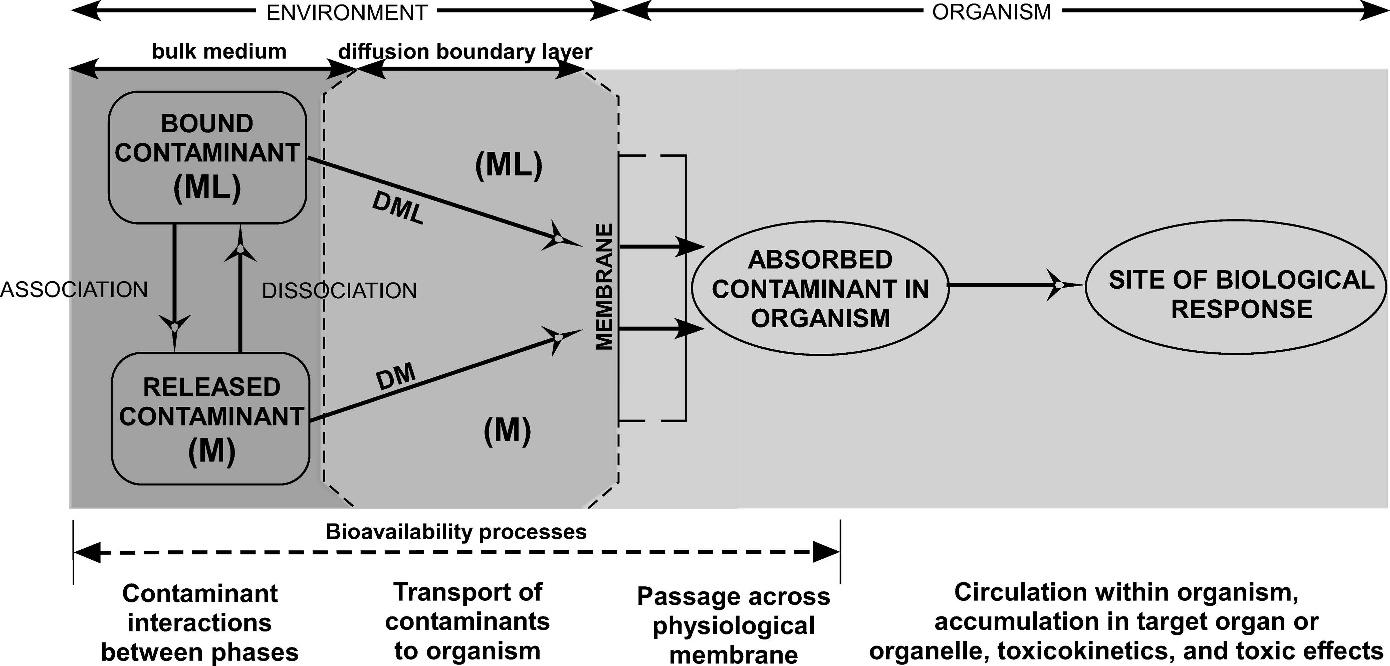
FIGURE 5.Simplifiedmodelofmetalintakeintoanorganismthroughthecellmembraneappliedtoaforaminifer(Compiledandmodifiedfrom NationalResearchCouncil,2003,andLanderandReuther,2004).ML—complexedmetalions;M—metalions;DML—diffusioncoefficientforML; DM—diffusioncoefficientforM.
marineenvironments(Reinfelderandothers,1998).Numerousspeciesofalgae(macro-andmicroalgae)can sequesterPTEsthroughadsorptionbyfunctionalgroups (i.e.,carboxylic,amino,hydroxo-carboxylic;Gonza´lezDa´vila,1995).Forexample,thediatom Dunaliellatertiolecta hasbeenfoundwithhighercopperconcentrations thanitssurroundingenvironment(Gonza´lez-Da´vila,1995). However,thesealgaelowerPTEtoxicitybyoxidation,so excretedPTEs(Ag,Se,andZn)arelessbioavailableto diatomsthantheyareintheirinorganicform(Wangand Fisher,1998).
Foraminiferscommonlyingestalgaeandbacteriathrough phagocytosis.PTEswithinthepreyorinclaysthatenter endocytoticvacuolesarelikelymobilizedbylowpHlevels (, 3;TwiningandFisher,2004)andtherebybecome bioavailableduringvacuolization.Thisisanalogousto PTEdesorption,whichcommonlyoccursduringpHchanges orduringdigestionbymarinebivalves(Reinfelderand others,1998).Organiccoatings(i.e.,bacterialextra-cellular polymers)onsedimentstendtoaugmentPTEassimilation bybivalvesduringingestion.Inthecaseofforaminifers, sedimentsororganicmattercontainingPTEscouldbe trappedduringvacuolizationandthechemistrywithinthe vacuolescouldincreasetheirbioavailability.Inaddition, granuloreticulopodiaarecommonlyobservedcoatedwith sedimentparticles,organicdetritus,bacteria,andvarious microalgae(BreslerandYanko,1995a),allofwhichcould containPTEsthatincreasetheriskofcontaminationtothe foraminifer.
AnotherpotentialmechanismofPTEincorporationis diffusionduringcalcification.Erez(2003)developeda modelofthevacuolizationprocessofperforateplanktic foraminifersthroughendocytosis.Accordingtothismodel, vacuolizationofseawaterisfollowedbyactivetransportof
hydrogenionsoutofthevacuoleandcalciumionsin,which raisesthepHwithinthevacuoleandtherebypromotes calcification.Duringthisprocess,arestrictedmicroenvironmentiscreatedinwhichtheincorporationofPTEs couldoccurasabyproductofcalcification.
Asnotedpreviously,theextensivesurfaceareaof granuloreticulopodiaprovidesavastdiffusiveboundary layeroverwhichPTEuptakecanoccurdirectlyfrom seawater.DirectincorporationofPTEshasbeenpostulated byYankoandothers(1998).Free-ion-activitymodels (FIAM)assumethatthebioavailabilityofmetalsisbased onuncomplexedmetalactivityinsteadofthetotalor dissolvedconcentrations(LanderandReuther,2004).Such modelsassumethat(1)themasstransferdoesnot determineflux,(2)complexassociation-dissociationreactionsareatequilibrium,and(3)free-ionactivitycontrols reactionswithsurfacesitesonorganisms(bioavailability; Ribaandothers,2003;LanderandReuther,2004).Sucha modelcouldbeappliedtoPTEintakethroughdiffusionor facilitateddiffusion(NationalResearchCouncil,2003)by foraminifers.BasedonFIAMfundamentals,Figure5isa simplifiedmodelthatshowspathwaysformetalionsand complexedmetalionsfromtheenvironment(bulkmedium) intotheboundarylayerandthroughthemembrane (LanderandReuther,2004;NationalResearchCouncil, 2003).TherateofPTEuptakefromseawaterorporewater byforaminiferslivinginthesediment-waterinterface dependsuponthefluxoftheionsofconcern.Inwell oxygenatedwatersaswellasanoxicporewaters,certain PTEspeciesaresequesteredandionfluxislimited. However,manyinfaunalforaminifersliveatornearthe hypoxicboundarywherethePTEsaremosteasily mobilized.Theseforaminifersaremorelikelyexposedto dissolvedPTEsinporewatersincethesezonesaremore
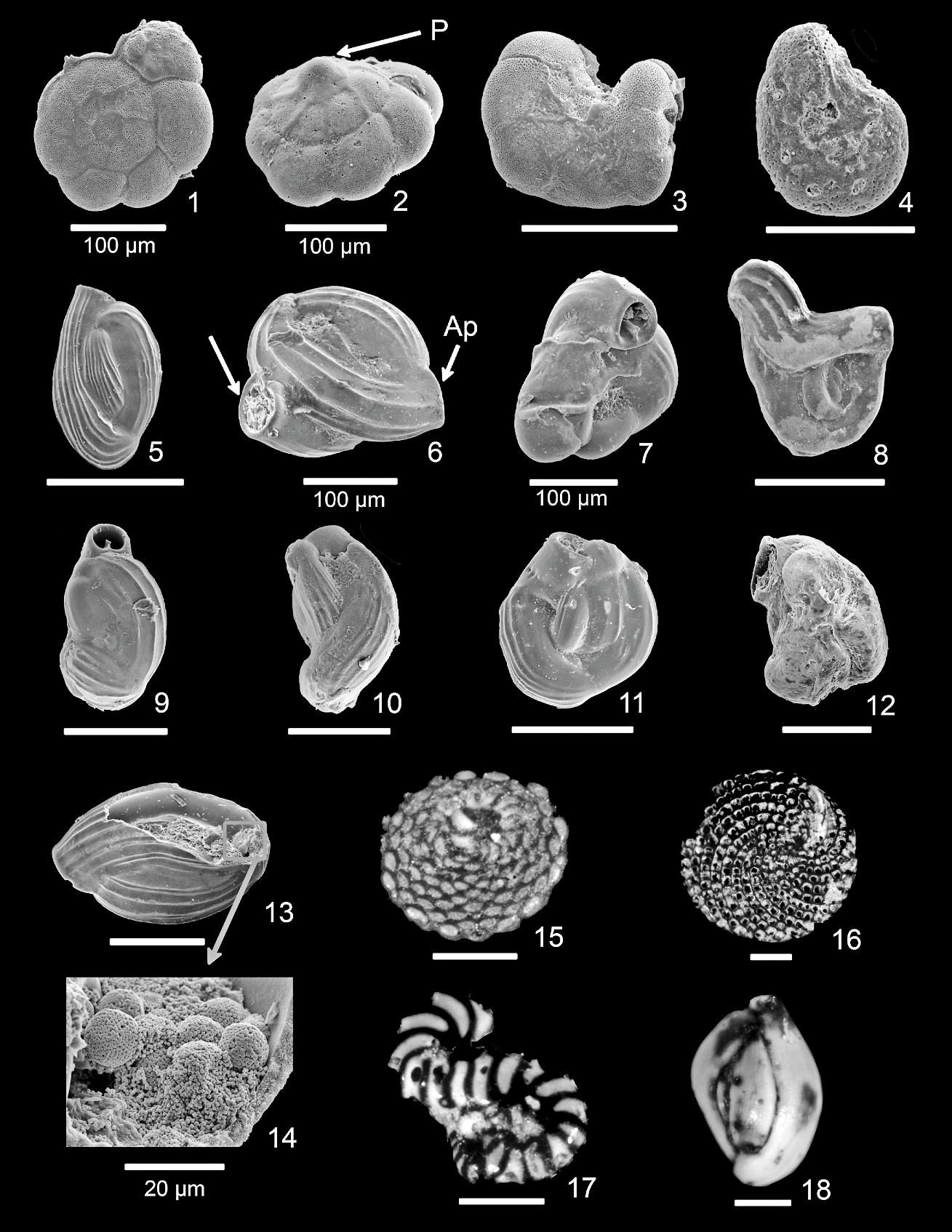
PLATE1
1–4 Ammonia sp.: 1 undeformed; 2 protrudedproloculus(p); 3 double(twinned)shell; 4 pittedsurfaceandhighlydissolved. 5–14 Quinqueloculina rhodiensis: 5 undeformed; 6 doubleaperture(Ap). 7–8 aberrantformsshowingdissolution; 9–11 changeincoilingdirection, 12 highlydissolvedshell, 13 undeformedwithframboidalpyrite, 14 framboidalpyrite; 15–18 darkenedshells: 15 Broeckina sp.; 16 Archaiasangulatus; 17 Peneroplis sp.; 18 Quinqueloculina cf. Q.multimarginata.ForaminiferswerecollectedfromTorrecillaLagooninPuertoRico.Scalebars 5 200 mmunlessotherwise noted.
susceptibletopHchangesthatcanreleasetheelementsinto solutionorintoamorebioavailablephase(Fig.3).
NEEDFOR FOCUSED EXPERIMENTAL STUDIES
Althoughafewexperimentshaveaddressedtheuseof foraminifersasindicatorsofpollution(seeNigamand others,2006),thereisneedtoelucidatethephysiological andbiochemicalimpactsofPTEsandothercontaminants atthecommunity,population,andindividualphysiological andbiochemical-activitylevels.Addressingtheseneedswill requiremanymorefield-andlaboratory-basedexperiments,rangingfrommicrocosmexperimentstotest responsesofindividualtaxatomesocosmstudiesof foraminiferalassemblages.Additionallyandmostimportantly,thereisneedforstudiesofindividualstodetermine howtheyincorporatePTEsintotheircytoplasmandshells. HowdodifferentPTEsinfluencethebiochemistryand physiologyoftheindividualforaminifer?DoPTEsinterfere withnormalbiochemicalactivityinawaythatimpactsthe functioningofthegranuloreticulopodiaortheproduction ofshellmatrixcompounds,therebypromotingabnormal growth?
Criticaltostudiesofindividualphysiologicaland biochemicalresponsesarethedevelopmentandmaintenanceofaxenicculturesofmoreforaminiferalspecies. Standardizedculturetechniquesanddependablelineagesof representativesofseveralorderswillprovidethepathway towardunderstandingthebiologyoftheseprotistsandtheir diversityofresponses.Ifbiologicalcultureswerereadily available,thedoorswouldopentoawidevarietyof foraminiferalstudies,includinggenetics,biochemistry,and cellularphysiology.Secondonlytocalcareousnannoplanktoninaccountingforbiogeniccalciumcarbonate,foraminiferalshellscoverroughlyonethirdoftheEarth,orhalf theoceanfloor(Kennett,1983).Thus,wecontendthat understandingforaminiferalbiologyisvitaltounderstandingtheoceanspastandpresenttomoreeffectivelypredict theEarth’sfuture.
CONCLUDING REMARKS
Todate,themajorityofstudiesaimedatdeterminingthe effectsofPTEsonforaminiferalassemblagesandmorphologiesincoastalenvironmentshaveutilizedcorrelation approaches,inwhichwaterandsedimentchemistrieshave beencomparedwithparametersbasedonbenthicforaminifers.Whilethiscanbeveryusefulfirst-lineevidence, correlationdoesnotprovecausation.
Thekeytoapplyingforaminifersasenvironmental indicatorsisstrongscientificmodelingbasedonfieldand laboratoryobservationsandexperimentsthatspecifically examinetheinfluenceofpollutantsatthecommunity, assemblage,population,individual,orgene-expression levels.Fieldstudiesshouldincorporatedetailedgeochemicalanalysestoassessbioavailabilityaswellastotal concentrations.Micro-andmesocosmexperimentsmust bedesignedtoidentifyspecificresponsesandvulnerabilities tospecificcontaminants.Perhaps,mostcriticallyneeded aregenomicstudiesofkeyforaminiferaltaxawithstrong potentialasbioindicators.Forexample,genomicanalyses ofwidelydistributedgenera,includinganagglutinategenus
(e.g., Ammobaculites or Trochammina),amiliolid(e.g., Quinqueloculina or Triloculina),androtaliidsatopposite endsofwaterqualitygradients(e.g., Ammonia and Amphistegina),couldleadtobreakthroughapplicationsof foraminiferalbioindicatorsinmid-andlow-latitudecoastal systems.
Realizationofthefullpotentialofforaminifersas environmentalindicatorsfacesmajorchallenges.Their nearlyubiquitouspresenceinmarineandestuarine environments,alongwiththeirglobalimportanceinthe pastandpresent,arguesstronglyforcommittingthe necessaryhumanandmonetaryresourcestofurther developthesepromisingtools.
ACKNOWLEDGMENTS
TheauthorswouldliketothankDr.GuillemMateuVicens,Dr.ValentinaYanko-Hombach,Dr.Charlotte Brunner,ananonymousreviewer,Dr.ElizabethAlve,Dr. KenFinger(JFReditor),JulieRichey,andIniaSotofor insightfulcommentsonthemanuscript.FundingforMMCwasprovidedbytheCollegeofMarineScienceandthe SloanFoundation.Workwaspartiallysupportedby fundingfromtheNationalScienceFoundation(grant numberCHE-0221834),theNationalOceanicandAtmosphericAdministrationthroughtheFloridaHurricane Alliance,NationalOceanicandAtmosphericAdministration-NationalEstuarineResearchReserve(grantnumber NA07N0S4200050),PuertoRicoSeaGrant(grantnumber R-21-1-08),U.S.GeologicalSurveyCooperativeAgreement99HQAG0004,andfromtheU.S.Environmental ProtectionAgencyGulfEcologyDivision(grantnumber X7-96465607-0).
REFERENCES
ABDULLAH,M.I.,SHIZU,Z.,andMOSGREN,K.,1995,Arsenicand seleniumspeciesintheoxicandanoxicwatersoftheOsloFjord, Norway:MarinePollutionBulletin,v.31,p.116–126.
ACEVEDO-FIGUEROA,D.,JIMENEZ,B.D.,andRODRıGUEZ-SIERRA,C. J.,2006,Tracemetalsinsedimentsoftwoestuarinelagoonsfrom PuertoRico:EnvironmentalPollution,141,p.336–342.
ACKERMAN,F.,1980,Aprocedureforcorrectinggrainsizeeffectin heavymetalanalysisofestuarineandcoastalsediments:EnvironmentalTechnologyLetters,v.1,p.518–527.
AL-HWAITI,M.,MATHEIS,G.,andSAFFARINI,G.,2005,Mobilization, redistributionandbioavailabilityofpotentiallytoxicelementsin Shidiyaphosphorites,SoutheastJordan:EnvironmentalGeology, v.47,p.431–444.
ALVE,E.,1991,Benthicforaminiferainsedimentcoresreflectingheavy metalpollutioninSørfjord,westernNorway:Journalof ForaminiferalResearch,v.21,p.1–19.
———,1995,Benthicforaminiferalresponsestoestuarinepollution:a review:JournalofForaminiferalResearch,v.25,p.190–203.
———,2000,Environmentalstratigraphy:Acasestudyreconstructing bottomwateroxygenconditionsinFrierfjord,Norway,overthe pastfivecenturies, in Martin,R.E.(ed.),Environmental Micropaleontology:KluwerAcademic/PlenumPublishers,Boston,p.324–350.
———,andGOLDSTEIN,S.T.,2003,Propaguletransportasakey methodofdispersalinbenthicforaminifera(Protista):Limnology andOceanography,v.48,p.2163–2170.
———,andOLSGARD,F.,1999,Benthicforaminiferalcolonizationin experimentswithcopper-contaminatedsediment:Journalof ForaminiferalResearch,v.29,p.186–195.
ANGELL,R.W.,1967a,Theteststructureandcompositionofthe foraminifer Rosalinafloridana:JournalofProtozoology,v.14, p.299–307.
———,1967b,Theprocessofchamberformationintheforaminifer Rosalinafloridana:JournalofProtozoology,v.14,p.566–574.
ARMYNOTDU CHATELET,E.,DEBENAY,J.-P.,andSOULARD,R.,2004, Foraminiferalproxiesforpollutionmonitoringinmoderately pollutedharbors:EnvironmentalPollution,v.127,p.27–40.
ARRAES-MOREIRA,R.C.,andBOAVENTURA,G.R.,2003,Refereˆncia geoquımicaregionalparaainterpretac¸a˜odasconcentrac¸o˜esde elementosquı´micosnossedimentosdabaciadoLagoParanoa´DF.QuımicaNova26,p.812–820.
AUSTIN,M.C.,MCEVOY,A.J.,andWARWICK,R.M.,1994,The specificityofmeiobenthiccommunityresponsestodifferent pollutants:resultsfrommicrocosmexperiments:MarinePollution Bulletin,v.28,p.557–563.
B ANERJI,R.K.,1990,Heavymetalandbenthicforaminiferal distributionalongBombayCoast,India, in Takayanagi,Y.,and Saito,T.(eds.),StudiesonBenthicForaminifera:TokaiUniversityPress,Sendai,p.151–157.
BERGIN,F.,KUCUKSEZGIN,F.,ULUTURHAN,E.,BARUT,I.F.,MERIC, E.,AVSAR,N.,andNAZIK,A.,2006,Theresponseofbenthic foraminiferaandostracodatoheavymetalpollutioninGulfof Izmir(EasternAegeanSea):EstuarineCoastalandShelfScience, v.66,p.368–386.
BERNHARD,J.M.,2000,Distinguishinglivefromdeadforaminifera: methodsreviewandproperapplications:Micropaleontology, v.46,p.37–46.
BIERENSDE HAAN,S.,1991,Areviewoftherateofpyriteoxidationin aqueoussystemsatlowtemperature:Earth-ScienceReviews,v.31, p.1–100.
BILYARD,G.R.,1987,Thevalueofbenthicinfaunainmarine pollutionmonitoringstudies:MarinePollutionBulletin,v.18, p.581–585.
BOLTOVSKOY,E.,SCOTT,D.B.,andMEDIOLI,F.S.,1991,Morphologicalvariationsofbenthicforaminiferaltestsinresponseto changesinecologicalparameters:areview:JournalofPaleontology,v.65,p.175–185.
BRESLER,V.,andYANKO,V.,1995a,Chemicalecology:anew approachtothestudyoflivingbenthicepiphyticforaminifera: JournalofForaminiferalResearch,v.25,p.267–279.
———,and———,1995b,Acutetoxicityofheavymetalsforbenthic epiphyticforaminifera Pararotaliaspinigera (LeCalvez)and influenceofseaweed-derivedDOC:EnvironmentalToxicology andChemistry,v.14,p.1687–1695.
———,and———,2000,Chemicalecologyofbenthicforaminifera. Parametersofearth,environmentalpathology,andassessmentof environmentalquality, in Martin,R.E.(ed.),Environmental Micropaleontology:KluwerAcademic/PlenumPublishers,Boston,p.217–254.
BURONE,L.,VENTURINI,N.,SPRECHMANN,P.,VALENTE,P.,and MUNIZ,P.,2006,Foraminiferalresponsestopollutedsedimentsin theMontevideocoastalzone,Uruguay:MarinePollutionBulletin, v.52,p.61–73.
BUZAS,M.A.,HAYEK,L.C.,REED,S.A.,andJETT,J.A.,2002, ForaminiferaldensitiesoverfiveyearsintheIndianRiverlagoon, Florida:amodelofpulsatingpatches:JournalofForaminiferal Research,v.32,p.68–92.
BUZAS-STEPHENS,P.,andBUZAS,M.A.,2005,Populationdynamics anddissolutionofforaminiferainNuecesBay,Texas:Journalof ForaminiferalResearch,v.35,p.248–258.
CAPLAT,C.,TEXIER,H.,BARILLIER,D.,andLELIEVRE,C.,2005, Heavymetalsmobilityinharbourcontaminatedsediments:the caseofPort-en-Bessin:MarinePollutionBulletin,v.50, p.504–511.
CARNAHAN,E.A.,HOARE,A.M.,HALLOCK,P.,LIDZ,B.H.,and REICH,C.D.,2008,DistributionofheavymetalsandforaminiferalassemblagesinsedimentsofBiscayneBay,Florida,USA: JournalofCoastalResearch,v.24,p.159–169.
———,———,———,———and———,2009,Foraminiferal assemblagesinBiscayneBay,Florida,USA:Responsestourban andagriculturalpollutioninasubtropicalestuary:Marine PollutionBulletin,v.59.doi.10.1016/j.marpolbul.2009.08.008.
CEARRETA,A.,ALDAY,M.,CONCEIc¸AO-FREITAS.,ANDRADE,A.,and CRUCES,A.,2002,Modernforaminiferalrecordofalternating openandrestrictedenvironmentalconditionsintheSantoAndre ´ lagoon,SWPortugal:Hydrobiologia,v.475,p.21–27.
CHANDLER,G.T.,WILLIAMS,D.F.,SPERO,H.J.,andGAO,X.D., 1996,Sedimentmicrohabitateffectsoncarbonstableisotopic signaturesofmicrocosm-culturedbenthicforaminifera:LimnologyandOceanography,v.41,p.680–688.
COCCIONI,R.,2000,Benthicforaminiferaasbioindicatorsofheavy metalpollution:acasestudyfromtheGorolagoon(Italy), in Martin,R.E.(ed.),EnvironmentalMicropaleontology:Kluwer Academic/PlenumPublishers,Boston,p.71–104.
COCKEY,E.M.,HALLOCK,P.,andLIDZ,B.,1996,Decadalscale changeinbenthicforaminiferalassemblagesoffKeyLargo, Florida:CoralReefs,v.15,p.237–248.
CREVISON,H.,andHALLOCK,P.,2007,Anomalousfeaturesobserved ontestsofliveArchaiasineforaminifersfromtheFloridaKeys, USA:JournalofForaminiferalResearch,v.37,p.223–233.
DAVIES,B.E.,BOWMAN,C.,DAVIES,T.C.,andSELINUS,O.,2005, MedicalGeology:Perspectivesandprospects, in Selinus,O., Alloway,B.,Centeno,J.A.,Finkelman,R.B.,Fuge,R.,Lindh, U.,andSmedley,P.(eds.),EssentialsofMedicalGeology:Elsevier AcademicPress,NewYork,p.1–41.
DAVIS,R.D.,BECKETT,P.H.T.,andWOLLAN,E.,1978,Criticallevels oftwentypotentiallytoxicelementsinyoungspringbarley:Plant andSoil,v.49,p.395–408.
DEBENAY,J.-P.,GUILLOU,J.J.,REDOIS,F.,andGESLIN,E.,2000, Distributiontrendsofforaminiferalassemblagesinparalic environments:abaseforusingforaminiferaasbioindicators, in Martin,R.E.(ed.),EnvironmentalMicropaleontology:Kluwer Academic/PlenumPublishers,Boston,p.39–67.
DE GROOT,A.J.,1964,Mudtransportstudiesincoastalwatersfrom thewesternSsheldttotheDanishfrontier, in VanStraaten,L.M. J.U.(ed.),DeltaicandShallowMarineDeposits:Developmentin SedimentologyVolume1:Elsevier,Amsterdam,p.93–103.
———,GESLIN,E.,EICHLER,B.B.,DULEBA,W.,SILVESTRE,F.,and EICHLER,P.,2001,Foraminiferalassemblagesinahypersaline lagoon,Araruama(R.J.)Brazil:JournalofForaminiferal Research,v.31,p.133–151.
DE VITRE,R.,BELZILE,N.,andTESSIER,A.,1991,Speciationand adsorptionofArsenicondiageneticironoxyhydroxides:LimnologyandOceanography,v.36,p.1480–1485.
DI TORO,D.M.,MAHONY,J.D.,HANSEN,D.J.,SCOTT,K.J., CARLSON,A.R.,andANKLEY,G.T.,1992,Acidvolatilesulfide predictstheacutetoxicityofcadmiumandnickelinsediments: EnvironmentalScienceTechnology,v.26,p.96–101.
DUFFUS,J.H.,2002,‘‘Heavymetals’’—ameaninglessterm?Pure AppliedChemistry,v.74,p.793–807.
DU LAING,G.,DE VOS,R.,VANDECASTEELE,B.,LESAGE,E.,TACK,F. M.G.,andVERLOO,M.G.,2008,Effectofsalinityonheavymetal mobilityandavailabilityinintertidalsedimentsoftheScheldt estuary:Estuarine,CoastalandShelfScience,v.77,p.589–602.
———,MEERS,E.,DEWISPELAERE,M.,VANDECASTEELE,B.,RINKLEBE,J.,TACK,F.M.G.,andVERLOO,M.G.,2009a,Heavymetal mobilityinintertidalsedimentsoftheScheldtestuary:Field monitoring:ScienceoftheTotalEnvironment,v.407, p.2519–2530.
———,RINKLEBE,J.,VANDECASTEELE,B.,MEERS,E.,andTACK,F. M.G.,2009b,Tracemetalbehaviourinestuarineandriverine floodplainsoilsandsediments:Areview:ScienceoftheTotal Environment,v.407,p.3972–3985.
EAGAR,S.H.,2000,Ostracodaindetectionofsewagedischargeona Pacificatoll, in Martin,R.E.(ed.),EnvironmentalMicropaleontology:KluwerAcademic/PlenumPublishers,Boston,p.151–166.
ELBERLING,B.,KNUDSEN,K.L.,KRISTENSES,P.H.,andASMUND,G., 2003,Applyingforaminiferalstratigraphyasabiomarkerfor heavymetalcontaminationandminingimpactinafjordinWest Greenland:MarineEnvironmentalResearch,v.55,p.235–256.
ENGLE,V.D.,2000,Applicationoftheindicatorevaluationguidelines toanindexofbenthicconditionforGulfofMexicoestuaries, in Jackson,L.E.,Kurtz,J.C.,andFisher,W.S.(eds.),Evaluation GuidelinesforEcologicalIndicators.EPA/620/R-99/005:U.S. EnvironmentalProtectionAgency,ResearchTrianglePark,NC, p.3-1to3-29.
EREZ,J.,2003,Thesourceofionsforbiomineralizationinforaminifera andtheirimplicationforpaleoceanographicproxies:Biomineralization,v.54,p.115–149.
ERNST,S.R.,MORVAN,J.,GESLIN,E.,LE BIHAN,A.,andJORISSEN,F. J.,2006,Benthicforaminiferalresponsetoexperimentallyinduced Erikaoilspill:MarineMicropaleontology,v.61,p.76–93.
FARKAS,A.,JANOS,S.,andVARANKA,I.,2003,Crustaceansas biologicalindicatorsofheavymetalpollutioninLakeBalaton (Hungary):Hydrobiologia,v.506,p.359–364.
FARRAH,H.,andPICKERING,W.F.,1979,pHeffectsintheadsorption ofheavymetalionsbyclays:ChemicalGeology.,v.25,p.317–326.
FLAKOWSKI,J.,BOLIVAR,I.,FAHRNINI,J.,andPAWLOWSKI,J.,2005, Actinphylogenyofforaminifera:JournalofForaminiferal Research,v.35,p.93–102.
FRITIOFF,A.,KAUTSKY,L.,andGREGER,M.,2005,Influenceof temperatureandsalinityonheavymetaluptakebysubmerged plants:EnvironmentalPollution,v.133,p.265–274.
FRONTALINI,F.,andCOCCIONI,R.,2008,Benthicforaminiferafor heavymetalpollutionmonitoring:Acasestudyfromthecentral AdriaticSeacoastofItaly:EstuarineCoastalandShelfScience, v.74,p.404–417.
GARRETT,R.G.,2005,Naturaldistributionandabundanceofmetals, in Selinus,O.,Alloway,B.,Centeno,J.A.,Finkelman,R.B., Fuge,R.,Lindh,U.,andSmedley,P.(eds.),EssentialsofMedical Geology:ElsevierAcademicPress,NewYork,p.17–42.
GESLIN,E.,STOUFF,V.,DEBENAY,J.-P.,andLESOURD,M.,2000, Environmentalvariationandforaminiferaltestabnormalities, in Martin,R.E.(ed.),EnvironmentalMicropaleontology:Kluwer Academic/PlenumPublishers,Boston,p.192–212.
GOLDSTEIN,S.T.,1999,Foraminifera:abiologicalreview, in Sen Gupta,B.K.(ed.),ModernForaminifera:KluwerAcademic Publishers,Boston,p.37–55.
GONZALEZ-DAVILA,M.,1995,Theroleofphytoplanktoncellsonthe controlofheavymetalconcentrationinseawater:Marine Chemistry,v.48,p.215–236.
GREEN-RUıZ,C.,2000,GeoquımicadeMetalesPesadosyMineralogıa delaFraccio´nArcillosadelosSedimentosdeCuatroPuertosdel GolfodeCalifornia.UnpublishedPh.D.Dissertation,UniversidadAutonomadeMexico,Mexico,312p.
———,2005,Adsorptionofmercury(II)fromaqueoussolutionsby theclaymineralmontmorillonite:BulletinofEnvironmental ContaminationandToxicology,v.75,p.1137–1142.
———,2009,Effectofsalinityandtemperatureontheadsorptionof Hg(II)fromaqueoussolutionsbyaCa-montmorillonite: EnvironmentalTechnology,v.30,p.63–68.
———,andPAEZ-OSUNA,F.,2004,Potentialbioavailabilityofheavy metalsinsurfacesedimentsfromtheAltata-Ensenadadel Pabello´nlagoon,SEGulfofCalifornia:JournalofCoastal Research,v.20,p.1123–1134.
GUSTAFSSON,M.,DAHLLOF,I.,BLANKC,H.,HALL,P.,MOLANDER,S., andNORDBERG,K.,2000,BenthicforaminiferaltolerancetoTri-n Butyltin(TBT)pollutioninanexperimentalmesocosm:Marine PollutionBulletin,v.40,p.1072–1075.
HALLOCK,P.,FORWARD,L.B.,andHANSEN,H.J.,1986,Influenceof environmentonthetestshapeof Amphistegina:Journalof ForaminiferalResearch,v.16,p.224–231.
———,TALGE,H.K.,COCKEY,E.M.,andMULLER,R.G.,1995,A newdiseaseinreef-dwellingforaminifera:Implicationsforcoastal sedimentation:JournalofForaminiferalResearch,v.25, p.280–286.
———,2000,Symbiont-bearingforaminifera:harbingersofglobal change?Micropaleontology,v.46,p.95–104.
———,LIDZ,B.H.,COCKEY-BURKHARD,E.M.,andDONNELLY,K. B.,2003,Foraminiferaasbioindicatorsincoralreefassessment andmonitoring:theFORAMIndex:EnvironmentalMonitoring andAssessment,v.81,p.221–238.
———,WILLIAMS,D.E.,TOLER,S.K.,FISHER,E.M.,andTALGE,H. K.,2006,Bleachinginreef-dwellingforaminifers:implicationsfor reeddecline.Proceedings,10th InternationalCoralReefSymposium,Okinawa,Japan,p.729–737.
HANSEN,D.J.,MAHONY,J.D.,BERRY,W.J.,BENYI,S.J.,CORBIN,J. M.,PRATT,S.D.,DI TORO,D.M.,andABEL,M.B.,1996, Chroniceffectofcadmiuminsedimentsoncolonizationby benthicmarineorganism:anevaluationoftheroleofinterstitial
cadmiumandacid-volatilesulfideinbiologicalavailability: EnvironmentalToxicologyandChemistry,v.15,p.2126–2137.
HAYWARD,B.W.,GRENFELL,H.R.,NICHOLSON,K.,PARKER,R., WILMHURST,J.,HORROCKS,M.,SWALES,A.,andSABAA,A.T., 2004,Foraminiferalrecordofhumanimpactonintertidal estuarineenvironmentsinNewZealand’slargestcity:Marine Micropaleontology,v.53,p.37–66.
———,———,SABAA,A.T.,MORLEY,M.S.,andHORROCKS,M., 2006,Effectandtimingofincreasedfreshwaterrunoffinto shelteredharborenvironmentsaroundAucklandCity,New Zealand:EstuariesandCoasts,v.29,p.165–182.
HINTZ,C.J.,CHANDLER,G.T.,BERNHARD,J.M.,MCCORKLE,D.C., HAVACH,S.M.,BLANKS,J.K.,andSHAW,T.J.,2004,A physicochemicallyconstrainedseawaterculturingsystemfor productionofbenthicforaminifera:LimnologyandPaleoceanography,v.2,p.160–170.
HOROWITZ,A.J.,1991,Physicalandchemicalfactorsaffecting sediment-traceelementchemistry, in Horowitz,A.J.(ed.),A PrimeronSediment-TraceElementChemistry:LewisPublisher, Reston,p.14–79.
H UNTER ,J.M.,andARBONA ,S.I.,1995,Paradiselost:An introductiontothegeographyofwaterpollutioninPuertoRico: SocialScienceandMedicine,v.40,p.1331–1355.
JACKSON,L.E.,KURTZ,J.C.,andFISHER,W.S.(eds.),2000, EvaluationGuidelinesforEcologicalIndicators,EPA/620/R-99/ 005.U.S.EnvironmentalProtectionAgency,OfficeofResearch andDevelopment,ResearchTrianglePark,NC,107p.
JAYARAJU,N.,andREDDI,K.R.,1996,Impactofpollutiononcoastal zonemonitoringwithbenthicforaminiferaofTuticorin,southeast coastofIndia:IndianJournalofMarineScience,v.25,p.376–378.
JORISSEN,F.J.,1999,Benthicforaminiferalmicrohabitatsbelowthe sediment-waterinterface, in SenGupta,B.K.(ed.),Modern Foraminifera:KluwerAcademicPublishers,Boston,p.191–179.
KENNETT,J.P.,1983,MarineGeology:PrenticeHall,NewYork, 813p.
KOT,F.S.,GREEN-RUıZ,C.,PAEZ-OSUNA,F.,SHUMILIN,E.N.,and RODRıGUEZ-MEZA,D.,1999,Distributionofmercuryinsediments fromLaPazlagoon,PeninsulaofBajaCalifornia,Mexico: BulletinofEnvironmentalContaminationandToxicology,v.63, p.45–51.
KRAEPIEL,A.M.L.,CHIFFOLEAU,J.F.,MARTIN,J.M.,andMOREL, F.M.M.,1997,GeochemistryoftracemetalsintheGironde estuary:GeochimicaetCosmochimicaActa,v.61,p.1421–1436.
K RAUSKOPF ,K.B.,andB IRD ,D.K.,1995,Introductionto Geochemistry,3rd edition:McGraw-Hill,NewYork,p.589–591.
LANDER,L.,andREUTHER,R.,2004,Metalsinsocietyandinthe environment:Acriticalreviewofcurrentknowledgeoffluxes, speciation,bioavailabilityandriskforadverseeffectsofcopper, chromium,nickel,andzinc:KluwerAcademicPublishers, London,406p.
LANGER,M.R.,1993,Epiphyticforaminifera:MarineMicropaleontology,v.20,p.235–265.
LAUTH,J.R.,SCOTT,G.J.,CHERRY,D.S.,andBUIKEMA,A.L.Jr., 1996,Amodularestuarinemicrocosm:EnvironmentalToxicology andChemistry,v.15,p.630–637.
LAWLER,S.P.,1998,Ecologyinabottle.Usingmicrocosmstotest theory, in Resetarits,W.J.,Jr,andBernardo,J.(eds.), ExperimentalEcology:IssuesandPerspectives:OxfordUniversity Press,Oxford,p.236–253.
L E C ADRE,V.,andDEBENAY,J.-P.,2006,Morphologicaland cytologicalresponsesof Ammonia (foraminifera)tocopper contamination:Implicationfortheuseofforaminiferaas bioindicatorsofpollution:EnvironmentalPollution,v.143, p.304–317.
———,———,andLESOURD,M.,2003,LowpHeffectson Ammonia beccarii testdeformation:Implicationsforusingtestdeformation asapollutionindicator:JournalofForaminiferalResearch,v.33, p.1–9.
LE ´ OPOLD,E.N.,JUNG,M.C.,AUGUSTE,O.,NGATCHA,N.,GEORGES, E.,andLAPE,M.,2008,Metalspollutioninfreshlydeposited sedimentsfromriverMongoa,maintributarytothemunicipal lakeofYaounde,Cameroon.GeosciencesJournal,v.12, p.337–347.
LEE,M.R.,andCORREA,J.A.,2005,Effectsofcopperminetailings disposalonlittoralmeiofaunalassemblagesintheAtacamaregion ofnorthernChile:MarineEnvironmentalResearch,v.59,p.1–18.
———,and———,2007,Anassessmentoftheimpactofcoppermine tailingsdisposalonmeiofaunalassemblagesusingmicrocosm bioassays:MarineEnvironmentalResearch,v.64,p.1–20.
———,———,andSEED,R.,2006,Asedimentqualitytriadassessmentoftheimpactofcopperminetailingsdisposalonthelittoral sedimentaryenvironmentintheAtacamaregionofnorthern Chile:MarinePollutionBulletin,v.52,p.1389–1395.
LEWIS,G.N.,1923,ValenceandtheStructureofMolecules:The ChemicalCatalogueCompany,NewYork,172p.
LONG,E.R.,andMORGAN,L.G.,1990,Thepotentialforbiological effectsofsediment-sorbedcontaminantstestedintheNational StatusandTrendsProgram,NOAATechnicalMemorandum NOSOMA52,NationalOceanicandAtmosphericAdministration,Seattle,Washington,175p.
———,MACDONALD,D.D.,SMITH,S.L.,andCALDER,F.D.,1995, Incidenceofadversebiologicaleffectswithinrangesofchemical concentrationsinmarineandestuarinesediments:Environmental Management,v.19,p.81–97.
LORING,D.H.,1981,Potentialbioavailabilityofmetalsineastern Canadianestuarineandcoastalsediments:RapportetProcessVerbauxdesReunionsCommissionInternationalepourl’ExplorationScienctifiquedelaMerMediterranee,v.181,p.93–101.
———,1990,Lithium–anewapproachforthegranulometric normalizationoftracemetaldata:MarineChemisty,v.29, p.155–168.
LUOMA,S.N.,andBRYAN,G.W.,1981,Astatisticalassessmentofthe formofthetracemetalsinoxidizedestuarinesedimentsemploying chemicalextractants:ScienceoftheTotalEnvironment,v.17, p.165–196.
———,1990,Processesaffectingmetalconcentrationsinestuarineand coastalmarinesediments, in Furness,R.W.,andRainbow,P.S. (eds.),Heavymetalsinthemarineenvironment:CRCPress, Florida,USA,p.52–66.
MACDONALD,D.D.,1994,ApproachtotheAssessmentofSediment QualityinFloridaCoastalWaters:FloridaDepartmentof EnvironmentalProtection,Tallahassee,Florida,v.1,p.140.
MERIC,E.,AVSAR,N.,GORMUS,M.,andBERGIN,F.,2004,Twinand tripletformsofRecentbenthicforaminiferafromtheeastern AegeanSea,Turkishcoast:Micropaleontology,v.50,p.297–301.
MILLWARD,R.N.,CARMAN,K.R.,FLEEGER,J.W.,GAMBRELL,R.P., POWELL,R.T.,andROUSE,M.-A.M.,2001,Linkingecological impacttometalconcentrationsandspeciation:amicrocosm experimentusingasaltmarshmeiofaunalcommunity:EnvironmentalToxicologyandChemistry,v.20,p.2029–2037.
MOJTAHID,M.,JORISSEN,F.,andPEARSON,T.H.,2008,Comparison ofbenthicforaminiferalandmacrofaunalresponsestoorganic pollutionintheFifthClyde(Scotland):MarinePollutionBulletin, v.56,p.42–76.
MORSE,J.W.,andLUTHER,G.W.,III,1999,Chemicalinfluenceson tracemetal-sulfideinteractionsinanoxicsediments:Geochimicaet CosmochimicaActa,v.36,p.3373–3378.
MOUTA,E.R.,SOARES,M.R.,andCASAGRANDE,J.C.,2008,Copper adsorptionasafunctionofsolutionparametersofvariablecharge soils:JournaloftheBrazilianChemicalSociety,v.19,p.996–1009.
MURRAY,J.W.,andBOWSER,S.S.,2000,Mortality,protoplasmdecay rate,andreliabilityofstainingtcniquestorecognize‘‘living’’ foraminifera:areview:JournalforForaminiferalResearch,v.30, p.66–70.
———,2001,Thenicheofbenthicforaminifera,criticalthresholdsand proxies:MarineMicropaleontology,v.41,p.1–7.
———,andALVE,E.,1999a,Taphonomicexperimentsonmarginal livemarineforaminiferalassemblages:Howmuchecological informationispreserved?Paleogeography,Paleoclimatology, Paleoecology,v.149,p.183–197.
———,and———,1999b,Naturaldissolutionofmodernshallow waterbenthicforaminifera:taphonomiceffectsonthepaleoecologicalrecord:Paleogeography,Paleoclimatology,Paleoecology, v.149,p.195–209.
———,and———,2002,Benthicforaminiferaasindicatorsof environmentalchange:marginal-marine,shelfandupper-slope
environments, in Haslett,S.K.(ed.),QuaternaryEnvironmental Micropaleontology:OxfordUniversityPress,London,p.59–90.
———,andP UDSEY ,C.J.,2004,Living(stained)anddead foraminiferaformthenewlyice-freeLarsenIceShelf,Weddel Sea,Antartica:ecologyandtaphonomy:MarineMicropaleontology,v.53,p.67–81.
NATIONAL RESEARCH COUNCIL,2003,Bioavailabilityofcontaminants insoilsandsediments:processes,tools,andapplications:National AcademyPress,Washington,D.C,416p.
NIGAM,R.,SARASWAT,R.,andPANCHANG,R.,2006,Applicationof foraminifersinecotoxicology:retrospect,perspectandprospect: EnvironmentInternational,v.32,p.273–283.
NOOIJER,L.J.,REICHART,G.J.,DUENAS-BOHORQUEZ,A.,WOLTHERS, M.,ERNST,S.R.,MASON,P.R.D.,and VANDER ZWAAN,G.J., 2007,Copperincorporationinforaminiferalcalcite:resultsfrom culturingexperiments:Biogeosciences,v.4,p.493–504.
PATTERSON,R.T.,GUILBAULT,J.-P.,and CLAGUE,J.J.,1999, Taphonomyoftidalmarshforaminifera:implicationsofsurface samplethicknessforhigh-resolutionsea-levelstudies:Palaeogeography,Palaeoclimatology,Palaeoecology,v.149,p.199–211.
PEEBLES,M.W.,HALLOCK,P.,andHINE,A.C.,1997,Benthic foraminiferalassemblagesfromcurrent-sweptcarbonateplatformsofthenorthernNicaraguanRise,CaribbeanSea:Journal ForaminiferalResearch,v.27,p.42–50.
PEREZ-CID,B.,LAVILLA,I.,andBENDICO,C.,1998,Speedingupofa three-stagesequentialextractionmethodformetalspeciation usingfocusedultrasound:AnalyticaChimicaActa,v.360, p.35–41.
PESCOD,M.B.,1992,Wastewatertreatmentanduseinagriculture: FoodandAgricultureOrganizationoftheUnitedNations, IrrigationandDrainagePaper47,125p.
PICHLER,T.,VEIZER,J.,andHALL,G.E.M.,1999a,Thechemical compositionofshallowwaterhydrothermalfluidsinTutumBay, AmbitleIsland,PapuaNewGuineaandtheireffectonambient seawater:MarineChemistry,v.64,p.229–252.
———,———,and———,1999b,Naturalinputofarsenicintoa coral-reefecosystembyhydrothermalfluidsanditsremovalby Fe(III)oxyhydroxides:EnvironmentalScienceandTechnology, v.33,p.1373–1378.
P OLOVODOVA ,I.,andS CHONFELD ,J.,2008,Foraminiferaltest abnormalitiesinthewesternBalticSea:JournalofForaminiferal Research,v.38,p.318–336.
RAINBOW,P.S.,andWHITE,S.L.,1989,Comparativestrategiesof heavymetalaccumulationbycrustaceans:zinc,copper,and cadmiuminadecapod,anamphipodandabarnacle:Hydrobiologia,v.174,p.245–262.
———,andFURNESS,R.W.,1990,Heavymetalsinthemarine environment, in Furness,R.W.,andRainbow,P.S.(eds.),Heavy MetalsintheMarineEnvironment:CRCPress,BocaRaton, p.1–4.
———,1995,Biomonitoringofheavymetalavailabilityinthemarine environment:MarinePollutionBulletin,v.31,p.183–192.
REINFELDER,J.R.,FISHER,N.S.,LUOMA,S.N.,NICHOLS,J.W.,and WANG,W.-X.,1998,Traceelementtrophictransferinaquatic organisms:acritiqueofthekineticmodelapproach:Scienceofthe TotalEnvironment,v.219,p.117–135.
RESIG,J.M.,1960,Foraminiferalecologyaroundoceanoutfallsoff southernCalifornia, in Pearson,E.A.(ed.),WasteDisposalinthe MarineEnvironment:PergamonPress,NewYork,p.104–121.
R IBA ,I.,G ARCIA -L UQUE ,E.,andD EL V ALLS ,T.A.,2003, Bioavailabilityofheavymetalsboundtoestuarinesedimentsas afunctionofpHandsalinityvalues:ChemicalSpeciationand Bioavailability,v.15,p.101–114.
R IEDEL ,G.F.,S ANDERS ,J.G.,andO SMAN ,R.W.,1997, Biogeochemicalcontrolonthefluxoftraceelementsfrom estuarinesediments:watercolumnoxygenconcentrationsand benthicinfauna:Estuarine,CoastalandShelfScience,v.44, p.23–38.
ROMANO,E.,BERGAMIN,L.,FINOIA,M.G.,CARBONI,M.G.,AUSILI, A.,andGABELLINI,M.,2007,IndustrialpollutionatBagnoli (Naples,Itlay):Benthicforaminiferaasatoolinintegrated programsofenvironmentalcharacterization:MarinePollution Bulletin,v.56,p.439–457.
ROTTGER,R.,andHALLOCK,P.,1982,Shapetrendsin Heterostegina: JournalofForaminiferalResearch,v.12,p.197–204.
SAMIR,A.M.,2000,Theresponseofbenthicforaminiferaand ostracodstovariouspollutionsources:astudyfromtwolagoons inEgypt:JournalofForaminiferalResearch,v.30,p.83–98.
———,andEL-DIN,A.B.,2001,Benthicforaminiferalassemblages andmorphologicalabnormalitiesaspollutionproxiesintwo Egyptianbays:MarineMicropaleontology,v.41,p.193–227.
S ANTOS ,I.R.,S ILVA -F ILHO ,E.V.,S CHAEFER ,C.E.G.R., ALBUQUERQUE-FILHO,M.R.,andCAMPOS,L.S.,2005,Heavy metalcontaminationincoastalsedimentsandsoilsnearthe BrazilianAntarcticstation,KingGeorgeIsland:MarinePollution Bulletin,v.50,p.185–195.
SCHAFER,C.T.,2000,Monitoringnearshoremarineenvironments usingbenthicforaminifera:someprotocolsandpitfalls:Micropaleontology,v.46,p.161–169.
SCHNOOR,J.L.,1996,Environmentalmodeling:fateandtransportof pollutantsinwater,air,andsoil:WileyandSons,NewYork, 676p.
SCHOLZ,F.,andNEUMANN,T.,2007,Traceelementdiagenesisin pyrite-richsedimentsoftheAchterwasserlagoon,SWBalticSea: MarineChemistry,v.107,p.516–532.
SCHROPP,S.J.,andWINDOM,H.L.,1988,Aguidetointerpretationof metalconcentrationsinestuarinesediments.FloridaDepartment ofEnvironmentalRegulation,CoastalZoneManagementSection, 53p.
SEIGLIE,G.A.,1968,Foraminiferalassemblagesasindicatorsofhigh organiccarboncontentinsedimentsandpollutedwaters: AmericanAssociationofPetroleumGeologistsBulletin,v.52, p.2231–2241.
———,1971,Apreliminarynoteontherelationshipsbetween foraminifersandpollutionintwoPuertoRicanbays:Caribbean JournalofScience,v.11,p.93–98.
———,1975,ForaminifersofGuayanillaBayandtheiruseas environmentalindicators:RevistaEspan˜oladeMicropaleontologı´a,v.7,p.453–487.
SELINUS,O.,ALLOWAY,B.,CENTENO,J.A.,FINKELMAN,R.B.,FUGE, R.,LINDH,U.,SMEDLEY,P.,and EDS.,2005,EssentialsofMedical Geology:ElsevierAcademicPress,NewYork,832p.
SELLIERDE CIVREAUX,J.M.,1970,Mutacionesrecientesdelgenero Peneroplis yrelacionesfilogenicasconotrosSoritidae:Revista Espan˜oladedeMicropaleontologia,v.2,p.5–12.
SEN GUPTA,B.K.,TURNER,R.E.,andRABALAIS,N.N.,1996, Seasonaloxygendepletiononcontinental-shelfwatersofLouisiana:Historicalrecordsonbenthicforaminifera:Geology,v.24, p.227–230.
———,1999,Systematicsofmodernforaminifera, in SenGupta,B.K. (ed.),ModernForaminifera:KluwerAcademicPublishers, Boston,p.7–36.
SHARIFI,A.R.,CROUDACE,I.W.,andAUSTIN,R.L.,1991,Benthic foraminiferidsaspollutionindicatorsinSouthamptonWater, southernEngland:JournalofMicropaleontology,v.10, p.109–113.
SIEGEL,F.R.,2002,Environmentalgeochemistryofpotentiallytoxic metals:SpringerPublishing,NewYork,USA,218p.
SMEDLEY,P.,andKINNIBURGH,D.G.,2005,Arsenicingroundwater andtheenvironment, in Selinus,O.,Alloway,B.,Centeno,J.A., Finkelman,R.B.,Fuge,R.,Lindh,U.,andSmedley,P.(eds.), EssentialsofMedicalGeology:ElsevierAcademicPress,New York,p.301–330.
STOUFF,V.,DEBENAY,J.-P.,andLESOURD,M.,1999,Originofdouble andmultipletestsinbenthicforaminifera:observationsin laboratorycultures:MarineMicropaleontology,v.36,p.189–204.
TAYLOR,K.G.,PERRY,C.T.,GREENAWAY,A.M.,andMACHENT,P. G.,2007,Bacterialironoxidereductioninaterrigenoussedimentimpactedtropicalshallowmarinecarbonatesystem,north Jamaica:MarineChemistry,v.107,p.449–463.
TESSIER,A.,CAMPBELL,P.G.C.,andBISSON,M.,1979,Sequential extractionprocedureforthespeciationofparticulatetracemetals: AnalyticalChemistry,v.51,p.844–851.
TOLER,S.K.,andHALLOCK,P.,1998,Shellmalformationinstressed Amphistegina populations:relationtobiomineralizationand paleoenvironmentalpotential:MarineMicropaleontology,v.34, p.105–115.
———,———,andSCHIJF,J.,2001,Mg/Caratiosinstressed foraminifera, Amphisteginagibbosa,fromtheFloridaKeys: MarineMicropaleontology,v.34,p.199–206.
TSUJIMOTO,A.,NOMURA,R.,YASUHARA,M.,YAMAZAI,H.,and YOSHIKAWA,S.,2006,Impactofeutrophicationonshallow marinebenthicforaminifersoverthelast150yearsinOsaka Bay,Japan:MarineMicropaleontology,v.60,p.258–268.
TURNER,A.,andOLSEN,Y.S.,2000,Chemicalversusenzymatic digestionofcontaminatedestuarinesediment:relativeimportance ofironandmanganeseoxidesincontrollingtracemetal bioavailability:Estuarine,CoastalandShelfScience,v.51, p.717–728.
TWINING,B.S.,andFISHER,N.S.,2004,Trophictransferoftrace metalsfromprotozoatomesozooplankton:Limnologyand Oceanography,v.49,p.28–39.
UNLU,S.,ALPAR,B.,AYDIN,S.,AKBULAK,C.,BALKIS,N.,BARUT,I., MERIC,E.,AKSU,A.,andKIRBASOGLU,C.,2006,Anthropogenic pollutioninsedimentsfromtheGulfofGemlik(MarmaraSea, Turkey);Cause-resultrelationship:FreseniusEnvironmental Bulletin,v.15,no.12A,p.1521–1530.
VENUGOPAL,B.,andLUCKEY,T.D.,1975,Toxicologyofnonradioactiveheavymetalsandtheirsalts, in Luckey,T.D., Venugopal,B.,andHutchensen,D.(eds.),HeavyMetalsToxicity, SafetyandHormology:Thieme,Stuttgart,p.4–73.
V ILLAESCUSA -C ELAYA ,J.A.,G UTIE RREZ -G ALINDO,E.A.,and FLORES-MUNOZ,G.,2000,Heavymetalsinthefinefractionof coastalsedimentsformBajaCalifornia(Me´xico)andCalifornia (USA):EnvironmentalPollution,v.108,p.453–462.
VITOUSEK,P.M.,ABER,J.D.,HOWARTH,R.W.,LIKENS,G.E., MATSON,P.A.,SCHINDLER,D.W.,SCHLESINGER,W.H.,and TILMAN,G.D.,1997,Humanalterationoftheglobalnitrogencycle: sourcesandconsequences:EcologicalApplication,v.7,p.737–750.
WALKER,D.A.,LINTON,A.E.,andSCHAFER,C.T.,1974,Sudan blackB;asuperiorstaintoroseBengalfordistinguishingliving fromnon-livingforaminifera,v.4,p.205–215.
WALSH,J.J.,1984,Theroleofoceanbiotainacceleratedecological cycles:atemporalview:BioScience,v.34,p.499–507.
WALTON,W.R.,1952,Techniquesforrecognitionoflivingforaminifera:ContributionsfromCushmanfoundationforForaminiferal Research,v.3,p.56–60.
WANG,W.X.,andFISHER,N.S.,1998,Accumulationoftrace elementsinamarinecopepod:LimnologyandOceanography, v.43,p.273–283.
WANG,Z.-L.,andLIU,C.-Q.,2003,Distributionandpartition behaviorofheavymetalsbetweendissolvedandacid-soluble fractionsalongasalinitygradientintheChangjiangEstuary, easternChina:ChemicalGeology,v.202,p.383–396.
WARD,J.N.,POND,D.W.,andMURRAY,J.W.,2003,Feedingof benthicforaminiferaondiatomsandsewage-derivedorganic matter:anexperimentalapplicationoflipidbiomarkertechniques: MarineEnvironmentalResearch,v.56,p.515–530.
WILLIAMS,D.E.,HALLOCK,P.,TALGE,H.K.,HARNEY,J.N.,and MCRAE,G.,1997,Responsesof Amphisteginagibbosa populations intheFloridaKeys(USA)toamulti-yearstressevent(1991–1996):JournalofForaminiferalResearch,v.27,p.264–269.
WILSON-FINELLI,A.,CHANDLER,G.T.,andSPERO,H.J.,1998,Stable isotopebehaviorinpaleoceanographicallyimportantbenthic foraminifera:resultsfrommicrocosmcultureexperiments:Journal ofForaminiferalResearch,v.28,p.312–320.
WOLF-GLADROW,D.A.,BIJMA,J.,andZEEBE,R.E.,1999,Model simulationofthecarbonatesysteminthemicroenvironmentof symbiontbearingforaminifera:MarineChemistry,v.64,p.181–198.
YANKO,V.,KRONFELD,J.,andFLEXER,A.,1994,Responseofbenthic Foraminiferatovariouspollutionsources-implicationsfor pollutionmonitoring:JournalofForaminiferalResearch,v.24, p.1–17.
———,AHMAD ,M.,andKAMINSKI,M.,1998,Morphological deformitiesofbenthicforaminiferaltestsinresponsetopollution byheavymetals:implicationsforpollutionmonitoring:Journalof ForaminiferalResearch,v.28,p.177–200.
———,ARNOLD,A.J.,andPARKER,W.C.,1999,Effectsofmarine pollutiononbenthicforaminifera, in SenGupta,B.K.(ed.), ModernForaminifera:KluwerAcademicPublishers,Boston, p.217–235.
YU,K.-C.,TSAI,L.-J.,CHEM,S.-H.,andHO,S.-T.,2001,Chemical bindingofheavymetalsinanionicriversediments:Water Research,v.35,p.4086–4094.
ZHANG,S.,WANG,S.,andSHAN,X.,2002,Distributionandspeciation ofheavymetalsinsurfacesedimentsfromGuantingReservoir,
Beijing:JournalofEnvironmentalScienceHealth,v.A37, p.465–478.
Received19February2008
Accepted7July2009