Preliminary Survey on Foraminiferal Responses to Pollutants inTorrecillas Lagoon Puerto Rico
Preliminary Survey on Foraminiferal Responses to Pollutants in Torrecillas Lagoon Puerto Rico
Michael Martínez-Colón1 and Pamela Hallock
College of Marine Science-University of South Florida 140 7th Ave. S, St. Petersburg, FL 33701
†foram3438@yahoo.com
ABSTRACT.—Torrecilla Lagoon, part of the San Juan Bay Estuary system, is a moderately-polluted estuary on the northern coast of Puerto Rico. Foraminiferal assemblages from two 30 cm cores were dominated by Ammonia spp. and Quinqueloculina rhodiensis. The latter taxon exhibits a relatively high occurrence of deformed tests (up to 18%). Analyses for potentially toxic-element in bulk sediment samples of one core show concentrations below recognized toxicity levels except for copper. Copper concentrations (50-138 ppm) fall between previously established Effect Range Low and Effect Range Median values, representing potential for occasional detrimental effects to the aquatic environment. Organic matter content (loss-on-ignition) ranging from 10-23%, coupled with the presence of framboidal pyrite, indicate low oxygen conditions. Ammonia spp. showed no significant variation in size with depth in core. Ammonia-Elphidium index values, a previously established indicator of hypoxia, are 69-100, reflecting relative few Elphidium. Species diversity indices indicate temporal variability in abundance and distribution of foraminifers. Foraminiferal assemblages and organic matter in sediments indicate that Torrecilla Lagoon has undergone episodes of hypoxia.
KEYwORDS.—Pollution, Foraminifera, Potentially Toxic Elements, Estuary, Eutrophication, Puerto Rico
Environmental studies have characterized and quantified anthropogenic sources of pollution (i.e., sewage discharge, boat marinas, hydroelectric plants, etc.) entering the San Juan Bay Estuary (SJBE) system in northern Puerto Rico, and, to a lesser degree, on its sub-systems (e.g., Torrecilla Lagoon). These studies have found that the bay contains elevated concentrations of Potentially Toxic Elements (PTEs) (As, Cd, Hg, Ni, Th, and Zn) in the sediments; high, oxygendepleting nutrient loads; low dissolved oxygen (DO) levels; pathogens; and high sedimentation rates; all of which have been classified as major environmental threats to the SJBE (Ellis 1976; Marsh 1992; Hunter & Arbona 1995). Torrecilla Lagoon (TL) sediments have been found to be contaminated with As (17 μg/g), Hg (0.05 μg/g), and Pb (20 μg/g) (Webb et al. 1998).
Benthic foraminifers can be useful bioindicators for PTE pollution (e.g., Alve, 1995; Nigam et al. 2006). In polluted areas, foraminifers can display not only a wide variety of morphological deformities but also changes in assemblage makeup and species abundance (Schafer 2000; du Chatelet
Proof only Proof only
et al. 2004). However, no direct relationship has been established between either natural stressors (i.e., salinity) or anthropogenic stressors (i.e., PTEs, pesticides), and tests deformities or community structure (e.g., Alve 1995; Debenay et al. 2001). Benthic foraminifers are potentially sensitive to PTE exposure due to their high surface-tovolume ratios and relationship with sediments and pore waters.
Seiglie (1968, 1975) investigated the impacts of eutrophication (from sewage disposal and leakage) and temperature changes (by hydrothermal plants) on benthic foraminiferal assemblages along southwest and northern coastlines of Puerto Rico. Seiglie (1975) concluded that Ammonia catesbyana (= becarii) forma tepida (Cushman) dominated areas of sewage discharge and noted abnormal morphologies of Quinqueloculina rhodiensis (Parker) influenced by eutrophication and thermal pollution (deformed chambers).
This study examines two short sediment cores from TL, Puerto Rico, with the goal of assessing foraminiferal assemblages and determining relative influences of
natural and anthropogenic stressors. Torrecilla Lagoon (2.5 km2) falls within the eastern subtidal portion of the SJBE and is fed from several sources including southern fresh water inputs and northern marine inputs (Atlantic Ocean). Increased sediment runoff, wastewater discharge, and eutrophication have enhanced water turbidity to the degree that benthic primary production is shut down in some areas of the SJBE (Bunch et al. 2000). Non-point sources have been inferred to be related to illegal sanitary discharges, on-site septic systems, and storm water runoff.
The sparse foraminiferal (Table 1) assemblage of Core TR-I is dominated by Ammonia spp. and Q. rhodiensis. Foraminifers of the genus Ammonia tend to be tolerant of environmental stresses such as changes in pH, hypoxia, and presence of PTEs (e.g., Seiglie 1975 and Le Cadre & Debenay 2006), which
might explain their dominance. Tests of Q. rhodiensis exhibited a wide variety of deformities, indicating that conditions are stressful but at least intermittently survivable. Prevalence of foraminiferal deformities was 5-17% of observed tests, and included double tests, double apertures, extended proloculi, reduced last chambers, and aberrant forms.
Bulk sediment sub-samples of Core TR-I were analyzed by commercial laboratories (Actlabs-Canada) for PTE content (32 elements) using Inductively Coupled Plasma Optical Emission Spectrometry (ICP-OES). Of these elements, Cu is of concern. Effect range-low (ERL) and Effect range-medium (ERM) values for Cu in estuarine environments are 34-270 (ppm) (Long et al. 1995). MacDonald et al. (1996) determined a threshold effect level (TEL) concentration for Cu as 18.7 ppm. These values,
Table 1. Indices recorded for sediment samples extracted from cores from Torrecilla Lagoon: TR-I and TR-II. T = number of foraminiferal taxa recorded (to genus or species); n = number of individual foraminiferal shells identified; r = foraminiferal shell density (number of individuals per gram of sediment); H(S) = Shannon-Weiner Index; E’ = Equitability Index; AEI = Ammonia-Elphidium Index; %D = percent of shells exhibiting deformities; %LOI = loss on ignition determination of organic matter in the sediment sample.
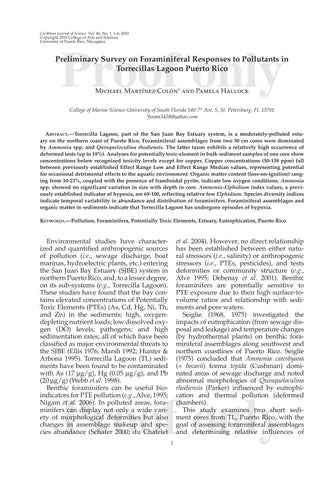
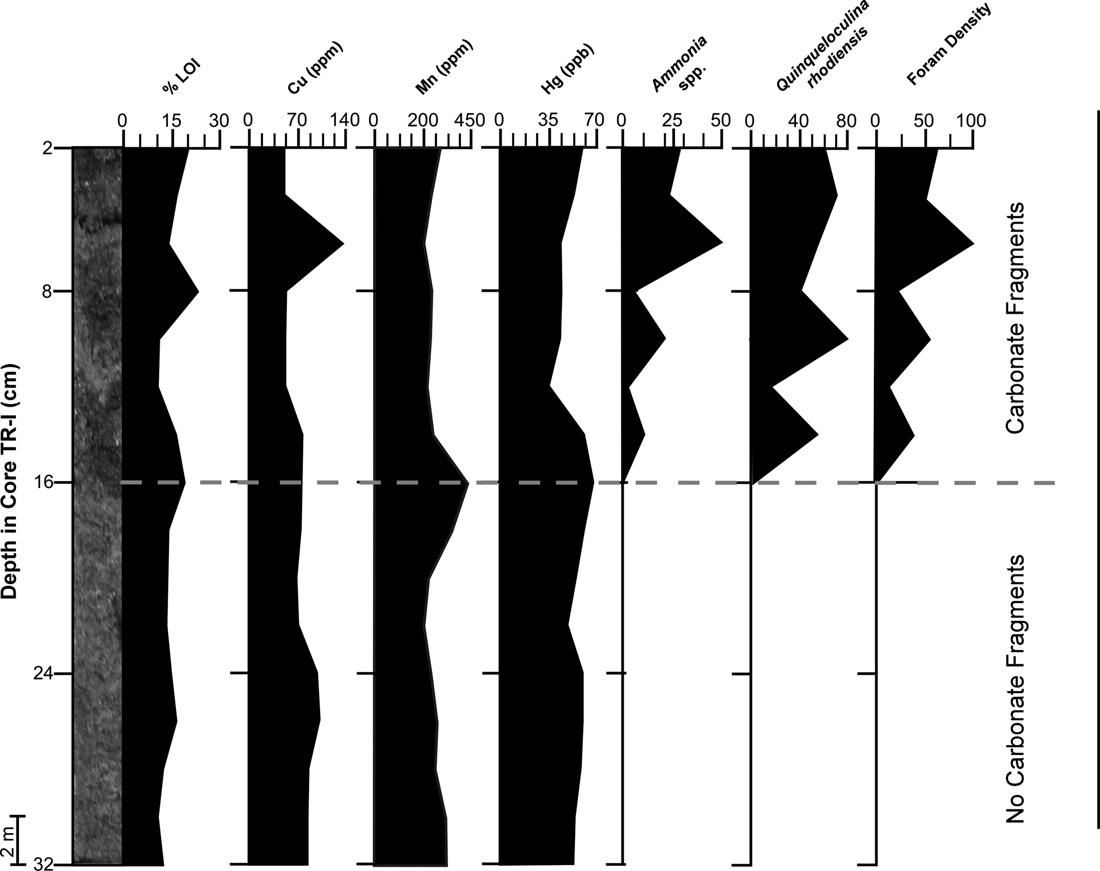
determined by analyzing marine invertebrate and fish tissue, indicate the concentrations below which Cu generally have no detrimental biological effects. Copper concentrations (60-140 ppm) in sub-samples from the TR-1 core consistently exceeded ERL and TEL values, yet Cu profiles seem to follow that of LOI (Fig. 1). Thus, Cu may be an environmental stressor, as indicated by ERL and TEL values. Similarly, Hg and Mn follow the LOI profile (Fig. 1) indicating that organic matter could be a compounding factor in sequestering these PTE’s. Unfortunately due to small sample size (n = 8), no statistical analysis of variables (i.e., correlation matrix) could be done.
Proof only
in Core TR-I. The sharp drop in numbers of tests of both species at 8 cm corresponds with a peak in LOI at 22% (Fig. 1). Below 8 cm, abundances of tests of both taxa vary roughly inversely with LOI, possibly indicating intermittent hypoxia. No carbonate fragments (i.e., foraminifers, gastropods, bivalves, etc.) were found below 18 cm, indicating that conditions at or after deposition were unfavorable for calcium carbonate preservation.
Tests of Ammonia spp. and Q. rhodiensis are found in low abundance down to 6 cm
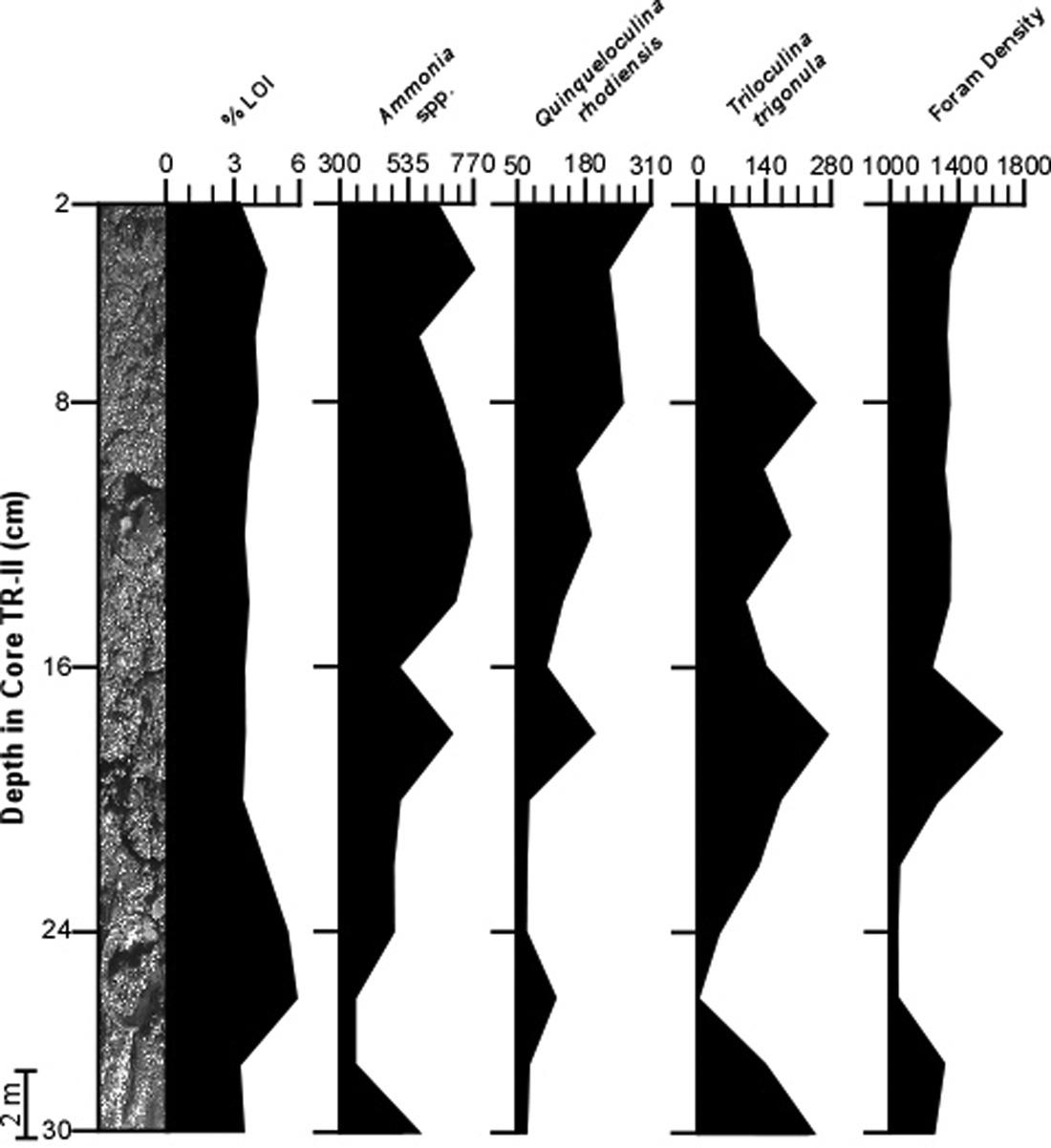
Core TR-II has foraminiferal tests and carbonate fragments throughout its length (Table 1). Test abundance was more than 10 times higher and the number of genera was 3- to 4-fold higher than in Core TR-I. Nevertheless, the majority of genera found in Core TR-II site were relatively rare. Tests of Ammonia spp. were abundant
Proof only
Fig 1. Sediment core TR-I. Loss on ignition (%LOI), copper (Cu), manganese (Mn) and mercury (Hg) concentrations in bulk sediments. Ammonia spp., Quinqueloculina rhodiensis, and total foraminiferal (Foram) shell densities (number of individuals per gram of sediment).
throughout the core, with lows at 26 and 28 cm depth where LOI peaked, and generally increasing upcore. Tests of Q. rhodiensis generally increased upcore, with a subpeak at 18 cm. Tests of Triloculina trigonula (Lamarck) were most variable, absent at 26 cm and with a very strong peak at 18 cm. Deformed tests were seen in all
samples, with percentages ranging from 2% to 18%. Diversity indices remain relatively constant although two zones can be seen (Fig. 2). The transition occurs at a depth of 16 cm, the same depth at which carbonate fragments and foraminifers appeared in Core TR-I. The consistent occurrence of foraminiferal tests throughout Core TR-II
Proof only Proof only
Fig. 2. Sediment core TR-II. Loss on ignition (%LOI), Ammonia spp., Quinqueloculina rhodiensis, Triloculina trigonula, and abundance (number of individuals per gram of sediment), and total foraminiferal (Foram) shell densities (total number of individuals per gram of sediment).
indicates that conditions remained suitable for carbonate preservation throughout, likely associated with close proximity to the outlet area that connects to the Atlantic Ocean. Oceanic influence is further demonstrated by the occasional presence of reefassociated genera, including Amphistegina, Archaias, and Asterigerina, though their presence is inferred to be due to postmortem transport. Salinity gradients in TL show a decreasing trend along a northsouth transect (Bunch et al. 2000).
Thus, differences in foraminiferal assemblages between cores can be explained largely by location, salinity gradients and organic content. The Core TR-I collection site was closer to fresh water influence (i.e. , Quebrada Blasina), whereas TR-II is closer to the lagoon outlet to the Atlantic Ocean. Seiglie (1975) attributed the abundance, distribution, and test deformities to organic pollution based on their proximity to sewage outfalls in TL. Loss-on-ignition data show marked differences between core sites. Core TR-I shows the greatest amount of organic matter, which could lower the pH values in the sediments. This stressor could be magnified by fresh water lenses coming from the interior mountain range. In contrast, LOI values for Core TR-II are relatively low, yet dissolution scars were relatively common. Thus, the foraminiferal assemblage appears to be strongly influenced by organic matter. It has been found that organic matter strongly influences oxygen concentrations, pH and carbonate preservation potential (Jorissen, 1999).
In conclusion, at both sites foraminiferal assemblages are strongly dominated by Ammonia spp. and Q. rhodiensis. This is a typical assemblage of coastal lagoons in Puerto Rico that are under the influence of anthropogenic pollutants (eutrophication) (Seiglie 1975). Quinqueloculina rhodiensis is the species that most commonly exhibits test deformities. Because PTE analyses are only available for Core TR-I and Cu was the only PTE found at concentrations of concern, interpretations of PTE influence on the distribution and deformities of foraminifers are limited. Organic matter content, salinity and carbonate preservation potential are
interpreted to have played major roles in controlling species distribution and test preservation.
Proof only Proof only
Acknowledgements.—We would like to thank Ana Olga Gonzalez and Lynette Torres (Universidad del Este-Puerto Rico) for their help in collecting the cores. Thanks also to Bryan McCloskey for insightful comments on the manuscript. Funding for MM-C was provided by the College of Marine Science and the Sloan Foundation Minority Program. Work was partially supported by Puerto Rico Sea Grant Program Grant (No. R-21-1-08).
Literature Cited
Alve, E. 1995. Benthic foraminiferal responses to estuarine pollution: a review. Journal of Foraminiferal Research 25:190-203.
Bock, W. D., Lynts, G. W., Smith, S., Wright, R., Hay, W. N., and Jones, J. I. 1971. A symposium of recent south Florida foraminifers. Miami Geological Society Publication, 175p.
Bunch, B. W., Cerco, C. F., Dortch, M. S., Johnson, B. H., and Kim, K. W. 2000. Hydrodynamic and water quality model study of San Juan Bay Estuary. U.S. Army Engineer Waterways Experiment Station Technical Report ERDC-TR-00-1: 305.
Debenay, J. P., Geslin, E., Eichler, B. B., Wuleba, W., Sylvestre, F., and Eichler, P. 2001. Foraminiferal assemblages in a hypersaline lagoon, Araruama (R. J.) Brazil. Journal of Foraminiferal Research 31: 133-151.
du Chatelet, E. A., Debenay, J-P, and Soulard, R. 2004. Foraminiferal proxies for pollution monitoring in moderately polluted harbors. Environmental Pollution 127:27-40.
Ellis, S. R., 1976, History of dredging and filling of lagoons in the San Juan area, Puerto Rico. USGS Water-Resources Investigations Report: 38-76.
Hunter, J. M., and Arbona, S. I. 1995. Paradise lost: An introduction to the geography of water pollution in Puerto Rico. Social Science and Medicine 40:1331-1355.
Jorissen, F. J. 1999. Benthic foraminiferal microhabitats below the sediment-water interface. In Modern Foraminifera, ed. B. K. Sen Gupta, 191-179. Netherlands: Kluwer Academic Publishers.
Le Cadre, V., and Debenay, J. P. 2006. Morphological and cytological responses of Ammonia (foraminifera) to copper contamination: Implication for the use of foraminifera as bioindicators of pollution. Environmental Pollution 143: 304-317.
Long, E. R., MacDonald, D. D., Smith, S. L., and Calder, F. D. 1995. Incidence of adverse biological effects within ranges of chemical concentrations
in marine and estuarine sediments. Environmental Management 19:81-97.
MacDonald, D. D., Carr, R. S., Calder, F. D., Long, E. R., and Ingersoll, C. G. 1996. Development and evaluation of sediment quality guidelines for Florida coastal waters. Ecotoxicology 5:253-278.
Marsh, S. P., 1992, Analytical results for stream sediment and soils samples from the Commonwealth of Puerto Rico, Isla de Culebra, and Isla de Vieques. U.S. Geological Survey Open File Report 92-353A, 8pp. Nigam, R., Saraswat, R., and Panchang, R. 2006. Application of foraminifers in ecotoxicology: Restrospect, perspect and prospect. Environment International 32:273-283.
Proof only Proof only
Schafer, C. T. 2000. Monitoring nearshore marine environments using benthic foraminifera: some protocols and pitfalls. Micropaleontology 46:161-169.
Seiglie, G. A. 1968. Foraminiferal assemblages as indicators of high organic carbon content in sediments and polluted waters. The American Assoc. of Petroleum Geol. Bulletin 52:2231-2241.
Seiglie, G. A. 1975. Foraminifers of Guayanilla Bay and their use as environmental indicators. Revista Española de Micropaleontología 7:453-487.
Webb, R. M. T., Gómez-Gómez, F. 1998. Synoptic survey of water quality and bottom sediments, San Juan Bay Estuary System, Puerto Rico. USGS Water Resources Investigations Report 97-4144:69.