Estuarine foraminifera as an effective measure of benthic ecological quality status in Jobos Bay, Puerto Rico)
Benjamin G. Shirey1-2, Michael Martínez-Colón1*, Charles Jagoe1, Olugbenga T. Fajemila3, Angel Dieppa4 , and Benjamin Mwashote1
1School of the Environment, Florida A&M University, Tallahassee, FL, USA, michael.martinez@famu.edu
2AUT Lab for Cephalopod Ecology and Systematics (ALCES), Department of Environmental Science, Auckland University of Technology, Auckland 1010, New Zealand
3Department of Geological Sciences, Osun State University, Osogbo 230261, Nigeria
4Jobos Bay National Estuarine Research Reserve, Aguirre, PR, USA
*corresponding author
ABSTRACT: This study investigated the effects of potentially toxic elements (PTEs) on the spatial distribution of benthic foraminifera in Jobos Bay, a National Estuarine Research Reserve in Puerto Rico. High PTE total concentrations (Cr-Cu-Zn-Mn-Hg) clustered around anthropogenic sources where “moderately polluted” to “moderate-heavily polluted” conditions prevail. The spatial distribution of the foraminiferal ecological indices mainly followed trends in bioavailable (exchangeable and organic-bound) PTEs. Ammonia (T1) (36%) was the most abundant foraminifera with species richness and diversity being characteristically low for an impacted estuary in Puerto Rico. Based on the Foram Stress Index, the ecological quality status (EcoQ) of the benthic environment varied according to PTE pollution and water quality levels with a “heavy polluted” (EcoQ “poor”) Inner Bay area (east coast) proximal to multiple non-point sources of pollution while conditions improved towards “moderately polluted” (EcoQ “moderate”) in the Open Bay area. The Restricted area (west coast of the bay) which received direct effluents of raw sewage was exposed to higher organic-bound bioavailable PTE concentrations coupled with more corrosive and less oxygenated bottom waters in some areas. This variability was reflected in the “heavy polluted” (EcoQ “poor”) and “azoic” (EcoQ “bad”) conditions where several sites were barren with respect to porcelaneous taxa in addition to Ammonia (T1) being almost absent in one sample.
Keywords: trace metals, Caribbean, biological indices, ecosystem health, EcoQ.
INTRODUCTION
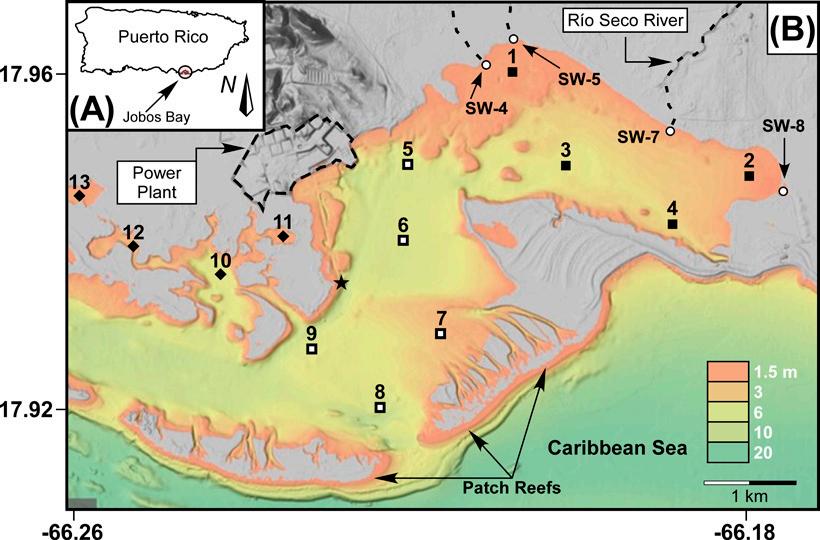
It is well known that estuaries serve an inadvertently dual purpose as a sink or source of pollutants. Their fate and transport are governed by the dynamic equilibrium between water quality, sediments, and biota especially at the sediment water interface. The JBNERR (Jobos Bay National Estuarine Research Reserve) was established in 1981 and is an estuarine ecosystem located to the south coast of Puerto Rico. Like any estuarine setting in a small island, it has been impacted by numerous pointand non-point sources of pollution (text-fig. 1). For example, a landfill, residential areas, tire recycling, two power plants, power station, abandoned sugar mill, sewage, as well as pharmaceutical manufacturers (Baxter and Pfizer) are found within the watershed and some in proximity to the shoreline (Whitall et al. 2011; JBNERR 2017). Previous studies have documented organic pollutants (Aldarondo-Torres et al. 2010; Whitall et al. 2011; Pait et al. 2007; 2012) and PTEs (Potentially Toxic Elements) (e.g., Se, Cr, Cu, Zn) (Zitello et al. 2008; Aldarondo-Torres et al. 2010; Whitall et al. 2011; Apeti et al. 2012) in the sediments as well in the tissues of organisms. It is known that JBNERR has a rich history of pollution, and this was confirmed by Alegría et al. (2016) who documented changes in the use of PCBs (Polychlorinated biphenyl) from a sediment core that was radiometrically dated to 1939. More recently, a study by Martínez-Colón et al. (2021) documented the bioaccumula-
tion of PTEs (Cd-Ba-V-Cu-Zn-As-Se) into the black mangrove and its subsequent bioavailability and bioconcentration in the soft tissues of fiddler crabs via trophic transfer.
Meiofaunal communities thrive and respond to bioavailable PTEs. These ecological responses are advantageous especially when r-type strategists serve as sentinels of environmental stress (e.g., Elliott and Quintino 2007; Wang et al. 2023) as well as for PTE pollution given their opportunistic or resilient behaviour. According to the definition of Heink and Kowarik (2010), an ecological indicator is a species used to evaluate the environmental conditions of an area as well as any spatial changes. BF (benthic foraminifera) are heterotrophic single-celled organisms that have been used for this purpose by numerous authors (e.g., Watkins 1961; Bouchet et al. 2012; Jorissen et al. 2018; Martins et al. 2020). Different BF taxa can be sensitive to indifferent (k-type strategist) or tolerant (r-type strategist) (Hallock 1985; Hallock et al. 1991; 2003; Martins et al. 2019; Bayrón-Arcelay et al. 2020; Benedetti and Papazzoni 2022) towards natural (e.g., Prazeres et al. 2020; Rosa-Marín et al. 2024) as well as anthropogenic (e.g., Watkins 1961; Marques et al. 2019; O’Malley et al. 2021) stressors. These organisms are ubiquitous in marine settings (deep vs shallow) however in tropical estuarine environments their community structures are unique, typically with low diversities and the dominance of
Micropaleontology, vol. 71, no. 2, text-figures 8, plate 1, pages 167–181, 2025 https://doi.org/10.47894/mpal.71.2.03
Benjamin G. Shirey et al.: Estuarine foraminifera as an effective measure of benthic ecological quality status in Jobos Bay, Puerto Rico)
TEXT-FIGURE 1
(A) Island of Puerto Rico. (B) Jobos Bay National Estuarine Research Reserve. Black squares - inner bay. White squares - open bay. Black diamonds - restricted. White circles - river/creek outlets. Black star - thermal water outlet. Dash lines - river/creek morphology.
only a few taxa, for example. As r-strategists in estuaries, their rapid ecological response to environmental changes makes them excellent ecological indicators and more importantly because they biomineralize a carbonate test. Their preservation potential is an added advantage especially when examining seasonal and temporal (e.g., sediment core) changes (e.g., Melis et al. 2019; Martins et al. 2022; Rosa-Marín et al. 2024). Aside from salinity, pH, and organic matter amongst other natural parameters, BF are also adept at following pollution gradients (e.g., Alve 1991; 1995; Sen Gupta et al. 1996; Jorissen 1999; Bergin et al. 2006) including PTEs were in extreme conditions the sediments become azoic and this has been linked to point sources (Alve 1995).
In Puerto Rico there are only 12 published studies related to extant BF since 1968. Only three are from JBNERR related to estuarine faunas under anthropogenic organic matter pollution by Seiglie (1971; 1975a) and seasonal nutrient variability in reef-dwelling by Rosa-Marín et al. (2024). The current research is part of a more comprehensive study involving abiotic (PTE) and biotic proxies (BF) in two other estuaries (Guánica Bay and San Juán Bay Estuary) from Puerto Rico. The main purpose of this research in JBNERR was to assess the sediment quality as it relates to foraminiferal communities. The two main objectives of this research were: (1) to utilize the Foram Stress Index (FSI) as a proxy of sediment ecological quality status (EcoQ) and (2) to assess the degree of PTE pollution and bioavailability in sediments.
METHODOLOGY
Studied Site
The JBNERR is the second largest estuary in Puerto Rico, and it is an open tidal-marine system. The bay is under the influence
of a rain shadow effect with very little seasonal variability with the highest average precipitation of 167 mm coinciding with the peak in hurricane activity (September-October) and the lowest in January with an average of 20 mm (Whitall et al. 2011). It has a total area of 25 km2 with a 137 km2 watershed (JBNERR 2017) which is “urban” given the 46,000 citizens living in the areas (U.S. Census Bureau 2024). According to Zitello et al. (2008), the watershed is further subdivided into nine SW (subwatersheds) of which four (SW-4, SW-5, SW-7, and SW-8) have direct outlets towards the eastern side of the bay (text-fig.1). Tidal patterns follow an eastward (flood) and westward (ebb) flow (Laboy-Nieves 2009) with a mean diurnal tidal range of 0.21 m based on measurements from the NOAA tidal station 9755971. The intertidal shorelines of the bay are mainly dominated by mangroves while the sediments are sand and mud with localized patches of seagrass beds (NOAA 2002; Alegría et al. 2016; Martínez-Colón et al. 2021). The southern boundary of the bay is protected by numerous small and shallow coral reefs (NOAA 2002; Rosa-Marín et al. 2024).
Field Sampling
Sediments were recovered from 13 sites (text-fig. 1) with a depth range of 1.2–9 m. These sites were separated into three groups based on surrounding and geographic characteristics. The “Inner Bay” comprises sites 1‒4 towards the east (text-fig. 1) where the four SW outlets are found. The “Open Bay” comprises sites 5‒9 towards the center of the bay where Caribbean bottom water flow in from the south through the numerous patch reefs. The “Restricted” area consists of sites 10‒13 as these are surrounded by mangrove forests and water circulation is relatively restricted. A petit ponar grab was used to collect the sediments (50‒100 g/sample) and a Teflon spoon was used to scrape the top 2 cm and placed in Nalgene containers that were acid
cleaned (10% HCl) and Milli-Q rinsed prior to being frozen. In addition, a YSI meter was used to measure temperature (°C), DO (dissolved oxygen- mg/L), salinity, and pH at depth intervals of 0.5‒1 m within the water column.
Laboratory Work
Abiotic Parameters
Prior to any abiotic and biotic analysis, all samples were dried at 50°C (except for Hg) and subsampled for grainsize, total organic carbon (TOC), carbonate (CO3), and PTE analysis. For grain size analysis, a 20‒21 g subsamples were wet sieved first with a 63 μm mesh. The remaining sediment was again dried (50°C) overnight to determine the amount of mud (< 63 μm) by weight difference and reported as a percent (mud). The sand fraction (> 63 μm) was subsequently stored for later use for BF analysis.
For TOC and CO3 content (as percent values), the method developed by Byers et al. (1978) was used for loss on ignition. Subsamples of one gram each were crushed using an agatha mortar/ pestle and dried at 105°C (DW 105) for 24 hours. After cooling in a desiccator, they were “baked” in a muffle furnace at 550°C for 4 hours (DW 550) and the following equation was used to determine TOC:
LOI 550 = ([DW 105 - DW 550] / DW 105) * 100
where DW is the dry weight. After cooling in a desiccator, they were “baked” again for one hour at 1000°C (DW1000) to allow for the calculation of the CO3 content using the following the equation:
LOI 1000 = ([DW 550 - DW 1000] / DW 550) * 100
For PTE extractions, 0.5 g of dry subsamples were crushed using an agatha mortar/pestle. The EPA 3051A method was used to determine the total PTE concentration in samples using aqua regia (3:1 ratio of HNO3 and HCl) (EPA 2007). It is important to note that method does not dissolve the sediment completely, so what it is obtained is a “pseudo-total” concentration that does not include silicate minerals. The extractions were done using Teflon bombs in a microwave-assisted digester. All the leached extracts were diluted in 3% HNO3 (trace metal grade) and subsequently analyzed using an inductively coupled plasma optical emission spectrometer (ICP-OES) for Cd, Cr, Ni, Cu, Zn, Pb, As, Se, Al, Ti, Fe, and Mn. A second 0.5 g subsample was digested following the sequential extraction methods of Tessier et al. (1979) but only for the “mud-bound” and “organic-bound” fractions (F1Tess and F4Tess respectively). Both leached extracts were diluted in 3% HNO3 (trace metal grade) and subsequently analyzed using an ICP-OES for the same PTEs. All the concentrations are expressed in mg/kg except for Fe and Ti which are represented as a percent. It is important to highlight that Fe and Ti are only reported for the total concentrations. The rationale is that that these PTEs are used as proxies for terrestrial sediment input (e.g., Fukue et al. 1999; Bianchette et al. 2016; Oliva et al. 2018; Yao et al. 2021; Dietz et al. 2022) and for potential sequestration of PTEs due to redox conditions at the sediment-water interface for Fe only (e.g., Martínez-Colón et al. 2017; 2018; Fajemila et al. 2022).
Total Hg was analyzed separately on subsamples (0.05‒0.1 mg) using thermal decomposition, amalgamation, and atomic absorption spectroscopy following the EPA 7473 method (EPA 1998). The Hg concentration was also expressed as mg/kg.
172 et al., 2022) including the “AphiaID” 173
World Register of Marine Species (WoRMS) was
174
Biotic Parameters
175
Data Analysis
For BF analysis, the leftover sand fraction from the grain size analysis (> 63 μm) was used. A one-gram subsample was used to count up to 200 individuals (total counts). Species representing <3% of the total assemblage in all the samples were taken out completely from this study. The following taxonomic sources were used: Loeblich and Tappan (1987), Poag (1981), Seiglie (1968; 1975a,b), and Martínez-Colón et al. (2018). A complete taxonomic list is found in Appendix 1 (see supplementary material). The World Register of Marine Species (WoRMS) was used to corroborate proper taxonomic names (Hayward et al., 2022) including the “AphiaID”.
To assess the level of pollution of the sampled sediments, the 176 the multi-element modified pollution index (MPI) were calculated. 177 following formula according to Acevedo-Figueroa et al. (2006):
178
179
180
181
Data Analysis
EF = ([M]i / [E]i)sediment / ([M]r / [E]r)background
To assess the level of pollution of the sampled sediments, the single element enrichment factor (EF) and the multi-element modified pollution index (MPI) were calculated. EF was determined by using the following formula according to Acevedo-Figueroa et al. (2006):
where [M]i and [E]i represent the total concentration of the 182 sediments respectively; [M]r and [E]r are the PTE and normalizing 183 background concentrations found in shale. For purposes of this 184
EF = ([M]i / [E]i)sediment / ([M]r / [E]r)background
where [M]i and [E]i represent the total concentration of the PTE and the normalizing element in the sediments respectively; [M]r and [E]r are the PTE and normalizing element in the Earth’s crust as background concentrations found in shale. For purposes of this study, the normalizing element used was Fe instead of the traditional Al given that the latter was found below detection limits. The EF provides information in terms of how many times the concentration of a single PTE is above background or baseline values. The level of impact is in accordance with the following classification (Acevedo-Figueróa et al. 2006): “no enrichment” (<1), “minor enrichment” (1–3), “moderate enrichment” (3–5) “moderate severe enrichment” (5–10), “severe enrichment” (10–25), “very severe enrichment” (25–50), and “extremely severe enrichment” (>50).
190
Fe instead of the traditional Al given that the latter was found 185 information in terms of how many times the concentration 186 baseline values. The level of impact is in accordance w ith the 187 et al. 2006): “no enrichment” (<1), “minor enrichment” (1–3), 188 severe enrichment” (5–10), “severe enrichment” (10–25), 189 “extremely severe enrichment” (>50).
191
192 193
For the MPI values, the formula proposed by Brady et al. (2015)
For the MPI values, the formula proposed by Brady et al. (2015) was used:
194
195
MPI = √(EF)2 +(EFmax )2 2
where (EF) and EFmax represent the average (all the PTEs combined) and the maximum highest concentration of any PTE. The MPI values are classified into five categories: “unpolluted” (<1), “slightly polluted” (1‒2), “moderately polluted” (2‒3), “moderately-heavily polluted” (3‒5), “heavily polluted” (5‒10), and “severely polluted” (>10). For this calculation, both Fe and Ti were converted to mg/kg. A PCA (Principal Component Analysis) was done using the square-root transform of the PTE total concentrations in addition to TOC, CO3, and mud.
For the biotic parameters, the following ecological indices were used:
Species richness: S = number of species per sample
Shannon index: H(S) = −Σ pi × ln(pi)
Relative abundance: RA = pi × 100
where pi is the proportion of the ith species (Shannon, 1948). The RA was done for only for Ammonia beccarii var. tepida 8
Benjamin G. Shirey et al.: Estuarine foraminifera as an effective measure of benthic ecological quality status in Jobos Bay, Puerto Rico)
TEXT-FIGURE 2
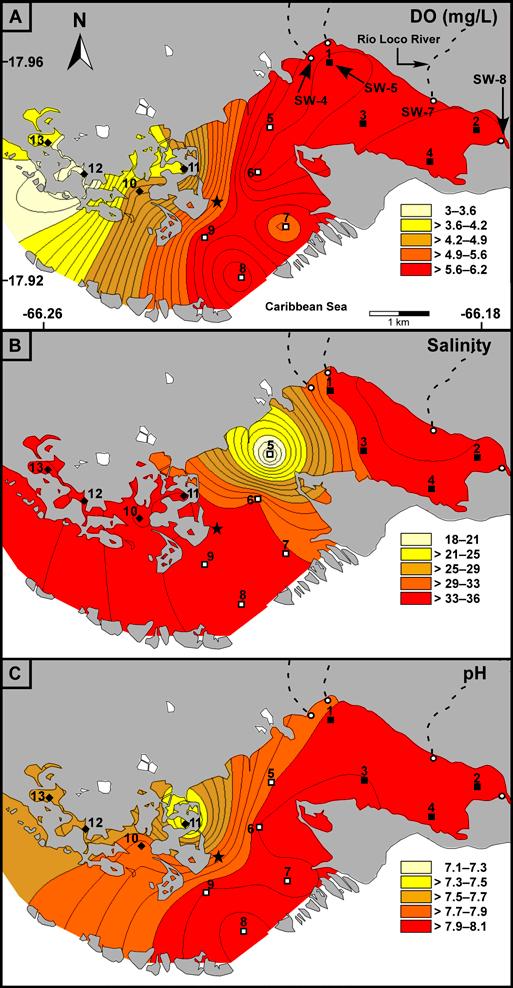
Spatial distribution of bottom water parameters. (A) DO - dissolved oxygen. (B) Salinity. (C) pH. Black squares - inner bay. White squaresopen bay. Black diamonds - restricted. White circles - river/creek outlets. Black star - thermal water outlet. Dash lines - river/creek morphology
(Ammonia tepida, AphiaID- 478788) (ARA) given that it vastly dominated the assemblage. This species is herein referred to as Ammonia (T1) according to phylotype (morpho-species) classification of Hayward et al. (2004), Richirt et al. (2021), and Pavard et al. (2021). Lastly, the foraminiferal taxa were divided into porcelaneous, and hyaline morphological groups based on test-texture, and both were expressed as a percentage.
The FSI is a sediment quality indicator based on the occurrence of BF that are not tolerant or those that are opportunistic to organic enrichment and other pollutants according to the protocols of Dimiza et al. (2016). The following formula was used:
FSI = (10 * Sen) + (Str)
where “Sen” represents the relative abundance of the sensitive foraminifers and “Str” represents the relative abundance of the stress-tolerant taxa. Although this index was developed for the Mediterranean, those tropical foraminiferal faunas from Puerto Rico (e.g., Caribbean) not reported by Dimiza et al. (2016) were given group assignments (Sen vs Str) based primarily on the observed relationship to DO, TOC, and PTEs (this study) in addition to other relevant work form which BF were correlated with these abiotic parameters. Only BF species representing <3% of the assemblage in all the samples were taken out completely from this study (Appendix 3, see supplementary material). A total of 19 species were added to the SEN and ten to the STR groups (Appendix 2, see supplementary material). The FSI values ranged from 1 to 10 and it was also calibrated to address the following groupings according the Ecological Quality Status (EcoQ) (Dimiza et al., 2016): “High” (normal/ pristine- 9.0 ≤ FSI ≤ 10.0), “Good” (slightly polluted/transitional- 5.5 ≤ FSI < 9.0), “Moderate” (moderately polluted- 2.0 ≤ FSI < 5.5), “Poor” (heavily polluted- 1.0 ≤ FSI < 2.0) and “Bad” (azoic- FSI < 1).
A CCA (Canonical Correspondence Analysis) was performed involving abiotic (bottom water: DO, salinity, pH; and sedimentary: TOC, CO3, mud and PTEs) and biotic (S, H(S), hyaline-perforate, porcelaneous taxa) parameters. In addition to the biotic data, the most abundant taxa were also used: Ammonia (T1), Cribroelphidium poeyanum, Haynesina sp., and Florilus grateloupii (now Nonionoides grateloupii, AphiaID- 595937). Lastly, given very low diversity and BF counts per species, some were grouped at the genus level to help in the assessment of any potential similarities between the sites. These were: Bolivina sp., Elphidium sp. (dominated by Elphidium discoidale), Nonion sp., Quinqueloculina sp. (dominated by Quinqueloculina seminula; now Quinqueloculina seminulum, AphiaID- 595937), and Triloculina sp. (dominated by Triloculina oblonga). All the taxa used for the CCA were normalized to mass in each sample (20–21g). Both abiotic and biotic data were squared root transformed (Parker and Arnold 1999) prior to analysis. The CCA and PCA was done using PAST© statistical software following the correlation matrix between group samples. The contour heat maps were done using Surfer® software (v. 22.1.151) (www.goldensoftware.com).
RESULTS
Water Column
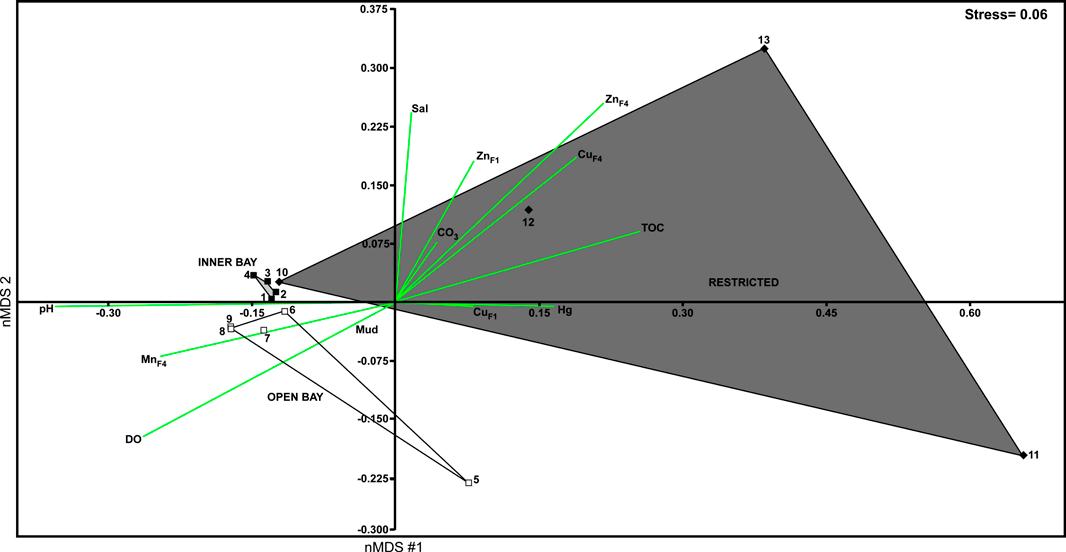
The water depth of the sampled sites ranged from 1.2‒9 m with an average of 4.51 m with site 5 being the deepest in proximity to the old sugar mill dredge channel (text-fig. 1). For most of the sites, only the top and bottom values were recorded given the very minute observed changes, thus no stratification was observed. The bottom temperature, DO, salinity, and pH respective value ranges were: 28.7‒29.3°C, 3.16‒6.07 mg/L, 18.30‒36.36, and 7.33‒8.02 (text-fig. 2) (Appendix 4, see supplementary material). The nMDs (stress 0.06) show how the samples are separated by regions having an overall E‒W decreasing trend following DO and pH gradients (text-fig. 2). For example, the Restricted area samples with the lowest DO and pH are plotted along the positive nMDS1 axis, while the Open and Inner Bay follow the negative nMDS1 axis corresponding to higher values (text-fig. 3). Salinity has a strong correlation with nMDS2 axis. Of note is site 5 with the lowest salinity at 9 m depth in addition to sites 10‒13 having the lowest DO cou-
TEXT-FIGURE 3
nMDS plot of sediment and bottom water parameters. DO - dissolved oxygen. Sal - salinity. TOC - total organic carbon. CO3 - carbonate. F1 - "mudbound". F4 - "organic-bound" fraction.
pled with the most corrosive water mass within the Restricted area.
Sediments and Potentially Toxic Element Distribution
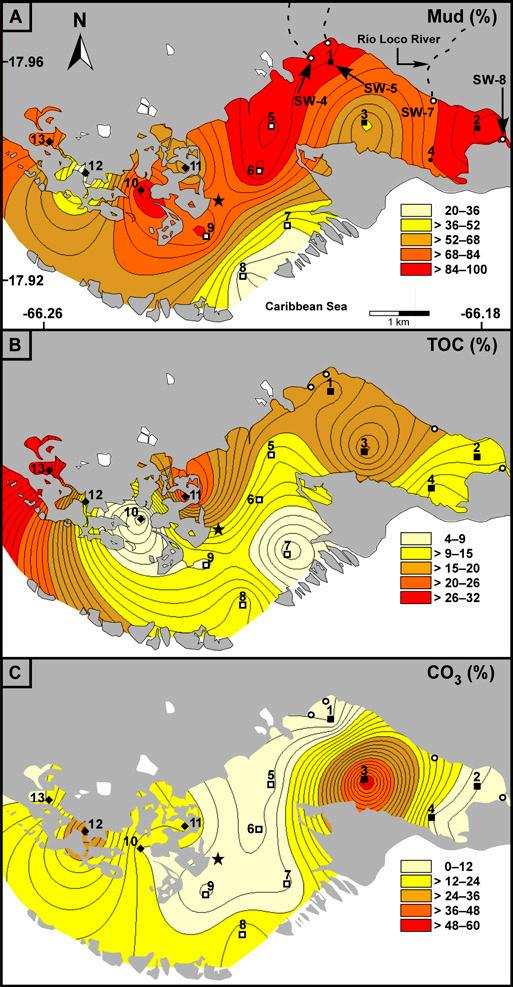
The most abundant sediment type was mud ranging from 25‒97% with no apparent spatial trend. Sites 12, 8 and 7 had the lowest mud content with the following respective values of 25, 30, and 40% (text-fig. 4). TOC ranged from 4–32% while CO3 ranged from 6–55% (Appendix 5, see supplementary material). In this case, the nMDS show an overall E‒W increasing trend (text-fig. 3) with the Restricted area having the highest TOC plotted along the positive nMDS1 axis, while the Open and Inner Bay follow the negative nMDS1 axis corresponding to lower values. Both mud and CO3 have minimal influence along the nMDS1 axis (text-fig. 3).
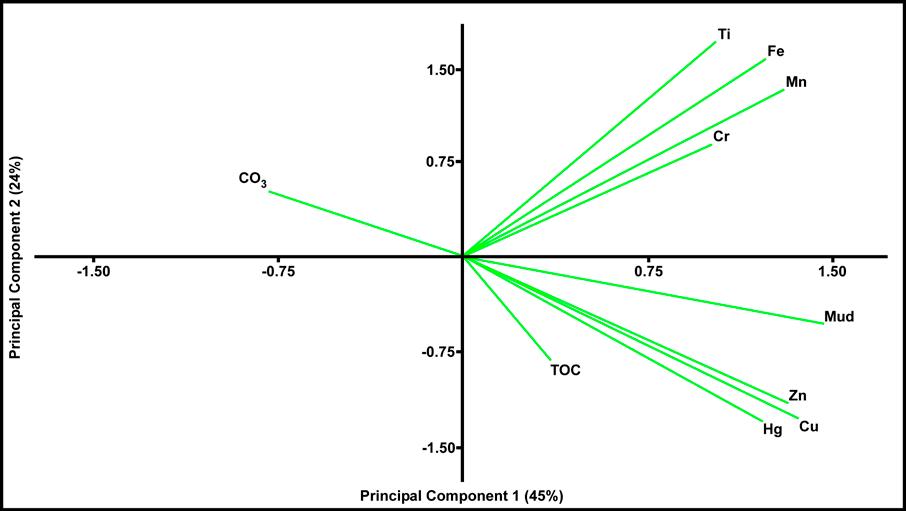
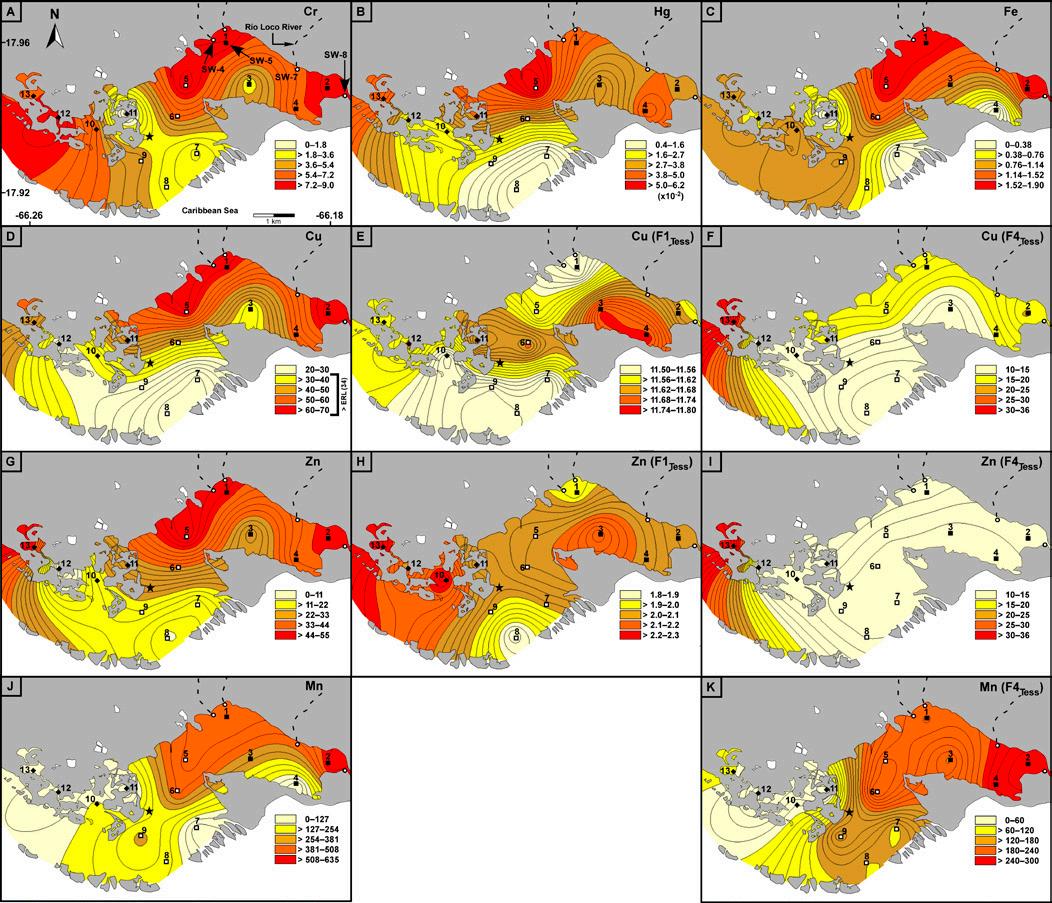
Of the 13 PTEs analyzed, Cd-Ni-Pb-As-Al-Se were below detection limit (0.001 mg/kg). Only Cr-Cu-Zn-Mn-Hg-Fe-Ti total concentrations are reported in this study. The PCA showed distinct groupings where Cu-Zn-Hg have a strong correlation with mud but limited when compared to TOC while all PTEs showed a negative affinity towards CO3 (text-fig. 5). Chromium is the only one to have significant correlation with Fe-Ti (terrestrial proxies) and Mn. Only the total concentrations of Cr (0.06–8.97 mg/kg), Fe (0.06–1.89%), and Ti (0.01–0.04%) had no discernable spatial pattern (text-fig. 6). An E–W decreasing trend was observed for total Cu (20.64–67.74 mg/kg), Zn (0.30–52.20 mg/kg), Mn (0.06–632.40 mg/kg), and Hg (0.004–0.06 mg/kg) (text-fig. 6). Given the levels of anthropogenic influence within the watershed and coastal areas, the single element EF index showed that most PTEs had “no enrichment”. The values for Zn-Mn had an E–W decreasing enrichment varying from “minor enrichment” to “no enrichment” (Appendix 5, see supplementary material). Copper was the only PTE to have “moderate enrichment” across the bay
except at site 13 which had a “moderate severe enrichment”. The multi-elemental MPI index identified most sampled sites as “moderately polluted” with 12–13 as “moderate- heavily polluted” (Appendix 5, see supplementary material).
As expected, only some of the PTEs were found in both the F1 (mud-bound) and F4 (organic-bound) bioavailable fractions. No trend for CuF1 (11.52–11.76 mg/kg) was observed given its very weak nMDS1 correlation while ZnF1 (1.86–2.28 mg/kg), with a nMDS2 significant influence, show a relative E–W increasing trend (text-fig. 6). More prevalent trends were observed in relation to CuF4 (10.08–35.88 mg/kg) and ZnF4 (2.40–27.78 mg/ kg) along the nMDS1 and nMDS2 axes (text-fig. 3). An overall E‒W increasing trend (text- fig. 6) was found with the Restricted area having the highest concentrations plotted along the positive nMDS1/nMDS2 axes, while the Open and Inner Bay corresponded to lower values. Only MnF4 (0.06–280.32 mg/kg) had a strong influence along the negative nMDS1 axis. In this case, Open and Inner Bay areas had the highest concentrations, while the Restricted sites corresponded to lower values. It is important to highlight that for these three PTEs, a 3-fold and 10-fold factor increase were observed for Cu an Zn while for Mn it was a 280fold in the F4 (Appendix 5, see supplementary material).
Ecological Responses and Distribution of Benthic Foraminifera
A total of 1,727 individuals were counted amongst 16 genera and 30 species. Ammonia (T1) is the most dominant species representing 37% (631 individuals) of the assemblage with site 5 having the highest counts (93) which corresponded with the lowest bottom salinity (18.3). Site 11 is considered “barren” given that only eight individuals were present of which two were Ammonia (T1). It is important to highlight that at site 13 the only foraminifer present was Ammonia (T1) with 44 individuals. Cribroelphidium poeyanum (136 individuals) and Haynesina sp. (101
Benjamin G. Shirey et al.: Estuarine foraminifera as an effective measure of benthic ecological quality status in Jobos Bay, Puerto Rico)
TEXT-FIGURE 4
Spatial distribution of sediment parameters. (A) Mud. (B) TOC - total organic carbon. (C) Carbonate (CO3). White squares - open bay. Black diamonds - restricted. White circles - river/creek outlets. Black starthermal water outlet. Dash lines - river/creek morphology.
individuals) were the second and third most abundant taxa in the assemblage representing 8 and 6% respectively and both had their highest values at site 4. Quinqueloculina seminulum (89 individuals), Nonion sp. (79 individuals), T. oblonga (75 individuals), E. discoidale (66 individuals), Quinqueloculina subpoeyana (65 individuals), and N. grateloupii (56 individuals) each represented <4% of the assemblage (Plate 1).
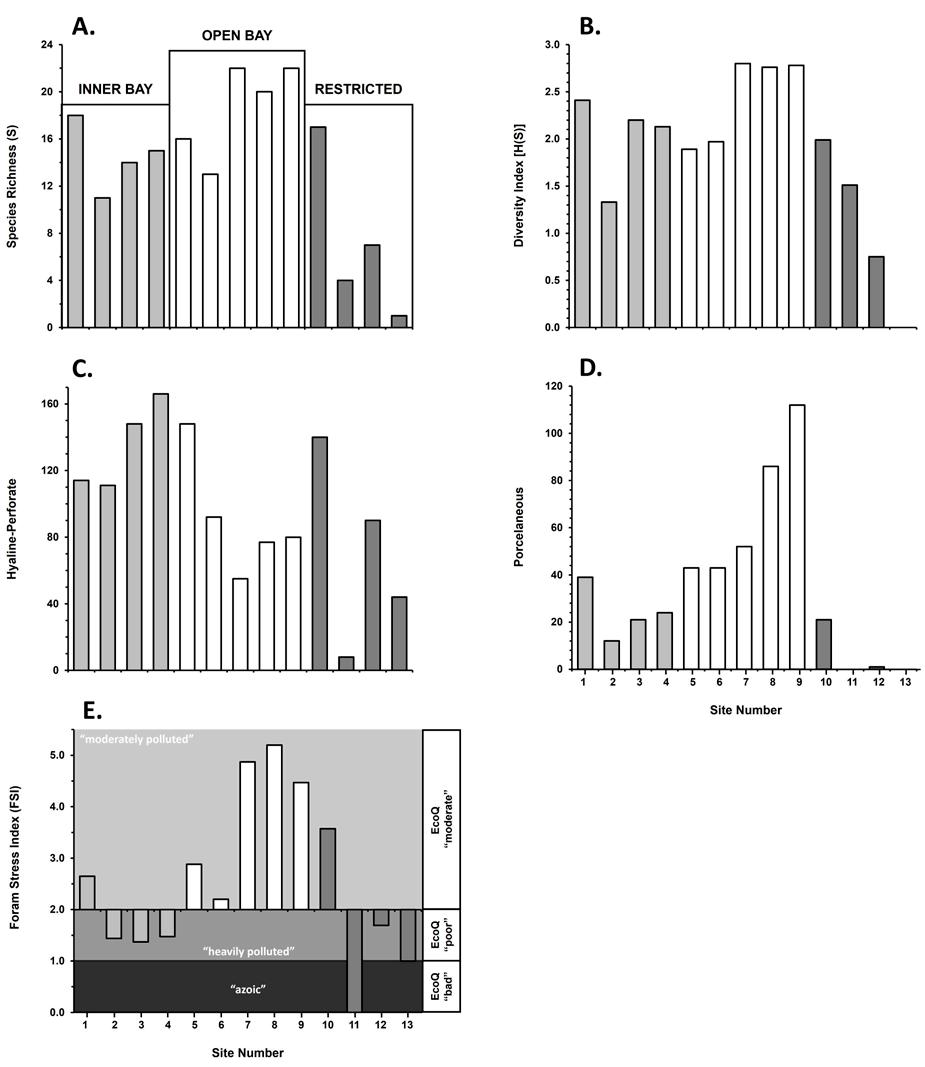
The S values raged from 1‒22 increasing from the Inner towards the Open Bay (highest values) and subsequently decreased towards the Restricted area with the lowest values at site 12 (7), site 11 (4), and site 13 (1) (text-fig. 7). The H(S) values rang-
ing from 0‒2.8 had a very similar pattern to that of S with the lowest values at sites 12 (0.75) and 13 (0) in the Restricted area (text-fig. 7). Regarding the hyaline- perforate and porcelaneous morphogroups, both had distinct distributions with the former having higher values within the Inner Bay and subsequently decreasing towards the Restricted sites (text-fig. 7). For the latter morphogroup, the highest values were observed at sites 8 (86) and 9 (112) in the Open Bay (text-fig. 7) with the Restricted area having the lowest values at sites 11 and 13 having none (Appendix 6, see supplementary material).
According to the FSI, the bay as an overall ecological rating of “Moderately Polluted” with a “moderate ecological status” especially at the Open Bay sites. “Heavily Polluted” conditions were found at the Inner Bay (sites 2‒4) and Restricted (sites 12‒13) areas representing a “poor ecological status” (textfig. 6).
Site 11 only had eight individuals represented by Elphidium sp., Ammonia (T1), Nonion sp., and Pseudononion sp. and yet its FSI value of 4.38 makes it “Moderately Polluted”. It is believed that this value is an artifact of the formula and not an ecological response. For example, some of the sites (2‒4, 12) considered “Heavily Polluted” (text-fig. 7) had higher S values coupled with higher number of individuals. Conversely, the monotonic site 13 with only 44 individuals of the well-known stress tolerant Ammonia (T1) had an FSI value of 1 (“Heavily Polluted”). For purposes of the FSI only, site 11 is considered “azoic” with a “bad” ecological status.
The CCA triplot (scaling-type 2) show how the biotic data plotted with respect to the abiotic parameters (text-fig. 8). The 54% of the abiotic variance is explained by Axis 1 while 16% is explained by Axis 2 with minimal to no impact on the biotic parameters. In decreasing order, the highest positive significance along +Axis 1 were DO > pH > MnF4 while along the -Axis 1 CuF4 > ZnF4 > ZnF1 > TOC > Hg > CO3 > CuF1 negatively influenced the biotic parameters (text-fig. 8). Along the +Axis 2, CuF1 > TOC were the only parameters having a significant positive influence and in the case of -Axis 2, it was pH > salinity (text-fig. 8). The Open Bay area was one of the least impacted by the abiotic parameters. Only DO-pH-MnF4 are the ones of note in this area along +Axis 1. Their observed positive influence over Triloculina sp., Quinqueloculina sp., Bolivina sp. and the porcelaneous morphogroup is significant. In addition, these taxa were negatively influenced (-Axis 1) mainly by TOC-HgCuF1-CuF4-ZnF1-ZnF4 (text-fig. 8). The Inner Bay with relative higher S, H(S), and more stress tolerant taxa, is less impacted than the Restricted sites by most of the abiotic parameters. For example, Haynesina sp. is significantly influenced by ZnF1ZnF4-Hg-TOC-salinity- CO3 (-Axis1) and by CuF1 (+Axis 1). In addition, these taxa are negatively influenced by DO-pH-MnF4. This is observed at site 2 which is located between SW-7 and SW-8 outlets. The rest including S and H(S) have very minimal influence by any of the abiotic parameters (text-fig. 8). Lastly, the Restricted sites are very isolated in the triplot and are mostly influenced by most of the abiotic parameter in addition to the lack of BF associated to this area (text-fig. 7). For example, the porcelaneous taxa are absent at sites 11 and13 with only one individual at site 12. Only DO-pH-MnF4 have a significant and negative effect on this area in relation to BF.
TEXT-FIGURE 5
Principal component analysis of total PTE concentrations. TOC - total organic carbon. CO3 - carbonate.
DISCUSSION
Fate and Transport of PTEs
The JBNERR, overall, is an open estuary given the large marine influence of Caribbean waters. On the one hand, bottom water salinities are practically uniform aside from site 5 (text-fig. 2) which is evidence of groundwater intrusion as reported in other areas in the study site (Zitello et al. 2008; JBNERR 2017). On the other hand, DO-pH are lower in the Restricted sites due to minimal flushing as depicted by increased TOC (text-fig. 2) although Laboy-Nieves (2009) reported a 5.5 day mean residence time for the whole estuary. In addition, this area is heavily surrounded by mangroves which explains the higher accumulation of organic matter coupled with associated soils being highly acidic (Martínez-Colón et al. 2021). The excess mangrove litter and tannin production naturally lowers the pH in the water as well as in sediments and soils (e.g., Rejeki et al. 2019; Lang et al. 2024) which helps in the desorption of PTEs from the F1Tess fraction and subsequently they get complexed with organic matter found associated with the F4Tess fraction (e.g., Martínez-Colón et al., 2009). This explains why Site 11 having the most acidic conditions (e.g., tannins and small ditches from the nearby thermoelectric plant) has the lowest PTE concentrations in F1Tess fraction while Site 14 has the highest in the F4Tess due to higher TOC.
The source of PTEs has always been a challenge in urbanized/ industrialized estuaries because natural sources are often masked by anthropogenic inputs or at best a combination of both. The level of environmental impact in JBNERR is that of “moderately polluted” based on the multi-parameter MPI index except for sites 12–13 (“moderate-heavily polluted) in the Restricted area. No PTE point source was identified in this study but four nonpoint sources associated with SW were found due to their highest total concentrations associated with their respective outlets in the Inner Bay (text-fig. 6). Previous studies have reported that the PTEs are of natural origin due to their positive correlation with terrestrial proxies (Whitall et al. 2011; Apeti et al. 2012)
as well as from anthropogenic sources (Whitall et al. 2011) in JBNERR. The sediments have experienced “minor” and “moderate” anthropogenic enrichments of Cu and Zn respectively between the Inner and Open Bay (sites 5–6 only) areas based on EF values. Only Cr showed a direct natural input since there is “no enrichment” and this is strongly supported by its significant correlation with Fe-Ti terrestrial proxies (text-fig. 5) which indicates a common source. The fate and transport of Hg is of interest because it also has a “no enrichment” value. As with all the PTEs however, this pollutant did not correlate with Fe or Ti but instead it followed the general trend of mud across JBNERR. Mercury is interpreted as anthropogenic in origin given the fact that its concentrations are higher in proximity to the SW (e.g., source of mud) and to a coal power plant (e.g., source of Hg; Whitall et al. 2011).
Of the three general regions, the Inner Bay is the one that has been exposed the most to PTEs given the number of SW discharging into this area (text-fig. 1). As reported by previous authors (Whitall et al. 2011; Apeti et al. 2012), this clearly explains highest overall total Cr-Cu-Zn-Mn-Hg concentrations, when compared to the other two areas, especially at sites 1 and 2 associated with SW-4, SW-5, SW-7, and SW-8 non-point sources (text-fig. 6). A similar interpretation is given for Cu-Zn in the F1 (mud-bound) fraction, although lower concentrations at site 1 is related to redox conditions at the sediment water interface which would remobilize these two PTEs into a different fraction (e.g., sulfide, carbonate) (e.g., Martínez-Colón et al. 2009; Jia et al. 2024). Overall, when compared to the Inner Bay and Restricted areas, all the abiotic parameters decrease towards the Open Bay. This area has no direct input of pollutants, and it is mainly exposed to waters of the Caribbean coming from the south (textfig. 1). It is suspected that the strong surface (high winds) and bottom current limits the deposition of mud-size sediments as well as influencing the spatial distribution of TOC in this area. This is supported by the findings of Whitall et al. (2011) who re-
Benjamin G. Shirey
al.:
TEXT-FIGURE 6
Spatial distribution of PTE concentrations. Total concentrations: (A)–(D), (G), (J). F1Tess: (E), (H). F4Tess: (F), (I), (K). White squares - open bay. Black diamonds - restricted. White circles - river/creek outlets. Black star - thermal water outlet. Dash lines - river/creek morphology. ERL - Effect range low. Concentration units are in mg/kg except for Fe (%).
ported PTEs and organic pollutants in coral tissue being flushed out by surface currents coming from the Inner Bay. In addition, in the case of the Open Bay (sites 7–9) and Restricted (site 10) areas, what it is observed is a synergistic effect of the amount of mud, salinity (Cl-ligands), and TOC as these are known factors for PTE desorption or remobilization (e.g., Martínez-Colón et al. 2009; 2024; Król et al. 2020) which would also explain the lower concentrations. Given the high TOC content for an estuary, the concentrations of Cu-Zn in the F4 (organic-bound) were unexpectedly not much higher than those from the F1 (mud-bound). The most likely scenario is the continual export or flushing towards the Caribbean Sea which has reduced the amount of TOC in the Open Bay. Only site 13, had the highest Cu-Zn concentrations of this organic-bound fraction given how restricted circulation is at this site (text-fig 6) which allowed for greater TOC deposition. More importantly, septic raw sewage from the hous-
ing community bordering the northern shore of this site has been reported seeping into this cove (Sastre et al. 2015) which is also a potential source for Cu and Zn (e.g., Martínez-Colón et al. 2009).
Ecological Response to Bioavailable PTEs
The foraminiferal fauna is not as numerous as expected given the normal marine conditions (e.g., DO, salinity) that prevail in JBNERR. On the other hand, their ecological response and spatial distribution indeed follow distinct abiotic gradients within each of the three regions. Both S and H(S) including Elphidium sp., Nonion sp., and N. grateloupii were minimally influenced by DO-pH in both the Inner and Open Bay areas but what is observed in the Restricted sites is their sensitivity to minor DO-pH changes and how strongly these are represented in the noticeable decrease in values (text-fig. 7a). Overall, the porcelaneous (especially Quinqueloculina sp.and Triloculina sp.) and Bolivina
TEXT-FIGURE 7
Benthic foraminifera ecological indices. EcoQ - ecological quality status. For panel E, the second y-axis represents the EcoQ thresholds.
sp.are well known to respond favourably to DO-pH while some species are tolerant to lower values (e.g., Martínez-Colón, et al., 2018; Bouchet et al., 2021). In this study for example, most species in these taxa are more abundant when normal marine conditions prevail (e.g., Moorea, South Pacific - Fajemila et al. 2020; Lagos (Commodore channel), eastern Atlantic – Fajemila et al. 2024), as evidence by the dominance of Q. subpoeyana, as they much prefer sandier sediments. This explains their much greater abundance in the Open Bay (text-fig. 7d) where Rosa-Marín et al. (2024) reported mesotrophic to oligotrophic conditions with very little seasonal variability in proximity to sites 7–8. Quin-
queloculina seminulum (Foster et al. 2012; Martins et al. 2013; Martínez-Colón et al. 2017) and T. oblonga (Debenay et al. 2001; Martínez-Colón et al. 2018) have been reported in other impacted estuaries from Puerto Rico and elsewhere and in this study, they are reacting more negatively towards bioavailable PTEs and TOC given their absence at the Restricted sites 11–13 (text-fig. 7d). In the case of the hyaline-perforate morphogroup, their rapid decrease in abundance from the Inner Bay towards the Restricted area is a response to lower DO-pH values and to a lesser extent mud. This explains why then Ammonia (T1) and Haynesina sp. have a relative dominance.
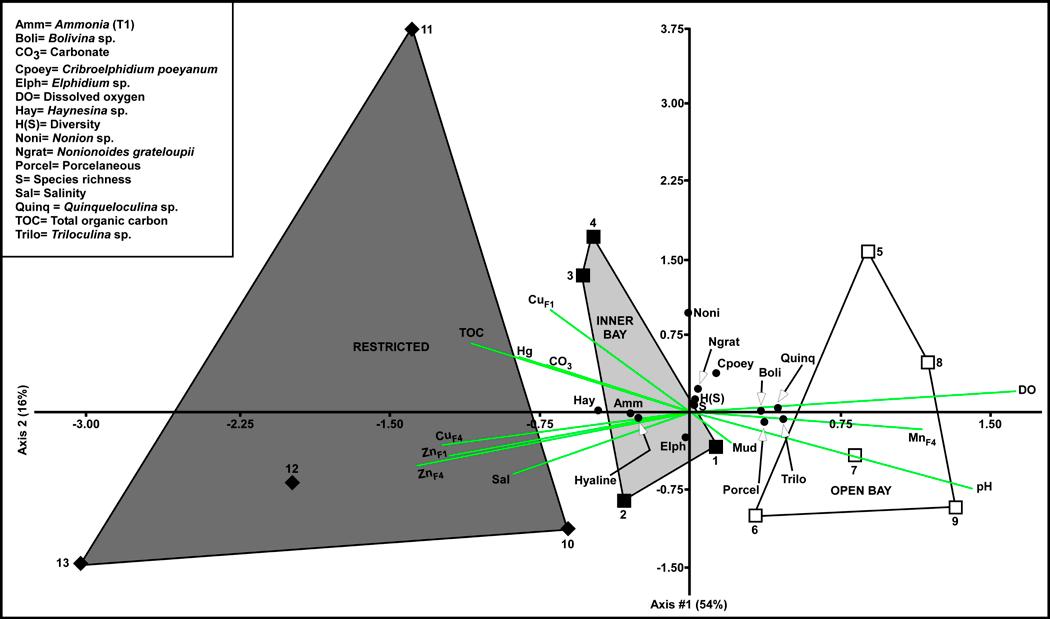
TEXT-FIGURE 8
Canonical correspondence analysis triplot of foraminiferal ecological parameters and abiotic parameters. Triplot was magnified two-times for better visualization.
In urban estuarine environments, is unlikely that the flora/fauna ecological behaviour is strictly related to natural variability as it is important to understand the synergistic factors provided by PTEs. Bioavailability is controlled by water quality (e.g., redox conditions, dissolved organic carbon, salinity) as well as by the substrate properties (e.g., TOC, texture, food type) at the sediment-water interface. Numerous studies (e.g., field-based, micro/macrocosm) have documented the negative effects of PTEs on the sensitive and tolerant taxa (e.g., Yanko et al. 1994; de Nooijer et al. 2007; Frontalini et al. 2016; Smith and Goldstein 2019; 2021; Lintner et al., 2021) and a more recent study showed how Cu-Zn toxicities reduced metabolism and at lower concentrations it improved food uptake of C and N (Bubl et al., 2024). In this study Ammonia (T1) and Haynesina sp. are tolerant to Cu-Zn in both bioavailable fractions, although despite their tolerance, their numbers decreased rapidly towards higher bioavailable concentrations at the restricted area (Fajemila et al. 2022). This is indicative of surpassing a critical concentration value in the sediments as this was speculated by Bubl et al. (2024) culture experiments with Heterostegina depressa. It comes as no surprise then that the porcelaneous morphogroup is practically absent (text-fig. 7d) given their higher sensitivity to bioavailable PTEs and TOC content. As mentioned earlier, septic tank seepage occurs at site 13 and most likely this is the main controlling factor given that the highest amounts of TOC in the sediments coupled with the lack of diversity (text-fig. 7).
JBNERR is a unique estuary given its near-normal marine conditions coupled with groundwater as a main freshwater input. This estuary is an MPA (Marine Protected Area) but it is not exempt
from anthropogenic perturbations and inputs of PTEs from nonpoint sources. According to the FSI, the environmental quality of the benthic environment is not uniform. The Inner Bay is considered “heavily polluted” and of “poor” ecological status given the BF response to the bioavailable PTEs even though the highest PTE total concentrations were recorded in this area. According to several authors, total concentrations overestimate the impacts of PTEs since both bioavailable and non-bioavailable are extracted indiscriminately (e.g., Martínez-Colón et al. 2009; 2017; Martins et al. 2020; Fajemila et al. 2022). What is observed is the sensitive taxa reacting more adversely to the synergistic effect of bioavailable PTEs and DO-pH-TOC. Of interest is site 1 which despite being near two non-point sources (SW-4 and SW-5) (text-fig. 1), it shows a “moderate” ecological status instead of having a lower ecological status. This is interpreted as the BF responding favourably to slightly lower CuF1-ZnF1. as this has been reported from culture experiments by Bubl et al. (2024). The “moderate” ecological status in the Open Bay was expected given the lower bioavailable concentrations of PTEs. Rosa-Marín et al. (2024) reported an increase in miliolids as a response to oligotrophic conditions along Cayo Caribe’s backreef environments (proximal to sites 7–8) which also explains the increased dominance of the porcelaneous taxa (text-fig. 7d) due to more favourable water quality conditions.
Lastly, the worst ecological status was found in the Restricted area with “poor” to “bad” conditions (text-fig. 7e) as the BF are responding to higher bioavailable PTEs in addition to the synergistic effect of the lowest water quality amongst the three areas. Special attention is given to sites 10 and 13. The former
was studied by Seiglie in 1971 who reported anoxic conditions due to a disposal site from the Central Aguirre Sugar mill north of this area. He reported high abundances of N. grateloupii (36% living assemblage) and concluded that this species is a bioindicator of organic matter pollution. Conditions have improved after the sugar mill closure in 1971 as evidenced by well oxygenated conditions reported in this study and by Seiglie in 1975. This explains the highest S and H(S) values of this area in addition to a 4% abundance in the total assemblage of N. grateloupii. Similarly, site 13 was surveyed by Seiglie in 1975 who reported high abundances of living miliolids but noted their total disappearance (living and dead) at >1 cm below the sediment-water interface due to dissolution. Aside from the BF reacting adversely to the high bioavailable PTE concentrations, this partially explains the porcelaneous taxa (total assemblage) absence at sites 11–13 in addition to being “moderate-heavily polluted” based on the MPI.
CONCLUSION
The “moderately polluted” profile of the sediments was uniform across the bay, indicative of a persistent anthropogenic influence of PTE total concentrations. Ammonia (T1) was the most dominant species and the ecological response of BF in the three regions was controlled mainly by the clustering of anthropogenic non-point sources of pollution in relation to the spatial distribution of bioavailable PTEs, and to a lesser extent by the bottom water characteristics and substrate type. Consequently, the “poor” to “bad” benthic EcoQ conditions between the Inner Bay and Restricted areas reflected increasing gradients in CuZn in the organic-bound fraction (F4). The relatively improved “moderate” ECoQ conditions of the Open Bay area exhibited the highest species diversity and richness as these were more likely governed by lower bioavailable concentrations and improved water quality.
ACKNOWLEDGMENTS
We want to thank Mrs. Veera from FAMU School of the Environment Core Lab for her assistance with ICP-OES analysis. Special thanks to Ms. Gabriella Lirio for providing fieldwork assistance. This work was supported by Puerto Rico Sea Grant [grant number: A18OAR4170089].
REFERENCES
ACEVEDO-FIGUEROA, D., JIMÉNEZ, B. D. and RODRÍGUEZSIERRA, C. J., 2006. Trace metals in sediments of two estuarine lagoons from Puerto Rico. Environmental Pollution, 141 (2): 336–342.
ALDARONDO-TORRES, J. X., SAMARA, F., MANSILLA-RIVERA, I., AGA, D. S. and RODRÍGUEZ-SIERRA, C. J., 2010. Trace metals, PAHs, and PCBs in sediments from the Jobos Bay area in Puerto Rico. Marine Pollution Bulletin, 60: 1350–1358.
ALEGRÍA, H., MARTÍNEZ-COLÓN, M., BIRGUL, A., BROOKS, G., HANSON, L. and KURT-KARAKUS, P., 2016. Historical sediment record and levels of PCBs in sediments and mangroves of Jobos Bay, Puerto Rico. Science of the Total Environment, 573: 1003–1009.
ALVE, E., 1991. Benthic foraminifera in sediment cores reflecting heavy metal pollution in Sørfjord, western Norway. Journal of Foraminiferal Research, 21 (1): 1–19.
–––––, 1995. Benthic foraminiferal responses to estuarine pollution: a review. Journal of Foraminiferal Research, 25 (3): 190–203.
APETI, D. A., WHITALL, D. R., PAIT, A. S., DIEPPA, A., ZITELLO, A. G. and LAUENSTEIN, G. G., 2012. Characterization of land-based sources of pollution in Jobos Bay, Puerto Rico: status of heavy metal
concentration in bed sediment. Environmental Monitoring and Assessment, 184: 811–830.
ARMYNOT DU CHÂTELET, E., DEBENAY, J. -P. and SOULARD, R., 2004. Foraminiferal proxies for pollution monitoring in moderately polluted harbors. Environmental Pollution, 127 (1): 27–40.
BAYRÓN-ARCELAY, M., RODRÍGUEZ-CAMACHO, K. and ACOSTA-MERCADO, D., 2020. Morphological response of Bolivina lowmani to sediment composition and organic matter: Applying geometric morphometrics for potential bio-monitoring. Journal of Foraminiferal Research, 50 (3): 249–265.
BENEDETTI, A. and PAPAZZONI, C. A., 2022. Rise and fall of rotaliid foraminifera across the Paleocene and Eocene times. Micropaleontology, 68 (2): 185–196.
BERGIN, F., KUCUKSEZGIN, F., ULUTURHAN, E., BARUT, I., MERIC, E., AVSAR, N. and NAZIK, A., 2006. The response of benthic foraminifera and ostracoda to heavy metal pollution in Gulf of Izmir (Eastern Aegean Sea). Estuarine, Coastal and Shelf Science, 66 (3–4): 368–386.
BIANCHETTE, T. A., MCCLOSKEY, T. A. and LIU, K. B., 2016. Re-evaluating the geological evidence for Late Holocene marine incursion events along the Guerrero Seismic Gap on the Pacific Coast of Mexico. PLoS One, 11 (8): 0161568.
BOUCHET, V. M. P., ALVE, E., RYGG, B. and TELFORD, R. J., 2012. Benthic foraminifera provide a promising tool for ecological quality assessment of marine waters. Ecological Indicators, 23: 66–75.
BOUCHET, V. M. P., FRONTALINI, F., FRANCESCANGELI, F., SAURIAU, P. -G., GESLIN, E., MARTINS, M. V. A., ALMOGILABIN, A., AVNAIM-KATAV, S., DI BELLA, L., CEARRETA, A., COCCIONI, R., COSTELLOE, A., DIMIZA, M. D., FERRARO, L., HAYNAERT, K., MARTÍNEZ-COLÓN, M., MELIS, R., SCHWEIZER, M., TRIANTAPHYLLOU, M. V., TSUJIMOTO, A., WILSON, B. and ARMYNOT DU CHÂTELET, E., 2021. Indicative value of benthic foraminiferal species from European intertidal areas and transitional waters for biomonitoring: assignment to ecological groups of sensibility to total organic carbon. Marine Pollution Bulletin, 164: 112071.
BUBL, M., HEINZ, P., WANEK, W., SCHAGERL, M., HOFMANN, T. and LINTNER, M., 2024. Impact of heavy metals (Cu, Fe, Pb, Zn) on carbon and nitrogen uptake of the diatom-bearing benthic foraminifera Heterostegina depressa. Heliyon, 10 (6): 27229.
BYERS, S.C., MILLS, E.L. and STEWART, P.L., 1978. A comparison of methods of determining organic carbon in marine sediments, with suggestions for a standard method. Hydrobiologia, 58: 43–47.
DE NOOIJER, L. J., REICHART, G. J., DUEÑAS-BOHÓRQUEZ, A., WOLTHERS, M., ERNST, S. R., MASON, P. R. D. and VAN DER ZWAAN, G. J., 2007. Copper incorporation in foraminiferal calcite: results from culturing experiments. Biogeosciences, 4: 493–504.
DEBENAY, J-P., GESLIN, E., EICHLER, B. B., DULEBA, W., SYLVESTRE, F. and EICHLER, P., 2001. Foraminiferal assemblages in a hypersaline lagoon, Araruama (R.J.) Brazil. Journal of Foraminiferal Research, 31 (2): 133–151.
DIMIZA, M. D., TRIANTAPHYLLOU, M. V., KOUKOUSIOURA, O., HALLOCK, P., SIMBOURA, N., KARAGEORGIS, A. P. and PAPATHANASIOU, E., 2016. The Foram Stress Index: A new tool for environmental assessment of soft-bottom environments using benthic foraminifera. A case study from the Saronikos Gulf, Greece, Eastern Mediterranean. Ecological Indicators, 60: 611–621.
ELLIOTT, M. and QUINTINO, V., 2007. The Estuarine Quality Paradox,
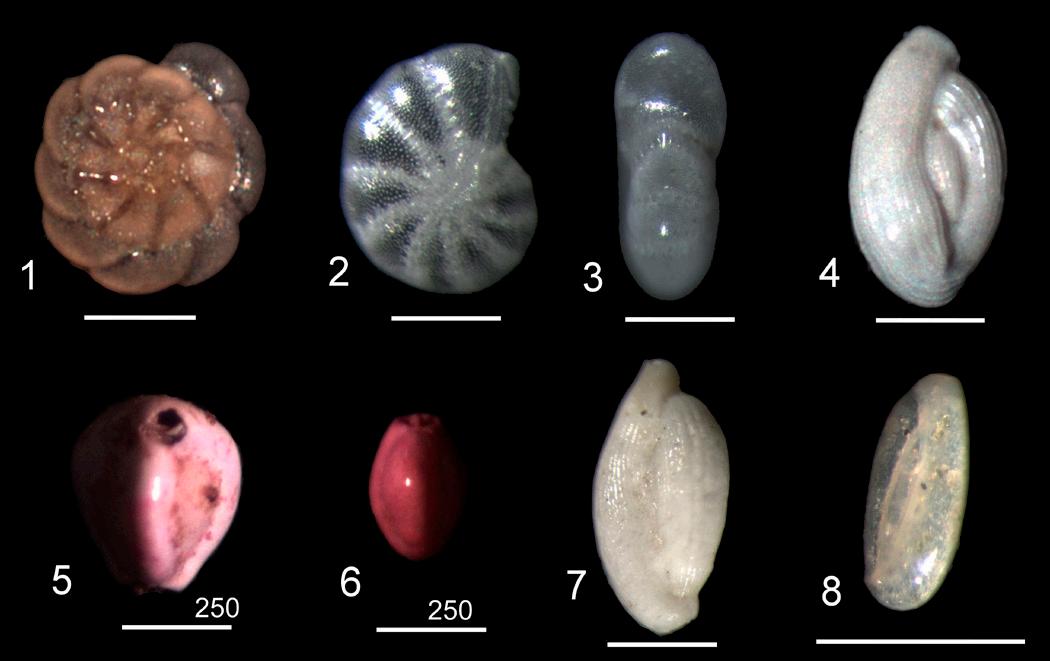
Scale bars are 500 microns unless otherwise indicated
Ammonia beccarii var. tepida (Cushman, 1926), spiral view
Cribroelphidium poeyanum (d/Orbigny, 1839), spiral view
Cribroelphidium poeyanum (d’Orbigny, 1839), apertural view
Quinqueloculina tenagos Parker, 1962
Triloculina tricarinata d’Orbigny in Deshayes, 1832, apertural view
Triloculina tricarinata d’Orbigny in Deshayes, 1832
Quinqueloculina subpoeyana Cushman, 1962
Quinqueloculina bosciana d’Orbigny, 1826
Environmental Homeostasis and the difficulty of detecting anthropogenic stress in naturally stressed areas. Marine Pollution Bulletin, 54: 640–645.
FAJEMILA, O. T., LANGER, M. R. and LIPPS J. H., 2020. Atlas of shallow-water tropical benthic foraminifera from Moorea (Society Islands, French Polynesia). Cushman Foundation for Foraminiferal Research, Special Publication, 48: 107 pp.
FAJEMILA, O. T., MARTÍNEZ-COLÓN, M. and SPEZZAFERRI, S., 2022. Spatial distribution of pollution levels and assessment of benthic foraminifera in Apapa-Badagry Creek, Nigeria. Marine Pollution Bulletin, 185: 114359.
FAJEMILA, O. T., MARTÍNEZ-COLÓN, M. and SPEZZAFERRI, S., 2024. Recent shallow-water benthic foraminifera from a tropical estuary, SW Nigeria. Journal of African Earth Sciences, 214: 105257.
FOSTER, W. J., ARMYNOT DU CHÂTELET, E. and ROGERSON, M., 2012. Testing benthic foraminiferal distributions as a contemporary quantitative approach to biomonitoring estuarine heavy metal pollution. Marine Pollution Bulletin, 64: 1039–1048.
FRONTALINI, F., CURZI, D., CESARINI, E., CANONICO, B., GIORDANO, F. M., DE MATTEIS, R., BERNHARD, J. M., PIERETI, N., GU, B., ESKELSEN, J.R., JUBB, A. M., ZHAO, L., PIERCE, E.M., GOBBI, P., PAPA, S. and COCCIONI, R., 2016. Mercury pollution induction of intracellular lipid accumulation and lysosomal compartment amplification in the benthic foraminifer Ammonia confertitesta PLoS ONE, 11 (9): 0162401.
FUKUE, M., NAKAMURA, T., KATO, Y. and YAMASAKI, S., 1999. Degree of pollution for marine sediments. Engineering Geology, 53 (2): 131–137.
HALLOCK, P., 1985. Why are larger foraminifera large? Paleobiology, 11: 195–208.
HALLOCK, P., PREMOLI SILVA, I. and BOERSMA, A., 1991. Similarities between planktonic and larger foraminiferal evolutionary trends through Paleogene evolutionary trend. Palaeogeography, Palaeoclimatology, Palaeoecology, 84 (1–3): 49–64.
HALLOCK, P., LIDZ, B. H., COCKEY-BURKHARD, E. M. and DONNELLY, K. B., 2003. Foraminifera as bioindicators in coral reef assessment and monitoring: The FoRAM Index. Environmental Monitoring and Assessment, 81: 221–238.
HAYWARD, B. W., HOLZMANN, M., GRENFELL, H. R., PAWLOWSKI, J. and TRIGGS, C. M., 2004. Morphological distinction of molecular types in Ammonia—towards a taxonomic revision of the world’s most commonly misidentified foraminifera. Marine Micropaleontology, 50: 237–271.
HAYWARD, B. W., LE COZE, F., VACHARD, D. and GROSS, O., 2022. World Foraminifera Database. https://www.marinespecies. org/foraminifera on 2024-05-08 (accessed- 7/1/2024).
HEINK, U. and KOWARIK, I., 2010.What are indicators? On the definition of indicators in ecology and environmental planning. Ecological Indicators, 10 (3): 584–593.
JIA, Z., LIU, Q., HU, J., LI, S. amd CHEN, H., 2024. A microcosm evaluation of metal cycling in an urbanized contaminated estuary varying with oxic-hypoxic-anoxic-reoxic transition: Behavior, fluxes, and mechanism. Science of the Total Environment, 930: 172769.
JOBOS BAY NATIONAL ESTUARINE RESEARCH RESERVE (JBNERR), 2017. Jobos Bay NERR management plan 2017–2022. https://www.drna.pr.gov/jbnerr/pm-jbnerr/jobos-bay-national-stuarine-research-reserve-management-plan-2017-2022/
JORISSEN, F. J., 1999. Benthic foraminiferal microhabitats below the sediment-water interface. In: Sen Gupta, B. K., Ed., Modern Foraminifera, 179–191. Boston: Kluwer Academic Publishers.
JORISSEN, F. J., NARDELLI, M. P., ALMOGI-LABIN, A., BARRAS, C., BERGAMIN, L., BICCHI, E., EL KATEB, A., FERRARO, L., MCGANN, M., MORIGI, C., ROMANO, E., SABBATINI, A., SCHWEIZER, M. and SPEZZAFERRI, S., 2018. Developing Foram-AMBI for biomonitoring in the Mediterranean: Species assignments to ecological categories. Marine Micropaleontology, 140: 33–45.
KRÓL, A., MIZERNA, K. and BOZYM, M., 2020. An assessment of pH-dependent release and mobility of heavy metals from metallurgical slag. Journal of Hazardous Materials, 384: 121502.
LABOY-NIEVES, E. N., 2009. Environmental profile and management issues in an estuarine ecosystem: a case study from Jobos Bay, Puerto Rico. In: Laboy-Nieves, E. N., Schaffer, F. C., Abdelhadi, A. H., Goose, M. F. A., Eds., Environmental Management, Sustainable Development and Human Health, 361–398. The Netherlands: CRC Press/Belkema.
LANG, T., KE, X., WEI, J., HUSSAIN, M., LI, M., GAO, C., JIANG, M., WANG, Y., FU, Y., WU, K., ZHANG, W., FUNG-YEE TAM, N. and ZHOU, H., 2024. Dynamics of tannin variations in mangrove leaf litter decomposition and their effects on environmental nitrogen and microbial activity. Science of the Total Environment, 908: 168150
LINTNER, M., LITNER, B., T., WOLFGANG, W., NINA, K., VON DER KAMMER, HOFMANN, T., and HEINZ, P., 2021. Effects of heavy elements (Pb, Cu, Zn) on algal food uptake by Elphidium excavatum (Foraminifera). Heliyon, 7 (11): 08427.
LOEBLICH, A. R. and TAPPAN, H., 1987. Foraminiferal genera and their classification. New York: Van Nostrand Reinhold Company, 982 pp + 847 pls.
MARQUES, J. A., COSTA, P. G., MARANGONI, L. F. B., PEREIRA, C. M., ABRANTES, D. P., CALDERON, E. N., CASTRO, C. B. and BIANCHINI, A., 2019. Environmental health in southwestern Atlantic coral reefs: Geochemical, water quality and ecological indicators. Science of The Total Environment, 651 (1): 261–270.
MARTÍNEZ-COLÓN, M., HALLOCK, P. and GREEN-RUÍZ, C. R, 2009. Strategies for using shallow-water foraminifers as bioindicators of potentially toxic elements: A review. Journal of Foraminiferal Research, 39 (4): 278–299.
MARTÍNEZ-COLÓN, M., HALLOCK, P. and GREEN-RUÍZ, C. R and SMOAK, J. M., 2017. Temporal variability in potentially toxic elements (PTE's) and benthic Foraminifera in an estuarine environment in Puerto Rico. Micropaleontology, 63 (6): 357–381.
MARTÍNEZ-COLÓN, M., HALLOCK, P. and GREEN-RUÍZ, C. R and SMOAK, J. M., 2018. Benthic foraminifera as bioindicators of potentially toxic element (PTE) pollution: Torrecillas lagoon (San Juan Bay Estuary), Puerto Rico. Ecological Indicators, 89: 516–527.
MARTÍNEZ-COLÓN, M., ALEGRÍA, H., HUBER, A., UBRA GUL, H. and KURT-KARAKUS, P., 2021. Bioaccumulation and biomagnification of potential toxic elements (PTEs): An Avicennia germinans–Uca rapax trophic transfer story from Jobos Bay, Puerto Rico. Ecological Indicators, 121: 107038.
MARTÍNEZ-COLÓN, M., ROSS, B., OWENS, J. D., DUONG, G., FAJEMILA, O. T., BOUCHET, V. M. P. and MARTINS, M. V. A., (in press). Pitfalls of bioavailability assessment of sequentially extracted potentially toxic elements in environmental micropaleontology. Journal of Foraminiferal Research
Benjamin G. Shirey et al.: Estuarine foraminifera as an effective measure of benthic ecological quality status in Jobos Bay, Puerto Rico)
MARTINS, M. V. A., FRONTALINI, F., TRAMONTE, K. M., FIGUEIRA, R. C., MIRANDA, P., SEQUEIRA, C., FERNANDEZFERNANDEZ, S., DIAS, J. A., YAMASHITA, C., RENO, R., LAUT, L. L., SILVA, F. S., RODRIGUES, M. A., BERNARDES, C., NAGAI, R., SOUSA, S. H., MAHIQUES, M., RUBIO, B., BERNABEU, A., REY, D. and ROCHA, F., 2013. Assessment of the health quality of Ria de Aveiro (Portugal): heavy metals and benthic foraminifera. Marine Pollution Bulletin, 70: 18–33.
MARTINS, M. V. A., YAMASHITA, C., HELENA DE MELLO E SOUSA, S., APOSTOLOS MACHADO KOUTSOUKOS, E., TREVISAN DISARÓ, S., DEBENAY, J. -P. and DULEBA, W., 2019. Response of benthic foraminifera to environmental variability: Importance of benthic foraminifera in Monitoring Studies. IntechOpen. doi.org/10.5772/intechopen.81658.
MARTINS, M. V. A., HOHENEGGER, J., MARTÍNEZ-COLÓN, M., FRONTALINI, F., BERGAMASHI, S., LAUT, L., BELART, P., MAHIQUES, M., PEREIRA, E., RODRIGUES, R., TERROSO, D., MIRANDA, P., GERALDES, M. C., HERINGER VILLENA, H., REIS, T., AGUILERA-SOCORRO, O. A., SOUSA, S. H. M., YAMASHITA, C. and ROCHA, F., 2020. Ecological quality status of the NE sector of the Guanabara Bay (Brazil): A case of living benthic foraminiferal resilience. Marine Pollution Bulletin, 158: 111449.
MARTINS, M. V. A., CAZELLI, L., YHASNARA, M., DA CRSITINE SILVA, L., SAIBRO, B. M., RAFALOSKI BOBCO, F. E., RUBIO, B., FERREIRA, B., CASTELO, W. F. L., SANTOS, J. F., RIBERIO, S., FRONTALINI, F., MARTÍNEZ-COLÓN, M., PEREIRA, E., ANTONIOLI, L., GERALDES, M., ROCHA, F., SOUSA, S. M. H. and DIAS, J. M. A., 2022. Factors driving sediment compositional change in the distal area of the Ria de Vigo (NW Spain): oceanographic processes vs. paleopollution. Environmental Science and Pollution Research, 29: 69652–69679.
MELIS, R., CELIO, M., BOUCHET, V. M. P., VARAGONA, G., BAZZARO, M., CROSERA, M. and PUGLIESE, N., 2019. Seasonal Response of benthic foraminifera to anthropogenic pressure in two stations of the Gulf of Trieste (northern Adriatic Sea): the marine protected area of Miramare versus the Servola water sewage outfall. Mediterranean Marine Science, 20 (1): 120–141.
NATIONAL OCEANOGRAPHIC AND ATMOSPHERIC ADMINISTRATION (NOAA), 2002. Benthic habitat mapping in Puerto Rico and the U.S. Virgin Islands for a baseline inventory- Mapping benthic habitats to support research, monitoring, coastal zone and fisheries management. National Centers for Coastal Ocean Science. https://coastalscience.noaa.gov/project/benthic-habitat-mapping-puerto-rico-virgin-islands/ (accessed- 3/01/2024).
OLIVA, F., PEROS, M. C., VIAU, A. E., REINHARDT, E. G., NIXON, F. C. and MORIN, A., 2018. A multi-proxy reconstruction of tropical cyclone variability during the past 800 years from Robinson Lake, Nova Scotia, Canada. Marine Geology, 406: 84–97.
O'MALLEY, B. J., SCHWING, P. T., MARTÍNEZ-COLÓN, M., SPEZZAFERRI, S., MACHAIN-CASTILLO, M. L., LARSON, R. A., BROOKS, G. R., RUIZ-FERNÁNDEZ, A. C. and HOLLANDER, D. J., 2021. Development of a benthic foraminifera based marine biotic index (Foram-AMBI) for the Gulf of Mexico: a decision support tool. Ecological Indicators, 120: 106916.
PAIT, A. S., WHITALL, D. R., JEFFREY, C. F., CALDOW, C., MASON, A. L., CHRISTENSEN, J. D., MONACO, M. E. and RAMÍREZ, J., 2007. An assessment of chemical contaminants in the marine sediments of southwest Puerto Rico. NOAA Technical Memorandum NOS NCCOS, 52, 116 pp.
PAIT, A. S., WHITALL, D., DIEPPA, A., NEWTON, E., BRUNE, L., CALDOW, C. and CHRISTENSEN, D., 2012. Characterization of organic chemical contaminants in sediments from Jobos Bay, Puerto
Rico. Environmental and Monitoring Assessment, 184: 5065–5075.
PARKER, W. C. and ARNOLD, A. J., 1999. Quantitative methods of data analysis in foraminiferal ecology. In: Sen Gupta, B.K., Ed., Modern Foraminifera, 71–89. Boston: Kluwer Academic Publishers.
PAVARD, J. -C., RICHIRT, J., COURCOT, L., BOUCHET, P., SEURONT, L. and BOUCHET, V. M. P., 2021. Fast and reliable identification of Ammonia phylotypes T1, T2 and T6 using a stereomicroscope: implication for large-scale ecological surveys and monitoring Programs. Water, 13: 3563.
POAG, C. W., 1981. Ecologic Atlas of Benthic Foraminifera of the Gulf of Mexico. Woods Hole: Hutchinson Ross Publishing Company, 175 pp.
PRAZERES, M., MARTÍNEZ-COLÓN, M. and HALLOCK, P., 2020. Foraminifera as bioindicators of water quality: The FoRAM Index revisited. Environmental Pollution, 257: 113612.
REJEKI, S., MIDDELJANS, M., WIDOWATI, L. L., ARIYATI, R. Q., ELFITASARI, T. and BOSMA, R. H., 2019. The effects of decomposing mangrove leaf litter and its tannins on water quality and the growth and survival of tiger prawn (Penaeus monodon) post-larvae. Biodiversitas, 20 (9): 2750–2757.
RICHIRT, J., SCHWEIZER, M., MOURET, A., QUINCHARD, S., SAAD, S. A., BOUCHET, V. M. P., WADE, C. M. and JORISSEN, F. J., 2021. Biogeographic distribution of three phylotypes (T1, T2 and T6) of Ammonia (foraminifera, Rhizaria) around Great Britain: new insights from combined molecular and morphological recognition. Journal of Micropalaeontology, 40 (1): 61–74.
ROSA-MARÍN, A., HALLOCK, P. and MARTÍNEZ-COLÓN, M., 2024. Benthic foraminiferal dynamics in reef-associated sediments of Jobos Bay, Puerto Rico: 2018–2019. Journal of Foraminiferal Research, 54 (2): 95–106.
SASTRE, M. P., COLLADO, E., MANSILLA-RIVERA, I. and RODRÍGUEZ-SIERRA, C. J., 2015. DNA damage and heavy metal content in the mussel, Brachiodontes exustus (Linnaeus, 1758) (Mollusca: Mytilidae), from the Jobos Bay National Estuarine Research Reserve (JBERR), Salinas and Guayama, Puerto Rico. Life: The Excitement of Biology, 3 (1): 3–14.
SEIGLIE, G.A., 1968. Foraminiferal assemblages as indicators of high organic carbon content in sediments and polluted waters. American Association of Petroleum Geologists Bulletin, 52: 2231–2241.
–––––, 1971. A preliminary note on the relationships between foraminifers and pollution in two Puerto Rican Bays. Caribbean Journal of Science, 11: 93–98.
–––––, 1975a. Modifications a l’Holocene supérieur de foraminifères de la baie de jobos et ses environs, Porto Rico. Revue de Micropaleontologie, 19: 101–107.
–––––, 1975b. Foraminifers of Guayanilla Bay and their use as environmental indicators. Revista Española de Micropaleontología, 7: 453–487.
SEN GUPTA, B. K., TURNER, R. E. and RABALAIS, N. N., 1996, Seasonal oxygen depletion on continental-shelf waters of Louisiana: Historical records on benthic foraminifera. Geology, 24: 227–230.
SHANNON, C. E., 1948. A mathematical theory of communication. The Bell System Technical Journal, 27: 379–423.
SMITH, C. W. and GOLDSTEIN, S. T., 2019. The effects of selected heavy metal elements (arsenic, cadmium, nickel, zinc) on experi-
mentally grown foraminiferal assemblages from Sapelo island, Georgia and Little Duck Key, Florida, U.S.A.. Journal of Foraminiferal Research, 49 (3): 303–317.
–––––, 2021. Effects of varied temperature and salinity on assemblages of foraminifera grown with exposure to heavy-metal pollutants (nickel and zinc). Journal of Foraminiferal Research, 51 (3): 99–114.
TESSIER, A., CAMPBELL, P. G. and BISSON, M., 1979. Sequential extraction procedure for the speciation of particulate trace metals. Analytical Chemistry, 51 (7): 844–851
U.S. CENSUS BUREAU, 2024. Guayama Municipio, Puerto Rico. https://www.census.gov/quickfacts/fact/table/guayamamunicipiopuertorico,guanicamunicipiopuertorico/BZA010222.(accessed7/010/2024).
U.S. ENVIRONMENTAL PROTECTION AGENCY (EPA), 1998. Method 7473 (SW-846): Mercury in Solids and Solutions by Thermal Decomposition, Amalgamation, and Atomic Absorption Spectrophotometry. Washington, DC., 17 pp.
–––––, 2007. Method 3051A (SW-846): Microwave Assisted Acid Digestion of Sediments, Sludges, and Oils. Washington, DC., 30 pp.
WANG, X., YU, M., HE, X., SU, J., XI, B., SUN, Y., FU, X., WANG, Y. and ZHENG, M., 2023. Insights into the role of the microbial
community lifestyle strategies in variations of the dissolved organic matter molecular composition along an effluent-dominated river. Chemosphere, 310: 136829.
WATKINS, J. G., 1961. Foraminiferal ecology around the Orange County, California, ocean sewer outfall. Micropaleontology, 7 (2): 199–206.
WHITALL, D. R., COSTA, B. M., BAUER, L. J., DIEPPA, A. and HILE, S. D. 2011. A baseline assessment of the ecological resources of Jobos Bay, Puerto Rico. NOAA Technical Memorandum NOS NCCOS 133. Silver Spring, MD., 188 pp.
YANKO, V., KRONFELD, J. and FLEXER, A., 1994. Response of benthic Foraminifera to various pollution sources–implications for pollution monitoring. Journal of Foraminiferal Research, 24: 1–17.
YAO, Q., LIU, K., WU, Y., ARAGÓN-MORENO, A.A., RODRIGUES, E., COHEN, M., DE SOUZA, A. V., FARFÁN, L.M. and ANTINAO, J.L., 2021. A multi-proxy record of hurricanes, tsunami, and post-disturbance ecosystem changes from coastal southern Baja California. Science of The Total Environment, 796: 149011.
ZITELLO, A. G., WHITALL, D. R., DIEPPA, A., CHRISTENSEN, J. D., MONACO, M. E. and ROHMANN, S. O., 2008. Characterizing Jobos Bay, Puerto Rico: A watershed modelling analysis and monitoring plan. NOAA Technical Memorandum NOS NCCOS 76. Silver Spring, MD., 81 pp.