remote sensing
Article

ElevationandDistributionofFreshwaterandSewageCanals
RegulateCanopyStructureandDifferentiateHurricane DamagestoaBasinMangroveForest
QiongGaoandMeiYu*
Citation: Gao,Q.;Yu,M.Elevation andDistributionofFreshwaterand SewageCanalsRegulateCanopy StructureandDifferentiateHurricane DamagestoaBasinMangroveForest. RemoteSens. 2021, 13,3387. https:// doi.org/10.3390/rs13173387
AcademicEditors:EileenH.Helmer, PatrickJ.Comer,DavidGwenzi,Wan ShafrinaWanMohdJaafarand XiaolinZhu
Received:4July2021
Accepted:24August2021
Published:26August2021
Publisher’sNote: MDPIstaysneutral withregardtojurisdictionalclaimsin publishedmapsandinstitutionalaffiliations.

Copyright: ©2021bytheauthors. LicenseeMDPI,Basel,Switzerland. Thisarticleisanopenaccessarticle distributedunderthetermsand conditionsoftheCreativeCommons Attribution(CCBY)license(https:// creativecommons.org/licenses/by/ 4.0/).
DepartmentofEnvironmentalSciences,UniversityofPuertoRico,RioPiedras,SanJuan,PR00926,USA; q.gao@ites.upr.edu
* Correspondence:meiyu@ites.upr.edu
Abstract: Thecoastalmangroveforestbearsimportantecosystemfunctionsandservices,including theprotectionofshorelinesandcoastalcommunities.Whilecoastalmangrovesoftensuffersevere damageduringstorms,understandingthevulnerabilityandresistanceofmangrovestothedamage atalandscapescaleiscrucialforcoastalmangrovemanagementandconservation.InSeptember 2017,twoconsecutivemajorhurricanescausedtremendousdamagetothecoastalmangrovesin theCaribbean.ByutilizingLiDARdatatakenbeforeandafterthehurricanesinabasinmangrove forestinNortheastPuertoRico,weanalyzedthespatialvariationofacanopystructurebeforethe hurricanesandhurricane-inducedcanopyheightreductionandexploredpossibledriversbymeans ofspatialregressions.Regardingthecanopystructure,wefoundthatthepre-hurricanecanopyheight ofthemangroveforestdecreasedwithelevationanddistancetothefreshwater/sewagecanalswithin theforest,andthesetwodriversexplained82%ofvariationsinthemangrovecanopyheight.The model,thus,impliesthatfreshwaterandnutrientinputsbroughtbythecanalstendtopromotethe canopyheight,andmangrovetreesatlowerelevationareespeciallymoreadvantageous.Similarly, treedensitiesdecreasedwiththecanopyheightbutincreasedwiththeelevationandthedistance tothecanals.Wealsofoundthatthismangroveforestsufferedonaveragea53%canopyheight reduction,reflectingmostlyheavycrowndefoliationandtheruptureofbranches.Theregression, whichexplains88%ofspatialvariationinthecanopyheightreduction,showedthatmangroves withahighercanopyorlowerdensity,orgrowinginlowerelevation,orbeingclosertothecanals sufferedmoredamage.Ourfindingsindicatethatdeliveredfreshwater/sewagebymeansofhumanmadecanalshasastrongimpactonthecanopystructureaswellasitsresistancetotropicalstorms. Freshwaterandsewagetendtoreleasethesalinitystressandnutrientdeficitand,thus,topromotethe mangrovecanopyheight.However,theadditionoffreshwaterandnutrientsmightalsoincreasethe riskofmangrovedamageduringthestormsprobablybecauseofanalteredallometryofassimilates.
Keywords: coastalmangroves;anthropogenicactivities;canopystructure;tropicalcyclones;Puerto Rico;LiDAR
1.Introduction
Mangroveforestswereestimatedtooccupy137,760km2 oftheglobalcoast[1],and arehomesofmanyfaunafrominvertebratetovertebrate[2].Mangroveforestsgrowin asaltyandanaerobicenvironmentwithagreatcarbonsequestrationcapabilityduetoa highcarbonassimilationbutlowecosystemrespiration,andtheextremelyhighwaterand nutrientuseefficienciesofthemangrovetrees[3].Thecapabilityoffixinggreatamountof nutrientsmakesmangrovethebestfilteroftoxicantsinthecoastalwater[4,5].Meanwhile, mangrovestendtostabilizethecoastlinebecauseoftheirhighcapacityofverticalaccretion tooffsetthecoastalretrieveduetosealevelrise[6].
Tropicalandsubtropicalcoastsareoftentheplacesofhistoricalagriculture,tourism, andurbandevelopment,whichcompetewithmangroveforestsforlandandotherre-
sources[7].Althoughprotectedbyinternationalandnationalpoliciesandregulations, mangroveforestsinclosedistancetourbanareasareconnectedtotheurbancommunities viahistoricallegacy,aerodynamics,hydrology,andnutrients[8].Forpeoplelivingnearthe coast,thedensecanopyandrootsystemofmangrovesprovideessentialprotectionduring thetropicalstorms[9].
Whileprotectingshorelinesandcoastalcommunities,mangrovesoftenexpericence severedamageduringstrongstorms.Inadditiontodefoliation,theraptureofbranches andtrunks,andwindthrowsbythestormwinds,thesurgeofoceanandfloodsofriverscan inundatethemangrovesystemforweeks.Aprolongedinundationsubmergestheaerial rootsofmangroves,preventstreesfromrespirating,andcausesadelayedmortality[10–12]. Duetothesalinityandhypoxiastress,therecoveryofamangroveecosystemmaytake decades[13–15].
Assessingandanalyzingthedamageoftropicalstormstomangrovesatlandscape scalesarecrucialtounderstandingtheresistanceofcoastalmangroves.Anassessmentby groundobservation[16]isoftenlimitedbyscale.Vegetationindicesandmoistureindices derivedfrommultispectralremotesensingprovideacontinuous,spatiotemporalobservationoftheterrestrialecosystemandhavebeenusedtoassessthewiderangedamagesof mangroves[15,17,18].Comparedtouplandforests,coastalmangrovesexperiencethegreatestimpactaftermajorhurricanesintermsoftherelativedropinthevegetationindex[15]. However,changesinthevegetationindexmostlyreflectchangesingreenbiomassorleaf areawithalimitedcapacitytoassessverticalstructuraldamagesofmangrovebranches andtrunksbyhurricanes.
Space-orair-borneLiDAR(LightDetectionandRanging)isidealtoassessstorm damagestotheverticalstructureofcoastalmangroves[19].High-intenseinfraredlaser beamscanpenetratecanopylayersandreturnmultiplesignalsreflectingthestructureof theforestcanopy.Thelasercanreachthegroundandresultinalastreturnfromtheground ifthecanopyisnotexceptionallydenseorthick.LiDARdatacanbeusedtoderiveadigital surfacemodel(DSM),digitalterrainmodel(DTM),andcanopyheightmodel(CHM).The spatialvariationofcanopyheightcanbeusedtoderiveplanarcartesiancoordinatesoftree tops,thecanopyarea,andtreedensityinaforest[20,21].
Theseverityofdamagetoaforeststructurebystormwindscanbeaffectedbyvarious factors.Mitchell[22]gaveacomprehensivereviewonthewinddisturbanceonforests: Anemergentoverstoryandhighercanopymayinterceptmorewindforceandmore momentumtodamagethetreesinaforest,andabigstemdiametertendstoincrease theshearmodulusand,thus,resiststheraptureofstemsandbranches.Largerspacing amongtreestems(lowerstemdensity)decreasesthecriticalstem-rupturewindspeed, implyingthatundergivenstormwindspeedlargerspacingmightleadtomoredamage[23]. However,whenthedensityistoohigh,treesallocatemorematerialsforlongerratherthan larger-diameterstems,whichmakestheforeststandmorevulnerabletostrongwinds.The windthrowoftreesisalsoaffectedbyroot–soilanchorage.Wet,especiallysaturated,soil plusashallowrootsystemmakesaforestmorepronetowindthrow[22].Inadditiontothe winddamage,thelengthyoffloodingmaycausedelayeddamagetothemangroves[10].
TheCaribbeancoasts,inbetweentheAtlanticOceanandCentralAmerica(Figure A1), arefrequentlydisturbedbytropicalcyclones[24].Forexample,in2017,HurricaneIrma ofcategoryfivepassednearbythenortheastofPuertoRico,oneoftheGreatAntilles islandsintheNortheasternCaribbean(Figure A1),onSep.6.Twoweekslater,another high-endcategoryfourhurricane,HurricaneMaria,madealandfallintheeastoftheisland whichsweptPuertoRico(Figure 1a)andcreatedtremendousdamagestothemangrove ecosystems[17,25].Anassessmentandanalysisofthehurricanedamageatalandscape levelarestillingreatneedtounderstandthemechanismofthemangroveresistanceto storms[15].
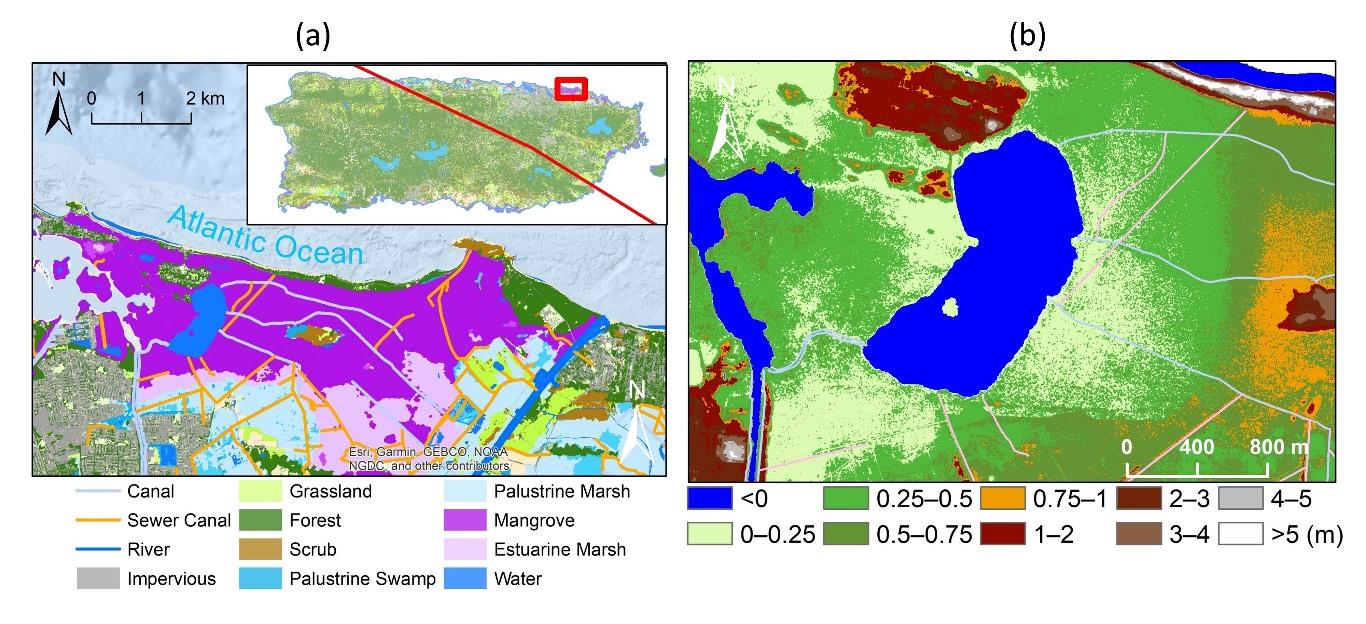
Figure1. (a)PiñonesStateForest,thelargestmangroveforestinPuertoRico.MapofPuertoRicoisintheupperrightwith aredlineindicatingthepathofHurricaneMariaon20September2017.LandcoverfromtheNOAAC-CAPProgramfor 2010showsthedistributionofmangroves,togetherwiththeriversandcanals.(b)DigitalElevationModelaroundthe PiñonesLagoon,alsowiththecanals.
Figure 1. (a) Piñones State Forest, the largest mangrove forest in Puerto Rico. Map of Puerto Rico is in the upper right with a red line indicating the path of Hurricane Maria on 20 September 2017. Land cover from the NOAA C-CAP Program for 2010 shows the distribution of mangroves, together with the rivers and canals. (b) Digital Elevation Model around the Piñones Lagoon, also with the canals.
2.2. LiDAR Data Processing
Theobjectivesofthisstudyaretoassessthehurricanedamagetothelargestmangrove forestinNortheastPuertoRicoandtodeterminekeyvariablesthatexplainthespatial variationofthecanopystructureaswellasthatofthehurricanedamage.Usingthe availableLiDARdatasourcesinSpring2017and2018,westartedwithanalyzingthe spatialpatternsofLiDAR-derivedcanopyheightandtreedensityandthenattributed thespatialvariationofmangrovestructurestotheenvironmentsuchastopographyand sewage/freshwaterdischargestotheforest.Assumingthechangesincanopyheightfrom Spring2017to2018weremostlycausedbythehurricanesinSeptember2017,wethen analyzedthespatialpatternofcanopyheightreductionbythehurricanestoidentifykey factorsthatregulatethedamagesduringthehurricanes.Wehypothesizedthatthespatial variationofcanopyheightandtreedensityofthebasinmangrovescanbemostlyexplained bytheelevationprofileandthedistancetofreshwater/sewagecanalswithintheforest,as afreshwaterandnutrientsinputmaybenefitthemangroves,andthebenefitisespecially prominentatalowerelevation.Specifically,thelowerelevationorthecloserdistanceto canaltendstobeassociatedwithahighermangrovecanopy.Wealsohypothesizedthat thereductionincanopyheightbythehurricanesissevereratalowerelevation,orwith closerdistancetothefreshwater/sewagecanals,orwithlowertreedensity,asmangroves atalowerelevationorwithacloserdistancetothecanalsmayhavealowerstemdensity andhighercanopywhicharevulnerabletobothwindandfloodingdamage.
To investigate spatial patterns of the mangrove structure and to assess the hurricanes’ damages, we used airborne LiDAR data provided by two flight campaigns before and after the hurricanes. In March 2017, the campaign of Goddard's LiDAR, Hyperspectral and Thermal Imager (G-LiHT) [33] by National Aeronautics and Space Administration (NASA) covered two transects with tiles around the Piñones Lagoon: PR_17March2017_198 to the north and PR_15March2017_112_196 to the south (https://glihtdata.gsfc.nasa.gov/, accessed on 24 August 2021), which we hereafter refer to as North and South transects, respectively. Each transect consists of several tiles, and we used three tiles of the former and four tiles of the latter, which altogether covered 187.8 ha of mangroves and spanned approximately 3 km long from west to east. The normal point spacing of the point cloud was 0.24 m and the vertical and horizontal accuracies were within 1 m (https://glihtdata.gsfc.nasa.gov/, accessed on 24 August 2021). The other LiDAR campaign (USGS, https://nationalmap.gov/3DEP/, accessed on 24 August 2021) was conducted in 2018 for the whole island of Puerto Rico which could be used to assess the damage brought by the two major hurricanes. The vertical accuracy was within 0.1 m and the horizontal accuracy was within 1 m. The nominal point spacing was 0.35 m. Hereafter we will refer to the mangrove forest state in March 2017 as ‘pre-hurricane’ or ‘intact’, whereas that in 2018 as ‘post-hurricane’ or ‘disturbed’.
2.Methods
2.1.StudyArea
Each tile of LiDAR data before or after the hurricanes (point cloud in .las files) was clipped to our study area with a high-resolution map of mangroves of 2010 [34]. Using the ‘lidR’ package of R, we derived Canopy Height Models (CHM) at 1 m resolution before and after the hurricanes from the LiDAR data with ‘grid canopy’ function after z coordinate of LiDAR point cloud was normalized with ‘normalize height’ function [35]. We also derived a tree density from the LiDAR data before the hurricanes based on the local maximum algorithm. This detection of trees provided the coordinates of treetops. However, the algorithm may fail to detect small trees with crowns overlapping with adjacent big trees. Hence, the average density of derived trees in the two transects would be checked against an onsite inventory of trees with diameter greater than 2.5 cm.
PuertoRicohadabout11,000haofmangrovesin1800whichdeclinedtoabout 6000ha in1960sduetotheexpansionofagricultureandurbandevelopmentonthecoast[26]. However,conservationofwetlandsguidedbyinternationalandnationallawsledtothe recoverytoabout8000hainlarge,aggregatedpatches[26–29].Themangrovesarefound mostlyinthenortherncoastwithhighwaveenergy,largefluvialplains,andabundant rainfalltodilutesalinitystress.Northerncoastispredominatedbytheriverineandbasin mangroves,whereasfringesandover-washedmangrovesaremostlydistributedinthe southoftheisland[30].MangroveforestsatthecoastofPuertoRicoareoftenconnectedto theurbanareaswithcanalsofsewageandfreshwaterduetohistoricalcoastalagriculture andcurrentcoastaldevelopment.
Subtracting the intact CHM from the disturbed CHM, we could assess the impact of the hurricanes on canopy height. To further explain the spatial variations in canopy height and tree density as well as the reduction in canopy height by the hurricanes, we adopted
OurstudyareaisthelargestcontinuousmangroveforestinPuertoRico(–65◦56 , 18◦26 30”)lyingintheNorthernLoízamunicipalitywithatotalareaof1660hectares(from
NOAAC-CAPmap).PiñonesStateForestwasestablishedherein1918aroundPiñones Lagoonwhichhasslowexchangeofwaterwiththeocean.However,astreamfromthe southeast(QuebradaBlasina)andseveralcanals,includingthoseforsewagepurposesin theeastandsouthofthelagoon,providefreshwaterandnutrientstothemangrovesnearby (Figure 1a).Elevation(Figure 1b)aroundthelagoonvariedfrom–0.5to4m.However,the 5thand95thpercentilesofthe0.5mDEMwere0.09and0.41m,respectively.ThisStateForesthostsfourmajorspeciesofmangroves[31].Redmangroves(Rhizophoramangle L.)with stiltrootslivemostlynearsaltywaterormuddyenvironments.Blackmangroves(Avicennia germinans L.)featuringlonghorizontalrootsconnectingnumerouspneumatophorescan growinshallowwaterenvironment.Bothredandblackmangroveshavehightolerance tosalinity,whilewhitemangroves(Lagunculariaracemosa (L.)Gaerth.)andbuttonwood mangroves(Conocarpuserectus L.)havemoderatesalinitytolerance[3].Thesefourspecies ingeneralappearalonganelevationgradient.Withintheforest,redmangrovegrowson thevergeofthelagoon,blackmangroveandwhitemangroveoccupythemostarea,and buttonwoodmangroveisonlyfoundinspotswithhigheranddrierconditions[32].
2.2.LiDARDataProcessing
Toinvestigatespatialpatternsofthemangrovestructureandtoassessthehurricanes’ damages,weusedairborneLiDARdataprovidedbytwoflightcampaignsbeforeand afterthehurricanes.InMarch2017,thecampaignofGoddard’sLiDAR,Hyperspectral andThermalImager(G-LiHT)[33]byNationalAeronauticsandSpaceAdministration (NASA)coveredtwotransectswithtilesaroundthePiñonesLagoon:PR_17March2017_198 tothenorthandPR_15March2017_112_196tothesouth(https://glihtdata.gsfc.nasa.gov/, accessedon24August2021),whichwehereafterrefertoas North and South transects, respectively.Eachtransectconsistsofseveraltiles,andweusedthreetilesoftheformer andfourtilesofthelatter,whichaltogethercovered187.8haofmangrovesandspanned approximately3kmlongfromwesttoeast.Thenormalpointspacingofthepointcloud was0.24mandtheverticalandhorizontalaccuracieswerewithin1m(https://glihtdata. gsfc.nasa.gov/,accessedon24August2021).TheotherLiDARcampaign(USGS, https: //nationalmap.gov/3DEP/,accessedon24August2021)wasconductedin2018forthe wholeislandofPuertoRicowhichcouldbeusedtoassessthedamagebroughtbythe twomajorhurricanes.Theverticalaccuracywaswithin0.1mandthehorizontalaccuracy waswithin1m.Thenominalpointspacingwas0.35m.Hereafterwewillrefertothe mangroveforeststateinMarch2017as‘pre-hurricane’or‘intact’,whereasthatin2018as ‘post-hurricane’or‘disturbed’.
EachtileofLiDARdatabeforeorafterthehurricanes(pointcloudin.lasfiles)was clippedtoourstudyareawithahigh-resolutionmapofmangrovesof2010[34].Usingthe ‘lidR’packageofR,wederivedCanopyHeightModels(CHM)at1mresolutionbeforeand afterthehurricanesfromtheLiDARdatawith‘gridcanopy’functionafterzcoordinateof LiDARpointcloudwasnormalizedwith‘normalizeheight’function[35].Wealsoderived atreedensityfromtheLiDARdatabeforethehurricanesbasedonthelocalmaximum algorithm.Thisdetectionoftreesprovidedthecoordinatesoftreetops.However,the algorithmmayfailtodetectsmalltreeswithcrownsoverlappingwithadjacentbigtrees. Hence,theaveragedensityofderivedtreesinthetwotransectswouldbecheckedagainst anonsiteinventoryoftreeswithdiametergreaterthan2.5cm.
SubtractingtheintactCHMfromthedisturbedCHM,wecouldassesstheimpactof thehurricanesoncanopyheight.Tofurtherexplainthespatialvariationsincanopyheight andtreedensityaswellasthereductionincanopyheightbythehurricanes,weadopteda high-resolutionDEM(0.5m)andcomputedamapofthedistancetothecanals(including sewagecanals)(ArcGIS10,ESRI,Redlands,CA,USA).
2.3.StatisticalModeling
Totestthehypotheses,weappliedregressionwithspatialautocorrelationoferror toquantifythedependenceofmangrovestructureanddamagesbyhurricanesonthe
covariatevariables.Spatialerrormodel[36]consideredthespatialautocorrelationoferror ofalinearregressionmodel:
y = xβ + uu = λWu + (1)
where y isthedependentvariablerepresentedasan n × 1matrix(n,numberofrecords), x isoneormultiple(m)independentvariablesrepresentedbyan n× (m +1)matrix, β isan(m +1) × 1coefficientmatrixtobeestimated,and u isan n × 1spatialerror matrix. W isan n × n weightmatrixdeterminedbytheneighborhoodstructure, λ isthe spatialautocorrelationcoefficient,and ε isthenormali.i.d.(independentandidentically distributed)residual.
Weintendedtoregresstheintactcanopyheightandtreedensityaswellasthe reductionincanopyoncovariates,includingtheelevationandthedistancetothecanals. Beforeregression,allmapswereaggregatedtoagridof40mresolution.Wenormalized thevariablessothattheyspanwithintherangeof0to1.Selectionofexplanatoryvariables wasperformedintheregressiontoachievetheminimumAkaikeInformationCriterion (AIC).AllthestatisticalanalyseswereperformedinR[37].
3.Results
3.1.SpatialVariationsinCanopyHeightandTreeDensity
Theintactcanopy(Figure 2a,Table 1)washigherinthesouthtransectthaninthe northtransect.Themeancanopyheightwas10.1and14.5mforthenorthandsouth transects,respectively,whereasthepooledmeanheightwas12.9m.Thecanopyheightwas greatlyreducedbythehurricanes(Figure 2b)inbothtransects.However,thereseemednot tobesuchasharpcomparisoninthedisturbedcanopyheightbetweenthetwotransects, aswefoundthatthemeandisturbedcanopyheightwas6.2and5.4mforthenorthand southtransects,respectively.Figure 2 alsoshowedthatthereweregreatspatialvariations incanopyheightwithinbothtransects.
a 188 ha landscape, our LiDAR-detected intact canopy height with a mean of 12.9 m was likely to be true for the intact canopy height.
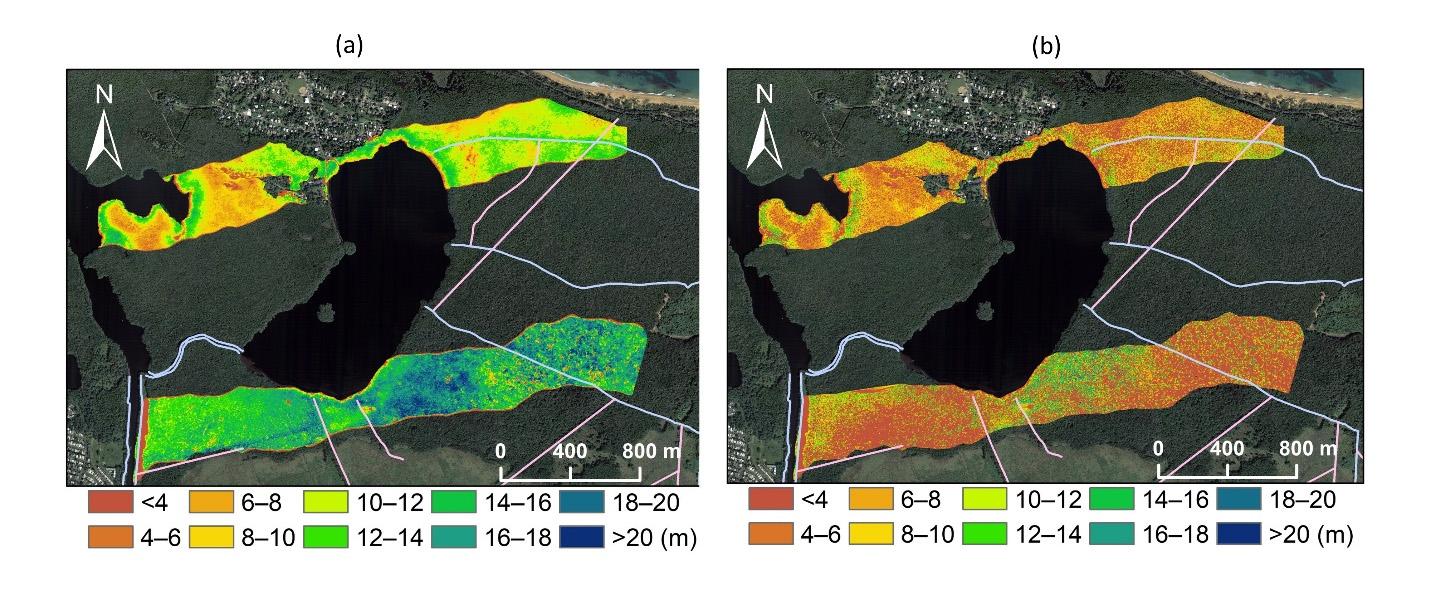
Figure2. TheLiDAR-detectedcanopyheightmodelfor(a)intact(pre-hurricane)and(b)disturbed(post-hurricane) mangroveforestalongthenorthandsouthtransects.ThechangesincanopyheightwereillustratedinFigure6a.
Figure 2. The LiDAR-detected canopy height model for (a) intact (pre-hurricane) and (b) disturbed (post-hurricane) mangrove forest along the north and south transects. The changes in canopy height were illustrated in Figure 6 a.
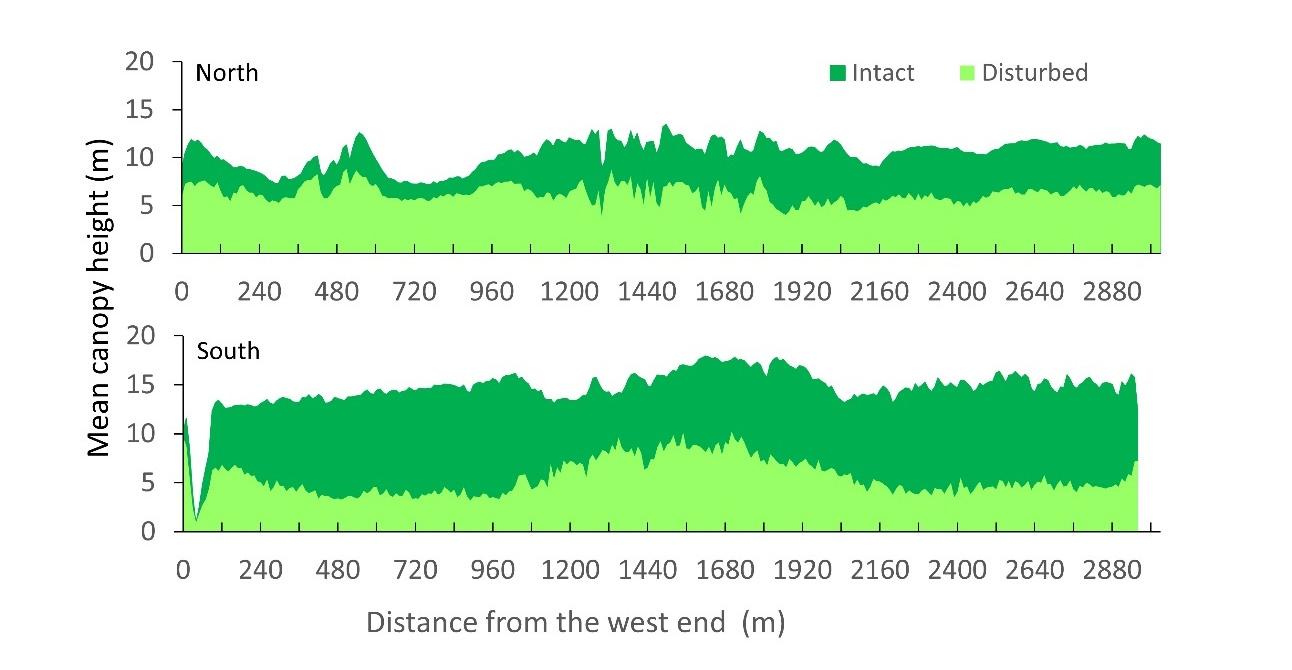
Canopy height averaged over the width of the transects also showed a distinct comparison of reduction by the hurricanes between the two transects with more reduction in the south than in the north (Figure 3). Within the north transect, the intact canopy height in the west was lower than that in the east, and the canopy height reduction in the west was less severe than that in the east.
a 188 ha landscape, our LiDAR-detected intact canopy height with a mean of 12.9 m likely to be true for the intact canopy height.
astandarddeviationof1.9mindicatingthevariationamongplots.Althoughthemean canopyheightwasnotthetreestemheightandfoursmallplotscouldnotbecompared witha188halandscape,ourLiDAR-detectedintactcanopyheightwithameanof12.9m waslikelytobetruefortheintactcanopyheight.
Figure 2. The LiDAR-detected canopy height model for (a) intact (pre-hurricane) and (b) disturbed (post-hurricane) mangrove forest along the north and south transects. The changes in canopy height were illustrated in Figure 6
Canopy height averaged over the width of the transects also showed a distinct comparison of reduction by the hurricanes between the two transects with more reduction the south than in the north (Figure 3). Within the north transect, the intact canopy height in the west was lower than that in the east, and the canopy height reduction in the west was less severe than that in the east.
Canopyheightaveragedoverthewidthofthetransectsalsoshowedadistinctcomparisonofreductionbythehurricanesbetweenthetwotransectswithmorereductionin thesouththaninthenorth(Figure 3).Withinthenorthtransect,theintactcanopyheightin thewestwaslowerthanthatintheeast,andthecanopyheightreductioninthewestwas lessseverethanthatintheeast.
Figure3. Meancanopyheightalongthenorthandsouthtransectsbefore(intact)andafter(disturbed) thehurricanesinSeptember2017.
Figure 3. Mean canopy height along the north and south transects before (intact) and after (disturbed) the hurricanes in September 2017.
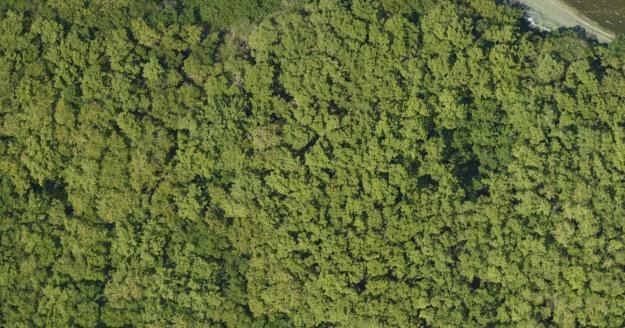
Thetreedensitybeforethehurricaneswasexpressedasthenumberoftreesfound within5m × 5mgridcells(Figure 4).Convertingtothenumberoftreesperhectare, wefoundthatthenorthtransecthadameandensityof2579treesha 1,higherthanthe southtransectwhichhadameandensityof1806treesha 1.Thepooledmeandensity was2174treesha 1,comparedtothefieldfindingof2352 ± 831ha 1 fortreeswitha diameter>2.5cmintheaforementionedfourplots[30,38]inthearea.Therewerealso largespatialvariationsoftreedensitywithinthetransects.Wedidnotattempttoderivethe post-hurricane(disturbed)treedensitybecausethehurricanedamagecausedmangrove treestogreatlyinclineandthecanopiesweremixed(Figure A2:aerialphotostakenbefore andafterthehurricanes).
The tree density before the hurricanes was expressed as the number of trees found within 5 m × 5 m grid cells (Figure 4). Converting to the number of trees per hectare, found that the north transect had a mean density of 2579 trees ha 1, higher than the south transect which had a mean density of 1806 trees ha 1. The pooled mean density was 2174 trees ha 1, compared to the field finding of 2352 ± 831 ha 1 for trees with a diameter > cm in the aforementioned four plots [30,38] in the area. There were also large spatial iations of tree density within the transects. We did not attempt to derive the post-
hurricane (disturbed) tree density because the hurricane damage caused mangrove trees to greatly incline and the canopies were mixed (Figure A2: aerial photos taken before and after the hurricanes).
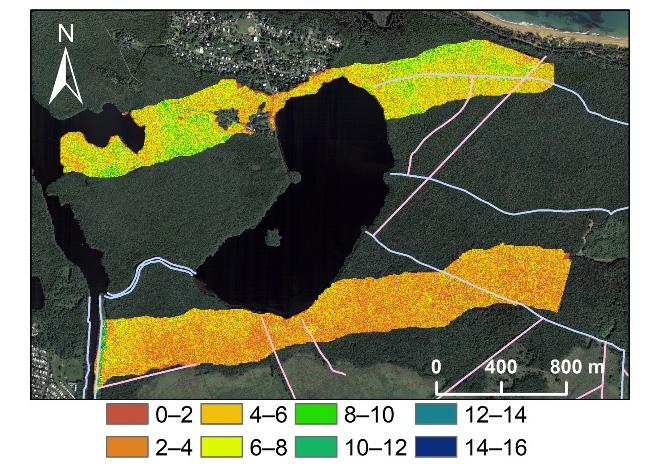
Figure 4. The intact tree density expressed as the number of trees in 5 m by 5 m grid cells. The numbers in the legend can be converted to number of trees per ha by multiplying 400.
Figure4. Theintacttreedensityexpressedasthenumberoftreesin5mby5mgridcells.The numbersinthelegendcanbeconvertedtonumberoftreesperhabymultiplying400.
To explore the drivers that might cause the spatial variations of the canopy height, tree density, and canopy height reduction, we summarized the maps of DEM and distance to canals for the two transects with the available data (Table 1). We found that the north transect had a higher mean elevation (0.28 m) than the south transect (0.18 m), whereas the south transect had a closer mean distance to the canals (164.5 m) than the north transect (414.6 m). Table 1 shows a clear pattern: a higher elevation and farther distance to canals in the north transect were associated with a lower intact canopy height, a higher intact tree density, and a smaller canopy height reduction by the hurricanes, whereas the lower elevation and near distance to the canals in the south transect were associated with a higher intact canopy height, a lower intact tree density, and a greater reduction in canopy height. The large standard deviations in Table 1 implied a great within-transect variation. Whether the elevation and the distance to the canals actually explained the spatial variations of the canopy height, tree density, and canopy height reduction was further tested by the spatial modeling.
Toexplorethedriversthatmightcausethespatialvariationsofthecanopyheight, treedensity,andcanopyheightreduction,wesummarizedthemapsofDEManddistance tocanalsforthetwotransectswiththeavailabledata(Table 1).Wefoundthatthenorth transecthadahighermeanelevation(0.28m)thanthesouthtransect(0.18m),whereasthe southtransecthadaclosermeandistancetothecanals(164.5m)thanthenorthtransect (414.6m).Table 1 showsaclearpattern:ahigherelevationandfartherdistancetocanals inthenorthtransectwereassociatedwithalowerintactcanopyheight,ahigherintact treedensity,andasmallercanopyheightreductionbythehurricanes,whereasthelower elevationandneardistancetothecanalsinthesouthtransectwereassociatedwithahigher intactcanopyheight,alowerintacttreedensity,andagreaterreductionincanopyheight. ThelargestandarddeviationsinTable 1 impliedagreatwithin-transectvariation.Whether theelevationandthedistancetothecanalsactuallyexplainedthespatialvariationsofthe canopyheight,treedensity,andcanopyheightreductionwasfurthertestedbythespatial modeling.
3.2.SpatialRegressionofIntactCanopyHeightandTreeDensity
3.2. Spatial Regression of Intact Canopy Height and Tree Density
Thespatialregressionwithautocorrelationamongeightnearestneighboringgrid cellsshowedthatthenormalizedcanopyheight(h)beforethehurricanescouldbewell explainedbythenormalizedelevation(z)andthedistancetothecanals(s):
The spatial regression with autocorrelation among eight nearest neighboring grid cells showed that the normalized canopy height (h) before the hurricanes could be well explained by the normalized elevation (z) and the distance to the canals (s):
(2)
ℎ=0.749−0.314 −0.366 −0.301 (2)
All the coefficients were significant with p-value ≤ 0.01. The regression estimated a significant λ (spatial autocorrelation coefficient) as 0.94. Using the original definition of r2 in ordinary linear regression, we computed r2 as 0.82, and the model-predicted canopy height aligned well with the LiDAR-detected canopy height (Figure 5a). The standard error of the residual was 0.011 compared to the range of h between 0 and 1. The regression result (Equation (2)) indicated that the intact canopy height decreased significantly, linearly with the distance to canals, and declined significantly with the elevation in a quadratic manner.
Allthecoefficientsweresignificantwith p-value ≤ 0.01.Theregressionestimateda significant λ (spatialautocorrelationcoefficient)as0.94.Usingtheoriginaldefinitionof r2 inordinarylinearregression,wecomputed r2 as0.82,andthemodel-predictedcanopy heightalignedwellwiththeLiDAR-detectedcanopyheight(Figure 5a).Thestandarderror oftheresidualwas0.011comparedtotherangeof h between0and1.Theregressionresult (Equation(2))indicatedthattheintactcanopyheightdecreasedsignificantly,linearlywith thedistancetocanals,anddeclinedsignificantlywiththeelevationinaquadraticmanner.
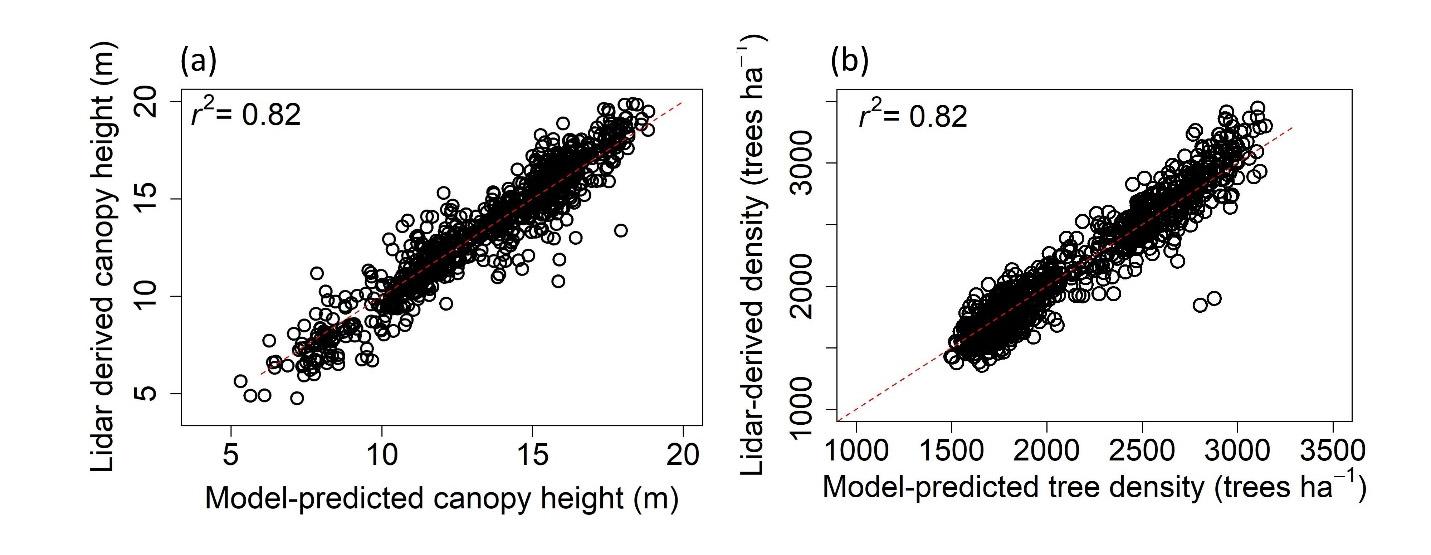
Figure5. Model-predictedintactcanopyheightversusLiDARCHM(a),andmodelpredictedintacttreedensityversus LiDAR-detectedtreedensity(b).
Figure 5. Model-predicted intact canopy height versus LiDAR CHM (a), and model predicted intact tree density versus LiDAR-detected tree density (b).
Thespatialregressionoftheintacttreedensitygavethefollowingequation:
D = 2819 1057
The spatial regression of the intact tree density gave the following equation: =2819−1057ℎ+13.1 +359.4 (3)
where D istheintacttreedensityintreesha 1.Allthecoefficientsweresignificant with p-value ≤ 0.01.Theregressionalsohadan r2 of0.82andthemodel-predictedtree densitywasingeneralalignedwiththeLiDAR-detectedtreedensity(Figure 5b).The negativecoefficientinfrontofthenormalizedcanopyheight(h)indicatedthatthetree densitydecreasedsignificantlywithcanopyheight,implyingself-thinning.Thepositive coefficientsinfrontoftheelevation(z)andthedistancetothecanals(s)indicatedthatthe intacttreedensitysignificantlyincreasedwiththeelevationandthedistancetothecanals.
where D is the intact tree density in trees ha 1. All the coefficients were significant with pvalue ≤ 0.01. The regression also had an r2 of 0.82 and the model-predicted tree density was in general aligned with the LiDAR-detected tree density (Figure 5b). The negative coefficient in front of the normalized canopy height (h) indicated that the tree density decreased significantly with canopy height, implying self-thinning. The positive coefficients in front of the elevation (z) and the distance to the canals (s) indicated that the intact tree density significantly increased with the elevation and the distance to the canals.
3.3.SpatialRegressionofCanopyHeightReduction
3.3. Spatial Regression of Canopy Height Reduction
Canopyheightreductionwascomputedasthepre-hurricanecanopyheightminusthepost-hurricanecanopyheight,whichwastheoppositeofthecanopyheight change(Figure 6a).Consideringtherelationshipbetweenthecanopyheightandelevation(Equation(2)),weenvisionedthatthecanopyheightreductionwasalsocorrelated withtheelevationandthedistancetothecanals.Therelativecanopyheightreduction,that is,dividingthereductionincanopyheightbythepre-hurricanecanopyheight,gavethe mean ± standarddeviationas0.40 ± 0.22,0.64 ± 0.23,and0.53 ± 0.26forthenorth,south, andpooledtwotransects,respectively.
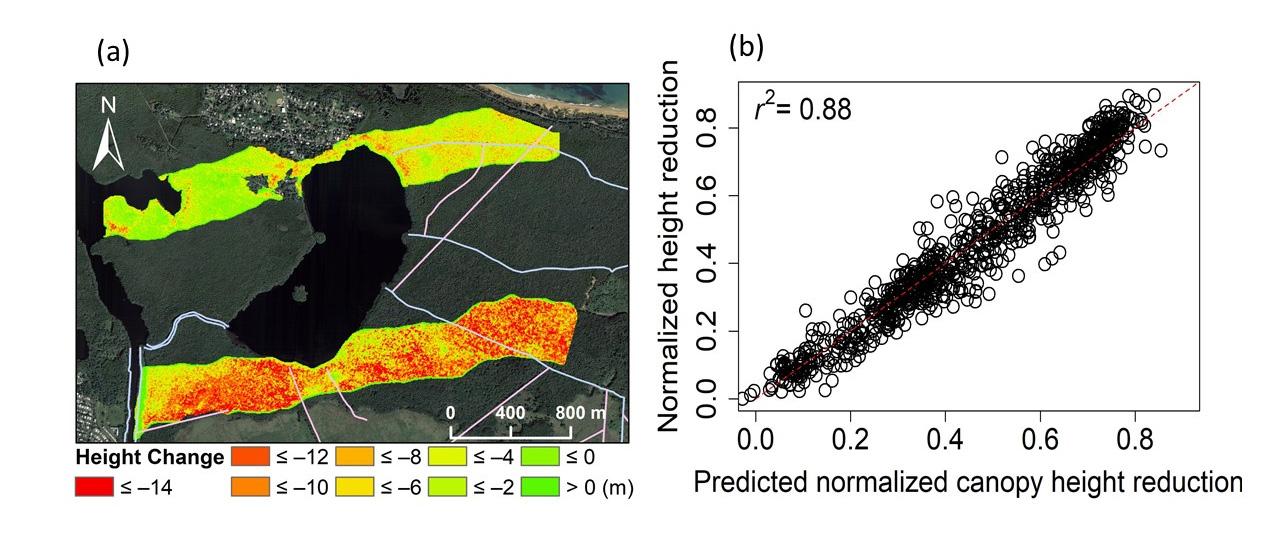
Canopy height reduction was computed as the pre-hurricane canopy height minus the post-hurricane canopy height, which was the opposite of the canopy height change (Figure 6a). Considering the relationship between the canopy height and elevation (Equation (2)), we envisioned that the canopy height reduction was also correlated with the elevation and the distance to the canals. The relative canopy height reduction, that is, dividing the reduction in canopy height by the pre-hurricane canopy height, gave the mean ± standard deviation as 0.40 ± 0.22, 0.64 ± 0.23, and 0.53 ± 0.26 for the north, south, and pooled two transects, respectively.
The spatial regression of the mean canopy heigh reduction at a 40 m grid on the norand distance to the canals gave the follow(4)
is the normalized intact tree 0.05 except the coefficient befor this regression eased with the intact canopy ity, the distance to the canals, and the ele-
Figure6. Canopyheightchangebythehurricanescalculatedasdisturbedminusintactcanopyheight(a),andmodelpredictedversusLiDAR-derivednormalizedcanopyheightreduction(b).
4. Discussion
Vertical structures of mangroves were highly regulated by the hydrology, salinity, and nutrient supply among others [3,39]. In this study, we found that an intact canopy
Thespatialregressionofthemeancanopyheighreductionata40mgridonthe normalizedelevation,canopyheight,treedensity,anddistancetothecanalsgavethe followingequation:
where ∆h isthenormalizedcanopyheightreduction,and d isthenormalizedintacttree density.Allthecoefficientsweresignificantwith p-value ≤ 0.05exceptthecoefficientbefore thedistancetothecanals(s)whichhada p-valueof0.09.The r2 forthisregressionwas0.88 (Figure 6b).Hence,thecanopyheightreductionincreasedwiththeintactcanopyheight, butdecreasedwiththeintacttreedensity,thedistancetothecanals,andtheelevationina quadraticmanner.
4.Discussion
Verticalstructuresofmangroveswerehighlyregulatedbythehydrology,salinity, andnutrientsupplyamongothers[3,39].Inthisstudy,wefoundthatanintactcanopy heightsignificantlydependedontheelevationanddistancetothefreshwater/sewage canals(Equation(2)),whichcontrolthespatialpatternsofthehydrology,salinity,and nutrientsofthemangroveecosystem.Thelowerelevationandcloserdistancetocanals tendedtogiveahigherintactcanopy(Figures 2–4,Table 1),whereasplaceswithahigher elevationorfurtherdistancefromthecanalswereassociatedwithalowercanopy.Although mangrovesflourishinthelowsalinityenvironments,thegrowthofmangrovetreesis greatlysuppressedbyahighsalinity[40,41].Amplerainfallresultsinoverlandflow,and thecanalscarryfreshwaterandnutrientstothelowerelevation.Inadditiontotheverge ofthelagoon,thereexistlocalminimumsintheelevationprofile(Figure 1b).Freshwater andnutrientsarelikelytobuildupintheseminimumstoalleviatethesalinitystressand toprovidenutrientsforbettermangrovegrowth.Indeed,mangrovesclosertothecanals hadahighercanopy,andthecoefficientinfrontofthenormalizeddistancetocanalswas inthesameorderofthatforthenormalizedelevation(Equation(2)).Whentheelevation increases,theavailabilityoffreshwaterdeclines,andsalinityislikelytobehigh.However, whenelevationbecomestoohigh,soilswillhavelessofachancetoreceivesaltywaterand theamplerainfallpreventsasalinitybuilt-upinthesoil,sothatthesalinitymaystartto decreasewithelevation[42].
WesummarizedtheconnectionsamongthespatialvariablesinFigure 7:Notonlydid theelevationandthedistancetothecanalssignificantlycontributetothespatialpatterns oftheintactcanopyheightandtreedensity,whichintermsignificantlycontributedtothe spatialpatternofcanopyheightreduction,butalsotheydirectlyaffectedcanopyheight reduction,thesignsinFigure 7 indicatethedirectionsoftheeffects.
Thespatialvariationofthestructuralcharacteristicssignificantlymodifiedtheresponsesoftheecosystemtothemajorhurricanes.Specifically,thecanopyheightreduction wasamplifiedwithahigherintactcanopyheight(Equation(4)).Agreatercanopyheight beforeahurricaneoftenimpliesmoreleavestointerceptgreaterwinddragforcesduring thehurricanes[43,44]and,thus,damagetothecanopy.Themaximumtreeheightwas foundimportanttoexplaintheresistanceofthetropicalforesttohurricanes[45],and theemergenttreeheightinaforesthasbeenusedasapredictorofdamagesbytropical cyclones[46,47].
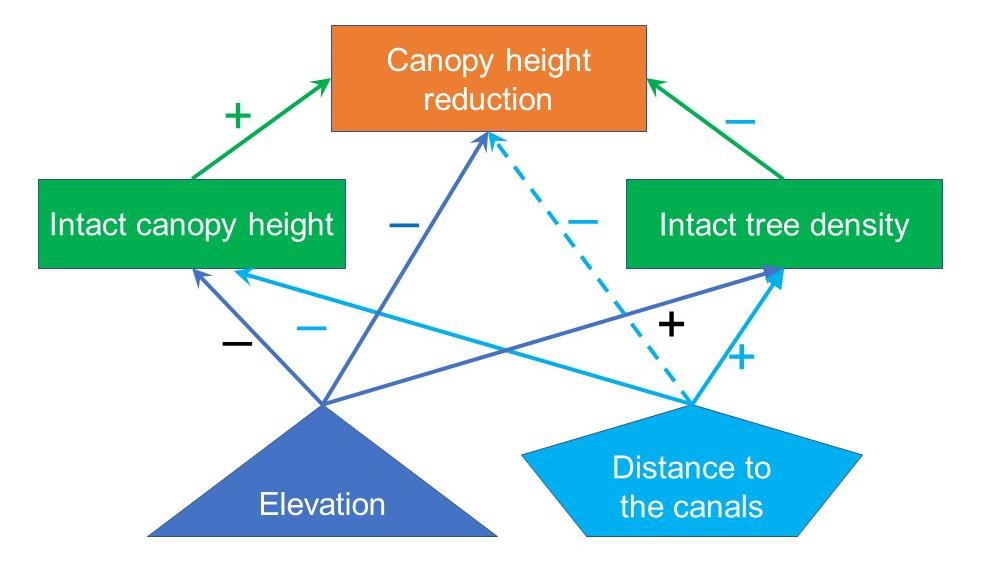
Figure7. Connectiongraphshowingtherolesofelevationanddistancetocanalsinthespatial variationsofintactcanopyheight,intacttreedensity,andcanopyheightreductionbythehurricanes. Thedashedlinebetweenthedistancetocanalsandthecanopyheightreductionconsidersthe0.09 p-valueinEquation(4).
Figure 7. Connection graph showing the roles of elevation and distance to canals in the spatial variations of intact canopy height, intact tree density, and canopy height reduction by the hurricanes. The dashed line between the distance to canals and the canopy height reduction considers the 0.09 p-value in Equation (4).
The spatial variation of the structural characteristics significantly modified the responses of the ecosystem to the major hurricanes. Specifically, the canopy height reduction was amplified with a higher intact canopy height (Equation (4)). A greater canopy height before a hurricane often implies more leaves to intercept greater wind drag forces during the hurricanes [43,44] and, thus, damage to the canopy. The maximum tree height was found important to explain the resistance of the tropical forest to hurricanes [45], and the emergent tree height in a forest has been used as a predictor of damages by tropical cyclones [46,47].
High tree density is also identified as a significant factor to resist canopy damage (Equation (4)), and spatial arrangement of trees is also important even for a forest with big trees [48]. Trees in a forest growing at a close distance, especially the mangrove trees with a height averaged around 10 meters, tend to provide mutual support during wind disturbance [44,49]. Interactions via leaves and branches among trees during storms dissipate a portion of wind energy [50] and such interactions are enhanced by a high tree density. If a forest during hurricane winds can be viewed as a windbreak, an increased density of trees tends to reduce the average gap size and increase the effect of the windbreak. A forest with a low tree density is seen associated with more dead trees and bent trunks after a major hurricane [51]. ForestGales, a hybrid model to simulate the wind damage risk to a forest, uses predictor parameters, including spacing between trees, top tree height, mean DBH, gap size, soil types, and rooting depth [23,52]. The model computes a critical stem rupture wind speed which is inversely proportional to average spacing between trees so that a greater wind speed is needed to rupture stems with closer tree spacing. Tree spacing is the inverse of the density, and the model, thus, implies that a greater wind speed is needed to rupture trees with a high density. Gaps in the forest are mostly created by fallen trees or timber harvesting. However, gaps can also be the result of a low tree density. The recent variance-based sensitivity analysis on the risk of wind damage showed that tree height, mean diameter, and tree spacing are the mostly determinative factors, whereas the soil type and rooting depth are much less important [53].
Hightreedensityisalsoidentifiedasasignificantfactortoresistcanopydamage (Equation(4)),andspatialarrangementoftreesisalsoimportantevenforaforestwith bigtrees[48].Treesinaforestgrowingataclosedistance,especiallythemangrove treeswithaheightaveragedaround10m,tendtoprovidemutualsupportduringwind disturbance[44,49].Interactionsvialeavesandbranchesamongtreesduringstorms dissipateaportionofwindenergy[50]andsuchinteractionsareenhancedbyahightree density.Ifaforestduringhurricanewindscanbeviewedasawindbreak,anincreased densityoftreestendstoreducetheaveragegapsizeandincreasetheeffectofthewindbreak. Aforestwithalowtreedensityisseenassociatedwithmoredeadtreesandbenttrunks afteramajorhurricane[51].ForestGales,ahybridmodeltosimulatethewinddamage risktoaforest,usespredictorparameters,includingspacingbetweentrees,toptreeheight, meanDBH,gapsize,soiltypes,androotingdepth[23,52].Themodelcomputesacritical stemrupturewindspeedwhichisinverselyproportionaltoaveragespacingbetweentrees sothatagreaterwindspeedisneededtorupturestemswithclosertreespacing.Tree spacingistheinverseofthedensity,andthemodel,thus,impliesthatagreaterwindspeed isneededtorupturetreeswithahighdensity.Gapsintheforestaremostlycreatedby fallentreesortimberharvesting.However,gapscanalsobetheresultofalowtreedensity. Therecentvariance-basedsensitivityanalysisontheriskofwinddamageshowedthattree height,meandiameter,andtreespacingarethemostlydeterminativefactors,whereasthe soiltypeandrootingdeptharemuchlessimportant[53].
Theavailabilityofafreshwaterandnutrientsinputmayalsomodifytheresponse ofthemangroveforesttohurricanes.Mangroveshaveagreatmorphologicalplasticity andchangeallometricgrowthuponalteredsalinityandnutrientsbalancesviafreshwater/sewagecanals.Thealteredallometricgrowthislikelytomodifytheresistanceofa mangroveforesttotropicalstorms.Areducedsalinitybyfreshwaterandanamplenutrientsinputtendtoincreasetheshoottorootratio[39,54–56],implyinglessroottosupport tallertreesduringhurricanewinds.Treeslivinginalowersalinityandhighernutrient availabilitytendtogrowmoreleaves[57–59],thus,tointerceptmoredragwindsduring storms[43].Ontheotherhand,treeswithmorenutrientstendtogrowthinnerleaveswith ashorteraveragelifespan,whichmakesleaveseasiertobetornbyhurricanewindssoasto causemoredamagetothecanopy[60,61].Thesefactsexplainedourresultsthatmangroves withaclosedistancetothefreshwater/sewagecanalssufferedmorehurricanedamageand hadalowercanopyheightremainingafterthehurricanes(Figures 2 and 3,Equation(4)).
The availability of a freshwater and nutrients input may also modify the response of the mangrove forest to hurricanes. Mangroves have a great morphological plasticity and change allometric growth upon altered salinity and nutrients balances via freshwater/sewage canals. The altered allometric growth is likely to modify the resistance of a mangrove forest to tropical storms. A reduced salinity by freshwater and an ample
Anelevationprofilewasshowntobeimportantinregulatingcanopyheightbefore thehurricanes(Equation(2))anddifferentiatingthecanopyheightreduction(Equation(4))
inthisstudy.Specifically,alowerelevationwasassociatedwithmorecanopyheight reduction(Equations(2)–(4)).Inadditiontofacilitatingtheaccumulationoffreshwater andnutrients,alowerelevationalsoimpliesmorechancesforinundationduringthe hurricanes[15].Thetwohurricanesbroughttorrentialrainfalltotheisland,andthe lagoonwithanextremelylowexchangewithoceanwatermadeitverypronetoprolonged inundation.Thepreliminarystudyshowedthatthelowandmoderateelevationinthis areahadbeeninundatedformorethanaweek,whichmayhavegreatlydamagedtheblack mangrovesatalowerandmoderateelevationafterthehurricanes,suchasimmersing thepneumatophoresandcausingadelayedmortality.Thesoilunderamangroveforest islikelysaturated.Thisisespeciallytherealityforplaceswithalowelevationwhere mangrovesgrowinmuddyorsubmergingsoil.Thevariationofelevationcanalsohavean implicationonsoil–rootanchorage.Muddysoilunderalowerelevationhaslessanchorage formangroverootsthansoilsatahigherelevation;thus,makingthemangrovesproneto soil–rootfailureduringthehurricanes[62].
TheLiDAR-detectedcanopyheightwasbasedonthereturnofalaserbeambytree leaves[63].Thecanopyheightistheheightoftreecrownswhichconsistsoftreetops, branches,andmoreimportantly,treeleavesontopsofthecrowns.Thefirstreturnof LiDARbeamwasoftenfromleavesonthetopofthetreecrown.Fortreeswithheavy leaves,trunksmighthavemuchlessofachancetobehitthefirstbyLiDARbeams.The 53%canopyheightreductionmayhavebeenmostlybecauseofthedefoliationandrupture oftreebranches,buttoalesserextent,reflectingfallingtrunkordeathoftrees.Further effortstoseparatethelossofleaves/branchesfromthelossoftrunkswillbepromisingto facilitatetheassessmentoftherecoveryofaforeststructure.Ouranalysisshowedthatthere werestrongmechanisticconnectionsamongtreedensity,canopyheight,elevation,and distancetothefreshwater/sewagecanals.Futureresearchisnecessitatedtoseparatethe effectsofinundationandthoseoffertilizationanddesalinizationbythefreshwater/sewage canalsatalowelevation.LiDARdetectioncombinedwithmorefrequentmultispectral andhyperspectralimagesissuggestedtofurtherapproachtheproblemofthiskind.With theincreasedclimatevariabilityandwarming[64,65],morefrequentor/andintensified stormsareexpectedatthesecoastalecosystems.Thisresearchcontributedtoadvancing theunderstandingofurbanmangroves,especiallytheimpactofhumanactivitiesthat modifiedthehydrology,salinity,andnutrients,suchascanalingandsewagedisposition, onthemangrovestructure,andhelpedtoelaboratetheresistanceofcoastalmangrovesto tropicalstorms.
5.Conclusions
ThisstudyusedLiDARdatatoanalyzethestructureofabasinmangrovenear urbanareas.Wefoundthatelevationanddistancetothefreshwater/sewagecanalswere significantexplanatorstothecanopyheightandtreedensityaswellasthecanopyheight reductionduringthehurricaneseasonin2017.The188hamangrovessufferedonaverage a53%canopyheightreduction.Thecanopyheightreductionwasfoundtoincreasewith thecanopyheightbeforethehurricanes,butdecreasewiththeelevation,thedistance tothefreshwater/sewagecanals,andthetreedensitybeforethehurricanes.Adding freshwater/sewagetotheforestmademangrovesgrowhigher;however,itmayalsomake thecanopymorepronetohurricanedamages.
AuthorContributions: Conceptualization,Q.G.andM.Y.;methodology,Q.G.andM.Y.;formal analysis,Q.G.andM.Y.;writing—originaldraftpreparation,Q.G.;writing—reviewandediting,Q.G. andM.Y.Bothauthorshavereadandagreedtothepublishedversionofthemanuscript.
Funding: ThisresearchwassupportedbytheNOAAPuertoRicoSeaGrant.
Acknowledgments: WeacknowledgeUSGSforprovidingtheLiDARafterthehurricanes,publicly availableattheUSGS3DElevationProgram(3DEP)dataportal(https://nationalmap.gov/3DEP/, accessedon24August2021),andNASAforprovidingtheLiDARdatabeforethehurricanes,publicly accessibleatNASAG-LiHT(https://glihtdata.gsfc.nasa.gov/,accessedon24August2021).
References
Author Contributions: Conceptualization, Q.G. and M.Y.; methodology, Q.G. and M.Y.; formal analysis, Q.G. and M.Y.; writing—original draft preparation, Q.G.; writing—review and editing, Q.G. and M.Y. All authors have read and agreed to the published version of the manuscript.
Author Contributions: Conceptualization, Q.G. and M.Y.; methodology, Q.G. and M.Y.; formal analysis, Q.G. and M.Y.; writing—original draft preparation, Q.G.; writing—review and editing, Q.G. and M.Y. All authors have read and agreed to the published version of the manuscript.
Funding: This research was supported by the NOAA Puerto Rico Sea Grant.
Funding: This research was supported by the NOAA Puerto Rico Sea Grant.
Acknowledgments: We acknowledge USGS for providing the LiDAR after the hurricanes, publicly available at the USGS 3D Elevation Program (3DEP) data portal (https://nationalmap.gov/3DEP/, accessed on 24 August 2021), and NASA for providing the LiDAR data before the hurricanes, publicly accessible at NASA G-LiHT (https://glihtdata.gsfc.nasa.gov/, accessed on 24 August 2021).
Acknowledgments: We acknowledge USGS for providing the LiDAR after the hurricanes, publicly available at the USGS 3D Elevation Program (3DEP) data portal (https://nationalmap.gov/3DEP/, accessed on 24 August 2021), and NASA for providing the LiDAR data before the hurricanes, publicly accessible at NASA G-LiHT (https://glihtdata.gsfc.nasa.gov/, accessed on 24 August 2021).
ConflictsofInterest: Theauthorsdeclarenoconflictofinterest.Thefundershadnoroleinthedesign ofthestudy;inthecollection,analyses,orinterpretationofdata;inthewritingofthemanuscript,or inthedecisiontopublishtheresults.
Conflicts of Interest: The authors declare no conflict of interest. The funders had no role in the design of the study; in the collection, analyses, or interpretation of data; in the writing of the manuscript, or in the decision to publish the results.
Conflicts of Interest: The authors declare no conflict of interest. The funders had no role in the design of the study; in the collection, analyses, or interpretation of data; in the writing of the manuscript, or in the decision to publish the results.
Appendix A
AppendixA
Appendix A
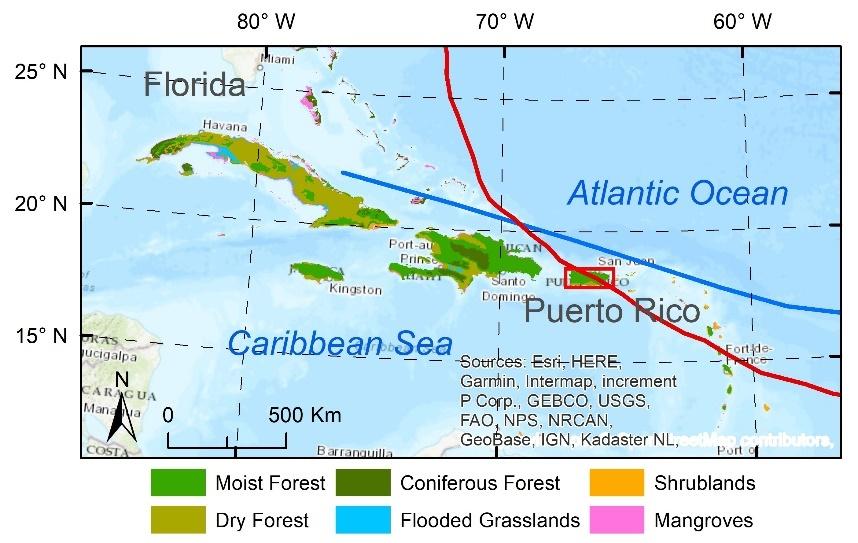
Figure A1. Location of Puerto Rico in the Caribbean. The blue and red lines are the paths of Hurricane Irma and Hurricane Maria, respectively.
Figure A1. Location of Puerto Rico in the Caribbean. The blue and red lines are the paths of Hurricane Irma and Hurricane Maria, respectively.
FigureA1. LocationofPuertoRicointheCaribbean.TheblueandredlinesarethepathsofHurricane IrmaandHurricaneMaria,respectively.
15 March 2017
15 March 2017
27 April 2018
27 April 2018
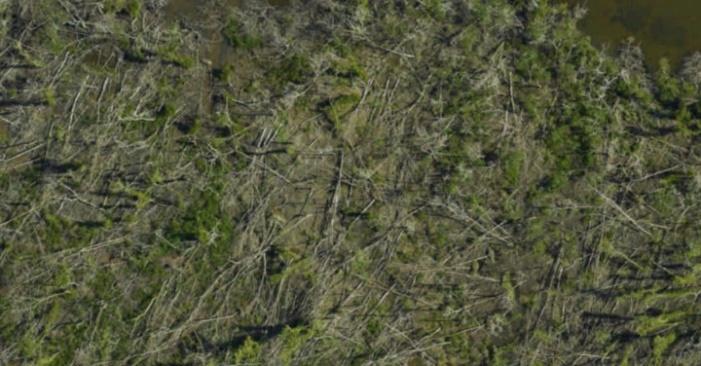
FigureA2. AerialphotographstakenbeforeandafterthehurricanesatthesouthernPiñoneslagoon (–65.96◦ ,18.43◦ ,source:NASAG-LiHT https://glihtdata.gsfc.nasa.gov/puertorico/,accessedon 24August2021).
1. Giri,C.;Ochieng,E.;Tieszen,L.L.;Zhu,Z.;Singh,A.;Loveland,T.;Masek,J.;Duke,N.Statusanddistributionofmangrove forestsoftheworldusingearthobservationsatellitedata. Glob.Ecol.Biogeogr. 2011, 20,154–159.[CrossRef]
2. Field,C.;Osborn,J.;Hoffman,L.;Polsenberg,J.;Ackerly,D.;Berry,J.;BjÖRkman,O.;Held,A.;Matson,P.;Mooney,H.Mangrove biodiversityandecosystemfunction. Glob.Ecol.Biogeogr.Lett. 1998, 7,3–14.[CrossRef]
3. Lovelock,C.E.;Krauss,K.W.;Osland,M.J.;Reef,R.;Ball,M.C.ThePhysiologyofMangroveTreeswithChangingClimate.In TropicalTreePhysiology—AdaptationsandResponsesinaChangingEnvironment;Goldstein,G.,Santiago,L.S.,Eds.;Springer:Berlin, Germany,2016;pp.149–179.
4. Alongi,D.Carbonsequestrationinmangroveforests. CarbonManag. 2014, 3,313–322.[CrossRef]
5. Kristensen,E.;Andersen,F.O.;Homboe,N.;Holmer,M.CarbonandnitrogenmineralizationinsedimentsoftheBangrong mangrovearea,Phuket,Thailand. Aquat.Microb.Ecol. 2000, 22,199–213.[CrossRef]
6. Gedan,K.B.;Kirwan,M.L.;Wolanski,E.;Barbier,E.B.;Silliman,B.R.Thepresentandfutureroleofcoastalwetlandvegetationin protectingshorelines:Answeringrecentchallengestotheparadigm. Clim.Chang. 2011, 106,7–29.[CrossRef]
7. Doody,J.P.‘Coastalsqueeze’—Anhistoricalperspective. J.Coast.Conserv. 2004, 10,129–138.[CrossRef]
8. Branoff,B. UrbanMangroveBiologyandEcology:EmergentPatternsandManagementImplications;UniversityofPuertoRico:San Juan,PR,USA,2018.
9. Lee,S.Y.;Primavera,J.H.;Dahdouh-Guebas,F.;McKee,K.;Bosire,J.O.;Cannicci,S.;Diele,K.;Fromard,F.;Koedam,N.;Marchand, C.;etal.Ecologicalroleandservicesoftropicalmangroveecosystems:Areassessment. Glob.Ecol.Biogeogr. 2014, 23,726–743. [CrossRef]
10. Choy,S.C.;Booth,W.E.ProlongedinundationandecologicalchangesinanAvicenniamangrove:Implicationsforconservation andmanagement. Hydrobiologia 1994, 285,237–247.[CrossRef]
11. Mbense,S.;Rajkaran,A.;Bolosha,U.;Adams,J.Rapidcolonizationofdegradedmangrovehabitatbysucculentsaltmarsh. S.Afr. J.Bot. 2016, 107,129–136.[CrossRef]
12. Lovelock,C.E.;Feller,I.C.;Reef,R.;Hickey,S.;Ball,M.C.Mangrovediebackduringfluctuatingsealevels. Sci.Rep. 2017, 7,1680. [CrossRef]
13. Ward,G.A.;Smith,T.,III.PredictingmangroveforestrecoveryonthesouthwestcoastofFloridafollowingtheimpactofHurricane Wilma,Octobe2005.In ScienceandtheStorms:TheUSGSResponsetotheHurricanesof2005;Farris,G.S.,Smith,G.J.,Crane,M.P., Demas,C.R.,Robbins,L.L.,Lavoie,D.L.,Eds.;U.S.GeologicalSurveyCircular,JohnW.PowellNationalCenter:Reston,VA, USA,2005;283p.
14. Blankespoor,B.;Dasgupta,S.;Lange,G.-M.Mangrovesasaprotectionfromstormsurgesinachangingclimate. Ambio 2017, 46, 478–491.[CrossRef]
15. Yu,M.;Gao,Q.Topography,drainagecapability,andlegacyofdroughtdifferentiatetropicalecosystemresponsetoandrecovery frommajorhurricanes. Environ.Res.Lett. 2020, 15,104046.[CrossRef]
16. Branoff,B.;Cuevas,E.;Hernandez,E. AssessmentofUrbanCoastalWetlandsVulnerabilitytoHurricanesinPuertoRico;Department ofNaturalandEnvironmentalResources:SanJuan,PR,USA,2015.
17. Taillie,P.J.;Roman-Cuesta,R.;Lagomasino,D.;Cifuentes-Jara,M.;Fatoyinbo,T.;Ott,L.E.;Poulter,B.Widespreadmangrove damageresultingfromthe2017Atlanticmegahurricaneseason. Environ.Res.Lett. 2020, 15,064010.[CrossRef]
18. Zhang,K.;Thapa,B.;Ross,M.;Gann,D.Remotesensingofseasonalchangesanddisturbancesinmangroveforest:Acasestudy fromSouthFlorida. Ecosphere 2016, 7,e01366.[CrossRef]
19. Huang,W.;Sun,G.;Dubayah,R.;Cook,B.;Montesano,P.;Ni,W.;Zhang,Z.Mappingbiomasschangeafterforestdisturbance: ApplyingLiDARfootprint-derivedmodelsatkeymapscales. RemoteSens.Environ. 2013, 134,319–332.[CrossRef]
20. vanLeeuwen,M.;Nieuwenhuis,M.RetrievalofforeststructuralparametersusingLiDARremotesensing. Eur.J.For.Res. 2010, 129,749–770.[CrossRef]
21. Gao,Q.;Yu,M.CanopyDensityandRoughnessDifferentiateResistanceofaTropicalDryForesttoMajorHurricaneDamage. RemoteSens. 2021, 13,2262.[CrossRef]
22. Mitchell,S.J.Windasanaturaldisturbanceagentinforests:Asynthesis. For.Int.J.For.Res. 2012, 86,147–157.[CrossRef]
23. Gardiner,B.;Byrne,K.;Hale,S.;Kamimura,K.;Mitchell,S.J.;Peltola,H.;Ruel,J.-C.Areviewofmechanisticmodellingofwind damagerisktoforests. For.Int.J.For.Res. 2008, 81,447–463.[CrossRef]
24. Krauss,K.W.;Osland,M.J.Tropicalcyclonesandtheorganizationofmangroveforests:Areview. Ann.Bot. 2019, 125,213–234. [CrossRef]
25. Cartier,K.HurricanesHitPuertoRico’sMangrovesHarderThanFlorida’s. EOS 2019.[CrossRef]
26. Martinuzzi,S.;Gould,W.A.;Lugo,A.E.;Medina,E.ConversionandrecoveryofPuertoRicanmangroves:200yearsofchange. For.Ecol.Manag. 2009, 257,75–84.[CrossRef]
27. Yu,M.;Rivera-Ocasio,E.;Heartsill-Scalley,T.;Davila-Casanova,D.;Rios-López,N.;Gao,Q.Landscape-LevelConsequences ofRisingSea-LevelonCoastalWetlands:SaltwaterIntrusionDrivesDisplacementandMortalityintheTwenty-FirstCentury. Wetlands 2019, 39,1343–1355.[CrossRef]
28. Gao,Q.;Yu,M.DiscerningFragmentationDynamicsofTropicalForestandWetlandduringReforestation,UrbanSprawl,and PolicyShifts. PLoSONE 2014, 9,e113140.[CrossRef]
29. Kennaway,T.;Helmer,E.H.TheforesttypesandagesclearedforlanddevelopmentinPuertoRico. GiscienceRemoteSens. 2007, 44,356–382.[CrossRef]
30. Martinez,R.;Cintron,G.;Encarnacion,L.A. MangrovesinPuertoRico:AStructuralInventory;DepartmentofNaturalResources, PuertoRico:SanJuan,PR,USA,1979.
31. Lugo,A.E.;Medina,E.MangroveForests.In EncyclopediaofNaturalResources—Land;Wang,Y.,Ed.;Taylor&Francis:NewYork, NY,USA,2014;Volume1.
32. PuertoRicoDepartmentofNaturalandEnvironmentalResources. BosqueEstataldePiñones;PuertoRicoDepartmentofNatural andEnvironmentalResources:SanJuan,PR,USA,2008.
33. Cook,B.;Corp,L.;Nelson,R.;Middleton,E.;Morton,D.;McCorkel,J.;Masek,J.;Ranson,K.;Ly,V.;Montesano,P.NASA Goddard’sLiDAR,HyperspectralandThermal(G-LiHT)AirborneImager. RemoteSens. 2013, 5,4045.[CrossRef]
34. OfficeforCoastalManagement.C-CAPLandCover,PuertoRico,2010.2020.Availableonline: https://www.fisheries.noaa.gov/ inport/item/48301 (accessedon24August2021).
35. Roussel,J.-R.;Auty,D.;Boissieu,F.D.;Meador,A.S.Lidr:AirborneLiDARDataManipulationandVisualizationforForestry Applications.2019.Availableonline: https://cran.r-project.org/package=lidR (accessedon24August2021).
36. Anselin,L.;Griffith,D.A.DOSPATIALEFFECFSREALLYMATTERINREGRESSIONANALYSIS? Pap.Reg.Sci. 1988, 65,11–34. [CrossRef]
37. RCoreTeam. R:ALanguageandEnvironmentforStatisticalComputing;RFoundationforStatisticalComputing:Vienna,Austria, 2020.
38. Pool,D.;Snedaker,S.C.;Lugo,A.E.StructureofMangroveForestsinFlorida,PuertoRico,Mexico,andCostaRica. Biotropica 1977, 9,195–212.[CrossRef]
39. Krauss,K.W.;McKee,K.L.;Lovelock,C.E.;Cahoon,D.R.;Saintilan,N.;Reef,R.;Chen,L.Howmangroveforestsadjusttorising sealevel. NewPhytol. 2014, 202,19–34.[CrossRef]
40. Lugo,A.E.;Snedaker,S.C.Theecologyofmangroves. Annu.Rev.Ecol.Syst. 1974, 5,39–64.[CrossRef]
41. Medina,E.MangrovePhysiology:Thechallengeofsalt,heat,andlightstressunderrecurrentflooding.In EcosystemasdeManglar enAmericaTropical;Yanez-Arancibia,A.,Lara-Dominquez,A.L.,Eds.;InstitutodeEcologiaA.C.Mexico:Xalapa,Mexico,1999; pp.109–126.
42. Leong,R.C.;Friess,D.;Crase,B.;Lee,W.K.;Webb,E.High-resolutionpatternofmangrovespeciesdistributioniscontrolledby surfaceelevation. Estuar.Coast.ShelfSci. 2017, 202,185–192.[CrossRef]
43. Angelou,N.;Dellwik,E.;Mann,J.Windloadestimationonanopen-grownEuropeanoaktree. For.Int.J.For.Res. 2019, 92, 381–392.[CrossRef]
44. Peterson,C.J.;Ribeiro,G.H.P.d.M.;Negrón-Juárez,R.;Marra,D.M.;Chambers,J.Q.;Higuchi,N.;Lima,A.;Cannon,J.B.Critical windspeedssuggestwindcouldbeanimportantdisturbanceagentinAmazonianforests. For.Int.J.For.Res. 2019, 92,444–459. [CrossRef]
45. Paz,H.;Vega-Ramos,F.;Arreola-Villa,F.Understandinghurricaneresistanceandresilienceintropicaldryforesttrees:A functionaltraitsapproach. For.Ecol.Manag. 2018, 426.[CrossRef]
46. Renaud,J.-P.;Vega,C.;Durrieu,S.;Lisein,J.;Magnussen,S.;Lejeune,P.;Fournier,M.Stand-levelwinddamagecanbeassessed usingdiachronicphotogrammetriccanopyheightmodels. Ann.For.Sci. 2017, 74,74.[CrossRef]
47. Hall,J.;Muscarella,R.;Quebbeman,A.;Arellano,G.;Thompson,J.;Zimmerman,J.K.;Uriarte,M.Hurricane-InducedRainfallisa StrongerPredictorofTropicalForestDamageinPuertoRicoThanMaximumWindSpeeds. Sci.Rep. 2020, 10,4318.[CrossRef] [PubMed]
48. Duryea,M.L.;Kamp,E. WindandTrees:LessonsLearnedfromHurricanes;SchoolofForestResourcesandConservation,University ofFloridaFASExtension:Gainesville,FL,USA,2017.Availableonline: http://edis.ifas.ufl.edu (accessedon24August2021).
49. Moore,J.;Lin,Y.Determiningtheextentanddriversofattritionlossesfromwindusinglong-termdatasetsandmachinelearning techniques. For.Int.J.For.Res. 2019, 92,425–435.[CrossRef]
50. Walter,B.;Gromke,C.;Lehning,M.TheSLFboundarylayerwindtunnel—Anexperimentalfacilityforaerodynamicalinvestigationsoflivingplants.InProceedingsofthe2ndInternationalConferenceWindEffectsonTrees,Freiburg,Germany, 13–16October2009;pp.31–38.
51. Jimenez,D.L.;Alvarez-Añorve,M.;Pineda-Cortes,M.;Flores-Puerto,J.;Benitez-Malvido,J.;Oyama,K.;AvilaCabadilla,L. Structuralandfunctionaltraitspredictshorttermresponseoftropicaldryforeststoahighintensityhurricane. For.Ecol.Manag. 2018, 426.[CrossRef]
52. Hale,S.;Gardiner,B.;Peace,A.;Nicoll,B.;Taylor,P.;Pizzirani,S.Comparisonandvalidationofthreeversionsofaforestwind riskmodel. Environ.Model.Softw. 2015, 68,27–41.[CrossRef]
53. Locatelli,T.;Tarantola,S.;Gardiner,B.;Patenaude,G.Variance-basedsensitivityanalysisofawindriskmodel—Modelbehaviour andlessonsforforestmodelling. Environ.Model.Softw. 2017, 87,84–109.[CrossRef]
54. Nguyen,H.T.;Stanton,D.E.;Schmitz,N.;Farquhar,G.D.;Ball,M.C.GrowthresponsesofthemangroveAvicenniamarinato salinity:Developmentandfunctionofshoothydraulicsystemsrequiresalineconditions. Ann.Bot. 2015, 115,397–407.[CrossRef]
55. Chen,Y.;Ye,Y.EffectsofSalinityandNutrientAdditiononMangroveExcoecariaagallocha. PLoSONE 2014, 9,e93337.[CrossRef]
56. Peters,R.;Vovides,A.G.;Luna,S.;Gruters,U.;Berger,U.Changesinallometricrelationsofmangrovetreesduetoresource availability—Anewmechanisticmodellingapproach. Ecol.Model. 2014, 283,53–61.[CrossRef]
57. Vovides,A.G.;Vogt,J.;Kollert,A.;Berger,U.;Grueters,U.;Peters,R.;Lara-Domínguez,A.L.;López-Portillo,J.Morphological plasticityinmangrovetrees:Salinity-relatedchangesintheallometryofAvicenniagerminans. Trees 2014, 28,1413–1425. [CrossRef]
58. Whigham,D.F.;Verhoeven,J.T.A.;Samarkin,V.;Megonigal,P.J.ResponsesofAvicenniagerminans(BlackMangrove)andtheSoil MicrobialCommunitytoNitrogenAdditioninaHypersalineWetland. EstuariesCoasts 2009, 32,926–936.[CrossRef]
59. Kodikara,K.A.S.;Jayatissa,L.P.;Huxham,M.;Dahdouh-Guebas,F.;Koedam,N.Theeffectsofsalinityongrowthandsurvivalof mangroveseedlingschangeswithage. ActaBot.Bras. 2017, 32.[CrossRef]
60. Reich,P.B.;Walter,M.B.;Ellsworth,D.S.Leaflife-spaninrelationtoleaf,plant,andstandcharacterisiticsamongdiverse ecosystems. Ecol.Monogr. 1992, 62,365–392.[CrossRef]
61. Chapin,F.S.I.;Matson,P.;Vitousek,P.M. PrinciplesofTerrestrialEcosystemEcology,2nded.;Springer:NewYork,NY,USA,2011.
62. Lugo,A.E.Visibleandinvisibleeffectsofhurricanesonforestecosystems:Aninternationalreview. AustralEcol. 2008, 33,368–398. [CrossRef]
63. Wang,Y.;Fang,H.EstimationofLAIwiththeLiDARTechnology:AReview. RemoteSens. 2020, 12,3457.[CrossRef]
64. Gao,Q.;Yu,M.Reforestation-inducedchangesoflandscapecompositionandconfigurationmodulatefreshwatersupplyand floodingriskoftropicalwatersheds. PLoSONE 2017, 12,e0181315.[CrossRef]
65. Yu,M.;Gao,Q.;Gao,C.;Wang,C.ExtentofNightWarmingandSpatiallyHeterogeneousCloudinessDifferentiateTemporal TrendofGreennessinMountainousTropicsintheNewCentury. Sci.Rep. 2017, 7,41256.[CrossRef]