Michael Martínez-Colón
Puerto Rico Sea Grant Program- Final Report (Grant no. R-21-1-08)
A. Executive Summary
July 28, 2011
Title: Benthic Foraminifera as Bio-indicators of Heavy Metal Pollution: Torrecilla Lagoon (San Juan Bay Estuary), Puerto Rico.
Date: 7/28/2011
Project Number: R-21-1-08
Investigators and Affiliation:
Michael Martínez-Colon and Pamela Hallock-Muller
College of Marine Science- University of South Florida
Dates Covered: 2/1/08 – 1/31/11
Summary of Impacts:
Objectives-
1. Determine the distribution and bio-availability of metals at Torrecilla Lagoon. Objective partially achieved. Sample analysis is still in progress.
2. Determine the effects of metals on the spatial/temporal distribution of foraminifers at Torrecilla Lagoon.
Objective partially achieved. (1) Core sediment samples could not be dated because of the high organic matter content and possible bioturbation (anthropogenic). Vertical variations in metals concentrations are evident. (2) Spatial temporal distribution of key metals has been determined for season one samples; analysis of season two samples is still in progress.
3. Determine specific morphological deformities in Ammonia spp. that are induced by bio-available metals in controlled culture experiments.
Objective achieved. Three experiments were conducted at different copper concentrations (0.10, 0.20, and 0.30 micromol). Experiments show a change in morphology towards a more pronounced trochospiral shape in 10% of specimens. This is considered a deformity under these concentrations.
4. Develop a cost-effective pollution indicator, which will lay groundwork for utilization of foraminiferal assemblage and deformity assessment in future long-term environmental monitoring programs in Puerto Rico and other tropical coastal environments.
Objective not achieved. This objective will be addressed once Objective 2 is finalized.
Advancement of the field-
Torrecilla Lagoon (TL) is a moderately-polluted estuary on the northern coast of Puerto Rico. Foraminiferal assemblages (Ammonia spp. and Quinqueloculina rhodiensis) from 30 cm cores contain a relatively high occurrence of deformed tests, especially among the miliolids, while rotaliids show fewer deformities. Preliminary results for potentially toxic element analysis from bulk sediment samples show concentrations below toxicity levels except for copper. Copper concentrations (50-138 ppm) fall between the Effect Range Low and Effect Range Median values, representing possible to occasional detrimental effects to the aquatic environment. The distribution of foraminifers and abundance of Ammonia spp. appear to be related to hypoxiic events coupled with pH and salinity variability. Ammonia-Elphidium index values, a previously established indicator of hypoxia, are 83-97, indicating common stress from hypoxia. Diversity indices indicate temporal variability in abundance and distribution of foraminifers. Foraminiferal assemblages, coupled with diversity and hypoxia indices, as well as organic matter concentrations indicate
that TL has undergone several episodes of hypoxia. Such conditions could explain the relatively high percentage of test deformities, although elevated copper concentrations may be a compounding factor. These findings corroborate the application of foraminifera as indicators of stress. However in an environment in which hypoxic conditions and heavy metals co-exists, the former could have a prevalent effect.
Problems Encountered-
1) In spring 2010 we went to TL to determine the concentration of dissolved copper in surface and porewaters using a field adapted spectrophotometer. We could not generate any data because the high amount of colored dissolved organic matter (CDOM) masked the copper signal that was calibrated for the instrument.
2) Sediment core samples could not be dated due to the high amount of organic matter and possible anthropogenic bioturbation.
Research Impacts-
1) Heavy metal distribution maps in surface sediments will be generated. These maps will help resource managers in making better decisions in considering permit applications that impact the lagoon (i.e., dredging -permit applications).
2) Foraminiferal distributions. Higher densities of stress- tolerant taxa correlate with “hot spots” of heavy metals, which can also help in the decision-making process on how to manage TL.
Other Impacts and Products-
List students supported
1) Michael Martinez-Colon- mmartin8@mail.usf.edu; graduate student; Fellow; $32,447 salary ; 5/29/081/20/11; 65 weeks; 1,887 hours.
2) Ryann Williams-rawilli6@mail.usf.edu, graduate student (now working as an EPA contractor in Washington, DC); laboratory assistant; $2,757; 5/28/2009 – 7/23/2009; 176 weeks; 176 hours.
3) Jenna LoDico Cummins- jcummings@canterbury-fl.org; graduate student (now an area science teacher); laboratory assistant; $1,483; 7/27/2008 – 11/13/2008; 8 weeks; 84 hours.
4) Paul Suprenand- psuprena@mail.usf.edu; graduate student; laboratory assistant; $34; 11/27/2008; 1 week; 2 hours.
5) Alexa Ramirez- alexar83@gmail.com; graduate student (now a GIS specialist in the private sector); laboratory assistant; $2,588; 5/29/2008 – 7/24/2008; 8 weeks; 164 hours.
Presentations
1)Martínez-Colón,M.andHallock,P.2010. Benthicforaminiferaasbio-indicatorsofheavymetalpollution: TorrecillaLagoon(SanJuanBayEstuary). Puerto Rico Sea Grant Symposium.
2)Martínez-Colón, M. 2009. Mangroves- Excellent Site for Teacher Workshops in Puerto Rico: NOAANERRS Graduate Research Fellowship and Puerto Rico Sea Grant Outreach Components. Geological Society of America Joint Annual Meeting in Portland, OR.
3) Martínez-Colón, M. and Hallock, P., and Green-Ruiz, C. 2008. Benthic foraminiferal assemblages as bio-indicators of potentially toxic elements in Puerto Rico. Geological Society of America Joint Annual Meeting in Houston, TX.
4) Martínez-Colón, M. and Hallock, P. 2006. Foraminifera assemblages in Laguna Torrecilla (San Juan Bay Estuary System in Puerto Rico): an environmental micropaleontology approach. EOS Transaction American Geophysical Union, 87(52) Fall Meeting (SF-California)
Michael Martínez-Colón
Puerto Rico Sea Grant Program- Final Report (Grant no. R-21-1-08)
Publications
July 28, 2011
1) Martinez-Colon, M., and Hallock, P. Preliminary survey on foraminiferal responses to pollutants in Torrecillas Lagoon-Puerto Rico. Caribbean Journal of Science, v. 46-1, p. 106-11.
2) Martinez-Colon, M., Hallock, P., and Green-Ruiz, C., 2009. Strategies for using shallow-water foraminifers as bioindicators of potentially toxic elements: A review. Journal of Foraminiferal Research, vol. 39-4, p. 278-299.
3) Martinez-Colon, M., and Hallock, P., 2010. Trace Metal Study in Torrecilla Lagoon, in Bauza-Ortega, J. (ed), Second Report on the Environmental Conditions of the San Juan Bay Estuary, p. 25-28.
Honors Awarded
1) University of South Florida-Dissertation Completion Fellowship (2011-2012)
Source of Matching Funds-
1) 50% (half-time) appointment as a Research Assistant in the College of Marine Science
2) One month of salary plus benefits, representing 1 month effort by Dr. Pamela Hallock-Muller (PhD advisor)
New Extramural Funds-
N/A
Benefits-
1) Outreach: This component of the project was done in coordination with Sea Grant-PR. The societal benefit was to provide a workshop for school teachers from districts in proximity to TL, which emphasized understanding the importance and use of mangroves close to TL as an educational resource.
2) Education of under-represented minority in the STEM disciplines: The primary graduate student involved in this project, Michael Martinez-Colon, is a Hispanic male. Two other graduate students who participated in aspects of the research were an African-American female (Ryann Williams) and a Hispanic female (Alexa Ramirez).
B. Final Report Narrative
Statement of Problem:
In Puerto Rico, Torrecilla Lagoon (TL), part of the San Juan Bay Estuary is excellent field sites to study heavy-metal pollution. Anthropogenic development in the surrounding areas of these semi-enclosed bays is a major concern with regard to the health of the estuaries. Management of point and non-point sources of pollution requires continual monitoring in addition to identifying and assessing concentrations and distribution of heavy metals in sediments at both sites. No long-term monitoring program has been implemented to detect changes in sediment quality. This estuary provides a natural laboratory to establish relationships between heavy metals, foraminiferal assemblages, and shell deformities. Foraminiferal assemblages, a cost-effective bio-indicator, will provide baseline data related to the spatial/temporal presence and bio-availability of heavy metals. Controlled culture experiments, using foraminifers, will increase the understanding of the interrelationship between heavy-metals and foraminiferal-shell
deformities. This approach will further establish the utility and caveats of heavy-metal monitoring using foraminifers.
The purpose and significance of this research is to refine the use of foraminifers as bio-indicators of estuarine pollution by understanding their inter-relationship with heavy-metals in sediments and in culture experiments.
Methodology:
1) Surface sediments samples were collected at 27 localities in TL using a petite ponar grab sampler. Samples were preserved in plastic, acid washed, Nalgene containers and kept in the dark at 2ºC until analyses.
2) Sediment cores (5) were collected using a Universal Core Head with a built-in slide hammer. All cores were split in half. One half used for analysis of grain size and foraminiferal assemblages and the second for TOC/trace metal content. Core samples were subsampled at 2 cm intervals. The two-twin cores were used for Pb/Cs dating.
3) Grain-size analyses were performed after disaggregating clay particles using sodium metaphosphate (25% concentration) and shaking at 170 rpm for 24 hours. Samples were wet sieved to remove the excess clay material. The remaining sample was wet sieved through a 63 µm mesh and the size fraction >63 µm oven dried at 50 ºC to determine the clay size fraction by weight difference.
4) Bulk trace metal content was determined on sediment samples. Samples were dry sieved using polyethylene sieves (<63 µm grain size fraction). A0.5 g of dry weight sediment was used for analysis Samples were analyzed for 32 elements using Inductively Coupled Plasma Mass Spectrometry (ICP-MS). The method used is Code-ULTRATRACE 4 (ACTLABS-Canada), which measures a suite of metals via “total” digestion with hydrochloric, nitric, perchloric and hydrofluoric acids by ICP-MS analysis.
5) Bio-availability of potential toxic elements was carried out using a 1 g sample (63 µm grain size fraction) following Luoma & Bryan, 1981 and Szefer et al., 1995 protocols. Ten mL of HCl (1N) was added to each sample. The solution was placed on polyethylene tubes of a 50 mL capacity for digestion (24 hrs) and were sonicated and then centrifuged to obtain a fast separation of extracts. The extracts were treated with a 10:1 (by volume) mixture of concentrated HNO3 and HCLO4 and after evaporation to dryness (5-10 hrs) the residue was treated with concentrated HCl evaporated to dryness again and finally dissolved in 1M HCl. Digested samples (10 mL) were analyzed in Atomic Absorption mass spectrometry.
5) Total Inorganic Carbon (TIC) was determined for all samples. Fifteen mg of sediment were crushed into a fine powder (100 mesh), then acidified using 2N perchloric acid for 5 minutes inside an acid tube inserted in a coulometer, and analyzed.
6) Sedimentation Rates/Dating was not determined due to low counts of Pb and Cs. Reason could be dredging in nearby areas and redistribution of Pb.
7) Foraminiferal shells were stained in a solution of Rose Bengal (1 gr of dye in 1L distilled water) for 24 hours. A 1 g sub-sample was wet sieved through a 63 µm mesh to removeany clay particles and then dried (50oC). Sample size analyzed varied between 0.05 to 1.00g.
8) Foraminiferal culture work involved the use of a 24-well Teflon chamber with water circulation. Temperature (25C), alkalinity (2200 microgram/gram), and pH (7.8) were kept constant. Foraminifers were photographed every 3-4 days and were fed live Chlorophytes.
Results and Findings:
The following results are based on samples collected in 2008. Samples from 2009 await final analyses and syntheses.
Michael Martínez-Colón
Puerto Rico Sea Grant Program- Final Report (Grant no. R-21-1-08)
Grain Size and %Carbonate-
July 28, 2011
Sediment textures throughout the bay (Table 1) are consistently dominated by the mud size fraction (85%). In contrast, towards west portion of the lagoon, the area mainly dominated by gravel (12%) due to oyster shell fragments. Calcium carbonate content ranged from 0-100% between surface and core samples with highest values found in the oyster rubble beds.
Potentially Toxic Elements
-
The bulk sediment concentrations of PTEs of concern (Figure 1) tend to be highest in the Inner Bay (SE), generally decreasing towards the Bocas de Cangrejos (NW). These high concentrations are close to the entrance towards Laguna de Piñones which could be a potential point source. However, the elevated values of As in the mid lagoon could be related to complexation with organic matter content. The rest of the elements of concern show the overall decreasing trend from inner to outer bay environments (Appendix A). Figure 1 shows distribution patterns for selected PTEs.
Table 1.Median grain size for 118 samples collected in 2008.
Michael
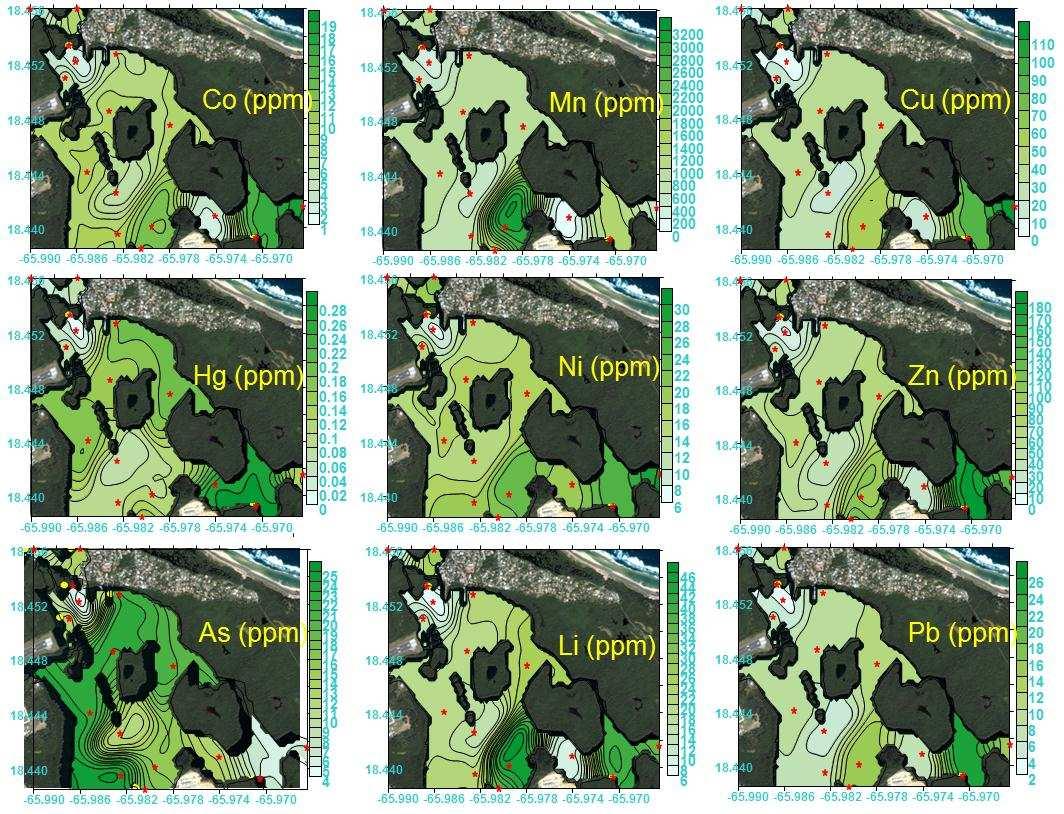
Enrichment Factors (EF) and Geo-accumulation Index (GI) values (Appendix A) of the PTE’s are <1 indicative of no enrichment and contamination degree respectively. Several discrete samples from surface and core sites contain EF values of concern. These elements show slight enrichments: Hg (3.40-core), Li (6.00), V (2.40-core), Cu (1.09-2.49), Pb (6.4-core). Of all metals, As shows the highest EF values ranging from 0.3-5.41 in surface samples and 1.41-5.39 in core samples. These EF values are of concern since is indicative of slight contamination in the mid to west area of the lagoon (Figure 1). Based on Long et al (1995) environmental parameters of effect range low (ERL- limited biotic effect) and effect range medium (ERM- moderate biotic effect), only Ni (up to 32.60 µg/g) and Cu (up to 99.80 µg/g) are likely have an environmental effect on the bay’s biota.
The bioavailable concentrations were only determined on 4 heavy metals (see Appendix A). Values for Zn ranged from 14-16 µg/g and 7-26 µg/g for surface and core samples respectively. Cooper varied from 5-16 µg/g and .7-12 µg/g while values where below 0.5 µg/g. All of these values are below the ERL range.
Michael Martínez-Colón
Puerto Rico Sea Grant Program- Final Report (Grant no. R-21-1-08)
Foraminifera-
July 28, 2011
Foraminiferal density ranged from 44-9235 individuals per gram in surface samples. The highest densities tended to occur towards the middle and SW of the bay, decreasing towards the NE. Bray Curtis cluster analysis show two (A-B) distinct assemblages (Figure 2). Of these, assemblage A includes the two most common genera, Ammonia spp. and Triloculina spp., in which the former is the dominant species which is typical of stressed environments. Assemblage B is considerably less diverse, mainly composed of larger symbiont-bearing taxa and smaller rotalids. Assemblage B is close to Bocas de Cangrejos in which reef-dwelling foraminifers are transported into the lagoon by currents.
The Foram Index (FI) values range from 1.07 to 6.50 with highest values towards Boca de Cangrejos on the NW of TL. The Ammonia-Elphidium Index (AEI) values ranged from 90-97 showing a similar distribution as foraminiferal density. See Appendix B for full foraminiferal data set.
Correlation Matrix-
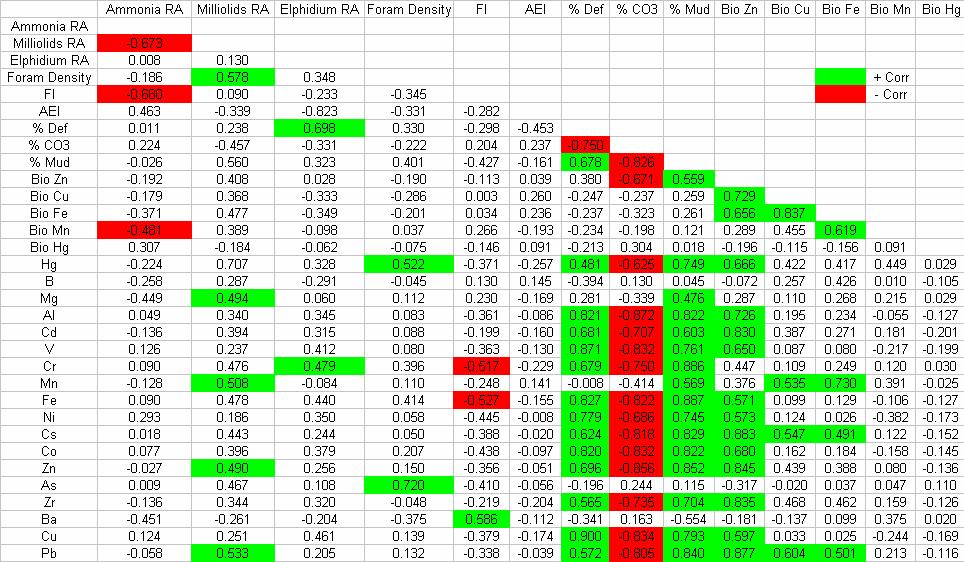
A root-transformed cross-correlation matrix was performed on 32 variables (Figure 3). Miliolid RA (relative abundance) positively correlated with total foraminiferal density, %mud and with bulk concentration of Hg-Zn-Pb in bulk sediments. Ammonia RA negatively correlated with miliolids RS, FI and bioavailable Mn (BioMn). Interestingly, Elphidium RA correlated positively with both % deformities and bulk concentration of Cr. An important fact is that several metals (Hg, Cd, V, Cr, Ni, Cs, Co, Zn, Cu. and Pb) in bulk sediments samples correlated positively with % deformities. This is indicative of potential stressors; however bioavailable metals have no correlation which could be interpreted as other factors causing stress (i.e., dissolved oxygen). Finally, the strong positive correlation of %mud with metals is indicative of the adsorption capacity of clays to chemically attract those elements.
Data analysis is still underway on this project. The dissertation that this funding supported will be completed in 2012. At that time, this report will be amended to include all findings from the study.
Objectives Accomplished or not:
1. Determine the distribution and bio-availability of metals at Torrecilla Lagoon. Objective partially achieved. We are waiting on the results from bulk sediments collected in 2009.
2. Determine the effects of metals on the spatial/temporal distribution of foraminifers at Torrecilla Lagoon.
Objective partially achieved. (1) Core sediment samples could not be dated because of the high organic matter content and possible bioturbation (anthropogenic) so we do not have an exact temporal scale. We do see vertical variations in metals. (2) Spatial temporal distribution of key metals has been determined for season one samples. We are waiting on results of season two samples.
3. Determine specific morphological deformities in Ammonia spp. that are induced by bio-available metals in controlled culture experiments.
Objective achieved. Three experiments were conducted at different copper concentrations (0.10, 0.20, and 0.30 micromol). Experiments show a change in moprhology towards a more pronounced trochospiral shape in 10% of specimens. This is considered a deformity under these concentrations.
4. Develop a cost-effective pollution indicator, which will lay groundwork for utilization of foraminiferal assemblage and deformity assessment in future long-term environmental monitoring programs in Puerto Rico and other tropical coastal environments.
Objective not achieved. This objective will be addressed once Objective 2 is finalized.
Michael Martínez-Colón July 28, 2011
Puerto Rico Sea Grant Program- Final Report (Grant no. R-21-1-08)
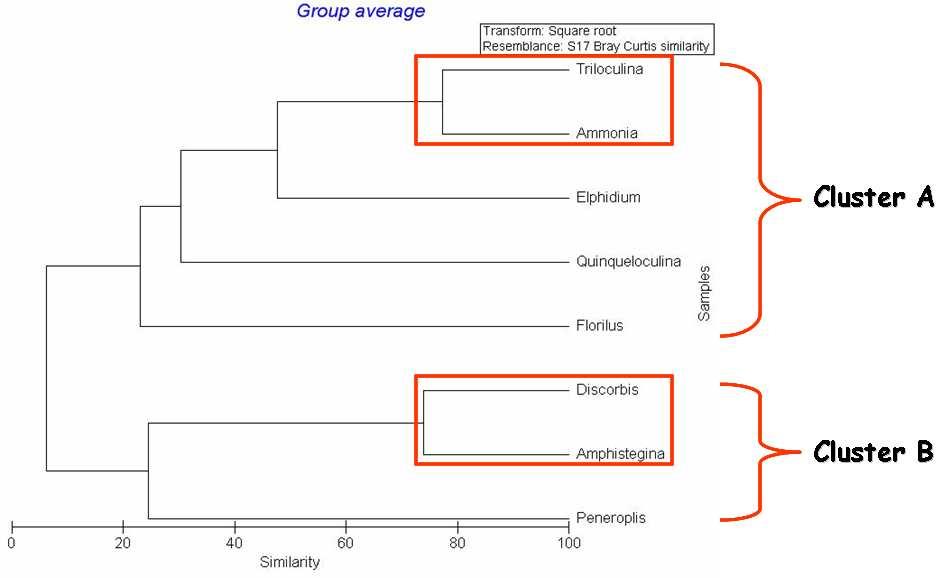
2. Foraminiferal assemblage cluster dendogram.
Discussion of Project Impacts and Products:
This project had several impacts on graduate students from the College of Marine Science at the University of South Florida, in-service teachers, and members of the community surrounding TL.
Impacts-
Undergraduate and Graduate Students
Five students were involved in several aspects of the project. Responsibilities varied from SCUBA diving for sample collection, coring, sample preparation and processing. All students involved learned foraminiferal processing techniques. Of these students, 3 are females of different racial/ethnic backgrounds (Hispanic-American, African-American, and white-American) and 2 are males (HispanicAmerican and white-American). In addition, one white-American undergraduate student has assisted in sample processing.
In-service Teachers
As part of the outreach component, 16 in-service middle school teachers representing 3 school districts attended a 4-day workshop. The facilities of the San Juan Bay Estuary Program were used as classroom and laboratory. Teachers were involved in field sampling and topographic surveying along transects in a mangrove environment near TL (Laguna Pinones). They learned to construct sieves using PVC tubing and pantyhose (mesh) (Appendix C). Also they learned standard sieving techniques, component analysis, graphing, cross section construction, and how to prepare a scientific poster to present at local or national teacher association events. In addition each group gave a 10 minute presentation of their findings. All participants are females in which two are African-American and the rest white Hispanics.
Community Members -- Community members adjacent to TL were involved and interested in our work. Approximately 5 individuals assisted in either loading/unloading equipment into the boat, serving as boat captain, and helping in preparing water samples.
Products -- This project has generated 3 publications (see Project Summary). Two are related to preliminary scientific results and a review paper on heavy metals and foraminifers. The last publication is related to TL but oriented towards the non-scientific community of the island as part of a special issue on the San Juan Bay Estuary Program. In addition, preliminary results have been presented at 4 local (PR) and national meetings.
Recommendations:
The conclusions of this research will provide a potential new tool to be incorporated into management plans on coastal areas in PR. Preliminary data on benthic foraminifers have shown that their distribution behave in response to stressors. These stressors could be high input of organic matter, heavy metals, pesticides, etc. One of the goals of this study is to see their response to heavy metals and subsidiary factors as grain size, organic matter, and dissolved oxygen. This project not only will answer our questions but will raise new ones. Based on this we recommend the following:
1- Increase the number of stations done in this project to develop better distribution maps which will help in identifying potential point sources.
Michael Martínez-Colón
Puerto Rico Sea Grant Program- Final Report (Grant no. R-21-1-08)
July 28, 2011
2- Monitoring TL using foraminifers on a seasonal basis. This will determine if the assemblage has any variability throughout the year.
3- Monitor heavy metal content on an annual basis on the clay fraction.
4- Determine the speciation of heavy metals on bulk sediment samples by conducting sequential extraction techniques. This approach will help clarify in which sediment fraction (carbonate, Fe/Mn oxide, clay, and residual) the heavy metals are more concentrated. This in the ends will provide more insight in the bioavailability of such metals.
5- Determine the free ion concentration of the key metals like Cu, Pb, As, Zn, and Hg through the water column and porewaters from core samples. This will help determine which ions dissolved in TL waters are more common before being complexed or adsorbed.
Bibliography:
ACTLABS, 2007. (http://www.actlabs.com/home.htm).
Luoma, S.N., and G.W. Bryan. 1981. A statistical assessment of the form of the trace metals in oxidized estuarine sediments employing chemical extractants. Sci. Tot. Env. 17:165-196.
Szefer, P., G.P. Glasby, J. Pempkowiak, R. Kaliszan. 1995. Extraction studies of heavy-metal pollutants in surficial sediments from the southern Baltic Sea off Poland. Chem. Geol. 120:111-126.
Michael Martínez-Colón July 28, 2011
Puerto Rico Sea Grant Program- Final Report (Grant no. R-21-1-08)
Appendix A. Concentrations of metals in µg/g unless otherwise noted; EF (Enrichment Factor) and GI (Geo-accumulation Index) are unitless.
Bioavailable metals
Sample #ZnCuFeMnHg
TL07#146.1516.950.96592.2263.98
TL07#2 (top)25.946.450.40172.4330.56
TL07#2 (bottom)21.774.900.3172.4612.85
TL07#313.3310.170.3161.8212.62
TL07#414.957.790.45450.34300.33
TL07#523.5912.500.95431.8160.38
TL07#622.0310.000.59301.25172.98
TL07#718.969.400.65148.6033.71
TL07#817.128.200.59473.5336.00
TL07#915.547.370.51446.5137.56
TL07#1013.687.280.42342.471066.45
TL07#1113.025.870.37355.4854.01
TL07#1215.498.550.62478.670.77
TL07#1316.176.820.48226.40106.54
TL07#1415.167.620.47573.5127.24
TL07#1514.727.840.48370.2239.68
TL07#1615.177.430.70525.9842.98
Bulk sample concentrations
Sample #
TL07#1280.000.648.8739.800.55-1.311.550.95-13.83
TL07#2 (top)119.000.247.6335.600.43-1.481.510.81-13.86
TL07#2 (bottom)108.000.237.4935.200.46-1.491.420.82-13.95
TL07#30.00--9.400.79-3.400.823.02-14.74
TL07#4180.001.188.2320.900.83-2.241.472.58-13.90
TL07#5100.000.317.3844.900.85-1.141.891.58-13.54
TL07#6155.000.518.0135.900.72-1.461.581.40-13.80
TL07#794.000.587.2920.900.78-2.240.971.59-14.50
TL07#8182.000.808.2424.100.64-2.041.491.75-13.88
TL07#969.000.466.8516.200.65-2.610.861.52-14.68
TL07#1082.000.487.0915.300.54-2.691.302.02-14.08
TL07#11153.000.837.9918.300.60-2.441.502.16-13.87
TL07#1210.000.104.066.200.39-4.000.842.33-14.71
TL07#1334.000.495.824.200.36-4.561.606.10-13.78
TL07#1469.000.286.8527.600.70-1.831.862.04-13.56
TL07#1513.000.144.446.600.42-3.911.885.28-13.55
TL07#16175.000.808.1919.700.54-2.331.271.54-14.11
Michael Martínez-Colón July 28, 2011
Puerto Rico Sea Grant Program- Final Report (Grant no. R-21-1-08)
Appendix A. Bulk Samples (cont.)
Sample #Al (%)EFGAICdEFGAIVEFGAI
TL07#18.701.00-13.750.401.23-0.17151.001.07-0.37
TL07#2 (top)10.001.00-13.550.300.80-0.58192.001.18-0.02
TL07#2 (bottom)9.291.00-13.660.200.57-1.17210.001.390.11
TL07#31.451.00-16.34< 0.1BDLBDL37.001.57-2.40
TL07#43.041.00-15.270.100.88-2.1748.000.97-2.02
TL07#56.371.00-14.200.100.42-2.1797.000.94-1.01
TL07#66.041.00-14.280.200.88-1.1790.000.92-1.12
TL07#73.261.00-15.170.100.82-2.1758.001.09-1.75
TL07#84.531.00-14.690.20BDLBDL66.000.90-1.56
TL07#93.021.00-15.28< 0.1BDLBDL50.001.02-1.96
TL07#103.441.00-15.09< 0.1BDLBDL41.000.73-2.25
TL07#113.701.00-14.990.201.44-1.1758.000.96-1.75
TL07#121.921.00-15.93< 0.1BDLBDL21.000.67-3.22
TL07#131.401.00-16.39< 0.1BDLBDL10.000.44-4.29
TL07#144.861.00-14.590.100.55-2.1775.000.95-1.38
TL07#151.901.00-15.95< 0.1BDLBDL22.000.71-3.15
TL07#164.401.00-14.740.201.21-1.1762.000.87-1.65 Sample #CrEFGAIMnEFGAIFe (%)EFGAI
TL07#136.700.37-1.8812701.37-0.015.210.00-13.73
TL07#2 (top)41.600.37-1.705160.49-1.316.280.00-13.46
TL07#2 (bottom)45.600.44-1.574870.49-1.396.610.00-13.39
TL07#310.300.63-3.711370.89-3.221.610.00-15.42
TL07#436.301.06-1.899372.90-0.443.730.00-14.21
TL07#548.500.68-1.4830204.461.244.250.00-14.02
TL07#633.500.49-2.0114602.280.204.920.00-13.81
TL07#724.000.65-2.497672.21-0.733.480.00-14.31
TL07#832.100.63-2.079471.97-0.434.140.00-14.06
TL07#927.200.80-2.315921.84-1.112.610.00-14.73
TL07#1027.400.71-2.305981.64-1.092.320.00-14.90
TL07#1134.700.83-1.968302.11-0.623.640.00-14.25
TL07#1210.400.48-3.702991.47-2.090.760.00-16.51
TL07#136.600.42-4.352481.67-2.360.630.00-16.78
TL07#1440.800.75-1.7310802.09-0.243.160.00-14.45
TL07#1511.600.54-3.544352.15-1.550.940.00-16.20
TL07#1632.000.65-2.089201.97-0.474.130.00-14.07
Sample #NiEFGAICsEFGAICoEFGAI
TL07#125.000.34-2.031.500.28-2.3216.400.79-0.80
TL07#2 (top)30.300.36-1.751.00--18.700.79-0.61
TL07#2 (bottom)32.600.41-1.651.000.17-2.9119.800.90-0.53
TL07#319.601.59-2.380.400.44-4.233.000.87-3.25
TL07#414.800.57-2.780.500.26-3.917.000.97-2.03
TL07#522.900.42-2.161.000.25-2.9111.700.77-1.28
TL07#620.600.40-2.310.800.21-3.2313.000.91-1.13
TL07#718.100.65-2.490.500.25-3.919.401.21-1.60
TL07#816.500.43-2.630.600.21-3.648.000.74-1.83
TL07#915.100.59-2.760.400.21-4.235.600.78-2.35
TL07#1015.200.52-2.750.400.19-4.235.700.70-2.32
TL07#1116.100.51-2.660.500.22-3.917.800.89-1.87
TL07#127.400.45-3.780.200.17-5.231.700.37-4.07
TL07#1310.700.90-3.250.200.23-5.231.700.51-4.07
TL07#1420.800.50-2.290.700.23-3.428.700.75-1.71
TL07#1513.100.81-2.960.200.17-5.232.400.53-3.57
TL07#1616.000.43-2.670.500.18-3.918.700.83-1.71
Michael Martínez-Colón July 28, 2011
Puerto Rico Sea Grant Program- Final Report (Grant no. R-21-1-08)
Appendix A. Bulk Samples (cont.)
Sample #ZnEFGAIAsEFGAIZrEFGAI
TL07#1181.001.750.356.100.43-1.68580.33-2.05
TL07#2 (top)130.001.09-0.136.100.38-1.68290.15-3.05
TL07#2 (bottom)132.001.20-0.114.900.32-1.99380.20-2.66
TL07#325.001.45-2.5112.705.39-0.6220.07-6.91
TL07#454.301.50-1.3922.104.470.18270.44-3.15
TL07#597.801.29-0.5415.901.54-0.29350.27-2.78
TL07#6119.001.66-0.2618.101.84-0.11120.10-4.32
TL07#749.601.28-1.5224.504.620.3380.12-4.91
TL07#867.801.26-1.0720.102.730.0470.08-5.10
TL07#935.400.99-2.0112.102.47-0.6950.08-5.58
TL07#1038.200.94-1.9012.802.29-0.6160.09-5.32
TL07#1154.801.25-1.3822.103.680.1890.12-4.74
TL07#128.700.38-4.034.401.41-2.1520.05-6.91
TL07#134.800.29-4.898.103.56-1.27200.71-3.58
TL07#1469.501.20-1.0414.101.79-0.47290.30-3.05
TL07#1519.000.84-2.917.002.27-1.482.000.05-6.91
TL07#1660.501.16-1.2422.603.160.217.000.08-5.10
Sample #BaEFGAICuEFGAIPbEFGAI
TL07#1194.000.31-2.1681.901.670.2825.401.17-0.24
TL07#2 (top)150.000.21-2.54118.002.100.8114.600.58-1.04
TL07#2 (bottom)142.000.21-2.62130.002.490.9514.300.62-1.07
TL07#338.000.36-4.5217.402.13-1.966.901.90-2.12
TL07#4177.000.80-2.3032.801.92-1.049.301.22-1.69
TL07#5160.000.35-2.4457.101.59-0.2414.700.92-1.03
TL07#6134.000.31-2.7054.801.61-0.3015.601.03-0.94
TL07#7134.000.57-2.7026.001.42-1.386.900.85-2.12
TL07#8160.000.49-2.4434.801.37-0.9610.700.94-1.49
TL07#9229.001.05-1.9318.601.09-1.865.400.72-2.47
TL07#10251.001.01-1.7921.101.09-1.686.600.77-2.18
TL07#11191.000.71-2.1936.101.73-0.908.900.96-1.75
TL07#12631.004.53-0.463.200.30-4.403.400.71-3.14
TL07#13394.003.88-1.140.900.11-6.232.000.57-3.91
TL07#14166.000.47-2.3941.901.53-0.6910.900.90-1.46
TL07#15317.002.30-1.466.200.58-3.444.000.84-2.91
TL07#16148.000.46-2.5634.801.41-0.969.400.85-1.67
Appendix B. Data on foraminiferal assemblages.
TL07#2top1752000004917
TL07#2bot2021901001634
TL07#325170000910
TL07#2top20030000
TL07#2bot00000300
TL07#300000000
TL07#700000000
TL07#810000000 TL07#900000001
TL07#1000000000
TL07#1130000000
TL07#1201200000
TL07#1300200400
TL07#1500100000
Michael Martínez-Colón
Appendix B. Data on foraminiferal assemblages.
Sample #TOTAL Sediment Mass (g) Foram Density # Deformed FORAM Index (FI)AEI%DEF
TL07#13140.78402.56141.6091.734
TL07#2top2920.201460.00251.1689.749
TL07#2bot3030.065050.00281.0791.409
TL07#32781.00278.0001.0797.290
TL07#43140.039235.29101.5382.953
TL07#52730.55496.3641.3895.651
TL07#63310.057195.6551.4798.802
TL07#72800.065000.0001.4895.210
TL07#83900.049069.77101.4696.323
TL07#93430.191824.4701.1596.180
TL07#103000.86349.6501.1496.140
TL07#113000.048108.11161.2885.335
TL07#12321.0032.0003.9190.910
TL07#133000.46652.1701.8696.890
TL07#15441.0044.0006.5090.000
Sample #AmmoniaPercentMilliolidPercentElphidiumPercent
TL07#112238.8516050.96113.50
TL07#2top17559.939131.16206.85
TL07#2bot20266.677825.74196.27
TL07#325190.29196.8372.52
TL07#410734.0816552.55227.01
TL07#515456.4111040.2972.56
TL07#616449.5516148.6420.60
TL07#713949.6413447.8672.50
TL07#818346.9219349.4971.79
TL07#927780.763811.08113.21
TL07#1024983.004113.67103.33
TL07#1115752.3311337.67279.00
TL07#121031.25721.8813.13
TL07#1315652.003311.0051.67
TL07#15920.451840.9112.27
Michael Martínez-Colón
Puerto Rico Sea Grant Program- Final Report (Grant no. R-21-1-08)
Appendix C. Teacher Workshop
Fecha: 30 de Mayo de 2009.
Hecho por: Michael Martínez Colón
Fuente: N/A
Titulo de la Lección: Construcción de Tamices
July 28, 2011
Estándar Educativo: La Naturaleza de la Ciencia; Idea Fundamental- La Actividad científica se nutre de la interacción entre la ciencia, la matemática y la tecnología.
Grado: 7mo-9no
Duración: 2 períodos de 50 minutos
Conceptos: Instrumentación científica.
Objetivos: Que el estudiante pueda construir 3 tamices utilizando materiales del diario vivir.
Materiales:
* Reductor de PVC (7 cm diámetro externo)
* Tijeras
* Pega de tubería de PVC o abrasaderas
* Pantyhose
* Maya (“screen”) de “Fiber Glass” de 1mm cuadrado (Home Depot)
* Regla
* Goma elástica
* Guantes
* Vaso plástico de 10 onzas u otro tipo de envase de mayor/menor volumen
Procedimiento:
1) Tomar la maya y cortar un pedazo de 12 cm cuadrados utlizando la tijera.
2) Tome el tubo PVC y en la parte inferior agregue la pega de tubería a vuelta redonda.
3) Rápidamente coloque el tubo en el centro de la maya y envuelva el tubo haciendo presión en la parte inferior. Rote el tubo ligeramente y coloque una goma elástica.
4) La goma elástica asegurará la maya al tubo durante el secado.
5) Ponga el tamiz en un lugar ventilado.
6) Este será el Tamiz #1.
7) Repita los pasos 1-5 con el pantyhose.
8) Este será el Tamiz #2.
9) El vaso plástico no hay que modificarlo.
10) Este será el Tamiz #3.