ACOMPARISONOFSEQUENTIALEXTRACTIONMETHODSUSEDFOR BIOAVAILABILITYASSESSMENTOFPOTENTIALTOXICELEMENT
MICHAEL MARTÍNEZ-COLÓN1,*,BENJAMIN
ROSS1,2,JEREMY D.OWENS3,GWENDOLINE DUONG4,OLUGBENGA
VINCENT M.P.BOUCHET4 AND
MARÍA
VIRGINIA ALVES MARTINS6,7
ABSTRACT
Understandingpotentiallytoxicelement(PTE)bioavailabilityhaseludedtheresearchcommunityfordecades. HerewecomparethreePTEextractionmethodsthatare widelyusedinforaminiferalpollutionstudies.Evidentdiscrepanciesbetweenmethodswereobservedwhendiversity indicesandrelativeabundanceswerein fluenceddifferentlybythesameand,insomecases,bydifferentPTEs dependingonthemethod.Thiswasreflectedinthecanonicalcorrespondenceanalysis(CCA),whereCr-Ni(Method B)andZn-Pb-Cu(MethodC)hadarespectivepositive andnegativein fl uenceovertheforaminiferalrelative abundanceswhilenopositivecorrelationswereobservedfor MethodA.Thesediscrepanciesstemfromeachmethod extractingdifferentconcentrationlevelsofthesamePTE fromthesamesedimentsamples.WerecommendbioavailablePTEstobeextractedfromthefollowingfractions:(1) mud-boundfromMethodA(F1-exchangeable);(2)organicboundfromMethodB(F3-oxidizable);and(3)completely avoidusingMethodC.
INTRODUCTION
Inenvironmentalmicropaleontology,benthicforaminiferaarebioindicatorsusedinmarineenvironmentalassessmentsandmonitoring.Theirrapidecologicalresponseto changesinabioticstressors(e.g.,salinity,pollutants)isa keytraitthathasbeenexploitedwhenconductinganthropogenicpollutionstudies(e.g.,Alve,1995;Nigametal., 2006;Frontalinietal.,2016;El-Kahawyetal.,2018;Bergaminetal.,2019;Bariketal.,2022).Inaddition,theuse ofbenthicforaminiferaindescribingandassessingspatial/ temporalecologicalconditionsofcoastal(e.g.,Jorissen etal.,2018;Casteloetal.,2021;Fajemilaetal.,2022a; Ghandouretal.,2025)anddeep-watersettings(e.g., Schwingetal.,2017;O ’ Malleyetal.,2021)havesteadily
1 SchooloftheEnvironment,FloridaA&MUniversity,1515SMartin LutherKingJr.Blvd,FSHScienceResearchCenter,Tallahassee,FL 32307
2 RosenstielSchoolofMarine,Atmospheric,andEarthScience, UniversityofMiami,4600RickenbackerCauseway,Miami,FL 33149
3 DepartmentofEarth,Ocean,andAtmosphericScience,FloridaState University,1011AcademicWay,Tallahassee,FL32306
4 UniversitédeLille,CNRS,IRD,Univ.LittoralCôted’Opale, UMR8187,LOG,Laboratoired’OcéanologieetdeGéosciences,Station MarinedeWimereux,59000,Lille,France
5 DepartmentofGeologicalSciences,OsunStateUniversity,230261, Osogbo,Nigeria
6 FaculdadedeGeologia,UniversidadedoEstadodoRiodeJaneiro, UERJ,Av.SãoFranciscoXavier,24,sala2024A,Maracanã,Riode Janeiro,RJ20550-013,Brazil
7 UniversidadedeAveiro,GeoBioTec,DepartamentodeGeociências, CampusdeSantiago,3810-193Aveiro,Portugal
*Correspondenceauthor.E-mail: michael.martinez@famu.edu
increasedinrecentyearsinresponsetoenvironmental healthassessments(AbdMalek&Frontalini,2024).At present,themethodsappliedtoassesspotentiallytoxic element(PTE;e.g.,As,Se)concentrationsinsediments havegenerallybeeninappropriatebecausewhatisbioavailabletotheforaminifershasbeenseverelyoverlooked bymostauthors.
Discrepanciesexistbetweenresearchermethodswhen applyingbenthicforaminiferaasbioindicatorsofPTEpollutionandscalingtothepollutant ’sbioavailability.Noconsensusexiststodeterminethebioavailabilityforforaminiferal bioaccumulationand,mostimportantly,whichchemical extractionmethodismostappropriate.Studieshavereliedon usingeitherverystrongacid(Hydro fl uoricandPerchloric), relativelyweakeracid(threetooneratioofHydrochloricand Nitric 5 Aquaregia),orx-ray fl uorescencetodetermine “total ” PTEconcentrations(e.g.,Yankoetal.,1998;Sulkowski&Hirner,2006;EPA,2007;Schintuetal.,2016;Oron etal.,2021;El-Kahawy&Mabrouk,2023;Ganugapenta etal.,2025)fromsediments.Theseapproachesreportboth bioavailableandnon-bioavailablePTEsindiscriminatelyand simultaneouslycombinethemintoasingleconcentration value(Fig.1;MethodC).AccordingtoTessieretal.(1979), usingtotalPTEextractionisnotanaccurateapproach becauseitdoesnotre fl ectthephysicochemicalbehaviorof PTEs.Inaddition,theyspeculatedthatwhenusingtotal extraction(p.844), “ ...allformsofagivenmetalhavean equalimpactontheenvironment;suchanassumptionis clearlyuntenable. ” WeagreewiththissincePTEsboundto organicmatter,forexample,shouldbereadilybioavailableto theforaminiferssincemostaredetritivores.Thus,this approachhasbeenshowntonotconsiderthebioavailability ofPTEs(Quevauvilleretal.,1993;Morilloetal.,2004; Arainetal.,2008;Martínez-Colónetal.,2009,2017,2018; Martinsetal.,2020)insedimentsandtoinadvertentlyoverestimatetheimpactofthepollutantsonecologicalresponses ofbenthicforaminiferaasseeninnumerousstudies(e.g., Berginetal.,2006;Ferraroetal.,2006;Frontalini&Coccioni, 2008;Ayadietal.,2016;Hessetal.,2020;Congetal.,2022; Schmitzetal.,2024;Ganugapentaetal.,2025).BioaccumulatedPTEsinanorganismarenotrelatedtothetotalconcentrationinthesedimentbuttowhatisbiologicallyextracted (Tessier&Campbell,1987),whichisthecasewithbenthic foraminifera.
OBJECTIVES
Thispapercomprisestwosectionsthataddresstwomajor objectives.The fi rstobjectiveistoguidetheresearcherson thegeneralbackgroundaspectsofbioavailability.Inaddition,thissectionprovidesabriefexplanationofPTEchemical fractionationinsedimentsandthreemethodsofextraction widelyusedinpollutionstudiesinvolvingbenthicforaminifera.
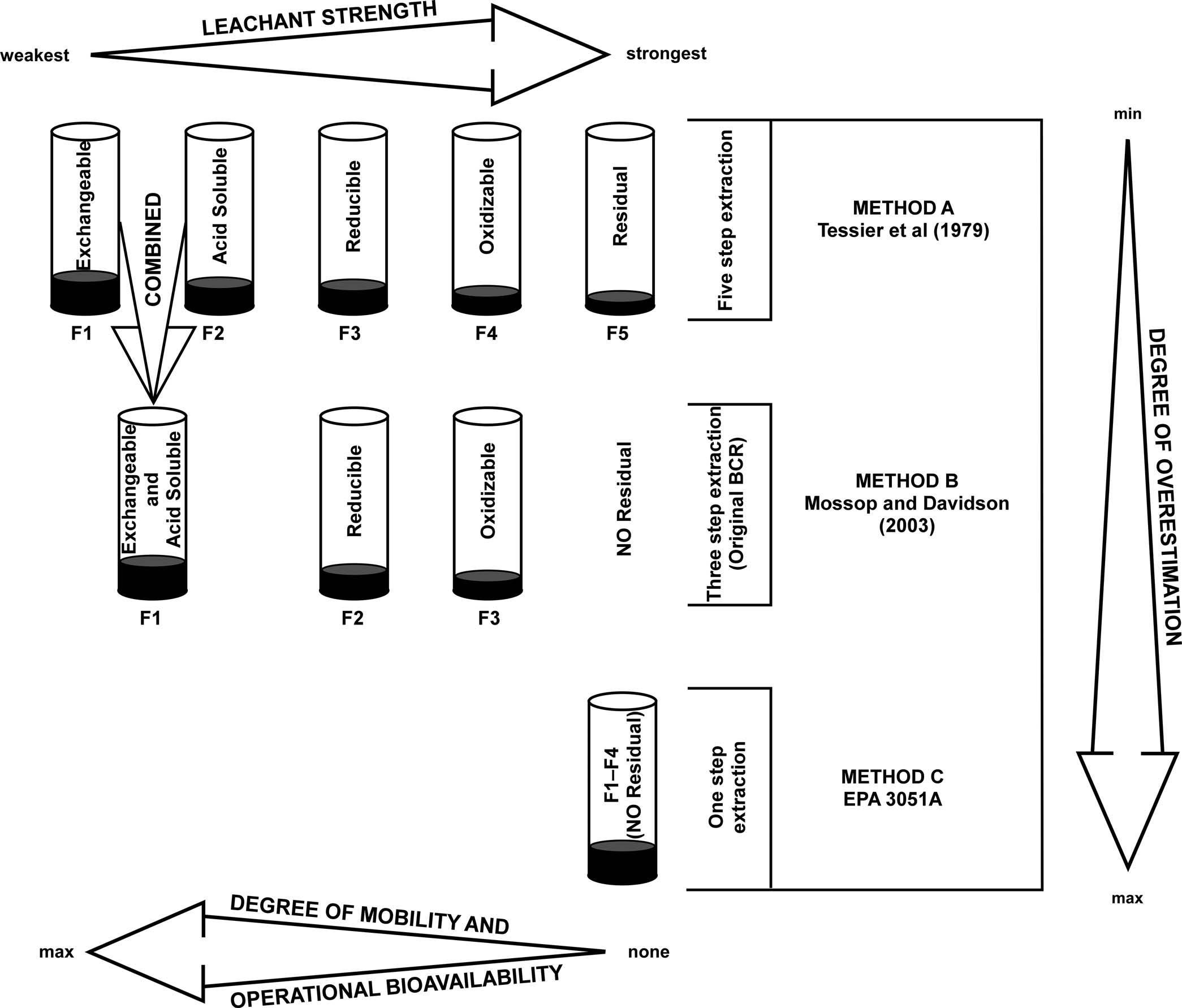
FIGURE 1.Qualitativecomparisonofallthreeextractionmethodsusedinthisstudy.Eachoftheextractionstepsisequivalenttoachemicalfractionin thesediment.ThetermfractionisdenotedbytheletterF.
GiventhecomplexityofPTEfractionation,notaddressedhere, amorein-depthdiscussionabouttheenvironmentalfactorsthat controltheirfate,transport,andbioavailabilitywasprovidedby Martínez-Colónetal.(2009).
Themainobjectiveofthesecondsectionistouseasediment core,fromaknownpollutedestuary,toexamineandanalyze thepreviouslydescribedthreeextractionmethodstodiscuss: (1)howthechoiceofextractionwillleadtodifferentinterpretationsonPTEbioavailability;(2)howthispromotes,fromthe samedataset,differentapparentPTEeffectsonbenthicforaminifera;and(3)whichPTEchemicalfractionsshouldbeusedas bioavailabletobenthicforaminiferaandwhichonesneedtobe avoidedinfuturepollutionstudies.Thegoalofthesecondsectionisnottoprovideanin-depthinterpretationoftheecological effectsofbioavailablePTEsonbenthicforaminiferaortointerpretup-corehistoricalchangesofpollution,sincethisispartof afollow-upcontribution.
BACKGROUND
OPERATIONAL BIOAVAILABILITY
Numerousprotocolsweredevelopedthatreliedonusing andapplyingleachants(e.g.,acids,bases,salts;Appendix1) neededtoextractPTEsfromdifferentsedimentchemicalfractions.Unliketheuseofstrongacidswiththecapacitytodissolvesilicateminerals(e.g.,feldspar,pyroxene),sequential extractionmethodshavebeendevelopedtobetterconstrain PTEbioavailabilityoratleastweakermineralstructures recordedinsolidphasesediments(Tessieretal.,1979;Davidsonetal.,1998;Sulkwoski&Hirner,2006;Arainetal.,2008; Rosadoetal.,2016).Sequentialextractionprocedurestarget keysedimentchemicalcomponentswherePTEsarefractionated(Fig.1).Theoperationalbioavailabilityorlevelof “dif ficulty ” inleachingoutaPTEisrelateddirectlytotheir substrateaffi nity(e.g.,sediment,particulateorganicmatter),
whichisrelatedtoaparticularsetofenvironmentalconditions (e.g.,pH,redox,ligands,bondingstructures).Thestrongerthe chemicalaffi nitybetweenaPTEanditssubstrate,thegreater thedif fi cultyinbeingleachedout,thusbecoming,operationally,lessbioavailable(Fig.1;e.g.,Tessieretal.,1979;Ure etal.,1993).
TherearenumerousPTEextractionmethodsavailablein theliterature,ofwhichthreearewidelyusedinenvironmental micropaleontology.TwoarerelatedtohoweasilythePTEsare sequentiallyextractedbasedontheirsedimentchemicalfractionationandasafunctionofoperationalbioavailability(Sulkowski&Hirner,2006;Bacon&Davidson,2008;Martins etal.,2013;Martínez-Colónetal.,2017;Bariketal.,2022; Fajemilaetal.,2022a,c).Thethirdoneisaone-stepmethod thatprovidesatotalorpseudo-totalextractiondependingon thetypeofleachantused.Sincenosequentialextraction methodis100%precise,asallsedimentshavearangeof uniqueproperties,theresearcher(end-user)needstounderstandthedifferencesintheextractionmethods(Appendix1) andhowthemethodologyaffectstheirinterpretationswhen assessingthebioavailabilityofPTEstobenthicforaminifera (Fig.1).
TheTessieretal.(1979) five-stepsequentialextraction method(Fig.1;MethodA)isusedwidelyinothertypesof pollutionassessmentstudies(e.g.,ecologicalrisk,mining, aquaculture)althoughithasnotfounditsnicheinenvironmentalmicropaleontology.Ingeneral,theaddedadvantageof employingthistypeofmethodisthatitprovidesinvaluable informationontheprovenance(naturalvsanthropogenic), fate/transport(mobility),andbioavailabilityofPTEs(Caplat etal.,2005;Nematietal.,2011;Lietal.,2022).Regardlessof itswideacceptanceinthescientificcommunity,variationsand modificationshavebeenmadetotheirmethodology(e.g.,Kim &McBride,2006;Sulkowski&Hirner,2006;Bacon& Davidson,2008;Rosadoetal.,2016)basedondifferencesin (1)applicability-PTEleachingfromsediments,soils,sewage, sludge;(2)timeconstraints-lengthofleachingprocess;(3) chemicalenvironment-oxidation,diagenesis,carbonatecontent;and(4)extractionpotential-leachantstrength.
TheCommunityBureauofReference(BCR;Fig.1;Method B)isawidelyusedthree-stepextractionmethodinpollution studies(Morilloetal.,2004)includinginenvironmental micropaleontology.TosimplifytheTessieretal.(1979)protocols,theBCRmethodwasdesignedtorelyonhigheracidic conditions,longerextractiontimes,andleachantswithoutsolventionsasanattempttominimizere-adsorptionandprecipitationduringtheextractionprocess(Sulkowski&Hirner, 2006).SimilartoMethodA,modifi cationshavebeenproposedtoimprovetheaccuracyofextractionandreducetime needed.Forexample,ultrasonicationwillhelpinincreasing thesurfaceareaofthesedimentswhileamicrowave-assisted extractionreducesthereactiontime,whichwillmaximize PTEleachabilityfromtargetsedimentfractions(Quevauviller etal.,1993;Ureetal.,1993;Arainetal.,2008).OnemaindifferencefromMethodAisthatthismethodreliesononlythree extractionstepsinsteadof five.The firststepintheMethodB extractionprocedureistocombinethe fi rsttwoMethodA fractions(Fig.1):(F1)exchangeabledeemedhighlybioavailabletobenthicforaminifera(e.g.,Martínez-Colónetal.,2009; Fajemilaetal.,2022a,c)and(F2)acid-soluble,which
Martínez-Colónetal.(2017,2018)documentedasnotbioavailable.Researchersneedtobeconcernedthatcombinedextractionssteps,includingtotaldigestion,ofthesedimentresultsin higherPTEconcentrations,butmuchofthisfractionisnotbioavailabletoforaminiferaleadingtomisinterpretations.
Theunderlyingissueforanysequentialextractionmethod isitsaccuracyintargetingaPTEinaparticularchemicalfraction.Numerousauthorshavedocumentedandprovedthat selectinganappropriateleachantdoesnotguaranteefull extractionofthePTEfromagivenfractionduetocross-contamination(e.g.,co-precipitationduringanextraction;Martin etal.,1987;Davidsonetal.,1998;Mossop&Davidson,2003; Kim&McBride,2006;Sulkowski&Hirner,2006;Bacon& Davidson,2008;Cuvieretal.,2021).These fi ndingsstrongly suggestthatnotonlytheleachanttypebutalsotheirconcentrationsarenot100%target-specifi c.Thereisnoprecise methodofextractiongiventhedifferenttypesofrecovery whenadjustmentshavebeenmadetoanextractionmethod. ThesearenottheonlyshortcomingsofanysequentialextractionproceduresinceimproperpHconditionsorincorrect leachantconcentrationsduetousererrorwillaffectPTE recoveryandconcentration.
Aquaregia(three-to-oneratioofHydrochloricandNitric acids)isusedinone-stepextractionmethodsthatproducetotal PTEconcentrations.Theshort-termextractiontimeisan addedadvantageofthismethodinadditiontothevaluesbeing neededwhenimplementingpollutionindiceslikeenrichment factors(EF)andpollutionloadindex(PLI),aswellasdeterminingbackgroundorbaselinevaluesamongothers.Asmentionedearlier,themaindisadvantageofthiswidelyused methodinenvironmentalmicropaleontologyisthatitdoesnot discriminatebetweenbioavailableandnon-bioavailablePTEs. TheU.S.EnvironmentalProtectionAgency(EPA)protocol 3051A(Fig.1;MethodC)usedinthisstudyimplementsthe aquaregiaextractionsolution.
EXTRACTABILITYVS BIOAVAILABILITY
ItisimportanttorememberthatbothAandBextraction methodswereoriginallydesignedtoassesstheimpactofsediment-boundPTEsonsoilsandsediments.Subsequently,these methodswereappliedtoaquaticmacrofaunaandlarger-sized meiofauna(e.g.,nematodes)giventhattheyareexposedto PTEsduringsedimentdigestion(passiveoractive).Thisexposuredoesnottranslatedirectlytobenthicforaminiferagiven theirdifferentmodeoflife(e.g.,feeding,epi/endobenthic); foraminifersatthesediment-waterinterfacewillbeexposedto PTEsinsolutionthataretrulybioavailable(e.g.,Maltoetal., 2025).However,ithasbeenfoundthatmanyPTEsreleased intoporewateraresubsequentlyfoundassociatedwithrefractoryorganicmatter,authigeniccarbonates,authigenicclay minerals,andFe-sulfi desthatare “permanent” phasesofPTE sinksinsediments(e.g.,Solimanetal.,2019;Smrzkaetal., 2019),hence,immobile,andnotbioavailabletobenthicforaminifera.AspointedoutbyTessier&Campbell(1987,p.50), “Therouteofentryoftracemetals(water,food,sediments, endocytosis)shouldbedeterminedforbenthicorganisms.” Thus,sedimentaryPTEbioavailabilityhadtobere-evaluated forbenthicforaminiferalstudies.
BioavailabilityismeasuredbyhoweasilyaPTEisleached outfromaparticularsedimentchemicalfraction.MethodA
considered fi vedifferentfractions(Fig.1)fromwhichMartínez-Colónetal.(2009)arguedthatPTEsfoundadsorbedto sedimentsandcomplexedwiththeorganicmattershouldbe consideredbioavailabletobenthicforaminifera.Although PTEsfoundco-precipitatedwithcarbonatesintheacid-soluble fractionareconsideredthesecondmostbioavailable(Fig.1), Martínez-Colónetal.(2017,2018)demonstratedthattheydid notcorrelatewithbenthicforaminiferalecologicalresponses butratherwithtotalconcentrations.
Herewebriefl yexplaintherationalebehindfourchemical fractionsanditsassociationwithPTEs:
(A)Exchangeablefraction(F1)-PTEsreadilyadsorbtothe sediment’ssurfaces(e.g.,clays,minerals).Thisisrelated totheionicchargeofthePTEconcerningthesurface chargeofthesediment.Becauseofthis,thePTEsare weaklybondedtothesedimentsandarethusreadily releasedintothesolutionduetominutechangesinpHor scavengedfromthesedimentsurfacesbychangesin salinity(e.g.,Cl- ligands;e.g.,DuLaingetal.,2008; Shengetal.,2023).Basedonoperationalbioavailability, thePTEsinthisfractionareveryeasilyleachedandthus consideredthemostavailabletobiota(Tessieretal., 1979;Martínez-Colónetal.,2009;Fig.1).
(B)Acid-soluble(F2)-PTEsco-precipitatedwithcarbonate minerals.Inthistypeoffractionation,thepollutantis foundwithinthecrystallinestructureorlatticeofthe mineralbecauseofcationsubs titution(Ca þ2 forCuþ2/ Zn þ2 /Pb þ2 ;e.g.,Harstad&Stipp,2007;Yuanetal., 2016;Smrzkaetal.,2019)asthisisseenaswellduringforaminiferalcalci fi cation(e.g.,vanDijketal., 2017;Sagaretal.,2021).Itisimportanttorealizethat thisfractionisconsideredthesecondmostbioavailable(Fig.1),accordingtoTessieretal.(1979),butto otherfaunathatcouldingestcarbonateminerals.At theexpenseofnotengagingintheintricaciesofthe marineCO 2 -buffersystem,alowerpHorachangein alkalinityisneededtodissolvethecarbonateminerals asafunctionoftheCO 3 2 ionsolubility,whichwill thenreleaseanysequesteredPTEs.Forexample,PTEs canremainstableindifferentcarbonatephases[e.g., malachite:Cu 2 (OH) 2 CO 3 ]andwillreactdifferentlyto dissolutionbasedonsolubilityandpH,especiallyin sedimentswithhighamountsoforganicmattercontent(e. g.,Martínez-Colónetal.,2009).
(C)Reducible(F3)-PTEsco-precipitatedwithFe/Mn minerals.Similartotheacid-solublefraction,the PTEsarealsofoundwithinthecrysta llinestructure orlatticeof(oxy)hydroxideminerals(e.g.,hematite, goethite).Thesolubilityofthesemineralsisstrongly relatedtotheredoxenvironmentatthesedimentwaterinterface,thus,duringoxicconditions,PTEs aresequesteredduringmineralization,makingthem effectivelynon-bioavailable.Also,itisimportantto notethatFeoxidationhasbeendocumentedunder anoxicconditions(Doddetal.,2022).Althoughthis iscommonlyobservedinthesubsurface,suchconditionsarenotalwaysobservedexceptincaseswhere watercolumnstrati fi cationoccursandiscoupled withlongresidencetimes.
(D)Oxidizable(F4)-PTEsaresequesteredandcomplexed byorganicligandsassociatedwithorganicmatter.Itis importanttorememberthatthetypeoforganicmatter (e.g.,labile,refractory)playsaroleintermsoffood availability.Regardingbenthicforaminifera,adebate stillstandsintermsoforganicmattertypeandpreference(e.g.,Linke&Lutze,1993;Alveetal.,2016). Overall,thePTEsfoundinlabileorganicmatterare morereadilybioavailablethanthoseintherefractory formtothebenthicforaminiferagiventheresistanceof thelattertoweathering(e.g.,Baltaretal.,2021; Fajemilaetal.,2022b)andsubsequentpollutantrelease. Asecondligand(sulfur)promotessulfidemineralprecipitationwherePTEs,likewithcarbonateand(oxy)hydroxide mineralization,areco-precipitatedintogalena(PbS)or pyrite(FeS2;e.g.,DuLaingetal.,2008)forexample. Althoughlivingbenthicforaminiferahavebeenfoundto containframboidalpyrite(mostlikelybybacterialreductivetransformation;Seiglie,1973;Wangetal.,2010),this typeofsequestrationonlyoccursundersulfidicoreuxinic conditionsatthesediment/waterinterface,whichwould alreadybeintolerabletotheforaminifers.Underthese extremeenvironmentalredoxconditions,thePTEsare operationallyandchemicallynotbioavailabletobenthicforaminiferagiventheinsolubilityofsulfideminerals.Thissedimentfractionischallenginggiventhatduring theextractionmethod,thePTEsareleachedoutfromboth organicandinorganicchemicalforms.
MATERIALSANDMETHODOLOGY
STUDY
AREAAND
FIELD SAMPLING
InSeptember2022,theGuánicaBayestuaryinsouthern PuertoRicowasincludedintheNationalPriorityList superfundsitebytheU.S.EnvironmentalProtection Agency(EPA).Fordecadesthisestuaryhasbeenreceiving copiousamountsofpollutantsincludingPTEs,polychlorinatedbiphenyls,andsewageamongothers(e.g.,Whitall etal.,2013;Kumaretal.,2016).Theaveragewaterdepth is4m(Whitalletal.,2013),andthesurfacesedimentsare predominantlymud(Baueretal.,2012;Klausetal.,2016). A52-cmpushcorewascollectedbySCUBA(Self-Contained UnderwaterBreathingApparatus)diversinOctober2021at adepthof2.5minasmallcoveawayfromthedredged channelwithrelativelycalmwaters,onthenorthwestsectionofthebay(Fig.2).Thepollutionhistoryofthissite ensuredthatchangesinbioavailabilityverticalgradients (idealforthisstudy)wouldbeshowcasedbytheextraction methodcomparisons.
SAMPLINGAND SAMPLE PROCESSING
Thesedimentsfromthe10-cmdiametercorewereextruded andsampledat1-cmbetween0–10cmand2-cmresolution between10 –46cm,resultingin28samples.Thelastsixcm wereextrudedatone-(46–47cm),two-(47 –49cm),and three-cm(49–52cm)intervals,forthreeadditionalsamples, giventechnicaldifficultiesduringextrusion.Theextrudedsampleswereplacedinacid-washed(10%HCl)8-ozNalgene©
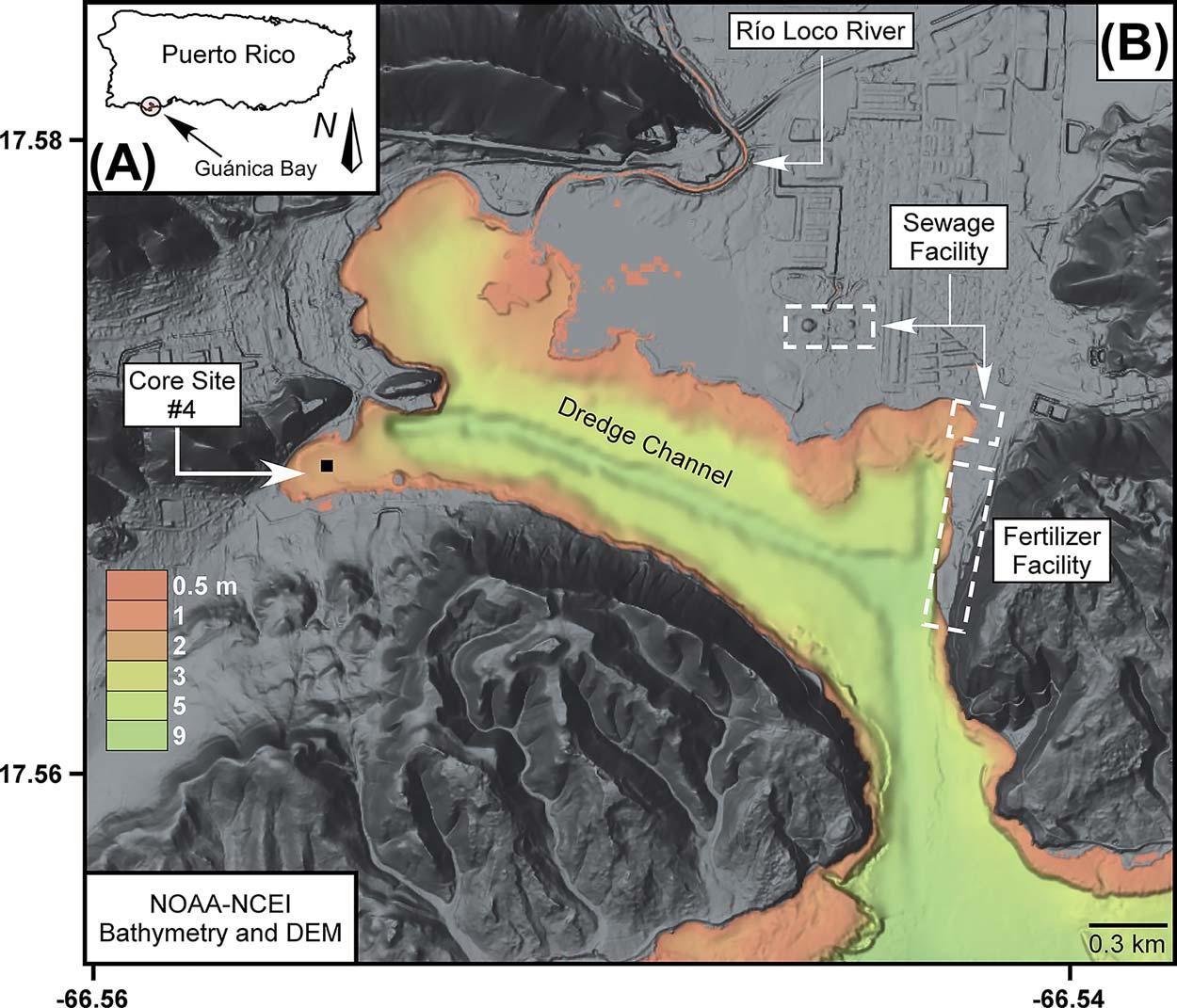
FIGURE 2.Studiedarea.A)GeneralizedlocationofGuánicaBayinPuertoRico.B)Locationofthesedimentcore.
containersandfrozenat4°C.Inthelaboratory,thesamples werefreeze-dried,andsubsampleswerecollectedforthefollowingparameters:(1)PTEextractionMethodA,(2)PTE extractionMethodB,(3)PTEextractionMethodC,and(4) analysisofforaminiferaldiversityandrelativeabundancesof thedominanttaxa.
Insummary,2–20gofsediment/subsamplewereinitially wetsieved(,63 mm)andfurtherdriedat50°C.Forbenthic foraminiferalanalysis,thegoalwastopick300individuals (maxwas239)fromlessthan1gofsedimentpersubsample (.63 m m).ForthePTEconcentrations,allsubsampleswere groundusinganagatemortarandpestle.Forthesequential extractionmethods,PTEswereextractedfromsubsamples consistingof0.5gfollowingMethodA(Tessieretal.,1979) andMethodB(Mossop&Davidson,2003;BCR)protocols (Appendix1;Fig.1).Theoriginalprotocolsrequired1gof sedimentbutinthisstudy,halfthemasswasused(duetolimitedsubsampleavailability),andalltheleachantvolumesfor theextractionswerealsohalved.ForMethodC(EPA3051A; EPA,2007),amicrowave-assistedextractionwasdoneusing aquaregia(Appendix1)and0.5gofsediment/subsample. Theconcentratedacidsusedinthismethodarenotstrong enoughtocompletelydissolvealltheresidualminerals(e.g., quartz)(Fig.1).Alltheleachedextractsfromthethreemethodsusedweredilutedin30%HNO 3.Aftercompletesample digestion,eachsamplepermethodwasdilutedin2%HNO 3 solutionandanalyzedusinganAgilent7500csICP-MS (Inductivelycoupledmassspectrometry)attheNationalHigh MagneticFieldLaboratoryatFloridaStateUniversityforthe followingninePTEs:Cr,V,Co,Ni,Cu,Zn,As,Se,andPb. Internalstandardsandspikeswereusedtoensureinstrument stabilityandtocorrectdatapostanalysis.Proceduralblanks werebelowdetectionlimitsforallreportedelements.For
thisstudy,weusetheterm “ pseudo-total ” forthesummation oftheextractedPTEsinMethodA( ΣF1 –F4)andMethodB (ΣF1–F3).
DATA ANALYSIS
Forthisstudy,weusedseveralecologicalparameters.We calculatedboth1)SpeciesRichness,whereS 5 thenumberof speciespersample,andthe2)Shannon-Index(Shannon, 1948)using
HðSÞ 5 Σpi xlnðpi Þ
where pi istheproportionofthei th speciesinasample.We alsolookedattherelativeabundanceofthemostdominant foraminifers:3) Ammoniatepida (Cushman,1926)Relative Abundancewascalculatedusing
ARA 5 ðA=BFT Þ 100
where A isthenumber A.tepida and BFT isthetotalnumber ofbenthicforaminiferainthesample.Thiswasthemostdominantspecies.4) Quinqueloculinaseminulum (Linnaeus,1758) and Quinqueloculinatenagos (Parker,1962)RelativeAbundancewascalculatedusing
QRA 5 ½ðQs þ Qt Þ=BFT 100
where Qs and Qt arenumbersof Q.seminulum and Q.tenagos, respectively,and BFT isthetotalnumberofbenthicforaminiferainthesample.Thesewererelativelythesecondandthird mostabundanttaxa.ItisimportanttorememberthatthreedifferentPTEextractionmethodsarebeingcomparedinthis work.Theseecologicalindiceswereonlyusedtovisualize
andconceptualizediscrepanciesarisingfromthedifferent “effects” ofPTEs.
ForthePTEs,aunivariatetwo-sample t-testusingnontransformeddatawasdonetoassessasigni ficantdifference betweenMethodAandMethodBsequentialextractions. Giventhatthenomenclatureandapproachforeachfraction aredifferentbetweenthemethods(Fig.1;Appendix1),the followingcomparisonsweredone:(a)F1(exchangeableMethodA)vsF1(exchangeableandacid-soluble-MethodB); (b)F3(reducible-MethodA)vsF2(reducible-MethodB); and(c)F4(oxidizable-MethodA)vsF3(oxidizable-Method B).Inaddition,theconcentrationofPTEsextractedbyaqua regiafromMethodCwascomparedwiththe “pseudo-total ” valuesfromMethodsA(ΣF1 þ F2 þ F3 þ F4)andB(ΣF1 þ F2 þ F3).Lastly,aprincipalcomponentanalysis(PCA)was doneusingthesquare-roottransformofthePTEdatafrom MethodAandMethodB.Inaddition,acanonicalcorrespondenceanalysis(CCA)wasdoneonthefollowingsquare-root transformedparameters:(1)MethodAPTEfractions(F1,F3, andF4),(2)MethodBPTEfractions(F1 –F3),(3)MethodC PTEaquaregiaand “pseudo-total” extractions,(4)S,(5) H(S),(6)ARA,and(7)QRA.Thesquare-roottransformations weredoneusingExcelandthetwo-sample t -test,PCA,and CCAweredoneusingthePaleontologicalStatistics(PAST) softwarev.4.15c(Hammeretal.,2001).
RESULTS
VARIABILITYOF PTESAND FORAMINIFERAL DIVERSITY
PTEExtractionMethods
TheninePTEsofconcern(Cr,V,Co,Ni,Cu,Zn,As,Se, Pb)wereanalyzedfollowingthethreedifferentextraction methods(A –C)outlinedinAppendix1.Inaddition,wewant tohighlightthatforthisstudywedidnotincludetheF2fractionofMethodA(concentrationofPTEsassociatedwithcarbonates).IthasbeenshownthatPTEsinthisfractionarenot bioavailabletobenthicforaminifera(e.g.,Martínez-Colón etal.,2009,2017,2018;Fajemilaetal.,2022a,c).
MethodA:F1(exchangeable)vsMethodB:F1(exchangeable 1 acidsoluble). Figure3illustratestheverticalpro files ofthesequentiallyextractedPTEsfromtheF1fraction.On theonehand,noobservablecorrelationswereestablishedfor Ni,Cu,andZn(Table1)giventheywerebelowthedetection limit(BDL)inMethodA(Figs.3D –F).Ontheotherhand, significantstatisticaldifferenceswereobservedbetweenmethodsfortherestofthePTEs.ItisimportanttohighlightthatV, Co,As,Se,andPbextractedwithMethodBhadhigherconcentrations(Figs.3B–C,G–I).Forexample,themeanconcentrationdifferenceforSewas20xhigherinMethodBwhen comparedwithMethodA(Fig.3H;Table1)whileforVand Pbitwasaslowas1.1x(Figs.3B,I;Table1).OnlyCrhadan opposingrelationshipwherethemeanconcentrationfrom MethodAwas1.7xhigherthanMethodB(Fig.3A;Table1). RawdatacanbefoundinAppendix2.
Whencomparingthemethods,thesubsampleswereclearly distinguishedandclusteredbymethodandhaddifferent degreesofseparationbasedonthePCAanalysis(Fig.4).For thisexchangeablefraction,92%ofthevarianceisexplained byprincipalcomponent1(PC1).Basedontheirloadings,the
mostsignifi cantPTEswere:Se(0.92) . As(0.35) . Co (0.15)(allpositivelycorrelated;Fig.4A).Chromiumhasa negativebutnonsignifi cantcorrelationwithPC1.Themost signi ficantPTEscorrelatedwithintheprincipalcomponent2 (PC2,whichexplained7%ofthevariance)were:Zn(0.85) . Cu(0.49)(bothpositivelycorrelated).GiventhatPTEs adsorbedtothesurfaceofmineralswereextractedwith MethodAandthoseadsorbedandco-precipitatedwithcarbonatemineralsbyMethodB(Appendices1–3;Fig.1),the subsamplesclusteredseparatelyalongPC1(Fig.4A).Method Asubsamplestightlyclusteredalong-PC1andareonlyin fluenced(negatively)bySe-As-Co.ConcerningMethodB,the subsampleswerelesstightlyclusteredalongthe þPC1asthe vastmajority(90%)werepositivelyinfl uencedbythesame threePTEs(Se-As-Co).TherestofthePTEsdonothavea signi ficantinfl uenceonthesubsampledistribution.Wewant tohighlightthattwosamples(at1and52cm)weretakenout ofallthePCAanalysesthatinmostcasesbothcontain extremePTEconcentrations(Figs.4A–C)whichcausedoverlapping(Appendix3:A –C).Byremovingthesetwosamples, uniqueanddistinctclustersareobservedwithminortono overlapping(Figs.4A –C)andwithminimalchangestoPTE variancesandloadings.
MethodA:F3(reducible)vsMethodB:F2(reducible). Figure5 illustratestheverticalpro fi lesofthesequentiallyextracted PTEsfromtheF3andF2reduciblefractions.
HighermeanconcentrationswereobservedforV,Ni,and SewhenextractedwithMethodAwithSebeing300xhigher whencomparedtoMethodB(Table1).Conversely,Cuand Asshowedanoppositeprofi lerelationship,andbothhad higherconcentrationswhenextractedwithMethodB.For instance,Cuhad71xhigherconcentrationsinMethodBthan inA.SignificantstatisticaldifferencesaroundthePTEmeans wereobservedexceptforCr,Co,Zn,andPb(Table1).However,Co-Znhadhigherconcentrationswhenextractedwith MethodA,whileforCrandPbMethodBhadthehighestwith relativelyminimaldifferences.Completeconcentrationdata canbefoundinAppendix2.
Asexpected,thePCAresultshighlightthatthesubsamples clustereddifferentlybymethod(MethodsAandB;Fig.4B). ThePC1explains57%ofthevariationbetweenmethods,and themostcorrelatedPTEs,basedontheirsignifi cantloadings, were:Cu(0.81)andPb(0.54)(allpositivelycorrelated).The PTEswiththemostsigni fi cantcorrelationwithPC2,and explaining38%ofthevariance,were:Zn(0.62)andPb(0.54) (bothpositivelycorrelated).OnlyCu(-0.45)hasanegative correlationalong-PC2.
Forthereduciblefraction,aslightoverlapbetweenmethods isobserved.ForMethodAthesubsamplesclusteredintotwo differentgroups(Fig.4B):(1)subsamples49–12cmshowa signi ficantpositiveinfl uencebyZnandPbandasignifi cant negativeinfluencebyCu;and(2)subsamples10–2cmshowa signi ficantnegativeinfl uenceonlybyZnandPbandpositive influencebyCu.ForMethodBasimilargroupingisobserved, eventhoughthesubsamplesaremorewidelydistributedalong þPC1:subsamples49–14cmshowasignificantpositiveinfluencebybyCu–PbandanegativeinfluencebyNi;and(2)subsamples12 –2cmareshowasignificantnegativeinfl uenceby Zn–PbandasignificantpositiveinfluencebyCu.
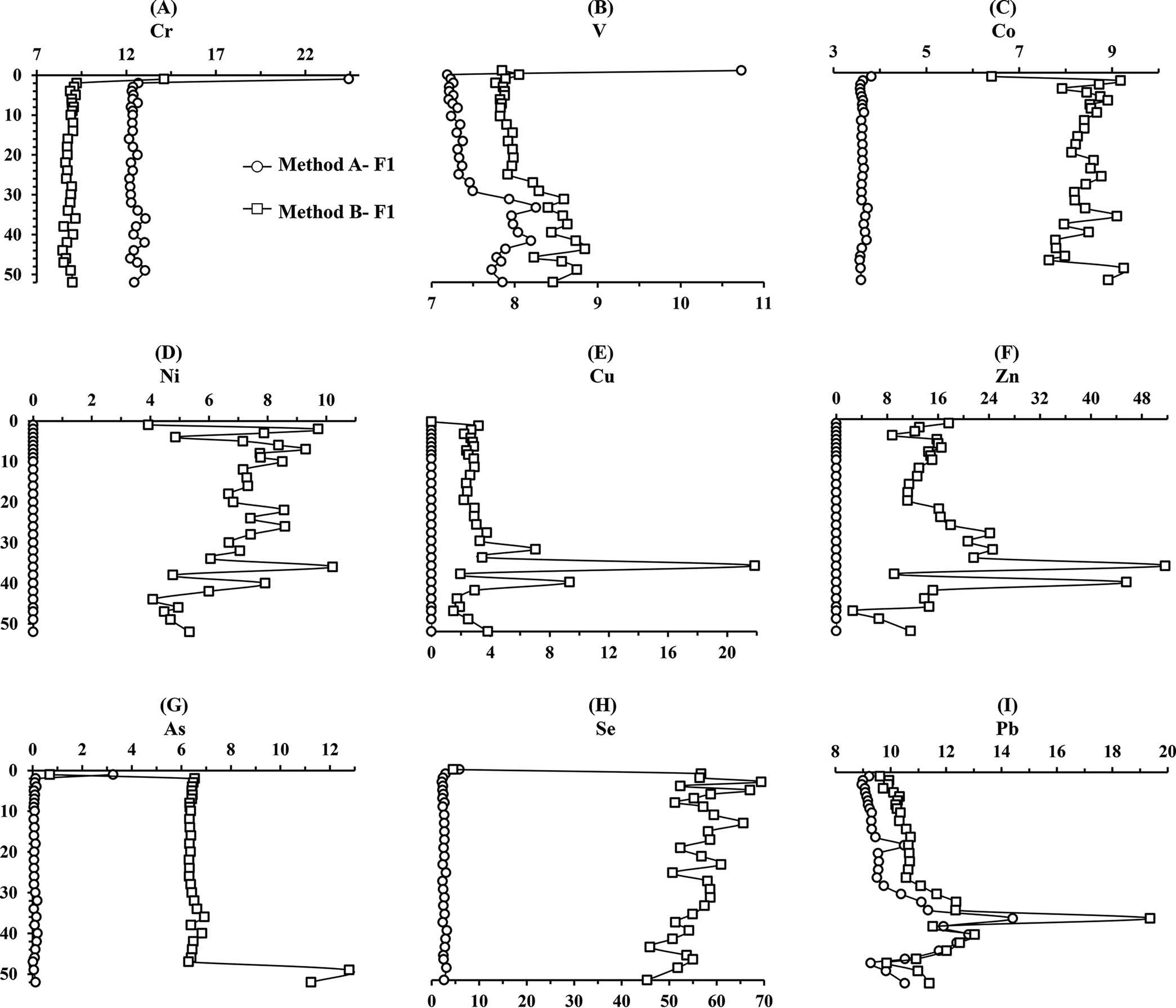
FIGURE 3.DistributioncomparisonofPTEsextractedfromMethodA(exchangeable)andMethodB(exchangeable þ acidsoluble).Allconcentrations areinmgkg 1
MethodA:F4(oxidizable)vsMethodB:F3(oxidizable). The profilesobservedinFigure6showedthatmostPTEsextracted bybothmethodsbehavesimilarly(e.g.,Cr,Co,andV)while others(e.g.,AsandSe)haveunrelatedtrends.Regardless,Ni, Cu,Zn,Se,andPbhadhigherconcentrationswhenextracted withMethodA,astheirmeansarestatisticallydifferent (Table1)withSehavinga33xhighermeanconcentration thaninMethodB.ArsenicistheonlyPTEwithastatistically signifi cantmeanconcentrationinwhichthehighestvalues wererecordedfromMethodB.TheonlyPTEswithnostatisticalsigni fi cancearoundtheirmeanswereCr,V,andCo (Table1).RawdatacanbefoundinAppendices2and3.
ThePCAinFigure4Cshowsthevariancebetweenmethods.ThePC1explains77%ofthevariationbetweenmethods basedonthetwomostcorrelatedPTEs:Cu(0.88)andPb (0.42)(allpositivelycorrelated).ThePC2explains10%ofthe variationbetweenmethods,andthemostcorrelatedPTEs, basedonthesignifi cantloadingsofNi(0.59)andCr(0.50)
(allpositivelycorrelated).OnlyZn(-0.33)hasanegativebut nonsignifi cantcorrelationalong-PC2.Itisimportanttohighlightthatthedistributionofthesubsamplesbetweenmethods arecloserwhencomparedtotheprevioustwofractions (Figs.5A–B)andarebarelyoverlapping.
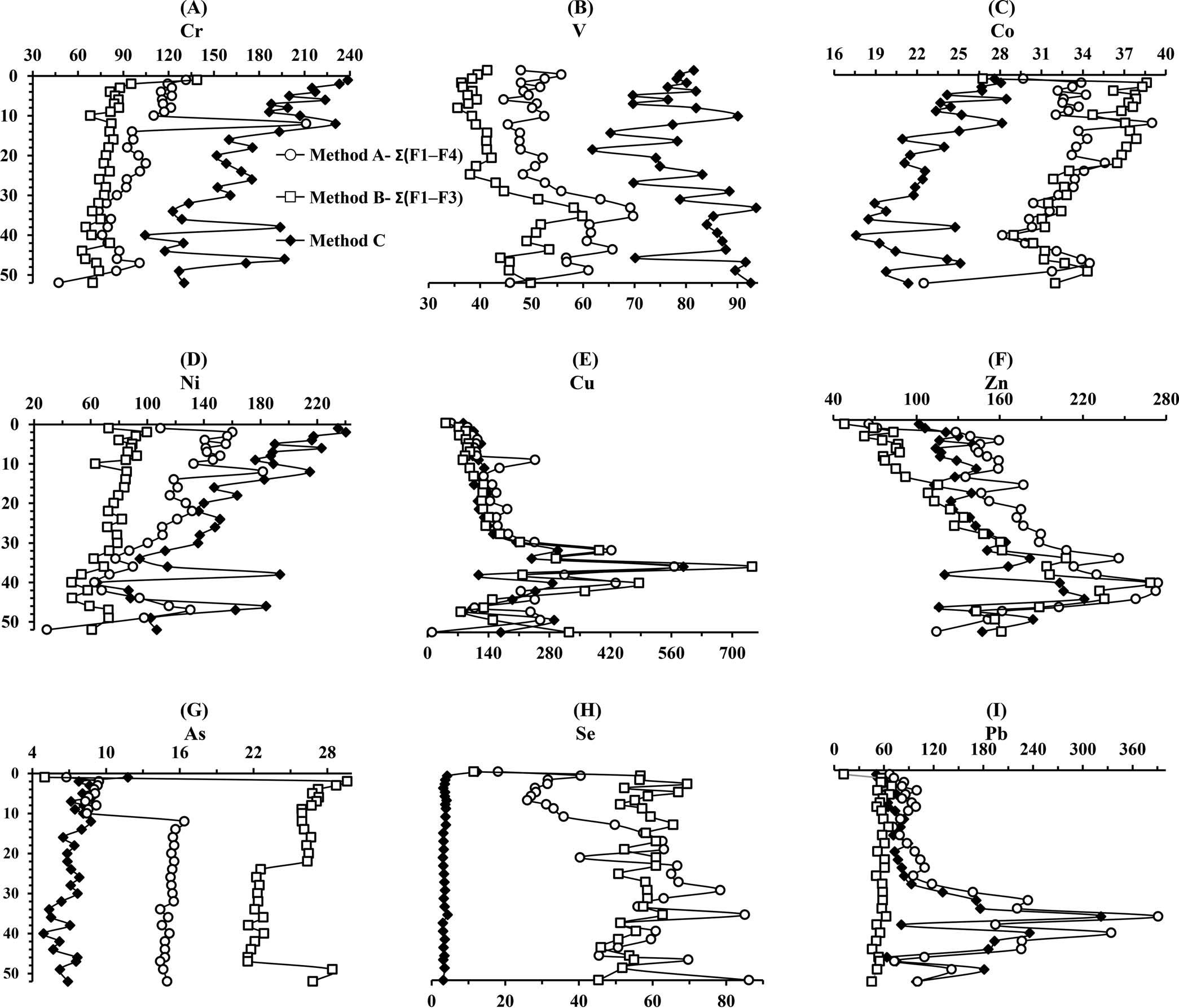
MethodC:aquaregiaand “pseudo-total” extractions. The profilesobservedinFigure7showedthatmostPTEsextracted bybothmethodsbehavesimilarly.FormethodsAandB,the sumofeachoftheirrespectivefractionswasusedasa “pseudo-total” concentration.WhencomparedtoMethodC (aquaregiaextraction)itwashighlyunexpectedto fi ndthat Cr,V,andNiweretheonlyPTEsextractedwiththismethod thatreachedconsiderablyhigherconcentrations(Figs.7A B, D)whileCo,As,andSe(Figs.7C,G,H)andZnandPb (Figs.7F,I)hadlowerthanexpectedandintermediatevalues, respectively.Surprisingly,onlyCushowedanalmostidentical profi leamongthethreemethods(Fig.7E).Rawdatacanbe foundinAppendix2.
Exchangeable MethodA(F1)
TABLE 1.Two-sample t-test.Grayareasareofnosignificantcorrelations.Martínez-ColónTable1
ReducibleOxidizable
Exchangeable þ Acidsoluble MethodB(F1) Twosample t-TestMethodA(F3)MethodB(F2) Twosample t-TestMethodA(F4)MethodB(F3) Twosample t-Test Meanp(0.05)Meanp(0.05)Meanp(0.05)
Cr 12.849.031.50E-1220.9821.500.7655.1449.040.04
V 7.147.662.80E-0420.7215.122.30E-0319.6420.770.26
Co 3.638.341.37E-499.609.210.6216.3616.690.63
Ni 06.93n/a31.379.632.99E-1874.5558.259.50E-04
Cu 03.57n/a1.3193.038.57E-07189.7481.322.08E-05
Zn 016.68n/a102.8479.270.0650.3036.474.30E-04
As 0.196.623.83E-275.348.893.29E-067.168.753.80E-03
Se 2.7254.453.29E-3520.320.073.28E-1021.600.664.26E-21
Pb 10.1311.110.0267.5692.360.1743.9112.952.54E-05
ThePCAinFigure8clearlydistinguishedandclusteredthe subsamplesbymethod.ThePC1explains61%ofthevariation betweenmethodsbasedonthesignificantpositiveinfluenceof thetwomostcorrelatedPTEs:Cu(0.69)andPb(0.55).The PC2explains21%ofthevariationbetweenmethodsbasedon thesigni fi cantpositivein fluenceofCr(0.45)andNi(0.37). OnlySe(-0.64)hadasignificantnegativeloadinginthe-PC2.
BenthicForaminifera
Atotalof6,717foraminiferalindividualswerecounted with A.tepida (4,495individuals), Q.seminulum (1,217individuals),and Q.tenagos (350individuals)asthethreemost dominantspecies.Speciesrichnessvariedfrom5–13andH(S) from0.39–1.47.TheARAvaluesrangedfrom42–93%,while QRArangedfrom1–49%.Rawdatafortheecologicalindices canbefoundinAppendix4.
CanonicalCorrespondenceAnalysis:AbioticvsBiotic
Sincethemainobjectiveofthisstudyistocompareextractionmethods,thebestapproachwastousethePTEconcentrationdata(abiotic)inrelationtotheecologicalparameters (biotic).ThefollowingCCAtri-plotswithscaling-type2illustratethedifferentenvironmentaleffectsofthePTEs(by method)onthefourmainbenthicforaminiferaecological parameters(Figs.9A –F,10A –C).Forexample,theproximity ofanecologicalparametertothedistalendofaPTEvector lineindicatesthattheabioticparameterisexertingavery stronginfluence.Ontheotherhand,theclosertheparameteris totheproximalendindicatesamuchlowerin fluence.As expected,andbasedonthemethodofextraction,different PTEsexertedagreater,lower,ornegligibleinfl uenceonthe benthicforaminifera.Inallthemethods, $98%ofthePTE varianceisexplainedbyAxis1,whilethosefoundalongAxis 2haveverylittle(#1.6%)impactontheforaminifers. MethodA(F1,exchangeable)andMethodB(F1,exchangeableandacid-soluble)vsforaminiferalecology. WhenassessingtheeffectsofthePTEsfoundinthisbioavailablefraction (Fig.9A),themostsigni fi cantPTEsassociatedwithMethod AwereV(0.67) . Pb(0.59) . Se(0.35)(allpositivelycorrelated).ItisimportanttorememberthatNi,Cu,andZnwere BDLforthisMethodA(Figs.3D –F).TheQRAseemtobe infl uenced(positively)byVandSe,butweaklybyCr,while
H(S)wasin fluencedtoalesserextentbyV,Se,Pb,Cr,and Co.PTEshadaverylimitedpositiveinfluenceonS.TheARA isfoundalongthe-Axis2whichindicatesthatthisbiotic parametershowsanegativecorrelationwithV,Pb,Se,andCr. InthecaseofMethodB(Fig.9B),thewholesuiteofnine PTEswaspresent.Itishighlyimportanttorememberthatthis methodextractedPTEsconcurrentlyfrombothadsorbed(e.g., mineralsurfaces)andacidsoluble(carbonatemineralco-precipitation)fractions(Fig.1).ThePTEsthathadthehighest signi ficance(positively)along þAxis1wasV(0.62) . Pb (0.49)andtoalesserextentbyCu(0.27).Chromium(-0.41), Co(-0.30)andNi(-0.39)havesignifi cantandnegativecorrelationalong-Axis1.TheQRAseemstobein fl uenced(positively)byVandPbwhileH(S)isin fl uencedbyCuandZn. TheARAalong-Axis2showsthatitisinfluenced(positively) byCr,Ni,andCoandnegativelybyV,Pb,andCu.Thereis veryminimalPTEinfluenceoverS.
MethodA(F3,reducible)andMethodB(F2,reducible)vs foraminiferalecology. ThePTEsmostsignificantlyassociated withMethodA(Fig.9C)wereV(0.89) . Zn(0.86) . Co (0.84) . Pb(0.80) . Cr(0.74) . Ni(0.79)(allpositivelycorrelated).TheSandH(S)arefoundinrelativeproximitytothetriplot’scenteraxisindicativeofnosignificantinfluencewhereas QRAispositivelyinfluencedbythePTEsalong þAxis1.The ARAisfoundalong-Axis1whichshowsthatthisbioticparameterisnegativelycorrelatedwithV,Zn,Co,Pb,Cr,andNi.
InthecaseofMethodB(Fig.9D),thePTEsthathadthe highestsignificance(positively)along þAxis1wereZn(0.74) . V(0.73) . Pb(0.61) . Cu(0.59) . Cr(0.55).Arsenic (-0.54)wastheonlyPTEtohaveasignifi cantandnegative correlationalong-Axis1.Ofthefourecologicalparametersin relativeproximitytothetri-plot’scenteraxis,QRAistheonly onetobeinfluenced(positively)byZn,V,Pb,Cu,andCrand negativelybyAs.TheARAalong-Axis1showsthatitis influenced(positively)byAsandnegativelybyZn,V,Pb,Cu, andCr.ThereispracticallynoPTEin fl uenceoverSwhile veryminimalinthecaseofCrandCuoverH(S).
MethodA(F4,oxidizable)andMethodB(F3,oxidizable)vs foraminiferalecology. Themostsignifi cantPTEsassociated withMethodA(Fig.9E)wereCu(0.64) . V(0.58) . Zn (0.54) . Pb(0.39)along þAxis1withAs(-0.66) . Cr (-0.62) . Ni(-0.61) . Co(-0.45) . Se(-0.37)(allpositively correlated)along-Axis1.TheSandH(S)arefoundinrelativeproximitytothetri-plot ’scenteraxisindicativeofno signi fi cantin fl uence,andaswiththepreviouscomparisons,
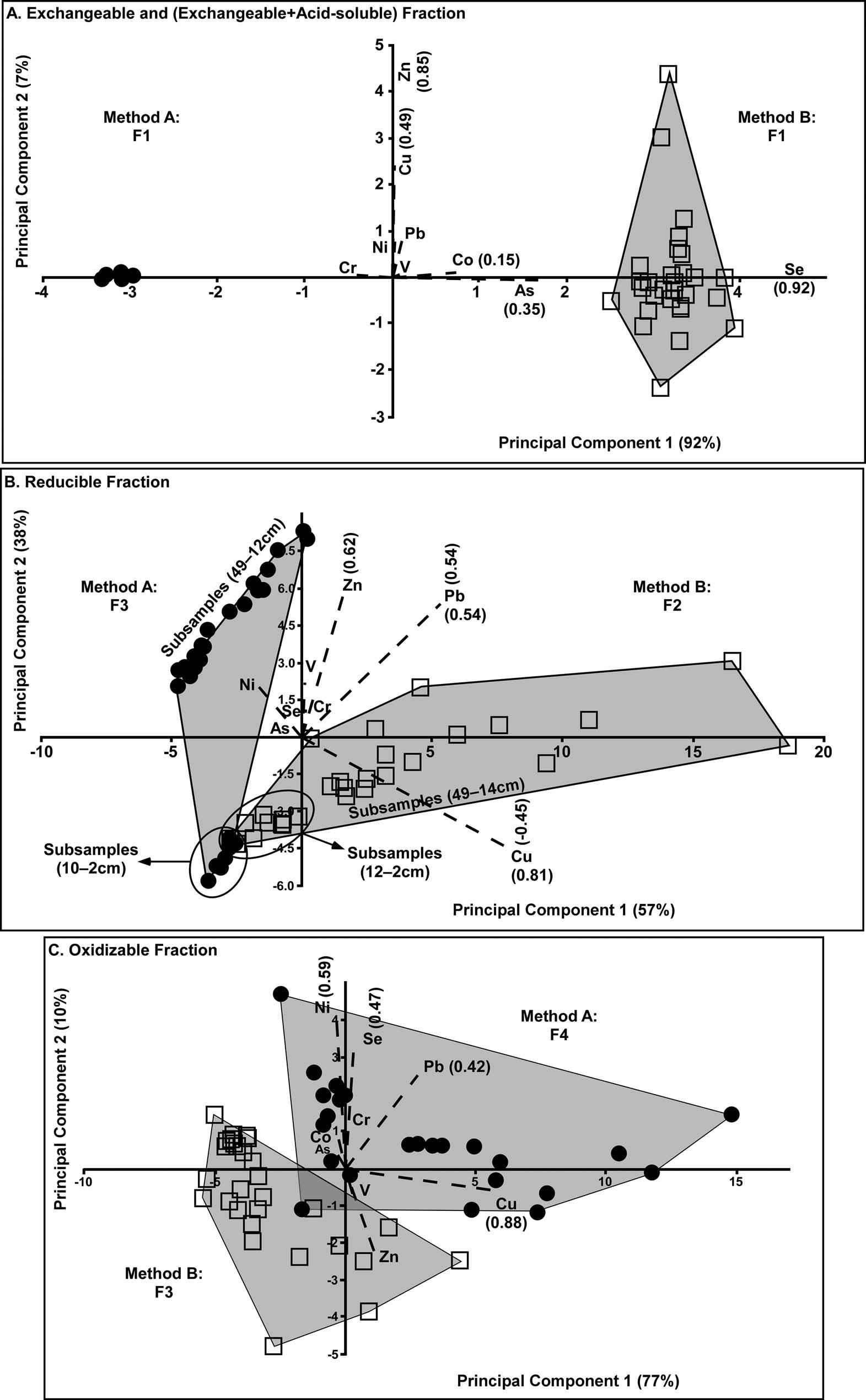
FIGURE 4.PCAof:(A)F1vsF1,(B)F3vsF3,and(C)F4vsF3.HorizontalvaluesinparenthesisrepresenttheloadingsofthemostimportantPTEs alongPC1.VerticalvaluesinparenthesisrepresenttheloadingsofthemostimportantPTEsalongPC2.Circles:MethodA.Squares:MethodB.Gray shade:To “highlight” sampleclustersbymethod.
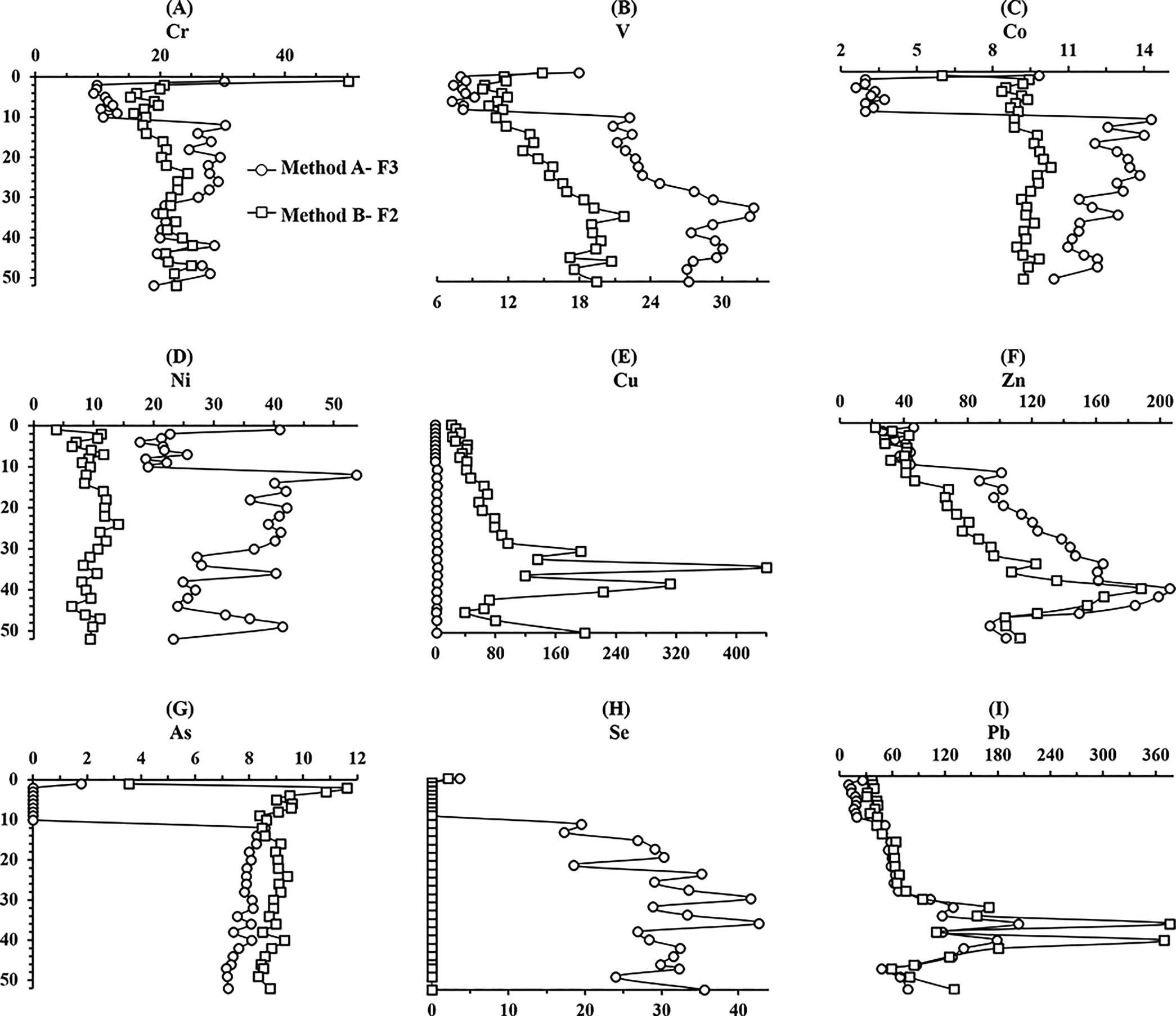
FIGURE 5.DistributioncomparisonofPTEsextractedfromthereduciblefraction.Allconcentrationsareinmgkg 1
QRAseemstobein fl uenced(positively)byCu,V,andZn along þAxis1andnegativelycorrelatedwithAs,Cr,Ni,and Coalong-Axis1.TheARAisfoundalong-Axis1showing apositivecorrelationwithAs,Cr,Ni,andCo.
InthecaseofMethodB(Fig.9F),onlytwoPTEs[Zn (0.59) . Cu(0.49)]hadthehighestsignifi cance(positively) along þAxis1,whereasCr 5 As(-0.73) . Co(-0.72) . Ni (-0.65) . Pb(-0.57)hadanegativesignificancealong-Axis1. Ofthefourecologicalparametersinrelativeproximitytothe tri-plot’scenteraxis,QRAistheonlyonetobeinfl uenced (positively)byZnandCuandnegativelybyCr,As,Co,Ni, andPb.TheARAisfoundalong-Axis1,whichshowedadifferentrelationshiptothatofQRAalong-Axis1(positive:Cr, As,Co,Ni,andPb)and þAxis1(negative:Zn-Cu).TheSis notinfl uencedbyanyofthePTEswhileH(S)isminimally influencedbyZnandCu.
MethodC(aquaregiaand “pseudo-total”)vsforaminiferal ecology. Itisimportanttorememberthatthreeapproaches
wereimplementedtoassessthetotalPTEconcentrations.The fi rstapproachwastocombinethefourfractions Σ(F1 þ F2 þ F3 þ F4)extractedwithMethodA(Fig.1)intoa “pseudototal ” concentrationsincewedidnotextractPTEsfromthe residual(F5)fraction.ThesamewasdoneforMethodBin whichthethreefractions Σ(F1 þ F2 þ F3)wereaddedtogether (Fig.1)andlastly,theaquaregiamethodwasimplementedfor MethodCfortotalconcentration.
Themostsignificant “pseudo-total” PTEconcentrationsassociatedwithMethodAwereAs(0.84). Se(0.72) . Zn(0.67) . Cu(0.65) . V(0.55) . Pb(0.54)(allpositivelycorrelated) along þAxis1,whileNi(-0.67) . Cr(-0.45)along-Axis1were negativelycorrelated(Fig.10A).TheQRAandH(S)seemtobe influenced(positively)byPb,Zn,As,andSeandnegativelyby NiandCr.TheARAisfoundalong-Axis1whichshowsthat thisbioticparameterisbeingnegativelyinfluencedbyCu,Pb, As,andSe(þAxis1)andpositivelybyNiandCr(-Axis1).The SisnotinfluencedbyanyofthePTEs.
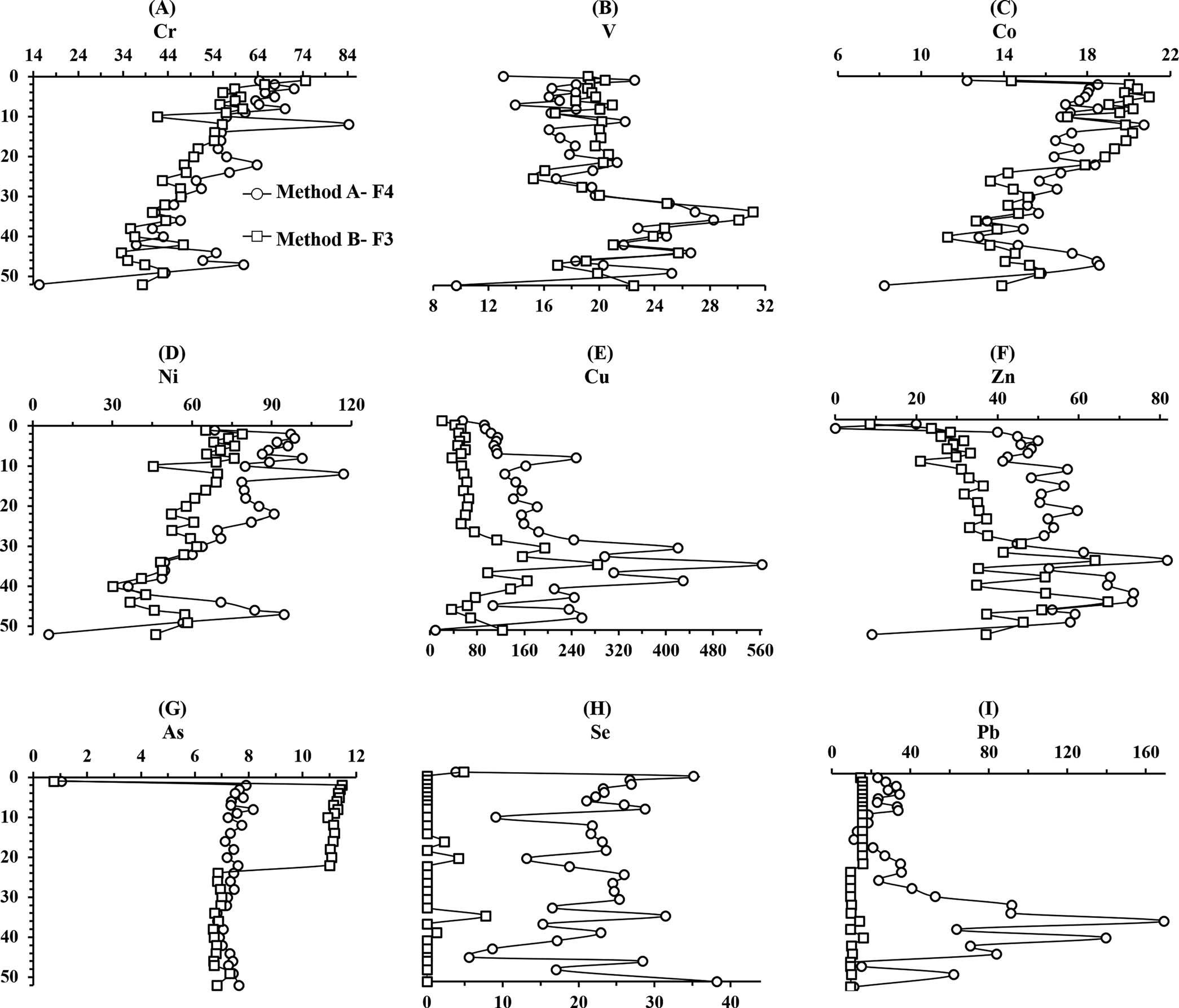
FIGURE 6.DistributioncomparisonofPTEsextractedfromtheoxidizablefraction.Allconcentrationsareinmgkg 1
InthecaseofMethodB,the “pseudo-total ” PTEconcentrationsthathadthehighestsignifi cance(positively)along þAxis1wereZn(0.74) . V(0.61) . Pb(0.58) . Cu(0.55) (Fig.10B).Along-Axis1,Co(0.72) . As(-0.68) . Cr (-0.66) . Ni(-0.65)hadsignifi cantandnegativecorrelations. ThebioticparametersQRAandH(S)seemtobein fl uenced (positively)byZnandV(þAxis1)andnegativelybyCo,As, Cr,andNi(-Axis1).TheARAisfoundalong-Axis2which showsthatthisbioticparameterisbeingnegativelyinfluenced byZn,V,Pb,andCuandpositivelybyNiandCoalong þAxis 1.OnlySwasinfluenced(positively)bySe.
InthecaseofMethodC,theaquaregiaPTEconcentrations thathadthehighestsignifi cance(positively)along þAxis1 werePb(0.55) . Zn(0.51) . Cu(0.49)(Fig.10C).Along -Axis1,Cr 5 Ni( 0.63) . As(-0.59) . Co(-0.58)hadsignificantandnegativecorrelations.ThebioticparametersQRA andH(S)seemstobeinfl uenced(positively)byPb,Zn,and Cu(þAxis1),whileonlyH(S)isnegativelyinfluencedNi,Cr,
As,Co,andSe.TheARAisfoundalongthe-Axis1which showsthatthisbioticparameterisbeingpositivelyin fl uenced byCr,Ni,As,andCoandnegativelybyZn,Pb,Cu,and V.TheSisonlyinfluenced(negatively)bySeandV.
DISCUSSION
ASSESSMENTOF BIOAVAILABILITY INTERPRETATIONAND RECOMMENDATION
MethodA(F1,exchangeable)andMethodB(F1,exchangeableandacid-soluble)
MethodAismoreconservativeintermsofbioavailabilitywith regardstobenthicforaminiferathanMethodB.Figure1illustrates aconcernrelatednotonlytothelevelofbioavailabilitybetween methodsbutalsototheoverestimationproducedduringthe first extractionbyMethodB(e.g.,Rosadoetal.,2016).AsseeninFigure3,allthePTEprofilesexceptforCdhadconsistentand,in
somecases,drasticallyhigherconcentrations(e.g.,CoandSe). Thisisalsoreportedbyotherauthors(e.g.,Iannietal.,2010; Rosadoetal.,2016).Thisisaresultofthelevelofacidityusedin MethodBtocompensatefortheaddedcarbonatefractionduring thisleachingstep(Fig.1;Appendix1).ThisexplainswhyNi,Cu, andZnwererecordedonlyinthismethod,showingthattheirpresenceisaresultofthecombinationofthetwochemicalfractions. ThisissupportedbythepresenceofNi,Cu,andZnintheacid-solublefractionfromMethodA(F2,acid-soluble;Appendices2–3). ThePCAinFigure4Aclearlyshoweddissimilaritiesbetweenthe methods.AninterestingfactisthattheMethodBclusterisbeing influencedmorebythepollutantsbecausetwodifferentfractions wereleachedoutintandem,hence,notonlyoverestimatingPTE concentrations,butnotbeingrealisticintermsofbioavailability.In contrast,theMethodAclustersuggestshowprecisetheextraction processwaswithverylimitedPTEinfluenceextractedfromonly onefraction.ThisisofconcernbecausethehigherPTEconcentrationsfoundinMethodBwillcreateanoverestimationoftheir
effectsonbenthicforaminiferawhichwillleadtoerroneous interpretations.ThisissupportedbytheCCAplot(Figs.9A –B)whichclearlyshowedhowtheecologicalindicatorswere in fl uenceddifferentlybythesamePTE.Forexample,ARA isonlynegatively(Pb,Se,Co)impactedbyMethodA(F1), whilein fl uencedpositively(Cr,Co)andnegatively(Pb,Cu, Zn)inMethodB.Itisknownthatbenthicforaminiferaeither passivelyoraccidentallyingestmud-sizesedimentparticles coupledwithdetritus(e.g.,food;Leeetal.,1991;Orsietal., 2020).Duringenzymaticdigestion,thepHlevelswithinthe vacuolewilldecrease(Martinetal.,2017),anditisexpected thatthiswillcausetheinadvertentreleasesofPTEsintheir ionicform,whichwillthenbecomehighlybioavailable.This isveryplausiblegivenhoweasilyPTEscouldbedesorbed backintosolutionbypHchanges(e.g.,Martínez-Colón etal.,2009).Therefore,werecommendPTEsbeextracted fromtheexchangeablefractionandconsideredasbioavailableinfuturestudies.Westronglyrecommendusingonly
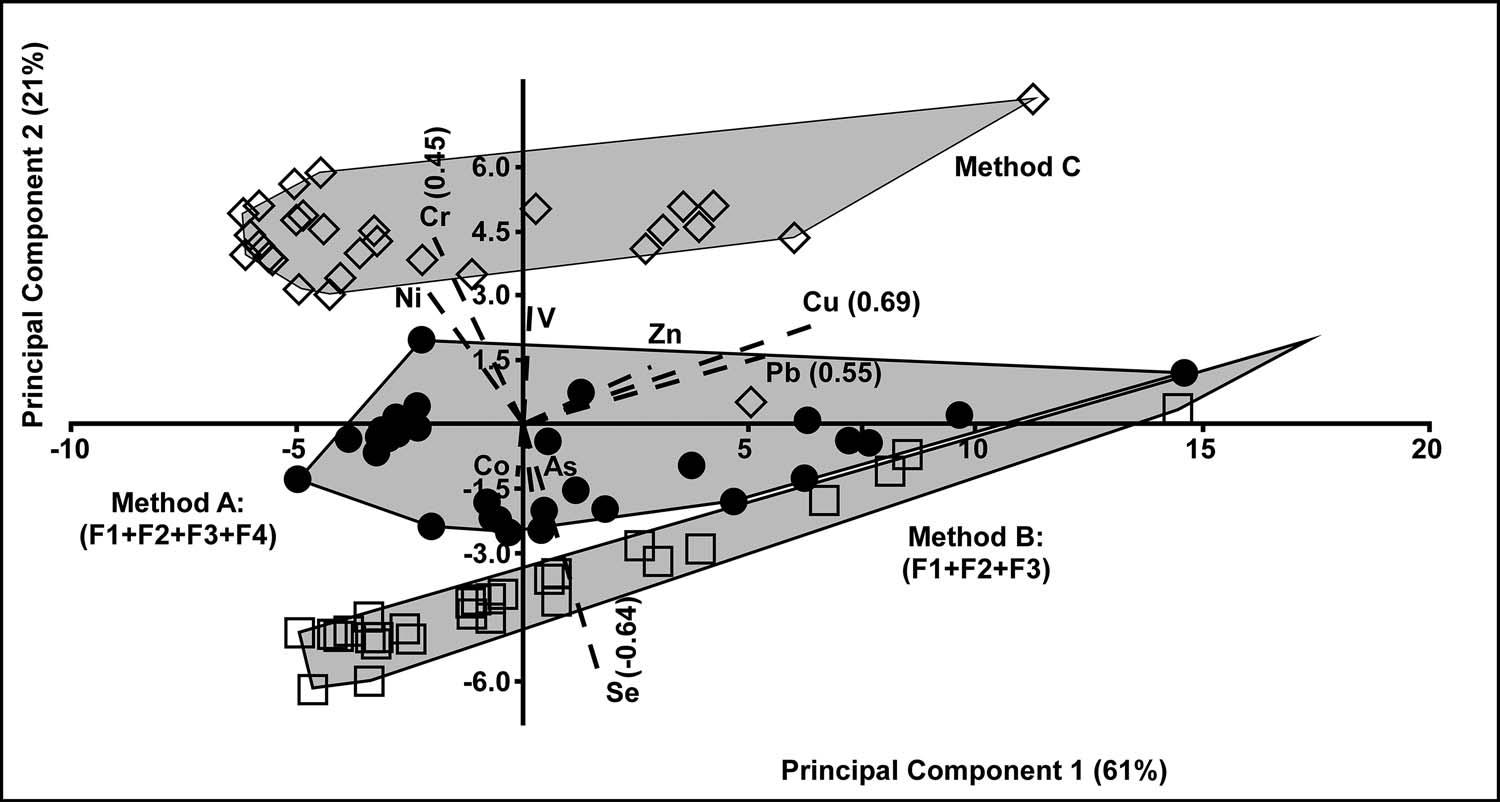
FIGURE 8.PCAoftotalPTEconcentrations.HorizontalvaluesinparenthesisrepresenttheloadingsofthemostimportantPTEsalongPC1.Vertical valuesinparenthesisrepresenttheloadingsofthemostimportantPTEsalongPC2.Circles:MethodA.Squares:MethodB.Diamonds:MethodC.Gray shade:To “highlight” sampleclustersbymethod.
MethodA(F1;Fig.1)fromTessieretal.(1979)because unlikeMethodB,itdoesnottargetthecarbonatefraction.
MethodA(F3reducible)andMethodB(F2,reducible)
TheleachantsbetweenthesetwomethodsareslightlydifferentintermsoftheirmolarconcentrationsatapHof2 (Appendix1).ThisexplainswhyinFigure5mostPTEs(Cr, V,Co,Ni,Zn,andSe)hadhigherconcentrationswhen extractedbythemoreaggressiveMethodA,sinceitsleachant wasdilutedinaceticacid(25%v/v)eventhoughMethodB had3xhighermolarconcentration.Itisimportanttohighlight thattheoverlappingclustersinthebottom-leftquadrantare theresultofadepositionalenvironmentalchangebetween12–2cm(Fig.4B)andnotanartifactrelatedtothechoiceof leachants.Thisstronglysuggeststhatduringchangesinredox conditions(reduction . oxidation),thepotentialextractionof PTEsfoundassociatedwithFe/Mnco-precipitatesbetween methodsisverysimilarandmoresensitive.
Aninterestingaspectofcomparingthesetwomethodsisthe PTEspotentialeffectontheecologicalresponseofbenthic foraminifera.AsseeninFigures9C–D,theCCAtri-plot showedthatinbothcasesmostlyallthePTEsareinfl uencing benthicforaminifera.Theobservedcorrelations,eitherpositiveornegativearejuststatisticalartifactsgiventhechoiceof leachantsusedinbothextractionmethods.Theobserveddifferencesbetweenmethodsarebasedonthedegreeofinfl uence.Forexample,V,Zn,Co,Pb,Cr,andNihaveagreater negativeinfl uenceonARAwithMethodA,whileV,Zn,Pb, Cu,andCrhavearelativelylesserin fluencewhenextracted withMethodB.Inaddition,itisobservedthatAsispositively in fl uencingSandARAwhenextractedwithMethodAand MethodB,respectively.Asbrieflymentionedearlier,thePTEs arefoundwithinthecrystallinestructureof(oxy)hydroxide minerals(e.g.,hematite,ferrihydrite,vernadite).Asidefrom somebacteriarelyingonoxidemineralsforrespiration(e.g., Spiroetal.,2010),noreportshavebeenfoundthatdocumentedbenthicforaminiferarelyingonthesemineralsasa
foodsourceorforanyotherphysiologicalprocess.Now,no evidencesuggeststhatPTEsfoundinthisfractionarebioavailableespeciallywhenbothmethodsrelyonstrongerleachants(loweroperationalbioavailability;Fig.1).Previous studiesdemonstratetheabilityofbenthicforaminiferatofeed selectively(e.g.,Lipps,1983;Goldstein&Corliss,1994). However,thereisnoevidencetosuggestthatbyeitheractive orpassiveselectionoffoodfromsediments,thatbenthicforaminifera “ingest” anddegrade(oxy)hydroxideminerals.Consideringtheseinterpretations,westronglyrecommendthat PTEsinthereduciblefractionbeavoidedinbioavailability studiesrelatedtobenthicforaminifera.
MethodA(F4,oxidizable)andMethodB(F3,oxidizable)
Accordingtonumerousauthors,thisorganicfractionisconsideredtheleastbioavailableasidefromtheresidualorlithic fraction(Fig.1;e.g.,Tessieretal.,1979;Morilloetal.,2004). TherationaleforextractingPTEsfromthisfractionisbased ontheapplicationofstrongerleachants,althoughMethodA hasadditionalchemicalsandhighermolarconcentrations (Appendix1),whichexplainstheobservedhigherPTEconcentrationsforCr,Ni,Cu,Zn,Se,andPb(Fig.6).Unlikethe previoustwomethod-fractioncomparisons,thePCAshoweda relativelyhigherproximityofthesubsampleclusters(Fig.4C). However,mostPTEsextractedfromMethodAareinfluencing thesampledistribution.Averyinteresting findingisthatalmost thesametypesofPTEs(withsimilarloadings),extractedby bothmethods,arefoundtobeinfluencingeitherpositivelyor negativelyARA,QRA,andH(S)(Figs.9E–F).Thisisindicativethatthisfraction,whichisconsideredtheleastbioavailable (operationally),shouldbereassessedwhenappliedtobenthic foraminiferagiventheintrinsicrelationshipthatexistsbetween organicmatter,asaPTEvectortransport,andforaminifera. AsdemonstratedbyJorissen(1999)andothers,organic matterplaysapivotalroleinbenthicforaminiferaecological distributions,includingpatchiness,dominanceofkeytaxa, andverticalmigration(infaunalvs.epifaunal).Otherstudies
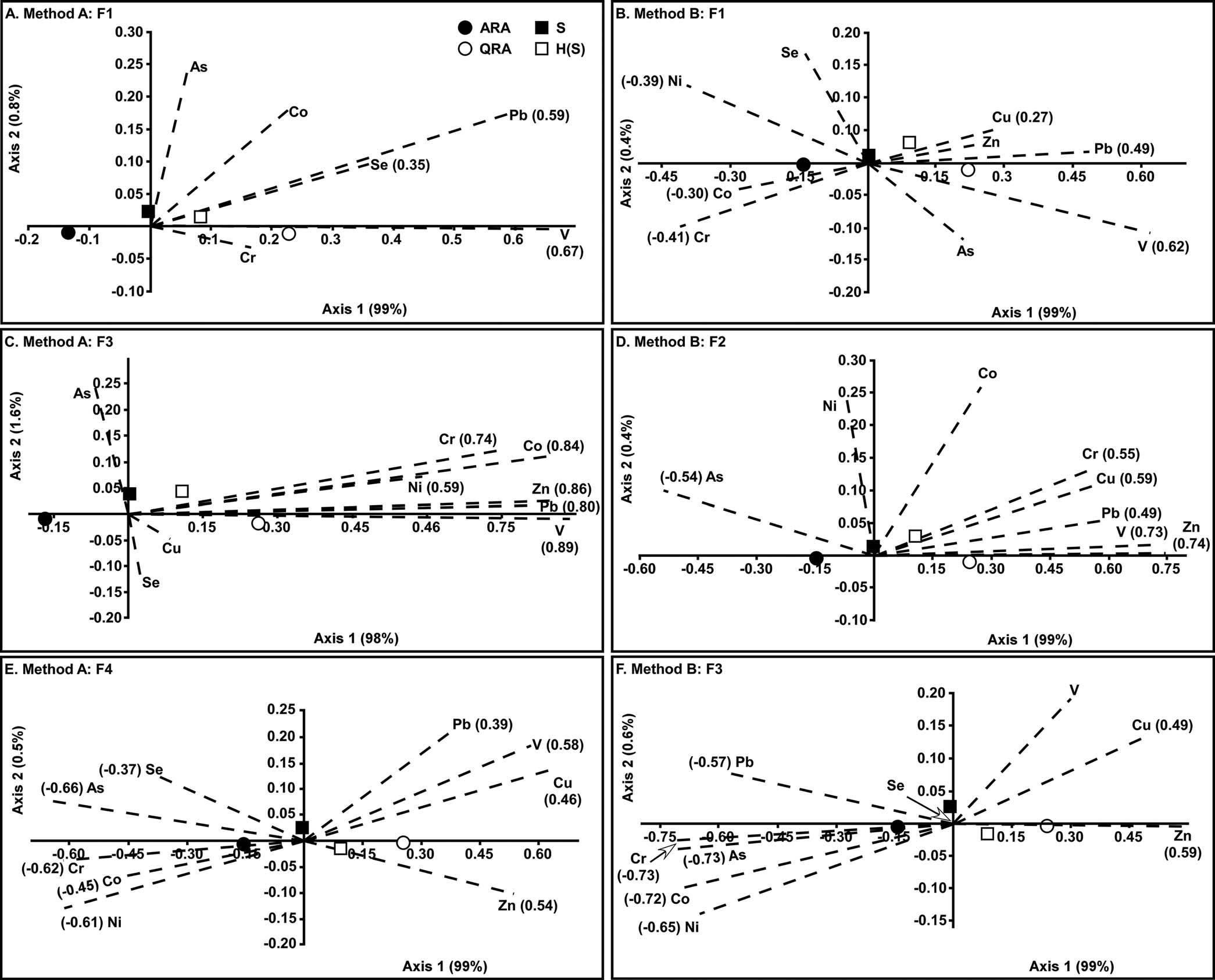
FIGURE 9.Canonicalcorrespondenceanalysistri-plotsofforaminiferalecologicalparametersandPTEsofinterest.S:speciesrichness.H(S):Shannon Index.ARA: Ammoniatepida relativeabundance.QRA: Quinqueloculinaseminulum and Quinqueloculinatenagos combinedrelativeabundances.
haveshownthepreferenceforlabile(e.g.,highernutritional value)versusrefractoryorganicmatterbybenthicforaminifera (e.g.,Papaspyrouetal.,2013;Cesbronetal.,2016;Cappelli etal.,2019;Fajemilaetal.,2022b),whilePTEsfoundinthe formeraremorereadilybioavailabletotheforaminifersgiven theresistanceofthelattertoweathering(e.g.,Baltaretal., 2021)andsubsequentpollutantrelease.Inaddition,studies havedemonstratedtheminorroleofbenthicforaminiferain organicmatterremineralization(Bruckner&Mackensen, 2008;Geslinetal.,2011;Cesbronetal.,2016),especially sincePTEscouldbereleasedduringthisprocess(e.g.,Widerlund,1996;Hullebuschetal.,2003;Lietal.,2020)atthesediment-waterinterface.Asmentionedearlier,numerousbenthic foraminiferaspeciesaredetritivoresaswellasselectivefeeders,so thistypeoffoodsourcemustbeaPTEbioaccumulationtransfer mechanism.Inaddition,whencomparedtotheexchangeablefraction(consideredbioavailabletoforaminifers),allPTEsexceptfor Seinthisoxidizablefractionshowedthehighestconcentrations,so thepotentialeffectsofthisfractionbeingbioavailablecouldbe verysignificant.
Operatingundertherealizationthattheoxidizablefraction isthemostbioavailabletobenthicforaminifera,itisimportant tobriefl ydiscussthecompositionofthesedimentdetritus. Schmidtetal.(2022)describeddetritusfeeding(i.e.,mud-size sediment,deadparticulateorganicmatter,andothermicroscopicorganisms)asatrophictransferstrategy.Furthermore, ithasbeenshownthatwithinthedegradationordigestivevacuoles(Goldstein&Corliss,1994;LeKieffreetal.,2018;FrailGauthieretal.,2019;Tsuchiyaetal.,2020;Schmidtetal., 2022)ofbenthicforaminifera,clayaswellasorganicdetritus arepresentinrelativelyhighquantities.AccordingtoPascal etal.(2008)andreferencestherein,somebenthicforaminifera relyonbacteria(e.g.,biofi lms),whicharepartofthedetritus andthesemicrobesareknowntoengageinPTEbio-transformations(e.g.,mineralization,accumulation,sorption;e.g., Lloyd,2003;Choudhary&Sar,2011;Newsomeetal.,2014). Thus,mud-sizedsedimentsandorganicmatterarevector transportsofbioavailablePTEs.Thisisofimportancebecause thepHlevelswithinthedigestivevacuolesinotherphagotrophicprotistshavebeenreportedtobelow(3 –5)andinsome
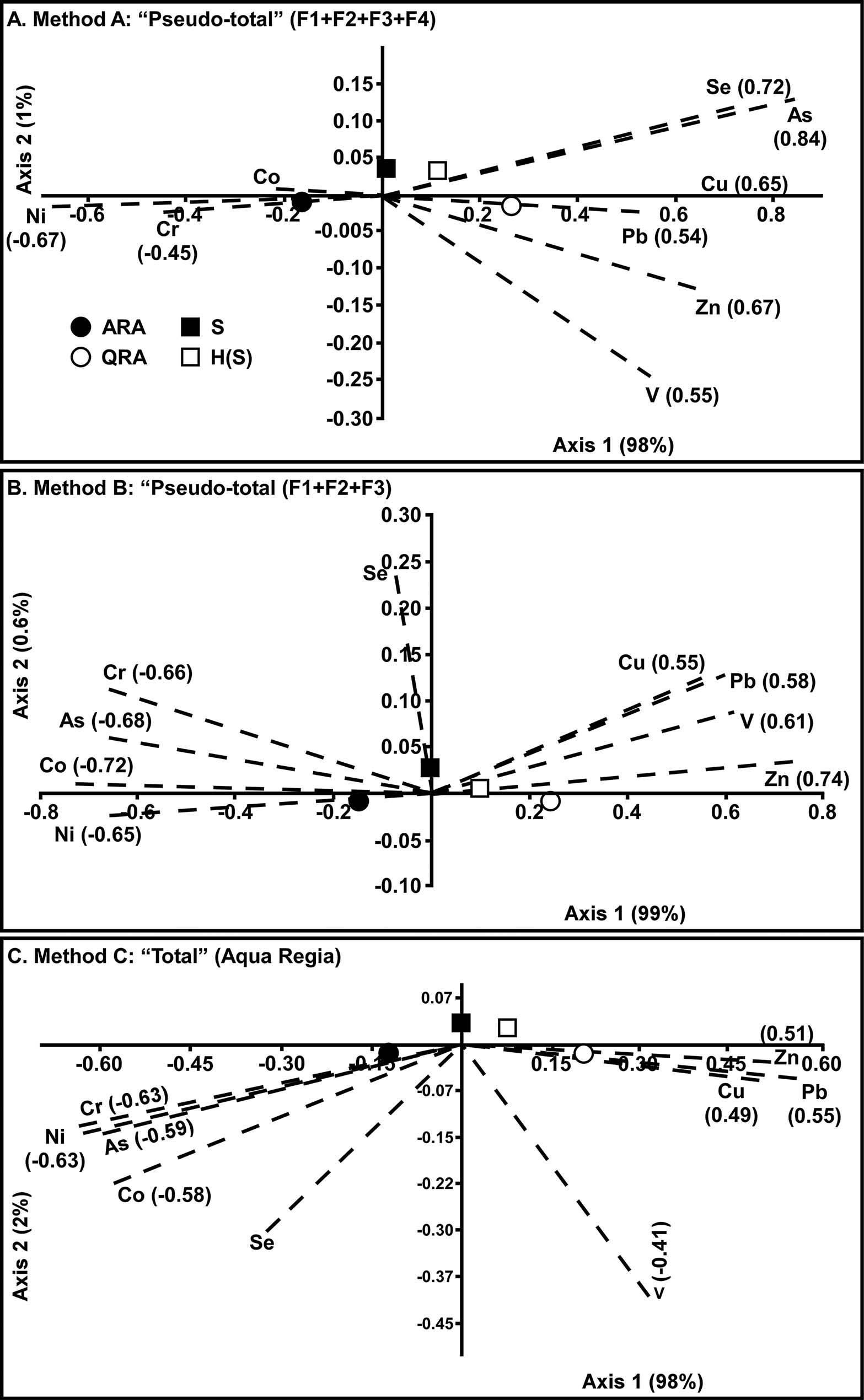
FIGURE 10.Canonicalcorrespondenceanalysistri-plotsofforaminiferalecologicalparametersandPTEsofinterestrelatedtototalconcentrations.S: speciesrichness.H(S):ShannonIndex.ARA: Ammoniatepida relativeabundance.QRA: Quinqueloculinaseminulum and Quinqueloculinatenagos combinedrelativeabundances.
Downloaded from http://pubs.geoscienceworld.org/cushmanfoundation/jfr/article-pdf/55/3/276/7305704/i1943-264x-55-3-276.pdf
casesdownto1.4(Foketal.,1982;Gonzálezetal.,1993). Enzymaticdigestionhasbeenreportedtoaccelerateduring higheracidicconditions(Gonzálezetal.,1993),andacidic vacuoleshavebeenreportedinbenthicforaminifera(Anderson&Bé,1976;Frontalinietal.,2019),whichcouldpossibly releasePTEsbackintoionicformswithinthevacuoles.This issupportedbyOrsietal.(2020)whoreportedfooddigestion withinacidicvacuolesofbenthicforaminiferaduetoH þ ATPases,anenzymethatothershavereportedtobeinvolved inPTEtransportinArchaea(Archaeoglobusfulgidus Stetter, 1988;Arguelloetal.,2007),fungi(Saccharomycescerevisiae Hansen,1883)(Techoetal.,2020),anddiatoms(Phaeodactylumtricornutum Bohlin,1897;Brownleeetal.,2023).
Thissedimentfractionischallenginggiventhatduringthe extractionmethod,thePTEsareleachedoutfrombothorganic (labileandrefractory)andinorganicchemicalforms.Forthe latter,sulfurligandspromoteco-precipitationofPTEsinto biogenicpyrite(FeS 2 ;DuLaingetal.,2009).Forexample, Ni-Cu-ZnhadlowerconcentrationsinMethodB(Fig.6).This isinterpretedasthismethodbeinglessaggressiveinextracting PTEsfromsulfides;hence,theywereextractedmorefromthe organicmatter.Basedonourinterpretationsoftheoverall data,werecommendPTEsbeextractedfromtheoxidizable fractionandconsideredasbioavailableinpollutionstudies involvingbenthicforaminifera.Wealsostronglyrecommend thatonlyMethodB(F3;Fig.1)fromMossop&Davidson (2003)beusedastheextractionmethodinfuturestudies.
CONCLUDINGREMARKS
Weagreethatthelackofanappropriatede fi nitionforPTE bioavailabilityhaseludedtheforaminiferalcommunity.For researcherstotakeadvantageofthiscontribution,they needtorememberthatthefateofPTEsinsedimentdictates itsbioavailability.Thus,theassumptionthatallextracted PTEs,regardlessofthemethodemployed,arebioavailable isincorrect.Stemmingfromthisarethemisinterpretations ofPTEeffectsontheecologicalresponsesofbenthicforaminifera.Wearenotdwellingonestablishinganewor modi fi edde fi nition,butinsteadwantedtoshedlightand makerecommendationsintermsofwhatisbioavailableto benthicforaminifera.
ResearchersemployingPTEsinpollutionstudiesneedtobe awareofthefollowingrecommendationsrelatedtobioavailabilitywhenusingbenthicforaminiferaasbioindicators:
(1)TheexchangeablefractionshowsthePTEsadsorbedto sedimentparticlesthatareconsideredlabileandreadily bioavailabletobenthicforaminiferaduringdigestivevacuolization.MinorchangesinpHorsalinityatthesediment/waterinterfacewilldesorbandremobilizethePTEs, buttheywillbetranslocatedintoothersedimentfraction (s).WestronglyrecommendPTEsextractedonlyby MethodA(F1;Tessieretal.,1979)beusedinbioavailabilitystudiesusingbenthicforaminifera.
(2)ThePTEsintheacid-solubleandreduciblefractionsare boundtothecrystallinestructureofcarbonateminerals and(oxy)/hydroxideminerals,respectively.Ifwater parameterslikepHanddissolvedoxygenchangewithin thewatercolumnoratthesediment-waterinterfacedueto naturalcycling(e.g.,tides)orbyanthropogenicmeans
(e.g.,dredging),thePTEs ’ chemicalmobilitywillbe altered.Itisnotcorrecttoassumethatthesetwofractionsarebioavailableinthesedimentssimplybecause thePTEswillbereleasedbackintosolution.Forexample, PTEsremobilizedintosolutioncanbesubsequentlyresequesteredoradsorbed,orcomplexedintoahigheror lowerbioavailablefraction(s).Thischemicalbehavior hasbeenobservedaswellduringtheactualleachingof PTEsduringsequentialextractions(e.g.,Martinetal.,1987; Tessier&Campbell,1987).FollowingMartínez-Colónetal. (2009,2017,2018),werecommendavoidingPTEsextracted fromthesetwofractionsinbioavailabilitystudiesusing benthicforaminifera.
(3)ThePTEscomplexedwithorganicmatterareconsidered labile(dependentonorganicmatterquality)andreadily bioavailabletobenthicforaminiferaduringdigestivevacuolization.Thisoxidizablefractionalsorepresentsthat thePTEsbereleasedfromtheorganicmatterifoxidation increasesatthesediment-waterinterface.Likethepreviousfractions,thesolubilizedPTEswillbere-sequestered intootherfractions.AsnotedforexamplebySkarbal etal.(2000)andSmrzkaetal.(2019),duringorganic matterremineralizationorbyreductiveliberationof oxide-boundCu,thereleasedPTEisfoundinasolution complexedtodissolvedorganicmatter.WestronglyrecommendPTEsextractedbyMethodB(F3;Mossop& Davidson,2003)tobeusedinbioavailabilitystudies usingbenthicforaminifera.
(4)WedonotrecommendtheuseofPTEsfromtotalextraction procedures(e.g.,MethodC-aquaregia;summationof extractedfractionsfromMethodAandB);itshouldbe completelyavoidedinpollutionstudieswhenonlymakinginterpretationsaboutPTEbioavailabilityonbenthic foraminifera.Researchersneedtorememberthatboth bioavailableandnon-bioavailablePTEsareextracted simultaneously.Thesamerecommendationisgivenwhen calculating “pseudo-total” concentrationssinceallfractions areaddedtogether.
ACKNOWLEDGMENTS
TheauthorswouldliketothankFAMUSchoolofthe Environmentgraduatestudents(Mr.BenjaminShireyand Ms.GabriellaLirio)forproviding fi eldandSCUBAdiving support.SpecialthankstoMr.JorgeViqueira-Ríosfrom ProtectoresdeCuencasInc.forcoordinatingwiththe DepartmentofNaturalResourcesofPuertoRicoavesselto collectthesedimentcores.Inaddition,wewanttothankthe anonymousreviewers,Dr.MarciRobinson(JFRChief Editor),andDr.RobertPoirier(JFRAssociateEditor)for theircommentsinimprovingthismanuscript.Thisworkwas supportedbyPuertoRicoSeaGrant(NA18OAR4170089), NOAAEducationalPartnershipProgramwithMinorityServing InstitutionsAward(EPP-MSI)CooperativeAgreementAward (NA21SEC4810004),NationalAeronauticsandSpace Administration(80NSSC18K1532),SloanFoundation(FG2020–13552),NationalHighMagneticFieldLaboratoryin Tallahassee,Florida,andtheNationalScienceFoundation CooperativeAgreementNo.DMR-1644779.Thecontentis solelytheresponsibilityoftheauthorsanddoesnotnecessarily
representtheofficialviewsoftheU.S.DepartmentofCommerce, NOAA.Theappendicescanbefoundlinkedtotheonlineversion ofthisarticle.
REFERENCES
AbdMalek,M.N.,andFrontalini,F.,2024,Benthicforaminiferaasbioindicatorsofmarinepollution:Abibliometricapproachtounravel trends,patternsandperspectives:MarinePollutionBulletin,v.199,p. 115941,DOI: 10.1016/j.marpolbul.2023.115941
Alve,E.,1995,Benthicforaminiferalresponsestoestuarinepollution;a review:JournalofForaminiferalResearch,v.25,p.190–203,DOI: 10. 2113/gsjfr.25.3.190.
Alve,E.,Korsun,S.,Schönfeld,J.,Dijkstra,N.,Golikova,E.,Hess,S., Husum,K.,andPanieri,G.,2016,Foram-AMBI:Asensitivityindex basedonbenthicforaminiferalfaunasfromNorth-EastAtlanticand Arcticfjords,continentalshelvesandslopes:MarineMicropaleontology,v.122,p.1–12,DOI: 10.1016/j.marmicro.2015.11.001
Anderson,O.R.,andBé,A.W.H.,1976,Acytochemical finestructure studyofphototrophyinaplanktonicforaminifer, Hastigerinapelagic (d’ Orbigny):BiologicalBulletin,v.151,p.437 –449,DOI: 10.2307/ 1540498
Arain,M.B.,Kazi,T.G.,Jamali,M.K.,Jalbani,N.,Afridi,H.I.,and Baig,J.A.,2008,Speciationofheavymetalsinsedimentbyconventional,ultrasoundandmicrowave-assistedsingleextractionmethods: Acomparisonwithmodifiedsequentialextractionprocedure:Journal ofHazardousMaterials,v.154,p.998–1006,DOI: 10.1016/j.jhazmat. 2007.11.004
Arguello,J.M.,Eren,E.,andGonzález-Guerrero,M.,2007,Thestructure andfunctionofheavymetaltransportP1B-ATPases:Biometals,v.20, p.233–248,DOI: 10.1007/s10534-006-9055-6
Ayadi,N.,Zghal,I.,Aloulou,F.,andBouzid,J.,2016,Impactsofseveral pollutantsonthedistributionofrecentbenthicforaminifera:thesoutherncoastofGulfofGabes,Tunisia:EnvironmentalScienceandPollutionResearch,v.23,p.6414–6429,DOI: 10.1016/j.ecss.2021.107317
Bacon,J.R.,andDavidson,C.M.,2008,Isthereafutureforsequential chemicalextraction?:TheAnalyst,v.133,p.25–46,DOI: 10.1039/ B711896A
Baltar,F.,Alvarez-Salgado,X.A.,Arístegui,J.,Benner,R.,Hansell, D.A.,Herndl,G.J.,andLønborg,C.,2021,Whatisrefractoryorganic matterintheocean?:FrontiersinMarineScience,v.8.,DOI: 10.3389/ fmars.2021.642637
Barik,S.S.,Singh,R.K.,Tripathy,S.,Farooq,S.H.,andPrusty,P.,2022, Bioavailabilityofmetalsincoastallagoonsedimentsandtheirin fluenceonbenthicforaminifera:ScienceofTheTotalEnvironment,v. 825,p.153986,DOI: 10.1016/j.scitotenv.2022.153986.
Bauer,L.J.,Edwards,K.,Roberson,K.K.W.,Kendall,M.S.,Tormey,S., andBattista,T.,2012,Shallow-waterBenthicHabitatsofSouthwest PuertoRico:NOAATechnicalMemorandumNOAANOSNCCOS, SilverSpring,MD,155p.
Bergamin,L.,Romano,E.,Finoia,M.G.,Venti,F.,Bianchi,J.,Colasanti, A.,andAusili,A.,2009,Benthicforaminiferafromthecoastalzoneof Baia(Naples,Italy):Assemblagedistributionandmodificationastools forenvironmentalcharacterization:MarinePollutionBulletin,v.59,p. 234–244,DOI: 10.1016/j.marpolbul.2022.114359
Bergin,F.,Kucksezgin,F.,Uluthuran,E.,Barut,I.F.,Meric,E.,Avsar,N., andNazik,A.,2006,TheresponseofbenthicforaminiferaandostracodatoheavymetalpollutioninGulfofIzmir(EasternAegeanSea): EstuarineCoastalandShelfScience,v.66,p.368–386.
Brownlee,C.,Helliwell,K.E.,Meeda,Y.,McLachlan,D.,Murphy,E.A., andWheeler,G.L.,2023,Regulationandintegrationofmembrane transportinmarinediatoms:SeminarsinCell&DevelopmentalBiology,v.134,p.79–89,DOI: 10.1016/j.semcdb.2022.03.006
Bruckner,S.,andMackensen,A.,2008,Organicmatterrainrates,oxygen availability,andvitaleffectsfrombenthicforaminiferald13Cinthe historicSkagerrak,NorthSea:MarineMicropaleontology,v.66,p. 192–207,DOI: 10.1016/j.marmicro.2007.09.002
Caplat,C.,Texier,H.,Barillier,D.,andLelievre,C.,2005,Heavymetals mobilityinharbourcontaminatedsediments:ThecaseofPort-en-
Bessin:MarinePollutionBulletin,v.50,p.504–511,DOI: 10.1016/j. marpolbul.2004.08.004
Cappelli,E.L.G.,Clarke,J.L.,Smeaton,C.,Davidson,K.,andAustin, W.E.N.,2019,Organic-carbon-richsediments:Benthicforaminifera asbio-indicatorsofdepositionalenvironments:Biogeosciences,v.16, p.4183–4199,DOI: 10.5194/bg-16-4183-2019
Castelo,W.F.L.,Martins,M.V.A.,Martínez-Colón,M.,Varela-Guerra, J.,Pinherio-Dadalto,T.,Terroso,D.,Filgueiras-Soares,M.,Frontalini, F.,Duleba,W.,Aguilera-Socorro,O.A.,Geraldes,M.C.,Rocha,F., andBergamaschi,S.,2021,Disentanglingnaturalvs.anthropogenic inducedenvironmentalvariabilityduringtheHolocene:Marambaia Cove,SEsectoroftheSepetibaBay(SEBrazil):EnvironmentalScienceandPollutionResearch,v.28,p.22612 –22640.DOI: 10.1007/ s11356-020-12179-9
Cesbron,F.,Geslin,E.,Jorissen,F.J.,Delgard,M.L.,Charrieau,L., Deflandre,B.,Jézéquel,D.,Anschutz,P.,andMetzger,E.,2016,Verticaldistributionandrespirationratesofbenthicforaminifera:Contributiontoaerobicremineralizationinintertidalmud flatscoveredby Zosteranoltei meadows:Estuarine,CoastalandShelfScience,v.179, p.23–38,DOI: 10.1016/j.ecss.2015.12.005
Choudhary,S.,andSar,P.,2011,Uraniumbiomineralizationbyametal resistantPseudomonasaeruginosastrainisolatedfromcontaminated minewaste:JournalofHazardousMaterials,v.186,p.336–343,DOI: 10.1016/j.jhazmat.2010.11.00
Cong,J-Y.,Long,H-Y.,Zhang,Y.,andWang,N.,2022,Ecologicalenvironmentresponseofbenthicforaminiferatoheavymetalsandhuman engineering:AcasestudyfromJiaozhouBay,China:ChinaGeology, v.5,p.12–25,DOI: 10.31035/cg2021040
Cuvier,A.,Leleyter,L.,Probst,A.,Probst,J.-L.,Prunier,J.,Pourcelot,L., LeRoux,G.,Lemoine,M.,Reinert,M.,andBaraud,F.,2021,Why comparisonbetweendifferentchemicalextractionproceduresisnecessarytobetterassessthemetalsavailabilityinsediments:JournalofGeochemicalExploration,v.225,DOI: 10.1016/j.gexplo.2021.106762
Davidson,C.M.,Duncan,A.L.,Littlejohn,D.,Ure,A.M.,andGarden, L.M.,1998,Acriticalevaluationofthethree-stageBCRsequential extractionproceduretoassessthepotentialmobilityandtoxicityof heavymetalsinindustrially-contaminatedland:AnalyticaChimica Acta,v.363,p.45–55.
Dodd,M.S.,Wang,H.,Li,C.,Towner,M.,Thomson,A.R.,Slack,J.F., Wan,Y.,Pirajno,F.,Manikyamba,C.,Wang,Q.,andPapineau,D., 2022,Abioticanoxicironoxidation,formationofArcheanbandediron formations,andtheoxidationofearlyEarth:EarthandPlanetaryScienceLetters,v.584,DOI: 10.1016/j.epsl.2022.117469
DuLaing,G.,DeVos,R.,Vandecasteele,B.,Lesage,E.,Tack,F.M.G., andVerloo,M.G.,2008,Effectofsalinityonheavymetalmobility andavailabilityinintertidalsedimentsoftheScheldtestuary:Estuarine,CoastalandShelfScience,v.77,p.589–602.
DuLaing,G.,Meers,E.,Dewispelaere,M.,Vandecasteele,B.,Rinklebe, J.,Tack,F.M.G.,andVerloo,M.G.,2009,Heavymetalmobilityin intertidalsedimentsoftheScheldtestuary:Fieldmonitoring:Science oftheTotalEnvironment,v.407,p.2519–2530.
El-Kahawy,R.M.,andMabrouk,M.S.,2023,Benthicforaminiferaas bioindicatorsfortheheavymetalsintheseverelypollutedHurghada Bay,RedSeacoast,Egypt:EnvironmentalSciencePollutionResearch, v.30,p.70437–70457,DOI: 10.1007/s11356-023-27242-4
El-Kahawy,R.,El-Shafeiy,M.,Helal,S.A.,Aboul-Ela,N.,andElWahab,M.A.,2018,MorphologicaldeformitiesofbenthicforaminiferainresponsetonearshorepollutionoftheRedSea,Egypt:EnvironmentalMonitoringandAssessment,v.190,p.1–22,DOI: 10.1007/ s10661-018-6695-2
EPA,2007,Method3051A(SW-846):Microwaveassistedaciddigestion ofsediments,sludges,andoils,revision1:U.S.EPA,Washington, D.C.,30p.
Fajemila,O.T.,Martínez-Colón,M.,Sariaslan,N.,CouncilI.S., Kolawole,T.O.,andLanger,M.R.,2022a,Contaminationlevelsof potentiallytoxicelementsandforaminiferaldistributionpatternsin LagosLagoon:Acorrelationanalysis:Water,v.14,DOI: 10.3390/ w14010037
Fajemila,O.T.,Martínez-Colón,M.,Spangenberg,J.E.,andSpezzaferri, S.,2022b,Organicmattersourceanddistributionintheestuarine
Apapa-BadagryCreek,Nigeria:Implicationsforliving(stained)benthicforaminiferalassemblage:MarineMicropaleontology,v.172, DOI: 10.1016/j.marmicro.2022.102112
Fajemila,O.T.,Martínez-Colón,M.,andSpezzaferri,S.,2022c,Spatial distributionofpollutionlevelsandassessmentofbenthicforaminifera inApapa-BadagryCreek,Nigeria:MarinePollutionBulletin,v.185, DOI: 10.1016/j.marpolbul.2022.114359
Ferraro,L.,Sprovieri,M.,Alberico,I.,Lirer,F.,Prevedello,L.,and Marsella,E.,2006,Benthicforaminiferaandheavymetalsdistribution: AcasestudyfromtheNaplesHarbour(TyrrhenianSea,Southern Italy):EnvironmentalPollution,v.142,p.274–287,DOI: 10.1016/j. envpol.2005.10.026.
Fok,A.K.,Lee,Y.,andAllen,R.D.,1982,Thecorrelationofdigestive vacuolepHandsizewiththedigestivecyclein Parameciumcaudatum:JournalofProtozoology,v.29,p.409–414,DOI: 10.1111/j.15507408.1982.tb05423.x
Frail-Gauthier,J.L.,Mudie,P.J.,Simpson,A.G.B.,andScott,D.B., 2019,Mesocosmandmicrocosmexperimentsonthefeedingoftemperatesaltmarshforaminifera:JournalofForaminiferalResearch,v. 49,259–274,DOI: 10.2113/gsjfr.49.3.259,2019.
Frontalini,F.,andCoccioni,R.,2008,Benthicforaminiferaforheavy metalpollutionmonitoring:AcasestudyfromthecentralAdriaticSea coastofItaly:Estuarine,CoastalandShelfScience,v.76,p.404–417, DOI: 10.1016/j.ecss.2007.07.024
Frontalini,F.,Curzi,D.,Cesarini,E.,Canonico,B.,Giordano,F.M.,De Matteis,R.,Bernhard,J.M.,Piretti,N.,Gu,B.,Eskelsen,J.R.,Jubb, A.M.,Zhao,L.,Pierce,E.M.,Gobbi,P.,Papa,S.,andCoccioni,R., 2016,Mercury-pollutioninductionofintracellularlipidaccumulation andlysosomalcompartmentampli ficationinthebenthicforaminifer Ammoniaparkinsoniana:PlosOne,v.11,DOI: 10.1371/journal.pone. 0162401
Frontalini,F.,Losada,M.T.,Toyofuku,T.,Tyszka,J.,Gole n,J.,de Nooijer,L.,Canonico,B.,Cesarini,E.,Nagai,Y.,Bickmeyer,U., Ikuta,T.,Tsubaki,R.,BesteiroRodriguez,C.,Al-Enezi,E.,Papa,S., Coccioni,R.,Bijma,J.,andBernhard,J.M.,2019,Foraminiferalultrastructure:Aperspectivefrom fluorescentand fluorogenicprobes:JournalofGeophysicalResearch:Biogeosciences,v.124,p.2823–2850, DOI: 10.1029/2019JG005113
Ganugapenta,S.,Badimela,U.,Subbyamoola,P.B.,Madipally,R., Nadimikeri,J.,andKrishnan,K.A.,2025,Ecologicalresponsesof benthicforaminiferatotraceelementpollutionintheBeyporeestuary, southwestcoastofIndia:Implicationsforcoastalanthropogeniccontamination:MarineEnvironmentalResearch,v.205,DOI: 10.1016/j. marenvres.2025.107022
Geslin,E.,Risgaard-Petersen,N.,Lombard,F.,Metzger,E.,Langlet,D., andJorissen,F.,2011,Oxygenrespirationratesofbenthicforaminifera asmeasuredwithoxygenmicrosensors:JournalofExperimental MarineBiologyandEcology,v.396,p.108 –114,DOI: 10.1016/j. jembe.2010.10.011
Ghandour,I.M.,El-Kahawy,R.M.,Murgulet,D.,Bantan,R.A., Althagafi,A.A.,Al-Mur,B.A.,andAljahdali,M.H.,2025,Benthic foraminiferaasecologicalqualitystatusbiomonitorsinsharmObhur, RedSeaCoast,SaudiArabia:EgyptianJournalofAquaticResearch, v.51,p.57–70,DOI: 10.1016/j.ejar.2024.11.004
Goldstein,S.T.,andCorliss,B.H.,1994,Depositfeedinginselected deep-seaandshallow-waterbenthicforaminifera:DeepSeaResearch PartI:OceanographicResearchPapers,v.41,p.229–241. González,J.M.,Sherr,B.F.,andSherr,E.B.,1993,Digestiveenzyme activityasaquantitativemeasureofprotistangrazing:theacidlysozymeassayforbacterivory:MarineEcologyProgressSeries,v.100,p. 197–206.
Hammer,Ø.,Harper,D.A.T.,andRyan,P.D.,2001,Past:Paleontological statisticssoftwarepackageforeducationanddataanalysis:PalaeontologiaElectronica,v.4,9p.
Harstad,A.O.,andStipp,S.L.S.,2007,Calcitedissolution:Effectsof tracecationsnaturallypresentinIcelandsparcalcites:Geochimicaet CosmochimicaActa,v.71,p.56–70,DOI: 10.1016/j.gca.2006.07.037.
Hess,S.,Alve,E.,Andersen,T.J.,andJoranger,T.,2020,Definingecologicalreferenceconditionsinnaturallystressedenvironments-How
difficultisit?:MarineEnvironmentalResearch,v.156,DOI: 10.1016/ j.marenvres.2020.104885
Hullebusch,E.V.,Auvray,F.,Bordas,F.,Deluchat,V.,Chazal,P.M.,and Baudu,M.,2003,Roleoforganicmatterincoppermobilityinapolymicticlakefollowingcoppersulfatetreatment(CourtilleLake, France):EnvironmentalTechnology,v.24,p.787–796,DOI: 10.1080/ 09593330309385615
Ianni,C.,Bignasca,A.,Magi,E.,andRivaro,P.,2010,Metalbioavailabilityinmarinesedimentsmeasuredbychemicalextractionandenzymaticmobilization:MicrochemicalJournal,v.96,p.308 –316,DOI: 10.1016/j.microc.2010.05.003.
Jorissen,F.J.,1999,Benthicforaminiferalmicrohabitatsbelowthesediment-waterinterface, in SenGupta,B.K.(ed.),ModernForaminifera: KluwerAcademicPublishers,Boston,p.191–179.
Jorissen,F.,Nardelli,M.P.,Almogi-Labin,A.,Barras,C.,Bergamin,L.,Bicchi, E.,ElKateb,A.,Ferraro,L.,McGann,M.,Morigi,C.,andRomano,E., 2018,DevelopingForam-AMBIforbiomonitoringintheMediterranean: Speciesassignmentstoecologicalcategories:MarineMicropaleontology,v. 140,p.33–45,DOI: 10.1016/j.marmicro.2017.12.006
Kim,B.,andMcBride,M.B.,2006,Atestofsequentialextractionsfor determiningmetalspeciationinsewagesludge-amendedsoils:EnvironmentalPollution,v.144,p.475 –482,DOI: 10.1016/j.envpol.2006. 01.034
Klaus,J.S.,Kourafalou,V.H.,Piggot,A.M.,Reniers,A.D.,Kang,H.S., Kumar,N.,Zahran,E.M.,Bachas,L.G.,Fernandez,A.,Gardinali,P., Toborek,M.,Daunert,S.,Deo,S.,andSolo-Gabriele,H.M.,2016, PotentialimpactsofPCBsonsedimentmicrobiomesinatropical marineenvironment:JournalofMarineScienceandEngineering,v.4, DOI: 10.3390/jmse4010013
Kumar,N.,Ramirez-Ortiz,D.,Solo-Gabriele,H.M.,Treaster,J.B., Carrasquillo,O.,Toborek,M.,Deo,S.,Klaus,J.,Bachas,L.G., Whitall,D.,Daunert,S.,andSzapocznik,J.,2016,Environmental PCBsinGuánicaBay,PuertoRico:implicationsforcommunity health:EnvironmentalSciencePollutionResearch,v.23,p.2003–2013,DOI: 10.1007/s11356-015-4913-9
Lee,J.J.,FaberW.W.,andLee,R.E.,1991,Granularreticulopodaldigestion-Apossiblepreadaptationtobenthicforaminiferalsymbiosis?: Symbiosis,v.10,p.47–51.
LeKieffre,C.,Bernhard,J.M.,Mabilleau,G.,Filipsson,H.L.,Meibom, A.,andGeslin,E.,2018,Anoverviewofcellularultrastructureinbenthicforaminifera:Newobservationsofrotalidspeciesinthecontextof existingliterature:MarineMicropaleontology,v.138,p.12 –32,DOI: 10.1016/j.marmicro.2017.10.005
Li,L.,Zhen,X.,Wang,X.,Ren,Y.,Hu,L.,Bai,Y.,Liu,J.,andShi,X.,2020, Benthictracemetal fluxesinaheavilycontaminatedbayinChina:Does thesedimentbecomeasourceofmetalstothewatercolumn?:EnvironmentalPollution,v.257,DOI: 10.1016/j.envpol.2019.113494
Li,Q.,Wang,Y.,Li,Y.,Li,L.,Tang,M.,Hu,W.,Chen,L.,andAi,S., 2022,Speciationofheavymetalsinsoilsandtheirimmobilizationat micro-scaleinterfacesamongdiversesoilcomponents:ScienceofThe TotalEnvironment,v.825,DOI: 10.1016/j.scitotenv.2022.153862.
Linke,P.,andLutze,G.F.,1993,Microhabitatpreferencesofbenthicforaminifera-astaticconceptoradynamicadaptationtooptimizefood acquisition?:MarineMicropaleontology,v.20,p.215–234,DOI: 10. 1016/0377-8398(93)90034-U
Lipps,J.H.,1983,Bioticinteractionsinbenthicforaminifera, in Tevesz, M.J.S.,andMcCall,P.L.(eds.),BioticInteractionsinRecentand FossilBenthicCommunities.TopicsinGeobiology:Springer,Boston, p.331–373,DOI: 10.1007/978-1-4757-0740-3_8
Lloyd,J.R.,2003,Microbialreductionofmetalsandradionuclides: FEMSMicrobiologyReviews,v.27,p.411–425,DOI: 10.1016/ S0168-6445(03)00044-5
Malto,M.A.D.,Lim,Y.C.,Chen,C.-W.,Wang,M.-H.,Chen,C.-H., Albarico,F.P.J.B.,andDong,C.D.,2025,Disentanglingmetaldiffusionfromahighlyindustrialharboranditsbioaccumulationindifferentzooplanktongroups:MarinePollutionBulletin,v.213,DOI: 10. 1016/j.marpolbul.2025.117606
Martin,J.M.,Nirel,P.,andThomas,A.J.,1987,Sequentialextraction techniques:PromisesandProblems:MarineChemistry,v.22,p.313 –341,DOI: 10.1016/0304-4203(87)90017-X
Martin,W.F.,Tielens,A.G.M.,Mentel,M.,Garg,S.G.,andGould, S.V.,2017,Thephysiologyofphagocytosisinthecontextofmitochondrialorigin:MicrobialandMolecularBiologyReviews,v.81, DOI: 10.1128/MMBR.00008-17
Martínez-Colón,M.,Hallock,P.,andGreen-Ruíz,C.,2009,Strategiesfor usingshallow-waterforaminifersasbioindicatorsofpotentiallytoxic elements:Areview:JournalofForaminiferalResearch,v.39,p.278–299,DOI: 10.2113/gsjfr.39.4.278.
Martínez-Colón,M.,Hallock,P.,Green-Ruíz,C.,andSmoak,J.,2017, Temporalvariabilityinpotentiallytoxicelements(PTE’s)andbenthic ForaminiferainanestuarineenvironmentinPuertoRico:Micropaleontology,v.63,p.357–381,DOI: 10.47894/mpal.63.6.01
Martínez-Colón,M.,Hallock,P.,Green-Ruíz,C.,andSmoak,J.,2018, Benthicforaminiferaasbioindicatorsofpotentiallytoxicelements (PTE)pollution:TorrecillaLagoon,PuertoRico:EcologicalIndicators Journal,v.89,p.516–527,DOI: 10.1016/j.ecolind.2017.10.045
Martins,M.V.A.,Frontalini,F.,Tramonte,K.M.,Figueira,R.C.,Miranda,P., Sequeira,C.,Fernandez-Fernandez,S.,Dias,J.A.,Yamashita,C.,Reno, R.,Laut,L.L.,Silva,F.S.,Rodrigues,M.A.,Bernardes,C.,Nagai,R., Sousa,S.H.,Mahiques,M.,Rubio,B.,Bernabeu,A.,Rey,D.,andRocha, F.,2013,AssessmentofthehealthqualityofRiadeAveiro(Portugal): heavymetalsandbenthicforaminifera:MarinePollutionBulletin,v.70,p. 18–33,DOI: 10.1016/j.marpolbul.2013.02.003
Martins,M.V.A.,Hohenegger,J.,Martínez-Colón,M.,Frontalini,F., Bergamashi,S.,Laut,L.,Belart,P.,Mahiques,M.,Pereira,E.,Rodrigues, R.,Terroso,D.,Miranda,P.,Geraldes,M.C.,HeringerVillena,H.,Reis, T.,Aguilera-Socorro,O.A.,Sousa,S.H.M.,Yamashita,C.,andRocha,F., 2020,EcologicalqualitystatusoftheNEsectoroftheGuanabaraBay (Brazil):Acaseoflivingbenthicforaminiferalresilience:MarinePollution Bulletin,v.158,p.111449,DOI: 10.1016/j.marpolbul.2020.111449
Morillo,J.,Usero,J.,andGracía,I.,2004,Heavymetaldistributionin marinesedimentsfromthesouthwestcoastofSpain:Chemosphere,v. 55,p.431–442,DOI: 10.1016/j.chemosphere.2003.10.047
Mossop,K.F.,andDavidson,C.M.,2003,Comparisonoforiginaland modifiedBCRsequentialextractionproceduresforthefractionationof copper,iron,lead,manganeseandzincinsoilsandsediments:AnalyticaChimicaActa,v.478,p.111–118.
Nemati,K.,Bakar,N.K.A.,Abas,M.R.,andSobhanzadeh,E.,2011, SpeciationofheavymetalsbymodifiedBCRsequentialextractionprocedureindifferentdepthsofsedimentsfromSungaiBuloh,Selangor, Malaysia:JournalofHazardousMaterials,v.192,p.402–410. Newsome,L.,Morris,K.,andLloyd,J.R.,2014,Thebiogeochemistryand bioremediationofuraniumandotherpriorityradionuclides:Chemical Geology,v.363,p.164–184,DOI: 10.1016/j.chemgeo.2013.10.034
Nigam,R.,Saraswat,R.,andPanchang,R.,2006,Applicationofforaminifersinecotoxicology:Retrospect,perspectandprospect:Environment International,v.32,p.273–283.
O’Malley,B.J.,Schwing,P.T.,Martínez-Colón,M.,Spezzaferri,S., Machain-Castillo,M.L.,Larson,R.A.,Brooks,G.R.,RuizFernández,A.C.,andHollander,D.J.,2021,Developmentofabenthicforaminiferabasedmarinebioticindex(Foram-AMBI)forthe GulfofMexico:Adecisionsupporttool:EcologicalIndicators,v.120, p.106916,DOI: 10.1016/j.ecolind.2020.106916
Oron,S.,Sadekov,A.,Katz,T.,andGoodman-Tchernov,B.,2021,Benthic foraminiferageochemistryasamonitoringtoolforheavymetalandphosphoruspollution Apost fish-farmremovalcasestudy:MarinePollution Bulletin,v.168,p.112443,DOI: 10.1016/j.marpolbul.2021.112443
Orsi,W.D.,Morard,R.,Vuillemin,A.,Eitel,M.,Wörheide,G.,Milucka, J.,andKucera,M.,2020,AnaerobicmetabolismofForaminiferathrivingbelowthesea floor:TheISMEJournal,v.14,p.2580 –2594,DOI: 10.1038/s41396-020-0708-1
Papaspyrou,S.,Diz,P.,García-Robledo,E.,Corzo,A.,andJimenez-Arias, J.L.,2013,Benthicforaminiferalcommunitychangesandtheirrelationshiptoenvironmentaldynamicsinintertidalmuddysediments (BayofCádiz,SWSpain):MarineEcologyProgressSeries,v.490,p. 121–135,DOI: 10.3354/meps10447
Pascal,P.-Y.,Dupuy,C.,Richard,P.,andNiquil,N.,2008,Bacterivoryin thecommonforaminifer Ammoniatepida:Isotopetracerexperiment andthecontrollingfactors:JournalofExperimentalMarineBiology andEcology,v.359,p.55–61,DOI: 10.1016/j.jembe.2008.02.018
Quevauviller,P.,Ure,A.,Muntau,H.,andGriepink,B.,1993,ImprovementofanalyticalmeasurementswithintheBCR-programme:Single andsequentialextractionproceduresappliedtosoilandsedimentanalysis:InternationalJournalofEnvironmentalAnalyticalChemistry,v. 51,p.129–134,DOI: 10.1080/03067319308027618.
Rosado,D.,Usero,J.,andMorillo,J.,2016,Abilityof3extractionmethods(BCR,TessierandproteaseK)toestimatebioavailablemetalsin sedimentsfromHuelvaestuary(SouthwesternSpain):MarinePollutionBulletin,v.102,p.65–71,DOI: 10.1016/j.marpolbul.2015.11.057.
Sagar,N.,Sadekov,A.,Scott,P.,Jenner,T.,Vadiveloo,A.,Moheimani, N.R.,andMcCulloch,M.,2021,Geochemistryoflargebenthicforaminifera Amphisorushemprichii asahigh-resolutionproxyforlead pollutionincoastalenvironments:MarinePollutionBulletin,v.162, DOI: 10.1016/j.marpolbul.2020.111918
Schintu,M.,Marrucci,A.,Marras,B.,Galgani,F.,Buosi,C.,Ibba,A.,and Cherchi,A.,2016,Heavymetalaccumulationinsurfacesedimentsat theportofCagliari(Sardinia,westernMediterranean):Environmental assessmentusingsequentialextractionsandbenthicforaminifera: MarinePollutionBulletin,v.111,p.45–56.
Schmidt,C.,Geslin,E.,Bernhard,M.J.,LeKieffre,C.,Svenning,M.M., Roberge,H.,Schweizer,M.,andPanieri,G.,2022,Deposit-feedingof Nonionellinalabradorica (foraminifera)fromanArcticmethaneseep siteandpossibleassociationwithamethanotroph:Biogeosciences,v. 19,p.3897–3909,DOI: 10.5194/bg-19-3897-2022
Schmitz,O.,Mehlhorn,P.,Finch,J.,Haberzettl,T.,Hahn,A.,Hill,T., Kretschmer,K.,andFrenzel,P.,2024,Ostracodaandforaminiferaas bioindicatorsof(aquatic)pollutionintheprotectedareaofuMlalazi estuary,SouthAfrica:RevuedeMicropaléontologie,v.83,DOI: 10. 1016/j.revmic.2024.100771
Schwing,P.T.,O’Malley,B.J.,Romero,I.C.,Martínez-Colón,M., Hastings,D.W.,Glabach,M.A.,Hladky,E.M.,Greco,A.,and Hollander,D.J.,2017,CharacterizingthevariabilityofbenthicforaminiferainthenortheasternGulfofMexicofollowingtheDeepwater Horizonevent(2010 –2012):EnvironmentalScienceandPollution Research,v.24,p.2754–2769,DOI: 10.1007/s11356-016-7996-z
Seiglie,G.A.,1973,Pyritizationinlivingforaminifers:JournalofForaminiferalResearch,v.3,p.1–6.
Shannon,C.E.,1948,Amathematicaltheoryofcommunication:TheBell SystemTechnicalJournal,v.27,p.379–423.
Sheng,W.,Hou,Q.,Yang,Z.,andYu,T.,2023,ImpactsofperiodicsaltwaterinundationonheavymetalsinsoilsfromthePearlRiverDelta, China:MarineEnvironmentalResearch,v.187,DOI: 10.1016/j. marenvres.2023.105968
Smrzka,D.,Zwicker,J.,Bach,W.,Feng,D.,Himmler,T.,Chen,D.,and Peckmann,J.,2019,Thebehavioroftraceelementsinseawater,sedimentaryporewater,andtheirincorporationintocarbonateminerals:A review:Facies,v.65,DOI: 10.1007/s10347-019-0581-4
Soliman,N.F.,Younis,A.M.,andElkady,E.M.,2019,Aninsightinto fractionation,toxicity,mobilityandsourceapportionmentofmetalsin sedimentsfromElTemsahLake,SuezCanal:Chemosphere,v.222,p. 165–174,DOI: 10.1016/j.chemosphere.2019.01.009.
Spiro,T.G.,Bargar,J.R.,Sposito,G.,andTebo,B.M.,2010,Bacteriogenicmanganeseoxides:AccountsofChemicalResearch,v.43,p.2–9, DOI: 10.1021/ar800232a
Sulkowski,M.,andHirner,A.V.,2006,Elementfractionationbysequentialextractioninasoilwithhighcarbonatecontent:AppliedGeochemistry,v.21,p.16–28,DOI: 10.1016/j.apgeochem.2005.09.016
Techo,T.,Jindarungrueng,S.,Tatip,S.,Limcharoensuk,T.,Pokethitiyook, P.,Kruatrachue,M.,andAuesukaree,C.,2020,VacuolarHþ -ATPase isinvolvedinpreventingheavymetal-inducedoxidativestressin Saccharomycescerevisiae:EnvironmentalMicrobiology,v.22,p.2403–2418,DOI: 10.1111/1462-2920.15022
Tessier,A.,andCampbell,P.G.C.,1987,Partitioningoftracemetalsinsediments:Relationshipwithbioavailability:Hydrobiologia,149,p.43–52.
Tessier,A.,Campbell,P.G.C.,andBisson,M.,1979,Sequentialextractionprocedureforthespeciationofparticulatetracemetals:Analytical Chemistry,v.51,p.844–851,DOI: 10.1016/j.marpolbul.2022.114359
Tsuchiya,M.,Miyawaki,S.,Oguri,K.,Toyofuku,T.,Tame,A.,Uematsu,K., Takeda,K.,Sakai,Y.,Miyake,H.,andMaruyama,T.,2020,Acquisition, maintenance,andecologicalRolesofkleptoplastsin Planoglabratella
opercularis (Foraminifera,Rhizaria):FrontiersinMarineScience,v.7, DOI: 10.3389/fmars.2020.00585.
Ure,A.M.,Quevauviller,P.,Muntau,H.,andGriepink,B.,1993,Speciationofheavymetalsinsoilsandsediments.Anaccountofthe improvementandharmonizationofextractiontechniquesundertaken undertheauspicesoftheBCRoftheCommissionoftheEuropean Communities:InternationalJournalofEnvironmentalAnalytical Chemistry,v.51,p.135–151,DOI: 10.1080/03067319308027619 vanDijk,I.,deNooijer,L.J.,andReichart,G.-J.,2017,Trendsinelement incorporationinhyalineandporcelaneousforaminiferaasafunctionof pCO2:Biogesciences,v.14,p.497–510,DOI: 10.5194/bg-14-497-2017 Wang,S.,Teng,S.T.,andFan,M.,2010,Interactionbetweenheavymetalsandaerobicgranules, in Sarkar,S.(ed.),EnvironmentalManagement:IntechOpen,London,p.173–185,DOI: 10.5772/10106
Whitall,D.,Bauer,L.J.,Sherman,C.,Edwards,K.,Mason,A.,Pait,T., andCaldow,C.,2013,BaselineAssessmentofGuánicaBay,Puerto RicoinSupportofWatershedRestoration.NOAATechnicalMemorandumNOSNCCOS176:NCCOSCenterforCoastalMonitoring andAssessmentBiogeographyBranch,SilverSpring,MD,169p.
Widerlund,A.,1996,Earlydiageneticremobilizationofcopperinnearshoremarinesediments:Aquantitativepore-watermodel:Marine Chemistry,v.54,p.41–53,DOI: 10.1016/0304-4203(96)00024-2 Yanko,V.,Ahmad,M.,andKaminski,M.,1998,Morphologicaldeformitiesofbenthicforaminiferaltestsinresponsetopollutionbyheavy metals:Implicationsforpollutionmonitoring:JournalofForaminiferal Research,v.28,p.177–200.
Yuan,K.,Lee,S.S.,DeAndrade,V.,Sturchio,N.C.,andFenter,P.,2016, Replacementofcalcite(CaCO3)bycerussite(PbCO 3):Environmental ScienceandTechnology,v.50,p.12984–12991,DOI: 10.1021/acs.est. 6b03911
Received17April2023
Accepted28February2025
APPENDIXCAPTIONS
APPENDIX 1.Chemicalsusedineachoftheextractionmethods.*Synonym forHydroxilammoniumchloride.**NospecificsweregivenabouttheperoxidepH.WeusedRauretetal.(2000)todeterminetheperoxidepH.
A PPENDIX 2.DataofextractedPTEsbyfractions:MethodA(F1,F2,F3, andF4),MethodB(F1,F2,andF3),andMethodC(extractionwithaqua regia). “Pseudo-total ” concentrationsweredeterminedbyaddingthe sequentiallyextractedPTEsbyfraction:MethodA(F1 þ F2 þ F3 þ F4) andMethodB(F1 þ F2 þ F3).
A PPENDIX 3.PCAincludingthecoretop(1cm)andcorebottom(52cm) samples.A:MethodA-F1vsMethodB-F1.E:MethodA-F3vsMethod B-F2.C:MethodA-F4vsMethodB-F3.
APPENDIX 4.Temporaldistributionofecologicalindicesandrelativeabundances(%)ofbenthicforaminifera.S 5 Speciesrichness,H(S) 5 ShannonIndex,ARA 5 relativeabundanceof Ammoniatepida,QRA 5 relativeabundanceof Quinqueloculinaseminulum and Quinqueloculina tenagos combined.