
Verandah MAY 2026

Page 1


MAY 2026

Interested to Learn More About How the VCA Operates?

In February 2026 the VCA board adopted an Organizational Handbook. The handbook’s purpose is to provide Verandah’s homeowners, including new Board and Committee members, with an understanding of how the Verandah Community Association (VCA) is organized and operates. It is a common tool homeowner associations nationwide use to help people better understand how decisions are made; how to become involved; and how each homeowner contributes to maintaining property values, preserving common areas, and fostering a positive and neighborly living environment.

The Handbook has nine chapters including mission and purpose, governance, meetings and procedures, VCA partners, financial management, legal and insurance, property management, documents and official records, and communication. It is available on the VCA website in “Helpful Documents.”

The handbook is a reference document and is not intended to replace or be a substitute for the VCA’s Governing Documents or Florida statutes. It is also a living document that will be periodically reviewed and republished as necessary to reflect changes in Florida Law, the VCA Governing Documents, new Board decisions, and other changes within the community that occur over time.

The VCA Board hopes that you will find this a helpful resource.

Money, Money, Money… The VCA Finance

This is another in our series of articles looking into the workings of VCA Committees. This article is on the Finance Committee chaired by Jack Hauser.

The Finance Committee is responsible for overseeing all financial affairs of the Verandah Community Association (VCA) The annual expenses of the Community exceed $6 million, with the largest expenses being Comcast, common area maintenance (mowing, tree trimming, mulch, etc.), security (gate operations and community patrol), and compensation for the office staff.

In addition to Jack Hauser, the committee chair, two other official members include Luba Grossman and Wally Watson. They meet at least monthly to review the financial statements prepared by RealManage, the VCA management company, to approve invoices and to discuss other pressing matters related to their committee’s oversight responsibilities. A major responsibility of the committee is preparing the annual budget for the coming year which is approved by the Board in October.

“Our greatest accomplishment over the last two years has been keeping the increase in homeowner assessments to

an absolute minimum,” said Jack, “The increase in HOA assessments has been in the 3% range for both 2025 and 2026.”

Jack retired from a career in finance in Minneapolis and moved to Verandah in 2024. He was elected to the VCA Board and selected as Treasurer that same year. In terms of challenges ahead, Jack says there are many.

“The sugar cane mosaic virus has had a devastating impact on the lawns in several communities,” explained Jack. “To the extent that the virus spreads to the Verandah common areas, there would be a significant (perhaps as much as $1 million) cost to replace the current turf with grass that is resistant to the virus.”

The committee is evaluating alternatives to the current office space on Palm Beach Boulevard. The lease expires in September of this year. Jack explained that it may be financially advantageous in the long run for the VCA to purchase its own office compared to leasing our current space. However, this might mean incurring a large up-front cost. The current lease will need to be renewed, at least for some time, given the long lead time needed to find alternate space.

Another hot issue the committee has been wrestling with includes the installation of a stop light at the main entrance. While

(continued on page 5)

JACK HAUSER

Finance Committee

no decision has been made, there are several outside factors that may dictate that a light be installed. These include the increase in traffic on Palm Beach Boulevard given the pace of development in the area, particularly from Babcock Ranch, the new development tentatively called Caloosa Crossings at the corner of Palm Beach Boulevard and County Road 31, and the proposal being considered by Lee County to not allow any left turn onto Palm Beach Boulevard from our main entrance.

When asked about the biggest misconceptions residents have about the Finance Committee’s role and

responsibility, Jack explained it is the difference between the VCA and the Verandah Club.

“The VCA and the Verandah Club are two distinct entities. Residents don’ t always understand what the Club responsibilities are and how they differ from those of the VCA,” explained Jack. “The Club is a private for-profit company, while the VCA is a non-profit for the purpose of providing services to the Community members.”

For more information on the Committee visit VCAlife.com. Additionally, you can reach out to Jack at JackH@vcalife.com.

A Guide to Verandah’s Native Birds

THE MUSCOVY DUCK: VERANDAH’S UNUSUAL WADDLER

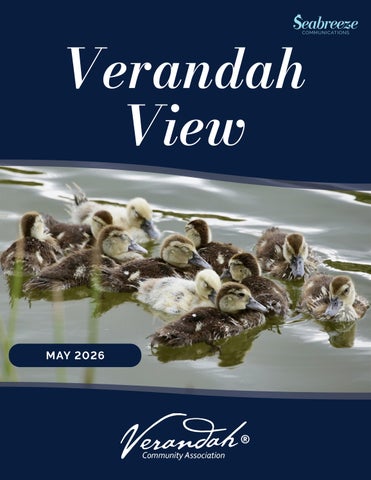
A friend of mine recently invited me over to photograph a new addition to the Cottonwood Bend neighborhood—Muscovy ducks have made themselves right at home on the pond. Not long after settling in, they surprised residents with a brood of fluffy ducklings, often seen trailing closely behind their mother along the water’s edge or on the lawn. Watching this little family

offers a charming reminder of how wildlife continues to thrive right alongside us here in Verandah.

One of the first things people notice about a Muscovy is the bright red skin around its eyes and bill. These fleshy bumps are called caruncles. While they may look unusual, they are perfectly normal for this species and tend to become more pronounced as the bird ages, especially in males. Most Muscovies you’ll see in Verandah are a mix of black and white feathers, often in bold, patchy patterns. Their dark feathers can appear glossy black at first glance, but in the sunlight they often shimmer with iridescent greens and purples. Not all Muscovies look the same, though. Some have more white, some more dark coloring, and others may appear brown, gray, or mottled, especially females or

(continued on page 7)

younger birds. You might even notice individuals that are mostly white with just a few dark patches—or the reverse.

coos, and gentle trills. Males often make a low huffing sound, especially during courtship. This quieter voice makes them noticeably different from mallards or other common ducks that fill the air with loud quacking.

Muscovies thrive in warm climates, which is why they do so well in Southwest Florida communities like Verandah. Unlike most North American ducks that came from Europe or Asia, these ducks are native to Central and South America. They are excellent flyers and, unlike many domestic

Another surprising thing about Muscovy ducks is that they don’t quack like most ducks. Instead, they communicate with soft hisses, (continued on page 8)

(continued from page 7)

ducks, they can sometimes be seen perched in trees. Their strong claws on their webbed feet help them grip branches.

They are also surprisingly good for the environment around our homes. Muscovy ducks feed on insects, small invertebrates, and even mosquito larvae, helping keep pest populations in check.

TEN INTERESTING FACTS ABOUT MUSCOVY DUCKS

1. A female can lay 10–15 eggs, usually in a quiet nesting spot under shrubs, near water, or sometimes in unexpected places like planters or sheltered corners around our lanais.

2. They are one of the largest duck species commonly seen in neighborhoods.

3. Their red facial skin (caruncles) helps with cooling.

4. Ducklings can swim within hours of hatching.

5. They often raise their wings and hiss if they feel threatened—more bluff than danger.

Like many animals that adapt to human communities, Muscovy ducks sometimes spark mixed reactions. But they are part of the rich wildlife that surrounds Verandah—from egrets and herons to hawks and limpkins. These quirky ducks remind us that nature often shows up in surprising forms.

6. They can change how they look when they’re excited. Muscovies can raise the feathers on their heads into a little crest, making them look puffed up and more expressive.

7. They wag their tails like dogs when relaxed or happy- especially around food.

8. Their eggs take longer to incubate than most ducks- 35 days compared to 28 days for most other duck species.

9. They recognize familiar places—and people. Muscovies are creatures of habit and often return to the same feeding spots or nesting areas.

10. They have serious “side-eye.” Because of how they turn their heads, they will often look at you with one eye.

School’s Out for Summer….

The Verandah Community University (VCU) has just finished its third season of programming and is working hard on next year’s line-up.

From the first presentation by Hall of Fame pitcher Bert Blyleven to the most recent speaker on how new medicines are discovered, there have been a wide array of speakers on subjects including bees, wine, books, the Secret Service, forensics, travel,

adventure, the Holocaust, restaurant ownership, football, journalism, acting, the FBI, and many more.

While some of the speakers have been from outside the community, the majority have been Verandah residents. “I am truly inspired by the number of fascinating, talented people we have within Verandah,” said VCU Dean Susan Shamey. “It is very humbling to meet neighbors who have had such amazing careers and hobbies.”

Verandah Community University is a member-run organization that presents an educational/entertaining program one Monday per month from October to April. The programs are held in the River House from 4 to 5:30 p.m. with a cash bar available. Along with Susan Shamey, the VCU Deans are Cathy Brummer, Alice Borowsky and Stephanie Levin. The group met working on the VCA Communications Committee. Brainstorming ideas to bring new programming events to Verandah, they came up with a speaker’s program and the rest is history.

“While this is a member-run group, we couldn’t do it without the support

(continued on page 11)

of the Club providing a comfortable space and equipment for our programs,” said Dean Stephanie Levin. “We’ve come a long way from meeting in the Fitness Center to filling up the River House Dining Room.” Attendance has continued to grow and the Deans are very appreciative of all the support in the community. They hear all the time that the VCU is a nice addition to all of the sports/game events.

“We are pleased that the VCU continues to be so successful,” said Dean Cathy Brummer. “We get such wonderful feedback and suggestions for future speakers. It is also fun to welcome our returning residents speaker after speaker.”

The University is working hard to up its game for next year, looking for interesting speakers and topics to offer members. “We are considering a number of speakers for next year and may try something new like a field trip to one of our local theaters to learn about the behind-the-scenes operations,” said Dean Alice Borowsky. “We are very open to hearing your thoughts and suggestions on speakers and subjects.”

The Verandah Community University Deans wish all of you a wonderful summer vacation and look forward to starting the next semester in October.

Homeowners Respond to Verandah Employee Emergency Relief Fund (VEERF)

In the first 60 days of the Fund homeowner response has been amazing. More than 70 homeowners have donated – some making multi-year commitments. “We are excited that Kolter Hospitality and Hampton Golf made a combined gift of $50,000 ” said Doug Van Nostran, President of the Fund. VEERF is a non-profit, charitable organization recognized by the state of Florida and the Internal Revenue Service. It is governed by a Board of Directors consisting of homeowners that live in Verandah and a representative of Kolter Hospitality. (VEERF is similar to non-profit employee assistance programs at many clubs like Verandah.)

Please consider making a gift to VEERF - your support provides immediate, meaningful help to the employees who care for our community when they need it most. Every contribution makes a real difference in helping them navigate unexpected hardships.

VEERF donors understand that contributing to the well-being of Verandah’s 160+ employees (full and parttime) in times of personal emergencies is a meaningful way to show appreciation for their hard work and dedication. Together, they care for the golf courses and Verandah’s common areas, help keep us fit, prepare and serve wonderful meals,

care for all of the amenities that make Verandah a special place, and make our community run smoothly.

Sometimes, life throws unexpected challenges—such as medical emergencies, natural disasters, or personal crises— that can put our people in financial hardship. VEERF allows us to step in quickly and support those who care for our community. By contributing to this fund, we turn our compassion into action, helping ensure our employees—and, by extension, our community—can navigate tough times with stability and dignity.

Please speak with a Board member to learn more about the Fund and about the many ways to make a tax-deductible donation. Checks made payable to the Verandah Employee Emergency Relief Fund can be mailed to VEERF, 11821 Palm Beach Boulevard #126-297, Fort Myers FL 33905. Thank you for your support.

Board of Directors

Pete Biava

Craig Grayson

David Keeley

John Kilday

Frank Leopold

Wayne Morris

John Nolan

Doug Van Nostran

Tim Saurs

Bill Weller

Even though you may be up North or on vacation this summer, remember that the Verandah View and NYCU-News You Can Use-is always available in your inbox! Stay in touch and be in the know!

Bedding Plants that Beat the Heat

The intense heat and humidity of summer is rapidly approaching and will be tough on plants. Many bedding plants say “no thanks” to this high heat and humidity. Surprisingly, there are some that thrive on these extreme conditions and will survive the sizzling summer months.

What is a bedding plant? A bedding plant is typically an annual that lasts one season. Most are flowering, some are noted for their colorful foliage. In Verandah, the annuals will flourish in the summer and continue to bloom and grow throughout the warm fall months. Annuals are bought blooming or near-blooming in a variety of sizes from big box stores or local garden centers. When added to the landscape, they add a pop of color, variety, and interest to their surroundings.

If planted in the right place, the following are annuals that have proven to be good choices for our summer landscape beds.

Pentas (Pentas lanceolata)

This plant is often referred to as Starflower because of their big clusters of star shaped flowers. A hardy plant that can handle both heat, full sun and rainfall. Pentas come in a variety of vibrant colors including red, pink, lavender, and white. They grow to a height of 18-24 inches.

Shorter, dwarf cultivars make a great border plant. In the summer, they put on a show planted in mass at the Verandah entrances and bullnoses of the community monuments. This plant benefits from regular deadheading to produce more blooms. Want to attract Butterflies? Butterflies love this plant! Red Glow, an old fashion Pentas is their favorite.

Vinca (Catharanthus roseus)

Vinca or Periwinkle is an easy care, heat and drought tolerant plant. It thrives in

(continued on page 15)

full to part sun and grows to a height of 7-24 inches, depending on the cultivar. This plant comes in soft pink, purple, white and bicolor. Vincas are used for edging, mass plantings and as container plants. Summer rain can be challenging for this plant as they do not like over watering which can lead to fungal diseases. Planting in well-drained soil is a necessity.

SunPatients (Impatient spp.) SunPatients, an Impatient hybrid, was cultivated to specifically withstand high heat and humidity. Unlike the traditional shade loving Impatient, these plants can tolerate sun. Morning or part sun is best. Strong sun should be avoided. Sunpatients have a mounding habit and grow 16-36 inches depending on the variety. Sunpatients are thirsty plants and should be kept evenly moist.

Portulaca (Portulaca grandiflora)

There are over 100 plants in the Portulaca family. Moss Rose and Purslane are the 2 species that are the popular bedding plants. Both are succulents and have a spreading habit. The main difference between the 2 is the shape of leaf. Moss Rose has a cylinder-shaped leaf, and purslane has a flattened, tear drop shaped leaf. They tolerate heat and humidity and love sun. Both come in an array of colors and are hardy bedding plants requiring minimal care. When

planted in mass they form a carpet of color. The flowers on these plants close in late afternoon and on cloudy days. Bonus-Purslane leaves are nutritious and can be eaten cooked or raw.

Coleus (Coleus scutellarioides)

This plant is endeared for its outstanding foliage rather than its flower. Leaf color in combinations of pink, red, yellow, and greens make this plant a standout in the landscape and when used in containers. It is easy to care for and grows best in part sun. However, newer varieties have been developed that can now grow in full sun. Pinching back stems and removing their insignificant flower encourages fuller and healthier plants. Coleus is easy to propagate from stem cutting. Remove lower leaves and place in water or a soil medium.

Other heat-resistant resistant annuals include salvia, celosia, marigolds, angelonia, potato vine, and zinnia. Remember that all heat-resistant summer annuals, just like us, can use a reprieve from the brutal heat. Keep your plants watered but not over-watered, monitor for pests and fungal diseases, apply a fertilizer when allowed and most of all enjoy their colorful addition to your landscape!

Happy Gardening!

Residential Solar Power – Something to Consider

Have you thought about installing solar panels on your roof to create electricity? Do you wonder what it will cost and what the benefits are? Read on!

Homeowners in Southwest Florida have several options for installing residential solar power. The most common approach is a rooftop photovoltaic (PV) system, where solar panels are mounted on the roof and connected to an inverter that converts the electricity for household use. Some homeowners also install solar systems with battery storage, which allows excess power generated during the day to be stored and used at night or during power outages—an increasingly attractive feature in hurricaneprone areas.

The cost of residential solar in Florida typically ranges from about $20,000 to $40,000 for an average 8–9 kW system, depending on equipment quality, system size, and installation complexity. With abundant sunshine—often more than 5 peak sun hours per day—many Florida systems pay for themselves in roughly 6–10 years through reduced electricity bills.

Beyond financial savings, residential solar power offers meaningful environmental and energy benefits. Solar systems generate electricity without producing greenhouse gases or air pollution, helping reduce dependence on fossil fuels and lowering a household’s carbon footprint.

Over the typical 25-year life of a solar system, a home can avoid many tons of carbon emissions while producing clean, renewable energy. Solar also improves energy resilience, particularly when paired with battery storage, by allowing homeowners to maintain power during grid outages or storms—an important consideration in Southwest Florida’s climate.

What are your options?

There are three main options for how the system is owned and financed: a homeowner owns the equipment, a solar loan, or a third-party arrangement where the solar company owns the system .

1. Homeowner Ownership

- The homeowner purchases the solar system outright and owns the equipment installed on the roof. This option has the highest upfront cost but usually provides the greatest long-term savings, because the homeowner receives all available incentives, including the federal solar tax credit and Florida’s property-tax and salestax exemptions. The homeowner also benefits fully from reduced electric bills and any net-metering credits for excess electricity sent back to the utility grid.

2. Solar Loan Financing - Instead of paying cash, many homeowners finance the

(continued on page 17)

Consider

system through a solar loan, similar to a home improvement loan. The homeowner still owns the system and qualifies for tax incentives, but spreads the cost over monthly payments, often for 10–20 years. In many cases, the monthly loan payment can be comparable to or lower than the household’s previous electric bill, allowing homeowners to transition to solar with little or no upfront investment.

3. Third-Party Ownership

(Lease or Power Purchase Agreement) - In this model, a solar company installs and owns the system, and the homeowner either leases the equipment or agrees to buy the electricity it produces through a Power Purchase Agreement (PPA) . The homeowner typically pays little or nothing upfront but instead makes a fixed monthly lease payment or pays a set rate per kilowatt-hour of electricity generated. Because the solar company owns the system, it receives the tax incentives and is responsible for maintenance, while the homeowner benefits from predictable energy costs and potentially lower electric bills.

Look around Verandah and you will see an increasing number of rooftop solar panels. Homeowners are seeing the advantages. The VCA office and the Design Review Committee can help you understand Verandah’s solar power requirements.

A homeowner’s experience

Dick Macko (a homeowner in Palmetto Grove) chose to have solar installed because it would reduce his annual electricity fee to about $25/month. He owns the panels and all of the energy created goes into the grid. He is paid by the power company for what he contributes. (The timing was great because he was having a new roof installed.) The payback on his $42,000 investment (reduced to $29,000 after tax credits) is 8-9 years.

Alliance for the Arts

The Fort Myers area is fortunate to have many art venues such as Barbara B. Mann, The Florida Repertory Theatre, The Baker Museum, The Naples Players, The Players Circle, Southwest Florida Symphony, and Broadway Palm Dinner Theater, just to name a few. However, sometimes overlooked is The Alliance for the Arts.

In 1975, the Alliance for the Arts was created by community leaders, including Barbara B. Mann, to foster the growth of art and cultural events in our area. The Alliance

is a creative space that spurs and supports self-expression, imagination and equity. Its mission is to transform lives and improve our community through the arts.

The Alliance covers a 10-acre area with a theater that presents over 100 theatrical performances a year hosting plays, live contemporary music events and “Reel” family movie nights. One can browse through three art galleries with special openings and 325 exhibition days. If you are interested in expanding your horizons, consider taking an adult or youth class. Over 1,000 adults and

(continued on page 19)

over 2,400 young people participate in a wide variety of classes annually.

When you take classes with The Alliance for the Arts, you join a community of people who are committed to learning new skills, passionate about accomplishing goals and game to step outside of their comfort zone. You can find balance with Qigong, hone your skills with drawing portraits, watercolor

or acrylic painting, calling the shots with a photography workshop or even how to play the ukulele! After class relax and enjoy a snack at the Arts & Eats Cafe. Take a class and get inspired!

The Alliance for the Arts is located at 10091 McGregor Blvd. To learn about scheduling for events and classes, check out their website at www.artinlee.org or call (239) 939-2787.

Pet of the Month

Meet Duke who is a 4/1/2-year-old handsome Chocolate Lab weighing in at 115 pounds of love, cuddles and charm. If Duke is not lounging around the house, he is busy at work. As a certified therapy dog, Duke has brought love, joy and laughter to hundreds of children this past year in schools and libraries. Just imagine cozying up to him as you read a story. He will melt your heart! Duke recently

continued that charm by greeting children arriving for Verandah’s Santa Brunch. Duke lives on Sanctuary Point with his certified handlers and loving dog parents, Bob and Cheryl Scheidet. Duke loves his walks (and treats) so, if you see him out walking, stop a minute and enjoy some of his sweetness.

A beloved pet’s photo, whether dog, cat, horse, bird, or fish will be featured in the Verandah View Pet of the Month. Resident owners can send in a photo with pet’s name, owner’s name, type of pet, and one sentence or two about their pet by texting Susan Shamey at (724) 355-2478 or email sshamey@ymail.com. Your pet’s debut will be in the Verandah View in the order they are submitted. All pets are beautiful to their owners.

Consumer Alerts

TIMESHARES: YES? NO? MAYBE?

If you’re considering getting a timeshare this vacation season, read on. Maybe you got a flyer in the mail with pictures of sunny beaches and beautiful resort suites. Sounds great, right? But before you sign a timeshare contract, make sure you understand what you’re getting into — and how to get out of it.

Not all timeshares work the same way. Some use points to determine where you can stay and for how long. Others get you one week a year at a resort, but it’s not always the same week. The cost also varies … a lot. Typically, timeshares require you to pay initial fees and yearly maintenance fees that may increase every year.

Promoters might offer you a gift or delicious meal to attend a timeshare presentation. If you decide to go, the sales staff may make a lot of promises and pitches designed to get you to buy right then and there

without giving you time to think about it or do any of your own research.

So before you sign that timeshare agreement, ask yourself a few questions:

• If the timeshare is only for a specific property, is this where I want to vacation every year?

• Can I afford this timeshare, even if the maintenance fees go up?

• Do I have the time to deal with issues that may arise if I can’t book the resort I want during the time I want to travel?

• If I no longer can afford or want the timeshare, how can I sell it?

And read Timeshares, Vacation Clubs, and Related Scams for more tips.

Turn static files into dynamic content formats.
Create a flipbook