MARCH 2026

![]()

MARCH 2026

NORM TOBACK – SHADY BEND NEIGHBORHOOD REPRESENTATIVE AND BOARD OF SUPERVISORS – CDD WEST
The two Verandah Community Development Districts (Verandah CDDs - East and West) were responsible for the initial creation and continued maintenance of our preserves, lakes, and related storm water management system. Verandah West CDD comprises approximately 777 acres and includes the western area of the community from the Main Gate to the walking trail behind Brantley Oaks and Lakeview Isles. Verandah East CDD comprises approximately 652.6 acres and includes the eastern area of the community from the walking trail behind Brantley Oaks and Lakeview Isles to the East Gate.
A Community Development District is a special-purpose unit of local government that is established by Florida Statutes. As units of government, they operate outside of the VCA. The Districts are governed by a five-member Board of Supervisors who are elected Verandah homeowners themselves.
The infrastructure costs of the CDDs are financed through the issuance of low interest 20 or 30-year special assessment revenue bonds. The debt from these bonds makes up most of the annual assessment from a District. Assessments are collected as part of each homeowner’s Lee County’s annual property tax bill. The management team consists of a District Manager and field personnel. Each District also engages the services of a professional engineer, an attorney, and other professionals as needed.

Serving South Florida
Are you interested in advertising?
The Verandah View is a publication of the VCA. We work with Seabreeze Communications, a marketing company whose advertising provides the revenue to produce the View at no cost to the Verandah community. The content is prepared by the VCA Communications Committee.
Elizabeth Lynch, Editor
Alice Borowsky
Stephanie Levin
Susan Shamey
Norm Toback
David Keeley, Board Liaison
(239) 278-4222
Check out our website:
Please contact our Sales Department at: or email sales@seabreezecommunications.com www.seabreezecommunications.com
Seabreeze Communications, Inc. does not endorse any advertising as it relates to the communities. Advertising is not screened by Seabreeze Communications, Inc.
All rights reserved. Reproduction or utilization of these contents in any form by any electronic, mechanical, or other means, including xerography and photocopying is forbidden without the written permission of the Publisher. The Publisher is not responsible or liable for misinformation or misprints herein contained and reserves the right to accept or reject all copy deemed unsuitable for publication.
(continued from page 2)
The independent management of Verandah’s CDDs safeguards the community’s quality of life. Residents enjoy enhanced and protected wetland preserves, storm water flood protection, and other benefits without having to wait for uncertain future municipal improvements. Verandah’s CDDs are an assurance of quality for years to come.
Verandah’s land contains natural flow-ways and wetlands that are home to many species of Florida wildlife and birds. These natural areas along with an extensive system of inter-connected lakes form the backbone of Verandah’s water management system. These important features are managed by the Verandah’s CDDs to ensure their functionality and pleasing aesthetics in perpetuity for the benefit of those who live in Verandah. It’s important to note that no person or owner may disturb, clear, or seek to improve the nature preserves, ponds, or adjacent stormwater areas.
Members of the Board are elected in accordance with Florida Statutes through the Lee County Supervisor
(continued on page 5)
of Elections. Each November, prior to the General Elections, candidates are solicited via advertisement in the News Press and the election is announced. Each member is elected for a 4-year term. (Terms are staggered so the Board does not change all at once.) Similar to the VCA, if only one person applies for election, their name does not appear on the ballot and they are seated. If a seat becomes vacant before the end of a term the Board of Supervisors may appoint a successor. These appointments are done in a public meeting.
Your Verandah West Supervisors are Jeff Jordan, Susie McIntyre, Ed Faynor,
Norm Toback, and Gerald Baldwin. Your Verandah East Supervisors are Denny Shields, David Moore, John Sample, Stu Axelrod, and Jacqueline Voiiles. Everyone in Verandah is grateful for their service.
The CDDs typically meet month/y or quarterly and these meetings are publicly announced. All meetings of the Board are held at the VCA Office and are open to the public. Written Minutes are available through the District Manager.
The District Manager for both Districts is Cleo Crismond-Adams of Wrathell, Hunt and Associates, LLC. E-Mail: crismondc@ whhassociates.com . (239) 498-9020


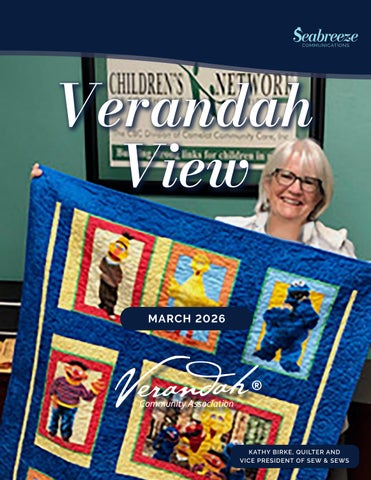
If you have lived in Verandah for a while you know about our Sew & Sews. Sew & Sews are a group of over 160 active volunteers who attend meetings twice a month to create handcrafted items to support local nonprofits in our community. As they sew, quilt, knit, crochet and knot, they are re-energizing their love for their craft while making a difference.

This is remarkable, but describing it as such understates the real-life impact these volunteers have on children who are ill or traumatized, for women who have sought a safe haven from domestic violence, and for post-surgical and chemotherapy patients, to give some examples.
On January 16th , Sew & Sews held their annual Kick-Off Luncheon at the River House with over 100 members in attendance. Representatives from three of the nonprofit organizations that Sew & Sews has served for years spoke about what the group’s crafts meant to their clients.

The first speaker was from the Children’s Network of SWFL. The Children’s Network is the nonprofit lead agency for the child welfare system in Lee and several other counties and is responsible for over 2500 abused and neglected children. We all know firsthand that children often hold on to special dolls or blankets for security and comfort when they are tired, stressed, or in an unfamiliar situation. The staff of the Children’s Network say that one of the hardest parts of their job is taking a young child from their home and moving him or her to a new “home.” To ease this transition children are given a beautiful handmade quilt made by Sew & Sews’ quilters to take with them and hold onto. The quilt becomes their special thing that gives them some security, and the softness of the quilt gives them physical comfort as well. For many the quilt is the most beautiful thing they have ever had and can call their own.

ACT (Abuse, Counseling and Treatment, Inc.) Emergency Shelter. The ACT Emergency Shelter offers a safe haven for victims
(continued on page 10)

(continued from page 8)
of domestic violence and survivors of sexual assault and human trafficking, as well as the children of these victims. Their Fort Myers’ shelter offers 73 beds. A significant number of the women entering the shelter arrive with little more than the clothes on their backs. Because they arrive with very little, the shelters must provide immediate necessities like toiletries, clothes, and shoes. Sew & Sews’ sewers create adorable backpacks for kids to store their things. The women receive handcrafted toiletry bags containing donated items and tote

bags to organize papers for court proceedings. Our knotters create cuddly fleece knotted blankets for their children. These are things we take for granted but are invaluable to those in circumstances we find hard to imagine.

The Nurse Navigator from Lee Health Cancer Institute also spoke. She thanked the group for providing them with post-surgical pillows and shawls and blankets for chemotherapy patients. The pillows provide specialized support to protect surgical sites, reduce pressure, and improve sleep quality. Chemotherapy often causes sensitivity to temperature and the hats, blankets and shawls made by the Sew & Sews’ knitters and crocheters provide warmth and comfort during long, cold infusion sessions.
These are just a few of the nonprofit organizations, doing good work in the community, that Sew & Sews serves. Hats off to the Sew & Sews. You make a difference!
PAGE KEELEY
MARSH RABBITS

If you’ve ever caught a glimpse of a small, dark rabbit along a pond, preserve edge, or drainage area in Verandah, you may have met one of our most elusive residents—the marsh rabbit. We have two types of rabbits in Verandah- the eastern cottontail and the marsh rabbit. Unlike the larger, familiar eastern cottontail rabbits we frequently see around our homes, marsh rabbits are true wetland specialists, perfectly adapted to the watery landscapes that make Verandah such an ideal habitat for wildlife.
Marsh rabbits prefer areas with thick grasses, reeds, and low vegetation close to water. They’re most active at dawn and dusk, which is why you may spot them during early morning walks or while enjoying the quiet of the evening. With their compact bodies, short ears, short dark tails, and
brown fur, they are well camouflaged against muddy banks and shadowy vegetation— blink, and they’re gone. Where I see them most frequently is near the bridge on the nature trail after the dog park.
What makes marsh rabbits especially interesting compared to the eastern cottontail species is how comfortable they are around water. Unlike most rabbits, marsh rabbits are strong swimmers. When threatened, they may slip silently into the water and paddle away. This skill helps them escape predators such as bobcats, hawks, and even snakes that share the same habitat.
Their diet reflects their marshy lifestyle. Marsh rabbits feed on grasses and aquatic plants, playing a quiet but important role in shaping wetland vegetation. By grazing selectively, they help maintain plant diversity and keep fast-growing plants from taking over.
Seeing a marsh rabbit in Verandah is a reminder that our community sits within a living ecosystem, not separate from it. These rabbits depend on healthy wetlands and undisturbed vegetation—features that Verandah has worked hard to preserve. Their presence is a sign that our ponds, preserves, and natural buffers are doing exactly what they’re meant to do: supporting native wildlife.
(continued on page 12)
(continued from page 11)
If you’re lucky enough to spot one, enjoy a glimpse from a distance. Marsh rabbits are shy and easily frightened, so it’s best not to approach them. You are most apt to see them during early morning and evening hours. Marsh rabbits may not get our attention like our alligators or wading birds, but their quiet lives and unique features make them just as interesting. If you spot a marsh rabbit in Verandah, consider it a quiet compliment from nature—these shy neighbors only thrive where wetlands are doing well.

1. They are excellent swimmers. Unlike most rabbits, marsh rabbits will escape danger by slipping into the water and swimming to safety.
2. Wetlands are their home turf. Marsh rabbits live almost exclusively in marshes, swamps, and pond edges—not dry lawns or open fields.
3. They have shorter ears than eastern cottontails. Their small ears help reduce heat loss and snagging in dense, wet vegetation.
4. Their hind feet are broader than those of cottontails. This gives them better support on muddy, unstable ground and helps them push through shallow water and thick wetland plants.
5. Their bodies are more compact and heavier for their size. Compared to cottontails, marsh rabbits have a stockier build, which helps them conserve heat and move efficiently through dense marsh vegetation.
6. Their eyes are positioned high and to the sides of their heads. This
(continued on page 13)
gives marsh rabbits a wide field of visionalmost 360 degrees- so they can watch for predators while staying hidden in tall grasses.
7. They are most active at dawn and dusk. These quiet times help them avoid predators and human activity.
8. They don’t hop far when startled. Instead of long leaps, marsh rabbits make short, quick dashes into thick cover—or water. They also rely on frozen stillness as a defense strategy, sitting perfectly motionless until danger passes.
9. Their digestion is specialized for tough wetland plants. Marsh rabbits practice coprophagy (eating their soft droppings), allowing them to extract maximum nutrients by “re-eating” fibrous marsh grasses and aquatic plants—an efficient survival strategy in nutrient-poor wetland habitats.
10. Their fur is darker than most rabbits. The dark brown to blackish coat provides excellent camouflage in muddy, shadowed wetlands. It also has natural water-repellent qualities. Oils in their coat help shed water and keep their skin from becoming soaked when they swim or move through wet plants.

Each issue of The Verandah View features one of the VCA’s eight committees. This time, we’re spotlighting the Governance Committee .
The Governance Committee was created by the Board in 2025. It supports the Board’s work to keep the VCA consistent with Florida law, HOA best practices, and the changing needs of our community. Simply put, the committee helps the Board make well-informed, consistent decisions and promotes transparency in how the Association is run.
The committee includes five homeowner volunteers and is supported by a Board liaison, the VCA General Manager, and legal counsel. Over the past six months it has worked on two tasks:
The committee has focused on preparing a VCA Organizational Handbook —a practical reference guide used by many Florida homeowner associations. The Handbook explains how the Association is structured, how decisions are made, and who is responsible for what. It brings together key policies and procedures in one place.
To do this, the committee followed a three-step process. First, it gathered and reviewed existing organizational materials—some dating all the way back to 2002, when the Association was first formed. These documents were scattered across filing cabinets, computers, and VCAlife.com. Next, it recommended updates to certain Board policies and procedures to reflect changes in Florida law and the community’s evolving needs. Finally, it reviewed Florida HOA best practices to fill in organizational gaps for issues like records retention, management of official records, and collating past Board resolutions.
The Board is now reviewing the draft Handbook. It’s important to note that the Handbook is meant to be a reference tool —it does not replace the VCA’s Governing Documents or Florida law. It’s a living document that will be updated from time to time as the law changes and new Board decisions are made.
Verandah’s governing documents—such as the Covenants, Conditions, & Restrictions; Bylaws; and Articles of Incorporation— were adopted in 2002 and various
(continued on page 15)

amendments made since then. Over the past twenty years Florida HOA laws have changed, management practices have improved, and our community has continued to grow and evolve.
Looking ahead, it’s possible the developer will complete construction of all homes in 2026, at which point its governance role in the community will end. With that transition on the horizon, it is timely for the Board, with help from legal counsel, to begin thinking about how these documents can be updated to support Verandah well into the future.

Starting at the Verandah Gate part time 17 years ago, Trish Snook worked her way up to Gate Manager, and then on to Assistant General Manager.
Trish supported the Design Review Committee by dealing with resident modification requests. As Assistant GM, she worked with compliance issues, vendors, handling issues and estimates, and liaised with Envera and the Community


Patrol. She also supervised the administrative staff. Trish, we thank you for everything you did for Verandah and its residents.
Trish is a wife, mother and grandmother. In this next chapter, she plans on traveling and enjoying a well-deserved freedom from work.
Happy Retirement Trish!
VERANDAH COMMUNITY UNIVERSITY
MONDAY, MARCH 9, 2026 4 PM-5:30 PM THE RIVER HOUSE
VCU is pleased to present resident, Howard Babcock, as he, along with his son Brian, recount the history of how a fruit farm became a very successful winery, Suisin Creek, in the Suisun Valley in Fairfield, California.
40 years ago, Howard bought many acres of prune, cherry and pear trees in Fairfield. Over time, the trees developed a blight which ended its time as a fruit farm. Not to be daunted, Howard decided to plant his many acres with Merlot grapes. However, disaster struck when the very successful movie Sideways came out, and the characters vehemently disparaged Merlot as a horrible wine which caused a massive amount of people to turn from Merlot to Pinot and other varieties. Needless to say, Howard lost a small fortune. Again, undaunted, Howard planted all types of grapes, and Suisun Creek Winery was once again on top. Success! Now you can purchase several delicious wines from Suisun Creek Winery or enjoy wines under the Caymus Winery label made from Howard’s high quality grapes!
Brian, who now runs the daily operation of the winery, allows
Howard to split his time between here and California. He loves living in Verandah, especially the people. Howard says, “I consider myself an ordinary guy-a farmer at heart.”
You can sign up now on the club Event Calendar or at verunifm1@yahoo.com
There will certainly be some wine raffled and maybe even a wine tasting after the presentation! We look forward to seeing you at this fun event.

BARBARA WATSON, VCA LANDSCAPE COMMITTEE, FLORIDA MASTER GARDENER
Spanish Moss (Tillandsia usneoides), a native to the tropical regions of South Florida, is a familiar sight throughout Verandah and humid areas of the south. Its curly, gray tendrils, reaching 5-20 feet, cling and drape from the branches of Live Oaks and Cypress trees, favorites of Spanish Moss. It can also attach to shrubs, fences, telephone poles and other such structures and plants.
Spanish Moss is not a moss nor is it Spanish, as its name implies. It is a flowering epiphyte or air plant and is a member of the bromeliad family, a relative of the pineapple. It was so named by French explorers who thought it resembled the beard of Spanish conquistadors. Over time, it gained other nicknames such as grandfather’s whiskers, graybeard and tree hair.
Spanish Moss does not have roots. As an epiphyte, it absorbs nutrients directly from air, rain and atmospheric moisture through its tiny, surface scales. Spanish moss will turn green after a heavy rain and then fade to gray as it dries. It can remain dormant during dry periods and will revive when moisture returns. Clean air and water are vital to the survival of Spanish moss. It will not thrive in polluted environments.
Spanish Moss propagates in two ways. The first and most common is by fragmented pieces called festoons that are carried off by

wind or birds. The second is from very tiny seeds that have feathery appendages such as dandelions and blow through the air to another tree.
Epiphytes are often confused with parasites. Spanish moss is not parasitic as it does not live off the tree but lives on the tree, using it solely for support, a place to hang out, so to speak. It will not harm or kill the tree. However, heavy infestations can block sunlight from reaching leaves, interrupting photosynthesis and slowing the growth of the tree. Heavy growth typically occurs on declining trees where the canopy has thinned. Tree limbs can also break from the weight of Spanish Moss, particularly after a rainfall when it becomes saturated and heavy.
Throughout the ages people have found valuable uses for Spanish Moss. Indigenous people used it to construct clothing, frame and insulate houses, braid
(continued on page 19)

rope, fire pottery, and treat headaches to name a few. Confederate soldiers wove it into blankets. It was widely used for mattresses and stuffing for car seats. Factories existed throughout Florida that processed it to be used for such purposes. This all closed with the advent of foam rubber. Today Spanish Moss is largely used by the floral and arts & crafts industries.
More importantly, Spanish Moss plays an important role in Florida’s ecology. Several species of birds use it as a nesting material. Other species of animals use clumps of Spanish Moss for shelter including amphibians, reptiles, bats and insects. Spanish Moss is also used as a
roosting site for the Zebra Longwing, Florida’s state butterfly. One word of caution. Chiggers, a biting insect, may be present on moss gathered from the ground or low hanging branches.
Spanish Moss gives Florida landscape a casual feel and is a definite trademark that makes Florida’s landscape unique. It not only has an aesthetic appeal, but it also has proven to be valuable resource to many. Ecologically, it provides shelter and habitat for wildlife.
As you ride or walk through the Verandah, look up and enjoy the marvels of Spanish Moss!

Several years ago, when the husband of a Sew & Sews’ Board Member passed away, she wrote in the obituary, “In lieu of flowers, a donation may be made to Sew & Sews in his memory.” Her husband had been so proud of her participation in Sew & Sews, and it seemed like the perfect local nonprofit to receive donations. Sew & Sews raised $1,500 from his memorial tribute, helping members quilt, sew, knit, crochet and knot blankets for local nonprofits in Southwest Florida, including Visions of Sugar Plums and Verandah Cares, here at home.

Sew & Sews’ Giving Thread is a new donation program symbolizing the threads of friendship and giving that are an intrinsic part of the Verandah community and the threads of yarn and fabric used to create handmade items by its members. The Giving Thread provides you with the opportunity to support these efforts throughout the year and as a celebration of important moments in your life. The Giving Thread is the perfect way to celebrate a birthday, anniversary, birth of a child or to memorialize a loved one.
• Visit the Sew & Sews website SewandSews.org and click on the Donate Now button. Complete the secure transaction form and Sew & Sews will take care of the rest.
or
• Send a check to Sew & Sews, 3291 Sanctuary Point, Fort Myers, FL 33905 with your name, address, and email, along with the name and address of the person you wish to honor.
Verandah artist Charlotte Mertz, has graciously given Sew & Sews permission to feature her artwork on the beautiful card
(continued on page 21)

that will be sent to the family or recipient being honored or memorialized.
Sew & Sews is a 501(c)3 organization and will send you a thank you letter and tax receipt* following your donation.
For questions about the program, visit the website at SewandSews.org or email
Giving Thread Chair, Maggie Schubert at maggieschubert@yahoo.com .
*Sew & Sews, Inc., is a not-for-profit, 501(c) (3) organization-EIN 85-3538787. Your contribution is tax-deductible to the extent allowed by law.

March 20

Look no further if you are ready for an afternoon of enjoyment at The Marietta Museum of Art & Whimsy. The Museum was founded in 2006 by Marietta Lee who, having traveled to renowned museums around the world, found that humorous art was under-represented. In her travels, she discovered an enormous variety of American artists with fresh, colorful, creative and upbeat ideas. Ms. Lee, a graduate of the Ringing College of Art & Design, wanted to bring all of these “out of the box” artists together. Knowing Sarasota as an art-friendly community, Marietta was sure it would be the perfect spot for the Museum.
Wander, with wonder, among the outdoor garden featuring grand pink flamingos, a bridge, a bathysphere, a ballerina and a stainless-steel rocket ship made from a variety of materials. The indoor part of the Museum features works all from American artists.
Visitors of every age come to the Museum to enjoy the art, and enrich their lives in a colorful, friendly environment where they can relax, forget their problems, slow down to smell the roses, and enjoy the present.
One of the exhibit rooms has three suspended wire bodies elegantly dancing in the breeze. With the lights out, visitors can make sounds, like clapping or singing, making the lights in the ceiling come on in rhythmic, spectacular motions. There’s even a guard at the door who is so lifelike, it’s very difficult to believe he’s not alive.
Being at the Museum will inspire your creativity, touch your heart and just make you feel good. That is why the Museum has become The Smiley Place!
The Museum is open November through May on Thursday, Friday and Saturday afternoons from 1-4 P M. There is no fee, but a donation is always welcome.
2121 N. Tamiami Trail, Sarasota, FL 34234 (941) 364-3399. mleeawp@aol.com .
Sophia is an 11-year-old rescue from San Antonio. Her unique look warmed Erika’s and Brian’s hearts the moment they saw her. People would always ask “what kind of dog is she?” Her doggie DNA results labeled her a “mega mutt” which is a dog with such diverse genetic traits that she’s truly one of a kind.
The sleek coated Oliver (Ollie) is one year or so old and is a rescue born in California. Luckily for Ollie, he was found and adopted by his proud parents, Erika McCarthy and Brian McMillan. Oliver’s story is also unique. His brain has been described as “perfectly imperfect” and he is exactly that. He may wobble when he walks or stare endlessly, but he is full of puppy energy, sweet, gentle and a joy. These two beloved dogs make Erika’s and Brian’s family complete.


A beloved pet’s photo, whether dog, cat, horse, bird, or fish will be featured in the Verandah View Pet of the Month. Resident owners can send in a photo with their pet’s name, owner’s name, type of pet, and one sentence or two about their pet by texting Susan Shamey at (724) 355-2478 or email sshamey@ymail.com . Your pet’s debut will be in the Verandah View in the order they are submitted.
All pets are beautiful to their owners.