
Verandah APR 2026

Page 1


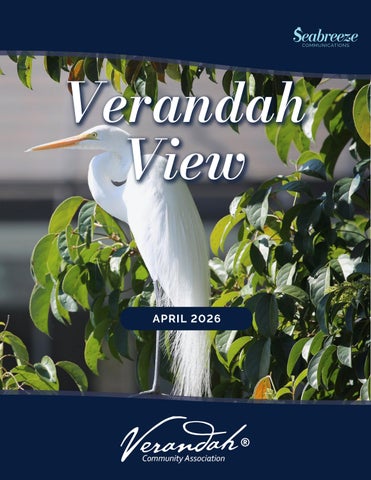
APRIL 2026

The Verandah View is a publication of the VCA. We work with Seabreeze Communications, a marketing company whose advertising provides the revenue to produce the View at no cost to the Verandah community. The content is prepared by the VCA Communications Committee.

Elizabeth Lynch, Editor

Alice Borowsky

Stephanie Levin

Susan Shamey

Norm Toback

David Keeley, Board Liaison

Communication Survey Results

Dear Fellow Residents,

Thank you for taking the time to respond to our recent survey on the communications provided by the Verandah Community Association (VCA). The survey was completed by over 350 residents. We received a wealth of feedback that has enabled us to have a better understanding of how well you feel you are kept informed and the methods used to deliver information. We will continue to pour through the data and the many comments but, for now, we want to showcase a few highlights.

What We Are Doing Well

• 88% of the respondents are satisfied with the methods used by the VCA to deliver information, i.e., emails, News You Can Use (NYCU), and the Verandah View, with issue specific emails receiving the highest positive response of 82%. • 92% like to receive a monthly edition of NYCU.

(continued on page 4)

(continued from page 2)

Areas for Improvement

• Only 12% of respondents use the website and the majority of homeowners do not go to the website for information. The VCA will focus on navigation and content over the next several months.

• While the information received from the VCA is seen as easy to understand and useful, only 25% found it to be consistently timely. The VCA needs to work on being timelier in disseminating information.

Opportunities

• Overall, 65% or respondents were satisfied with the communication received from their Neighborhood Representatives. Numerous comments did, however, reveal the need for more consistency in communication and timeliness among all neighborhoods. The VCA will work to achieve consistency and timeliness.

• 76% of respondents regularly read the Verandah View. However, it was suggested that we work on providing a wider range of topics, including more focus on the work of the VCA and its committees. Interest was also expressed in making it easier to read the magazine on a phone. The VCA will work on improving the content and, to the extent possible, the readability of the Verandah View.

We are committed to improving communication with our residents and to following through on the information we have received. Thank you again for your feedback.

Stephanie Levin

Susan Shamey

Norm Toback

David Keeley, Board Liaison

Unlock Your Golf Swing Potential

Frustrated with your golf game? Have you tried lessons and hours on the driving range to no avail? How about unlocking your swing potential with a Titleist Performance Institute (TPI) golf class right here in Verandah’s Fitness Center.

Every Thursday morning at 9:00 AM, TPI Certified Coach, Justin Check works with Verandah residents to improve their swing mechanics with varying dynamic exercises and drills: hip mobility, thoracic mobility, core control, and coil sequencing.

“The feedback has all around been very positive and most people who try it come back regularly,” said Justin. Some participants have had a misunderstanding of what the role is of a TPI golf fitness and performance coach versus a swing coach or golf pro. As a TPI golf fitness and performance coach, I do not coach on stance, grip, or help with making changes to swing style. My focus is purely on increasing a golfer’s physical capabilities.”

The TPI philosophy states that “There is no single way to swing a club, rather an infinite number of swing styles. There is, however, one efficient way for every player to swing, and it is based on what the player can physically do.

“Justin has been a great help to my golf game,” said Peter Pristach. “He identified my mobility issues and devised a plan to address my needs. It is a slow process

(continued on page 7)

but definitely noticeable improvement comes quickly if you do the exercises consistently.

Teaching and training in Verandah for almost 11 years, Justin has dedicated his career to helping clients achieve their personal best, whether that’s building functional strength, improving mobility/movement quality, enhancing swing & athletic

performance, recovering from injury/dysfunction, or dialing in a sustainable nutrition plan.

“I have been able to improve my flexibility to increase the length of my swing and get more rotation which has given me back 10 yards off the tee,” said Tom Rath. “I plan to continue to work on my flexibility and core control to gain back even more distance.”

Justin and his wife Stephanie, who is also a Verandah fitness instructor and trainer, own Check Total Health. They offer expert fitness and nutrition coaching directly to clients. Their concierge-style service is built around performance, personalized nutrition, and functional training that fits individual lifestyles. Their motto is: Move Better. Eat Smarter. Live longer.

Enjoy kayaking on the Orange River

The Orange River is a tributary of the Caloosahatchee and is approximately 9 miles long. It flows along Verandah’s southern border for 1.75 miles. It offers Verandah’s residents and guests a special kayaking experience that blends tranquility with the allure of nature.

The river has a gentle current and it makes travel easy in both directions. If you go to the right, you can head toward Manatee Park and perhaps see manatees if the air is cold. To the left you can meander through “Old Florida” with parts of the river canopied by mature oaks dripping with Spanish moss. Remember to be mindful of how far you go and how long it takes because you must paddle the same distance back.

Fishing from a kayak is a favorite pastime for many. (Be sure adults have a fishing license.) Alligators are an integral part of Florida’s ecosystem. Be vigilant and keep a safe distance from them. Generally, they are afraid of you but nevertheless, always keep hands and feet out of the water.

Kayak choices Verandah’s kayaks are the “sit atop” variety. The seat is typically above the waterline, and you are exposed to the

elements which on a warm, sunny day is quite refreshing. They are easy to get in and out of and are less likely to capsize than the sit inside (covered) kayaks which have an enclosed cockpit. Our kayaks are excellent for beginners and are selfbailing.

Kayak singles are generally more maneuverable. A tandem kayak requires synchronizing your paddle strokes with your partner to navigate smoothly. Conversationally you may find it is more enjoyable to chat in singles as you are able to see each other. Have fun in the outdoors!

(continued on page 9)

TIPS FOR USING OUR KAYAKS

1. Take care when moving a kayak as they are easy to scratch on rough surfaces.

2. Use the wheeled cart and center the kayak’s keel (wheels level and kickstand down for loading)

3. Guide the kayak down to the launch; or if there are two of you, carry it down to the river together, protecting the hull.

4. Run your hand over the surfaces to feel for any cracks and ensure it is watertight.

5. When you return there is a hose to rinse everything off to remove any sand or debris. Pay attention to crevices where dirt can accumulate.

6. Drain off excess water before returning the kayak to the rack.

2026 Entry Monument and Resident Holiday

In recent months a number of questions have been raised by residents about the VCA guidelines regarding holiday decorations and lighting. In light of this, it seems timely and worthwhile to review and publish our use restrictions and policies on these topics.

If you have any questions about these topics, please feel free to contact James Tanigawa at the VCA office or by email at jamest@vcalife.com.

Per the governing documents and adopted policies of the Verandah Community Association, holiday decorations are permitted on neighborhood entryway islands and single-family resident lots. However, there are guidelines governing the display of decorations. The 2026 calendar describes when and how holiday decorations may be displayed on Neighborhood Entry Monuments and on the exterior of homes.

The Use Restrictions in the VCA’s governing documents establish the following times compliant festive decorations and lighting may be displayed. (Inflatable type decorations are not allowed.)

• Winter holiday season decorations and lighting may be displayed November 25 to January 7)

• Decorations (no lighting) for all other approved holidays (see below) may be displayed 7 days in advance of the holiday and must be removed within 7 days after the holiday.

Flag Holidays 1 (when ONLY flags may be displayed)

• Martin Luther King, Jr., Day (January 18th)

• Memorial Day (May 31st)

• Flag Day (June 14th)

• Labor Day (September 7th)

• 9/11 Remembrance Day (September 11th)

• Veterans Day (November 11th)

Creative Holidays (when compliant creative decorations may be used)

• Spring holiday (April 5th)

• Independence Day (July 4th)

• Halloween (October 31st)

• Winter Holiday Season including Thanksgiving (November 25th to January 7th)

Neighborhood Entry Monuments

The VCA will provide 24-notice to a Neighborhood Representative about noncompliant décor and then remove the items. When decorating a monument:

(continued on page 11)

Holiday Decorations

• Take care not to damage the monument, lights, trees, plants or irrigation. Climbing or nailing/screwing on the monument and trees is not allowed. The cost to repair damage caused by decorating activities will be billed back to the neighborhood.

• No items may be installed or placed in the front of the bullnose where annual flowers are planted. (The bullnose is the pointed section at the beginning of the entry island)

• Decorations must be in good condition and not faded or broken.

• Neighborhoods may opt for the professional installation and removal of entry feature winter holiday decorations. The cost will be billed to participating neighborhoods.

1 Flags permitted or recognized by state statute or established flag protocols included United States, State of Florida, POW-MIA, flags representing a branch the United States Armed Forces and First Responder flags.

Do you have an interesting background or skill you’d be willing to share with other Verandah residents? Verandah Community University is filling its roster for the 2026-27 school year and looking for people with varied backgrounds and stories to tell.

Verandah Community University is a memberrun organization that presents an educational/ entertaining program one Monday per month

from October to April. The programs are held in the River House Dining Room from 4-5:30 p.m., with a cash bar available.

In the past, we’ve had speakers with a wide range of topics: Hall of Fame Pitcher, Forensic Anthropologist, Super Bowl Referee, TV News Broadcaster, Secret Service Agent, FBI Special Agent, Local Food Critic and Author, Holocaust Educator, World War II History Buff, First Amendment Educator, to name a few.

Special Topic: We’d love to find someone who could explain AI, how it can help us in our daily lives, and when, why, and how to protect ourselves from it.

If interested in speaking or you have a suggestion for a future speaker, please contact one of the Deans: Susan Shamey (sshamey@ymail.com,) Alice Borowsky (aliceborowsky@ gmail.com), Cathy Brummer (wiresdds5@comcast.net ), or Stephanie Levin (sslaging@comcast. net ), or verunifm1@yahoo.com with your contact information and speaking topic.

The Long and Winding Road: How Molecules Become Medicines

Monday, April 6 | 4 - 5:30PM | River House

VCU is proud to present Verandah resident Krista McKerracher , who will share her firsthand perspective on how new medicines are discovered, developed, and ultimately brought to patients. Krista retired in 2019 after a distinguished 35-year career in the biopharmaceutical industry and now serves on the boards of three biotech and health tech companies. Over the course of her career, she contributed to some of the most important breakthroughs in modern medicine—including several transformational cancer treatments. In this engaging lecture, she will also explore how emerging technologies such as gene editing and artificial intelligence are accelerating the development of nextgeneration—and potentially curative—therapies.

Join Us for a Bestselling Author Event

WITH LEAH WEISS

The Verandah Club cordially invites you to attend a bestselling author event with Leah Weiss, where she will present her new book The Creek, the Crone, and the Crow.

Ms. Weiss has visited Verandah in the past when she presented her first novel, If The Creek Don’t Rise , and her second novel, All the Little Hopes. Those who love reading won’t want to miss out on meeting Leah on Tuesday, April 7,

2026 in the River House. The event will run from 10:00 AM to Noon. Light refreshments will be served.

$25.00 per person will be charged to your Club account. Guests are very welcome. On the Event registration page, there will be a separate registration if you are interested in purchasing T he Creek, the Crone, and the Crow from The Blinking Owl Books of Ft. Myers.

You can sign up now on the Verandah Club’s Event Calendar for Ms. Weiss’ in-person presentation!

A Guide to Verandah’s Native Birds

GREAT WHITE EGRETVERANDAH’S ELEGANT SENTINEL

Few sights in Verandah feel as quietly majestic as a Great White Egret standing motionless along a pond’s edge—snow-white feathers glowing against dark water, neck curved into a graceful S, eyes fixed with intense focus. Or perhaps you have seen them perched in a tree. Often mistaken at a glance for a heron or an ibis, this elegant bird is one of Florida’s most iconic wetland residents and a frequent, welcome presence in our community.

The Great White Egret is tall and statuesque, reaching

about 3½ feet in height with an impressive wingspan that can exceed five feet. Its brilliant white plumage, long black legs, and sharp yellow/ orange bill make it easy to recognize. During the breeding season, adults grow delicate, wispy plumes on their backs—feathers once so coveted they nearly led the species to extinction.

One of the most fascinating changes happens around the egret’s face during mating season. As spring approaches, the normally yellow skin between the eye and the bill (called the lores) can turn a vivid green, a visual signal that the bird is ready to breed. The bill itself may intensify in color, appearing brighter than usual. These subtle facial color changes, combined with the flowing breeding plumes, give the Great White Egret an especially striking look at this time of year.

at a time before striking with lightning speed. Fish make up much of its diet, but it also feeds on frogs, small reptiles, insects, and even the occasional small mammal.

The Great White Egret holds a special place in conservation history. In the late 1800s and early 1900s, egrets were heavily hunted for their plumes, which were used to decorate fashionable lady’s hats. Their dramatic decline helped spark the bird conservation movement and led to the creation of protective laws and organizations dedicated to bird protection. Thanks to those efforts, the Great White Egret

Watching a Great White Egret hunt is a lesson in patience. It may stand perfectly still for minutes (continued on page 17)

has made a remarkable comeback—and seeing one today is a reminder of what conservation can achieve.

Verandah’s mix of ponds, wetlands, and natural areas makes it an ideal stop for Great White Egrets. Some are year-round residents, while others pass through seasonally. Early mornings and late afternoons are the best times to spot them, especially during breeding season when their colors and plumes are at their most dramatic and the light catches their feathers, turning them almost luminous. The next time you see that flash of white along the water in Verandah, pause for a moment. You’re not just seeing a beautiful bird— you’re seeing a symbol of

resilience, patience, and the enduring wildness that makes our community such a special place to live.

10 Interesting Facts About Great White Egrets:

1. The Great White Egret is one of the largest and most recognizable white wading birds in North America. They are sometimes confused with snowy egrets which are smaller.

2. They nest in colonies, often alongside herons, ibises, and other egrets in trees near water.

3. Both parents help raise the chicks, taking turns guarding the nest and bringing food.

4. They fly with their necks pulled back into an “S” shape, unlike cranes, which fly with necks stretched straight out.

5. Great White Egrets are found on every continent except Antarctica, showing remarkable adaptability.

6. Great White Egrets hunt alone , even though they nest in colonies— solitary feeding reduces competition for prey.

7. They can change hunting strategies, usually slowly stalking prey, other times actively stirring the water with a foot to flush fish out.

8. Their eyesight is exceptionally sharp, allowing them to judge distance accurately before striking underwater prey.

9. They are highly sensitive to water levels, and sudden drops or rises in pond depth can cause them to abandon a feeding area entirely.

10. During breeding season, Great White Egrets perform an elegant courtship display. Males grow long, lacy plumes and use slow neck stretches, plume fluffing, wing spreading, and bill clattering to attract a mate. When a female accepts, the pair bond through gentle mutual preening before mating and nesting begins.

Growing Bulbs in Southwest Florida

Crocuses popping up through the snow, followed by colorful hyacinths, tulips and daffodils are a welcomed sign of spring in the northern states. Sadly, these bulbs are not suited for warmer climates as they require a lengthy chilling period to bloom. However, in South Florida we do have several tropical and subtropical bulbs that can be planted in our gardens, adding color and variety to the landscape.

What exactly, is a bulb? Basically, a bulb is a thickened underground organ that stores nutrients, minerals, and water for the plant to use during dormancy or in stressful conditions such as a drought. Bulbs also provide roots to anchor the growing plant. There are 4 different bulb types, True Bulbs, Corms, Tubers and Rhizomes. Although, not alike in appearance they all function similarly.

Collectively, they are all referred to as bulbs.

The brief descriptions of the following 3 Florida Friendly plants are examples of bulbs that are often planted and do well in the Verandah.

Agapanthus: This perennial lily is referred to as African Lily and Lily of the Nile. It is a summer bloomer growing 2-4 feet high depending on the variety. It is available in purple, lavender, blue, and white. It does best in part sun to partial shade. It can

be used in mass plantings, borders or as an accent plant.

Crinum Lily: There are several varieties and species of this impressive Florida plant. Most frequently grown are the large varieties that can reach up to 6 feet and spread to 5 feet, so consider space when planting these. Smaller varieties are available. Crinum lilies bloom on and off throughout the year, producing a solitary

(continued on page 19)

AGAPANTHAS
CRINUM LILY

fl ower on the top of a long stem. It prefers full to part sun. It is used as a specimen or accent plant. It will de fi nitely make a statement in your landscape. Beware, it is a favorite of the Eastern lubber grasshopper! Look for nymphs in the spring when this young, hungry hopper is easiest to control.

Society Garlic: A grassy looking, clump forming perennial. It is so named because the leaves smell like garlic when crushed. It grows in clusters to a height of 12 inches. Lavender fl owers on long

SOCIETY GARLIC

stems appear in the spring and summer. Both fl ower and tubular leaves are edible with a similar taste to garlic and garlic chives. It prefers full sun and is drought and cold tolerant. This plant works best in borders and mass plantings.

Good news-Society Garlic is rabbit repellant. I guess they do not like garlic!

Other bulbs that do well in warmer climates are Amaryllis, Cannas, Gladiolus and Caladium. Bulbs can be planted when temperatures begin to warm in late winter. When planting add organic matter such as peat moss or compost to the hole. Be sure your bulb is planted with the rough side, the root zone down. Once established, your plants will reward you for years to come.

Happy Gardening!

Spotlight on a Resident

Ken Cuccinelli is the man you want to know if you need something done and are wondering how to do it- whether it’s volunteering, business advice, engineering questions, or even a little plumbing!

Ken was raised in an ethnic neighborhood in Jersey City, NJ, where he learned the principles of living with many types and origins of people with no bias toward anyone. That lack of bias has led him to a life of kindness, hope, helping others, and integrity in all facets of his life.

Ken’s undergrad degree in chemical engineering and his MBA led him to work initially in the gas industry. Later, with his background in technology, marketing, and business strategies, he became the owner of Quest Fore, a Pittsburgh based operation which offered turnkey marketing and communication solutions for companies large and small. In addition to his working career, Ken was very involved leading volunteer crews for

Habitat for Humanity. For example, the youth group at his church ran a project in West Virginia’s Appalachian area for one week each year. With 25 years working with the local building contractors, roofers, plumbers, and other skilled workers, he was able to ask them to donate their time and expertise to help. Many agreed. Over time, Ken amassed a crew of over 100 volunteers including both adults and teenagers who would work on several homes at a time. And those recipients who were able assisted the crews with the projects.

Currently, Ken is very involved volunteering in church related programs and serving as a mentor with SCORE. SCORE mentors volunteer their experience and knowledge

to help small business professionals start, develop, and grow businesses.

Having attended many sporting events and other activities with their children, Ken and his wife Maribeth realized that many teams and organizations had a Creed. So, they decided that the Cuccinelli Family should have their own Creed, The Cuccinelli Creed! They asked their three children and spouses, thirteen grandchildren and six greatgrandchildren to share their thoughts on what should be included. Even the eightyear-old contributed. The Cuccinelli Creed was created and each member of the family has a copy which they use as a set of convictions to live by. What a great idea!

You might see Ken on the golf course, biking the neighborhood and, as always, volunteering where something needs to be done.

When asked his goal for the next part of his life, Ken said he hoped to leave a legacy of kindness and hope.

The Verandah View – For Mobile Users

As our recent communications survey indicated that a number of our readers are viewing this magazine on their phones and finding it difficult to read the small font, we want to share a few tips to help you get the most out of the site.

While the magazine is still available in its traditional format, the easiest way to read Verandah View on a phone is through the individual article pages. The article format includes everything that appears in the magazine along with additional updates, announcements, and information that may be added between publication deadlines.

USING THE ARTICLE PAGES

Many readers prefer the article pages when using a phone. The layout is designed for mobile reading and makes it easy to move between stories. Each article has its own page which gives the information more space on a smaller screen.

Don’t be worried about missing out on anything. Everything that appears in the magazine is also available in the Articles section, along with additional content that may be posted during the month.

(continued on page 23)

To access the Articles, scroll past the digital magazine on the homepage (see #1). You will see a list of articles with the title, author, and estimated reading time. After finishing an article, you can use your back button to return to the list or select another story from the related articles shown at the bottom of the page.

ADJUSTING THE FONT SIZE

If the text appears smaller than you prefer while reading an article, you can increase the font size. Click the rectangle icon with two lines next to the website search bar (see #2). Then tap the larger

“A” (see #3) until the text reaches a comfortable size.

READING THE FULL MAGAZINE ON YOUR PHONE

If you still want to read the full magazine, you can do so directly from the homepage. There are two ways to view it on your phone.

OPTION 1: VIEW IN FULL SCREEN

Tap the four arrows in the bottom right corner of the embedded magazine (see #4). This expands the magazine to full screen. If the text or images appear small, you can zoom in on the page. Use the arrows (see #5) to flip between pages.

OPTION 2: DOWNLOAD THE MAGAZINE

Tap the download link (see #6) to save the full magazine to your phone. This allows you to access it even when you do not have wireless service. In this format you will scroll vertically to move through the pages.

We hope this guide helps you enjoy reading The Verandah View on your phone or tablet.

Enjoy The Wonder

27180 Old 41 Road

Bonita Springs, FL 34135

Experience a touch of Old Florida by visiting The Wonder Gardens, a botanical and zoological jewel in Downtown Bonita Springs.

In 1936, the Piper family established The Reptile Gardens as a roadside attraction along the newly built Tamiami Trail. As the animal and botanical exhibits grew, the attraction’s name was changed to The Wonder Gardens to appeal to more visitors. This year The Wonder Gardens is celebrating 90 years as one of the few remaining cornerstones of Old Florida.

You can stroll through the gardens and zoo by yourselves or have a guided tour with professional animal and landscapers.

You will experience a sense of wonder as you visit the home of rescued and non-releasable birds and reptiles nestled among the sprawling banyan trees and plantings. The animals all live in healthy and natural environments. When you visit, make sure to stop by the alligator snapping turtle which looks positively prehistoric!

The gardens offer field trips, specialized programs and Animal Meet and Greets for all ages. A person even can become a certified landscaping expert through The Landscaping Expert Certification Program. The Tea Room and the Glass Conservatory are available for visitors and events. Enjoy The Wonder! 27180 Old 41 Road Bonita Springs, FL 34135

Tips for Living Independently:

MEET MY BEST FRIENDS: SIRI AND ALEXA

When I ask a question, I want a nonjudgmental answer. No eye-rolls or grimaces when I request a song and sing along loudly in the shower, no judgment… just an answer and wish-fulfilled with the sound of my voice, thanks to my best friends, Siri and Alexa.

They give me driving directions, the scores of my favorite teams, and remember what I needed at Publix. When my scale started delivering my weight in kilograms, my “girls” were there to recalculate it into pounds!

There is no jealousy. Siri doesn’t get upset if I ask Alexa more questions than I ask her. (You like her better than me…)

But recently, I’ve learned of a new skill of Alexa’s that sounds perfect for families, couples, or someone living alone, enjoying life, and trying to live safely and independently. Being a strategic thinker, I ask myself “What if” a lot. What if I fall, what if the car won’t start, what if the air conditioner breaks? Then I come up with scenarios of how to solve each problem.

Not falling or getting sick or injured are priorities in my life. If I don’t take care of myself, who will?

Alexa has a new option called Emergency Assist.

If you have any of the Echo or other Alexa devices, you can use your voice to ask Alexa for help right away. After signing up for the $5.99/month program (if you have Prime) or $7.99/ month (without Prime), you can just say, “Alexa, I need

help”. Someone from the Emergency Assist call center will respond and find out what you need. Ambulance? Fire Department? Police? No buttons to push, locate your phone, or fumble with your watch. Just the sound of your voice… Alexa cannot call 911, but can call friends or emergency contacts for you, too. While the Emergency Assist is a selfrenewing program, you can cancel whenever you’d like.

I’ve just signed up for this program to check it out and hope to never need it!

If you’d like questions about independent living answered in Verandah View, text or email me from verandahlife.com member directory.

Stephanie Levin,

Specializing in Independent Living

Pet of the Month

Steve is a 19-month-old gorgeous showquality German Shepherd. He enjoys living on J.R. and Faith Widder’s Ohio farm in the summer and winters in Verandah. He is fully trained in obedience and likes training on the Powerline. Steve loves playing Cow Patty Golf at home and rearranges everyone’s ball. In last year’s July 4th Open competition, he assisted a golfer with dropping a ball into the cup for a “Steve Assisted” hole in one. Maybe Verandah golfers can borrow Steve for his help with their games! Steve even has his own RV for traveling back and forth named “The Steve Mobile.”

Steve and Henrietta, Faith’s cat, live together amicably. But Henrietta does like to slide things off the table or shelf that Steve shouldn’t have, and then she loves seeing him get in trouble! Clever cat!

A beloved pet’s photo, whether dog, cat, horse, bird, or fish will be featured in the Verandah View Pet of the Month. Resident owners can send in a photo with pet’s name, owner’s name, type of pet, and one sentence or two about their

pet by texting Susan Shamey at (724) 355-2478 or email sshamey@ymail.com. Your pet’s debut will be in the Verandah View in the order they are submitted.

All pets are beautiful to their owners.

Finding Resources For Older Adults

To help the growing numbers of older adults who have questions or need support, the Eldercare Locator stands ready to connect people with nearby aging resources available in their communities. Older adults, concerned family members, caregivers and professionals can contact the Eldercare Locator to find information about local aging programs and services that can help address a variety of needs during this national health crisis.

One call to the Eldercare Locator at (800) 677-1116, or a visit to the website at eldercare.acl.gov , can connect you to

aging services that can help ensure that older adults can continue to live safely at home. For more than 20 years, the Eldercare Locator has connected older adults, caregivers and the professionals who work with them to local programs that can help meet their needs.

The Eldercare Locator is a free public service of the U.S. Administration for Community Living and is administered by the National Association of Area Agencies on Aging. Find the Eldercare Locator online at eldercare.acl.gov or at (800) 677-1116.

The Benefits of Full Body LED Light Therapy

Full body LED light therapy—also known as photobiomodulation or red light therapy— is a non-invasive treatment that uses specific wavelengths of light to support healing, reduce inflammation, and enhance overall wellness. Once limited to clinical settings, this technology is now widely available in wellness centers, gyms, and even at home. As research continues to grow, so does interest in the wide-ranging benefits of full body LED light therapy.

What Is Full Body LED Light Therapy?

LED (light-emitting diode) therapy uses low-level wavelengths of red and nearinfrared light to penetrate the skin and stimulate cellular activity. Unlike UV light, which can damage the skin, red and nearinfrared light are considered safe and do not cause burns when used appropriately.

Full body systems typically consist of large panels or light beds that allow users to expose most or all of their body at once, maximizing systemic effects rather than targeting a single area.

1. Enhanced Cellular Energy Production

One of the primary mechanisms behind LED light therapy is its effect on mitochondria—the “power plants” of our cells. Red and near-infrared light stimulate the production of adenosine triphosphate

(ATP), the molecule responsible for cellular energy. Higher ATP production supports faster cell repair, improved tissue regeneration, and enhanced overall cellular function.

This boost in cellular energy is the foundation for many of the therapy’s reported benefits.

2. Reduced Inflammation and Pain Relief

Inflammation is a key factor in many chronic conditions, including joint pain, muscle soreness, and autoimmune disorders. Full body LED light therapy has been shown to:

• Reduce inflammatory markers

• Improve circulation

• Accelerate recovery from injury

Athletes frequently use full body light therapy to reduce muscle soreness after intense workouts and to speed up recovery times. Individuals with arthritis or chronic pain conditions may also experience decreased stiffness and improved mobility.

3. Improved Skin Health

Red light therapy is widely known for its cosmetic benefits. By stimulating collagen and elastin production, it can help:

• Reduce fine lines and wrinkles

• Improve skin tone and texture

• Minimize acne and acne scarring

• Support wound healing

Full body exposure allows for comprehensive skin rejuvenation, making it popular in anti-aging and aesthetic wellness programs.

4. Faster Muscle Recovery and Performance Support

Because full body LED light therapy enhances circulation and ATP production, it supports muscle repair at a deeper level. Many professional athletes and fitness enthusiasts use it to:

• Shorten recovery time between workouts

• Reduce delayed onset muscle soreness (DOMS)

• Enhance endurance and performance

When muscles recover more efficiently, overall performance and training consistency can improve.

5. Enhanced Mood and Sleep Quality

Emerging research suggests that red and near-infrared light exposure may positively influence mood and sleep patterns. By reducing inflammation and supporting cellular health, light therapy may help regulate circadian rhythms and promote relaxation. Some users report:

• Improved sleep quality

• Reduced stress levels

• Enhanced mental clarity

While more large-scale studies are needed, early findings are promising.

6. Support for Circulation and Healing

Full body LED light therapy promotes vasodilation—the widening of blood vessels—which enhances blood flow and oxygen delivery throughout the body. Improved circulation supports:

• Faster wound healing

• Reduced swelling

• Better nutrient delivery to tissues

This systemic effect is one of the advantages of full body treatment over smaller, localized devices.

Safety and Considerations

LED light therapy is generally considered safe when used as directed. It is non-invasive, painless, and does not require downtime. However, individuals with certain medical conditions, those taking light-sensitive medications, or those who are pregnant should consult a healthcare provider before beginning treatment.

Consistency is key. Most protocols recommend multiple sessions per week over several weeks to achieve noticeable results.

Where to Get Full Body LED Therapy in Southwest Florida

LED light therapy is offered in a few niche med spas and wellness centers around Southwest Florida, including select locations at Massage Envy. Prices can range anywhere from $30 - $85 per

treatment at most facilities, which can add up quickly when you are going twice per week; however, Massage Envy offers an unlimited use package for $100 per month, making this great service affordable to almost anyone. Massage Envy utilizes the Lightstim Full body LED bed, which is the only full body led bed cleared by the FDA for treatment of chronic pain and inflammation.

Conclusion

Full body LED light therapy offers a range of potential benefits—from enhanced cellular energy and reduced inflammation to improved skin health, faster muscle recovery, and better overall wellness. While ongoing research continues to explore its full capabilities, current evidence and user experiences suggest it is a promising, low-risk option for those seeking a non-invasive way to support whole-body health.

As with any wellness treatment, results may vary, but for many individuals, full body LED light therapy has become a valuable addition to their health and recovery routine.

This article is a paid advertisement. The content was provided by the sponsor and does not necessarily reflect the views of this community or Seabreeze Communications.

Turn static files into dynamic content formats.
Create a flipbook
Verandah APR 2026 by Seabreeze Communications - Issuu