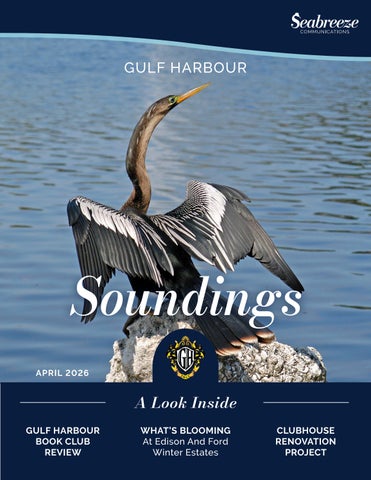
GulfHarbour APR 2026

Page 1


Gulf Harbour Book Club Review

THEO OF GOLDEN

The Gulf Harbour Book Club met on March 2 to discuss Theo of Golden by Allen Levi. We had a great meeting without the author in person. There were 39 of us in attendance.

Allen grew up in Columbus, Georgia, attended University of Georgia for degrees in English and Law, and worked as an attorney from 1980 to 1990. He left law practice for two years in 1990, moved to Scotland, and, while there, received a degree in Scottish fiction from the University of Edinburgh. He returned home, resumed law practice for three years, and finally ventured into vocational music in 1996.

Since then, he has worked as a traveling musician, sharing his whimsical, thought-provoking brand of songwriting and storytelling to audiences across the U.S. He has over twenty albums to his credit, as well as hundreds of other unpublished songs.

In 2014, he published The Last Sweet Mile, a memoir of the close friendship he shared with his brother, Gary, who died in 2012. He also wrote and published a children’s book, Oliviatown, adapted from a song of the same title.

Allen published his first novel, Theo of Golden, in 2023. It has since become a sensation. His next book is Ellen of Golden.

When not reading or writing Allen cares for family acreage where he lives with his father, tries to spend time with

family nearby, keeps a full schedule of involvement in the small community around him, and dreams of being an artist someday.

Theo of Golden is a character-driven novel about Theo (Gamez Theophilus Zilavez), an 86-year-old Portuguese artist and widower who brings transformative, intentional acts of kindness to a small Georgia town. He connects with residents, including a struggling artist, a homeless woman, and a bookseller, by gifting them meaningful portraits. For most of us we considered it heartwarming.

The Gulf Harbour Book Club meets on the first Monday of each month in the Fitness Center. If you want to join the Book Club email joankaplan@mac.com . Zoom is available for Members if the author allows it. We had 9 authors lined up for the 2025/2026 season. We already had Kristen Harmel, Jane Yang and Abi Dare and Zelly Ruskin, Kate Quinn and Bernhard Schlink. March was Theo of Golden , April is Chris Torockio for The Soul Hunters .

Theo has brought lots of joy and meaning to the many characters in the book. I have listed them below.

Key characters in the novel include:

• Theo (Gamez Theophilus Zilavez/Zila): An elderly, wise, and kind Portuguese-American artist who acts as a catalyst for change in the community.

• Asher Glissen: A prominent local portrait artist whose work captures the souls of the town’s residents.

• Minnette Prentiss: A CPA who receives the first of Theo’s bestowed portraits.

• Tony (Antony Wilcox): A sardonic, witty bookstore owner and Vietnam veteran who becomes a close friend of Theo.

• Ellen: A complex, intelligent, and eccentric homeless woman and artist.

• Simone Lavoie: A gifted young cellist who receives support from Theo.

• Kendrick Whitaker: A hardworking custodian and devoted father to his daughter, Lamisha.

• James Ponder: The owner of Ponder House and Theo’s landlord.

• Basil Cannonfield: A street musician and grieving brother.

• Shep and Addelyn (Addy) Carlile: Owners of “The Chalice” coffee shop.

IMPORTANT NOTICE!

Please submit all articles, announcements, photos and events for Gulf Harbour Soundings to GulfHarbourReport@gmail.com by the 4th of the month preceding the month of publication.

February 20, 2026

Wen Wu
Hole No. 9

Continental Women’s Club

The Continental Women’s Club will hold its monthly luncheon meeting on Thursday, May 7th starting at 11:30 a.m. Our May program will feature the installation of our Executive Officers for 2026-2027, and a recognition of the leadership of our Past Presidents. We will also have a fun “May Day” Hat competition. An opportunity to show off your prettiest or most creative hat. The deadline to reserve for this luncheon is Tuesday, April 28th.

The meetings are being held at The Hideaway Country Club, 5670 Trailwinds Drive, Fort Myers 33907. The cost to attend the luncheon is $28.  Please call Liz Paul at

239-691-7561 prior to April 28th for meal selection and to make a reservation.

Continental Women’s Club is a social, cultural, and philanthropic organization established in 1975, with membership open to women living in Lee County. We have many special events and interest groups within our Club that you can participate in for social and educational purposes throughout the month and the year. In addition, we contribute to many local charities and award two scholarships each year to senior high school girls who plan on furthering their education.

The Benefits of Full Body LED Light Therapy

Full body LED light therapy—also known as photobiomodulation or red light therapy— is a non-invasive treatment that uses specific wavelengths of light to support healing, reduce inflammation, and enhance overall wellness. Once limited to clinical settings, this technology is now widely available in wellness centers, gyms, and even at home. As research continues to grow, so does interest in the wide-ranging benefits of full body LED light therapy.

What Is Full Body LED Light Therapy?

LED (light-emitting diode) therapy uses low-level wavelengths of red and nearinfrared light to penetrate the skin and stimulate cellular activity. Unlike UV light, which can damage the skin, red and nearinfrared light are considered safe and do not cause burns when used appropriately.

Full body systems typically consist of large panels or light beds that allow users to expose most or all of their body at once, maximizing systemic effects rather than targeting a single area.

1. Enhanced Cellular Energy Production

One of the primary mechanisms behind LED light therapy is its effect on mitochondria—the “power plants” of our cells. Red and near-infrared light stimulate the production of adenosine triphosphate

(ATP), the molecule responsible for cellular energy. Higher ATP production supports faster cell repair, improved tissue regeneration, and enhanced overall cellular function.

This boost in cellular energy is the foundation for many of the therapy’s reported benefits.

2. Reduced Inflammation and Pain Relief

Inflammation is a key factor in many chronic conditions, including joint pain, muscle soreness, and autoimmune disorders. Full body LED light therapy has been shown to:

• Reduce inflammatory markers

• Improve circulation

• Accelerate recovery from injury

Athletes frequently use full body light therapy to reduce muscle soreness after intense workouts and to speed up recovery times. Individuals with arthritis or chronic pain conditions may also experience decreased stiffness and improved mobility.

3. Improved Skin Health

Red light therapy is widely known for its cosmetic benefits. By stimulating collagen and elastin production, it can help:

• Reduce fine lines and wrinkles

• Improve skin tone and texture

• Minimize acne and acne scarring

• Support wound healing

Full body exposure allows for comprehensive skin rejuvenation, making it popular in anti-aging and aesthetic wellness programs.

4. Faster Muscle Recovery and Performance Support

Because full body LED light therapy enhances circulation and ATP production, it supports muscle repair at a deeper level. Many professional athletes and fitness enthusiasts use it to:

• Shorten recovery time between workouts

• Reduce delayed onset muscle soreness (DOMS)

• Enhance endurance and performance

When muscles recover more efficiently, overall performance and training consistency can improve.

5. Enhanced Mood and Sleep Quality

Emerging research suggests that red and near-infrared light exposure may positively influence mood and sleep patterns. By reducing inflammation and supporting cellular health, light therapy may help regulate circadian rhythms and promote relaxation.

Some users report:

• Improved sleep quality

• Reduced stress levels

• Enhanced mental clarity

While more large-scale studies are needed, early findings are promising.

6. Support for Circulation and Healing

Full body LED light therapy promotes vasodilation—the widening of blood vessels—which enhances blood flow and oxygen delivery throughout the body. Improved circulation supports:

• Faster wound healing

• Reduced swelling

• Better nutrient delivery to tissues

This systemic effect is one of the advantages of full body treatment over smaller, localized devices.

Safety and Considerations

LED light therapy is generally considered safe when used as directed. It is non-invasive, painless, and does not require downtime. However, individuals with certain medical conditions, those taking light-sensitive medications, or those who are pregnant should consult a healthcare provider before beginning treatment.

Consistency is key. Most protocols recommend multiple sessions per week over several weeks to achieve noticeable results.

Where to Get Full Body LED Therapy in Southwest Florida

LED light therapy is offered in a few niche med spas and wellness centers around Southwest Florida, including select locations at Massage Envy. Prices can range anywhere from $30 - $85 per

treatment at most facilities, which can add up quickly when you are going twice per week; however, Massage Envy offers an unlimited use package for $100 per month, making this great service affordable to almost anyone. Massage Envy utilizes the Lightstim Full body LED bed, which is the only full body led bed cleared by the FDA for treatment of chronic pain and inflammation.

Conclusion

Full body LED light therapy offers a range of potential benefits—from enhanced cellular energy and reduced inflammation to improved skin health, faster muscle recovery, and better overall wellness. While ongoing research continues to explore its full capabilities, current evidence and user experiences suggest it is a promising, low-risk option for those seeking a non-invasive way to support whole-body health.

As with any wellness treatment, results may vary, but for many individuals, full body LED light therapy has become a valuable addition to their health and recovery routine.

This article is a paid advertisement. The content was provided by the sponsor and does not necessarily reflect the views of this community or Seabreeze Communications.

Clubhouse Renovation Project

UPDATE #21

Fellow Members and friends of Gulf Harbour,

Consider this a State of the Renovation address.

Here’s a summary of where we are on the Clubhouse Renovation project, as of February 10, 2026:

• Schedule: We’re 60-days behind and focused on a December 2026 reopening.

• Cost: The project remains within our cost budget, including contingencies. and falling interest rates has generated a favorable funding variance.

• Quality: The project will meet our quality standards and expectations.

• Pool & Tiki: Closed until work on the building’s west side is more complete.

• Communications: Feedback on our approach to communications has been positive.

Schedule Update – We’re behind and focused on a December 2026 reopening.

The period from November 2025 through January this year has fallen short of my expectations, our teams’ and yours for progress on our Clubhouse Renovation schedule. I want to be clear about that from the outset. What we have seen during this timeframe does not reflect the standard of execution, focus, or urgency that this project demands

from our chosen construction contractor, Curran & Young Construction. We estimate we are at least 60 days behind our initial schedule, which called for the Clubhouse to be completed by September 2026. Our latest completion date is now estimated to be early December 2026, in time for the holidays, but with little room for delays or missteps.

As you may recall from earlier updates, we initially encountered delays in securing all necessary permits and approvals, but once received, we officially began the construction project on July 7th, 2025. As construction progressed, several unforeseen infrastructure conditions were identified that could not have been reasonably anticipated during the initial planning phase. Lonnie highlighted those in earlier updates. Additionally, numerous errors were made by subcontractors during demolition. Design changes became necessary, and schedules had to be altered.

Furthermore, expectations were set and then reset. Difficult conversations have taken place between me and the executive leadership team at our construction contractor, Curran & Young Construction. And I assure you we have taken the necessary initial steps to protect ourselves legally and fiduciarily. But it doesn’t change the fact that we are behind our initial completion date.

The Board of Governors assures you that we are doing everything possible to exert appropriate pressure to push this project forward and find ways to accelerate work activities and installation dates.

Last month, Lonnie and I again met directly with the principals of Curran & Young to express our concerns, displeasure, and need for greater progress. That meeting was necessary, candid, and firm. We expressed

our dissatisfaction with the pace of work and the lack of meaningful forward momentum. As a result, we conducted a full reset and reached agreement on a revised path forward, which we are operating to.

The schedule is dependent on delivery of structural steel, which has been – and remains – a critical path item. I’m pleased to report that we began to receive structural steel on Friday, February 6th and should be receiving more structural steel each week over the next three weeks. As Lonnie and I walked the project last Sunday, interior columns and beams were already being installed.

Cost Update – We are within budget, and no additional assessments or funds are needed. On the financial front, and seven months into the project, the Board still believes the Memberauthorized $19 million total cost is attainable. But

we still have an estimated nine months until completion. Much has to go “right” from here on out, and our contractors are aware of that. Let me be as clear and reassuring as I can at this time, the Board has reviewed the details of our spend-to-date and that which remains to be spent, as well as detailed cash flow projections moving forward, and we remain confident that the project budget remains intact. I repeat, NO additional assessments or funds are expected to be required from our

Members. That commitment which the Board made to you remains unchanged.

We have collected $10.8 million so far, most of which was from Members prepaying up front. We have used $6.5 million for construction costs to date so we currently have just over $4 million in cash

earning interest. We therefore don’t anticipate tapping our bank line of credit for the project until April/May this year. Additionally, and for those closely following the financial market, interest rates have improved nicely since we started this project, which lessens our expected debt service and provides a favorable funding variance versus our original models, once we begin to draw on the loan.

Quality

Update – The project will meet our quality standards and expectations. Build quality on a project of this scale demands continuous, disciplined oversight, and it remains a central focus of our management team and the daily interactions we have with our contractor. Our Owner’s Representative and Quality Manager are exercising the appropriate level of scrutiny to ensure workmanship meets our standards, despite significant challenges presented by the contractor. We remain confident that

the finished product will align with our quality expectations.

Importantly, as construction has advanced, we have integrated several design enhancements that elevate aspects of the design, architectural detailing, and overall finish of the Clubhouse. We believe these improvements— though requiring careful coordination— meaningfully enhance what Members will experience upon completion and further underscore our commitment to delivering a first-class facility.

Pool and Tiki Update – Closed until work on the west side of the building is more complete. As you know, our Clubhouse Renovation is a significant and transformative project for Gulf Harbour. Throughout the planning process, our hopes and intentions were to keep the pool and Tiki-Hut available for Member use during construction. Unfortunately, as work has not progressed as planned, construction activity in the immediate vicinity of the pool has increased to a level that we believe

poses safety concerns for our Members and guests. That level of construction activity will only increase as structural steel is placed in this area and our expanded footprint begins to take shape on the southwest corner of the building.

With all that in mind, and with sincere regret, the Board has determined that we must delay the opening of the pool and Tiki-Hut until construction advances to a point where we can ensure a safe environment. At this time, we estimate this may require approximately two to three additional months of closure. However, because construction conditions can change, we cannot commit to a fixed reopening date today.

We understand how disappointing this news is, especially as many of you look forward to enjoying the pool during this part of the year. Please know that this Board decision was not made lightly. The safety and well-being of our Membership remain our highest priorities, and we are working closely with our construction team to accelerate progress wherever possible.

The moment it is deemed safe to re-open the pool area and Tiki-Hut—even earlier than estimated—be assured we will do so. We will continue to keep you updated as the project advances and as the timeline becomes more definitive.

Renovation projects of this magnitude can be frustrating for everyone involved – Board members, project partners, and most importantly, you, our Club Members. I regret being the bearer of this news, but transparency matters, and sugarcoating reality would do no one any favors.

Communication Update – we will continue to provide regular updates

The Board commends Lonnie for his exceptional leadership of the Club during this challenging project and for his clear, consistent communication of renovation updates to the Membership. We thank him for his efforts, diligence and candor. I also want to acknowledge the truly extraordinary efforts being put forth by Doug Glover, who

is acting as our Owner’s Representative and Char Mohr, our Quality Manager, as well as the deep involvement and assistance of Gulf Harbour Members: Mark Walsh, Michael Sklorenko and Jim Spangler. These individuals have collectively spent thousands of hours assisting with design details, interpretations and answers to requests for information, logistics, sequencing, coordination, and cost control. Despite their tireless involvement and support, we remain frustrated by the slow pace of progress to date, but we remain diligent in our efforts to push our Contractor and optimistic and encouraged by the future we are creating for Gulf Harbour.

Overall, this project is complex. It is testing. And it is not moving as quickly as any of us want. But I assure you that leadership is engaged, pressure is being applied where it belongs, and accountability is front and center. Members of the Board, and Club Members such as Doug Glover, Mark Walsh, Michael Sklorenko, Jim Spangler, and of course Lonnie and his team, are spending countless hours to

assure this project is completed by December of this year.

We thank you for your patience, your understanding, and your continued trust as we work through an exceptionally challenging phase of this renovation.

We will provide another schedule, cost and quality update each month to keep you informed. Lonnie, as he’s done in past updates, has provided the attached photos showing the latest state of progress.

Sincerely,

Catch The Action

CAPT. BILL RUSSELL

APRIL ON THE WATER

April may be our top month fishing in the coastal waters of southwest Florida. As we transition into spring, our waters are warming, baitfish have moved in, and fish are hungry. The weather is stable for the month with light winds and mild sunny days, plus not much threat of daily thunderstorms. Also, until the summer rains begin, inshore waters are the clearest we see all year.

This month brings our largest sea trout of the year with many measuring over twenty inches, and some much larger. Trout prefer clear water and areas with sea grass. Their diet consists of crustaceans and fish. Hungry trout will pounce on shrimp and small baitfish, plus a wide variety of artificial baits.

Spanish mackerel are running large and often schooled up across our inshore waters, around gulf passes, and a short distance offshore. Bluefish, ladyfish, jack crevalle, and sharks often are mixed with mackerel. You get into this mix of fish and it’s a blast as all are fast drag screamers. Spanish mackerel are also very tasty when prepared and eaten fresh.

In gulf waters, king mackerel, often large, follow the Spanish mackerel. If you want to tug on something larger, toss a larger bait out for a big cobia, shark, or king mackerel when you get Spanish or other fish biting.

Anglers fishing deeper in gulf waters will find red grouper, mixed with a variety of snappers and other tasty fish. Live and cut bait fished in depths from seventy to one hundred twenty feet over hard live bottom and ledges will produce fish. April should bring many days with light winds to comfortably make the run into gulf waters. It’s possible to hook into blue water fish such as mahi, tuna, wahoo, and sailfish as well.

Sharks of all sizes are making their way into our waters. A lot of sharks showed up last month and more will continue. Tarpon fishing kicks off this month throughout southwest Florida. It’s possible to hook into a big silver king if you are fishing for them or not. They are just as likely to gulp down a live shrimp or small lure as anything. On calm days, look for schools of fish a short distance off the beach, early morning is the best time to toss a small live crab or Atlantic thread herring ahead of the school. Tarpon numbers will increase inshore, in the passes, and off the beaches as the month progresses.

After months of winter lows, we get high (spring) tides during the day. This is the time to target redfish under the bushes or mangrove shorelines as they use the higher water to get under the tree overhangs to root out their next meal. Redfish are a scent feeder, while live bait and

lures catch fish; many believe fishing cut shrimp, cut baitfish, and crabs is the best option. On the opposite end of the spectrum, the month will hold mornings with ultra-low tides, just the ticket for sight fishing reds over the shallow flats and around oyster bars. Hit the flats at first light for the best results.

Snook fishing heats up this month as the warmer water gets them active and hungry. Snook are ambush feeders; they like to sit stationary with their nose into the current. And they like structure. Fish shorelines, oyster bars, pilings, etc., with a good tide flow for best results. Snook aren’t like many other fish that allow you to pull them for structure. A snook once hooked will do its best to get to the safety of any type of structure and break off. And they are good at it, especially the bigger ones. Redfish and larger sea trout are often caught from many of the same locations as snook. Snook season is open through the end of April.

You can go a different direction fishing each day from inshore to offshore and not cover all

the possibilities. If there is one month that just doesn’t have enough days to take advantage of all the great fishing opportunities, April is it.

Stay up to date with fishing regulations by visiting the Florida Fish and Wildlife Commission at: www. myfwc.com. Also, upload the Fish Rules app. It has current regulations with pictures to help identify fish. If you enable your GPS, the Fish Rules app updates regulations to your location each time you open the app. In my opinion, it is more accurate and up to date than FWC’s website.

For charter information, please contact us at Gulf Coast Guide Service and “Catch the Action” with Capt. Bill Russell, call or text (239) 410-8576, website: www.fishpineisland.com, email: gcl2fish@live.com.

Capt. Bill Russell is a native and lifelong resident of Pine Island who has spent his entire life fishing the waters surrounding Pine Island and Southwest Florida. For the past 30 years, Bill has been a professional fishing guide who takes pride in customizing each trip to ensure everyone on board has a great time and will return again. Come join us and “Catch the Action.”

What’s Blooming At Edison And Ford Winter Estates

PANDANUS: FROM WORLD’S OLDEST PLANT FOSSIL TO YOUR KITCHEN

One of the largest plants growing at the Edison and Ford Winter Estates greets visitors along the main allée, just outside the Edisons’ home. Heavily damaged by Hurricane Ian, this unusual plant has made a full recovery, testament to its resilience to wind, water, and salt. This Pandanus looks somewhat like a palm on the top and a mangrove underneath the heavy canopy of drooping leaves.

Henry Nehrling, one-time advisor to Thomas Edison, noted in a letter written in 1929 that “the east side of the house was shaded by large overhanging rubber trees and masses of screw pines…” Even Mina Edison listed the Pandanus as a plant of interest for the garden tours that she offered in the 1930s.

Commonly known as screw pine, Pandanus species have grown on the property since at least 1910, likely purchased from the Reasoner Brothers Nursery of Sarasota in 1907 and it grew in the area that now hosts the Latania palms, near the Caretaker’s Cottage. It is noted in historical writings that the screw pine once grew along the west side of the Edison’s pool as well. Prior to the hurricanes, the large Pandanus had been carefully pruned and trimmed to show off its stilt roots, which give the plant stability in sandy or marshy environments and support the top-heavy trunks.

It has been allowed to simply grow and recover and soon will be ready for another beauty pruning.

The Pandanus genus claims one of the Earth’s oldest fossilized plants, discovered in Queensland, Australia— the species Pandanus estellae, dated to approximately 30 million years ago and is part of the evidence to support the ancient supercontinent theory known as Gondwana, which included South Asia, Africa, Antarctica, Australia, and India.

Consequently, we know that Pandanus is a tropical species native to Australia, the Malay Peninsula, Southeast Asia and across the tropical Pacific regions to include Hawaii. During the savage tsunami of 2006, Pandanus odoratissimus that grew in coastal regions saved many villages. Subsequent studies determined that the combination of the complexly rooted P. odoratissimus and Australian Pine Tree (Casuarina equisetifolia) provides an effective “green belt,” reducing the surge and energy of such deadly tsunamis in the Pacific regions.

The ecosystem offered by coastal Pandanus is matched by the genus’

versatility to provide materials for locally made rope, mats, baskets, roof thatch and as a healthy food source from some species. Estimates vary on the number of species in the genus – anywhere from 500 to 700, depending on the source document.

As a tropical plant, a few species can be successfully grown in Florida, though after the recent damaging cold spell, choose wisely. Pandanus baptisstii is a smooth-edged leaf variety that does not produce any fruit – avoiding the potential for a messy yard. P. veitchii is another non-fruiting variety for Florida growers, producing a 40-foot-tall plant with white stripes along the spiny leaf edges.

Most species of Pandanus do not grow quickly but almost all of them are dioecious – producing fragrant flowers on the male plant and fruit only on the female plant. Because the male plants flower annually and the female

SPECIES CURRENTLY GROWING AT THE ESTATES INCLUDE  PANDANUS UTILIS –  A NATIVE TO MADAGASCAR AND  PANDANUS MONOTHECA –  THE GREAT SCREW PINE – AN UNBRANCHING PANDANUS THAT IS ENDANGERED IN ITS NATIVE THAILAND, AND  PANDANUS DUBIUS  OR KNOB FRUITED SCREW PINE. ALL ARE FOUND IN THE SOUTH RESEARCH GARDEN AT THE ESTATES.

only every other year, it is possible they don’t bloom at the same time to bring about the fruit.

The unusual fruit is of great interest, looking something like a huge pinecone, hence its common name (the screw referring to the whorled or circular growth pattern of its leaves around the trunk) or even a trimmed pineapple. In many species, but not all, the fruit is edible, though only when it turns bright orange or red. When the fruit bursts open, it produces several seeds called “keys.” These can be planted but allow up to a full year for the key to sprout. Pandanus sp. mature at eight to 10 years old and will reliably produce fruit for 50 years or

more, making it an important source of nutrition in some cultures (the fruits are mashed to create a “butter” for cooking and flavoring).

Species currently growing at the Estates include Pandanus utilis – a native to Madagascar and Pandanus monotheca –the Great Screw Pine – an unbranching pandanus that is endangered in its native Thailand, and Pandanus dubius or Knob Fruited Screw Pine. All are found in the South Research Garden at the Estates.

Not every garden is ready for the high moisture requirement of Pandanus nor scaled to accommodate its mature size; however, everyone in South Florida can grow a pot of Pandanus amaryllifolius or Fragrant Pandan. Of unknown origins, this small shrublike Pandanus offers many reputed health benefits and culinary inspiration.

ON PANDANUS BAPTISII VARIEGATA, THE LEAVES ARE VARIEGATED AND APPEAR STRIPED.

Indian cuisine employs the juice of boiled Pandan to flavor curries, jellies and desserts. It may also be used

as an organic food wrap, but the leaves are rarely eaten. Regularly harvesting the leaves will cause the plant to continue to produce the juvenile leaves, which are preferred. The flavored water imparts a coconut/almond flavor to rice and other recipes. This evergreen, clumping herb is best grown in a rich, well-draining soil. A complete fertilizer applied three times a year is all it should need in addition to keeping the plant moist but not waterlogged. When temperatures dip below 50 degrees, bring the potted pandanus indoors.

A leaf, rubbed on skin can be used as a natural insect repellant, especially against mosquitoes or soak the leaves in water and put in a spray bottle to apply wherever needed. Fragrant pandans is not a small herb, so give it a good-sized pot, at least 12 inches wide, where it can grow and produce pups or offshoots for you to share with friends. Let the offshoots grow to about five inches tall before removing them from the mother plant. None of the Pandanus genus is toxic to domestic pets.

LOOKING AT THE PANDANUS LEAF

ARRANGEMENT, ONE CAN SEE HOW THE COMMON NAME OF SCREW PINE CAME ABOUT.

To see Pandanus, take a Garden Tour of the Estates and ask the

tour guide to identify the plants. Garden Tours are offered at 10 a.m. on the second Wednesday of each month. On the tour, horticulturists take visitors around the more than 20 acres of botanical gardens and go behind the scenes and highlight the propagating nursery, crop gardens, and heritage and edible plants. Registration is required at EdisonFord.org.

ASSOCIATION PRESIDENTS

RESOURCE HUB

Admiral’s Isle ................................ Jeff McGinty

Bellavista George Hemsey

Coronado Geoff Smith

Courtyard Homes ...................... Tiffany Gaede

Crescent Cove ......................... Sam Schiphorst

Crooked Pond Carol Tsilimos

Edgewater Mike Sklorenko

Grande Cay ....................................... David Lein

Gulf Harbour Master Geoff Smith

Gulf Harbour Marina Dana Snyder

Harbour Landings I Megan Martin

Harbour Landings II ............. Thomas Broadie

Harbour Links Joe Pierce

Long Pond Millie Johnson

Mariposa ....................................... Steve Perseo

Mill Pond ................................ Maureen Herold

Osprey Landing William Crouch

Osprey Point Jay Ducharme

Palmas Del Sol ................................... Bob Corp

Rivers Edge Ron Harrington

Sagamore George Sorensen

Seaside Estates Richard Edelman

Tamarind Cay ........................... Harvey Gordon

The Shores I Ron Kitlas

The Shores II Mark Anderson

The Shores III ............................... Dave Reimer

The Shores IV ................................ John Albano

GULF

HARBOUR COUNTRY CLUB

BOARD OF GOVERNORS

William Lambert President

Kim Bauman Vice President

Jack Bourget Treasurer

Patti Buckingham ............................... Secretary

Scott Bassett Governor

Bruce Jasurda Governor

George Johnson ................................. Governor

Reymond Sargenti ............................. Governor

Michael Sklorenko Governor

GULF

HARBOUR MARINA

BOARD OF DIRECTORS

President Kirk Hamilton

Vice President Doug Duncan

Secretary Bob Cunningham

Treasurer ............................................. Larry Palmer

Marina Appearance Committee David Kelley

GULF HARBOUR

MASTER ASSOCIATION

BOARD OF DIRECTORS

President

Geoffrey Smith

Vice President ............................. Sam Schiphorst

Treasurer/Secretary ............................ Carl Pecko

Director William Crouch

Director

Carol Gillespie

Director .................................... Ripperton Riordan

Director John Wilson

COMMUNITY NEWS

Bellavista

Coronado

Courtyard Homes

Crooked Pond

Edgewater

Grande Cay

Harbour Landings I

Harbour Landings II

Harbour Links

Long Pond

Marblehead Manor

Mariposa

Mill Pond

Osprey Landing

Osprey Point

Palmas Del Sol

Paramount

Rivers Edge

Sagamore

Seaside Estates

Tamarind Cay

The Shores I

The Shores II

The Shores III

If you want your community news included here, please send articles and pictures to GulfHarbourReport@gmail.com by the 4th of each month.

GULF HARBOUR WEBSITES

GULF HARBOUR MASTER ASSOCIATION

BOARD

MEETINGS

will now be routinely held at Suitor Middleton Cox & Associates offices, 15751 San Carlos Blvd #8, Fort Myers, FL 33908. Meeting date and times will continue to be posted on the signs at the north and south entrances.

ATTENTION ASSOCIATION BOARD

MEMBERS

When your officers change, be sure to notify us so that we can keep both www.GulfHarbour33908.com and the Soundings updated.

GULF HARBOUR MASTER ASSOCIATION • www.GulfHarbour33908.com

GRANDE CAY • www.grandecay.com

HARBOUR LANDINGS I • www.harbourlandings.org

HARBOUR LINKS • www.harbourlinks.net

MARIPOSA • http://detaliassociates.com/secure/login.aspx

PALMAS DEL SOL • www.palmasdelsol.net

PARAMOUNT • http://www.athomenet.com/theparamount

TAMARIND CAY • https://smca.cincwebaxis.com/cinc/home/

GULF HARBOUR COUNTRY CLUB • www.gulfharbour.com

MARINA • www.gulfharbourmarina.com

YACHT CLUB • www.gulfharbouryachtclub.org

RESOURCE HUB

PHONE NUMBERS

✨

SEEKING SOUNDINGS WRITERS

Do you have an interesting story to share?

The Soundings is always looking for new and talented writers to submit articles on events, the social scene, restaurants, movies, family matters, village life, etc…

Now is your chance to share your interests with the community. You can contribute each month, just once, or once in a while.

• Are you involved in any particular activities in Gulf Harbour or around town?

• Can you share your knowledge about a specific topic or hobby?

• Do you have (or did you retire from) an interesting career?

• Are you the person who always knows what to do/where to go in our area?

• Do you like to take pictures or draw cartoons?

• Can you pass along a favorite recipe?

If you answered yes to any of the above or have an idea of your own, you can submit your articles (and photos) at GulfHarbourReport@gmail.com.

GOLF CART RULES REMINDER

Gulf Harbour has had several incidents and issues involving golf carts. Reports have included underage driving, wrongway driving, driving on pedestrian and bike paths, and driving under the influence.

Some excerpts from our Rules and Regulations:

Any member, family member, or guest may operate a motorized vehicle (i.e. cars, trucks, golf carts, motorized scooters, etc.) on Master Association property as long as the driver is at least 16 years of age, has a valid driver’s license, and has proof of vehicle insurance.

All golfers with golf carts should refrain from using pedestrian and bicycle pathways, if at all possible, especially if a golf cart path is available in that area and the golf cart driver is playing golf at the time. When use of a Gulf Harbour road is necessary, ATVs, and golf carts utilized for other than golf activities should be driven in the same direction as vehicle traffic and comply with all rules that apply to vehicles.

All Florida rules of the road must be followed when driving motor vehicles within Gulf Harbour.

Please consider the above when driving your golf cart at Gulf Harbour.

RULES & REGULATIONS REMINDER

Lakes: No boating, fishing or swimming in any lake within Gulf Harbour.

RESOURCE HUB

Eagle Perch Island: No fishing.

Marina: No recreational swimming or fishing in the marina. No fish or other marine life of any kind shall be cleaned, prepared or processed in any manner on the property.

Regulations are fully supported by: Gulf Harbour Master Association Inc., Gulf Harbour Golf and Country Club Inc., Gulf Harbour Marina Condominium Association Inc.

DISCLAIMER

REMINDER

All Dogs MUST be leashed at ALL times in and on Gulf Harbour Properties.

The Soundings is a newsletter published for the benefit of the residents of Gulf Harbour. Seabreeze Communications Group assists in providing publishing, printing and advertising services. The content is that of the authors which should not be construed to be representations, opinions or views of the Gulf Harbour Master Association Inc., or its management, officers or directors or Seabreeze Communications Group. Additionally, the paid advertising in the Soundings should not be construed as an endorsement of any advertised product or service. Finally, none of the content of the Soundings may be reproduced for any purpose nor can the name GHY&CC Homeowner’s Association or similar modification be used in any way without the express prior written consent of the GH Master Association Inc Board of Directors.

Turn static files into dynamic content formats.

Create a flipbook