WINTER EDITION 2025
THE OFFICIAL MAGAZINE OF THE STEEL ERECTORS ASSOCIATION OF AMERICA
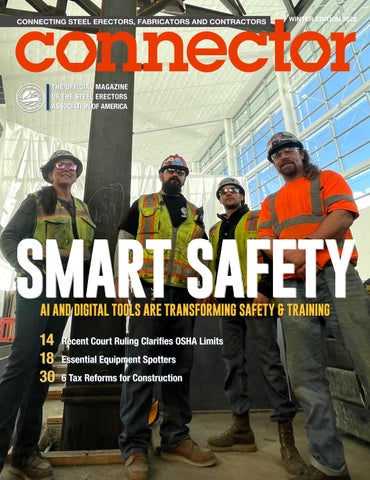
SMART SAFETY AI AND DIGITAL TOOLS ARE TRANSFORMING SAFETY & TRAINING
14 Recent Court Ruling Clarifies OSHA Limits 18 Essential Equipment Spotters 30 6 Tax Reforms for Construction
Gain Insight and Control into Every Stage Gain Insight and Control into Every Stage Gain Insight and Control into Every Stage of your Steel Fabrication Production of your Steel Fabrication Production of your Steel Fabrication Production
Built for Structural Steel Fabricators Built for Structural Steel Fabricators Built for Structural Steel Fabricators
SpaceX Death Star SpaceX Death Star SpaceX Death Star
Acme Data Center Acme Data Center Acme Data Center Yahoo Stadium Yahoo Stadium AI Towers
Yahoo Stadium
AI Towers AI Towers
Full Production Control AISC Compliance Full Production Control AISC Compliance Align Stations Workflows Control CustomizeAISC Controls to meet your Fulland Production Compliance Align Stations and Workflows with Configurable Alerts and Align Stations and Workflows with Configurable Alerts and Rules for Smooth Enforcement. withfor Configurable Alerts and Rules Smooth Enforcement. Rules for Smooth Enforcement.
Customize toand meet your Quality ControlControls Program Customize Controls toand meet your Quality Control Program Maintain AISC Standards. QualityAISC Control Program and Maintain Standards. Maintain AISC Standards.
Sync Production, and Delivery Data in RealLoading, Time Sync Production, Loading, and Delivery Data in Real Time with full Tekla Integration. Delivery Data in Real Time with full Tekla Integration. with full Tekla Integration.
Monitor Job Time Progress and Issues Quality Metrics in Real to Spot Monitor Job Time Progress andIssues Quality Metrics in Real to Spot Early and Take Action. Metrics in Real Time to Spot Issues Early and Take Action. Early and Take Action.
Tekla PowerFab Tekla PowerFab Sync Production, and TeklaLoading, PowerFab
Real-time Analytics Real-time Analytics Real-time Analytics Monitor Job Progress and Quality
Trusted Tools with Tangible Results Trusted Tools with Tangible Results Trusted Tools with Tangible Results “We transitioned from an outdated “We transitioned from an outdated steel“We tracking systemfrom that an lacked realtransitioned outdated steel tracking system that lacked realtimesteel product visibility and had a tracking system that lacked realtime product visibility and had a complicated user visibility interfaceand to ahad a time product complicated user interface to a modern, user-friendly application complicated user interface to that a that modern, user-friendly application gives us insights into our production modern, user-friendly application gives us insights into our productionthat process.” gives us insights into our production process.” process.” - Cobb Industrial, Inc. - Cobb Industrial, Inc. - Cobb Industrial, Inc.
Steel Tracking is Evolving Steel Tracking is Evolving Steel Tracking is Evolving
Configurable Labels Configurable Labels Supports Paper-based and Labels Configurable
Supportswith Paper-based and KettleTags Ability to Choose Supports Paper-based and to Choose theKettleTags Fields you with wantAbility to Display. to Choose theKettleTags Fields you with wantAbility to Display. the Fields you want to Display.
Inventory Management Inventory Management Inventory Management Maintain Inventory Accuracy with Maintain Inventory Streamlined Receiving,Accuracy with Maintain Inventory Accuracy with Streamlined Movement, andReceiving, Inventory Audits. Streamlined Movement, andReceiving, Inventory Audits. Movement, and Inventory Audits.
Learn More Learn More Learn More www.steelcoded.com
www.steelcoded.com connect@steelcoded.com connect@steelcoded.com www.steelcoded.com connect@steelcoded.com
MPSPECIALTY.COM MPSPECIALTY.COM MPSPECIALTY.COM
IF YOU LIFT, ERECT, IF YOU LIFT, ERECT, IF YOU LIFT, ERECT, HAUL, OR RIG IT: HAUL, OR RIG IT: HAUL, OR RIG IT: WE INSURE IT. WE WE INSURE INSURE IT. IT.
M&P Specialty Insurance provides M&P Specialty Insurance provides insurance and risk management M&P Specialty Insurance provides insurance and risk management services for heavy and moving insurance and risk lifting management services for heavy lifting and moving industries. services for heavy lifting and moving industries. industries.
INDUSTRY INDUSTRY INDUSTRY SPECIALTIES: SPECIALTIES: SPECIALTIES: STEEL ERECTORS STEEL ERECTORS ERECTORS STEEL ERECTORS HEAVY HAULERS HEAVY HEAV Y HAULERS HEAVY HAULERS CRANE RENTAL CRANE CR ANE RENTAL CRANE RENTAL RIGGING RIGGING RIGGING FABRICATORS FABRICATORS FABRICATORS FABRICATORS STRUCTUAL MOVERS STRUCTUAL MOVERS STRUCTURAL MOVERS STRUCTUAL MOVERS
THE M&P DIFFERENCE THE M&P THE M&P DIFFERENCE DIFFERENCE Licensed nationwide, M&P Specialty Insurance offers comprehensive coverage,
Licensed nationwide, M&P Specialty Insurance offers comprehensive coverage, excellent service, competitive premiums. Underwritten by A+ rated Licensed customer nationwide, M&P and Specialty Insurance offers comprehensive coverage, excellent customer service, and competitive premiums. Underwritten by A+ rated carriers, customer our team service, emphasizes importance of alignment betweenbyinsurance excellent and the competitive premiums. Underwritten A+ rated carriers, our team emphasizes the importance of alignment between insurance products, contractual detail, and risk management practices. carriers, our team emphasizes the importance of alignment between insurance products, contractual detail, and risk management practices. products, contractual detail, and risk management practices.
CONTACT JASON MCELRATH TODAY CONTACT JASON MCELRATH 1179 Sunset Blvd. West Columbia, SC 29169 | 803 -936-1601TODAY | Jason@MPSpecialty.com CONTACT JASON MCELRATH 1179 Sunset Blvd. West Columbia, SC 29169 | 803 -936-1601TODAY | Jason@MPSpecialty.com 1179 Sunset Blvd. West Columbia, SC 29169 | 803 -936-1601 | Jason@MPSpecialty.com
Winter Edition October 2025
•
c ntents FEATURES 14
Management Per-Employee Citations and OSHA’s Expanded Instance-by-Instance Policy What Steel Erectors Need to Know About Clarifie By Mark Ishu
18
In the Field Spotting the Risks Trained equipment spotters are essential to accident prevention and intervention.
22 Cover Story Smart Safety Safety and Training Excellence Award Winners discuss how AI and digital tools are transforming jobsites. By Tracy Bennett On the Cover: Derr & Gruenewald Construction, which has received Craft Training and Safety Excellence Awards every year since the program’s inception, sets their people up for success. Above: At High Plains Steel Services, JSA meetings are conversations that reinforce that connection between team leaders and field crews.
ONLINE HIGHLIGHTS ■ New Category for Safety Awards. Deadline January 31
By Macie Murie
28
Special Focus Driving Support for Training and Education The 2025 Dave Schulz Memorial Golf Tournament generated almost $23,000 which helps fund the association’s safety and education initiatives. By Macie Murie
DEPARTMENTS 8 Perspective
■ NCCER Releases Simplified Crane Operator Certification
10 Association News
■ SEAA Members Named on ENR’s Top 20 Steel Construction Firms
12 Product Focus
■ Closing the Gaps in Pre-Lift Planning
30 Business Operations
Check out our feeds.
latest social media
36 Topping Out
seaa.net The Steel Erectors Association of America (SEAA) is dedicated to advancing the common interests and needs of all engaged in building with steel. The Association’s objectives in achieving this goal include the promotion of safety, education and training programs for steel erector trades, development and promotion of standards and cooperation with others in activities which impact the commercial construction business.
4 | THE STEEL ERECTORS ASSOCIATION OF AMERICA
THE OFFICIAL MAGAZINE OF THE STEEL ERECTORS ASSOCIATION OF AMERICA SEAA is the only national trade association representing the interests of steel erectors, fabricators, and related service providers. Connector reaches both small and large contractors working in union and open labor markets.
Steel Erectors Association of America 353 Jonestown Rd, Suite 207 Winston-Salem, NC 27104 336-294-8880 www.seaa.net OFFICERS & EXECUTIVE STAFF Jack Nix, President Chris Legnon, President Elect Glen Pisani, Industry Member Vice President Carrie Gulajan, Associate Member Vice President Bryan McClure, Secretary Jason McElrath, Treasurer R. Pete Gum, Executive Directorr PUBLISHING PARTNER Chris Harrison, Publisher chris.harrison@seaa.net Phone 660-287-7660 Tracy Bennett, Managing Editor editor@seaa.net Phone 816-536-7903 Macie Murie, Assistant Editor macie@mightymomedia.com Jud Kite, Art Director jud5483@gmail.com ADVISORY COMMITTEE Chris Legnon, Chairman, Cooper Steel Nick Caratelli, Vice Chairman, Nelson Stud Welding Terri Bailey, FieldForce Solutions Nathan Block, SDS2 by Allplan Tammy Dean, Gardner-Watson Decking John Hughes, Industrial Training International Tyler Jones, Cumberland Steel Co. Geoff Kress, Gardner-Watson Decking Jerry Morganelli, MAS Building & Bridge Jackson Nix, Shelby Erectors Jim Simonson, Steel Service Katy Williams, Williams Industries Connector™ is published quarterly by the Steel Erectors Association of America 4948 Martin View Ln, Suite 207 Winston-Salem, NC 27104 Copyright 2025 by the Steel Erectors Association of America. No material may be reprinted without permission from the Executive Director. While the information and recommendations contained in this publication have been compiled from sources believed to be reliable, the Steel Erectors Association of America, its affiliates, employees, contributors, writers, editors, designers, photographers, and media advisory committee, makes no guarantee as to, and assumes no responsibility for, the correctness, sufficiency or completeness of such information or recommendations and cannot be held responsible for the outcome of any action or decision based on the information contained in this publication or claims made by advertisers. No part of this publication may be reproduced in any form without prior written permission of the Publisher. Permission is only deemed valid if approval is in writing.
6 | THE STEEL ERECTORS ASSOCIATION OF AMERICA
PERSPECTIVE By Jack Nix
Introducing Modern Erector Certification: SEAA’s New Benchmark for Excellence
F
or more than half a century, the Steel Erectors Association of America has stood shoulder-to-shoulder with the hardworking men and women who build our nation. We have celebrated their skills, advanced their training, strengthened their safety, and pushed our industry forward in ways that matter. Today, that tradition continues with one of the most exciting initiatives SEAA has ever undertaken—the Modern Erector Certification. This initiative represents the collective effort of SEAA’s Strategic Planning Committee, under the leadership of Committee Chair Glen Pisani, who has guided the development of the Modern Erector Certification from concept to reality. In raising the bar for our industry, their commitment was to building a program worthy of the companies it will honor. Representing structural steel, reinforcing steel, and metal decking disciplines, the Modern Erector Certification exists to define, recognize, and celebrate the very best in our industry. Not just the companies that perform exceptional work, but those that cultivate exceptional people, systems, and cultures—the organizations that truly embody what it means to be a modern erector. While full program details will be unveiled over the course of the first quarter of 2026, we are now ready to give the SEAA membership its first look.
Why the Modern Erector Certification Matters Our industry continues to evolve at an unprecedented pace. Today’s top erectors are educators, innovators, planners, mentors, and ambassadors of safety. They manage digital workflows, build strong leadership pipelines, invest in the wellbeing of their teams, and uphold quality standards that define the future of construction. Jack Nix is President of SEAA and Chief Operations Office for Shelby Erectors. 8 | THE STEEL ERECTORS ASSOCIATION OF AMERICA
The Modern Erector Certification was built to recognize these companies—the ones doing the hard work behind the scenes to build not only projects, but long-term excellence. This is not a popularity award or a marketing emblem. It is a rigorous, evidence-based certification developed to reflect the values our association stands for—safety, quality, workforce development, operational excellence, and a deep commitment to the craft. For SEAA, this program marks an important step forward. It provides clarity on what excellence looks like in the next decade and establishes a standard that pushes our entire industry to grow.
Modern Erector Certification exists to recognize organizations that cultivate exceptional people, systems, and cultures. What It Means to Be a Modern Erector The certification evaluates companies across several major categories representing the complete picture of today’s steel, reinforcing, and decking operations. Companies will be assessed in areas such as: • Business Operations • Culture & Employee Engagement • Employee Experience & Benefits • Safety & Risk Management • Training & Workforce Development • Quality & Technical Excellence
These categories highlight the reality of modern construction leadership. True excellence requires more than jobsite performance; it demands thoughtful planning, comprehensive safety systems, strong training programs, meaningful employee engagement, and documented quality processes. The certification is intentionally challenging. It rewards companies that demonstrate proven systems, documented processes, and intentional focus on culture. This is not a surface-level box checking exercise. It is a distinction that must be earned, and when achieved, will represent one of the highest honors available in our industry.
Elevating the Entire Industry Beyond recognizing high performers, the Modern Erector Certification provides value to every SEAA member. Whether a company earns the certification now or sets it as a future goal, the program serves as a roadmap for strengthening operations, improving safety results, developing talent, and building resilient, future-focused organizations. Companies who earn the designation will be recognized by SEAA through a variety of platforms, including public announcements,
media features, special events, and digital tools to promote their achievement. These certified companies will help define and lead the next evolution of our craft.
More Is Coming Soon In the weeks ahead, SEAA will release full details of the Modern Erector Certification, including eligibility information, the application process, and program timelines. We want every member—from small reinforcing firms to national structural steel contractors—to have the opportunity to participate and benefit. This is a defining moment for SEAA and for the entire steel erection, reinforcing, and metal decking community. With deep appreciation for the dedication of Glen Pisani and the Strategic Planning Committee, I am proud to share the beginning of this next chapter. The Modern Erector Certification is our opportunity to recognize the best of the best. To honor the companies that don’t just claim excellence. They prove it. This sets the tone for the future of our industry. Stay tuned. The next era of recognition for our trade is about to begin.
•
SEAA Members Only. A System Built for Steel Erectors. Now FREE for two months on your jobsite. Why wait to see how AI-powered insights can change your projects? With this Member to Member offer, you’ll get:
✔ A Versatile device shipped to your jobsite ✔ Unlimited user access ✔ Daily jobsite data + full team support
Scan the QR and Learn more! Versatile.ai/SEAA
Track progress. Catch delays early. Defend backcharges. All with zero extra work from your crew.
Connector | WINTER EDITION December 2025 | 9
ASSOCIATION NEWS ■ Convention Registration is Now Open
EVENTS & ACTIVITIES Steel Connections California January 29, 2026 Embassy Suites, Monterey Bay Seaside Seaside, California • Board Meeting • Peer Group • Meet & Greet GMF Steel Group Career Fair February 27, 2026 Lakeland, Florida CONEXPO CON/AGG March 3-7, 2026 Las Vegas, Nevada NASCC: The Steel Conference April 22-24, 2026 Atlanta, Georgia 2026 Convention & Trade Show May 5-8, 2026 Kansas City, Missouri
■ Stand Out in the 2026 Membership Directory The Spring issue of Connector doubles as SEAA’s annual Membership Directory, a year-round resource for erectors, fabricators, suppliers, and industry partners. Only active member companies are included, and placement is based on the annual revenue category submitted during membership renewal. Upgrade
10 | THE STEEL ERECTORS ASSOCIATION OF AMERICA
your listing by adding a company logo for $250. If your membership is pending, now is the time to confirm status to ensure proper listing. Contact Director of Membership & Business Development William Hutabarat at william@seaa.net to renew.
■ Recognizing Excellence in Safety & Training Submissions for the Safety & Craft Training Excellence Awards are due January 31, 2026. Fabricator Safety category joins the Erector Craft Training and Erector Safety categories this year. Awards are points-based and evaluated in blind review by the Safety & Education Committee. Recognition levels include Gold, Premier, and World Class. World Class Craft Training winners are eligible for a $1,500 Craft Training Grant.
SEAA’s Convention & Trade Show, May 5–8, 2026 in Kansas City, Missouri, is an opportunity to connect with peers and industry leaders. The event brings together steel erection, fabrication, reinforcing ironwork, and decking contractors to learn about industry issues, new products, and networking. “The Convention & Trade Show is where our members get the chance to learn from each other and reconnect,” said Carrie Gualajan, Chair of SEAA’s Events Committee. “With Kansas City's location right in the middle of the country, we expect to draw strong attendance from both the east and the west. From its jazz roots and award winning BBQ to being the home of Hallmark cards--Kansas City has lots to offer visitors.” The agenda features new education formats, popular networking traditions, and expanded accessibility through virtual education sessions. Tuesday opens with two member favorites. The George R. Pocock Memorial Golf Tournament and a Pickleball Tournament at Chicken N Pickle. Both excursions provide fun competition and ample time for informal networking. On Wednesday, education starts with a focus on strategic advancement. The sessions will cover AI adoption from bid day through project completion, and provide data-backed approaches to workforce development for recruitment and retention. Breakout sessions deliver fast-paced engagement on topics like Mass Timber Momentum and The Employee Benefits Game Show, offering a new way to learn about technical and HR-related content. The keynote speaker will be Jim “The Rookie” Morris, whose remarkable career shift from high school science teacher to Major League Baseball pitcher was immortalized in the Disney film The Rookie. Morris will speak on mentorship, leadership, and the impact of surrounding yourself with people who elevate your potential. Thursday centers on real-world lessons with the Project of the Year panel, where contractors share insights from recent steel and rebar projects. Additional sessions cover Cyber Security and Safety & Training best practices. The 50/50 split Boom Lift Ball Drop, sponsored by United Rentals, promises big payout for one lucky winner, and the President’s Dinner will recognize our industry’s best during awards presentations. The week ends with small-group peer discussions centered on mentorship, employee retention, and company culture. These discussions provide an opportunity to share experiences and practical solutions with industry peers. Attendees will also be the first to hear about a major new membership initiative launching during Convention. Designed to serve as a benchmark of industry excellence, this program will introduce a new way to recognize high-performing contractors. “SEAA is built on collaboration,” said Pete Gum, Executive Director of SEAA. “When contractors, suppliers, and training professionals have the chance to come together, share what works, and support each other, the whole industry benefits. This event is about making that possible in a real, meaningful way.” Early bird registration is available through February 21, 2026. Hotel reservations at the Sheraton Crown Center must be made by April 13 to receive the group rate. Golf and pickleball registration deadline is April 15.
•
Connector | WINTER EDITION December 2025 | 11
PRODUCT FOCUS
■ LR Willson & Sons Sets National Christmas Tree SEAA member LR Willson & Sons was tasked with setting the National Christmas Tree in Washington, D.C., using one of its Link-Belt HTC 86100 truck cranes. The annual tree placement is a special holiday tradition dating back to 1923, and being selected for the lift speaks to the company’s reputation for reliability and precision. Led by Bo Willson, the crew carried out the lift at the Ellipse in full view of the national landmarks.
■ Type II Helmet Certified Under
CSA and ANSI Standards
STUDSON has announced the SHK-1 Full Brim safety helmet is the first Type II model to achieve dual certification under both CSA Z94.1-15 (R2024) and ANSI/ISEA Z89.1-2014 (R2019). The dual-certified model aims to simplify PPE selection, eliminating the need to source country-specific helmets. The helmet is compatible with STUDSON accessories like welding shields, mesh visors, headlamps, and hearing protection. It also integrates Twiceme technology, which allows emergency responders to access critical medical and contact information stored directly in the helmet and enables safety teams to digitally track helmet assignments and worker certification status.
12 | THE STEEL ERECTORS ASSOCIATION OF AMERICA
■ New Hiring Platform Perk
Available to SEAA Members
A new member benefit is now available to help contractors improve hiring efficiency and reduce turnover. Discovered AI is offering members exclusive access to its hiring platform, including a free Essentials Plan account and 10% off all upgrade options. The platform provides applicant tracking, AI-powered assessments, automated scheduling, workflow tools, and candidate sourcing across major job boards. Users can also access DISC and skills testing, one-way video interviews, and background check integration. Find more details on our Member to Member Discounts page.
■ New Welding Technologies Target Fabricator Productivity Lincoln Electric has introduced welding and automation solutions focused on improving productivity and process consistency for fabrication shops and structural steel producers. Launches include the LT-10D Submerged Arc Welding Tractor, designed to enhance seam tracking and reduce setup time on beam and column welding. The ArcAdjust real-time adjustment system allows operators to modify parameters during welding to limit rework. Updated Flextec power sources support multi-process applications, while a new CQI-15 compliant robotic welding cell advances fabrication quality and documentation..
■ SDS2 Introduces Platform
Enhancements for 2026
SDS2 announced updates to its platform for 2026 aimed at improving connection accuracy, drawing management, and material modeling for fabrication and detailing teams. The redesigned drawing editor now supports bulk revision updates and faster navigation to reduce time spent on final review. A new smart grouping function allows similar connections to be identified and approved together to help limit discrepancies between detailing, shop fabrication, and field erection. The update also adds support for custom profiles in non-steel materials such as aluminum, stainless steel, and FRP, reflecting growing use of mixed systems in specialized fabrication workflows.
■ Rapid-Install Lifting Point
Streamlines Changeouts for Fabricators
A new screw-in lifting point from pewag, the PLZW-R rapid, is designed to speed up changeouts during rigging and equipment handling tasks. Its tool-free click mechanism eliminates the need for wrenches or torque tools, allowing users to install or remove the point quickly by hand. With working load limits of 0.4 to 1.1 metric tons (for M10, M12, and M16 thread sizes), the PLZW-R rapid is best suited for light component handling, shop fabrication environments, or smaller modular lifts rather than primary structural picks. Each unit carries a serial number for traceability, aiding inspection documentation and inventory tracking.
•
Connector | WINTER EDITION December 2025 | 13
MANAGEMENT By Mark Ishu
Per-Employee Citations and OSHA’s Expanded Instance-by-Instance Policy What Steel Erectors Need to Know About Clarified Limits
W
hen OSHA updated its Instance-by-Instance (IBI) enforcement policy in early 2023, many in the construction industry took notice. The change gave the agency greater power to issue separate citations — and separate penalties — for each worker or each instance of a similar hazard. For steel-erection contractors, that meant a single jobsite could suddenly generate dozens of “per-employee” fall-protection citations, quickly multiplying penalty exposure and risk. But a recent decision by an Administrative Law Judge (ALJ) of the Occupational Safety and Health Review Commission (OSHRC) has drawn new boundaries around how far OSHA can go. The decision confirms that while OSHA may seek to deter hazards through aggressive enforcement, its policies must still provide clear notice and stay within the limits of the law. Mark Ishu, Senior Counsel, Conn Maciel Carey LLP, represents employers nationwide in OSHA inspections, enforcement actions, and whistleblower investigations, with a focus on construction and high-hazard industries.
14 | THE STEEL ERECTORS ASSOCIATION OF AMERICA
For steel-erection employers who are among the most frequently cited for fall protection under 29 C.F.R. § 1926.501, this case offers important lessons about recognizing, managing, and challenging potential per-employee or per-instance citations.
Evolution of OSHA’s Per-Instance Policy OSHA’s Instance-by-Instance enforcement authority dates back to 1990, when the agency first introduced the concept for “egregious” cases. These were situations involving willful, repeated, or exceptionally serious violations showing indifference to employee safety. For decades, that policy was reserved for the most severe, willful conduct, typically in fatality investigations or cases demonstrating a pattern of neglect. That changed in January 2023, when OSHA under the Biden Administration issued Directive CPL 02-00-169, updating its long-standing IBI policy. Under the 2023 directive, OSHA expanded IBI enforcement beyond traditionally egregious (willful) cases to include certain high-gravity serious violations. For the first time, the agency could apply per-instance treatment to serious hazards involving falls, trenching, machine guarding,
Steel Erection Solutions
Maximize uptime with welding equipment rentals
12%
Discover Our Impact
Red-D-Arc provides steel erection companies with a wide range of welding and welding-related equipment, ensuring they have the tools necessary to work efficiently and produce quality results. Equipment rental and lease options offered by Red-D-Arc enable steel erectors to access specialized welding equipment without the need for large upfront investments, streamlining operations and increasing productivity.
WELDING
HEATING
POWER GENERATORS
A broad range of equipment in any process for application, using advanced or traditional welding techniques. Our portable machines are built for tough welding situations, backed by our industry expertise.
Pre & post-weld efficient heat treating equipment for any application including steel erection, bridge building and other unique infrastructure work.
Experience dependable, uninterrupted power supply with generators and portable power distribution panels. Accompanied by our portfolio of creative power solutions.
1-866-733-3272 | reddarc.com
respiratory protection, lockout/tagout, confined spaces, and selected recordkeeping provisions. The goal, OSHA explained, was to “encourage greater deterrence” by allowing multiple citations for each employee exposure or each day a condition existed. That limitation became central in a case before the Review Commission, where an ALJ held that the 2023 Instance-by-Instance policy did not authorize per-instance repeat citations. By the time the ALJ issued his decision, OSHA had already revised the directive in 2024 to expressly include Repeat and Willful violations. The judge, however, found that the revised policy did not apply because the inspection and citations occurred when the 2023 version was still in effect. He also noted that OSHA’s 2024 revision effectively confirmed that the earlier directive lacked authority for per-instance repeat citations.
A Message About Fair Notice While OSHA has the authority and obligation to enforce safety standards, it must do so within clear, published guidance. The ALJ’s decision reaffirms a basic principle of administrative law: employers are entitled to fair notice of what conduct may trigger enhanced enforcement or penalties. For steel-erection employers, that principle can be the difference between a manageable case and one that threatens a company’s viability. It means that policies like the IBI directive cannot retroactively expand liability or reinterpret existing rules without first giving employers explicit notice and an opportunity to comply. As OSHA continues to emphasize fall protection and other high-gravity construction hazards, contractors should expect per-employee enforcement to remain a priority. However, they should also know that the law still draws boundaries, and that those boundaries can be successfully defended when OSHA pushes beyond them.
A Recent OSHRC Ruling Draws the Line Earlier this year, a federal Administrative Law Judge issued a decision limiting OSHA’s authority to apply its expanded per-instance policy. The case arose from a construction project where OSHA issued more than a dozen alleged violations and used the 2023 IBI policy to treat each day and location as a separate “repeat” offense, which pushed proposed penalties into the seven-figure range. The employer challenged OSHA’s interpretation, and the ALJ agreed in large part, holding that the agency’s 2023 policy did not authorize per-instance repeat citations at the time of the inspection. The ruling reduced the total penalty by over $1 million and offered important clarification for all employers.
16 | THE STEEL ERECTORS ASSOCIATION OF AMERICA
Per-instance authority must be expressly stated. The 2023 policy’s scope — limited to serious violations — gave no notice that repeat violations could be cited per instance. OSHA’s 2024 revision, which expressly added repeat and willful classifications, effectively conceded that gap. Under the current directive, OSHA has authority to pursue per-instance repeat or willful citations, but that authority applies only to inspections conducted while the 2024 policy is in effect and only where the cited standard creates discrete, individualized duties. Whether a per-instance approach is proper ultimately depends on the language of the standard itself. The language of each standard controls. Per-instance citation is proper only where the regulatory text imposes discrete, individualized obligations. For example, OSHA may cite separate violations when a rule requires an employer to ensure each employee performs or receives a specific action, but not when the rule creates one collective duty for a site or system. PPE standards are not automatically per-instance. The ALJ vacated OSHA’s per-instance citations under the hard-hat standard (§ 1926.100(a)), finding that the 2023 IBI policy identified only respiratory protection as a PPE rule eligible for per-instance treatment and did not extend that approach to other PPE requirements. In sum, the decision reaffirmed that OSHA must operate within the four corners of its published enforcement policies — a significant reminder that even high-profile initiatives cannot exceed their stated scope.
Distinct Characterizations Require Distinct Notice One of the most consequential aspects of the ruling concerns how OSHA classifies violations. The ALJ agreed that Repeat is a stand-alone characterization under the OSH Act — not merely a subtype of Serious, even though OSHA now frequently labels citations “Repeat-Serious” or “Willful-Serious.” Each characterization — Serious, Repeat, and Willful — carries distinct elements and proof burdens, and interpretations that apply to one cannot automatically extend to another. Thus, when OSHA’s 2023 per-instance policy referred only to serious violations, it provided no notice that the same approach would extend to repeat violations. The ALJ noted that OSHA’s 2024 amendment, which expressly added repeat citations, effectively confirmed that limitation. That distinction underscores a larger point: when OSHA expands enforcement policies that affect penalty magnitude or legal classification, it must do so transparently and prospectively — not through inference or after-the-fact interpretation.
Practical Lessons for Steel Erectors The ruling offers several takeaways for contractors facing potential per-instance citations.
1. Scrutinize the Standard Cited The text of the cited standard determines whether OSHA may lawfully issue a per-instance citation and what counts as a separate violation. Standards that impose an individualized duty — a
requirement that applies to each employee, such as ensuring each connector uses personal fall protection (§ 1926.760(d)) or each worker receives specific training (§ 1926.503) — can support per-instance enforcement if covered under OSHA’s current directive. By contrast, rules that create a single, site-wide obligation, such as installing guardrails or maintaining fall-protection systems (§ 1926.501(b)(1)), typically allow only one violation per location. Because the hard-hat rule (§ 1926.100(a)) was not among the standards listed in OSHA’s 2023 policy, the ALJ vacated those per-instance items altogether.
2. Understand the Unit of Prosecution Even when per-instance treatment is permissible, the “unit of violation” depends on what the standard protects and how the duty is framed. The ALJ emphasized that the language of the standard identifies the proper unit of prosecution. For fall-protection standards, that distinction can be critical: a rule requiring the employer to ensure each employee is tied off may justify per-employee citations, while a rule requiring an employer to install or maintain fall-protection systems creates a single duty tied to the work area, not each worker. Understanding that difference can determine whether OSHA’s case involves one item or a dozen.
3. Recognize Distinct Classifications The court clarified that “Repeat,” “Serious,” and “Willful” are separate characterizations, each with unique elements and notice requirements. OSHA’s attempt to label citations as
“Repeat-Willful-Serious” was rejected, confirming that combining characterizations without distinct proof undermines fair notice.
4. Expect OSHA’s Policy Response After the litigation exposed that gap, OSHA revised CPL 02-00169 in 2024 to expressly include Repeat and Willful violations. That change implicitly acknowledged that the earlier 2023 version did not authorize per-instance treatment of those categories. Going forward, employers should expect OSHA to rely solely on the current directive, but only for inspections conducted while that policy is in effect.
5. Emphasize Fair Notice Finally, the case underscores that policy expansions affecting penalty magnitude or classification must be transparent and prospective. Employers are entitled to clear notice before the agency enlarges the reach of per-instance enforcement. OSHA’s expanding use of per-instance citations represents one of the most significant enforcement shifts in recent years. For steel erectors, understanding the limits of that policy and the lessons from the recent OSHRC decision is essential. The takeaway is straightforward: OSHA can cite aggressively, but it must do so within the law. Employers who maintain strong safety programs, document compliance efforts, and challenge overbroad citation strategies can protect both their workforce and their business.
•
Connector | WINTER EDITION December 2025 | 17
IN THE FIELD By Macie Murie
A trained spotter, positioned on the ground with a clear view, can assist MEWP operators in avoiding obstructions.
Spotting the Risks Trained Equipment Spotters are Essential to Accident Prevention and Intervention
J
obsites are crowded with moving equipment, blind spots, and constantly changing conditions. Combine that with working in tight spaces, and the equipment spotter quickly becomes a critical safety control. The role of a spotter is not only to react to hazards but to anticipate and prevent them by walking equipment travel paths, scanning the work area, and guiding operators before problems arise. Recently, a SEAA member reported a serious incident involving a 60 ft. boom lift. An operator working alone extended into the third level of a building to level and weld steel tubes. As he maneuvered the boom, the bottom of the basket became lodged against a tube. After several attempts, the basket broke Macie Murie is Assistant Editor of Connector magazine and Associate Client Manager for Mighty Mo Media Partners, where she develops technical and educational content focused on safety, workforce development, and industry best practices.
loose and the stored torque in the boom caused the platform to catapult upward nearly eight feet, resulting in an injury. This type of incident underscores precisely why spotters are so critical. A trained spotter, positioned on the ground with a clear view, would likely have recognized the obstruction and helped guide the operator around it preventing the incident from occurring. According to a recent report from International Powered Access Federation (IPAF), there has been a 75% increase in reported MEWP entrapment incidents and a 62% rise in related fatalities from 2023 to 2024. More than 70% of the incidents occurred in construction environments. These incidents are frequently tied to operators inadvertently touching controls, poor visibility at height, or maneuvering too close to overhead structures. All of these are conditions a trained spotter can recognize. The Center for Construction Research and Training (CPWR) further reinforces this point by noting that workers on foot are often
18 | THE STEEL ERECTORS ASSOCIATION OF AMERICA
struck or crushed when heavy equipment operators lose sight of them, especially during backing maneuvers or when moving loads.
Establishing Jobsite Standards While OSHA does not require a spotter in every situation, it does recommend their use with forklifts, boom lifts, and scissor lifts, especially in congested areas or where visibility is limited. Spotters are also required any time an operator’s rear view is obstructed or when working near power lines. Spotters must be trained to recognize hazards, understand equipment capabilities, and communicate clearly with operators. Spotters and operators should agree on hand signals for commands such as stop, forward or reverse, turn, and raise or lower a load. In situations where visual contact is challenging or impossible (such as noisy environments or over long distances) twoway radios become crucial for effective communication.
SAFE. PRECISE. ON TIME. FL CGC1514810
Estimating: Geoff Kress: 727.463.3074 Jason Kulvinskas: 727.463.3078 Patrick Forrest: Patrick.f@gwdeck.com www.gwdeck.com Connector | WINTER EDITION December 2025 | 19 World Class Safety Award Winner 2022-2025
Spotting Done Right In order to be effective, spotting should start before any equipment begins moving. A spotter should walk the intended path with the operator, clearing obstacles, identifying hazards, and confirming the plan. This upfront coordination reinforces the spotter’s role in anticipating risks rather than reacting to them. Once operations begin, safe movement and positioning are essential. An effective
spotter should have a general understanding of the equipment’s limitations in order to communicate quickly and effectively if the load becomes unbalanced and is at risk of tipping or slipping. Spotters should avoid walking backward whenever possible and remain alert to both their own path and the path of the equipment. They must position themselves outside travel zones but where the operator can clearly see them.
OSHA recommends spotters with forklifts, boom lifts, and scissor lifts, especially in congested areas or where visibility is limited.
XTREME COBALT Annular Cutters
™
Premium M42 & IronEdge Coated ™
Structural, AR, Stainless... No Problem!
800-426-7818 SERVICE • INTEGRITY • RELIABILITY HOUGEN.COM Hou-766 Xtreme Cobalt SEAA Ad.indd 1
20 | THE STEEL ERECTORS ASSOCIATION OF AMERICA
10/22/25 2:58 PM
Maintaining visibility and clear communication is critical, and spotters must keep continuous eye contact with the operator and use established hand signals for commands such as stop, turn, or move forward or reverse. Spotters must also be attentive to the operator’s blind spots and scan constantly for people, moving equipment, and ground hazards. High-visibility clothing should be worn at all times, and in busy areas, using a distinct vest color can help others quickly identify the spotter. When feasible, working from the operator’s side provides the best view of backing movements and surrounding activity. If there is ever uncertainty or confusion, operations should stop immediately until communication is reestablished and the next step confirmed. Fatigue affects performance as well and some have found that limiting spotter shifts to roughly four hours and rotating responsibilities helps maintain alertness. During spotting, distractions such as phones, headphones, or additional job site responsibilities have been avoided to preserve focus. When working in congested spaces or surrounded by trade and pedestrian traffic, it may be appropriate to assign a second spotter to ensure full situational awareness. According to a guidance document from the Construction Industry Plant Safety Group, spotters should also be incorporated into emergency planning and not only be relied on for observation and communication. Rescue procedures should be practiced before work begins to make sure the designated spotter is familiar with emergency descent and ground-level controls of the specific equipment in use. This preparation allows the spotter to assist with recovery if an operator becomes entrapped and cannot self-rescue. In these scenarios an operator might not be able to signal distress and incidents can go unnoticed from the ground. Immediate recognition is essential and, in those cases, every second counts. Ultimately, the role of a spotter is often overlooked compared to the visible work of climbing steel, connecting, and bolting, yet it carries just as much weight in determining whether a shift ends safely. Building a culture where spotting is valued, supported, and taken seriously is what separates reactive safety programs from proactive ones. When crews recognize the spotter as a partner in production and protection, everyone on site benefits.
•
SAFE. PRECISE. ON TIME.
Duke Perry, VP of Sales/Operations 404.808.0504 Duke.p@gwstuds.com www.gwstuds.com Connector | WINTER EDITION December 2025 | 21
World Class Safety Award Winner 2022-2025
COVER STORY By Tracy Bennett
SMART SAFETY LEADERS SHARE HOW AI AND DIGITAL TOOLS ARE TRANSFORMING
STEEL ERECTION SAFETY AND TRAINING
A
t the 2025 SEAA Convention, the safety and training conversation wasn’t about compliance checklists—it was about change. From artificial intelligence to digital inspection tools, companies recognized for Safety Excellence and Training Excellence described how technology is reshaping how jobsite safety is tracked, taught, and lived. Moderating the discussion, Jason Farris, Chairman of SEAA’s Safety & Education Committee and Executive VP of Safety for Cooper Steel, noted that while technology drew the headlines, the foundation of a strong safety culture is communication and mentorship.
AI and Ironworkers Representatives from Shelby Erectors shared how AI-enabled cameras are now part of their daily routine. The portable, solar-powered units monitor jobsite activity and use machine-learning software to identify potential issues, such as fall protection, PPE, and ergonomic risks. High-severity events generate immediate alerts for supervisors, who verify accuracy and use the information to guide retraining and toolbox talks. Jason Zyla, Operations/Safety Manager for Shelby Erectors noted that early versions produced frequent false alerts, but accuracy improved rapidly as the system learned field conditions. “It’s night and day from where it started,” he said. “Now we’re getting meaningful alerts that actually help us correct behavior.” He warned the others to be careful when evaluating AI companies. “The challenge is determining what the provider’s actual capabilities are today while also selecting a company that will be flexible to work with you in applying the technology for your application. Make sure they can deliver what they promise,” he said.
Drew Shaw (left), General Foreman for MAS Building & Bridge, Inc., describes his company’s safety incentive program. Seated to his right is Austin Reiner, Safety Manager, Derr & Gruenewald Construction.
Balancing Technology and Trust
“Our teams accepted it because we use it for coaching, not punishment,” he said. Unless a serious violation is noted—which sends an alert to field supervisors to take immediate action—the information is used for training. The data shapes toolbox talks and focuses training on recurring risks. “If I’m seeing a pattern of PPE violations, I know next week’s safety meeting topic,” explained Zyla. “It helps us address reality, not assumptions.” Interestingly, many alerts highlight issues with the General Contractor’s workforce rather than Shelby Erectors’ crews. “About 70 percent of the violations we see come from other crews,” explained Jack Nix, Chief Operations Officer for Shelby Erectors. “It gives us leverage to have real conversations about shared responsibility,” he added.
Zyla expected backlash from the ironworkers with the implementation of 24/7 camera monitoring, but the pushback never came.
Rise of the Digital Safety Officer
Tracy Bennett is editor of Connector magazine and President of Mighty Mo Media Partners, a PR firm representing the construction industry.
22 | THE STEEL ERECTORS ASSOCIATION OF AMERICA
AI is only one piece of a larger digital shift. Companies reported adopting integrated platforms that combine audits, inspections,
Setting steel at roof level.
Daily conversations reinforce that connection between team leaders and field crews. At High Plains Steel Services, JSA meetings are designed to get “everyone’s heads in the game,” said Mike Hurst, Operations Manager/Erection. Award winners were recognized during SEAA’s annual President’s Dinner during convention in May 2025.
PANELISTS AND AWARD WINNERS Cooper Steel, World Class Safety Excellence • Damon Smith, SPG Project Manager Derr & Gruenewald Construction, World Class Safety & Craft Training Excellence • Austin Reiner, Safety Manager • Ed Valencia, Safety Director GMF Steel Group, World Class Safety & Craft Training Excellence • Guy Callahan, Safety Director • Hiscael Morell, Talent Development Manager High Plains Steel Services, LLC, World Class Safety Excellence • Mike Hurst, Operations Manager/Erection MAS Building & Bridge, Inc., World Class Safety Excellence • Drew Shaw, General Foreman Shelby Erectors, World Class Craft Training Excellence • Jason Zyla, Operations/Safety Manager
PREMIER SAFETY EXCELLENCE
reporting. For training, several companies use online Learning Management Systems to deliver content, and record and document scores. Crews can complete training remotely, certifications update automatically, and incident reports populate OSHA forms without duplicate entry. They digitize jobsite audits and safety observations, turning field data into trend reports that highlight leading indicators, not just lagging statistics.
• Flex-Erect • Gardner-Watson Decking • GSE • JPW Erectors • LR Willson & Sons, Inc. • Piedmont Structural Co. • S & R Enterprises
GOLD SAFETY EXCELLENCE • CWC Inc. • Shelby Erectors
Connector | WINTER EDITION December 2025 | 23
When panelists described how they’re using artificial intelligence to monitor jobsite activity, the room leaned forward. What once sounded futuristic has become practical.
From an operations standpoint, digital daily-report tools are also becoming standard. “Foremen can do pre-task analysis, attach photos, and verify compliance from their phones or tablets, ensuring management has real-time visibility across multiple sites,” said Damon Smith, SPG Project Manager, Cooper Steel. “We try to also keep up with the hours per day or per task. He advised not giving field crews too many tasks to track, but to use the daily reports in combination with feedback from the foreman to decipher project schedules. By linking these tools, safety and training departments gain instant insight across the organization. It’s all about visibility, and prioritizing resources on the things that need to be focused on that delivers the biggest impact.
Data That Drives Decisions Companies are leveraging data to identify trends, target retraining, improve planning, and even lower insurance costs. As Jack Nix put it: “If you know what’s going wrong, you can fix it. Hiding behind ignorance is just waiting for luck.”
Hiscael Morell, Talent Development Manager (right), shared how GMF Steel Group onboards new hires. The process is designed to identify strengths and gaps in skill sets in order to prescribe appropriate training. Their goal is to make sure all hires—from engineers to fire watch—have a consistent and best possible experience during onboarding. To his left is Mike Hurst, Operations Manager/Erection, High Plains Steel Services, LLC But even the best digital tools depend on engaged leadership. “If the foreman doesn’t take it seriously, the crew won’t either,” said Smith. Guy Callahan, Safety Director, GMF Steel Group agreed, emphasizing the importance of field employees knowing their voices are heard. “We do that by being visible in the field—not just safety personnel but also members of our executive team,” he said. Callahan makes his phone number available to everyone for calls or texts, and they provide a comment link on the digital tool box talks. Their Spanish-speaking employees often engage with Hiscael Morell,
24 | THE STEEL ERECTORS ASSOCIATION OF AMERICA
the company’s bilingual Talent Development Manager regarding safety issues because they feel more comfortable doing so.
The Future of Smart Safety Panelists agreed that successful implementation requires connecting digital insights to daily behavior. As AI matures, its role will shift from detection to prediction—anticipating risks before they occur. For now, it and other digital tools are already saving time, informing training, and creating accountability. Ultimately, technology can highlight risks, but culture is what fixes them.
•
EMPLOYEE OWNED
Jason Farris, Chairman of SEAA’s Safety and Education Committee and Executive VP of Safety for Cooper Steel led the panel discussion. Seated (left to right) are Mike Hurst, Hiscael Morell, Guy Callahan, and Jazon Zyla.
WHERE SAFETY CULTURE MEETS INNOVATION
E
ven as AI, digital audits, and remote training tools reshape jobsite practices, SEAA’s World Class Safety and Craft Training Excellence winners were unanimous about one thing: technology works only when culture works. Their success hinges on human-centered strategies that keep communication flowing, mentorship strong, and safety personal. Communication comes first. Safety leaders stressed the importance of being present in the field—not just safety staff, but executives and superintendents as well. Visibility builds trust, and trust makes workers more willing to speak up. Daily conversations reinforce that connection. At High Plains Steel Services, for example, JSA meetings are designed to get “everyone’s heads in the game,” said Mike Hurst, Operations Manager/Erection. Foremen are encouraged to arrive early, review the day’s tasks, and ask crews how
they plan to meet both safety goals and production goals. Psychological safety is essential. Panelists stressed that employees must feel comfortable sharing concerns without fear of blame. Multiple communication avenues helps normalize that dialogue. Onboarding and mentorship matters. “Injuries are more apt to happen in the first year of employment,” said Ed Valencia, Safety Director, Derr & Gruenewald Construction. Many companies have onboarding programs that combine digital efficiency with personal interaction. New hires complete assessments, paperwork, and safety modules through online systems, but they also meet with training staff and supervisors to understand expectations. Award-winning companies rely heavily on pairing newer workers with seasoned hands through formal apprenticeships and informal peer mentoring. Valencia
26 | THE STEEL ERECTORS ASSOCIATION OF AMERICA
emphasized the need for ongoing monitoring, adding that refresher training is essential for both apprentices and journeymen. “Whatever it is, such as hands getting pinched or cut, everyone needs retraining at some point,” he said. Recognition reinforces the right behaviors. Incentive programs reward safe performance without discouraging honest reporting. MAS Building & Bridge’s point-based program, described by General Foreman Drew Shaw, allows workers to exchange points for boots, tools, sweatshirts, or other items. Crews earn points for safe weeks, perfect safety audits, and peer nominations. Foremen are rewarded as well, and the top point earner each month receives $1,000. Other initiatives encourage peer involvement, such as leading safety sessions or participating in peer-to-peer audits, which helps to build a culture where learning, accountability, and leadership grow together.
•
SPECIAL FOCUS By Macie Murie Mattney Burgin, Brian Maxwell, Derek Schafran, and Mike Dare from United Rentals win 1st Place at this year’s tournament.
Driving Support for Training and Education
E
very Fall, SEAA members take a break from the field and trade early morning jobsite calls for an early morning tee time. Beneath the good-natured competition and friendly rivalry, the heart of the Dave Schulz Memorial Golf Tournament remains focused on what mattered most to Dave: investing in the safety and education of ironworkers. Held October 17 at the Lonnie Poole Golf Club at NC State University in Raleigh, North Carolina, the tournament brought together members, friends, and industry partners for a day of remembrance and comradery. The tournament took place on the Arnold Palmer–designed course, ranked among the nation’s top collegiate golf facilities. Following the shotgun start, teams played through 18 holes before regrouping for the awards luncheon and the Boom Lift Ball Drop. Through sponsorships and the popular Boom Lift Ball Drop 50/50, sponsored by United Rentals, the event generated almost $23,000 which helps fund the association’s safety and education initiatives. This includes the most recent development of the SteelPros Training Portal, which houses more than 80 ironworker training videos that are aligned with the modules of the NCCER-based Ironworker Level I, II and III. These videos are currently being remade in Spanish to ensure Spanish-speaking ironworkers receive the same high-quality training without language barriers. Additional funds go toward development of safety materials, including Stand-Down posters, resource guides, and projects driven by the Safety & Education Committee. Planning is already underway for the 2026 tournament, which will return to the Lonnie Poole Golf Club next October.
David Deem, Past SEAA President and President of Deem Structural Services, took home $600 from the Boom Lift Ball Drop.
•
Macie Murie is Assistant Editor of Connector magazine and Associate Client Manager for Mighty Mo Media Partners, where she develops technical and educational content focused on safety, workforce development, and industry best practices. 28 | THE STEEL ERECTORS ASSOCIATION OF AMERICA
Don “Gov” Grigg, Tekla, won Closest to the Pin on holes 6 and 17.
Chris Pecoraro of Schulz Iron Works and Cindy Schulz play a round in memory of Dave Schulz.
Second place went to Terry Wilkerson, Thomas Wilson, and Sumner Tate of United Rentals, and Travis Freeman of ASPE South.
Nick Overholt from Birmingham Fastener, Travis Cook, Ethan Blum, and Landry McRae of Steel & Pipe Corporation placed third.
Thank You
SPONSORS
Lonnie Poole Golf Club at NC State University
ASPE South Barnett Steel Erection BBSI Big B Crane Birmingham Fastener Buckner Heavylift Cranes, LLC Construction Insurance Agency, Inc. Cooper Steel Crane & Hoist Inspection Professionals Deem Structural Services Evolution Safety Resources Fieldforce Workforce Solutions Gardner-Watson Decking, Inc. Gardner-Watson Studs, LLC GWY LLC Hanes Supply Hilti
L.R. Willson & Sons Lincoln Electric Mabe Steel, Inc. MAS Building & Bridge, Inc. Mighty Mo Media Partners Miller Electric Mfg LLC MP Specialty Insurance Phoenix Steel Erectors Red-D-Arc S&R Enterprises, LLC Safran Law Offices Shelby Erectors Steel Service Corporation United Rentals Versatile Vulcraft-Nucor
Connector | WINTER EDITION December 2025 | 29
BUSINESS OPERATIONS By Matt Neely and Mark Cooter
Six Ways 2025 Tax Reform Impacts Construction
O Matt Neely
Mark Cooter
n July 4, 2025, President Trump signed P.L. 119-21, the “One Big Beautiful Bill Act,” into law, marking the most comprehensive overhaul of the U.S. tax code since the Tax Cuts and Jobs Act (TCJA). While the legislation covers a wide range of tax and economic provisions, several updates are particularly impactful for the construction industry. From expanded cost recovery and accounting method changes to the repeal of key energy efficiency incentives, these reforms reshape how construction firms, builders and engineering firms plan, invest and manage cash flow. Highlighted here are the most relevant provisions for construction businesses and how they may influence operations, project planning and long-term tax strategy.
1. Expanded Flexibility in Percentage-ofCompletion (PCM) Accounting Effective for contracts entered into in taxable years beginning after July 4, 2025, the 2025 tax reform expands the exception to the percentage-of-completion method (PCM) by replacing the term “home construction contracts” with the broader “residential construction contracts.” This change allows a wider range of residential projects, including multifamily developments like apartments, condominiums and mixed-use buildings, to qualify for more favorable accounting treatment. In addition, the legislation extends the small business contract threshold from two years to three years. This gives construction firms working on longer-duration residential projects greater flexibility in managing revenue recognition and deferring taxable income. As a result, many construction firms, particularly those building multi-family or phased residential developments, can now opt out of PCM and instead use the completed-contract method. This simplifies revenue recognition and may allow firms to defer income until project completion, which is especially beneficial for smaller construction firms or those operating on tight margins. The extended three-year threshold also accommodates longer build cycles without triggering This article is reprinted with permission from Cherry Bekaert, an advisory, assurance, and tax firm. Matt Neely is a Tax Partner based in Louisville, Kentucky, and Mark Cooter serves as Real Estate, Construction & Hospitality Industry Leader, and is based in Greenville, South Carolina. For related insights, resources, and in-depth discussion of these issues, click here
30 | THE STEEL ERECTORS ASSOCIATION OF AMERICA
more complex accounting requirements, easing administrative burdens and improving cash flow planning.
2. 100% Bonus Depreciation Made Permanent The 2025 tax reform permanently reinstates 100% bonus depreciation for qualifying property placed in service on or after January 20, 2025. This change eliminates the phasedown schedule previously set under the TCJA, which would have reduced bonus depreciation to 40% in 2025, to 20% in 2026 and 0% thereafter. However, taxpayers may still elect to apply the 40% rate. For construction firms, this means the ability to immediately deduct the full cost of qualifying assets, such as heavy equipment, vehicles and tools, placed in service on or after the effective date. This accelerates cost recovery, improves cash flow and reduces taxable income, particularly for companies investing in fleet upgrades or expanding operations. It also simplifies long-term tax planning and enhances the value of cost segregation studies when applied to owned facilities or construction-related assets.
3. Section 179 Expensing Expanded The 2025 tax reform increases the maximum Section 179 deduction to $2.5 million, with a phaseout beginning at $4 million. Starting in 2026, these thresholds will be indexed for inflation, helping ensure the deduction remains relevant as project costs rise. Section 179 allows construction businesses to immediately expense the full cost of qualifying assets, such as equipment, vehicles, software and certain building systems, rather than depreciating them over time. This change provides construction firms with a faster path to tax savings and improved cash flow, especially when managing multiple projects or investing in new tools and technology. For construction firms and specialty trades, the expanded limits offer greater flexibility in capital planning. Whether upgrading machinery, investing in project management software, or replacing outdated systems, Section 179 enables firms to recover costs more quickly and reinvest in operations without waiting years for depreciation schedules to play out.
4. New 100% Depreciation for Qualified Production Property (QPP) The 2025 tax reform introduces a new elective 100% first-year depreciation deduction for QPP, a provision
Connector | WINTER EDITION December 2025 | 31
How the 2025 R&E Tax Reform Impacts Construction Firms Investing in Innovation • Construction Firms: Firms building custom scheduling tools, estimating platforms or workflow automation systems can now deduct software development costs upfront, improving short-term tax planning and liquidity. • Design-build Firms: Companies integrating architecture, engineering and construction services may benefit from simplified compliance and faster tax recovery for investments in building information modeling (BIM), prefabrication or energy modeling innovations • Specialty Trades: Electrical, mechanical and HVAC specialists investing in energy-efficient system design or installation methods can now realize immediate tax benefits for qualifying R&E activities. • Infrastructure and Civil Specialists: Firms exploring new materials, geotechnical methods or environmental mitigation strategies can accelerate recovery of R&E investments, improving project-level ROI modeling. • Construction Technology Providers: Businesses offering construction-focused SaaS platforms or digital tools can deduct development costs in the year incurred, enhancing investor reporting and capital allocation strategies. that could significantly increase demand for the services of construction firms that design or construct industrial and manufacturing facilities. QPP is defined as nonresidential real property used by the taxpayer as an integral part of a qualified production activity such as manufacturing, refining or processing. To qualify, the property must: • Begin construction after January 19, 2025, and before January 1, 2029 • Be placed in service before the end of 2030 • Be used as an integral part of a qualified production activity. • Have its original use commence with the taxpayer and occur within the U.S. Assets acquired after January 19, 2025, may qualify (written binding contract stipulations will apply when determining in-service date). There are some exclusions to QPP treatment, including: • Real property used for offices, sales and R&D activities, administrative functions, etc. unrelated to a qualified production activity • Real property leased to others; food or beverage production tied to retail establishments (e.g., restaurants or breweries) • Assets subject to ADS depreciation treatment This provision is designed to support
domestic manufacturing and industrial reshoring by allowing businesses to fully deduct the cost of eligible facilities in the year they are placed in service. For construction firms, this is expected to drive increased demand for the design and build of production facilities, including factories, processing plants and logistics hubs. While they may not qualify for the deduction themselves, construction firms specializing in industrial and infrastructure projects may see a surge in project volume as qualifying businesses accelerate timelines to meet the eligibility window. The incentive also opens the door to longer-term engagements tied to complex, large-scale builds, offering opportunities for firms to expand their portfolios and deepen relationships with clients in the manufacturing and industrial sectors. Because the deduction is elective and subject to specific criteria, construction firms should coordinate closely with clients, tax advisors and engineering teams to ensure compliance and maximize the benefit.
5. Section 179D Energy-Efficient Deduction Terminated The 2025 tax reform repeals the Section 179D Energy Efficient Commercial Building Deduction for projects that begin construction after June 30, 2026. This deduction
32 | THE STEEL ERECTORS ASSOCIATION OF AMERICA
has long served as a valuable incentive for energy-efficient construction and retrofits in commercial buildings. Its repeal creates a narrowing window of opportunity for construction firms to help clients secure the benefit before it sunsets. In the short term, construction firms and specialty trades involved in energy-efficient upgrades, such as HVAC systems, lighting, insulation and building envelopes, may see a surge in demand as developers and property owners rush to start projects before the deadline. This uptick could lead to increased project backlogs, tighter labor availability, and higher demand for green-certified construction firms and materials. Firms that specialize in sustainable construction should prioritize project scheduling and resource planning to meet the June 2026 cutoff. Additionally, collaboration with design and engineering teams will be critical to ensure that qualifying features are incorporated early in the planning process. After the deadline, clients may need to rely more heavily on alternative incentives or state-level energy programs to support green building initiatives.
6. R&E Amortization Relief: A Boost for Innovation in Construction The 2025 tax reform introduced a major shift for construction firms investing in innovation. Under the new legislation, businesses can now immediately deduct domestic research and experimental (R&E) expenses, reversing the prior requirement under the TCJA to amortize these costs over five years. This change is not only prospective; there are opportunities to recoup capitalized domestic costs capitalized from 2022 through 2024, as well. Eligible small business taxpayers can file amended returns, and all taxpayers can deduct any remaining unamortized expenditures over a one- or two-year period beginning in 2025. Guidance is needed from the IRS or Treasury on how to take advantage of these opportunities. Foreign R&D expenses must still be amortized over 15 years. This change significantly improves short-term cash flow for construction companies engaged in activities such as developing proprietary project management software,
DISCOVER HEARTLAND VALUE SEAA Convention & Trade Show
Kansas City, Missouri - May 5-8, 2026
REGISTRATION NOW OPEN! GET DISCOUNTS UNTIL FEB. 21.
Learn. Lead. Connect.
Experience the industry’s must-attend event in the Heart of America.
Join your peers for:
Education that drives results – Business, HR, Technology, Labor & Hiring, Operations, Leadership Recognition that inspires – SEAA Awards Programs Networking that matters – Trade Show, Receptions, Golf & Pickleball Tournaments
(336) 294-8880 | www.seaa.net
Connector | WINTER EDITION December 2025 | 33
enhancing energy modeling techniques or engineering new building systems. By allowing immediate expensing, the reform reduces taxable income in the current year and frees up capital for reinvestment in innovation.
Additional Provisions: Long-term Certainty and Strategic Planning for Construction Firms Several other provisions offer long-term stability and strategic planning opportunities for construction firms. These updates, some made permanent, others left unchanged, provide clarity for financial forecasting, entity structuring and succession planning.
Section 163(j) Interest Deduction Limitation The limitation on business interest expense deductions under Section 163(j) remains in effect but was expanded to allow depreciation and amortization to be added back in the calculation, capping interest deductions at 30% of adjusted taxable income (earnings before interest, taxes, depreciation and amortization). For capital-intensive construction firms, especially those financing large-scale projects, this provision continues to impact
debt structuring and after-tax cash flow planning.
Pass-through Entity Provisions Two key provisions affecting passthrough businesses were made permanent: • 20% Qualified Business Income (QBI) Deduction under Section 199A: This offers ongoing tax relief for eligible S corporations, partnerships and sole proprietorships, structures commonly used by construction firms. • Excess Business Loss (EBL) Limitation: Also made permanent, with a reset threshold beginning in 2026. This limits the amount of business losses that non-corporate taxpayers can use to offset non-business income, with any excess carried forward as a net operating loss. While these changes provide welcome certainty, they also require more nuanced tax planning, especially for firms with cyclical earnings or large-scale, multi-year projects.
New Markets Tax Credit (NMTC) The NMTC program was made permanent, offering long-term support for construction firms working on projects in
low-income communities. This complements other incentives like Opportunity Zones and LIHTC, particularly for firms involved in mixed-use, institutional or community-focused developments.
Pass-through Entity (PTE) Taxes The federal reform does not alter statelevel PTE tax regimes, which many states adopted in response to the SALT deduction cap. These remain a critical planning tool for high-income owners of construction passthrough entities, especially in high-tax states.
Carried Interest Despite speculation, the carried interest rules were not changed. This means construction-focused private equity sponsors and real estate developers can continue to benefit from long-term capital gains treatment, subject to existing holding period requirements.
Estate Tax Exemption Increase Beginning in 2026, the estate and gift tax exemption will rise to $15 million per individual (or $30 million per couple). This presents a significant planning opportunity for owners of closely held construction businesses looking to transition ownership or preserve wealth across generations.
Your Guide Forward: Turning Insight Into Action for Construction Firms The 2025 tax reform delivers a sweeping set of changes that will reshape how construction firms plan, invest and manage cash flow. With the permanent return of 100% bonus depreciation, expanded Section 179 expensing and new incentives like QPP depreciation, the legislation offers powerful tools to accelerate cost recovery and fuel growth. At the same time, the repeal of Section 179D introduces new planning challenges for firms focused on energy-efficient construction. The reform also brings long-awaited relief for innovation-driven businesses by allowing immediate expensing of domestic R&E costs, and for capital-intensive firms by favorably changing the limitation under section 163(j), unlocking near-term tax savings and freeing up capital for reinvestment. Now is the time to reassess your tax strategy, align with trusted advisors, and ensure your business is positioned to maximize benefits while remaining compliant.
•
34 | THE STEEL ERECTORS ASSOCIATION OF AMERICA
From Accounting to Welding
Up Your Game with Member to Member Discounts Just one of the reasons SEAA has a 96% member retention rate.
Exclusive Deals to Help You Run your Business
Join now Mobile 571.331.3361 | william@seaa.net William Hutabarat Director of Membership & Business Development As of 9/24/25
TOPPING OUT
Industry Confidence Rebounds Ahead of 2026 The Q3 2025 CIRT Sentiment Index, conducted by FMI in partnership with the Construction Industry Round Table (CIRT), shows a marked increase in market confidence among leaders in the design and construction sector. The index is a quarterly survey used to track business outlook and strategic priorities among CEOs from top architectural, engineering, and construction firms. The index rose from 54.0 0 in the previous quarter to 65.0, signaling more positive expectations heading into 2026. Key points from the report include: • Profitability and backlog quality were rated the top resilience factors for 2026, indicating a focus on selective bidding over volume growth. • Nonresidential sectors—particularly infrastructure, manufacturing, and public works— remain strongest, aligning with SEAA’s core market areas. • Emerging opportunities include AI integration, manufacturing onshoring, renewable energy development, and infrastructure renewal, reflecting changes in owner priorities. Challenges remain particularly related to federal instability, high interest rates, and labor market pressures. This data reinforces what many steel contractors are experiencing in their own pipelines. The demand remains strong, but execution hinges on workforce capability, pricing discipline, and adaptability to shifting policy environments. Image credit: FMI Corporation, in partnership with the Construction Industry Round Table (CIRT).
Meet New Members Check out the Member Directory at SEAA.net
Baxter Inc., Yarmouth, Massachusetts, specializes in heavy-lifting, crane rental, rigging and emergency lifting services from delicate placements to major crane jobs. Direct Scaffold Supply, Houston, Texas, is a global leader in the manufacturing and supply of scaffolding, shoring, and formwork products. As a trusted OEM for brand-name scaffolding, we proudly serve both direct customers and distributors worldwide. Discovered Hiring Solutions, Surfside, California, provides a robust selection of Recruitment marketing, pre-employment assessments and hiring
tools to help companies win at hiring all delivered through our modern Discovered Performance Hiring Software platform. Referred by Jack Nix, Shelby Erectors KWH Constructors, Inc., Issaquah, Washington, a structural erection company with a construction engineering division, Somerset Engineering. KWH and Somerset are experts in the challenging field of complex installations for buildings, bridges, material handling, pre-stressed concrete, and unique structures. Quantum Industrial, Inc., Titusville, Florida, delivers broad industrial expertise to customers, serving sectors including aerospace, manufacturing, defense, and amusement, meeting complex project demands efficiently.
UP NEXT
36 | THE STEEL ERECTORS ASSOCIATION OF AMERICA
Roanoke Valley Steel Corporation, Weldon, North Carolina, steel erector specializing in projects up to $3 million across North Carolina. SmartScale AI, Barrie, Ontario, replaces manual workflows with integrated AI systems that eliminate bottlenecks, reduce human drag, and create scalable operations. Referred by Tanner Myers, Cumberland Steel Company T&R Steel Installations, Walton, Kentucky, specializes in structural and miscellaneous steel erection, delivering safe, precise, and reliable services for commercial and industrial projects across the Midwest. Referred by Trinity Steel Services
Member Directory Business Trends Technology Roadmaps Lien Waivers
Spring Edition: April 2026 Ad Deadline: February 20 Chris.Harrison@seaa.net 660-287-7660
Save time with a bolted solution.
© 2025 Simpson Strong-Tie Company Inc. M-LS-SLMC25-I-2
Introducing the Strong-Link™ moment connection (SLMC) from Simpson Strong-Tie. Engineered for wind-governed, low-seismic designs, SLMC is a fully restrained, bolted connection that is tested and proven for strength and durability. This pre-manufactured solution is ready to use off the shelf. With no shop or field welding required, it speeds up installation and streamlines inspection. The SLMC comes in eight models to fit various beam sizes, and is field-adjustable to ensure proper alignment with the beam and column. Widely available and backed by our expert service and jobsite support, the SLMC is the latest addition to our expanding line of innovative solutions for structural steel. Learn more at go.strongtie.com/slmc or call (800) 999-5099.
Structural Steel Solutions | Products, Software and Service for Smarter Building
COOPERSTEEL.COM NASHVILLE, TN | SHELBYVILLE, TN | FLORENCE, KY (931) 684 - 7962 38 | THE STEEL ERECTORS ASSOCIATION OF AMERICA
COOPER STEEL IS A NATIONAL INDUSTRY LEADER IN STEEL FABRICATION AND ERECTION, ESTIMATING AND PROJECT MANAGEMENT, DELIVERING TOP-TIER SERVICES WITH PRECISION AND EXPERTISE.
OR
E
N
V
C
H
DO T A
IL
DE
CK +
AI PINT
™
L
A
FUTUREPROOF T O D A Y F O R W H A T E V E R C O M E S T O M O R R O W. New construction architecture requires special consideration for the inevitability of future upgrades. That’s why modern construction projects need hanging solutions that are built for speed, versatility, and adaptability to ensure quick and seamless renovations. To help meet that challenge, Vulcraft-Verco has developed the PinTail™ Anchor, an innovative hanging solution that works exclusively with our Next Generation Dovetail Floor Deck, and are specifically designed to futureproof today’s construction projects for tomorrow’s renovations.
PINTAIL™ ANCHOR THREADED ROD AND NUT NOT INCLUDED
N E X T G E N E R AT I O N
DOVETAIL DECK