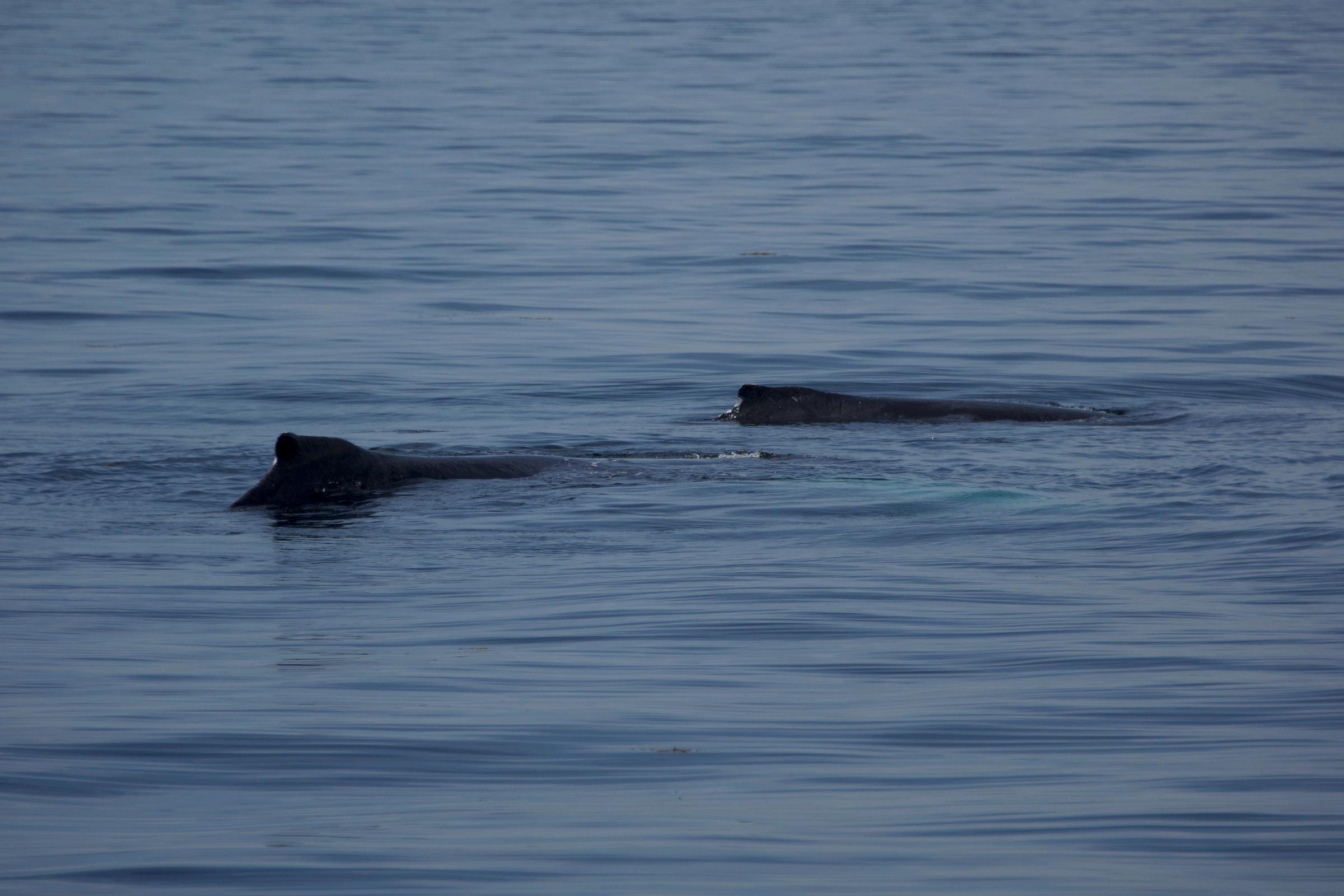
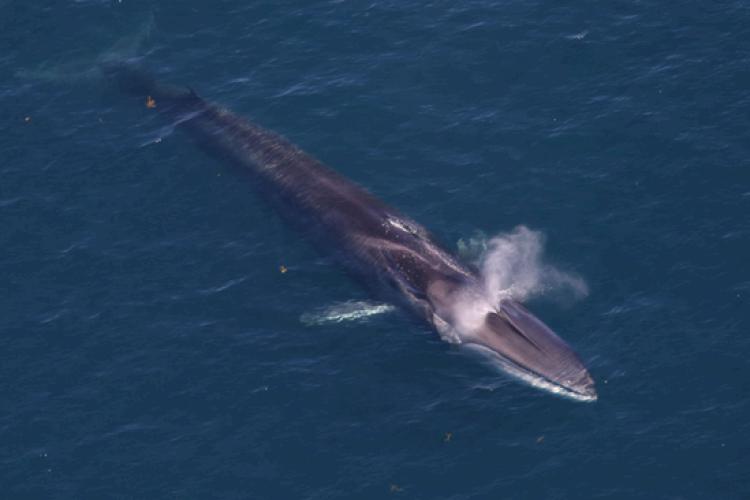
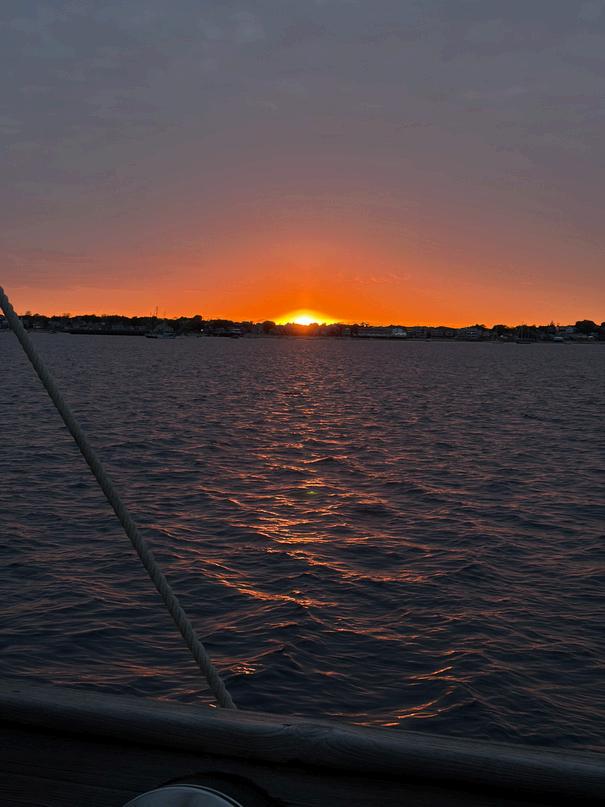
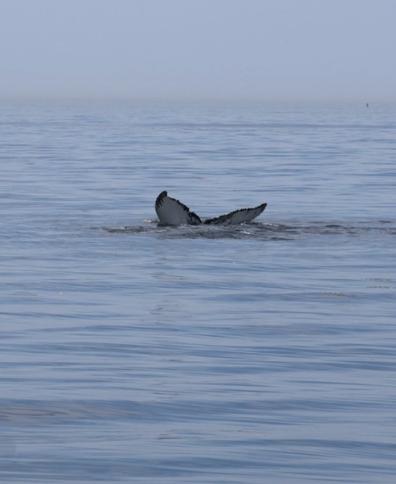
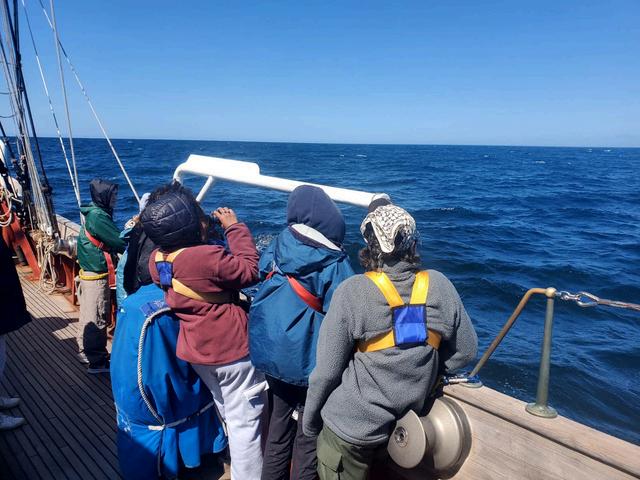
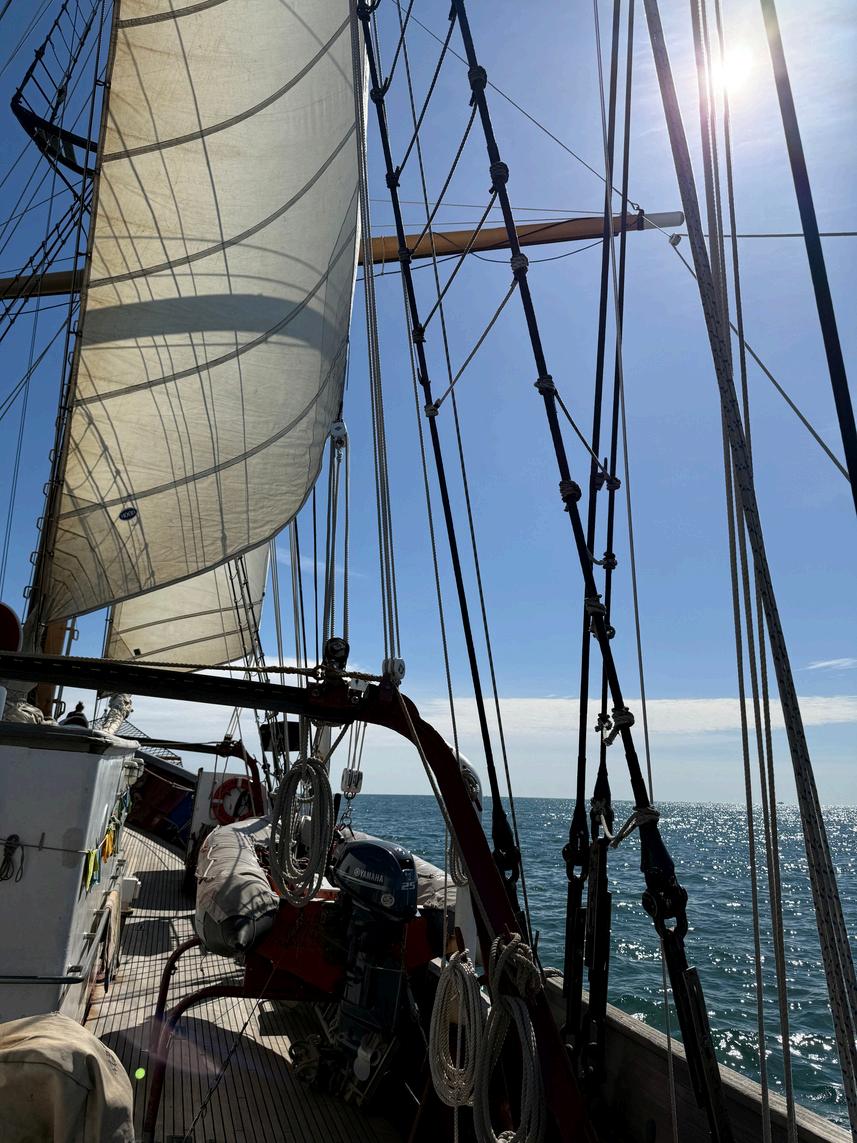
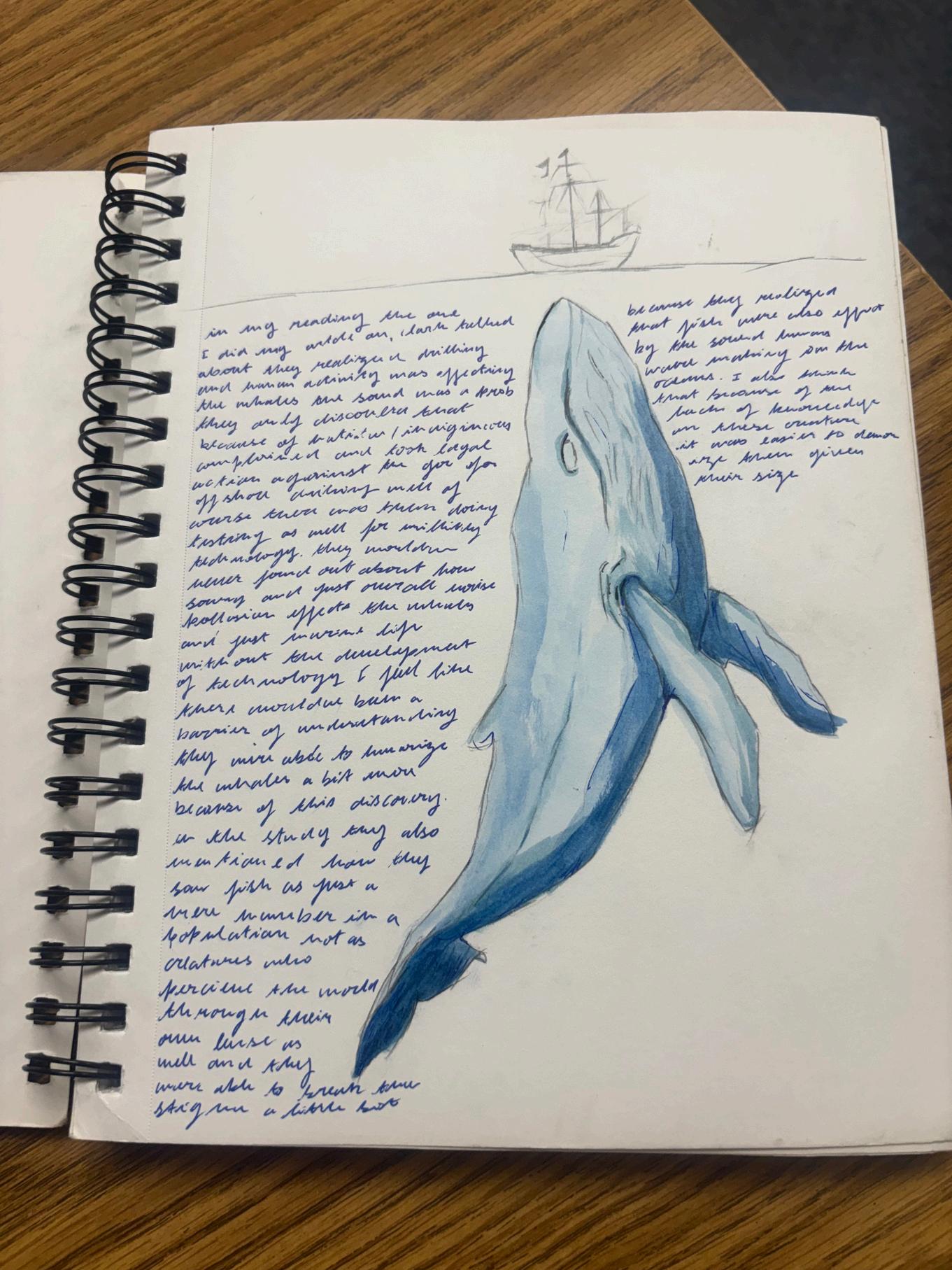
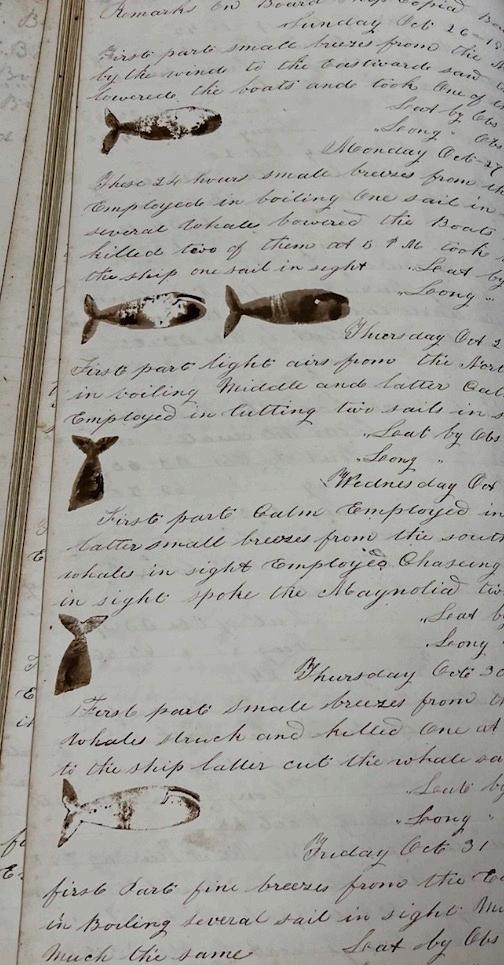
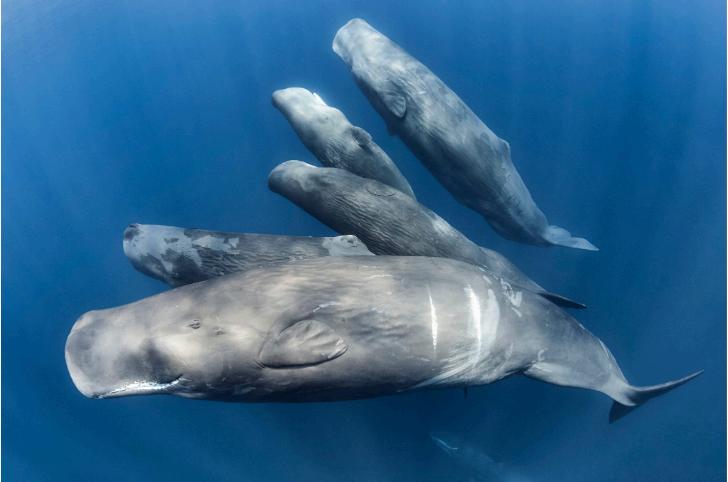
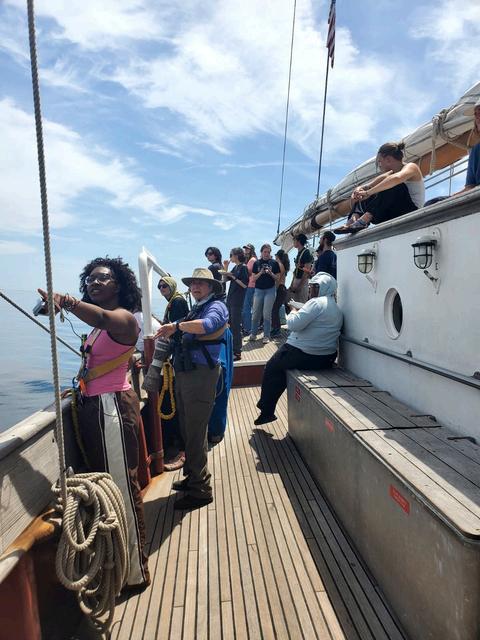
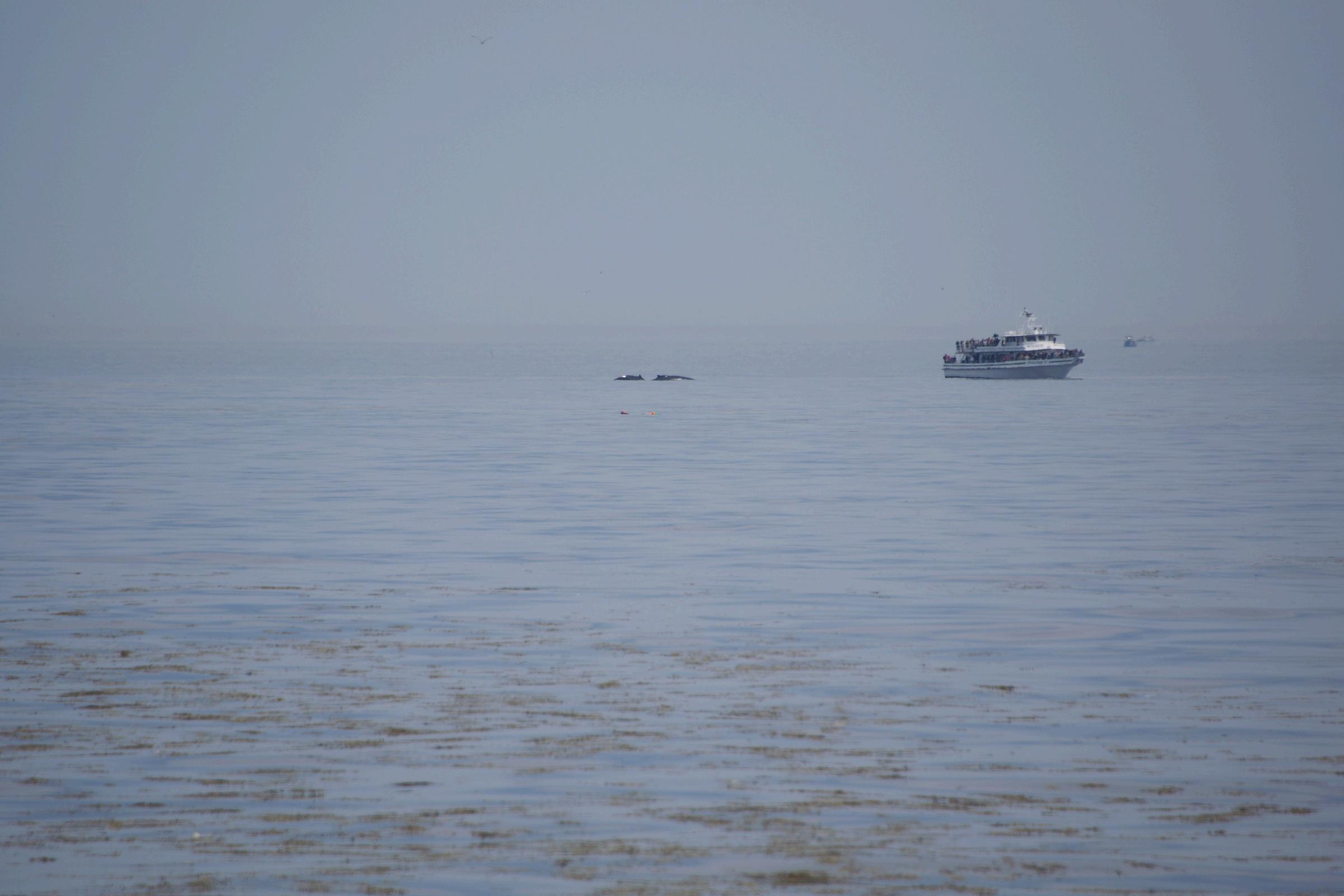
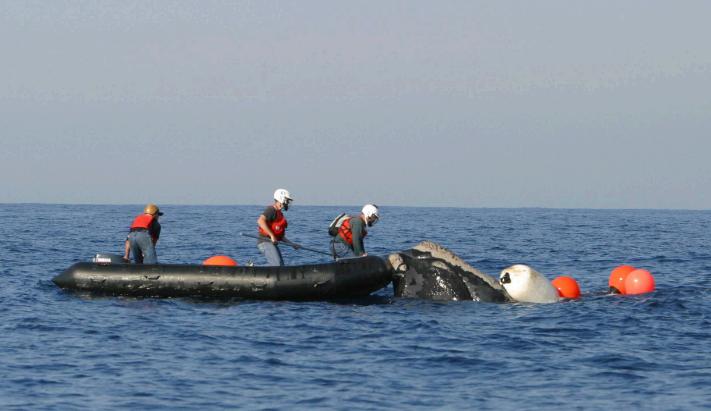
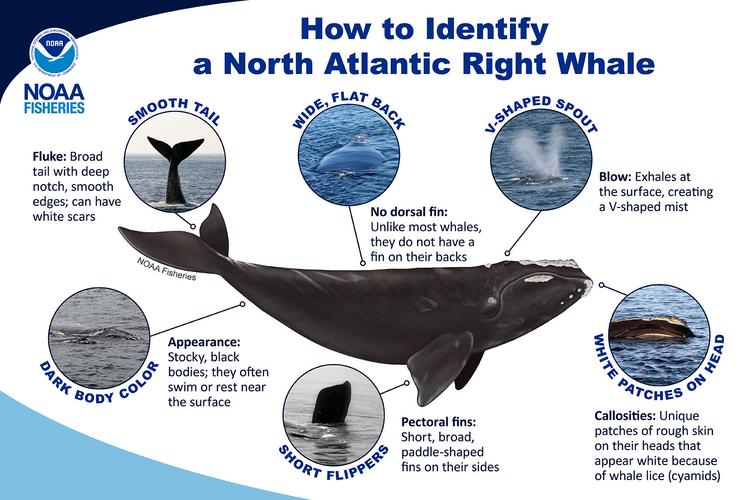
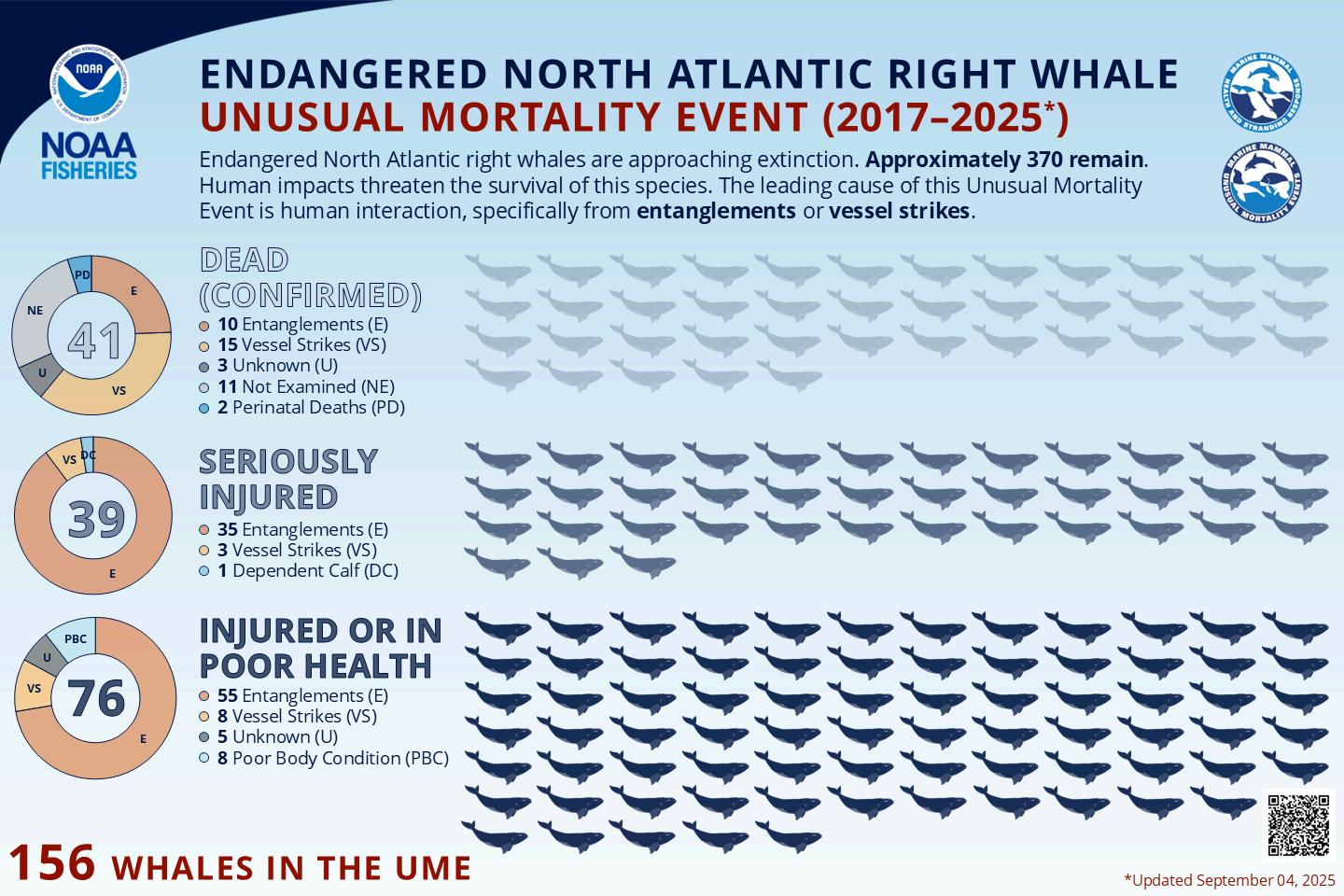
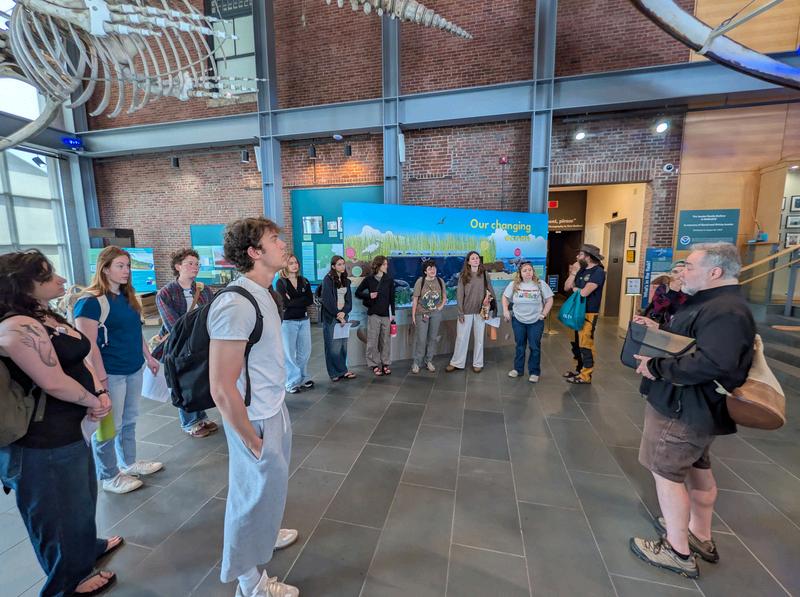
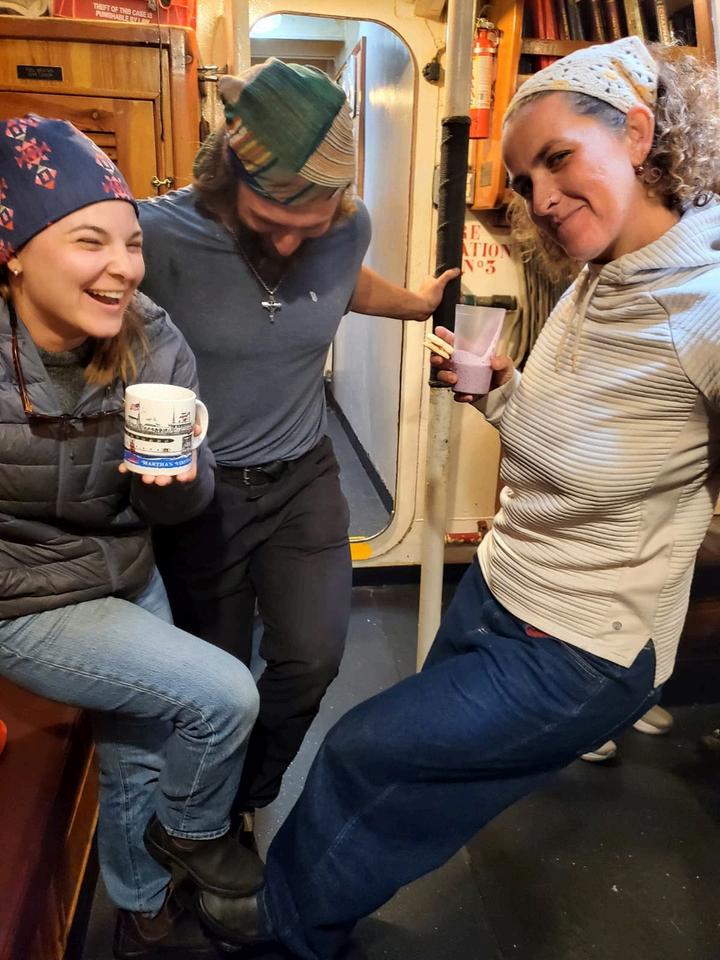
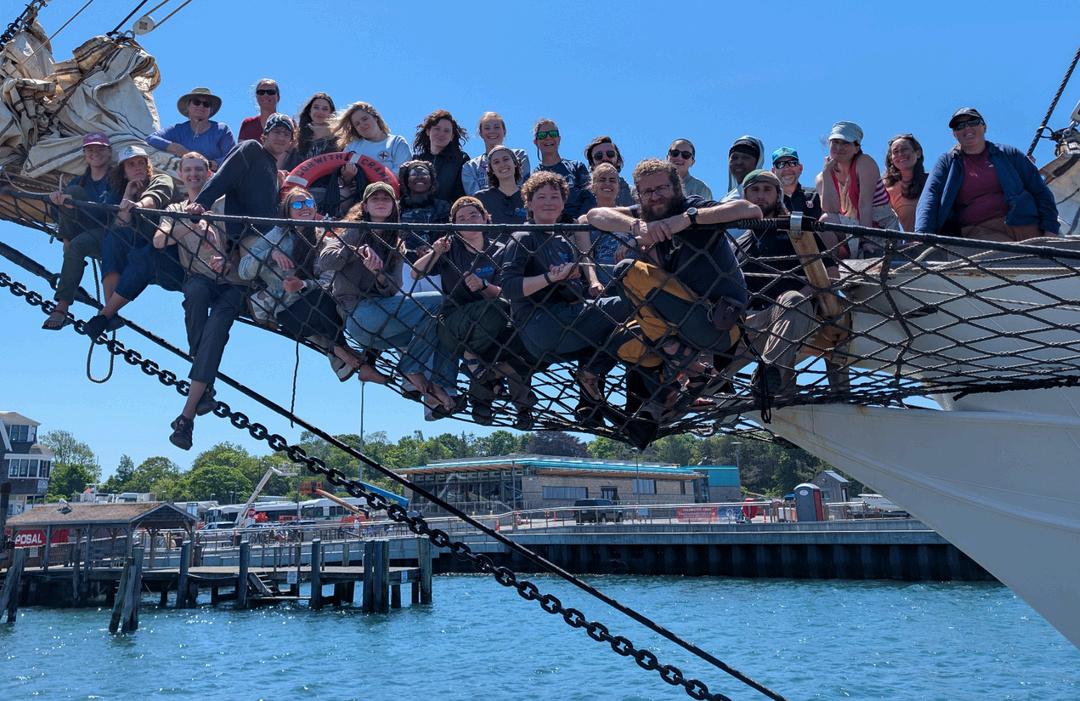
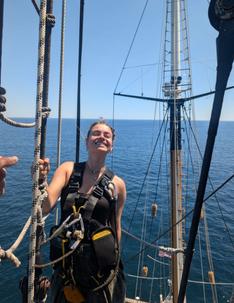
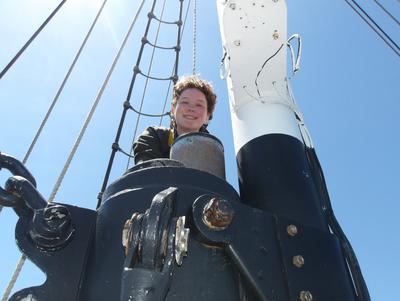
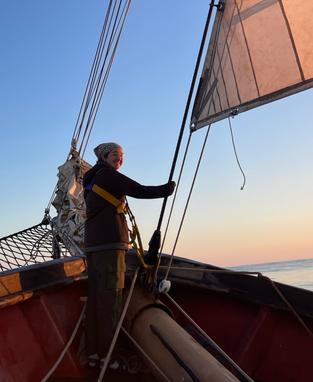
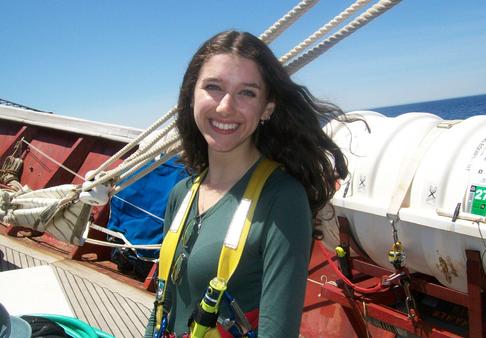
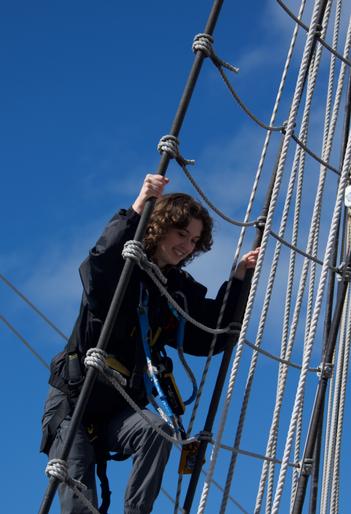
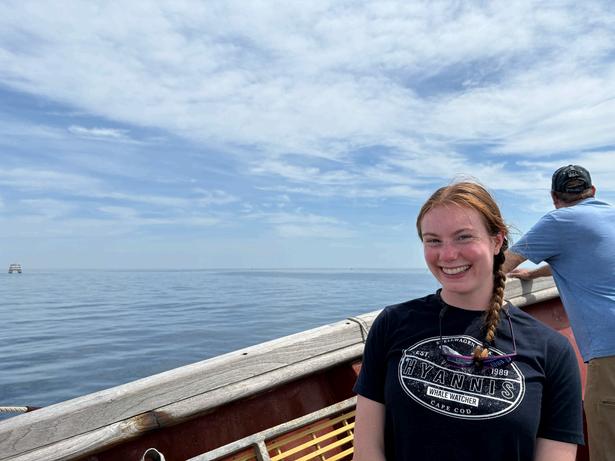
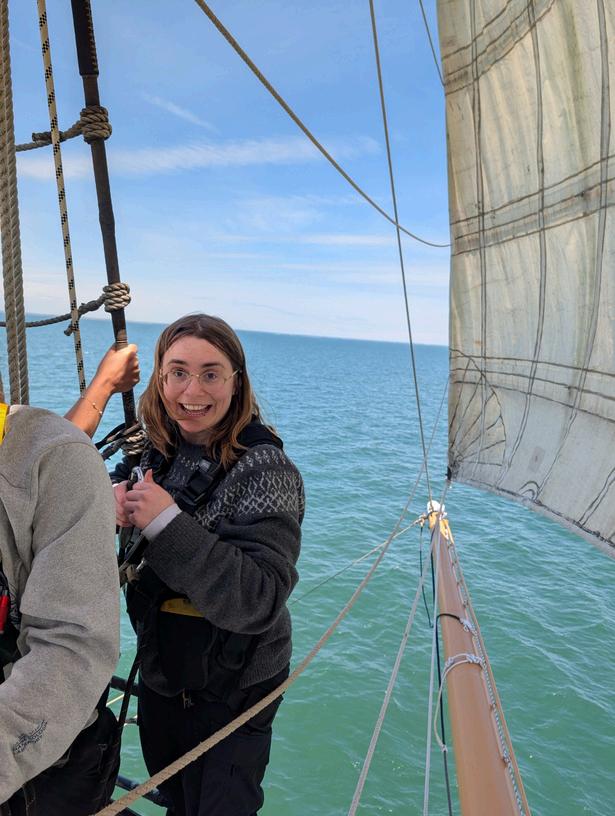
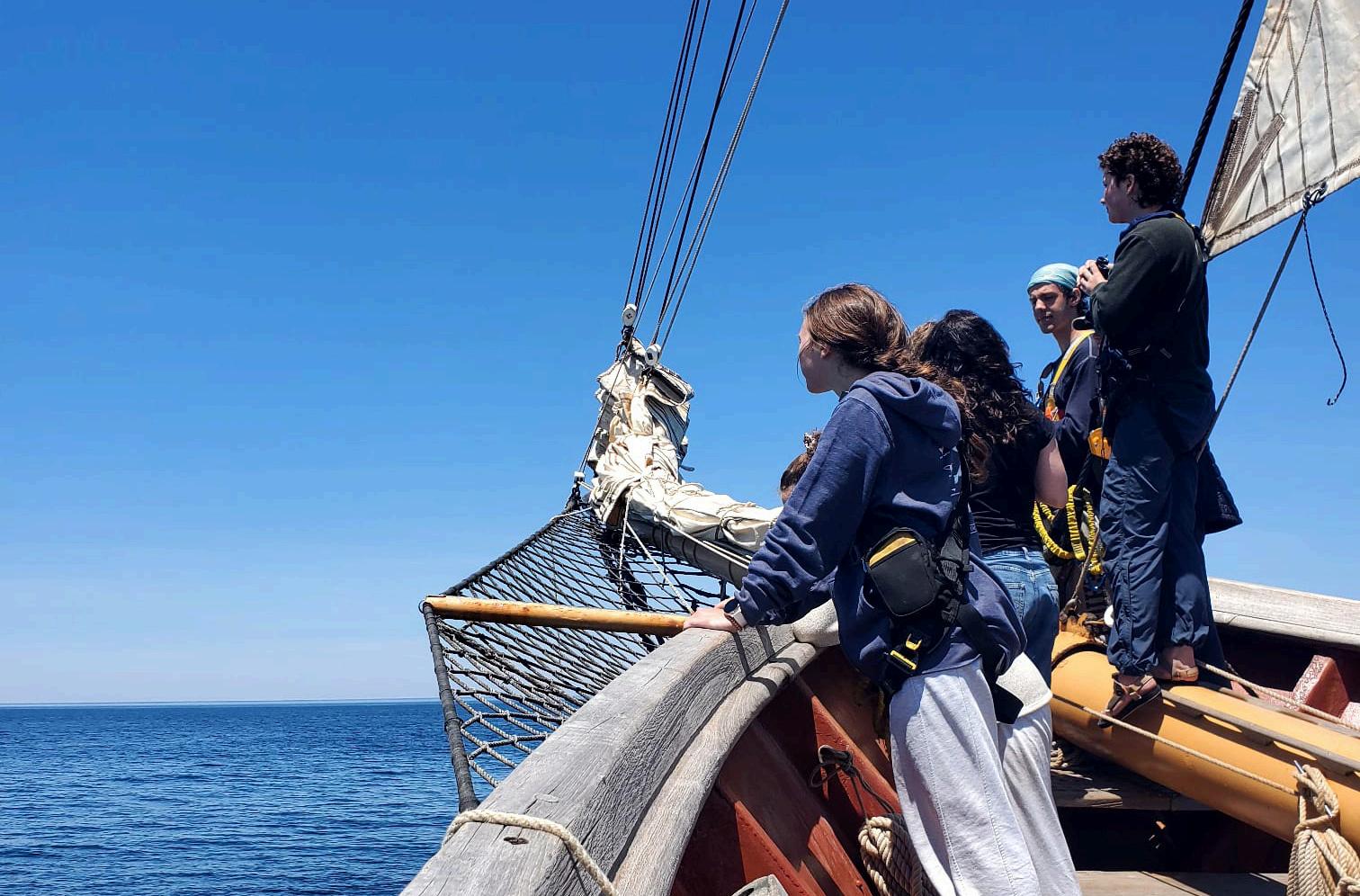
“It was the closest I'd ever been to a whale. We were close enough that we could hear the sound of their breath as they blew out of their blowholes. Even though they were sleeping and pretty calm, it was still really interesting to see them up close and magical. I really liked how everybody got very quiet whenever we were having closer encounters with whales or just any encounters with whales. It kind of gave everyone time to really take in what we were looking at and not just see them as commodities but more as individuals and beings that we were sharing the space with.”
--GraceFarinella
The Sea Education Association (SEA), based in Woods Hole, MA, USA, offers ocean studies programs for undergraduate, gap year, and high school students.
Introduction
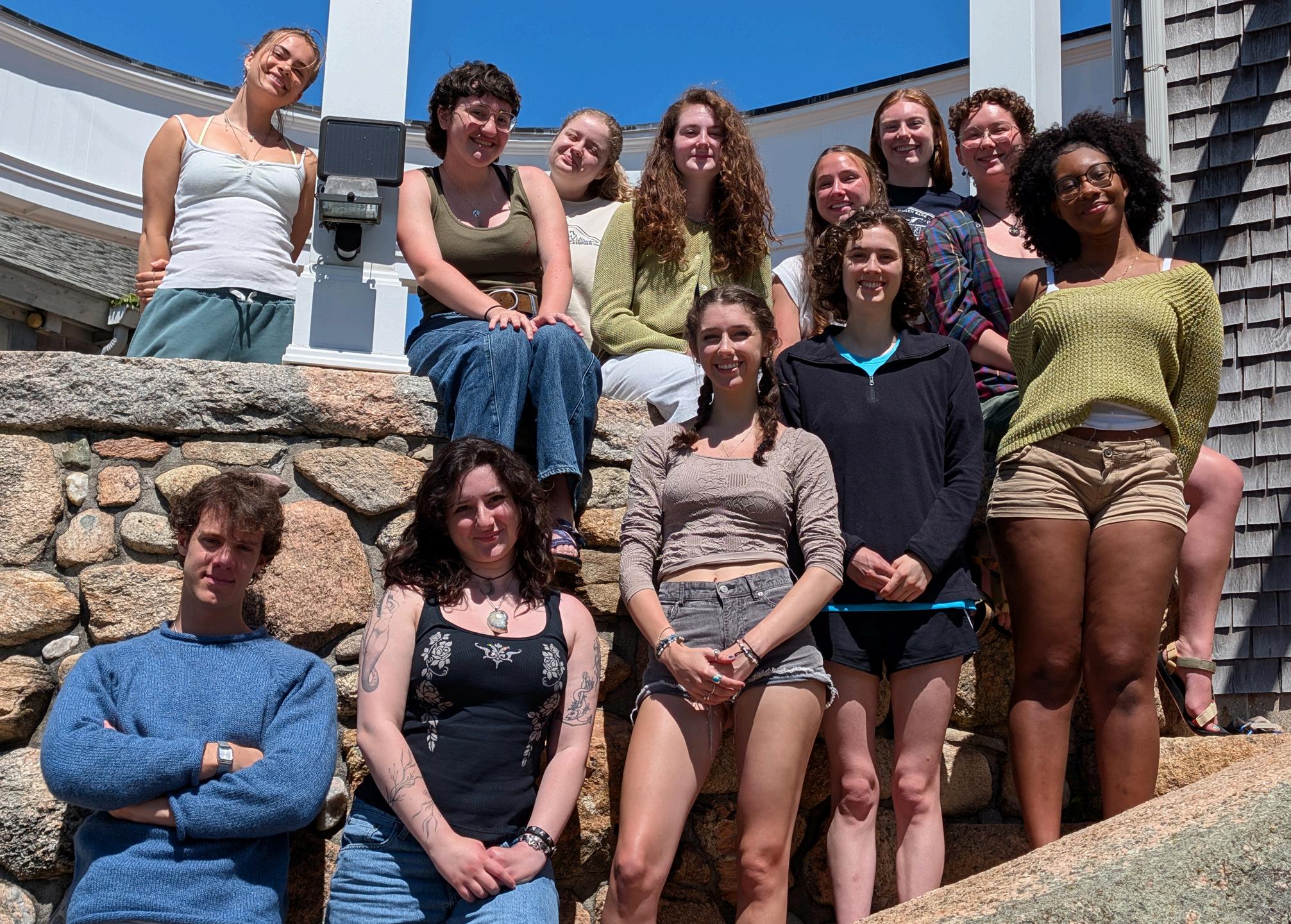
When the twelve of us first arrived at the Woods Hole SEA campus for a week-long shore component–-packed with history classes with Brooke, field trips to whale-relevant sites, oceanography basics with Jan, and a fair amount of procrastinating writing our SEA Writer magazine articles for Rich–-we were, perhaps, comfortable in our own niches. We had workout routines, meal preferences, preferred sleep times, study habits.
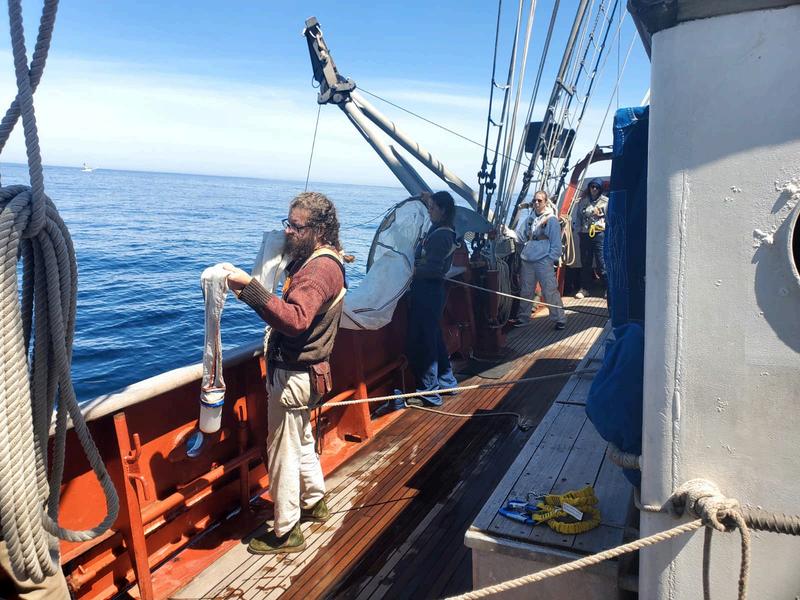
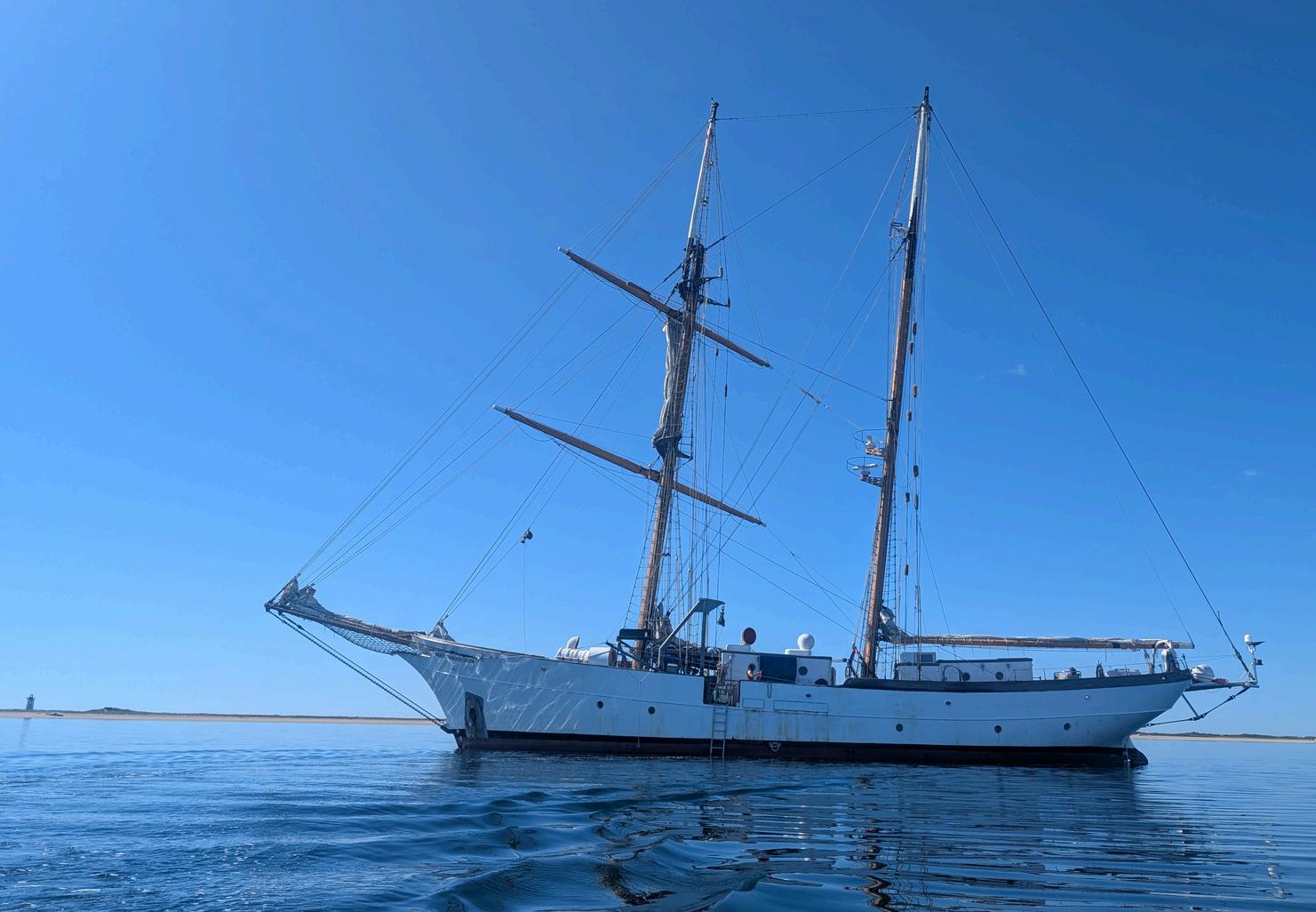
Our SEA class C'327, “Whaling History and Whale Conservation,” studied for three weeks on campus in Woods Hole and aboard the Corwith Cramer, sailing around Cape Cod and across the Stellwagen Bank Marine Sanctuary. Our primary academic course was “Marine Environmental History,” for which this magazine is the final project.
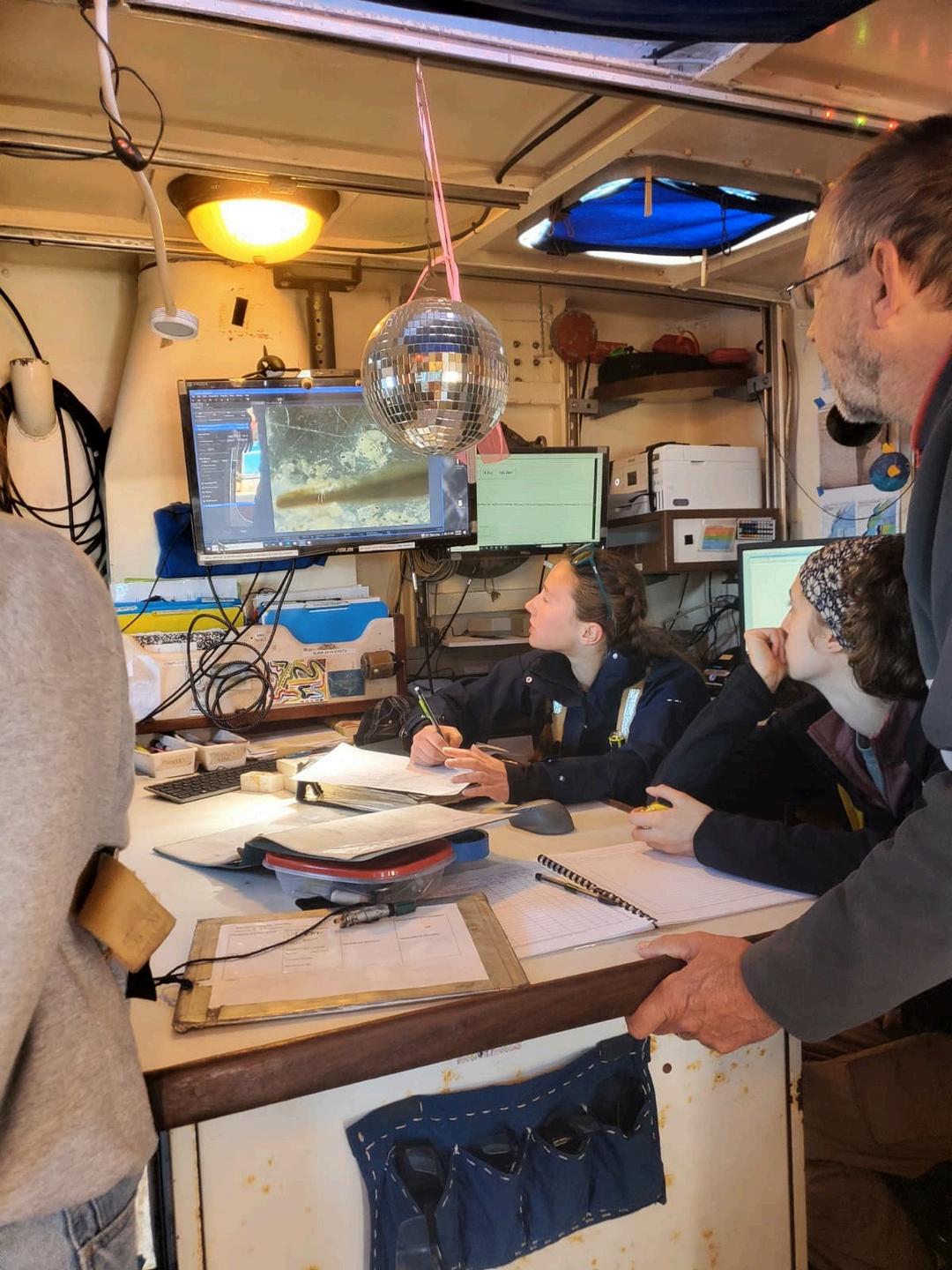
But then, over the course of our ten-day voyage on the Corwith Cramer, these boundaries were systematically shattered. As we were told the first day we arrived on the ship: ship first, shipmate second, self third. Styles of workout routines were severely cramped (unless you were content to run laps on a 130-foot sailboat that pitched side to side every few seconds); meals were cooked in the galley by our two stewards; watch and midnight anchor watch hours were up to the whims of our chief mate.
As we adjusted to the jargon, punctuality, and lack of WiFi that ship life conferred, we sailed from Woods Hole to Nantucket, to Provincetown, and, finally, to our ultimate destination of Stellwagen Bank Marine Sanctuary. “Whaling History and Whale Conservation’s” individuality manifested in the great degree of flexibility in what you took away from it. The crew and instructors were packed with knowledge about their respective fields of expertise, but we students were also our own repository. On the ship, cut off from so much terrestrial infrastructure, we grew to depend on each other. Kelly and
watch it, we are going back from whence we came.”
Sixty-four years later, during this three-week, whale-focused sailing voyage and course, his words seemed fitting.
Each member of the voyage had their own connection to the sea, their own niche interest, their own reason for being so drawn to it All twelve of us are aspiring marine scientists, writers, environmental lawyers, geologists. It is this diversity of interdisciplinary perspectives that is crucial to cetacean conservation, and, more broadly, to marine conservation.
It is impossible to understand, for example, the Inuit desire to hunt whales sustainably today if we do
not understand their subsistence whaling tradition that goes back centuries. It is impossible to protect North Atlantic right whales by tracking them with newfangled tags and gliders if we are unable to implement policies that make use of that data.
It is this diversity of interdisciplinary perspectives that is crucial to cetacean conservation, and, more broadly, to marine conservation.”
In the following pages you will find articles that are reflections of our interests. They by no means provide a comprehensive summary of current whale research; rather, they offer a window into the diversity of that field of study. As you read through them, we hope that you take away exactly this: it is through this diversity of interests and perspectives that conservation is strengthened, especially in this period of intense anthropogenically-induced change
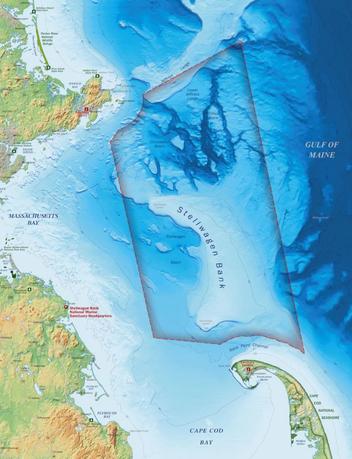
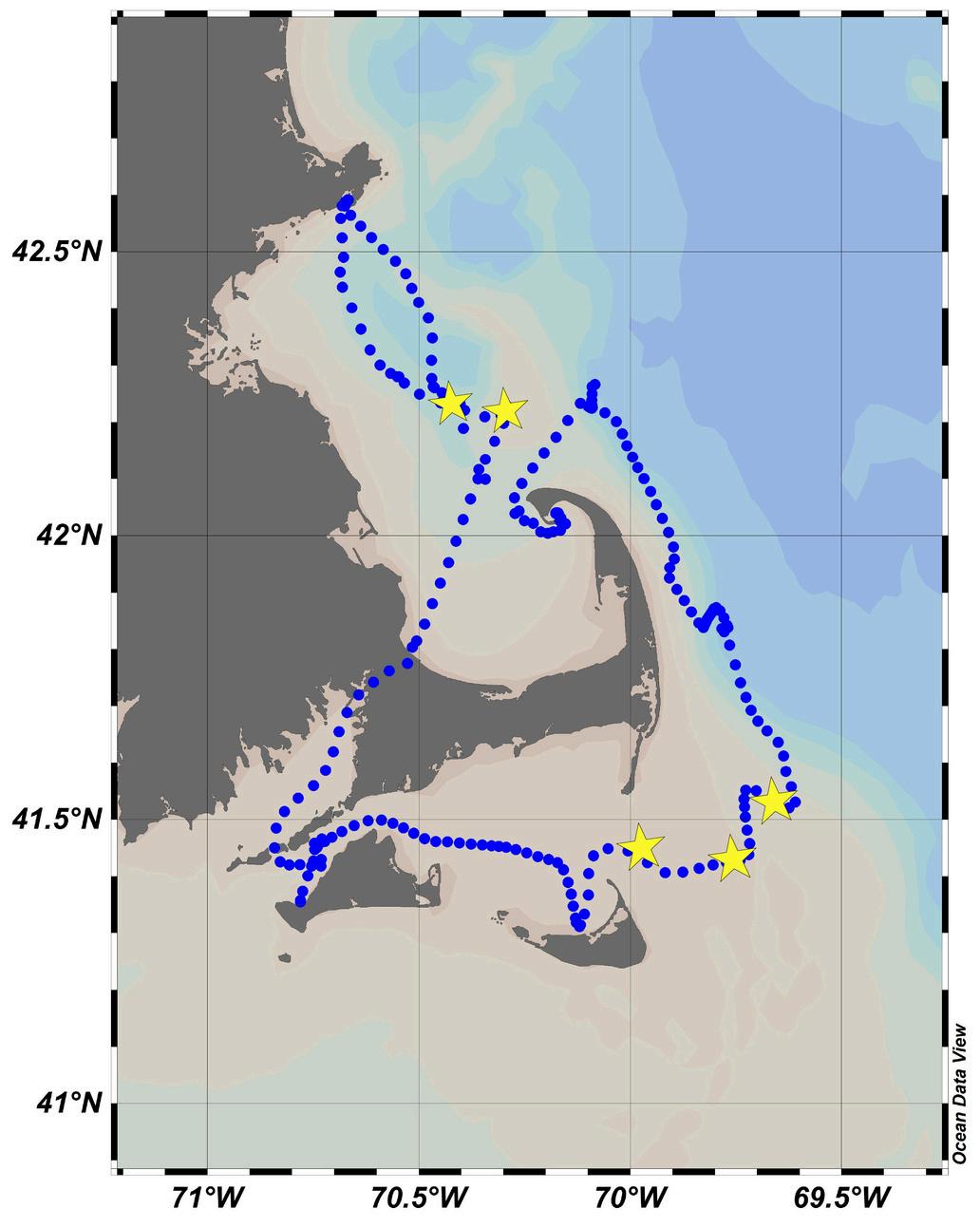
Cruise track and oceanographic sampling stations during the voyage of the Corwith Cramer, May 30 to June 7, 2026, out of Woods Hole, MA, USA. Yellow stars represent recorded sightings of whales, not whale numbers. Inset is the boundary of the Stellwagen Bank National Marine Sanctuary (track map by Kayla Gardner; sanctuary map NOAA)
“Origins of Oceanography: Rethinking Matthew Fontaine Maury’s Legacy”
“When Whales Come Ashore: The Iron Age Baleen Whale Discovery in Sweden and Its Implications”
“Oh S***! Whale Poop and Global Nutrient Cycling”
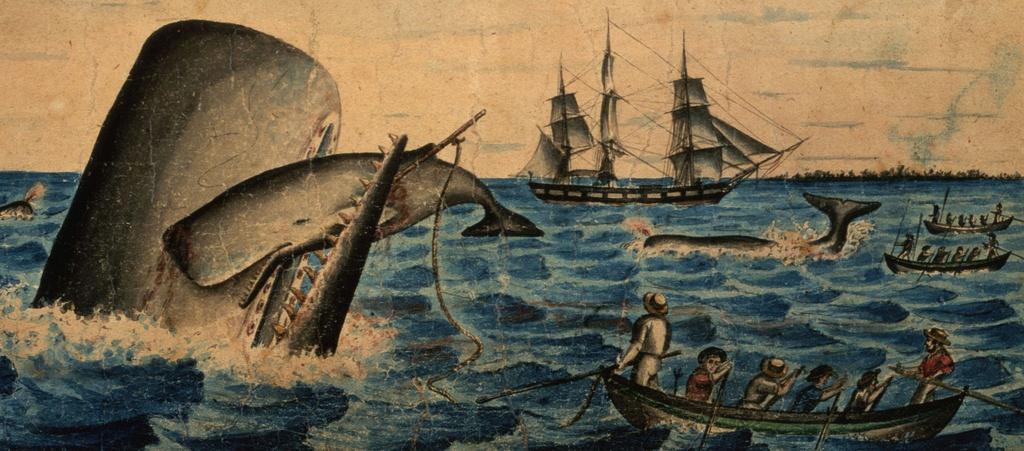
“Did Whales Out-Smart 19th Century Whalers?”
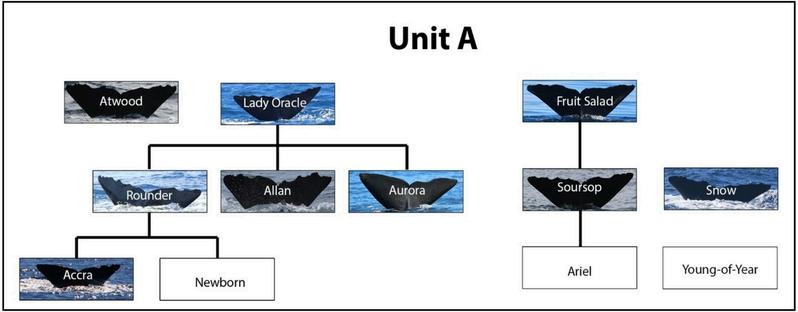
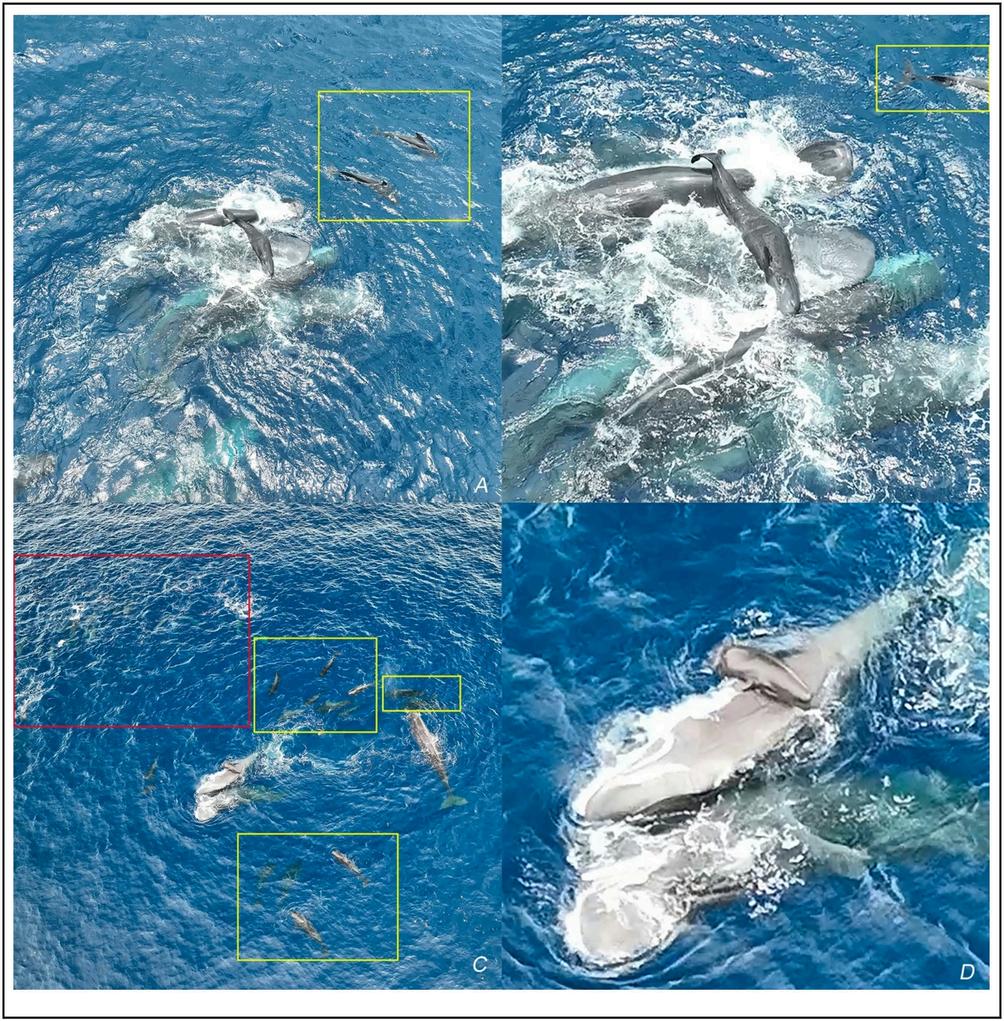
“It Takes a Whale-age: A Documentation of Collaborative Birthing Behavior in Sperm Whales”
“Music in the Age of Noise: Could Humpback Whales Sing More Under Intense Noise Pollution?”
“Hope For North Atlantic Right Whales: New Tags and Their Potential Impacts on Conservation”
“The writers for SEA Writer state that none of the included images or articles have used AI in their creation and the entirety of this edition is human-made. The artificial formulation of thoughts eliminates the human experience of mindful creation through writing and art. Generative AI is proven to be harmful to the environment, using millions of gallons of water (EESI 2025) to cool data computers for no practical use other than the replacement of the human mind. These are truths SEA does not stand for and states a zero use policy of generative AI for the writers and artists involved in this SEA Writer issue.”
--Grace Farinella C’327
Origins of Oceanography Rethinking Matthew Fontaine Maury’s Legacy
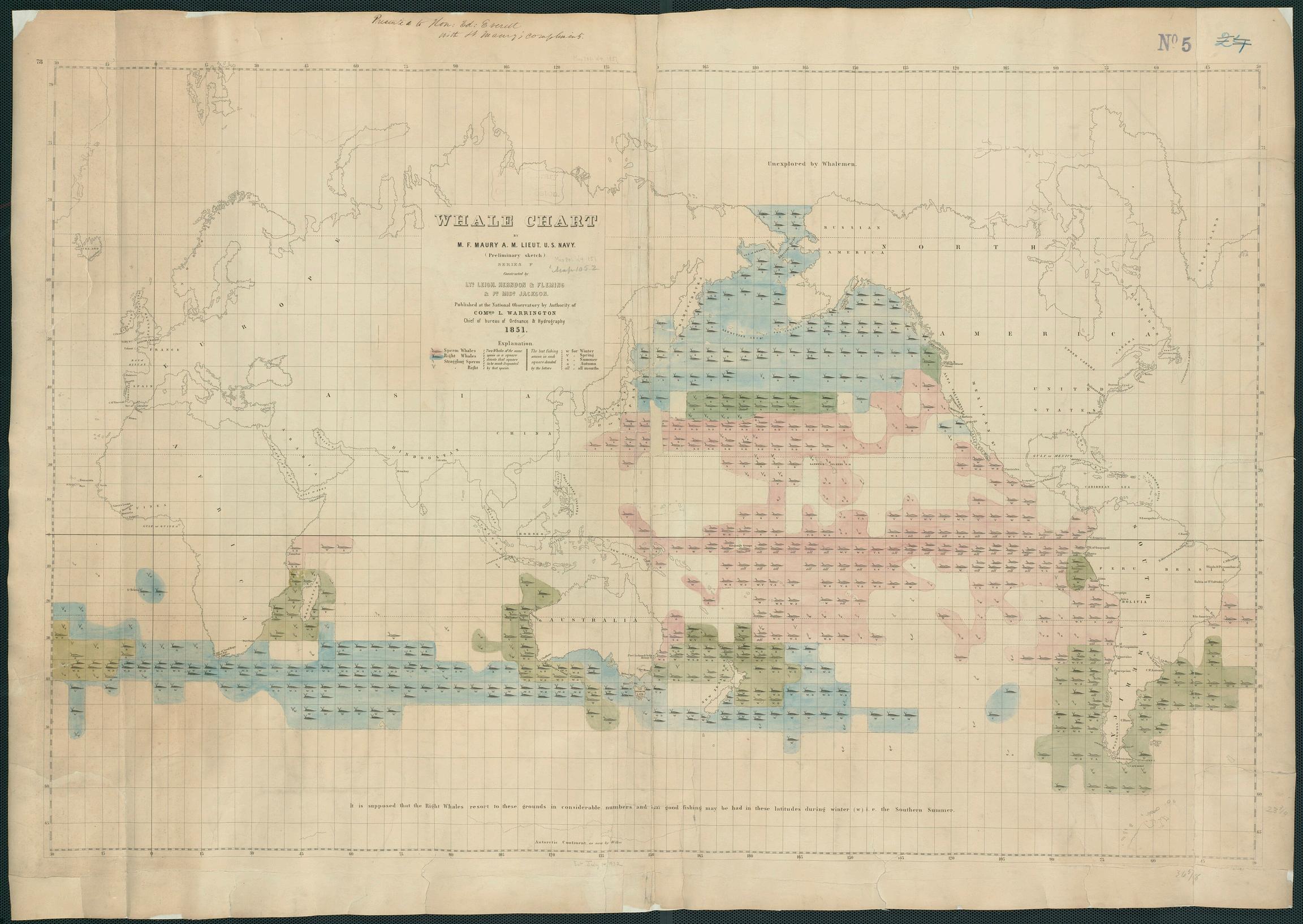
For hundreds of years, whaling ships sailed into every major ocean in pursuit of whales, as was depicted in Herman Melville’s 1851 novel, Moby-Dick. Whalers and others operating vessels at sea were often the first to document scientific data about marine ecosystems and weather patterns in the Western world, as well as observe the behaviors and biology of the whales they were hunting Whaling captains recorded detailed ship logbooks of everyday observations from voyages spanning roughly from the end of the 18th century to the beginning of the 20th century, and it was this information that would become the foundation for the collection of data that would essentially create the field of oceanography.
Matthew Fontaine Maury, considered the father of Western oceanography, was the first to catalog all of these observations in one place, transforming the information collected by sailors into a dataset that began to view the ocean as a place not just of economic opportunity, but of scientific study. Maury began his
by Ursula Koch
research by compiling previous ships’ logbooks and collecting information on past records of data such as currents, sailing routes, and winds. Logbooks had primarily been used as a way to catalog a ship’s journey or to prove a sailor’s worthiness to a potential employer, but had never been used as scientific data before.
Felix Lüttge explains: “The sea’s mid-nineteenth-century transformation from a transit zone into a destination and an object of scientific interest has become a commonplace of maritime history, often accompanied by a call
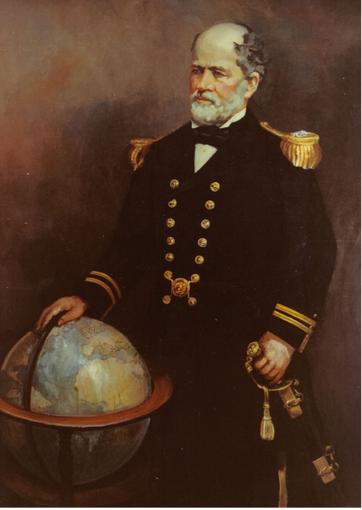
Posthumous painting of Matthew Fontaine Maury by E Sophonisba Hergesheimer, 1923 (Wikimedia Commons)
to historians ‘to look to the ocean’ ”
With this shift in viewing the sea as a place for scientific exploration also came a transformation of the ocean in people’s minds as not just a means of travel and an economic opportunity in terms of whaling, but as an opportunity for discovery.
While oceanography began as a study of past historical records of the ocean, it evolved to be a bridge between historical data and current interactions with the ocean. Much of the research and data that went into compiling the first oceanographic datasets came not from field research on the ocean, but from historic logbooks stored on land.
At the time, mariners were some of the most knowledgeable about the ocean due to the fact that they were up close with marine ecosystems as part of their day to day life. This allowed them to be a great resource both for compiling past data that had already been collected on the job, and for serving as a ready-made crew of field researchers who could collect new data around the world. This also led to oceanography becoming a sort of collective empiricism between scientific researchers on land and whalers travelling the world, typically for their occupation.
Matthew Maury himself originally served as a sailing master on the USS Falmouth on a voyage around Cape Horn, and was disappointed when he could not acquire adequate charts and sailing directions for his trip. Upon his return, he published his
own sailing directions from his voyage in a publication titled “On the Navigation of Cape Horn” in The American Journal of Arts and Sciences. In 1842, Maury was appointed the superintendent of the Depot of Charts and Instruments, where he began to catalog the previous logbooks held at the depot. After working through previous records, Maury began to create a standardized logbook for mariners to fill out and mail back to him for his research. This was called the “Abstract Log, for the Use of American Navigators,” and included space for recording values such as latitude, longitude, currents, temperature, wind, and other qualitative remarks.
In exchange for filling out these forms and returning them to US Navy offices, sailors were provided with copies of the charts
by Ursula Koch
Cover of the American Journal of Science and Arts in which Maury’s Cape Horn article first appeared (1834)
that Maury was able to create with the data
The returned logbooks arrived in varying states of completion and detail, with some captains taking care to provide extensive description and fully complete logbooks, while others received requests from Maury, such as one to Captain Fisher of the Abraham H. Howland, which noted, “With the temperature columns filled out, it would have been a rich gem.”
Maury continued this work until 1861, when he resigned from his position in order to fight for the Confederacy
Acknowledging Maury’s history with the Confederacy is as important as the impact his research had on the field of oceanography. After he resigned from his position to become commander in the
Confederate Army, he served for the duration of the war and then proceeded to spend seventeen years working to promote slavery and white supremacy.
For many years, this history was largely ignored and overshadowed by his contributions to the scientific community. However, following George Floyd’s death in 2020, there were movements across the South and other parts of the country to remove statues of members of the confederacy and people who promoted racist ideologies. Maury’s statue was eventually removed, and it brought into question the morality of celebrating scientific accomplishment while ignoring harmful ideologies, especially as there are still several buildings in the US named after Maury, such as at the U.S. Naval Academy.
Acknowledging
Maury’s history with the Confederacy is as important as the impact his research had on the
field of oceanography.”
While Maury’s research had a profound effect on oceanographic knowledge, it is impossible to fully separate the science from the scientist and ensure a completely unbiased viewpoint. He also had a distinctly economic and imperialistic agenda, meaning that his research was used to promote American expansion, particularly by way of the
by Ursula Koch
Graffitied statue of Maury in Richmond, Virginia in 2020 (Rozwadowski & Hardy, 2020; photo credit: Adam H Domby)
sea Therefore, it is important that while Maury will likely always be remembered for his contributions to oceanography, his research is not taken as the only example of important figures in the field or as the only model for how oceanographic history should be remembered.
As students of SEA’s “Whaling History and Whale Conservation” program, we actually had the opportunity to look at some of these historic whaling logbooks, kept at the New Bedford Whaling Museum. Similar to how Maury cataloged and extracted data, these logbooks are still being used in the modern day to collect information on phenomena such as past weather and climate
Tim Walker of the University of Massachusetts Dartmouth and Caroline Ummenhofer of WHOI have collaborated in interdisciplinary historical climatology research to track historical wind patterns. Looking at these logbooks, these researchers are able to translate whalers’ qualitative descriptions of weather into classifications based on the Beaufort Wind Scale, which is a way to categorize numerical wind speed values in descriptive terms. With this information, they are able to create a picture of the weather patterns that were present in the times that these whaling ships were active, primarily from the late 18th century to the early 20th century. Because whaling ships followed the whales instead of
well-established trade and travel routes, they are also able to fill gaps in areas where climate data was not previously available. This research allows for the study of climate patterns over time and how they have changed, lending to discussion about current climate change issues.
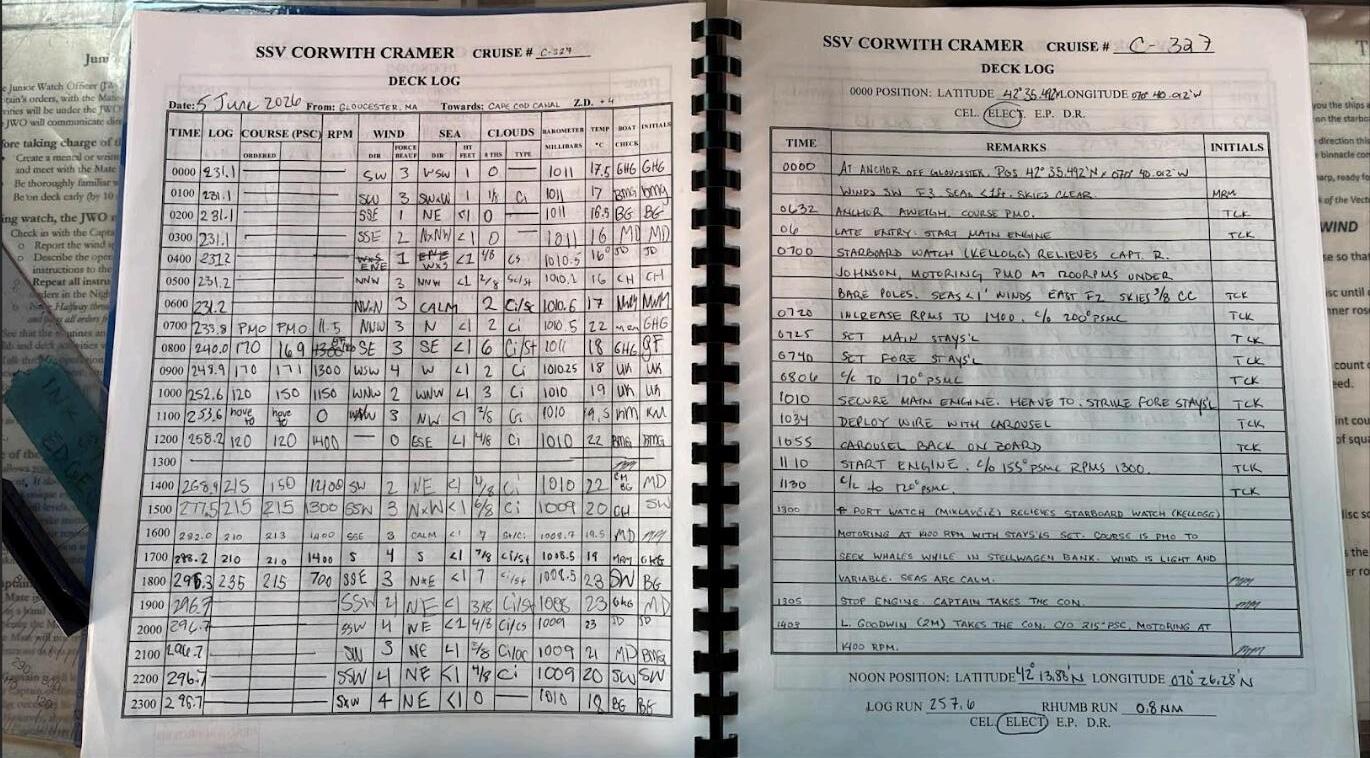
Logbooks are still being used on ships today, and during our time on the Corwith Cramer, students were responsible for recording hourly weather observations and recording our position in latitude and longitude every half hour before plotting the points It's fascinating to see how a practice that began centuries ago is still continued to this day, and in some ways it connects the maritime industry throughout the years Whaling logbooks provided the information that led to the creation of the field of oceanography in the 1800s, and they are still providing valuable data that will help us understand changes in climate well into the future.
Further Reading
Benjamin Cassidy, “How a Trove of Whaling Logbooks Will Help Scientists Understand Our Changing Climate,” Smithsonian (June 3, 2024): www.smithsonianmag.com.
P K Hardy and H M Rozwadowski, “Maury for Modern Times,” The Oceanography Society 33, no. 3 (2020): 10-15.
Felix Lüttge, “Seas of Data; or, The Oceanographer in the Archive,” Configurations 31, no. 3 (Summer 2023): doi.org: 10 1353/con 2023 a904488
by Ursula Koch
Corwith Cramer logbook pages from June 5th , 2026
Note the 1300 entry: “Course is PMO [per master’s orders] to seek whales while in Stellwagen Bank.”
When Whales Come Ashore
The Iron Age Baleen Whale Discovery in Sweden and Its Implications
Despite the abundance of baleen whales globally prior to the onset of commercial whaling, the existence of relevant archaeological records remains largely unmapped in many areas, such as Scania, Sweden
Because many people never have the chance to experience these fascinating creatures in close proximity, these archaeological pieces offer a vital way to learn about the mammals' autonomy and history. Visible from the historical and archeological art is the emotional response and fascination with these creatures, yet they were still exploited and hunted.
Until the early twentieth century, baleen whales were highly valued primarily for their blubber, but also for their bone and baleen This exploitation is best understood archaeologically by tracing the circulation of whale bone throughout regions.
Conducted by a multidisciplinary team based primarily out of Lund University, this collaborative study features the work of Stella Macheridis, Erika Rosengren,
by Gina Gallo
Samantha Greeves, Paul Eklöv Pettersson, and Mats Rundgren. This research documents the first ever confirmed discoveries of baleen whale remains from the Iron Age in Scania (Skåne), the southernmost region of Sweden, providing achievements for Scandinavian zooarcheology.
Following the Bronze and Stone Age, the Iron Age began with the mastery and widespread production of a new metal: iron. In Scandinavia, the adoption of iron aligned with the shifting social dynamics, fueling new
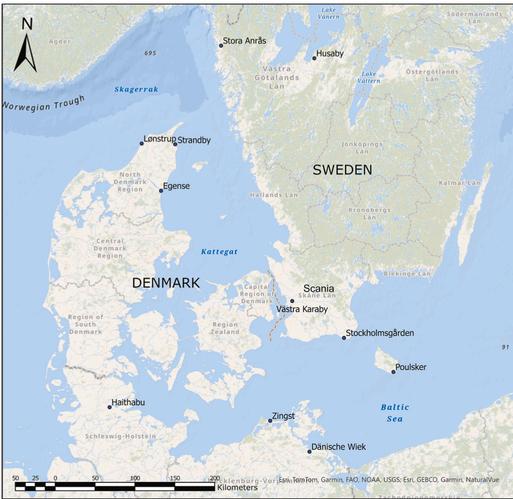
Map of sites in southern Scandinavia and northernmost Germany where Iron Age whale bones found (Macheridis, et al., 2026)
trades and industries and while elevating the power of the warrior class with the production of advanced weaponry. Spanning from 500 BC to 1100 AD, the Nordic Iron Age was a transformative era marked by immense economic, cultural, and political restructuring, as well as large-scale migration of the native population which reshaped the region's society While whale bones are occasionally found in other parts of Iron Age Scandinavia, they have historically been absent or unverified in Scania’s otherwise rich zooarchaeological record
The goal of Mecheridis, Rosengren, and others is to present these previously unrecognized baleen whale finds. Evaluating them alongside regional datasets, they aim to figure out whether these bones are more useful for understanding the natural history of the whales or for tracking how people traded and crafted with bone material. For their study the researchers reanalyzed forgotten “grey literature” (not published but archived) archival bones that were excavated many years prior and stored at the Historical Museum at Lund
by Gina Gallo
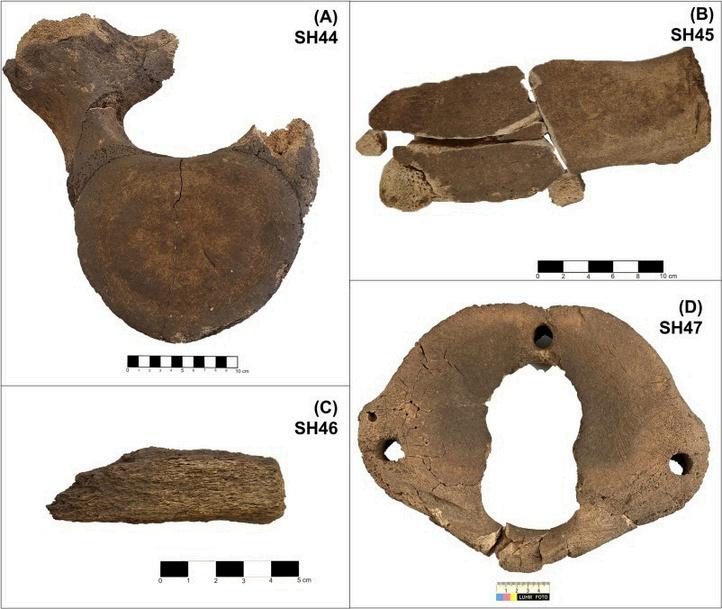
Photograph of research finds: A) thoracic vertebrae (pit house A342), B) transversal process from a vertebra (in well A295), C) fragmentary bone (pit house 90/71), and D) An atlas vertebra (Stockholmsgården) (Macheridis, et al , 2026)
University.
The specific specimens of interest were originally recovered during the 1960s and 1970s in connection with excavations at the Iron Age settlements of Västra Karaby parish and Stockholmsgården (Valleberga parish). Västra Karbay is a large late Iron Age settlement known for numerous workshop pit houses and wells. Here three samples were analyzed: a large, complete thoracic vertebra (bones that form middle section of spine) found at the bottom of the pit house A342; a chopped side bone from the lower spine vertebra from well A295; and a worn down fragment of bone from pit house 90/71. At Stockholmsgården, a Viking Age site, one sample was analyzed: a modified atlas vertebra
by Gina Gallo
(topmost bone of spine) was discovered inside a pit, bounded by oblong stones. Ultimately, the presence of these bone findings may indicate a distinct paleozoological occurrence of baleen whale species in the area.
In a review of the region's cetacean (meaning all whales) subfossil records, researchers noted occurrences of the minke whale (Balaenoptera acutorostrata), fin whale (B. physalus), humpback whale (Megaptera novaeangliae), North Atlantic right whale (Eubalaena glacialis), and bowhead whale (Balaena mysticetus). Many of these fossil records date back to the Weichselian (a European glacial period lasting from roughly 115,000 to 11,700 years before present) and
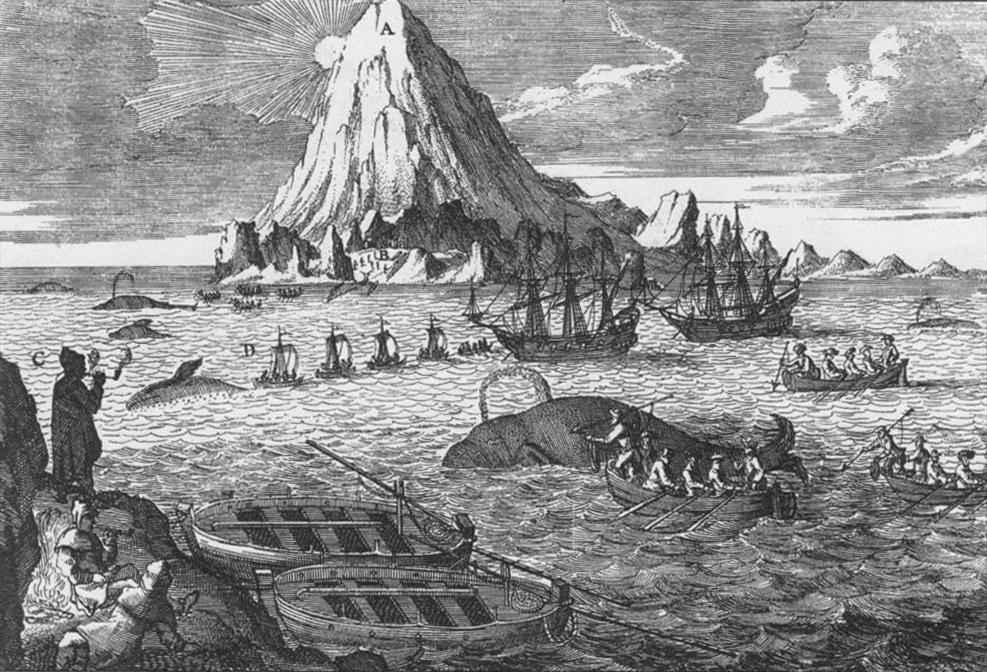
Dutch ships depicted whaling in the Arctic in the 18th century (Wikimedia Commons)
the Early Holocene
Chronologically, these finds correlate with the circumpolar migratory patterns of the bowhead whale, which followed the moving rim of the sea ice; this behavior drew this species further south, as a large portion of Scandinavian waters was covered by sea ice during these periods. This behavior is likewise supported by paleontological records indicating a southern migration into coastal waters. In other areas, such as the Baltic Sea, different baleen whales like the humpback and the right whales were historically present. Furthermore, as Marcheridis points out, the representativeness of these whale bones within the Polish archives, although not explicitly addressed in the original study, indicates the potential reach of these species into the southwestern Baltic during prehistoric times.
In addition to its own findings, the study incorporates regional data on baleen whales from Sweden, Denmark, and Haithabu (Germany), alongside previously published specimens from major natural history and zoological museums in Copenhagen, Gothenburg, and Stralsund. Whale bones found in archaeological contexts are often highly fragmented, weathered, or altered by human craftsmanship making them morphologically unidentifiable with traditional visual analysis. To overcome these limitations, the researchers utilized Zooarchaeology by Mass
Spectrometry (ZooMS), a peptidefingerprinting technique to definitively identify the species of the bone fragments. While ZooMS was used for taxonomic identification, determining the timeline for these finds required radiocarbon dating.
However, dating marine life is complex due to the marine reservoir effect, causing marine organisms to appear artificially older than they are. To fix this the researchers used CHRONO marine databases to filter out 177 regional data points from the Nordic Seas, allowing them to calculate customized marine reservoir age correction.
These finds correlate with the circumpolar migratory patterns of the bowhead whale, which followed the moving rim of the sea ice.”
The team also used a contextual approach. They radiocarbon dated terrestrial mammal bones found within the same structural features to double check and confirm age of the site.
Focusing specifically on the Iron Age, the majority of baleen whale finds in the region derive from the Viking Age emporium (trading hub) of Haithabu. Most specimens from this area belong to the Balaenidae family, consisting of either the bowhead whale or the North Atlantic right whale. Palaeozoological
by Gina Gallo
records show that grey whales were once more common than previously understood. The application of ZooMS has greatly enriched our understanding of their historical presence and distribution in the North Atlantic.
When combining the Haithabu specimens with findings from German and Danish sites, as well as an area of animal husbandry in central Sweden dating to the Late Iron Age, the results support the conclusion that baleen whales occurred much more frequently in historical periods before commercial whaling led to the overhunting of these taxa. Because the bowhead whale's subarctic and arctic range makes it unlikely to wander into southern Scandinavia given that sea ice did not reach mainland Europe during the Iron Age, van den Hurk argues that most whales identified within the Balaenidae family actually belong to the North Atlantic right whale. This also demonstrates that the right whale, which no longer occurs in the region, was once far more common than previously assumed
Every bone examined showed stark evidence of intentional human modification prior to deposition. For instance, the fin whale bone displayed unambiguous chop marks where the side pieces had been severed from the spine. Another bone was intensely split, abraded, and partitioned, leaving open spongy bone tissue- a signature characteristic of refuse from a bone crafting
workshop. Lastly, the Stockholmgården atlas vertebra was modified into a complex object featuring three distinct holes drilled through it, alongside heavy friction and wear on articulation surfaces. Its exact function remains a mystery, as no archeological parallel currently exists.
Key findings of the study demonstrated that ZooMS successfully identified the remains of multiple baleen whale species, creating the first concrete biological map for baleen whales in Iron Age Scania. At the Västra Karaby site, researchers identified three types of whale: the fin whale (confirmed by peak intensity on spectrometer), the humpback whale, and either the North Atlantic right whale or the bowhead whale It is difficult to tell the right whale and bowhead apart as they share identical peptide markers, meaning they cannot be split purely via ZooMS. Meanwhile, humpback whales were found at both Västra Karaby and Stockholmsgården. Researchers easily spotted these thanks to a unique, highly specific chemical ‘peak’ that showed up on the spectrometer.
Based on the chronology and feature dating for Västra Karby Pit House A342, the whale vertebra returned a wide calibrated age range extending from the Medieval period (720-1225 CE). However, an associated cattle femur showed a tighter Vendel Period (655-775 CE), leading researchers to conclude that
by Gina Gallo
the feature dates to the late Vendel Period (8th century CE). At Västra Karby well A295, the fin whale bone similarly returned with a broad date of 360-870 CE, but associated sheep and cattle bone accurately fixed the filling of the well to the early Vendel period (555-650 CE).
In pit house 90/71, the whale fragment itself was in too poor of a condition to safely sample for 14C, but associated sheep and cattle remains date this site to the late Roman Iron Age or Migration Period (250-555 CE).
Lastly, at Stockholmsgarden pit, no radiocarbon date was conducted, but contextual associations with the biconical spindle whorl placed humpback whale bone to the Viking Age
Rather than pointing to a local, active whaling industry, the archaeological contexts imply the circulation of whale bone as a highly valued raw material Furthermore, the distribution of these bones points to well-established, longdistance resource and trade networks across southern Scandinavia during the Late Iron Age.
These incidental discoveries underscore the significance of curating legacy collections to enable ongoing research that employs emerging technologies. However, because active trade was widespread during this era, the researchers caution against using these specific bone finds to map out the historical native presence or migration
patterns of these whale species in the immediate waters of southern Sweden. Because the late Scandinavian Iron Age was marked by highly active, long-distance trade routes, these bones are best understood as imported raw commodities. Given their condition, it is highly likely these massive whale bones were circulated far and wide as treasured raw blocks for specialized carvers-such as for making gaming pieces or elite tools, rather than representing animals stranded or hunted directly on the Scanian coast
Further Reading
Andreas Hennius, et al. “Late Iron Age Whaling in Scandinavia - Journal of Maritime Archaeology,” SpringerLink, Springer US, 19 (Dec 2022): link.springer.com/article/10.1007/s11457-02209349-w
Stella Macheridis, et al , “First Confirmed Finds of Baleen Whale from Iron Age Scania, Sweden, and their Archaeological Implications,” Journal of Archaeological Science: Reports 71, no 105720 (2026): doi org/10 1016/j jasrep 2026 105720
Youri van den Hurk, “The Prelude to Industrial Whaling: Identifying the Targets of Ancient European Whaling Using Zooarchaeology and Collagen Mass-Peptide Fingerprinting - PMC.” National Library of Medicine (13 Sep 2023): pmc ncbi nlm nih gov/articles/PMC10498027/
by Gina Gallo
Oh S***! Whale Poop and Global Nutrient Cycling
For centuries, our n understanding of cetaceans (whales, dolphins, and porpoises) and their impact on ecosystems has been largely dominated by their role as predators or as charismatic megafauna
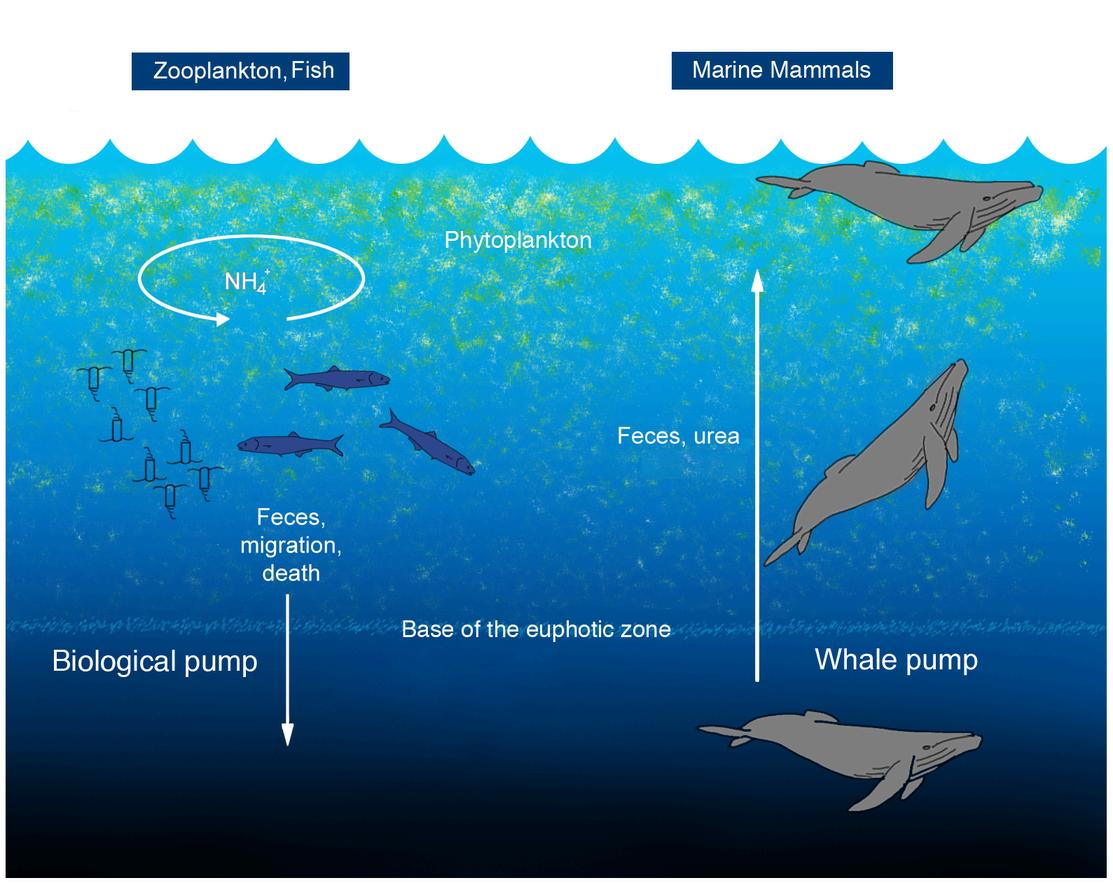
However, recent studies have suggested that whales are vital for nutrient cycling. Cetaceans are mammals. They breathe and rest at the surface, so they often urinate and defecate there. This excretion contains important nutrients necessary for phytoplankton growth, including nitrogen, phosphorus, and iron This then leads to nutrient enrichment events in the euphotic zone, the topmost layer of the ocean where photosynthesis is possible, which is often depleted of those nutrients due to the phytoplankton growth. This process was coined in 2010 as the “whale pump” by scientists Joe Roman and James McCarthy.
For most of Western human history, whales were mainly viewed as resources to exploit and simply as large predators at the top of marine food webs. Commercial whaling
By Bea Gumbinner
drastically reduced whale populations worldwide, as whalers hunted whales for resources such as oil and baleen.
Early whale conservation movements were primarily concerned with whales economically, such as the founding of the International Whaling Commission (IWC) in 1946, which was created to make sure that whaling would remain viable in the future. The IWC would later shift
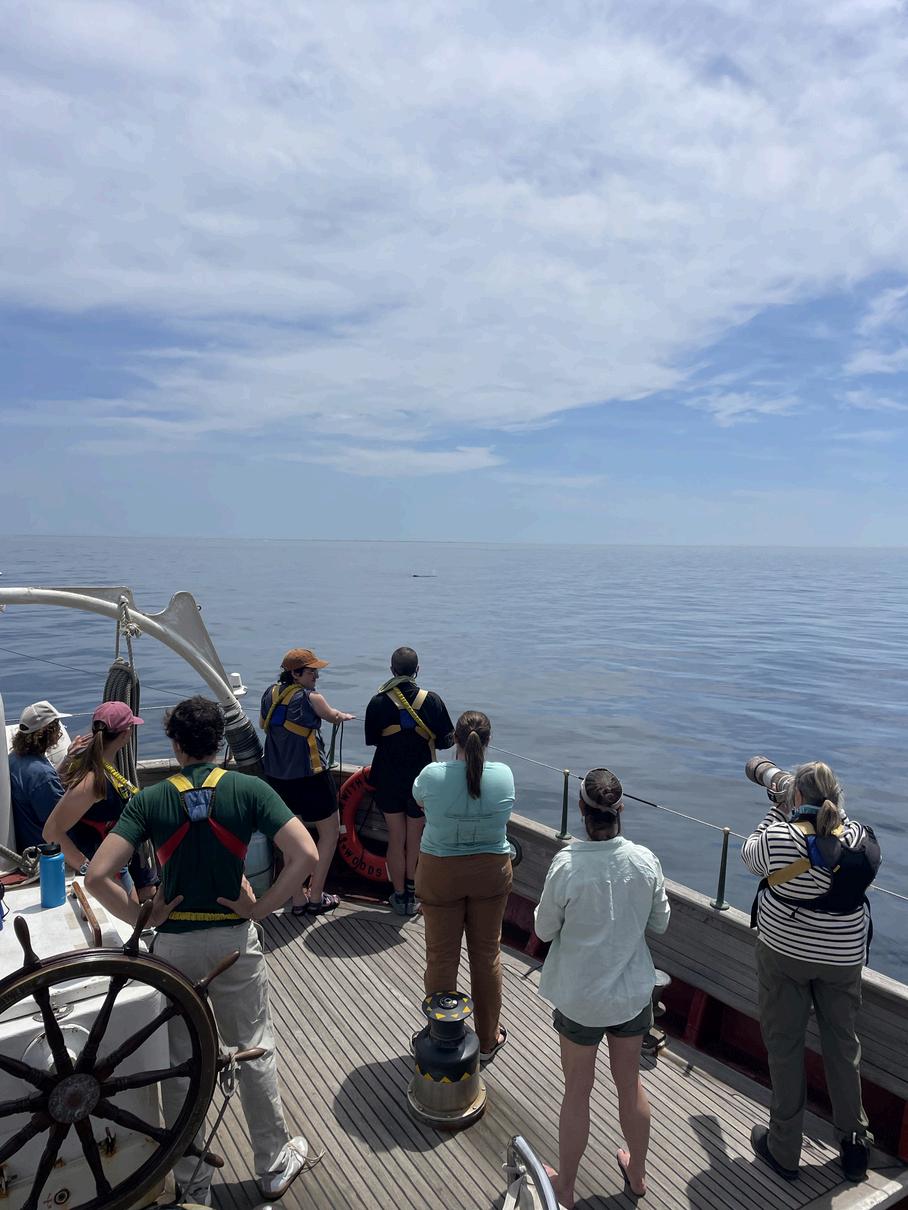
Watching whales from the Corwith Cramer, in awe of their size and the sound of their breathing--but few of us at that moment were thinking of their chemical contributions to the ecosystem (Kenzie Meier)
towards conservation, with a view of them as endangered species. Overall, conservation work has largely ignored the ecological roles whales play in ocean systems.
However, within the past decade, ecological research suggesting that whales are important nutrient recyclers, studies by researchers such as Lola Gilbert and a team of colleagues from La Rochelle University, have begun to investigate the extent of the role cetaceans play in global nutrient cycling and ocean productivity.
In a 2023 study, Gilbert’s team used computer modeling to estimate the global impacts and importance of the whale pump on oceanic nutrient cycling. In their study, they looked at cobalt, iron, manganese, phosphorus, zinc, nitrogen, selenium, and copper. Across all eight nutrients, cetacean nutrient release showed a significant correlation with chlorophyll and sea surface temperature, which are both indicators of ecosystem productivity. Gilbert also found that cetaceans release greater quantities of
By Bea Gumbinner
nutrients in temperate areas as compared to tropical and subtropical environments, which show relatively low nutrient inputs from cetacean communities. This suggests that whales have the largest impacts in highly productive oceans. It also highlights that, as predators, whales depend on areas of high primary productivity and may in turn contribute to that productivity through their nutrient recycling in their waste, creating a positive feedback loop. Since the study found significant relationships between whale nutrient release and indicators of ecosystem productivity, it suggests that cetaceans may play an important role in maintaining productive marine ecosystems
Gilbert and the team also found that different cetaceans play very different ecological roles depending on the ecosystem. Baleen whales, such as humpbacks and blue whales, dominated nutrient cycling in more northern waters, while deep-diving whales, such as sperm whales and beaked whales, were especially important in tropical and subtropical regions. This is because deep-diving whales transport nutrients from the deep ocean waters back up to the more nutrient-poor surface, which is less equipped to support baleen whales. These nutrients would not be available to organisms near the surface otherwise. This means that this process is incredibly important to productivity in these regions, which are typically less productive
than the more temperate environments The researchers also found that small cetaceans (such as dolphins) played a larger role in nutrient cycling than previously expected.
Another important finding from the study was that different whale species contribute different combinations of nutrients depending on their diets and behaviors. For example, deep-diving whales that consume large amounts of squid
By Bea Gumbinner
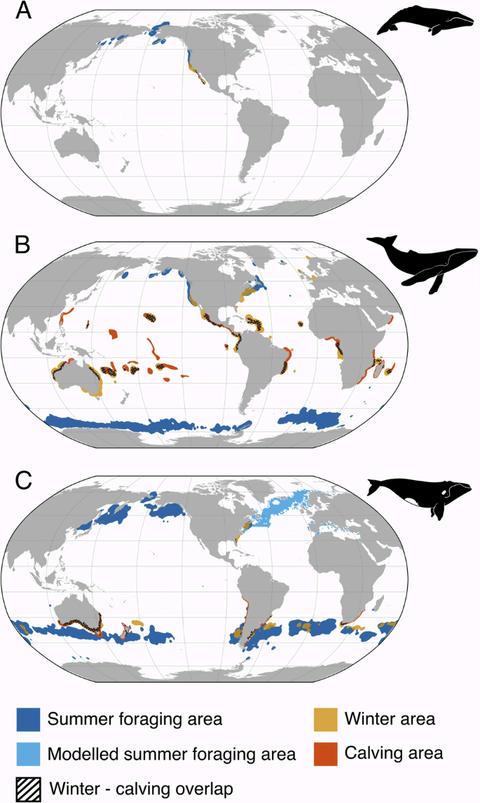
Seasonal movements of grey (A), humpback (B), and right whales (C) (Roman, et al. 2025)
excrete larger amounts of copper. This means that different cetacean species are not ecologically interchangeable, as each species contributes differently to nutrient cycling and ecosystem functioning. The researchers ultimately argue that whale biodiversity itself is important, since the loss of certain species could alter nutrient movement and productivity within marine ecosystems.
By drastically reducing whale populations globally through commercial whaling, humans likely altered marine nutrient cycling and productivity... in these ocean systems.”
The findings from Gilbert and her colleagues also suggest that industrial whaling may have had larger ecological consequences than previously understood By drastically reducing whale populations (mostly baleen and sperm whales) globally through commercial whaling, humans likely altered marine nutrient cycling and productivity long before Western understanding of the ecological roles that whales played in these ocean systems. Additionally, because different cetacean communities contribute different nutrients depending on their behaviours and diets, the loss of biodiversity within cetacean communities could have major impacts on ecosystem functioning
The loss of deep-diving whale species, for example, would not only reduce whale abundance, but could also reduce the movement of important nutrients into nutrientpoor surface waters.
With that in mind, it is incredibly valuable that we continue to study this, especially as global nutrient cycles are changing due to the rapid anthropogenic climate change. Studies such as the one conducted by Gilbert’s research team suggest that protecting whales may also mean protecting marine productivity, biodiversity, and the stability of ocean ecosystems more broadly.
By Bea Gumbinner
Further Reading
Joe Roman & James J McCarthy, “The Whale Pump: Marine Mammals Enhance Primary Productivity in a Coastal Basin,” PLoS One 5, no 10 (2010): e13255, doi org/10 1371/journal pone 0013255
Lola Gilbert, et al , “Composition of Cetacean Communities Worldwide Shapes Their Contribution to Ocean Nutrient Cycling,” Nature Communications 14, no 5823 (2023): doi org/10 1038/s41467-023-41532-y
The Mystery of Microplastics
No coast on this Earth is untouched by plastic.
Even on the most remote, human-free shores, plastic has been discovered, and it is no secret as to why this is true. We love plastic.
Plastic is cheap, durable, versatile, safe, and convenient, which is why it is so heavily relied on in everyday life. Plastic is easy and everywhere, but the issue is plastic waste is almost always mismanaged and it can never fully decompose Once mismanaged, plastic will very often find its way, whether that be through wind or water runoff, into a body of water and, eventually, the ocean In the ocean, the plastics break down, getting smaller and smaller, becoming microplastics. These microplastics are then carried around the globe by ocean currents and often accumulate in specific areas, such as in the center of ocean gyres.
But now, new questions about plastics in our environment are being brought up, specifically, if plastic is now being found within the animals that call the ocean their
by Bridget Gioffe
microplastics being found within marine organisms Specifically, this study focused on the occurrence of microplastics across the tissues of North Atlantic fin whales. Microplastics, as defined in this study, are plastics that have either broken down or been purposefully manufactured into particles of less than 5 mm. Microplastics (MPs) have been extensively found throughout the ocean, meaning these North Atlantic fin whales have had constant exposure to them. As Vitale
and her team explain, Exposure to MPs may occur via ingestion, respiration, or dermal absorption. In marine fauna, the ingestion of MPs occurs directly from water or, indirectly, through contaminated prey.”
These multiple modes of exposure and pathways, combined with constant exposure to MPs, increase the chance of the plastic entering the tissue of fin whales.
Fin whales were chosen as the species to study because, as baleen whales, their filter-feeding and long seasonal migrations make them more susceptible to MP ingestion. Much of their prey, euphausiids (krill) and pelagic fish, have had MPs found in their tissue, and when filter
by Bridget Gioffe
feeding, the chance of ingesting plastic increases since they are constantly processing vast volumes of water in order to feed Their annual migrations expose them to global and ecosystem changes and pollution, which has made the species a good subject to study ecosystem changes, but very few studies have actually examined how these factors have affected the species specifically.
This study works to do just that, looking closely at how MPs translocate and bioaccumulate in the tissues of the fin whale species. The two main goals of the study were “(i) to investigate the occurrence of MPs in multiple fin whale tissues, and (ii) to assess the
qualitative and quantitative variation of MPs detected, within and between individuals.”
By doing this, the researchers expect that MPs will translocate (the MPs will cross biological boundaries in the body and enter new tissue) to “highly vascularized tissues such as fat, but also along the respiratory tract, the second route of access for particles after ingestion ”
Eight fin whales (seven females and one male) were caught by the Icelandic whaling company Hvular in the North Atlantic waters off the coast of Iceland, a country still actively involved in whaling. Vitale and her team took samples from the blubber, muscle, liver, kidney, and lung tissue in each individual. A total of five samples, each weighing twenty grams, were examined from each of the whales. The inner portion of each tissue, made up of organic molecules, was dissolved by hydrogen peroxide, an organic solvent. The inner tissue was used in order to reduce contamination since the outer section was exposed to the aluminum wrapping. It was then put through a filtration system to isolate the inorganic plastic particles that were left behind. The plastics were then photographed, counted, measured, and classified by color, size, and shape
Once all tissues were examined and all plastic particles were accounted for and sorted out, a total of sixteen MPs were identified in the fin whale samples. Of the forty total fin whale samples, thirteen had
at least one MP found, and of the eight sampled fin whales, seven contained at least one MP. While this may appear to be a very small number of MPs, only a very small fraction of the total mass of the whale was studied. A fin whale weighs between forty to seventytwo metric tonnes, and only one hundred grams of tissue were examined This means there is a potential for there to be millions of MPs in the tissue of just one of those individuals.
This means there is a potential for there to be millions of microplastics in the tissue of just one of those individuals.”
By taking from different tissue samples and classifying MPs in different ways, Vitale and her team gathered many different types of results, allowing for several conclusions to be made.
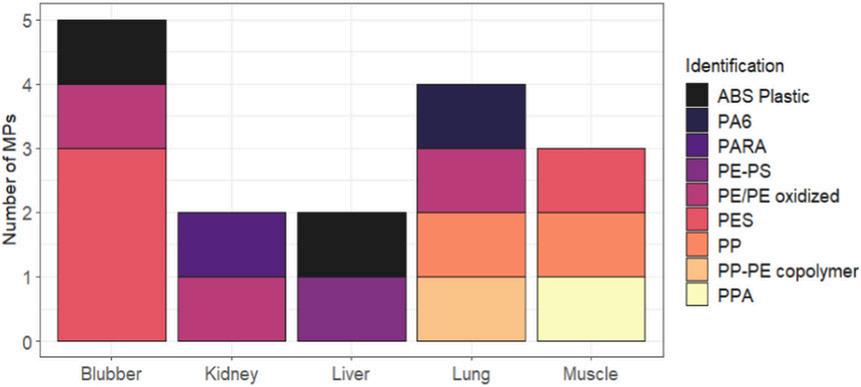
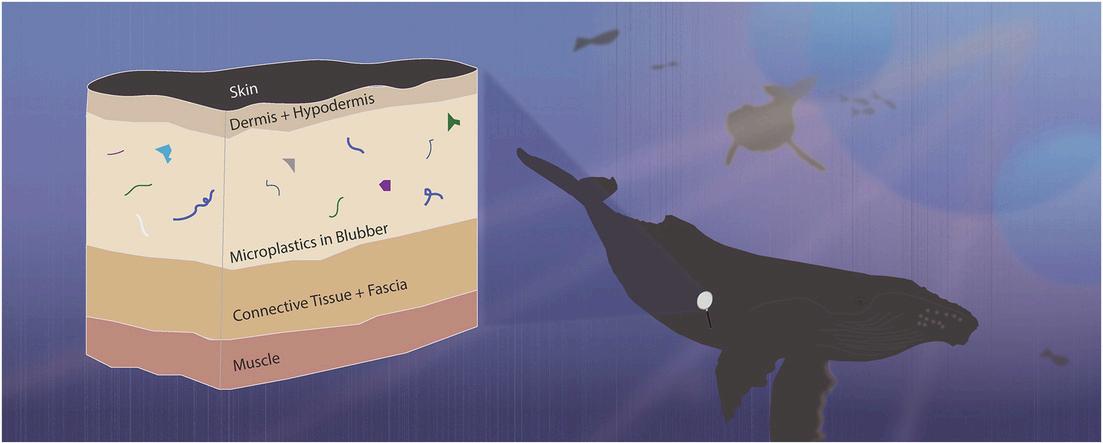
One of the most obvious results was the distribution of MPs across the different tissues of fin whales Blubber and lungs had, on average, the most MPs (31% in blubber and 25% in lungs), lungs followed (18%), and kidney and liver had the least (both 13%) The detection of many MPs spread throughout different tissues supports the initial hypothesis that MPs can translocate throughout the body and that they will mostly be found in fatty tissue (blubber) and along the respiratory
by Bridget Gioffe
tract (lungs)
The route of translocation and uptake of MPs has been studied much more in terrestrial mammals, but not in cetaceans. We have known that MPs have been entering the body through three different exposure routes: dermal contact, inhalation, and ingestion.
have entered different tissues
Even though knowledge of translocation in marine mammals has been limited, Vitale and her team have been able to provide several reasonable hypotheses One of these is that MPs are attracted to fatty and highly vascularized tissue, which blubber and lung tissue both
The issue is, explained by Greg Merril and his team in a separate study on microplastics in the blubber of marine mammals, “There is very little research on dermal contact in animals or humans, but exposure via the latter two routes is believed to be more significant. However, the extent to which microplastics are internalized via inhalation in marine mammals is also unknown.”
Ingestion, on the other hand, has been more widely accepted for longer and recognized as the primary route of MP exposure, with translocation explaining how MPs
by Bridget Gioffe
are MPs are carried through the body in the bloodstream, so a highly vascularized area, an area with a rich supply of blood vessels, means a high likelihood of MPs entering. The MPs then build up there since many of them are hydrophobic and attracted to the fatty nature of this tissue.
Another proposed pathway from this study for translocation was that “inflammatory responses may facilitate the translocation of MPs by compromising biological barriers and increasing tissue permeability.” This means that the weakened tissue will allow for increased passage of
MPs This could be an explanation for why some of the individuals had more MPs since their tissues had already been compromised.
Another important finding from this study is the distribution of MPs by size and type. The average MP length was 62.2 micrometers, with a wide range of 20-130 micrometers. It was noted that there was a trend towards longer particles observed in blubber (95 micrometers) and in muscle (75 micrometers).
An issue found while analyzing MP size within the samples is that previously, studies have suggested that MPs larger than 20-30 micrometers cannot pass through biological pathways. This study found many MPs larger than this size, causing the researchers to hypothesize, “Constant exposure to MPs may impair mucosal barriers by inducing oxidative stress and inflammation, thereby facilitating the passage of even larger particles ”
This means constant exposure to MPs could break down barriers in the body allowing for larger MPs to pass through, raising concerns that MP translocation could act as a positive feedback loop In other words, MP translocation will amplify the longer the process is happening within the organism.
The three most common types of plastic found in Vitale’s research were polyester, polyethylene, and polypropylene, which are consistent with the most common types found in the environment of the North Atlantic As explained in the study, these polymers are used extensively in consumer products, which contributes to their widespread occurrence in the environment, and their bioaccumulation up the food chain. The distribution of MPs is based on both large-scale ocean processes (such as currents) and local use.
Vitale and her team explained in
by Bridget Gioffe
that in the sampled area of the waters around Iceland, fishers are a very large producer of polyethylene and polypropylene due to lost fishing equipment.
Polyester, the most abundant plastic type in the study, is associated with land-based inputs, especially wastewater from textile washing. This input is suspected to be increased in cold water climates due to the increased need for synthetic clothing to keep warm.
The large ocean currents, the North Atlantic Current and the Irminger Current, play a large role in concentrating MPs in the waters around Iceland, a known feeding area, which consequently increases the likelihood of fin whales ingesting MPs while feeding Many adverse effects based on the type of plastic polymer have been known to affect the species that ingest them.
For example, polyester has been shown to cause inflammatory and immune responses, and polypropylene fibers can reduce body mass and impair lipid storage. Lipid storage is particularly important to cetaceans, playing a key role in energy storage, insulation, and metabolic regulation, so the presence of polypropylene is likely to have chronic effects. While aboard the Corwith Cramer, I could observe similar patterns of plastic distribution as described in the study. Our cruise track stayed within the coastal waters of Cape Cod and the Massachusetts coastline for the
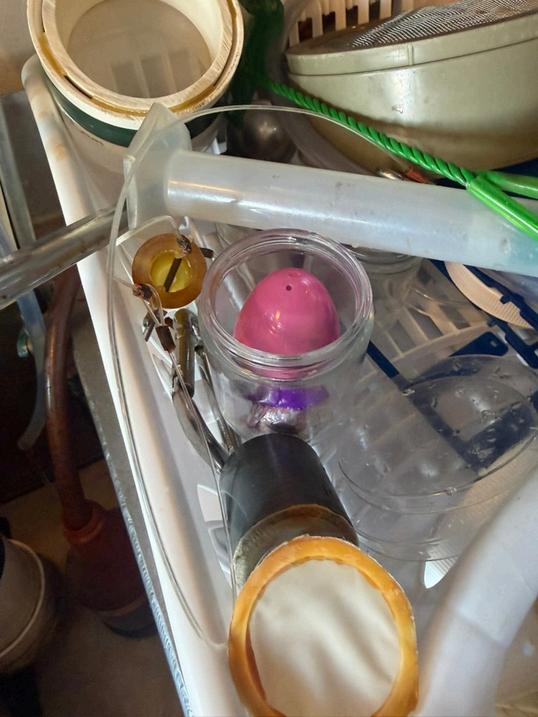
majority of our trip We observed many occurrences of anthropogenic plastics floating on these waters, such as balloons, bottles, and plastic bags. We even often caught plastic within our meter net tows which pulled samples from depths reaching 125 meters in the water column. One notable example was an entire Easter egg filled with unopened Easter themed candy (See lead image, p. 28)
Items such as these suggest that much of the plastic we’ve found was land-based waste, and that despite being in coastal waters, it had been floating there for a significant amount of time. Our Easter egg had likely been floating in these waters since Easter, over two months previous As noted in the study, we too observed a notably large amount of plastic waste around the feeding grounds of whales. We spent much of our time within Stellwagen Bank, a marine sanctuary and known feeding ground for humpback whales.
We had one day where in between sighting whales we tried to remove a large balloon from the surface of the sea. While we were unsuccessful, it goes to show that once our plastic from land makes it to the sea, it has the ability to travel anywhere, even into the feeding grounds of the marine mammals we love, putting them at risk of plastic ingestion.
While it is clear we must take steps to reduce the current volume of MPs in the ocean, the most
by Bridget Gioffe
effective way to ensure a reduction in the future is to limit the amount of plastic before it even enters the ocean.
That means an increased effort to create a policy that limits plastic use and increases the effectiveness of waste management on land. Roughly eighty percent of plastic in the ocean comes from land-based pollution, which is notorious for being poorly managed.
The issue in attempting to create policy is that historically, land-based pollution was a responsibility left to the coastal state This was done because, at the time, in the 1970s, ocean currents were very poorly studied, so it was assumed landbased pollution wouldn’t spread and would only be an issue for the coastal state. This then also led to the assumption that coastal states had enough of an incentive to manage, so international law was not necessary
Clearly, none of these assumptions were true in practice, which is why we have such a weak patchwork of attempted regulation. It wasn’t until the late 1990s, with the discovery of the Great Pacific Garbage Patch, that plastic accumulation was understood as an issue. By that point, our major law of the sea framework (the United Nations Convention on the Law of the Sea) had entered into force, omitting any clear responsibility related to land-based pollution. Perhaps the biggest issue with plastic regulation is that the current
global plastic trends are not at all favorable in attempting to mitigate plastic usage; production has been both accelerating and diversifying. Plastic production is a very profitable business, and states and companies don’t want to be told to reduce production in fear of losing revenue. That is why studies like these are immensely important in providing convincing evidence that supports plastic reduction. A clear connection is made between plastic and severe effects on an animal we all know and love. So, hopefully, as science and understanding grow, the motivation to act grows alongside it, pushing forward the policy needed to protect our oceans.
Further Reading
Giulia Vitale, et al , “Occurrence of Microplastics across Tissues in North Atlantic Fin Whales,” Environmental Pollution 397 (May 2026): 1-8, https://doi.org/10.1016/j.envpol.2026.128026.
Greg Merril, et al , “Microplastics in Marine Mammal Blubber, Melon, & Other Tissues: Evidence of Translocation,” Environmental Pollution 335 (October,2023), https://doi org/10 1016/j envpol 2023 122252
Elizabeth Mendenhall,“ Land-Based Pollution,” Lecture, MAF 312 (international politics of the sea), University of Rhode Island, Spring 2026
by Bridget Gioffe
Bea on Just Wanting to Learn
Thursday June 4, 2026
At anchor, Gloucester Harbor 2045 ET
After a northerly sail across Stellwagen Bank Marine Sanctuary, the ship is at anchor off the famous fishing port of Gloucester, Massachusetts. The Corwith Cramer will be crossing Massachusetts Bay again, southbound, hoping to see more whales, then transiting the Cape Cod Canal and home to Woods Hole this weekend.
This is Camryn’s interview with Beatrice Gumbinner conducted after the first day, at the start of the week, while at anchor off Nantucket. It turned out that the stiff northerly wind conditions would not allow the group to take rides in the small boat to go ashore. (Fittingly, a lack of a safe harbor for anchoring deep draft ships was one of the main reasons the majority of the whaling business in the early 1800s moved over to New Bedford.)
Who am I here with?
Hi, I'm Bea. I'm from DC, but I go to
featuring Bea Gumbinner
school in Oberlin, Ohio. I study Geosciences Right now we’re on the deck of the Corwith Cramer.
What did your day look like today?
I've had a very full day I woke up around 0450 to help undock the boat. We got it out from Woods Hole. And we have been sailing all day. We're anchored near Nantucket, and we're going to go visit tomorrow. And so, once I was on watch, I did a ton of things. I was at lookout. I was on helm. I helped a little bit with science and just kind of
anything they needed on deck, like helping with lines and coiling, etc.
Did you have a favorite task?
I really liked lookout It was a little bit stressful just because there were a lot of boats. And it was my first time. I'm kind of still learning everything. But I really liked lookout. I could kind of see everything, and that was really, really cool. I also really liked steering the boat just because, I don't know, it felt so powerful.
And tonight we had our humanities class in the salon.
Yeah, so for class, we all met up. We had our little group meeting with everyone at first. All the students and crew who wanted to stay stayed for the class. And we talked a little bit about Nantucket since we're visiting tomorrow We talked a lot about Nantucket's history, specifically around whaling and around wealth in Nantucket. And then we read a chapter from MobyDick entitled “Nantucket ” It was really interesting kind of seeing what we're going to see tomorrow and kind of being prepared for that.
More generally, what's been on your mind about whaling history and whale conservation?
I mean, I've learned SO much. I think I don't know. I think we've been in class a lot, so it's been just so much
information, and I'm learning so many cool things. I would say in in general, because I'm more on the science side of things, I've been thinking a lot of how to connect that to science I think one thing I found really cool was towards the first few days, we talked about whaling logbooks and how we use those to reconstruct oceanographic data for history And I think that that is really cool and maybe something I could do with my life.
What are you most excited about for tomorrow?
I'm really excited to go to the museum and to see Nantucket. I've never been. I also really love museums, and I like everything that we're learning. So I'm sure I'll love it.
When we were on watch together yesterday, a crew member asked us to reflect on one thing that we want to leave this trip with. Something that we just want to get out of it in general, self-growthwise or otherwise. What do you want to leave this trip with?
I would say the main thing I want to leave this trip with is knowledge. I want to learn everything I can. I want to gain all the experiences I can. And I don't know. That's what I'm here for. Yeah, I just want to learn.
Bea on lookout (Kenzie Meier)
#Savetheturtles
An In-depth Discussion on the Death Rates of Marine Mammals and Turtles Due to Plastic Consumption
Asea turtle drifts through the ocean carrying a plastic bag it it mistakes for food, while a whale washes ashore with a stomach full of fishing gear. Two separate moments, one shared cause Remember in 2019 when the phrase “#Savetheturtles” became a major viral internet trend, especially on TikTok, Instagram, and VSCO culture, where reusable straws and eco-friendly products became aesthetic “must haves”?
Conservation cannot be deemed a trend with the death of animals at the hands of humans, which is classified as torture But what exactly is happening in deep ocean waters to marine mammals and turtles?
A research study conducted by a team led by Erin L Murphy for the Proceedings of the National Academy of Sciences titled “A Quantitative Risk Assessment Framework for Mortality Due to Macroplastic Ingestion in Seabirds, Marine Mammals, and Sea Turtles” will give us the insight we are looking for. Let’s break down the study by the animals we are focusing on today: marine mammals first,
by Sarah Wallen
then we will look at turtles. Fortunately, we have data that includes adult sea turtles, juveniles, and even teeny-tiny post-hatchlings. (Unfortunately, I will not be covering seabirds in this article. If you're interested in that, I recommend reading the study to get direct insight from researchers.)
Research Breakdown
For about 1,300 marine species in all vertebrate classes, macroplastics have been linked to mortality
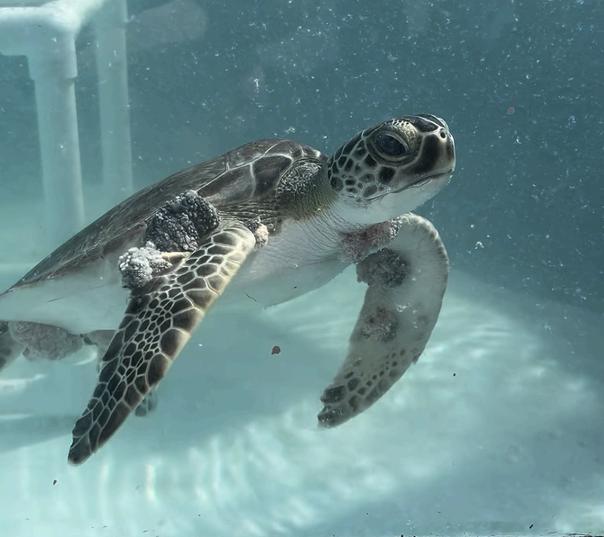
Author’s photograph at “The Turtle Hospital,” located in Marathon FL Note the tumor-like growths that turtles experience from just existing in an environment with microplastics (Sarah Wallen)
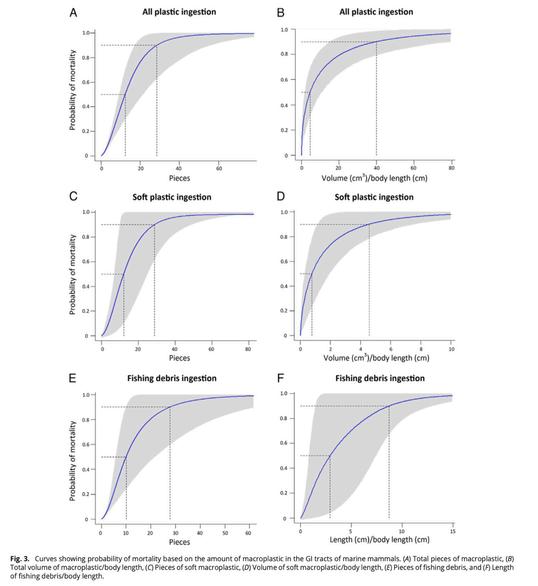
“Curves showing probability of mortality based on the amount of macroplastic in the GI tracts of marine mammals (A) Total pieces of macroplastic, (B) Total volume of macroplastic/body length, (C) Pieces of soft macroplastic, (D) Volume of soft macroplastic/body length, (E) Pieces of fishing debris, and (F) Length of fishing debris/body length,” as captioned by Murphy, et al (2025)
(macroplastics are >5 mm; microplastics are <5 mm).
To measure all the data, we are faced with two questions: “1) Should a risk assessment include the full mixture or be relevant to different material types? and 2) What particle characteristics particle volume, surface area, length, or shape should inform the exposure parameter?”
But how do researchers even gather the data in the first place? The answer to this is necropsies, which are equal to a human autopsy for the most part. Necropsies are done on animals that have washed up on shorelines After assessing
by Sarah Wallen
these marine animals, researchers determined that the characteristics of the plastics are a direct cause of the harm the animals face. In the study, we are reviewing the goal to quantify the mortality rate for marine mammals and sea turtles based on the count and volume/cm body length of plastic, along with the type of plastic.
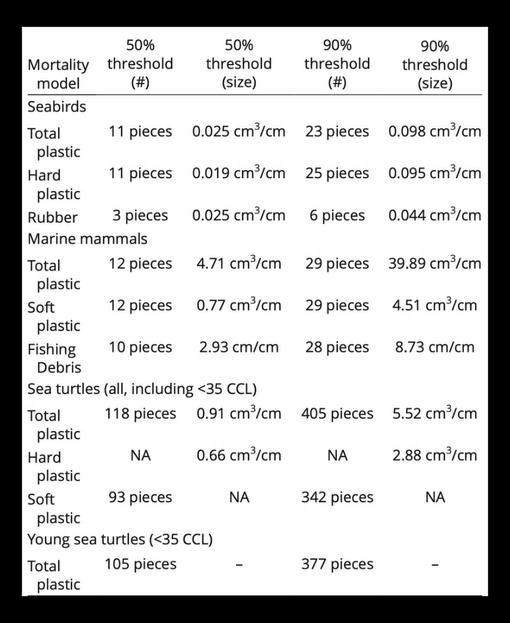
The scientists looked at four categories of plastic: hard, soft, rubber, and fishing debris (i e , line, rope, and nets). The mortality models are used to identify the percent chance of death by an individual animal based on the number of species and the volume of
plastic found in the GI tract For example, researchers determined and predicted when an organism has a fifty percent chance and a ninety percent chance of death based on the type and amount of plastic in its body (shown below for marine mammals). Researchers focus on just ingestion in this study but note that entanglement in macroplastics is another main driver of death and can be argued to be even more lethal.
Measurement Types
Erin L. Murphy and her team used necropsy data, derived from reviewed literature published between 1900 and June 2003. Individuals from the studies that did not ingest any plastic were included in this research as well Physical impacts are also included, specifically perforation, obstruction, and torsion. Perforation is a physical puncture found in the GI tract. Obstruction refers to a blockage in the GI tract that prevents the individual from successfully eating. Lastly, torsion is when the intestines are twisted, also considered another version of obstruction, because the individual cannot eat successfully.
A few of the studies reviewed directly connected plastic ingestion to mortality. So, any animals whose cause of death could not be determined with full certainty. “These animals were excluded,” Murphy and her colleagues explained, “out of an abundance of caution as not to overinflate plastic deaths.”
Data Analysis and Derivation
After creating measurement categories that are the most scientifically relevant and correct, researchers sorted the data. Smith and colleagues derived the data from “57 sources [53 peer-reviewed publications, the NOAA Fisheries stranding network database (54), the FWC Fish and Wildlife Research Institute manatee mortality database (55), and two new datasets].” Then, mortality models could be determined for all taxa. To create each mortality model, the Wei AFT model was used to assess the relationship between plastic exposure or GI tract load and the mortality risk. Overall, necropsy data from 10,412 individuals were used: “7,569 individuals were marine mammals (10 families, 31 species), and 1,306 were sea turtles (seven species).”
Marine Mammals
When all plastic types were looked at together, if a marine mammal ate twenty-nine or more pieces of plastic (39.89 cm /cm body length), it was predicted there was a ninety percent chance of mortality. On the other hand, if a marine mammal consumes just one piece of long rope, line, or net, the chances of death are fifty percent On average, marine mammals, due to size comparison, consume the largest pieces of plastic. This means the volume thresholds were highest for marine mammals compared to sea turtles. The plastics categorized 3
by Sarah Wallen
as soft plastics and fishing debris posed the biggest risk to mortality, largely due to large pieces causing obstructions in the GI tract.
If a marine mammal consumes just one piece of long rope, line, or net, the chances of death are 50%.”
Sea Turtles
According to the data acquired in this research, a little less than half of individuals were found with ingested macroplastic. Note, there was a variety in the frequency of different types. The mean piece size was .22 cm , so generally small Though they have the highest mortality threshold regarding number of pieces. Over half the individuals contained less than 1 cm of plastic and almost all were under 10 cm , “Small amounts of plastic are killing sea turtles.” Across the different mortality models, they show that a plastic amount between 3-118 pieces (or 0 019–4 71 cm /cm body length) in any sea turtle can cause a fifty percent chance of death; it’s the same in marine mammals as well. 3 3 3 3
Juvenile and Hatchling Green Sea Turtle
It was found that post-hatching sea turtles consume a higher number of hard plastics, while adult turtles consume more soft plastic and fishing debris. “A sea turtle
consumed 405 pieces (or 5 52 cm /cm CCL), and a juvenile sea turtle (<35 cm CCL) consumed 377 pieces.” Sea turtles seemed to be more sensitive to soft plastics; the results also showed that hard plastics pose a higher threat.
Why is this? It was deemed that this contradicting information could have been due to the fact that death from plastic consumption was mostly among juveniles and hatchlings (due to their size), both are more prone to the ingestion of hard plastics because their feeding habits are more general in their youth.
Table titled “The amount of ingested macroplastic associated with a 50% and 90% likelihood of mortality for each taxon studied (sea birds, sea turtles, and marine mammals)” in Murphy, et al
by Sarah Wallen
(2025)
As someone aspiring to study environmental conservation law, I must emphasize the importance of in-depth studies like this being continued; it is the only way we will get policy changed. We must continue to chip away at all the harm already done while preventing further issues with marine life This particular research can inform future management and risk assessments.
Although the study only focuses on ingestion, we must consider the other effects of plastic pollution in marine wildlife. Entanglement is one of the other main causes of death we see in ocean mammals and sea turtles To translate this data into policy, we can expand this evidence into human intervention, such as plastic cleanups and a single-use plastics ban. The authors mentioned that they intend the study to be used for such purpose: “our modeling approach can be used as a tool, adapted by decision makers to explore likelihood of mortality in their locale and updated as new data are available.”
The most important consideration to make is that new environmental thresholds can be created by policymakers Identifying quantitative thresholds and updating data are important steps when
reaching the goal of an effective intervention when addressing the problem of plastic pollution.
Further Reading
E L , Murphy, et al “A Quantitative Risk Assessment Framework for Mortality Due to Macroplastic Ingestion in Seabirds, Marine Mammals, and Sea Turtles ” Proceedings of the National Academy of Sciences 122, no 48 (2025): e2415492122. doi.org/10.1073/pnas.2415492122
by Sarah Wallen
Marine Footprint
How Atlantic Europe is Reshaping the Atlantic Beneath its Feet
In an article from The Royal Swedish Academy of Science, researchers led by Paul Holm recorded an estimate of biomass extracted from the Atlantic specifically by Europe, including whales The estimate was recorded over the past 500 years, from about 1500-2019. What was recorded was strictly an estimated extraction of biomass, without specific considerations to other factors Later in the article we get a better look into what parts of Europe may have looked like in the late 1500s, specifically the markets of the time. Apart from consumption and extraction of ocean biomass for food, many organisms such as whales were extracted for their oil; and fish were reduced to fish meal and oil as well The different uses of whale oil specifically could range from fuel sources to lubricants or bases for candles. As technology advanced and we started to rely more on crude oil, we shifted away from a need for whale oil. The IWC moratorium then outlawed the use of whale oil. The military and other government branches do have
by Max Daucher
special permission to use stores of whale oil due to its superior chemical composition in comparison to crude oil.
Europe has a deep and rich history that spans from their sports traditions, architecture and artworks, and stealing. Every country falls victim to the last point, but when looking more closely at Europe, specifically countries that border the Atlantic, we see a long standing history and large impact on the marine ecosystems that surround them.
European whaling peaked twice, first in the 1830s, which primarily
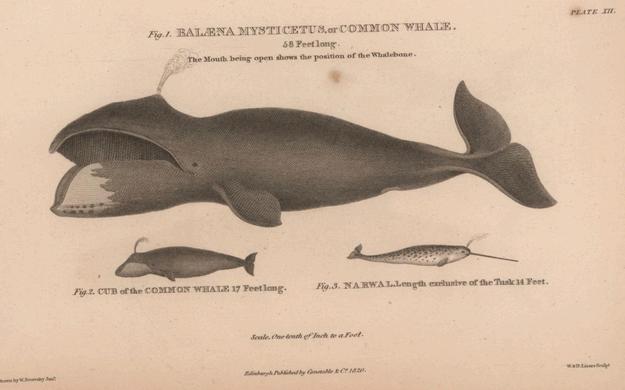
Illustration of a bowhead whale by the English whaleman-naturalist William Scoresby, Jr in An Account of the Arctic Regions, 1820 (Wikimedia Commons)
consisted of lower scale whaling under sail in the North Atlantic, then again in the 1930s in the Southern Ocean, when cetaceans up north were already too scarce to bother with and global whaling increased. There are a handful of countries that continue to whale today (as we learned in the whaling history class with Brooke); these include Norway, Russia, and Japan.
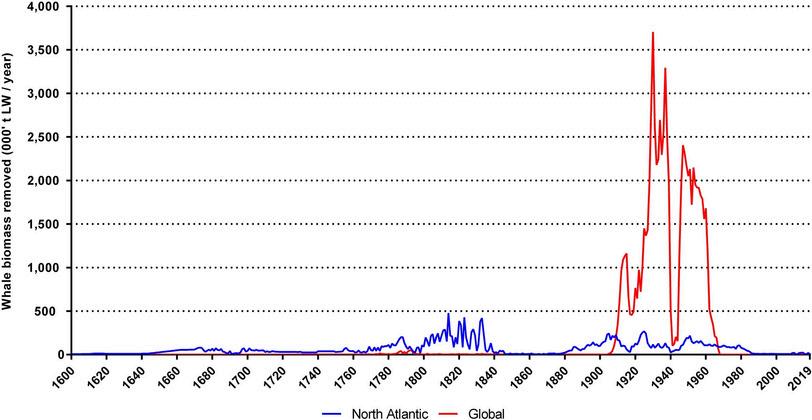
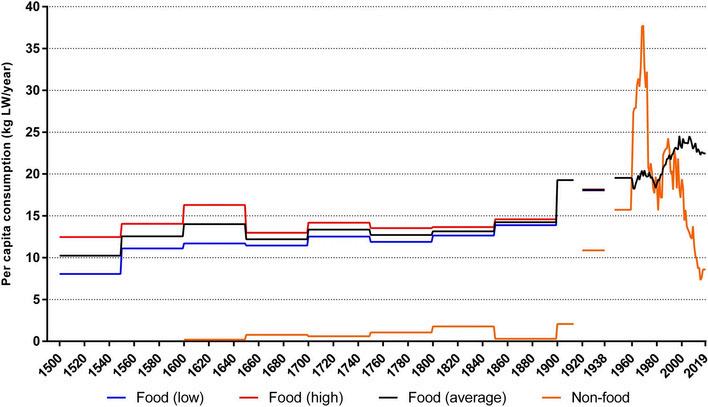
At the peak, 3.8 million tonnes of whale biomass were harvested in a single year, 1930. Non-food consumption accounted for 37 of 57 kg per capita at the 1968 peak, thus meaning the majority of Europe's marine footprint wasn't even food. All of this non food biomass was
by Max Daucher
primarily in forms such as whale oil or spermaceti, as well as fish meal or oil for agricultural reasons. The military also required a solid amount of whale oil before the discovery of petroleum.
The industry didn't stop because of conscience; instead it stopped because the whales ran out. Fish followed the same pattern: fishmeal production surpassed direct human consumption in the 1960s–70s, reducing entire species to pellets for pigs and poultry.
The Southern Ocean became Europe's backup ocean once the North Atlantic was stripped. Then whaling companies raced to Antarctic waters, harvesting species
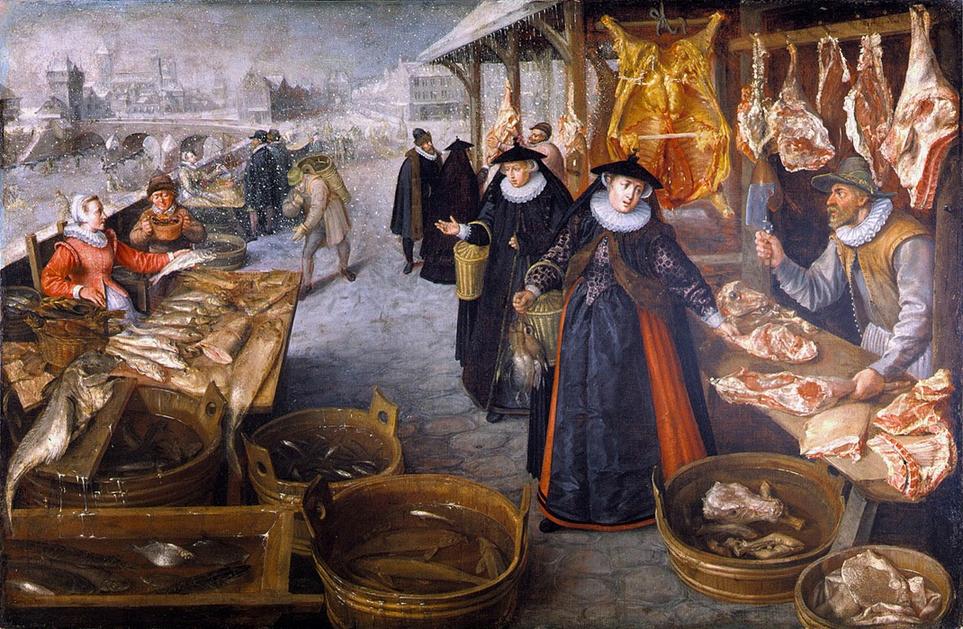
Lucas van Valckenborch, “Meat and Fish Market (Winter),” ca 1595 A great variety of protein was available at the Frankfurt market Consumer choice between seafood and meat impacted the human marine footprint (Wikimedia Commons)
that had never encountered humans
Fishmeal factories converted entire herring populations into agricultural feed.
With all of this consumption people refused to realize what they were doing, which was damaging the global marine ecosystem in turn for profit. Other things such as WWII created more demand for whale oil for military purposes, because it is inherently superior to petroleum.
The North Atlantic Right Whale is still endangered today, seeing numbers as low as roughly 380 known individuals.
Even with conservation efforts rising during the rise of television and media becoming more environmentally conscious, whale populations collapsed. The IWC (International Whaling Commission) moratorium arrived in 1986 many decades too late for many species, such as North Atlantic cod, once the backbone of the European diet for 500 years, became effectively commercially extinct by the 1990s.
by Max Daucher
Outside of direct consumption and extraction of biomass, the marine ecosystem faces many other possible worries. Something that is included in biomass extraction, but also has other negative impacts is lobster traps, primarily in New England and upper Maine coastal areas The lines of these lobster traps can cause many larger marine mammals such as whales to become entangled and can even lead to their death.
Today Europe imports sixty percent of its seafood, strip-mining the waters of West Africa and Southeast Asia furthering the problem, not solving it. The marine footprint didn't shrink at all, it just moved. Out of sight, out of mind.
This graph displays the shift from North Atlantic whaling over time, to the drastic increase in global whaling As technology improved and countries were able to send out whaling operations further away, the whale populations did not stand a chance; the drop towards the end is a result of the 1986 IWC Moratorium (Holm et al , 2024)
This graph shows all of the different factors that
the
Take a second and imagine that you’re a right whale swimming through the North Atlantic Ocean. Next thing you know you hear voices approaching as you come up to take a breath, and then you feel a sharp pain as they harpoon you. You can try to escape and this fight may go on for hours, but will most likely lead to your inevitable demise
Realistically we are not North Atlantic right whales and this is not a worry that many people have. It is however the reality for these whales and many other marine mammals and other species. There are many other environmental issues that pose very pressing threats, but in the case of the North Atlantic right whale, it shows what happens when action is not taken. Regulations get pushed back and as a result a population gets decimated. This is one of the many examples of what sitting back and watching can cause. When looking at the consumption
by Max Daucher
of things like fish, it depends heavily on “species abundance, availability, price, and taste.” Other major factors that played into the overall consumption of fish and other marine biomass was the specific region of Europe.
Looking into the consumption and how it was recorded there were three different categorizations that Holm and his partners used. The first being “apparent,” which relied primarily on historical records such as logbooks and other accounts from government organizations; “observed” which was largely household expenditure; and “approximated,” which is an estimation based on other data.
To get more perspective of how biomass is extracted and the factors that go into it, we need to understand all of the historical context. European Whaling is one of the earliest recounts of biomass extraction and many researchers
made up
live weight extracted yearly in the North Atlantic, by roughly every two decades We have consistent estimates from before around 1950, but see much more accurate records after because of a global effort by the Food and Agriculture Organization of the United Nations (Holm, et al , 2024)
such as Tim Walker and Caroline Ummnenhofer also use the logbooks from these whalers to get context for the marine climate and get a look for the future.
After going on the Corwith Cramer and being within ten feet from a whale, I could only imagine what is in those logbooks, the awe of the whole boat at the sighting of a single whale is a testament to how much power we as a people have over the ocean’s ecosystem. With the ability to extract such a powerful animal we also need to understand what happens as a result. The phytoplankton and zooplankton levels start to rise and with warming of the oceans as well they start to heavily concentrate in certain areas, which creates disparity for species that live in other areas
The awe of the whole boat at the sighting of a single whale is a testament to how much power we as a people have over the ocean’s ecosystem.”
With pushes against climate regulation from the current administration, it has become something that seems like an insurmountable task to create healthy oceans again. Between the jungles of fishing line, lobster rope, and microplastic, you may see a singular animal, caught up in it all. It
is possible that going a day without using single-use plastics means that animals are free, or if more ondemand lobster gear was enforced then we wouldn't see such an intense amount of entanglements What is most important is that we understand the numbers and the gravity that they hold. From 1500 we have extracted an estimated amount of 2,500 million tonnes of marine biomass and that still is a rough estimation of Atlantic Europe that misses many factors. The more we understand how big our footprint is, the more work we can do to shrink it.
Further Reading
Poul Holm, Patrick Hayes, and John Nicholls, “Historical Marine Footprint for Atlantic Europe, 1500–2019,” Ambio 53 (2024), pp 624–636: doi.org/10.1007/s13280-023-01939-9.
by Max Daucher
Did Whales End American Slavery?
Topher L. McDougal and Austin Choi-Fitzpatrick think they might have. Their research article titled “Leviathans and Liberation: Did Whaling Contribute to the Decline of Slavery?,” published in 2025, brings up the interesting connection between the decline of American slavery and the New England whaling economy. They question if whaling had more of an impact on the decline of slavery than previously thought, bringing this subject into the light in relation to broader social and economic pressures of the same time period. By compiling U S Census data along with statistics from the American Offshore Whaling Voyages database – maintained by Mystic Seaport and the New Bedford Whaling Museum –McDougal and Choi-Fitzpatrick investigated the impact of whaling harvests on percentage change of slave populations year to year from 1790 to 1840 While the American Offshore Whaling Voyages database includes information about harvested whale material, i.e. bone/baleen, oil, and spermaceti, as
by Georgia Green
well as vessels lost at sea, these researchers use voyages as the unit of analysis.
McDougal and Choi-Fitzpatrick’s study begins with a large amount of background information, as the histories of both the American whaling industry and slavery are filled with political, economic, and social factors which would take books to explain in full. McDougal and Choi-Fitzpatrick discuss previous examples of slaveholding societies and their histories of resistance and abolition. They bring up these examples in order to paint the picture of the various factors that impact both the rise, but more importantly, the fall of slavery in a given society.
In order to demonstrate how many pre-modern abolition efforts were largely unsuccessful or limited, the authors give short overviews from the Ancient Greeks, the Roman Empire, the Xin dynasty in China, and more. These show moments when these societies either attempted to abolish slavery or succeeded in doing so but at a very limited scale.
Chattel slavery was integral to the foundation of the United States as it
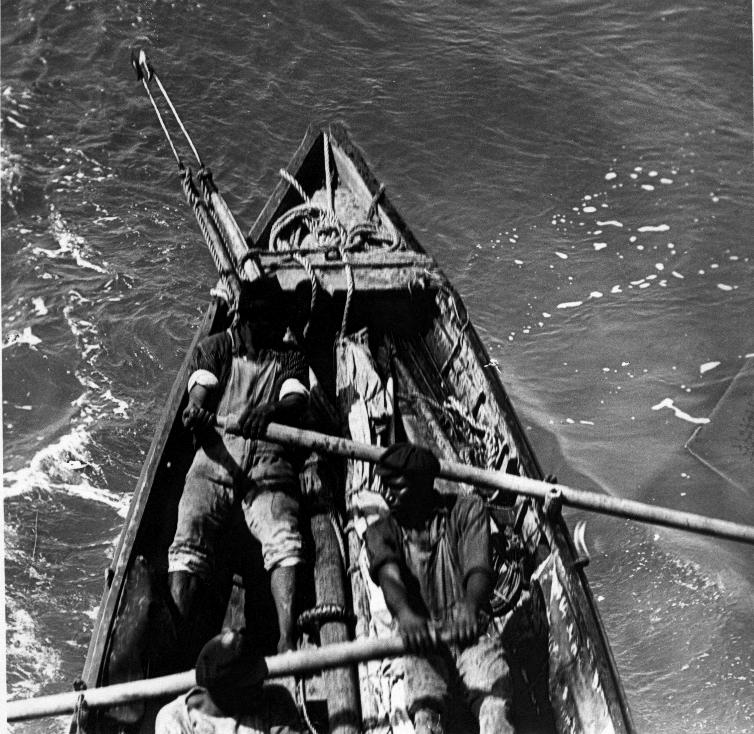
Whalemen aboard the ship Daisy, 1912-13
(Robert Cushman Murphy, A Dead Whale or a Stove Boat (1967)
supported the development of the colonies, including in those places that might sometimes be thought of as not having slavery, notably the northern colonies. The authors point out that in all societies that practiced slavery, these hierarchies relied on the exploitation of human energy to build and support their civilizations, just as we now rely on the exploitation of energy from things like fossil fuels or other non-human resources.
McDougal and Choi-Fitzpatrick then move on to discussing the historical connections between the whaling industry and slavery in America. Widely considered the first real American industry, whaling supported the growing American economy for some two hundred years from the mid-1600s onwards, before beginning to decline in the later 1800s. This industry supplied oil for lamps, lubrication, and soaps as well as spermaceti for candles (which burned much cleaner than other wax or tallow candles) and baleen for combs, tools, corsets, and umbrellas.
As whale populations near the New England coast were plundered, whalers began to make their voyages last longer and longer, going further out to sea for weeks, months, and eventually years at a time In this way, the whaling industry added to globalization, spreading and exchanging ideas with the people they encountered, some of whom were people of color like the Azorean and Cape Verdean people
who often joined American whaling ships. Additionally, I cannot understate the influence of Christian missionaries in the globalization of thoughts, people, and religion Then, in the mid 1800s, petroleum hit the scene.
Neither the authors of this research article nor I will go into the debate of whether or not fossil fuels eventually killed the whaling industry, but fossil fuels definitely changed the industry; ships began using engines meaning they could reach faster speeds to travel further and catch up to whales that were previously too fast in comparison with sailing powered ships.
Additionally, innovations like the harpoon cannon which shot exploding harpoons led to devastating numbers of whales caught and killed at the turn of the century. Eventually, the discovery of petroleum – along with other factors such as the Civil War and the vastly
by Georgia Green
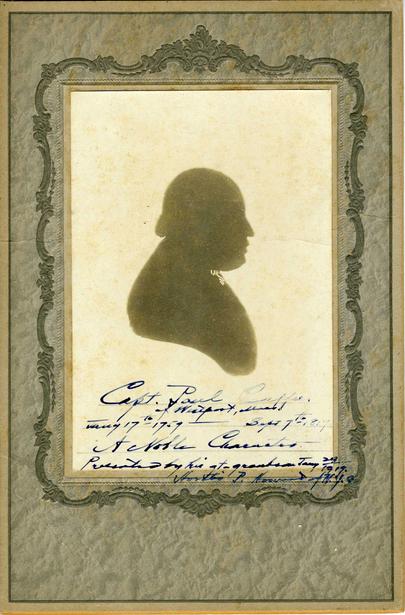
Period silhouette of Paul Cuffe, Sr , a famous Black-Native American whaling captain and the owner of the ship The Traveller (paulcuffe org)
overfished whale populations –would cause the whaling industry to fall to the wayside, but that’s not the focus of this story.
Throughout the same time period of American whaling, slavery rose and fell in this country.”
The other half of this research question is, of course, the American slave trade. Throughout the same time period of American whaling, slavery rose and fell in this country Many places relied on slave labor to essentially power their economies; using African slaves to support large scale agricultural productions as settlers moved further West, pushing out and killing Native Americans across the country, and, later, as factory workers for the textile industry.
Hundreds of thousands of enslaved people were brought into America and the Caribbean and subsequently sold from place to place throughout this time period. While there were some people who might have been against the practice of slavery from the start, the majority of the country (at least those with votes and property) directly relied on and profited from enslaved labor. An important part of the abolitionist movement in America was the role of Quakers, a large population of which lived in New England, specifically Nantucket
which was a nexus of American whaling. Quakers saw slavery as morally wrong and were very strong proponents of abolition in America. Many of the captains and/or owners of the whaling ships out of Nantucket were these same Quakers, meaning the whaling industry had direct ties to the abolitionist movement.
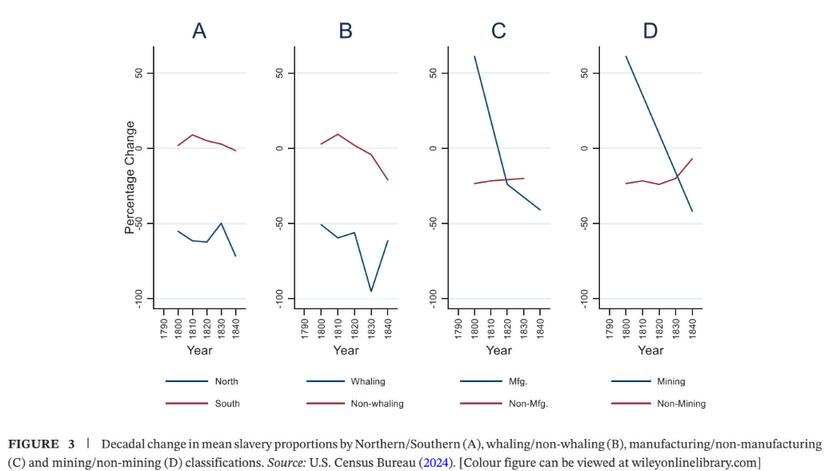
The authors find that states involved in whaling had slave populations that decreased more quickly (i.e. percentage change of populations of enslaved people proportional to the state’s population) than those non-whaling states.
They point out that, along with the Quaker connection, there are other reasons why the whaling industry might have contributed to the abolition movement. One of these is that the whaling industry was a space where people could earn a wage and social merit, even if they were not white; as people of color joined whaling voyages – from both New England and around the world –they were able to occupy roles where they participated in securing the catch just as much as their white counterparts, proving themselves through the dangerous jobs of harpooning and the like. And, as mentioned previously, the white sailors were exposed to people of color around the world and saw many different worldviews where those people of color were the predominant population.
Additionally, if those whalers
by Georgia Green
made it back to shore with a sizable catch, they might earn enough money to buy their own freedom, showing how the whaling industry gave some people of color agency in their own fate as they were able to end for themselves and make a living wage. The American whaling
would chase them
This, I think, speaks to the nature of the sea; one of escape from land and a place of exploration and boundlessness. We often speak of the ocean as a source of freedom in a metaphorical or poetic sense – an escape to the vast, open ocean – but
industry would eventually see around fifty Black men as captains of their ships, some even setting sail with crews made up entirely of people of color. In this way we can see that the whaling industry was not only a source of abolitionist support but it was itself a place of freedom for people of color who found themselves a part of whaling voyages. Moreover, joining whaling voyages was a way for formerly enslaved people to escape the Fugitive Slave Act – the ocean was a place to disappear, where no one
by Georgia Green
for these people of color in this time it was very literal.
McDougal and Choi-Fitzpatrick compare proportional rates of declining slave populations in a variety of conditions looking at differences between northern and southern states, whaling and nonwhaling states, and more (see table above). While there is certainly a correlation that can be seen, especially between whaling and nonwhaling states, this doesn’t necessarily prove a direct causal relationship. This leads the authors
to conclude that “the effects of whaling on the decline of slavery seem to be very close to 1-for-1: for every 1% rise in whaling harvests, we observe a 1% decline in slavery in future years.” But they do point out that their study does not demonstrate a causal link, leading them into their discussion of further research.
So with that background knowledge in mind, it makes sense to look for a connection between rates of decline of slave populations and rates of success of the whaling industry, right? If we know that this industry was deeply important to the American economy in the same time period as the height of American slavery and we know that many freed Black people were involved in whaling, it makes sense to look for a causal relationship between the two that can be proved through statistical modeling.
However, part of the way that McDougal and Choi-Fitzpatrick framed their work doesn’t quite fit into this line of reasoning. In fact, in their introduction section, when pointing out the possible role of whaling in the decline of slavery, they explain the industry as “an intermediate strategy of energy exploitation between slavery and fossil fuels,” further explaining that the whaling industry “allowed humans to exploit the bioenergetic resources of the world’s largest ever animals… the practice may have served as a…bridge between slavery and fossil fuel exploitation ” And
then in the following paragraph they state that their hypothesis is that “the whaling industry weakened the practice of slavery in the United States.”
To my understanding, these two paragraphs don’t make sense in conjunction with each other. In the first, the authors seem to be stating that they believe whaling to be an energy resource exploitable in the same way as humanpower through slavery and chemical power through fossil fuels. However, the products of whaling – spermaceti, oil from blubber, and baleen – were never used as energy or burned for power. The way I read these statements is that the authors take the exploitation of whales to fulfill the same niche as the exploitation of people for labor and fossil fuels for energy, which they do not. And then, th f ll i h th i d
by Georgia Green
Sunset off Provincetown, MA, one of the largest whaling towns in Massachusetts in the 19th century (Georgia Green)
practice of slavery, not that it acted as an in-between from slavery to fossil fuels. Now, as I stated above, I understand why a researcher would think to look for a connection here, but neither the idea of whaling as a stepping stone or whaling as a direct influence on slave populations fits into that understanding of why it makes sense to look for this relationship.
But, rather than focusing on being critical of McDougal and ChoiFitzpatrick’s work, I think it would be both more productive and more interesting to think about what this data could tell us instead, and what future research could come from this topic.
The authors hope, as all researchers do, for their work to spur further research on this same subject. They note four specific ideas as particularly important: focusing on energy transitions; demonstrating the direct impact of whaling on abolitionism; expanding maritime history to look at economic agency (particularly within Black and Native American populations); and quantitative spatial analysis around whaling’s impact on regional changes. Additionally, they hope that future research will explore different modes of energy exploitation, especially those of biological origins. I believe this research could also be taken in the direction of investigating what different forms of freedom meant to enslaved people –especially how escaped or freed
enslaved people found economic agency – and historical records of how the ocean has facilitated freedom for marginalized or oppressed populations. While I will never understand even an inch of what it meant to be enslaved, I do feel a sense of freedom every time I’m near the ocean and every time I set foot in a boat on the water. I think continuing research into the relationship between disenfranchised peoples and the sea could continue to shed light on how people find themselves connecting to their communities and driving the desire for agency wherever you might find it. Especially today, when the activity of sailing in America is so often limited to the wealthy and privileged, I think that a reminder of how sailing has been such a large part of American history for more than just white people might not be such a bad thing.
Further Reading
Skip Finley, Whaling Captains of ColorAmerican’s First Meritocracy (Naval Institute Press, 2020).
Topher L McDougal and Austin Choi‐Fitzpatrick 2025 “Leviathans and Liberation: Did Whaling Contribute to the Decline of Slavery?”
International Social Science Journal (Paris) 75, no. 247 (2025): 507–19: doi org/10 1111/issj 12567
Frederick Douglass, The Life and Times of Frederick Douglass: From 1817-1882 (Christian Age Office, 1881)
by Georgia Green
Sounds Beneath the Surface
The Story of Ocean Noise, Whales, and Human Impact
During our visit to Woods Hole Oceanographic Institution (WHOI), we got to listen to different frequencies of whale calling sounds. For a moment it felt like we had been transported to the ocean itself, listening to whales communicate across vast distance. My cohorts, Georgia and Bea, were mesmerized by the sounds. “I could listen to this for hours,” Georgia said
In that moment I understood the connection she felt to these whales. Their songs didn’t feel like random background noise. They felt emotional, alive, and meaningful
Max Chervin Bridge, a historian whose research focuses on cetaceans, sounds, and environmental history, wrote the article “Still a Silent World: Fish Ears, Whale Politics, and the Science of Ocean Noise, 1941–1990.” This is a historical study on how ocean noise became a scientific and political issue.
Bridge examined scientific research, government documents, past records from the U.S. Navy, and even accounts from Indigenous whalers to account for how ideas
by Judetalina Daniel
about ocean noise changed over time And how we came to understand that fish and whales depend on sound and that humanmade noise has impacted marine life.
Humpback whale diving, as seen on Stellwagen Bank from the Corwith Cramer (Brooke Grasberger)
Historical context
This story starts after World War II when the US Navy started paying attention to underwater sound. The US Navy didn’t study the ocean because they wanted to save the marine animals. They were interested in how oceanic listening could be helpful to military technology. This was helpful in opening conversations about sound in the ocean. Ships, submarines, sonar and other gear were all dependent on the understanding of the movement of sound through water But when scientists began to listen more carefully, they started to understand that the ocean was not silent.
Fish involvement in whale study
One big part of this history is research on fish hearing. In his study Bridge examines how scientists, in tanks and laboratories, studied fish in the 1940s-1960s They exposed fish to different sounds to see if they could hear and respond. This was pivotal because not a lot of people considered fish as sentient animals, at least in Western traditions They were mostly seen as an object, things to eat, or numbers in a population. But Bridge says that this discovery showed fish as animals that could hear, react and perceive the world through their own lenses. Whales became central characters in the public's narrative
by Judetalina Daniel
Marie Poland Fish records fish sounds with a hydrophone at the URI lab in Narragansett Bay, RI (Scientific American, 1956)
as scientists began to connect underwater sounds to their behavior and survival.
Arthur Myrberg, a marine biologist and former professor at the University of Miami, shared his concerns that low frequency noise from ships could have an effect on the sounds fish use to reproduce, and hunt for pray. Which turned into: if noise could affect the smallest of fish it could also have an impact on the largest marine animals, whales. Their voices are seen as emotional ones people could connect to After being struck the whale being hunted made a screeching sound. Conservationist Roger Payne compared this scream to that of a woman. Whale songs are often described and recognized as beautiful.
Understanding Acoustics
Understanding acoustics is important when it comes to ocean noise. Sound behaves differently underwater than it does in air. Sound is created by pressure waves. These waves move through a medium, like air or water, by compressing and expanding particles. Water is a strong medium that can carry sound very far. During a lesson with the Sea Education Association, Kenzie Meier, a scientist at WHOI, further explained sound, using terms like amplitude, frequency, wavelength, and intensity. Amplitude relates to how loud or soft a sound is, while frequency refers to pitch. A higher
frequency creates a higher-pitched sound, and a lower frequency creates a lower-pitched sound. Sound travels much faster in seawater than it does in air. In seawater, sound moves about 1,500 meters per second, while in air it travels about 340 meters per second.
We’re not going out and sticking them with a pole anymore; we’re just ruining their lives.”
The ocean is an environment where sound can move across long distances. Since light does not travel as well underwater, a large number of marine animals have evolved to depend on sound as a major way of receiving information, including whales, dolphins, fish, and even invertebrates. Sound is not just background noise in the ocean It is a form of information.
Dangers of Masking
Sound is not just about beauty. It is survival Acoustic biologist Christopher Clark asks people to think of being a whale and listening to ships get louder and louder until the sounds “drown out everything” the whale might have been hearing He describes this problem as an “acoustic smog.” For sperm whales, masking can interrupt echolocation, hunting, and navigation. For humpback whales and other baleen whales, masking can make it harder
by Judetalina Daniel
to communicate or locate one another.
Noise pollution isn’t always plain to see. People can spot plastic in the ocean or oil on the water, but sound goes into the water That makes it easier to ignore. But for marine animals, sound can also shape their entire worlds. If a whale relies on hearing another whale far away, a vessel’s engine is not just background noise. It can build a wall between whale and environment.
“We’re not going out and sticking them with a pole anymore, we’re just ruining their lives,” said Dr Brooke Grasberger, an ocean environmental historian.
Scientists were finding out that fish were hearing. Whalers were claiming the whales listened to noise. Industrial activity was
by Judetalina Daniel
growing Ships were becoming louder. The ocean continued to be used as an empty space where human activity can go unchecked. Bridge shows that by the twentieth century some scientists were already warning that human-made noise could hurt marine life. According to Myrberg, the effect of manmade noise on fish “can no longer be ignored ”
Indigenous Knowledge and Whale Behavior
Bridge also wrote about how Indigenous Iñupiaq whalers already knew about the effect of noise on whales before officials took it seriously. They knew that bowhead whales could be disturbed by noise because the hunters lives depended on knowing whale behavior. Bridge
Whalemen in an umiaq out of Barrow Alaska Iñupiaq hunters have for centuries understood about the impact of sound on whales (EncountersAlaska com)
writes about Captain Burton “Atqaan” Rexford, who explained that whalers observed how noise affected bowhead whales. Iñupiaq hunters used quiet sealskin boats. Because these boats were quieter, they could approach the whales in a more cautious way.
Oil and gas drilling in the Arctic raised serious concerns in the 1970s and 1980s. With offshore developments happening in the Beaufort Sea, bowhead whales, the kind of whale Iñupiaq communities made a living from, were threatened. These communities resisted. Iñupiaq lobbying against offshore drilling helped push federal research and regulation of ocean noise in the United States. These findings didn’t simply come from labs or universities That knowledge also came from people who lived with whales and watched them closely for generations. Iñupiaq whalers had real knowledge based on experience, observation, and survival Their concerns helped force the government and scientists to study how industrial noise affected whales.
Bridge makes it very clear the ocean has never been silent It was only treated that way because we were not listening close enough. My experience on the Corwith Cramer, listening for whales on the hydrophone, I couldn’t help but hear the loud rumblings of the Cramer engines. That helped me understand this more clearly, how sound travels underwater, which made the issue
feel even more real.
Ocean noise pollution is easy to ignore because we are not able to see it, but that does not make it less harmful
by Judetalina Daniel
Further Reading
Max Chervin Bridge, “Still a Silent World: Fish Ears, Whale Politics, and the Science of Ocean Noise, 1941–1990,” Environmental History 30, no 4 (October 2025): 700–728, doi org/10 1086/736607
Arthur N Popper, “Effects of Anthropogenic Sounds on Fishes,” Fisheries 28, no 10 (October 2003): 24–31
Arthur A Myrberg Jr , “Ocean Noise and the Behavior of Marine Animals: Relationships and Implications,” in Effects of Noise on Wildlife, edited by John L. Fletcher and Ronald G. Busnel (New York: Academic Press, 1978): 169-208
Students watching whales aboard the Corwith Cramer, including the author in maroon (Brooke Grasberger)
Grace on Human Connection with Marine Life
Wednesday June 10, 2026
SEA Campus
Woods Hole, MA 1600 ET
While back on campus after the sea voyage, and in-between writing and preparing final projects and presentations, Camryn interviews fellow student Grace Farinella.
Hello, what's your name and where are you from?
I'm Grace. I'm from New Jersey. I go to URI [University of Rhode Island] I study Marine Biology.
What brought you to SEA?
I got an email from my school's Marine Biology program for internships and opportunities for the summer, and I saw that it had to do with whales and being on a ship. I immediately wanted to be a part of it, because I have a passion for whales and also being out on the ocean and the field work being directly in the environment of the sea I learn better [that way, instead of] learning marine biology in
featuring Grace Farinella
classrooms. This is my first time sailing.
What was your most memorable moment from our life at sea?
My most memorable moment was probably when we saw the mother and calf sleeping together. It was the closest I'd ever been to a whale. We were close enough that we could hear the sound of their breath as they blew out of their blowholes. Even though they were sleeping and pretty calm, it was still really interesting to see them up close and magical.
Grace speaking on the lawn in front of the student houses (Camryn Hartigan)
I really liked how everybody got very quiet whenever we were having closer encounters with whales or just any encounters with whales. It kind of gave everyone time to really take in what we were looking at and not just see them as commodities but more as individuals and beings that we were sharing the space with.
Today was one of our last days of classes. Do you have a particular lesson about whaling history and conservation that has stood out to you most?
I do. I really enjoy the, it was kind of brief, but any lessons that we had about Indigenous experiences with whaling and whales. I find this very interesting. I think that it's
something to look back on and consider when taking in the full story of human coexistence with animals in general and nature. That there were people who already had ideas about conservation and had values about how to live in reciprocity with the things around us.
Today we had a class in the morning where we learned about the future of whale conservation, current issues that whales still face. I found it was a pretty interesting lecture on the different weights of all of these different problems that are facing whales today that have not a lot to do with industrial whaling that we might have thought, but more so to do with entanglements and vessel strikes and climate change.
I think something that sticks with me more so throughout my life that's kind of been solidified through this program is seeing whales and organisms in the life around me as something that we're a part of and something that we affect. And that we can't get away from them.
There's no point in trying to pretend that they are separate. Something that we can do better is to understand and acknowledge that connection and make sure that we are using it in the best way for both parts.
featuring Grace Farinella
Grace’s photograph of the Corwith Cramer under sail
Journal entry and illustration in response to a class assignment, by Judetalina Daniel
Did Whales Out-Smart 19th Century Whalers?
Whaling Logs Reveal Long Term Decline in Strikes Due to Sperm Whale Communication Around North Pacific Social Clans
Sperm whale (Physeter macrocephalus) communities throughout the world’s oceans were victim to commercial whaling under sail at its height in the 1700’s to mid-1800’s. These ocean giants were targeted for “spermaceti,” the unique oil found in their heads that when processed down was used as wax for candles and lamps as well as a high quality lubricant for machinery
The public Western view of these animals at the time was largely as Leviathan, big fish, and valued product. But in reality sperm whales are deeply intelligent mammals with social systems and language that mirror our own.
Commercial whalers recorded an abundance of valuable observations of whales in their open ocean habitats, viewing natural behaviors during their voyages that lasted upwards of a decade. Historical and scientific researchers alike have used these archives to infer the impact of whaling on the species targeted, notably the sperm whale. Whalers often logged every whale
by Grace Farinella
A 19th century whaling log from our visit to the New Bedford Whaling Museum archives, depicting four slaughtered whales and two sighted, but escaped capture (New Bedford Whaling Museum)
that was caught as a record for accounting profits. When we went to the New Bedford Whaling Museum we got the privilege of access to their archives, including hundreds of whaling logs Each whale stamp in a log represented a whale that was killed. Each whale tail stamp represented a whale that was seen, potentially striked, but overall escaped capture
In a recent study researchers Hal Whitehead, Tim D. Smith, and Luke Rendell inspected logs from whalers in the North Pacific Ocean from 1819 to 1844, during the peak of American commercial whaling under sail. Within this period they noticed a 58% drop in recorded strikes of sperm whales. The researchers inspected possible sources to such a dramatic decrease in the whaler’s success. The team eliminated possible options such as whaler incompetence, as previous whalers strike rates had not been elevated outside of the North Pacific, such as New England’s rates. They also ruled out whalers eliminating all the vulnerable individuals as it would not result in such a rapid decline Combined with modern knowledge of sperm whale social complexity, the researchers came to the conclusion that the whales of the region were learning and teaching each other how to evade capture. The researchers suggest that “social learning, in which naive social units, when confronted by whalers, learned defensive measures from grouped social units with
experience, could lead to the documented rapid decline in strike rate.”
Sperm whales live in matriarchal social units, often kin-based families of mothers, calves and elder matriarchs. But they do not strictly interact within the unit. The researchers found that pods were more likely to split in response to high whaling pressure When a victim was captured, the kin would attempt to flee, and often a few got away.
Encounters with whalers typically lasted hours, clicks and squeals from the victim coordinated evasion. If pods split and rejoined other units, experienced individuals intermingled with inexperienced individuals, telling the story of whalers It is suggested that defensive and evasive behaviors were shared from these “conversations” and spread among local pods, decreasing the strike rate in the region
The researchers came to the conclusion that the whales of the region were learning and teaching each other how to evade capture.”
Pods naturally intermingle with other social units, especially those that share acoustic similarities. Certain communities have regional “accents”, or clicking patterns that are unique to the group of social units. These language markers are
by Grace Farinella
A diagram of the social and vocal units of sperm whales off the coast of the Galapagos Islands displaying the complexity of pod relationships Line thickness shows the strength of relationship between individuals and social units (blue circles- Regular Clan, red circles- Plus One Clan) These are Pacific Ocean cultural clans
called “codas.” This shared acoustic identity of these communities creates a “clan” of sperm whales. Studies (Cantor, Shoemaker, Cabral 2015) have shown that sperm whale clans have relationships with their neighboring clans as well.
Try to imagine a sperm whale pod in the 1800s, traveling through the North Pacific. The matriarch swims strongly, leading the way. She is seventy years old, having known the sea for nearly three quarters of a century. Her daughters and their calves click softly to each other nearby. Suddenly, shadows of small boats at the surface loom overhead. Lunging harpoons puncture the waves around them. The pod
by Grace Farinella
becomes erratic, clustering together in defense. The matriarch is pierced, ropes wrap around her body. As the grandmother and leader of the pod gets dragged to the whaling vessel she calls out to her kin in low, desperate codas. Blood sprays from her blowhole, showering the pod in violence For hours she struggles to break free, her daughters watching in despair. Eventually the few survivors flee, leaving the matriarch to be cut up. They took her blubber and the rest of her body was thrown away. Her knowledge, her leadership, her life, lost to the cold sea.
The severed pod traveled across the Pacific seas, their eyes cannot unsee what they have witnessed.
made up of multiple pods established by unique identity codas (Cantor, Shoemaker, Cabral 2015)
Photograph by Tony Wu
They eventually cross paths with another social unit. They share a dialect and can communicate easily. The witnesses tell stories of the predators from above, clicking knowledge to their peers The new pod of the war-torn and the innocent now travel together. Communicating with others from their clan, and spreading to neighboring clans of the North Pacific, who speak a different coda. Together they spread information across the ocean. When confronted by the whalers again, the pods of the region know better, having listened, learned, and educated.
The researchers unraveled the log entries into a scene like this. They
explain how the intellectual complexities within sperm whale communities such as behavioral plasticity and cross-clan adaptation could greatly impact how we understand and protect them today
We may no longer have a strong worldwide whaling industry but human threats still loom overhead for many cetaceans. Vessels still put many pods in danger of being struck as they speed overhead without care for the intelligent mammals below.
The research team explains: “The ability of sperm whales, or potentially other species, to rapidly change behaviour in the face of a new anthropogenic threat by making use of social learning has implications for the population significance of
by Grace Farinella
Journal Illustration by Oliver Wilcox aboard the whaleship Canton in the North Pacific in 1837, depicting three sperm whales killed (note the blood in their blow) and three harpooned but escaped (New Bedford Whailing Museum)
new threats, and their assessment.”
This conclusion of adaptive learning also helps researchers who focus on translating whale language and social structures. Today, we don’t truly understand what meanings lie in every click but studies on the past can further our knowledge in the present. I believe scientific exploration is about understanding the world around us, translating the untranslatable. If humanity learns that the creatures in which we share the world have language, culture, and higher thought, we might begin to restore a bond to the natural world that industrialization harpooned within us.
I think it is well worth acknowledging that Indigenous peoples from around the world have practiced sustainable whaling for thousands of years before these whaling log entries were written. Their values of respect, reciprocity, and connection allowed for whales to thrive alongside their communities as a gift rather than a product. Native peoples have understood the codas of nature long before Western scientists had the technologies to listen in on the languages of the earth and sea. Taking only what is needed, making use of the whole organism, and respecting the harvest with returned protections Combining Indigenous wisdom, scientific knowledge and
and ocean stewardship, the language of whales can be translated into a gift within reach
by Grace Farinella
Further Reading
Maurício Cantor, et al., “Multilevel Animal Societies Can Emerge from Cultural Transmission,” Nature Communications 6, no 8091 (2015): doi.org/10.1038/ncomms9091.
H Whitehead, T D Smith, and L Rendell, “Adaptation of Sperm Whales to Open-boat Whalers: Rapid Social Learning on a Large Scale?,” Biology Letters 17, no. 20210030 (2021): doi org/10 1098/rsbl 2021 0030
It Takes a Whale-age
A Documentation of Collaborative Birthing Behavior in Sperm Whales
W“ hale spout! Broad off the starboard bow!”
The shout came at around 2 pm (or, as we sailors would say, at 1400). Early that morning, we had entered the Stellwagen Bank National Marine Sanctuary, an 842-square-mile, federally protected marine park located off of the coast of Massachusetts Within this area, it is illegal to drill, dredge, dump waste, or otherwise disturb the marine mammals who live there. Our only plan for the day: look for whales.
In some ways, Stellwagen Bank was the ultimate destination for our ten-day voyage. Its positioning and topography allows for extreme productivity that supports its thriving marine food web, and, importantly for us, its large population of whales. We had been somewhat unlucky so far; this whale sighting was the first we’d had all morning that didn’t seem to disappear as we got closer.
As we approached, we realized there were actually two whales: a mother and calf. They were
by Celeste Giannoulias
humpbacks, exhibiting the characteristic “logging” behavior in which a whale rests at or below the surface, breathing as each half of its brain takes turns sleeping
Humpback whale mothers and calves stay together for ten to twelve months, during which time the calf drinks gallons of breastmilk daily Humpbacks are not the only whales who have this close mothercalf bond: all mysticetes–-baleen whales–-have an intense bond for a short time after birth, and
Jude Daniel (left) and other crew and students see whales on Stellwagen Bank (Brooke Grasberger)
odontocetes–-toothed whales–often have lifelong, multigenerational connections.
Western cultures have known about cetacean maternal care for some centuries now, likely first documented in Thomas Beale’s 1839 book The Natural History of the Sperm Whale, in which he wrote that mother sperm whales possess a “remarkable attachment to their young, which they may be frequently seen urging and assisting to escape danger with the most unceasing care and fondness.”
Much of early cetacean research, especially about sperm whales, was driven by the whaling industry’s interest in determining where, when, and how to maximize profit. When Beale published his book in the 1830s, coastal New England was the epicenter of the global whaling
by Celeste Giannoulias
industry; throughout the 1830s alone, roughly 20,000 sperm whales are estimated to have been killed.
However, observing cetaceans giving birth in the wild is exceedingly rare there remains only one other instance recorded by Western scientists of sperm whales giving birth within the past sixty years, and the other three accounts were taken note of on whaling voyages in the mid-20th century. Overall, only nine out of the ninety-three (or ninetyfour, depending upon whom you ask) species of cetacean have been documented giving birth.
For sperm whales, which regularly conduct foraging dives up to 2,000 meters, much of their lives take place in the euphotic zone, with a brief interim for surfacing and breathing On average, sperm whales spend more than fifty percent of
An 1830s painting of whalers harpooning a sperm whale calf in order to lure the mother and other female sperm whales close by This tactic was used to enable easier hunting of the adults, who would most always come to the calf’s rescue (New Bedford Whaling Museum)
heir lives at depth
That’s why, when Project CETI (Cetacean Translation Initiative) announced in March of this year the publication of two milestone studies, presenting the most comprehensive documentation of sperm whale birth recorded, it was foundational.
“These findings fundamentally reshape how we understand whale society,” said David Gruber, a National Geographic Explorer, Founder and President of Project CETI, and Distinguished Professor of Biology at the City University of New York “What we’re seeing is deeply coordinated social care during one of the most vulnerable moments of life.”
clan dubbed by the researchers “Unit A.” All members of Unit A were present at the birthing event; important to note, as collective calf care is absolutely essential—or at least seems to be so in the group living practice of sperm whales.
Sperm whale “units” are cohorts that exist together, hunting and migrating, and make up the broader clan structures that dominate ocean basins. Unit A has eleven sperm whales, eight adults and three calves. Sperm whale units are strictly matriarchal. Unit A in particular consists of two matrilines who share a distant common ancestor. The calf belongs to Line One, consisting of
Project CETI is a nonprofit organization applying advanced machine learning and new technological advancements to listen and translate the communication of sperm whales
Their study, titled “Description of a Collaborative Sperm Whale Birth and Shifts in Coda Vocal Styles during Key Events,” documents the birth of a newborn sperm whale off the coast of Dominica to a whale
by Celeste Giannoulias
two elder females, fancifully named Lady Oracle and Atwood. Lady Oracle is mother to Allen, Aurora, and Rounder, the latter of which is the mother of the newborn.
All female whales within a unit take part in caring for a newborn, a practice they call “allomaternal care.” Adult male sperm whales live more solitary lives at higher latitudes than females do, sometimes moving in highly bonded “bachelor groups”
The two matriarchal lines of Unit A; all of these whales were present at the birth (Aluma, et al , 2026)
which seem to confer no reproductive advantage.
Sperm whale gestation and birth differ from ours in several fundamental ways–not the least being that calves are already around four meters long when they are born!
These findings fundamentally reshape how we understand whale society.”
This large size at birth is enabled by their evolutionary trajectory: as they evolved to be aquatic mammals, their hind limbs disappeared and eventually detached from the pelvis and vertebral column. This allowed for a larger birth canal, and the typical tail-first birth of calves, which significantly reduces the risk of drowning.
Calves have a 14-16 month gestation period, and are dependent on breast milk for about two years post-birth. Perhaps most importantly, they represent the nexus of the unit’s interactions postbirth.
On the day of the birth, researchers took drone footage of the unit’s whales making several dives beneath the mother, Rounder, prior to the start of the birth, seemingly checking whether the birth had begun. The flukes of the calf emerged first, and other adults oriented towards the calf, diving under Rounder’s dorsal fin, belly up,
head oriented towards her genital slit.
As the birth, which took about thirty-four minutes in total, progressed, the unit’s whales flanked Rounder closely Eventually, Rounder rolled her body to expel the juvenile, and immediately, they write, “all unit members began pushing at the newborn with their noses, onto their backs, towards and above the surface.”
One minute after birth, tail flukes folded and umbilical cord present, the newborn took its first breath.
This group lifting behavior that CETI documented has evolved because calves are negatively buoyant at birth: they have less oil in their spermaceti organs, located on top of their head, have a lower percentage of body fat, and have a smaller lung to total body length ratio than do adults. Calf lifting behavior predates the 35 millionyear-old split between mysticetes and odontocetes, despite only being observed in odontocetes.
This makes sense: many odontocetes venture to deeper depths, and group lifting is essential in allowing the calf its first breath.
Perhaps to coordinate lifting, or perhaps for another reason we have yet to uncover, the unit was highly social both during, and directly after, the birth. Sperm whales communicate in codas, short series of clicks that last up to two seconds and are essential in establishing a clan’s dialect. CETI obtained a whole 3.5 hours of audio recordings during the
by Celeste Giannoulias
by Celeste Giannoulias
Drone footage of collaborative lifting behavior, showing the newborn sperm whale being lifted away from neighboring pilot whales (yellow boxes) and dolphins (red box) and atop the backs of Unit A members (Aluma, et al , 2026)
birth, which contain a total of 5,731 codas. The predominant coda type was the “1+1+3” coda, a suggested signature for the Eastern Caribbean clan to which Unit A belongs.
Second most common was the “4R,” a unit level clan signature. The team hypothesized, then, that as well as a means of social bonding for the group, this abundance of codas functioned as a sort of social conditioning for the calf. Post-birth, the group remained at the surface for about two hours, after which time an individual made a foraging dive and the highly social, highlyphysical birth behavior seemed to come to a close. Two female whales stayed close to Rounder: Accra (halfsister to the newborn) and Aurora (the calf’s young aunt).
The study poses several broader questions: firstly, is vocalization and vocal coordination in highly social cetacean species necessary for successful birth? And, if so, is survival a function of how many adults are present?
The ability to reproduce is a fundamental characteristic of life. Sexual or asexual, thousands of meters above sea level, or miles beneath the ocean’s surface, it enables the transfer of genetic material and preservation of Earth’s biodiversity. It also plays a role in human culture: seeing a newborn triggers in us some instinct to care. The concept of creating a new life is celebrated extensively, and, when we attempt to empathize with
another animal, oftentimes we look for similarities in reproductive bonds.
On that day in Stellwagen Bank, after spotting the mother and calf pair, we cut the engines, furled the sails, and drifted as the humpbacks came to us. Because they were resting, they didn’t dive back down after only a few minutes. Instead, they stayed at the surface until we were about half a boat length away from them. Everyone, clustered on the quarterdeck, was perfectly silent–and through this hush, we heard the whales breathe: a soft, snuffling sound from their blowholes.
We did not hear any humpback song, despite multiple deployments of the hydrophone; this experience was the only acoustic behavior we gleaned from our voyage. And yet, their breath was perhaps just as moving as sub-marine song–a simultaneous assurance of vitality and vulnerability and a reminder that, regardless of our habitat, lifestyle, and size discrepancies, we share the classification Mammalia.
by Celeste Giannoulias
Further Reading
Y Aluma, Z Baron, R Barrett, et al “Description of a Collaborative Sperm Whale Birth and Shifts in Coda Vocal Styles During Key Events,” Scientific Reports 16, article no 9206 (2026): doi org/10 1038/s41598-025-27438-3
Music in the Age of Noise
Could
Humpback
Whales
Sing More Under Intense Noise Pollution?
As our twenty-first-century planet piles with industrial noise, one must wonder what happens to the natural chorus that is buried. Humans are not the only creatures that rely upon acoustic signals to communicate and thrive as a species. As the world becomes a louder place, questions arise surrounding how these behaviors will change in acoustic chaos
In 2010, two researchers set out to understand noise pollution’s impact on one of nature’s most charismatic sounds – humpback whale songs
Sixty one years earlier, in March 1949, fear and hope danced together, hand in hand. The war had ended, and in the shadows of celebrations stood a lingering anxiety, a prayer that peace would stick this time. Somewhere off the coast of Bermuda floated the R/V Atlantis, armed with scientists from Woods Hole
Oceanographic Institution on a technological mission partnered with the U.S. Navy. At the dusk of submarine warfare and the dawn of the Cold War, the team was
by Camryn Hartigan
developing hydrophones to study how sound travels underwater in the context of military defense. The ocean they recorded was a very different place from the sea we know today. The technology recorded the quiet absence of submarine traffic, but also, something else. A soft moan – a malfunction? An alien? It was an unanswerable question, surrendered to the archives of WHOI.
Seventy-six years later, the recording was rediscovered. With decades of research on their side, 2025 scientists identified the eerie cry that had puzzled the R/V Atlantis in 1949. It was the oldest
Researchers working with audio equipment aboard the R/V Atlantis c 1949 (WHOI/CBS News)
known recording of a humpback whale song.
While scientists failed to identify the song in 1949, the discovery of whale songs in the following decades triggered an earthshaking cultural impact. When bio-acoustician Roger Payne publicized his recordings of humpback whale songs in 1970, he changed American society’s relationship with cetaceans forever Revolutionarily, the songs portrayed whales as relatable and sentient creatures in the mainstream.
They
heard what is perhaps the most impactful sound in marine environmental history.”
Cetaceans transformed from distant sea monsters to be slaughtered for profit to sympathetic creatures who sing, not unlike humans kneeling in churches and rocking baby cradles. In this way, humpback whale songs contributed to the empathetic motives of the “Save the Whales” movement, which ultimately led to the global agreement to reduce commercial whaling in 1986. But threats to whale populations did not cease with the outlawing of direct slaughter.
The 1949 recording not only asked the future questions, but it also offered it an answer: the soundscape of the ocean has changed drastically. Today, shipping traffic is at an alltime high and seismic exploration is experiencing sustained growth.
When researchers aboard the R/V Atlantis deployed a hydrophone in 1949, they heard what is perhaps the most impactful sound in marine environmental history. When scientists put their ears to the deep today, decades later, did they hear it, too?
In 2010, Michael J. Noad and Rebecca Dunlop moored their hydrophones off the coast of Queensland, Australia along a humpback migration route. This marked the beginning of their thirteen-year-long quest to understand how humpback whale singing behaviors respond to a changing ocean soundscape.
In 1949, the ocean was a quieter place. Unlike today, the R/V Atlantis’ recording was comparatively unburdened by the ambiance of shipping traffic and seismic exploration. Noise pollution is an
by Camryn Hartigan
Cover of Roger Payne’s 1970 album “Songs of the Humpback Whale,” which revolutionized human perceptions of cetaceans by popularizing the notion that whales “sing ”
easily overlooked environmental threat, particularly in the context of marine mammals. As Dr. Laela Sayigh, a marine bioacoustician at WHOI, notes: "Considering noise as a pollutant is something that has only kind of recently gotten a lot of attention, but marine mammals as a group really rely on sound. It's their essential mode. It's as important to them as vision is to us "
Dunlop and Noad researched the behavioral responses of humpbacks to a particularly intense form of noise pollution: seismic air guns, devices used by oil and gas industries to map the ocean floor. They blast compressed air down the water column, triggering a loud acoustic pulse that maps the seafloor for oil and gas industry use Dunlop and Noad sought to understand the impacts these blasts had on the breeding behaviors of humpbacks.
While scientists are not entirely sure why humpbacks sing, the prevailing theory is that singing is a male behavior used to advertise reproductivre fitness. Using visual and acoustic strategies, the researchers aimed to understand how seismic air guns would impact breeding tactics, including singing.
Before identifying behavioral changes, Dunlop and Noad distinguished the sexes of the whales present during their survey periods. Individuals with calves were presumed to be female, and whales demonstrating mate seeking behaviors (like singing) were deemed
males
The researchers faced the challenge of interpreting underwater reactions to the seismic air guns from a drastically different plane of experience from the surface Dunlop and Noad had to identify and interpret the behaviors of humpbacks using only acoustic technology and brief surface visuals. To do this, they moored five hydrophone buoys to listen to underwater vocalizations and estimate the locations of singers. With sexes and singer locations kept in mind, individual whales were tracked visually during surface activity.
Before they could interpret behavioral changes, Dunlop and Noad established typical humpback breeding behavior. They classified the males they observed as either seekers or singers. Singers are often slow-moving or stagnant in the water, moaning into the deep. Contrary to singers’ attractive
by Camryn Hartigan
Diagram depicting the general operation of seismic air gun blasts
The ship tows an air gun that emits acoustic blasts (dotted lines) that bounce off the seafloor and signal locations of oil and gas deposits to floating audio monitors
This graph depicts the payoff, or joining success, of male whales that demonstrated seeking behaviors over singing behaviors The blue trendline depicts the payoff of the seeking tactic as a function of male density under conditions without seismic air gun blasts The orange trendline shows seeker payoff under blast periods Under baseline conditions, seeker payoff increased with male density, as expected But when air guns were introduced, seeker payoff failed to honor the expected trend and decreased This is because in periods of seismic air gun blasts, more males sang instead of seeking. (Dunlop and Noad, 2024)
This graph depicts the payoff associated with males that demonstrated singing behaviors over seeking behaviors The blue trendline, once again, depicts the payoff of the seeking tactic as a function of male density under conditions without seismic air gun blasts The orange trendline shows seeker payoff under blast periods. Under baseline conditions, the payoff of the singing was unremarkable –singers were likely outcompeted by seekers But when air guns were introduced, the payoff of the singing tactic skyrocketed. (Dunlop and Noad, 2024)
by Camryn Hartigan
approaches, seekers physically pursue females. Both groups share the goal of “joining” a female and escorting her along her migration. The “payoff” of a mating behavior, therefore, was determined by the individual’s ability or failure to join a mate.
Across four years, Dunlop and Noad monitored baseline mating behaviors and compared them with periods of active seismic shooting, which lasted for about one hour each as air guns were towed along the whales’ migration route.
To succeed as a vocal strategy, the attractive singing tactic fundamentally relies on a female’s ability to hear. This is enough to validate Dunlop and Noad’s hypothesis that humpback singing would quiet during seismic blasts, as the noise would, in theory, obstruct acoustic reception. Rumors of noise pollution silencing blue whales were even more of a reason for gloomy projections. But four years went by Dunlop and Noad returned to the
waters off of Queensland each autumn, visiting the humpbacks along their 10,000+ mile journey. And what they observed was shocking. During air gun periods, there were more singers than seekers Not only were seekers more inclined to switch to singing under periods of noise, but their efforts were more likely to yield a successful join.
Despite the same number of males being present in the area as in baseline conditions, there were approximately half the number of seekers observed joining. Normally, seeker payoff increased with increasing numbers of males. But this was not the case when air guns were introduced. When noise was present, high densities of males did not generate the correspondingly frequent seeking behaviors that could be anticipated. Instead, the whales sang.
Perhaps the decline in seeking could be expected The introduction of bothersome noise could understandably distract from typical,
by Camryn Hartigan
Humpback whales near a whale-watch boat on Stellwagen Bank, as photographed from the Corwith Cramer Note the lobster trap buoys in the foreground (Georgia Green)
mating behaviors. But puzzlingly, air guns had the opposite effect on singers when air guns were active, more whales sang. And compared to baseline conditions, the singing worked. In higher male densities, singers joined females at more successful rates without the counterweight of seekers competing to join females.
To summarize, when deafening blasts of air echoed through the water column, more whales sang, and the payoff of this behavior increased. It is unclear why more whales chose to sing in periods of intense noise pollution. Dunlop and Noad mention the theory that the whales could have mistaken the blasts for the sound of breaching, and therefore, for a false signal of social activity in the adjacent area But overall, the trend towards singing in artificially noisy conditions remains a mystery.
When researchers aboard the R/V Atlantis deployed their hydrophone in 1949, they could not have known that they were documenting a natural phenomenon that would go on to change society’s relationship with whales forever It’s also unlikely that they anticipated the degree to which the ocean soundscape would change with the uptick in oil exploration and shipping traffic eleven years later Plausibly, the humpback that the R/V Atlantis heard singing could have joined a female. The calf he fathered could be swimming in the waters of seismic blasts today And
by Camryn Hartigan
he could be singing in a chorus that is grander than that of his ancestors. For whales and humans alike, the world is becoming a shockingly industrial and noisy environment within single lifetimes Scientifically, we do not yet know why humpbacks sing more in the presence of seismic air guns. But symbolically, perhaps we can take it as a lesson. As humans in the waxing age of AI, like whales, machinery is jeopardizing our ability to communicate. Just as whales adjust to singing in an increasingly loud ocean, we must learn to communicate authentically through the blur of machine-generated language. Our industrializing world does not have to silence our interconnectedness. It could be a call to sing louder
Further Reading
Ayesha Rascoe and Michael Radcliffe, “The oldest known recording of a whale song reveals how oceans have changed,” NPR News, March 22, 2026 www npr org
Avery Schuyler Nunn, “Blue whales are going eerily silent and scientists say it’s a warning sign,” National Geographic, July 29, 2025: www nationalgeographic com
Rebecca Dunlop and Michael Noad, “Male Humpback Whales Switch to Singing in the Presence of Seismic Air Guns,” Communications Biology 7, no. 1232 (2024): doi org/10 1038/s42003-024-06908-w
1949 humpback whale song recording: https://www.youtube.com/watch? v=U929U5KcWNk
Hope For North Atlantic Right Whales
New Tags and Their Potential Impacts on Conservation
One of the most endangered large marine mammal species lives right off our coast of Cape Cod.
The North Atlantic right whale is a medium sized baleen whale. They travel here in the early spring on their migration path up to the Gulf of St. Lawrence to feed, and then in late fall while heading down off the coast of the southern states to breed and give birth
Right whales were the first species to feel the impacts of the colonial whaling industry in New England starting in the 1640s. Large,
slow swimming, and close to shore, they were the first whale successfully landed by shore fishing operations. Their carcasses often float after death, which makes recovering and harvesting them easier.
Their numbers dwindled even further when exposed to pelagic whaling done under sail power. By the end of the sailing whale industry around 1920, their populations had been completely decimated with none of them spotted in the coastal waters they originally inhabited.
Unlike the populations of other whale species, which have been able
by Kelly McGonigle
The Center for Coastal Studies disentanglement team hard at work on a North Atlantic right whale (Center for Coastal Studies)
to bounce back from their numbers of when they were being hunted, North Atlantic right whales (henceforth referred to as NARWs) have not, falling victim at unreasonable numbers to many new anthropogenic threats. The two biggest immediate threats these whales currently face are vessel strikes and entanglement with human fishing gear.
Since 2017, NARWs have been under an unusual mortality event, which under the Marine Mammal Protection Act means “a stranding event that is unexpected, involves a significant die-off of any marine mammal population, and demands immediate response.”
A new study by Zerbini and team examines a possible technology for tagging these extremely endangered animals. Before this study, two types of tags existed that are used on
by Kelly McGonigle
whales. A short term superficial tag that uses suction adhesion is known as a Dtag. A longer term tag that penetrates the whale's skin tissue for deeper attachment is more specifically known as the Low Impact Minimally-Percutaneous External-Electronics Transmitter. It is the only one currently authorized for use on NARWs and is commonly referred to as a LIMPET tag since it only hangs onto the whales for a short time.
This new tag is meant to bridge the gap in information, by giving the long term information of a deeper tag without extra potential damage to the whale. The new tag has an anchor point specifically thirteen cm long, designed to anchor in the NARW blubber which is above the deeper muscle-facia that can cause lingering damage. These tags have tracking capabilities as well as
communication with satellites In order to protect this endangered population, we need more information on them, including specific locations of their population throughout the year Right now, there is a very active and successful photo identification catalogue, but this tag could highlight unknown habitats that are impossible to photograph
This tag could highlight unknown habitats that are impossible to photograph.”
The tags from this study were tested on southern right whales, which are a less endangered species of similar whales. This decision was made because North Atlantic right whales cannot sustain any extra stress until their population rebounds. The invasive nature of tags that anchor too far into whales’ skin have been questioned by many conservationists, but the increased information they provide could be used to create more protective measures.
This tag is hopefully the best of both worlds, anchoring deep enough to stay attached but shallow enough to not cause undesirable harm to the whales. The tags had two different designs, one with rings to hopefully help it stay attached (SPOT-396) and one without the rings (SPOT-177s). Both tags had an average attachment
of about twenty-four days, so when deployed with NARWs, the tag without extra rings is likely to be used as the rings left extra damage to the whales as well.
In the conclusion, the researchers state: “Mean duration for ‘blubberonly’ tags was more than twice than documented for LIMPET tags (the only satellite tag currently permitted to use with NARWs), suggesting their application on this species would lead to longer monitoring times.”
Some of the tags tested had an antimicrobial coating applied after sterilization as well but the data returned no evidence that this coating helped healing in any way, so inclusion is up to researchers' best opinions. Another suggested use of
the tags is that they can be used on other species with thinner blubber layers, such as minke or Rice’s whales. These satellite tags could be incredibly helpful for NARW conservation efforts in helping build
by Kelly McGonigle
The new “blubber-only” right whale tag (Zerbini, et al 2026)
more location data on their migration patterns as well as seasonal habitats.
Today's world only further complicates these whales’ survival. Due to the characteristics that made them such a good whale to hunt, they face anthropogenic threats in new ways. Their slow moving migrations make them a prime target for vessel strike In the past ten years, at least fifteen NARWs have been fatally struck by a vessel. Their natural habitat being so close to shore also means entanglement with fishing gear is unfortunately common (this is not limited to NARW, it affects many species of whale). This can lead to a slow death by starvation or exhaustion as they drag heavy sets of fishing equipment along with them. While on our voyage on the Corwith Cramer, we saw many lines of lobster pots that our ship had to dodge Unlike a whale, we had increased maneuverability and the ability to go backwards to get out of danger. This is where the knowledge of NARW locations and travel patterns could be invaluable--for ship captains and fishermen setting gear.
There is another consideration that must be made, however. The new tags, while still trying to be minimally damaging, do necessitate the firing of a metal projectile through a pneumatic rifle into living animals. There will be damage to these whales. Their blubber is a highly evolved organ with special
purpose and there is no telling how a large metal spike could harm or injure the whales in the long term. The retention elements have an uncomfortable resemblance to whaling harpoons Humans have been known to want to insert themselves into situations where they may not be needed. The researchers’ should carefully weigh the increase in information they could provide versus the trauma and stress it would cause. They need to consider if their own sense of “saviorism” and need for direct interaction is actually helping the whales. In terms of protective measures, these tags might not be essential, especially when thinking about how less hurtful measures have had great success
One of the most effective efforts to prevent threats to NARWs is NOAAs seasonal speed restrictions. They are put in effect to lower collision rates in areas with excessive risk of vessel strikes. It states that vessels over 65 ft must slow to a speed of 10 knots. In addition, once a NARW is detected in a specific area voluntary speed restrictions are also recommended.
There are also seasonal fishery closures in place for industries such as lobster fishing which have long lines from the top to bottom of the ocean that have extremely strong break strengths, meaning a NARW could not break them if needed to disentangle itself. A possible solution to this issue is using on demand fishing systems where a buoy is
by Kelly McGonigle
released following an acoustic signal that will bring a line up from the bottom with the traps to the surface, where the lobster boat will be. This vastly reduces the number of vertical lines in the water column and therefore, the risk of entanglement to the whales. Both of these initiatives cause no damage to the whales and vastly leaves them on their own to recover with no human harm inflicted upon them.
During an interview with Dr. Michael Moore, the head of the Marine Mammal Center at Woods Hole Oceanographic Institute, we discussed the factors that complicate this problem. He told me that in order to get the fishing industry on board, they need to believe they have an issue. Right now, a common belief held by the fishing industry is that whale conservationists are, Moore said, “solving an issue they don’t think they have.”
In the water, there are so many lines, so much gear and very few whales. There is little chance to see the two in the same place, same time and be able to put together the connection that the gear is harming the animals. Even on our short venture, our boat witnessed a number of lobster pots that vastly overwhelmed the number of whales we saw The hope is that individuals can recognize the value of biological conservation outweighs the costs (in financial and personal comfort) it takes to coexist with our biosphere.
If left alone, Dr. Moore believes that these whales could return to healthy population numbers.
With new conservation measures being designed and deployed every year, hope remains for the NARW population to make a comeback, similar to their southern cousins. The new blubber-only tags were just discovered this year and are proof that new technologies are constantly being developed by people who care deeply about these creatures. The more we discover about these wonderful animals and how we impact them, the more we can do to help them survive in a human driven world.
by Kelly McGonigle
Further Reading
“North Atlantic Right Whale,” NOAA Fisheries, www fisheries noaa gov
Alexandre N. Zerbini, et al. “Development of a Short, Integrated, Consolidated Satellite Tag Designed to Anchor in the Blubber of Right Whales (Eubalaena spp ),” Marine Mammal Science 42, no. 2, (2026): doi org/10 1111/mms 70130
What We Can Do to Support Whale Conservation:
Individual choices can have measurable impacts on the seemingly daunting goal of protecting cetaceans. We can:
Practice reducing and recycling plastics
Gain awareness about our consumption habits and shipping lane use Support sustainably caught seafood
Carefully choose and support reputable and responsible ecotourism
Boat responsibly – abide by speed limits and keep appropriate distances from wildlife
Consider donating to conservation organizations or projects, such as the Center for Coastal Studies or Robots for Whales
Contact our representatives, show support for legislation like the Marine Mammal Protection Act
Ideation by Kelly McGonigle Graphics by Camryn Hartigan
SEA Partner: Timothy Walker
Historian and Professor, UMass Dartmouth
Timothy D. Walker is a Professor of History at the University of Massachusetts Dartmouth and serves on the Executive Board of the Center for Portuguese Studies and Culture. He is the Project Director of “Sailing to Freedom: Maritime Dimensions of the Underground Railroad,” an NEH-funded initiative that explores the important role of waterways, maritime communities, and seafaring industries in helping enslaved people seek freedom.
During our program, Professor Walker shared his extensive knowledge of New Bedford and its unique place in American history. Through visits to the New Bedford Whaling Museum and a guided tour of the city’s historic sites, he helped us understand the connections between the Underground Railroad and the whaling industry. He explained how New Bedford’s diverse maritime economy created opportunities for freedom and employment, making the city a destination for many formerly enslaved individuals, along with selfemancipation seekers. By connecting local history to broader themes of abolition, resistance, and mobility, Professor Walker provided us with a deeper appreciation for the ways maritime networks shaped the fight for freedom on and around Cape Cod.
Sarah Wallen
Learn more about Professsor Walker and his most recent book, Sailing to Freedom: www umasspress com/9781625345929/sailing-tofreedom
Professor Walker, far right, with our group at the New Bedford Whaling Museum (Dane Whicker)
SEA Partner: Erica Fuller Senior Counsel, Conservation Law Foundation
Before our voyage Dr. Erica Fuller gave our group an overview of the current status and threats to the North Atlantic right whale and how their fate connects to US laws and regulations such as the Endangered Species Act and the Marine Mammal Protection Act
Dr. Fuller is senior counsel at the Conservation Law Foundation where
she works to protect vulnerable wildlife in the northeast. North Atlantic right whales have been a primary project for her, working on regulations and funding to help protect them from fishing gear entanglements, ship strikes, and to help spread awareness of their potential vulnerabilities to climate change and offshore wind farms.
Before going to law school at the Univeristy of Maine, Erica was a doctor of veterinary medicine for
two decades!
This wasn’t the first time Dr. Fuller has shared her expertise with the SEA community She sailed aboard the Corwith Cramer in 2023 as part of an underway symposium of experts focused on North Atlantic whale research!
Richard King
Learn more about Dr. Fuller and the work of the Conservation Law Foundation: www.clf.org
A slide from Dr Fuller’s presentation (2026)
“That’s How I Fell in Love with Marine Science”
An Interview with Senior Marine Tech Kayla Gardner
During our time on the SSV Corwith Cramer the students of C-327 (affectionately nicknamed “Whales!”) met many incredibly interesting and smart people. One of whom was our first marine tech, Dr. Kayla Gardner.
The three marine techs, led by the chief scientist, are responsible for creating and implementing a science plan for each program at SEA. The techs facilitate deployment of scientific equipment, data collection, and lab procedures along with assisting in sail-handling and other crew duties.
Kayla and I were in the same watch group, so I spent a lot of time learning from her, as did all of the students of Whales! Below is an abridged version of an interview I had with Kayla on June 10, a few days after we got back from sea
GG: Could you talk about your educational background and how you ended up at SEA?
KG: I kind of always knew I wanted to go into marine science since
middle school. My parents were actually artists, but I grew up on the water and absolutely loved going to the beach and being in the surf with a snorkel and staring at sea robins and exploring. My parents would have to drag me out of the water when I was a kid. I've always been
by Georgia Green
math minded and so marine science ended up being the perfect place. I went to a Duke summer camp that exposed me to research in marine science, and I got to go on a ship and look at plankton in the microscope and do and see what real marine science is like and really fell in love with it.
I kept doing those camps and went to the University of South Carolina for undergrad, which has a really cool marine science program. They had a really great mix of a fun state college experience with a really small honors college that has really great resources. And so it was kind of the perfect mix for me, and I really fell in love with that campus.
I got into a lab my freshman year, working with phytoplankton ecology, kind of like genetics of phytoplankton ecology. And I liked that. But then I was on a microscope for a million years. So I was like, I can't do that anymore
Then, I got the NOAA Ernest F. Hollings [Undergraduate Scholarship] and did an internship with Hawaiian monk seals and educational outreach programs I was engaging with stakeholders a lot and letting them know what kind of resources that we had for teaching for local schools and compiling a database of local educational resources on Hawaiian Monks seals and also responding to strandings. So very opposite of phytoplankton lab science.
I did my senior thesis [back in South Carolina] talking to local
by Georgia Green
I got to go on a ship and look at plankton in the microscope and do and see what real marine science is like and really fell in love with it.”
be one of these four.” And then I got that, and I reached back out to them and they were all like, “Yeah, sure, you can come.”
GG: So that’s how you ended up here at WHOI [the Woods Hole Oceanographic Institution]?
KG: Actually, this, the program here at WHOI and MIT, was kind of at the bottom of my list because I was kind of burnt out from school and the prospect of going into MIT courses and also going north where it's cold didn't sound super fun. But your PhD program is really about your project and your advisor. And when I came here, I fell in love with the lab I was going to work in and the project was really cool.
My advisor uses stable isotope analysis, like a fancy way of looking at food web interactions. I came here to do that and zeroed in more on the ecology side and ended up back at a microscope sorting out zooplankton by species and genus. So big full circle moment from my undergrad where I got tired of being at a microscope.
GG: When did you first learn about SEA and what has your role here been?
KG: I knew about SEA because my PhD program did a ten-day student cruise with them at the beginning, so that we could all bond. I loved that. And so I always had SEA in the back of my mind. Near the end of my
PhD, I needed a brain break And so I took a summer off and taught the summer high school programs here, which also felt very full circle for me, because that's kind of how I fell in love with marine science I really loved the opportunity to give that to high schoolers in the next generation.
I did that for a summer and then finished up my PhD in the next six months and then came back as a short-term postdoc on the Pacific version of the PBS (Plastics and Biodiversity in the Sargasso Sea) cruise that was called MBC, Marine Biodiversity, and Conservation. I went from Aotearoa New Zealand to Tahiti. I was the kind of fish ID expert helping them identify the myctophids, as well as helping with their man o’war collections, and in general just helping in the lab. I was also on shore with them, mentoring them through their projects and all of that
I continued on for the summer programs again last summer and got hired on full term as joint faculty, but also senior marine tech. And so I've been on the coral reef trip that was this last spring, bopping around from St. Croix to Dominica to Anguilla and back. And then, got on PBS from Bermuda back here on the trip north and then joined this Whales cruise Now I'm back to teaching the summer camps for the summer and I'll be teaching in the fall for the Climate Change and Coastal Resilience program.
by Georgia Green
GG: What’s special about SEA that keeps you here?
KG: I don't want to do academiaproper. That's why SEA is really great for me. I really like data visualization and figuring out how to communicate with people with different kinds of core values and engaging local stakeholders. SEA, I think, is a good place for that, too. That's why I really love SEA. I also love community dynamics. I think the boat is such a crazy, fun community dynamic where we have to work together to survive out here on this boat and you can't get away from each other. You have to figure out how to talk to each other. That's why I like SEA, and why I ended up here.
GG: Before this program, did you have much experience with whales and whale biology?
KG: Not really. I do consider myself a general ecologist, so I pick up knowledge as I go. There are some things that are generally applicable. Like I was able to talk to you guys about stable isotopes and do some quick research on how that's used in whale ecology. And it's very similar to how it's used in other parts of ecology. So it's a transferable kind of skill set. But no, I've seen a lot of whales on SEA boats on the crew transit north in Seattle. We saw blue whales and sperm whales and humpback whales and all the whales. So I've seen a lot of whales, but I have never done any science on them.
by Georgia Green
GG: For the lesson that you taught us about isotopical analysis, was it challenging to adapt that to whales? How did you hope that lesson would connect into our other classes, both science and humanities-wise?
KG: I think it was hard to adapt it to a whiteboard; challenges of teaching at sea are interesting in that way But in terms of the general principles of it, it was pretty applicable to whale ecology in that it’s used a lot, especially because whales have that baleen that gives you these years and years of records. The general background of what a stable isotope is and the ecology of that I think is valuable, just because it's such a cool aspect of science. It's super applicable to so many different parts of biology. It's a really cool tool.
Knowing you guys were more on the humanities side, I didn't want to go too, too deep into the specifics of the science, but just kind of give the information of how that is a tool that can be used and that that information is out there in scientific papers. It’s a great way, for example, to find out migratory information or feeding information for conservation efforts. I think it adapted pretty well to “Whales!” It also adapted to the course because you guys do, even though it's a humanities course, you know, you were at sea and we were collecting scientific data. So it's fun to be able to see what other forms of data are being collected on whales.
Jan [our chief scientist] wanted me to go first so that he could follow up and talk about how we [use these tools] for conservation. How do we create protected areas for legislation for animals that are highly migratory and never really sticking around any EEZs [exclusive economic zones] and/or in the open ocean? I think a lot of that's really relevant right now, because of this new movement of high seas conservation efforts.
GG: This program is more humanities focused than most other SEA programs and was pretty short. How did that come into the considerations of what science we would do on the boat?
KG: I think that made it so that our plan was pretty of the moment. You know, we wanted to lean into anything that you all expressed interest in and have that ability. So not having something crazy structured where it's like at 10 AM, we have to splash this carousel every day and then at 10 PM we have to do the same. And we have to finish all this processing
We wanted to get you guys trained as soon as possible because observations of whales is a science, right? Locating them and knowing where they are and noting what activities they're doing in those places is a big part of mammal science sometimes. We wanted that to be something that people could be leaning into. We wanted people to be able to go observe and watch
by Georgia Green
whales if we saw them feeding or sleeping.
We wanted to have the science plan still expose you guys to what we do generally [on semester-long trips], and get you some hands-on experience, doing deployments and lab procedures. But that was kind of secondary to the interests that you all had. Jan also supplied several papers that you guys had chosen in the lab that we could look through. And I suggested that we implement some science reports too, just so that you all could think critically about summarizing what we did and maybe why that's important to whales and tying that back in. So like with the meter nets [towed 125m beneath the surface], that's their food source, right? With the carousel [which provided water temperature, salinity, oxygen, etc.], having Jan look at the phytoplankton, that's the food source’s food source And that's all impacted by the chemical properties and physical properties that we're looking at with our carousel and with our ADCP and all of that.
So we chose our science plan to be a little bit flexible. And we also knew that you guys weren't going to get a ton of sailing days, so if we were sailing, if we were setting a sail, we wanted everyone to be able to have hands on that and be able to go out and do that.
GG: Do you have any final thoughts about this program that you’d like to share?
KG: I really enjoyed a lot of Brooke’s [our professor] presentations I love that she talked about Indigenous groups. That's a big thing that I really love talking about, which scientists can sometimes forget about. Indigenous groups have so many years and years and years of knowledge and are so tuned into the environment in a way that many [non-Indigenous people] aren't. And they have such a connection to their environment and just so much knowledge about it which scientists discount because it's not as quantitative.
I think it was really cool that Brooke included so much of that, especially because it gets complicated with whaling in particular because it's a tradition for them and it's of significance culturally to them and so it's allowed for them to continue in a lot of places. I really enjoyed that part of this because I've mostly been on science-focused cruises and so that was a really cool component. I really enjoyed how different Whales! was from other programs I’ve done.
by Georgia Green
Coda
Reflecting on this journey brings a wave of gratitude and joy, along with the bittersweet sadness of saying goodbye. What we frequently talked about together was how, in such a short amount of time, we were able to build a family within our group. The people who first arrived were completely different from the ones who left that day in early June
Throughout our three weeks together, we faced numerous challenges and triumphs. Ashore, we had to adapt to an unfamiliar place and tackle unpredictable tasks; at sea, we entered entirely new territory, bonding with an amazing crew and taking on unfamiliar responsibilities to keep our ship moving forward Despite coming from different corners of the world and diverse backgrounds, we finally found people who shared our deep fascination and care for the things we love
Through the wealth of information we gathered and the range of people we met, we can now carry this knowledge forward into the world wherever we go It is through our work on this magazine that we hope to share our experience and insight with you. Through this issue of SEA Writer magazine, we hope you catch a glimpse of what we had the unique privilege to learn, both through our own research and from the
remarkable individuals we met along the way. This collaborative publication brings together the distinct passion, talent, and knowledge of every student involved At the start of this program, we arrived with varying levels of experience. Guided by our staff through a brand new course filled with unfamiliar tasks, we united around a shared drive: our excitement for marine environments, conservation, and everything to do with whales.
We
united around a shared drive: our excitement for marine environments, conservation, and everything to do with whales.”
Life aboard the Corwith Cramer passed in a wake, yet every moment left a profound impact Living on a boat was entirely new for many, and while tasks like taking the helm, boat checks, navigation, and setting sails seemed daunting at first, they quickly became a joy as we learned to be a crew. These challenges and close quarters bonded us in a way only we can understand. Beyond our rewarding duties, we explored new places, ran deployments, and finally saw the whales we so anxiously anticipated. Even the grueling day we hit massive swells past
Nantucket, pushing through seasickness, feels so far from now. We made it together, and honestly, facing those seas again would be worth it just to go back
As we returned to Woods Hole we began to pour our time into our research projects, determined to soak up every remaining moment we had The finished work was a true reflection of our dedication and a culmination of the answers we had searched for. Learning about the history of whaling and the ongoing needs of whale conservation felt both challenging and deeply inspiring. While there is still so much work left to do, it is hopefully efforts like this that motivate others to get involved and drive real change
I am honored to have been able to partake in this adventure. I feel privileged to have been a part of this community and to carry memories that I will reflect on for a lifetime Because of SEA, I have been able to expand my circle of people, and I look forward to seeing where we all go and what we will accomplish. Although there is much ahead, may this not be a passing moment in our lives, but something we cherish forever.
In the spirit of our beloved sea song: “Turn to, and put out all your strength of arm and heart and brain, And like the Mary Ellen Carter, rise again.”
--Gina Gallo
The Corwith Cramer at anchor off Provincetown (Matthew Lawson)
“Whaling History and Whale Conservation” C’327
Judetalina Daniel, UMass-Dartmouth
Max Daucher, Lehigh University
Grace Farinella, University of Rhode Island
Gina Gallo, SUNY Stonybrook
Celeste Giannoulias, Yale University
Bridget Gioffe, University of Rhode Island
Georgia Green, Bates College
Beatrice Gumbinner, Oberlin College
Camryn Hartigan, Colby College
Ursula Koch, Northern Michigan University
Kelly McGonigle, Providence College
Sarah Wallen, Syracuse University
Brooke Grasberger, Professor, History
Jan Witting, Professor, Oceanography
Richard King, Professor, History
Dane Whicker, Program Assistant
Rebecca Johnson, Captain
Marija Miklavcic, Chief Mate
Lisa Goodwin, Second Mate
Tamara Kellogg, Third Mate
Tadhg McKay, Engineer
Soren Booth, Asst Engineer
Anna Frangiosa, Steward
Channieng Norton, Asst Steward
Kayla Gardner, 1st Marine Tech
Nathan Miller, 2nd Marine Tech
Matthew Lawson, 3rd Marine Tech
Lily Verrill, Deckhand
Sam Kelley-Derzon, Deckhand
Mackenzie Meier, Deckhand/Whale Researcher
Judetalina Daniel is from Cambridge, MA, and is a student at UMass Dartmouth, where she studies psychology with a sustainability concentration.
Maxwell Daucher is a rising sophomore at Lehigh University studying Earth and Environmental Science. His main hobbies include living an active and outdoor lifestyle while also trying to learn more about global cultures Max loves going out onto the headrig, but if it gets chilly, he never forgets a sweater. Max's favorite thing about whales is how they mind their own business, and he thinks that people could learn a lot about whales in this regard
Grace Farinella is a rising senior Marine Biology major at University of Rhode Island She enjoys learning about animal consciousness and ecosystem dynamics. Her favorite parts of sailing were resting in the headrig and journaling about the marine life seen from the Cramer
Gina Gallo is a rising junior at SUNY Stony Brook University, majoring in Marine Science with a minor in Environmental Engineering She is passionate about reef conservation and utilizing marine engineering to protect ocean ecosystems.Aboard the Cramer, she found joy in reading on deck, watching the sunset with everyone after an all-hands dinner, and listening to the crew play music
Celeste Giannoulias is a rising junior at Yale University majoring in Ecology and Evolutionary Biology. She is interested in that one invertebrate that everyone knows about (the octopus) and all those invertebrates that no one has heard about (ascidians, onychophorans, the list goes on ) Her favorite part of sailing was going skylarking in the rigging!
Bridget Gioffe is a rising sophomore at the University of Rhode Island, doublemajoring in Marine Biology and Marine Affairs. She is interested in both marine mammal and ocean conservation policy. While aboard the Cramer she enjoyed seeing whales while aloft and getting to deploy equipment and studying their findings.
Georgia Green is a rising junior at Bates College in Lewiston, Maine, majoring in Anthropology with a minor in Asian Studies and a concentration in Math They enjoyed learning the details of sailing a tall ship and the excitement of spotting a whale while on lookout.
Bea Gumbinner is a rising junior at Oberlin College in Oberlin, Ohio, majoring in Geosciences with a minor in environmental studies. Whilst aboard the Cramer, Bea enjoyed linehandling, science stations, and steering the ship.
Camryn Hartigan is a rising sophomore at Colby College, doublemajoring in English and Environmental Policy with a Marine Science minor. She is interested in culture’s intersection with the ocean and the roles creative writing and art play in articulatingenvironmental topics
Ursula Koch is a rising senior at Northern Michigan University in Marquette, MI, majoring in Environmental Studies and Sustainability with a GIS certificate. During her time on the Cramer, she enjoyed being on lookout, listening to music on the deck while watching the sunset, and star gazing at night on anchor watch.
Kelly McGonigle just graduated from Providence College with a B.S. in Biology and a minor in Public and Community Service studies. Her experiences as a former whale watch intern and life long Cape Cod resident convinced her to dedicate her time and energy to whale conservation
Sarah Wallen is a rising senior at Syracuse University studying Sociology, Forensic Science, and Law, Policy and Society. She has aspirations to be an environmental conservation lawyer. Abord the Corwith Cramer she loved handling the helm, and of course seeing the whales.
Brooke Grasberger is a visiting professor in maritime history who led the marine environmental history course. She is beginning a four-year ocean research fellowship in Germany
Rebecca Johnson was our captain aboard the Corwith Cramer She is an Assistant Professor of Nautical Science at SEA.
Richard King is a visiting professor in the humanities and a writer and illustrator. He suffered megafauna FOMO by teaching remotely from Santa Cruz, CA.
Dane Whicker is an environmental and marine educator, spreading the joy of the ocean world across his work with SEA and his hobby podcast, BioDIVE-rsity A SCUBA diver, hiker, and world traveler from a young age, he is constantly excited to explore new corners of our blue planet - and share the excitement.
Jan Witting, Professor of Oceanography at SEA, provided the ecological background to our whale studies and was chief scientist aboard the Corwith Cramer
Watching whales off the bow of the Corwith Cramer (Brooke Grasberger)
Sea Education Association
171 Woods Hole Road Falmouth, MA 02456 USA
We are eager to collaborate with local and international partners and to share our research.
Regarding the oceanographic data collected during this “Whailng History and Whale Conservation” program, please contact Dr. Jan Witting (jwitting@sea.edu) or go to: www.sea.edu.
For general data sharing, cruise reports, and our Data Request Form: https://sea.edu/research/sea-dataaccess/