
SpecialDining Events atAlbert’s
Mother’s Day
unch
May 10, 2015
Treetops Banquet Room
Continuous seating from 11 a.m. to 3:30 p.m.
$44.95 for adults, $18.95 for children ages 3 to 11, plus tax and gratuity. Nonmembers add Zoo admission.
Treat your mom to a unique celebration at the San Diego Zoo on her special day! Enjoy the casual elegance of our Treetops Banquet Room as you make selections from our omelet bar or the many generous entrées specially prepared by our chefs just for the occasion. Share a Mother’s Day toast over a lovely meal, then stroll around the Zoo to see your favorite animals.
For reservations, call 619-557-3964 between 10 a.m. and 4 p.m. daily.
Albert’s Spirits Dinner
Featuring Ballast Point “Taco Shop Series” Fugu Vodka
June 6, 2015
Albert’s Restaurant
6 p.m. Reception in Treetops Banquet Room
6:45 p.m. Dinner in Albert’s Restaurant
$79 per person for members, $92 for nonmembers, plus tax and gratuity.
Join us for a very special evening as we explore spirits with a south-of-the-border theme! San Diego Zoo
Executive Chef Chris Mirguet and Albert’s Chef Charles Boukas have created a gourmet meal perfectly planned to complement the unique characteristics of Ballast Point’s “Taco Shop Series” Fugu vodkas.
Guests will be seated at tables of eight. Must be at least 21 years of age to attend. Menu substitutions are not available for this event.
For Spirits Dinner reservations, call 619-718-3000 or book online.
Albert’s Father’s Day unch
June 21, 2015
Albert’s Restaurant Brunch menu served from 10 a.m. to noon Price varies with menu selections. Nonmembers add Zoo admission.
Show your dad a grand time with a hearty brunch at the Zoo. Our chefs are cooking up the perfect Father’s Day to salute the head of your pride—he’ll feast like a king! Try our decadent panettone french toast or one of our delicious breakfast scrambles, and don’t forget to add a San Diego Bloody Mary or Bottomless Mimosa. Then go exploring through the Zoo to complete the adventure.
For reservations, call Albert’s Restaurant at 619-685-3200.
For menus and information, visit sandiegozoo.org/zoo/alberts
8 The Crash of the Northern White Rhino
How did such a sturdy species dwindle down to five remaining on the planet?
BY KARYL CARMIGNANI
10 The Rhinoceros: Ten Reasons for Hope
As dire as the rhino situation is, there are still victories to celebrate!
BY KARYL CARMIGNANI
12 Behind the Horn: The ABCs of the Mighty Rhinoceros
A rhino is a rhino is a rhino. Or is it? Learn the telltale differences between them. BY
KARYL CARMIGNANI
15 Hornprints from the Past
For
BY WENDY PERKINS
20 A Crash of Cute: Rhino Calves at the Park Parvesh, Petunia, and Chutti are living, breathing symbols of hope for the future of rhinos. BY
PEGGY SCOTT
conservation 18 Breeding and Eating: Reproductive Challenges for White Rhinos in Zoos
Researchers are working to improve the diets of rhinos in zoos to increase their reproductive success. BY
KARYL CARMIGNANI
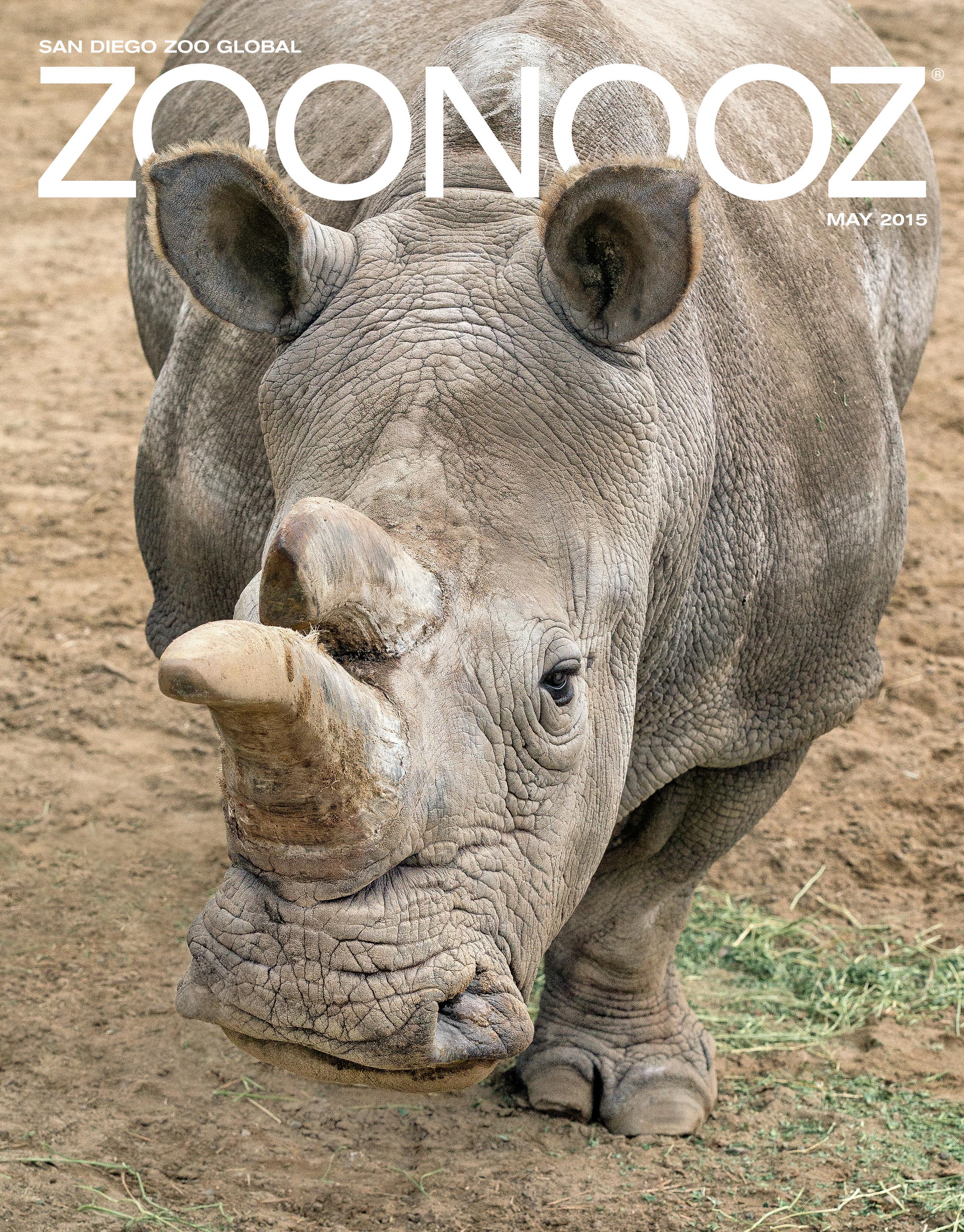
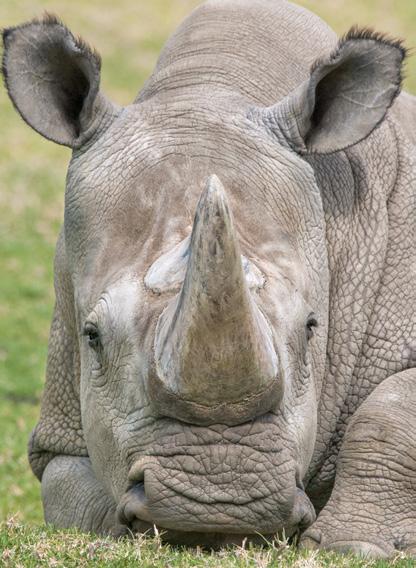
on the cover: Nola, a northern white rhino Ceratotherium simum cottoni
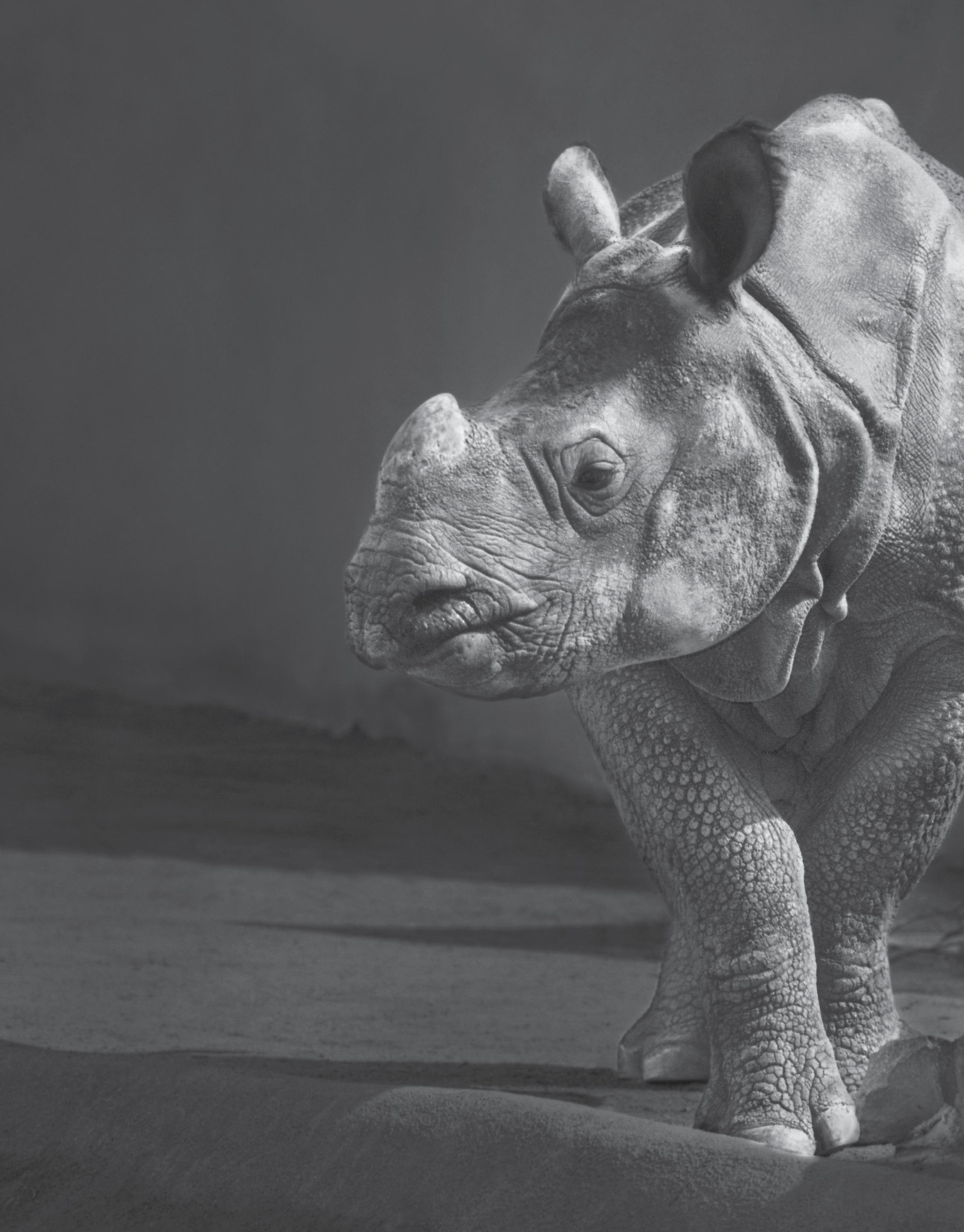
Photo by Ken Bohn, SDZG Photographer this page: 1963 historical photo of Lasai, a greater one-horned rhinoceros Rhinoceros unicornis
Photo by Ron Garrison, SDZG Photographer
FREE! Download the ZOONOOZ App for your tablet at sandiegozoo.org/ zoonooz to see this month’s special photos and videos!
chairman’s note

TFocus on Rhino Conservation
his issue of ZOONOOZ is dedicated to animals in dire need of conservation help: rhinos. San Diego Zoo Global has had a long history with rhinos, dating back to the 1950s, and we have had signi cant breeding success with southern white rhinos, greater one-horned rhinos, and black rhinos. However, all species of rhinos in the wild today are facing the worst poaching crisis in history. For example, statistics show that 3 rhinos are killed in South Africa every day—1,215 southern white rhinos were killed in 2014, the most ever recorded. Only 25,000 black and white rhinos remain across all of Africa, and if the current poaching rates are not stopped, they could become extinct in the wild within the next 20 years. Greater one-horned rhinos face similar frightening circumstances, and the numbers of Sumatran and Javan rhinos are so low that they are already critically endangered.
As I’m sure our members know, rhinos are poached for their horn, despite the fact that it is made of keratin, the same material as human hair and ngernails. Although international trade in rhino horn has been banned since 1977, the demand, particularly in Asia, is higher than ever. Today’s poachers are well equipped and highly organized, using helicopters, machine guns, and veterinary drugs to kill rhinos, and criminal syndicates to smuggle rhino horn. What you may not be aware of is that the US is actually a signi cant destination for rhino horn. In fact, California is considered the second-largest market for rhino horn in the nation behind New York City. Some people may consider the rhino crisis to be something that happens elsewhere—but these illegal markets for rhino horn are right in our own backyard.
San Diego Zoo Global is committed to helping save rhinos from extinction. We are working with conservation partners to fund ranger training and anti-poaching patrols in parks and reserves where rhinos are found, researching the ecology and behavior of rhinos to determine their needs for survival, and continuing reproduction e orts at the Safari Park to contribute to assurance populations. Saving rhinos will also require something equally as powerful, however: public perception, education, and participation. Public campaigns are underway in Asian countries to discourage the use of rhino horn, and our voices need to be heard here in the US as well. One way you can help this month is to attend our “Rally 4 Rhinos” event at the Safari Park on Endangered Species Day, May 15, 2015. We will be calling attention to the urgent need for rhino conservation and encouraging our members and visitors to help spread the word. You can nd the event details on the back cover of this ZOONOOZ issue and on our website. In whatever way you can, I hope you will raise your voice to prevent the extinction of rhinos.
SAN DIEGO ZOO GLOBAL
OFFICERS
Robert B. Horsman, Chairman
Sandra A. Brue, Vice Chairman
Judith A. Wheatley, Secretary
Steven G. Tappan, Treasurer
BOARD OF TRUSTEES
M. Javade Chaudhri
Berit N. Durler
Richard B. Gulley
Clifford W. Hague
Linda Lowenstine, D.V.M., Ph.D.
Patricia L. Roscoe
TRUSTEES EMERITI
Frank C. Alexander
Kurt Benirschke, M.D.
Thompson Fetter
Bill L. Fox
Frederick A. Frye, M.D.
George L. Gildred
Yvonne W. Larsen
John M. Thornton
Albert Eugene Trepte
Betty Jo F. Williams
James Lauth, General Counsel
Douglas G. Myers, President/CEO
Charles L. Bieler, Executive Director Emeritus
THE FOUNDATION OF SAN DIEGO ZOO GLOBAL
OFFICERS
Murray H. Hutchison, Chair
Maryanne C. Pfister, Vice Chair
Susan N. McClellan Secretary
Richard M. Hills, Treasurer
Mark A. Stuart, President
Robert B. Horsman, Ex officio
Douglas G. Myers, Ex officio
BOARD OF DIRECTORS
Christine L. Andrews
Joye D. Blount
Rick Bregman
Lisa S. Casey
Douglas Dawson
Berit N. Durler, Ex officio
U. Bertram Ellis, Jr.
Arthur E. Engel
Craig L. Grosvenor
Judith C. Harris
Michael E. Kassan
Robert B. Horsman Chairman
Susan B. Major
Michael D. McKinnon
George A. Ramirez
Thomas Tull
Margie Warner
Ed Wilson
CELEBRATE MOM & DAD AT THE SAFARI PARK THIS YEAR
Safari Park chefs Joshua Mireles and Abriann Ramirez are cooking up something very special for Mother’s Day and Father’s Day, and we hope you’ll join us for a wildly good time!
Mother’s Day Brunch
Sunday, May 10, 2015
Hunte Nairobi Pavilion
Two seatings: 10 a.m. to noon and 1 p.m. to 3 p.m.
Join us for a beautiful day at the Safari Park to celebrate Mom! Festive dishes and beautiful surroundings will make the day extra-special for the whole family. Guests will be seated at their own reserved table.
$44.95 for adults, $18.95 for children ages 3-11, plus tax and gratuity. Parking not included; nonmembers add Park admission.
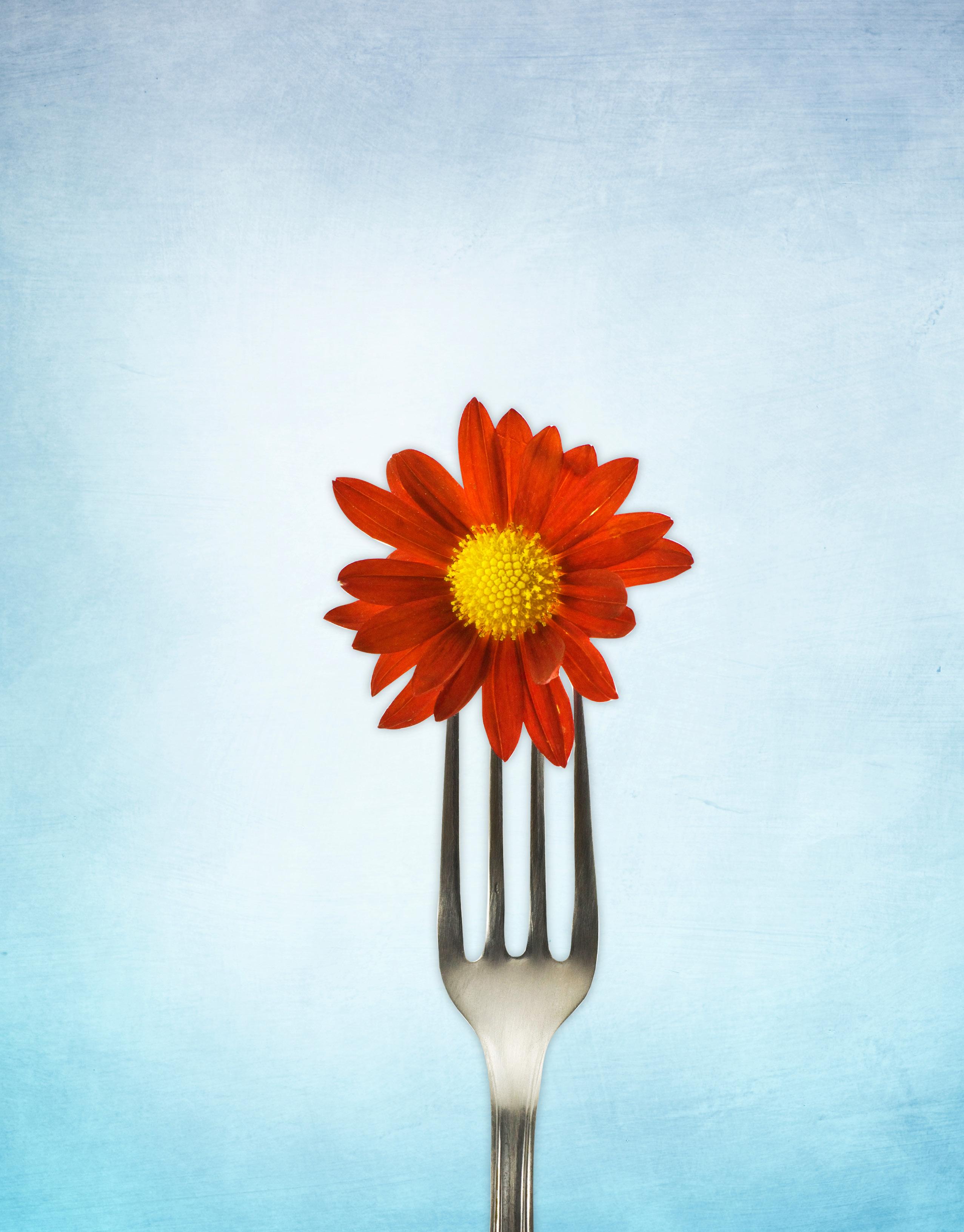
Father’s Day
Buffet
Sunday, June 21, 2015
Hunte Nairobi Pavilion 11:30 a.m.
Celebrate the king of your pride in the wild setting of the Safari Park! A lavish buffet will include hearty dishes and chef’s specialties as you raise a toast to Dad while enjoying live entertainment. Guests will be seated at their own reserved table.
$44.95 for adults, $18.95 for children ages 3-11, plus tax and gratuity.
Parking not included; nonmembers add Park admission.
To make your reservations for both of these events, please call 619-718-3000 or visit sdzsafaripark.org/dining to book online and see menus.
through the lens
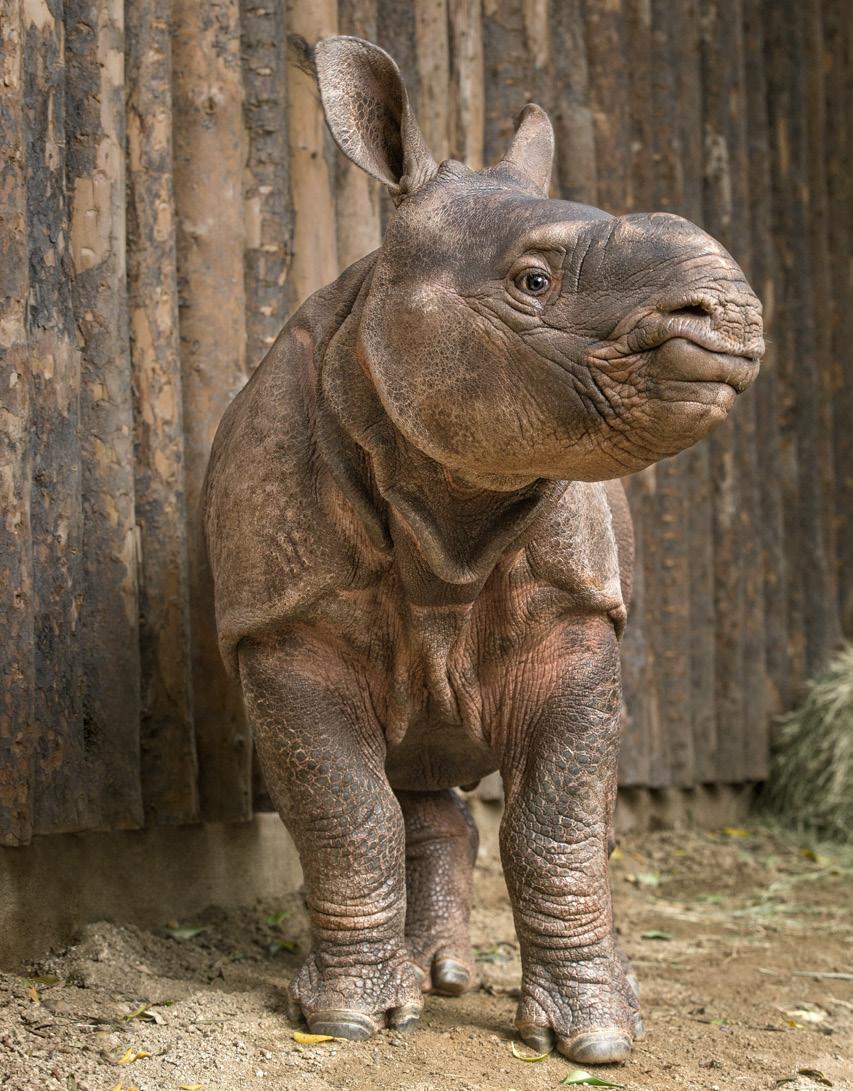
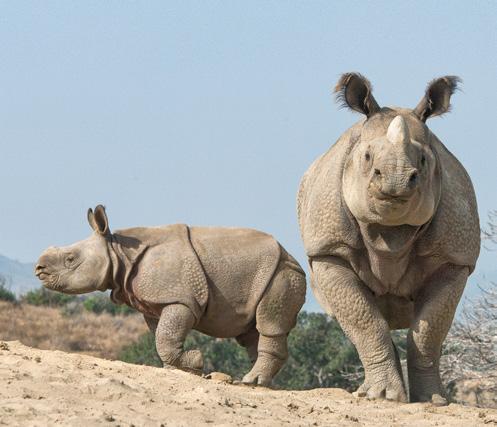
Greater one-horned
rhinoceros calf Rhinoceros unicornus
ZOONOOZ®
PUBLISHED SINCE 1926
MAY 2015
VOL. LXXXVIII NO. 05
MANAGING EDITOR
KAREN E. WORLEY
ASSOCIATE EDITOR
PEGGY SCOTT
STAFF WRITERS
WENDY PERKINS
KARYL CARMIGNANI
SAN DIEGO ZOO GLOBAL
PHOTOGRAPHER
KEN BOHN
DIGITAL IMAGING TECHNICIAN
TAMMY SPRATT
DESIGN AND PRODUCTION
DAMIEN LASATER
CHRIS MARTIN • KERRI ABRAMS
HEIDI SCHMID ROMERO • LISA BISSI
JENNIFER MACEWEN
PREPRESS AND PRINTING QUAD GRAPHICS
e Zoological Society of San Diego was founded in October 1916 by Harry M. Wegeforth, M.D., as a private, nonprofit corporation that now does business as San Diego Zoo Global. e printed, hard-copy version of ZOONOOZ (ISSN 00445282) is currently published bimonthly (Nos. 1, 3, 5, 7, 9, and 11 of each year’s volume; the even-numbered issues of each volume are available in digital format only). Publisher is San Diego Zoo Global, at 2920 Zoo Drive, San Diego, CA 92103, 619-231-1515. Periodicals postage paid at San Diego, California, USA, and at additional mailing offices.
POSTMASTER: Send address changes to Membership Department, P.O. Box 120271, San Diego, CA 92112. Copyright 2015 San Diego Zoo Global. All rights reserved. “ZOONOOZ” Reg. U.S. Pat. Office. All column and program titles are trademarks of San Diego Zoo Global. Annual Memberships: Dual $125, new; $110, renewal. Single $102, new; $90, renewal. Each membership includes unlimited entrance to the San Diego Zoo and the San Diego Zoo Safari Park.
Subscription to printed issues of ZOONOOZ $25 per year, $65 for 3 years. Foreign, including Canada and Mexico, $30 per year, $81 for 3 years. Contact Membership Department, P.O. Box 120271, San Diego, CA 92112.
As part of San Diego Zoo Global’s commitment to conservation, ZOONOOZ is printed on recycled paper that is 30% post-consumer waste, chlorine free, and is Forest Stewardship Council (FSC ) certified.
FSC® is not responsible for any calculations on saving resources by choosing this paper.
Swinging into Summer
May and June are busy and exciting months at the Zoo and Safari Park, and this year is no exception! We have several events taking place, and I hope you can join us for all the festivities. We’re starting off with the Epiphyllum Show at the Safari Park on May 2 and 3, where garden society volunteers will be on hand to share the secrets of this unusual plant and show off some beautiful blooms. Speaking of flowers, the Garden Festival presented by Sparkletts at the Zoo on May 9 and 10 will be all about “Flower Power” this year, with fun discoveries and activities for the whole family. Sunday, May 10 is also Mother’s Day, and our chefs at both the Zoo and the Safari Park are cooking up a wonderful buffet brunch to help you celebrate Mom. I also want to let you know that if you’ll be visiting the Zoo over Memorial Day weekend, you can get an early start: the Zoo will open at 8 a.m. for that weekend.
On Endangered Species Day, Friday, May 15, we have a special event taking place at the Safari Park to honor some of our most prominent, well-known, and endangered animals: rhinos. “Rally 4 Rhinos” presented by LivingSocial kicks off at 9:30 a.m. with a special presentation and community participation, and then in the afternoon we are hosting a symposium at the Beckman Center about rhino conservation science. ere will be opportunities to participate through our social media channels, so be on the lookout for those. Our goal with “Rally 4 Rhinos” is to continue to build awareness and encourage people to take action on behalf of rhinos, since they are in dire need of protection. is issue of ZOONOOZ is dedicated to rhinos, and you will find a wide variety of information about these majestic animals in the articles.
In June, we’re looking forward to our annual R•I•T•Z gala on Saturday, June 20, which will benefit the beautiful penguin exhibit we plan to build for Conrad Prebys Africa Rocks at the Zoo. Our annual salute to summer and longer evening hours also begins in June: Nighttime Zoo presented by Cymer kicks off on Sunday, June 21, and the Park’s festive Summer Safari starts on Saturday, June 27. ere’s so much fun ahead—and I hope to see you there!
Douglas G. Myers President/CEO
SAN DIEGO ZOO HOURS
May 1–22 and 26–31: 9 a.m. to 6 p.m.
May 23–25: 8 a.m. to 6 p.m.
June 1–19: 9 a.m. to 6 p.m.
June 20: 9 a.m to 5 p.m.
June 21–30: 9 a.m. to 9 p.m.
SAN DIEGO ZOO SAFARI PARK HOURS
May 1–22 and 26–31: 9 a.m. to 5 p.m.
May 23–25: 9 a.m. to 6 p.m.
June 1–26: 9 a.m. to 5 p.m.
June 27–30: 9 a.m. to 7 p.m.
WEBSITE sandiegozoo.org
SAN DIEGO ZOO PHONE 619-231-1515
DIGITAL ZOONOOZ® issuu.com/sdzglobal
you said it
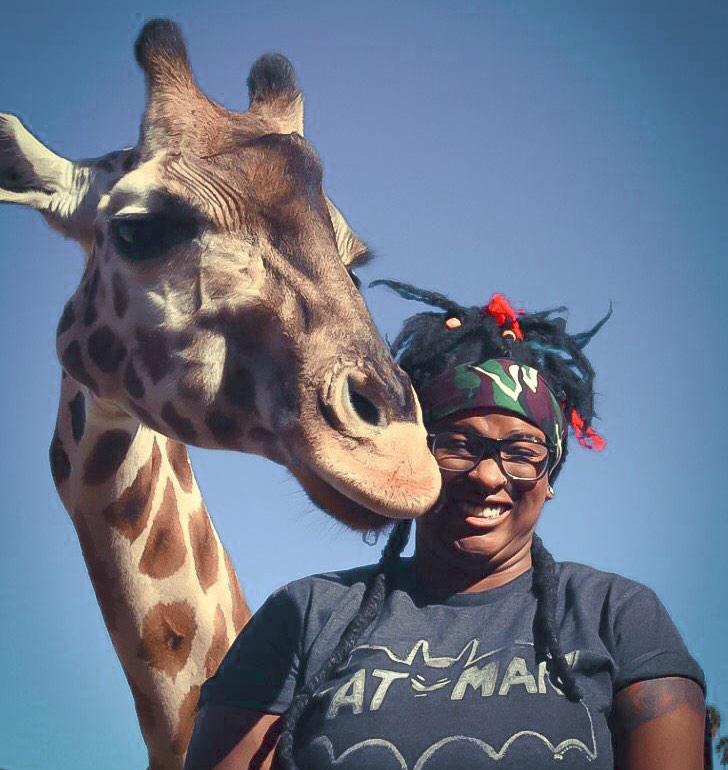

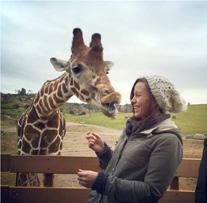
Had a lot of fun hanging with #giraffes today at the @sdzsafaripark @iamraw
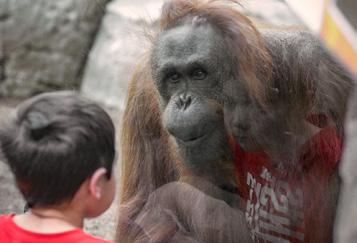

Connection, it’s a good thing. Really enjoyed our day at the Zoo, thanks much.
Dan Morrow
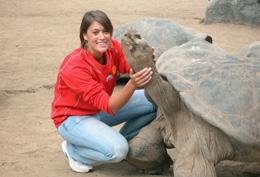
My husband and I spent our honeymoon on your amazing VIP tours! Soooooo much fun!
Rachel McCarty
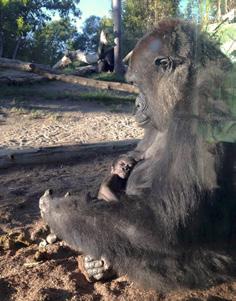
anks San Diego Zoo! We had such an amazing experience at the Zoo today, we got to see Jessica the gorilla that just had a baby boy last week...we were front and center watching her cuddle & nurse him, was SO awesome!
Ashley Pear
e death of an individual is sad. e extinction of a species by our hand is a cosmic sin.
@HughLaurie
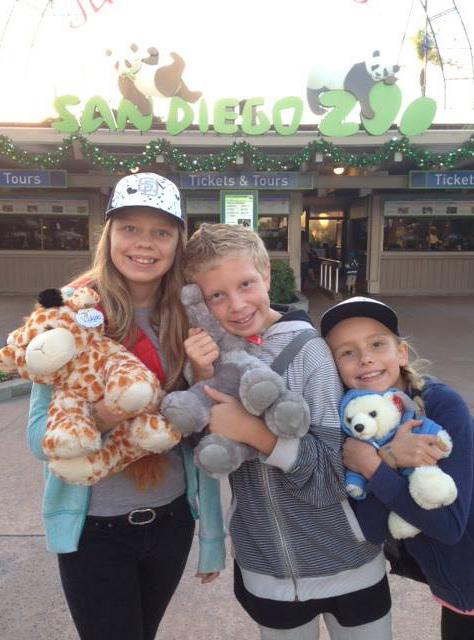
ank you for helping give #Wishkid Jacob the trip of his dreams. You’d never know what Jacob’s little body has been through unless you look at his scars. He was diagnosed with a #neuroblastoma tumor that wrapped around his spinal cord. He received months of chemotherapy because removing it could have left him paralyzed. ank you for your support and making his wish trip a reality. He and his sisters had a blast at the San Diego Zoo! Kids Wish Network is guy was a drooler. #sandiego #giraffe #sdzsafaripark @ekparr

fOr KiDs
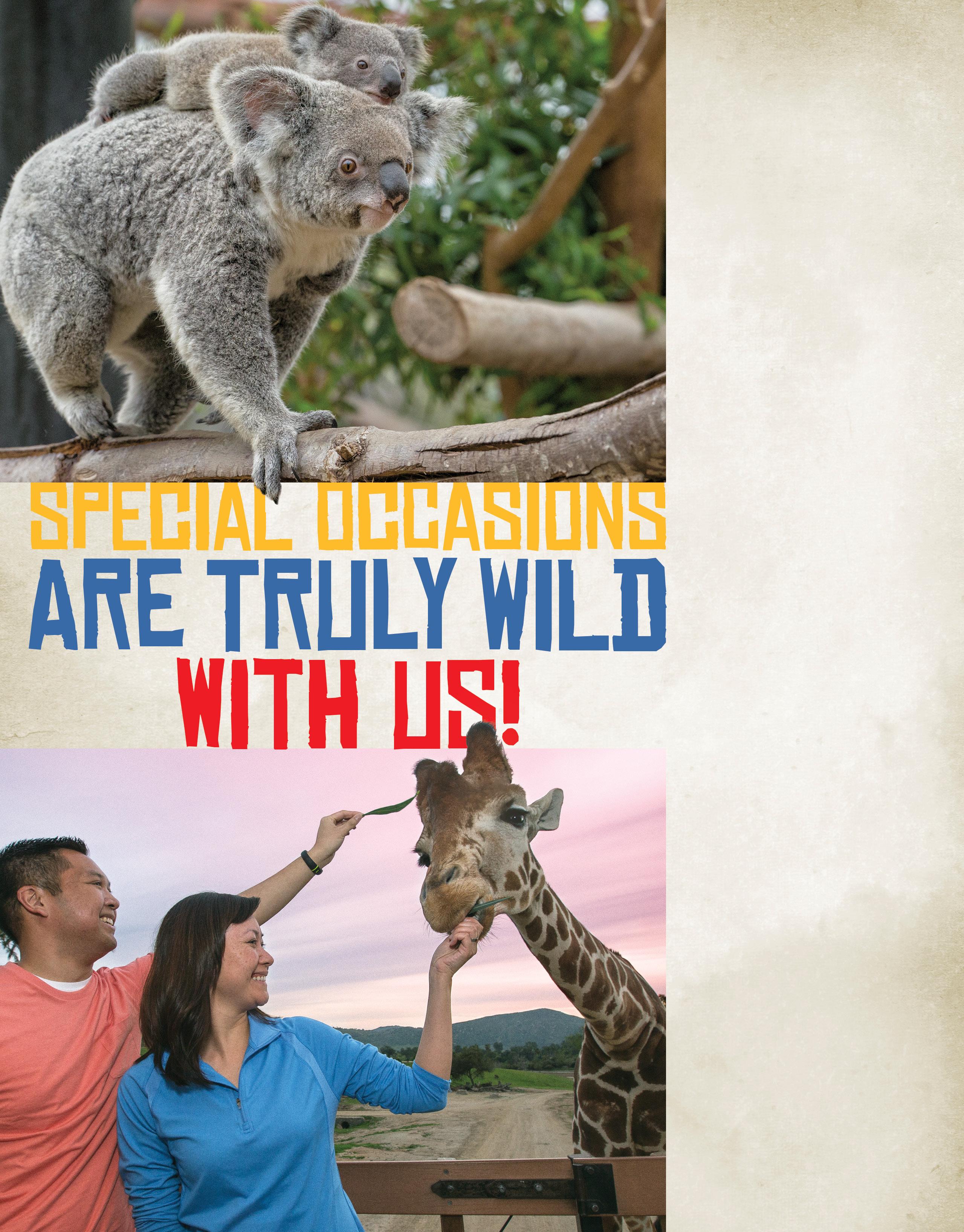
Celebrate your child’s birthday with this Australian adventure at the San Diego Zoo! Children ages 10 and younger and their adult chaperones can party in our exclusive Aussie Outback room with fun-loving host Dr. Zoolittle. The birthday bash includes animal presentations, entertainment, Zoo decorations, cake and juice, and Zoo birthday activities.
Call 619-685-3259 to talk with our party planners about details and options for a birthday all the kids will be talking about.
MaKe YoUr CeLe BrAtIoN tHe uLtImAtE sA fArI
Do you have a big occasion coming up, like a birthday, graduation, or anniversary? Make it truly unique and memorable on a Safari Park adventure! Celebrate your special occasion with our Ultimate Safari, the safari experience of a lifetime. Call to speak to one of our professional planners today. This safari requires reservations and is subject to availability; all requests must be made a minimum of 72 hours in advance.
Reservations for this safari must be made by phone at 619-718-3000.
THE NORTHERN WHITE RHINO THE CRASH OF
By Karyl Carmignani STAFF WRITER
Photos by Ken Bohn SDZG PHOTOGRAPHER
Nothing embodies the tragic plight of an animal teetering on the brink of extinction more than the northern white rhinoceros. Separated from its southern white rhino brethren by the Great Ri Valley and a tangle of Central African forests, the northern variety once numbered about 2,000 individuals. Decades of civil war and rampant poaching have taken a merciless toll, diminishing their numbers to single digits. e nal few were rounded up and taken to refuges where they could be closely guarded. e passing of Suni, one of the three remaining breeding males, last fall at the Ol Pejeta Conservancy in Kenya le only six northern white rhinos remaining on the planet. en in December 2014, Angalifu, the elderly male living at the San Diego Zoo Safari Park, passed away of natural causes, leaving ve northern white rhinos in the entire world. Nola, a “senior citizen” female, still lives at the Safari Park. Should this subspecies blink out, humans will have failed the Earth on an irreversible level. Although this rhino subspecies’ survival looks grim, conservationists have not given up. ere is still a icker of hope.
A MATCH MADE IN…THE SAFARI PARK
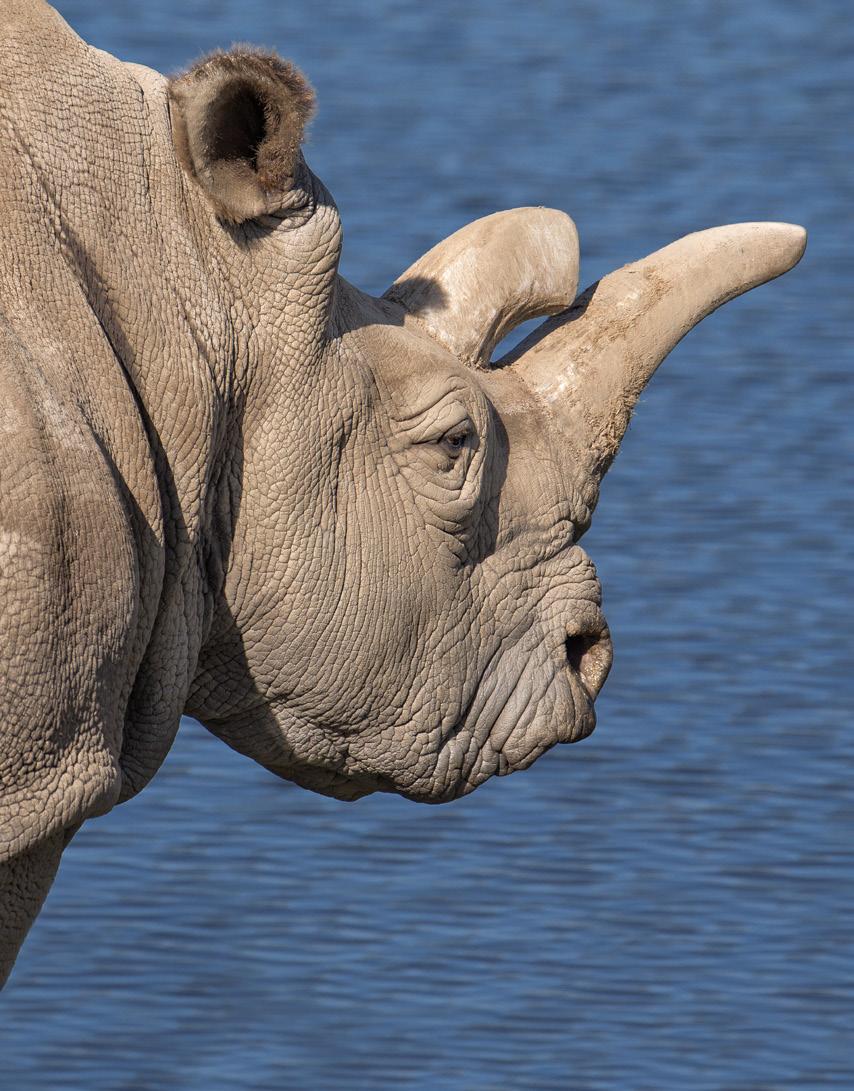
For nearly 30 years, the Safari Park had cared for a pair of northern white rhinos with the hopes of breeding them. But Nola and her would-be mate, Angalifu, never seemed to hit it o . Well past their reproductive prime, both enjoyed years of “retirement” in spacious eld exhibits at the Safari Park until Angalifu’s unfortunate passing. Nola (photo at le ), who is deeply loved by her keepers and visitors alike, gets regular pedicures, since her toenails occasionally grow rogue despite the long distances she walks each day. On “spa day,” keepers follow her in the truck across the eld exhibit until she nds a comfortable place to lie down, then two keepers quickly trim her toenails while another brushes her down with a sti -bristled deck brush, a massage that she loves. “We are honored to be her keepers for the rest of her life,” said Jane Kennedy, a lead keeper at the Park.
SPERM IN A BOTTLE
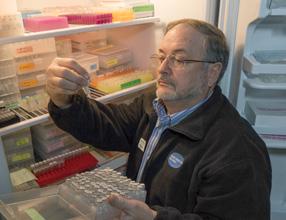
With so few northern white rhinos remaining, Angalifu bore the weight of his kind on his broad, gray shoulders. A team of scientists and keepers kept close tabs on him. When a persistent limp required veterinary treatment, our Reproductive Physiology Division took the opportunity to collect Angalifu’s semen. Despite his advanced years, Angalifu was still producing motile sperm in high concentration.
tilize an egg in a process called intracytoplasmic sperm injection. “For a population as small as the northern white rhinoceros, it is imperative that every individual’s genes are passed on to future generations to maintain the greatest possible genetic diversity,” Barbara added.
WHAT’S GOING ON?
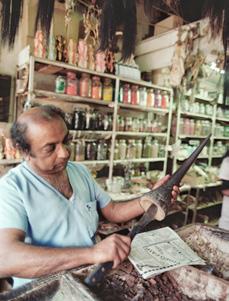
Many people know that a group of rhinos is called a crash. It is unfortunate that there are barely enough northern white rhinos le in the world to make a crash. e fact is, rhinos of all persuasions are under near constant threat from humans. Ever-expanding human populations gobble up forest and grassland habitat. But the rhino’s true curse is its horn, because of the misguided belief in some Asian cultures that the horn—made of keratin, the same material as our hair and ngernails—can cure everything from hangovers to cancer. e uptick in demand for rhino horn is fairly recent. Over time, hunting rhinos has gone from subsistence hunting by local people to today’s highly organized international crime rings pro ting from Asia’s demand for rhino horn. Even museums and auction houses are falling victim to “rhino head heists” as thieves make o with the horned loot.
e uid was transported back to the lab at our Institute for Conservation Research for additional fertility tests and prepared for cryopreservation. Using a protocol designed for the rhino’s close relative, the domestic horse, the sperm was placed in a protective medium, then frozen rapidly in liquid nitrogen vapor before being settled in its place in our Frozen Zoo® at -321 degrees Fahrenheit.
signs of abating.
“Because Angalifu had no o spring, our most pressing conservation goal was to preserve his sperm for the future when, through assisted reproduction, he may contribute to generations of northern white rhinoceros yet to be born,” explained Barbara Durrant, Ph.D., director of reproductive physiology, Henshaw Chair. Even if some of his sperm su ers from freezing and thawing, a single sperm may be used to fer-
Rhino horn concoctions have been prescribed in traditional Chinese medicine for about 2,000 years, but until the late 1800s, the effect on the species was manageable. By the early 1900s, however, extensive trophy hunting had been added to the mix, decimating the white rhino populations. Over the next few decades, concerted conservation e orts to protect rhinos made it illegal to hunt them and slowed their decline. Fortunately the white rhino species recovered, although never to its original numbers. In the 1990s, demand was reduced when rhino horn was removed from the Chinese traditional medicine pharmacopeia, and alternatives for dagger handles were used in Yemen. Only about 15 rhinos were poached in South Africa annually from 1990 to 2007.
But then an alarming trend emerged: in 2008, 83 southern white rhinos were illegally killed by poachers; the next year, it was 122. In
Tragically, the misguided demand for rhino horn shows no
MINDEN
PICTURES
2012, 688 rhinos were destroyed, and an unprecedented 1,004 rhinos were slaughtered in 2013. In 2014, poaching was the worst yet: a horrifying 1,215 rhinos were killed in South Africa, mostly in Kruger National Park, a reserve intended for protection. e primary culprit? An emerging demand for rhino horn in Vietnam.
WHY NOW?
In 2008, the perfect storm to annihilate the rhino was unleashed. Rumors swept across Vietnam that imbibing crushed rhino horn cured a politician’s cancer, despite the complete lack of scienti c evidence to back up the claim. ere is no record of the horn being used to cure cancer in traditional Chinese medicine, either. e country is also experiencing a surge in wealth, with the number of multimillionaires increasing by 150 percent in the last 5 years. An increase in cancer cases, combined with few treatment options, is causing people to grasp at straws like rhino horn to try to restore health. is is despite the president of the Cancer Association of Vietnam publicly denouncing the e cacy of rhino horn as medicine.
Others insist that the demand for rhino horn has an even more nefarious purpose: ground into a powder, the horn is considered a party drug in Asia, much like cocaine, except without the pharmaceutical e ects (imagine grinding your ngernails into a powder). Mixed with wine or water, the luxury potion is called “the drink
of millionaires”; some even snort it like snu . is has increased its cachet in certain circles—though certainly not with those who decry the brutal, militarized killing of rhinos that is taking place to supply it. Whatever the supposed reason, the last Javan rhino in Vietnam was felled by a bullet in 2010, and its horn unceremoniously hacked o . Since then, poachers —most in highly organized and well-armed gangs—have pursued an all-out war on rhinos in Africa and even the tiny remaining population in west Java, all in the pursuit of pro t.
WHAT’S NEXT?
Download the digital version of ZOONOOZ and “crash” into a cool rhino video.
While the International Union for Conservation of Nature (IUCN) lists three of the ve remaining species of rhino as critically endangered, the outlook in Africa holds the best chance for hope. More than 70 percent of the world’s wild rhinos hunker down in South Africa, many under armed guard.
San Diego Zoo Global is committed to saving rhinos from extinction. Our animal care sta and conservation scientists’ e orts have led to the birth of 93 southern white rhinos, 68 greater one-horned rhinos, and 14 black rhinos at the Safari Park over the past 42 years. We are preserving cell samples in our Frozen Zoo®, including genetic material from 12 northern white rhinos, for future reproductive opportunities. We’d like to thank the Seaver Institute for their generous investment to launch the genetic rescue of the northern white rhino. And we are working in collaboration with other conservation organizations to fund anti-poaching patrols and support local community education e orts in countries where rhinos are found.
But to save rhinos in the long run, consumer demand needs to be addressed, animal tra cking laws need to be strictly enforced, poachers should pay a much higher price with harsher punishment, and the animals must be protected. “ e conservation of all species falls on our shoulders as humans,” said Jane. “What we do for endangered animals, including the last of the northern white rhinos, will have a huge, long-lasting impact on the world.” We must take action—we cannot wait for another species to crash.
Left: Rhinos need their horns; humans don’t. Right: Dr. Oliver Ryder, director of genetics, Kleberg Chair, holds a tissue sample from the Frozen Zoo®
THE RHINOCEROS: TEN REASONS FOR HOPE
By Karyl Carmignani STAFF WRITER
It’s no secret that things are looking grim for many species of wildlife, including the stout and sturdy rhinoceros. is issue of ZOONOOZ explores all things rhino related, and we hope to inspire readers to take action to save these majestic animals. Rhinos are facing an unprecedented crisis, but there are glimmers of hope. rough determination, cooperation, and hard work, there are some victories to share. With your ongoing support, we will continue our ght to save the mighty rhinoceros.
1 BILL ME: San Diego Zoo Global is a staunch supporter of AB 96, a California bill that will prohibit a person from buying, selling, or importing with intent to sell elephant ivory or rhinoceros horn. is bill will eliminate loopholes and enhance enforcement of wildlife laws to help end the slaughter of elephants and rhinos. We hope this bill will go into effect this year.
2 SOUTHERN COMFORT: In the early 1900s, the southern white rhino had been hunted to near extinction. e
surviving 50 animals were taken to a national park, protected by armed guards, and eventually rebounded. Today, there are over 20,000 of them. While rhinos are still in great peril, three of the five remaining species are slowly increasing in number. e
San Diego Zoo Safari Park has bred rhinos according to the Species Survival Plan and 93 southern white, 68 greater one-horned, and 14 black rhinos have been born here.
3 SAMPLES ON ICE: e Frozen Zoo® at our Institute for Conservation
6 BUCKING TRENDS:
Nepal is the only country that can boast zero poaching of rhinos since February 16, 2013. eir wildlife crime control is a collaboration between the Nepalese army, police, government officials, community, and international organizations. Nepal’s most-wanted wildlife criminal, a rhino poaching ringleader, was arrested in January 2015, thanks to Interpol’s first global fugitive operation targeting environmental crimes.
7 MIRACLE BABY:
Research has banked living cell lines from 214 individual rhinos, as well as gametes and stem cells, to ensure genetic lineages live on. Our Reproductive Physiology division has developed artificial insemination protocols and shared techniques with other zoos to improve rhino reproduction.
4 STRIKE! Bowling for Rhinos has been a longtime annual fundraising event, begun in 1990 by the American Association of Zookeepers. AAZK chapters around the country raise $400,000 for rhino conservation each year. To date, this event has raised over $5,408,000 to help rhinos make a comeback.
5 ACTING ACTIVISTS: From actors to athletes, celebrities are using their influence to inspire others to help wildlife instead of destroy it. What’s not to like?
One male from the Safari Park was moved to the Cincinnati Zoo, and his male off spring was released into a park in Indonesia, where he successfully sired off spring of his own.
9
BOOTS
In 2012, poachers struck with a vengeance in a wildlife reserve in South Africa. In March, a female rhino was found alive but severely injured with her horn removed (two males were also killed in the attack). After 10 operations and massive doses of tender loving care, andi recovered from her brutal wounds. In January 2015, this hardy survivor gave birth to her first calf!
8
BACK TO THE
WILD: Over 30 greater one-horned rhinos have been bred in zoos and released into the wild.
ON THE GROUND: San Diego Zoo Global employees manage the rhino Species Survival Plan (SSP), greater one-horned rhino studbook, serve on rhino conservation boards, and are founding members of the International Rhino Keeper Association. One Safari Park keeper became part of an elite anti-poaching brigade in South Africa.
10
HOME ON THE RANGE: It is critical to connect people to wildlife; the human factor can make or break rhino survival. Observing a rhino with her calf trotting beside her can be life changing! Feeding a rhino can leave an indelible impression. San Diego Zoo Global provides rhino education through our parks, websites, curriculum, and school group workshops. Learning about rhinos and their challenges is one way to help them live another day.
Be a Hero for Wildlife
Fighting species extinction and creating a future in which people and wildlife can thrive together is a collaborative effort—and you are a vital part of that. Discover how your support impacts the survival of species at the San Diego Zoo Wildlife Conservancy website: endextinction.org . As a Hero for Wildlife, you help protect endangered animals, ensuring they are here for generations to come. ank you! endextinction.org
BEHIND THE HORN THE ABC S OF THE MIGHTY RHINOCEROS
By Karyl Carmignani
STAFF WRITER
Photos by Ken Bohn SDZG PHOTOGRAPHER
The rhinoceros is the secondlargest land mammal, behind the elephant. These stocky, Land Rover-sized vegetarians once numbered over 500,000, but they have been reduced to about 29,000 in recent years, largely due to humans’ appetite for their signature appendage: the horn. Of the ve rhino species, one is a conservation success story (southern white), three are critically endangered (black, Sumatran, Javan), and one is listed as vulnerable (greater onehorned), according to the International Union for Conservation of Nature (IUCN). e current rate of poaching is unsustainable for all rhinos. Subspecies of black and Javan rhinos have already slipped into extinction. Northern white rhinos are hanging on by a ngernail, with only ve individuals left, including Nola at the Safari Park. For both “splitters” and “lumpers” of species and subspecies, the downward trend is heartbreaking.
With all the brouhaha about rhino horn, what exactly is it made of? Turns out, rhino horn is made of keratin like our hair and ngernails, with deposits of calcium and melanin in the core, so it is similar to horse hooves and turtle beaks. Scientists say the calcium makes the horn stronger while the melanin protects it from the sun’s UV rays. Rhino horns tend to curve backward toward the animal’s head because the keratin in the front grows faster. e outer layers are somewhat so and can be worn down a er years of use. Rhinos inhabit savannas and forests in tropical and subtropical regions. Africa has two species, both with two horns: the white rhino Ceratotherium simum and black rhino Diceros bicornis. e Asian rhinos are the greater one-horned Rhinoceros unicornis and Javan rhino R. sondaicus, both with one horn, and the Sumatran rhino Dicerorhinus sumatrensis, with two horns.
African Rhinos: Read My Lips
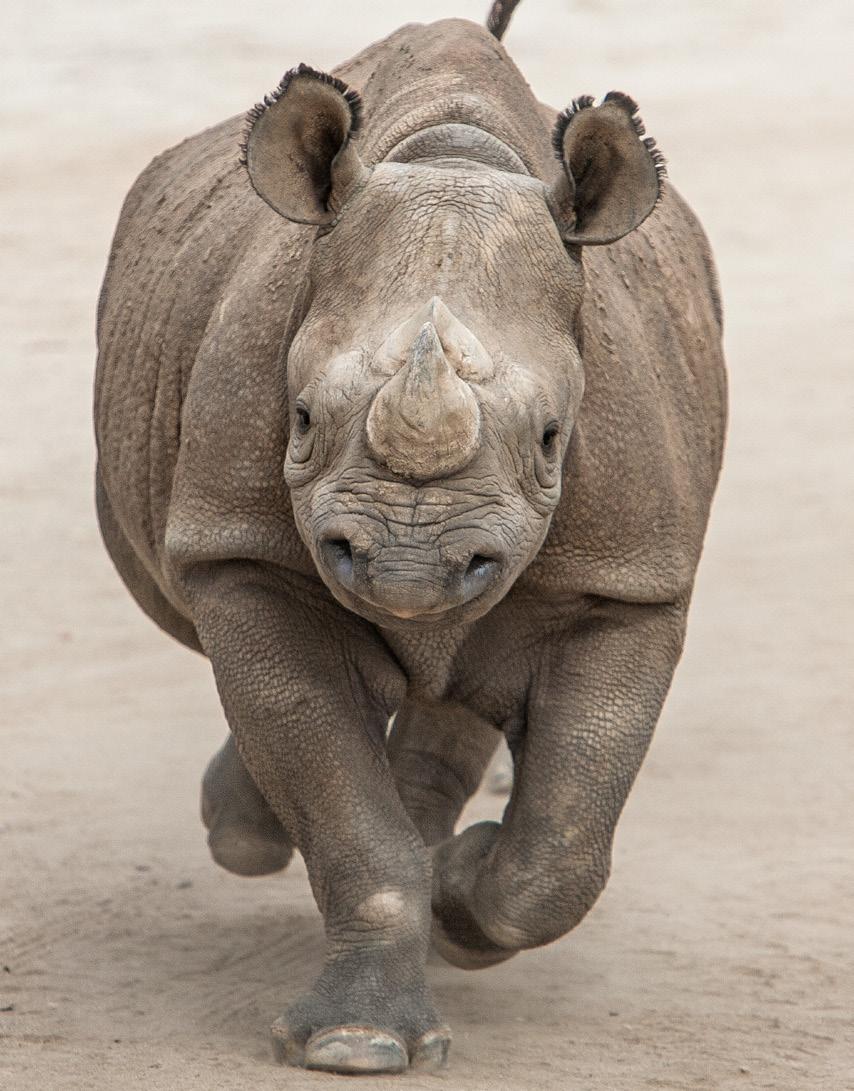
Before you head o on an African safari to test your rhino knowledge, note that white rhinos aren’t white and black rhinos aren’t black. Luckily, there are other telltale signs
of which is which. The white rhino is the largest, tipping the scales at 4,000 to 5,000 pounds and standing 5 to 6 feet tall at the shoulder. It has a long forehead, a muscular bulge (called a nuchal hump) on the top of its neck, and holds its head low while resting. But the best way to tell them apart is also what keeps them out of each other’s way at mealtime: mouth shape! The white rhino has a wide, at upper lip for mowing grass, while the black rhino has a hooked, prehensile lip for grasping and browsing on trees
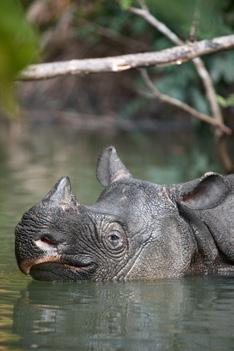
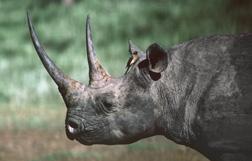
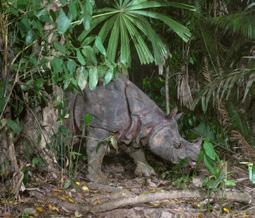
Above: The Javan rhino is critically endangered. Left: Black rhinos have a hooked, prehensile lip ideal for browsing on leaves. They live in Africa with the white rhino.
and shrubs. e two species do not compete for the same resources, since one is a grass grazer and the other a tree trimmer. It is thought that the white rhino’s name was derived from the Afrikaans word “weit,” meaning wide, to describe its mouth. Black rhinos probably earned their name from their wallowing lifestyle and the dark mud on their skin. Both can produce 50 pounds of dung a day, and both species scrape the dung pile with the rear feet, inging it and
leaving two parallel foot skids through the pile as a form of communication.
Rising from the Ashes
e southern white rhino has fared much better than its northern brethren, which have become functionally extinct with only five individuals remaining. The southern white rhino, found primarily in South Africa, had been relentlessly hunted to near extinction in the early 1900s. A surviving population of 100 was rounded up and protected in a national park in South Africa. Today, southern white rhinos are a conservation success story, as their numbers now exceed 20,000. However, rampant poaching remains a chronic threat.
The Mysteries of Asian Rhinos
Of the three rhino species surviving in Asia—Sumatran, Javan, and greater onehorned—only one is showing conservation recovery while the other two are on the cusp of extinction. The greater onehorned rhino has risen from the critically endangered dust: in the 1900s, its numbers plummeted to about 200 animals, but today 3,330 animals live throughout India and Nepal. While reintroduction projects have begun, poaching and habitat loss remain a looming threat. Will its thick, armor-like folds of skin ward o extinction?
e most threatened species is the solitary Javan rhino, numbering about 60 individuals in one national park in Java, Indonesia. According to the Asian Rhino Project, work has begun to expand the rhinos’ habitat by relocating illegal human settlers; eradicating the arenga palm, an invasive plant that prevents the undergrowth (rhino food) from flourishing; and replanting suitable rhino greens. e Javan rhino sports one horn, and the female’s horn is virtually non-existent, which could discourage poaching. Sadly, the last Javan rhino in Vietnam was felled by a poacher’s bullet in 2010.
e hairiest rhino is the only two-horned rhino in Asia: the Sumatran. It is also the most petite, weighing in at about 1,320 to 2,000 pounds and measuring 3.3 to 5 feet tall at the shoulder. ey are more closely related
MINDEN
PICTURES
to the now-extinct woolly rhino than the other four rhino species. Only the Sumatran and greater one-horned rhinos have canine teeth, which they use to slash and gouge at enemies.
Making It through History
The rhinoceros is an odd-toed ungulate known as a perissodactyl, related to tapirs, horses, and zebras. e earliest known odd-toed, rhinoceros-like mammal appeared during the middle of the Eocene epoch (56 to 33.9 million years ago) and was the size of a large dog, with hooves, plant-eating dentition, and no horns. ree families of rhinos evolved in the late Eocene: Hyracodontidae (running rhinos), Amynodontidae (aquatic rhinos), and ancestors of modern rhinos, Rhinocerotidae. is compact variety was distributed throughout the world, including North America. It died out there about 4 million years ago, while the jumbo-sized, two-horned woolly rhinoceros ourished in Eurasia up until the last Ice Age. It went extinct around 12,000 years ago, most likely due to humans hunting it for its meat and thick fur pelt.
Of the remaining rhinos, the greater one-horned rhino appears to be the oldest modern lineage, followed by the Sumatran rhino a million years later. The new species on the block—geologically speaking—are the African rhinos, which appeared about 17 million years ago. DNA evidence shows white and black rhinos diverging from a common ancestor about 2 million years ago, while fossil evidence indicates an earlier departure of 7 to 8 million years ago.
All in all, rhinos have been quite successful, grazing and browsing their way across history virtually unbothered by predators—until humans and their high-powered weapons arrived on the scene. Now it is up to humans to change their ways and make the right decisions to keep the remaining rhinos safe, so these magni cent animals will still share the planet with us into the future.
2
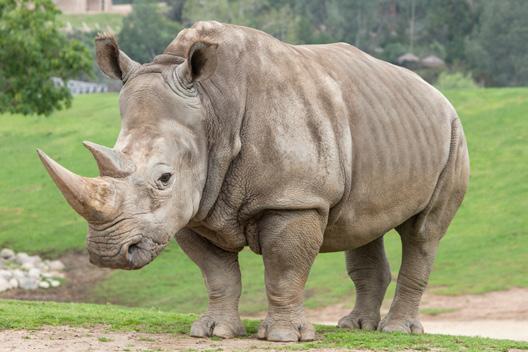
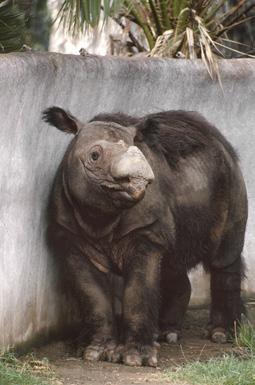
Lip shape, horn number, and the fur factor help tell who is who
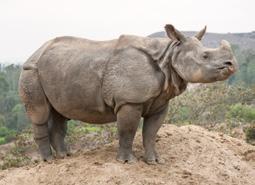
1 Southern white (wide-lipped, largest species) 2 Sumatran (small and hairy type).
3 Black rhino (hooked lip, two horns)
4 Javan (single horn, critically endangered)
5 Greater one-horned rhino (layers of thick skin resemble armor, one horn).
HORNPRINTS FROM THE PAST
By WENDY PERKINS STAFF WRITER
Although rhino-less for its first 36 years, San Diego Zoo Global’s past 63 years have been rhino-ful. Having at one time or another cared for four of the five recognized species, we are proud to have added to the collective knowledge about these massive, mighty, and, in many ways, still mysterious animals.
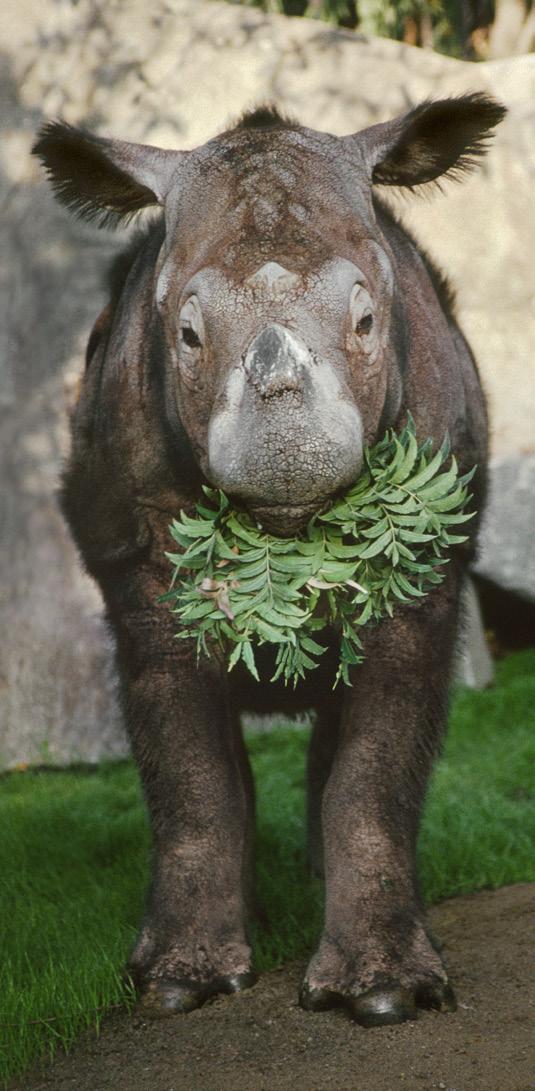
Barakas, a female Sumatran rhino, charmed San Diego Zoo visitors and staff alike, and gave us an opportunity to hone in on the fine details of this species’ nutritional needs.
Photos by SDZG
Greater One-horned Asian Rhino
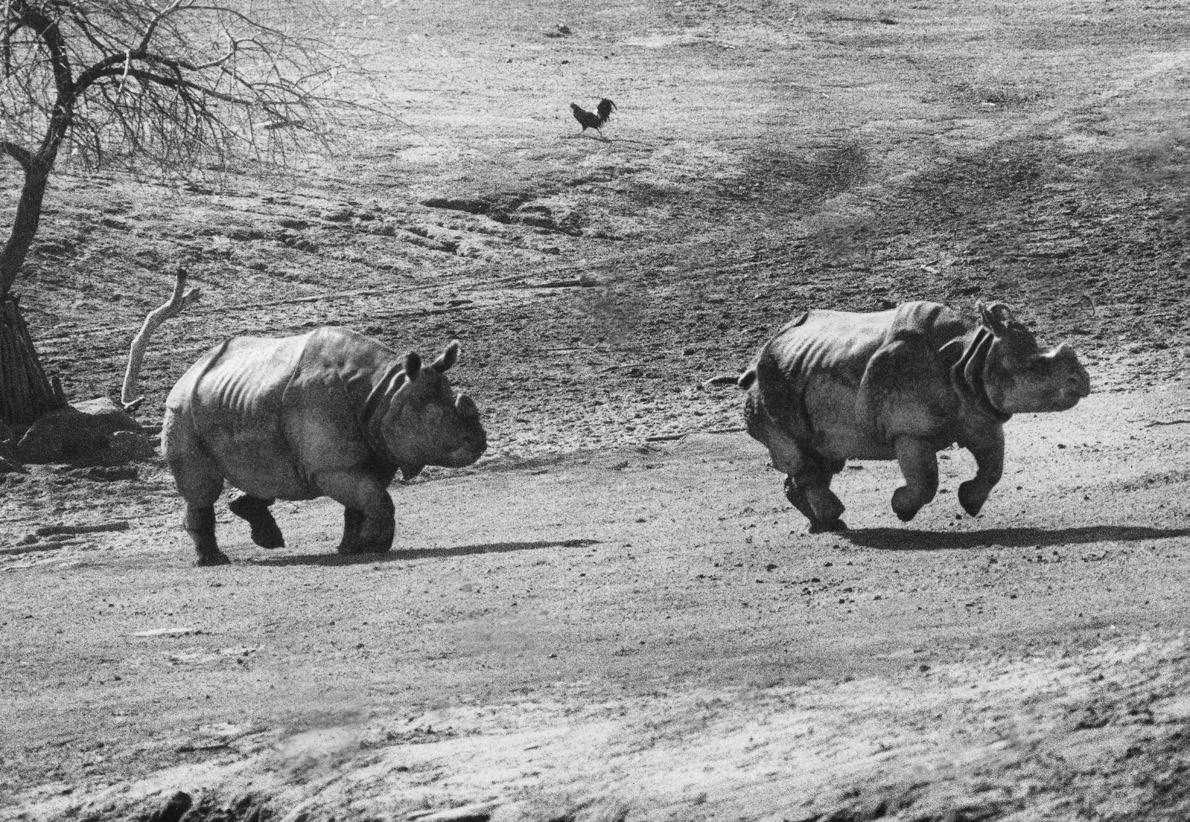
These massive mammals first left an impression on Zoo visitors in 1963, when a male named Lasai came to San Diego from the Basel Zoo. Lasai was then joined by a female named Jaypuri, and the pair eventually moved to the Park. They formed the nucleus of the greater one-horned rhino breeding group, which grew to become the largest initiative of its kind.
Once established, results came quickly: in 1982, we had the first birth of a second-generation, zoo-born greater onehorned rhino in the Western Hemisphere! It was an exciting moment, but there were even more milestones to come, including the recent birth of a fifth-generation, zoo-born calf. Working with other zoos and organizations, including those in India, we have been able to move zoo breeding populations in and out of the breeding group, which contributes to the genetic diversity. Over the years, our animal care staff and veterinary team have been able to refine husbandry and management practices for the species and share our knowledge with other organizations around the world.
Sumatran Rhino
In the 1980s, as the wild population of this species dropped to fewer than 1,000, San Diego Zoo Global joined other US zoos in establishing the Sumatran Rhino Trust, working with the Indonesian government toward saving the species. With the goal of learning more about its reproductive biology and husbandry needs, as well as increase the numbers through breeding, a few Sumatran rhinos were brought to the US, including the San Diego Zoo.
Barakas, a 15-year-old Su-
matran rhino, came to the Zoo in 1988. She was later joined (at separate times) by two males and another female. “During this process, we learned a great deal about the species’ dietary needs,” explained Carmi Penny, director of collections husbandry science. “Our nutritionists worked on finding the optimum diet, and we discovered that ficus browse is vital to their well-being.” While we no longer have this species at our facilities, we continue to play a key role in supporting its survival—our horticulture team has regularly cut and shipped fresh ficus branches to the Cincinnati Zoo twice a week so the Sumatran rhinos there have the best nutrition possible.
Black Rhino
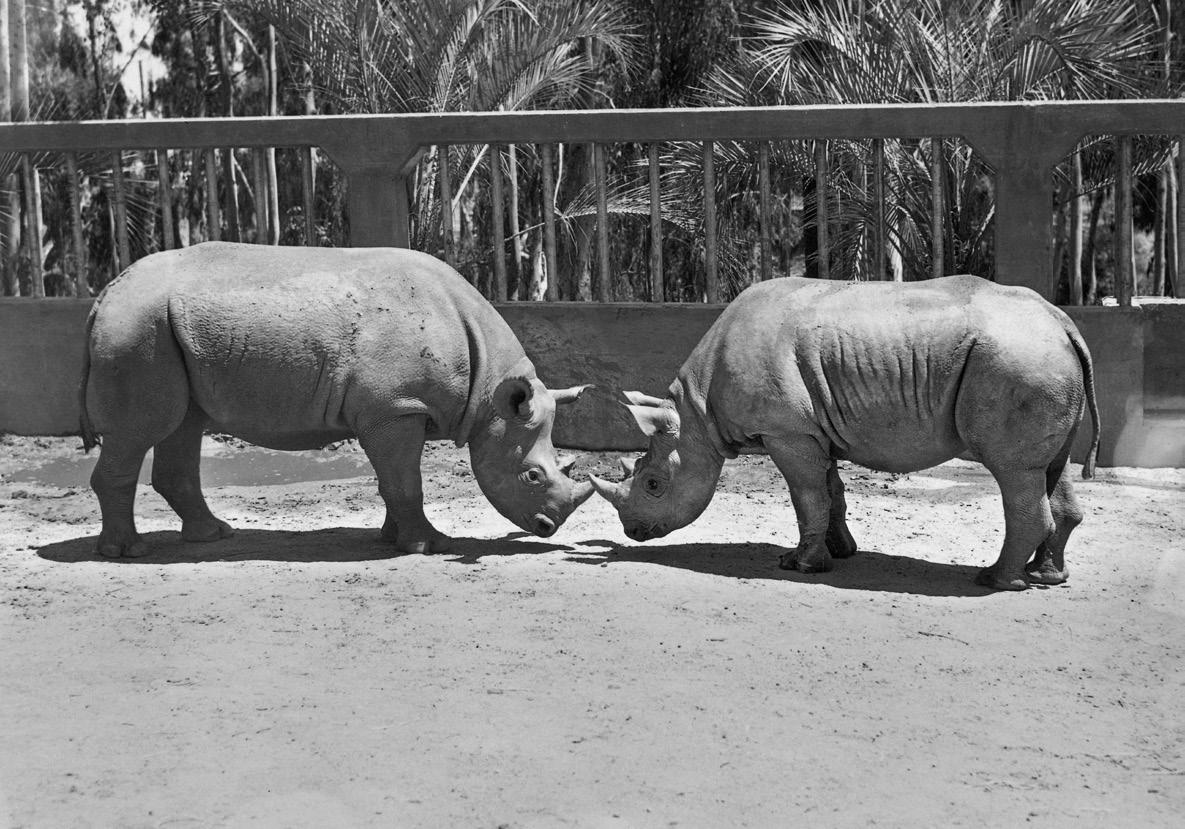
For the San Diego Zoo, 1952 was an exciting year. After many years, we finally had a rhino to share with visitors! The cause of the commotion, a three-yearold black rhino named Sally, was a beloved resident at the Zoo until her passing in 1985. Although she had two mates (and outlived them both), Sally never bred. She did, however, teach the public and the Zoo staff a great deal about her kind. Visitors discovered firsthand the magnificence of an animal they had only glimpsed in grainy movies, while the Zoo learned the dietary and husbandry requirements for thriving black rhinos.
What we learned paid off. In 1976, the Park’s Dillion and Mulenda produced the first black rhino calf in San Diego. The female, named Nanyuki, remained at the Park and bred as well. “One of the things we’ve learned over the years is that each species of rhino is different,” said Randy Rieches, Henshaw curator of mammals at the Park. “Black
Greater
Black rhinos Barney and Sally were the Zoo’s first rhinos.
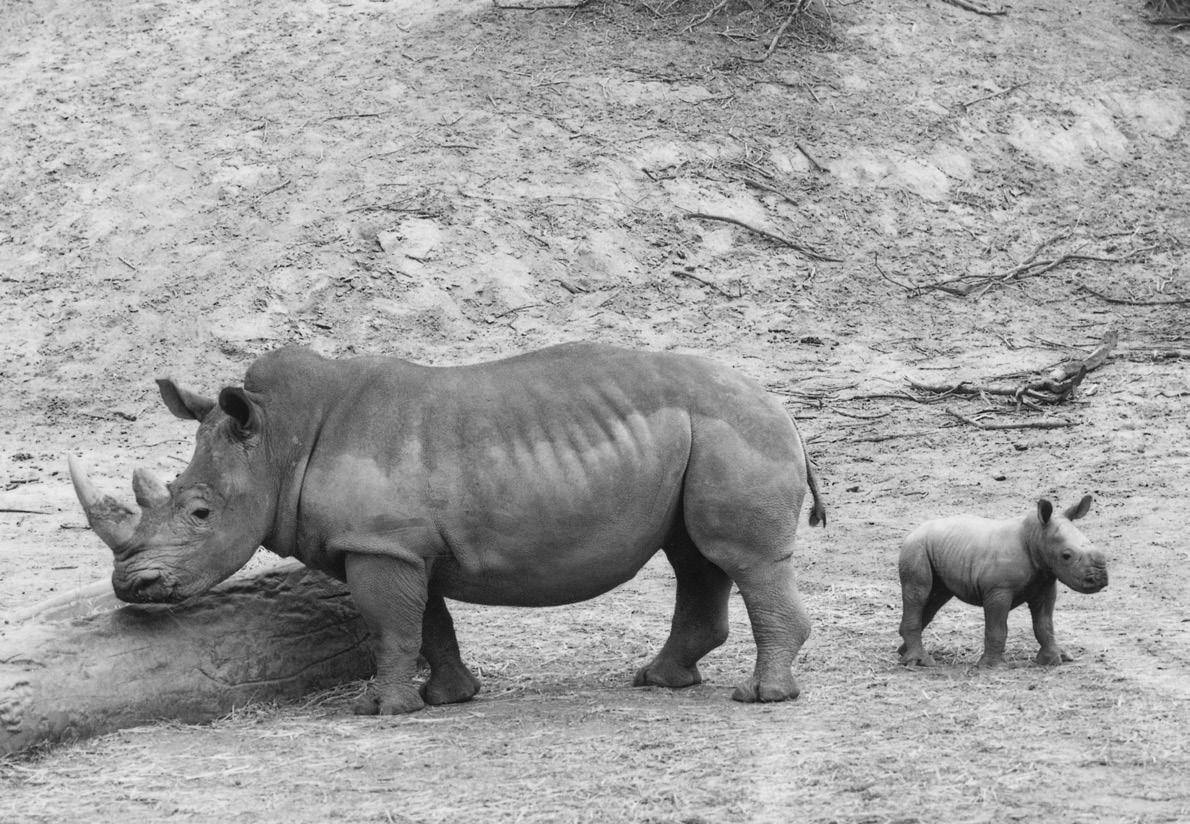
Zibulo, our first southern white rhino calf, was nicknamed Ian after Ian Player (see sidebar).
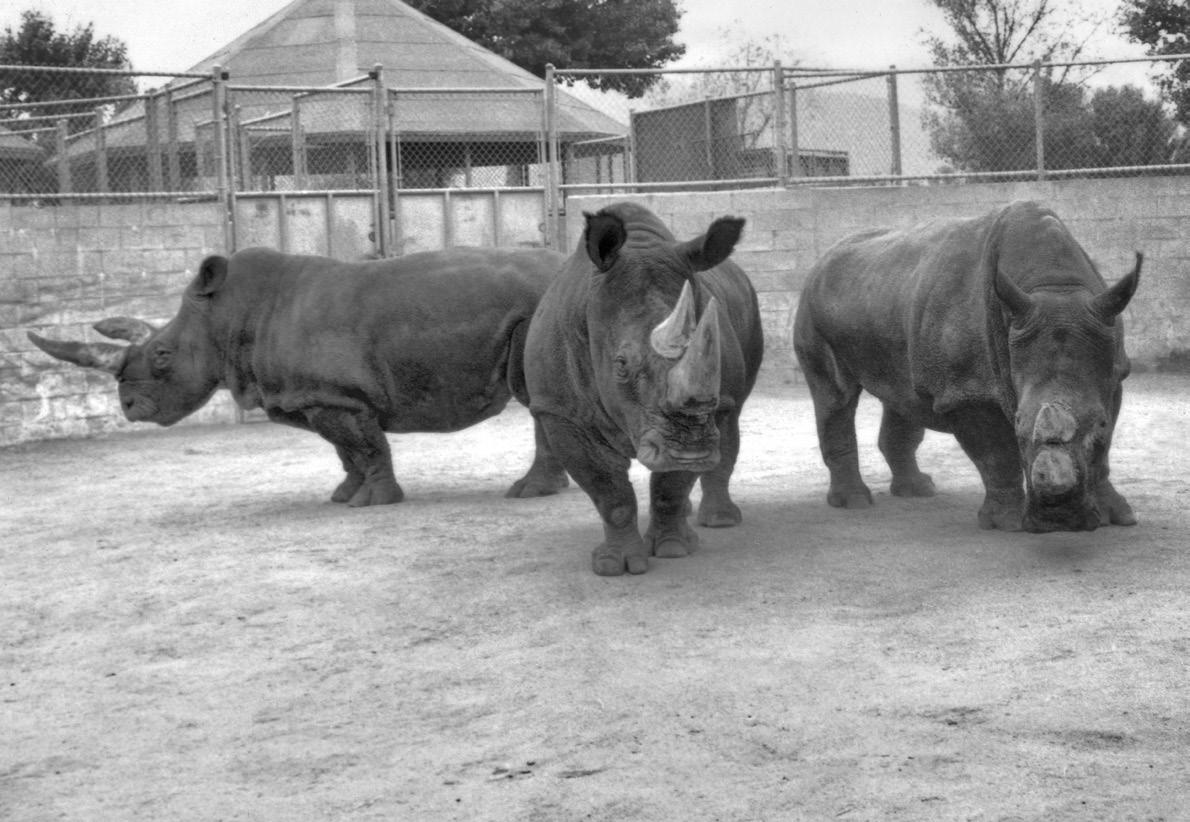
Caring for northern white rhinos Nola, Saut, and Nadi added to our knowledge of this nearly extinct subspecies.
one-horned rhino Lasai was the founding male of our breeding program, which currently boasts seven generations.
REMEMBERING IAN PLAYER
Ian Player’s conservation career began in 1952 as a game warden assigned to the Umfolozi Game Reserve in South Africa. In his 1972 book The White Rhino Saga, he shares the story of the first white rhino he saw and that later “I could think of nothing but the white rhino. Never had I been so impressed and at the same time strangely involved with an animal.”
In the late 1950s and early 1960s, there were fewer than 450 white rhinos in the wild. Aware that the rapidly declining populations were under enormous pressure from hunters, poachers, and farmers, Player devised and implemented an audacious plan to translocate rhinos to other game farms and parks throughout Africa. His efforts paid off, and the number of southern white rhinos rose. In 1966, he was awarded the Zoological Society of San Diego Conservation Medal for his courageous vision and success.
Anderson Borthwick, then Zoological Society trustee and later president, was greatly impressed by Player, and the two became friends. As plans for the Safari Park (then known as the Wild Animal Park) took shape, an agreement was reached for 18 southern white rhinos to be translocated to the new facility in San Diego. At the Park’s dedication ceremonies in 1972, Player, then Zululand’s Chief Conservator, shared his belief and support for the fledgling operation: “Some years back, I came here to conclude a deal with the San Diego Zoo… I believed then, and still do, that this
rhinos need to be alone—just one male and one female. So we’ve given them their own area at the Park, and 14 calves have been born.”
Northern White Rhino
In 1972, the Park welcomed Bill and Lucy, two northern white rhinos that had lived at the National Zoo since 1956. The pair came to us on a breeding loan, in hopes they would reproduce in a larger habitat. The St. Louis Zoological Society then sent its northern white rhinos to the
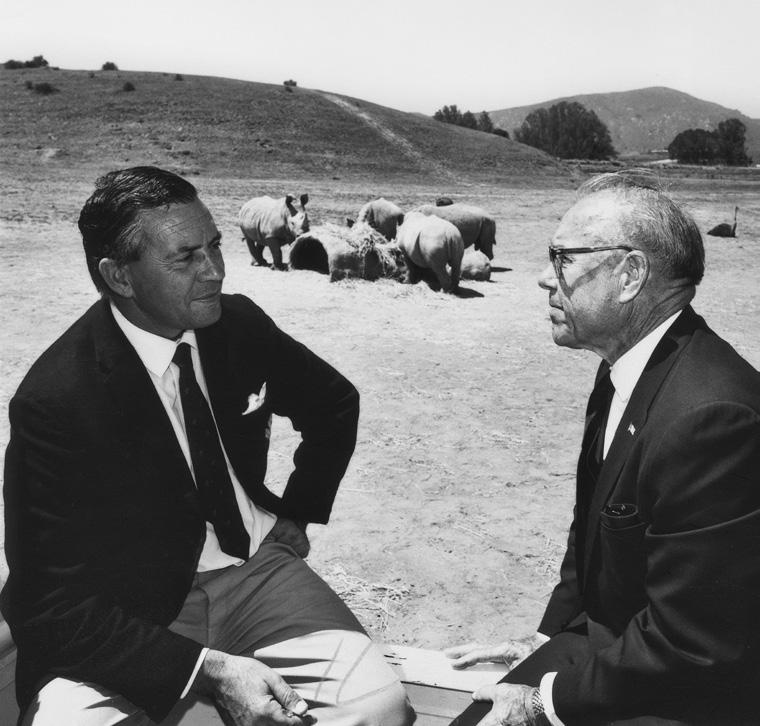
Park is one of the finest places outside Africa for white rhino propagation. When your president Mr. Borthwick and your director Dr. Schroeder agreed, we merely shook hands on it and there was never a piece of paper between us—an example of the faith that exists between those men whose interest is in the animals of the world.”
Ian Player passed away last year, November 30, 2014, and the conservation world lost a great champion. As we move forward, caring for our wildlife and striving to save species like the white rhino from extinction, we do so with gratitude to Mr. Player for the faith he placed in us.
Park, so that all four members of the species in the Western Hemisphere would be in one place. Unfortunately, the animals never bred.
In 1989, a male and two females—Nadi and our beloved Nola—came to the Park. The trio was joined a year later by Angalifu (who passed away last year), but again, no breeding occurred. The reasons are somewhat of a mystery, but it is possible that the animals were beyond breeding age when they arrived. Whatever the reason,
was taking shape, arrangements were made for a group of 18 southern white rhinos to be translocated from Zululand.
The newcomers were soon joined by a pair that had been at the Zoo since 1962. The male, Mandhla, had never shown a bit of interest in his female companion. However, upon his arrival at the Park in 1972, he almost immediately began courting most of the females. On October 11, 1972, the first US-born southern white rhino calf brought cheers from San Diego Zoo Global staff.
The young male calf was named Zibulo, a Zulu name meaning “first fruits of man or beast.” The name was chosen because the rhino birth symbolized what the Park is all about. He was nicknamed Ian, after Ian Player, the chief conservator of the Natal Parks, Game and Fish Preservation Board, who arranged for the first crash of southern white rhinos to relocate to San Diego.
San Diego Zoo Global remains committed to helping this subspecies. The question is how, given the reality that there are only five of them left.
Southern White Rhino
Our success in breeding southern white rhinos is something we are extremely proud of. In the lore of the Safari Park, our southern white rhino crash began with a handshake between humans, followed by the shuffling steps of the rhinos themselves. While the Safari Park
We have welcomed the births of nearly 100 southern white rhino calves over the last 40 years. One of the rhino-sized lessons we’ve learned is that white rhinos are social animals, and females need to be able to form small groups, called coalitions, with other females. Our success also appears to indicate that large spaces are necessary for successful breeding to take place. Fortunately, we have that space at the Safari Park, and our keepers and researchers are continuing to work with and study our white rhinos to better understand the finer details of breeding new generations. n
Wait, there’s more! See photos of more rhino memories on your iPad.
Ian Player (left) talks with Dr. Charles Schroeder at the Park, with part of the white rhino herd in the background.
BREEDING
REPRODUCTIVE CHALLENGES FOR WHITE RHINOS IN ZOOS
By Karyl Carmignani STAFF WRITER
Photos by Ken Bohn SDZG PHOTOGRAPHER
e adage “you are what you eat” can be problematic for some southern white rhinos in zoos. While female rhinos brought in from the wild to join zoo-based programs reproduce well, females born in zoo settings tend not to bear o spring as o en. ese wide-lipped grazers seem to be sensitive to compounds called phytoestrogens found in soy and alfalfa, which make up the lion’s share of the animals’ diet in zoos. “During their 16-month gestation, female calves could be exposed to the compounds through Mom’s diet, resulting in permanent fertility issues later in life,” explained Chris Tubbs, Ph.D., scientist in the Reproductive Physiology Division of the San Diego Zoo Institute for Conservation Research. “ ese plantbased (phyto) estrogens activate receptors that regulate estrogen function.”
white rhinos, absorbing the “imposter” estrogens tampers with their reproductive success; and the more they consume, it seems, the less fertile their daughters will be later in life. Only about one-third of southern white rhinos born in zoo settings successfully reproduce in their lifetime, making a sustainable population a challenge. Interestingly, other species of rhinos in zoos do not have the same problem.
Test Tube Riddles
When our phytoestrogen project began in 2007, it was the rst “receptor-based study to address the zoo rhino reproductive issue” taking a laboratory approach, explained Chris. (Since then, similar work by Chris and his team involves studying how chemicals in the environment a ect the biology of free-flying California condors.)
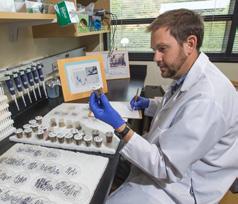
But the project has taken on a real urgency due to the 100-fold increase in rhino poaching in recent years. “More than ever, we need selfsustaining populations of white rhinos established outside of Africa,” he said. Last year alone, about 5 percent of the entire white rhino population was slaughtered.
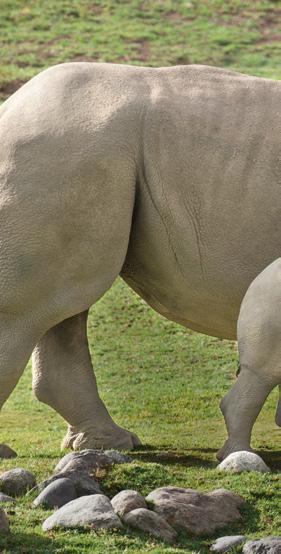
As females of many species can attest, normal estrogen function is precisely controlled, and when things get out of kilter, it can lead to turmoil. For female southern
For scientists in conservation endocrinology, nding solutions to this complex problem entails test tubes, diet samples, food extracts, and a collaborative effort spanning multiple levels of biology. “If you just focus on one aspect of the research, you lose sight of the others,” Chris said. This project is a collaboration between
keepers, animal care managers, veterinarians, and scientists; laboratory work is crucial to saving this species. In addition to combing through white rhino studbook records, zoos around the country were asked to send samples of their rhino diets for testing phytoestrogen content. This may seem straightforward, but since many rhinos are housed with other species (like at the Safari Park), those animals may get a different diet—if a 5,000-pound rhino
EATING : AND
lumbers over for a bite, few animals are going to argue. Hence, rhinos can eat just about anything they get their lips on.
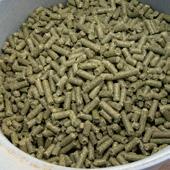
Yet another wild card is the climate of the place they live. Most rhinos in zoos receive a signi cant amount of commercial pellets as part of their diet. e pellets are readily available year round, affordable, and packed with vitamins and minerals…and phytoestrogens. However, it has been observed that rhino mothers
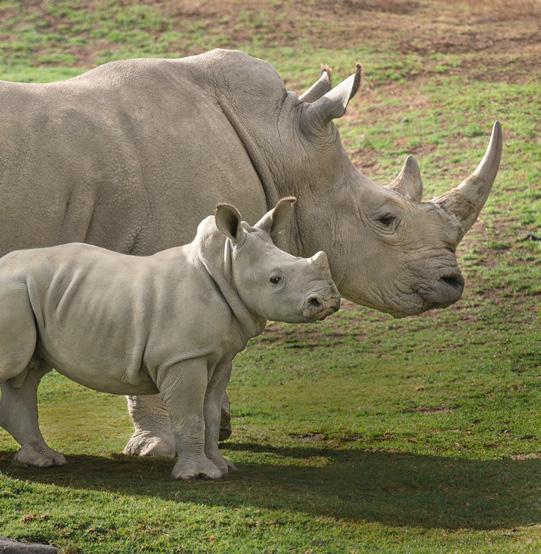
Facing page: Dr. Chris Tubbs and the Reproductive Physiology team are working to solve this rhino reproductive mystery. Above: Rhino calves are precious...and adorable! Below: Pellets are part of the diet for rhinos in zoos.
that eat more naturally occurring fresh grasses during their pregnancy have a higher rate of successful reproduction.
The director of Nutritional Services at the San Diego Zoo, Michael Schlegel, Ph.D., is collaborating with groups to develop a grass-based pellet for rhinos, which is being tested in the lab by Chris and his col-
Examining the Genome
San Diego Zoo Global is pleased to receive a generous grant from the Seaver Institute, which will enable our Genetics Division to begin sequencing white rhinoceros genomes. is critical scientific component will provide muchneeded data clarifying the differences between northern and southern white rhinos; identify the amount of surviving genetic variation in these two forms of rhino; and provide a crucial tool to achieve advance reproductive technologies to save rhino species.
leagues. Finding a pellet with lower phytoestrogen content could help get female white rhinos back on track.
Further diet studies will also be tackled, addressing the microorganisms in the rhino’s gut breaking down all that plant material. How are phytoestrogens digested in the gut? Are they converted into a form more or less potent—and potentially harmful to a female’s reproductive future?
The reproductive life of southern white rhinos in zoos is still shrouded in mystery, but the challenge is being looked at with fresh eyes. Chris and his team are grateful “there is support in the organization to develop and employ new approaches to conservation science,” he said. “We can affect change and bene t the animals through cooperation and collaboration with di erent groups.” Each new southern white rhino calf frolicking next to its mother at a zoo will be just as appreciative.
A Crash of Cute
Rhino Calves at the Park
By Peggy Scott
ASSOCIATE EDITOR
Photos by Ken Bohn
SDZG PHOTOGRAPHER
Even before its public opening in May 1972, the Safari Park had a special relationship with the rhinoceros. ese magni cent creatures are both the Park’s iconic symbol and one of its greatest conservation success stories. e saga that began with the arrival of a herd of southern white rhinos in 1971 unfolded into an epic tale with many chapters, and more are yet to be written.
Since those early days, the Park has been home to four types of rhinos: southern white, northern white, greater one-horned, and
East African black. Our vital research and reproductive work has garnered the best of results—175 calves have been born! Each expressive, chubby little face—like those of the three greater onehorned calves born at the Safari Park last year—serves as a beacon of hope for the future.
A Cause for “Celebration”
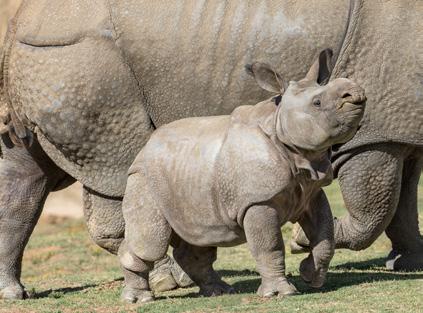
Parvesh was born on February 25, 2014. From the beginning, this little guy kept his own schedule—as did his mother, Alta. Keepers knew the 10-year-old rhino was due to
give birth, but she hadn’t shown any signs of labor. So the call received early that morning by Peter Jones, a Park lead keeper, was a bit of a surprise. “If Alta had shown any of the signs she had with her rst calf, we would have started a 24-hour watch,” Peter says. e calf continues to thrive, gaining the expected 100 pounds per month, and can be seen—all 600-plus pounds of him—in the Asian Plains habitat with his mother and the rest of his crash. e calf’s name means “lord of celebration” in Hindi, and as Randy Rieches, Henshaw cura-
tor of mammals at the Park, points out, Parvesh’s arrival was certainly notable. “With rhino poaching being rampant in every country where rhinos are found, each and every birth that we have in zoos and parks is a major accomplishment and a safety net for the rhinos in their native habitat.”
Late-Blooming Beauty
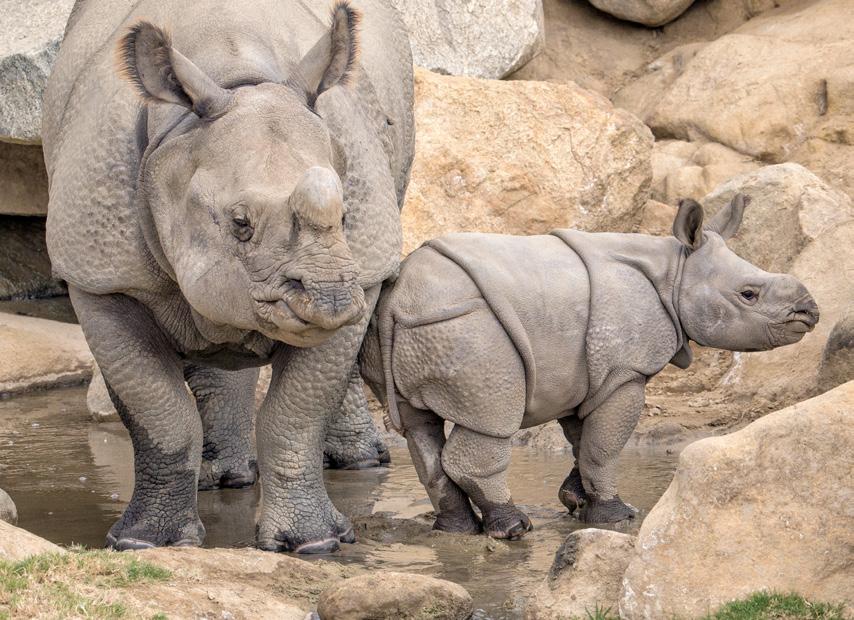
When petite Petunia was born on August 1, 2014, her small size (128 pounds) concerned her keepers, as did the difficulty her mother, Tanaya, was having producing milk. Mom and daughter were kept in the maternity corral for the rst month of Petunia’s life, under the watchful eye of their caretakers. Happily, with the help of medication to increase Tanaya’s milk production, Petunia blossomed, and the pair joined the other rhinos in the 40-acre Asian Plains exhibit.
Caravan Safari guide Elise Newman reports that spunky little Petunia romps around her habitat, making sure her mother is never too far away. Still dainty by rhino standards, Petunia gets a helping hand—or feet—from Tanaya when enjoying the mud wallow. “She sits on top of Tanaya’s feet to keep her head above water,” Elise says. A girl’s best friend is her mom!
Thank You For Being A Friend
First-time mother Kaya spent her Thanksgiving Day (November 27, 2014) giving birth. Even though she dutifully nursed and cared for her newborn for two weeks, the calf failed to gain weight properly and was brought to the Safari Park’s Animal Care Center to be hand-raised. e male calf, named Chutti (which means “holiday” in Hindi—a nod to his birthday), received extra nutrition in the form of ve, three-bottle feedings per day, and he was soon gaining three to four pounds a day!
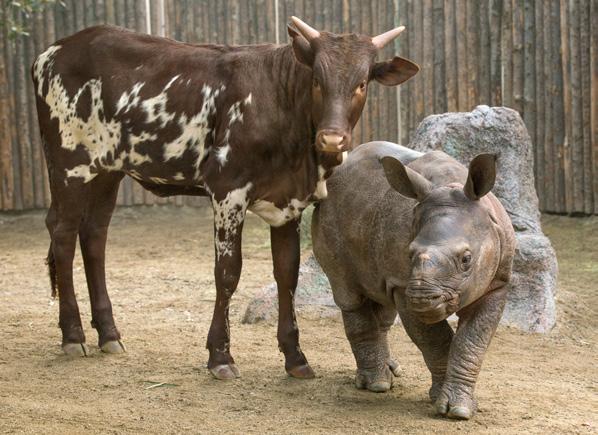
Since Chutti, who keeper Sandy Craig calls “a sweetie,” is being raised in a nursery setting, it is important for him to get daily exercise and have companionship. He has been paired with a oneyear-old female Ankole calf, a ectionately named Moo Moo Kitty by keepers, who was also born to a first-time mother that couldn’t properly care for her calf. Keepers hand-raised and recently weaned the Ankole, and they felt she would make the perfect companion for
the little rhino since both are social animals. “She is curious and has a lot of con dence,” Sandy says, adding that Chutti “likes his personal space, and Moo Moo Kitty is learning to respect that.”
The playful pair can usually be seen at the Animal Care Center nursery corral. “ ey are funny together,” Sandy says. “And part of their day is about ‘how am I going to get into some trouble?’” Sounds like a lot of “kids” we know—two- and four-legged!
Opposite page: Little Petunia is her mother Tanaya’s “minime.” Above: Ankole calf Moo Moo Kitty and rhino calf Chutti are partners in mischief.
Bottom: Parvesh’s name means “lord of celebration,” and the little rhino seems to know he’s something pretty special.
Animals
Appreciated and YOUR Assets
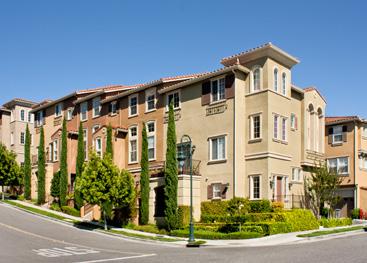
There is a lot to be said for holding assets— stocks, bonds, or property—for decades, since the appreciation can be astronomical. But once you decide to cash in an asset, then come questions about the potentially enormous capital gains tax that might dim your original excitement.
Last year one of our longtime donors found himself in this situation. A er 40 years of ownership of an income-producing rental property in San Diego, he knew his tax bill would skyrocket into the millions if he sold it. He asked if we might have a solution for him: what would work best for his situation and his goals?
We suggested a Charitable Gi Annuity (CGA), because it met his goals: fixed income for life, avoidance of capital gains tax, and, ultimately, a gi to the Zoo. A CGA with San Diego Zoo Global bene ts you as well as us: when you transfer cash, stock, property or other assets to us, we promise to make fixed payments to you for your lifetime. With an interest
rate xed at the time you create your CGA (offering 5.1 percent at age 70 and increasing to 9 percent at age 90), you are assured of a stable rate that gives you a xed payment for life based on your age. Another great feature is that both single life annuities and annuities that include a partner are available; the latter bene ts both individuals for their lifetimes.
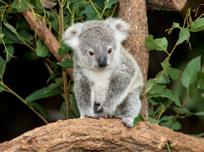
There was more good news for this donor: in his case, the xed monthly annuity payment is more than twice the amount of his previous monthly income from this particular property! He will no longer have to oversee property management or budget for maintenance bills on this property—and his monthly annuity check will arrive regularly, may be partially tax free, and also gives him a substan-
tial charitable tax deduction for making a gi to us. A gi annuity is a wonderful way to help us while we help you—and it’s sure to keep you smiling.
If you have highly appreciated stocks, bonds, or property and would like to explore your options, please reach us at 619-557-3947 or donations@sandiegozoo.org.
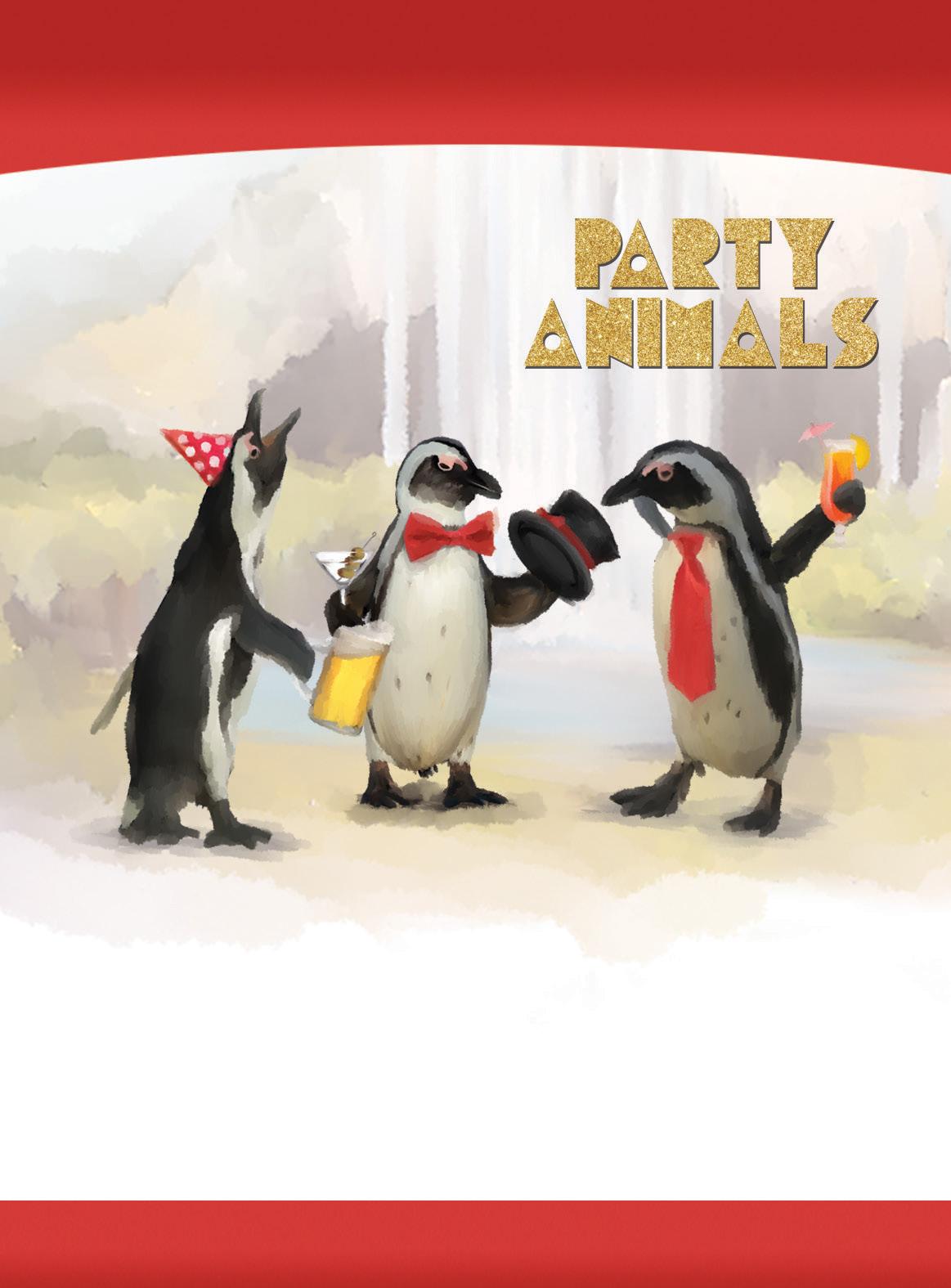
The 32nd Annual R• I •T•Z Saturday, June 20, 2015 6:30 p.m. until midnight
Some of our donors support many Zoo and Park exhibits as well as the Institute for Conservation Research, yet they often have a favorite animal. For this donor, it was definitely Australia’s unique species!
What’s Black, White, and a PARTY all over?
It’s the wildly exotic celebration of food, fashion, and furry–feathery fun. A rip-roarin’ rumble in the jungle more entertaining than a barrel of monkeys… AND a beach full of penguins!
See you “Party Animals” there!
Contact Marilyn Neumann at 619-287-5435 or SDZOORITZ@gmail.com sandiegozoo.org/RITZ

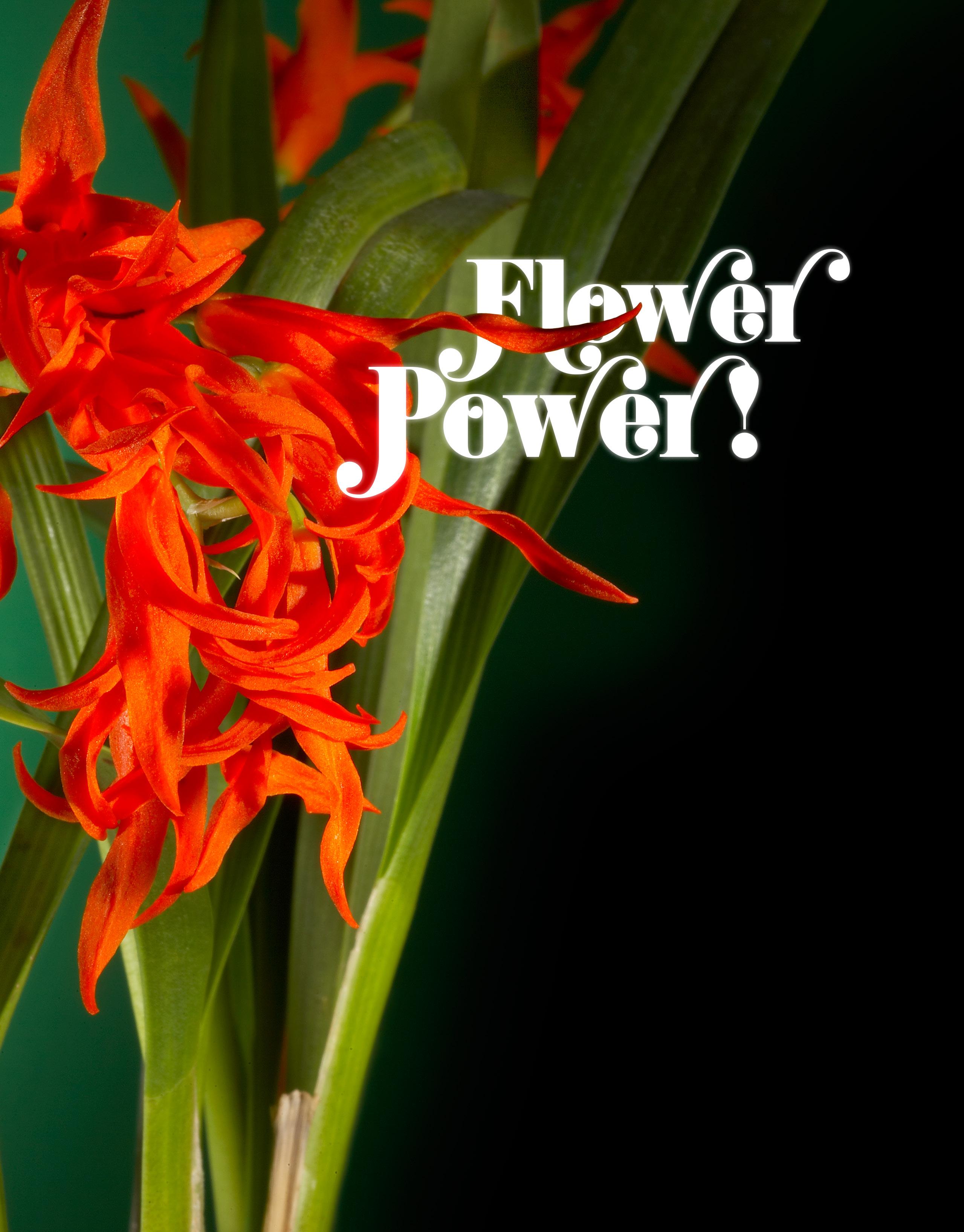
At this year’s Garden Festival presented by Sparkletts on May 9 and 10, 2015,
We’ll be showcasing the San Diego Zoo’s beautiful flowering plants, including their importance for our animal collections, how they aid animal welfare, and their vital role in supporting local pollinators—and, of course, the enjoyment they bring to all of us. Guests are invited to dig into several special activities, including:
GARDEN FESTIVAL SCAVENGER HUNT Find flowers and plants around the Zoo, for kids and kids at heart
FROM SEED TO BLOOM Learn more about the science of how a flower grows
COLLECTION CONNECTIONS Talk with our horticulture sta about our amazing botanical collections, as well as scientists from our Institute for Conservation Research
CAN YOU DIG IT Find out how soils play an integral part in the health of our plants and animals
ZOO BOTANICAL TOURS Pick up self-guided tour brochures, made possible through the generosity of the Daphne Seybolt Culpepper Memorial Foundation, and branch out to discover more about our Zoo gardens.
Garden Festival is a blooming

Exclusive Private Jet Tours
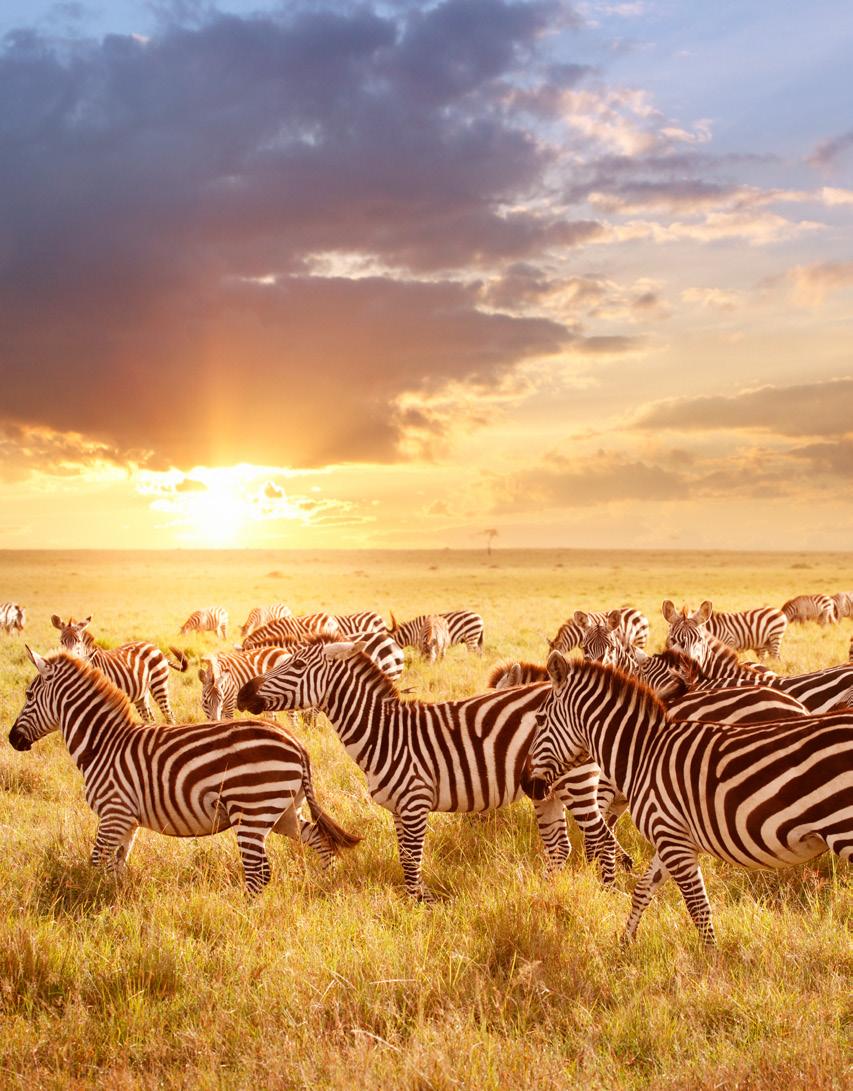
Wonders of the Earth
April 17 –May 11, 2016

View endangered wildlife, meet indigenous people, and see unbelievable landscapes. Stops include Papua New Guinea, the Galápagos Islands, and Tanzania. $82,950 plus round-trip airfare to departure city (per person, double occupancy)

Coming Soon
Brazil’s Pantanal
September 2016
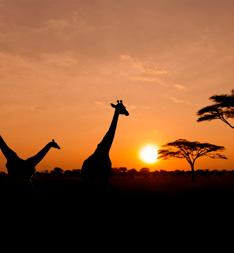
Explore Brazil’s Pantanal, the Serengeti of South America and the world’s largest wetland.




Around the World
September 29 –October 22, 2016
Experience a lifetime of must-see iconic destinations, including Machu Picchu, the Great Barrier Reef, the Serengeti Plain, and Angkor Wat. $76,950 plus round-trip airfare to departure city (per person, double occupancy)
Cuba and Its Wildlife
October 2016
From Havana to the national parks, explore the vibrant wildlife and culture of this mystical island country.
MAY–AUGUST MEMBER COUPONS
MAY 2015
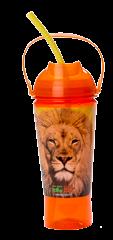
$1 OFF SOUVENIR SIPPERS
Discount available at any Zoo or Safari Park restaurant location. Members also receive free refills all day on date of purchase.
Offer valid May 1–31, 2015.
Offer cannot be combined with any other offer or discount. Show valid San Diego Zoo Global membership card at time of purchase. Not valid at San Diego Zoo’s Albert’s Restaurant.
MAY–AUGUST 2015
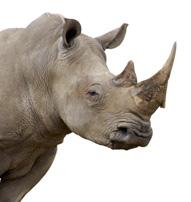
$10 OFF ALL ANIMAL ADOPTIONS!
Looking for a unique gift? You can adopt a rhino and have the digital adoption package sent immediately! Visit our San Diego Zoo website to view rhinos and all our other animals, and give a gift of hope! Digital adoptions start at $35. Mailed adoptions—which include a plush animal—start at $100. Adoptions support our wildlife conservation efforts here and around the globe. See our website at sandiegozoo.org/adopt for a full list of our animal adoptions.
Offer valid
May 1–August 31, 2015.
To redeem online, enter coupon code ASZW0515 at checkout. No limit. Not valid at any on-grounds adoption booths.

JUNE 2015
10% OFF ALL HATS!
Valid at all stores at the San Diego Zoo and Safari Park.
Offer valid June 1–30, 2015.
No limit while supplies last. Not valid with any other offer or discount. Show valid San Diego Zoo Global membership card at time of purchase.
JUNE 21–SEPTEMBER 7, 2015
HAPPY HAPPENS AT ALBERT’S RESTAURANT!
Join us from 3 to 5 p.m. daily during our Nighttime Zoo celebration. Begin your evening dining with selections from our $6 and $7 menu that includes appetizers, specialty cocktails, fine wines, and craft beers. For complete menus and details, visit sandiegozoo.org/zoo/alberts
Offer valid June 21–September 7, 2015.
No coupon necessary for this offer. Cannot be combined with any other offer or discount. Valid only at Albert’s Restaurant. Although not necessary, reservations can be made at 619-685-3200.
JULY 2015
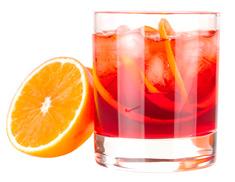
HAPPY HOUR AT BAMBURI BOAT BAR!
Join us at the Safari Park from 2 to 4 p.m. and enjoy daily specials, such as craft beers, fine wines, and specialty cocktails, all while relaxing on the deck overlooking the lagoon. Bamburi Boat Bar is located in Nairobi Village near Mombasa Cooker.
Offer valid July 1–31, 2015.
No coupon needed for this offer. Cannot be combined with any other offer or discount. Valid only at the Safari Park’s Bamburi Boat Bar.
AUGUST 2015
MEMBER SPECIAL ON SELECT T-SHIRTS
Purchase two T-shirts for $30 (regularly priced at $19.95 each). Valid on select designs only at ZooStore at the San Diego Zoo and Bazaar at the Safari Park.
Offer valid August 1–31, 2015.
No limit while supplies last. Not valid with any other offer or discount. Show valid San Diego Zoo Global membership card at time of purchase.
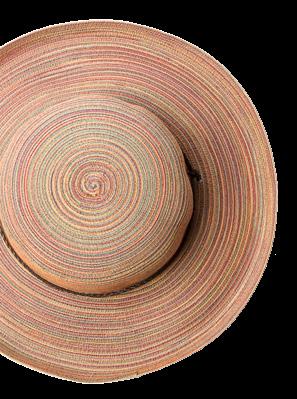

HAT




Visit our stores at the Zoo and Safari Park to purchase these featured items. Available in select stores. Limited quantities available.
Styles shown range from $19.95 to $39.95. Many more styles, including men’s and children’s are available in store.
Your purchases support the conservation projects and educational work of San Diego Zoo Global.
The Sweet 18 from the archives
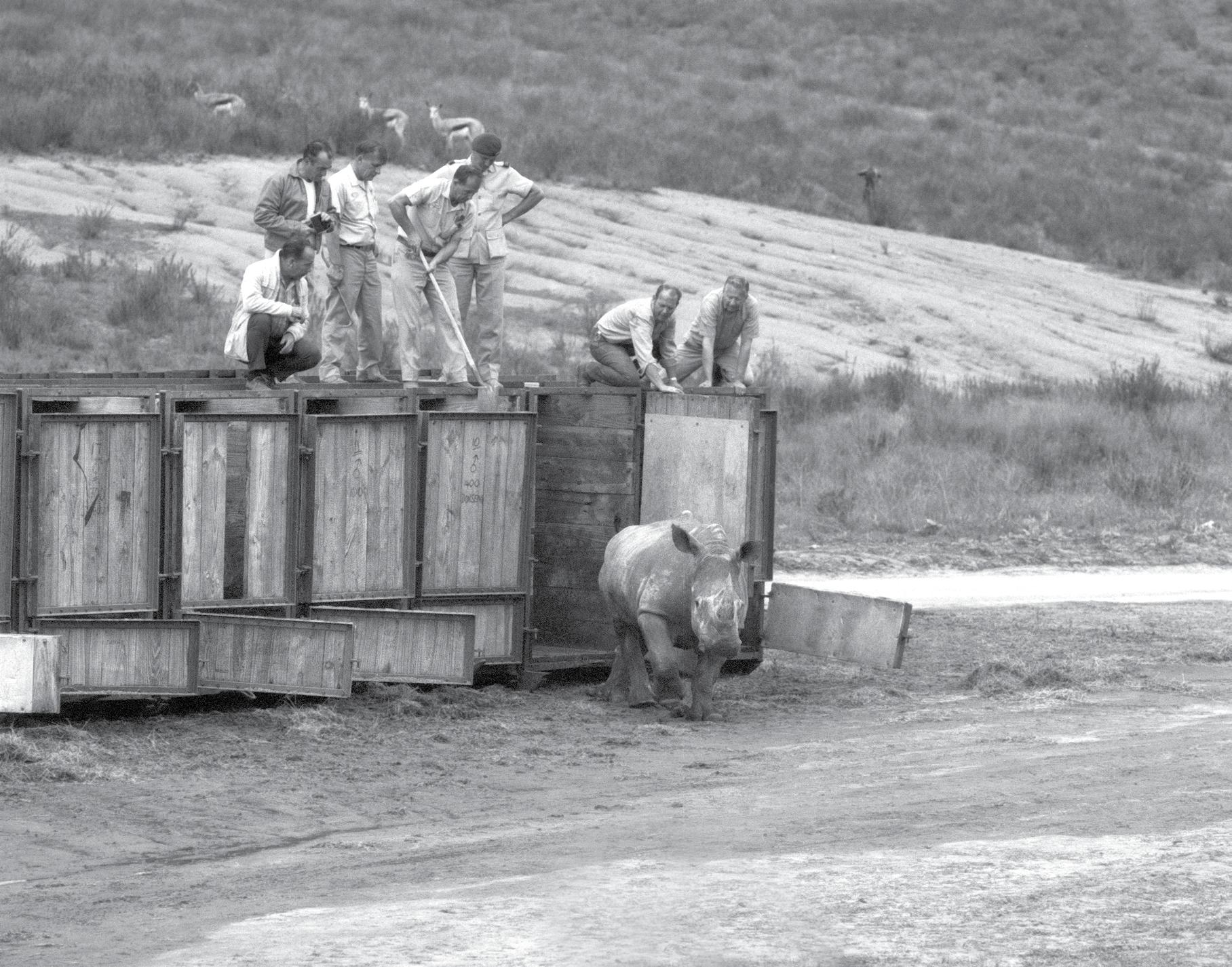

Mid-afternoon on February 19, 1971 , 18 southern white rhinos thundered into their new, 93-acre eld exhibit at the yet-to-open San Diego Wild Animal Park (now the San Diego Zoo Safari Park), thus expanding the Zoological Society of San Diego’s relationship with these majestic animals.
While the majority of the newcomers were juveniles “not yet of reproductive capacity,” it was hoped, as was noted in the May 1971 issue of ZOONOOZ, “that having been provided with the proper environmental and nutritional requirements, this group of rhinos will be a viable reproducing captive herd.”
We didn’t have to hope for long. On October 11, 1972, the herd’s rst calf was born at the Park. Dubbed Zibulo, a Zulu name meaning “ rst fruits of man or beast,” the little male was only the third rhino calf conceived in a zoo. Zibulo wouldn’t be the new kid—or calf—on the block for long: by April 1973, four more calves would be born at the Park. To date, the Park has celebrated the births of 93 southern white rhinos, along with 68 greater one-horned rhinos, and 14 eastern black rhinos.
MORE SPOTS IN AFRICA
As Africa’s leading airline for over 80 years, from the U.S. to South Africa, including daily nonstop service from New York-JFK and daily direct service from Washington, DCDulles to Johannesburg. Our extensive route network in Africa provides for convenient continent. Come experience our legendary award-winning hospitality and see why we have earned a 4-Star rating from Skytrax for 12 consecutive years.
SAN DIEGO ZOO GLOBAL
Box 120551, San Diego, CA 92112
join our “rally 4 rhinos” on
may 15, 2015!
Rally 4 Rhinos at the Safari Park, Presented by
May 15 is Endangered Species Day, and we have a special event at the Safari Park: we’re celebrating rhinos and rallying for their future!
San Diego Zoo Global has been working steadily for decades to help these iconic endangered species. Yet rhinos continue to be in critical need of conservation help. Currently, a rhino is poached every eight hours. With dramatically low populations of all 5 rhino species, rhinos could become extinct in 15 to 20 years. That’s not a future we want to live with!
Join us on May 15 as we “Rally 4 Rhinos.” Spread the word that rhinos need help—and that everyone can make a difference. No matter where you live, you can be a part of saving a species from extinction.

Beginning at 9:30 a.m. at the Safari Park’s African Plains Overlook, a special presentation and lively community activities will involve everyone in helping rhinos. Be there to raise awareness of the plight of rhinos—and the urgent need to protect them for future generations.
Rally 4 Rhinos from Anywhere
Join our online rhino Twitter Party using the hashtag #Rally4Rhinos and be part of the conservation conversation.
Send an online letter to the California Legislature in support of bill AB 96: if passed, AB 96 will prevent the importation or sale of rhino horn and elephant ivory in California.
Lend a hand: Write “Stop Killing Rhinos” on the palm of your hand and take a photo, then post the photo on social media using the hashtag #Rally4Rhinos. There are five species of rhinos left on the planet—and we have five fingers on a hand. Let’s lend that hand to say “Stop!” and halt the destruction of these magnificent animals.
For more information, visit rally4rhinos.org.