

Albert’s Restaurant at the San Diego Zoo is cooking up some exciting dining events for your springtime enjoyment. Join Executive Chef Chris Mirguet and Albert’s Chef Charles Boukas for a gourmet meal and great company—make your reservations today!
Saturday, March 7, 2015
Treetops Banquet Room
Reception 5 p.m. | Dinner 5:30 p.m.
$69 for members, $82 for nonmembers
Celebrate spring with some of the San Diego Zoo’s favorite animal ambassadors! Enjoy appetizers and a no-host bar from 5 to 5:30 p.m., while you meet a variety of animal friends. A three-course meal follows, with animal encounters taking place throughout the evening. Guests will be seated at tables of 8. Menu substitutions are not available for this event.
Sunday, April 5, 2015
Treetops Banquet Room
Continuous seating begins at 11 a.m.
$44.95 for adults and $18.95 for children ages 3 to 11. Zoo admission required for nonmembers. Enjoy a beautiful spring day at the Zoo with friends and family and savor a bountiful and delicious Easter buffet brunch. For reservations for this event only, call 619-557-3964.
Featuring Merryvale Vineyards: A Napa Valley Winery
Saturday, April 25, 2015
Reception with animal ambassadors 6 p.m. in the Treetops Banquet Room
Dinner 6:45 p.m. in Albert’s Restaurant
$89 for members, $102 for nonmembers, ages 21 and older only
Indulge in a four-course meal crafted by our chefs to pair beautifully with the rich and complex wines of Merryvale Vineyards that have been selected especially for this evening.
Prices not including tax and gratuity; nonmembers add Zoo admission. Seating is limited.
For reservations, please call 619-718-3000, or book online and see menus at sandiegozoo.org/zoo/alberts.
At
PEGGY SCOTT
A
The


f you have visited the Zoo recently, you’ve probably noticed that several renovation and construction projects are underway. We are making changes in preparation for our centennial celebration in 2016, adding new exhibits in the Asian Passage zone, and starting the monumental work for Conrad Prebys Africa Rocks, which will completely transform the old Dog and Cat Canyon area of the Zoo when it opens in 2017.
One project is already complete: the new Centennial Walkway that passes in front of the Otto Center and leads to Balboa Park. We’ve built this walkway to help celebrate Balboa Park’s centennial this year, upgrading the access and creating an inviting sense of arrival as people walk between the Zoo and Balboa Park. If you’ve missed the elephant topiaries that used to be at the Zoo entrance, you’ll now f nd them in their new home along the walkway. What better way to indicate that you are going to or coming from the Zoo than two towering elephants?
Our new employee parking structure on Zoo grounds, in the canyon near the Zoo Hospital, is progressing nicely. Te supporting elements are going up and the concrete is being poured for the seven-level structure, which is due to be completed by August. It will provide more than 600 parking spaces for our employees, which opens up space in the Zoo’s parking lot for our guests. Tat will be especially welcome during the summer and other busy times at the Zoo.
Also new this summer will be an expansive new habitat for Amur and snow leopards in the Asian Passage zone at the Zoo, near Panda Trek. Te beautiful multilevel, 16,500-square-foot habitat is now in the f nal phases of construction, and visitors will be able to enjoy seeing these big cats in their new homes during Nighttime Zoo. Te new habitat also makes it possible for us to increase our participation in breeding programs for these leopards, an important step since both species are critically endangered. Our thanks go to the more than 1,000 generous donors who helped to make this habitat a reality.
Te Zoo’s Wegeforth Bowl will be playing a key role in our centennial celebration next year, with a new entrance, new features including sound and lighting, and a wonderful centennial multi-media—and multi-animal—show that you won’t want to miss. We started the renovations last month, so be aware that there will not be a Wegeforth Bowl show for several months as we create the setting for this new experience. I know it will be worth the wait!
Te biggest project by far is Conrad Prebys Africa Rocks, which will completely change an entire canyon at the Zoo. We’re just getting started with this exhibit complex that will represent some of the habitats and animals of Africa, including kopjes, grasslands, forests, swamps, and the rocky coastline where African penguins live. When you see the construction fences up around this large area of the Zoo during the next two and a half years, you’ll know that something big, ambitious, and spectacular is taking shape behind them.
While this is a great deal of construction within our 100-acre Zoo, the inevitable rerouting and closed-of areas are the precursors to making your San Diego Zoo better and more enjoyable than ever. We hope you will “pardon our dust” as we renew the Zoo!
OFFICERS
Robert B. Horsman, Chairman
Sandra A. Brue, Vice Chairman
Judith A. Wheatley, Secretary
Steven G. Tappan, Treasurer
BOARD OF TRUSTEES
M. Javade Chaudhri
Berit N. Durler
Richard B. Gulley
Clifford W. Hague
Linda Lowenstine, D.V.M., Ph.D.
Patricia L. Roscoe
TRUSTEES EMERITI
Frank C. Alexander
Kurt Benirschke, M.D.
Thompson Fetter
Bill L. Fox
Frederick A. Frye, M.D.
George L. Gildred
Yvonne W. Larsen
John M. Thornton
Albert Eugene Trepte
Betty Jo F. Williams
James Lauth, General Counsel
Douglas G. Myers, President/CEO
Charles L. Bieler, Executive Director Emeritus
OFFICERS
Murray H. Hutchison, Chair
Maryanne C. Pfister, Vice Chair
Susan N. McClellan Secretary
Richard M. Hills, Treasurer
Mark A. Stuart, President
Robert B. Horsman, Ex officio
Douglas G. Myers, Ex officio
BOARD OF DIRECTORS
Christine L. Andrews
Joye D. Blount
Rick Bregman
Lisa S. Casey
Douglas Dawson
Berit N. Durler, Ex officio
U. Bertram Ellis, Jr.
Arthur E. Engel
Craig L. Grosvenor
Judith C. Harris
Michael E. Kassan
Susan B. Major
Michael D. McKinnon
George A. Ramirez
Thomas Tull
Margie Warner
Ed Wilson
Robert B. Horsman Chairman
The Safari Park blossoms in the spring with colorful flowers and the beautiful butterflies of Butterfly Jungle. Join Safari Park chefs Joshua Mireles and Abriann Ramirez for gourmet dining to welcome the season.
Friday, March 13, 2015, 5:30 p.m.
Mombasa Pavilion
$69.95 for members, $82.95 for nonmembers
See Butterfly Jungle before it officially opens to the public, enjoy a presentation from a butterfly keeper, and gather for a lovely dinner with a spring-inspired menu.
Featuring California Cider Company
Saturday, March 21, 2015, 5:30 p.m.
Hunte Nairobi Pavilion
$79 for members, $92 for nonmembers, ages 21 and older only
Join us for a special evening, with an animal presentation followed by a four-course gourmet dinner. Our chefs have paired each course with a different hard cider that will be presented by a representative from California Cider Company.
Sunday, April 5, 2015, 11 a.m.
Hunte Nairobi Pavilion
$44.95 for adults and $18.95 for children ages 3 to 11
Hop on over to the Safari Park for a wild Easter Brunch! From chef’s specialties to Easter favorites—and plenty for those with a sweet tooth—this brunch buffet is sure to please the whole family.
Prices not including tax and gratuity; nonmembers add Safari Park admission and parking. Seating is limited.
PUBLISHED SINCE 1926
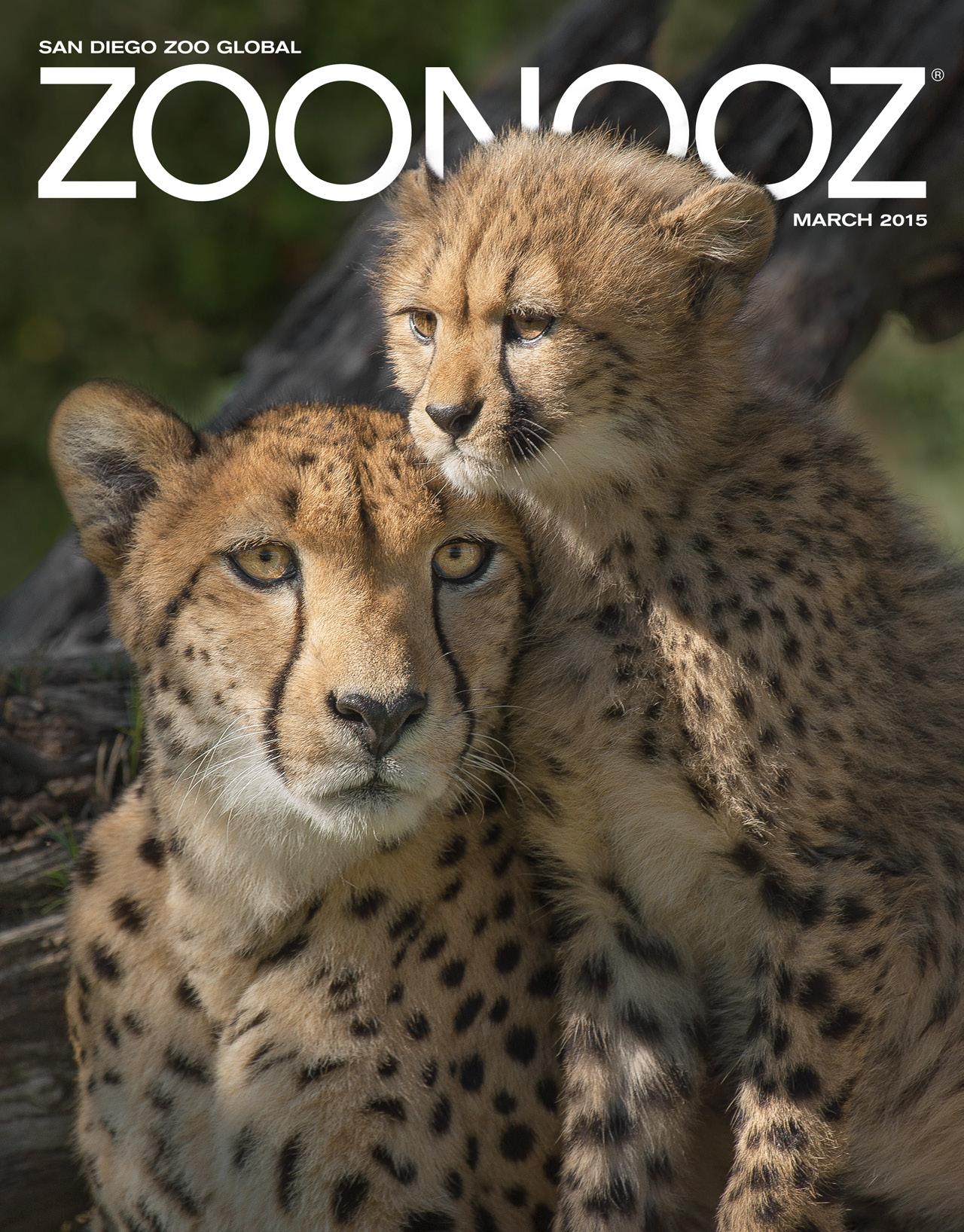
MARCH 2015
VOL. LXXXVIII NO. 03
MANAGING EDITOR
KAREN E. WORLEY
ASSOCIATE EDITORS
PEGGY SCOTT
DEBBIE ANDREEN STAFF WRITERS
WENDY PERKINS
KARYL CARMIGNANI
SAN DIEGO ZOO GLOBAL PHOTOGRAPHER
KEN BOHN
DIGITAL IMAGING TECHNICIAN
TAMMY SPRATT
DESIGN AND PRODUCTION
DAMIEN LASATER • CHRIS MARTIN
HEIDI SCHMID ROMERO • LISA BISSI
JENNIFER MACEWEN
PREPRESS AND PRINTING QUAD GRAPHICS
Te Zoological Society of San Diego was founded in October 1916 by Harry M. Wegeforth, M.D., as a private, nonprofit corporation that now does business as San Diego Zoo Global.
Te printed, hard-copy version of ZOONOOZ (ISSN 00445282) is currently published bimonthly (Nos. 1, 3, 5, 7, 9, and 11 of each year’s volume; the even-numbered issues of each volume are available in digital format only). Publisher is San Diego Zoo Global, at 2920 Zoo Drive, San Diego, CA 92103, 619-231-1515. Periodicals postage paid at San Diego, California, USA, and at additional mailing offices.
POSTMASTER: Send address changes to Membership Department, P.O. Box 120271, San Diego, CA 92112. Copyright 2015 San Diego Zoo Global. All rights reserved. “ZOONOOZ” Reg. U.S. Pat. Office. All column and program titles are trademarks of San Diego Zoo Global. Annual Memberships: Dual $125, new; $110, renewal. Single $102, new; $90, renewal. Each membership includes unlimited entrance to the San Diego Zoo and the San Diego Zoo Safari Park.
Subscription to printed issues of ZOONOOZ $25 per year, $65 for 3 years. Foreign, including Canada and Mexico, $30 per year, $81 for 3 years. Contact Membership Department, P.O. Box 120271, San Diego, CA 92112.
As part of San Diego Zoo Global’s commitment to conservation, ZOONOOZ is printed on recycled paper that is 30% post-consumer waste, chlorine free, and is Forest Stewardship Council (FSC ) certified.
FSC® is not responsible for any calculations on saving resources by choosing this paper.
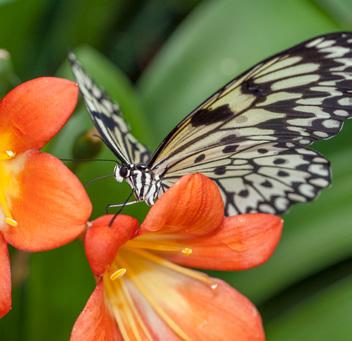
SPRING IS A BUSY AND EXCITING TIME at the Zoo and Safari Park, so if you have a case of spring fever, we have the cure! At the Safari Park, springtime brings Butterfly Jungle, which begins on March 14 and continues through April 12. It promises to be as impressive, colorful, and fun as always, with thousands of beautiful butterflies fluttering around you in a lovely welcome to the season. If you’d like a special preview, join our Safari Park chefs for the Butterfly Jungle Preview Dinner on March 13, which includes an exclusive visit to the butterflies before a wonderful meal in Mombasa Pavilion. Te Safari Park is also debuting something new this spring: Animal Tales, a chance to hear some great animal stories firsthand from our staff, then visit some of the animals themselves. Te first one is on March 15, where you’ll hear about the Park’s gorilla baby, Joanne, and the second takes place on April 17, where you’ll meet the Park’s dynamic cheetah and dog duo, Ruuxa and Raina.
At the Zoo, spring means Plays Days, which begins on March 28 and continues through April 12. Experience animal enrichment activities, keeper talks, and special presentations popping up throughout the Zoo for fantastic “play dates” with all your favorite animals. Tis year we’re paying particular attention to our spotted animals, so see how many of these species you can spot as you stroll around the Zoo grounds. Come visit us and enjoy!
SAN DIEGO ZOO HOURS
March 1–8; 9 a.m. to 5 p.m.
March 9–27; 9 a.m. to 6 p.m.
March 28–31; 9 a.m. to 7 p.m.
April 1–12; 9 a.m. to 7 p.m.
April 13–30; 9 a.m. to 6 p.m.
SAN DIEGO ZOO SAFARI PARK HOURS
March 1–13: 9 a.m. to 5 p.m.
March 14–31: 8 a.m. to 6 p.m.
April 1–12: 8 a.m. to 6 p.m.
April 13–30: 9 a.m. to 5 p.m.
WEBSITE sandiegozoo.org
SAN DIEGO ZOO PHONE 619-231-1515
DIGITAL ZOONOOZ® issuu.com/sdzglobal
Doug G. Myers President/CEO
1 Orchid Odyssey—Zoo
7 Albert’s Dinner with Animal Ambassadors—Zoo
13 Butterfly Jungle Preview Dinner—Park
14 Butterfly Jungle begins—Park 14, 28 Roar & Snore: Safari Sampler with Butterfly Jungle—Safari Park
15 Animal Tales breakfast presentation: Joanne the gorilla—Park
20 Plant Day and Orchid Odyssey—Zoo 20, 21, 27, 28 KinderNights—Zoo
21 Brewmaster Dinner—Park 21, 28 KinderTots—Zoo
28 Play Days begins—Zoo
1 Butterfly Jungle continues—Park
1 Play Days continues—Zoo
4 Roar & Snore: Happy Hoppers, with Butterfly Jungle—Park
5 Easter Brunch—Zoo and Park
11 Nativescapes Garden tour—Park
11 Roar & Snore: Safari Sampler with Butterfly Jungle—Park
12 Butterfly Jungle ends—Park
12 Play Days ends—Zoo
17 Plant Day and Orchid Odyssey— Zoo
17 Animal Tales evening presentation: cheetah cub and puppy duo—Park
25 Albert’s Spring Winemaker Dinner— Zoo
said it

Her favorite place @sharinnybarahas

Just spent a lovely day at the Safari Park - the new Tiger Trail is SO beautiful and I saw 5 different tigers up close and personal. A real triumph in animal display. THANK YOU!!
Karen L Whitney
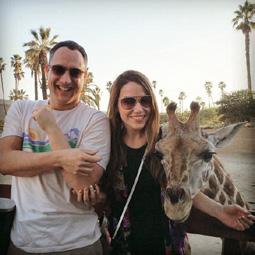
One more pic with my beloved giraffe Leroy at @sdzsafaripark best #blackfriday ever! #GIRAFFE @stuartbrazell
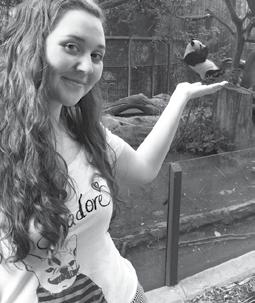

Today, I held a mini giant panda. It was epic. #sandiegozoo
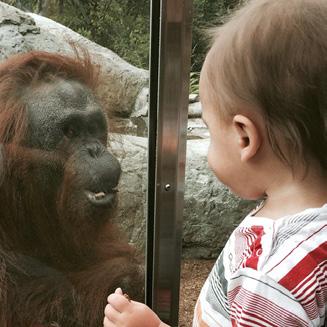
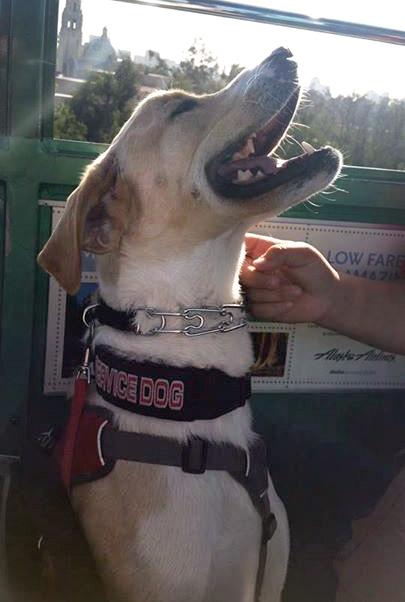
Hi, my name is Kate and this is my service dog Rhodey. Rhodey loved the San Diego Zoo. And I say loved, because yesterday, while trying to protect our family from a coyote, Rhodey was struck and killed by a car.
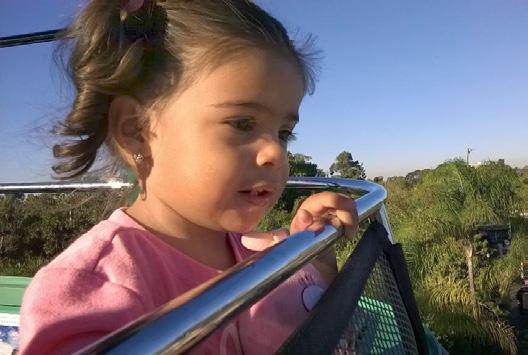
Rhodey had over 200 hours of public service and countless green San Diego Zoo bandanas. I took this picture on our last trip to the Zoo while riding the Skyfari. I think it shows how special this place was to us.
We knew all the ADA drivers, had heard Margie the singing bus driver all 3 times we took the tour. He had been chased by an Amur leopard and enjoyed a shared love of Kong toys with Cookie the Honey Badger. Te wild llamas in Africa Rocks always heckled him (their warning call) whenever we saw them. Bonobos offered him food, and likewise Karen the Orangutan tried to feed him berries. He wasn’t of much interest to the female mountain lion on the Big Cat Trail, but we sat stock still with my wheelchair there for hours, trying to desensitize her to the weird contraption.
Despite all these run-ins with wild animals, nothing excited Rhodey more than seeing a San Diego Zoo squirrel dart across the path. Te Zoo was our special spot. Where we could go, just the two of us. Nothing made him happier than sitting with me in front of the flamingos by the entrance. Everyone who met and knew Rhodey at the Zoo was incredibly special to us. Whether it be volunteers or keepers, or security, or ADA drivers.
Tank you for making this place the happiest place for my very special boy.
Kate Tompson
These two bonded over their love of eating bark and leaves. #sdzkidsfree @thebirdstheword
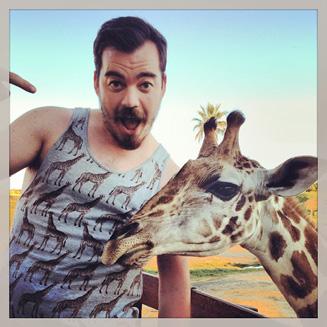
Tis guy! (Leroy the Giraffe) #justababy #giraffe @dannyandpanny
Looking for the best seat in the Park or Zoo?

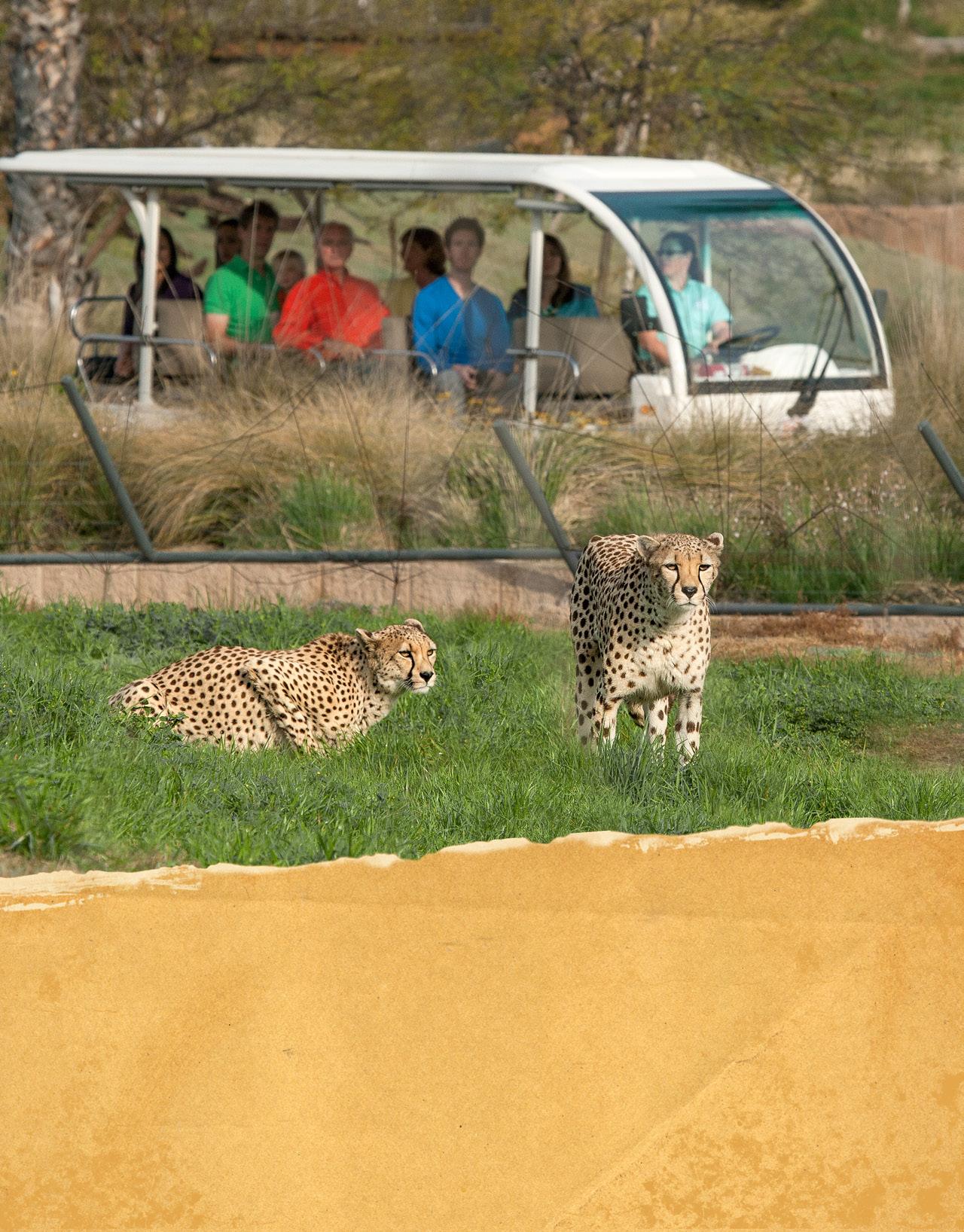
Let an experienced guide introduce you to the incredible animals and plants at the San Diego Zoo during a Discovery Cart Tour or at the Safari Park during a Cart Safari. Sit back in the comfort of our expedition cart as you tour the grounds and visit select spots for opportunities to get great photographs. Your guide will share special stories about the plants and animals, how our conservation research work helps their wild relatives, and how little things we all do can make a big difference. Best of all, you can step off for better views of your favorite animals and ask your guide as many questions as you like as you watch our amazing wildlife. It’s an experience you won’t soon forget!
By Peggy Scott ASSOCIATE EDITOR
Photos by Tammy Spratt SDZG PHOTOGRAPHER
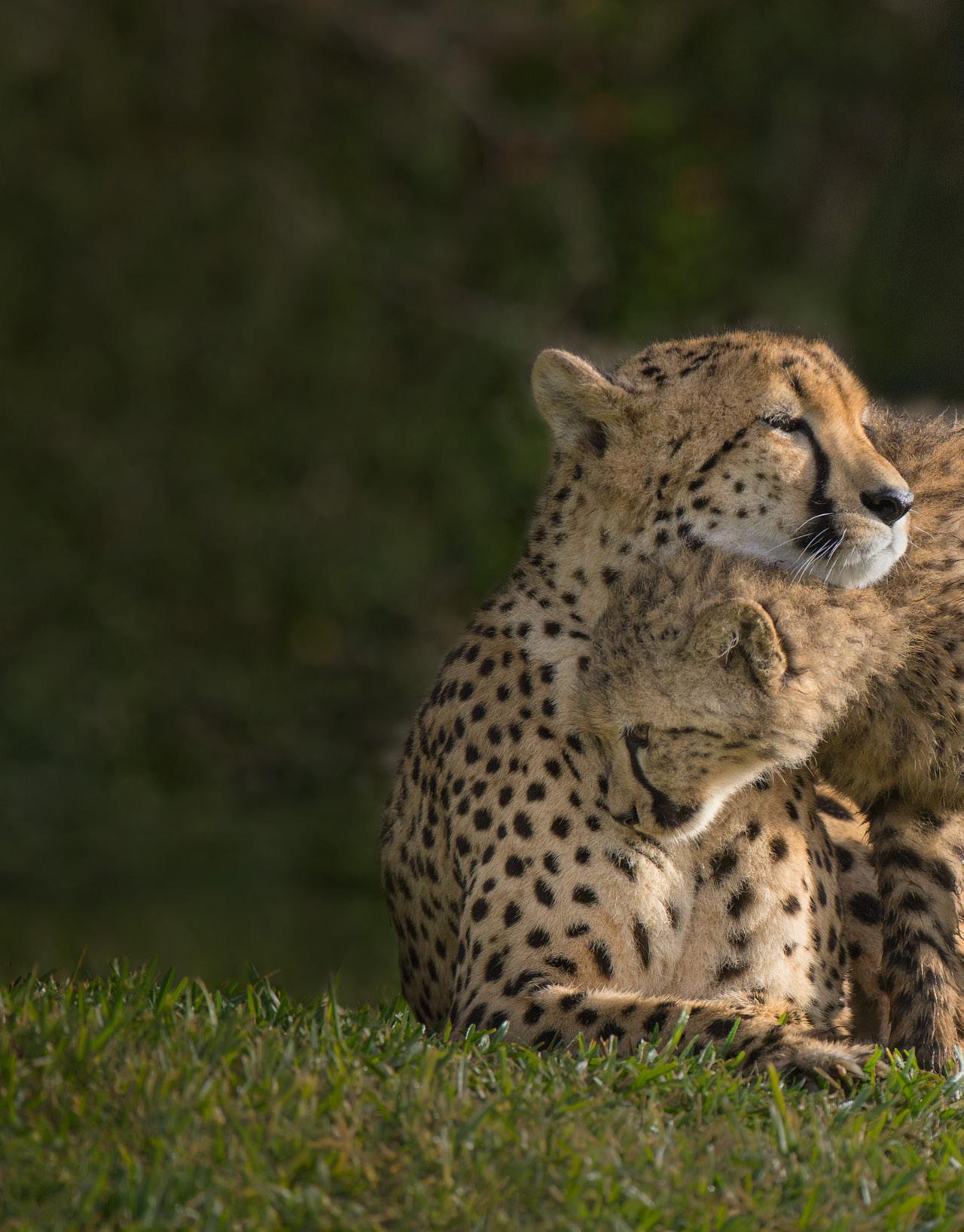
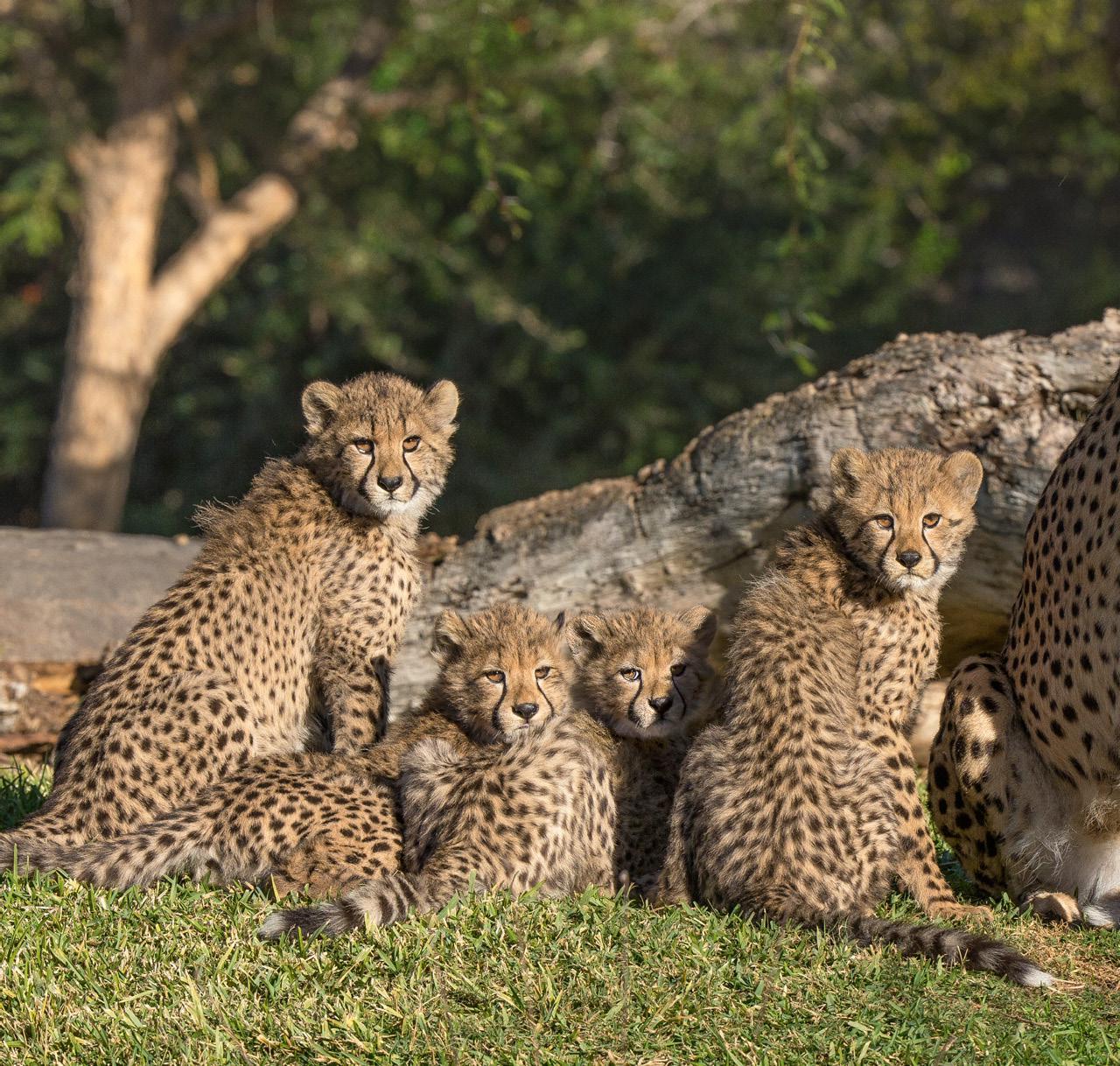
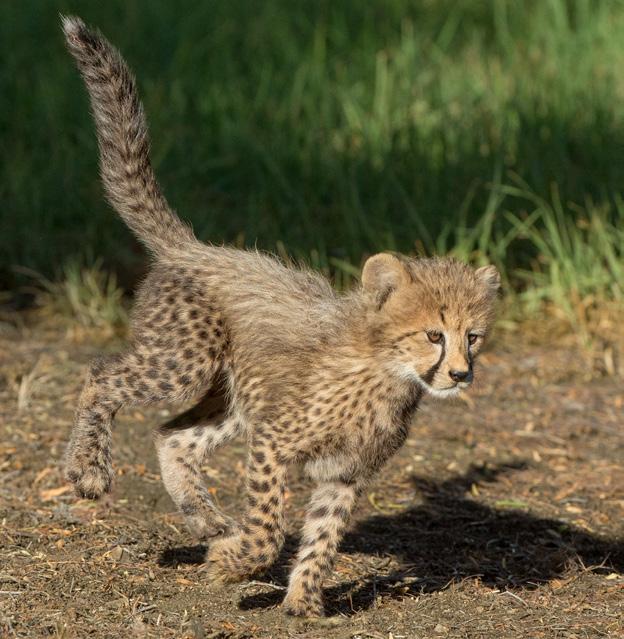
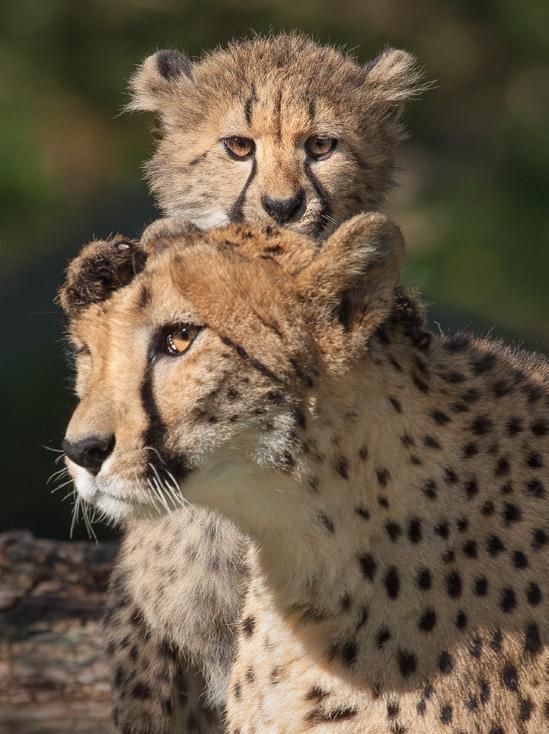
Visitors to the Safari Park can see spots run—and climb and play— as our four young South African cheetah cubs turn their habitat in Okavango Outpost into the Park’s newest “hot spot.”
Under the watchful eye of their mother, Addison, the feline foursome spends time chasing birds, leaves, and each other, until Mom calls them back with a parental “chirp.” Although she’s a f rst-time mother, Addison is de f nitely in charge, according to Paula Augustus, a senior keeper at the Park, and has been since the cubs were born on July 13, 2014, at the Park’s of-exhibit Cheetah Breeding Center. “Addison is an excellent mom—calm, con fdent, and extremely protective,” Paula says. “ Te cubs are very vocal, curious, and playful, with their own distinct temperaments. It’s great to be able to watch a cheetah mother raising her cubs.”
Cub Scouting
Te two male cubs, Wgasa and Refu, and the two females, Pumzika and Mahala, were bestowed with monikers honoring former areas of the Safari Park. “Wgasa was named a fer the old railway that used to be here at the Park,” explains Melodi Tayles, lead keeper at the Cheetah Breeding Center. “Refu is named for the old boma (the Bantu Swahili word for livestock enclosure) that was in East Africa before the new tram was built. Pumzika’s name came from Pumzika Point, the old ‘pier’ that used to extend out into East Africa. And Mahala was named a fer the old amphitheater that was here at the Safari Park back when summer concerts were all the rage.”
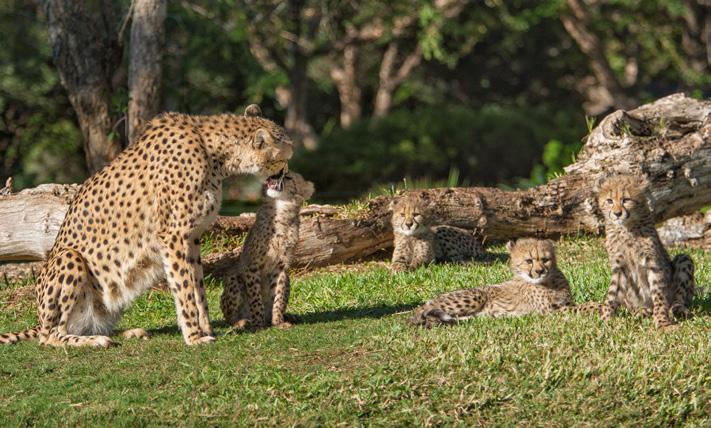
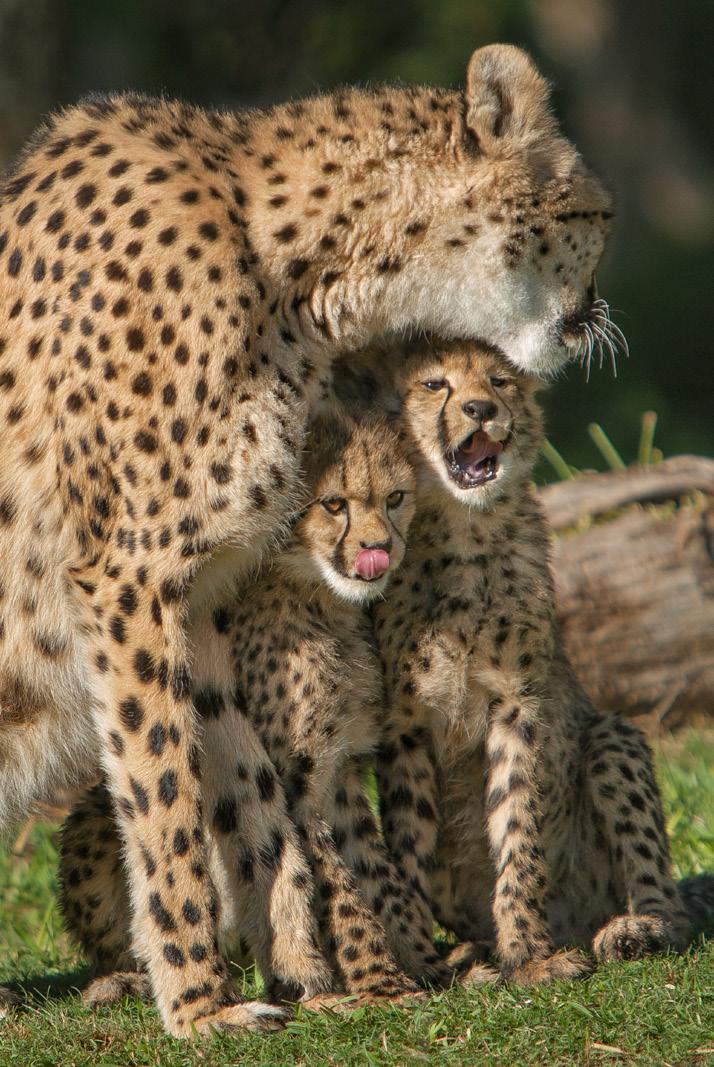
Melodi acknowledges that with all the spots and similar body types, the cubs resemble each other, and guests may have trouble telling them apart. But even from a bit of a distance, she adds, keepers can identify them by their faces, tails, and markings. “ Teir behavior and habits also tell us a lot about ‘who’s who.’” Te almost 8-month-old cubs pack a lot of personality into an approximately 50-pound package. Wgasa, Melodi explains, is the cub most likely to be playing with Mom, and he has the least amount of white on the end of his tail. “His brother, Refu, is both the most bold and the most mellow. And he has a small white patch on his shoulder.”
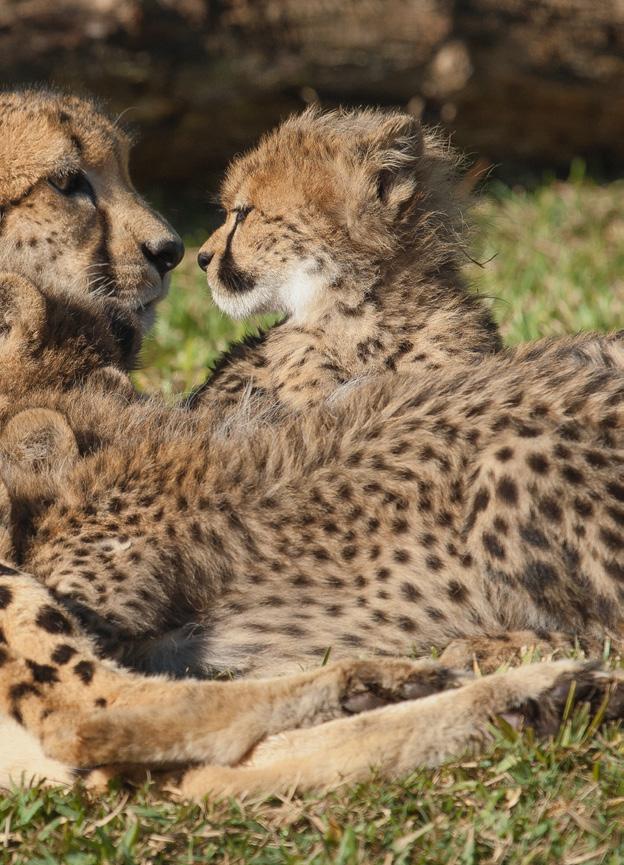
Pumzika is paws-down the most independent cub and the most likely to be climbing on things. “She’s also the darkest cub right now,” Melodi adds. “She looks the most like the cubs’ father, Quando, who lives at the breeding center.” In contrast—literally—is Mahala, who sticks close to Mom and has a lighter coat. “She also has a round little face,” Melodi says.
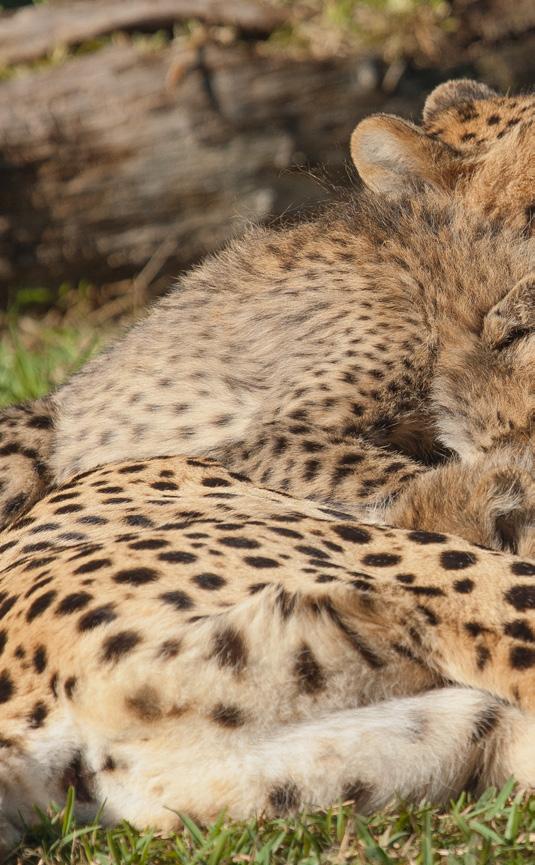
At this age, Melodi notes, the cubs are all about fun. Chasing each other, pouncing on Mom, climbing—every day is an adventure. Te youngsters are also paying more attention to their neighbors as time goes on. “ Tey all seem to be intrigued by the animals out in the East Africa feld exhibit,” Melodi says. “ Tey pay special attention when a gazelle or rhino runs by. It’s good for them to be exposed to many di ferent stimuli at this young age. And they seem to enjoy it.”
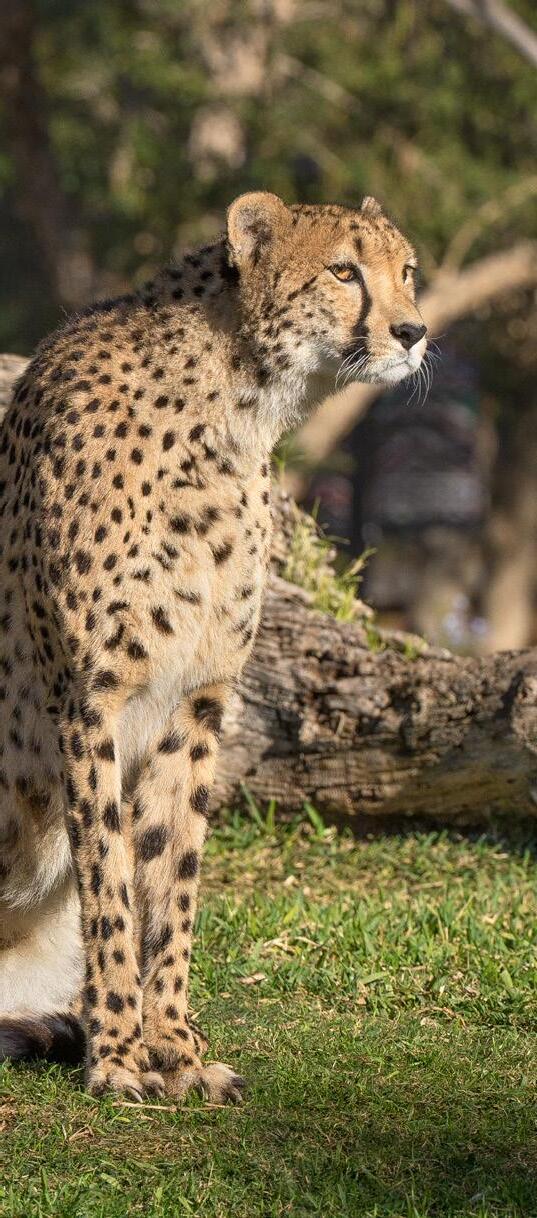
Along with a lot of playing, the cubs have done a considerable amount of growing—and still have a way to go! While they weighed 1 to 2 pounds at birth, it’s expected the cubs will reach 84 to 143 pounds, the average for an adult cheetah. As they mature, the cats will take on the cheetah’s long, lanky appearance. Measuring two to three feet at the shoulder, an adult cheetah can reach over four feet in length, plus another two and a half feet of tail!
Te unique physique of the cheetah Acinonyx jubatus jubatus serves the cubs’ wild brethren well in the grasslands and open plains in parts
of Africa and a small area in Iran. Te body is designed to run fast for fairly short distances to catch prey that other big cats can’t get. A cheetah’s ability to run starts with its fexible spine, which allows the front legs to stretch far forward on each stride. Its claws are hard and sharp like cleats, giving the cat great traction when running. Reaching speeds up to 70 miles per hour, the cheetah is the fastest land mammal. You can witness a demonstration by these spotted speedsters daily at the Park during the Shiley’s Cheetah Run experience.
Te birth of Addison’s cubs—and every cheetah cub—is a positive step toward preserving the species. San Diego Zoo Global has been breeding cheetahs for more than 40 years and has had more than 130 cubs born. We have also been instrumental in the formation of the Breeding Center Coalition (BCC) to create a sustainable cheetah population. With only 10,000 cheetahs remaining, and about 10 percent of those living in zoos or wildlife parks, it’s important to keep those numbers on the rise. Tere are eight other organizations participating in the breeding program for this endangered species: Fossil Rim Wildlife Center in Glen Rose, Texas; White Oak Conservation Center in Yulee, Florida; Te Wilds and the Cincinnati Zoo in Ohio; the Smithsonian Conservation Biology Institute in Front Royal, Virginia; the St. Louis Zoo in Missouri; the Wildlife Safari in Oregon; and Omaha’s Henry Doorly Zoo in Nebraska.
PHOTO BY KEN BOHN, SDZG
Visitors to the San Diego Zoo Safari Park can see the cubs and their mother in the Okvango Outpost exhibit or from the Africa Tram tour. You shouldn’t have any trouble “spotting” them! n
“Spot” additional cheetah photos and a video in the digital version of the March ZOONOOZ!
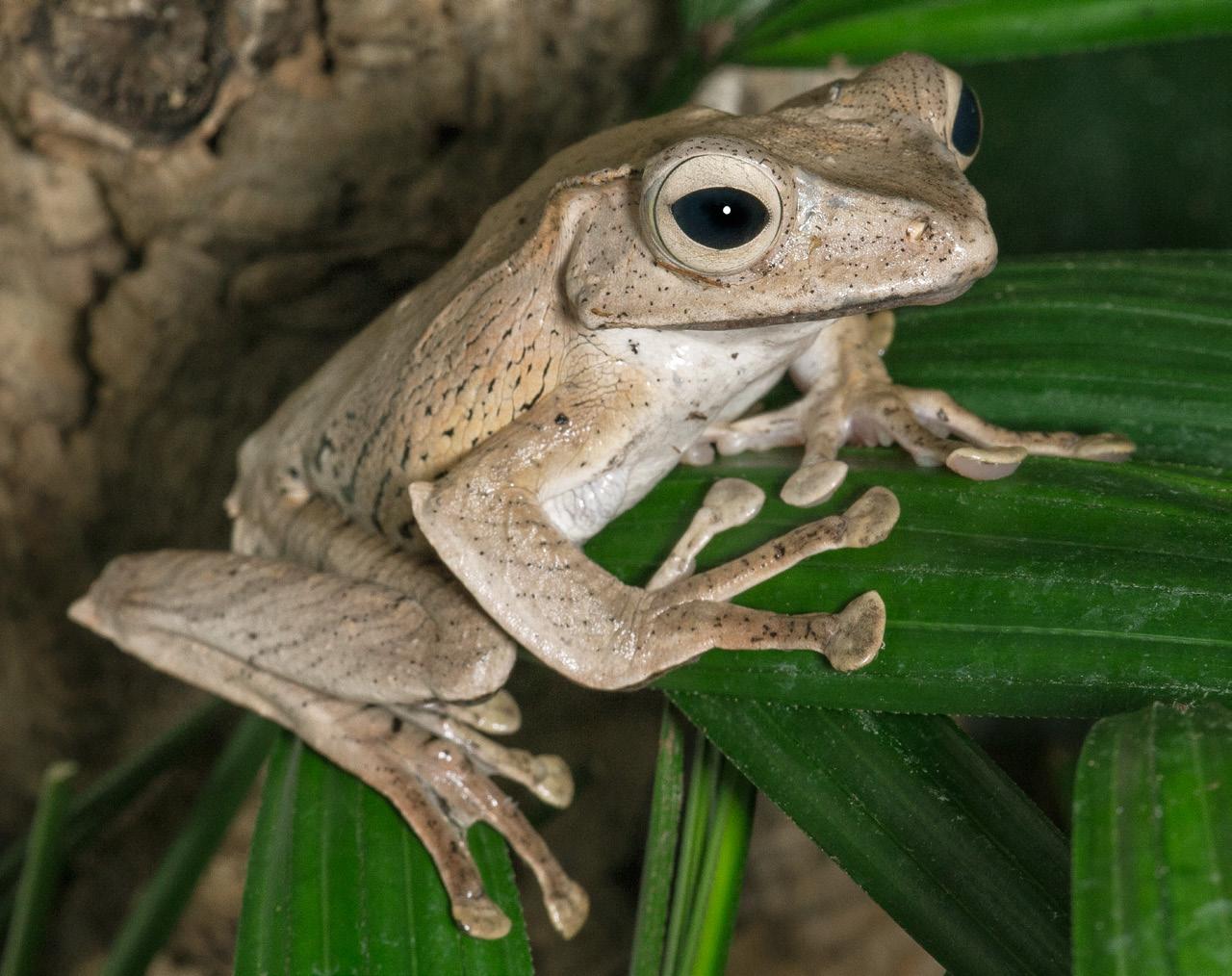
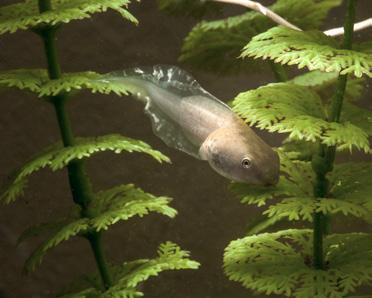
The Bornean eared frog owes at least part of its name to the skin folds or “ears” above the tympanum (or ear region) behind its eyes. In the inset photo, a tadpole of the species with gills shows signs of limb development.
By Brett Baldwin
ANIMAL CARE MANAGER, HERPETOLOGY DEPARTMENT, ZOO
by Ken Bohn
When it comes to reproduction, most animals pick one method—and environment—and stick with it. Frogs, on the other hand, seem to have adapted an “any port in a storm” approach to furthering the species. Tese amphibious animals occur in a variety of habitats, from dry environments to high-altitude cold climates to the most commonly associated habitat: the humid, rainy tropics. Te ability to occupy a wide diversity of habitat types has given rise to many methods of reproduction for the 6,400-plus known frog species. In their work with many of the animals in the order Anura, San Diego Zoo keepers Erika DiVenti and Dave Grubaugh have discovered that for frogs to thrive, there are a few basic—but crucial—components needed to recreate the ideal mix.
Ingredients:
• 2 to 10 frogs
• Reverse-osmosis water—the tap water in San Diego is hard, with high amounts of minerals like calcium, magnesium, and iron. It also contains chloramines and ammonia that are toxic to frogs. Reverse-osmosis systems are used to f lter out these minerals and chemical by-products.
• AmQuel Plus—an aquarium product that removes ammonia.
• Liquid R/O Right—a product that reconstitutes or replaces the necessary trace minerals and magnesium, potassium, and calcium to life-sustaining levels a fer the water has been through the reverse-osmosis system.
• Regular misting with R/O water.
• “Rain”—re-circulating water from the top of the enclosure through sprinkler heads.
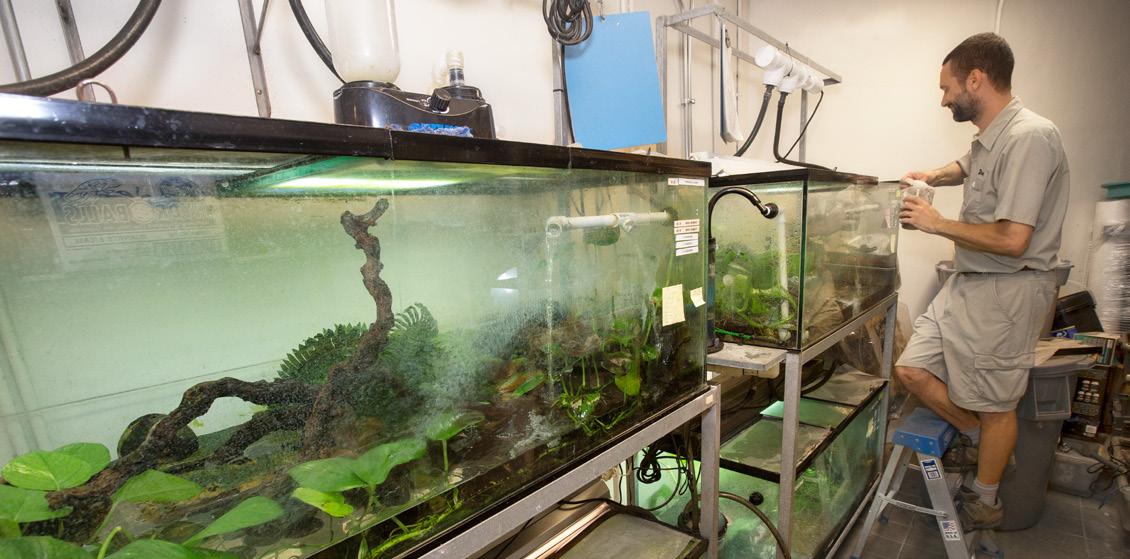
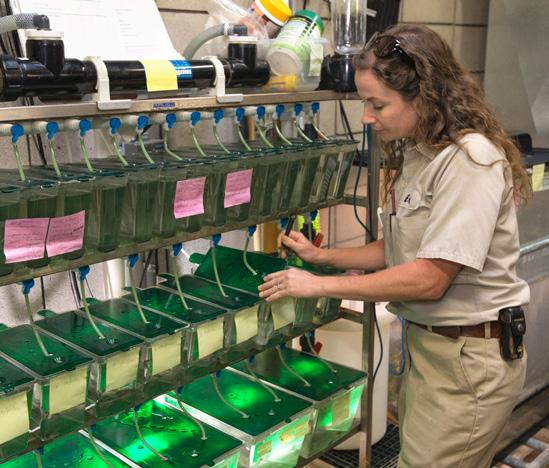
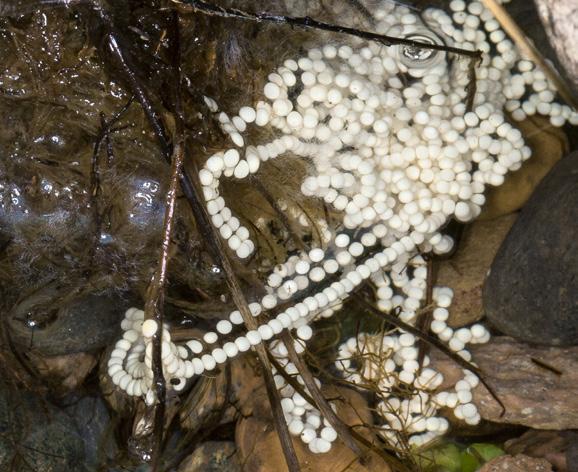
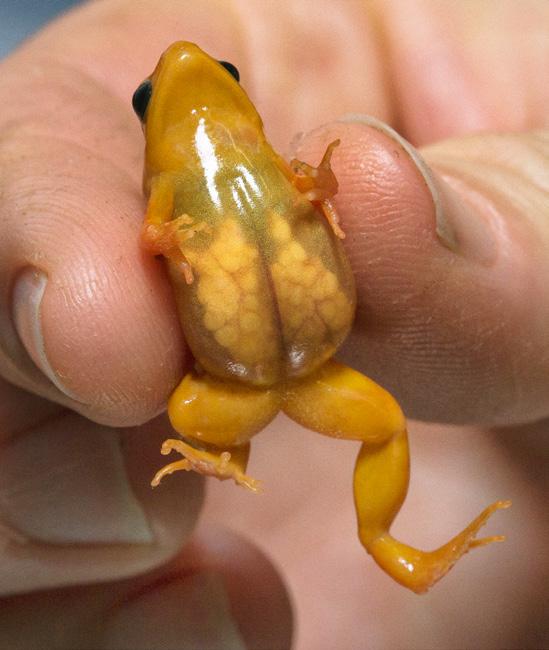
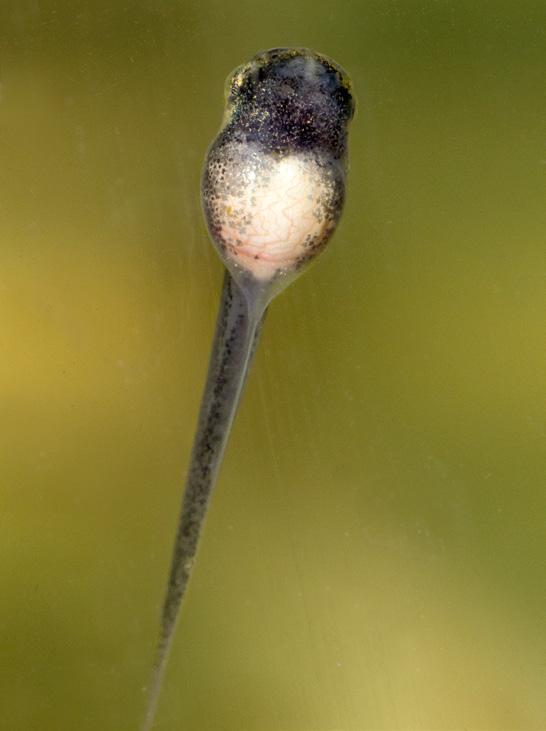
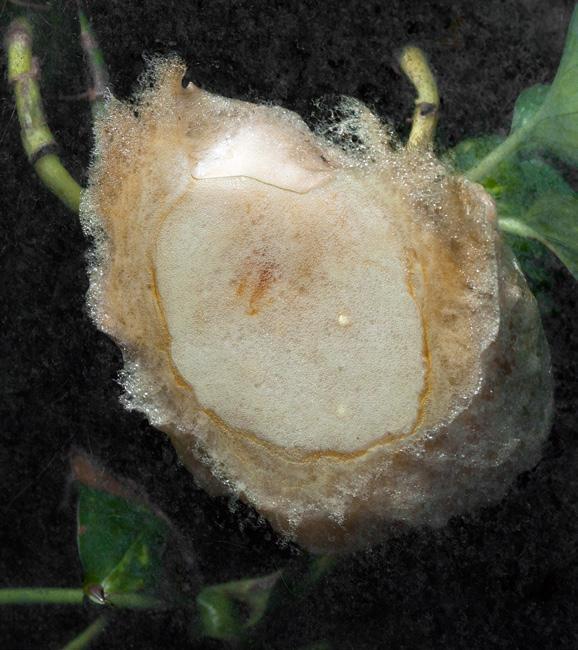
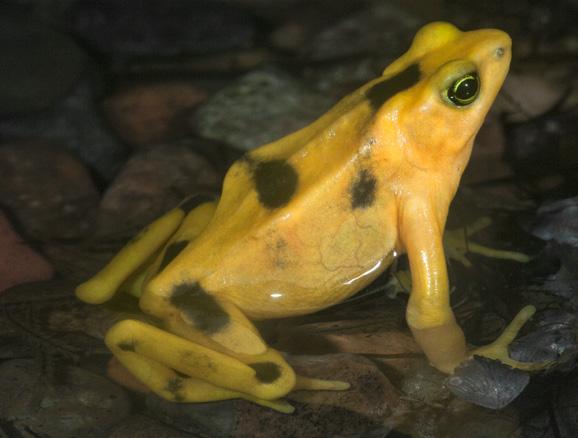
Above, left: A clutch of developing eggs is clearly visible inside this golden mantella female’s body. Above, right: A Bornean eared frog nest adheres to the glass wall of a tank. Left: This underside shot offers a unique view of a Panamanian golden frog tadpole.
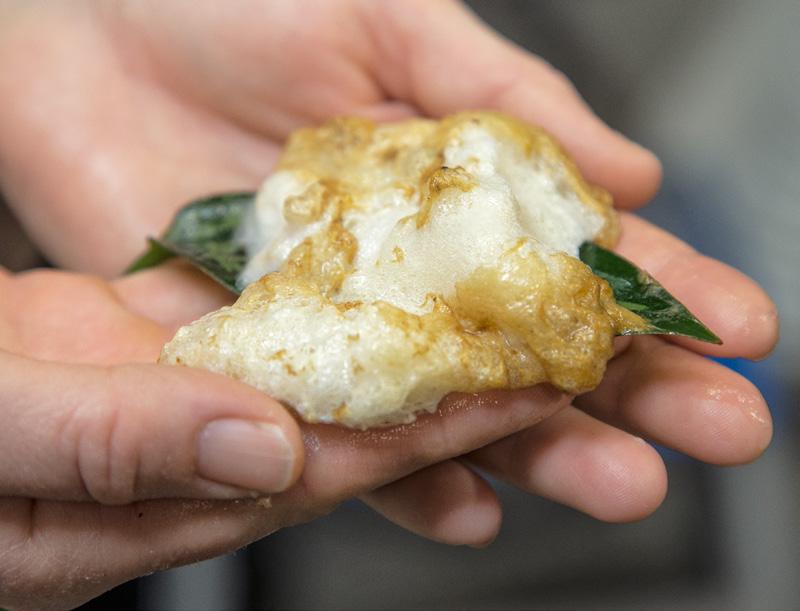
For reproduction in the frog world, the various species march—or leap—to their own drummer. Bornean eared frogs Polypedates otilophus are an arboreal species with a wide range in the lowland forests of Borneo, Sumatra, and Malaysia. In this species, the female produces a frothy mass of 50-plus eggs encased in a protective foam, which she attaches to a leaf or branch. Does that mean there will be tadpoles in the trees? Not for long: as the tadpoles hatch, they drop into temporary rain pools below.
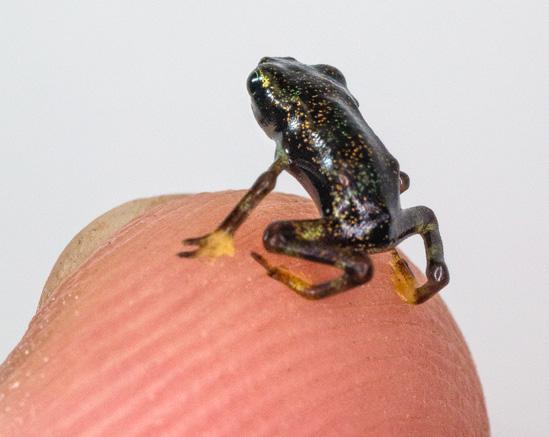
On the other (webbed) hand, the golden mantella Mantella aurantiaca deposits clutches of 20-plus eggs on moss or moist leaf litter on the ground. Te eggs hatch in about 14 days, and rain washes the tadpoles into pools. Tere, they morph into little froglets with legs. T is tiny terrestrial frog has a restricted range in the swampy areas of Madagascar. Accelerated deforestation from logging, agriculture, and human encroachment are the major threats to the golden mantella, which the International Union for Conservation of Nature (IUCN) lists as critically endangered.
Te Panamanian golden frog Atelopus zeteki lives in the tropical mountain forests of Panama. Te female lays strands of up to 500 eggs in dark places, as the eggs are extremely light sensitive. Tey only take two to six days to hatch, but hatchlings remain in the tadpole stage for up to four months. Te tadpoles feed on algae and other tiny
organisms in the water. Some are actually carnivorous and feed on their siblings! “Frog” doesn’t really ft for this species: they are bufonids, members of the toad group. Panamanian golden frogs only occur in a few places, and their populations have been in decline over the years. Te species is listed as critically endangered by the IUCN. As tadpoles in all frog species develop, they generate limbs and lose their tails. Teir mouths change as well. At f rst, they are capable of merely sucking and scraping algae of rocks and plants and
taking in tiny organisms. Once the mouth grows wide, the frog is capable of swallowing insects and other invertebrates.
Along with habitat loss and other human-induced threats, frogs are facing dangers from within their own ranks—and bodies. Chytrid fungus, a skin disease caused by Batrachochytrium dendrobatidis , has been found on all continents where amphibians exist. The chytrid fungus is capable of causing sporadic deaths in some amphibian populations and 100-percent mortality of a fected individuals in others. T is disease is believed to have caused amphibian population declines in Australia, South America, North America, Central America, New Zealand, Europe, and Africa, and has been implicated in the total disappearance of some species of frogs. At the San Diego Zoo Institute for Conservation Research, our
scientists in the Wildlife Disease Laboratories are working on ways to identify and counter chytrid fungus in frogs. Here’s hoping that more species can be saved, allowing them to continue to leap into the future. n
For additional “ribbiting” frog photos, check out the digital issue of the March ZOONOOZ
Managing a “Tower” of Giraffes
By Karyl Carmignani STAFF WRITER
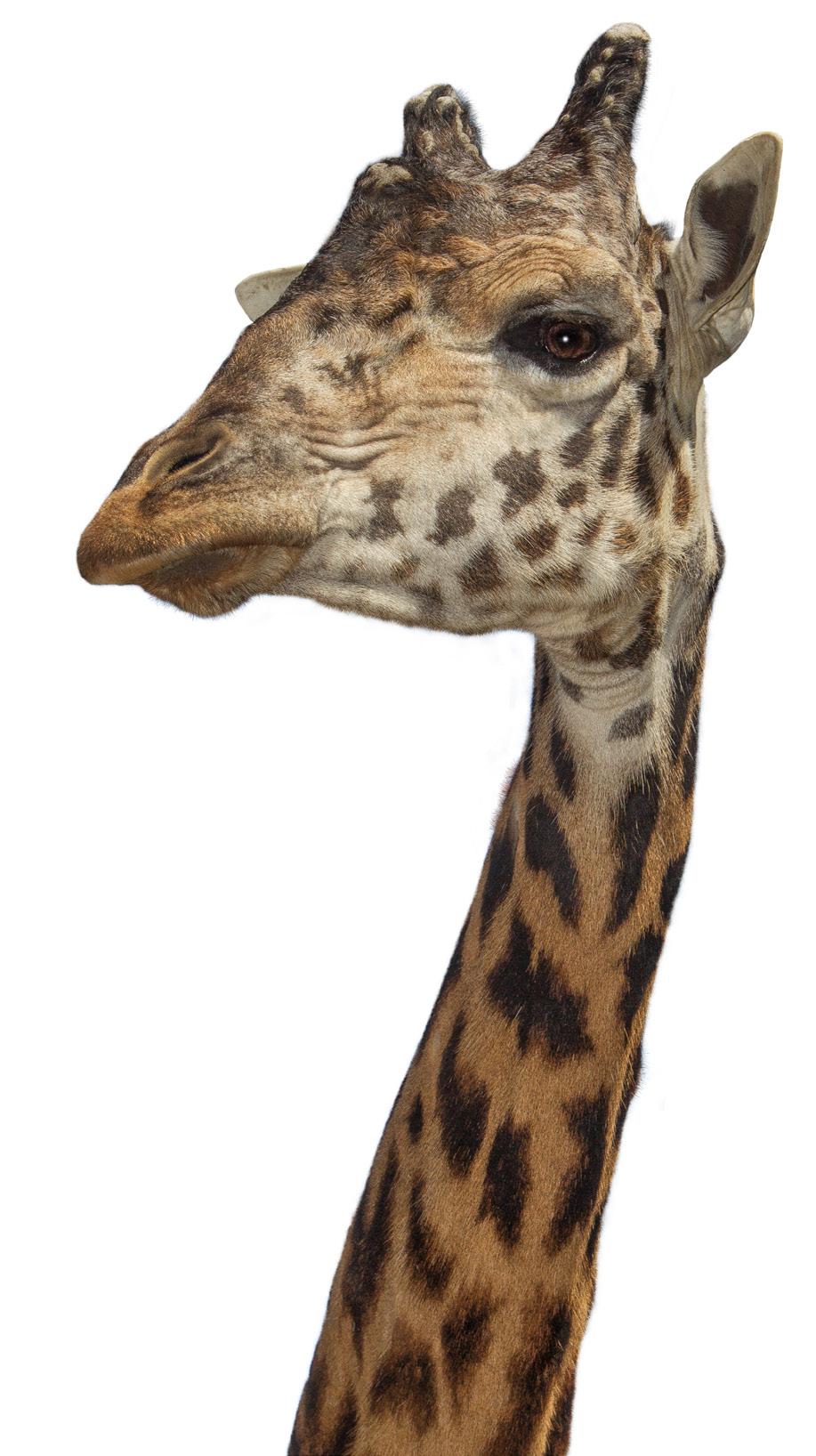
It is nearly hypnotic to observe a gira fe herd gracefully moving across the landscape. As the tallest mammal on the planet (a full-grown male can peek through a second-foor window without standing on his tiptoes!), the gira fe can pose signi fcant health and safety challenges to keepers. With hooves the size of dinner plates attached to six-foot-long legs, a gira fe can really kick up its heels at close range. For blood to travel up its characteristic long neck, a gira fe needs a super-sized, 25-pound heart to get the job done. While a healthy human’s blood pressure is about 120/80, a healthy gira fe’s is around 240/180. Te gira fe’s unique physiology and anatomy can make anesthesia or immobilization a tricky proposition.
Tere is only one species of gira fe, with nine subspecies currently recognized. A group of giraffes is sometimes called a tower. At the Zoo, there are seven Masai gira fes Gira f a camelopardalis tippelskirchi, ranging from the 21-year-old titan named Silver to the sprightly yearling, Kumi. Each animal receives attentive and committed care from keepers and veterinary sta f. “It’s give and take with the animals,” said Curby Simerson, associate curator at the Zoo. “We use positive reinforcement training, so if a medical crisis arises and urgent care is needed, the animals are less stressed and easier to manage.”
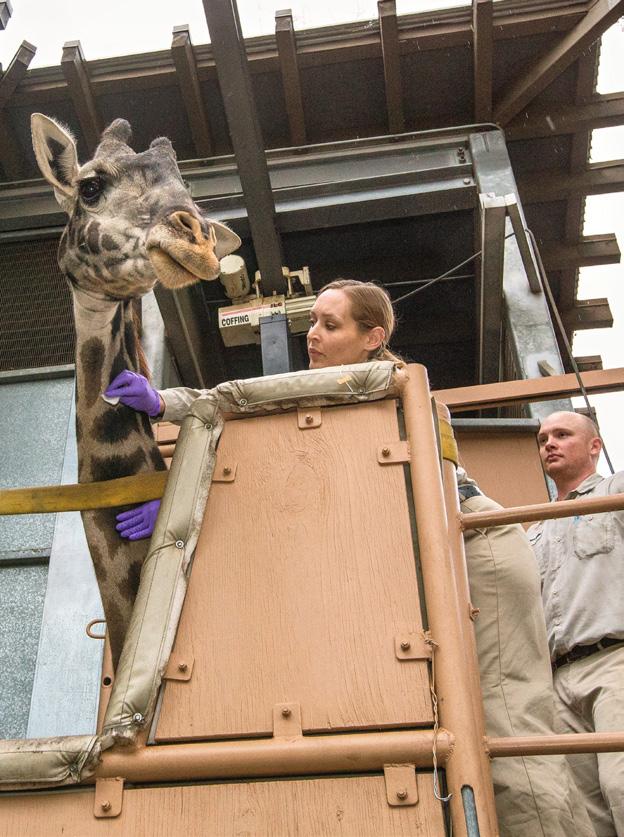
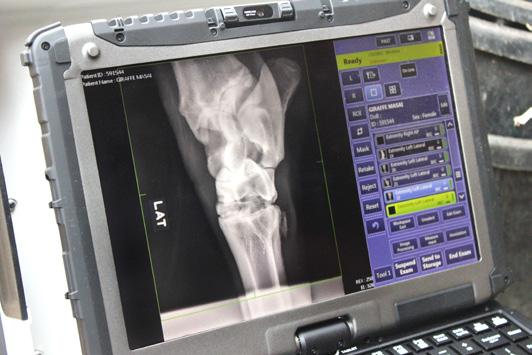
He explained that gira fes are skittish by nature, hesitant, and notoriously di fcult to work with. Fortunately for everyone, there is a custom-made gira fe chute at the exhibit, making routine exams, x-rays, medical procedures, hoof trims, and vaccinations much safer and calmer. “It is very valuable to work on these animals when they are awake. Gira fe anesthesia procedures are involved, and it is helpful to train these animals to allow procedures without having to administer anesthesia,” explained Meredith Reid, a registered veterinary technician at the Zoo. “We are able to collect vital signs on an awake animal that are more representative of true values versus those collected under anesthesia.” Without the chute, sedations would be much more frequent, which is stressful for all concerned.
Much well-deserved attention has been paid to elephant and rhino populations being poached to the edge of extinction in Africa. But little ink has been spilled on the quiet demise of the giraffe. Fifteen years ago, about 140,000 giraffes dotted the African savannas. Today, that number has fallen by more than 40 percent, with only about 80,000 giraffes remaining. Protection and conservation can bolster populations of this iconic species—the next few years will be critical for this animal. Giraff e research programs are on the rise and so are San Diego Zoo Global’s efforts: Christy BrowneNunez, Ph.D., and Dave O’Connor from the San Diego Zoo Institute for Conservation Research are in Kenya now doing giraff erelated community conservation work.
When a gira fe requires specialized attention, Bill Austin, a senior keeper who has worked with the gira fe herd for seven years, separates the animal into the barn. Herbivore biscuits are a favorite reward. Patient coaxing gets the animal into the chute, which has adjustable padded sides and a “push wall” used to slowly guide the animal into position. Once the gira fe is securely “boxed in,” keepers can safely access the animal at various levels through hinged portals. Te animal’s head and neck are free to arc downward to receive treats for its cooperation.
With some efort, Bill picks up the gira fe’s front leg to trim its hoof as his colleague doles out the biscuits. “ Tere is still a lot of manual labor,” said Curby, “but using the chute is safe for the animal and the keeper. It is a valuable alternative to the immobilization
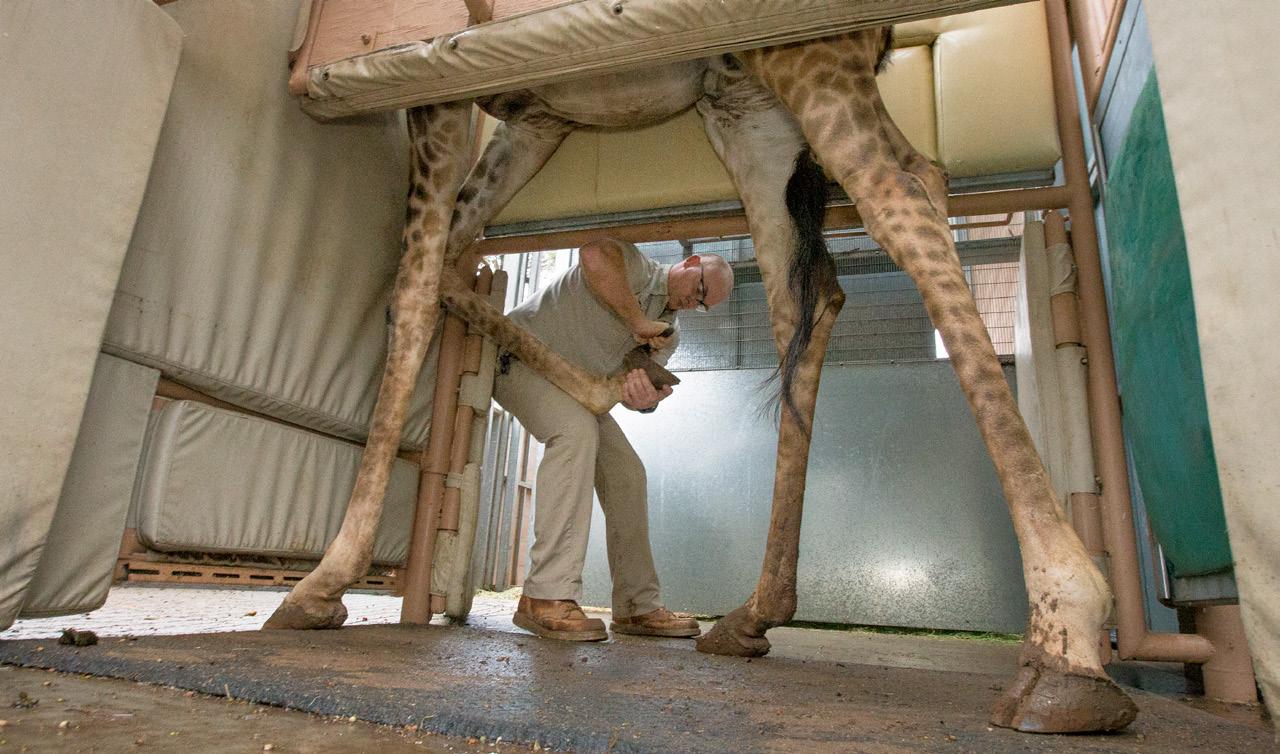
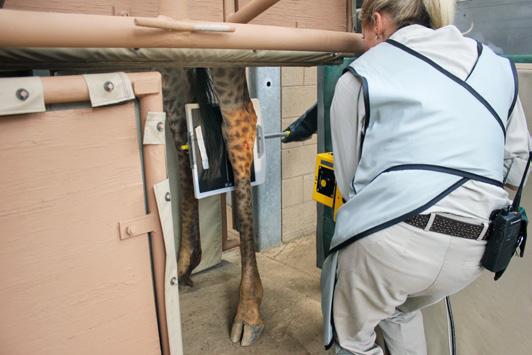
of a large and awkward animal.” A healthy gira fe hoof is three to three-and-a-half inches from the coronary band (at the hairline) to the tip. Daily walking can keep the hoof f led down, but as animals get older and more sedentary, it can become necessary to give them
a pedicure. Power tools from the dairy and horse industry are used, including clipping and sanding wheels and farrier tools like a rasp and hoof pick.
As part of the Association of Zoos and Aquariums’ Species Survival Plan for gira fes, animals are exchanged with other accredited zoos to maximize optimum breeding opportunities. Following time in quarantine, the animals receive physical exams and necessary vaccinations in the familiar space of the chute.
Should a gira fe become pregnant, she is closely monitored during her 15-month gestation period. One of the portals in the chute opens at gira fe belly height, and veterinarians can conduct an ultrasound as part of neonatal care. Another opening allows access to the gira fe’s rear end, so if her delivery requires assistance, animal care sta f can intervene. Fortunately, there have only been two cases of a female gira fe needing assistance at the Zoo in the past 20 years.
One of the easiest ways to monitor an animal’s health is by weighing it. Sudden or gradual weight loss can indicate a serious health issue, which most animals try to hide from their keepers (and predators) with great skill. But as we all know, the scale doesn’t lie. A metal foor can be added to the chute to record an animal’s weight. Silver, the towering male, weighs 2,585 pounds, while the smallest gira fe is a dainty 678 pounds. Veterinarians also use a mobile radiograph machine to take digital x-rays when needed. Te gira fe chute is truly a blessing for the tall order of managing these majestic animals. n
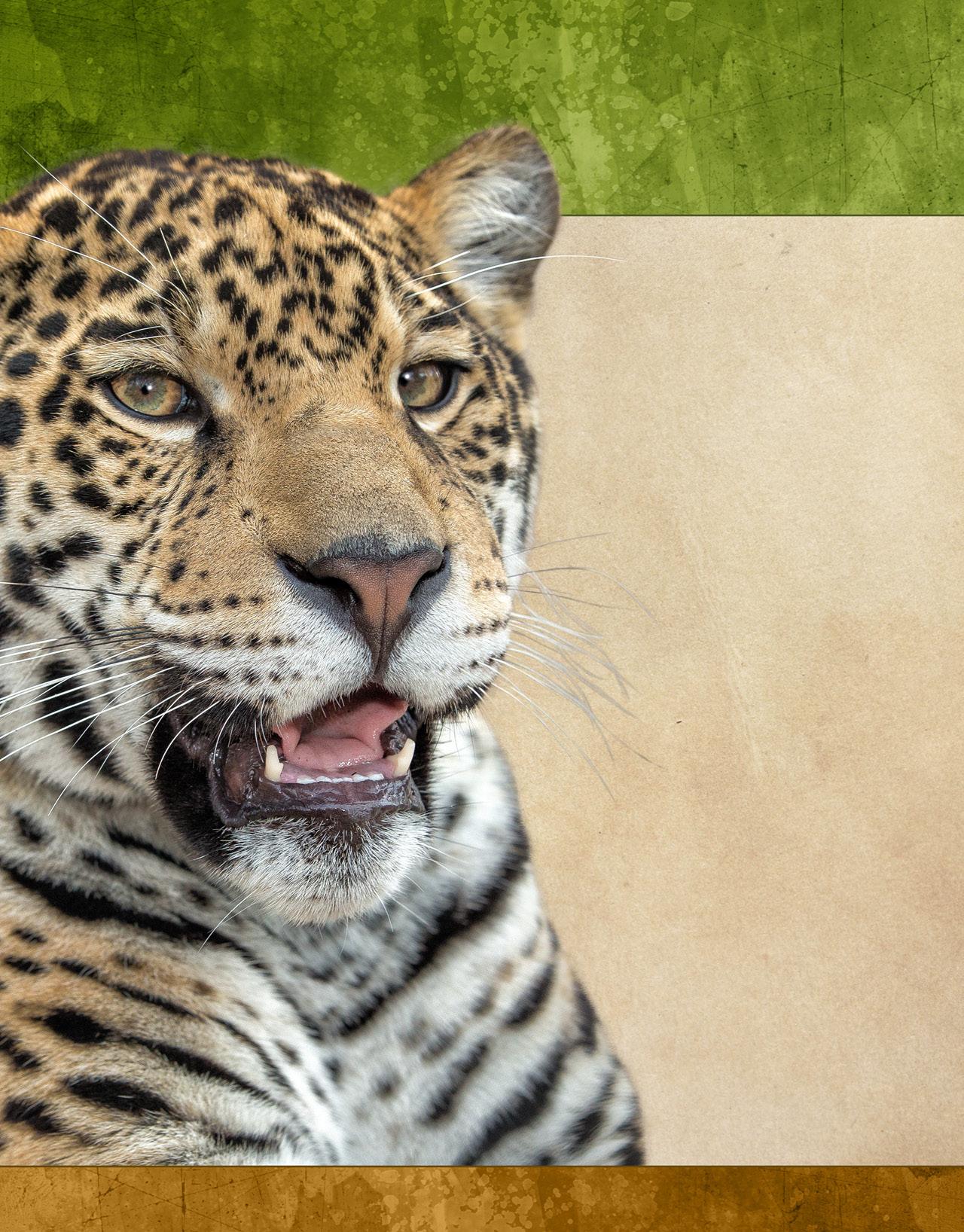
Tis spring, spot your chance for playful fun at the San Diego Zoo! We’re putting the spotlight on our beautiful spotted animals and all the wonderful things they can do. Celebrate spring with up-close encounters with our animal ambassadors, watch as animals from servals to jaguars play and prowl, hear cool stories from keepers, and even meet the Easter Bunny for commemorative photos, March 21 through April 5. Check out a complete list of all the activities at sandiegozoo.org to plan your perfect Play Days!
Service
By Wendy Perkins STAFF WRITER
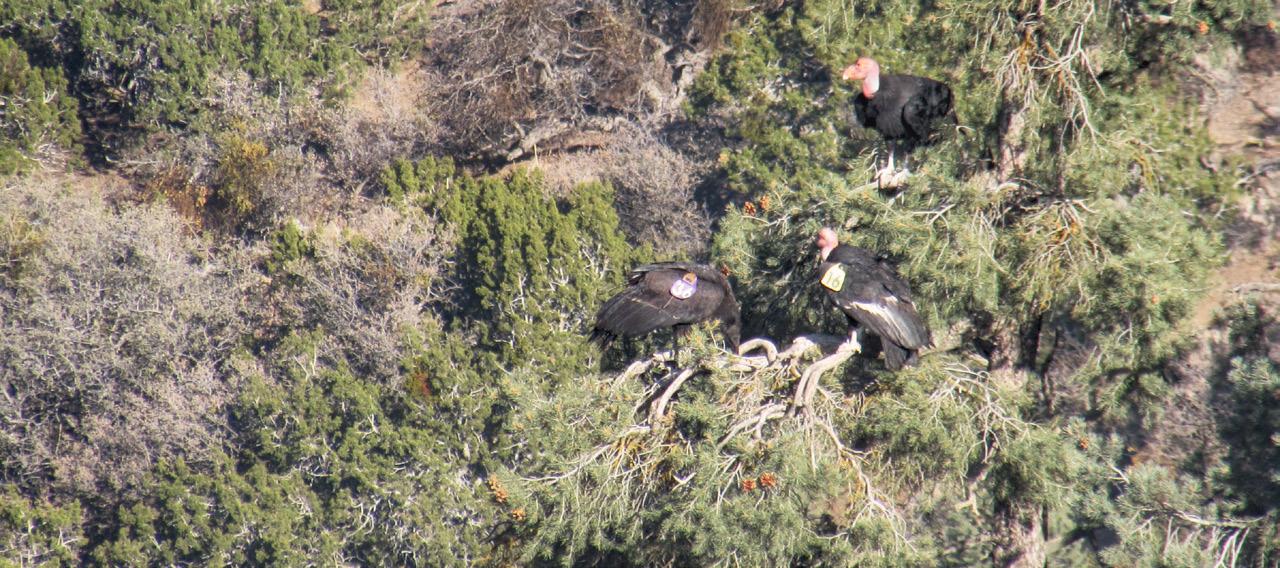
OVER THE PAST THREE YEARS, a new form of bird watching has captivated people around the globe—Condor Cam. Te livestreaming footage from the nest of one of our breeding condor pairs at the Safari Park has developed quite a following. Folks “tune in” during the spring and summer to check on the progress of the latest chick. Last year’s chick, Su’nan, has fedged and is living with other juvenile and adult mentor condors in an of-exhibit space at the Safari Park, where her fans can watch her learning “to be a condor” via a second camera. But what about the previous “stars,” Saticoy (2012) and Cuyamaca (2013)? We’re pleased to give a status update!
Saticoy, the first California condor to hatch while viewers watched on Condor Cam, was released to the wild at the Bitter Creek National Wildlife Refuge in Southern California in November 2013, and he is still fying free and thriving. Recently, the feld crew was able to catch him for a routine health check. T is is an important assessment: blood is collected to monitor levels of lead, since lead poisoning is still the main threat to the health of free-fying condors. Te results of Saticoy’s bloodwork brought good news: it was below the threshold for treatment!
While the feld biologists had access to Saticoy, they took the opportunity to change out the tracking devices he wears, which had stopped working. A new telemetry transmitter was placed on one of his tail feathers, and a new GSM/GPS unit was attached to each wing tag. “ Te GSM transmitters collect a location every 15 minutes during daylight hours,” explains Ron Webb, senior keeper at the Safari Park’s condor breeding facility. “It provides a more complete range map than other GPS units.”
Ron has been in touch with the feld biologists and learned what Saticoy has been up to. According to the data, the young bird has been spending most of his time around the Tejon Ranch area, 40 to
60 miles from where he was originally released. Photos show that he’s blending in well with the other condors.
Te 2013 Condor Cam “star,” named Cuyamaca by a vote from her proud public, now f ies over northern Arizona. Released in June 2014 at the Vermilion Cli fs, just north of Grand Canyon National Park, she seems to be thriving. “A fer release, she needed minimal maintenance from the feld biologists,” says Ron. “She was fying high, feeding well, and f nding safe roost sites. She blended into the wild population easily!” Cuyamaca has shown she has the skills and spirit needed to survive in other ways, too. “One day, the feld crew observed her being chased by a golden eagle,” says Ron. “ Te eagle hit her in the air, and they both tumbled to the ground, but she rebounded immediately and showed no signs of injury. Other than that, Cuyamaca has had a fairly stress-free transition to the wild.”
A 50-mile radius around the release site seems to be Cuyamaca’s preferred territory. “She takes multi-day trips to the Colorado River corridor of Marble Canyon, as well as some regular foraging trips to the Kaibab National Forest,” says Ron. Perhaps if your travels take you to that area, you might see her soaring overhead!
Tanks to the dedication of the sta f at the Safari Park’s condor breeding facility; the feld crews that monitor the birds, from U.S. Fish & Wildlife Service, the California Department of Fish and Wildlife, the Arizona Game and Fish Department, and the Peregrine Fund and its World Center for Birds of Prey; and everyone who supports condor conservation, these condors are continuing to help their species come back from the edge of extinction. n
Tune in to Condor Cam at zoo.sandiegozoo.org/cams/ condor-cam to watch this year’s featured condor chick as it grows up.

March 14 to April 12, 2015
Special event hours: 8 a.m. to 6 p.m.
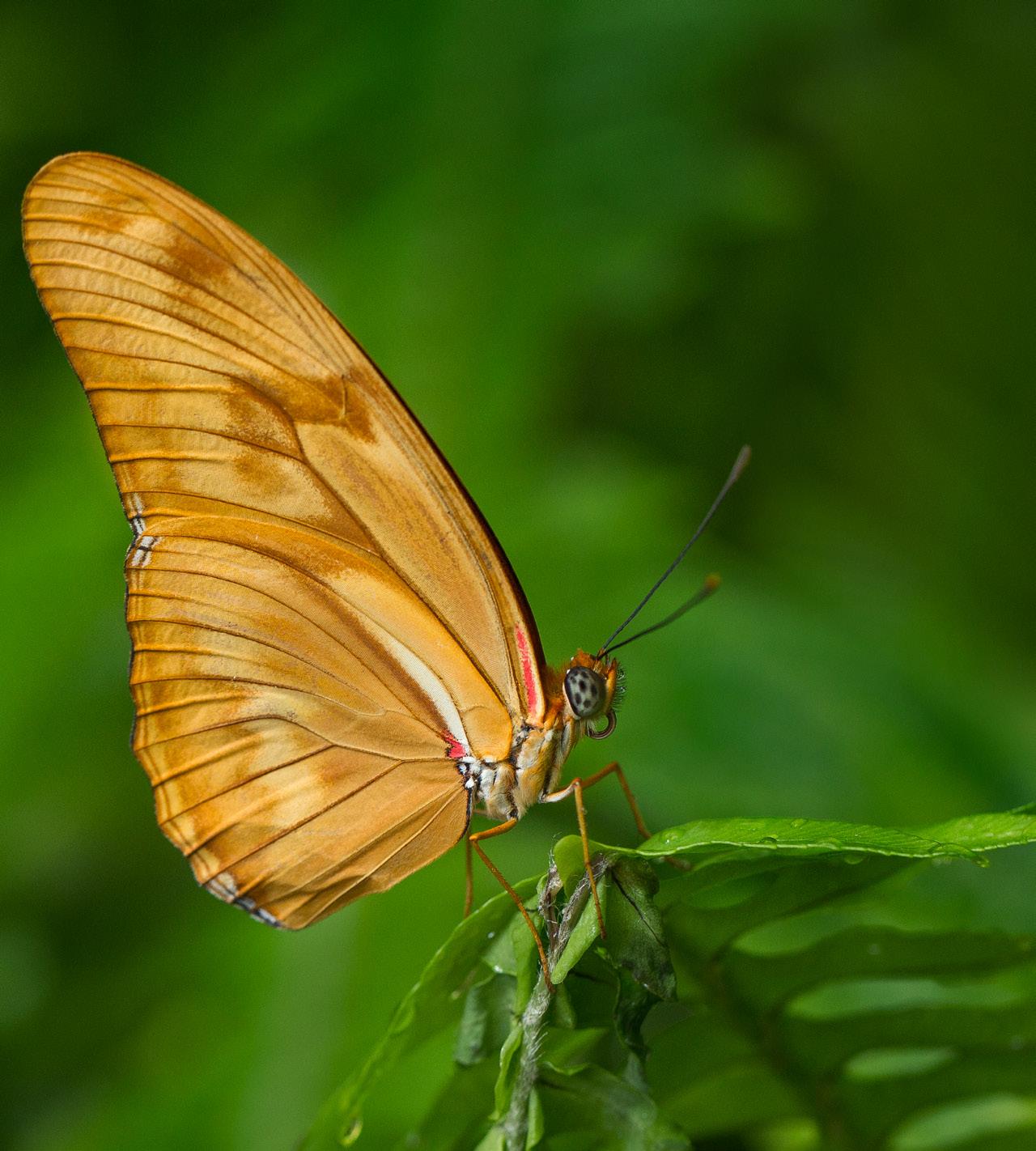
Spring brings Butterfly Jungle to the Safari Park for a magical experience. The Park is even opening early, at 8 a.m., during the event to celebrate! Wear bright colors to attract the butterflies’ attention, and you may find yourself serving as a perch for the delicate and colorful creatures. The butterfly identification cards at the entrance will aid your discovery of the more than 30 different species winging their way through Hidden Jungle— see how many of them you can find. Educators will be on hand to answer your questions, and attendants will ensure you don’t have hitchhikers as you leave the greenhouse building. And to help keep things fluttering along, you can even pick up a ticket that gives you a specific entrance time and avoid waiting in long lines. Wing your way to the Park for this joyful, once-a-year event!
By Karyl Carmignani STAFF WRITER
They silently slip along fence lines, monitor waterways, trace footprints, lie in wait, fush them out, and chase them down.
T ey endure impossibly long workdays, grumbling empty stomachs, well-aimed gun f re, sti f ing humidity, and a plethora of voracious insects and venomous snakes. For the special operations tactical anti-poaching group in South Africa, these tribulations are par for the course in the ongoing battle to save the rhinoceros. For Mike Veale, a keeper at the Safari Park, it was a lof y dream come true to work with this boots-on-the-ground conservation brigade. A f er two years of planning, he packed up, sold his belongings, took a leave of absence from his job, and caught a plane to South Africa to embark on the most rigorous training of his life. Part Rambo and part CSI, the anti-poaching boot camp included feld medic, f rearms, ftness, security, survival, and crime scene training. It was unforgiving physically and mentally, with applicants dropping like tsetse f ies. Mike became the second American to ever join this elite force.
With a solid background in backpacking and 12 years in shooting competitions, Mike was well suited for the tasks at hand for the next three months. But survival in the bushveld of South Africa is another animal. Recruits were trained in the art of safe sleeping by building a thorn-tree boma for protection “with your head in the
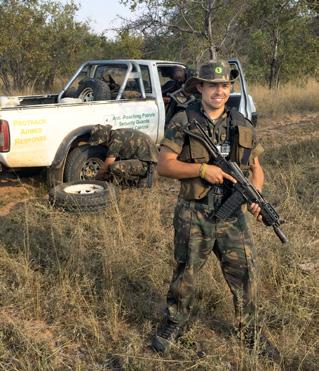
Mike Veale stands guard while his partner changes a tire on their vehicle. There is no AAA roadside service out in the bush!
center, sleeping bag unzipped, and your boots still on,” explained Mike. “So if a predator grabs you, you can slip out of your sleeping bag and still be able to yell for help.” Other hot tips for survival? Never assume you’re safe; keep your weapon within arm’s reach; never cook and camp in the same spot; and never walk on roads. Tese tactical strategies ensured that the rangers could materialize out of thin air and catch their poaching quarry unaware.
Te specially trained rangers could cook by f re only at daybreak and sunset to avoid detection by poachers. Mike noted that hyenas were enthralled by f re, and a ring of glowing eyes ofen surrounded the men at mealtime. Tey also learned to never carry anything citrus, as it would attract elephants. His diet in the bush consisted of “pap,” a maize meal boiled to di ferent consistencies with a tasty soy-based favor packet added, along with “a lot of bugs, and marula

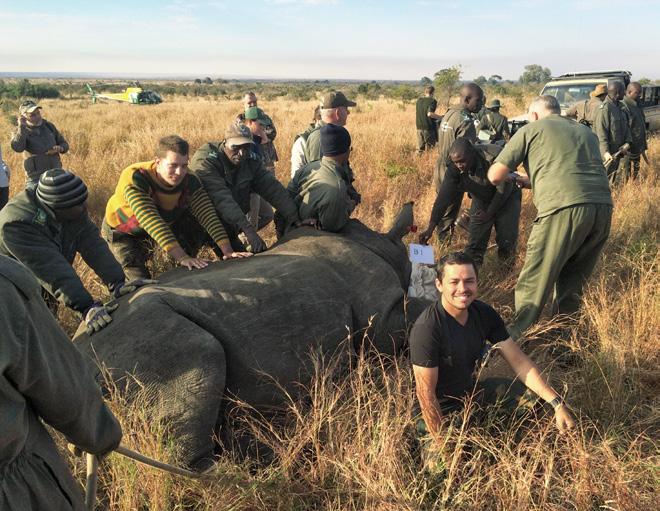
Above: Training for the anti-poaching brigade was demanding and intense. Only the best of the best graduated to protecting rhinos. Below right: The anti-poaching team (Mike in the foreground) works to relocate a rhino from a poaching hot zone to a safer place.
fruit whenever possible,” Mike added. It’s not an African adventure without some health calamity, and for Mike it was contracting “tick bite fu” or bush fever. Te pepper-grain-sized ticks would collect at the sock line, with at least one infecting its host. Strong antibiotics and sheer willpower conquered the three days of agonizing fever and swollen joints.
Kruger National Park, where most African rhinos live (and die), is 7,500 square miles of wide-open veld with grasses and bushes, only thinly forested. Tere are also fringe reserves surrounding the park proper under private ownership. Mike and his anti-poaching team worked the fringe areas, investigating slaughtered rhino crime scenes. Waxing moonlit nights led up to the dreaded “full poacher’s moon,” with still more bloodshed. Daily patrols were hushed, 10- to 30-mile treks through the bush. Te team removed hundreds of snares.
Vultures circling overhead would indicate a carcass below, and all too ofen it was a rhino. Mike described the CSI protocol, starting with securing a 40-yard radius around the victim with caution
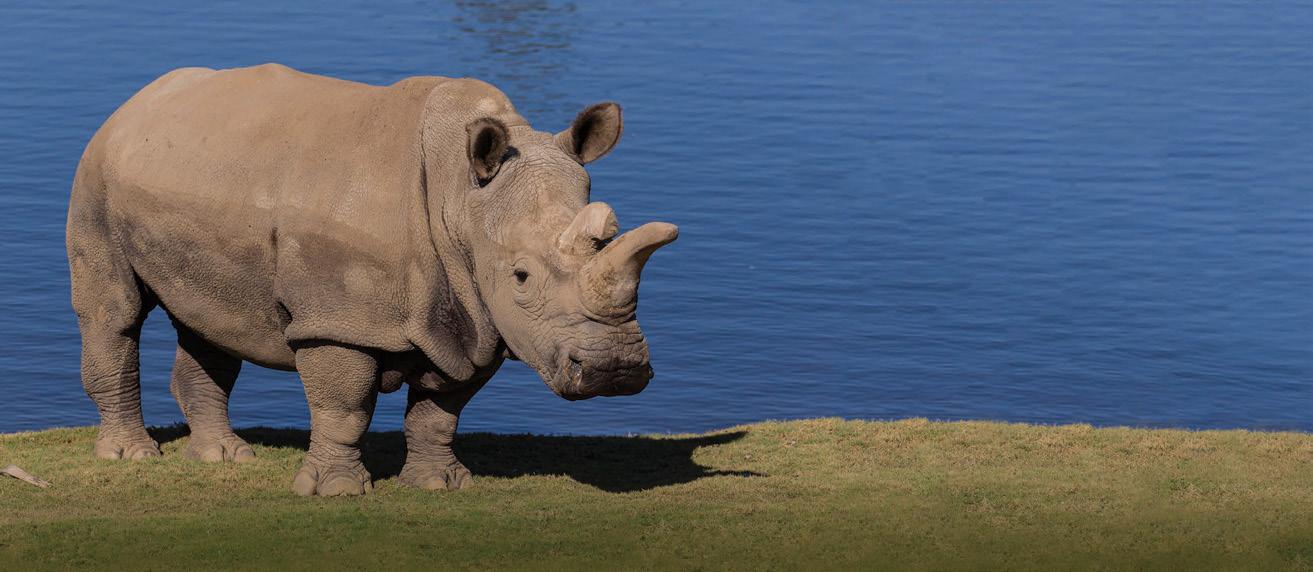
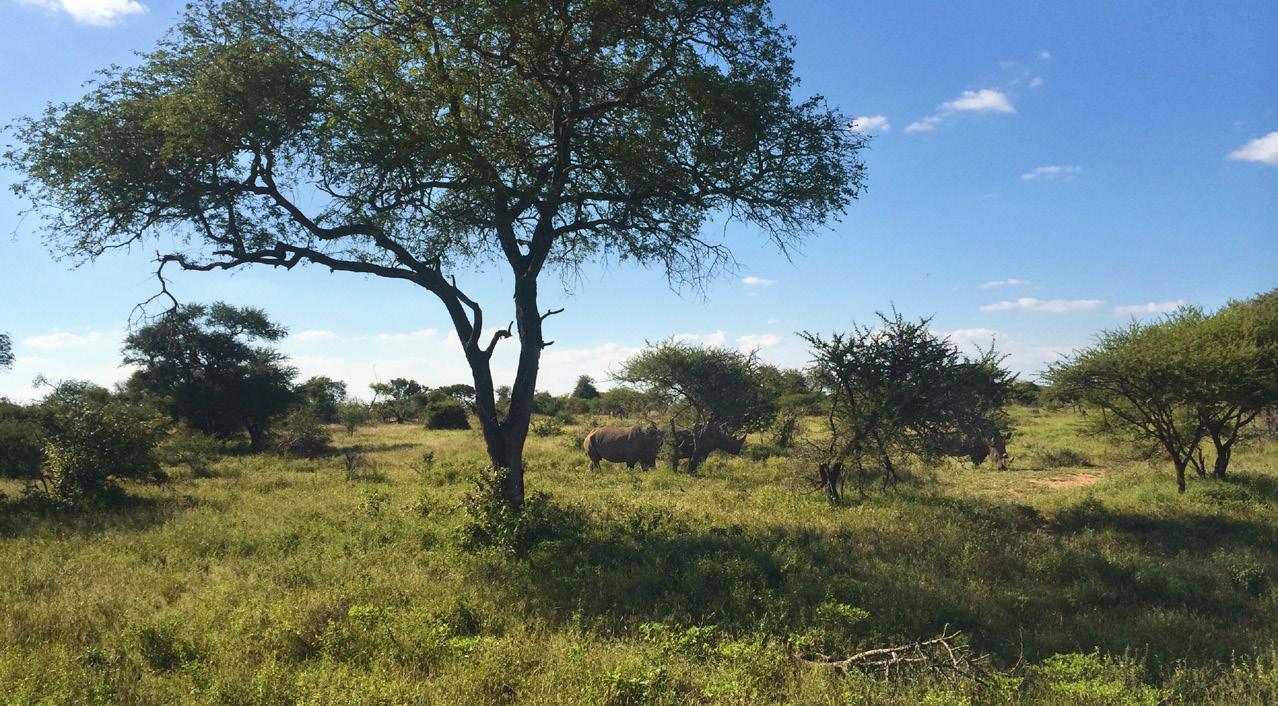
South Africa holds the lion’s share of rhinos: about 80 percent of Africa’s rhinos inhabit this vast country, which is about 3 times the size of Texas. Flanked by four countries and two oceans, South Africa is a smuggler’s dream for transporting illegal animal parts, including rhino horn. Mozambique is a major smuggling route. Demand for rhino horn (made of keratin like our hair and fingernails) in China and Vietnam has accelerated the slaughter; poachers killed 1,215 rhinos in 2014, an all-time high. More than half of these deaths were in the renowned Kruger National Park. Tis rate of poaching will soon overtake the rhinos’ birth rate, shoving this magnificent species towards extinction.
tape and triangulating the location from which the fatal shot was fired. Rangers performed the necropsy, preserving evidence. Fanning out, they “carefully searched for clues like shell casings, cigarette butts, or food wrappers. Anything to indicate the poachers’ trail,” explained Mike. Data were collected on the victim, including time of death, age, and sex of the rhino. If it was a female, a careful search for calf footprints was conducted. Sometimes the little one was spared a bullet but, if still alive, required immediate veterinary care. It was hot, muggy, exhausting work, and the sickening smell of decay didn’t help. But
catching a poacher made it all worthwhile, despite the fact that “if they’re caught, they receive a sti fer sentence for illegal weapons or ammunition violations than for killing a rhino,” said Mike. “Grim as that is, clearly the only hope the rhinos have is us caring about them.” Indeed.
When a rhino was discovered in a poaching hot zone, park veterinarians and rangers relocated the animal to a safer haven. Mike’s skills as a rhino keeper at the Safari Park proved useful—he assisted with six rhino relocations. T is procedure entails anesthetizing the rhino and collecting blood and skin samples, taking a body score to assess overall health, and placing a microchip in its horn. Te latter requires drilling into the horn (no more painful than a haircut), placing the microchip, and f lling the opening with graphite and super glue. Should the animal be poached in the future, the chip can help pinpoint the route of transport and possibly help catch the poachers, smugglers, and buyers. Te rampant wildlife poaching “bothers me to the core every day,” said Mike. “But there’s always something you can do. Don’t be afraid to try to make a di ference.” n
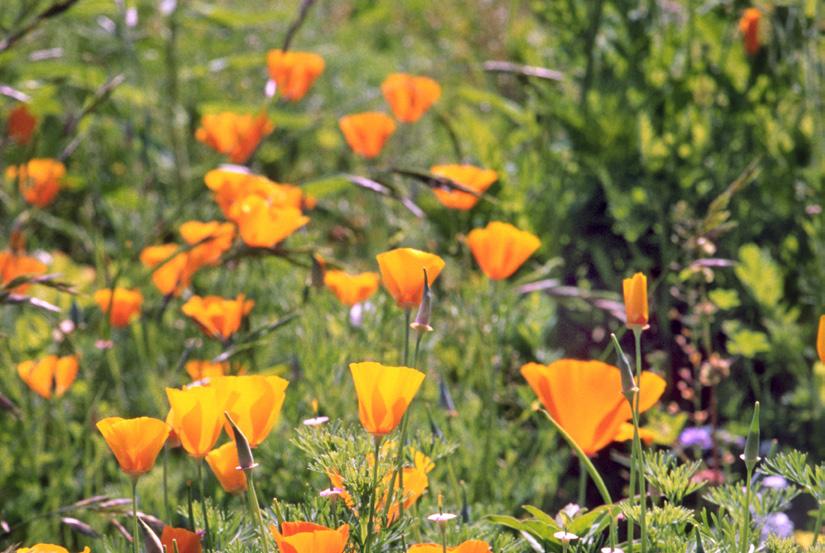
The official flower of the Golden State, California poppies Eschscholzia californica provide a bright, blazing welcome to springtime visitors at the Park’s Nativescapes Garden.
By Wendy Perkins STAFF WRITER
PERCHED ATOP ONE of the highest points of the Safari Park is a garden of sensory delights. From here, there is a breathtaking view of the Asian Savanna and the African Plains field exhibits. Breezes moving through oaks and willows hum a mellow tune, while sage, sumac, and other aromatic flora softly scent the surroundings. Welcome to the Nativescapes Garden!
While many botanical enthusiasts seek out unusual exotic plants and beautiful cultivars for their gardens, there is also much to be said for California’s native species. Te Nativescapes Garden is a testament to that, with more than 1,500 individual plants representing 500 species, all of which historically call Southern California home.
Planted and maintained by volunteers from the Lake Hodges Native Plant Club, the garden’s four acres highlight plant communities such as chaparral, coastal sage scrub, cypress, montane, palm oasis, riparian, and three types of desert biomes. Walking among the plant communities as they transition from one to another plants a seed of understanding about the diverse habitats that surround our cities and suburbs.
With names like Apache plume, California buckeye, and monkey flower, the intriguing but often overlooked plant species show that there’s considerable variety and splendor to California’s native landscape. Once you’ve experienced these unique plants, you can help restore some of California’s botanical heritage by including them in your own garden. A free, guided walking tour of the Nativescapes Garden is offered April 11 and May 9 at 10 a.m. Te tour begins at the garden entrance, which is along the trail beyond the Baja Garden in the World Gardens territory at the Safari Park. Please allow about 30 minutes to walk there from the Park’s entrance. No reservations are required, and the tour is free with Park admission. n
1
2
3 4
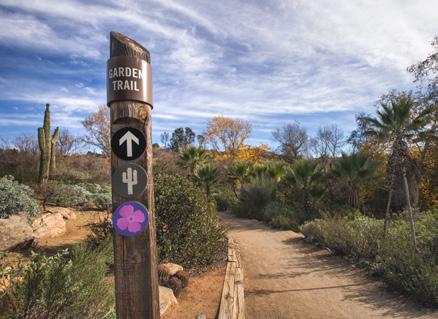
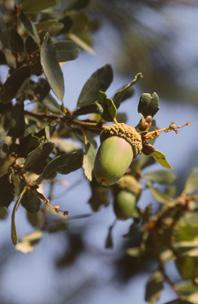
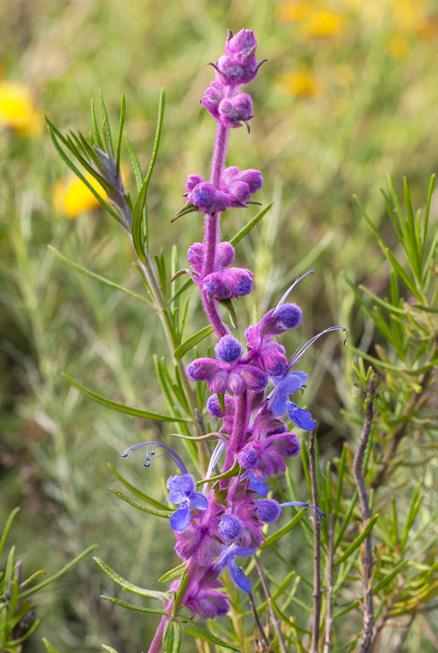
1) Woolly blue curls Trichostema lanatum 2) Follow the Garden Trail to discover a variety of native California plant communities.
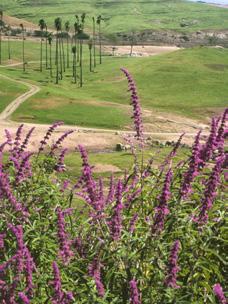
3) At the far end of the Nativescapes Garden is a step-stopping view overlooking the Park’s animal habitats.
4) California scub oak Quercus dumosa

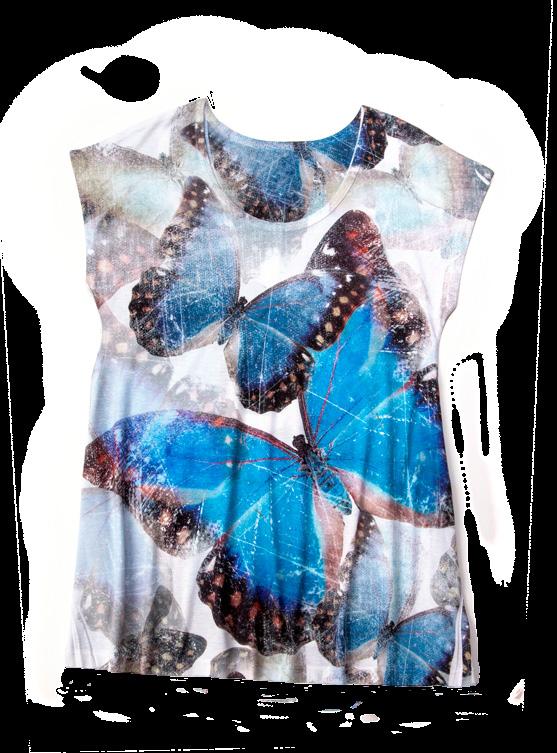
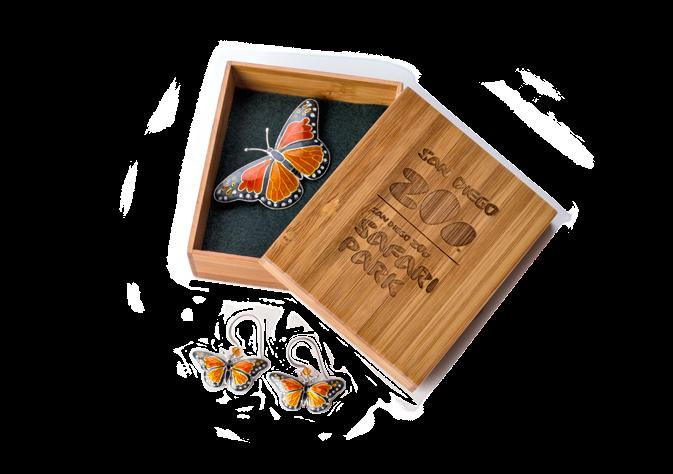
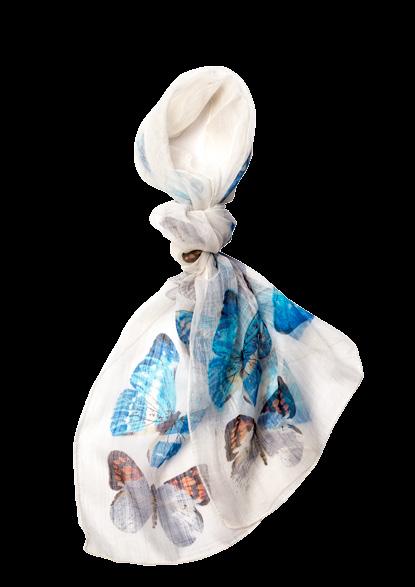

Springtime is winging its way to the Zoo and Safari Park, and in celebration we have some beautiful items featuring things with wings! Deck yourself out with butterflies and birds as you welcome spring to your home.
Visit our stores at the Zoo and Safari Park to purchase these featured items. Available in select stores. Limited quantities available.
Your purchases support the conservation projects and educational work of San Diego Zoo Global.
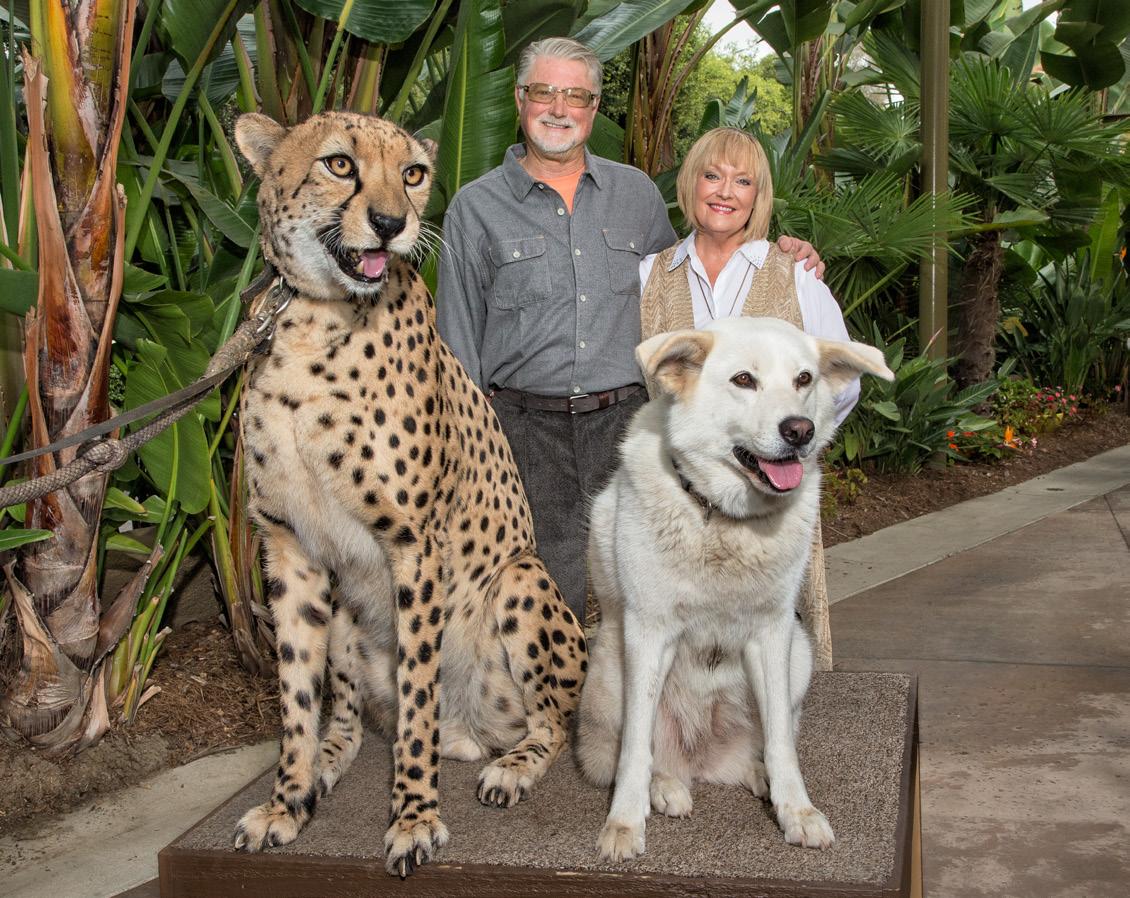
WHEN VICKI AND CHRIS EDDY, our 2015 Rendezvous In Te Zoo (R•I•T•Z) co-chairs, talk about the Zoo, their passion for animals, and their plans for the June 20 gala, they bubble over with enthusiasm! T is fun-loving couple has a long history with the Zoo and Safari Park as well as many happy memories, so they are beyond excited to be at the helm of what Vicki says is a “magni fcent, amazingly unique party.” We asked Vicki and Chris to share a bit about themselves and their plans for our 32nd annual R•I•T•Z, which is
themed “Party Animals” and will benefit the African penguin exhibit at Conrad Prebys Africa Rocks.
When did the San Diego Zoo and animals become a part of your life?
Chris: I’m a fourth-generation San Diegan. I grew up with the Zoo, and everything I did was animal-oriented. Whether I was running in the canyons, catching lizards, or hanging out at the San Diego River, animals were really important to me, and the Zoo was my
outlet. Field trips to the Zoo were my favorite days at school.
Vicki: I’m from Shreveport, Louisiana, and I grew up with dogs as our family pets. Also, we had plenty of wild animals in Louisiana, especially alligators in the lakes where we waterskied—that’s how we learned early that you didn’t want to fall! My introduction to the San Diego Zoo came a little bit later in life, when I moved to San Diego in 1980. However, a fer I met and married Chris, the Zoo became a very central part of our lives.
What are some of your favorite Zoo memories?
Chris: I have three memories that stand out. Te f rst is when I was a kid, I was dropped of by myself at the Zoo by my elementary school teacher to hang out inside the Reptile House with the assistant curator of reptiles for the entire day! Also, the f rst date I ever had with Vicki was Memorial Day weekend at what was then the Wild Animal Park. We toured the Park and then went to the Righteous Brothers concert there. And the third: When we were raising our kids, every Sunday was a Zoo day. It was family time and a requirement!
Vicki: I also fondly remember my f rst zipline adventure, which was Flightline Safari at the Safari Park. I was a bird—a big bird— soaring through the sky, and it was so much fun!
You both mentioned that there is a Zoo element to your careers. How so?
Chris: I’m a real estate professional, and for many years I used the Zoo as my virtual ofce. I would bring my laptop and sit in Scripps Aviary or another forested area in one of the Zoo’s canyons. I would do my work there—it was like having an ofce in a rain forest. Te Zoo made me feel more serene, and I could concentrate better.
Vicki: I’m a writer, and I was a creative director at an ad agency for many years. I also taught at the Advertising Arts College for 15 years. When I commuted to the college, I would see Zoo billboards on the highway, and I dreamed that one day I would write the text for those billboards or be on the Zoo’s advertising account. Now, in a sense, I am! For the past fve or six years, I’ve had the opportunity to work on the theme, design, copy, and ads for the R•I•T•Z program!
What is your vision for R•I•T•Z this year?
Vicki: Te goal of the R•I•T•Z chairs is to maintain the magical standard that already exists while also putting a fresh spin on it. Te challenge is to reinvigorate R•I•T•Z for our longtime patrons each and every year yet also make sure that the R•I•T•Z experience for the f rst-time guest is a giant “Wow!” I am really excited about the theme, Party Animals. It’s simple and can be interpreted in a lot of di ferent ways—great entertainment and plenty of surprises are a big part of it.
Chris: I want R•I•T•Z 2015 to have a huge fun factor, yet without dismissing elegance. I want the party to be vibrant and enjoyable for everybody.
What is important to you about San Diego Zoo Global?
Chris: I think aside from the Zoo and Safari Park being the most tangible way for people to enjoy and appreciate the Animal and Plant Kingdoms, the mission is to sustain animals
in the world, especially ones that are endangered. Te most important thing is not just what is done locally at the Zoo but also what is done globally. T is happens to be the headquarters of San Diego Zoo Global, yet it’s a worldwide conservation efort, and we get to see the fruits of those eforts here. We are uniquely fortunate.
Vicki: Being involved with the Zoo is such an incredible opportunity to be a part of something so much larger than ourselves that continues on far beyond our own lifetime. And there aren’t a lot of opportunities to make that kind of contribution. It’s now or never for lots of species. I think we are almost required by our place in history to stop and help now. T is is a critical time for our planet, and I love the fact that we have this opportunity to do something locally that reverberates globally. n

Annual R• I •T•Z
20,
Black, White, and a PARTY all over?
It’s the wildly exotic celebration of food, fashion, and furry–feathery fun. A rip-roarin’ rumble in the jungle more entertaining than a barrel of monkeys… AND a beach full of penguins!
See you “Party Animals” there! Contact Marilyn Neumann at 619-287-5435 or SDZOORITZ@gmail.com sandiegozoo.org/RITZ


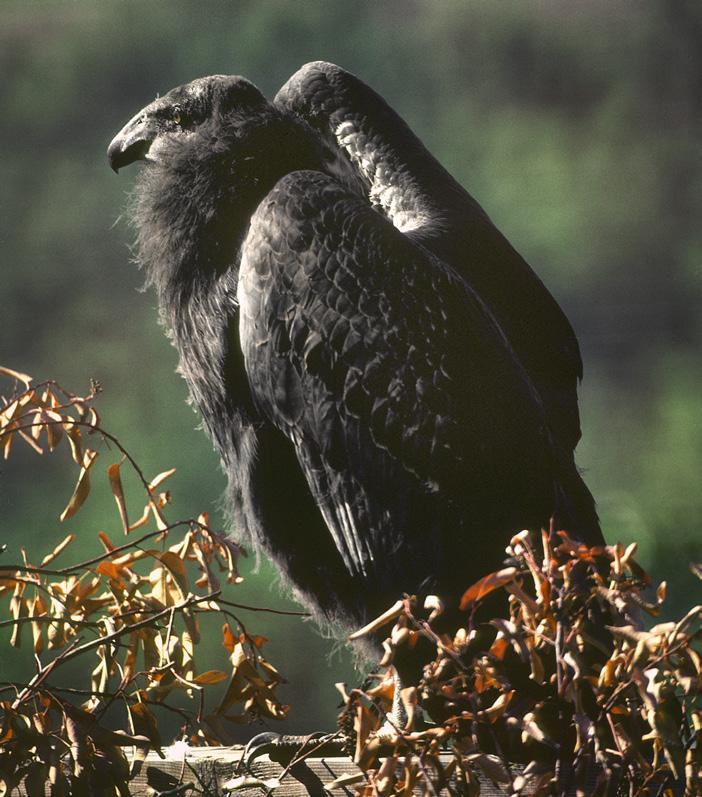
The chick had been left in its cliff-side nest, untended and without food, for several days. Hopes for its survival—and the survival of its species—were fading. But help arrived on August 13, 1982, in the form of a helicopter provided by the U.S. Forest Service. It carried San Diego Zoo Veterinarian Phil Ensley and Noel Snyder of the U.S. Fish & Wildlife Service and the Condor Research Center to a spot near the nest in California’s Ventura County.
Te two men hiked the rest of the way to that nest and placed the three-month-old California condor in a padded travel carrier for its journey to a new home at the San Diego Zoo Safari Park.
Te precious chick, named Xolxol, a Chumash word meaning both condor and spirit of the condor, was watched around the clock via video camera. Worries subsided as Xolxol proved to be active, playful, and hungry. A fer just one week, he had gained 1¾ pounds!
Xolxol’s rescue was the start of the California Condor Recovery Program. San Diego Zoo Global continues its involvement in this efort to save the species from extinction to this day. Less than two dozen California condors remained in 1982. Now, there are over 400 of these majestic animals, with more than half of them fying free in the wild once more! n