Rhino Conservation in the Spotlight chairman’s note
LAST MONTH, ON ENDANGERED SPECIES
DAY, MAY 15, we held our “Rally 4 Rhinos” event at the Safari Park to call attention to the urgent need for rhino conservation and to encourage our members, visitors, and supporters to help spread the word. Despite the rainy day, it was a great event. A highlight was the students from San Pasqual Union Elementary School in Escondido participating in a “crash mob” dance called the Rhino Romp. In the afternoon, a symposium was held at the Beckman Center with presentations from the International Rhino Foundation, William C. Woody, Chief of Law Enforcement for U.S. Fish and Wildlife Services, and conservationist Iain Douglas-Hamilton from South Africa.
As part of the Rally 4 Rhinos campaign, the public was asked to spread the word about rhino poaching, writing “stop killing rhinos” on their hand, taking a photo, and posting the photo to social media using the hashtag #Rally4Rhinos. The campaign spread like wildfire, reaching around the world, with postings from South Africa, Botswana, Uganda, UK, France, Vietnam, Brazil, Russia, across the US, and more. More than 2,000 photos were shared in social media, and there were more than 19.5 million social media impressions, all centered on rhino conservation.
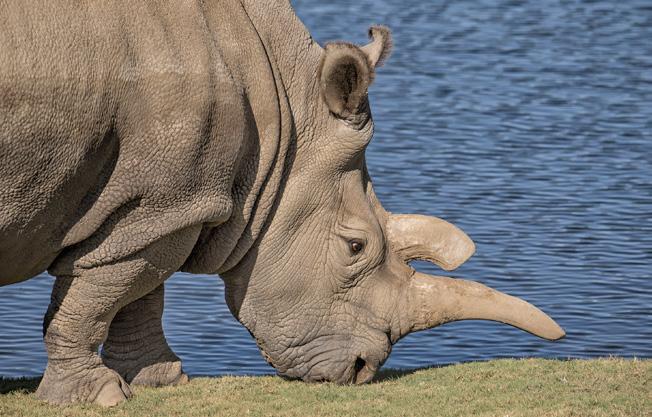
All species of rhinos in the wild are facing the worst poaching crisis in history. Only 25,000 black and white rhinos remain across all of Africa, and if the current poaching rates are not stopped, they could become extinct in the wild in the next 20 years. Greater onehorned rhinos face similar frightening circumstances, and the numbers of Sumatran and Javan rhinos are so low that they are already critically endangered.
As many of you know, rhinos are poached for their horns, despite the fact that they are made of keratin, the same material as human hair and fingernails. Although international trade in rhino horn has been banned since 1977, the demand, particularly in Asia, is higher than ever. Today’s poachers are well
equipped and highly organized, using helicopters, machine guns, and veterinary drugs to kill rhinos and criminal syndicates to smuggle rhino horn. What you may not be aware of is that the US is actually a significant destination for rhino horn. In fact, California has the second largest market for it in the nation behind New York City. Some people may consider the rhino crisis to be something that happens elsewhere—but these illegal markets for rhino horn are right in our own backyard.
San Diego Zoo Global is committed to helping save rhinos from extinction. During Rally 4 Rhinos, we announced that we are building a rhino conservation center barn at the Safari Park later this year. We plan to house and care for more southern white rhinos, establishing the Safari Park as a sanctuary to protect these rhinos and their offspring until the poaching in Africa can be stopped. Researchers at the San Diego Zoo Institute for Conservation Research also will move forward to explore the science necessary to preserve the genetics of the northern white rhino, and San Diego Zoo Global will continue to support the ban of rhino horn and ivory sales asked for by the proposed bill AB 96.
Saving rhinos will also require something equally as powerful: public perception, education, and participation. Public campaigns are underway in other countries to discourage the use of rhino horn, and our voices need to be heard here in the US as well. We will be continuing the momentum from Rally 4 Rhinos throughout this summer, with further activities to raise awareness for World Rhino Day on September 22. In whatever way you can, I hope you will raise your voice to prevent the extinction of rhinos.
OFFICERS
Robert B. Horsman, Chairman
Sandra A. Brue, Vice Chairman
Judith A. Wheatley, Secretary
Steven G. Tappan, Treasurer
BOARD OF TRUSTEES
M. Javade Chaudhri
Berit N. Durler
Richard B. Gulley
Clifford W. Hague
Linda Lowenstine, D.V.M., Ph.D.
Patricia L. Roscoe
TRUSTEES EMERITI
Frank C. Alexander
Kurt Benirschke, M.D.
Thompson Fetter
Bill L. Fox
Frederick A. Frye, M.D.
George L. Gildred
Yvonne W. Larsen
John M. Thornton
Albert Eugene Trepte
Betty Jo F. Williams
James Lauth, General Counsel
Douglas G. Myers, President/CEO
Charles L. Bieler, Executive Director Emeritus
THE FOUNDATION OF SAN DIEGO ZOO GLOBAL
OFFICERS
Murray H. Hutchison, Chair
Maryanne C. Pfister, Vice Chair
Susan N. McClellan, Secretary
Richard M. Hills, Treasurer
Mark A. Stuart, President
Robert B. Horsman, Ex officio
Douglas G. Myers, Ex officio
BOARD OF DIRECTORS
Christine L. Andrews
Joye D. Blount
Rick Bregman
Lisa S. Casey
Douglas Dawson
Berit N. Durler, Ex officio
U. Bertram Ellis, Jr.
Arthur E. Engel
Craig L. Grosvenor
Judith C. Harris
Michael E. Kassan
Susan B. Major
Michael D. McKinnon
George A. Ramirez
Robert B. Horsman Chairman
Thomas Tull
Margie Warner
Ed Wilson
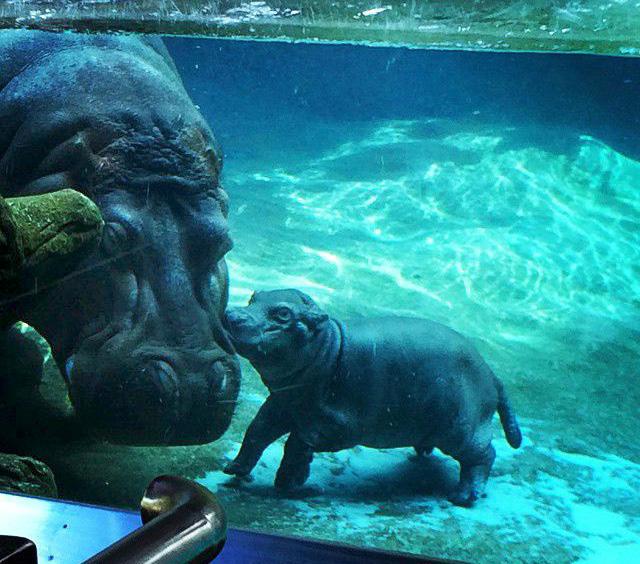
said it
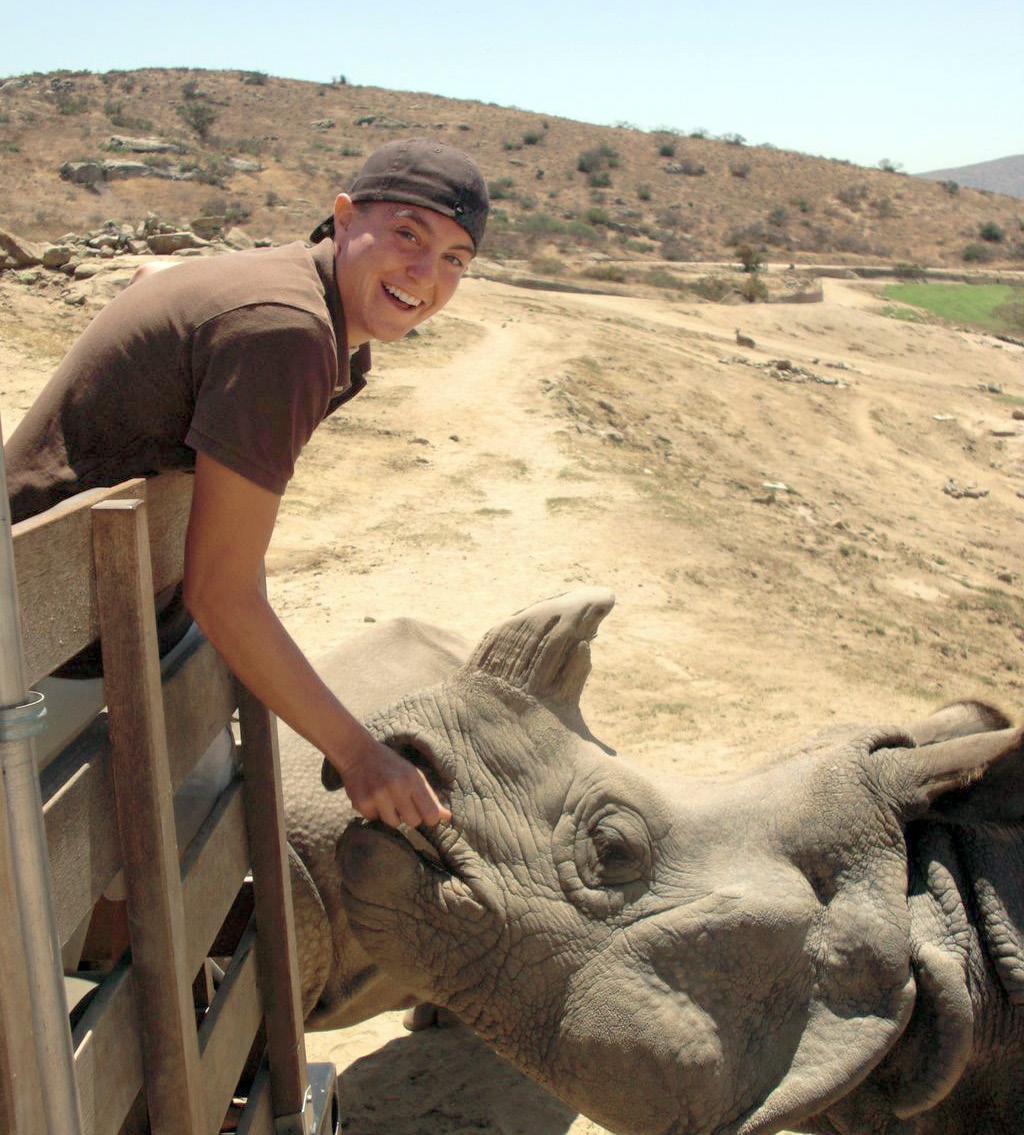
Me feeding a Greater One-Horned #Rhino @sdzsafaripark in 2008. What a privilege! @corbinmaxey
It’s been a very magical day. @cocolarsen
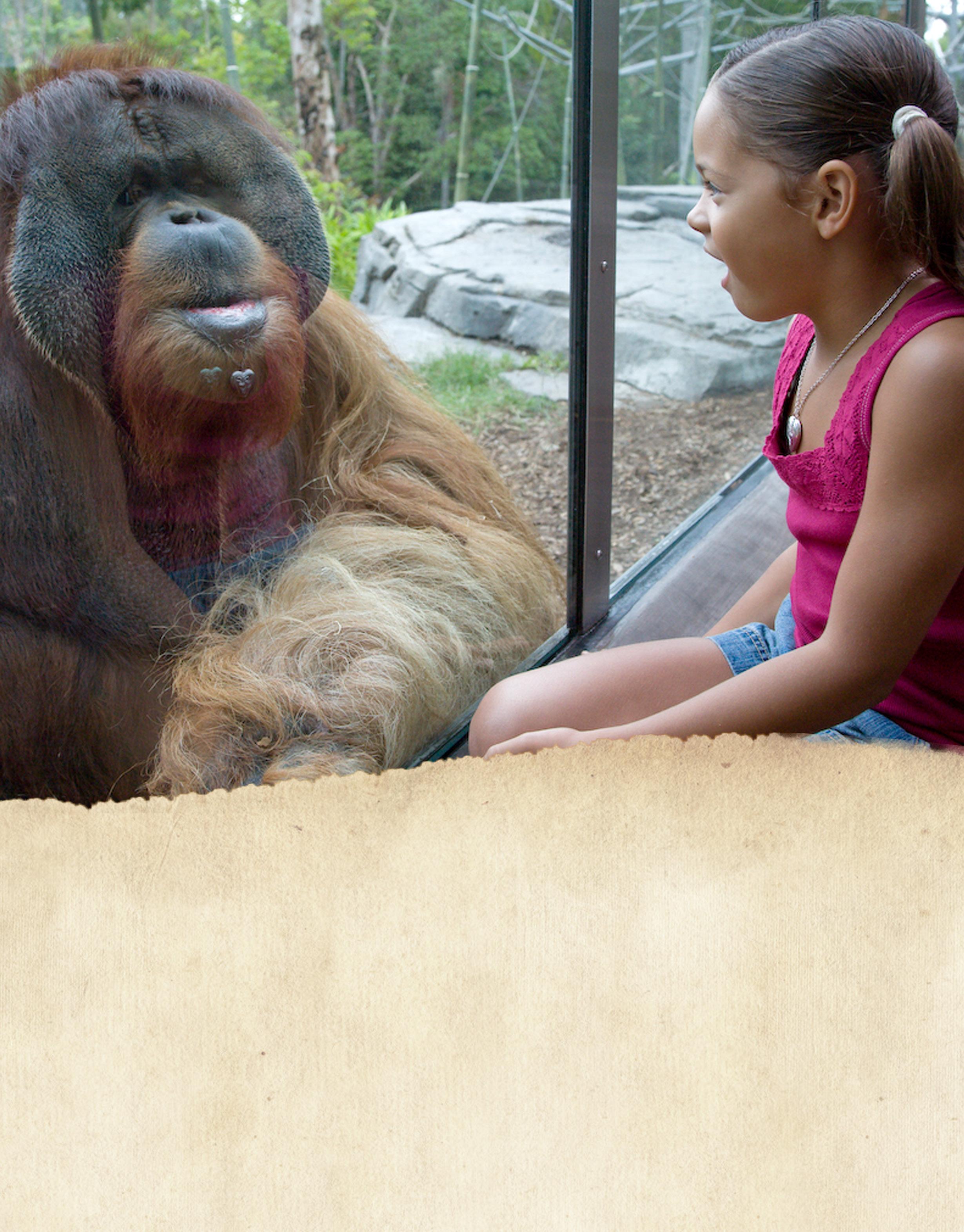
I was born at Balboa Naval Hospital in 1963 and grew up in SD until I was 14 yrs old. My fondest memories as a child was going to this zoo. I remember at age 12 my friends and I could ride the public bus and get into the zoo for 50 cents. I believe as long as you were of school age it only cost 50 cents! Those were the days!
Kelly Griffin
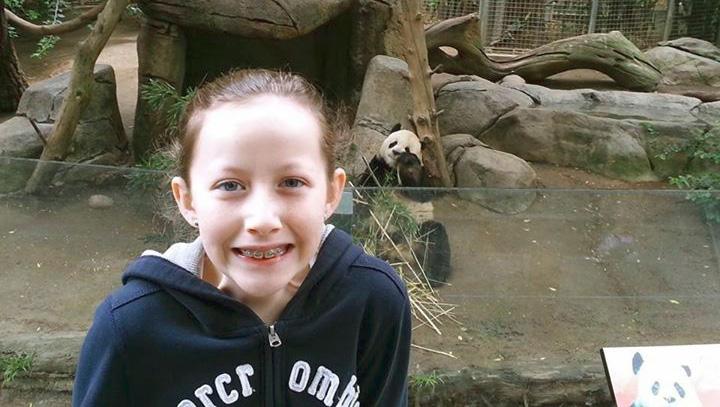
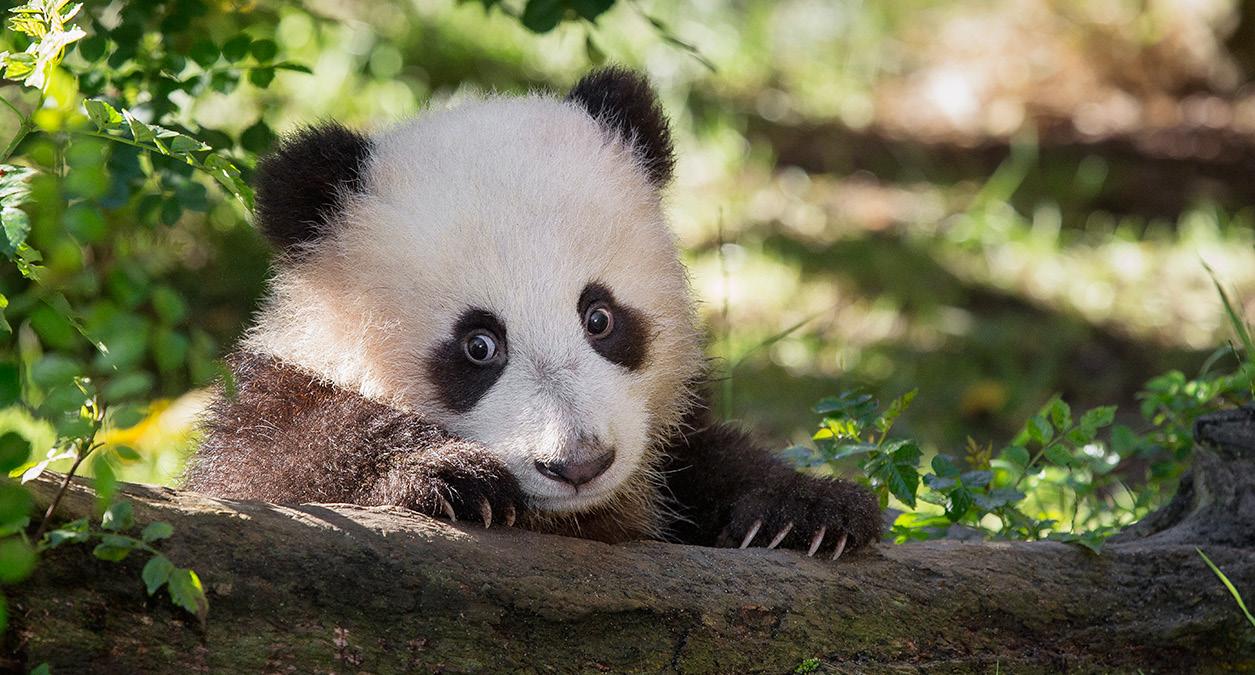
Early morning with the Pandas! Robin was awesome, and this is the perfect way to start your zoo day. So many adventures...so many memories.
Dodi Balagna Morrison
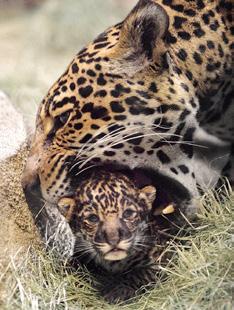
Be careful Mom! Cat mothers are skilled at carefully picking up the little ones with those intimidating teeth. Nindiri the Jaguar and her cub.
Mike Wilson
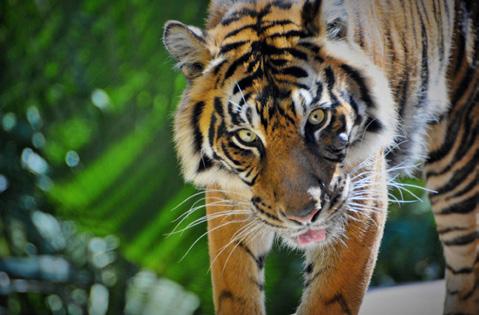
I really enjoy this new exhibit at the Safari Park! I can really get up close with these beautiful tigers. Thanks again for all you do! Keep up the great work!
Lindalea Lowrie-Griffith
The mom is very protective so you have to stay back but this little baby is adorable!! #sandiegozoo @sandsusie
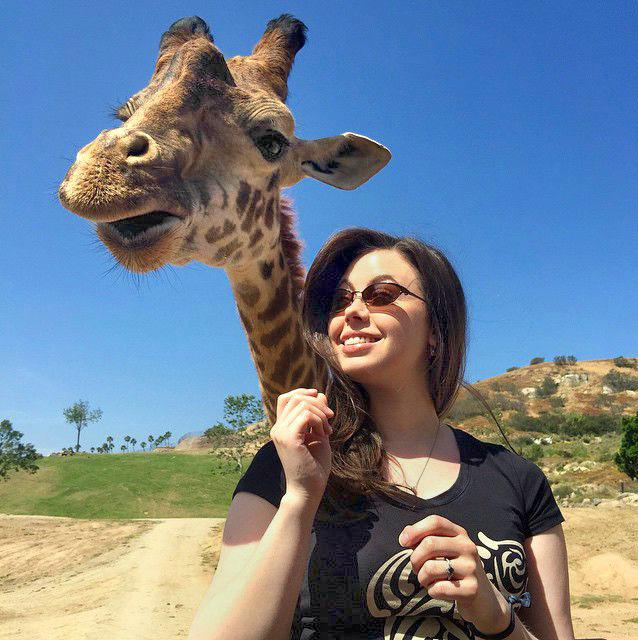
Oh don’t mind me—I’m just on safari, hanging with a giraffe.
@foreveramber226
This is my big boy, Xiao Liwu (Charlie). He was born in 2012, 3 months before I had brain surgery. He helped me to recuperate—he s till is helping me. #endextinction
Pamela Teets
Thnx, had an amazing day! Kudos to your staff for replacing my new hat after it blew off the Skyfari. I appreciate it!
@JGGShopsDC
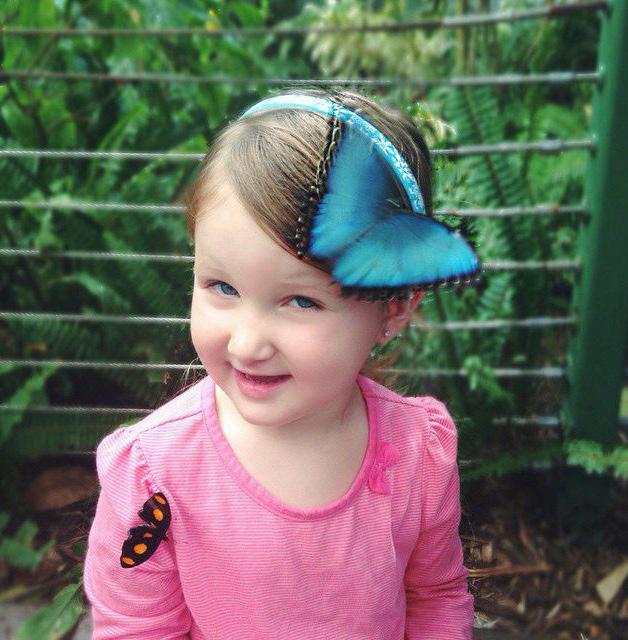
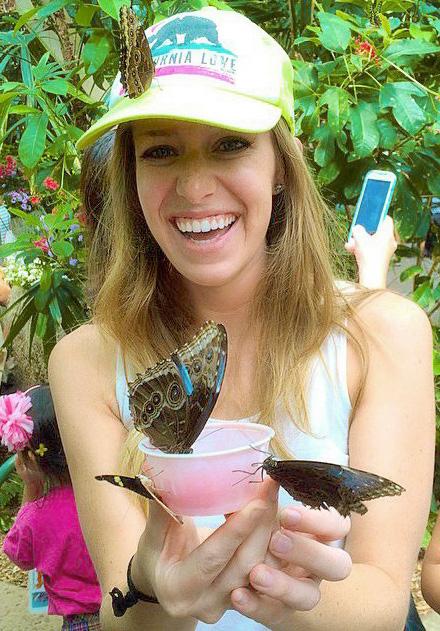
Just hanging out with my new friends! #butterflyjungle @littlekatelyn
through the lens
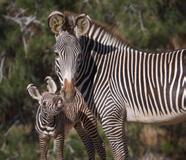
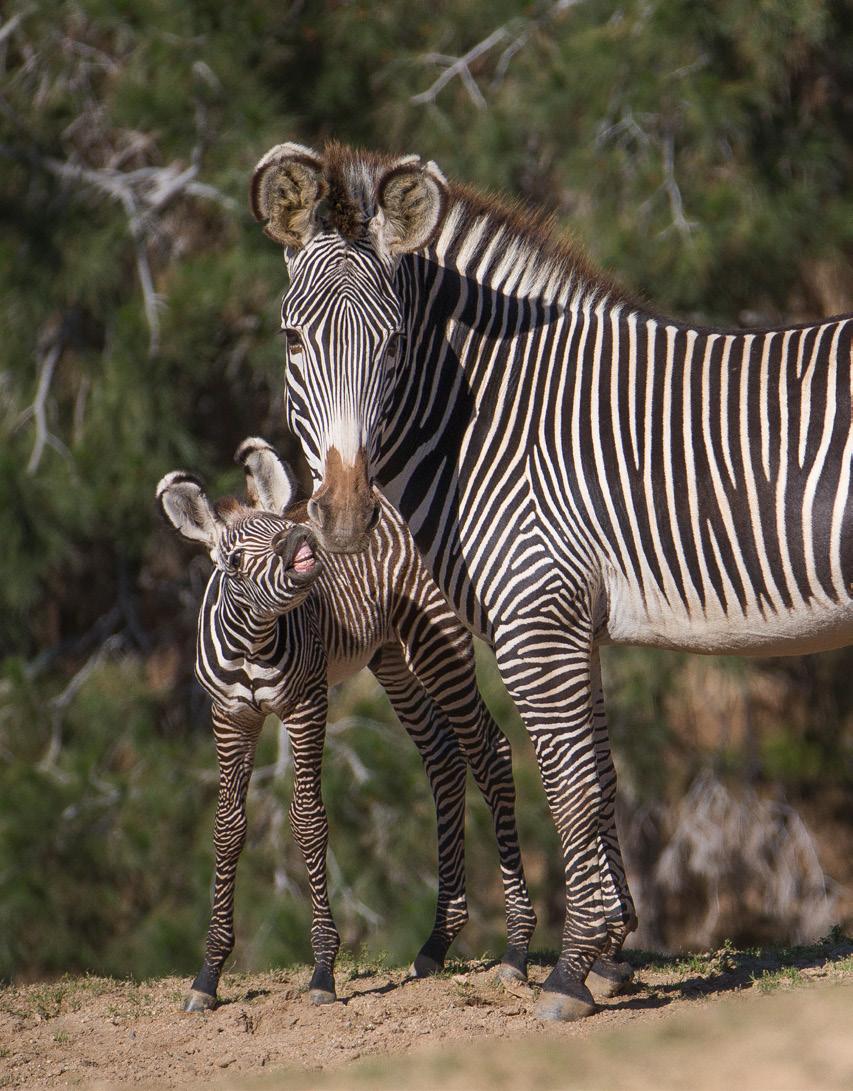
Grevy’s zebra Equus grevyi with foal
Photo by Ken Bohn SDZG PHOTOGRAPHER
By Wendy Perkins STAFF WRITER
Photos by Ken Bohn SDZG PHOTOGRAPHER
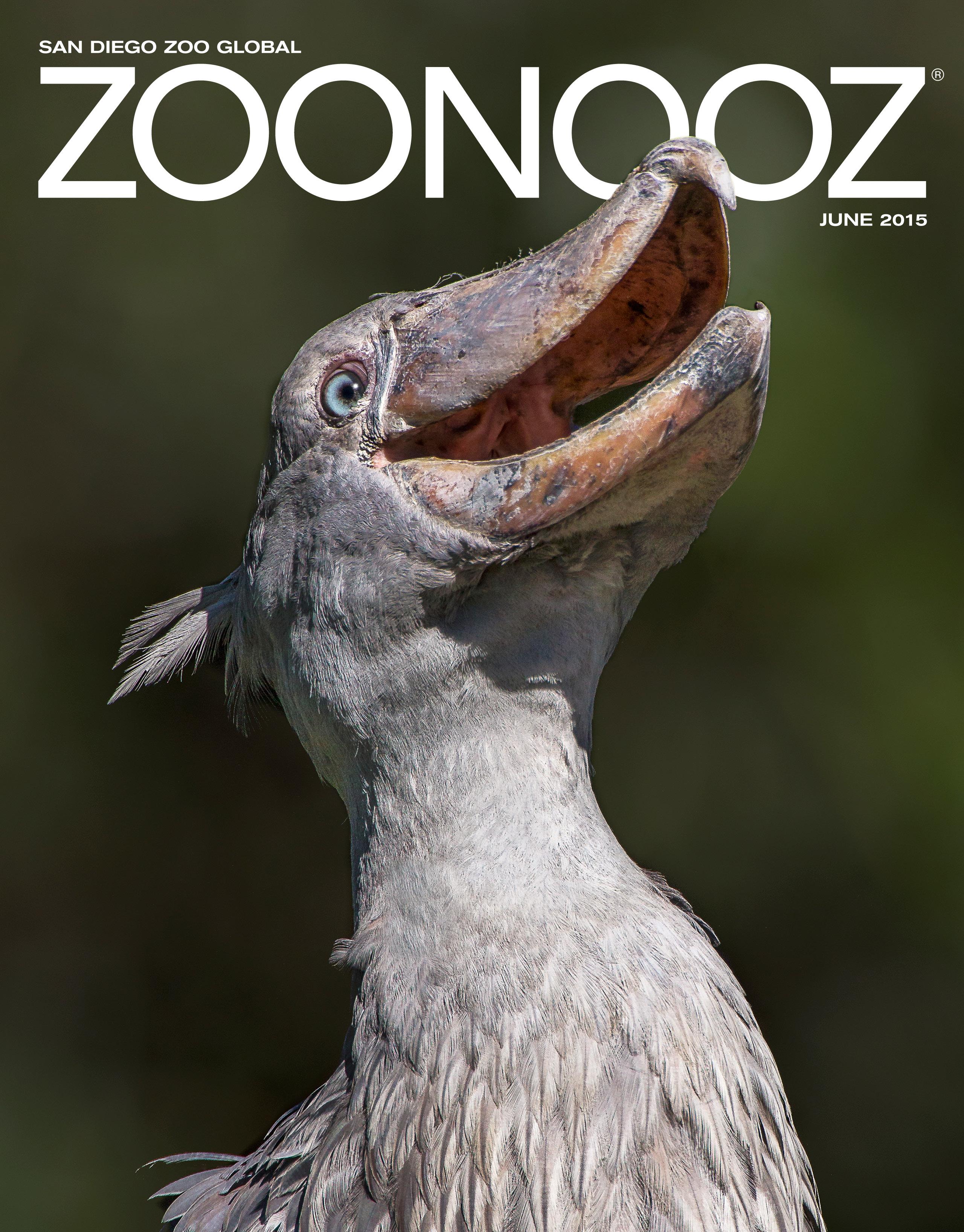
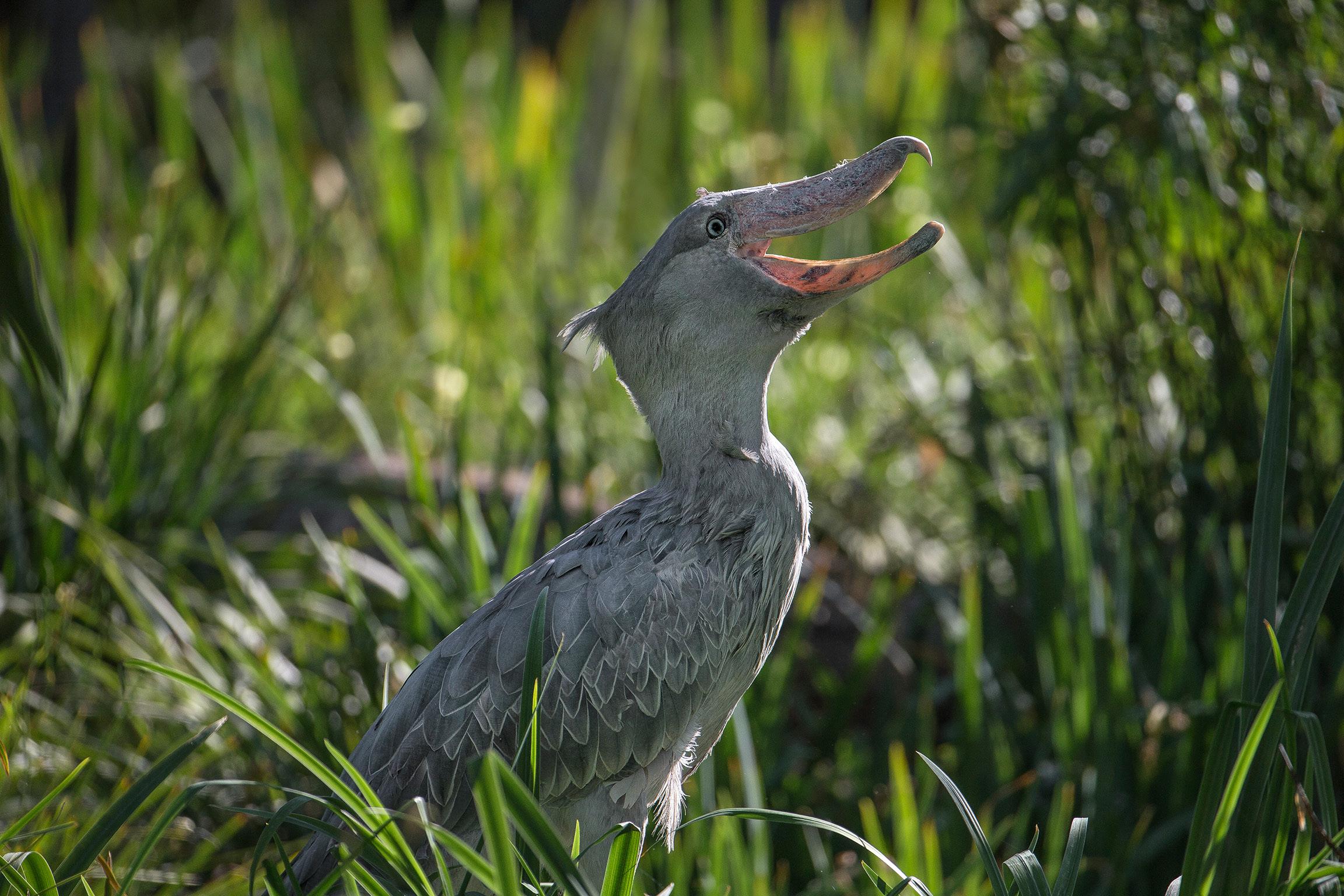
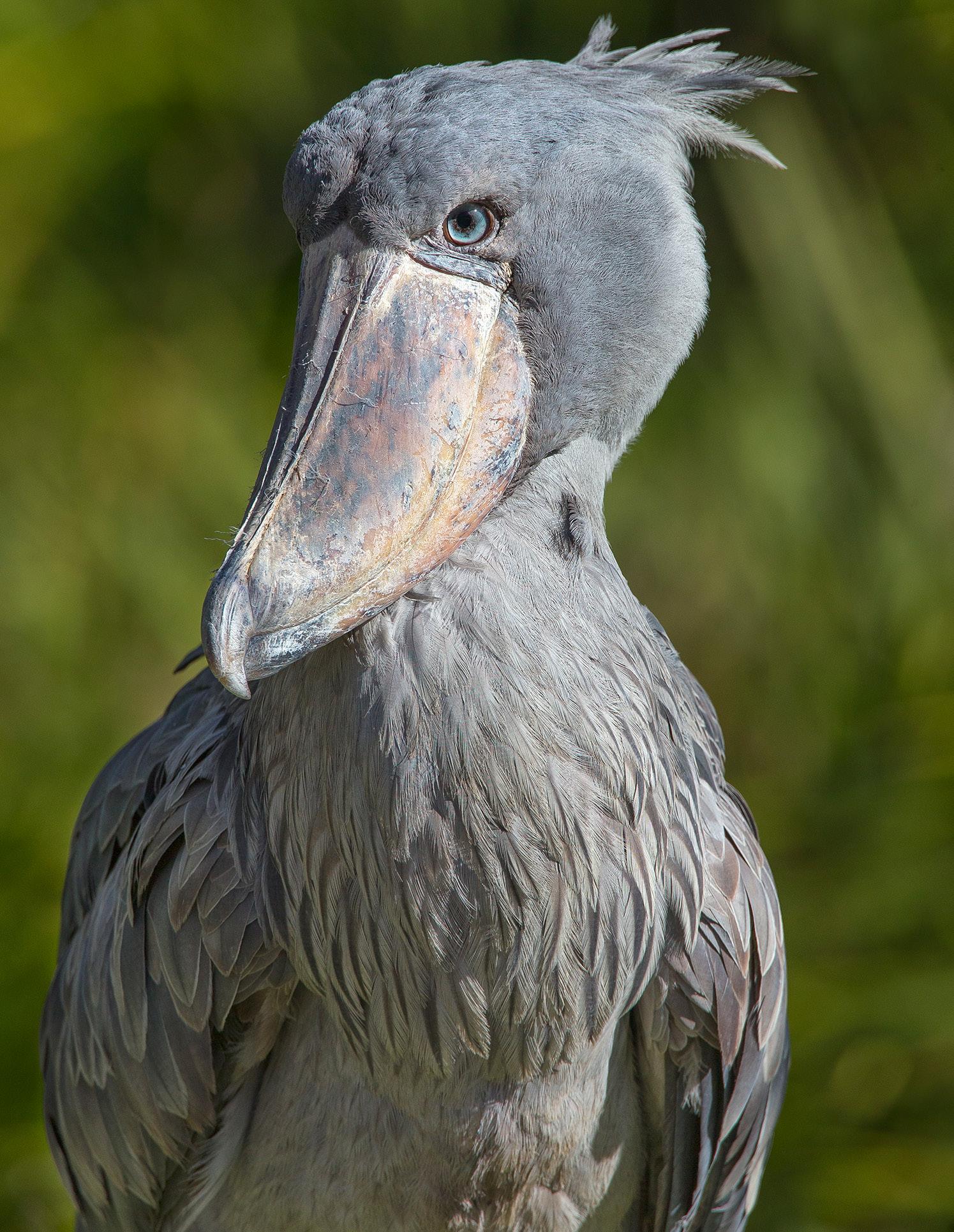
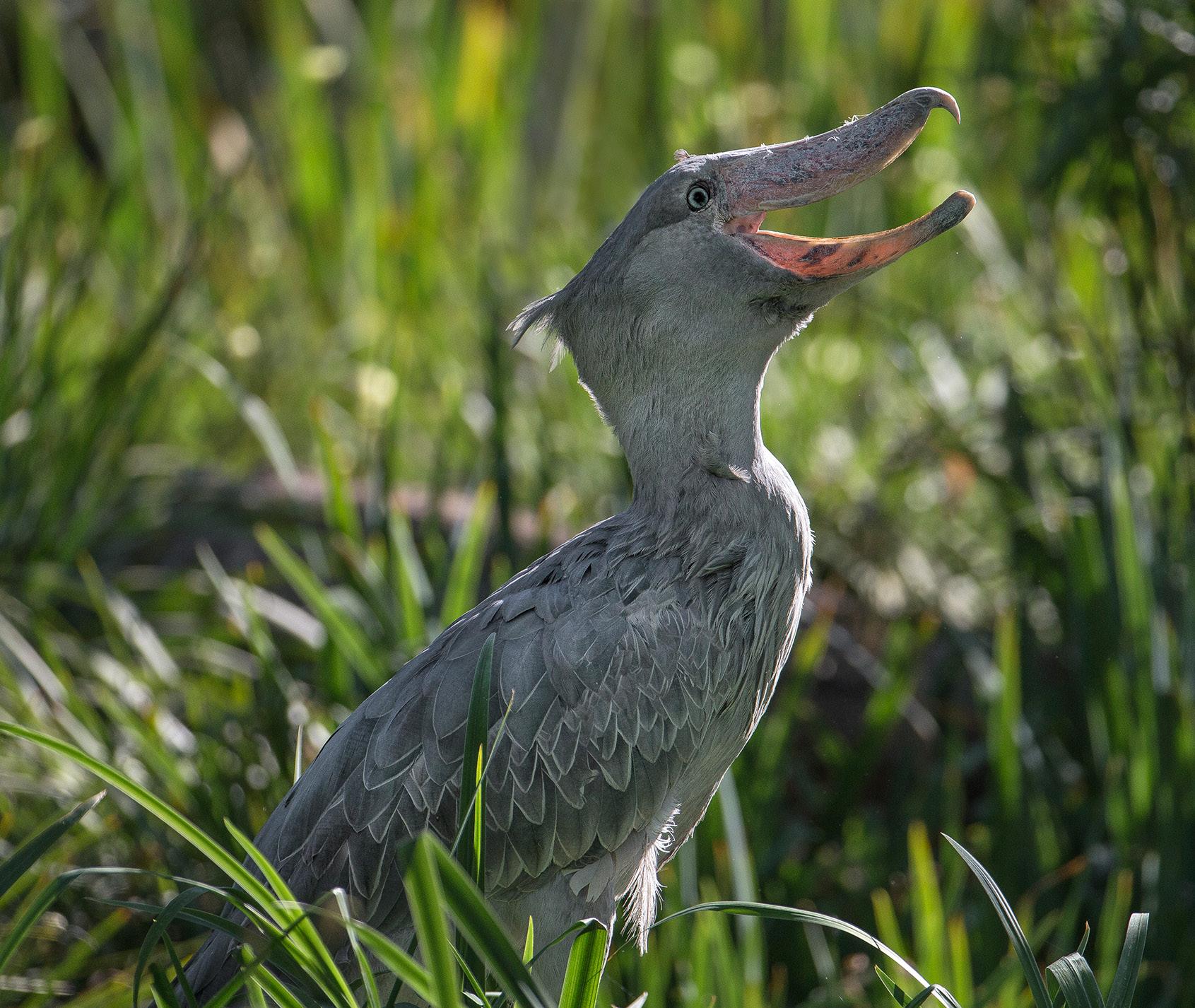
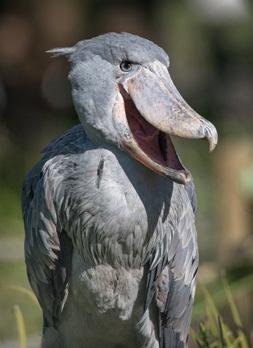
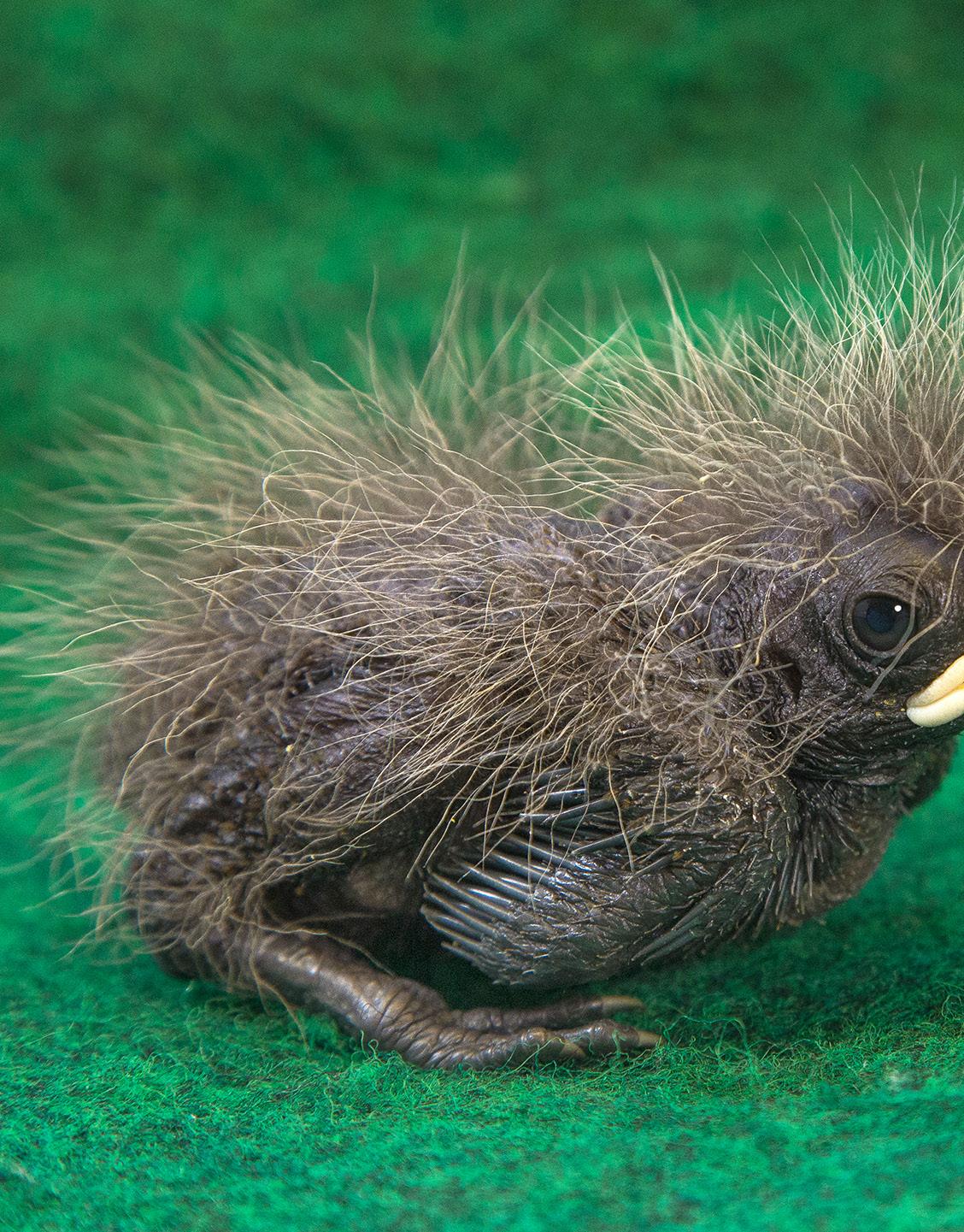
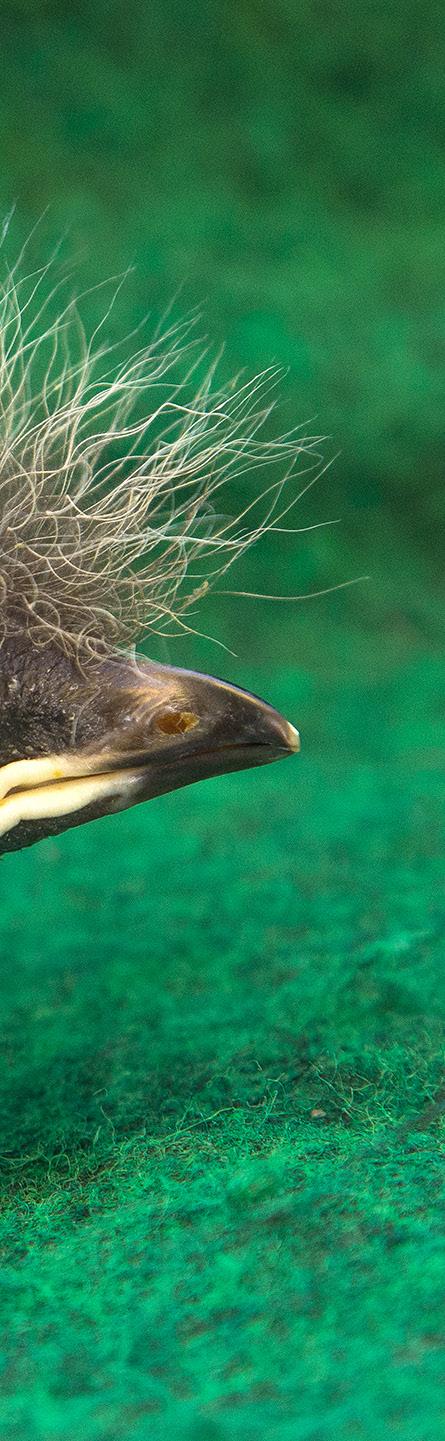
This page: The sharp, curved projection at the tip of a shoebill’s beak is used to hook prey. Opposite page: The name “shoebill” comes from the cloglike shape of this bird’s mighty beak. These birds belong to Order Pelecaniformes, along with pelicans.
Weird can be wonderful—and that’s certainly true of the shoebill stork
Baleniceps rex. The shoebill’s characteristic, oversized beak is a standout and an important adaptation, oddlooking yet marvelous when its uses are revealed. While the bill is certainly a scene-stealer, there’s more to this reclusive African bird than its mighty mandibles. From its specialized feeding niche to its zen-like hunting strategy to its nesting habits, the shoebill stork is an astonishing wonder.
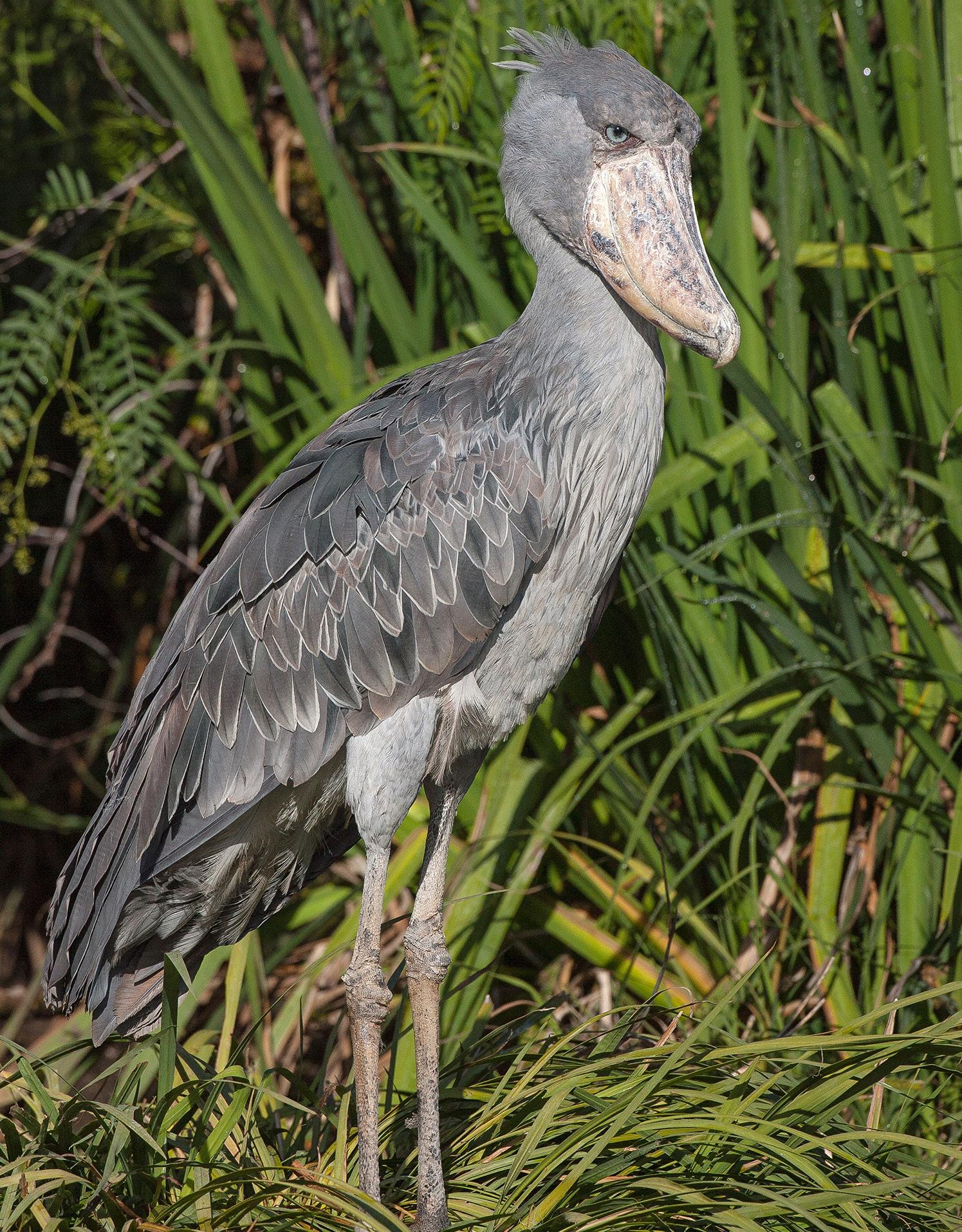
A shoebill’s long legs make it well adapted to keeping most of its body dry as the bird wades through its marshy habitat.
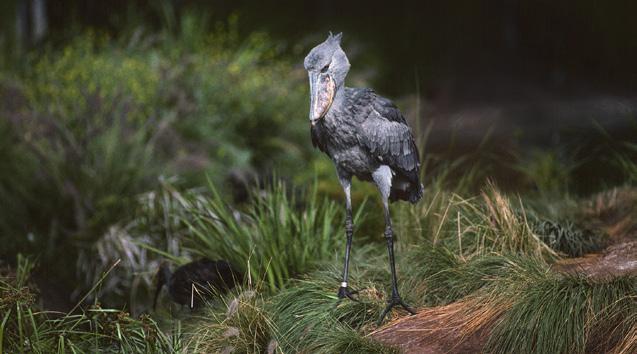
Standing about five feet tall, shoebill storks live in some of the most inaccessible habitat on the planet: the upper Nile’s dense marshes and impenetrable swamps. This is a realm choked with papyrus and other aquatic flora. As hippos and elephants plow through the area, they open channels in the vegetation, which become prime real estate for shoebills. These birds prefer open areas that allow for a quick fly-out if danger comes near. One benefit of this habitat is a rich supply of food in the form of fish, frogs, and large invertebrates.
ALL IN
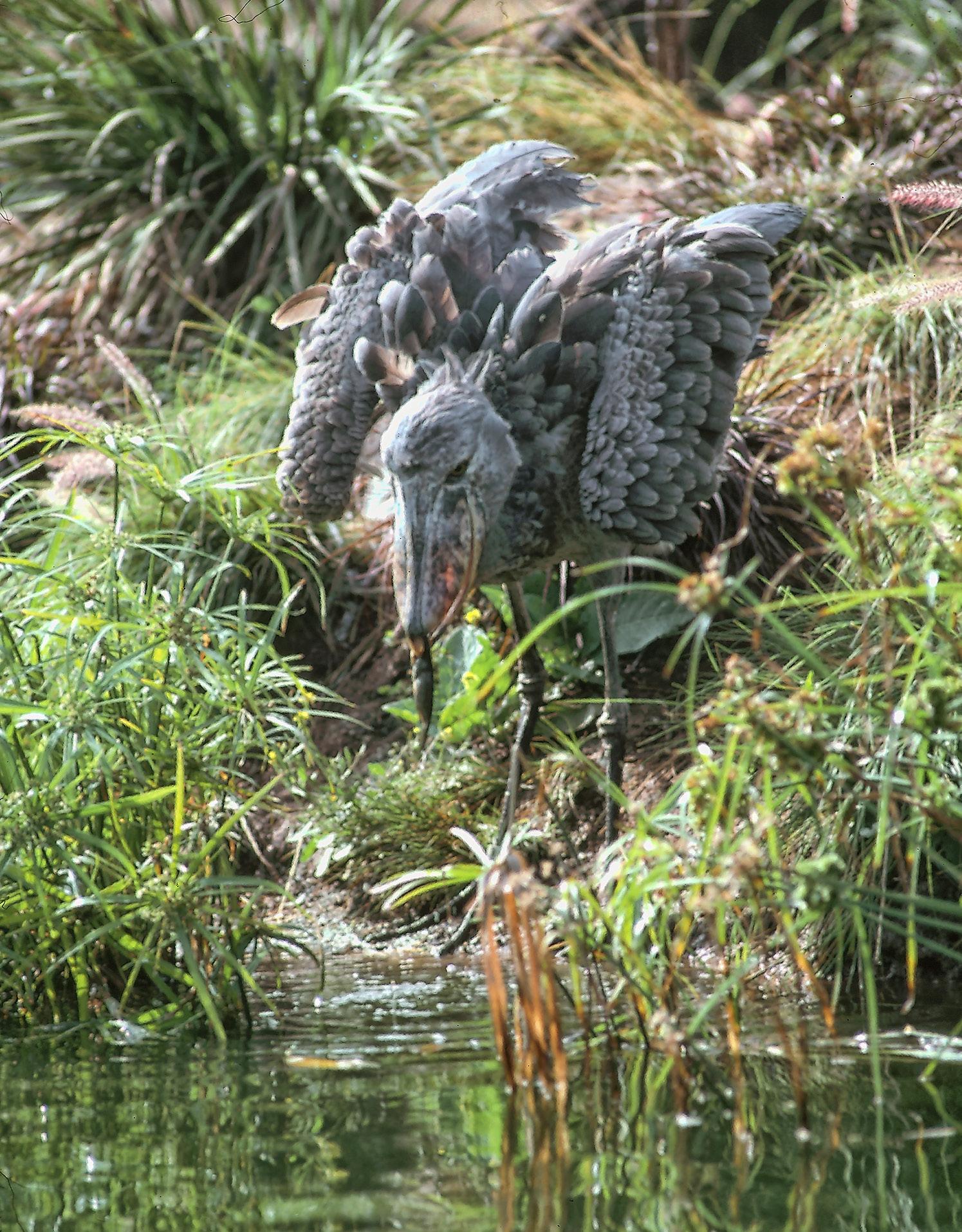
When it comes to procuring a meal, hunting is not exactly the best descriptor for the shoebill’s technique. They don’t stalk prey—they wait for it. Positioned on floating mats of vegetation, a shoebill stands stock still. If it needs to move to improve its position, it does so deliberately and oh-so-slowly. Beak tucked to its chest, the bird watches the water for fish to rise to the surface. Because the water in this area is so low in oxygen, fish must come to the surface to gulp air. When they do, the shoebill makes its move—and what a move it is!
In the blink of an eye and with maw agape, the bird launches its body forward in a powerful lunge that looks a bit like a belly flop. Before another blink, the bird has a mouthful of food. But before it can swallow its meal, it has a little sorting out to do; along with the fish or frog, the bird has scooped up floating vegetation as well. Once the tangle of plants and debris is out of the way, small prey is swallowed whole. Larger catches like lungfish are efficiently chopped into chunks by the sharp edges of the shoebill’s powerful beak.
A small fish like this may be swallowed whole, but larger fish are first chopped into chunks by the shoebill’s sharpedged beak.
BY
APPEARANCE AND ALIAS
How this African bird came by its common name is as plain as the beak on its face. The name shoebill comes from the Arabic moniker for the species, abu markub, meaning “father of the shoe” due to its resemblance to clog-type foot apparel. These birds are also known by another name: whale-headed stork.
In his lifetime, noted 19th-century ornithologist and artist John Gould observed and painted thousands of birds. The man had just about seen it all. Yet, in his documentation of the first shoebill specimen he received, he deemed it “…the most extraordinary bird I have seen for many years.” Gould dubbed the species Baleniceps rex , meaning “king whalehead.” The name fits; the tall bird is indeed regal in posture and movement, and the beak does resemble the head of a baleen whale: flat on top with a wide, convex lower portion. No matter what common name is used, it always comes back to that impressive eight-inch-wide bill. And rightly so—that beak is key to the bird’s existence.
SCOOP AND TELL
Used in breeding and nesting, the shoebill’s astonishing beak is truly a multipurpose tool. It’s used not only for catching food but also for communication. Shoebills are monogamous by nature. Both partners work together to build the nest, scouring their territory for suitable material. When they return, they greet each other with a bobbing dance accompanied by bill clattering. The sound of the mandibles clapping together repeatedly has a deep, hollow quality. It’s believed
PHOTO
SDZG
that the sound produced by a male and a female differ, because their bills are slightly different in size (males’ are larger).
To build the nest, the pair “sews” grasses into an existing platform of plant material. They use their toes to work the material in and jump up and down on it to press it in more securely. It’s a two-stage construction project. First, a nest mound measuring about nine feet in diameter is established. On top of that, the birds place a threeto five-foot-wide nest of softer grasses and stems.
Both male and female incubate the eggs. They alternate sitting on the nest, turning the eggs and monitoring the temperature. Keeping the clutch of one to three eggs warm is important, of course, but in their habitat, shoebills must also keep them from overheating. Again, that remarkable bill comes in handy.
Scorching temperatures and the high humidity of their habitat can sometimes reach extreme levels. Shoebills have frequently been observed pouring beakfuls of water over eggs in the nest and later over their chicks. The gush of liquid cools things off immediately thanks to the effects of evaporative cooling.
IN SEARCH OF THE GREAT UNKNOWN
Although we know bits and pieces of their natural history, many aspects of shoebill life remain a mystery. “Typically, inaccessible habitats like The Sudd make it extremely difficult to study species like this,” said Michael Mace, curator of birds at the San Diego Zoo Safari Park. One of the unanswered questions about shoebills is how many there are. The International Union for Conservation of Nature (IUCN) describes the population as “…widely but very locally distributed …from South Sudan to Zambia.” Estimates conservatively suggest a total population of 5,000 to 8,000 individuals. But IUCN points out that this could be low and that further study is needed.
cessible environment,” said Michael. “When you have populations that are low in the wild, it’s important to understand their natural history and reproductive cycles, so that if populations decline, we have the resources to help them—as San Diego Zoo Global has helped California condors, loggerhead shrikes, and alala.”
HOME AWAY FROM HOME
In the late 1990s, a huge flight aviary designed to encourage breeding was built in an off-exhibit area at the Park. The vegetation planted back then has matured, creating a lush marsh-like habitat for the two shoebills that inhabit it. Three ponds, stocked with fish and frogs, allow the birds to feed in their species-typical fashion while misters and sprinklers simulate the humidity and rainy season of their native habitat. An observation booth allows staff to gather more information about them. One thing they’ve learned is that the birds nest away from where they eat.
The pair that lives there now started building nests about three years ago but did not lay eggs. That changed last fall. The first clue keepers had that the birds were up to something was a shift in their behavior. “They became very defensive of their nest,” explained Andrew Stehly, lead keeper. “Instead of just ignoring us as we serviced the aviary, they would take wing and land right in front of us, staring us down.” On a previously installed closed-circuit camera, the keepers saw why: a single egg on the nest. Unfortunately, the egg never hatched. One morning, about two weeks after staff estimated it should hatch, the egg disappeared. The parents had pushed it out of the nest, as birds sometimes do when an egg is not viable.
In 1988, the Safari Park received five shoebills. At the time, they were the first of their kind in the US, and even today there are fewer than a dozen in zoos in this country. “This is an opportunity to study them in an ac-
The bird team at the Safari Park is looking forward to next year, hoping for a successful hatch so they can learn more about these impressive birds. “Shoebills serve as ambassadors for the importance of African wetlands,” said Michael. “Wetland conservation is critical, and what benefits this iconic species also benefits other animals and plants in the habitat.” Hopefully, as knowledge grows, conservation flows. Long live King Whalehead! n
The structure of a shoebill’s mouth makes it appear that the bird is smiling (or in this case, laughing)—an illusion that only adds to the bird’s mystery.
Tucking its huge bill tightly to its chest gives the shoebill a better view of whatever prey may pass before it.
WHEN MURPHY MET MINA: RED RIVER HOG PAIR GETTING ALONG
FBy Peggy Scott ASSOCIATE EDITOR
rom the tips of their comical ears to the end of their non-curly tails, red river hogs Murphy and Mina simply exude porcine personality. Smart, sassy, and possessing startlingly sharp senses of humor, the pair is creating a stir in Urban Jungle at the Zoo—and beginning to hog all the attention!
Photos by Ken Bohn SDZG PHOTOGRAPHER
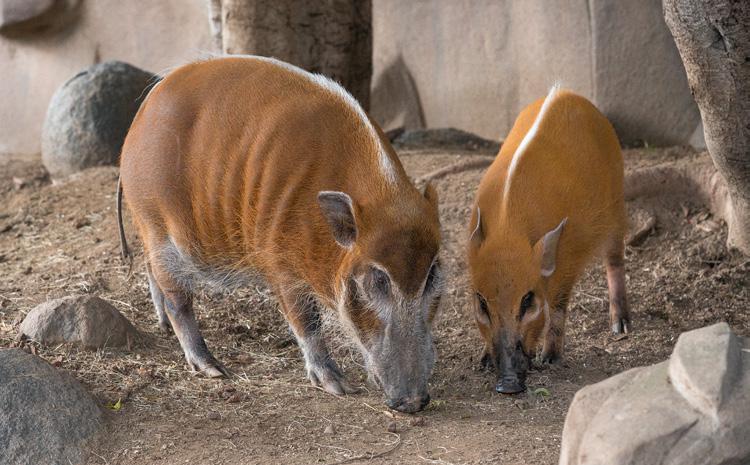
Murphy (left) is larger than Mina, but her personality more than makes up for the size difference!
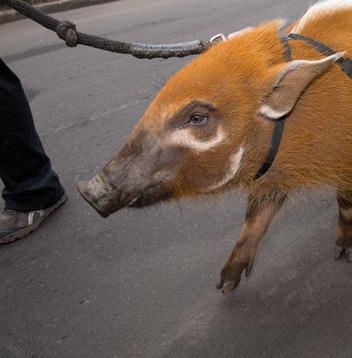
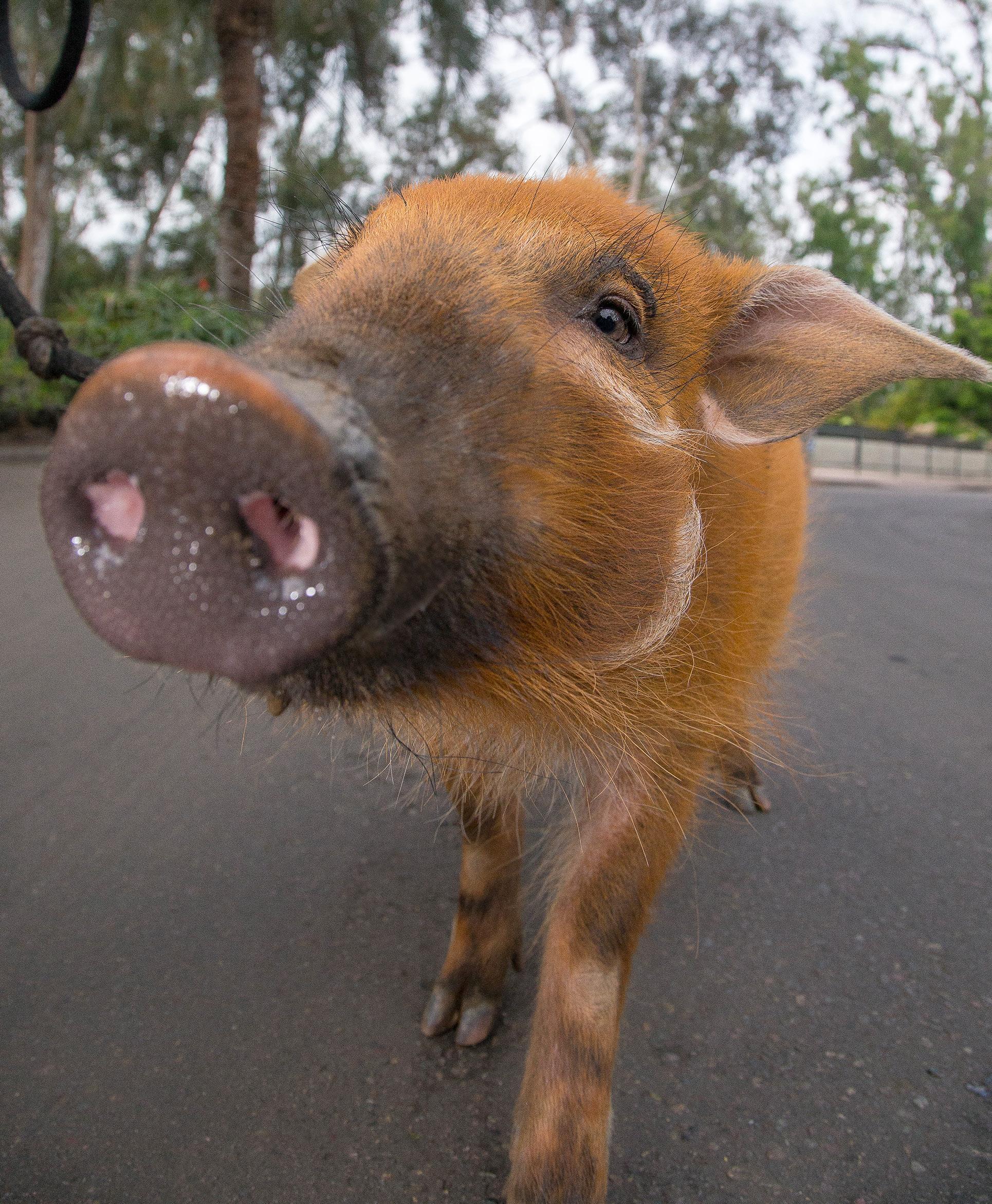
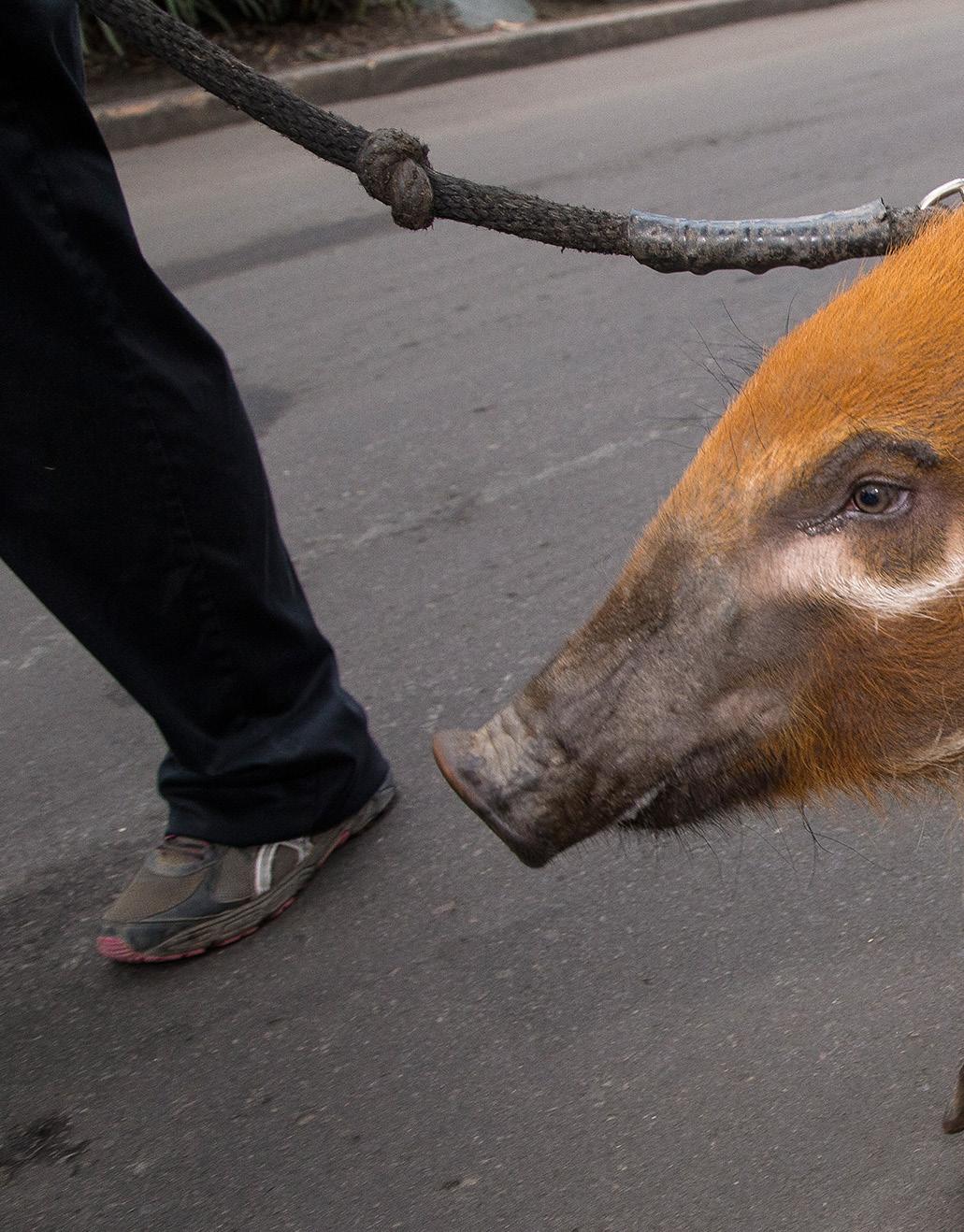
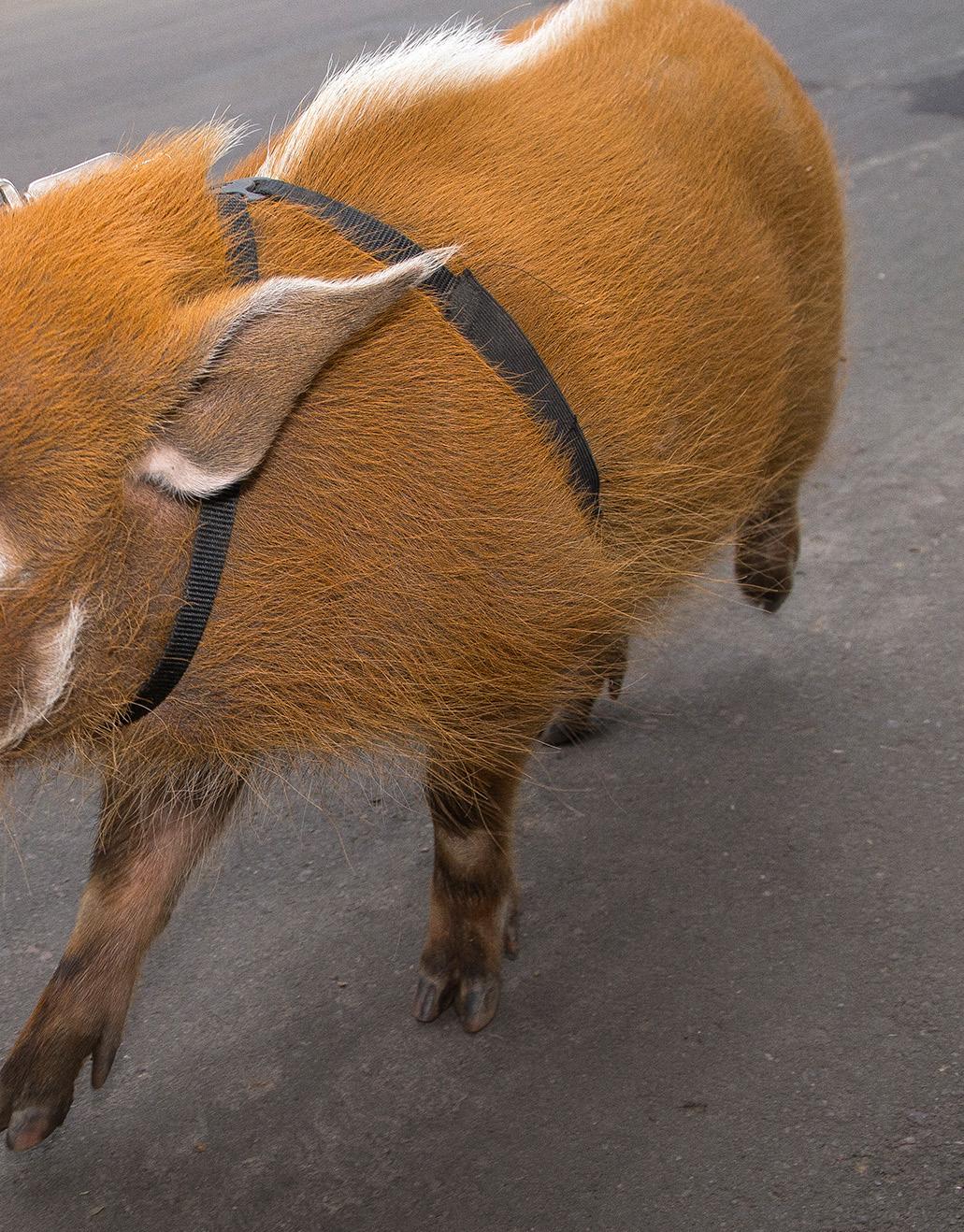
A stroll through Zoo grounds with her trainers is one of Mina’s favorite pastimes.
“Mina loves her walks with her keepers. She always wants ‘her’ people with her.”
Pig Tales
Red river hogs can’t help turning heads— they certainly are eye-catching animals. The “fanciest” of the wild swine, these pretty African piggies sport reddish-brown coats with a white crest running along their spine. Both males and females have tusks, but the males’ tusks are larger. The red river
hog’s most characteristic feature, however, has to be its long, cartoonish ears, tipped with tassel-like tufts. And that happens to be where Murphy and Mina stand out even among others of their species. Murphy’s ears were injured early in life so he doesn’t have ear tufts, and young Mina’s have yet to grow in. Even if they weren’t so unusual
looking, however, the Zoo’s newest dynamic hog duo would somehow manage to get noticed.
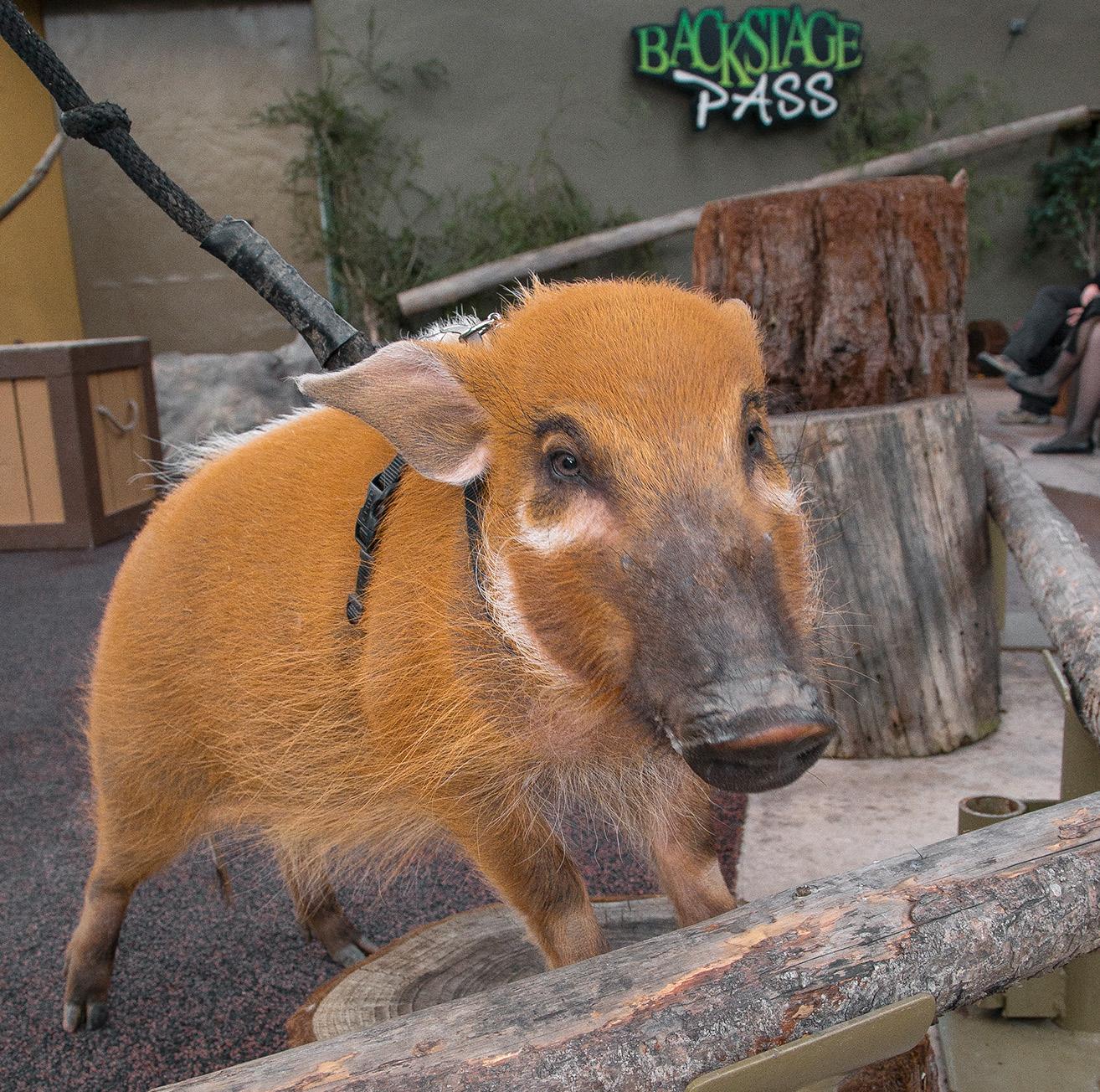
“They are partners in crime—always on a ‘search-and-destroy,’ mischief mission,” says Kelly Elkins, a lead animal trainer with the Zoo’s Backstage Pass experience. “They are sometimes too smart for their own
A born ham, Mina is a Backstage Pass star in the making.
good. And Mina is always the ringleader!” Since they’ve joined forces, they seem adorably unstoppable.
Nine-year-old Murphy is well known to Zoo regulars. For several years, he hammed it up in shows at Hunte Amphitheater. His stage career earned him quite a loyal following. “He has a fan club,” Kelly admits. “People visit him every day.” These days, his admirers will notice that Murphy’s act has expanded to include his partner.
Wilhelmina (“Mina” to her friends) came to the Zoo from the Safari Park, where she was hand-raised, along with her brother, “Iggy the Piggy.” With her outgoing nature and obvious star quality, Mina was the logical choice when Backstage Pass had an opening for a new cast member. Because this species is social—like most wild pigs—keepers thought the spirited little hog would make a good companion for Murphy, who could use a pal. But their initial meeting didn’t go quite as planned. “She was only five months old when she came here,” Kelly explains. “And so when they were introduced, she went over and tried to nurse from him. He froze and gave us the funniest ‘what is going on?’ look. But he was such a good sport.”
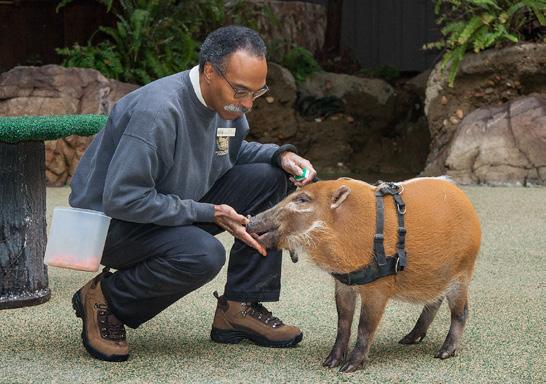
Awkward first impressions aside, the hogs are settling into cozy cohabitation, napping together and happily sharing food—an herbivore diet of pellets, root vegetables, greens, and grass hay. Fruit, a special treat, is saved to camouflage medicine, should that need arise. Murphy is quite fond of yams and carrots, but Mina seems content with her pellets.
As with all relationships, there has been a bit of compromise. Mina is one-third Murphy’s size, but she is 100 percent in charge. “She rules the roost, and established that early on,” Kelly says. “She stands on his back, pulls on his ears, nips at his legs, all kinds of normal pig communication stuff. Female are typically in charge. He could certainly put a stop to things if he wanted to, but he’s so patient with her.” Which isn’t to say he doesn’t let his feelings be known—or at least that’s what his keepers think. “She had been really active one day, and when we came in the next morning, we saw Murphy had bumped one of the food tubs up against the door of their
A
stage veteran, Murphy works well with many trainers, including Mark Freeland.
little log cabin, sort of ‘locking’ her in. We laughed about it and said he probably got a good night’s sleep that day!”
Snout and About
For these intelligent animals, stimulation and enrichment are crucial. They play elaborate games of hide-and-seek with their keepers: “They hide things—like pool drains—in their exhibit and we try to find them,” Kelly explains. Murphy and Mina also enjoy strolls through the Zoo—accompanied, of course. “Mina loves her walks with her keepers,” Kelly says. “She always wants ‘her’ people with her.” Murphy, on the other hand (or hoof), is always widening his social circle. “He loves when Sophia and Zari, the miniature Mediterranean donkey and Grant’s zebra that live nearby in Urban Jungle, stop by on their walks to the animal ambassador area. He greets them through the fence at the front of his enclosure, and then turns his rump around, hoping they’ll give him a little scratch.”
With their distinct—and different— personalities, Murphy and Mina might be a perfect pig pair. “She’s so active and has such a nose for trouble, and he is such a sweet pig,” Kelly says, fondly. “They are turning into BFFs, though. They move stuff around in their exhibit together, nap together, forage together.” Sounds like a match made in hog heaven! n
“She stands on his back, pulls on his ears, nips at his legs, all kinds of normal pig communication. Females are typically in charge. He could certainly put a stop to things if he wanted to, but he’s so patient with her.”
THE WIND BENEATH OUR WINGS: LIFE AT THE AVIAN PROPAGATION CENTER
By Karyl Carmignani STAFF WRITER
Photos by Ken Bohn SDZG PHOTOGRAPHER
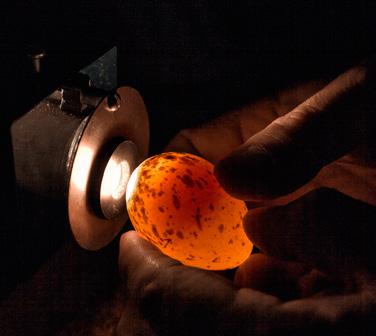
PCandling an egg reveals if it is fertile and how the chick is developing.
hysical labor, hard science, mathematical skills, patience, and a gentle touch all come into play at the Zoo’s Avian Propagation Center (APC). Breeding some of the rarest birds on the planet is a wondrous though sometimes perplexing task. Each species (and individual) has its own needs, preferences, and idiosyncrasies that can impact successful reproduction. Meticulous records are kept on each egg so keepers can discern what works and what doesn’t for successful hatchings. There are several steps to fledging a chick, from the moment the egg is laid: one or both parents must incubate the egg properly, ensure that the chick can pip its way out of the shell, feed the youngster’s voracious appetite, and keep it safe until it is ready to leave the nest. When things don’t go as planned, highly skilled keepers and veterinarians at the Zoo are ready to intervene. “Parent-reared chicks are always our preference,” said Jessica Theule, senior keeper at the APC. “But if we detect difficulties in the nest, we are prepared to hand raise chicks if necessary.”
The APC keeps records of every egg laid and hatched at the Zoo; last year 2,300 eggs were documented and tracked. The APC serves as the rearing and holding area for birds going on grounds at the Zoo and Safari Park and to other institutions. “We are committed to conservation efforts for a lot of different species,” said Jessica. “From assurance populations to education to using our knowledge to help species in the wild, like the mangrove finch in the Galápagos Islands, our work here has a far-reaching impact.”
The ABCs of the APC
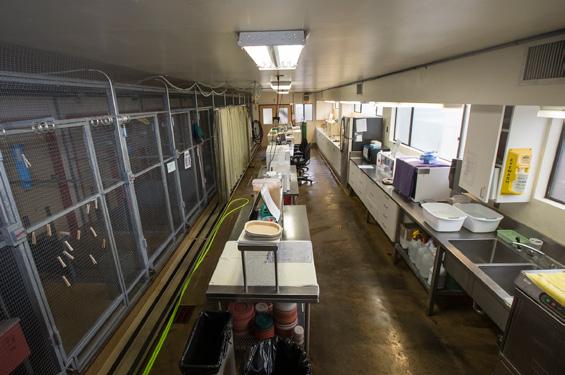
T he APC is made up of three “strings”: one for incubating and hand-raising, and two for off-exhibit breeding. This behind-the-scenes area is impeccably clean and tidy. “Bird eggs are porous and susceptible to disease,” explained Jessica, so rigorous cleaning is done regularly. Bird enclosures are kept neat, incubators are disinfected monthly, and both incubator rooms are sterilized weekly. Some enclosures house more than one bird species. “Doves and pigeons are generally more peaceful,” said Jessica, “while babblers can be destructive and aggressive to each other and outsiders.” The birds behave differently while keepers are openly watching them, so staff must be discreet to get the true picture of the avian dynamics. They monitor the birds’ behavior surreptitiously from the walkway or by observing real-time, closed-circuit camera footage in the APC office. Keepers agree that getting the birds to reproduce—especially new pairings—is the biggest challenge.
Privacy helps, but so can just the right nesting material, a favorite food, and seasonal cues. But once the birds breed, they may not be the best parents, so “we depend on the APC staff to hatch and rear many of our birds,” said Dave Rimlinger, curator of birds at the Zoo. “I am always impressed how our staff can often successfully raise a species on the first try!”
(Roll) Over Easy
Sometimes eggs are pulled from the nest so the birds will lay more, thereby increasing the chances of survival and the potential overall number of chicks. When keepers collect the delicate eggs from a nest, they are placed in one of several incubators that can be adjusted to incubate that species. Jessica pointed out that different species require different “dry temperatures, wet temperatures, and rate of egg turning” to survive. Smaller eggs need more turns per day than do larger eggs; both require less turning closer to hatching. For
instance, parrot eggs need a dry temperature of 98.5 degrees Fahrenheit, while kiwi eggs incubate best at 97 degrees Fahrenheit. The latter also need a cover over the incubator window, since wild kiwis are nocturnal and nest underground. Eggs never “see” the light of day, and letting light into the incubator can jeopardize survival. Eggs of species that come from an arid environment, like the pygmy falcon, typically require less humidity in their incubator.
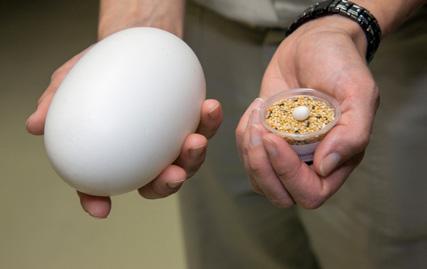
Keepers monitor the eggs closely and record development milestones. “Developing eggs all go through the same stages, just at different times,” said Jessica. Incubation times range from 9 to 11 days for the crested coua to 75 days for the kiwi. Each egg has a weight-loss spreadsheet, and gathering this data is a quiet and efficient event. A keeper removes the egg from the incubator and places it in warm millet to minimize jostling. The egg is candled by holding it in front of a bright light to observe embryonic
development. It is carefully weighed then quickly returned to the incubator. Eggs weigh less as they get closer to hatching, so tracking progress and comparing it to established baseline data is key. Candling reveals another clue that hatching is imminent: the air cell at the large end of the egg increases in size. This structure provides oxygen to the chick during the hatching process. Many species have an egg tooth, a sharp projection on the bill, that is used to crack the shell from the inside and pip their way to freedom.
Post Pip: The Brooder Room
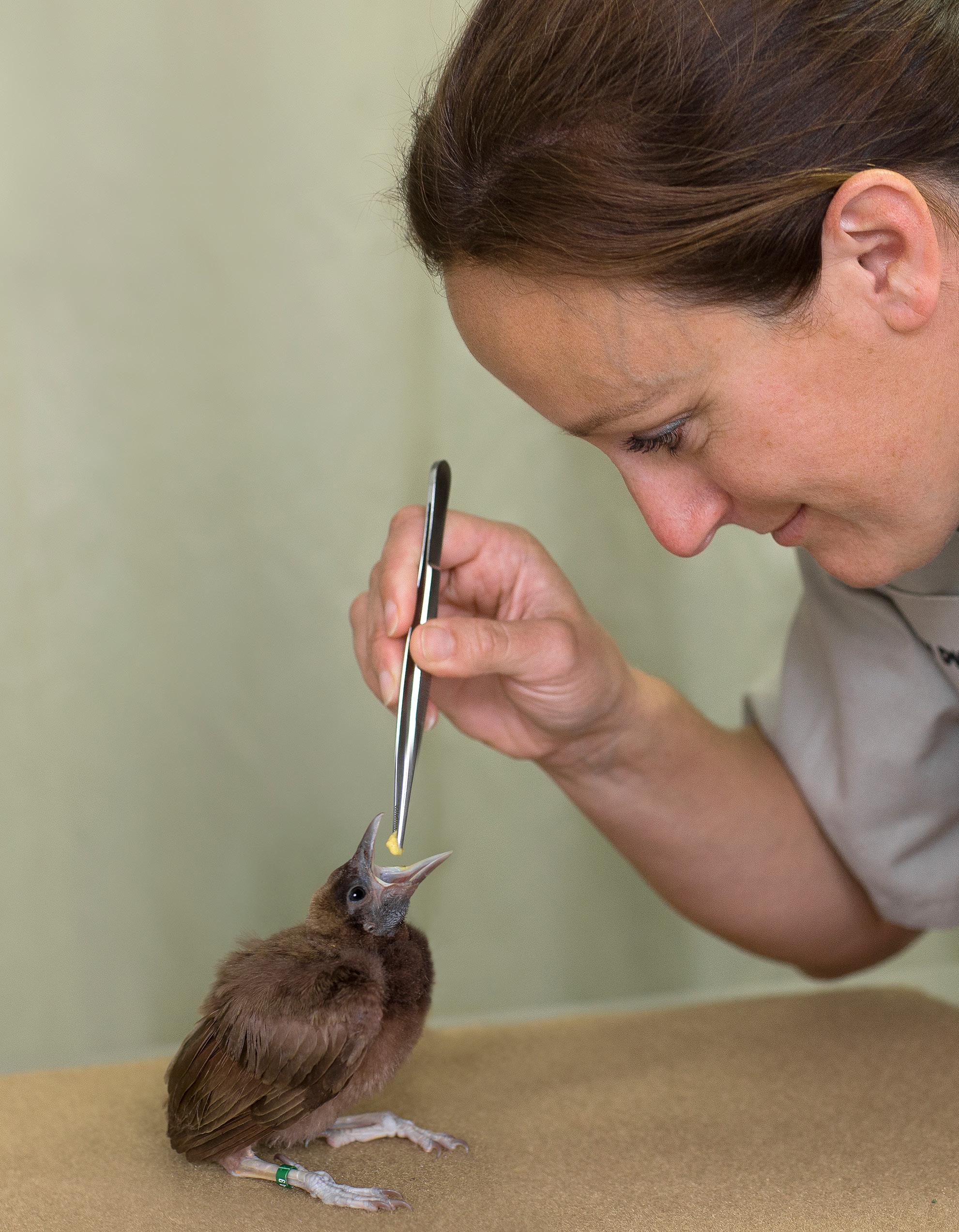
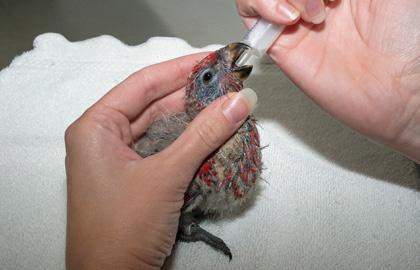
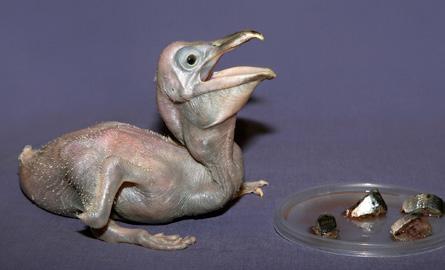
T he APC brooder room has cozy, temperature- and humidity-controlled boxes that house the newly hatched. Often still featherless, the tiny creatures must be kept warm and nourished. Not only do diets vary among chicks, but so does the feeding style. Some boxes have the word “ghost” taped to the outside, meaning that keepers must wear a camouflage outfit for feedings to prevent the chicks from imprinting on humans. A four-day-old pelican receives chunks of chopped fish from a “ghost” keeper. Unusual among birds, pelicans hatch with their eyes open, but sometimes they need help getting the fish to the right place. Once in its mouth, the wobbly, pink chick throws its head back like as if it were taking a shot of whiskey to get the fish down. It takes several moments for the food to pass down the gullet to the stomach. With feedings taking several minutes, baby pelicans rest on a heated pad for their meals, unlike other birds that scarf down their food so fast they are back in their toasty abode before they catch a chill.
Sometimes these “avian amateurs” run into health issues. Recently, three fuzzy, black-and-white long-toed lapwings came to the APC because one of them had injured its long toes. The toes were wrapped and separated with soft medical tape so they would heal properly. Neonatal avian care at its finest!
The APC handles everything from emus to hummingbirds.
Big or small, they raise t hem all!
Staff at the APC have a gentle touch, endless patience, and intimate knowledge of their charges.
All aspects of the Avian Propagation Center are kept clean and tidy to protect the eggs.
PHOTO BY TAMMY SPRATT, SDZG
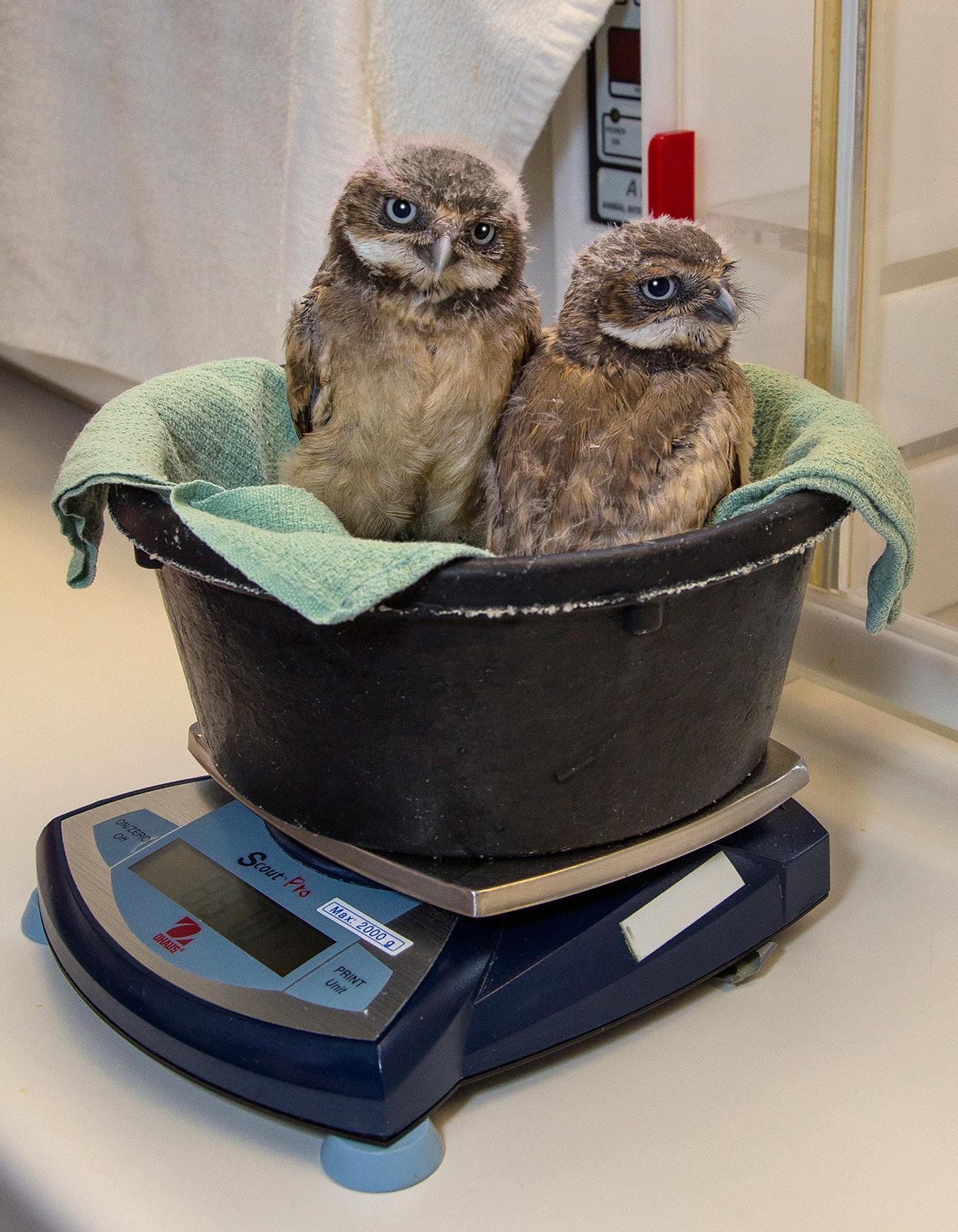
Tracking a bird’s weight is a sure way to monitor its health. These young owls are much calmer when weighed together.
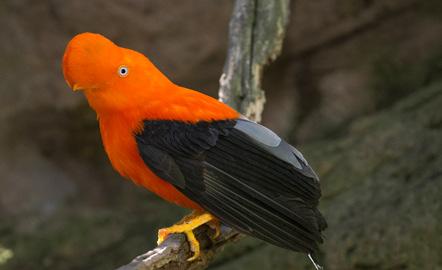
It is a magical transformation from a wobbly chick to a mature cock-ofthe-rock bird.
The goal of the APC is to produce healthy birds, like this adult cock-ofthe-rock.
This Dalmatian pelican chick already has a voracious appetite.
Challenges and Victories
The Andean cock-of-the-rock is exceedingly rare in zoos. The APC first reared them in the 1980s, then the species was out of the collection for several years. When we acquired them again, they were still a rarity. Now, the tide is turning for this species, since the experts at Dallas World Aquarium have been very successful at raising them, as has the APC, with eight chicks fledged in 2014. It is hoped that one day soon, this avian wonder will become more common in zoos and in the wild.
The vainly named beautiful sunbird is another challenging species, because spiders are its primary food. In 2013, keepers had staff and volunteers throughout the Zoo collecting thousands of daddy long leg spiders to feed to the parents to share with their chick. It was a colossal effort, but it paid off and the chick fledged (he now lives at
All this “eggs-pertise” is shared when San Diego Zoo Global hosts an annual Incubation Workshop, which people from zoos and conservation programs from around the world attend. Using chicken eggs, attendees are versed in embryo development, incubation management, and what to do when things go wrong.
the Safari Park). The following year, a beautiful sunbird egg was hatched and the chick was reared at the APC. It was fed a diet of tasty cricket abdomens, and the tiny chick, weighing a mere 0.63 grams at hatch, thrived. The APC is also home to the only pair of Blyth’s tragopans in the US. It is hoped that this gorgeous pheasant will soon have a nestful of youngsters—or at least eggs. The talented staff at the APC can take it from there. n
PHOTO BY TAMMY SPRATT, SDZG PHOTOGRAPHER
THE APPEAL OF BANANAS
By Wendy Perkins STAFF WRITER
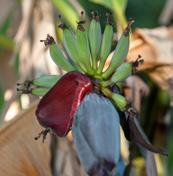
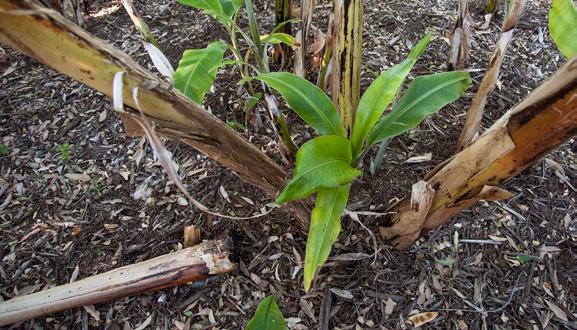
Bananas do not grow on trees. It’s true! The plant’s long, broad leaves are supported by a single stout structure called a pseudostem, which only looks like a tree trunk. But banana plants are actually considered giant herbs. They are herbs that bear fruit—which means, botanically speaking, that the fruit is a berry. Intrigued? That’s just the beginning.
Photos by Tammy Spratt SDZG PHOTOGRAPHER
TROPICAL AND ANCIENT
Banana plants belong to the genus Musa. Wild bananas are found throughout Southeast Asia today, but they are mostly inedible to humans. Containing little fruit and many hard seeds, they are too much work for too little gain for Homo sapiens, but they are a boon to wildlife.
The bananas we eat are seedless. It is believed this mutation was first noticed and nurtured by humans in Southeast Asia circa 8,000 to 5,000 B.C.E. Archeological findings suggest humans in the Kuk Valley of New Guinea may have been the first to domesticate the plant. Other evidence suggests that spontaneous domestication may have also occurred soon after in other parts of Southeast Asia and the South Pacific. From there, domesticated Musa plants were carried across the tropics and cultivated over hundreds of years. As Musa spread, so did the diversity.
BANANA-COPIA
Asked to draw a banana, most people would sketch something resembling a curved cylinder narrowing to a point at both ends. That’s what is most commonly seen in the produce section—often our only exposure to the fruit. Yet among the well over 1,000 types of domesticated bananas, there exists a range of shapes and sizes. Some are round as a bowling ball, others long and straight. Certain types are short and thick, some are pear shaped, and a few look like nothing else—especially not the bananas we typicially buy at the grocery store.
The names given to the plethora of banana varieties are often vividly descriptive: False Horn (long and straight); Praying Hands (pieces grow close together, sometimes even fused); Monkey Fingers (exceptionally long, slender, and slightly curved); and the astonishing Hapai (“pregnant” in Hawaiian) banana, so named because the fruit develops inside the trunk! An abundance of fruit flies and ants on the trunk of a Hapai banana plant is a sign that the fruit inside is ripe. To harvest the bananas, the farmer carefully cuts the central stalk open and pulls the fruit out.
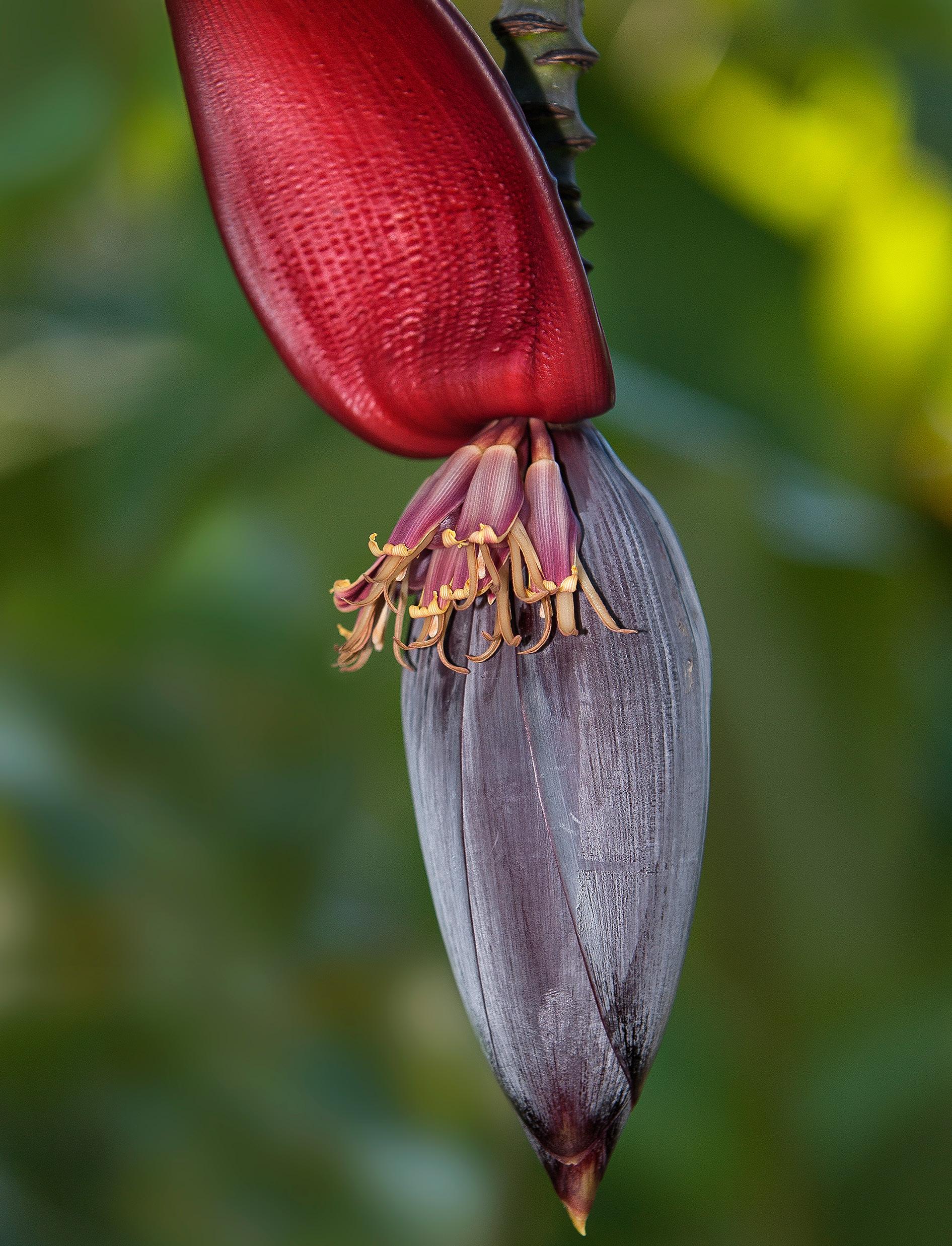
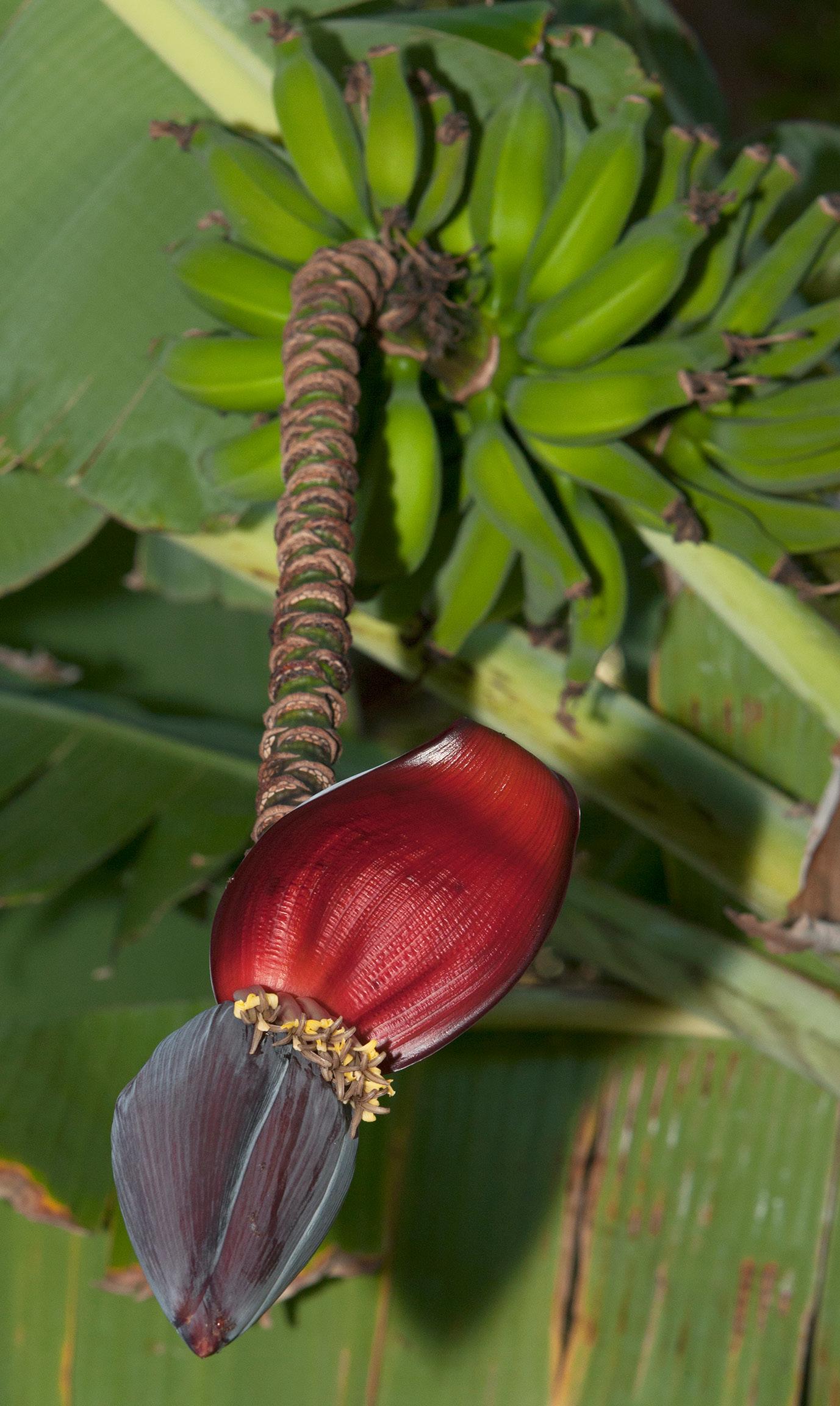
A banana plant’s inflorescence takes the form of a long stalk. Mature female blossoms become bananas. Maroon bracts of the terminal bud lift to reveal the male flowers.
Right: Sprouts called “pups” emerge from the rhizome beneath the soil surface.
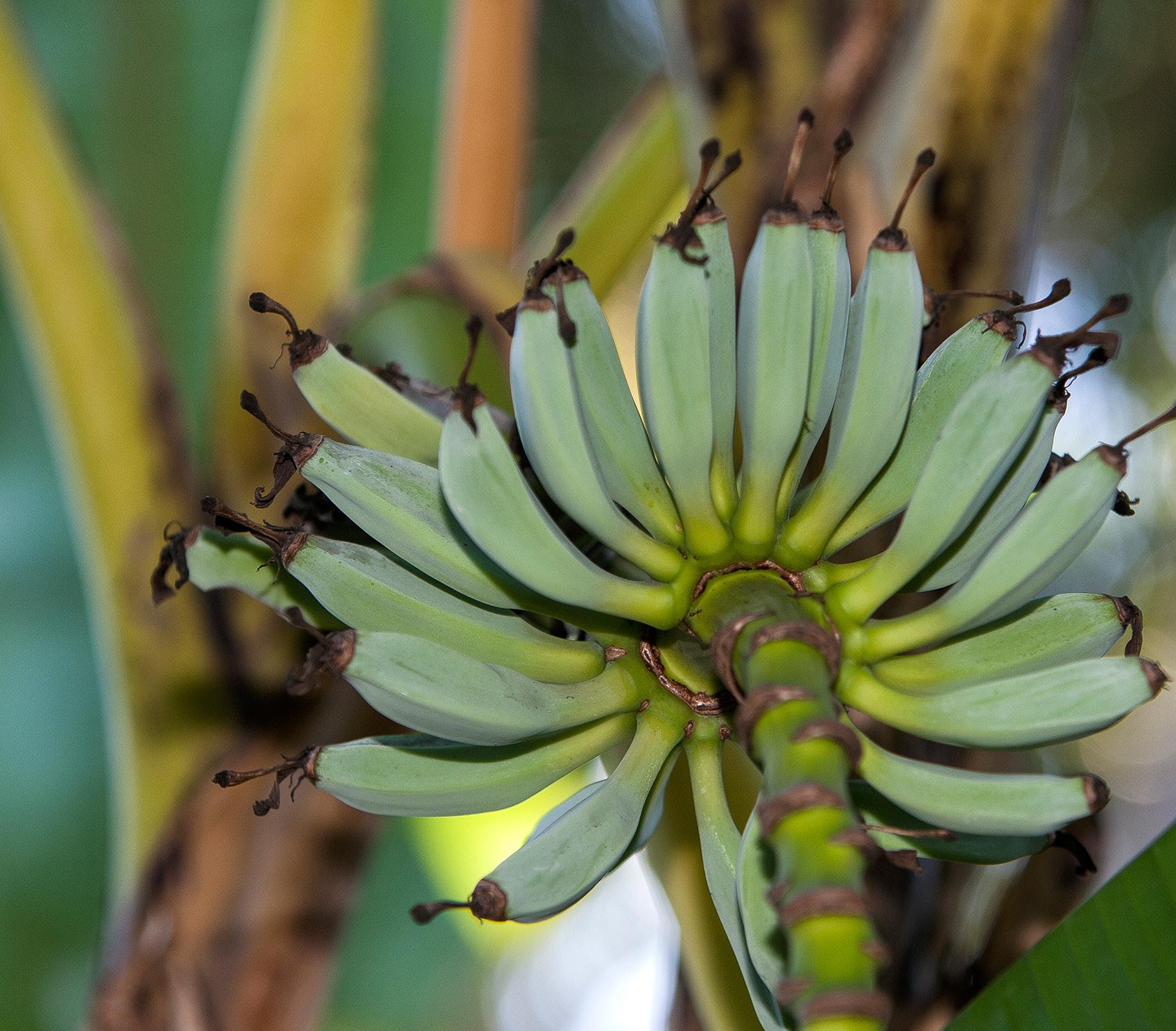
Below: A “bunch” of bananas is all the fruit on a single stalk. The smaller bundle we buy in stores is more correctly called a “hand.”
MUSA SPEAK
Around the world, different human cultures have developed their own Musa species. Some are called plantain instead of banana, and there is a noticeable difference between the two. Starchy plantains are cooked before being eaten. They have a low-moisture content (65 percent on average), contain little sugar, and are not good eaten raw. Bananas contain more moisture (83 percent on average) and a higher sugar content, which makes them delicious to humans when eaten raw.
Whether the subject is plantain or banana, there’s a simple lexicon for referencing the harvest—and most of us have been saying it wrong. A single banana is called a finger. About 20 fingers make up a “hand,” and multiple hands grow in a bunch, also known as a stalk. Depending on the variety, a bunch of bananas may contain 3 to 20 hands!
HOME GROWN
Being tropical, bananas require great quantities of water, heat, and rich humus-type fertilizers. In warm climates like those found in the southern US and many Mediterranean countries, growing bananas has become a popular pastime for gardening enthusiasts. New varieties pop up frequently, bred for the home garden market.
The San Diego Zoo cultivates 24 species of banana plants on its 100-acre grounds. The leaves and stalks are harvested and given to our primates and elephants as browse. The fruit sometimes supplements the commercial bananas purchased to feed many animals in the collection. In our Mediterranean climate, it takes a good 2 years to reach fruiting, whereas in the tropics it takes 12 to 14 months, depending on the variety.
The Zoo’s Musa collection not only provides nutrition and enrichment for the animals, it also adds to the beauty of the grounds. Clusters of stout trunks and long, broad, deep green leaves create a lush, tropical feel, and visitors can see what plant produces this favored fruit. For all these reasons, bananas are a truly appealing group of plants. n
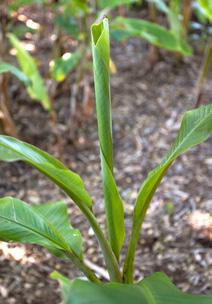
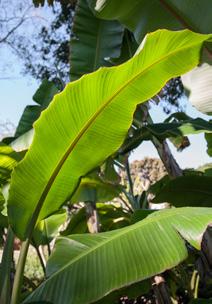
It begins with just one leaf.... Generally, a banana plant produces 40 leaves before fruiting.
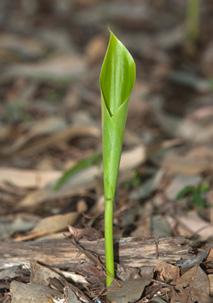
New banana leaves—called “cigar leaves” because of their tightly rolled shape— emerge one at a time from the center of the stalk.
The veins in a banana leaf do not branch as in some other plants, making them tear easily when disturbed.
CONSERVATION: IN THE DETAILS DEVIL’S THE
By Karyl Carmignani STAFF WRITER
Photos by Ken Bohn SDZG PHOTOGRAPHER
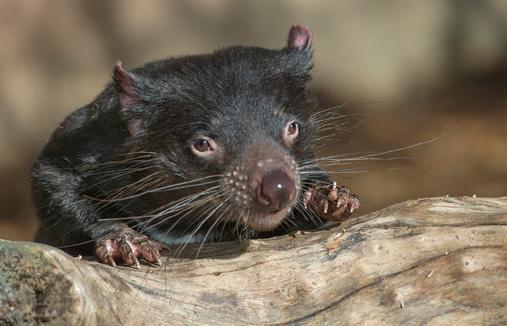
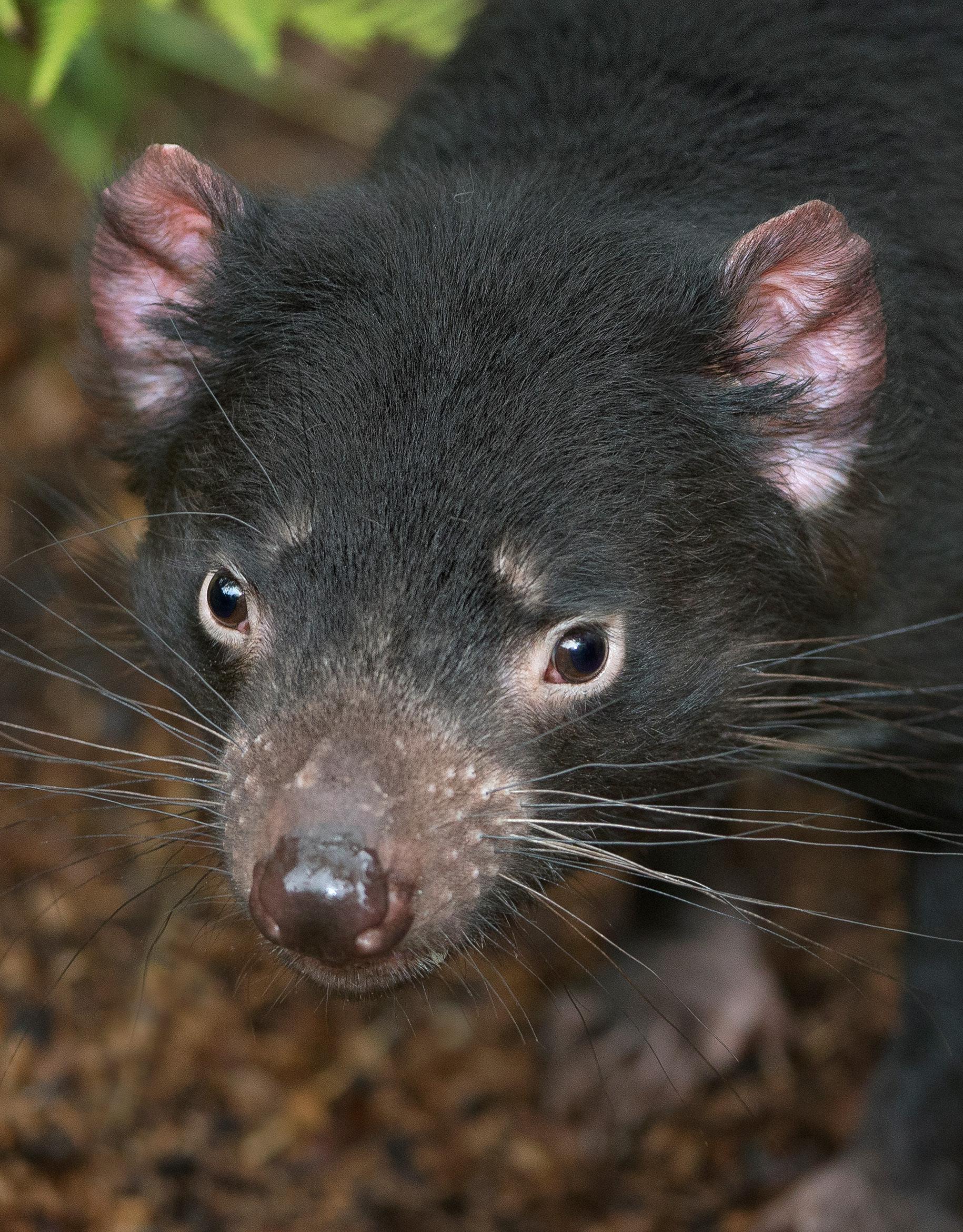
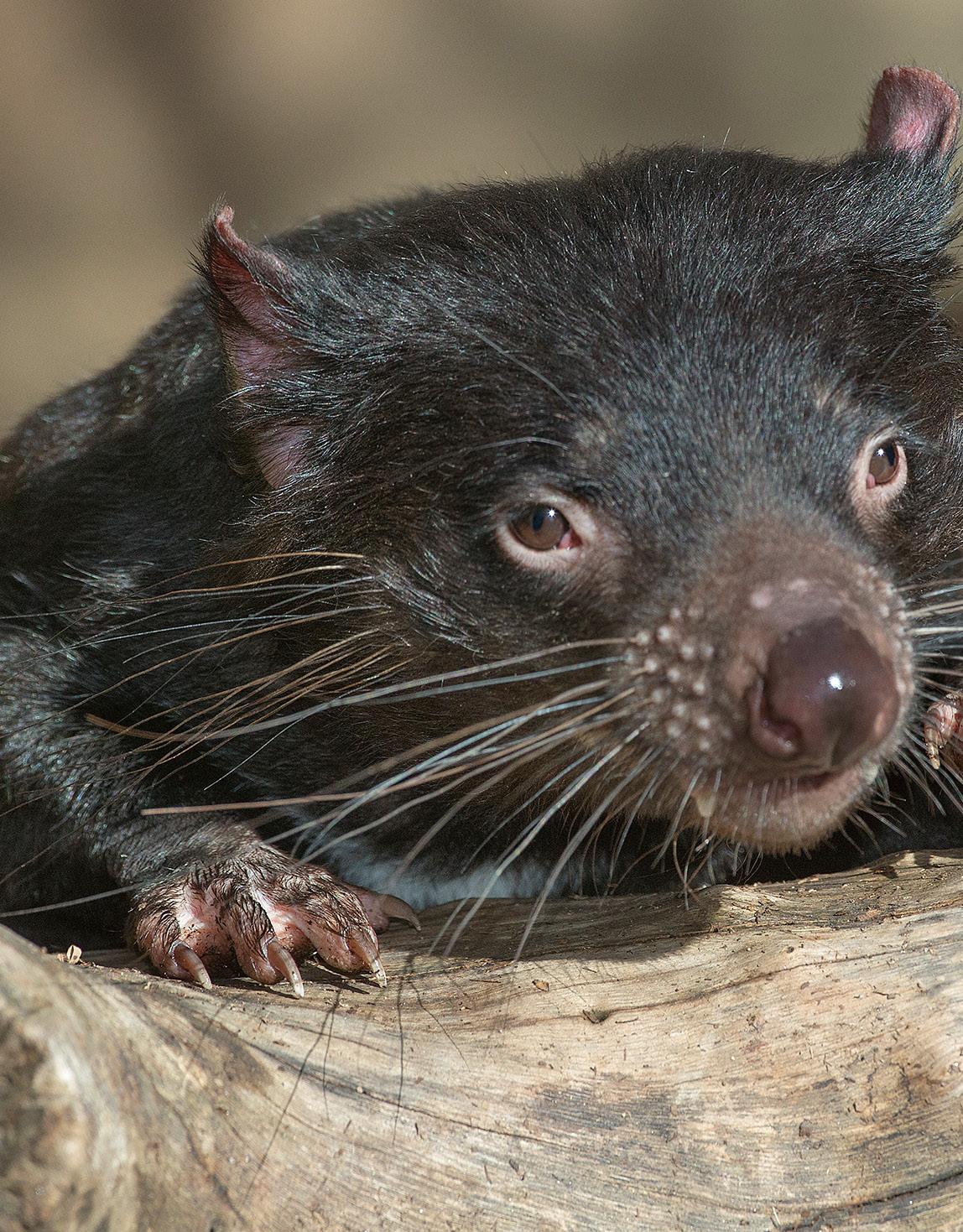
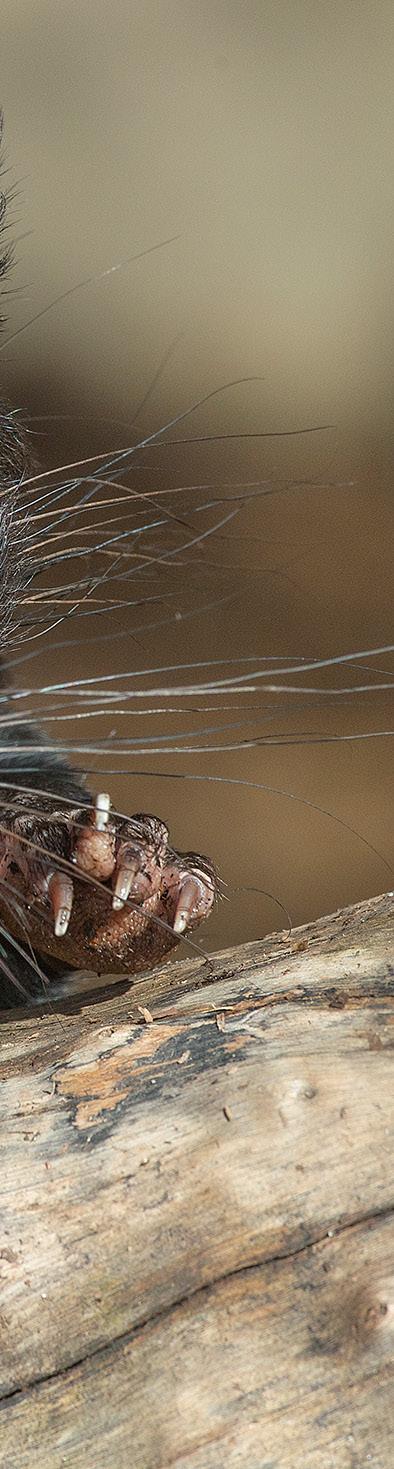
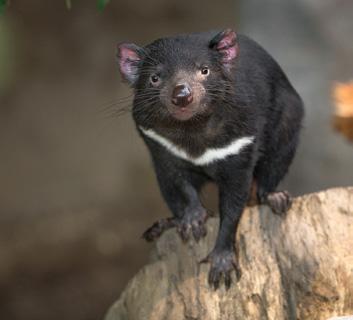
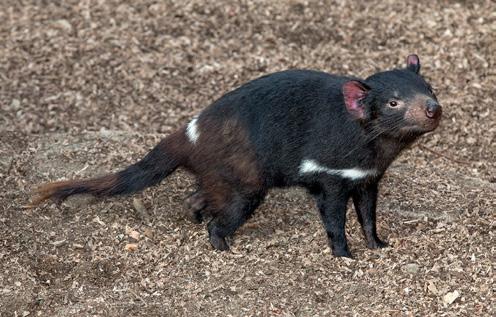
It is the largest carnivorous marsupial in the world. It is solitary and nocturnal, roaming nearly 10 miles by night looking to scavenge or hunt whatever is available. Powerful jaws and teeth enable it to consume its prey—bones, fur, and all. Though barely bigger than a beagle, it has a fierce and effective vocal repertoire, from harsh coughs and snarls to high-pitched shrieks, especially when bellied up to a large carcass or vying for a mate. When early European settlers encountered the famously ferocious mammal, they dubbed it a “devil” and tacked on its geographic range to avoid confusion: the Tasmanian devil Sarcophilus harrisii. But something the creature cannot stave off with its wily ways or ear-splitting shrieks is devil facial tumor disease (DFTD), a highly contagious, consistently fatal cancer that starts in the mouth and moves to the animal’s face. It is found only in this species. The disease has already decimated 85 percent of wild devils since 1996. The unusual affliction has created a crisis for this species that requires commitment and collaboration to combat, and San Diego Zoo Global is contributing expertise and support to this pressing conservation cause. “It is an urgent situation,” said Bob Wiese, Ph.D., chief life science officer of San Diego Zoo Global. “We need to find ways to re-establish Tasmanian devils throughout their historic range and keep the animals free of this aggressive and fatal disease.”
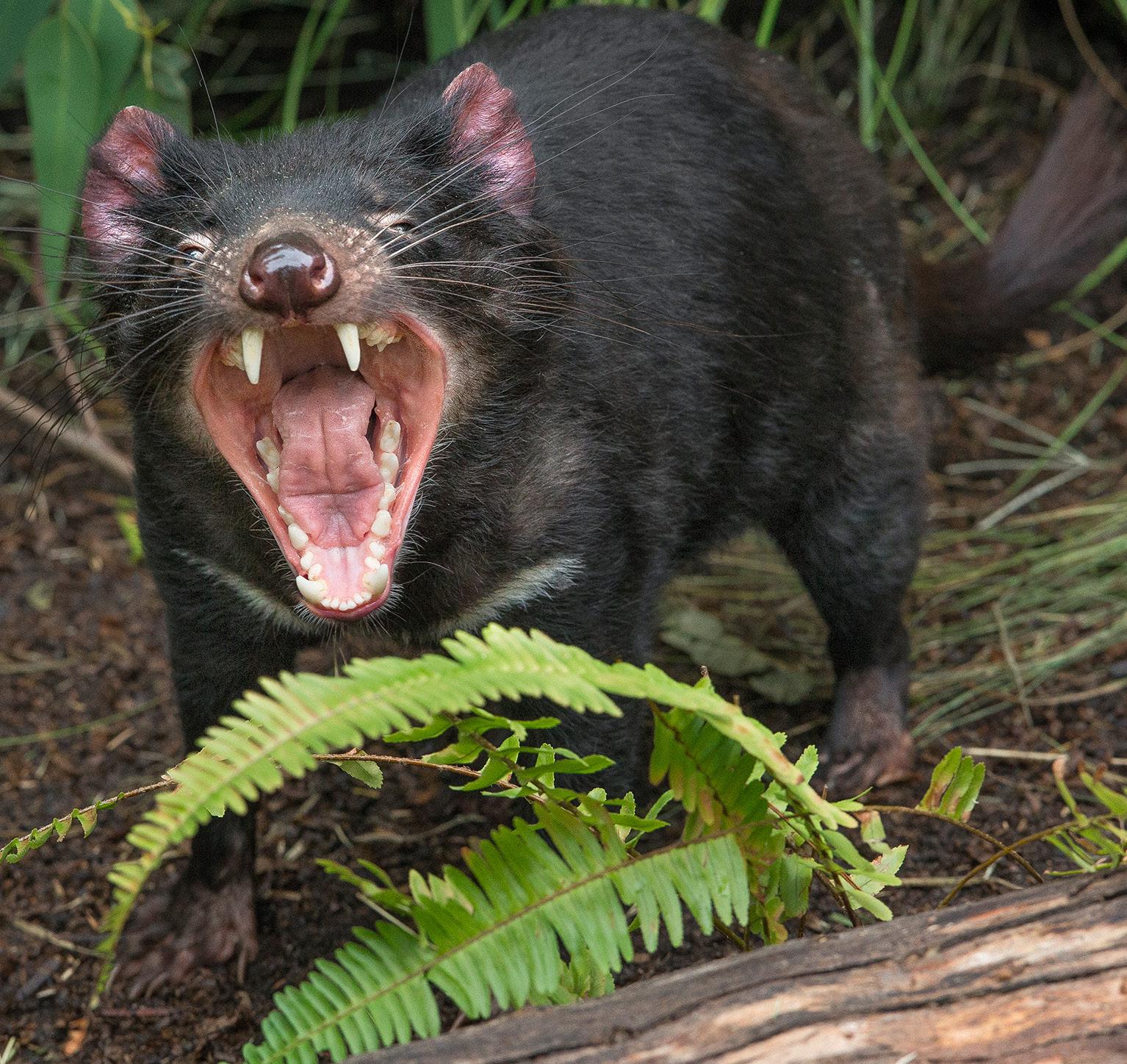
Opposite page: Researchers around the world are working together to save the Tasmanian devil. This page: Famed for its ear-splitting shriek, the Tasmanian devil has many other talents—like being the largest carnivorous marsupial in the world!
Safe Haven
Researchers are working diligently on several fronts to save the Tasmanian devil. Breeding centers, including the Trowunna Wildlife Park in Tasmania, are working together to form disease-free populations that can be reintroduced to the wild. These assurance populations are critical to the Save the Tasmanian Devil Program (STDP). To facilitate breeding and natural behavior, devil enclosures are spacious and complex with climbing structures, hiding places, and nest material.
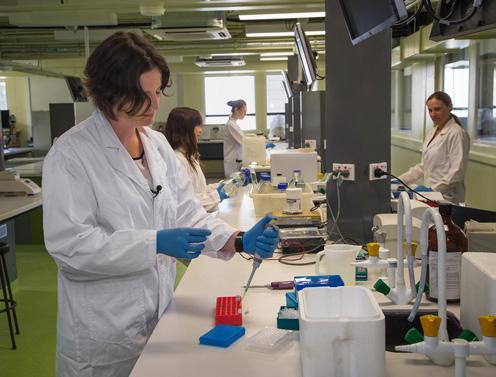
The University of Sydney is a leader in genetic sequencing of the Tasmanian devil. This expertise will be used to monitor genetic variation in the devils being bred in zoos and breeding facilities. San Diego Zoo Global is contributing $500,000 to this project, including funding geneticist Catherine Grueber, Ph.D., at the university. Her conservation work will help maximize genetic diversity within assurance populations.
Protected Landscape
A vast river separates the Tasman Peninsula from the mainland, making it a man-
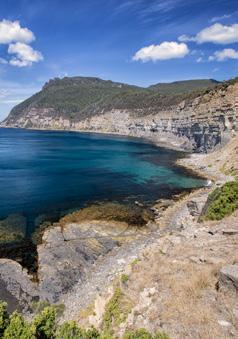
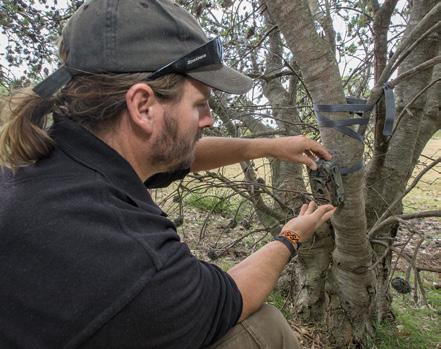
habitat in which to translocate healthy Tasmanian devils.Researchers continue to monitor the animals through 14 video camera traps set throughout the island, as well as observing telltale signs like their unmistakable scat.
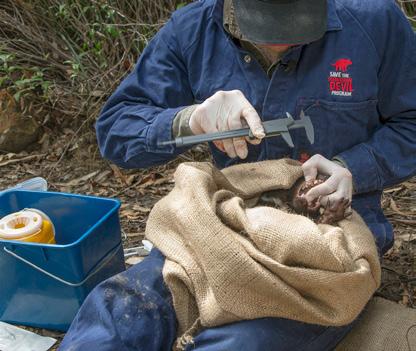
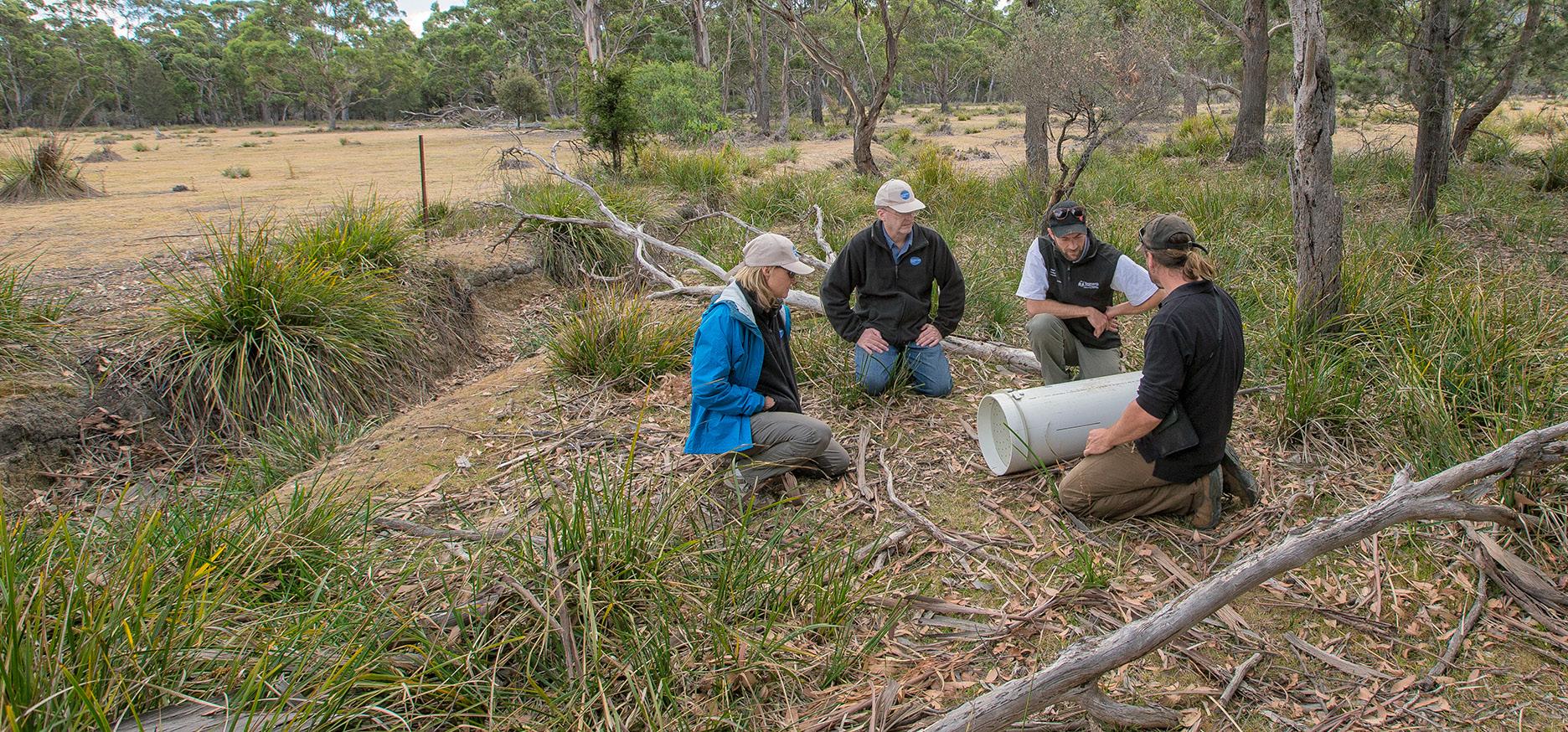
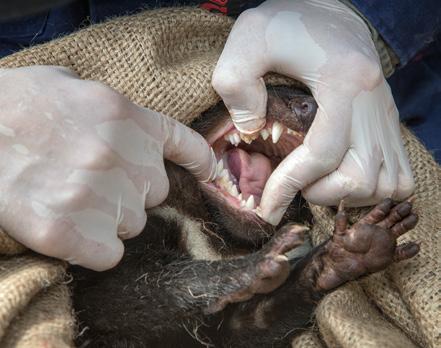
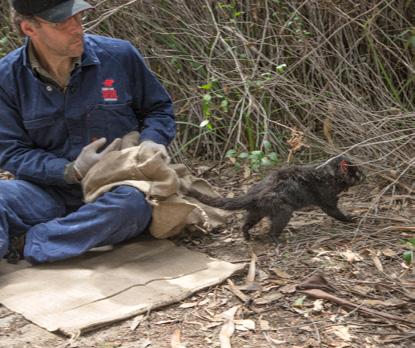
ageable location to reintroduce devils and monitor them. A fence has been built across the narrow isthmus to keep out devils that may have DFTD and could spread the disease. Catch-and-release traps made out of PVC pipe are baited and set around the area. When a Tasmanian devil is caught, biologists take a series of measurements; check its body condition; closely inspect its mouth, since tumor cells are transmitted through biting and emerge there first; microchip the animal; and collect tissue samples. This project is “worthwhile because it is the only way we can actually stop the disease from getting into the population,” explained Bill Brown, wildlife biologist for STDP. The re-wilding of this peninsula will be a critical and ongoing process in saving the Tasmanian devil.
Maria Island, a picturesque ecosystem isolated from the mainland, is an ideal habitat in which to translocate healthy Tasmanian devils. To date, more than 80 adult animals inhabit the island, from a release cohort of 27. Researchers continue to monitor the animals through 14 video-camera traps set throughout the island, as well as observing telltale signs of them, such as their unmistakable scat. In addition to the devils’ activities, the camera traps reveal other native creatures like echidnas and wombats. It is a long-term investment in Tasmanian devils. “We knew it wasn’t going to be a dump-and-run exercise,” said Drew Lee, translocation team leader with STDP. This is a collaborative effort to resuscitate populations of this iconic species, including laboratories, breeding centers, select zoos around the world, and San Diego Zoo Global.
Our Devils
Katie Tomlinson, senior keeper at the Zoo, attended a workshop on Tasmanian devil husbandry at Trowunna Wildlife Park in the hopes that we would one day be chosen to exhibit the devils. Happily, in 2013, San Diego Zoo received four Tasmanian devils for our Conrad Prebys Australian Outback exhibit: three males named Conrad, Nick, and Jake, along with Debbie, a female. Katie has worked with them from day one and considers them her “little pride and joys.” The animals have settled in nicely and each has
Maria Island is a scenic ecosystem isolated from the mainland. It is an ideal
San Diego Zoo Global is funding the work of a geneticist at the University of Sydney to better monitor genetic variation among devils being bred in zoos and breeding facilities.
Camera traps reveal the secrets of the forest, like echidnas and wombats.
Researchers take several measurements of the devils to monitor their health.
Tasmanian devils are collected in a simple and safe trap, which researchers check frequently.
The animal’s mouth is inspected closely, as the devil facial tumor disease (DFTD) is transmitted by bite.
Tasmanian devils are collected in a simple and safe trap, which researchers check frequently.
Tasmanian devils are well-suited for making their way through the night in search of carrion and other small animals to eat.
Shout Out:
We are pleased to collaborate with the Tasmanian government’s Save the Tasmanian Devil Program, The University of Sydney, and the Zoo and Aquarium Association of Australasia to help save the Tasmanian devil from extinction.
its own personality: Jake is no longer tearing up the plants in his exhibit (in his defense, digging is natural for these animals), Conrad enjoys peering at his food-bearing keepers through the exhibit door, Debbie shows her keen intelligence when she’s not feeling ornery, and Nick has totally embraced the laid-back Southern California lifestyle. The animals are rotated between the four exhibits, with new scents and different hiding and basking spots providing enrichment. They are “scatter fed” throughout the day, which keeps them active and engaged. As
dyed-in-the-wool carnivores, they get mice, beef parts, fish, and big juicy bones—there are never leftovers! The devils’ biggest job is to teach visitors about the health plight of their wild counterparts, while dispelling the dervish reputation of the species. “We have a great opportunity to introduce them to people here in the US, and show that they are not just a cartoon character,” said Katie. Inspiring people to care about these unusual marsupials and working with other organizations to save them from extinction is our mission. And it’s not impossible. n
Four Tasmanian devils reside at the San Diego Zoo at the Conrad Prebys Australian Outback.
Devils are curious and intelligent animals, each with its own distinct personality.
Conservation corps:
An Early Start at Making a Difference
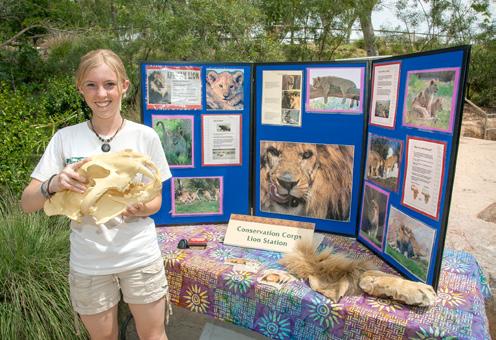
Conservation Corps members give nature a helping hand.
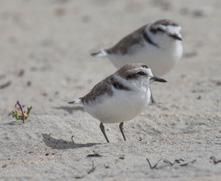
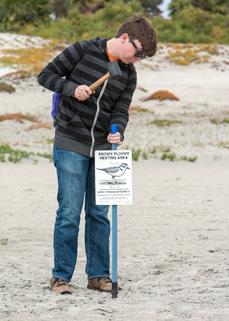
Symbolic fencing will help protect snowy plover and lesser tern nesting areas at Breaker’s Beach in Coronado.
By Peggy Scott ASSOCIATE EDITOR
Folks lamenting about “kids today” haven’t met the young people who devote their time and energy as members of the San Diego Zoo Safari Park’s Conservation Corps. These high school students have made a commitment to making a difference, and that dedication is helping shape a more promising future for wildlife. In return, participants gain confidence-building skills and the pride of knowing they’re helping build a better tomorrow—one day, and one project, at a time.
Conservation Corps is a hands-on program for teens interested in conservation, science, public speaking, and community service. Conservation Corps members help make a difference in two different ways.
“The students participate in four ‘Action Days’ and four ‘Interpretation Days’ each semester,” explains Sasha Stallard, education manager at the Safari Park. “They work with various San Diego Zoo Global staff members on real conservation projects in the field as well as on Safari Park grounds, where they share information with guests about wildlife and conservation, using artifacts, biofacts, and interactive games.”
Getting Their Hands Dirty
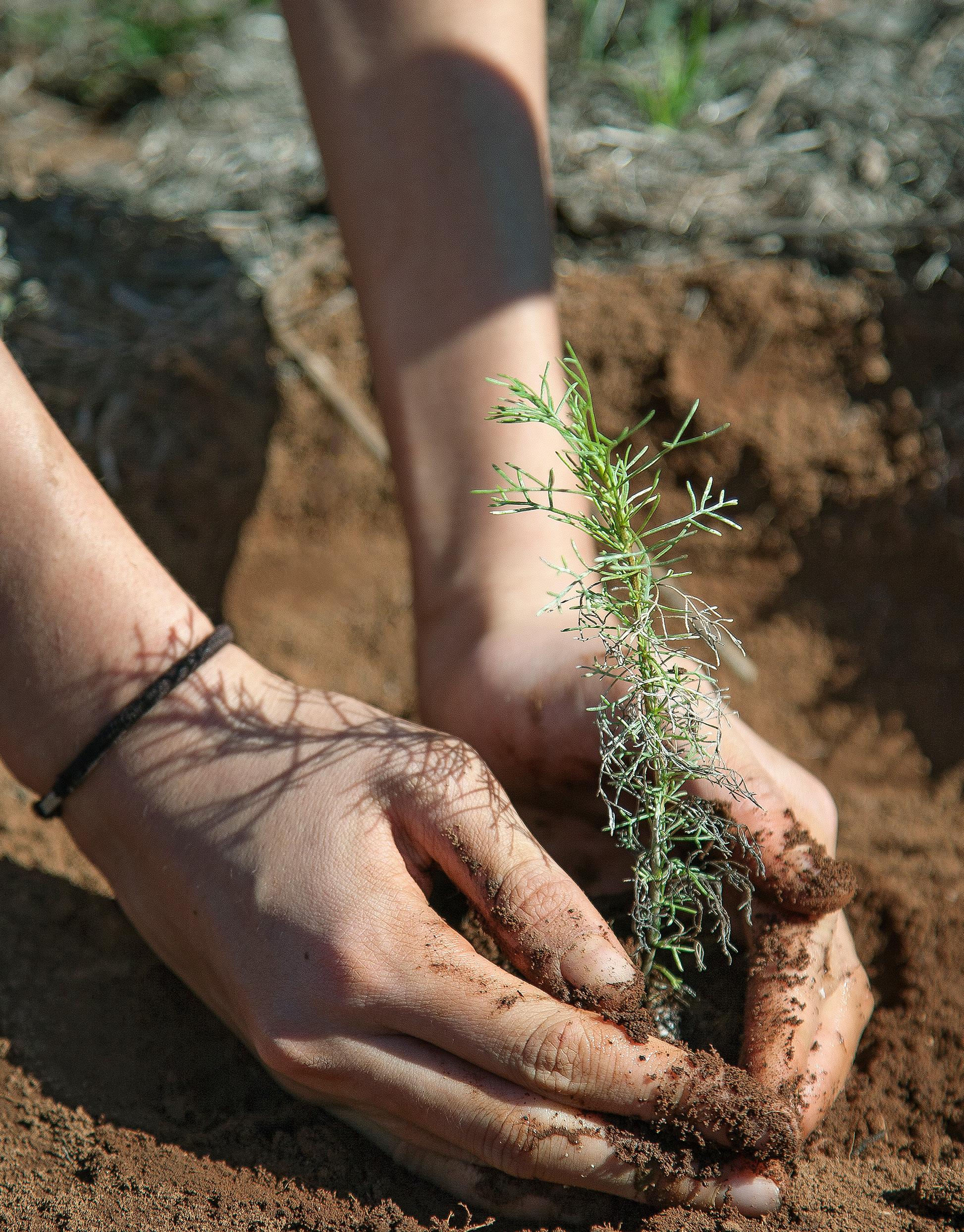
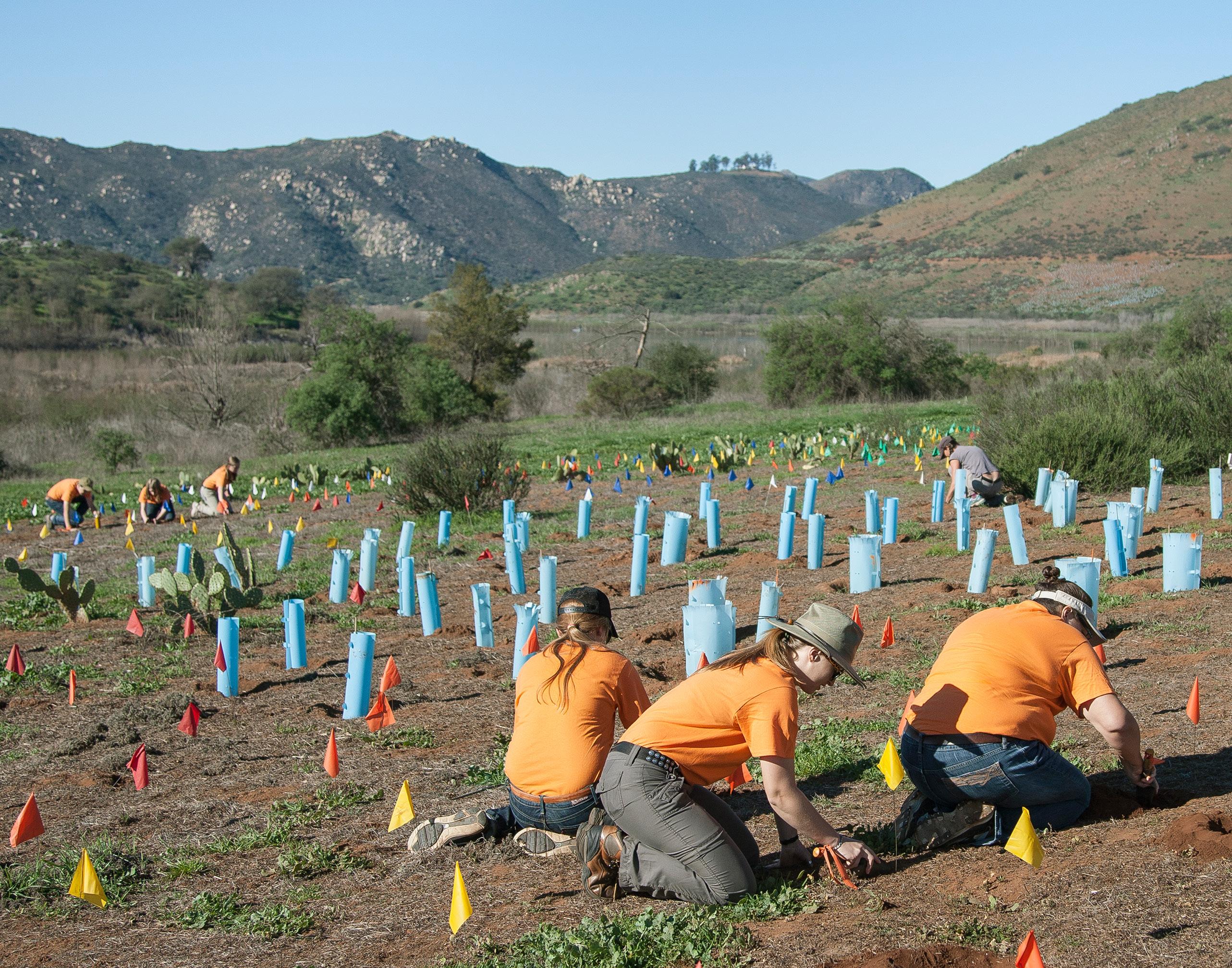
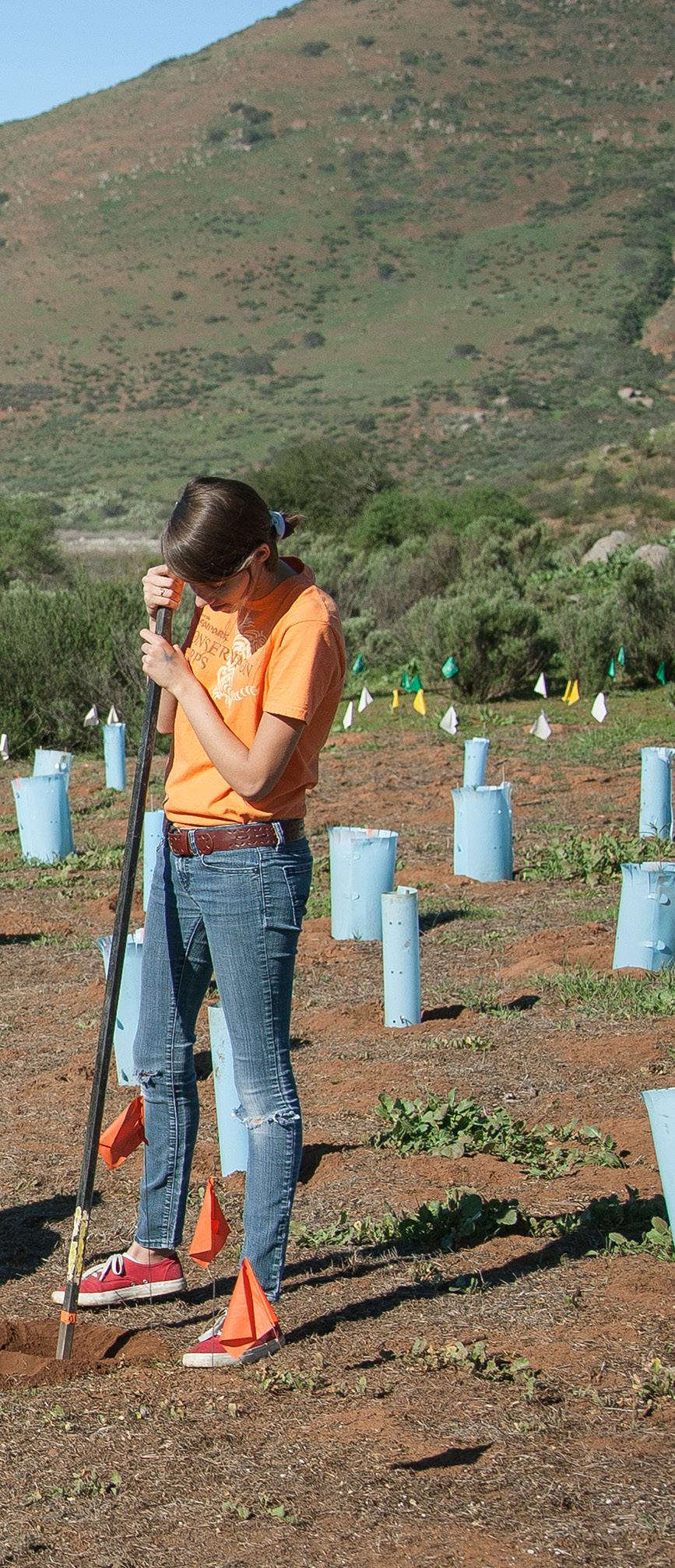
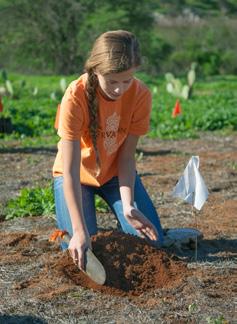
In February 2015, participants from Conservation Corps and the San Diego Zoo’s Zoo Corps, along with members of their families, rolled up their sleeves and dug into a project at Lake Hodges. The volunteers helped plant 825 native plants as part of an ongoing project to help restore habitat that was destroyed by the 2007 wildfires. This particular project began in 2014, with the goal of planting 20,000 native shrubs across 25 acres around the lake by 2016. To date, more than 10,000 plants have taken root as part of this green-thumb group effort. It was spearheaded by the team from the San Diego Zoo Institute for Conservation Research Applied Plant Ecology division, in conjunction with the San Dieguito River Park,
Photos by Tammy Spratt SDZG PHOTOGRAPHER
with a Wildlife Conservation Society Climate Adaptation grant and a Climate Ready grant from the State Coastal Conservancy.
“Having the Conservation Corps and Zoo Corps teens help on this restoration project has been great,” notes Christa Horn, conservation program specialist at the Institute. “The teens volunteering have been vital to the success of this important conservation project. They have accomplished so much while getting to spend time outdoors, connecting with nature.”
Taking part in such projects has given some participants an outlet for their personal interests. “Animals are my passion,” says one Conservation Corps member. “I love every moment I am involved in helping either a species or a habitat. Every time I leave CC I feel good about what I have accomplished.”
The experience is just as rewarding for program organizers. “This program is a favorite part of my job!” Sasha says. “The students in this program inspire and amaze me every time we get together. Their drive, determination, and interest in having an active role in conservation education gives me hope, not only for the future of San Diego Zoo Global but also for the future of conservation in general. The greatest
Ropes will be attached between these stakes to deter beachgoers from entering the nesting area.
“ The teens volunteering have been vital to the success of this important conservation project. They have accomplished so much while getting to spend time outdoors, connecting with nature. ”
thing about this program is that whether the students choose a career that directly relates to conservation or not, their experiences will help to shape the decisions they make as they move into the world as adults. They leave the program as strong stewards for conservation, ready to take action and make a difference in the world.”
At the Core of the Corps
Each Conservation Corps session runs five months (January through May and August through December). Students interested in applying must attend a mandatory information meeting with a parent/guardian. If selected, applicants must be available for an interview and, if accepted, must be available to attend a mandatory two-day training program. A limited number of applicants are selected each session.
Applications for the program are distributed only at the information meetings. The program fee is $150 per student. The next Conservation Corps session runs from September through December, and the information meeting is in August. For more information, call 760-796-5671. n
The restoration project at Lake Hodges has resulted in more than 10,000 native plants taking root.
Corps members help restore native plant habitat at Lake Hodges in North County.
PHOTO BY KEN BOHN, SDZG
Conservation Corps members help spread the word about what Safari Park visitors can do to help save animals and their habitats.
Chan in the
By Justin Weber DIGITAL FUNDRAISER, DEVELOPMENT
e share the planet with close to nine million species of plants and animals—and seven billion people! Tragically, as the human population grows, so do habitat loss and wildlife poaching. Species like the rhinoceros, tiger, and elephant are vanishing at this very moment. Humans are the cause of their demise, but you and I can be the heroes to help save them from disappearing forever.
World
San Diego Zoo Global is leading the fight against extinction. We’re committed to saving species large and small, furry, scaled, and feathered. With support from generous donors like you, we’ve successfully helped save species like the California condor and giant panda for future generations.
As a leader in conservation, our efforts span the globe, with over 140 conservation projects in nearly 80 countries. San Diego Zoo Global has successfully bred 165 endangered species and reintroduced more than 40 of those species back to the wild. This passion, dedication, and teamwork are making a significant impact!
But our commitment and work are far from over. Today, we partner with 250 other organizations to save species like the rhino, elephant, and gorilla. We have the opportunity to make a difference in today’s world that will last beyond our lifetimes. If you’d like to join us in these life-saving efforts, make a gift to the San Diego Zoo Global Wildlife Conservancy today at endextinction.org. n
You can help secure the future for wildlife!
Heritage Guild
Nola, who lives at the Safari Park, is one of only five northern white rhinos left on Earth.
PHOTO BY SDZG
PHOTO BY KEN BOHN, SDZG PHOTOGRAPHER
By creating a Charitable Gift Annuity or including the Zoological Society of San Diego in your will or trust, you can help protect wildlife. To receive more information, or visit our website at zoolegacy.org.
BY
King of Hearts
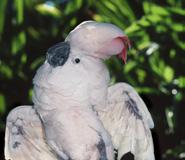
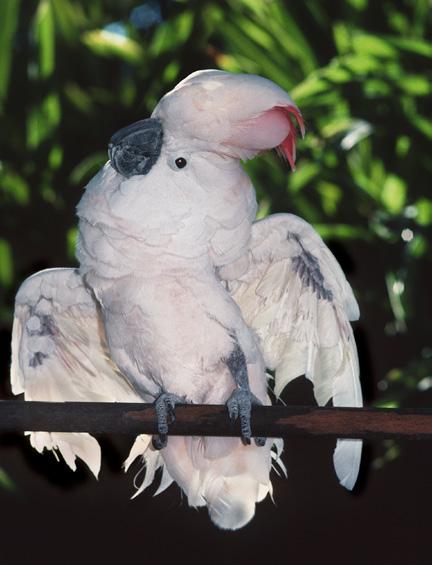
King Tut, a salmon-crested cockatoo, was the San Diego Zoo’s beloved official greeter for 40 years. He was already an adult bird when he arrived in San Diego on March 25, 1925. At first, his time was divided between the Zoo, where he delighted visitors with his vocal and physical antics, and various motion picture and theatrical duties— including a role in fan dancer Sally Rand’s act.
In early 1951, King Tut began spending more time in his position as official Zoo greeter. He still kept a clawed toe in show business though, through appearances on the long-running Zoorama television program and small roles in productions at San Diego’s Old Globe Theatre, as well as the Starlight Opera.
Friendly King Tut loved people, and they adored him. As one ZOONOOZ article about him pointed out: “His bearing is that of a king...a king who is well loved.” Millions of people stopped to say hello to Tut during his long life at the Zoo, and he’d respond with a whistle or little dance to greet them in return. When he was most excited, he’d let loose with his (very loud) trademark shriek: “ahha-ha-HA-ha!” He retired from frontline duties in 1989, but he continued to appear at special functions—and receive fan mail.
Today, a bronze likeness of the great King Tut greets guests to the left of the flamingo pond—in the exact spot his perch occupied for nearly half a century. n
PHOTO
SDZG
PUBLISHED SINCE 1926 JUNE 2015 n LXXXVIII–NO. 6
MANAGING EDITOR KAREN E. WORLEY
ASSOCIATE EDITORS PEGGY SCOTT
STAFF WRITERS
WENDY PERKINS
KARYL CARMIGNANI
SAN DIEGO ZOO GLOBAL™ PHOTOGRAPHER KEN BOHN
TAMMY SPRATT
DIGITAL IMAGING TECHNICIAN TAMMY SPRATT
DESIGN AND PRODUCTION DAMIEN LASATER
CHRISTOPHER MARTIN
KERRI ABRAMS
HEIDI SCHMID-ROMERO
STEPHANIE BEVIL-PAGADUAN
DENNIS CORBRAN
KAMBIZ MEHRAFSHANI
KRISTIN NIELSEN
KIM TURNER
LISA BISSI
SAN DIEGO ZOO GLOBAL™ VIDEOGRAPHERS LEE RIEBER
MARIA BERNAL-SILVA
DUSTIN TRAYER
The Zoological Society of San Diego was founded in October 1916 by Harry M. Wegeforth, M.D., as a private, nonprofit corporation that now does business as San Diego Zoo Global.
This digital edition of ZOONOOZ® is currently published every month. Versions are available for download on iPads and a PDF version is available for viewing on Kindle Fire, desktops, Android devices, and smartphones. Publisher is San Diego Zoo Global, at 2920 Zoo Drive, San Diego, CA 92103, 619-231-1515.
Copyright® 2015 San Diego Zoo Global. All rights reserved. “ZOONOOZ” Reg. U.S. Pat. Office. All column and program titles are trademarks of San Diego Zoo Global. Annual Memberships: Dual $125, new; $110, renewal. Single $102, new; $90, renewal. Membership includes unlimited entrance to the San Diego Zoo and the San Diego Zoo Safari Park.
SAN DIEGO ZOO HOURS:
June 1–19: 9 a.m. to 6 p.m.; June 20: 9 a.m. to 5 p.m.
June 21-30: 9 a.m. to 9 p.m.
SAN DIEGO ZOO SAFARI PARK HOURS:
June 1–28: 9 a.m. to 5 p.m.
June 29–30: 9 a.m. to 7 p.m.
For more information about our animals and events, visit sandiegozoo.org or call 619-231-1515.