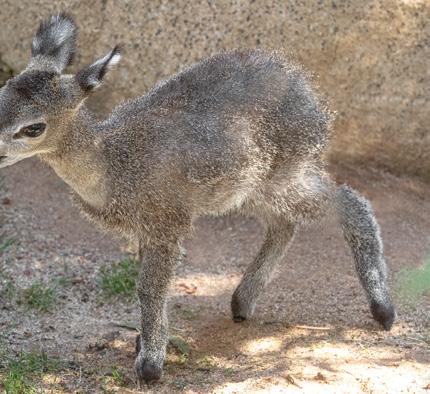
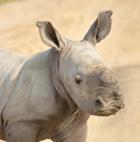
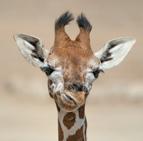
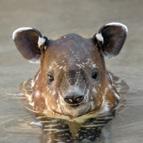
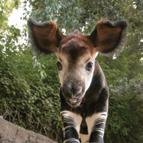
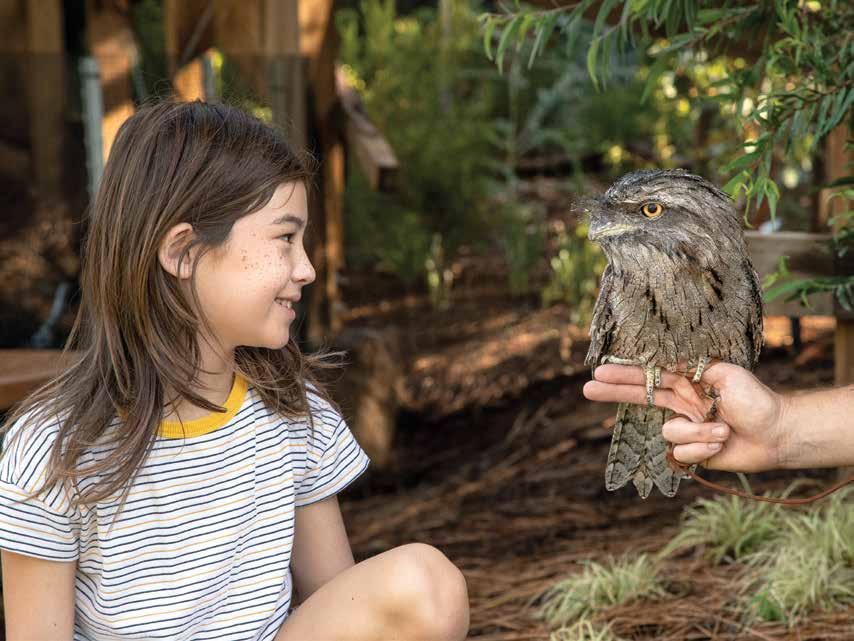
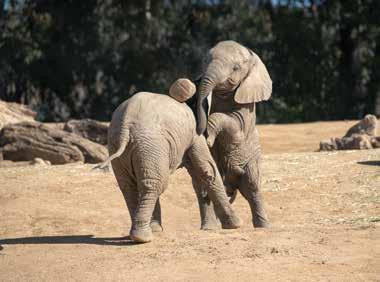
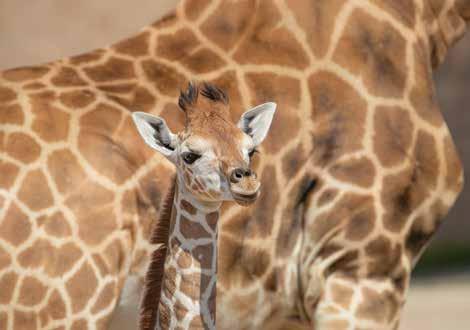
Join us at the Safari Park for a fall brew festival featuring beers from local craft breweries, a bountiful buffet, music, and animal ambassadors. Representatives from the breweries will talk about the various beer selections.
Advance ticket price is $50 per person for food and beer; $25 for food only. Purchase advance tickets online. Same-day tickets will be available at the Safari Park for $70 per person, depending on availability. Add tax and parking; nonmembers add admission. Guests must be 21 or older to attend.
SAFARI PROWL
SATURDAY, OCTOBER 19, 2019
6 TO 9 P.M. | MULTIPLE LOCATIONS
At this fun new dining experience, you’ll explore several areas of the Safari Park as you stroll from one unique venue to another to enjoy different food and drinks at each location, along with musical entertainment and great animal views.
Cost is $98 per person, plus tax and parking.
Migration Destination
Some animals go to great lengths—and distances—as part of their lifestyle. BY
WENDY PERKINS AND AMY BLANDFORD
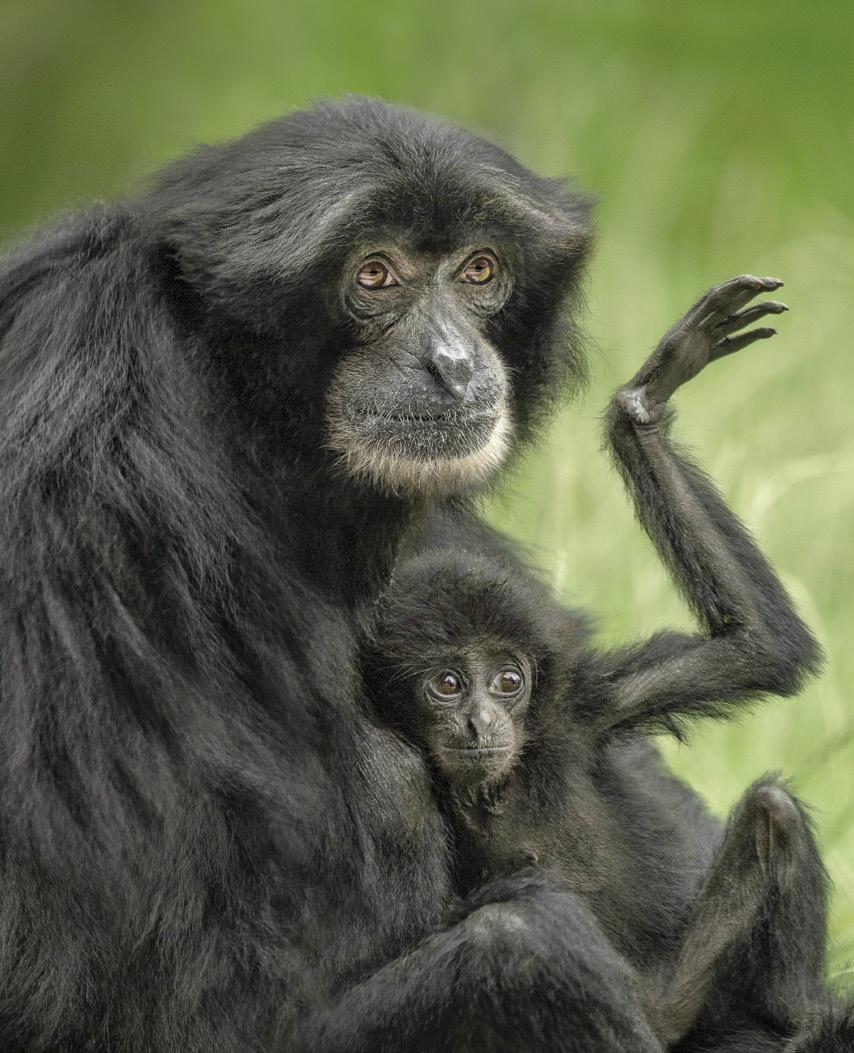
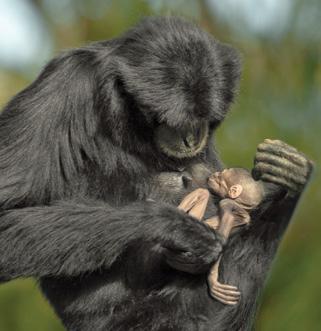
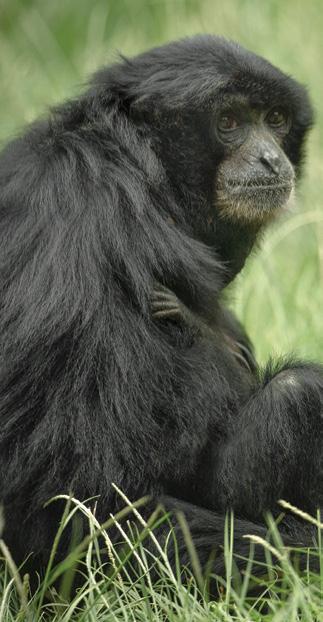
Congratulations, Tiny Survivor! When Sela the siamang was born prematurely, the animal care staff was concerned. But with expert care from her mother, Sela overcame the odds. BY DONNA
PARHAM
Features
18
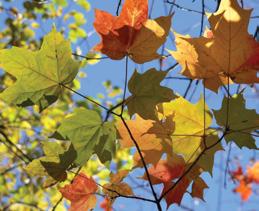
Falling for Autumn
Deciduous trees have some interesting tricks up their leaves to cope with the onset of winter. BY
KARYL CARMIGNANI
20
It Takes a Village—and a Boma
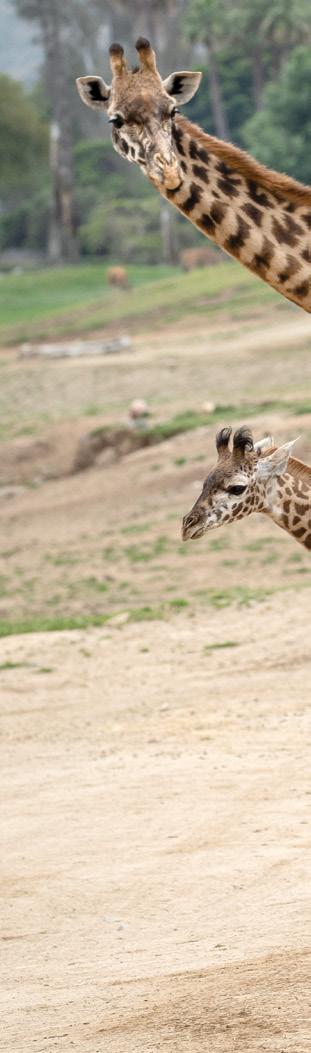
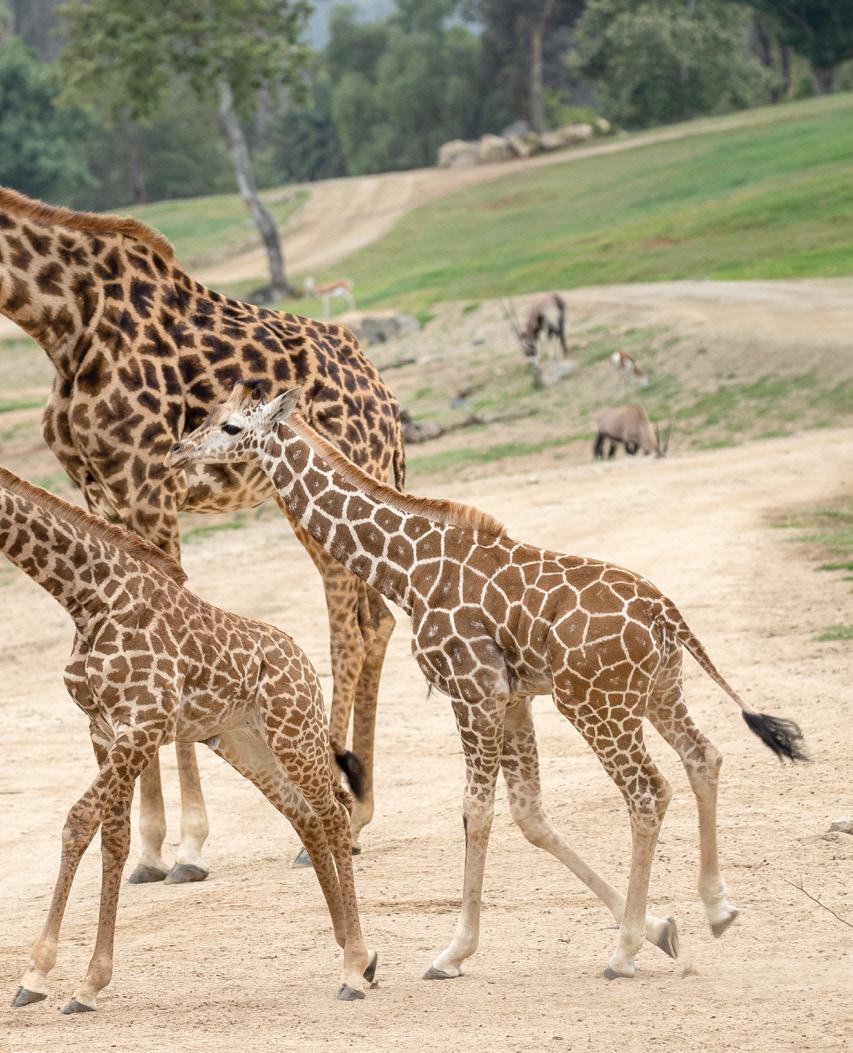
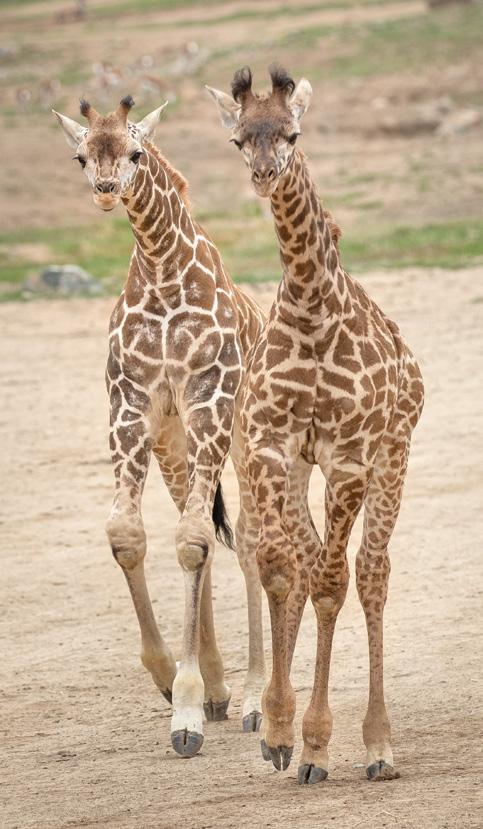
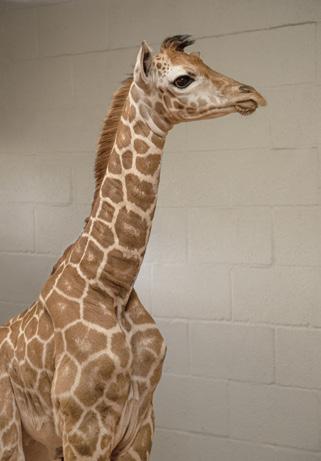
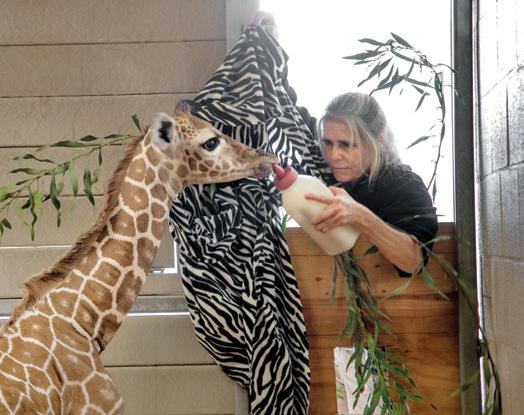
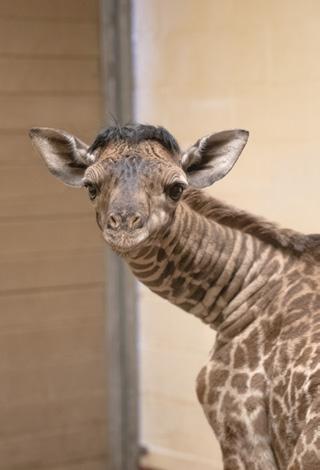
Two giraffe calves at the Safari Park had a rough start. But after treatment at the hospital, and some TLC to help them grow, they are standing tall. BY PEGGY SCOTT
26
Penguins’ Progress
The Zoo’s Penguin Beach welcomed its first two African penguin chicks that hatched from eggs laid in the Africa Rocks habitat. And it’s been adorable antics ever since! BY ESTON ELLIS
2 Nooz Notes 30 Support 32 In the Field 33 Member Specials ON THE COVER: Siamang Symphalangus syndactylus
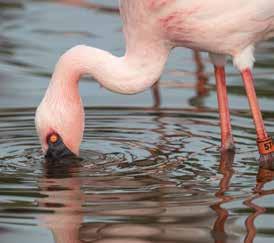
PAGE: American flamingo Phoenicopterus ruber
BY: Tammy Spratt, SDZG Photographer
BOOK SIGNING EVENTS
Saturday, September 21:
Zoo Kids Store, 11 a.m. to 3 p.m.
Saturday, September 28: Safari Park Bazaar, 11 a.m. to 3 p.m. WHAT’S IN STORE?
Meet the Author
Longtime San Diego Zoo Global employee Georgeanne Irvine has written some furry and feathered tales that will touch the heart of animal lovers of all ages. Meet her in person and have your books signed at our Zoo and Safari Park book signing events! These award-winning books in the Hope and Inspiration series are available in our gift shops and online at shopzoo.com.
and
Friends forever
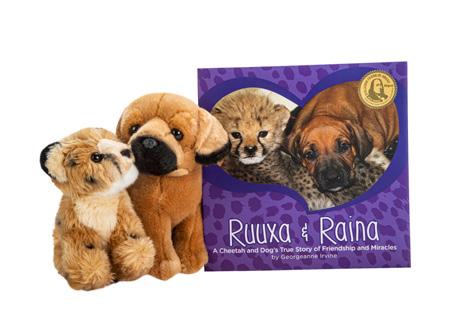
A cheetah-and-canine dynamic duo, Ruuxa and Raina became pals very young, and kept their friendship going strong through many challenges. Even illness and surgeries couldn’t keep these two apart! They got through it all together.
Pretty (amazing) in pink
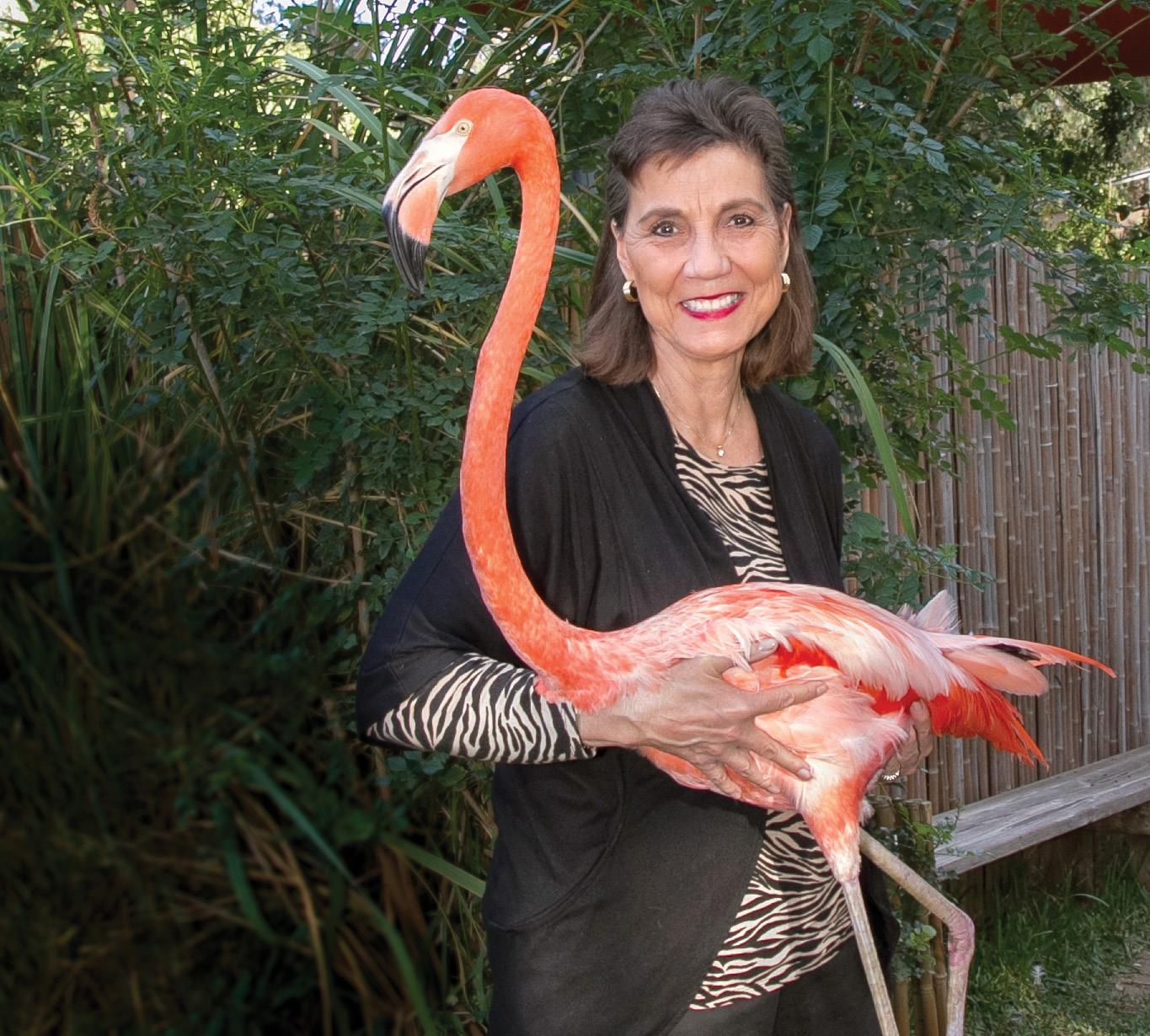
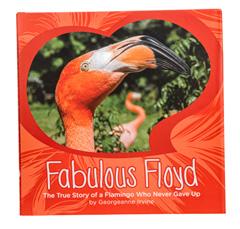
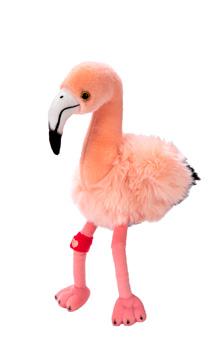
Floyd the flamingo’s life didn’t start out on the right foot— his leg was turned wrong! Zoo staff had to get creative to help Floyd flourish. Fabulous Floyd shows the world that it’s important to never give up.
Little but mighty
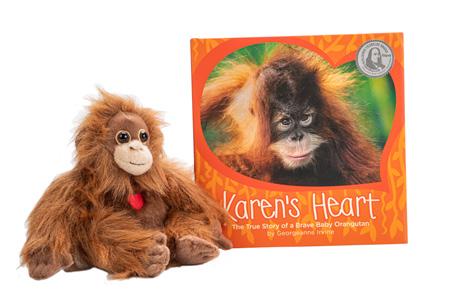
She only weighed three pounds at birth, but Karen the orangutan had a supersize spirit! Veterinarians discovered she had a hole in her heart and needed surgery. Full of hope, Karen’s Heart is a story of perseverence, ingenuity, and dedication.
Fabulous Floyd book, $14.95; Floyd plush, $18.99. In store only: book and plush set, $29.95.
Ruuxa & Raina book, $14.95; Ruuxa and Raina plush, $29.99. In store only: book
plush set, $39.95.
Karen’s Heart book, $14.95; Karen plush, $14.99. In store only: book and plush set, $24.95.
Dining events at the Zoo!
ANIMAL AMBASSADOR DINNER
Saturday, September 14, 2019 | 6 p.m. | Albert’s Restaurant
Join us for a fun evening with our animal ambassadors. We’ll start with a reception in the Treetops Room to meet the animals, then enjoy a gourmet meal prepared by Executive Chef Carissa Giacalone and Albert’s Chef Grant Toraason in Albert’s Restaurant, along with an animal presentation.
The cost is $82 per person, plus tax and gratuity. Make reservations online at zoo.sandiegozoo.org/dining-events or call 619-718-3000.
BREWMASTER DINNER
Saturday, October 19, 2019 | 6 p.m. | Albert’s Restaurant
Novo Brazil Brewing will be our featured brewery for this delicious dining experience. Start with a reception in the Treetops Room with animal ambassadors, and then enjoy a four-course gourmet meal prepared by Executive Chef Carissa Giacalone and Albert’s Chef Grant Toraason. Each course will be paired with a beer selection from Novo Brazil Brewing.
The cost is $82 per person, plus tax and gratuity. Ages 21 and older only. Nonmembers receive free admission after 5:45 p.m. Make reservations online at zoo.sandiegozoo.org/dining-events or call 619-718-3000.
Save the Date
What’s happening at the Zoo and Park this month and next (Z) Zoo events (P) Park events
AUGUST 31–SEPTEMBER 2
International Vulture Awareness Days
Join us for special activities at the Safari Park and discover why vultures are important— and awe-inspiring! (P)
SEPTEMBER 1–30
Firefighter Appreciation
Month presented by California Coast Credit Union
Active-duty firefighters get free admission to the Safari Park all month— and their accompanying guests get 10 percent off admission. (P)
SEPTEMBER 7, 21; OCTOBER 5, 19
KinderZoo
Animal interaction and fun for children ages 3 to 5, with an adult. Call 619-557-3962 or book online at sandiegozoo.org. (Z)
SEPTEMBER 7, 8, 28; OCTOBER 5, 6, 26
Sunrise
Surprise Stroll
Stroll the grounds with
Zoo educators and hear “inside secrets” about special animals. Call 619-718-3000 or visit sandiegozoo.org. (Z)
SEPTEMBER 14
Albert’s Animal Ambassador Dinner
See details on page 3. (Z)
SEPTEMBER 14, OCTOBER 12
Kids’ Wild Night Out
Leave your kids at the Zoo for a wild night out with Dr. Zoolittle and animal friends. Book online at sandiegozoo.org or call 619-718-3000. (Z)
SEPTEMBER 21
Food, Wine & Brew Celebration
Enjoy food and beverages from 160 restaurants, wineries, and breweries at this fund-raiser for SDZG Wildlife Conservancy. General admission: $125; VIP: $225. Visit zoofoodandwine.com. (Z)
OCTOBER 1–31
Kids Free presented by Mission Fed Free admission for
The Joys of Autumn
Skids 11 and younger accompanied by an adult. For details, visit sandiegozoo.org and sdzsafaripark.org. (Z) (P)
OCTOBER 6
Okapi Brew Festival
See details inside front cover. (P)
OCTOBER 11–13, 18–20, 25–27
HalGLOWeen
The Zoo’s Halloweenthemed celebration offers family fun, music, and entertainment from 5 to 9 p.m. Details at sandiegozoo.org. (Z)
PRESIDENT/CEO’S NOTE
DOUGLAS G. MYERS
OCTOBER 19
Albert’s Brewmaster Dinner
With Novo Brazil Brewing. See details on page 3. (Z)
Safari Prowl
See details of this new dining experience inside front cover. (P)
OCTOBER 20
Champagne Brunch
See details inside front cover. (P)
OCTOBER 27
Creepy Camp Roar & Snore Safari Halloween-themed
eptember means savoring the last of summer, and then taking the leap into fall. At the Zoo and the Safari Park, it’s a time for beautiful days to visit your favorite animals. September also brings our always-popular San Diego Zoo Food, Wine & Brew Celebration, which supports our Wildlife Conservancy. Heading into October means fun and games at the Zoo and the Park during Kids Free presented by Mission Fed, when kids 11 and younger get free admission all month long. Mark your calendar to join us for HalGLOWeen at the Zoo, taking place over three weekends in October, and for Dia de los Muertos at the Safari Park, a colorful and joyful celebration November 1 to 3. I’d also like to call your attention to one of our newest endeavors—we’ve collaborated with Animal Planet to produce The Zoo: San Diego, with episodes all about the Zoo and Safari Park. The show launched on August 10 and is running now, with new episodes airing Saturdays at 9 p.m. PDT. If you have a chance to watch, I think you’ll really enjoy it!
SAN DIEGO ZOO AND SAFARI PARK ON TV!
San Diego Zoo Global has teamed up with Animal Planet to produce The Zoo: San Diego, featuring stories all about us. Find it on the Animal Planet channel, with new episodes airing Saturdays at 9 p.m.
sleepover for all ages! Call 619-718-3000 or book online. (P)
NOVEMBER 1–3
Dia de los Muertos Celebrate with special festivities and free admission for kids 11 and younger accompanied by an adult. Find details at sdzsafaripark.org. (P)
NOVEMBER 2
Spirits Dinner featuring Jack Daniel’s Family of Brands
See details inside front cover. (P)
Let’s Talk
Follow us! @sandiegozoo @sdzsafaripark @sdzglobal
Share your #SanDiegoZoo & #SDZSafariPark experience on Twitter & Instagram.
Check everyone off your holiday gift list with a membership to the San Diego Zoo and San Diego Zoo Safari Park. They’ll go wild, and you’ll give back by supporting the threatened wildlife in our care as well as our critical conservation work worldwide.
It’s only a number
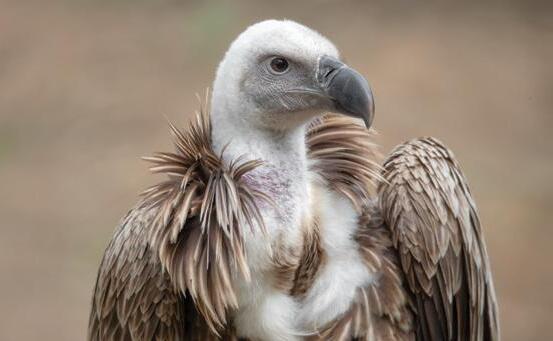
Vultures play a vital role in their native environments. Often referred to as “nature’s cleanup crew,” their scavenging ways help to prevent the spread of disease and buildup of toxins that could harm other animals—and people. Yet vultures are facing other threats that could decimate their populations. To raise awareness and honor these important birds, we’re celebrating International Vulture Awareness Days from August 31 to September 2 at the Safari Park.
23
The number of vulture species. Of these, 16 are considered threatened or endangered.
ZOONOOZ
PUBLISHED SINCE 1926
®
SEPTEMBER 2019 | VOL. XCII–NO. 05
MANAGING EDITOR
KAREN E. WORLEY
ASSOCIATE EDITOR
PEGGY SCOTT
STAFF WRITERS
WENDY PERKINS
KARYL CARMIGNANI
DONNA PARHAM
COPY EDITOR
ESTON ELLIS
DESIGNER
KERRI ABRAMS
SAN DIEGO ZOO GLOBAL
PHOTOGRAPHERS
KEN BOHN
TAMMY SPRATT
SR. IMAGING SPECIALIST
TAMMY SPRATT
DESIGN AND PRODUCTION
KIM TURNER
AMY BLANDFORD
LISA BISSI
JENNIFER MACEWEN
PREPRESS AND PRINTING
QUAD GRAPHICS
11
Width in feet of an Andean condor’s wingspan, the widest of any bird.
7
The height—in miles!—that a Rüppell’s vulture can soar above the ground.
The Zoological Society of San Diego was founded in October 1916 by Harry M. Wegeforth, M.D., as a private, nonprofit corporation that now does business as San Diego Zoo Global.
The printed ZOONOOZ® magazine (ISSN 0044-5282) is currently published bimonthly, in January, March, May, July, September, and November. Publisher is San Diego Zoo Global, at 2920 Zoo Drive, San Diego, CA 92103, 619-231-1515.
Periodicals postage paid at San Diego, California, USA, and at additional mailing offices.
ADDRESS CHANGES: Please send to Membership Department, P.O. Box 120271, San Diego, CA 92112.
Annual Memberships: Two adults in same household $174; $159 renewal. One adult $112; $102 renewal. Student (must live in and attend school in San Diego County) $95.20, Senior (age 65 and older): two adults in same household $147.90; $135.15 renewal. One senior adult $95.20; $86.70 renewal. Each membership includes unlimited entrance to the San Diego Zoo and the San Diego Zoo Safari Park.
Subscription to ZOONOOZ magazine: $25 per year, $65 for 3 years. Foreign, including Canada and Mexico, $30 per year, $81 for 3 years. Contact Membership Department, P.O. Box 120271, San Diego, CA 92112, for subscription information.
As part of San Diego Zoo Global’s commitment to conservation, ZOONOOZ is printed on recycled paper that is at least 10% post-consumer waste, chlorine free, and is Forest Stewardship Council ® (FSC®) certified.
SAN DIEGO ZOO GLOBAL
OFFICERS
Steven G. Tappan, Chairman
Javade Chaudhri, Vice Chairman
Linda Lowenstine, DVM, Ph.D., Secretary
Ryan Sullivan, Ph.D., Treasurer
BOARD OF TRUSTEES
Rolf Benirschke
Kathleen Cain
Richard B. Gulley
Clifford W. Hague
Robert B. Horsman
Steven S. Simpson
Judith A. Wheatley
TRUSTEES EMERITI
Frank C. Alexander
Berit N. Durler
Thompson Fetter
Bill L. Fox
Frederick A. Frye, M.D.
George L. Gildred
Yvonne W. Larsen
John M. Thornton
A. Eugene Trepte
Betty Jo F. Williams
James Lauth, General Counsel to the Board
20
The percentage of their body weight that vultures can eat in one sitting.
SAN DIEGO ZOO HOURS
Most days in September and October: 9 a.m. to 6 p.m.
September 1–2; October 11–13, 18–20, 25–27: 9 a.m. to 9 p.m.
September 21: 9 a.m. to 5 p.m.
SAFARI PARK HOURS
Most days in September and October: 9 a.m. to 5 p.m.
September 1–2; October 5–6, 12–13, 19–20, 26–27: 9 a.m. to 6 p.m.
WEBSITE sandiegozoo.org
PHONE 619-231-1515
ZOONOOZ® Online web publication zoonooz.sandiegozoo.org
FSC® is not responsible for any calculations on saving resources by choosing this paper.
Douglas G. Myers, President/CEO
Charles L. Bieler, Executive Director Emeritus
THE FOUNDATION OF SAN DIEGO ZOO GLOBAL
OFFICERS
Judith C. Harris, Chair
U. Bertram Ellis, Jr., Vice Chair
Joye D. Blount, Secretary
Susan N. McClellan, Treasurer
David Wu, President
Amy B. Parrott, Vice President
Steven G. Tappan, Ex officio
Douglas G. Myers, Ex officio
BOARD OF DIRECTORS
Christine L. Andrews
Valerie E. Armstrong, DVM
Sophie W. Bryan
Douglas Dawson
Berit N. Durler
Chris Eddy
Nikita Kahn Ellison
Arthur E. Engel JJ Fetter
Susan Guinn
Lynelle Lynch
Susan B. Major
Susan F. McCarthy
Diane McKernan
Barry Munitz
Joshua A. Pack
Maryanne C. Pfister
Philip C. Seeger
Elizabeth W. Shoemaker
Rosa Sinnott
Carter Skeath
David M. Tehle
Kathryn J. Vaughan
SAN DIEGO’S TASTING EVENT Wildest
Saturday, September 21, 2019 | 6:30 − 10:30 p.m. at the World-Famous San Diego Zoo
SMALL BITES, BIG FUN. All included!
San Diego’s premier tasting event showcases the best beer, wine, and food Southern California has to offer. Sample from more than 160 vendors while exploring adventure around every corner. Soar above it all on Skyfari®, jam along with live bands, shake a tail feather on the dance floor—or just kick back and relax!
EAT, DRINK, PARTY— Repeat!
VIP and General Admission tickets are available at zoofoodandwine.com. This tasty night for wildlife benefits the San Diego Zoo Global Wildlife Conservancy.
relatively speaking
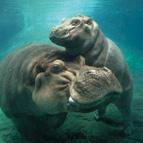
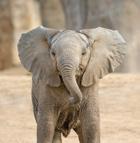
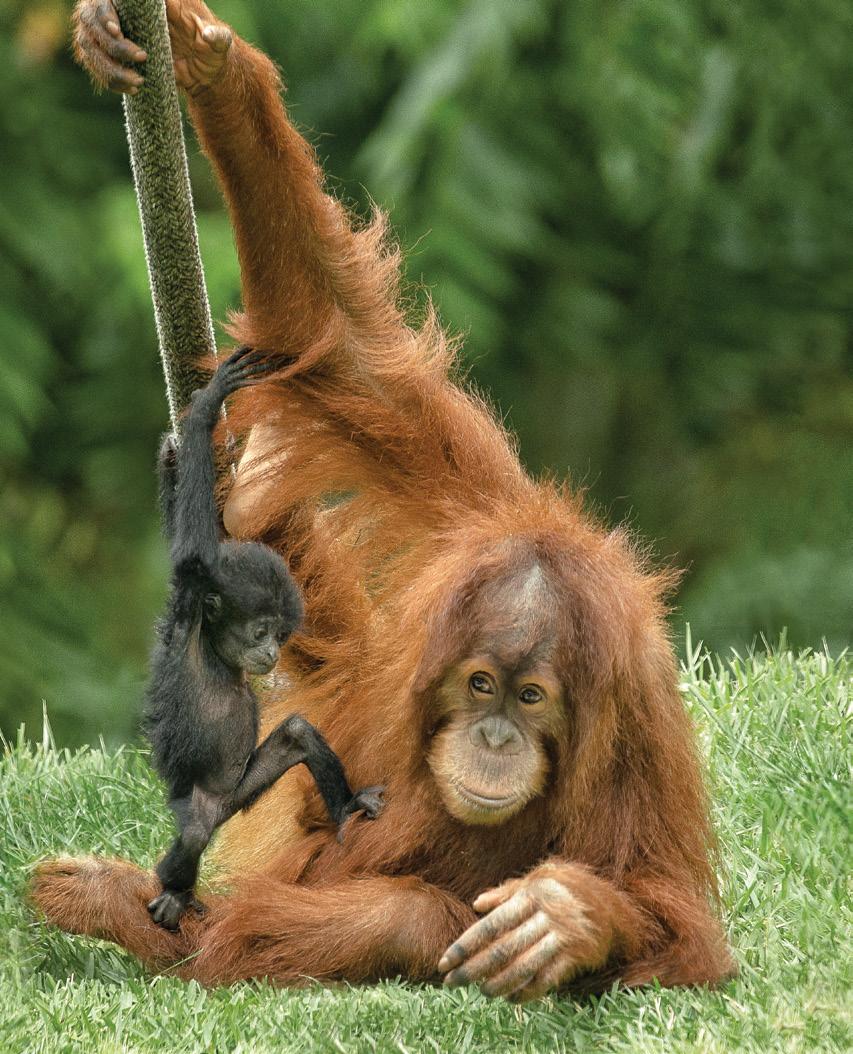
In the Animal Kingdom, some family reunions are full of surprises! Think your cousins don’t look anything like you? Try to match the animals in the top row to their relatives in the bottom lineup. Looks can be deceiving— it’s all in the family!
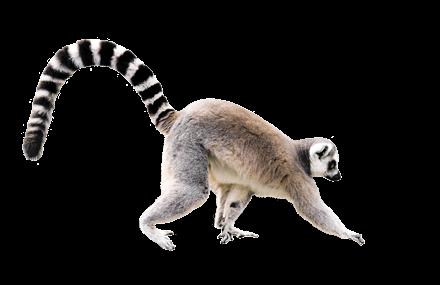
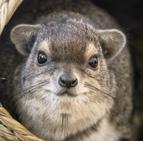
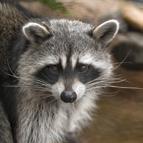
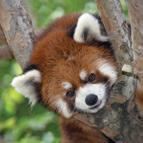
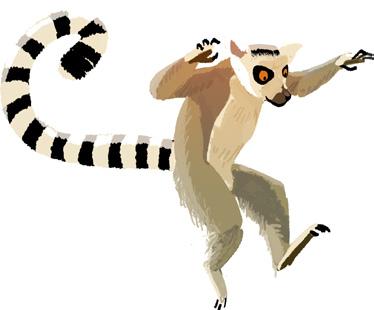
Given their sizes and ringed tails, it’s not too difficult
“unmask” the red panda’s closest relatives, which are believed to be skunks, badgers, and this clever, nocturnal animal.
rhi n o
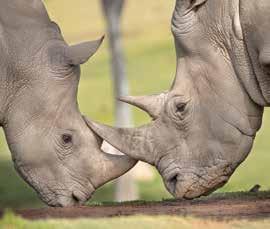
There’s no “snout” about it—the rhino’s closest relative may look like a pig with a trunk, but it isn’t. How tight are these mammal family members?
In Indonesia, the word “badak” is used for both!
Their coat patterns may clash—spots versus stripes— but the giraffe and its closest relative share some characteristics: their long, prehensile tongues that help when eating; and legs that are longer in front than in back.
Visit the San Diego Zoo Kids website to find out about these and other animals, plus videos, crafts, stories, games, and more! kids.sandiegozoo.org
hipp
o
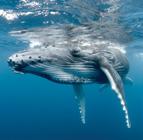
Talk about a deep family history!
Researchers believe that a four-footed, semiaquatic mammal from 40 million years ago was an ancestor to both the hippo and this big, ocean dweller.
Tusk, tusk! Not only does the elephant’s rotund relative also sport tusk-like teeth, they have hooflike nails and other physical similarities, albeit on a much smaller scale—and they’re furry, to boot.
PHOTO BY: (WHALE)
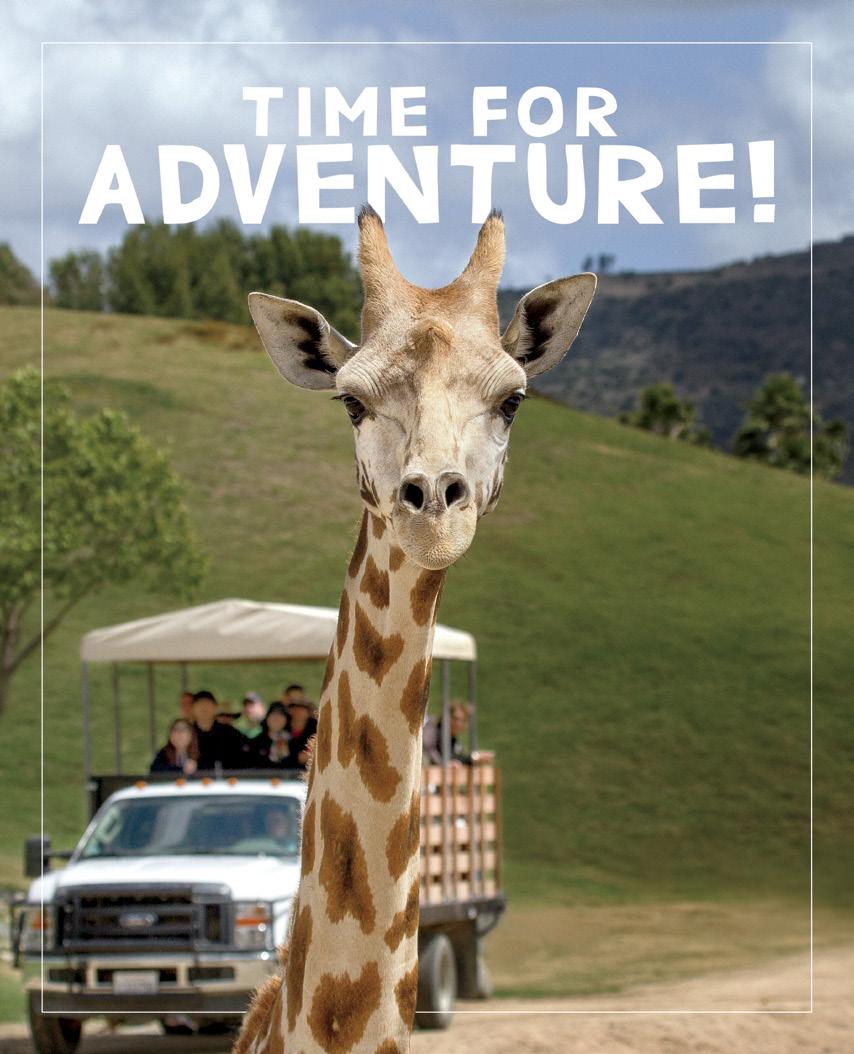
Travel in the back of a covered, open-air safari truck into our field enclosures, as our expert guides take you to the animals and provide fascinating and fun information about the latest goings-on. Get an up-close view of Asian and African birds and mammals, with an opportunity to feed giraffes! You haven’t lived until you’ve had a giraffe tongue reach out and take a leaf from your hand. Your safari awaits!
GRAPHICALLY SPEAKING
Around 1.5 milion wildebeest pound the Serengeti each year during The Great Migration. It's not an event—it's a lifestyle. Following the rains, wildebeest travel in search of fresh grazing areas and water, covering a 995-mile, clockwise loop each year.
The current recordholder for the longest insect migration is the globe skimmer dragonfly. Found on many continents, they’re best known for their multi-generational, 11,200-mile migration from India to eastern Africa. Each insect flies about 3,700 miles.
Leatherback sea turtles cross the Pacific Ocean, swimming an astounding 10,000 miles or more. They migrate east from Japan to the shores of Washington, Oregon, and California. At sexual maturity, they head west and return to breeding sites in Japan, where females nest on the very same beach where they hatched.
Considered the largest mammal migration in the world, tens of millions of straw-colored fruit bats migrate from the Democratic Republic of Congo to Zambia each spring. The goal of this roughly 1,200-mile journey? A seasonal bounty of fruit, a dietary mainstay.
The red crabs of Christmas Island scuttle a mere three miles to their breeding spot, but the short migration has been known to quite literally stop traffic! The 4.6-inch-wide crustaceans move to the breeding beach all in one huge mass— blocking some roads.
Racking up 44,110 migration miles each year, the Arctic tern has the longest migration of any animal. These endurance experts migrate from the Arctic to the Antarctic each year. That tallys up to 1.5 million miles over their average 30-year lifespan!
Each fall, monarch butterflies leave feeding grounds in the US and Canada to winter in Mexico, some 3,000 miles away. In spring, they reproduce and their offspring head north, reproducing and dying along the way. The return trip north takes four to five generations.
Migration Destination
It is said that life is about the journey, not the destination. But for the many animals that migrate, their life depends on both the feat of getting there and what awaits at the end of the trek. Some animals withstand taxing conditions on their journey and travel surprising distances. Just how far do they go? Take a look at the itineraries of some species and find out!
BY WENDY PERKINS | STAFF WRITER ILLUSTRATIONS BY AMY BLANDFORD | STAFF ILLUSTRATOR
In South America, the gilded catfish undertakes a truly Herculean—or, in this case, Amazonian— migration. From the estuary of the mighty Amazon River, adults swim some 3,600 miles upriver to spawn in the headwaters. The adults die soon after, but their offspring go back downriver to complete the epic life-cycle journey.
SAN DIEGO ZOO GLOBAL
Congratulations,
When primate keepers at the orangutan and siamang habitat arrived for work on November 12, 2018, they didn’t know that by day’s end, they would have one more charge in their care.
BY DONNA PARHAM | STAFF WRITER
PHOTOS BY TAMMY SPRATT | SDZG PHOTOGRAPHER
Tiny Survivor!
The Zoo’s siamangs Unkie and Eloise (Ellie for short) had previously made a significant contribution to the population in managed care of this endangered species: they had successfully raised five female offspring over the years. With Ellie on contraception, their reproductive years had come to a close.
Or so the animal care staff thought.
Contraception is not 100 percent assured, and that day, Ellie was quietly and calmly cradling a new infant. And not just any infant, but the smallest siamang the keepers had ever seen. Keepers kept a close eye on Ellie and the newborn in the warmth and humidity of the siamang bedrooms.
“Usually, a siamang infant can cling to its mom within a day or two, and can find a nipple on its own. But this infant wasn’t as strong as she should have been,” says Tanya Howard, senior keeper. Fortunately, because she was an experienced and capable mother, “Ellie positioned the baby on her nipple,” says Julie Krajewski, senior keeper. “She is an excellent mom. That’s something a first-time mom might not do.”
Typically, it is several years before keepers and veterinary staff separate a young ape from its mother, even for a routine exam. But in this case, “We knew something wasn’t quite right,” says Tanya. The staff handled the infant temporarily for a quick checkup when she was just
six days old, with Ellie there for support. They determined that the infant had been born prematurely, and was significantly smaller than a typical healthy newborn—only about 10 ounces, compared to a typical 19-ounce newborn siamang. The exam also showed signs that the infant’s spine might not be developing normally. “We had to mentally prepare ourselves that there was a strong chance she might not get better,” says Tanya.
While Ellie carried and cuddled her infant 24 hours a day, veterinary staff stood by. They were concerned
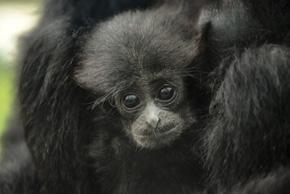
enough to check the infant again about two weeks later, but intervention wasn’t necessary. To everyone’s relief, any potential problems resolved as the infant developed. Everyone was thrilled to celebrate her two-month milestone, and then see her continue to grow into a strong, healthy youngster. They give all the credit to Ellie’s maternal skills. “It was all Ellie,” says Julie. Keepers named the infant Selamat, and affectionately call her Sela. The name is an especially appropriate Malay word: its most common meaning is “congratulations,” but a lesser-used definition is “survivor.”
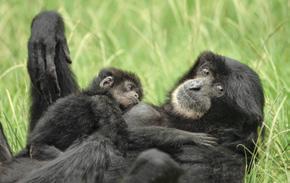
Right now, Sela spends most of her time in Ellie’s arms—or nearby. Ellie still gets “a little anxious if she can’t see Sela,” says Tanya. But that is slowly changing. “A father siamang starts carrying his offspring at some point during the first year,” says Julie. “In the second year, fathers pretty much take over the care of their offspring.” Sela is also becoming more adventurous—and making friends.
Six-year-
Playing with the baby.
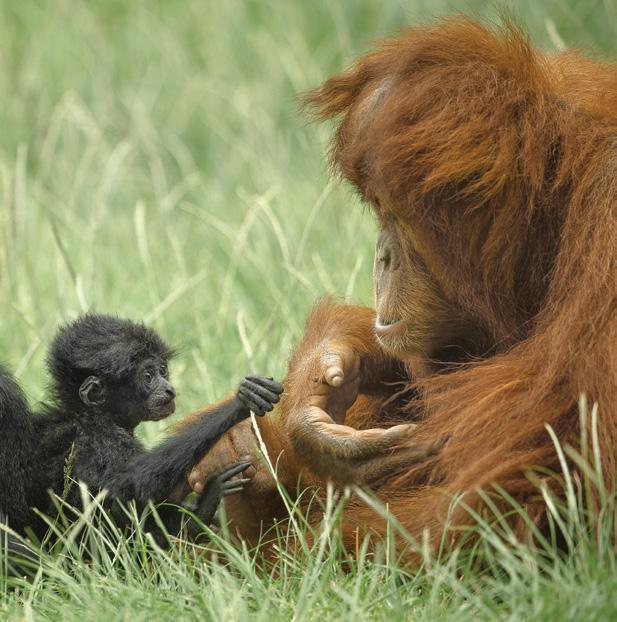
(Left) Sela is the darling of the exhibit, and all the orangutans enjoy her antics and vie for her attention.
old Aisha is playful but gentle. (Above) Ellie cradles her newborn infant.
APE OR MONKEY?
Siamangs are apes, and they are great. But they’re not great apes. And they aren’t monkeys, either.
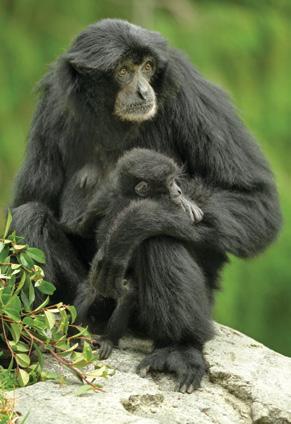
Siamangs are the largest members of the gibbon family—also known as the lesser apes, because they are smaller than great apes (gorillas, orangutans, chimpanzees, and bonobos). “Lesser” they may be, taxonomically, but they are apes and not monkeys, as many Zoo visitors assume.
The biggest differences between apes and monkeys are in their torso and shoulders.
With a trunk that’s slightly compressed back-to-front (like a human’s), not side-toside (like a monkey’s), an ape’s erect posture allows it to sit upright, with its shoulders projecting sideways. This gives them more versatile arm movements—especially shoulder rotation— than monkeys. Another clue is the tail—or lack of it. Apes do not have (visible) tails; almost all monkeys do.
Day care providers For the first few months, mothers provide care for their infants. But by the end of the youngster’s first year, the dads are in charge.
She is the first siamang born at the Zoo in more than 10 years, so keepers weren’t sure how the much-larger orangutans that share their habitat would react. “They were really excited about the new baby,” says Tanya. And they have been gentle and respectful with the new arrival. “Ellie is usually fine with the orangutans coming close.” If their adoring gazes and gentle caresses get to be too much, “She just takes Sela and moves away.”
Six-year-old orangutan Aisha is especially captivated by Sela, and the admiration seems mutual. Aisha was somewhat of a preapproved playmate. “Unkie and Ellie have a really great relationship with Aisha,” says Tanya. “They have plenty of familiarity playing and wrestling with her, and she’s been completely appropriate in her behavior toward Sela.”
Unlike most other primates, male and female siamangs typically pair up as adults and
Getting to Know You. Sela seems just as enamored with Aisha as Aisha is with the infant siamang. At first, their relationship developed only under the watchful eye of protective mom Ellie.
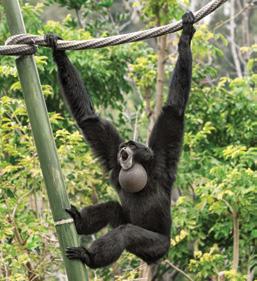
Can you hear me now? A simang’s expandable throat sac amplifies its calls and songs—which can be heard throughout the Zoo each morning.
often spend the rest of their lives together. Pairs establish and maintain their territories—and reinforce their bond—by singing. Each siamang pair creates a distinctive duet all its own. “The longer they are together, the more unique their song becomes,” says Tanya. Thanks to an inflatable throat sac, the resonant songs can be heard up to a mile away.
Unkie and Ellie have been together since 1987, and their duet is particular to them. It’s something that Zoo regulars have come to expect and look forward to each morning. The pair’s bond is strong, too. Keepers say that before Sela was born, it wasn’t unusual to find them asleep in each other’s embrace in the morning. While Sela is the one that currently curls up with mom, her parents’ bond is as strong as ever. With parents like these, and a healthy infant, congratulations are in order all around.
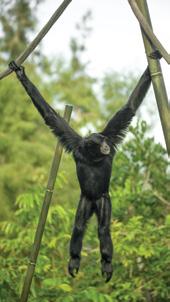
Siamangs live in the trees, 80 to 100 feet up, in the rain forests of the Malay Peninsula and Sumatra. Acrobatic and agile—and with arms that are longer than their legs—their main mode of travel is swinging through the trees, a type of locomotion called brachiating. If you ever tried to “brachiate” your way across monkey bars on a school playground, you may remember how difficult it felt. In fact, no other primate can do it like gibbons can, thanks to their unique arm anatomy. Spider monkeys and woolly monkeys can brachiate with the assistance of a prehensile tail, and orangutans, chimpanzees, bonobos, and young gorillas can brachiate with the assistance of the hind limbs.
KINGS OF SWING
Calling all kids! October is Kids Free month at the San Diego Zoo and San Diego Zoo Safari Park, when children 11 years and younger receive free admission all month long (with an adult). Kids can connect with their wild side by meeting wildlife, while discovering the wonders of nature through play and exploration. On weekends, there will be even more kid-focused fun, with a variety of special activities.
sandiegozoo.org
Camps & Programs
Adventures at the Zoo
KINDERZOO
Children ages 3–5 and their favorite adult
First and third Saturdays of each month, September through May, 8:30–10 a.m.
September 7 and 21, October 5 and 19, November 2 and 16, December 7 and 21.
Check our website for 2020 dates. $16 per person for members; $19 for nonmembers, plus Zoo admission. Book online or call 619-557-3963.
Trek through the Zoo with your favorite adult to visit some of our favorite animals before the Zoo opens. Once you observe and learn about the animal of the month, you may have the opportunity to do a fun craft, listen to an exciting story, or meet an animal ambassador.
*New theme and animal guests each month. FALL & WINTER 2019-2020
KIDS’ WILD NIGHT OUT
Grades K–5
Select Saturdays, 6–10 p.m.
September 14, October 12, November 9, December 14, January 11, February 8. $40 per child; book online or call 619-718-3000.
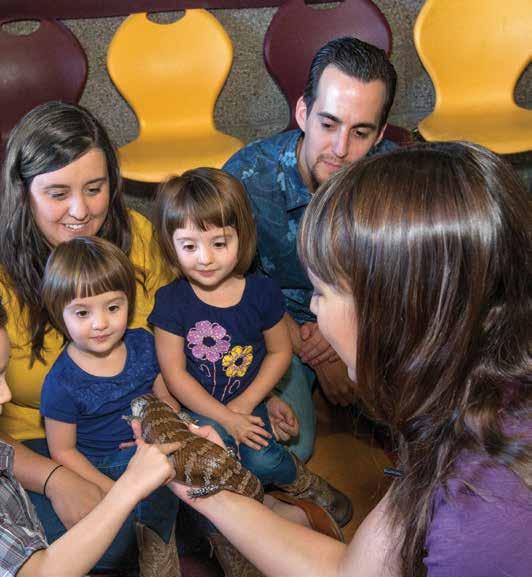
Kids! It’s the evening you’ve been waiting for! Join us at the Zoo for a wild night out with Dr. Zoolittle and animal friends. Hang with us for a few hours and we will meet some amazing animals, create Zoo crafts, play games, enjoy a snack, and much more—with a new theme and animal guest each month. Sorry, no grown-ups allowed!
More Adventures at the Zoo Aussie Outback Birthday Bash
FOR TEENS
ZOO CORPS
Teens ages 13–17
Ages 3–11, with adult chaperones
11 a.m. on select Saturdays
$79 per person for adults and children ages 3 and older. Includes all-day Zoo admission, lunch, and birthday cake! Birthday child, and children 2 and younger are free (with an accompanying paid adult).
Celebrate your child’s birthday with an Australian
“Inspiring change for a better tomorrow” is the motto for Zoo Corps teens, who teach guests about topics like animal care,
Interested teens must attend an informational meeting with a parent or guardian to receive an application. There are two meeting dates to choose from: Saturday, November 2 at 9 a.m. or Thursday, November 7 at 7 p.m. Meetings will take place at the Dickinson Family Center for Lifelong Learning. No reservation required. Applications are due
For more information, email sbarnard@sandiegozoo.org.
SUNRISE SURPRISE STROLLS
Select Saturdays and Sundays September 7, 8, and 28; October 5, 6, and 26; November 2, 3, and 30; December 7, 8, and 28
$29 per person, plus admission for nonmembers
Book online or call 619-718-3000.
What will you see this month? Walk the grounds with experienced Zoo educators as they share the latest updates on our animal collection and the “inside secrets” of what’s going on, all before the Zoo opens for the day. Each month is different, and you won’t know what you’ll see and learn until you get here! This is a 90-minute walking tour to areas in natural hills and valleys.
Ages 16–adult
Book online or call 619-718-3000.
Photography Workshop with Caravan: Long Lens Photography Workshop
6:15–10:15 a.m. Saturdays, September 21 and 28 $324 for members, $374 for nonmembers.
Come photograph the plants and animals of the San Diego Zoo Safari Park in a whole new light! This unique opportunity allows you to learn from professional photographers, helping you to improve your wildlife photography skills as you are escorted to various Park habitats by a knowledgeable Safari Park educator. You will arrive in the early morning hours, long before the Park opens, giving you an exclusive look at our plants and animals and providing you with the chance to come away with photographs of a lifetime! Session 1 of the workshop will provide an exclusive opportunity to experience the Park’s vast field exhibits from a Photo Safari truck, and Session 2 will give participants a chance to stroll the Park as a group and photograph plants and animals in beautiful early morning light. No photo equipment
Safari Park Photography Workshops
Photography Workshop— Walking Program
6–10 a.m. Saturdays, November 9 and 16
$199 for members, $249 for nonmembers.
Sharpen your photography skills with these amazing sessions led by a professional photographer and a Park educator. During each session of this two-day photography workshop, you will stroll as a group to a different area of the Park while photographing plants and animals in the beautiful early morning light. You’ll enjoy special access to an area not normally available on foot. Workshop participants will receive guidance and individual feedback sessions with professional photographers, as they offer their expertise on how to capture the best images of the unique flora and fauna of the Safari Park. Through hands-on learning and instruction delivered with humor and humility, our pros will share their collective knowledge of wildlife photography. Whether you are a beginning or advanced photographer, this program will help you take better wildlife pictures!
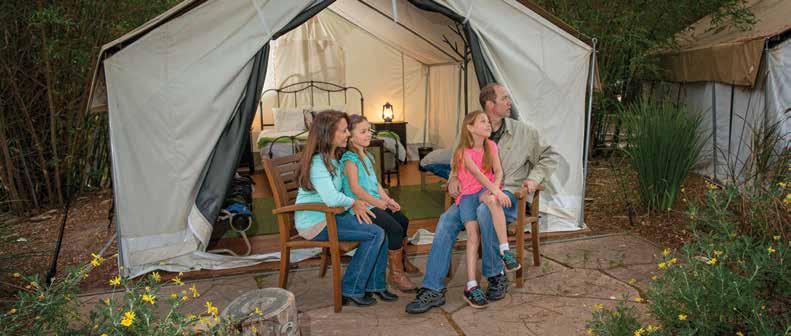
Spend the night at the Safari Park in our tents overlooking the elephant habitat and the African Plains! Sleepovers may include walking tours, behind-the-scenes visits, an animal presentation, and a tram ride. Each Roar & Snore starts at 4:15 p.m. and concludes at 9:30 the next morning; and includes a tent and sleeping pad for the night.* For family programs, children 17 and younger must be accompanied by a paid adult. For reservations, and all the Roar & Snore options and pricing, call 619-718-3000; or visit sdzsafaripark.org.
Roar & Snore Safaris
*Vista tents include cots. Premium tents include a queen-size bed and cots.
All Ages
Roar & Snore
All ages
September 6, 7, 14, 27, 28; October 5, 12; November 2, 8, 9, 23
Spend the night at the Safari Park with your family. Campers of all ages are invited to experience a sleepover that has something for everyone. Our selection of walking tours varies to make your night relaxed or high energy.
Adults Only
Roar & Snore
Ages 21 and older
September 13; November 16
Discover the secret lives of animals through the kind of information we can only share with no children around! Special behind-the-scenes moments, evening hikes, and face time with critters fierce and friendly add new meaning to the term “nightlife.”
Girl Scouts
Roar & Snore
Girl Scout troops
September 21; October 4, 19; November 15 Girl Scouts will learn how easy it is to become a hero for wildlife in their daily lives during this activity-filled sleepover. At the end of their nightly activities, Girl Scouts will get the chance to participate in SWAPs with other troops.
School Nights
Roar
& Snore
School groups, in grades 3–12
October 10, 17; November 7, 21
Teachers, bring your students to the Safari Park for a super sleepover they will never forget! Students will learn
about plant and animal conservation; and this program is aligned to Common Core Literacy Standards and Next Generation Science Standards.
All Ages Creepy Camp
Roar & Snore
All ages October 25
Enjoy haunted trails, make special Halloween treats for our animals, and meet creepy critters up close at a spooky sleepover. Don’t forget your costume!
Adults Only Creepy Camp Roar & Snore
Ages 21 and older
October 26
Meet remarkable animals and enjoy a variety of activities at this Halloween weekend sleepover designed for adults only.
Holly Jolly Jungle
Roar & Snore
All ages
November 30
Celebrate the holiday season with this festive sleepover on Thanksgiving weekend. Enjoy holiday crafts and games, make merry with our animal ambassadors, and take amazing photos for your holiday cards.
For private sleepovers at the Zoo or Safari Park, please call 619-718-3000.
OCTOBER 11-13 | 18-20 | 25-27
Our popular October event is back, and bigger than ever! Join us for any—or all—of the three weekends to bask in the bright fun until 9 p.m.! Kids 11 and younger are free, and may come in costume.*
There is fun for the whole family, with glowing hula hoops, acrobats, jugglers, and more— plus Dr. Zoolittle, musical entertainment, Zoo characters, animal encounters, and tempting food specials.
*See costume policy at zoo.sandiegozoo.org/help#seasonal-events
Reveling in the colorful joys of the
season Autumn forFalling
BY KARYL CARMIGNANI | STAFF WRITER
BY TAMMY SPRATT | SDZG PHOTOGRAPHER
Fall is a season packed with earth tones, comfort food, and nostalgia. The dog days of summer give way to crisp weather, honey-colored light, and a reminder that the only constant is change. Autumn is an invigorating buffer between swelter and snow! While fall may trigger a flurry of pumpkin-spiced everything and a countdown to “the holidays” for some people, other animals respond by storing food, producing antlers, migrating south, and growing more fur. Trees also buckle up for the onslaught of winter, with some putting on a brief but stunning show of color. While San Diego’s Mediterranean climate is better known for its leaves and flowers of spring and summer, there are still pockets of dramatic autumn colors. As French author Albert Camus rhapsodized, “Autumn is a second spring when every leaf is a flower.”
CUES AND HUES
Autumn’s nickname “fall” is appropriate, as brittle leaves swirl to the ground in the slightest breeze. On deciduous trees, which tend to live in temperate, cold climates, each leaf is responding to an evolutionary effort to save the tree from the barbs and arrows of winter. Leaves are food-making receptors for the plant: green chlorophyll absorbs light energy and turns it into chemical energy through photosynthesis, fueling the tree. But in temperate regions, water flowing through the veins of leaves may freeze in winter, so shedding this liability is a useful strategy for the tree. And a pretty one!
At the base of each leaf is a layer of cells called the “abscission,” and as the days shorten and nights chill, the production of chlorophyll slows and eventually stops, revealing other pigments in the leaves. Carotenoids produce yellow, orange, and brown hues, as seen in aspens and hickories, among others. Other trees produce a pigment group call anthocyanins, which show off the reds and purples that oaks, dogwoods, and maples display.
DECIDUOUS DECISIONS
During this burst of color, the abscission layer swells and becomes a perforated edge between leaf and
tree, cutting off supply lines. Eventually the leaf drops, having served its purpose. But not all leaves fall for the same reasons. Some trees are semideciduous, essentially “molting” their leaves and growing them back quickly. Others, like the desert willow, are drought deciduous, shedding their leaves during the dry season. It’s an effective way to cope with environmental pressures.
AUTUMNAL ZOO AND PARK
Temperatures are more extreme at the Safari Park, so deciduous trees cast shade in summer and let
PHOTO
sunshine in during winter. Robert Thurston, lead horticulturist, has worked at the Park since 1980, and has known many of its towering trees since they were humble seedlings. He takes great pride in his charges, declaring the Cape chestnut tree in Nairobi Village “ungodly beautiful” when in pink, spiky bloom, and it also cuts a handsome form without leaves. He shared some secrets of ginkgo trees, including different leaf shapes and the spectacular gold the leaves turn in autumn. His favorite tree is the wingnut tree, a member of the walnut family, named for its whirligig-shaped blooms. Found along Tull Family Tiger Trail, these are fast-growing trees and provide shade along the path, turning to tones of yellow in the fall.
There is also a cloak of color at the Zoo in autumn. Stephanie Shigematsu, curator of horticulture, spoke of deciduous trees like they’re old friends. “We like to inspire people about the wide range of trees here, and how they support our animal health and welfare goals.” She pointed to a Hong Kong orchid tree. “This is a semi-deciduous tree, losing its leaves sometimes—depends on its location and the weather—and we harvest its branches for primate browse.” A stroll around the koi pond reveals gingkos, crape myrtles, and three different types of Japanese maples, each hiding beautiful pigments beneath the chlorophyll, which emerge in the fall. At the first whiff of pumpkin spice, I’m returning to take in this colorful “second spring”!
This page: A gingko tree Gingko biloba at the Zoo’s Terrace Lagoon shows off its glorious golden fall color. Left: The anthocyanins in maple leaves produce stunning shades of red and orange.
DID YOU KNOW?
San Diego Zoo Global recently earned accreditation from Botanic Gardens Conservation International for its plant collections and plant conservation work. The San Diego Zoo has eight accredited collections, and the Safari Park has three accredited collections.
Boma It Takes Village— a and a
Raising Giraffe Calves at the Park
BY PEGGY SCOTT | ASSOCIATE EDITOR
PHOTOS
BY
KEN BOHN | SDZG PHOTOGRAPHER
While two giraffes at the Safari Park have names that sound like those of a pair of legendary intergalactic heroes, their story is a saga for the ages all on its own. When the male calves, named Obi and Yodha, arrived last spring under less-thanideal circumstances, a force was certainly with them—in the form of Safari Park keepers and veterinary staff. Different ailments complicated the calves’ early days. But animal care staff were determined to complete their mission: to nurse the babies back to health and reunite them with the herd.
Follow me: The adult members of the giraffe herd wasted no time in teaching Obi and Yodha the ropes of life in the field.
A DISTURBANCE IN THE FIELD
Acacia gave birth to her baby boy, Obi, on January 27, 2019, in the East Africa field exhibit. All appeared fine, until keepers noticed that the calf was not nursing well. “After a field assessment, Obi was taken to the Paul Harter Veterinary Medical Center, where a CT scan showed inflammation in his nasal cavity and throat,” explains Kimberly Millspaugh, senior keeper at the Safari Park. “He ended up staying there for three weeks while he was being treated for an infection.” While the youngster’s name may conjure up the image of a robed, wise elder, in this case, “Obi” is a nod to the calf’s perseverance—it means “heart” in the Yoruba language of Nigeria.
Just a few weeks after Obi was born, Yodha arrived on February 22, the offspring of Masai giraffes Gasira and Robert. This calf needed help, as well. “Yodha had trouble standing,” Kimberly says. “Wet weather had caused a bad footing situation, and this was keeping him from moving successfully. So he went to the hospital for about a week for supportive care.” Yodha fought hard to get on his feet, living up to his name, which is Sanskrit for “warrior.” And he was victorious!
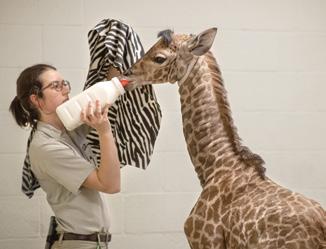
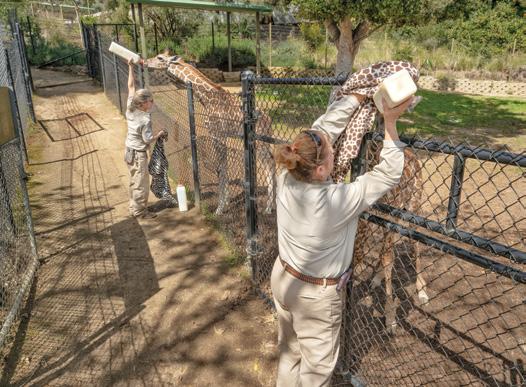
It was decided early on that the calves should be hand raised and bottle-fed, as Gasira hadn’t formed a bond with Yodha, and neither he nor Obi were likely to thrive if they were simply returned to their mothers. At first, the boys received four bottles a day; now they receive two daily.
Once the calves were discharged from the hospital, they still needed TLC, which, in this case, was a little tricky. Most animal babies that need
special care are taken to the Ione and Paul Harter Animal Care Center (ACC) at the Park, but at roughly six feet tall, giraffe calves require more room—preferably with heat. According to Melodi Tayles, a lead keeper at the
Safari Park, there was a perfect solution. “The okapi barn provided the heat and shelter that the calves needed,” Melodi says. “Once they were big enough, we could transfer them closer to the herd.”
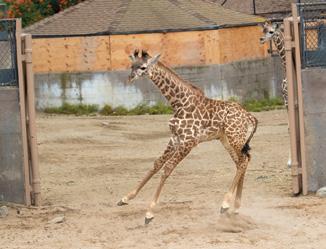
Feeling feisty: Obi (left) lets bold Yodha take the lead as they tackle the world—or at least their field exhibit.
IN A BOMA NOT FAR, FAR AWAY…
Even though their beginnings weren’t ideal, it was fortuitous, notes Kimberly, that the boys arrived within such a short time of each other. “They’ve had each other to grow up with,” she says. “This is important because giraffes are social. It was good they had company, both in the okapi barn and after.” Once they—rather quickly—outgrew the okapi barn, the calves were moved to a boma (a protective enclosure) in the South Africa field
exhibit. The boma was the perfect location for the boys to not only continue to grow physically, but to further their social development.
“The Masai herd could come visit over the wall,” Kimberly explains. “They always had their giraffe friends close by. They were able to learn about the other giraffes and how the herd works.”
As the calves grew, so did their personalities. “Yodha is the bold one; even though Obi is larger,” Kimberly says. “Obi is older, but he’s not in charge.”
JOINING THE ALLIANCE
On introduction day, June 4, 2019, the calves had different reactions to their expanding world. “When they opened the gate, Yodha charged right out,” Kimberly says. “Obi was a little reluctant, until one of the young females in the herd came into the boma and led him out. The two calves had a great time running around. For the first week, they still spent some time in the boma, and then gradually increased field time until they were ready to join the herd full time.”
Boys’ Life: (Clockwise from top
Yodha couldn’t wait to explore the field exhibit. Bottle-feeding giraffe calves is a tall order. The (adorable) face of animal care success. Keepers use blankets that have been rubbed on calves’ mothers to help keep the youngsters from imprinting on humans.
left)
The boys’ new world included their herdmates—an adult male, Gowan; Obi’s mother, Gasira; and three young females, Tazama, Mara, and Zindzhi—as well as a somewhat varied cast of new characters. “The ostriches have chased the boys, and they have chased the ostriches,” Melodi says. “They are learning the parameters.” The exhibit is also home to springbok, waterbuck, sable antelope, gemsbok, and eland. Melodi notes that the boys have melded well into the giraffe herd, and that all the animals are learning to get along and share space, just as they might in the wild. There are certain amenities available to the young giraffes, such as six-foot-tall feeding stations ideal for the calves—they can reach the food, but their antelope and rhino neighbors can’t.
It’s fascinating to watch the herd dynamics change as individual
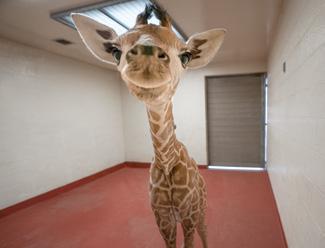
Seeing spots: Obi’s coat pattern helps tell him apart from Yodha. Below: Feeding the calves in the early days was a job unto itself— but with great rewards.
relationships form and their story continues. “It was so rewarding to watch the two giraffe boys join the giraffe herd,” Kimberly says. “It’s what we have been working toward for these boys for the past five months, and it was such a joy to see it happen and go so well. A lot of planning and preparation from
many keepers, animal care supervisors, managers, and curators happened to make that event possible.”
The saga for giraffes in the wild, however, isn’t quite as upbeat. Earlier this year, the U.S. Fish and Wildlife Service conducted an initial review of an Endangered Species Act petition to list giraffes as Endangered. In addition, giraffes are listed as Vulnerable on the International Union for Conservation of Nature (IUCN) Red List of Threatened Species, and their populations have declined up to 40 percent in the last 30 years. This is a story in need of a rewrite, and every addition, such as Obi and Yodha, is a promising development.
Park visitors can observe the next chapters of the story unfolding by taking the Africa Tram, where it’s possible to view the giraffe herd and periodically spot the calves that are, indeed, the giraffes they have been looking for.
4
Number of daily feedings the calves initially received
7
Number of members in the Safari Park’s South African Plains giraffe herd 40
The percentage of decline in the wild giraffe population over the last 30 years BY THE NUMBERS
WHAT CAN YOU DO IN 30 DAYS?
ENROLL IN FOUR-WEEK CLASSES AT NATIONAL UNIVERSITY, PROUD SPONSOR OF THE SAN DIEGO ZOO
National University is San Diego’s largest private nonprofit university, founded in 1971 by retired U.S. Navy Capt. David Chigos. Our mission is to provide accessible, achievable higher education to busy adult learners. Today, we offer flexible fourweek classes across over 100 degree programs, so you can focus on one class at a time, one month at a time.
Here are just a few benefits of enrolling at NU:
• Classes offered on campus or online
• Convenient locations across California and in Nevada
• Yellow Ribbon school with military tuition discounts
• Alumni network of over 165,000 worldwide
CLASSES START MONTHLY. ENROLL TODAY! LEARN MORE AT NU.EDU/ZOONOOZ
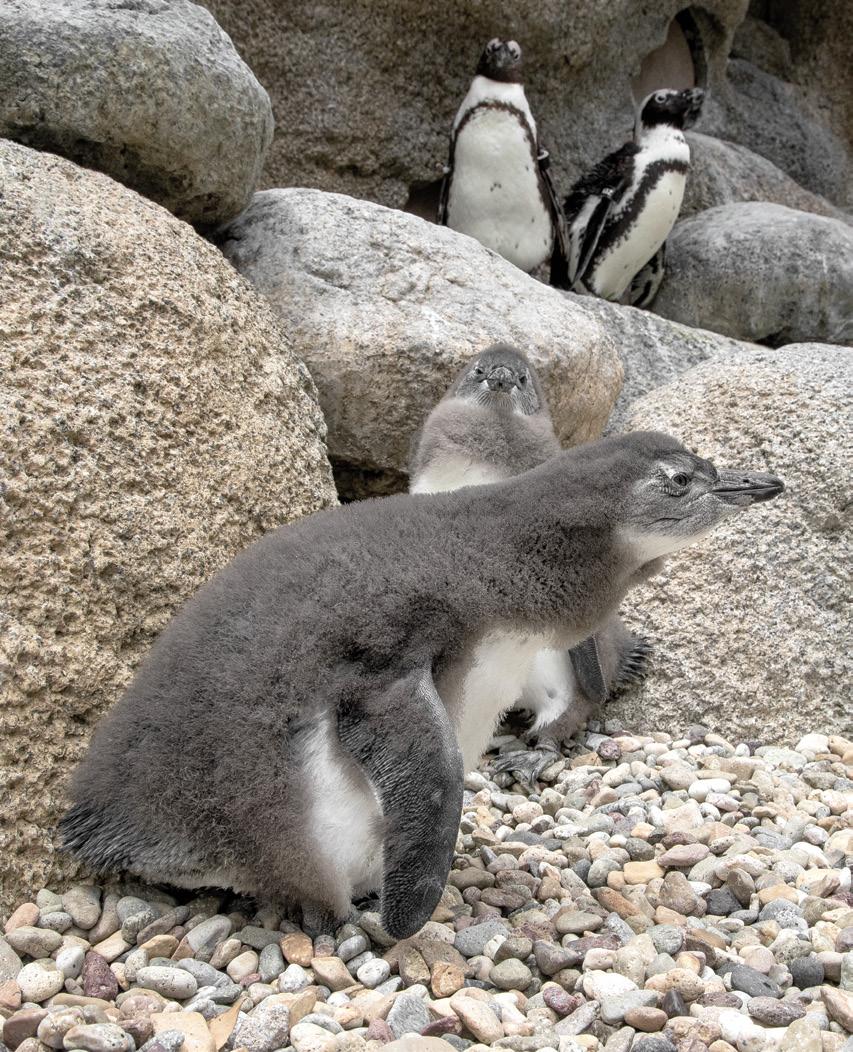
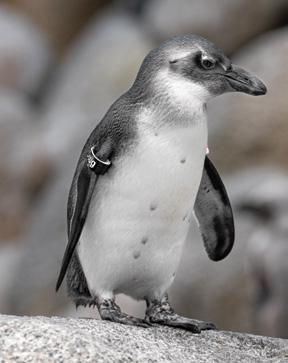
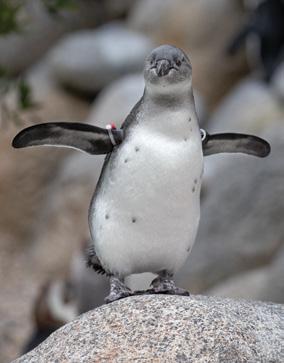
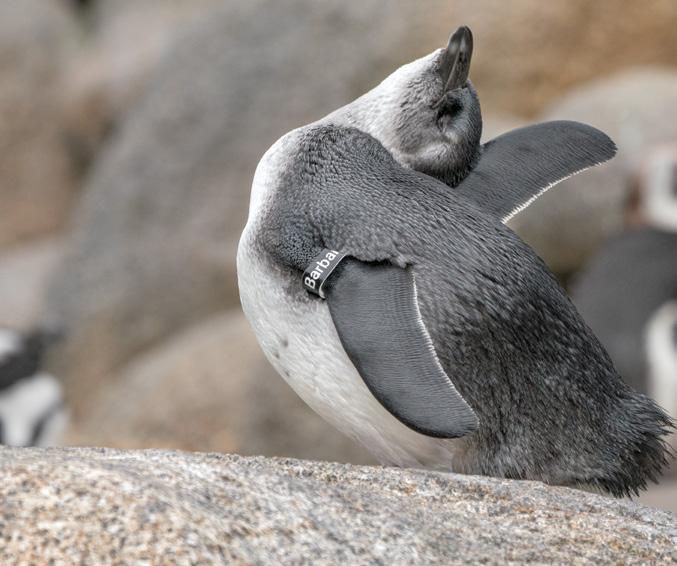
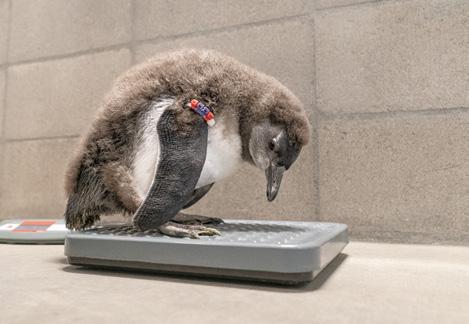
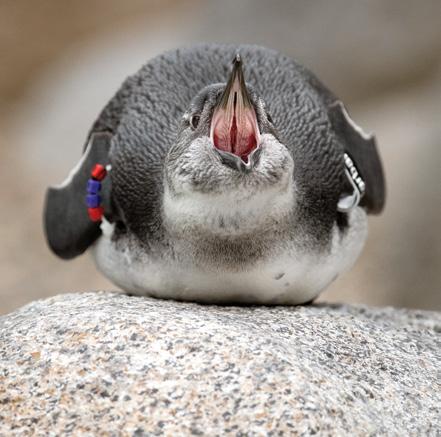
Meet Doug and Barbara. Since these two African penguin chicks hatched at the Zoo’s Cape Fynbos habitat in March, they have grown from fluffy chicks into confident youngsters that now weigh as much as their parents.
PENGUINS’ PROGRESS
BY ESTON ELLIS | STAFF WRITER PHOTOS BY KEN BOHN | SDZG PHOTOGRAPHER
There was big news in March at the San Diego Zoo’s Dan and Vi McKinney
Penguin Habitat at Conrad Prebys Africa Rocks: the animal care staff
welcomed the first chicks to hatch from eggs laid by our own breeding pairs!
Barbara, whose parents are Simon and Norrine, hatched on March 7; and Doug, whose parents are Danny and Malloy, hatched on March 10. Two other penguin chicks—Dot and Lucas—hatched last year at the Avian Propagation Center, but they were from eggs supplied by the Minnesota Zoo. Doug and Barbara are the first chicks that were both conceived and hatched by parents in the Zoo’s now-33-member African penguin breeding colony—a happy milestone for the San Diego Zoo.
“It’s very exciting,” said Lara Jones, a keeper who has worked closely with the new chicks. Both chicks hatched from eggs that were cared for and incubated by their parents, Lara explained. “Our chicks were both hatched by first-time parents, so we were watching to see that they were not only feeding their chick, but that they were taking turns, so that one parent wasn’t doing all the work and getting tired out. Both parents, in each case, were doing their part.”
The hatchlings were of interest to the penguin colony, as well. “Our chicks hatched toward the end of the breeding season, so we had a lot of looky-loos, once the chicks were a couple of days old,” Lara said. “But the parents were so protective—they didn’t let any other penguins come close.”
Doug and Barbara grew quickly, and they reached near-adult size just three months after hatch ing. “They weigh just as much as their parents now,” Lara said. “Soon, they will be adding their genetic contribution to the world’s endangered population of African penguins—and that’s very significant.”
GROWING CHICKS
When both chicks were no longer spending all their time under their doting parents, it was time for them to get to know the animal care staff. Building a relationship with keepers is important, in order to provide effective husbandry care for the penguins, Lara explained. “We want them to know that we are a source of care, and food.”
Keepers started hand-feeding the chicks small boneless fish filets. “As they grew, we gradually in troduced them to whole fish—herring and capelin,” Lara said. The growing chicks, like the adults in the exhibit, get vitamins concealed in their hand-fed fish, along with medications they may need.
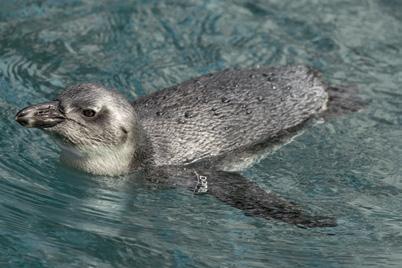
After the chicks became comfortable with the keepers, it was time for their first swim in the pool. Lara and fellow keeper Debbie Denton donned wet suits and got in first. “Barbara followed us right in, but
Doug stayed at the water’s edge,” Lara recalled. “He was probably thinking ‘I don’t know about this,’ but then he trusted us enough to follow us in. Doug was a clumsy swimmer at first, but like Barbara, he learned very quickly.”
Achieving milestones.
Under the watchful eyes of keepers, chicks Doug and Barbara learned to eat whole fish, started putting on weight (as evidenced by regular weigh-ins), became confident swimmers, and began interacting daily with other members of the Zoo’s African penguin colony.
Soon, the chicks were introduced to other areas of the exhibit, spending a day out with the adults. “Barbara was comfortable right away, but Doug just wanted to be a baby, making chick noises,” Lara said. “If you’re a penguin chick, the two things you want to do around adults are to avoid attracting attention to yourself by making chick noises, and to stand your ground if challenged.”
After four days of daytime exhibit visits, the two chicks got a chance to stay there all night. “Barbara spent most of the time in the water, and Doug was in a new spot all the time—every rock he could possibly sit on—until he found ‘his
COMING SOON
Dive into Penguin Beach, a web-series on the Zoo’s social media channels, beginning October 10, 2019.
DID YOU KNOW?
African penguins are categorized as Endangered, with only around 23,000 breeding pairs left. That’s a far cry from 100 years ago, when there were more than one million African penguins. While commercial harvesting of penguin eggs and guano (droppings) ended in the late 20th century, other threats—including a lack of food due to overfishing, climate change, oil and marine pollution, the emergence of avian influenza A (H5N8), and habitat degradation—have led to a continuing decline. SDZG participates in the Association of Zoos and Aquariums’ Species Survival Plan to maintain a protected assurance population of African penguins.
SDZG also partners with the Southern African Foundation for the Conservation of Coastal Birds (SANCCOB) on conservation work to help these penguins in South Africa, including rescue, rehabilitation, and tracking upon release.
rock’ in the middle of the exhibit, where he can see everything that is going on,” Lara said. “He started to defend himself instead of running. Barbara recently joined him in that spot, since she really didn’t have one of her own. Both have now figured out when it’s feeding time, both morning and afternoon. Before, they would just come up to us any time they were hungry, like they were asking ‘is it dinner time yet?’”
The two get weighed weekly. “We want to see that they maintain their weights, and we watch as they settle in and get completely familiar with the rest of the colony,” Lara said. Keepers also look at their feet to see how active they are.
CHANGES AHEAD
While Doug now has his “spot” to hang out in, Barbara has begun making friends with adults in the colony. “Barbara has been hanging out with Gayle and Lori, who are troublemakers—but it’s good to see she’s socializing,” Lara said. “She’s made more friends than Doug has, but he’s a male and he’s just defending everything, for now.”
“These guys are big characters,” Lara added. “Doug has stayed pretty sweet. He will sit in a keeper’s lap and likes to get his back scratched— that is, when we get him by himself. Barbara wants to be right on your heels when you’re in the exhibit,
thoughts will soon gently (or not so gently) turn to nesting season. “The colony will be involved in pairing up, and all the drama that goes with that,” Lara said. “We will be watching to see if Doug and Barbara will be excited about all the shenanigans going on with the adults, or whether they will just lay low.”
What else does the future hold for the growing chicks? They will go through their first molt at about a year and a half old, which is a major step, Lara said.
“Molting is very awkward. They will be wondering, why am I swelling and puffed up? Why am I so hungry?” And they will go from the bluish juvenile coloration to their adult black and white.
After they go through the first molt, they will go through their first breeding season.
“That’s when they start to ‘play house,’ and they may find a mate,” Lara said. However, Barbara probably won’t lay her first egg until she is two or three years old, so major milestones lie ahead.
For now, the chicks are just enjoying being chicks, and they’re still finding their place in the lively colony at Africa Rocks. Watch them—at the Zoo, or online on Penguin Cam—as they transform from awkward youngsters to savvy adult penguins!
Two Miracle Moms
First Steps To Saving The Northern White Rhino
BY CAITLIN HANNAH | COPYWRITER, DEVELOPMENT DEPARTMENT PHOTOS BY KEN BOHN | SDZG PHOTOGRAPHER
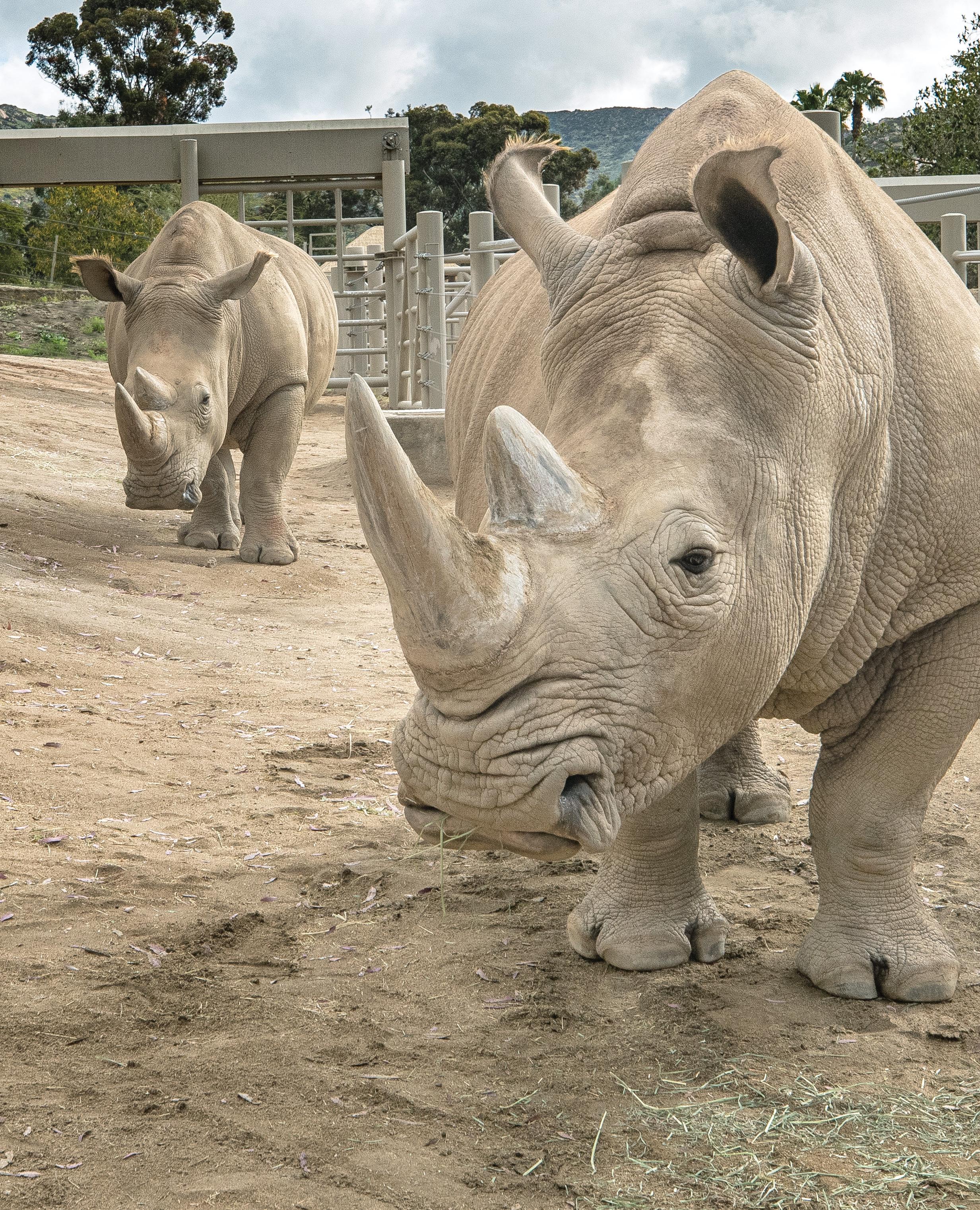
Victoria and Amani spend their days nibbling on hay, hanging with their friends, and being spoiled with behind-the-ear scratches from their favorite keepers. They might seem like ordinary rhinos, but these two gentle giants are our superheroes—and they’re helping to bring their cousins back from the brink of extinction.
Edward, the 186th rhino born at the Safari Park, and the first by artificial insemination in North America.
A few years ago, on a crisp Thursday night in November, several trucks pulled up to a nondescript building at the San Diego Zoo Safari Park. They had a special delivery. Six female southern white rhinos, including Victoria and Amani, had been rescued from Africa, where three rhinos are killed every day. One of the “girls,” Wallis, even arrived with a bullet lodged in her side—the result of a failed poaching attempt. Fortunately, Wallis made a full recovery. But the scar left behind is a constant reminder of the lives that are at stake.
Rhino populations have been devastated by decades of rampant poaching. They’re killed for their horn because of its supposed medical benefits.
But rhino horn has no healing powers. It’s made of keratin, the same as your hair and fingernails. While all rhino species are in trouble because of this poaching crisis, the northern white rhino has suffered worst of all. Only two remain on Earth, and neither is able to breed. Now, the best hope for saving the northern white rhino is our surrogacy program at the Nikita Kahn Rhino Rescue Center at the Safari Park. That’s where you and our supermoms come in.
Thanks to generous donations from friends like you, Victoria was the first rhino in San Diego Zoo Global’s 103-year history to become pregnant by artificial insemination. Amani soon followed. Their landmark pregnancies mean the science is working, and hope for the northern white rhino is at our fingertips.
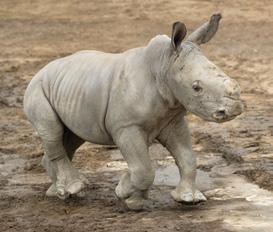
We are thrilled to share that on July 28, 2019, Victoria gave birth to a male calf. Named Edward, this little boy is living proof that friends like you make hope possible.
You can help
As we celebrate Edward’s birth and eagerly await the arrival of Amani’s calf, we could not be more grateful for friends like you. You can truly make miracles happen. Will you join us today to keep these lifesaving efforts going?
Your gift of $50 could fund the Rhino Rescue Center for one hour, allowing these critical conservation efforts to continue.
Your gift of $250 could provide prenatal care like ultrasounds for our moms-to-be.
Your gift of $1,200 could run the Rhino Rescue Center for an entire day.
For gifts of $1,200 or more, your name (or that of a loved one) will be listed on the San Diego Zoo Global Annual Conservation Recognition Plaque, displayed at the San Diego Zoo and Safari Park from Spring 2020 to Spring 2021.
To join us, visit endextinction.org/rhinos.
Victoria and Amani, two of our miracle moms at the Nikita Kahn Rhino Rescue Center.
IN THE FIELD
San Diego Zoo Global’s mission to end extinction takes place not just at the Zoo, Park, and Institute for Conservation Research, but also through fieldwork in projects around the globe. Each issue, we share an update on these projects.
BIG DEAL ON THE BIG ISLAND
BY KARYL CARMIGNANI | STAFF WRITER PHOTOS BY KEN BOHN | STAFF PHOTOGRAPHER
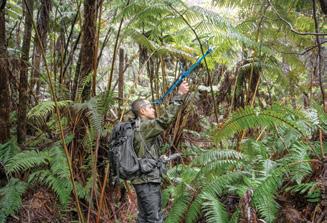
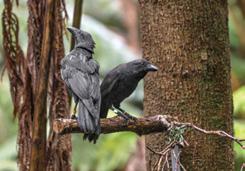
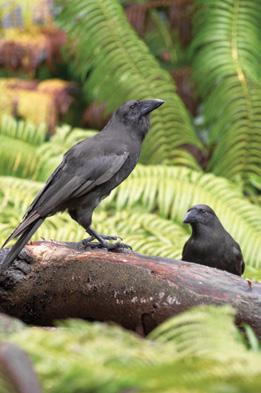
For the first time in decades, alala (Hawaiian crows) are free-flying and exhibiting nesting behavior on the Big Island. “It’s their first season as adults, and they are nest building, pair bonding, and setting up territories like they should,” said Alison Greggor, Ph.D., postdoctoral research associate, Recovery Ecology, San Diego Zoo Global. She noted that corvids (crows) are prone to failed nests the first or second season. Like other crow species, alala are longlived birds, and it can take them a while to successfully fledge chicks. This behavioral milestone is an achievement, and it was a long time coming. “Today’s success is due to a decades-long effort by San Diego Zoo Global and partner groups and agencies,” she added. “No one could do this alone.” Since 1996, we have bred this critically endangered species at the Keauhou and Maui Bird Conservation Centers. Intensive management has helped this species rebound from fewer than 20 birds in the 1990s to more than 120
birds today, 19 of which make up the release cohort.
There have been challenges. In 2016, five alala were released, and three did not survive, likely due to predation by the io (Hawaiian hawk) or exposure. Researchers collected the remaining two birds and changed the release protocol. Anti-predator training was increased, the release site was moved within Pu’u Maka’ala Natural Area Reserve (with fewer io), and the composition of the release cohort was changed. “We released a larger group of mixed-sex birds, hoping they would stick together,” Alison said. And they are. The research team has seen each bird every day, except during a tropical storm. “The field team has done a fantastic job monitoring the birds. Rain or shine, binoculars in hand, they are committed.” It has been a “soft release,” with the birds getting supplemental food to help them succeed. Happily, the team has seen alala cooperatively mobbing an io in defense of their territory. And that’s a big deal!
SEPTEMBER 2019
Cool down to start off fall with a tasty ice cream treat at the Zoo.
Valid September 1–30, 2019
Valid at any location at the Zoo where frosty cones are sold. Member must provide valid membership card at time of purchase to receive discount. Supporting ID may be required. Not valid with any other offer, promotion, or discount. Coupon not required.
OCTOBER 2019
OFF
GAMES AND PUZZLES
Add an animal theme to playtime fun.
Valid October 1–31, 2019
Valid at all stores at the San Diego Zoo and Safari Park. Member must provide valid membership card at time of purchase to receive discount. Supporting ID may be required. Coupon not required. For online purchases, enter promotion code MEMBER10 at checkout. Cannot be combined with any other offer, promotion, or discount. No limit while supplies last.
OCTOBER 2019
SOUVENIR SIPPERS
Bring home a new animal sipper from the Safari Park.
Valid October 1–31, 2019
Discount available at any Safari Park restaurant location. Members also receive free refills all day on date of purchase. Member must provide valid membership card at time of purchase to receive discount. Supporting ID may be required. Not valid with any other offer, promotion, or discount. Coupon not required.
Enjoy a $1 off a cinematic adventure with high-definition 4-D projection and thrilling sensory effects.
Valid November 1–30, 2019
Valid at Zoo 4-D Theater. Member must provide valid membership card at time of purchase to receive discount. Supporting ID may be required. Not valid with any other offer, promotion, or discount. Coupon not required.
SAN DIEGO ZOO GLOBAL Box 120551, San Diego, CA 92112 OVER I RA FOR THE YOUR ZOO ROLL
• You can use your IRA in the way you want GET READY FOR KIDS FREE IN OCTOBER!
$100,000 You can direct up to 70 ½ or older
If you are 70½ or older and don’t need your IRA’s required minimum distribution (RMD), you can roll over part of it to help San Diego Zoo Global provide for the animals in our care and support our conservation efforts around the world An IRA Charitable Rollover gift can benefit both you and the Zoo! Contact us today at 619-557-3947 or donations@sandiegozoo.org to request a sample letter to send to your IRA administrator that will allow you to make an IRA Charitable Rollover gift. DOUBLE THE BENEFITS!