NOVEMBER/DECEMBER

JANUARY 2024
Grand India Wildlife Adventure
MARCH 2024
Family Costa Rica Adventure
AUGUST 2024
SEPTEMBER 2024
Madagascar Wildlife Adventure
NOVEMBER 2024
Southern Australia and Tasmania
DECEMBER 2024
Classic Galápagos Experience

JANUARY 2024
Grand India Wildlife Adventure
MARCH 2024
Family Costa Rica Adventure
AUGUST 2024
SEPTEMBER 2024
Madagascar Wildlife Adventure
NOVEMBER 2024
Southern Australia and Tasmania
DECEMBER 2024
Classic Galápagos Experience
Journey Through Our Conservation Work This issue of the San Diego Zoo Wildlife Alliance Journal focuses on the Australian Forest hub. To learn more about our collaborative conservation programs around the world, including our wildlife care at the San Diego Zoo and San Diego Zoo Safari Park, visit sdzwa.org.
Cover Story 8
Out of the Ashes
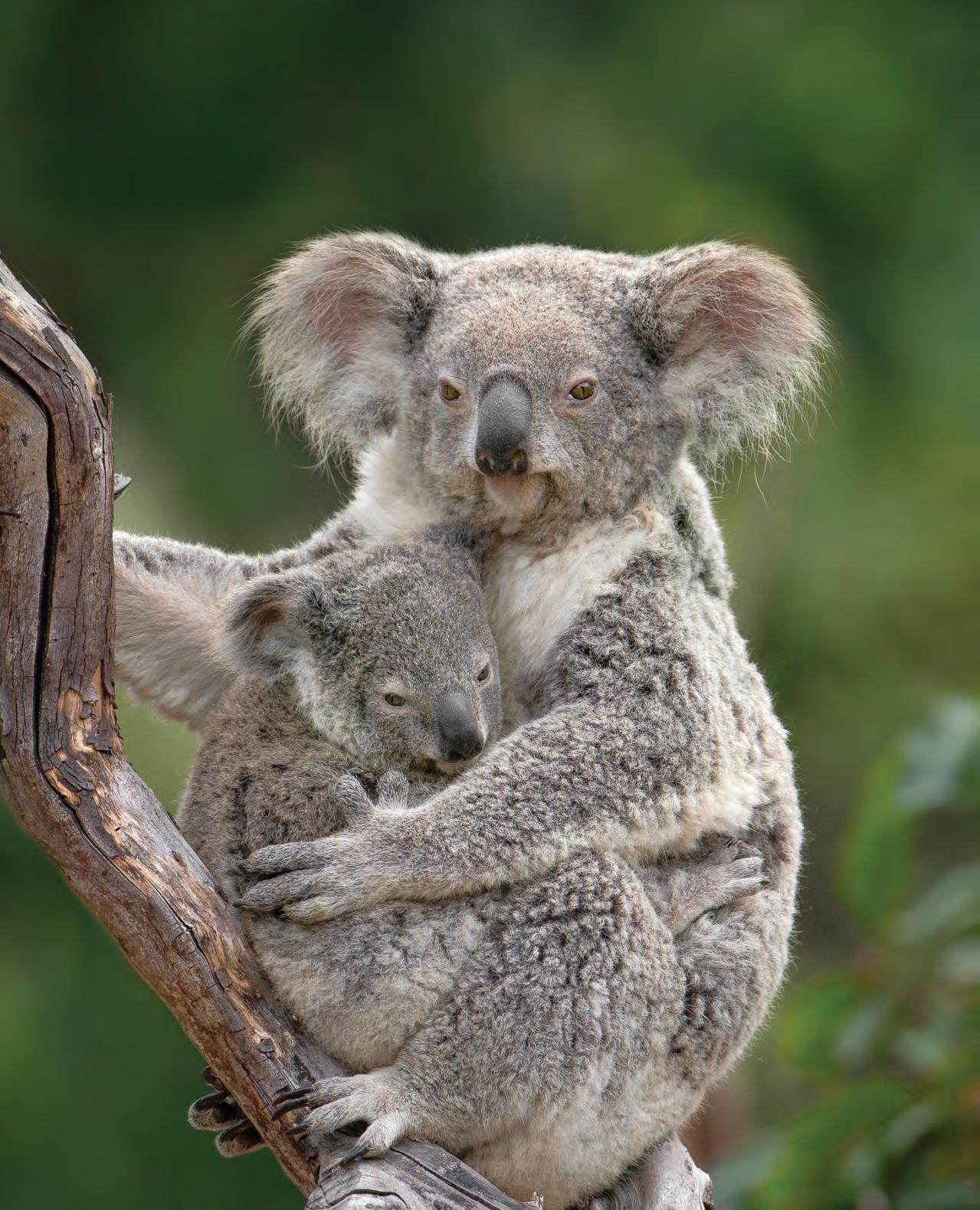
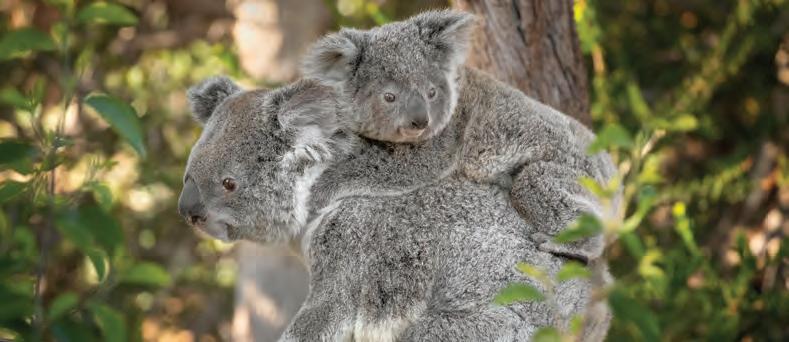
The “Black Summer of Fire” in 2019–2020 was devastating for koalas in Australia’s Blue Mountains. A collaborative recovery effort is underway.
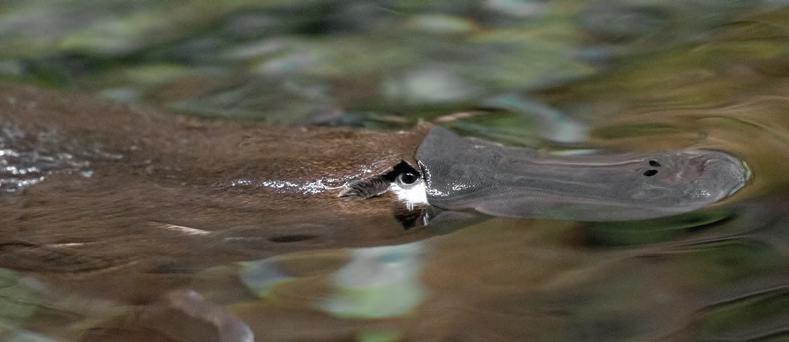
Using data from eDNA techniques, scientists are exploring how to protect platypuses and their watery habitat. 15
Home Is Where the Habitat Is 2023 Calendar
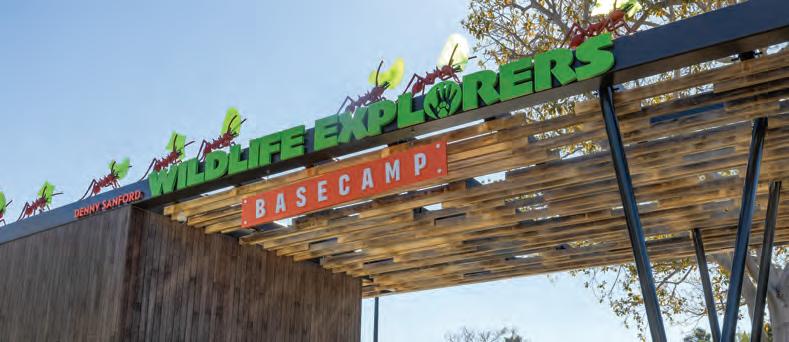
The San Diego Zoo’s Wildlife Explorers Basecamp is home to amazing species in four unique ecosystems. Meet some of them in our 2023 Calendar!
40 Visualize It
Monotremes are some of the most unusual species in the world. See what makes them like other mammals, and what characteristics make them unique.
SENIOR EDITOR Peggy Scott STAFF WRITERS
Donna Parham
Elyan Shor, Ph.D.
Ebone Monet
Alyssa Leicht
COPY EDITOR Eston Ellis
DESIGNER Christine Yetman
PHOTOGRAPHERS
Ken Bohn
Tammy Spratt
DESIGN AND PRODUCTION
Kim Turner
Lisa Bissi
Jennifer MacEwen
PREPRESS AND PRINTING Quad Graphics


Follow @sandiegozoo & @sdzsafaripark.
Share your #SanDiegoZoo & #SDZSafariPark memories on Twitter & Instagram.
The Zoological Society of San Diego was founded in Octo ber 1916 by Harry M. Wegeforth, M.D., as a private, nonprofit corporation, which does business as San Diego Zoo Wildlife Alliance.
The printed San Diego Zoo Wildlife Alliance Journal (ISSN 2767-7680) (Vol. 2, No. 6) is published bimonthly, in January, March, May, July, September, and November. Publisher is San Diego Zoo Wildlife Alliance, located at 2920 Zoo Drive, San Diego, CA 92101-1646. Periodicals postage paid at San Diego, California, USA, and at additional mailing offices. POSTMASTER: Send address changes to San Diego Zoo Wildlife Alliance, P.O. Box 120271, San Diego, CA 92112-0271.
Copyright© 2022 San Diego Zoo Wildlife Alliance. All rights reserved. All column and program titles are trademarks of San Diego Zoo Wildlife Alliance. If your mailing address has changed: Please contact the Membership Department; by mail at P.O. Box 120271, San Diego, CA 92112, or by phone at 619-231-0251 or 1-877-3MEMBER.
For information about becoming a member of San Diego Zoo Wildlife Alliance, please visit our website at ZooMember.org for a complete list of membership levels, offers, and benefits.
Subscriptions to San Diego Zoo Wildlife Alliance Journa l are $25 per year, $65 for 3 years. Foreign, including Canada and Mexico, $30 per year, $81 for 3 years. Contact Membership Department for subscription information.

San Diego Zoo Wildlife Alliance has a long tradition of working with Australian conservationists to protect wildlife native to Australia’s forest habitats. For nearly a century, we have collaborated with conservation partners, including the Indigenous peoples of Australia and local communities, to develop innovations in wildlife care, helping to secure a future for some of Australia’s most iconic species. Because of this long-term alliance, when megafires tore through the Blue Mountains—a UNESCO World Heritage Site—severely impacting critical koala populations, we were able to mobilize teams ahead of the devastation to rescue koalas in the path of danger, and to help care for the survivors. Conservation happens in moments, and our efforts to help Australia’s iconic wildlife have also created new opportunities for collaborative conservation as our partners continue to rebuild for the future. With allies like you at our side, we can build relationships that stand the test of time, and find solutions to some of conservation’s toughest challenges.
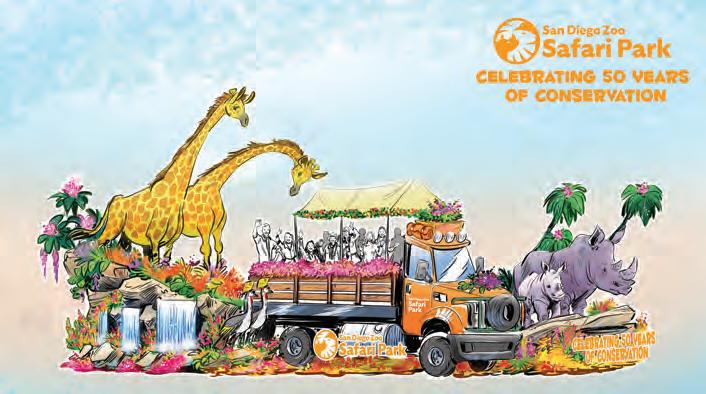
We’ve had so much to celebrate this year, reflecting on 50 years of life-changing moments and connections with wildlife at the San Diego Zoo Safari Park. Unlike any other place on Earth, the Safari Park provides us with authentic stories of nature that help us connect the dots between ourselves and the rest of the world. We are excited to announce the largest endeavor in Safari Park history as we begin construction on the new Denny Sanford Elephant Valley. Elephant Valley will transform the footprint of the Safari Park and the future of elephant conservation forever. Through the course of our journey, viewing locations will be modified and may at times be limited, but in the end, our commitment and connections with these gentle giants will be greater than ever before.
To culminate our celebrations, we will be participating in the Rose Parade with another mesmerizing experience showcasing those life-changing moments that happen here each and every day, and our global commitment to conservation. We hope you join us by tuning in on Monday, January 2, 2023 to watch as we reach millions with our message of hope for a world where all life thrives.
As we prepare for a new year and think about ways in which we can lean into our roles as allies for wildlife, we hope this year’s San Diego Zoo Wildlife Alliance calendar helps inspire the budding conservationist in all of us, year round. The calendar features wildlife from four different ecosystems that you can encounter at the San Diego Zoo’s new Denny Sanford Wildlife Explorers Basecamp. Through parallel play, dynamic habitats, and immersive experiences, Wildlife Explorers Basecamp gives each of us the opportunity to experience the world from wildlife’s perspective, helping guests gain knowledge and insights to support wildlife and the planet we all share.
As part of San Diego Zoo Wildlife Alliance’s commitment to conservation, this magazine is printed on recycled paper that is at least 10% post-consumer waste, chlorine free, and is Forest Stewardship Council ® (FSC ®) certified. FSC ® is not responsible for any calculations on saving resources by choosing this paper.
Together we can change the world, bring about our brightest days, and inspire the next generation of world changers. Thank you for your support, and for being an ally for wildlife.

Paul A. Baribault President
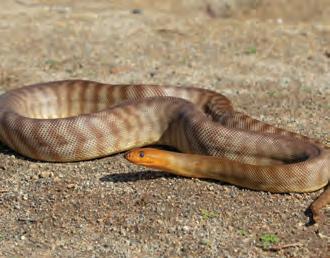
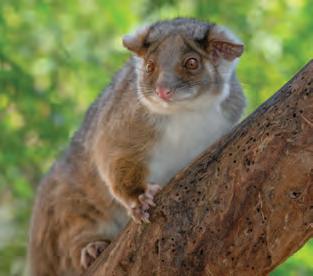
Australian forests host a large array of unique flora and fauna, largely because of their long-term geographic isolation. From iconic marsupials such as koalas, to lesserknown monotremes like the short-beaked echidna, variety is abundant. However, their eucalypt habitats burn easily. Protecting these forests is essential to conserving Australia’s rich biodiversity.
The percentage of Australia’s flowering plants, mammals, reptiles, frogs, and fishes that can only be found in Australia.
2
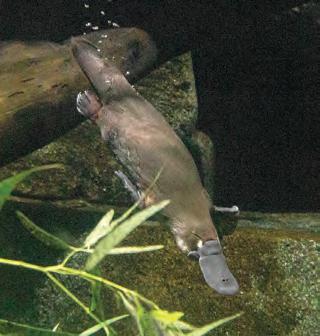
Only two platypuses live outside of Australia—at the Safari Park.
~250 million
Acres of eucalypts make up three-quarters of Australia’s forests.
14
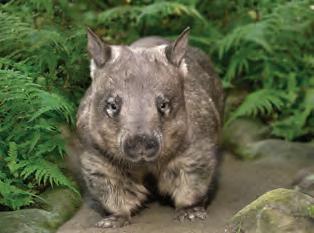
Days for a wombat to digest one meal. The resulting scat is compact and cube-shaped.
2,486
Javade Chaudhri, Chair
Steven S. Simpson, Vice Chair
Richard B. Gulley, Treasurer
Steven G. Tappan, Secretary
TRUSTEES
Rolf Benirschke
Kathleen Cain Carrithers
Clifford W. Hague
Robert B. Horsman
Gary E. Knell
Linda J. Lowenstine, DVM, Ph.D.
Judith A. Wheatley
‘Aulani Wilhelm
TRUSTEES EMERITI
Berit N. Durler
Thompson Fetter
George L. Gildred
Yvonne W. Larsen
John M. Thornton
A. Eugene Trepte
Betty Jo F. Williams
Executive Team
Paul A. Baribault
President and Chief Executive Officer
Shawn Dixon
Chief Operating Officer
David Franco
Chief Financial Officer
Erika Kohler
Executive Director, San Diego Zoo
Lisa Peterson
Executive Director, San Diego Zoo Safari Park
Nadine Lamberski, DVM, DACZM, DECZM (ZHM)
Chief Conservation and Wildlife Health Officer
Wendy Bulger
General Counsel
David Gillig
Chief Philanthropy Officer
Aida Rosa
Chief Human Resources Officer
David Miller
Chief Marketing Officer
San Diego Zoo Wildlife Alliance (SDZWA) protects and restores nature in eight conservation hubs on six continents. Below are recent discoveries and progress from around the world.
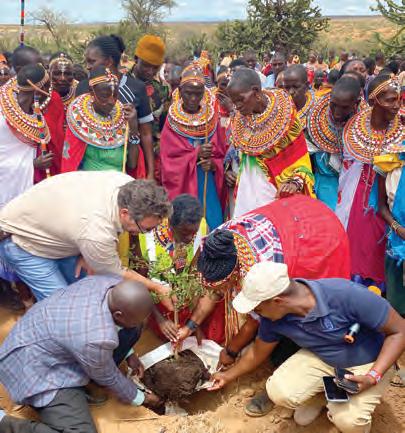
Our leopard conservation team, Uhifadhi wa Chui (“Leopard Conservation”) is working with Loisaba Conservancy to build and develop the Chui Mamas Center, a community headquarters for local enterprise and conservation planning in Laikipia County, Kenya. The Chui Mamas (“Leopard Mothers”) is a community-based women’s organization, established and led by local women to enhance capacity and income opportunities linked to wildlife and habitat conservation. The Chui Mamas Center will be a base for over 300 women from the surrounding community conservancies, including spaces for their shops and a meeting hall for conservation events.
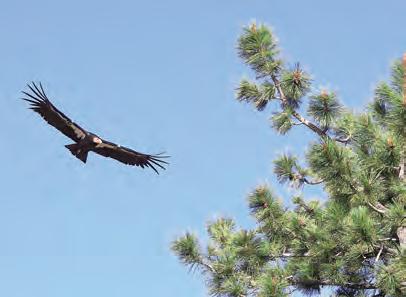
After eight years of continuous attempts to restart exportation of juvenile condors from our conservation breeding program to Baja California, Mexico, our Wildlife Health, Wildlife Care, and Conservation Science teams successfully sent two juvenile condors to Baja California earlier this year. These condors not only increase the population size, but also provide valuable genetic diversity to the growing Baja California flock. This effort required an incredible degree of attention and collaboration within SDZWA and with our partners. SDZWA has been actively involved in condor conservation for over 30 years.
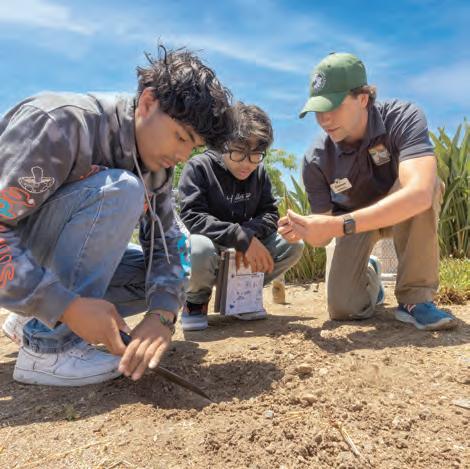
SDZWA’s newest Community En gagement program is the Native Biodiversity Corps. We recruited about 100 students from 3 local high schools; our program goal is for the students to learn and appreciate that they live in a biodiversity hotspot. During our spring session, we engaged students in naturebased learning activities at local wildlife conservation sites. In our summer session, the students worked with our team and native landscape design experts to design, implement, monitor, and maintain native wildlife gardens on their high school campuses. The gardens are designed to attract and support local wildlife, combat impacts of regional climate change, promote regional pride, and build more resilient communities. With this program, SDZWA hopes to inspire a generation of conservation stewards for our local habitats.
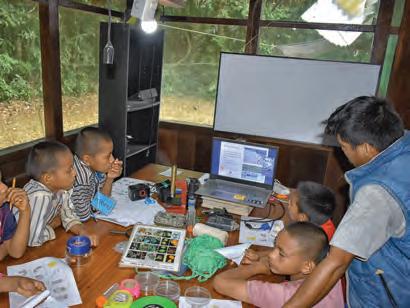
The Matsigenka are indigenous people who live deep inside Peru’s Manu National Park, in protected areas only accessible by river. This summer, young students from the Matsigenka community of Yomibato visited the Stiefel Behner Cocha Cashu Biological Station for the “EduCashu” educational program hosted by our Amazonia team in Peru. Across two days, the students, together with parents and teachers, shared scientific and traditional insights about life in the forest, and they identified plants and birds as they explored the station’s forest trails. They also joined our SDZWA team to learn about methods of studying giant otters and fish in the park’s oxbow lakes, as well as the recent findings by our giant otter research program on the effectiveness of protected areas in the Amazon.
What is the coolest thing about your job?
I think the coolest part of my job is being situated in close proximity to leading experts in the fields of conservation science, wildlife health, and wildlife care. If ever I have a pressing question or an idea for a new program, I can just pop down the hall and access worldclass expertise and knowledge. I am inspired daily by my incredible colleagues at SDZWA!
What book or film influenced you or made a strong impression?
My favorite film was actually adapted from a book that left a very strong impression on me: The Constant Gardener by John le Carre. Based on compelling true events in Africa, the book reinforced in me the importance of an altruistic and community-oriented mindset to keep hope and progress alive in the world, and that only when brave people stand up for the voiceless can we move forward as a global society. The film adaptation, directed by Fernando Meirelles, is visually stunning and set my sights on experiencing the incredible landscapes of Kenya firsthand, a longtime dream I was fortunate to realize in 2019 on a trip with SDZWA partners. I will always cherish the memory of hovering above millions of flamingos in a helicopter over Lake Turkana!
MEET OUR TEAM
As director of the Community Engagement team in the Conservation Science and Wildlife Health department, Maggie Reinbold oversees and supports the work of two innovative and interconnected work groups: the Conservation Science Experiential Learning group and the Applied Conservation Social Science group. Q Q Q
What is your favorite animal? Why?
I have always been a big fan of dragonflies. I did an undergraduate research project at San Diego State University that focused on dragonflies and damselflies living in and around the springs and oases of Anza-Borrego Desert State

Q Q
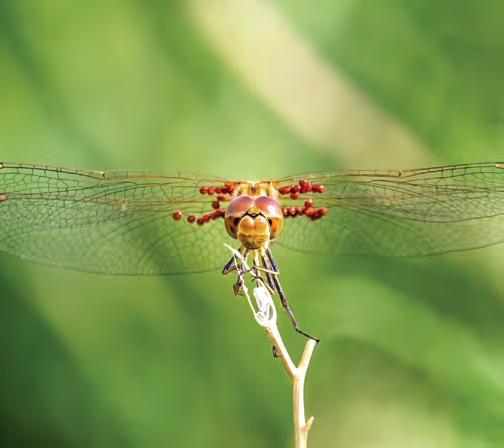
Park, and I was quickly fascinated by their life cycles, physiology, and behaviors. I also love to advocate for arthropods and other invertebrates, all the critically important species that E.O. Wilson referred to as “the little things that run the world.” Without them, human existence on this planet would not be possible.
What was a turning point or defining moment in a project or program you’ve worked on?
In the summer of 2016, we invited a dozen international educators to join our annual Teacher Workshops in Conservation Science, as we celebrated the program’s 10year anniversary. Witnessing the fruitful exchange of ideas and stories between our international colleagues and teachers from across the US (whom we lovingly refer to as the hardest-working people in America) was truly inspirational, and has now become a centerpiece of the program.
What do you see as the future of wildlife conservation?
I believe that conservation is inherently a human issue, so I see the future as actively and meaningfully partnering with communities here and abroad to co-generate and test solutions that benefit both wildlife and people.
Who or what inspires you?
I am most inspired by community members who actively celebrate their bond with the natural world, and then work to pass that love and appreciation on to others. I have been positively influenced by community members across the world, from Hawai'i to Kenya to Mexico, to right here in our own backyard. I am grateful for their inspiration.

PROUDLY SUPPORTED BY

The magic and the spirit of the holiday season return! The Zoo lights up the night until 8 p.m. (*except December 24) with amazing entertainment featuring the spectacular show, Aurora. Bring the family and enjoy some tasty treats and the warmth of the holidays.
For Raj Brown, director of horticulture for the San Diego Zoo Safari Park, studying an iconic tree from Down Under is like a trip back in time—way, way back.
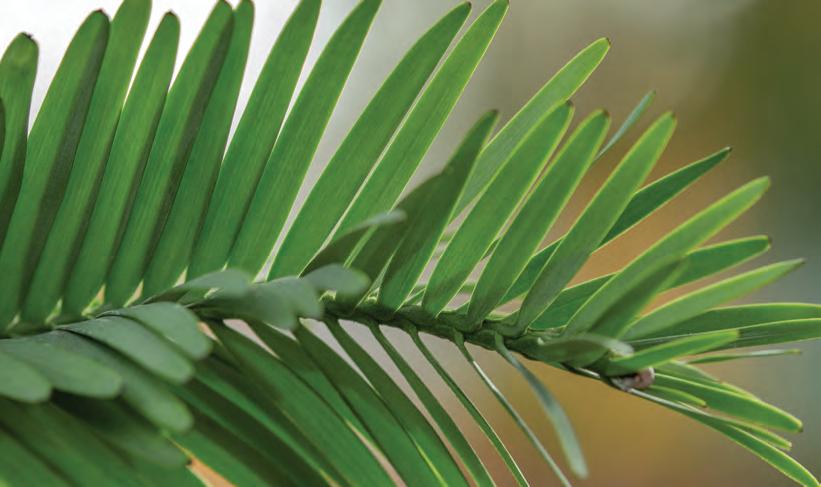
One of the world’s oldest and rarest trees, the Wollemi pine Wollemia nobilis is a fascinating and resilient tree that flourished during the late Cretaceous era, when dinosaurs like Tyrannosaurus and Triceratops roamed the Earth. As a member of the 200-millionyear-old plant family Araucariaceae, scientists classified the species as extinct until a bushwalker discovered the trees thriving in an isolated canyon on the outskirts of Sydney, Australia. The discovery of the ancient stand of trees caused great excitement in the botanical community and has spurred national and international conservation efforts to protect the species through in situ and ex situ conservation efforts.
Wollemi pines are tall, coniferous trees with needle-like leaves. They grow to 130 feet in height. A trunk can grow up to three feet in diameter, and it’s common to find numerous trunks emerging from a single root base. Wollemi pines reproduce
to safeguard the cherished groves of native trees. In a coordinated effort, air tankers dropped fire retardant while on-grounds crews set up irrigation systems to hydrate the environment. Fortunately, the strategy proved successful, with very few of the trees consumed by the fire. The aftermath photography showed a desolate and charred landscape with verdant pockets of Wollemi pines standing tall.
vegetatively and by wind pollination. They are monoecious, with both male and female cones on each tree. They are extremely long-lived, and it is estimated that the wild population trees have specimens between 500 and 1,000 years old.
Wollemia nobilis is considered critically endangered, with native populations scattered within isolated pockets of Wollemi National Park. The trees are protected through in situ wildlife conservation efforts, and the locations of the wild groves are kept secret to prevent damage and disease introduction. The limited geographic distribution and small population size make the Wollemi pine extremely vulnerable to disease and fire.
The catastrophic Gospers Mountain megafire of 2020 burned more than 1.2 million acres and nearly destroyed the last remaining native populations of Wollemi pine. Noting the significance of these isolated forests, the Australian government deployed a specialized team of firefighters
In addition to the in situ conservation efforts, the Australian government developed an extensive propagation strategy for ex situ plant conservation. Seed collections from the ancient native groves were propagated en masse, as a part of a global cultivation conservation strategy. Purchasing the Wollemi pine saplings helps support ongoing conservation research, while also diversifying the geographic distribution of the species. Additionally, the mass propagation strategy has diminished illegal plant trafficking demand to remove plant materials from native forests.
The San Diego Zoo Safari Park and San Diego Zoo botanical collections participate in the global ex situ Wollemi pine meta-collection conservation efforts, with multiple trees at each location. At the Safari Park, there are Wollemi pine trees located in Walkabout Australia near the Matschie’s tree kangaroo and platypus habitats. The trees are growing among native Australian shrubs, like blue hibiscus and bottle brush. In the vicinity, you will also find other ancient trees from the ancient Araucariacea family, including the Queensland kauri Agathis robusta, Norfolk Island pine Araucaria heterophylla, and Monkey Puzzle tree Araucaria araucana. Next time you are at the Safari Park, we encourage you to admire this plant conservation success story, and enjoy these wonderful “living fossils.”
BY KELLIE LEIGH, PH.D., AND KAT BOEHRINGER
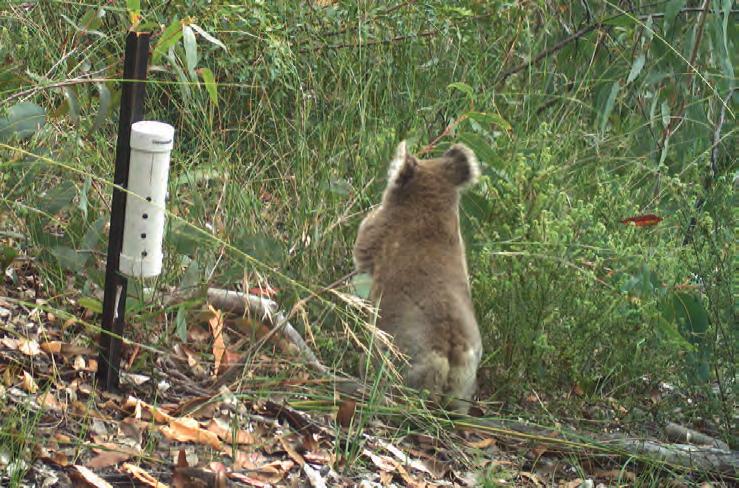
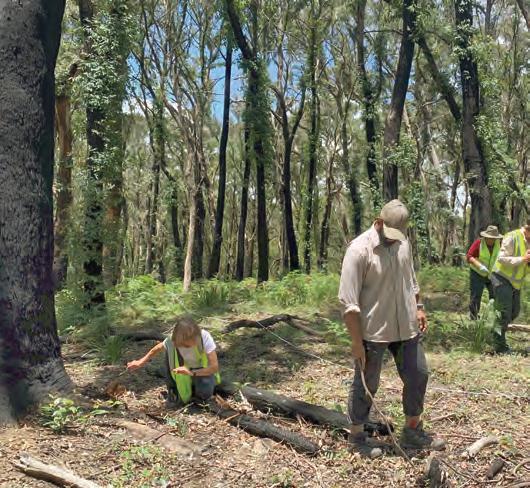
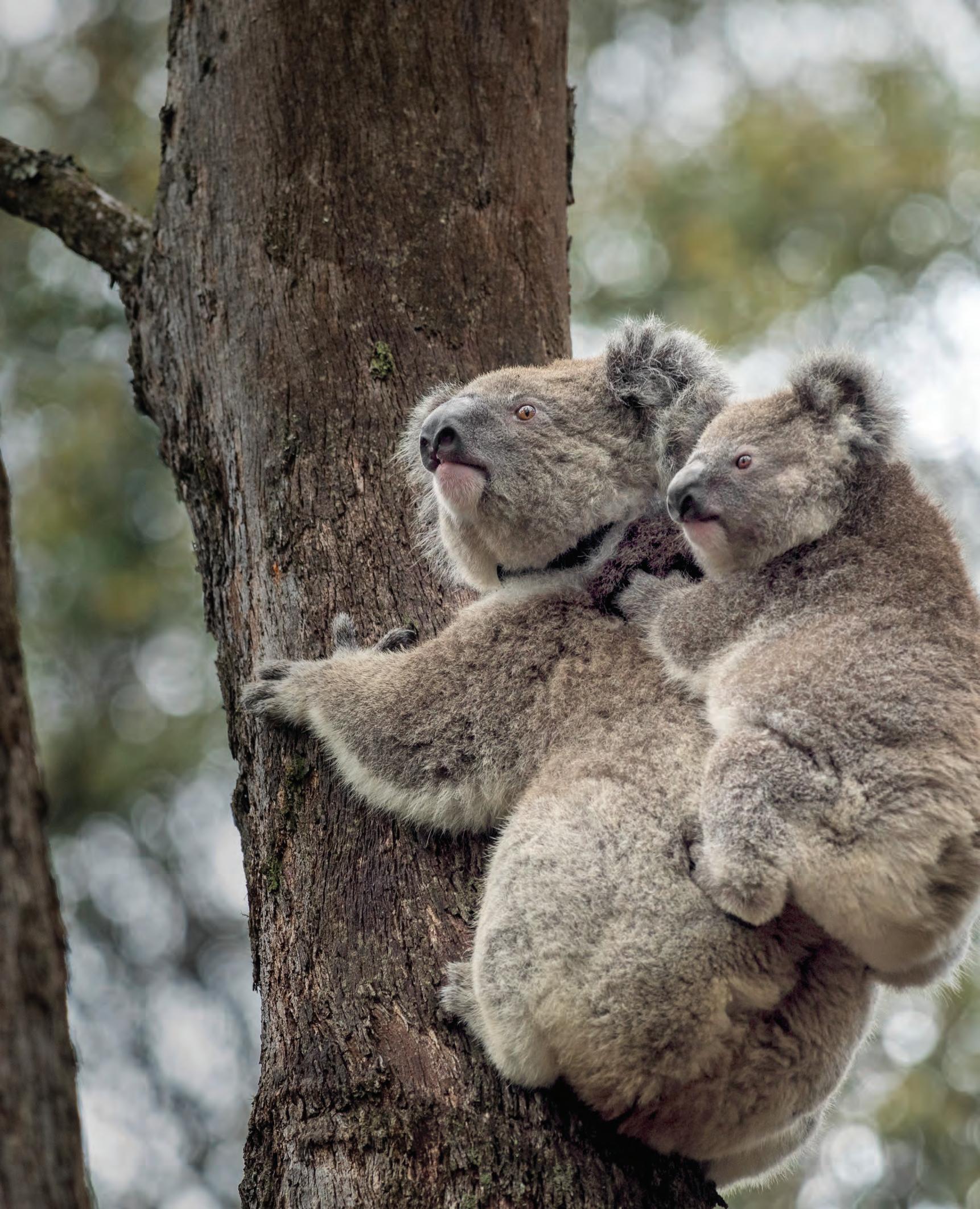
The summer bushfires of 2019–2020—christened the “Black Summer of Fire”—dealt a deadly blow to Australia’s iconic koalas. In the Blue Mountains, west of Sydney, an out-of-control mega-blaze tore through the ancient bush, burning a staggering 80 percent of the World Heritage Area and heavily impacting the koalas there. Once a thriving community of 3 to 4 million, koala numbers are now as low as 300,000—and conservation scientists predict that koalas may be extinct in New South Wales by 2050. Saving each and every koala population is vital to their survival as a species.
The devastating fires seriously affected breakthroughs we were making. Not long before the blazes, we had started to make exciting discoveries, uncovering populations of genetically diverse and chlamydia-free koalas living in the area. Pre-fire, we found koalas where we didn’t expect them, using types of trees we didn’t think they used. Post-fire, we realized how devastating this setback was. We returned to the area, seeking surviving koalas. We’re working hard to find out how many of these rare and nationally significant koalas are left in the Greater Blue Mountains area, to ensure a future for these “rule-breaking” koalas. We are also trying to work out just how many were killed or displaced. The golden question is how many are left, and where are they. If we don’t know where they are, we can’t save them.
In partnership with San Diego Zoo Wildlife Alliance (SDZWA), which raised approximately $1 million for the cause; NSW Koala Strategy, and Science for Wildlife scaled up their efforts to look for surviving koalas and understand more about the impact of the fires. We conducted an impressive 435 surveys, across 5 study sites. Overall, we found that even 12 months after the fires, koalas were predominantly occupying areas that either didn’t burn, or where the fires were of low intensity. Koalas had not bounced back in areas where the tree canopy was scorched by fire. Our team is using these results to predict where other potentially undiscovered koala populations might also have survived across the Greater Blue Mountains World Heritage Area.
The Greater Blue Mountains area encompasses more than 3,800 square miles (1 million hectares) of sandstone plateaus, escarpments, and gorges, dominated by an outstanding diversity of eucalypt forests. Finding koala populations is no easy task in this vast, rugged landscape. To make matters worse, living up to its reputation as a land of extremes, swaths of Australia have experienced record-breaking rainfall since the fires under La Niña weather conditions, making scat detection—key to koala mapping—even more difficult. It was time to call in a canine friend.
Koala scat-sniffing dogs have been playing an important role in determining what habitats koalas are using. Thanks to their help, along with our dedicated volunteers, we’ve located koala scats at a new study site on the western side of the World Heritage Area. This is exciting news: the whole region was heavily impacted by fire, and it was uncertain if any koalas could have survived. Up until now, there had
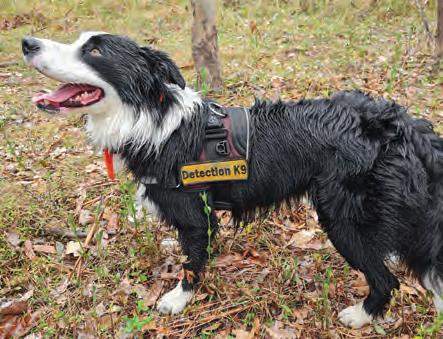
only been a few anecdotal sighting records in this region. Our team conducted the first systematic surveys for koalas, confirming their presence.
We’re excited to have confirmed the presence of koalas by finding their scat, but so far, we haven’t managed to spot any of them. We’re going to keep monitoring this site and looking in nearby areas. Koala spotting is hard-going, and involves many hours of walking through remote, thick bushland, across gullies and ridgetops. When we find koalas, we give them a health assessment, then radio-track them so we can document important food trees, home range sizes, mortality rates and causes, breeding rates, and site-specific threats.
We are expecting bushfires to be more frequent and intense under climate change, which poses new challenges to fire management and the wildlife that make their homes in the bush. We are focusing on the long-term picture, to prevent losing entire populations of koalas and other wildlife to fire in the future. Our research has found that up to 60 percent of koala habitats were impacted, killing or displacing koalas in the high fire intensity areas. This includes important, disease-free koalas that our team had found. We’ve been working to assess the remaining koala populations, their viability, and their potential to recolonize burned areas as vegetation recovers.
Our team is now underway with critical work under the Blue Mountains Koala Project, to look at long-term strategies to provide a future for koalas and other wildlife under threat of climate change. What we are learning is informing the development of fire refugia for the management of koalas and other wildlife under changing fire regimes. Part of our work includes uncovering where koalas have survived and are living in the protected area network and prioritizing them for management.
We learned a lot of lessons from the megafires of 2019–2020, including how underprepared we were. During the fires, unburned asset protection zones around homes and towns were refuges for koalas and other wildlife. They are also likely to be critical areas from which wildlife can recolonize burned areas. Plans are underway to engage with landholders to undertake habitat restoration activities in areas that are likely to support koalas in a changing climate.
The willingness of people to help wildlife after the fires was tremendous, and it remains high today. Raising awareness and engaging communities in conservation is key to our work. We are exploring ways to harness this grassroots action, for the benefit of people and wildlife.
This work is also proving important to other at-risk wildlife. Australia’s many small native wildlife (those that weigh between about 1 and 194 ounces, or 35 and 5,500 grams) include gliders, bandicoots, and possums. These small mammals are easy prey for invasive predators like feral cats and foxes. They are known as “critical weight range” mammals, and a number were already in trouble before the Black Summer bushfires.
With the support of SDZWA, we were able to monitor the food and water stations put out immediately after the bushfires, using 90 remote area cameras. With further assistance from a Commonwealth Government Landcare Led Bushfire Recovery Grant, these
Koalas have fingerprints that are completely unique to each of them. DID YOU KNOW?
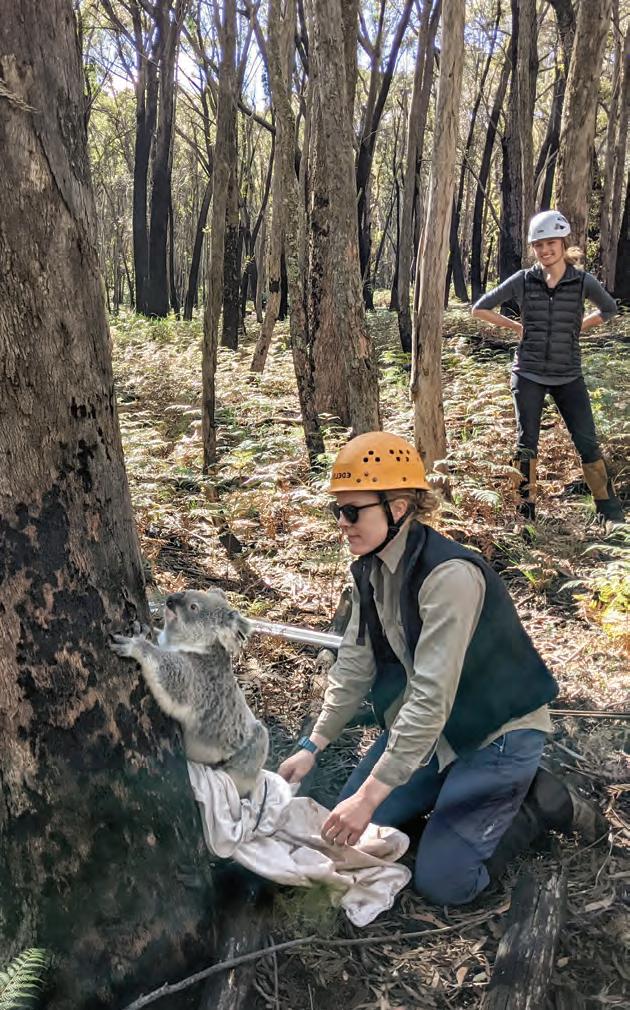
Home, Sweet Home: The Science for Wildlife Team releases a koala back into native habitat in Kanangra-Boyd National Park, after giving it a health check—an important part of their post-fire work across the Blue Mountains.
cameras have more recently been used to inform the conservation of these other native mammals.
We have found that these native mammals are favoring unburned areas where vegetation is intact, even two years after the bushfires. This points to the role of unburned areas as a refuge during and after fires, and the need to protect these areas. It will be a challenging road to recovery for koalas and other at-risk wildlife and their habitats. We are doing our best to ensure their future under climate change.
Kellie Leigh, Ph.D., is executive director of Science for Wildlife, and a partner of SDZWA; Kat Boehringer is partnerships and communications manager at Science for Wildlife.
Stay fueled up by enjoying a delicious treat at one of our specialty snack stands on your next visit. The San Diego Zoo and San Diego Zoo Safari Park thank our partners for their continued support!




BY JOSH GRIFFITHS AND EMILY MCCOLL-GAUSDEN
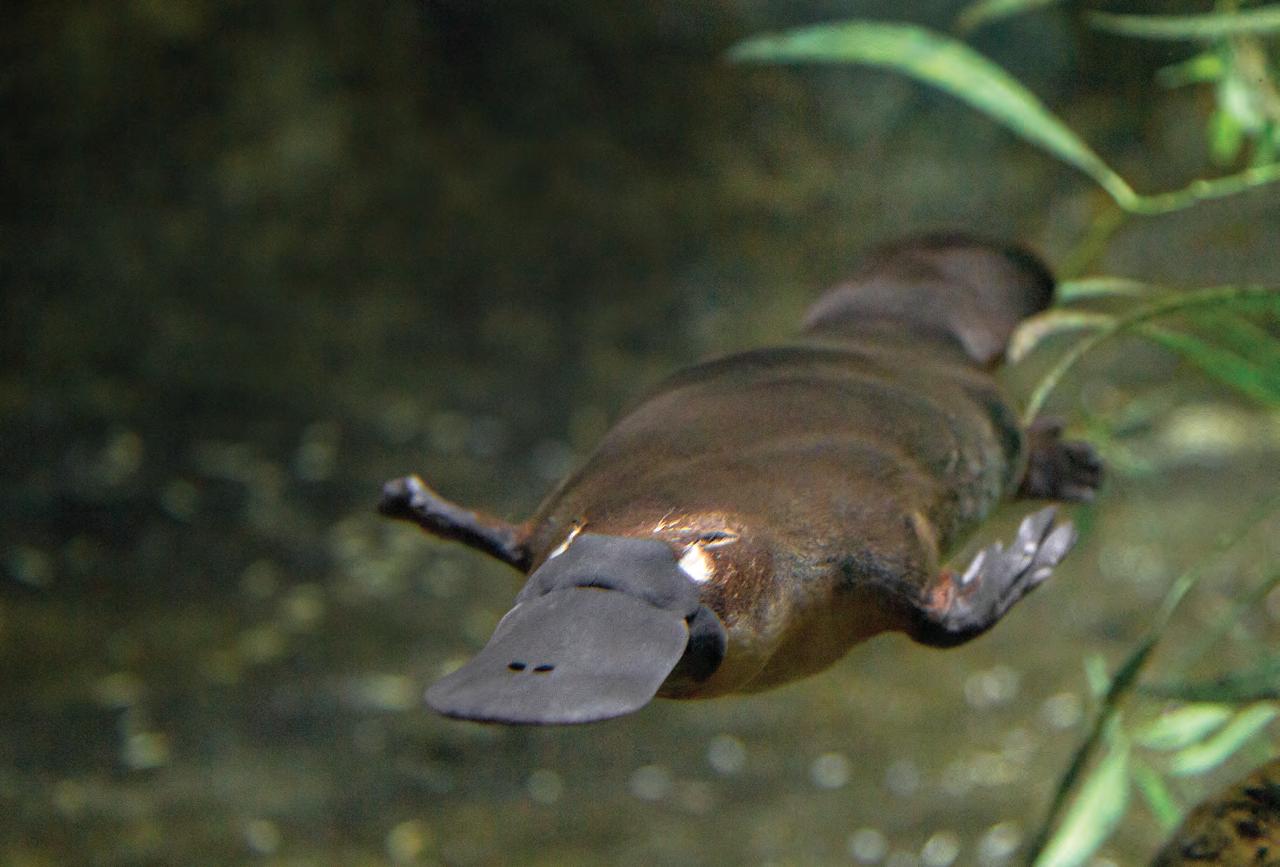

As adaptable as it is unique, the platypus Ornithorhynchus
anatinus is an iconic, semiaquatic Australian mammal. Endemic to eastern Australia, this fascinating monotreme can inhabit a variety of freshwater systems (creeks, rivers, lakes, and even artificial ponds) and is able to tolerate diverse environmental conditions. Their flexibility extends to their diet, which includes primarily aquatic macroinvertebrates. And while platypuses may be quite at home in the water, this dependence on aquatic ecosystems can leave them vulnerable to a range of natural and anthropogenic (human-made) threats that can degrade their habitat. There are several challenges that wildlife conservation organizations are working to meet.
Concerns facing platypuses and their watery home include drought and altered flow from water diversion and extraction; as well as changes to the surrounding catchment area due to agriculture or urbanization, removal of riparian vegetation, and habitat fragmentation. Poor water quality, as well as predation from invasive predators and entanglement in rubbish and fishing equipment, can also threaten platypuses. Climate change and human population growth are likely to exacerbate these threats. Until recently, there was little concern over the conservation status of platypuses, largely because their overall distribution did not appear to have changed significantly since European settlement of Australia (unlike many small Australian mammals that have suffered extinctions or dramatic range declines). The problem was that within this broad geographic distribution covering much of eastern Australia, ecologists had very little idea of population numbers or trajectories at either a local or landscape scale. This is largely because platypuses are difficult to monitor in native habitats due to their aquatic and mostly nocturnal lifestyle, high mobility, and
BY:
dispersed distribution. Live-trapping surveys are time- and labor-intensive, costly, and severely limited by environmental conditions, and can be stressful for a platypus. Observational surveys can be difficult to implement in remote areas or where visibility is limited. They are typically biased toward population centers and have moderate risk of false positives due to misidentification, typically with the native rakali Hydromys chrysogaster, also known as a water rat. By necessity, observations need to occur during daylight, but that is when platypuses are least active. Both techniques can have poor sensitivity to detect platypuses at low abundance and are difficult to systematically implement over the large spatial scales required to understand the status of wildlife like the platypus, which is widely and relatively sparsely distributed across a vast area.
Despite such difficulties, there has been mounting evidence of localized population declines over the past few decades, mostly in agricultural or urban areas. Challenges in assessing platypus abundance and occurrence, as well as the lack of long-term studies and systematic historical data, have hampered attempts to assess the impacts of various threatening processes at a local or landscape scale or to rigorously assess their conservation status.
More recently, non-invasive sampling techniques have been developed that detect species-specific DNA from environmental samples such as water or soil. Comparisons with traditional sampling methods indicate that environmental DNA (eDNA) methods are superior in terms of sensitivity and cost efficiency, particularly for scarce, elusive, or cryptic species. We adapted and assessed eDNA methods to detect platypuses and found high sensitivity to detect the species if present, even at low densities. In collaboration with San Diego Zoo Wildlife Alliance (SDZWA), we applied eDNA techniques in the largest-ever survey of platypuses to try to quantify the impacts of various threats and better understand their conservation status.
The project focused on southeastern Australia, as these populations were considered to be most threatened. This area has
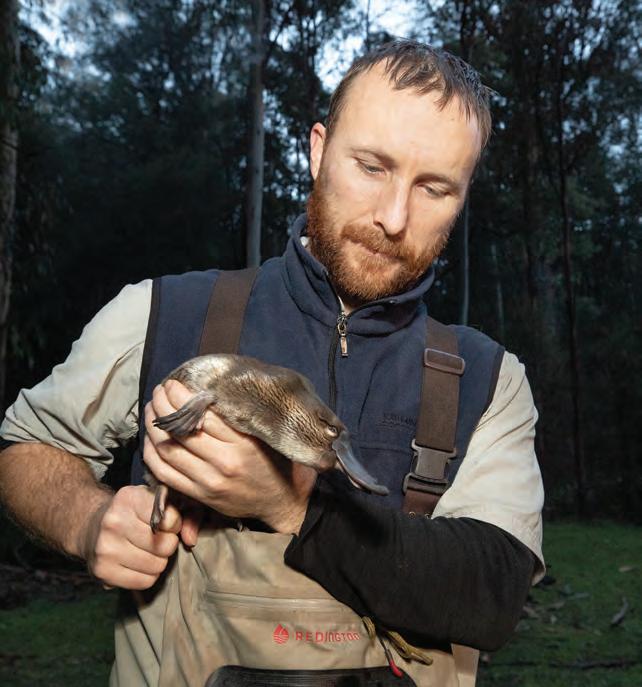
Gathering Data: One of the authors, platypus ecologist Josh Griffiths, prepares to release a platypus back to its habitat during a live-trapping population survey.
been particularly devastated by the decade-long “Millennium Drought” and is expected to be further impacted by climate change. Using a random stratified design, we selected about 800 survey sites across more than approximately 200,000 square miles, based on vegetation, which varied from native vegetation to urban areas. The project team visited 777 sites and collected replicate water samples from 504 sites during 2018 through 2021, and recorded a number of site variables assumed to be important for platypuses or their macroinvertebrate prey (such as bank erosion, in-stream complexity, and riparian vegetation). Back in the laboratory, the team screened samples for platypus DNA using a species-specific genetic probe. Hierarchical site-occupancy models were used to analyze the data, estimate occupancy and detection probabilities, and quantify the impacts of various threats at various spatial scales, from site- to landscape-level.
The COVID-19 pandemic created some significant challenges for the team to navigate over the last couple of years, including lockdowns, border closures, travel restrictions, and even sourcing laboratory consumables. In addition, extensive bushfires ripped through southeastern Australia during the summer of 2019 and 2020, encompassing a large part of our study area. These “Black Summer” bushfires were devastating for the people and wildlife affected. However, they presented a unique opportunity for us to revisit a selection of survey sites to try to understand the impacts of bushfires on platypuses as, for the first time, we had systematic pre-fire data to compare with.
The data analysis is still being finalized for a Ph.D. thesis and publication, but some findings are taking shape. For instance, at the landscape level, platypuses were much less likely to occur in areas of intense agriculture or shrub or grasslands, and in rivers with extended cease-to-flow events. They were more likely to occur at sites with higher runoff, a proxy for water availability in the system. Additionally, at the site level, platypuses were more likely to occur where banks suitable for burrowing were present. And, thankfully, platypuses appeared to be somewhat buffered from severe impacts from the bushfires; although there is evidence for more localized impacts.
Using data from eDNA techniques, our findings will help land and waterways managers to develop better strategies for protecting platypuses, such as riparian rehabilitation programs in agricultural zones, and the use of environmental flows to minimize zero-flow days.
Josh Griffiths is a platypus ecologist at Cesar Australia; Emily McColl-Gausden is a Ph.D. candidate at the University of Melbourne.
Cal Coast is pleased to contribute $50 to San Diego Zoo Wildlife Alliance when you open a qualifying checking and savings account with us.1 What’s more, you can also get $50 when you open your account.
We’re proud to be a partner of San Diego Zoo Wildlife Alliance and the credit union of choice for over 200,000 members. Open your account today by calling (877) 495-1600, or by visiting any of our 26 convenient branches in San Diego and Riverside counties. Just mention this ad
PHOTOS BY KEN BOHN
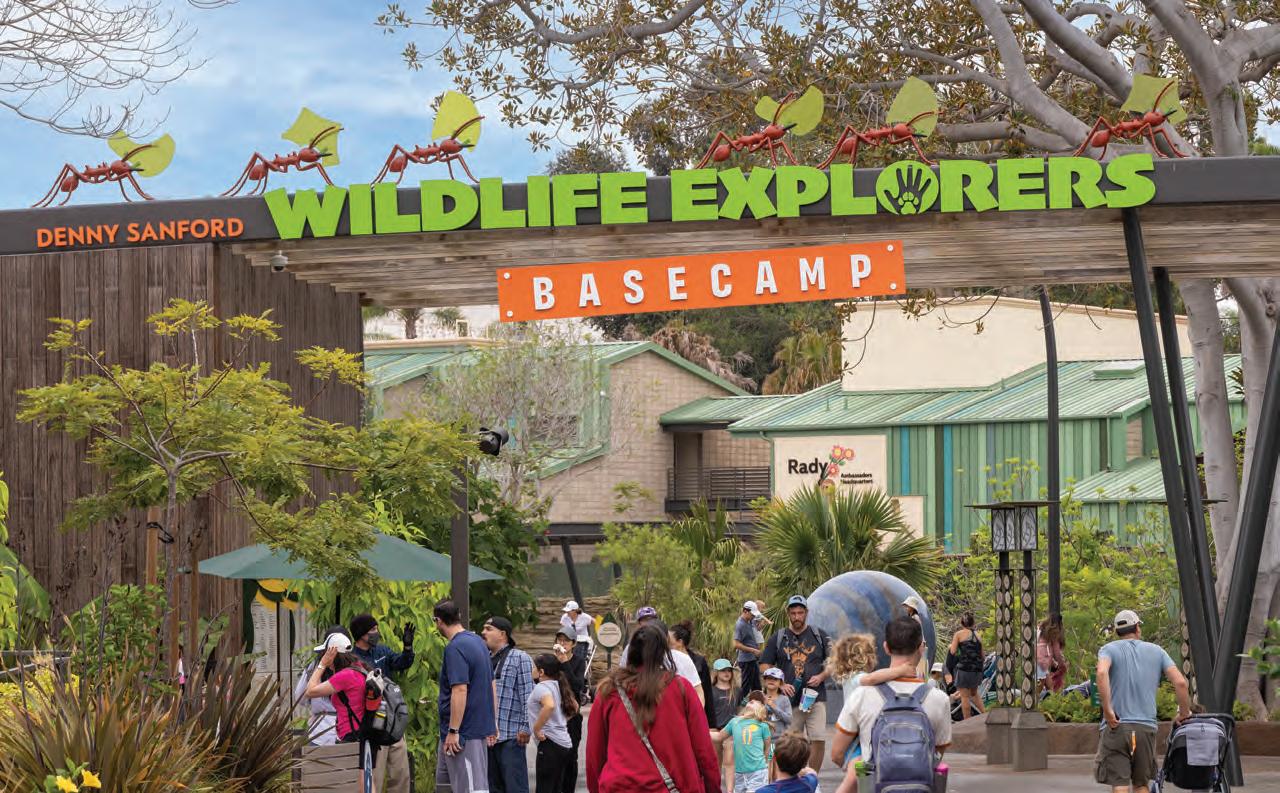
From up-close encounters with a myriad of wondrous wildlife, to the treehouse and “splashy” water play area, the San Diego Zoo’s Wildlife Explorers Basecamp isn’t meant to be seen—it’s to be experienced. The most significant expansion in the Zoo’s 106-year history, this immersive new world takes you into four unique ecosystems— and introduces you to the species that call them home. Additionally, Jake’s Cool Critters Herptile House and the McKinney Family Spineless Marvels Invertebrate House offer the chance to come nose-to-nose (or beak, or snout…) with crawly and slithery creatures of all kinds.
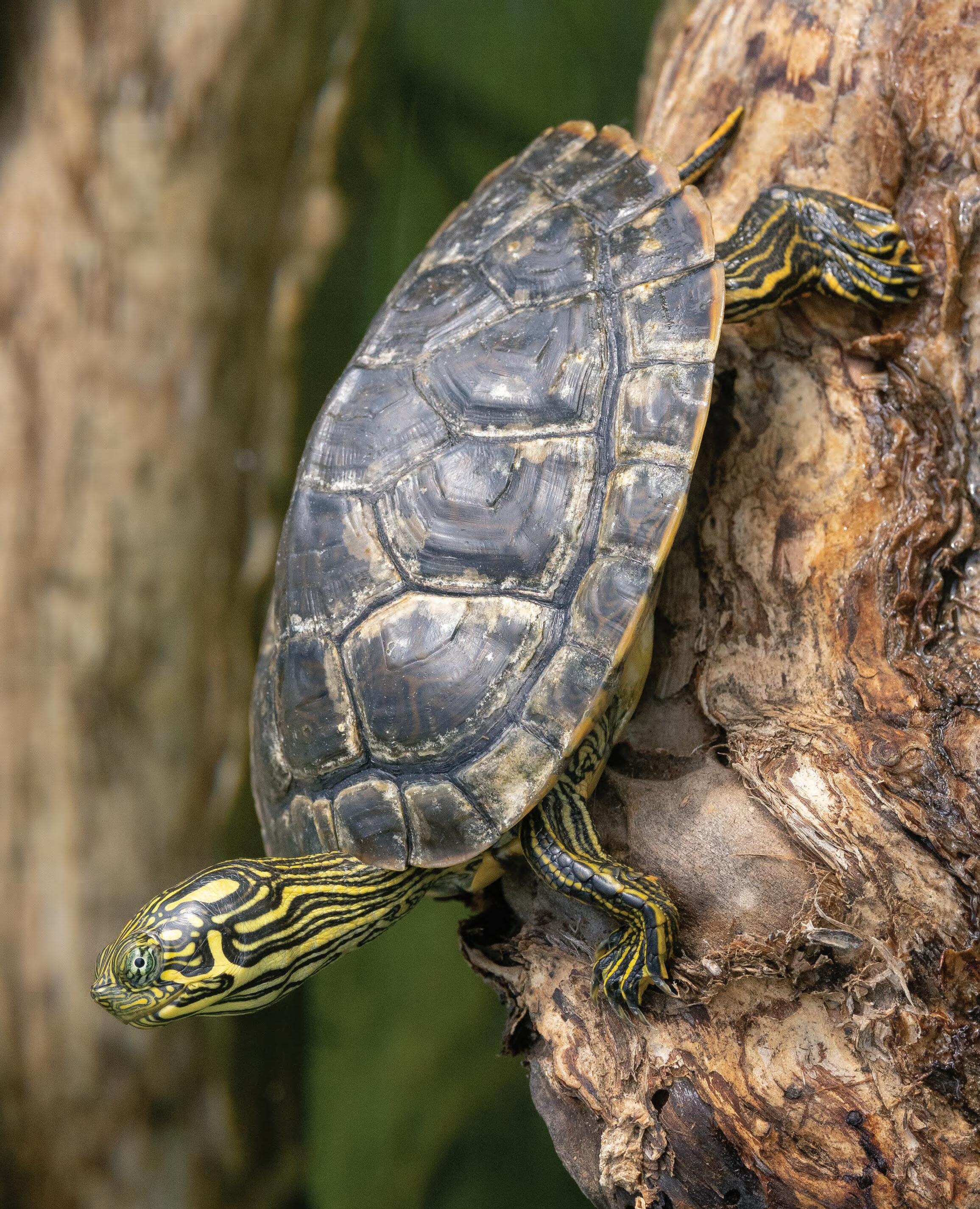
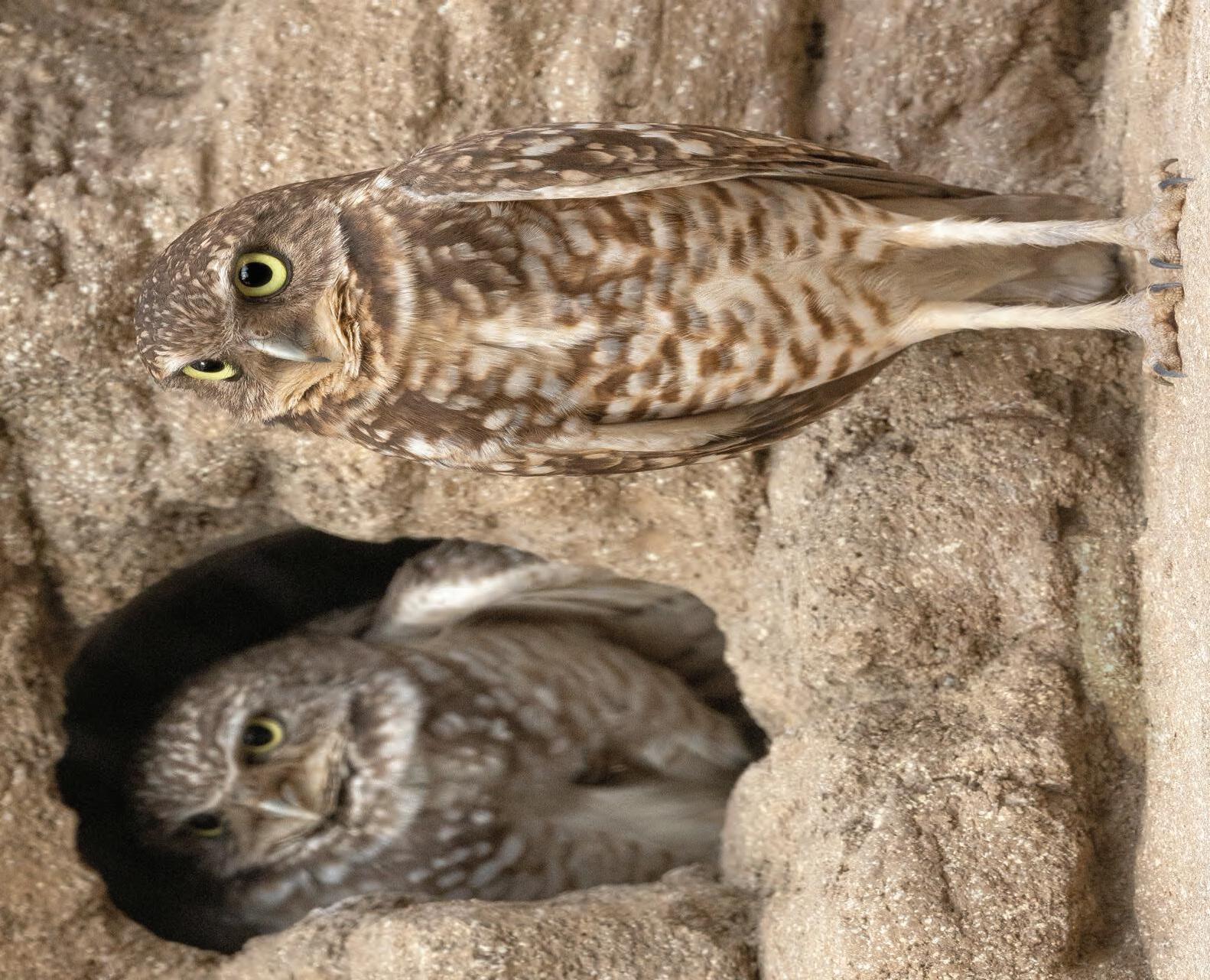
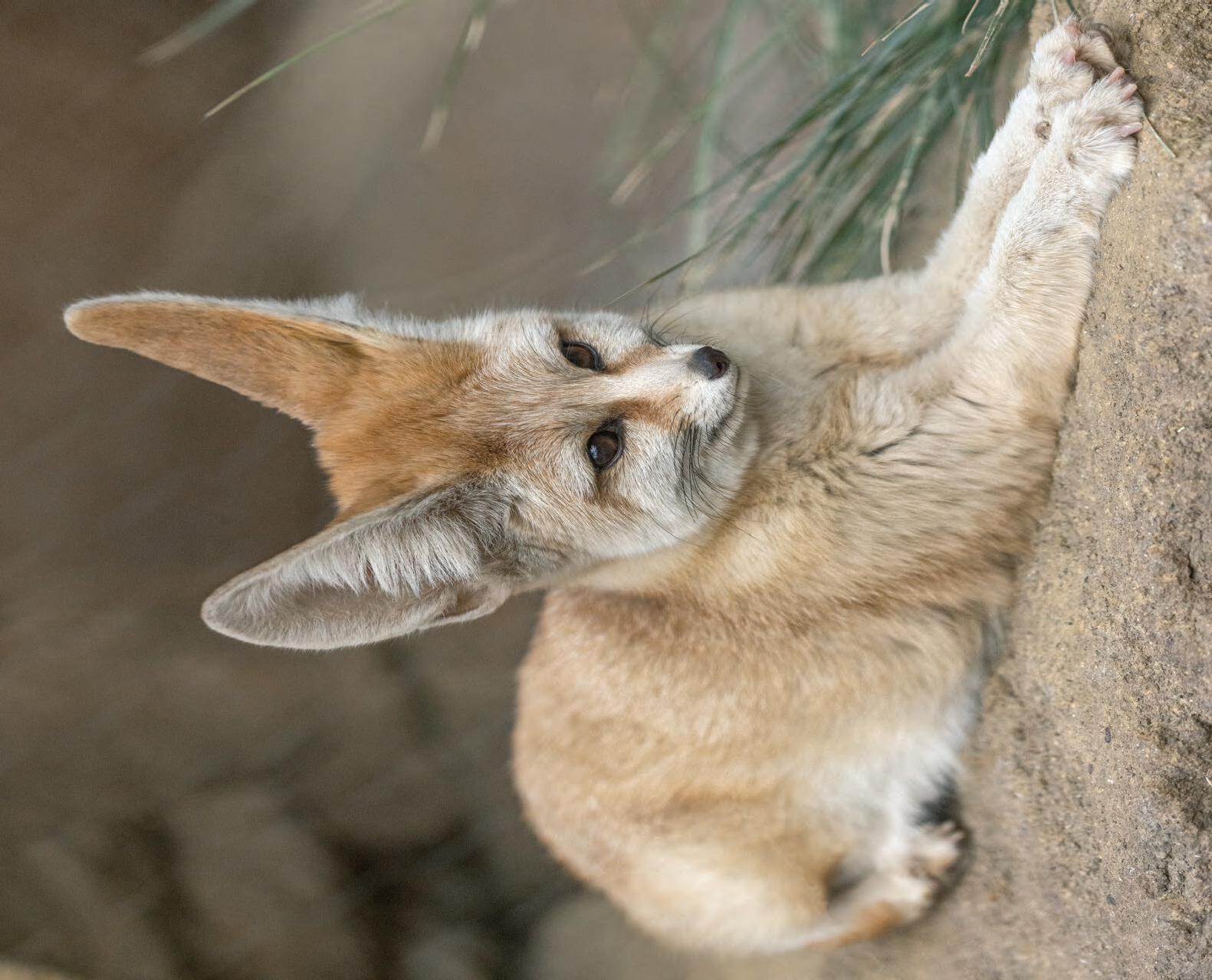
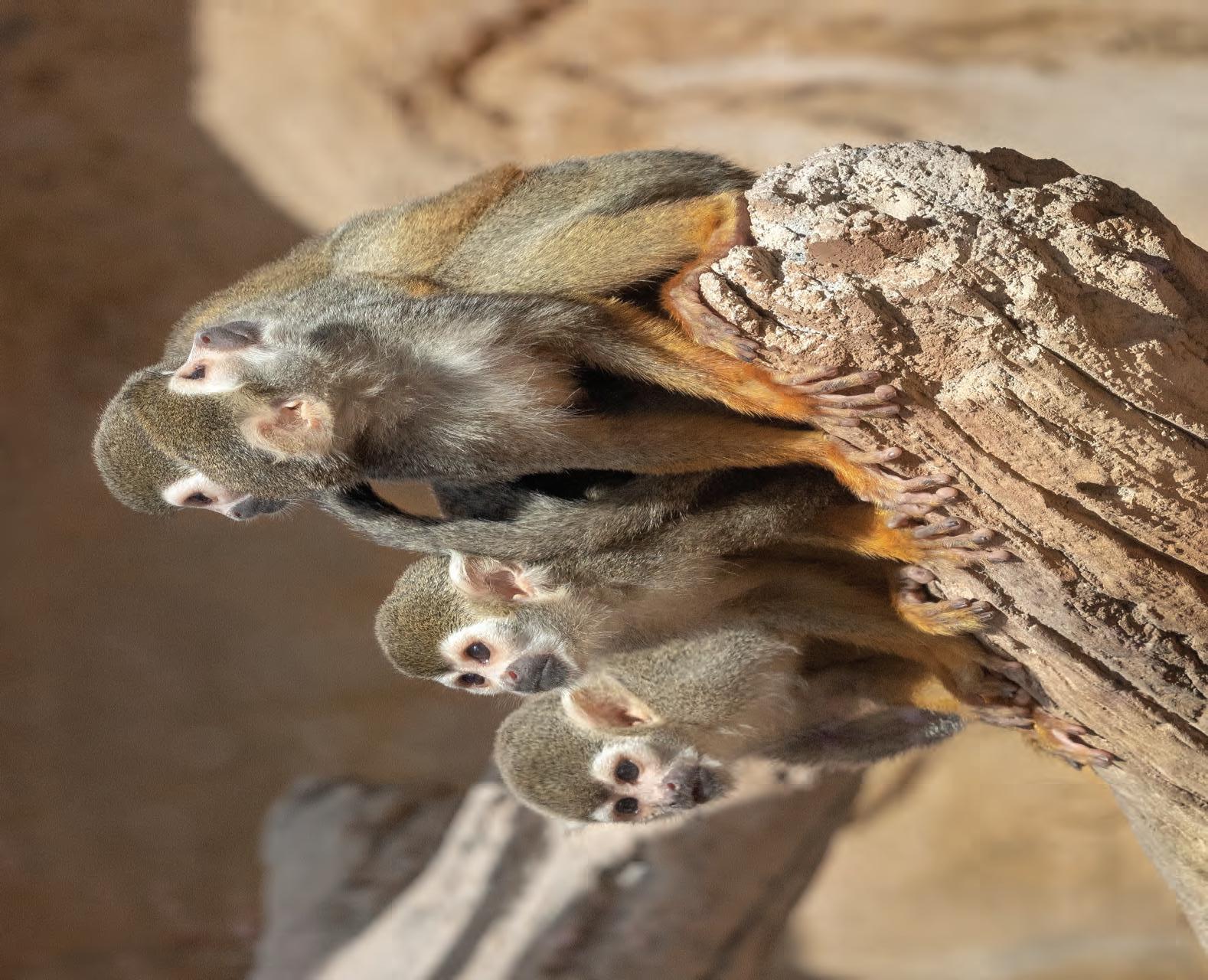
Climb rocks, explore caves, and play in a desert wash in Desert Dunes, where you can discover wildlife that use burrows to beat the heat—including the fennec fox, prairie dog, desert tortoise, and burrowing owl. In Wild Woods, step into a waterfall grotto, and look out for splashing jets that unexpectedly fill a stream. Then, pick a path to climb the ancient oak tree—a rope bridge, a spiral staircase, or a fallen branch. Nearby, squirrel monkeys and coatis play in the same way that Wildlife Explorers do. Marsh Meadows begins with a trek into the marsh, where the waterline rises as you head deeper down the shore. Observe our crocodiles and turtles as they take to the water. And as the marsh grows deeper, it teems with
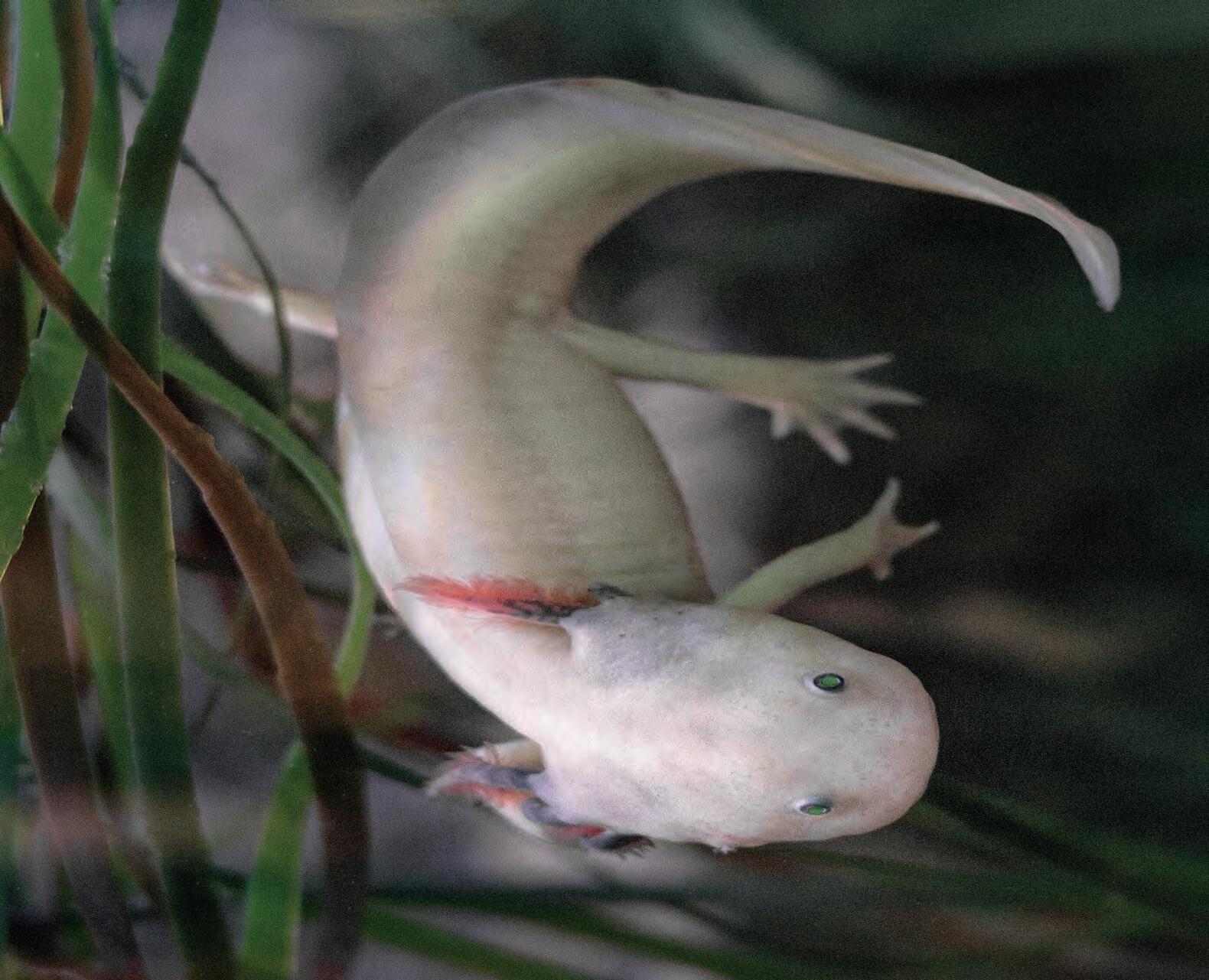
more wildlife. Venture into Jake’s Cool Critters Herptile House to discover a watery world and a moving river of light that ripples mysteriously overhead in the underwater-themed environment. Spot the rare Fijian iguana, South American lungfish, axolotl, and Chinese giant salamander. Check out the microscope stations, where you can take a snapshot and share it. Maybe you’ll meet a conservationist and some of our favorite scaly friends.
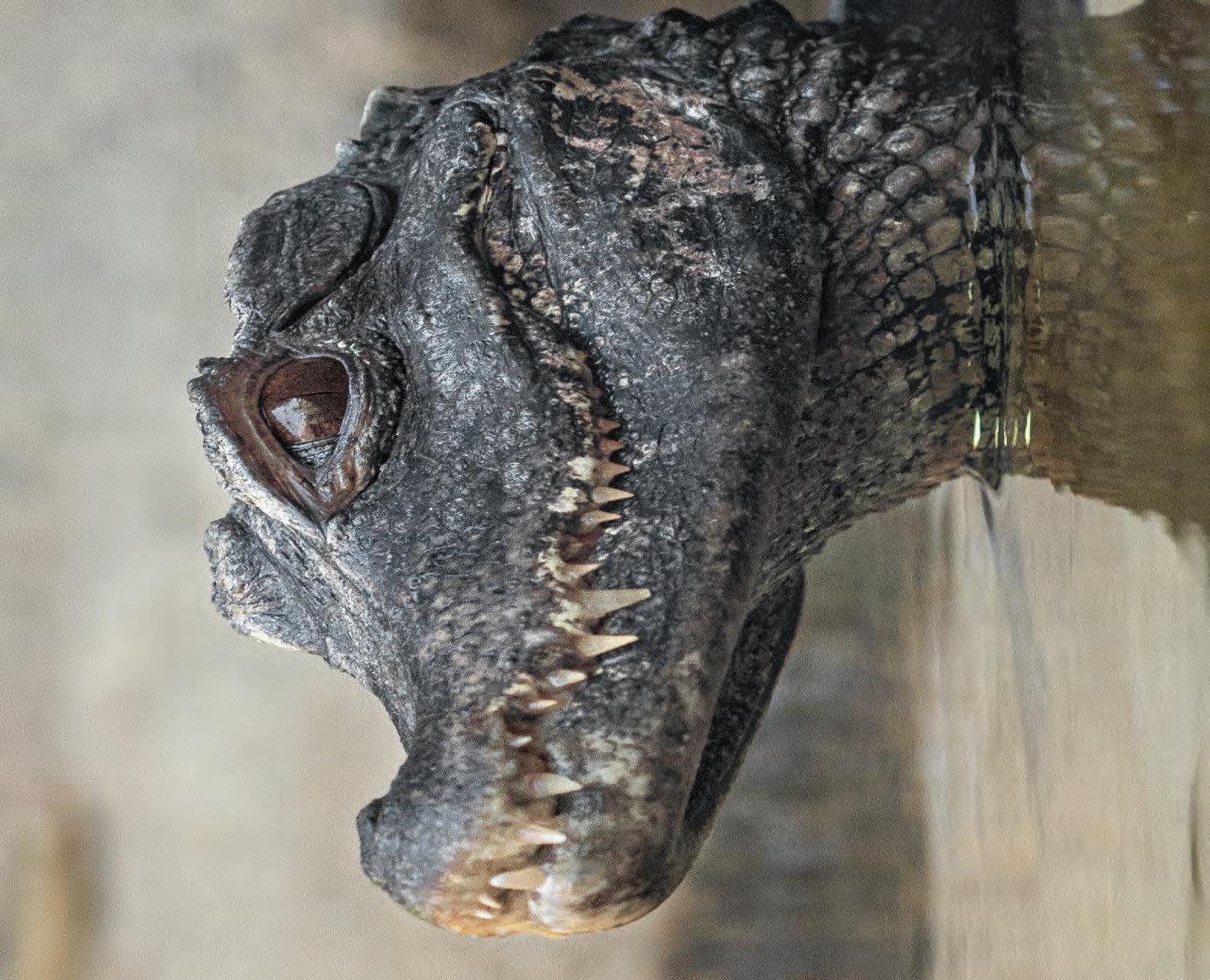
In the Rainforest, a multilevel outdoor environment with caimans and tortoises awaits your exploration. This mixed habitat is also home to our wildlife ambassadors and the McKinney Family Spineless Marvels Invertebrate House.
Our two-story greenhouse abounds with butterflies, grasshoppers, bees, and other invertebrates. Explore dark caves and inspect an entire colony of leafcutter ants. There is more excitement just outside Wildlife Explorers Basecamp, where you can see the largest living lizard in the world at Kenneth C. Griffin Komodo Kingdom; as well as witness astonishing flights of fancy in the William E. Cole Family Hummingbird Habitat.
Wildlife Explorers Basecamp must be seen—and experienced—to be believed. And to help you get ready for your visit to all its wonders, enjoy our 2023 calendar, which features some of the incredible wildlife that awaits you. Start planning your visit now— and mark it on your San Diego Zoo Wildlife Alliance calendar!
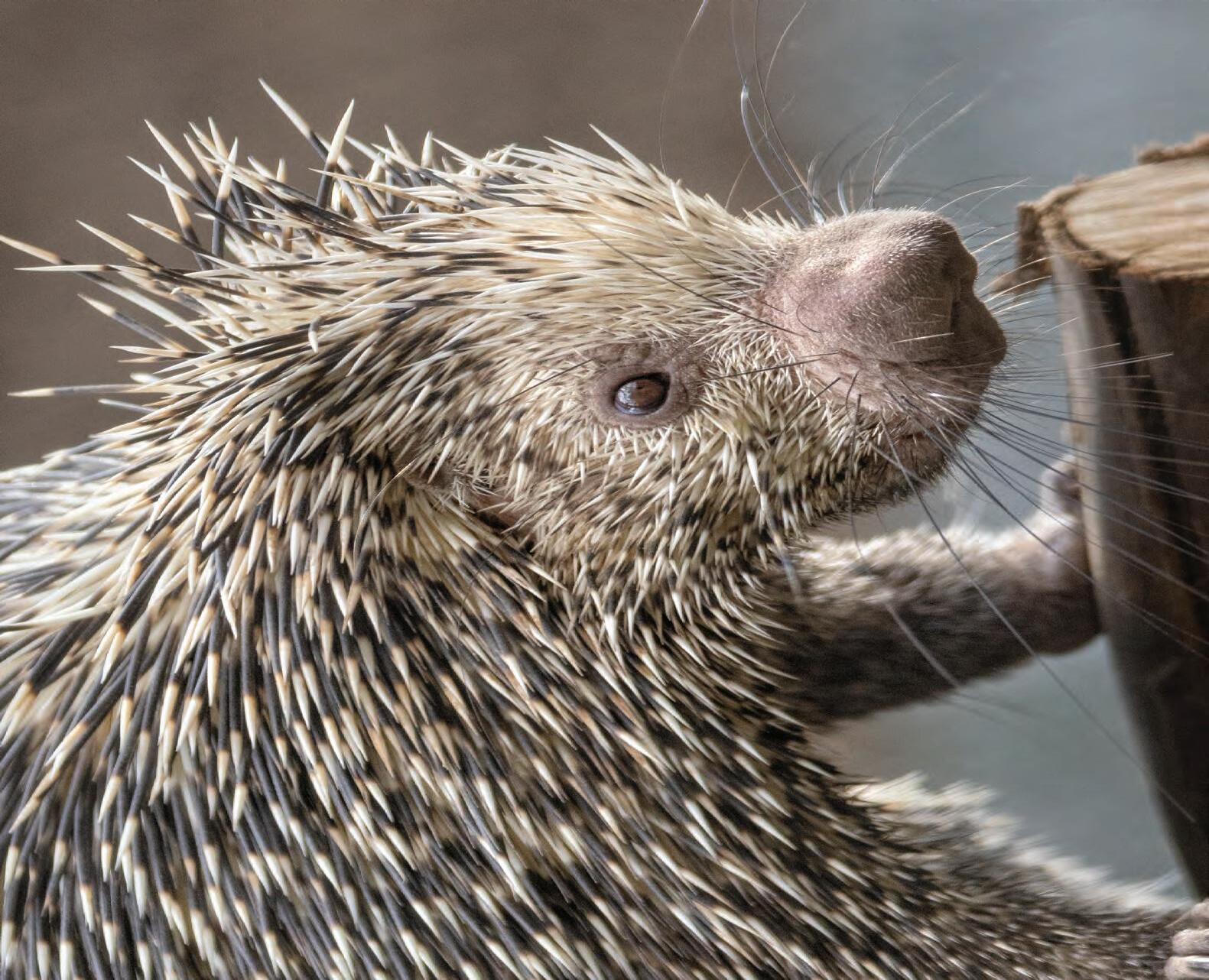
Prehensile-tailed porcupines
(modified hairs). They
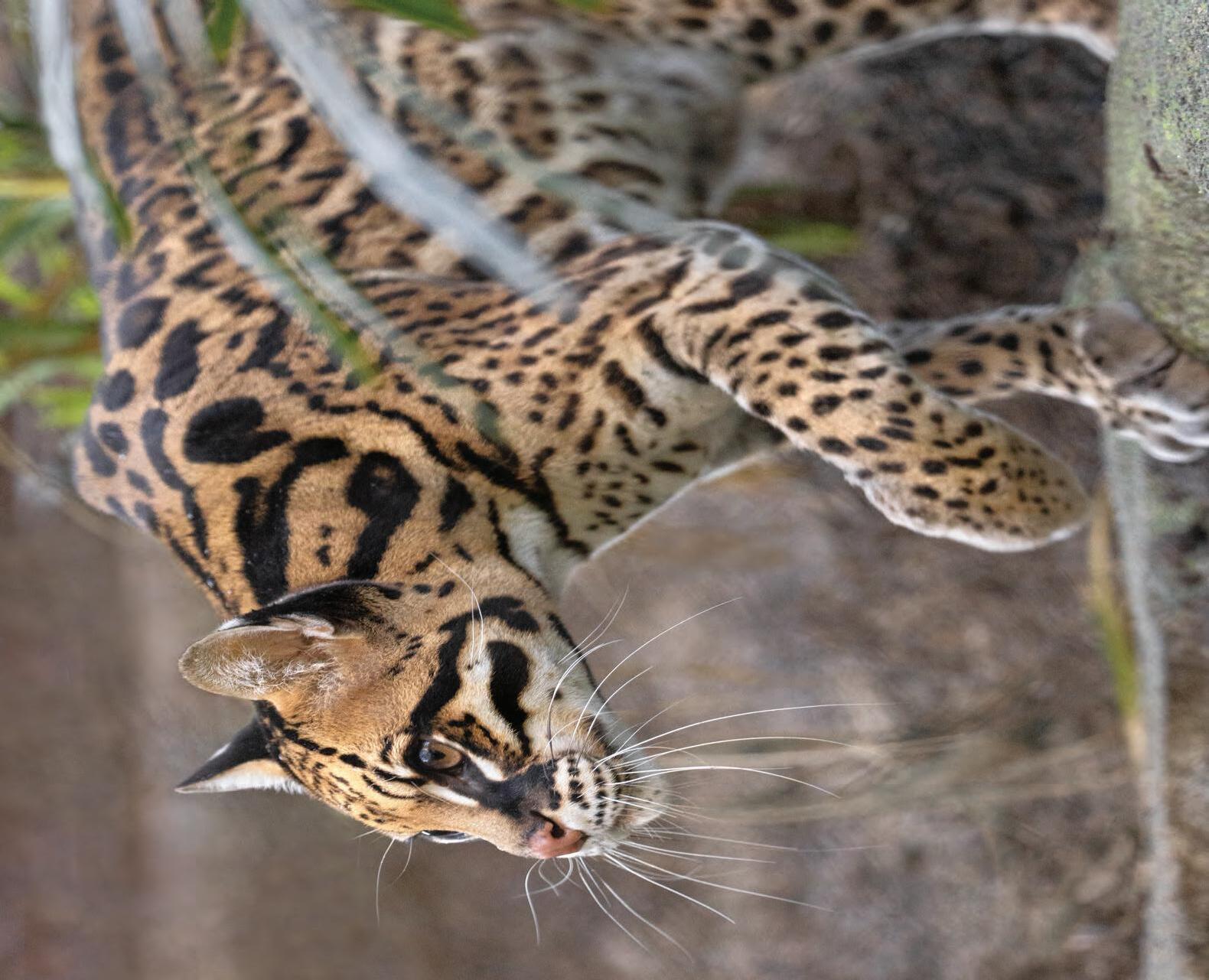
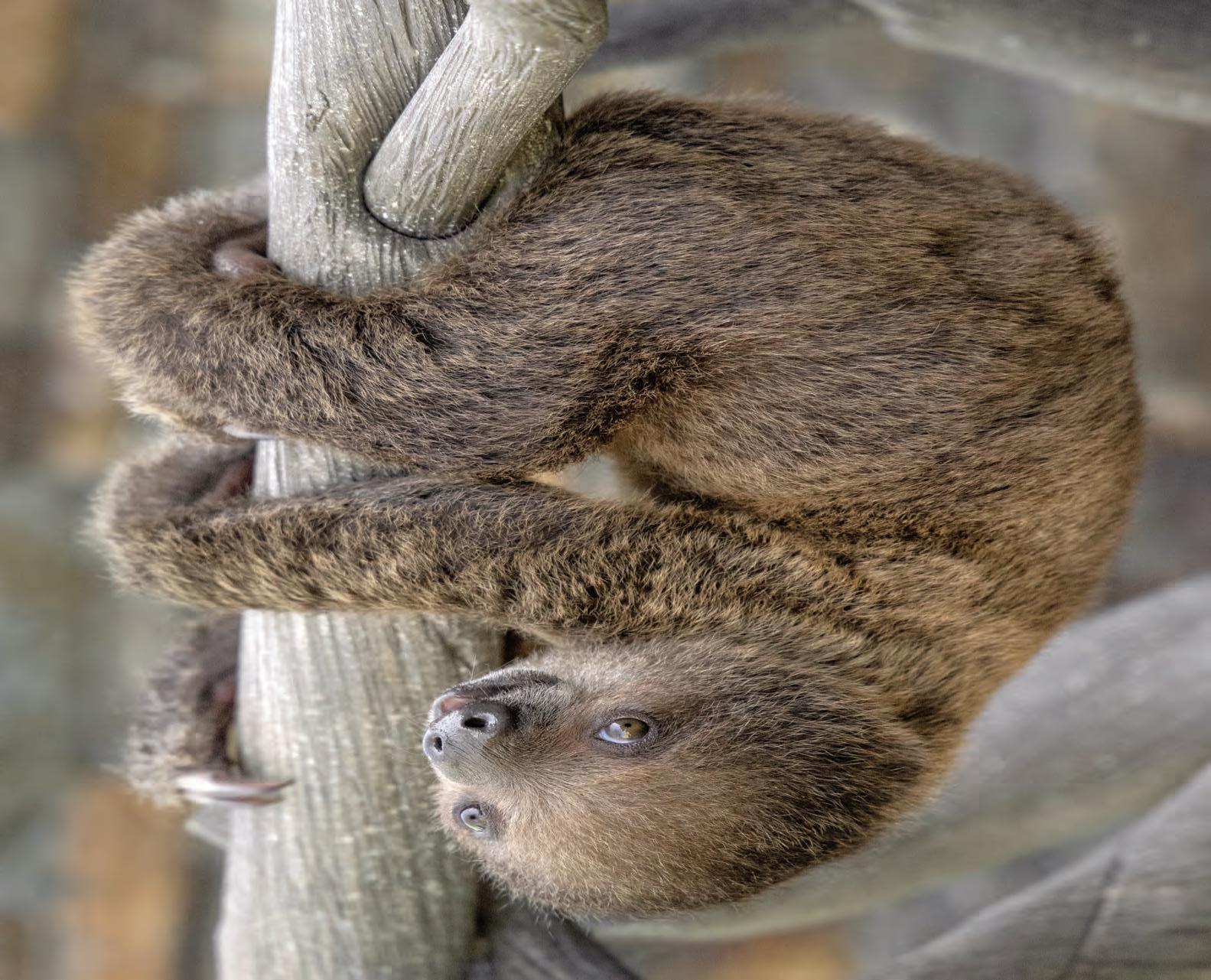
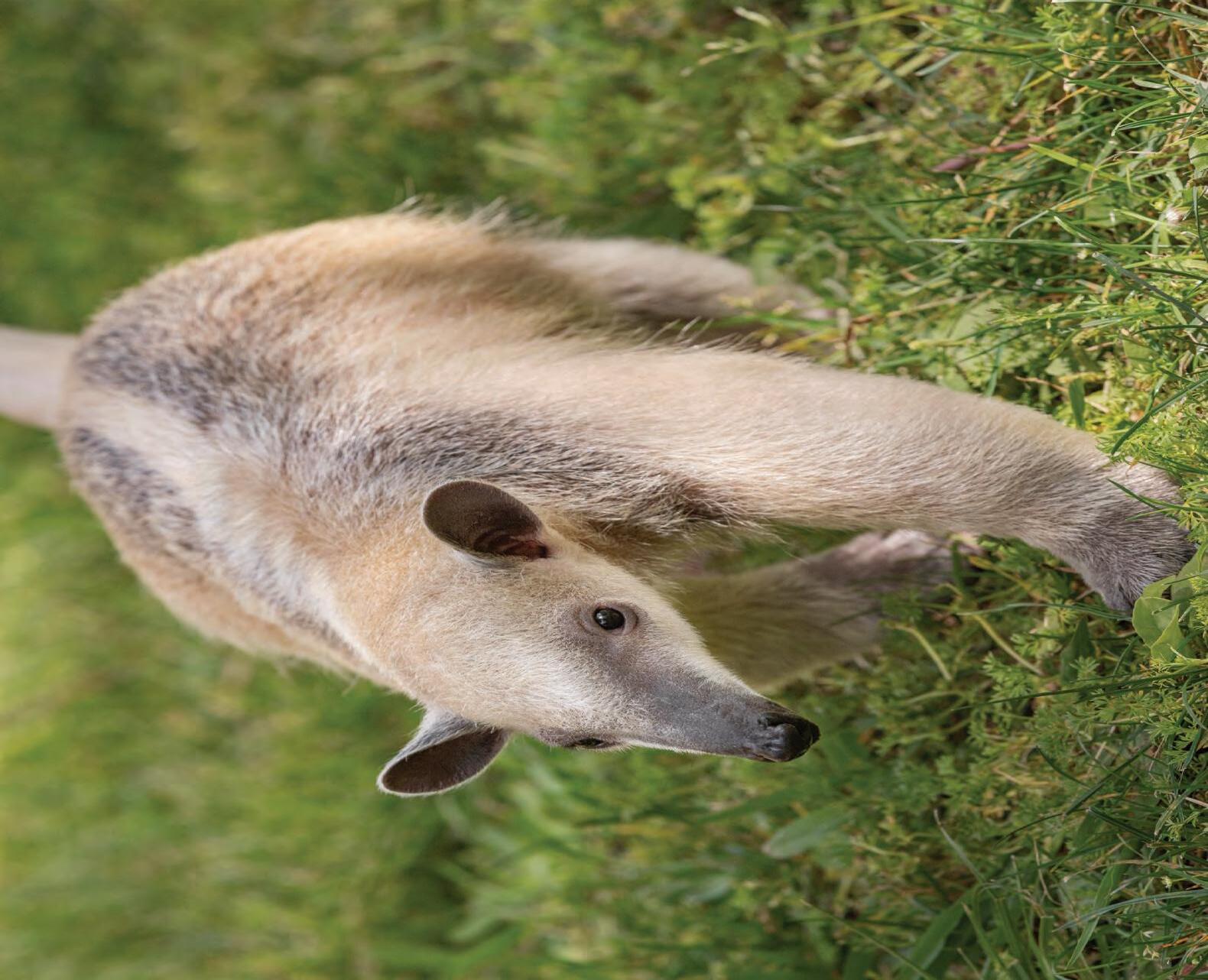
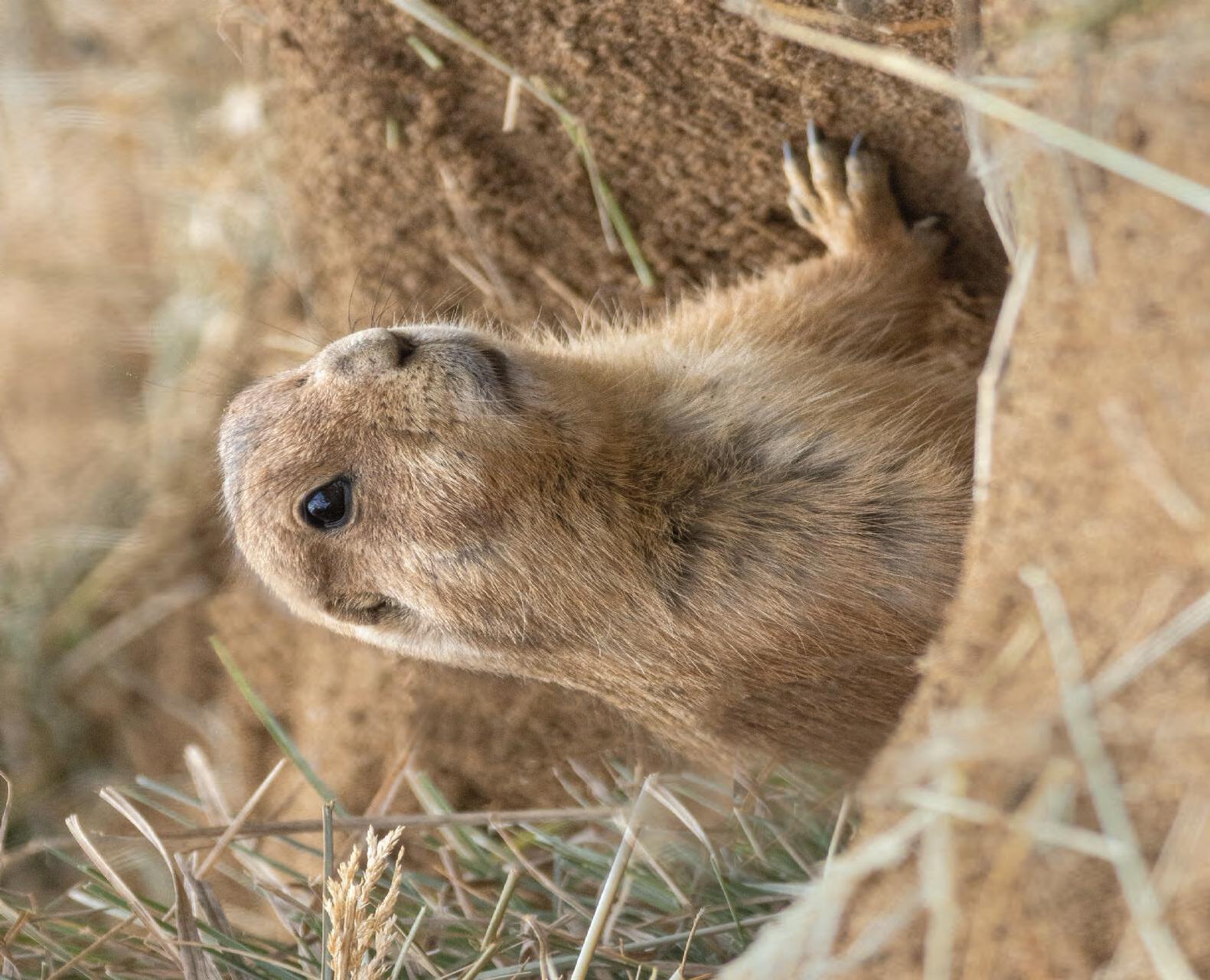
They eat grasses, roots, seeds, and other leafy plants throughout their habitat.
Prairie dog feeding habits have a big effect on the
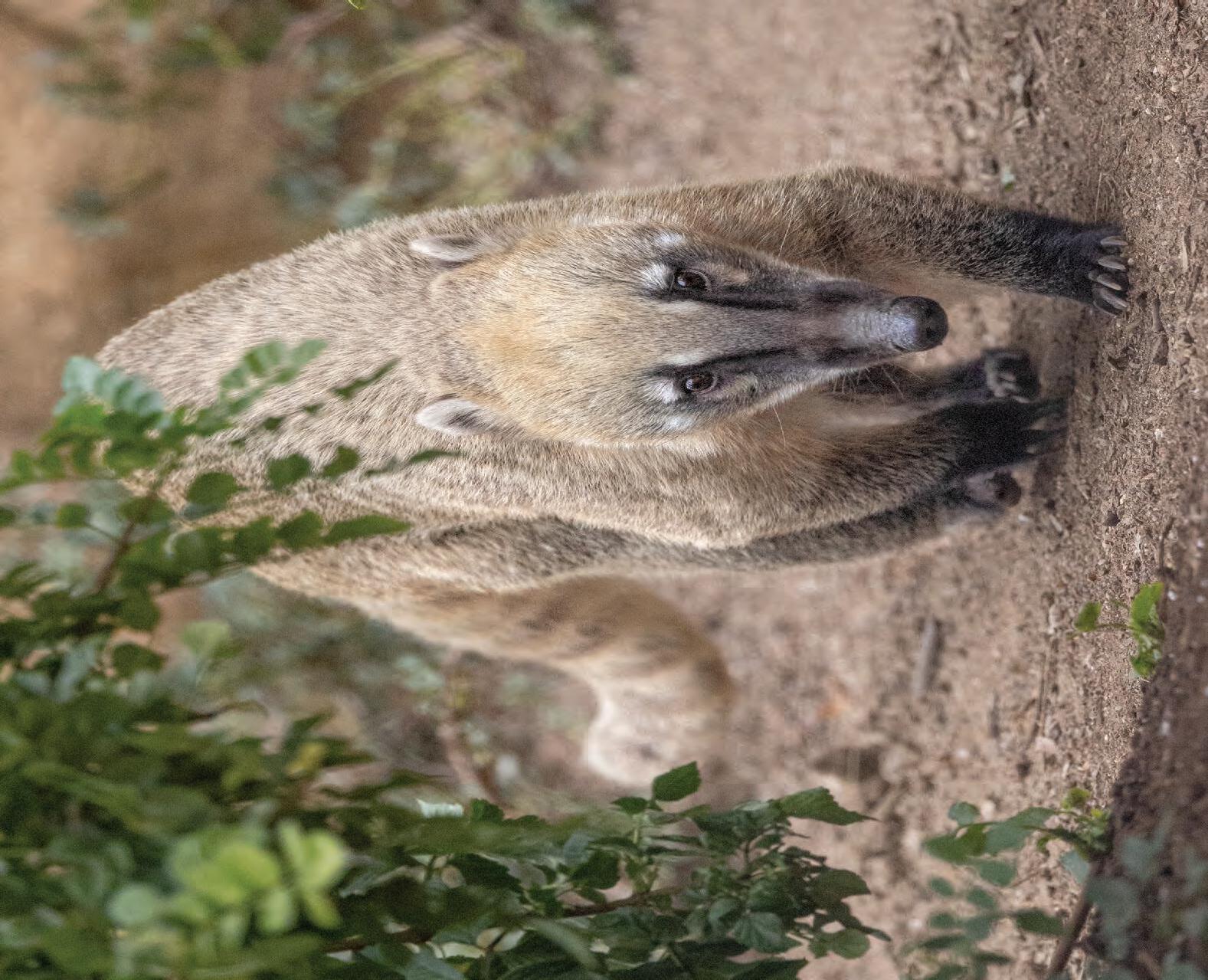
to raccoons, coatis
in groups (called “bands”) of 15 to 20 individuals. They are known for their strong, nimble claws, and keen intelligence.
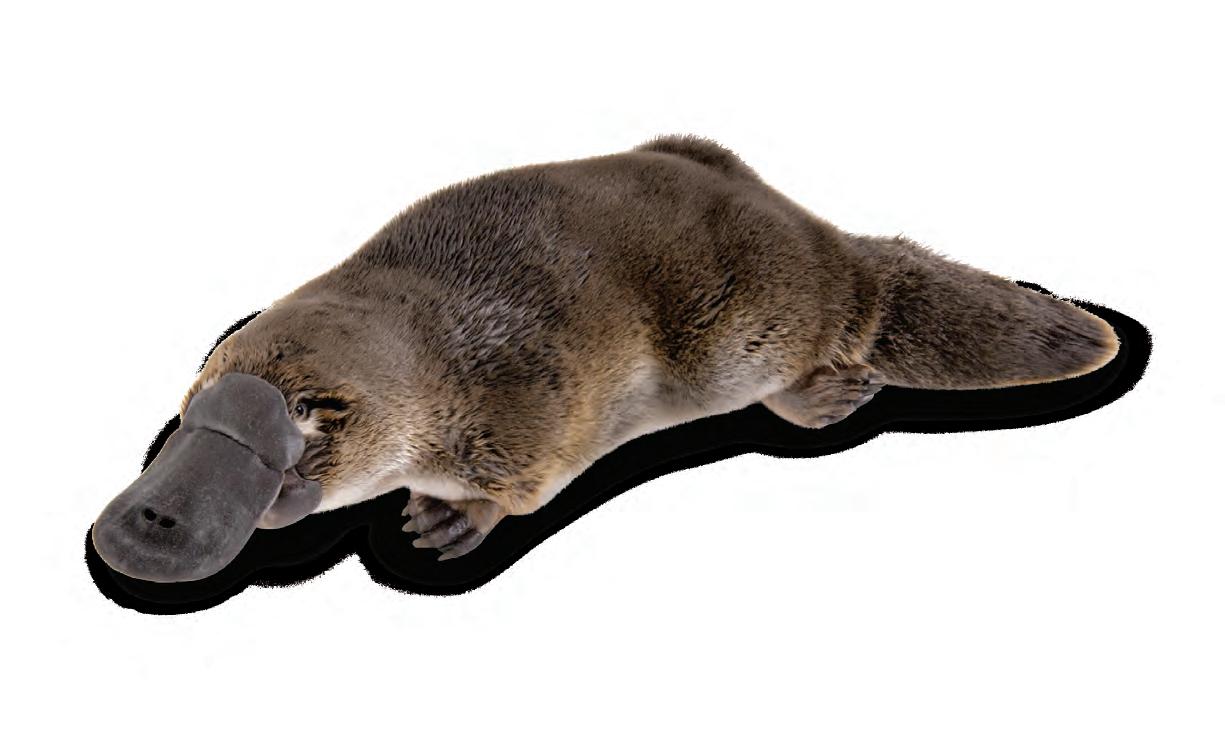
The monotremes are a small group of mammals that include only the platypus, the short-beaked echidna, and three species of longbeaked echidnas. In many ways, they are like other mammals: they have fur, they generate and maintain body heat, and females produce milk to nourish their offspring. But monotremes are different from other mammals in some important ways, too.
By Donna Parham | Illustration by Amy Blandford
Normal body temperature for monotremes is about 89.6 degrees Fahrenheit. That’s quite a bit lower than other mammals, which maintain a body temperature close to ours.
A monotreme’s hind feet point backward.
Short-beaked echidnas live in parts of New Guinea and throughout Australia, including Tasmania and offshore islands.
All other mammals give live birth, but monotremes lay eggs. Fetus-like hatchlings are altricial.
Platypuses live in parts of eastern Australia, including Tasmania. They build burrows in stream banks and spend much of their time in fresh water.
Actual Size
On their hind ankles, adult male (but not female) monotremes have halfinch spurs. A spur connects to a gland in the thigh. Young females have small ones but shed them before they reach maturity.
Monotremes don’t have nipples. Milk flows from a mother’s mammary glands through pore openings in “milk patches,” and offspring suck or lap it from her fur.
Monotremes have electroreceptors on their snout. An echidna can detect voltage 1,000 times weaker than what you can detect with the tip of your tongue. And a platypus has 100 times as many electroreceptors as an echidna!

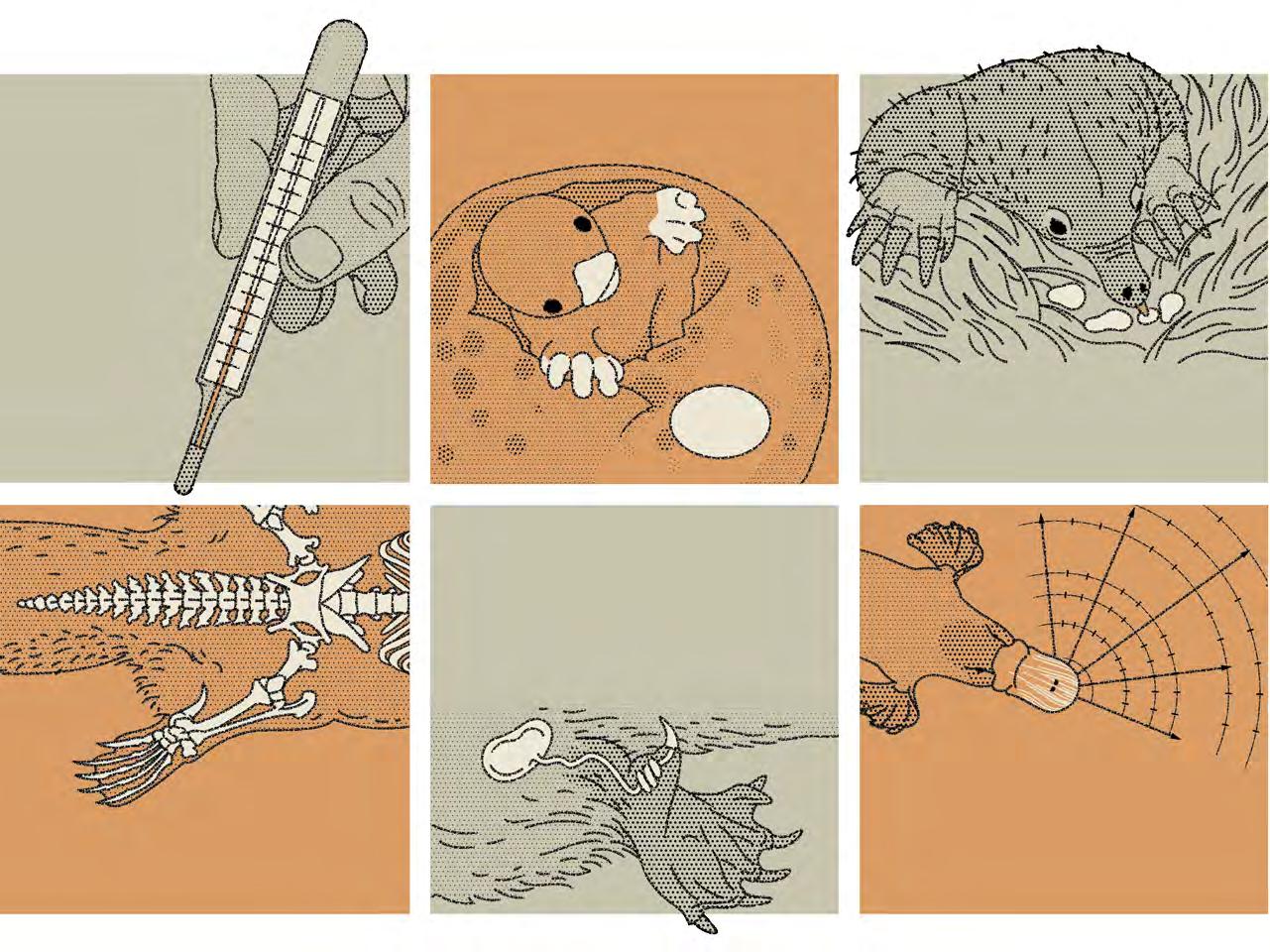
Platypuses forage underwater small invertebrates. Electroreceptors on their snout locate small prey like crayfish, shrimps, swimming insects, grubs, and nymphs.
Echidnas are covered with hair and sharp, hollow hairs called spines. Each spine has a long root embedded in muscle. An echidna can move its spines individually or as small groups.
An echidna’s tiny, V-shaped mouth is at the tip of the snout , underneath. Its sticky, worm-like tongue extends far out of its mouth for feeding on minute prey.

A male echidna’s spur glands produce a nontoxic, milky fluid during the breeding season. Experts suspect that it plays a role in scent marking.
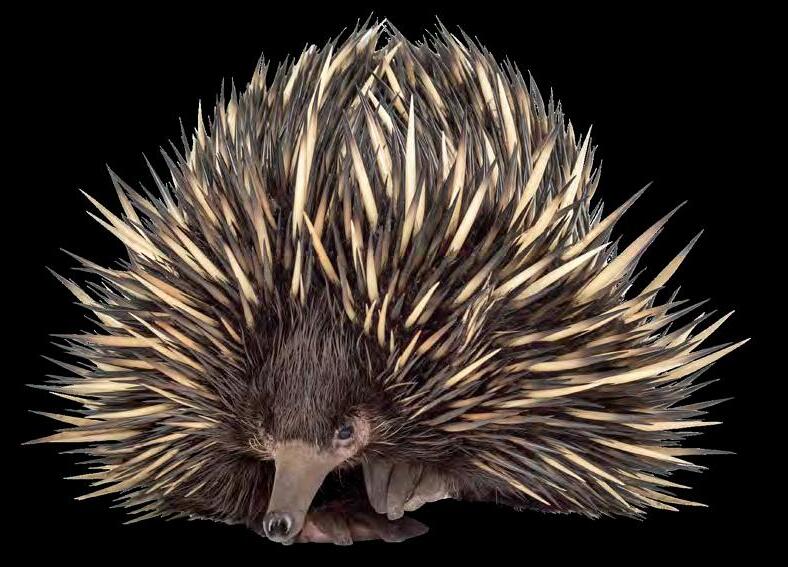
A short-beaked echidna is 12 to 18 . Most weigh between . They lose weight during breeding season—as much
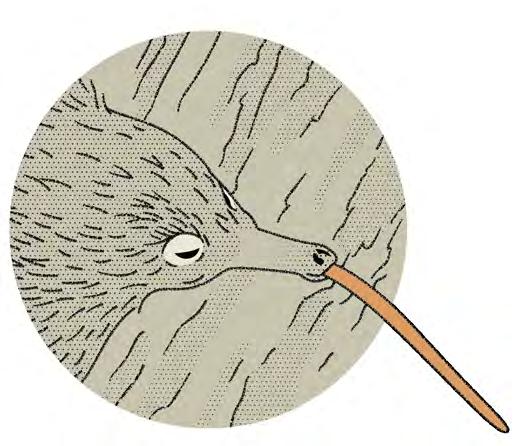
Short-beaked echidnas eat mostly ants, termites, and grubs . (Long-beaked echidnas eat mostly earthworms .)
An echidna’s nostrils lie at the tip of its snout, on top. Its excellent sense of smell is important in locating prey
San Diego Zoo*
9 a.m.–5 p.m.
Extended Hours
During Jungle Bells
9 a.m.–8 p.m.
San Diego Zoo Safari Park*
9 a.m.–5 p.m.
Extended Hours
During Wild Holidays
9 a.m.–8 p.m.
sdzwa.org
619-231-1515
*Programs and dates are subject to change—please check our website for the latest information and requirements for visiting.
(Z) = San Diego Zoo
(P) = Safari Park

DECEMBER 9, 2022 THROUGH JANUARY 1, 2023*
Jungle Bells
Proudly Supported by California Coast Credit Union
Join us at the Zoo until 8 p.m. (*except December 24) for holiday cheer with festive lights and decorations, the spectacular Aurora experience, special seasonal music and entertainment, and a variety of tasty treats available for purchase. (Z)
SELECT DATES IN NOVEMBER AND DECEMBER
Early Morning Explorers at the Zoo
Families with youths ages 3–12 can be wildlife explorers, enjoy hands-on nature exploration projects, and experience exclusive viewing of Wildlife Explorers Basecamp before the Zoo opens for the day! Call 619-718-3000 or book online. (Z)
NOVEMBER 18; DECEMBER 11 AND 16
Plant Day and Orchid Odyssey
On these special days, guests can take a rare look inside the Zoo’s Orchid House from 10 a.m. to 2 p.m., learn about the Zoo’s botanical collection from Horticulture staff on the Botanical Bus Tour at 11 a.m., and check out the Carnivorous Plant Greenhouse from 11 a.m. to 1 p.m. (Z)
OFFERED DAILY
Wildlife Wonders
At the Zoo’s Wegeforth Bowl amphitheater, wildlife care specialists introduce you to wildlife ambassadors representing San Diego Zoo Wildlife Alliance’s conservation work around the world in Wildlife Wonders, presented daily at 2 p.m. Learn about amazing wildlife—from the Amazon to right here in our own backyard in San Diego—and find out what everyone can do to help conserve wildlife and the world we all share. Presentation runs 15 to 20 minutes. (Z)
OFFERED DAILY
Discovery Cart Tours
Sit back in the comfort of an expedition cart, and enjoy a 60-minute guided tour of the Zoo, led by one of our knowledgeable guides. Book online or call 619-718-3000. (Z)
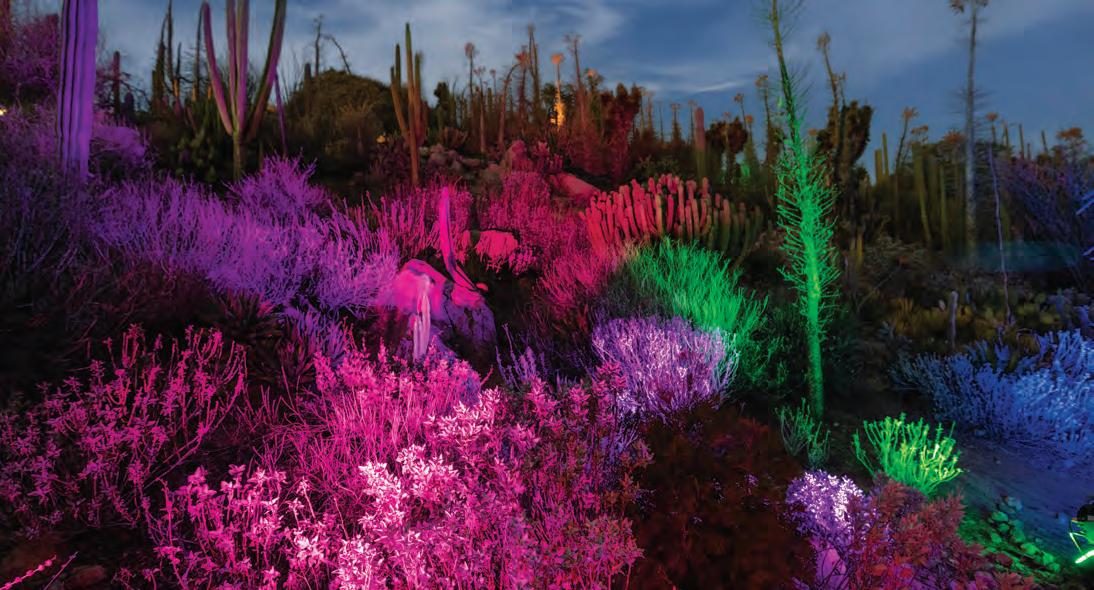
SELECT DATES IN NOVEMBER AND DECEMBER, 2022; AND JANUARY 1, 2023
Spend evenings at the Safari Park until 8 p.m., go on a holiday expedition of light, and travel through places that twinkle and glow with holiday cheer. Fanciful characters, musical entertainment, storytelling, and culinary treats round out the seasonal festivities. (P)
NOVEMBER AND DECEMBER, SELECT DATES
Wildlife Safaris at the Safari Park
Venture into one of our expansive savanna habitats to get an up-close view of our wildlife. Choose from a variety of tour options including our popular 1-hour Wildlife Safaris, to our Twilight and Deluxe options or even our Wine Wildlife Safari. Prices and availability vary. Call 619-718-3000, or book online. (P)
NOVEMBER AND DECEMBER, SELECT DATES
All Ages Holly Jolly Jungle Roar & Snore Safari
Enjoy a holiday-themed Safari Park sleepover for the whole family! Call 619-718-3000 to make your reservations. (P)
OFFERED DAILY Cart Safaris
Sit back in the comfort of your own Safari cart, as you enjoy a 60-minute guided tour of the Safari Park’s spacious African or Asian savanna habitats, led by one of our knowledgeable guides. Book online or call 619-718-3000. (P)
Visit the San Diego Zoo Wildlife Explorers website to find out about these and other animals, plus videos, crafts, stories, games, and more! sdzwildlifeexplorers.org
Not only are kangaroos the largest marsupials in the world, these amazing Australian mammals are really fun to draw! Just follow the six steps below to create your very own ’roo. What are you waiting for? Hop to it!
STEP 1
With a pencil or crayon, draw a rounded shape; this will be the head.
STEP 2
Add two small ovals on top for the ears, and a larger, long oval for the body.
STEP 3
Connect the ears with two short lines and add a front leg. Then add a large hind leg.
STEP 4
Add small lines to the inner ears. Then draw the tail.
STEP 5
Give your ‘roo a face, and the add the background front leg and hind leg.
STEP 6
Crikey! You did it— now color in your kangaroo!
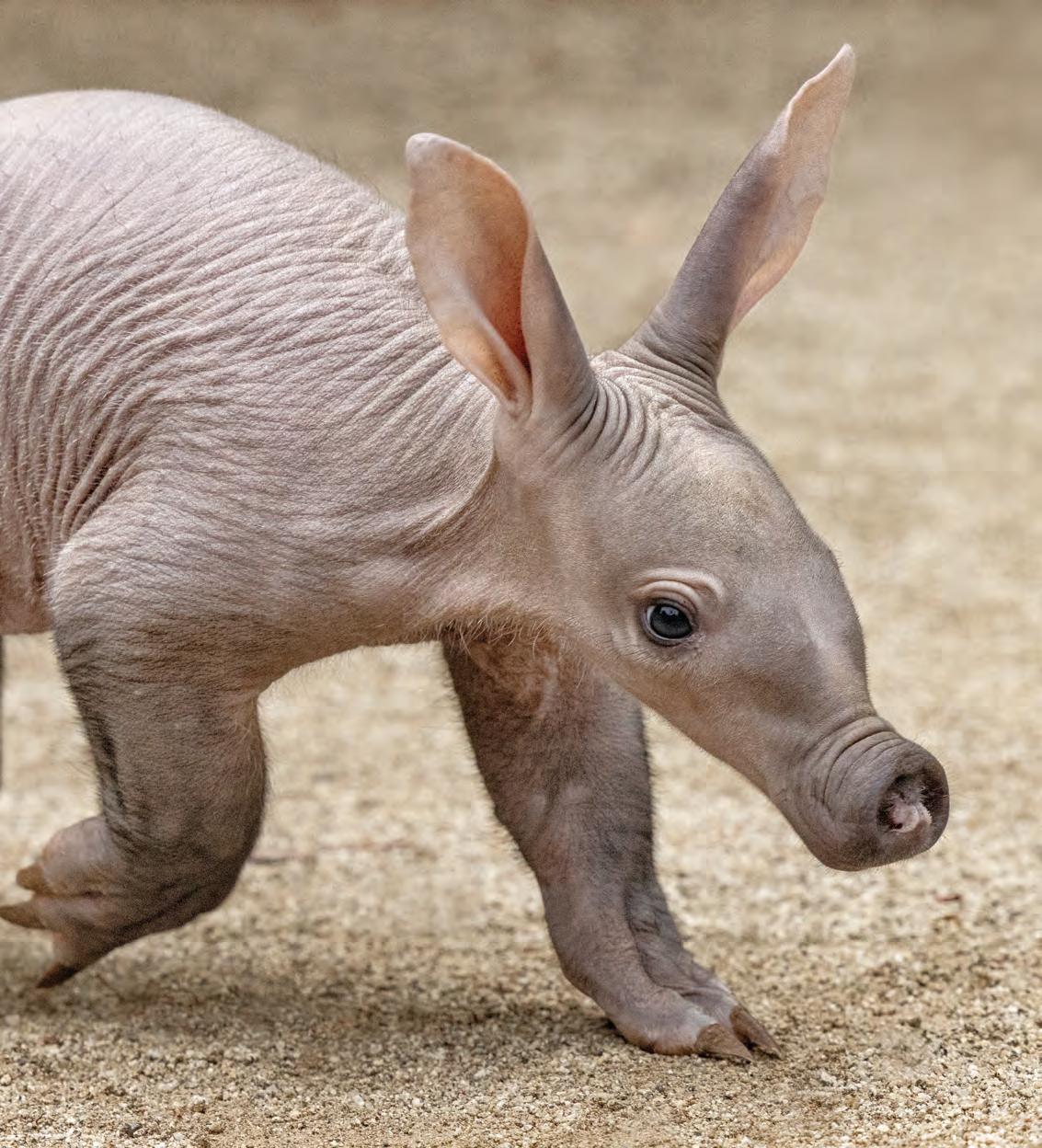
Can you dig it? The San Diego Zoo’s new aardvark, Nandi, certainly can! Born May 10, 2022, to first-time parents Zola and Azaan, the active little female was using her sharp claws to dig like an adult aardvark, just hours after birth. Aardvarks are native to sub-Saharan Africa, and their name is derived from Afrikaans; it literally translates to mean “earth pig.”
Photographed by Ken Bohn, SDZWA photographer.
San Diego Zoo Wildlife Alliance
P.O. Box 120551, San Diego, CA 92112

Give a holiday gift membership by December 31 and save up to $10!
With the holidays approaching, now is a great time to consider your gift list. Give memories that last a lifetime with a gift membership where loved ones can experience priceless adventures while exploring our two incredible locations.
But more than that, your gift membership supports essential conservation efforts, and inspires moments that matter to wildlife and to your loved ones.
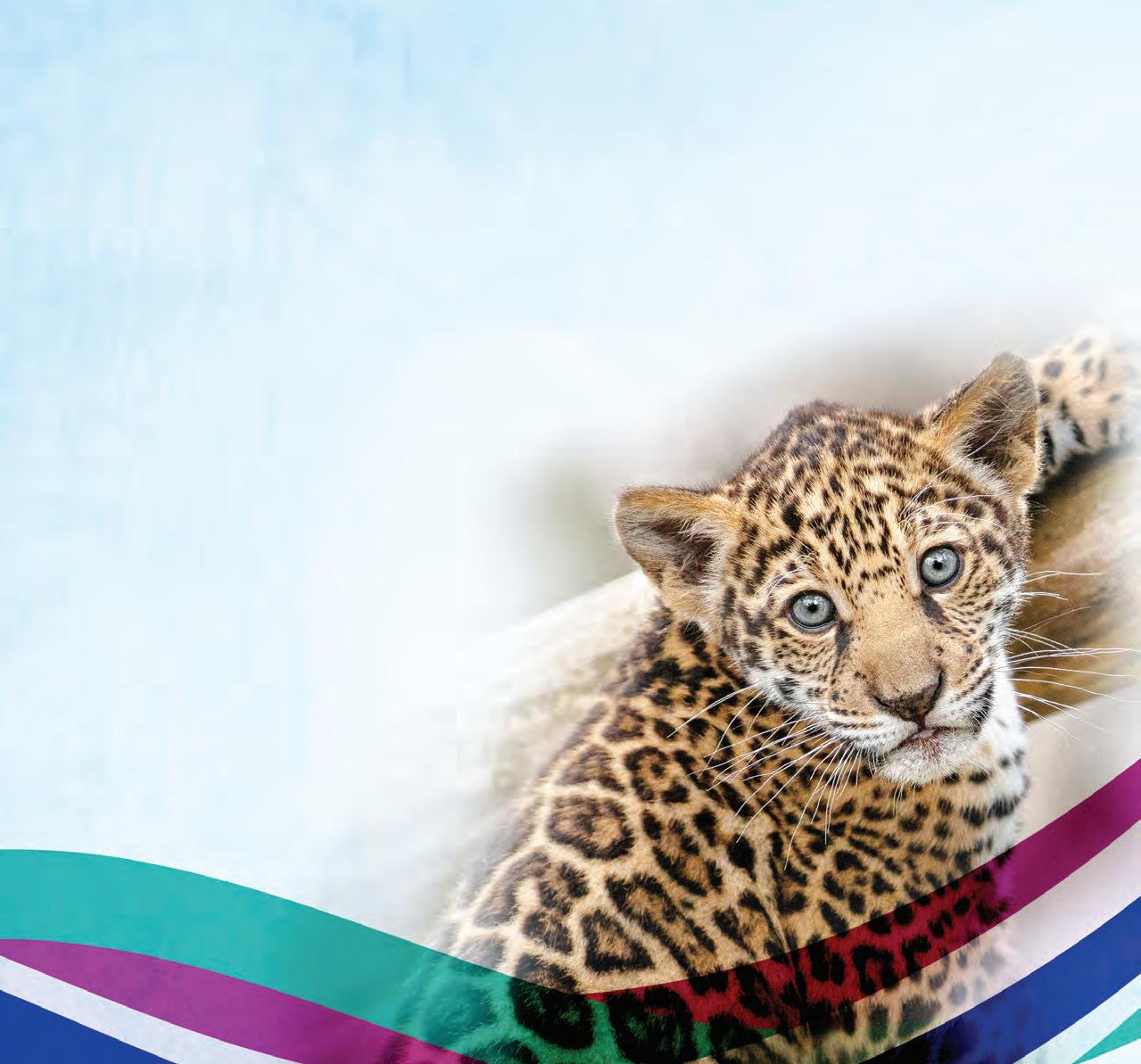
ORDER BY DECEMBER 7 for delivery by December 25