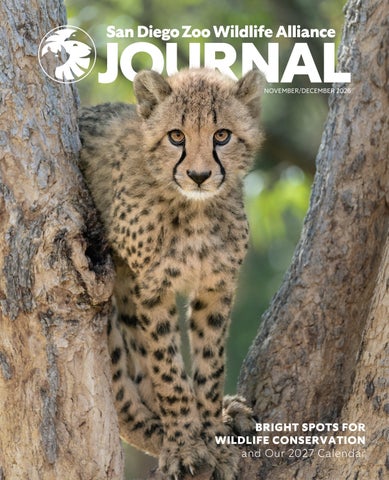
NOVEMBER/DECEMBER 2026
BRIGHT SPOTS FOR WILDLIFE CONSERVATION and Our 2027 Calendar
San Diego Zoo
JUNGLE BELLS December 19 through January 3
WE’RE AGLOW WITH THE SPIRIT AND MAGIC OF THE HOLIDAY SEASON! “Merry and bright” takes on a whole new meaning as the Zoo lights up the night with family-friendly entertainment, specialty sips and snacks, and amazing illuminated experiences. Come help us ring in the season! For all the insights and to learn more visit, zoo.sandiegozoo.org/junglebells.
Jungle Bells Ad TK
Albert’s Restaurant Holiday Prix Fixe Meal Join us at Albert’s Restaurant to indulge in the magic of Jungle Bells with a delicious three-course meal. Savor the season with our curated wine pairings and holiday-themed cocktails. Book online through OpenTable or at zoo.sandiegozoo.org/dining/alberts.
MEMBERS are invited to join us for a Jungle Bells preview on December 18
NOVEMBER & DECEMBER 2026
Vol. 6 No. 6
CONTENTS 02 President/CEO’s Letter 03 By the Numbers 04 Findings 0 7 Meet the Team 08 Hot Topics 46 Events 48 Wildlife Explorers Page 49 Last Look
COVER STORY 10 A Coalition of Brothers
10
First-time cheetah mom Kelechi has her paws full with four male cubs. These adorable new arrivals at the Safari Park also represent a growing hope for the future of their species.
FEATURES 18 2027 Calendar Throughout our 2027 calendar, the Alliance is proud to spotlight some of the iconic species we are working to save, as well as ways to commemorate wildlife conservation each and every day.
8
18
44 Visualize It Even the Komodo dragon, the world’s largest living lizard, starts out small. Follow this powerhouse predator through its fascinating life stages.
On the Cover: Cheetah Acinonyx jubatus Photo by: Ken Bohn, SDZWA photographer
PHOTOS BY: KEN BOHN/SDZWA
MANAGING EDITOR Peggy Scott STAFF WRITERS Mike Hausberg Aubrey Lloyd Sara Maher Ellie McMillan Elyan Shor, Ph.D. CONTRIBUTING EDITOR Justin Weber DESIGNER Kaitlyn Lara PHOTOGRAPHERS Ken Bohn Tammy Spratt DESIGN AND PRODUCTION Lisa Bissi Jennifer MacEwen PREPRESS AND PRINTING Quad Graphics
Let's Stay Connected Follow @sandiegozoo & @sdzsafaripark. Share your #SanDiegoZoo & #SDZSafariPark memories on social media.
The Zoological Society of San Diego was founded in October 1916 by Harry M. Wegeforth, M.D., as a private, nonprofit corporation, which does business as San Diego Zoo Wildlife Alliance. The printed San Diego Zoo Wildlife Alliance Journal (ISSN 2767-7680) (Vol. 6, No. 6) is published bimonthly, in January, March, May, July, September, and November. Publisher is San Diego Zoo Wildlife Alliance, located at 2920 Zoo Drive, San Diego, CA 92101-1646. Periodicals postage paid at San Diego, California, USA, and at additional mailing offices. POSTMASTER: Send address changes to San Diego Zoo Wildlife Alliance, PO Box 120271, San Diego, CA 92112-0271. Copyright © 2026 San Diego Zoo Wildlife Alliance. All rights reserved. All column and program titles are trademarks of San Diego Zoo Wildlife Alliance.
As part of San Diego Zoo Wildlife Alliance’s commitment to conservation, This product is made of material from wellmanaged FSC®-certified forests, recycled materials, and other controlled sources, chlorine free, and is Forest Stewardship Council® (FSC®) (COC) certified. FSC® is not responsible for any calculations on saving resources by choosing this paper.
If your mailing address has changed: Please contact the Membership Department by mail at PO Box 120271, San Diego, CA 92112, or by phone at (619) 231-0251 or 1-877-3MEMBER. For information about becoming a member of San Diego Zoo Wildlife Alliance, please visit our website at ZooMember.org for a complete list of membership levels, offers, and benefits. Paid subscriptions to San Diego Zoo Wildlife Alliance Journal are available. Contact the Membership Department for subscription information.
LET TER FROM THE PRESIDENT & CHIEF EXECUTIVE OFFICER
A Year of Wildlife Thriving Together
2026 Board of Trustees Officers Rolf Benirschke, Chair Steven S. Simpson, Vice Chair Adam Day, Treasurer Gary E. Knell, Secretary Trustees Tom Chapman E. Jane Finley Clifford W. Hague Bryan B. Min Kenji Price Corinne Verdery ‘Aulani Wilhelm
At San Diego Zoo Wildlife Alliance, we pride ourselves on helping the wildlife in our care thrive, not just survive. Sharing our passion, knowledge, and curiosity for the species that live at our parks, throughout our conservation hubs, and around the world is what keeps
of why this work matters, one
our mission alive.
milestone at a time. You will also find a fascinating
Executive Team Shawn Dixon
of the year, I hope this issue leaves
look behind the scenes at the
President and Chief Executive Officer
you with a sense of the remarkable
thoughtful science that goes into
Annie Fitzgerald
community you are part of and make
the diets we prepare for the wildlife
Chief Operating Officer
possible. As you flip through every
in our care. It is detail-oriented,
David Franco
page of this special 2027 calendar
creative work, and it makes a
issue, we hope you feel inspired
profound difference every single day.
to keep learning and to celebrate
Thank you for your loyalty, your
wildlife appreciation days at the
generosity, and your belief in a future
San Diego Zoo and San Diego Zoo
where wildlife thrives. It is a privilege
Safari Park next year.
to close this year alongside you.
stories about our teams. At the Together for Wildlife,
Pat McTigue Senior Vice President and Executive Director, San Diego Zoo Safari Park DVM, DACZM, DECZM (ZHM) Chief Conservation and Wildlife Health Officer General Counsel
staying close to one another in life. Their upbringing is a reminder
Senior Vice President and Executive Director, San Diego Zoo
Wendy Bulger
continue learning, exploring, and ways that will carry them through
Erika Kohler
Nadine Lamberski,
This issue also holds captivating Safari Park, four cheetah brothers
Chief Financial Officer
David Gillig Shawn Dixon President and Chief Executive Officer
Chief Philanthropy Officer
Allyson Carr Chief Human Resources Officer
David Miller 2 / SAN DIEGO ZOO WILDLIFE ALLIANCE JOURNAL / NOVEMBER/DECEMBER 2026
Chief Marketing Officer
PHOTO BY: KEN BOHN/SDZWA
As we move into the final weeks
Trustees Emeriti Javade Chaudhri Berit N. Durler Thompson Fetter Richard B. Gulley Robert B. Horsman Steven G. Tappan John M. Thornton
BY THE NUMBERS
A Year in Breakthroughs Momentous achievements happen across the Zoo, the Safari Park, and throughout our global conservation programs in our Hubs every single day. And 2026 was filled with extraordinary wins. Throughout the year, we connected people with wildlife, safeguarded the species that need our help the most, and shared our responsibility to create a world where all life thrives. These big moments led to even bigger impacts—like a brighter future for species and ecosystems and more allies ready to protect them all.
110
We completed the largest and most transformative project in our 110-year history, Denny Sanford Elephant Valley, and celebrated its official opening in March.
20
This year marked the 20th anniversary of two influential education programs: Exploring Conservation Science and Teacher Workshops in Conservation Science field trips.
>282K PHOTO BY: CAMERON FRANCO/SDZWA
Dedicated Alliance volunteer teams contributed over 282,000 hours this year, supporting crucial efforts across our entire organization.
1
A Socorro dove—a species that has been extinct in native habitat for over five decades— hatched at the Safari Park for the first time.
>2K
This year, wildlife health experts cared for more than 2,000 animals at the Safari Park’s Paul Harter Veterinary Medical Center, which also celebrated its 25th anniversary. SAN DIEGO ZOO WILDLIFE ALLIANCE / SDZWA.ORG / 3
FINDINGS
PACIFIC ISLANDS
SOUTHWEST
SOCORRO DOVE CELLS BANKED
MILESTONE YEAR FOR FROGS
We recently banked the cells of a Socorro dove in our Frozen Zoo® for the first time. Beyond marking an important milestone for the species, this addition represents an important milestone for global conservation—Socorro doves are extinct in the wild, and samples from wildlife in this category can be difficult to secure and are therefore underrepresented in cryopreserved (frozen) repositories. The Frozen Zoo now safeguards the cells of five species that are extinct in the wild, and these cells could one day be foundational to recovery for these animals. Fewer than 200 Socorro doves remain, and the Safari Park is one of the few conservation breeding centers with the honor of caring for these rare birds.
Our mountain yellow-legged frog conservation program produced more than 5,300 tadpoles this year, the highest number in our program’s history. This includes more than 200 tadpoles that hatched from eggs laid by frogs from the San Bernardino population, a vital boost to a population with a history of limited reproductive success. We released thousands of tadpoles into native habitats in Southern California this year. In addition, San Diego Zoo Wildlife Alliance and partnering institutions are headstarting at least 1,000 tadpoles that will be released when they reach older stages. Mountain yellow-legged frogs are endangered, but they provide key ecosystem services that keep Southern California’s environments healthy. These unique amphibians can now be experienced at the San Diego Zoo’s Denny Sanford Wildlife Explorers Basecamp.
S AVA N N A
WOMEN’S CONSERVATION FORUM San Diego Zoo Wildlife Alliance and our partners funded and helped organize the third Women’s Conservation Forum in Kenya. The forum brought together 29 women serving on conservancy boards from eight community conservancies across northern Kenya. The workshop explored links between gender equity and conservation, strengthened participants’ understanding of conservancy board roles, and provided space to discuss the opportunities and barriers women face when taking on leadership roles in conservation. Participants also identified practical ways to increase women’s participation, influence, and leadership in community conservation. The forum supported locally informed approaches to more equitable conservation governance. 4 / SAN DIEGO ZOO WILDLIFE ALLIANCE JOURNAL / NOVEMBER/DECEMBER 2026
PHOTOS BY: (TOP LEFT) CAMERON FRANCO/SDZWA, (TOP RIGHT, BOTTOM) SDZWA
San Diego Zoo Wildlife Alliance protects and restores nature in eight Conservation Hubs on six continents. Below are recent discoveries and progress reports from around the world.
Explore South America’s Grandest Wildlife Realm July 10-20, 2027
Wildlife of Brazil’s Pantanal Track jaguars, scout for tapirs, look for hyacinth macaws, and more in South America’s most extensive wild frontier—the sprawling wetlands of the Pantanal— with some of the planet’s most abundant wildlife.
Book now to travel with us! For details about this and all our Adventures, visit adventures.sdzwa.org. Photos Provided by Natural Habitat Adventures
SIP, SNACK,
SAVE
SPECIES Stay fueled up by enjoying a delicious treat at one of our specialty snack stands on your next visit. The San Diego Zoo and San Diego Zoo Safari Park thank our partners for their continued support! © 2025 2026 The The Coca-Cola Coca-Cola Company Company | | “Coca-Cola” “Coca-Cola” and and “DASANI” “DASANI” are are registered registered trademarks trademarks of of The The Coca-Cola Coca-Cola Company Company
The “Frito-Lay logo” is a registered trademark of Frito-Lay North America, Inc © 2026 2025
MEET THE TEAM become patients, they either wake up at the hospital or walk out of the trailer. Being at the Safari Park means they probably came from a herd in a vast field habitat. We work hard to keep them calm and comfortable and eating, but they never consider us part of their herd. They manage this strange period of their life and, at reintroduction to their herd, we hope they forget the hospital visit ever happened.
Is there a patient or case that you will remember forever?
EILEEN NEFF Lead Wildlife Care Specialist Paul Harter Veterinary Medical Center
For more than 25 years, Eileen has cared for wildlife throughout the San Diego Zoo Safari Park. Over the years she has nurtured mammals in all stages of life, from neonates to fully grown hoofed animals and large cats like cheetahs. She is currently lead wildlife care specialist at Harter, where she helps patients of all species—whether they’re receiving routine exams or on their road to recovery.
First thing in the morning, the hospital care team walks around together, checking our patients and discussing their care and status. There are almost always medical procedures scheduled throughout the day. There are almost always unplanned emergencies or checkups as well. We assist with those and provide feeding, cleaning, medicating, and continuous observation of the wildlife in our care. We have cameras monitoring our patients as well, and we review them often so we know how they’re doing even when we’re not present.
What is the most unique patient you have cared for? An echidna was a first for me. They are covered in spines and roll in a very tight ball and are incredibly strong. The Rodrigues fruit bats were also very interesting to handraise since they do almost everything upside-down.
What has surprised you the most about working in a veterinary hospital? How resilient animals are (especially hoofed animals). First of all, they are typically prey species. When they
What or who inspires you? All of the people that work here at the Safari Park. All the volunteers and all the departments. I am fortunate to interact with wildlife in my day-to-day job, and I have recognized other team members’ strong loyalty and love for this place and all our animals.
What is your favorite species, and why? There are so many! Elephants because they’re so smart and they live in family units and look out for each other. Giraffes because every day is a new day for them and you must earn their trust. Plus, if you introduce a new “kid” to the herd (the few times we’ve had to hand-raise a calf), they accept it easily. And Addra [dama] gazelle— they’re just beautiful and the male is so confident and stately. SAN DIEGO ZOO WILDLIFE ALLIANCE / SDZWA.ORG / 7
PHOTOS BY: KEN BOHN/SDZWA
Tell us what your typical day is like (if there is such a thing).
A male giraffe named Congo. He lost his mother when he was one month old. He came to the hospital since he still needed to stay warm and protected and nurse from a bottle. We tried everything to convince him to trust us with a bottle. He resisted us. On the morning of the fourth day, I came in really early so it would be quiet and calm. After at least an hour of me hanging over a wall (so I was above him—it had a ledge to stand on), he finally came to the bottle that was covered with a spotted blanket and sucked down the whole bottle. What a relief!
HOT TOPICS
FOOD FOR THOUGHT
Jordyn Nylander, senior clinical nutritionist with San Diego Zoo Wildlife Alliance, offers a taste of the expertise it takes to keep so many species well-fed and fed well.
G
ood nutrition keeps our wildlife healthy. Our goal as a nutrition team is to provide safe, appropriate diets for every species in our care—from leafcutter ants and hornbills to elephants and everything in between. Nutritionists play a key role in wildlife health, reproduction, welfare, and longevity for both individuals and populations throughout their lives. As a nutritionist, my work always starts with questions like how do we help this individual animal gain weight, or what does a species need to thrive? Working with biologists, supply chain experts, wildlife care staff, veterinarians, pathologists, laboratories, and the animals themselves, wildlife nutritionists assemble all the pieces into a holistic diet plan.
8 / SAN DIEGO ZOO WILDLIFE ALLIANCE JOURNAL / NOVEMBER/DECEMBER 2026
For example, a wildlife care specialist might ask, “Our gerenuk is losing weight. Can you adjust the diet?” While this may sound simple, creating or changing a diet involves much more than just adding more food. Before making recommendations, I need to understand the individual animal and the goals of the care team. I can get this information by heading out to meet the animal and the Wildlife Care team responsible for their care. I begin by gathering detailed information, much like taking a medical history, but specific to nutrition. What does he or she currently eat? What is its habitat like? Who does it live with? Have there been environmental changes, recent moves, or new challenges for staff? Is the animal healthy, taking medication, or showing behavioral changes?
Balancing act Wildlife nutrition is both a science and an art. All the suitable components are gathered to create a diet that is both nutritious and palatable. Nutritionists must also factor in special needs such as advanced age-related dental concerns or mineral interactions in the body.
PHOTOS BY: KEN BOHN/SDZWA
Similar to how a doctor evaluates a patient, I observe how an animal chews and selects food, its body condition, and the quality of its skin, fur, feathers, hooves, or horns. I also examine the habitat for changes, such as new plant growth. Combining the information I receive from the Wildlife Care teams and my own observations with scientific research and my educational experience helps give me a complete picture of what the animal needs to thrive. Once I gather all the information, I head to my desk to start building out a diet sheet. The diet sheet acts like a prescription, detailing what foods to provide, how much to feed, and how often. This diet sheet is then sent to the Nutrition Warehouse team, which prepares the diets, and the wildlife care specialists, who feed the wildlife. Creating diets is only one facet of the Nutrition team’s work. We also sample our food to make sure our animals are actually getting the nutrients we expect; we assess the plants growing in habitats to make sure our animals are safe; we work with veterinarians to review diagnostics and create clinical diets for animals with special health concerns; and we support our Conservation Hubs through nutritional insights to meet their goals. Regardless of what we are working on, we are always trying to answer the question of what the best dietary choices for this individual are right now. Species with highly specialized diets pose their own challenges. Both red and giant pandas consume a diet that is 99% bamboo. This means nutritional content is critical. The plants have a natural nutrient cycling process (shoots, leaf, culm), which will change the nutrient composition of the bamboo throughout the year. Nutrients provided by the soil and water where the plant is grown will also impact the nutrient composition available to the pandas. Dietary needs aren’t always species-based— sometimes we must develop a plan for aging wildlife with dental concerns, as well as those with sensitivity to minerals such as iron. Every meal is a delicate balance. So the next time you see an animal eating, consider the many questions a nutritionist asks to ensure that animal receives the best possible care.
SAN DIEGO ZOO WILDLIFE ALLIANCE / SDZWA.ORG / 9
A COALITION
A
rambunctious cloud of spots
cheetahs born at the San Diego Zoo Safari Park
flurries around five-year-old
since 2020, and they’re a crucial addition to the
cheetah Kelechi. She trills,
vulnerable global population of their species.
and the commotion around her
Kelechi welcomed her cubs in the middle
calms—but only for a moment.
of the night on January 24, 2026. They spent
As a first-time mom, she’s got her paws full with
about six weeks bonding in their den until
not one, but four male cubs. These are the first
the cubs slowly began exploring their grassy
10 / SAN DIEGO ZOO WILDLIFE ALLIANCE JOURNAL / NOVEMBER/DECEMBER 2026
of BROTHERS BY ELLIE MCMILLAN | PHOTOGRAPHY BY KEN BOHN
surroundings and eating solid foods. Following
from the same litter, the cubs will remain a
mom’s lead, they quickly felt comfortable
“coalition”—which is what a group of male
exploring their new world. The four boys
cheetahs is called. This is a unique, natural trait
quickly took to running, playing, climbing, and
of this primarily solitary species. Just as they
learning from Kelechi.
would in native habitats, they’ll hunt, sleep, eat,
The brothers will eventually branch out, but they won’t be alone. Since they’re males
and find female partners together for as long as it’s best for them. SAN DIEGO ZOO WILDLIFE ALLIANCE / SDZWA.ORG / 11
Nyasi It’s All in the Name Translated from the African languages Swahili, Oshiwambo, and Dholuo, the cubs’ names are as special as they are. Through a social media contest with over 45,000 votes, wildlife allies like you helped name Nyasi, which means “grass” or “plains.” Owadgi means “brother,” and Ohani honors the name of their grandmother. Nkala’s name is drawn from local folklore and means strength and power. Nyasi puts on a tough façade. He’s always ready to protect his brothers but often stays close to mom and avoids risks. On the other paw, Owadgi is often the most adventurous and loves climbing trees, though he still calls for 12 / SAN DIEGO ZOO WILDLIFE ALLIANCE JOURNAL / NOVEMBER/DECEMBER 2026
Owadgi mom when he gets into sticky situations. Ohani is the bravest and fastest learner of the coalition, usually inspiring his brothers to help him investigate new experiences. Last but not least is the cub whose personality is most similar to Kelechi’s. Nkala has an observant nature and always takes a moment to understand what’s happening around him before he responds. And reflecting his name’s meaning, Nkala shows his quiet strength through perseverance.
See the Difference? Cheetahs go through a few stages of color variation before they
THE FOUR OF CUBS For Kelechi’s four cubs, each day brings new adventure, growing confidence, and the further development of their distinct personalities.
Ohani
reach adulthood. They’re born with all their spots, making their fur look darker than adult cheetahs. As they age, their spots have a chance to disperse across their body, and their coats tend to lighten up. However, some cheetahs keep their darker fur throughout their lives. Another telltale sign of aging: they develop a wispy silver mantle from their head to their tail that almost looks like a mohawk. Female cheetahs usually grow out of their mantle, while male cheetahs maintain it during adulthood, though it becomes less prominent. Mantles are specific to each cheetah, and some have no mantle at all.
Nkala For Nyasi, Owadgi, Ohani, and Nkala, their spots are as distinct as their personalities. Sometimes it’s hard to distinguish between them when they’re running and playing, but when they stop for a moment, it becomes a lot easier to tell them apart. Nyasi and Ohani are blonder than the other boys. Plus, out of the four of them, Nyasi has the largest head. Ohani’s feet are notably white and he has the smallest head. Continuing on the gradient scale, Nkala has darker fur than Nyasi and Ohani. Owadgi has the darkest fur, and his eyes have an unmistakable “cat-eye” shape to them. SAN DIEGO ZOO WILDLIFE ALLIANCE / SDZWA.ORG / 13
14 / SAN DIEGO ZOO WILDLIFE ALLIANCE JOURNAL / NOVEMBER/DECEMBER 2026
Spots of Hope
A BRIGHT SPOT (OR FOUR) With approximately 7,000 cheetahs remaining in native ranges, every cub born—like Nyasi, Owadgi, Ohani, and Nkala— represents renewed hope for the future of the species.
These little ones aren’t just adorable, they’re also vital to the future of their vulnerable species. Cheetahs were once widespread throughout Africa and into Asia. As a keystone species, sustainable cheetah populations are critical to the health of the overall ecosystem. Cheetahs face mounting threats from challenges such as humanwildlife coexistence, changes in climate, and habitat loss and fragmentation. Today their populations are scattered, with approximately 7,000 cheetahs remaining in native habitats. At first, this may seem like a stable number. But unfortunately, their population has decreased by over 93% throughout the last century. Fortunately, there is hope for these iconic cats. With partners across the Association of Zoos and Aquariums (AZA), San Diego Zoo Wildlife Alliance participates in the Species Survival Plan (SSP) Program for cheetahs. The SSP Program’s goal is to support healthy, genetically diverse cheetah populations in North America and across native ecosystems. Additionally, AZA-accredited institutions within the SSP Program are able to support global conservation initiatives, participate in collaborative research projects, and share information to learn more about the species as a whole. The heart of our cheetah conservation efforts are at the Safari Park’s Carnivore Conservation Center. Through the work of the dedicated team in this behind-the-scenes area, we’re able to support sustainable cheetah populations. There have been nearly 200 cubs born at the Safari Park since the beginning of the cheetah conservation program in 1972, making a crucial difference for their species’ genetic diversity and global population. In addition to successful conservation efforts at the Safari Park, we’re also working to save and protect the native ecosystems on which cheetah rely through our Savanna Conservation Hub.
One Spot at a Time As the first cheetah cubs born at the Safari Park in over five years, these four youngsters are cause for celebration. There is still much to be done to help cheetahs survive and thrive for generations to come, yet it’s important to remember the difference each conservation milestone makes for vulnerable and endangered wildlife worldwide. Nyasi, Owadgi, Ohani, and Nkala represent the bond of brotherhood, what it means to stay by each other’s side, and generational hope for the future of their species. On your next visit to the Safari Park, connect with the cubs at African Outpost or on a behindthe-scenes tour to experience the power of incredible conservation moments like this for yourself.
SAN DIEGO ZOO WILDLIFE ALLIANCE / SDZWA.ORG / 15
S E L E C T N IG H T S
NOVEMBER 28 THROUGH JANUARY 3 M EM B ER S ARE I NVI TED TO JO IN US FO R A PRE VIE W ON NOVE MBER 27
Celebrate the holiday season and see the San Diego Zoo Safari Park in a whole new light! Go on an expedition of light and travel through places that glow, shine, and twinkle with holiday cheer. Musical entertainment, festive storytelling, and culinary treats create family fun that gets everyone in the spirit of the season. Learn more at sdzsafaripark.org/wildholidays. 14 / SAN DIEGO ZOO WILDLIFE ALLIANCE JOURNAL / NOVEMBER/DECEMBER 2026
a y d i d s i l seaso l o o h h s i nn, Th shop to
support wildlife conservation!
Purchase a gift card of $50 or more and receive a free plush! * Scan the QR code below or call (619) 718-3000 to purchase. *Gift cards can be used toward any purchases at the San Diego Zoo or San Diego Zoo Safari Park (not available for online purchases). Discounts do not apply toward gift card purchases. Valid for physical gift cards orders only. Gift card and free plush will be shipped to any domestic street address you specify (shipping and handling charges apply). Plush may vary. Plush offer can be redeemed online by scanning the QR code or through Call Center purchases only. Special promotion is not available for purchase at shopzoo.com, at the gift shops, nor ticket booths on grounds. Offer valid through January 8, 2027, while supplies last.
ShopZoo Ad TK Ring in the season of giving and make a difference for wildlife worldwide with every purchase.
SAN DIEGO ZOO WILDLIFE ALLIANCE / SDZWA.ORG / 17 13 Sign up for our weekly e-newsletter to receive merry special offers and the latest new arrivals!
18 / SAN DIEGO ZOO WILDLIFE ALLIANCE JOURNAL / NOVEMBER/DECEMBER 2026
Commemorating Wildlife Conservation, Each and Every Day San Diego Zoo Wildlife Alliance 2027 Calendar PHOTOGRAPHY BY KEN BOHN AND TAMMY SPRATT
Every day we celebrate the incredible conservation efforts
devils. Across the world’s Oceans, teams of Alliance experts are
you make possible for wildlife, people, and the planet we all share.
collaborating with partners to save iconic species, including polar
All species, including humans, play a vital role in the health and
bears and penguins. The Pacific Islands are home to critically
survival of their ecosystems—an intricate and critical connection
endangered wildlife, including one-of-a-kind orchids and birds
that links us all.
such as the lady’s slipper orchid and 'alalā. Across the Savanna,
As allies for wildlife you are connected with our mission
Alliance conservationists are working with local communities
to save species worldwide by uniting our expertise in wildlife
living alongside elephants, rhinos, giraffes, leopards, and many
care and conservation science with our dedication to inspiring
others. And in the rivers, mountains, deserts, and coastlines of
passion for nature. Together we are part of the collective effort to
the Southwest, we’re supporting countless native North American
ensure a brighter and more hopeful tomorrow for all, from the
species, from the mountain yellow-legged frog and desert tortoise
largest navigating the African savanna to the smallest swimming
to the burrowing owl and Pacific pocket mouse.
in Southwestern streams. Your support is making a meaningful
Throughout our 2027 calendar, we’re honored to highlight
difference for wildlife throughout our Conservation Hubs
some of these success stories and the individual days set aside
worldwide: African Forest, Amazonia, Asia, Australian Forest,
for each of these remarkable plants and animals! From axolotls
Oceans, Pacific Islands, Savanna, and Southwest.
to zebras and every other in between, each day offers a reason
As we protect gorillas deep within the vanishing treetops of the African Forest; save elusive jaguars traversing Amazonia;
to pause and appreciate our global conservation efforts as an Alliance, to care for, save, and protect the world’s wildlife.
and care for giant pandas and other iconic wildlife that create
Whether they soar, slither, or stomp, each of these
Asia’s complex and varied ecosystems, we commemorate the
remarkable species can be experienced at the Zoo and Safari
conservation successes you make possible as allies for wildlife.
Park. We invite you to have an incredible year by spending time
In the Australian Forest, we’ve been caring for and protecting
alongside your favorites while exploring what you can do to help
koalas for over a century, and expanded our work over time to
conserve them. There’s a whole world to celebrate, and the Zoo
protect platypuses, tree kangaroos, cassowaries, and Tasmanian
and Safari Park are the perfect places to enjoy this year’s journey.
SAN DIEGO ZOO WILDLIFE ALLIANCE / SDZWA.ORG / 19
January 2027
27
Groundhog Day
National Bird Day
2
26
19
12
5
Jungle Bells (Zoo) Wild Holidays (Park)
29
T U E S D AY
3
27
20
13
6
Jungle Bells (Zoo) Wild Holidays (Park) Last Quarter Moon T
30
W E D N E S D AY
New Moon 0
7
4
28
21
14
Jungle Bells (Zoo) Wild Holidays (Park) New Year’s Eve
31
T H U R S D AY
California Condors Once down to just 22 birds, North America’s largest bird now numbers more than 600, thanks to collaborative efforts across our Southwest Conservation Hub. Experience this iconic native species at the Safari Park’s Condor Ridge and the Zoo’s Elephant Odyssey.
International Zebra Day
1
31
Seniors Free Month begins (Park) World Axolotl Day
25
Martin Luther King Jr. Day
18
11
4
Jungle Bells (Zoo) Wild Holidays (Park)
28
M O N D AY
24
17
Early Member Hours (Park)
Early Member Hours (Zoo)
10
Jungle Bells (Zoo) Wild Holidays (Park)
3
Jungle Bells (Zoo) Wild Holidays (Park)
S U N D AY
1
29
5
Last Quarter Moon T
Full Moon @
22
Plant Day (Zoo) First Quarter Moon G
15
8
Jungle Bells (Zoo) Wild Holidays (Park) New Year’s Day
F R I D AY
2
sdzwa.org
6
Lunar New Year Celebration (Zoo) Lunar New Year Celebration (Park) Lunar New Year begins New Moon 0
30
23
16
9
Jungle Bells (Zoo) Wild Holidays (Park)
S AT U R D AY
Februa ry
14
22
1
21
28
Groundhog Day
2
23
16
9
2
26
T U E S D AY
World Wildlife Day
3
24
17
10
3
27
W E D N E S D AY
4
25
18
11
4
28
T H U R S D AY
Polar Bears The polar bear’s scientific name, Ursus maritimus, translates to “sea bear.” Experience the seasonal lifecycles of Earth’s largest bear species and the work we’re doing to protect their native ecosystems through our Oceans Conservation Hub at the Zoo’s Conrad Prebys Polar Bear Plunge.
Seniors Free Month end (Park)
Presidents’ Day Washington’s Birthday
15
8
Early Member Hours (Park) Valentine’s Day
Early Member Hours (Zoo)
Ramadan begins
Lunar New Year Celebration (Zoo)
7
International Zebra Day
1
31
Seniors Free Month begins (Park) World Axolotl Day
25
M O N D AY
24
S U N D AY
29
Elephant Valley First Anniversary
Plant Day (Zoo)
Lincoln’s Birthday
5
26
19
12
5
Last Quarter Moon T
F R I D AY
sdzwa.org
6
International Polar Bear Day Last Quarter Moon T
27
Lunar New Year Ends Full Moon @
20
First Quarter Moon G
13
6
Lunar New Year Celebration (Zoo) Lunar New Year Celebration (Park) Lunar New Year begins New Moon 0
30
S AT U R D AY
March
Last Quarter Moon T
29
Eid al-Fitr begins
30
23
16
9
2
23
T U E S D AY
St. Patrick’s Day
31
24
17
10
World Wildlife Day
3
24
W E D N E S D AY
Butterfly Jungle continues, through April 11 (Park) April Fool’s Day
1
25
18
11
4
25
T H U R S D AY
Good Friday
Plant Day (Zoo)
Elephant Valley First Anniversary
F R I D AY
African Elephants This month marks the one-year anniversary of the opening of Denny Sanford Elephant Valley at the Safari Park. An immersive reflection of the impact of our Savanna Conservation Hub, Elephant Valley—and the Zoo’s Elephant Odyssey—offer life-changing moments with the world’s largest land mammal.
Easter Sunday
28
22
21
Palm Sunday
First Quarter Moon G
Early Member Hours (Zoo) Early Member Hours (Park) Daylight Saving Time begins
World Water Day Purim begins Full Moon @
15
New Moon 0
8
14
World Platypus Day
7
1
28
Seniors Free Month end (Park)
22
M O N D AY
21
S U N D AY
2
26
19
12
5
26
sdzwa.org
3
27
Butterfly Jungle begins, through April 11 (Park) Spring Equinox
20
13
6
International Polar Bear Day Last Quarter Moon T
27
S AT U R D AY
April
5
12
11
Last Quarter Moon T
29
M O N D AY
4
3
13
Full Moon @
4
27
20
First Quarter Moon G
New Moon 0
6
30
T U E S D AY
28
Cinco de Mayo
5
Last Quarter Moon T
Passover begins
21
14
7
31
W E D N E S D AY
New Moon 0
Earth Day
15
8
1
6
29
22
Butterfly Jungle continues, through April 11 (Park) April Fool’s Day
T H U R S D AY
Arbor Day (Park)
2
16
9
7
30
23
Plant Day (Zoo) National Orchid Day Eid al-Adha begins
F R I D AY
Orchids Working with partners in the Pacific Islands Conservation Hub, we sustainably collect orchid seeds in Palau and bring them to the Zoo. This allows us to safely cultivate new plants as part of our efforts for some of Earth’s most trafficked species. Thousands of blooms, like the snout orchid Dienia ophrydis (pictured), await in the Zoo’s Orchid House.
2
26
25
International Flamingo Day (Park)
19
18
Early Member Hours (Zoo) Early Member Hours (Park) Butterfly Jungle ends (Park)
Easter Sunday
28
S U N D AY
3
sdzwa.org
8
Food, Wine & Brew (Zoo)
1
24
International Bat Appreciation Day (Park)
17
10
S AT U R D AY
May
4
11
10
9
27
T U E S D AY
3
International Flamingo Day (Park)
26
M O N D AY
2
25
1 Wild Summer continues, through August 15 (Zoo)
World Parrot Day (Park) Memorial Day
12
2
26
19
First Quarter Moon G
Cinco de Mayo
5
Last Quarter Moon T
28
W E D N E S D AY
World Bee Day Full Moon @
New Moon 0
3
27
20
13
6
29
T H U R S D AY
F R I D AY
New Moon 0
sdzwa.org
World Environment Day
5
Wild Summer begins, through August 15 (Zoo)
Wild Summer Member Preview (Zoo) Last Quarter Moon T
4
29
28
Wild Weekend (Zoo) First Quarter Moon G
Plant Day (Zoo) World Tree Kangaroo Day (Park) Endangered Species Day
Armed Forces Day
15
8
Food, Wine & Brew (Zoo)
1
22
14
7
30
S AT U R D AY
21
Arbor Day (Park)
Tree Kangaroos Through our Australian Forest Conservation Hub, we support the Species Survival Plan for these endangered marsupials. For over 100 years, the Alliance has worked in Australia to save iconic wildlife. Experience tree kangaroos, wallabies, a platypus, and cassowaries at the Safari Park’s Walkabout Australia.
30
31
25
24
23
Wild Weekend (Zoo)
18
17
16
Early Member Hours (Park) Mother’s Day
Early Member Hours (Zoo)
S U N D AY
June
30
1
24
Plant Day (Zoo) Full Moon @
2
25
18
26
3
Last Quarter Moon T
Juneteenth
19
RITZ (Zoo) National Cougar Day (Park)
12
World Environment Day
sdzwa.org
29
23
11
First Quarter Moon G
New Moon 0
5
Wild Summer begins, through August 15 (Zoo)
Wild Summer Member Preview (Zoo) Last Quarter Moon T
4
29
S AT U R D AY
28
F R I D AY
Giraffes Groups of giraffes are called towers—fitting for the tallest species alive today. All four species of giraffe are native to sub-Saharan Africa, part of our Savanna Conservation Hub, and Masai giraffes can be experienced at both the Zoo’s Urban Jungle and across the Safari Park’s savanna habitats.
28
22
17
10
3
27
T H U R S D AY
New Moon 0
27
21
World Giraffe Day (Park) Summer Solstice
Flag Day
16
9
2
26
W E D N E S D AY
Wild Summer continues, through August 15 (Zoo)
Father’s Day
20
Early Member Hours (Park)
Early Member Hours (Zoo)
14
13
15
8
7
6
World Oceans Day
Wild Summer continues, through August 15 (Zoo)
World Parrot Day (Park) Memorial Day
25
T U E S D AY
1
24
M O N D AY
31
30
Wild Weekend (Zoo)
23
S U N D AY
July
11
1
25
26
New Moon 0
2
Last Quarter Moon T
World Echidna Day (Park)
19
3
27
20
13
6
29
T U E S D AY
4
28
21
14
7
30
W E D N E S D AY
1
International Tiger Day (Park)
5
29
22
15
8
Wild Summer continues, through August 15 (Zoo)
T H U R S D AY
Tigers Within our Asia Conservation Hub, efforts are underway to help save critically endangered species of tigers and their vanishing ecosystems. Come nose to nose with Sumatran tigers at the Safari Park’s Tull Family Tiger Trail, and prowl alongside Malayan tigers at the Zoo’s Tiger River.
Wild Summer continues, through August 15 (Zoo)
Full Moon @
18
Early Member Hours (Park)
12
5
4
Early Member Hours (Zoo)
Independence Day
28
M O N D AY
27
S U N D AY
Plant Day (Zoo) World Snake Day
F R I D AY
6
30
23
16
9
2
10
sdzwa.org
7
31
24
17
First Quarter Moon G
New Moon 0
3
S AT U R D AY
August
1
25
24
New Moon 0
31
Last Quarter Moon T
Full Moon @
17
10
3
27
T U E S D AY
Member September begins (Park)
1
25
18
11
4
28
W E D N E S D AY
International Orangutan Day
5
12
2
26
19
World Elephant Day (Park)
International Tiger Day (Park)
29
T H U R S D AY
Plant Day (Zoo)
F R I D AY
Giant Pandas The giant panda is a global conservation success story! Yun Chuan and Xin Bao can be experienced at the Zoo’s Denny Sanford Panda Ridge. As part of our 30-year partnership with China Wildlife Conservation Association, we are working to save these beloved bears and their forest ecosystem through our Asia Conservation Hub.
30
29
16
9
23
New Moon 0
2
Last Quarter Moon T
26
M O N D AY
22
Wild Summer ends (Zoo)
15
Early Member Hours (Park) California Panda Day (Zoo) First Quarter Moon G
Early Member Hours (Zoo)
8
Wild Summer continues, through August 15 (Zoo)
S U N D AY
3
27
20
13
6
30
4
28
21
sdzwa.org
Wild Weekend (Zoo) International Vulture Awareness Day (Park)
World Lizard Day
14
7
31
S AT U R D AY
September
4
27
20
13
7
5
28
21
14
California Biodiversity Day (Park) First Quarter Moon G
New Moon 0
31
T U E S D AY
New Moon 0
6
7
First Quarter Moon G
Member September ends (Park)
30
Last Quarter Moon T
World Rhino Day (Park)
29
23
16
9
2
T H U R S D AY
22
Full Moon @
8
15
Member September begins (Park)
1
W E D N E S D AY
F R I D AY
24
17
10
3
HalGLOWeen (Zoo)
8
HalGLOWeen Member Preview (Zoo) Rosh Hashanah begins
1
World Gorilla Day (Park)
Plant Day (Zoo)
Rhinoceros Rhinos are part of the Alliance’s Savanna Conservation Hub and among the Safari Park’s greatest conservation successes. Groups, or “crashes,” of southern white and greater one-horned rhinos can be experienced across the Safari Park, while a greater one-horned rhino awaits at the Zoo’s Urban Jungle.
HalGLOWeen (Zoo) Autumn Festival (Park) One Health Day
3
Early Member Hours (Park) World Cassowary Day (Park)
26
Early Member Hours (Park)
19
Early Member Hours (Park)
Early Member Hours (Zoo)
12
Early Member Hours (Park)
Labor Day
6
5
Wild Weekend (Zoo)
30
M O N D AY
29
S U N D AY
2
25
sdzwa.org
HalGLOWeen (Zoo) Autumn Festival (Park)
9
HalGLOWeen (Zoo) Autumn Festival (Park)
International Red Panda Day
18
Patriot Day National Day of Service and Remembrance
11
Wild Weekend (Zoo) International Vulture Awareness Day (Park)
4
S AT U R D AY
October
1
Election Day
2
3
7
4
28
21
14
First Quarter Moon G
Member September ends (Park)
30
T H U R S D AY
Okapi The elusive okapi is an umbrella species in our African Forest Conservation Hub. Protecting okapis also helps protect other endangered wildlife that share their vanishing rainforest habitats. Discover the only living relative of the giraffe at the Zoo’s Lost Forest and the Safari Park’s African Woods.
HalGLOWeen (Zoo) Halloween
31
HalGLOWeen (Zoo) Autumn Festival (Park)
27
25
24
26
International Sloth Day
20
13
6
World Okapi Day (Park)
New Moon 0
29
W E D N E S D AY
HalGLOWeen (Zoo) Autumn Festival (Park)
19
12
5
28
T U E S D AY
18
Indigenous Peoples’ Celebration (Park)
11
4
27
M O N D AY
17
Early Member Hours (Park) Yom Kippur begins
HalGLOWeen (Zoo) Early Member Hours (Zoo) Autumn Festival (Park)
10
HalGLOWeen (Zoo) Autumn Festival (Park) One Health Day
3
Early Member Hours (Park) World Cassowary Day (Park)
26
S U N D AY
HalGLOWeen (Zoo) New Moon 0
5
29
HalGLOWeen (Zoo) Last Quarter Moon T
22
HalGLOWeen (Zoo) Plant Day (Zoo) Full Moon @
15
HalGLOWeen (Zoo)
6
sdzwa.org
Wild Weekend (Zoo) First Quarter Moon G
HalGLOWeen (Zoo)
30
HalGLOWeen (Zoo) Autumn Festival (Park)
23
HalGLOWeen (Zoo) Autumn Festival (Park)
16
HalGLOWeen (Zoo) Autumn Festival (Park)
9
HalGLOWeen (Zoo) Autumn Festival (Park)
HalGLOWeen Member Preview (Zoo) Rosh Hashanah begins
8
2
S AT U R D AY
1
F R I D AY
November
7
14
29
28
International Jaguar Day
Election Day
30
23
16
9
2
26
T U E S D AY
1
24
17
10
3
27
W E D N E S D AY
Thanksgiving Day
Veterans Day
2
25
18
11
4
28
T H U R S D AY
26 Wild Holidays Member Preview (Park)
Plant Day (Zoo)
19
12
5
29 HalGLOWeen (Zoo) New Moon 0
F R I D AY
Jaguar Jaguars are the only remaining big cats native to the Americas. As part of efforts in our Amazonia Conservation Hub, the Alliance partners with local conservationists to study jaguars and protect their vanishing habitats while working to support human-jaguar coexistence. Experience this iconic cat at the Zoo’s Elephant Odyssey.
Wild Holidays (Park)
22
15
8
1
25
M O N D AY
21
Early Member Hours (Park)
Early Member Hours (Zoo)
Daylight Saving Time ends
Wild Weekend (Zoo)
HalGLOWeen (Zoo) Halloween
31
HalGLOWeen (Zoo) Autumn Festival (Park)
24
S U N D AY
3
v
6
20
sdzwa.org
International Cheetah Day (Park)
4
Wild Holidays (Park) New Moon 0
27
Last Quarter Moon T
Full Moon @
13
Wild Weekend (Zoo) First Quarter Moon G
HalGLOWeen (Zoo)
30
S AT U R D AY
December
20
3
Jungle Bells (Zoo) Wild Holidays (Park) New Moon 0
27
Jungle Bells (Zoo) Wild Holidays (Park) Last Quarter Moon T
Full Moon @
13
6
29
M O N D AY
4
Jungle Bells (Zoo) Wild Holidays (Park)
28
Jungle Bells (Zoo) Wild Holidays (Park)
21
14
Pearl Harbor Remembrance Day
7
30
T U E S D AY
Jungle Bells (Zoo) Wild Holidays (Park)
5
29
Jungle Bells (Zoo) Wild Holidays (Park)
22
15
8
1
W E D N E S D AY
6
Jungle Bells (Zoo) Wild Holidays (Park)
30
Jungle Bells (Zoo) Wild Holidays (Park)
23
16
9
2
T H U R S D AY
17
7
31
24
Jungle Bells (Zoo) Wild Holidays (Park) New Year’s Eve
Christmas Eve Hanukkah begins
3
10
Plant Day (Zoo) Jungle Bells Member Preview (Zoo) Wild Holidays (Park)
F R I D AY
Mountain Yellow-legged Frog Mountain yellow-legged frogs are indicators of the health of their ecosystem. For over 20 years, we have helped bolster and reintroduce populations of this endangered amphibian back into native ranges through our Southwest Conservation Hub. See them in Cool Critters at the Zoo’s Denny Sanford Wildlife Explorers Basecamp.
Jungle Bells (Zoo) Wild Holidays (Park)
2
Jungle Bells (Zoo) Wild Holidays (Park) Kwanzaa begins
26
Jungle Bells (Zoo) Wild Holidays (Park)
19
Early Member Hours (Park)
Early Member Hours (Zoo)
12
First Quarter Moon G
5
Wild Holidays (Park)
28
S U N D AY
18
11
sdzwa.org
1
8
Jungle Bells (Zoo) Wild Holidays (Park) New Year’s Day
Jungle Bells (Zoo) Christmas Day
25
Jungle Bells (Zoo) Wild Holidays (Park)
International Mountain Day
International Cheetah Day (Park)
4
S AT U R D AY
Medium-size Komodos will start spending more time on the ground and may eat birds, rodents, and other lizards.
Even the most powerhouse predators can start out super small. Discover how Komodo dragons transform from hatchlings hiding high in the trees to the world’s largest living lizard.
BY SARA MAHER | ILLUSTRATION BY AMY BLANDFORD
Branch to Brawn
VISUALIZE IT
Parents do not care for their young. Females will guard their nests and may lie on the nest, but once the eggs hatch, the little Komodos are on their own.
Females lay up to 30 grapefruit-size eggs in burrows they either dig in hillsides or take over from ground-nesting birds. The eggs incubate for up to 9 months before hatching.
SAN DIEGO ZOO WILDLIFE ALLIANCE / SDZWA.ORG / 45
Males are larger than females, and may reach up to 10 feet (3 m) long and 300 pounds (136 kg).
Komodo dragons are known to live up to 30 years and continue to grow slowly throughout their lives.
Komodo dragons reach maturity when they are 5–7 years old. At this age, they are up to 6.5 feet (2 m) long and 55 pounds (25 kg). This is when they start hunting larger prey like deer, pigs, and water buffalo.
Adult Komodos eat very quickly. Their lower jaw opens wide, allowing them to swallow large chunks of meat, bones, and even hooves. They have been known to consume up to 80% of their body weight in one feeding!
Learn more about how San Diego Zoo Wildlife Alliance works to protect Komodo dragons and their native habitats at sdzwa.org/storyhub/komodoconservation.
Hatchling Komodos are an average of 16 inches (40 cm) long and weigh just 3.5 ounces (0.1 kg). Because they are so small, they stay high in the trees to keep away from predators. They eat insects and small lizards.
EVENTS
&
NOVEMBER DECEMBER
SAN DIEGO ZOO
SELECT NIGHTS IN DECEMBER AND JANUARY
Jungle Bells The magic and spirit of the holiday season return! The Zoo lights up the night with amazing entertainment and exciting attractions and experiences. Bring the family and enjoy some tasty treats and the warmth of the holidays. On December 18, San Diego Zoo Wildlife Alliance members are invited to enjoy a Jungle Bells Member Preview. (Z)
NOVEMBER 7–8 Wild Weekend: Oceans Learn more about the wildlife of our Oceans Conservation Hub with special activities, wildlife care specialist talks, and more. (Z) NOVEMBER 20 AND DECEMBER 18 Plant Day and Orchid Odyssey On these special days, guests can take a rare look inside the Zoo’s Orchid House from 10 a.m. to 2 p.m., learn about the Zoo’s botanical collection on the Botanical Bus Tour at 11 a.m. and noon, and check out the Carnivorous Plant Greenhouse from 11 a.m. to 1 p.m. A variety of plants grown by Horticulture team members will be available at the Plant Sale, happening in front of the Orchid Greenhouse entrance from 10 a.m. to 2 p.m. (Z) OFFERED DAILY Wildlife Wonders During Wildlife Wonders at the Zoo’s Wegeforth Bowl amphitheater, presented daily at 2 p.m., wildlife care specialists will introduce you to wildlife ambassadors representing San Diego Zoo Wildlife Alliance’s conservation work around the world. Learn about amazing wildlife—from the Amazon to right here in our own backyard in San Diego—and find out what everyone can do to help conserve wildlife and the world we all share. The presentation runs 15 to 20 minutes. (Z)
46 / SAN DIEGO ZOO WILDLIFE ALLIANCE JOURNAL / NOVEMBER/DECEMBER 2026
FO R M E M B E RS NOVEMBER 1 AND DECEMBER 13 Member Exclusive Early Hours Rise and shine with the sights and sounds of the San Diego Zoo. On select days, qualifying members* can enter the Zoo one hour before the general public. To join us, simply present your qualifying membership card at the main entrance beginning at 8 a.m. *Excludes memberships with blockout dates. (Z) E VE RY DAY Wild PerksSM San Diego Zoo Wildlife Alliance members are eligible for Wild PerksSM. Show your membership card each time you make an on-grounds purchase and save up to 20%, depending on your membership level. Some exclusions apply; for details, visit sdzwa.org/ membership/wild-perks. (Z)
SAFARI PARK OFFERED DAILY Journey into the Wild Join our wildlife care specialist team as they introduce you to wildlife ambassadors representing San Diego Zoo Wildlife Alliance’s conservation work in our Amazonia, Savanna, and Southwest Conservation Hubs. This conservation presentation takes place daily at 10:30 a.m. in Benbough Amphitheater. (P) OFFERED WEEKENDS Botanical Africa Tram Tour at the Safari Park Find out all about what’s “growing” on around the Safari Park during a new, flora-focused adventure. Offered every Saturday and Sunday at noon, join us to explore botanical wonders. The Botanical Africa Tram Tour is included with admission, but reservations are required and first come, first served; visit any ticket booth at the Safari Park for your complimentary ticket. (P)
SELECT NIGHTS IN NOVEMBER, DECEMBER, AND JANUARY
Wild Holidays
FO R M E M B E RS
Spend evenings at the Safari Park until 8 p.m.! Go on a holiday expedition of light and travel through places that twinkle and glow with holiday cheer. Musical entertainment, storytelling, and culinary treats round out the seasonal festivities. On November 27, San Diego Zoo Wildlife Alliance Members are invited to a Wild Holidays Member Preview. (P)
NOVEMBER 1 AND DECEMBER 13 Member Exclusive Early Hours Rise and shine with the sights and sounds of the Safari Park. On select days, qualifying members* can enter the Safari Park one hour before the general public. To join us, simply present your qualifying membership card at the main entrance beginning at 8 a.m. *Excludes memberships with blockout dates. (P)
DECEMBER 4 Wildlife Awareness Days Join us at the Safari Park for International Cheetah Day, which spot-lights the world’s fastest land mammal. (P)
EVERY DAY Wild PerksSM San Diego Zoo Wildlife Alliance members are eligible for Wild PerksSM. Show your membership card each time you make an on-grounds purchase and save up to 20%, depending on your membership level. Some exclusions apply; for details, visit sdzwa.org/ membership/wild-perks. (P)
November and December Hours For San Diego Zoo and Safari Park operating hours, visit sdzwa.org
sdzwa.org
(619) 231-1515
Programs and dates are subject to change—please check our website for the latest information. (Z) = San Diego Zoo (P) = Safari Park
47
Visit the San Diego Zoo Wildlife Explorers website to find out about these and other animals and plants, plus videos, crafts, stories, games, and more! SDZWildlifeExplorers.org
Fascinating Features Below are a few of the species we care for here, and just like you, they all have unique features that help them thrive. Can you match these fun facts with the animals they describe? Once you know a little about them, visit Wildlife Explorers Basecamp to learn even more!
A. These scaly predators use their strong tails and webbed back feet to move quickly and quietly through the water.
B. Unlike their name, these crustaceans don’t have sharp teeth. They use their brightly colored claws to catch shrimp, fish, and crickets for food.
C. These tree dwellers have long tails for balance and sharp nails for climbing as they swiftly scurry through the branches.
D. Because they have poor eyesight, these amphibians use sensory nodes on their smooth, slick skin to detect prey in the water nearby.
E. Tongues aren’t always used for eating! These colorful reptiles use their tongues to catch scent particles and “smell” the environment around them.
Chinese giant salamanders
Fiji iguanas
Squirrel monkeys
Dwarf caimans
Vampire crabs
Answers: Fiji iguanas: E. Guianan squirrel monkeys: C. Dwarf caimans: A. Vampire crabs: B. Chinese giant salamanders: D.
48 / SAN DIEGO ZOO WILDLIFE ALLIANCE JOURNAL / NOVEMBER/DECEMBER 2026
PHOTOS BY: (A) J.A. DUNBAR/ISTOCK/GETTY IMAGES PLUS; (B) DAN OLSEN/ISTOCK/GETTY IMAGES PLUS; (C) CHUNYIP WONG/E+/GETTY IMAGES; (D) MARTIN VOELLER/ISTOCK/GETTY IMAGES PLUS; (E) TAMMY SPRATT/SDZWA; (CHINESE GIANT SALAMANDER) MARTIN VOELLER/ISTOCK/GETTY IMAGES PLUS; (FIJI IGUANAS) DONYANEDOMAM/ISTOCK/GETTY IMAGES PLUS; (SQUIRREL MONKEY) VIKTORCAP/ISTOCK/GETTY IMAGES PLUS; (DWARF CAIMANS) ZHI XIONG LEE/ISTOCK/GETTY IMAGES PLUS; (VAMPIRE CRABS) DAN OLSEN/ISTOCK/GETTY IMAGES PLUS
Your friends at the Zoo are waiting for you! When you visit Wildlife Explorers Basecamp, you’ll go on exciting adventures, explore new habitats, and get up close with wildlife.
LAST LOOK
The lure of sweet nectar is all it takes to draw insects to the Australian pitcher plant. Once prey lands on the slippery edge, it’s down they fall into a pool of acidic digestive fluid. Photographed by Tammy Spratt, SDZWA photographer. SAN DIEGO ZOO WILDLIFE ALLIANCE / SDZWA.ORG / 49
JOURNAL
San Diego Zoo Wildlife Alliance PO Box 120551, San Diego, CA 92112
Give a holiday gift membership by December 31 and save up to $10! With the holidays approaching, now is a great time to consider your gift list. Give memories that last a lifetime with a gift membership, where loved ones can experience priceless adventures while exploring our two incredible locations. But more than that, your gift membership supports essential conservation efforts and inspires moments that matter to wildlife and to your loved ones.
Give the gift that gives back! ORDER BY DECEMBER 9 for delivery by December 25
Visit zoomember.org/gift