SEPTEMBER/OCTOBER 2026
INSPIRING ACTION for the Future of Wildlife Health and Conservation
oo Diego Z n a S e h h at t hs e mont e r F s en yout h id w K , is k r r ari Pa n all Octobe Zoo Saf dmissio a o g e ie e r D f ive can and San ger rece plorers n x u e o g y n d u an ). Yo fe, 11 years g wildli an adult in h t it e e w ( m long e by fun! month wild sid asonal ir e e s h r t e h p e su y t wit joy som ht Frida connec n ig e n s e d h n t ts up weeke ark’s een ligh and on W Safari P O L e h t lG a d H n ’s ome .m., a The Zoo ntil 9 p down-h u f y o a t d s n e Su . he b through atures t ntil 7 p.m e u f l y a a iv d t n Fes d Su Autumn rday an u t a S t inmen enterta un! iss the f Don’t m
/kids sdzwa .org
fr e e
SEPTEMBER & OCTOBER 2026
Vol. 6 No. 5
CONTENTS 02 President/CEO’s Letter 03 By the Numbers 04 Findings 06 Hot Topics 1 7 Meet Our Team 26 Events 28 Wildlife Explorers Page 29 Last Look
COVER STORY 08 Troop Dynamics
8
Gorilla social structure is as complex as it is fascinating. Explore the intricacies of what can inspire leadership changes, and what we can learn from them.
FEATURES 14 Visualize It While the Pacific pocket mouse may be tiny, this Southern California native plays a giant role in its ecosystem.
18 Happy Birthday to Zoo
PHOTO BY: PHOTOS: (CLOCKWISE FROM TOP) TAMMY SPRATT/SDZWA, KEN BOHN/SDZWA, SDZWA
18
22
As the Alliance marks 110 years of wildlife conservation, take a look at the incredible milestones met, as well as more to come.
22 Keep Calm and Carrion The vulture’s role in its ecosystem may not be glamorous, but nature’s “cleanup crew” is critical to keeping not only wildlife healthy, but people as well.
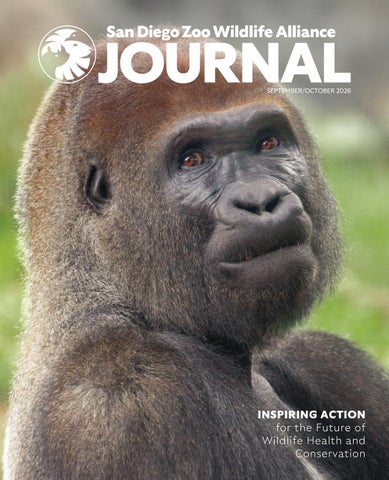
On the Cover: Western lowland gorilla Gorilla gorilla gorilla Photo by: Ken Bohn, SDZWA photographer
MANAGING EDITOR Peggy Scott STAFF WRITERS Mike Hausberg Aubrey Lloyd Sara Maher Ellie McMillan Elyan Shor, Ph.D. CONTRIBUTING EDITOR Justin Weber DESIGNER Christine Yetman PHOTOGRAPHERS Ken Bohn Tammy Spratt DESIGN AND PRODUCTION Lisa Bissi Jennifer MacEwen PREPRESS AND PRINTING Quad Graphics
Let's Stay Connected Follow @sandiegozoo & @sdzsafaripark. Share your #SanDiegoZoo & #SDZSafariPark memories on social media.
The Zoological Society of San Diego was founded in October 1916 by Harry M. Wegeforth, M.D., as a private, nonprofit corporation, which does business as San Diego Zoo Wildlife Alliance. The printed San Diego Zoo Wildlife Alliance Journal (ISSN 2767-7680) (Vol. 6, No. 5) is published bimonthly, in January, March, May, July, September, and November. Publisher is San Diego Zoo Wildlife Alliance, located at 2920 Zoo Drive, San Diego, CA 92101-1646. Periodicals postage paid at San Diego, California, USA, and at additional mailing offices. POSTMASTER: Send address changes to San Diego Zoo Wildlife Alliance, PO Box 120271, San Diego, CA 92112-0271. Copyright © 2026 San Diego Zoo Wildlife Alliance. All rights reserved. All column and program titles are trademarks of San Diego Zoo Wildlife Alliance.
As part of San Diego Zoo Wildlife Alliance’s commitment to conservation, This product is made of material from wellmanaged FSC®-certified forests, recycled materials, and other controlled sources, chlorine free, and is Forest Stewardship Council® (FSC®) (COC) certified. FSC® is not responsible for any calculations on saving resources by choosing this paper.
If your mailing address has changed: Please contact the Membership Department by mail at PO Box 120271, San Diego, CA 92112, or by phone at (619) 231-0251 or 1-877-3MEMBER. For information about becoming a member of San Diego Zoo Wildlife Alliance, please visit our website at ZooMember.org for a complete list of membership levels, offers, and benefits. Paid subscriptions to San Diego Zoo Wildlife Alliance Journal are available. Contact the Membership Department for subscription information.
LET TER FROM THE PRESIDENT & CHIEF EXECUTIVE OFFICER
An Inspired Look Back, and Forward at Wildlife Conservation
Officers Rolf Benirschke, Chair Steven S. Simpson, Vice Chair Adam Day, Treasurer Gary E. Knell, Secretary Trustees Tom Chapman E. Jane Finley Clifford W. Hague Bryan B. Min Kenji Price Corinne Verdery ‘Aulani Wilhelm
patience, and a refusal to accept that some obstacles can’t be overcome. That same determination has carried us for 110 years. Through depressions, wars, and uncertainty, we’ve found ways to create real change for wildlife and people. That ambition and vision still drive our work today, and they shape everything we’re building for the next 110 years. That’s what inspires me most: the people, the partners, and the lifechanging impacts behind all of our work at San Diego Zoo Wildlife Alliance. As you read these stories, I hope you find something that inspires you, too.
Warmly,
Trustees Emeriti Javade Chaudhri Berit N. Durler Thompson Fetter Richard B. Gulley Robert B. Horsman Steven G. Tappan John M. Thornton
Executive Team Shawn Dixon President and Chief Executive Officer
Annie Fitzgerald Chief Operating Officer
David Franco Chief Financial Officer
Erika Kohler Senior Vice President and Executive Director, San Diego Zoo
Pat McTigue Senior Vice President and Executive Director, San Diego Zoo Safari Park
Nadine Lamberski, DVM, DACZM, DECZM (ZHM) Chief Conservation and Wildlife Health Officer
Wendy Bulger General Counsel
David Gillig Shawn Dixon President and Chief Executive Officer
Chief Philanthropy Officer
Allyson Carr Chief Human Resources Officer
David Miller 2 / SAN DIEGO ZOO WILDLIFE ALLIANCE JOURNAL / SEPTEMBER/OCTOBER 2026
Chief Marketing Officer
PHOTOS BY: TAMMY SPRATT/SDZWA, (OPPOSITE PAGE) KEN BOHN/SDZWA
Inspiration runs through everything we do. It has shaped the 110 years of history we’ve built as an Alliance, it drives the creativity behind our wildlife care, and it sparks the moments our guests share at the Zoo and Safari Park. Every day, we’re inspired to take on challenges that propel our mission forward. In the pages ahead, you’ll see how our innovations over time, and our landmark conservation wins, among other efforts, continue to make a difference for wildlife and people alike. Look closely at a gorilla troop and you’ll notice strong bonds between parent and offspring, a reminder that deep relationships move communities forward. You’ll also meet two species that quietly protect entire ecosystems: Egyptian vultures and California condors. The condor’s recovery points to a promising path for other endangered species right here in our own backyard. And in Hawai‘i, the return of the ‘alalā to its ancestral forest renewed a meaningful connection with the local community. None of these stories happened on their own. They required hard work,
2026 Board of Trustees
BY THE NUMBERS
It Starts Right Here San Diego Zoo Wildlife Alliance is an international conservation nonprofit, committed to saving, protecting, and caring for wildlife and ecosystems all around the world. Our global Alliance began 110 years ago as a dream in the heart of Dr. Harry Wegeforth as he gazed across Balboa Park in 1916. That dream started it all, and San Diegans sustained the momentum. We wouldn’t be who we are today without this community.
1
The legacy of generosity to our organization began with one local woman, Ellen Browning Scripps, when she made the very first donation in 1921.
1,600,000,000 Since we started recording, $1.6 billion has been raised from generous donors to share our mission in San Diego and around the world.
90
We regularly serve more than 90 school districts across Southern California to inspire the next generation of wildlife allies.
1,000 At the Safari Park, conservation experts focus on supporting local wildlife across our Biodiversity Reserve, a 1,000acre stretch of native habitat.
11
We’ve had the honor of caring for 11 giant pandas at the Zoo since 1996, establishing us as a leading conservation partner while welcoming millions of guests to our city. SAN DIEGO ZOO WILDLIFE ALLIANCE / SDZWA.ORG / 3
FINDINGS
San Diego Zoo Wildlife Alliance protects and restores nature in eight Conservation Hubs on six continents. Below are recent discoveries and progress reports from around the world. AFRICAN FOREST
OCEANS
EBO FOREST LARGE MAMMAL SURVEY
CRYOPRESERVING JELLYFISH SPERM
Following several months of intensive fieldwork, our team in Cameroon successfully completed our annual Large Mammal Survey (LMS). Conducted on foot by a team of six, the survey involved nine field expeditions between fall 2025 and spring 2026, covering over 1,400 square kilometers (540 square miles) across the Ebo forest. These expeditions focused on locating signs of both mammals and threats to wildlife. In addition to field data collection, the LMS team also organized informal meetings with local communities before and after entering the forest. These exchanges helped strengthen collaboration and raise awareness about the importance of conservation. This survey has been conducted on a regular basis since 2012 and constitutes one of the most thorough and long-term datasets within forested Central Africa. The next LMS takes place from late 2026 to early 2027 and will bring our total to 15 years of invaluable data.
Our team received purple-striped jellyfish sperm from our partners at Monterey Bay Aquarium. After experimenting with a few different processes, we achieved the first-ever successful cryopreservation (deep freezing) of jellyfish sperm. We have published the results of the study to help distribute the news and methods to marine scientists around the world. Preserving sperm means we can preserve vital genetic diversity, and perhaps one day, restore jellyfish populations by generating new individuals from banked reproductive materials. This achievement is also a foundation for the development of protocols for more jellyfish species.
BIOBANKING PLANNING WORKSHOP San Diego Zoo Wildlife Alliance and our IUCN Center for Species Survival: Biodiversity Banking convened the Vietnam National Biobanking Strategic Planning Workshop earlier this year. Hosted by the Institute for Ecology and Conservation of Nature at Vinh University (Vietnam), the workshop brought together 80 stakeholders from government, academic, conservation, and zoological institutions to provide feedback on Vietnam’s first National Biobanking Strategic Plan. Our team provided technical and operational expertise to support our local partners’ vision for preserving biological samples in Vietnam. We also led field sampling and laboratory training sessions during the event. The workshop culminated in the formation of the Vietnam National Biobanking Network, which includes 19 organizations and establishes a framework for growth and collaboration.
4 / SAN DIEGO ZOO WILDLIFE ALLIANCE JOURNAL / SEPTEMBER/OCTOBER 2026
PHOTOS: SDZWA
ASIA
Most nonstop destinations from San Diego
Official Airline Sponsor of San Diego Zoo Wildlife Alliance
HOT TOPICS
ECHOS of KŪPUNA
I
n late 2024, five young ‘alalā made their way home—returning not just to the forest, but to a legacy deeply rooted in Hawai‘i. The birds were reintroduced into Kīpahulu, a remote and storied landscape on Maui where native plants still thrive and the land holds its breath in quiet reverence. Accessible only by helicopter or a long journey on foot, this ecosystem provides something rare: space for reconnection, healing, and renewal. While ‘alalā were most recently known to inhabit Hawai‘i Island, fossil records remind us that they could once be found throughout the pae ‘āina (archipelago). Their return to Maui is not an introduction, but a remembering. ‘Alalā are known for their complex relationships: territorial, observant, and resourceful. As youth, they flock together, learning and growing before forming pairs and claiming their home spaces in the forest. To honor this natural rhythm, we reintroduced a cohort of juveniles who had already formed strong bonds in managed care, with the hope they would continue to learn from and uplift one another after release. That hope was realized quickly. At just two years old, one pair from the five birds successfully laid eggs last season; a powerful
sign of resilience and comfort in returning home. As another summer breeding season unfolds, we listen closely for news from our partners in the field, carrying quiet excitement for what may come next. This moment is the result of deep collaboration. Many hands and hearts came together to support this momentous event, including the Maui Bird Conservation Center and our sister facility at Keauhou, alongside the State of Hawai‘i Division of Forestry and Wildlife, U.S. Fish and Wildlife Service, Maui Forest Bird Recovery Project, Haleakalā National Park, and many others from our community. From hatching to release, each ‘alalā was raised with intention, care, and kuleana (responsibility). Reintroduction preparation went beyond physical readiness. We closely observed their social dynamics such as co-perching, coforaging, and allofeeding, witnessing playful moments that reflected trust and connection. They learned the pursuit of insects, the shapes of native fruits, and the sounds of the forest. Predator awareness testing, flight conditioning, and the experience of wearing transmitters all helped prepare them for life beyond our care. In Hawai‘i, culture is identity. Our native
6 / SAN DIEGO ZOO WILDLIFE ALLIANCE JOURNAL / SEPTEMBER/OCTOBER 2026
birds, plants, and ocean life are our kūpuna; ancestors who guide and sustain us. From mauka (inland) to makai (ocean), all things are connected. The forest cannot thrive without its birds, and we cannot thrive without the forest. Now, these five ‘alalā have spent more time at home than with us. Soon, their lineage will be shaped only by the forest itself. That truth inspires us to continue this work, so that one day, the voices of our kūpuna may once again echo freely through the forest.
Nona ka ‘ūmi‘i lauwili i ka pāka‘awili —his is the tie that twisted into one that holds fast. —MARY KAWENA PUKUI
PHOTOS: (TOP) KEANINI AARONA, (RIGHT) KEN BOHN/SDZWA
Keanini Aarona, avian recovery specialist, and Bryce Masuda, senior conservation program manager, with the Maui and Keauhou Bird Conservation Centers, share the story of the ancestral wisdom of ‘alalā as they return back to their forest home, creating the conditions for them to remember what their bones have always known.
Our native birds, plants, and ocean life are our kūpuna; ancestors who guide and sustain us.
5
Fascinating ‘Alalā Facts
1 A LOT TO SAY ‘Alalā express themselves via approximately 24 distinct, complex calls.
2 FOR YOUR PROTECTION In Hawaiian culture, the ‘alalā is considered an ‘aumākua (a family guardian).
3 BABY BLUES When ‘alalā chicks hatch, their eyes are a bright blue. By adulthood, they darken to brown.
4 HOW HANDY ‘Alalā have been observed using twigs as tools to reach food.
5 COUNT ON IT Thanks to intensive conservation breeding programs, the total ‘alalā global population consists of just over 110 birds.
7
TROOP DYNAMICS Gorillas and Their Social Structure BY GREG VICINO | PHOTOGRAPHY BY KEN BOHN
A
s humans we are invariably drawn to gorillas. The attraction seems to go beyond a simple fascination with the world’s largest primate, or even the pull of a shared ancestry. We are fascinated because, as with most nonhuman primates, we see so much of ourselves in them. Perhaps it’s the gaze at first. The look in their eyes is interpreted as contemplation, problem solving, or simple curiosity; all skills we pride ourselves on having and feel comfortable classifying when we notice them in other beings. Social Studies It could be the way we watch these great apes deal with each other. We recognize behaviors like play, anger, parental adoration, and even sometimes familial strife. It’s easy to surmise that gorillas are just like us, following an outdated (from a human perspective) but recognizable patrilineal social structure where everything fits into place. A massive silverback at the helm, with a handful of adult females all working together to tend to the success of the next generation of offspring. The reality, however, is so much deeper and complex, and possibly the true reason we are mesmerized. From a socioecological perspective (the study of how an ecosystem influences a social structure), gorillas seem to muddy the more traditional classifications of “male bonded,”
8 / SAN DIEGO ZOO WILDLIFE ALLIANCE JOURNAL / SEPTEMBER/OCTOBER 2026
LIFE LESSONS As members of a bachelor troop, young gorillas such as Njemba (left) and Mizani learn about social behavior and relationship development.
SAN DIEGO ZOO WILDLIFE ALLIANCE / SDZWA.ORG / 9
or “female bonded.” These are simple descriptions used to denote which gender disperses (emigrates) from its natal group as an inbreeding avoidance strategy, and as a means to maximize genetic diversity. “Female bonded” means females and their offspring stay together (males then disperse at sexual maturity), forming the core of the community and developing deep bonds that may last a lifetime and are passed down to the next generation (think elephants). Whereas in rarer “male-bonded” species, males serve as the core of the community, forging strong alliances and managing the culture of the group (think chimpanzees). Both systems have a place for members that have reached an age in which they no longer contribute to reproduction but continue to help rear young and teach the skills needed to survive.
Multiple Approaches to Troop Life Gorillas don’t fall into either structure, or sometimes both, or sometimes a combination of any number of social systems. Regardless, for gorillas, the goals still remain the same: Protect your offspring, teach them the ways of the ecosystem, avoid predators, and live a rich social life. Gorilla social structure is more fluid and it, in some cases, is dependent on the competency of the silverback, as determined by the females in the troop. Female gorillas leave their natal troop when they reach sexual maturity and will seek out a new troop (with unrelated females) to join, with a silverback to mate with, and a safe place to raise offspring. Although they can and do form bonds with unrelated females in the troop, the most important relationship they maintain is with the silverback, and their own offspring. All of the females contribute to the safety and rearing of the young to varying degrees, and if the
resources (such as food and shelter) are plentiful, multigenerational troops can thrive. Nonreproductive females will often stay with a troop to benefit from the protection it provides, but also to help with the daily responsibilities of child rearing. If the females of any given troop decide the silverback is no longer capable of providing the right protection or guidance, they simply leave and join another troop. Some female gorillas can transfer multiple times over the course of their lives. This strategy maximizes their chances of living a safe and long life, while also offering the best conditions for their babies to grow. For male gorillas, things are a bit different. They also leave their natal troops at sexual maturity, but they don’t always leave alone, and they almost certainly don’t immediately join another troop. Sometimes brothers (or more likely half-brothers) leave the troop together, forming seminomadic bachelor troops. Sometimes males leave alone, and live solitary lives for a bit before joining a bachelor troop, or if they are lucky, eventually attracting some females and starting their own troop once they have gained enough experience. Regardless of how they end up living out the rest of their lives, male gorillas face significant pressure during this phase. Lots of males never become successful as troop leaders and are destined to stay on the periphery of troop life. When a male is ready to take on the challenges of leading a troop, they may have to fight to replace an aging male or rely on the often serendipitous “being in the right place at the right time” strategy. The one thing that holds true for both male and female gorillas is the value of social skills and the ability to form and maintain relationships. Perhaps it is this set of familiar skills that we
10 / SAN DIEGO ZOO WILDLIFE ALLIANCE JOURNAL / SEPTEMBER/OCTOBER 2026
DID YOU KNOW?
6 Adult male gorillas can reach 6 feet in height.
4
Newborn gorillas weigh approximately 4 pounds.
2
Male gorillas are about twice the size of female gorillas.
SAN DIEGO ZOO WILDLIFE ALLIANCE / SDZWA.ORG / 11
see when we dig into the lives of gorillas that draws us in. It’s possible that this depth of interpersonal relationships we consider to be “human” is what we marvel at when we watch gorillas navigate the ups and downs of troop life. Certainly, we can see the social maneuvering, the selective attention, and the unmistakable affection between parent and offspring as something unmistakable and familiar.
Family Ties at the Zoo and Safari Park Members of San Diego Zoo Wildlife Alliance have, over the decades (11 to be exact!), seen all of these twists and turns pan out in the real lives of the gorilla troops for which we have had the honor of caring. Many will remember that Frank’s grandmother, Alvila, was instrumental in helping to raise Mandazzi and Maka, despite being past her reproductive years. The same could be said for her mother Vila at the Safari Park, who contributed stability and care to the growing troop under Winston’s long leadership tenure. Most guests also recognize that the transition of Jessica from the Zoo troop to the Park troop was as much a part of a natural gorilla lifestyle as the mixed groups of brothers living the bachelor life at the Zoo. Even behind the scenes, Wildlife Care teams continue to work tirelessly to monitor social signaling and dynamics of multiple iterations of social groups in our care, to maximize the chances that all gorillas have a rich social existence. For most of the 20th century, people have studied the social structure of great apes (gorillas, chimpanzees, bonobos, orangutans) to glean insight into how ancient humans navigated a world without agriculture or technology. Scientists have often noted that social skills are often more critical than aggression or manipulation of the environment when it comes to long-term success in social nonhuman primates. Maybe that is what we see when we watch gorillas. Less of a mirror and more of an aspiration to a world where cooperation and respectful interactions lead to a better existence for all. Greg Vicino is vice president of wildlife care at the San Diego Zoo. GETTING TO KNOW THEM Page 10: Frank. Page 11: Imani. (This page, clockwise from top) Njemba and Frank romp. A contemplative Mizani. Mokonzi and Njemba pause for a moment. Ekuba keeps a watchful eye.
12 / SAN DIEGO ZOO WILDLIFE ALLIANCE JOURNAL / SEPTEMBER/OCTOBER 2026
at the San Diego Zoo EVERY FRIDAY, SATURDAY, & SUNDAY IN OCTOBER! The glittering, glimmering, and glowing Halloween extravaganza is back! When the sun goes down, enjoy safe, family fun at this light-up-the-night annual spectacular full of amazing entertainment, interactive festivities, and surprises! On Friday, October 2, San Diego Zoo Wildlife Alliance members are invited to enjoy a HalGLOWeen Member Preview.
VISUALIZE IT
Pacific pocket mice live only in coastal areas in Southern California. San Diego Zoo Wildlife Alliance works to protect this threatened habitat in our Southwest Conservation Hub.
Laguna Coast Wilderness Park Dana Point Headlands San Mateo Creek
Pocket Pals The endangered Pacific pocket mouse is North America’s smallest mouse species. We can compare their length to a thumb, or their weight to a few coins . . . but it’s best to experience them for yourself. Take a peek into the life of these pocket-size pals—and yes, this is their actual size! BY SARA MAHER | ILLUSTRATION BY AMY BLANDFORD
14 / SAN DIEGO ZOO WILDLIFE ALLIANCE JOURNAL / SEPTEMBER/OCTOBER 2026
Camp Pendleton
From spring to fall, females give birth to litters of 2–8 live young. Babies nurse from their mothers for about 30 days.
Newborn mice are called “pups.” They are born blind and hairless and weigh about as much as 1 penny.
They usually live up to 2 years in native habitats or 6 years in human care. The record is just a few days shy of 10 years and is held by a Pacific pocket mouse named Pat, who was cared for at the San Diego Zoo Safari Park. Pat was even recognized by Guinness World Records as the oldest mouse ever!
Females can reproduce when they are only a few months old, so it is possible for a Pacific pocket mouse to be born and have babies of its own within the same year. They keep their fur clean by “sand bathing.”
Adults hibernate in burrows from fall to spring.
Adults are only 4–5 inches long (including their tail) and weigh no more than 3 pennies.
They collect seeds in their external cheek pouches and store them in underground burrows to eat throughout the year.
SIP, SNACK,
SAVE
SPECIES Stay fueled up by enjoying a delicious treat at one of our specialty snack stands on your next visit. The San Diego Zoo and San Diego Zoo Safari Park thank our partners for their continued support!
© 2025 The Coca-Cola Company | “Coca-Cola” and “DASANI” are registered trademarks of The Coca-Cola Company
The “Frito-Lay logo” is a registered trademark of Frito-Lay North America, Inc © 2025
MEET OUR TEAM people came to see these precious black-and-white bears.
What is the most rewarding aspect of writing the Hope & Inspiration books? Receiving positive feedback about my books from children, parents, and teachers is the most rewarding aspect of my work. I am also thrilled when parents send me photos of their child with the books. I have found that kids are not only inspired to love wildlife through the Hope & Inspiration books but they also learn life lessons, such as being brave, never giving up, and the value of special friendships.
What do you hope your legacy will be?
GEORGEANNE IRVINE Director of Historical Affairs and children’s book author, San Diego Zoo Wildlife Alliance
In her 48-plus years with the Alliance, Georgeanne Irvine has been an inspiring storyteller for wildlife in many capacities, including positions in public relations, marketing, philanthropy, media relations, book publishing and editing, and more, as she shares our stories with audiences around the world. She also writes the awardwinning Hope & Inspiration children’s book series.
I have always loved writing and storytelling. I graduated from San Diego State University with a degree in Journalism. My emphasis was public relations, which includes writing press releases, working with media and film crews, and more. I was a public relations intern during my last semester of college at the San Diego Convention and Visitors Bureau and a job as a public relations assistant opened up at the San Diego Zoo. Never in a million years did I think I would spend my entire career here. After a few weeks on the job, though, I realized that working for the Alliance was not only fun, exciting, and fascinating, but also meaningful.
What’s the most interesting or most meaningful wildlife moment you’ve had? The most exciting 200 days of my Alliance career were when Basi and Yuan Yuan, two giant pandas from China’s Fuzhou Panda World, visited the San Diego Zoo in 1987-88. This was the first time giant pandas had ever lived at the San Diego Zoo and I worked with media on giant panda stories nearly every day. Millions of
I want my legacy to be about enlightening, energizing, and empowering children as well as adults—through my books and storytelling efforts—to protect our Earth, its wildlife and its extraordinary habitats, which are disappearing at an alarming rate. Hopefully, my books and stories will play a role in galvanizing people to take action to preserve and protect nature and make our world a better, healthier place for all of its inhabitants.
What’s your favorite animal and why? I have different favorite animals every day, depending on what projects I’m working on. In addition, I often write about specific animals so my favorite animal might not be a species but an individual like Karen the orangutan, Tornero the two-toed sloth, Omeo the koala, or Mosi Musa the vervet monkey.
Georgeanne is dedicated to the Alliance’s vision of a world where all live thrives. Find out more about how she works toward that goal every day on our Story Hub at www.sdzwa.org/storyhub.
SAN DIEGO ZOO WILDLIFE ALLIANCE / SDZWA.ORG / 17
PHOTO: (TOP) TAMMY SPRATT/SDZWA
When did you first realize that you wanted to work in wildlife conservation?
HAPPY BIRTHDAY TO ZOO
110 Years of Wildlife Conservation BY GEORGEANNE IRVINE
18 / SAN DIEGO ZOO WILDLIFE ALLIANCE JOURNAL / SEPTEMBER/OCTOBER 2026
THROUGH THE YEARS The San Diego Zoo has received numerous updates over the decades. Many of these projects involved support from donors such as our earliest benefactor, Ellen Browning Scripps.
S
an Diego Zoo Wildlife Alliance is celebrating its 110th birthday on October 2, 2026, and when looking back at its rich history, it’s truly remarkable what
our Zoo overcame to become a global leader in wildlife conservation. Considering the economic
PHOTOS: (TOP) KEN BOHN/SDZWA, (OPPOSITE PAGE) SDZWA
challenges of the Great Depression and two world wars during the Zoo’s infancy, the founding directors and staff faced major challenges and obstacles. Through perseverance, ingenuity, and sheer determination, they were able to grow the fledgling Zoo into what is now one of the most outstanding and important zoological and conservation organizations in the world.
It Began with Roars When the Panama Canal opened in August 1914, it was considered one of the world’s greatest engineering feats and had a major impact on shipping between the Atlantic and Pacific oceans. At the time, San Diego was a small city with a population of 40,000 and was the first port of call in the United States. To draw attention to the community and help bolster the economy, San Diego hosted the 1915-1916 Panama-California Exposition in Balboa Park. The Exposition featured wildlife such as bears, wolves, bison, lions, coyotes, monkeys, parrots, and other species. On September 26, 1916, local physician Dr. Harry Wegeforth was returning to his downtown office after performing surgery at a nearby hospital. As he drove down Sixth Avenue, he heard the roar of several lions that lived in the cages on Park Boulevard. He famously said to his brother, Paul,
Wouldn’t it be splendid if San Diego had a zoo! You know…I think I’ll start one. A few days later on October 2, 1916, Dr. Harry, Paul, and several physician and scientist friends met in Dr. Harry’s office as the “Board of Directors of the San Diego Zoological Society” SAN DIEGO ZOO WILDLIFE ALLIANCE / SDZWA.ORG / 19
WONDROUS WILDLIFE With more than a century’s worth of expertise, collaboration, community dedication, and tenacity, San Diego Zoo Wildlife Alliance is a leader in the development of state-of-the-art habitats for a vast array of wildlife species.
to a source of pride for the entire community. Dr. Harry fulfilled many roles. He was manager, promoter, planner, financial advisor, and, much of the time in the early days, he was the sole support. He raised all the private funds with which the Zoo was built. He visualized and planned all its unique features. He traveled at his own expense all over the world, bringing back ideas not only from zoos, but from parks and native habitats; as well as from conversations with experts in their native countries. He made connections which enabled the Zoological Society to receive wildlife for the Zoo. And it was through his interest in the relationship between wildlife diseases and his own experience in human medicine that our zoological hospital was planned and built.
20 / SAN DIEGO ZOO WILDLIFE ALLIANCE JOURNAL / SEPTEMBER/OCTOBER 2026
Leaders with Vision In addition to Dr. Harry, there were other dedicated leaders over the years who have played major roles in moving the San Diego Zoo forward, upward, and into the future. Dr. Harry hired Belle Benchley as a temporary bookkeeper in 1925 but by 1926, he asked her to run the Zoo. Belle became the first female zoo director in the world and worked closely with Dr. Harry to grow and transform the Zoo. She skillfully guided the Zoological Society through the hardships of the Great Depression and the turmoil of World War II and the Korean War. Under Belle’s leadership, the San Diego Zoo not only survived but thrived. She was a trailblazer in wildlife conservation, care, and behavior; community outreach, science, and education. Gorillas, giraffes, and many other species were
PHOTOS: KEN BOHN/SDZWA
and the San Diego Zoo was born. The Zoo’s first wildlife would be the animals from the Exposition that lived throughout Balboa Park. In 1921, the Balboa Park commissioners gave 140 acres of land that they deemed unusable for anything else to the Zoological Society. The commissioners saw brush-andcactus covered hills, canyons, and mesas, but Dr. Harry envisioned a zoological garden. Philanthropist Ellen Browning Scripps donated $9,000 to build fencing around the Zoo while the wildlife habitats were being built. After the fence was completed in 1923, admission was charged: 10 cents for adults and children were free. By the mid-1920s, Dr. Harry’s dream of creating a world-class zoo had gone from a source of amusement for some San Diegans
introduced at the Zoo under Belle’s watch. After Dr. Harry’s death in 1941, Belle continued to run the Zoo until she retired in 1953. Then, she played a role in convincing the board to hire Dr. Charles Schroeder, a former San Diego Zoo veterinarian and confidante of Belle’s, as executive director. She told Dr. Schroeder about her idea to create an open-range zoo in San Diego’s back country where endangered species could breed, and Dr. Schroeder took it from there.
Championing Growth Dr. Schroeder worked tirelessly for eight years to convince the Zoo’s board of trustees to pass a resolution, enabling him to build the San Diego Zoo Safari Park (then known as the San Diego Wild Animal Park). He created the concept for the Park, found the land in the San Pasqual Valley, and did a feasibility study with the Stanford Research Institute. Charles “Chuck” Bieler, who became the executive director in 1973 and later played a major role in the Alliance’s fundraising efforts, steered the San Diego Zoo and Safari Park through unprecedented challenges during tough economic times. He championed
science and research, which resulted in the founding of the Center for Reproduction of Endangered Species (CRES). He also gave his staff full rein to catapult the Zoo into the forefront of California condor conservation efforts. Chuck built connections with the local community and cemented relationships with philanthropists, who donated millions of dollars to the Zoological Society. He also cultivated international partnerships that ultimately brought koalas, giant pandas, and other precious wildlife to San Diego. While Chuck focused on philanthropy, Douglas G. Myers succeeded him as Society director in 1985. Doug deepened the organization’s worldwide conservation commitment. Through teamwork and strategic planning, he advocated working toward an audacious goal: ending extinction. Doug and his team also transformed the Zoo and Safari Park by creating innovative Zoo habitats like the Harry and Grace Steele Elephant Odyssey, Conrad Prebys Africa Rocks, Polar Bear Plunge, and Australian Outback; and Walkabout Australia, Heart of Africa, Lion Camp, Tull Family Tiger Trail, and Condor Ridge at the Safari Park. The Arnold and Mabel Beckman
Center for Conservation Research, which has become an international conservation hub, was built during Doug’s tenure and the Paul Harter Veterinary Medical Center, the world’s most modern veterinary hospital, opened at the Safari Park. Giant pandas also debuted at the Zoo for the first time in 1987–1988 and later in 1996, which resulted in the birth of Hua Mei, North America’s first surviving giant panda cub. And now, as San Diego Zoo Wildlife Alliance celebrates its 110th birthday, President and CEO Shawn Dixon is leading the organization into the next chapter of our history and shaping our future. The opening of Denny Sanford Elephant Valley at the Safari Park is just the beginning of Shawn’s plans to create new habitats for wildlife at both the Zoo and Park; as well as expand our international conservation efforts in our Conservation Hubs and beyond. Under Shawn’s leadership and his emphasis on teamwork across all areas of the organization, the next 110 years are on a path to fulfill San Diego Zoo Wildlife Alliance’s aspirational vision: a world where all life thrives. Georgeanne Irvine is San Diego Zoo Wildlife Alliance’s director of historical affairs.
KEEP CALM AND
CARRION The Essential Roles of Vultures
A
BY ANDREW STEHLY | PHOTOGRAPHY BY KEN BOHN
t first glance, vultures are easy to misunderstand. Popular culture frequently associates them with death or greed, overshadowing their ecological contributions. They are among the most essential and underappreciated species on Earth. Vultures occupy a unique ecological niche as scavengers, meaning they feed almost entirely on dead animals. This role is far more important than it may initially appear. By rapidly consuming carcasses, vultures prevent the spread of harmful bacteria and diseases that could otherwise threaten wildlife, livestock, and even human communities. At the San Diego Zoo Safari Park, these amazing birds offer visitors a chance to rethink their misconceptions and the wildlife care specialists at the Safari Park have a passion for these often maligned birds. We are always excited to share a deeper story about these birds, one of ecological balance, cultural significance, and resilience.
Flying Wonders The Safari Park has a long history with vultures, caring for 10 of the 23 species. Currently, there are
22 / SAN DIEGO ZOO WILDLIFE ALLIANCE JOURNAL / SEPTEMBER/OCTOBER 2026
eight vulture species guests can see at the Safari Park—some of the rarest and most unique ones in the world—from one of the smallest and most unique species of vulture, the Egyptian vulture, to the largest and critically endangered California condor. Though they differ in size, both species exemplify the invaluable services vultures provide. The Egyptian vulture is one of the most distinctive vultures in the world. Smaller than many of its relatives, it is known for its bright yellow face and striking black-and-white wings. It is also one of the few bird species observed using tools. They can be seen dropping stones to crack open eggs, including ostrich eggs. Unlike many vultures that rely solely on large carcasses, Egyptian vultures are highly adaptable feeders. They consume a wide range of materials, including carrion, insects, and even animal dung. This flexibility allows them to thrive in diverse environments across Africa, Europe, and Asia, though their populations have declined significantly due to human impacts such as poisoning and habitat loss. Their presence in managed care settings like the Safari Park helps raise awareness about these threats while highlighting their ecological importance.
A PLACE IN HISTORY
The Egyptian vulture was a symbol of power and motherhood in ancient Egypt, celebrated via hieroglyphics and royal imagery.
PHOTO BY: Lorem Ipsum
SAN DIEGO ZOO WILDLIFE ALLIANCE / SDZWA.ORG / 23
Even as a smaller species, the Egyptian vulture plays a meaningful role in nutrient cycling and waste removal, demonstrating that every scavenger, regardless of size, contributes to ecosystem health. The Safari Park is currently the only zoo in the Western Hemisphere to welcome chicks. Some offspring produced at the Safari Park have been relocated to Africa to boost their recovery efforts and several of our youngsters can be seen on habitat in African Woods. In contrast, the California condor is the largest flying land bird in North America, with a wingspan that can reach 10 feet. Once widespread across the western United States, the species faced near extinction in the 1980s due to habitat loss, lead poisoning, and human activity. Today, the California condor is one of conservation’s most powerful success stories. Through a collaborative effort with the Los Angeles Zoo, Oregon Zoo, The Peregrine Fund’s World Center for Birds of Prey, and reintroduction programs with U.S. Fish and Wildlife Service, populations are slowly rebounding. Like all vultures, condors are essential scavengers. Their size allows them to consume large carcasses, accelerating decomposition and limiting opportunities for disease to spread. Beyond their ecological role, condors have also become symbols of hope. Proof that dedicated conservation efforts can bring a species back from the brink. The Safari Park is home to upward of 35 California Condors at any given time. This includes nine reproducing pairs and an ever-changing number of offspring preparing for their eventual introduction to their native range. There are also several condors visible to visitors at our Condor Ridge habitat. All having been significant contributors to the recovery of their species.
A Symbol in the Sky While many cultures around the world often cast vultures in a negative light, many Indigenous cultures view them quite differently. Across North and South America, vultures, including condors, hold deep spiritual and symbolic meaning. For many of the Indigenous People in the Southwest, the California condor, often referred to as thunderbirds, are more than a bird; they are sacred beings. Believed to bring thunder with the beating of their powerful wings, they are associated with the sky, the sun, and the connection between the physical and spiritual worlds. In some traditions, condors 24 / SAN DIEGO ZOO WILDLIFE ALLIANCE JOURNAL / SEPTEMBER/OCTOBER 2026
are linked to renewal and transformation. These concepts closely align with their ecological role as recyclers of life. By consuming what has died, they help sustain what continues to live, embodying a cycle that is both natural and spiritual. Similarly, Egyptian vultures have been regarded as purifiers. Ancient Egyptian society revered vultures as symbols of protection and motherhood, incorporating them into hieroglyphics and royal imagery. Although these birds are divided by continents, this echoes Indigenous understandings of vultures as vital, even sacred, participants in the web of life. The San Diego Zoo Safari Park will be celebrating Indigenous Peoples’ Day on October 12. It’s a great opportunity for us to honor not only Indigenous histories and traditions, but also how those traditions emphasize respect for all living beings, including those often misunderstood. Seeing a California condor or an Egyptian vulture interact with its environment can be a powerful experience. It reminds us that beauty in nature is not limited to the traditionally charismatic species of our zoo but it exists in all our wildlife, big and small. The stories of the Egyptian vulture and California condor are a reminder that the health of our ecosystems depends on species that often go unnoticed or undervalued. Protecting vultures means protecting our world. Vultures rarely harm living animals and instead provide a service that benefits entire ecosystems. Their digestive systems are uniquely adapted for this task. Highly acidic stomachs allow them to safely process pathogens such as anthrax and botulism, effectively sterilizing the remains they consume. This makes vultures not only recyclers of nutrients but also critical protectors of public health. In ecosystems where vulture populations decline, carcasses persist longer, often increasing the risk of disease in surrounding communities. As we celebrate Indigenous Peoples’ Day, their story becomes even more meaningful. Indigenous traditions remind us that every species has a role and a purpose, even those we may not immediately understand. Celebrating this perspective, we not only honor cultural heritage but also strengthen our commitment to protecting the natural world. Andrew Stehly is curator of birds at the San Diego Zoo Safari Park.
An Experience as Unique as the Islands Themselves
Embark on an Amazing Adventure and Support Conservation
Travel with us to the Galápagos. The Galápagos Islands, forged of black lava and named for the giant tortoises that are among their most noted inhabitants, are like no other place on Earth. Home to an array of unique wildlife, the islands offer an immersion in nature that includes iguanas, blue-footed boobies, sea turtles, porpoises, sea lions and, of course, Galápagos tortoises.
Limited to 16 travelers per trip aboard a luxury catamaran! Two booking opportunities in 2027
March 31–April 9, 2027 • December 1–10, 2027 Book now to travel with us! For details about these and all our Adventures, visit adventures.sdzwa.org. Photos by Ken Bohn, SDZWA Photographer
EVENTS
&
SEPTEMBER OCTOBER
OCTOBER 1–31 Kids Free Throughout the entire month of October, youths ages 11 and younger receive free admission to the San Diego Zoo. Kids Free month gives youths an opportunity to visit the Zoo, and learn about Earth’s wildlife and the conservation efforts underway to save, protect, and care for species worldwide. (Z) OFFERED DAILY Wildlife Wonders During Wildlife Wonders at the Zoo’s Wegeforth Bowl amphitheater, presented daily at 2 p.m., wildlife care specialists will introduce you to wildlife ambassadors representing San Diego Zoo Wildlife Alliance’s conservation work around the world. Learn about amazing wildlife—from the Amazon to right here in San Diego—and find out what everyone can do to help conserve wildlife and the world we all share. The presentation runs 15 to 20 minutes. (Z)
SAN DIEGO ZOO FRIDAYS, SATURDAYS, AND SUNDAYS IN OCTOBER
HalGLOWeen
OFFERED DAILY Early Morning with Pandas Walking Tour Put on your walking shoes and join us for an exclusive early morning visit at Denny Sanford Panda Ridge! Led by a knowledgeable Zoo educator, this 60-minute walking tour takes a stroll past several different habitats and includes exclusive visits to see red pandas and giant pandas. Book online or call (619) 718-3000. (Z)
The glittering, glimmering, and glowing Halloween extravaganza is back! When the sun goes down, enjoy safe, family fun at this lightup-the-night annual spectacular full of amazing entertainment, interactive festivities, and surprises! On Friday, October 2, San Diego Zoo Wildlife Alliance members are invited to enjoy a HalGLOWeen Member Preview. (Z) SEPTEMBER 18, OCTOBER 16 Plant Day On these special days, guests can take a rare look inside the Zoo’s Orchid Greenhouse from 10 a.m. to 2 p.m., and learn about the Zoo’s botanical collection on the Botanical Bus Tour at 11 a.m. and noon, and check out the Carnivorous Plant Greenhouse from 11 a.m. to 1 p.m. Each month during Plant Days, a variety of plants will be available for purchase—all grown on site by Zoo Horticulture staff. The Plant Sale takes place from 10 a.m. to 2 p.m. at the Orchid Greenhouse entrance. Something new has blossomed: Botanical Bus Tours are now offered every Sunday at noon, and are also included with Zoo admission. (Z) SEPTEMBER 19–20 Wild Weekend: African Forest In anticipation of World Gorilla Day (September 24), Treetops Plaza will be in full swing with a celebration of the wildlife and culture of our African Forest Conservation Hub. Come learn more about our projects and take part in special activities, wildlife care specialist talks, and more. (Z)
26 / SAN DIEGO ZOO WILDLIFE ALLIANCE JOURNAL / SEPTEMBER/OCTOBER 2026
FO R M E M B E RS S E P TE M B E R 1 3 & O C TO B E R 4 Member Exclusive Early Hours Rise and shine with the sights and sounds of the San Diego Zoo. One Sunday each month, qualifying members* can enter the Zoo one hour before the general public. To join us, simply present your membership card at the main entrance beginning at 8 a.m. *Excludes memberships with blockout dates. (Z) E VE RY DAY Wild PerksSM San Diego Zoo Wildlife Alliance members are eligible for Wild PerksSM. Show your membership card each time you make an on-grounds purchase and save up to 20%, depending on your membership level. Some exclusions apply; for details, visit sdzwa.org/ membership/wild-perks. (Z)
OF F ER ED DAI LY
Journey into the Wild Join our wildlife care specialist team as they introduce you to wildlife ambassadors representing San Diego Zoo Wildlife Alliance’s conservation work around the world. This conservation presentation begins at 10:30 a.m. daily in Benbough Amphitheater. (P) OCTOB ER 1 –31
Kids Free October is Kids Free month at the Safari Park, and youths ages 11 and younger receive free admission all month long. Kids Free is designed to give youths an opportunity to visit the Safari Park and learn about Earth’s wildlife and the conservation efforts underway to save, protect, and care for species around the world. (P)
SAFARI PARK
September and October Hours For San Diego Zoo and Safari Park operating hours, visit sdzwa.org
sdzwa.org
SELECT WEEKE ND DAYS I N O C TO B E R
Autumn Festival
The San Diego Zoo Safari Park celebrates the return of the season of color during Autumn Festival, taking place Saturdays and Sundays in October (except October 31). Amazing wildlife, colorful specialty entertainment, and delicious culinary comforts will create heartwarming memories and good ol’-fashioned family fun! On Saturday, October 3, San Diego Zoo Wildlife Alliance members are invited to an Autumn Festival Member Preview. (P) S E PT E M B E R
Member September at the Safari Park! We’re celebrating YOU with Member September at the Safari Park. Our loyal members make it possible to achieve our vision of a world where all life thrives, and we’d like to thank you with exclusive perks all month long. Join us at the Safari Park to enjoy double Wild Perks savings on almost all purchases, free carousel rides for Wildlife Explorers, Member Early Hours every Saturday and Sunday; plus surprise giveaways through the month. (P) SM
FO R M E M B E RS Member Exclusive Early Hours Rise and shine with the sights and sounds of the Safari Park. During Member September, qualifying members* can enjoy Early Hours every Saturday and Sunday. There will also be an Early Hours on Sunday, October 4. To join us, simply present your membership card at the main entrance beginning at 8 a.m. *Excludes memberships with blockout dates. (P) San Diego Resident and Wildlife Protector members with blockout days: upgrade your membership today to enjoy weekend Early Hours at the Safari Park. If you’re not a member yet, become one today to access these perks and help save, protect, and care for wildlife. Visit sdzwa.org/membership. (P)
(619) 231-1515
Programs and dates are subject to change—please check our website for the latest information. (Z) = San Diego Zoo (P) = Safari Park
27
Visit the San Diego Zoo Wildlife Explorers website to find out about these and other animals and plants, plus videos, crafts, stories, games, and more! SDZWildlifeExplorers.org
DRAWING INSPIRATION FROM THE SOUTHWEST The Southwest is filled with awe-inspiring ecosystems and amazing wildlife. Now it’s your turn to get creative with conservation! Draw and color your response to any of the prompts below. There’s no wrong answer, and you can also ask an adult for ideas. Let your imagination flow as you celebrate the wonders of the Southwest!
1 2 3
Draw your favorite animal species from the Southwest. If you could grow a garden of Southwest plants, what would be in it? What do you want the future to look like for wildlife in the Southwest?
28 / SAN DIEGO ZOO WILDLIFE ALLIANCE JOURNAL / SEPTEMBER/OCTOBER 2026
LAST LOOK
When the mountain yellow-legged frog population slipped to fewer than 200 individuals in its native Southern California range, the Alliance and its partners leaped into action, developing a conservation breeding and reintroduction program. Zoo guests can experience this endangered amphibian at Denny Sanford Wildlife Explorers Basecamp in the Cool Critters Reptile House. Photographed by Ken Bohn, SDZWA photographer. SAN DIEGO ZOO WILDLIFE ALLIANCE / SDZWA.ORG / 29
JOURNAL
San Diego Zoo Wildlife Alliance PO Box 120551, San Diego, CA 92112
Looking Ahead Please remember San Diego Zoo Wildlife Alliance in your will or trust. Together, we can create a better future for wildlife. Contact us today to request sample bequest language that will help you make your gift.
ZooLegacy.org (619) 685-3219 donations@sdzwa.org