ZOONOOZ
DIEGO ZOO GLOBAL
CELEBRATE
Looking for something exciting and different for your Thanksgiving celebration this year? How about a feast fit for your “pride” at the San Diego Zoo or the Safari Park? Our chefs are cooking up the perfect meal to share with family and friends on Thanksgiving Day, November 24, 2016, featuring traditional favorites, new treats, and a fun and festive atmosphere!
SAN DIEGO ZOO TREETOPS THANKSGIVING BUFFET
Continuous seating begins at 11:30 a.m.
At the Zoo’s Treetops Banquet Room, a lavish buffet offers Thanksgiving favorites and hand-carved prime rib, along with traditional side dishes, salads, artisan breads, and a dessert bar.
Cost is $46.95 for adults and $18.95 for children ages 3 to 11, plus tax and gratuity. Admission is required for nonmembers.

SAN DIEGO ZOO ALBERT’S THANKSGIVING DINNER
Seating begins at 11 a.m.
Join us at Albert’s Restaurant and enjoy a three-course Thanksgiving feast with all the trimmings. The menu boasts free-range turkey and braised prime-beef short rib, vegetarian options, traditional side dishes, and decadent desserts.
Cost is $40.95 for adults and $14.95 for children ages 3 to 11, plus tax and gratuity. Admission is required for nonmembers.
SAN DIEGO ZOO SAFARI PARK THANKSGIVING DAY BUFFET
Seatings at noon and 3 p.m.
Celebrate Thanksgiving Day at the San Diego Zoo Safari Park’s Hunte Nairobi Pavilion, where you can enjoy a lavish buffet with Thanksgiving favorites and chef’s specialties, as well as a special selection just for the kids.
Guests will be seated at their own reserved table, set for the number in your party. Cost is $46.95 for adults; $18.95 for children ages 3 to 11, plus tax and parking. Nonmembers add Safari Park admission.
CELEBRATE OUR CENTENNIAL
Visit our centennial website sandiegozoo100.org.
Cover Story
8
Rock Stars
Get ready to rock with the animals, plants, and habitats of the San Diego Zoo’s newest exhibit: Conrad Prebys Africa Rocks, opening in summer 2017. BY
KAREN E. WORLEY
2017 Calendar 12
Amazing Animals of Africa
For our 2017 calendar, we’re shining the spotlight on some of the fascinating species that will be moving into their new homes in Conrad Prebys Africa Rocks.
Features
40
100 Years of the San Diego Zoo
Change was the operative word during the San Diego Zoo’s ninth and tenth decades, with a renewed and reinvigorated commitment to the conservation of animals, plants, and habitats, culminating in today’s vision to lead the fight against extinction.
BY KAREN E. WORLEY
More
2 Nooz Notes
36 WorldWild Tours
38 Support
44 That Was Then
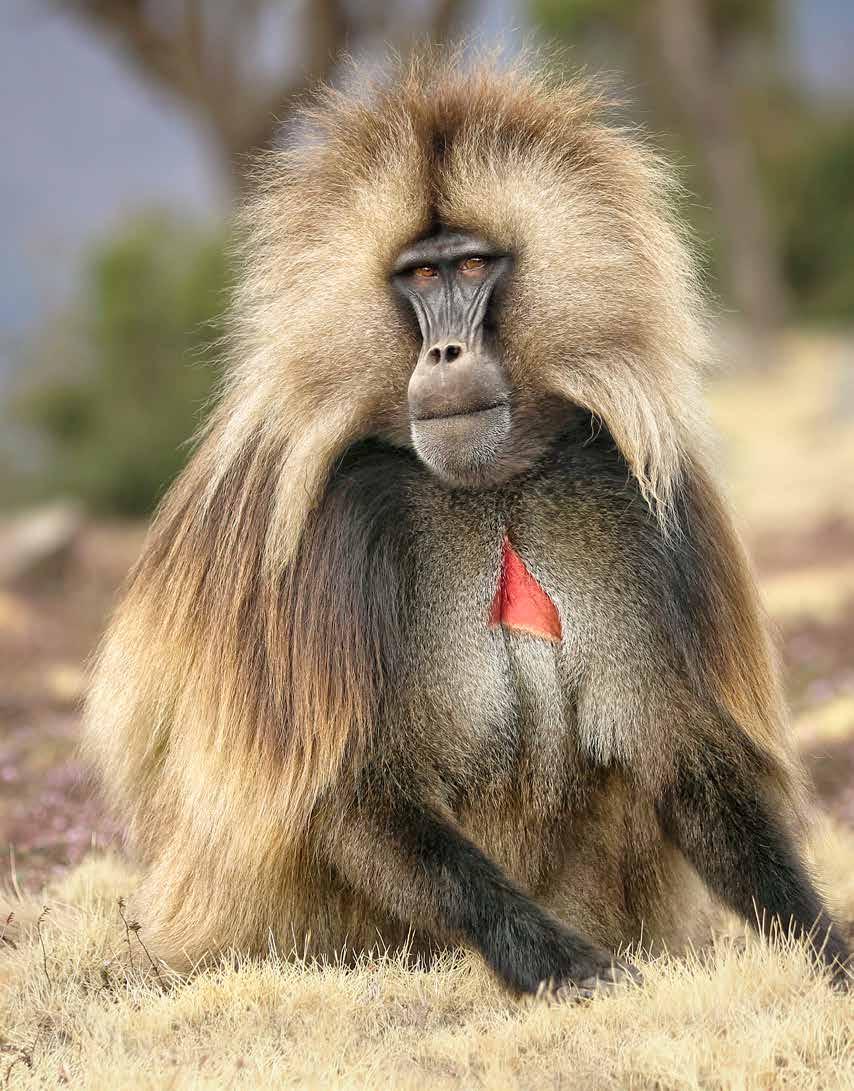
ON THE COVER: Gelada Theropithecus gelada
PHOTO CREDIT: Jez Bennett/NIS/Minden Pictures
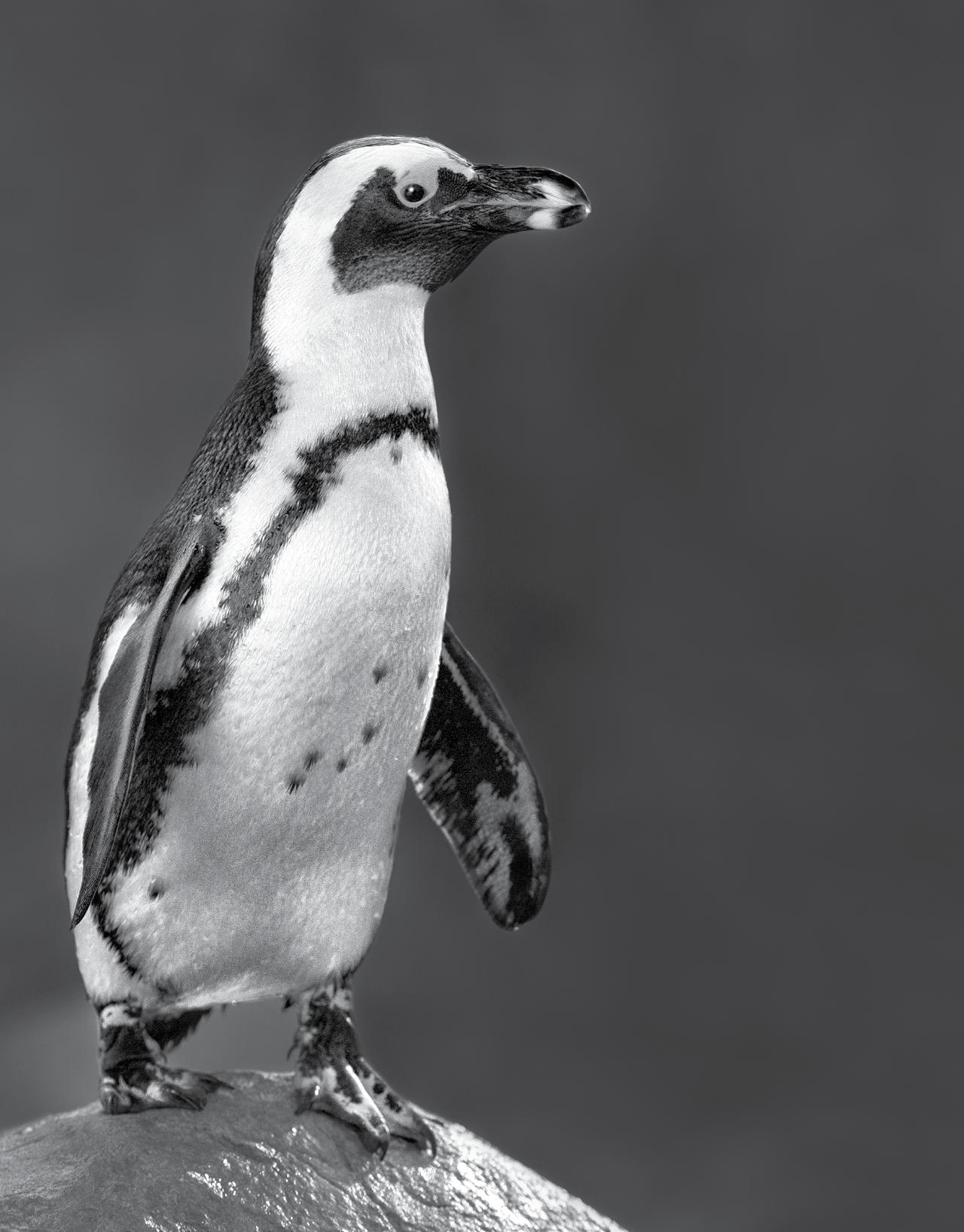
THIS PAGE: African penguin Spheniscus demersus
PHOTO CREDIT: Ken Bohn, SDZG Photographer
CALENDAR PHOTO CREDITS: Suzi Eszterhas/Minden Pictures (January)
Jean-Jacques Alcalay/Biosphoto/Minden Pictures (February)
Ken Bohn/SDZG (March, April, June, July, September, November)
Thomas Marent/Minden Pictures (May, October, December)
Tony Crocetta/Biosphoto/Minden Pictures (August)

WildShoppingHoliday
If anyone on your holiday gift list loves animals, we have the perfect presents! Whether you’re shopping in person at the Zoo and Safari Park gift shops or exploring online at our virtual store shopzoo.com, you’ll find an amazing array of gift ideas and unique items that are sure to please the wildlife lovers in your life. Make your holiday shopping a safari this year, and see what you discover!

Get Out of My Bath book, $15.99
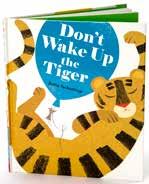
Don’t Wake Up the Tiger book, $15.99
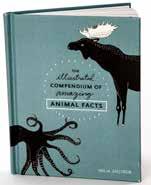
The Illustrated Compendium of Amazing Animal Facts book, $14.99
37-inch bear plush, $129.99
The Quiet Book, $8.99
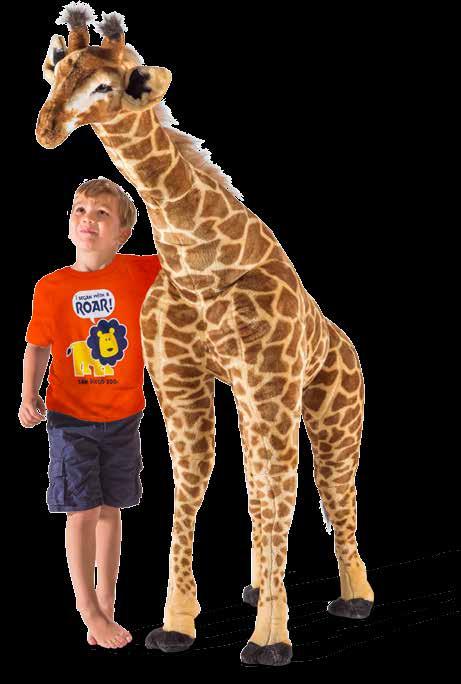
72-inch giraffe plush, $299.99
I Began with a Roar T-shirt, $16.95


CHAIRMAN’S NOTE
ROBERT B. HORSMAN
Centennial Success
San Diego Zoo Global’s centennial year has been a tremendous experience, as we looked back at 100 years of history and celebrated all that our organization has become. It has been quite a journey, from the roar of Rex the lion and Dr. Harry Wegeforth’s seemingly improbable dream, to today’s three facilities at the Zoo, Safari Park, Institute for Conservation Research, and more than 140 conservation projects in 80 countries around the globe. The Centennial Community Celebration held in Balboa Park in May was one of the year’s greatest highlights, and being able to share that event with more than 15,000 San Diegans and guests was a proud moment for us. It was wonderful to watch faces light up at the entrance of each of the animal puppets, and to see everyone enjoying the music, dancers, and multimedia show. It was a tribute worthy of 100 years!
Now that 2016 is coming to a close and we are moving into San Diego Zoo Global’s next 100 years, we are looking forward to the opening of Conrad Prebys Africa Rocks in summer 2017. This new exhibit comprises six African habitats and more than 40 animal species, and it is our biggest building endeavor yet. It replaces the steep terrain and old exhibits in Dog & Cat Canyon—some of which dated back to the 1930s—with a representation of the biodiversity of Africa. Visitors will travel on a gently winding path to encounter animals like the fossa, hamadryas baboon, several different species of lemurs, and beautiful African woodland birds. One of the most eagerly anticipated parts of Africa Rocks is a colony of African penguins, which will be at home in their shoreline habitat. It’s going to be a beautiful new feature of the Zoo, adding another dimension to our efforts to save endangered species and lead the fight against extinction.
In the spirit of Thanksgiving and the upcoming holiday season, I thank you for your continued support of San Diego Zoo Global. My family and I wish you a joyous holiday season.
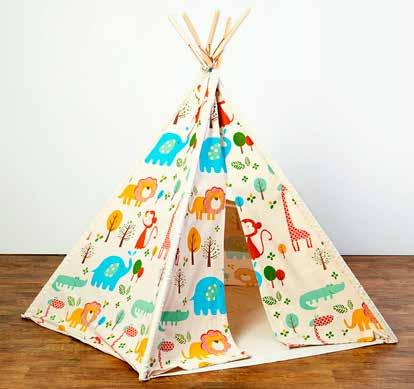
African animal teepee, $199.99
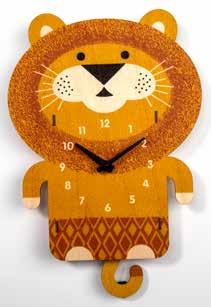
Lion clock, $48.95
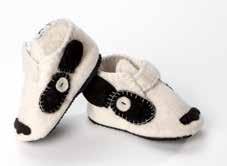
Felt panda hat, $16.95; baby booties, $22.95
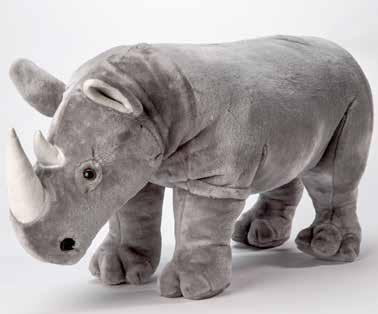
Rhino plush, $99.99
Save the Date
What’s happening at the Zoo and Park this month and next (Z) Zoo events (P) Park events
NOVEMBER 5, DECEMBER 10
Kids’ Wild Night Out
Leave your kids at the Zoo for a wild night out with Dr. Zoolittle and animal friends. Call 619-7183000, or book online at sandiegozoo.org. (Z)
NOVEMBER 5, 12, 26
Breakfast with Tigers
Watch our tigers start their day—then start yours with a buffet breakfast. Call 619-718-3000 or visit sdzsafaripark.org. (P)
NOVEMBER 5, 6, 26; DECEMBER 3, 4, 31
Sunrise Surprise Stroll Walk with Zoo educators to enjoy the Zoo before it opens, and learn “inside secrets.” Call 619-718-3000 or visit sandiegozoo.org. (Z)
NOVEMBER 5, 12, 19; DECEMBER 3, 10, 17 KinderTots
Children ages 18 months to 3 years, with an adult
companion, discover animals—and meet some up close. For reservations, call 619-557-3962 or visit sandiegozoo.org. (Z)
NOVEMBER 5, 19
Photo Workshop: Long-lens Photography
Join our professional photographers at this two-session class, open to guests 16 or older. Call 619-718-3000 or visit sandiegozoo.org. (Z) (P)
NOVEMBER 11, 12, 18, 19; DECEMBER 9, 10, 16, 17 KinderNights
Animal interaction and fun for children ages 3 to 6, with an adult. Call 619-557-3962 or visit sandiegozoo.org. (Z)
NOVEMBER 12
Albert’s Late Harvest Winemaker Dinner featuring Napa Valley’s Whitehall Lane Winery
See page 5 of this issue for reservation information. (Z)
PRESIDENT/CEO’S NOTE
DOUGLAS G. MYERS
Giving Thanks
DECEMBER 9JANUARY 2
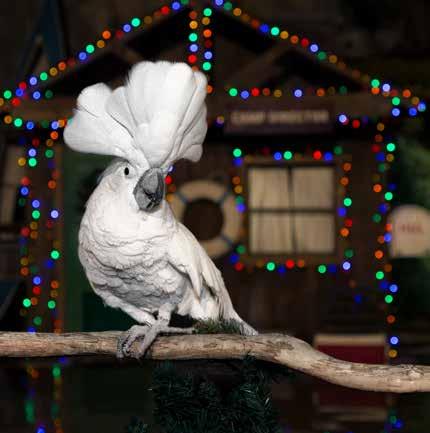
Ring in the holidays with Jungle Bells presented by California Coast Credit Union Visits with Santa, rides on the Twinkle Light Trolley, and live music and entertainment are just some of the delights to close out our centennial year. (Z)
NOVEMBER 18, DECEMBER 16/ DECEMBER 4
Plant Day & Orchid Odyssey/ Orchid Odyssey
Take a self-guided tour or a Botanical Bus Tour, and get a rare look inside the Zoo’s Orchid House. (Z)
NOVEMBER 19
Safari Park Brewmaster Dinner featuring Ballast Point For reservations, call
619-718-3000 or visit sdzsafaripark.org. (P)
NOVEMBER 24
Thanksgiving Dinners
See inside cover of this issue for reservation information. (Z) (P)
NOVEMBER 26
Holly Jolly Jungle Roar & Snore
DECEMBER 10, 17
Breakfast with Santa Visit with Santa at the Safari Park to celebrate the holidays! See page 43 of this issue for reservation information. (P)
DECEMBER 31
Albert’s Mildly Wild New Year’s Eve Dinner
See page 5 of this issue for reservation information. (Z)
A holiday-themed, sleepover adventure for all ages. Call 619-718-3000 for reservations. (P)

Let’s Talk
s our centennial year draws to a close, I want to give my thanks to all of you for helping us make it such a wonderful experience and celebration. What a year it has been: from the multimedia history show in Wegeforth Bowl that started in the spring; to the spectacular Centennial Community Celebration in Balboa Park, which continued into Nighttime Zoo presented by Cymer with the extraodinary animal puppets; to 10 birthday parties that culminated in the October 2 party to celebrate the founding of the San Diego Zoo; and now to the upcoming holiday fun of Jungle Bells presented by California Coast Credit Union. It has been such a pleasure to hear and see all the memories you have shared with us throughout the year, and to participate in this joyful milestone with a community that has always supported their zoo with pride. As we now look forward, and roll up our sleeves to continue our work in leading the fight against extinction, I am grateful that you are with us and share the commitment to save wildlife now and in the future. I wish you a very happy holiday season, and I thank you for your support of San Diego Zoo Global and your dedication in creating a brighter future for species around the world.
Follow @sandiegozoo & @sdzsafaripark.
Share your #SanDiegoZoo & #SDZSafariPark memories on Twitter & Instagram.
Queenie the Asian elephant, along with local author Emma Lindsay Squier, took part in a KFSD radio program on November 1, 1930, bringing attention to our young Zoo.
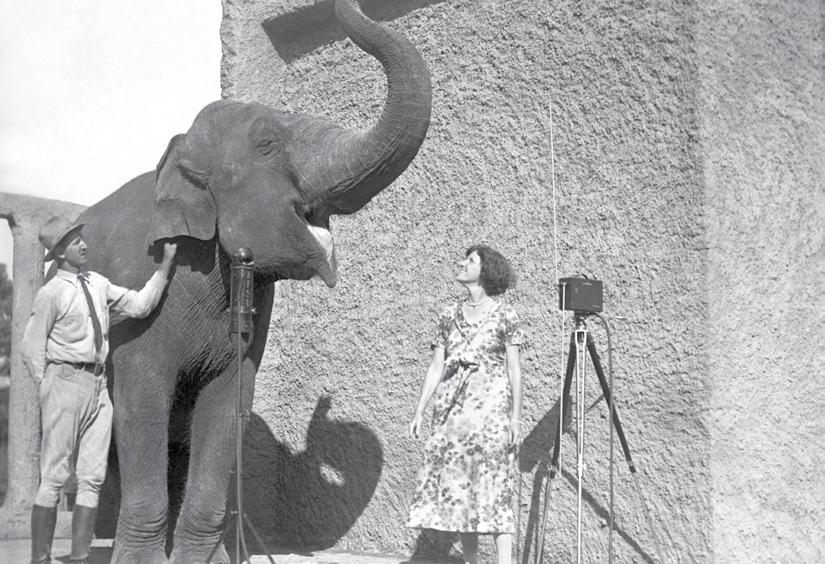
Giving thanks comes easy to us at the San Diego Zoo, where the month of November has brought many special events during our 100-year history. Here are just a few reasons we’ve had to be grateful.
1956
A gift from the Belgian government in Congo, our first okapi, Bayahu, arrived at the Zoo on November 27 and settled in nicely on Mammal Mesa.
ZOONOOZ
PUBLISHED SINCE 1926
®
NOVEMBER 2016 | VOL. LXXXIX–NO. 06
MANAGING EDITOR
KAREN E. WORLEY
ASSOCIATE EDITOR
PEGGY SCOTT
STAFF WRITERS
WENDY PERKINS
KARYL CARMIGNANI
DONNA PARHAM
COPY EDITOR
ESTON ELLIS
DESIGNER
KERRI ABRAMS
SAN DIEGO ZOO GLOBAL
PHOTOGRAPHERS
KEN BOHN
TAMMY SPRATT
DIGITAL IMAGING TECHNICIAN
TAMMY SPRATT
DESIGN AND PRODUCTION
KAMBIZ MEHRAFSHANI
KIM TURNER
AMY BLANDFORD
HEIDI SCHMID-ROMERO
LISA BISSI
JENNIFER MACEWEN
PREPRESS AND PRINTING
QUAD GRAPHICS
1963
November 25 brought the first Gila monster conceived and hatched in captivity, an achievement that earned the Zoo an Edward H. Bean Award.
1971
On November 5, Joan Embery made her first appearance on The Tonight Show Starring Johnny Carson, alongside Carol the elephant.
The Zoological Society of San Diego was founded in October 1916 by Harry M. Wegeforth, M.D., as a private, nonprofit corporation that now does business as San Diego Zoo Global.
The printed ZOONOOZ® magazine (ISSN 0044-5282) is currently published bimonthly, in January, March, May, July, September, and November. Publisher is San Diego Zoo Global, at 2920 Zoo Drive, San Diego, CA 92103, 619-231-1515. Periodicals postage paid at San Diego, California, USA, and at additional mailing offices.
ADDRESS CHANGES: Please send to Membership Department, P.O. Box 120271, San Diego, CA 92112.
Copyright® 2016 San Diego Zoo Global. All rights reserved. “ZOONOOZ” Reg. U.S. Pat. Office. All column and program titles are trademarks of San Diego Zoo Global.
Annual Memberships: Dual $135, new; $120, renewal. Single $111, new; $99, renewal. Each membership includes unlimited entrance to the San Diego Zoo and the San Diego Zoo Safari Park.
Subscription to ZOONOOZ magazine: $25 per year, $65 for 3 years. Foreign, including Canada and Mexico, $30 per year, $81 for 3 years. Contact Membership Department, P.O. Box 120271, San Diego, CA 92112, for subscription information.
As part of San Diego Zoo Global’s commitment to conservation, ZOONOOZ is printed on recycled paper that is at least 10% post-consumer waste, chlorine free, and is Forest Stewardship Council ® (FSC®) certified.
SAN DIEGO ZOO GLOBAL
OFFICERS
Robert B. Horsman, Chairman
Steven G. Tappan, Vice Chairman
Judith A. Wheatley, Secretary
Richard B. Gulley, Treasurer
BOARD OF TRUSTEES
Sandra A. Brue
Javade Chaudhri
Berit N. Durler
Clifford W. Hague
Linda Lowenstine, D.V.M., Ph.D.
Patricia L. Roscoe
Steven S. Simpson
TRUSTEES EMERITI
Frank C. Alexander
Kurt Benirschke, M.D.
Thompson Fetter
Bill L. Fox
Frederick A. Frye, M.D.
George L. Gildred
Yvonne W. Larsen
John M. Thornton
Albert Eugene Trepte
Betty Jo F. Williams
James Lauth, General Counsel
Douglas G. Myers, President/CEO
1992
The first rhino born at the San Diego Zoo arrived on November 15: a male named Werikhe, after rhino conservation champion Michael Werikhe.
Charles L. Bieler, Executive Director Emeritus
THE FOUNDATION OF SAN DIEGO ZOO GLOBAL
OFFICERS
Murray H. Hutchison, Chair
Maryanne C. Pfister, Vice Chair
Susan N. McClellan, Secretary
Richard M. Hills, Treasurer
Mark A. Stuart, President
SAN DIEGO ZOO HOURS
Nov. 1–5: 9 a.m. to 6 p.m.
Nov. 6–Dec. 8: 9 a.m. to 5 p.m.
Dec. 9–23: 9 a.m. to 8 p.m.
Dec. 24: 9 a.m. to 5 p.m.
Dec. 25–31: 9 a.m. to 8 p.m.
SAFARI PARK HOURS
Nov. 1–24: 9 a.m. to 5 p.m.
Nov. 25–26: 9 a.m. to 6 p.m.
Nov. 27–Dec. 31: 9 a.m. to 5 p.m.
WEBSITE sandiegozoo.org
PHONE
619-231-1515
ZOONOOZ® Online web publication zoonooz.sandiegozoo.org
FSC® is not responsible for any calculations on saving resources by choosing this paper.
Amy B. Parrott, Vice President
Robert B. Horsman, Ex officio
Douglas G. Myers, Ex officio
BOARD OF DIRECTORS
Christine L. Andrews
Joye D. Blount
Rick Bregman
Lisa S. Casey
Douglas Dawson
Berit N. Durler, Ex officio
Chris L. Eddy
U. Bertram Ellis, Jr.
Arthur E. Engel
Craig L. Grosvenor
Michael N. Hammes
Judith C. Harris
Michael E. Kassan
Susan B. Major
Michael D. McKinnon
Joshua Pack
Philip C. Seeger
Ryan Sullivan
Thomas Tull
Margie Warner
Ed Wilson
Wild Holiday Gifts!
Looking for the perfect holiday gift for the animal lovers in your life?
Our exciting tours, programs, and special experiences at the San Diego Zoo and Safari Park make truly memorable gifts! We have something for everyone, and a visit with pandas, koalas, and gorillas or tigers, rhinos, and giraffes is sure to be their favorite gift this holiday season. Visit sandiegozoo.org and sdzsafaripark.org to browse the many options and make your selections today! CALL 619-718-3000 TO RESERVE YOUR HOLIDAY GIFTS FOR FAMILY AND FRIENDS
ARE YOU READY TO ROCK?
THE SAN DIEGO ZOO IS SETTING THE STAGE FOR A FANTASTIC NEW VENUE, OPENING IN SUMMER 2017: CONRAD PREBYS AFRICA ROCKS!
BY KAREN E. WORLEY | MANAGING EDITOR
his expansive, multispecies tribute to African wildlife is the Zoo’s most ambitious exhibit project to date, transforming the steep slopes of what was formerly Dog & Cat Canyon into a gently winding pathway through six different types of African habitats. We want to thank our friends who made this possible, including lead donors Conrad Prebys, Ernest Rady, and Dan and Vi McKinney, along with thousands of others who supported this much-anticipated home for so many unique animals. n Africa Rocks spotlights the amazing biodiversity found on the African continent, with unusual and striking species ready for their rise to fame. Ushering you into each new area are rock formations unique to their regions—from the craggy granite outcroppings of the kopje, to the jagged, layered tsingy rocks of Madagascar, to the smooth, wave-worn boulders of the South Africa coastline. Plus, a key tree or plant has a featured solo in each habitat. Of course, the amazing animals will have you starstruck: fans of fossas, primates, songbirds, leopards, penguins, and more will have their favorites to cheer for. The anticipation is building as we prepare for the opening event next summer—here’s a sneak peek at just a few of the Africa Rocks headliners!
Living in a kopje means living on the rocks— and there are several species that are masters at it. One is the klipspringer, an Afrikaans word meaning “rock jumper,” which reflects this tiny antelope’s big talent. Less than 25 pounds and 2 feet tall at the shoulder, klipspringers have unusual hooves that look like they are standing on tiptoe. The hoof’s structure gives it a slight suction-cup effect, helping these spry animals leap from boulder to boulder and nimbly manage rocky surfaces that look impossible to climb. It doesn’t take them long to reach the top! Another animal with special skills for living in a rock pile is the rock hyrax (pictured above). This squat, furry animal is a master climber. It has bare, padded, sweaty feet that act like suction cups to keep a grip on rocks and cliffs. Hyraxes live among the nooks, crannies, dens, and burrows of the rock formations, blending in with the boulders as protection from predators. Strangely, their closest relative is the elephant, revealed by their tiny tusk-like teeth—but no trunk, so a trumpet isn’t part of their gig.
Two bands of primates that have not been seen at the Zoo for many years will call Africa Rocks home: hamadryas baboons (pictured at left) and geladas. Found in dry, rocky areas of the Horn of Africa, hamadryas baboons spend the day foraging on a savanna plateau, and then scale up a sheer cliff face to spend the night in the safety of craggy ledges. Rocking a thick coat of long hair, including a “cape” (mane and mantle), the males are larger than females and rather showy to get attention.
Speaking of showing off, the gelada has a red, hourglass-shaped patch of skin on the chest and neck, an eye-catching adornment that sets this monkey apart from other primates. On a male, color intensity equals status—the one with the reddest patch usually gets the girls. The males also sport a wild mane of hair to complete their look. Something else that makes geladas unique is that they are the only grazing primate; they are adapted for the windswept plateaus of the Ethiopian Highlands, and their diet is made up mostly of grass!
You might know the ratel as the honey badger: a smart, strong, and skilled forager that rips into beehives. But not for the honey—ratels are really after the bee larvae, and they use their impressive, long claws to dig and break open the hive for a feast. They are impervious to bee stings, since they have coarse fur and tough skin. Their skin is also loose, so stings don’t easily reach the muscles. Because it takes a very determined predator to harm a ratel, they are known for their fierce, confident temperament. Ratels definitely have attitude!
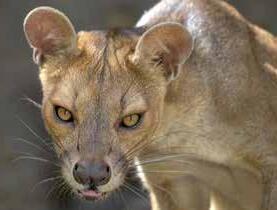
On the African island of Madagascar, the fossa (pictured below) is the top predator. It looks a bit like a dog, but it has claws and teeth like a cat; yet it is most closely related to the mongoose. Day and night, fossas are kings of the Madagascar scene, preying on lemurs, wild pigs, reptiles, rodents, and birds. They are usually loners, but they have cool moves—they are famous for darting and climbing swiftly and silently through the forest.
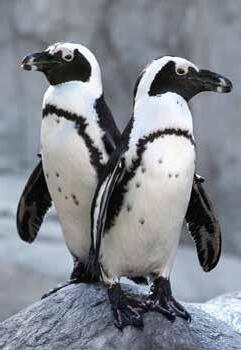
When you think penguin, you might think ice, but there are penguin species found throughout the Southern Hemisphere. African penguins prefer the beach scene, living along the shore of South Africa. In their warm climate, they show a little skin, with bare patches around the eyes and on the legs to release heat. After all, when you’re hot, you’re hot.
Because they can’t fly, penguins jet from place to place by swimming, and they are shaped perfectly to move swiftly through the water to catch fish. An African penguin can swim at nearly eight miles per hour and stay underwater for up to four minutes. On land, African penguins may look like they’re stiffly plodding the red carpet in their tie and tails—but get them in the pool, and it’s party time!
Conrad Prebys Africa Rocks has a star-studded lineup that will make it the hottest ticket in town. Mark your calendar for summer 2017 to see these and many more representatives of Africa’s amazing biodiversity. And to help you do that, this is your 2017 calendar issue of ZOONOOZ, featuring the animals of Africa Rocks!
AFRICA ROCKS HABITATS AND INHABITANTS
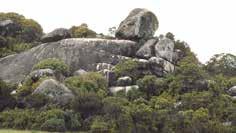
The kopje habitat is a rocky, boulder-strewn outcropping located within a grassland savanna. Kopje plants and animals, like the dwarf mongoose, are adapted to living among these islands in the plains.
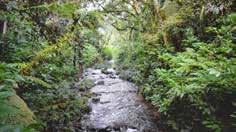
WEST AFRICAN FOREST
With up to 260 inches of rain annually, the warm, wet forests of central and western Africa are rich in animal and plant biodiversity. Reptile species like the African dwarf crocodile and many amphibian species find their homes here.
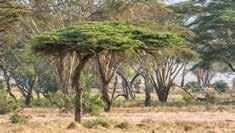
Africa’s woodlands are low-density forests, offering plenty of sunlight and small shrubs or grasses. Animals like leopards and a wide variety of birds make the trees and grassland of this habitat home.
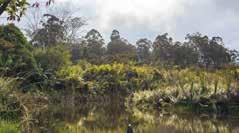
MADAGASCAR FOREST
Madagascar has both tropical forests and dry forests, and it is home to more than 8,000 species, including 98 species of lemurs, that can only be found in the unique habitats of this island.
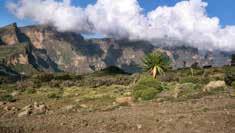
The Ethiopian Highlands is a rugged plateau region covered with grasslands, and sparse trees and brush. The species that live there, like the gelada, have adapted to cope with a challenging environment.
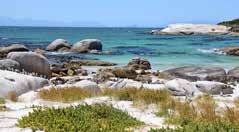
The western Cape fynbos habitat along South Africa’s rocky coastline is the African penguin’s domain. This is one of Africa’s most biodiverse regions and contains species found nowhere else.
COASTLINE FYNBOS
KOPJE
ACACIA WOODLANDS
ETHIOPIAN HIGHLANDS
JUNGLE BELLS PRESENTED BY CALIFORNIA COAST CREDIT UNION DECEMBER 9, 2016 THROUGH JANUARY 2, 2017
‘Tis the season to ring in holiday merriment at the San Diego Zoo!
We’re transforming the Zoo with animal-shaped light sculptures, festive decorations, holiday treats, animal experiences, and fun for the whole family. Plus, it’s another chance to see the larger-than-life centennial animal puppets of “The Journey”—lit up and aglow for the holidays in celebration of our 100th birthday.
The holiday magic includes decorated trees, the miniature train, music, and visits with Santa at Santa’s Igloo—he’ll be here November 25 to 27; December 3 and 4; and December 9 through 25. And don’t forget that Happy Holidays Happens at Albert’s Restaurant, with select $6 drinks and appetizers from 3 to 5 p.m. daily.
Jungle Bells is a jolly conclusion to the San Diego Zoo’s centennial year. Join us for plenty of good cheer—we’ll be there with bells on!

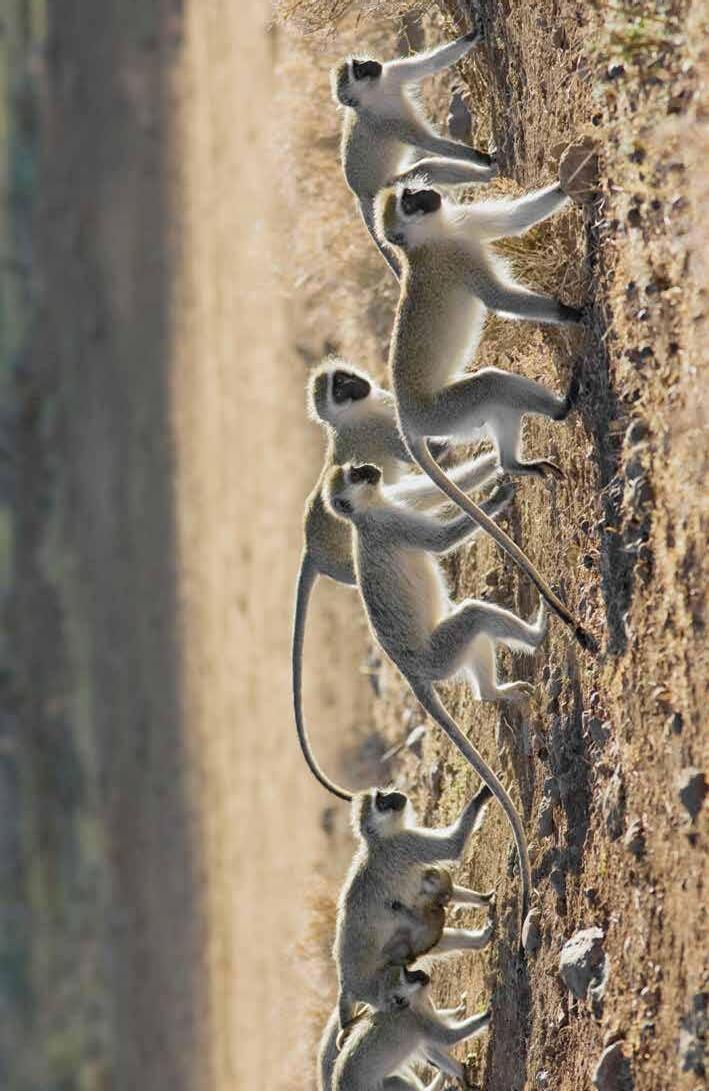
Vervet Monkey
These active, social primates are fascinating to watch in their acacia woodland habitat. They live in bands that are led mainly by related females.
White-fronted bee-eater
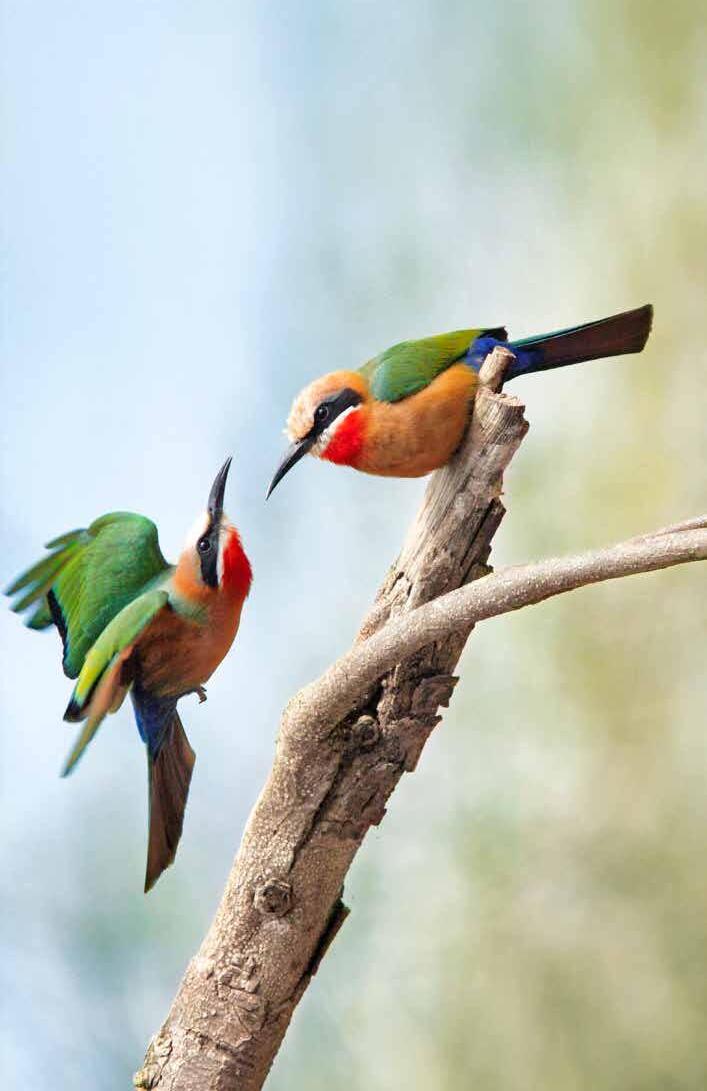
Nesting in colonies along cliffsides and riverbanks, bee-eaters are masters of swooping from a perch to catch insects like bees in midair.
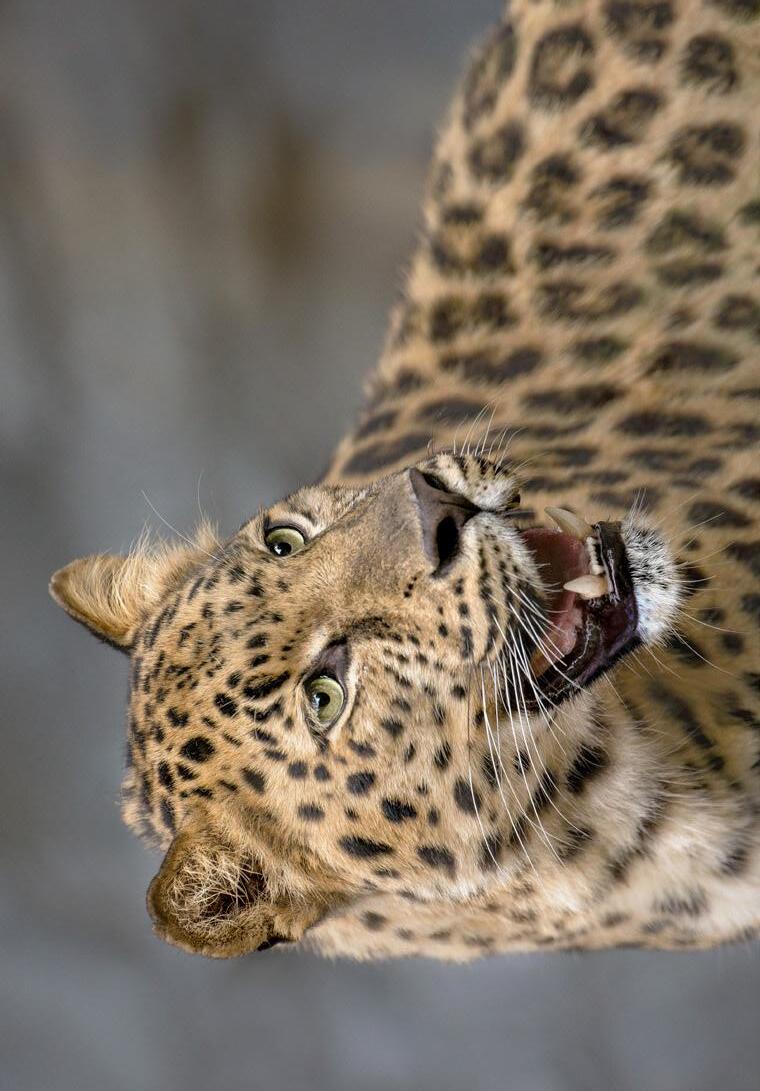
Leopard
Stalking through grassy woodland habitats, these beautiful and largely solitary cats are clever and agile predators. To keep their meals away from scavengers, they climb trees and stash their prey among the branches.
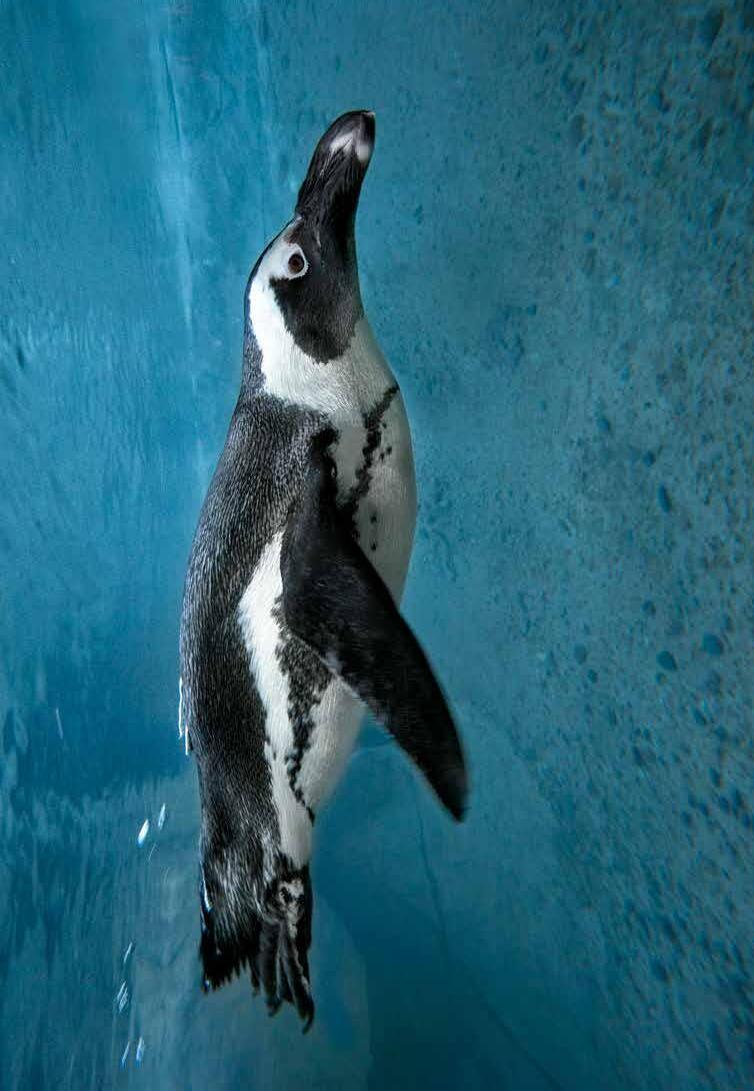
African Penguin
Adapted to the warm climate along the rocky shores of southwestern Africa, these swimming birds are an endangered species. San Diego Zoo Global is working with other conservation groups to protect their habitat and increase their populations.
HamadryasBaboon
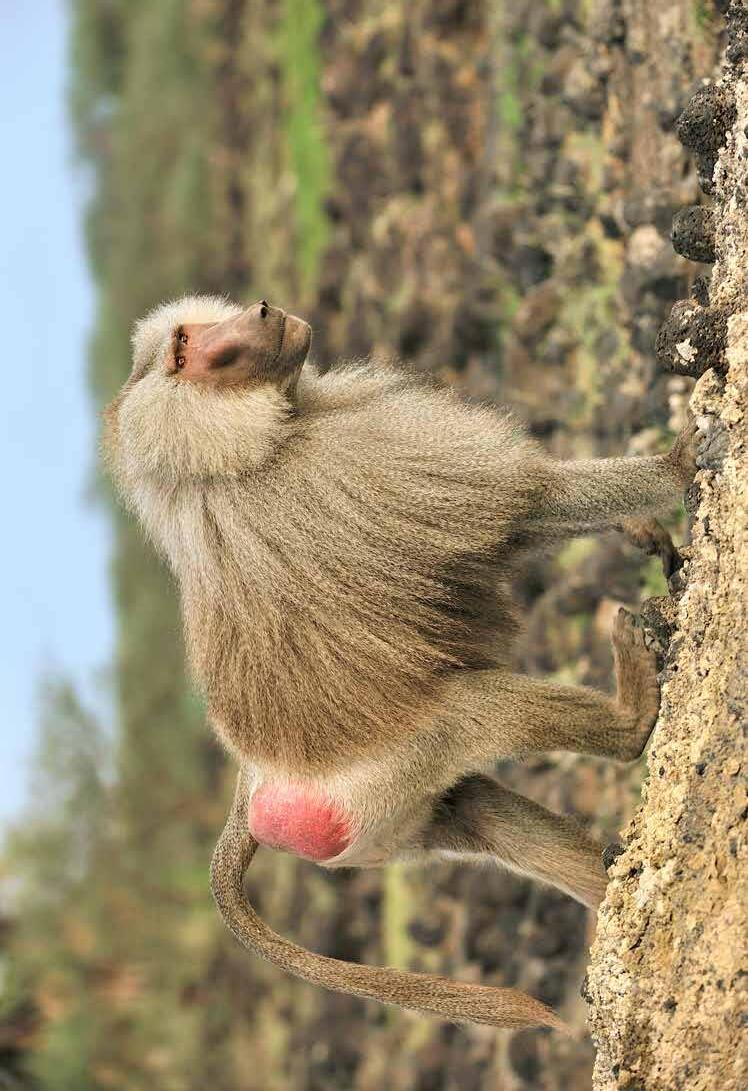
Their striking appearance and interesting social behaviors make these inhabitants of the Ethiopian Highlands a standout among Africa’s diverse primate species.
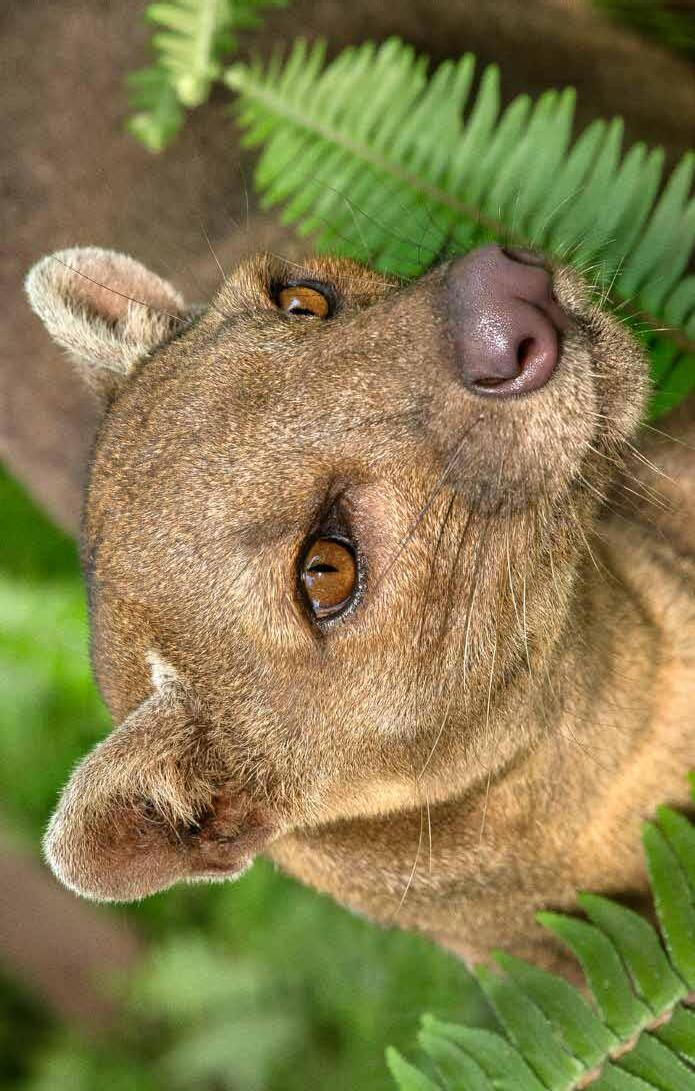
Fossa Madagascar’s top predator is wily, elusive, and vital to maintaining balance in its island ecosystem.
Ratel
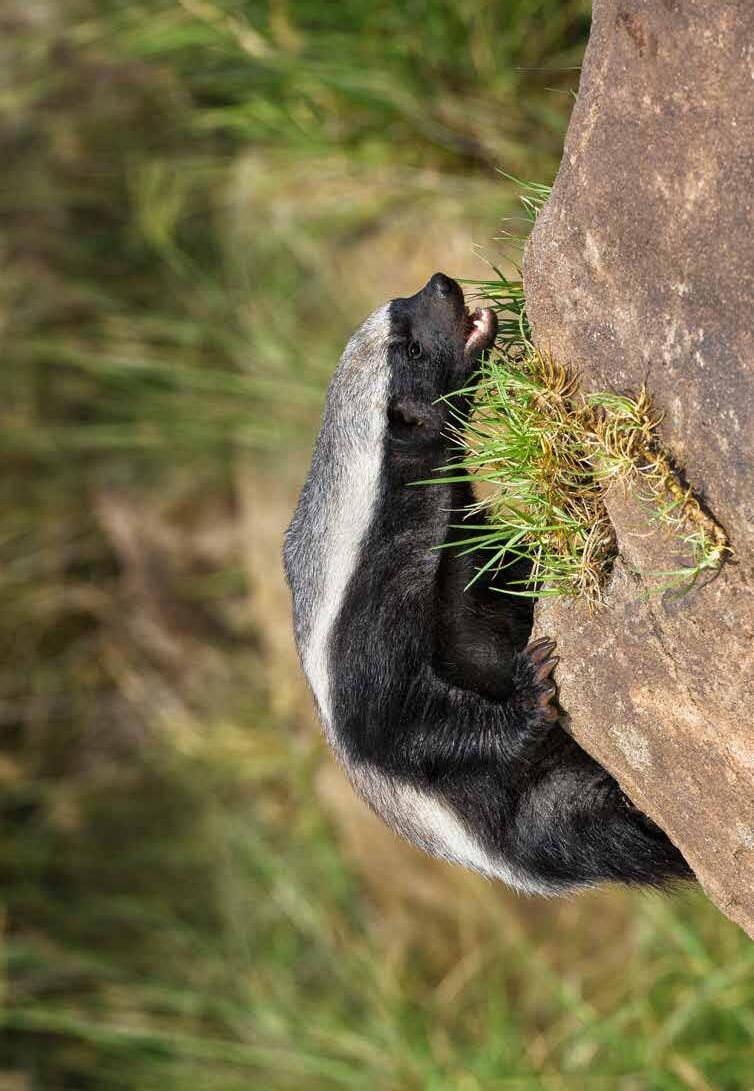
Popularly known as the honey badger, the ratel prowls a variety of habitats in Africa and uses its impressive claws to dig open beehives and termite mounds to eat the larvae.
Beautiful Sunbird
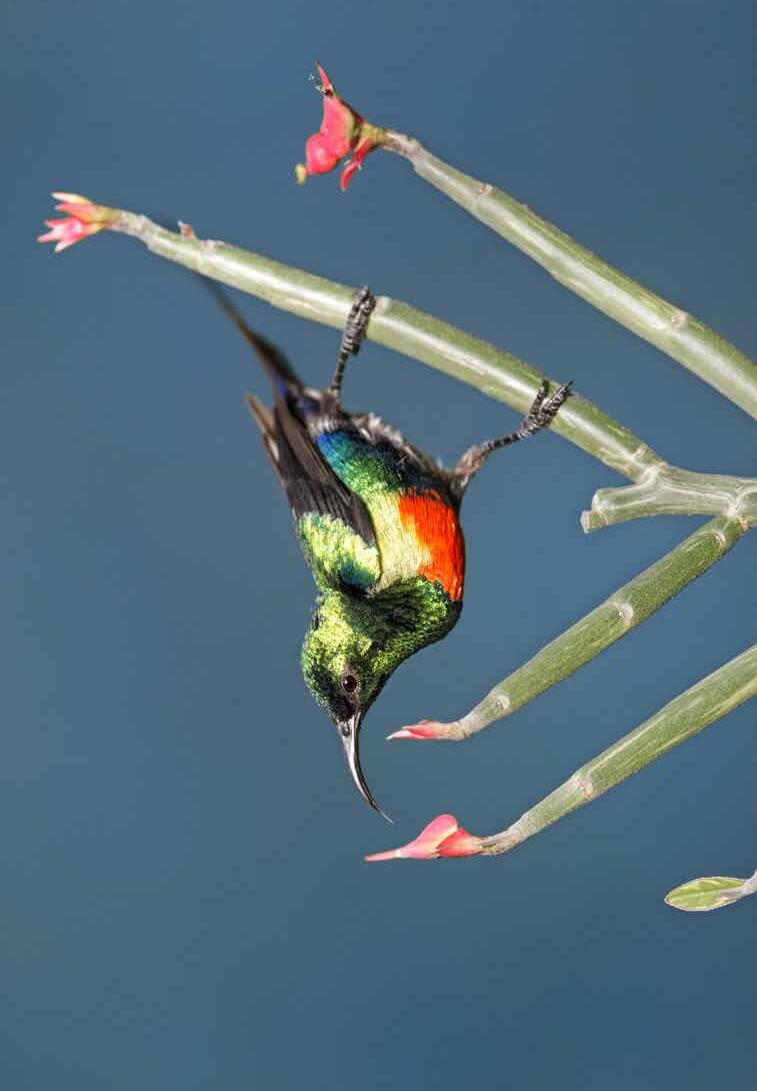
In Africa, sunbirds fill a similar role to hummingbirds, seeking out nectar from flowering plants and helping to pollinate them along the way.
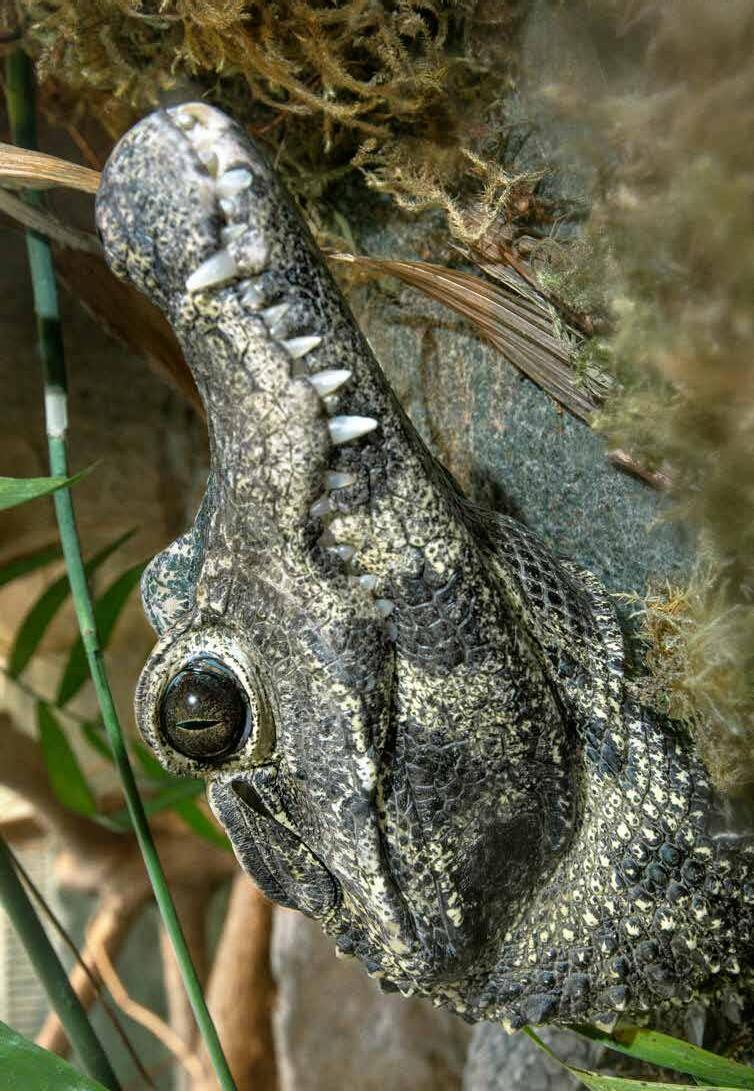
African Dwarf Crocodile
This small and shy crocodile species lives among the dense forest and slow-moving rivers of West Africa. Surprisingly, it can climb into trees and is sometimes spotted lying on lower branches.
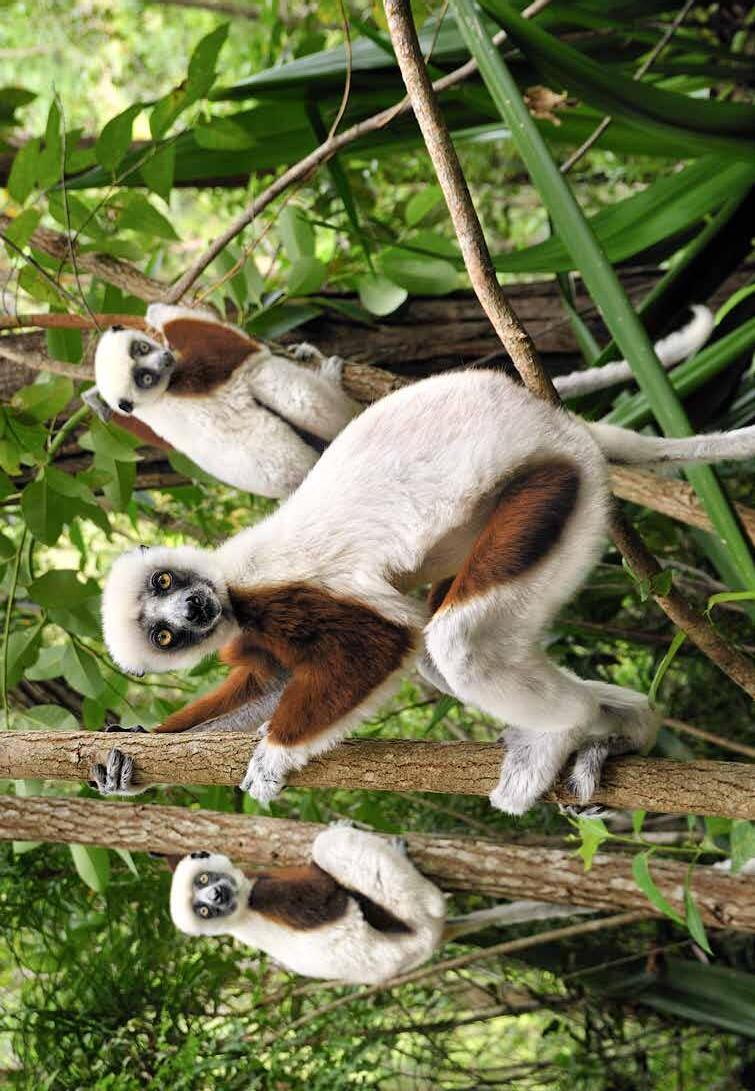
COQUEREL’S SIFAKA
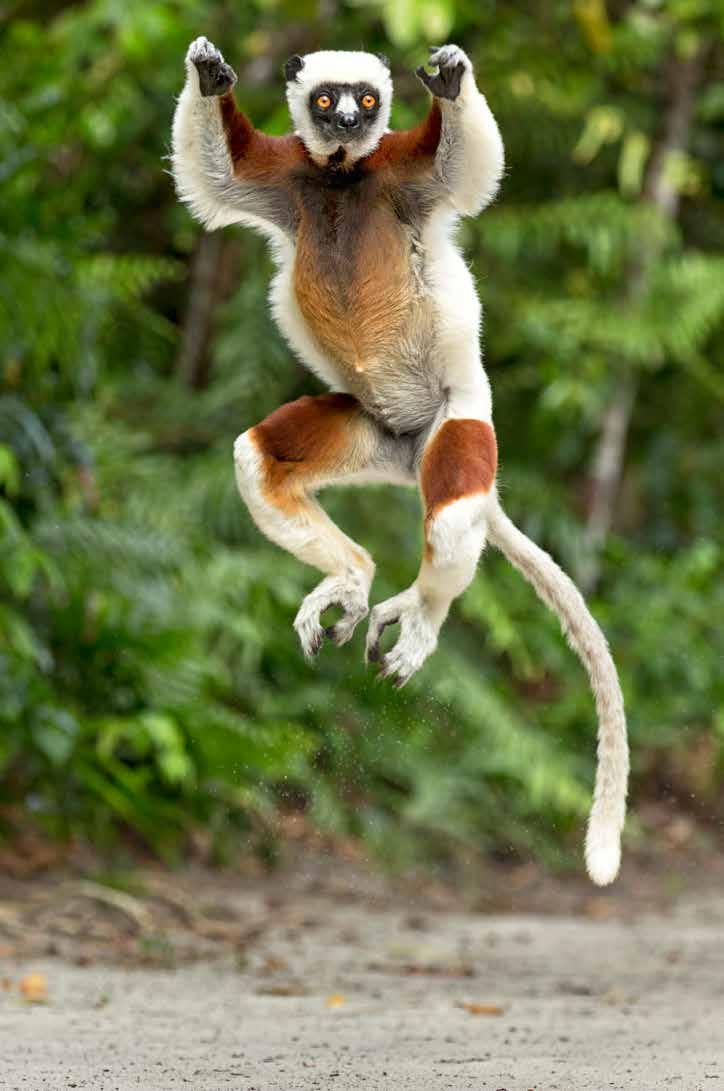
One of 98 species of lemurs, which are found only on the island of Madagascar, Coquerel’s sifaka is unique, beautiful, and endangered. San Diego Zoo Global is working on conservation projects in Madagascar to help save lemurs from extinction.
KLIPSPRINGER
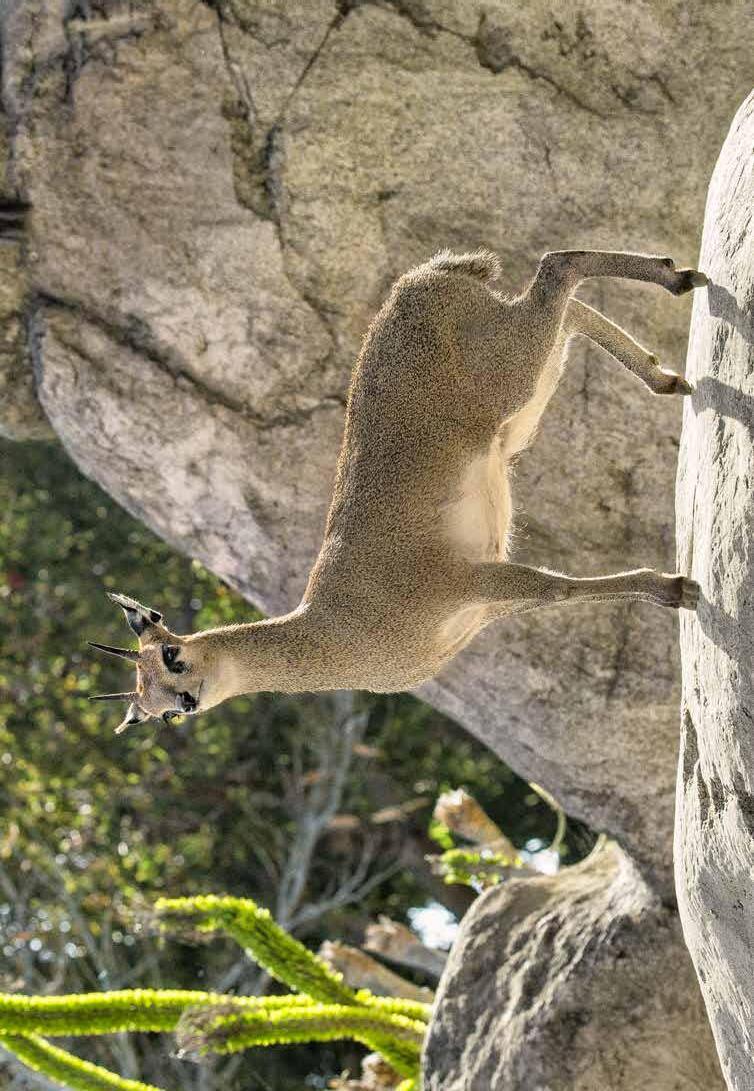
The unique hooves of this dwarf antelope have a suction effect that helps it climb, leap, and scamper among the rocks and boulders of its African kopje habitat.
GELADA
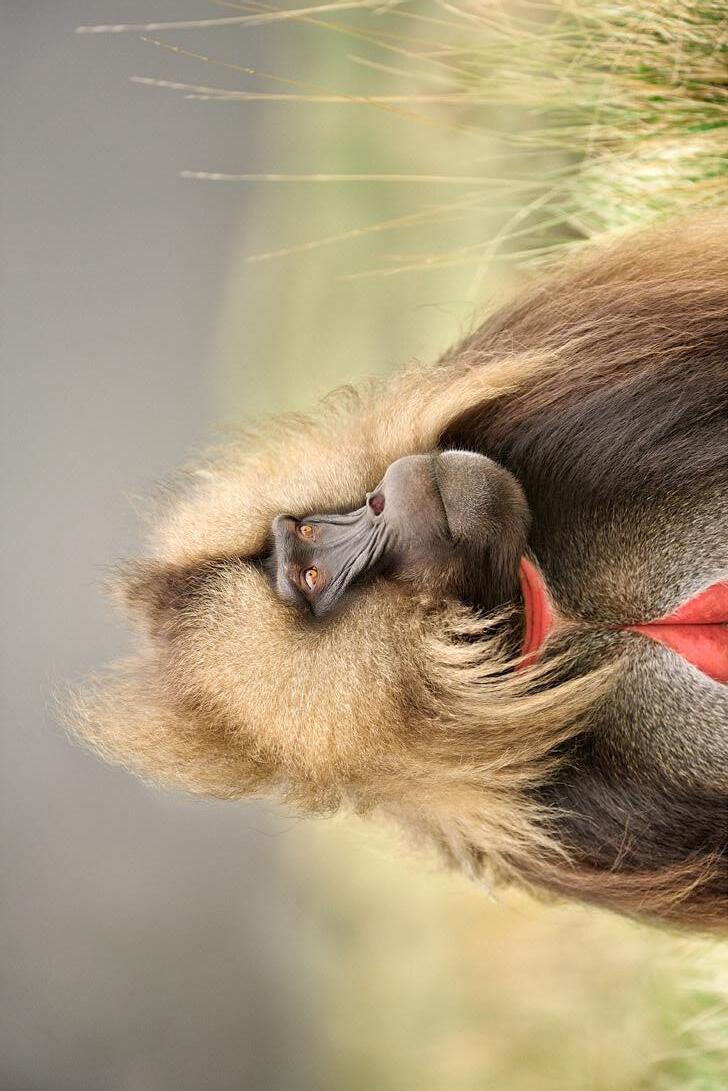
The gelada is one of Africa’s most unusual primates. Living among the cliffs and plateaus of the Ethiopian Highlands, geladas are the only grazing monkey— they primarily eat grass. San Diego Zoo Global supports conservation efforts to help save this threatened species.
TRAVEL THE WORLD WITH THE SAN DIEGO ZOO
Explore some of the wildest places on Earth in 2017 with the San Diego Zoo! Our itineraries highlight the wildlife at each destination and include expert naturalists and a San Diego Zoo escort, plus a group of like-minded travelers. For brochures, visit sandiegozoo.org/travel or call Julia Altieri at 619-685-3205.

H AWAII
FEBRUARY 7–12, 2017
Journey beyond luaus and leis to explore natural wonders and visit our Hawaii Endangered Bird Conservation Center. SDZG bird expert Joop Kuhn will be your guide. Prices start at $3,695 plus airfare (per person, double occupancy).
Exclusive Private Jet Tours
WILD ENCOUNTERS
FEBRUARY 17–MARCH 8, 2017
Set off on a wildlife adventure and come faceto-face with the world’s legendary creatures in their natural habitats, including India’s jungles, the Serengeti Plain, the mountains of Rwanda, and Borneo’s rain forest. You’ll be joined by SDZG Curator of Primates Dean Gibson. $83,950 plus round-trip airfare to and from departure city (per person, double occupancy).
CHINA
MAY 14–27, 2017
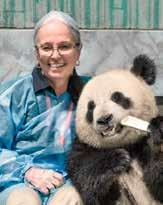
Come face-to-face with giant pandas, climb the Great Wall, visit the Terracotta Warriors, and cruise down the Yangzi River. $5,590 plus airfare (per person, double occupancy).
KENYA
SEPTEMBER 8–20, 2017
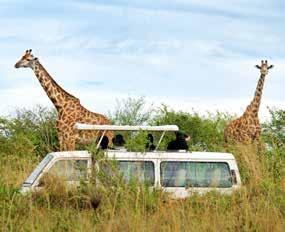
Witness the Great Migration and view the most impressive animals and beautiful landscapes of the African continent. $7,995 plus airfare (per person, double occupancy).
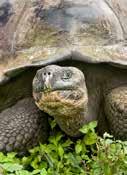
GALÁPAGOS
OCTOBER 13-22, 2017
Experience the treasures of the Galápagos, including giant tortoises, blue-footed boobies, sea lions, and penguins. Prices start at $6,198 plus airfare (per person, double occupancy).
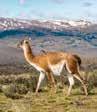
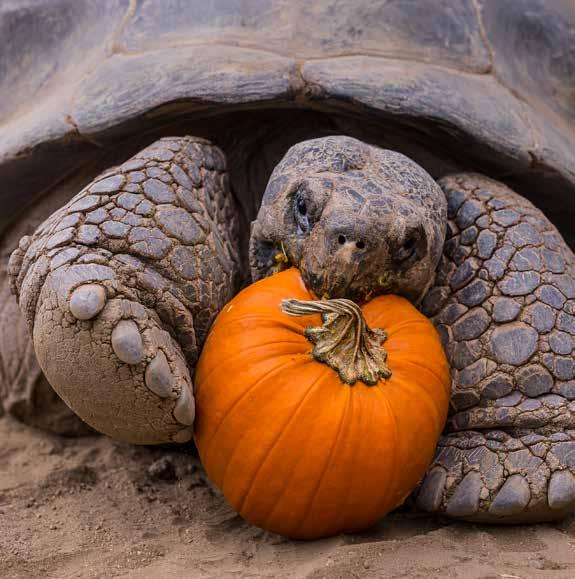
Galápagos tortoises—the Zoo’s oldest residents always enjoy a bright bite!
LOVE OF ANIMALS & LIFETIME SECURITY
There is a lot to be said for saving and investing your money. A penny saved is a penny earned—but are you tired of the low interest rates paid on savings accounts and CDs? Or the uncertainty of the stock market and dividends?
One of our longtime donors felt the same way. The early years of her marriage were incredibly busy, because she and her husband decided to invest in rental property while he held down a demanding full-time job: “We bought little houses to refurbish and rent. I would sand, and spackle, and paint, and do minor electrical and plumbing repairs—I’ve even tarred roofs.”
As she explains it, neither of them was comfortable with investing in stocks, so they decided that buying homes, remodeling them, and renting them was the way to go. It also gave them a sense of control over their retirement investment—and that is a major point. By trading up, they eventually had many new units, managing every aspect of them. As she says, it was a great tax write-off, and they got in at a good time for the housing market.
around for new properties that would give them income. She adds, with a laugh, that travel was their passion, so they would always need funds for that.
SAMPLE CHARITABLE GIFT ANNUITY RATES
QUESTIONS?
After several decades, they saw their investment grow several thousand percent. When it came time to retire, they both decided that selling the properties would eat up a great deal in capital gains tax, so they looked
To explore your Charitable Gift Annuity options, please reach us at 619-557-3947 or donations@ sandiegozoo.org.
After her husband passed away, she made a decision that since she now had only herself to care for, she would turn to “great organizations like San Diego Zoo Global to provide me with more financial security.” She wanted to keep her home in good repair and always have extra income to provide for herself and her cat. Applying her business savvy, she chose to fund several Charitable Gift Annuities (CGAs). Her monthly annuity checks arrive regularly, may be partially tax free, and also give her a charitable tax deduction for making
a gift to us. These gifts are rewarding in that they not only provide her with fixed payments for life, they also provide for a brighter future for endangered species. She is truly a wonderful friend to us and to the animals, and her zest for life and generosity assure her a wonderful legacy.
OMA BRIAR WEGEFORTH: ALWAYS PROUD OF MY ZOO!
BY MARY SEKULOVICH | SENIOR EDITOR, DEVELOPMENT DEPARTMENT
When Oma Briar was growing up in San Diego in the 1920s, she never imagined that one day she would be part of a legendary San Diego family, the Wegeforths, and have a lifelong connection to the local zoo she loves. Once a longtime Zoo member, she doesn’t visit as often now but still comes when she can. Oma believes Dr. Harry would have been pleased today with the Zoo he founded, which is much larger than she remembers it. Then her remarkable memory brought those early years to life.
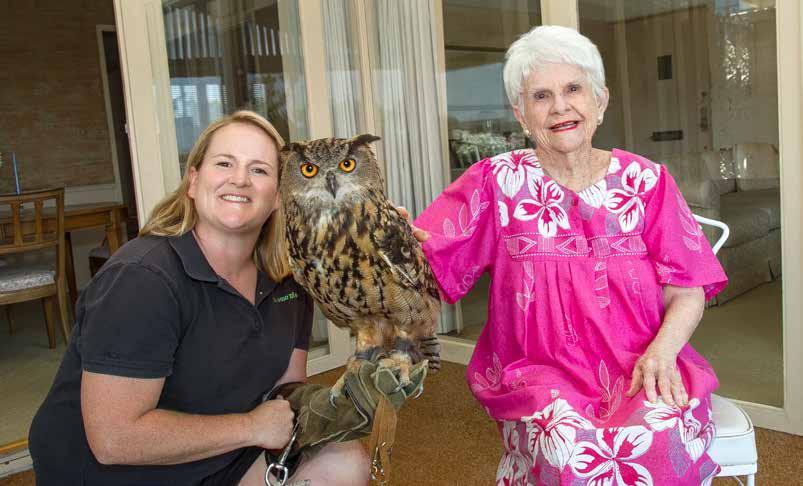
Einstein the Eurasian eagle owl and San Diego Zoo animal trainer Katie Springer met Mrs. Wegeforth at her home.
Oma’s father, a chief petty officer in the Navy, was stationed in China in 1925, but after a year, when Oma was three years old, they returned to San Diego and settled in the same neighborhood as the Wegeforths. She attended Florence Elementary School with Lester, Dr. Harry’s younger son, and they were great friends as teenagers and went to dances together. Oma was often invited to dinner at the Wegeforths’ home and remembers happy times there.
Oma has so many memories of those early days with the family and recalls that Lester, as a young boy, often rode on the back of Dr. Harry’s Arabian stallion, La Sed, as his father crisscrossed the Zoo grounds to plan where exhibits would be placed. She was visiting the Wegeforths when the bronze bust of Dr. Harry was brought there by artists Holger and Helen Jensen. The bust was originally placed by the Zoo’s entrance, and now it’s located near the Skyfari, by the large ZOO 100 lion plaque, where more visitors can see it.
Model T buses so students could be brought to the Zoo for education tours.
Across all those years, Oma and Lester remained friends. Eventually both married others and had children: Oma’s daughter, Gwen, and Lester’s son, Harry. Oma and Lester met again several years later, after both were divorced, and Lester told her, “I let you get away once, but I won’t let you go again!” Their happy marriage lasted for 48 years, until Lester passed away in 2001. Oma has a lifetime of incredible memories to look back on. Her friends say, “We miss Lester and his jokes!” He was great with people, very sociable, like Dr. Harry, and he had that Wegeforth twinkle in his eye.
Her favorite animals are primates, especially great apes. Among Oma’s earliest Zoo memories are visits with the gorillas, Ngagi and Mbongo, that came to San Diego in the 1930s. She remembers when their bronze busts, commissioned by Mrs. Rachel Wegeforth, were placed in the Zoo’s entry plaza.
Oma always loved visiting the Zoo because she says that in those days children didn’t have as many options for fun outings as they do today. Her grandmother would often fix a picnic lunch on weekends for her and her sister, Doris, then her grandfather would take them on the streetcar and walk them all over the Zoo, “so he got his money’s worth!” She also looked forward to school bus trips to the Zoo, which began in 1926 when a local teacher gave the funds to purchase two Ford
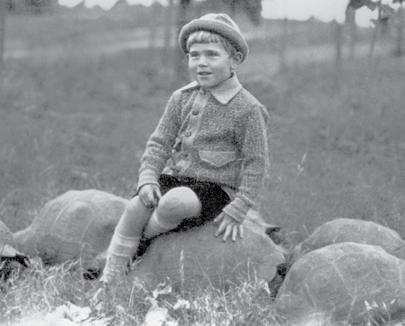
ter and Oma, accompanied by their Siamese cat, Ignatz, and visiting as well as participat ing in car shows. Oma shares that she has always loved animals, and she loves having at least one cat—currently, she has Misha. She says Lester loved animals as much as his father did. In fact, Dr. Harry’s favorite photo of Lester was as a young boy riding on the back of a giant tortoise (pictured above)— and turtles and tortoises were Dr. Harry’s favorite animals.
When she attended the San Diego Zoo Centennial Celebration in Balboa Park on May 14, Oma relived great moments with the Wegeforth family from those early years. And more than once as we talked, she said, “I am very proud of the Wegeforth name!” Even in her 95th year, her heart is still very much with Lester, the Zoo, and its animals. It is a true love story on many levels.


Lester Wegeforth and a Galápagos tortoise—one of Dr. Harry’s favorite photos.
100 YEARS OF THE SAN
Vision, 1997-2006, and End Extinction, 2007-2016
The Zoological Society of San Diego’s ninth decade started with a Wild Animal Park (now Safari Park) milestone: its 25th anniversary. As part of the celebrations, the Park opened Heart of Africa, a series of exhibits that added a new dimension to the grounds. The walking journey through forest and thorn scrub to see animals like eland, warthogs, hornbills, bat-eared foxes, okapi, and secretary birds expanded opportunities to experience African wildlife.
SUCCESS IN BLACK AND WHITE
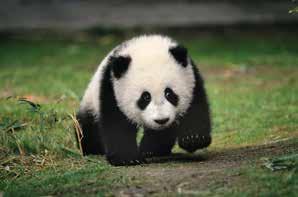
centers today—a population with enough genetic diversity to keep the panda species viable for the next 100 years.
A LARGE COMMITMENT
The Zoo had dedicated years to researching giant panda reproduction and behavior. In 1999, a long-anticipated event happened: the Zoo welcomed a tiny bear that was a big deal. Shi Shi had refused to breed naturally, but researchers had determined how to artificially inseminate Bai Yun with Shi Shi’s sperm. In July, the giant panda team thought Bai Yun might be pregnant, but they weren’t sure, because it was difficult then to pinpoint pregnancy in pandas.
They had been on “birth watch” 24/7 for a couple of weeks, when on July 29, it became clear that Bai Yun was in labor. The word spread, and giant panda team members hurried to the Giant Panda Research Station to observe via remote camera. It was standing room only; the tension was palpable. Then they saw Bai Yun scoop up a tiny, white, squirming baby—and everyone cheered. The Zoo had its first giant panda cub.
The research staff learned a great deal from observations of Bai Yun before, during, and after the birth. Video was recorded inside the den every day, which the staff used to take behavior
data. Two weeks after the birth, live video from the den was shown on the Zoo’s website: the launch of Panda Cam. Following Chinese tradition, the cub was named at 100 days old: Hua Mei, meaning “China USA” to honor the important collaboration between the two countries to save pandas.
Over the years, Bai Yun has been dubbed a “supermom,” raising six cubs: Hua Mei was followed by Mei Sheng, Su Lin, Zhen Zhen, Yun Zi, and Xiao Liwu. As a result of collaborative research on reproduction, behavior, and nutrition, a giant panda baby boom also took place in China’s breeding centers. There are more than 300 giant pandas in breeding
In 2002, a herd of African elephants in Swaziland found themselves constrained by agriculture and human habitation, and they were eating themselves out of house and home—as well as destroying the habitat for other species. The Kingdom of Swaziland decided they had to cull the herd or find somewhere else they could go. The San Diego Zoo and the Lowry Park Zoo joined forces to bring the nine-elephant herd to the United States. The move was highly controversial and contested, resulting in conflict and criticism from opposition groups. However, with elephants disappearing in the wild as the result of rampant poaching, the zoos wanted to see this herd survive.
The elephants’ specialized crates were loaded onto a jumbo cargo plane and flown to the US. Seven of the elephants came to the Wild Animal Park, and a happy result was the birth of the herd’s first calf, Vus’musi, in February
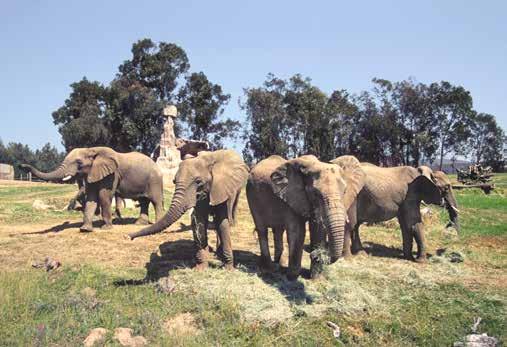
The elephants from Swaziland settled right in.
Above: Hua Mei, the Zoo’s first panda cub, was big news.
DIEGO ZOO
BY KAREN E. WORLEY MANAGING EDITOR
2004. Since then, 10 more calves have been born. The project received the prestigious Edward H. Bean Award in 2014 from the Association of Zoos and Aquariums (AZA), for contributions to the breeding and care of elephants.
LOOKING AHEAD
At the start of the new millennium, the Zoological Society opened two new facilities in Escondido that extended the commitment to animal care and conservation. In 2001, the state-of-theart Paul Harter Veterinary Medical Center opened, with innovative facilities, equipment, and technology. In 2004, the Arnold and Mabel Beckman Center for Conservation Research opened, providing laboratories and research facilities, space for the Frozen Zoo®, and classrooms for students of many ages.
Work was growing in scope on the conservation front. One group of endangered species that our researchers had been working with was the Caribbean rock iguanas, helping to pioneer strategies for headstarting juveniles— giving them a chance to grow large enough to fend off predators before release. There was celebration in 2001, when CRES had their first successful hatching of the critically endangered Anegada iguana.
The San Diego Zoo Hawaiian Bird Conservation Program had also been at work for many years to breed, hatch, and raise endangered species. One was Kauai’s puaiohi thrush, which was clinging to survival, with no more than 300 left. Dedicated efforts during the 2000s led to 350 puaiohi chicks hatching, making it possible to release the species back to its native habitat. Another species was the alala (Hawaiian crow), which was
BY SDZG
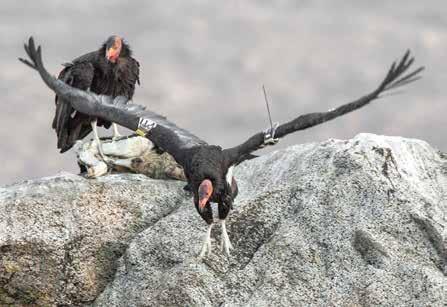
considered extinct in the wild in 2002. The San Diego Zoo partnered with the U.S. Fish and Wildlife Service and the Hawaii Division of Forestry and Wildlife to save the species. During this decade, the alala population reached a new high of 114 birds.
END EXTINCTION
The Zoological Society’s 10th decade has seen the continued expansion of conservation efforts around the world. Long-standing projects like the California Condor Recovery Program continued to be in the forefront. In 2007, a new phase began releasing juvenile condors in Baja California, Mexico, a part of their historic range. From only 22 condors left in the early 1980s, there are now more than 400, and more than half of those are flying in the wild, reproducing and raising chicks.
RAIN FOREST OUTREACH
The Zoological Society had been conducting conservation research in other countries for many years, but no formal facilities had yet been established outside the US. In 2005, the first field research station was established in Cameroon’s Ebo Forest in Central Africa. Work there focuses on studies of the biodiversity—which includes a recently identified subspecies of gorilla—as well as finding ways to protect the wildlife from illegal poaching. The team includes local people, and researchers work with the communities to produce income while preserving the forest’s species.
In 2011, the Zoological Society expanded its commitment to rain forest conservation by taking on the manage-
ment of the Cocha Cashu Biological Station, a conservation and research station located in the Manu National Park in Peru. Recognized by UNESCO as a World Heritage Site, this park is protected as a biosphere preserve. At Cocha Cashu, our staff and visiting researchers and students study rain forest animal and plant species, as well as the ecology of this pristine ecosystem.
EXHIBIT INNOVATIONS
New animal habitats during this decade included the Zoo’s Harry and Grace Steele Elephant Odyssey in 2009, which highlights extinct animals once found in Southern California, alongside their living counterparts now found in other parts of the world. The Zoo’s elephant herd, made up of aging individuals, moved into this new home, and the Conrad Prebys Elephant Care Center provides expert care for each elephant.
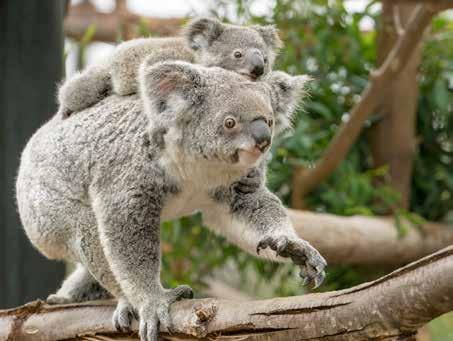
The Conrad Prebys Australian Outback opened in 2012, with the Zoo’s colony of 24 koalas. At one time, koalas were managed largely in indoor areas with controlled temperatures and humidity. However, after learning about these marsupials over the years, it was determined that it was better for the animals’ welfare to remain outdoors 24/7. Australian Outback achieved that, as well as providing an interesting environment for guests and a variety of Australian animals, including Tasmanian devils.
The Park saw big changes during this time, as well. In 2007, a new tram
PHOTOS
The release of condors in Baja began a new phase of the California Condor Recovery Program.
San Diego Zoo has the largest koala colony outside of Australia. Below: The Park’s Rhino Rescue Center hopes to help save rhinos from extinction.
tour replaced the fondly remembered but outdated—and frequently brokendown—monorail, providing new views and more reliable access as visitors traveled out to see the animals in the field exhibits. In 2014, the Park’s tigers moved into a spectacular new home: the Tull Family Tiger Trail, a representation of the Sumatran tiger’s native habitat, with lush vegetation, tall trees, running streams, and deep pools. The cats’ new territory gave them many behavioral opportunities, wowed visitors, and garnered the Park the Best New Exhibit Award from AZA.
A NEW DIRECTION
Given the considerable, and still-growing, commitment to conservation, the organization felt it was time to assess the mission and future direction. After extensive study and deliberation, in 2010 the organization undertook the largest rebranding project in its history. The Zoological Society of San Diego became San Diego Zoo Global. CRES became the San Diego Zoo Institute for Conservation Research. And the San Diego Zoo’s Wild Animal Park became the San Diego Zoo Safari Park. The following year, the San Diego Zoo Global Wildlife Conservancy was established, allowing people anywhere in the world to join us and help save species. Then in 2013, in keeping with these bold and sweeping changes, San Diego Zoo Global established its current vision: “We will
lead the fight against extinction,” which has created a unifying purpose for all parts of the organization.
RALLYING FOR RHINOS
It has become starkly clear that a number of species are facing an extinction crisis—including the rhinoceros, which has long been an important and celebrated part of San Diego Zoo Global. One rhino in particular came to symbolize the urgency in saving these species: Nola, the northern white rhino at the Safari Park, one of only four left of her kind. Her death in 2015 sparked a wave of awareness about the plight of rhinos that spread around the globe, and also galvanized San Diego Zoo Global’s resolve to try to save northern white rhinos through innovative reproductive technologies.
While saying goodbye to Nola was heartbreaking, her legacy lives on in San Diego Zoo Global’s Frozen Zoo®. Samples with her DNA were added to samples from 11 other northern white rhinos already in the Frozen Zoo®. The ICR teams—along with collaborators at Scripps Research Institute in La Jolla and at the Institute for Zoo and Wildlife Medicine in Berlin—are working to develop assisted reproductive technology
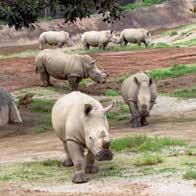
for rhinos. Thanks to a generous donation from Nikita Kahn, at the end of 2015 San Diego Zoo Global opened the Nikita Kahn Rhino Rescue Center at the Safari Park, and brought six southern white rhinos to be part of the initiative. The rhino’s reproductive system is complex, and there is much to learn, but it is possible that some of these rhinos could eventually serve as surrogates to carry northern white rhino calves. It’s a project that will be developing well into the first decade of San Diego Zoo Global’s next 100 years.
ENVISIONING THE FUTURE
The San Diego Zoo has come a long way from that group of cages along Park Boulevard in 1916. San Diego Zoo Global now comprises three leading facilities: the San Diego Zoo, San Diego Zoo Safari Park, and San Diego Zoo Institute for Conservation Research. In the late 1920s, Belle Benchley worked with 30 employees; now there are nearly 3,000. While Dr. Harry felt fortunate to care for a few animals without a home in the 1930s, San Diego Zoo Global now has more than 140 field projects in 80 countries to protect and save species. Dr. Harry dedicated the San Diego Zoo to the children of San Diego—and we now dedicate San Diego Zoo Global to the children of the world. What began with one man and one lion has become the combined voices and dedication of millions on behalf of species everywhere. As San Diego Zoo Global concludes its centennial celebration, the stage is set for the next 100 years. We are dedicated to saving species from extinction, igniting a passion for wildlife, and providing a sanctuary and refuge for animals and for people. The challenges facing wildlife today are unprecedented. But with the help and support of volunteers, members, partners, and the worldwide community, San Diego Zoo Global stands ready to “roar forward” and create a future where people and wildlife can live and thrive together.
HAVE BREAKFAST
WITH SANTA!
SAN DIEGO ZOO SAFARI PARK
SATURDAY, DECEMBER 10 & 17, 2016, 9 TO 11 A.M.
Santa Claus is coming—to the Safari Park! He’ll be here for breakfast and would love to see you and your family. Gather at the Park’s scenic Kilima Point for a bountiful breakfast buffet with the jolly ol’ elf himself.
Cost is $25.95 for adults, $15.95 for children ages 3 through 11, plus tax and Safari Park parking. Nonmembers add Safari Park admission.


Call 619-718-3000 to reserve your spot at Santa’s breakfast table! Visit sdzsafaripark.org/dining-events for more information and the menu.





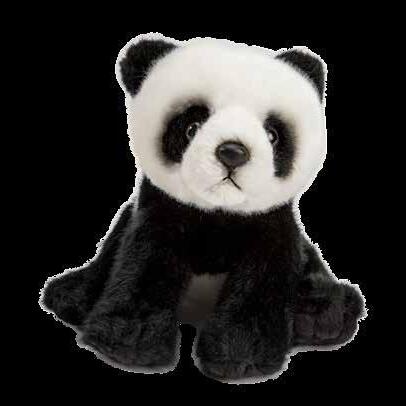
Wondering what to get for those hard-to-shop-for people? Give them an animal adventure!
This year’s stunning gift card features our centennial design and can be used toward any purchases at the San Diego Zoo or Safari Park. Purchase a gift card of $50 or more and receive a FREE plush animal, which can be shipped to any domestic street address you specify (shipping and handling charges will apply). What could be better than giving that special someone a visit with their favorite Zoo or Park animals?

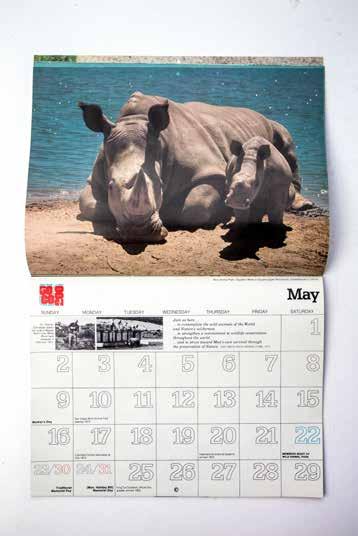
First Calendar
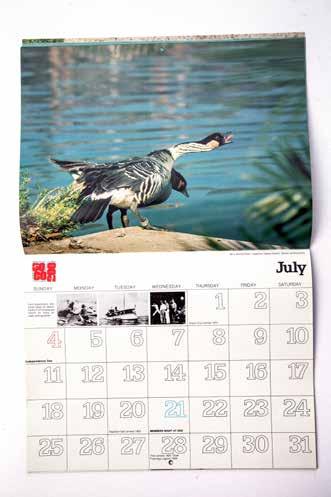
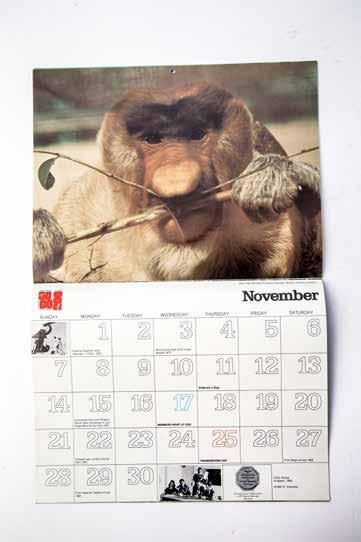
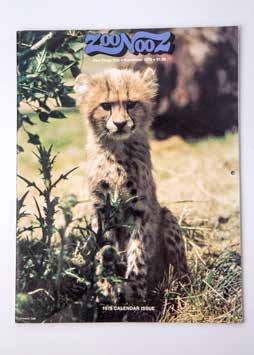
In the November 1975 issue, ZOONOOZ magazine included its first-ever calendar for members, celebrating the milestone year of 1976.
TODAY AT THE ZOO
Since 1975, ZOONOOZ has continued to include a calendar for the coming year in each November issue, often featuring a particular theme or looking ahead to a new exhibit for the Zoo or Park. This year, we highlight the opening of Conrad Prebys Africa Rocks in 2017!
A GIFT TO MEMBERS AND SUBSCRIBERS
For our readers, the year 1976 is noteworthy—it adds up to 50 years of ZOONOOZ, 60 years of the Zoological Society of San Diego, and 200 years of our Country’s independence. As a special gift to our members and subscribers, the November ZOONOOZ consists of 36 pages and includes a 1976 calendar....There will be a history of your Zoo and Wild Animal Park— illustrations and quotations will recall events that have shaped the development of the Zoological Society of San Diego. Expect nostalgia at the turn of each page and pleasurable views of your Zoo and Park favorites for each month of the 1976 calendar.
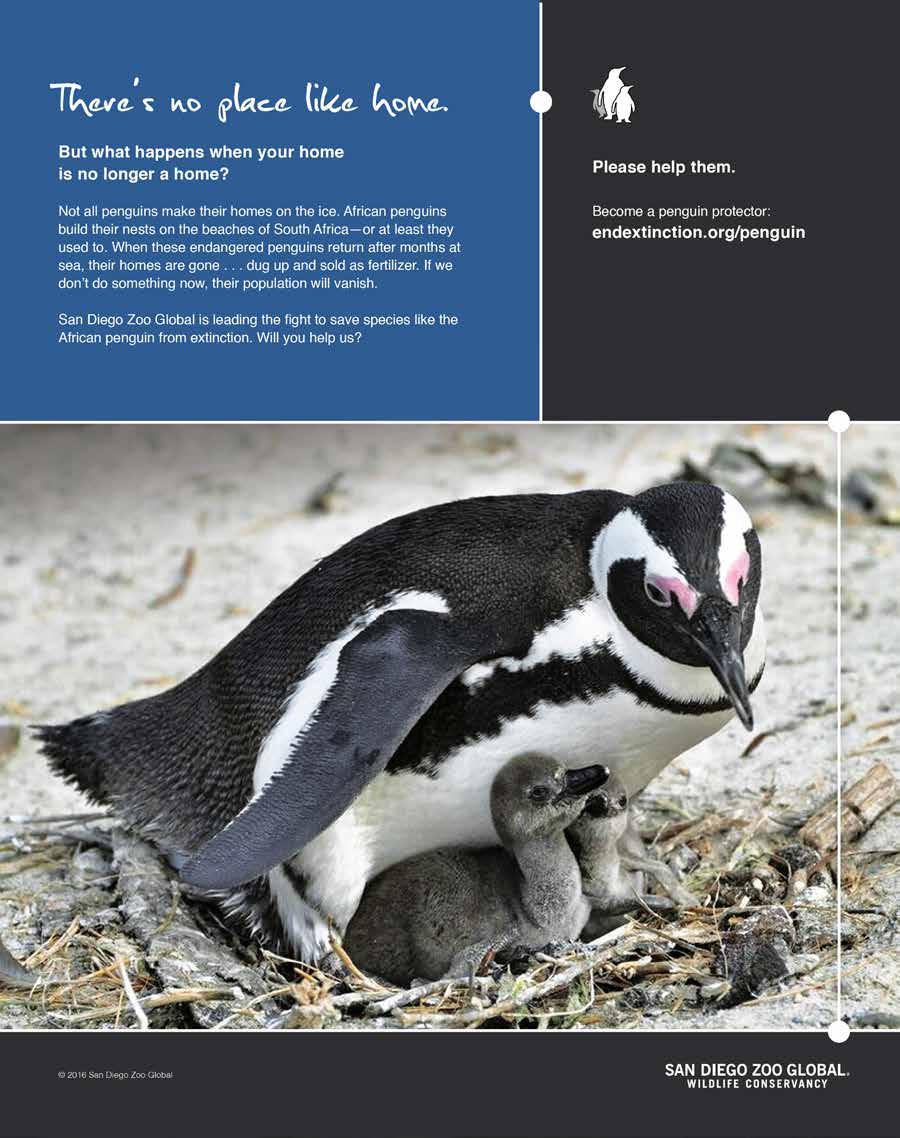

Your family and friends will love a membership to the San Diego Zoo and the San Diego Zoo Safari Park.
It’s the gift that unwraps all year and is guaranteed to provide warm moments and cherished memories to last a lifetime.
Best of all, when you give a gift membership you are directly helping the animals in our care and supporting our conservation efforts.
Order your holiday gifts today!