WITH A MOTHER’S DAY BUFFET AT THE ZOO AND SAFARI PARK THIS YEAR
SUNDAY, MAY 8, 2016
CONTINUOUS SEATING BEGINS AT 11 A.M.
Enjoy the casual elegance of our Treetops Banquet Room as you make selections from our endless omelet bar, or choose from many generous entrée choices and delectable desserts.
$44.95 for adults; $18.95 for children ages 3 to 11, plus tax and gratuity. Nonmembers add Zoo admission.
For reservations, please call 619-557-3964 between 10 a.m. and 4 p.m. daily. Secure your reservation with a credit card.
SEATINGS AT 10 A.M. AND 1 P.M.
Celebrate Mother’s Day at the San Diego Zoo Safari Park with a delicious spring brunch. Guests will be seated at their own reserved table, set according to their guest count.
$44.95 for adults; $18.95 for children ages 3 to 11, plus tax and parking. Nonmembers add Safari Park admission.
For reservations, call 619-718-3000, or book online.
Chairman’s Note; President’s Note; Save the Date; Centennial; What’s In Store; It’s Only a Number
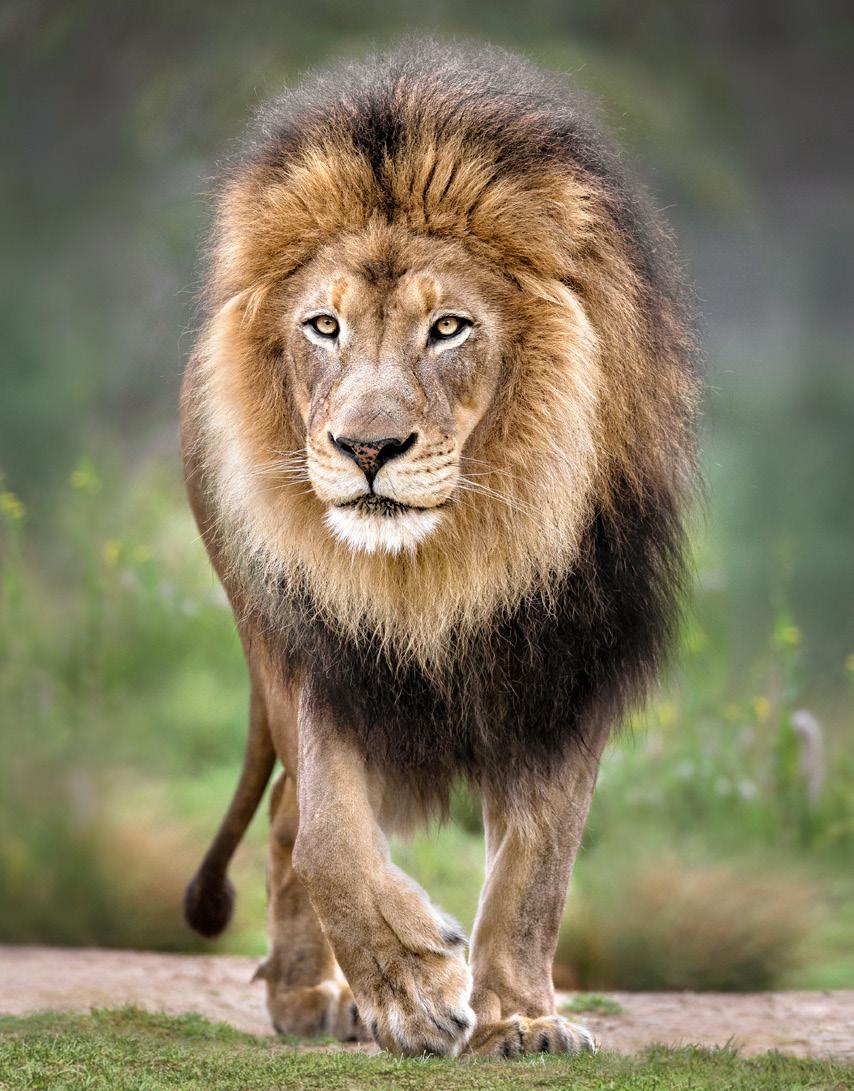
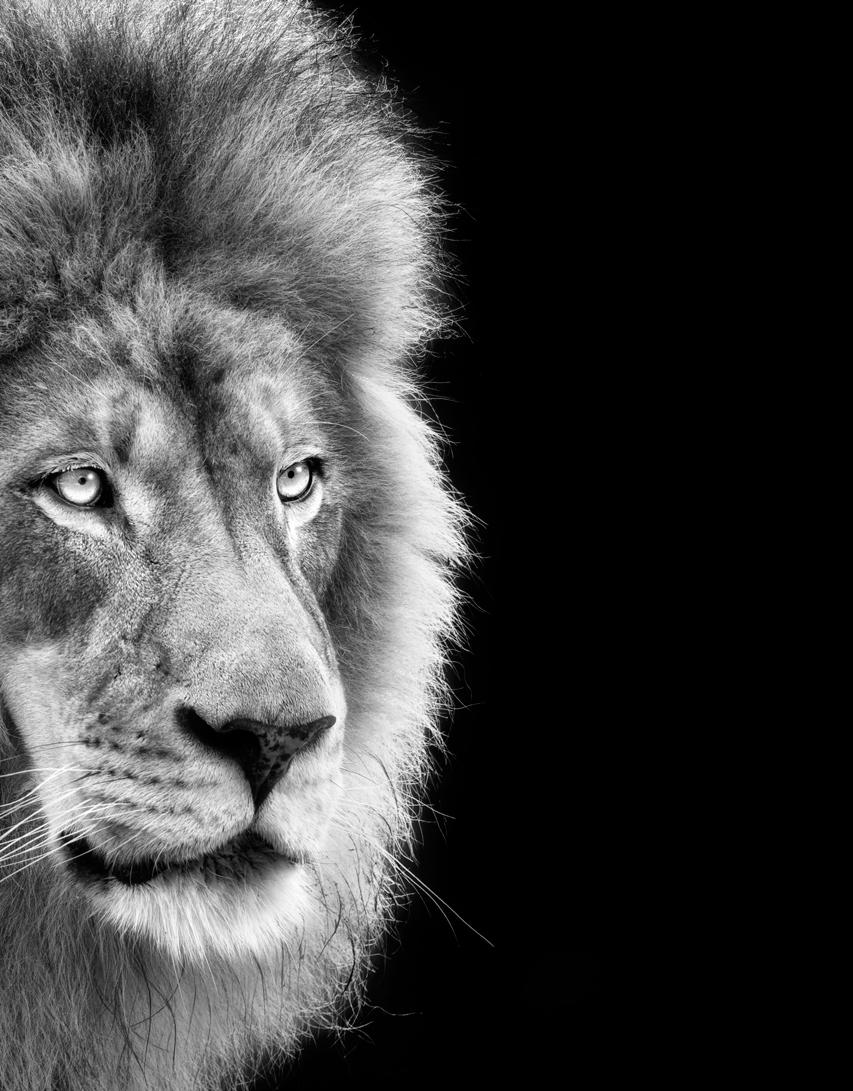
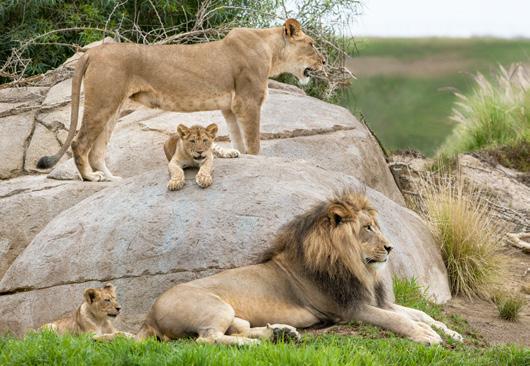
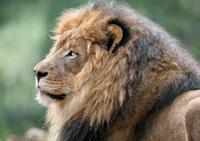
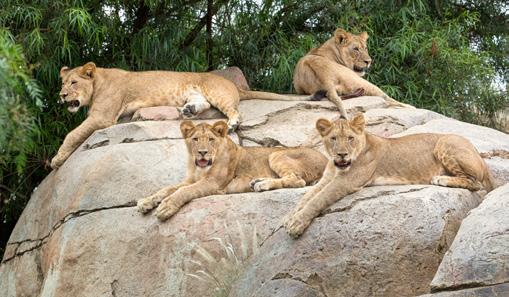
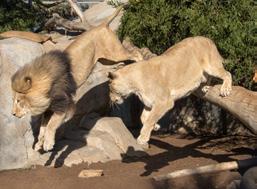
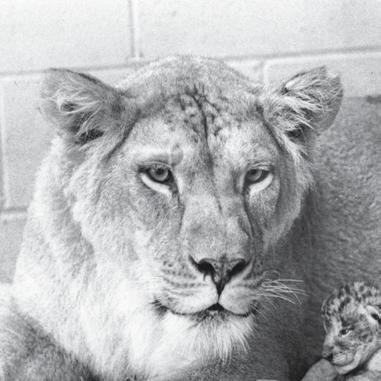
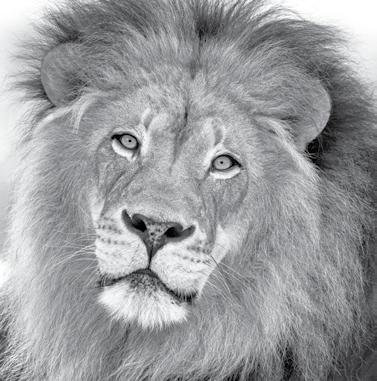
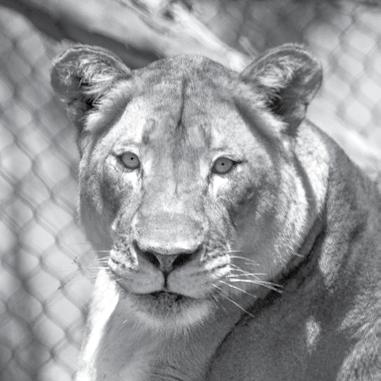
What sets the “king of beasts” apart from other big cat species? A lion’s share of unique attributes, both physical and behavioral.
Lions Lions have been a source of “pride” at the Zoo and Safari Park for 100 years!
Find out how keepers keep lions healthy and engaged at the Zoo and the Safari Park.
Why have lion populations declined more than 40 percent in the last 20 years? The king of the savanna needs our help!
100 Years of the San Diego Zoo, Part 5 The story of the San Diego Zoo continues, exploring the growth and innovative exhibits of the 1950s and 1960s.
lion Panthera leo
BY: Ken Bohn, SDZG Photographer
Show Your Pride
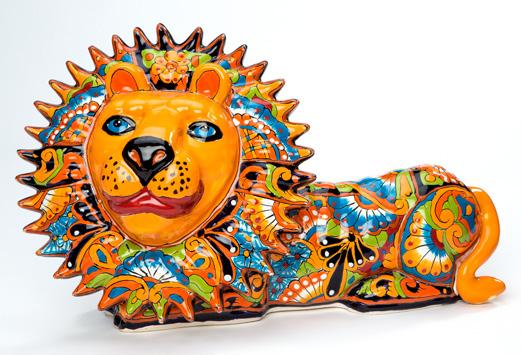
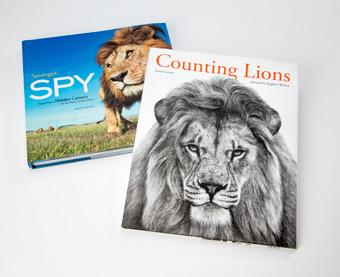
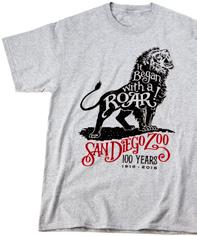
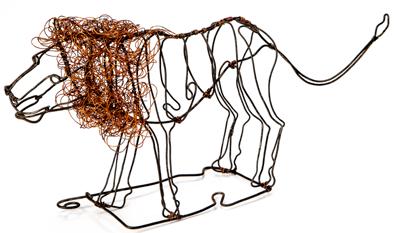
The king of beasts also reigns supreme at our gift shops. Our collection of lion-centric books, apparel, and décor items is certainly something to roar about! Visit our stores at the Zoo and Safari Park to see our entire collection. Available in select stores.
CHAIRMAN’S NOTE
ROBERT
B. HORSMAN
A Celebration to Roar About
Our centennial year is in full swing, with a new show at Wegeforth Bowl, beautiful short films about our conservation projects at the Bus Tour theater, and San Diego Zoo birthday parties that kicked off during Play Days in March. Now comes the biggest party of the year: our Centennial Community Celebration on May 14, 2016. I invite everyone in San Diego to join us for this festive, colorful, and musical tribute to 100 years of the San Diego Zoo, which will be held in Balboa Park, beginning at 6 p.m. at the Spreckels Organ Pavilion.
Zoo Ambassador Rick Schwartz will be sharing animal stories and introducing our animal ambassadors; there will be food vendors, performers, face painting, and craft making; and several Balboa Park museums will be open late, including the San Diego History Center, with its wonderful exhibition about the San Diego Zoo’s history, “The Lore Behind the Roar.” Then at 8 p.m., the main event takes place at the Spreckels Organ Pavilion stage, with a spectacular and unique performance backed by original music from a 50-piece orchestra, trumpeters, and a 130-member choir, along with a multitude of dancers—and some big surprises. Special guests Joan Embery and San Diego Mayor Kevin Faulconer will be there, and Tony- and Grammy-winning vocalist Heather Headly, who originated the role of Nala in “The Lion King” on Broadway, will headline the show. The program ends with an opportunity for all of us to set a Guinness World Record.
We are so happy to share this tremendous milestone year for the San Diego Zoo with you, looking back at our long and extraordinary history and looking ahead to the future, as we seek to fulfill our vision of leading the fight against extinction. I hope you will join us on May 14 and help us share the “ROAR!”
Before the Safari Park opens, enjoy a bountiful breakfast while watching our beautiful tigers, and see how the big cats start their day. Our buffet, featuring a traditional American hot breakfast, awaits you in Tiger Trail’s Sambutan Longhouse, which offers amazing views of our tiger habitat. The morning also includes a keeper talk and tiger enrichment.
Cost is $45 per person, plus tax and parking. Nonmembers add Safari Park admission.
FATHER’S DAY BUFFET
Sunday, June 19, 2016 Hunte Nairobi Pavilion, 11:30 a.m.
Celebrate the king of your pride in the wild setting of the Safari Park!
A lavish buffet will include hearty dishes and chef’s specialties as you raise a toast to Dad while enjoying live entertainment.
Guests will be seated at their own reserved table. Cost is $44.95 for adults and $18.95 for children (ages 3 to 11), plus tax and parking. Nonmembers add Park admission.
BREWMASTER DINNER FEATURING
Saturday, July 9, 2016 Hunte Nairobi Pavilion, 5:30 p.m.
Following a visit with our animal ambassadors, a representative from The Lost Abbey brewery will be on hand to present selected beers, accompanied by a four-course gourmet meal.
Cost is $89 per person, plus tax and parking. Must be 21 years of age or older to attend.
Save the Date
What’s happening at the Zoo and Park this month and next (Z) Zoo events (P) Park events
MAY 1
Epiphyllum Show and Sale
Check out the “orchid cactus” that bursts into glorious bloom in April and May. (P)
MAY 6, 7, 13, 21, 28, 29; JUNE 4, 11, 17, 18, 25
All Ages Roar & Snore Safari
Spend the night at the Safari Park with camping sleepovers for everyone. Call 619-718-3000. (P)
MAY 7–8
Garden Festival presented by Sparkletts
Discover beautiful and fascinating plants, enjoy family activities, and get advice from garden experts. (Z)
MAY 7, 8, 28; JUNE 4, 5, 25
Sunrise Surprise Strolls
Learn “inside secrets” and hear animal stories. Call 619-718-3000 or visit sandiegozoo.org. (Z)
MAY 8
Mother’s Day Brunch
Treat Mom to a lovely and festive meal in the Safari
Park’s unique surroundings. For reservations, call 619-718-3000 or visit sdzsafaripark.org/ dining. (P)
Albert’s
Mother’s Day Brunch
Honor Mom with a memorable spring brunch at the Zoo. For reservations, call 619-557-3964, 10 a.m. to 4 p.m. daily. (Z)
MAY 14
Centennial Community Celebration
This once-in-a-lifetime celebration of the San Diego Zoo’s 100th birthday starts at 6 p.m. at Spreckels Organ Pavilion in Balboa Park. Open to everyone—join us!
Nativescapes Garden Tour
A free guided walking tour of the Park’s garden; begins at 10 a.m. (P)
MAY 14, 20, 21; JUNE 4, 10, 11 KinderNights
Animal interaction and fun for children ages 3 to 6. For reservations, call 619-557-3962 or visit sandiegozoo.org. (Z)
PRESIDENT/CEO’S NOTE
DOUGLAS G. MYERS
MAY 20, JUNE 17/JUNE 5
Plant Day & Orchid Odyssey/ Orchid Odyssey Take a self-guided tour of our botanical gardens, or a Botanical Bus Tour; get a rare look inside the Zoo’s Orchid House. (Z)
MAY 14, 21, 28; JUNE 4, 11 KinderTots
Children ages 18 months to 3 years have fun discovering and meeting animals. To book, call 619-557-3962 or visit sandiegozoo.org. (Z)
MAY 28
Breakfast with Tigers
Watch our tigers start the day—then start yours with a buffet breakfast. For reservations, call 619-718-3000. (P)
JUNE 4
Albert’s Centennial Dinner
Celebrate our centennial!
Reception with animal ambassadors followed
A Centennial Celebration
Tby a three-course dinner. Ages 21 and up. (Kids’ Wild Night Out also available at additional cost.) For reservations, visit zoo.sandiegozoo. org/dining-events or call 619-718-3000. (Z)
JUNE 18
R•I•T•Z Gala
“It Began with a Roar” is the theme for this year’s Rendezvous in the Zoo (R•I •T•Z) black-tie fund-raiser, to benefit the Children’s Zoo. (Z)
JUNE 19
Albert’s Father’s Day Brunch
Celebrate Dad with a festive brunch. For reservations, call 619-557-3964, from
his month we are hosting a party that you could say was 100 years in the making: our Centennial Community Celebration, taking place on May 14, 2016, in Balboa Park. We decided on the location because the 1915-1916 PanamaCalifornia Exposition that established Balboa Park was also the impetus for the San Diego Zoo, and we continue to be a proud part of Balboa Park today. We also wanted a venue large enough to invite everyone in San Diego—and we do mean everyone! There is no admission required, and we hope to see San Diegans and their families there, to say thank you for supporting the Zoo throughout its history. It’s going to be a spectacular event—I don’t want to spoil the surprises, but suffice it to say, everyone will be “roaring” about it. I hope you will join us!
10 a.m. to 4 p.m. daily. (Z)
Father’s Day Buffet
Treat Dad to a buffet in wild surroundings. For reservations: sdzsafaripark.org/dining or 619-718-3000. (P)
JUNE 19–SEPTEMBER 5
Nighttime Zoo presented by Cymer
Enjoy a summer full of fun activities, live entertainment, and extended summer hours. (Z)
JUNE 25 –AUGUST 14
Summer Safari presented by SunPower Discover a full schedule of activities, live entertainment, and extended summer hours. (P)
LET’S TALK
Follow @sandiegozoo & @sdzsafaripark.
Share your #SanDiegoZoo & #SDZSafariPark memories on Twitter & Instagram.
LONG LIVE ANIMALS COME CELEBRATE WITH US!
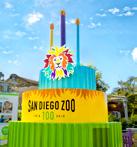
The San Diego Zoo is 100 years old this year—it’s time to party!
Saturday, May 14, 2016, the San Diego Zoo is throwing a party for our 100th birthday—and the guest list is everyone in San Diego! This free-admission event in the heart of Balboa Park starts at 6 p.m. with a dazzling array of performers, music, and family activities, as you stroll through the Plaza de Panama in Balboa Park. The animal-themed main event then takes place at the Spreckels Organ Pavilion with a multitude of dancers and some extraordinary surprises, backed by original music from a 50-piece orchestra, trumpeters, and a 130-member choir. Everyone in attendance will even help us set a Guinness World Record!
LEARN MORE AT sandiegozoo100.org
WAIT! THERE’S MORE.
YOU’RE ALSO INVITED TO A CENTENNIAL DINNER SATURDAY, JUNE 4, 2016
6 p.m. - Reception with Animal Ambassadors in the Treetops Banquet Room 6:30 p.m. - Dinner to follow in Albert’s Restaurant
Raise a glass, and toast the centennial birthday of the San Diego Zoo. Spend an evening taking a 100-year journey, and experience the history of how our Zoo became “world famous,” along with an amazing threecourse dinner prepared by our San Diego Zoo chefs. $72 per person, plus tax and gratuity. Must be 21 years of age to attend. Menu substitutions are not available for this event. Guests will be seated at tables of 8. For reservations, please call 619-718-3000 or book online at zoo.sandiegozoo.org/dining-events.
Kids’ Wild Night Out available in conjunction with the Albert’s Centennial Dinner. Additional cost is $37 per child. For more details, visit zoo.sandiegozoo.org.
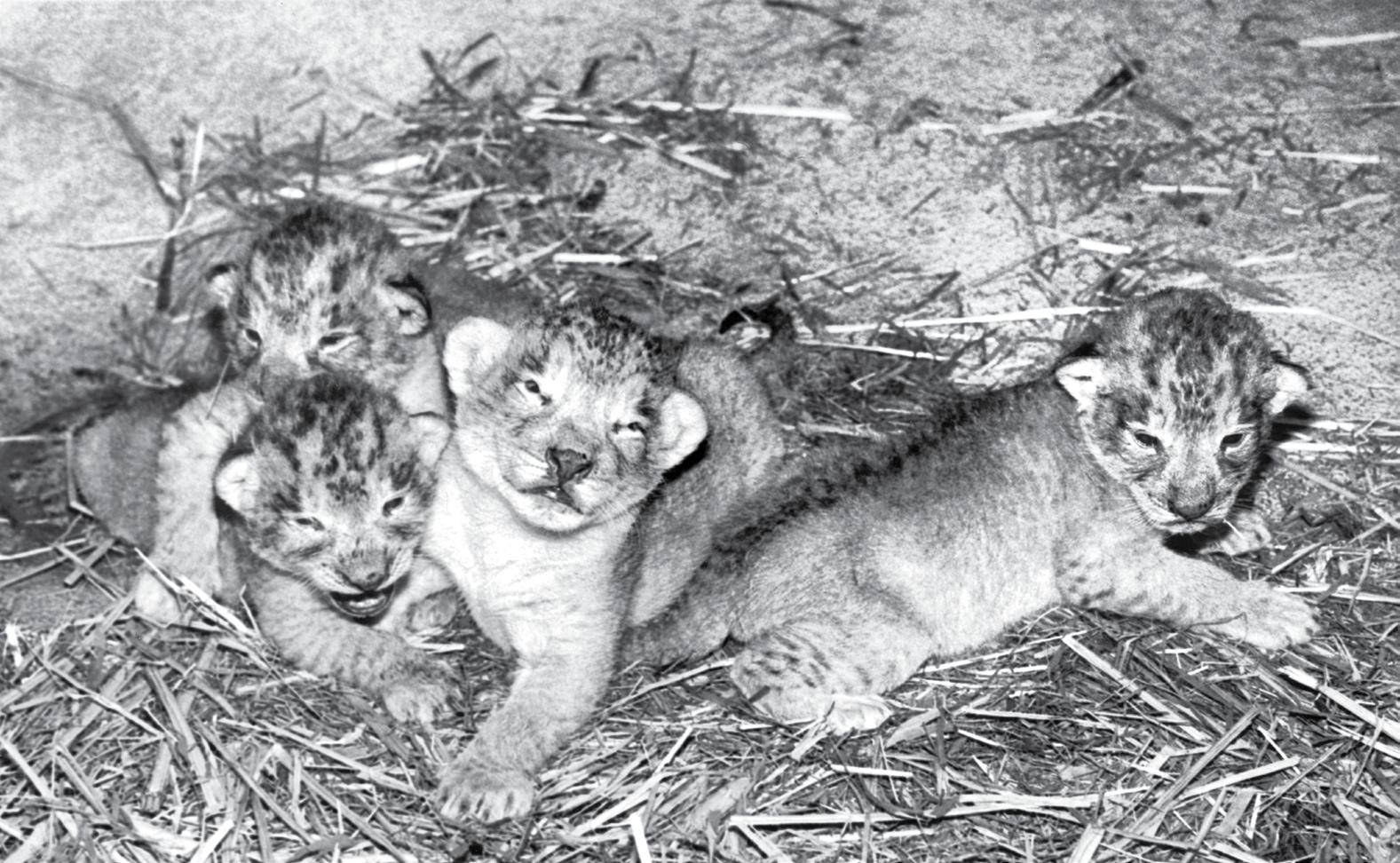
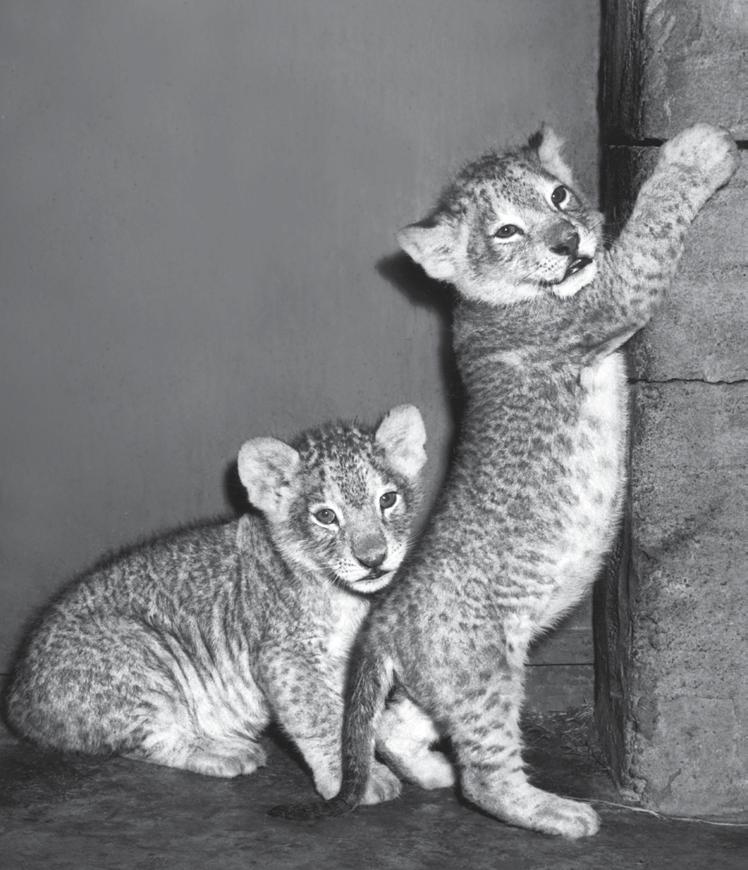
The birth of our first (what were then called) Asiatic lion cubs was an adorable litter of three males and a female.
It’s only a number
As you “may” know, the fifth month of the year has brought many notable events to SDZG that featured lions as the “mane” attraction.
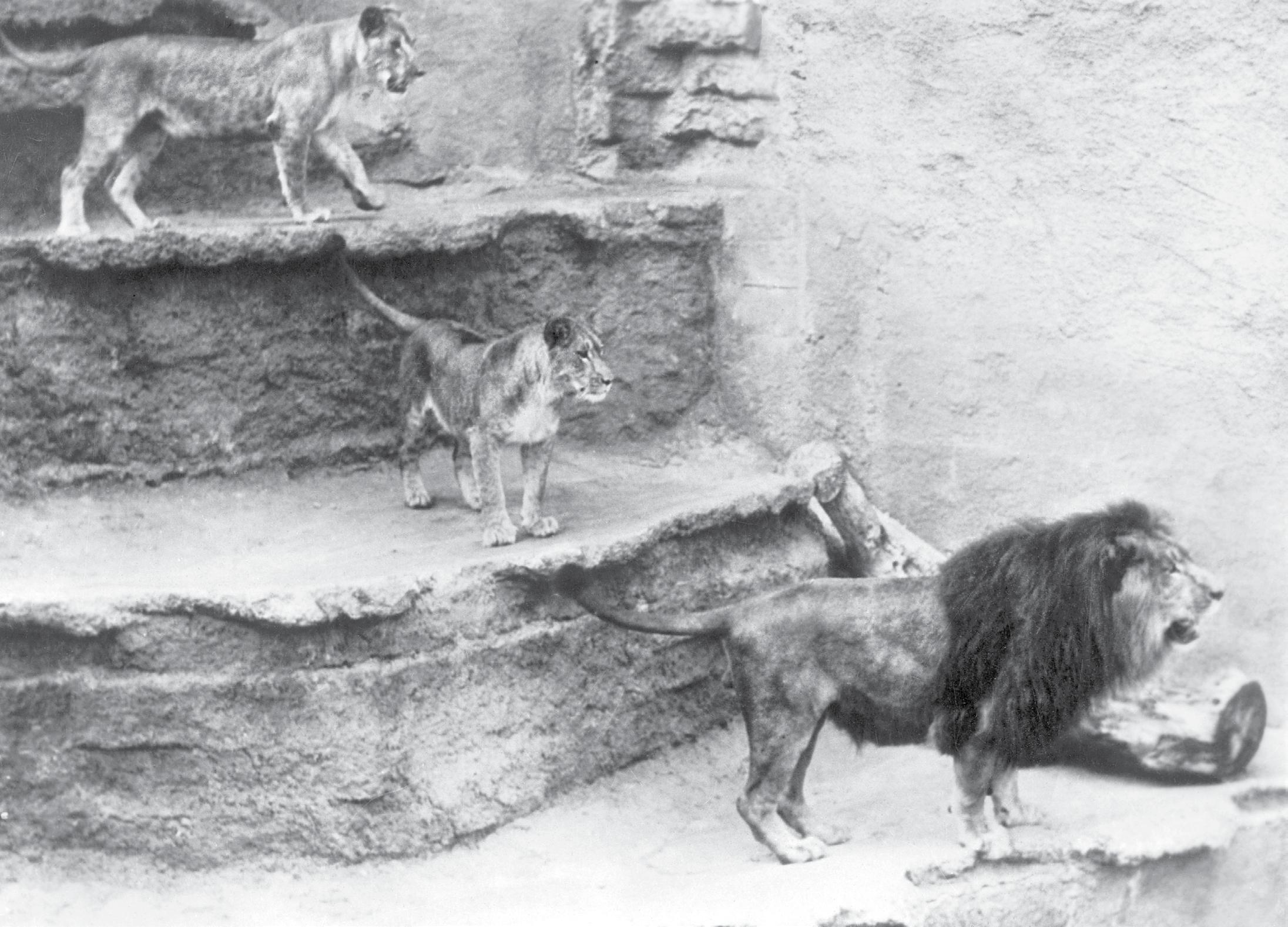
1944
Leo, a “truly black maned lion,” loved the camera and vice-versa! He graced the cover of the May 1944 ZOONOOZ.
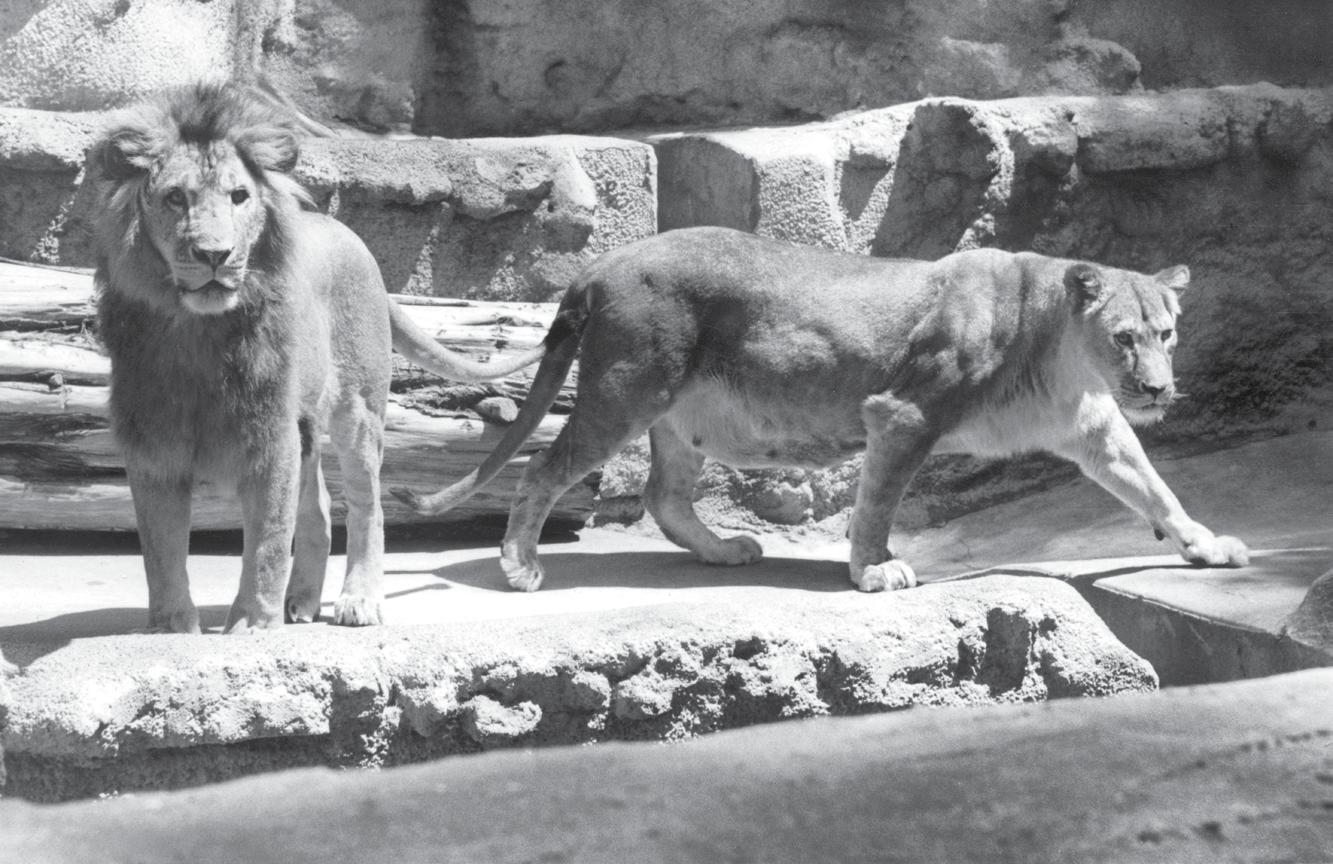
1958
Two African lion cubs, Pasha and Tanya, arrived at the San Diego Zoo in May of 1958. Tanya would later deliver cubs of her own at the Zoo.
ZOONOOZ
PUBLISHED SINCE 1926
®
MAY 2016 | VOL. LXXXIX–NO. 03
MANAGING EDITOR
KAREN E. WORLEY
ASSOCIATE EDITOR
PEGGY SCOTT
STAFF WRITERS
WENDY PERKINS
KARYL CARMIGNANI
DONNA PARHAM
COPY EDITOR
ESTON ELLIS
DESIGNER
KERRI ABRAMS
SAN DIEGO ZOO GLOBAL
PHOTOGRAPHERS
KEN BOHN
TAMMY SPRATT
DIGITAL IMAGING TECHNICIAN
TAMMY SPRATT
DESIGN AND PRODUCTION
KAMBIZ MEHRAFSHANI
KIM TURNER
AMY BLANDFORD
HEIDI SCHMID-ROMERO
LISA BISSI
JENNIFER MACEWEN
PREPRESS AND PRINTING
QUAD GRAPHICS
SAN DIEGO ZOO GLOBAL
OFFICERS
Robert B. Horsman, Chairman
Steven G. Tappan, Vice Chairman
Judith Wheatley, Secretary
BOARD OF TRUSTEES
Sandra Brue
Javade Chaudhri
Berit N. Durler
Richard B. Gulley
Clifford W. Hague
Linda Lowenstine, D.V.M., Ph.D.
Patricia L. Roscoe
Steven S. Simpson
TRUSTEES EMERITI
Frank C. Alexander
Kurt Benirschke, M.D.
Thompson Fetter
Bill L. Fox
Frederick A. Frye, M.D.
George L. Gildred
Yvonne W. Larsen
John M. Thornton
Albert Eugene Trepte
Betty Jo F. Williams
James Lauth, General Counsel
1983
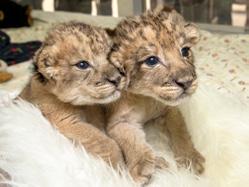
On May 4, 1983, the Zoological Society of San Diego welcomed its first (then-called) Asiatic lion cubs, born at the Wild Animal Park.
The Zoological Society of San Diego was founded in October 1916 by Harry M. Wegeforth, M.D., as a private, nonprofit corporation that now does business as San Diego Zoo Global.
The printed ZOONOOZ® magazine (ISSN 0044-5282) is currently published bimonthly, in January, March, May, July, September, and November. Publisher is San Diego Zoo Global, at 2920 Zoo Drive, San Diego, CA 92103, 619-231-1515. Periodicals postage paid at San Diego, California, USA, and at additional mailing offices.
ADDRESS CHANGES: Please send to Membership Department, P.O. Box 120271, San Diego, CA 92112.
Copyright® 2016 San Diego Zoo Global. All rights reserved. “ZOONOOZ” Reg. U.S. Pat. Office. All column and program titles are trademarks of San Diego Zoo Global.
Annual Memberships: Dual $135, new; $120, renewal. Single $111, new; $99, renewal. Each membership includes unlimited entrance to the San Diego Zoo and the San Diego Zoo Safari Park.
Subscription to ZOONOOZ magazine: $25 per year, $65 for 3 years. Foreign, including Canada and Mexico, $30 per year, $81 for 3 years. Contact Membership Department, P.O. Box 120271, San Diego, CA 92112, for subscription information.
As part of San Diego Zoo Global’s commitment to conservation, ZOONOOZ is printed on recycled paper that is 30% post-consumer waste, chlorine free, and is Forest Stewardship Council® (FSC®) certified.
2009
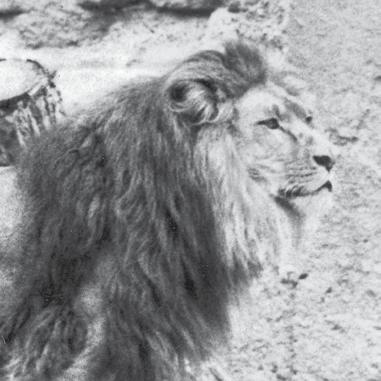
The Harry and Grace Steele Elephant Odyssey opened in May 2009 and included African lions M’bari and Etosha.
SAN DIEGO ZOO HOURS
May 1–31: 9 a.m. to 6 p.m.
June 1–17: 9 a.m. to 6 p.m.
June 18: 9 a.m. to 5 p.m.
June 19–30: 9 a.m. to 8 p.m.
SAFARI PARK HOURS
May 1–27 and 30–31: 9 a.m. to 5 p.m.
May 28–29: 9 a.m. to 6 p.m.
June 1–24: 9 a.m. to 5 p.m.
June 25–30: 9 a.m. to 7 p.m.
WEBSITE sandiegozoo.org
PHONE 619-231-1515
ONLINE VERSION OF PRINT ZOONOOZ® issuu.com/sdzglobal
FSC® is not responsible for any calculations on saving resources by choosing this paper.
Douglas G. Myers, President/CEO
Charles L. Bieler, Executive Director Emeritus
THE FOUNDATION OF SAN DIEGO ZOO GLOBAL
OFFICERS
Murray H. Hutchison, Chair
Maryanne C. Pfister, Vice Chair
Susan N. McClellan, Secretary
Richard M. Hills, Treasurer
Mark A. Stuart, President
Robert B. Horsman, Ex officio
Douglas G. Myers, Ex officio
BOARD OF DIRECTORS
Christine L. Andrews
Joye D. Blount
Rick Bregman
Lisa S. Casey
Douglas Dawson
Berit N. Durler, Ex officio
Chris L. Eddy
U. Bertram Ellis, Jr.
Arthur E. Engel
Craig L. Grosvenor
Michael N. Hammes
Judith C. Harris
Michael E. Kassan
Susan B. Major
Michael D. McKinnon
Joshua Pack
Philip C. Seeger
Ryan Sullivan
Thomas Tull
Margie Warner
Ed Wilson
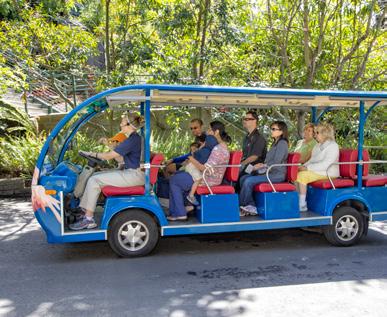
Our Inside Look and Discovery Cart Tours at the Zoo and Behind-the-Scenes and Cart Safaris at the Safari Park provide an up-close and personal experience you’ll always remember. Let our guides introduce you to our incredible animals while you have opportunities to get great photographs. Best of all, you can get better views of your favorite animals and ask your guide as many questions as you like. Fill your scrapbook with amazing memories of everything you encounter on your tour!
TUFT
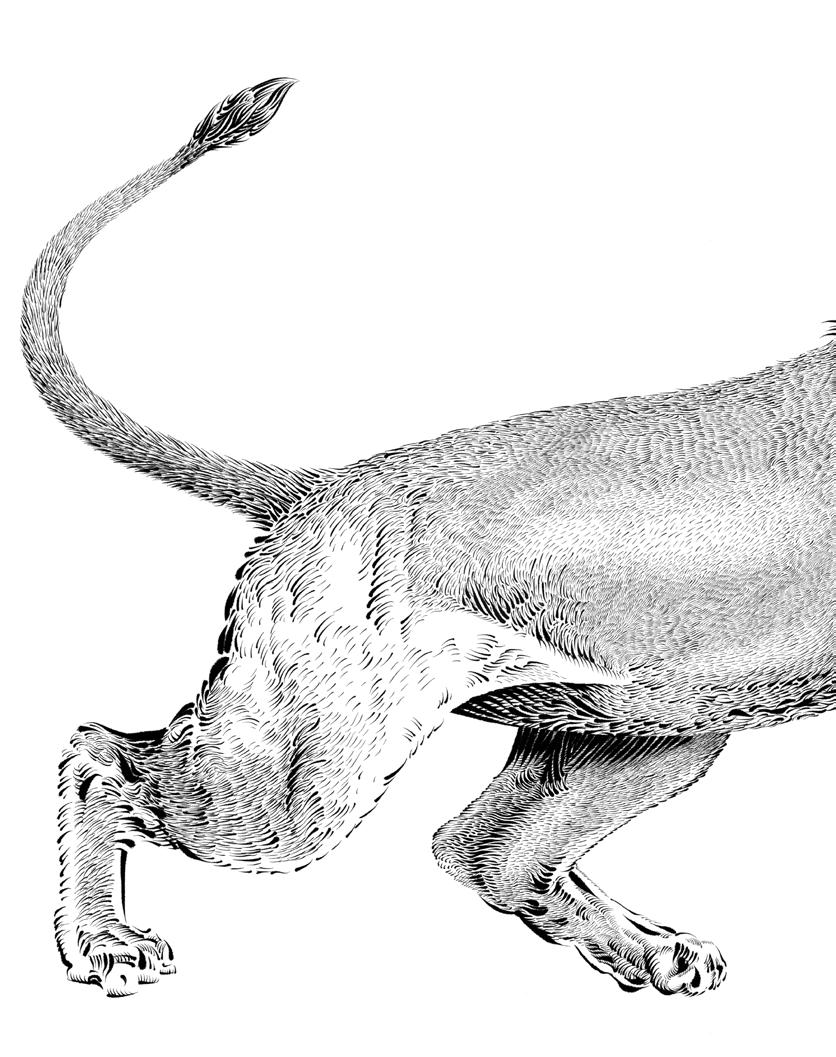
Lions are the only cat with a tuft at the tail tip. The black tassel covers a hard spur, and may be used to signal others while hunting.
ON THE RUN
Female lions can sprint more than 30 miles per hour. Males are generally slower.
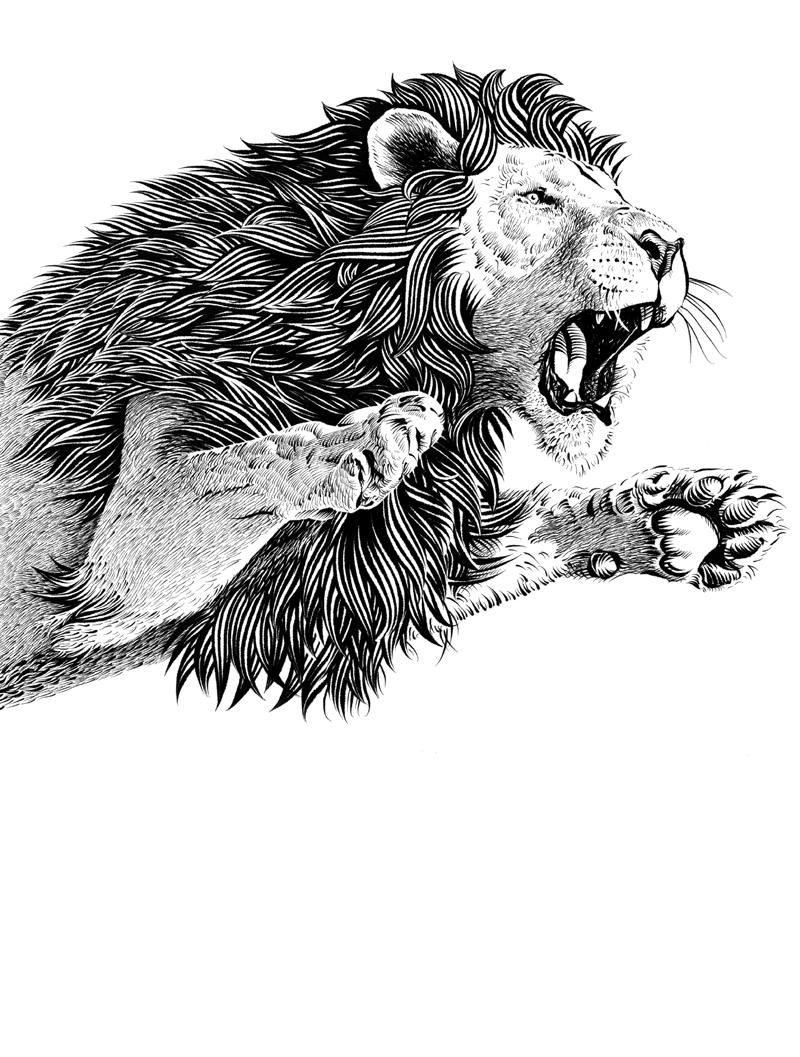
Lions Revealed
From their powerful call to the males’ regal, crowning mane, lions top the big cat list for a reason. Take a closer look at the king of beasts.
ILLUSTRATION BY AMY BLANDFORD | SDZG ILLUSTRATOR
TEXT BY WENDY PERKINS | STAFF WRITER
TOTAL PACKAGE
With a brawny build and 1.5-inch-long claws, lions are built more for attacking than chasing.
“MANELY” TRUE
Not all male lions have manes. Some living in hot, dry regions are smooth-necked, while others have a slight, sparse ruff.
MANE
The color, size, and abundance of the mane vary among individuals and with age. The enormous ruff makes the male look more impressive to females, more intimidating to rival males, and protects the neck against raking claws during fights.
VANISHING ACT
Lions were once found in Europe, Africa, the Middle East, North America, and northern India. Today, most lions live in Africa, except for a small population that lives in India’s Gir Forest.
THROATY ROAR
Lions and other cats that roar are able to do so because their larynx is located deeper in the throat than other felids. Straps of muscle pull the larynx even lower as the cat exhales to make the sonorous sound.
WHISKER SPOTS
The arrangement of muzzle whiskers on a lion is as unique as a fingerprint. Researchers can use the pattern of black spots at the base of each whisker to identify individual cats.
SCENT SIGNALS
Beyond the large nostrils is a complex maze of nasal passages. Scent is a key form of communication among lions.
THE LIFE
OF LION
They’re not the biggest living cats (tigers take that title), yet they have loomed large in human culture for centuries. What is it about lions that grips the human imagination?
BY WENDY PERKINS | STAFF WRITER PHOTOS BY KEN BOHN | SDZG PHOTOGRAPHER
It likely began with their powerful presence, and our fascination is revealed in the numerous depictions of lions in art as well as on shields, banners, flags, and countless bits of ephemera. It’s a reverence that continues today. But our lionization (we even invoke them to indicate ultimate admiration) transcends the physical to include the intricacies of their lifestyle and very being.
A CAT LIKE NO OTHER
You may have heard the lion Panthera leo referred to as the “King of the Jungle”—but that’s an ironic name, because lions aren’t found in that dense, tangled type of habitat. They are, however, one of the rulers of grasslands, open woodlands, and scrublands. They may have inhabited other biomes in the past; lions as we know them once thrived in Europe, Asia, India, and Africa. Today, there are two recognized subspecies, Panthera leo leo and Panthera leo melanchaita. There are between 17,000 and 19,000 of the leo subspecies scattered across southern and eastern Africa; there are only about 1,400 of the endangered melanchaita subspecies left, which live in small African populations and one population under human protection in India’s Gir Forest.
Compared to other members of the big cat genus Panthera—tigers, leopards, and jaguars—lions stand out both physically and behaviorally. They are the only cat with a tufted tail, as well as the sole feline species to display dramatic sexual dimorphism:
regally ruffed males are easily distinguished from sleek females. And, of course, lions are the only cats that live in large social groups.
POINT OF PRIDE
Most people today know that a group of lions is called a pride, but that wasn’t always the case. Although humans shared habitat with these social cats for thousands of years, the first evidence of a name for a group of lions doesn’t show up until the
15th century, and it wasn’t common until the 1930s. Why a “pride”? The official reasoning is lost to the ages, but the sight of a group of lions striding along together does seem to embody the confidence and satisfaction the word conveys.
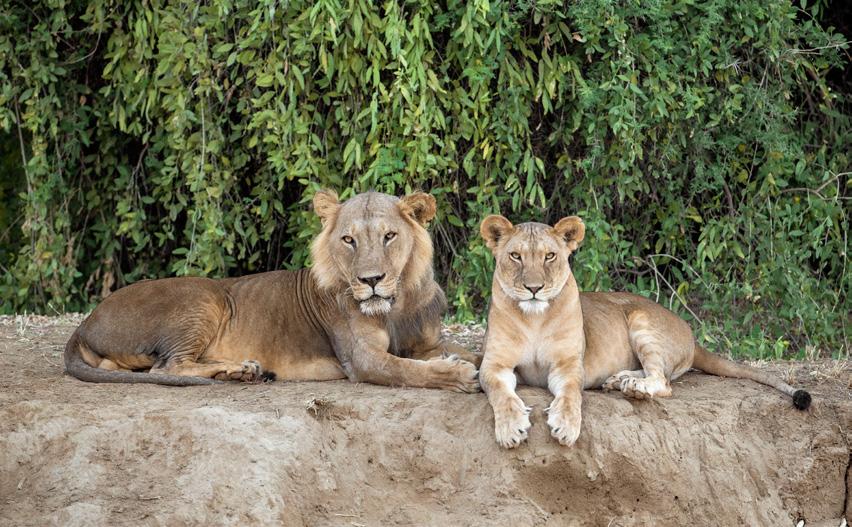
A pride is made up of lionesses (mothers, sisters, and cousins) and their cubs, a few related sub-adult males, and, of course, the reigning adult male. The size of the group can vary depending on location, usually numbering 3 to 30 individuals. In dry areas with less prey, prides are smaller; habitats with more food and water allow for the survival of more members.
It isn’t uncommon to come across lions that do not live in prides, though. Called nomads, they range far and wide while following migrating herds of large game. They are generally young males, roaming in pairs or small groups and often related to one another, but female nomads exist, too.
Related lionesses, especially the older ones, usually live together. Adult males, however, may only stay with a pride for two to three years. During that time, their main job is to defend the pride’s territory—its pantry, so to speak. The pride spends the day’s hottest hours resting. At nightfall, they disperse: females
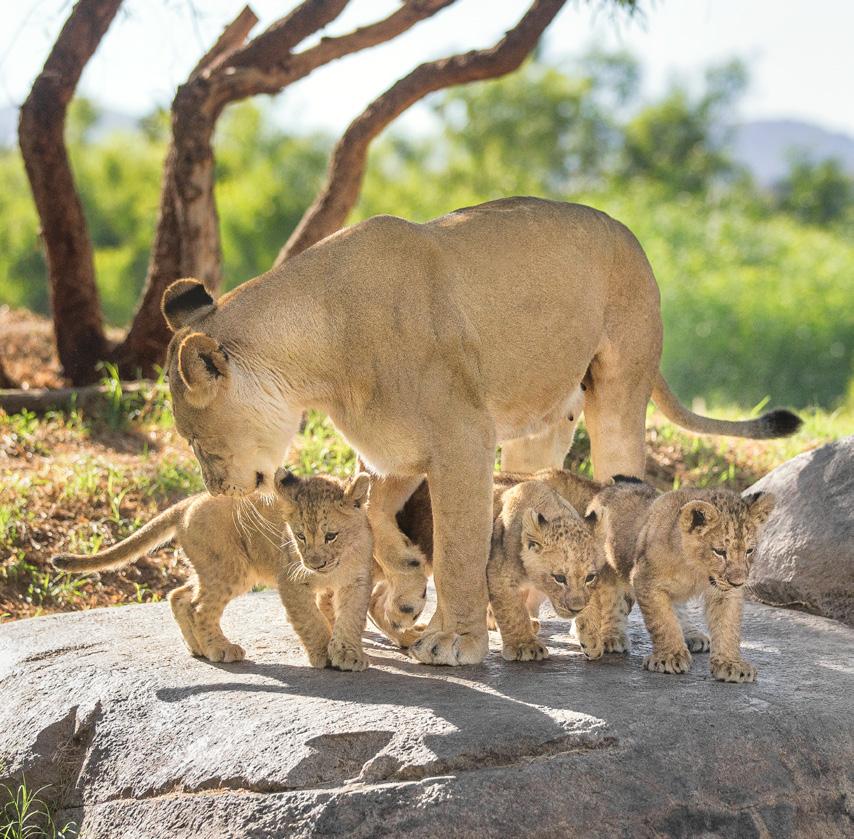
This page: Excellent vision and 2.5-inch-long canine teeth contribute to the lion’s renowned hunting ability. Opposite page: Lionesses are highly attentive to cubs—both their own and those of other females in the pride.
to hunt, and males to patrol and protect the boundaries of the domain. There are almost always unaffiliated male lions looking to take over a group of females. If the newcomers are able to vanquish the reigning males, they win the pride.
The lionesses work together to hunt and rear the cubs. This cooperation streamlines their survival: they get the most from their hard work, increasing the odds of keeping everyone healthy and safe. The division of labor between males and females makes sense, as lionesses are smaller, lighter, more agile, and faster sprinters than males.
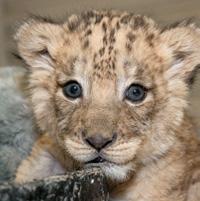
Unique among cats, male lions interact with their offspring. At the Safari Park, Izu has proven to be a patient and playful father to his cubs. Below: Cubs have spotted coats until three months of age.
FEEDING THE FAMILY
A sampling of ways to say “lion”
Löwe (German)
Simba (Swahili)
Igonyama (Xhosa, Zulu)
León (Spanish)
Tau (Sotho)
Shumba (Shona)
Zaki (Hausa) DID YOU KNOW?
Hunting as a group increases the odds of a successful hunt; there is a better chance that the lions have food when they need it. While hunting, smaller females typically chase prey toward the center of the group. The larger and heavier lionesses ambush or capture the prey. Lionesses are versatile and can switch jobs, depending on which females are hunting that day and what kind of prey they are stalking.
Females—and even males—do sometimes hunt on their own. Generally, this approach yields smaller prey, such as a warthog or Thomson’s gazelle. The big prize, however, takes teamwork. An adult male can eat nearly 90 pounds of meat at a single meal, so bigger prey yields a better return on investment.
CLUB CUB
Females in a pride often give birth around the same time, but not in the same location. A lioness typically
finds a secluded spot away from the group to give birth. She keeps the cubs hidden for the first four to six weeks of their life, leaving them only to find food. Once she brings them into the presence of the pride, they not only have plenty of playmates, they have many “mothers.” Adult females will nurse any cub in the pride, not just their own. This extra
attention is a significant advantage—cubs born in a pride are twice as likely to survive as those born to a nomad lioness.
At three months old, cubs follow their mother wherever she goes, and they are weaned by the age of six months. How long a lion cub stays with its mother depends on the sex of the cub. Mothers generally raise males until they are about two years
old; then at that stage, the mother usually runs them out of the pride. Female cubs often stay with the pride, and a mother and daughter may live together for life. However, as the pride continues to grow, it may split up into smaller groups that share a territory but don’t spend much time together.
THAT ROAR… AND MORE
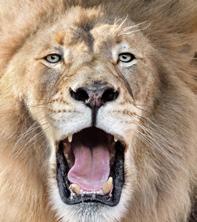
Lions are famous for their mighty roar. Under the right conditions, the sonorous call can be heard up to three miles away and mostly serves to announce territorial ownership. Most people base their imitation of a lion’s roar on what they’ve heard in movies and television. Yet, this cat’s vocal signature is not just a single vocalization, but rather a sequence.
The lion’s iconic call begins with a few fairly soft sounds that increase in volume, frequency, and duration until the full roar is realized. After about 40 seconds, the sounds begin to decrease, ending in a series of grunts. Males are able to roar when they are about one year old, and females can roar a few months later.
Lions use their roar as one form of communication. It identifies individuals, strengthens the pride’s bond, and lets other animals know the pride’s domain. Other sounds
Although lions get most of their moisture from their prey, a water source is an important part of their territory; it draws prey to a good ambush spot. DID YOU KNOW?
46401 3SanDiego Zoo.pdf 1 2/26/16 3:29 PM
lions produce include growls, snarls, hisses, meows, grunts, and puffs, which sound like a stifled sneeze and are used in friendly situations. Lions usually roar at dawn and dusk to communicate with pride members that might be in a different part of the territory. While the lions
at the San Diego Zoo and the Safari Park have their pride mates close at paw, they instinctively let loose and sound off to any ears in the area. Anyone nearby can’t help but be impressed—it’s a call not only heard but felt! See if you experience the roar on your next visit. e cap to you
A tip of the cap to you
Congratulations on 100 years of hope, innovation, conservation and roars!
Congratulations on 100 years of hope, innovation, conservation and roars!
Coca-Cola is proud to be San Diego Zoo and Safari Park's O cial Beverage Sponsor.
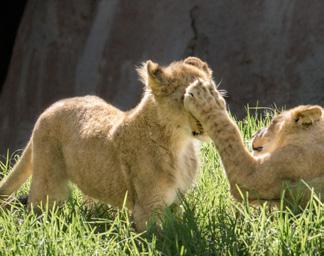
Wrestling and batting each other helps cubs develop hunting skills.
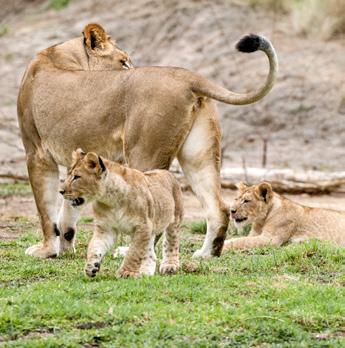
Lions are the only cats with tufted tails. The black hair serves as a visual signal.
TRAVEL THE WORLD WITH THE SAN DIEGO ZOO
WORLDWILD TOURS
Travel with the San Diego Zoo’s WorldWild Tours™ to some of the wildest places on Earth in 2016 and 2017. Our itineraries highlight the wildlife at each destination and include expert naturalists and a San Diego Zoo Global escort, plus a group of like-minded travelers. For brochures, visit sandiegozoo.org/travel or call Julia Altieri at 619-685-3205.
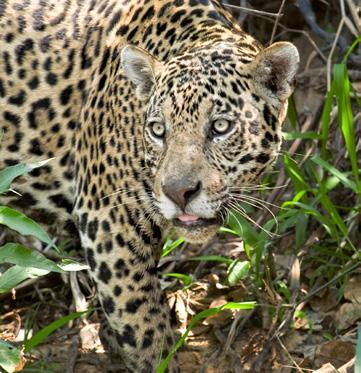
BRAZIL’S PANTANAL AUGUST 19–28, 2016 Explore Brazil’s Pantanal, the Serengeti of South America and the world’s largest wetland. $6,373 plus airfare (per person, double occupancy)
Coming in 2017
HAWAII
February 2017
CHINA AND ITS GIANT PANDAS May 2017
KENYA June 2017
GALÁPAGOS ISLANDS
October 2017
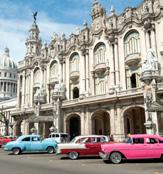
CUBA AND ITS WILDLIFE
OCTOBER 21–31, 2016
From Havana to the national parks, explore the vibrant wildlife and culture of this mystical island country. $6,995 plus airfare (per person, double occupancy)
POLAR BEAR ADVENTURE
OCTOBER 28–NOVEMBER 3, 2016
Chill with polar bears in their native habitat from the comfort of the Tundra Buggy Lodge in Churchill, Canada
$6,073 plus airfare (per person, double occupancy)
AROUND THE WORLD
SEPTEMBER 29–OCTOBER 22, 2016
Experience a lifetime of must-see iconic destinations, including Machu Picchu, the Great Barrier Reef, the Serengeti Plain, and Angkor Wat. $76,950 plus round-trip airfare to and from departure city (per person, double occupancy)
WILD ENCOUNTERS
FEBRUARY 17–MARCH 8, 2017 Set off on a wildlife adventure and come face to face with the world’s legendary creatures in their natural habitats, including India’s jungles, the Serengeti Plain, the mountains of Rwanda, and Borneo’s rain forest. $83,950 plus round-trip airfare to and from departure city (per person, double occupancy)
CUBA
BRAZIL
CANADA
LEGENDARY LIONS
From regal Rex to enchanting Miss Ellen, lions have been a major source of “pride” during our 100-year history, and these beautiful big cats continue to captivate guests at the Zoo and Safari Park.
BY PEGGY SCOTT | ASSOCIATE EDITOR PHOTOS BY SDZG
Prince (right), and his cubs were early stars at the Zoo.
While the lion is widely regarded as the king of beasts, this regal feline also reigns supreme in San Diego Zoo lore. After all, as the story goes, “It began with a roar!” On that fateful day in 1916, upon hearing the roar of a lion in the menagerie left over from the 1915-1916 Panama-California Exposition, did Dr. Harry Wegeforth know that his inspiration for a zoo in San Diego would become his legacy to America’s Finest City, and to the zoological world? Over the past 100 years, many lions have graced the Zoo with their presence, and if there’s one thing that has been retained over a century, it’s the lion’s enduring role as a “mane” attraction.
FELINE FOUNDING FATHERS (AND MOTHERS)
While vociferous Rex (he of roaring fame) may have helped prompt the creation of the Zoo, his fellow felids played a role in making the place a “must-see.” The birth of the Zoo’s first-ever lion cubs, Faith, Hope, and Charity, in 1917 seemed to indicate that the big cats were doing pretty well in the foundling Zoo. Lions Prince, Cleopatra, and Rena were at the center of zookeeping history in 1923, when a donation from Zoo benefactor Ellen Browning Scripps funded the construction of the first two open-air grotto exhibits in the US—one for bears and the other for the Zoo’s pride of lions.
Prince was the picture of lion-esque
manliness—except for one soft spot: his cubs. He calmly indulged those “little terrors” and their games of tug-the-tail and pounce-on-pop, even taking care to not let his heavy, drowsiness-laden head drop onto the little cubs as they snoozed, draped across his paws. Fatherhood certainly seemed to agree with Prince—he ended up siring 19 offspring! Another early lion, Babe, also possessed great patience for offspring and their penchant for tail biting. Lots of lion cubs were born in those early years—Cleopatra had 33 babies over an 8-year period! In our 100-year history, 130 lions have been born at the Zoo.
In 1941, Zoo staff would experience a
new version of lion care—the hand raising of a cub. Little Sheba was rejected by her mother and ended up in the care of veterinary hospital attendant Emily Burlingame. Sheba was so attached to Emily that even after the lionness was grown, she thought white coats or dresses, which Emily wore, meant someone was bringing her a bottle.
The Zoo’s lion family tree branched out again in 1951, when Moja, Tatu, and Victoria—the Zoo’s first Masai lions— went on exhibit, coming to San Diego from the “Kenya Colony in British East Africa.” The newcomers settled in nicely, with Victoria giving birth to two cubs (sired by Moja) in July of 1953, and a female cub in April of 1955. Four lion cubs would mark another milestone for the Zoological Society of San Diego in 1983, as the Safari Park (formerly called the Wild Animal Park) welcomed its first birth of what were then known as Asiatic lions. The cubs, three males and a female, were born to mother Munda, and were an important contribution to our conservation efforts.
TODAY’S CATS OF CHARACTER
The San Diego Zoo Safari Park has had lions on exhibit since it opened in 1972, and it has welcomed 73 births over
The Zoo welcomed the birth of its first Masai lion cubs in 1953.
Ike and Vicky reigned in the 1950s.
the years. In 2004, the Safari Park’s Lion Camp: The Sylvia G. Straton Lion Savanna opened, with six adorable young Transvaal lion cubs from a facility in South Africa. Three of them, now 12 years old, still live at Lion Camp: Izu, the regal male, playful Mina, and lioness-in-charge Oshana. Many of their 18 surviving cubs from over the years are now residing in other zoos, but 6 are still here. Two-year-old brother-and-sister duo Ken and Dixie, who were hand raised at Lion Camp, will move to other facilities in order to support genetic diversity. And given their personalities—Ken is a playful, loving boy, and Dixie is a firecracker— they are sure to win hearts wherever they go.
Lion Camp’s youngest lions, a foursome born in July of 2014, are keeping things quite lively. Outgoing Ernest is the curious one, and Miss Ellen likes being the beauty queen. Marion is the litter’s peacekeeper—unlike Evelyn, who is the boss of the group and takes after her mother, Oshana, with her feisty personality.
Not only are the Park’s lions iconic to keepers, staff, and guests, they’ve also contributed to pop culture. When working on The Lion King, Walt Disney Pictures’ animators visited the Safari Park and our lions for inspiration for the movie. (The Zoo’s meerkats and
No Lion
One of the Zoo’s early residents, Prince had a particular soft spot for
Clockwise from top: Evelyn, Miss Ellen, Ernest, and Marion; M’bari and Etosha; Ken and Dixie.
warthogs also influenced the Timon and Pumbaa characters.)
Two of the original Lion Camp residents, M’bari and Etosha, now hold court in the Harry and Grace Steele Elephant Odyssey at the Zoo. At this “kingdom,” guests get close enough to count the cats’ whisker spots and bask in the lions’ golden gaze, and specially heated rocks make the perfect lounging spot for the king of beasts. Ever the maned monarch, M’bari awes visitors
with his majestic bearing and late-afternoon bouts of roaring, while keepers describe Etosha as mellow and sweet.
We are proud of our lions and their key role in the Zoo’s story. A sculpture of Prince on the Zoo’s entrance plaza honors the iconic status of lions in San Diego Zoo history and makes for a memorable photo opportunity. To San Diegans, lions are symbolic of their zoo, and will be a source of much “pride” for the next 100 years and beyond.
The San Diego Zoo and Safari Park have been home to many notable lions throughout the years. Here are just a few of those charismatic big cats.
Born in 1941, Sheba was the first lion cub to be hand raised
In 1983, she had our first (formerly called) Asiatic lion cubs.
An original Lion Camp resident, Izu is the proud father of 18 cubs.
The fastest way to this mellow girl’s good side is with food!
PRINCE
his cubs.
SHEBA
at the Zoo.
MUNDA
IZU
ETOSHA
&May 7 and 8, 2016
Come to the Zoo to celebrate all things green and flowering during this year’s GARDEN FESTIVAL presented by Sparkletts.
Our theme for this centennial year is “SEE HOW WE’VE GROWN.” Discover how the Zoo’s botanical wonders have blossomed, branched out, and transformed the San Diego Zoo during its 100 years, with special tours, displays, family activities, and a chance to talk with our garden experts. After all, we’d be nowhere without plants!
THE “MANE” HIGHLIGHTS OF LION CARE
A great deal goes into keeping the lions at the Zoo and the Safari Park healthy and challenged.
BY KARYL CARMIGNANI
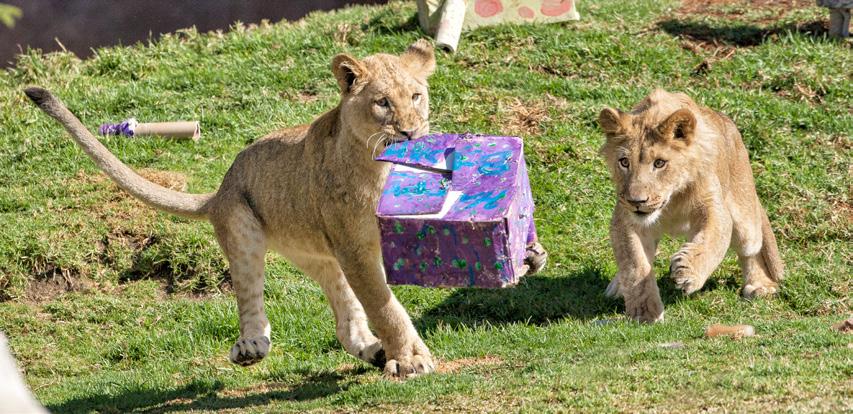
Above: Like cats everywhere, lion cubs love boxes! These enrichment items provide them with lots of exploration and activity.
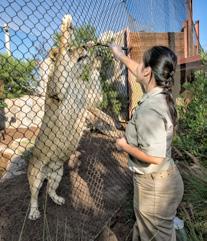
Right: Keepers train the lions in husbandry behaviors that help keep them healthy.
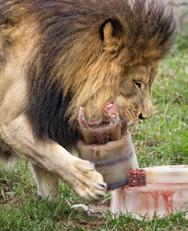
Facing page: Izu enjoys his “blood-sicle” treat.
One of the most recognizable and admired creatures on the planet, African lions at the Zoo and the Safari Park draw visitors like dress pants attract cat hair. Even in slumber—a common activity—the tawny cats are a sight to behold. Big, bold, brainy, and bewitching, lions can be challenging to keep challenged, but keepers pull out all the stops to ensure the cats have compelling enrichment and stay healthy.
As highly social animals, Panthera leo also bring big-cat drama to the fore, so keepers are dialed into pride and pair dynamics. For instance, keepers at the Zoo can gauge the mood of 12-year-old M’bari, the regal male, by the actions of his mate, Etosha. “If he’s
in a good mood, they play and tug each others’ tails,” said Kimberly Hyde, senior keeper. “But if he’s grouchy, it’s obvious that she is avoiding him and staying out of his way.” Then the keepers know not to ask M’bari to do anything out of his comfort zone. “They are a strongly bonded pair,” she said, “and they have very different personalities.” Indeed, each lion exhibits its own type of felid charm. The Zoo is home to two lions, and nine lions live at the Park.
GOOD PUPIL
GOOD PUPIL
Cultivating animal husbandry behaviors is “the result of practice, patience, and professional protocols,” said Safari Park keeper Lacey Byrnes. While it may look like magic,
| STAFF WRITER PHOTOS BY KEN BOHN | SDZG PHOTOGRAPHER
it is “through the use of operant conditioning, positive reinforcement, and trust-based relationships that keepers can train cats to demonstrate a variety of behaviors that allow us to provide the best care possible.” Never was that more pressing than when a lion youngster named Ernest at the Safari Park was diagnosed with a cataract in his eye. Part of the post-surgical protocol was for the one-year-old cat to have eye drops applied three times a day. Given our protected-contact practices, where there is always a secure barrier between staff and potentially dangerous animals, keepers had to find a way to administer the eye drops through the mesh.
Training began before his surgery. “We used a fourinch-long pipette that could fit through the mesh, and with the other hand fed Ernest a special meat mixture while we flushed his eye,” explained Janet Lawhon, lead keeper. As the lion recovered from his procedure in November 2015, he eagerly went along with the thricethen twice-daily eye treatment, and then it was down to once a day. He finished his follow-up eye care in February and is now good as new!
BIG CAT TRAINING
To monitor the health of the lions at the Zoo and the Safari Park, keepers train them in several basic husbandry behaviors, including present paw, open mouth, rise up, lie down, roll over, station/target station, and crate. Other behaviors that take a great deal of time and patience on both sides of the mesh are blood draws from the tail and having the cats accept injections while awake. “Vaccinations for rabies, feline viruses, and canine distemper can be administered while they are anesthetized for a routine physical exam,” explained Dr. Cora Singleton, associate veterinarian at the Zoo, “but it is helpful if the cats will accept the injections without a trip to the hospital.” These behaviors will benefit the cats as they age, since lions are susceptible to diseases similar to those of domestic cats, including kidney issues, arthritis, and cancer. For injections, the lion is asked to station, pressing its side against the mesh. While one keeper rewards the behavior with delicious meat bits, the other keeper gives the cat a little poke on the flank with a finger, then a pencil, and eventually an empty hypodermic needle. “You can’t rush it,” said Kimberly. At the Zoo, M’bari is slow to catch on, as he is not a fan of change, but Etosha, who “pretty much likes anyone who feeds her,” is a quick study. Similar behavioral training at the Zoo and Park goes into
blood draws from the tail. Though it is a lengthy process, it is not impossible, and collecting these samples from the cats is important in managing their health. “Collecting blood samples enables us to check for signs of infection or organ dysfunction, as well as test for heartworm and monitor their response to vaccines to make sure they are still protected,” said Dr. Cora.
A MATTER OF CHOICE
As social big cats, lion prides have a certain amount of “fun” built into their activities by interacting with group members. But keepers also keep things interesting for their charges with a variety of other stimuli. To keep the cats’ prowling skills honed, keepers provide “meatball hunts” with hand-rolled meat treats hidden throughout the exhibit. The cats are also crazy for scents like kitchen herbs, animal hair, and high-end perfume, which they rub their faces on and roll in like a field of catnip. Kimberly said it is a natural lion behavior to “mask the predator scent” to improve hunting success.
At the Park, Izu adores rolling in wood shavings and minty scents like wintergreen and peppermint, said Janet. “He also loves boxes, and will protect one like a prey item!” At the Zoo, M’bari’s favorite scent is elephant dung, which he covers himself in. He is also quite fond of his big, white barrel— which “he prefers over food,” so keepers have to be mindful when they give it to him, or he won’t eat his supper. To help beat the heat on warm days, the cats get frozen “blood-sicles” as a special treat, in addition to their beef-based diet. At the Zoo, keepers sometimes add tilapia fish to the pool, which the lions can catch and eat. “Etosha doesn’t like to eat them, but M’bari enjoys catching them,” said Kimberly.
THE DOCTOR IS IN
So, how can you tell if the “king of beasts” is ailing? “The first indicators come from the keepers,” said Dr. Cora. “They are amazing at picking up subtle changes in an animal’s gait, appetite, activity level, even the way they’re chewing.” For lions and their voracious appetite for meat and bones, chipping a tooth is not unusual. The “open wide” behavior is a great way to monitor the lions’ oral health. Additionally, keepers can call the cats over and feed them by hand, providing a few precious moments to get a close look at them—and ensuring that each animal is getting its fair share. The attentive daily care that each lion receives is something to roar about.
LIONS: THE STATS
21 Hours they sleep a day
30 Years lions can live in zoos
40 How many inches long a lion’s tail can be
10 Pounds of food Izu (adult male) eats per day
5 Pounds of food Oshana (adult female) eats per day
SAVING SIMBA
The elimination of top predators destabilizes ecosystems, setting off far-reaching and unpredictable reactions along the food chain.
BY KARYL CARMIGNANI | STAFF WRITER
PHOTOS BY KEN BOHN | SDZG PHOTOGRAPHER
Lions have been padding across the savanna for centuries, vying for mates, raising cubs, and cooperatively chasing down prey. The lions’ finely tuned dance with their habitat has helped keep the complex ecosystem in balance: apex predators control hoofed animal populations, as well as keeping them wary and on the move, thus not overgrazing any one area. Countless other creatures rely on the lions’ leftovers to survive. With their broad habitat tolerance, lions once roamed across most of Africa, and even lived in Greece, the Middle East, and into southern India. They are now found only south of the Sahara Desert and in a small population surviving in India’s Gir Forest.
Lion pride members “divide and conquer” the hunting, protection, and cub-raising chores.
DOWNWARD TREND
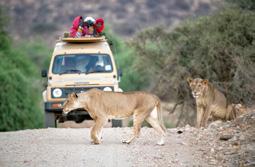
Lion Panthera leo populations declined by about 43 percent between 1993 and 2014, according to the IUCN Red List. A bloody combination of forces has led to this drastic decline: indiscriminate killing of the big cats in retaliation for taking livestock or human life, and the depletion of the lion’s prey base (large, wild herbivores), animals that are often consumed by burgeoning human populations. Compounding the pressure is the poaching of the cats for their body parts, which are illegally traded for use in Asian folk remedies. Poorly regulated trophy hunting can also pose a threat by removing the “biggest and baddest” male lions from an area, which can disrupt or destroy lion prides. As human populations have increased, so have threats to lions, including habitat loss. The lion has disappeared from about 80 percent of its African range; estimates say less than 20,000 wild lions survive in Africa today.
Like most conservation issues, saving lions is a complex, multilayered, cooperative proposition. While it is easy for “city slickers” to shake our fists at locals who kill these clever and ecologically important carnivores, the fact is, the cats can be a menacing threat to the livelihood and families of people who share the habitat. In southeastern Tanzania
“Without lions as the apex predator, the entire ecosystem is thrown out of balance. This causes a cascading effect that results in numerous other extinctions or invasions by nonnative species,” explained Carmi Penny, San Diego Zoo Global director of collections husbandry science and curator of mammals. People who live in and near lion habitat—and who often compete with native hoofed animals because their grazing livestock push out these prey species—will feel the crash of lion populations first. Left unchecked, native animals will overgraze vegetation, leaving little for livestock, and resulting in hardship for the local people.
alone, about 400 lion-related human deaths were documented between 1997 and 2007. For pastoralists, who rely on the meat, milk, and blood of their cattle and goats to survive, lions preying on their livestock can have a huge adverse effect, ranging from $290 to $370 per owner each year. Nomadic pastoralists, often children, can inadvertently walk into lion territory as they herd their flocks to fresh pastures in search of grazing, alongside wild herbivores.
DID YOU KNOW?
Taxonomists have found that the lion’s closest living relatives are the jaguar and leopard.
To head off a family’s economic or personal disaster, “lions are persecuted intensely in livestock areas across Africa,” according to the IUCN. This includes tainting cattle carcasses with poison, which lions often return to after a bout of feeding. The lions then suffer a prolonged, excruciating death, as do many other animals in the food chain, including scavengers like hyenas and vultures.
DELICATE BALANCE
But lions serve a keystone role in their habitats, keeping hoofed animal populations of zebra, buffalo, giraffe, and antelope in check and mobile.
HELPING PEOPLE HELP LIONS
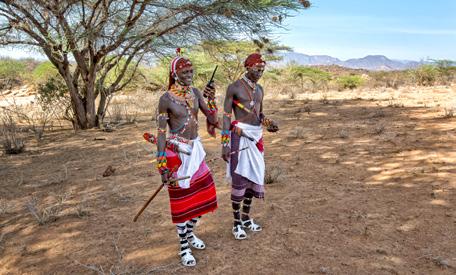
In order to change the dynamic and prevent this catastrophe, San Diego Zoo Global provides funds to two bootson-the-ground partner organizations that work to protect habitat and wildlife diversity: Ewaso Lions and the Northern Rangelands Trust. To be successful, strategies to save lions (and other wildlife) must respect and incorporate the needs of local people. By showing that predators like lions are critical to the health and diversity of the ecosystem, these community-based conservancies benefit both humans and animals. They foster understanding that the occasional loss of a cow or goat is acceptable, because of the greater good to the community by having lions present. At the same time, these partner organizations are also helping to develop programs to better control and protect livestock. While human-lion conflict may continue to occur, through education and community support, people can learn to live with lions, and stronger, healthier ecosystems will prevail.
Local people use technologies like GPS to track and protect lions.
100 YEARS OF THE
Part 5: Innovation, 1957-1966
BY KAREN E. WORLEY MANAGING EDITOR
BY SDZG
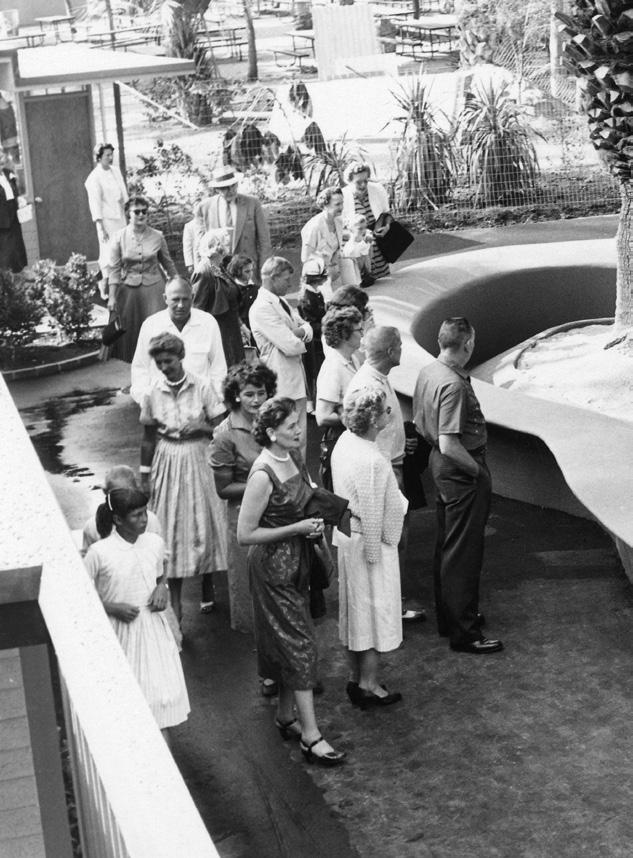
After many years of planning, an exciting extension of the Zoo opened in June of 1957: the Children’s Zoo. Then Zoo director Dr. Charles Schroeder had seen two children’s zoos on his travels and recognized the appeal they had for families. The “little zoo within a zoo” was a pioneering concept, designed and built specifically for children—everything was kid sized, from the exhibits and railings to the bathrooms and drinking fountains. On opening day, the line to get in snaked along the path all the way to the front plaza. Entrance was 15 cents, and every child proudly offered their dime and nickel, then raced in to see the new wonders.
The Petting Paddock presented animals that children could touch and interact with, including the Galápagos tortoises that many San Diegans remember riding when they were young. The Children’s Zoo was designed like a maze, with only a few exhibits visible at a time, providing the sense of a new discovery
around every corner. It was an innovative, dynamic concept that Dr. Schroeder worked on with a team of young designers, including Chuck Faust, who would go on to become the Zoo’s exhibit designer, and Bill Noonan, who would become the Zoo’s graphic designer.
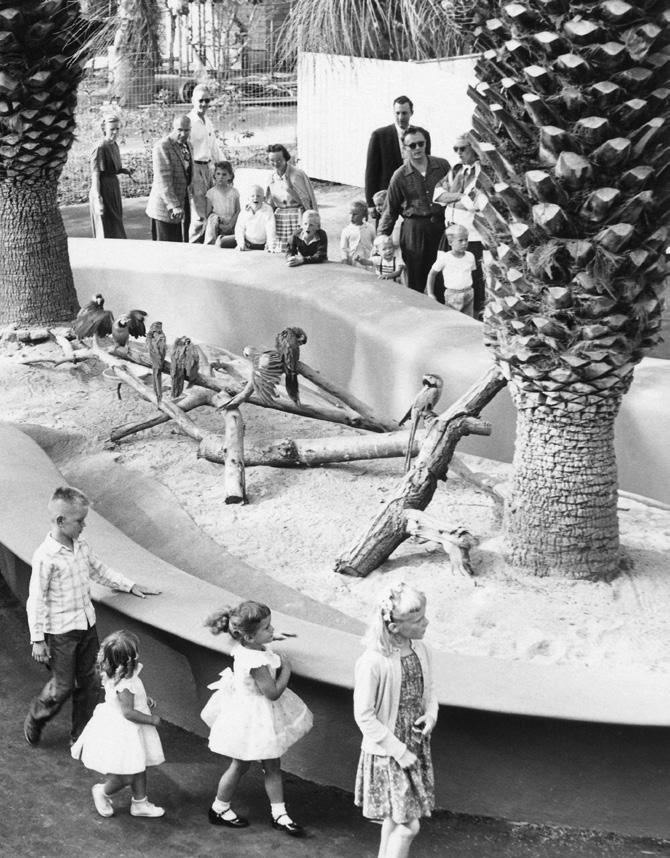
The opening of the Children’s Zoo kicked off a series of innovative new exhibits. One idea that had been tried first in the Children’s Zoo was a walk-through aviary. It had worked so well there that Dr. Schroeder and his team decided to try it in the main Zoo. In 1958, Scripps Aviary was renovated and remodeled, creating a winding pathway inside it so that guests could now enter the exhibit and stroll among the birds for the first time.
ice. From time to time, Dr. Schroeder also ordered huge ice blocks to go in the pool.
BACK IN TIME
Discover much more about the San Diego Zoo’s 100 years of history on our centennial website: sandiegozoo100.org
Dr. Schroeder also set in motion a revitalization of moated enclosures throughout the Zoo. He didn’t like chain link and wire, and he wanted to expand what Dr. Harry had started with open grotto exhibits. One new exhibit was for the polar bears, which opened in 1960. It included a pool, a slide, climbing structures, and white walls to simulate
New moated grotto enclosures for the Zoo’s gorillas opened in 1962. They provided logs and rocks for climbing, resting places with a view, and room for elaborate games of chase. Dr. Schroeder, Chuck Faust, and the curators worked on the plans for months, measuring and testing to see how the exhibits should be designed for the benefit of the gorillas, but also to keep them from getting out. As Faust said, “It was exciting to work on such a new idea—but then you had to be the one standing in front when the animals first went in.” Albert, Bouba, and Bata moved into one of the exhibits, and Vila, Chuck, Trib, and Yula moved into the adjoining one—and all went well, to Faust’s relief. On opening day, the crowds were huge, including many television broadcast crews.
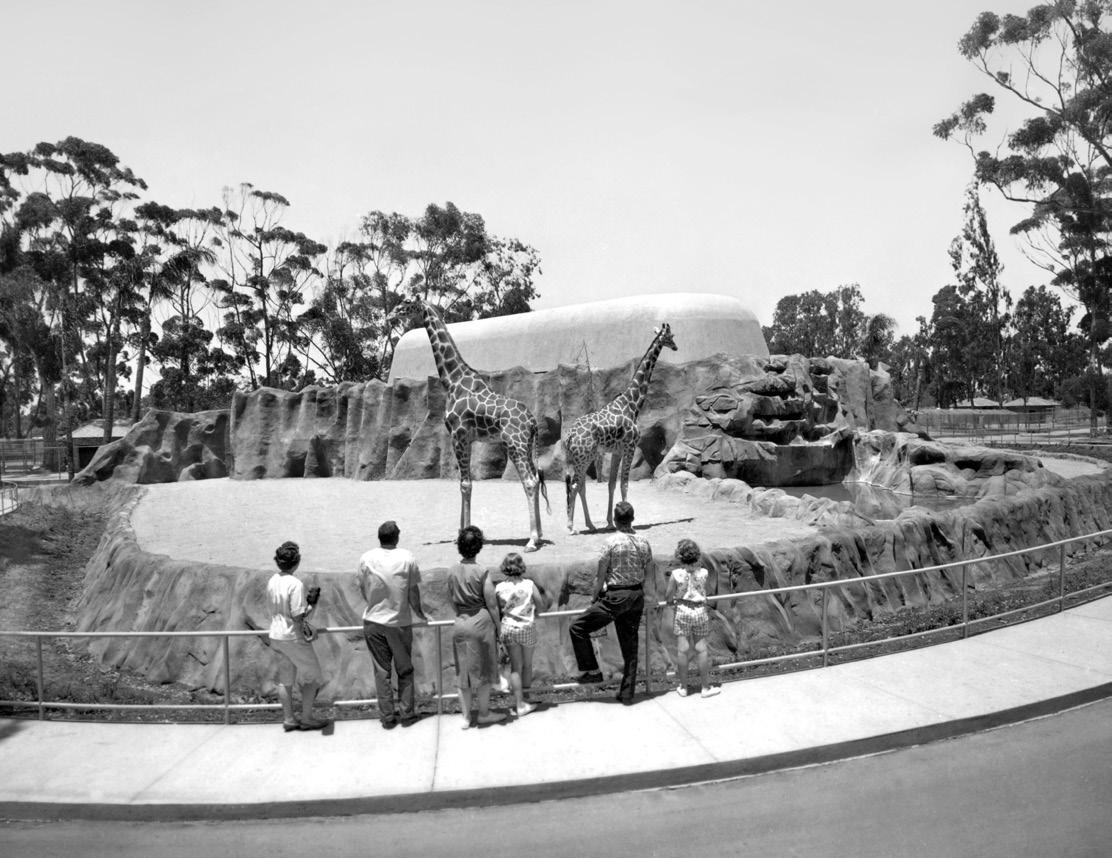
Moated giraffe exhibits also opened in 1962. People thought the giraffes could walk right out, but after testing it, Dr. Schroeder and the team discovered that the giraffes stayed away from the moat. For many years, Dr. Schroeder showed off the exhibit proudly and explained the concept, ending with what became his
PHOTOS
SAN DIEGO ZOO
famous line, “It’s great…and it works!”
Three young Baringo giraffes shared one exhibit: Topper, Freckles, and Checkers, who arrived in 1962. Longtime residents Waffles and Dolly, reticulated giraffes, shared the other exhibit.
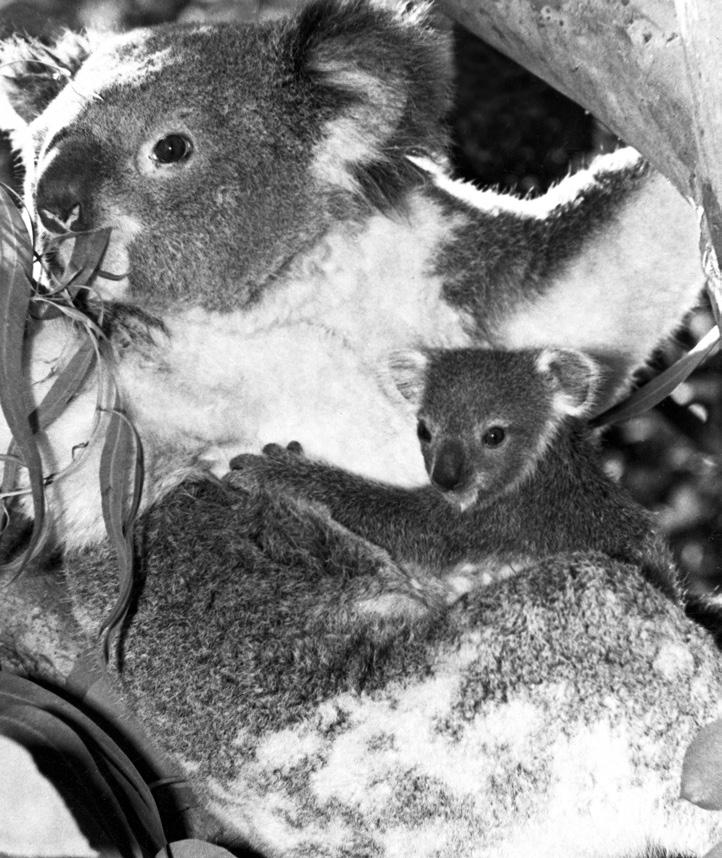
In the early 1960s, the San Diego Zoo made big news with the first koala births in North America. Matilda, the first joey to make an appearance, was actually a stowaway: she was already in her mom’s pouch when a group of koalas came to the Zoo in late 1959. She was so small no one knew she was there—until she poked her head out a few months later! A second joey, named Vicki, was born in 1960, and she was the first koala both conceived and born at the Zoo. The Zoo received the prestigious Edward H. Bean Award from the American Association of Zoological Parks and Aquariums (AAZPA, now the Association of Zoos and Aquariums, AZA) in 1961 for this birth. It would be the beginning of a highly successful koala breeding program at the Zoo.
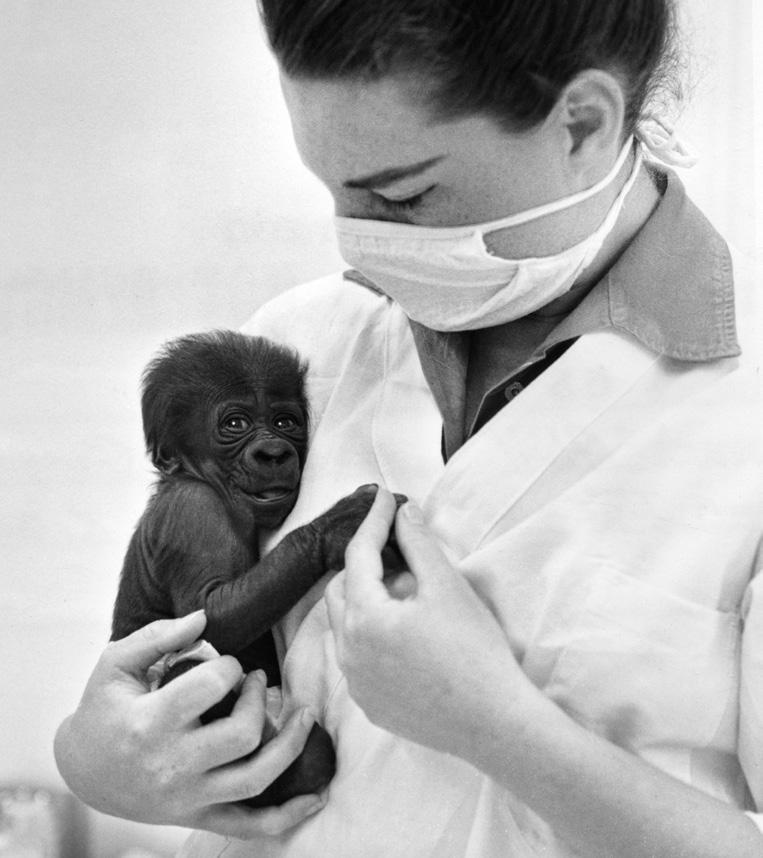
The Zoo was in the news again in 1965, with Alvila, the Zoo’s first gorilla birth. She was only the seventh gorilla that had been born in any zoo worldwide. Her name was a combination of her father’s, Albert, and her mother’s, Vila. After the birth, Vila tried to care for her baby, but she couldn’t get the hang
of how to nurse her properly. So keepers needed to bring Alvila to the Children’s Zoo nursery to be hand raised. Visitors flocked to see the baby ape as she grew.
The Zoo’s 50th birthday took place in 1966, with a celebration called the Golden Jubilee. The Zoo hosted an international wildlife conservation conference that year, and international flags adorned the front entrance. The AAZPA also held their national conference in San Diego, where the Zoo awarded its first Conservation Medals. For Dr. Schroeder, conservation was an important emphasis for the celebration, and for the Zoo. He and other zoo directors were very aware of the increasing problem of species becoming endangered.
Dr. Schroeder and the staff were proud to show off the spic-and-span Zoo to the conference delegates. The outdoor moving sidewalk, Turtletorium, Hummingbird Aviary, and Skyfari were all new ideas that Dr. Schroeder had implemented. By the Golden Jubilee, the San Diego Zoo had the world’s largest collection of exotic animals. It was looking very different than it had a decade earlier.
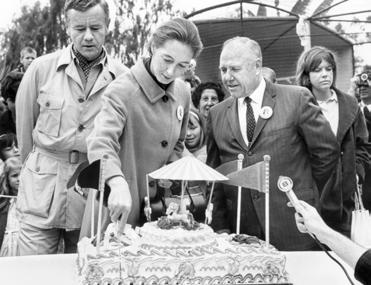
In honor of the Golden Jubilee, a birthday party for the children of San Diego was held at the Zoo on April 3, 1966. A huge birthday cake composed of 314 decorated sheet cakes was set up along the front plaza and guests were invited to
have a piece. Dr. Schroeder served the first pieces, and volunteers from Scout groups and Zoo School took over from there. By 3 p.m. that day, more than 30,000 pieces of cake had been served.
The children’s birthday party kicked off “Zoo50,” a week of celebrations. The honored guest was Dr. Jane Goodall, who gave several presentations around town and at the Zoo. At the birthday party, she helped Dr. Schroeder cut a special birthday cake, along with Marshall Thompson, star of the popular television show Daktari. Dr. Goodall was also the featured speaker at the Safari Supper for Zoo members and guests, which was held at the Convention Hall and attended by more than 3,500 people.
From left to right: Open, moated exhibits for giraffes opened for the first time in 1962. Alvila was the first gorilla born at the Zoo, in 1965. There was much excitement about the opening of the Children’s Zoo in 1957, one of the Zoo’s greatest innovations during the decade. Vicki the koala was big news in 1960, as the first joey conceived and born in the US. Special guests at the Golden Jubilee 50th birthday celebration included Dr. Jane Goodall and TV star Marshall Thompson, who helped director Dr. Schroeder cut the birthday cake.
The year 1966 was truly a golden one for the Zoo, and it marked a time of great strides for the Zoological Society of San Diego.
Coming in July: 100 Years of the San Diego Zoo, Part 6: New Era (1967 to 1976) and Part 7: Conservation (1977 to 1986).
PLANNING FOR THE FUTURE WITH FELINE FLAIR
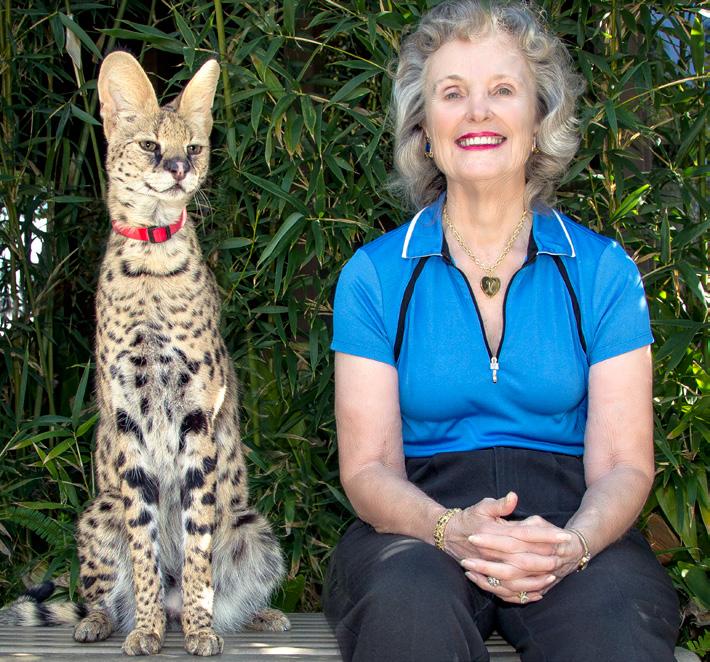
When Marguerite Stewart had a close encounter with Riki-San, one of the Zoo’s young clouded leopards, a few years back at a donor event, it was one of her all-time cat highlights. She was delighted with Riki-San—who loves to play (and is sometimes naughty!)—and enjoyed meeting new friends at Backstage Pass. This is just one experience that led Marguerite to create an estate plan with San Diego Zoo Global, designating her life insurance policy for the care of big cats at the Zoo through the Wegeforth Endowment Fund.
BY MARY SEKULOVICH | SENIOR EDITOR, DEVELOPMENT DEPARTMENT
PHOTO BY TAMMY SPRATT | SDZG PHOTOGRAPHER
Many of us have friends who are cat lovers, and then there is Marguerite Stewart. Her family always had cats, and Marguerite has endearing stories about them all.
When she was a child, a neighbor rescued two litters of kittens and brought them all to her to raise. She fondly remembers two of her cats, Taffy and Blackie. When Taffy had five kittens, they didn’t survive; so she looked at Blackie’s four new kittens and decided she would carry them off as her own—one by one—until Blackie noticed and moved her litter to a high place on top of a wardrobe!
When Marguerite met Jim Stewart in May 1966, they were working for Hughes Aircraft—and then they married in June!
“Sometimes it’s just meant to be,” she said. “It was a wonderful marriage.” The young couple was still a cat family, and she remembers one of their cats was named “Dog” because Jim thought he behaved like one. When they lived in Palos Verdes, they heard of a co-worker in the San Fernando Valley who was giving away kittens, so they welcomed Smoky, a long-hair, and Potluck, a multicolored feline.
Smiles all around: Jabari the African serval came from Backstage Pass to meet Marguerite.
After they retired and moved to the desert to be near great golf courses, they took in Duke and Duchess, and the cats moved with them to Lake San Marcos. Once settled in San Diego County in the 1990s, Marguerite and Jim began visiting the Zoo and soon became members, where they always went to see the big cats first, naturally.
Before Marguerite lost Jim a few years ago, after 46 great years together, she described them as quintessential home bodies who enjoyed gardening, road trips—like those to California’s gold country, because Jim was a history buff and loved stories of the Old West—golfing excursions, and regular Zoo visits.
Marguerite shared why her estate plan includes her life insurance policy, and why she chose the Wegeforth Endowment Fund. As she explains, the San Diego Zoo has a long history—100 years of great animal care—
and the Wegeforth Endowment Fund specifically supports the best possible care and ensures our animals have safe and enriching habitats. She sees the Zoo as a stable organization, one she can count on to carry out her estate wishes.
Marguerite likes the fact that you don’t need to donate funds today: nothing comes out of pocket immediately, but it still benefits the Zoo and its animals in the future. She feels secure that her life insurance policy will help the Zoo, and she feels good about entrusting it to such a great wildlife organization.
Marguerite doesn’t have a cat at home now, other than two small plush leopards from the opening of the Asian Leopard exhibit last year. But who knows, one may stroll into her garden one day and make itself at home. And she would not mind one bit.
WHAT KIND OF LEGACY WILL YOU LEAVE?
To learn more about ways you can make a difference through estate planning for the San Diego Zoo and the amazing animals in our care, please contact us at zoolegacy.org or call 619-557-3993 for your FREE Wills Guide.
Sheba, the Baby Lioness
TODAY AT THE ZOO
Through our many decades of caring for orphaned animals, we’ve built a strong knowledge base in the diet and care needs of hundreds of species. While we always root for our animal mothers to raise their own young, when help is needed our Neonatal Assisted Care team deftly steps in.
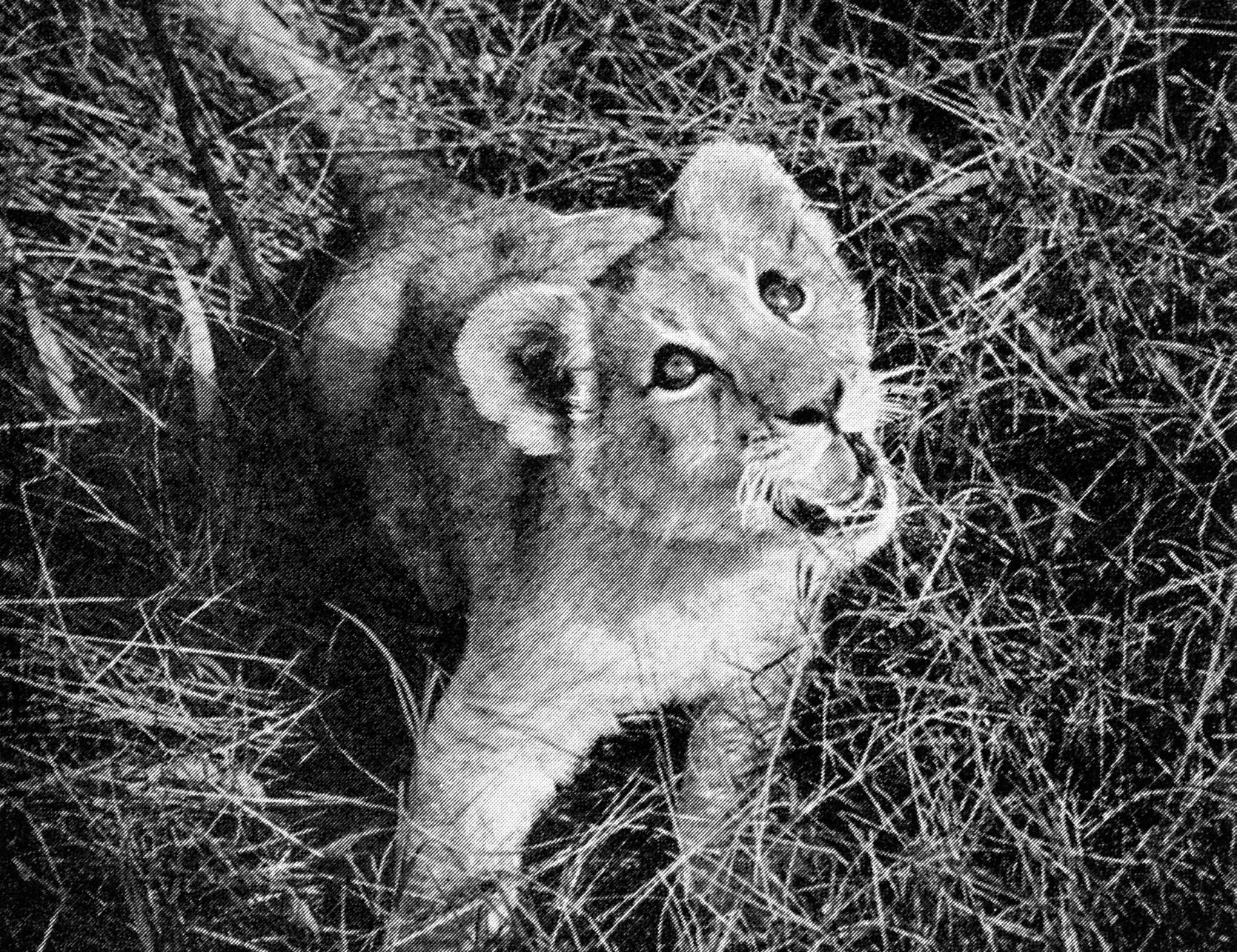
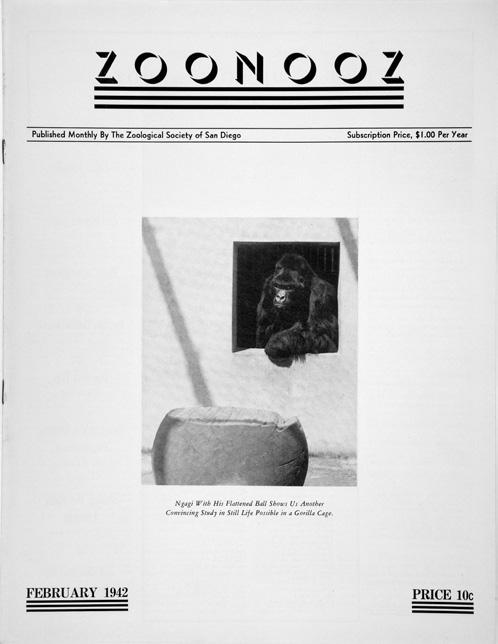
In February 1942, the story of a little lioness named Sheba captured the hearts of ZOONOOZ readers. Abandoned by her mother after a few weeks, the little tyke was whisked into the care of Zoo staff, who gamely rode the roller coaster of caring for a tender, young exotic animal.
It is not always a simple matter to raise wild animals by hand, as the milk from each species of animal varies widely as to butterfat, water and minerals, so that many die within the first few days…“Sheba” grew very well for about six weeks when one morning, Mrs. Burlingame reported that “Sheba” was losing her hair…hemorrages began to occur in the mouth, ears, eyes, and between the toes….Similar symptoms are known to occur in people from a lack of vitamin C, and, although we have been taught that cats are not supposed to require vitamin C, it was decided that orange juice would be given a trial….in Sheba’s case, it was the difference between a sick and well cat. Within a short time, [Sheba] was again playing with the young jaguar and chewing the nipples from her nursing bottles almost as fast as they could be replaced.
TRAVEL THE WORLD WITH THE SAN DIEGO ZOO
WORLDWILD TOURS
Travel with the San Diego Zoo’s WorldWild Tours™ to some of the wildest places on Earth in 2016 and 2017. Our itineraries highlight the wildlife at each destination and include expert naturalists and a San Diego Zoo Global escort, plus a group of like-minded travelers. For brochures, visit sandiegozoo.org/travel or call Julia Altieri at 619-685-3205.
BRAZIL’S PANTANAL AUGUST 19–28, 2016 Explore Brazil’s Pantanal, the Serengeti of South America and the world’s largest wetland. $6,373 plus airfare (per person, double occupancy)
Coming in 2017
HAWAII
February 2017
CHINA AND ITS GIANT PANDAS May 2017
KENYA June 2017
GALÁPAGOS ISLANDS
October 2017
CUBA AND ITS WILDLIFE
OCTOBER 21–31, 2016
From Havana to the national parks, explore the vibrant wildlife and culture of this mystical island country. $6,995 plus airfare (per person, double occupancy)
POLAR BEAR ADVENTURE
OCTOBER 28–NOVEMBER 3, 2016
Chill with polar bears in their native habitat from the comfort of the Tundra Buggy Lodge in Churchill, Canada
$6,073 plus airfare (per person, double occupancy)
AROUND THE WORLD
SEPTEMBER 29–OCTOBER 22, 2016
Experience a lifetime of must-see iconic destinations, including Machu Picchu, the Great Barrier Reef, the Serengeti Plain, and Angkor Wat. $76,950 plus round-trip airfare to and from departure city (per person, double occupancy)
WILD ENCOUNTERS
FEBRUARY 17–MARCH 8, 2017 Set off on a wildlife adventure and come face to face with the world’s legendary creatures in their natural habitats, including India’s jungles, the Serengeti Plain, the mountains of Rwanda, and Borneo’s rain forest. $83,950 plus round-trip airfare to and from departure city (per person, double occupancy)
CUBA
BRAZIL
CANADA
14
Our wonderful ZOONOOZ magazine is just part of the story! The beautiful new ZOONOOZ Online site can be accessed on any device at any time; all you need is a web browser, and it’s mobile friendly. Choose from story categories like Animals, Plants, Keeper Notes, Saving Species, and Wild and Fun; and new posts are published every week. It’s a wild new world we hope you’ll join us there!