
ZOONOOZ
JUNE 2020
SAN DIEGO ZOO GLOBAL
A Special Issue
The world has changed in many ways over the last few months while this issue of ZOONOOZ was in production—and we’re changing with it. In this issue, you’ll find information about San Diego Zoo Global’s responses to the COVID-19 pandemic, including all the many resources we can provide online to families, students, and anyone who is seeking some comfort and distraction by connecting with animals and nature (see page 2). San Diego Zoo Global is also making plans to reopen the Zoo and the Safari Park when that becomes possible, and to accomplish reopening in the safest way for our visitors, staff, and animals.
This issue of the magazine also takes a new step in expanding San Diego Zoo Global’s communications about our worldwide conservation work: it combines ZOONOOZ features with conservation science articles that were previously found in a separate publication, Saving Species. As San Diego Zoo Global continues to grow as a conservation organization, it is more important than ever to share the many stories of the research, field work, science collaboration, and community partnerships that are making great strides in saving endangered species worldwide.
In upcoming issues, you will see more articles about this important work and how it is making a difference for wildlife, as we reimagine ZOONOOZ as part of San Diego Zoo Global’s conservation mission. We are excited about this transition as we change and adapt as an organization. Thank you to all our members, donors, and supporters for your ongoing dedication and enthusiasm for San Diego Zoo Global.
June 2020
Hello, Bright Eyes
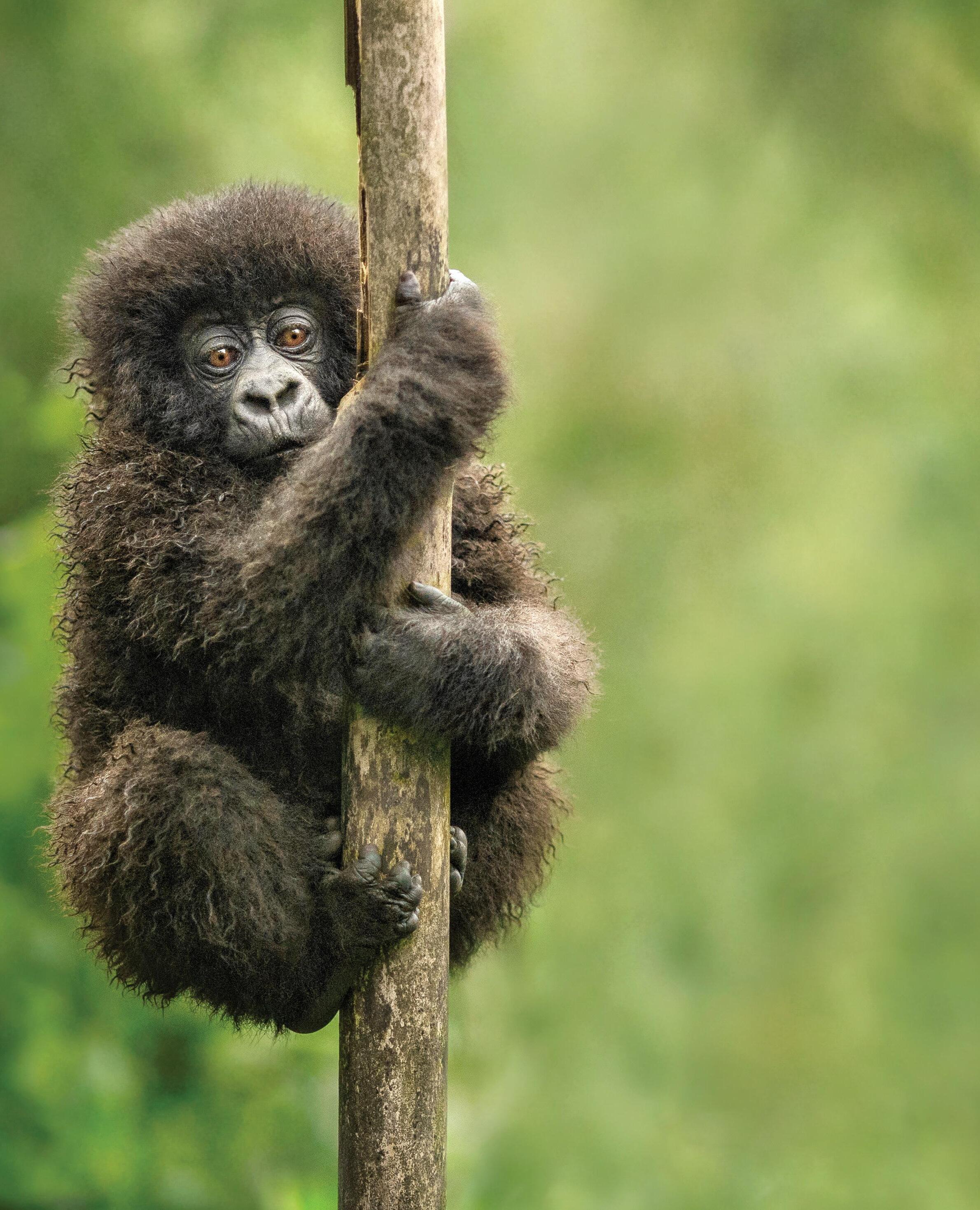
When young gorilla Leslie needed cataract surgery, everyone on her care team pitched in to make the procedure a success. BY DONNA PARHAM
An adaptation twist makes side-necked turtles worth a second—and close—look. BY WENDY PERKINS
Ebo Forest’s Treasures
Cameroon’s Ebo forest is a unique habitat that is home to very rare species that need protection. BY BETHAN MORGAN, PH.D.
Madagascar’s Lemurs
Collaboration and a forest-saving strategy come to the aid of primate species found nowhere else on Earth. BY TIMOTHY M. EPPLEY, PH.D.
One of the many challenges to wildlife is the shifting distribution of disease vectors as a result of climate change. BY BRUCE RIDEOUT, DVM, PH.D.
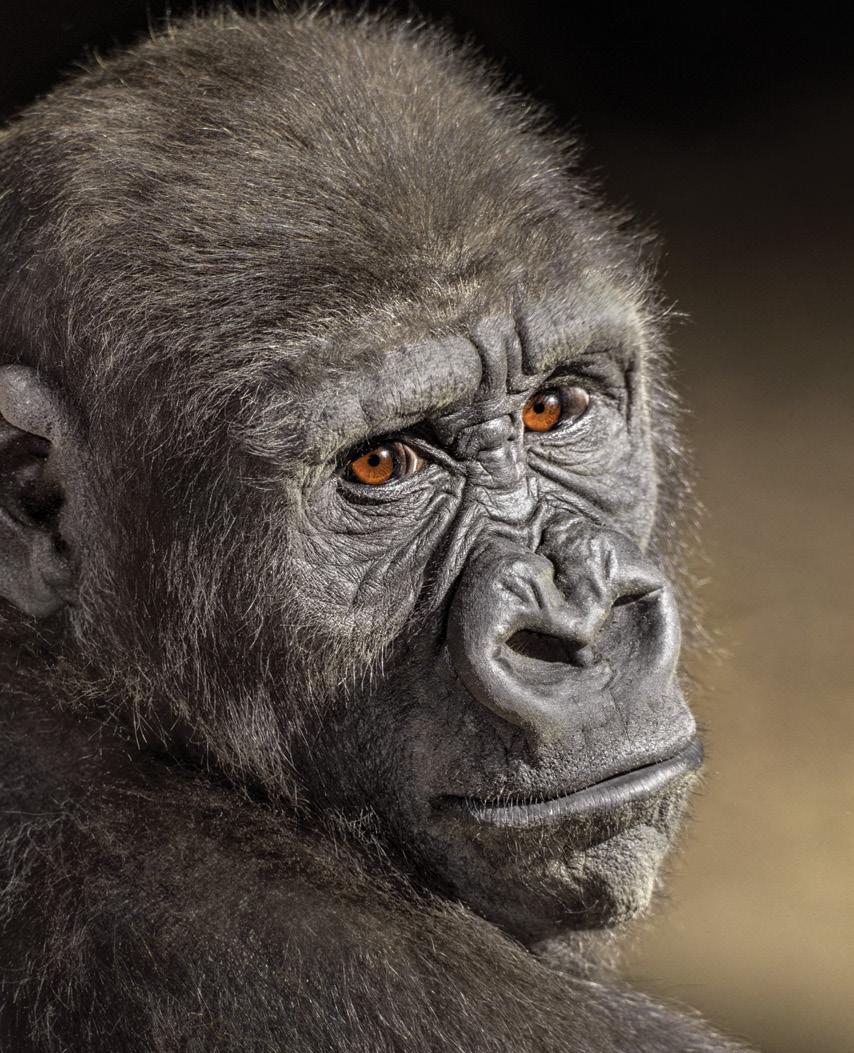
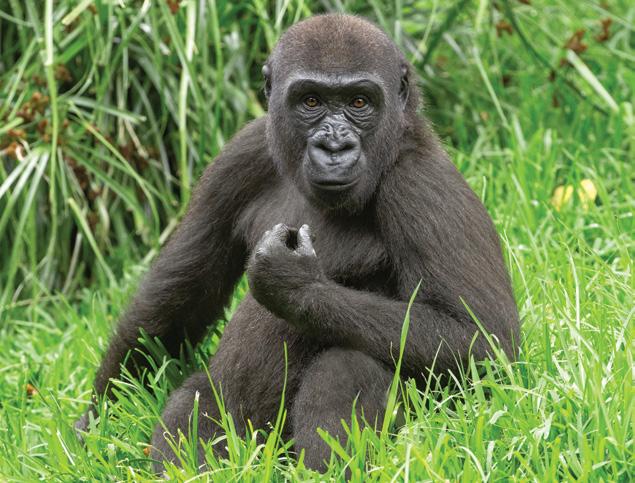
Western lowland gorilla Gorilla gorilla gorilla. Photo by Ken Bohn, San Diego Zoo Global Photographer
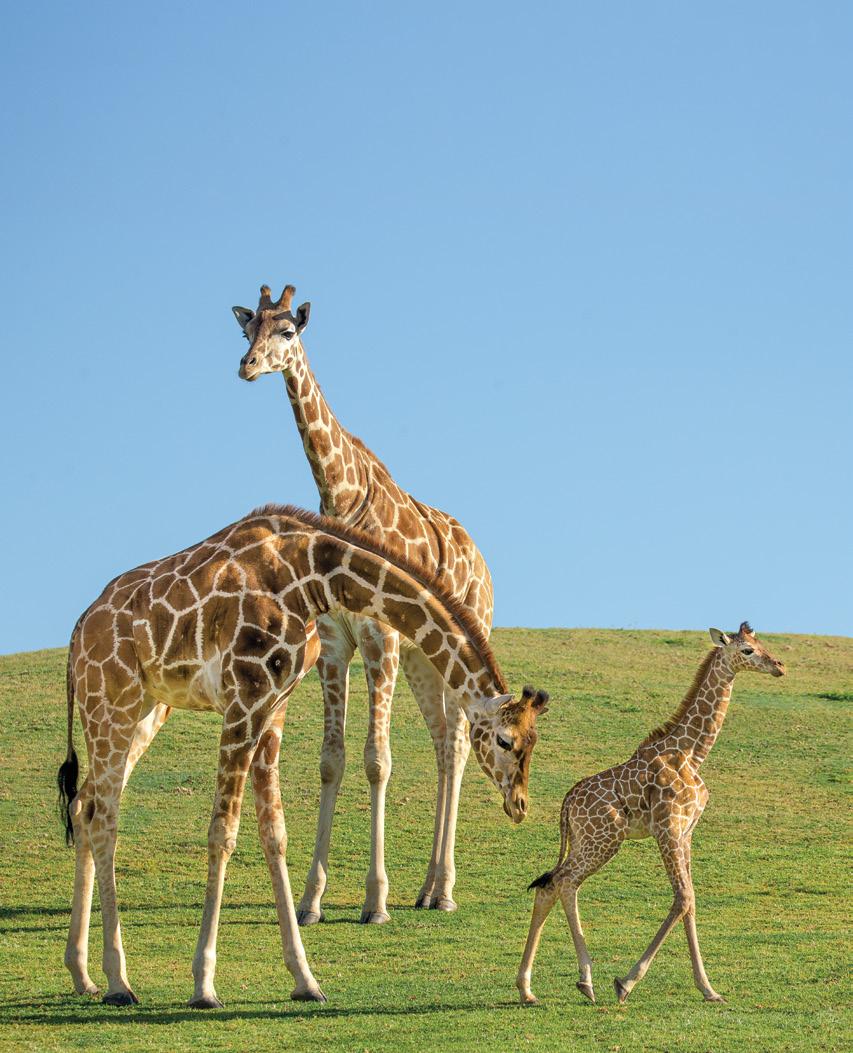
Photo by Tammy Spratt, San Diego Zoo Global Photographer
we’re Here toGether
At the San Diego Zoo AnD Safari Park, Saving the worlD’S Precious SpecieS is whAt we’re All About.
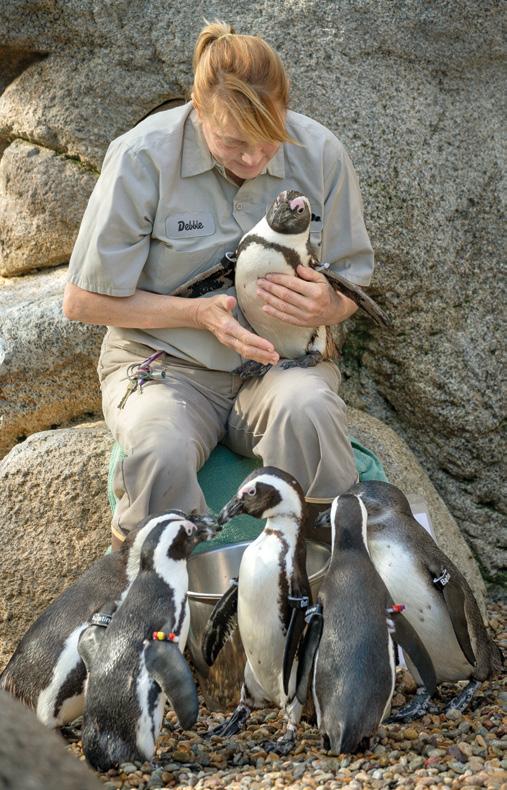
We want to let you know that we’re here, taking care of all our animals and plants at the Zoo and Safari Park, and protecting the wildlife that means the world to all of us.
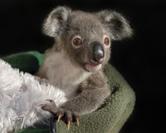
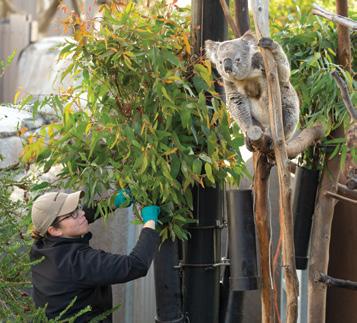
Even though you might not be able to join us at the Zoo and Safari Park for now, we are making sure our newest baby hippo continues to thrive, helping our platypuses get in a midday swim, watching over our littlest rhinos as they enjoy some playtime in the mud, and giving the koalas fresh eucalyptus before their afternoon snooze, all while implementing rigorous safety procedures for animal care and our staff.
We know you are here with us, in spirit, as we safely serve our people, our community, and, of course, our animals. To offer some comfort and respite for you during this time, we have put together a resource page on our website, with links to virtual animal experiences, information, and activities that we hope you will enjoy.
We will see this through, together. And when the time is right, we cannot wait to welcome you back, so we can thank you for all the love and support.
Your P artners in S aving the worl D ’ S S pecie S ,

v irtual v i S its to the San Diego Zoo A n D Safari Park!
The San Diego Zoo and Safari Park may be closed for now, but it’s business as usual for the animals of San Diego Zoo Global and the crew of wildlife care specialists that are looking out for them—and you can stay connected with virtual visits at any time. Check in on your favorite animal friends with our livestreaming animal cams, videos and articles, online education courses, activities for kids, and more. Bring our wildlife into your home today! Visit zoo.sandiegozoo.org/were-here-together.
wildlife Cams
From their habitat to yours, these livestreaming cams provide views of wildlife as they explore, eat, swing, pounce, groom, and play through their day. Catch all the action!
Ape Cam presented by California Coast Credit Union
Baboon Cam presented by Go City
Burrowing Owl Cam presented by Ori and the Will of the Wisps Condor Cam
Elephant Cam presented by Planet Zoo®
Giraffe Cam presented by Fiesta
Hippo Cam presented by Mattel
Koala Cam
Panda Cam (archived video)
Penguin Cam presented by Alaska Airlines
Platypus Cam presented by Animal Crossing™: New Horizons game
Polar Cam presented by the Coca-Cola Company
Tiger Cam presented by Safari Ltd.

San Diego Zoo KiDs
Kids can jump into the world of wildlife with every visit to San Diego Zoo Kids. This family friendly website is jam-packed with videos and information about animals, fun stories, hands-on activities, and games.
watcH wildlife StorieS on Youtube
Anyone can tune into YouTube to view our heartwarming, educational, and fun animal and conservation videos.
free San Diego Zoo GlobAl AcAdemY CourSeS
Learn about animals by taking some San Diego Zoo Global Academy online courses for free! Through June 18, 2020, we will provide complimentary access to our Introduction to Animal Species and conservation courses, offering different topics each week. These are especially useful for teachers and students.
ZoonooZ online
This free digital version of our magazine features fascinating stories about wildlife and ongoing conservation projects, including posts from wildlife care specialists. New articles are posted each week!
San Diego Zoo AnimAlS & PlAnts
With detailed information, fun trivia, and much more, this website is a user-friendly, A-to-Z guide about favorite animals and plants, including fascinating species you may not know.
Science Blog
Middle school and high school students can dig into science on the San Diego Zoo Institute for Conservation Research website.
Help trAcK wildlife from the Comfort of Home
Anyone can become a “citizen scientist” and contribute valuable data to conservation researchers by helping to count and identify giraffes and burrowing owls—online in your own home.
StorieS of HoPe AnD inSpirAtion
Enjoy heartwarming, true stories from the San Diego Zoo and San Diego Zoo Safari Park without leaving your home, in author Georgeanne Irvine’s award-winning Hope and Inspiration collection of children’s books, published by San Diego Zoo Global Press. Available for purchase on Shopzoo.com.
Unprecedented Times
PRESIDENT/CEO’S NOTE
PAUL A. BARIBAULT
In March, we made the decision to close the San Diego Zoo and the San Diego Zoo Safari Park to the public, in response to the COVID-19 coronavirus pandemic. San Diego Zoo Global is first and foremost a family, of employees, volunteers, donors, members, and fans who make up our community. The health concerns of these past months are challenging for all of us, and I want to reach out to all of you and let you know we recognize the gravity of the evolving situation and are doing our part to protect the health and welfare of our community and the wildlife in our care.
The San Diego Zoo and San Diego Zoo Safari Park are iconic destinations, and we are proud to play an important role in inspiring guests about the natural world, while also being a respite and escape for our visitors. However, it is vital for San Diego Zoo Global to ensure we are putting the health and well-being of our greater community first.
As outdoor facilities that care for a wide variety of animal and plant species, the Zoo and the Safari Park have been committed to maintaining the healthiest of environments for
decades—and at no time in our history has that experience proven more valuable than right now. We remain committed to providing premier care and safety for the wildlife at our parks during this time, and only essential staff taking care of animals and plants and maintaining critical systems have remained active on grounds, following rigorous standards. Other staff members who are able to work from home have been doing so.
The safety of our wildlife, staff members, volunteers, and community is—and always will be—our highest
priority. We recognize that visits to the San Diego Zoo and the Safari Park are opportunities to experience wildlife, enjoy rich educational experiences, and share the wonder of the natural world with friends and family—and also provide an escape from our daily lives and a chance to enjoy fresh air and exercise. We are very much looking forward to reopening and welcoming visitors back to our parks at the first opportunity we can responsibly do so.
Please check our websites and social media channels for further information as it becomes available. And in the meantime, our social media and live cams provide a chance to visit the animals virtually, and our San Diego Zoo Kids, Animals & Plants, and ZOONOOZ websites offer a wealth of engaging articles, videos, activities, and other material you can enjoy and use as learning options for kids that are home from school.
From me and from all of us at San Diego Zoo Global, thank you for being part of our family.
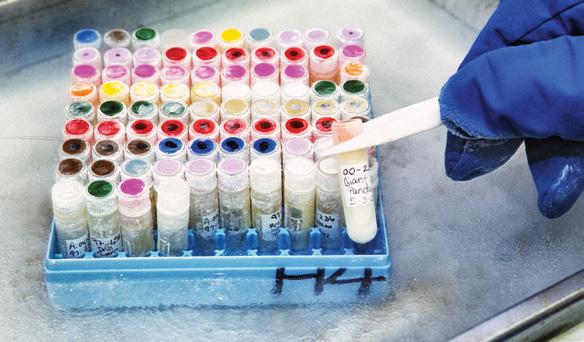
The Frozen Zoo is continually growing, with 5 to 10 samples from new animals added each week. In 2019, we added a total of 75 species.
It’s only a number
San Diego Zoo Global’s Frozen Zoo® is the largest and most diverse collection of its kind in the world. Here are just a few facts about this expanding and invaluable resource for conservation, assisted reproduction, evolutionary biology, and wildlife medicine—all vital to our mission of saving species.
5.4
Percentage of the world’s threatened vertebrate species that are represented in the Frozen Zoo.
ZOONOOZ
®
PUBLISHED SINCE 1926 JUNE 2020 | VOL. XCIII–NO. 03
MANAGING EDITOR
KAREN E. WORLEY
ASSOCIATE EDITOR
PEGGY SCOTT
STAFF WRITERS
WENDY PERKINS
KARYL CARMIGNANI
DONNA PARHAM
COPY EDITOR
ESTON ELLIS
DESIGNER
KERRI ABRAMS
SAN DIEGO ZOO GLOBAL
PHOTOGRAPHERS
KEN BOHN
TAMMY SPRATT
SR. IMAGING SPECIALIST
TAMMY SPRATT
DESIGN AND PRODUCTION
KIM TURNER
AMY BLANDFORD
LISA BISSI
JENNIFER MACEWEN
PREPRESS AND PRINTING QUAD GRAPHICS
625
Number of mammal species represented in the Frozen Zoo—more than twice the current populations at the Zoo and Park combined!
1,160
The total number of species that are currently represented.
The Zoological Society of San Diego was founded in October 1916 by Harry M. Wegeforth, M.D., as a private, nonprofit corporation that now does business as San Diego Zoo Global.
The printed ZOONOOZ® magazine (ISSN 0044-5282) is currently published bimonthly, in January, March, May, July, September, and November. Publisher is San Diego Zoo Global, at 2920 Zoo Drive, San Diego, CA 92103, 619-231-1515. Periodicals postage paid at San Diego, California, USA, and at additional mailing offices. ADDRESS CHANGES: Please send to Membership Department, P.O. Box 120271, San Diego, CA 92112.
Copyright© 2020 San Diego Zoo Global. All rights reserved.
“ZOONOOZ” Reg. U.S. Pat. Office. All column and program titles are trademarks of San Diego Zoo Global.
Annual Membership: Two adults in the same household $160 early bird renewal; $170 lapsed; $185 new. One adult $97 early bird renewal; $102 lapsed; $112 new. Seniors (age 65 and older) receive a 15% discount off Annual Pass Memberships. Keeper’s Club (BEST VALUE!): two adults in the same household, or one adult plus one accompanying guest each visit $224 early bird renewal; $239 lapsed; $254 new. Each membership includes unlimited entrance to the San Diego Zoo and San Diego Zoo Safari Park. Please visit our website zoomember.org for a complete list of membership benefits.
Subscription to ZOONOOZ magazine: $25 per year, $65 for 3 years. Foreign, including Canada and Mexico, $30 per year, $81 for 3 years. Contact Membership Department, P.O. Box 120271, San Diego, CA 92112, for subscription information.
As part of San Diego Zoo Global’s commitment to conservation, ZOONOOZ is printed on recycled paper that is at least 10% post-consumer waste, chlorine free, and is Forest Stewardship Council ® (FSC®) certified.
10,000
Living cell lines—not counting all the oocytes, sperm, and embryos—in the Frozen Zoo.
SAN DIEGO ZOO AND SAFARI PARK HOURS
Because of closures due to COVID-19, please check our websites for the latest information about opening dates, hours of operation, and restrictions.
WEBSITES sandiegozoo.org sdzsafaripark.org
PHONE 619-231-1515
ZOONOOZ ® Online web publication zoonooz.sandiegozoo.org
FSC® is not responsible for any calculations on saving resources by choosing this paper.
SAN DIEGO ZOO GLOBAL
OFFICERS
Steven G. Tappan, Chairman
Javade Chaudhri, Vice Chairman
Linda Lowenstine, DVM, Ph.D., Secretary
Ryan Sullivan, Ph.D., Treasurer
BOARD OF TRUSTEES
Rolf Benirschke
Joye D. Blount
Kathleen Cain
Richard B. Gulley
Clifford W. Hague
Robert B. Horsman
Steven S. Simpson
Judith A. Wheatley
TRUSTEES EMERITI
Berit N. Durler
Thompson Fetter
Bill L. Fox
Frederick A. Frye, M.D.
George L. Gildred
Yvonne W. Larsen
John M. Thornton
A. Eugene Trepte
Betty Jo F. Williams
GENERAL COUNSEL TO THE BOARD
James Lauth
Paul A. Baribault, President/CEO
Douglas G. Myers, President/CEO Emeritus
Charles L. Bieler, Executive Director Emeritus
THE FOUNDATION OF SAN DIEGO ZOO GLOBAL
OFFICERS
Joye D. Blount, Chair U. Bertram Ellis, Jr., Vice Chair
Barry Munitz, Secretary
Susan N. McClellan, Treasurer
Kea C. Spurrier, President
Amy B. Parrott, Vice President
Paul A. Baribault, Ex officio
Steven G. Tappan, Ex officio
BOARD OF DIRECTORS
Todd Beck
Sophie W. Bryan
David Crane
Berit N. Durler
Chris Eddy
Nikita Kahn Ellison
Arthur E. Engel
JJ Fetter
Susan Guinn
Murray Hutchison
Lynelle Lynch
Susan B. Major
Susan F. McCarthy
Diane McKernan
Joshua A. Pack
Maryanne C. Pfister
Philip C. Seeger
Elizabeth W. Shoemaker
Rosa Sinnott
Carter Skeath
David M. Tehle
Kathryn J. Vaughan, Esq.
Tony Yousif
Hello, Bright Eyes
Successful eye surgery has baby gorilla Leslie back in action and seeing clearly
BY DONNA PARHAM | STAFF WRITER
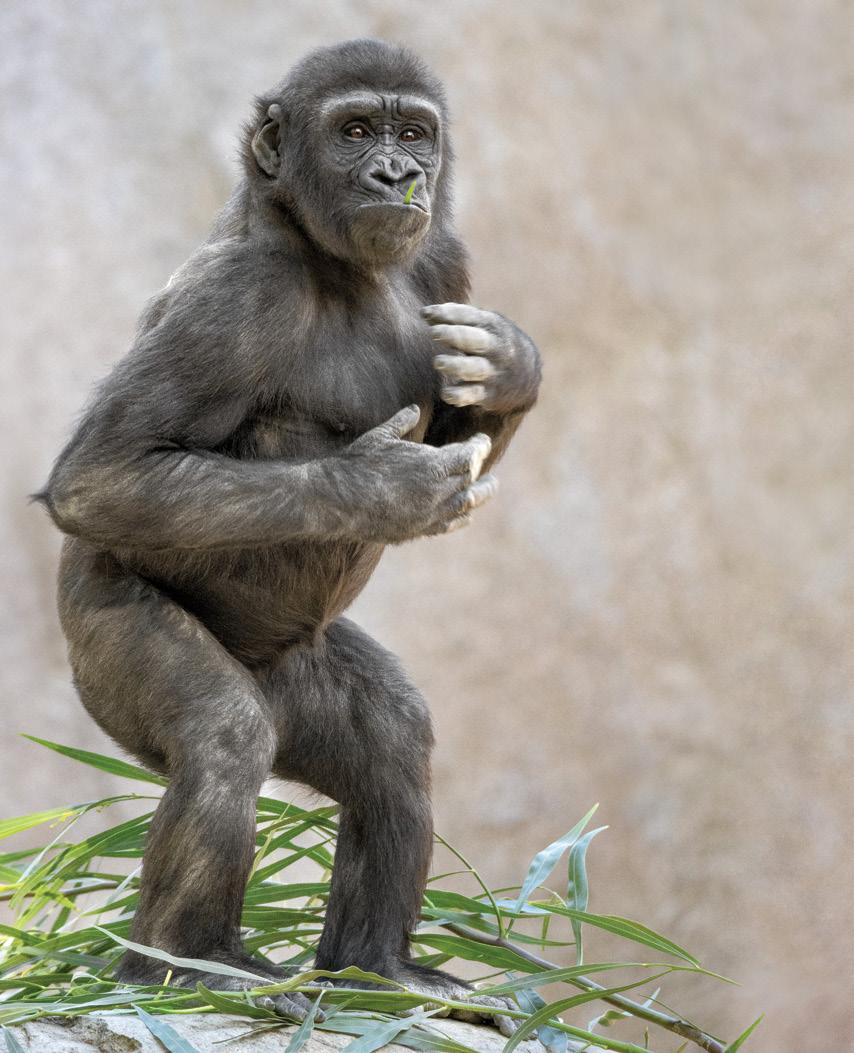
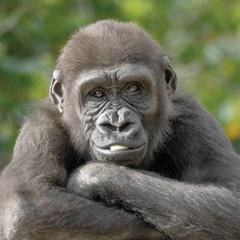
One evening last fall, as wildlife care specialist Breanne Murray brought the Safari Park gorilla troop inside for the night, she noticed something wasn’t quite right with the youngster of the troop, three-year-old Leslie. “Although she wasn’t displaying any behavioral symptoms, her left eye was cloudy—it had become completely opaque,” says Breanne.
PHOTOS BY KEN BOHN | SDZG PHOTOGRAPHER
“At first, we didn’t know for sure what was wrong,” says Park veterinarian Meredith Clancy, DVM. “But it looked like a cataract.” Dr. Clancy has worked with veterinary ophthalmologists on cataract surgeries for lions and birds, but because primates are more similar to humans, she wanted to consult a human ophthalmologist. She reached out to Christopher Heichel, M.D., an ophthalmologist with UC San Diego Shiley Eye Institute, who has experience with cataracts in younger patients. “From the moment we started talking to Dr. Heichel, he seemed like the best technical expert for this problem,” says Dr. Clancy.
Ready to Go:
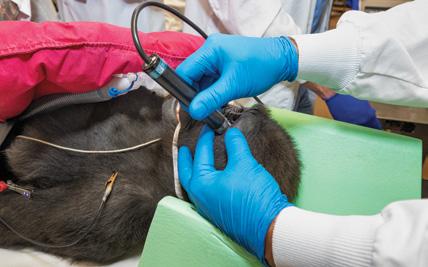
Dr. Heichel jumped at the chance to help. “It took me less than a second to know that this surgery was something I wanted to do,” he says. “And my next thought was, ‘How?’” While Dr. Heichel performs a lot of challenging eye surgeries, Leslie would be his first nonhuman patient. His first order of business was a house call, but protective mom Kokamo wasn’t keen about allowing this stranger close to her youngster. With a portable ophthalmoscope, Dr. Heichel was able to get a quick glimpse into Leslie’s eye before mom scooped her away. He diagnosed her with a cataract that probably resulted from an injury—likely sustained while playing and roughhousing with her siblings.
Knowing that planning and logistics for an eye surgery would take some time, both doctors were eager to get the process started. Dr. Heichel explains that in human children, “The visual cortex stops processing images from the bad eye after a while.” Waiting too long might mean that Leslie’s brain would essentially stop “seeing” with her left eye.
Leslie was too young to be separated from her mom, so the procedure had to involve Kokamo, too. “That increased everything exponentially,” says lead
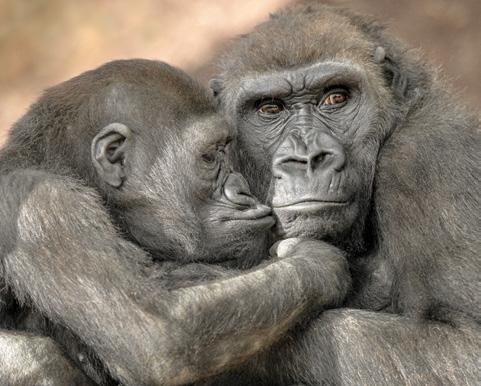
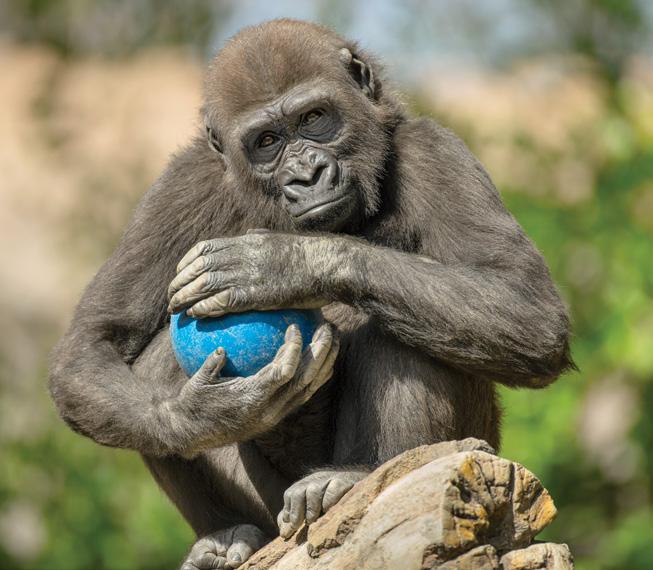
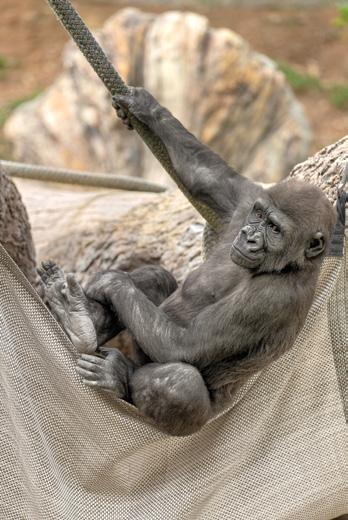
(Left and above) Leslie is back in action, and that includes playing and cuddling with sixyear-old Joanne. (Below) Dr. Heichel performed an ultrasound to rule out a tumor or a detached retina.
wildlife care specialist Peggy Sexton. The veterinary team immobilized both gorillas at the same time, so that mom and daughter could fall asleep together at the gorilla habitat and wake up together at the gorilla habitat. “I didn’t want mom to go to sleep before the baby did—and I didn’t want them to remember any of it, if possible,” Peggy says.
Once the two gorillas were anesthetized, teams of wildlife care specialists, veterinarians, and vet technicians jumped into action, driving them to the Safari Park’s Paul Harter Veterinary Medical Center. They bathed Leslie and trimmed her nails—to reduce the chance of introducing bacteria in case she rubbed her eyes. Then they moved the little gorilla into a sterile surgery room, where Dr. Heichel could take his first good look at Leslie’s cataract, under a microscope, and measure her eye.
For Dr. Heichel, the surgery itself was the most comfortable part of the process. “It’s the exact same
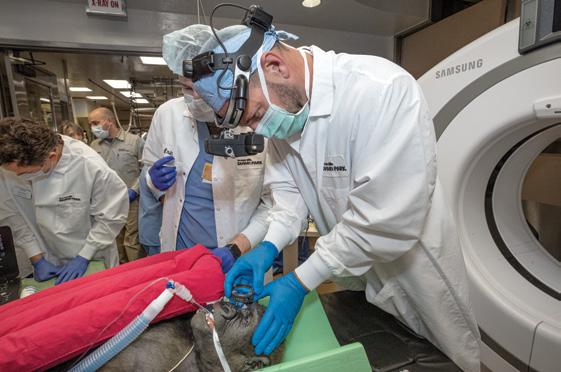
surgery as in humans,” he says. “The lens in a gorilla’s eye is essentially identical to ours.” He explains that the lens rests in a clear, membranous envelope, held in place by a ring of tiny fibers. In an eye injury, some of the fibers can be damaged, so he opted to insert a device called a tension ring, to help support the new lens. Then, just as he would do in a human, he made a tiny opening in the envelope to remove the clouded lens and implant the new, artificial one.
“The unknown was how she would do postoperatively,” says Dr. Heichel, who knew there was “no way she was going to wear the usual postoperative, protective shield on her eye.” The day after the surgery, he visited the Safari Park to check on his patient. True to form, “Kokamo was a little suspicious of me,” he says. “She protectively scooped Leslie away.” Luckily, the wildlife care team took amazing, closeup photos and videos of Leslie’s eye. “They’re used to us taking our phones out and taking pictures of them,” says senior wildlife care specialist Kelly Casavant. “One of us holding a phone up to her face was nothing to her. We’d email them, and everyone could take a look.” (See sidebar to learn
Taking a Good Look: (This page) In surgery, Dr. Heichel was able to examine Leslie’s eye under a microscope. He depended upon what he knew from pediatric cataract surgeries to determine the best lens for the implant. (Opposite page) Playtime. Leslie is a healthy, active three-yearold, and that means plenty of play throughout the day.
Cataract surgery hasn’t slowed down this fun-loving girl one bit.
Follow-up care
For weeks after the surgery, Leslie would need medication applied to her healing eye. Beforehand, “We did a lot of talking about, ‘How are we going to do this?’” says Kelly. Anyone who has had to give their pet medication can appreciate the challenge. “Gorillas don’t like water on them, and they certainly don’t like anyone putting stuff in their eyes,” she says. So the team set about desensitizing Leslie to the process, which was complicated by the fact that they had to occupy her mom Kokamo at the same time.
Eventually, Leslie allowed Kelly to drop a bit of saline solution into her eye. “She didn’t love it,” says Kelly, “but she tolerated it.” But just as things seemed to be going well, Leslie hit a developmental milestone. Like a human toddler, “She became more independent, and ‘said no’ more often, and drops in her eye were a big ‘no,’ so it was back to the drawing board.”
Kelly was pleased—and somewhat surprised—when Leslie allowed her to touch and massage around the little gorilla’s eyes. After the surgery, Leslie allowed her to apply medication by dabbing it into the corner of her eye—twice a day for 2 weeks, then once a day for 10 days. “How many times will a baby sit there and let you smear something like Neosporin in her eye as she’s eating something?” Kelly marvels. The secret to success turned out to be a smear of peanut butter frozen onto a wooden tongue depressor. “She had to work at it a little bit, and you have time to get the medicine in,” says Kelly. “She didn’t love us sticking our fingers in her eye, but she let us do it.”
how wildlife care specialists administered post-op eye meds.)
“The images were very reassuring,” says Dr. Heichel. Even better, Kokamo gradually accepted Dr. Heichel’s attention to Leslie. On one visit, when Kokamo noticed Dr. Heichel, she picked up her daughter…and carried her over to him so he could have a look at her. “That visit was so special,” he says.
Park visitors will attest that little Leslie is back to her usual self. “I am so grateful to have had this opportunity to work with the awesome team at the Safari Park and help a truly amazing animal,” says Dr. Heichel. While both Dr. Clancy and Dr. Heichel credit the wildlife care team with the success of the operation, the wildlife care specialists give the credit to the gorillas. Kelly says, “If it weren’t for Leslie and Kokamo being who they are, we wouldn’t have been able to do this.”
VISION FOR THE FUTURE
Dr. Heichel’s experience helped him select the right lens for Leslie. “I had to predict how much her eye is going to change as she grows,” he says. “The lens that would be just right for now, wouldn’t necessarily give her the best vision when she is a teenager or adult.” It’s the same decision he has to make with children. “As the eye grows, the vision will change slightly over the next few years.”
For Leslie, “I used a lens that will give her better and better vision as she ages.”
The Side Track
The San Diego Zoo has some turtle species with a twist: a long, flexible neck that they bend sideways, giving them the name side-necked turtles.
BY WENDY PERKINS | STAFF WRITER PHOTOS BY KEN BOHN | SDZG PHOTOGRAPHER
There are more than 350 species of turtles and tortoises that share our planet. They are categorized into two groups, based on how their neck retracts. Most pull their neck straight in, but others throw a curve by folding their neck to the side instead.
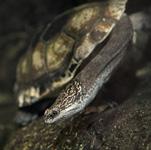
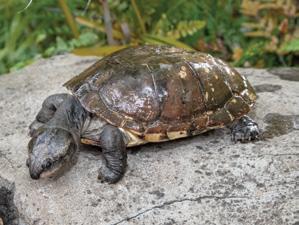
Those that pull the neck straight in belong to the Suborder Cryptodira: tortoises, sea turtles, and box turtles (cryptodires). Those in the Suborder Pleurodira, however, have a different angle. Rather than pulling into the shell, a pleurodire bends its neck sideways, tucking its head along its side. Although the neck and head are not hidden, a generous overhang of the carapace (top shell) offers protection. Watching some of the pleurodire species in Reptile Walk’s Turtle Building reveals another amazing attribute. If a flexible, folded neck doesn’t catch your eye, the extension of it will. These turtles
have surprisingly long necks—earning them their other common name of snakenecked turtles.
NECK AND NECK
The name Pleurodira translates from Latin as “side neck,” and the common names for this group vacillate between side-necked and snake-necked. Cryptodira means “hidden neck” and is just as apt. What makes one neck different from the other? Why don’t side-necked turtles simply pull their head in, the way cryptodires do? The neck function is based on form.
All turtles alive today have eight
cervical vertebrae, but a difference in structure contributes to each group’s retraction style. Unlike cryptodires, the neck bones of pleurodires are narrow in cross-section, and one or more of these bones is convex (curving outward) on both upper and lower surfaces. This al lows them to function as a double joint, resulting in the side-necked turtle’s impressive neck flexibility.
BIG GULP
Without a doubt, one of the side-necked turtles, the matamata Chelus fimbriatus is the strangest-looking turtle in the world. Its appearance and name even sound like something Dr. Seuss might have created. It is rarely confused with any other species, because there is noth ing that even comes close. With a jagged-edged, reddish
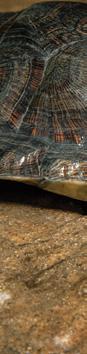
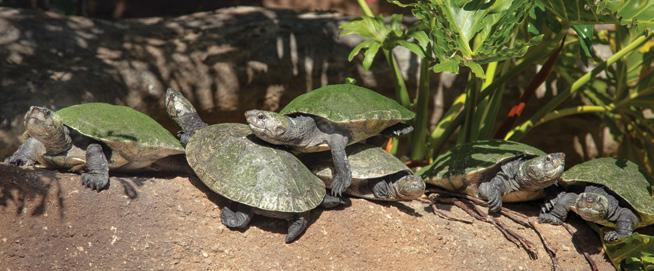
West African mud turtles Pelusios castanoides enjoy a good bask in the sun.
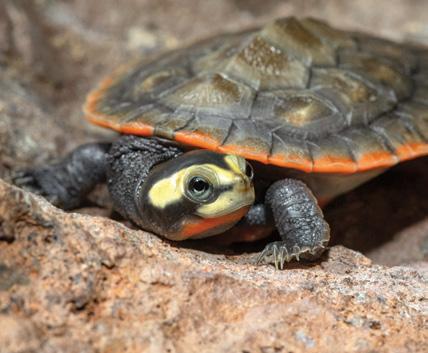
Red-bellied short necked turtle Emydura subglobosa; Papua New Guinea, northern Australia
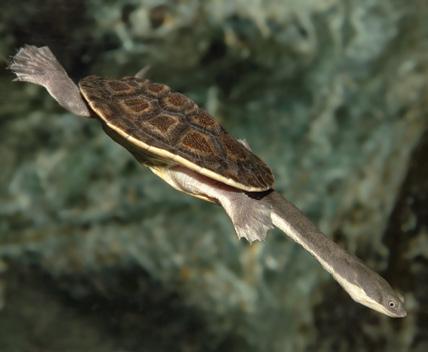
Broad-shelled snake-necked turtle Chelodina expansa; southeastern Australia
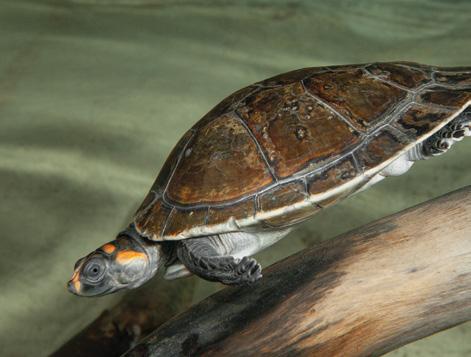
Red-headed river turtle Podocnemis erythrocephala; Brazil, Colombia, Venezuela
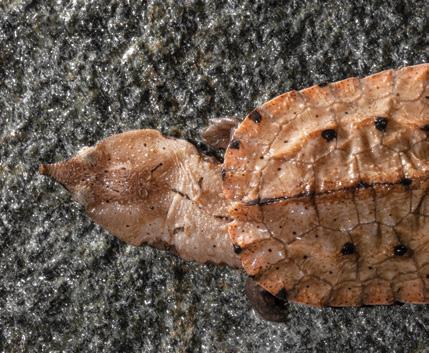
Matamata Chelus fimbriatus; Amazon basin in Guianas, Ecuador, Colombia, Venezuela, Peru, and Bolivia
Madagascar bigheaded turtle Erymnochelys madagascariensis; Madagascar
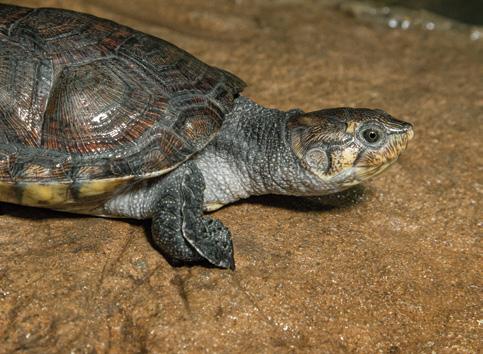
East African black mud turtle Pelusios subniger subniger; southeastern Africa, Seychelles, and eastern Madagascar
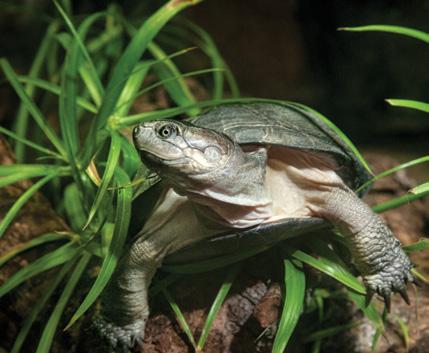
DID
YOU KNOW?
Although it lives an aquatic life, the broad-shelled snake-necked turtle
Macrochelodina expansa prefers to walk along the bottom, taking long strides with its neck fully stretched out straight ahead.
Despite being an aquatic species, matamatas are not well adapted for swimming in open water. They prefer the muddy bottom of ponds and shallow, slow-moving rivers.
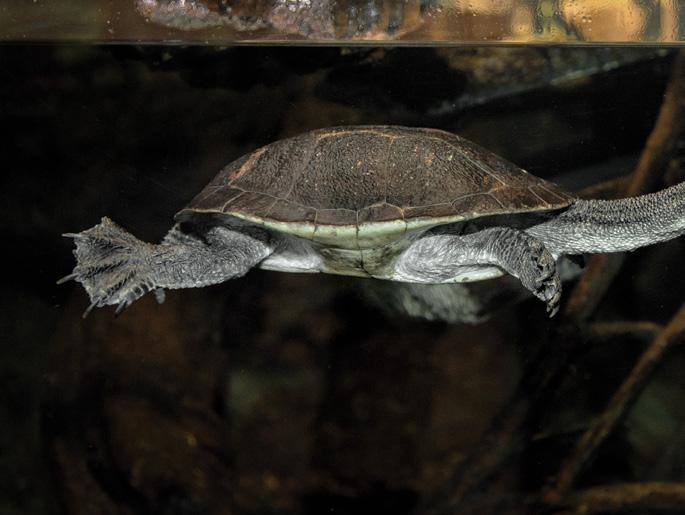
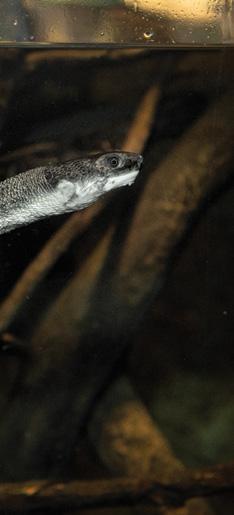
The long, serpentine neck on pleurodires like this Roti Island snake-necked turtle gives greater range when snatching prey and allows the animal to snorkel for a breath while keeping most of its body well beneath the surface.
The neck of a Parker’s snake-necked turtle
Macrochelodina parkeri (below) can measure about 10 inches long. That equals about 75 percent of its carapace length.
frogs, tadpoles, and other potential prey approach, the turtle makes its move. Swinging its head in the direction of prey, it suddenly opens its mouth wide, creating a strong suction that pulls its meal into its gaping maw. The matamata may be unique in appearance, but it isn’t the only side-necked turtle to just “let it flow” while feeding. Red-headed river turtles Podocnemis erythrocephala are mostly herbivores. Feeding on aquatic plants requires some biting and tearing, but these turtles also use the open-mouth technique to take in fine particles of algae and bits of decaying plants floating at the surface of the water.
THE WATER IS FINE
The sinuous throat of pleurodires is a trait that sticks out like a…well, a neck. But another unique trait is concealed beneath the shell—and it brings
Brett Baldwin, a wildlife care expert in the Herpetology department. “But a fused pelvic region may be beneficial to moving in water. A pelvis fused to the carapace is actually an ancient trait, and pleurodires are one of the most ancient turtle groups living today.” Without needing space for a flexible pelvis, the carapace of side-necked turtles has a lower, more streamlined profile. They don’t leave the water often, spending most of their time resting at the bottom of wetlands, streams, rivers, and lakes. With a few exceptions, most feed on bottom-dwelling mollusks and worms, tadpoles, insects, crabs, and small fish. The East African serrated mud turtle Pelusios sinuatus even has a helpful habit: it feeds on ticks attached to large mammals that wade into waterholes. While some side-necked turtle species haul out on beaches to bask in the sun, others like to stay closer to water and use logs as a safe spot to
warm up. But when it’s time to lay eggs, a female cautiously sets out to find a nesting spot on land— sometimes traveling thousands of yards from the safety of the water. After laying and covering her eggs, the female returns to her aquatic home. The incubation time for many species varies greatly, depending on when the rains arrive.
A RARE SIGHT
Their propensity for staying in the water makes side-necked turtles a challenge to see in their native habitats. In some cases, plummeting populations, severe droughts, and land-use changes ratchet up the rareness. For example, Roti Island snake-necked
turtles Chelodina mccordi are critically endangered. They are threatened by ecosystem modifications for human industries and the resulting waterway pollution; invasive introduced species and diseases; and drought. These factors combine to create an alarming situation on their island home in Indonesia, and their populations are severely diminished.
Then in the early 1990s, a spike in the number of Roti Island snake-necked turtles taken for the international pet trade devastated the population. Within a few years, the island population was considered ecologically extinct. Breeding and building assurance populations under protected care—such as zoos and aquariums—is working to bring these turtles back.
Building assurance populations, community conservation efforts, and setting aside protected areas are vital parts of the effort to bring side-necked turtle species—and other endangered turtles and tortoises—back from the brink of extinction. These species have been on Earth for a very long time. Here’s hoping that together we can make sure their ancient lineage continues.
BY THE NUMBERS
35
The largest of all the side-necked turtles is the the South American river turtle Podocnemis sp. A female’s carapace can reach 35 inches in length.
S Revealing Ebo Forest’s Treasures
Protecting apes, monkeys, and more
BY BETHAN MORGAN, PH.D. HEAD, CENTRAL AFRICA PROGRAM, AND POPULATION SUSTAINABILITY TEAM
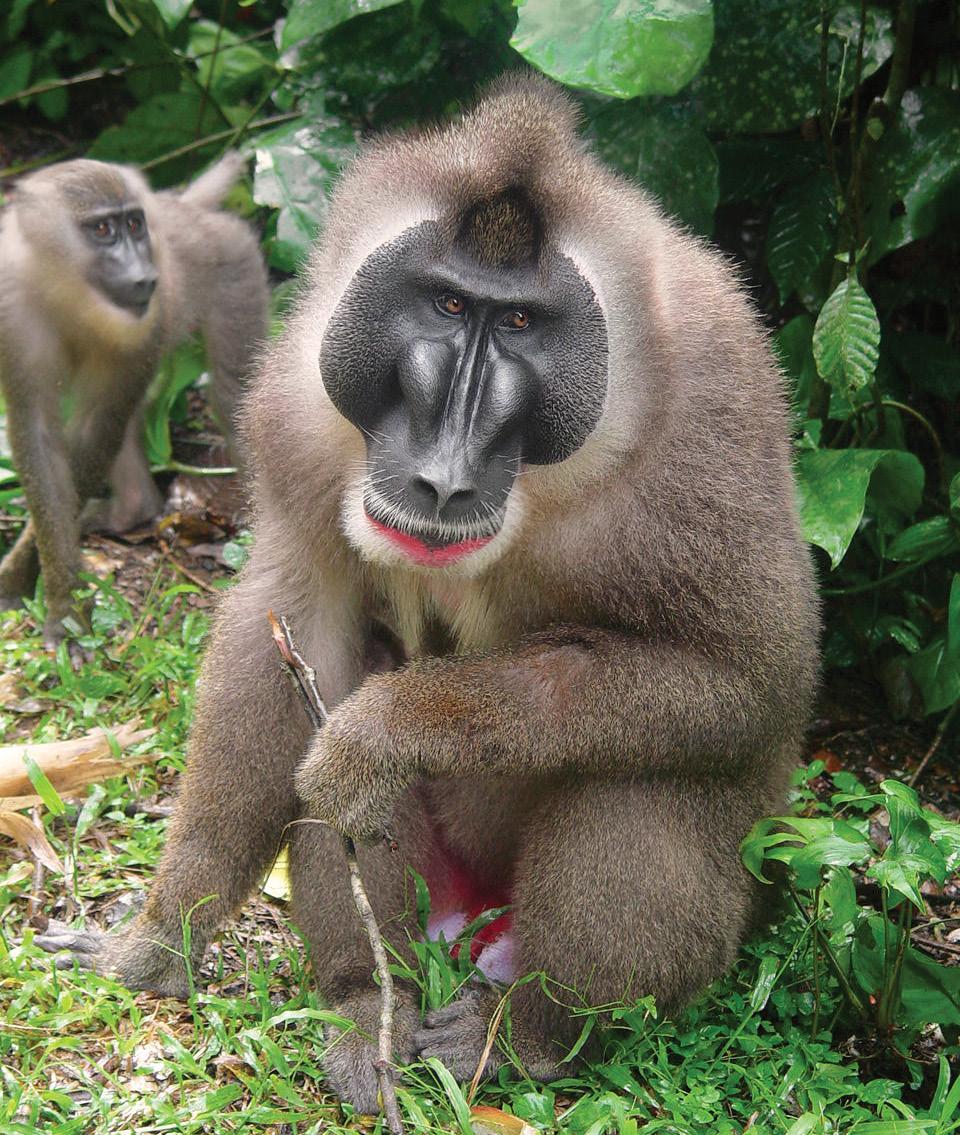
an Diego Zoo Global’s Central Africa Program is no stranger to the challenges that impact the most biodiverse and magnificent rain forests in Central Africa. When I started my conservation research work in the Ebo forest of Cameroon in 2002, studying the elusive drill, one of Africa’s most endangered and colorful primate species, I came across a group of previously unknown gorillas, hundreds of miles from the nearest known gorilla population. At that time, the main threat to the survival of the drills, gorillas, and other animal species in the forest was hunting to supply the commercial bushmeat trade.
PHOTO BY: BETHAN MORGAN
A DEDICATED TEAM
In the 18 years since our work began, our team of committed Cameroonian conservationists has struggled on a daily basis to protect gorillas, chimpanzees, monkeys, forest elephants, and other wildlife. Our manager, Ekwoge Abwe, joined us in 2003, and in early 2019, he was awarded the same postdoctoral fellowship that kick-started my work in Cameroon. Today, he manages a dedicated staff of 15, who work under extremely challenging conditions to improve the conservation outcomes for some of the most endangered species in Africa.
ENGAGING THE COMMUNITIES
During the first 10 years, we conducted our field research from tented research stations positioned deep inside the Ebo forest. This allowed us to observe monkey groups regularly, inventory the birdlife, and monitor a series of defined areas to study the diversity and abundance of mammal species. In 2012, we broadened our approach to include working within the human communities surrounding the forest. We realized that it was only through engagement and collaboration with local people that the forest would ultimately be protected.
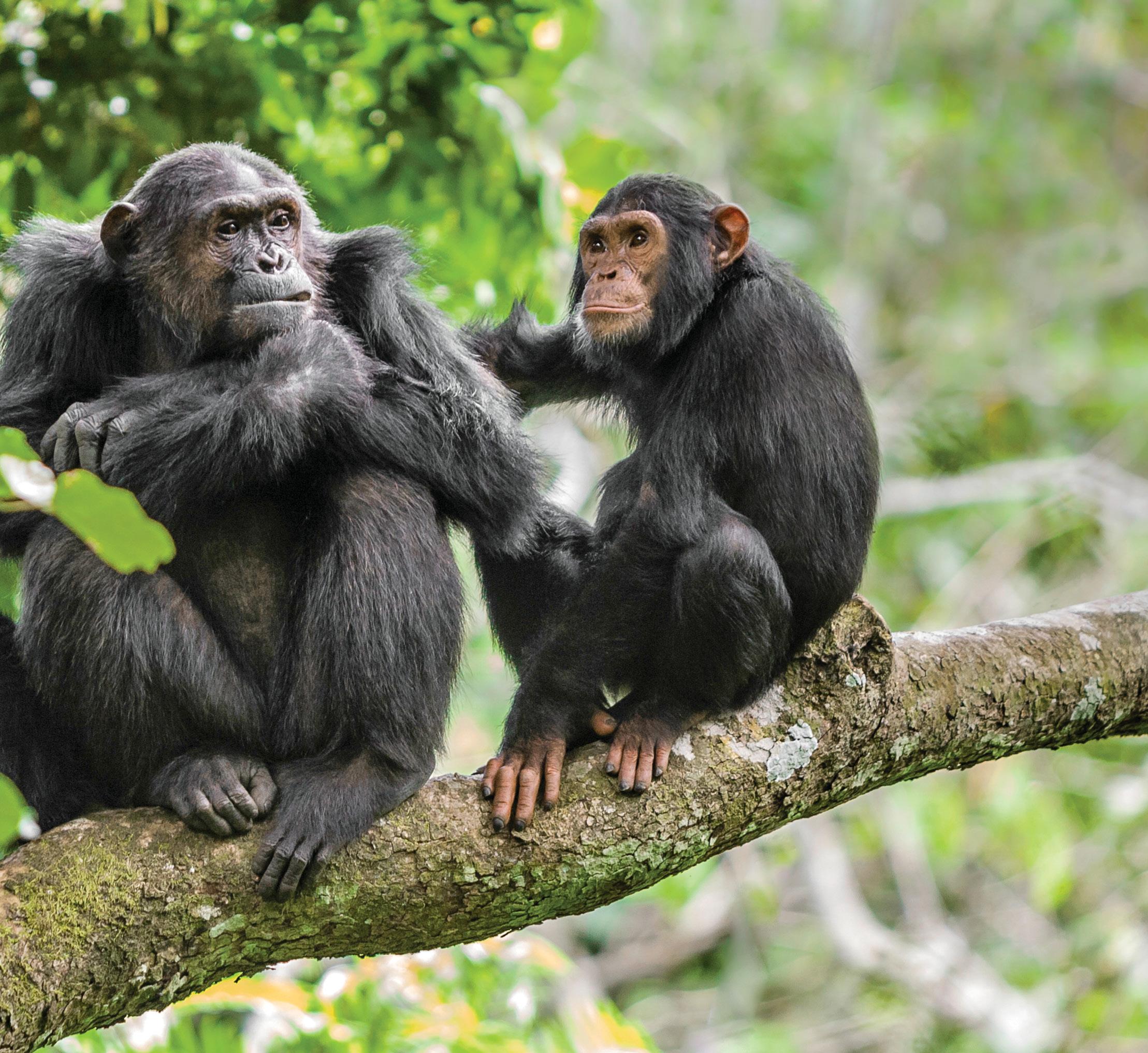
At Home in Ebo: Great apes like chimpanzees (this page) and monkeys like the drill Mandrillus leucophaeus (left) are among the vulnerable forest species needing protection.
CANDID
CAMERA
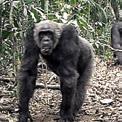
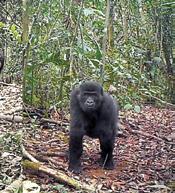
A network of trail cameras installed in various parts of the Ebo forest has provided photos of a wide variety of species, including two of the key study species, chimpanzees and gorillas.
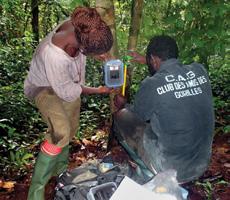
Our “Clubs des Amis des Gorilles” (Gorilla Guardian Clubs) were established by engaging three local communities in the protection of gorilla habitat in the northeastern Ebo forest. Our work with communities to
the north and west of the forest includes locating and sharing information about the critically endangered Preuss’s red colobus—Ebo has one of only two remaining populations worldwide of this shy, leaf-eating monkey.
PROTECTING BIODIVERSITY
This work is critical, given that Central Africa is experiencing a massive expansion of largescale agribusinesses, including palm oil plantations, which often
Trail Cameras in the Ebo Forest
We installed 12 trail cameras in the Ebo forest in 2010, and soon had images of a whole range of species. The cameras are managed by our staff and the Gorilla Guardian Clubs, resulting in the local communities being fully on board with the forest monitoring. To date, we have videos of chimpanzees, gorillas, and a male forest elephant, which charged one of our cameras repeatedly, trying to make it go away! We have recently invested in 20 of the latest highquality cameras to try, in order to see if the improved footage will allow us to identify individual gorillas.
PHOTOS BY (FROM TOP): KEN BOHN/SDZG; DANIEL MFOSSA
Clubs des Amis des Gorilles
Gorilla Guardian Clubs
In 2012, we added a new focus to our conservation work: establishing voluntary community groups in the three communities closest to the gorilla population. This initiative started with a handful of young, dedicated ex-hunters who realized, through working with us, that unless hunting pressure is reduced, many of the magnificent species would never be seen by their children. Membership in the voluntary club continues to grow. We issue membership cards and organize regular community events, including storytelling by village elders, activities for primary schoolchildren, and participation in Cameroon “fête days” for women and youths. More than 50 percent of adults in each community participate, working with us to monitor threats to gorilla habitat, join in community engagement activities, and join small-scale sustainable livelihood projects to raise the quality of life in remote communities that have no access to healthcare, electricity, or running water.
convert high-quality rain forest to stands of palm trees that do not allow other species to flourish. Not only is this devastating for local biodiversity, but it also removes land from local communities and results in an influx of workers who inevitably put pressure on the remaining rain forest with activities such as hunting and subsistence agriculture.
By working with communities around the Ebo forest, we are able to highlight these impacts and encourage social empowerment of previously marginalized communities. In particular, our work with the network of traditional chiefs has led to a resurgence of pride in traditional societal structures and land management practices, building on ancient
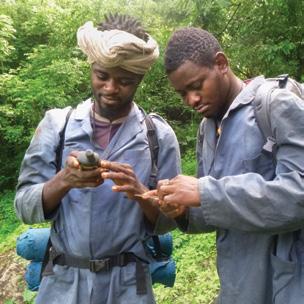
PLANT RESEARCH IN THE EBO FOREST
knowledge and providing community structure, education, and increased dignity. We also encourage the establishment of women’s groups in communities where women are engaged in small-scale farming activities to feed their families.
A VISION OF PRIDE
We are supporting the three communities near the Ebo gorilla population to establish a community-sanctioned exclusion area in the forest, not only to protect gorilla habitat but also to support a long-term vision of pride in the Ebo forest. Although this project is currently known as the “no-go zone,” it will be the communities that will decide its name and enforce the community-endorsed rules that will
protect the land. This represents a collaboration between traditional chiefs, their communities, and the regional ministry of forestry and wildlife.
Concurrently, we are working with traditional chiefs and regional and national government administrations to encourage a land use planning process to determine the future of the forest and how to best protect its cultural and biological riches. This endeavor is gaining traction, and we are developing a long-term funding strategy to bring our stakeholders together to focus national political attention on the Ebo region. If successful, this effort will protect the most important remaining habitat for flagship species in Central Africa.
Since 2002, we have been collaborating with the National Herbarium of Cameroon and Royal Botanic Gardens in Kew, England, to bring conservation attention to some of the rarest and most range-restricted plant species on Earth. We have discovered no fewer than 14 species new to science, from tiny flowering plants that cling to rocks in fast-flowing rivers to huge rain forest trees. The growing inventory of species recorded from Ebo will be published in a Checklist of the Plants of the Ebo Forest in the coming years, and it will be used to demonstrate the richness of the forest and provide yet another reason to encourage the protection of its biodiversity. Preparations are now under way for a botanical inventory to the west of the Ebo forest by a team led by our collaborators at Kew.
W PROTECTING MADAGASCAR’S LEMURS Saving
Their Forests Is a Key to Success
BY TIMOTHY M. EPPLEY, PH.D. | POSTDOCTORAL FELLOW, POPULATION SUSTAINABILITY/SDZG
here does one begin to describe Madagascar’s unique and irreplaceable biodiversity, including more than 100 lemur species and subspecies? Ruffed lemurs are considered a flagship species for conservation in Madagascar, although this does not ensure their survival in many areas. They are well represented within zoological parks worldwide, yet in their native habitat they are listed by IUCN as Critically Endangered.
FORESTS UNDER SIEGE
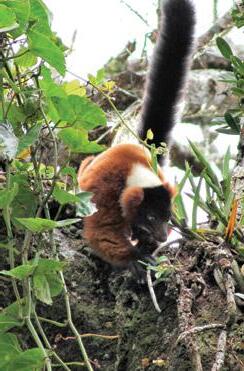
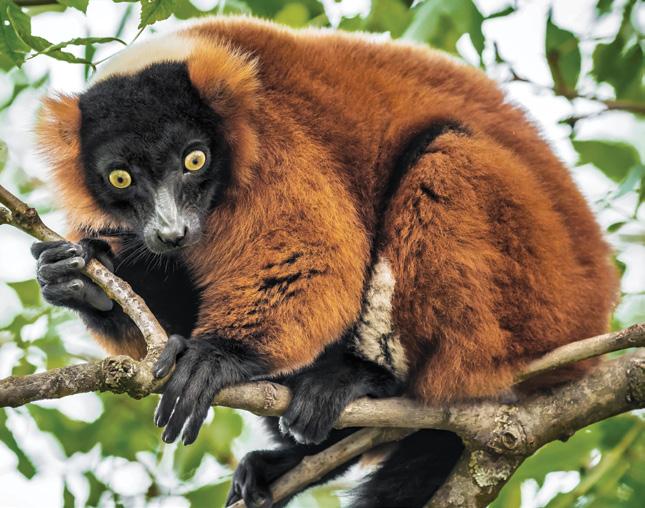
The red ruffed lemur Varecia rubra is found only in northeastern Madagascar, with much of its remaining population protected within the Masoala National Park and the adjacent Makira Natural Park. However, recent political strife has led to a surge in various illegal activities there, including harvesting of hardwoods and hunting, placing these forests under severe threat.
Research on ruffed lemurs, the species that relies most on a fruit diet, suggests that they may not cope well within habitats that attract human activities. The next critical question is how to protect them, because if we lose these forests, we have lost the lemurs.
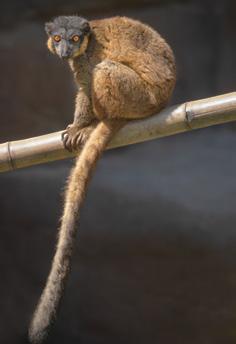
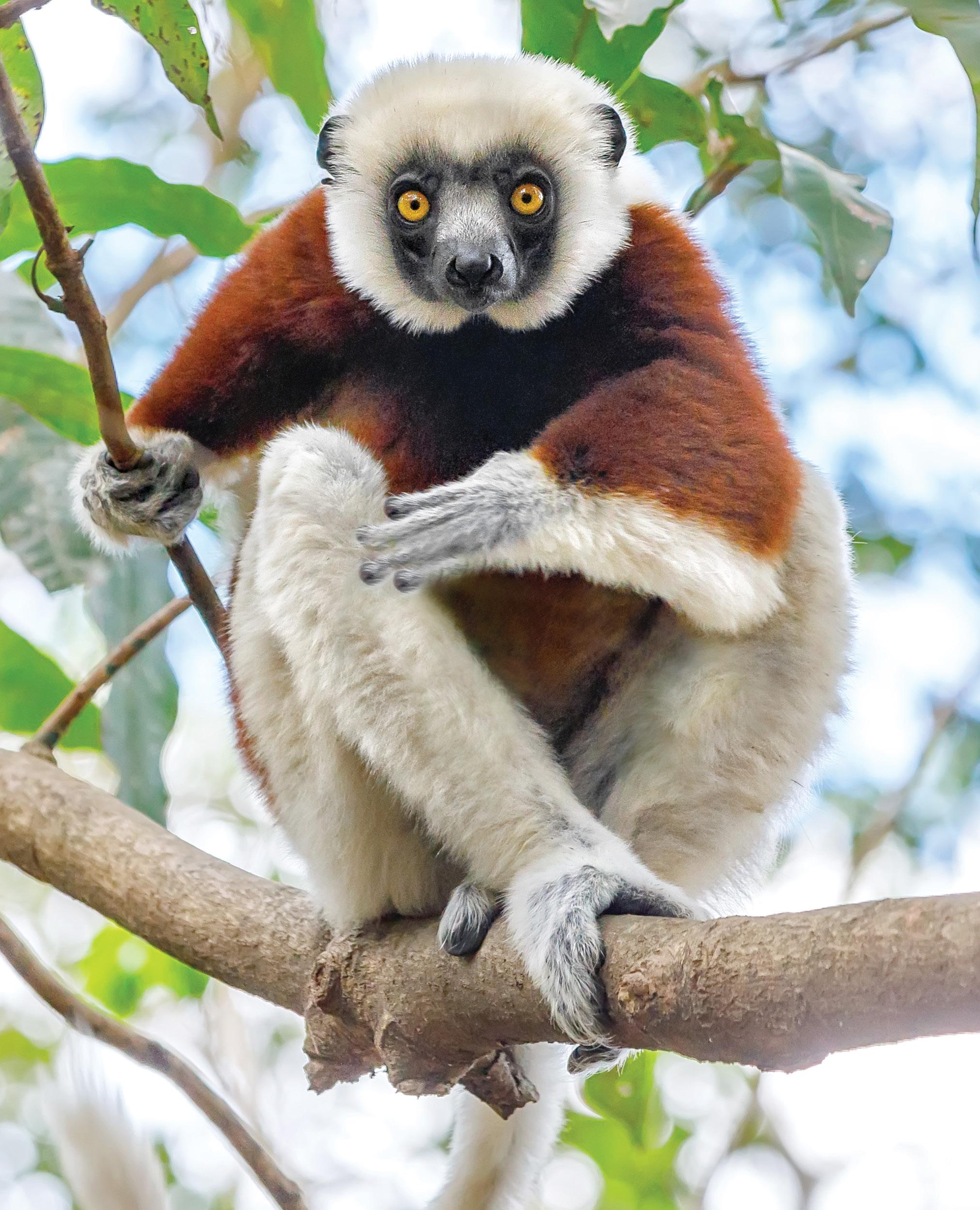
Relying
COLLABORATION FOR CONSERVATION
As a postdoctoral fellow, I have spent the last two years leading conservation research projects on red ruffed lemurs in northeastern Madagascar. I have worked in Madagascar since 2006, focusing on the effects of fragmented landscapes on bamboo lemur behavior and feeding ecology. Those experiences, coupled with multiple years working in the Democratic Republic of Congo on behavioral ecology and conservation of bonobos, have prepared me not only to collect ecology data on the red ruffed lemurs but also to establish collaborators at many levels. This includes local field guides, students from the local
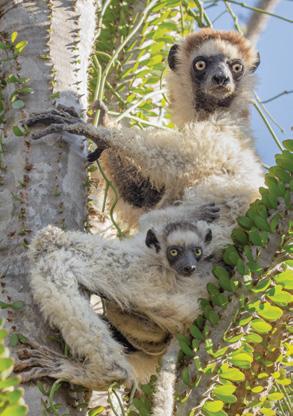
on the trees: Many lemurs, including the red collared brown lemur Eulemur collaris and the Coquerel’s sifaka Propithecus coquereli (right) are arboreal, depending on forests for their homes and food.
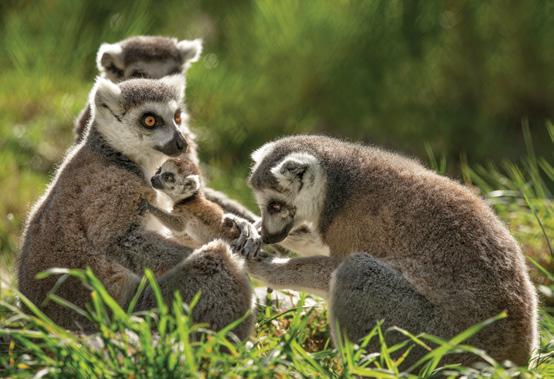
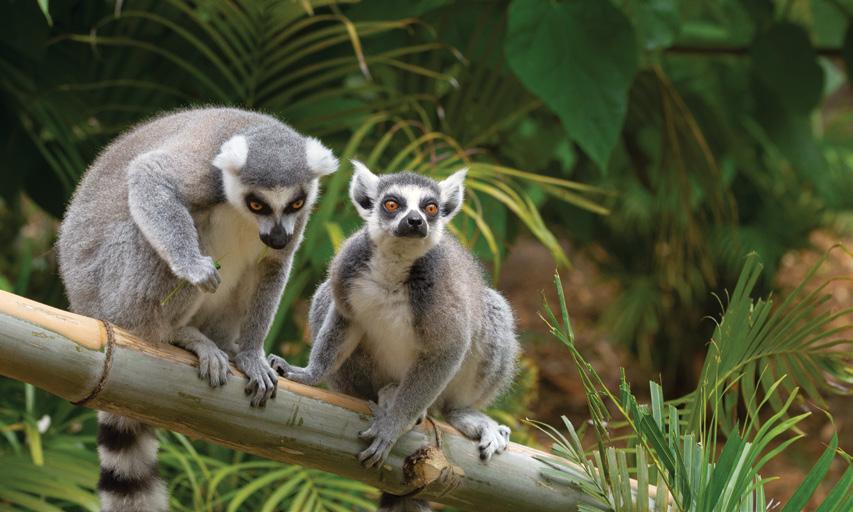
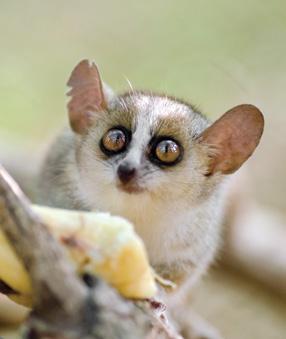
Wide eyed and bushy tailed: The ring-tailed lemur Lemur catta is one of the most common lemur species, but it is listed by IUCN as Endangered. Below: Mouse lemurs are the smallest primates in the world. Some species are only known from a single individual found in a fragment of forest.
university, and both local and international NGOs. The red ruffed lemur project is highly collaborative, advised by San Diego Zoo Global animal care experts and the Institute’s Population Sustainability and Conservation Genetics teams, as well as Port land State University.
SETTING UP A STRONGHOLD
One focus of our work is to create an established site for conserving this species, from which long-term behavioral, nutritional, and reproductive ecology studies can be carried out. We accomplished this by establishing a permanent presence in Andranobe, a site along the west coast of the Masoala Peninsula that houses one
of the densest known wild populations of red ruffed lemurs. We trained a local team of dedicated paraecologists who monitor the lemur population, document forest vegetation changes, and collect biological samples. We have over 4,000 observation hours, making this the longest continuous study of this species in the wild to date.
LOCATING LEMURS
A second aim is to conduct surveys throughout the Masoala-Makira region to generate popula tion density estimates of red ruffed lemurs and other lemur species. At the same time, we op portunistically collect fecal samples to evaluate population health. So far, we have conducted surveys at six remote sites for diurnal and
INVALUABLE FROZEN
ZOO ®
SAMPLES
One of the most important aspects of our research in northeastern Madagascar is the collection of biological samples—blood, hair, and feces—from red ruffed lemurs throughout their remaining habitat. These specimens help us to answer key questions, such as which remaining populations are experiencing potential genetic bottlenecks, allowing us to target those sites for immediate conservation action. Last fall, we
PHOTOS
SAVING FORESTS SAVES LEMURS
While national parks are important biodiversity areas within Madagascar, there are many unprotected habitat fragments that hold a wealth of plants and animals in critical need of attention and immediate conservation actions.
We visited a group of six small montane forest fragments in southeastern Madagascar last summer, which have an approximate size of less than 494 acres. This is one of only a few known locations where dry, spiny forest lemur species live together with humid forest lemur species. Eight lemur species reside there, and, unfortunately, two of them are on the list of the World’s 25 Most Endangered Primates. During our visit, we discovered extensive and unsustainable logging. Our hope is that the incredible biodiversity of this site, coupled with the unrestrained rate at which the forest is being lost, will inspire conservationists and funding organizations to help fight for its protection.
nocturnal lemurs, totaling more than 186 miles and 111 miles of transects, respectively. Ultimately, our objective is to establish a more data-informed conservation assessment for red ruffed lemurs that will guide local management to help save imperiled populations.
RELATIONSHIPS FOR THE LONG TERM
We work closely with in-country collaborators at the University of Antananarivo, through which we train and support master’s degree-level Malagasy students. We are proud of building local conservation capacity through direct employment and capacity enhancement that will form the basis for long-term, locally managed biodiversity monitoring.
Varied habitat: Sifakas, like Verreaux’s sifaka Propithecus verreauxi (left), are mostly found in Madagascar’s spiny dry forest, while ruffed lemurs, like the red ruffed lemur (below), make their home in the rain forests of the island.
Where to
Begin? Understanding Wildlife Health and Climate Change
BY BRUCE RIDEOUT, DVM, PH.D., DIPL. ACVP DIRECTOR, DISEASE INVESTIGATIONS
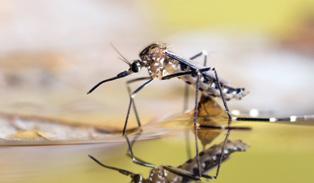
One of the fascinating—and daunting—aspects of climate change that doesn’t get much attention is the changing disease transmission dynamics we can expect as animals, pathogens, and disease vectors shift their distribution in response to changing climatic conditions. One of the ways we try to anticipate environmental change is through computer models developed by climate scientists, which can help predict large-scale processes, such as melting ice sheets and rising sea levels. But it is difficult or impossible to predict what will happen in specific disease transmission scenarios, because there are too many variables involved—even the most powerful computers can’t handle the complexity. We know that changes in disease transmission patterns are coming, but we don’t know exactly what they will be, or how they will impact us or the wildlife we care for—we are left in suspense. But we cannot sit back idly and wait; we have to do our best to respond based on the evidence we currently have. What we do know is that most pathogens and disease vectors have relatively strict environmental requirements for optimum reproduction and development. As average temperatures increase, disease vectors such as mosquitoes will move into areas that were once too cold for them to develop.
Hawaiian birds are threatened by deadly mosquitoborne diseases like avian malaria. Now that the birds’ forest habitats are experiencing warmer temperatures and more rainfall, mosquitoes multiply at these higher elevations as never before.
HAWAIIAN BIRDS IN CRISIS
A classic example of this is the changing mosquito distribution in Hawaii. Mosquitoes were introduced to Hawaii by a whaling ship in 1826. Prior to that, Hawaii was an idyllic paradise, completely free of biting insects. The introduction of foreign avian pathogens, such as malaria and poxviruses, soon followed. Hawaiian forest birds had not co-evolved with these pathogens, so their immune systems were not equipped to respond to them, and their populations were decimated.
Today, fewer than a third of native Hawaiian forest bird species remain, and more than half of those are endangered or threatened with extinction. Those that survive are concentrated in high-elevation forests above 4,921 feet, which
was the line that historically marked the temperature break above which the larvae of the dominant mosquito species, Culex quinquefasciatus, could not develop. Now, these high-elevation forests are getting warmer and wetter because of climate change, and the mosquitoes are moving up in response, destroying the last refuge these birds have from these deadly introduced diseases.
As a result, our Recovery Ecology team has started an assurance population of ‘akikiki Oreomystis bairdi at our Kauai Bird Conservation Center by collecting eggs from the wild. Akikiki are only found on Kauai, where the population is rapidly declining due to a lack of forest habitat without mosquitoes. We are also monitoring disease in a number of other native Hawaiian forest birds as the climate changes, and we already have mosquito-proof breeding facilities at our Endangered Bird Conservation Centers on Hawaii Island and Maui for maintaining reserve populations of many of these species, as a hedge against extinction.
THE ARCTIC’S POLAR BEARS
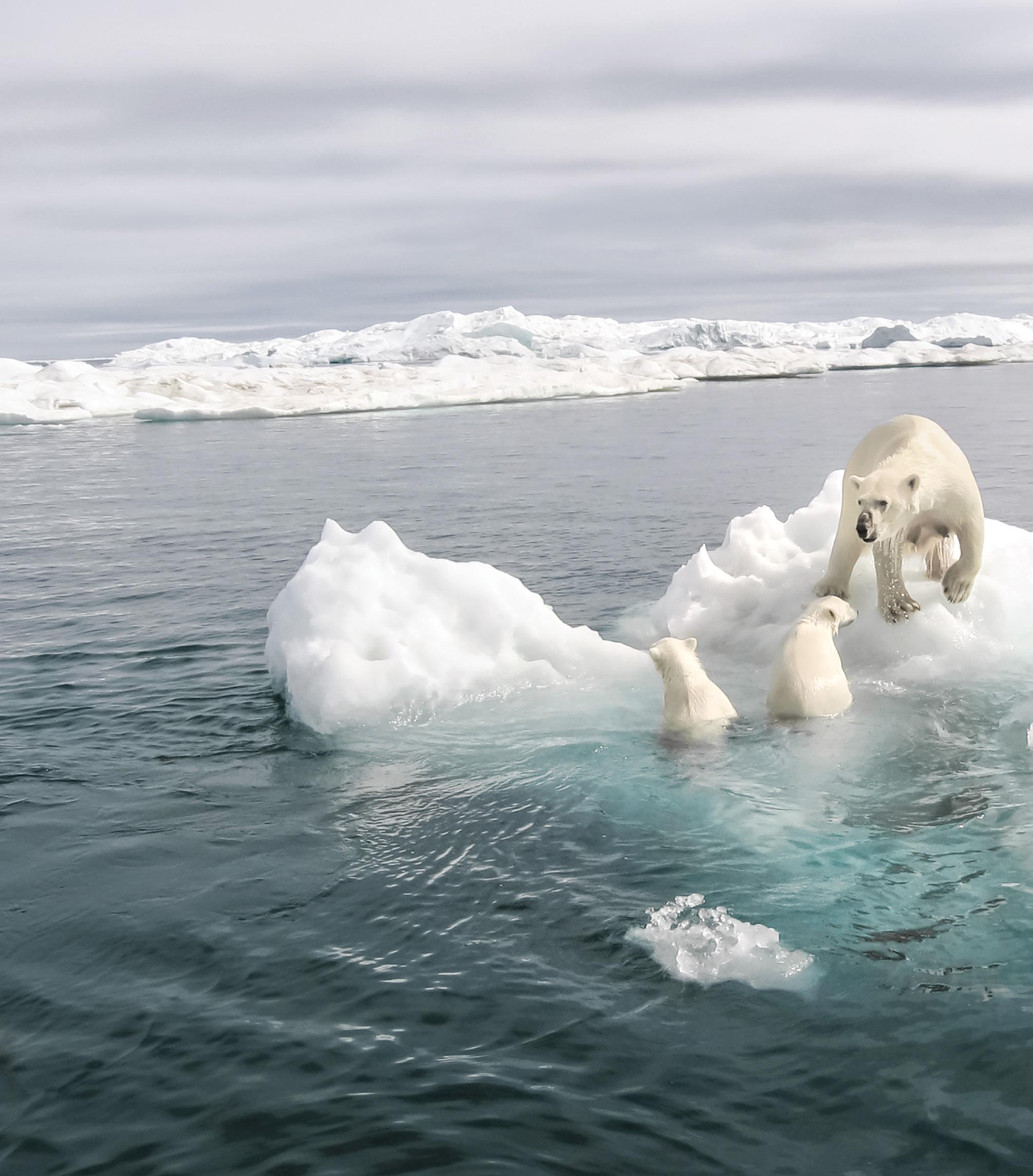
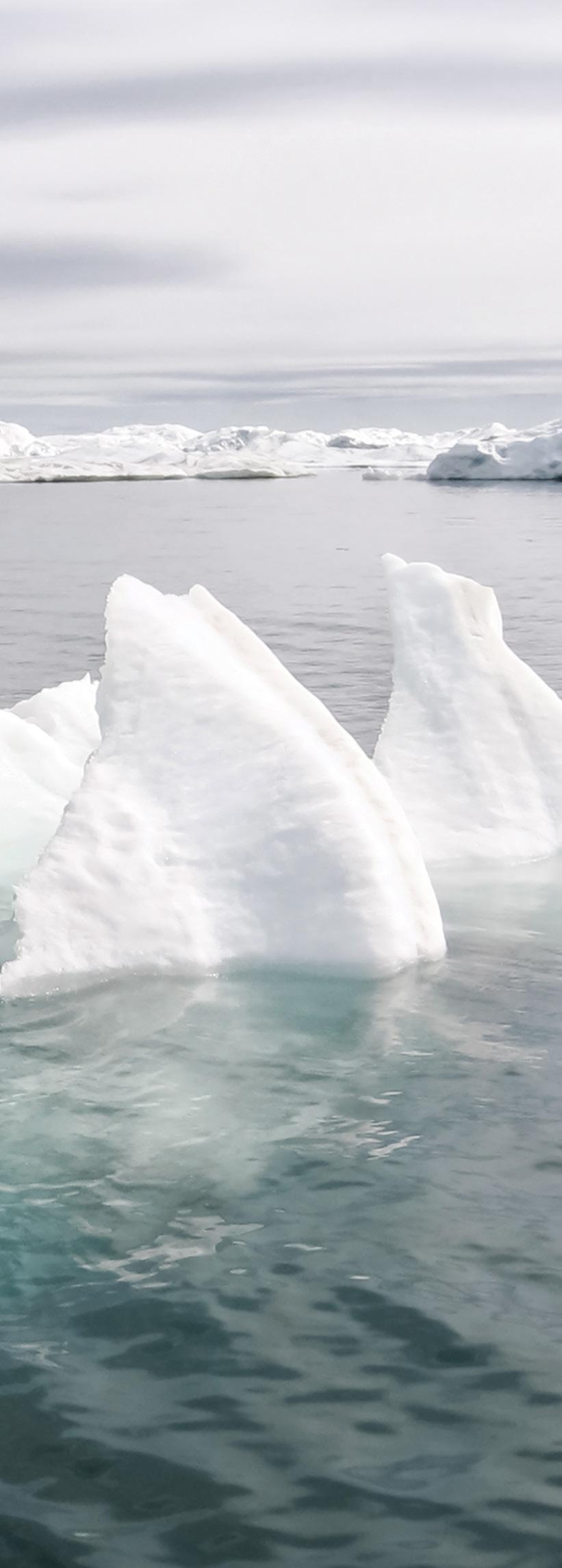
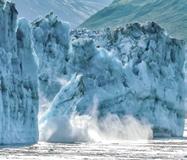
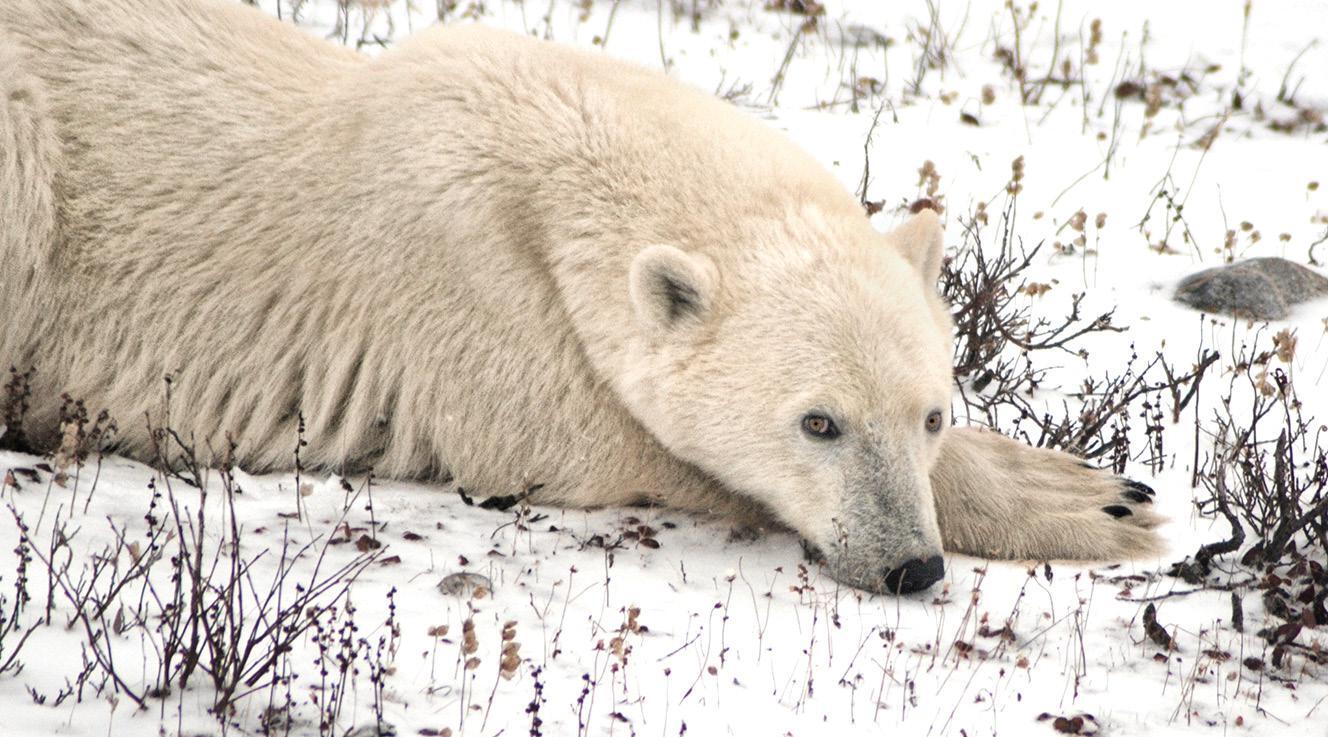
Much farther north, shrinking sea ice due to climate change and increasing human activities is causing some polar bear Ursus maritimus populations to gradually shift to more terrestrial food sources. These changes in foraging behavior are also changing the disease exposure dynamics for polar bears, resulting in an increasing prevalence of terrestrial diseases, such as those of domestic dogs. We are now collaborating with Environment Canada and our Population Sustainability team, looking at 30 years of disease exposure data in different polar bear populations. Understanding these changing disease dynamics will enable us to make management recommendations to better protect polar bears from terrestrial disease threats as a result of climate change.
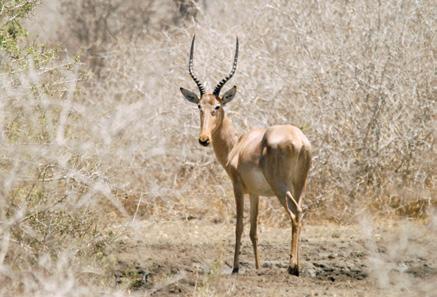
Necessary ice: As the climate warms, the ice sheets that polar bears rely on to hunt seals are disappearing. Below: The hirola, a highly endangered antelope, is one of the species in northern Kenya that San Diego Zoo Global and our partners are helping.
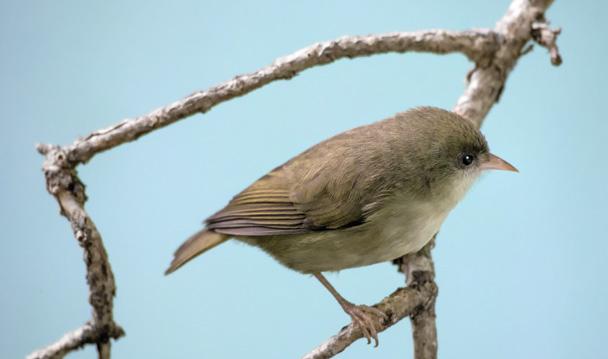
Hawaii’s forests used to be filled with the calls of songbirds like this palila Loxioides bailleui Mosquitoes carrying avian pathogens are one of the threats they now face.

“Rather than waiting in suspense to see what frightening scenarios play out, we’re working to minimize the impacts of climate change on wildlife and preparing for whatever responses might be necessary to lead the fight against climate-related extinction.”
—BRUCE RIDEOUT
KENYA’S WILDLIFE
Changes in animal behavior and disease resilience are also becoming evident in response to climate change. As native species decline in response to habitat loss and human development, they are at risk of going through a genetic bottleneck that results in increased susceptibility to disease. This is a concern for the critically endangered hirola antelope Beatragus hunteri in Kenya, where drought and overgrazing by livestock add to the stress on the last remaining population, increasing their vulnerability to deadly livestock disease outbreaks. In response to these climate-related threats, we are developing the first integrated livestock-wildlife health management program for the region, which will protect the hirola from disease threats, while simultaneously benefiting the local pastoralist communities whose livelihood and survival depend on their livestock.
Since starting our breeding program in 2005, San Diego Zoo Global has released and monitored thousands of critically endangered mountain yellow-legged frogs Rana muscosa in local mountain streams, boosting species recovery.
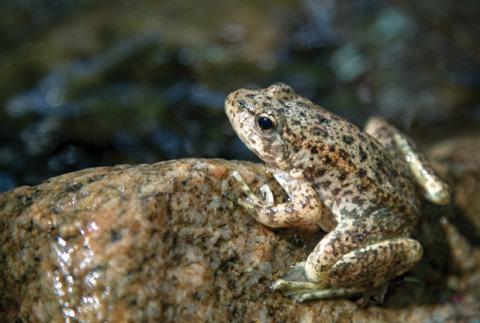
surveillance services for amphibian conservation programs. This is a pressing need: over 100 amphibian species have become extinct since 1980, and a third of the remaining 6,000 species are threatened with extinction because of the global spread of the deadly chytrid fungal disease.
AMPHIBIAN DISEASE LAB: URGENT SOLUTIONS
Our Amphibian Disease Laboratory was established under a grant from the Institute of Museum and Library Services to provide diagnostic and disease
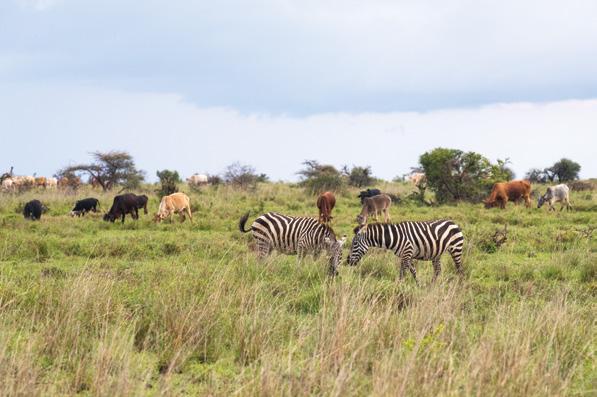
Sharing resources: Finding ways for livestock and wildlife to share food resources; in Kenya, along with an integrated livestock-wildlife health management program, can help many species.
We provide our services at cost, in order to facilitate the establishment of assurance populations as a hedge against extinction. Since the inception of the lab, we have provided support to over 100 zoos and conservation programs around the world. In addition to providing our laboratory diagnostic services, we provide expert consultations on disease surveillance strategies, and mitigation plans to control the spread of disease, which is exacerbated by climate change.
MINIMIZING IMPACTS
These climate impacts have the potential to create a self-perpetuating downward spiral in native species. Rather than waiting in suspense to see what frightening scenarios play out, we are working to minimize the impacts of climate change on wildlife and preparing for whatever responses might be necessary to lead the fight against climate-related extinction.
Feet First
Animal feet come in a staggering array of forms and functions, and may serve other purposes beyond locomotion. Feet can also dig, defend, stick, smell, kick, hang, perch, communicate, or grab. Some are flat footed, tippy-toed, or toenail walking, and may sport claws or nails. Mammal feet are typically flexible assemblies of bones, joints, muscles, and tissues that efficiently serve an animal's lifestyle. Here is a quick walk through some diverse footwear.
BY KARYL CARMIGNANI | STAFF WRITER ILLUSTRATIONS BY AMY BLANDFORD | STAFF ILLUSTRATOR
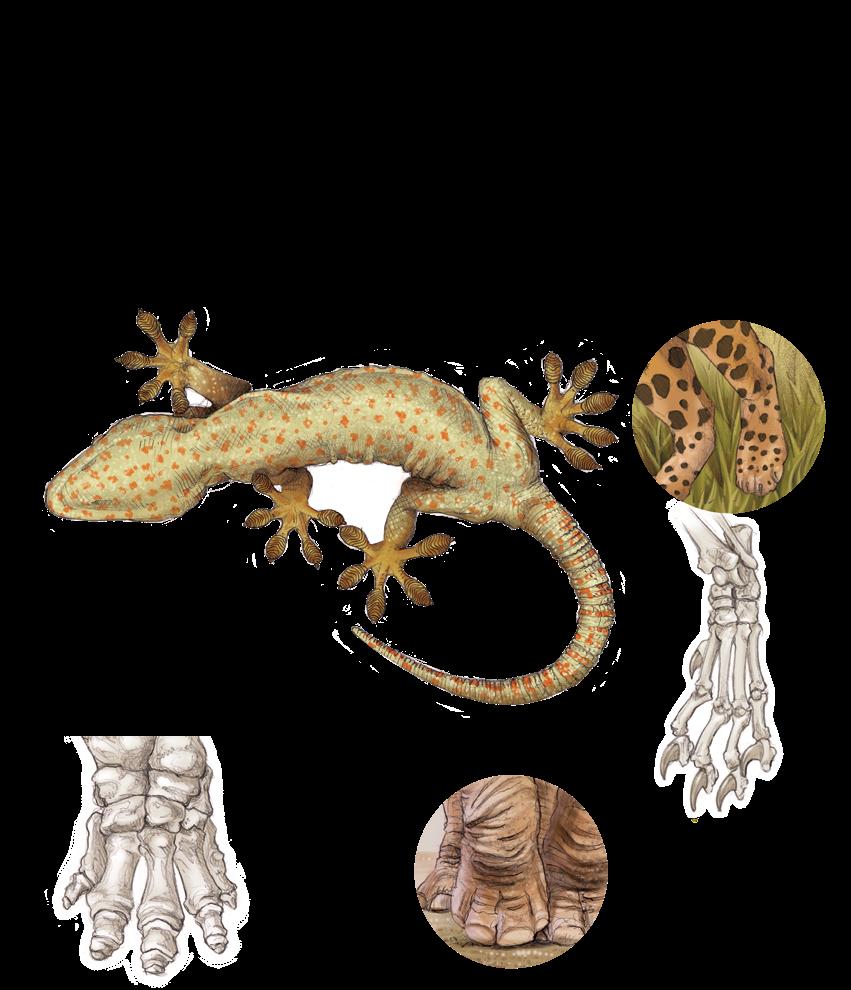
GECKO
SPLITTING HAIRS
How does a gecko run straight up a wall? Its feet are not sticky all the time, but instead it employs tiny, branched hairs on its toes called setae that can be instantly activated to provide gravitydefying traction and swift locomotion. The setae can actually support 50 times the gecko’s body weight!
ELEPHANT
QUIETER THAN A MOUSE
Even the largest land mammal on the planet can be stealthy at times: The elephant’s foot structure allows it to walk on tiptoes. Its feet have five toes, but not all of them have nails. Much of each round, dinner plate-sized foot is made up of an elastic spongy cushion on the “heel” that smothers objects underfoot, muffling noises of crushed debris.
JAGUAR SCRATCH THAT
A cat’s retractable claws are like a Swiss army knife in the ready. Used for climbing, gripping, digging, slicing, or just shredding the couch, these handy tools give cats an evolutionary leg up on the competition.
FRUIT BAT
HANG IN THERE
Fruit bats are well suited for hanging upside down. Bat legs are highly flexible and— unique among mammals— the knee faces backwards. But it’s a locking tendon from the leg into the bat’s claw that cinches the deal: once closed around a branch, the bat hangs effortlessly during sleep and even death.
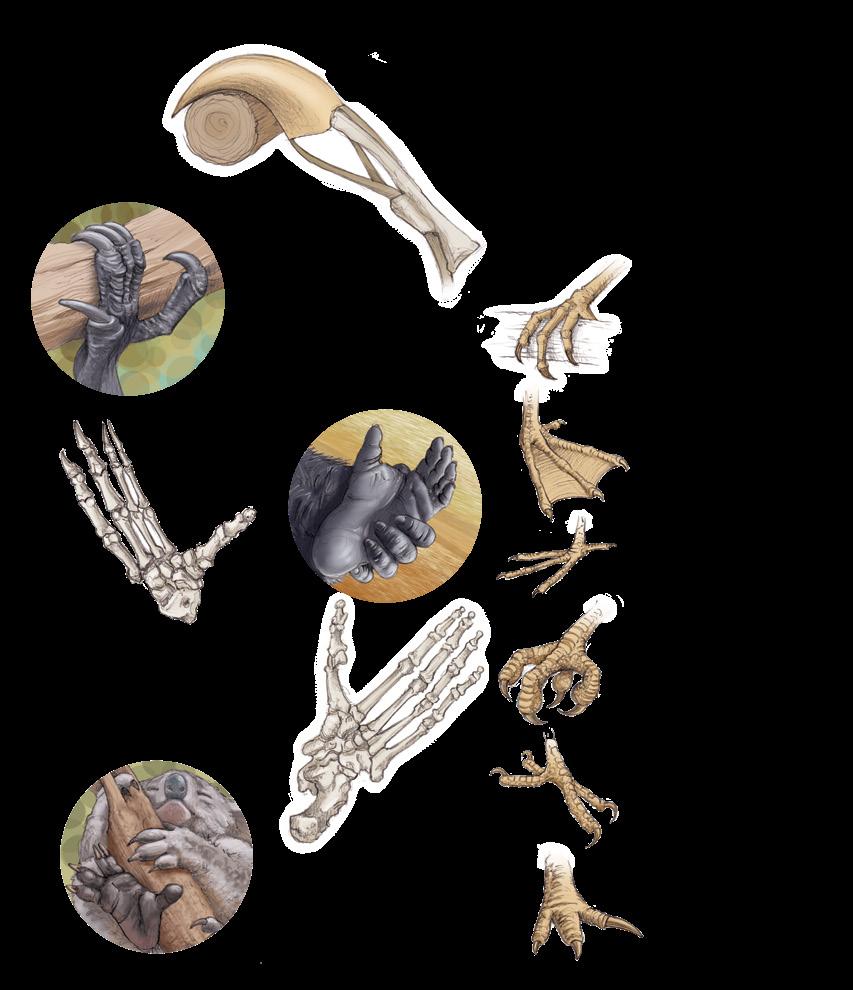
KOALA GET A GRIP
Koalas live in towering eucalyptus trees in eastern Australia. Long, sharp claws provide a tight grip, curling tightly around tree branches as a koala consumes leaves. They have two opposable digits on each hand, and one opposable digit on each foot. Hail the quintessential tree hugger!
GORILLA ALL THUMBS!
All primates except humans have grasping feet. Primates also have nails on their digits (though some species may have more claw-like nails). Having an opposable big toe allows great apes like gorillas to manipulate objects and scramble up a tree when necessary.
Avian Toe Types
Bird feet serve the ecology and lifestyle of the species. Other “feats” besides flight influence foot types and shapes.
PERCHING Songbirds like wrens and warblers have flexible toes, with one pointing backward. A tendon on the ankle locks toes around a branch, keeping the bird secure in place as it sleeps.
SWIMMING Webbed feet are handy for aquatic birds like ducks, gulls, and swans. Palmate feet have three front toes connected by webbing, enabling energyefficient propulsion.
WADING Wading birds like herons and cranes have long, slender toes that don’t sink into the mud as these birds travel along shorelines and wetlands.
SEIZING PREY Hawks, owls, and eagles use their powerful legs and feet to grab prey. Raptor toes are equipped with sharp, curved talons perfectly suited for meals on the go.
CLIMBING Climbing birds like woodpeckers have two forward-pointing toes and two that point backward, so poking for food along tree trunks is a breeze.
WALKING Flightless birds like emus, ostriches, and cassowaries use their strong legs and sharp claws to defend themselves.
mark on your
From snazzy stripes to pretty patches, animal bodies are adorned with lots of cool markings. Some want to fool predators; others are hoping their friends find them! You can make your own mark by drawing patterns on the figures below.
parrot
A bacteriaresistant pigment gives parrots’ feathers their red, yellow, and green coloration.
giraffe
Underneath each patch in a giraffe’s coat is a sophisticated system of blood vessels that can help the animal release heat.
This monkey’s golden color is accented with long black-gray guard hairs on their shoulders, upper arms, and back.
zebra
Every zebra has a unique pattern of stripes. And scientists can use the patterns like bar codes to identify individuals in a herd and keep track of them.
A tiger’s stripes help to break up the outline of its body and make it harder to find in shadowy forests.
snake
A snake’s coloring and pattern can be on either side of the snake and on the back or the belly.
To find out about these and other animals, plus videos, crafts, stories, games,

Edward Meets Future
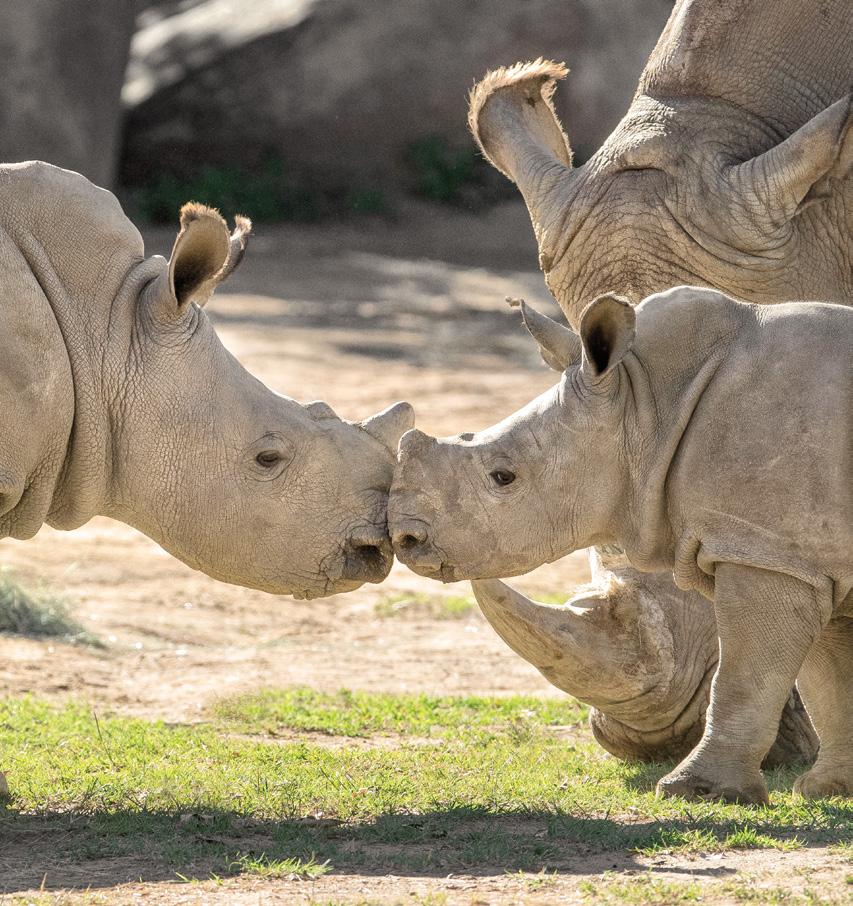
It was a crash course in cuteness at the Safari Park on February 1, 2020, when the two newest southern white rhino calves at the Nikita Kahn Rhino Rescue Center met nose to nose. The sight of Edward (on the left) and Future (the younger one on the right) playing together was a happy reward for our scientists, for their hard work. It’s also a sign of hope and promise for rhino conservation.
CHECK OUR WEBSITES FOR UPDATES ON HOURS AND EVENTS
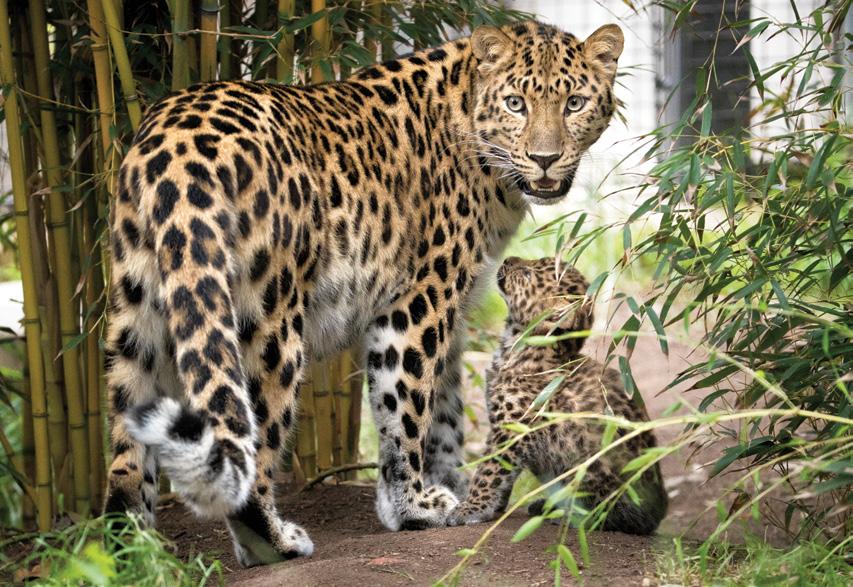
YOUR SUPPORT MATTERS
As we overcome the challenges of COVID-19 together, our dedicated teams continue to care for all the animals and plants at the Zoo and Safari Park, as well as critically endangered species around the world. We remain committed to our mission and to saving species worldwide—but we can’t do this without you.
Your support is more crucial now than ever. Your most generous gift makes a difference for wildlife in our care and around the globe, and your continued support offers hope and reassurance for the future. Make your gift today at SanDiegoZoo.org/Hope.