Farmers Union

As we reflect on the women who raised us this Mother’s Day, South Dakota Farmers Union celebrates the many women who support the state’s No. 1 industry – farm and ranch moms!
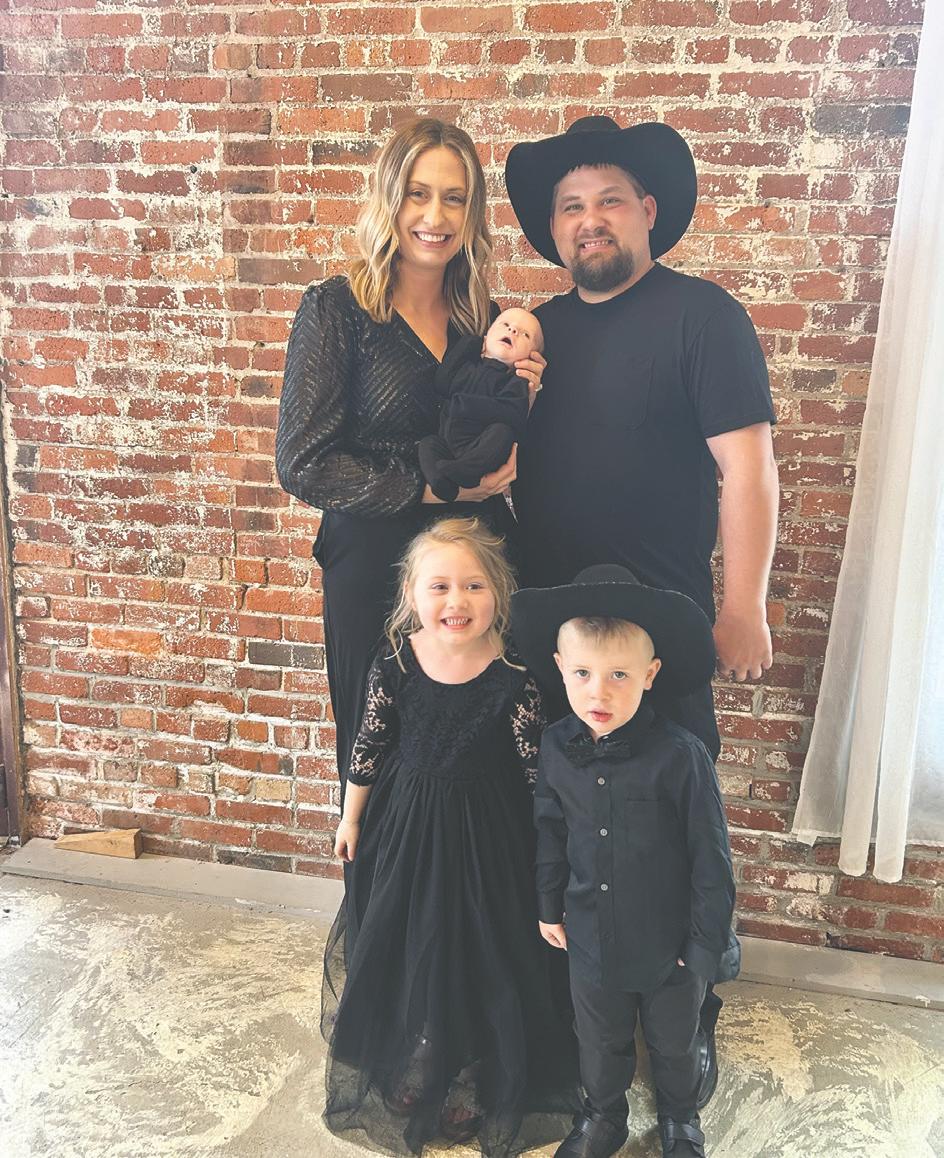
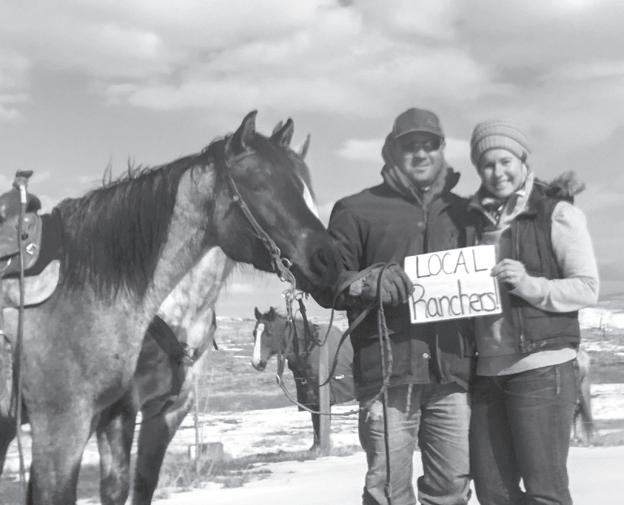
Lindsey Hinsvark with her husband, Lance, and their children, newborn Hank, Georgia, 4, and Swede, 2.
Read about Brenda Reis from Reliance and Lindsey Hinsvark from Gary on Pages 10 and 11.
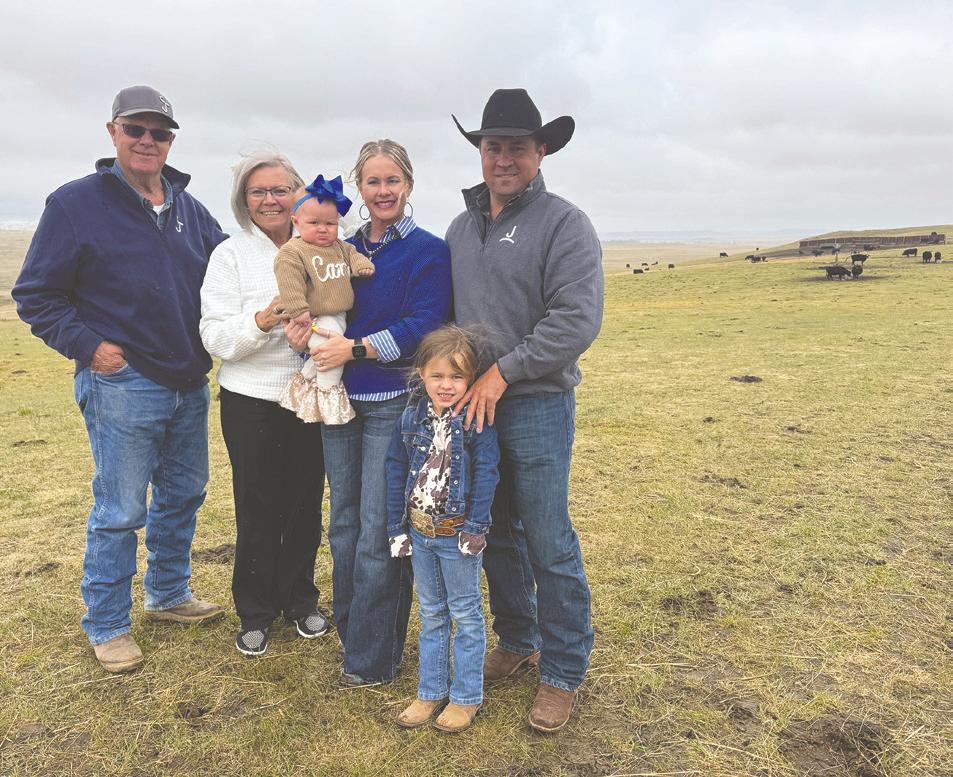
Ask five-year Adley Johnson what she enjoys most about life on her family’s Harding County ranch and without hesitation the fifthgeneration rancher says, “riding horses.”
Her favorite? A palomino named Custer.
Adley is the reason her dad, Brad, is happy he returned home after a more than a decade career as a professional steer wrestler.
“I enjoy it when Adley comes out and helps me. When we are tagging calves, she writes the tag number and date in the calving book,” Brad said.
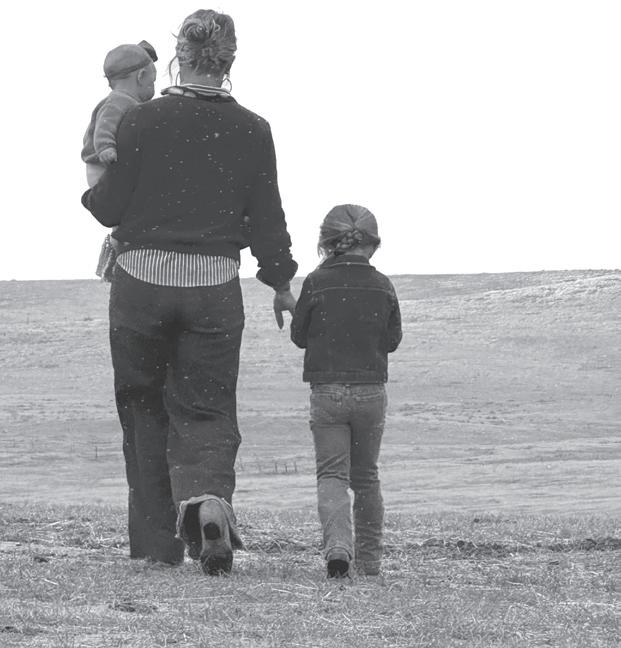
Amy, Adley’s mom agrees. “We like having the girls with us when we are working. Sure things get done a bit slower and we have to revolve
Johnson Family Continued from Page 1
“When I do something to benefit us today, I also do the work looking further down the road for our girls.”
– Brad Johnson
working cattle around nap time – either so they are sleeping or so they can help us – but we enjoy having our family together,” Amy said of Adley and 7-month-old Carty.
Like Brad, Amy grew up on a South Dakota ranch. In addition to raising cattle, her family trained horses on their place east of Hot Springs. Rodeo is also very much a part of her life.
“We are rodeo people. My dad was a World Champion Calf Roper and my mom was
Miss Rodeo South Dakota,” Amy said. “I did everything – barrel racing, pole bending, goat tying, breakaway and team roping – I did not know any other way. My dad always said rodeo will pay for college. And it did.”
Amy loved the competitiveness of rodeo and the sense of family.
Brad agreed. “I still have lots of friends from everywhere. Because of rodeo, I can be in nearly any state and call up a friend,” he said.

Like Amy, rodeo paid for Brad’s college tuition. He rodeoed for Eastern Wyoming and Gillette College and then hit the professional circuit until he decided to return to his family’s ranch fulltime in 2020.
“Amy and I got married in 2019 and we had Adley in 2021. My priorities became different.”
Today Brad and Amy remain connected to rodeo team roping together.
“We are both very competitive, so it is nice to be competitive together and push each other,” Amy said.
Amy works as the Executive Secretary for the South Dakota High School Rodeo Association and trains horses for her family.“Anytime I ride, it takes me back to home and family,” Amy said. “I love training horses for my daughters’ future riding and rodeo needs.”

As Brad and Amy visit, Adley draws a picture for her Grandma Laura and Grandpa Bill. Along with a fence, grass and trees, the picture includes a horse – probably Custer.
The family is sitting at Bill and Laura’s kitchen table enjoying a lunch of beef stew and rhubarb bars. Brad’s parents’ home sits just a few yards away from the original homesteader’s house.
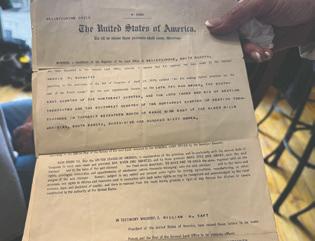
“My grandma, Nina Klovdahl, homesteaded here around 1909,” Bill shared. “Grandpa, his name was JR Johnson, had homesteaded in Reeder, North Dakota and sent grandma here by wagon to homestead by herself. They were not married yet. She and her two sisters all came down here and homesteaded their own places. After she proved up her homestead, they got married and had five kids.”
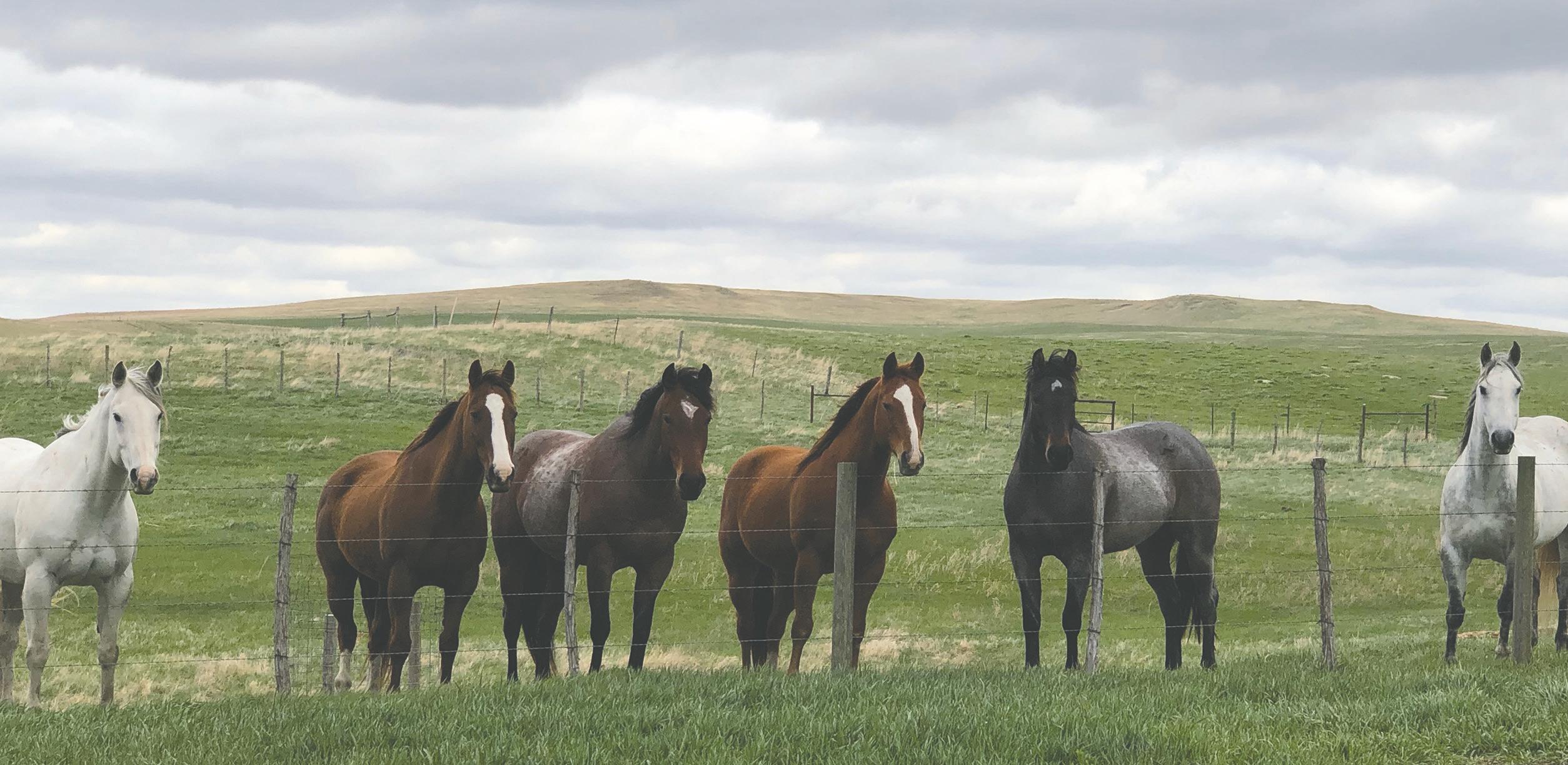
Out loud Bill wonders what attracted Grandma Nina to homestead at this exact location. The Johnson Ranch sits in the middle of rolling hills of native rangeland with the scenic Slim Buttes off to the west.
The ranch is 10 miles from Reva, a onestop-shop for local ranchers and travelers along
South Dakota Highway 79 with a general store, feed store, gas station and post office all under one roof and owned by a local family.
Named after the daughter of its first settler, Reva Bonniwell, Reva is among the many unincorporated ranching communities that make up Harding County. A ranching community that is currently thriving thanks to young people like Brad returning home, explained Laura.
“Harding County is pretty unique in the fact that there are a lot of places like ours that have been here for generations. It is a big sense of pride, not only for our generation, but for the future,” explained Laura, who recently retired from a career teaching music education in rural schools in Perkins and Harding Counties. “Right now, Harding County School kindergarten class has 24 little people.”
When Brad returned home to ranch fulltime, Bill says letting his son take over the big decisions was not difficult. “I was plumb comfortable with stepping back because I think there are always two ways to do something and if two people are trying to figure out how to do something it just makes it complicated,” Bill said. “And the improvements that have come to the ranch since Brad came back are amazing – the fences, the buildings, the pipeline, the grazing rotation, the genetics.”
Brad is one of four children Bill and Laura raised on their ranch. His three sisters are Robin Zebroski, Keri Casteel and Katie Martin. “We are lucky to have 13 grandchildren that all live within a few hours,” Laura said. “It is so nice to have Adley and Carty so close. We see Adley every day. She calls me up and asks, “grandma are you home. I want to come over.”
Growing up, Bill’s family raised Hereford
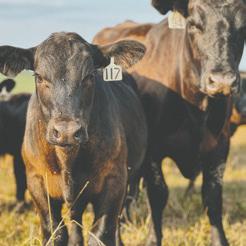
cattle. Today, it’s Black Angus. Nearly finished with Calving Season 2026, the family said it has gone well due to cooperative weather, in other words, no blizzards.
Over the last decade, the family has implemented a more intentional rotational grazing system. “Each year we start and end in different pastures. We move the cattle depending on how much moisture we have received and have a take half, leave half rule,” Bill explained.
Access to dependable water made rotating through more pastures possible. To accomplish this, the Johnsons worked with Natural Resources Conservation Service programs to dig wells and install miles of pipeline and fence.
“When I do something to benefit us today, I also do the work looking further down the road for our girls who are the fifth generation,” Brad said. “What makes our ranch better today, also make it better for tomorrow.” n by Lura Roti for SDFU
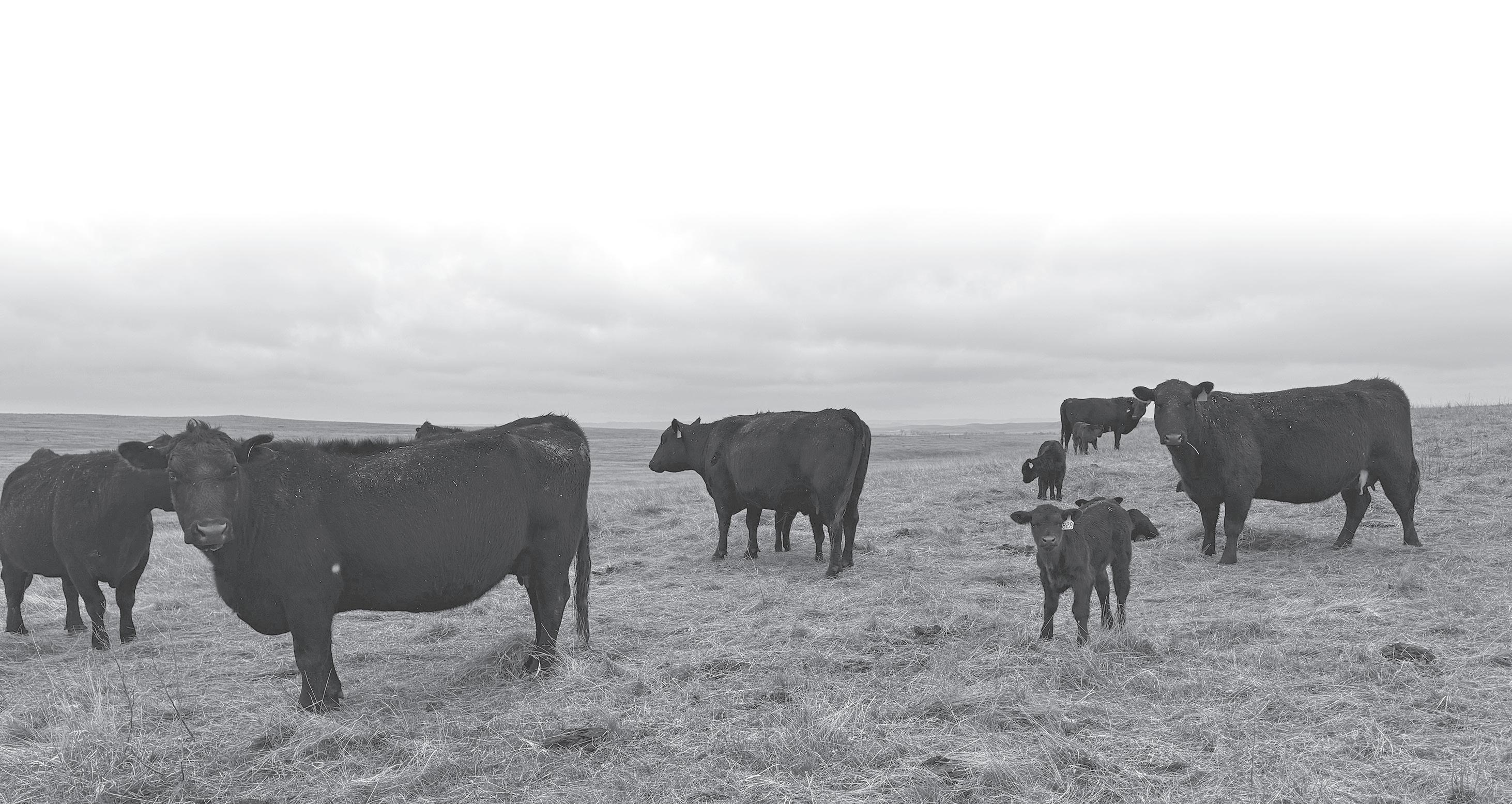
“Harding County is pretty unique in the fact that there are a lot of places like ours that have been here for generations. It is a big sense of pride, not only for our generation, but for the future.”
– Laura Johnson
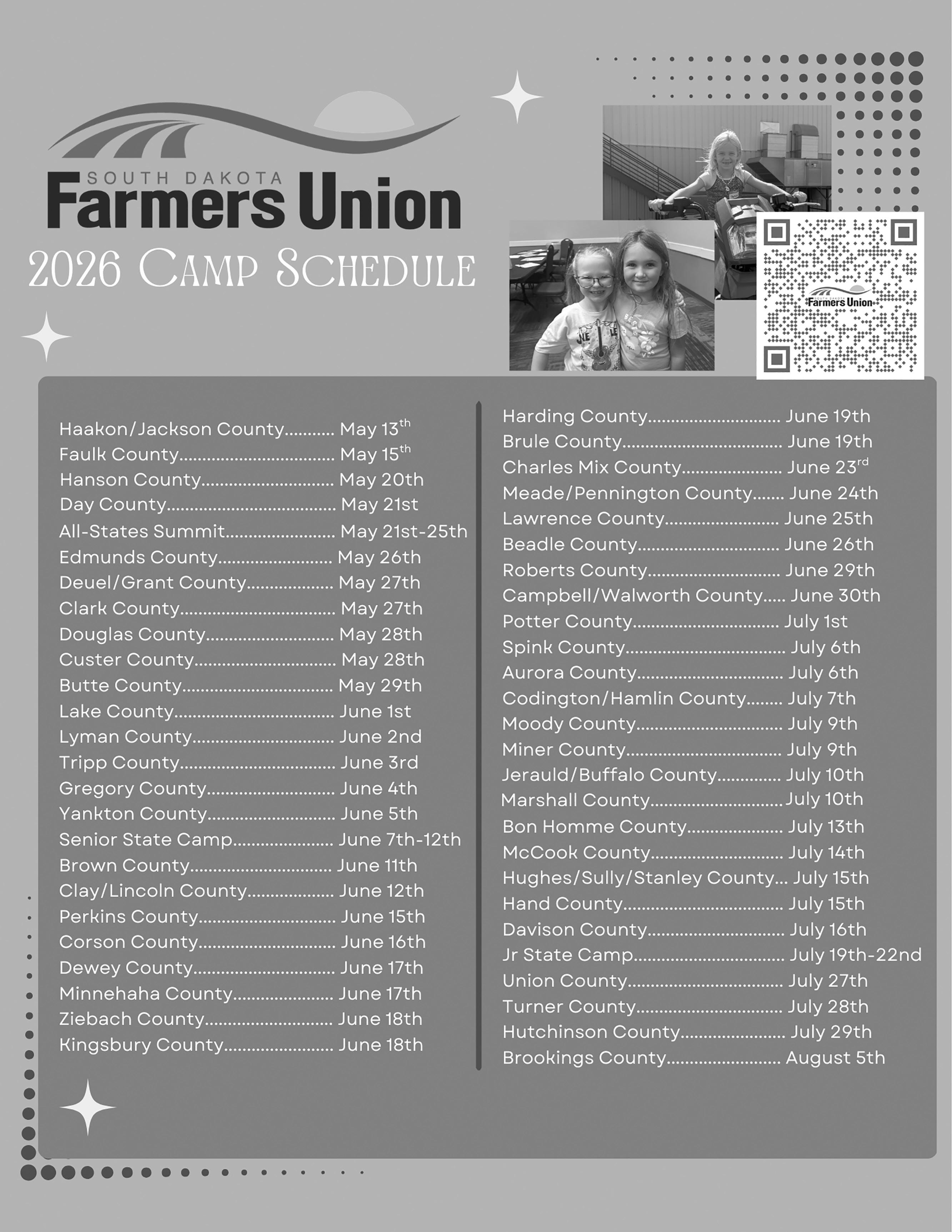
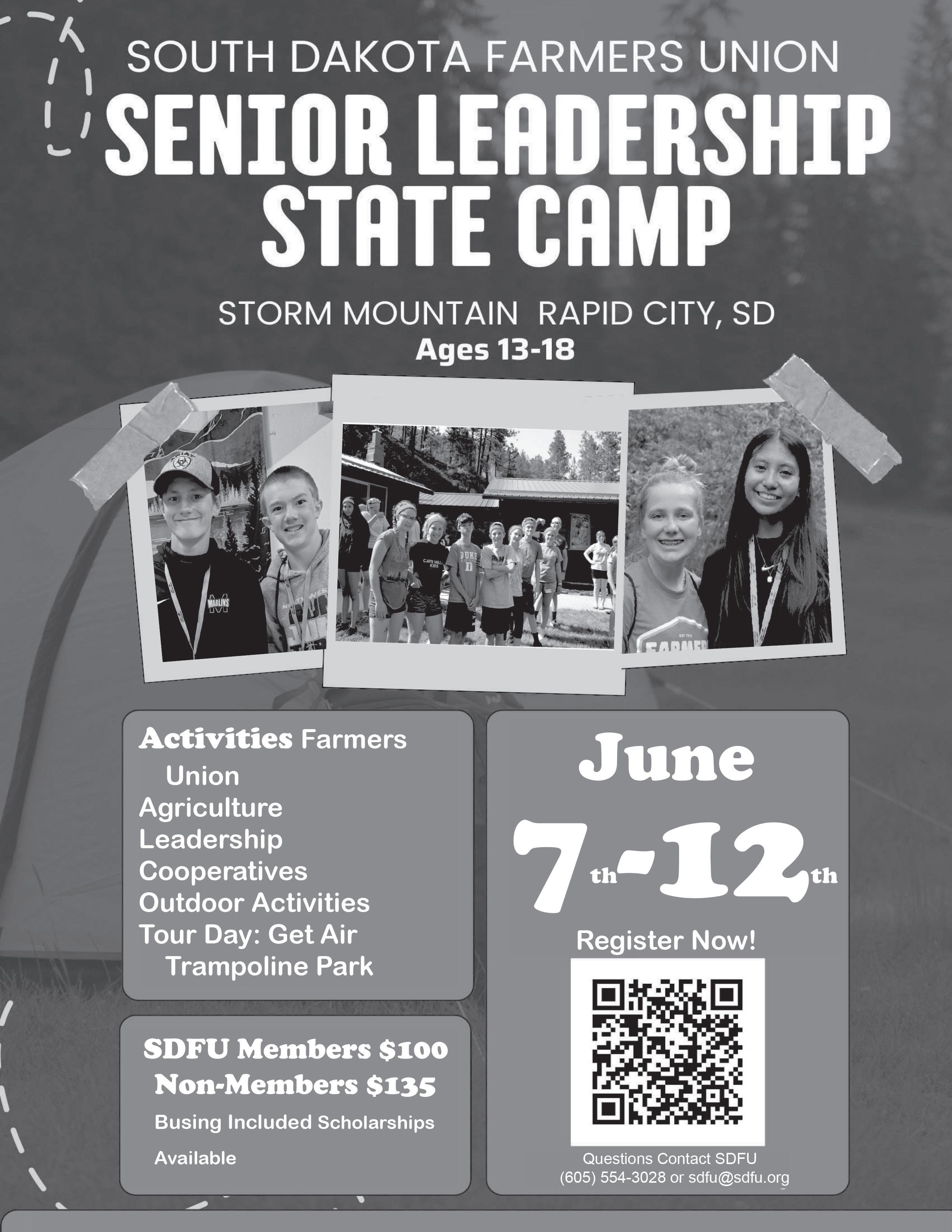
Each summer hundreds of South Dakota youth attend Farmers Union County Day Camps, State Leadership Camp and State Youth Camp. During these camps, youth gain leadership skills and personal development, learn about farm safety, cooperatives and agriculture careers – all while engaging in fun, hands-on activities.
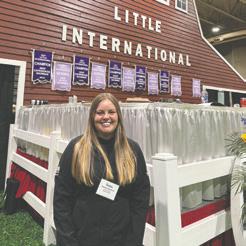
To support staff, volunteers and Farmers Union youth leaders in camp facilitation, each summer South Dakota Farmers Union (SDFU) hires a team of college interns. The 2026 Intern Team are South Dakota State University students: Maya Howard, Kassidy Roseberry, Janie Lhotak and Katelyn Zeug. “We are excited to work with these interns this summer,” said Karla Hofhenke, Executive Director for SDFU. “They are passionate about agriculture and eager to teach rural youth this summer.” Read on to meet the 2026 Intern Team.
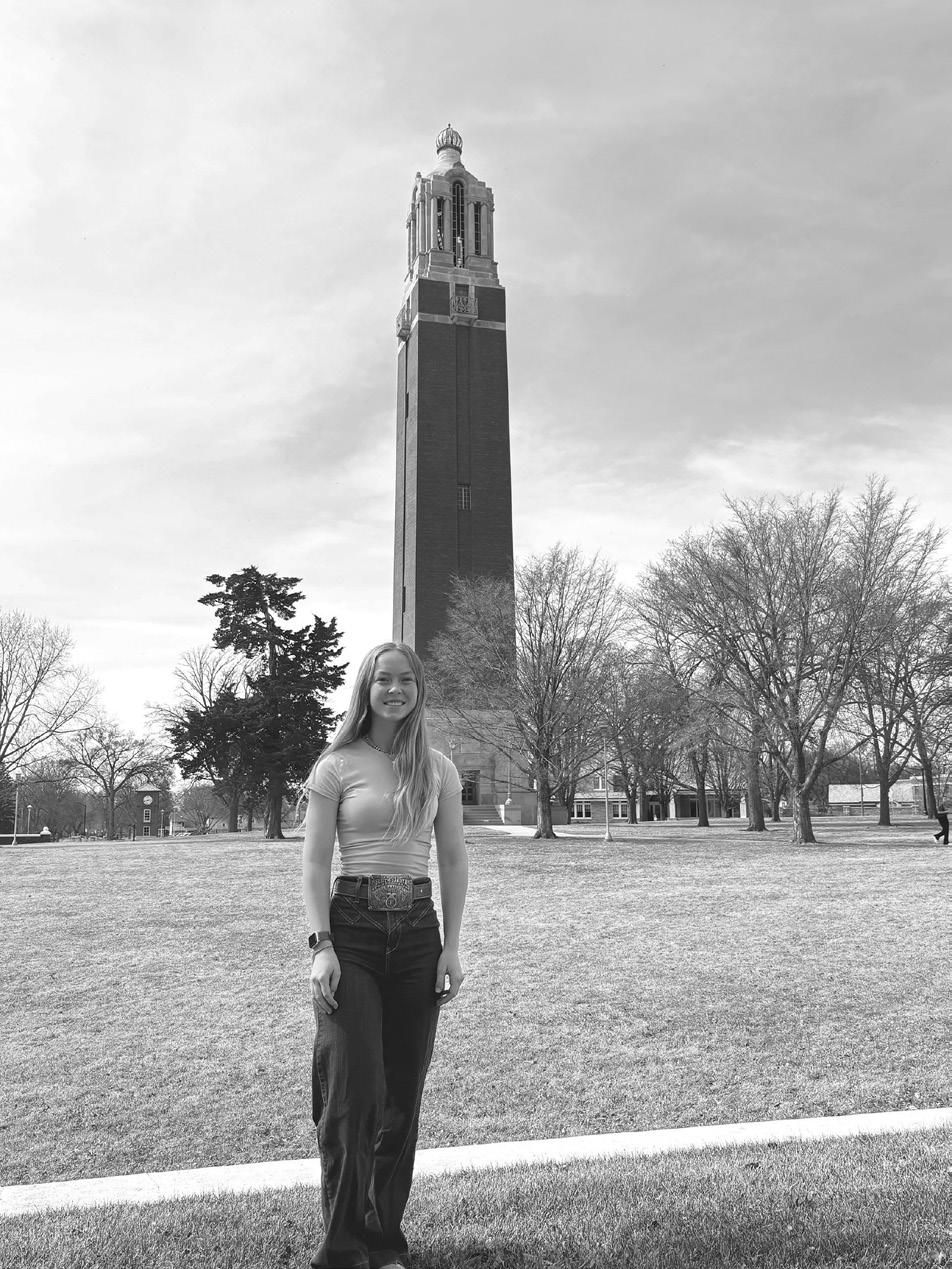
Maya Howard, animal science & ag leadership major from Miller, South Dakota
Growing up on a crop, cow/calf and feedlot farm near Miller, Maya Howard said her background led her to pursue degrees in agriculture.
“I was really involved in FFA in high school and through this involvement I realized I wanted to share my love for agriculture and growing up on a farm with others,” Howard said.
Her areas of study led her to apply for the Farmers Union Internship.
“I wanted an internship where I can learn how to teach agriculture to kids,” Howard explained. “I am also happy that through this internship I will be working with kids from different backgrounds and ages 6 to 18.”
In addition to the opportunity to teach kids about agriculture, Howard said she is eager to explore South Dakota. “This internship will give me the opportunity to see the whole state. It will help me decide where I want to teach when I graduate.”
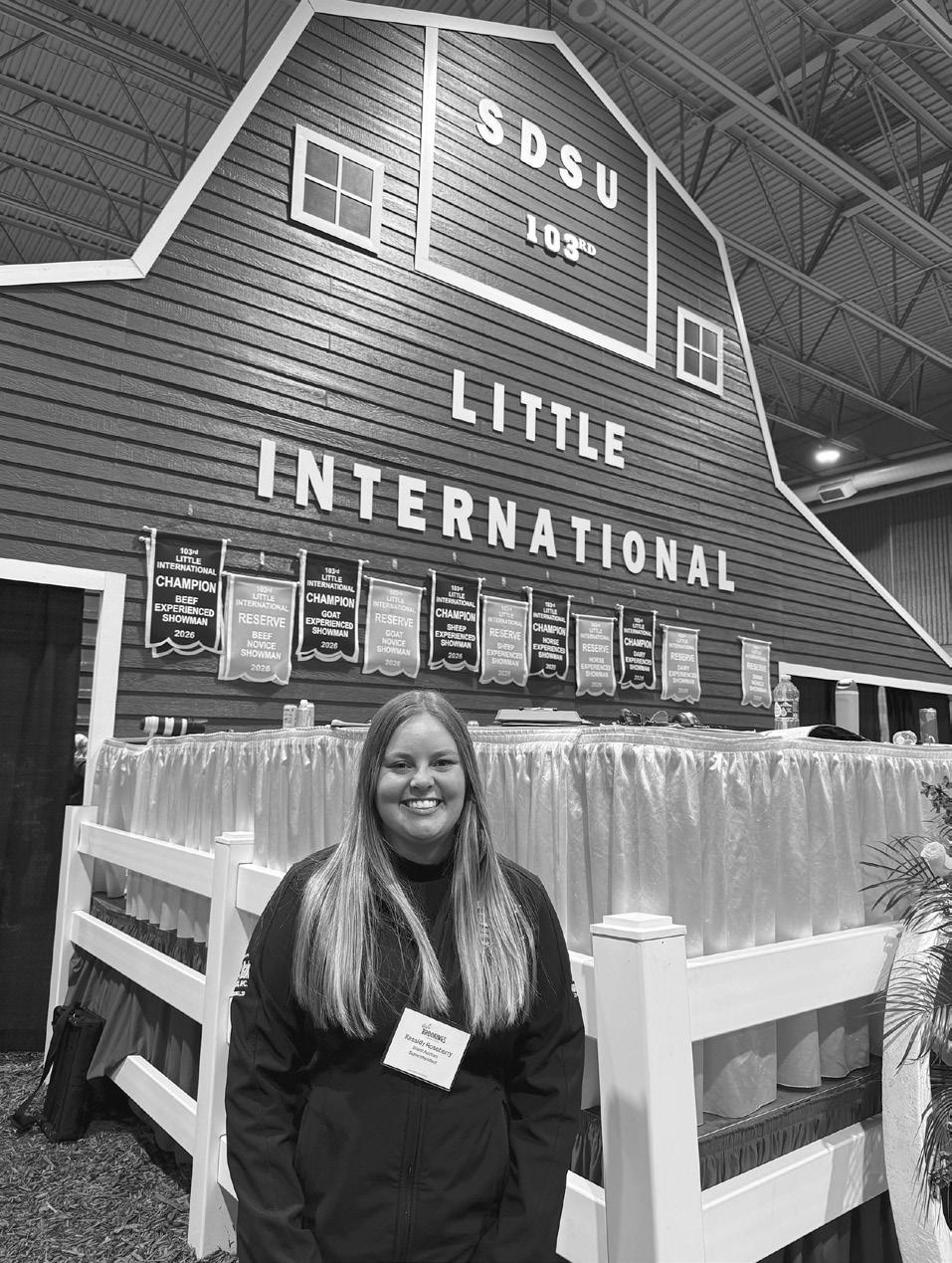
Kassidy Roseberry, agriculture education & agriculture science major from Cody, Nebraska
Growing up on a Nebraska cattle ranch and working for the local livestock supply store in her rural community inspired Kassidy Roseberry to share the story of agriculture.
“I want to advocate for the people of agriculture who don’t have a voice – small farmers and ranchers sometimes get brushed under the rug,” Roseberry said. “I want more people outside of agriculture to hear about the joys of being involved in agriculture.”
This desire to serve the people of agriculture led her to pursue an ag leadership degree and apply for the Farmers Union internship.
“This internship will teach me about leadership and how to work as a team, and the idea of teaching kids about agriculture really struck a chord with me,” she said.
Janie Lhotak, ag systems technology major from Battle Lake, Minnesota
Helping out on her neighbor’s farm led Janie Lhotak to get involved in FFA.
“I joined the small animal team as a seventh-grader and my involvement grew from there,” explained Lhotak, who eventually served as her FFA chapter’s garden manager.
Lhotak’s FFA chapter raised and sold vegetables as an annual fundraiser. In the role of garden manager, Lhotak was responsible for seed selection, garden layout, planting, weeding and harvest for the 2-acre garden.
“I enjoyed being in charge of people and being responsible to make sure things got done and they were accurately done,” Lhotak said. “I also loved being outside and working outside.”
She said the experience helped her enhance her ability to communicate, manage her time and organize – all skills she thinks will come in handy during her summer internship with Farmers Union.
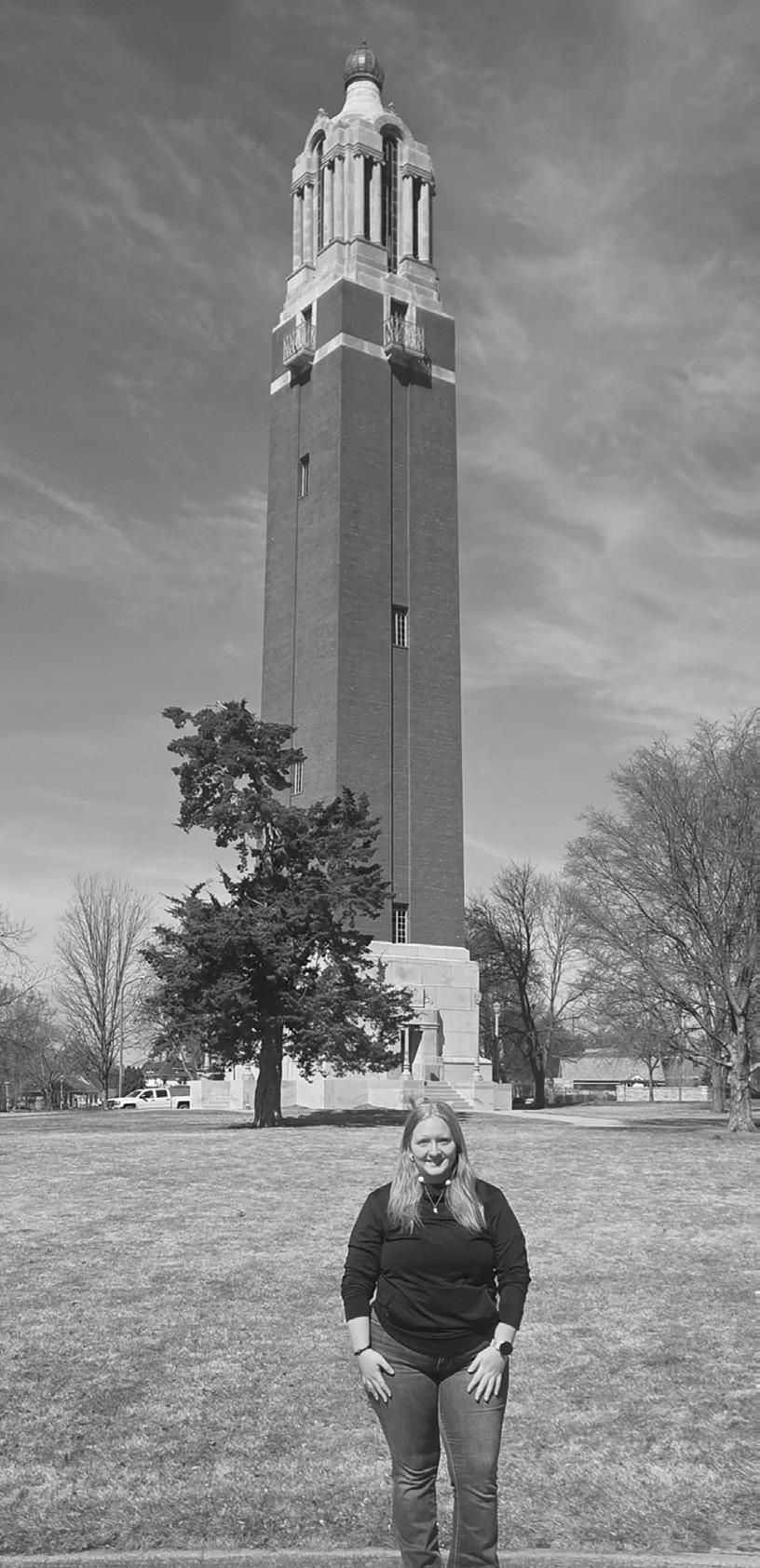
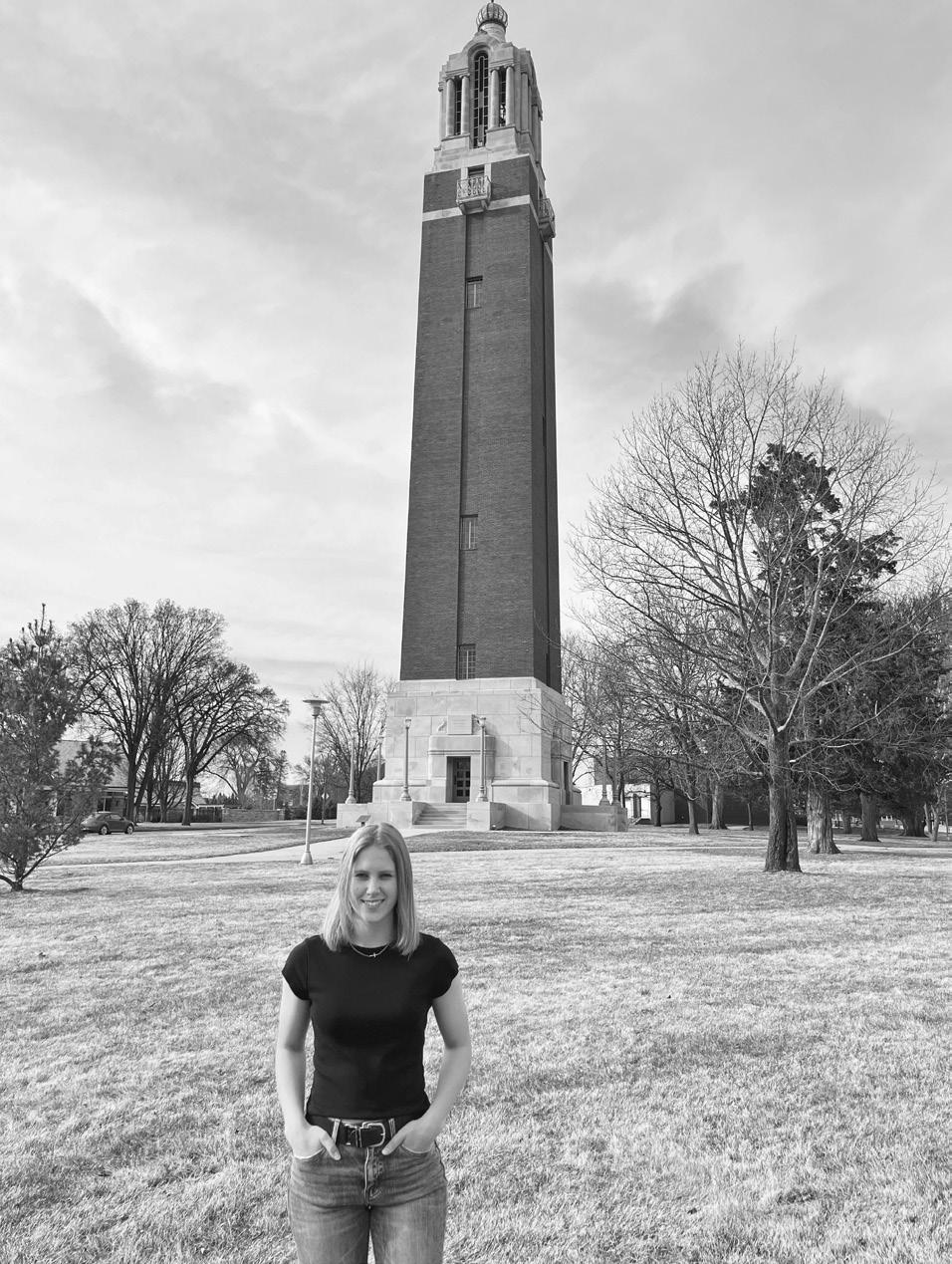
Katelyn Zeug, agriculture education major from Lucan, Minnesota
Growing up on a Minnesota corn and soybean farm, Katelyn Zeug spent her summers showing pigs and rabbits in 4-H. In high school she became actively involved in FFA. As she watched what her agriculture education teacher/FFA adviser did, she decided ag education looked like a good fit for her.
After getting some classroom experience her first semester at SDSU, she realized it was.
“I really love being in an environment where I can share what I know about agriculture with students,” Zeug said. “Agriculture education gives me the chance to know a little bit about everything. And I enjoy student interaction.”
Zeug said she applied for the Farmers Union Internship because she was looking for an opportunity to put the skills she has been studying to work in a real-world scenario.
“This is a great way to practice lesson planning,” Zeug said.
To learn more about South Dakota Farmers Union youth programming, visit www.sdfu.org and click on the Education link. n by Lura Roti for SDFU
“I really love being in an environment where I can share what I know about agriculture with students.” – Katelyn
Zeug
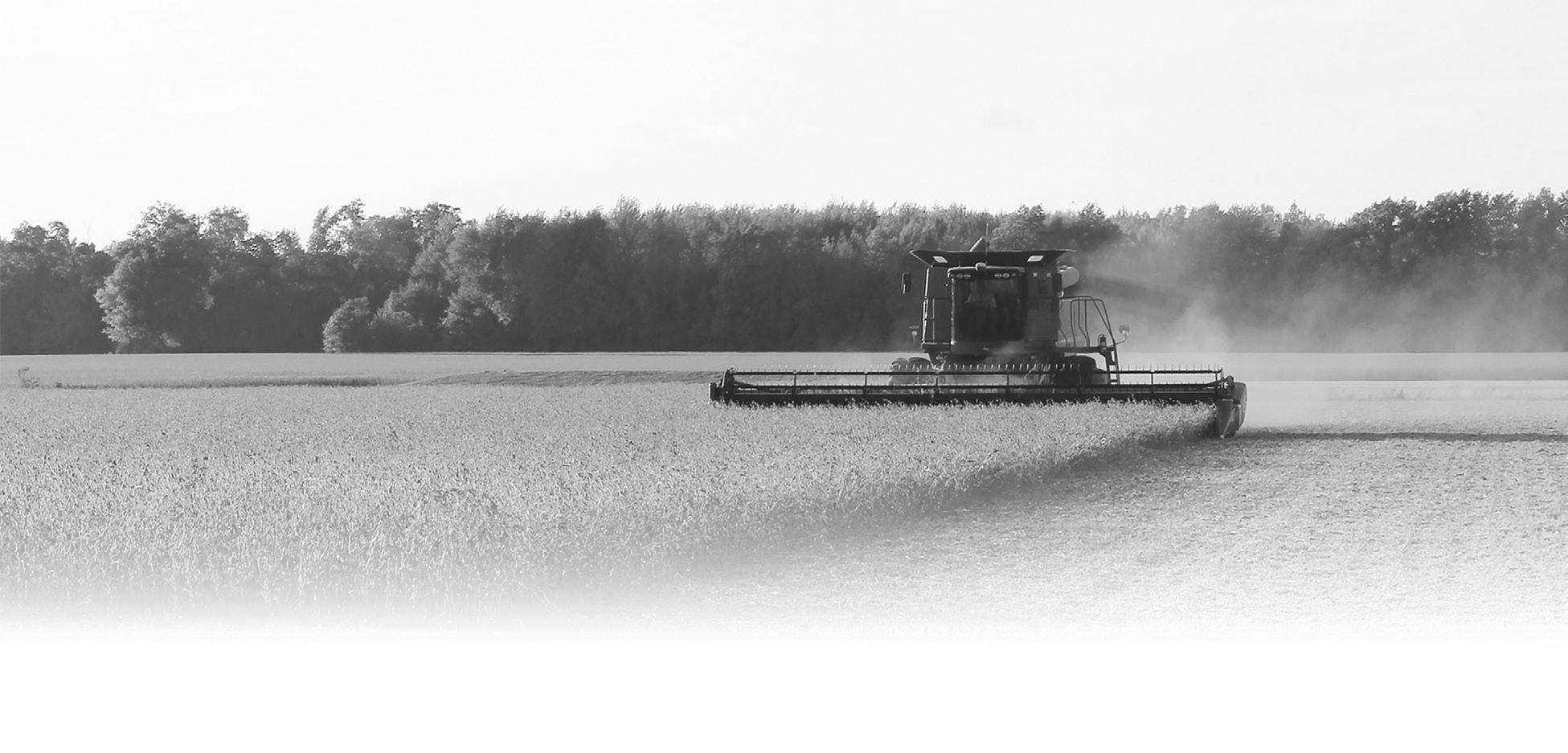
March 27 the Trump administration announced a record increase to the renewable fuels mandate which could have a positive impact on South Dakota’s corn and soybean farmers because the crops are used to produce ethanol and biodiesel. The mandate increases the Renewable Volume Obligation (RVO) oil refineries are required to blend – from 22.33 billion gallons to 25.98 billion gallons.
“Family farmers have not had a lot of good news in the marketplace lately, so this increase to a domestic demand for corn and soybeans so that oil refineries can meet their Renewable Volume Obligation (RVO) by blending more ethanol and biodiesel gives us some hope as we go into the 2026
“This gives people the choice. Do you want to use a homegrown fuel that’s renewable, or do you want to use a fuel produced outside of the U.S. that is bad for the environment?”
– Doug Sombke, SDFU President
planting season,” said Doug Sombke, President of South Dakota Farmers Union.
Motivated by the war in Iran, the increase to the RVO also gives consumers the opportunity to buy U.S.-produced fuel, the fourth-generation Brown County corn and soybean farmer explained.
“This gives people the choice,” Sombke said. “Do you want to use a homegrown fuel that’s renewable, or do you want to use a fuel produced outside of the U.S. that is bad for the environment?”
The mandate goes into effect in 2027. To learn more about how South Dakota Farmers Union advocates for renewable fuels, visit www.sdfu.org n

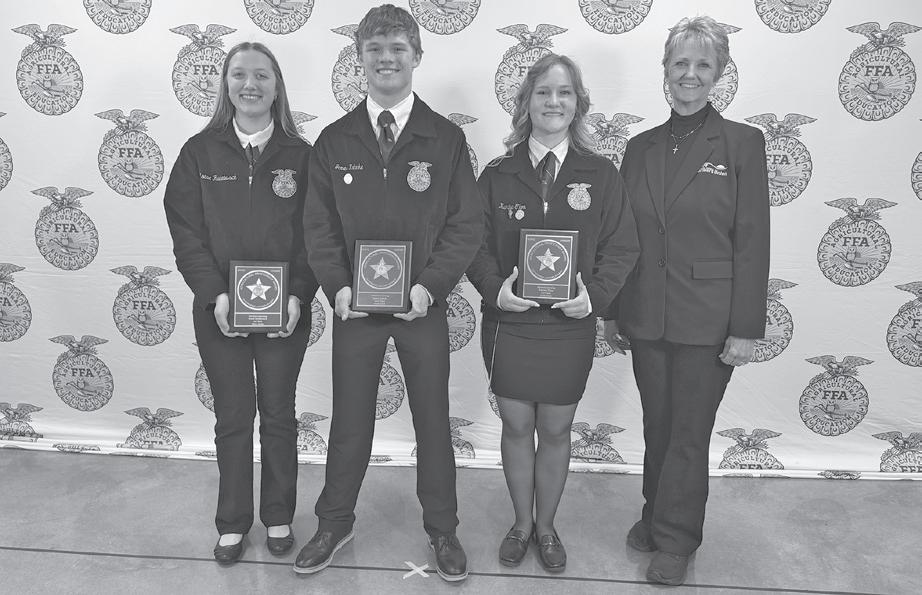
FFA members from across the state put their farm safety knowledge to the test competing in the South Dakota Farmers Union Farm Safety Quiz Bowl held during the 2026 South Dakota State FFA Convention held in Brookings on the campus of South Dakota State University April 20-22.
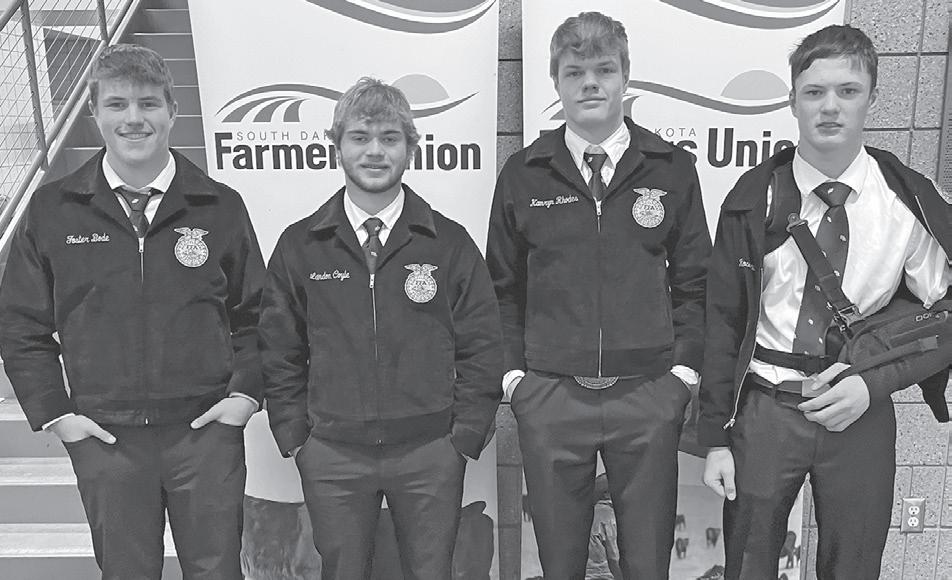
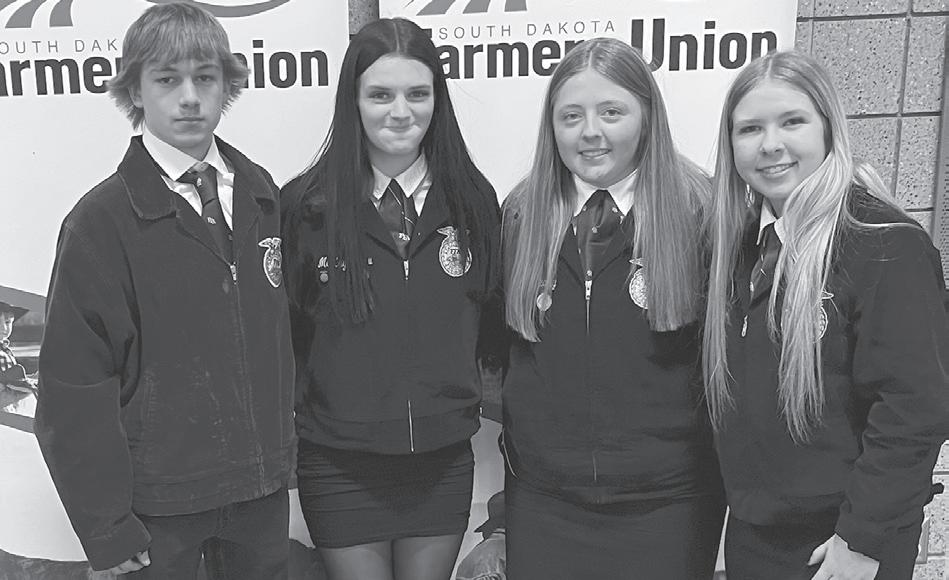
Four FFA chapter teams qualified for the Farm Safety Quiz Bowl Championships held during Farmers Union day at the South Dakota State Fair, Sept. 5: Faulkton Area, Hitchcock-Tulare, Tri-Valley and Wessington Springs. Team members include Faulkton-Area FFA Chapter: Landon Coyle, Sean Roseland, Kamryn Rhodes and Foster Bode; Hitchcock-Tulare FFA Chapter: Sawyer Miller, Cash Chaplin, David Bixler and Tucker Gilbert; Tri-Valley FFA Chapter: Kendall McAreavey, Lincoln Kirstein, McKayla Dow and Taylor Nelson; Wessington Springs FFA Chapter: Ella Fagerhaug, Remie Roduner, Lily Roesler and Wyatt Arhart.
“Farms and ranches are wonderful places to raise families, but they
are also full of situations that can be unsafe if individuals are not aware of how to stay safe. The Farm Safety Quiz Bowl is designed to get teens thinking about farm safety,” explained Karla Hofhenke, Executive Director of South Dakota Farmers Union.
Farm safety is something teens should think about more, explained Landon Coyle, a member of the Faulkton Area team. “I have been on the scene when a farm accident happened. And it was preventable,” explained the high school junior who raises cattle with his dad, Anthony, and brother, Paton.
Kendall McAreavey agreed. The Tri-Valley FFA president said her dad talks to her quite a bit about staying safe on the family farm. “On the farm we deal with a lot of dangerous situations – we drive large machinery or work with large animals. Staying safe to the best of our ability is important so that no one gets hurt.”
Even though she thinks about general farm safety when she is on
Quiz Bowl Continued on Page 8
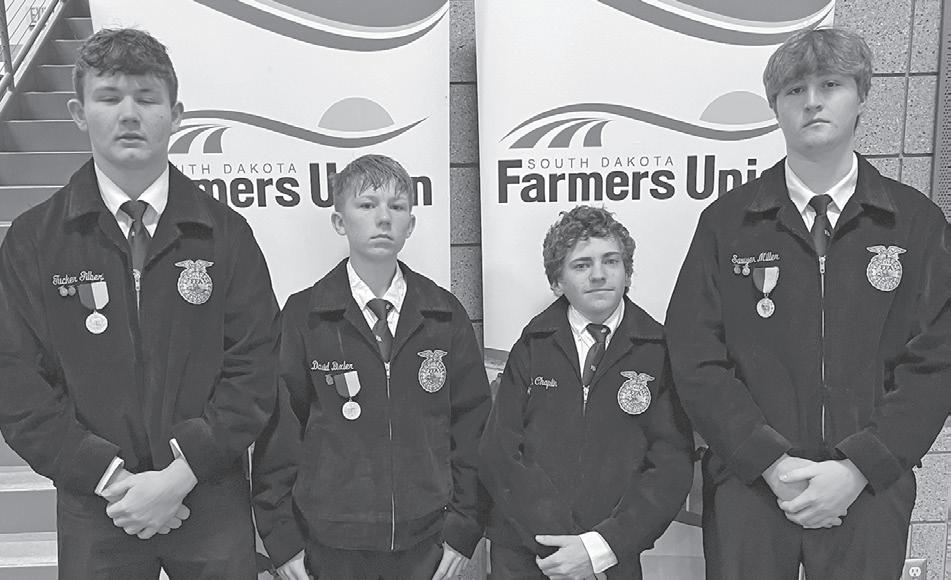
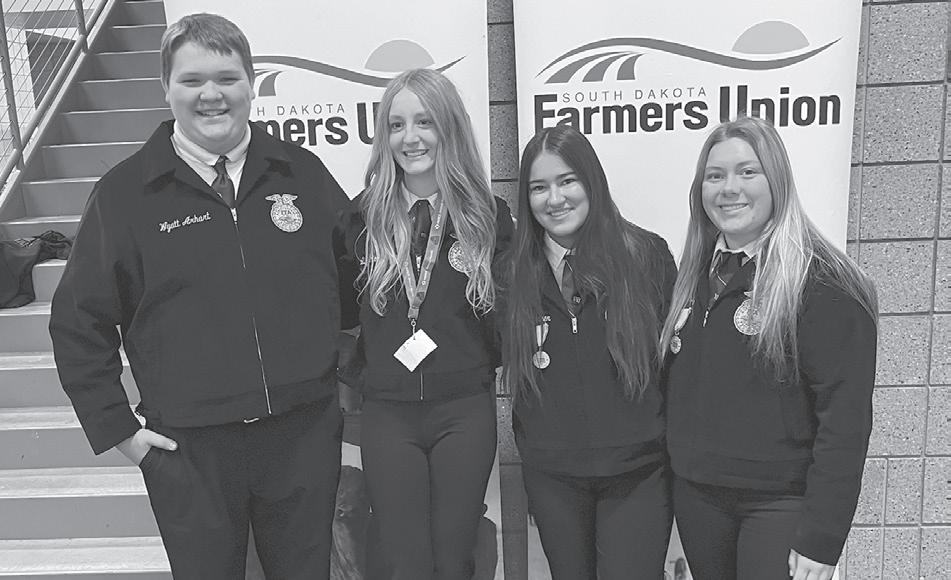
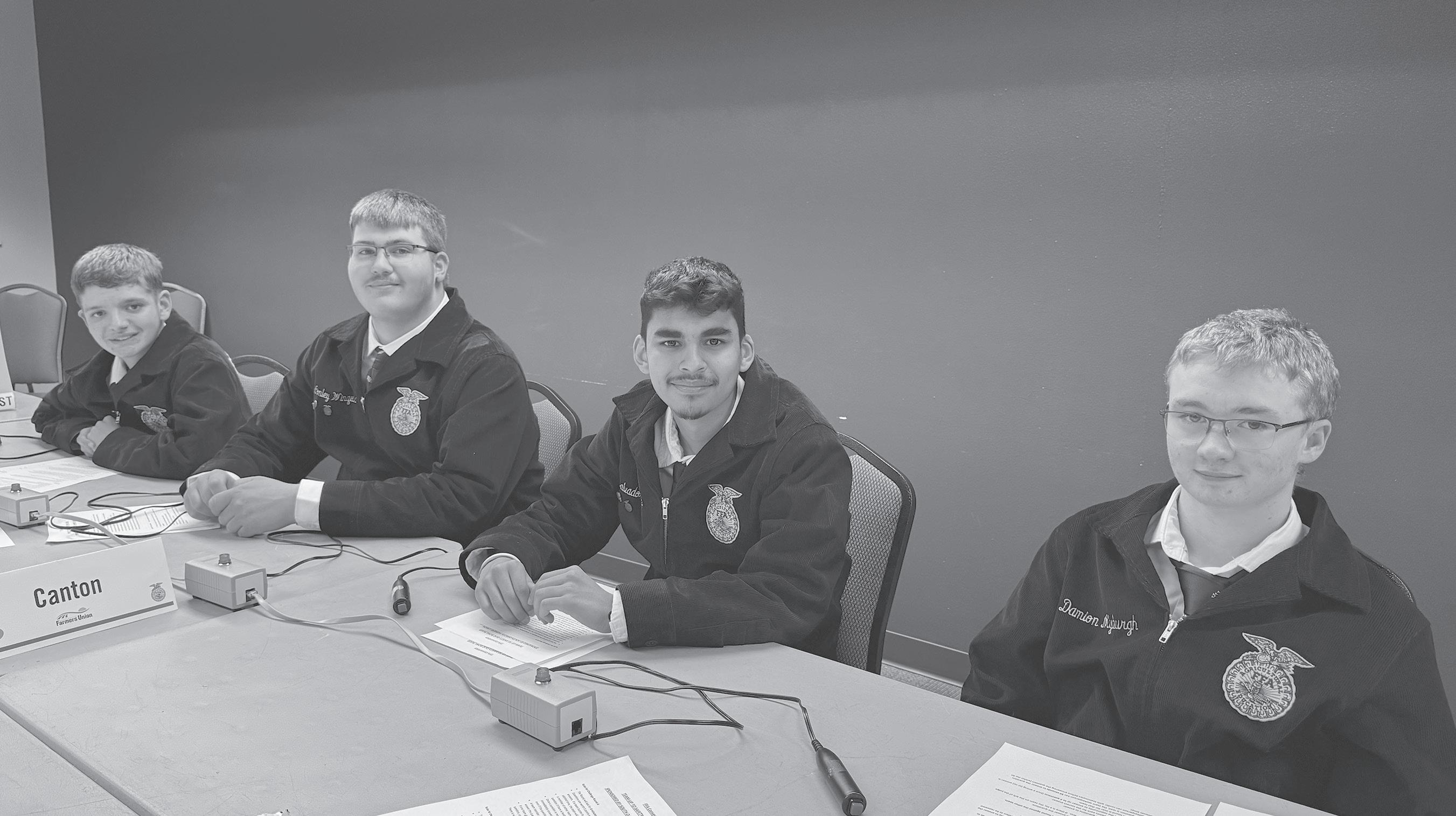
her grandparents’ Wessington Springs farm, Ella Fagerhaug said that studying for the Farm Safety Quiz Bowl made her think of how to stay safe in situations she never thought much about. “I never thought much about grain bin safety, but there are many accidents that happen in grain bins so it is important to know to be extra cautious when I’m working around grain bins.”
As the teens look forward to the Farm Safety Quiz Bowl championships during the State Fair, many say they plan to study up on farm safety to prepare. This is not something Hitchcock-Tulare FFA member David Bixler would typically do over the summer, but the idea of winning the title and cash prize is appealing.
“And thinking about farm safety a bit more than usual is a good idea because we are out on the farm working in the summer,” Bixler said.
Farm safety education is a year-round focus for Farmers Union
In addition to the Farm Safety Quiz Bowl, South Dakota Farmers Union educates youth and families about farm safety through hands-on activities that are part of their Farm Safety Trailer that they take to schools, fairs and other community events throughout the year. The organization also hosts youth camps where farm safety is discussed.
To learn more about how South Dakota Farmers Union educates youth and families on farm safety, agriculture, cooperatives and leadership, visit www. sdfu.org n by Lura Roti
“Farms and ranches are wonderful places to raise families, but they are also full of situations that can be unsafe if individuals are not aware of how to stay safe. The Farm Safety Quiz Bowl is designed to get teens thinking about farm safety.”
–
Karla Hofhenke, Executive Director of South Dakota Farmers Union
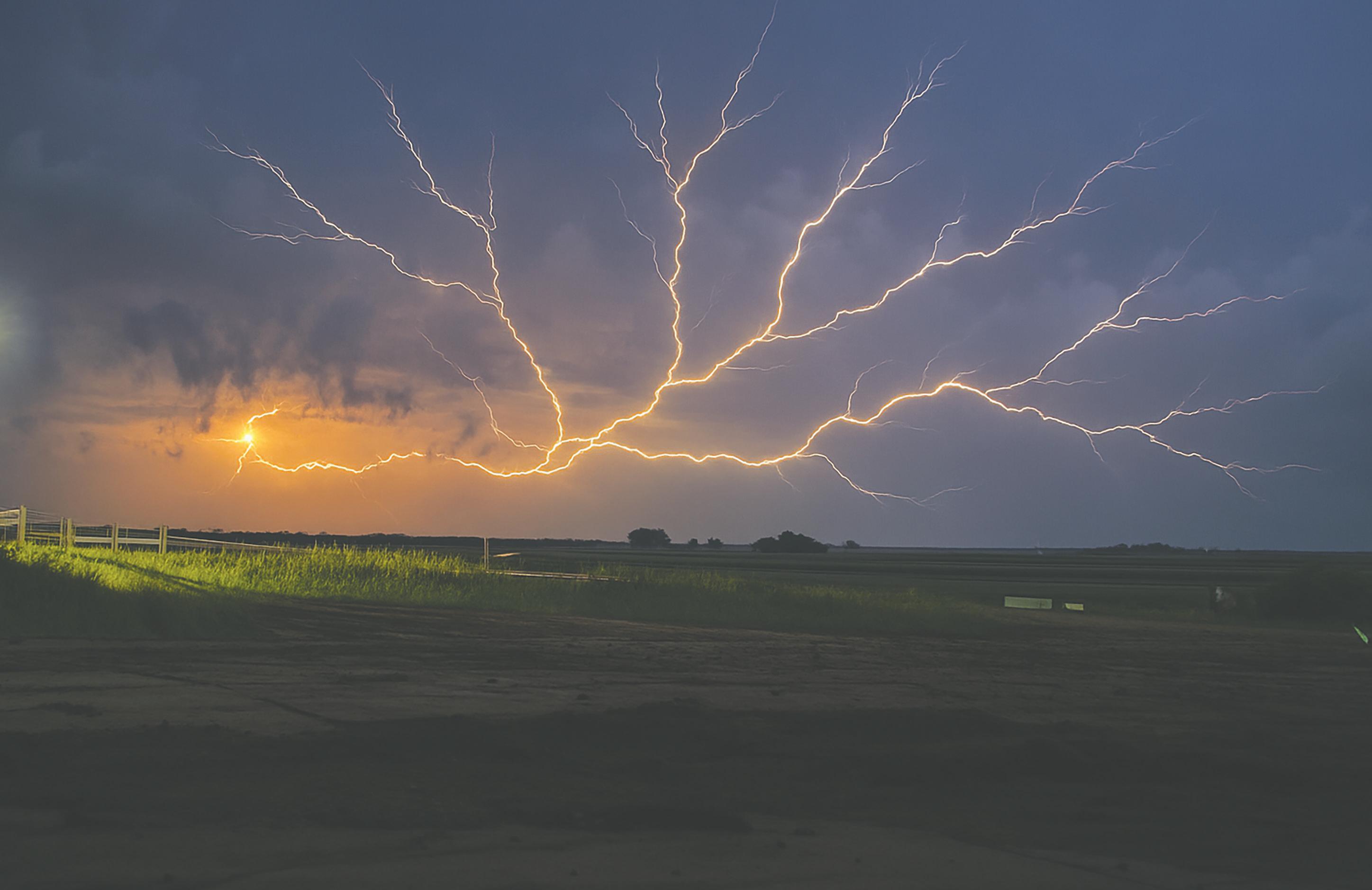
Enjoy capturing life on South Dakota’s farms and ranches? Then you are encouraged to enter photos in South Dakota Farmers Union annual photo contest May 1 through Oct. 1.
Photographers compete for cash prizes.
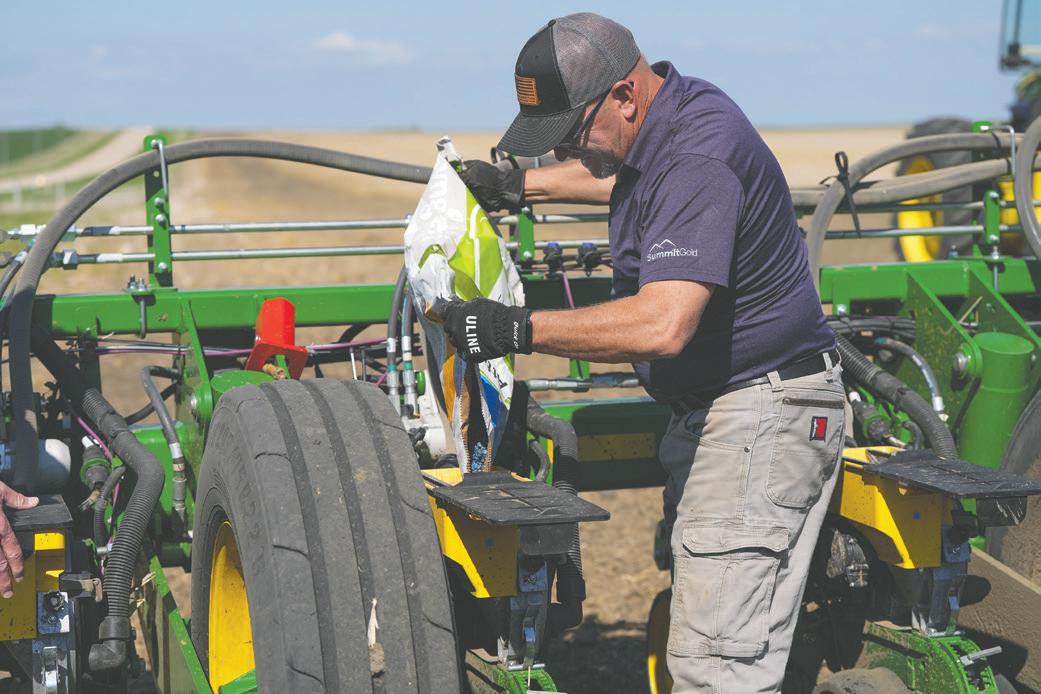
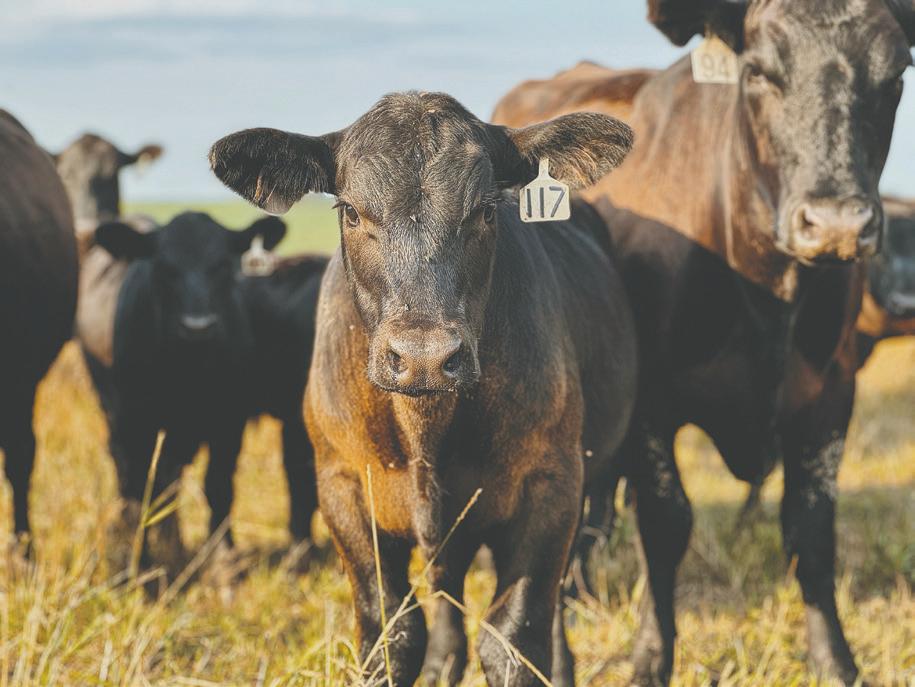
“Photos tell stories. Whether it’s a newborn calf or pouring seed into the planter or baling hay or corn harvest – there’s plenty of stories to capture on family farms and ranches,” explained Karla Hofhenke, Executive Director for South Dakota Farmers Union. “We love sharing the stories of family farmers and ranchers and this photo contest is one of many ways we are able to do this.”
Throughout the five-month contest, submitted photos are shared on social media in the Farmers Union newsletter and at www.sdfu.org

Enter photos today
The 2026 contest categories are:
• Farm & Ranch Scenery
• Farmer/Rancher at work
• Livestock
Each category winner receives $200!
By Breyten Johnson
Farmer-Rancher at Work Winner!
By Bosten Morehart
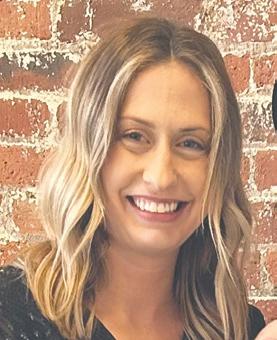
Lindsey Hinsvark is mom to Georgia, Swede and Hank. She and her husband, Lance, live on his family’s ranch near Gary.
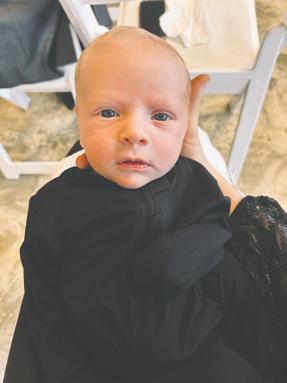
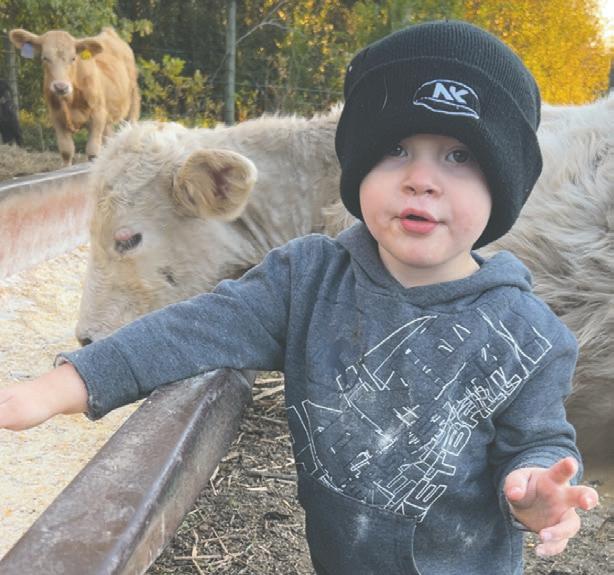
When it comes to raising their three young children; Georgia, 4, Swede, 2, and Hank, 3 weeks, Lindsey Hinsvark works to keep things simple and find joy in the moment.
“The other day when it was 80 degrees, we got pizza from town, laid out a blanket on the lawn and had a picnic for supper. That was a week ago and the kids are still talking about it like it was the most amazing activity,” Lindsey said. “We love being together and being outside. Lance and I are the type of parents who want to raise our kids like we were raised in the ‘90s – no screen time. Don’t get me wrong, they do watch TV sometimes, but we try to limit it. So, our kids spend a lot of time outside.”
And there is plenty of room for their children to roam outdoors on their family ranch near
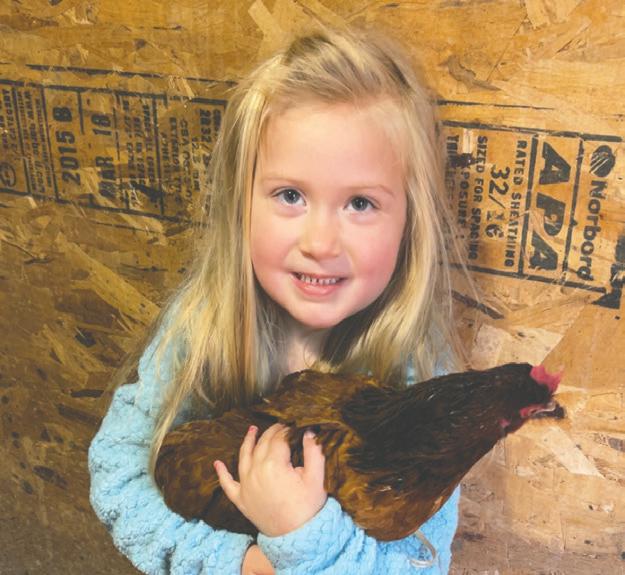
Gary, where they raise crops and cattle.
In addition to working on the ranch, Lindsey and Lance both have off-ranch careers. Lindsey owns her own hair salon, The Beauty Barn, and Lance works as an agronomist. Because she owns her own business, Lindsey works to keep her work hours family friendly. And when she is home, she tries to leave her phone on the charger.
“I’m blessed to be able to schedule my work during the week. I don’t work nights and weekends,” she said, explaining that her employee also has a family, so they both schedule appointments that work with their kids’ schedules. “I heard once that you only have small children for a short time, so in this era of my life, I’m focusing on them and doing the things they are interested in. I figure when they are older and don’t want to hang out with me, that is the time when I can work my butt off in the salon.”
Right now, with newborn, Hank, the entire family is spending a lot of time giving baby extra love. “Swede keeps coming in and giving him kisses and Georgia just loves holding him,” Lindsey said.
Lindsey’s mom, Anna Jennings, is also spending extra time with the family. “My mom just retired so she calls each week and asks what day she can come and help. My mom is a great mom and grandma. I really look up to her,” said Lindsey, adding that her own childhood – growing up with three siblings in a happy household – is the reason she wanted a family of her own.
She and Lance met when they were both
students at Lake Area Technical College. He was studying to be an agronomist and she was studying cosmetology.
“I knew since I was 5 that I wanted to become a stylist,” Lindsey said. “I love my clients. I love making them feel beautiful. And I have been cutting their hair for long enough now that many I consider my close friends.”
Lance’s mom, Birdie, is also a cosmetologist. Shortly after the couple married, she was looking to retire and Lindsey took over her Clear Lake business in 2017. In need of more room, Lindsey purchased a building in 2020. Today, the larger space allows Lindsey to employ a second stylist and offer tanning and sauna services.
2
“In a small community like Clear Lake, there are not many businesses, so I know that each business in town matters,” Lindsey said.
Growing up in town, Watertown, Lindsey loved her childhood but appreciates that her children get to be raised on the ranch. “It is so nice that they get to play outdoors and help care for the calves and chickens and play with their cousins or ride in the tractor with Dad.” n
by Lura Roti
“The other day when it was 80 degrees, we got pizza from town, laid out a blanket on the lawn and had a picnic for supper. That was a week ago and the kids are still talking about it like it was the most amazing activity.” – Lindsey Hinsvark
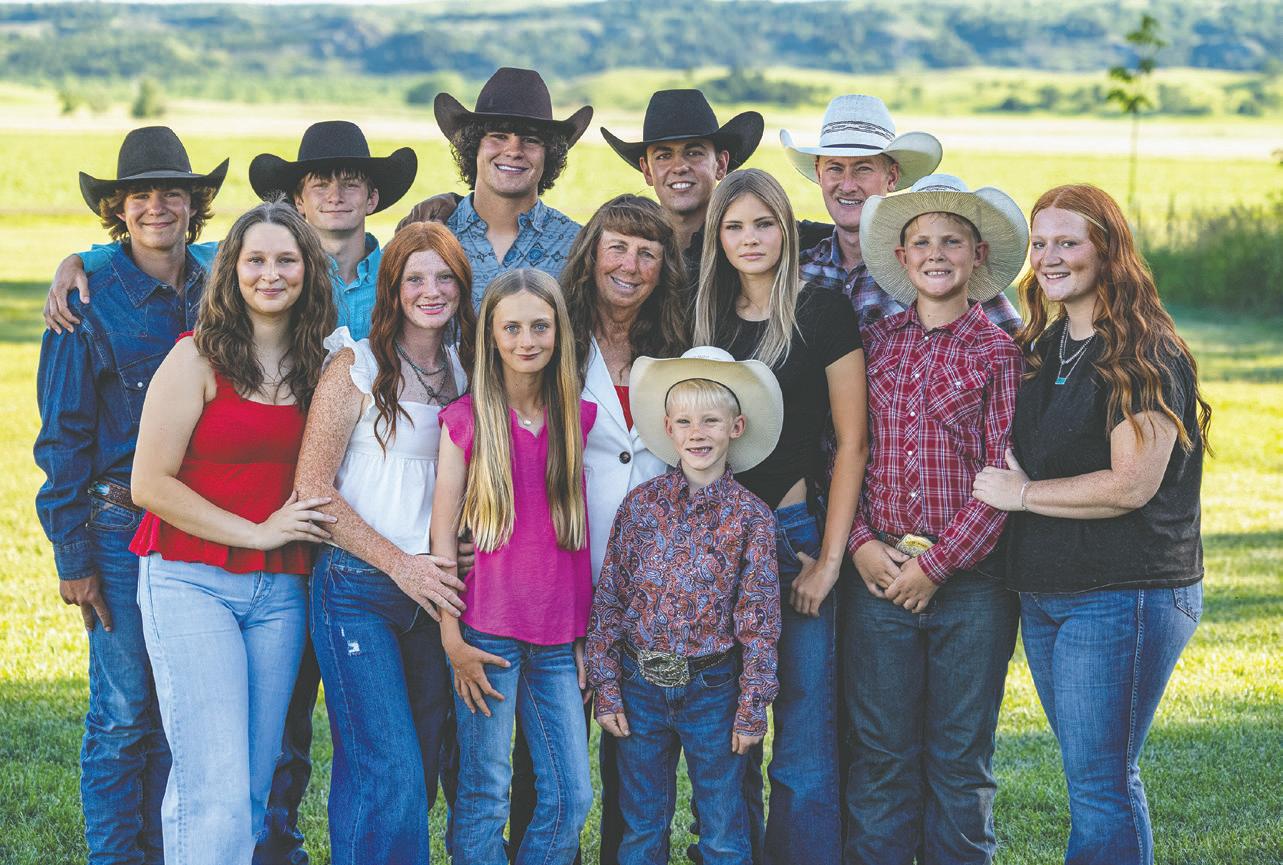
Brenda Reis ranches with her husband, David, near Reliance. She is mom to Shawn, April, Shane and Zane, and grandma to Buster, Swade, Rope, Haleigh, Keeleigh, Wiley, Oakleigh, Arista, Collin, Jozie, Sawyer and Jasper.
In addition to Mom and Grandma, “Keeper of the Photos” is the other title Brenda Reis treasures.
“I’ve been taking photos since our kids were little,” Brenda said. “But when our kids were little, I didn’t have the cool camera that I have now. And now with digital cameras and our phones, today, everyone takes so many photos, but nobody ever looks at them – so every year for Christmas for the grandkids, I make a photo book of things we did together. I have 12 grandkids so it’s quite a job now. But they love their books. The oldest is 25 and still wants a photo book every Christmas.”
“When our kids were growing up, they went everywhere with us. If we were outside working cattle, they were outside with us. If we were fencing or feeding bottle calves, they were right there with us.” – Brenda Reis
Inside the photo books she spends months creating, there are pictures of brandings, rodeos, swimming and fishing in the White River, working cattle, riding horse, fixing fence, showing meat goats and cattle at the State Fair, camping trips, advocating for ag in Washington, D.C., and many more adventures and activities that she and David, her husband of 50 years, enjoy together with their children and grandchildren.
Whether working together or enjoying a fun activity together, the philosophy Brenda and David adopted as young parents and today as grandparents is, “spend time with your kids.”
“When our kids were growing up, they went everywhere with us. If we were outside working cattle, they were outside with us. If we were fencing or feeding bottle calves, they were right there with us,” said Brenda of all the day-to-day activities it takes to operate the family’s multigenerational cow/calf operation near Reliance. “And these were the days before side-by-sides, so
the kids rode on the horse with me or David until they were big enough to ride their own horse.”
Working beside their parents, the Reis kids learned how to do what their parents did. “They knew everything about the pastures and the cattle because they grew up doing the work with us and we always had the help we needed,” Brenda said. “They all have a good work ethic and understand responsibility and working cattle comes natural to them.”
Like her children and now grandchildren, Brenda grew up working on her family’s ranch near Fort Thompson. Her dad raised racehorses and she loved helping care for the horses and competing in rodeos.
After the work was done for the day on the Reis Ranch, Brenda and David would ask their kids what they wanted to do for fun. “Sometimes we’d play baseball, or we’d go to the river and swim or fish. I love the river. I take the grandkids there whenever I can,” said Brenda, of the White River located just half a mile from the ranch house and the Missouri River which is only 6 miles away.
Today, all four of their grown children live within 15 miles of the ranch and return to help on the ranch frequently with their own families.
Even though their children all attended college, Brenda said she and David did not place priority on going to college after high school, but they did encourage their kids to do something away from the ranch after high school. “We wanted them to broaden their horizons,” she said.
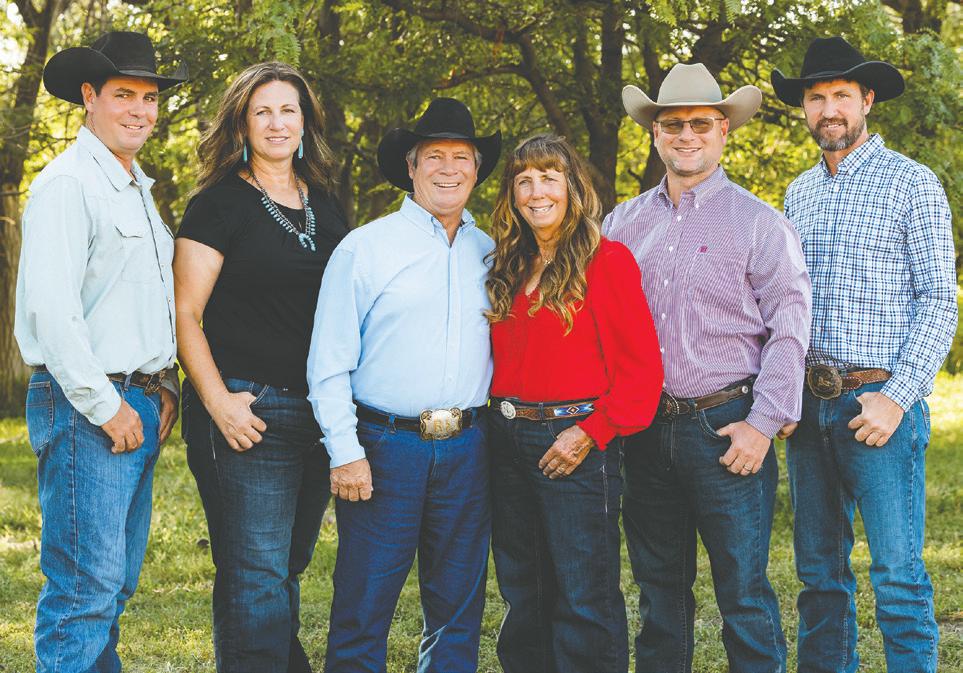
To help their grandchildren do the same, Brenda and David gave a heifer calf to each when they turned 5. They then get to save the earnings from the sale of calves for college or whatever life adventures they seek after high school.
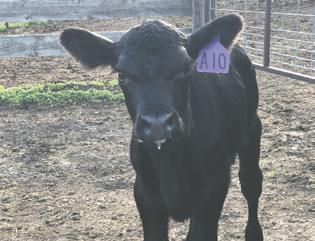
To make it easy to identify each grandchild’s calf and its offspring have a unique color ear tag. “It’s our way of helping them get started,” Brenda said. “And they enjoy working all cattle, but it is fun to look for their cattle.” n by Lura Roti

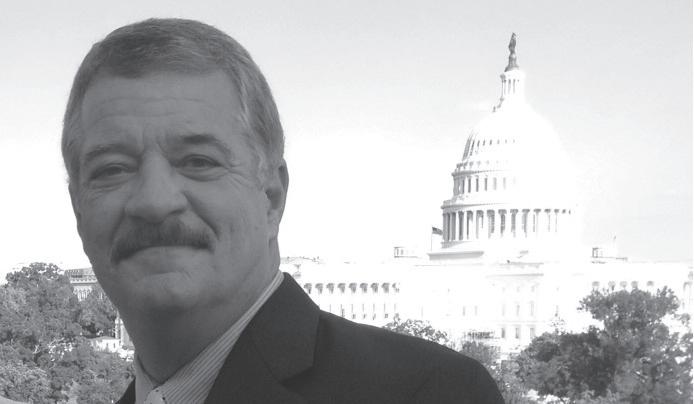
Doug Durante, Executive Director, Clean Fuels Development Coalition
information is current as of April 13, 2026
Printing deadlines require these columns to be submitted well before the time they are read, so depending on how things play out, observations and predictions can seem brilliant and clairvoyant or very foolish. This certainly applies to the conflict with Iran. We could be at peace, we could be at war, but one thing is for certain – we in the U.S. will remain dependent on oil for our transportation needs.
This is puzzling, frustrating and so debilitating to our economy, our national security and our health. Our relationship with oil is a long and complicated story. In the pre-World War II era, the U.S. was the largest oil producer in the world with little imports and low prices. The population and economic growth over the next three decades resulted in a growing dependence on other sources, notably the oil rich Middle East as our own production peaked.
In 1973, due to our alliance with Israel in their conflict with Egypt and Syria, an embargo by all of OPEC was the first punch to the American gut as prices doubled and supply became an issue. Then in 1979, the Iranian revolution resulted in oil shortages that rocked the world, particularly the U.S. as we literally had gas lines, rationing and unrest.
While these events did lead to the establishment of fuel efficiency standards and a half-hearted effort to develop alternative fuels like ethanol, methanol and CNG, it was a brief fling, and we went back to our oil habits in a big way. Lightduty vehicles – all running on gasoline –increased from 145 million in 1979 to 190 million in 1985. Ethanol production was less than 1 billion gallons annually and the public and the government showed little interest in taking measures to insulate us from a repeat of the 1970s. Ethanol production, only through the determination of American agriculture and the skill of the
ethanol and clean fuel stakeholders, hung in there and remains the only commercially available alternative for a gasoline-powered vehicle.
As explained in our book Gasolinegate, due to the money and the staggering number of lobbyists the oil industry uses to influence policy, nothing has really changed aside from the critical role ethanol has played to displace more than 10 percent of our gasoline – thank goodness.
If the public doesn’t like high gasoline prices, they would like them a lot less if we took ethanol out of the system. If supply is tight now, try taking another 10 percent out. Given that, if we didn’t have a Congress and administration compromised by oil industry influence, a logical step would be to put more of a lower cost, domestic, high-octane product in the mix, not work to keep it out.
The Brazilians certainly have figured that out. Unlike us, they responded to the 1973 crisis with some self-determination by going all in on ethanol. They produce their own oil and with blends now approaching 30 and 40 percent, they have plenty of both and are not turned upside down when global prices increase.
Sure, we now produce a lot of oil in the U.S. We worked our way back from the hard-to- believe 62 percent import figure of 2005 and, at least on paper, produce enough oil to meet our needs. But, oil has to be refined, and we have been walking a razor’s edge with respect to refining capacity compared to gasoline consumption. The recent shutdown of refineries in California has resulted in imports of gasoline to the West Coast and there is no indication these refineries are coming back.
The public is being led to believe we are “energy independent” and understandably is asking why do events in the Middle East raise our prices. This is part of the
complication of oil – if the world price of oil doubles, Exxon, Chevron or any of the big guys aren’t going to leave that money on the table. It is a global commodity, and global demand is going to set the price everywhere.
So how do we reduce the price of oil? Reduce the demand for it, of course. A 42-gallon barrel of oil produces just 20 gallons of gasoline, even less when making premium, high-octane grades. By the same metric, a barrel of ethanol is 42 gallons of high-octane fuel and frees up refinery capacity.
My longtime colleague Dave Hallberg has been preaching the value of ethanol when it comes to octane since he formed the Renewable Fuels Association in 1980. Even back then when he launched the annual RFA conference, he made the theme “Capturing Octane Value.” Using the 20-gallon gasoline yield figure, Dave recently reminded me that if we were to adopt a 30 percent blend ratio – like the Brazilians – it would displace 1.5 billion barrels of oil annually and importantly, frees up refining capacity!
This is not just a good idea because of the turmoil we are currently experiencing; it makes sense any time. Taking the shackles off ethanol to allow truly game changing blend volumes would result in a positive economic impact on gasoline, groceries, fertilizers, plastics and all things related to oil. Yet we seem to have a Congress and an administration that won’t even allow us to voluntarily add 5 percent more ethanol into gasoline when doing so would be a service to the public and national security.
As noted, the conflict with Iran may be resolved by the time you read this but our exposure to events in the Middle East will always be a threat. How have we not learned the lessons of the past? n
The Billie Sutton Leadership Institute has announced its 2026 class of Sutton Leaders and Rural POWER participants, marking its eighth year of inspiring and preparing leaders in South Dakota.
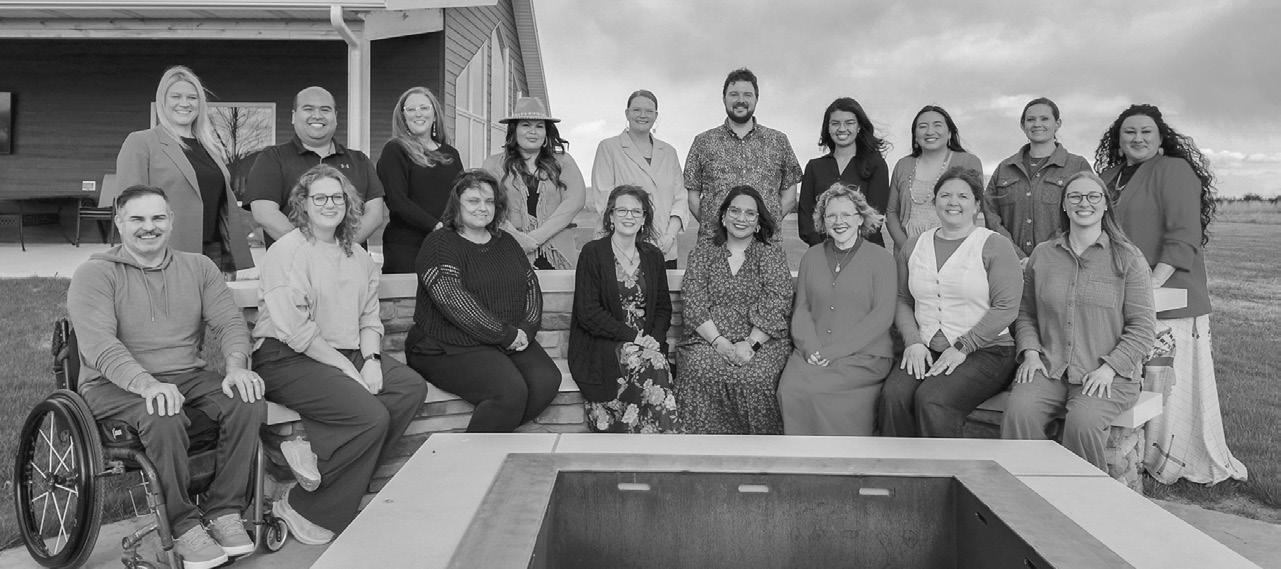
Fifteen new members gathered in Gregory, South Dakota, for a kickoff training seminar that launches the year-long leadership development program.
2026 Sutton Leadership Institute Class with Billie and Kelsea Sutton
Billie Sutton, a former state senator, 2018 candidate for governor of South Dakota, and founder of the Sutton Leadership Institute said,
“We are excited to welcome our eighth group of leaders to the Billie Sutton Leadership Institute! These community leaders from across the state are helping shape the future of South Dakota, and we’re honored to support them in that journey.”
Members of the 2026 Billie Sutton Leadership Institute class include:
Allan Idjao, Sioux Falls, Sutton Leaders
Amy Rambow, Watertown, Sutton Leaders
Anna Waterland Dykstra, Spearfish, Sutton Leaders
Anpo Jensen, Rapid City, Sutton Leaders
Bre Gibson, Box Elder, Rural POWER
Carleyn Petersen, Eagle Butte, Rural POWER
Danielle Kearin, Madison, Sutton Leaders
Jonni Arpan, Eagle Butte, Rural POWER
Lucas Wiscons, Aberdeen, Sutton Leaders
Matty Kerr, Brookings, Rural POWER
Rebecca Kennedy-Sazue, Lower Brule, Rural POWER
Rebecca Whidby, Fort Pierre, Rural POWER
Sandi Anzua Fischer , Sioux Falls, Sutton Leaders
Sarah Meagher, Sioux Falls, Sutton Leaders
Tyresha Grey Horse, Rapid City, Sutton Leaders
The non-partisan, 501(c)(3) nonprofit Billie Sutton Leadership Institute is dedicated to inspiring and preparing the next generation of leaders to build a stronger South Dakota
and more vibrant communities and workplaces through service to others.
Sutton Leaders, the Institute’s original program, is now in its eighth year and focuses on leadership development, community engagement and public service across South Dakota.
Sponsored by South Dakota Farmers Union, Rural POWER, now in its sixth year, is designed to grow a new generation of rural leaders and encourage engagement in rural cooperatives that provide essential services to South Dakota communities. n
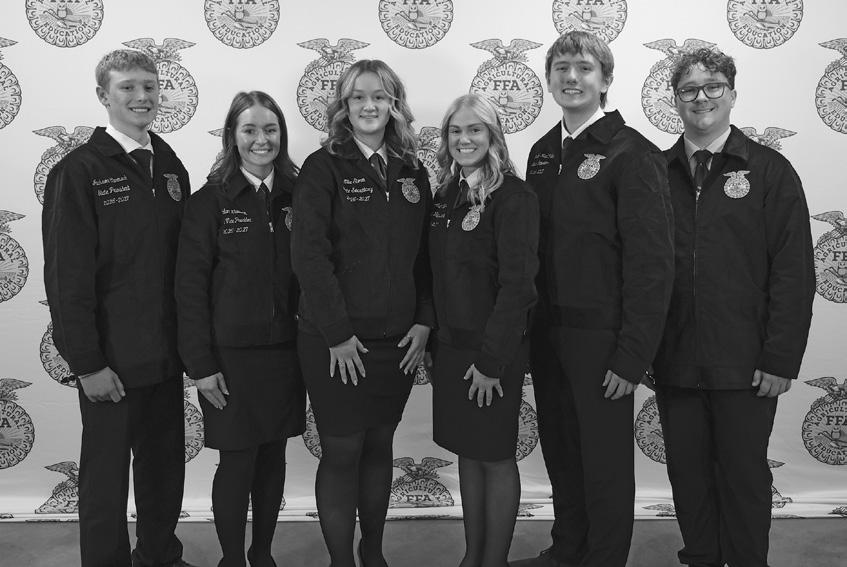
Delegates at the 98th South Dakota State FFA Convention elected the 2026-27 South Dakota FFA State Officer Team on April 22 during the fourth session at First Bank and Trust Arena, sponsored by SDSU College of Agriculture, Food and Environmental Sciences. The newly elected officers are:
• President: Jackson Cammack, Sturgis FFA
• Vice President: Aedan Klawonn, Madison Central FFA
• Secretary: Ellie Storm, Sturgis FFA
• Treasurer: Ava Couser, Brookings FFA
• Reporter: Lorick Pirlet, Lake Preston FFA
• Sentinel: Andy Pruitt, Belle Fourche FFA
The state officer team will serve for the coming year, representing more than 6,500 members across 113 chapters statewide. As elected student leaders, they will travel throughout South Dakota conducting chapter visits and facilitating leadership
workshops while engaging directly with members in agricultural education programs.
In addition to working with local chapters, the team will connect with industry leaders, sponsors and state legislators, helping promote
agriculture and student opportunities across the state. Officers will also assist in coordinating major events, including the South Dakota State FFA Convention, leadership camps and career development events, while representing South Dakota at the National FFA Convention.
Support for the newly elected state officer team is made possible through contributions from past state officer teams and industry partners. The 20202021 state officer team sponsored official jackets for the new team, the 2023-2024 team provided scarves and ties, and the 2015-2016 team contributed officer polos. Additional support for official dress is provided by Johnathan and Jeanette Linke and Wrangler. Addtitional support for the 2026-27 state officer team is provided by past state officer teams and industry partners, including sponsorship of official jackets, officer apparel and dress. n Story and State Officer photo courtesy of SDSU Ag Communications Capstone Class
The recent announcement in the Right to Repair journey, that John Deere agreed to settle with farmers for $99 million is not acceptable to Farmers Union because it means that John Deere will not have to make a court appearance.
Without a trial, we will not be assured that John Deere will be held accountable to truly, “share its tools, software and diagnostic systems with farmers and independent repair shops.”
Farmers Union policy, established by members, clearly states that as farmers and ranchers, we deserve transparency and complete access.
Know that South Dakota Farmers Union, along with National Farmers Union, will continue to advocate for a sustainable solution in the Right to Repair policy discussions.
IMSET remains a common sense solution
As family farmers and ranchers continue to wait for a Farm Bill, South Dakota Farmers Union along with National Farmers Union continues to encourage policymakers to consider IMSET (Inventory Management Soil Enhancement Tool).
IMSET is an incentive-based and voluntary proposal to protect farmers against low markets.
When markets fail to cover expenses, IMSET allows farmers to invest in soil enhancements and earn compensation to keep farming. We’ve been advocating for this for quite some time. If you want to learn more, scan the QR code included in this article.
Like so many policy initiatives necessary for family farmers and ranchers to thrive, Farmers Union is patient and persistent.
Persistence is essential when we are dealing with policy, because policy does depend on government working for us. And when it comes to transparency among the packers, we were so close – the Department of Justice actually had a large team of attorneys working on this – and recent federal layoffs resulted in this team dissolving.
Know that Farmers Union is not giving up. The National Farmers Union team will continue to work to restart the investigation when the time is right.
Higher ethanol blends receiving support
To end this column on an optimistic note, I am grateful to update that the war in Iran has triggered support for an increase to the renewable fuels mandate. March 27 the Trump administration announced a record increase to the renewable fuels mandate which could have a positive impact on South Dakota’s corn and soybean farmers because the crops are used to produce ethanol and biodiesel.
The mandate increases the Renewable Volume Obligation (RVO) oil refineries are required to blend from 22.33 billion gallons to 25.98 billion gallons. Read more about this in an article on page 6.
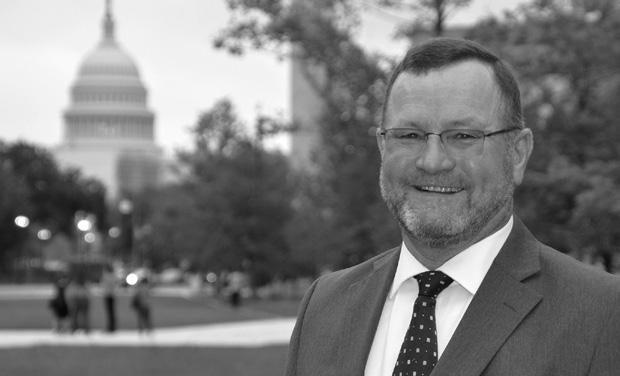
Doug Sombke, President South Dakota Farmers Union
Congressional Leaders Contact information:

Rep. Dusty Johnson
Mason Ohnstad, Legislative Assistant 202-225-2801
mason.ohnstad@mail.house.gov
Sen. Mike Rounds
Lucas Heitkamp, Legislative Assistant 202-224-5842
Lucas_Heitkamp@rounds.senate.gov
Sen. John Thune
Ashlynne Beninga, Legislative Assistant 202-224-2321
Ashlynne_Beninga@thune.senate.gov
South Dakota Union Farmer, ISSN 0745-8797, publishes seven times per calendar year, with issues printed in January, February, May, June/July, August, September/ October and November/December. Periodical postage paid at Sioux Falls, S.D.
Karla Hofhenke, Publisher Lura Roti, Editor Wendy Sweeter, Copy Editor Diane Martinson, Layout & Design
All information for publication must be submitted by the 15th of the month. You may submit items to address below or email items to: sdfu@sdfu.org
POSTMASTER: Address changes to: SDFU, PO Box 1388, Huron, S.D. 57350-1388
Contact SDFU • 605-554-3028 1410 Dakota Avenue South, PO Box 1388, Huron, SD 57350 www.sdfu.org sdfu@sdfu.org
Doug Sombke ext. 1240 President Groton Direct Line 605-554-3027
Megan Babcock ext. 1180
Controller Huron
Direct Line 605-554-3026
Rocky Forman. ext. 1170
Member Services Coordinator Cavour
Direct Line 605-554-3025
Karla Hofhenke ......... ext. 1140
Executive Director Huron Direct Line 605-554-3028
Cally Faulhaber ext. 1220
Digital Media Specialist Plankinton Direct Line 605-554-3024
Lacey Bich ext 1160
Executive Assistant Cavour Direct Line 605-554-3023
David Smith Legislative/Farm Specialist, Pierre Direct Line 605-350-8857
Doug Sombke.........President Groton
Jeff Kippley Vice President Aberdeen
Larry Birgen District I Beresford
Scott Kolousek
Contact NFU National Farmers Union 20 F Street NW Suite 300 Washington, DC 20001
Rob Larew, President ~ Jeff Kippley, Vice President Darin Von Ruden, Secretary ~ Doug Sombke, Treasurer 202.554.1600 www.nfu.org

Brian Hansen loves his job. He spends his days meeting with friends.
“I don’t refer to my clients as customers. I call them friends because that is what they are, friends. Every product I recommend, I recommend because they are my friends and I have their best interest in mind.”
It took a while for Hansen to find the career that he loves. In December 1989 he graduated with a degree in history education from the University of South Dakota, but his plans to teach did not materialize because there were not any teaching positions open.
“We had our first baby on the way, so I did a little bit of everything – I worked in a packing plant, I mowed yards – sometimes I had three jobs at one time to support our family and make ends meet. And sometimes, even working three jobs they did not meet.”
In 2001 Hansen found his way to Farmers Union Insurance. Reflecting on his 25 years
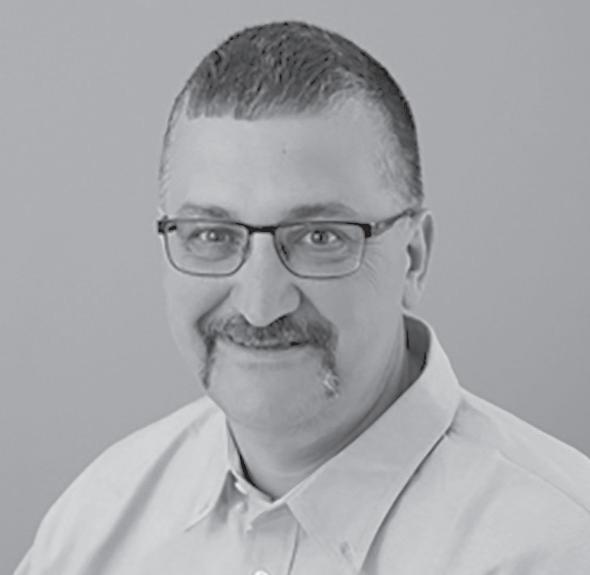
serving his friends as an insurance agent, Hansen said insurance is not a one-size-fitsall business. So, he takes the time and does the necessary research to connect his friends with the best products to provide the cover-
age they need.
“The fact that today Farmers Union Insurance agents have so many options for companies we can work with makes a difference,” Hansen said. “I will meet farmers on their land and drive around their farm to understand what they are doing and what their farm and family’s insurance needs are – as an agent I need to spend the time to understand their situation so I can best take care of them.”
When he is not with his friends, he is with his family – children, Katey, Kersten and Matt, and grandchildren, Ava, Cooper and Cora.
“Grandkids are the greatest thing to happen in my life,” Hansen said. n
Contact: brian.hansen@fumic.com Cell: 605-661-6488
Keeping up on governmental policy and programming vital to your farm or ranch doesn’t need to be a chore.
Subscribe to Farmers Union Producer Connection weekly email today and stay connected to the news you need.
Producer Connection includes weekly:
• Summaries of Congressional activity
• South Dakota Ag News
• Farmers Union Updates
To subscribe, visit www.sdfu.org and add your email address to the “Join Our Mailing List” located at the bottom of the homepage.
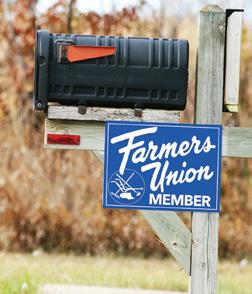
Show your Farmers Union spirit with a special Farmers Union sign. The cost per sign is $10 or free with a five-year or greater membership to Farmers Union.
To get yours today, call 605-352-6761 or email sdfu@ sdfu.org.
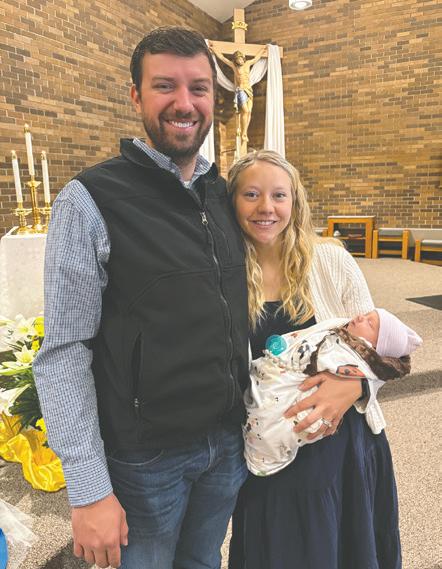
Samantha Bowman and her husband, Tonner, welcomed Kayson Lee March 28.
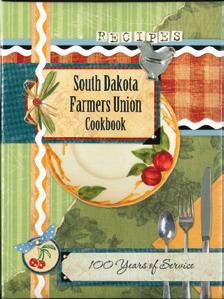
Cookbooks are $10 plus tax and shipping. Call 605-352-6761 or email sdfu@sdfu.org to place your order today! ORDER YOUR OWN COPY OF
½ lb. hamburger, cooked
½ lb. bacon, 6 slices, cut up
1 onion, diced and cooked slightly
½ c. ketchup
1 tsp. salt
½ c. brown sugar
½ c. white sugar
1 tsp. mustard
2 tsp. vinegar
Sabers Sturgis, S.D. Lifetime Member
1 (no. 2) can buttered beans
1 (no.
Brown hamburger and bacon. Add onion and cook a little more.
Drain off fat. Add ketchup, salt, sugars, mustard, vinegar and beans.
Mix well and bake for 40 minutes at 350 degrees F.
NOTE: I usually put it in a crockpot and let it cook on low.