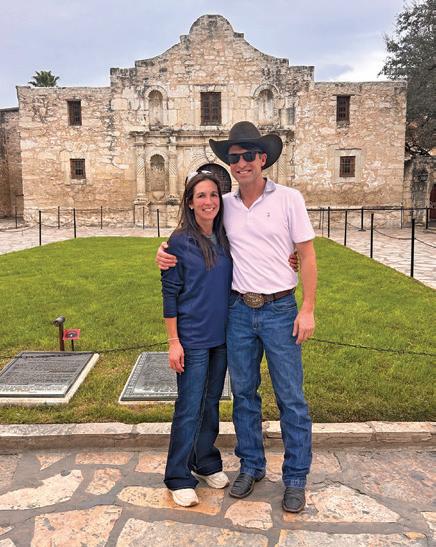
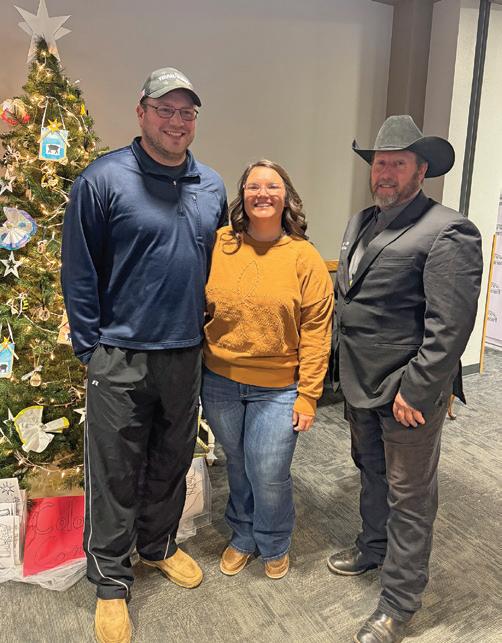
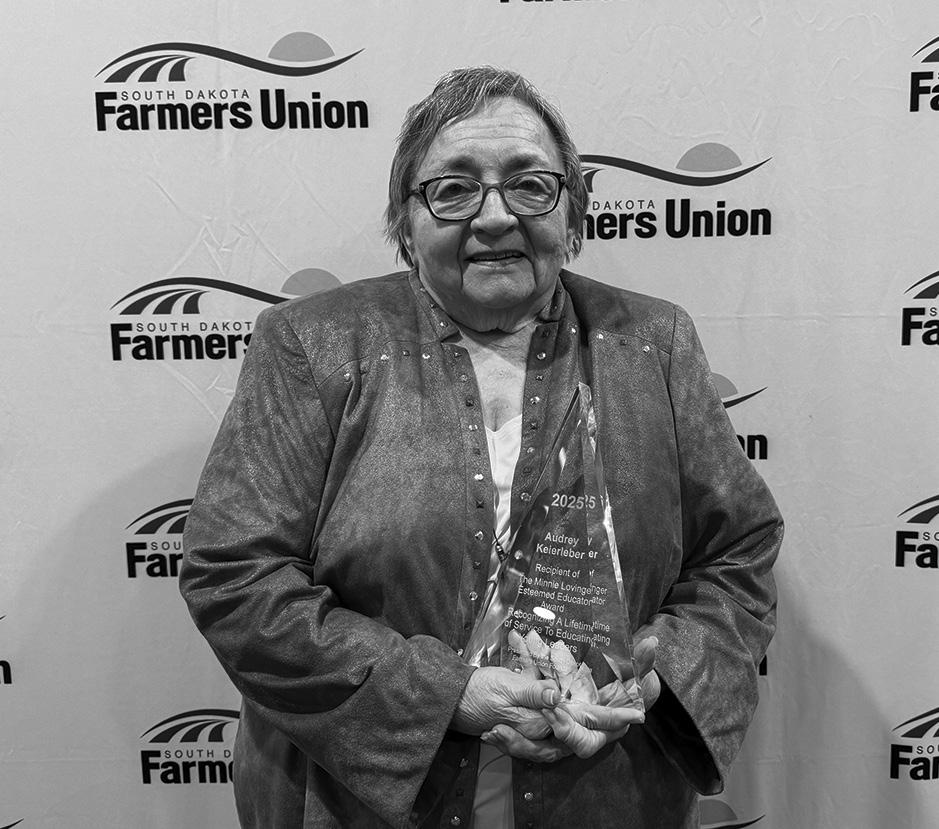
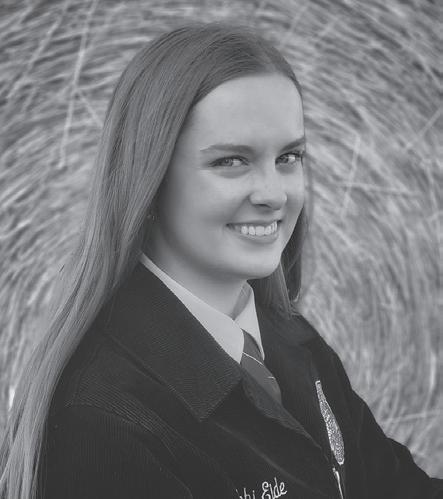
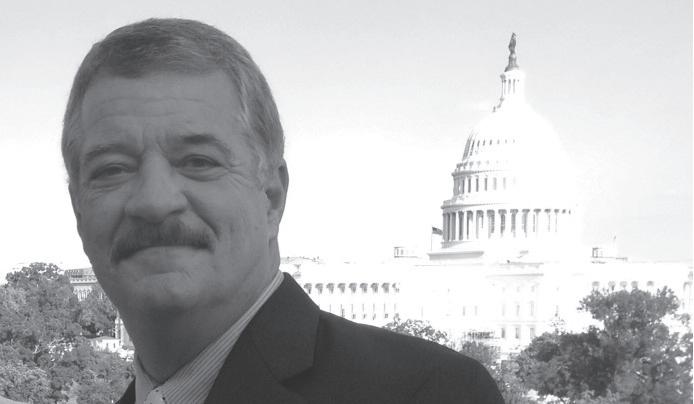
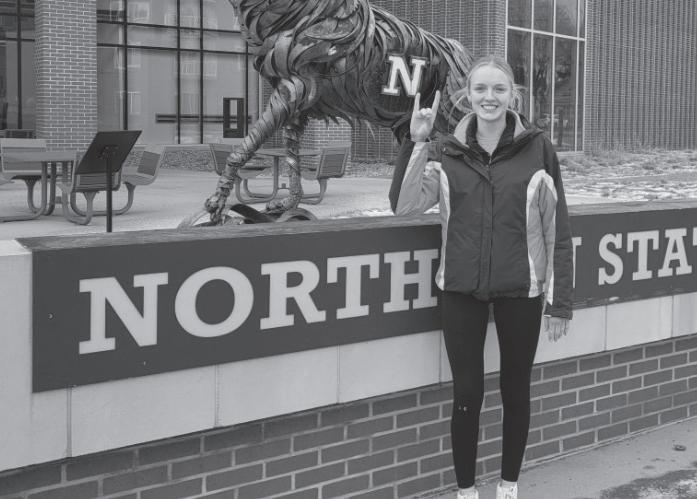
Audrey Keierleber is 2025 Minnie Lovinger Honoree PAGE 11
are Tough and Family Farmers and Ranchers Are Speaking Out During 110th South Dakota Farmers Union Convention
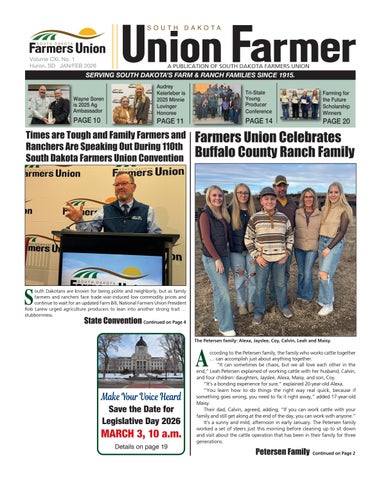
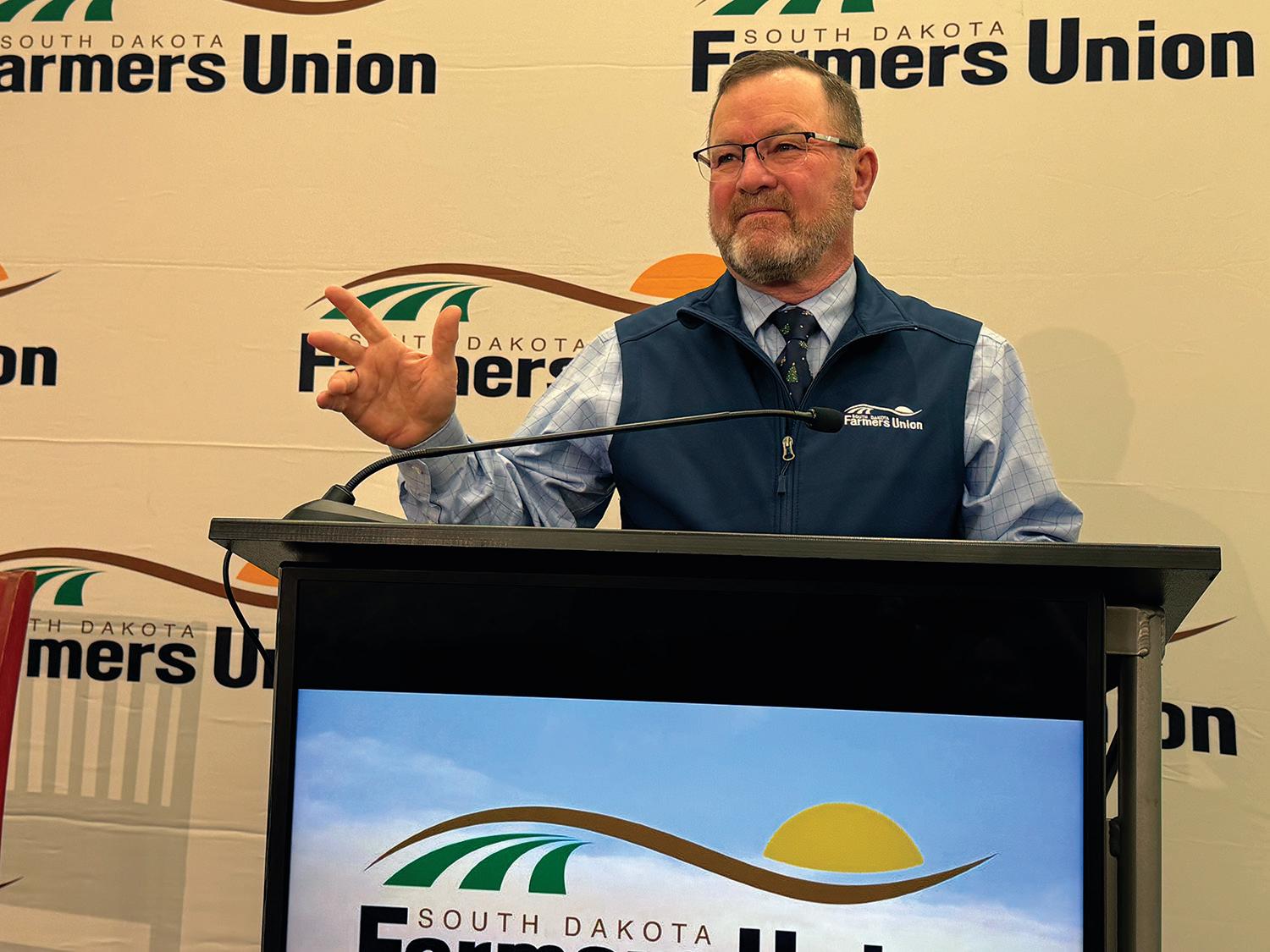
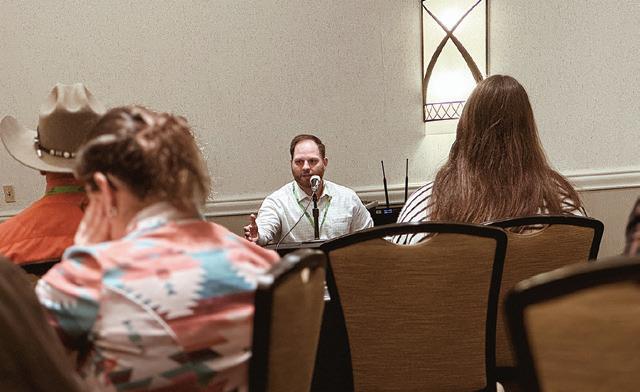
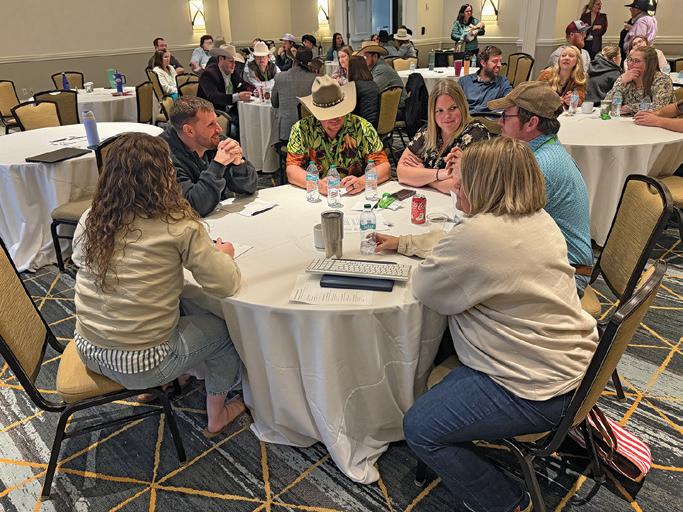
South Dakotans are known for being polite and neighborly, but as family farmers and ranchers face trade war-induced low commodity prices and continue to wait for an updated Farm Bill, National Farmers Union President Rob Larew urged agriculture producers to lean into another strong trait … stubbornness. Tri-State Young Producer Conference PAGE 14 State Convention Continued on Page 4
Farmers Union Celebrates Buffalo County Ranch Family
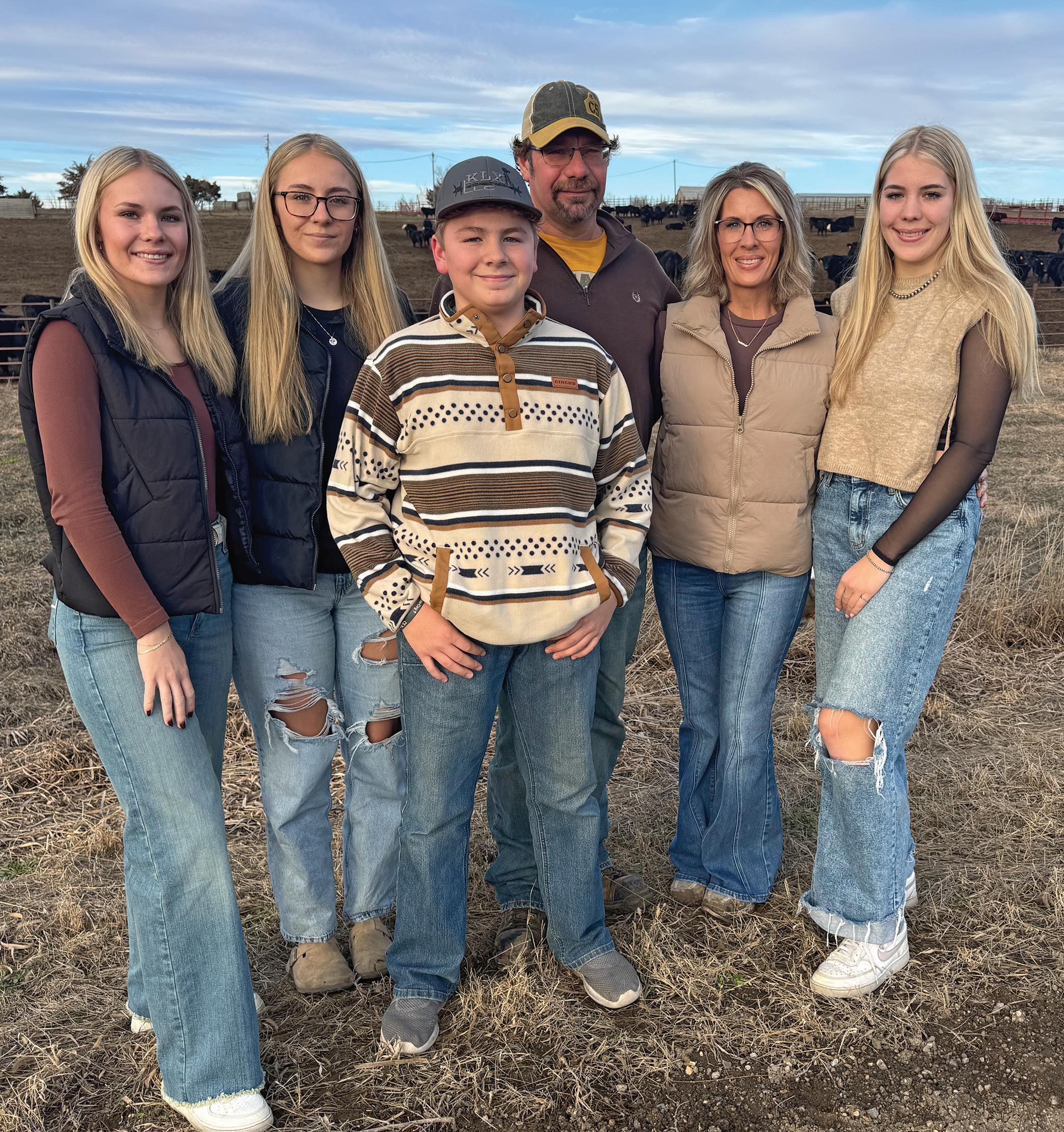
The Petersen family: Alexa, Jayslee, Coy, Calvin, Leah and Maisy.
According to the Petersen family, the family who works cattle together … can accomplish just about anything together.
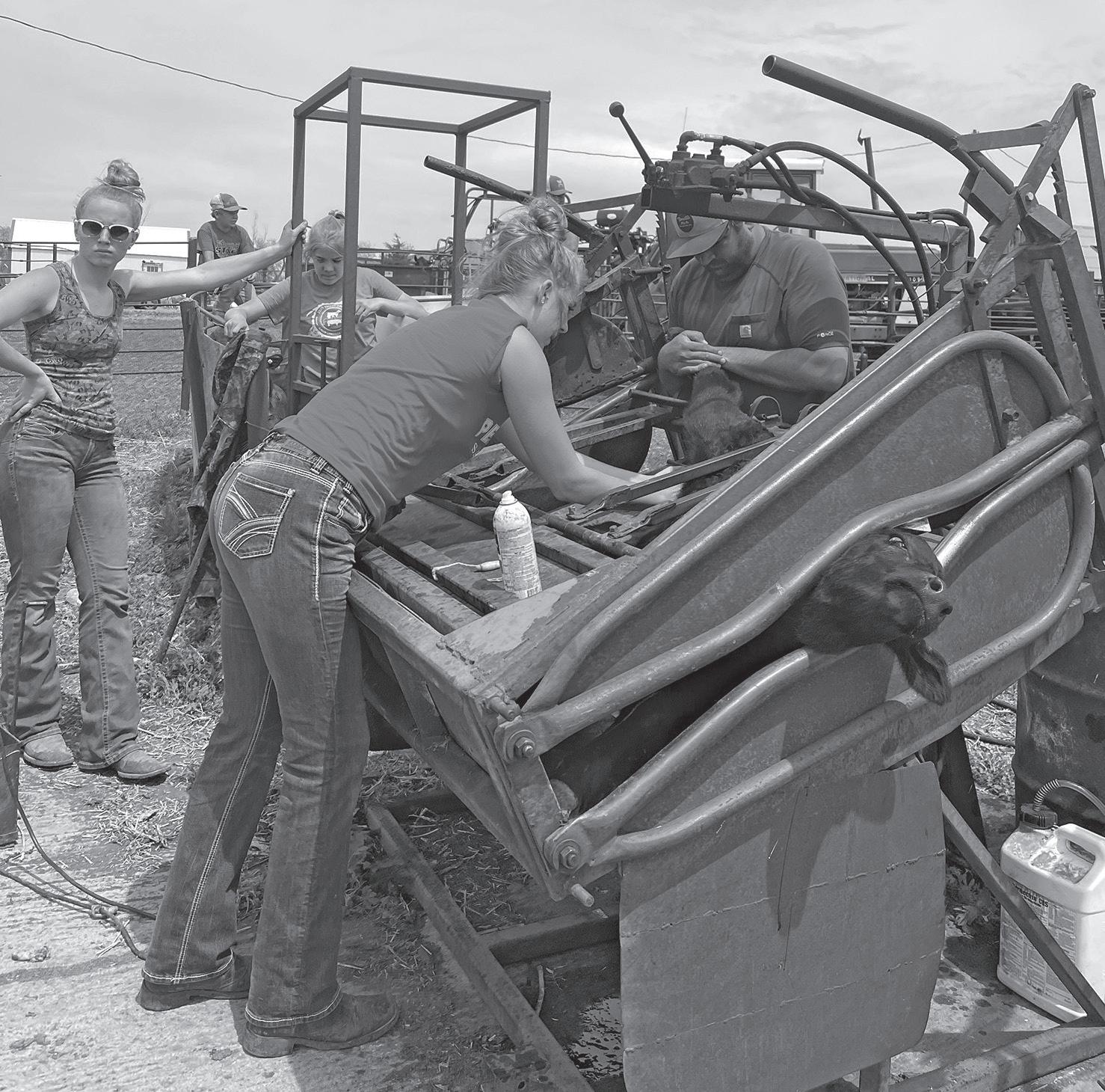
“It can sometimes be chaos, but we all love each other in the end,” Leah Petersen explained of working cattle with her husband, Calvin, and four children: daughters, Jayslee, Alexa, Maisy, and son, Coy.
“It’s a bonding experience for sure,” explained 20-year-old Alexa.
“You learn how to do things the right way real quick, because if something goes wrong, you need to fix it right away,” added 17-year-old Maisy.
Their dad, Calvin, agreed, adding, “If you can work cattle with your family and still get along at the end of the day, you can work with anyone.”
It’s a sunny and mild, afternoon in early January. The Petersen family worked a set of steers just this morning before cleaning up to sit down and visit about the cattle operation that has been in their family for three generations. Petersen Family Continued on Page 2
Union Farmer
“My dad and mom have taught me everything I know. I love working side-by-side with them and being my dad’s right-hand man.”
– Coy Petersen
“Grandpa William and Grandma Mary settled here in 1941,” said Calvin, of the ranch that sits on the Crow Creek Reservation, just 13 miles north of Pukwana.
Growing up during the Farm Crisis of the 1980s, Calvin knew times were tough. But when his dad encouraged him to pursue a different career, he was determined to return to the family’s ranch.
“My dad said, ‘get out of here and try something new.’ I was stubborn enough that I ended up back here after college,” Calvin said.
When it comes to raising cattle, the Petersens’ herd is mostly closed. “We raise our own replacements,” Calvin explained. “Someone asked me the other day, ‘the cattle market is good, do you plan to sell.’ I said, ‘no.’ We sell
our calves the same time every year regardless of the market and have made it here through good times and bad because we hold steady. We stick to our beliefs and we don’t follow fads.’”
The Petersens raise Simmental-Angus cross cattle. “The cattle we raise need to be able to thrive here,” Calvin explained. “We pick cattle based on the lay of the land.”
The landscape of the Petersen ranch is rolling hills of native prairie grassland. “Our calves and cows get basic mineral and salt program, we try to minimize supplements and let them just do their thing, we don’t put a lot into them,” Leah said. “We are fortunate all our pastures are connected, so when it’s time to move the cows, we just open a gate.”
Unlike Calvin, Leah did not grow up on a ranch, but she did grow up rural. “My best friend grew up on a farm and I rodeoed, so I always was
around it,” Leah said.
Leah and Calvin met one summer when Calvin was helping work cattle for a neighbor that Leah was also working for as a nanny.
Leah enjoys raising cattle as much as Calvin. Until 2015 Leah worked in town as a massage therapist and nail technician. But then Calvin’s parents, Ronald and Alona were both diagnosed with cancer.
“I quit work to help take care of them and help Calvin on the homeplace, and I’ve been here full time ever since,” Leah said.
Returning to the ranch full time to work with Calvin means no workday is ever the same. “Everyone pitches in. No one has a specific job. When something needs done, we all help get it done,” Leah explained.
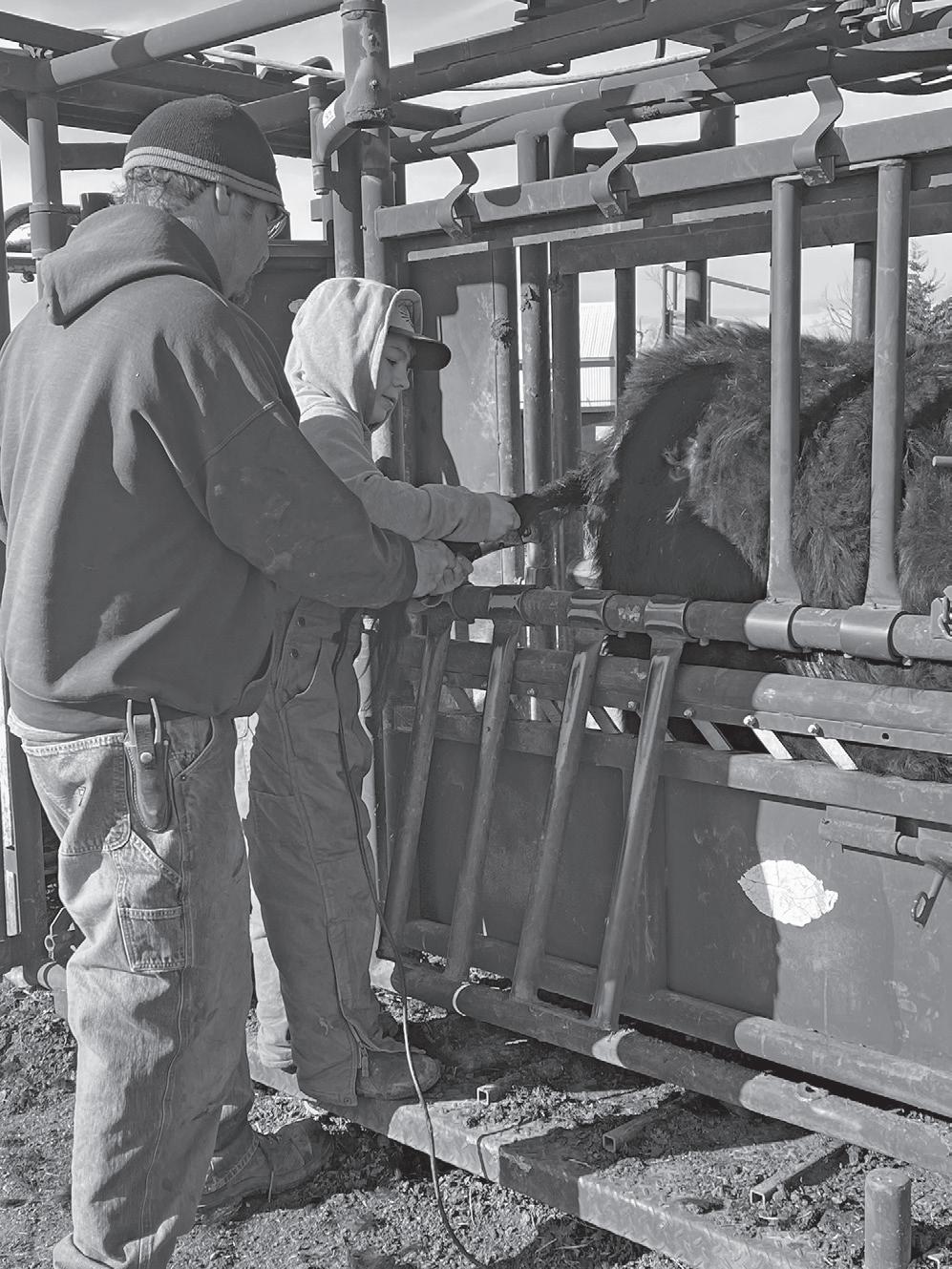
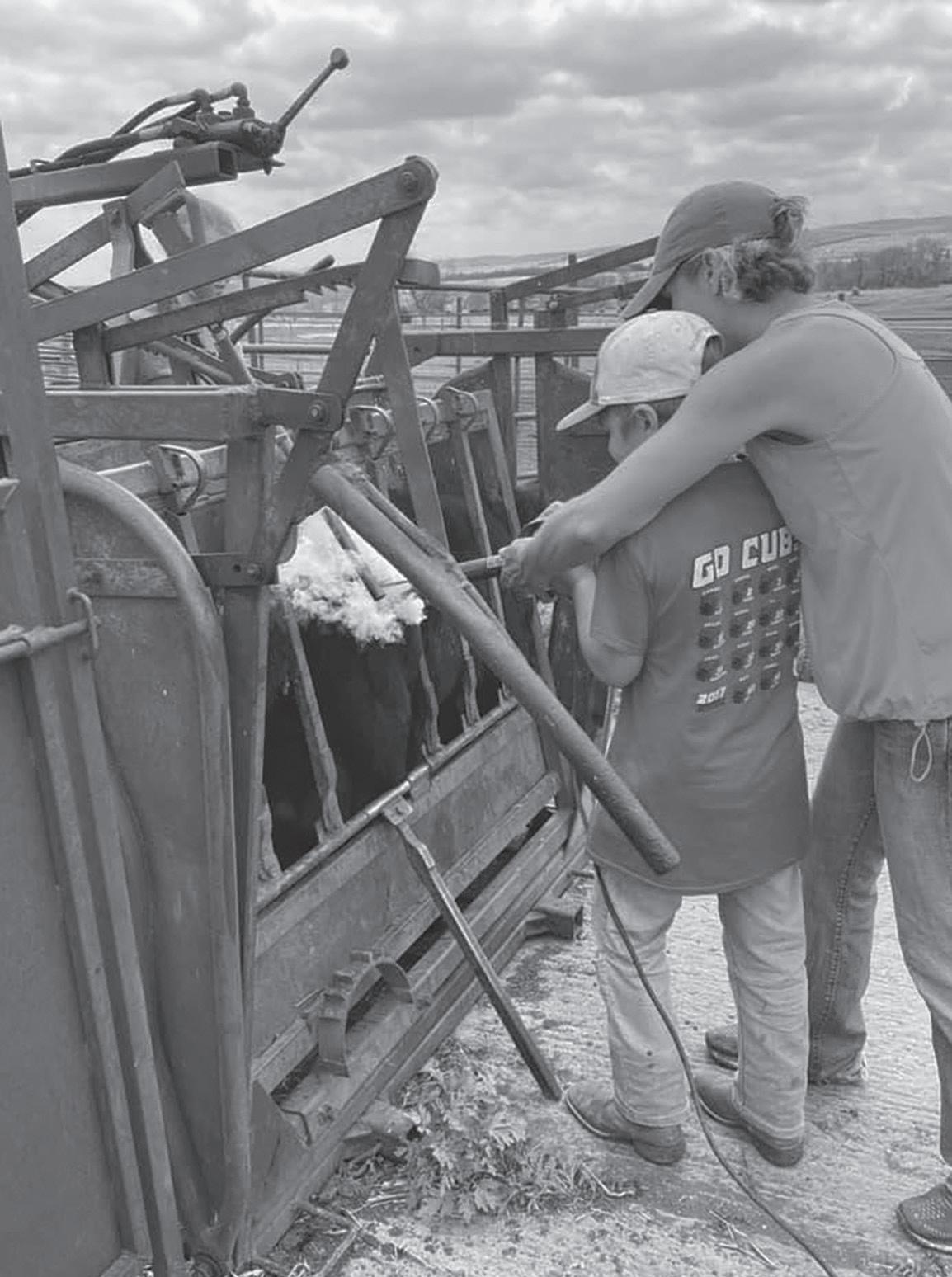
And there are days when it’s just Leah and their children because Calvin also works off the ranch clipping and torching bulls. It’s a side job he’s had since he was 14.
“I met a family through 4-H and they asked me if I wanted to help get cattle ready for the Denver National Western Stock Show. I didn’t play sports so after school every day I went over and helped them until long after dark,” Calvin said. “It was an opportunity to meet people and see the world.”
Thirty years later, Calvin continues to clip and torch cattle for several purebred producers who have become much more than friends, he thinks of them like extended family. When it works in his school schedule, his 14-year-old son, Coy, helps out.
“My dad and mom have taught me everything I know. I love working side-by-side with them and being my dad’s right-hand man,” explained Coy, who is building up his own cattle herd, and hopes to return home to ranch with his parents after college. “It is my lifelong dream. I don’t see myself working anywhere else.”
Coy is a 2025 Farmers Union Herd Builder, selected to receive a heifer during the Western Junior Livestock Show. Recently, when he and
Calvin were at the Fort Pierre Livestock Salebarn, his dad handed the paddle over to Coy because he is starting to expand his own herd, acquiring new genetics.
“We agreed we liked the look of the heifers and we knew the bulls they were bred to. But when dad handed over the bidder number to me, I was shaking,” Coy said. “It felt good that he thought I was ready for this responsibility and I would not do him wrong.”
Coy’s desire to ranch full time after school does not surprise Calvin and Leah.
“At a certain age we told the kids, ‘do you want to work on the ranch this summer or work in town,’” Leah explained.
When their oldest, Jayslee had the option, at 14 she chose to work for a local nursing home. “She always said she wanted to be a nurse, so we said she should work at the nursing home and see if she liked it. She loved it,” Calvin said.
Now 22, Jayslee recently graduated from Lake Area Technical College with a nursing degree and works for Avera WesKota Hospital in Wessington Springs.
She said working with her family on the ranch prepared her well. “Whether it was working cattle with my family or fixing fence, I learned hard work and dedication for sure,” Jayslee said.
Union Farmer
Her sister, Alexa, an accounting major at Southeast Technical College, agreed. “Working on the ranch I learned to help out wherever it was needed,” Alexa said. “And the hard work and dedication transfers to college – focusing, studying and going to class.”
Maisy, who is a senior at Chamberlain High School, and is looking at attending the University of South Dakota in the fall with pursuing a degree in criminal justice also agrees with her sisters in regards to the hard work, dedication and responsibilities all play a role in how they apply themselves in the future.
Leah and Calvin said they enjoy watching their children discover and follow their passions on and off the ranch. They treasure days like this one, when most of their children are home and they can work cattle together.
To view more photos and videos of the Petersen family, visit www.sdfu.org and click on the Farm and Ranch Families link under the About Us Tab. n by Lura Roti for SDFU
Union Farmer
Annual Convention
“We can be polite, but we cannot be polite at the expense of things we need as family farmers and ranchers,” Larew said as he addressed South Dakota Farmers Union members during the 110th State Convention held Dec. 10 and 11 in Huron. “The idea that somehow these rural communities are just going to survive on their own and we are just going to let rural healthcare facilities go away and we are not going to make sure that family farmers and ranchers have a fair shot from one year to the next in a marketplace that is not functioning – in a beef market that lacks transparency – and while we can say, ‘thank you,’ and show gratitude for the $12 billion, we need to lean into the stubbornness and say, ‘This is what my community needs. We are not going to give in and watch rural communities lose healthcare clinics or young farm and ranch families.’”
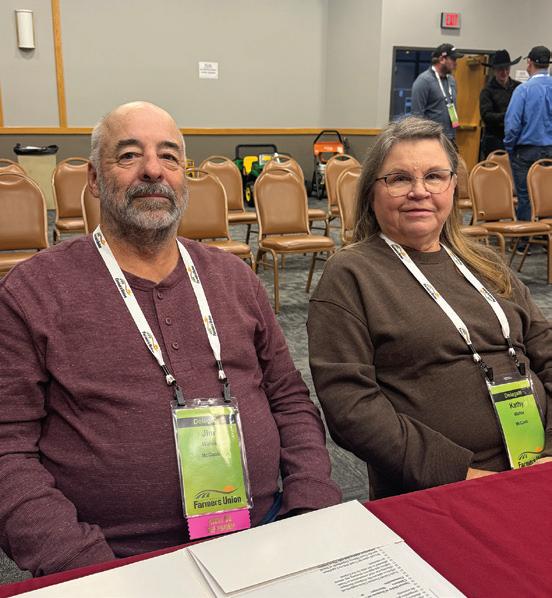
Larew is among the National Farmers Union team in D.C. advocating for farm and ranch-friendly policy. Being a part of an organization who gives a strong voice to family farmers and ranchers is encouraging during the current situation, said fifth-generation Salem farmer Jim Wahle.
“I appreciate National Farmers Union working to get a Farm Bill passed that will provide a safety net,” said Wahle. “When times are tough, like they are right now, that’s when I’m grateful for Farmers Union on the state and national level.”
Amber Kolousek agreed.
“I appreciate how Farmers Union is grassroots and fights for solutions to the issues we face on our farms and ranches,” explained Kolousek.
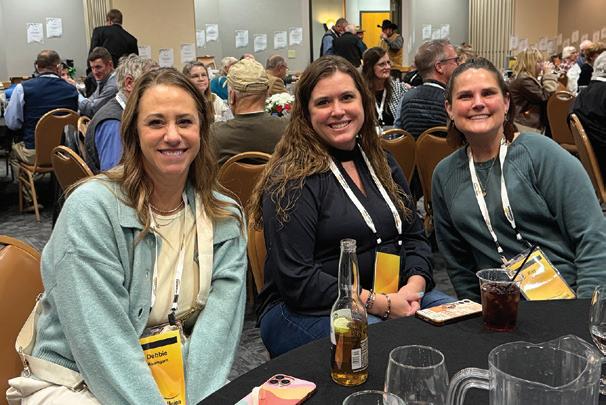
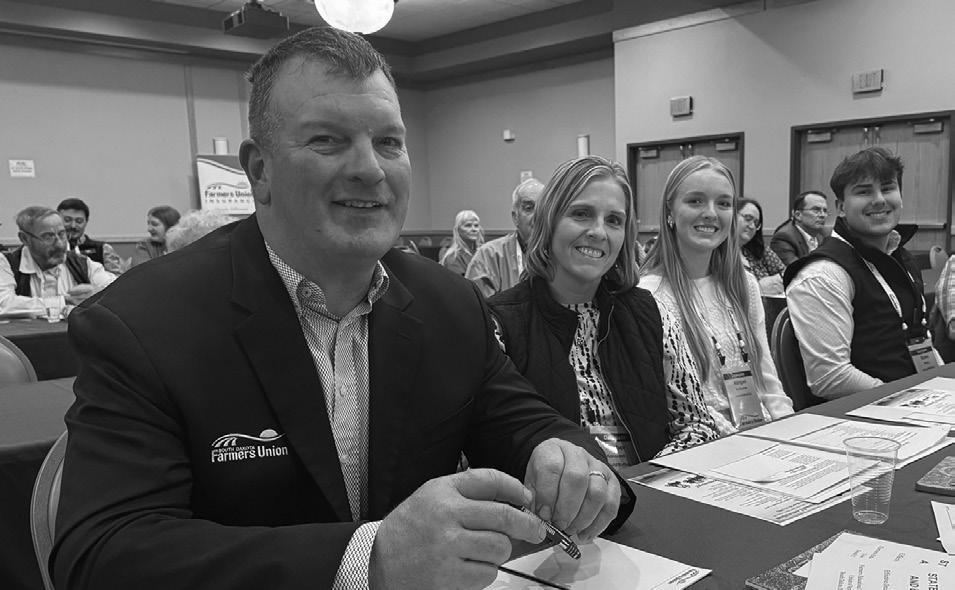
Kolousek and her husband, Scott, ranch near Wessington Springs. The couple has been active in Farmers Union for more than a decade. They invited their college-age daughter, Abby, and her boyfriend, Blake Miller, to attend State Convention with them this year.
“We wanted to show them what Farmers Union does and what we have been involved in,” Kolousek said. “Knowledge is wealth.”
Abby and Blake are among a growing number of college students getting involved in Farmers Union. They are members of the newly chartered Northern State University Collegiate Farmers Union Club.
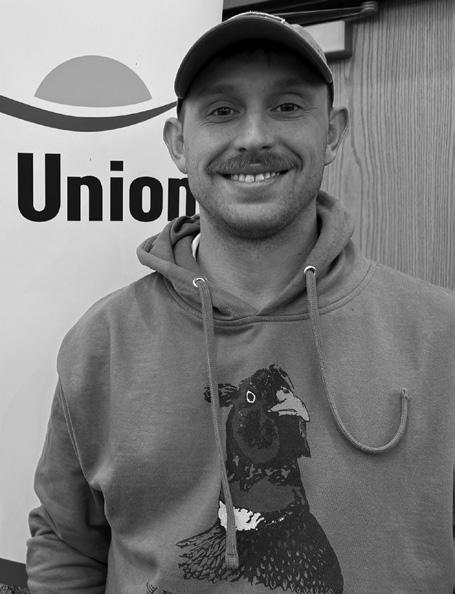
Chaz Blotsky is also a Collegiate Farmers Union member of the Mitchell Technical College Club. The 110th State Convention is the fifth State Convention the 21-year-old Hidden Timber rancher has attended. He said he took time away from college classes for convention because he believes as a young producer, participating in policy discussions is important.
“I feel it is our generation’s responsibility right now, to step up, not later, but now,” Blotsky said.
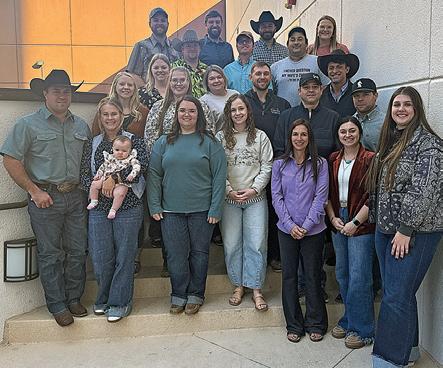
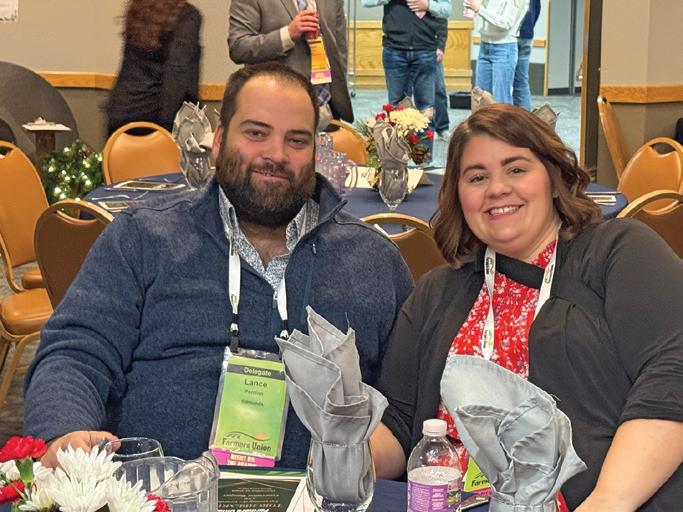
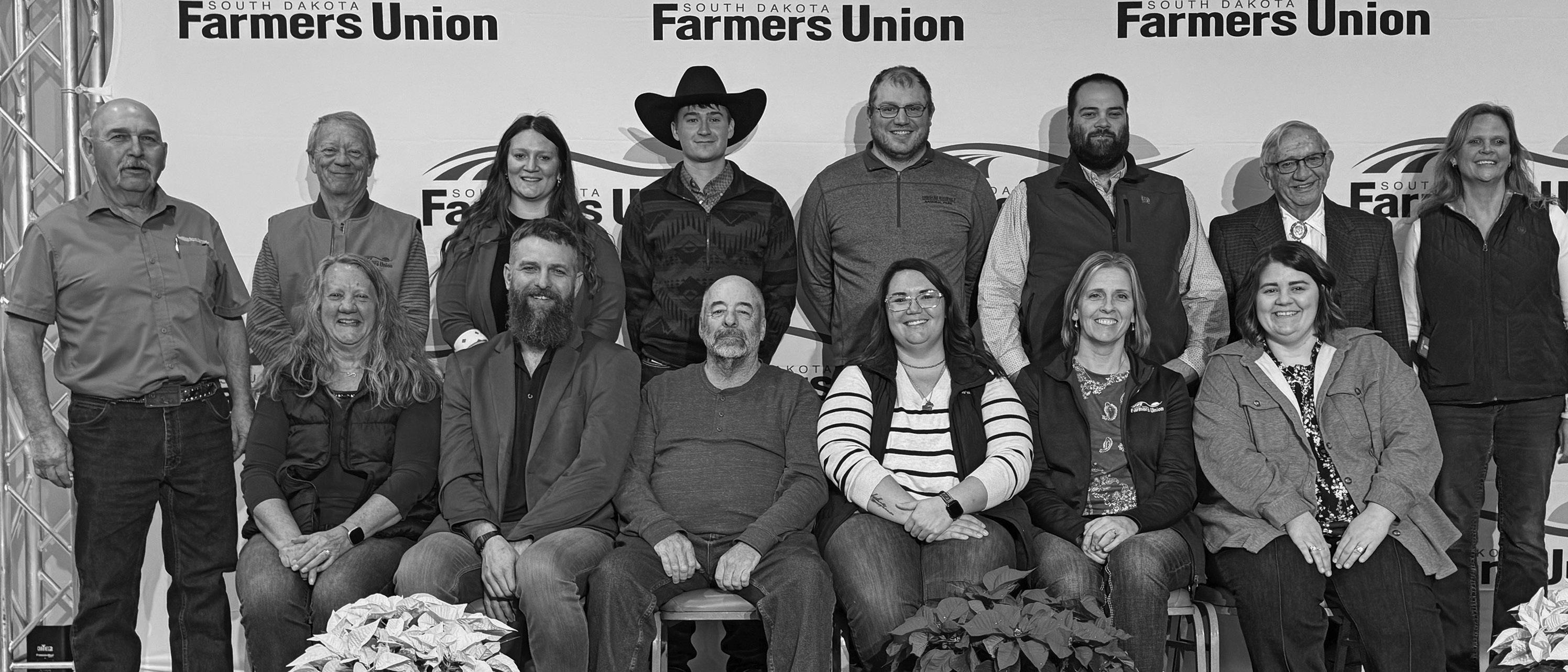
Aberdeen; Jason Latham, Buffalo; Kaeloni Latham, Buffalo; John Kippley, Aberdeen; Lance Perrion, Ipswich; Sarah Perrion, Ipswich; Rob Lee, De Smet; Darrin Olson, Aberdeen; Jim Wahle, Salem; Keeleigh Reis-Elwood, Reliance; Terry Sestak, Tabor; and Amber Kolousek, Wessington Springs.
In addition to policy, Blotsky also appreciated hearing from convention speakers, specifically Gov. Larry Rhoden. “Gov. Rhoden’s speech was motivating,” Blotsky said. “After hearing him speak, I stood up a little taller. It made me proud to be from South Dakota.” (Turn to page 9 to read more about Gov. Rhoden’s keynote address.)
South Dakota State University student and Collegiate Farmers Union member Brandon Toennies agreed. “It was nice to learn that the person who holds the state’s highest office knows what farmers and ranchers like us are going through because he is an actual rancher, and he knows that when we hurt, the entire state hurts.”
Like Blotsky, Toennies also enjoyed the State Policy Meeting. During convention, family farmers and ranchers discussed several topics and voted on four Special Orders. To learn more, turn to page 6.
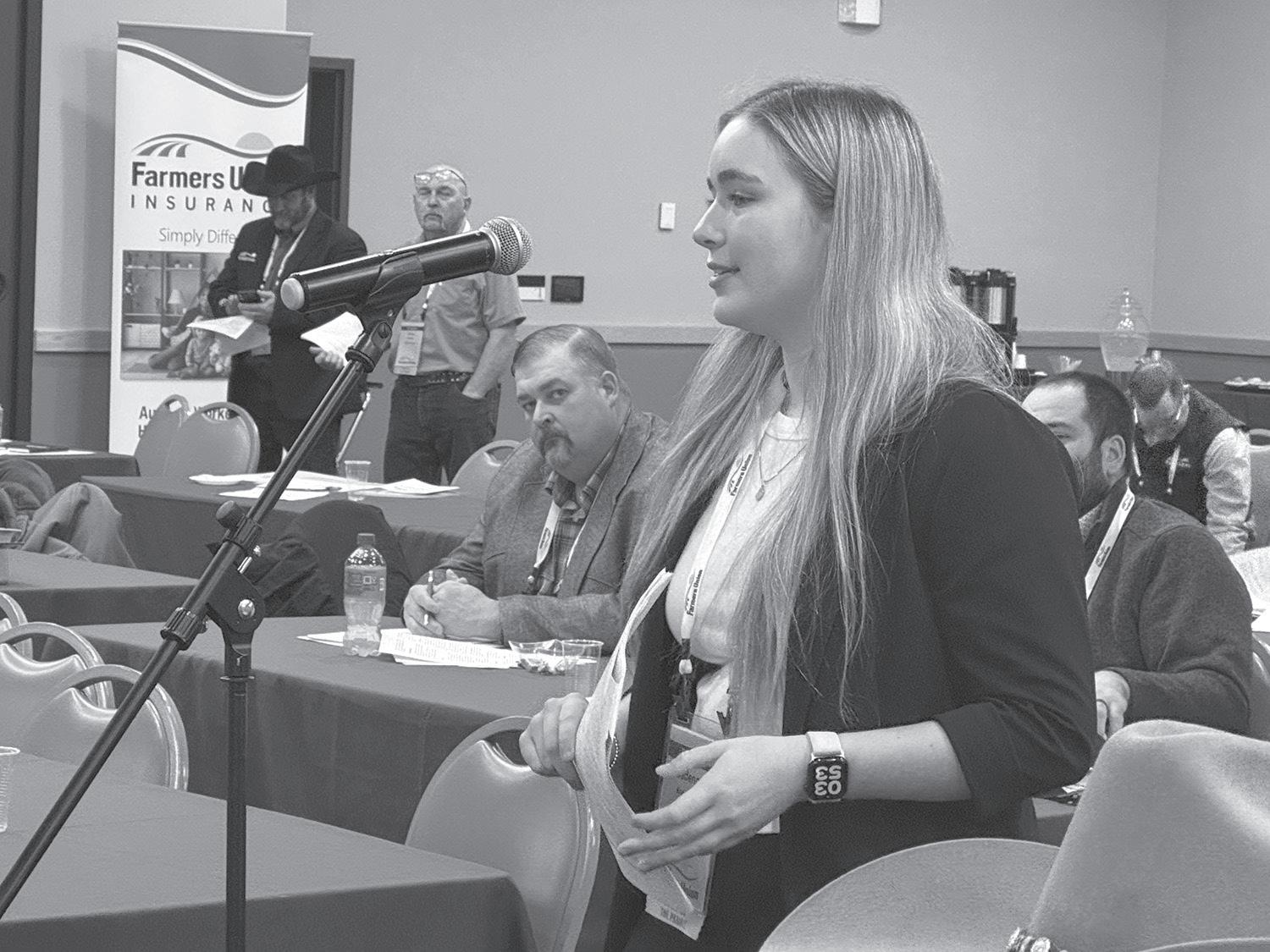
Participating in policy is something Senior Advisory Council member and Kimball cattle producer Cadence Konechne, 17, also enjoys. “Farmers Union is a place where even a high school student has a voice. Farm and ranch policy impacts me because it is important to my future,” Konechne explained.
With graduation on the horizon, Konechne said that her involvement in Farmers Union youth programming inspired her future career goal. “After participating in the D.C. Fly-In and attending Legislative Day in Pierre, I became interested in ag policy development and I think I want to get a law degree. I would have never been exposed to this field if it were not for Farmers Union.”
Colome farmer Joel Keierleber, 70, said seeing young producers enthusiastic about their future and engaged in Farmers Union was encouraging. “The young producers are the future. I noticed more attending this year’s convention than ever before. This is a good sign for the future of Farmers Union.”
Getting to connect with South Dakota family farmers and ranchers of all ages from across the state is among the benefits of attending South Dakota Farmers Union State Convention, said the organizations’ president and fourth generation Brown County farmer Doug Sombke.
“Convention is a good time to talk about the challenges that we face, with the low prices and world markets, and about the things that are happening in D.C. and Pierre … the kitchen-table issues we are all talking about,” Sombke said. “Convention is also a good place to learn about some future technologies, like AI. And what better time than the Christmas season to connect with farmers and ranchers from across South Dakota.”
Blotsky was among 14 South Dakota family farmers and ranchers elected during State Convention to serve as a delegate to the National Farmers Union Convention. The other delegates are Michelle Olson, Aberdeen; Rachel Kippley,
To learn more about convention speakers and policy, visit www.sdfu.org. To hear comments from more Farmers Union members, follow South Dakota Farmers Union on Facebook and Instagram. n by Lura Roti for SDFU State Convention Continued from Page 1
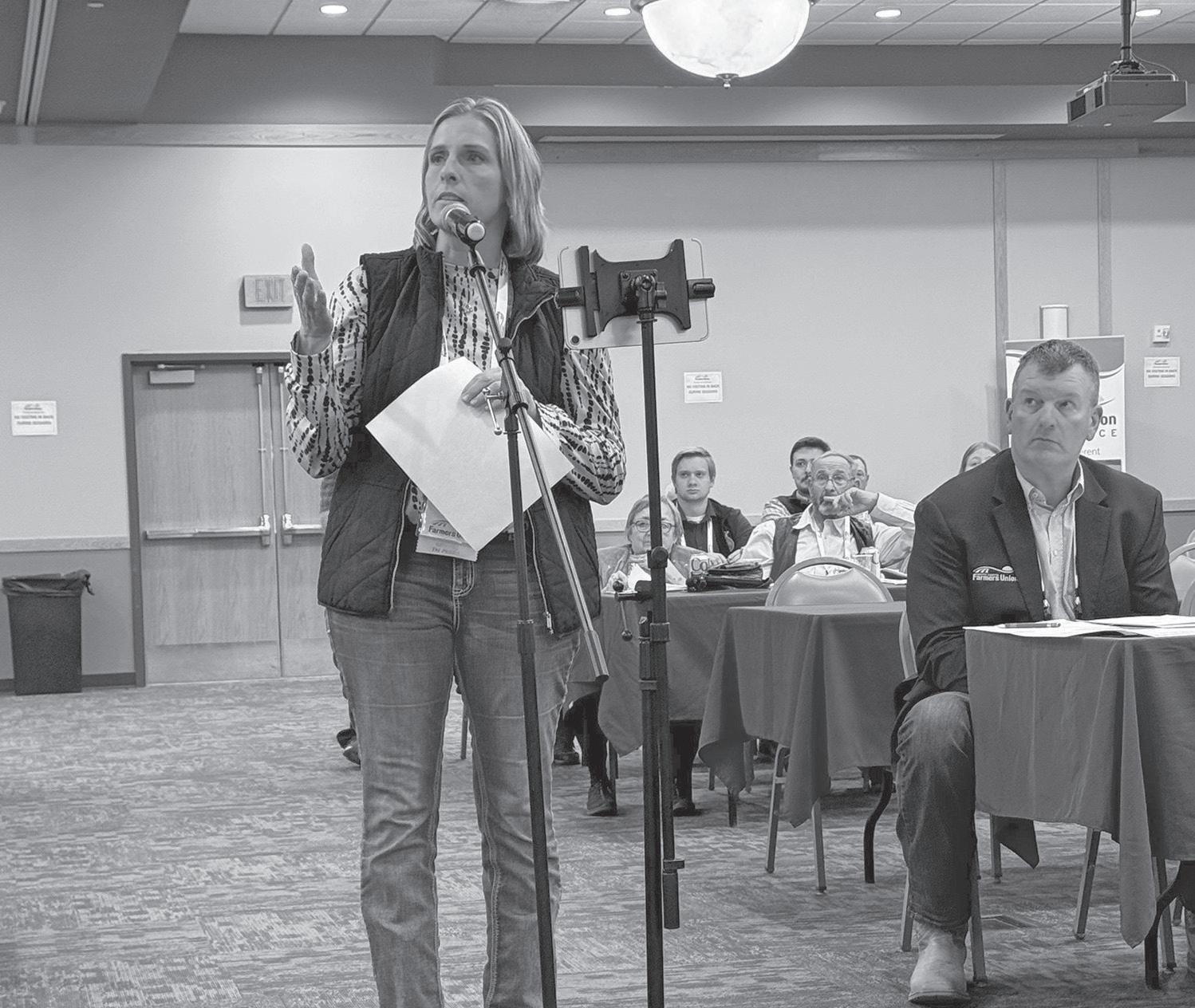
Wessington Springs cattle producer Amber Kolousek speaks during State Policy.
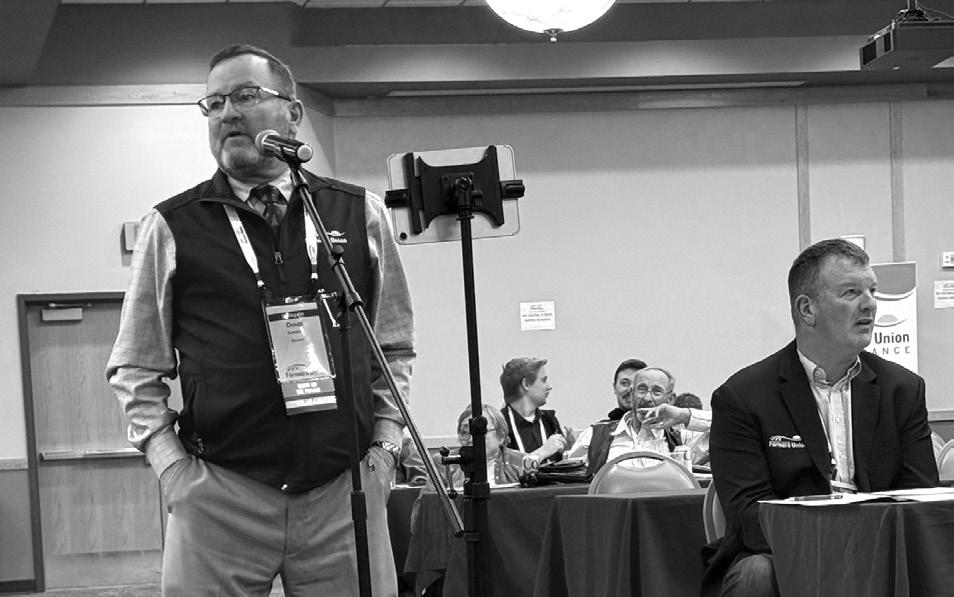
Senior Advisory Council member and Kimball cattle producer Cadence Konechne speaks during State Policy.
Annual Convention
Geopolitical Analyst Predicts a Future of Change for Farmers
When geopolitical analyst and podcaster Jacob Shapiro discussed the future of agriculture with farmers and ranchers during the 110th South Dakota Farmers Union State Convention, the picture he painted was not a rosy one.
“I’m here to tell you that I don’t think we are going through a cyclical downturn. I think we are going through a fundamental structural change to how global agricultural markets work,” Shapiro said. “I think everything we know about cycles before we need to throw out the window. We need to think about the world as it is, and as it is changing around us now.”
Shapiro pointed to the fact that unlike the U.S., which as of 2017 has been importing more food than we export, the rest of the world is working to become more self-sufficient. “All around us, countries are starting to behave a little differently. They’re actually looking for alternative sources or they’re trying to become more self-sufficient. … “India has almost doubled their pulse production over the last 20 years, even though most experts said that it was not possible (for India to grow more lentils and chickpeas). So, even as we are importing more food from abroad the rest of the world is producing more food for itself and this is eating into our export market share.”
“I’m here to tell you that I don’t think we are going through a cyclical downturn. I think we are going through a fundamental structural change to how global agricultural markets work.”
– Jacob Shapiro
Shapiro explained the dynamic shift is possible because we now, “live in a multipolar world.”
“I don’t care how long you’ve been farming. I don’t care how many books you’ve read. None of you in this room have lived in a multipolar, geopolitical context – for the last 40 years, we have lived in a unipolar world. The buck literally stopped with us. We were the dominant cultural, economic, military, trade, security, power. You name it. We were the top dog. Everybody listened to us. … But when you’re thinking about the world going forward, I want you to stop thinking about the world as one, undifferentiated marketplace, where countries send out product and people buy it, without recourse to politics because that’s not what’s happening.”
Taking a 70-year step back in history, Shapiro said before the U.S. was the dominating world power, we lived in a time of bipolar world, “You
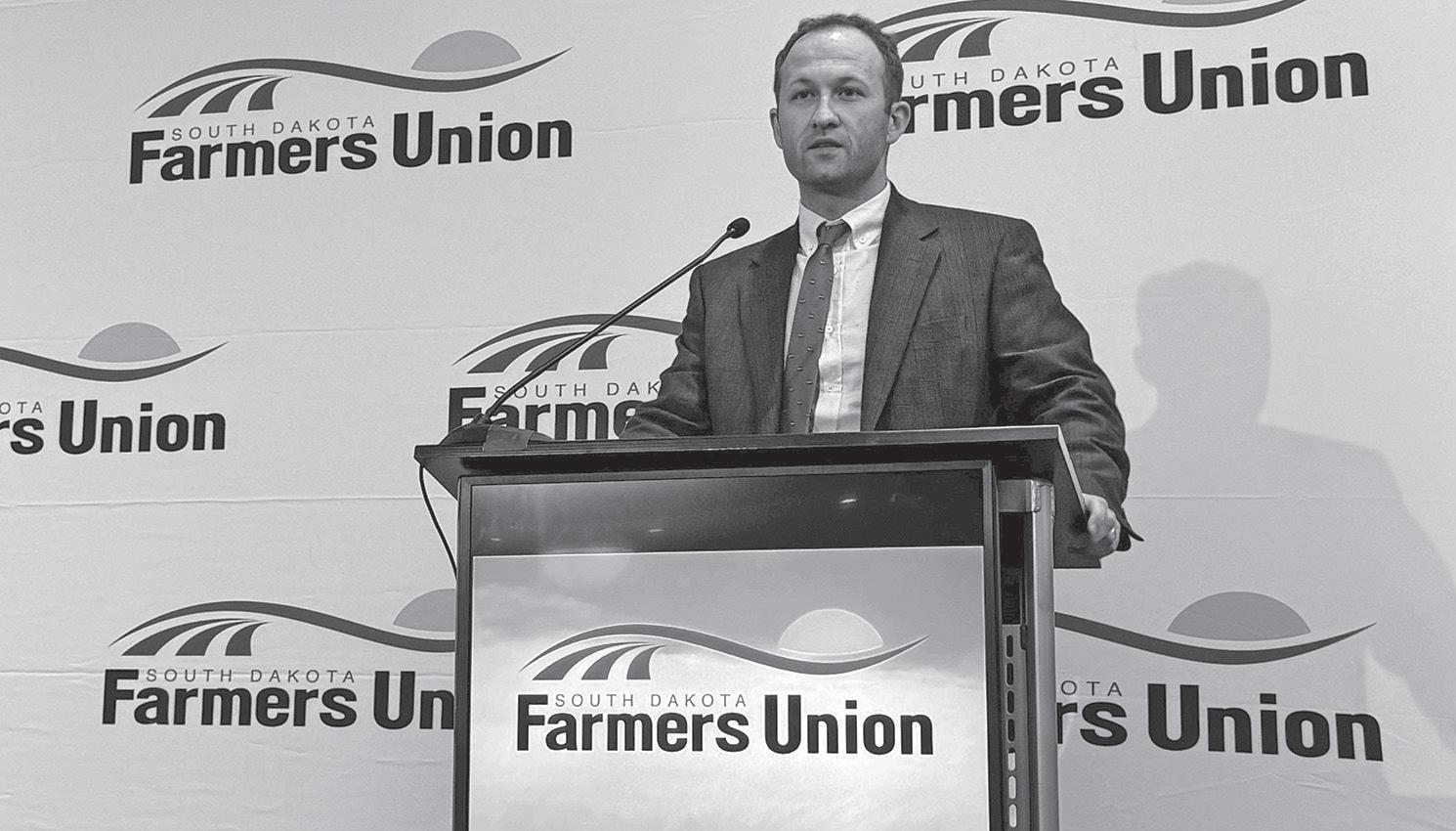
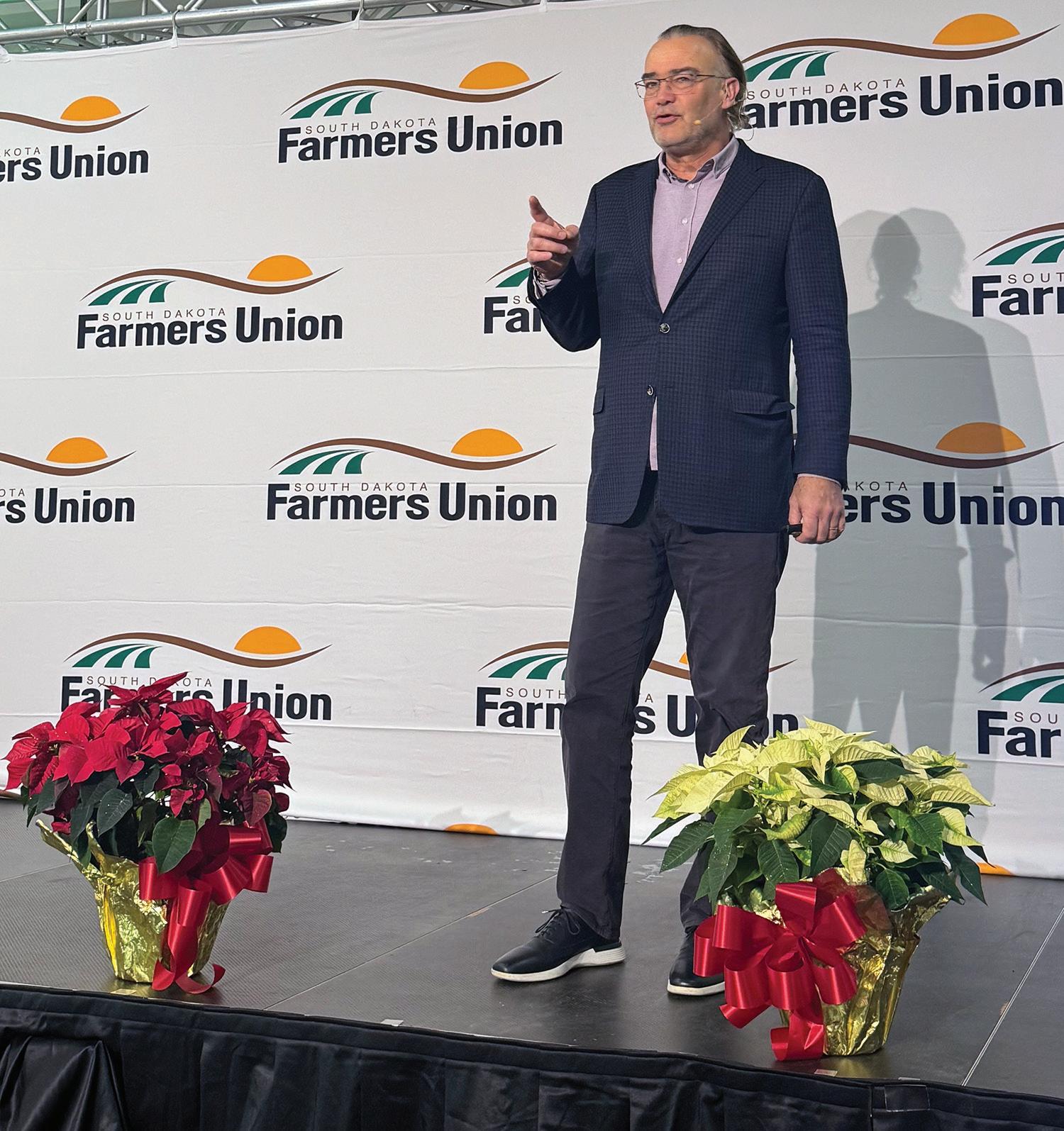
Geopolitical analyst and podcaster Jacob Shapiro speaks during State Farmers Union Convention.
had the Soviet Union on one side, you had the United States on the other side. Capitalism versus Communism, and everybody had to fall in line.”
To emphasize his point, Shapiro noted the global shift in the value of the dollar. “The world is telling you with their money that the dollar is not top anymore and that they are looking for alternatives.”
Shapiro explained the U.S. is losing its global influence as U.S. tariffs and leadership’s bold criticism of NATO allies continues to drive a wedge between America and the rest of the world. “Nobody’s listening to us. And countries that we go too far with are looking to China and other sources.”
Because the U.S. imports nearly all its electronics and more than 50 percent of its medical treatments and pharmaceuticals –Shapiro said consumers will not fare well if the countries we depend upon decide to close their doors.
What do egg and beef producers have in common? Shapiro explained that they understand “America First,” is not a campaign promise that is being followed. “When egg prices spiked at the beginning of the Trump administration, if you’re an egg farmer, you’re thinking, ‘finally, this is going to be the year where I can put some money away.’ What does the Trump administration do in response? It decides to import millions of eggs from Turkey and South Korea. … How about beef?”
Understanding his audience, Shapiro let the question hang in the air for a few seconds. “You guys know the data probably better than I do,” he said to the many Farmers Union members who raise cattle.
Energy and niche markets
Understanding that the data, historical analysis and future predictions he shared with
South Dakota family farmers and ranchers were not optimistic, Shapiro did have a few “silver linings” to share. These focused on raising crops for energy and niche markets.
“If I’m right about this, our energy growth consumption is going up…and we’re going to want to keep those energy prices as low as we possibly can.”
To listen to audio of Shapiro’s South Dakota Farmers Union talk, a link to the audio version can be found in this article on the Farmers Union website, www.sdfu.org n by Lura Roti for SDFU
Subscribe to Producer Connection Today!
Keeping up on governmental policy and programming vital to your farm or ranch doesn’t need to be a chore.
Subscribe to Farmers Union Producer Connection weekly email today and stay connected to the news you need.
Producer Connection includes weekly:
• Summaries of Congressional activity
• South Dakota Ag News
• Farmers Union Updates
To subscribe, visit www.sdfu.org and add your email address to the “Join Our Mailing List” located at the bottom of the homepage.
Union Farmer
Annual Convention
Grassroots Policy Addressed Concerns Over Data Centers, Childcare Shortages & More
Want to understand the current issues and concerns of South Dakota’s family farmers and ranchers? A quick review of the 2026 Special Orders passed by South Dakota Farmers Union (SDFU) members during the 110th SDFU State Convention Policy Meeting provides a clear overview, explained SDFU President Doug Sombke.
“Our policy is what we truly stand for,” Sombke said. “We are not an organization that supports a specific political view. We stand for a purpose, and the purpose is what is in our policy book. And the policy is established by South Dakota’s farmers and ranchers. Farmers Union is led from the ground up – from the farm or ranch up – as an organization, we don’t tell farmers or ranchers what they should have as their beliefs. They tell us what to stand for. This is the reason Farmers Union has lasted for so long. This is the reason we are over a century old.”
During the annual policy meeting, members review and update established policy, and the delegates and members establish Special Orders to highlight timely concerns members want policymakers to address at the state and national levels.
The policy and Special Orders established during the 2025 convention will be discussed by SDFU staff and members during the 2026 legislative session in Pierre and SDFU delegates will bring these topics up during the National Farmers Union Convention Policy meeting held in March.
The focus of the five Special Orders passed during convention are:
Special Order #1 – Beef on Dairy
Special Order #2 – Foreign Ownership of Food Processing
Special Order of Business #3 – Supporting a Competition Title in the Next Farm Bill
Special Order of Business #4 – Addressing Childcare Shortages in Rural Communities
Special Order of Business #5 – Addressing Data Center Concerns
*Complete Special Orders are listed at the end of the article on page 7.
“I enjoy participating in policy because the issues brought up are what agriculture producers are currently concerned about,” explained Harding County rancher Kaeloni Latham. “The focus changes
from year to year and can be different depending on where you live.”
Latham’s husband, Jason, agreed, adding, “I appreciate Farmers Union policy because it takes a stance for what family farmers and ranchers need to remain competitive. It is designed so that our farms and ranches are around when our kids are old enough to take over.”
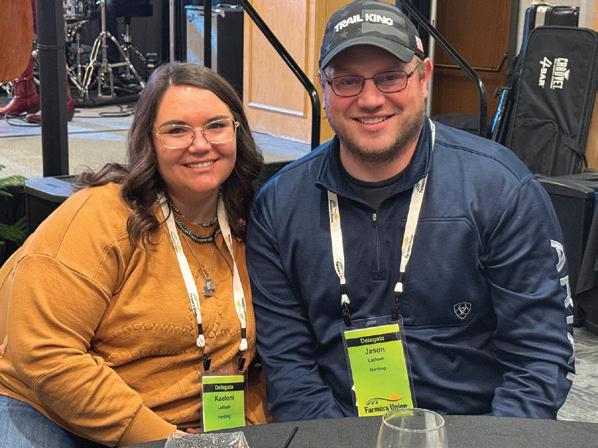
Jason and Kaeloni Latham are among 14 South Dakota family farmers and ranchers elected by members during convention to serve as delegates to the 2026 National Farmers Union Convention held in New Orleans, La. The other delegates elected are Chaz Blotsky, Hidden Timber; Michelle Olson, Aberdeen; Rachel Kippley, Aberdeen; John Kippley, Aberdeen; Lance Perrion, Ipswich; Sarah Perrion, Ipswich; Rob Lee, De Smet; Darrin Olson, Aberdeen; Jim Wahle, Salem; Keeleigh Reis-Elwood, Reliance; Terry Sestak, Tabor; and Amber Kolousek, Wessington Springs.
“ I appreciate Farmers Union policy because it takes a stance for what family farmers and ranchers need to remain competitive. It is designed so that our farms and ranches are around when our kids are old enough to take over.”
– Jason Latham, Harding County Rancher
When concerns over data centers came up during policy, Colome farmer Joel Keierleber said by engaging in policy discussions, South Dakota farmers and ranchers are kept aware and empowered. “Policy discussions get people thinking. If you are not thinking about what is happening, then you feel as if things happen to you.”
Wessington Springs rancher Scott Kolousek appreciated the discussion surrounding Special Order 2 Foreign Ownership of Food Processing. “It’s about national pride. American businesses should be owned by Americans. As a cattle producer, I
don’t think we should allow foreign ownership –other than minority investments – to own large portions of our food chain,” Kolousek said. “We say food security is national security. Then why are we letting countries like China get involved in the food sector? This applies directly to the beef industry. When a Brazilian-owned company like JBS is one of the largest beef processors in the U.S., what does this say about national security? I appreciate policy, because our members voted to pass this Special Order, now the policy we care about will go to state and federal policymakers.”
Kolousek pointed out how another issue he is concerned about, anti-trust issues among the beef packers, became a focus of a Department of Justice investigation, thanks to policy established during SDFU convention and carried to the National Farmers Union Convention.
National Farmers Union President Rob Larew referenced this same policy when he explained the value in grassroots policy.
“Farmers Union members have bold ideas and speak to the needs of farmers and ranchers,” Larew explained.
The National Farmers Union Convention will be held March 7-9. SDFU communications team will provide members with real-time policy and member updates through South Dakota Farmers Union website, Facebook and Instagram. To review a copy of the current SDFU Policy Book, visit www. sdfu.org and find the book in the State link under the Legislation tab. n by Lura Roti for SDFU
SDFU President Doug Sombke addresses delegates during State Policy.
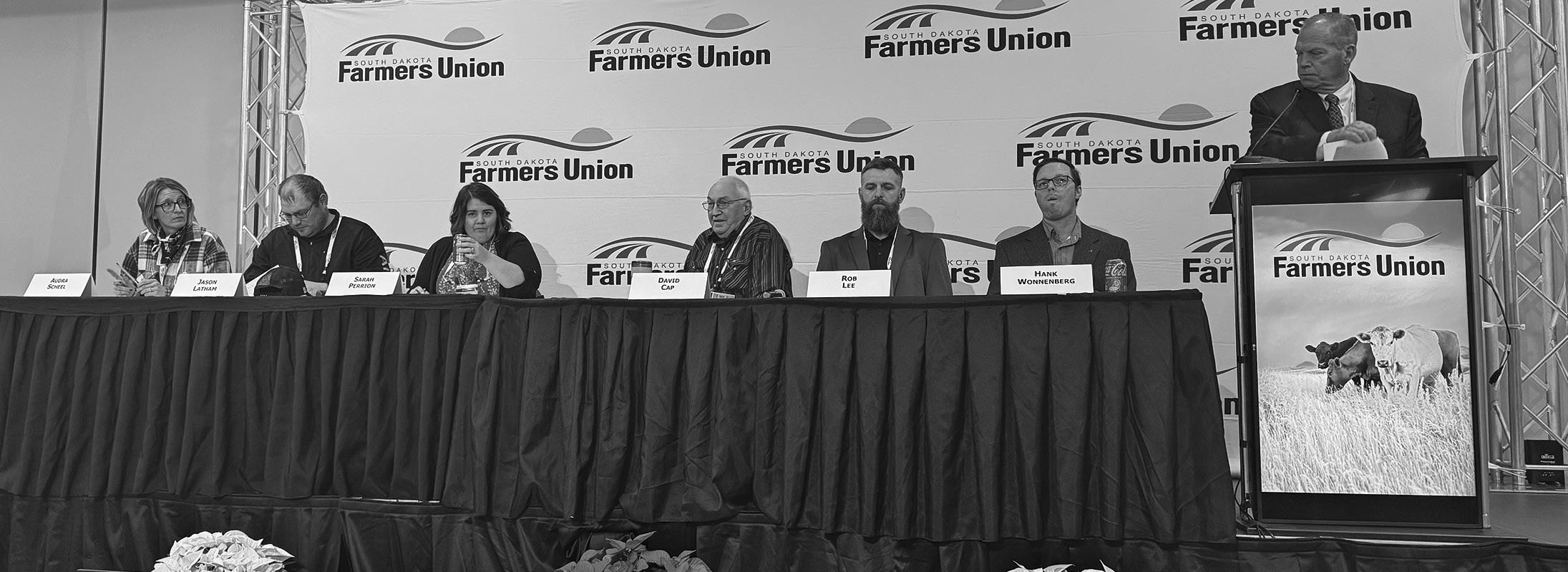
SDFU State Policy Committee: Audra Scheel, Jason Latham, Sarah Perrion, David Cap, Rob Lee and Hank Wonnenberg.
Annual Convention
Special Order #1 – Beef on Dairy
South Dakota Farmers Union urges our partners in agriculture, particularly those supporting beef breed associations, to take a strong stance against programs that promote corporate dairy operations accelerating vertical integration. Specifically, we oppose the distribution of selectively bred livestock or semen to these entities, which hastens their transition into feedyards and, ultimately, harvesting facilities threatening the competition practices in agriculture.
Such practices pose long-term threats to independent ranchers and farmer-feeders, undermining the sustainability of local operations and eroding market access and fairness. Protecting the integrity of our agricultural community means standing up to initiatives that put corporate interests ahead of producers’ livelihoods – today and for generations to come.
Special Order #2 – Foreign Ownership of Food Processing
Just as concerns over national security have led to calls for divestment from foreign-owned social media platforms, SDFU strongly opposes foreign ownership of any food system segments, including processing facilities in the United States. For our national food security, our food system should be built and controlled by those who invest in the strength and sustainability of American agriculture – not by foreign corporations whose priorities may conflict with the interests of local producers and communities.
Special Order of Business #3 – Supporting a Competition Title in the Next Farm Bill
South Dakota Farmers Union calls on congressional leadership to include a Competition Title in the next Farm Bill. The bill would have provisions that improve transparency and price discovery in the cattle markets, enforce the Packers and Stockyards Act, ensure the farmers’ right to repair, reinstate MCOOL, reform mandatory checkoff programs and promote competitive practices across all sectors of the economy.
Special Order of Business #4 – Addressing Childcare Shortages in Rural Communities
South Dakota Farmers Union supports all efforts to address the childcare shortages affecting our rural communities in South Dakota and opposes returning any money allocated to the state by the federal government.
We call upon the South Dakota Legislature and the South Dakota Department of Social Services to address the low utilization rate of subsidized daycare resources available to families who qualify. Further, we believe that the local communities should be provided with financial support to address affordable childcare shortages. We believe affordable and accessible daycare and afterschool programs are crucial to the success of our rural communities and farm families.
Union Farmer
Special Order of Business #5 – Addressing Data Center Concerns:
South Dakota Farmers Union recognizes that data centers can bring investment and activity to local communities. But if the wealthiest corporations in the world want to operate here, they must cover the full cost of doing business, not shift it onto rural families, taxpayers or our natural resources.
That means:
a. Transparency and strict standards for water and energy use, including proof that operations will not drain local aquifers or increase utility rates for households, farms or small businesses.
b. Protections to ensure data centers do not shift the cost of new infrastructure or energy generation onto other consumers, including farmers, ranchers and rural electric members.
c. Clear environmental protection for noise, construction impacts and pollution.
d. Verification of job creation and tax revenue claims, with any incentives tied only to actual performance, not optimistic projections.
e. No automatic taxpayer subsidies or blanket sales-tax exemptions. If data centers truly generate the economic activity their advocates claim, they can afford to pay their way.
Data centers can be part of a 21st century rural economy, but only with responsible siting, full cost accountability and development that strengthens rather than strains local communities. Economic growth should never require selling out our water. n
Union Farmer
Rural Youth Put Leadership Skills into Action during 110th State Convention
Providing rural youth with leadership and communication skills necessary to achieve future success is a focus of South Dakota Farmers Union youth programming. The skills these youth gained through active participation and hands-on leadership training were highlighted during the 110th State Convention when rural youth from across South Dakota gave speeches reflecting on what they gained through their involvement in South Dakota Farmers Union.
Speech Highlights
Avril Fletcher, Highmore – Junior Advisory Council
My journey with this organization began when a friend invited me to a junior camp when I was about twelve years old. At that time, I had no idea what to expect. I just thought it would be a fun way to spend a few days in the summer. But looking back now, that one invitation completely changed the way I see myself and the world around me.
Over the years of involvement, Farmers Union has helped me grow, build confidence and find my place in a community that truly cares. It also taught me leadership, responsibility and the importance of community. Through the organization’s programs, I’ve learned about agriculture, teamwork and even a bit about policy and advocacy. Farmers Union believes in
educating youth, not just about farming, but about being informed, active citizens. It’s helped me see how much power young people have to make a difference, especially in rural communities like mine.
So, when I ask myself, what has Farmers Union done for me? The answer is simple. It helped me grow into a more confident, compassionate and capable person. It gave me a voice and a community. It’s shown me that leadership doesn’t mean being the loudest in the room, it means lifting others up.
“Farmers Union believes in educating youth, not just about farming, but about being informed, active citizens.”
– Avril Fletcher
Dani Kruger, De Smet – Junior Advisory Council
When you join the South Dakota Farmers Union Youth Education Program, you are not just part of a summer camp -– you are part of a community that wants to see you succeed and soar above the limits of the sky.
One of my own leadership stories is when I helped with making a mini mic video of myself and a few other campers. This opportunity made me feel like I had a role in the camp that I had
gone to for years. I got to add my own little spark into something I’ve loved for so long. It’s important that the kids are able to have these opportunities to help grow the camp to show how you yourself could make such a big difference by making a single choice.
I also made the decision to apply to serve on the Junior Advisory Council. Serving in this leadership role is one of the best opportunities a camper at Farmers Union Camp can have. Based on my experience, it opens the door to growth, leadership, camp spirit and new adventures.
“It’s important that the kids are able to have these opportunities to help grow the camp to show how you yourself could make such a big difference by making a single choice.”
– Dani Kruger
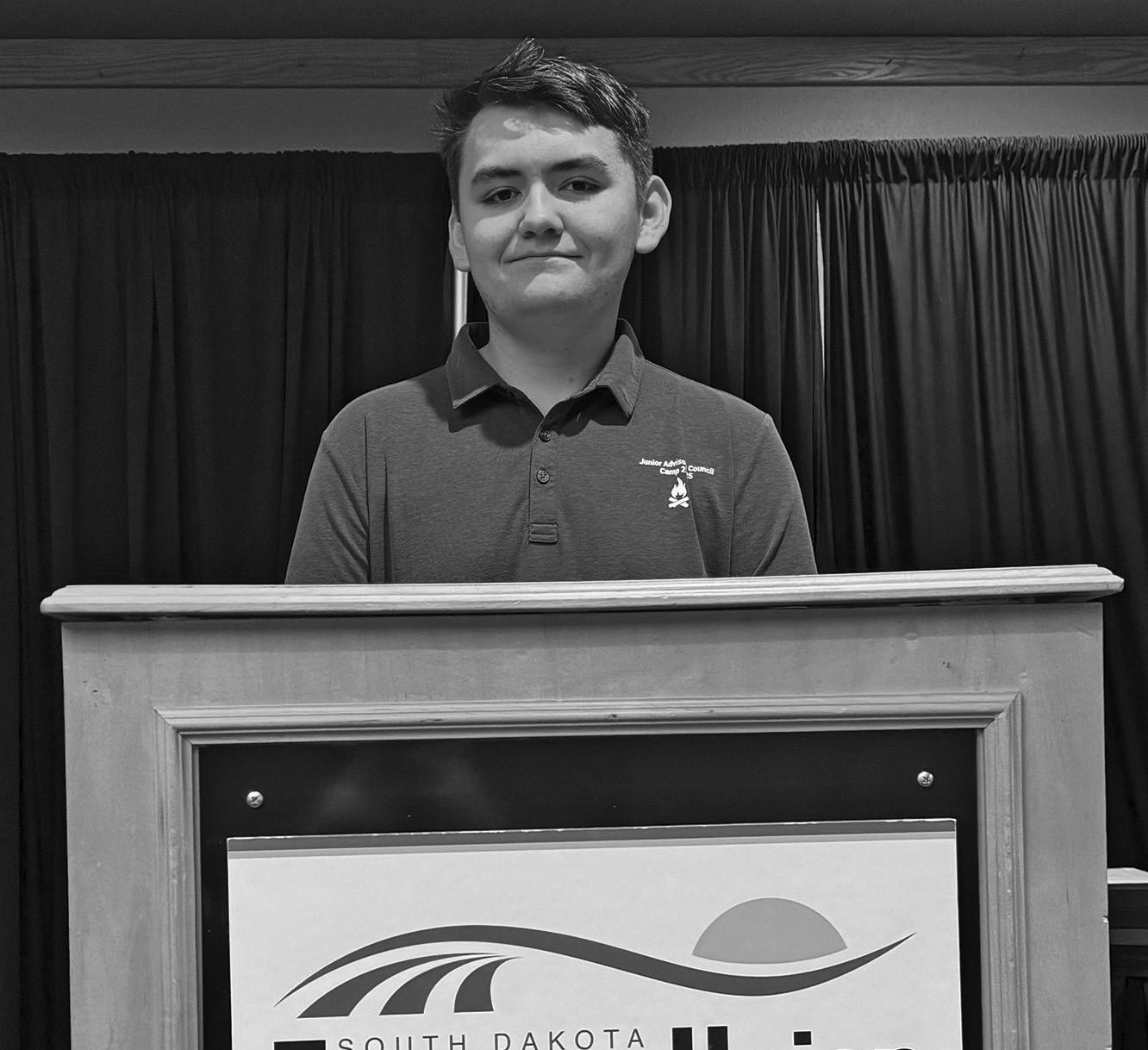
Coltyn Raymond, Ethan – Junior Advisory Council
When people look at the Junior Advisory Council from the outside, they see the big, exciting opportunities we have – attending State Convention, traveling to National Convention, working at the State Fair or serving as counselors at both junior and senior state camps. These are amazing experiences, and I am grateful for every single one.
But what most people don’t see – what many fail to ask – is what these opportunities actually mean to us? What they mean to the people who grew up in this organization, whose lives, confidence and friendships were shaped by it. And that is why I’m here today: to share what this journey has meant to me, and why I treasure the chance to give back.
Being in this position isn’t just about opportunities, it’s about responsibility. It’s about giving someone else the same unforgettable experience that I was given. It’s about being the reason a scared kid becomes a confident leader. It’s about passing on the same love, the same support and the same sense of belonging that shaped my journey.
Farmers Union didn’t just give me memories. It gave me friendships. It gave me confidence. It gave me a community. It gave me a purpose. n
“Farmers Union didn’t just give me memories. It gave me friendships. It gave me confidence. It gave me a community. And it gave me a purpose.”
– Coltyn Raymond
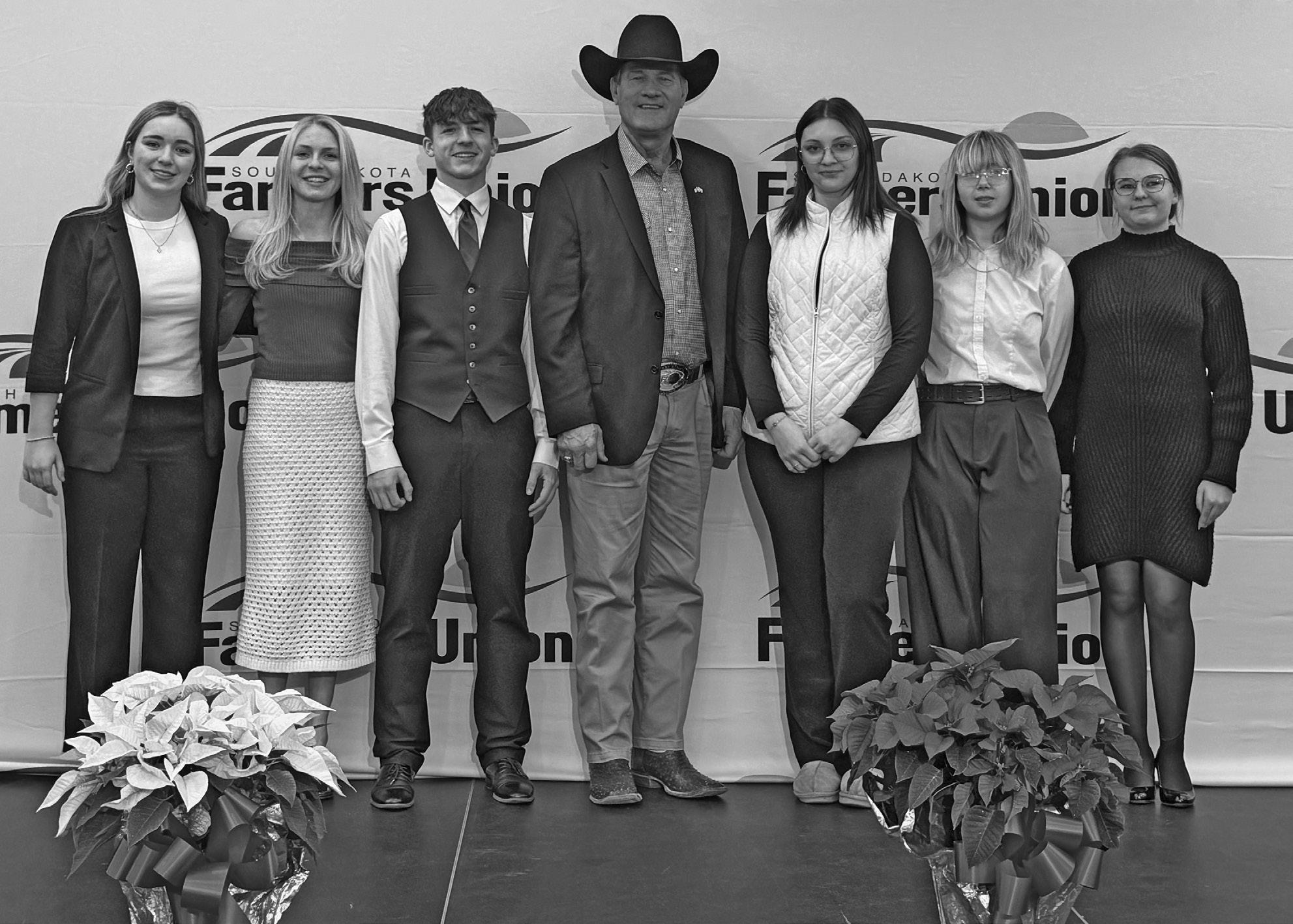
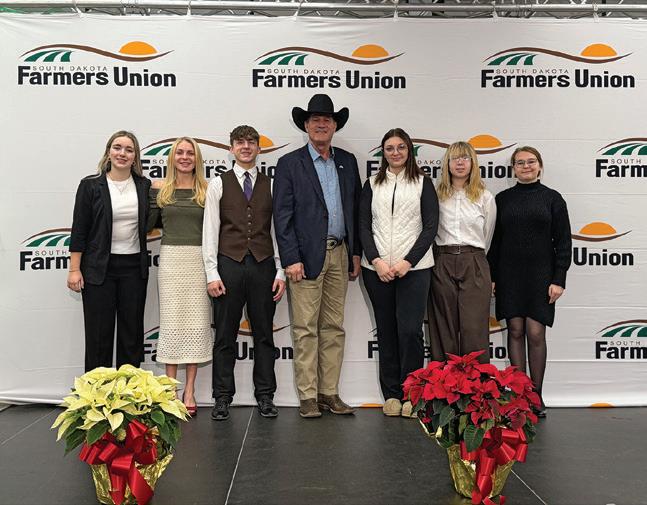
Gov. Larry Rhoden (center) with youth leaders of South Dakota Farmers Union (left to right) Cadence Konechne, Kimball; LizBeth Crosby, Pierre; Coltyn Raymond, Ethan; Dani Kruger, De Smet; Avril Fletcher, Highmore; and Allison Schulz, Lennox.
Annual Convention
Gov. Rhoden said He Will Continue to Fight for South Dakota Farmers & Ranchers
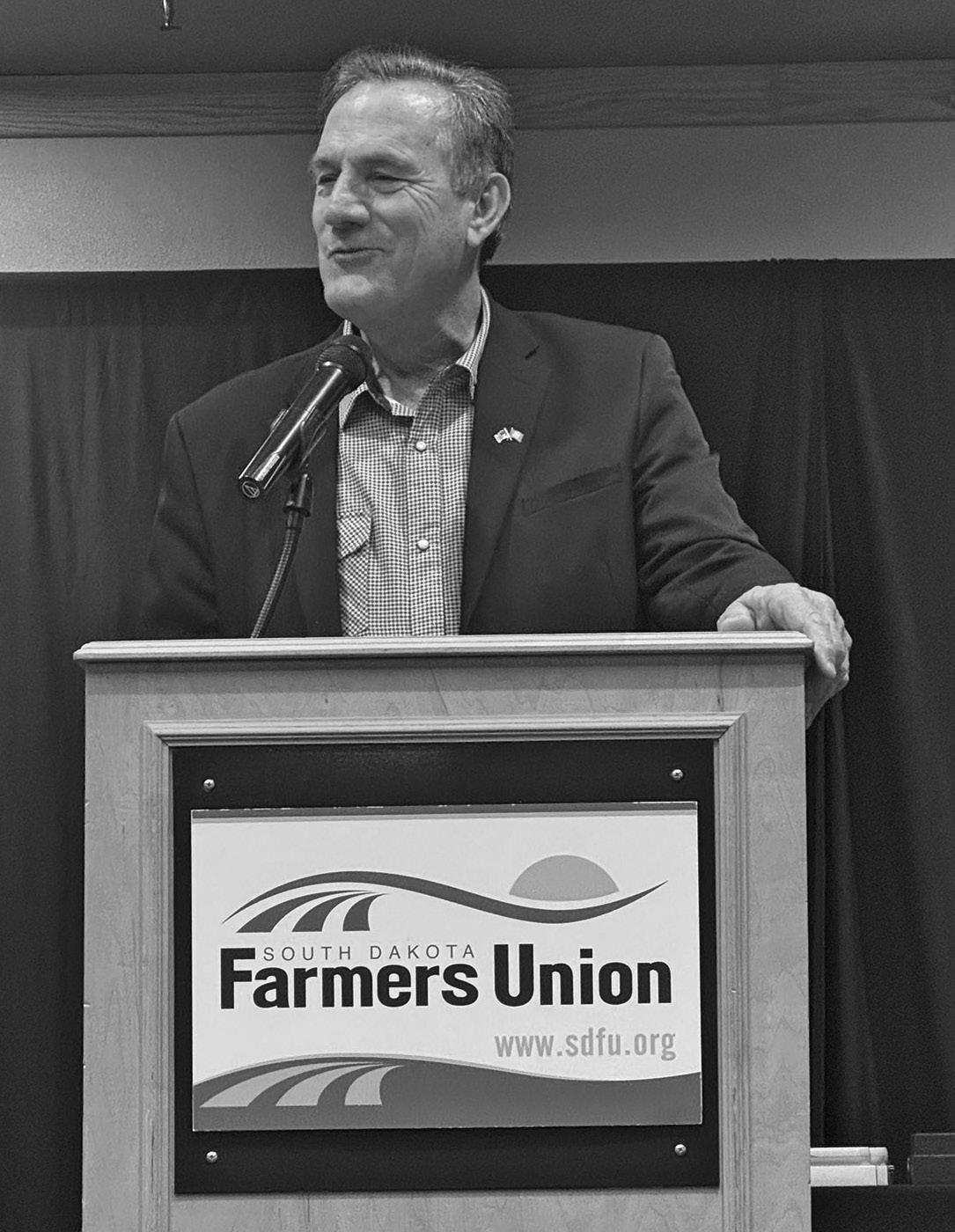
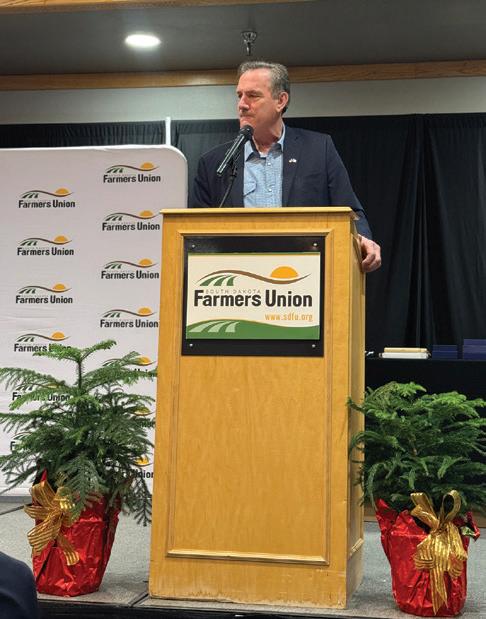
Gov. Larry Rhoden was among the first speakers to welcome family farmers and ranchers from across the state to the 110th South Dakota Farmers Union State Convention held in Huron Dec. 10 and 11.
During his keynote, the Union Center rancher shared how he is deeply connected to the state’s largest agriculture organization.
“Growing up, my dad belonged to only two things, the first was our church and the second was Farmers Union. He was a lifelong member of the Farmers Union and the Farmers Union Cooperative,” Rhoden said.
Rhoden went on to share that it was through his membership in South Dakota Farmers Union and the mentorship of a former Farmers Union president that he overcame his fear of public speaking. “I was deathly afraid of public speaking. And I remember we went to a convention one year … and he wanted me to get up and address the group … I was so nervous I could hardly breathe. Now it doesn’t bother me near as bad.”
Rhoden shared his concerns for the current state of South Dakota’s agriculture economy and his advocacy efforts in Pierre and D.C. “Our economy, our revenues are down and that’s directly related to the people represented in this room. You understand the crop prices have been tough,” Rhoden said.
Rhoden shared that shortly after he took over as governor following Kristi Noem’s appointment to serve as U.S. Department of Homeland Security Secretary, he traveled to D.C. for the first of many meetings with U.S. Secretary of Agriculture Brooke Rollins to advocate on behalf of a ranch family facing criminal charges from the federal government over fencing lines near National Forest Service land. The charges were dropped.
Rhoden’s genuine and lived understanding of life as an agriculture producer resonated with members. “I really like how Gov. Rhoden works to keep South Dakota ag focused,” said Kaeloni Latham, a rancher from Harding County. “He is from an ag background, so he understands. It is nice to see someone speaking from the heart, not the White House.”
Rhoden said he will continue to fight for South Dakota’s farmers and ranchers and their city neighbors. He shared a story to explain how he is inspired by the people who came before him to serve South Dakotans today.
“How many in this room have an ancestor that was a homesteader here in South Dakota? Raise your hand,” after several hands went up, Rhoden said. “I get that same kind of result every place I am in South Dakota. And they talk about how tough the homesteaders were. Well fact of the matter is, the majority of them weren’t. I was trying to count how many homestead sites are on my ranch. And there are a lot, and each of them represented a big family. And they came out for free land. And they went through one
winter and the weak ones headed back to Chicago or St. Louis or wherever they came from.
“It was only the most resilient, the toughest, the people with the strongest work ethic that survived in South Dakota. And that became the fabric of the people in South Dakota. So, I think this is a big part of what makes us special. And for as long as I’m governor, I will work to maintain that sense of just good old-fashioned work ethic and grab yourself by your bootstraps and take care of your own. And help your neighbors.”
“Growing up, my dad belonged to only two things, the first was our church and the second was Farmers Union. He was a lifelong member of the Farmers Union and the Farmers Union Cooperative.”
– Gov. Larry Rhoden
Rhoden was among a strong line-up of convention speakers including Rob Larew, National Farmers Union President; Doug Sombke, SDFU President; Jeff Kippley, National Farmers Union and SDFU Vice President; Derek McFarland, Veterinarian; Jacob Shapiro, Director of Research, Bespoke Group and host of “The Jacob Shapiro Podcast;” Peter Leyden, technology expert and thought leader on artificial intelligence; and Greg Hanes, CEO, Beef Checkoff.
To learn more, visit www.sdfu.org n by Lura Roti for SDFU
Union Farmer
Kingsbury County Farmer is 2025 Farmers Union Ag Ambassador
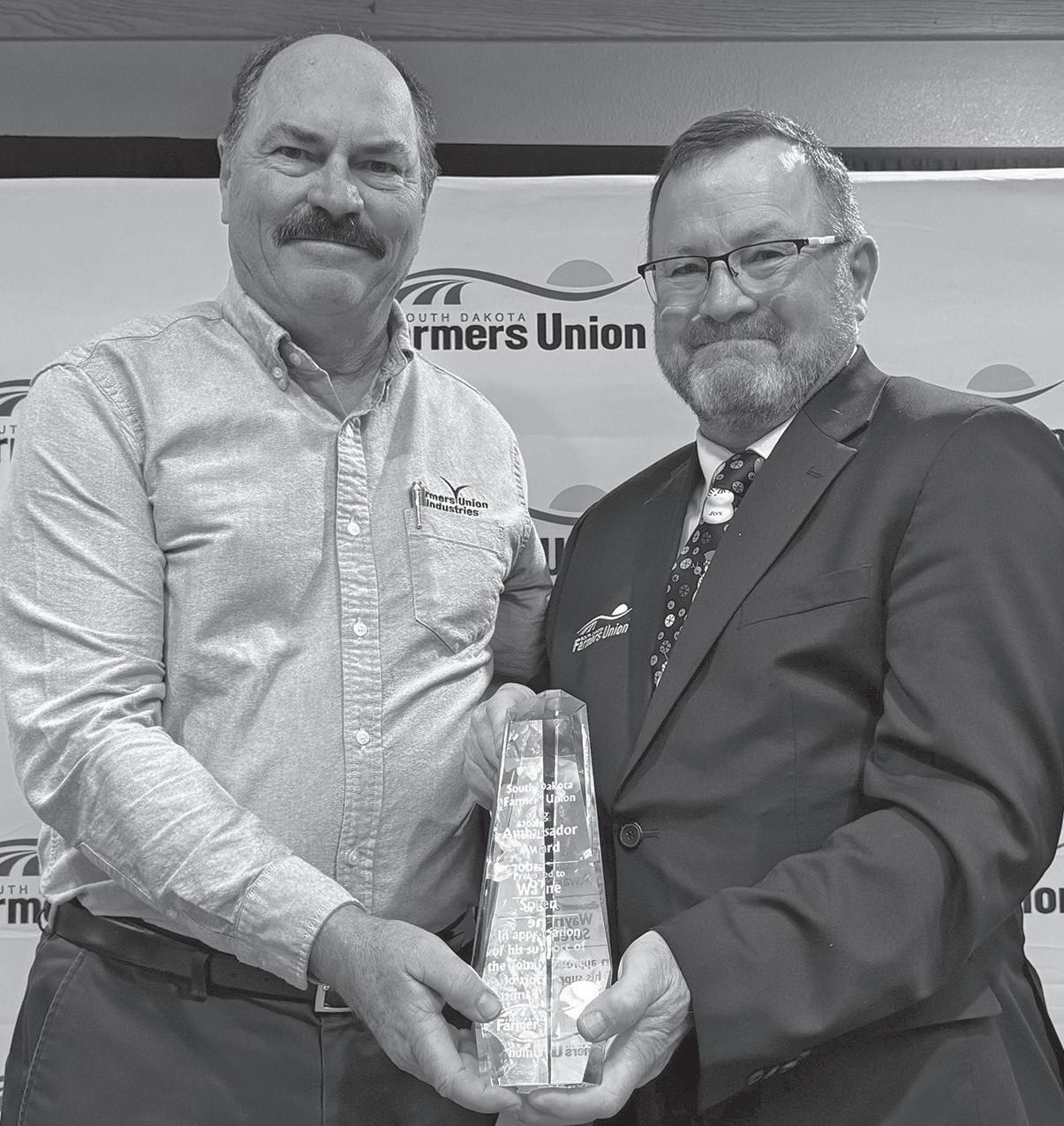
During the 110th South Dakota Farmers Union State Convention Dec. 11, the state’s largest agriculture organization recognized third-generation Kingsbury County farmer Wayne Soren for his contributions to South Dakota agriculture, naming him the 2025 Ag Ambassador.
“Wayne is the epitome of a leader in agriculture,” said Doug Sombke, President of South Dakota Farmers Union. “I’ve known Wayne since the early days when we were both young farmers trying to make it during the Farm Crisis. We served together many years on the board of directors and side by side as President and Vice President. He is active not only in Farmers Union, but in his church and community. He never seeks credit but always does what is right.”
Soren became involved in Farmers Union during the Farm Crisis. After the crisis, he remained involved because he believes in Farmers Union’s philosophies.
“I believe in co-ops. I believe in family farmers and helping local communities. I believe in grassroots policy, and there is virtually no other organization that encompasses all those in the way that Farmers Union does,” Soren said.
Soren has traveled to Washington, D.C., several times to advocate for policy during the National Farmers Union Fly-In. He served on the organization’s policy committee. He began serving on the board of directors in 1999 representing District 3. In 2010, he was asked to serve as the organization’s vice president alongside his friend Doug Sombke.
Throughout his nearly two decades of service, Soren has advocated for South Dakota farmers and ranchers during some dark times: cattle crisis, trade tariffs, droughts, Storm Atlas, floods.
And he’s also celebrated victories. He worked with the organization to support ethanol
expansion throughout the state, investment in South Dakota Wind Partners and helped lead a re-organization of Farmers Union Insurance.
Farmers Union educational programming is another aspect of the organization Soren has actively supported. “Since we became involved in Farmers Union, Vicki and I have been supporters of its educational programming. Our sons, Jason and Ryan, were Torchbearers. They served on the Junior and Senior Advisory Councils,” Soren said.
In the 1990s, the Soren family was recognized by the organization for their involvement and named Farmers Union Farm Family of the Year. “I am grateful to Vicki and our sons for all the support they have given me so that I could be as involved as I have been in Farmers Union,” Soren said.
In 2023, Soren retired from his role as State Vice President and passed the torch on to a young Aberdeen farmer Jeff Kippley. Kippley also serves as the National Farmers Union Vice President.
“I knew it was time to retire because I saw a lot of young people, like Jeff, who were involved and who were ready to lead,” Soren explained. “When I was a young man, I remember wanting to get involved in an organization’s leadership, and an old guy who was in leadership came up to me and took his finger and pointed it in my chest and told me: ‘wait your turn.’ I did not want to be that guy.”
Inspired by Grandpa Chester Soren’s eagerness to mentor the next generation of South Dakota farmers is inspired by his Grandpa Chester.
“Grandpa had a heart attack and needed to quit farming, so he called my dad and said, ‘I have some people who would like to buy the farm. Are any of the boys interested in farming?’ I said, ‘yes, I want to farm.’ So, Grandpa held on to the farm for a good 10 years until I was ready.’”
Although Soren grew up a city kid, he and his siblings took turns spending the summers on their grandparents’ Lake Preston farm.
“It was my fifth or sixth grade summer when I got bit by the farming bug, and I’ve had it ever since,” Soren said.
Together with his wife, Vicki, Soren moved to South Dakota to farm full time a few years after high school. It was 1980 – not an easy time to get into farming. But even though Grandpa Chester could not physically help him with the day-to-day work of farming, Chester’s advice and financial support were just what Soren needed.
“I could never repay my grandpa for what he did,” Soren said. “He signed my promissory notes for me for the first few years, and he gave me advice. Even in those days farming was too expensive to just get into it by yourself. Look around – nearly every farmer I know today had a dad or an uncle or a grandpa help them get their start in farming.”
Even though some of Soren’s ideas about farming were not the same as Chester’s, Soren said his grandpa was always his biggest supporter.
“I was one of the first guys in the county to grow soybeans. I asked him what he thought about it, and he was a bit reluctant because he had tried 25 years earlier and was not able to harvest any, but he let me do it. And those beans looked really nice … and then we got a hailstorm and it took them all out. The next year, he asked
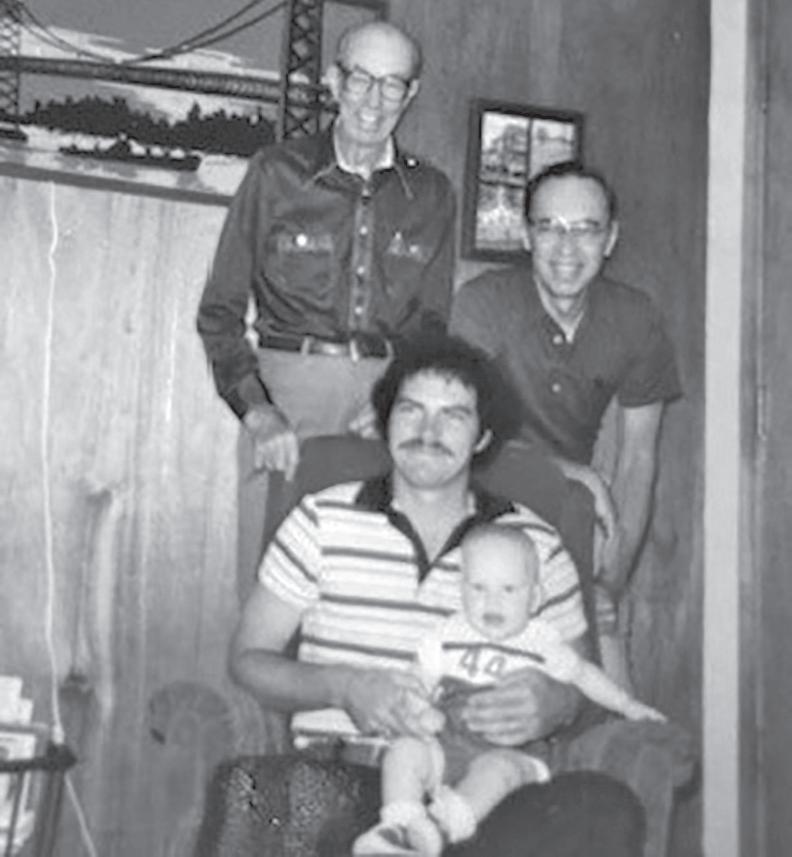
This vintage photo shows Wayne Soren with his dad, Ronald, and grandpa, Chester. Soren is holding his son, Jason.
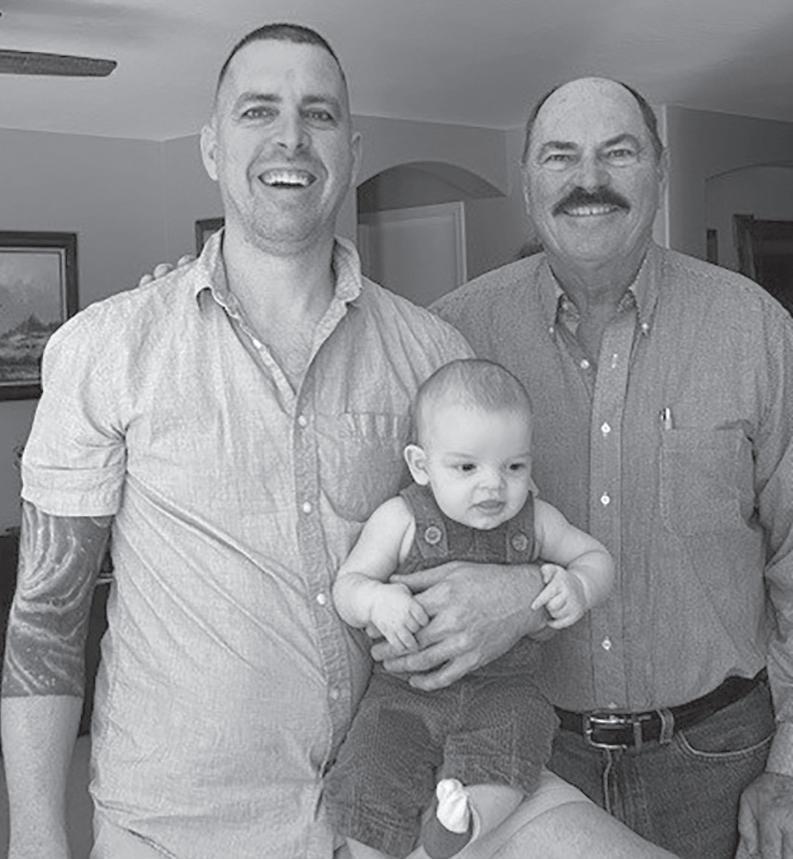
Wayne Soren with his son, Ryan, and grandson, Henry.
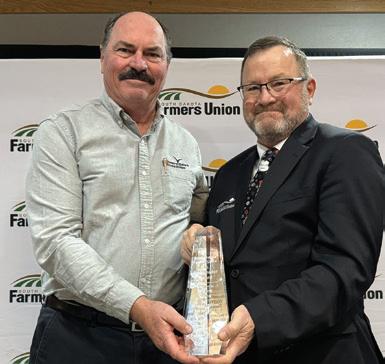
Lake Preston farmer Wayne Soren named 2025 Farmers Union Ag Ambassador, pictured here with SDFU President Doug Sombke (right).
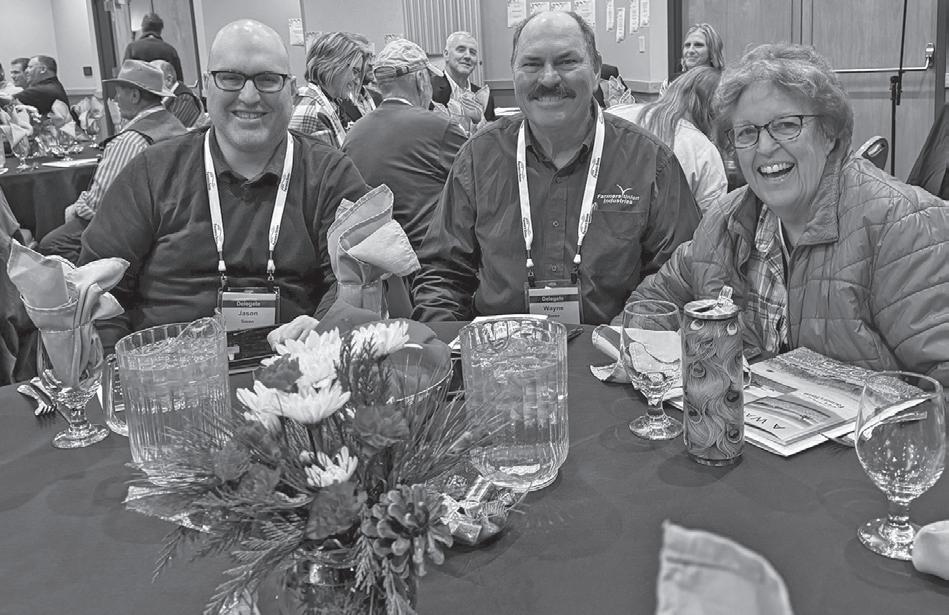
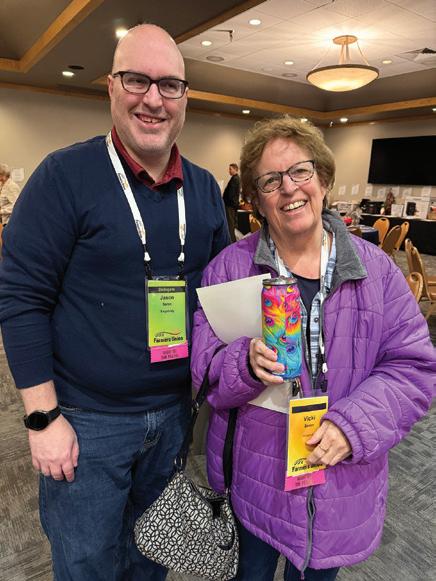
Wayne Soren (middle) with his son, Jason, and wife, Vicki, during a 110th South Dakota Farmers Union State Convention banquet.
Annual Convention
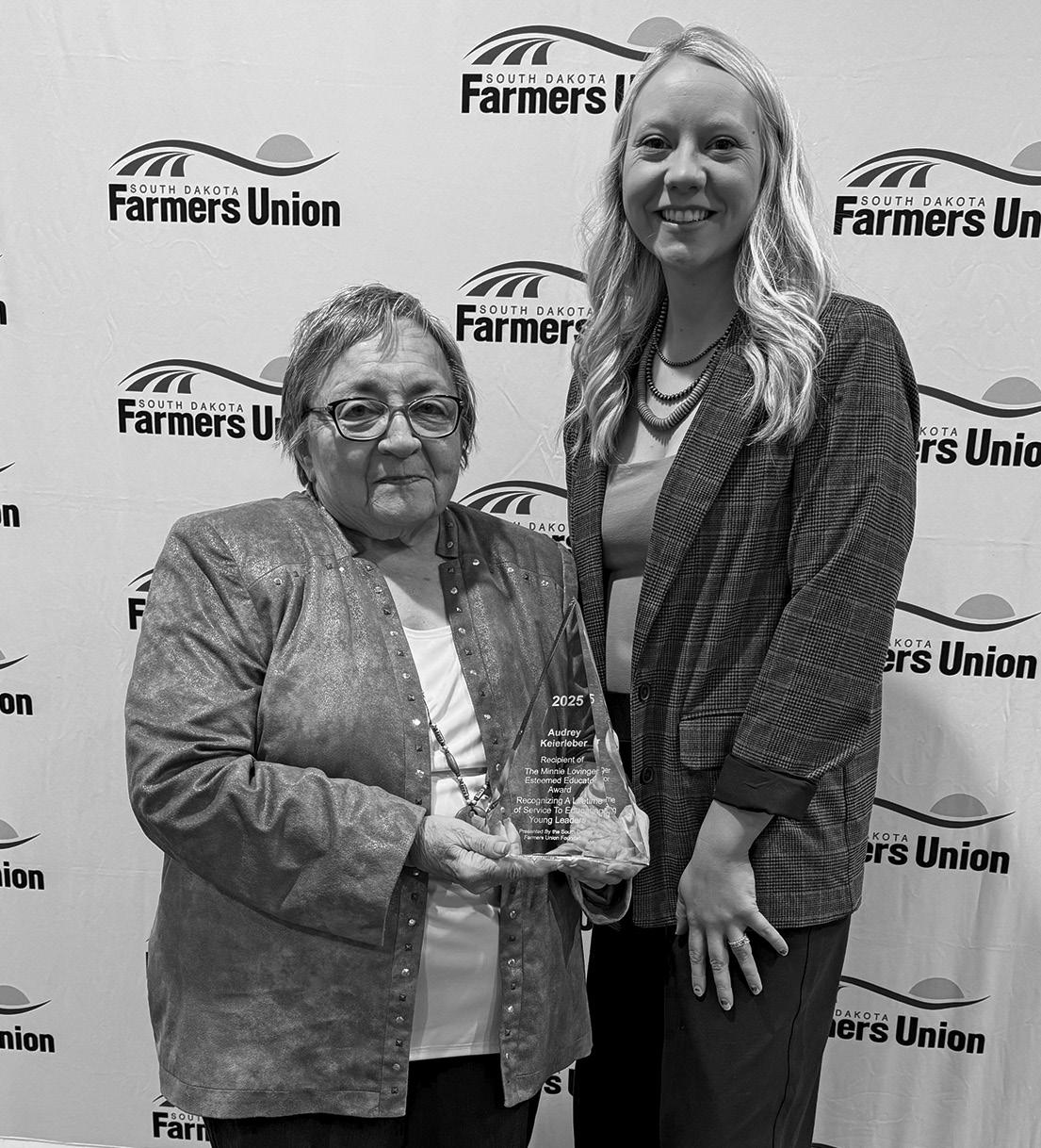
Audrey Keierleber Recognized with Minnie Lovinger Award for Dedication to Rural Youth
Audrey Keierleber was recognized for her volunteer efforts to provide farm safety, cooperative and leadership education to rural youth with the Minnie Lovinger Award. The award was presented to Keierleber during the South Dakota Farmers Union State Convention held in Huron Dec. 10 and 11.
“Farmers Union youth education programming depends on volunteers like Audrey who are willing to share their time, talents and passion for agriculture with rural youth,” said Karla Hofhenke, Executive Director for South Dakota Farmers Union. “Youth are our future. Providing them with education on farm safety, leadership and cooperatives empowers them to better serve their rural communities.”
From an early age, education was a focus of Keierleber’s, specifically getting a college education.
“My dad’s theory was that women stayed at home, got married and had families. If they wanted a job, they could get a job working at the local restaurant. Well, this was not what I wanted for my life. I did not want to stay home and work at a restaurant,” explained Keierleber, who grew up on a farm near Rutland and was the oldest of six children.
Inspired by her family and consumer science teacher, Keierleber enrolled at South Dakota State University (SDSU) in 1970. It was up to her to figure out how to pay her own tuition.
Keierleber met her husband, Joel, through his sister, Angela. “We were in class together and we had to go to Yankton for a weeklong class at the Youth Development Center there. When the class was over, I went home to Clearfield with Angela for spring break.”
A few years would go by before the two would begin dating. “By coincidence my first teaching job was in Colome, just about 30 miles from Clearfield. We’d go dancing on Saturday nights. It was a car full – me, Joel and his sister and three brothers.”
Keierleber’s teaching career was diverse. She
Ambassador Continued from Page 10
me if I was planning to grow some soybeans. He said we should try it again. So, we did and it was one of the best yields I’ve ever had.”
In addition to active involvement in Farmers Union, Soren is also actively involved in his local cooperative.
“I often get asked to explain the cooperative business model to youth during Farmers Union camp. And I always tell them, ‘You own the cooperative, and why not do business with the business you own,’” Soren said.
As a way to further educate rural youth
taught family and consumer science classes in Colome, Martin, Winner and White River. Because she had an English minor, she also taught a reading class in addition to family and consumer sciences when she began teaching at White River. Later, when there was a need for a science teacher in Burke, Keierleber taught middle school science, psychology and reading. She spent the 20 years prior to retirement teaching middle school science and family and consumer science in the Winner School District.
She loved watching her students learn and grow. Now retired 18 years, Keierleber says it is rewarding to see where they ended up in their careers. “Many are doctors, nurses, pharmacists, anesthesiologists, a former student works in sports medicine for Sanford Orthopedics, four of the nurse practitioners in Winner are former students…I may lose track of them, but they remember me when we see each other.”
Busy teaching during the school year, Keierleber was generous with her time during the summer months. In addition to aiding her
about cooperatives, Soren worked with his local cooperative, Prairie Ag Partners, to donate children’s books focused on cooperatives in local school and community libraries.
“I have always had the philosophy that me and my neighbor and my other neighbor could probably get something done together better than trying to do it by myself. In a nutshell, this is the co-op business model.”
Soren currently serves as chair of the Farmers Union Marketing and Processing Association board of directors, the organization that founded
daughters, Brecky and Christine, with their many 4-H projects, she began helping out with Farmers Union Day Camps.
She and Joel had been attending Farmers Union meetings since they were newlyweds because Joel’s parents were actively involved in the grassroots organization. When Brecky was 8, the education volunteers for Tripp County, Kenny and Doris Meiner, invited her to join a busload of other Tripp County youth and visit Golden West Cooperative in Wall.
“It was a good experience for the girls to see things they had not seen before. Yes, we have cooperatives in Tripp County, but this cooperative was different.”
Then the Meiners asked Keierleber if she would help out with Farmers Union Day Camp. “I was one of the lunch people. We would make the same thing every year – one volunteer would make mac and cheese, and I would do the hot dogs.”
In addition to learning about farm safety and cooperatives, Keierleber and the other volunteers helped the youth with crafts. “We always had crafts – most years two or three!”
Keierleber is the only one of her siblings to receive a college degree. She passed on her passion for education to her daughters. Christine Wood received a master’s in agriculture engineering from SDSU and is the STEM (Science, Technology, Engineering and Math) Specialist for SDSU Extension. Brecky Cwach is a business management graduate of Dakota State University and is a bond underwriter for a national firm.
“We always knew our daughters could do a lot and we supported them in their interests,” Keierleber said.
Each year, South Dakota Farmers Union works with volunteer education directors like Keierleber to host day camps in rural communities across the state. The organization also hosts State Youth and Teen Leadership Camps. To learn more about Farmers Union educational programming, visit www.sdfu.org n
Farmers Union Industries. Farmers Union Industries is the organization that owns several businesses which help fund five state Farmers Union organizations.
As Soren looks to the future of agriculture in South Dakota and his family’s farm, he remains optimistic that one day he and Vicki will pass their farm on to one of their sons or grandchildren.
To learn more about how South Dakota Farmers Union supports family farmers and ranchers, visit www.sdfu.org n by Lura Roti for SDFU
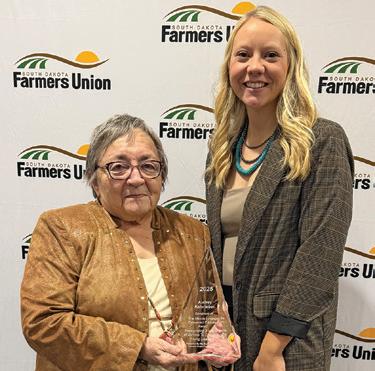
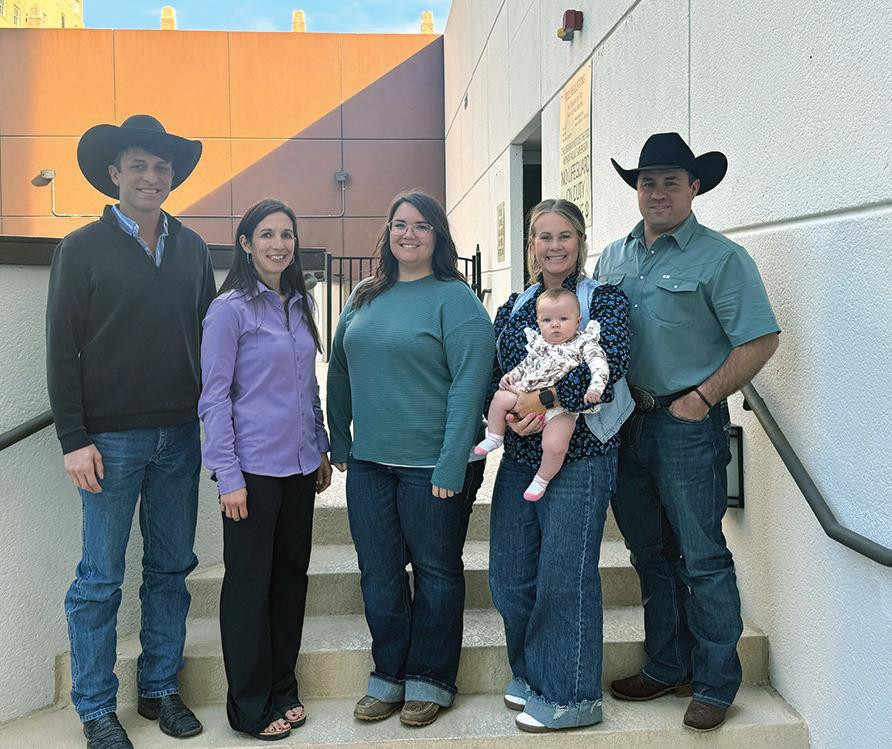
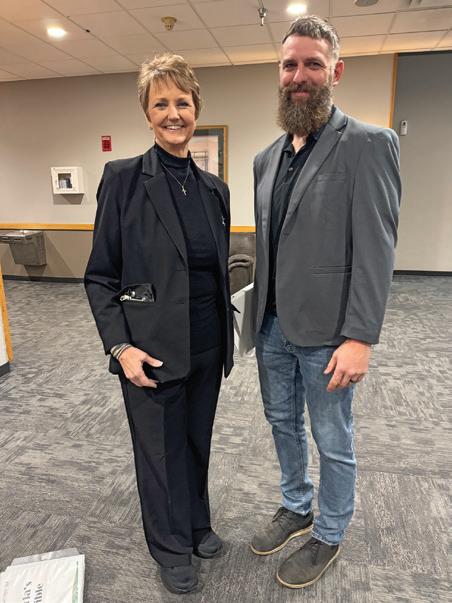
Colome farmer and educator Audrey Keierleber recognized with the Minnie Lovinger Award, pictured here with Samantha Bowman, Education Program Specialist.
Union Farmer
Meet the 2025 Torchbearers
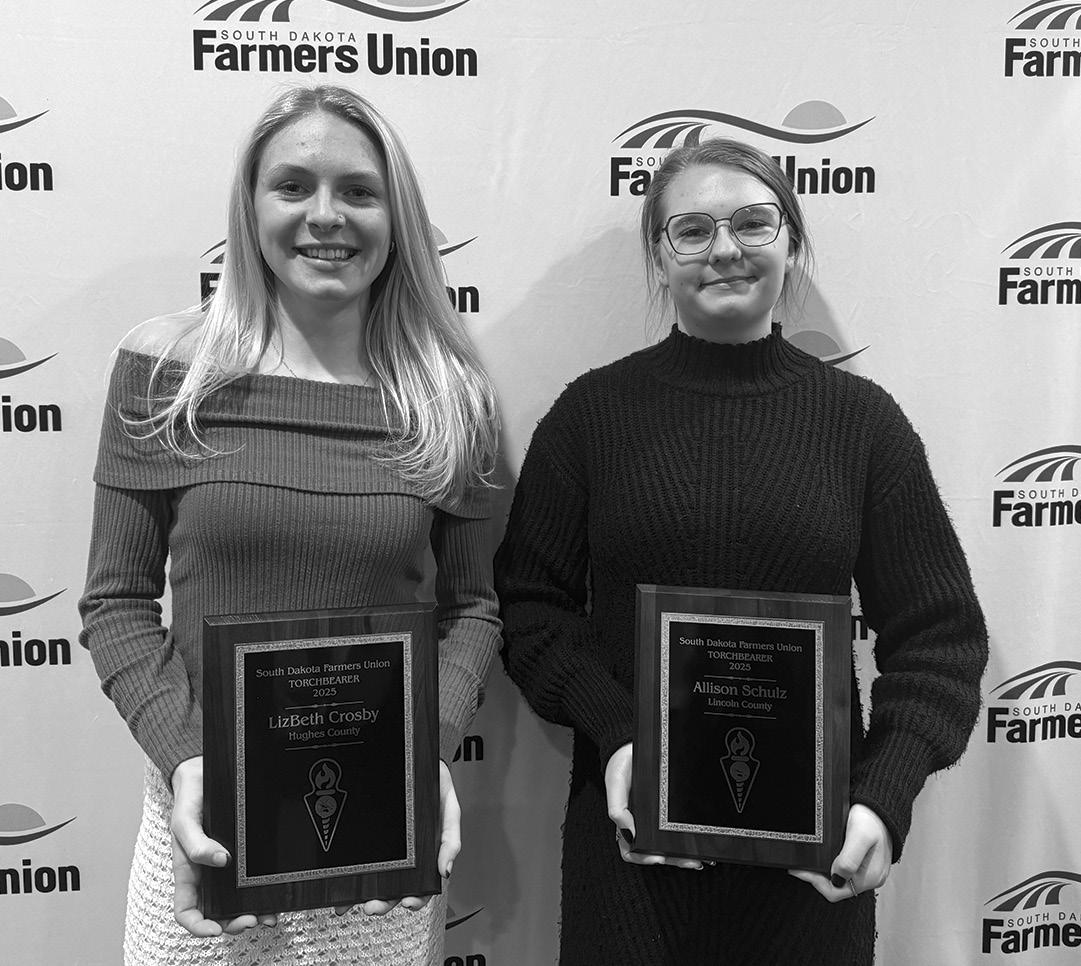
Of the hundreds of rural youth who participate in South Dakota Farmers Union youth programming each year, only a select few earn the esteemed Torchbearer Award. The 2025 Torchbearers recognized during the 110th State Convention are LizBeth Crosby, Pierre; Allison Schulz, Lennox; Billy Kezena, Yankton; and Brooke LaMont, Union Center.
“Youth who receive this award know how to be a leader and they know what a true leader is,” explained Doug Sombke, President of South Dakota Farmers Union. “These youth don’t earn the Torchbearer Award through a written exam, the Torchbearer Award is earned through their involvement and actions in Farmers Union over the years. Today’s Torchbearers follow in a long legacy of leadership. Several of our organization’s leaders received this award when they were teens.”
Torchbearers share what they learned through Farmers Union involvement
Billy Kezena of Yankton is the son of Alisa and Justin Miller
Farmers Union impacted who I am today. It helped me develop confidence, because a lot of the stuff we end up doing at camp ends up building good leadership skills. We also learn how to communicate in a more effective way.
The opportunity to serve as a counselor also helped me improve my communication skills. And it taught me what true leadership looks like. I learned a lot about teamwork and communicating while on a team when I served on the Junior Advisory Council.
These are all skills I will use when I pursue my goal of serving in the Air Force.
Brooke LaMont of Union Center is the daughter of Shilo and Ryan LaMont
To quote Robert Brault, “Enjoy the little things, for one day you may look back and realize they were the big things.”
When I first became involved in the Farmers Union youth program, I thought it would always remain one of the little things in my life — something fun, meaningful, but small. At that time, I could never have imagined how deeply it would shape who I am today.
For me personally, Farmers Union has been a constant — a steady force throughout my life. As I have grown, it has grown with me.
The youth program molded me into the person I am today — someone who strives to see the best in others, who believes in fairness, and
Annual Convention
who isn’t afraid to fight for what’s right. Through this organization, I learned that it’s not the volume of your voice that matters — it’s the meaning behind it. I learned that leadership isn’t about being in charge — it’s about using your influence to lift others up.
I’ve faced challenges, like we all do. But instead of fearing them, I’ve learned to see them as opportunities — opportunities to learn, to grow and to rise.
Farmers Union helped me find confidence in quiet strength. It showed me that leadership can be compassionate, that service can be powerful, and that authenticity — being truly yourself — is one of the greatest gifts you can offer the world.
Allison Schulz of Lennox is the daughter of Paul and Becky Schulz
Farmers Union youth program has helped me build more confidence in myself, enhance my leadership skills and explore more about the agriculture industry.
I am more willing to freely give my opinion in discussion in class and share what I think about a matter when I have an opinion on it. It has helped me to be more willing to take the leadership rule when needed and sometimes when not to. I have gained friendships with people from all over the state that I would never have if not in Farmers Union and I know most of these friendships will last me a lifetime.
LizBeth Crosby of Pierre is the daughter of Bonny Ruhnke and Justin Crosby
One of the things I am most thankful for is the opportunities the organization has given me. Through the youth program, I have had the chance to travel all over the country, and go places I never thought I could at my age. Those trips were about much more than just travel. They were about learning.
During the Washington, D.C., Fly-In, we even got to hold a mock policy session in the actual agriculture committee room on Capitol Hill. Sitting there going through the motions of debate and decision-making, I realized how much policy affects every part of agriculture and how important it is for the people in our industry to understand it. Farmers Union has taught me that agriculture isn’t just about what happens on the farm. It is how laws are written, how decisions are made and how those choices ripple through every rural community. That perspective has stuck with me, and it’s something I will carry forward in whatever I do. n
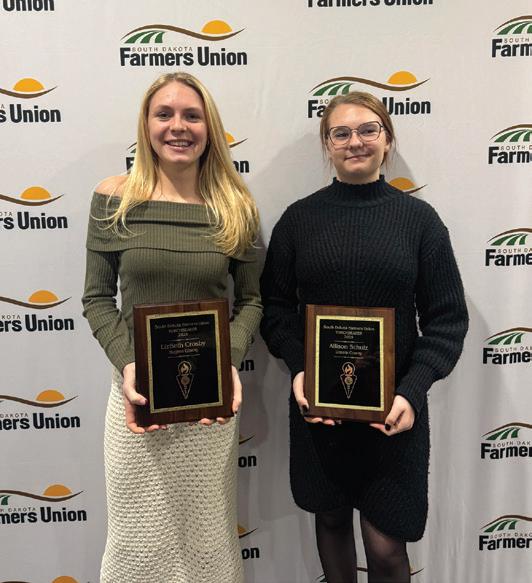
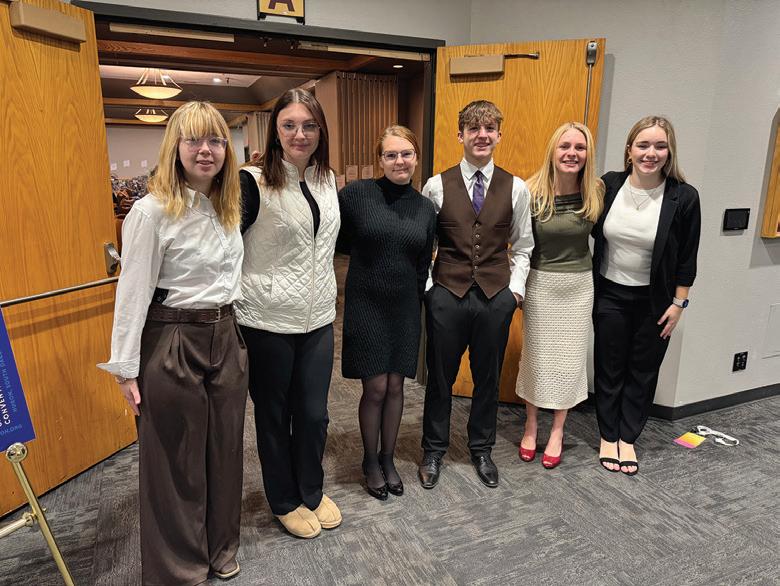
2025 Torchbearers LizBeth Crosby, Pierre, and Allison Schulz, Lennox. Due to weather-induced travel difficulties, 2025 Torchbearers Billy Kezena, Yankton, and Brooke LaMont, Union Center, were not able to attend State Convention.
Billy Kezena Brook LaMont
AI Expert Gives Convention-Goers a Lot to Think About
Cutting edge technology is something Peter Leyden has focused on his entire career – beginning with the internet. So, when the Silicon Valley technology author and owner of the strategic foresight firm, Reinvent Futures, spoke to South Dakota family farmers and ranchers during the 110th Farmers Union State Convention, he gave everyone a lot to think about.
“He explained that these innovations are coming regardless of if we want them to or not,” said Harding County rancher Kaeloni Latham. “Instead of worrying about them taking over our jobs, we should think about AI as a tool to help us make our lives easier and hopefully make the things we produce a higher quality.”
Reliance rancher and high school substitute science teacher Keeleigh Reis-Elwood also found Leyden’s talk relevant. “Look at how farmers harvest today – the combine is basically a self-running machine. And in our classroom, we use AI with predictions, asking it questions like, if we change this, what can happen.”
“When we talk about ages of new technology, like the Iron Age, humans entered the Iron Age, we figured out how to use metal, and that was such a game changer, such a world changer, that we never went back … you know, no one said, ‘let’s get rid of this iron thing and let’s go back to stone tools.’” – Peter Leyden
Over the course of Leyden’s hour-long presentation, a few highlights emerged:
This is a historic moment: “People in 500 years from now, they’re going to look back on ChatGPT as a world, historic moment … you don’t have to know how to code. You don’t have to know anything about data science … Even the AI experts, we thought humans eventually would be able to interact with computers through voice, but we didn’t think it was going to come this fast.”
Even AI experts are surprised by the speed of development: To emphasize this point, Leyden quoted a co-founder of a tech startup, “I’ve been working for almost 40 years in AI and more than 30 years in conversational AI – trying to get computers to talk. And I’m one of those
Night on the Prairie
who say I never thought I would see what’s happening in this last year in my lifetime.”
Leyden said these comments are not unique. “This is a common thing to hear AI experts say … This is the reason why you hear all the bullish kind of talk … it’s because the people who really know this technology are blown away by it.”
We are heading into three ages: When discussing AI and its current and future impact on humanity, to emphasize its significance, Leyden references
Leyden Continued on Page 18
Young Ag Producers Gain Resources & Information
While Expanding Network During Tri-State Conference
Redfield crop and cattle producer Alan Masat spent most of Monday afternoon in a meeting with his agriculture loan officer. The 2 p.m. meeting came just two days after the 27-year-old farmer attended a weekend workshop where a financial expert outlined ways ag producers can make their debt work for them.
“The timing was pretty great. She stressed the importance of maintaining and building working capital so that you are in the driver’s seat,” said Masat, who farms with his dad, Don, and brother, Drew.
Providing young producers with resources and access to experts and information is the purpose of the Farmers Union Tri-State Young Producers Conference, explained Karla Hofhenke, Executive Director of South Dakota Farmers Union and one of the event’s organizers.
“Young producers are the future of our industry and our organization,” Hofhenke said. “Education is a focus of Farmers Union because for family farmers and ranchers to succeed, they need access to personal and professional development.”
Sponsored by Farmers Union organizations from South Dakota, North Dakota and Oklahoma, the TriState Conference changes locations and speaker lineups each year. And each year, Eagle Butte rancher Carleyn Petersen said she and her husband, Cole, have gained information to enhance their family ranch.
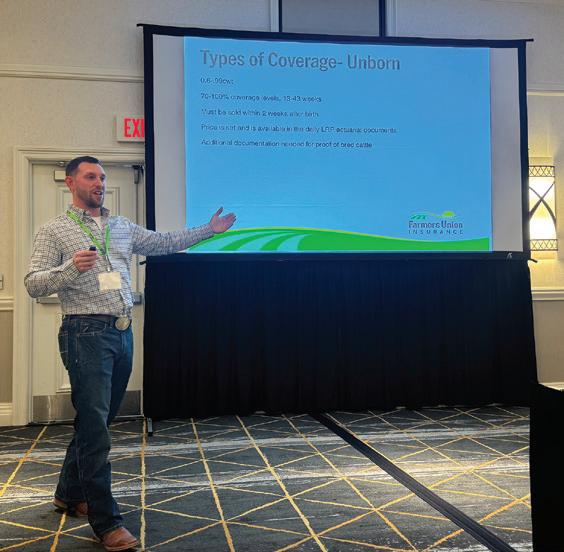
This year a presentation focused on Livestock Risk Protection (LRP) captured their attention. “Every time I attend, I learn something new, but this talk really hit home because we have been thinking about signing up for LRP, but we have not done it because we had so many questions,” Petersen said. “Because we were there with other cattle producers, we were able to ask them about their experience with LRP – how did it work for them – would they recommend it?”
Connecting with family farmers and ranchers from South Dakota and other states is a highlight, added Wessington Springs cattle producer Christina Karsky.
“It’s interesting to see what works for other producers and learn about what they are struggling with. And by visiting, sometimes we are able to help
each other out,” explained Karsky, who attended the conference with her husband, AJ.
Time away from their ranch together to focus on learning is also a benefit.
“It’s a perfect time of year. There is a lull in the ranching world because we are not calving yet and harvest is done,” Karsky said. “So, it is nice to go together so that we can discuss what we learned, since everyone remembers different bits and pieces.”
In addition to presentations on LRP and ag finances, other experts focused on building ag advocacy and communication skills; the history of cooperatives; agriculture policy and more.
Leaving the ranch for a weekend takes a bit of planning. Like most of the young producers who attend, the Petersens have young children and cattle to care for. Petersen said their three children are among the reasons they prioritize the conference each year.
“We work to gain information and try new things to better our operation so that when our kids are old enough to take over, they don’t have to struggle as much as we do,” Petersen said. “Our family is the reason we work so hard.” n by Lura Roti for SDFU
AJ & Christina Karsky
Cole & Carleyn Petersen
Samantha Swanson & Alan Masat
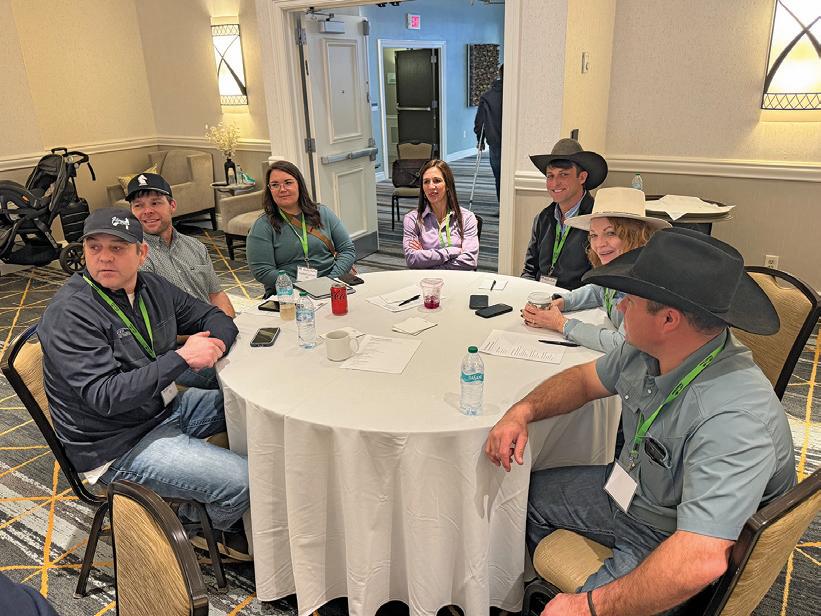
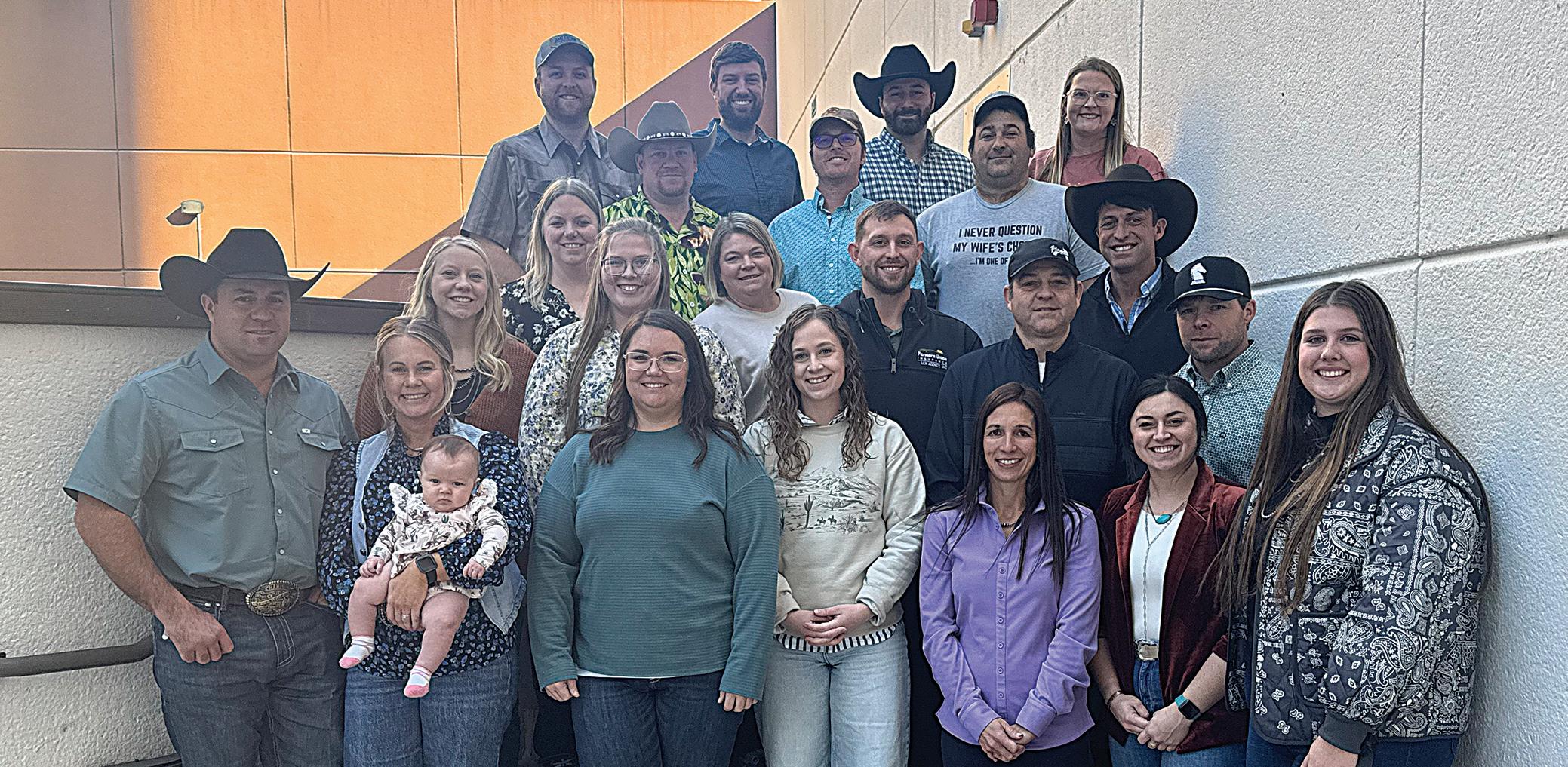
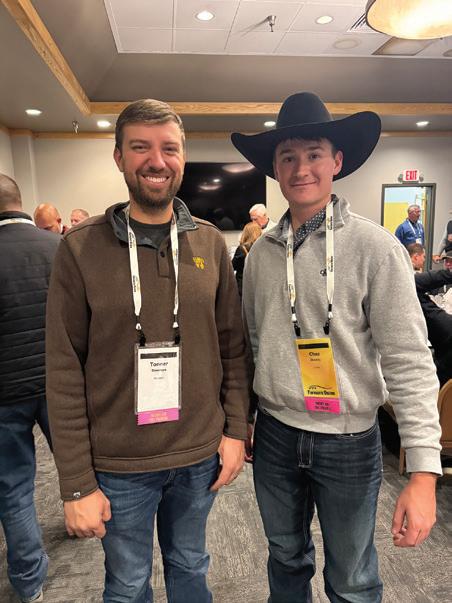
South Dakota producers to attend are back row: Adam Wollschlager, Clear Lake; Tonner Bowman, Mitchell; Alan Masat, Redfield; Carleyn Petersen, Eagle Butte. 4th row: Christina Karsky, Wessington Springs; AJ Karsky, Wessington Springs; Hank Wonnenberg, Dallas; Cole Petersen, Eagle Butte. 3rd row: Samantha Bowman, Mitchell; Elizabeth DeBoer, Clear Lake; Melissa Wonnenberg, Dallas; Cameron Lux, Wetonka; Riley Routier, Buffalo. 2nd row: Brad Johnson, Reva; Amy Johnson, Reva; Kaeloni Latham, Camp Crook; Jessica Lux, Wetonka; Rocky Forman, Huron; Rodney Yost, Gann Valley. Front: Jessica Routier, Buffalo; Samantha Swanson, Redfield; Cally Faulhaber, Plankinton.
FFA Advisers Do More than Teach…They Inspire
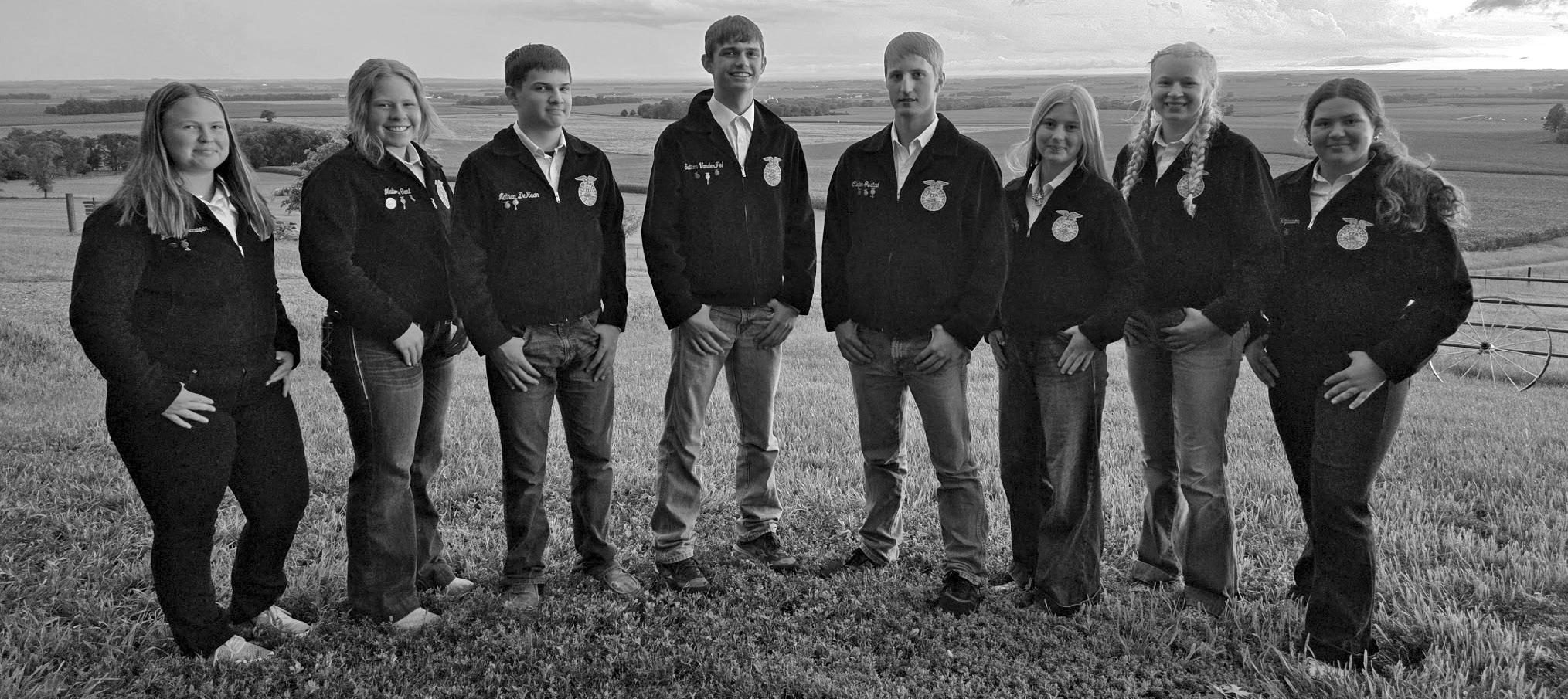
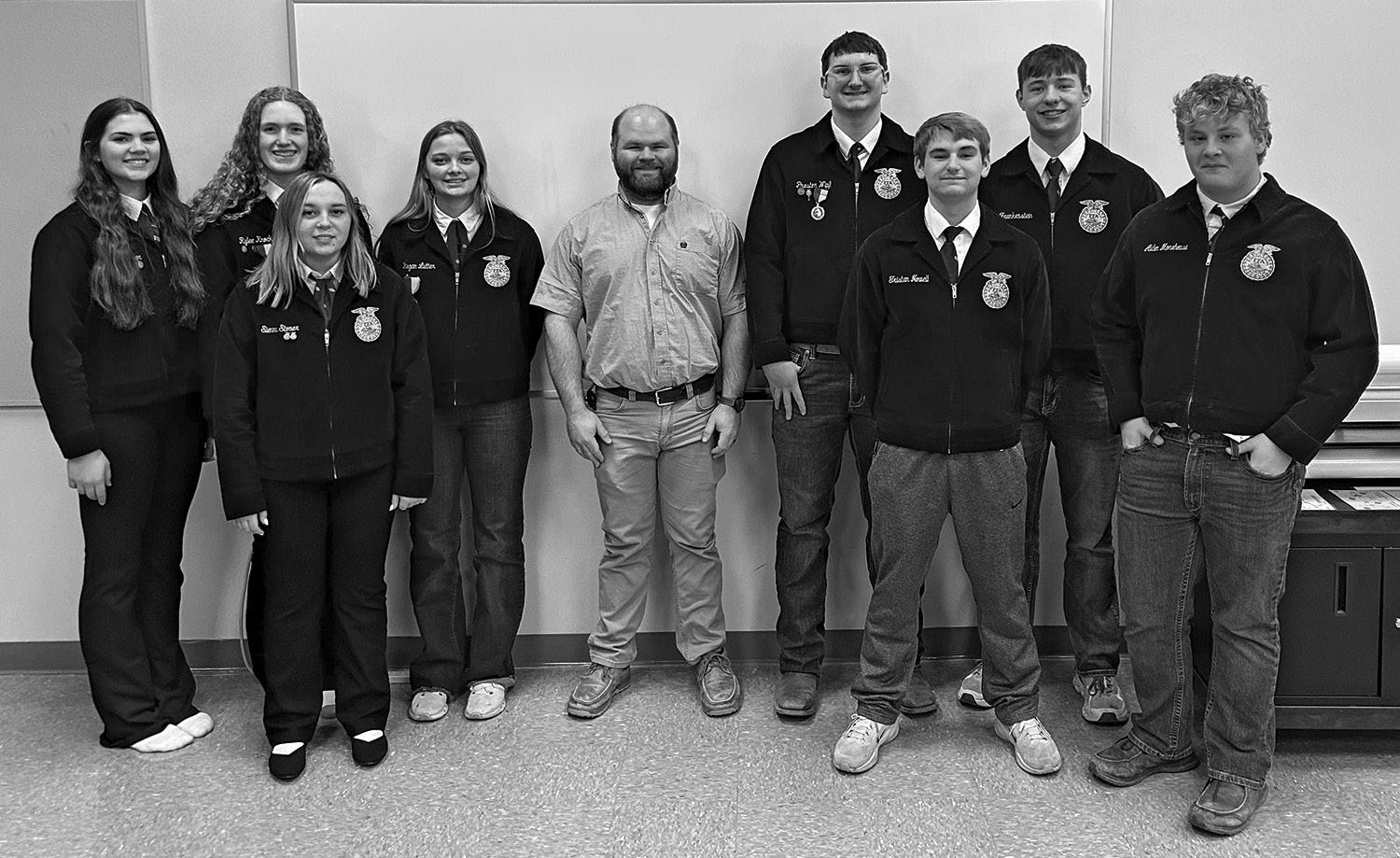
Each year hundreds of South Dakota students learn about agriculture and are inspired to lead and serve by the efforts of their agriculture education teachers/FFA advisers. During FFA Week 2026, (Feb. 21-28) South Dakota Farmers Union would like to thank these men and woman for their positive impact on the next generation. n by Lura Roti for SDFU
Cayla Graves, Platte-Geddes FFA Chapter
An agriculture education teacher and FFA adviser for 14 years, Cayla Graves said based on her experience there are two things her students will always remember after they graduate.
“Yes, I teach them a lot of important information about agriculture. And they will remember some of it. They will always remember the gestation of a sow because it’s three months, three weeks and three days. But I know they will forget much of what I teach. But I also know students are not going to forget how I made them feel,” Graves said. “I always just think, ‘if I can be their bright spot for the day, and let them know that I care, even if home life stinks or their friends stink’ – every kid needs to know that somebody cares for them.’”
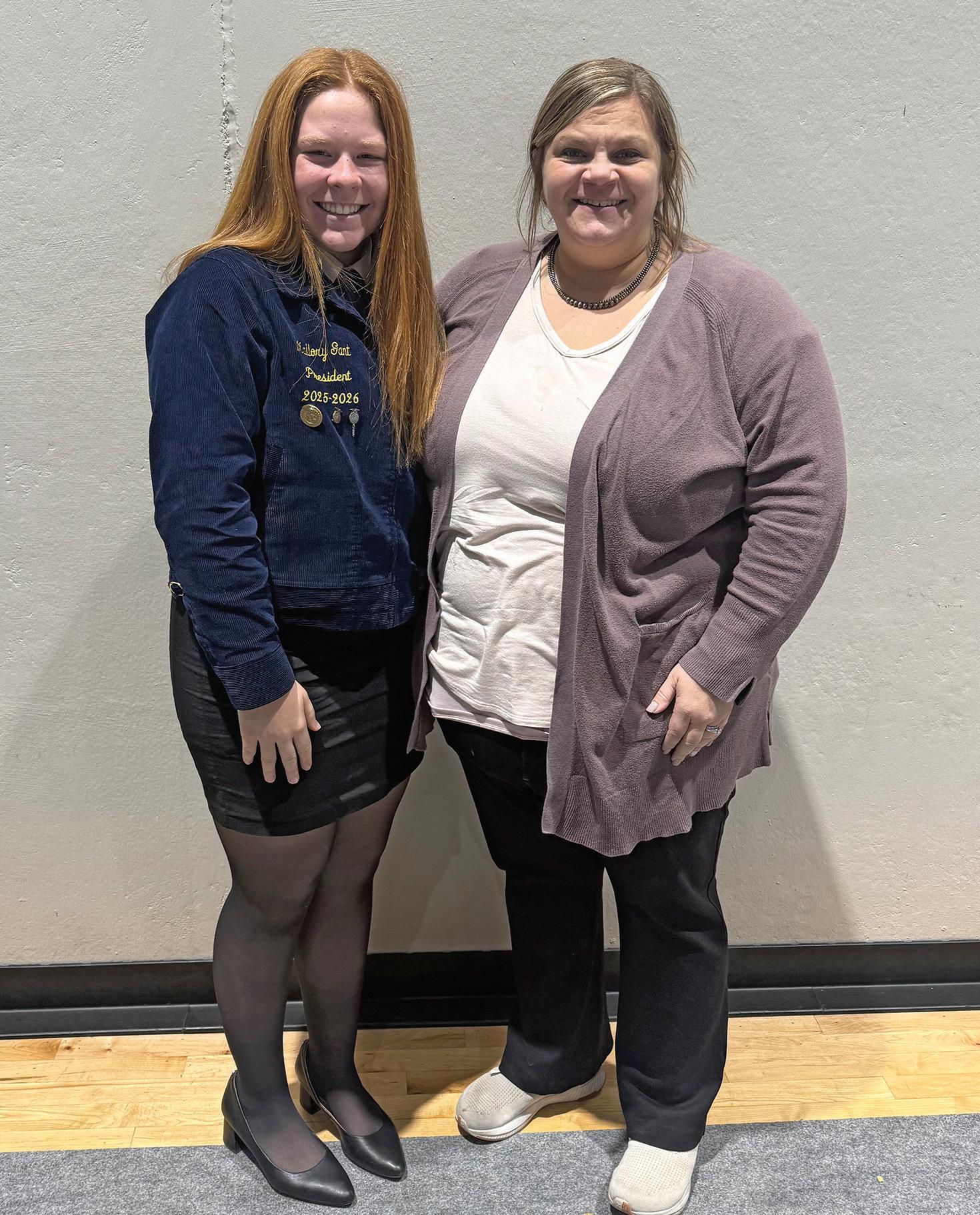
Graves’ efforts are not lost on her students, explained Mallory Gant, a senior at Platte-Geddes High School and FFA Chapter President. “Mrs. Graves cares on a deeper level,” Gant said. “My freshman year I was new to PlatteGeddes. I knew no one. Walking into ag class was so intimidating and I was so nervous. Mrs. Graves welcomed me right away and she pushed me to do Creed Speaking and I went to state that year.”
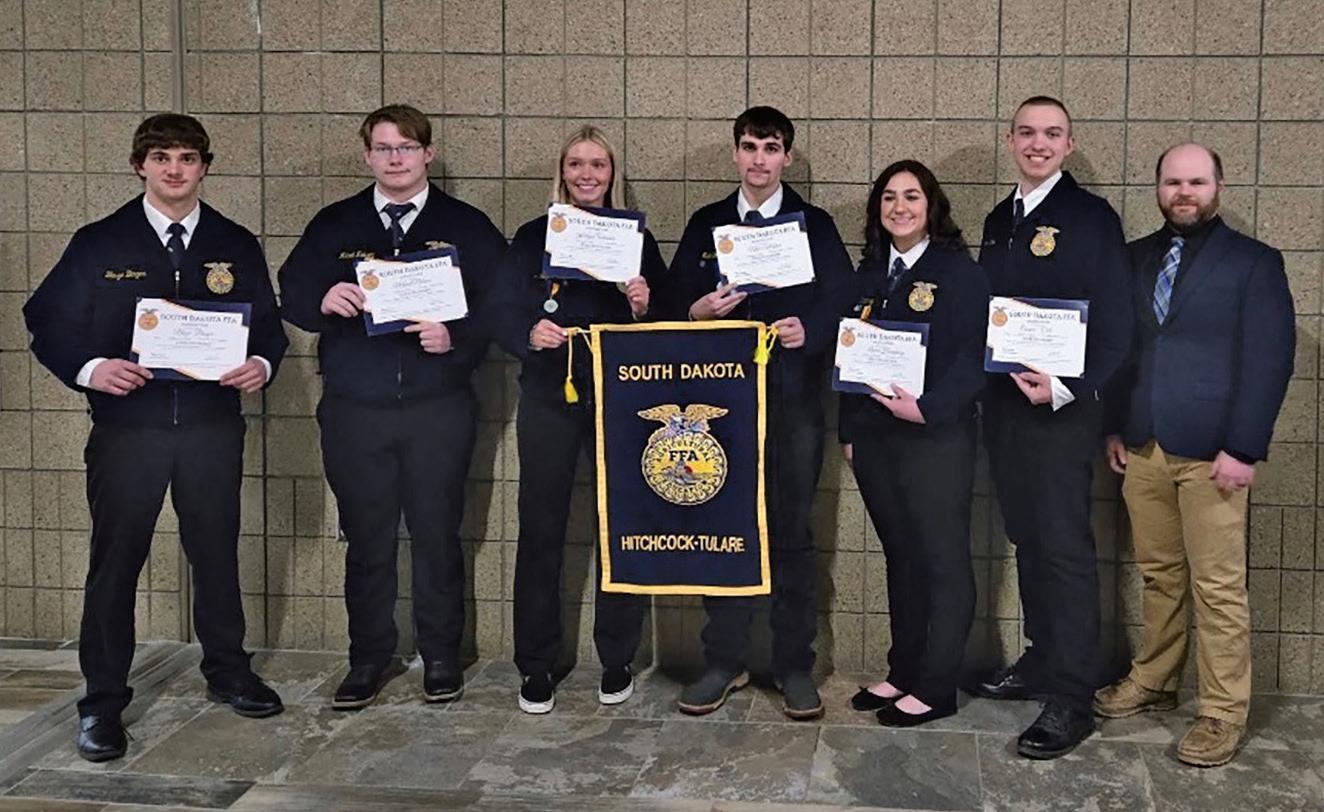
Shane Gross, Hitchcock-Tulare FFA Chapter
Witnessing FFA members grow and thrive is the rewarding part of teaching, Graves said. “Being an ag teacher is so special because I don’t just
Graves Continued on Page 24
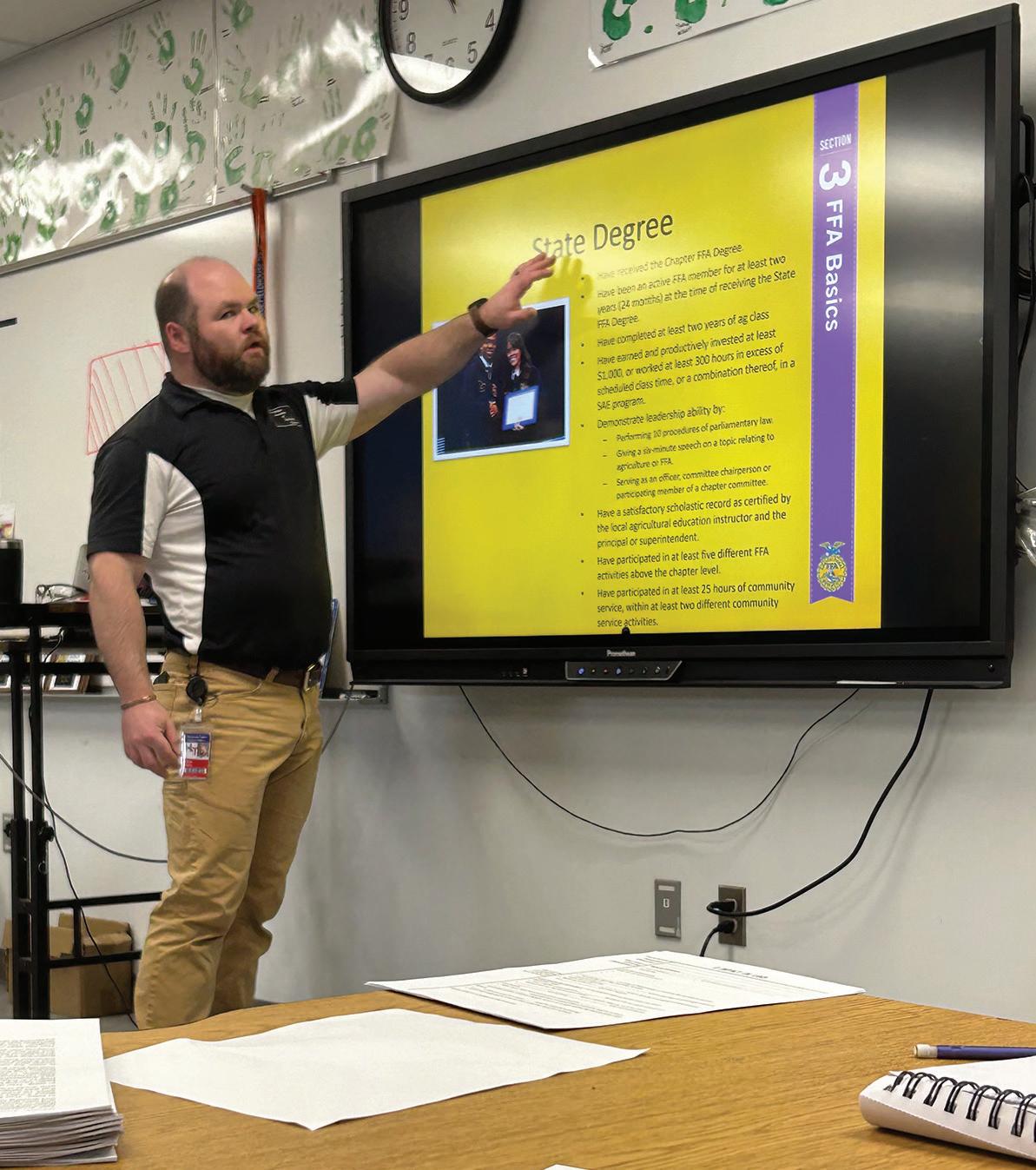
Hitchcock-Tulare FFA Adviser and agriculture education teacher Shane Gross frequently tells his students, “you never know what you are going to end up doing for a career, so the more information and skills you can gain today the more prepared you will be.”
Gross knows this based on first-hand experience. He graduated from South Dakota State University planning to pursue a career in agriculture business but ended up teaching agriculture education instead.
Fourteen years later, he said he is happy his career path took the unexpected detour that it did. “I appreciate the variety of the work I do,” Gross explained. “I’m not tied to one specific topic or space. Each class is so different. I could be in the shop teaching or in the classroom teaching about animal science or plant science or teaching hydroponics or helping students change the oil in a tractor or process meat.”
With the overarching goal of exposing his students to a broad look at agriculture as well as diverse leadership opportunities, Gross has a rule that freshman and sophomore FFA members need to try new and different contests.
“I push our students to experience as many new things as I can. This may mean they only
Continued on Page 24
FFA Advisor, Cayla Graves with FFA member and chapter president, Mallory Gant.
Cayla with her husband, Rob, and daughters Talli and Tress
FFA Advisor Shane Gross (far right) with FFA members Blaze Binger, Michael Nielson, Katelyn Schroeder, Nick Tollefson, Lainey Humphrey and Cooper Cole.
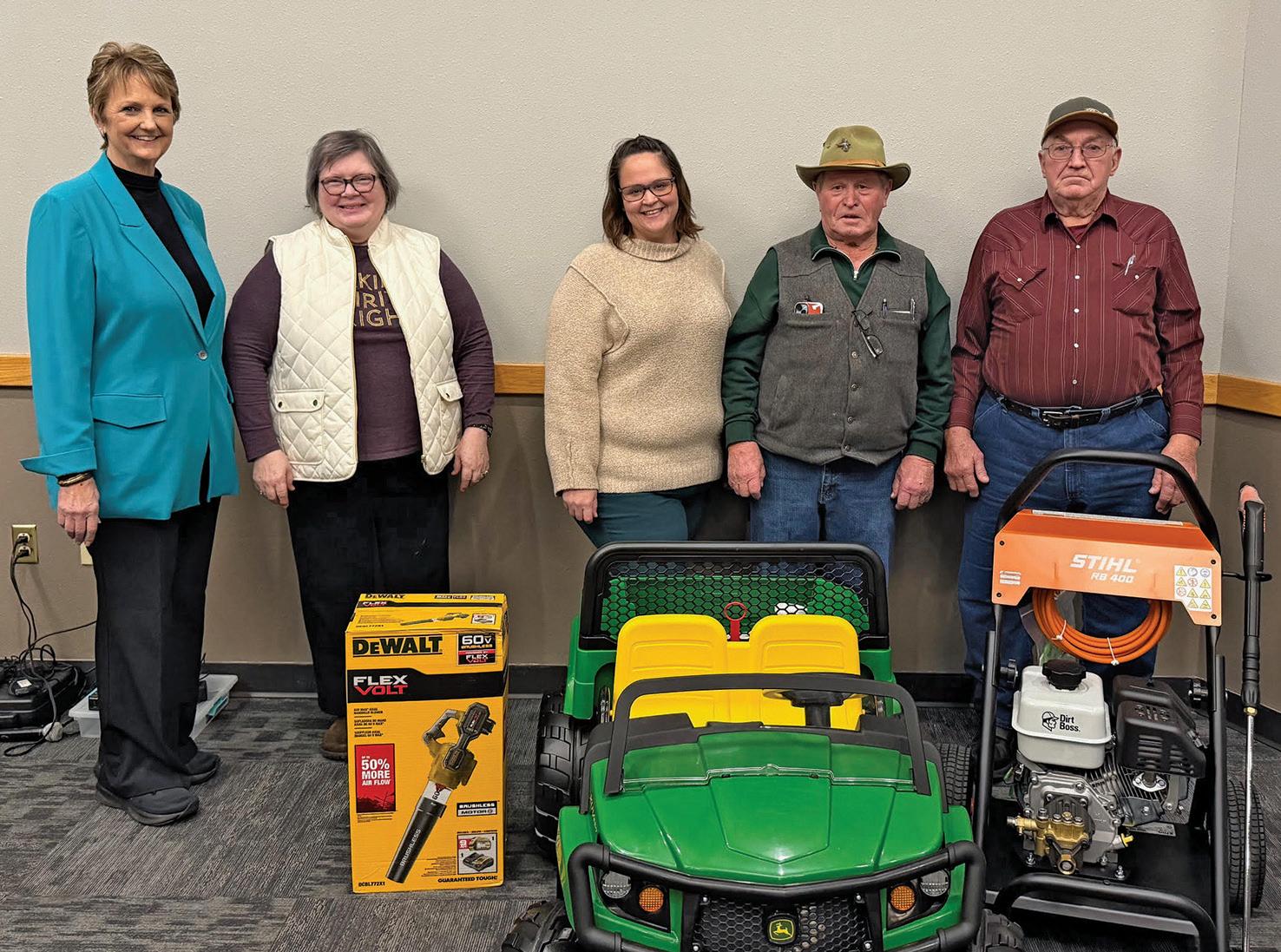
State Convention Grand Prize Drawing Winners are: Kathy Chase, Dewalt blower; Jenae Hansen-Gross $4,000; Richard Rubel kids ATV; and David Cap Stihl power washer.
South Dakota Farmers Union 2025 Awards
South Dakota Farmers Union recognizes South Dakotans and organizations who give of their time and talents to support family farmers and ranchers throughout the state.
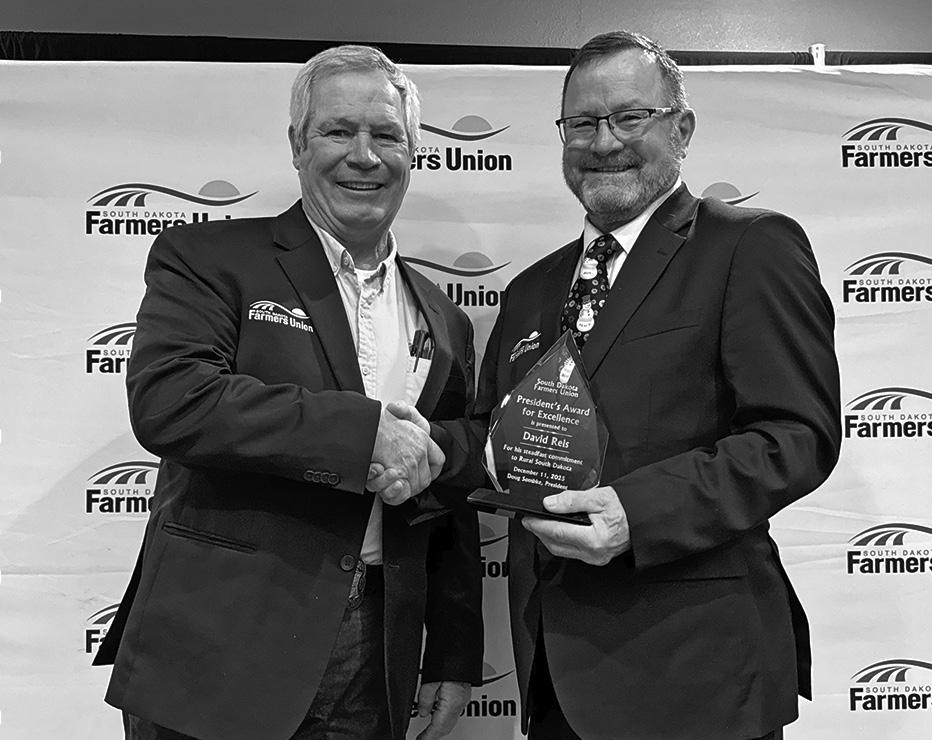
David Reis, South Dakota Farmers Union President’s Award for Excellence
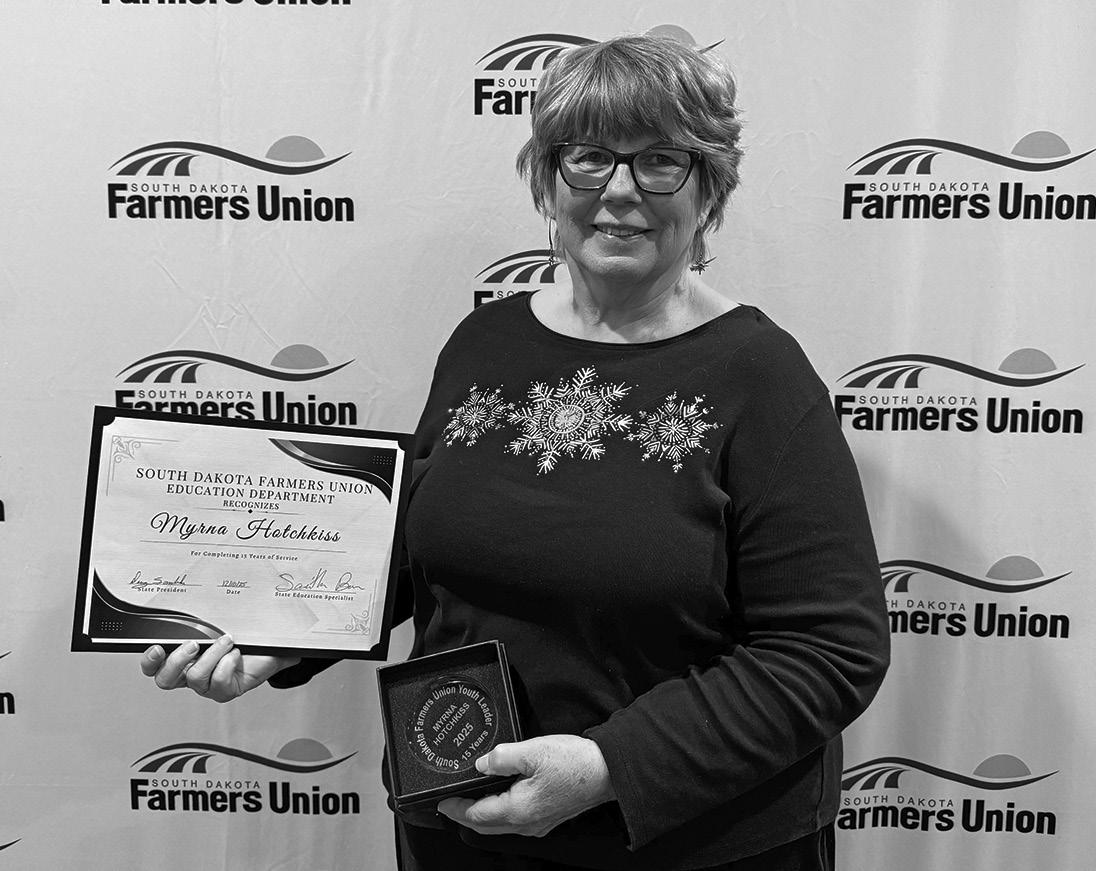
Myrna Hotchkiss, South Dakota Farmers Union Youth Leadership
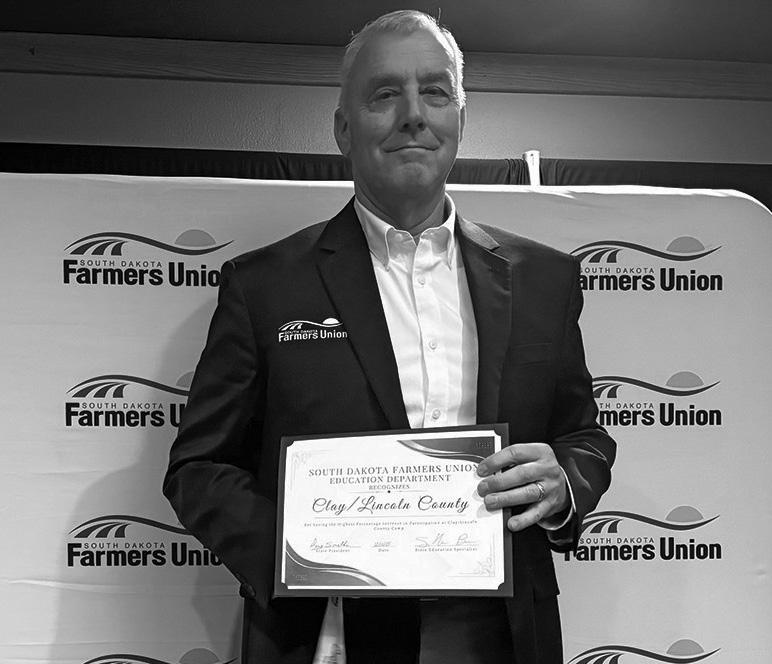
Clay/Lincoln Counties, Largest Increase Camp Participation
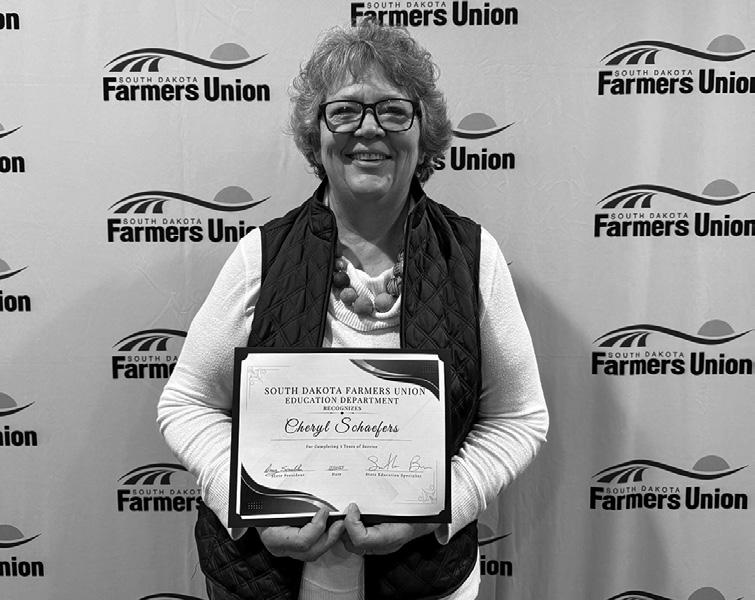
Cheryl Schaefers, 5 Years of dedication and commitment to Farmers Union Youth
Minnie Lovinger Award: Audrey Keierleber
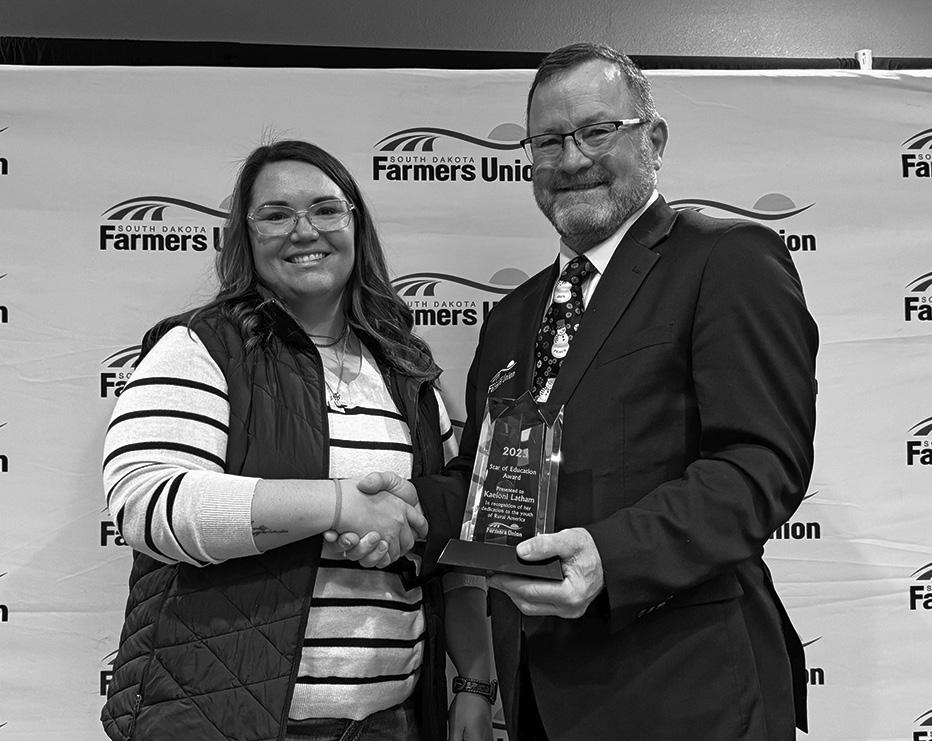
Kaeloni Latham, South Dakota Farmers Union Star of Education Award
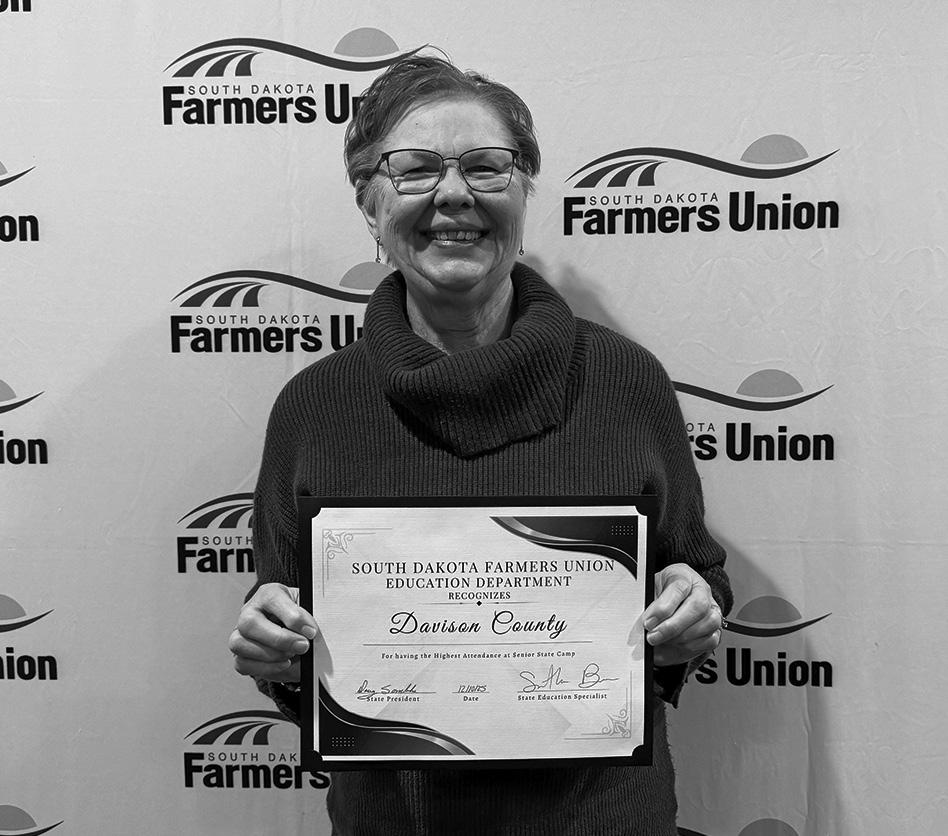
Davison County, Largest County Presence at State Camp
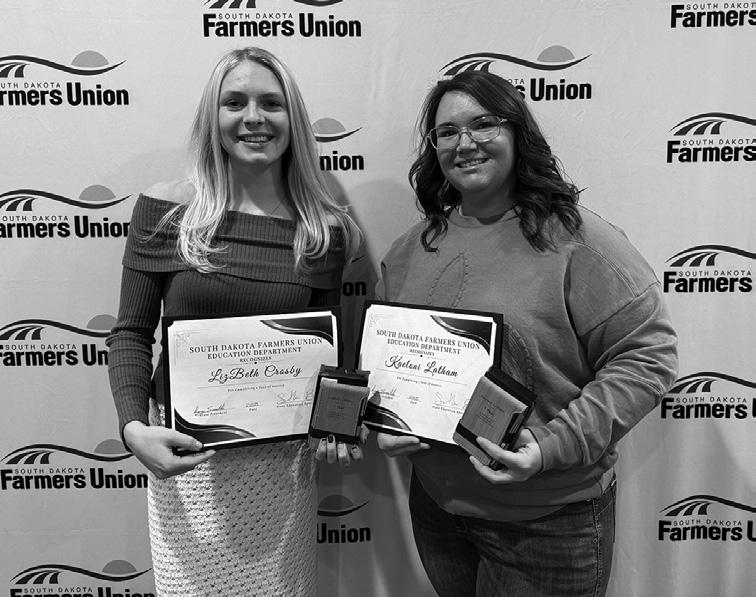
LizBeth Crosby and Kaeloni Latham, 1 year of dedication and commitment to Farmers Union Youth
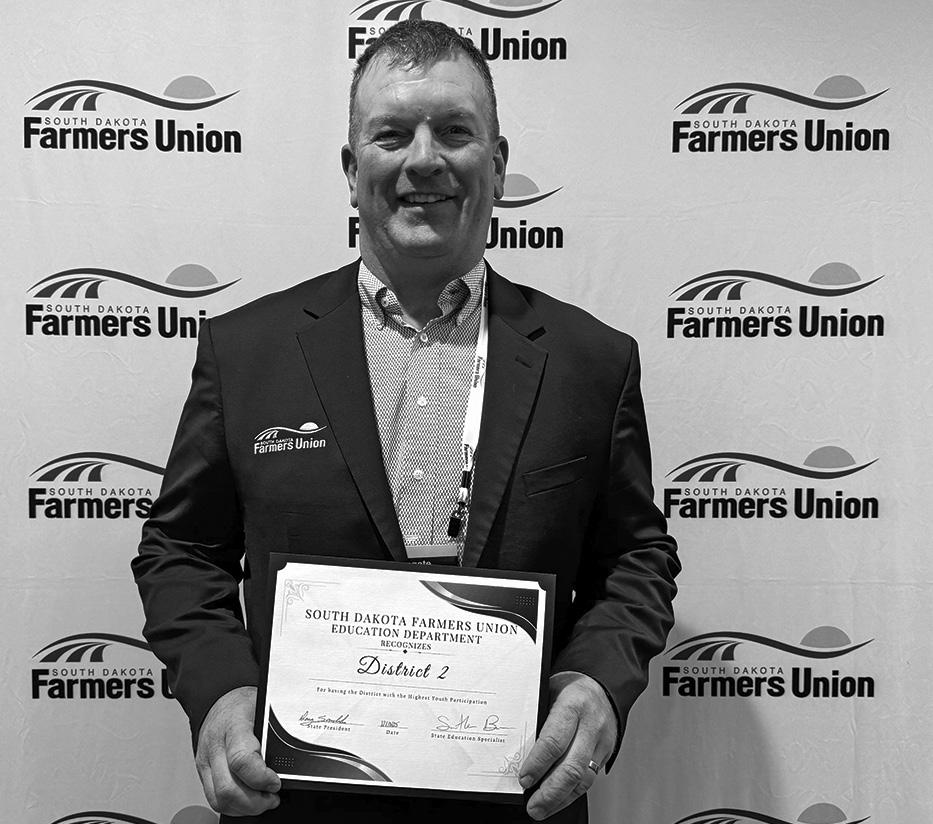
District 2, District with Highest Participation
Also recognized but not pictured: Noah Wicks, Farm & Ranch News Award; Brendon Hansen, South Dakota Farmers Union 2025 Insurance Award; Lyman County, 2025 Outstanding County Achievement Award; Hal Clemensen, South Dakota Farmers Union 2025 Co-Op Partner Award; Randy Knecht, South Dakota Farmers Union 2025 Co-Op Partner Award; Katelyn Krueger, 1 year of dedication and commitment to Farmers Union Youth; Maureen Wernsmann, 5 Years of dedication and commitment to Farmers Union Youth; Bon Homme County, Largest Camp; Harding County, Largest Youth Membership Camp Attendance; Harding County, Jr State Camp Largest County Presence.
Union Farmer
Annual Convention
Convention Comments
Amber Kolousek, Wessington Springs
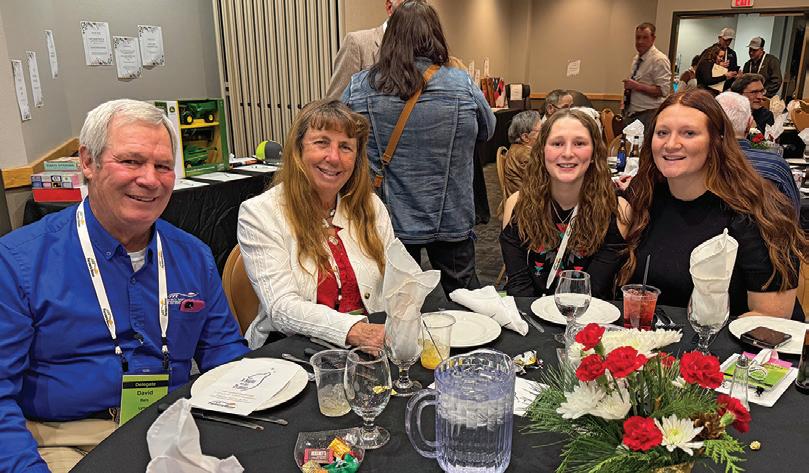
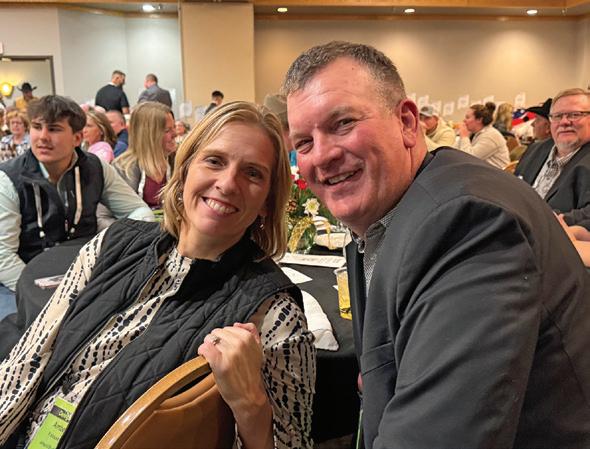
“This year we brought our daughter, Abby, and her boyfriend, Blake Miller, with us. They are both involved in Northern State University Farmers Union Chapter and we wanted to show them what we’ve been doing the last few years. We go home and we tell them stories about policy and the people that we meet here, and the great friends we’ve made. They are interested, but it’s, there’s nothing like that firsthand experience of being a part of policy and hearing the speakers.” Scan QR Code to watch video.
Cameron Lux, Wetonka
Denise Mushitz, Geddes
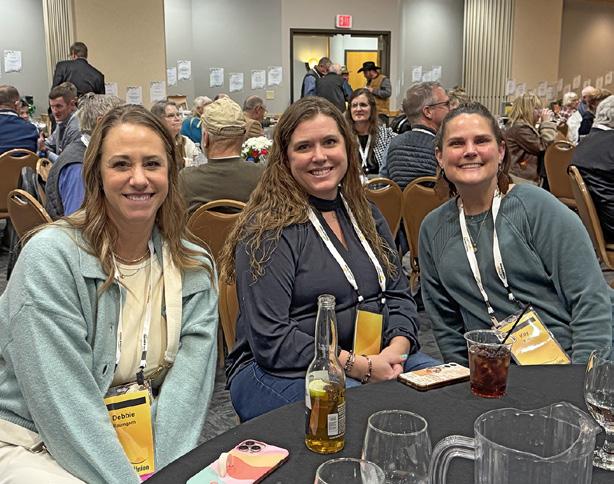
I’ve been to every convention the last 30 years, minus the one that we had the blizzard. But for me, it’s always been important to be here to have my voice heard. And because of the people. Every year, I’m just so happy to see my friends from around the state. And I just feel like actually they’re more than friends, they’re more like family. I feel like when I walk into the convention hall and I can sit with pretty much anyone, at any table and I feel like I’m welcomed and I’m at home with them.” Scan QR Code to watch video.
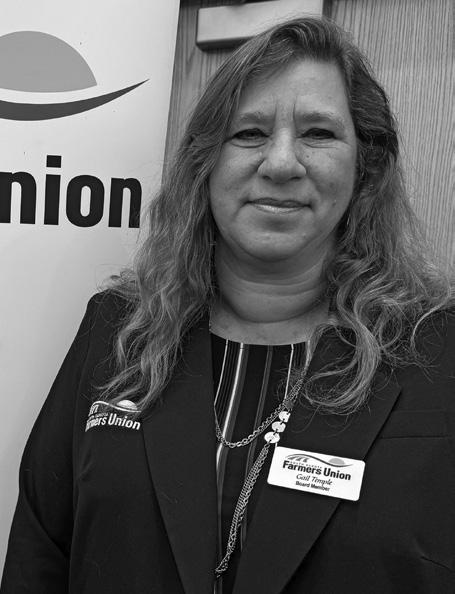
Gail Temple, Clark
“I make time for the state convention every year because we are the next generation of farmers and ranchers who are going to be taking on the challenges ahead. And what a great place to come to learn more and interact with some of the producers that have been around for longer than I have – some of them a lot longer than I have – and try to absorb as much knowledge as possible.” Scan QR Code to watch video.
Chaz Blotsky, Hidden Timber
“It’s important for us young producers to be participating in Farmers Union events is I feel like it’s our generation’s responsibility right now to step up. Not later, but now.” Scan QR Code to watch video.
Continued from Page 13
it as the Age of Intelligent Machines.
“When we talk about ages of new technology, like the Iron Age, humans entered the Iron Age, we figured out how to use metal, and that was such a game changer, such a world changer, that we never went back … you know, no one said, ‘let’s get rid of this iron thing and let’s go back to stone tools.’”
Leyden said as we are entering the Age of Intelligent Machines, we are also entering two other eras simultaneously – the Age of Cheap Abundant Energy and the Age of Bioengineering. Don’t be scared, be empowered: As he
“I enjoy hearing the youth speeches during convention because I am a Torchbearer. I started out with Farmers Union day camps and I went all the way through up to Torchbearer. I believe being in our camping program is very important. Not only then, but now, because we are teaching the youth about cooperatives, about Farmers Union, about advocating for farmers and ranchers. And it’s a good way to learn about parliamentary procedure and just a whole different array of topics. Even if you don’t stay in agriculture, which we hope you do stay in agriculture, any job that you choose in the future, what you learn here, will help you there.” Scan QR Code to watch video.
spoke, Leyden addressed the fact that he feels too much emphasis has been put on the risks of AI.
“All general-purpose technologies bring risks if they bring benefits. If they bring a big enough benefit, they are going to bring some risk and what we learn over time is that you take a bunch of human ingenuity and innovation to minimize the risk.”
Among the AI benefits he quickly outlined were:
– Children of all income levels can receive tutoring.
– With virtual AI assistants, everyone, not just
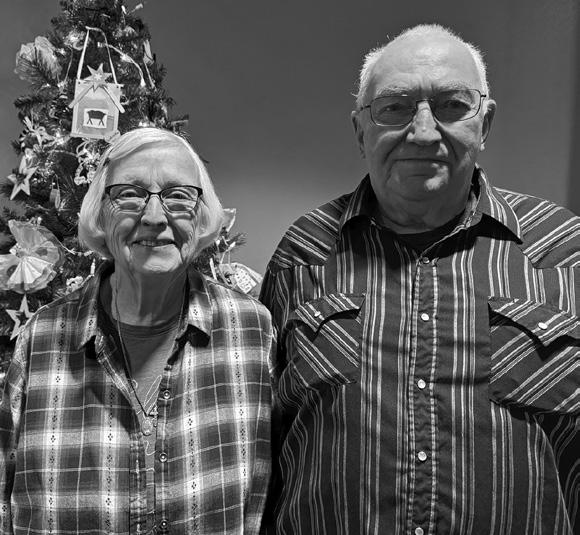
David and Ione Cap, Utica
“We make time for convention because we believe in grassroots policy. It helps get things done that are good for farmers. And Farmers Union has done a good job over the years establishing good relationships between farmers and consumers.”
–
CEOs, can receive aide with tasks they don’t want to do.
Due to recent advancements in bioengineering and AI we could potentially reduce pollution by replacing materials, like plastics with bioengineered sustainable materials. “They could, when exposed to certain conditions like salt water, they could biodegrade, in a way that plastic cannot.”
And there’s more … For members who want to hear the entirety of Leyden’s talk, an audio version can be accessed by visiting this article on the Farmers Union website at www.sdfu.org n by Lura Roti for SDFU
Leyden
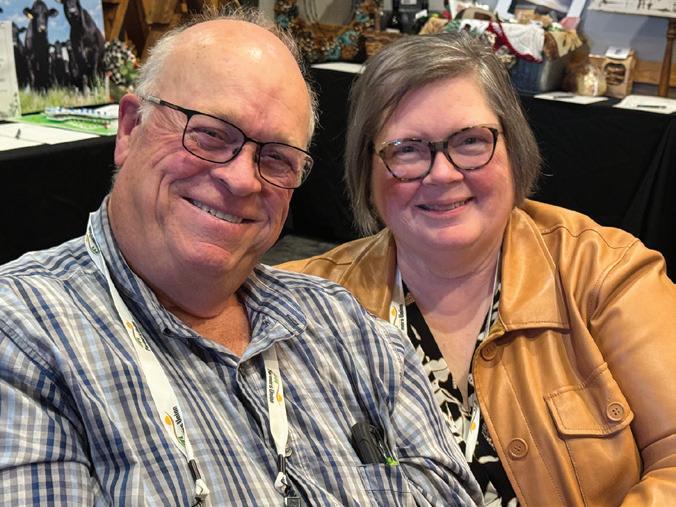
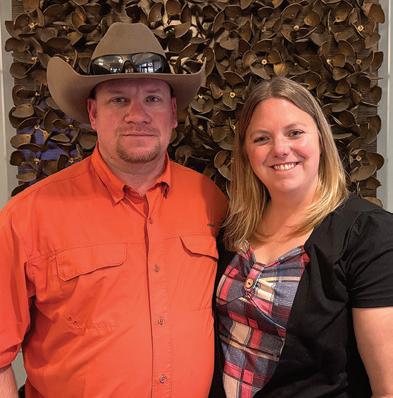
Amber Kolousek (second from left) with her husband, Scott (far right), daughter, Abby and Blake Miller.
Scan to watch video
Scan to watch video
Scan to watch video Scan to watch video
Scan to watch video
Union Farmer
Property tax reform, right to repair, data centers…there’s a lot of topics discussed by legislators in Pierre that South Dakota Farmers Union members have established policy to reflect how family farmers and ranchers believe these issues should be addressed.
And many family farmers and ranchers will travel to Pierre March 3 at 10 a.m. for the South Dakota Farmers Union (SDFU) Legislative Day to visit one-onone with legislators to explain the grassroots policy they put in place and ensure their voice is heard.
“Legislative day gives us access to our legislators,” explained David Reis, a Reliance rancher and SDFU board member. “It is important that we as farmers and ranchers share our opinion on the issues that affect us. Our legislators work hard for us, but they are not mind readers. So, they need to hear from us to understand which way we need them to vote.”
Former legislator and Parade rancher Oren Lesmeister agreed. “Speaking to someone faceto-face is much different than receiving an email. When you meet someone, their story sticks
Farmers & Ranchers Make Their Voice Heard in Pierre
2026 Legislative Update
By Mitch Richter
SDFU lobbyist Mitch Richter is in Pierre each day of Legislative Session 2026 to keep an eye on issues and ensure SDFU policy is represented. Keep up with bills this session with the SDFU Bill Tracker. Scan QR code and scroll to the bottom of the page or visit www.sdfu.org.
Property Taxes: Legislators met over the summer to work on solutions to property tax challenges facing a few South Dakota counties. These meetings resulted in 19 proposals. Farmers Union does not sup-
with you much more than if you just read an email.”
During Legislative Day, farmers and ranchers get to sit down and share a meal with legislators in the Capitol Rotunda. “There is just something about breaking bread together,” said Doug Sombke, SDFU President and a Brown County crop and cattle farmer. “When you are sharing a meal together, it seems easy to have a friendly discussion over topics you may not even agree on.”
The Farmers Union meal has ties to South Dakota agriculture – it is prepared by Polo cattle producer and caterer Cheryl Schaeffer. “Having the food catered by a South Dakota farm family helps drive the message home about the role that family farmers and ranchers play in our everyday life – whether you live rural or urban, everyone eats,” explained Karla Hofhenke, SDFU Executive Director.
In addition to visiting with legislators, Farmers Union members have an opportunity to sit in on committee meetings as well as House and Senate Sessions.
All Farmers Union members are welcome to attend. To learn more, visit www.sdfu.org n
port any of the proposals because they do not align with policy.
Farmers Union policy takes a firm stance that property tax relief should not have a negative impact on South Dakota family farmers and ranchers or schools.
Data Centers: Farmers Union members are concerned over the amount of misinformation on data centers. We understand that data centers use a lot of power.
Our policy supports data centers as long as the data centers cover all costs associated with infrastructure enhancements.
And Farmers Union members believe data centers should not receive tax incentives or discounts.
Data centers should pay sales tax on everything because sales tax is one of only two ways our state receives money – sales tax and property tax.
Right to Repair: Farmers Union policy supports an individual’s right to repair their own equipment. If an individual owns a piece of equipment, they should have access to diagnostic technology. n
January/February 2026 19
Rural Youth from Clark, Union, McCook & Charles Mix Counties Win Ag Advocacy Scholarship Contest
Advocating for South Dakota’s No. 1 industry of agriculture and supporting the next generation of agriculture professionals are important. The Farming for the Future Social Media Scholarship Contest sponsored by South Dakota Farmers Union accomplishes both.
“The future of agriculture relies upon skilled professionals and educated consumers. This is the reason Farmers Union designed this unique scholarship opportunity,” explained Karla Hofhenke, Executive Director for South Dakota Farmers Union.
Designed to engage youth in agriculture advocacy, students compete in seven weekly social media challenges. Each week winners are named and students earn points and scholarship dollars based on their ranking. Throughout the contest, South Dakota Farmers Union awarded $15,000 in scholarship dollars to high school and college students from across the state.
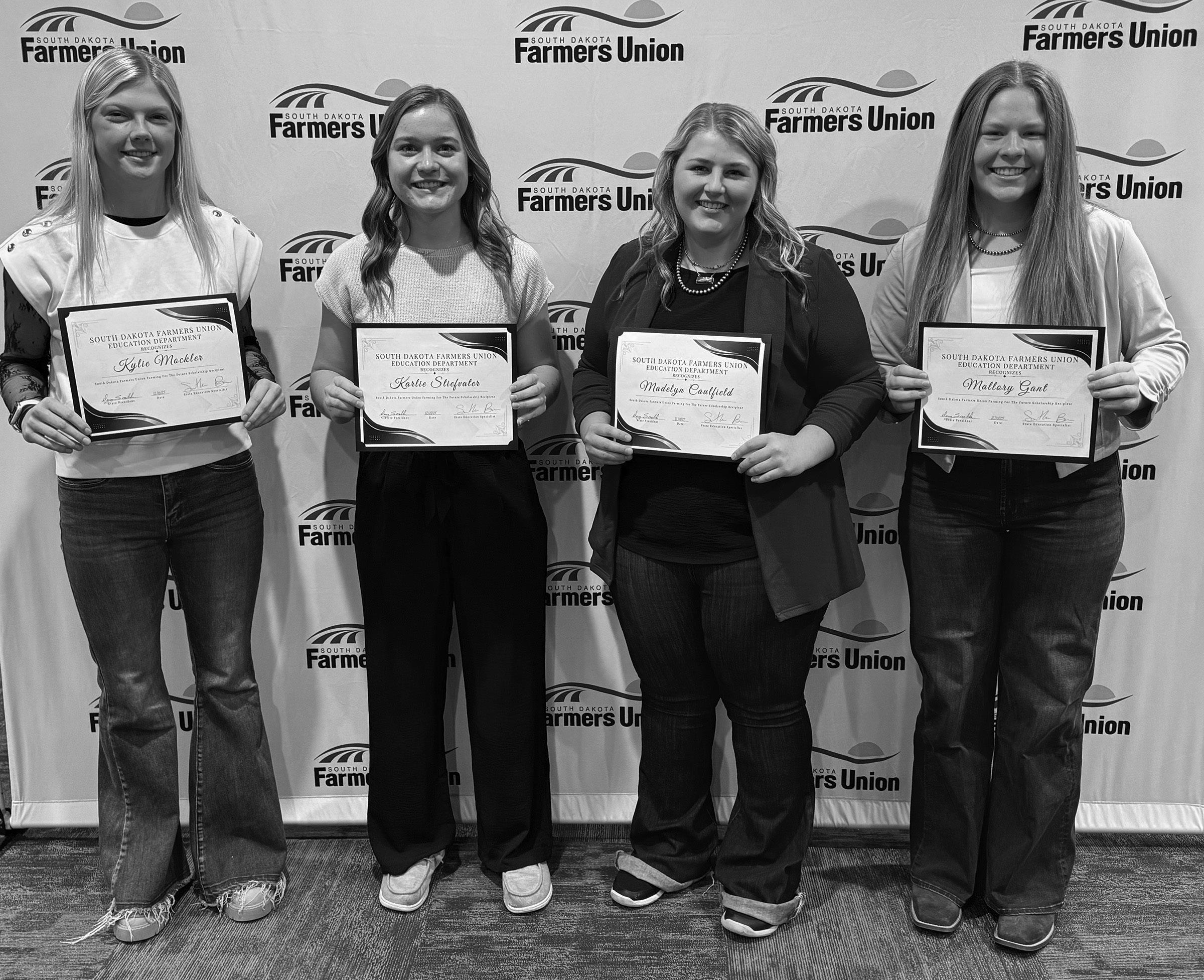
“This scholarship contest shows how much Farmers Union cares about youth in agriculture,” said Madelyn Caulfield, a second-generation farmer from Clark County and a sophomore prevet major at South Dakota State University.
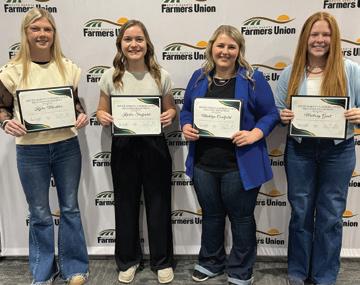
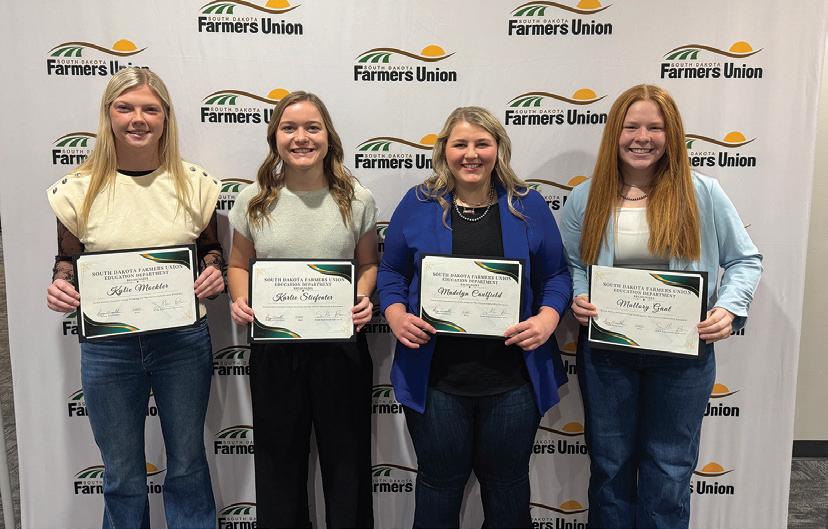
Caulfield placed third overall, receiving $1,500 in addition to her weekly earnings. She and the other winners were announced during the 110th South Dakota Farmers Union State Convention held in Huron Dec. 10 and 11. The other overall Farming for the Future Agriculture Advocacy Scholarship winners are: first place, receiving $3,000, Kylie Mockler, Clay County; second place, receiving $2,000, Karlie Stiefvater, McCook County; as mentioned earlier, third place, receiving $1,500 Madelyn Caulfield, Clark County; fourth place, receiving $1,000, Abbie Chase, McCook County; and fifth place, receiving $500, Mallory Gant, Charles Mix County.
“I competed in this contest, not only for the scholarship dollars, but for the experience,” explained Mockler, a fifth-generation Beresford cattle producer.
2025 is the second year Mockler participated in the scholarship contest. In addition to placing first overall, Mockler was also named the Social Media Star. She also received the Excellence Award as the only student to receive more than 1,000 points.
“The increase in overall interest by South Dakota students and the caliber of work produced by students was outstanding,” said Samantha
Bowman, Education Program Specialist for South Dakota Farmers Union. “It is exciting for ag advocacy efforts to expand our reach.”
Stiefvater would agree. “Everyone is surrounded by agriculture whether they know it or not – the food we eat, the clothes we wear and what we put in our gas pumps – I advocate for agriculture because I want consumers to know the role agriculture plays in all the products they use. I want them to understand where their food and other ag-based products come from and who is at the start of it – who is doing the work,” explained Stiefvater, a fifth-generation Salem farmer who plans on returning to work on her family’s farm after graduating from SDSU.
Like Stiefvater, after college Gant also plans on remaining active in her family’s farm. A senior at Platte-Geddes High School, Gant said she plans to expand on the ag advocacy efforts she started through the Farming for the Future scholarship contest. “It is important to advocate for the future we want for our family farms and ranches and ag industry, because if we don’t advocate today, we don’t know what the future
will hold.”
As an agriculture communications major at SDSU, Chase said that in addition to gaining more hands-on experience in ag advocacy, the contest’s weekly social media challenges also taught her about Farmers Union.
“I attended Farmers Union day camps as a youth, but I did not know that Farmers Union also had week-long leadership camps,” Chase said. “I enjoyed learning more about Farmers Union as a whole and the work they do for family farmers and ranchers.”
#FarmingForTheFuture25
To view social media posts created by students participating in the Farming for the Future Agriculture Advocacy Scholarship Contest, visit the South Dakota Farmers Union Foundation Facebook page or search #FarmingForTheFuture25. To learn more about how South Dakota Farmers Union supports rural youth and family farmers and ranchers across the state, visit www.sdfu.org n by Lura Roti for SDFU
Scholarship Winners: first place, receiving $3,000, Kylie Mockler, Clay County; second place, receiving $2,000, Karlie Stiefvater, McCook County; third place, receiving $1,500, Madelyn Caulfield, Clark County; fourth place, receiving $1,000, Abbie Chase, McCook County (not pictured) and fifth place, receiving $500, Mallory Gant, Charles Mix County
Farmers and Ranchers Take South Dakota Ag Policy to National Convention
Adding mandatory country-of-origin labeling (MCOOL) to the new Farm Bill., addressing childcare shortages in rural America. addressing concerns pertaining to the establishment of data centers are some of the ag and rural policy South Dakata family farmers and ranchers will take to the 2026 National Farmers Union Convention held March 7-9 in New Orleans, Louisiana responds to real-time concerns in farm and ranch country.
“Our policy is solution-focused,” explained Doug Sombke, President of South Dakota Farmers Union (SDFU). “We don’t create a list of problems and expect policymakers to fix them.”
Sombke is among the South Dakota family farmers and ranchers elected during the annual South Dakota Farmers Union Convention to advocate for the state’s policy at the national level. “We realize many of the issues South Dakota family farmers and ranchers face are not unique to us. These are challenges agriculture producers across the U.S. face. This is the reason we have a national organization – so that our policy reaches congressional leaders,” Sombke said.
Because only those who earn a living from farming and ranching can serve as delegates, congressional leaders can trust that the policy developed by National Farmers Union is truly farmer/rancher focused, explained Rob Lee, a third-generation De Smet farmer.
“As a farmer, it is important to me that our family belong to an organization, that when it comes to who is dictating the direction of the
organization’s advocacy efforts, we stick to our roots as a farm organization and only those who are actually farming or ranching get to decide,” said Lee, who serves on SDFU State Policy Committee and will serve as a delegate to the National Farmers Union Convention.
During the 2020 National Farmers Union Convention, Salem farmer Jim Wahle served on the National Policy Committee when a bylaw was passed to establish the rule that only those considered farmers or ranchers per the U.S. Department of Agriculture criteria can serve as a Farmers Union delegate.
“We as producers live this ag thing. We understand it, and we have to represent ourselves so that outside interests don’t make decisions for us,” explained Wahle, a fifth-generation farmer.
Of course, not all farmers and ranchers agree on policy priorities or on the solutions to shared challenges, but this is the reason Aberdeen farmer and Brown County Fair Manager Rachel Kippley enjoys participating in Farmers Union policy discussions. “Policy is the highlight of the whole convention,” Rachel said. “As delegates, we get to put our heads together and discuss challenges, discuss solutions and discuss the vision and advocacy direction of our national organization.”
In addition to their crop and cattle operation, Rachel and her husband, Jeff, both have offfarm careers. And with four children, the couple understand the sacrifice delegates make when they make time to leave their South Dakota agriculture operations to advocate for policy at
the national convention.
“It’s difficult to do because today’s family farmers are pulled in so many directions. But if we want to have the opportunity to pass our farms or ranches on to the next generation – which is the goal of nearly every farmer and rancher I know – then we need to make the time for farm and ranch-friendly policy,” Rachel said. Jeff agreed. He currently serves as the National Farmers Union Vice President and as Vice President of South Dakota Farmers Union.
“We are at the best place we’ve ever been at as far as getting Country of Origin Labeling back. At the same time, we’re probably at the worst place we’ve been in a long time with commodity prices and input costs,” Jeff said. “So, it’s really time that we get a new Farm Bill passed that can really give us a safety net that farmers across the state and country need.”
The delegates representing South Dakota Farmers Union policy during the National Farmers Union Convention include Doug Sombke, Groton; Chaz Blotsky, Hidden Timber; Michelle Olson, Aberdeen; Rachel Kippley, Aberdeen; Jason Latham, Buffalo; Kaeloni Latham, Buffalo; John Kippley, Aberdeen; Lance Perrion, Ipswich; Sarah Perrion, Ipswich; Rob Lee, De Smet; Darrin Olson, Aberdeen; Jim Wahle, Salem; Keeleigh Reis-Elwood, Reliance; Terry Sestak, Tabor; and Amber Kolousek, Wessington Springs.
To learn more about South Dakota Farmers Union policy, visit www.sdfu.org and find the Policy Book under the Legislation link. n by Lura Roti for SDFU
During the 110th South Dakota Farmers Union Convention, family farmers and ranchers were elected to represent South Dakota Farmers Union as delegates to the 2026 National Farmers Union Convention. Delegates are: front row left to right: Michelle Olson, Aberdeen; Rob Lee, De Smet; Jim Wahle, Salem; Kaeloni Latham, Buffalo; Amber Kolousek, Wessington Springs; and Sarah Perrion, Ipswich. Back row, left to right: Terry Sestak, Tabor; Darrin Olson, Aberdeen; Keeleigh Reis-Elwood, Reliance; Chaz Blotsky, Hidden Timber; Jason Latham, Buffalo; Lance Perrion, Ipswich; John Kippley, Aberdeen; and Rachel Kippley, Aberdeen.
Rural Youth Receive Scholarships from South Dakota Farmers Union Foundation
Bobbi Ann Eide, Gettysburg
Education Goal: Attend South Dakota State University to study agriculture education and agriculture communications Inspired by Agriculture Education Teacher: My agriculture teacher inspired me by showing how one person can make a difference in students’ lives and in their community. I aim to achieve this by helping young people in rural South Dakota learn about agriculture, develop their skills, and build a stronger future for our farming communities.
Breyten J. Johnson, De Smet
Education Goal: Study agriculture business
Career Goal: I am preparing for a career in agriculture as a Farm Credit Services insurance agent, Farm service Agency loan officer, or an ag banker/ accountant. In any of these roles, I will strengthen rural South Dakota by supporting producers with resources, financial tools and education, ensuring the long-term success of agriculture and the communities it sustains.
Kyza Marie Johnson, White Lake
Education Goal : Plan to attend college to study animal science or ag business, education and communication Career Goal: Through any of these career paths, I can have a positive impact on rural South Dakota. If I study Animal science I would impact it in many different ways to improving the growth and health of cattle to improving farm productivity. The ag business, education and communication profession would allow me to come back to my community and teach agriculture to students which will help people understand the rural areas of South Dakota through the eyes of the people that live in the areas.
Sydney Layne Asmus, St. Lawrence
Education Goal:
Attend South Dakota State University to study precision agriculture
Career Goal: As a future precision agriculture specialist, I aim to revolutionize farming in rural South Dakota by increasing yields, reducing input costs and promoting sustainability through data-driven practices. By applying cutting-edge technology, I’ll help local farmers make smarter decisions and improve their livelihoods. I will be attending SDSU to gain the knowledge and skills needed to make this impact.
Cadence Konechne, Kimball
Education Goal:
Pursue a degree in political science and attend law school to become a lawyer
Career Goal: As a lawyer I can help rural communities by contributing to local government, and assisting with rural issues like environmental regulations, land disputes, and the generational transfer of operations. n by Lura Roti for SDFU
Can Ford’s U-Turn on EVs Open the Road for Ethanol?
Doug Durante, Executive Director, Clean Fuels Development Coalition
$19 billion down the drain. Ford finally read the writing on the wall and said they are totally reversing course when it comes to EVs. But wait, it gets worse – when you add previous losses that were written off, some estimates put the total closer to $35 billion. By any standards, that’s a lot of money, and what a shame as it was all so unnecessary. And it’s not just Ford. Every automaker on the planet that embraced EVs, whether in whole or part, is recanting. While it is technically incorrect to say the Biden administration mandated EVs, the emission and efficiency standards were so stringent that it appeared to be the only solution. But as they say, appearances can be deceiving and this was a classic example. There were other ways to achieve what they wanted without the kind of wholesale change in the way the American public drives. It was a bad decision by the Biden administration and a bad decision by the auto industry to not push back more.
At CFDC, we published an issue brief several years ago, not to be a hit piece but rather to provide a reality check that looked at costs, safety, recharging and countless other issues that had yet to be resolved before going all in on such a drastic change. And we were right. The pendulum has swung from the overreach of the Biden administration to flat out opposition by the current administration, resulting in a limbo where cost, recharging and other challenges remaining unresolved, with little prospect for improvement. That pendulum can swing back again, and automakers know that producing efficient and clean vehicles is in their business and political interest.
So where do they turn? As ethanol advocates, it was particularly frustrating for us to see proposals to reduce emissions and oil use that cost billions upon billions of dollars in corporate investment and government subsidies when we had a nearly no-cost alternative in the form of higher ethanol blends that can provide health and emission benefits cheaper, faster and in
many cases, far better than an EV scenario.
A recent guest editorial in a Kansas City paper by a former General Motors executive and engineer Don Siefkes suggested that an alternative to EVs would be to ban gasoline-powered vehicles and turn to 100 percent ethanol. As well-intentioned as this proposal is, it is a bridge too far and not a feasible approach for reducing gasoline use or creating more demand for agricultural products.
Our corn growers and farmers would love nothing more than to see ethanol at the levels that such a program would require, but it is inconceivable that we would be able to produce 100 billion gallons or more of ethanol from corn. Cellulosic ethanol simply does not exist at any measurable level despite decades of research, subsidies and investment. With the full backing of this administration, the politics of oil will always ensure a role for petroleum. The idea that legislation could ever pass banning the internal combustion engine or gasoline simply ignores history.
Assuming that we will still have at least some mileage and emission standards, the answer is to go to higher blends, ensuring a role for both oil and ethanol.
Given that the loss leader in the Ford fiasco was the effort to electrify the Ford F-150, let’s start with trucks, since American farmers and the ag community are the core buyers. Not only is the F-150 the highest selling vehicle in the U.S., but it is also the highest selling used vehicle. How interesting that the top selling used car sold in the top five corn-producing states of Iowa, Illinois (outside of Chicago), Nebraska, Minnesota and Indiana is the F-150. It’s not a stretch to tie the success of the F-150 to agriculture. It is also No. 1 in Kansas, Kentucky, Missouri, Mississippi, the Dakotas, the Carolinas … I think you get the picture. Popular used vehicles support continuation of new vehicles, so Ford gets rolling free advertising all over American highways. GM trucks are not far behind in these statistics and also
need to remain competitive. Keep in mind the big three of Ford, GM and Ram/Stellantis absolutely crush foreign truck sales proving that mid-America buys American.
The flaw in the suggestion of the former GM engineer that we could go to 100 percent ethanol leads us into the same trap as EVs, or any single-fuel alternative. A vehicle tuned to 100 percent ethanol would not run well with conventional gasoline so now you are back to the whole refueling challenge and consumer angst over finding a dedicated ethanol pump. But Ford, GM and Ram could give some love to the ag community that buys their trucks by simply increasing the compression ratio to take advantage of a high-octane E30 blend resulting in increased mileage with a lower cost fuel.
Hybrids open up the possibility of even higher blends while flex-fuel vehicles capable of running on any combination of gasoline and ethanol up to 85 percent can be part of the mix as well. Unlike the mass transformation that the EV or 100 percent ethanol scenarios present, there is no drastic change in our current system.
The key to unlocking this vault of benefits is to reinstate the dual-fuel vehicle credits and prorate them to reward any blend of ethanol. The mileage/emission credits automakers earned resulted in 20 million FFVs being produced, once the credits were eliminated so were the FFVs. If E85 resulted in an oil equivalent mpg of 100 or more, an E30 blend or an E40 in a hybrid should get a proportional credit. This is worth billions to the auto industry and allows them to offer consumers the vehicles they want.
In future columns we will explain how the credits worked and how simple it would be to reinstate them. It would allow President Trump to directly help farmers by increasing demand for their crops and tying it directly to the trucks they drive. All consumers everywhere would benefit from lower fuel costs and cleaner air. n
Union Farmer
Graves Continued from Page 15
get to know my students between the bells – I get to really know them because of all the extra time we spend together for FFA events and contests,” Graves said. “When I encourage a student to try something because I see their potential and then they succeed – that’s all I ever wanted in this job – to see them realize their own potential.”
Graves recalled another freshman she encouraged to compete in the FFA Creed Speaking contest. The Creed Speaking contest is a contest where students memorize the FFA Creed and then present it before a panel of judges. “I had a freshman look at a paragraph of the Creed and he had it memorized just like that. I said, ‘you have to do this.’ And he said, ‘no, I’m not going to and act like a Disney character.’ And I said, ‘you have a gift of memorizing, and this contest would be so awesome for you.’ He finally committed and now he’s hooked. Now he wants to try a different contest next year.”
Graves credits her mom, Carla Christiansen, a school secretary with her empathy. And she credits her grandma, Phyllis Christiansen, a school principal, with encouraging her to become a teacher.
“I was initially a pre-pharmacy major. But after I did some job shadowing, I realized, this is not for me,” Graves said.
A farmkid from Volin, SD, Graves was actively involved in Ceres Women’s Fraternity – an agriculture-focused organization at South Dakota State University. So, when she began looking for another career focus, her Ceres’ sisters encouraged her to consider agriculture education.
Just like job shadowing showed Graves pharmacy was not the right fit, student teaching showed her that teaching was. “Student teaching was hard, but it seemed right because I could share my love for agriculture with kids and teach them about agriculture and also life skills.”
Graves got her first teaching position a few years after graduation. She was working for South Dakota Cattlemen’s Association but needed a different job because she was getting married to a Platte farmer. Fortunately, about the time Graves moved to Platte, the school was looking for a new agriculture education teacher.
“Student teaching was hard, but it seemed right because I could share my love for agriculture with kids and teach them about agriculture and also life skills.”
– Cayla Graves
The time commitment it requires to be an FFA Adviser in addition to teaching can feel overwhelming at times. But Graves said it is this extra time that she spends before and after school and on the weekends with her students because of FFA contests, workshops and conventions that makes her career one she loves.
She also values the fact that her young daughters, Talli and Tressa, get to also spend time with her students outside of kindergarten and third grade. “When I stay after school helping students practice or prepare for an FFA contest, my girls are here with me. And I love the way my school kids love my biological children,” Graves said. “Just the other day I was helping a student scan some forms and I looked up and my girls were dancing with some of my students to a song on the radio.” n
Gross Continued from Page 15
compete in one specific contest for one or two years, and maybe they will not win the state competition, but by the time they graduate they will have experienced more than one career development area.”
While diverse experiences are important, Gross is also determined to help students discover their talents, explained senior Sienna Stoner. “I was doing meats judging and I really was not catching on. So, Mr. Gross asked, ‘are you open to trying something else? I’m willing to help you.’ And then he asked me what I was interested in. We decided the nursery landscape career development event would be a good thing for me to try. We learned about the contest together. The first year it was rocky, but I did really well last year, I placed in every event and qualified for state.”
“I like all the different variety of skills we gain through contests – like land judging or parliamentary procedure. Everyone is welcome in FFA, and everyone has a place where they can excel. FFA is literally built so that everyone can join, no matter what your background is.”
– Regan Lutter
The culture of success that Mr. Gross fosters is the reason Chapter President Regan Lutter enjoys taking agriculture education classes and being involved in FFA. “I like all the different variety of skills we gain through contests – like land judging or parliamentary procedure. Everyone is welcome in FFA, and everyone has a place where they can excel. FFA is literally built so that everyone can join, no matter what your background is.”
This is exactly the message Gross shares with students. “You don’t know that you will like something until you try it. It’s good to get out of your comfort zone. There are alumni who didn’t want to try meats judging, but they did, and it turned out they really liked it. And then they ended up judging meats on the SDSU meats team,” Gross explained.
Like his students, Gross attended Hitchcock-Tulare High School. He taught for eight years at another school, but decided to return home in 2020. “Mr. Brink built a really strong program, and the community had high expectations, so I am grateful I was able to teach and learn and grow so that I could return home a seasoned teacher,” Gross said.
Gross added that his hometown supports FFA. “I always stress to my students how good our school district, our administration and our school board is to us,” Gross said.
Gross enjoyed his FFA experience so much that as a senior he ran for a State FFA Office and was elected to serve as the 2008-2009 State FFA Treasurer. n
FFA Advisor Shane Gross (middle) with FFA members Jocelyn Wagner, Rylee Knock, Regan Lutter, Preston Wipf, Tristan Nowell, Aiden Frankenstein and Aiden Morehouse.
Union Farmer
From the President.... Advocating Matters
With the 2026 legislative session underway in Pierre our team is keeping an eye on bills impacting agriculture and the other issues family farmers and ranchers care about and are in our policy.
This session there are several bills focused on data centers. This is a topic we addressed with a Special Order during our 2025 State Convention State Policy Meeting. As I, our lobbyist Mitch Richter and Legislative/Farm Specialist David Smith review the bills, it seems our legislators are thinking like we are. They don’t want to give up tax dollars, they don’t want to give away resources. As of Jan. 12, it seems that we all understand if data centers are going to spring up in South Dakota, they need to not become a burden to citizens today or into the future.
Legislative Day 2026 is March 3
Throughout session, Mitch and David are at the capitol daily working on your behalf, b nothing beats having membership boots on the ground. Legislators love hearing directly from the citizens they represent. This is the purpose of South Dakota Farmers Union Legislative Day. You get to visit one-on-one with legislators about the challenges you face on your farm or ranch and how the policy they vote on could impact you – for the good or bad.
Advocating for what is right comes up a lot at Farmers Union events. And during
the recent Tri-State Producers Conference, the topic of labor shortages at feedlots due to current immigration policy and visa restrictions came up. Finding and retaining good employees is a constant challenge for many farmers and ranchers. There needs to be a way for agriculture workers who have not committed crimes to become legal citizens.
2026 NFU Convention
Just a few days after Legislative Day, South Dakota Farmers Union delegates advocate on behalf of our organization’s policy during the National Farmers Union Convention Policy Meeting.
When I look at the list of members elected to serve in this position, I am confident South Dakota’s policy is in excellent hands. These delegates are family farmers and ranchers just like you. They understand the policy we established together during State Convention and the reasons behind the policy. I am looking forward to hearing them advocate on South Dakota’s behalf during convention.
South Dakota Union Farmer, ISSN 0745-8797, publishes eight times per calendar year, with issues printed in January, February, March/April, May, June/July, August, September/ October and November/December. Periodical postage paid at Madison, S.D.
Karla Hofhenke, Publisher Lura Roti, Editor
Wendy Sweeter, Copy Editor
Diane Martinson, Layout & Design
All information for publication must be submitted by the 15th of the month. You may submit items to address below or email items to: sdfu@sdfu.org
POSTMASTER: Address changes to: SDFU, PO Box 1388, Huron, S.D. 57350-1388
Contact NFU National Farmers Union 20 F Street NW Suite 300 Washington, DC 20001
Rob Larew, President ~ Jeff Kippley, Vice President Darin Von Ruden, Secretary ~ Doug Sombke, Treasurer 202.554.1600 www.nfu.org
Doug Sombke, President
Doug Sombke, SDFU President
Farmers Union Launches Collegiate Clubs
AAbby Kolousek grew up in Farmers Union. She attended camps and a D.C. Fly-In with her parents Scott and Amber. When she learned there was an opportunity to continue her involvement at the collegiate level, she was eager to engage.
“I saw this strong sense of community through Farmers Union. The members support each other. It just seems like a great organization to be a part of,” explained Kolousek, who grew up on
Around the State with Farmers Union
South Dakota Farmers Union members and staff are making a difference in rural communities across South Dakota.
a Wessington Springs cattle operation and is a charter member of the Northern State University Farmers Union Club.
Bridging the gap between youth and adult programming is the reason South Dakota Farmers Union (SDFU) is working with college students to start collegiate clubs, explained Samantha Bowman, SDFU Education Program Specialist. “We saw a need, because youth grew up actively involved in our programming, and then there was nothing for them. These collegiate clubs provide opportunities to young adults to be involved and expand ag and policy knowledge.”
Connecting with ag policy is among the reasons Mitchell Technical College student Treyton Anson and a few of his friends helped start their campus club. “We want to know what is going on around the ag world – not just what we do in everyday life on our farms and ranches – but what is going on in Washington, D.C. that impacts us,” explained Anson, who plans to return to his family’s cattle operation after he graduates.
Along with policy, Anson said the Collegiate
Farmers Union Club also plans to provide a fun opportunity to connect with other ag majors on campus. In September, Anson and his friends hosted an Ag Olympics. Students competed in pitchfork tossing, bale stacking, tire flipping and corn hole.
In 2025 collegiate clubs started on the campuses of South Dakota State University, Northern State University and Mitchell Technical College. To learn more, contact Bowman at SBowman@sdfu.org. n by Lura Roti for SDFU
SALE BARN
COFFEES
STOCKMEN YANKTON
Abby Kolousek is among a group of college students to help launch Farmers Union Collegiate Clubs.
Mitchell Tech Farmers Union Club Ag Olympics
Union Farmer
Dear SDFU,
Thank you so much for this beautiful goat! She will help me so much. I am so thankful. Thanks for giving kids like me a chance to grow my goat herd.
From one very grateful 4-H kid, Jade Grieves
You
Karla, all of the board of directors and whom ever else,
Thank you for the High-Pressure Washer that we (David) won at the convention as a door prize! Also, to Rocky and the young lady that helped load it into our vehicle. Thank you again!
David & Ione Cap Really appreciate it!
FARMERS UNION SIGNS
Show your Farmers Union spirit with a special Farmers Union sign. The cost per sign is $10 or free with a fiveyear or greater membership to Farmers Union. To get yours today, call 605-352-6761 or email sdfu@sdfu.org.
COOK’S CORNER
Cookbooks are $10 plus tax and shipping. Call 605-352-6761 or email sdfu@sdfu.org to place your order today!
Gooey Caramel Rolls
2 loaves frozen bread dough, thawed
½ c. margarine
1 c. brown sugar
3 or 4 T. milk
JoAnn Morford Miller, S.D. Lifetime Member
1 lg. pkg. vanilla pudding (not instant)
½ c. pecans or walnuts, chopped ½ tsp. cinnamon
Layer pecans or walnuts on bottom of pan then tear loaves into pieces or slice and put in greased 9 x 13 pan. Melt butter and add other ingredients. Beat with spoon until smooth. Pour over torn dough. Let rise to top of pan (2 to 3 hours). Bake at 375 degrees F. for about 30 minutes. For overnight preparations: Prepare as above. Let rise 1 ½ hours and then refrigerate overnight and bake.