



SDTA EXECUTIVE COMMITTEE
Justin Anders Chairman
Tom Murphy
Vice Chairman
Ryan Viessman
Treasurer
Jim Maciejewski
Secretary
Bob Willey Past Chairman
Vacant
ATA Vice President
Christine Vinatieri-Erickson President
SDTA BOARD OF DIRECTORS
Phillip Christian
Nick Cleveringa
Shanna Gray
Pete Halverson
Eric Hamiel
Jared Hanis
Steve Hoffman
Bailey Johnson
Larry Klaahsen
Tim Kotalik
Justin Larson
Matt Parker
Jeff Peterson
Dan Schipper
Ben Sternhagen
Gene Williams
SDTA SERVICES BOARD OF DIRECTORS
Jim Maciejewski Chairman
Brad Schipper
Membership Retention Director
Todd Johnson Public Relations Director
Rick Underwood
Membership Services Director
Cindy Heiberger
Group Insurance Director
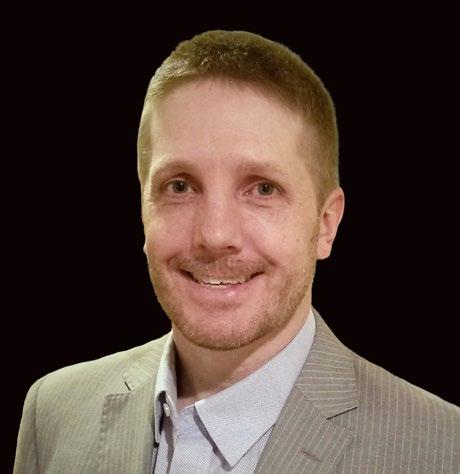
Hello everyone! I hope you are all doing well. The past few weeks seem to be a throwback to a couple of years ago when fuel went crazy high, and rates did not follow. It is frustrating to see what’s happening with oil due to fear more than an actual crisis, in my opinion. I think speculators are taking advantage of the situation in Iran, and the trucking industry is paying for it dearly. Fuel prices skyrocketing by a dollar in less than a week is a tough burden to bear. The spot rates don’t really have time to adjust, and still really haven’t even after a couple of weeks.
Those fortunate enough to have customers who allow for fuel surcharges help, but even that lags behind a week or so, making it difficult to pay for the higher fuel prices. This industry isn’t for the weak-hearted, that’s for sure. I pray you’re all able to keep grinding and stick it out, despite the many obstacles that we face in trucking.
Safe travels,
Justin Anders
Anders Trucking dispatch@anderstrucking.com
GCC Ready Mix
Tony Clobes
1301 23rd Street SE
Watertown, SD 57201
Phone: 605-902-3251
Email: aclobes@gcc.com
Website: www.gcc.com
US DOT #1451833
Cement / Aggregates
GMG EnviroSafe
Kaleigh Steeves
1341 W. Fullerton Ave., Ste. 307 Chicago, IL 60614
Phone: 208-871-5479
Email: ksteeves@gmgenvirosafe.com
Website: www.gmgenvirosafe.com
Compliance & Safety
JUSTIN LARSON (605) 224-1611
PIERRE, SD
KURT SWANSON (605) 224-1611
PIERRE, SD
JORDAN GAU (605) 996-4698
MITCHELL, SD NICK BACKLUND (605) 996-4698
MITCHELL, SD
TACHA ARTZ (605) 737-7865 RAPID CITY, SD GREG BALDWIN (605) 336-2795 SIOUX FALLS, SD
RUSS STOUGH (605) 336-4444 SIOUX FALLS, SD
Acrisure Truck Group consultants are experts in the coverage of all size trucks and farm equipment, so we know the risks and liabilities to make sure you are fully covered. We have four locations in South Dakota to serve you and your truck insurance needs—Pierre, Mitchell, Rapid City and Sioux Falls.
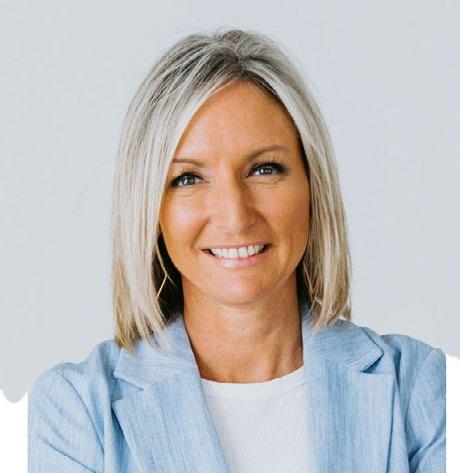
Christine Vinatieri-Erickson President christine@southdakotatrucking.com
Michelle Wells Member Manager michelle@southdakotatrucking.com
Patty Hinz
Office Manager/Graphic Designer patty@southdakotatrucking.com
Scott Johnson Controller accounting@southdakotatrucking.com
Address: 3801 S. Kiwanis Avenue Sioux Falls, SD 57105
Office: (605) 334-8871
Email: info@southdakotatrucking.com Website: southdakotatrucking.com
The 2026 South Dakota Legislative Session has officially concluded, bringing with it several developments that will directly impact the trucking and motor carrier industry across our state.
This year’s 101st Legislative Session saw more than 500 bills and resolutions introduced. Throughout the session, the South Dakota Trucking Association (SDTA) closely monitored legislation related to commercial driver licensing, motor carrier safety regulations, and broader transportation policy to ensure the voice of our industry was represented.
Two key pieces of legislation—Senate Bill 164 and Senate Bill 10—were of particular importance to our members. Both bills ultimately passed the Legislature and were signed into law.
Senate Bill 10 updates South Dakota law to align with the latest federal motor carrier safety regulations.
Specifically, the bill:
• Updates the state’s adoption of Title 49 of the Code of Federal Regulations to the 2026 federal standards
• Applies these regulations consistently to both interstate and intrastate carriers, with certain exemptions
• Requires both interstate and intrastate CDL holders to obtain and maintain a medical card—a significant change that will impact many South Dakota businesses
• Maintains exemptions for intrastate vehicles under 26,000 pounds GVWR not transporting hazardous materials or passengers



While this update aligns South Dakota with current Federal Motor Carrier Safety Administration (FMCSA) standards, it also introduces new challenges—particularly for small carriers.
The SDTA opposed this legislation in the Senate due to concerns about its impact on small trucking businesses. However, the state had been out of compliance with federal adoption requirements for approximately five years. Federal officials indicated that failure to comply could result in the loss of roughly $1.5 million in federal highway funding.
This placed lawmakers in a difficult position, balancing industry concerns with the need to protect critical federal funding.

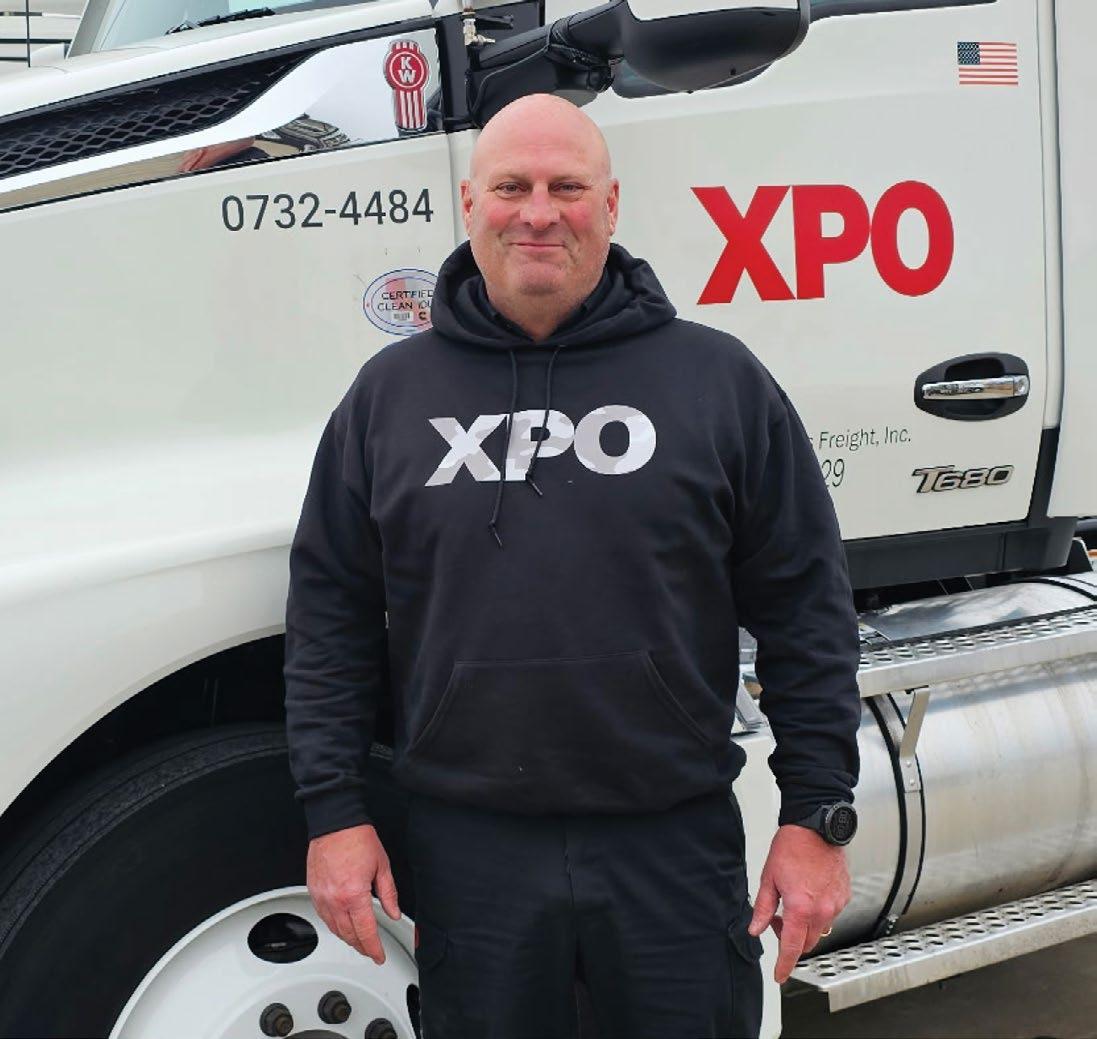
Patrick Schneider, XPO, Sioux Falls, SD, was selected as the March 2026 Driver of the Month by the South Dakota Safety Management Council.
Patrick brings more than 34½ years of professional driving experience, with an impressive safety record of over 950,000 miles and just one accident. He has been a dedicated leader and driver trainer during his 15 years at XPO, mentoring and supporting countless new hires throughout his tenure.
He has proudly participated in the South Dakota Special Olympics Convoy and competed in both the 2024 and 2025 South Dakota Truck Driving Championships. In 2024, he earned 2nd place in the 4-axle division, followed by an outstanding 1st place finish in 2025—highlighting his exceptional skill and dedication to excellence on the road.
Patrick and his wife, Alison, reside in Sioux Falls. He is a proud father to a son and daughter, and a devoted stepfather to three stepdaughters.
The South Dakota Trucking Association joins the Safety Management Council in congratulating Craig Nolan on being selected as the March 2026 Driver of the Month.

A nomination form & rules can be found online at www.southdakotatrucking.com under the Resource s
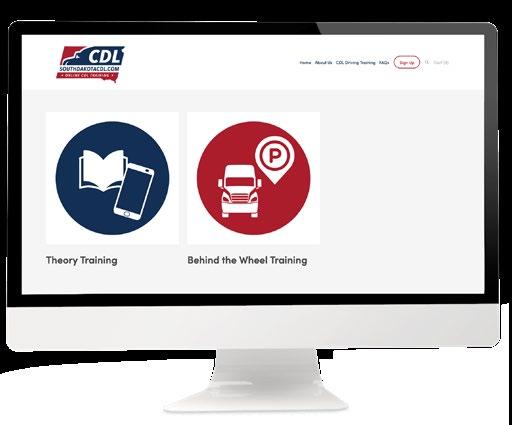

We offer high-quality, low-cost CDL training options in the South Dakota region that are available online from any device. Our curriculum is fully compliant with the current FMCSA ELDT Training standards, and we are a member in good standing of the Training Provider Registry as a Theory provider.
To learn about our fully-online, FMCSA-compliant CDL Theory program and how you can join our trainee to employee pipeline, call the SDTA office at 605-334-8871 or go to www.southdakotatrucking.com
MARCH 24-26, 2026
Call On Washington Washington, DC
MAY 7, 2026
SDTA Spring/Summer Executive Committee Meeting
10:00 a.m.
AmericInn Chamberlain, SD
MAY 7, 2026
SDTA Spring/Summer Board of Directors Meeting
1:00 p.m.
AmericInn Chamberlain, SD
MAY 7, 2026
Social Hour, Dinner and Calcutta for the Annual Cliff Tjaden Fishing Event
6:00 p.m.
AmericInn Chamberlain, SD
MAY 8, 2026
Annual Cliff Tjaden Fishing Event
7:30 a.m. - 3:30 p.m.
Cedar Shore Marina Oacoma, SD
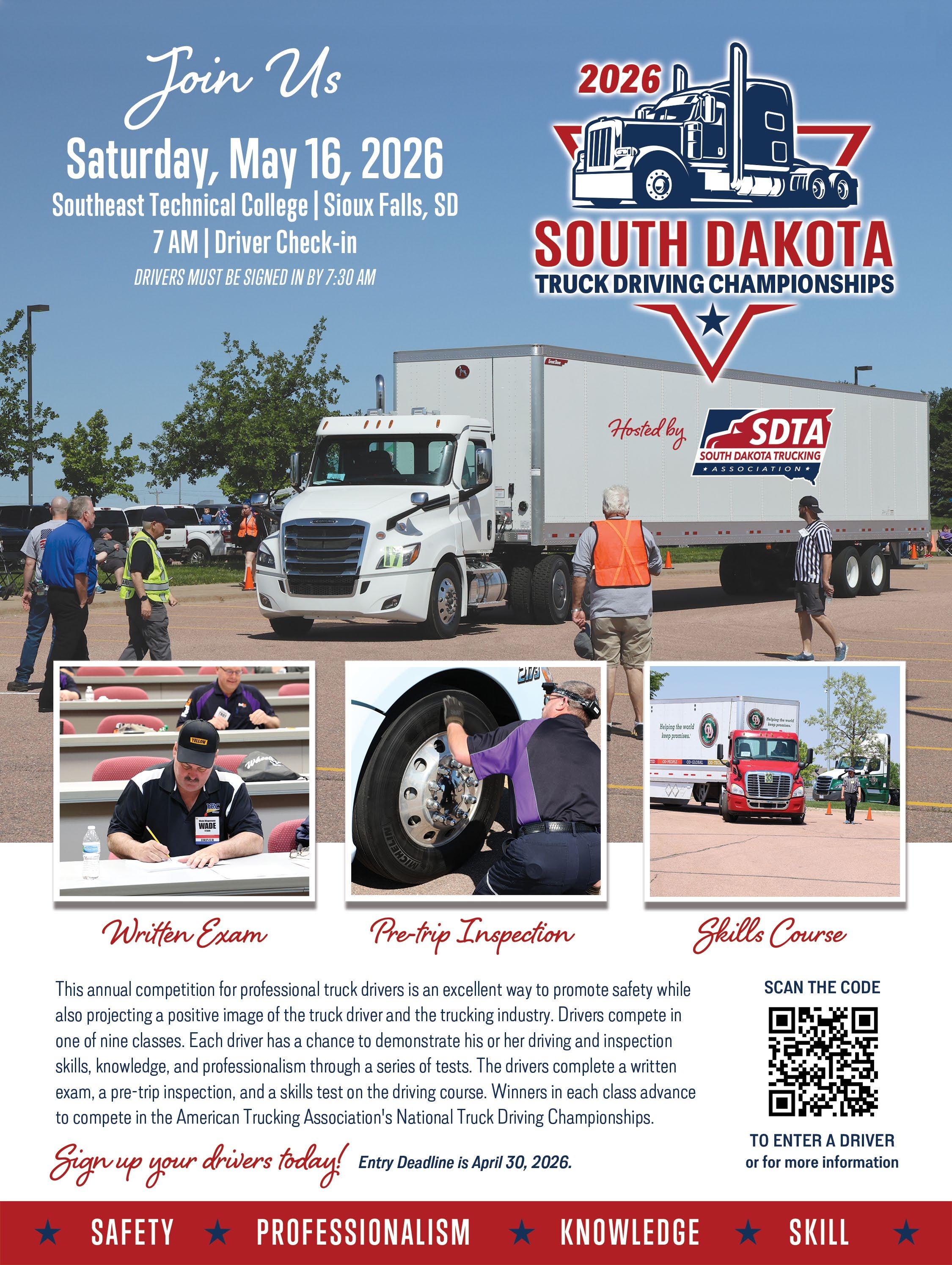
MAY 16, 2026
SD Truck Driving Championships
7:00 a.m.
Southeast Technical College Sioux Falls, SD
JUNE 4-7, 2026
Wheel Jam Truck Show
State Fairgrounds Huron, SD
JULY 9, 2026
SDTA East River Golf Event
9:00 a.m.
Brandon Golf Course Brandon, SD
AUGUST 11-15, 2026
National Truck Driving Championships
David L. Lawrence Convention Center Pittsburgh, PA
SEPTEMBER 1-3, 2026
SDTA 91st Annual Convention
Deadwood Mountain Grand Hotel & Casino
Deadwood, SD
SEPTEMBER 13-19, 2026
National Truck Driver
Appreciation Week
NOVEMBER 12, 2026
SDTA & SDADA Annual Pheasant Hunt
8:00 a.m.
Meet at Hutch’s Cafe Presho, SD
NOVEMBER 13, 2026
SDTA Fall Executive Committee Meeting
8:00 a.m.
AmericInn
Fort Pierre, SD
NOVEMBER 13, 2026
SDTA Fall Board of Directors Meeting 10:00 a.m.
AmericInn
Fort Pierre, SD


Letterhead
Envelopes
Brochures
Postcards
Forms
Notepads Carbonless
Banners
Mark Schremmer | Senior Editor | Land Line
Have you received inquiries from individuals seeking to purchase your USDOT or MC numbers? If so, you should listen up.
FMCSA issued a bulletin on Friday, March 13, with the headline, “DO NOT Sell, Purchase, or Lease a USDOT Number or Operating Authority (MC Number) online or elsewhere from an unknown person or outside of a legitimate corporate transaction.”
In the bulletin, FMCSA noted that USDOT Numbers are like a driver’s license or identification card number and confirm the identity of a motor carrier, broker, freight forwarder or other entity.
“The USDOT Number belongs to the same legal person forever and may not be sold, transferred, rented or leased,” the agency wrote in the bulletin. “FMCSA will inactivate USDOT Numbers upon discovery that the number is being used by anyone other than the assigned legal person.”
Additionally, FMCSA said that if it discovers attempts to sell, purchase or lease a USDOT Number or MC Number outside
Continued From Page 5.
SB 10 passed both chambers and was signed into law in February 2026.
Senate Bill 164 establishes a requirement that all Commercial Driver License (CDL) holders in South Dakota demonstrate English language proficiency.
Under this new law, drivers must be able to read and communicate in English to safely interact with law enforcement, understand traffic control devices, and follow safety procedures.
Key provisions include:
• CDL holders must meet English proficiency standards consistent with federal regulations
• CDL knowledge and skills tests must be administered in English
• Law enforcement may assess a driver’s language ability during traffic stops or crash investigations
• Drivers who do not meet the requirement may face citations, out-of-service orders, and escalating penalties for repeat violations
of a legitimate corporate transaction, the agency will initiate proceedings to inactivate the number and revoke all related registrations.
The FMCSA bulletin also explains the differences between a sole proprietor and a corporation regarding USDOT and MC numbers.
Brittany Murphy, an agent in the Owner-Operator Independent Drivers Association’s Permits and Licensing Department, said the issue has led to problems for some OOIDA members.
Murphy provided an example of an OOIDA member selling his operating authority. A few years later, the carrier operating under his number was involved in a crash. Because the transaction was not transferred properly, the OOIDA member was being held responsible.
Murphy said that if you sold your operating authority, it would be a good idea to follow up to ensure the transfer was done properly. Those with questions can call OOIDA’s Permits and Licensing Department at 816-229-5791. LL
Reprinted from Land Line
This legislation received strong support in both chambers and was signed into law by the Governor in March 2026.
For our industry, SB 164 reinforces existing federal expectations and promotes roadway safety by ensuring drivers can effectively read signage, communicate with officials, and understand regulatory requirements.
As these new laws take effect, the SDTA will continue working with state officials and industry partners to provide guidance, support compliance efforts, and advocate for policies that strengthen South Dakota’s trucking industry.
We appreciate the engagement of our members throughout the legislative session and remain committed to representing your interests at the Capitol.
Onward,

Christine Vinatieri-Erickson christine@southdakotatrucking.com
Noël Fletcher | Staff Reporter | Transport Topics
A Jamaican immigrant from New York is facing federal charges for his alleged role in a cargo theft ring that hacked truckload carriers’ email accounts to fraudulently book and retrieve shipments to sell.
Romoy Forbes, 31, living in Deer Park, N.Y., is being prosecuted in U.S. District Court in Massachusetts after being charged with interstate transportation of stolen goods and conspiracy to commit that offense.
A conviction for interstate transportation of stolen goods carries a sentence up to 10 years imprisonment, three years of supervised release and a $250,000 maximum fine. The conspiracy charge can result in no more than five years in prison, three years of supervised release and a $250,000 fine.
In announcing the case against Forbes, the U.S. Attorney’s Office in the District of Massachusetts released a series of photos showing Forbes allegedly transporting cargo booked via hacked legitimate emails from shippers and crooks pretending to represent the shippers.
Federal prosecutors described crimes involving stealing high-value cargo using infiltrated emails from three real truckload carriers.
Stolen goods included 33,750 pounds of frozen snow crabs (worth $325,000) taken July 15 from a warehouse in Worcester, Mass.
Before the theft, a co-conspirator allegedly hacked into the email “of a trucking carrier company (Carrier 1). The co-conspirator, pretending to work for Carrier 1, and using the email account of Carrier 1, allegedly contacted and contracted with Shipper 1, a transportation business, to ship the goods to a customer in Jacksonville, Fla.
Forbes then allegedly arrived at the warehouse in Worcester pretending to work for Carrier 1, loaded the seafood into his truck and drove off,” according to the U.S. Attorney’s Office.
Instead of proceeding to the customer in Florida, Forbes allegedly transported the seafood to a grocery store in Queens, N.Y., “where Forbes allegedly took a picture of the pallets of packaged crabs with his cellphone.”
Forbes is accused of stealing a blueberry shipment a month earlier in New Jersey after an unnamed co-conspirator allegedly hacked into an email from a trucking carrier and contracted with a shipper to take the fruit to Illinois after mimicking the carrier company.

(ftwitty/Getty Images)
The defendant then allegedly arrived at the warehouse, pretended to work for Carrier 2, loaded the fruit in his truck and drove away.
“Instead of delivering the blueberries to the customer in Illinois, Forbes allegedly arranged to illicitly sell the fruit to his phone contact named, ‘My customer for everything,’ ” the U.S. Attorney’s Office stated. The defendant also is accused of partaking in a similar crime in New York to steal $433,830 worth of cologne that was supposed to be delivered to a customer in Los Angeles.
Forbes then allegedly arrived at the warehouse holding the goods and purportedly as a driver for Carrier 3, loaded the cargo into his truck and left.
“Instead of delivering the fragrances to the customer in California, Forbes allegedly contacted his “customer for everything,” offering to sell the cologne and sent the contact a video of the cologne, to which the contact replied, ‘OK,’ ” the U.S. Attorney’s Office added.
The FBI participated in the investigation as part of Operation Take Back America, a nationwide initiative in which the U.S. Department of Justice targets illegal immigration along with eliminating cartels and transnational criminal organizations.
Before his arrest in New York, Forbes reportedly was observed by FBI agents living out of his tractor-trailer, according to court documents.
Reprinted from Transport Topics.
Eugene Mulero | Senior Reporter | Transport Topics
WASHINGTON — Deputy Transportation Secretary Steven Bradbury on March 17 outlined the Trump administration’s highway policy and funding goals as work begins on the next surface transportation bill.
Speaking at the U.S. Chamber of Commerce’s annual infrastructure forum, Bradbury said the Department of Transportation is laying out its reauthorization proposals while congressional leaders target committee action as early as April. The senior DOT official asked lawmakers to review processes for grant programs and streamline project delivery, among other proposals.
“We’re focused on consolidation of grant programs, simplification of programs, and giving more control over projects and money to state and local governments,” Bradbury told an audience of freight executives and infrastructure stakeholders.
A central priority, he said, is further accelerating environmental permitting for major projects. DOT is working with the White House to shorten and simplify National Environmental Policy Act reviews — a long-standing objective for the administration.
“This is a huge emphasis in the administration,” Bradbury said. “We’re doing everything we can within our authorities to streamline, simplify the NEPA process … and all the permitting requirements for projects to accelerate project delivery.”
Bradbury also described a wider regulatory and infrastructure agenda the administration intends to advance in President Donald Trump’s second term, including initiatives designed to improve safety across modes, update fuel-economy oversight and establish a long-term funding framework for major projects.
In trucking, DOT continues to focus enforcement on illegal foreign drivers, English-language proficiency violations and the motor carriers that employ such drivers — efforts DOT views as key to strengthening freight mobility. The department also is moving forward with a congressionally backed update of the air traffic control system.
Bradbury said DOT likewise is working to foster private-sector innovation. The agency is updating federal standards meant to eventually allow certain autonomous vehicles without conventional equipment to operate in the marketplace. DOT recently hosted a national forum on AV driving technologies.
On Capitol Hill, House Transportation and Infrastructure Committee Chairman Sam Graves (R-Mo.) aims to advance a bi-
partisan bill by April. It is unclear whether the Republican-led chamber will consider the legislation around Memorial Day. Senate transportation leaders expect to advance their version before the current law expires Sept. 30.
The existing highway law — enacted in 2021 as part of the $1.2 trillion Infrastructure Investment and Jobs Act — faces looming revenue strains. The Highway Trust Fund, supported primarily by stagnant federal fuel-tax rates, is projected to fall short within two years. Congress last raised gas and diesel taxes in 1993.
The chamber framed its forum on March 17 as an opportunity for industry and government officials to emphasize the need for a sustainable, long-term funding strategy.
According to the chamber, the next surface transportation bill should “enhance safety, efficiency and reliability, sustain necessary funding levels, modernize the permitting process and fix the Highway Trust Fund.”
Reprinted from Transport Topics.

Regardless of your job, running in the door to make it to your kids’ activities has happened to many of us, including Randy Knecht.
The recently retired Journey Group CEO joined Common Cents on the Prairie™️, a podcast based out of South Dakota, to reflect on branding a business, putting family first, leading with stewardship, and knowing when to step down.
Scan the QR code to listen on the road, or find the episode on Apple Podcasts.

For more information, contact: Jennifer Svarstad (605) 725-8352 | Jennifer.Svarstad@ agtegra.com
FAULKTON, S.D. (March 11, 2026) –Agtegra Cooperative (Agtegra) announced today that it plans to construct a new, state-of-the-art feed mill in Faulkton, South Dakota. The 100,000-ton facility will prioritize biosecurity and produce complete grind-mix bulk feed, primarily for swine and poultry farms in South Dakota.
“Our farmer-owned cooperative has a long history of supporting livestock producers, and we believe strongly in the future of livestock production in our region,” Agtegra CEO Jason Klootwyk said. “We are investing in modern infrastructure that will provide producers with a high-quality, biosecure feed supply while creating economic opportunities for our members and the community.”
The mill will be located adjacent to Agtegra’s grain elevator east of Faulkton, where it will grind locally-sourced corn and blend it with soybean meal, vitamins and miner-
als to produce complete feed rations. By using more corn locally, it will create a consistent, value-added domestic market for area farmers with reduced transportation needs and a more efficient and sustainable cycle – from the crop to feed to livestock and back to the field.
The project reinforces Agtegra’s long-term commitment to the Faulkton community and is expected to add a dozen local jobs. With a reliable, local feed supply and the growing interest from livestock producers in the region, this new feed mill will create more opportunities for local farmers to grow swine or poultry production or diversify their existing operation.
Agtegra has partnered with the South Dakota Governor’s Office of Economic Development on this project. Earlier today, the Board of Economic Development approved this project for a reinvestment payment to support continued livestock development in the state.
“This investment strengthens South Dakota’s livestock industry while creating a new value-added market for local produc-

ers,” said Bill Even, commissioner of the Governor’s Office of Economic Development. “Projects like this help keep more of our agricultural products working here at home, supporting farmers, producers, and rural communities.”
Construction is starting soon, with the facility anticipated to be operational in 2027, marking an important milestone in Agtegra’s continued investment in livestock, its member-owners and the Faulkton community. Plans are underway for a groundbreaking ceremony, with details to be shared soon.

News Staff
On Tuesday, members of the American Trucking Associations’ Law Enforcement Advisory Board wrote to leaders of the House as well as the chairman and ranking member of the Senate Judiciary Committee to urge them to pass legislation to address the continuing increase of cargo theft.
LEAB is composed of current or former public safety officials who work ro improve the relationship between trucking and law enforcement. The group strongly supports the Combating Organized Retail Crime Act because it would help law enforcement solve crimes that target the supply chain.
“Cargo theft is not merely a property crime — it is a growing public safety threat that endangers drivers, law enforcement personnel, and the traveling public,” the leaders of LEAB wrote. “Those of us charged with protecting commercial motor vehicle operations see firsthand how organized theft groups target freight corridors, distribution hubs, and drivers. Federal coordination is indispensable to confronting this threat and ensuring the safety of our transportation system.”
The Combating Organized Retail Crime Act passed the House Judiciary Committee unanimously in January and is cosponsored by about half of both the House and Senate. The bill would strengthen law enforcement’s capabilities to dismantle organized theft groups by enhancing legal frameworks; improving enforcement capabilities; and fostering coordination among federal, state, and local agencies.
“Swift passage of this critical legislation will provide law enforcement with the federal partnership we urgently need to protect drivers, safeguard freight corridors, and secure the nation’s supply chains,” the leaders of LEAB concluded.
Cargo theft is becoming increasingly prevalent and hightech, and it often originates overseas. The American Transportation Research Institute calculated that cargo theft is costing the trucking industry over $18 million per day. Reprinted from Truckers News.

Eugene Mulero | Senior Reporter | Transport Topics
House Republicans advanced legislation to toughen English-language requirements for commercial driver license holders, accelerating a priority highlighted by President Donald Trump during his State of the Union address.
On March 18, the House Transportation and Infrastructure Committee approved Dalilah’s Law, a bill that would tighten enforcement of federal CDL standards by requiring states to further verify both applicant eligibility and English proficiency. GOP lawmakers say the measure responds to safety concerns raised publicly by Trump and echoed by Republican committee members.
Committee Chairman Sam Graves (R-Mo.) said the legislation aims to ensure only qualified drivers secure CDLs and that states apply federal rules consistently. “This is common-sense legislation that requires all truck drivers on our roads to be able to read and speak English, strengthens laws related to issuing CDLs and ensures that states are following and enforcing those laws and requirements,” he said.
Lead sponsor Rep. David Rouzer (R-N.C.), a senior member of the panel, said the bill targets preventable crashes tied to drivers who should not be operating. Ensuring every driver is “qualified and legally operating will protect the public from these tragic, yet preventable accidents,” he said.
Democrats on the committee largely opposed the measure, questioning its scope, implementation and potential impacts on state licensing agencies.
Dalilah’s Law would require CDL holders to demonstrate the ability to understand English, roadway signage and instructions from law enforcement officers. Drivers who fail to meet those standards would be placed out of service.
The bill also would require states to confirm they are not issuing CDLs to individuals ineligible under federal law. Additional provisions would increase federal penalties, target freight fraud and cargo theft and crack down on fraudulent “CDL mills.”
Republican leaders indicated they intend to bring the bill to the House floor. The Trump administration also endorsed the proposal.
Transportation Secretary Sean Duffy said the measure reflects the administration’s focus on road safety and licensing integrity. “Rep. Rouzer’s bill, Dalilah’s Law, codifies a simple premise: no English, no license,” he said.
Sen. Jim Banks (R-Ind.) introduced a similar version of the bill shortly after Trump’s annual address to Congress.
American Trucking Associations supports the legislation. ATA President Chris Spear said the measure would strengthen oversight by holding states accountable for CDL issuance and improving consistency in testing and qualification requirements across jurisdictions.
“Strengthening the integrity of the commercial driver’s license system is essential to restoring accountability, removing bad actors from the road and protecting the overwhelming majority of professional truck drivers who follow the rules and uphold high standards,” Spear said in a statement ahead of the committee vote.
The bill is named for Dalilah Coleman, who was 5 years old when she suffered serious injuries from a multi-vehicle pileup caused by a tractor-trailer driven by a man federal officials said was in the country unlawfully. She was among the guests invited to Trump’s State of the Union this year.
During the Feb. 24 address, Trump urged Congress to bar individuals lacking legal status from obtaining CDLs: “Many, if not most, illegal aliens do not speak English and cannot read even the most basic road signs as to direction, speed, danger or location.”
Reprinted from Transport Topics.





Cummins experts go above and beyond to ensure you’re moving forward. With over 3200 certified technicians and 24/7 emergency field support through locations all across North America, you can count on Cummins to keep you moving in a world that’s Always On.
Go to cummins.com to request service or to find a Cummins service center near you.
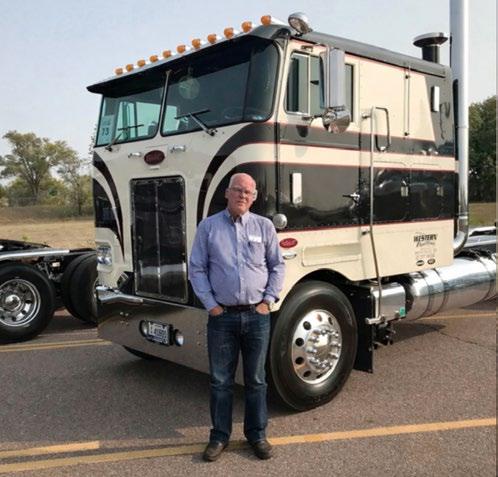
July 12, 1948 - February 27, 2026
Larry De Groot was born on July 12, 1948, in Grand Rapids, MI, to John and Sally (Woudstra) De Groot. He was raised in Edgerton, MN, where he was a rambunctious boy who loved playing catch with his dad (as a good Christian Reformed kid, a bat was not allowed on Sundays), running around town with his friends, catching pigeons in barns to later sell for a nickel apiece, teasing his sister, and developing his lifelong love of reading. He attended Edgerton Christian and Southwest Christian schools, where he had the unique experience of being the principal’s kid.
After high school, his family moved to Sioux Center, IA, where Larry attended Dordt College and majored in education. When he wasn’t studying, Larry drove a feed truck—delivering feed most afternoons and every Saturday to area farmers. During his time at Dordt, Larry met the love of his life, Helen Slegers. After she asked to borrow his car to go to the movies, Larry decided it would be better if he drove—so he took her on a date instead. Larry and Helen were married on August 22, 1969. After graduating from Dordt, they made their home in Hull, IA.
Larry began his teaching career at Western Christian High School, teaching English and serving as guidance counselor. He later taught for a year at Ontario Christian High School in Ontario, California. After realizing he didn’t enjoy painting or golfing all summer, Larry decided teaching wasn’t his life’s calling and ended his time in the classroom.
He went on to sell steel buildings for Altena Steel in Sioux Falls, SD— many of which still stand today. He ultimately returned to his first love, trucking, at Te Slaa Trucking in Hull. After several years of long-haul driving, Larry sold trucks for Peterbilt in Sioux Falls for a year before moving to the office at Te Slaa in 1990, becoming a dispatcher and helping grow Te Slaa until he purchased his own company, Western Provisions, in 2004.
Larry loved his work in the trucking community, but what he cherished most was sitting next to his two sons, Jon and Jason, every day at Western. A few summers even found his daughter in the office making copies
and answering phones. He truly made it a family affair. Larry had a huge heart for his drivers, salespeople, bankers, and everyone he encountered. He treasured the community, the stories, and the connections—and he always made time for conversation. When Larry was around, you felt it. His energy was unforgettable.
For over 40 years, Larry spent every summer in Okoboji, a place he dearly loved. He enjoyed time on the water, long days with friends, and countless hours surrounded by his wife, children, grandchildren, and anyone else who crossed his path at the lake. He was a presence—warm, loud, joyful, and fully alive. Larry also cherished many trips to Cabo San Lucas with Helen, his children, and later his grandchildren.
Larry was a devoted husband, father, and grandfather. He was an active member of First CRC in Hull, IA, and, after moving to Sioux Falls, found community again at First CRC in Sioux Falls. His deep faith guided him throughout his life and comforted him until his very last day. He passed that faith on to his children and shared it freely with all who knew him.
Larry is reunited in Heaven with his wife, Helen J. De Groot; his parents, John L. and Sally De Groot; his parents in-law, Hubert and Martha Slegers; his infant son, Michael James De Groot; brothers-in-law George Slegers and Gerard Slegers; and sister-in-law Rita Buys.
He is cherished on earth by his son Jonathan De Groot and his wife, Misty, of Sioux Falls, South Dakota, and their children, Max Kaarre (fiancé Sidney Schock), Izzy Kaarre, and Lyncoln De Groot; son Jason De Groot and his wife, Abby, of Rock Valley, Iowa, and their children, Harper, Reese, and Jase De Groot; daughter Joni Nikodym and her husband, Adam, of Sioux Falls, South Dakota, and their children, Henry, Helen, and Harvey Nikodym; sister Helen (Gervin) Bonnema; siblings-in-law, Joan (Dave) De Groot, Thelma (Ron) Coles, Gwenny Slegers, Richard Slegers, Doug (Sandy) Buys, John (Sheryl) Slegers, and Barb (Dan) Ter Horst; and many beloved nephews and nieces.

Keith Goble | State Legislative Editor | Land Line States are stepping up enforcement of federal trucking regulations – and cracking down on men and women behind the wheel.
Lawmakers are zeroing in on English-language proficiency and drivers holding non-domiciled CDLs.
This past fall, federal officials called non-domiciled CDLs a “national emergency” and a “threat to public safety.”
After pressure from the Owner-Operator Independent Drivers Association, the U.S. Department of Transportation tightened the rules and cut back who can get one.
Now, more states are moving fast to follow suit.
Alabama just made federal trucking rules state law. The rules come with sharp penalties.
Gov. Kay Ivey signed a bill requiring foreign truck drivers to prove they entered the U.S. legally. They must also have valid work authorization.
SB242 requires drivers to also meet federal English requirements.
Break the rules? It’ll cost you.
Drivers face $2,000 fines. Carriers pay $1,000. Get caught again, and the fines double.
“Alabama’s economy is booming, and our hardworking truckers play a vital role in keeping goods moving across our state and across the country,” Ivey said.
She added that road users deserve to know that the rules are being enforced.
The Alabama Trucking Association said the new law is an important part of the state framework. They say it aligns with federal law and raises penalties for lawbreakers.
“This legislation is a crucial step forward in enhancing safety on Alabama’s highways by ridding the industry of illegal operators and bad actors,” ATA posted on social media.
South Dakota is tightening the gate on non-domiciled CDL permits.
Gov. Larry Rhoden signed a bill that restricts permits to truck drivers with valid job-based visas. Examples include H-2A, H-2B, and E-2 visas, as well as similar statuses in U.S. territories.
SB180 requires applicants to show passports and immigration papers and appear in person for renewals.
Their licenses will be clearly labeled “nondomiciled.” Drivers must give up any similar licenses from other states.
The governor said the new rules are “commonsense steps to improve public safety by guaranteeing that truckers read our road signs and making sure that only citizens and legal immigrants hold CDLs.”
Indiana rolled out one of the toughest crackdowns yet.
The state can revoke non-domiciled CDLs if a truck driver loses legal status to stay in the U.S.
Officials must also check with federal agencies to flag licenses that should be pulled.
All non-domiciled CDLs issued in Indiana before March 1, 2026, will expire next month. An exception is made for drivers with approved work visas.
Using fake documents or an invalid foreign CDL? That’s a felony.
Drivers can be fined $5,000. Employers face $50,000 fines.
Businesses that knowingly train ineligible drivers face the same steep penalty.
HB1200 also requires CDL testing to be done entirely in English.
Truck drivers must also demonstrate proficiency in reading road signs. Requirements are also in place to answer officials’ questions and to fill out logbooks in English.
Rep. Jim Pressel, R-Rolling Prairie, stated that the rule is straightforward.
“You will be able to speak the language. You will be able to read the signs, and you will have to take the test that way,” Pressel said.
The rule changes follow two fatal crashes last month in Indiana. Both incidents involved trucks driven by illegal immigrants.
“As the crossroads of America, Indiana must do all we can to ensure our roads are safe,” said Gov. Mike Braun. LL Reprinted from Land Line.
Connor D. Wolf | Staff Reporter | Transport Topics
The Iran conflict has caused major disruptions to global supply chains that experts warn could ripple down to domestic trucking.
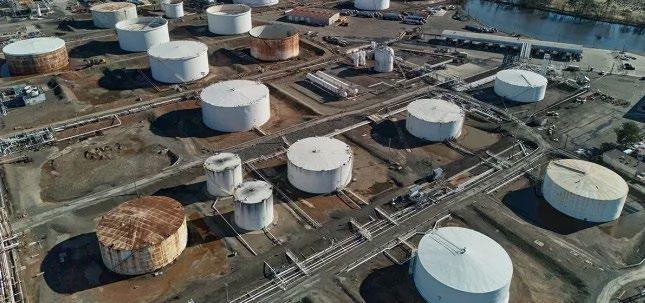
The U.S. and Israel launched attacks against the country leading to a military escalation across the region, disrupting major international trade corridors and the movement of critical shipments including those tied to the energy and petrochemical industries.
“Because of the Strait of Hormuz, the way the geography is in that part of the region, it’s very easy to control or constrain shipping,” said Pawan Joshi, chief strategy officer at E2open. “That’s really what has happened during the hostilities in that area.”
Joshi has seen ships that weren’t yet stuck in the strait begin to reroute. He noted that shipments traversing the region are primarily petrochemical-based products such as fertilizer ingredients, with the dominant effect being higher fuel costs globally.
“Given the hostilities in that area, a lot of the commercial airlines are actually avoiding that space, and they’re taking longer routes,” Joshi said. “Also, a lot of the airports in that region are not operating at capacity, so it’s not only the longer flights but also the overall air capacity.”
Joshi expects the decline in air capacity to show up as freight costs and a drop in cargo coming out of the region. But he also noted that the domino effect of the global disruptions could surface across other parts of the world, including the cost of trucking across North America.
“In terms of capacity, we’re probably not seeing a massive impact because our trucks and our regional lanes of transportation over the land tend to be unaffected,” Joshi said. “What does get affected is the price for securing the same capacity, because the fuel price is going up.”
Joshi also noted that demand has been fairly stable given the products that flow from the region and available inventories,
but he cautioned that demand could slow if the situation continues.
“The biggest thing, obviously …is oil prices,” said Tony Pelli, director of supply chain security and resilience at BSI Consulting. He also noted the fuel price spike is pressuring air cargo rates because of the Middle East being a major hub, with Dubai in particular serving as an eastwest transit lane.
Pelli, too, is concerned about the downstream impacts if the Strait of Hormuz remains blocked. He warned that the disruptions to petroleum-based products, production feedstock and energy-intensive manufacturing could further destabilize global supply chains.
“As far as the U.S. trucking industry, I think, the biggest impact will just be oil prices,” Pelli said. “That’ll increase the price of trucking, and you may see frustration from individual trucking companies, carriers, that kind of thing, around the cost of gas and diesel.”
TD Cowen suspects that shippers are likely to bear the brunt of these market disruptions due to surcharges, fees and delays. But the investment bank and financial services company also views less-than-truckload carriers as better positioned, since fuel surcharges can become revenue generator for that mode during periods of diesel price volatility.
“Things are developing pretty quickly, especially just a week ago,” Dirk
Stammnitz, a consultant at business consulting firm Catalant, said of the Strait of Hormuz. “That certainly has had some serious, some substantial, impacts on the flows of ships in and out of the region.”
Stammnitz has seen companies respond by shifting to larger container fleets or by rerouting, though alternative routes can add weeks and possibly surcharges to a shipment. He even has seen some insurance companies pull coverage from the region.
While oil remains the main focus, Stammnitz noted petrochemicals, plastics and other industries are also affected from a raw materials standpoint.
Regional shipments impacted are not all moving through Iran, according to Stammnitz. The greater conflict has involved missile strikes into neighboring countries that produce and transport shipments such as rare earth minerals that are critical for technology and batteries. He also anticipates that the resulting global disruptions could impact U.S. trucking.
“Since it leads with the fuel story, as I said, and energy markets first, it’s initially less about the physical flows,” Stammnitz said. “If we start to get into one month, two months, and beyond, now it starts to impact shippers — and they’re going to start delaying orders, of course, because they don’t want to pay the increases.”
Reprinted from Transport Topics.












Outdated and unrealistic safety training slows operations and increases liability. Built by former CDL drivers, safety and operations leaders, and state troopers, Changing Lanes Academy (CLA) delivers modern, mobile-friendly training that works for drivers and support teams without disrupting daily operations.
Why CLA works for every role:
Drivers Realistic, engaging training they can complete anywhere
Safety Teams Real-time tracking and documented compliance
Operations Efficient training with no wasted time
Owners Reduced risk and potential insurance savings
The best part? Drivers who complete CLA and have an approved front-facing camera may qualify for a 5% insurance discount through Aladdin’s trucking insurance partner.

Mark Schremmer | Senior Editor | Land Line When it comes to diesel exhaust fluid requirements, many truckers are being left out in the cold, Sen. Dan Sullivan, R-Alaska, said during a Senate hearing on Wednesday, March 11.
“These are the men and women who keep our country moving,” Sullivan said. “They haul fuel and food and the supplies that keep communities running … And what they’re telling us is simple. The rules coming out of Washington don’t reflect the reality they face on the ground.”
In November 2025, Sullivan introduced the Cold Weather Diesel Reliability Act, which would direct the Environmental Protection Agency to update its regulations to account for how trucks operate in cold-weather states. S3135 would provide year-round exemptions from DEF system requirements for vehicles and equipment that operate primarily in cold climates, such as Alaska and Wyoming.
• DOT Physicals
• DOT and Non-DOT Drug Screening and Alcohol Testing
• MRO Services
• Injury Care (billed at South Dakota Work Comp Fee Schedule)
• Third Party Administration
• Employee Assistance Plan
• Additional Occupational Health Services
• Efficient, Friendly, Professional Services
co-sponsored S3135 with Sullivan. “The people of Wyoming should not have to choose between breaking the law or losing their lives.”
Opponents of the Cold Weather Diesel Reliability Act were also represented at Wednesday’s hearing.
Sen. Sheldon Whitehouse, D-R.I., said the bill targets a problem that the EPA has already addressed.
“The potential for diesel emission control systems to fail at very low temperatures (below 12 degrees Fahrenheit) from a cold start is a known issue that has already been successfully addressed by EPA in 2009 and again last year,” Whitehouse said. “In both cases, EPA directed engine manufacturers to allow the vehicle to drive on for some distance (now, up to 8,400 miles) before the engine derates in response to a sensor telling it the NOx control system is not functioning.” LL
SUBSTANCE ABUSE PROFESSIONALS
“My bill brings some common sense into the system,” Sullivan said as part of a Senate Environment & Public Works Committee hearing to examine S3135. “We have to listen to the people who have to deal with these everyday problems … We have to make sure that federal policy reflects the reality they face on the road.”
The Avera Employee Assistance Program (EAP) offers substance abuse evaluations for employees who test positive for drugs or alcohol, as regulated by the Department of Transportation (DOT). Under DOT regulations, safety-sensitive employees (i.e., truck drivers, pilots and airline workers, transit workers, pipeline workers, etc.) are subject to pre-employment, random, post-accident, and reasonable suspicion drug and alcohol tests. When there is a positive test result, the DOT-regulated employee must seek the service of a DOT-qualified Substance Abuse Professional (SAP). 605-322-4069
Ryan Anderson, commissioner of the Alaska DOT and Public Facilities, testified that his department estimates up to 80% of its diesel engine maintenance issues over the past two years have been related to emission control systems.
“Across Alaska, operators are reporting failures tied to diesel exhaust fluids and related emission control systems during sustained cold-weather operations,” Anderson said. “These systems can freeze, malfunction or trigger automatic engine derates. In most places, that might mean a quick trip to the repair shop, but in Alaska, when equipment loses power in extreme cold and remote areas, the consequences are far more dangerous. These situations are not hypothetical. They are happening today on Alaska’s highways where professional drivers are moving the fuel, food and industrial supplies that people in our state depend on.”
Sen. Cynthia Lummis, R-Wyo., and Wyoming Farm Bureau Federation President Todd Fornstrom delivered similar concerns about current DEF requirements in their state.
“Climate-alarmist bureaucrats in Washington do not understand that the consequences of their radical agenda are hurting real people in western communities,” said Lummis, who
Call 605-322-5100 to schedule an appointment.
DOT Physicals | DOT and Non-DOT Drug Screening and Alcohol Testing | MRO Services | Injury Care (billed at South Dakota Work Comp Fee Schedule) | Third Party Administration
Employee Assistant Plan | Additional Occupational Health Services | Efficient, Friendly, Professional Services 605-322-5100
The Avera Employee Assistance Program (EAP) offers substance abuse evaluations for employees who test positive for drugs or alcohol, as regulated by the Department of Transportation (DOT). Under DOT regulations, safety-sensitive employees (i.e., truck drivers, pilots and airline workers, transit workers, pipeline workers, etc.) are subject to pre-employment, random, post-accident, and reasonable suspicion drug and alcohol tests. When there is a positive test result, the DOTregulated employee must seek the service of a DOT-qualified Substance Abuse Professional (SAP). 605-322-4069



What’s Changing on July 1, 2026, for Medical Certificates in South Dakota?
• EA-Excepted Intrastate- Are the only drivers that are affected by this change.
• South Dakota will no longer exempt intrastate CDL holders from the requirements of 49 CFR 391.11(b)(4), Physical Qualifications.
• Your CDL will be automatically downgraded to a non-commercial license on July 1, 2026.
• You can still drive on that non-commercial license.
• But you won’t be allowed to operate commercial vehicles again until you receive a medical card.
Re-Certify as:
• NI- Non-excepted Interstate - (You will qualify for this if you or your cargo cross state lines or you do not meet qualifications in other categories.)
• Visit a certified medical examiner listed on the FMCSA’s National Registry.
• They’ll submit your medical certificate electronically to Driver Licensing within 2 business days.
• Then go to a driver exam station before July 1 to update your CDL and remove the “K” restriction and receive a new license.
EI-Excepted Interstate - (You may qualify only if all your commercial driving is under federal exemptions 49 CFR 390.3(f), 391.2, 391.68, or 398.3).
• You may still qualify for Excepted Interstate under the following conditions: Beekeepers, custom harvesters, government employees, and certain farm vehicle drivers and qualifying covered farm vehicles. (See the federal regulations for a full list of excepted categories.)
• Go to the driver exam station before July 1 to update your CDL and remove the “K” restriction and receive a new license.
NA-Non-Excepted Intrastate - (You may qualify only if all your commercial driving is under 32-12A-24 (in-state school bus driving) or if you are under the age of 21.)
• Visit a certified medical examiner listed on the FMCSA’s National Registry.
• They’ll submit your medical certificate electronically to Driver Licensing within 2 business days.
m You will need to submit a new self-certification form to Driver Licensing.
m Once Driver Licensing updates your self-certification form, your process is completed.
All CDL drivers must complete a medical self-certification statement.
• CDL drivers with a medical certificate must keep a current version on file with Driver Licensing.
• A new certificate must be received before the current one expires, generally every two years.
• Drivers will be notified 60 days prior to their current certificate’s expiration date that they must obtain a new certificate or self-certify that they are no longer subject to the federal physical requirements.
• If the South Dakota Driver Licensing Program does not have a current medical certificate for a CDL driver, their CDL will be downgraded to a non-commercial license.
Medical certificates must be issued by a medical professional registered with the National Registry of Certified Medical Examiners.
• Find a professional near you at https://nationalregistry.fmcsa.dot.gov/search-medical-examiners
• Information about medical examinations and exemptions for diabetes, vision, hearing, and seizures can be found on the FMCSA website: https://www.fmcsa.dot.gov/medical/driver-medical-requirements/medical-applications-and-forms
• Incomplete or illegible certificates will be returned and must be re-submitted
All CDL Medical Cards will be submitted electronically to the South Dakota Driver Licensing Program through the National Registry by a participating provider. Companies and drivers no longer need to send in their medical card/certificates.
If you need to verify that South Dakota has received your medical certificate, you may email us at dpsdl@state.sd.us or call (605) 773-6883 between 9AM-4PM Central Time Monday-Friday (closed on weekends and state holidays).
Reprinted from the South Dakota Department of Safety