

SARA RANKIN | SDML EXECUTIVE DIRECTOR
March always feels like a reset to me. The days stretch a little longer, the sun sticks around a little later, and we finally start trading heavy coats for lighter layers. And at the League, March also means one of my favorite seasons of the year: district meeting season.

If you haven’t registered yet, there’s still time. Head to the League website and click on “Calendar” for all the details. I truly hope to see you there.
Over the years, I’ve been reminded again and again that while the League provides advocacy, resources, and support, our real strength comes from you, our members. The SDML works because our cities and towns are willing to show up, share ideas, and tackle challenges together. That collaboration is what makes us effective, both locally and at the Capitol.
District meetings are more than just updates and agendas. They are opportunities to connect with peers who understand the realities of municipal service. Whether you’re navigating tight budgets, public safety concerns, infrastructure needs, or economic development pressures, chances are someone else in the room has faced something similar. A small town might benefit from a larger city’s experience launching a new initiative. A larger community might gain fresh perspective from rural innovation and resourcefulness. Those exchanges matter.
(LEFT) - Approximately 250 municipal officials, state legislators, and legislative staff attended the South Dakota Municipal League’s Rib Dinner Feb. 3 in Fort Pierre.
(RIGHT) - Brandon City Councilor and District 2 Legislator Dave Kull plays the bag pipes on the House floor Feb. 6.
And when members engage and share what’s happening in their communities, it strengthens our advocacy. A unified voice carries weight. The more connected and involved you are, the more effectively we can represent municipal interests at the state level. Your insight directly shapes our priorities and our message.
Local government can sometimes feel isolating— but it doesn’t have to be. Through the League, you have a built-in network of colleagues who are willing to offer advice, share best practices, and serve as sounding boards. Those relationships often turn into long-term partnerships that make the work easier and more rewarding.
When municipalities collaborate, great things happen. Communities can share resources, coordinate regionally, and develop creative solutions that save both time and money. That spirit of cooperation is what makes South Dakota’s municipal family so strong.
From district meetings to affiliate trainings, the Elected Officials Workshop, and our Annual Conference, there are countless ways to stay connected. Every opportunity to gather is a chance to strengthen our collective impact.
At the end of the day, the League is only as strong as its members. Your involvement truly does make the difference and I’m grateful for each of you. ■


PRESIDENT
Leland Treichel, President of the Board, Roscoe
1st VICE PRESIDENT
Michelle DeNeui, Finance Officer, Spearfish
2nd VICE PRESIDENT
Dawn Murphy, Finance Officer, Tea TRUSTEES
Rick Boschee, Mayor, Bowdle
Leah Braun, Chief of Staff, Rapid City
Paullyn Carey, Finance Director, Huron
Richard Thomason, Councilmember, Sioux Falls
Laurie Woodward, City Administrator/Finance Officer, Custer
PAST PRESIDENT
Carolynn Anderson, Finance Officer, Wall
Sara Rankin
Dist. 1 | Mike Grosek, Mayor, Webster
Dist. 2 | Jameson Berreth, City Administrator, Madison
Dist. 3 | Derick Wenck, Mayor, Harrisburg
Dist. 4 | Shauna Meyerink, Finance Officer, Platte
Dist. 5 | Kristi Honeywell, City Administrator, Pierre
Dist. 6 | Frank Schwartz, Mayor, Redfield
Dist. 7 | Gary Weismantel, Mayor, Herreid
Dist. 8 | Brittany Smith, City Administrator, Philip
Dist. 9 | Misty Summers-Walton, Finance Officer, Hot Springs
Dist. 10 | Gina Carpenter, Human Resources Officer, Belle Fourche
Executive Director
Lori Butler Deputy Director
Jessica Carr Director of Member Engagement
Emilie Miller Director of Marketing and Communications
Lisa Nold Director of Risk Sharing Services
Kristi Osterkamp Senior Accountant
Krista Kerns Member Accounts Manager Vacant Director of Municipal Electric Services
SD Public Assurance Alliance
Lynn Bren
Executive Director
Kristina Peterson Deputy Director
Becky Brunsing Member Services Representative
Hampton Iverson Member Services Representative
Paytra Nichols Underwriter
sdmunicipalleague.org | 1.800.658.3633 | Fax: 605.224.8655

Hard to believe the legislative session is almost over. It seems like this year has been flying by. I don’t know if it’s the nicer weather lately or if it’s true that the older you get the faster time moves, but the days definitely go by in a hurry. A shout out to Sara, Yvonne, Eric, Sam, Larry, and Drake for their lobbying abilities and keeping on top of the Capitol happenings. You can still sign up to for the Capitol Connection weekly email or join a weekly City Action Call. Visit www.sdmunicipalleague.org/Advocacy to take advantage of these and other advocacy resources.
A bigger shout out to all of you who have stepped up and come to Pierre to testify at committee hearings and voiced your concerns on certain bills which brought new perspective to legislators and made a difference in how they looked at those bills. You are the ones who really made a difference as to whether or not some of those bills even made it out of committee or if they changed just a bit. Your insight on how they affect our communities is appreciated.
The new election laws that were passed last year got cleaned up a little which should make it easier for finance officers and school business managers after this year. A thank you to those finance officers that asked for and suggested those changes.
With Spring coming, along with district meetings and State Bs, we can almost be assured that the moisture we desperately need will be coming. Spring is a time for renewal of everything—from our environment, to life, to sometimes our attitudes—all very necessary things. My wife and I should be back in Roscoe the night of March 14, so it can happen any time after that, but I would prefer when the moisture happens it is clear and not white and the temperatures stay well above 32. Yes, I shoot for the stars. Crutches don’t work well on ice and snow and while I really dislike using a walker now, I would revert back for safety purposes.
Get your registrations in for your district meetings. They are a good time to get together with others that we don’t see very often and just connect to see what’s happened during the session that affects us and what we all need to prepare for. Hope to see you soon!
YVONNE TAYLOR | SDML ADVOCACY TEAM
Early on this legislative session, we are already seeing multiple property tax measures — and more are surely coming.
If we are going to have a serious tax policy discussion in South Dakota, we need to start with a truthful premise. Many of the loudest voices disparaging our property tax system do not start with that honest base.
The truth is, South Dakotans are not overtaxed. According to the 2026 report by the Tax Foundation, South Dakota
is second most competitive in overall taxes, and eighth most competitive in property taxes.
We are 49th lowest in the United States in state taxes per capita, and 50th lowest in state taxes as a percent of personal income.
Similarly, our government budgets are not bloated or frivolous. As Gov. Larry Rhoden put it in his State of the State address, almost all funds are spent on public safety, helping people stay fed and healthy, and educating our kids.
Where do you want to cut?
We have the 10th lowest total state expenditures per capita in the entire U.S., and the lowest total state expenditures per capita among our neighboring states. Budget cuts in South Dakota cut meat, not fat.
Local budgets go to the programs the local people want — police and fire protection, streets, water, sewer, parks, and all types of quality-of-life facilities that keep our cities growing because people want to live, work, and raise

families in them. We need to keep that local control over local budgets in place. It is the most direct form of government for the citizens.
Just because the loud ones keep saying the same things does not make them true. A legislative property tax study committee traveled the state this summer, practically begging people to attend and give their take on the property tax system that exists now. If you consider there are around 690,000 adults in South Dakota, and one way or the other, they are almost all paying property taxes through either property ownership or rent, you have an idea of the number of people who have an interest in the property tax system. Now, let’s look at the number of people who attended and testified at the property tax meetings this summer.
The vast majority of people testifying at these meetings were not private citizens speaking to the committee — they represented a group or entity impacted by property tax changes. Of the purely private citizens speaking, there were a total of 20 people speaking on their own behalf. Four of those were “frequent flyers” who appeared at two or more of the four meetings. There were two night meetings, where a total of 12 people represented themselves, but we have no idea what they said because those meetings were not publicly recorded.
Of the 20 speaking on their own behalf, several seemed to have a pretty specific issue — one didn’t like exemptions for nonprofits; one thought schools should only pay for reading, writing and math, not arts or sports; one lost every level of appeal, including losing a Supreme Court case by a unanimous vote, but is still mad. Several people were only interested in tax increment financing districts.
Six of the 20 were there to advocate for the complete elimination of the property tax, with some of those advocating for a “transaction tax.” Two supported a corporate income tax.
One person complained about her tax assessments increasing by a large percentage — but public records show she failed to mention she was measuring the increase between when she had bare land, and when she had built a house and garage on it. Facts matter.
So, of the approximately 690,000 South Dakotans paying into the property tax system, only 20 appeared on their own behalf to discuss a wide variety of issues — and very few of those presented a fair representation of the typical taxpayer.
It is always good to have a statewide discussion on the merits of our tax system and ways to make it better — but an honest discussion has to start with honest facts. Let’s hope the legislature can start with the truth when beginning these discussions. ■
Yvonne Taylor is a former executive director of the South Dakota Municipal League with more than 35 years of advocacy experience around the state Legislature.

It is important to regularly review Fair Labor Standards and Child Labor regulations PRIOR to seasonal hiring. Often, we become complacent and continue to do things the way we have always done them. Reminders like this give us an opportunity to verify that we are adhering to the law. In this economy, none of us can afford to make mistakes that cost our communities back wages for overtime.
The Fair Labor Standards Act (FLSA) allows for specific exemptions from minimum wage and overtime including administrative, executive, and professional exemptions. For purposes of this article, we will assume that most employees hired for seasonal and temporary positions are non-exempt from minimum wage and overtime provisions. This means that these employees will be eligible to receive minimum wage at $11.85 per hour. Seasonal and temporary employees are eligible to receive 1.5 times the hourly wage for all hours worked over 40 in any given workweek as required by FLSA.
Section 13(a)(3) provides an exemption from the minimum wage and overtime provisions of the FLSA for "any employee employed by an establishment which is an amusement or recreational establishment, if (A) it does not operate for


more than seven months in any calendar year, or (B) during the preceding calendar year, its average receipts for any six months of such year were not more than 33-1/3 per centum of its average receipts for the other six months of such year."
It would seem apparent that a swimming pool or other facility that is open only for the summer months would qualify for this exemption from overtime and minimum wage provisions of the FLSA. But please note, if seasonal employees who qualify for this exemption perform other jobs for the city, this exemption from overtime may not apply.
Also please review the “FLSA Child Labor Regulations Refresher” article on the next page. It is important to consider the duties that employees under age 18 are permitted to perform. With limited resources and limited staff, it becomes essential to understand the law.
The majority of the questions that the Municipal League receives are regarding “children” under eighteen years of age (16-17) and if they are allowed to run lawn mowers. The League discourages cities from doing so but we will leave that to you and your city attorney to work out. It would also be prudent to review the Child Labor Violation Penalties which is in a later article as well.
These laws can be complicated and difficult to sort out. If there are questions, employers are required to follow the law that provides the greatest benefit to the employee.
SD Codified law can be found online at sdlegislature.gov/ Statutes under Title 60 Labor and Employment. The South Dakota Department of Labor and Regulation (DLR) staff is also a great resource. You also have access to the knowledgeable SDML staff (800-658-3633) and the SD Governmental Human Resource Association. ■
Reprinted from the United States Department of Labor Wage and Hour Division website. The information in this article is a snapshot of what is provided via the DOL website. For more details, visit http://www.dol.gov/whd/regs/compliance/childlabor101.pdf.
With summer just around the corner, it may be a good time to have a little refresher course on the Fair Labor Standards Act (FLSA) regarding child labor regulations. Employers may employ youth only under certain conditions and child labor regulations vary significantly depending on the age of the youth.
The FLSA child labor provisions are designed to protect the educational opportunities of minors and prohibit their employment in jobs and under conditions detrimental to their health or well-being. The provisions include restrictions on hours of work for minors under 16 and lists of hazardous occupations orders for both farm and non-farm jobs declared by the Secretary of Labor to be too dangerous for minors to perform. Further information on prohibited occupations is available from https://www.dol.gov/agencies/ whd/youthrules.
Other federal and state laws may have higher standards. When these apply, the more stringent standard must be observed. All states have child labor provisions, compulsory school attendance laws, and establish the minimum ages and conditions under which youths may operate motor vehicles.
Unless otherwise exempt, a covered minor employee is entitled to receive the same minimum wage, overtime, safety and health, and nondiscrimination protections as adult workers.
14 Young persons 14 and 15 years of age may be employed outside school hours in a variety of nonmanufacturing and non-hazardous jobs for limited periods of time and under specified conditions.
16 Basic minimum age for employment. 16- and 17-yearolds may be employed for unlimited hours in any occupation other than those declared hazardous by the Secretary of Labor.
18 Once a youth reaches 18 years of age, he or she is no longer subject to the Federal youth employment provisions.
The following list, which is not exhaustive, are jobs that 14and 15-year-olds may not be employed in:
• They are prohibited from working in any of the Hazardous
Orders or in most occupations involving transportation, construction, warehousing, communications, and public utilities.
• They may not work in processing, mining, in any workroom or workplace where goods are manufactured or processed, in freezers, or in meat coolers.
• They may not operate or tend any power-driven machinery, except office machines.
• They may not perform any baking operations.
• They may not be employed in youth peddling, sign waving, or door-to-door sales activities.
• They may not work from ladders, scaffolds, or their substitutes.
• They may not be employed to catch or coop poultry.
The following is the list of jobs the Secretary of Labor has determined will not interfere with the schooling, health, and well-being of 14- and 15-year-olds and therefore MAY BE performed by such youth. Any job not specifically permitted, is prohibited.
• They may work in most office jobs and retail and food service establishments.
• They may be employed in occupations such as bagging groceries, office work, stocking shelves, and cashiering.
• They may work in intellectual or artistically creative occupations such as teacher, musician, artist, and performer.
• They may perform limited kitchen work involving the preparation of food and beverages.
• They may perform only limited cooking duties (see Fact Sheet #58). They may cook over electric or gas grills that do not involve cooking over an open flame and they may cook with deep fryers that are equipped with and utilize a device that automatically lowers the baskets into the hot oil or grease and automatically raised the baskets from the hot oil or grease.
• They may clean cooking equipment and surfaces (not

otherwise prohibited), and filter, transport, and dispose of grease as long as the temperature of the surfaces, containers, and grease do not exceed 100°F.
• Properly certified 15-year-olds may work as lifeguards and swimming instructors at traditional swimming pools and water amusement parks.
The Hazardous Occupations Orders (HOs) for Nonagricultural Employment
These Orders are published in Subpart E of Part 570 of Title 29 of the Code of Federal Regulations.
The FLSA provides a minimum age of 18 years for any nonagricultural occupations which the Secretary of Labor “shall find and by order declare” to be particularly hazardous for 16- and 17-year-old persons, or detrimental to their health or well-being. In addition, Child Labor Regulation No. 3 also bans 14- and 15-year-olds from performing any work proscribed by the HOs. This minimum age applies even when the minor is employed by the parent or person standing in place of the parent. The seventeen HOs apply either on an industry basis, specifying the occupations in
the industry that are not permitted, or an occupational basis irrespective of the industry in which found. Some of the HOs contain limited exceptions.
The Wage and Hour Division, which is part of the Department of Labor, administers and enforces the child labor, minimum wage, overtime and recordkeeping provisions of the Fair Labor Standards Act. The Wage and Hour Division also has enforcement responsibility for programs covering such things as prevailing wages for government contracts, the payment of special minimum wages, farm labor, family and medical leave, immigration and polygraph testing. Wage and Hour Division Investigators, who are stationed across the United States, are authorized to conduct investigations and gather data on wages, hours of work, and compliance with all the provisions of the FLSA, including the child labor provisions.
An employer that violates the youth employment provisions may be subject to civil money penalties (CMPs). The amount of the CMP assessment, which may not exceed a cap set

by statute, depends upon the application of statutory and regulatory factors to the specific circumstances of the case.
• As a general matter, child labor CMP assessments will be higher if the violation contributed to the injury or death of the youth involved in the violation. The severity of any such injury will be taken into account in determining the amount of a CMP.
• CMP assessments may be decreased based on the size of the business.
• CMP assessments will reflect the gravity of the violation and may be doubled if the violation is determined to be willful or repeated.
A CMP assessment for a violation that causes the death or serious injury of a minor is subject to a higher statutory cap.
• An injury qualifies as a “serious injury” for this purpose if it involves permanent or substantial harm. Both the significance of the injury and the duration of recovery are relevant in determining whether an injury is serious.
• If more than one violation caused a single death or serious injury, more than one CMP may be assessed.
• CMP assessments based on the death or serious injury of a minor may be doubled up to a higher statutory cap if the violation is determined to be willful or repeated.
For current maximum CMP amounts, please visit https:// www.dol.gov/agencies/whd/flsa.
For information about the federal child labor requirements, visit the YouthRules! at http://www.youthrules.dol.gov.
For additional information, visit the Wage and Hour Division website at https://www.dol.gov/agencies/whd or call the toll-free information and helpline, available 8 a.m. to 5 p.m. in your time zone, 1-866-4USWAGE (1-866-487-9243). ■


Fact Sheet # 60: Application of the Federal Child Labor Provisions of the Fair Labor Standards Act (FLSA) to the Employment of Lifeguards. Revised July 2010.
The Fair Labor Standards Act (FLSA), administered by the U.S. Department of Labor's Wage and Hour Division (WHD), requires that most employees be paid at least the applicable federal minimum wage and overtime pay for all hours worked at time and one-half the regular rate of pay after 40 hours in a workweek. The FLSA also includes child labor and recordkeeping provisions. While some seasonal and recreational establishments such as outdoor swimming pools may be exempt from the minimum wage and overtime requirements of the FLSA if they meet certain tests, this exemption does not apply to the child labor or record keeping provisions of the FLSA.
The federal child labor provisions were enacted to protect the educational opportunities of minors and prohibit their employment in jobs and under conditions detrimental to their health or well-being.
18 years of age
Once a minor reaches 18 years of age, the federal child labor provisions no longer apply to their employment.
16 and 17 years of age
Sixteen and 17-year-olds employed as lifeguards may perform any nonhazardous job, for unlimited hours. The Secretary of Labor has declared 17 Hazardous Occupations Orders (HOs) which restrict the types of jobs and/or industries in which youth under 18 years of age may be employed. Although not exhaustive, the following list represents some common tasks which occur at establishments that employ lifeguards. Under the federal child labor provisions, workers under 18 years of age generally may not:
• Operate or assist to operate, clean, oil, set up, adjust, or repair certain power-driven woodworking, metalworking, bakery, meat processing, and paper products machinery - including meat slicers, compactors, balers, mixers, and saws.
• Drive or serve as an outside-helper on a motor vehicle on a public road; but 17-year- olds who meet certain specific requirements may drive automobiles and trucks that do not exceed 6,000 pounds gross vehicle weight for limited amounts of time during daylight hours as part of their job. (see Fact Sheet #34.)
• Operate power-driven hoists such as elevators, cranes, derricks, and high-lift trucks. However, 16- and 17-yearolds may operate and assist in the operation of most water amusement park and recreation establishment rides.

• Load, operate, or unload power-driven balers and compactors used in the disposal of waste. A limited exemption exists that permits the loading, but not the operating or unloading, of certain scrap paper balers and paper box compactors under certain specific conditions (see Fact Sheet #57).
Fifteen-year-olds, but not youth less than 15 years of age, may be employed as lifeguards at traditional swimming pools and most facilities of water amusement parks. Such employment must meet the following conditions:
• The 15-year-old must be trained and certified by the American Red Cross, or a similar certifying organization, in aquatics and water safety; and
• The 15-year-old must be employed in compliance with all the other applicable provisions of the federal child labor rules contained in Child Labor Regulations No. 3 (see Subpart C of 29 CFR Part 570), , including the restrictions on the hours and times of day that 15-yearolds may be employed as discussed below; and
• The federal child labor rules require that 15-yearolds who are employed to teach or assist in teaching others how to swim must also be certified as swimming instructors by the American Red Cross or some other similar certifying agency.
The occupation of lifeguard, as per 29 C.F.R. § 570.34(l), encompasses the duties of rescuing swimmers in danger of drowning, the monitoring of activities at a swimming pool to prevent accidents, the teaching of water safety, and providing assistance to patrons. Lifeguards may also help to maintain order and cleanliness in the pool and pool areas, conduct or officiate at swimming meets, and administer first aid. Additional ancillary lifeguard duties may include checking
in and out such items as towels, rings, watches and apparel. Properly certified 15-year-old lifeguards are also permitted to use a ladder to access and descend from the lifeguard chair; use hand tools to clean the pool and pool area; and test and record water quality for temperature and/or pH levels, using all of the tools of the testing process including adding chemicals to the test water sample. Such youth would, however, be prohibited from entering or working in any chemical storage areas, including any areas where the filtration and chlorinating systems are housed.
As mentioned, a core and defining duty of a lifeguard is the rescuing of swimmers in danger of drowning, often by entering the water and physically bringing the swimmer to safety. Under 29 C.F.R. § 570.34(l), any employee under the age of 16 whose duties include this core duty-such as a "junior lifeguard" or a "swim-teacher aide"-or whose employment could place him or her in a situation where the employer would reasonably expect him or her to perform such rescue duties, would be performing the duties of a lifeguard while working in such a position. For such employment to comply with these child labor provisions, the employee would have to be at least 15 years of age and possess the proper certification.
A traditional swimming pool means a water tight structure of concrete, masonry, or other approved materials located either indoors or outdoors, used for bathing or swimming and filled with a filtered and disinfected water supply, together with buildings, appurtenances and equipment used in connection therewith. A water amusement park means a facility that not only encompasses the features of a traditional swimming pool, but also includes such additional attractions as wave pools, lazy rivers, activities areas and elevated water slides.
Properly certified 15-year-olds may be employed as lifeguards at water amusement park wave pools, lazy rivers, and activities areas, but not at the top of elevated water slides. Generally, all youth under 16 years of age are prohibited from operating or tending power-driven equipment and may not assist the public as they enter, "ride," and leave waterpark or amusement-park-type rides. Thus, minors under 16, even if properly certified as lifeguards, may not be employed as dispatchers, attendants, or slide monitors at the top of elevated water slides. Fifteen-year-olds who are properly certified may be employed as lifeguards stationed at the splashdown pools located at the bottom of elevated water slides.

Youth under 16 years of age may not be employed as lifeguards at natural environment facilities such as rivers, streams, lakes, ponds, quarries, reservoirs, wharfs, piers, or ocean-side beaches.
The employment of 14- and 15-year-olds, including those 15-year-olds employed as lifeguards, is generally limited to:
• Outside of school hours;
• 3 hours on a school day, including Fridays;
• 8 hours on a non-school day;
• 18 hours in a week that school is in session;
• 40 hours in a week that school is not in session.
Also, such youth may not work before 7 a.m. or after 7 p.m. (except from June 1 through Labor Day when the evening limit is extended to 9 p.m.).
Fourteen- and 15-year-olds, including properly certified 15-year-olds who are employed as lifeguards, may not be employed in the following occupations that are often found at establishments that have traditional swimming pools:
• Work involving the operation or tending of any power-driven machinery and hoists (except office
machinery). This prohibition includes work involving most amusement park and recreation establishment rides - including dispatchers on elevated water slidesand power-driven lawn mowers and trimmers.
• All baking and most cooking. These minors may perform cooking with electric and gas grilles that does not involve cooking with open flames. They may also cook with deep fryers that are equipped with and utilize devices that automatically lower and raise the fryer baskets into and out of the hot oil or grease. They may not operate NEICO broilers, pressure cookers, ovens or rotisseries.
• The cleaning of cooking equipment and the filtering, transporting, and disposing of hot oil and grease when the surfaces or hot oil or grease exceed 100° F.
• All work in construction, including demolition and repair.
• All work involving the use of ladders or scaffolding, except properly certified 15-year- old lifeguards may use a ladder to access and descend from the lifeguard chair.
• All work in freezers, but they may enter freezers equipped with safety latches, for brief periods of time, to retrieve items.
Youth under 14 years of age are generally not allowed to work in nonagricultural occupations. However, the FLSA

does allow a parent who is the sole-owner of a business to employ his or her child in any occupations other than mining, manufacturing or those declared to be hazardous by the Secretary of Labor.
For additional information, visit our Wage and Hour Division Website: http://www.dol.gov/agencies/whd and/or call our toll-free information and helpline, available 8 a.m. to 5 p.m. in your time zone, 1-866-4USWAGE (1-866-487-9243).
This publication is for general information and is not to be considered in the same light as official statements of position contained in the regulations.
The contents of this document do not have the force and effect of law and are not meant to bind the public in any way. This document is intended only to provide clarity to the public regarding existing requirements under the law or agency policies. ■

South Dakota sales tax, including municipal sales tax, is collected based on the delivery address for all taxable sales. This includes products and services.
Retailers and service providers can verify the applicable sales tax rate for a South Dakota address using the Department of Revenue’s (DOR) tax rate lookup database provided on the department’s website. Retailers and service providers rely on the database to provide accurate tax rate information. The Department of Revenue relies on each municipality imposing a municipal sales or gross receipts tax to provide the most up to date address information to keep the database as accurate as possible.
To ensure your city’s municipal tax revenue is being collected accurately, it is vital that the State Department of Revenue has the most current city boundaries and all addresses within those boundaries. When a city has a boundary change, a street or address change, or additional addresses created, the city must notify the Department of Revenue.
Notices of annexations and address changes or additions are submitted through the Department’s “Notice of Annexation” webpage, https://sddor.seamlessdocs.com/f/2043 and “Notice of New or Updated Addresses” webpage at https:// sddor.seamlessdocs.com/f/5028. These pages provide the form to complete and allow you to upload all necessary documents regarding boundary changes and address updates.
When submitting a boundary change you will need to include (preferably PDF or Excel formats):
• Copy of the resolution or amendment
• Updated city boundary map (aerial map is preferred)
• List of addresses within the annexed area
When submitting address updates, you will need to include (preferably PDF or Excel Formats):
• List of the addresses - indicate if these are new, corrected or updated addresses
• Map of address locations (aerial map is preferred)
Once the notice is submitted you will receive an email acknowledging receipt of the form.
The Department of Revenue wants to ensure your city is receiving the city tax you are due. This can only happen with your continuous assistance to ensure the department’s information is accurate.
If you would like to verify the addresses the department currently has for your city, please email DOR.TechHelp@ state.sd.us for directions and assistance.
Find information regarding municipal sales tax online at https://dor.sd.gov/businesses/taxes/municipal-tax, or by calling the Taxpayer Assistance Center at 1-800-829-9188. ■
As winter fades and daylight savings time reminds us to spring forward, many municipalities use this season to reassess priorities—cleaning out storage rooms, updating policies, and planning for the year ahead. Spring is also an ideal time to review investment strategies and make sure public funds are positioned appropriately for both near-term needs and long-term obligations.
Just as spring cleaning helps separate what’s needed now from what can be stored away, municipal investment planning requires distinguishing between short-term operating cash and funds that can be invested longer term. Through SD FIT, local governments have access to both daily liquidity options and fixed-rate investments, allowing them to align cash management decisions with upcoming obligations, market conditions, and policy requirements.
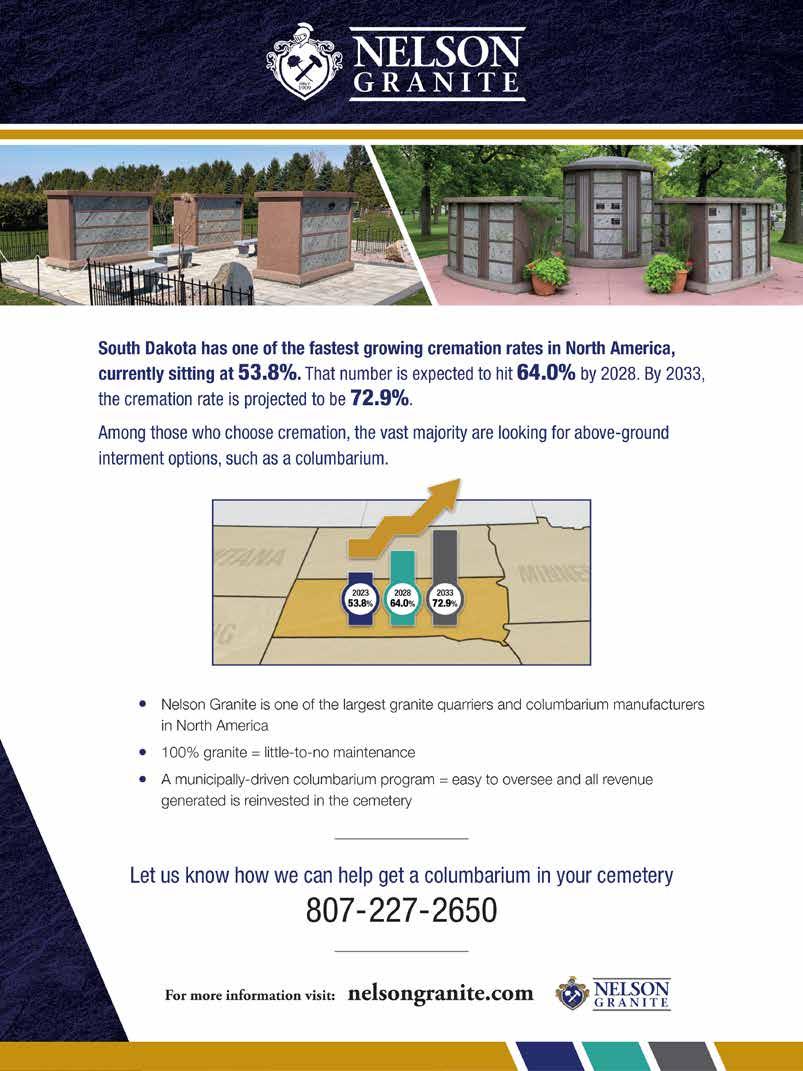
Local governments must balance safety, liquidity, and yield when investing public funds. The South Dakota Public Funds Investment Trust (SD FIT) is a specialized investment pool designed exclusively for municipalities, counties, school districts, and other local entities. It offers a spectrum of cash-management and investment options that help public finance officers make informed choices between short-term flexibility and long-term yield potential.
SD FIT functions as a cash management and investment service tailored for local government portfolios. The trust manages pooled funds to provide competitive returns, professional investment oversight, and a range of options from daily liquidity to fixed-rate investments.
Core offerings include:
• Daily liquidity investment accounts that provide immediate access to funds with market return.
• Fixed-rate investments (via institutional CDs, U.S. Treasuries, and other high-quality fixed income) that allow locking in a known rate for a set term.



(as of Feb. 2, 2026)
Daily (short-term) rate: ~3.35% annualized, based on the most recent daily yield annualized figure. This reflects shortterm market conditions where yields on liquid instruments like T-bills and money-market holdings tend to dominate.
(Note: Rates vary with market conditions and may change frequently — municipalities should verify current yields directly with SD FIT before investing.)
Definition: Short-term here refers to investments with high liquidity and frequent access (daily or weekly), such as the SD FIT money market-style account that credits returns based on recent income generation.
Pros
• Liquidity: Funds can be accessed quickly to cover payroll, payables, or emergency expenses without notice.
• Stability: Principal is preserved with minimal market value fluctuation.
• Cash flow alignment: Useful for operational funds and short-cycle cash flow planning.
Cons
• Lower yield: The trade-off for liquidity is typically lower return than locking funds into a longer-term fixed rate.
• Rate sensitivity: Daily yields can fluctuate with market interest rates.
Typical Use Cases for Municipalities
• Operating funds
• Reserve accounts for near-term obligations
• Funds awaiting allocation to longer-term projects
Definition: Long-term investments through SD FIT involve fixed-rate instruments such as institutional certificates of deposit, U.S. government obligations, or bank CDs with maturities beyond the short-term horizon. These are procured through SD FIT’s bidding process, which works with banks to secure competitive rates.
Pros
• Higher yield potential: By extending maturity beyond overnight or weekly liquidity, municipalities often realize better interest rates — especially in higher-rate environments.
• Predictability: Fixed rates help in budgeting, as returns are known at purchase.
• Locking in yield: Protects returns if market rates fall after investment.
Cons
• Reduced liquidity: Funds are tied up until maturity. Accessing them early may incur penalties or opportunity costs.
• Interest rate risk: Long-term rates can be less favorable if the yield curve changes (e.g., steepening curve).
Typical Use Cases for Municipalities
• Debt service reserve funds
• Capital project funding committed over years
• Endowments and dedicated long-term reserves
COMPARING SHORT & LONG TERM: YIELD & STRATEGY
Liquidity Very High Lower
Return Potential Moderate Higher (usually)
Risk Exposure Low Market Risk Interest Rate Risk
Use Case Cash Flow Needs Future Obligations, Capital Projects
Typical Rate (SD FIT)
~3.35% (as of 2/2/26)
Often above short run, varies with term and market
Municipal treasurers often use a laddered approach — maintaining a core of liquid assets for operations while staggering longer-term investments to capture higher yields without sacrificing all liquidity. This strategy helps balance safety, cash needs, and income.
• SD FIT investments aren’t FDIC-insured; they rely on prudent portfolio management and high-quality securities to preserve principal.
• Local investment policy and state law (SDCL 4-5-6 and others) determine allowable investments. Municipalities should ensure alignment with GASB reporting and internal policies.
• While long-term rates may be higher, municipalities must weigh opportunity cost of liquidity when locking funds away.

1. Define the fund’s purpose before choosing term length — operational funds need liquidity more than yield.
2. Monitor rate trends — short-term SD FIT yields can shift with interest rate cycles.
3. Consider a laddered investment strategy to balance liquidity and yield.
4. Review policy & compliance to ensure investment choices meet statutory and accounting obligations.
Spring is about renewal, clarity, and making thoughtful adjustments—and municipal investing is no different. By taking time now to review cash balances and investment timelines, municipalities can ensure funds are neither sitting idle nor locked away unnecessarily. SD FIT’s combination of short-term liquidity and longer-term fixed-rate options allows local governments to remain nimble while still capturing competitive yields.
As daylight stretches longer and budgets come into clearer focus, a balanced approach—maintaining liquidity for today while investing strategically for tomorrow—helps municipalities move forward with confidence. A seasonal investment review can be a simple but powerful step toward stronger cash management and better outcomes for taxpayers throughout the year. ■
Registration is now open for the 2026 Police Chiefs’ and Sheriffs’ Conference, which will be held April 14-16 at the Lodge at Deadwood.
The annual conference gathers police chiefs, sheriffs, and other state and federal law enforcement agencies as an opportunity to engage in training and professional development opportunities.
“This conference brings together South Dakota’s law enforcement professionals for an unparalleled networking and advanced training, ensuring our agencies leaders remain prepared and connected,” says Chief Jason Foote, President of the South Dakota Police Chiefs Association.
This year’s agenda features speakers whose sessions will focus on topics such as leadership, leading at-risk employees, personal development and team building, critical incident response and lessons learned, as well as kratom and emerging substances currently sold throughout the state.
The conference will also include a presentation of awards for Medal of Honor, Citizen’s Award of Merit, Sheriffs’ Service Award, Chief Deputy Ken Prorok Safety Officer of the Year, and SDPCA/SDSA Officer of the Year. The awards will be presented during the banquet on the evening of Wednesday, April 15.
Full conference registration with banquet ticket is just $135 through March 30. One-day and guest options are also available. Learn more and register at www.sdmunicipalleague.org/events. ■
MARCH 12-15
MARCH 13-14

As communities across South Dakota prepare for the nation’s 250th anniversary in July, Yankton is showing how a hometown can turn a national milestone into a meaningful, community-wide celebration.
As the first capital of Dakota Territory, Yankton has long embraced its historic identity. Now, through a city-led task force, it is planning a week of events and a legacy project designed to honor the past while bringing residents together in new and engaging ways. Branded “Yankton, SD, Celebrates America’s 250th,” the initiative blends history, recreation, arts, and civic pride, creating opportunities for participation well beyond a single day of fireworks.
“At its heart, this celebration is about community,” said Todd Larson, Director of Yankton Parks, Recreation and City Events. “We want people of all ages to find a way to participate, whether that’s planting a tree, walking the Meridian Bridge, visiting one of our museums, or gathering in Riverside Park on July 4. The 250th is a chance to reflect on where we’ve been and celebrate where we’re going together.”
A centerpiece of Yankton’s effort is the refurbishment of the Dakota Territorial

Capitol Replica Building in Riverside Park. Originally constructed by the Yankton Sertoma Club and dedicated in 1989, the replica honors the city’s territorial roots. The task force has set a goal of raising $100,000 to restore and preserve the building, ensuring the celebration leaves behind something tangible for future generations.
By forming a task force, identifying a legacy project, and inviting partnerships across civic groups,
schools, businesses, and cultural organizations, Yankton demonstrates that meaningful participation doesn’t require a large population, just strong local commitment.
The America 250th South Dakota Commission invites every South Dakota town, large or small, to become an official partner in the statewide 250th commemoration. Register your community via the America 250th website at americas250th.sd.gov. ■

Yankton’s plans span several days around Independence Day and include a blend of outdoor activities, heritage experiences, and community gatherings:
• Dakota Territorial Capitol Building Renovation – A yearlong fundraising effort to restore this historic Riverside Park landmark, originally completed in 1989. The task force aims to raise $100,000 with community support and matching city funds.

PIERRE, S.D. - South Dakota Game, Fish and Parks (GFP) recently announced that the Land and Water Conservation Fund (LWCF) and Recreation Trails Program (RTP) grant applications for 2026 are now open.
• 250 Trees for 250 Years – A community challenge encouraging individuals, schools, and organizations to plant and document 250 or more trees throughout the city in 2026.
• Meridian Bridge 250 Challenge – Participants can walk, run, and track 250 laps in honor of 250 years of independence, earning commemorative prizes along the way.
• New exhibit at the Mead Museum – Opening in July, A Dakota Story 1870–1970. The museum, housed in a historic 1909 Sioux Quartzite building, chronicles the region’s history from 1870 to 1970.
• Historic and Cultural Events – Cemetery tours, special presentations like America’s Story, and a time capsule burial at Mead Heritage Park that will be opened in 2076.
• Family Activities & Entertainment – Kayak excursions with stewardship elements, summer concerts, murals, youth programming, and a full slate of July 4 outdoor festivities in Riverside Park, featuring live music, patriotic presentations, and fireworks.
Follow these pages to take part in this historic celebration.
• https://www.yanktonsd.com/americas-250th
• https://www.facebook.com/profile. php?id=61583204428014

The Recreational Trails Program is a federal aid assistance program to help states and maintain recreational trails for both motorized and non-motorized use. The program provides up to 80 percent reimbursement funds for all kinds of recreational trail uses.
The RTP encourages all kinds of trail enthusiasts to work together to provide a variety of recreational trails opportunities. RTP funds come to the state through the Federal Highway Administration and are apportioned to states by congress to fund both motorized and nonmotorized public recreation trail projects.
The application deadline is April 10, 2026.
The Land and Water Conservation Fund (LWCF) is a federal program that supports the acquisition and development of public outdoor recreation areas and facilities. This grant helps state and local governments enhance parks, trails, and natural spaces, ensuring equitable access to outdoor recreation while conserving critical lands for future generations.
It provides up to 50 percent reimbursement for approved outdoor recreation projects that seek at least $10,000 in grant assistance. Emphasis will be given to project applications that address the priority needs identified in the 2023 South Dakota Statewide Comprehensive Outdoor Recreation Plan (SCORP).
Priorities identified by the public include, but are not limited to, unpaved trails, swim beaches, fishing areas, canoe and kayak water trails, nature areas/open spaces, playgrounds, dog parks, and picnic areas.
The application deadline is April 30, 2026.
Application information for both grants are available on the Partnerships page of the Game, Fish, and Parks website. Refer to the application manuals for detailed instructions.
For more information, contact Grants Coordinator Kerri Richards at 605.773.5490 or by email at Kerri.Richards@ state.sd.us. ■
LYNN BREN | SDPAA EXECUTIVE DIRECTOR
for
This year, our nation marks its 250th anniversary — a milestone that invites reflection, celebration, and renewed commitment to the communities we serve. While national commemorations will draw headlines, the most meaningful observances will happen at the local level. You are uniquely positioned to turn this anniversary into something more than a date on the calendar. You have the opportunity to turn this historical event into an opportunity to emphasize community pride, historical storytelling, tourism, and even improved safety practices.
Long before statehood, before county lines were drawn, and before many of our communities had names, people gathered to solve problems, share resources, and build a future together. That spirit — neighbor helping neighbor — is as alive today in South Dakota as it was in 1776. We witness this collaboration every time we step into a training session, conference, or convention.
The 250th anniversary offers a chance to highlight that continuity. It’s an opportunity to remind residents that the work happening in city halls, county courthouses, public works shops, and volunteer fire stations is part of a long, proud tradition of local self-governance.
Every community, large or small, can tailor the anniversary to fit its character. Incorporating the anniversary into your own local community events can help draw new visitors to your area, while staying engaged with the citizens to reinforce the love and devotion to your community. A few ideas that blend celebration with engagement:


• Create walking tours or interpretive signs highlighting historic buildings, early settlers, or key community milestones.
• Partner with schools to have students research and present local stories from the past 250 years. Having a contest with a small prize always draws more attention and attendance!
• Invite long time residents to share oral histories at libraries or community centers. People love learning from other people.
Involving your citizens in the celebration of your communities, even if it’s not a milestone year for you, will help strengthen the community identity and give residents a sense of belonging — something especially valuable in a time of rapid change.
• Host a “250th Community Day” with food, music, and local vendors, or incorporate this theme into your already scheduled annual celebration.
• Incorporate the 250th anniversary theme into your already scheduled parades, fireworks displays, street dances etc.
• Encourage neighborhoods to hold block parties or volunteer clean up days.
Your annual celebration events help to strengthen social ties, which in turn support public safety and resilience.
South Dakota travelers love a good story, and they love to share those stories with their friends… friends at the diner as well as friends on social media! Communities can use the anniversary to:
• Promote heritage tourism through brochures, maps, or social media campaigns.
• Highlight unique local landmarks or lesser-known historical sites.
• Partner with regional tourism groups or other communities to create multi community “250th Trails” or weekend itineraries.
No matter how large or small, communities with creative opportunities for celebrating can attract visitors when they frame their history in a compelling way. Every community has something that is unique to them, use the anniversary to boast about what you have accomplished and have to offer.
Celebrations bring people together, but they also bring increased activity, foot traffic, and event related risks. This is where thoughtful planning pays off, and this article wouldn’t be useful if we didn’t offer up some loss control tips to consider when planning your upcoming celebrations!
Use this year to take some meaningful steps to review your event safety and emergency response plans.
• Review emergency action plans for parades, fireworks, and large gatherings.
• Ensure proper barricades, signage, and traffic control devices are available and in good condition.
• Coordinate early with law enforcement, EMS, and volunteer fire departments.
• Ensure that all vendors and vendor contracts include appropriate coverage requirements as well as hold harmless and indemnification language (local counsel should review all any contracts or agreements before they are executed)
• Inspect parks, sidewalks, playgrounds, and public buildings before hosting events.
• Address trip hazards, lighting issues, and accessibility concerns.
• Confirm that electrical systems used for temporary stages or vendors meet safety standards.
• Refresh staff and volunteer training on crowd management, incident reporting, and equipment use. Ensure that all staff is aware of who and how to document and report incidents to facilitate an efficient investigation should a claim arise.
• Document pre event inspections and post event reviews to support continuous improvement. Be prepared to review any incidents which occur during your event and consider how your response plans were effective and where they may need adjustments.
These steps don’t dampen the celebration — they ensure it’s memorable for the right reasons.
The 250th anniversary is more than a commemoration. It’s a reminder that local governments are the stewards of both history and possibility. By embracing this milestone, South Dakota communities can honor not only the nation’s founding, but the enduring role of local leadership in shaping the American story. ■

MICAH GAUDET | DEPUTY CITY MANAGER, CITY OF MARICOPA, AZ
Recently, several notable studies examined how we use and view AI. Taken together, these studies offer a clearer picture of AI adoption and use. AI is surging, with 98 percent of US adults saying they have seen or heard something about AI in the last year, according to a recent Gallup survey. One in ten people use ChatGPT at least weekly, according to a National Bureau of Economic Research paper, and message volume is doubling every eight months.
While people are aware of and using AI regularly, its core use is
somewhat mundane. It is used to gather information, make decisions and document work, which appears consistent across professions and largely occupation-agnostic. Even in prompts involving writing, the overwhelming majority are related to editing, revising and polishing usercreated text.
Anthropic’s Economic Index adds additional texture to this picture and highlights where AI is used, and not used, in existing work streams by profession. Policing, for instance, shows variation in AI use by role. Detectives use Large Language Models (LLMs)
like Claude to prepare charges or responses to charges, and information for court. Officers are using Claude to assist motorists by providing road information. While core usage appears consistent across occupations, some professions may move faster than others.
In the U.S., AI usage is primarily focused on everyday tasks like nutrition, career documentation and personal advice. Usage patterns vary by state and economy. Users in high per-capita states are somewhat more likely to use AI for collaborative, augmentation-style work, while lower per-capita economies

lean toward delegating full tasks to the model. The Economic Index shows variation by state. Texas users prioritize work-related tasks such as resumes, workflow optimization and K-12 educational materials. South Carolina has a very different mix, with elevated interest in legal drafting, gaming and personal relationship advice. In Arizona, which ranks 26th in per-capita use, the top uses of Claude include editing (5 percent of conversations), debugging (3 percent), tutoring (3 percent) and healthcare (3 percent). This suggests that state-level economics may determine what problems AI is being applied to and how AI is expected to work.
While adoption surges, public trust is not keeping pace. According to Pew Research, most Americans remain wary about the growing role of AI. Half of adults are more concerned than excited
about AI, up sharply from 37 percent in 2021. Most adults under 30 believe AI will make people worse at creativity and will erode human relationships. Forty percent of adults over 65 share those concerns.
While views on AI’s impact are relatively negative, Pew Research shows that most Americans are open to using AI in specific cases. Strong majorities support using AI to detect financial crimes (70 percent) and identify fraud in government benefits (70 percent). Surprisingly, 61 percent support using AI to identify crime suspects. In their daily lives, 73 percent of American adults would allow AI to assist them a little with daily activities, although only 13 percent expressed willingness to let AI play a major role. Most interestingly, the strongest support for AI policy (72 percent) is expanding workforce training and AI education to help people learn how to develop or use AI. People are
Explore the benefits as well as the potential risks of artificial intelligence in NLC’s AI Toolkit for Municipalities.
not rejecting AI outright. They are asking for education and training.
Across these studies, one theme is consistent: AI adoption is accelerating. Governments could consider deploying AI to automate tasks versus strengthening human judgment and whether AI governance includes appropriate and timely training to prepare the workforce to thrive alongside the new technology. The research suggests that the answers to those questions will matter more than adoption rates alone. ■

The South Dakota Governmental Finance Officers’ Association is seeking nominations for their prestigious Finance Officer of the Year award. The award recognizes a member of the association who has made significant contributions to their municipality as a finance officer and to their community as a citizen.
“Finance officers serve a crucial role within South Dakota municipalities and are well known for going above and beyond in serving their organizations,” said Association President Michelle DeNeui of Spearfish. “Finance officers are also known for serving their communities through participation in community groups and activities.”
The award will be presented during the association’s annual Finance Officers’ School, held June 10-12 in Oacoma, SD.
Nominations can be submitted online at sdmunicipalleague. org/FinanceOfficers. Nominations are due May 1. ■
The South Dakota City Management Association will hold its first ever conference in Harrisburg on March 18-20.
Registration is now open to city managers and administrators, chiefs of staff, assistant/deputies, and department heads.
Chad Wright, founder of Forward Partners, will work with participants in a day-long session focused on leadership development and values development. The second half of the conference will focus on the theme and mapping for SDCMA in 2026-27. Participants will also have networking opportunities both Wednesday evening prior to the conference start, as well as Thursday at the conference location.
For the full conference details and registration, visit www. sdmunicipalleague.org/events. ■


Monday, April 6 Pre-Conference
3-4 p.m. Royal River Casino Tour (Optional) Member and Vendor Social Meal on your own
Tuesday, April 7
10:30 a.m.-12 p.m. Registration Lunch on your own
12-4 p.m. Presentations
• Value of Public Power
• Policy & Leadership Round Table
• Impacts of Large Loads
• Dry Ice Cleaning
4-6 p.m. Vendor Show and Expo 6:30 p.m. Prime Rib Dinner
Wednesday, April 8
7:30-8:30 a.m. Breakfast
9-12 a.m. Presentations
• GIS & Field Operations
• Data Centers
• Industry Updates
12 p.m. Lunch Provided
Registration Fees
SDMEA Member Municipality | $250
Non-member | $600
Guest (Prime Rib Dinner) | $60
BRAD WILSON | SDML WORKERS' COMPENSATION FUND

The SDML Workers’ Compensation Fund Board of Trustees is happy to continue the partnership with the SDPAA Board of Directors to provide this benefit for all of our first responders, their spouses, and their dependents in 2026. First responders include over 13,000 law enforcement officers, firefighters, ambulance personnel, 911 dispatchers, correctional officers, emergency management and members of search and rescue teams and their dependents.
We understand the challenges and stress that can be placed on employees/volunteers and the families of first responders. The First Responder Assistance Program provided by Connections EAP, Inc. of Rock Valley, Iowa is an important benefit available to first responders and their families. You do not have to sign up for this benefit. As long as your department is a member of the SDML Workers’ Compensation Fund or the SDPAA, you are automatically eligible for this benefit.
This program was created in response to the growing recognition that stress and trauma experienced by first responders places an emotional and mental health cost on them and at times, family members. One of the unique benefits is the Critical Incident Stress Debriefings coordinated by Connections EAP. Trained peer support first responders and credentialed mental health professionals will conduct Critical Incident Stress Debriefings in response to tragic events at your request.
There are many more personal benefits available as well including:
FREE and CONFIDENTIAL access to information and professional assistance for first responders and dependents* includes three sessions “in person” or via telehealth assessment and solution planning with a local credentialed professional counselor at no out-ofpocket cost to the first responder. First responders and dependents can also

talk to experts, browse for information, and access services for:
• Emotional problems
• Stress
• Anxiety
• Depression
• Post-traumatic stress
• Marital or family conflict
• Drug or alcohol issues
• Grief
• Caregiving responsibilities
• Legal or financial problems
These services are CONFIDENTIAL and you are entitled to 3 FREE sessions: per incident, per year. You may use this benefit for incidents that occurred in the past, both related or unrelated to your experience as a first responder.
Additionally, first responder employees, volunteers and dependents* can access the following experts through a variety of communication modes. Phone, email, web, and some in-person support include:
• 24/7 Phone Access – Toll-Free

Hotline
• Local Credentialed Counseling Professionals – Nationwide Network
• Local Credentialed Addiction Counselors
• Elder or Adult Consult and Care/ Find in 50 states
• Child Consult and Care/Find
• Special Needs Child Consult
• Pre-Natal support
• Summer Care Consult/Find
• Access to Attorneys for Legal Help
• Consumer Credit Counseling
• Family Budget Planning
• Adoption Information and Support Services
• Access to web-based self-help information and assessments
• Webinars, & Additional Work-life Information
• AND MORE!
Connections EAP counselors may recommend various services or treatments beyond the three sessions of assessment/solution planning. Costs for treatments beyond those provided by Connections are the first responder’s responsibility but may be covered in part by a regular health insurance benefit or another EAP program.
The service is CONFIDENTIAL –Connections Inc. EAP reports only the number of people who use services. NO ONE from the SDML Work Comp Fund, the employer or department will
be informed of your call or visit unless you specify in writing that an EAP professional contact us.
Different locations for in-person assessment and solution planning are available in your area. Connections EAP, Inc. will authorize your sessions at a location near you, and you can arrange an appointment at a date and time that is convenient and comfortable for you.
The toll-free phone is personally answered by trained professionals 24/7.
Research clearly shows that people are at their best when they are confident that they are doing something positive to resolve personal and family stressors. If you are a first responder and have considered using consultation, counseling or related support services, but cost or other unknowns have discouraged you, please take advantage of this FREE and CONFIDENTIAL resource available to first responders, their spouses, and their dependents* that are members of the SDML Workers’ Compensation Fund.
Personal and family stress is treated most effectively when you do not wait to make the call. Connections EAP, Inc. would be happy to answer any questions you may have. Simply call 800-779-6125 or go to their website at www.connectionseap.com or visit www.sdmlwcfund.com for a link to their website. If you are a first responder member of the SDML Workers’ Compensation Fund or the SDPAA, Connections EAP, Inc. will provide you with a user name and password for full access to their web resources. There is also a 12-minute video available that explains the program in detail. You can watch the video in the privacy of your own home or play it at a department meeting. Find the FRAP Video Presentation on YouTube by searching @sdmlworkcompfund7723.
Feel free to contact us with any questions. ■
*Dependent defined as per Federal IRS standards.

SDML WORKERS COMPENSATION FUND
Telephone: 800-233-9073
info@sdmlwcfund.com www.sdmlwcfund.com
Brad Wilson, Administrator, CIC, AIC, SDWCS brad@sdmlwcfund.com
Doug Kirkus, Marketing Rep doug@sdmlwcfund.com
Gary Drewes, Marketing Rep gary@sdmlwcfund.com
Kim Currey, CSR kim@sdmlwefund.com

SDPAA
Telephone: 800.658.3633 Option 2 sdpaa@sdmunicipalleague.org www.sdpaaonline.org
Lynn Bren, Executive Director lbren@sdmunicipalleague.org
Becky Brunsing, Member Services Rep bbrunsing.sdpaa@sdmunicipalleague.org
Hampton Iverson, Member Services Rep hiverson.sdpaa@sdmunicipalleague.org

CONNECTIONS EAP, INC.
Matt Visser, CEO matt@connectionseap.com
Code Enforcement Officer of the Year
Due: March 15
Recognizes an individual who has made significant contributions to their municipality as a code enforcement officer and their community as citizen. Award presented at the association’s spring meeting. Learn more/submit nominations: sdmunicipalleague.org/ CodeEnforcement
Governor's Awards for History, SD State Historical Society
Due: March 20
Recognizes achievements in three categories: individual (professional and non-professional), history organizations, and the history teacher of the year. Nominations are also open for the prestigious Robinson Lifetime Achievement Award given to a person who has a lifetime of dedicated and distinguished service to the preservation of the history of South Dakota. Individuals and organizations are eligible. Learn more/nominate: https://history.sd.gov/aboutus/ eventsanded.aspx
Finance Officer of the Year
Due: May 1
Recognizes a member of the SD Governmental Finance Officers' Association who has made significant contributions to their municipality as a finance officer and to their community as citizen. Award presented at the association’s annual Finance Officers’ School. Learn more/apply: sdmunicipalleague.org/FinanceOfficers
Homeland Security Grant, SD Dept. of Public Safety
Due: March 20
Funding awarded for projects that have a connection to Homeland Security by providing protection against terrorism threats. Paid on a reimbursement basis. Learn more/apply: https://www.sd.gov/dps or call 605-773-3450
Recreational Trails Program (RTP) Grant, SD Game, Fish and Parks
Due: April 10
Provides partial reimbursement for approved trail projects including the construction of new public trails, rehabilitation of existing public trails, development of trail-related facilities, and educational programs that relate to recreational trails.
Learn more/apply: www.gfp.sd.gov/partnerships; Grants Coordinator at Kerri.Richards@state.sd.us or 605.773.5490.
Agri-Business Grant, SD Dept. of Transportation
Due: April 15, July 15, and Oct. 15
Open to any local unit of government for the development of new or expanded agri-business industries. Provides 80% of the construction costs. Grant size is limited to $600,000.
Learn more/apply: https://dot.sd.gov
Industrial Park Grant, SD Dept. of Transportation
Due: April 15, July 15, and Oct. 15
Open to any local unit of government for the development of new or expanded access for new industry located within industrial parks. Provides 80% of the construction costs. Grant size is limited to $500,000.
Learn more/apply: https://dot.sd.gov
Land and Water Conservation Fund (LWCF) Grant, Game, Fish and Parks
Due: April 30
The federal aid assistance program provides up to 50 percent reimbursement funds for acquisition and development of outdoor recreation projects. Eligible projects may include playgrounds, ballfields, sport and play fields, picnic facilities, pools, ice rinks, golf courses, amphitheaters, winter sports facilities, visitor information facilities, and land acquisitions.
Learn more/apply: www.gfp.sd.gov/partnerships; Grants Coordinator at Kerri.Richards@state.sd.us or 605.773.5490.
Small Community Planning Grant Program, SD Dept. of Agriculture and Natural Resources
Due: Ongoing, awarded at any time on a first-come, first-served basis
Provides 80% of the funds to hire an engineering consultant to develop a project specific engineering report. Open to systems serving a population of 2,500 or fewer. A community may receive up to $8,000 for a water engineering study and up to $10,000 for a wastewater related study. Learn more/apply: https://danr.sd.gov
Code Enforcement Training Scholarship
Due: April 1
Provides funds for an association member to attend a training of their choice to enhance their performance of duties as a code enforcement officer.
Learn more/apply: sdmunicipalleague.org/ CodeEnforcement
Finance Officers' Training Scholarship
Due: April 1
Provides funds for continuing education for an association member. Applicants may apply for a scholarship to attend Finance Officers' School (FO School) in June or another professional development class/college course of their choosing.
Learn more/apply: sdmunicipalleague.org/ FinanceOfficers
Human Resource Training Scholarship
Due: April 1
Provides funds for an association member from a second- or third-class municipality to attend the SD Governmental Human Resource School (HR School) in June.
Learn more/apply: sdmunicipalleague.org/ HumanResource
Police Chiefs' IACP Scholarship
Due: April 1
Provides funds for an association member to attend the annual International Association of Chiefs of Police (IACP) Annual Conference and Exposition in October. Learn more/apply: sdmunicipalleague.org/PoliceChiefs
City Management Conference
March 18-20, Harrisburg
Registration: $125 SDCMA members
Brings together city managers, deputies and assistants, and department heads from across the state to share ideas, build connections, and shape the future of municipal leadership in South Dakota. The featured speaker is Chad Wright of Forward Partners who will present Embracing Healthy Leadership and Creating a Thriving Organization.
Learn more/register: sdmunicipalleague.org/events
Building Officials ICC Training
April 7 in Rapid City; April 9 in Sioux Falls
Registration: $85 SDBOA member; $105 non-member
This seminar introduces critical concepts of the Performance Compliance Method of the 2024 International Existing Building Code (IEBC). An understanding of the intent of the performance compliance method is built through reviewing the details of the categories for each performance attribute then doing a real-world application of the method.
Learn more/register: sdmunicipalleague.org/events
Electric Conference and Technology Expo
April 7-8, Flandreau
Registration: $200 SDMEA member; $225 non-member Annual operations conference that provides a wide range of technical and educational presentations with a vendor expo and networking opportunities.
Learn more/register: sdmunicipalleague.org/events
Police Chiefs' and Sheriffs' Conference
April 14-16, Deadwood
Registration: $135 SDPCA members; plus other options
Annual joint conference of the SD Police Chiefs' Association and the SD Sheriffs' Association where members gather to learn about and discuss recent topics in law enforcement.
Learn more/register: sdmunicipalleague.org/events
Code Enforcement Information and Training Conference
May 6-7, Fort Pierre
Registration: $50 - SoDACE member; $90 Non-member Annual spring meeting where members learn about and discuss current topics in code enforcement. Includes announcement of Code Enforcement Officer of the Year recipient.
Learn more/register: sdmunicipalleague.org/events
Energize Conference, South Dakota State University Extension Community Vitality
May 6-7, Wall
Registration: Early rate of $99 through April 1; Discounts for groups of three or more.
Works to energize South Dakota’s rural communities to develop new ideas and take action to improve their own communities.
Learn more/register: https://extension.sdstate.edu/ event/energize-conference
GOSCMA (Great Open Spaces City/County Management Association) Conference
May 20-22, Deadwood
The annual conference of local government managers in Montana, North Dakota, South Dakota, and Wyoming.












It’s officially tax season, and while that is a daunting season for some, many families, seniors, and hard-working South Dakotans will owe less in taxes this year and likely see a bigger refund. You may not think you’ll benefit, but a surprising number of South Dakotans will. This is all thanks to the Working Families Tax Cuts bill that I helped pass in Congress and President Trump signed into law. Want to know how you’ll benefit? Check out a few of the examples below.

Are you a senior?
Nearly 88% of South Dakota seniors will qualify for a $6,000 tax deduction from Social Security benefits. For couples, they could qualify for a $12,000 deduction. This is great news for our seniors who live on a fixed income – you paid into the Social Security system for decades, you’ve earned this.
Are you a parent?
The Working Families Tax Cuts created Trump Accounts, which any of your children under age 18 with a Social Security Number can qualify for. Children born between January 1, 2025 and December 31, 2028 qualify for a $1,000 investment from the government, but make sure to select it on your tax forms. The $2,000 Child Tax Credit has been made permanent and expanded to $2,200 and is adjusted annually for inflation. That means you could get more money back to spend on what your family needs.
Are you affected by the Death Tax?
The Estate Tax exemption, also known as the Death Tax, would have been halved if the Working Families Tax Cuts did not become law. Instead, the exemption was permanently expanded from $13.9 million to $15 million per individual and $30 million for couples. More than two million family farms in the U.S. will benefit from this provision, preserving the legacy of family-owned and operated farms for future generations.
Are you a tipped or overtime worker?
Taxpayers who work for tips will also be able to deduct up to $25,000 of their tips from their taxable income. If you’re working overtime, up to $12,500 can be deducted from your taxable income, and up to $25,000 for joint filers. Around 28% of South Dakota employees regularly work overtime and could benefit from the no tax on overtime provision. You’ve worked hard for these dollars, and you’ll see some tax relief due to the Working Families Tax Cuts.
Do you utilize the standard deduction?
The standard deduction, which most taxpayers take, was increased by $1,500. Even if you’re not a senior, don’t have children at home, don’t work a tipped or overtime job – you’ll likely still benefit from this. Without this increase, 94% of South Dakota taxpayers would have seen their standard deduction cut in half. Once more, the Working Families Tax Cuts keep more money in your pocket.
I’m proud to have supported the Working Families Tax Cuts to prevent your taxes from increasing by 25%. Money is tight and many are pinching pennies to make ends meet. I’ll keep working in Congress to keep taxes low, reduce inflation, and lower everyday costs to make your life more affordable. ■
Airport Operations and Maintenance Supervisor – City of Aberdeen, SD. Responsible for managing the operations and maintenance of the municipal airport. Performs airfield inspections to ensure compliance with federal regulations. Monitors access, security, and operations of the Airport Operations Area to ensure compliance with the Airport Security Plan. Monitors weather conditions: plans, coordinates, and dispatches teams to remove snow and ice. Supervises the Wildlife Hazard Management Program. 2026 wage: $31.72 per hour. See full description and apply at www.aberdeen.sd.us/jobs. Open until filled.
Director of Municipal Electric Services - South Dakota Municipal Electric Association (SDMEA), remote work in South Dakota. Serves as the primary employee and the public face of the SDMEA. The employee is highly self-motivated, capable of working independently, and brings exceptional communication skills to the role. Oversees the administration, programs, and organizational strategies of SDMEA, and requires proactive engagement in
marketing, event planning, community outreach, education, and legislative lobbying during the Legislative Session and throughout the year. Reports directly to the SDMEA Board of Directors. Remote work flexibility; however, the ability to travel is essential. Full-time salaried position with competitive salary, SD Retirement System participation and other benefits. Full job description at sdmunicipalleague.org. Apply via letter of application and resume to rhalgerson@swiftel-bmu.com or by mail to Brookings Municipal Utilities, C/O Electric Department Manager, 525 Western Ave, PO Box 588, Brookings, SD 57006. Salary Range: $70,000-$100,000 depending on experience. Open until filled.
Executive Director - Minnesota Counties Information Systems, Grand Rapids, MN. Leads the development, maintenance, and support of hardware and software solutions for member counties. Oversees MCIS staff, resources, and long-term technology planning; manages financial forecasting, budgeting, and organizational obligations; ensures effective personnel management; and serves as a trusted advisor to the Board and member counties on information technology and software development. Salary: $114,978 to $162,264. Comprehensive benefits. Learn more and apply at https://daviddrown.hiringplatform.com. Please direct any questions to Pat Melvin at pat@daviddrown.com or 612-920-3320 x116. Open until filled.
Finance Officer – City of Vermillion, SD. Oversees the functions of the Finance Department and supports effective municipal

operations. Will work in collaboration with the City Manager while working under the direction of the Mayor/City Council. Full-Time. Wage: $100,000 - $125,000 Annually DOQ. View the full Job Description at https://www.vermillion.us/Jobs. Direct any questions to Alex Ruth at alexr@cityofvermillion.com or 605-677-7050. Open until filled. EOE.
Communications Officer – City of Pierre, SD. Work as part of a team operating the Central South Dakota Communications Center, the 911-Emergency Dispatch Center for central South Dakota. Receive calls for assistance from the public, document and dispatch appropriate public safety personnel for those calls. Receive, process and send radio communications for various Law Enforcement Agencies, Emergency Medical Services, and local Fire Departments. 40 hours per week - Shift work. Comprehensive benefit package. UP TO $3000 HIRING BONUS! Learn more and apply at www.cityofpierre.org. Open until filled. EOE.
Wildland Engine Boss/Firefighter - City of Spearfish, SD. The wildland engine boss/firefighter is responsible for all aspects of assigned engine, crew, and equipment. They supervise and mentor engine personnel. While not on fire suppression assignments,
personnel will complete hazardous fuels mitigation projects, community risk reduction projects and other tasks as directed by the Deputy Fire Chief. $34.50/hour. Learn more and apply at https://www.spearfish.gov/161/Career-Opportunities. Open until filled. EOE.
Airport ARFF/Operations/Maintenance Technician – City of Pierre, SD. Responsible for providing general daily oversight of airside operations by monitoring overall airfield safety, performs vehicle and equipment maintenance, airfield lighting maintenance and performs aircraft rescue firefighter duties. Maintains lighting systems, vehicles, equipment, grounds, structures, pavement and turf. Assists in overseeing wildlife management at airport through annual training, assisting in depredation permits, and overseeing bird strike report program. Maintains documentation and records of all actions taken on airfield to ensure compliance with FAA Part 139 certification requirements. Wage offer will be based upon actual education and experience. Comprehensive benefit package. UP TO A $3,000 HIRING BONUS! Learn more and apply at www. cityofpierre.org. Open until filled. EOE.
Civil Engineering/Surveying Intern – City of Watertown, SD. Ideal candidate will be a motivated individual interested in pursuing a surveying, engineering or construction management career, who has had experience and/or training in surveying or drafting.

Will work in a team environment under the supervision of the City Engineer. This is a great opportunity for someone who has a broad interest in Municipal Government and/or Civil Engineering, surveying, or construction management. 40-50 hours per week. Temporary, full-time basis for 12-16 weeks for the summer of 2026. $19.00 - $23.00 per hour, depending upon previous experience and training. Learn more and apply at http://www.watertownsd. us/Jobs.aspx. Open until filled. First review Feb. 9.
Staff Engineer – City of Spearfish, SD. Responsible for performing Computer Aided Drafting (CAD) activities, providing engineering support activities involving both office and field work and administering the city’s floodplain ordinance. Maintains a regular and reliable attendance with a physical presence. Utilizes CAD software to perform a wide variety of mapping and engineering support activities. Develops and maintains standard CAD operating and work procedures. Prepares and/or updates exhibits, city maps, and standard construction details. Maintains all CAD master base mapping for public infrastructure; Updates mapping on a regular basis using as-built information from private developments projects. $42.03 per hour. Learn more and apply at https://www.spearfish. gov/161/Career-Opportunities. Open until filled.
Energy Services Technical Supervisor - Missouri River Energy Services, remote work in Minnesota. Leads and coordinates technical activities of the Energy Services Team to implement and promote demand reduction via energy efficiency programs, and beneficial load growth via efficient electrification programs (Bright Energy Solutions), as well as other Missouri River Energy Services (MRES) services. Directs and implements the delivery of technical support, energy calculations, and analysis for demand management, energy efficiency and efficient electrification products and services through the members to their energy customers. Researches applicable technologies and recommends new programs or program modifications for use by members and their customers. See full description and apply at https://careers. mrenergy.com/go/Open-Jobs/9714800. Open until filled.
Deputy Finance Officer – City of Hecla, SD. Position entails entrylevel bookkeeping, clerical, customer service and computer skills and assisting in accounts payable and receivable. Reports to Finance Officer. This is a part-time position. High school graduate or GED certificate required. Wage DOE. Apply at the Hecla City Office, 206 Main Street, Hecla, SD. Questions may be directed to 605-994-2333. Position open until filled. EOE.
Finance Officer – City of Fort Pierre, SD. Seeking a strategic, hands-on Finance Officer to oversee all financial and administrative operations for the entire municipality. As the City’s chief financial leader, you will work directly with the Mayor and City Council, collaborate with department heads, supervise finance staff, manage the annual budget, oversee payroll, ensure regulatory compliance, and interact with the public daily. If you enjoy leadership, variety, and making a visible impact in your community, this role delivers. Governmental/municipal accounting experience preferred. Strong budgeting, compliance, and leadership skills required.$110,000 Salary + $2,000 Hiring Bonus + Outstanding Benefits. Apply at www.fortpierre.com (Employment Opportunities). Open until filled. EOE.
Municipal road departments can purchase surplus heavy equipment at a discount through the State of South Dakota’s Property Management Division.
• City, county, township, and tribal governments get first opportunity to purchase equipment before offering it to the public.
• Equipment is SDDOT surplus and includes items such as mowers, plows, trailers, and more.
• Visit https://surplus.sd.gov for photos, details, and to make a purchase. Cities must register for verification. Once registration is approved, the site offers easy, online purchase options. The online store is open year-round; check periodically for newly listed items.
Sign up for surplus alerts at https://boa.sd.gov/ central-services/property-management. More info: (605) 773-4935 or surplus.property@state. sd.us.
Utility Billing and Software Support Specialist - Missouri River Energy Services, Sioux Falls, SD. As a key resource for our members, this role focuses on helping utilities get the most value from their utility billing software by performing the following duties. Provides hands on support, training, and guidance to ensure utility staff can perform daily billing operations smoothly and efficiently. Through strong partnerships, process understanding, and deep software expertise, this role enhances member confidence, improves workflow performance, and strengthens the overall service experience. Delivers business to business customer support via phone, email, or in person, with a focus on resolving utility billing software questions and issues. Competitive wages and comprehensive/low-cost benefit package. Learn more and apply at https://www.mrenergy.com/careers. EOE.
Medical Assistant – City of Sioux Falls, SD. Health/Falls Community Health has an exciting opportunity available for Medical Assistants! We are seeking Medical Assistants that have a Medical Assistant certification. Our pharmacy services are continuing to grow, so we are looking for a qualified individual who is interested in working in both medical and pharmacy settings. Health/Falls Community Health will provide on-the-job training for the hired individual to obtain their pharmacy technician certification. HIRING RANGE DOQ: $21.42 - $23.09 hourly. This position is eligible for a hiring incentive of up to $4,000. Learn more and apply online at www. siouxfalls.gov/careers. Open until filled.

Certified Patrol Officer – City of Brookings, SD. Work encompasses everything from traditional patrol duties to criminal investigations. Responsible for providing law enforcement services to the citizens of Brookings in a timely, efficient, and professional manner. Starting minimum compensation, depending on experience, is $62,142.66,148 to $84,075.37, plus benefits. View the complete list of minimum requirements online. Open to current Certified Law Enforcement Officers only! For details and application: https:// www.cityofbrookings-sd.gov/careers. Closes March 31, 2026.
Community Service Officer – City of Spearfish, SD. The position is a civilian, non-sworn employee of the Spearfish Police Department performing work that supports basic law enforcement operations. Has a variety of critical responsibilities, which include parking enforcement, found property, taking and preparing non-hazardous crime reports, monitoring and directing traffic, and carrying out non-sworn assignments as directed. Salary range: $28.32-$43.08. Learn more and apply at www.spearfish.gov. Open until filled.
Community Service Operator – City of Spearfish, SD. The position is a civilian, non-sworn employee of the Spearfish Police Department performing work that supports basic law enforcement operations. The position has a variety of critical responsibilities, which include parking enforcement, found property, taking and preparing nonhazardous crime reports, monitoring and directing traffic, and carrying out non-sworn assignments as directed. Salary range: $28.32-$43.08. Learn more and apply at https://www.spearfish. gov/161/Career-Opportunities. Open until filled.
Central South Dakota Communications Center Manager – City of Pierre, SD. Responsible for the overall operation, planning, development and administration of the Center South Dakota Communications Center which is responsible for communication with all public safety personnel in central South Dakota. REQUIREMENTS: Bachelor’s degree in public administration, criminal justice, communications or related field and a minimum of three years’ progressively responsible professional level experience in public safety communications and/or emergency management or telecommunications planning and supervision; or any equivalent combination of experience and education. Comprehensive benefit package. Up to $2000 annual educational assistance available. Wage offer based upon actual education and experience. Learn more and apply at www.cityofpierre.org. Open until filled. EOE.
Patrol Officer – City of Pierre, SD. Performs law enforcement & public safety duties as necessary to maintain law & order in the City of Pierre. Must be at least 21 years of age, have a high school diploma or GED, & pass the police entry level examinations including a background investigation. Prior experience in law enforcement is desirable. Certified officer preferred. Up to $2000 annually for educational reimbursement. Up to $6000 hiring bonus. Comprehensive benefit package. Learn more and apply: Human Resources Office, City of Pierre, Box 1253, Pierre, SD 57501, (605)773-7429, www.cityofpierre.org. Open until filled. EOE.
Police Officer – City of Avon, SD. Qualifications to include: High school diploma or GE Equivalent; Must be 21 years of age; Must have valid SD driver's license with acceptable record; Must agree to have acceptable results of law enforcement background checks for criminal history, driving record, and job history. Must be free of felony convictions; Must be fingerprinted for SD standards and training application process; Must possess or be able to obtain and maintain: Law Enforcement officer certification within 12 months of hire date; Firearms qualification within 12 months of hire date; CPR and Radar certification and any and all other required certifications deemed necessary. Pay based on education and experience. Competitive benefits. Applications can be picked up at the Avon City Finance Office, 116 N Main Street, Avon, SD. For questions, please call 605-286-3694. Open until filled. EOE.
Police Officer – City of Spearfish, SD. Enforce local, state, and federal laws; prevent and suppress crime and accidents; promote public safety through community policing principles. Responsible for the investigation of criminal cases as assigned. Full-time position. Requires availability to work all shifts weekends and holidays. Starting wage range: $32.84 per hour. Sign-On Bonus of $6,000 for police officers plus an additional $500 per month housing allowance for 8 months. Learn more and apply at https:// www.spearfish.gov/161/Career-Opportunities. Open until filled. EOE.
Police Officer – City of Summerset. Responsible for the duties of general law enforcement functions and service to the court. General Law Enforcement Functions include: General patrol; Enforce federal, state and local laws and ordinances; Preserve peace and protect life and property; Respond to calls for service and emergency assistance; Traffic enforcement; Observe and investigate persons, situations or matters that require attention; Receive and process citizen complaints; Arrest offenders; Investigate traffic crashes. To apply, download and print the application packet at https://www. summerset.us/join-our-team/. Submit the completed packet along with your resume to policeinfo@summerset.us. Open until filled.
Sergeant - Night Supervisor – City of Summerset, SD. Responsible first and foremost for the duties of a Patrol Officer (general law enforcement functions and service to the courts). In addition, is responsible for performing general and administrative duties in law enforcement and in activities of the Police Department. Assumes the responsibility of general and direct supervision of all Patrol Officers under him/her and direct supervision of all officers assigned to his/her shift. $34.33/hour +$2.00/hour weekend and night differential. Learn more and apply at https://summerset.us/ join-our-team. Open until filled.
Parks and Recreation Director – Spearfish, SD. Directs the city’s public parks, campground, cemetery, spectator recreation, and recreation and aquatics facility operations as well as the city’s safety program. Knowledge and level of competency associated with the completion of a baccalaureate degree in a course of study closely related to the occupational field. Experience sufficient to thoroughly understand the diverse objectives and functions of the subunits in the division/department in order to direct and coordinate work within the division/department, usually interpreted to require five years of related experience with at least five years in a leadership capacity. Position salary range: $117,582.40 - $178,921.60; Hiring range: $117,582.40 - $143,270.40. Learn more and apply at www. spearfish.gov/161/Career-Opportunities. Open until filled.
Planning Director – City of Sturgis, SD. Responsible for performing advanced and complex professional work in current and long-range planning, zoning, land use, and development for the City of Sturgis. Involves providing exceptional service and fostering collaboration in all internal and external interactions. Will oversee and administer planning and development functions, including building services, in alignment with the City’s goals and policies. Key responsibilities include the implementation and enforcement of the City’s zoning ordinance, subdivision regulations, and comprehensive plan.
Salary: $88,000 yearly. Find more details and an application at https://www.sturgis-sd.gov/jobs. Open until filled.
City Maintenance – City of Kimball, SD. The City of Kimball is now taking applications for a permanent full-time City Maintenance Worker. Wage is negotiable based on qualifications. Willing to train the right applicant. Applicants must be highly motivated with a great work ethic and have the ability to work cooperatively with other government agencies, the public and city personnel. Contact the city office for a copy of the full job description. Please submit cover letter and resume to City of Kimball, Attn: City Finance Officer, PO Box 16, Kimball, SD 57355 or email to kimballcitysd@ midstatesd.net. Phone: (605)778-6277. EOE.
Fleet Mechanic – City of Hot Springs, SD. Monitors and directs the day-to-day activities and operations of fleet maintenance; coordinates and provides maintenance and repair to city department vehicles and machinery. Oversees and performs skilled tasks in the servicing, repair and maintenance of a variety of city equipment and vehicles; oversees the inventory and procurement of all applicable parts, supplies, tools, fuels and equipment needed with supervisor assistance; prepares maintenance reports and machinery/part documentation. WAGE: DOEQ $16.99-21.24/hr. TOS. Learn more and apply at www.hs-sd.org, search city employment opportunities. Open until filled.

Maintenance Worker – City of Gettysburg, SD. Position entails various civic maintenance duties in a small-team, small-town work environment. Excellent benefits and wages. Wages DOE. Must be 18 years of age or older. Must have valid driver’s license. A CDL license will be required on hire or acquired within six months of your hire date. Position subject to random drug testing for safety reasons. Applications should be directed to: City of Gettysburg, 109 E Commercial Ave, Gettysburg SD 57442. Contact: phone: 605765-2264 or email: cogburg@venturecomm.net or gburgwater@ venturecomm.net. EOE. Open until filled.
Public Works Director – City of Billings, MT. Oversees one of the largest and most diverse municipal operations in Montana, with a staff of more than 270 employees dedicated to delivering essential services that support the community’s infrastructure, safety, and quality of life. The City of Billings is a rapidly growing community that offers a unique opportunity for the next Public Works Director to guide the city toward community-focused development, foster staff growth, and engage meaningfully with businesses, developers, and residents. Salary: $147,331 - $197,430 annually DOQ. View the full position profile, job description, and benefits at gmphr. com. Rolling interviews, open until filled.
Public Works Director – City of Winner, SD. Working with other Department Heads and consulting engineers, this position is responsible for supervising the department heads and assisting with planning, directing and coordinating the work of the Water, Wastewater, Streets, Sanitation, Electrical, Parks and Cemetery Departments. The position will direct and supervise the foreman of the maintenance shop, vehicle and equipment maintenance and repair. If interested, call Mayor Brad Shramm: 605-530-3418. Open until filled.
Public Works Employee – City of Wessington Springs, SD. Will help street and electric departments as needed. Class B commercial driver’s license required or obtained. Subject to drug and alcohol testing. Must obtain water and sewer certifications. Excellent benefit package including SD Retirement, health, vision & dental insurance, AFLAC, and PTO. Salary dependent on experience and qualifications. Applications available at cityofwessingtonsprings. com, City Hall, or 605-539-1691. Open until filled. EOE.
Public Works Maintenance Tech – City of Newell, SD. Performs maintenance in the public works departments including streets and alleys, snow removal, irrigation system, water, wastewater, sanitation, parks and cemetery. Applicants must be SD DENR certified or willing to become certified in all water/wastewater certifications. Must have a SD driver’s license including CDL or be willing to get CDL. Have knowledge of and ability to operate equipment and handle materials used in street maintenance and be able to lift and move 50 to 100 pounds. Will be required to take on-call rotation. Will report to and take direction from the Public Works Foreman. Pay along with all other essential duties and responsibilities can be discussed at time of interview. Applications available at townofnewell.org. Open until filled. EOE.
Public Works Maintenance Worker – City of New Underwood, SD. Responsible for the overall maintenance and repair of streets,




alleys, parking lots, sidewalks, curb and gutter, water lines, sewer lines and City equipment, as directed by the Director of Public Works. Applications can be found at newunderwood.com under City Forms. Open until filled.
Public Works Supervisor – City of Britton, SD. Will perform supervisory, administrative and professional work in planning, organizing, directing, and supervising the Public Works Department, including environmental, water, sewer, street, traffic control, cemetery, airport, swim pool, parks, rubble site, forestry and code enforcement. Applicant must be dependable, reliable, and friendly and be able to work with others. Must have a lifting capacity of 75 lbs. Full benefit package. Applications at https:// cityofbritton.com or at city hall; City of Britton, PO Box 126, Britton SD 57430. 605-448-5721. Open until filled. EOE.
Street Maintenance Worker – City of Pierre, SD. Responsible for manual labor and operating street sweepers and snowplows to maintain city streets. Manual labor, such as shoveling, raking asphalt, etc. is required. Skill in operating and maintaining equipment such as street sweeper, truck, roller, snow plow, skid steer, and front-end loader. Must have possession of or ability to obtain a Class B CDL with air brakes and tanker endorsements. Comprehensive benefit package. Up to $2000 annual educational assistance available. Wage offer will be based upon actual education and experience.
UP TO $3000 HIRING BONUS. Learn more at www.cityofpierre. org. Open until filled.
Wastewater Collections Operator I/II/III – City of Watertown, SD. Performs preventive maintenance and repairs on the wastewater collection systems to ensure proper operation. Inspects, repairs, rehabilitates, and maintains the wastewater collection system, including locating sanitary sewer and storm drains; repairing wastewater lines; installs flow meters; makes sewer taps; maintains air relief and sewer valves; and lift stations. Inspects manholes. Maintains and repairs lift stations including electrical equipment, pumps, floats, structures, piping and valves. Salary: DOE - Operator I = $53,123.20 annually; Operator II = $55,785.60 annually; Operator III = $58,572.80 annually. See full description and apply at http://www.watertownsd.us/Jobs.aspx. Open until filled.
Wastewater Plant Specialist – City of Hartford, SD. Will oversee the daily operations of the city’s Aeromod mechanical wastewater treatment plant. Requires self-motivation, technical knowledge, and a commitment to maintaining the plant’s operation efficiency and regulatory compliance. Responsible for the testing, reporting, maintenance, and upkeep of the plant and grounds while ensuring that all processes meet environmental standards and safety regulations. The ideal candidate should have experience in wastewater treatment operations. Possessing a degree in environmental science, engineering, or related field is a plus. Wages will be commensurate with experience and qualifications. Full benefits. Apply at www.hartfordsd.us. Open until filled.
Wastewater Treatment Plant Operator III, Public Works – City of Watertown, SD. Operates, monitors, maintains, and trouble-shoots the wastewater treatment facility, equipment, and its processes. Salary: Grade 145/Step 1 to Step 5 = $58,572.80 to $63,398.40 annually DOE. Learn more and apply at http://www.watertownsd. us/Jobs.aspx. Open until filled.
Water Meters – The City of New Underwood is offering approximately 250 water meters, mixed condition, as a surplus lot valued at $2,500. For details, contact 605-754-6773 or publicworks1@goldenwest.net.

DISTRICT 7 MEETING, Herreid
DISTRICT 6 MEETING, Redfield
DISTRICT 4 MEETING, Dallas
CITY MANAGEMENT CONFERENCE, Sioux Falls Metro Area
DISTRICT 5 MEETING, Pierre
DISTRICT 3 MEETING, Lennox
DISTRICT 2 MEETING, Brookings
DISTRICT 1 MEETING, Webster
DISTRICT 9 MEETING, Wall
DISTRICT 10 MEETING, Belle Fourche
DISTRICT 8 MEETING, Midland
OFFICIALS ICC TRAINING, Rapid City
OPERATIONS
AND TECHNOLOGY EXPO, Flandreau
OFFICIALS ICC TRAINING, Sioux Falls
Deadwood
March 2026
March 1 - A nominating petition may not be circulated for signatures more than four months before the election. A nominating petition must be filed under the provisions of § 9-13-7 at least seventy days before the election. The finance officer shall certify to the appropriate county auditor the candidate names and ballot language to be voted on by the Thursday sixty-eight days before the election. (SDCL 9-13-37) – Follow the Municipal Election Calendar for all election deadlines.
8 9 10 11 12 13 14 15 16 17 18 19 20 21
22 23 24 25 26 27 28 29 30 31
process has been completed within five days. (SDCL 10-11-13, 10-11-14; See Hdbk., sec. 12.120)
On or before the fourth Monday of March – After completing the equalization the clerk of the equalization board is required to deliver the assessment roll to the county Director of Equalization. (SDCL 10-11-21; See Hdbk., sec. 12.120)
At least six days prior to the last Tuesday of March – The county director of equalization must publish a list of all tax exempt property in the county. This publication must be in the official newspapers of the county. (SDCL 10-4-15.1; See Hdbk., sec. 12.105)
Not later than the third Monday in March – A copy of the assessment roll must be furnished to each requesting municipality. (SDCL 10-3-28; See Hdbk., sec. 12.105)
Third Monday of March (Equalization meeting) – The governing body and the finance officer together representing the municipality with a member of the school board are required to meet for the purpose of equalizing the assessment of property. The Equalization Board may adjourn from day to day until the
March 24 – For elections held in June, nominating petitions must be filed not later than five p.m. on the last 24th day of March. (SDCL 9-13-7; See Hdbk., sec. 7.250) If no one, including the incumbent, files a nominating petition, a vacancy is created and is filled by appointment or special election. (SDCL 9-13-14.1; 9-13-14.2) Follow the Municipal Election Calendar for all election deadlines.
On or before March 31 – The Urban Renewal Agency is required to file a report of its activities with the governing body. The report must include a complete financial statement for the preceding year. (SDCL 11-8-47) The Urban Renewal Agency must file a similar report with the Auditor-General on or by the same date. (SDCL 11-8-48; See Hdbk., sec. 14.200, The Urban Renewal Agency) ■
April 2026
S M T W T F S 1 2 3 4
5 6 7 8 9 10 11
12 13 14 15 16 17 18
19 20 21 22 23 24 25
26 27 28 29 30
April 17 - First day of absentee voting (SDCL 12-19-1.2)
April 8 - Deadline for candidates in first-class municipalities and school districts with >2,000 students to file a Candidate Financial Interest Statement (SDCL 12-25-30).
Second Tuesday in April – The consolidated board of equalization meets and completes equalization in no more than three weeks. (SDCL 10-11-66 through 10-11-76; See Hdbk., sec. 12.120)
Week of April 26 (and May 3) - First day of absentee voting (SDCL 12-19-1.2) ■ S M T W T F S 1 2 3 4 5 6 7