
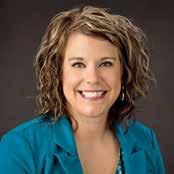
SARA RANKIN | SDML EXECUTIVE DIRECTOR
The legislative session is well underway, and as we cruise into February, it is a good opportunity to acknowledge the dedication of the SDML advocacy team. Their efforts at the Capitol on behalf of our members have been nonstop. We also want to extend our appreciation to municipalities across the state for the work you’re doing both in Pierre and within your own communities.
Conversations you have with legislators at cracker barrels, community forums, and other local events continue to be among the most effective tools we have in our advocacy efforts. Keeping an open line of communication with your elected officials about the issues impacting your community is incredibly important. We also invite you to stay connected with the League by sharing your input and concerns—your feedback helps guide our advocacy team as they work to represent your interests.
Each Friday during the legislative session, we distribute the Capitol Connection (formerly the Legislative Update), which outlines the week’s significant bills and developments. If you're not currently receiving it, we strongly encourage you to sign up by emailing sara@sdmunicipalleague. org.
New this year the SDML advocacy team will be hosting City Action Calls every Wednesday at 12:15 p.m. Central Time. You can access the call-in information on the Advocacy page of the League’s website.
We’re also looking forward to two major events coming up soon:
• SDML Legislative Rib Dinner – Tuesday, February 3
• Municipal Day at the Legislature –Wednesday, February 4
These gatherings provide an excellent opportunity for our members to meet directly with legislators and showcase the collective priorities of municipalities across South Dakota.
Beyond the legislative events, several educational opportunities are on the schedule. In March, we’ll hold district meetings as well as multiple election-related webinars. Also in March, the City Management Association will be hosting a training on March 18-20. In April, the SD Building Officials’ Association will offer ICC training sessions on April 7 in Rapid City and April 9 in Sioux Falls. Additionally, the SD Police Chiefs’ Association will host its spring conference in Deadwood from April 14-16, in partnership with the SD Sheriffs’ Association. Planning is underway for Human Resource and Finance Officer Schools being held June 9-12 in Oacoma. Be sure to mark your calendars!
You can find a complete list of scheduled 2026 events on page 26 of this issue or online at www. sdmunicipalleague.org/events.
Lastly, I want to encourage you to take a moment to review the League’s newly adopted Strategic Plan. The League Board of Directors, staff and affiliate board members spent the summer and fall participating in the strategic planning process. From this work came a plan that will lead the League and our members into the next several years. View the plan at www.sdmunicipalleague. org/AssociationDocuments.
Until next month, don’t hesitate to reach out— we’re here to help at 1-800-658-3633 or sara@ sdmunicipalleague.org. ■
PRESIDENT
Leland Treichel, President of the Board, Roscoe
1st VICE PRESIDENT
Michelle DeNeui, Finance Officer, Spearfish
2nd VICE PRESIDENT
Dawn Murphy, Finance Officer, Tea
TRUSTEES
Rick Boschee, Mayor, Bowdle
Leah Braun, Chief of Staff, Rapid City
Paullyn Carey, Finance Director, Huron
Richard Thomason, Councilmember, Sioux Falls
Laurie Woodward, City Administrator/Finance Officer, Custer
PAST PRESIDENT
Carolynn Anderson, Finance Officer, Wall
Dist. 1 | Mike Grosek, Mayor, Webster
Dist. 2 | Jameson Berreth, City Administrator, Madison
Dist. 3 | Derick Wenck, Mayor, Harrisburg
Dist. 4 | Shauna Meyerink, Finance Officer, Platte
Dist. 5 | Kristi Honeywell, City Administrator, Pierre
Dist. 6 | Frank Schwartz, Mayor, Redfield
Dist. 7 | Gary Weismantel, Mayor, Herreid
Dist. 8 | Brittany Smith, City Administrator, Philip
Dist. 9 | Misty Summers-Walton, Finance Officer, Hot Springs
Dist. 10 | Gina Carpenter, Human Resources Officer, Belle Fourche
Sara Rankin
Executive Director
Lori Butler Deputy Director
Jessica Carr Director of Member Engagement
Emilie Miller Director of Marketing and Communications
Lisa Nold Director of Risk Sharing Services
Kristi Osterkamp Senior Accountant
Krista Kerns Member Accounts Manager
Vacant Director of Municipal Electric Services
SD Public Assurance Alliance
Lynn Bren
Executive Director
Kristina Peterson Deputy Director
Becky Brunsing Member Services Representative
Hampton Iverson Member Services Representative
Paytra Nichols Underwriter
sdmunicipalleague.org | 1.800.658.3633 | Fax: 605.224.8655
I hope everyone is having a great start to 2026!
The Legislature is in full swing. Please keep on top of those bills that will mean changes to our school, city, and county governments, and if you aren’t sure of something, PLEASE contact the League for clarification on how it will affect you.

It seems there are always new regulations that are handed down and we must be diligent in how this will affect not only our community, but all communities in the state, regardless of their size. If the League sends out a request for action to contact your representatives, please take the time to do so. A few minutes to send an email does make a difference if it can sway a vote. If there is a cracker barrel session close to you, please try to attend and get to know your legislators; it makes those emails and calls much more impactful.
The cruddy start to winter turned around to many beautiful weeks, which may not bode well for the upcoming district meetings beginning in mid-March. My wife and I will be starting home from Arizona on Friday, March 13 (of course). Tracy looked back at Facebook pictures from March in the past and has already made personal predictions she won’t share. We will begin the process of juggling district meeting schedules with physical therapy schedules in a few weeks and we pray that the weather cooperates so we can make everything work.
Again, reach out to the staff at the League if there is anything you don’t understand this Legislative session, and if they ask for your help, please be there. You aren’t helping just the League, you are helping all the citizens of all our cities. There is so much happening politically we must stay alert to changes that may affect our everyday lives and how we, as local governmental organizations, function.
I am looking forward to seeing as many of you as I can in March as we travel our beautiful state! ■
As the 2026 Session of the South Dakota Legislature continues throughout February and into March, it’s important to keep your legislators informed about the needs of South Dakota’s cities. After all, no one knows your city or town better than you do. And, therefore, no one can do a better job of telling your elected representative what works and what does not work for your community than you can.
Below is a quick refresher of highlights from last month’s legislature feature. For more detailed information, refer back to the January 2026 issue of South Dakota Municipalities, which is available online for free at www.sdmunicipalleague.org.
Remember, when you get involved in the legislative process and share your expertise and experiences with your legislators, your city - and all cities - have a stronger voice.
• Sign up for the SDML’s Capitol Connection emails. Email sara@sdmunicipalleague.org.
• Join a City Action Call - a concise recap of activity at the Capitol each week, held each Wednesday at 12:15 p.m. CT.
• Find bill details, including sponsors, scheduled actions, recorded testimony, amendments, and more online at sdlegislature.gov.
• Use MyLRC to receive information customized to your needs, including the ability to follow specific legislators, committees, or bills. Sign up for a free account at mylrc.sdlegislature.gov.
• Develop a positive working relationship with your legislator.
• Have a specific agenda; present your case firmly and succinctly.
• Connect your community to the issue.
• Be responsive to any requests in a timely manner.
• Say “Thank you!” for their time.
• Keep the League informed about your correspondence.
• Individual Legislators Find the full list at sdlegislature.gov.
• SD Legislature Senate: 605.773.3821 House: 605.733.3851
• Legislative Research Council 605.773.3251 LRC@sdlegislature.gov sdlegislature.gov
• SDML - Executive Director Sara Rankin sara@sdmunicpalleague.org Lobbyist phone: 605.224.5030
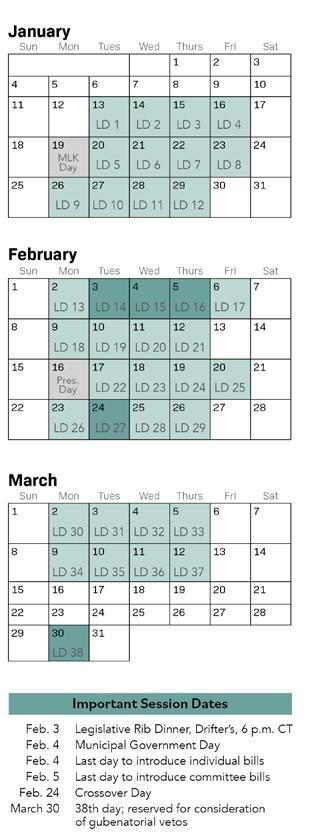
Registration is now open for the South Dakota Municipal League (SDML) annual district meetings, which will be held throughout the state in late March and early April.
The meetings will update member municipalities with the outcomes of the legislative session and provide an opportunity for in-person networking.
“The district meetings are a great opportunity for official updates and information,” said SDML Executive Director Sara Rankin, “but they’re also a chance for members to meet, swap stories, and share ideas with their peers from neighboring cities.”
Each meeting typically includes a social and meal as well as remarks from Rankin
and League President Leland Treichel of Roscoe.
The meeting will also feature a moderated session where attendees can engage in conversation regarding issues within the district, discuss select legislative topics in depth, and participate in a Q & A style forum.
District business will also be conducted, including the election of district chairs and the selection of next year’s district meeting location.
The meetings are open to any SDML members. Mayors, town presidents, council members, and city officials are especially encouraged to attend. Area legislators, State agency
representatives, and congressional delegates are also invited.
Attendees are able to register and bring guests. Meal fees vary for each meeting.
One meeting will be held in each district of the South Dakota Municipal League. If members are unable to attend the meeting in their district, they are welcome to attend any of the other meetings. A list of cities in each district can be found online at www. sdmunicipalleague.org/About-Districts.
Pre-registration is required at www. sdmunicipalleague.org/events. Registrants can pay online or send a check through the mail. ■

TIM REED | STATE SENATOR, DISTRICT 7

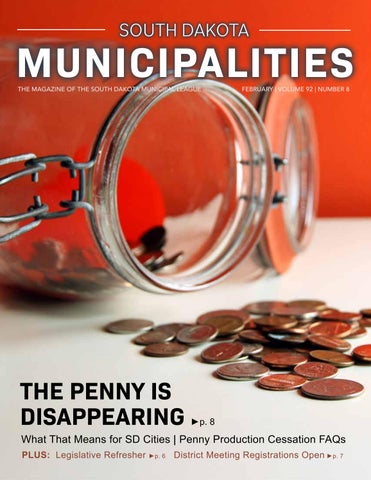
The penny is still legal tender but it’s quickly becoming scarce.
In late 2025, the White House directed the U.S. Treasury to stop producing pennies because they cost more to make than they’re worth, about 3.7 cents per coin. While billions remain in circulation, Federal Reserve inventories are tightening, and some distribution terminals have already stopped filling penny orders. Retailers across the country are now facing penny shortages at the checkout line.
That raises a simple but important question: How do you complete a cash transaction when pennies aren’t available?
TAX STAYS THE SAME. CASH TOTALS MAY NOT.
Sales tax calculations do not change. Sales tax should still be calculated to the penny, as current law requires. The only adjustment occurs at payment.
The most widely supported approach is straightforward:
• Calculate prices and taxes to the penny
• Round only the final total, and only for cash payments
• Keep card, check, and electronic payments exact to the cent
This approach preserves accurate tax remittance for state and municipal governments while allowing cash transactions to continue.
As penny availability declines, retailers are adjusting how they complete cash transactions. Approaches vary, with some rounding the final total to the nearest nickel and others applying different rounding methods. These adjustments are being made to ensure transactions can be completed efficiently when exact change is unavailable.
Clear and consistent practices will help ensure predictable outcomes for customers and support accurate transaction processing for businesses.
Rounding typically affects transactions by only a penny or two and generally balances out over time. Still, perception matters, especially for residents who rely on cash and for cash-heavy businesses. City utilities and government offices that accept cash may also need to adjust procedures.
I serve as a co-chair of the National Conference of State Legislatures (NCSL) State and Local Taxation Task Force, which recently released a policy brief on penny elimination and rounding. The report outlines best practices, legal considerations, and lessons from countries that have already made this transition.
The full report, Elimination of the Penny: Centsable Considerations, is available at: https://www. ncsl.org/fiscal/elimination-of-the-penny-centsable-considerations.
The penny may be small, but its disappearance affects daily commerce and tax administration. Clear, consistent guidance keeping tax calculations unchanged while allowing final cash totals to be rounded will help protect consumers, support businesses, and ensure stable municipal revenue during the transition. ■
The following recommendations are non-binding guidance. All must comply with otherwise applicable restrictions.
Over the past 10 years, the total production cost of the penny has risen from 1.3 cents to 3.69 cents per penny. These production costs include materials, facilities, and overhead. The U.S. Mint projects an immediate annual savings of $56 million in reduced material costs by stopping penny production. Additional savings will accrue as facility usage is adjusted and other efficiencies are achieved with the reduced production. Given the increasing number of noncash transactions and the very low purchasing power of a single penny, the Department of Treasury does not believe continued production is fiscally responsible or necessary to meet the needs of commerce in the United States. The Secretary of the Treasury has the authority under Federal Law (31 U.S.C. §§ 5111(a)(1) and 5112(a)(6)) to mint and issue pennies in amounts necessary to meet the needs of the United States.
WWW.TREASURY.GOV
manufacturing new pennies but the Federal Reserve will continue to recirculate the roughly 114 billion pennies currently in existence for as long as possible. How long existing pennies remain in circulation depends largely on consumer behavior.
The Treasury Department encourages the public to spend their on-hand pennies to support a smooth transition and allow retailers and point-of-sale (POS) system providers time to adapt. This initiative aims to help keep the existing supply in circulation, ensuring clarity and fairness at the point of sale during the transition.
How should my business respond as the supply of pennies drops?
report entitled Elimination of the Penny: Cents-able Considerations states: “The most recommended form of rounding is symmetrical rounding whereby if the final digit of the total transaction amount (including taxes) is 1, 2, 6, or 7 cents, the amount is rounded down to the nearest multiple of five. If the final digit is 3, 4, 8, or 9 cents, the amount is rounded up. Transactions totaling exactly $0.01 or $0.02 might be rounded up to $0.05. Rounding rules would not apply to payments made via electronic methods, checks, gift cards, or other non-cash instruments.”
Are businesses required to accept pennies after they are no longer distributed?
Retailers should continue accepting pennies and providing penny change for cash transactions while the coin remains in circulation. When penny change is not available, businesses may round the final amount of a cash transaction to the nearest five-cent increment, recognizing that states will approach this issue differently based on unique considerations. The penny will remain legal tender, meaning it retains its status as an acceptable form of payment.
DISTRIBUTING THE PENNY?
The federal government has stopped
As pennies fall out of circulation, merchants will need to round transactions either up or down to the nearest five cents. However, most states require sales tax to be calculated on the final sale price rounded to the nearest penny. How states and localities will ultimately amend their sales tax laws is the right and responsibility of those jurisdictions. Recent guidance from the National Council of State Legislators gives some indication how states may adapt. The NCSL’s November 21, 2025
We recommend that non-cash transactions, such as payments made

by check, credit card, or debit card, continue being priced and processed to the exact cent.
Businesses should apply rounding practices in a fair, consistent, and transparent manner.
How will accepting foreign currencies, government checks, gift cards, and split payments be affected by rounding?
We recommend that rounding be applied only to cash payments. Payments made with foreign currencies, government checks, gift cards, or split payments can be settled to the exact amount without the need for rounding adjustments.
Will the price rounding increase overall consumer prices?
There is no impact on non-cash transactions. For cash transactions, final transaction prices will be rounded down just as often as they will be rounded up, so there should be no overall effect on consumer prices
When a consumer requests a refund, is the amount subject to rounding?
As is the case now, businesses can set their own refund policies. However, if a refund is paid in cash and pennies are not used, businesses should round the final amount in a fair and transparent manner.
Will businesses need to update cash registers for rounding?
This is a decision to be made by each individual business.
As pennies fall out of circulation and states adapt their laws and policies accordingly, we recommend rounding for cash payments should take place only after all duties, fees, and taxes have been calculated. Businesses may choose to update their point-ofsale systems to automatically apply rounding for cash transactions. Doing so can enhance transparency and improve the customer experience by clearly displaying the rounding adjustment on receipts.
To support a smooth transition, the Treasury Department is actively collaborating with point-of-sale (POS) system providers to ensure their systems are properly equipped to handle rounding and accurately calculate sales taxes.
Where can I find more information on the impact of phasing out the penny on sales taxes?
For more information on how the phase-out of the penny may affect sales taxes and income taxes, you can consult your state’s tax authority for specific guidelines and updates.
Will businesses be able to redeem pennies with their financial institutions?
Businesses may continue to deposit pennies at their financial institutions. Pennies will continue to be legal tender and retain their nominal value in perpetuity.
Can I still use pennies for buying goods and services?
Yes, the penny will retain its full monetary value indefinitely. It will continue to be recognized as legal tender, allowing consumers to use pennies for cash transactions at businesses that choose to accept them, even after new pennies are no longer produced and distributed.
However, as pennies gradually phase out of circulation, Point of Sale (POS) system providers are encouraged to collaborate closely with retailers to implement rounding functionality for cash transactions, rounding to the nearest five cents.
It is essential for retailers to proactively inform and train their employees on any updates to business procedures and POS system features ahead of this transition. Doing so will help ensure that cash transactions are rounded smoothly and accurately, while maintaining customer confidence.

Will the price rounding increase overall prices for the products I buy?
There is no impact on non-cash transactions. For cash transactions, as final transaction prices will be rounded down just as often as they will be rounded up, so there should be no overall effect on consumer prices.
Are financial institutions required to accept my pennies?
Consumers may continue to deposit pennies at their financial institutions. For deposit of larger quantities, some banks may require that coins be rolled or wrapped prior to deposit. It is recommended that consumers consult their bank in advance to confirm specific guidelines and ensure a smooth deposit process.
Will rounding affect the sales tax I have to pay?
The amount of sales tax is determined by state and local law, but in general, rounding for cash transactions should not impact the amount of sales tax consumers are required to pay. We anticipate that sales tax will continue to be calculated based on the exact total of a purchase before any rounding is applied. Individual states may approach this issue differently based on unique considerations. ■
Applications open Feb. 2 for the 2026 State Homeland Security (HLS) grant funding. The grant awards projects with a nexus to terrorism threats while following the Homeland Security Grant terms and conditions.
Examples of projects include:
• Access control systems such as electronic locks, video entry, door locks, metal detectors, and panic buttons.
• Lighting.
• Fencing, gates, barriers, etc.
• Cybersecurity risk assessments.
• Projects that address vulnerabilities identified in cybersecurity risk assessments such as hardware, software, access control to systems, training, and exercises.
• Tactical gear or ballistic protection.
• Training Special Weapons and Tactics (SWAT) teams.
• Training Special Response Teams (Taskforce 1).
• Training and awareness programs.
• Backup generators and transfer switches for PSAPs or EOCs only.
• Training and exercises.
• Detection equipment for CBRNE threats .
• Rescue equipment.
• Pagers for fire, ambulance, or search and rescue.
• Equipment compatible with the State Radio System such as P25 radios, repeaters, and extenders.
• Border Security.
Applications must be submitted through the EDGAR (Electronic Database for Grant Application & Reporting) system by March 20, 2026, at 5 p.m. Central Standard Time. The link to EDGAR is https://sddpsigx.intelligrants.com.
Award agreements will be generated and sent out after funding becomes available. Projects cannot start before the grant award agreement is signed by the grantee and HLS. Award Agreement and Funding for projects is typically
expected to become available on or about September 2026.
The Homeland Security Grant Program provides a suite of risk-based grants designed to support South Dakota’s state, local, tribal, and territorial partners in preventing, protecting against, mitigating, responding to, and recovering from acts of terrorism and other security threats. These grants equip South Dakota communities with critical resources to implement the National Preparedness System and advance the National Preparedness Goal of a secure and resilient nation. By strengthening local capabilities, the program enhances the safety and resilience of communities across South Dakota, from rural towns to tribal lands and urban centers.
Learn more on the South Dakota Homeland Security Grants at www. sd.gov/dps or call 605-773-3450. ■
PIERRE, S.D. – Last month, the South Dakota Department of Agriculture and Natural Resources (DANR) announced that the Board of Water and Natural Resources has approved $48.9 million in statewide projects.
A total of $36,958,000 in state loans, including $425,000 in principal forgiveness, was authorized for drinking water and wastewater improvements. Additionally, $7,648,000 was allocated through Emerging Contaminants for Small or Disadvantaged Communities grants, along with $4,313,307.85 in additional American Rescue Plan Act (ARPA) grant funding.
Funding was distributed through DANR’s Drinking Water State Revolving Fund, Clean Water State Revolving Fund, Emerging Contaminants for Small or Disadvantaged Communities grant program, and ARPA funds to the following:
BDM Rural Water received an additional $233,450 in ARPA grant funds to construct a new water treatment plant, install a water reservoir, install pipe to expand the water system and loop lines for added redundancy, and replace water meters. Previous funding for this project was approved in April of 2022 and June of 2024. The additional grant award brings the ARPA grant total for this project to $5,501,878.
Clay Rural Water received an additional $334,250 in ARPA grant funds to construct two ground storage reservoirs near the existing Greenfield reservoir and the Wakonda Water Treatment plant. A new booster station at the Greenfield reservoir and distribution line improvements to provide additional capacity and accommodate a Highway 46 construction project is also included. Previous funding for this project was approved in April of 2022 and June of 2024. The additional grant award brings the ARPA grant total for this project to $7,778,060.

Mid-Dakota Rural Water System received an additional $917,357.85 in ARPA grant funds to update the existing water system by installing an advanced metering infrastructure system, paralleling of pipe, addition of a new backwash recovery system, and additional membrane capacity. Previous funding for this project was approved in April of 2022 and June of 2024. The additional grant award brings the ARPA grant total for this project to $21,615,489.85.
Mitchell received a $3,930,000 Clean Water State Revolving Fund Program loan to upgrade the clay sanitary and storm sewer on a portion of North Ohlman Street. The loan terms are 3.75% for 30 years.
Rapid City received a $14,512,000 Drinking Water State Revolving loan to make improvements to an existing well and to construct two new wells. The loan terms are 4.00% for 30 years.
Shared Resources received an additional $1,500,000 in ARPA grant funds for treatment plant, well field, distribution pipeline, and two storage tanks. Shared Resources is a joint effort between Minnehaha Community Water Corporation and the Big Sioux Community Water System. Previous funding for this project was approved in April of 2022, June of 2024, and May of 2025. The additional grant award brings the ARPA grant total for this project to $50,942,148.
Sioux Falls received a $7,648,000 Drinking Water Emerging Contaminants in Small or Disadvantaged Communities Grant to complete a third connection to the Lewis and Clark Regional Water System. This connection will allow the city to better utilize the available water supply and provide water to the downtown distribution zone where water capacity was reduced due to well shutdowns.
Sioux Falls also received a $17,746,000 Clean Water State Revolving Fund Program loan to construct a new Southeast Basin sanitary force main and gravity trunk lines, lift stations, equalization basin and gravity extensions. The project will be conducted in phases, and this is for Phase I. The loan terms are 3.50% for 20 years.
South Lincoln Rural Water System received an additional $328,250 in ARPA grant funds to make system wide improvements including installing an elevated water tank, a new pump station, and a new water treatment plant. This project addresses capacity issues in portions of the distribution system and increasing demands within the existing service area. Previous funding for this project was approved in April of 2022 and June of 2024. The additional grant award brings the ARPA grant total for this project to $8,450,523.
South Dakota Department of Agriculture and Natural Resources received an additional $1,000,000 in ARPA grant dollars for its statewide Riparian Buffer Initiative (RBI). Previous funding for this project was approved in April of 2022 and June of 2024. The additional grant award brings the ARPA grant total for this project to $7,000,000.
Toronto received a $770,000 Drinking Water State Revolving loan with $425,000 in principal forgiveness to relocate sections of an existing water main. This is to accommodate the Department of Transportation installing new storm sewers and highway surfacing. The loan terms are 3.50% for 30 years.
The State of South Dakota and the U.S. Environmental Protection Agency fund the Clean Water and Drinking Water State Revolving Fund Programs, which provide lowinterest loans for wastewater, stormwater, water conservation, nonpoint source projects, and public drinking water system projects. The programs are funded through a combination of federal appropriations, loan repayments, and bonds.
The board approved the funding the Jan. 8 meeting in Pierre. ■


In 2026, the City of Lead will take center stage in South Dakota’s America250 observance while marking two milestones of its own. Founded in 1876 during the Black Hills Gold Rush, Lead will celebrate its 150th anniversary alongside the nation’s 250th birthday and the 100th anniversary of Gold Camp Jubilee Days. Together, these milestones create a once in a generation opportunity to connect local history, community tradition, and the national story.
First settled following the discovery of gold in Gold Run Gulch, Lead grew around what became the Homestake Mine, once the largest and most productive gold mine in the Western Hemisphere. Incorporated in 1877, the city quickly developed into a thriving community built by miners, families, and entrepreneurs. That legacy remains visible today in Lead’s historic downtown, strong civic pride, and deep sense of place.
Fourth of July weekend in 2026, July 2-5, will be the focal point of this historic triple celebration. The City of Lead is working closely with the Lead Area Chamber of Commerce, Lawrence County, and regional partners to expand the traditional Gold Camp Jubilee into a four-day event that honors America’s 250th while

highlighting Lead’s sesquicentennial and a century of community celebration through Jubilee Days.
Rather than replacing long standing traditions, the city has taken an active leadership role in building upon them. City involvement includes funding for key components of the celebration, including a major outdoor concert on Friday, July 3, that represents one of the largest entertainment investments the city has made. The expanded schedule features historic programming, family friendly activities, and patriotic events designed to draw residents and visitors together.

Robin Lucero, Lead City Administrator, has been closely involved in coordinating the city’s role and aligning local plans with the broader America 250 initiative.
“This is truly a once in a generation moment for Lead,” Lucero said. “We are honoring 150 years of our city, 100 years of a beloved community tradition, and the nation’s 250th birthday all at the same time. That legacy remains visible today in Lead’s historic downtown, shared community identity, and a deep sense of place.”
City hosted and city supported events include historical music programs at the Homestake Opera House, walking tours throughout the community, a Liberty Tree planting, a time capsule ceremony, and a community picnic on July 5. Regional collaboration is also highlighted through a vintage baseball game series with the City of Deadwood.
As America approaches its 250th birthday, Lead’s Fourth of July celebration offers a powerful reminder that national history is built city by city and tradition by tradition. Find the full 2026 schedule at www.leadmethere. org/goldcampjubilee. ■
July 2-July 5, 2026
Lead, South Dakota

• Four-day community wide celebration marking America’s 250th anniversary, the City of Lead’s 150th anniversary, and the 100th anniversary of Gold Camp Jubilee Days
• Expanded historic programming throughout the weekend, including walking tours and special presentations highlighting 150 years of Lead’s history
• Thursday evening historical music program, More Than Gold, at the Homestake Opera House
• Friday mountaintop concert featuring nationally recognized Lexington Lab Band, plus additional live music throughout the day and evening
• Mining games and interactive history-based activities honoring Lead’s roots
• Family friendly events including children’s activities, skate and bike competitions, community meals, and hands on educational experiences
• Patriotic ceremonies tied to America250, including a Liberty Tree planting and a community time capsule ceremony
• Vintage baseball game series with the City of Deadwood, reinforcing regional collaboration and shared heritage ►
• Community picnic and potluck on Sunday, July 5
• Expanded Fourth of July fireworks display over the Open Cut, one of the most anticipated events of the weekend


• City supported events and partnerships designed to keep most activities free or affordable for families

Lead’s 2026 celebration is part of the statewide America’s 250th South Dakota initiative. Cities, towns, and counties are invited to become official partners by connecting local events and history to the nation’s 250th anniversary. Partnerships help highlight each community’s place in the American story while increasing visibility through statewide promotion and shared resources.
Learn more or register your community at americas250th.sd.gov/partners.aspx.
ABERDEEN received a $1 million award from the Office of Economic Development (GOED)'s Future Fund to develop two new business parks. When making the announcement, Gov. Larry Rhoden said that creating more space for new businesses or for current businesses to expand will prepare Aberdeen for the next wave of opportunity. Currently, Aberdeen only has one vacant development property available, warranting the need for two new business parks. Local leaders and private investors have already raised $7 million for the development of those business parks, and this $1 million investment will get the projects across the finish line.
At the end of December, Gov. Larry Rhoden announced the United States Department of Housing and Urban Development (HUD) approved South Dakota’s Community Development Block Grant – Disaster Relief (CDBG-DR) Action Plan for NORTH SIOUX CITY, marking an important step forward in the community’s long-term recovery efforts. With the Action Plan approved, the Office of Economic Development (GOED) will work with federal and local partners to complete the remaining steps so funding can be awarded. This approval provides positive momentum, keeping North Sioux City on track for meaningful recovery and future resilience.
WATERTOWN recently received a grant from the Office of Economic Development (GOED) Board of Economic Development. The board awarded a $500,000 Local Infrastructure Improvement Program (LIIP) grant to the city to support critical infrastructure expansion in the Calvin Industrial Park. The project includes building a 25-foot sanitary sewer lift station and force main to serve a 335acre basin. This infrastructure will meet the permanent sanitary sewer needs of the 73-acre industrial park and help prepare an additional 150-200 acres for future industrial development.
WASHINGTON, D.C. — America250, the official nonpartisan organization established by Congress to lead the nation’s 250th anniversary commemoration, launched its latest tentpole program, America Gives, a nationwide initiative designed to make 2026 the largest year of volunteerism in U.S. history.
America Gives challenges businesses, nonprofits, schools, youth groups, faithbased networks, and organizations of all kinds to commit to increasing their volunteer efforts and measurable impact starting today.
“America Gives embodies what our Semiquincentennial is all about — celebrating not only our nation’s past,
but also its people and potential,” said Rosie Rios, Chair of America250. “Through service, we strengthen the bonds that unite us and remind ourselves that the American spirit of generosity and community endures. Together, we can make 2026 a year defined by purpose and action.”
America Gives was developed in response to research America250 conducted showing that most Americans believe rekindling a culture of community service should be part of the nation’s 250th anniversary. The initiative aims to build a movement of sustained impact — helping nonprofits expand their volunteer bases and inspiring individuals to continue giving back long after the fireworks fade.
America250’s National Co-Chairs, former Presidents Barack Obama and George W. Bush, whose shared commitment to unity and service reflects the Semiquincentennial’s spirit, have also inspired this program.
Americans can take the Year of Service pledge and log their volunteer hours at America250.org/America-Gives. A live national counter on the site will track participation in real time, showcasing the collective hours of service across all 50 states, 5 territories, and Washington, D.C.
Participants can easily record their hours by entering their volunteer activity details directly into the America

Gives portal. They can also upload stories and photos to inspire others and explore opportunities to get involved.
Americans can also visit the America250 website at America250.org/America-Gives to find service opportunities near them and based on their interests. America250’s National Resource Partner, Points of Light, will help join interested volunteers with the right organization. Points of Light is the world’s largest organization dedicated to volunteer service and connects individuals, business and nonprofit volunteer organizations to create change in the world.
“Since our founding, Points of Light has been dedicated to building a culture of volunteering that strengthens communities and reflects our nation’s highest ideals. America Gives reflects the very best of who we are as a nation: people who show up, take action, and create meaningful change together,” said Jennifer Sirangelo, CEO of Points of Light. “As a National Resource Partner for America250, Points of Light is proud to support America Gives and help mobilize millions of volunteers so that every individual and community can benefit from the positive effects of volunteering.”
To further encourage participation, America250 is launching the America Gives National Sweepstakes, where 250 randomly selected winners will each have the opportunity to direct a $4,000 donation to one of America250’s approved 501(c) (3) Founding Partner charities. In total, $1 million will be donated by America250 through this program as participants log their service hours throughout the year.
Major corporate and non-profit partners have pledged to activate their networks to help make 2026 the largest coordinated volunteer effort in U.S. history. These commitments represent millions of potential volunteers coming together under the America Gives banner to serve.
To take the Year of Service pledge, log your volunteer hours, or find service opportunities near you, visit America250. org/America-Gives. ■
The Municipal Annual Report Forms for 2025 are now available online from the Department of Legislative Audit (DLA) website.
https://legislativeaudit.sd.gov/ resources/resources.aspx
Click on “Municipalities," then on the best fit:
• Small Municipalities < $600,000
• Large Municipalities – Special Purpose
• Large Municipalities – GAAP Basis
FILE THE COMPLETED ANNUAL REPORTS
File the forms with Department of Legislative Audit through one of the following methods:
• E-mail: sheri.doolittle@state.sd.us or rod.fortin@state.sd.us
• Mail: Department of Legislative Audit
427 S. Chapelle C/O 500 E. Capitol Pierre SD 57501-5070
The finance officer shall report to the governing body no later than the first regular meeting of May each year, the receipts, expenses, and financial condition of the municipality. The report shall include the amount of funds in the treasury at the time the report is made and where and in what amounts the funds are deposited or invested. The report shall be published in the official newspaper, or any other newspaper as the governing body may direct within thirty days after the report is made to the governing body or on completion of an annual audit. By the last day of May each year the financial officer shall file a copy of the report with the Dept. of Legislative Audit. (SDCL 9-22-21) ■
Feb. 3 |
Feb. 4 | State Capitol, Pierre Front row

PIERRE, S.D. – At the South Dakota Transportation Commission meeting held Dec. 18, 2025, commissioners awarded $4 million in economic development grants for infrastructure improvements to counties and smaller communities across South Dakota. The economic development grant funds are designated to improve roads leading to schools, main business areas, hospitals, grain elevators, and other economicbased areas within a community. The grants provide funding for 80 percent of the construction costs to a maximum of $600,000.
“These economic development grants have proven to be a vital part of improving and strengthening our state's infrastructure,” said Transportation Secretary Joel Jundt. “Without the grant funds, many rural communities would
not have the financial ability to foster economic development. Thankfully, these dollars will help position our local communities for long-term success.”
Following is the list of grants awarded by the Transportation Commission at the December meeting.
Community Access Grants:
• City of Crooks received $600,000 for 3rd and 4th Streets, 1st Avenue, and Park Drive which serve the truck route and business area
• City of Deadwood received $600,000 for Crescent Street which serves the rodeo grounds
• City of Hartford received $600,000 for Western Avenue which serves a business area
• City of Hecla received $547,000 for Pine Street and Depot Street which

The South Dakota Municipal League recently unveiled a new multiyear strategic plan aimed at strengthening the League’s voice, deepening member engagement, and preparing members for the opportunities ahead. The plan is the result of a data-driven process conducted over several months in partnership with a strategic planning consultant and shaped by input from SDML members, the Board of Directors, and staff. The plan is designed to be fluid, adaptable, and uncomplicated, and can evolve based on progress, conditions, and needs of the League.
plan at
serve the elevator
• City of Sinai received $193,800 for Park Avenue which serves a business area
Agri-Business Grants:
• Yankton County received $518,500 for 439th Avenue which serves Yaggie’s, Inc.
• Fort Pierre received $463,000 for Buffalo Road which serves Sioux Nation
• Blom Township received $518,500 for 473rd Avenue which serves Plainview Dairy
Economic development grant program information and the application process are available on the SDDOT website, https://dot.sd.gov, or by contacting Paula Huizenga, Grants Program Engineer, at 605-773-6253. ■
SHEILA COSS |

As I was enjoying a quiet evening walk, watching the stars emerge and the moon rise, I noticed Orion’s Belt shining clearly in the night sky—a constellation that only graces us during the winter months. Winter often brings a natural pause, a chance to reflect and prepare for what lies ahead. That moment reminded me how quickly time passes—and how important it is to be thoughtful and intentional with the opportunities we’re given.
February 3 marks my first anniversary with PTMA and, ultimately, SD FIT. What an incredible year it has been. As a former finance officer, I have truly appreciated reconnecting with so many dedicated professionals and meeting new ones along the way. I understand the weight of your role and the responsibility that comes with managing public funds. Much of your work happens quietly, yet its impact is long-lasting. You are stewards of public trust, and the decisions you make today help shape your community’s future.
That reflection on time also hit closer to home. In just two years, my oldest grandchild will be graduating from high school. I honestly never imagined time would move this fast. It feels like my own children just graduated—so how can my grandchildren already be at that stage? Moments like these remind us how quickly “we’ll get to it” turns into “how did we get here so fast?”
Like many of us, I’ve found myself thinking, we’ll look at that later. But the truth is, later has arrived. As we review our New Year’s resolutions, we’re already a month into 2026. Time moves forward whether we act or not, and the same is true for financial opportunities. My hope is not that every municipality makes immediate changes—but that each takes the time to ask an important
question: Are our public funds working as effectively as they could be?
To help frame that conversation, consider this simple example:
• $500,000 x 3.40% (SD FIT rate as of 1/6/26) = $17,000
• $500,000 x 0.75% (local bank rate as of 1/6/26) = $3,750
That’s a difference of $13,250 in just one year. If someone approached your council with an opportunity to add $13,250 to the budget—without raising taxes— would that be worth discussing? When funds remain entirely in accounts earning historically lower rates, municipalities may be leaving resources on the table that could otherwise support services, reserves, or future projects. Even small adjustments, made thoughtfully, can have a meaningful impact over time.
It’s important to emphasize that SD FIT is not intended to replace your local bank relationships. Those relationships matter and serve an important role in your financial ecosystem. Instead, SD FIT is designed to complement them— providing another tool that allows you to balance liquidity, safety, and return in a way that aligns with your municipality’s specific needs.
I’ve seen firsthand how easy it is for familiar tools to be overlooked simply because day-to-day responsibilities take priority. While visiting with an existing client, she realized she hadn’t revisited her SD FIT utilization for quite some time. After taking a fresh look at her options, she chose to invest an additional $4 million. Her city earned $38,404.30 in interest from Sept. 25 to Dec. 31, 2025—funds that are now available to support her community’s goals. That kind of outcome doesn’t require sweeping change, just a willingness to pause and reassess.
I’ve never been overly motivated by money itself. What does motivate me is helping local taxpayers ensure their dollars are managed with intention and care. When public funds are given the opportunity to work efficiently, the benefits extend far beyond a balance sheet. They support long-term planning, strengthen communities, and reinforce the trust placed in those responsible for managing them.
If nothing else, I encourage you to take a moment to pause, reflect, and revisit your investment strategy. Ask a few thoughtful questions. Consider whether small adjustments today could make a meaningful difference tomorrow. Much like watching the night sky change with the seasons, the passage of time is inevitable—but how we choose to respond to it is not. Sometimes, the most impactful decisions are simply the ones we choose not to put off any longer.
If you’d like to talk through your options, review your current approach, or simply have a conversation about what might make sense for your municipality, I welcome the opportunity. Even a brief discussion can help bring clarity and confidence as you plan for the year ahead. ■

PIERRE, S.D. – For the Deadwood Fund Grant Fall 2025 cycle, the South Dakota State Historical Society awarded matching grants to historic preservation projects in Keystone, Hot Springs, Doland, Roslyn, and Brookings.
These grants are awarded from the Deadwood Fund program, which is funded exclusively by a portion of the gaming revenue from the City of Deadwood for the administration of historic preservation projects, as required by state law. The grant program promotes the rehabilitation and restoration of historic properties across South Dakota.
The following projects received a Deadwood Fund Grant for the most recent cycle:
• Keystone (Pennington County): Keystone School, built between 1897 and 1900, received $15,000 to assist in reglazing the windows and repainting the exterior of the school
• Hot Springs (Fall River County): Hot Springs City Hall, built in 1893, received $15,000 to treat erosion threatening
the masonry and structural stability of the building. The project will also include tuckpointing and masonry repair
• Doland (Spink County): Doland Opera House, built in 1913, received $22,000 for a roofing repair project
• Roslyn (Day County): Roslyn Auditorium, built in 1936, received $10,000 for a roofing repair project
• Brookings (Brookings County): The Campbell House, built in 1894, received $15,000 for a stabilizing project that will treat water damage to the stone foundation
“For the past 29 years, this program has served as a great way to encourage restoration or rehabilitation of historic properties across our state,” said Garry Guan, State Historic Preservation Officer. “It is one more way we can promote and preserve our historic and cultural heritage of South Dakota.”
The Deadwood Fund Grant program awards projects annually with two application deadlines – February 1 and October 1. For more information on the Deadwood Fund grant program, contact the State Historic Preservation Office at history.sd.gov. ■


How we can work together for a successful investigation and resolution of a workers’ compensation claim.
Fax: 605-333-9835
Email: claims@claimsassoc.com
Nurse Call Line: 877-899-9112
(Please submit FROI after the call.)
Mail: Claim Associates, PO Box 1898, Sioux Falls, SD 57101
• This is our first opportunity to analyze the claim. Please complete in its entirety.
• SD Department of Labor and Regulation requires we file the information on the form electronically. The more complete, the better. Please include contact supervisor phone numbers and class codes.
• The adjuster is assigned and the member’s designated representative receives an acknowledgement email
• The employee’s signature is NOT required. Please do not delay submission for a signature.
• It is important that we receive all claims timely – even minor first aid or those who haven’t sought any treatment. 6% come on the very day of the injury with 80% within the first week!
• Review First Report of Injury
• Contact Employee for interview
• Contact Employer with questions – please also contact us if you have questions or additional information!
• Review medical records
• Authorize medical bills to be processed and paid pursuant to the SD Fee Schedule.
• Complete state forms for wage benefits with assistance of the employer
• Pay indemnity compensation benefit if 7 consecutive days of doctor ordered work loss
• Determine subrogation potential. Is another party negligent?
• Determine restitution – was it ordered? This involves our law enforcement departments. We stress the need for internal incident reports, arrest reports, and defendant information in order for us to communication with the states attorney. Please send this information with the First Report of Injury.
• Employee must notify the employer of an injury within three (3) business days.
• Employee has first choice of physician; Transfer of care must be pre-authorized.
• Injury must arise out of and in the course of the employment.
• Work injury must be a major contributing cause of medical condition
• Indemnity benefits are not due unless a doctor orders the employee “off work” for seven (7) consecutive days.
• Compensation rate is 2/3 the average weekly wage based on 52 weeks of payroll records prior to date of injury
• Medical bills paid only after receipt and review of medical records
• Temporary benefits pursuant to physician order. Form 110 submitted to Department of Labor
• Permanent benefits based on impairment determined by physician.

• If not compensable, a denial letter will be sent to the employee and employer and Department of Labor and Regulation
• Employee has 2 years to dispute the decision
• Employee may contact Department of Labor and Regulation for dispute resolution
• Employee may file a petition, which begins the litigation process, and we hire defense counsel on behalf of the employer.
Moving on….Congratulations to Kimberly Rausch on her recent retirement. We wish her the best as she moves on to her next adventure (relaxation?) If she was your claims rep, please feel free to call 605-333-9810 for more information.
Moving forward…. We welcome Ian to the full time workers’ compensation claims team. You may also hear from Shasta, Nick, or Wade (multi-line adjusters) who are getting some action with comp claims. We are moving forward developing the best team to assist with your workers’ compensation claims. ■
Flags are powerful symbols that can inspire, unite and instill pride. Many cities, towns and villages have a municipal flag, whether their residents know it or not. Flags inspire civic pride inside the municipality AND they can serve as powerful brands to the outside.
But city flags are often poorly designed.
So what makes a city flag so successful? And if people don’t like the flag or fly it, what is the best way to change it?
Below, explore 12 points to keep in mind as you consider whether and how to redesign your city’s flag.
1. Cities Do It All the Time
Hundreds of US cities are changing their flags. Since Roman Mars’ 2015 TED Talk “Why city flags may be the worst-designed thing you’ve never noticed”, more than 400 cities have adopted a new flag.
2. Make it Public, Get People Involved
A city flag process can be a feel-good exercise. Involve the public widely; get students and families involved. This is a chance to advance civic identity and build city pride around a popular new symbol.
3. City Flag Adoption is 10% Design and 90% Politics
The flag design is the easy part! Consider the flag change process as a public relations campaign. Dealing with the politics of change can be a challenge, so communication and intentionality about the process are key.
4. Flag Change Does Not Need to Be Costly
A flag redesign process can be easily managed by existing city staff or a volunteer committee. There are usually very few physical flags to replace.

MAKE SURE THE FLAG HAS AN EFFECTIVE DESIGN
5. A Simple, Memorable Design, Specific to Your City
A good flag can help with city branding and civic pride. Keep it simple, use two or three basic colors and use recognizable symbolism for your city.
6. Don’t Try to Do Too Much
A flag should be very simple. It should be recognizable at a distance, from both sides (any image should be reversible), and memorable. Imagine it as a shoulder patch or lapel pin.
7. No City Seals!
The seal belongs to the government; the flag belongs to the people. In most cases, the city seal is not a recognizable symbol to residents of your city. It is also too detailed to be legible on a flag.
8. No Words!
Writing the city’s name on the flag means the symbolism has failed. Words don’t belong on flags.
9. Make Sure the Decision-Makers Understand Good Flag Design Educate them on the five principles of good flag design from the North American Vexillological Association: • Keep it simple
• Use meaningful symbolism
• Use two or three basic colors
• No lettering or seals
• Be distinctive or be related
10. Decide to Change the Flag; Don’t Hedge
The decision to change the flag is separate from the decision to adopt a new flag. If you decide to change the flag, don’t include the old flag designs as one of the design options. Retiring the old flag and choosing a new one are separate decisions.
11. Consult the Public, Pick Through Representatives
Pick representatives to make the final decision on a new flag design. Involve the public through participatory methods such as a design competition and invite public feedback on a selection of final designs. You don’t need to have a public vote — that’s the elected officials’ job.
12. Adopting the Flag is Not the Finish Line
Use the opportunity to have a flashy public roll-out of the new design. Put flags on buildings, uniforms and lapel pins. Give out mini flags and sell flag merch. Celebrate your city! To encourage wide use, make sure to not place any copyright restrictions on the design. ■
LYNN BREN | SDPAA EXECUTIVE DIRECTOR
Communities nationwide are becoming more reliant on technology with each passing day. There are new technology solutions for more efficient operations – for utilities, for public safety, for finance and communication, even for day-to-day operations. Unlike back in ‘the day,’ cyber security is no longer a technical issue to be addressed by your IT staff, it’s now a governance issue, both internally with your staff and externally for your communities. By increasing awareness and strengthening your cyber readiness, you will be able to protect your operations, other teams within your organization, and the residents who depend on you.
Cyber incidents are not just increasing in frequency, but also severity. We have seen an uptick in attacks on local SD communities over the past two years. And with the increase in frequency comes an increase in severity. Unfortunately, as a rural community, our local governments are seen as prime targets because these cyber attackers are assuming that we have limited staffing, aging or out of date systems and tight budgets. The use of AI to monitor your organizational operations, dependency on third party vendors which are also becoming highly targeted, and public expectations for transparency and continuity, are the variables bad actors depend upon.
If you ask the Google what percent of Americans fail to keep their New Year’s Resolutions by February, you will see it’s a staggering 80%. With that, it’s time to start thinking about how best to revamp your cyber security awareness in 2026. There are five priorities for local leaders to consider:
• Often times, the most effective defense to a cyber attack are the simplest defenses. The first and most commonly suggested defense against cyber-attacks is multi-factor authentication (MFA). MFA simply allows the system to confirm that there is a legitimate attempt to access your information.
• Regular software updates also can seem like a hassle, especially in our busy times. However these updates typically will include critical security update as well, so to ensure that you aways have the most up to date defenses against the latest attack software, always be sure to run the updates as they are pushed out to your system, unless of course you are instructed otherwise by your IT staff or consultant.
• Strong passwords! With the use of technology, weak passwords can take a fraction of a second to crack. Many systems are set up to require a stronger password with

key component requirements; however, PASSWORD is no longer a password that keeps your information safe.
• Secure, offline backups. Having a recent copy of your data is often crucial to reinstating your operations after a ransomware attack. Keeping a back up of your data that is offline provides you an opportunity to restore your operations using reliable data, often before the ransomed data or hardware are returned.
• Finally, access to software and hardware based on job duties.
These steps dramatically reduce the likelihood of a successful attack and support long term operational stability.
The people in your organization remain the first line of defense. Training your people to recognize an attack, or potential attack will give your organization a significantly better chance of avoiding a full cyber event. The training that you offer should reflect the threats that these folks may actually encounter, including:
• AI-generated phishing - the emails created to appear valid and asking your employee to do something.
• A deep fake audio message or voicemail. AI only needs three seconds, THREE SECONDS of a recording of your voice to be able to create a copy of your voice tones and inflections, thus creating a voice message or responsive engagement.

• Social engineering attempts, which especially target finance, HR, or utilities. This typically involves an email with a link seeking to receive updated information, but which actually will serve to download malware which will open your system up to data mining. These messages generally come with a sense of urgency such as stopping a fraudulent charge (ironic, right?) or avoiding the loss of critical account access.
• Your team training should always include how and when to report suspicious activity. Clarifying the proper change of command in reporting suspicious activity or when someone is the victim of any of the above will help efficient resolution of the incident.
Organizational teams who are well trained and understand the exposures and consequences of an attack will be the most effective tools against a cyber-attack.
With the growing number of vendors offering cost effective solutions for outsourcing various service such as payments, payroll management, utilities billing and payments, permitting and other communications, it is critical to ensure that your contracts with these vendors:
• Vendors meet basic security standards
• Contracts include breach notification requirements
• Data ownership and retention are clearly defined
• Systems support modern security tools like MFA and encryption
Good vendor oversight protects both your operations and public data.
A cyber incident doesn’t have to become a crisis. Cyber risk, like any other risk, can be managed and mitigated with proper preplanning by creating a well thought out, and adaptable incident response plan. A strong plan should outline:
• Who does what in the first hour
• How to communicate with staff, residents, and partners
• When to involve law enforcement

• How to restore systems safely
• How to document the event for insurance and legal purposes
Preparedness reduces downtime and helps maintain public confidence. Your incident response plan should be reviewed often and updated, as necessary. Like all policies, your incident response plan should be reviewed by staff, and trained upon. Your team will respond more efficiently if the policy is fresh in their mind.
Cybersecurity is not an IT project — it’s part of responsible governance. Making cybersecurity training and discussions as common as the budget will help instill the importance and focus of cyber security in your organization. To help emphasize the importance of cyber security, you can:
• Build cybersecurity into annual budgeting
• Prioritize investments that reduce the most risk
• Explore shared services or regional partnerships
These steps help communities remain resilient even as threats evolve.
Early in the year, local governments are setting priorities, reviewing budgets, and navigating the legislative session. It’s the perfect moment to reaffirm a simple truth: strong cybersecurity is part of strong local government. It protects essential services, supports continuity, and reinforces the trust residents place in their community leaders. ■
WEBINAR 4: FEB. 13 10 a.m. and 2 p.m. CT
Topics: Election Day, Counting Ballots, Canvassing Election Results, Recounts
Identical sessions will be held in both the morning and afternoon. Pre-registration is not required. The training link and supporting documents will be available through the South Dakota Municipal League's online calendar at https://sdmunicipalleague.org/events before the training.
For resources related to past webinars, visit the Secretary of State's website, www.sdsos.gov, and look under the Division of Elections for City/ School Resources. ■
DISTRICT
DISTRICT 8 MEETING, Midland
BUILDING OFFICIALS ICC TRAINING, Rapid City
ELECTRIC OPERATIONS CONFERENCE AND TECHNOLOGY EXPO, Flandreau
BUILDING OFFICIALS ICC TRAINING, Sioux Falls
DISTRICT 7 MEETING, Herreid
DISTRICT 6 MEETING, Redfield
DISTRICT 4 MEETING, Dallas

WASHINGTON — The Internal Revenue Service announced Dec. 29 that the optional standard mileage rate for business use of automobiles will increase by 2.5 cents in 2026, while the mileage rate for vehicles used for medical purposes will decrease by half a cent, reflecting updated cost data and annual inflation adjustments.
Optional standard mileage rates are used to calculate the deductible costs of operating vehicles for business, charitable, and medical purposes. Additionally, the optional standard mileage rate may be used to calculate the deductible costs of operating vehicles for moving purposes for certain activeduty members of the Armed Forces, and now, under the One, Big, Beautiful Bill, certain members of the intelligence community.
As of Jan. 1, 2026, the standard mileage rates for the use of a car, van, pickup or panel truck are:
• 72.5 cents per mile driven for business use, up 2.5 cents from 2025.
• 20.5 cents per mile driven for medical purposes, down a half cent from 2025.
• 20.5 cents per mile driven for moving purposes for certain active-duty members of the Armed Forces (and now certain members of the intelligence community), reduced by a half cent from last year.
• 14 cents per mile driven in service of charitable organizations, equal to the rate in 2025. The rates apply to fully-electric and hybrid automobiles, as well as gasoline and diesel-powered vehicles.
While the mileage rate for charitable use is set by statute, the mileage rate for business use is based on an annual study of the fixed and variable costs of operating an automobile. The rate for medical and moving purposes, meanwhile, is based on only the variable costs from the annual study.
Under the law, taxpayers cannot claim a miscellaneous itemized deduction for unreimbursed employee travel expenses, except for certain educator expenses. However, deductions for expenses that are deductible in determining adjusted gross income remain allowable, such as for certain members of a reserve component of the Armed Forces, certain state and local government officials, certain performing artists, and eligible educators. Alternatively, eligible educators may claim an itemized deduction for certain unreimbursed employee travel expenses. In addition, only taxpayers who are members of the military on active duty or certain members of the intelligence community may claim a deduction for moving expenses incurred while relocating under orders to a permanent change of station.
Use of the standard mileage rates is optional. Taxpayers may instead choose to calculate the actual costs of using their vehicle.
Taxpayers using the standard mileage rate for a vehicle they own and use for business must choose to use the rate in the first year the automobile is available for business use. Then, in later years, they can choose to use the standard mileage rate or actual expenses.
For a leased vehicle, taxpayers using the standard mileage rate must employ that method for the entire lease period, including renewals.
Notice-2026-10 PDF contains the optional 2026 standard mileage rates, as well as the maximum automobile cost used to calculate mileage reimbursement allowances under a fixedand variable rate plan. The notice also provides the maximum fair market value of employer-provided automobiles first made available to employees for personal use in 2026 for which employers may calculate mileage allowances using a cents-per-mile valuation rule or the fleet-average-valuation rule. ■
All-America City Award, The National Civic League
Due: Feb. 26
Honors ten outstanding communities, celebrating excellence in local innovation, civic engagement, and cross-sector collaboration. Highlights the remarkable potential within communities to address critical issues and drive meaningful change when residents, businesses, and nonprofit and government leaders work in concert.
Learn more/apply: www.nationalcivicleague.org
Code Enforcement Officer of the Year
Due: March 15
Recognizes an individual who has made significant contributions to their municipality as a code enforcement officer and their community as citizen. Award presented at the association’s spring meeting. Learn more/submit nominations: sdmunicipalleague.org/ CodeEnforcement
Governor's Awards for History, SD State Historical Society
Due: March 20
Recognizes achievements in three categories: individual (professional and non-professional), history organizations, and the history teacher of the year. Nominations are also open for the prestigious Robinson Lifetime Achievement Award given to a person who has a lifetime of dedicated and distinguished service to the preservation of the history of South Dakota. Individuals and organizations are eligible. Learn more/nominate: https://history.sd.gov/aboutus/ eventsanded.aspx

Trenching and Confined Space Entry Safety Equipment Grant, SDML Workers' Compensation Fund
Due: Opened Jan. 1, awarded first-come, first-served Provides funds towards equipment to mitigate the risks of trenching and confined space entry. Applicants must be a member of the SDML Workers' Compensation Fund. See grant application for full details.
Learn more/apply: www.sdmlwcfund.com
Stan Houston ICS Saw Grant, SDML Workers' Compensation Fund
Due: Opened Jan. 1, awarded first-come, first-served Provides funds towards purchasing saw packages to reduce risk of injury during activities that require the use of a chop saw. Applicants must be a member of the SDML Workers' Compensation Fund. See grant application for full details.
Learn more/apply: www.sdmlwcfund.com
Stryker EMS Equipment Grant, SDML Workers' Compensation Fund
Due: Opened Jan. 1, awarded first-come, first-served Provides funds towards purchasing equipment to provide a safer workplace for employees that assist in emergency transfer of patients. Applicants must be a member of the SDML Workers' Compensation Fund. See grant application for full details.
Learn more/apply: www.sdmlwcfund.com
Better Utilizing Investments to Leverage Development (BUILD) Grant Program, U.S. Department of Transportation
Due: Feb. 24
Provides grants for surface transportation infrastructure projects with significant local or regional impact. Allows project sponsors, including state and local governments, counties, Tribal governments, transit agencies, and port authorities to pursue multi-modal and multi-jurisdictional projects that are more difficult to fund through other grant programs.
Learn more/apply: https://www.transportation.gov/ BUILDgrants
Homeland Security Grant, SD Dept. of Public Safety
Due: March 20
Funding awarded for projects that have a connection to Homeland Security by providing protection against terrorism threats. Paid on a reimbursement basis.
Learn more/apply: https://www.sd.gov/dps or call 605-773-3450
Code Enforcement Training Scholarship
Due: April 1
Provides funds for an association member to attend a training of their choice to enhance their performance of duties as a code enforcement officer.
Learn more/apply: sdmunicipalleague.org/ CodeEnforcement
Finance Officers' Training Scholarship
Due: April 1
Provides funds for continuing education for an association member. Applicants may apply for a scholarship to attend Finance Officers' School (FO School) in June or another professional development class/college course of their choosing.
Learn more/apply: sdmunicipalleague.org/ FinanceOfficers
Human Resource Training Scholarship
Due: April 1
Provides funds for an association member from a second- or third-class municipality to attend the SD Governmental Human Resource School (HR School) in June.
Learn more/apply: sdmunicipalleague.org/ HumanResource

Election Training
Webinars: Remaining session: Feb. 13
Registration: Free, pre-registration not required
Multiple sessions assist officials in conducting municipal or school elections. Attend the individual sessions that interest you. Topics for each webinar available to view online. New finance officers and business managers are encouraged to attend all webinars. Sponsored by the Secretary of State's office, Associated School Boards of South Dakota, and the South Dakota Municipal League.
Learn more/register: sdmunicipalleague.org/events
City Management Conference
March 18-20, Sioux Falls Metro Area
Brings together city managers, deputies and assistants, and department heads from across the state to share ideas, build connections, and shape the future of municipal leadership in South Dakota. The featured speaker is Chad Wright of Forward Partners who will present Embracing Healthy Leadership and Creating a Thriving Organization.
Learn more/register: sdmunicipalleague.org/events
Building Officials ICC Training
April 7 in Rapid City; April 9 in Sioux Falls
Registration: $85 SDBOA member; $105 non-member
This seminar introduces critical concepts of the Performance Compliance Method of the 2024 International Existing Building Code (IEBC). An understanding of the intent of the performance compliance method is built through reviewing the details of the categories for each performance attribute then doing a real-world application of the method.
Learn more/register: sdmunicipalleague.org/events
Electric Conference and Technology Expo
April 7-8, Flandreau
Registration: $200 SDMEA member; $225 non-member
Annual operations conference that provides a wide range of technical and educational presentations with a vendor expo and networking opportunities.
Learn more/register: sdmunicipalleague.org/events



















Last year, Republicans followed through on our promises to the American people by passing landmark legislation to support safer streets, put more money in hardworking Americans’ pockets, and create new opportunities to get ahead. The Working Families Tax Cuts that Republicans passed last July contains a decade of legislating in a single bill, and it will make a generational impact that the American people will begin to feel this year.
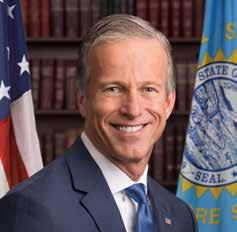
First and foremost is that the Working Families Tax Cuts delivered permanent tax relief for hardworking Americans, preventing a $2,500 tax hike on a typical South Dakota family beginning this year. As South Dakotans prepare to file their taxes, they can plan on taking advantage of a larger standard deduction, and seniors can claim an additional bonus deduction on top of that. We raised the child tax credit to $2,200 per child, which working families will be able to claim on this year’s tax return. Workers who earn tips and overtime pay won’t have to pay federal taxes on that income either. And all of that adds up to bigger tax refunds for a lot of South Dakotans in April.
Republicans’ landmark legislation also made a generational investment in rural health care. In the last two decades, more than 100 hospitals have closed across rural America. But thanks to the Working Families Tax Cuts, help is on the
way. This bill created a $50 billion Rural Health Transformation Program to address the rural health care crisis. Instead of a top-down approach centered in Washington, we gave states the resources and freedom to find solutions to their unique challenges. And in South Dakota, that funding will go toward creating regional hubs for emergency services, a major investment in telehealth, and to bolster our rural health care workforce, among other priorities.
This bill also made a significant investment in public safety and national security. It included funding for state and local law enforcement agencies, including efforts to combat violent crime and drug trafficking. It made a generational investment in border security, supporting the hiring of new enforcement agents, finishing the border wall, and deploying technology and resources to the southern border. And it supported much-needed efforts to modernize our military and ensure that America’s men and women in uniform have the very best capabilities to defend our national security from whatever threats may arise.
The contents and impact of this legislation are significant, and there’s much more I could say about it. I could talk about its sizeable investment in the programs that farmers and ranchers depend on; or tax policies that help small businesses grow; or its provisions addressing waste, fraud, and abuse in federal programs. This bill is filled with wins for the American people, and I can’t wait for that story to unfold in South Dakota and in every corner of America. ■

Chief Executive Officer - Southeastern Minnesota Multi-County Housing and Redevelopment Authority (SEMMCHRA), Wabasha, MN. Provides vision, leadership, and oversight for the SEMMCHRA. Reporting to the Board of Commissioners, the CEO ensures effective planning, direction, and evaluation of all programs and policies, while overseeing efficient administration and the supervision of department heads. This position is based in SEMMCHRA’s Wabasha office and requires regular, on-site presence to effectively lead staff, support the Board of Commissioners, and engage with communities and partners throughout the region. View the full position profile at https://www.ddahumanresources.com/active-searches. Salary: $137,914 to $155,223. Open until filled.
Director of Municipal Electric Services - South Dakota Municipal Electric Association (SDMEA), remote work in South Dakota. Serves as the primary employee and the public face of the SDMEA. The employee is highly self-motivated, capable of working
independently, and brings exceptional communication skills to the role. Oversees the administration, programs, and organizational strategies of SDMEA, and requires proactive engagement in marketing, event planning, community outreach, education, and legislative lobbying during the Legislative Session and throughout the year. Reports directly to the SDMEA Board of Directors. Remote work flexibility; however, the ability to travel is essential. Full-time salaried position with competitive salary, SD Retirement System participation and other benefits. Full job description at sdmunicipalleague.org. Apply via letter of application and resume to rhalgerson@swiftel-bmu.com or by mail to Brookings Municipal Utilities, C/O Electric Department Manager, 525 Western Ave, PO Box 588, Brookings, SD 57006. Salary Range: $70,000-$100,000 depending on experience. Open until filled.
Finance Officer – City of Fort Pierre, SD. Directs activities of staff in various departments within the City, supervising personnel and overseeing the fiscal accounting, budgetary and business functions that are essential to the City, under the direction of the Mayor and according to statute, ordinances, codes, and policies adopted by the Council. Calls for a great deal of contact with the public therefore maintaining good public relations is essential. Bachelor’s Degree in Accounting or Business Management preferred, will consider an equivalent combination of relevant education and work experience. $2,000 Hiring Bonus. Salary range begins at $80,000/yr depending

on qualifications and experience, plus excellent benefits. Learn more and apply at www.fortpierre.com (Employment Opportunities). Open until filled.
Communications Specialist (E-911) – City of Mitchell, SD. Responsible for answering emergency and non-emergency calls and for dispatching appropriate personnel. Some of the duties are: provide guidance to callers until emergency personnel arrive on scene; receive and transmit radio and telephone communication; monitor security cameras; and greet and assist visitors at the customer service window. No experience in the field is necessary; however, sufficient experience to understand basic principles relevant to the major duties of the position. Possession of or ability to readily obtain NCIC and EMD Certification. Starting wage: $23.846 per hour plus benefits. Learn more and apply at www. cityofmitchellsd.gov. Open until filled.
Economic Development Director – City of Staples, MN. Manages the City’s economic development, community development, and marketing initiatives. Serves as the primary liaison for development projects and business assistance efforts and acts as the Executive Director of the Staples Economic Development Authority. Qualifications: Bachelor’s degree in Business Administration, Economics, Marketing, Public Administration or related field, and a minimum of five (5) years of experience in local government, economic development, financial management, business ownership, or business operations, or an equivalent combination of education and experience. Salary: $70,703 to $90,645. Learn more and apply at https://daviddrown.hiringplatform.com. Application Deadline: Feb. 10.
Wildland Engine Boss/Firefighter - City of Spearfish, SD. The wildland engine boss/firefighter is responsible for all aspects of assigned engine, crew, and equipment. They supervise and mentor engine personnel. While not on fire suppression assignments, personnel will complete hazardous fuels mitigation projects, community risk reduction projects and other tasks as directed by the Deputy Fire Chief. $34.50/hour. Learn more and apply at https:// www.spearfish.gov/161/Career-Opportunities. Open until filled. EOE.
Assistant City Engineer - City of Huron, SD. Play a key role in shaping the city’s infrastructure, serving the community, and ensuring long-term growth and sustainability. This is an excellent opportunity for a dedicated civil engineer ready to expand their leadership and technical skills. Supports the City Engineer in applying civil engineering principles, methods, and techniques. This

role requires professional judgment, strong technical knowledge, and adaptability to varied project needs. Annual Salary Range: $87,201 – $106,298. Learn more and apply at https://huronsd.gov/ Jobs. Open until filled.
Civil Engineering/Surveying Intern – City of Watertown, SD. Ideal candidate will be a motivated individual interested in pursuing a surveying, engineering or construction management career, who has had experience and/or training in surveying or drafting. Will work in a team environment under the supervision of the City Engineer. This is a great opportunity for someone who has a broad interest in Municipal Government and/or Civil Engineering, surveying, or construction management. 40-50 hours per week. Temporary, fulltime basis for 12-16 weeks for the summer of 2026. $19.00 - $23.00 per hour, depending upon previous experience and training. Learn more and apply at http://www.watertownsd.us/Jobs.aspx. Open until filled. First review Feb. 9.
Staff Engineer – City of Spearfish, SD. Responsible for performing Computer Aided Drafting (CAD) activities, providing engineering support activities involving both office and field work and administering the city’s floodplain ordinance. Maintains a regular and reliable attendance with a physical presence. Utilizes CAD software to perform a wide variety of mapping and engineering support activities. Develops and maintains standard CAD operating
and work procedures. Prepares and/or updates exhibits, city maps, and standard construction details. Maintains all CAD master base mapping for public infrastructure; Updates mapping on a regular basis using as-built information from private developments projects. $42.03 per hour. Learn more and apply at https://www.spearfish. gov/161/Career-Opportunities. Open until filled.
Deputy Finance Officer – City of Hecla, SD. Position entails entrylevel bookkeeping, clerical, customer service and computer skills and assisting in accounts payable and receivable. Reports to Finance Officer. This is a part-time position. High school graduate or GED certificate required. Wage DOE. Apply at the Hecla City Office, 206 Main Street, Hecla, SD. Questions may be directed to 605-9942333. Position open until filled. EOE.
Finance Officer – City of Britton, SD. Duties include but are not limited to overseeing all the City’s finance operations, including payroll, budgets, revenue and expense reports, accounts payable and receivable, prepare and file necessary State and Federal Reports, manage and direct day to day operations of the city. Fulltime position. Salary DOE, competitive benefit package. Please send resume to financeofficer@brittonsd.net or City of Britton, PO Box 126, Britton, SD 57430. Open until filled. EOE.

Finance Officer - City of Fort Pierre. Directs activities of staff in various departments within the City, supervising personnel and overseeing the fiscal accounting, budgetary and business functions that are essential to the City; human resources; under the direction of the Mayor and according to statute, ordinances, codes, and policies adopted by the Council. Calls for a great deal of contact with the public therefore maintaining good public relations is essential. Salary range begins at $80,000/yr depending on qualifications and experience, plus excellent benefits. $2,000 Hiring Bonus. Learn more and apply at www.fortpierre.com (Employment Opportunities). Open until filled. Affirmative action and equal opportunity employer.
Medical Assistant – City of Sioux Falls, SD. Health/Falls Community Health has an exciting opportunity available for Medical Assistants! We are seeking Medical Assistants that have a Medical Assistant certification. Our pharmacy services are continuing to grow, so we are looking for a qualified individual who is interested in working in both medical and pharmacy settings. Health/Falls Community Health will provide on-the-job training for the hired individual to obtain their pharmacy technician certification. HIRING RANGE DOQ: $21.42 - $23.09 hourly. This position is eligible for a hiring incentive of up to $4,000. Learn more and apply online at www. siouxfalls.gov/careers. Open until filled.
Certified Patrol Officer – City of Brookings, SD. Work encompasses everything from traditional patrol duties to criminal investigations. Responsible for providing law enforcement services to the citizens of Brookings in a timely, efficient, and professional manner. Starting minimum compensation, depending on experience, is $62,142.66,148 to $84,075.37, plus benefits. View the complete list of minimum requirements online. Open to current Certified Law Enforcement Officers only! For details and application: https://www. cityofbrookings-sd.gov/careers. Closes March 31, 2026.
Communications Officer – City of Spearfish, SD. This position is responsible for performing emergency and non-emergency communications functions. $26.95/hour. Learn more and apply at https://www.spearfish.gov/161/Career-Opportunities. Open until filled. EOE.
Community Service Operator – City of Spearfish, SD. The position is a civilian, non-sworn employee of the Spearfish Police Department performing work that supports basic law enforcement operations. The position has a variety of critical responsibilities, which include parking enforcement, found property, taking and preparing nonhazardous crime reports, monitoring and directing traffic, and carrying out non-sworn assignments as directed. Salary range: $28.32-$43.08. Learn more and apply at https://www.spearfish. gov/161/Career-Opportunities. Open until filled.
Patrol Officer - City of Mitchell, SD. Responsible for the enforcement of federal, state, and local laws and the protection of life and property. Some of the job duties include: patrol the city to detect and

deter criminal activity and traffic violations and to provide assistance as needed; monitors commercial and residential areas for signs of criminal activity; responds to calls for service, including domestic disputes, assaults, burglaries, traffic accidents, lost or missing persons searches, public service requests; completes required reports and forms, including accident and incident reports. Starting wage: $30.525 per hour. $3,000 relocation stipend. Competitive benefits. Learn more and apply at www.cityofmitchellsd.gov. Open until filled.
Police Chief – City of Golden Valley, MN. Offers a unique opportunity to lead and inspire a highly engaged and dedicated staff, build a strong culture of excellence, and partner effectively with the community to ensure exceptional service delivery. The Golden Valley Police Department enjoys robust community support, as well as a supportive City Council and City leadership. All partners are enthusiastic and ready to actively participate in supporting the new Chief to shape the police department's future vision. The City itself is financially strong, and supportive of innovative programs and initiatives that enhance public safety. Salary: $158,454 - $211,120 annually DOQ. View the full position profile, job description, and benefits at gmphr.com. First Review: Feb. 8. EOE.
Police Officer – City of Avon, SD. Qualifications to include: High school diploma or GE Equivalent; Must be 21 years of age; Must have valid SD driver's license with acceptable record; Must agree to have acceptable results of law enforcement background checks for criminal history, driving record, and job history. Must be free of felony convictions; Must be fingerprinted for SD standards and training application process; Must possess or be able to obtain and maintain: Law Enforcement officer certification within 12 months of hire date; Firearms qualification within 12 months of hire date; CPR and Radar certification and any and all other required certifications deemed necessary. Pay based on education and experience. Competitive benefits. Applications can be picked up at the Avon City Finance Office, 116 N Main Street, Avon, SD. For questions, please call 605-286-3694. Open until filled. EOE.
Police Officer – City of Huron, SD. Under the general, and occasional, direct supervision of the Patrol Sergeant, or Captain, is responsible for protecting the law-abiding citizen and enforcing the law through ongoing police work in the City. Work varies, exercising judgment within well established procedures and standards. $29.082/hour. Apply at huronsd.gov/Jobs. Open until filled.
Police Officer (Full-Time) - City of North Sioux City, SD. South Dakota certification is preferred, but not mandatory. Please mail, email or fax applications and resumes to: North Sioux City Police Department PO Box 650/ 118 So. Victor Avenue, North Sioux City, SD 57049. Email: rich.headid@northsiouxcity-sd.gov or peggy. gorsett@northsiouxcity-sd.gov. Phone: (605) 232-3302 - Fax: (605) 232-3266. Position open until filled. EOE.
Police Officer – City of Spearfish, SD. Enforce local, state, and federal laws; prevent and suppress crime and accidents; promote public safety through community policing principles. Responsible for the investigation of criminal cases as assigned. Full-time position. Requires availability to work all shifts weekends and holidays. Starting wage range: $32.84 per hour. Sign-On Bonus of $6,000 for police officers plus an additional $500 per month housing allowance for 8 months. Learn more and apply at https://www. spearfish.gov/161/Career-Opportunities. Open until filled. EOE.
Police Officer – City of Summerset, SD. Responsible for the duties of general law enforcement functions and service to the court. General Law Enforcement Functions include: General patrol; Enforce federal, state and local laws and ordinances; Preserve peace and protect life and property; Respond to calls for service and emergency assistance; Traffic enforcement; Observe and investigate persons, situations or matters that require attention; Receive and process citizen complaints; Arrest offenders; Investigate traffic crashes. To apply, download and print the application packet at https://www. summerset.us/join-our-team/. Submit the completed packet along with your resume to policeinfo@summerset.us. Open until filled.
City Maintenance – City of Kimball, SD. The City of Kimball is now taking applications for a permanent full-time City Maintenance Worker. Wage is negotiable based on qualifications. Willing to train the right applicant. Applicants must be highly motivated with a great work ethic and have the ability to work cooperatively with other government agencies, the public and city personnel. Contact the city office for a copy of the full job description. Please submit cover letter and resume to City of Kimball, Attn: City Finance Officer, PO Box 16, Kimball, SD 57355 or email to kimballcitysd@midstatesd. net. Phone: (605)778-6277. EOE.
Electrical Superintendent/Lineman – City of Arlington, SD. Must have successfully completed an approved Electrical Line Worker program and have Journeyman experience. Requires a strong working knowledge of a municipal electrical system, departmental budgeting, and a vision for long range electrical system planning. Must be proficient with computers including Microsoft, mapping and AMI systems. Reports directly to the Utility Superintendent. The ideal candidate will display excellent communication, leadership and supervisory skills. Must demonstrate the ability to engage the general public and address any electrical outages or concerns. Must possess a Class A CDL Driver’s license (or be willing to acquire one) and are subject to random drug and alcohol testing. Salary commensurate with experience and qualifications, with competitive benefits package. Apply with cover letter, resume, salary history, and three work-related references to Stephanie Damm, Finance Officer,

City of Arlington, cityofarlington@arlingtonsd.com or PO Box 379, Arlington, SD 57212. For more information, contact Marshal Mix (Utility Supt) at 605-203-1121 or Stephanie Damm at 605-983-5251. Open until filled. EOE.
Foreman, Solid Waste Department – City of Huron, SD. Under general supervision, and in the superintendent’s absence, oversees all transfer station, composting, and construction and demolition (C&D) operations. Also manages staff involved in solid waste collection, disposal, transportation, and recycling. Expected to lead with professionalism and good judgment, remain neutral and respectful, listen to different viewpoints, encourage input and work cooperatively with staff, city leadership, commissioners, elected officials, and the public. $29.082/hour. Learn more and apply at huronsd.gov/jobs. Open until filled.
Public Works Employee – City of Wessington Springs, SD. Will help street and electric departments as needed. Class B commercial driver’s license required or obtained. Subject to drug and alcohol testing. Must obtain water and sewer certifications. Excellent benefit package including SD Retirement, health, vision & dental insurance, AFLAC, and PTO. Salary dependent on experience and qualifications. Applications available at cityofwessingtonsprings. com, City Hall, or 605-539-1691. Open until filled. EOE.
Public Works Maintenance Tech – City of Newell, SD. Performs maintenance in the public works departments including streets and alleys, snow removal, irrigation system, water, wastewater, sanitation, parks and cemetery. Applicants must be SD DENR certified or willing to become certified in all water/wastewater certifications. Must have a SD driver’s license including CDL or be willing to get CDL. Have knowledge of and ability to operate equipment and handle materials used in street maintenance and be able to lift and move 50 to 100 pounds. Will be required to take on-call rotation. Will report to and take direction from the Public Works Foreman. Pay along with all other essential duties and responsibilities can be discussed at time of interview. Applications available at townofnewell.org. Open until filled. EOE.
Public Works Supervisor – City of Britton, SD. Will perform supervisory, administrative and professional work in planning, organizing, directing, and supervising the Public Works Department, including environmental, water, sewer, street, traffic control, cemetery, airport, swim pool, parks, rubble site, forestry and code enforcement. Applicant must be dependable, reliable, and friendly and be able to work with others. Must have a lifting capacity of 75 lbs. Full benefit package. Applications at https://cityofbritton.com or at city hall; City of Britton, PO Box 126, Britton SD 57430. 605448-5721. Open until filled. EOE.
Street Maintenance Worker – City of Pierre, SD. Responsible for manual labor and operating street sweepers and snowplows to maintain city streets. Manual labor, such as shoveling, raking asphalt, etc. is required. Skill in operating and maintaining equipment such as street sweeper, truck, roller, snow plow, skid steer, and front-end loader. Must have possession of or ability to obtain a Class B CDL with air brakes and tanker endorsements. Comprehensive benefit package. Up to $2000 annual educational assistance available. Wage offer will be based upon actual education and experience. UP TO $3000 HIRING BONUS. Learn more at www.cityofpierre. org. Open until filled.
Utilities Operator – City of Spearfish, SD. Responsible for the installation, maintenance, repair, and operation of the City’s water
distribution and wastewater collection utility systems. An incumbent in this position may be designated “Utilities Operator I, II, or III. Knowledge and level of competency commonly associated with completion of specialized training in the field of work, in addition to basic skills typically associated with a high school education. Sufficient experience to understand the basic principles relevant to the major duties of the position, usually associated with the completion of an apprenticeship/internship or having had a similar position for one to two years. Position ranges: Operator I - $25.65$39.03; Operator II - $26.95-$41.01; Operator III $29.75-$45.27. Learn more and apply at https://www.spearfish.gov/161/CareerOpportunities. Open until filled.
Wastewater Collections Operator I/II/III – City of Watertown, SD. Performs preventive maintenance and repairs on the wastewater collection systems to ensure proper operation. Inspects, repairs, rehabilitates, and maintains the wastewater collection system, including locating sanitary sewer and storm drains; repairing wastewater lines; installs flow meters; makes sewer taps; maintains air relief and sewer valves; and lift stations. Inspects manholes. Maintains and repairs lift stations including electrical equipment, pumps, floats, structures, piping and valves. Salary: DOE - Operator I = $53,123.20 annually; Operator II = $55,785.60 annually; Operator III = $58,572.80 annually. See full description and apply at http:// www.watertownsd.us/Jobs.aspx. Open until filled.

Wastewater Treatment Plant Operator III, Public Works – City of Watertown, SD. Operates, monitors, maintains, and troubleshoots the wastewater treatment facility, equipment, and its processes. Salary: Grade 145/Step 1 to Step 5 = $58,572.80 to $63,398.40 annually DOE. Learn more and apply at http://www. watertownsd.us/Jobs.aspx. Open until filled.
Water Sewer Maintenance Uncertified – City of Huron, SD. Under general supervision is responsible for maintaining and repairing water distribution and collection lines. Work varies; individual judgment and decision making may be required within wellestablished Federal and State regulations. Physical demands include some climbing, bending, stooping, walking, kneeling, crawling, and lifting up to 75#s (greater with assistance). Work is frequently performed in uncontrollable working conditions of heat, cold, dampness, and exposure to chemicals and infectious wastes. Assists in installing, maintaining, and repairing water mains, sewer mains, water service connections, fire hydrants, lift stations, and valves; keeps maps up to date; Work may include nights, weekends, holidays, and responding to emergency callouts. $21.624/hour. Learn more and apply online at huronsd.gov/Jobs.
Find full descriptions, links to applications, more listings, or place an ad online:
December 2025 issue, page 10 "Additional Election Notes"
Vermillion should have been included in the list of Home Rule Municipalities.
December 2025 and January 2026 issues "January Municipal Calendar"
The January Municipal Calendar listed the vacancy publication notices for January. Due to legislative changes in 2025, these dates have changed per SDCL 9-13-6. Please refer to the SD Secretary of State’s City and School Election Calendar for election publication dates.
Current statute: The finance officer of the municipality shall have a notice published in the official newspaper of the municipality setting forth the vacancies that will occur by termination of the terms of office of elective officers. The notice must also state the time and place where nominating petitions may be filed for the offices. The notice must be published once each week for two consecutive weeks between the fifteenth day and the thirtieth day of the month six months before the election.
Water Meters – The City of New Underwood is offering approximately 250 water meters, mixed condition, as a surplus lot valued at $2,500. For details, contact 605-754-6773 or publicworks1@goldenwest. net.




On or before February 1 – The State Treasurer must distribute to the County Treasurers the remainder of the franchise tax on banks. The County Treasurer then apportions and distributes the tax in the same proportion as the real property taxes levied in each taxing subdivision in the previous year. (SDCL 10-43-76; 10-43-77; See Hdbk., sec. 12.255(4))
No later than February 1 – The liquor tax reversion must be made. (SDCL 35-5-22; See Hdbk., sec. 11.600)
February 1 – All certificates for water supply and treatment systems operators expire and must be renewed. (SDCL 34A-3-18; See Hdbk., sec. 6.305)
February 2 – The earliest date for a candidate to sign declaration of candidacy, begin petition circulation, and file a petition if the municipal election is to be held the first Tuesday after the first Monday in June. (SDCL 9-13-9; 13-7-6) Follow the Municipal Elections Calendar for all election deadlines.
Not later than its first meeting in February – The governing body may by resolution encumber that portion of the unexpended appropriations from the preceding year for which applicable obligations were incurred but were not paid. (SDCL 9-21-24.1; See Hdbk., sec. 12.069)
Third Monday of February – Presidents’ Day – State holiday (SDCL 1-5-1)
Sales tax ordinance deadlines – The effective date of any new or amended municipal sales tax ordinance must fall on either January first or July first. The municipality must notify the Department of Revenue of the ordinance at least 90 days prior to the effective date. (SDCL 10-52-9; 10-52A-13; See Hdbk. Sec. 12.260)
Boundary changes – Municipalities must notify the Department of Revenue of any resolution or amendment enacted which changes the boundaries of the municipality. Notification shall be in written form, shall contain a copy of the resolution or amendment, and may be sent by electronic means or registered mail. Municipalities shall also provide any changes and additions to streets and addresses. (SDCL 10-52-13; See Hdbk., sec. 14.172)
March 2026
March 1 - A nominating petition may not be circulated for signatures more than four months before the election. A nominating petition must be filed under the provisions of § 9-13-7 at least seventy days before the election. The finance officer shall certify to the appropriate county auditor the candidate names and ballot language to be voted on by the Thursday sixty-eight days before the election. (SDCL 9-13-37) – Follow the Municipal Election Calendar for all election deadlines.
15 16 17 18 19 20 21
22 23 24 25 26 27 28
29 30 31
Not later than the third Monday in March – A copy of the assessment roll must be furnished to each requesting municipality. (SDCL 10-3-28; See Hdbk., sec. 12.105)
Third Monday of March (Equalization meeting) – The governing body and the finance officer together representing the municipality with a member of the school board are required to meet for the purpose of equalizing the assessment of property. The Equalization Board may adjourn from day to day until the process has been completed within five days. (SDCL 10-11-13, 10-11-14; See Hdbk., sec. 12.120)
On or before the fourth Monday of March – After completing the equalization the clerk of the equalization board is required to deliver the assessment roll to the county Director of Equalization. (SDCL 10-11-21; See Hdbk., sec. 12.120)
At least six days prior to the last Tuesday of March – The county director of equalization must publish a list of all tax exempt property in the county. This publication must be in the official newspapers of the county. (SDCL 10-4-15.1; See Hdbk., sec. 12.105)
March 24 – For elections held in June, nominating petitions must be filed not later than five p.m. on the last 24th day of March. (SDCL 9-13-7; See Hdbk., sec. 7.250) If no one, including the incumbent, files a nominating petition, a vacancy is created and is filled by appointment or special election. (SDCL 9-13-14.1; 9-13-14.2) Follow the Municipal Election Calendar for all election deadlines.
On or before March 31 – The Urban Renewal Agency is required to file a report of its activities with the governing body. The report must include a complete financial statement for the preceding year. (SDCL 11-8-47) The Urban Renewal Agency must file a similar report with the Auditor-General on or by the same date. (SDCL 11-8-48; See Hdbk., sec. 14.200, The Urban Renewal Agency) ■