SDCCD



BOARD OF TRUSTEES
Geysil Arroyo
Mariah Jameson
Marichu Magaña, Psy.D.
Craig Milgrim
Maria Nieto Senour, Ph.D.
CHANCELLOR
Gregory Smith
PRESIDENTS
Ricky Shabazz, Ed.D.
Ashanti T. Hands, Ed.D.
P. Wesley Lundburg, Ph.D.
Tina M. King, Ed.D.
EXECUTIVE EDITOR
Jack Beresford
Vice Chancellor, Marketing, Communications & Public Affairs
EDITOR
Leslie Stump
Manager of Creative Services
GRAPHIC DESIGN
Claudia Azcona
PHOTOGRAPHY
David Brooks, Howard Lipin
CONTRIBUTORS
Campus Information Officers:
Cesar Gumapas, Anabell Pulido, Stephen Quis, Brenna Leon Sandeford
Writers: Allura Garis, Anne Krueger, David Ogul, Hoa Sanchez
San Diego Community College District
Marketing, Communications & Public Affairs Office
3375 Camino del Rio South, Suite 335 San Diego, CA 92108
The San Diego Community College District (SDCCD) is governed by its Board of Trustees. No oral or written representation is binding on the San Diego Community College District without the express written approval of the Board of Trustees.
Questions, comments?
We’d love to hear from you. Email us mcpa@sdccd.edu.

SDCCD

14 Paying it forward
Roger Frey’s commitment reflects a deep belief in the power of community colleges to uplift students
Experience that counts Credit for Prior Learning is helping working professionals turn real-world experience into college degrees — faster and for less
18 Powered by persuasion Mesa College’s Speech and Debate team members turn critical thinking and mentorship into championships and increased confidence

AS PUBLIC SERVANTS, WE ARE COMMITTED TO PROVIDING pathways to higher education to everyone in our community. For too many people and households, the rising cost of housing in the San Diego region makes meeting basic needs and pursuing education impossible. We cannot be America’s Finest City if socioeconomic advancement, health, well-being, and prosperity are inaccessible to San Diego’s diverse communities.
The San Diego Community College District is embracing its ability to address this crisis. In 2025, the SDCCD and San Diego Unified School District founded the San Diego Regional Housing Finance Authority, an independent public agency with the ability to use public funds to build and operate affordable housing. Its mission: build housing near jobs, schools, and transit so San Diegans can live in communities where they work and thrive. Its vision: create a city where every resident has a quality, affordable home close to current and future job opportunities. Through SDRHFA, we can bring large-scale affordable communities to San Diego.
One of the possible housing sites being discussed is adjacent to the historic-but-outdated Golden Hall, which we and the city of San Diego are looking to transform into an arts and culture hub for the region (read more on page 6). This spring, the Housing Finance Authority board adopted a Transitional Strategic Framework, a critical milestone allowing us to move into a new phase: securing operational funding, hiring staff, launching an Advisory Committee, and developing the programs, partnerships, and financing strategies that can ultimately lead to a funding proposal being brought to voters as early as 2028. This summer, we will launch a San Diego Regional Housing Finance Authority website containing more details about the Authority and updates on its progress.
This effort is about more than housing. It’s about ensuring that those who are building our neighborhoods can live in the communities they serve. It is about strengthening our institutions by investing in the people who sustain them. It is about advancing a more equitable and resilient future for our region.

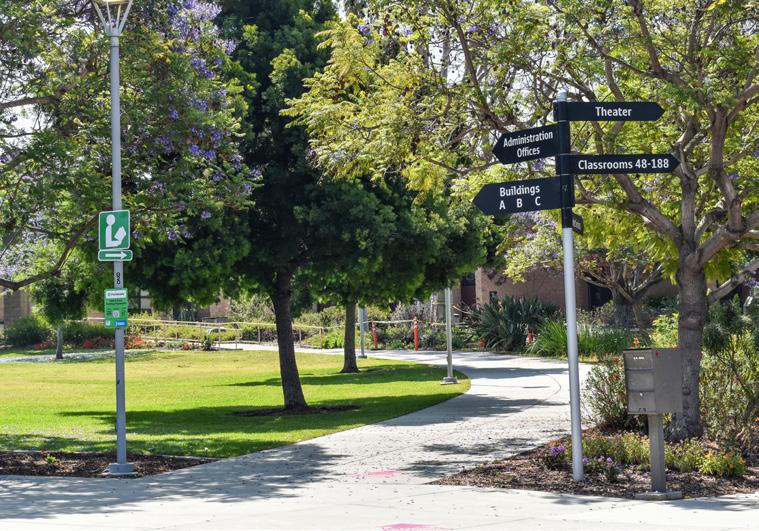
When designing new spaces, landscape and well-lit walkways play an integral part toward visibility and awareness for safe movement around campus.
Safety on campus is often thought of in terms of emergency response, but across the San Diego Community College District, many decisions that affect safety happen much earlier — while projects are still being planned.
“Safety starts in the design phase, while projects are still on paper, not after they’re built,” said SDCCD College Police Lieutenant J. Stone, who serves as a public safety liaison on Measure HH projects. By working alongside architects, planners, and college leaders, Stone helps review projects before construction begins, following principles of a design strategy known as Crime Prevention Through Environmental Design. This strategy uses buildings, landscaping, and site design to support visibility, awareness, and safe movement.
Across the District, Measure HH projects are incorporating CPTED guidelines to make campuses easier to navigate and to improve visibility. This is done by incorporating features such as clearly illuminated walkways connecting classrooms, parking and transit areas, and student gathering spaces. Pathways
“When students know where they’re going and can easily navigate campus, they’re more aware of their surroundings.”
— SDCCD College Police Lt. J. Stone
that connect major student destinations are designed without hidden corners or confusing routes.
Outdoor gathering areas and landscaping are also planned with line of sight in mind, Stone added.
“Landscape design can help define pedestrian routes without creating hidden areas,” he said. “Design teams select trees with taller canopies to maintain visibility underneath. Lower-profile plants and shrubs are selected to avoid blocking critical sight lines and enhance visibility along walkways and entrances.”
The emphasis on safety also affects everyday campus life. Clearly marked entrances, connected walkways, and straightforward signage can help students spend less time figuring out where to go and more time focused on classes and campus activities.
For Stone, the objective is practical: creating campuses where students, employees, and visitors feel comfortable moving through the environment from the moment they arrive.
“If we can design spaces that make people feel safe before they even set foot on campus,” Stone said, “then we’re doing our job.”
What if campus buildings could think for themselves in real time? Some of the new Measure HH buildings will be designed to do just that — automatically fine-tuning lighting and temperature through smart controls based on how the spaces will actually be used. It’s just one of the ways sustainability is becoming more visible across SDCCD campuses. These features build on long-standing District standards and Board of Trustees priorities, all aimed at creating spaces that work better with fewer resources. Look for:
• Campuses supported by solar, battery storage, and other emerging technologies
• Landscaping that emphasizes native plants — which support local ecosystems and use less water
• Water captured and reused for irrigation
• Materials chosen for durability and lower maintenance
• Healthier environments with improved air quality, comfort, and natural light
Together, these choices shape campuses that run efficiently, reflect their surroundings, and continue to serve students and employees well into the future.
SDCCD’s research on sexual orientation and gender identity guides inclusive planning and student support
The San Diego Community College District has long supported members of the LGBTQIA+ community. A project to collect both qualitative and quantitative data related to sexual orientation and gender identity (SOGI) is helping to find new and better ways to serve those students and employees.
The research, conducted by SDCCD’s Office of Institutional Effectiveness and Research, will help support equitable planning, inform new and existing programs, and strengthen the District’s advocacy for LGBTQIA+ (lesbian, gay, bisexual, transgender, queer/questioning, intersex, asexual, or different orientations and identities) students and employees.
SOGI data project Research Assistant Rajitha Narreddy said the data collection is important for the District.
“To advocate effectively for LGBTQIA+ students, we need inclusive and representative data,” they said. “The lack of this data renders LGBTQIA+ students invisible in policy and funding decisions. This work is essential to ensuring access to the life-saving services and support systems that every student needs and deserves.”
Use of quantitative data at the SDCCD got a boost in 2024 when the District secured a grant from the American Association for the Advancement of Science.
In an analysis supported by the grant, researchers found at least 13% of students districtwide across 2023-2024 and 20242025 academic years identified as LGBTQ. Based on the data, the District estimates that at least 15,700 LGBTQIA+ students attend one of its four colleges, San Diego
cation. The data does not include students who applied when they were under 18 years old, including dual enrollment students, because they are not asked about their sexual orientation on their college applications.
Also among the data, researchers found that a higher percentage of LGBTQIA+ students were housing insecure, had been in the foster care system, and used disabled student programs more than the rest of the student population.
Another key finding from the qualitative research, which launched in 2019, was that LGBTQIA+ students desired space — both physical spaces and space within the curriculum they were being taught in classes — in which to freely express themselves, as well as direct support from the colleges. Such findings provide opportunities for the colleges to support not only Pride Centers but also outreach and student support programs.
“It’s important that we create spaces where access, belonging, success, and the exchange of ideas and learning are paramount for our diverse community of students, faculty, and employees,” said Jaime Sykes, a research and planning analyst who worked on the project with fellow Analyst Stephen Bass.
The District has taken many steps to support the LGBTQIA+ community, most notably a 2023 resolution by the Board of Trustees affirming its support through the annual raising of the Pride flag, which was again reaffirmed in 2025 and 2026.
San Diego City, Mesa, and Miramar colleges all have Pride Centers for their LGBTQIA+ students, and the College of Continuing Education provides mobile support between its seven campuses while also exploring a permanent center.
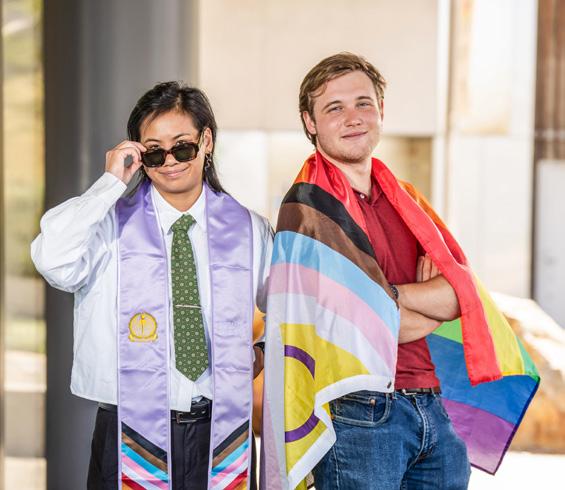
LGBTQIA+ Safe Zone trainings are available throughout the District, and the District’s Queer Alliance employee resource group is now becoming part of the SDCCD’s District Governance
“It’s extremely important that all of our services and programs are inclusive and built to consider and support queer and trans students’ success and well-being,” Sykes said.
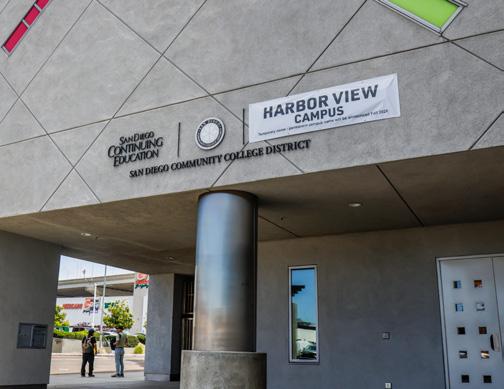
SDCCD governing board approves temporary renaming of campus in Barrio Logan
Following a special April 6 meeting, which included considerable public input, the San Diego Community College District Board of Trustees decided to rename San Diego College of Continuing Education's César E. Chávez Campus. The building in Barrio Logan will temporarily be called San Diego College of Continuing Education Harbor View campus while the college, along with the District, completes a process to determine a permanent name change.
While several suggestions for a permanent name were made at the meeting, the Board expressed support for a thoughtful and transparent process to ensure all voices in the community have the opportunity to be heard. The District will gather additional public input on a permanent name to be recommended to the Board during the fall 2026 semester. In addition, the Board directed staff to remove related visual design elements, including main building signage and artwork, around the campus.
“As a Mexicana, I want to be clear that removing his name does not remove us from who we are and what we represent in this country,” said SDCCD Board President Geysil Arroyo. “I want us to be sure that it will be the comunidad that will make the decision of the new name. I see this as an opportunity to teach younger generations about the farmworker movement.”
The renaming of the campus and a reconsideration of Chávez’s personal legacy follow allegations that the labor leader sexually abused young girls decades ago. Several who commented during the April 6 meeting expressed support for survivors of sexual violence and emphasized that Chávez’s actions do not tarnish the work of thousands who helped shape the farmworker movement.
Located at 1901 Main St. in San Diego’s Barrio Logan neighborhood, the 67,924-square-foot campus opened in 2015 and annually serves thousands of adult education students enrolled in the SDCCD’s College of Continuing Education. The facility is designated as a Campus of Excellence in Healthcare Careers, and it provides free classes for vocational training, English as a Second Language, citizenship, business, and adult basic education, among other programs.
THE SAN DIEGO COMMUNITY
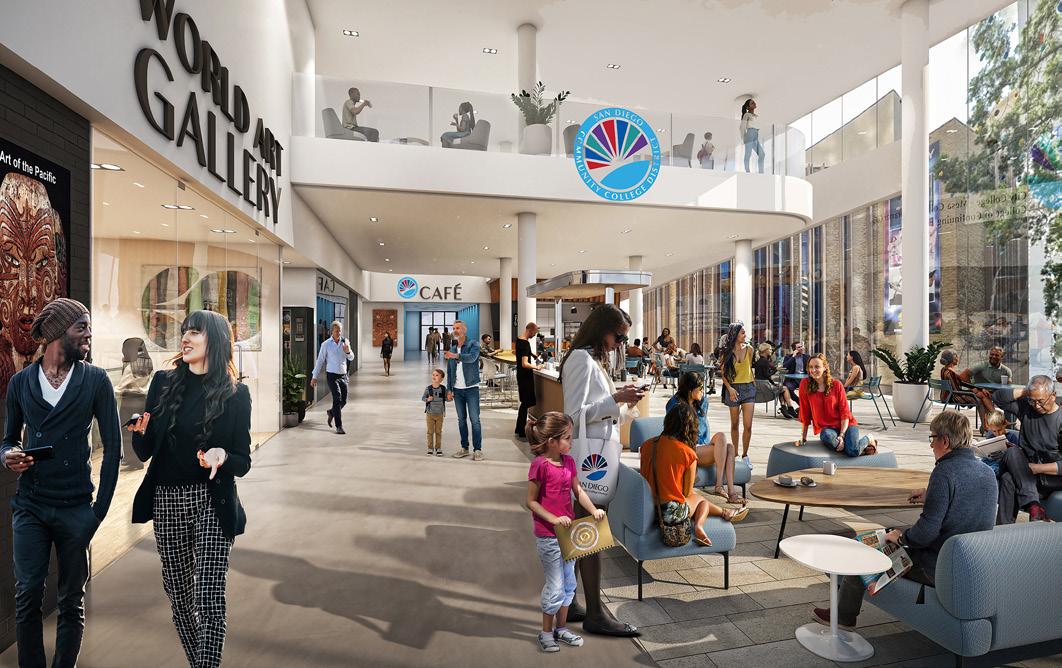
COLLEGE DISTRICT AND THE CITY OF SAN DIEGO have taken a major step toward transforming the city’s historic-but-outdated Golden Hall into a museum and educational center as part of a comprehensive plan to remake the downtown Civic Center complex.
A nonbinding memorandum of understanding signed May 11 allows the District to inspect and assess Golden Hall before moving forward with possibly redeveloping the site, which would be a key piece in a larger renovation of the Civic Center. San Diego Mesa College and District officials view a downtown World Art Collection home as becoming a focal point for research, education, and engagement.
The Golden Hall property would house a 20,000-square-foot gallery space showcasing rotating displays from Mesa College’s World Art Collection, which is outgrowing its current home at the college’s Learning Resource Center Glass Gallery; a conservation and collections storage area; classrooms for hands-on-learning; and a 5,000-square-foot community and events
space. The SDCCD is also looking toward building hundreds of affordable residential units on the site (read more on page 3).
Established more than a half-century ago, the Mesa College World Art Collection has amassed more than 1,300 pieces, including art and artifacts from Africa, the Pacific Islands, Mesoamerica, and Asia. What began as a donation of several pieces from Africa is today a priceless and growing academic asset for students and a highly sought-after resource for the study of indigenous cultures around the world.
The SDCCD will assess the project’s feasibility over the next several months. Any future agreement to proceed would require approval by the San Diego City Council.
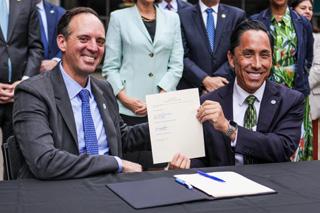

San Diego State University and the San Diego Community College District have made progress since launching a first-of-its-kind partnership last summer to strengthen transfer pathways for students from San Diego City, Mesa, and Miramar colleges.
A key element in the partnership focuses on developing an SDCCD Science, Technology, Engineering, and Mathematics program-oriented academic building at SDSU’s Mission Valley campus near Snapdragon Stadium. The two institutions also finalized guaranteed admission for eligible SDCCD students in certain fields with the first transfer students benefiting from this partnership enrolling at SDSU this fall.
Expanding access and boosting STEM admission rates are seen as critical to producing more graduates for high-demand fields across the region. A shared STEM education center at SDSU’s Mission Valley Innovation District would provide SDCCD students with expanded access to university labs, on-site academic and career advising, and expanded networking opportunities.
After meeting with SDSU this spring, SDCCD’s facilities team has defined general parameters for the education center, and the District in May issued a request for proposals/ qualifications to solicit prospective design and construction firms. This step does not commit SDCCD to any financial obligation.
The focus on STEM reflects a key challenge: many SDSU STEM prerequisite courses lack an SDCCD equivalent, forcing STEM transfer students to complete additional semesters after they transfer. Clear, four-year pathways provide SDCCD students with a defined road map to a bachelor’s degree from when they first enroll at City, Mesa, or Miramar college.
Just 63% of SDCCD STEM majors seeking to transfer are currently accepted to SDSU, compared with 82% of students in a non-STEM field, according to District data.
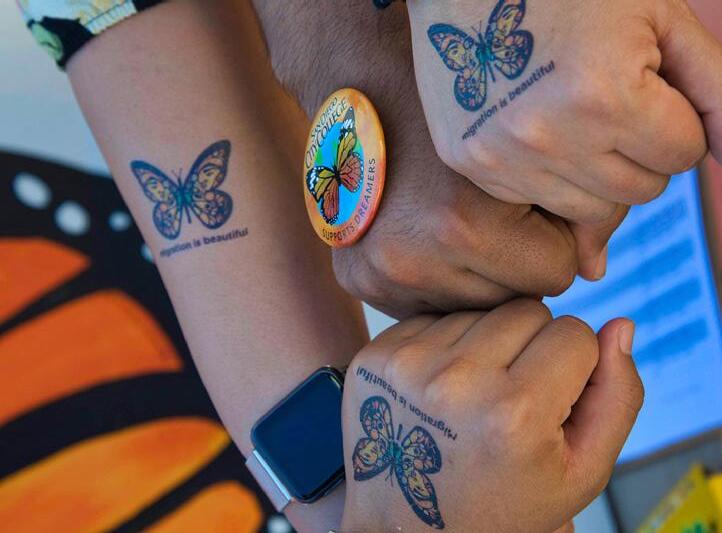
For immigrant students, the American legal system can be confusing and intimidating. Higher Education Legal Services at the San Diego Community College District is working to educate students about their rights as immigrants and to get guidance on their legal issues.
The legal services program offers consultations to students, as well as their family members and SDCCD employees, on a wide variety of immigration issues and holds workshops on immigration law for undocumented students and their families.
The program can be life-changing.
“It’s made a huge impact in their lives,” said Fatima Mota, Immigration Student Success
received education about legal services in workshops held at the campuses and online.
Those needing legal advice can consult with attorneys or representatives accredited by the Department of Justice, but the program does not represent people in court. The program assists with filing 20 types of immigration services, including Deferred Action for Childhood Arrivals, deportation defense consultation, applications for legal permanent residency, work permit applications, and citizenship applications.
2,200
Attendees of in person or online legal services workshops.
Program counselor at the San Diego College of Continuing Education. “A lot of our students come to this country not knowing what their rights are”
Higher Education Legal Services is provided by Jewish Family Service to community colleges and universities in San Diego and Imperial counties, thanks to a grant from the California Health and Human Services Agency.
“We don’t charge any legal fees,” said Marisa Garcia-Perez, program manager for Higher Education Legal Services. “It’s important for the community to know that they have access to this free resource ”
Since the program began in 2019, more than 1,300 people at the four SDCCD colleges have received legal services, and more than 2,200 have
The program has been offering multilingual “Know Your Rights” workshops regularly at the colleges, both in person and virtually. Citizenship and naturalization classes are also offered.
Garcia-Perez said the constantly changing policies and laws regarding immigration have made it challenging for attorneys and legal providers to stay current.
“It’s creating a lot of anxiety in the immigration community with people unsure about making a decision for the safety of their families,” she said.
Mota said the workshops and legal consultations have helped to answer the many questions that immigrants have about their legal status.
“A lot of people are very fearful,” she said.
“Hearing from an attorney about what is going on and how to better prepare is huge because now they have the knowledge and options, and they can make a wise choice.”

SDCCD continues to encourage, educate student journalists in an ever-changing media landscape
STORY BY DAVID OGUL
ince Janna Braun began teaching journalism at San Diego Mesa College in 2005, the media landscape has undergone profound change. Thousands of newspapers have shut down, hundreds of thousands of jobs have disappeared, and more than a third of counties across the United States no longer have a local newsroom. Public radio and local television have faced their own challenges, with some markets, including San Diego and Sacramento, consolidating coverage. At the same time, more Americans are turning to social media and video platforms for news, a shift that has accelerated in the past decade.
Amid this transformation, Braun and a host of other SDCCD faculty and adjunct professors continue to prepare students for careers in journalism. The work itself, even with growing uncertainty of career availability or security, remains indispensable.
“Because truth and the media still matter. How the news is conveyed is the question,” she said. “The jobs are different now. You’re probably not going to work at a large daily newspaper, but there are jobs, vital jobs, that are still out there.”
That helps explain why San Diego City and Mesa college journalism programs remain among the more successful in the
region. Program alumni include former City College student newspaper editor-in-chief David Hasemyer, who became an award-winning investigative reporter at The San Diego Union-Tribune and shared a Pulitzer Prize for national reporting at Inside Climate News; and Artie Ojeda, an Emmy Award-winning news anchor for NBC’s San Diego affiliate who spent decades covering the city he loves before retiring in 2022.
Local programs span podcasting, broadcasting, reporting, and video editing, and campus news studios are equipped with the latest tools. Newsrooms are hubs of camaraderie, where students majoring in everything from English to cyber security forge friendships that can last a lifetime.
“We’re not only teaching them skills that are applicable to the journalism industry,” said City College student media advisor and associate journalism professor Nicole Vargas. “Those same skills are also used in a wide variety of industries.” Among those skills are digital literacy, researching, fact checking, asking tough questions, and not blindly accepting everything on TikTok or YouTube as fact.
“Teaching writing, teaching editing are vital parts of our program, but teaching digital literacy might be the most vital of them all,” Vargas said. “The heart of what journalists do is question what we see.”
With Excellence magazine recently checked in with a handful of SDCCD journalism alumni to see how they are reporting in an ever-changing media landscape.
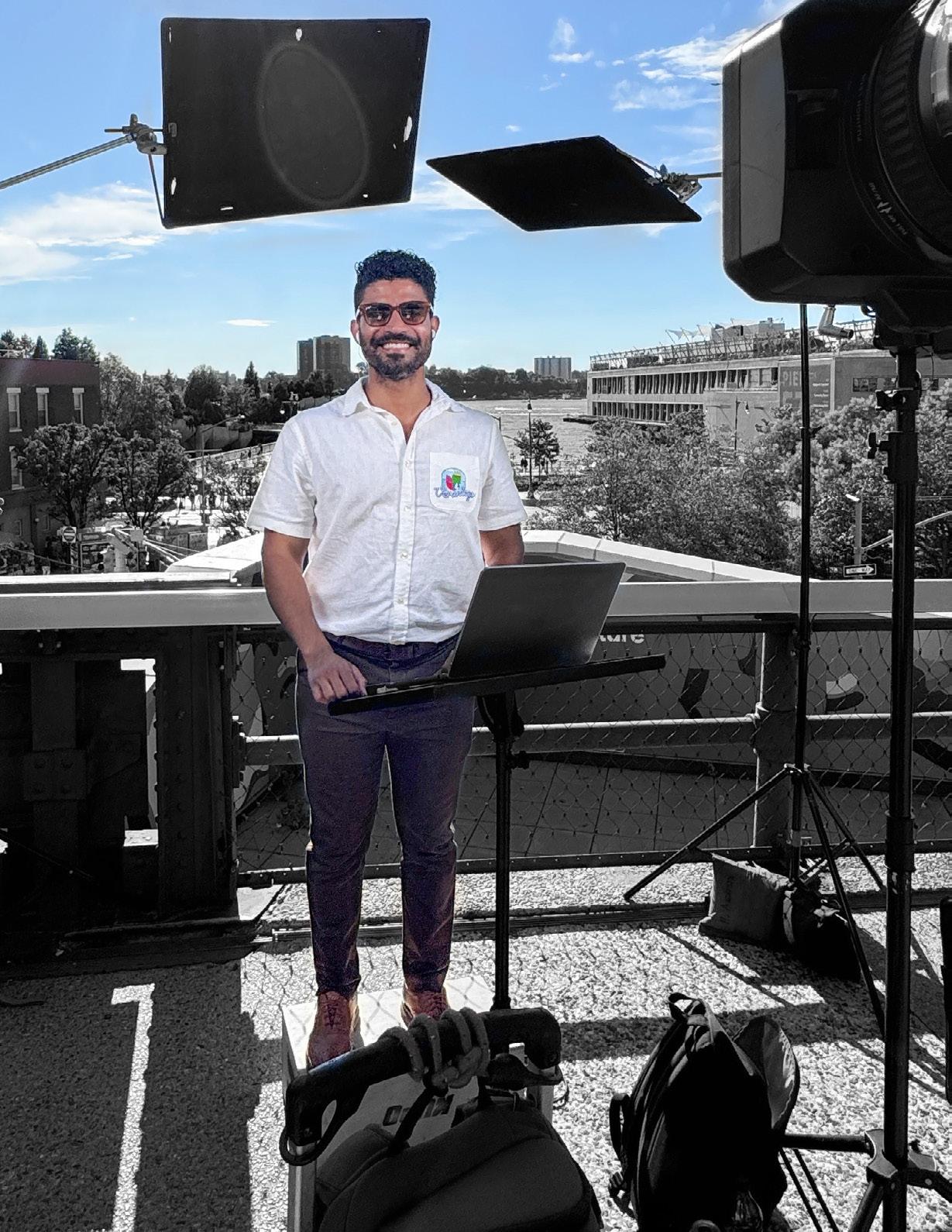
Broadcast meteorologist Jesus Lopez had already built an impressive résumé — working for a Telemundo affiliate in Oklahoma City, an ABC affiliate in Bakersfield, and AccuWeather in College Station, Pennsylvania — before moving to San Diego in 2019 and enrolling in City College’s media production program.
“It has to be one of the top programs of its kind in the country,” said Lopez, who earned a bachelor’s degree in meteorology from the University of Miami and relocated when his husband’s job brought them to San Diego. “I always wanted to learn what happens behind the scenes, and City College is highly regarded for its hands-on training in news production, technical operations, and journalism fundamentals. It also had a production studio where I learned to edit everything. I’m using the knowledge and tools I gained from City today.”
Today, Lopez is a broadcast meteorologist for TelevisaUnivision in New York City, a position he has held for the past six years. With the skills he gained at City College, he’s embracing the rise of artificial intelligence as a tool to cross-reference forecasting models and uncover deeper data insights.
“I don’t see it as a threat to broadcasting work; it still lacks the storytelling and charisma human meteorologists bring,” he said.

TRAINING FUTURE JOURNALISTS
At City College, students can gain real-world experience through the City Times digitalfirst news organization, CTTV and Newscene (weekly TV news broadcast), CT Sound (student-run radio station), and CityScene (news magazine). Mesa College students can test their mettle by working at The Mesa Press campus newspaper.

“If I was going to stay in journalism, I wanted to work somewhere not managed from corporate offices outside the area .”
— Lauren Mapp, Mesa College alumna

Mesa College alumna Lauren Mapp has learned to roll with the punches in a changing media landscape. A former reporter for The San Diego Union-Tribune, Mapp grew disillusioned after hedge fund company Alden Global Capital purchased the paper in 2023. Seeking a more community-driven newsroom, she teamed up with two former colleagues to launch Daylight San Diego, a nonprofit site covering areas often overlooked by the legacy
media. Grants and donations have helped keep the publication afloat.
“If I was going to stay in journalism, I wanted to work somewhere not managed from corporate offices outside the area,” said Mapp, who’s also an adjunct professor at Mesa College.
It’s a far cry from what Mapp set out to do when she graduated from Mesa College in 2016. Though she was a staff writer at campus papers from elementary through high
school, her goal was to become a food writer. That path shifted when she transferred to San Diego State University, landed an internship at inewsource, and secured a job at the U-T where she covered East County, indigenous communities, and senior care.
At Daylight San Diego, Mapp and her co-founders are planning a transition to a paid membership model with a $1 million annual budget and a staff of 11. “It’s a challenge, but it’s work we love.”

College wasn’t on Walker Armstrong’s radar when he was in high school.
“I didn’t even know what the SAT was,” said the Encinitas resident. After a few aimless years, he found his way to Mesa College in 2018, where the journalism program sparked his passion and changed his life.
“I was focused on doing the best I could to get to the next step,” he said. “All the professors were so focused on their students, and the journalism program was excellent. It fostered in me the belief that, hey, I can do this.”
Armstrong earned his associate degree in journalism, transferred to Boston University, and later landed his first reporting job at the Cape Cod Times, owned by USA Today. After one too many freezing winters, he returned home, joined The Coast News,
freelanced for the Voice of San Diego, and then secured a job covering South County for The San Diego Union-Tribune, where he’s worked since September. “I couldn’t be happier.”
As for journalism’s uncertain future? “Will I get laid off at some point? Maybe,” he said. “But whatever happens, I’ll deal with it. Journalism is evolving, but we’ll keep adapting and roll up our sleeves to bring news to people who care about their community.”
“All the professors were so focused on their students, and the journalism program was excellent. It fostered in me the belief that, hey, I can do this.”
— Walker Armstrong, The San Diego Union-Tribune reporter and Mesa College alumnus
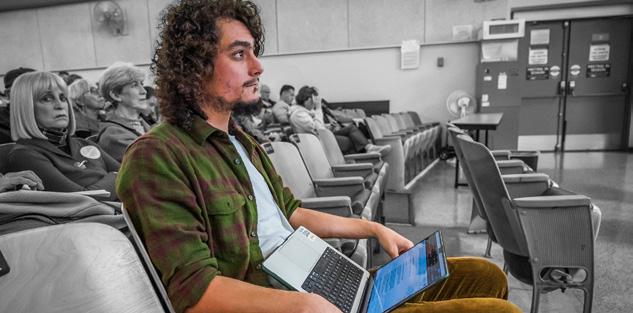
A career in journalism was the furthest thing from Jakob McWhinney’s mind while growing up in La Mesa.
“My dream was to be a rock star and make music,” said the Voice of San Diego reporter who now covers education. But when gigs and part-time work dried up during the pandemic, McWhinney enrolled at City College in 2020 and took an introductory course in journalism in 2021. “I fell in love with the concept right away and decided this was something I was going to pursue.”
He hasn’t looked back. At City Times, the campus news operation, McWhinney served as podcast director, multimedia journalist,
managing editor, and operations manager. That led to an internship with the Voice of San Diego, which hired him full time even before he transferred to SDSU.
“I finally feel like the work I’m doing means something that matters,” McWhinney said. “At a time like this, where traditional journalism is collapsing, working at a nonprofit, like Voice, and covering a community that you love is more important than ever.”
Like many in the industry, McWhinney is anxious about how AI and deepfakes will shape journalism’s future. For now, though, “I’m just enjoying the ride.”
David Pradel

City College couldn’t have done a better job preparing David Pradel for his career as a video journalist and editor at some of San Diego’s most popular news stations. He was deeply involved with Newscene, City College’s award-winning weekly broadcast filmed in state-of-the-art studios. He honed his writing and reporting skills at City Times. And he produced several podcasts through City Times Media using the latest industry tools.
“The equipment and resources at City mirror what actual news stations and newsrooms have,” said Pradel, who earned associate degrees in broadcast news and digital journalism and now works at Fox 5/KUSI, covering everything from brush fires to off-the-beaten-path human interest stories, as well as this year’s Padres Opening Day. “From newsroom meetings to the planning of a newscast, everything felt familiar once I started working professionally.”
It’s a career he loves. “It’s a lot of responsibility. You have to make sure your stories and live coverage are reported fairly, that your reporting provides information people need, and that you remember the work you’re doing will impact people in some way.”
Pradel, who attended City College between 20132017 before transferring to SDSU, admits to some anxiety about the future, but he feels ready for it. “While the transformation we’re seeing presents new challenges, it also brings new opportunities.”

Losing her job as an NBCUniversal producer and correspondent didn’t take the storyteller out of Jobeth Devera — instead, it sharpened it. After being laid off in November 2025, she turned setback into momentum, launching "Still Eating Good," a YouTube series rooted in culture and resilience. The pocket documentaries range from a former NBA champion’s journey beyond basketball to the cultural richness illustrated through the dishes served at the San Francisco Ferry Building.
Today, she draws up to 20,000 views per episode, with steady growth and plans to expand. The title comes from evolving cultural slang, where “eating” signals thriving — capturing Devera’s outlook of pushing forward despite adversity.
“When I lost my job, I was hurt, and honestly, a little bitter,” Devera said. “But I reminded myself: I’m still a journalist. I’m still a storyteller. I’m just going to do it my own way.”
That perspective was shaped at City College, where between 20112012 Devera honed her craft after graduating from San Diego State University. There, she learned not just reporting and editing, but how to notice the small details that bring stories to life.
“I didn’t realize it then,” she said, “but City taught me how to truly observe. That’s what I carry into my work today.” WE
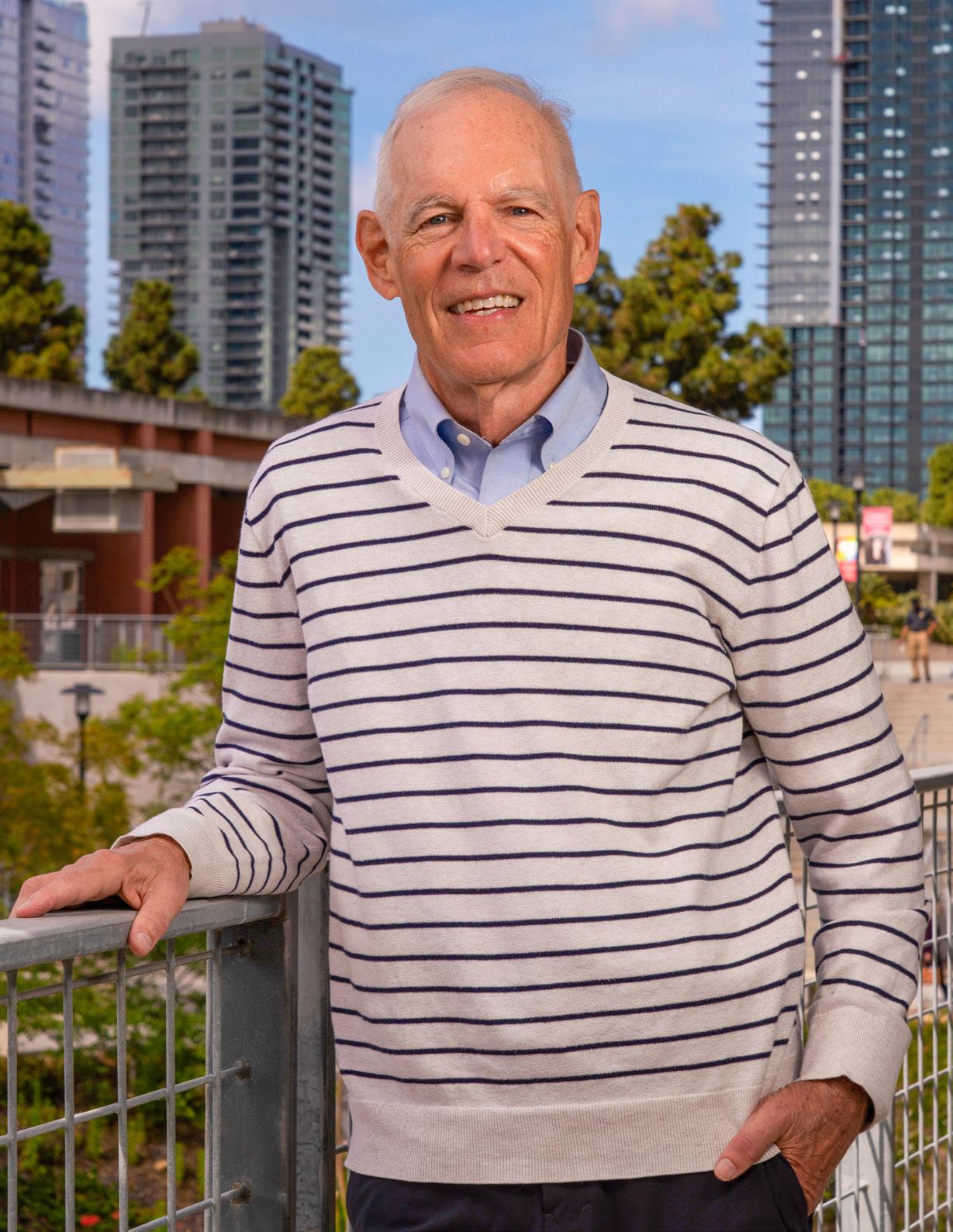
Roger Frey’s commitment reflects a deep belief in the power of community colleges to uplift students
BY DAVID OGUL
AFTER RETIRING AS A VICE PRESIDENT at
JPMorgan Chase, where he worked around the clock and traveled the world analyzing myriad energy-related ventures, Roger Frey switched gears and devoted his financial acumen to nonprofit service he had little time for during his career. He began volunteering with organizations such as Mama’s Kitchen, Special Delivery San Diego, and Uptown Community Service Center. His focus eventually turned to the San Diego Community College District after meeting with then-Vice Chancellor Lynn Neault, who introduced him to the San Diego Promise program.
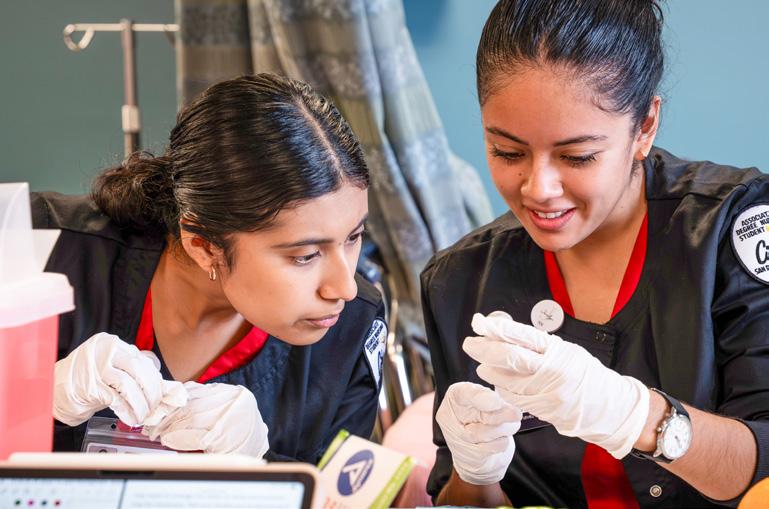
He has since donated or pledged a total of more than $1.5 million to the tuition-free San Diego Promise Program and the recently established Ready2Work initiative, the latter of which ensures students completing their training for a healthcare career are no longer held back by costly licensing and testing fees. A $1-million commitment announced in fall 2025 marks the largest contribution of its kind in SDCCD history.
“The inability to pay for a licensing exam should not be an impediment to getting a job that you are eminently qualified for,” said Frey, emphasizing the benefit to the larger community. Licensing exams alone can amount to nearly $500 per person on average, with some paying more than twice that. By removing the financial barrier, students are more quickly able to enter their intended field.
Frey says that the vital role community colleges play in uplifting all students drives his philanthropy.
“There are far more students enrolled at community colleges than at four-year colleges and universities, yet community colleges receive only a fraction of the funding,” Frey said. “People assume a community college education is cost free, but even though tuition is sometimes waived, transportation isn’t free, housing isn’t free, books and various fees aren’t free. As a
"The inability to pay for a licensing exam should not be an impediment to getting a job that you are eminently qualified for.”
— Roger Frey
consequence, a large number of community college students, many of whom are struggling single parents or living in their car, are really being challenged financially.”
SDCCD Chancellor Gregory Smith praised Frey’s impact: “Roger’s generosity and vision, his ability to see the transformative effect he could have, is remarkable, and the Ready2Work program is just the latest example of how philanthropy can change outcomes.”
Frey credits his upbringing in greater Detroit with instilling his drive to elevate others.
“My mother was always involved in working for nonprofit organizations,” he said. “She found it very rewarding, so I
think I probably picked it up from her.”
A motivating factor in his decision to retire in his early 50s was a desire to spend ample time paying it forward. He applies the same analytical skills he used at JPMorgan Chase, and at Fuji Bank of Japan before that, to evaluate the potential impacts of his philanthropic investments.
“When you meet these students, you realize how hard they’ve worked to get where they are,” Frey said. “They deserve this just based on merit alone. I was at a recent nursing program graduation at San Diego City College and a parent came up to thank me. I told her, ‘Don’t thank me, thank your child. They did all the work.’ ” WE




























15,000
SDCCD students have benefited from CPL

















$50 MILLION collective amount saved by SDCCDstudents who benefited from CPL






























































BY DAVID OGUL



dgar Cordova, a former firefighter now working as an emergency medical technician in Chula Vista, had long set his sights on a leadership role in emergency services. A new bachelor’s degree in Public Safety Management at San Diego Miramar College offered a clear path forward, but one barrier stood in his way: the requirement for an associate degree in fire science, which typically takes two years to complete. As a 35-year-old student parent, that timeline wasn’t realistic.
Through the San Diego Community College District’s expanding Credit for Prior Learning program, Cordova was able to earn that degree after completing just two courses. His prior training, certifications, and experience as a firefighter and paramedic counted toward the rest of the associate degree requirements.
courses — from child development and automotive technology to introductory Excel and specialized firefighting tactics — and follows a straightforward process: Students confirm eligible courses, identify accepted CPL methods, and submit an online request.
Miramar College’s Public Safety Management bachelor’s degree program exemplifies how CPL aligns industry training with academic pathways. “First responders often complete extensive training across multiple institutions,” said Fire Technology Program Director Darren Hall. “This degree leverages credit for prior learning to create the most direct pathway for students pursuing higher education.”






“I earned the associate degree last May, enrolled in the bachelor’s program last fall, and I’ll be graduating with the first class next year,” Cordova said. CPL awards college credit for validated, college-level learning gained outside the classroom, including military credit, industry credentials, credit by exams, and portfolio assessment. For adult learners, the impact is significant: Students reduce time to completion by nine to 14 months and save nearly $2,300 per credit in books, fees, and associated costs.
Fire Capt. Corey Adams will attest to that. The numerous certifications in the seven years he has been with California Department of Forestry and Fire Protection counted toward prerequisites needed to get into the Miramar College program. “The college does a great job working with you to make the transition easier,” he said.
In fact, the District’s leadership earned it recognition as the statewide 2025 MAP College of the Year, reflecting its success in translating training and experience into nearly 25,000 CPL credits in a single year.





While prior learning credits have existed in various forms for years, a 2020 update to California’s education code transformed CPL into a more formal, systemwide, and equity-focused framework. The California Community Colleges system also introduced the Mapping Articulated Pathways platform, which helps standardize how colleges translate prior experience into course credit across its 116 campuses.



Since CPL launched in 2021, more than 15,000 students across City, Mesa, and Miramar colleges, and participants from the College of Continuing Education, have collectively saved $50 million in tuition and related costs. The District is now expanding CPL opportunities for veterans, helping translate military training and Joint Services Transcripts into college credit. New offerings, including Business 201: Organizational Management, are part of the statewide Veteran Sprint initiative launched in 2025 that aims to honor technical skills veterans already possess by eliminating potential barriers of having to repeat coursework.
At the SDCCD, CPL spans a wide range of disciplines and upward of 300 individual
Said Desiree Payne, an SDCCD systems support analyst, “Some of these folks could teach some of the classes they would otherwise be required to take.” WE
Members

BY HOA SANCHEZ
Critical thinking, confidence, and trophies are just some of the results produced by San Diego Mesa College’s Speech and Debate team.
With a charter dating back to 1969, the team has made waves on the international stage in recent years — garnering five wins on the world stage, more than any two - or four-year college.
“It’s a fast and furious program that teaches students how to be confident, how to take critical feedback, and how to lose,” said Kim Perigo, who co-directs the Speech and Debate team with fellow professor Bryan Malinis. “Losing is an important part of winning — that’s what we always say.”
The Speech and Debate team serves about 25 students each semester with the support of three to four coaches. Team members come from a wide range of academic disciplines, including premed, prelaw, communication, and chemistry, and compete on national and international stages. Along the way, they develop abilities that support them in their careers and beyond, Perigo said.
Perigo knows firsthand the impact the program can have. She was a speech and debate team member herself.
“It was the greatest gift I gave myself as a student,” Perigo said. “Every advantage I’ve gotten in my life — everything of value — I can directly link to my time on the speech and debate team.”
Today, Perigo, who has co -directed the team since 2005, aims to give every student who joins what she calls a “full-service experience.”
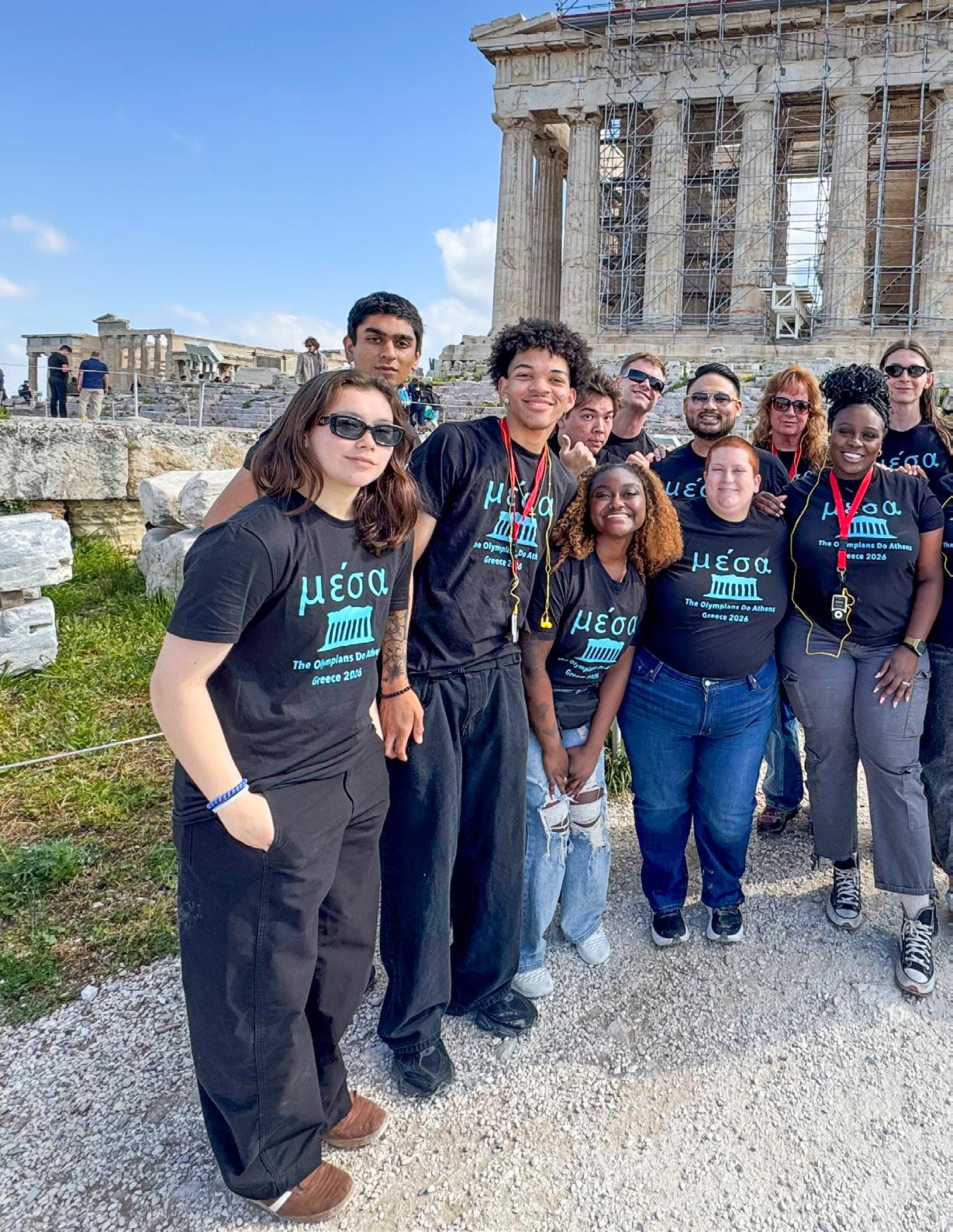
This year, the team competed in an international tournament in Athens, Greece, a setting deeply connected to the origins of speech and debate in ancient Greek philosophy. After discussing thinkers such as Socrates, Plato, and Aristotle in class, students sat among the ruins of Plato’s Academy and stood where Aristotle’s lyceum once existed. There they read Greek philosophy and explored artifacts that brought history to life.
“You can talk about the Acropolis, you can show pictures, but there is nothing like seeing it live,” Perigo said. “We can’t do this for every student, but we need to do it for as many as we can. It is truly life-changing.”
Perigo said opportunities like this reflect the college’s broader commitment to providing exceptional educational experiences. She added that developing a global perspective is essential not only for success in competition, but also for preparing students to be engaged citizens at home and beyond.
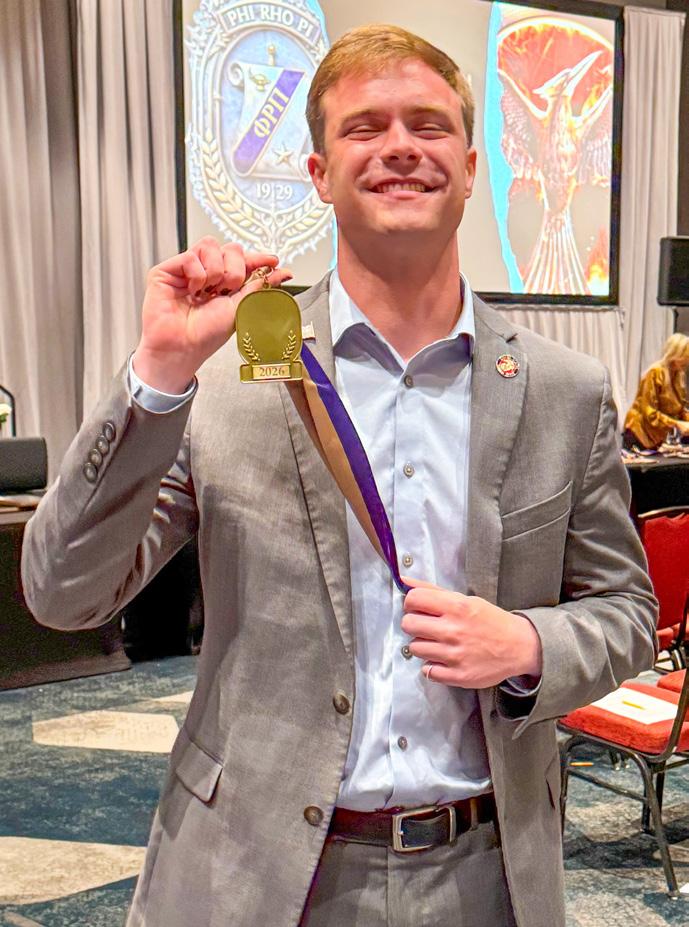
Josh Lewis, a communications major, is one student benefiting
”My life has significantly improved since last May, and the Speech and Debate team deserves a lot of credit for that.”
— Josh Lewis, Mesa College Speech and Debate team member
(pictured at left showing off his gold medal for Open Persuasion during the 2026 Phi Rho Pi National Forensic Tournament in Washington, D.C.)
from that full-service approach. Lewis served in the U.S. Marines before attending Mesa College and joined the Speech and Debate team last year to improve his public speaking skills.
“This team gave me a purpose and a support system while on campus,” Lewis said. “My life has significantly improved since last May, and the Speech and Debate team deserves a lot of credit for that.”
This school year, Lewis earned awards for a speech addressing suicide rates among service members, a topic shaped by personal experience.
“I have lost friends to this epidemic, and last May I almost took my own life,” Lewis said. “My sisters saved my life. I got more help, so, I wanted to raise awareness and get others involved in saving veterans’ lives.”
Kyle Picar, who changed her major from biology to communications after joining the Speech and Debate team last year, is also making an impact beyond competition. She recently traveled to Sacramento with the team, where she spoke with lawmakers about pending legislation.
“No one ever taught me how to reach out to my representatives, talk to them in person, and hold them accountable,” Picar said. “Through my coaches’ guidance, I’ve learned to be more confident and more knowledgeable about policy changes. Those experiences have encouraged me to question and challenge ideas, consider new perspectives, and stand my ground.”
Like Lewis, Picar said the relationships she has built through the team have positively shaped her life.
“I am so grateful to have found a community where I belong,” she said. “That can be hard sometimes, especially at a community college.”
With the abilities students gain, the sky is the limit.
“Our students have gone on to outstanding universities,” Perigo said. “We have one who attended Johns Hopkins and later transferred to Harvard Law School. Students consistently tell us that one of the most discussed aspects of their Mesa years is their speech and debate experience — whether in transfer and graduate school applications or during job searches.” WE
For individuals facing a crisis or looking for help, please call the 988 Suicide and Crisis Lifeline at 988 or go to 988lifeline.org for chat services.
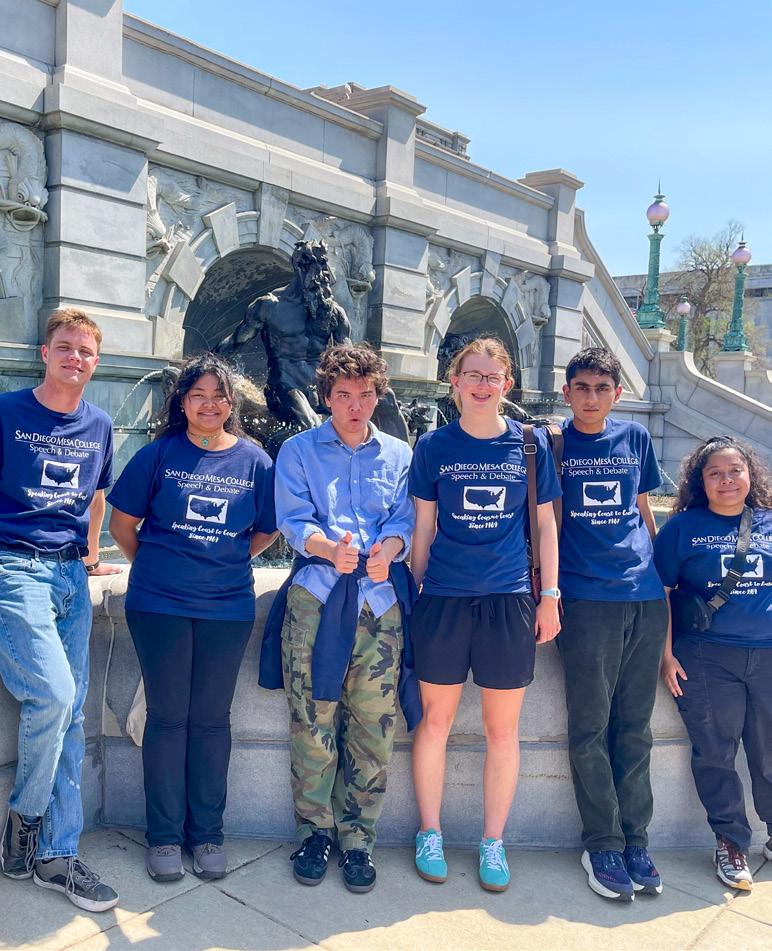
Members of the Mesa College Speech and Debate team visited the Library of Congress in between competitions for the 2026 Phi Rho Pi National Forensic Tournament in Washington, D.C.
San Diego Mesa College’s Speech and Debate team has the best record among colleges in international tournaments. Here’s a glance at the team’s first place wins over the years:
2025 INCHEON, SOUTH KOREA
2019 BERLIN, GERMANY
2013 ANTWERP, BELGIUM
2010 BERLIN, GERMANY
2008 LONDON, ENGLAND
WHEN CAROL “SPIRIT”
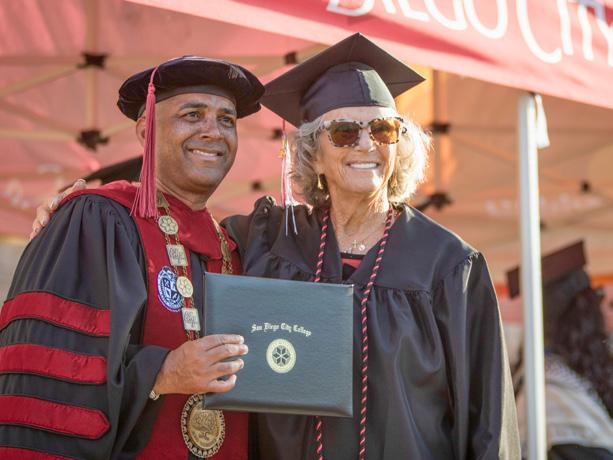
FABIAN graduated from high school in 1959, she never imagined she’d cross a college commencement stage more than six decades later. On May 21, the 85-yearold San Diego City College student did just that — earning her associate degree in Early Childhood Education and proving it’s never too late to learn.
Born in Long Island and raised in San Diego, Fabian built a full life beyond the classroom: she turned down a university scholarship to pursue fashion, raised four sons as a single mother, became a certified drug and alcohol counselor, biked 500 miles through Africa at 65, and completed a 5K on her 85th birthday. Still, a college degree remained unfinished business.
“I made a real commitment,” Fabian said.
“I said, ‘I’m going to graduate from college before I’m 100.’ And so, I just started, one unit at a time.”

31
Bachelor’s degrees in cyber defense and analysis conferred to the program’s inaugural graduating class. (Check out the grads on page 27.)
Her journey to City College began with her youngest son, Pete, whose enthusiasm for his professors inspired her to enroll. Managing ADHD, Fabian credits campus support for helping her persist. “Everything you need is there,” she said. “If you’re poor, you’ll get financial aid. If you need therapy, there's a therapist. And the professors, they’re there because they love City.”
After briefly studying gerontology, Fabian returned to her first passion: young children. She plans to advocate for greater investment in early childhood education, especially for ages zero to 5, which she calls the most critical stage of brain development.
Not slowing down, she hopes to pursue a bachelor’s degree after a year of travel. Fabian, who adopted the name “Spirit” at 80, leaves others with this message: “My life will be lived to the fullest until I take my last breath.”
1,594
Associate degrees conferred (a 31% increase over last year)
Peak Design: The City College design program has been ranked No. 1 in the world by the World Brand Design Society for the third consecutive year, recognizing the program’s continued excellence and global impact. The ranking reflects outstanding student achievement, with 53 awards earned across multiple categories.

The recognition is especially significant for a two-year program, as many global design rankings do not traditionally evaluate community colleges. City College continues to stand out for the quality of student work and its ability to prepare designers for success in the industry.
Additionally, City College students earned major individual honors. The design society named Tess Jordahl Student of the Year, selected from hundreds of students worldwide for her wine packaging project, and recognized Jaimie McKay as a close second.
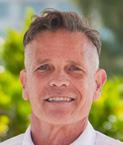
City College student Keith Sullivan was named a member of the 2026 Coca-Cola Academic Team and awarded a $1,300 scholarship. The Coca-Cola Scholars Foundation sponsors the Coca-Cola Academic Team program by recognizing scholars with nearly $200,000 in scholarships annually. Sullivan, who is studying social work, is also earning an associate degree in Alcohol and Other Drug Studies and plans to transfer to San Diego State University to pursue bachelor's and master's degrees in social work. A 4.0 GPA student, Sullivan is president of the Active Minds Club, an advocate for campus mental health services, a member of Phi Theta Kappa and the Honors Program, and is completing a 2,080-hour internship with an outpatient program serving unhoused individuals in recovery.
SAN DIEGO MESA COLLEGE’S GROWING EMPHASIS on global learning is reflected in recent recognition and new initiatives tied to study abroad opportunities. The U.S. Department of State named the college a Top Producer of Gilman Scholars for 2001-2025, placing it among institutions with a strong track record of supporting students in securing competitive scholarships through the Benjamin A. Gilman International Scholarship Program. The honor points to sustained efforts to expand access to international education, particularly for students with financial need.
Through its Study Abroad program, Mesa College offers opportunities for students to
earn academic credit while studying in international settings, developing cross-cultural competencies and broadening academic experiences. The Gilman Scholarship plays a key role in making those opportunities more accessible, supporting undergraduate students pursuing study or internships abroad.
This year also marks the launch of the San Diego Mesa College Foundation’s Community Travel Program, designed to connect educational travel with student support. The inaugural trip to Iceland, scheduled for July 27 through August 5, sold out, with a second trip planned to Sicily for spring 2027. Proceeds from these programs will help fund future study abroad opportunities for Mesa College students.
Two standout moments defined another memorable year for San Diego Mesa College athletics, showcasing both the growth of a rising program and the brilliance of an individual champion. On the badminton court, the women’s team earned a runner-up title after dropping the 3C2A State Championship match to De Anza College. The Olympians will retain much of its roster next season with seven players expected to return. Meanwhile, the Women’s Track and Field team continued their dominance as the Pacific Coast Athletic Conference Champions, capturing their fifth consecutive conference title before placing fourth overall at the 3C2A State Championships held at Mt. San Antonio College. Sophomore Natalie Allen (pictured at left) shined with one of the biggest moments of the day when, on her way being crowned the 2026 3C2A State Champion in the 10,000 meters, she set a new school record with a


LEARN MORE ABOUT participating in upcoming excursions with the Community Travel Program.

New Degree Path: Approval was granted from the California Community Colleges Chancellor’s Office to launch a bachelor's of science in physical therapist assistant. The degree, which is the college’s second baccalaureate program, reflects a continued response to workforce shortages in healthcare fields. The inaugural cohort is expected to begin in fall 2027.
Student Success: Mesa College, along with City College, was among the first in California named as a Black-Serving Institution. The newly established designation recognizes higher education institutions that are addressing systemic barriers that have kept Black students from reaching their full potential. Designations are limited to California colleges and universities with at least 10% of its enrolled student population identifying as Black and/or African American, or that have at least 1,500 Black and/or
African American students enrolled.
Well-deserved Recognition: Vice President of Instruction Dr. Isabel de los Angeles O’Connor was named the 2025–2026 recipient of the Carter Doran Award for her leadership within the California Community Colleges system and her contributions to statewide instructional initiatives and chief instructional officer professional practices.
Strong Finish: Two five-year grants — Hispanic Serving Institution STEM E3 and Asian American and Native American Pacific Islander-Serving Institution — reached completion. Between 2021-2026 the HSI STEM E3 grant annually served 1,555 Hispanic and low-income students pursuing STEM degrees; and the AANAPISI grant annually served 5,581 AAPI and low-income students and resulted in the creation of four AAPI studies courses.


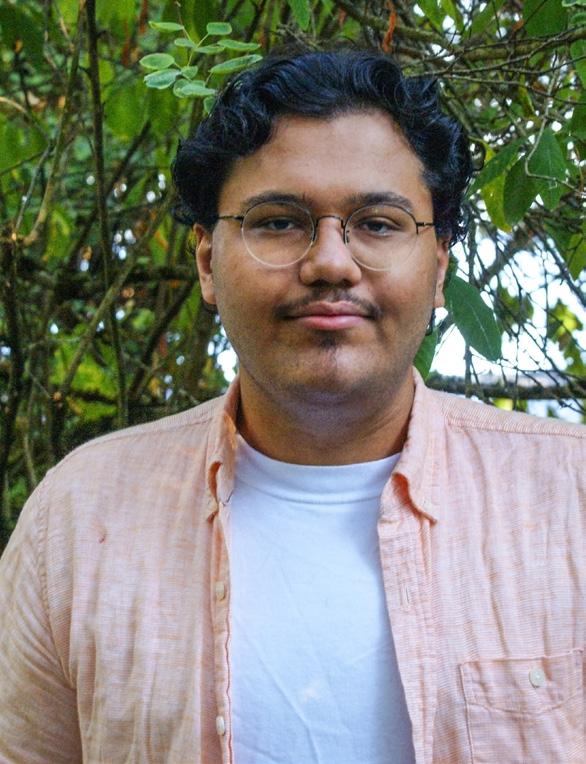
“...support programs like EOPS at Miramar College helped me catch up and get to where I am today.”
— RAZI ELHUSSEINI
ACCOLADES ABOUND
• Miramar College Dean of Public Safety, Dr. Jacqueline Hester, was honored on March 13 during a "Woman of the Year" Awards Ceremony hosted by California State Senator Brian Jones.
• Three students from the Diesel Equipment Technology program at Miramar College achieved outstanding success at the recent SkillsUSA State Leadership and Skills Conference, demonstrating
their technical expertise and dedication to excellence. David Barrios-Diaz earned Gold in the Diesel Equipment Technology competition, showcasing exceptional diagnostic and handson skills. Adrian Rodriguez secured Silver, and Brenden Oblujen took home Bronze, completing an impressive sweep for the program. As the gold medalist, Barrios-Diaz advanced to the SkillsUSA National Leadership and Skills Conference, held in June in Atlanta.
MIRAMAR COLLEGE STUD EN T RAZI ELHUSSEINI was among 60 community college students chosen to receive the prestigious Jack Kent Cooke Foundation Undergraduate Transfer Scholarship. The scholarship provides up to $55,000 a year to complete a bachelor’s degree. The Jack Kent Cooke Foundation announced 485 semifinalists for the 2026 Cooke Undergraduate Transfer Scholarship in March, and, along with ElHusseini, the list included fellow Miramar College student Lynnda Rader-Villicana, as well as Oleksandr Sharlai of San Diego Mesa College, the latter of whom also went on to receive a scholarship. In total, this year’s pool of applicants included 1,300 students representing 224 community colleges.
ElHusseini overcame significant academic and personal barriers on his path toward becoming a physician-scientist. Born in San Diego, he moved with his family to Dubai during the 2008 financial crisis at age 5, before returning to the United States at the start of high school amid the COVID-19 pandemic.
“After falling four years behind during a challenging high school experience, support programs like (Extended Opportunity Programs and Services) at Miramar College helped me catch up and get to where I am today.”
ElHusseini who graduated in May will continue his studies at UC Berkeley pursuing his studies in molecular and cell biology.
NEW AROUND CAMPUS

Dr. Boglárka Kiss has been named dean of Liberal Arts.
Kiss brings a rare blend of strategic leadership, creative practice, and student-centered impact to her work. She began her career as a management consultant at McKinsey & Company, delivering results in the healthcare and technology industries and contributing to the
Los Angeles Philharmonic’s successful brand revitalization and its move to the now-iconic Walt Disney Concert Hall. She later built a thriving freelance music career in Los Angeles while serving as a professor at Pasadena City College for 11 years. During that time, she supported countless students on their journey into meaningful careers as performers, conductors, educators, and technicians — many of whom now give back to their communities through the arts and education.
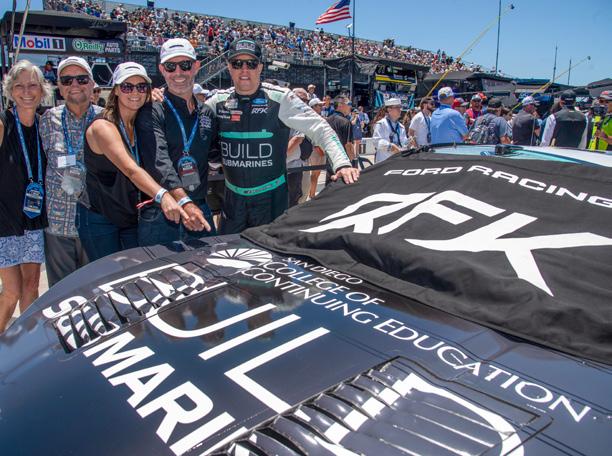
San Diego College of Continuing Education was represented at the Anduril 250 NASCAR Cup Series Race at Naval Base Coronado from June 19-21, helping showcase skilled trades pathways that support the U.S. Navy's submarine fleet.
NASCAR champion Brad Keselowski drove the No. 6 BuildSubmarines.com Ford Mustang Dark Horse for Roush Fenway Keselowski Racing, which featured SDCCE's logo through a mission-aligned partnership at no cost to the college. Sponsored by the U.S. Department of the Navy in collaboration with Submarine Industrial Base Program Office, the race car serves as a national platform to promote BuildSubmarines.com, a workforce development initiative aimed at filling more than 100,000 manufacturing, engineering, and skilled trades jobs critical to building and sustaining naval submarines.
Submarine Industrial Base Program Office awarded SDCCE with $1.175 million in 2023 to expand its tuition-free welding program in San Diego. At SDCCE, students earn industry-recognized certificates in Shielded Metal Arc Welding, Gas Metal and Flux Cored Arc Welding, Gas Tungsten Arc Welding, and Pipe Welding without the cost of tuition.
"Standing in the pit area and seeing the SDCCE logo on the hood of the BuildSubmarines.com car was an unforgettable experience, but what made the moment truly meaningful was knowing it represented opportunities for our students. This partnership highlights the power of connecting education with industry,” said
Brad Dorschel, associate dean of Career Technical Education at SDCCE.
NASCAR brought together motorsports and military service at Naval Base Coronado, giving attendees a firsthand look at Navy capabilities and careers that support national defense. A featured attraction was Brad Keselowski’s No. 6 BuildSubmarines. com Ford Mustang, which highlighted the sailors, welders, engineers, and skilled trades professionals who help build and sustain the nation’s submarine fleet.
“As a Navy community, San Diego is uniquely positioned to help meet the growing demand for welders and skilled trades professionals, and SDCCE is proud to provide a direct pathway from the classroom to careers,” said SDCCE President Tina M. King.
The Submarine Industrial Base Program Office investment is helping accelerate the expansion of SDCCE's skilled trades training programs, including nearly doubling the capacity of the college's welding program. The funding complements a broader $65 million modernization effort underway at the Educational Cultural Complex, supported by $35 million in state funding and Measure HH bond dollars. Together, these investments are expanding workforce training opportunities while supporting major campus improvements, including the modernization of the historic Educational Cultural Complex Theatre and the future development of the Automation, Innovation, and Robotics (A.I.R.) Skills Technical Trades and Workforce Development Center.
At SDCCE, creativity is a powerful tool for self-expression, confidence, and connection. The college's Adaptive Arts and Crafts program provides students with a wide range of disabilities the opportunity to explore painting, drawing, mixed media, and other artistic techniques in an inclusive and supportive environment. Through individualized projects tailored to each student's abilities and interests, participants develop critical thinking, communication, and problem-solving skills while expressing their emotions, experiences, and ideas through art. Unique to SDCCE, the program emphasizes artistic expression as a pathway to personal growth, helping students build self-esteem and strengthen social connections.

Opens: In April, the college opened its new Learning & Teaching Center at North City Campus, creating a centralized hub for instructional design, distance education excellence, faculty development, and emerging teaching practices. The center supports educators across online, hybrid, HyFlex, and in-person learning environments, helping ensure students receive high-quality, accessible, and engaging educational experiences to meet the changing needs of students.
11,122 certificates and diplomas awarded in 2026. This is the highest total in the college’s history and marks a 78% increase from just prior to the COVID-19 pandemic.

Brandon Wasliewski
is proud of the path he's piloting at Miramar College

WHEN BRANDON
WASLIEWSKI WALKED into the aviation department at San Diego Miramar College, he wasn’t sure what to expect or where life was headed. A former pizza maker with a passion for race cars, he had struggled in school and finished high school a semester late. At 33, he’s on track to graduate at the top of his class in aeronautics and aviation, with his sights set on a career repairing Cirrus aircraft. This spring, Wasliewski traveled to Atlanta to represent Miramar College at Verticon 2026, a global aviation conference hosted by Vertical Aviation International. Alongside two classmates and a faculty mentor, he competed in a high-stakes skills challenge against top aviation programs, including military teams specializing in Black Hawk helicopters.
Miramar College’s Federal Aviation Administration-approved program is the only low-tuition option of its kind in the region, training students for careers as mechanics, pilots, and aviation technicians. For Wasliewski, it has also been something more personal — a sense of purpose and pride.
Aviation, he said, represents a turning point. “For the first time in my life,” he shared, “I can say I’m proud of myself.”
Q: Prior to Miramar College, what path were you on? I worked at Bronx Pizza for about eight years. I moved to San Diego from Iowa on my own and just kind of stayed in that job. When one of the owners passed away and there was talk about selling the business, it scared me. I realized I didn’t have a backup plan.
Q: What inspired you to pursue aviation? Back in Iowa, I worked on race cars and got into automotive and mechanical work. Later, I met a 747-cargo pilot, and his success stuck with me. At the same time, a friend recommended Miramar College and told me studying aviation was the best decision he ever made. Hearing that was enough for me to enroll.
Q: What was your first impression of the program? I came in not knowing what to expect. Starting with general education and
introductory aviation courses, I learned the fundamentals of aircraft maintenance, and flight operations. That experience gave me a strong foundation and helped point me in the direction I wanted to go.
Q: How did your automotive background help? It gave me mechanical awareness, but aviation is on a different level. You learn precision, safety, and accountability. I started focusing on general aviation and worked toward my (Airframe and Powerplant) license, which opens a lot of doors in this industry. Your career options become limitless.
Q: What’s next after graduation? The aviation industry is highly competitive; I am fortunate to already have gained entry work with a local avionics shop. It’s come full circle, my employers are Miramar College Aviation alumni from the 1980s. Long term, I’d love to work with composite aircraft and advanced systems, maybe even with small jet repair stations with Gryphon Aircraft.
BY DAVID BROOKS
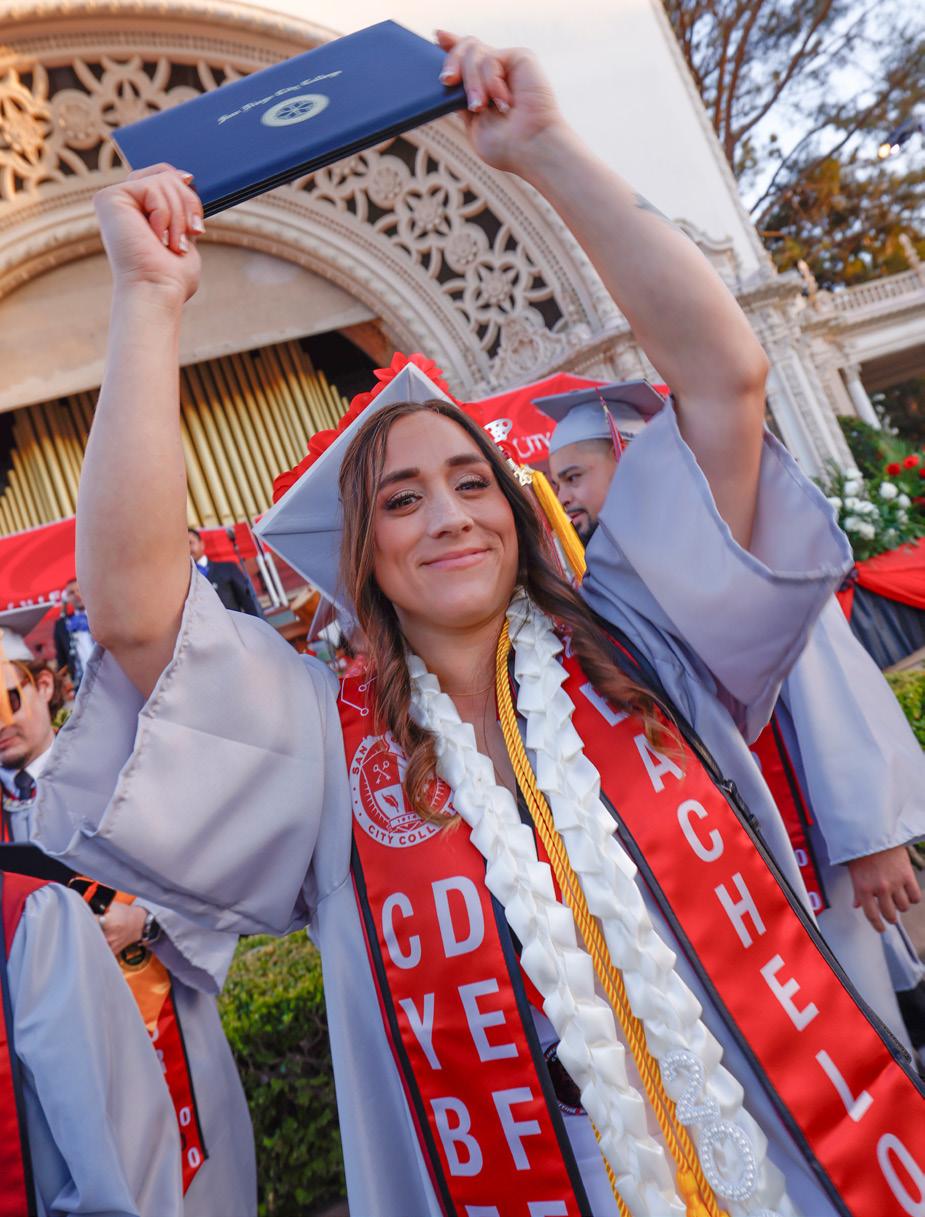
ON MAY 21, DURING ITS 112TH COMMENCEMENT CEREMONY, SAN DIEGO CITY COLLEGE awarded its first-ever bachelor's degrees to 31 students who successfully completed the Cyber Defense and Analysis baccalaureate program.