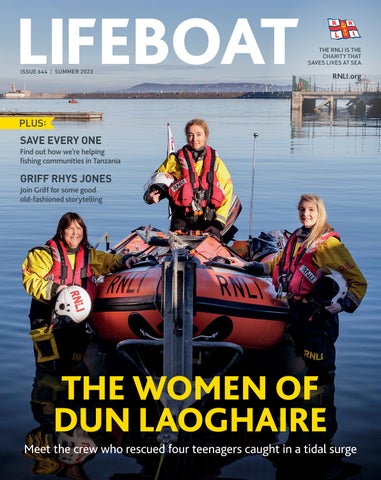
ISSUE 644 | SUMMER 2023
SAVE EVERY ONE
Find out how we’re helping fishing communities in Tanzania
GRIFF RHYS JONES
Join Griff for some good old-fashioned storytelling
![]()
Find out how we’re helping fishing communities in Tanzania
GRIFF RHYS JONES
Join Griff for some good old-fashioned storytelling
Meet the crew who rescued four teenagers caught in a tidal surge
Neil Williamson, ex-crew member and now volunteer curator of the RNLI Whitby Museum, on why it’s attracted over 15,000 visitors since its renovation
Whitby has a long RNLI connection. The lifeboat station was founded in 1802, and the RNLI took control of the boats in 1861 after a fateful storm, when the lifeboat was lost with 12 of the 13 crew. The museum is based in a Victorian double-fronted boathouse that was built in 1896.
I was asked to take over the curatorship in 2018 by the then curator, Peter Thomson. I think all museums have moved on in recent times. And what we’ve tried to do is keep the traditional side – the exhibits that people can come and see – but also allow people to see what the RNLI does today and encourage connection with the organisation. I'd say it's now the RNLI’s premier museum on the north-east coast.
One of our exhibits is a suitcase that reputedly belonged to Mary Roberts, who was on the Titanic in
1912 and was one of the survivors. In 1914, Mary was then on the hospital ship Rohilla as it ran aground off Whitby in the war, and the Whitby lifeboat was involved in the rescue. Once again, she survived the disaster – again, with her suitcase. Certainly, if she were queuing for a trip on a vessel, I wouldn’t be queuing behind her!
2024 is our 200th year of saving lives. Here’s your special preview of a podcast series that will commemorate our past, celebrate today’s lifesavers and inspire a new generation
How do you convey what that moment of rescue feels like? How do you explain what it’s like to witness a loved one risking their life for others?
How do you tell the story of 200 years of lifesaving? With so many examples of courage, selflessness, heart-breaking loss and heartfelt relief in its long history, the RNLI has left it to those who know best.
In 200 Voices, our anniversary podcast, you’ll hear from people whose lives have been touched by the charity, one way or another. Not just lifeboat crew members and casualties,
but fundraisers, lifeguards, shore crew and shop workers, as well as those with more surprising connections. It takes many hands to save a life. And each day in the run-up to our birthday on 4 March 2024, a unique voice will offer a unique perspective.
200 Voices will transport you back in time, far out to sea and into the future. The first of our 200 episodes will drop on 18 August 2023, wherever you get your podcasts.
Over the following pages you can read exclusive extracts from five of them.
Griff Rhys Jones, actor and friend of the RNLI, on why he feels safer on stage than on water
I don’t envy people when they have to go out in real storms, as lifeboat crews do. And anybody who’s been in a boat knows that the terrifying thing about boats is boat-to-boat action. Trying to get one boat alongside so that people can be rescued is an extraordinarily skilful thing.
I was always involved in sailing and being on the water. I’ve got a long association with West Mersea because that’s where my dad kept his boat. And that’s where I used to spend my winter weekends, under a wooden boat, scraping barnacles off. So for those who think that all people with yachts spend their time drinking gin and tonics, that’s not exactly what it was! It was a lot of laying in overalls, trying to make sure that the lead of the antifouling didn’t drop down into your eyes and that you didn’t swallow
too much of it. A few years ago, West Mersea RNLI asked me to launch a new lifeboat, and I was very proud to do that. Although the service that’s provided by the RNLI has leapt exponentially from the Grace Darling days of jumping in a rowing boat and helping somebody, to the days of fantastic safety operations, coordination with the coastguard –real brilliance … it is still, in essence, the Grace Darling model. It’s a real test of your skills and commitment to have to get up out of bed and go down to the lifeboat and get out there. You need a cool head and you need to realise that the conditions at sea can be terrifying, especially in a small boat.
‘ We’re keeping the traditional side, but also allow people to see what the RNLI does today and encourage connection with the organisation’
Team GB’s first black, female Olympian swimmer –and co-founder of the Black Swimming Association –on the sport that can save your life
The Black Swimming Association and the RNLI are striving to have everybody safe in and out of water. We’re looking to combat statistics like: 95% of black adults and 80% of black children in England don’t swim. The RNLI is one of our biggest and most important partners, and I’m always so grateful for their support and expertise. There are two great bits of research, which the RNLI is funding, and the BSA is helping to carry out. One of them is looking into the issue of why black people don’t swim. And understanding the barriers that are affecting them, so that we can go into the community and start to break these barriers down, because we have so many ideas about what is affecting black people, and Asian people and white people as well, around people not learning to swim.
The second bit of research is looking into bone density, and looking to dispel this whole idea around
black people not being able to float effectively, that we can’t swim – that we’re naturally not meant to. We want concrete proof so we can say: ‘It’s false.’ And hopefully encourage people
‘ We’re looking to combat statistics like: 95% of black adults and 80% of black children in England don’t swim’
to be like: ‘OK, it’s not real. Maybe I’ll give my lessons a go, because I'm capable of it.’ Personally, I never associated swimming as a life skill, because I saw it as a sport, and now I see it as both. My ambition is everybody learning to swim 25 metres – to feel comfortable in and out of water. It’s bold. It’s big. But I fully believe it’s achievable.
We have always counted on the kindness of others, and 200 Voices, like our other anniversary activities, has only been made possible thanks to the generosity of a unique club. The 200 Club is made up of a select group of supporters who are helping to secure the future of our lifesaving charity for another 200 years. To find out more and learn how you can take your place in this momentous moment in our history, visit RNLI.org/200Club.
From summer 2023 and throughout 2024, we’ll be commemorating our past, celebrating the RNLI of today and inspiring the next generation of lifesavers, with a unique programme of RNLI 200 activity. And because our watch spans the whole of the UK and Ireland, you’ll be able to get involved wherever you are.
A few things you can expect in 2023–24:
Spider-Man illustrator, on the heroic deeds that inspired him to be a Ballycotton crew member
When I was younger I wanted to be Spider-Man. That didn’t work out unfortunately, so I’ve ended up drawing him. For the last 10 years I’ve been working with Marvel Comics. I’ve drawn about 60 SpiderMan issues and then one day the Star Wars team came knocking. And that’s where I’ve been – in the world of comics – ever since.
My dad was in the lifeboat all his life. Patsy, my great-grandfather, is very well known for the Daunt Rock rescue, which happened back in 1936. We’re certainly told it’s the biggest lifeboat rescue of all time. I’m sure other stations will lay claim to that as well! In photos, Patsy certainly has the look of someone who spent a lot of time on the sea.
Growing up around the station, everything would have stemmed
from my dad’s relationship with the station. I can remember every square inch of that lifeboat. And I can remember seeing quite a dangerous rescue just off the coast – dad was involved on one of the inshore lifeboats, pulling a surfer off rocks in really bad weather. I guess if I was living in this world of superheroes and comics, that would have been my version of a real-life rescue in front of me – seeing my dad gear up in his superhero outfit, which was his lifeboat gear.
200 Voices will be available from 18 August 2023 via RNLI.org/200Voices or wherever you get your podcasts, including Apple Podcasts, Google Podcasts and Spotify. To find out what anniversary activities are planned near you, visit RNLI.org/2024
18 August 2023
The release of the first episode of 200 Voices
Autumn 2023
200th-themed retail range launches.
Throughout 2024
A taste of things to come in our 200th year – more details coming soon:
• Launch of Storm Force Rescue a free (and educational) downloadable game. Kids will be able to play at being a lifeguard and a lifeboat crew member
• A series of regional heritage exhibitions for the whole family to enjoy
• Live events: meet our lifesavers during RNLI days at Bamburgh Castle and Pembroke Castle, and at the RNLI 200 Lifeboat Festival in Poole – see the fleet and meet the RNLI lifesavers
• Water safety activity, live streamed for free, and available to all schools and education providers
• Harper Collins will publish an RNLI coffee-table book. A second book will focus on the RNLI’s history
• ASTO RNLI 2024 Small Ships Race (10–17 August 2024) between St Peter Port, Guernsey and Poole Harbour, inspiring the next generation of lifesavers.
‘I can remember seeing quite a dangerous rescue just off the coast –dad was involved’
The producer of Saving Lives at Sea shares her views on what it is about the TV series that keeps us watching
It’s very relatable. Many of us have been to the sea or have gone out on boats. And for those reasons, people love to watch it. The volunteers come from all walks of life and these people are giving up a huge amount of time to
More often than not, they’re happy to for two reasons: it’s a chance to show gratitude to the crew. And quite often they want to share a safety message. They may have gone out on a paddleboard without a lifejacket. Or something may have happened that they hope other people will learn from.
keep us all safe. It’s wonderful viewing –it’s heartwarming. And heartbreaking when things don’t go so well. But it’s humanity at its best.
The crew submits footage of rescues – we then approach the casualties involved to see if they’re willing to share their story. We’re very careful with this because people have been through a very traumatic incident.
Now that we’ve been running for seven series, we’ve built up some trust. People know that the series is very non-judgemental, as the RNLI is. It’s been humbling. We can be cynical about the way the world is. But working on this has shown me how many people there are that give up their time. If we all did half of what the volunteers do, the world would be a better place. I’ve worked in TV a long time, and this is the series I’m most proud of. ■
Words: Darren Crew Photos: Shane Cronin, Alice Dearing, Ceri Oakes, RNLI/(Richard Adams, Nathan Williams), Parisa Taghizadeh, Whitby RNLI Museum
Look out for more updates in future editions of Lifeboat In the meantime, for more news on our 200th activity, visit RNLI.org/200 or contact RNLI2024@rnli.org.uk
‘Now that we’ve been running for seven series, we’ve built up some trust. People know that the series is very non-judgemental, as the RNLI is. It’s been humbling’A selection of crew/lifeguards who appeared in Saving Lives at Sea series 7 (l–r): Kevin Lockhart (Oban), Jake Dean (Harlyn), Tom Quinn (Penarth), Leonie Mead (Oban)