Survival
A Scouting Ireland challenge



Imagine yourself with a walking party. There Is a blast of wind, a lot of noise and you are engulfed in an avalanche of snow. You are sailing In a yacht a heavy wind blows, you lose your mast and are set adrift. How do you cope?
These situations are ones which people have found themselves in on occasions in the past and will, doubtless, find themselves in the future. For this reason a knowledge of survival can be as useful as a knowledge of first aid.
Although we live in a relatively civilised environment the ease of modern travel, coupled with the fact that Scouts are going to more remote areas, maintains the need for a knowledge of survival skills.
Before going further it may be as well to define the term ‘survival’ - ‘Survival is the art of remaining alive in and escaping from a hostile environment, without full facilities.’ This needs a few words of explanation. If you camp in the hills in winter with a good mountain tent, a warm sleeping bag, a stove with plenty of fuel and no shortage of food , this is camping not survival. Survival begins when some relatively essential item is missing and becomes more acute the less one has.
The American Rescue Service has said that country people or city people who
have had a lot of Scout training are the best survivors.
To stay alive the following must be considered
Without it one will eventually die although not as rapidly as one might think. In her book. Hey I’m Alive, Helen Klaben describes how she stayed alive for forty nine days on virtually nothing.
With no water available a man, even in a cool climate and doing no work, is unlikely to survive more than fifteen days.
Without these the physical condition of the survivor will deteriorate.
Untreated injuries or sickness will undermine the body to some extent especially if allied to a lack of shelter and food. Additionally the ability to escape on foot will be inhibited.
A person is a very small object and the earth is a very big place. Some means of attracting attention is vital for anyone in need of help. A mobile phone is excellent
if a signal is available if not then traditional means of communication will need to be used.
How to move, when to move, etc. now become vital questions to be answered.
This may not be to one-degree accuracy but in many types of terrain it is quite an effort to keep going in a constant compass direction without veering well off course.
Too big a load will reduce your chances of reaching help but too small a load may mean vital items are abandoned.
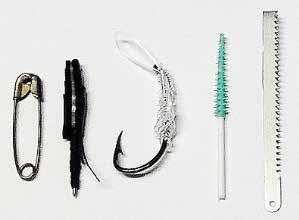
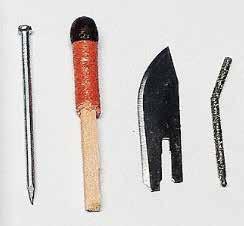
The Challenge is to create a small, always in my pocket, survival kit. Every item in the kit must have a use and purpose and combined with other items in the kit or with other things found in nature become useful for survival.
The container is a standard ‘Tic Tac’ mint boxyes it is small so it focuses the mind.
The challenge is to get as many items as possible into the box, and close the lid. All of the items must have a use and this must be explained. You cannot pack the box with a large number of the same item ( for example 20 fish hooks - these are considered as 1 item even though 20 would be useful).
In compiling and making you kit consider the main focus of survival - keeping alive, finding direction, lighting a fire, signaling for help, making shelter, and finding food.
You need to think small, and how an item can have multi uses. We have provide a listing grid opposite suggesting a possibility of 20 items but we are sure you can increase that amount. When you have completed the challenge take a picture of your finished survival kit and another showing all the items you managed to place inside.

You are on a yacht with three friends, for the holiday trip of a lifetime across the Atlantic Ocean. Because none of you have any previous sailing experience, you have hired an experienced skipper.
Unfortunately in mid Atlantic a fire breaks out in the ships galley and the skipper have been lost whilst trying to fight the blaze. Much of the yacht is destroyed and is slowly sinking. Your best estimate is that you are many hundreds of miles from the nearest landfall.
You and your friends have managed to save 15 items, undamaged and intact after the fire. In addition, you have salvaged a four man rubber life craft and a box of matches.
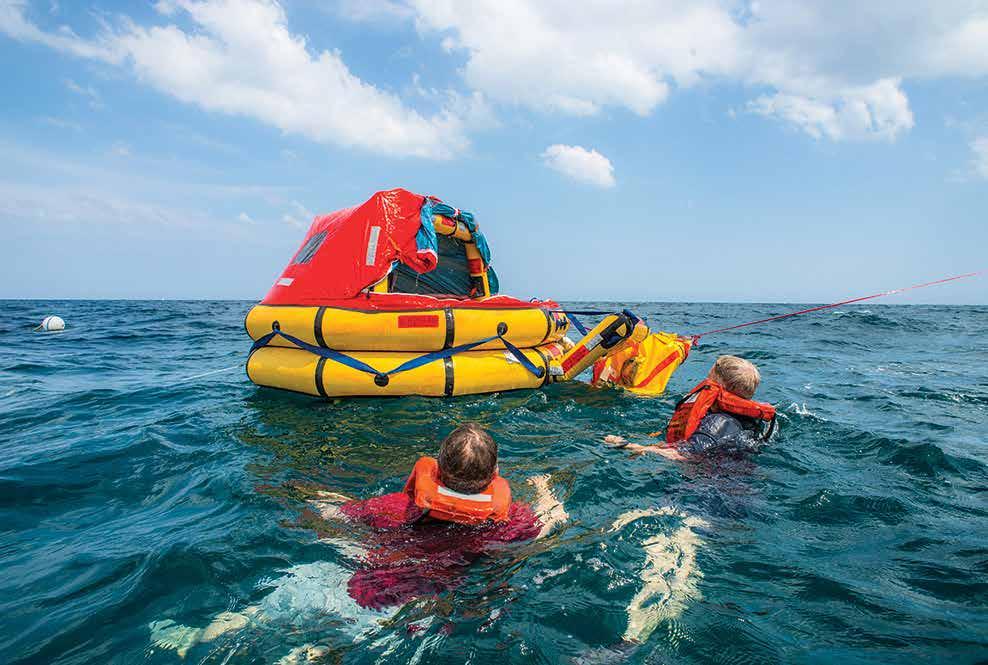
Your task is to rank the 15 items in terms of their importance for you, as you wait to be rescued.
Place the number 1 by the most important item, the number 2 by the second most important and so forth until you have ranked all 15 items.
A shaving mirror
A quantity of mosquito netting
A 25 liter container of water
A case of army rations
Maps of the Atlantic Ocean
A floating seat cushion
A 10 liter can of oil/petrol mixture
A small transistor radio
20 square feet of opaque plastic sheeting
A can of shark repellent
One bottle of 100% proof rum
15 feet of nylon rope
2 boxes of chocolate bars
An ocean fishing kit & pole
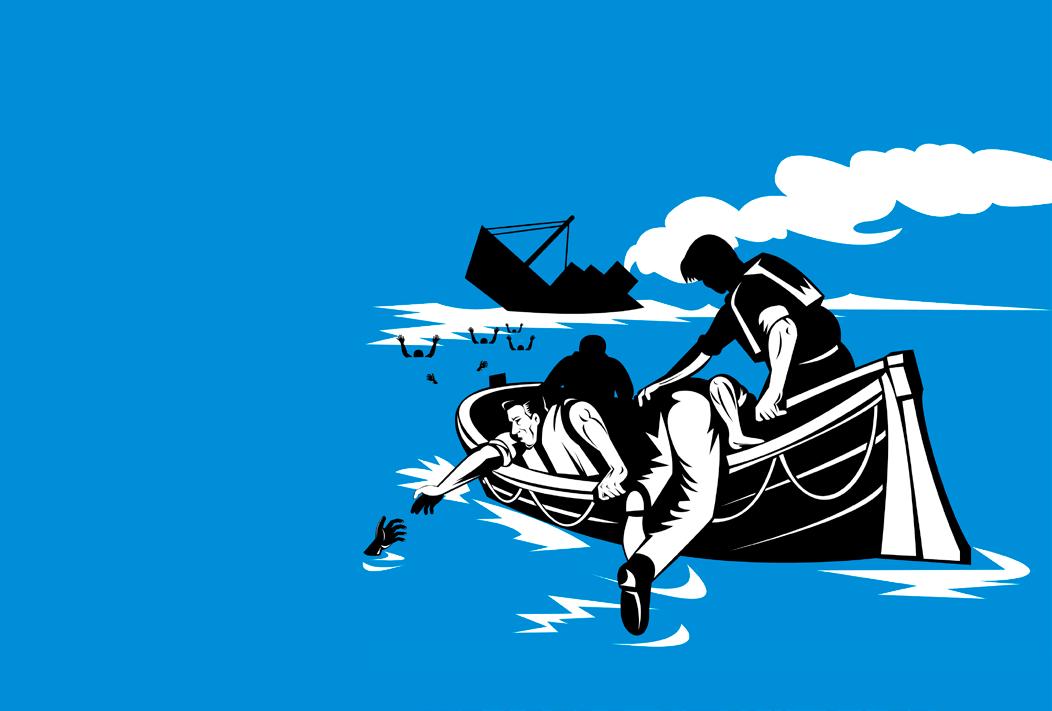
You and the following people are on a sinking cruise ship that was headed to the Bahamas. As your ship is sinking, you spot an island and believe that you are close enough to reach it in a lifeboat. However, there are 13 of you left alive, but only room for 7 in the lifeboat (you and 6 others). Those that go in the lifeboat will probably make it to the island where they will try to survive until they are rescued. Those that are left on the sinking cruise ship will likely go down with the ship and die.
You are one of the officers of the cruise ship and the highest ranking survivor. You are given the responsibility of deciding who remains on the ship and who goes aboard the lifeboat.
Individually, in your own space, without reference to anyone else; you have to decide the order in which you would save the people on the sinking ship. Place an 1-6 next to the 6 people you would choose to go in the lifeboat.
On a separate sheet of paper, write down the reason why you chose each person.
Come together with your Patrol. You must come up with who you will save as a Patrol. Place an “X” next to the 6 people you would choose to go in the lifeboat.* Most likely, people are going to have differing opinions, but you can only have one answer.
On a separate sheet of paper, write down the reason why you chose each person.
Your choice Patrol choice
This is the only information you have on the following people.
Lola – She is a 22 year old go-go dancer who was on the boat to relax from her recent cosmetic surgery. She suffers from clinical depression and has had two suicide attempts but none in at least a year.
Mary Anne – She is a 45 year old experienced nurse and single mother with two school aged children at home however they are living with her sister due to a Child Protective Services because she is an active alcoholic.
Billy – He is a 16 year old boy on probation for stealing money from old ladies. He is very charming, friendly and helpful when he wants to be but cannot be trusted.
Dr. Storch – He is 55 in good health except he has a prosthetic leg from a car accident. He is very intelligent but likes to throw his knowledge in everyone’s face as he is a bit arrogant.
Sheena – She is 30 and is an ex- fitness instructor with an athletic build however she is HIV positive that she contracted from her boyfriend, who is a drug dealer. She also works part time as a cocktail waitress.
Mickey – Mickey is in his mid 40’s and is unemployed cocaine addict, however he is unusually strong from years of street fighting and working on the docks. Mickey has a disfigured face from the years of street fighting and his hygiene is not the best.
Shane – Shane is a genius age 39 with a degree in cellular biology, making breakthroughs in his work on a cure for cancer but he is in a wheelchair and he comes across as selfish and rude.
Your choice Patrol choice
Tom – He is 41 and a hero from both gulf wars but he hears voices when he isn’t medicated.
Cindy – Cindy is a 70 year old retired schoolteacher with four adult children and 15 grandchildren. She also is an expert chef and homemaker. Cindy is a chronic smoker who is awaiting test results from a test indicating she may have lung cancer.
Barry – He is in his late 20’s and has survival techniques from his years as a hired mercenary. He angers easily with a short temper but otherwise has excellent leadership skills when calm. Barry admitted to you that he killed someone in a fight in a third world country many years ago and he never was caught and claims it was self-defense anyway.
Xavier– He is 18 and in good health, but he barely speaks English as he is from some strange country you’ve never heard of but he is an aspiring musician with a newly signed record contract for playing the zither. He is a on an international terrorist watch list but swears he is being wrongly racially profiled.
Fred – He is a 40 year old husband and father of four and an expert in yachting and sea navigation and in good health but since you have been on this boat trip he has gotten on your nerves often because he is very opinionated. Fred is on this trip because he recently abandoned his sick wife and children and does not plan on ever seeing them again.
What style of leadership do I use in my Patrol or Team. Will I play the nice guy and let people get away with murder or will I play the hard military type and “run a tight ship?...” This little story might help to explain:
A group of twenty five passengers are marooned on a desert island along with five officers from their luxury liner that floundered during wild storms. The Officers know the rough location of the island and realise that this spot in the South Pacific is completely off the main shipping lines. The best chance is to build a raft and sail away to safety.
The passengers look to the Ship’s Officers for leadership and it is decided that it will be best for all if the group divides up into five teams, each team being led by one of the Ship’s Officers. Each team will search the island for a suitable source of raft making material, food and water.
If any team gets a raft built they will sail to safety and contact help. Here is an account of how each team got on after they split up.
The first team was led by the Ship’s Entertainment Officer. He had spent many years organising the cabaret, games and dances on board ship. He had great concern for the welfare of the passengers and never wanted to push them too hard. He was the most popular officer of the lot. As soon as the group broke up, he
took his team and asked them what they wanted to do. They weren’t took keen on travelling East along the island - it seemed too heavily forested. The Western shore looked much easier to travel golden sandy beaches, coconut groves - no real raft making material but nice, easy-going territory. As the beach was surrounded coral reef, making launch impossible.
This team set off along the beach and reached point 1.9 on the map. This,’ they decided was the furthest they should go. The entertainment’s Officer agreed. He didn’t want to push them at all, as long as they were happy. He made sure that they had enough food - he let them go swimming as they wished - the lagoon was safe and beautifully warm. Team One didn’t get off the island - but they were all very
happy - the Entertainment’s Officer made sure of that. He kept them at point 1.9 where they were all very comfortable and he remained as popular as ever.
The second team was led by the Ship’s Engineer. He was a hard old sea dog who believed that the team should get off the island as soon as possible. He had worked with worse teams than this but always came up trumps. Push them hard - that was his motto. Give them no time to think. He choose the Easterly route along the island. At times this looked very overgrown, with some cliff areas along the shore, but there was bound to be plenty of wood there and food and water must abound. He took his team aside, telling them that if anyone
didn’t pull their weight, they would be left to die. There was no room for slackers here. The survival of the fittest, that’s what it was all about!
He pushed his team along the Southern shore of the island for two solid weeks. For much of the time they had to wade through mangrove swamps and once or twice had to scale cliff ledges. They found many sources of timber, food and water, many areas where a launch might have been possible but on arrival at point 9.1 on the map, team two mutinied. One of their members had already died when he fell from a cliff. The others knocked the first mate unconscious and escaped into the forest. The Ship’s Engineer awoke at point 9.1 on the island in a daze and wondered what had gone wrong. Team three This team was led by the Purser. He was used to taking bookings, counting money, ordering fuel and food. He never really wanted to be a ship’s Officer. His father had pushed him into it.
All he wanted to do all day was to remain undisturbed. He was happiest when people left him alone. He turned to his team, once the others had gone, and told them he didn’t really want the job of leading them. He only took it because he didn’t want anyone to give out to him. He didn’t really want to get off the island or even make sure that his five passengers were fed and safe. He just wanted to stay where he was and wait, for someone else, to save them. So they panicked, fought among themselves, split up and left him to get more and more depressed.
This team was led by the Captain. He took his team aside and had a meeting. They made up a map of the island, worked out where the best source of food and materials would be. Then they discussed the skills and capabilities of each member of the team. Balancing the need to get off the island against the capabilities of the team members that they decided to head in a North Easterly direction - avoiding the dangerous swamps. After a week or so they had set up base camp at point 9.9 on the map - a point from which they had easy access to the lush timber and food reserves. There was also an ideal spot for launching their raft - with no fear of crashing on a coral reef. They started to collect timber and build up stocks of food.
The Captain worked hard alongside his team. They shared out the work among the team. One passenger, a carpenter, took on the job of designing the raft, the others started collecting wood. Problems arose from time to time, people felt tired, they saw little progress at times, but the Captain got the team together and discussed the problems - not allowing grudges to build up. Within a month, the team had a raft built and stocked. They launched and spent a week or so on trials. Having sorted out some design faults they sailed away and were discovered two weeks later by an oil tanker and saved.
The fifth team was led by you. Where exactly would you end up? Which of the first four teams would you follow? You see the first four teams by different kinds of leaders. Each leader had a different emphasis on two things - people and results,

1. The Entertainment’s Officer who led Team One was only interested in keeping his people happy. He didn’t really care about getting off the island because his people just wanted the easy option - they wanted to laze about on the lagoon rather than work. He didn’t even expect them to gather food - he did all that and they loved him for it. He know that there would probably be a stormy season, but didn’t want to bring it up, he just laughed it off. People mightn’t like him if he was too serious. His team ended up at point 1.9 on the map so we’ll call him a “one-niner”.
2. The Ship’s Engineer took exactly the opposite approach. He had very little regard for his people - all he cared about was the result which had to be achieved - regardless! He pushed his people hard. He took the side of the island that was obviously going to produce the goods but his people suffered, and as often happens they fought back and left him. He made all the decisions - regardless of whether some of his people had good ideas. He won all arguments and made sure the other person knew they had lost. He ended up on the bottom right hand corner of the island (grid ref. 9.1) so we’ll call him “nine-oner”.
3. The Purser wasn’t really interested in whether his people were happy or not. Nor was he interested in achieving his set goal, i.e. getting off the island. His team could do as they liked as long as they didn’t disturb him. As you would expect, his team enjoyed themselves for a while - they did as they wished, but soon panicked, quarreled and left him alone at point 1.1, so we’ll call him a “one-oner”.
4. The Ship’s Captain on the other hand seemed to be able to handle both the people and the task in hand together. While he showed his ability to work his people according to their skills and abilities, he was also able to keep them working towards their goal. He seldom
made decisions on his own - by involving the team, he gave them a feeling of importance and -also the quality of decisions was much higher - the carpenter obviously knew what he was talking about when it came to boat building. From time to time his people had arguments amongst themselves and with him. Instead of brushing it under the carpet he made the point of actually discussing these problems, trying to find the root cause. The Captain made it all the way to point 9.9 on the island, so we’ll call him a “nine-niner”.
So which style do you normally use? How do you go about leading your team?
Think of other people in Scouting - what style do they use? Are they “engineers” or “entertainment officers”, “pursers” or “captains”?
They style of leadership we use has a great effect on the people we work with. There are too many ship’s engineers and lots of entertainment officers who just want to keep everyone happy.
We have some ‘pursers’ who do just enough to keep their position and don’t want to stick their necks out.
We don’t have enough Ship’s Captains around. Those people who would end up at point 9.9 on the island is the kind of leader we need. It’s not too hard to become a “nine-niner”. It involves developing good teamwork, listening for new ideas, evaluating these, proposing solutions and confronting problems as soon as they arise. Above all it means that at no time do you lose sight of the needs of either the people around you or task in hand.
Your spaceship has just crash-landed on the moon. You are 200 miles (320 km) away from Moon Base 3.
It is midday (remember the lunar day lasts 14 Earth days). Your crew’s survival depends on reaching the base.
15 items have been salvaged from the wrecked ship. Firstly, working by yourself , in private, rank the items 1-15 in order of importance.
When you are finished you should now join up with your Patrol/Team and agree a group listing.

Box of matches
Food concentrate
15m of nylon rope
Parachute silk
Solar powered portable heating unit
Two .45 caliber pistols
One case of powered milk
Two 45 kg tanks of oxygen
Self-inflating life raft
Magnetic compass
15 liters of water
Signal flares
First Aid kit (containing spacesuit
injection needles)
Solar powered FM receiver-transmitter
Stellar map (to aid navigation)
It is 1:00 p.m. on a Saturday afternoon at the end of May. You and your Patrol have just finished attending an international twoday scout training session in Casablanca, Morocco. You are now on board a twinengine plane that is destined for Dakhla, Morocco, a small town on the coast of the North Atlantic Ocean, approximately 1000 miles from Casablanca. At the beginning of the flight the Captain came on the overhead speaker and invited you to sit back and relax during the two-hour flight. The first fifty minutes of the flight were fine. Around this time the pilot comes back on the speaker to let you know that you are currently flying over the Sahara Desert and that weather reports showed a temperature high of 37 degrees. Approximately one hour and ten minutes into the flight, you hear a loud blast and the plane nosedives. Within minutes you realize that the cabin is losing pressure. When you look outside the windows, you notice that is desert below is growing larger as the plane rapidly descends toward the ground. You notice that the only things you can see out of your window are some large boulders and miles and miles of sand.
The pilot comes on warning that he is going to crash and so all on board should prepare for a crash landing. All surviving passengers and crew members scramble to exit the plane before it explodes. Seven minutes after the crash, the plane explodes in a fiery ball that reduces it to rubble. You, and your Patrol, one flight crew member, and the co-captain have all survived the crash. Now you must decide how to work together
to survive the desert climate and terrain, get help, and hopefully make it out of the desert alive. On your way of the plane, in the few minutes before it exploded, you and your teammates were able to salvage the items in the list below. It is May and you and your Patrol are dressed in Scout T- shirts, neckerchiefs and chino’s for the hot summer months of Africa. With only the clothes on your back and the items pulled from the wreckage, how will you survive?

1. Individually, rank the items below in order of importance, 1 being most important and 18 being least important.
2. Individually, write down your plan for survival in a few sentences.
3. Discuss your importance ranking of the items and plan with the Patrol.
4. The Patrol should agree a ‘best plan, and agreed list of item rankings after a discussion and exchange of ideas.
1 No. Book of matches
3 No. Airplane blankets
20 ft. Nylon rope
1 No. Sewing kit
2 No. 50 kg Tanks of oxygen
20 No. Cans of soda
1 No. Life raft
1 No. Bottle opener
1 No. Magnetic compass
1 No. Single-blade pocketknife
15 No. Gallons of water
3 No. Signal flares
1 No. First aid kit
1 No. Snakebite kit
25 No. Mini bags of pretzels
55 No. Mini bags of peanuts
1 No. Safety razor blade
4 No. Airplane pillows
You have been in a plane crash - while traveling in a small aircraft flying over Northern Canada to visit a relative in a remote location. During the flight the engine developed a mechanical problem which forced the pilot to crash land the plane. In the crash both the pilot and his co-pilot have died and you and your fellow passengers just managed to jump off the plane’s wreckage before it bust into flame. On the ground and in the wreckage you have gathered together a number of items.
Mid-January is the coldest time of year in Northern Canada. The first problem survivors face is the preservation of body heat and the protection against its loss. This problem can be solved by building a fire, minimizing movement and exertion, using as much insulation as possible, and constructing a shelter.
The participants have just crash-landed. Many individuals tend to overlook the enormous shock reaction this has on the human body decision-making under such circumstances is extremely difficult.
Before taking off, the pilot file a flight plan which contains vital information such as the course, speed, estimated time of arrival, type of aircraft, and number of passengers. Once it becomes apparent that the plane is missing search-and-rescue operations will begin.
It is 20 miles to the nearest town is a long walk under even ideal conditions, particularly if one is not used to walking such distances. In this situation, the walk is even more difficult due to shock, snow, dress, and water barriers. It would mean almost certain death from freezing and exhaustion. At temperatures of minus 25 to minus 40, the loss of body heat through exertion is a very serious matter.
Once the survivors have found ways to keep warm, their next task is to attract the attention of search planes. Thus, all the items the group has salvaged must be assessed for their value in surviving this ordeal.
The ranking of the survivors items was made by Mark Wanvig, a former instructor in survival training for the Reconnaissance School of the 101st Division of the U.S. Army. This survival simulation game is used in military training classrooms.
Newspapers (one per person)
20 x 20 foot piece of canvas
Loaded .45-caliber pistol
Cigarette lighter (without fluid)
Sectional air map made of plastic
Extra shirt and pants for each survivor
Can of Crisco shortening
Small ax
Quart of 100 proof whiskey
Ball of steel wool
Compass
Family size chocolate bars (one per person)
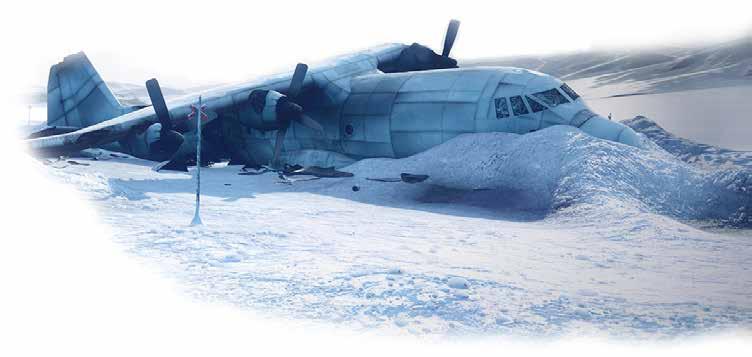
It happened - they have just found out your location and you need to get out of the city as soon as you can and head to the safe house in the northern woods approx. 90 miles away.
You have 10 minutes to grab what you can and stuff them in your pack and get out of there. The roads are likely to have road blocks so you will be on foot to avoid detection. You will need enough items to survive for 72 hours until you reach your safe house and to survive some time before resupply at the safe house.
Travel on foot - 3 miles per hour for 10 hours a day.
You can only travel for 10 hours a day - the max. weight you can carry in your bag is 15 Kilos so you can move fast. If you add additional items beyond this weight you must reduce you walking time by .5 of a mile per every two each kilos.
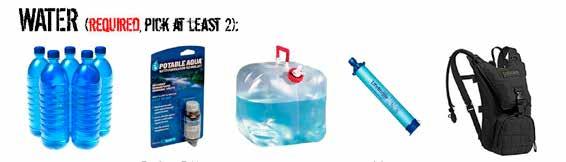
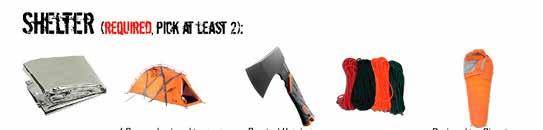
You must choose two items from each category.



0
0

Read more here https://mylifeasarefugee.org/index.html
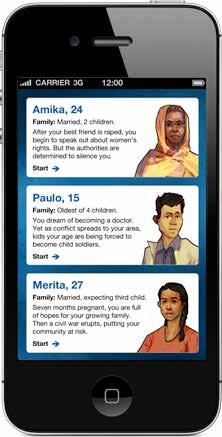
Every minute eight people are forced to flee war, persecution or terror.
If conflict threatened your family, what would you do?
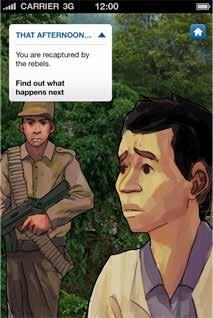
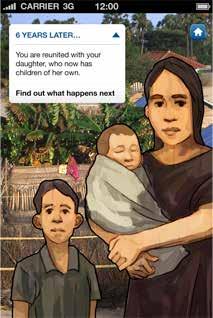
Built for iOS and Android, ‘MY LIFE AS A REFUGEE’ lets players contemplate the same life-changing decisions refugees make in a true-to-life quest to try to survive, reach safety, reunite with loved ones and re-start their lives.
Ready to get started? Download the app now!

Tom Crean was born on 20 July 1877, in Annascaul, Co Kerry into a poor farming household . Times were very hard, forcing many young men to leave their country after nothing but the most rudimentary education. He joined the Royal Navy at the age of 15 and spent the following seven years honing his skills as a junior seaman.
What makes Tom’s life interesting is that he took part in three of the most famous expeditions to Antarctica at the turn of the 20th century in what was known as the Heroic Age of Antarctica Exploration. Tom Crean was a pivotal figure, intimately involved in the great exploits of Scott and Shackleton. His contribution to these expeditions was enormous and on more than one occasion he risked his life to save others.
His feats, character and general good humour under difficulties make him a worthy hero. His feats, rank in history, among the greatest survival stories every told. In reading this account of his adventures you must realise that they took place in the early 1900’s. They had no communications with a home base or outpost, their equipment was basic and they travelled into unknown and unmapped territory under the worst of weather conditions.
The Discovery Expedition – 1901 -1904
The Terra Nova Expedition – 1911 – 1913 The Endurance Expedition – 1914 - 1917
While Crean was serving on HMS Ringarooma in New Zealand, he volunteered to join Scott’s British National Antarctic
Expedition on Discovery. It was here that he met Ernest Shackleton and they became friends. Having proved himself on this expedition he was chosen to take part in the next expedition of Robert Falcon Scott on the Terra Nova. Crean’s third Antarctic venture was as part of the Imperial Trans - Antarctic Expedition on Endurance led by Ernest Shackleton,
Robert Falcon Scotts 1911–13 Terra Nova expedition, which saw the race to reach the South Pole lost to Roald Amundsen and ended in the deaths of Scott and his polar party. During this expedition Crean’s 35mile (56 km) solo walk across the Ross Ice Shelf to save the life of Edward Evans led to him receiving the Albert Medal. Crean’s contributions to these expeditions sealed his reputation as a tough and dependable polar traveller, and earned him a total of three Polar Medals.
The ship was bound for Antarctica with one of the first British expeditions to explore the interior of the continent. The Discovery reached the McMurdo Sound early in 1902 and was to remain there for two years. The members of the ship spent the time carrying out a variety of scientific studies along with a number of exploratory forays deep into the continent, going further south than any men had ever gone before.
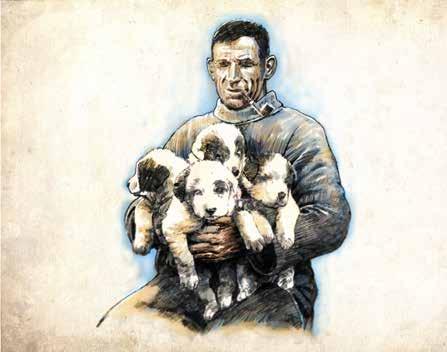
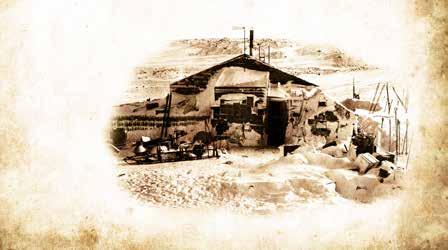
Crean - now a tall, well built young man in his mid-twenties - was a ‘gentle giant’, a physically strong man with an overriding emotional concern for the people and animals around him. He was a popular member of the expedition, always enthusiastic and good-humoured, who could strike up a song even during the most unlikely of circumstances. He was extremely hard-working - Scott once observed that the harder the work for Crean, the better. Above all, Crean never lost hope even during the most trying of circumstances, and was able to endure huge hardship long after most men would have given up.
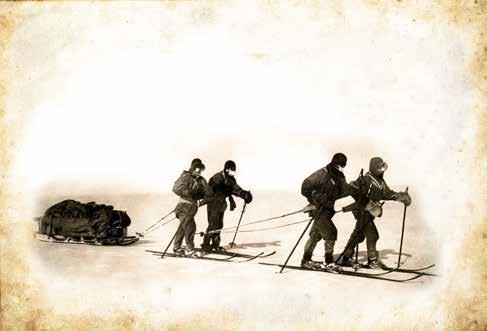
Crean proved to be one of the most consistent man haulers in the party; over the expedition as a whole only seven of the 48-member party logged more time in harness than Crean’s 149 days. Crean accompanied Lieutenant Michael Barnes on three sledging trips across the Ross Ice Shelf , then known as the “Great Ice Barrier”. The Barne party passed the previous furthest south mark, a record, which they held briefly until the southern party itself passed it on its way to the pole.
During the Antarctic winter of 1902 Discovery became locked in the ice. Efforts to free her during the summer of 1902–03 failed, and although some of the expedition’s members (including Ernest Shackleton) left in a relief ship, Crean and the majority of the party remained in the Antarctic until the ship was finally freed in February 1904.
Crean had caught Captain Scott’s attention with his attitude and work ethic on the Discovery Expedition, and in 1906 Scott requested that Crean join him on HMS Victorious by 1907 Scott was planning his second expedition to the Antarctic.
Meanwhile Ernest Shackleton’s British Antarctic expedition, 1907 - 09, despite reaching a new furthest south record, had failed to reach the South Pole. Scott was with Crean when the news of Shackleton’s near miss became public; it is recorded that Scott observed to Crean: “I think we’d better have a shot next.”
One prize still remained beyond the capabilities of even the most seasoned adventurer - to be the first human to reach the South Pole. In 1909, Ernest Shackleton came within 97 miles of the Pole before he made the bold decision to turn back. The next to try was Scott. Even before the expedition had started officially, Crean was already a part of his team.
It was on one of these preparatory journeys that Crean displayed the depth of character that was to mark him out during the years to come.
Returning from one of the depots, Crean and two other men, Henry Bowers and Apsley Cherry-Garrard, became marooned on an ice floe surrounded by killer whales.
Crean set off on his own to seek help, jumping from floe to floe, seemingly unaware of the huge risks he was taking with his own life. He reached base camp within a few hours and a party was dispatched to rescue his colleagues. Shortly after the end of the dark Antarctic winter, the assault on the South Pole commenced. The journey itself would
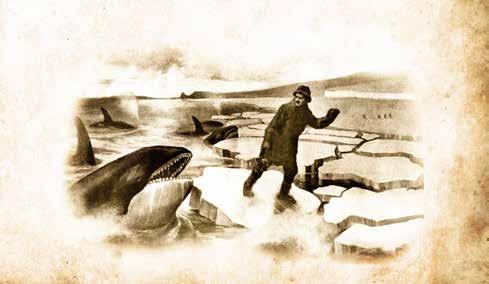
by Killer Whales
entail a 400 mile hike across the Ross Ice Shelf, followed by a punishing climb of 120 miles up the Beardmore Glacier, culminating in a trip of 350 miles over the featureless Antarctic Plateau to the South Pole itself. A team of 12 men, Crean included, set out on 1 November, 1911. Conditions were far from perfect, and the team struggled to cover distances of only a few miles each day. By the time the men reached the foot of the Beardmore, they were exhausted.
There then followed a withering one month slog up the crevasse-strewn Glacier, rising to a height of 10,000 ft above sea level. At the summit, Scott announced the team that he would be taking to the Pole. Crean was not selected and by all accounts he was devastated.
The return journey down the Glacier and across the Ice Shelf was anything but a cake-walk. Crean, Lashly and Evans now faced a 700-mile (1,100 km) journey back to Hutpoint. Soon after heading north, the party lost the trail back to the Beardmore Glacier, and were faced with a long detour around a large icefall where the plateau tumbles down onto the glacier. With food supplies short and needing to reach their next supply depot, the group made the decision to slide on their sledge, uncontrolled, down the icefall. The three men slid 2,000 feet (600 m), dodging crevasses up to 200 feet (61 m) wide, and ending their descent by overturning on an ice ridge. Evans later wrote: “How we ever escaped entirely uninjured is beyond me to explain”.
Evans removed his goggles and subsequently suffered agonies of snow blindness that made him into a passenger. When the party was finally free of the glacier and on the level surface of the Barrier
Evans became seriously ill with scurvy and as his condition declined, the two other men had to drag him by sledge for days, dangerously depleting their own supplies and slowing their progress. Evans continued to deteriorate, and eventually a point was reached where the team could go no further.
Once again, Crean set off on his own, with only a little chocolate and three biscuits to sustain him, without a tent or survival pack covering a distance of 35 miles in 18 hours, hardly taking a break despite the sub-zero temperatures and his reduced physical condition. He reached safety just ahead of a fierce blizzard, which probably would have killed him, and which delayed the rescue party by a day and a half. The rescue was successful, however, and Lashly and Evans were both brought to base camp alive. Crean modestly played down the significance of his feat of endurance. In a rare written account, he wrote in a letter: “So it fell to my lot to do the 30 miles for help, and only a couple of biscuits and a stick of chocolate to do it. Well, sir, I was very weak when I reached the hut.” Crean’s solo walk was to save Teddy Evans’s life.
Scott and his party were not so fortunate the entire team perished on the return journey,
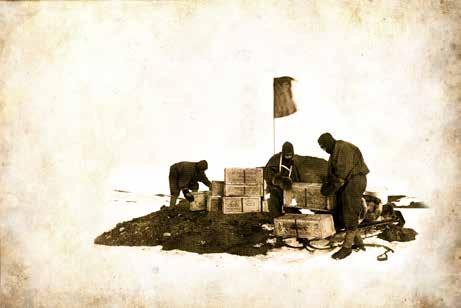
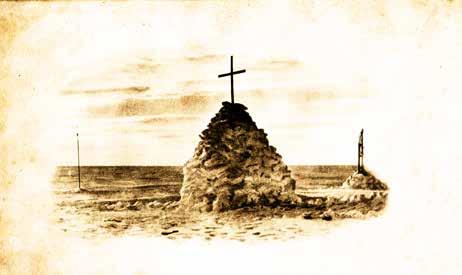
Tom Crean was the first to discover the bodies. He was one of the 11-man search party that found the remains of the polar party. They spotted a cairn of snow, which proved to be a tent against which the drift had piled up. It contained the bodies of Scott, Wilson, and Bowers.
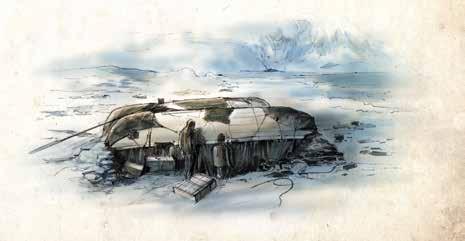
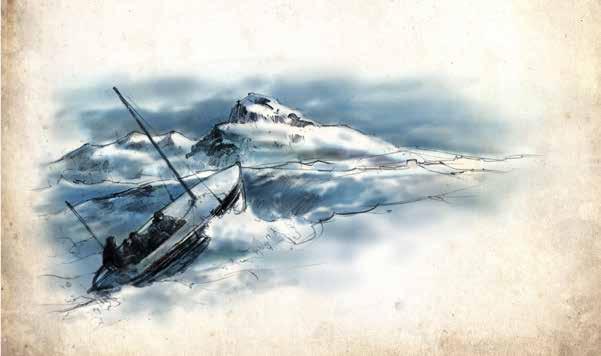
Setting off on 24 April 1916, thanks to the navigational skills of Worsley, armed with just the barest equipment, they reached South Georgia on 10 May 1916. Shackleton, in his later account of the journey, recalled Crean’s tuneless singing at the tiller: “He always sang when he was steering, and nobody ever discovered what the song was ... but somehow it was cheerful”.
The journey of the six men to South Georgia stands out as one of the most incredible sea journeys ever undertaken. It is nothing short of miraculous that they safely reached their destination but their troubles were far from over.
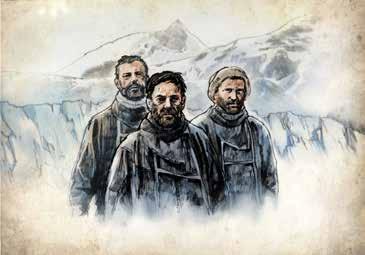
To reach the South Georgia whaling stations and the chance of salvation, Shackleton, Crean and Frank Worsley had to scale a series of steep, uncharted mountain ranges, the first recorded crossing of the mountainous island ,with nothing but their ragged clothes and a few basic tools to assist them a carpenter’s adze, a length of alpine rope, and screws
from the James Caird hammered through their boots to serve as crampons.. It was a climb fraught with danger, but the team of three struggled across the mountains in 36 hours.
On 20 May, 1916, over eighteen months since they lost contact with the rest of the world, the three dishevelled, exhausted men arrived at Stromness whaling station.
Their journey was at an end and, over the following months, the remaining members of the expedition were rescued. Their achievements saved the lives of all 28 men of the Endurance expedition. After returning to Britain, in recognition of his service on the Endurance, Crean was awarded his third Polar Medal.