

Sustainable Development Goals....at HOME
A collection of programme resources to assist your Section programme development towards the UN Sustainable Development Goals




Sustainable Development Goals....at HOME
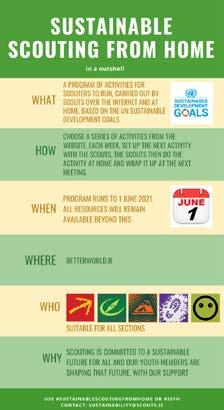
This is a ready-to-go program for scouts in all sections while scouting from home. There are a wide range of activities for you to choose from, and each one is set out with easy, clear instructions in a Plan, Do, Review format. They are based on the UN Sustainable Development Goals (SDGs) and are suitable for all sections to use while scouting from home!
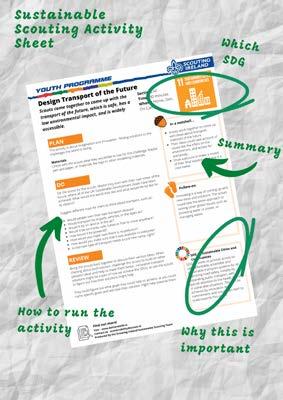
The full list of activities can be found on our Activity Sheets Page . These sheets take only between 30 mins to 1 hour. At your online meeting, set up the activity with the scouts, who then get on with it in their own time at home. At the next meeting discuss how they got on, following the pointers in the activity sheet. Each activity is easily adapted to all sections.
Badge Requirements
Compete a minimum of 8 activity sheets spreading across all 5 Pillars below to earn your Sustainable Scouting from Home badge. You may also use these resources for Special Interest and Better World badges too!
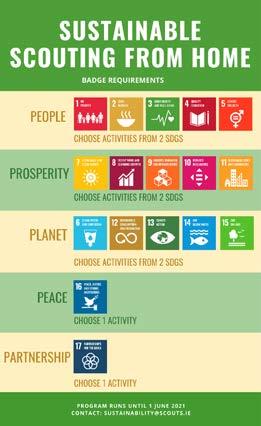
These 5 Pillars cover the areas of People, Planet, Peace, Prosperity and Partnerships.
Beaver Scouts
There are lots of activities which use creativity and imagination. Don’t get into much detail on the background issues as the beavers will pick up enough as they go along
Cub Scouts
Cubs are excitable and easily engaged with program like this, so begin to challenge them. Choose a mix of activities which include thinking about what their futures will look like. Get them thinking and leave them off!
Scouts
Sustainability and the SDGs are already part of their vocabulary and understanding. Build them a broad program from across the SDGs that will push them on to greater understanding. Include activities which will help them to empathise with people their own age in other parts of the world.
Venture Scouts
Form a new crew of those interested to take on the challenge, who can be put in a breakout room during meetings or organise their own separate calls. Ventures are ready to change the world, so encourage to challenge themselves and take on the more difficult topics.
Rover Scouts
Every activity sheet has a broad set of activities, but there is also a set of ideas on how to expand on the work. Rovers could set their own learning objectives through this program, and aim to build up their understanding and empathy, and move on to taking action on the issues which concern them most.
Whole group
You could also take a group-wide approach including all sections, and make an individual competition to complete the most sheets- the possibilities are endless!
People

There are 11 resource ideas in this area:-
Promote a local charity with a poster Cook a meal with limited ingredients Reduce food waste in the home
• Get out and appreciate nature
• Learn or improve another language
• Learn how to use a sewing machine
• Price comparison between products
• Opposite Day
• Experience inequality
Gather loose change
Scouts gather up loose change around their house and pool it to give to a local charity.
Section: All Time: 1 hour
Where: Home, Den
This activity is about gathering some funds for a local charity and the process of choosing who to give it to The scouts themselves need to pick the charity As this activity could be spread over a few sessions, be sure to decide when the money will be give to the charity, and allow for a review of the activity. You can always use Go Fund Me to do this activity online.
Scouts choose a charity to fundraise for.
They search their home for loose change, and check with family, friends and neighbours for theirs
They then donate the money to their charity, and discuss the value of their work.
Encourage the section to figure out how local charities tie in with the UN SDGs, specifically SDG 1 No Poverty if possible. Have a chat and work together to pick your final charity -you can select more than one
Simply gather up any loose change at home – with permission of course! You could also approach family members, friends or neighbours to get involved to for your charity. They might also decide to add in some of their own pocket money or wages. Pool all funds and arrange to get them to the selected local charity Be sure that the scouts themselves take part in passing on the funds, whether that is simply bringing a stack of coins to a collection box, or meeting a representative of the charity in uniform and taking a few photographs.
Follow-on
Why not arrange for someone from your chosen charities to talk to the scouts, or a visit to see their work so you can learn more and do more for the cause

SDG 1 No Poverty
Have a chat with the scouts about their chosen charity and their coin collecting
Were they motivated to help that charity?
Where was the weirdest place that they found some coins?
How did helping the charity make them feel?
Why do local charities exist?
Would they like to find other ways to help this, or other local charities in the future?
SDG 1 is to eradicate extreme poverty for all people everywhere, currently measured as people living on less than $1 25 a day
The activity opens scouts eyes to issues of poverty in their own community and empowers them to take further action
Promote a local charity with a poster
Scouts design a poster and use it to promote the work of a local charity.
Section: Beavers, Cubs, Scouts
Time: 1 hour
Where: Home, Den In a nutshell...
As this activity could be spread over a few sessions, be sure to figure when you will review the activity To get the most out of this activity, let the scouts know in advance so that they can find out more about the charity they are going to promote. Get them to agree to work on a single charity for the whole section, or one per small group, or even one each
Materials: Paper and colours for poster design Try to reuse what is available rather than buying new materials Scouts could bring in old posters or cards from home to reuse.
Scouts choose a local charity to promote
They find out about its work and how best to support it
They design and put up posters to encourage people to help.
Encourage the scouts to think about what message their poster can give to people. Does it inform people about the charity and it’s work? Does it try to help people to understand an issue, or feel empathy or concern? Does it motivate people to act in some way, such as by supporting the charity?
Be sure that the posters clearly show the name of the charity, and how people can get in touch to support it. Next, arrange for all of the posters to go on display Some could go to the local library or shops, and maybe they could all be posted online as well on the groups’ social media
REVIEW
Have a chat with the scouts about their chosen charity and their posters
Were they motivated to help that charity?
What was the most important thing they wanted to get across with their poster?
Can they think of other ways that local charities could promote their work?
Would they like to find other ways to help this, or other local charities in the future?
Watch out for feedback from the charities themselves or the public, to let scouts know of the effect of their work
Follow-on
Maybe people from those charities could be invited to talk to the scouts, or a visit to see their work could be arranged The scouts might be motivated to do further promotion of the charity, or find other ways in which they could support their work

SDG 1 No Poverty
SDG 1 seeks to eradicate extreme poverty for all people everywhere, currently measured as people living on less than $1 25 a day This activity will help with opening the scout’s eyes to issues of poverty in their own community and empowering them to take further action
Cook a Meal with Limited Ingredients
Scouts prepare a meal using a small amount of ingredients. This may lead them to empathise with people who have less food choices.
Section: All Time: 1 hour
Where: Home, Den
Prepare by planning when and where the scouts will do their cooking After that, it is a matter of choosing some ingredients, with a focus on cheaper items The focus could be on grains, pulses and vegetables Agree some guidelines with the scouts as to what they can and cannot add in It would probably be best to rule out the addition of any meats or other more expensive ingredients Ruling out processed ingredients, such as stocks, sauces or other pre-mixes, would help to focus the scouts on building up flavour naturally Give enough time to the planning stage to build up some interest around the challenge Don’t make it a competition between scouts, but an individual challenge for each scout or small group to make the most of what they have
In a nutshell...
Scouts plan to make a meal with limited basic ingredients (grains, beans and/or vegetables) They figure how to make it more tasty and nutritious, then cook and eat it
They reflect on the challenges faced by people who have limited food options due to poverty
Follow-on
The scouts get on and figure out what they can do with the ingredients Online searches might throw up some ideas, as would asking parents or grandparents The addition of herbs and spices can lift many dishes from being plain to be downright yummy! Scouts could find some of these in jars in their own kitchens, but wouldn’t it be interesting to see if there are herbs growing in their garden, or their neighbours? There might even be wild herbs that they could find in their community.
DO REVIEW
If the scouts managed to make their meal interesting and tasty enough to eat, then it was a success If the scouts cooked in the den or on camp, the best time to review might be while sitting around with (hopefully) empty plates in front of them. If they cooked at home, then have the chat at the next meetup.
Get the scouts to share their recipes, explaining where they got the ideas and the added ingredients In all of this, it is important to remind the scouts that people in some parts of the world face very limited food choices due to availability and cost How would they feel if this was their main meal for almost every day? What health problems might they face if their diet was restricted like this the whole time?
An easy follow-on would be to cook traditional meals from other cultures and cuisines Use this as an opportunity to learn more about other cultures, and aim to bring the food and knowledge together in a shared setting
Scouts could also look at growing some of their own food
SDG 2 Zero Hunger
The goal of ending hunger and malnutrition is focussed particularly on the poor and people in vulnerable situations Scouts could empathise with people who cannot get enough nutrition from their food to live a healthy life by experiencing this themselves, even if only for one meal
Reduce Food Waste at Home
Scouts investigate food waste in their own
home, and come up with solutions to reduce it.
Section: All Time: 1 hour
Where: Home In a nutshell...
This activity can be broken into two steps The first task is to identify food waste in the household and the second is to come up with ways to avoid this waste. One approach would be to have a session with the scouts on the issues around food waste, and then give them advice on how to log the waste in their household Scouts could bring their results to the next session, where they work together to come up with solutions Alternatively, the instructions to log waste, and identify solutions, could all be done in a single session, and then the scouts work on this from home.
Scouts figure WHAT food is wasted in their home
They work out WHY it is waste
Finally, they figure HOW this waste can be avoided
To start with, scouts need to figure out the different ways in which food is wasted in their house. One way to do this would be having a notebook beside the bin where the family record all food as it is binned (or heading for the compost heap) The next job is to work back and figure out why the food is ending up in the bin Here are some possible reasons:- Was there too much food on peoples plates, or too much made for the meal? Was the food handled or stored incorrectly, such as milk left out of the fridge, packaging left open or apples and bananas stored in the same bowl? If food went out of date, was it because there was too much bought when shopping, or was it forgotten about in the back of a cupboard, or hidden at the back of the fridge? The last task for the scouts is to figure out how they can cut down this waste in the future If they have identified the problems, then the solutions should follow on from these Proper storage and careful shopping will go a lot of the way towards reducing waste Scouts might also come up with ideas around meal-planning and using up leftovers
Give time to discuss and share the solutions which the scouts came up with Pooling their ideas will mean that they have even more ways to reduce food waste at home.
The scouts might like to share their ideas outside of their own homes A poster for the den could help others to reduce waste How about producing a short video where each scout presents an idea on how to cut out food waste, and circulate this on social media
The goal of ending hunger and malnutrition is focussed particularly on the poor and people in vulnerable situations Scouts can understand the unfairness of wasting food, while others go without, and realise that very many people don’t waste food because they don’t have enough in the first place
Mindfulness
Scouts find ways to make a bit of time and space for themselves
Section: Cubs, Scouts, Ventures, Rovers Time: 1 hour
Where: Home, Den
Little needs to be planned to help the scouts through this activity If the activity is taking place in the hall you may need to bring a computer or have a mindfulness video downloaded to show the scouts There are many different types e g Tai-Chi, Yoga or any form of meditation, discuss with the scouts what form would be best suited to them.
Timing
It is important that this activity is not rushed, so make sure that there is enough time set aside for it. In the den, it would be important to have a wind-down activity as a lead-in, or at home encourage the scouts to set aside the time and space so that they won’t be disturbed Half-an-hour would be useful if that amount of time could be made available

Choose a form of mindfulness and bring necessary aids to complete activity
Set up an area according to the activity
Circulate a link to an online resource, such as music or instruction, if scouts are to complete at home
Follow-on
Get the scouts to set up the area for the session according to the chosen form of mindfulness so they can stay focused and so they won’t get distracted Play the audio of the mindfulness session through to its end
If scouts are to take part in this activity at home by themselves you may choose a link to a mindfulness video on youtube and circulate it
Ask the scouts to discuss how they felt during and after the exercise and ask if they feel they have gained anything from it Discuss the fast pace of life and the benefits of mindfulness, and link it into people’s mental health
Different people will get different things out of the activity, so allow for their differing experiences and views
Could some type of mindfulness activity be used at weekly den meetings, or on camp? Scouts might like to try incorporating mindfulness into other activities, such as when out and about Look at the activity sheet Get out and Appreciate Nature for more ideas on this Perhaps there is an opportunity to bring someone in to conduct a session or discuss mindfulness.
SDG 3 sets a whole range of goals around health across an extensive range of measures Scouts can learn to look after aspects of their own health, and especially the importance of minding their own mental health.
Get out and appreciate nature
Scouts spend time in nature, tuning in to their surroundings and everything that is going on.
Section: All Time: 1 hour
Where: Home, Den, Hike, Camp In a nutshell...
Screens have become a huge part of everyone's life as they're used for school, work and staying in touch with your friends. This activity is about making space in life for other things as well, and equipping the scouts to look after their own mental health
Scouts simply decide to go out into their garden or down to the beach, maybe even a forest and enjoy it The time that they spend there is completely up to them, but of course the longer the better to try and get a true feeling for nature It is best done individually, or in very small groups, to minimise the distraction

Scouts decide where they will go Take their time and really appreciate the natural world around them
Discuss their experiences with the group
Follow-on
As scouts, so much of our time is already spent in nature whether that's up a mountain, on the water or camping. But the scouts don’t have to be with scouts to enjoy nature It’s important that they learn to go out on their own and appreciate it It can just be going for a walk around the garden or in the neighbourhood, but try to visit areas that are more natural and less built-up The scouts should aim to use all of their senses. Feel the wind on their faces and breathe in the air. Smell flowers and bushes, and run their hands over rocks, bark and soil. Watch the movement of birds in the air or look up close at the veins on a leaf Listen to everything from rustling branches to chirps and squawks! Get the scouts to think about their surroundings, how long it's been there, how it formed, and how it's still changing it
Maybe the scouts have found new areas themselves where the whole section could visit in the future Consider repeating the activity at different times of the year, so that scouts can notice the changes in their surroundings in different seasons

Have the scouts discuss where they went, what they did, and how they felt Have them share some of the more unusual sounds, smells or textures that they encountered. Can they imagine how many creatures call that environment home? Perhaps make a plan to do it as a group in the future
SDG 3 aims to prevent substance abuse including narcotic drug abuse and harmful use of alcohol
Learning to appreciate nature can equip scouts with mechanisms to boost their mental health and prevent addictions.
Learn or improve another language
Scouts
either take up a new language to learn, or improve one that they know a bit about already.
Section: All Time: 1 hour
Where: Home, Den In a nutshell...
Much of what scouts learn is decided for them by teachers and parents. Their scout group is one of the places they have the best opportunity to guide their own activities Making a decision to learn something, and then getting on and doing it for themselves, is useful to them on a number of levels
Work with each scout to identify the language they want to work on and their current standard in the language Then help them to set a target By being quite specific, the scout knows what they need to do and have a good chance of improving Targets could be along the lines of:
Being able to have a basic conversation about themselves and the weather!
Being able to ask some questions like a tourist as if they are visiting another country
Being able to pronounce words in an appropriate accent
Being able to recite some poetry or tell a story
Being able to have a basic understanding of a conversation
There are many ways for scouts to pick up a new language Online apps or courses are easily accessible and many are free Scouts may have access to television channels, streaming services or other online ways of watching programs in their chosen language
As societies become more multicultural, there are more chances to mix with native speakers
Scouts figure out individually a language they want to learn or improve
They set themselves a target on what they want to be able to do with the language
They get on and learn through apps, TV and/or direct contact with native speakers
Follow-on
The scouts could set more advanced targets to continue their learning
Scouters might be able to facilitate visits or links with native speakers from different countries to broaden the scout’s experience of languages Another direction to take this would be to extend from learning languages to finding out about related cultures
SDG 4 Quality Education
Check in with the scouts to see if they met their targets, and encourage them to stay going if not. Did they pick up any interesting facts or words? Find out more!
SDG 4 seeks to ensure that all learners acquire the knowledge and skills needed to promote sustainable development, including global citizenship and appreciation of cultural diversity and of culture’s contribution to sustainable development As scouts choose to learn new languages, they are opened up to new understandings and appreciation of other cultures
Learn to use a sewing machine
Being able to use a sewing machine opens up a whole new area for scouts - from clothing repair to being able to make a range of goods from scratch.
Section: Cubs, Scouts, Ventures, Rovers Time: 1 hour
Where: Home, Den In a nutshell...
In your wider scouting community, there are likely to be many people who are adept at using sewing machines. Put out a call to find people who can help to share their knowledge Get the scouts on board by explaining the dual benefits of being able to sew; it is a useful skill for being able to look after your own gear but also be creative, and it is a way of tackling a whole range of environmental and climate concerns through reducing waste and promoting recycling It is also worth mentioning that for people in some parts of the world, having a sewing machine and being able to use it provides them with an income that they might not otherwise have
Materials
A sewing machine, thread and some scrap material will be needed Other bits of kit which would be useful include pins, material scissors and maybe even tailors chalk
Scouts find someone in their community who can teach them to sew
They get on and learn the basics of setting up the machine and simple stitching
They make some small item to put their new skills into action
Learning to use sewing machines could be done at the den in small groups, or at home with the help of family Focus on helping the scouts to learn the basics:-How to thread and set up the sewing machine; Getting started Sewing in a straight line; Sewing along a curved line; Using pins to hold two pieces of material together for sewing; Sewing two pieces of material together along the edges (three out of four sides) then turning it inside out to see what the finish looks like
Make some basic, but attractive, or useful item, that scouts can use. This could be a small chapstick holder for on a keyring, a washup pad (made using a coarse and a soft material using the method mentioned in the last point), or a reusable shopping bag
When scouts have learned the basics, a whole range of possibilities will open up for them Help them to set challenges for themselves and check back with them to see how they are getting on
Fixing garments for themselves and others by stitching up split seams
Shortening or lengthening garments by changing hems.
Recycling old garments or materials to make new clothes
Using scraps or old clothes to make useful items like shopping bags or cushion covers
Follow-on
Once scouts get a taste for the potential that comes with being able to use a sewing machine, they might not need encouragement to keep going Over time you could return to this activity and ask the scouts to make items for activities, such as bean bags, or maybe curtains for the den Shopping bags could be made as a fundraiser, or peg bags with a drawstring prepared for annual camp
SDG 4 Quality Education
SDG 4 seeks to ensure equal access for all women and men to affordable and quality technical, vocational and tertiary education, including university Sometimes people think of education as being purely for getting a job and career, often based on academic ideas or technology Scouts learning to sew can broaden their perspective on education
Price Comparison between products
There are many items we all buy but they are slightly different versions of each other. Do a price check on one and see which gender has to pay more.
Section: Scouts, Ventures, Rovers Time: 1 hour
Where: Home, Den
Scouts could work on this on their own, or in their small groups Start the discussion with a basic question; if a shop is selling apples, should boys and girls be charged a different price, based purely on their gender? It should not take long to reach a consensus on this! Next question so; if that product is a disposable razor - packed differently but essentially the same product - should the price be different? After some chat around this, the scouts should be ready for the task Remind them that they are to try to find products of equal quality, where the only difference is that they are presented differently to genders
In a nutshell...
Discuss the concept of different pricing by gender
Scouts choose a product and make a real-world price comparison
Review the results and what they mean in the context of discrimination.
Follow-on
Disposable razors
Deodorant Shampoo/conditioner
Different items of clothing
A haircut Scouts can choose whatever they want, but here are a few ideas:
They might find the prices online or in local shops. Before comparing prices, the scouts need to make sure that they are comparing like with like Be sure that they are almost identical in quality and function, and take the base price (ignoring any special offers) As well as noting the price, the scouts could look at other differences, such as the way in which the products are presented Are there ‘special features’ meant to make them more appealing, or other colour or other design characteristics?
A follow-on conversation could address the wider issue of discrimination within society Can the scouts pick out other examples of discrimination which might be obvious? What about some less obvious ones? Are they intentional and, if so, what is the reason for them? What can be done across society to do away with gender discrimination
When the scouts come back together, chat through their findings On balance, who is paying more? On products where there was a clear difference, was there any attempt to present one product as clearly more suitable than the other? Were the significant differences in how the products were presented? If people pay different prices for essentially the same thing, would that be exploitation, discrimination, or just marketing? Finally, what can be done to change all of this?
SDG 5 Gender Equality
SDG 5 seeks to end all forms of discrimination against all women and girls everywhere. While there may be some limited examples of discrimination against main, the vast majority of discrimation is against women The challenge for scouts is to recognise it, even where it might be less obvious, and call it out
Some tasks at home might be done specifically by different genders. Swap them around for a day.
Section: All Time: All day
Where: Home In a nutshell...
Little preparation involved with this activity, as scouts carry on with their normally home routines, however just take new jobs that would normally be taken by their male or female counterpart If their are no suitable sibling to swap with, why not do it with a parent?
Scouts may need to put a plan of their Opposite Day in place with their parents This could involve sitting down and discussing what needs to be done ahead of the day.
The aim is for this task to complete the full day so all activities can be swapped
Scouts make a plan with parents/gaurdians about what tasks they are swapping Scouts carry out the full day of tasks
When finished review with the scouts the activity and discuss what they might do differently
Follow-on
Leave the scouts to it They will be at home and it will be their job to implement the plan that they made and to try and complete all of their Opposite Day tasks
Some tasks may include;
Cooking meals
Washing clothes
Tidying up after meals
Doing the shopping
Taking out the rubbish
Cleaning the floor
Opposite Day PLAN DO REVIEW
Helping younger siblings with homework
During some group activity, introduce a rule which discriminates against any gender, or rewards one over the other While some scouts might react straight away, just tell them that these are the rules Push it further until eventually all scouts challenge it as unfair, including those benefiting from the rule
Discuss with the scouts what new tasks they had to complete Did they find that some jobs automatically fell to one gender in their house? Could they figure out how or why this came about?
Do the scouts think that some jobs are better suited to certain genders? Assuming that you have a mixed group, this should make for a very interesting debate! Get them to discuss the different career options today and identify any that are more commonly taken by different genders
Are there jobs that they know of, anywhere in the world, that excludes people based on gender? Is there anything to be done to change this? Find out more!
SDG 5 Gender Equality
SDG 5 seeks to ensure women’s full and effective participation and equal opportunities for leadership at all levels of decision-making in political, economic and public life Scouts can seek to identify barriers, and how they have come about, in order to work towards true inclusivity
Experience Inequality
In order to understand inequality, or be able to recognize it, you may need to experience it.
Section: All Time: 1 hour
Where: Home In a nutshell...
You want each scout to set up a situation where they will be discriminated against! The aim here is to help them experience what this feels like, even just for a short while. The focus should firstly be on the unfairness of a persons’ treatment Each scout chooses a situation for themselves, where they are treated unequally With younger sections this might be most easily achieved by choosing a couple of situations which everyone must use, while older sections should be able to make individual choices Committing to sticking to the plan, especially when it becomes frustrating or annoying is essential. You might have somebody else, decide on the restriction for someone to experience so the element of choice and therefor control over the situation is removed
Set up the situation and discuss the plan with input from family or friends to help enforce it by contributing ideas or modifications Here are a few suggestions:
Restrict internet/screen usage compared to other family members or friends with time limitations or even an arbitrary cut off instruction out of the blue!
Do more than your “fair share” of housework, with no input on what you have to do, and with other people sitting down!
Play a game where extra restrictions apply to you, such as playing Monopoly but you never get to collect money while passing Go. Play outdoor games, with a specific disadvantage enforced on you, like kicking the ball with your “weak” foot
With family or friends online you must get permission from the group in order to speak, when nobody else must do this
Scouts figure how to set up a situation where they will experience inequality
They place themselves in the situation with family or friends
They discuss how it made them feel, and link it back to gender equality
Follow-on
Having reached the point of understanding the unfairness of gender inequality, and maybe being better able to recognize it, the scouts might be motivated to do something about it in their own lives Facilitate the scouts in making a plan as to how they could tackle it in their home, friend group or school Also look to positive examples of gender equality, which might include your own scout group
Discussing this issue with the scouts afterwards is a crucial element of the activity to link their experience to gender equality While it might sound like a cliché, the starting point is to ask how it made the scouts feel. Scouts who put in considerable restrictions, or had very little control, or experienced the unfairness over a longer time, will likely have the strongest feelings Give them time to share their experiences Next, ask them how they might feel if this went beyond a few hours or a day What if this was normal? What if they had no control over it? Finally, bring it around to the key point; what if this happened to you simply because of your gender, and society thought that this was okay?
SDG 5 Gender Equality
SDG 5 commits to ending all forms of discrimination against all women and girls everywhere. Scouts can use this activity to understand the issue through experiencing inequality, and learning to recognise it
Prosperity

There are 10 resource ideas in this area:-
Make a household energy saving plan
Mini alternative powered vehicles
• Switch off electricity
• Check a walking route
• Diversity in your community
• Design transport for the future
• Design a rooftop garden of the future
Make a household energy saving plan
Wasting energy is a cost to us and the planet. The resource provides guidance on putting a plan in place to save energy in the
home.
Section: All Time: 2 hours
Where: Home In a nutshell...
Energy usage is a major contributor to the gasses which cause Climate Change Scouts can reduce their own contribution to Climate Change, while waiting for governments and energy producers to complete the switch over to clean alternatives This activity can be applied to the whole household, but younger scouts might like to take on a smaller task, such as focusing on just lighting, or maybe a single room in the house Help the scouts make a plan of how they are going to record everything; a list of every item in the house which uses power will be quite a long list? Before they start, let them decide if they are going to look at all types of energy usage or just focus on electricity; coal and other solid fuel, gas, oil and batteries could also be included, but don’t make the job too big
Scouts record items which use electricity They come up with solutions which would save electricity
Using the Energy Usage sheet scouts can calculate the energy used in their homes
Follow-on
The scouts should walk around their house and record everything that is using electricity The more obvious ones will be in plain sight, such as lights, cookers and TVs Watch for occasional-use items which might be hiding in drawers or cupboards, like hair driers and kitchen blenders. Next, they should come up with ways to use an appliance less Lights and appliances can be switched off when not being used, kettles should only boil the amount of water that is needed, clothes dryers might not need to run during dry weather when clothes could go out on the line instead (which they could help with!).
Now that the scouts have come up with the solutions, they should try and implement them This can be very simple with ideas such as sticky notes beside a light switch reminding people to turn the light off or marking where on the kettle is enough for two cups of tea
The same approach can be used for other energy usage, such as heating fuels and batteries It could also apply to water and waste If the scouts tuned in to the importance of energy reduction, they might look to do the same thing for the den, local campsite or school
SDG 7 Affordable and Clean Energy
Scouts may need support while working on this, so consider a review with them as they are going along as well as at the end. They can share solutions and help each other to find new ways to make energy savings Once they see what can be done, they might set a target of three major changes, or get the whole family on board to tackle the whole lot They could also stretch it out and make one change each week
SDG 7 seeks to double the global rate of improvement in energy efficiency Scouts can play their part of identifying opportunities in their own household, and then taking that approach with them to their den, school and future job
Mini alternative powered vehicles
Find ways to power mini vehicles, using balloons, elastics, or anything else the scouts can figure.
Section: All Time: 1 hour
Where: Home, Den
This activity is about exploring different ways of making vehicles move forwards (or sideways!) without any kind of motor There is no right or wrong answer, and no set of drawings to follow The scouts can look up solutions online and adapt them to this project They may choose to take an existing small toy, or make their own vehicle from scratch. They can even make a flying vehicle, which could be as simple as a paper airplane, but it needs to have something more than a person just throwing it!
Materials
If doing this in the den, you could pull together a whole range of craft materials, alongside various mechanisms for powering movement, such as balloons and elastic bands. An alternative is to allow them to bring in what they need themselves
In a nutshell...
Think of some ways to power a car, boat or plane with balloons, elastics or other simple mechanisms
Fiddle around and come up with the best design - how far can it go
Discuss alternative ways of powering vehicles in the future.
In trying to make a small vehicle travel some distance, the scouts have two areas they can work on The first is the method of propulsion There are numerous ways of using balloons and elastic bands to store up energy and then release it to move a vehicle forward Scouts, being an imaginative and inventive bunch, might come up with more ideas. The second is designing or modifying the vehicle itself Making the vehicle lighter should make it easier to move, but not so light that it loses control The fun part of this activity is getting the vehicle to go any speed in any direction; the faster the better The learning part is to adjust the design to try to improve the speed, control and direction If this is being done from home, the scouts could video their best test drive
Follow-on
Scouts could refine their ideas further and have a competition to see who can propel their vehicle the furthest This could be expanded to find the most effective design for each zone; water, land and sea
Come together to discuss the results What worked well and what was completely unsuccessful? What were the improvements which people made after their first attempts? What redesigns did people do on the vehicles themselves? Could those redesigns be applied to larger vehicles in the future? If cars were not so big and heavy, could they be powered with less energy (so long as they were still strong enough to be safe)? Finish off the discussion by chatting about the other ways of powering vehicles in the future What do the scouts know about electric cars, or hydrogen engines? Can they see other solutions in the future which will make vehicles run without pollution (such as really big elastic bands!)
SDG 7 Affordable and Clean Energy
SDG 7 aims to substantially increase the share of renewable energy in the global energy mix This is going to need public support and innovation and the scouts can play their part in understanding the need for this change, as well as bringing about the solutions
Invent a new job
Scouts come up with a job for their future self.
Section: All Time: 30 minutes
Where: Home, Den, Camp In a nutshell...
Many of the jobs that people will be doing in 10-20 years time do not exist yet! This activity is an opportunity to get scouts thinking about how they want their future to look, and what part they might play in this Your role is to give them some tools and pointers on how to imagine that future, and come up with the job opportunities that people will have.
Scouts consider what the world will be like in the future
They identify a job which they might do, which does not even exist at the moment
The scouts then bring their ideas together to build a shared picture of their future.
Set the scene; “When your parents were your age, their aspirations for the future may have included being a Nurse or a Fireman, but certainly not a Data Privacy Manager or a Solar Power Engineer In your future, there is a good chance that the job you will work in has not been invented yet, so get on and invent it!” With the UN Sustainable Development Goals setting out a blueprint for how the world will look in the future, the scouts could use this as a guide to their future jobs. Have the scouts choose one or more of the 17 SDGs that appeal to them Next, have them figure out the kind of skills and roles needed in this new world as envisioned in their chosen SDG(s) People will be needed to make, build and fix new things People will have to monitor and manage ecosystems, protecting them and helping them to recover. Inventors will come up with new ways to generate energy, to transport people and goods, and engineers will need to make them work Finally, let the scouts come up with a super-cool name for this new job Draw their future self in their new job, showing any special clothing and tools or equipment, as well as the location where they will be working
Follow-on
Using large sheets of card or paper, have the scouts draw a huge scene of the future, showing all of them doing their future jobs Encourage them to draw the tasks, but also the outputs or outcomes; is there more biodiversity, cleaner oceans, cleaner power generation, more equality, less poverty and so on?
Give each scout the chance to explain their future job and how they came up with it. Prompt the scouts to think about each others’ ideas and expand on them. If you had the time, and felt like adding in a new aspect to the activity, challenge the scouts to figure out the salary for each job! You could give them a minimum and maximum salary, or give them a few salary bands to use Maybe ask them to rank them in terms of “importance” or “value to society”, or leave it up to them to determine how they would like to compare these roles.
SDG 8 Decent Work and Economic Growth
SDG 8 calls for full and productive employment and decent work for all women and men, including for young people and persons with disabilities, and equal pay for work of equal value When scouts consider what work they might do, they can think about it in this context, which might better help them to view and build towards an equitable future
Promote a Local Business
Local
Section: All Time: 1 hour
Where: Home, Den In a nutshell...
A thriving local economy is important for the future of all communities, whether that is a rural area, a town or village, or part of a city. This is a chance for scouts to understand the value of this, and take practical steps to support their locality. It can be difficult to see the importance of a local shop, particularly as virtual services continue to grow, so have the scouts imagine their community with no businesses at all What would this mean for being able to buy things when they need them, or even just be able to see what they are purchasing? What would it mean to them if they automatically had to move away to get work? Next, turn the conversation back around and look to the new opportunities for decent jobs for people Could new businesses be set up from home? Could people do remote-work from home? What about existing businesses going online for the first time?
Materials
Art materials and paper or cardboard Always consider other sources of paper, rather than buying new
Discuss the value of local businesses to an area
Design posters to promote business and put them up
Imagine a future with no local businesses, and a future with a thriving local economy
Follow-on
The scouts might decide to link all of their posters by having a single slogan that they use across the whole lot Something short and catchy, encouraging people to support their locality would be great. Gat on and make the posters, using design, creativity, humour and encouragement to get the message across. Once the posters have been made the scouts need to get permission to stick the posters up on notice boards for example the local supermarket or the library, or in their own windows at home It is important that the scouts are a part of asking local shops permissions and then stick up the posters themselves
Look at similar communities in other parts of the world Do they have the resources and supports needed to keep decent jobs in their own localities? What could be done at a local, national or international level to help them? You could also explore the idea of what is a “decent” job in the first place? What are working conditions like, and what is the rate of pay?
SDG 8 Decent Work and Economic Growth
Discuss the importance of local stores with the scouts Perhaps they have parents or family members working locally Circle back to the initial discussion of what it would be like without local businesses to provide services and jobs, and compliment the scouts on taking action to help secure those jobs Did this activity change the scouts' understanding of why supporting local business helps the whole community?
SDG 8 seeks to promote decent job creation, entrepreneurship, creativity and innovation, and encourage the growth of micro-, small- and mediumsized enterprises Scouts can recognise that the economy of their future is made up of all kinds of businesses and that every community around the world needs strong local support
Switch Off the Internet (Briefly!)
This activity is about recognising the need for essential infrastructure - in this case the internet - by doing without it for a while.
Section: All Time: 1 day
Where: Home
Terms like Industry, Innovation and Infrastructure can be a bit vague, but bring it home to scouts with this activity Imagine if the infrastructure which they take for granted - digital access to communication and information - is taken away! Then they will understand the importance of infrastructure a bit better! The aim here is not to try to get by without the internet, but understand how our modern lives depend on it. In preparing for this, the scouts need to figure out what devices they use which are connected to the internet There will be the obvious ones, like smartphones and laptops, but there might also be other things, like streaming services on the television Don’t forget, there will be no asking Alexa either! Finally, the scouts need to set a timeframe for this If they do it for too short a time, they will learn nothing from it, while doing it for too long might make them feel like they are back living in a cave! Something like a full day might be good This discussion in itself should show how much we rely on the internet

Plan when, and for how long, to do without the internet
Scouts take a big, deep breath, and disconnect
Chat about the difficulties the scouts would face with no access to the internet
Follow-on
With everything figured out, all the scouts have to do is disconnect! This will bring lots of challenges if they make extensive use of the internet, but that is the whole point of the activity The wider they set the restriction, the more they will learn from it So, no watching movies that were downloaded over the internet yesterday, or listening to music in the same way Apart from having some extra time on their hands to tidy their rooms, they can also use the time to consider what it would be like to have limited or no internet access in the modern world Many scouts, like others their own age, will already have a finely-tuned understanding of fairness While sitting on the end of the bed, not using their phone, they could consider if it is fair on youth elsewhere to not have access to essential infrastructure
Take the same approach to having water on tap - another crucial element of infrastructure What if all water had to be carried into the house, even just from an outside tap Imagine if it was further away Scouts could do the same with electrical infrastructure and try going for a period of time with no electricity
Bringing the scouts back together, encourage them to share their experiences What was it like for them having no access to their normal digital networks? What were the important things that they could no longer do? What did they find themselves doing instead? The key point to have the scouts consider is how this essential infrastructure benefits them What about young people the same age who are growing up without this access, or with only very limited access? Are they at a disadvantage in terms of access to information, new ideas, relevant skills and employment prospects?
SDG 9 Industry Innovation & Infrastructure
SDG 9 seeks to Develop quality, reliable, sustainable and resilient infrastructure to support economic development and human well-being, with a focus on affordable and equitable access for all Through experiencing the lack of key infrastructure, even for a short while, scouts can develop a deep understanding of what this aim means in practice
Switch Off Electricity
This activity is about recognising the need for essential infrastructure - in this case electricity - by doing without it for a while.
Section: All Time: 1 day
Where: Home
Terms like Industry, Innovation and Infrastructure can be a bit vague, but bring it home to scouts with this activity Imagine if the infrastructure which they take for granted - reliable electricity supply - is taken away! Then they will understand the importance of infrastructure a bit better! The aim here is not to try to get by without electricity, but understand how our modern lives depend on it Allow the scouts to set the guidelines for this activity Bearing in mind that their families might not be on for a whole day with no electricity, allow them to set a length of time for the activity. They might also decide to apply the rule to the whole household, or just to themselves. To get the most from the activity, they might agree to include all devices which need to be charged with electricity as well!
Plan when, and for how long, to do without electricity
With support from the household, they do the big “Switch Off”
Chat about the difficulties the scouts would face with no, or unreliable, electricity supply
Doing without electricity, for any length of time, will bring challenges
Everything from making a cup of tea to watching TV either becomes difficult or impossible Scouts must take care if their alternatives for cooking or lighting involve naked flames, and must be supervised at home for this The lack of electricity can mean that some activities take longer or use other resources. What would be involved in washing clothes if there was no plug-in washing machine? It can also mean that some activities are simply not an option, so without electricity, online gaming would be out the window Hopefully the scouts can run their big “Switch Off” for long enough to experience some of these challenges
Bringing the scouts back together, encourage them to share their experiences What was it like for them having no access to their normal digital networks? What things were just inconvenient and what ones were downright impossible? Have the scouts imagine what it would be like for youth of their own age in other parts of the world without the same level of infrastructure What would be different about their lives, both day-to-day and in their futures? Would they have the same opportunities for entertainment, personal development and education? Is this fair?
Follow-on
Take the same approach to having water on tap - another crucial element of infrastructure What if all water had to be carried into the house, even just from an outside tap Imagine if it was further away Scouts could do the same with digital infrastructure and try going for a period of time with no internet (of any sort, at all at all!)
SDG 9 Industry, Innovation and Infrastructure
SDG 9 seeks to develop quality, reliable, sustainable and resilient infrastructure to support economic development and human well-being, with a focus on affordable and equitable access for all Through experiencing the lack of key infrastructure, even for a short while, scouts can develop a deep understanding of what this aim means in practice
Check a Walking Route
Scouts
choose a route in their neighbourhood, such as their walk to school or to a shop. Their aim is to spot impediments to other people getting around.
Section: All Time: 1 hour
Where: Home, Den
If someone was born with limited or no eyesight, or lost the use of their legs in an accident, are they less entitled to be able to make their own way to school or the shop? Obviously not So, wouldn’t it be unfair on them if there were impediments to making their way along the path in their own neighbourhood?
Discuss the plan with the scouts, getting their thoughts on how something as simple as a trip to the local shop, or school, or library, is an issue of equality Help them to figure the types of problems to watch for, such as:
Footpath missing or uneven
Narrow gaps caused by bad design like the placement of poles or street furniture, or by temporary obstructions, like parked cars
Branches, bushes or other obstructions hanging out over the path
After scouts have walked the route and tried to spot obstacles, they could wear a blindfold and try to make the journey. Be sure that they have someone along who will keep them safe Scouts could borrow a wheelchair and try the same route again, or try pushing along a child’s buggy to get a similar experience
Scouts plan a walking route in their own locality with the aim of checking how people with limited eyesight or wheelchair users could get around. They walk the route to spot obstacles, then experience it while blindfolded or in a wheelchair.
After identifying the challenges faced by people in their community, they figure who can make the changes required, and then get on an ask them to do so.
Follow-on
Once the scouts have given full consideration to their route, what they are going to watch out for and how they will check it out, they just have to get on and do it. In addition to the obstacles along the way, they scouts might like to see how they would get on at their destination? For example, are there steps up to the building and is there an effective ramp for them instead? Scouts could record their route, and what better way than drawing a map Mark in the points where there were problems
To understand this issue further, the scouts might like to meet up with some people who are facing these challenges each day, to get first-hand information on the practical issues and how this makes people feel
To review this activity, you could just get the scouts to share their experiences and explain the difficulties which they faced However, is this enough? Is it likely to be enough for the scouts? When scouts see unfairness it will be more empowering for them if you can help them to find ways to deal with it. For each impediment to peoples mobility in their own community, ask the scouts three questions:
1 What is the problem?
2 Who could fix it?
3 What are we going to do about it?
Of these, the last question is the most challenging, but this is the difference between wishing things were better and making them better. Help the scouts to prepare respectful, well considered approaches to those who can make the necessary changes, explaining the issues as the scouts see them
A letter to a local authority, local politicians, community organisations or businesses could bring about the necessary changes
Global Goal 10 aims to empower and promote the social, economic and political inclusion of all, irrespective of age, sex, disability, race, ethnicity, origin, religion or economic or other status. Scouts can be vigilant for situations where this inclusion is missing.
Diversity in your community
Help the scouts to identify the cultural diversity in their community and what this means to them.
Section: All Time: 1 hour
Where: Home, Den
Without getting too bogged down by definitions of culture and nationality, just look at peoples’ first language as a way of recognising diversity The aim is to have the scouts identify how many different first languages are spoken in their community You could get them to focus on their school community, or a wider geographical area
Timing
This needs to be split over two sessions The first is to introduce and discuss the idea After that, give the scouts time to gather the information before coming back together to discuss it
In a nutshell...
Scouts consider how the languages spoken around them reflect the diversity in their community
They find out the different languages spoken in their school or wider community
Bringing their findings together, they discuss the diversity of backgrounds and experiences that this reflects in their community
For the first session, explain the idea of the activity There should be no need to lay down rules, but it would be good to help the scouts to outline their approach to gathering the information A scout should not need to be reminded to be respectful, but it might be helpful for them to be aware that their research might mean encountering cultures which they never came across before
Scouts could be encouraged to go a bit further than simply gathering a list of first languages Each person they encounter has their own story of how they got to your community, either recently or long ago, and these stories help to bring empathy and understanding Once the scouts have gathered the information, the second stage of the activity is essentially the review
Follow-on
If the scouts discover that the diversity in the community is not reflected in their scout group, they develop an action plan to attract new members Would it be enough to say that everyone is welcome, or might they need to identify the barriers which prevent people from joining? These could be cultural, economic or simply not realising that they would be welcome.
As scouts are part of a scouting family that spans the globe, the hope would be that they would recognise and welcome the diversity within their community Chat with the scouts about what it means to them to have other cultures amongst them What do they like, and what do they wonder about? Were they surprised to discover where some people in their community were from. The discussion could also take in the challenges or prejudice some of these people might face in your community Finally, ask the scouts how many first languages are in your scout group From this, the scouts can see if the group is representative of the wider community in terms of cultural diversity In recognising any difference, would the scouts have any ideas on how to attract people into the group from other cultures or nationalities
SDG 10 Reduced Inequalities
SDG 10 seeks to empower and promote the social, economic and political inclusion of all, irrespective of age, sex, disability, race, ethnicity, origin, religion or economic or other status These are already scouting values, but scouts can use this activity to put those values into practice
Design Transport of the Future
Scouts come together to come up with the transport of the future, which is safe, has a low environmental impact, and is widely accessible.
Section: All Time: 30 minutes
Where: Home, Den, On Camp In a nutshell...
This activity is about imagination and innovation - finding solutions to the challenges the world is facing.
Materials
Check with the scouts what they would like to use for this challenge Maybe pen and paper, or materials like lego or other modelling materials
Scouts work together to come up with ideas about transport methods of the future
Their ideas could take account of issues like the effect on the environment, and access for everybody
Draw a picture or make a model of their final solution, and give it a cool name!
Set the scene for the scouts Maybe they start with their own vision of the future, where all of the UN Sustainable Development Goals have been achieved What would this world look like and what would life be like for its citizens?
Suggest different ways for them to think about transport, such as:-
Would people own their own transport devices?
Would transport be in pods, vehicles, or the open air?
Would it be on land or in the air?
Would it be on tracks, rails, tubes or free to move anywhere?
How would it be powered?
How would you make sure there is no pollution?
How would you make sure that it was available to everyone?
A cool new type of transport needs a cool new name, right?
Bring the scouts back together to discuss their various ideas. When chatting about each solution, challenge the scouts to build on other peoples' ideas and help to make them better Innovative transport solutions might be a part of how we achieve the SDGs, so ask the scouts to figure out how their solutions might help
They could figure out what goals they could help to achieve, or you could name specific goals and ask how their solution might help towards them
Follow-on
Innovating is a way of coming up with new ideas and solutions The scouts could take the same approach to solving other global issues, such as providing water or power, or managing waste
SDG 11 Sustainable Cities and Communites
SDG 11 seeks to provide access to safe, affordable, accessible and sustainable transport systems for all, improving road safety, notably by expanding public transport, with special attention to the needs of those in vulnerable situations This can be achieved by innovation and commitment, and scouts can start to build towards this vision
Design a Roof Garden of the Future
Scouts design the roof garden of city buildings of the future. They might draw or make a model, and
could include green spaces, power generation, transport links and food growing.
Section: All Time: 30 minutes
Where: Home, Den, On Camp In a nutshell...
By 2050, 68% of the world population will live in urban areas Cities will look very different by then, with much more consideration given to sustainable living The starting point for this activity is to have the scouts imagine what these cities will look like, and to imagine what life will be like That will get them started and their imagination and optimism will build on from there
Let the scouts decide how they want to depict these future roof spaces. They might like to draw or paint their creations, or work with Lego or other modelling materials Some scouts might construct their future rook designs in Minecraft or other virtual realms, maybe even working together to create a future city
Materials
Drawing or modelling supplies, depending on how the scouts would like to do it
Scouts image what cities of the future will look like They design future rooftops and present them on paper, as models or on software such as Minecraft They share their ideas and bring them together to present the city of the future.
Follow-on
Scouts could work on their own or in small groups to bring their roof to life
Encourage them to think about the future that the SDGs envisage for us all; with clean air and water, safety and good jobs, a stable climate and healthy food, equality and justice for all How would buildings and neighbourhoods contribute to this?
Would some rooftops become the city parks, with trees and grass and even ponds and wildlife? Would some transport systems operate from these rooftops, maybe with clear tubes and landing spots for mini-jets? Might there be electricity generation from sun or wind, or might those things be on the sides of the buildings? What about growing food? Would the air be foggy and polluted or clean? In designing the rooftops of the future, literally, the sky is the limit!
The scouts could think about city rooftops in some other countries or regions What would be unique about the rooftops of a city in the desert, or one surrounded by rainforest? What about a frozen city, or one where it is dark for half the year?
SDG 11 Sustainable Cities and Communites
When everyone has done their designs, bring the scouts together to show their work. Chat through some of the more interesting, sustainable or innovative ideas Try to find a way to share their vision of the future to the wider scout community, whether through hanging art on the wall of the den, building a giant model or creating a virtual tour to share online
SDG 11 aims to substantially increase the number of cities and human settlements adopting and implementing integrated policies and plans towards inclusion, resource efficiency, and mitigation and adaption to climate change Scouts will contribute to these changes as planners, designers and inhabitants, so now is the time for them to start thinking about this.

There are 11 resource ideas in this area:-
Make, don’t buy - kitchen sponge
• Lighten your carbon footprint
• Fast food - sprouting and mini greens
• The sea starts here
• Cleaner cleaners
• Make fat balls for feeding birds
• Make a bug hotel
• Make, don’t buy - up-cycled tote bag
Make a Water Filter
Scouts make and use a water filter, to help understand the issues around access to clean water.
PLAN
Section: All Time: 30 minutes
Where: Home, Den, Camp In a nutshell...
When scouts are out on activities like hiking or camping, they have to carefully plan for having enough water with them, or being able to access clean water For others around the world, they face these challenges on a daily basis. Discuss this with the scouts, then set them the task of making their own water filter with materials which they have to hand
Materials:
Funnel or plastic bottle, kitchen roll or filter paper, sand, pebbles and other porous material for testing.
DO
If the scouts have a funnel, they can use that. If not, they could make one by cutting an empty plastic bottle in half and using the top To make the dirty water, mix a bit of soil into the water In the bottom of the funnel, place some porus paper such as kitchen roll Make sure it is not going to get pushed out through the hole Then build up layers of other filtering materials, such as sand followed by pebbles. The scouts could also try other materials, including fabrics, potting compost, and anything else that they think might work The aim is to see what works best, to make the clearest water
This water WILL NOT BE FIT TO DRINK, not matter how clear it looks To understand that this kind of filter will only take out the big bits, add a few drops of food colouring to the water and run it through the filter The result will show that the water is not pure, so various bacteria can still be present To be drinkable, the water would need to be boiled for five minutes
REVIEW
Scouts think about access to clean water
They make their own water filter and try a few experiments In considering the outcomes, they imagine if they had to do this every day to have clean and safe water
Follow-on
Check out the other activity sheets under SDG 6, including Turn Off That Tap where scouts look at reducing water wastage in their own home Scouts could do some research to find out about projects to bring clean water to communities in need, and maybe decide to do some fundraising to support this work.
SDG 6 Clean Water and Sanitation
Chat with the scouts about what worked well, and what didn’t. Bring the conversation back around to the issues people face with access to water in other parts of the world The scouts themselves will probably realise that turning dirty water into clean water for a family every day would take a lot of time and resources for that family, and it would be much better if they could access clean water as required.
Find out more!
SDG 6 aims achieve universal and equitable access to safe and affordable drinking water for all. This activity can help scouts to understand the importance of this issue and empathise with those who currently don’t have this access
Scouts make a plan for conserving water in their own home. The plan can be as simple as changing one single habit.
Section: All Time: 1 hour
Where: Home, Den
Scouts, through their connection with nature, probably already have a good feel for the vital importance of water to humanity and every ecosystem on earth. They will already be aware of the challenges people face in some parts of the world with access to clean water, but they may not pay as much attention to the unnecessary use of water in their own homes
This activity is about getting the scouts to identify one, two or three ways in which water usage can be reduced in their own home, making a plan for how to do this, and then implementing their plan
Discuss this with the scouts and get them to share their ideas before they each look at their own household Focus on the act of saving water, regardless of the volume If a scout makes a change in their household which only saves a cup of water a day, but they have become more aware of the issue, then the activity has been successful! They will do more in the future, when the time is right You know your scouts, so help them to set an appropriate goal for themselves as to how many targets they will set – one, two or three
Turn off that Tap! PLAN DO
From their discussions, scouts should be starting off with a number of ideas They can find more ideas online or from friends They could also start off by just checking through their home and noting down all of the appliances which use water, and all of the other times in the day when the tap is turned on for some reason
Here are a few suggestions of the type of thing which they could focus on:
Washing machines
Dishwashers/Dishwashing
Baths
Tooth-brushing
Watering indoor plants
Dripping or not-turned-off-properly taps
Toilet flushing
After choosing what to change, they then figure how best to do it Getting family members to change habits might mean explaining to them why it is important to avoid wasting water Putting up colourful and positive signs could act as a gentle reminder
a nutshell...
Scouts choose to find one, two or three ways to reduce water usage in their homes
They figure how to do this, and get their household on board through discussions and maybe little signs Coming back together, the scouts discus the changes they made
Follow-on
If the scouts were successful in this round of changes to their water usage, maybe they could challenge themselves to take it further This could mean trying out some of the more difficult issues at home, or maybe looking at the den or their school They could use the Household Water Audit activity to take a full look at the way they use water in their house and measure it, before making a plan on how to manage it Another option is that they would take the same approach to look at things like electricity, plastic or waste generation
SDG 6 Clean Water and Sanitation
Once the scouts have had time to set up their new water-saving-habits at home, bring them together again to discuss How did they choose which issues to tackle? What was the response from their family? What did they learn from the process? In wrapping it up, bring the discussion back around to people their age in other countries who might not have the same access to water. They might have to travel a distance to get water, or only have access to dirty water with no way to make it safe
SDG 6 aims to substantially increase water-use efficiency across all sectors and ensure sustainable withdrawals and supply of freshwater to address water scarcity and substantially reduce the number of people suffering from water scarcity This activity can help scouts to develop better habits towards water usage, recognising it as a scarce and valuable resource
Make, Don't Buy - Kitchen Sponge
Scouts give more thought to the idea of being a responsible consumer and making an item rather than buying it. For this activity, the item is a kitchen sponge or cleaning pad.
Section: Scouts, Ventures, Rovers Time: 1 hour
Where: Home, Den, In a nutshell...
Discuss the concept with the scouts Every day we buy and use things that we need To move to being a more responsible consumer, the scouts need to put more thought into these purchases One way to do this is to think about items that their family buys and come up with alternatives that they could make themselves Doing this could save on the resources, energy, water and everything else that went in to making it.
Use the example of a kitchen sponge If you have one to show the scouts, this might save some time on the explanation, especially for those not used to helping out in the kitchen! Most are made from synthetic materials, and sold in multipacks as they are designed to be used and thrown away Depending on the age and enthusiasm of your scouts, you might leave them off to research, design and create the sponge themselves, or you might like to give them the basics and maybe show them one that you "made earlier" yourself!
Materials
Scrap materials, sewing machine or needle and thread, and scissors
There are lots of different ways to make these, so go online and find a design At its simplest, grab a few pieces of scrap material and stich them together to make a pad the size of a dish sponge. This could be done by hand or on a sewing machine Coarser material will do a better job for the outside, but you can use softer material to stuff it Stitch the pieces together on three sides, then fold the pocket inside out and stuff it Finish up by stitching the last side to close it up After using the sponge, stick it in with the laundry and it is ready to go again, and again, and again!
If the scouts made these together in the den, come together at the end to look at their handiwork. If they made them at home, then chat about them the next time the scouts come together, by which time the pads might have been in use in the kitchen for a while
How did the scouts find the challenge? What did they learn from making the kitchen pads, and what might they do differently the next time? Be sure to bring the conversation around to consideration of what people buy, and the resources and energy needed to make, package and transport before it reaches the consumer
Scouts figure out how to make a simple kitchen sponge, to avoid having to buy them
Using scrap materials, they use their sewing skills to make a washable and reusable kitchen cleaning pad They think about how using scrap materials could save on energy and resources in manufacture, packaging and transport
Follow-on
The same approach could be useful to find other things which could be made instead of bought Have the scouts brainstorm to come up with their own solutions, then get on and try them out.
Check out our resource sheets for other Make, Don't buy projects
SDG 12 Responsible Consumption and Production
SDG 12 seeks to achieve the sustainable management and efficient use of natural resources, and to substantially reduce waste generation through prevention, reduction, recycling and reuse Scouts can help to achieve these goals, and replacing a purchased item in their household with something they make themselves will get them thinking about other possible solutions.
Making
new paper from used paper is an exercise in recycling and art.
Make Recycled Paper PLAN
Section: All Time: 2 hours
Where: Home, Den,
This activity has a few stages before you end up with new paper, ready for art, card-making or scrap-booking Plan it out, particularly if the scouts are going to make the frame, before starting
Materials
Scrap paper, a blender, a mesh-covered frame and a second sheet of mesh, and a basin that the frame will fit into
Timing
Making the paper itself can take up to an hour, and then it needs to be left to dry (anything from overnight up to three days)
In a nutshell...
Let it dry and hey presto! - recycled paper 1 2 3
Tear up scraps of waste paper, soak them and pulp them in a blender
Pour them out onto a screen to form a sheet of paper
Start by preparing your frame You can buy or make a "mould and deckle"check online for instructions Basically, it is a sheet of mesh stretched over a frame and attached to it, with a few additions if you want to get straight edges and a more professional finish
Tear up all of the scrap paper, using all kinds of used office paper, newspaper or envelopes, but avoid glossy paper as this won't work so well Tear it up into stamp-sized pieces and soak them in water If you have time, let them soak overnight Place the water and paper into a blender and blitz until it is a watery pulp with no pieces of paper visible
Sit your frame down into your basic, which is half-full of water, and pour your pulp onto the frame. Move around the pulp so that it is evenly covering the mesh, raising and lowering it in the water to help with this process
Lift out the frame, place the other sheet of mesh over the paper and press it down with a sponge to force the water out of the pulp Turn it over onto the loose piece of mesh and sit it out on a flat towel to dry It can take a few days to dry, especially if the paper is quite thick. When it dries, peel it off the mesh and it is ready to use
DO REVIEW
Check with the scouts what they thought of being able to make paper themselves. Can they think of ways to make it different, such as using different colours of paper, maybe leaving some small pieces of paper whole, or adding in paint, seeds or glitter? Get them to think about all of the paper which ends up going in bins and maybe encourage them to see if this could go for recycling instead
Find out more!
Follow-on
Experiment with making different colours and textures in the paper Do a craft evening using the recycled paper that the scouts made
SDG 12 Responsible Consumption and Production
SDG 12 seeks to substantially reduce waste generation through prevention, reduction, recycling and reuse. Through making recycled paper, scouts can try out a practical way to turn something which would otherwise be thrown out, back into something useful
Lighten your Carbon Footprint
Scouts look at their own carbon footprint, and come up with a few ways to reduce it further.
Section: All Time: 1 hour
Where: Home, Den
As many scouts already know, the carbon footprint is a way of measuring the impact of our activities on the climate, through the emissions of carbon dioxide and other greenhouse gasses If we were flying around the world, buying clothes to wear once, eating meat at every meal and driving everywhere in an inefficient polluting car, then that footprint would be quite deep Discuss these ideas with the scouts, and verify that they have a fair understanding.
Set them the task of, individually, reviewing their own carbon footprint and coming up with some ways to reduce it further Younger sections might aim for just one change, while others might go for a higher number or more challenging targets

Discuss the idea of peoples’ carbon footprint
Each scout reviews the good things that they already do, and picks out a range of new steps which they can take to reduce their carbon footprint
The scouts prioritise a few of these steps and make the necessary changes
Draw a footprint on a page and write in the ideas around it Have a think about the various ways to reduce their carbon footprint Don’t pick things for when they are older, but things that they could do tomorrow or even today. Here are some areas that they could look at:-
Transport - reducing car journeys by walking, car-pooling or cycling
Food - eating local produce, cutting down on meat, reducing food waste, being aware of Food Miles
Energy - reducing energy use at home by hanging out clothes instead of running the drier, switching off lights when not in use, and not leaving heaters running more than needed (a warm fleece might do instead)
Waste - cutting down on single-use plastics, avoiding other disposable items, recycling and reusing rather than dumping
Consumption - avoiding buying lots of poor quality clothing (fast fashion), choosing natural rather than synthetic (made from fossil-fuel) products, buying durable items rather than short life
After identifying a number of possible improvements, the scouts should pick a few that they can definitely do, and write them in on their footprint Put this up on the wall at home as a reminder
Scouts could go into more detail by checking their carbon footprint using an online calculator This might give them an indication of further steps that they could take Another option is to have them look at the carbon footprint of their household, their class or school or their scout group or section.
SDG 13 Climate Action
Did the scouts find that there were lots of improvements that they could make? What did they choose to act on and why? Were there some solutions which they came up with which they needed other people to help with, such as family members? Were there any solutions which surprised them, or they had not thought of before? After this review, there might be a need to come back to it again a few weeks later to check how the scouts got on Did they manage to achieve the targets which they set?
SDG 13 aims to improve education and raise awareness on climate change mitigation Climate Change is too big and too urgent a problem to be left to government and business to solve. Every scout can play their part in solving this, and every improvement which they make is another step in the right direction
Fast Food - Sprouting and Micro-greens
Section: All Time: 2 hours
Where: Home, Den, Camp
A pack of seeds, some clean water, the right conditions and you can have edible plant shoots in a few days The fun bit is being able to grow food so quickly and easily, while the important bit is the conversation around the impacts of food production and supply on our climate Choose what seeds you will grow (see below) and source them Try local shops first, then local or national online suppliers before going further afield. Buy in bulk for cost but also to reduce packaging Share out the seeds and instructions and set the scouts to work!
IMPORTANT Only buy seeds from reputable suppliers as there is a small risk of food-poisoning from contaminated seeds
Materials
Seeds, a wide-neck glass jar with a lid and/or a small shallow tray
There are two different approaches to this, depending on what seeds you are using Sprouting is the process of growing the first small shoots from the seed, and then eating the seed and shoot together. Put the seeds in the bottom of the jar, maybe filling around 10% Add water and soak them for 12 hours Either make some holes in the lid(small enough that the seeds won’t wash out), or wrap a piece of clean cloth around the top of the jar and hold it in place with an elastic band Empty off the water, but leave the seeds still damp Every 12 hours, add water again to dampen the seeds, and empty out the excess. They will be ready to eat in 2-4 days. Rinse again before eating. Try radish, pea, chick pea, mung beans, alfalfa, fenugreek, sunflower, lentil, and broccoli Micro-greens are basically miniature plants, where you allow the first leaves to form Grow in a shallow tray on damp paper and cut off the shoots and leaves, leaving the seed and roots behind Try peas (which you can grow a few inches tall before eating), broccoli, cauliflower, cabbage, mustard, cress, chia, sunflower or buckwheat
In a nutshell...
Learn about sprouting seeds for food and source the seeds Plant, water, grow, eat!
Discuss how this compares to other food that we eat in terms of its Carbon Footprint
Follow-on
Try out sprouting other seeds to find more tastes and textures that the scouts like The scouts could teach others about this new type of Fast Food! How about taking on other food-growing projects? While it takes much longer, growing all kinds of salad leaves can still be quite quick and produce a good crop
Scouts should be impressed with being able to grow food so easily, and should be proud of themselves What did they think of the different flavours and textures? How did they eat them? Compare this food to some other foods that they like, just to look at some climate impacts of food What were the Food Miles (how far the food was transported) of the sprouts compared to bananas? How much space on land was needed for the sprouts versus cattle for beef burgers? You might also consider the amount of water that was needed, compared to growing almonds to make almond milk. Or what about the pesticides needed to grow other field crops?
SDG 13 Climate Action
SDG 13 aims to improve education and raise awareness on climate change mitigation. This activity can focus scouts on the major contributions to climate change made by food production and transport
The Sea Starts Here
Scouts figure out some of the ways that pollution of the sea is caused, by tracking back the many routes to the sea.
Section: All Time: 30 minutes
Where: Home, Den
Explain the basic idea to the scouts and have them plan how they want to explore this idea Encourage them to go beyond just identifying the sources of pollution, and maybe consider how they might present their findings to the group and to the wider community Materials
Pens and (scrap) paper are a good way to record the ideas. Some scouts might like to present their findings as a poster, or as a model, so maybe some art materials might be handy as well
In a nutshell...
Explore the idea of where sea pollution comes from Trace back pollution (liquid and solid) to the sources
Map all of the routes of this pollution, marking each one with “The Sea Starts Here”
Encourage the scouts to think widely about this issue Bear in mind that there will be liquid pollution, but also solid waste finding its way to the sea You could offer some suggestions, but only if they need them!
Scouts might like to start with the more obvious pollution of the sea, such as waste pipes going into the sea, or waste dumped from ships
Everything that enters lakes, streams, rivers and even groundwater is likely to end up in the sea, so what can the scouts think of in this area?
Remind them that all of the water going down drains on the street, or coming out of the treatment plant taking waste water from their houses, will find its way to the sea The same goes for waste runoff from farms, and rubbish blowing away from landfills or just discarded on the beach
We often think that things that we dump, or wash down drains simply ‘goes away’. Well, there is no such place as ‘away’; instead we have ‘the sea’.
Follow-on
If your scouts were concerned by pollution of the sea, was there any specific aspect or source which might motivate them to explore this area further? Consider other Activity Sheets dealing with pollution, or help the scouts to come up with their own Action Plan to tackle waste.
SDG 14 Life on Land
Chat with the scouts about all of the locations which they identified They could pull them all together into a giant poster, marking each source of pollution with a “The Sea Starts Here” pointer
You might ask scouts:
How they feel about pollution
What types of pollution they are aware of
What needs to be done to stop this pollution
What they can do themselves to reduce pollution
SDG 14 aims to prevent and significantly reduce marine pollution of all kinds, in particular from landbased activities, including marine debris and nutrient pollution Thinking about how this pollution is caused in their own communities will help scouts understand the issues and how to solve them
Cleaner Cleaners
It might not make much sense, but many household cleaners actually cause pollution. So the scouts can try out some milder ways of cleaning.
Section: All Time: 30 minutes
Where: Home, Den
Discuss with scouts the ways in which pollution from their homes reach rivers, lakes and the sea. Get them to find out what is in detergents like washing up liquid, laundry detergent and toilet cleaners Watch for symbols on the bottles which represent the harm that they can do For younger scouts, you might like to just recommend some cleaners that they can make up themselves and get them to try them out, either in the den or at home For older scouts, you can suggest the ingredients but set them the challenge of figuring out what works best in different situations. The last pointer for the scouts is the use of “elbow grease” You might need to clarify that this does not come in a bottle, but that sometimes a good scrubbing with a cloth or sponge will do the job!
In a nutshell...
FInd out about the potential for pollution from household cleaners
Come up with some alternative, safer, ingredients for homemade cleaners
Mix up and try out these ‘solutions’
If are giving your scouts a few simple cleaning solutions to try out, you could ask them to:
Clean tea or coffee stains from a cup just giving a good scrub with a sponge, or adding a little salt or sugar onto the sponge to make it abrasive
Clean windows with a spray made of equal parts water and vinegar, or water with some lemon juice added
Clean sink and wash-hand-basin drains by dropping in some bread soda followed by vinegar, and watch it fizz up and clean as it goes
Instead, if your scouts are up for the challenge, let them try to come up with the best way to clean a few items from this list:
Tea/Coffee-stained mug
Kitchen worktop
Saucepans
Toilet
Stove top
Sinks and wash-hand basins
Kitchen Floor
Windows
For each of the cleaning tasks, scouts could start by trying out individual components, then try some of them together They could add other household ingredients as well They might find that some need to sit on the stains for a while, while others might need that bit of elbow grease
Follow-on
Scouts could use The Sea Starts Here activity to identify other sources of pollution of our lakes, rivers and seas They could make a short video on how (and why) to make these safer cleaners and show how well they work. This could be put up on the groups social media to encourage lots of households to be aware of this issue and make the switch
Chat with the scouts about what worked and what didn’t Be sure to bring the focus back to the importance of trying to reduce the levels of pollution coming from people's homes Are there any household cleaners that the scouts could not replace in their own homes?
SDG 14 aims to prevent and significantly reduce marine pollution of all kinds, in particular from landbased activities, including marine debris and nutrient pollution Through this activity, scouts can actively seek to reduce potential pollution coming from their homes, and encourage others to do the same
SDG 14 Life Below Water
Make Fat Balls for Feeding Birds
Scouts make seed balls and then place them in their garden and watch what birds feed on them.
Section: All Time: 30 minutes
Where: Home, Den
Making the balls from seeds and fat is the fun/messy part of this activity. The benefit to the scouts comes from the act of consciously engaging with nature and enjoying watching the birds feeding This can be done in the den, or have the scouts make them from home (where their parents get to do the cleanup instead!)
Materials
Lard, oats, seeds, raisins, sultanas, bird feed mix, string and scissors
Place whatever bird feed you have into a mixing bowl with plenty of space for the ingredients to slosh around Use whatever is to hand – the birds will be just as happy if you use what you have available in the house rather than going out to buy new ingredients! Add about 1 part lard to 2 parts seed mix and roll up your sleeves! Mix it all together, using the lard to bind the rest of the mix together. If the plan is to hang the balls from a tree, cut lengths of string and tie a large stopper knot at the end Then, form the lard mix into balls in cupped hands, forming them around the knot of the string if using it
The mix could also be packed into paper cups with a string through the base, which can then be hung upside down Once the food balls are made, the scouts should hang them outside, preferably in an open space so that cats cannot sneak up on feeding birds If the feeders can be hung near a window, it’s easier for the scouts to keep an eye to see what birds come and visit
In a nutshell...
Scouts make bird-food-balls using lard, seeds, oats, dried fruit, and anything else that birds might like They hang them up for the birds, preferably where they can watch from a window
The scouts chat about what they saw and learn more about the birds who visited the feeders
Follow-on
If scouts might like to experiment with other ways of feeding birds
Maybe next time the scouts are out hiking or camping they might take a bit more notice of the birdlife around them, which could be helped by a tick-sheet They might also like to visit areas known for having lots of birds; maybe a local birdwatching group have a hide set up or could provide a guide or speaker.
Follow up with the scouts to see how they got on There is a good chance that some of them will have innovated and come up with new ingredients, ways of making them, or hanging them How many different types of birds were the scouts able to identify? Were there some that they did not recognise? Maybe other scouts can help with the identification Explore with the scouts if they noticed anything more about the birds, just to see if they got something deeper out of the experience Were they impressed with the acrobatics of some of the smaller birds, or did they notice certain individuals coming back a few times Could they imagine the birds being extra happy to find energy-rich food so easily in very cold weather?
SDG 15 Life on Land
SDG 15 calls on everyone to take urgent and significant action to reduce the degradation of natural habitats, halt the loss of biodiversity and protect and prevent the extinction of threatened species
Every time that scouts engage with nature they build an empathy with the natural world, aligning them with this important objective
Scouts make a small habitat which will provide shelter for insects, especially for surviving the winter.
Section: All Time: 1 hour
Where: Home, Den
Before making the bug hotels, have the scouts learn about the types of insects which might like to take up residence in their new creation More inquisitive scouts might like to choose particular insect species to help out, such as solitary bees, and adapt their design for these creatures.
Materials
A wooden outer structure will help to make the bug hotel solid enough to last outdoors, so some scrap wood, a saw, hammer and nails, or screws and screwdriver will be needed After that, lots of dried hollow plant stems can be gathered Finally, you might also want a wood drill with different sized drill-bits for certain designs
Make a bug hotel PLAN DO
Making the bug hotels can be as simple or elaborate as the scouts want The more sturdy they make them, the longer they will last, giving shelter to insects
One approach is to make a wooden frame and pack this with suitable materials such as dried hollow plant stems Making a frame with a number of compartments will allow for a few different types of filling This caters for different insects but also looks very cool! Another option is to use a solid piece of wood and drill different sized holes in it Don’t drill the whole way through as this will then create tunnels in the wood for insects to use, much like rabbits might use a burrow
For a spectacular bug hotel, why not combine all of these ideas together? Once the bug hotels have been made, give them a final check before they are put into position A few extra nails and screws might make them more sturdy at this point!
The hotels can be placed anywhere at all, but above ground level is probably better Secure them in place to avoid wind damage, then move off and let nature do its thing
In a nutshell...
Scouts learn about insects in their area
They design and build a bug hotel After placing the bug hotels in place, they monitor over the course of the year to see what takes up residence
Follow-on
There are lots of other things that scouts can make to help wildlife in their community These include building bird feeders, bird boxes and net roost boxes Check out the other Life on Land resources for other ideas
While planning and doing the activity, discuss with the scouts why insects are an important part of our ecosystem Remind them of insects’ roles in breaking down all kinds of waste, as pollinators, and as food for other species Can the scouts imagine what the world would be like if there were less insects, or if some disappeared altogether? Remember to return to the bug hotels at different times of the year to see how they are being used Watch for holes covered up by insects who are hibernating during winter
SDG 15 calls for urgent and significant action to reduce the degradation of natural habitats, halt the loss of biodiversity and prevent the extinction of threatened species When scouts engage directly with nature like this, and seek to understand the needs of individual species within an ecosystem, they have taken another step in understanding and appreciating our natural habitats.
SDG 15 Life on Land
Upcycled
Scouts give more thought to being thrifty by making something they need using what they already have.
For this activity, the item is a tote bag.
Section: Cubs, Scouts, Ventures, Rovers Time: 1 hour
Discuss the concept with the scouts Ask scouts to consider all the clothes they have at home and ask them to consider how often do they wear them all Chances are they have lots of clothes they have forgotten about or don't really wear
Discuss how much waste can be generated when we buy things we don't use
Consider ways we could make things we need with items we already have
Use the example of a tote bag If you have one to show the scouts, consider the natural resources that help make this bag (e g cotton, water and energy) Most are made from cotton, a water-thirsty crop which is grown in places like The United States, India, China and Uzbekistan Use Google Maps to see how far away these place are Depending on the age and enthusiasm of your scouts, you might leave them off to research, design and create the bag themselves, or you might like to give them the basics and maybe show them one that you "made earlier" yourself!
Materials
T-shirt, ruler, marker and scissors
Useful Tutorial
https://www craftaholicsanonymous net/no-sew-t-shirt-bag-tutorial
There are lots of different ways to make these, so go online and find a design At its simplest, grab a few t-shirts and decide which will work best for your bag Do you need stretchy material or rigid? Do you have a colour preference for your bag? How big or small would you like your bag to be? After using the sponge, stick it in with the laundry and it is ready to go again, and again, and again! If you want to fit your laptop in the bag you might go for a strong cotton material. If you want to fit your laundry in it a cotton and elastane blend could work well The good thing is that these don't take too long to make Experiment with all different styles and sizes and see which works best for you
Where: Home, Den, In a nutshell... Follow-on SDG 12 Responsible
If the scouts made these together in the den, come together at the end to look at their handiwork. If they made them at home, then chat about them the next time the scouts come together, by which time the bags might have been in use already
How did the scouts find the challenge? What did they learn from making the bags, and what might they do differently the next time? Be sure to bring the conversation around to the consideration of what people buy, and the natural cotton, water and energy needed to make, package and transport it before it reaches the consumer
Scouts figure out how to upcycle a simple tote bag to reduce waste
Using old t-shirts and scissors, they use their resourcefulness to upcycle something old into something new They think about how using their own creativity can help reduce waste and encourage more conscious consumption
The same approach could be useful to find other things which could be made instead of bought Have the scouts brainstorm to come up with their own solutions, then get on and try them out.
Check out our resource sheets for other Make, Don't buy projects
SDG 12 seeks to achieve the sustainable management and efficient use of natural resources, and to substantially reduce waste generation through prevention, reduction, recycling and reuse Scouts can help to achieve these goals, and replacing a purchased item in their household with something they make themselves will get them thinking about other possible solutions.
Peace

There are 4 resource ideas in this area:-
Detect Fake News
Misinformation undermines justice and endangers peace. Scouts can learn to recognise fake news.
Section: All Time: 1 hour Where: Home
This activity is not about training scouts to spot every instance of fake news, but simply to start the conversation and get them thinking There are three activities here, so younger scouts might just focus on the image challenge, while others could do more
As this activity involves using the internet and specifically looking at potential misinformation, it would be good to explain to parents what is being asked of the scouts and why They may choose to supervise the activity for younger scouts. Choose from the challenges below and make sure the scouts understand what is being asked of them

Scouts do one or more of the following tasks:-
1 Look online for doctored images, real images and pictures which could be either
2 Try to find "information" online which backs up a lie
3 Review a purported news item analytically
Is that real? Start to question if an image is real or faked Scouts go online and search for images which are clearly modified (often described as "photoshopped") such as a cow piloting an airplane Next, find some pictures which are clearly real - like a cow in a field or a bowl or fruit Finally, search for pictures which could be either Try searching for something like "weird animals" or "strange trees" Many of these will be real photos but they will be so unusual and unfamiliar that it would be easy to mistake them for fakes Find the answer to a lie! The scouts are given a question, such as "Find out who was the first woman on the moon" Use this example, or choose another, but asking for an answer which does not exist The scouts do their research and come back with their responses
Do you trust them? Scouts choose a piece of news which has popped up to them on their internet browsing or social media activity, preferably one that looks suspect. They question whether it is likely to be true or fake by asking:-
Who made it?
Who is it targeted at?
Who gets paid if you click on it?
Who might benefit from, or be harmed by, the message?
Is it worded in such a way to make you respond emotionally?
How believable is it?
Bring the scouts together to discuss their findings Regardless of which activity was done, the aim is the same in reviewing each one What did the scouts think about what they saw? Did they find it difficult? Were they aware of misinformation before this activity?
The peer-to-peer discussion by the scouts will help them all to improve their understanding, with some of the more careful and skeptical scouts highlighting some of the pitfalls out there
Follow-on
Build on this activity by getting older scouts to be sure to do all three of these They could also focus on the third challenge and try to dig deeper They could identify a few markers which are common across the fake news which they identify, and share these pointers with others
SDG 16 Peace, Justice and Strong Intuitions
SDG 16 aims to ensure public access to information and protect fundamental freedoms, in accordance with national legislation and international agreements Fake news acts against this aim, so by learning to detect misinformation scouts can support this foundation of peace and justice
Pass New Laws
Let the scouts debate and then pass new laws, to understand the issues around how countries govern.
Section: All Time: 30 minutes
Where: Home, Den
Careful planning can engage the scouts from the start and make this an interesting and useful experience Working with the scouts, agree some guidelines on what they want the outcome to be Should the laws be applicable locally, nationally or internationally? Should they be focused on improving the world, maybe based on the many positive improvements proposed in the UN Global Goals? Maybe have a category for silly laws, as these are great fun to do, and then be able to focus on some more serious solutions!
Offer advice on coming up with topics to make new laws on You might suggest that the scouts think about situations which they regard as unfair, or practices which are unethical, polluting or otherwise harmful If the scouts had a magic wand, what would they do with just one wish to make the world a better and fairer place, and then see could that be achieved by a new law You might also recommend phrasing the law in such a way that it is a positive rather than a negative; maybe promoting one type of behaviour instead of forbidding another?
PLAN DO
With the clear guidelines put in place by the scouts, they should be able to get on and come up with a great range of new laws Working individually or in small groups, try to get the silly suggestions out of the way first Younger scouts might wish to ban homework while older ones might wish for unrestricted access to social media When it comes to the more serious topics, be prepared to offer reminders of the guidelines to keep them focussed or help them to come up with ideas
The final stage is to bring the ideas together and discuss them, with a view to picking a few that best represent the views of the group The act of stating the ideas, listening to other views, and possibly modifying those laws before putting them to a vote could reflect the ways in which many laws are formed both nationally and internationally Encourage the scouts to work together to achieve the best results, as opposed to having winners and losers, and they could set an example for national parliaments!
REVIEW
The review for this activity can be incorporated into the final stage of choosing the laws Here are some of the ideas which you might raise with the scouts
In a nutshell...
Scouts agree a process and some guidelines for agreeing on some new laws
They work individually or in small groups to come up with a list of proposals
As a group, they share their ideas and discuss their merits, before choosing the best of their ‘new laws’
Follow-on
If the scouts came up with some new laws which they felt passionate about, why not take it further? How about sending the proposal to relevant law makers or government bodies? All new laws start somewhere, so why not in your scout den?
SDG 16 Peace, Justice and Strong Instituations
Would any of the scouts see themselves being a politician, or a civil servant or work in a campaign group working to change laws. All of these are ways of directly influencing laws in the future Do the scouts think that choosing carefully who they vote for could influence what laws will be passed by government? Do they think that young people could make better laws? Why
SDG 16 seeks to Promote and enforce non-discriminatory laws and policies for sustainable development and to promote the rule of law at the national and international levels In this activity, scouts can get a feel for the process of negotiating new laws, and a realisation of the need for good laws to make their world a better, safer, more equitable place to live
Who Represents You?
Section: Cubs, Scouts, Ventures, Rovers
Time: 1 hour
Where: Home, Den
In more than half the countries in the world, we get to choose our politicians for local and national government Plan with the scouts how much detail they would like to get into on this. Younger scouts might be best to just focus on local or national representatives and a very basic idea of their views, while older scouts might look to get into more detail
Timing
This activity takes very little time to plan, and it is up to the scouts themselves how long they spend on gathering the information. The most important aspect is to set aside enough time for the scouts to discuss what they have learned
Scouts figure out what roles in their community are elected by the public They find out the names of the people who are representing their area at local, regional and national level.
They find out what their representatives stand for and maybe consider how happy they are with their representation
Scouts should research who is meant to be representing them in their local and national government Official website should have all of this information. Try to find out a little about what they stand for and what are their values This might be obvious from the political party which they represent, or from what they have said in the media about issues
Scouts could try to find out the overall platform and opinions of the politicians, or make it more personal by focusing on the issues which are important to them, such as youth issues, sustainability, climate change and human rights Scouts could chat with parents or friends to get their thoughts on their public representatives
Chatting with scouts about politics might sound challenging, and even offputting for some, but don’t let that stop you This activity allows for further discussions, but initially you should focus on the understanding of public representation. Had the scouts heard of all of their politicians before? Were they aware of the responsibilities that they have? What did they think of the opinions of these public representatives on issues of importance? Do the scouts intend to vote when they can and what kind of people would they like to elect? Would they consider running for elections themselves?
Wrapping up the discussion, it would be good to summarise the scouts' responses, and highlight the importance of being able to engage in respectful debate on these issues
The scouts could explore when people got the right to vote in their country, and if some people are still not given a vote They could compare their own voting rights with those in other countries, where there might be more, or less, opportunities to elect public representatives Scouts might also have opinions on the voting age, as many of them might not yet have a vote due to their age
SDG 16 seeks to ensure responsive, inclusive, participatory and representative decision-making at all levels A starting point for scouts is to be aware of their own public representatives and what they stand for
You are fleeing war in your country. With a chart, compass and small boat, can you plan a route to get you safely past the dangers?
Section: Scouts, Ventures, Rovers
Time: 1 hour
Where: Home, Den In a nutshell...
This activity can be tailored to your own scouts’ abilities, so choose a challenge level further on Regardless of this, the starting point is to set the scene
“You and your family must leave your country for safety (leave it at this, or specify the danger). You will meet at a point on the coast, where you will be given a small boat with an engine You will also have a compass Here is a map showing you the dangers which lie ahead, including the area where the people traffickers operate off the main island, and where pirates prey on refugees from their base on the smaller island There are rocks,submerged wrecks and other dangers as well, but these are all marked with dotted lines Fishermen say that the distance between the two island lighthouses is exactly 8 nautical miles I will meet you with the boat at the corner of the beach (marked “X” in the North East corner of the map) Plot your course to get to the meeting point (“M”) and safety in Utopia
As part of the plan, the scouts must figure what to bring with them Decide in advance how much they can bring; a rucksack, a day bag, or maybe just what will fit in their pockets? This could be done in their small groups
Plot a course to safety PLAN DO
The scouts chart a route that will get them from “X” to “M” Choose a challenge level:
Lucky Everything is going in your favour, and you can break the journey into as many legs as you want.
Risky The only boat available is in very poor condition The steering system is in danger of breaking and you may only make four changes in direction, meaning the journey must work in no more than five legs
Dangerous In addition to the problem with the boats’ steering, the person showing you the mapt says that she cannot give it to you Your route will have to include bearings from the various lighthouses (marked as beacons on the map) to confirm your turning points.
Choose which difficulty level to tackle - Lucky, Risky or Dangerous
Figure what to bring with you on the journey
Plot a course through the dangerous waters to bring you and your family to safety
Follow-on
Moving from a hypothetical situation to real life, the scouts could look at some journeys taken by asylumseekers and the dangers which they face
You could also do some night navigation from the beach or coast, taking bearings from fixed position lights to understand the difficulties involved
The first part of the review will involve checking if the scouts’ escape plan is viable At the basic level you can do this at a glance, while the more difficult challenges would need some time to check; maybe have the scouts send through their plan before the meeting so that you can verify their work The second part involves discussing how it felt trying to make a plan like this Get the scouts imagining what the journey might be like and how they would feel Older scouts in particular may be able to take on board the realisation that, if the journey goes wrong, it can literally be a matter of life and death Wrap this up on a positive note by asking the scouts what should be done to help people fleeing persecution who arrive on their shores
SDG 16 aims to significantly reduce all forms of violence and related death rates everywhere Millions of people are displaced by war, disease and famine and their journeys to safety have their own hazards
This activity can help scouts to relate to the risks and fear these people face
Plot a course to safety
You are fleeing war in your country. With a chart, compass and small boat, can you plan a route to get you safely past the dangers?
MAP FOR ACTIVITY
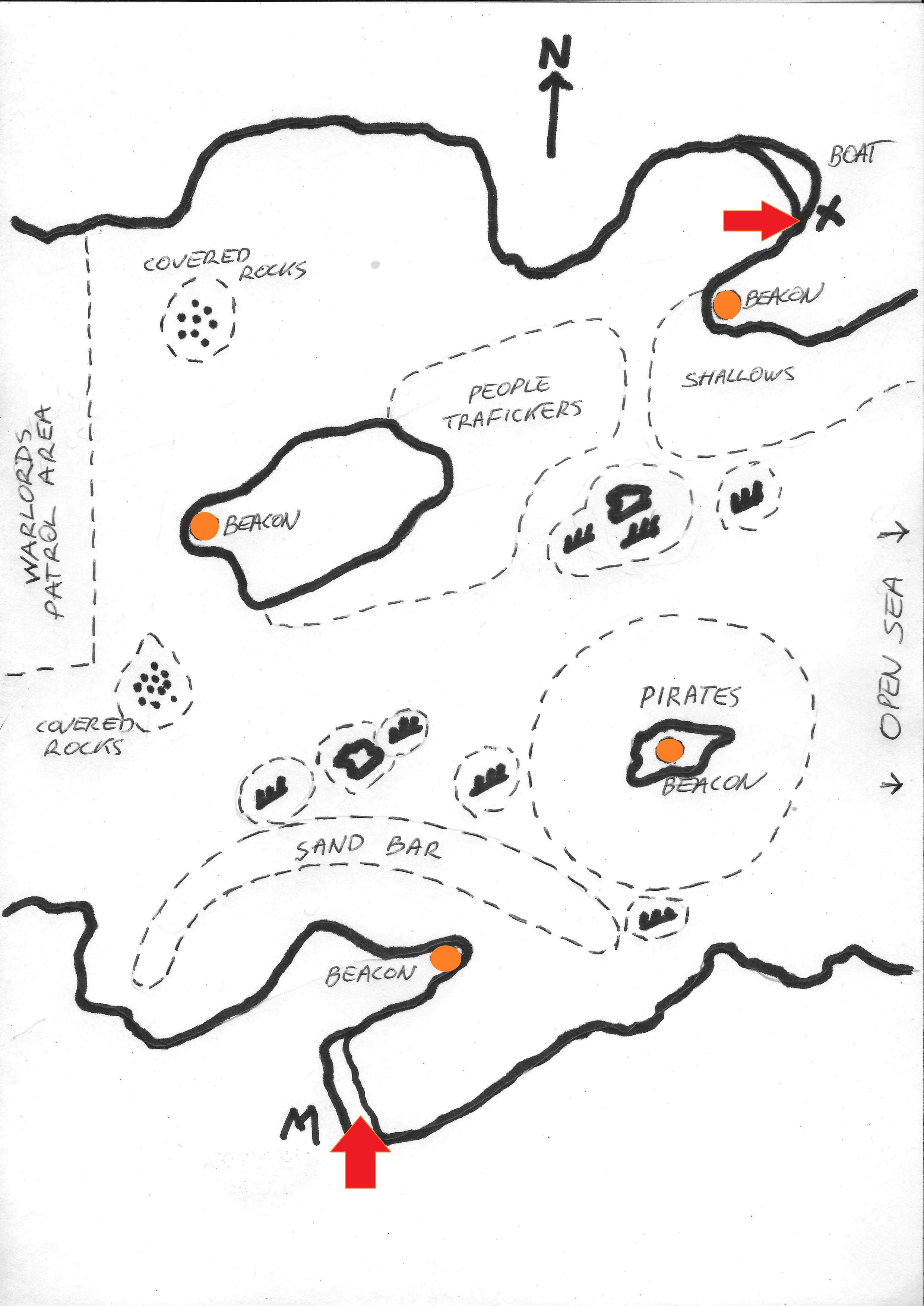
Partnership

There are 3 resource ideas in this area:-
Twin your scout group
Scouts make contact with scouts in another part of the world, either just once-off or for a longer twinning arrangement
Section: All Time: 1 hour to establish Where: Home, Den
The aim of this activity is to link the scouts with scouts of their own age in another part of the world, giving them an opportunity to hear first-hand about the experiences of others To maximise the value of this engagement, work with the scouts to choose a country or region where the people face a different set of challenges in relation to the SDGs This decision needs to be made after an amount of research by the scouts Finding a country where there is an active scouting community will make it easier to find a link
Scouts decide on another country to talk to scouts there about sustainability, amongst other things! The scouters make a safe formal arrangement and the scouts get chatting
It will be up to the scouters to follow through and make contact with a suitable group in the chosen country. Try searching online or seeking help from your national office Try to find a group which has youth members of the same age, this will increase the chances of your scouts being able to relate well to them Arrange to share messages between the two groups of scouts, and possibly set up online group calls or similar for them In all contacts between the scouts, take full account of child protection policies and other rules which might govern the interactions in both jurisdictions.
Meeting scouts from other countries is one of the many benefits of scouting, so allow for lots of chatter However, the focus of this activity is on learning about the challenges facing other countries in relation to the SDGs, so maybe set a task for the scouts in this area In identifying the country, the scouts probably already identified some more obvious issues, such as poverty or access to water. Their discussions with the other scouts might confirm this, or prove them totally wrong! Consider other issues around sustainable development, and be open to the possibility that they had misconceptions about the other country
The scouts learn about the issues facing their own age group in a different situation
Follow-on
Extending the process into a group twinning could open up a whole range of opportunities for the scouts Making an initial arrangement for maybe one scouting year would allow both groups to assess the benefits before renewing for another year, and make it easier for group members to buy in
After there has been a round of contact between both groups of scouts, bring your own scouts together to discuss what they found out What did they find out that surprised them? What issues are those scouts facing which might be resolved when the Global Goals are met? Can the scouts imagine what it must be like for their fellow scouts – can they empathise with their situations? Could they offer any advice? As the conversations will have been two-way, did the scouts find that this mirror showed them some of the challenges here at home? If the scouts enjoyed the process, would they like to maintain contacts at a section or group level? Is there interest from both sides to extend this to a broader twinning and continue the conversation?
SDG 17 Partnerships for the Goals
SDG 17 aims to encourage and promote effective public, publicprivate and civil society partnerships Scouts can reach out hands of friendship and start to understand and support others to better equip them to face shared challenges in the future
Share the SDGs PLAN
Scouts choose a way to promote the SDGs to their community, using posters, videos, memes or whatever to share a specific message.
Section: All Time: 30 minutes
Where: Den,Home
This activity is intentionally broad to allow the scouts to come up with their own plan Work with the scouts to figure out the three important components of this task:
- What message about sustainable development do the scouts want to communicate?
-Who do they want to get this message across to?
-How do they want to do it?
Help the scouts to choose a clear message that their target audience will understand. Help them as well to choose a method that is accessible and will be understood by that audience
Materials
Materials needed will depend on the method being used – paper and art supplies for posters, computer or smartphone for videos or memes and so on
Scouts decide on another country to talk to scouts there about sustainability, amongst other things!
The scouters make a safe formal arrangement and the scouts get chatting
The scouts learn about the issues facing their own age group in a different situation
Follow-on
The scouts can work individually or in their small groups to complete their designs Their focus should be on getting the message across, but using creativity, humour, irony or anything else that works for them
The second part is to get their message shared They may need help with this one, whether it is getting posters up in public places such noticeboards, in libraries, shops and community centres, or posting online or on social media.
Extending the process into a group twinning could open up a whole range of opportunities for the scouts Making an initial arrangement for maybe one scouting year would allow both groups to assess the benefits before renewing for another year, and make it easier for group members to buy in
Chat with the scouts about how their promotional campaign went Do they feel that they got their message across? Did they get feedback? Did people understand the message and will people make changes to how they do things?
Reviewing this activity with the scouts is an important way to help them to understand how they can get their message across
SDG 17 Partnerships for the Goals
SDG 17 aims to encourage and promote effective public, publicprivate and civil society partnerships Scouts can reach out hands of friendship and start to understand and support others to better equip them to face shared challenges in the future
Find out about Fair Trade
Scouts learn about the concept of Fair Trade, and find what products are available to them locally.
Section: All Time: 1 hour
Where: Home, Den In a nutshell...
SDG 17 is quite a complex goal, with many different aspects However, it all boils down to one simple idea; helping each other out Much of this is at the level of governments and businesses but we still have a role to play Discuss with the scouts how they can help by buying products from countries which need to grow their exports to improve their economies for the benefit of their people.
To be sure that the money we spend is giving benefit to the people of that country, we can watch out for Fairly Traded goods Scouts can do their research from home, or do it together in the den if they have internet access
Scouts learn about the concept of fair trade
They investigate the certifications and labelling of fair trade goods
They identify goods available to them locally, and consider switching over some of their purchases
Follow-on
Scouts can do their research by using the following guidance:
Find a definition of Fair Trade that makes sense to them
Figure how Fair Trade helps the producers?
Systems like this need to be managed properly to be sure that the producers are benefitting There are different international schemes to ensure fairness Scouts should identify a few of these and then draw the logos so that they would recognise them when out shopping
Check in local shops for fairly traded products. Watch out for the logos that they identified already
Look in the fruit and vegetable section, then maybe look at chocolates and biscuits
Make a list of all products which can be found locally, and in what shops
Check for shops in the locality, or online, which specialise in these products
Bring the scouts together to discuss their findings Gather the list of items that they found in shops to create a definitive list of the Fair Trade goods which can be purchased locally The scouts could then share this list throughout the group, encouraging scouts and their families to change some of their purchases to Fair Trade goods
Be sure to bring the focus back to the benefits to the producers, so that the scouts will be properly motivated and know that their efforts can make a difference
Scouts could make a short video for social media, explaining the concept of fair trade, and reporting from local shops to show some of the products which are available to their community Another option is to compare the price of Fair Trade goods with similar products Is there much of a difference? If some are more expensive, is it worth paying the extra?
SDG 17 Partnerships for the Goals
SDG 17 aims to significantly increase the exports of developing countries By learning about Fair Trade, scouts can see, and promote, ways of increasing exports for these countries, while ensuring that the workers earn a fair wage