PLAN:
EXPLORATION ACTIVITIES
Activity 1: Making Connections and Rewriting Injustice
Aim: To highlight how products bought in the Global North have links to Injustice in the Global South.
Time: 45 mins
SPICES: Social, Intellectual, Emotional
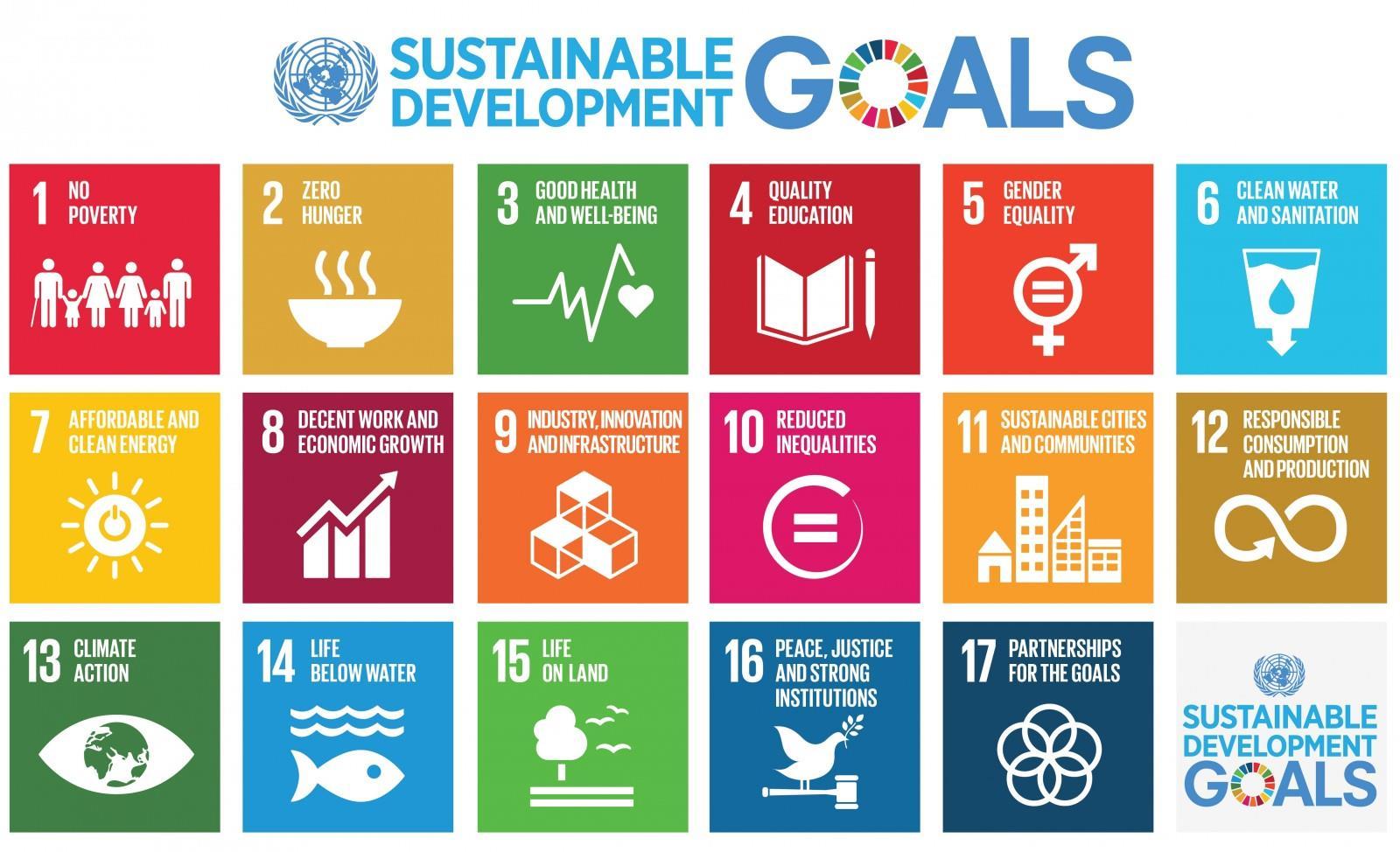
Sustainable Development Goals: 1. No Poverty, 2. No Hunger, 3. Good Health, 4. Quality Education, 8. Good Jobs and Economic Growth, 10. Reduced Inequalities, 12. Responsible Consumption, 13. Climate Action, 15. Life on Land, 16. Justice
Materials: Info sheet + Link Cards
Definitions:
• Global North: Represents the economically developed societies of Europe, North America, Australia, Israel, South Africa, and others.
• Global South: Represents the economically developing countries of Africa, India, China, Brazil, Mexico, and others.
• Consumer: A person who buys goods and services.
• Producer: A person who makes goods and provides services for consumers.
• The Human Development Index: A composite statistic of life expectancy, education, and per capita income indicators, which are used to rank countries into four tiers of human development. A country scores higher HDI when the lifespan is higher, the education level is higher, and the GDP per capita is higher.
Definitions: (cont’d)
• The Democratic Republic of the Congo (DRC): The Democratic Republic of Congo is extremely rich in natural resources but has had political instability, a lack of infrastructure, issues with corruption and centuries of both commercial and colonial extraction and exploitation with little holistic development. As of 2016, DR Congo's level of human development is 176th out of 187 countries, according to the Human Development Index.
• The Fair Trade Movement: The fair trade movement aims to improve labour and environmental standards, and educate workers to improve their skills, products and subsequently profit – through both practical interventions and international policy reform.
• Fair Trade Product: A product that was produced in accordance with the principles of The Fair Trade Movement.
• The European Union (EU): A partnership between 28 European countries. It was created after World War II to avoid conflict in Europe by promoting cooperation. Ireland joined in 1973. The EU has a single European currency, the EURO, and the EU population is about 700 million. The EU aims to create a single Europe-wide market in which people, goods, services, and money move freely. The EU is the world’s largest donor of international aid. The EU is very strong in policies related to fisheries, agriculture and international trade. Some policies disadvantage countries in the Global South as they create unfair rules that benefit EU producers.
• Endangered Animal: A species at risk of extinction because of human activity, changes in climate, changes in predator-prey ratios, etc..
• Pollution: The introduction of harmful substances or products into the environment.
• Cartel: A coalition of political or special interest groups having a common cause, formed especially to regulate prices and output in some field of business.
Definitions: (cont’d)
• Workers/Trade/Labour Union: An organization of workers formed to protect the rights and interests of its members.
• Asian Floor Wage: A wage for garment workers across Asia that would be enough for workers to live on.
• Living Wage: The minimum income necessary for a worker to meet their basic needs.
• Child Labour: Child labour is any kind of work that deprives a child of their childhood, their potential and their dignity. It is work that exceeds a minimum number of hours and that is harmful to a child’s physical and mental development. It may include work that is mentally, physically, socially or morally dangerous and work that interferes with schooling.
• Forced Labour: Forced labour is when a person is forced or threatened into providing labour or services and is not free to stop. It often occurs when employers take advantage of vulnerable people, such as those affected by poverty, high rates of unemployment, discrimination, corruption, political conflict, or lack of education or knowledge of their rights. Migrants are particularly vulnerable, but individuals may also be forced into labour in their own countries.
• Food Miles: Refers to the distance food is transported from the time of its production until it reaches the consumer. Food miles are one factor used when assessing the environmental impact of food, including the impact on global warming.
Steps:
Step 1: Cut up the link cards and put them into a bag.
Step 2: Ask each Scout to take a card from the bag.
Step 3: The Scouts must match their cards to form a coherent paragraph.
Step 4: After the Leader has checked the groups’ paragraphs, the groups must read them aloud. Individual Scouts call out what their cards say, in order.
Step 5: Discuss what has been said following the sample questions below…
• What did the consumers (Emma, Mark, etc.) have in common with one another?
• What did the producers (Devi, Camilla, etc.) have in common with one another?
• Did the consumers and producers have anything in common?
• How were the producers and consumers connected?
• Were you surprised by how the producers and consumers were linked?
• Is anyone to blame for the producers’ situations?
• How can the consumers help the producers?
Step 6: Get the groups to re-write the paragraphs, knowing what they now know, to make the outcome more favourable for the producers.
Step 7: Ask the groups to read out their new paragraphs.
Link Cards:
Mark eats muesli for breakfast every morning. The muesli contains nuts and figs.
The figs were grown on land that is occupied by Israeli people.
Israel has moved into Palestinian territories against international law.
The EU continues to trade with Israel for many products including figs.
Palestinian people are forced off their land by the Israeli army.
Mohammed gets beaten and imprisoned for fighting back and throwing a stone at a soldier.
His education suffers because his prison does not provide any education for children.
Link Cards:
Emma likes having the latest phone, she gets a new one each year.
Mobile phones need the mineral “coltan”.
80% of the world’s coltan is found in the Democratic Republic of Congo (DRC), which has a trade deal with the EU.
The eastern DRC is in civil war, many armies are fighting for control of the area.
The armies use the profit from the coltan mines to fund their wars.
Philippe is 13 and works in the mines where over 1 in 3 of the coltan miners are children.
The coltan miners buy their food from local traders.
Sometimes the traders sell animal meat, which can include the lowland Gorrilla, an endangered animal.
Link Cards:
Ciaran loves Chinese food. His favourite dish is Shrimp fried rice.
Over a quarter of all shrimp is now farmed to keep up with demand.
To support the demand in Europe, the EU negotiates for the cheapest shrimp from countries like Ecuador.
To sell more shrimp, businesses clear the trees along the coast to make more shrimp farms.
Emilia was born on this land, but now she has to move to make way for new farms.
The shrimp farm pollutes the sea, and there aren’t any fish for Emilia’s community.
Emilia must work in the shrimp farm to survive.
Link Cards:
Sarah is having a party. She’s decided to make a guacamole dip for the nachos.
The avocados she buys are from Mexico.
Many forests have been cut down in Mexico to make way for profitable avocado farms.
Camilla had to drop out of school to work at one such farm after her father was kidnapped by a local cartel.
The farmers have to purchase illegal weapons in order to protect themselves.
Camilla’s fingernails have been ruined from working with pesticides.
She wants to move to the U.S., but cannot afford to leave home, and is worried about the wall Trump says he will build.
Link Cards:
Gary drinks coffee while he studies.
The coffee he drinks has come from the Ivory Coast.
Emmanuel works as a coffee picker there.
When his older brother became ill, Emmanuel had to leave school to work.
For every €2 Gary spends on coffee, Emmanuel earns only 17 cents.
His brother’s medicine is expensive, and the family struggle to afford tuition fees for his younger siblings.
When times are bad, Emmanuel earns only 4 cents for every €2 Gary spends on coffee.
Link Cards:
Emily loves sport.
Her parents bought her a pair of €100 Nike runners for Christmas.
In 2014, Nike spent $100 every second on advertising.
Devi, who made Emily’s runners in a factory in Cambodia, is on strike.
Devi and his co-workers are campaigning to increase their individual monthly wages from $74 to $88.
Devi’s cousin was fired from a factory nearby for joining a workers union.
Original Text:
Mark eats muesli for breakfast every morning. The muesli contains nuts and figs. The figs were grown on land that is occupied by Israeli people. Israel has moved into Palestinian territories against international law. The EU continues to trade with Israel for many products including figs. Palestinian people are forced off their land by the Israeli army. Mohammed gets beaten and imprisoned for fighting back and throwing a stone at a soldier. His education suffers because his prison does not provide any education for children.
Emma likes having the latest phone, she gets a new one each year. Mobile phones need the mineral “coltan”. 80% of the world’s coltan is found in the Democratic Republic of Congo which has a trade deal with the EU. The eastern Democratic Republic of Congo is in civil war, many armies are fighting for control of the area. The armies use the profit from the coltan mines to fund their wars. Philippe is 13 and works in the mines where over 1 in 3 of the coltan miners are children. The coltan miners buy their food from local traders. Sometimes the traders sell animal meat which can include the lowland Gorrilla, an endangered animal. Change names to fit respective programmes
Ciaran loves Chinese food. His favourite dish is Shrimp fried rice. Over a quarter of all shrimp is now farmed to keep up with demand. To support the demand in Europe, the EU negotiates for the cheapest shrimp from countries like Ecuador. To sell more shrimp, businesses clear the trees along the coast to make more shrimp farms. Emilia was born on this land, but now she has to move to make way for new farms. The shrimp farm pollutes the sea, and there aren’t any fish for Emilia’s community and now she must work in the shrimp farm to survive.
Original Text:
Sarah is having a party. She’s decided to make a guacamole dip for the nachos. The avocados she buys are from Mexico. Many forests have been cut down in Mexico to make way for profitable avocado farms. Camilla had to drop out of school to work at one such farm after her father was kidnapped by a local cartel. The farmers have to purchase illegal weapons in order to protect themselves. Camilla’s fingernails have been ruined from working with pesticides. She wants to move to the U.S., but cannot afford to leave home, and is worried about Trump’s wall.
Gary drinks coffee while he studies. The coffee he drinks has come from the Ivory Coast. Emmanuel works as a coffee picker there. When his older brother became ill, Emmanuel had to leave school to work. For every €2 Gary spends on coffee, Emmanuel earns only 17 cents. His brother’s medicine is expensive, and the family struggle to afford tuition fees for his younger siblings. When times are bad, Emmanuel earns only 4 cents for every €2 Gary spends on coffee.
Emily loves sport. Her parents bought her a pair of €100 Nike runners for Christmas. In 2014, Nike spent $100 every second on advertising. Devi, who made Emily’s runners in a factory in Cambodia, is on strike. Devi and his co-workers are campaigning to increase their individual monthly wages from $74 to $88. Devi’s cousin was fired from a factory nearby for joining a workers union.
Tips & Project Ideas:
Use your purchasing power to ensure the products you purchase are produced ethically: Use websites such as Shop Ethical! or Rankabrand.org to help you find ethically certified products.
Ask your workplace, school, church and local shops and cafés to switch to ethically sourced coffee.
Additional Resources:
• Shop Ethical! Website: http://www.ethical.org.au/3.4.2/
• Rankabrand.org Web link: https://rankabrand.org/
• Animation Explaining The Asian Floor Wage: https://www.youtube.com/watch?v=ZTn8jD2GcRA
• The Asian Floor Wage Website: http://asia.floorwage.org/
Activity 2: The Disappeared
Aim: To highlight human rights abuses as an injustice and to get the group thinking about what can be done.
Time: 45 mins
SPICES: Social, Intellectual, Emotional.
Sustainable Development Goals: 10. Reduced Inequalities, 16. Justice
Materials: Info Cards, A2 Sheets, Markers, Polaroid Camera/Camera + Printer.
Definitions:
• Concentration Camp: A guarded compound for the detention or imprisonment of aliens, members of ethnic minorities, political opponents, etc..
• ‘The Troubles’: An ethno-nationalist conflict in Northern Ireland during the late 20th century. Also known internationally as the ‘Northern Ireland Conflict’, it is sometimes described as a ‘guerrilla war’ or a ‘low-level war’. The conflict began in the late 1960s and it is usually deemed to have ended with the Good Friday Agreement of 1998. Although the Troubles mainly took place in Northern Ireland, at times the violence spilled over into parts of the Republic of Ireland, England and mainland Europe.
• Crimes Against Humanity: A crime or series of crimes, directed against a large group because of religion, ethnicity, country of origin, or other reason unconnected with any individual's responsibility for having committed a criminal act.
Steps:
Step 1: Divide the group in three.
Step 2: Give each group an info card, an A2 sheet, and some markers.
Step 3: Separate the groups.
Step 4: The groups should read their info card.
Step 5: The groups should then write down any injustices that occurred in the stories, and what caused these injustices.
Step 6: Reunite the groups and invite them to share their findings.
Step 7: Discuss the following…
What was unfair in the stories?
Do forced disappearances still take place?
Where in the world do they happen?
What are the reasons?
Are they fair/just?
What should be done to prevent this happening again?
What role could young people have in this prevention plan?
Step 8: Take everyone’s photograph and have them printed, writing on each ‘If I disappeared, I would never…’.
Step 9: Invite individuals to complete the sentence.
Info Cards:
The Disappeared in Argentina: In 1976 the military took power in Argentina, they started a campaign to wipe out any opponents to their rule. In seven years, between 10,000 and 30,000 people were kidnapped. Some of these people were members of organisations the government didn’t like and had probably taken part in a protest. In some cases, they were just friends or family of people who disappeared. People didn’t know what happened or wouldn’t speak about it, for fear of it happening to them. Mothers who went looking for their sons and daughters also disappeared. After 1983 when the military left government, a national inquiry found over 340 secret concentration camps where the disappeared were tortured, heavily drugged and murdered. The mothers of many disappeared began to march every Thursday in the main square of the Capital city Buenos Aires wearing white head scarves which they embroidered the names and memories of their loved ones onto. They have since become a powerful organisation fighting for justice on many issues.
The Disappeared in Northern Ireland: In Northern Ireland during the period known as The Troubles (between the late 1960’s and ending in 1998) there was a campaign of violence between groups that believed Northern Ireland was part of either the UK or the Republic of Ireland. These paramilitary groups included the Irish Republican Army (IRA) and the Ulster Volunteer Force (UVF). The conflict caused many deaths on both sides, as well as kidnappings, robberies, assaults and disappearances. Most of the “disappeared” were people accused of being informers for the other side, they were murdered and their remains buried in hidden locations. Since the peace process people are trying to find out what happened to the “disappeared” so they can give them a proper funeral. Recently some of the groups who were fighting have worked with the government to recover some of the remains. The remains of many “disappeared” victims are still missing.
Info Cards: (cont’d)
The Disappeared in Australia: In Australia it used to be normal for Aboriginal children to be taken away from their families, especially if they were of “mixed race”. This meant if one parent was an Aborigine and one was a white Australian. This practice ended in 1969. There were many reasons given for it, including the need to integrate Aboriginal people into society and for maintaining white “racial purity”. The children were often brought up in state or religious institutions where they were punished for speaking their own language or practicing their beliefs. Most were raised to become house servants and farm labourers. In 2008, the Australian Government apologised. The previous government were unwilling to do so because they felt they would get sued for huge amounts of money. The children who disappeared are known as the “stolen generation”. Much of the culture of the Aborigines has also disappeared because there was nobody to carry it forward.
Info Cards: (cont’d)
The Disappeared in Europe: There are an estimated 10,000 refugee children missing across Europe. Many of these children arrive at European ‘hotspots’, such as the shores of Greece and Italy, having made a dangerous voyage across the Mediterranean by boat. Facilities at European hotspots have been described as “squalid” and “deplorable”, they lack reliable access to food and water, sanitation, access to physical and psychological health care and access to education. Children arriving at hotspots do not have guaranteed access to age-appropriate information about applying for asylum, the Dublin transfer and family reunification processes, or a guardian or legal representative to help them understand their rights. Smugglers discourage them from registering at borders and hotspots or legally applying for asylum. The children’s distrust in European child protection services and the legal relocation/reunification process is compounded by reality that the Dublin transfer system carries a lengthy waiting period of up to 12 months. As a result, 50% of these unaccompanied and separated children (UASC) go missing from hotspots within 48 hours of arriving. Fearful of the unjust legal system and desperate to reach their chosen destination, many are willing to trust smugglers and traffickers to transport them, many of whom force them into slavery.
Fact!
August 30th each year is International Day of the Disappeared. Forced disappearances are listed as a “crime against humanity” in the International Criminal Court.
Links and Resources:
• 10,000 Missing Children Irish Campaign Videohttps://www.youtube.com/watch?v=YuC75n_DTEs
• 10,000 Missing Children, Al Jazeera Videohttps://www.youtube.com/watch?v=BEFfbP-3OBw
Activity 2: Dodgeball Bailout
Aim: To explore what it means to be in debt.
Time: 1 hour
SPICES: Social, Physical, Intellectual, Character, Emotional Sustainable Development Goals: 1. No Poverty, 2. No Hunger, 3. Good Health, 4. Quality Education, 8. Good Jobs and Economic Growth, 16. Justice
Materials: Dodgeballs, cones/chalk/tape
Definitions:
• Debt: A duty or obligation to pay money, deliver goods, or render service under an express or implied agreement.
• Bankrupt: A person, business, etc., that is unable to pay debts.
• Bailout: Loaning or giving money to a company, a country, or an individual in order to try save them from bankruptcy.
• The European Union (EU): is a partnership between 28 European countries. It was created after World War II to avoid conflict in Europe by promoting cooperation. Ireland joined in 1973. The EU has a single European currency, the EURO, and the EU population is about 700 million. The EU aims to create a single Europe-wide market in which people, goods, services, and money move freely. The EU is the world’s largest donor of international aid. The EU is very strong in policies related to fisheries, agriculture and international trade. Some policies disadvantage countries in the Global South as they create unfair rules that benefit EU producers.
• The G8:
The countries of Canada, France, Germany, Italy, Japan, Russia, t he United Kingdom, and the United States.
Definitions: (cont’d)
• The International Monetary Fund (IMF): has 187 member countries working for global cooperation in finance and economics. The aim is to promote trade, employment and economic growth. The IMF was set up in 1944, based in Washington D.C. The IMF has high influence in world affairs and some say it is dominated by Western countries: the USA has the largest vote. The IMF encourages economic policies that promote the free market and private companies. The IMF can influence governments to cut public spending, e.g. in health and education, in order to pay back loans. Some say the IMF responds to problems rather than preventing them.
• The World Bank: Based in Washington D.C., was founded in 1944 to rebuild economies after World War II. Its aim is to tackle world poverty. It provides loans and technical advice to countries in the Global South. The World Bank has 187 member governments but the most powerful are ‘the G8’. Each country is a shareholder of the Bank, and each country has shares based roughly on the size of its economy. The USA holds 16% of votes, followed by Japan, Germany, the UK and France. The World Bank is the biggest lender of loans in the World and attaches policy conditions to countries borrowing money from it.
• The World Trade Organisation (WTO): A forum where countries agree trade rules. The WTO was created in 1995. It currently has 153 member governments and is based in Geneva, Switzerland. In theory, all countries have an equal voice at the WTO. However, in reality rich countries can dominate because they can afford to send many trade experts to meetings to fight for their interests. Trade negotiations called the Doha Development Agenda (or Doha Round) started in 2001 to enhance development and participation of poorer countries. However, the negotiation has led to much disagreement between Global North and South regarding imports, exports, prices and produce.
Steps:
Step 1: In a room, or open space, place or draw a line down the centre of the space using a rope/chalk.
Step 2: Divide the group into two teams.
Step 3: Explain the rules of dodgeball: They have to throw the ball from one team to the next trying to hit an opponent before the ball bounces. If you’re hit once, you have a personal debt and keep one arm behind your back. If you’re hit a second time, you have a national debt hop on one leg (as well as keeping one arm behind your back). If you’re hit a third time, you have to sit on the ground and are ‘bankrupt’. When sitting on the ground, the player can try to catch the ball with both hands. If they succeed, they shout ‘bailout!’ and are back in the game.
Step 4: When the game is over, discuss the following…
• What is debt?
• What sorts of debts exist (mortgage, car loan, credit cards etc.)?
• How did it feel to be burdened with ‘debt’ during the game?
• What does it mean to be bankrupt?
• What is a bail-out?
• Do you think rich or poor people have debts? Why?
• Do countries have debts? Why?
• If countries/people don’t have enough money, where can they get it?
• Is it fair that they take loans and have debts?
• Who is affected when this happens?
• If countries or people get into debt, whose fault is it?
• Do you think it’s wrong not to re-pay a loan?
Step 5: Read the following extract to the group…
Steps:
(cont’d)
Step 5: Read the following extract to the group…
“As I write this letter I am hoping that sleep can provide me with some escape from the anxiety and pain that the economic situation is causing me and my family. Until recently I have been able to pay for my home and provide for my young children. The part-time job I had has completely finished, and I have found myself and my loved ones having to cope with a new torment – hunger. Today I have had nothing to give my children only bread and cereal. My savings are gone. I dread what each day will bring.”
Step 6: Discuss the following with the group… What country do you think the person who wrote this letter is from?
Do you think this ever happens in Ireland? Why/why not? How does this letter make you feel?
Step 7: Reveal to the group that this extract was adapted from a letter sent to the Editor of the Irish Times on Friday 26th August 2011, from Kerry, Ireland.
Step 8: Debt is only one cause of poverty. Brainstorm, as a group, some other factors that can lead to poverty (e.g. Lack of Education, Unemployment, Drugs, Corruption, Politics, History, Population, Health, External Factors, Climate Change, etc.). Briefly discuss each point.
Steps: (cont’d)
Step 9: Read the following to the group…
7,941 people were homeless in Ireland in the week of June 1925th 2017 – the highest figures ever recorded. The number of families becoming homeless has increased by over 27% since June 2016. One in three of those in emergency accommodation is now a child.
Step 10: Ask the Scouts to go home and consider what has been discussed in relation to Ireland’s current homelessness crisis. This may be a point of discussion for your next meeting.
Activity 3: The Ups and Downs
Aim: To explore why some people have more opportunities than others.
Time: 45 mins
SPICES: Social, Intellectual, Character, Emotional.
Sustainable Development Goals: 1. No Poverty, 2. No Hunger, 3. Good Health, 4. Quality Education, 6. Clean Water and Sanitation, 10. Reduced Inequalities, 16. Justice
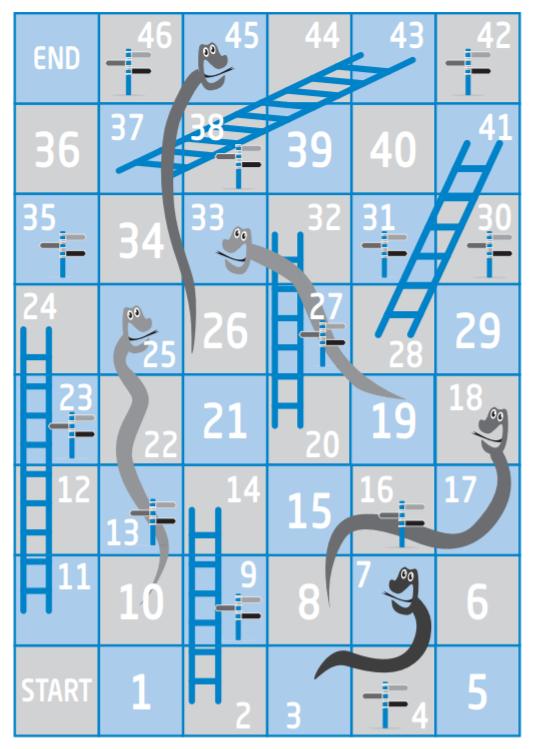
Materials: Copy of the grid, something for each person to mark their place, copy of the crossroads cards, copy of the role cards, dice.
Definitions:
• The Irish Travelling Community: The Travelling community is Ireland’s only significant indigenous ethnic minority. There are around 22,000 Travellers in Ireland, making up about 4,000 families. Another 15,000 Irish Travellers live in the UK, and there are 10,000 people of Traveller descent in the USA. Travellers account for 0.5% of the entire population of Ireland. They are a tight-knit community with a strong tradition and culture built around a nomadic existence. Though they are not related to the Roma peoples of Europe, Irish Travellers share with Romanies the sense of being excluded and marginalised in society.
• The Democratic Republic of the Congo (DRC): The Democratic Republic of Congo is extremely rich in natural resources but has had political instability, a lack of infrastructure, issues with corruption and centuries of both commercial and colonial extraction and exploitation with little holistic development. As of 2016, DR Congo's level of human development is 176th out of 187 countries, according to the Human Development Index.
Definitions:
• Refugee: Someone who has been forced to flee their home country because of a well-founded fear of persecution because of ethnicity, religion, nationality, and political opinion, or because of violence, conflict, or natural disaster.
• Asylum Seeker: A person seeking to be granted protection as a refugee outside their country of origin, and who is waiting for a legal determination of their application.
• National Youth Parliament of Ireland (Comhairle na N’Óg): Child and youth councils in the 31 local authorities of the country, which give children and young people the opportunity to be involved in the development of local services and policies.
Steps:
Step 1: Divide into sixes and distribute a role card to each person. Try to ensure there is a spread of roles in each group.
Step 2: Give each group a set for Snakes and Ladders and explain the following rules…
You are representing the character on your role card. Play the game as normal until you land at a crossroads. If this happens, you pick a crossroads card, read it aloud and the group must decide if the answer is Yes or No. They should give a reason for their decision. Yes moves forward 6 places, No moves back 6 places. The winner is the person who reaches the end first.
Step 3: Once the game is over, discuss the following…
• Which character won your game?
• Where did they come from?
• Who came last?
• Were you sent backwards or forwards at any point?
• Was this fair on you?
• Was it easier for some people to reach the top?
• Is this realistic?
• Why do some people have better opportunities than others?
Crossroads Cards:
• Would this person have enough food to eat every day?
• Could this person finish school?
• Does this person live in a safe environment?
• Can this person have fun with their friends?
• Can this person buy sweets when they want them?
• Can this person go on holidays away from home?
• Does this person have access to clean drinking water?
• Can this person get emergency medical care when they need it?
Role Cards:
• A young male Traveller from Dublin attending a local school
• A 10 year old boy from the Democratic Republic of Congo (DRC) who was taken by the rebel army to be a child soldier
• A teenage boy living in Ireland as an asylum seeker and without parents
• A Nigerian boy who is chairperson of a group of young people taking action to improve the health of young people in his school and community
• A young girl from Brazil who is in a wheelchair
• An elected teenage member of a National Youth Parliament in Ireland (Comhairle na nÓg)
Activity 4: An Alternative Future
Aim: To empower Scouts to be agents of change, bridging the gap between their ‘probable futures’ and their ‘preferred futures’.
Time: 40 minutes
SPICES: Social, Intellectual, Emotional
Sustainable Development Goals: All Materials: Sample Chart, flipchart paper, markers.
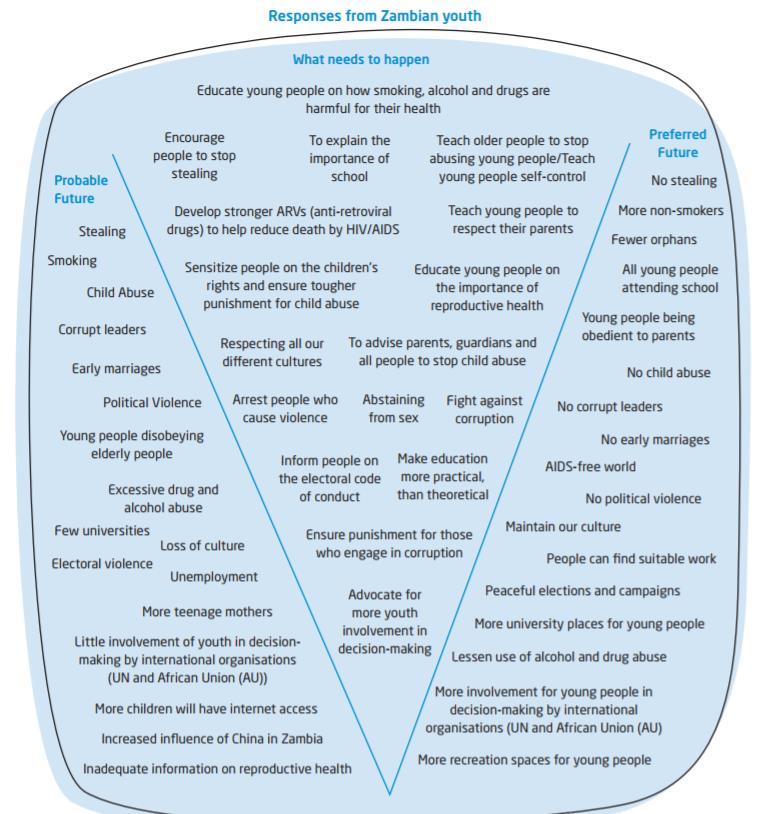
Step 1: In lodges, draw a large ‘V’ on a flipchart.
Step 2: On the far side of the left line, write or draw in the main events that are likely to happen in the next 30 years. These can be either personal, local, national or global events and should include both positive and negative elements. This is the ‘Probable Future’.
Step 3: Next, on the far side of the right-line of the ‘V’, draw or write their ‘Preferred Future’, i.e. what events you would like to see happen in the world during our lifetime.
Step 4: Finally, each group suggests how to ‘Bridge the Gap’ – this means things which will need to change in their personal lives, local communities, and in the world so that the Preferred Future can be reached.
Step 5: Allow the lodges to look at each others’ charts and give feedback.
Step 6: Now display the ‘Alternative Futures’ poster and explain that it shows ideas from Zambian youth. Invite the group to compare this to the world that they themselves imagined – both the ‘Probable World’, the ‘Preferred World’ and how to bridge the gap. What are the most common themes (e.g. education, employment, sex, drug and alcohol abuse, etc.)?
Step 7: Reflect on how these charts can help your group to develop service projects.
See following page for ‘Sample Chart’
Activity 5: A Picture Says 1000 Words
Aim: To show the power of photography in crisis situations, but to also reflect on the fact that one photo is only a single part of a bigger picture.
Time: 1 hour
SPICES: Social, Intellectual, Emotional, Spiritual.
Sustainable Development Goals: 10. Reduced Inequalities, 16. Justice
Materials: Photographs provided, notepads/paper, pens.
Step 1: Sit the group in a circle. Take one of the photographs provided and pass it around. Allow Scouts a set maximum amount of time to reflect on each image silently. They may write any thoughts they have on a notepad or paper, or just hold the thoughts in their head.
Step 2: When everyone has seen the photograph, discuss the following…
• What is happening?
• Where could it be happening?
• Why might it be happening?
• Who could the people in the photo be?
• What emotions are evident?
• What evidence is there, if any, of conflict in the photograph?
• Are there any significant contrasts in the image?
• How does the image make you feel?
• Who might the photographer have been?
• Why do you think this photo was taken?
• How do you think the photographer felt taking the photo?
Step 3: Invite Scouts to share what they have written.
Step 4: Read aloud the tagline that accompanies the image, and discuss the following…
• Does this change any answers to the previous questions?
• Does this change how you view the image? If so, in what way?
Step 5: Repeat Steps 1-4 for the remaining photographs.
Step 6: After all the photographs have been passed around, discuss the following…
• Was there anything all the photos had in common?
• How were the photographs different from one another?
• What do these things tell us about conflict?
• Did some images have more in common with one another than with others?
• What are the group’s thoughts on the role of photography in conflict?
Step 7: Assign one Scout to each photograph. Invite them to go home and research that image, bringing their findings back to the group for discussion at the next meeting.
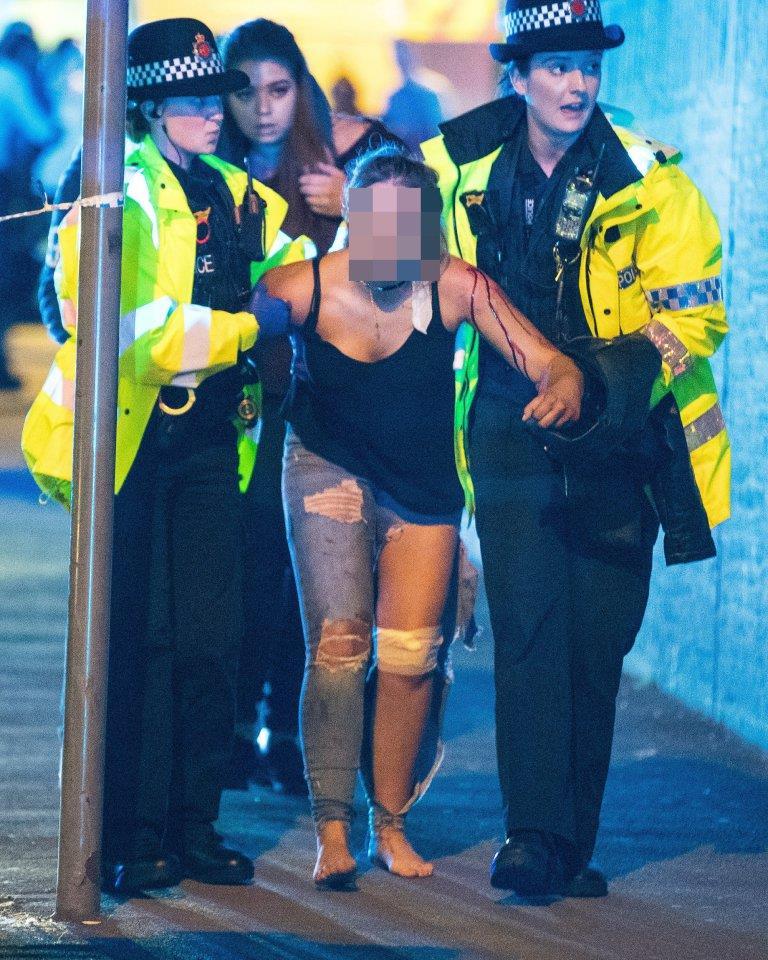
Image 1: Wounded Teen following Terrorist Attack at Ariana Grande Concert, Manchester 2017
Photos:
Image 2: Ireland Becomes the First Country to Legalise Same-Sex
Marriage through Popular Vote
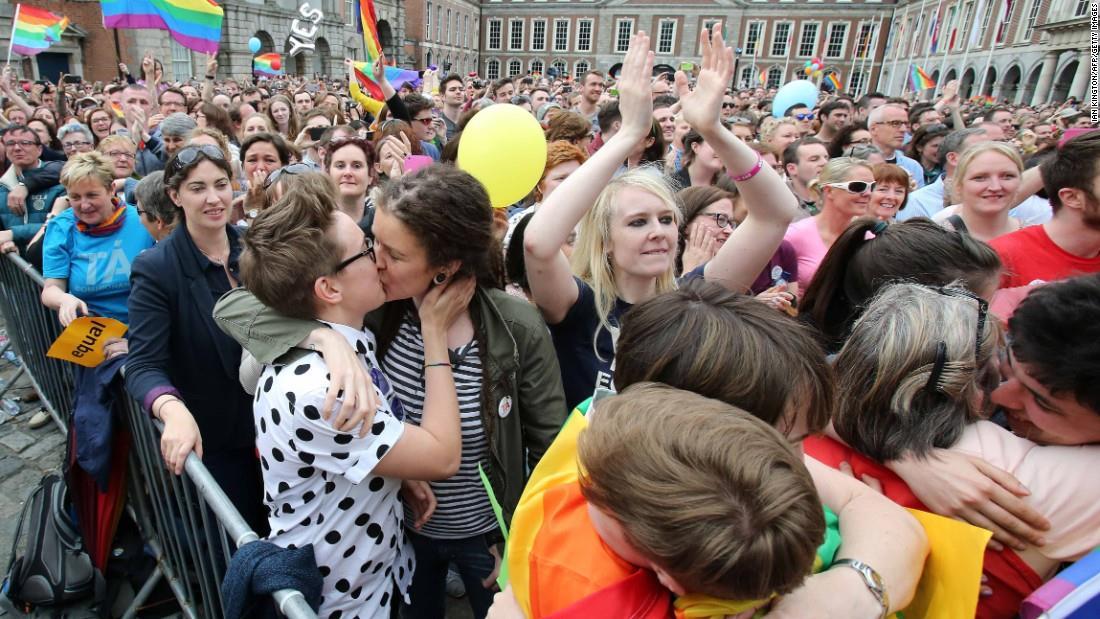
Image 3: Migrant Mother and her Children during the Great Depression (1936), California, U.S.A.
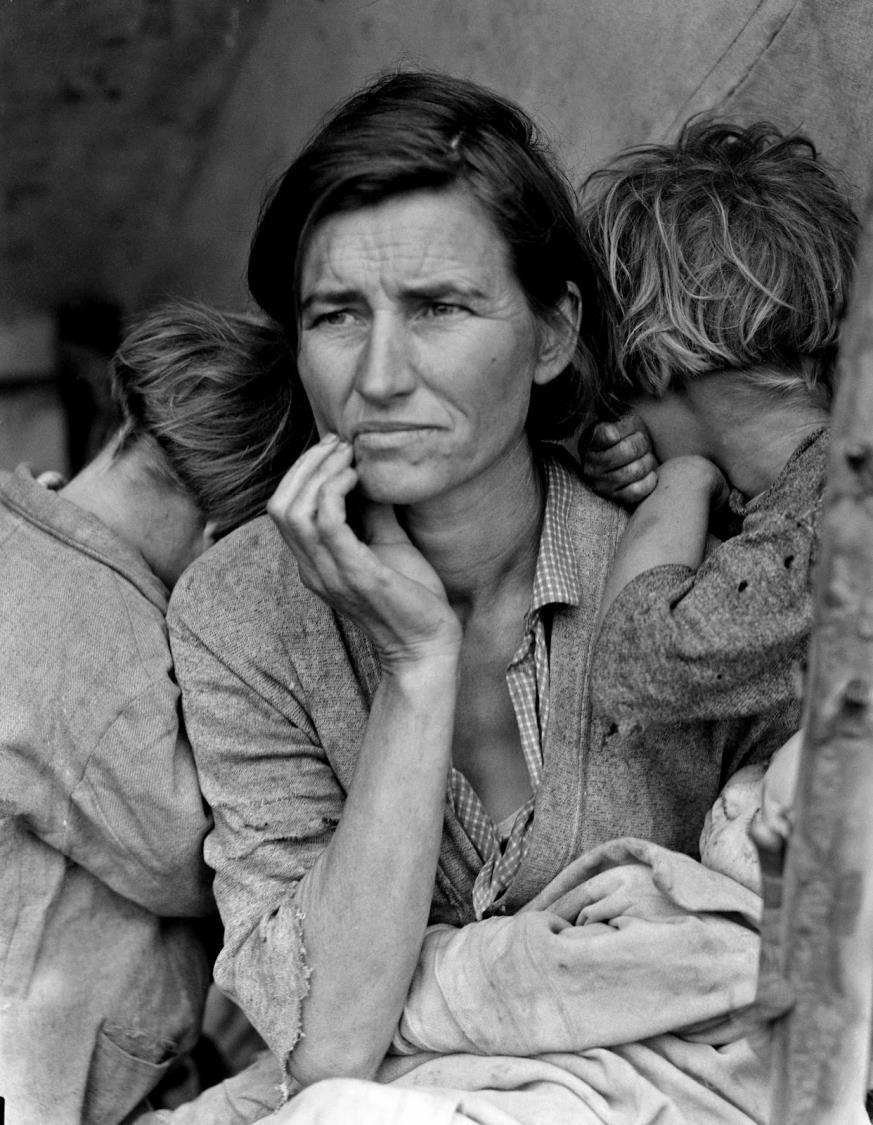
Image 4: Adolf Hitler Entertains a German Child at his Alpine Lodge in Bavaria, 1932.
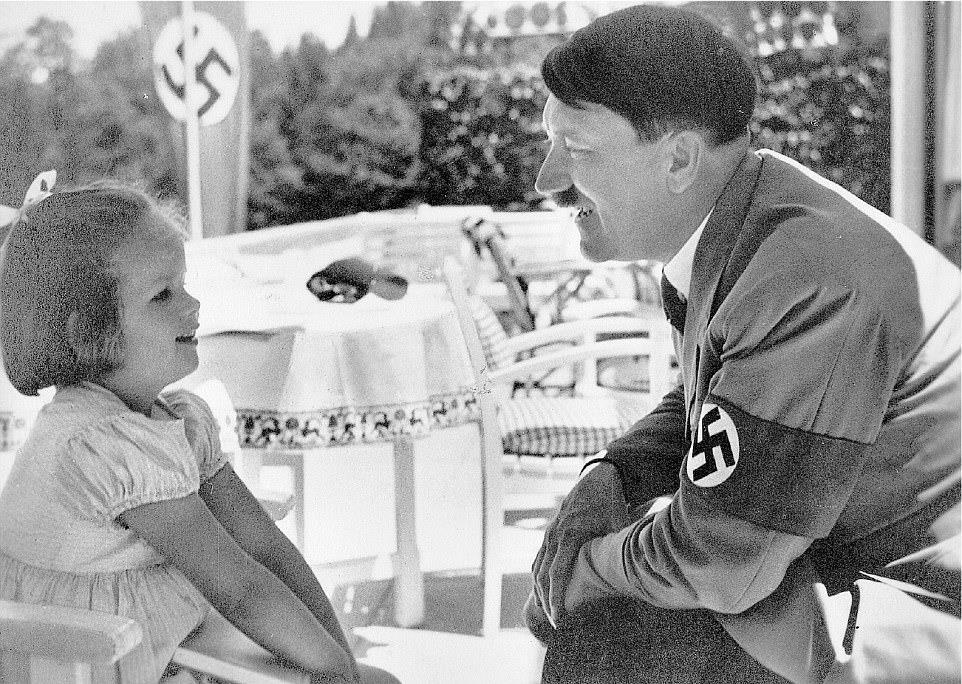
Image 5: The young pacifist Jane Rose Kasmir planting a flower on the bayonets of guards at the Pentagon during a protest against the Vietnam War on October 21, 1967.
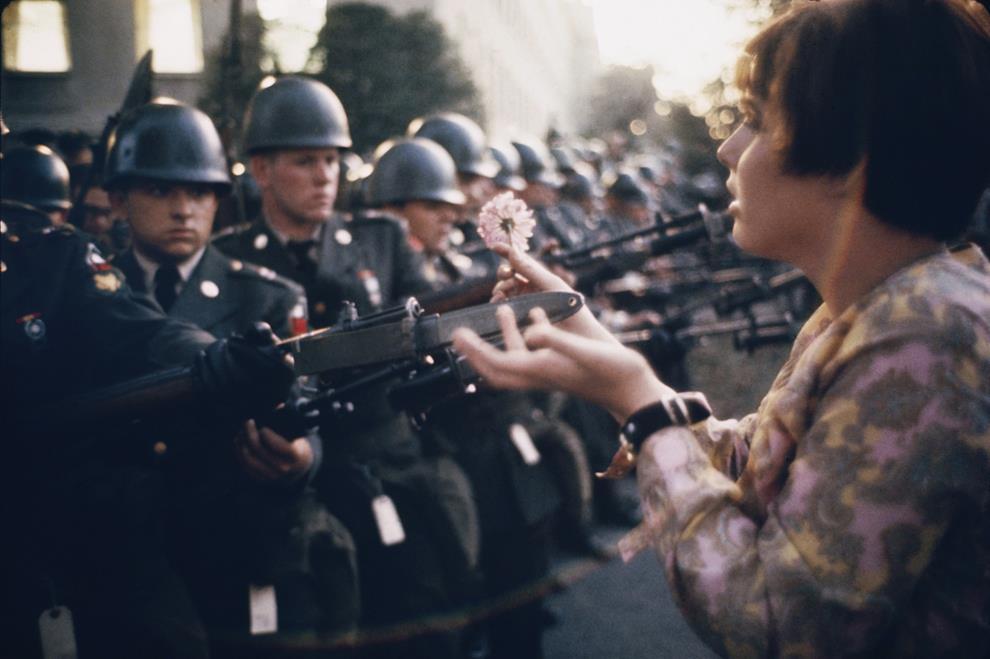
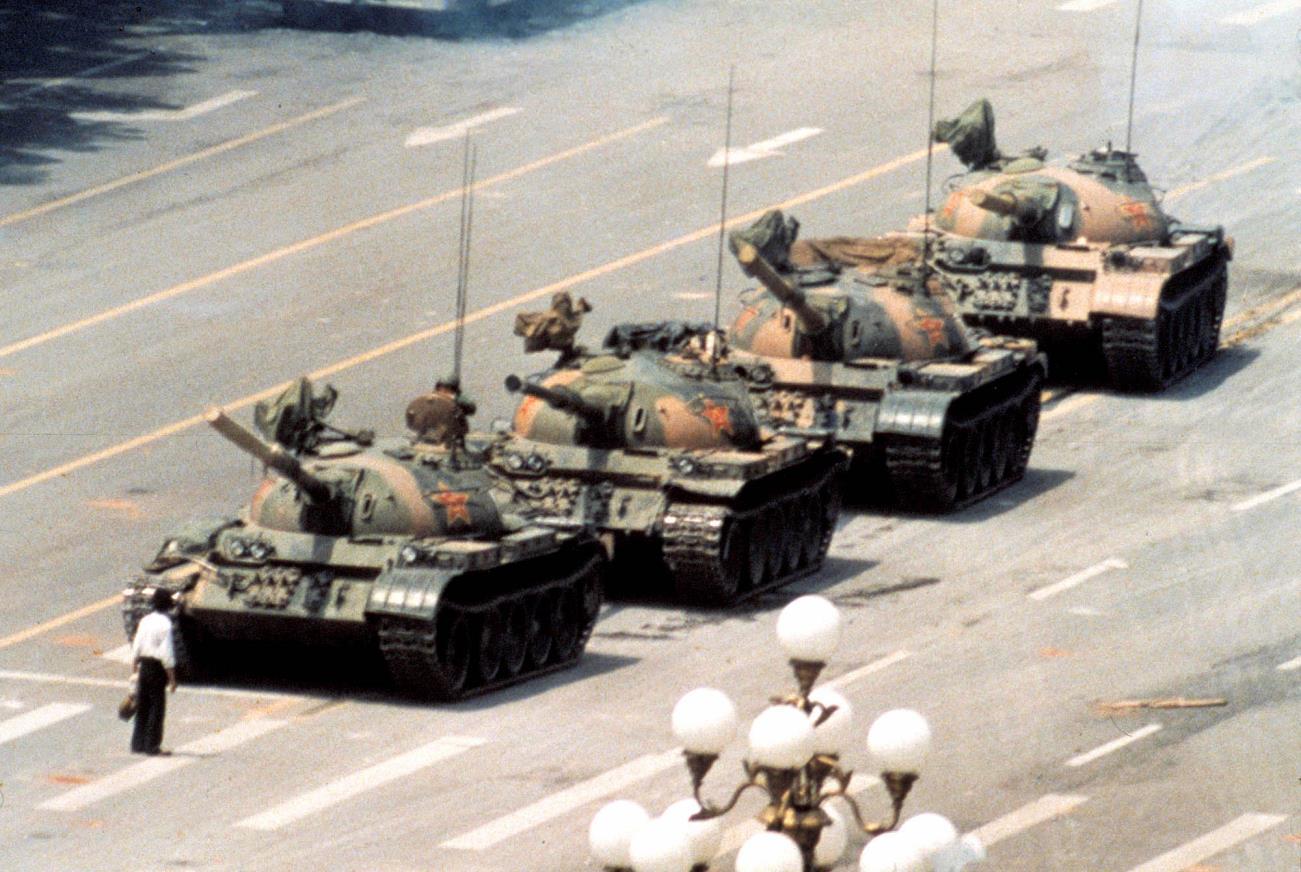
Image 6: Tank Man, the unknown rebel who stood in front of a column of Chinese tanks in an act of defiance following the Tiananmen Square protests of 1989.
Activity 5: First to Fifty
Aim: To explore different aspects of peace, conflict, and development throughout history, and in the present day. This exercise is intended as a springboard for project ideas.
Time: 1 hour + SPICES: All
Sustainable Development Goals: 4. Quality Education, 5. Gender Equality, 10. Reduced Inequalities, 12. Responsible Consumption, 16. Justice, 17. Partnerships for the Goals
Materials: Origami paper, internet access, A4 paper, colouring utensils.
Rules:
• Divide the section into patrols.
• Each patrol should be given a single die and a copy of the task list.
• Patrol members must take it in turns to roll the die.
• The first time a patrol member rolls, they must complete the task that corresponds to the number displayed on the die.
• If a Scout asks for help to complete a task, their patrol must assist them. If you refuse, you will be disqualified instantly.
• The die cannot be passed along until the Scout has completed their task.
• Once the task has been completed, the die should pass to the next patrol member.
• When rolling the die for a second time, the Scout must add the new number onto the old number. The sum of these two numbers corresponds to the task the Scout must now complete.
• The first Scout to reach, or surpass a sum of fifty has won, once they complete the final task on the list.
Tasks:
1. Name all of the SPICES.
2. Who founded the Scouting Movement?
3. What does WOSM stand for?
4. Who are the WAGGGS?
5. Who are the Messengers of Peace?
6. Make a human pyramid with six people.
7. Who are the UN?
8. Draw the symbol for the ‘HeForShe’ campaign.
9. What are the SDGs?
10. List all ten of KAICIID’s principles of peaceful dialogue
11. Give someone a compliment.
12. Do a good turn.
13. What is the Lumela - Fáilte Project?
14. Draw an outline map of Lesotho.
15. Draw and colour the flag of Lesotho.
16. What is the HDI?
17. List all 17 SDGs.
18. Where does Lesotho rank on the HDI?
19. Find a traditional Basotho blanket design online. Recreate it on paper and ask your patrol to help you colour it in.
20. Tie a friendship knot in someone outside of your patrol’s neckerchief.
21. Read the following article, summarise it, and share with the group - https://intercontinentalcry.org/maya-weavers-proposecollective-intellectual-property-law/
22. Find a traditional Mayan clothing design online. Recreate it on paper and ask your patrol to help you colour it in.
23. What does Fairtrade mean?
24. Name three celebrities who work with the UN as Messengers of Peace.
25. Show the following trailer to your patrolhttps://www.youtube.com/watch?v=Ze72rpWp_Dg
Tasks:
26. Show the following trailer to your patrolhttps://www.youtube.com/watch?v=0Co1Iptd4p4
27. Tie a friendship knot in two neckerchiefs of Scouts outside your patrol.
28. Make a human pyramid with ten people.
29. Make a selfless wish.
30. Dispose of a piece of litter.
31. List five things you own that you can live without.
32. List five things you have that you would never sell.
33. Who is Malala Yousafzai?
34. Who is Yeonmi Park?
35. What do Malala Yousafzai, Yeonmi Park, and Emma Watson have in common (apart from their gender)?
36. Tie a friendship knot in five neckerchiefs belonging to Scouts outside of your patrol.
37. Find a product you purchase on a regular basis on Shop Ethical! or Rankabrand.org’s website, and take an in-depth look at its ethical rating.
38. Make an origami crane. Now teach someone else to make an origami crane.
39. Who was Sadako Sasaki?
40. What was the Enola Gay?
41. Watch the following video with your patrolhttps://www.youtube.com/watch?v=AyWLvrWBKHA
42. Ask the person next to you to tell you one thing they’ve learned today.
43. What is Direct Provision? Where is your local Direct Provision Centre?
44. List the most vulnerable groups of people in your community.
45. Recite the Scout Promise and Law.
46. List all the community groups you can think of in your local area.
Tasks:
47. Do five rounds of the Boogaloo with the section.
48. Make five origami cranes and tie friendship knots in five neckerchiefs of Scouts outside your patrol.
49. Watch the following video with your patrolhttps://www.youtube.com/watch?v=LKBNEEY-c3s
50. Get every member of your section, including Scouters, to sign a pledge to complete a Messengers of Peace Project. Display this Pledge in the meeting place.
Additional Links/Resources:
• There You Go! Satirical Animation Narrated by David Mitchell: https://www.youtube.com/watch?v=uFU2iQcFv7U