Tips & Project Ideas:
Use your purchasing power to ensure the products you purchase are produced ethically: Use websites such as Shop Ethical! or Rankabrand.org to help you find ethically certified products.
Ask your workplace, school, church and local shops and cafés to switch to ethically sourced coffee.
Additional Resources:
• Shop Ethical! Website: http://www.ethical.org.au/3.4.2/
• Rankabrand.org Web link: https://rankabrand.org/
Activity 2: Dodgeball Bailout
Aim: To explore what it means to be in debt.
Time: 46 mins
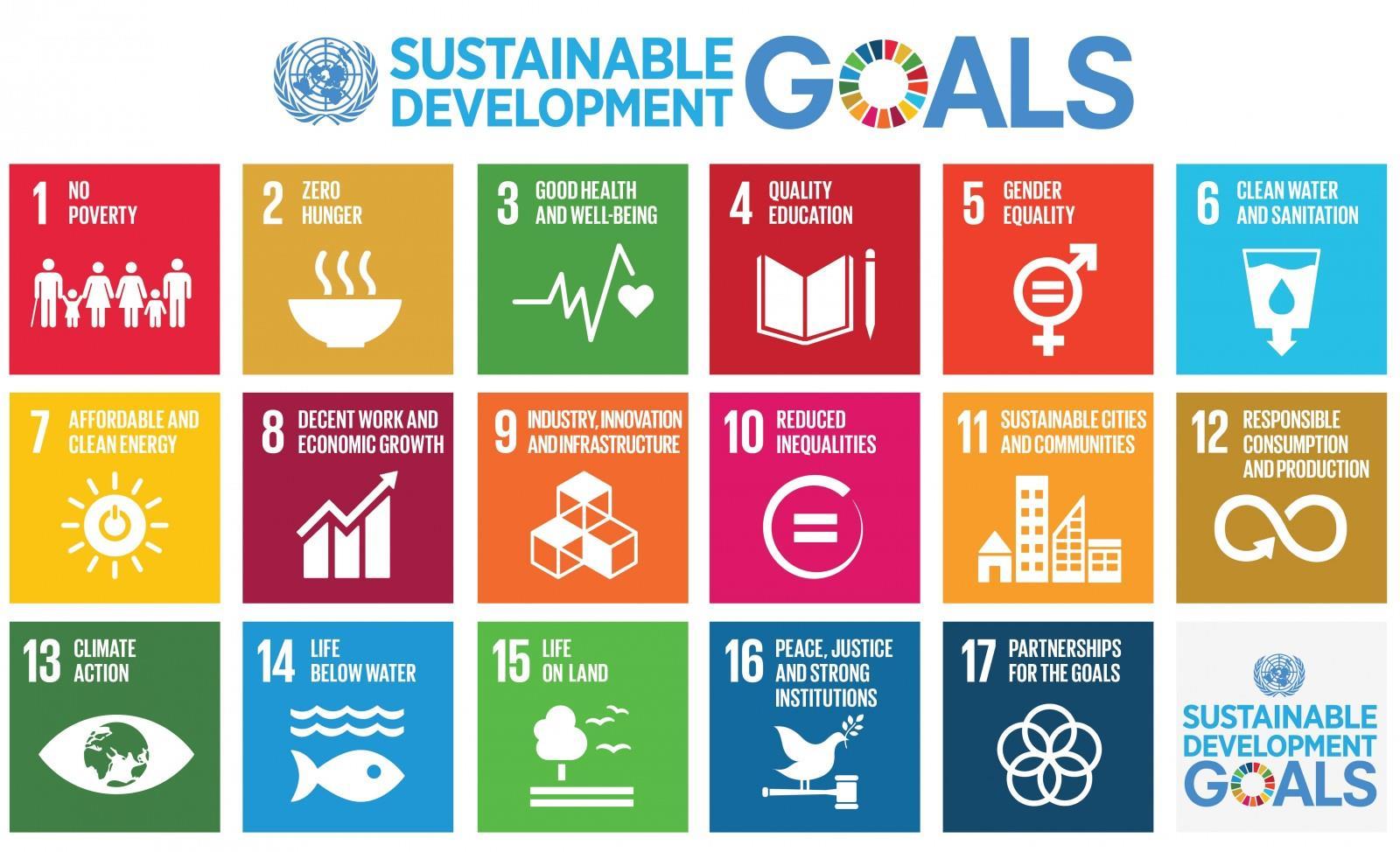
SPICES: Social, Physical, Intellectual, Character, Emotional Sustainable Development Goals: 1. No Poverty, 2. No Hunger, 3. Good Health, 4. Quality Education, 8. Good Jobs and Economic Growth, 16. Justice
Materials: Dodgeballs, cones/chalk/tape
Definitions:
• Debt: A duty or obligation to pay money, deliver goods, or render service under an express or implied agreement.
• Bankrupt: A person, business, etc., that is unable to pay debts.
• Bailout: Loaning or giving money to a company, a country, or an individual in order to try save them from bankruptcy.
• The European Union (EU): is a partnership between 28 European countries. It was created after World War II to avoid conflict in Europe by promoting cooperation. Ireland joined in 1973. The EU has a single European currency, the EURO, and the EU population is about 700 million. The EU aims to create a single Europe-wide market in which people, goods, services, and money move freely. The EU is the world’s largest donor of international aid. The EU is very strong in policies related to fisheries, agriculture and international trade. Some policies disadvantage countries in the Global South as they create unfair rules that benefit EU producers.
• The G8:
The countries of Canada, France, Germany, Italy, Japan, Russia, t he United Kingdom, and the United States.
Definitions: (cont’d)
• The International Monetary Fund (IMF): has 187 member countries working for global cooperation in finance and economics. The aim is to promote trade, employment and economic growth. The IMF was set up in 1944, based in Washington D.C. The IMF has high influence in world affairs and some say it is dominated by Western countries: the USA has the largest vote. The IMF encourages economic policies that promote the free market and private companies. The IMF can influence governments to cut public spending, e.g. in health and education, in order to pay back loans. Some say the IMF responds to problems rather than preventing them.
• The World Bank: Based in Washington D.C., was founded in 1944 to rebuild economies after World War II. Its aim is to tackle world poverty. It provides loans and technical advice to countries in the Global South. The World Bank has 187 member governments but the most powerful are ‘the G8’. Each country is a shareholder of the Bank, and each country has shares based roughly on the size of its economy. The USA holds 16% of votes, followed by Japan, Germany, the UK and France. The World Bank is the biggest lender of loans in the World and attaches policy conditions to countries borrowing money from it.
• The World Trade Organisation (WTO): A forum where countries agree trade rules. The WTO was created in 1995. It currently has 153 member governments and is based in Geneva, Switzerland. In theory, all countries have an equal voice at the WTO. However, in reality rich countries can dominate because they can afford to send many trade experts to meetings to fight for their interests. Trade negotiations called the Doha Development Agenda (or Doha Round) started in 2001 to enhance development and participation of poorer countries. However, the negotiation has led to much disagreement between Global North and South regarding imports, exports, prices and produce.
Steps:
Step 1: In a room, or open space, place or draw a line down the centre of the space using a rope/chalk.
Step 2: Divide the group into two teams.
Step 3: Explain the rules of dodgeball: They have to throw the ball from one team to the next trying to hit an opponent before the ball bounces. If you’re hit once, you have a personal debt and keep one arm behind your back. If you’re hit a second time, you have a national debt hop on one leg (as well as keeping one arm behind your back). If you’re hit a third time, you have to sit on the ground and are ‘bankrupt’. When sitting on the ground, the player can try to catch the ball with both hands. If they succeed, they shout ‘bailout!’ and are back in the game.
Step 4: When the game is over, discuss the following…
• What is debt?
• What sorts of debts exist (mortgage, car loan, credit cards etc.)?
• How did it feel to be burdened with ‘debt’ during the game?
• What does it mean to be bankrupt?
• What is a bail-out?
• Do you think rich or poor people have debts? Why?
• Do countries have debts? Why?
• If countries/people don’t have enough money, where can they get it?
• Is it fair that they take loans and have debts?
• Who is affected when this happens?
• If countries or people get into debt, whose fault is it?
• Do you think it’s wrong not to re-pay a loan?
Step 5: Read the following extract to the group…
Steps: (cont’d)
Step 5: Read the following extract to the group…
“As I write this letter I am hoping that sleep can provide me with some escape from the anxiety and pain that the economic situation is causing me and my family. Until recently I have been able to pay for my home and provide for my young children. The part-time job I had has completely finished, and I have found myself and my loved ones having to cope with a new torment – hunger. Today I have had nothing to give my children only bread and cereal. My savings are gone. I dread what each day will bring.”
Step 6: Discuss the following with the group… What country do you think the person who wrote this letter is from?
Do you think this ever happens in Ireland? Why/why not? How does this letter make you feel?
Step 7: Reveal to the group that this extract was adapted from a letter sent to the Editor of the Irish Times on Friday 26th August 2011, from Kerry, Ireland.
Activity 2: The Ups and Downs
Aim: To explore why some people have more opportunities than others.
Time: 45 mins
SPICES: Social, Intellectual, Character, Emotional.
Sustainable Development Goals: 1. No Poverty, 2. No Hunger, 3. Good Health, 4. Quality Education, 6. Clean Water and Sanitation, 10. Reduced Inequalities, 16. Justice
Materials: Copy of the grid, something for each person to mark their place, copy of the crossroads cards, copy of the role cards, dice.
Definitions:
• The Irish Travelling Community: The Travelling community is Ireland’s only significant indigenous ethnic minority. There are around 22,000 Travellers in Ireland, making up about 4,000 families. Another 15,000 Irish Travellers live in the UK, and there are 10,000 people of Traveller descent in the USA. Travellers account for 0.5% of the entire population of Ireland. They are a tight-knit community with a strong tradition and culture built around a nomadic existence. Though they are not related to the Roma peoples of Europe, Irish Travellers share with Romanies the sense of being excluded and marginalised in society.
• The Democratic Republic of the Congo (DRC): The Democratic Republic of Congo is extremely rich in natural resources but has had political instability, a lack of infrastructure, issues with corruption and centuries of both commercial and colonial extraction and exploitation with little holistic development. As of 2016, DR Congo's level of human development is 176th out of 187 countries, according to the Human Development Index.
Definitions:
• Refugee: Someone who has been forced to flee their home country because of a well-founded fear of persecution because of ethnicity, religion, nationality, and political opinion, or because of violence, conflict, or natural disaster.
• Asylum Seeker: A person seeking to be granted protection as a refugee outside their country of origin, and who is waiting for a legal determination of their application.
• National Youth Parliament of Ireland (Comhairle na N’Óg): Child and youth councils in the 31 local authorities of the country, which give children and young people the opportunity to be involved in the development of local services and policies.
Steps:
Step 1: Divide into sixes and distribute a role card to each person. Try to ensure there is a spread of roles in each group.
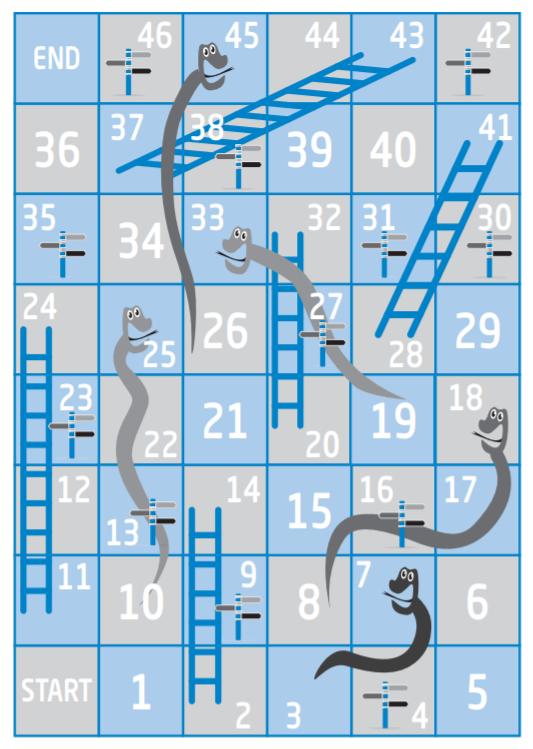
Step 2: Give each group a set for Snakes and Ladders and explain the following rules…
You are representing the character on your role card. Play the game as normal until you land at a crossroads. If this happens, you pick a crossroads card, read it aloud and the group must decide if the answer is Yes or No. They should give a reason for their decision. Yes moves forward 6 places, No moves back 6 places. The winner is the person who reaches the end first.
Step 3: Once the game is over, discuss the following…
• Which character won your game?
• Where did they come from?
• Who came last?
• Were you sent backwards or forwards at any point?
• Was this fair on you?
• Was it easier for some people to reach the top?
• Is this realistic?
• Why do some people have better opportunities than others?
Crossroads Cards:
• Would this person have enough food to eat every day?
• Could this person finish school?
• Does this person live in a safe environment?
• Can this person have fun with their friends?
• Can this person buy sweets when they want them?
• Can this person go on holidays away from home?
• Does this person have access to clean drinking water?
• Can this person get emergency medical care when they need it?
Role Cards:
• A young male Traveller from Dublin attending a local school
• A 10 year old boy from the Democratic Republic of Congo (DRC) who was taken by the rebel army to be a child soldier
• A teenage boy living in Ireland as an asylum seeker and without parents
• A Nigerian boy who is chairperson of a group of young people taking action to improve the health of young people in his school and community
• A young girl from Brazil who is in a wheelchair
• An elected teenage member of a National Youth Parliament in Ireland (Comhairle na nÓg)
Activity 3: An Alternative Future
Aim: To empower Scouts to be agents of change, bridging the gap between their ‘probable futures’ and their ‘preferred futures’.
Time: 40 minutes
SPICES: Social, Intellectual, Emotional
Sustainable Development Goals: All Materials: Sample Chart, flipchart paper, markers.
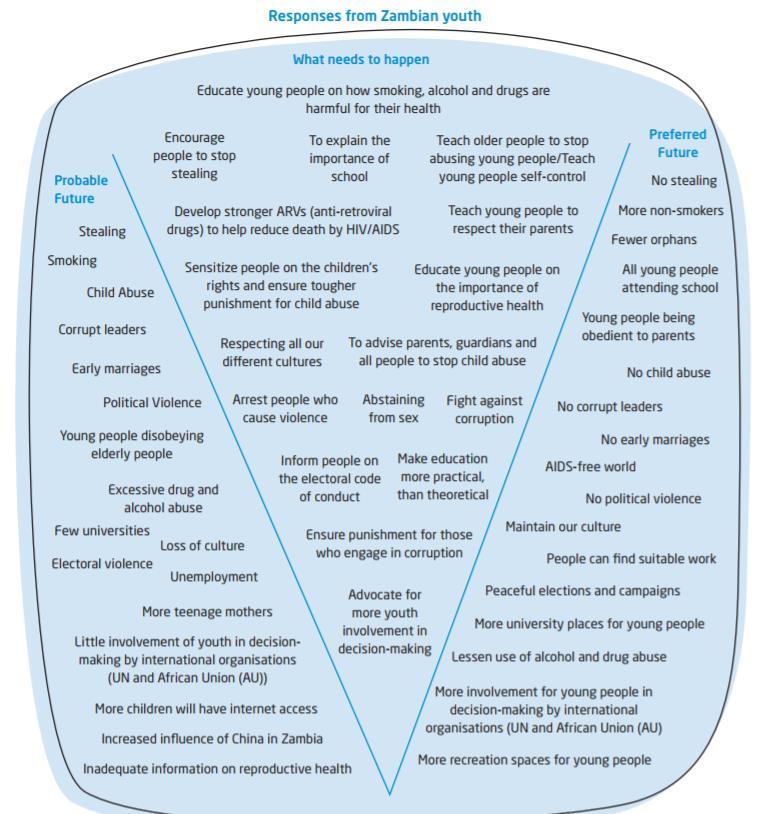
Step 1: In lodges, draw a large ‘V’ on a flipchart.
Step 2: On the far side of the left line, write or draw in the main events that are likely to happen in the next 30 years. These can be either personal, local, national or global events and should include both positive and negative elements. This is the ‘Probable Future’.
Step 3: Next, on the far side of the right-line of the ‘V’, draw or write their ‘Preferred Future’, i.e. what events you would like to see happen in the world during our lifetime.
Step 4: Finally, each group suggests how to ‘Bridge the Gap’ – this means things which will need to change in their personal lives, local communities, and in the world so that the Preferred Future can be reached.
Step 5: Allow the lodges to look at each others’ charts and give feedback.
Step 6: Reflect on how these charts can help your group to develop service projects.
See following page for ‘Sample Chart’
• What are the Sustainable Development Goals?
• UN Declaration on a Culture of Peace
• What counts as a Messengers of Peace project?
• Section-Specific Objectives
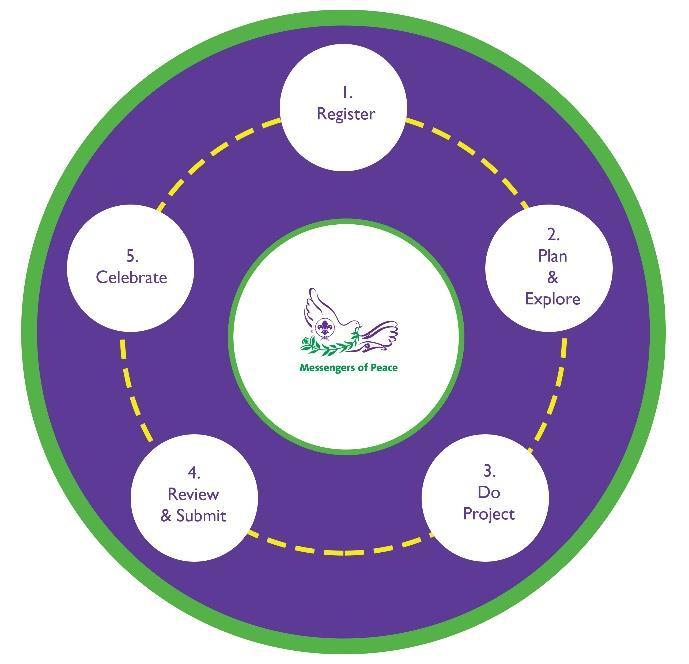
• Five Steps to Becoming a Messenger of Peace
• 10 Principles of Peaceful Dialogue
What are the Sustainable Development Goals?
In 2015, countries adopted the 2030 Agenda for Sustainable Development and its 17 Sustainable Development Goals. Scouts from different countries, along with citizens from all around the world, had a particular and specific contribution in defining these goals.
Always bear these goals in mind when planning your projects. Ask yourselves…
• How many of the SDGs does our project cover?
• In what way is our project related to the goal?
• How does our project contribute to advancing this goal?
Click on the icons in the following link to find out morehttp://www.un.org/sustainabledevelopment/sustainabledevelopment-goals/