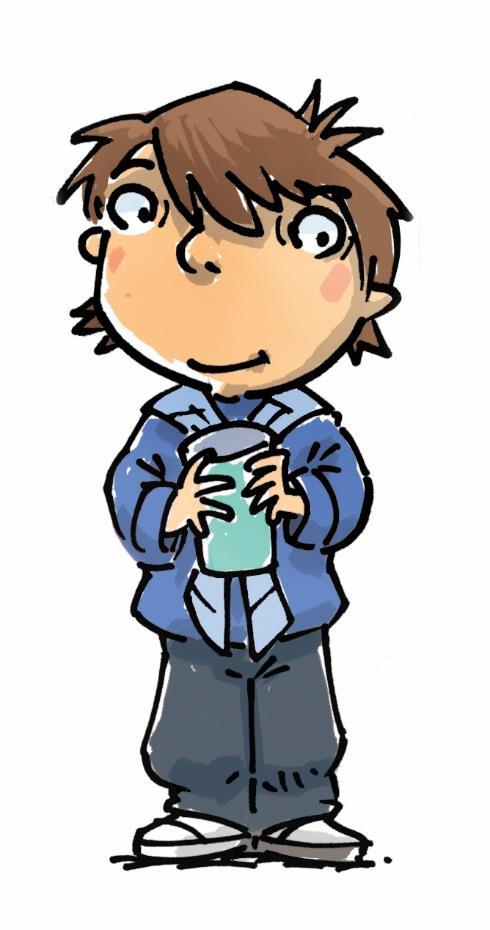
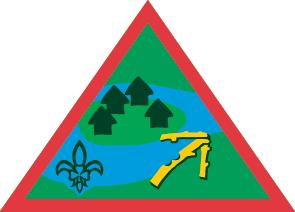
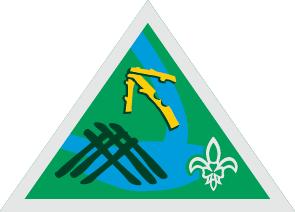
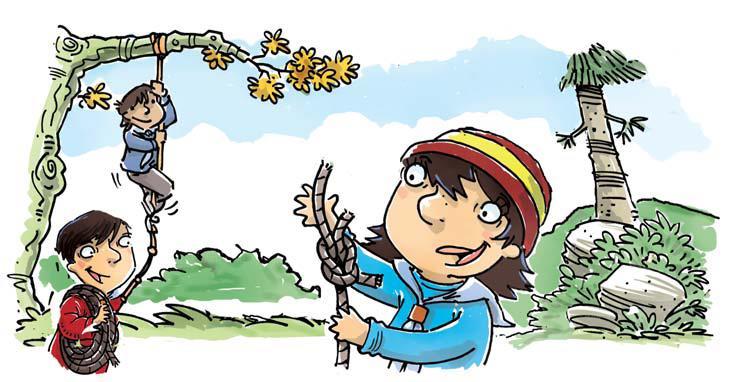
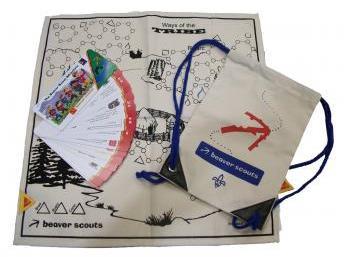
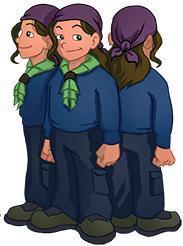
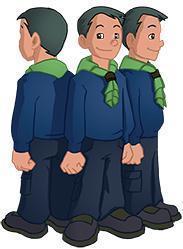
The Beaver Scouts could then have another look through the handbook, picking out adventures they might like to do during the year. The Scouter can point out the highlighted symbols on the side of each adventure page, and how they correspond to each character in the Fox Lodge. Why do you think this activity might be suitable for Spike? Etc. The Lodge may like to settle on a name for themselves. From the Lodges’ suggestions the week before, a list of what may be included in the code of conduct may be compiled by agreement of the whole Colony.
Week 4
The fourth meeting is where the Beaver Scouts partake in their preparatory work for their adventure! The investiture process may also be discussed.
An older Beaver Scout could call the roll this week, with a Bree Beaver Scout giving the Beaver Scout Call.
This week’s opening game may be decided upon by the Lodge Leaders. Again, it should be a game that is easy to follow and includes everyone.
You may wish to split the Colony up into Bree-Ruarc-Conn. The Bree Beaver Scouts would discuss with a Scouter the process required in the lead-up to the investiture. Why do we take a promise and what does it mean, etc. During this time, Ruarc and Conn Beaver Scouts may be preparing an activity for the Colony, or practising their skills needed for their adventure.
Week 4
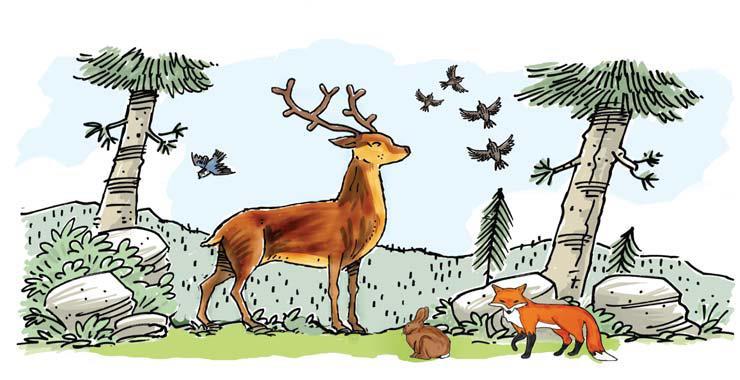
The Colony then partakes in activities based on their adventure. For example, if the adventure is ‘Friends of the Forest’, they could be studying animal footprints and learning about local flora and fauna.
If a SPICES objective has been achieved, Beaver Scouts may mark this off on the map.
A discussion may take place around the out-of-doors weekend activity, which in this instance takes place after Week 5. The activity could be a hike, a walk in the park, a backwoods day, etc., all depending on the adventure that was chosen. The Buddy System can be explained.
Discussions about what to pack in your day bag can take place, along with what food would be best to bring. What kind of shoes should we wear? Why is raingear important?
Week 5
The Lodge Leaders should be given responsibility to ensure that each of the Beaver Scouts in their Lodge knows what to bring for the activity and that they understand the Buddy System.
Different challenges may be set for Bree, Ruarc and Conn Beaver Scouts.
• Are there aspects of the adventure that the Conn Beaver Scouts can help implement with the Scouters for the other Beaver Scouts?
• Are there roles that Ruarc Beaver Scouts may take up in their Lodges?
• Are there any targets or challenges for the Bree Beaver Scouts to achieve?
Sample bags, food and equipment may be brought up to this meeting- Lodges will have to decide which of the given items of clothing should be worn or packed, and which food would be best to bring. Beaver Scouts should be encouraged to pack their own day bags at home, with help from their parent/ guardian.
Week 6
This meeting, taking place after the weekend activity, allows the Beaver Scouts to review their first outdoor adventure as a Colony. The Beaver Scouts can review the adventure, mark off their SPICES progress on their map, and begin the process of planning their next adventure!
The Beaver Scouts arrive to the meeting with their memory bags, which they may have filled with souvenirs from their weekend activity. They can put these in their Lodge corners, as they partake in the opening ceremony.
You may choose to give some general remarks about how the weekend activity went, what you and the other Scouters liked personally and any learning experience you had.
After the opening game, the Colony may split in order to carry out Log Chews. Here, in Lodges, Beaver Scouts discuss the activity. They can open their memory bags and talk about what they chose to pack.
Review.
Eva's Purple Emotions card. ✔ My potential. Show feelings. Others feelings. Life's challenges.
Turas- Did we support our friends?. Did we have fun?
Taisteal- Did the ceremony run as planned?. What would we like to do next year when its our turn?. How are we feeling now ?
Tagann- Are we ready to face our next challenge ? How do we feel about leaving our Leaders and Cub friends?
The Activity: Saying Hello.
Which SPICES will we use?
Social
Which travel cards could we use?
Sarahs Red Travel Card - ✔ Friendship.
Other people. Communication. Turas- play a game, and choose the SPICE that a game belongs to Taisteal- figure out a second SPICE for the game to belong to Tagann- organise a game
Hi I’m Sarah! And, I want to help you welcome your new Cub scouts into your Six and Cub pack. I like to be a friend. I like to make sure everybody is included.
Plan:
It can be pretty scary when a Cub first joins the Cub pack. After all, new friends must be made, a new routine learned, and above all, most other Cubs will probably be older.
You can do a lot to help new Cubs settle in. Think back to when you first came to a meeting night. What were you looking for? Most Cubs want to be included quickly, and to get involved. Simple icebreaker games are ideal to play on new cubs first night.
Two truths and a lie.
Get the group to sit in a circle and ask one person to say two truths and a lie about themselves. After they have finished you, as a compere, must get the group to vote on which statement they think is a lie. If the majority get it wrong, the player goes again, but if they get it right, play moves on to the next player.
Coat of arms
You will need: paper, colouring pens/pencils, flag template. Get the group to divide their template into quarters. They should have descriptions of their favourite things in each quarter; these could be their pets, favourite food, sports team, activity and so on. After the time is up, ask each Cub to stand up and talk everyone through their flag. This can also be a way to introduce the Land of Adventure. Leads to identity.
No See Em's Game.
Have two adults hold a tarp or blanket up and split the group into two teams, one on each side of the tarp (or blanket). Ideally, each team will also have at least one adult helping it (or the adults holding the tarp will help). Each team sends a team member to stand next to the tarp. On the count of three, the tarp is lowed and each Cub at the tarp (without any help from others) must name the other Cub at the tarp. The Cub who is idenitifed first joins the other team. The game is played until the adult leader decides to stop or until all Cubs are on the same team. This is a great way to help Cubs (and Scouter's) to learn Cub’s names.
DO
What can I do to help new Cubs.?
• Remember to explain the simple things: What do I do? How to fall in?
• Where do I pay the dues? What is the new promise?
• Explain the rules of games and activities. Play the icebreaker games.
• Involve them in the Six.
• Protect the new member from any form of bullying, including name-calling.
• Be the person’s friend. You might also ask another member of the Six, perhaps someone nearer to the new Cub’s own age to help take care of them.
Review.
What travel cards can we use?
Social. ✔ Friendship. Duty to others. Communication. Emotional. ✔ Lifes challenges. My Emotions. My potential.
Sarahs Red Travel Card.
Turas- Did I make new Friends?
Taisteal-Did I fulfil the Cub scout promise during the meeting by looking after others?
Tagann- Did I communicate properly so that all members of my Six knew each other
Eva's Purple Emotional card.
Turas- Moving to cubs can be scary. How did you feel about this new challenge? Do you miss your Beaver friends and Scouters
Taisteal- Were we considerate to the new Cubs feelings? How are you feeling now ?
Tagann- Did I do my best to make sure our Six starts to work together?
The Activity:
You and your role in a Six
What SPICES will we use?
Character
Which travel cards could we use?
Conors Grey travel card ✔What I stand for.
Self belief. Respect. Live the Law.
Turas - You are a new Cub Scout ready to start your journey with a new group of friends. They are here to help you through your first year. Listen and ask questions about how the six works. This shows that you treat others with respect.
Taisteal- This is your second year in Cubs. You now know more about how a six runs and you also may know what role you want to fill. Don't be afraid to put yourself forward and also if you don't get the role you'd like remember that every role is important for the six to work well.
Tagann- This is your final year in cubs. You have learned a lot in the last couple of years and now it's your time to help and share with the younger cubs and also to be more responsible in your six.
Hi my name is Conor and I'm the Sixer of the Atlantic six. That means I'm the leader of the Six. A Six is a group of six cub scouts. I have a helper called a seconder. Everybody in the six can have a role. In mine we also have a Quartermaster, a First aider, Scribe and a researcher.
Plan.
A Six is -
• A group of friends
• A group where everybody is important.
• A group of up to six people.
• A group which plans and does everything together.
• A group that has lots of fun and Adventures.
Jobs in a Six:
Sixer- The Sixer will take responsibility for 'looking after' their Six. They will attend Sixer Councils and help the scouters to design the programme. It's always a good idea to make a decision with other Scouters and existing Sixers when choosing a Sixer.
Seconder- The seconder is there to help the Sixer and the Six and to stand in for the Sixer if needed. Sometimes the Seconder has another job, such as one from the list below. The Seconder can also attend the Sixer and Seconder Council and help to shape the programme during the year. They keep scouters informed of how cubs are getting on.
Scribe - The scribe is the one who likes to write and looks after the logbook. It's very important as the logbooks are a way to look back on memories and also helpful when reviewing. Scribes take notes during den meetings and activities, and help the PRO to present ideas from the six to the pack. They can have the duty of keeping the SPICES progress up to date in their sixes as well by punching travel cards.
First Aider - The first aider is responsible for the First Aid Kit. They are the go to person if someone gets injured. They need to have some understanding of first aid and also to know that if they don't know how to treat it themselves to go to a Scouter.
Quartermaster - The Quartermaster job is to look after the equipment and gear belonging to the Six. If your six has a Patrol/Journey box it's up to you to make sure that at the end of each night it's tidied and put away.
Researcher.- If your six needs information for any activity or badge they will ask you to research it. Ask your parents/Scouters if you need to access the Internet. During programme planning, the researcher will be able to guide younger cubs through the activities needed to earn a badge.
Photographer/Public Relations Officer (PRO) – The PRO job is to help advertise the activities of the six and the pack. During activities, the PRO will take photos to make a record of what cubs are doing, working with the scribe. Some of the photos can go into the log book, and on social media. The PRO can help decide on photos to include and write up something to post, which the scouters then post for the pack. NB Cubs don’t use social media by themselves!
When the new Sixer is picked by Scouters and existing Sixers. It's a good idea for them to shadow a meeting with the existing Sixer before that Sixer moves up. So he/she can learn the ropes. Make sure that the brand new cubs understand the role of a Six and why it's important in the Cub pack. Talk about the different roles and see who fits what and make sure that everybody is listened to.
Do.
As a six decide on who gets what roles. Everybody should agree to try and do their best and respect each other and their roles. Your Six may already have a name like we do. In our pack our Sixers are named after seas, Pacific, Arctic, Caribbean, Indian, Baltic, China and my Six is the Atlantic six. What's your six called. Does your Six have a badge? Have a Six meeting and get to know each other.
Now it's time for some Fun!!! It's important when starting out to work on some team-building exercises. Why not try some of these? These games involve you all working together and listening to each other.
The human pyramid
How quickly can you get thesmallest patrol member to the top? Challenge other patrols.
Blindfold tent pitching
One member of your patrol can see, but is not actually allowed to do anything except instruct everyone else. Other patrol members are blindfolded. Can you successfully pitch a patrol tent? Can you take it down again and pack it with somebody else in charge?
Lighting the candle
Your patrol is stuck on one side of a river (marked on the floor). They have to light a candle placed on the far side. You are provided with several garden canes, some string, matches and a match box. Can your patrol solve the problem?
Crossing the chasm
Provided with four chairs, can your patrol get themselves across the meeting room without anyone touching the floor? Challenge another patrol. Who can do it faster? Can you do it with fewer chairs?
Review.
Talk in your Sixes about your new Six. Are you excited to be a part of it? Do you know how you fit into it?
Which travel cards can we use?
Conor’s Grey Travel card ✔Doing my best, Respect, Justice, Personal visions.
Turas.- Did I treat others with respect? Did I have fun during the team building exercises
Taisteal- Was everybody given a chance to speak about the roles they wanted to try for and was the final decisions fair? Did I try my best to help the new Cubs?
Tagann - Was I brave enough to put myself forward for a role that I wanted? Did I help the Sixer and respect his/her decisions and help carry them out with the younger Cubs during the exercise. Did everybody have Fun?
Isobel's Blue Travel Card. ✔ Decisions, Plan-Do-Review, Teamwork.
Turas.- Was I involved in the Plan, Do Review? Did I like being part of the new Six?
Taisteal- Did I try my best to work as a Team?
Tagann - Was I able to make Decisions fairly ? Did we have fun as a Six?
The Activity: Cub Code of Conduct
What SPICES will we use?
Character
Which travel cards could we use?
Conor's Grey Travel Card – Conor likes to ?
Turas- make a suggestion for a rule in the code.
Taisteal- use the promise or law to think of a rule.
Tagann- support younger cubs in making a suggestion.
Hi I’m Conor. I love to keep things fair. I like to watch for younger Cubs, and I’ve found a way for us to get on well with each other for the year. Medieval Knights used to have code of chivalry that helped them remember when they acted with honour, and when they were breaking the rules. Let’s make our own code of honour!
Top Tips:
• Use the Cub Promise and Law to come with up some suggestions.
• Remember to make positive rules: the ‘Dos’ and not the ‘Don’ts’
Plan
Talk about what rules can help you get along in Cubs during the year. In your Sixes find out what rules each cub thinks would be the most important to include in a code of conduct. Ask the Scribe for each six to record suggestions for the code.
Do
Each six tells the main group the rules they thought were important.
Scouters/Cub scribes write each rule up on an A1 sheet.
Ask the other sixes what they think of your ideas.
Ask the Scouters to make one contribution each as well!
Everyone signs or uses handprints to agree to these rules, including the adults!
Remember: The first rule is Fun!
Review
Talk in your sixes about how these rules will help to make the year more fun and run better.
Use Conor’s travel card to find something to punch.
Review how this activity went (Facts, feelings, findings, future)
Talk about an adventure you can test this code of conduct on a camp or overnight – that can be the main activity for a programme cycle.
Suggested Travel Cards
Conor’s Grey Travel Card ✔ Respect and Justice
Turas- did we discuss how to have a fun year?
Taisteal- do I see how the promise and law can be a part of our code?
Tagann- did I support younger cubs in making a suggestion?
Sarah’s Red Travel Card ✔ Community
Resources:
• A1 Sheet
Turas: did we discuss how to have a fun year together?
Taisteal: do I see how the promise and law can be a part of our code to work well together?
Tagann: did I support younger cubs in making a suggestion?
• A4 sheets (one for each six)
• Pens
• Marker
• Poster paint (if using hand prints)
The
Activity:
Introducing SPICES through games
Which SPICES will we use?
Isobel – Intellectual
Which travel cards could we use?
Isobel's Blue Travel Card - Isobel likes to find out about fun new ways of learning. Turas- play a game, and choose the SPICE that a game belongs to Taisteal- figure out a second SPICE for the game to belong to Tagann- organise a game
Hi I’m Isobel. I love to play games with my six and my cub pack. I love to work as part of a team and I’m also creative. I’ve found a fun way for us to find out more about how we can use the SPICES in everything we do at Cubs and meet the Atlantic Six.
Plan:
Each sixer picks a different Atlantic Six character, stands on a chair around the room and calls out who the character is and what they are interested in (each SPICE). They also say what the characters’ interests are Discuss in your sixes what each quality means.
Top Tip: Do not play these games in order, otherwise it will be too easy to guess which game is connected with each pf the SPICES
Suggested Games:
Social Game
2-cub reef knots
- A simple task for most cubs - normally, but this game involves the use of only ONE hand per cub. In pairs, the game involves simply tying a reef knot, with one cub using his left hand and the other using only his right hand. This is an exercise in co-operation! Each cub has a rope and the six ties all the ropes together in this way
Resources: ropes or sisal for every cub
Physical Game
NORTH-SOUTH-EAST-WEST
A sixer locates magnetic north in the room with a compass, and then calls out compass directions for the cub pack to run towards. Use other directions (north-west, south-east) as well.
Intellectual Game
Wink-Wink Murder
One cub is picked as the detective and leaves the room. 3 murderers are picked. Everyone stands in a circle facing in. The detective stands in the centre of the circle and has to guess who the murderers are. As s/he does this, the murderers wink at other cubs, without being seen by the detective. Anyone who is winked at falls down ‘dead’. The detective has five guesses
Character Game
Arm Sling Relay
Teams line up in relay formation with one cub acting as victim and standing in front of his team 30 feet away. All other people have their neckerchiefs on properly. The first cub on each team runs to the victim, asks what is wrong, and applies an arm sling to the arm indicated.
When the judge sees that the sling is correct, he calls out "Cured!". The scout removes the sling and becomes the victim. The previous victim runs back to touch the next member of his team. This continues until all on the team have been victim and rescuer.
Emotional Game
We like…we don’t like Someone starts by thinking of a rule to follow, such as [We like everything that does not start with the letter 'S']. Then, he says "We like Winter but we don't like Summer." "We like Mars but we don't like Saturn." "We like Acting but we don't like Skits."
S/he keeps coming up with more statements until someone wants to come up with a statement they believe follows the rule. If the statement is correct, the cub tells them it is and they can continue to come up with more. It's possible that they were just lucky or are thinking of a different rule, so the cub has to verify every statement made by others. When everyone has guessed the rule or has given up, have the six do a round with a different rule (e.g. not liking anything that ends in a particular letter).
Spiritual Game
Cat and Mouse
A “game master” is selected and all cubs walk around the room slowly. Each cub will choose one cub to ‘protect’ and another cub to fear, without saying anything to the others. Whilst walking, each cub will get closer to the one they wish to protect and walk away from the one they fear. This will be done with great concentration, in honesty and without a word. The important thing is that all members of the group carefully listen to each other. You can’t change the people you’ve chosen during the game. The “game master” has to observe everyone and find out who is feared and who is protected by whom. After 5 minutes, the game master guesses as many cats and mice as they can.
Starting Up: First 6 Weeks
The Scout Programme should be focused on the patrol. From Patrol Corners that plan and review, to the running of activities in small groups, and the assessment of progress in badgework, everything should revolve around the patrols. Even in a Troop with small numbers, every effort should be made to have at least two Patrols. This resource is a guide to helping you get the Patrol System up and running in your troop.
Week 1
First night back Games and icebreakers
Introduce new members
Week 2
Week 3
Week 4
Week 5
Week 6
Form Patrols, new PLs/APLs, assign Scouts
Patrol Corner: run a short patrol meeting
Patrol challenges
Skills practice, eg. navigation or knots
Patrol Corner: Look at Crean Awards
Patrol Leaders Council: plan a troop adventure
Learn a skill, eg. GPS or lashings, to be used on the troop adventure
Prepare for the adventure, eg geocaching or 10 min tower PLC runs a troop adventure, with time for each patrol to run their own short activity
Develop skill used on activity, eg. navigation and building with spars
Patrol Corners: review activity and progress in Crean Awards
Patrol challenges and skills practice
Patrol Leaders Council: review first few weeks
Forming Patrols:
The Scout Programme should be focused on the patrol. From Patrol Corners that plan and review, to the running of activities in small groups, and the assessment of progress in badgework, everything should revolve around the patrols. Even in a Troop with small numbers, every effort should be made to have at least two Patrols. This resource is a guide to helping you get the Patrol System up and running in your troop.
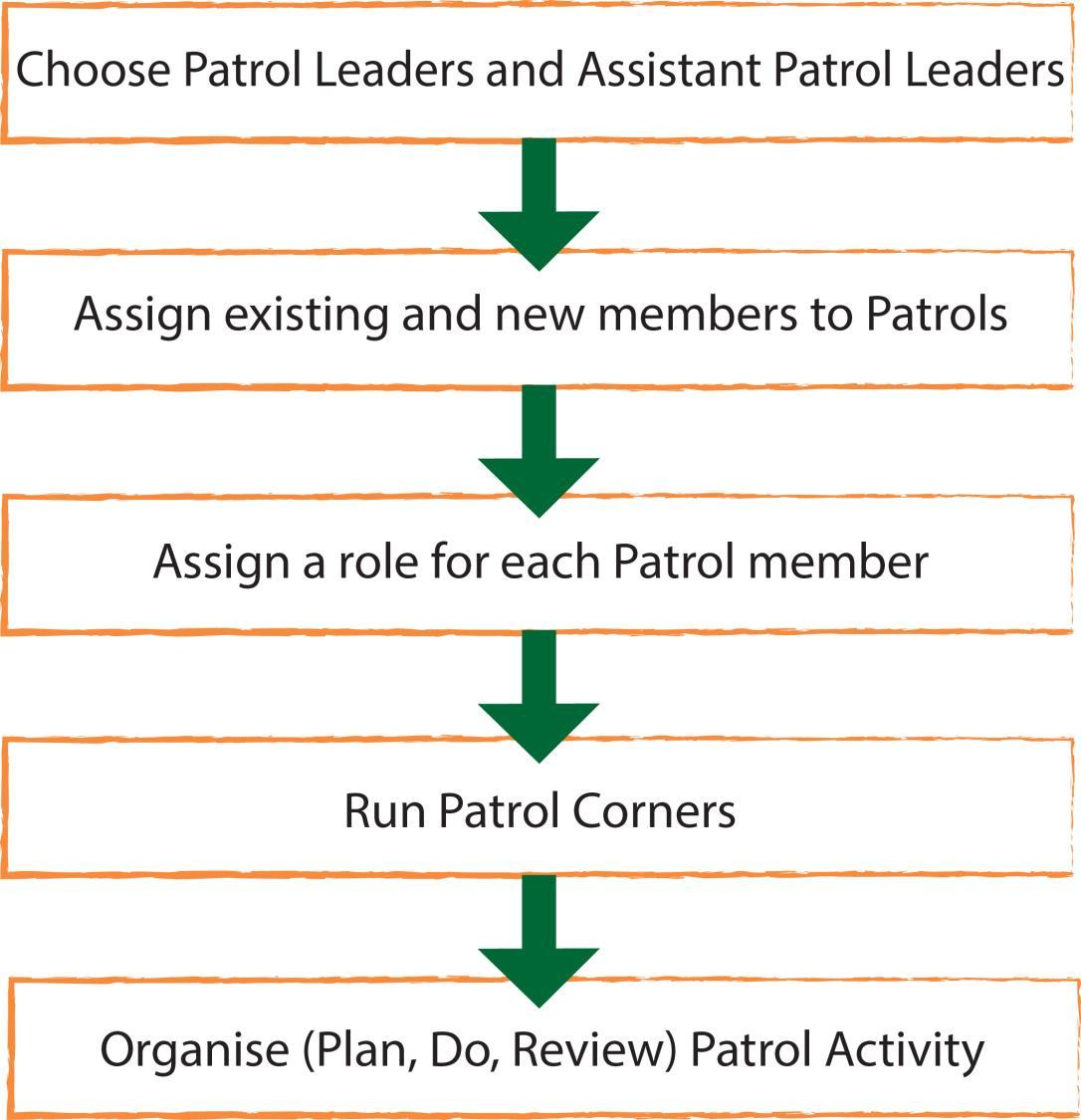
Deciding on PLs and APLs
Different troops have different ways of choosing which scouts would make the best PLs and APLs. Here are some approaches:
• PLs and APLs are elected by the scouts and scouters, or the current/outgoing PLs and Scouters meet to decide on which scouts should become new PLs and APLs, or a mixture of both systems.
• Personal progression is also important in this system, allowing for scouts in their first year to participate in the programme, scouts in their second year take an active involvement with some leadership roles, and scouts in their third/final year tend to lead as PLs, APLs, or activity leaders.
• Before taking up a role the incoming PLs/APLs should discuss it and commit to fulfilling it as best they can.
• Leadership and programme training should be provided as soon as possible; although it is advisable for scouts to have undertaken this training as APLs or as active scouts.
Assigning Members
Here are some approaches that troops use:
• The PLC can work together on dividing the troop in patrols.
• Several factors are generally taken into account, including scouting experience, existing members of patrols, friendship groups, and social dynamics.
• Patrols tend to have scouts at different stages of their Crean Awards, reflecting the personal progression of the programme and the patrols system.
• When matching PLs and APLs consider their capabilities/circumstances (eg. a new APL with a more experienced PL, or a having a gender mix).
Roles in the Patrol
It is important that everyone in the patrol has a role. This ensures that each scout plays an active part and contributes to the patrol. Two scouts can work on the one role together, if required. Here are a selection of common patrol roles:
• PL: The scout who organises the patrol. They will support other scouts in their roles and make sure the daily rota is working.
• APL: The scout who helps the PL in their role and deputises for them when required.
• Quartermaster: The scout who organises and maintains the Patrol’s equipment.
• First Aider/Safety Officer: The scout who maintains the first aid kits and gives first aid, with the help of scouters.
• Treasurer: The scout who plans the patrol’s budget and administers the patrol funds, with the PL.
• Photographer/Scribe: The scout who records the activities of patrol for the log.
• Record Keeper: The scout who maintains the records, such as the roll and programme book.
• Leave No Trace Officer: The scout who makes sure the patrol is following the principles of Leave No Trace.
• Grubmaster: Responsible for planning and buying of food.
In the general running of the programme, scouts should take on individual roles relevant to the activity. These roles should reflect their personal progression: scouts in their first year participating (Discovery/Terra Nova), scouts in their second taking an active involvement (Endurance), and scouts in their third/final year leading and organising (Polar).
Patrol Corners
These are a short patrol meetings within your troop meetings. Typically these should take up about 20-30mins. During these meetings patrols will:
• Plan Programme
• Review Activities
• Assess progress in Badgework
Getting patrol corners up and running in your troop can help establish the Patrol System. By participating in these meetings, scouts will begin to appreciate how they are a part of a team and will think about scouting in terms of their patrol. For more information on Patrol Corners, check out this other resource: goo.gl/OFx2tO
Patrol Activities
Next, try to get the Patrols to do activities in their patrols. Initially, base games and other activities during weekly meetings on the patrols. Then, encourage troop adventures where each Patrol operates independently – such as a series of bases they rotate through, or each patrol could light and cook on their own fire.
Gradually, you can suggest that each patrol might try to do something different to the others on troop adventures. This would be very useful for helping with badgework; as at their Patrol Corner the Wolf Patrol might decide to the Air Activities Adventure Skill and the Raven Patrol is going to work on their Environmental Special Interest Badge. Both activities could be accommodated within a troop adventure.
Running a Patrol Leaders Council
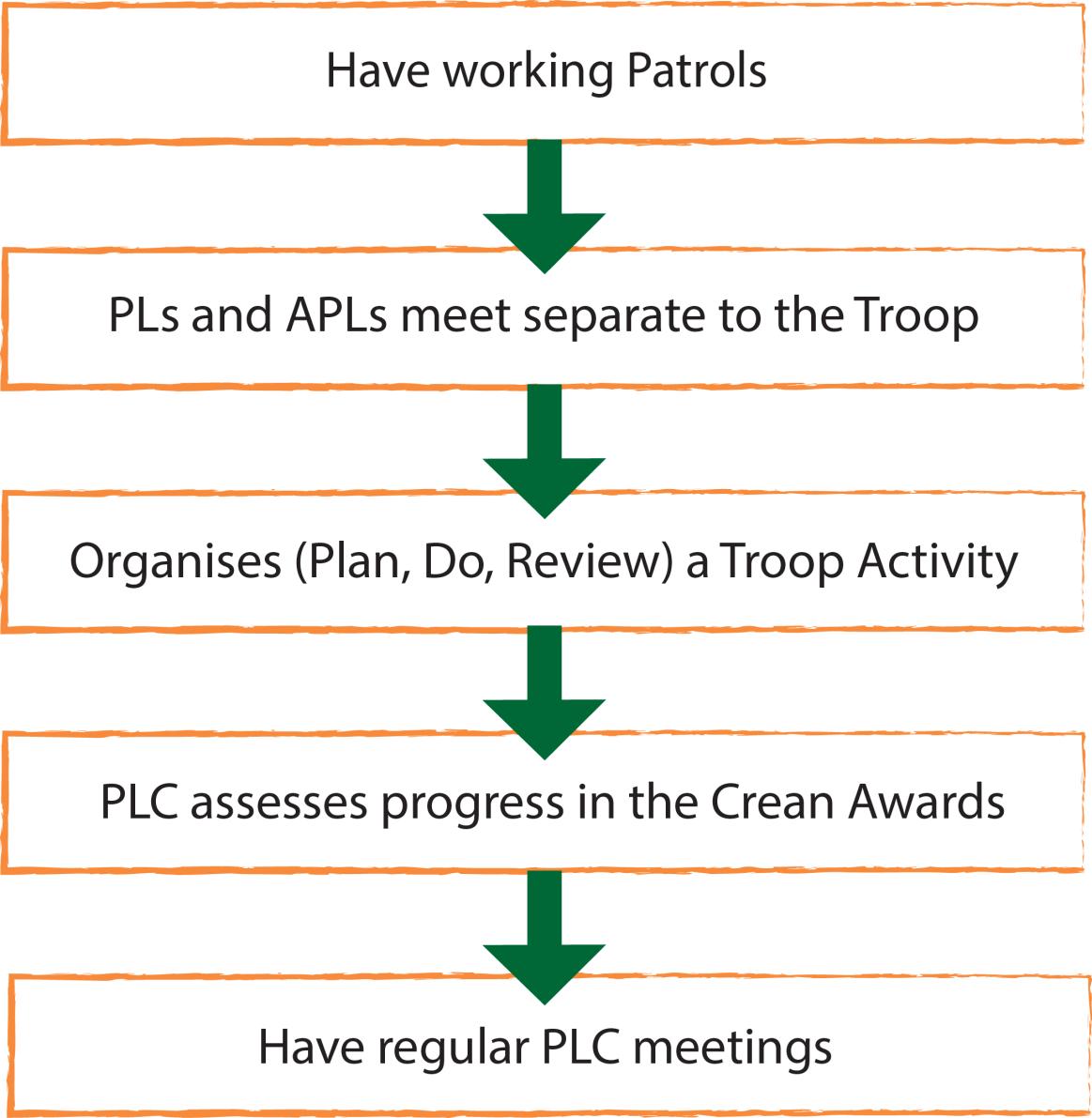
The Patrol Leaders Council (PLC) is made up of the PLs, APLs, and Scouters. The PLs and APLs take ideas from their Patrols and turn them into a planned programme of activities for the Scout Troop. The PLC is also responsible for introducing a code of conduct, awarding badges, and any for generally running the Scout Troop.
PLC - Areas of Responsibility
So what are the things that your PLC should be looking after?
Here are a few of the main tasks involved:
1. Running the Troop Programme: The PLC should plan, run, and review the troop programme. Taking ideas from patrols the PLs, APLs, and Scouters should come up with a detailed programme.
2. Award Crean Awards and other badges: The PLC should approve the awarding of badges to the Scouts. Each PL/APL should know about the progress of each Scout in their Patrol and this should be shared with the others at PLC meetings. The PLs and APLs should work with each other and the Scouters in completing their own Crean Awards.
3. Organise the Troop: With the help of Scouters, the PLs and APLs should organise and run the scout troop. The PLC also implements the Troop Code of Conduct; it is a space for PLs/APLs to discuss matters of concern in a confidential, respectful, and positive manner. The PLC can also represent the Troop at Group Council and other events.
Setting Up a PLC
Getting a PLC up and running in your troop can be done by building on the experiences and capabilities of the scouts and scouters.
PLC Meetings
A PLC should have regular meetings, usually about once a month. These meetings can be a separate part of troop meetings, can be held before/after troop meetings, or can be on a separate night. They need only be 20-30 mins long, unless something important is being discussed. The main things is to have regular meetings.
Suggested format for these meetings:
1. Patrol reports: Each PL should give a summary of their Patrol and how its getting on. It should include the patrol’s review of activities, ideas for new adventures, update on badgework, and any other matters.
2. Troop Report: The PLC should discuss how the troop is doing in general. This should include general conduct.
3. Scouters Report: The Scouters should pass on relevant information from Group or County meetings. The Scouter can also talk about things that may have been discussed at Scouter meetings.
4. Planning & Reviewing: The PLC should complete their own review of the Programme. Using ideas from the review and from the patrols, they should then make out a detailed plan for the activities of the next Programme Cycle. Also, include badgework opportunities for scouts to progress in their Crean Awards.
5. AOB: The ‘Any Other Business’ section of a meeting covers any other topics or points that need to be discussed. It allows people to bring up items which are of concern or interest to the PLC.
Venture Units: First Six Weeks
The first programme cycle is very important for a Venture Scout Unit as it sets the tone for the year ahead. The first six weeks allow you, the Venture Scouts, to set the standard by which your programme will live up to.
Embedding the Crew System, the Venture Executive and the Code of Conduct should be the focus for the first six weeks and if done properly, the rest of the year will follow this structure.
Week 1: Introductions, icebreakers and establishment of Code of Conduct for the Venture Unit
Depending on the size of the Venture Unit and how well each member knows each other, appropriate icebreakers, which aid introductions, should be carried out. This can be carried out in a number of different ways depending on how well the Unit know each other.
One suggestion might be to split the Venture Scouts up into groups of around three/four and pit them against each other in different Minute To Win It games. The following YouTube link has loads of possibilities for these and most of them only require very basic materials: https://youtu.be/5-zlBMJitp4
At this meeting, it is also recommended that the Venture Unit would put together a Code of Conduct. It is really important that the things that go into the Code comes from the Ventures with the support of their Scouters and that all buy into it.
Week 2: Establishing Venture Scout Crews and Venture Scout Executive
Venture Units can vary greatly in size from anything from 1 up to 30+ however it should be noted that a critical mass is generally needed for an effective Venture Unit. We recommend Units have between 12-20 Venture Scouts that allows a breakdown of between 3-5 Venture Crews.
Crews in Venture Scouts are much more flexible than in the younger sections and crews can be put together for different reasons, for example, the stage a Venture Scout is with the Venture Programme (Suas and Transa) or for specific projects. It is also possible to have ‘base crews’ that would stay the same throughout the year in a similar way to the Scout section.
The Venture Scout Executive should also be elected at this point. There can be any number of roles but it is recommended that there is a Chairperson, Secretary, Treasurer and Quartermaster at the minimum. These can be drawn from the Crew Leaders or can be elected in their own right.
Once the Ventures are split into crews, a crew challenge is a really worthwhile thing to encourage team building. Ready, Steady, Cook is great programme to do in this instance. The Scouters supply each crew with an assortment of food items and the Ventures must work in their crews to prepare a dish in a set time frame. This will take a bit of organising beforehand in terms of locating the equipment and buying the food but is a very worthwhile activity.
Week 3: SPICES Wheel and Venture Scout Expedition
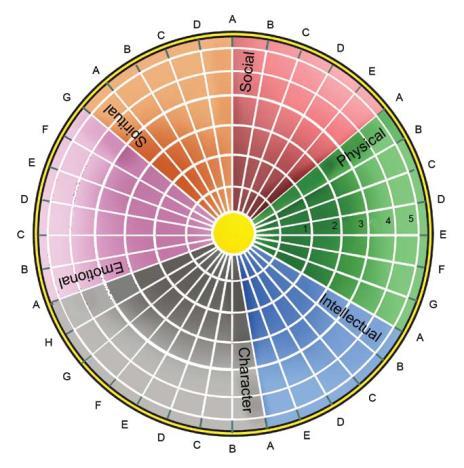
As early as week three, Venture Scouts should complete their SPICES wheel as this will aid in programme planning for the next programme cycle. For more information on the SPICES wheel revert to the Venture Scouts Programme book.
Also at this stage, the Unit as a whole should start exploring what they would like to do for the Venture Scout Expedition in the summer (assuming of course that it will be a Summer Expedition!). It’s important that Venture Scouts get involved in the planning stages and also in the research phase as having an end goal will give the Venture Unit something to work towards. Maybe you will go to a Jamboree, inter-railing, hiking in the Alps or a moving camp along the Wild Atlantic Way. Remember that service should form a large part of the expedition. Plant the seed with the venture scouts this week and ask each crew to come back in two weeks with an draft outline of a possible expedition.
Tonight is also a good place to start considering the Investiture and what type of ceremony there will be. Of course, the meeting should not just be a talking shop! Games and other challenges should be spread out throughout the meeting.
Week 4: Get out!
While meetings in the scout den are important, it is also important that the Venture Unit gets out and about to do activities. Activities can form any type but should be loosely linked to one or more of the SPICES. An activity must have a purpose. Yes, a cinema trip might be an easy option but what is the benefit of it to the development of each Venture Scout. This is the role of the Scouters and Venture Executive – ensuring and facilitating the development of each Venture Scout.
Get out to the local forest and work on some scout skills. Can you boil water in a brown paper bag? Can you cook pizzas in dutch ovens? How about cooking up a nice chicken curry on a Latvian log fire? Do something different, something interesting and something memorable.
Week 5: Decision time…
Tonight is a night to make decisions. Listen to the feedback and presentations from the crews on Venture Expedition possibilities and agree on one or two options. Agree to do up budgets and look at transport options in more detail and revert back in two weeks to make a final decision.
Also tonight, plan the next programme cycle. Why not have a theme for the programme cycle? You could choose a specific skill and design a programme around that skill. You should also aim to have an overnight activity in your next programme cycle. Once again – make it different, interesting and memorable.
Week 6: Investiture
An investiture is an important part of Scouting. It is the way we formally join the Venture Scout Unit and the scout movement. It involves each person making a scout promise in front of others. Each person should make their promise individually in the company of the other Ventures. We have three versions of the Scout Promise, each Venture Scout should choose the one which best suits their beliefs. Afterwards, you should have a celebration to mark the new members having fully joined the Unit.
Try to make investitures memorable. Think about a special place or activity. Why not do a sunrise investiture hike? Meet at 2am and start walking with a view to being on top of the mountain for sunrise. Everyone could then renew their Scout Promise as the sun rises which formally marks the new start of the Venture Scout journey for the new year.
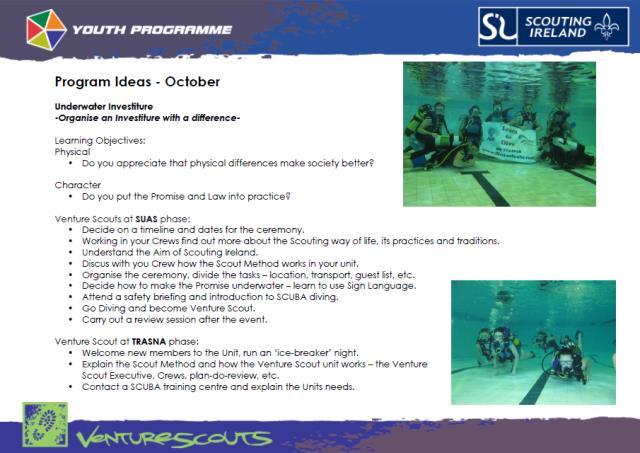
Why not have an underwater investiture? This will obviously take a bit more planning but there is a resource for this available here to help you out: http://goo.gl/orVNqD
New Rover Crew 6 week meeting plan
This is a six week plan that can be adapted to match the frequency of section meetings. This initial framework will set the foundation for a longer programme cycle. A programme cycle is a period of time comprised of planning, doing and reviewing programme activities and learning objectives. Learning objectives for Rovers, as in all of the other sections, are based on the SPICES.
Recruitment and registration: Week 1
Sources of recruitment are the Ventures moving up to your section, Roverage group members returning to the area from work/study/ travel, as well as new members from the community or the catchment area. Some potential recruits may have moved into the area for work or study. Recruitment posters, supplied by National Office, can be placed in local Garda stations, hospitals, colleges, universities and sports centres.
A good next step is to invite potential Rovers and existing Rovers to a social night where they can introduce themselves, ask questions and learn more about what it is to be a Rover Scout. As in the other sections the Rover programme is made up of several components such as special interest badges, Chief Scout Award, Adventure Skills, Nautical badge scheme and activities. The unique element to the Rover section is the ASSES which is the programme aims for the section. This is an acronym for Adventurous, Service, Skill, Environmental and Social. All new members would find this information helpful before week two where they will be designing the programme cycle for the section.
Registration of Adult Scouters is currently €25 and it is usually paid by the group. Registration for Rovers who are youth members is €45 and is usually paid by the Rover Scout. Some Rover sections fundraise to subsidise the registration fees and this should be considered as a long term plan once the sections is established.
Rovers who join the section outside of the usual registration timeslot must still register for the year unless they are already registered in another group, in which case, they can wait until the following September.
Planning: Week 2
This week should involve brainstorming project ideas that can be calendared into short and long term programme cycles. Some suggestions for brainstorming are:
• Create a Rover section bucket list
• Choose at least one activity from each ASSES category per programme cycle
• Consider developing adventure skills in small groups
• The chief scout award and the nautical badge scheme should also be considered when making your plans.
• Consider participating in, or running county, provincial or national rover events
Information and support for county and provincial events can be sought from the CPC and PYPR respectively, and information on national events can be found on the SI website.
Forming Crews and the Rover Executive: Week 3
A Rover section or Crew can have any number of members however it is organised into small project-based teams of between 4-8 Rovers. Project teams should ideally have a mix of age, experience and ability. This allows new members to participate in teams that are led by experienced members. Each project team should select their preference for a programme initiative to design and deliver, based on the plan agreed upon in Week 2. In the planning phase of projects, teams must consider learning objectives, project timelines, resources needed, skills required, cost, etc.
The Rover section must also elect a rover executive comprising of a chairperson, secretary and treasurer (at a minimum). Other roles may be added to the executive as needed. The chairperson will accompany the Rover advisor to Group Council to represent the Rover section. The Rover programme calendar should be presented to the group council, ideally at their first meeting.
Project Preparation: Week 4
This is a crew-based preparation meeting prior to the Rover sections first programme activity or event. Things to consider:
• Has information about the project been distributed to all the section members, rover advisor and group leader (Time, date, cost, equipment needed etc.)
• Has the group equipment needed for the event been checked out by the quartermaster
• Have transport arrangements (if needed) been made These are some general pointers, however the preparations needed will be specific to the project. Try not to be too ambitious with your first project of the year as its purpose is to gel the section and consolidate crews.
Programme Activity: Week 5
This is the week you will be doing your first programme activity of the year. The aim of this project, whatever it may be, is to get everybody engaged in the section. If everybody is participating then this project has been a success. This is a good opportunity to see how the crews are working together and emphasis should be placed on forming relationships between the newest members and the more experienced Rovers.
Review: Week 6
Having experienced the first programme activity together, the Rover section is in a better place to assess where their skills, interests and potential lies. This knowledge can then be applied to the next phase of project planning. You may wish to reconsider the crew’s formation based on their performance and dynamic during the programme activity.
It is important to begin considering the individual goals of members throughout all upcoming projects and how these goals can feed into the planned programme cycle of the section. There is no such thing as a perfect programme cycle. Plans change, projects mutate and some goals may even be abandoned. Just remember, the success of a crew will be decided by its members, and the section will be whatever you make it.