Plan
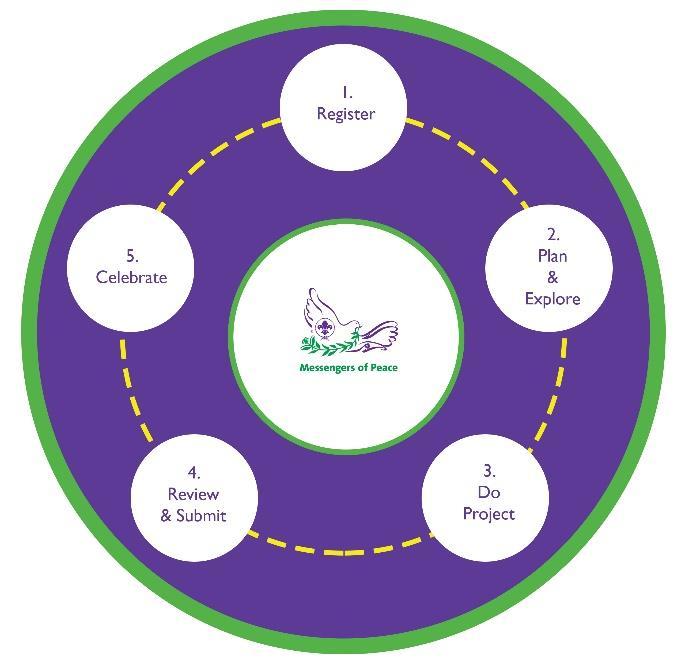
Steps to getting the Award:
1. The Unit firstly registers by emailing betterworld@scouts.ie (include your Group details, numbers of Venture Scouts participating, and your planned project)
2. Plan: Learn about a social issue (several meetings) and plan ways in which you can help (several meetings)
3. Do: Activity Crews undertake a community project (two weekends)
4. Review: Evaluate your project and commit to maintenance (meeting, on-going). Submit an application.
5. Celebrate your achievement!
Plan
Exploration activities
Activity 1: It’s Only Words
Aim: To gain an understanding of the importance of the language we use, and how our attitude towards other countries, religion, and other people can be shaped by the media.
Time: 45 minutes
Sustainable Development Goals: 4. Quality Education, 10. Reduced Inequalities, 11. Sustainable Cities and Communities, 16. Justice Materials: Headline cut-outs, paper, pens, A4 paper, markers.
Step 1: Divide the Unit into small groups.
Step 2: Provide each of the groups with a cut-out of one of the headlines provided, along with markers and paper.
Step 3: Ask each group to identify the key terms and words used in the headlines. Invite them to write down how the people in the stories are portrayed.
Step 4: Ask the groups to reimagine the headlines in a way that reports the news from an ethical journalistic viewpoint.
Step 5: The groups may share their old and new headlines with one another, and any other material they feel is relevant to the discussion. You may want to read the following facts out to the group…
In the years after 9/11, MediaTenor examined 2.6 million Western news stories from 10 American, British, and German outlets. They found that the media’s coverage of Islam has rarely been positive. While religious leaders like Pope Francis were often the face of Catholicism in the media, fringe extremists like Abu Bakr al-Baghdadi became the face of Islam.
Step 6: Discuss the following…
• Ask the group if they were journalists would they write a different headline.
• What might a young asylum seeker or Islamic migrant be feeling reading these headlines?
• What are the truly important messages that should be in our media?
HEADLINES
‘Rescue boats? I’d use gunships to stop migrants’
‘Muslim Women Face €9000 Fine as Another Country Bans Burka’
‘4000 Foreign Murderers and Rapists We Can’t Throw Out’
‘Muslim Forced Off Train as Commuter Complains He Used His ipad Suspiciously’
‘We Must Stop the Migrant Invasion’
‘Australian Senator Urges End to Muslim Immigration’
‘Migrants are Becoming Hooked on Gambling’
Activity 2: The Future We Want
Aim: To realise the value of exploring our own beliefs and values so as to understand how they influence your attitudes and behaviours. The key message here is about the connection between belief, values, and positive change. For young people to see themselves as potential agents of change, and realise the importance of reflecting on how our beliefs and values shape future behaviours.
Time: 50 minutes
Sustainable Development Goals: 4. Quality Education, 10. Reduced Inequalities, 16. Justice, 17. Partnerships for the Goals
Materials: A2 paper, A4 paper (1 per person), markers & pens.
Step 1: Divide the Unit into smaller groups and provide each group with the required materials.
Step 2: Get each group to draw a large circle in the middle of the page. Draw three concentric circles around it.
• In the centre write the word ‘Beliefs’
• In the next circle write the word ‘Values’
• In the next write the word ‘Attitudes’
• In the final circle write the word ‘Behaviours’
This represents a person. Each circle is connected to and influenced by the previous. Mention that beliefs are at our core, while behaviours are the part of us that other people see and experience. Ask the groups to bear the following in mind for the exercise…
Belief – A belief is an idea that you hold to be true. It can be influenced by culture, faith, education, experience, mentors, media, etc. You are usually willing to defend it and you have reasons and evidence to support this belief. E.g. I believe that gay people should have the right to marry.
Values – A value is a stable and long lasting belief about what is important to a person. Values can relate to different parts of our lives; happiness, wealth, education, career, family, health, etc. E.g. I think it is important for gay people to have the right to get married. Attitudes – Attitudes are ‘settled views’ about things. They are influenced most often by underlying beliefs and values. Attitudes affect decision making and behaviour. E.g. The law should be changed to allow gay marriage.
Behaviour – Behaviour is how we outwardly act. It is an action that can be a response to a certain situation. E.g. I will campaign for marriage equality!
Step 3: Ask the groups to consider the current situation with refugees in Europe. Half of the groups should write what they feel the beliefs, values, attitudes and behaviours of someone with a negative view towards refugees might be, the other half should do the same for those with a positive view towards refugees.
Step 4: Ask the group to share what they have found.
Step 5: Invite the groups to suggest how you might change or shift some of the beliefs, values, and attitudes of the negative people. Take note of these.
Step 6: Invite the group to redraw the circles on their A4 sheet, and fill them in with their own beliefs, values, attitudes and behaviours when it comes to refugees. (This is a personal reflection and does not need to be shared with the group)
Step 7: Watch the following videos….
Part 1 - https://www.youtube.com/watch?v=RBQ-IoHfimQ
Part 2 - https://www.youtube.com/watch?v=nKDgFCojiT8
Afterwards reflect on how campaigns like this might shift people’s beliefs, values, attitudes and/or behaviours. Do they think this could be a successful campaign? Why? Ask them to look at their A2 sheets and see what might change, or what might be strengthened from watching these videos.
Do
Reflect:
Brainstorm on the following…
• What activities did you carry out in the exploration?
• What did you learn from these activities?
• How does what we have learned in the ‘exploration’ relate to our local community, or a community that we know of?
• What can we do for this community in relation to the issues addressed?
• Is there already a group in your community who need help with a project?
Do:
• Your project should have a clear focus and be completed in a limited amount of time
• Be careful not to make commitments you can’t keep
• Your project should make a clear difference to your community
• Sometimes what we think as a good project may have already been thought of by another community group – do they need a hand with it?
• Assign roles – Activity Leader(s), Secretary/Liaison, Finance, PR, Quartermaster, Photographer, First Aider
• Draw up a priority list and timeline – When, What, Who? –What are the skills in your group? How can we use those skills? Would this person be suited for that job? - This time line should list all the jobs that need to be done and who is responsible for each one.
• Once you have a rough outline of your action plan, ask your group to explain the community as it is now, then ask them to explain how they imagine things might look after the project is complete. You might ask them to write one wish for the project on a piece of card. Keep these somewhere safe to look back on in your Review!
Some Extra Tips…
• Why not form a partnership with another organisation? The more the merrier! – Is your local charity shop short of volunteers? Do SVP need extra hands to deliver food for their big Christmas run?
• Local newspapers are always eager for community stories, why not publicise your project?
• Looking for specific advice? Why not ask someone who’s done a similar project? – Find them at www.scout.org
• Hang your timeline up in your den and check the stages off as you go along
Review
Crew Review
• What was your project?
• How did it help the community?
• What problems did you encounter, if any?
• What would you do differently next time?
• Look back on your wish for the project