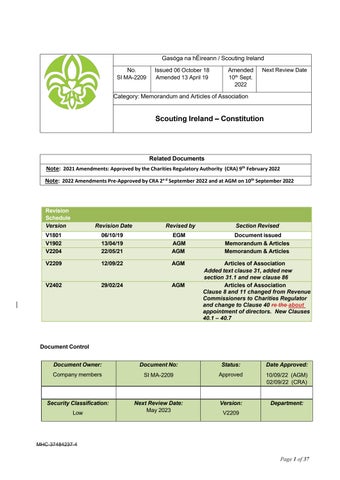

Gasóga na hÉireann / Scouting Ireland
No. SI MA-2209 Issued 06 October 18 Amended 13 April 19 Amended 10th Sept. 2022
Category: Memorandum and Articles of Association
Scouting Ireland – Constitution
Next Review Date
Related Documents
Note: 2021 Amendments: Approved by the Charities Regulatory Authority (CRA) 9th February 2022
Note: 2022 Amendments Pre-Approved by CRA 2n d September 2022 and at AGM on 10th September 2022
Added text clause 31, added new section 31.1 and new clause 86
Articles of Association
Clause 8 and 11 changed from Revenue Commissioners to Charities Regulator and change to Clause 40 re the about appointment of directors. New Clauses 40.1 – 40.7
Document Control
COMPANIES ACT 2014
COMPANY LIMITED BY GUARANTEE AND NOT HAVING A SHARE CAPITAL
CONSTITUTION OF
GASÓGA NA hÉIREANN / SCOUTING IRELAND
MEMORANDUMOFASSOCIATION
(adopted by special resolution passed on [⚫])
Capitalised terms used in this Memorandum of Association shall have the meanings given to those terms in the Articles of Association.
1. Name NAME
The name of the company (the “Company”) is Gasóga na hÉireann/Scouting Ireland .(the “Company”).
2. Company type COMPANY TYPE
The Company is a company limited by guarantee, registered under Part 18 of the Companies Act 2014 (the “Companies Act”).
3. Main Object MAIN OBJECT
The main object for which the Company is established is for the purpose of benefit to the community to encourage, and to support Scout Groups in encouraging, the social, physical, intellectual, character, emotional and spiritual development of young people so that those young people may achieve their full potential and, as responsible citizens, improve society (the “Main Object”)
4. Subsidiary Objects SUBSIDIARY AND ANCILLARY OBJECTS
As objects incidental and ancillary to the attainment of the Main Object, the Company shall have as its subsidiary and ancillary objects to promotethe promotion of the following:
(a) Promise and law Law - the commitment to a code of living based on the values of the Scout movement;
(b) Personal progressionProgression – a scheme to support the development of knowledge, skills and attitudes in all areas and to provide recognition for individual and group achievements;
(c) Learning by doing Doing – an approach that prioritises learning by practice, and first-hand experience, and from both successes and mistakes;
(d) Small Group System – progressive, democratic and self-governing groups, usually of 6-8 young people, being the basic organisational structure of Scouting;
(e) Symbolic Framework - providing a setting for Scouting that stimulates the imagination through symbols, themes and stories;
(f) Nature and Outdoors - the natural environment is the primary setting for Scouting offering unique opportunities for the development of the young person;
(g) Young People and Adults Working Together - a partnership model in which young people are supported to become increasingly self-governing and independent;
(h) Service and Commitment - recognising the importance of contributing to society by caring for others and the world around us; and
(i) The Scout Method - the unique educational method used by Scout Groups and the Company to fulfil their aims.
5. PowersPOWERS
The Company shall, in addition to the powers conferred on it by law, have the following powers which are exclusively subsidiary and ancillary to the Main Object and which powers may only be exercised in promoting the Main Object. Any income generated by the exercise of these powers is to be applied to the promotion of the Main Object:
(a) to undertake any activities as will assist it in achieving its aim in of encouraging the development of young people and promoting the development of young people to others;
(b) to purchase, take on, lease, licence, surrender, or in exchange, hire or otherwise acquire any real, leasehold or personal estate which may appear convenient property or assets;
(c) to construct, develop, maintain, manage and improve, repair or alter any property or assets owned or used by the Company including any halls, campsites, buildings, or equipment or installations;
(d) to procure, receive or accept, administer and allocate, including on behalf of its Members, any donations, contributions, funds bequests, legacy, gifts, grants, or subscriptions and bequests, to accept any gift of propertyof any nature, whether subject to any special trust or not, for any purpose within the main principal objectMain Object;
(e) to enter into any contracts or arrangements with, or establish and maintain links or other arrangements with, and make submissions to, any Governments, State
Agencies or Authorities, supreme, municipal, local or otherwise;
or take such steps by personal or written appeals, public meetings or otherwise, as may seem expedient for the purpose of procuring contributions to the funds or property, real or personal, of the Company that may seem conducive to the attainment of the Main Object;
(f) to print and publish, by any medium, any newspapers, periodicals, books or leaflets and engage in any publicity for the purposes of fostering the objects of the CompanyMain Object;
(g) to promote, commence, or be involved in, oppose, defend, settle or compromise any litigation, arbitration, liability, claim, action, demand or dispute or other proceedings or applications as may seem necessary directly or indirectly to advance or prejudice the interests of involving the Company;
(h) to sell, lease, mortgage, transfer, exchange, dispose of, grant and accept easements, or otherwise deal with all or any part of the property or assets of the Company;
(i) to borrow and/or raise money and secure its repayment in any manner and to give guarantees for persons, companies, or other associations or bodies where such is in furtherance of the Main Object; or funds, either without security or secured in such manner as the Company shall think fit and in particular by the issue of debenture stock perpetual or otherwise, by mortgage, charge, pledge, lien, and/or other security interest, upon all or any undertaking, property and/or assets of the Company (both present and future) and to purchase, redeem or pay off any such security;
(j) to give credit to or to become surety, indemnifier or guarantor for any persons or other companies, institutions, societies or associations, and to give all descriptions of guarantees and indemnities and either with or without the Company receiving any consideration to guarantee, indemnify or otherwise secure (with or without a mortgage or charge on all or any part of the undertaking, property and assets of the Company (both present and future);
(j)(k) to invest in such ways as shall seem desirable to the Directors any moneys of the Company not immediately required for the use in connection with its Main Object and to place any such moneys on deposit with bankers and others; subject nevertheless as regards and provided that the making of investments to such complies with any conditions (if any) and such consents (if any) as may for the time being be imposed or required by law applicable and subject toalso as hereinafter provided; prior permission to be being obtained from the Revenue Commissioners where the Company intends to accumulate funds over a period in excess of two five years for any purposes;
(k)(l) subject to Clause clause 6, to employ such personnel as the Company may think desirable or necessary for the furtherance of its Main Object; to appoint, employ, engage and retain all such officers and servants, employees, consultants and advisers as may be required for the purposes of the Company and to make all reasonable and necessary provisions for the payment of fees, wages, salaries, pensions, gratuities, allowances, superannuation, contractual or other payments to such officers, servants, employees (or their dependents where required), consultants and advisers;
(l)(m) to accept, undertake and execute any trusts or any agency business which may seem conducive to its Main Object;
(m)(n) to subscribe to, raise or help raise funds for any local or other charities, and to grant donations for any public purpose or to enter into any arrangement for cooperation or reciprocal concession with any person, local authority, company, bodyorassociation,for the purpose of advancing, directly or indirectly, theMain Object; of or any business carried on or intended to be carried on by the Company;
(n)(o) to establish, and support, manage or cooperate with, or to aid in the establishment and support and/or management of, any other charitable institution formed to promote its Main Object; companies, institutions, societies or associations having a main object wholly or in part similar to that of the Company;
(o)(p) to amalgamate with any companies, institutions, societies or associations having a main object wholly or in part similar to that of the Company;to establish and amalgamate with other companies, institutions, societies or associations having a main object wholly or in part similar to that of the Company;
(p)(q) to purchase or otherwise acquire and undertake all or any part of the property, assets, liabilities and engagements of any body with which the Company is authorised to amalgamate;to acquire, or take on, any activities or liabilities;
(q)(r) to transfer all or any part of the property, assets, liabilities and engagements of the Company to any body with which the Company is authorised to amalgamate; to apply for all licences, consents, certifications and permissions which may be required in relation to its property, asset or activities;
(s) to take out, pay for, and maintain policies of insurance in respect of the properties, assets, activities and liabilities of the Company and for the benefit of the officers of the Company, including Directors and Officers insurance (D&O insurance);
(t) to collect all allocations, fees or other amounts payable for facilities and services provided by the Company;
(r)(u) to devise, adopt, amend and suspend such rules and regulations as may be required for the efficient organization organisation of the activities of the Company and its membersMembers;
(s)(v) to do all such other lawful things as are incidental or conductive conducive to the pursuit to the attainment of its Main Object ;
(w) to do all or any of the above things in any part of the world, and as principals, agents, contractors, trustees or otherwise, and either by or through trustees, agents, subcontractors or otherwise and either alone in partnership or conjunction with any person, company or association, and to contract for the carrying on of any operation connected with the Main Object by any person, company or association.
PROVIDED THAT:
(i) in case the Company shall take or hold any property or assets which may
be subject to any trusts, the Company shall only deal with or invest the same in such manner as allowed by law having regard to such trusts; and
(ii) nothing hereinbefore contained shall be construed as including in the purposes for which the Company has been established any purposes which are not charitable according to law.
6. Income and Property INCOME AND PROPERTY
6.1 The income and property of the Company shall be applied solely towards the promotion of its Main Object as set forth in this Constitution No portion of the Company’s incomeandpropertyshallbe paid ortransferred , directlyor indirectly , by way of dividend, bonus or otherwise howsoever by way of profit to members of the CompanyMembers
6.2 No Director shall be appointed to any office of the Company paid by salary or fees, or receive any remuneration or other benefit in money or money’s worth from the Company. However, nothing shall prevent any payment in good faith by the Company of:
(a) reasonable and proper remuneration to any member or servant of the Company (not being a Director) for any services rendered to the Company;
(b) interest at a rate not exceeding 1% above the Euro Interbank Offered Rate (Euribor) per annum on money lent by Directors or other members of the Company to the Company;
(c) reasonable and proper rent for premises demised and let by any member of the Company (including any Director) to the Company;
(d) reasonable and proper out-of-pocket expenses incurred by any Director in connection with their attendance to any matter affecting the Company; and
(e) fees, remuneration or other benefit in money or money’s worth to any company of which a Director may be a member holding not more than one hundredth part of the issued capital of such company
6.3 Nothing shall prevent any payment by the Company to a person pursuant to an agreement entered into in compliance with section 89 of the Charities Act, 2009 (as for the time being amended, extended or replaced).
7. Winding Up WINDING UP
If upon the winding up or dissolution of the Company there remains, after the satisfaction of all its debts and liabilities, any property whatsoever, the same it shall not be paid to or distributed among the members of the CompanyMembers. Instead, such property shall be given or transferredtosomeothercompanyorcompanies(being a charitable institution or institutions) having objects similar to the objects of the Company (which objects comply with paragraph (a) of section 1180(1) of the Companies Act 2014) and which shall meet the requirements of paragraph (b) of section 1180(1) of the Companies Act 2014 and . The company or companies (being a charitable institution or institutions) to which the property is given or transferred shall
prohibit the distribution of its or their income and property among its or their members to an extent at least as great as is imposed on the Company under or by virtue of Clause clause 6 hereof. The members of the Company Members shall select the relevant company or companies (being a charitable institution or institutions) to which its property is to be so given or transferred at or before the time of dissolution, and if and so far as effect cannot be given to such provision, then the property shall be given or transferred to some other company or companies (being a charitable institution or institutions) selected by the members of the Company the objects of which are charitable Final accounts will be prepared and submitted to the Charities Regulator that will include a section that identifies and values any assets transferred along with the details of the recipients and the terms of the transfer
8. Additions, alterations or amendments ADDITIONS, ALTERATIONS AND AMENDMENTS
No addition, alteration or amendment shall be made to the provisions of the main object clause, the income and property clause, the winding up clause, the keeping of accounts clause or this clause of the Constitution for the time being in force:
(a) (1) unless such amendments have been previously submitted to and approved in writing by the Charities Regulator; or
(b) (2) which would contravene section 1180 of the Companies Act 2014.
8.1 The Company must ensure that the Charities Regulator has a copy of its most recent Constitution. If it is proposed to make an amendment of the Constitution which requires the prior approval of the Charities Regulator (including any change to clause 3, clause 6, or clause 7 of the Memorandum), advance notice in writing of the proposed changes must be given to the Charities Regulator for approval, and the amendment shall not take effect until such approval is received.
8.2 No amendments of any kind shall be made to the provisions of clause 6 or clause 7 of the Memorandum and no amendments shall be made to the Constitution to such extent that they would alter the effect of clauses 6 and 7 of the Memorandum, such that there would be non-compliance with the requirements of section 1180 of the Companies Act.
8.3. Gasóga na hÉireann / Scouting Ireland is a member of the World Organisation of the Scout Movement (“WOSM”) and agrees to be bound by the Constitution of WOSM. No amendments shall be made to clauses 1, 3 and 4 of this Memorandum or toArticles80-84(inclusive) of theArticlesof Association without the written consent of the World Scout Committee
Limited liability LIMITED LIABILITY
The liability of members Members is limited.
10. Undertaking to Contribute MEMBERS’ UNDERTAKING TO CONTRIBUTE
Every member of the Company Member undertakes to contribute to the assets of the Company, if the Company is wound up while he or she is a member or it is a Member, or the Company is wound up within one year after the date on which he or she it ceases to be a memberMember, for
(a) payment of the debts and liabilities of the Company contracted before he or she it ceases to be a memberMember, and the costs, charges and expenses of winding up; and
(b) the adjustment of the rights of the contributories among themselves, such amount as may be required, not exceeding €1.00 (EUR 1)
11. Keeping of Accounts
Annual audited accounts shall be kept and made available to the Charities Regulator on request.
ARTICLES OF ASSOCIATION
COMPANIES ACT 2014
COMPANY LIMITED BY GUARANTEE AND NOT HAVING A SHARE CAPITAL
CONSTITUTION OF
GASÓGA NA hÉIREANN/ / SCOUTING IRELAND
ARTICLESOF ASSOCIATION
(adopted by special resolution passed on 6th October 2018)[⚫])
DEFINITIONS AND INTERPRETATION
1. The Following Provisions Shall Apply:
1. In these Articles:-
1.1. The following definitions shall apply:
the “Acts” means the Act, all statutory instruments which are to be read together as one with the Act and every statutory modification and re-enactment thereof for the time being in force;
“AGM” means the annual general meeting of the Company, convened and conducted as set out at Articles 12 to 21 and 24 to 30;
“Articles” means these Articles of Association;
“Board” means the board of Directors for the time being and from time to time of the Company;
“CEO” means the Chief Executive Officer of the Company as set out at Article 50;
“Chairperson of the Board” means the chairperson of the Board as set out at Articles 62 to 64;
“Charities Act 2009” means the Charities Act 2009 (as and to the extent commenced and as amended, extended or replaced from time to time);
“Charities (Amendment) Act 2024” means the Charities (Amendment) Act 2024 (as and to the extent commenced and as amended, extended or replaced from time to time);
“Charities Regulator” means the Charities Regulatory Authority, a body established by section 13 of the Charities Act 2009;
“Committee” means a committee established by the Board under Article 65;
“Companies Act” means the Companies Act 2014 and every statutory modification, re-enactment and amendment thereof for the time being in force and from time to time;
“Company Secretary” means any person appointed from time to time to perform the duties of the company secretary of the Company and shall include any temporary, assistant or acting secretary;
“Constitution” means the Memorandum and the Articles;
“Directors” means the Directors directors for the time being of the Company or the Directors present at a meeting of the Board of Directors and includes any person, from time to time, occupying the position of director by whatever name called;
“Group Secretary” means the secretary of the Scout Group Council as set out in the Scout Group Constitution;
“Honorary Life Member” means a person on whom Honorary Life Membership has been conferred;
“Member” means a Scout Group that has been admitted as a member of the Company, in accordance with Articles 6 and 7;whether:
(a) a directly, in the case of a Scout Group that is a company or other body corporate in accordance with Article 8, or
(a) b indirectly, in the case of a Scout Group that is an unincorporated association, through the admission of its nominee in accordance with Article 7;
“Secretary” means any person appointed from time to time to perform the duties of the secretary of the Company;
“Memorandum” means the Memorandum of Association of the Company;
“Month” means a calendar month and “Months” shall be construed accordingly;
“Seal” means the common seal of the Company;
“Motions Committee means the committee established in accordance with Article 66;
“Office” means the registered office for the time being of the Company;
“Scout Group” means a company or an unincorporated body of persons who are association that is organised in accordance and compliance with the Scout Group Charter and Youth Charter and which the Directors have determined is eligible to become a Member of the Company, whether directly or indirectly through a nominee, in accordance with Article 6;
“Scout Group Charter” means the document approved and designated as such
by the Directors in accordance with Article 52.1;
“Scout Group Constitution” means the governance document which each Scout Group is required, by the Scout Group Charter, to adopt;
“Scout Group Council” means the Scout Group’s management committee as set out in the Scout Group Charter and the Scout Group Constitution; the “Company” means the company known as Gasóga na hÉireann or Scouting Ireland or both;
“Office” means the registered office for the time being of the Company;
“Scout Method” means the unique educational method used by Scout Groups and the Company to fulfil their aims. The promotion of the elements of the Scout Method is the subsidiary object of the Company;
“Seal” means the common seal of the Company;
“State” means the territory of the Republic of Ireland;
“Vice Chairperson of the Board” means the vice chairperson of the Board as set out at Articles 62 to 64;
“Year” means a calendar year, and
“Youth Charter” means the document approved and designated as such by the Directors in accordance with Article 52.3; and
“Scout Method” means the unique educational method used by Scout Groups and the Company to fulfil their aims. The promotion of the elements of the Scout Method is the subsidiary object of the Company;
“Honorary Life Member” means a person on whom Honorary Life Membership has been conferred.
1.2. The provisions set out in this Constitution these Articles shall constitute the whole of the regulations applicable to the Company and no “optional provisions” as defined by section 1177 of the Companies Act shall apply to the Company.
1.3. Expressions referring to writing shall, unless the contrary intention appears, be construed as including reference to printing, lithography, photography and any other modes of representing or reproducing words in a visible form.
1.4. Unless the contrary intention appears, words or expressions contained in these Articles of Association shall bear the same meaning as in the ActsCompanies Act or any statutory modification thereof in force at the date at which these Articles become binding on the Company
1.5 Headings and footnotes used in these Articles are for convenience of reference only and shall not be considered to form part of these Articles
MEMBERS
2. The number of members Members is 500 and shall be such higher or lower number as
may from time to time be registered in accordance with the provisions of these articles of associationArticles
3. The only persons who shall be members of the Company Members shall be the Scout Groups who are eligible for admission under Article 5 and who have been admitted as Members in accordance with Article 6 and none no others. The names of all Members of the Company shall be entered in the Company’s register of members accordingly.
4. The Company shall keep a register ofmembers Members which shall record the names and addresses (postal and electronic) of all Members and their date of admission to, and termination of, membership.
5 Only a company or an unincorporated association that is organised in accordance and compliance with the Scout Group Charter and Youth Charter, shall be eligible to be admitted as a Member.
5. The only persons eligible to be admitted as Members of the Company shall be:
5.1. A company or other body corporate that is a Scout Group; or
5.2. An individual who is the nominee of an unincorporated association that is a Scout Group.
ADMISSION OF MEMBERS
6. A Scout Group that wishes to be admitted as a Member of the Company, whether directly, or indirectly by its nominee, shall apply in accordance with the following provisions:
6.1. the Scout Group must satisfy the Directors that it meets the criteria that the Directors may from time to time prescribe in order prescribed in the Scout Group Charter to qualify as a Scout Group; and
6.2. the Scout Group’s application shall be made in such form and containing such information as may from time to time be prescribed by the Directors.; and
6.3. Where where the Directors have determined that a Scout Group is eligible to become a Member of the Company , the Directors may, by resolution, resolve to admit the Scout Group or its nominee as a Member of the Company
7. Register of Members
7.1. The name of the Scout Group as registered on the Company’s membership management system shall be recorded as the Member’s name in the register of Members.
7.2. The address to be recorded as the Member’s address in the register of Members shall be:
(a) where the Scout Group is a registered company, the company address as registered with the Companies Registration Office and as notified by the Scout Group to the Company Secretary, to such email address as is from time to time designated by the Directors for such
communications; or
(b) where the Scout Group is not a registered company,
(i) to the address of the Group Secretary as registered on the Company’s membership management system; or
(ii) to an alternative address agreed by the Scout Group Council and notified by them to the Company Secretary, by email
8 The Company shall send all notices and other communications for Members to the address in the register of Members and shall not be obliged to send notices and other communications to any other address, although it is not prohibited from so doing as may be appropriate from time to time
7. The following provisions shall apply to a Scout Group that is an unincorporated association:
7.1. The the Scout Group must shall nominate one individual to be its nominee to represent it in all matters pertaining to membership of the Company. Such a Scout Group can change its nominee in accordance with this Article ;
7.2 Where where the Directors admit such a Scout Group to membership, the individual who is from time to time the notified nominee shall be a Member of the Company and his or her name shall be entered in the Company’s register of members.Members as a Member;
7.3. The the Scout Group must notify the identity of its nominee and any changes in its nominee (together with such other information as the Directors may from time to time prescribe) to the Company Secretary by email to such email address as is from time to time designated by the Directors.; and
7.4. The the Company shall send all notices and other communications to the Member who is the nominee of an unincorporated Scout Group and shall not be obliged to send such to any other person
7.5. The Directors may from time to time prescribe regulations concerning the relationship a person nominated in accordance with Article 7.1 must have to the Scout Group.
8. The following provisions shall apply to a Scout Group that is a company or other body corporate:):
8.1. Such the Scout Group’s corporate name shall be entered in the Company’s register of members Members as a Member ;
8.2. The the Company will only engage with the Scout Group’s board of directors or other person duly authorised by its board of directors.
8.3. The Scout Group that is a Member shall nominate one individual to whom all notices or other communications, from the Company, to that Member, are to be addressed. A Scout Group which is a Member can change its nominee in accordance with this Article.
8.4. the Scout Group which is a Member must notify the identity of its nominee and
any changes in its nominee (togetherwith such other information asthe Directors may from time to time prescribe) to the Company Secretary, by email, to such email address as is from time to time designated by the Directors.; and
8.5. The the Company shall send all notices and other communications to the nominee of a Member and shall not be obliged to send such to any other person.
MEMBERSHIP: VOTING AND OTHER RIGHTS OF MEMBERS
9. Each Member shall be entitled to receive notice of and to attend and vote at general meetings of the Company.
10. Each Member shall have up to five (5) votes at a general meeting of the Company.
MEMBERSHIP: TERMINATION
11. Membership shall automatically terminate upon the occurrence of any of the following events, namely where:
11.1. the Directors determine in their discretion that it a Member no longer meets the criteria to qualify it as a Scout Group referred to in Article 6.1 to qualify as a Scout Group;or
11.2. in the case of a Member that is a company or other body corporate, it has a liquidator appointed to it or it is dissolved, whether following its strike off or otherwise; or
11.3. in the case of a Member who is the nominee of a Scout Group that is an unincorporated association, the unincorporated association is wound up or it is dissolved; oror
11.4. the Member resigns by notice in writing to the Company; or.
11.5. the Member, being an individual nominated by an unincorporated association dies; or
11.6. in the case of a Member who is the nominee of a Scout Group that is an unincorporated association, he or she is replaced by the unincorporated association in accordance with Article 7.1.; or
11.7. in the case of the original subscribers and such other persons who are members at the date of the adoption of these articles of association but who are not eligible for admission as Members under Article 6, upon the passing of a resolution of the Directors, terminating their membership.
GENERAL MEETINGS OF THE COMPANY
12. All general meetings of the Company may be held inside or outside of the State , and where held outside of the State , shall be held in accordance with section 176 of the Companies Act.
13. The Company shall in each year Year hold a general meeting as its Annual General MeetingAGM in addition to any other meetings in that year Year and shall specify the meetings as such in the notices calling it; and not more than 15 months fifteen (15)
Months shall elapse between the date of one Annual General Meeting of the Company AGM and that of the next AGM. The Annual General Meeting AGM shall be held at such time and at such place as the Directors shall appoint.
14. All general meetings , other than Annual General Meetings the AGM, shall be called Extraordinary General Meetings.
15. The Directors may, whenever they think fit, convene an Extraordinary General Meeting and may also cancel an Extraordinary General Meeting that they have convened. An Extraordinary General Meeting shall also be convened on such requisition or in default may be convened by Members, together having 10% of the voting rights in the Company, as provided by section 178(3) to (7) of the Companies Act, as modified in its application to a company limited by guarantee by section 1203 of the Companies Act. If at any time , there are not within the State sufficient Directors capable of acting to form a quorum any Director or any two (2) Members may convene an Extraordinary General Meeting in the same manner as nearly as possible as that in which meetings may be convened by the Directors.
MOTIONS FOR DISCUSSION AT ANNUAL GENERAL MEETINGS
16 The following apply in relation to motions for discussion at an AGM:
16.1. Subject to the provisions of these articles of association and the Act, Members may submit motions for discussion at the Annual General Meeting (“AGM”) of the Company an AGM in accordance with the following provisions:
(a) 16.1.At at the first meeting of the Directors following the adoption of these articles of association and thereafter at the first such meeting following the each AGM, the Directors shall set the date for the following year’s Year’s AGM and cause this date to be communicated to the Members.;
(b) 16.2.Not not later than twelve (12) weeks before the date of the AGM in each yearYear, Members wishing to propose motions for discussion at the AGM must submit them to the Company at the email address specified in the communication referred to in Article 16.1(a) or such other address as may be advised ;
(c) 16.3.All all proposed motions shall be considered by the Motions Committee who shall decide, in its absolute discretion, whether or not to allow a motion go forward to the AGM for discussion , and the Motions Committee may amend a proposed motion in any way in which it sees fit, again, in its absolute discretion ;
(d) 16.4.The the Motions Committee shall provide the Directors with a list of all Members’ motions that the Motions Committee are allowing go forward for discussion at the AGM as soon as possible but not later than six (6) weeks before the date of the AGM.;
(e) 16.5.No no motion may be proposed by a Member for discussion at an AGM that has not been approved by the Motions Committee in accordance with this Article 16 ; and
(f) 16.6.No no motion shall be put to an AGM, the effect of which is to amend the memorandum or articles of association Constitution of the
Company unless it has been proposed as a special resolution in accordance with these articles of association Articles and the Companies Act.
16.2. Directors’ motions are not subject to Article 16.1, however, the Board may seek feedback and guidance from the Motions Committee about any intended or proposed Directors’ motion.
NOTICE OF GENERAL MEETINGS
17. Subject to the Companies Act, any general meeting, including the an AGM , shall be called by 21 at least twenty one (21) days’ notice in writing at the least. The notice shall be exclusive of the day on which it is served or deemed to be served and of the day for which it is given and shall specify the place, the day and the hour of meeting and in the case of special business the general nature of that business, and shall be given in manner hereinafter mentioned to such persons as are under these articles of association Articles entitled to receive notices from the Company and,
17.1. The subject to Article 17.3, the elected representatives of the annual National Youth Fora, organised in accordance with policyNational Youth Fora’s standing orders, shall be entitled to attend and contribute to all General Meetings of the Company general meetings and to receive notice of such meetings in the same way as the Members of the Company., however, they are not entitled to exercise a vote in relation to the business of general meetings; and
17.2. There may be subject to Article 17.3, Honorary Life Members as set out in Article 1.1, such members can attend at General Meetings of the Company, other than as a representative of a Member They shall be entitled to attend at and contribute to all general meetings and to receive notice of such meetings in the same way as the Members, however, they are not entitled to exercise a vote in relation to the business of General Meetingsgeneral meetings; and
17.3. if an elected representative of the National Youth Fora or an Honorary Life Member is also a Member’s delegate at a general meeting, as provided for at Article 25, then they are entitled to vote and otherwise participate as any other delegate at that general meeting.
18. The notice of a general meeting shall specify:
18.1. The the place, date and the time of the meeting ;
18.2. The the general nature of the business to be transacted.;
18.3. The the text of all motions to be discussed at the meeting ;
18.4. In in the case of a proposed special resolution, the text or substance of that proposed special resolution; and
18.5. With with reasonable prominence, a statement that:
(a) a.a Member entitled to attend and vote is entitled to appoint up to five (5) delegates to attend and vote as its representatives; and
(b) b.the time by which the notice of nomination of delegates must be received at the Company’s registered office or some other place within the State as is specified in the statement for that purpose.
19. The accidental omission to give notice of a meeting to , or the non-receipt of notices of a meeting by , any person entitled to receive the notice shall not invalidate the proceedings at that meeting.
20. The following business shall be deemed special:
20.1. all business that is transacted at an extraordinary general meeting Extraordinary General Meeting; and
20.2. all business that is transacted at an annual general meeting, AGM with the exception of the consideration of the statutory financial statements and the reports of the Directors and the statutory auditors, the review by the Members of the Company’s affairs, the election of a Chief Scout (when necessary), the election of Directors in place of those retiring, the reappointment of the retiring statutory auditors and the fixing of the remuneration of the statutory auditors.
QUORUM AT GENERAL MEETINGS
21. No business shall be transacted at any a general meeting unless a quorum is present when the meeting proceeds to business. Save as hereinafter provided , a quorum shall be 50 fifty (50) Members (present in person by at least one delegate) at a general meeting of the Company If within half an hour from the time appointed for the general meeting a quorum is not present the meeting shall stand adjourned to the same day in the next week at the same time and place, or to such other day and such other time and place as the Directors may determine, and if at the adjourned meeting a quorum is not present within half an hour from the time appointed for the meeting the Members present shall be a quorum.
THE CHIEF SCOUT
22. There shall be an office of Chief Scout. The sole duties, role and powers of the Chief Scout shall be to:
22.1. represent the Company at ceremonial and other public events when requested to do so whether generally or specifically by the Directors.;
22.2. chair meetings of the Members of the Company in general meeting; and
22.3. chair the Motions Committee established under Article 66
23. The following provisions shall apply to the election of the Chief Scout:
23.1. At the 2021 Annual General Meeting and at every subsequent third Annual General Meeting (“AGM”)every three years at the AGM, the Members shall elect a Chief Scout for a three- year term.
23.2. To to be eligible to run for election as Chief Scout a person:
(a) a.must have been nominated by not less than ten (10) Members;
(b) b.must consent to act as Chief Scout, if elected;
(c) c.must not have held the office of Chief Scout for longer than 6 six (6) years; and
(d) d.must have successfully completed an officers’ pre-appointment induction course arranged by the Company.;
23.3. Valid valid nominations for the election of the Chief Scout must be received by the Company at the postal or email address specified by the Directors for this purpose not later than fourteen (14) weeks before the date of an AGM at which a Chief Scout is to be elected ;
23.4. A a nomination shall be valid when it is in the form approved by the Directors containing the information evidencing eligibility as may from time to time by specified by the Directors ;
23.5. Where where there is only one candidate validly nominated for the office of Chief Scout a ballot will be conducted and the person nominated shall be deemed elected only if they receive fifty percent plus one vote of the valid votes cast.;
23.6. Where where there is more than one valid nomination, the election of the Chief Scout shall be conducted by ballot. The Company shall prepare a ballot paper consisting of the names of all persons validly nominated for election as Chief Scout, in alphabetical order (referred to in this Article 23 as the “Chief Scout Candidates”) ”);
23.7. The the ballot paper shall be sent to all Members not later than ten (10) weeks before the date of the AGM. The ballot paper may be sent by post or electronically and in either case may, at the discretion of the Directors, specify the means by which it is to be returned to the Company ;
23.8. The the Chief Scout shall be elected from the Chief Scout Candidates by proportional representation by means of the single transferable vote conducted in accordance with the Regulations that are from time to time prescribed by the Directors.;
23.9. Members must return their ballot papers to the address specified therein not later than two (2) weeks before the AGM ;
23.10. The the Company shall arrange for the counting of the votes cast under the supervision of the Company's statutory auditors ;
23.11. The the results shall be announced formally at the AGM provided that the Company shall notify the successful Chief Scout Candidate in advance.;
23.12. The the term of office of the Chief Scout shall run from the AGM at which his or her their election is announced until the third next following AGM ; and
23.13. A a Chief Scout may resign or maybe removed at any time bymeans of a special resolution passed at a General Meetinggeneral meeting of the Company. Where a Chief Scout resigns, is unable to continue in office or is removed, or is temporarily removed, the Directors may appoint a Scouter to fill the casual vacancy in the officeof Chief Scout. Anysuchpersonsoappointedshallceaseto be Chief Scout at the AGM next following his or her their appointment or at such time as the Chief Scout resumes his/ or her their duties. Any such interim appointment shall not preclude the appointee from subsequently seeking
nomination for election to the role in accordance with these articlesArticles
THE CHAIRPERSON OF GENERAL MEETINGS
24. The following provisions shall apply:
24.1. The the Chief Scout for the time being of the Company shall preside as chairperson at any general meetings, but if such unless the Chief Scout is not present then at a general meeting in which case the Chairperson of the Boardboard of directors shall preside as chairperson of the that general meeting.
24.2. in the event that the Chief Scout and the Chairperson of the Board are not present at a general meeting, the Vice Chairperson of the Board shall preside as chairperson of that general meeting.
24.3. in the event that If neither the Chief Scout, nor the Chairperson of the Board board of directors and the Vice Chairperson of the Board are not present at a general meeting then the Directors present shall choose one of their number to preside as chairperson at of the that general meeting and in. In the event of a tie, a Director the chairperson of the meeting shall be chosen by lot to chair the meeting ; and
24.2.24.4. The the chairperson of a general meeting at which a quorum is present maywiththeconsent of theMembersattendingthatanygeneralmeetingat which a quorum is present (and shall if so directed by the meetingMembers) adjourn the meeting from time to time and from place to place, but no business shall be transacted at any adjourned meeting other than the business left unfinished at the meeting from which the adjournment took place. It shall not be necessary to give any notice of any adjournment or of the business to be transacted at an adjourned meeting.
VOTING AT GENERAL MEETINGS BY MEMBERS’ DELEGATES
25. The following provisions shall apply to attendance and voting at general meetings by Members:
25.1. Each each Member may nominate up to five (5) delegates each of whom who are entitled toattendgeneral meetings oftheCompany torepresent that Member (where the member is a body corporate) or that Member’s nominating Scout Group, where the Member is a nominee of a Scout Group that is an unincorporated association and to vote at such general meetings. A Scout Group shall only nominate its own members as delegates and may not nominate proxies or delegates from any other Scout Group;
25.2. Each each Member must notify the Company Secretary (by email to an address prescribed by the Directors for that purpose) of the names and addresses of its delegates to the general meeting of the CouncilCompany. Such notification shall be sent to and received by the Company Secretary not less than seven days before the meeting is due to take place ;
25.3. No no delegate shall be entitled to represent more than one Member ;
25.4. Each each of the delegates notified by a Member shall be entitled to vote on its behalf at the general meeting of the Company in respect of which they have been
appointed as delegates and each delegate shall be provided with a voting paper and, or in the alternative, a voting card upon their registration at the general meeting ;
25.5. For for theavoidanceof doubt, thefive(5) votestowhich eachMember is entitled need not be cast in the same way.;
25.6. Where where a Member nominates less than five (5) delegates, the delegate or delegates who are nominated by that Member shall be entitled to one (1) vote each and no more ;
25.7. The the Company shall not be required to enquire as to how delegates are instructed to vote by their nominating Member ;
25.8. The the Directors may prescribe procedures that must be followed by Members concerning the various notifications set out herein
25.9. Inadditiontotheprovisionsof Article86, whichenablestheCompanytoorganise general meetings at which some or all Delegates may participate remotely by the use of electronic technology, at general meetings where all Delegates are required to be present in person the Company may provide that voting take place by the use of electronic technology. Where electronic voting is provided at inperson general meetings, the provisions of Articles 86.2 and 86.5 shall apply.
26. At any general meeting a resolution put to the vote of the meeting shall be decided on a show of hands unless a poll is (before or on the declaration of the result of the show of hands) demanded:-:
(a) by the chairperson of the meeting, or
(b) by at least three (3) Members present through their delegates, or
(c) by any Member or Members present through their delegates representing not less than one-tenth of the total voting rights of all Members having the right to vote at the meeting ,
and any poll may be demanded at any time after the chairperson of the meeting declares the resolution is open for voting, but before the chairperson declares that the next resolution is open for voting or the meeting is closed, as the case may be.
27. Unless a poll is so demanded, a declaration by the chairperson of the meeting that a resolution has, on a show of hands, been carried or carried unanimously or by a particular majority or lost, and an entry to that effect in the book containing the minutes of proceedings of the Company, shall be conclusive evidence of the fact without proof of the number or proportion of votes recorded in favour of or against such resolution. The demand for a poll may be withdrawn.
28. Except as provided in Article 30, if a poll is duly demanded it shall be taken in such a manner as the chairperson of the meeting directs and the result of the poll shall be deemed to be the resolution of the meeting at which the poll was demanded provided that on a poll each Member present shall have up to five (5) votes in total depending on how many delegates of that Member are present in accordance with Article 25.1 and Article 25.6
29. Where there is an equality of votes, whether on a show of hands or on a poll, the
chairperson of the meeting at which the show of hands takes place or at which the poll is demanded shall be entitled to a casting vote.
30. A poll demanded on the election of a chairperson or on a question of adjournment shall be taken forthwith. A poll demanded on any other question shall be taken at such time, before the end of the meeting, as the chairperson of the meeting directs, and any business other than that upon which a poll has been demanded may be proceeded with pending the taking of the poll.
DIRECTORS
31. The minimum number of Directors shall not be less than three (3)
32. The maximum number of Directors shall be thirteen (13), ten (10) of which shall be elected by the Members in accordance with Articles 37 to 41 and three (3) of whom may shall be co-opted by the Directors in accordance with Article 42. The minimum number of Directors shall not be less than three (3).
31.1.33. In addition, and withoutWithout prejudice tosection160(7) of the CompaniesAct, in the event that the number of Directors drops below 3 (three) three (3) (for any reason including but not limited to a Director having died, having been removed from office, having lost capacity and/or being otherwise unable to act) the continuing Directors are authorised and empowered to: meet and act for the purpose of filling a casual vacancy on the Board of Directors to bring the total number of Directors to three (3). Any such co-opted Director so appointed pursuant to this power shall act as a full Director and shall hold office until the next annual general meetingAGM and shall then be eligible for re-election. His or/ her Their resignation shall not be taken into account in determining the Directors who are to retire by rotation at such a meeting;
1. meet and act for the purpose of filling a casual vacancy on the Board of Directors to bring the total number of Directors to 3 (three). Any such coopted Director so appointed pursuant to this power shall as a full Director and shall hold office until the next annual general meeting and shall then be eligible for re-election. His/her resignation shall not be taken into account in determining the Directors who are to retire by rotation at such a meeting;
2. and /or summon a General Meeting of the Company; but for no other purpose(s). ‘
32.34. Directors are not permitted to appoint alternates.
RETIREMENT BY ROTATION: TRANSITIONAL ARRANGEMENTS
33. Subject to Article 34, all of the existing Directors of the Company shall retire at midnight on the 31st October 2018.
34. For the avoidance of doubt, the ten (10) persons elected in accordance with Article 249 of the former articles of association, whose appointments are expressed to take effect on the 1st November 2018, shall not be considered to be existing Directors for the purposes of Article 33.
RETIREMENT BY ROTATION
35. At the Annual General Meeting to be held in 2020 and at each subsequent Annual
General MeetingAt each AGM, one-third of the Directors (other than any Directors coopted under Article 42) or if the number of Directors is uneven, then the lower number nearest one-third, shall retire by rotation. The Directors to retire shall be those who have been the longest in office but as between persons who became Directors on the same day, those to retire shall (unless they otherwise agree among themselves) be determined by lot. The retiring Directors shall be eligible for re-election provided that no person shall serve longer than six (6) years in total as a Director of the Company.
VACANCIES
36 The vacancies created by the operation of Articles 35 and 43 (the “Vacancies”) shall be filled in accordance with the procedures set out in Articles 37 to 41
ELIGIBILITY, NOMINATION AND ELECTION OF DIRECTORS
37. Section 186 of the Companies Act does not apply in relation to the nomination and election of Directors as such matters are dealt with outside of the AGM business as per Articles 40 and 41.The following provisions apply to the eligibility and nomination of persons for election as Director:
37.1. Eacheach Member shall be entitled to nominate an eligible person for election as Director; and
37.2. To to be eligible to run for election as a Director a person:
(a)
a.must have been nominated by at least one Member;
(b) b.must not have held office as Director of the Company for longer than 6 years;
(c) c.must consent to act as a Director, if elected;
(d) d.must not hold office as the Chief Scout,and
(e) e.must have successfully completed an officers’ pre-appointment induction course arranged by the Company ; and
(f) must not be disqualified by any condition set out in Article 44.5 to Article 44.7, Article 44.9 and Article 44.11 to Article 44.14
38. Not later than fourteen (14) weeks before the date of the AGM at which Vacancies are to be filled, Members wishing to nominate eligible persons to be elected Directors of the Company must furnish a valid nomination to the Company, at the email address specified by the Directors for this purpose.
39. A nomination shall be valid when it is in the form approved by the Directors containing and contains the information evidencing eligibility as may from time to time be specified by the Directors.
40. Where the number of valid nominations is less than or equal to the number of Vacancies, the Vacancies shall be filled by holding a ballot which shall be conducted in the following manner:
40.1. The the Company shall prepare a ballot paper consisting of the names of all persons validly nominated in alphabetical order (the “Candidates”) ;
40.2. The the ballot paper shall be sent to all Members not later than ten (10) weeks before the date of the AGM. The ballot paper may be sent by post or electronically and in either case may at the discretion of the Directors specify the means by which it is to be returned to the Company ;
40.3. Members entitled to vote shall vote either “yes” or “no” for each Candidate.;
40.4. Members must return their ballot papers to the address specified therein not later than two (2) weeks before the AGM.;
40.5. The the Company shall arrange for the counting of the votes cast under supervision of the Company’s statutory auditors ;
40.6. The the Candidates who receive at least half of the ballots cast plus one more shall be deemed to have been elected to fill the Vacancies with effect from the end of the AGM ; and
40.7. The the results shall be announced formally at the annual general meeting AGM provided that the Company shall notify successful Candidates in advance of holding the AGM.
41. Where the number of valid nominations exceeds the number of Vacancies, the Vacancies shall be filled by holding a ballot which shall be conducted in the following manner:
41.1. The the Company shall prepare a ballot paper consisting of the names of all persons validly nominated in alphabetical order (the “Candidates”).;
41.2. The the ballot paper shall be send sent to all Members not later than ten (10) weeks before the date of the AGM. The ballot paper may be sent by post or electronically and in either case may at the discretion of the Directors specify the means by which it is to be returned to the Company.;
41.3. Members entitled to vote shall rank the Candidates in order of their first and subsequent preferences. All first preference Candidates will be assigned a number of votes equal to the total number of Candidates (the “Total Number”), all second preference Candidates will be assigned a number of votes equal to the Total Number minus one (1), all third preference candidates will be assigned a number of votes equal to the Total Number minus two (2) and so on and so forthfor all subsequently ranked Candidates sothat the number that it subtracted from the Total Number in each case increases by one (1) for each subsequently preferred Candidate to whom a Member assigns a preference ranking ;
41.4. Members must return their ballot papers to the address specified therein not later than two (2) weeks before the AGM.;
41.5. The the Company shall arrange for the counting of the votes cast under the supervision of the Company's statutory auditors ;
41.6. The the Candidates receiving the highest number of votes shall be deemed to have been elected to fill the Vacancies with effect from the end of the AGM. In the event of a tie between two or more Candidates lots shall be drawn by the Chairperson of the board of DirectorsBoard to determine which Candidates are to be elected ; and
41.7. The the results shall be announced formally at the annual general meetingAGM provided that the Company shall notify successful Candidates in advance of the holding of the AGM.
CO-OPTION OF DIRECTORS
42. The Directors may co-opt up to three (3) persons to act as Directors for up to three years on such terms and conditions as the Directors may determine and who shall be eligible for re-appointment on the expiry of their term. No eligibility requirements apply to the cooption of such persons as Directors save that the Chief Scout may not be co-opted as a Director and no person shall serve longer than six (6) years as a Director of the Company.
CASUAL VACANCIES
43. The Directors shall have power at any time and from time to time to appoint any person to be a Director to fill a casual vacancy in the ten (10) Directors elected by the Members so that the total number of Directors shall not at any time exceed the number fixed in accordance with Article 3132. Any director Director co-opted in accordance with this Article 43 shall retire at the next Annual General Meeting AGM of the Company.
VACATION OF OFFICE BY DIRECTORS
44. The office of Director shall be vacated ipso facto if he or she:
44.1. they resign resigns by writing under his or her their hand left at the Office (being the registered office of the Company from time to time);
44.2. they retire retires in accordance with Articles 33, 35 or 43;
44.3. being a Director co-opted in accordance with Article 42, his or her their term of appointment comes to an end under their contract of appointment;
44.4. they become becomes an employee of the Company, a paid consultant or adviser to the Company or they provide provides for profit any other services to the Company unless specifically permitted by law;
44.5. they are is adjudicated insolvent or bankrupt or makes any arrangement or compromise with his or her creditors or being a bankrupt, they have has not obtained a certificate of discharge in the relevant jurisdiction or theymake makes any arrangement or compromise with his or her their creditors;
44.6. they become becomes or is are deemed to be the subject of a disqualification order within the meaning of Part 14 of the Companies Act;
44.7. they become becomes subject to a declaration of restriction under section 819 of the Companies Act;
44.8. they can no longer be reasonably regarded as possessing adequate decisionmaking capacity by reason of his or her their health;
44.9. they are is convicted of an indictable offence unless the other Directors otherwise determine.;
44.10. they are is directly or indirectly interested in any contract with the Company and fails they fail to declare the nature of his their interest in the manner required by section 231 of the Companies Act; or
44.11. they are is removed by an ordinary resolution passed in general meeting of the Company in accordance with section 146 of the Companies Act.;
44.12 they hold holds any office or place of profit in the Company save as permitted by section 89 of the Charities Act 2009 (if and when commenced) or Part 6A of the Charities Act 2009, as inserted by section 34 of the Charities (Amendment) 2024 (if and when commenced); or
44.13 they are is disqualified from being a charity trustee of any charitable organisation pursuant to section 55 of the Charities Act 2009 ; or
44.14. they receive receives a written communication informing him or her them that two thirds or more of his or her their co-Directors have resolved to remove him or her them as a Director on the basis that, after careful consideration, the majority of the Directors (excluding the Director being removed) have formed the view that it is not in the best interests of the Company for him or her them to continue to act as a Director.
POWERS AND DUTIES OF THE DIRECTORS
45. The business of the Company shall be managed by the Directors, who may pay all expenses incurred in promoting and registering the Company, and exercise all such powersof theCompanyasarenotbythe CompaniesAct orthesearticlesofassociation Articles required to be exercised in general meeting subject nevertheless to the provisions of the CompaniesAct and these articles of association Articles and to such directions, being not inconsistent with the aforesaid provisions, as may be given by special resolution of the Company in general meeting, but no direction given by the Company in general meeting shall invalidate any prior act of the Directors which would have been valid if that direction has not been given.
46. Without prejudice to section 40 of the Companies Act, the Directors may delegate any of their powers (including any power referred to in this Constitution) to such person or persons as they think fit, including committees; any such person or committee shall, in the exercise of the powers so delegated, conform to any regulations that may be imposed on them or it by the Directors.
47. The Directors may from time to time and at any time by power of attorney appoint any company, firm or person or body of persons, whether nominated directly or indirectly by the Directors to be the attorney or attorneys of the Company for such purposes and with powers, authorities and discretions (not exceeding those vested in or exercisable by the Directors under these Articles) and for such period and subject to such conditions as they may think fit, and any such powers of attorney may contain such provisions for the protection and convenience of persons dealing with any such attorney as the Directors may think fit, and may also authorise any such attorney to delegate all or any of the powers, authorities and discretions vested in him or her them
48. All cheques, promissory notes, drafts, bills of exchange and other negotiable instruments, and all receipts for moneys paid to the Company, shall be signed, drawn, accepted, endorsed or otherwise executed, as the case may be, by such person or persons and in such manner as the Directors shall from time to time by resolution
determine.
49. The Directors shall cause minutes to be made in books provided for the purpose:-:
49.1. of all appointments of officers made by the Directors;
49.2. of the names of the Directors present at each meeting of the Directors and of any committee of the Directors;
49.3. of all resolutions and proceedings at all meetings of the Company in general meeting, and of the Directors and of committees of Directors.
CHIEF EXECUTIVE OFFICER
50. The Directors from time to time may appoint any person (not being a directorDirector) to the position of Chief Executive Officer (hereinafter “Chief Executive Officer”CEO) for such period and on such terms as they think fit and they the Directors shall fix, determine and vary his or her the duties, powers and functions of the CEO. The Directors may revoke such an appointment but only by resolution of two-thirds of those Directors present and voting at a meeting of the Directors and such removal shall be without prejudice to any claim such Chief Executive Officer CEO may have for damages for breach of any contract of service between him or her them and the Company. A The Chief Executive Officer CEO shall not be a member of the Board of Directors or any committee of Directors, and he or she they shall not be entitled to vote at any meetings of Directors. The CEO may, however, attend meetings of Directors except on the invitation of the Board and shall not be entitled to vote at any meetings of Directors
DIRECTORS’ DUTIESOTHER MATTERS RELATING TO DIRECTORS
51. The Directors shall ensure that in performing their duties and responsibilities, they shall have regard to best practice and good corporate governance, particularly in relation to financial management and control. due regard to best corporate governance practices and standards and guidelines issued by the Charities Regulator from time to time and otherwise comply with their duties and obligations as imposed by law. Each Director shall at all times be cognisant of his or her their fiduciary obligations in respect of the Company and the best interest and reputation of the Company
51.1 The Chairperson of the Board shall represent the Company in all external communications relating to the Company and its activities (including on social and digital media platforms) and may delegate this authority to the Chief Scout, CEO or other Directors from time to time as the Chairperson of the Board considers reasonable or appropriate
51.2 No Director shall speak or communicate, including on social and digital media platforms, to Members, the public or externally on behalf of the Company or the Board unless specifically authorised to do so by the Chairperson of the Board (or Vice Chairperson of the Board, where applicable) or by resolution of the Board. In all Director communications, including those made on digital and social media platforms, he or she they shall be cognisant of his or her their fiduciary responsibilities in respect of the Company and the reputational interests of the Company.
52. Without prejudice to the generality of Article 45:
52.1. the Directors shall approve and designate the Scout Group Charter; and
52.2. the Directors shall ensure that the Company adopts and maintains appropriate Policiespolicies and procedures; and
52.3. the Directors shall approve and designate the Youth Charter.
53. Nothing in section 228(1)(e) of the Companies Act shall restrict a Director from entering into any commitment which has been approved by the Board of Directors or has been approved pursuant to such authority as may be delegated by the Board of Directors in accordance with these articles of associationArticles. It shall be the duty of each Director to obtain the prior approval of the Board, before entering into any commitment permitted by sections 228(1)(e)(ii) and 228(2) of the Companies Act.
54. In addition to the requirements of section 231 of the Companies Act, a Director may not vote in respect of any contract or matter under discussion at a meeting of directors Directors in which he or she is they are interested and shall not be counted in the quorumforthatmeeting.AnysuchDirectorshallleavethemeetingat whichthecontract or matter is being discussed.
PROCEEDINGS AND MEETINGS OF DIRECTORS
55. The Directors may meet together for the despatch dispatch of business, adjourn and otherwise regulate their meetings astheythinkfit. Questions arising at any meeting shall be decided by a majority of votes. Each director Director shall have one vote provided that where there is an equality of votes, the Chairperson chairperson of the meeting shall have a second or casting vote. The Company Secretary shall on the requisition of the Chairperson of the Board or of any five (5) Directors summon a meeting of Directors. If the Directors so resolve it shall not be necessary to give notice of a meeting of Directors to any Director who being resident in the State is for the time being absent from the State.
56. All Directors shall receive reasonable notice of any meeting of the Directors but, if the Directors so resolve, it shall not be necessary to give notice of a meeting of directors Directors to any Director who, being resident in the State, is for the time being absent from the State.
57. A resolution in writing, signed by all the Directors for the time being entitled to receive notice of a meeting of the Directors, shall be as valid as if it had been passed at a meeting of the Directors duly convened and held and any such resolution may consist of several documents in the like form, each signed by one or more Directors.
58. The quorum necessary for the transaction of the business of the Directors may be fixed by the Directors and unless so fixed shall be seven (7) Directors. determined by calculating fifty percent (50%) of the number of Directors in office on the date of the business being decided, rounding that number up to the nearest whole number and adding one (1) to the result or, put simply 50% plus 1.
59. A meeting of the Directors or of a committee of the Directors may consist of a conference between some or all of the Directors or, as the case may be, members of the committee who are not all in one place, but each of whom is able (directly or by means of telephonic, video or other electronic communication) to speak to each of the others and to be heard by each of the others:
59.1. a Director or member of the committee taking part in such a conference shall be
deemed to be present in person at the meeting and shall be entitled to vote and be counted in a quorum accordingly; and
59.2. such a meeting shall be deemed to take place:
(a) a. where the largest group of those participating in the conference is assembled;
(b) b. if there is no such group, where the chairperson of the meeting then is; or
(c)
c. if neither paragraph (a) or (b) applies, in such location as the meeting itself decides; and
59.3. at the commencement of the meeting each Director must acknowledge his or her their presence and that he or she accepts they accept that the conversationshall be deemed to be a meeting of the Directors and a Director may not cease to take part in the meeting by disconnecting his or her their telephone or other means of communication unless he or she has they have previously obtained the consent of the Chairperson chairperson of the meeting, and a Director shall be conclusively presumed to have been present and to have formed part of the quorum at alltimesduringthemeetingunless heorshehas theyhave previously obtained the express consent of the Chairperson chairperson of the meeting to leave the meeting as aforesaid.
60. The continuing Directors may act notwithstanding any vacancy in their number but, if and so long as their number is reduced below the number fixed by or pursuant to these Articles as the necessary quorum of Directors, the continuing Directors or Director may act for the purpose of increasing the number of Directors to that number or of summoning a general meeting of the Company, but for no other purpose.
61. All acts done by any meeting of the Directors or of a committee of Directors or by any person acting as a Director shall, notwithstanding that it is afterwards discovered that there was some defect in the appointment of any such Director or person acting as aforesaid, or that they or any of them were disqualified, be as valid as if every such person had been duly appointed and was qualified to be a Director.
CHAIRPERSON AND VICE CHAIRPERSON
62. The Directors shall elect, from their number, a Chairperson chairperson (“Chairperson of the Board”) and vice chairperson (“Vice Chairperson of the Board”) at the first meeting of the Directors held following each Annual General MeetingAGM The Vice Chairperson of the Board shall carry out the duties and responsibilities of the Chairperson of the Board when he or she is the Chairperson of the Board is unavailable or unwilling to act.
63. The Chairperson of the Board shall, if present, preside at every Board meeting but if at any meeting he the Chairperson of the Board shall not be present within fifteen minutes after the time appointed for holding the same, or shall be unwilling to preside, the Vice Chairperson of the Board shall preside. If at any meeting the Chairperson of the Board and the Vice Chairperson of the Board are not present within fifteen minutes after the time appointed for holding the same, or shall be unwilling to preside, the directors Directors present shall choose a director Director to preside.
64. The duties and responsibilities of the Chairperson of the Board shall be prescribed by
the Directors from time to time and shall include, but not be limited to:
64.1. Overseeing the governance and performance of the Company, setting the agenda for meetings and facilitating the effective contribution of other Directors.
64.2. Ensuring that there are in place appropriate strategies to implement the policies of the Company.
64.3. Leading and representing the Board of Directors and ensuring that the Board functions effectively and efficiently.
COMMITTEES
65. The Directors:
65.1. may from time to time establish one or more committees (“Committees” and each a “committeeCommittee”) consisting (subject to Article 66) in whole or in part of members of the board of DirectorsBoard to whom they may delegate any of their powers; and
65.1. and all committees so formed shall in the exercise of its powers of delegation, All Committees shall conform to their terms of reference as determined from time to time by the Directors. approved by the Directors from time to time.
65.2. The Directors shall establish a standing committee to be called the Finance, Audit & Risk Committee having such terms of reference as the Directors thinks appropriate.
65.3. All Committees other than the Motions Committee shall be comprised of, in whole or in part, members of the Board and others selected (subject to Article 65.4.) on a competency basis in accordance with the Company’s competency matrix and appointments policy to support the bringing of specific competencies to the Committee,
65.4. In line with the Company's core purpose as a youth-centred organisation, wherever practicable and subject to appropriate safeguarding provisions, each Committee shall include a minimum of two youth members being individuals aged between 16 and 25 who are actively engaged in the scouting programme and have received the required induction or governance training arranged by the Company.
65.5. Youth members shall:
(a) be appointed by the Board, or a delegated nominations process in consultation with the National Youth Fora;
(b) have full voting rights on the relevant Committee unless otherwise determined by the Directors for specific legal or fiduciary reasons;
(c) be supported through age-appropriate briefings and mentorship to enable effective participation at Committee level; and
(d) not be considered or deemed to be Directors by virtue of Committee membership and shall not bear the responsibilities of Directors.
66. There shall stand established a Motions Committee which shall be chaired by the Chief Scout and shall also be comprised of two additional persons appointed by the Board on the nomination of the Chief Scout but may not include a Director of the Company. The sole purpose of the Motions Committee is to adjudicate on motions proposed by Members fordiscussion at general meetings in accordance with Article 16. The Motions Committee may meet and adjourn as it thinks proper. Its quorum shall be two. Questions arising at any meeting shall be determined by a majority of votes of the members of the Motions Committee present, and where there is an equality of votes, the Chief Scout shall have a second or casting vote.
67. The Directors may authorise, or may authorise committees Committees established under Article 65 to authorise, any person who is not a Director to attend all or any meetings of any such committee Committee on such terms as the Directors or the committee Committee think fit, provided that any such person shall not be entitled to vote at meetings of the committeeCommittee.
68. All acts done by any meeting of any committee Committee or sub-committee, or by any person acting as a member of any committee Committee or sub-committee, shall as regards all persons dealing in good faith with the Company, notwithstanding that there was some defect in the appointment of any member of any committee Committee or sub-committee or person acting as such or that any such member or person was disqualified or had vacated office or was not entitled to vote, be as valid as if every such person had been duly appointed and was qualified and had continued to be a member of any committee Committee or subcommittee and had been entitled to vote.
69. The Directors shall appoint a chairperson to every committee Committee it establishes under Article 65. Subject to the terms of reference set by the Directors, a committee Committee may meet and adjourn as it thinks proper. Questions arising at any meeting of a committee Committee shall be determined by a majority of votes of the members of the committee Committee present, and where there is an equality of votes, the chairperson of the committee Committee shall have a second or casting vote.
THE COMMON SEAL
70. The Company’s common seal shall be used only by the authority of the Directors or of a committee authorised by the Directors to exercise such authority and the use of the seal shall be deemed to be authorised for these purposes where the matter or transaction pursuant to which the seal is to be used has been so authorised.
71. Any instrument to which the Company’s common seal shall be affixed shall be:
71.1. signed by a Director or by some other person appointed for the purpose by the Directors or by a committee of the Directors; and
71.2. be countersigned by the secretary CompanySecretary or by a second Director or by some other person appointed for the purpose by the Directors or by a committee of Directors.
SERVICE OF NOTICE ON MEMBERS
72. A notice required or authorised to be served on or given to a Member pursuant to a provisionof theCompaniesAct or thesearticlesof associationshallArticles, savewhere the means of serving or giving it specified in Article 72.4 is used, be in writing and may be served on or given to the member in one of the following ways:
72.1. by delivering it to the Member;
72.2. by leaving it at the registered address of the Member;
72.3. by sending it by post in a prepaid letter to the registered address of the Member; or
72.4. by electronic means; and each of the Members of the Company hereby consents to the use of electronic means in the form of email to serve or give notices in relation to them and further agrees to provide the Company with an email address to which notices may be served or given.
73. Anynoticeserved or giveninaccordancewithArticle72shallbe deemed, intheabsence of any agreement to the contrary between the Company (or, as the case may be, the officer of it) and the Member, to have been served or given:
73.1. in the case of its being delivered, at the time of delivery (or, if delivery is refused, when tendered);
73.2. in the case of its being left, at the time that it is left;
73.3. in the case of its being posted (to an address in the State or in Northern Ireland) on any day other than a Friday, Saturday or Sunday, 24 hours after despatch dispatch and in the case of its being posted (to such an address):
(a) a.on a Friday - 72 hours after despatchdispatch; or
(b) b.on a Saturday or Sunday - 48 hours after despatchdispatch;
73.4. in the case of electronic means being used in relation to it, twelve hours after despatchdispatch, but this Article is without prejudice to section 181(3) of the Companies Act.
74. In addition to the means of service of documents set out in section 51 of the Companies Act, a notice or other document may be served on the Company by an officer or member of the Company by email provided, however, that the Directors have designated an email address for that purpose and notified that email address to its members and officers for the express purpose of serving notices on the Company.
SENDING STATUTORY FINANCIAL STATEMENTS TO MEMBERS
75. Each of the members Member hereby agree agrees and consent consents that copies of the documents referred to in section 338(2) of the Companies Act, are to be treated, for the purposes of section 338 of the actCompanies Act, as sent to a person where:
75.1. the Company and that person have agreed to his or her their having access to the documents on a website (instead of their being sent to him or her them);
75.2. the documents are documents to which that agreement applies; and
75.3. that person is notified, in a manner for the time being agreed for the purpose between the person and the Company, of:
(a) a.the publication of the documents on a website,
(b) b.the address of that website, and
(c) c.the place onthat website where the documentsmay be accessed, and how they may be accessed.
76. Documents treated in accordance with Article 75 as sent toany person aretobe treated as sent to him or her them not less than 21 days before the date of a meeting if, and only if:
76.1. the documents are published on the website throughout a period beginning at least 21 days before the date of the meeting and ending with the conclusion of the meeting; and
76.2. the notification given for the purposes of paragraph (c) of Article 75.3 is given not less than 21 days before the date of the meeting.
77. Anyobligationbyvirtueof section339(1)or(2)ofthe CompaniesAct tofurnishaperson with a document may be complied with by using electronic communications for sending that document to such address as may for the time being be notified to the Company by that person for that purpose.
INDEMNIFICATION AND D&O INSURANCE
78. Subject to the provisions of and so far as may be permitted by section 235(3) of the Companies Act , every Director, secretary the Company Secretary and other officer (excluding statutory auditors) of the Company shall be entitled to be indemnified by the Company against all costs, charges, losses, expenses and liabilities incurred by him them in the execution and discharge of his their duties or in relation thereto including any liability incurred by him them in defending any proceedings, civil or criminal, which relate to anything done or omitted or alleged to have been done or omitted by him them as an officer or employee of the Company and in which judgment is given in his their favour (or the proceedings are otherwise disposed of without any finding or admission of any material breach of duty on his their part) or in which he is they are acquitted or in connection with any application under any statute for relief from liability in respect of any such act or omission in which relief is granted to him them by the Court.
79. The Directors shall have the power to purchase and maintain for any Director , the Company Secretary or other officer, past or present, of the Company, insurance against such liability as referred to in section 235 of the Companies Act and notwithstanding any other provision of these articles of associationArticles, the Directors shall entitled to vote (and be counted in the quorum) in respect of any resolution concerning the purchase of such insurance.
SCOUTING FUNDAMENTALS
80 Together, the members of the Company Members form a voluntary, uniformed, nonformal educational movement for young people. It is independent, non-political, open to all without distinction of origin, race, creed, gender, sexual orientation, or ability, in accordance with the purpose, principles and method conceived by the Founder, Robert Baden-Powell and as stated by the World Organisation of the Scout Movement.
81 The Scout Principles are enshrined in the Scout Promise and the Scout Law and they include:
(a) •Adherence to spiritual principles, loyalty to the faith that expresses them and acceptance of the duties resulting therefrom.
(b) •Loyalty to one’s community in harmony with the promotion of peace, understanding and cooperation.
(c) •Responsibility for the development of ones’ self.
(d) •Participation in the development of society with recognition and respect for the dignity of one’s fellow beings and for the integrity of the natural world.
(e) •Use of a method of progressive self-education, known as the Scout Method, comprising programmes adapted to the various age groups.
82 The Scout Promise:
On my honour I promise that I will do my best, to do my duty to God, to serve my community, to help other people and to live by the Scout Law.
Or
On my honour I promise that I will do my best to further my understanding and acceptance of a Spiritual Reality, to serve my community, to help other people and to live by the Scout Law.
Or
On my honour I promise to do my best, to uphold our Scout Principles, to serve my community, to help other people and to live by the Scout Law.
Or
Geallaim ar m’onóir go ndéanfaidh mé mo dhícheall, mo dhualgas do Dhia a chomhlíonadh, fónamh a dhéanamh do mo phobal, cabhrú le daoine eile agus Dlí na nGasóg a choimeád.
Or
Geallaim ar m’onóir go ndéanfaidh mé mo dhícheall, mo thuiscint agus mo ghlacadh den Réaltacht Spioradálta a chur chun cinn, fónamh a dhéanamh do mo phobal, cabhrú le daoine eile agus Dlí na nGasóg a choimeád.
Or
Geallaim ar m’fhocal agus ar m’fhírinne, go ndéanfaidh mé mo dhícheall ár bprionsabail Gasóg a chaomhnú, fónamh a dhéanamh do mo phobal, cabhrú le daoine eile agus seasamh le Dlí na nGasóg.
83 The Scout Law:
(a) •A Scout is to be trusted.
(b) •A Scout is loyal.
(c) •A Scout is helpful and considerate to all.
(d) •A Scout has courage in all difficulties.
(e) •A Scout makes good use of time and is careful of possessions and property.
(f) •A Scout has respect for self and others.
(g) •A Scout respects nature and the environment.
Or Dlí na nGasóg:
(a) •Bíonn Gasóg iontaofa.
(b) •Bíonn Gasóg dílís.
(c) •Bíonn Gasóg cabhrach agus tuisceanach do chách.
(d) •Bíonn misneach ag Gasóg i ngach deachracht.
(e) •Baineann Gasóg leas as a c(h)uid ama agus tugann aire d’airí agus do mhaoin.
(f) •Bíonn meas ag Gasóg air/ uirthi féin agus ar daoine eile.
(g) •Bíonn meas ag Gasóg ar an dúlra agus ar an timpeallacht.
84 The Board of Directors may, where appropriate, allow the use of different forms of the Scout Promise and different forms of the Scout Law to suit different age ranges and faiths provided any such adaptation is in accordance with the policy of the World Organisation of the Scout Movement and is approved by the World Scout Committee.
OTHER:POLICIES AND PROCEDURES
85.
a. The Board of Directors shall be empowered to develop, approve, adopt and update policies and procedures as required relating to the Company from time to time and .
b. Members of the Company shall not be bound by any new policies and procedures approved by the Board of Directors relating to the Company until such time as such policies orand procedures are:
(i) i.communicated to Members by way of electronic mail or similar; and
(ii) ii.published and made publicly available to Members via the Company’s website or similar.”
COMPANY MEETINGS AND USE OF TECHNOLOGY
86. With regard to meetings and use of technology:
86.1. A general meeting of the Company need not be held at a physical venue but may
be conducted wholly or partly by the use of electronic communications technology and in such circumstances, the Company shall ensure, as far as practicable, that:
(a) access details are set out in the notice in accordance with RegulationArticle 86.586.6;
(b) such technology enables the Member to -:
(i) hear what is said by the Chairperson chairperson of the meeting and any person introduced by the Chairpersonchairperson of the meeting, and
(ii) speak and submit questions and comments during the meeting to the Chairpersonchairperson of the meeting, to the extent that the Member is entitled to do so under this Constitution; and
(c) technology may be used to facilitatethecastingof votes, whether before or during the meeting, provided that the Chairperson chairperson of the meeting is of the opinion that he they can identify the Member entitled to vote and verify the content of voting instructions;
86.2. For the avoidance of doubt, where technology is used to facilitate the casting of votes at a general meeting, any references in this Constitution to voting by a show or hands or on a poll, shall be deemed to include a virtual show of hands and / or a virtual poll ;
86.3. All or any Delegates (duly nominated by a Member, as per clauseArticle 25.1. of this Constitution) may participate in, speak at, and vote at an AGM or EGM Extraordinary General Meeting (and shall be deemed to be "present in person" for the purposes of this Constitution, and shall be counted in a quorum accordingly) by means of any technology that provides Members, as a whole, with a reasonable opportunity to participate in such meeting, such as audioconferencing, teleconferencing, or by any othercommunication equipment which allowsallpersons participatinginthemeetingtoheareachother. Suchameeting shall be deemed to take place where the largest group of those participating is assembled or, if there is no such group, where the Chairperson chairperson of the meeting then is located.;
86.4. Any temporary failure or disruption of electronic communications technology shall not invalidate the general meeting or any proceedings relating to the meeting. For the avoidance of doubt, the failure of a Member’s technology or equipment, which disrupts or prevents their attendance at the meeting, shall not invalidate the meeting or any proceedings relating to the meeting ;
86.5. Where the chairperson of the meeting is satisfied that a failure of, or disruption to, electronic communications technology substantially interferes with the proceedings of the meeting or the participation of attendees as whole, and is not capable of being remedied during the meeting, he or she the chairperson may adjourn the meeting, unless such failure or disruption is attributable to any wilful act of the Company, the Company shall not be liable in respect of any failure or disruption relating to the equipment used by an attendee to access a general meeting by electronic communications technology that occurs and which failure or disruption prevents or interferes with the attendee’s participation, by way of such technology, in the meeting;
86.5.86.6 Where a meeting is proposed to be held wholly or partly by the use of electronic communications technology in accordance with RegulationArticle 86.1, the notice shall specify:
(a) the electronic platform to be used for the meeting;
(b) details for access to the electronic platform;
(c) the time and manner by which a Member must confirm his /or her their intention to attend the meeting;
(d) any requirements or restrictions which the Company / Charity has put in place in order to identify Members who intend to attend the meeting;
(e) the procedure for Members to communicate questions and comments during the meeting; and
(f) the procedure to be adopted for voting on resolutions proposed to be passed at the meeting.
NATIONAL ASSEMBLY
87. The Board shall enable and support, on an annual basis, a Member-led National Assembly:
(a) facilitating dialogue by providing a forum for Members’ representatives to engage in meaningful discussions on issues relevant to Scouting;
(b) enabling participation and informed debate by means of appropriate methods and in a supportive environment;
(c) providing a means for meaningful two-way communication between members’ representatives and those who work and make decisions at national level, including the Board, its Committees, its project teams and the national management team;
(d) fostering understanding and encouraging collaboration through the sharing of perspectives, views, ideas, issues and concerns;
(e) supporting the development and discussion of suggestions, proposals, propositions and initiatives for action by those who work and make decisions at national level and for possible consideration at general meeting.
WE, the persons whose names and addresses are subscribed, wish to be formed into a company in pursuance of this Memorandum of Association
NAMES, ADDRESSES. AND DECRIPTIONS OF SUSCRIBERS
Martin Burbridge, Accountant of Westward, Derryvarogue, Donadea, Naas.
Mark O'Callaghan, Solicitor, of 11, The Brambles, Pembroke Wood, Passage West.
Niall Walsh, Accountant of 213 Barton Road East, Dundrum Dublin 16.
Brendan McNicholas, Fire Officer, of 9 Brookwood Road, Artane Dublin 5.
Kiernan Gildea, Civil Servany, of 28 Temple Court, Palatine Square, Dublin 7.
Peter Kehoe, Priest, of The Carmelite Priory, Knocktopher, Co. Kilkenny.
Christy McCann, Building Contractor, of Burrow Road, Portrane, Co. Dublin.
Noel McCartney, Journalist, of 32 Woodview Crescent, Lisburn, Northern Ireland, BT28 ILF.
Julie Malone, Home Maker, of 23 Corrovorrin Grove, Ennis, Co. Clare.
Joe Marken, Community Services Supervisor, of 8 Glen Easton Drive, Lexlip, Co. Kildare.
Michael J Shinnick, Company Director, of Moneen, Glanworth, Co. Cork.
Derrick Watson, National Sales Manager, of Ballymacaw, Dunmore East, Co. Waterford.
Paul Falvey, Clerk of Works, of Forest Park, Brookhill, Glanmire, Co. Cork.
Ann Geraldine Foley, Marketing Executive, of 15 Albert College Drive, Glasnevin, Dublin 9.
Orla McCarthy, Teacher, of 4 Selskar Court, Skeries, Co. Dublin.
John Maher, Student, of 30 Brandon Crescent, Dillons Cross, Cork.
Amanda Merriman, Teacher of 18 Harbour View, Maynooth, Co. Kildare.
Pat Murphy, Company Director, of 33 Blenheim Heights, Waterford, Co. Waterford.
Garrett Flynn, Marketing Manager, of 1 Ardmore Drive, City West, Dublin 24
Witnessed By: Eamonn Lynch
Chief Executive Officer
5, Old Rectory Park, Taney Road Dundrum Dublin 14
Date: 13/11/04