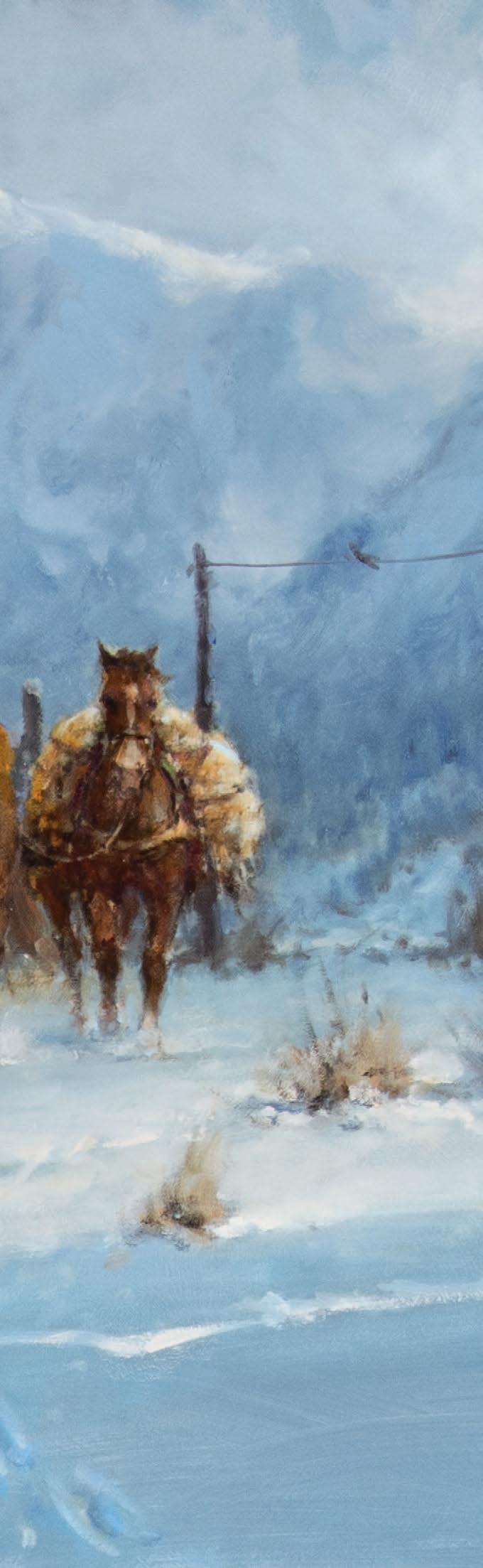
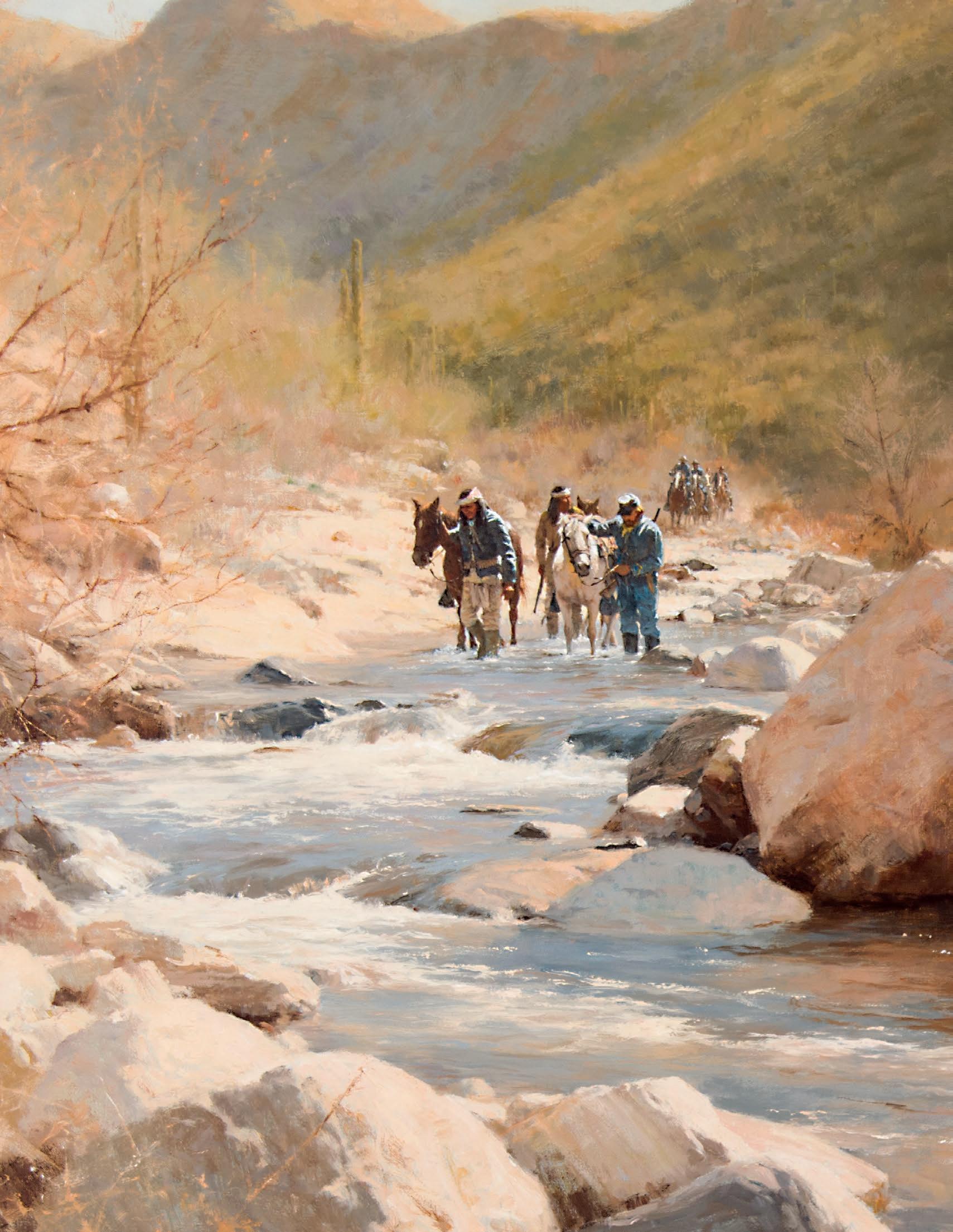
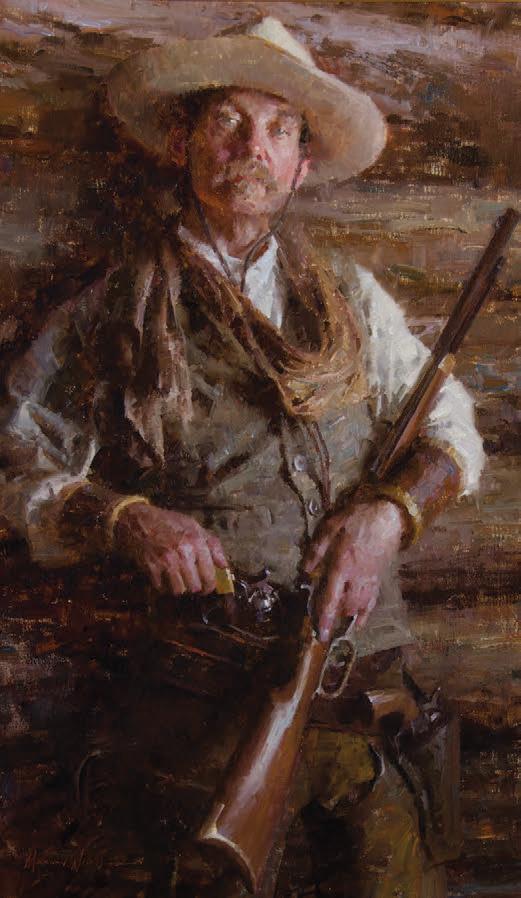
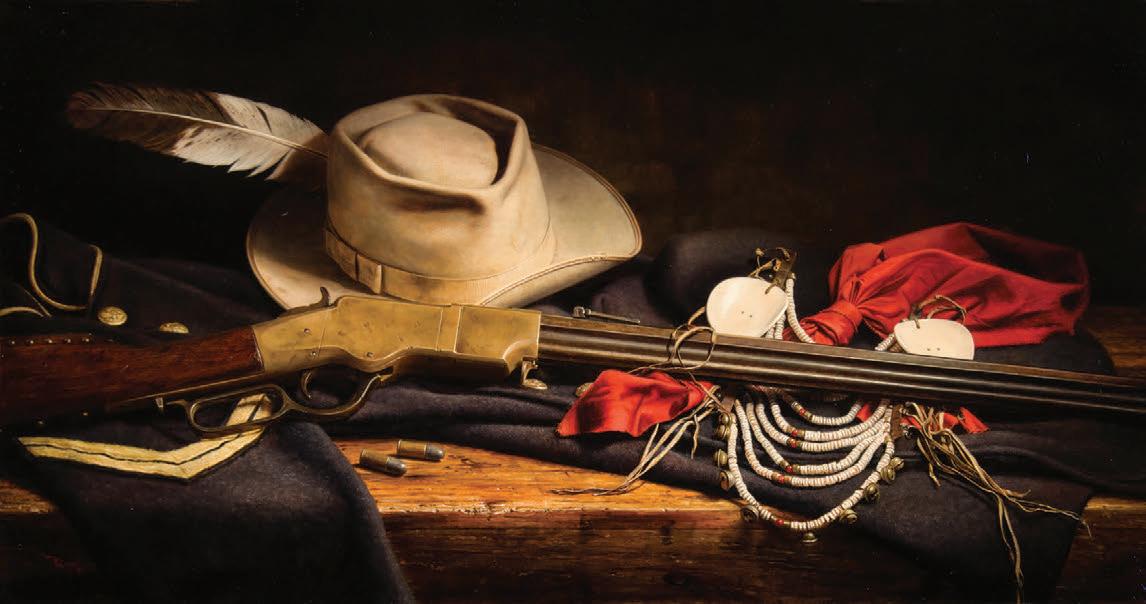
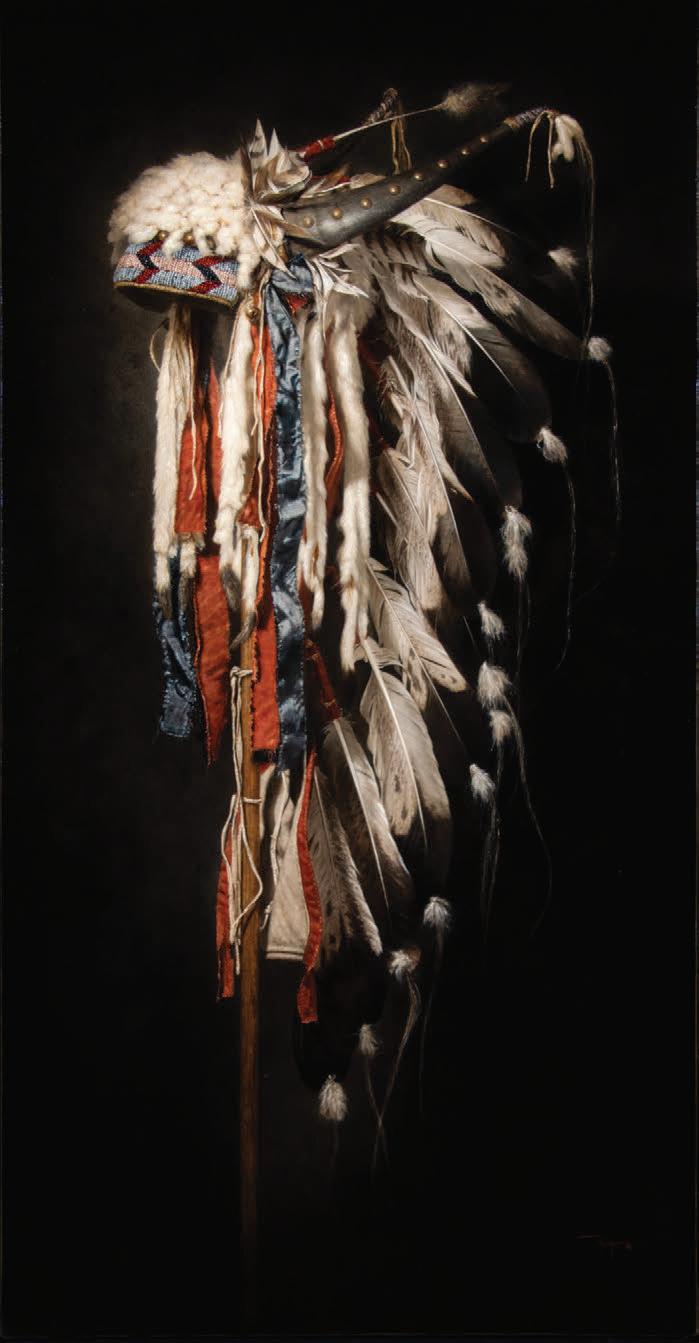
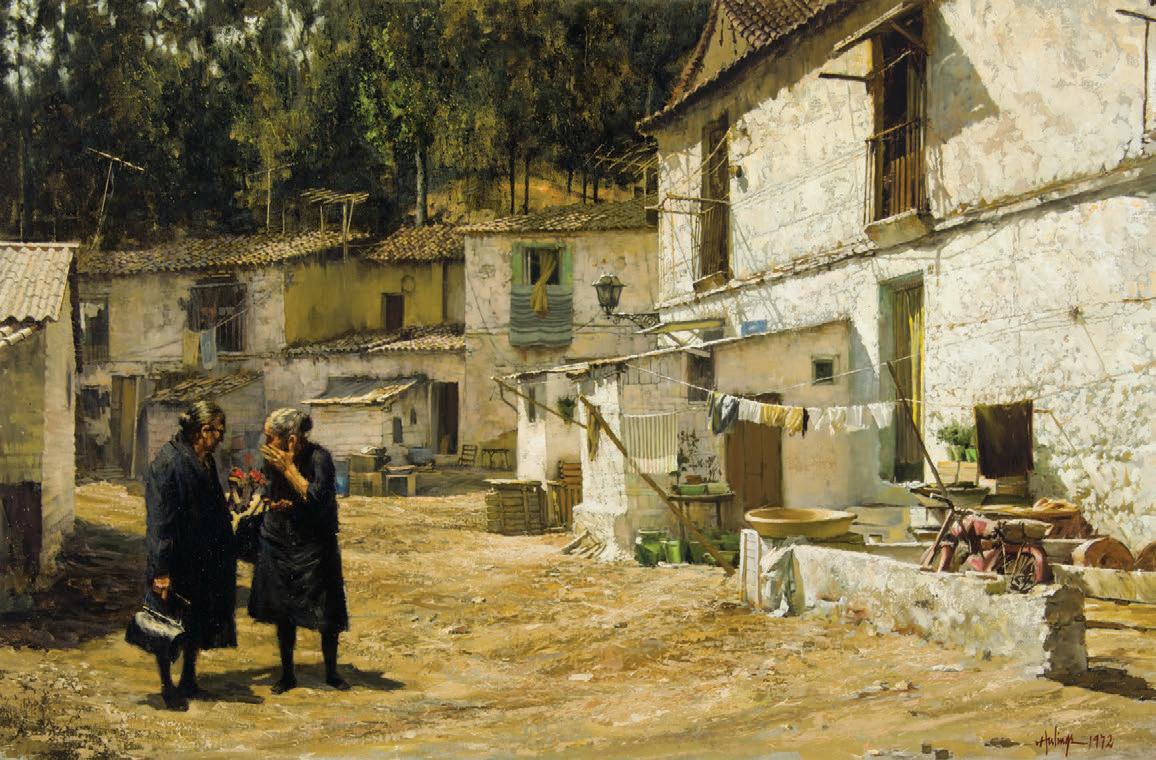
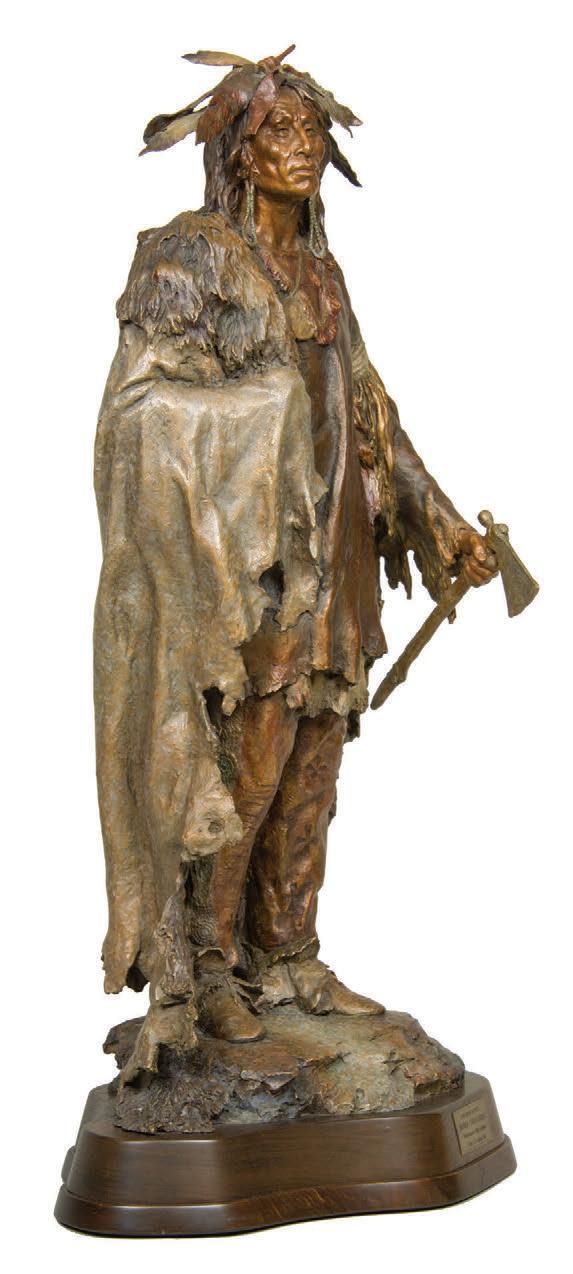
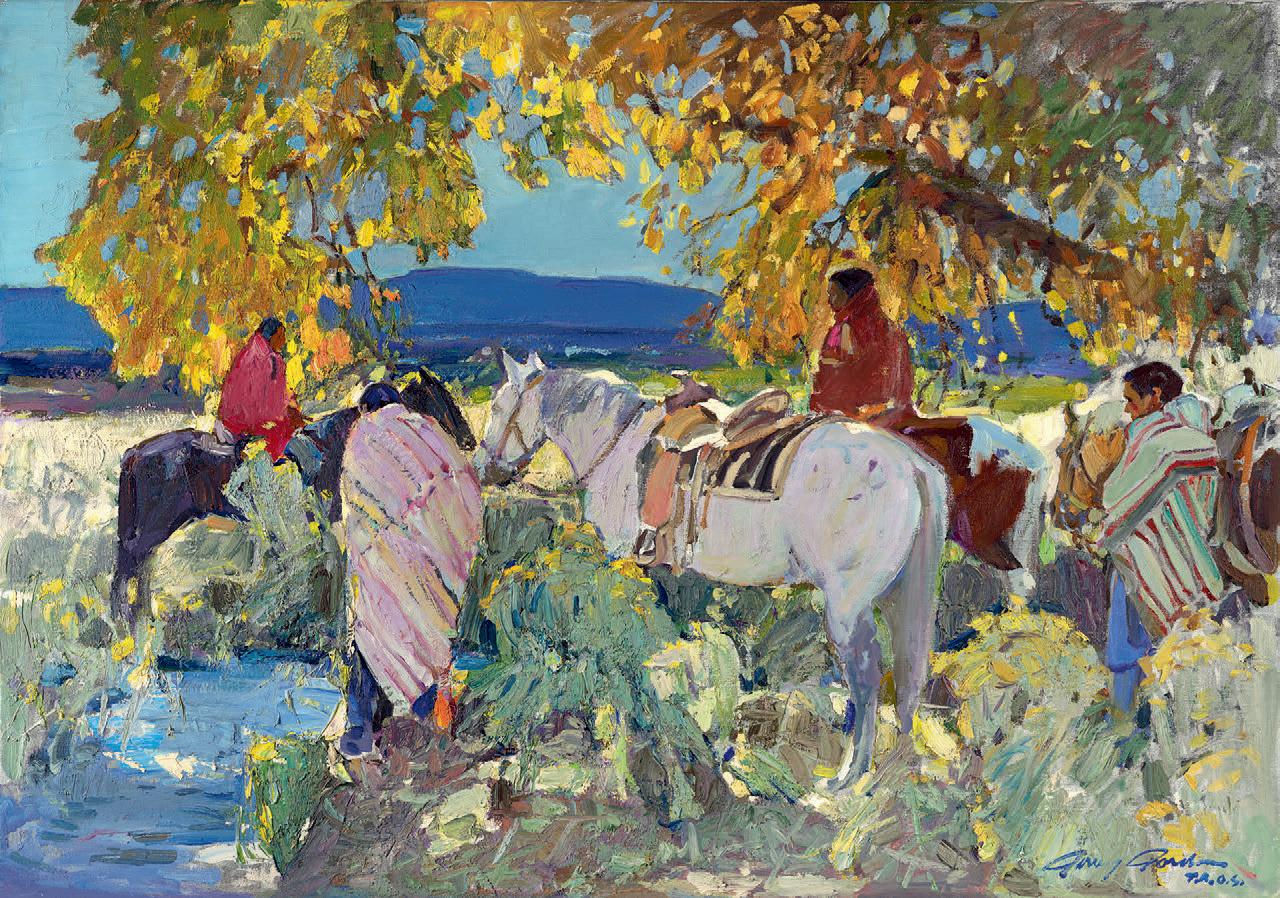
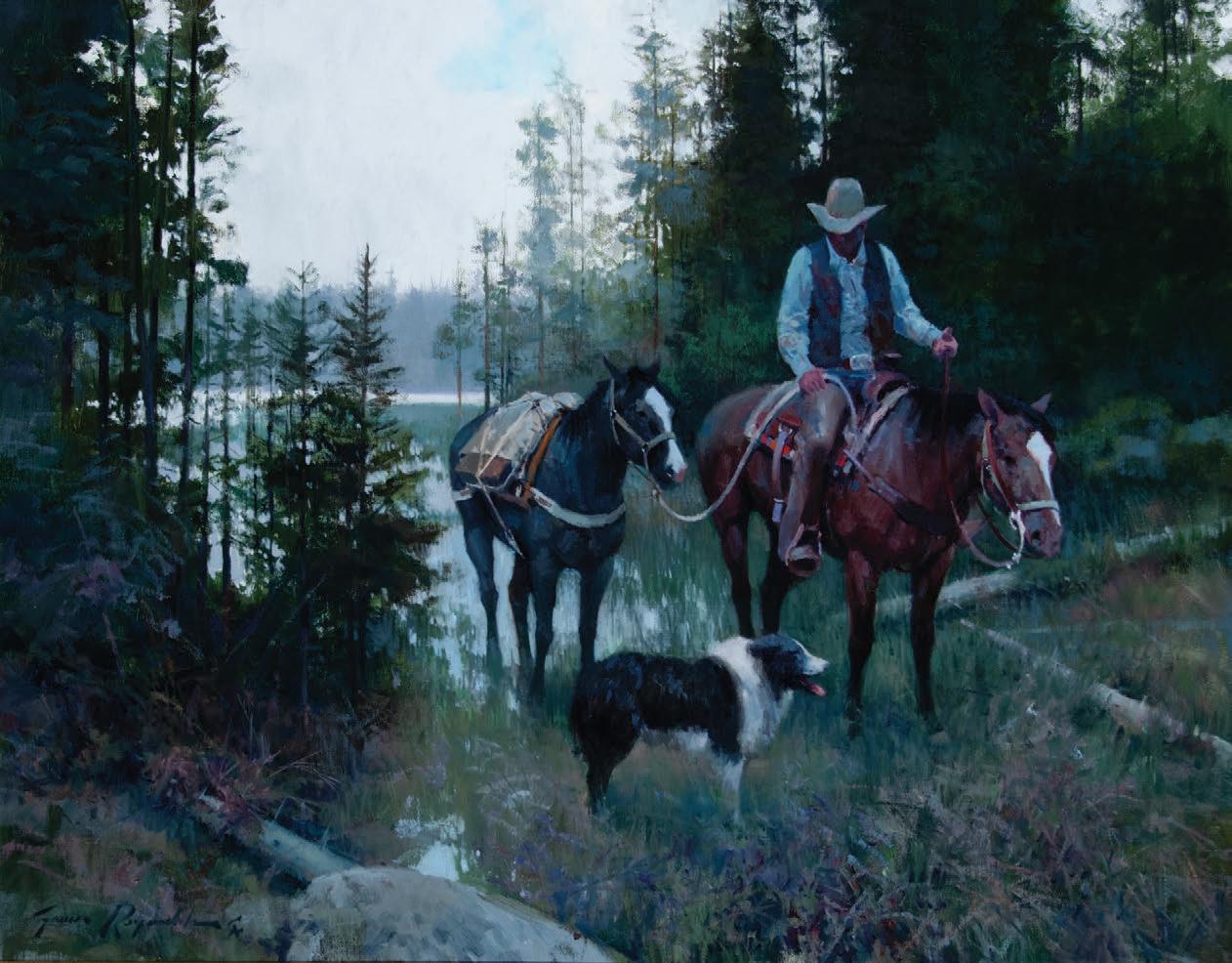
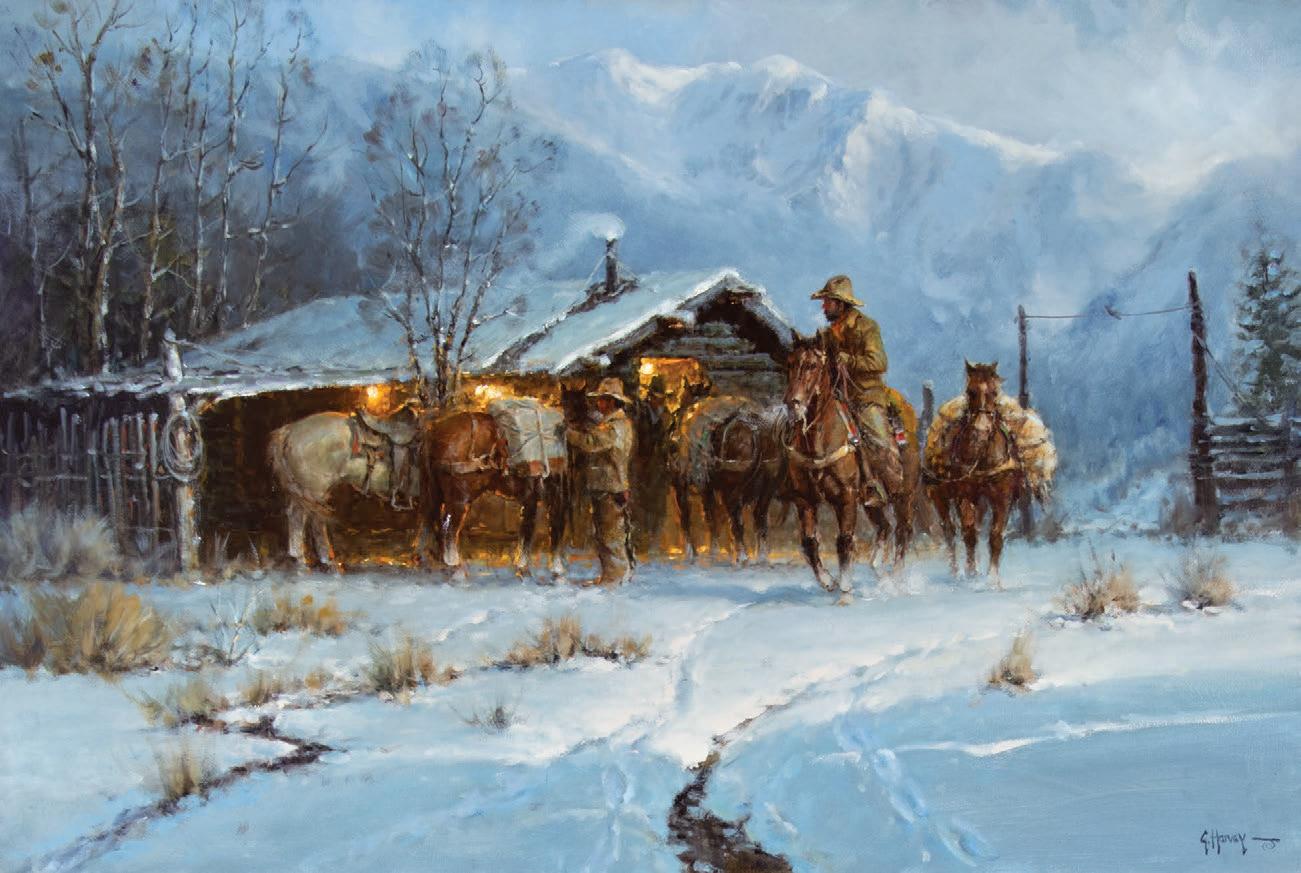
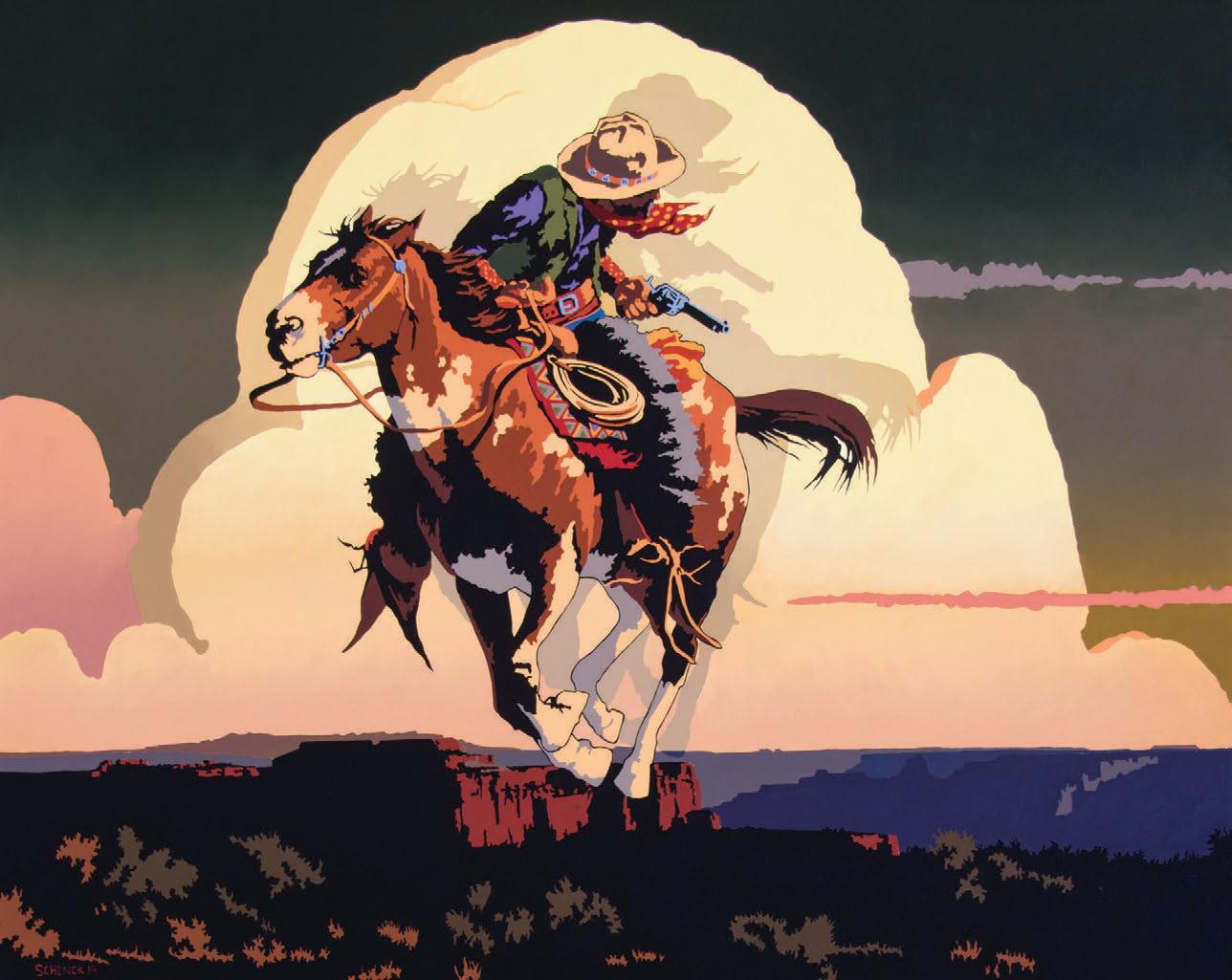
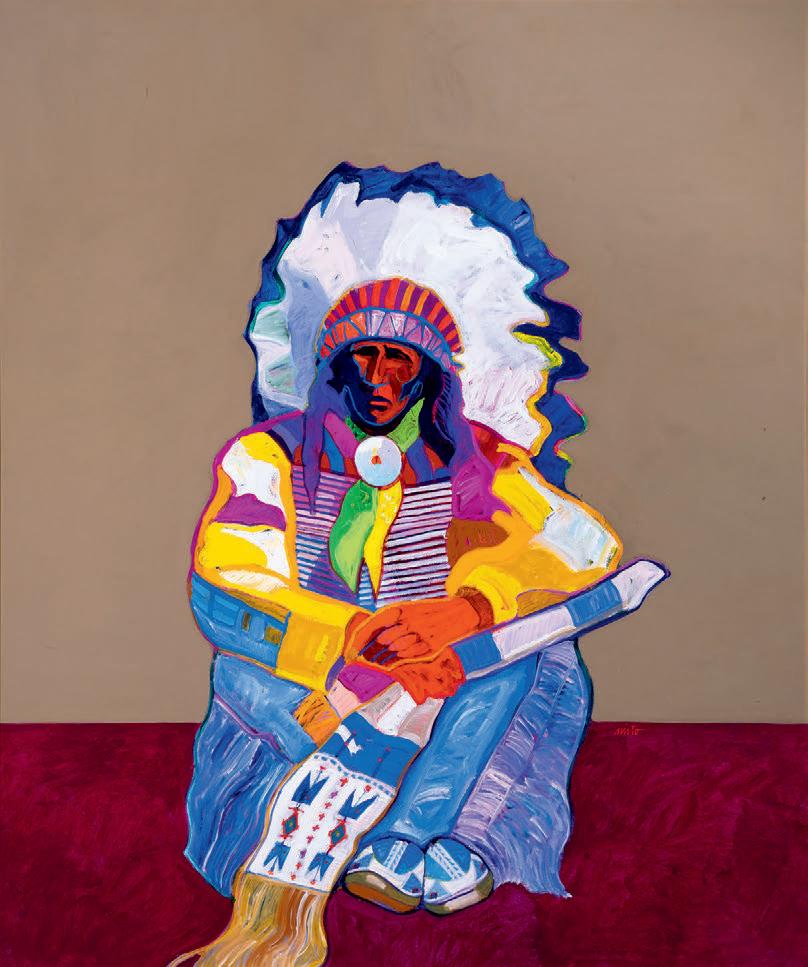
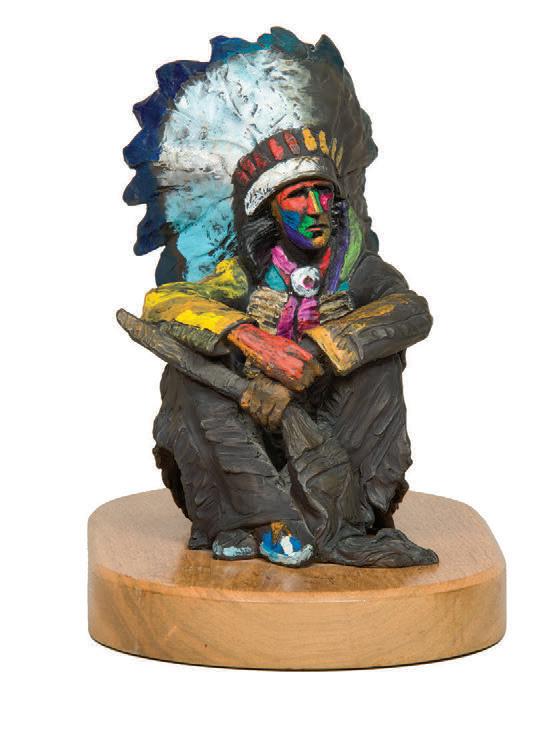
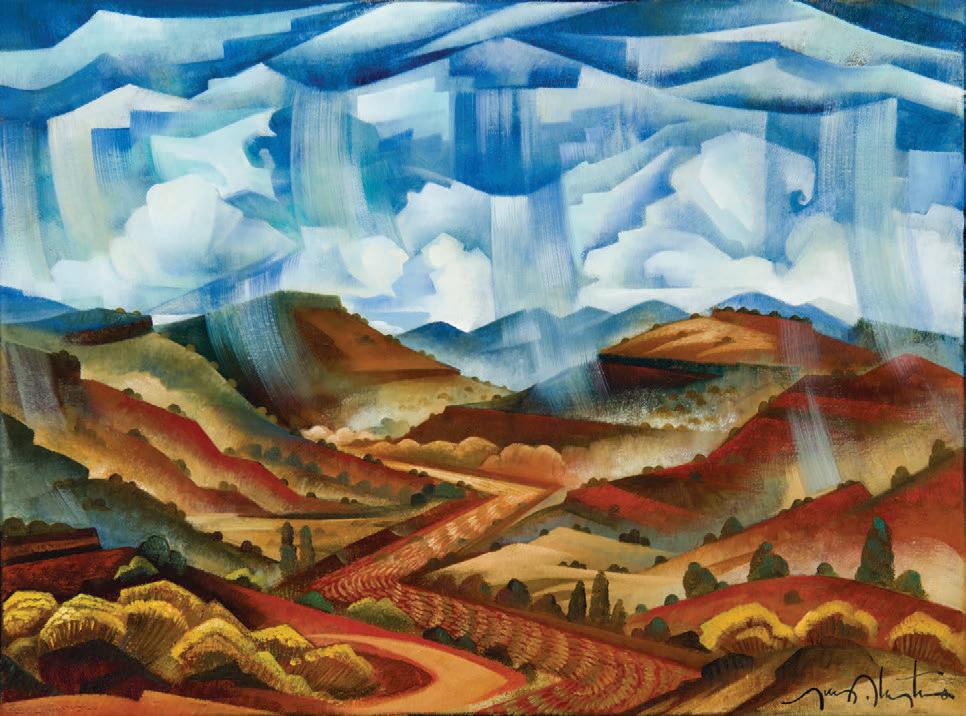
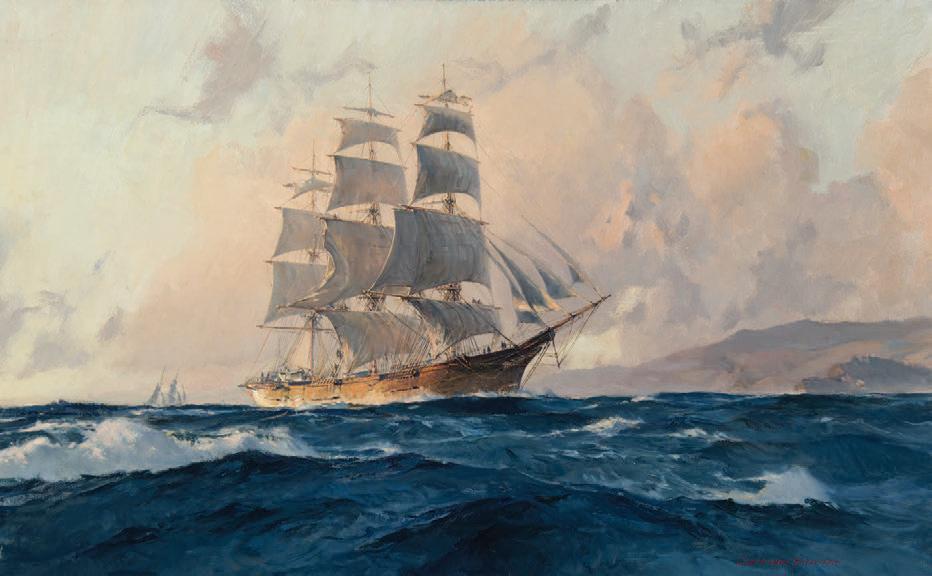
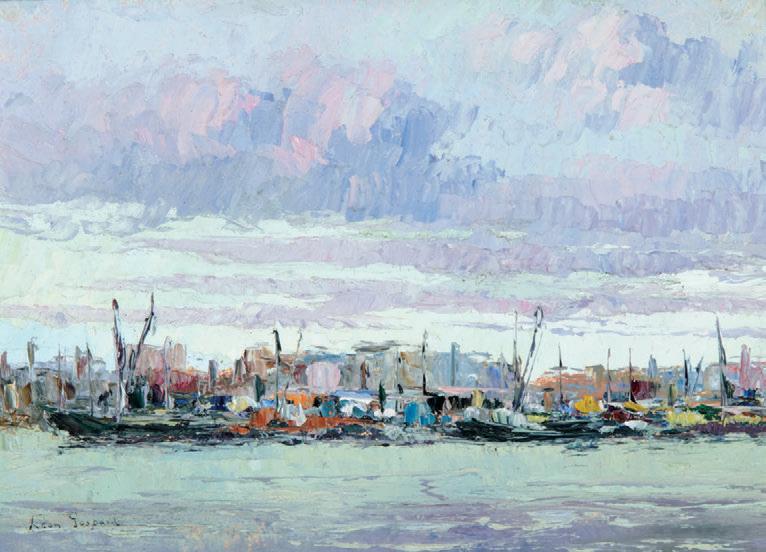
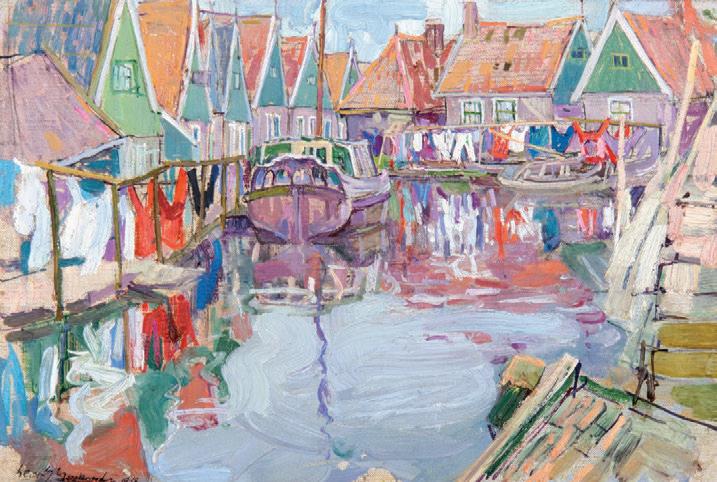
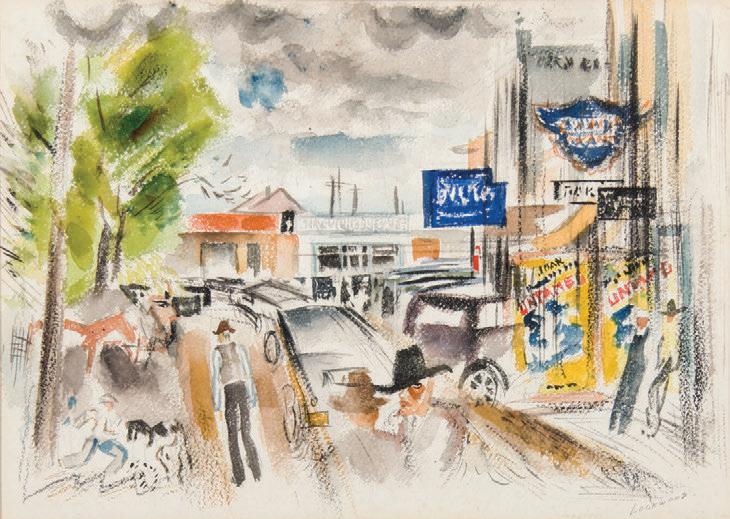
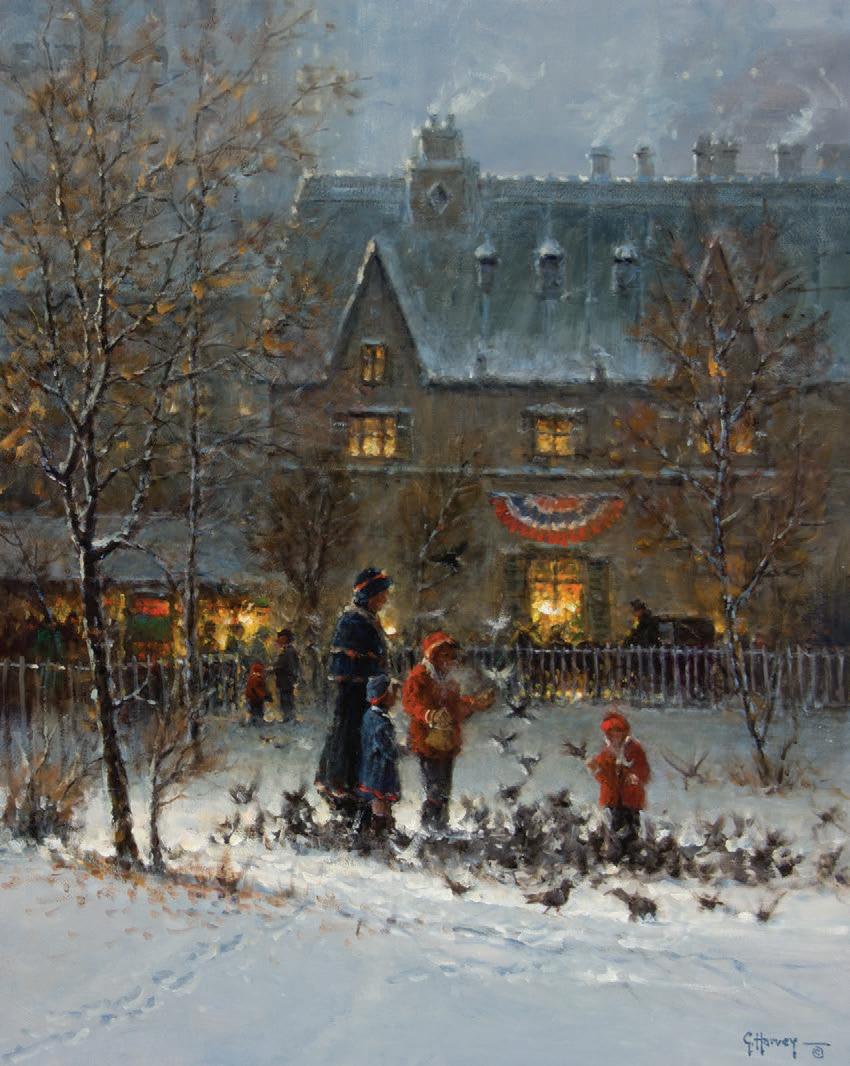
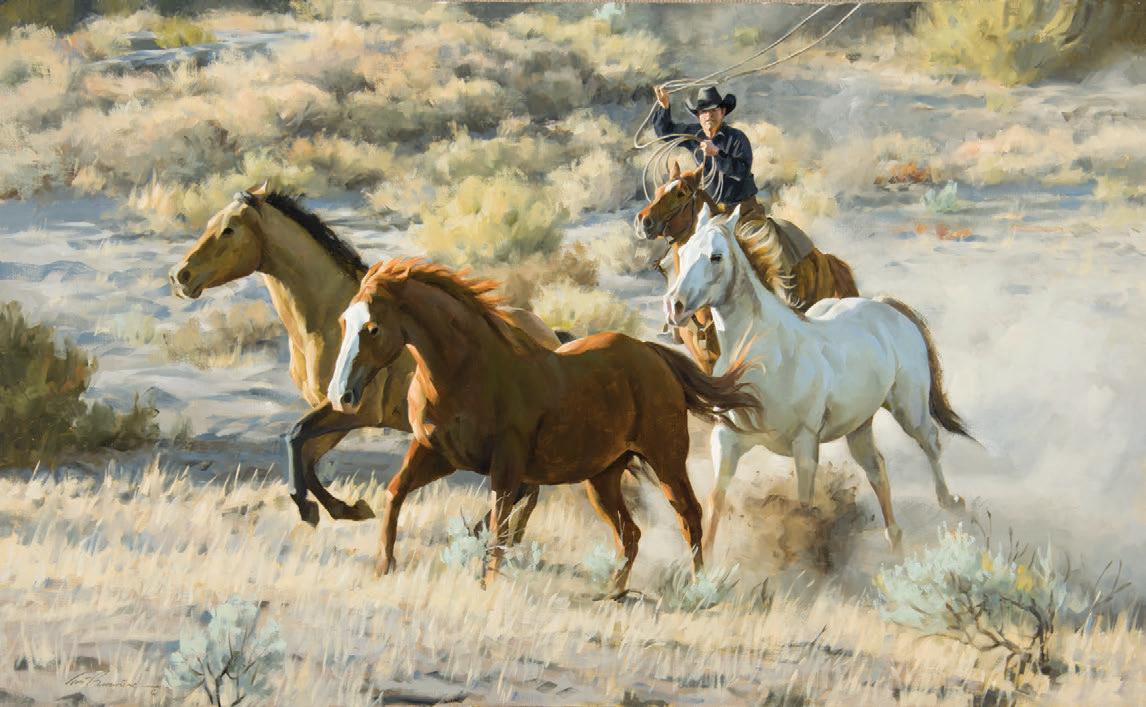
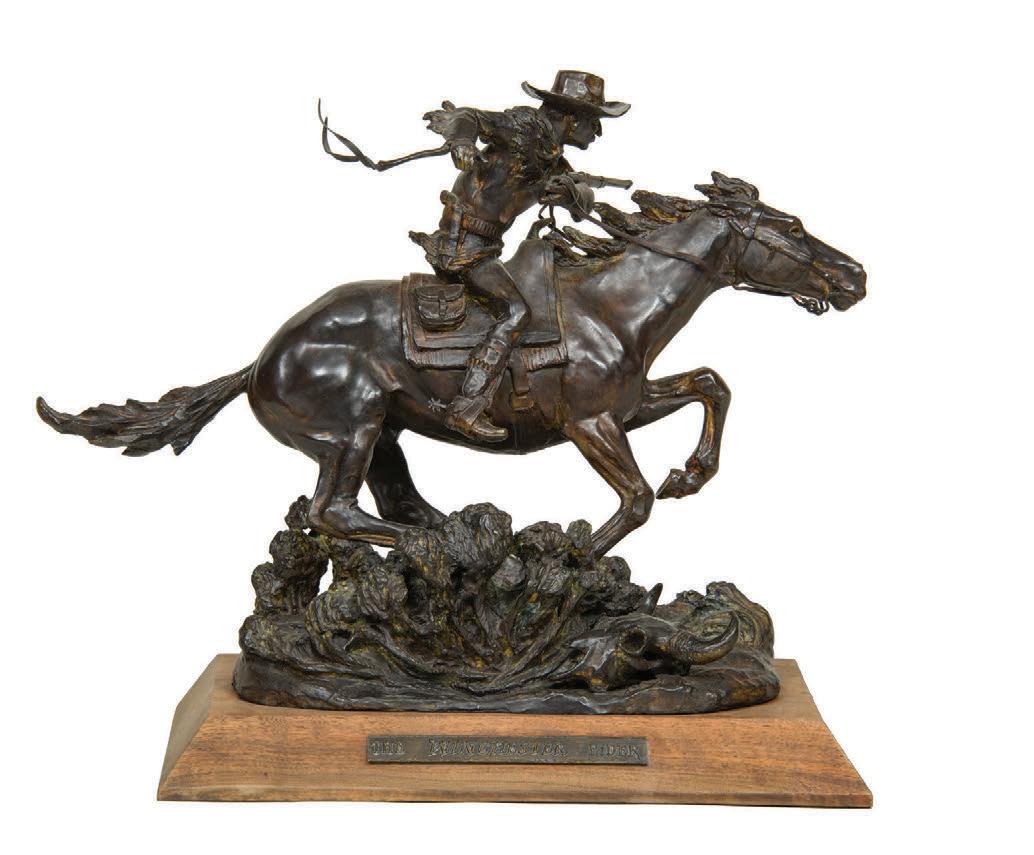
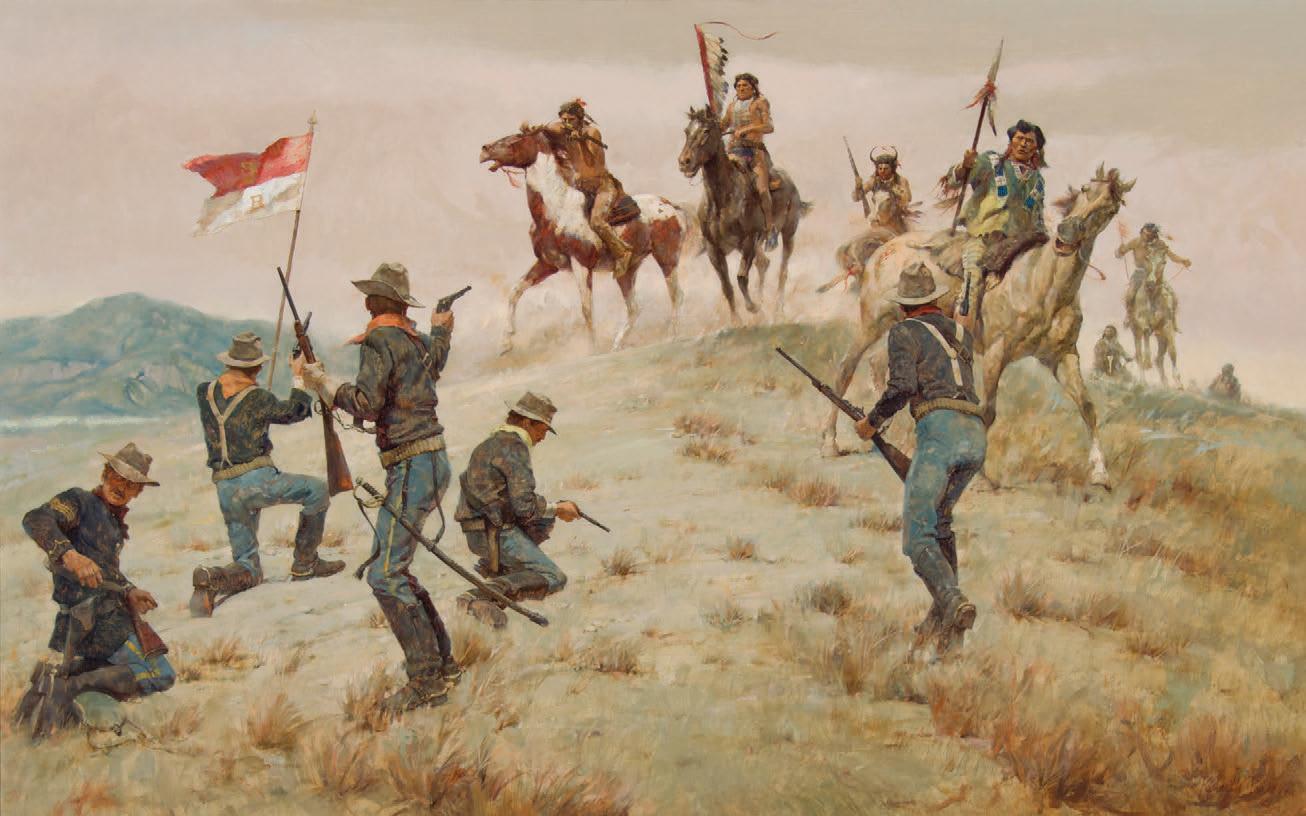
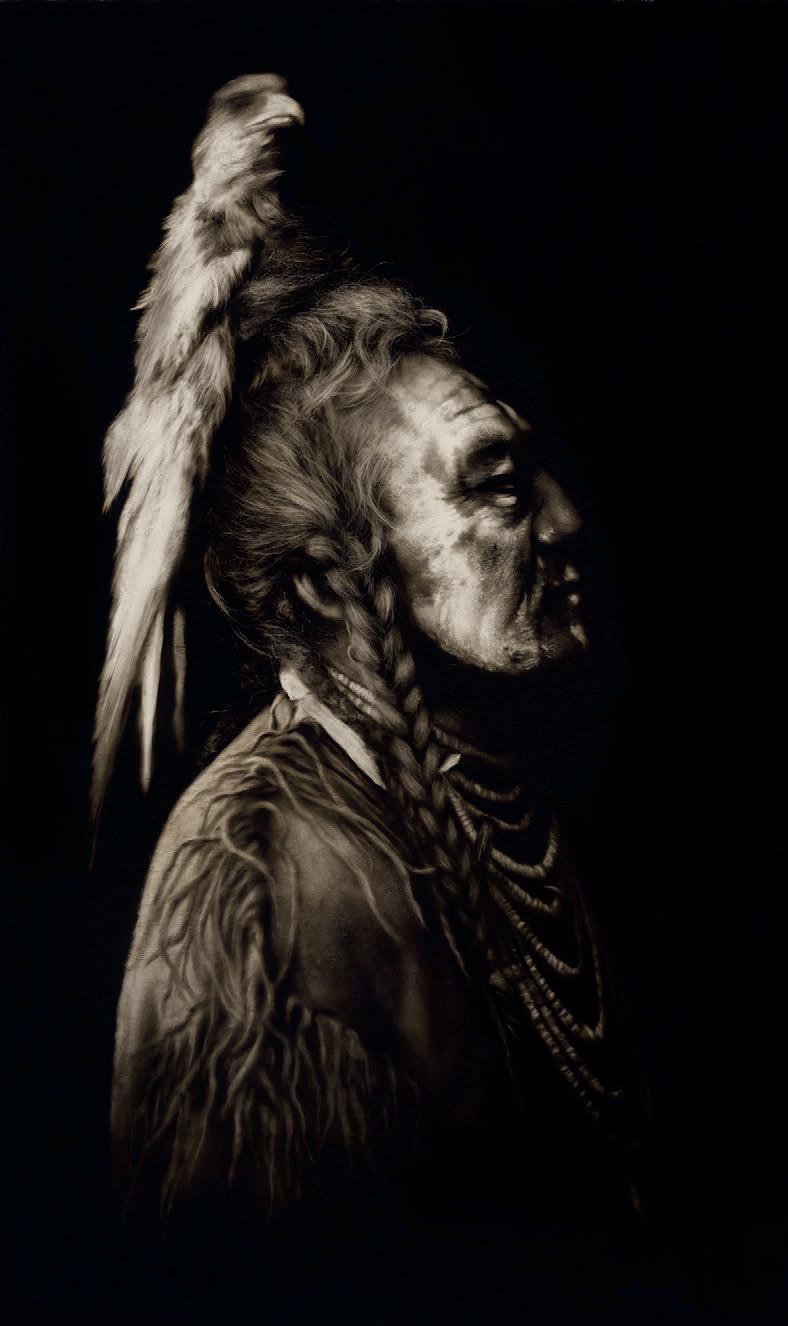
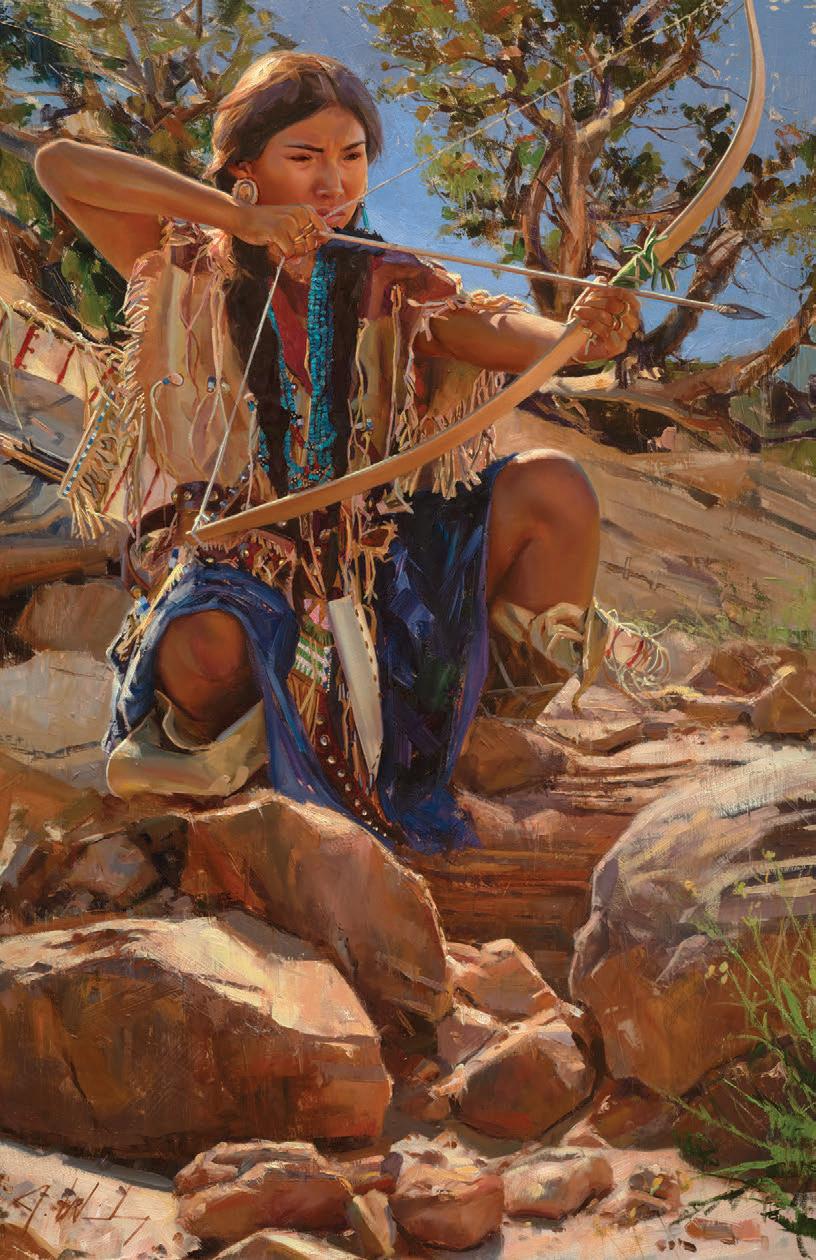
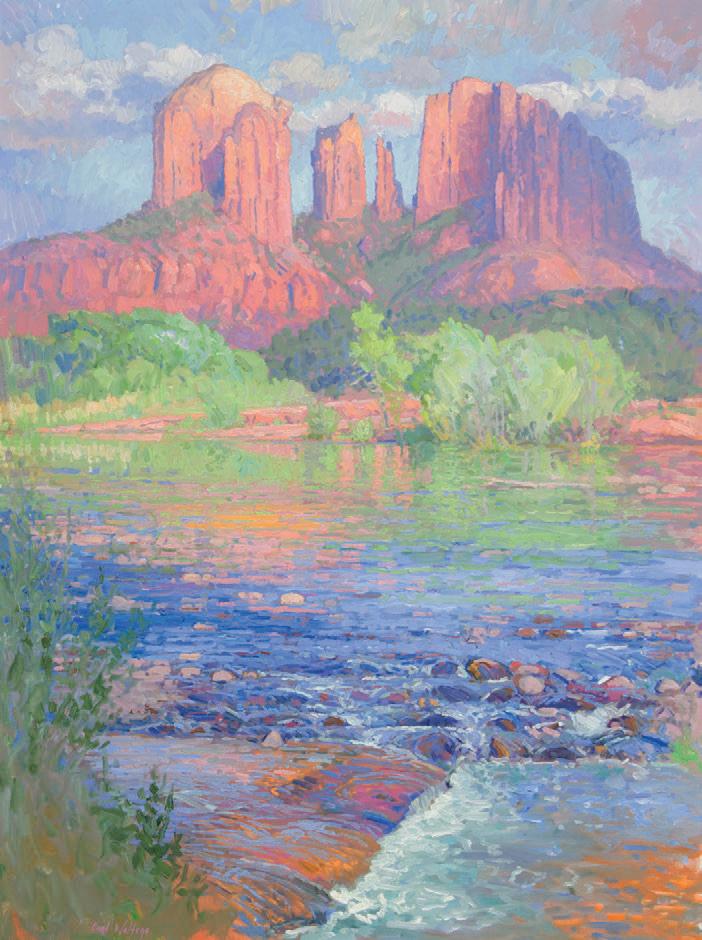
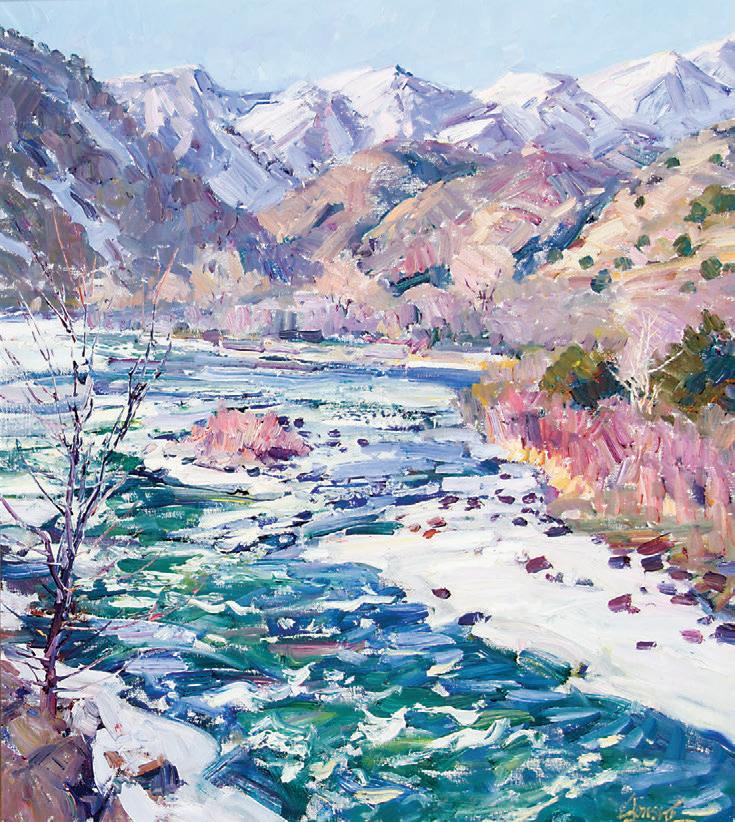
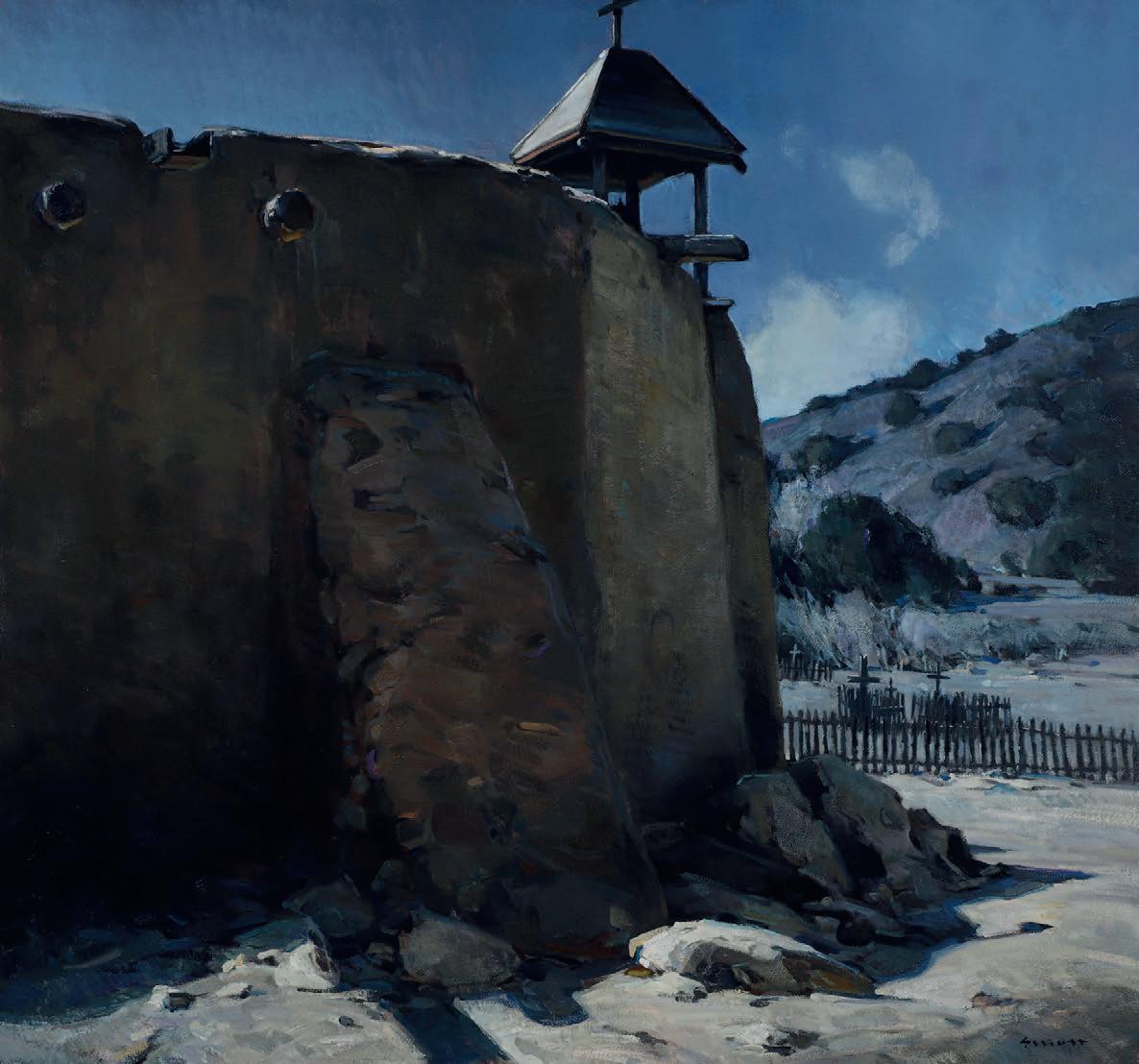
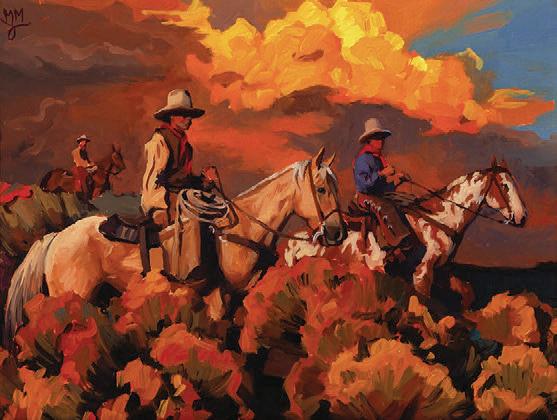
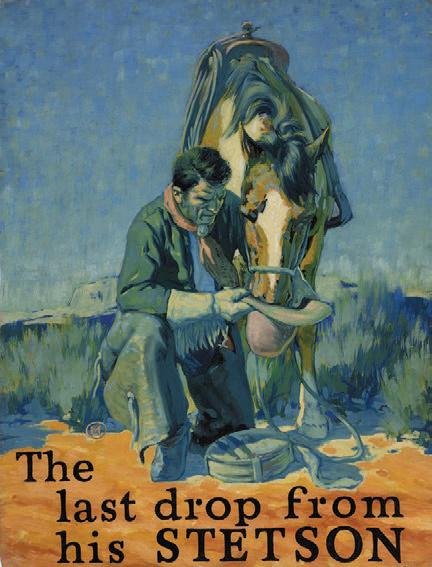
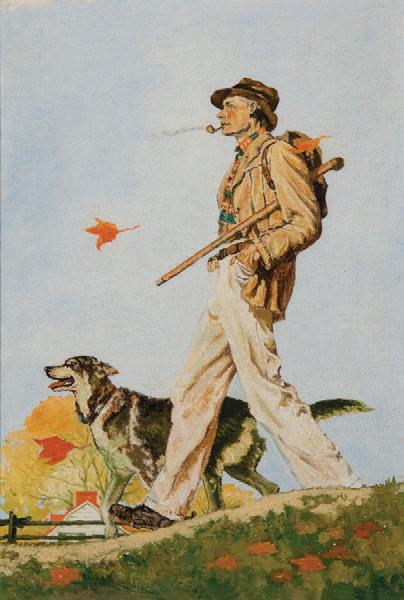
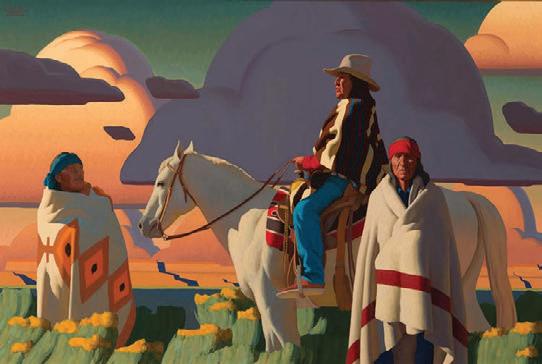
A.P. HAYS COLLECTION
April 11, 2026 · 12:00 p.m.
Abe Hays
9/8/1930 – 1/22/2025
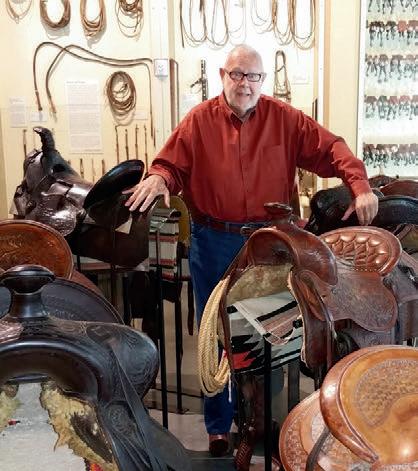
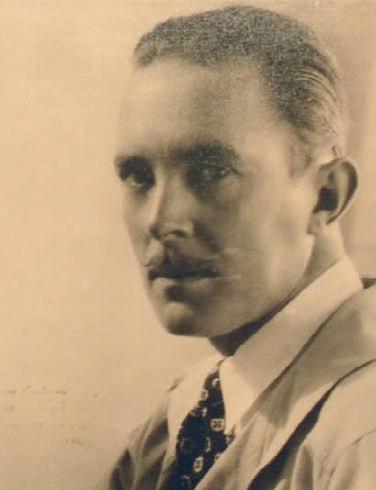
First arriving in Arizona as a child by way of Pittsburgh, Pennsylvania, A.P. Hays immediately fell in love with the American West. By his teen years in the 1940s, he was already collecting Western art and objects. In 1976, after a successful career in public relations, Hays moved to Scottsdale, Arizona, where he started Arizona West Galleries. The collector and art dealer, known by many as Abe, became a fixture at shows, auctions and events around the West, and quickly developed a reputation for a great eye when it came to Old West artifacts and paintings. When Western Spirit: Scottsdale’s Museum of the West opened its doors in 2015, visitors were greeted by the Abe Hays Family Spirit of the West Collection, the museum’s first permanent exhibition, which consists of 1,400 objects that includes historic Western saddles, rifles and revolvers, badges, gauntlets and horse gear.
Over 60 years collecting art, Hays owned thousands of pieces of history, including 17 works by Will James and 10 pieces by Carl Oscar Borg in this sale. There will be more of Abe's collection in future auctions to come.
Hays shared his knowledge and passion for Western Art with everyone he encountered. “I’m still a little boy, collecting little-boy things,” Hays told a reporter in 2015. “It’s just been a passion of mine that’s stayed my whole life.” A.P. “Abe” Hays died on January 22, 2025, in Scottsdale, Arizona.
Exhibited:
Many of these pieces were exhibited with Autry Museum Exhibit October 3, 97-Jan 4, 98
Provenance:
The A.P. Hays Collection, Scottsdale, AZ
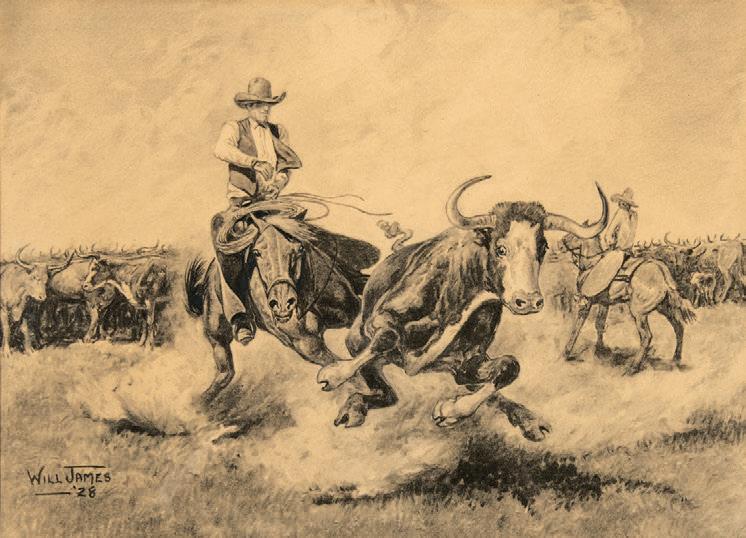
196
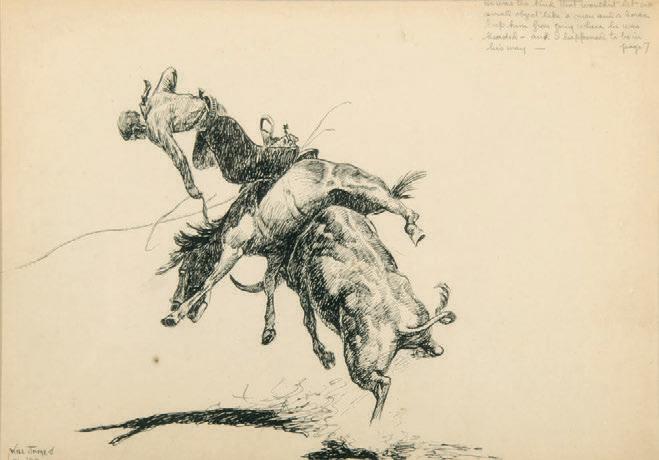
Will James 1892-1942
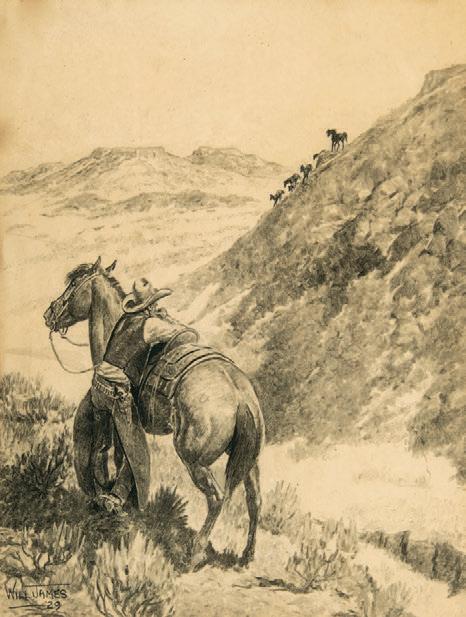
There Was Room for None But Experienced Men
Graphite
13 ½ x 18 ¾ inches
Signed and dated 28 lower left
Estimate: $10,000 - 15,000
Literature:
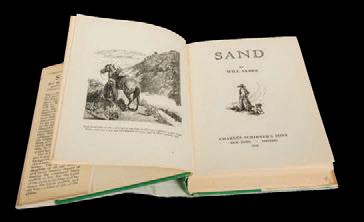
Sand: The Story of a Man and a Horse, Will James, Charles Scribner's sons, 1929, illustrated pg. 169
Noticias, Quarterly Magazine of the Santa Barbara Historical Society, Volume XLVII, No. 3, Autumn 2001, illustrated pg. 60
4 framed photographs of scenes from Sand (1949 movie starring Mark Stevens and Coleen Gray) to accompany this lot
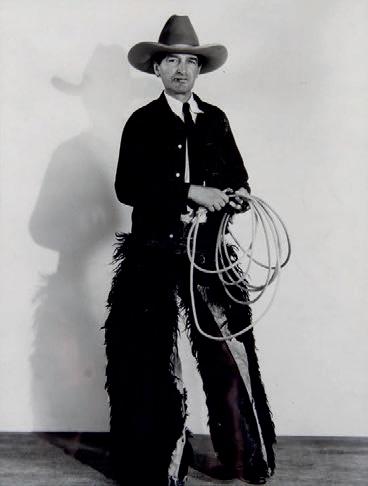
Will Roderick James 1892 - 1942
Born Joseph Ernest Nephtali Dufault near Montreal, Canada, Will James began drawing at an early age and dreamed of becoming a cowboy. At 15 he left home, eventually arriving in the United States in 1910, by which time he had changed his name to Will James and began working for large and small cow outfits in the West. Nearly killed when a horse he was breaking kicked him in the jaw, he endured six months of recuperative dentistry in Los Angeles. Turning bad luck to good, James joined several movie companies in Hollywood, performing as a daring stuntman on horseback and as a bit player in Westerns.
He attended the California School of Fine Arts in San Francisco, where he met Maynard Dixon and Harold Von Schmidt, through whom he received his first important appearance in print in a 1920 issue of Sunset Magazine That year, James met and married Mary Conradt, and joined the art colony in Santa Fe, New Mexico. Short stories and illustrations for Scribner's Monthly led to his first book, Cowboys North and South, a collection of short stories, and then, in 1926, his first novel, Smoky the Cowhorse During the 1930s, James' books ranked in sales, at times ahead of those of Ernest Hemingway and F. Scott Fitzgerald.
James settled in Montana in 1927, where he continued writing and drawing for Scribner's and developing script outlines of his books for film studios. In 1942, he completed emotionally exhaustive work on The American Cowboy, which received mixed reviews. His physical deterioration soon caused liver and kidney failure, from which he died at age 50. In his final book Will James chose to capitalize his last written words: “THE COWBOY WILL NEVER DIE.” If true, his own body of work will have much to do with assuring that mortality.
A.P. Hays
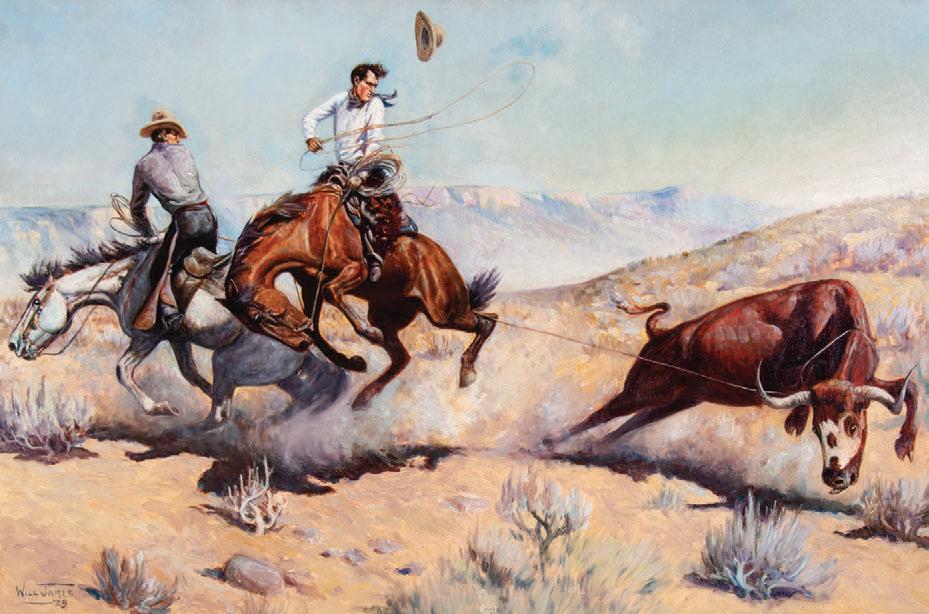
197
Will James 1892-1942
A Heeler in the Slack Oil on canvas 24 x 36 inches
Signed and dated 29 lower left
Estimate: $50,000 - 75,000
Literature:
Will James: The Spirit of the Cowboy, Nicolaysen Art Museum, Casper, WY, 1985, pg. 39
The Cattleman, Volume XXXIX, No. 6, Fort Worth, TX, Nov 1952, cover Western Art Digest, Sept/Oct 1985, Volume XII, Issue 4, Artists of the Rockies and The Golden West, Inc., Colorado Springs, CO, pg. 121
A copy of each (above) to accompany this lot
Noticias, Quarterly Magazine of the Santa Barbara Historical Society, Volume XLVII, No. 3, Autumn 2001, illustrated on pg. 64-65
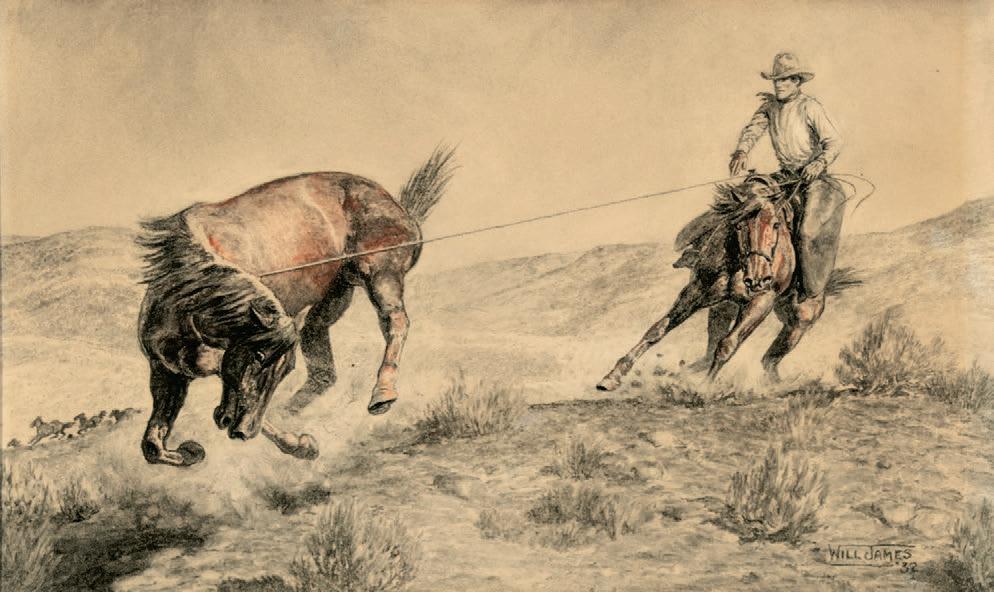
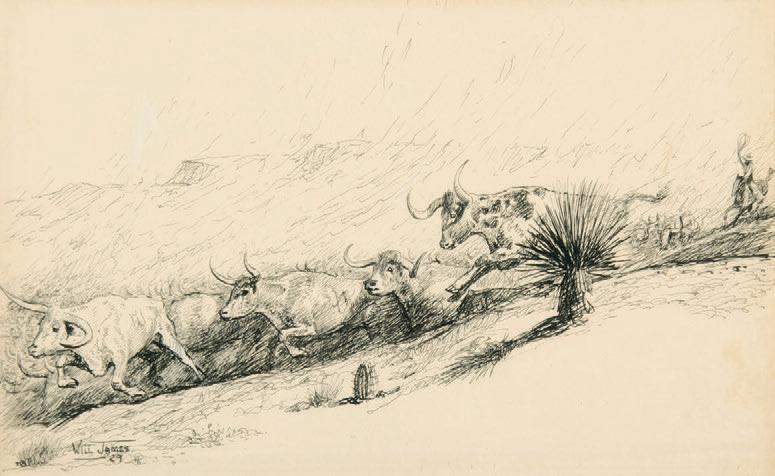
198
Will James 1892-1942
His Rambling Trail had Covered
Thousands of Miles of Range Land
Mixed Media
13 ¼ x 22 ¼ inches
Signed and dated 32 lower right
Estimate: $12,000 - 18,000
199
Will James 1892-1942
Curly Bill and His Buccaneers
Pen & Ink
9 x 14 ¾ inches
Signed and dated 29 lower left
Estimate: $5,000 - 7,000
Literature:
Tombstone by Walter Noble Burns, Doubleday, Doran & Company, Inc., 1929, illustrated after pg. 80
A copy of this book to accompany this lot
Literature: Uncle Bill: A Tale of Two Kids and a Cowboy by Will James, Charles Scribner's sons, 1932, illustrated on pg. 143
A copy of this book to accompany this lot
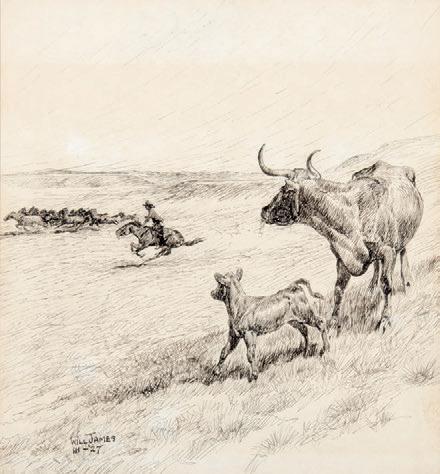
200
Will James 1892-1942
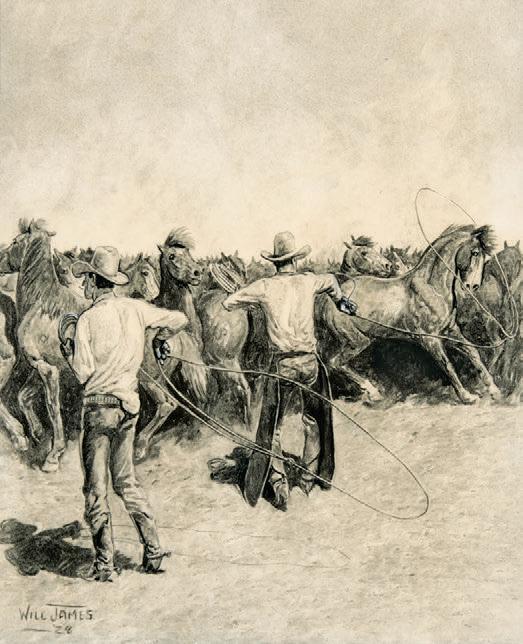
Gathering the Remuda Pen & Ink
11 ¼ x 10 ½ inches
Signed and dated 27 lower left
Estimate: $4,000 - 6,000
Literature: All In The Day's Riding by Will James, Charles Scribner's sons, 1927, pg. 142
A framed reproducton of "Range Table Etiquette" from pg. 39 & 40 in All In The Day's Riding book, to accompany this lot
201
Will James 1892-1942
Smoky and Clint Oil on canvas
28 x 22 inches
Signed lower left
Estimate: $50,000 - 75,000
Literature:
Smoky the Cowhorse, Will James, Charles Scribner’s Sons, New York, NY, 1926, illustrated on cover.
Noticias, Quarterly Magazine of the Santa Barbara Historical Society, Volume XLVII, No. 3, Autumn 2001, illustrated on the cover
A copy of each (above) and a Complete set of 8 lobby cards for Smoky movie starring Fred MacMurray and Anne Baxter to accompany this lot
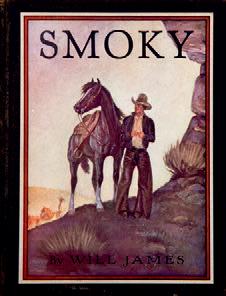
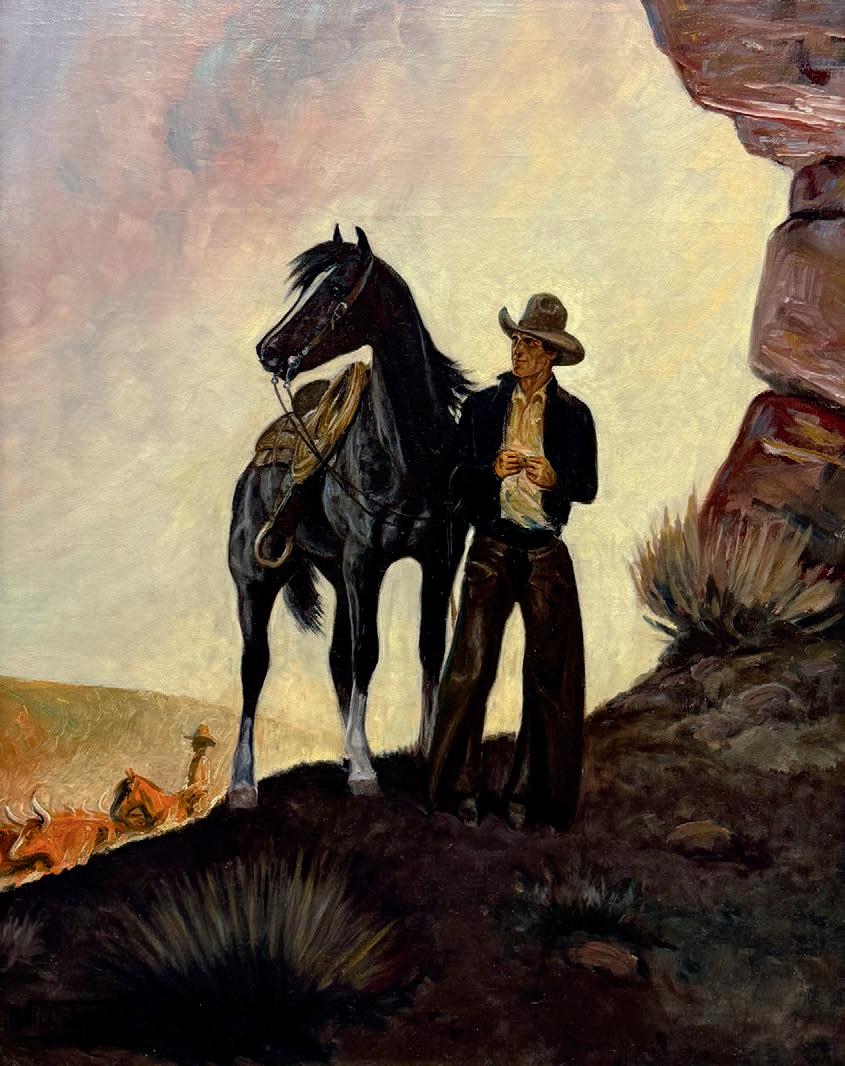
Although Will James had already seen success in his writing career, it was Smoky the Cowhorse from 1926 that saw the artist’s work soar to new heights. James, who wrote and illustrated the book, saw the story as a work for adults, but it was discovered by children, which propelled it to win the 1927 Newbery Medal, given to the “most distinguished contributions to American literature for children.” The book was such a hit that it was adapted to film three times: a 1933 version, a 1946 version with Fred MacMurray and Anne Baxter, and a 1966 version with Davy Crockett actor Fess Parker. James’ artwork has appeared on many editions of the book, including Scribner’s first edition, which featured a drawing of Smoky at the gate of a ranch. This painting, Smoky and Clint, appeared on the first edition of the Illustrated Classics Edition, also published by Scribner’s. Both editions were released in 1926.
In an article for the American Library Association, writer Barbara Elleman dug deeper into the Newbery Medal’s award to James. She refers to James’ editor, the renowned Maxwell Perkins, who nursed such luminaries as Thomas Wolfe, Ernest Hemingway and Marjorie Kinnan Rawlings into print. “The elitist Perkins, it seems, treasured the ten-gallon hat given to him by James and found the authentic American vernacular of James’ writing highly likable,” Elleman writes. “A cowboy with a quick wit, James was amazed to find Smoky winning the Newbery, saying it had been published as a book for adults. ‘I don’t know about that medal, but it’s fine with me.’ Some librarians criticized the book as too full of ‘cowboy lingo,’ saying that boys and girls would never read it. Others (among them undoubtedly the Newbery committee) found it ‘a bit of poetry in disguise,’ full of humor, color and excitement. The story did in fact prove highly popular and continual reprints necessitated new plates in 1955.”
Exhibitions:
202
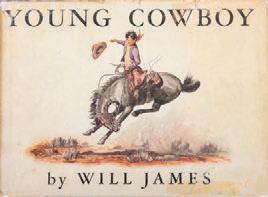
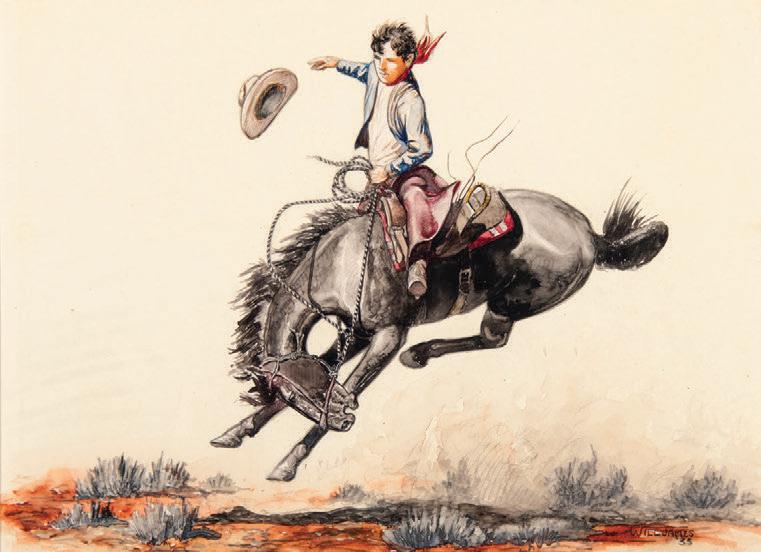
Will James 1892-1942
Young Cowboy Watercolor
11 x 15 inches
Signed and dated 35 lower right
Estimate: $10,000 - 15,000
Literature:
Young Cowboy, Will James, Charles Scribner’s Sons, New York, NY, 1935, illustrated on cover.
A copy of this book to accompany this lot
Will James: Cowboy Artist and Author, Western Spirit: Scottsdale’s Museum of the West, Scottsdale, AZ, 2015-2016, 2019.
Originally published in 1935, Will James’ Young Cowboy was a children’s story told from a child’s perspective. In the story, young Billy Roper dreams of becoming a cowboy like his father. On his fourth birthday, Billy is given his first horse, a black horse named Big-Enough. The 72-page book chronicles the next several years as Billy and Big-Enough grow to trust each other so Billy can become a “good, all-around cowboy on his father’s ranch.” The book contains 15 illustrations, in addition to four color plates, a title label on the cover and the frontispiece, seen here. All were done by James. Later editions of the book moved this color image to the cover instead of the original black-and-white drawing.
In the story, James wonderfully captures Billy’s first ride: “Billy was a wolf; he’d turned challenger and was pawing the black from ears to rump. Daylight showed plenty between him and the saddle but somehow he managed to stick on and stay right side up. The horse, surprised at the change of events, finally let up on his bucking; he was getting scared and had found a sudden hankering to start running. After that it was easy for Billy; he rode him around the corral a couple of times and then, all smiles and proud as a peacock, he climbed off. Billy had ridden his first bronc.”
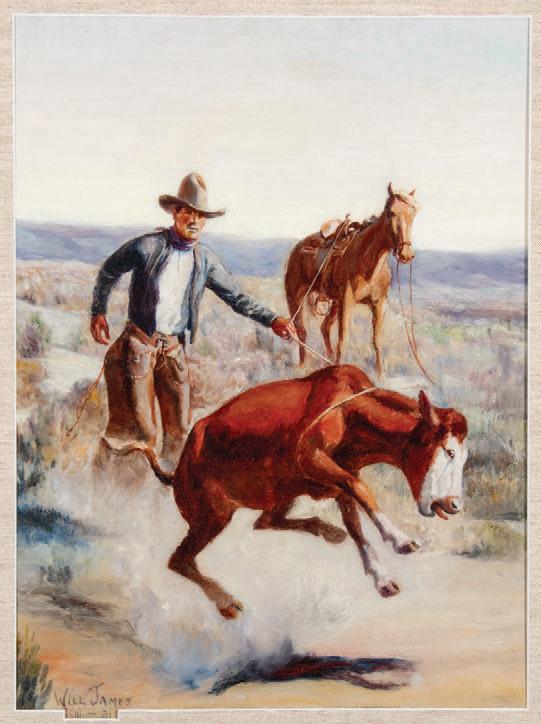
203
Will James 1892-1942
Calf Roping
Oil on board
20 ¼ x 15 inches
Signed and dated 21 lower left
Estimate: $20,000 - 40,000
Literature: Western Story Magazine, June 15, 1929, illustrated on cover
Framed Will James' Nevada State Prison, at Carson City, mugshot, April 1915 to accompany this lot
Conviction: Cattle Rustling
"Will R. James arrested for cattle rustling at Oasis, Utah 11/15/14 for driving Swallow Bros. cattle from Eastern Nevada. Served time at Carson City Nevada at Nevada State Prison, Inmate # 1778. Released a month early in April, 1916 after serving about 17 months..."
204
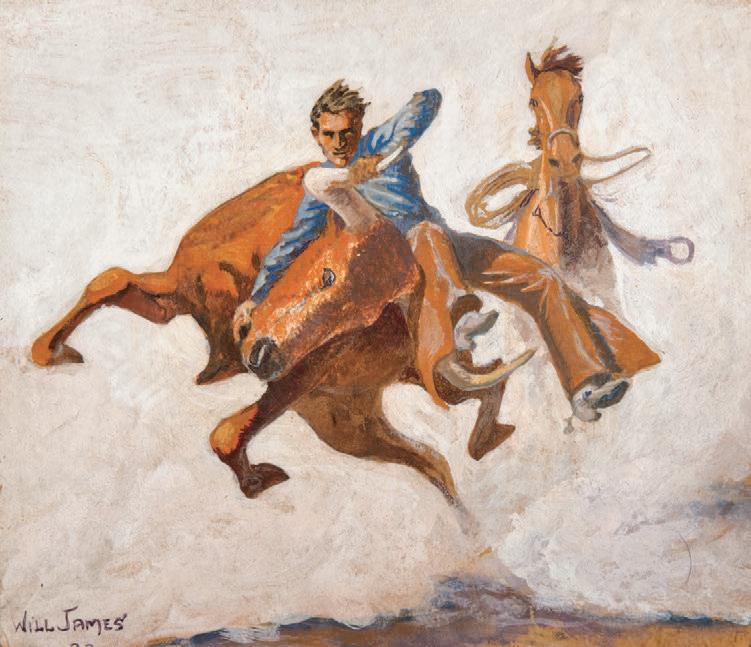
Will James 1892-1942
Bull Dogger sketch Oil on board
8 x 9 inches
Signed and dated 22 lower left
Estimate: $18,000 - 24,000
205
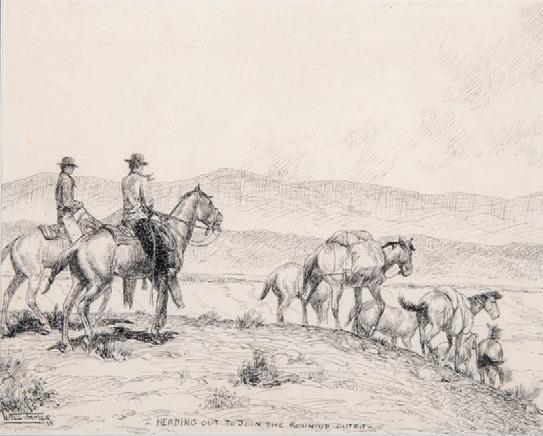
Will James 1892-1942
Heading Out to Join the Roundup Outfit
Pen & Ink
8 x 10 inches
Signed and dated 33 lower left; titled lower middle
Estimate: $5,000 - 8,000
Literature: The Three Mustangeers by Will James, Charles Scribner's sons, 1933, illustrated pg. 225
A copy of this book to accompany this lot
206
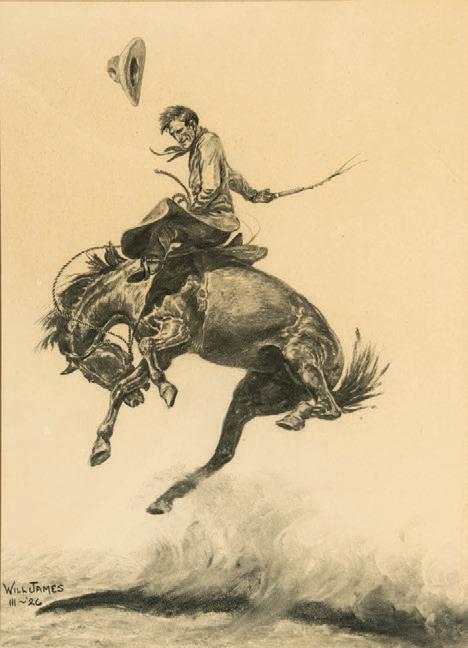
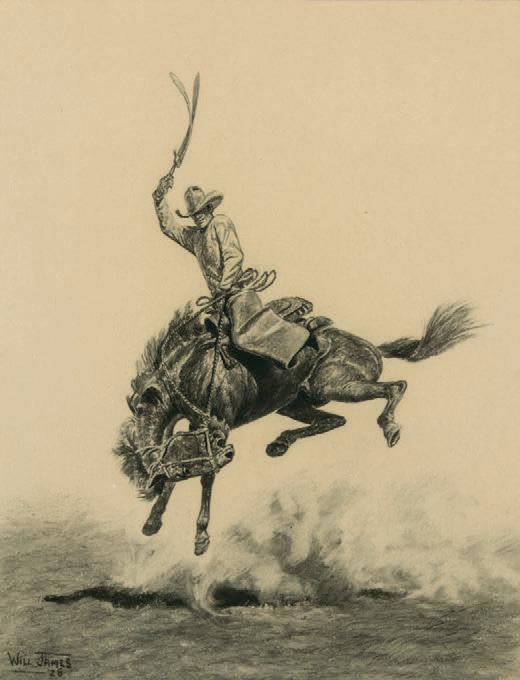
Will James 1892-1942
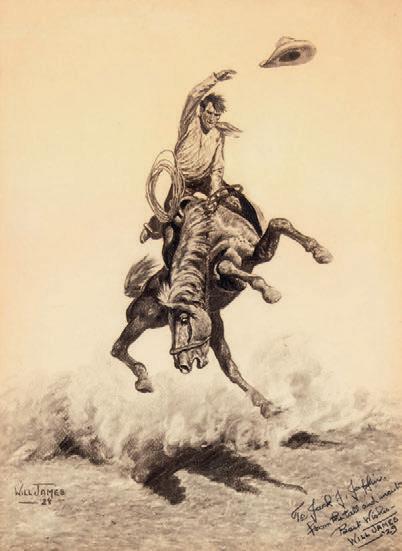
Bucking Horse
Graphite
19 ½ x 14 inches
Signed and dated 26 lower left
Estimate: $8,000 - 12,000
Exhibited: Autry Museum Exhibit October 3, 97-Jan 4, 98
Literature: Noticias, Quarterly Magazine of the Santa Barbara Historical Society, Volume XLVII, No. 3, Autumn 2001, illustrated pg. 63
Photograph and original Will James letter to accompany this lot
207
Will James 1892-1942
...A Glimpse of that Black Horse
Graphite
18 ¼ x 13 ¾ inches
Signed and dated 29 lower left
Estimate: $5,000 - 7,000
Literature:
Sand: The Story of a Man and a Horse, Will James, Charles Scribner’s Sons, New York, NY, 1929, title page.
A copy of this book to accompany this lot
Created in 1929 for Will James’ own cowboy novel Sand, the graphite drawing …A Glimpse of that Black Horse appeared next to the title page in the book’s first edition. “This is a story of a man and a horse. Both have ‘sand’—the gumption it takes to tackle the challenges of life head on,” the original synopsis reads. “The setting is the Great Plains. The characters are cowboys and horses. The heart of this story is the hero’s long duel with the horse, and how ‘the little grain of sand within him’ starts to grow.” In a brief intro, James reveals that he is the main character, the Kid. “I guess this story goes as fiction,” he wrote, “but to me it’s pretty true…”
208
Will James 1892-1942
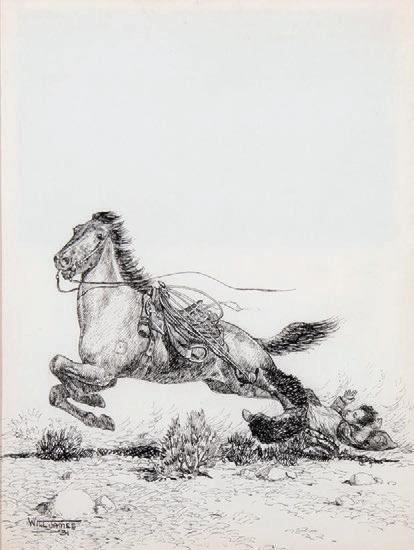
Big Enough
Pen & Ink
11 ⅞ x 9 inches
Signed and dated 31 lower left
Estimate: $5,000 - 8,000
Literature:
Big-Enough by Will James, Charles Scribner's sons and The McCall Company, 1931, pg. 101
A copy of the book to accompany this lot
209
Will James 1892-1942
And Rough is a Mighty Tame Name for Them Graphite
19 ½ x 14 ¼ inches
Signed and dated 28 lower left; inscribed, dated 29 and signed lower right
Estimate: $8,000 - 12,000
Literature:
All In The Day's Riding by Will James, Charles Scribner's sons, 1927, pg. 49
A copy of this book to accompany this lot
210
Will James 1892-1942
Bronco Buster
Graphite
17 ½ x 13 ½ inches
Signed and dated 28 lower left
Estimate: $8,000 - 12,000
Literature:
Sand: The Story of a Man and a Horse, Will James, Charles Scribner's sons, 1929, pg. 285
Complete set of 8 lobby cards for Sand 1949 movie starring Mark Stevens and Coleen Gray to accompany this lot
212
Will James 1892-1942
Cowboys North and South
Pen & Ink
9 ½ x 13 ½ inches
Signed and dated 23 lower left
Estimate: $4,000 - 6,000
Literature:
Cowboys North and South by Will James, Charles
Scribner's sons, 1923, illustrated on pg.167
A copy of thes book to accompany this lot
211
Will James 1892-1942
He Watched em’ Catching Horse After Horse
Graphite
16 ¾ x 13 ¾ inches
Signed and dated 28 lower left
Estimate: $9,000 - 12,000
Literature:
Sand: The Story of a Man and a Horse, Will James, Charles Scribner's sons, 1929, illustrated pg. 37
Noticias, Quarterly Magazine of the Santa Barbara Historical Society, Volume XLVII, No. 3, Autumn 2001, illustrated pg. 58
A framed lobby card from Will James' Sand (movie) starring Mark Stevens and Coleen Gray to accompany this lot
Noticias, Quarterly Magazine of the Santa Barbara Historical Society, Volume XLVII, No. 3, Autumn 2001, illustrated pg. 57
Carl Oscar Borg 1879 - 1947
Born in Sweden, Carl Oscar Borg discovered his interest in art early, but, due to his family’s sad financial state, he was largely self-taught. At 15 years old, he took on an apprenticeship—as a house painter. A later move to London opened up new opportunities, and within a few short years he was a seaman on a ship to San Francisco. He took shore leave from the S.S. Arizonan and never returned. Borg walked the rails to Los Angeles, and later studied under California painter William Wendt. He was discovered by Phoebe Hearst, mother of tycoon William Randolph Hearst. Phoebe sponsored his work and his various travels, including to the Southwest, where he discovered the landscape and Native American subjects. Borg’s work was neglected for a period in the late 20th century, but came roaring back as collectors, curators and contemporary artists discovered his grand paintings of the desert and sensitive portrayals of Native Americans within their homelands.
Provenance:
The A.P. Hays Collection, Scottsdale, AZ
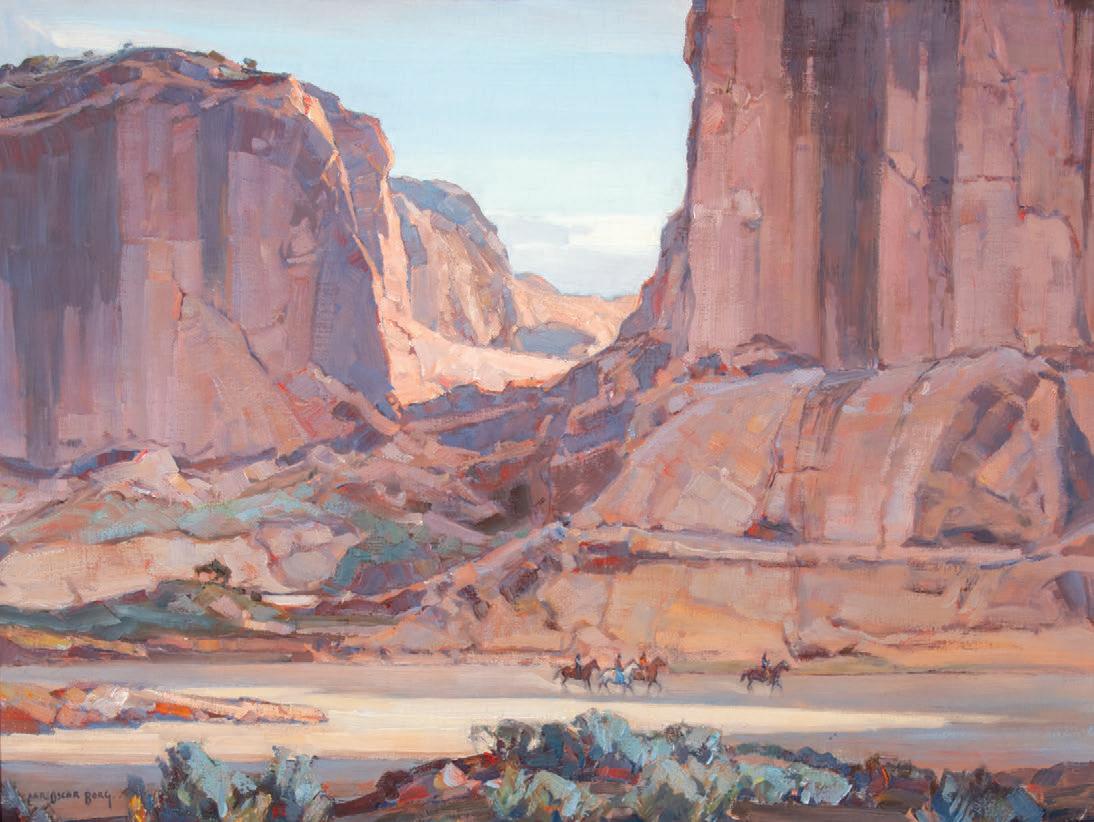
Carl Oscar Borg 1879-1947
30 ¼ x 40 inches
Signed lower left
Estimate: $50,000 - 75,000
Canyon de Chelly Oil on canvas
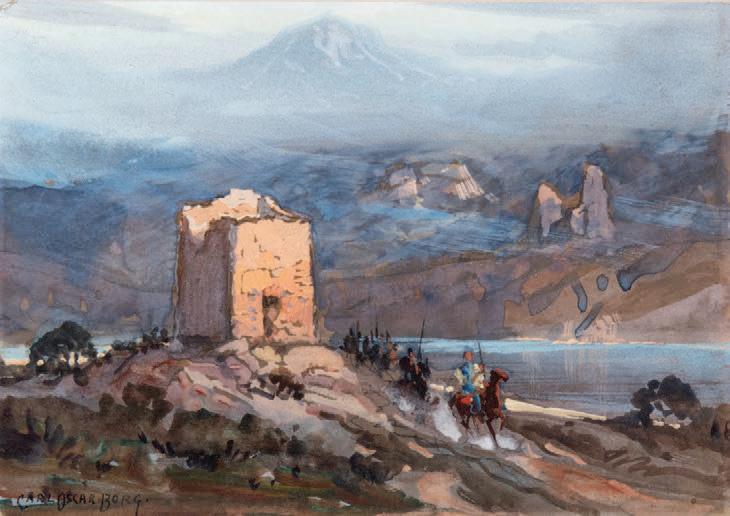
214
Carl Oscar Borg 1879-1947
Spanish Conquistadors Gouache
5 x 7 inches
Signed lower left
Estimate: $1,000 - 1,500
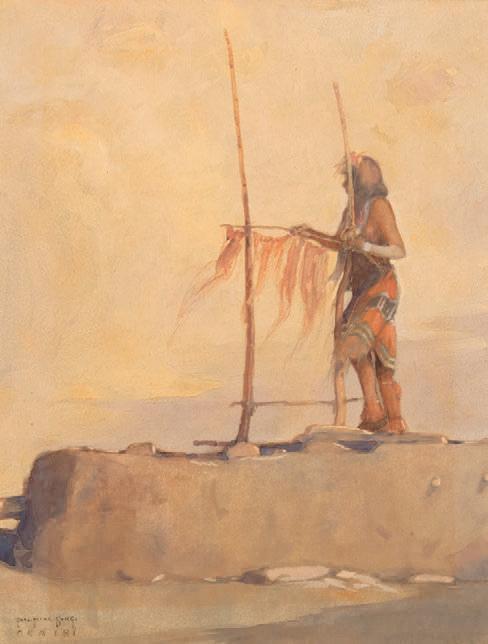
215
Carl Oscar Borg 1879-1947
Hopi, Snake Priest Watercolor
11 ½ x 9 inches
Signed lower left, Oraibi
Estimate: $1,500 - 2,500
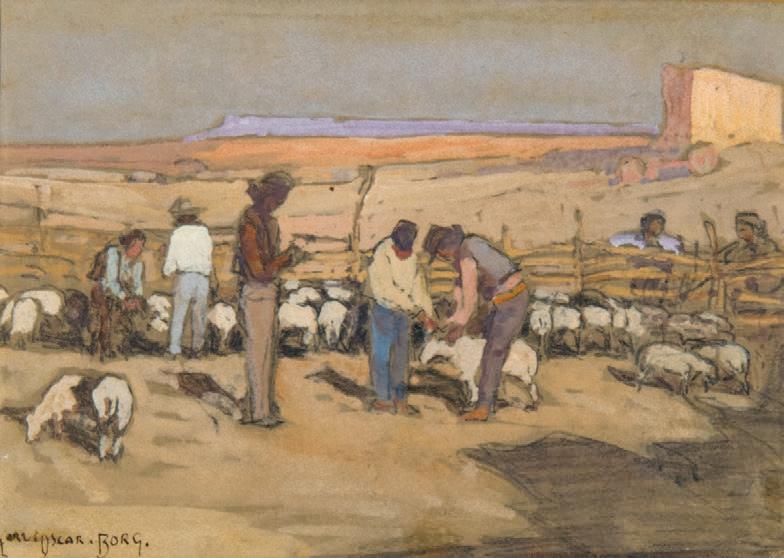
216
Carl Oscar Borg 1879-1947
Navajos Sheering Sheep Gouache
5 x 7 inches
Signed lower left
Estimate: $1,000 - 1,500
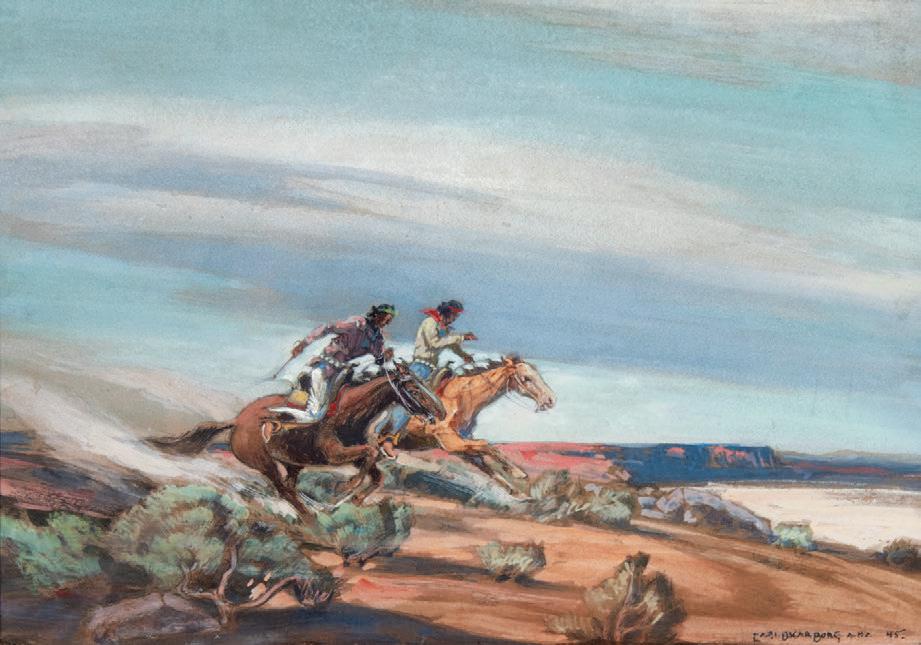
217
Carl Oscar Borg 1879-1947
Racing Navajos, Canyon de Chelly
Gouache
9 ½ x 13 ½ inches
Signed/ANA and dated 45 lower right
Estimate: $4,000 - 6,000
218
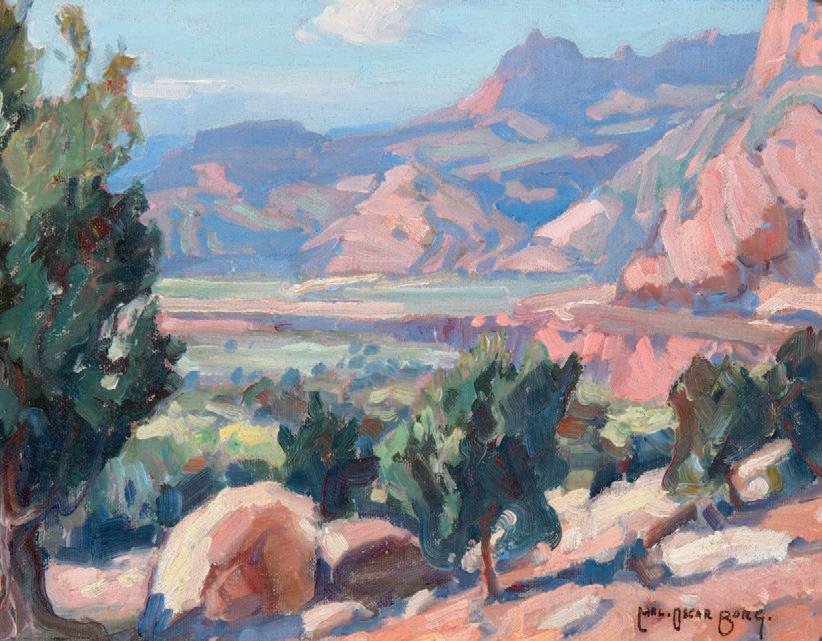
Carl Oscar Borg 1879-1947
Marsh Pass
Oil on canvas mounted to board 9 x 12 inches
Signed lower right; Signed, titled and dated 1925 and inscribed verso
Estimate: $1,500 - 2,500
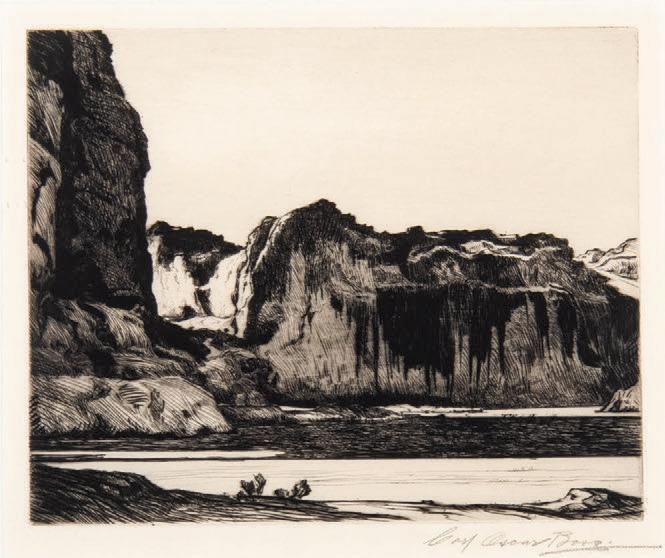
219
Carl Oscar Borg 1879-1947
Cliffs of de Chelly Etching
8 x 9 ¾ inches
Signed lower right
Estimate: $800 - 1,200
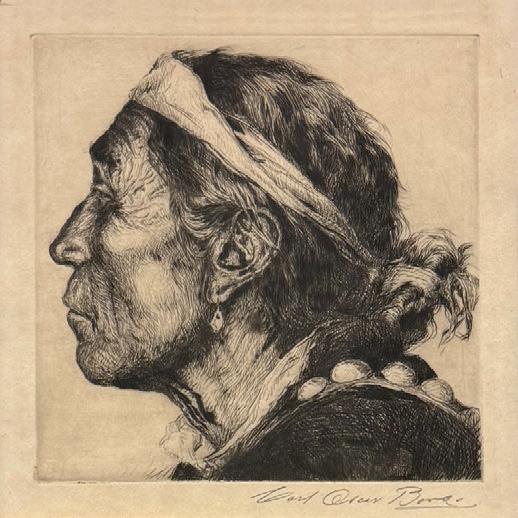
221
Carl Oscar Borg 1879-1947
Navajo Etching
6 x 6 inches
Signed lower right
Estimate: $800 - 1,200
Literature:
Carl Oscar Borg: ett konstnärsöde, Albin Widen, Nordisk Rotogravyr, Stockholm, 1953, p. 173
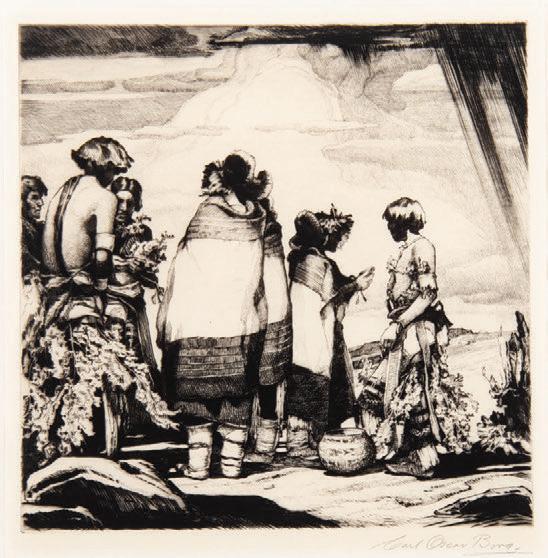
220
Carl Oscar Borg 1879-1947
The Niman Kachinas Etching
9 ¾ x 9 ¾ inches
Signed lower right
Estimate: $800 - 1,200
Literature:
Carl Oscar Borg: ett konstnärsöde, Albin Widen, Nordisk Rotogravyr, Stockholm, 1953, p. 185
222
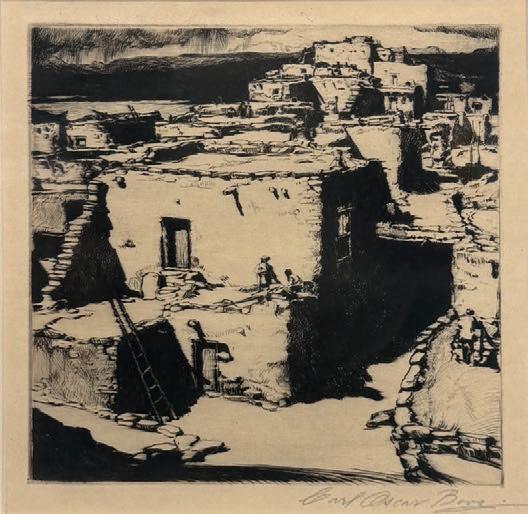
Carl Oscar Borg 1879-1947
Hopi Houses/Walpi, Hopi Village Etching
7 ¼ x 7 ⅜ inches
Signed lower right
Estimate: $800 - 1,200
Literature:
Carl Oscar Borg: ett konstnärsöde, Albin Widen, Nordisk Rotogravyr, Stockholm, 1953, p. 179
223
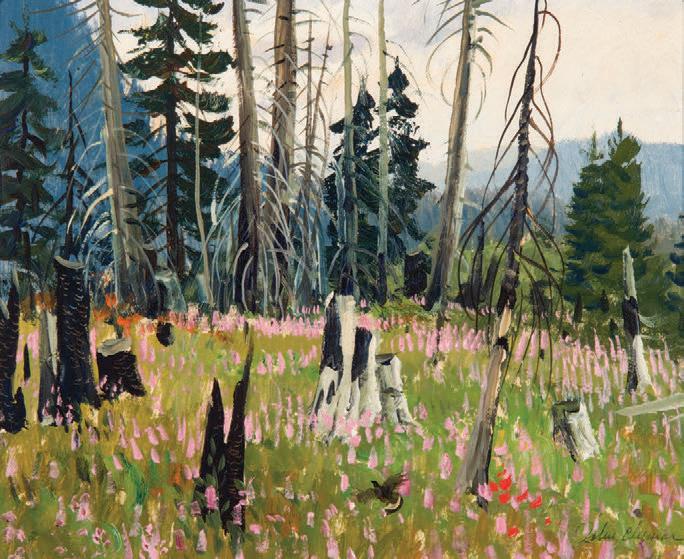
John Ford Clymer 1907-1989
Fireweed Oil on board
8 x 10 inches
Signed lower right; Signed and titled verso
Estimate: $4,000 - 6,000
224
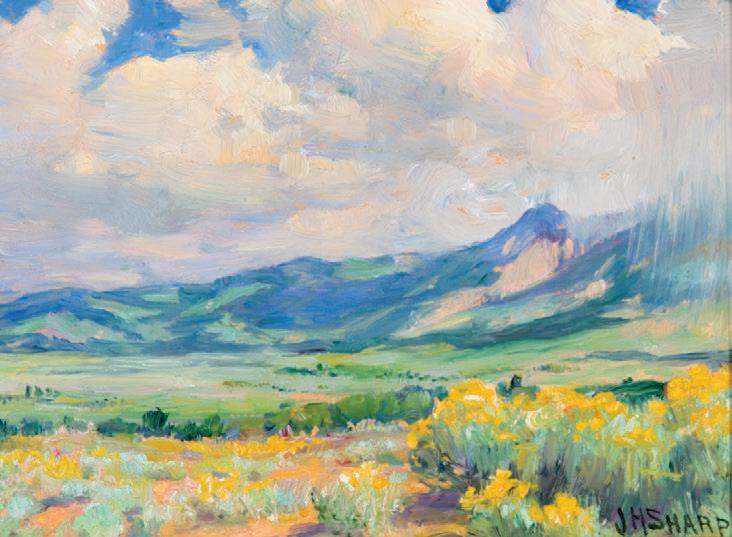
Joseph Henry Sharp 1859-1953
Taos Oil on board
6 x 8 inches
Signed lower right
Estimate: $5,000 - 8,000
225
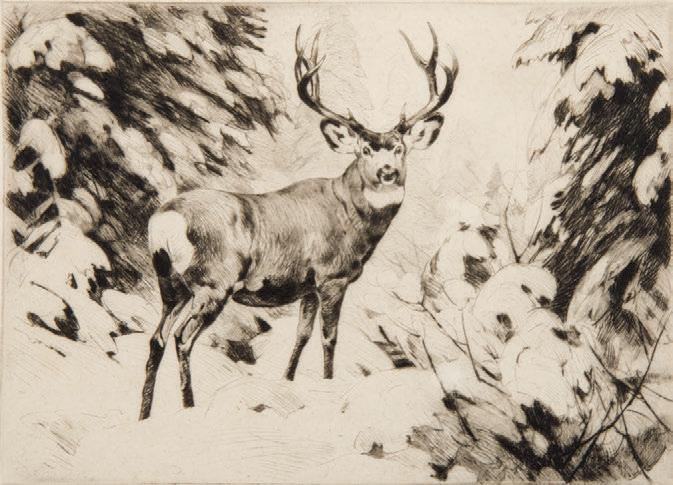
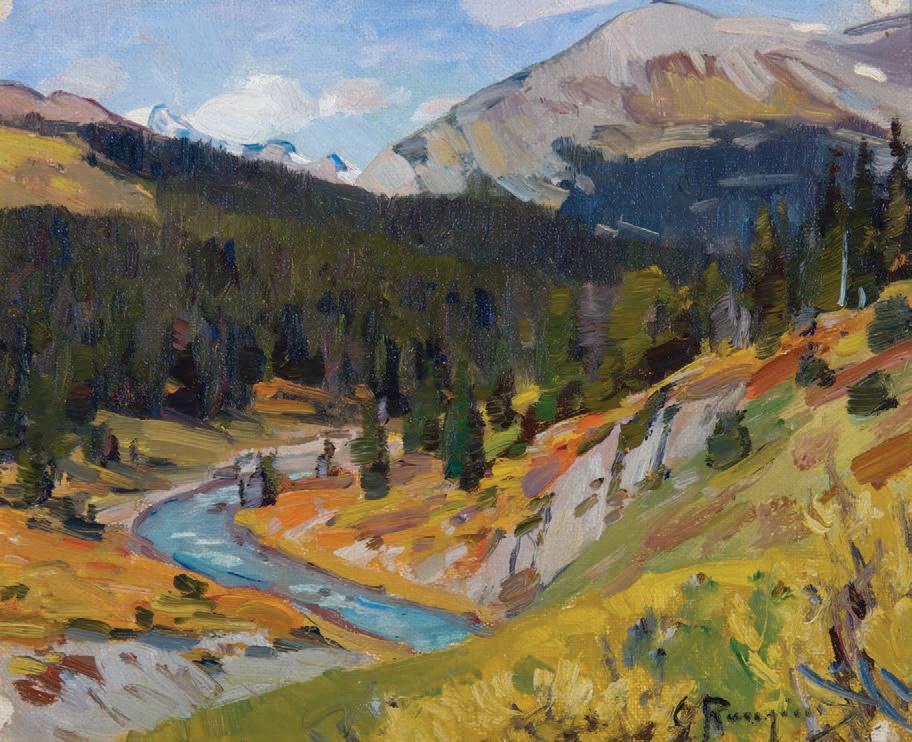
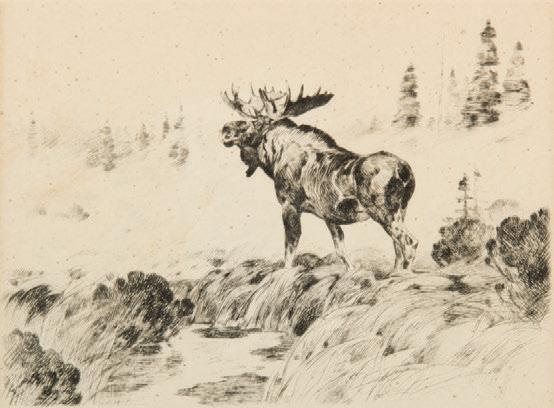
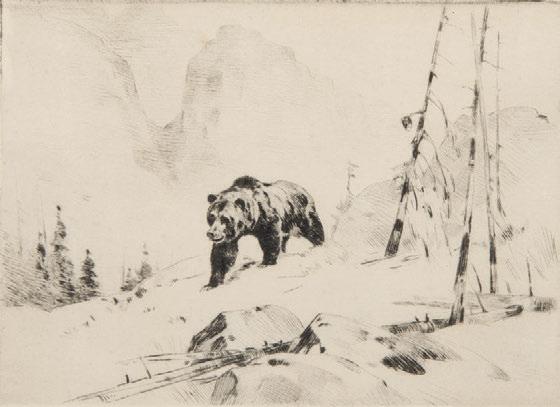
Carl Rungius 1869-1959
Mule Deer
Etching
7 ¾ x 10 ¾ inches
Signed lower right
Estimate: $4,000 - 6,000
Literature:
Carl Rungius: The Complete Prints, Donald E. Crouch, Mountain Press Publishing Co., Missoula, MT, 1989, p. 85
227
Carl Rungius 1869-1959
Morning Mist
Etching
7 x 9 ¼ inches
Signed lower right
Estimate: $2,000 - 4,000
Provenance: Private collection, Kansas
Literature:
Carl Rungius: The Complete Prints, Donald E. Crouch, Mountain Press Publishing Company, Missoula, MT, 1989, p. 70, 113.
226
Carl Rungius 1869-1959
Banff
Oil on canvas mounted to board 9 x 11 inches
Signed lower right
Estimate: $10,000 - 15,000
Provenance: Private collection, Texas
228
Carl Rungius 1869-1959
Lord of the Canyon
Etching
6 x 8 ⅜ inches
Signed lower right
Estimate: $1,500 - 2,500
Literature:
Carl Rungius: The Complete Prints, Donald E. Crouch, Mountain Press Publishing Co., Missoula, MT, 1989, p. 75
229
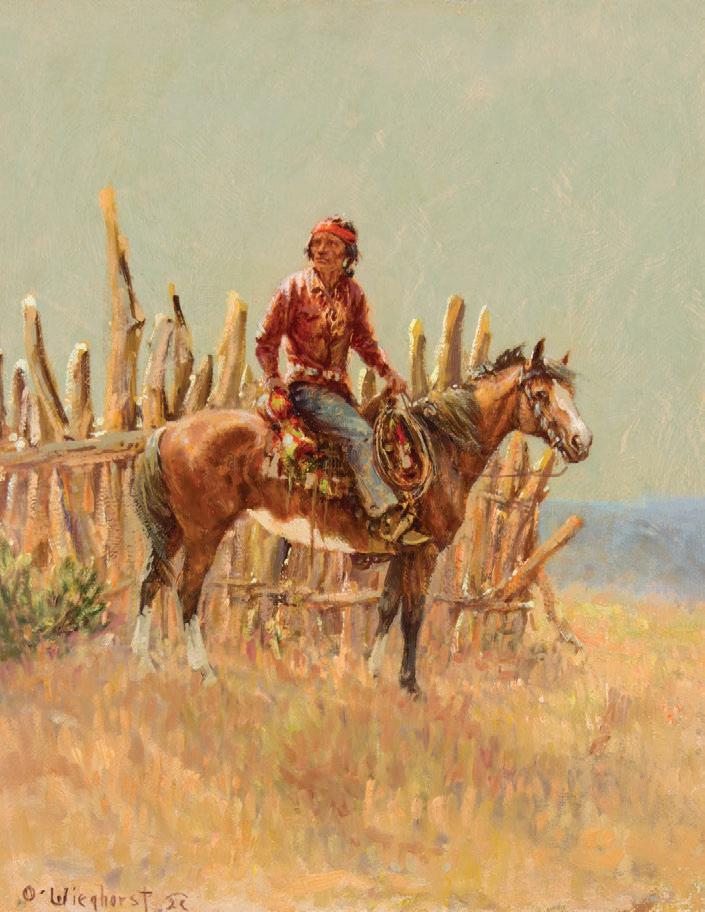
Olaf Wieghorst 1899-1988
Navajo Buck Oil on board
20 x 16 inches
Signed lower left; Titled verso
Estimate: $10,000 - 15,000
Provenance: Private collection, Texas
Olaf Wieghorst lived enough for several lives. He came from a family of acrobats in Denmark, but yearned to see the United States so he served as a cabin boy on a steam ship during a voyage across the Atlantic. On U.S. soil, he promptly joined the U.S. Cavalry. He fought Pancho Villa and witnessed the last gasp of the Old West. He painted Navajo Buck in 1925, after his cavalry service, during a time when Wieghorst was cowboying in Arizona and New Mexico. Not long after, he headed back east, where he served as a mounted police officer in New York City, before finally returning West as a professional artist.
230
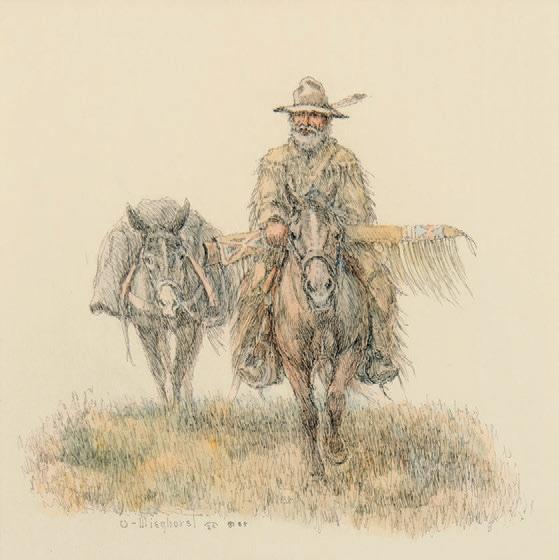
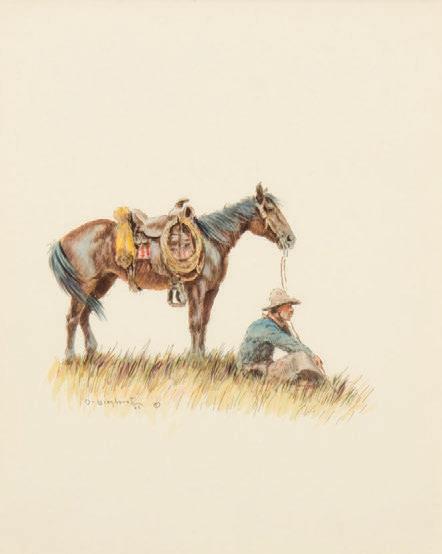
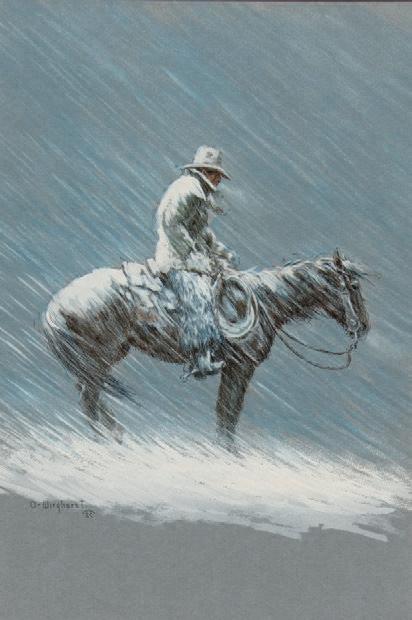
Olaf Wieghorst 1899-1988
The Mountain Man
Mixed Media
10 x 10 inches
Signed and dated 85 lower left
Estimate: $2,500 - 4,500
231
Olaf Wieghorst 1899-1988
Break Time
Mixed Media
12 x 10 inches
Signed lower left
Estimate: $3,000 - 5,000
232
Olaf Wieghorst 1899-1988
Cowboy in Blizzard
Mixed Media
13 ½ x 9 ½ inches
Signed lower left
Estimate: $3,000 - 5,000
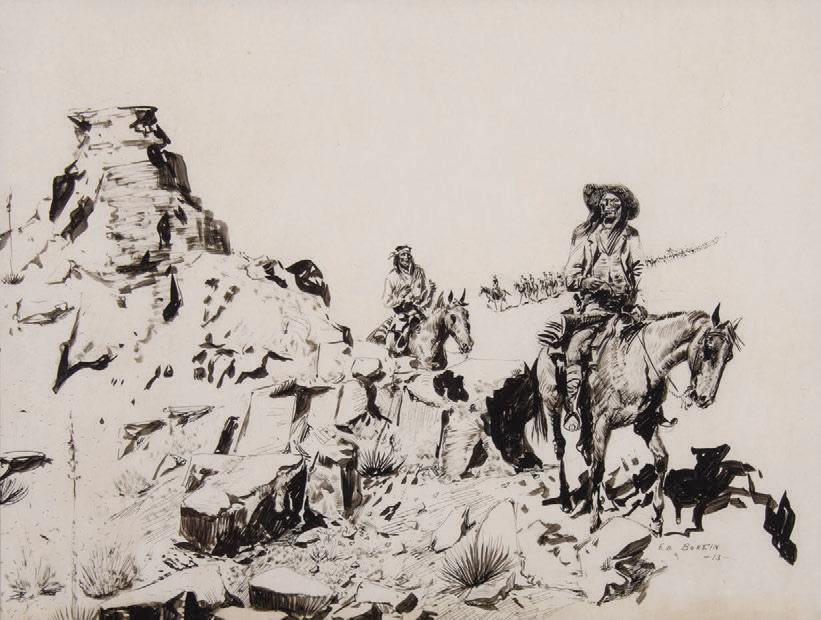
233
Edward Borein 1872-1945
Apache Scouts
Pen & Ink
18 ¾ x 24 ⅝ inches
Signed and dated 13 lower right
Estimate: $8,000 - 12,000
234
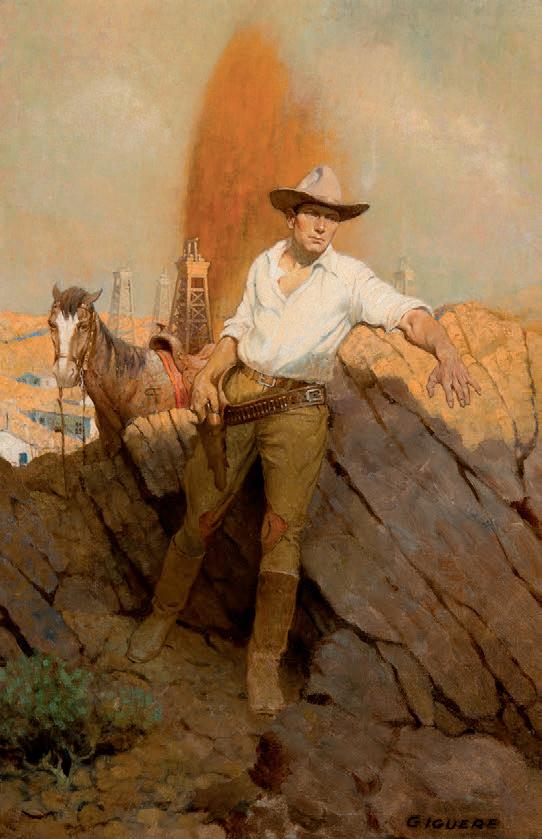
George Giguere 20th Century
Protecting the Derricks Oil on canvas
36 x 24 inches
Signed lower right
Estimate: $3,000 - 5,000
235
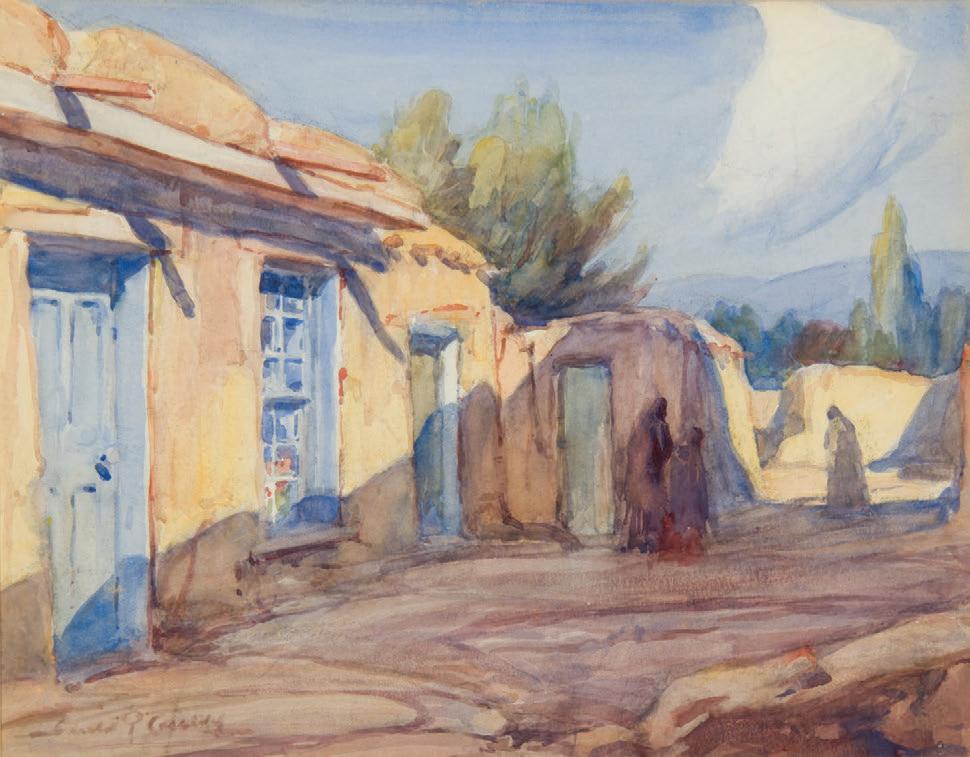
Gerald Cassidy 1869-1934
12 x 15 ½ inches
Signed lower left
Estimate: $4,000 - 6,000
236
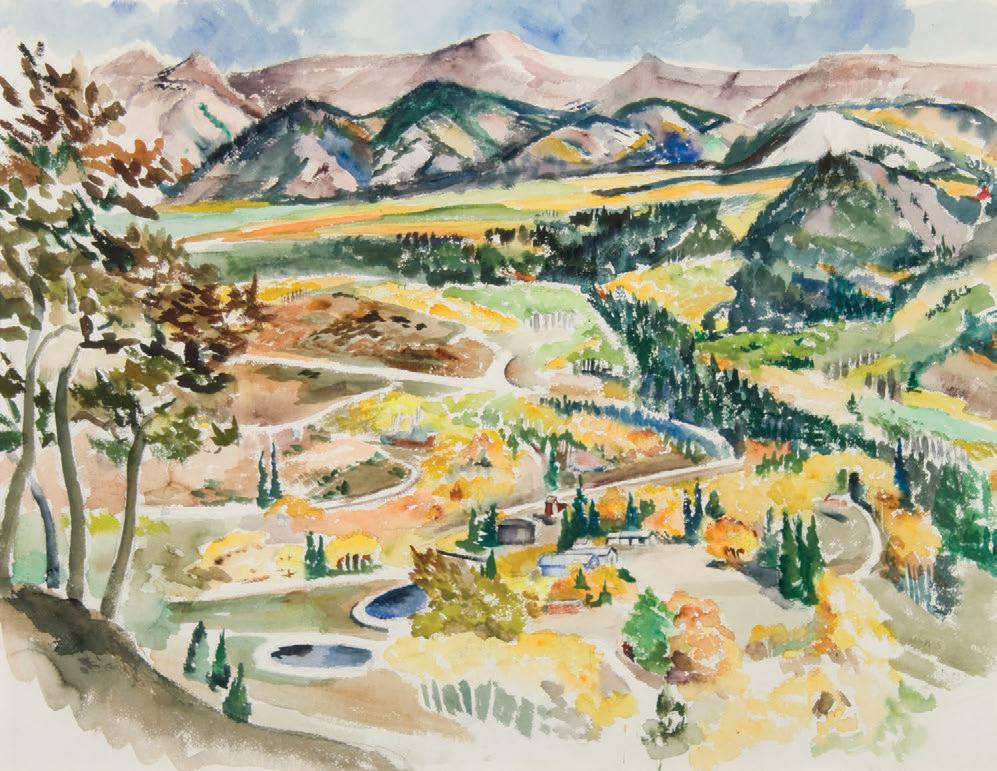
Jozef Bakos 1891-1977
21 ½ x 27 ½ inches
Signed lower right
Estimate: $4,000 - 6,000
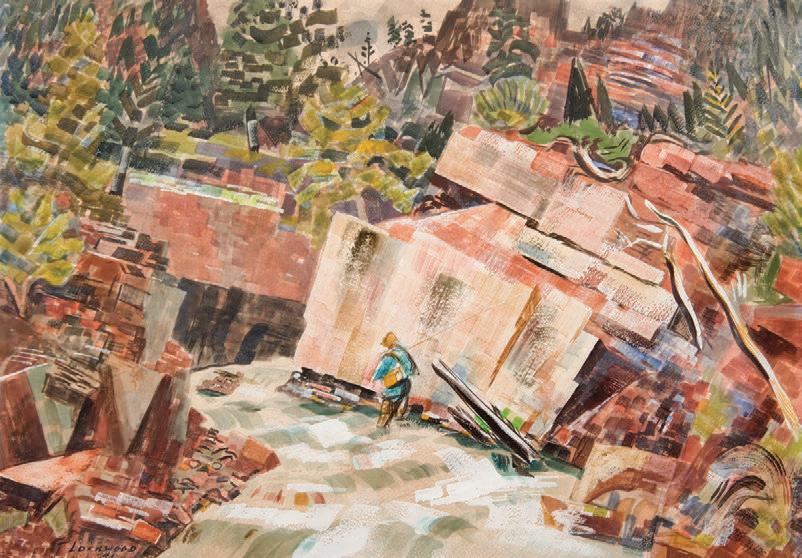
Adobe Walls Watercolor
Above The Ranch
Watercolor
237
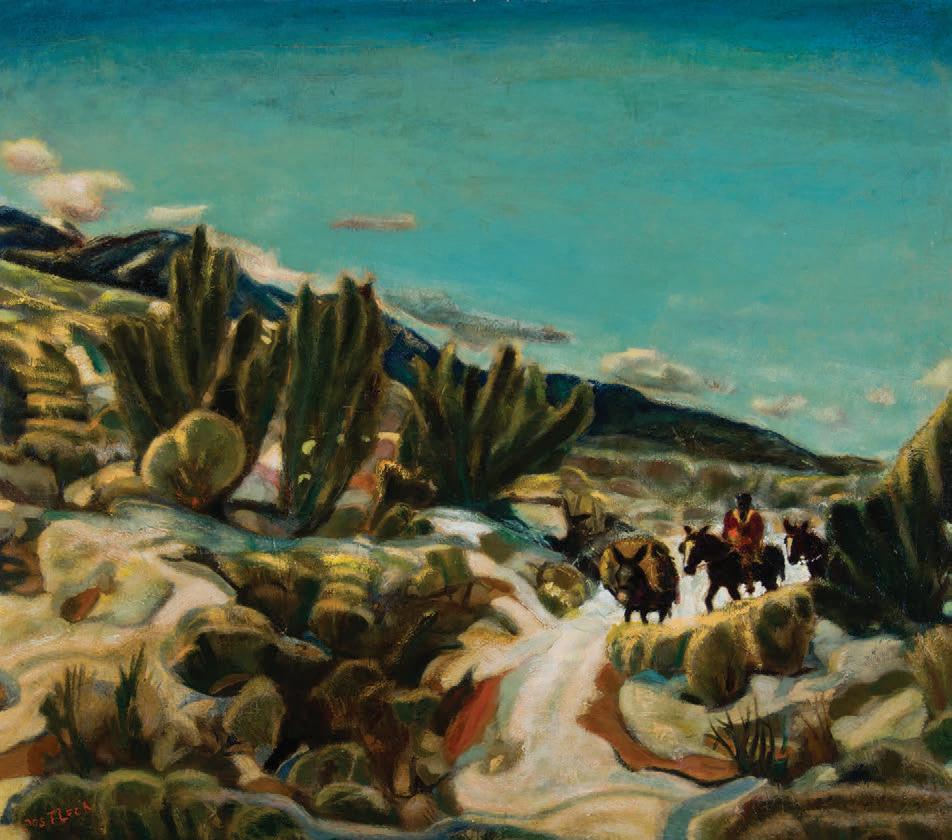
Joseph Fleck 1892-1977
Taos Cowpuncher
Oil on canvas
30 x 34 inches
Signed lower left
Estimate: $15,000 - 25,000
Provenance:
Private collection, Missouri
A man of many artistic talents—lithography, etching, engraving, stained-glass and design—Joseph Fleck was one of the many European artists who immigrated to the United States from Europe to then discover the beauty of Taos, New Mexico. Born in Austria-Hungary, Fleck only barely made it to America after surviving on the Italian front in World War I. His work in New Mexico was mostly representational, although he did make frequent swings into more modern and abstract art, notes of which can be seen in Taos Cowpuncher
238
Joseph Fleck 1892-1977
Indian Hunters Oil on canvas
25 x 30 inches
Signed/Taos lower right; Signed and titled verso
Estimate: $6,000 - 9,000
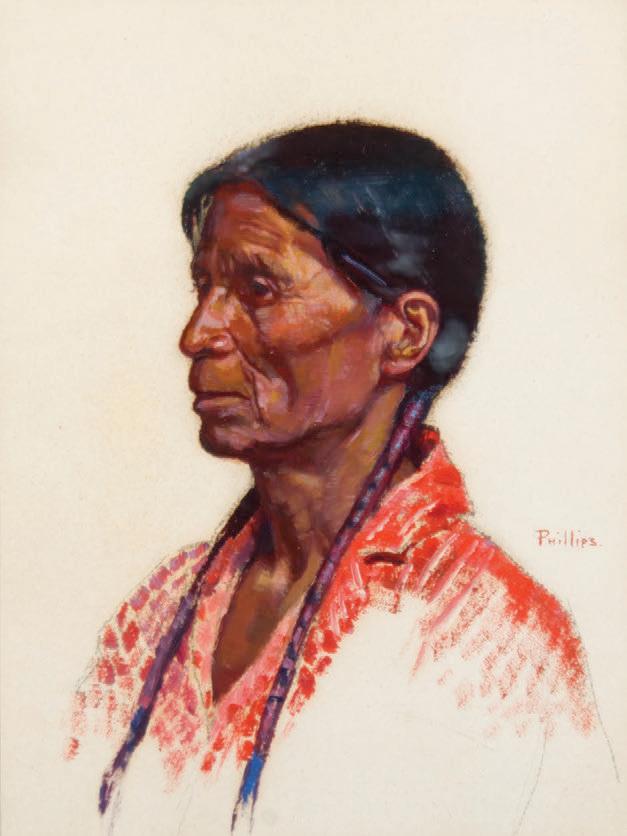
239
Bert Geer Phillips 1868-1956
Portrait of a Indian Oil on paper
12 x 9 inches
Signed lower right
Estimate: $6,000 - 9,000
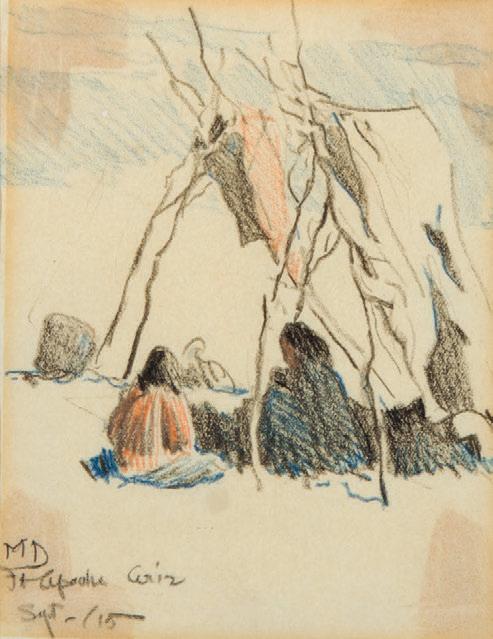
240
Maynard Dixon 1875-1946
Fort Apache Colored pencil
5 ¼ x 4 ⅛ inches
Initialed and dated lower left “Ft Apache Ariz”
Estimate: $4,000 - 6,000
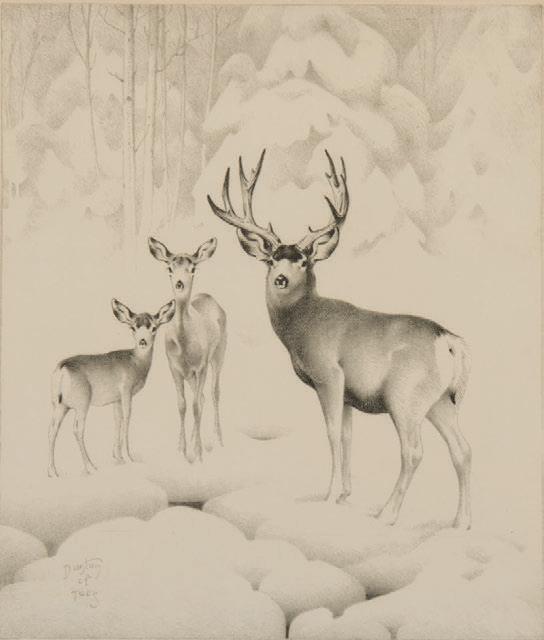
241
William H. Dunton 1878-1936
First Snow Lithograph #54
11 ¾ x 10 inches
Signed and titled lower left
Estimate: $2,000 - 3,000
242
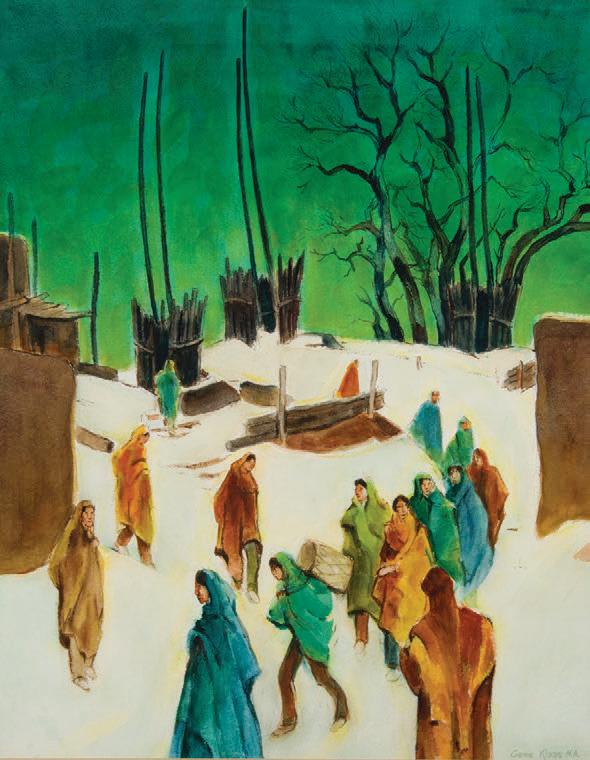
Gene Kloss 1903-1996
The Procession Watercolor
22 x 17 ½ inches
Signed/ N.A. lower right
Estimate: $10,000 - 15,000
Provenance: Private collection, Missouri
Widely known inside and outside the West for her work as a printmaker, Gene Kloss began her career learning etching at the University of California, Berkeley, in the 1920s. In 1925, she moved to Taos, New Mexico, which was still teeming with creative people of all types, including the Taos Society of Artists. She was drawn to Northern New Mexico because of the light and landscape, but also because of the people and architecture, all of which are prominent subjects in her prints and paintings. While her etchings are widely collected, her oils and watercolors are rare gems.
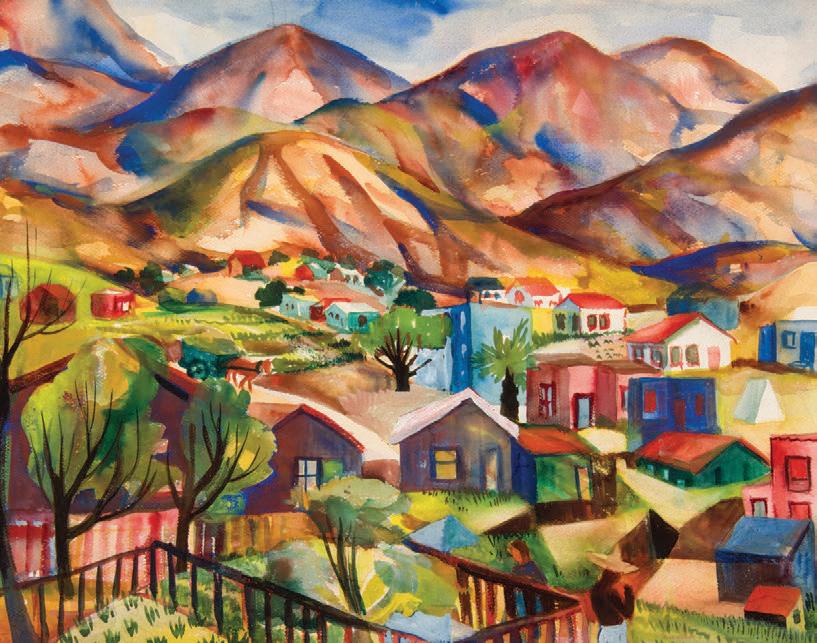
243
Bror Nordfeldt 1878-1955
New Mexico Village Watercolor
22 x 28 inches
Signed lower right
Estimate: $5,000 - 8,000
Provenance: Private collection, Arizona
Born in Sweden, educated in Chicago and influenced by a stint in Paris, B.J.O. Nordfeldt had many experiences throughout his art career, and yet, like many others before him, he was drawn to Northern New Mexico, where he lived in Santa Fe starting in 1917. Although he painted subjects from around the world, some of his most well-known images are of Native Americans. His close association with the Indigenous people pushed him to co-found the Indian Artists Fund, which helped preserve the heritage of the pueblo people. His landscapes, many of them created after 1929, are especially rare because he destroyed most of them before leaving New Mexico in 1940.
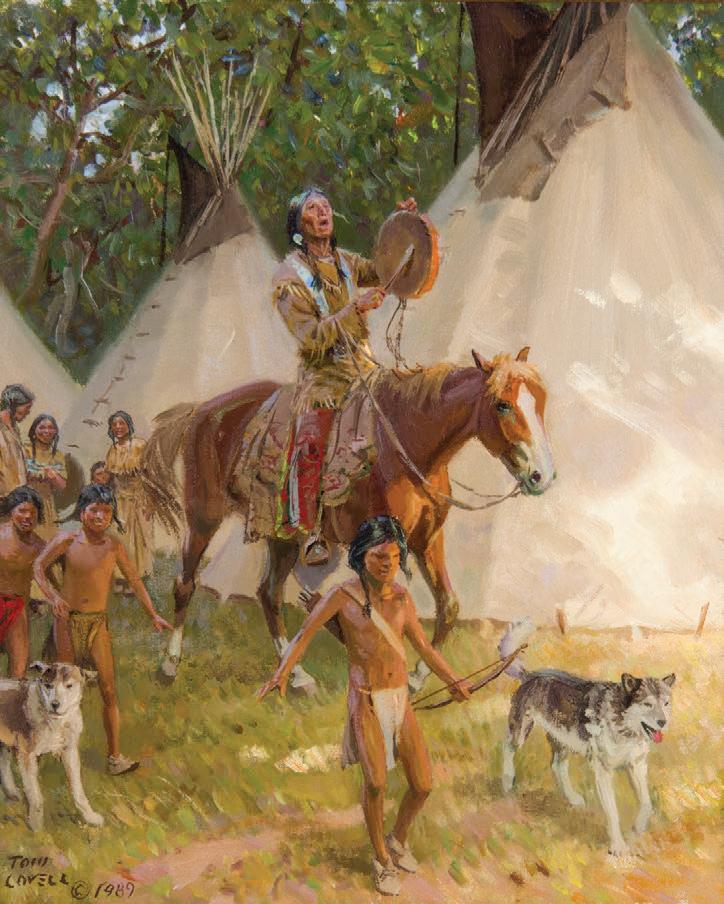
244
Tom Lovell 1909-1997
The Village Crier Oil on canvas
11 x 9 inches
Signed and dated 1989 lower left; Signed, titled and dated November 1989 verso
Estimate: $12,000 - 18,000
Provenance: Private collection, Michigan
Exhibited: American Art In Miniture at the Gilcrease Museum Tulsa, Oklahoma
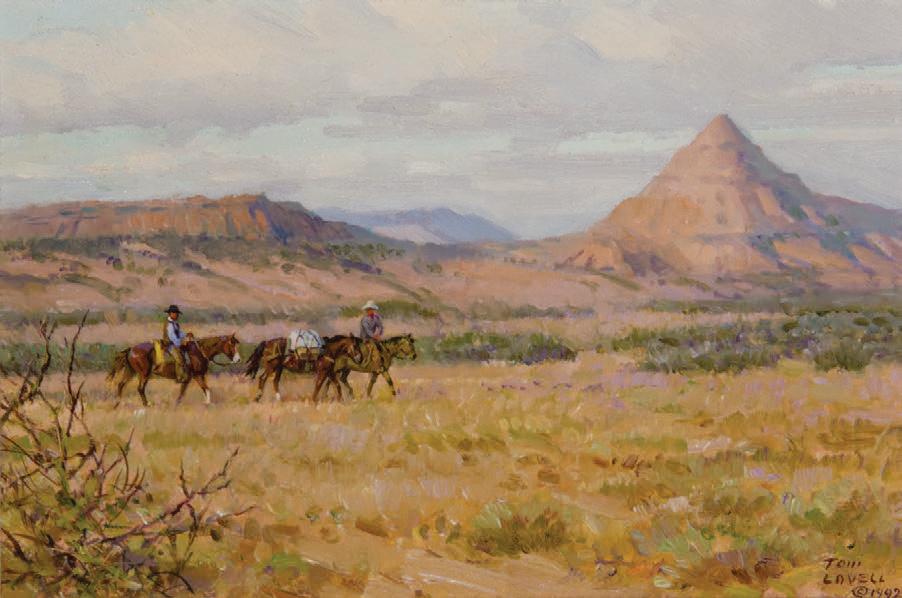
245
Tom Lovell 1909-1997
Oil on board
7 x 10 inches
Signed and dated 1992 lower right; Signed and titled verso
Estimate: $10,000 - 15,000
Provenance: Private collection, Texas
Landmark
246
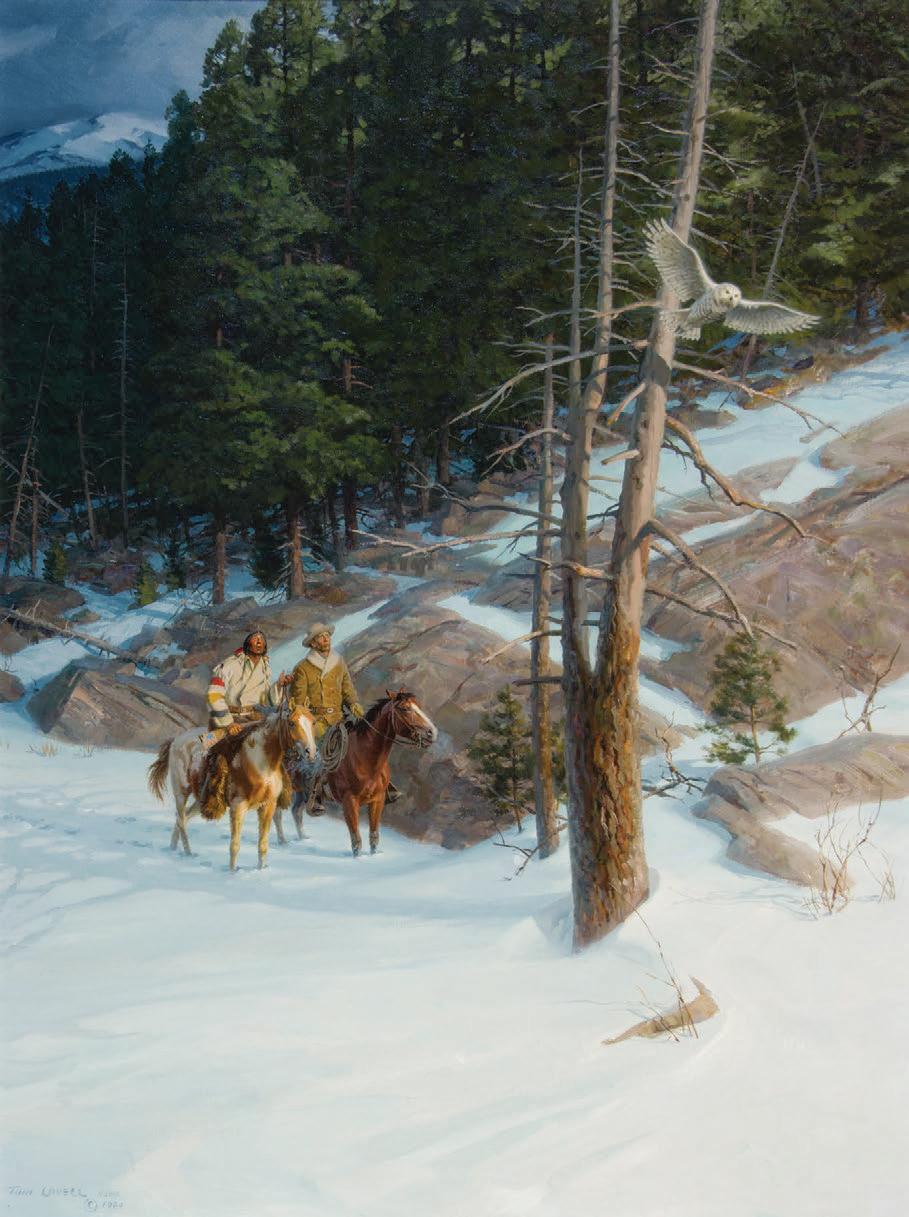
Tom Lovell 1909-1997
The Snowy Owl Prophecy Oil on canvas
40 x 30 inches
Signed/NAWA and dated 1984 lower left; Signed, titled and dated 1984 verso
Estimate: $40,000 - 60,000
Provenance: Private collection, Wyoming
Hang around enough cowboys, or cowboy artists, and they will eventually refer to the book We Pointed Them North: Recollections of a Cowpuncher. Written by E. C. “Teddy Blue” Abbott and Helena Huntington Smith, We Pointed Them North chronicles Abbott’s adventures as a cowboy in the late 1800s. Colorful, poignant, funny and even thoughtful, Abbott’s story is considered a classic piece of cowboy history. One of the book’s many fans was Tom Lovell, who painted The Snowy Owl Prophecy directly from Abbott’s tales of living and working in the West. “E.C. (Teddy Blue) Abbott was an English-born Texan who spent his early years driving trail herds north to Kansas. Later he made his home in Montana and married a Cheyenne girl,” Lovell wrote. “Naturally he was on good terms with the Indians. One day in early winter he was riding with a friend when they came upon a snowy owl. The Indian told him that it was their belief that this was a sign of a very severe winter. This was not necessarily so but about every five years these large birds would drift below the Arctic Circle because their food supply (lemmings) would become scarce. Abbott was a friend of Charlie Russell’s and wrote his own story, We Pointed Them North.”
247
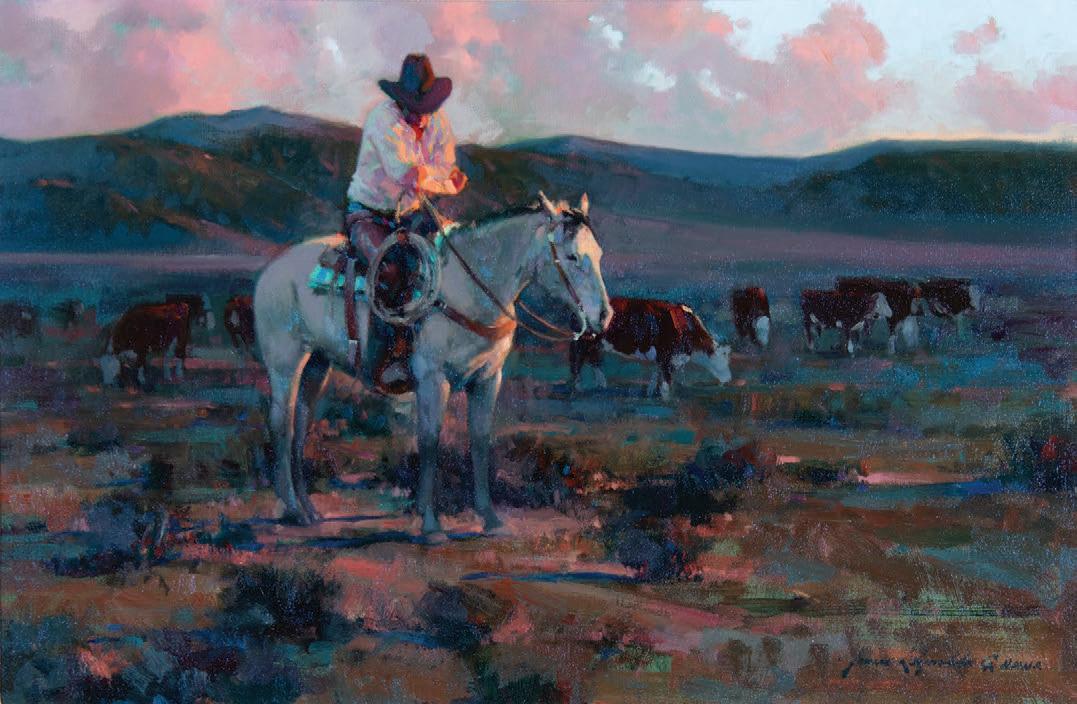
James Reynolds 1926-2010
A Long Day Oil on canvas 20 x 30 inches
Signed/CA NAWA lower right
Estimate: $25,000 - 35,000
Provenance: Legacy Gallery Private collection, California
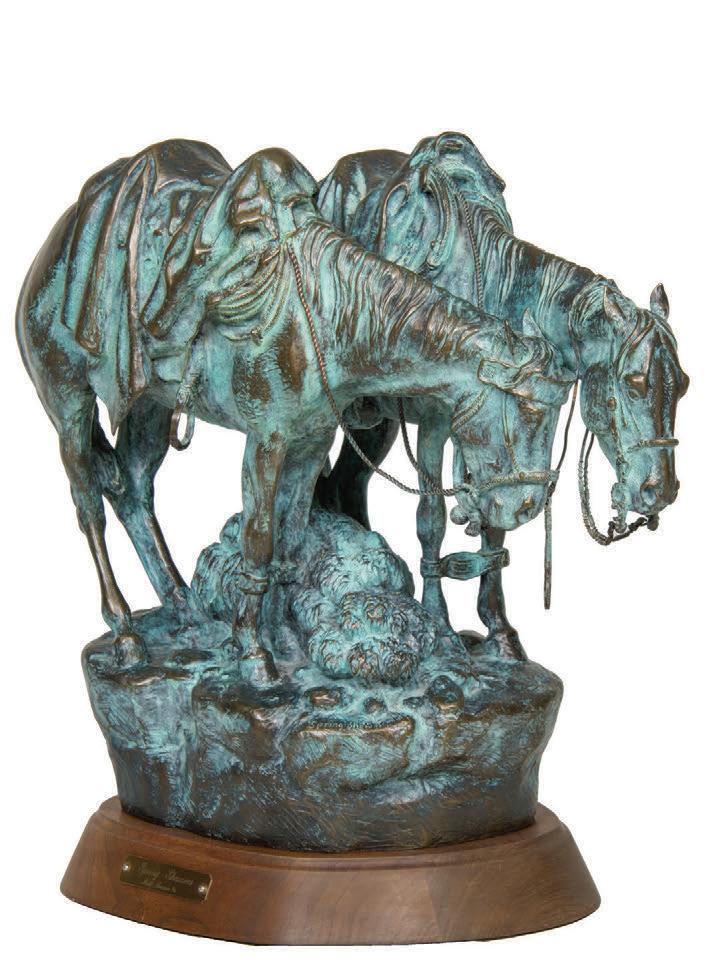
248 Mehl Lawson b. 1942 Spring Showers
Bronze, cast 26/35
17 inches overall height
Signed/CA and dated 89
Estimate: $2,500 - 3,500
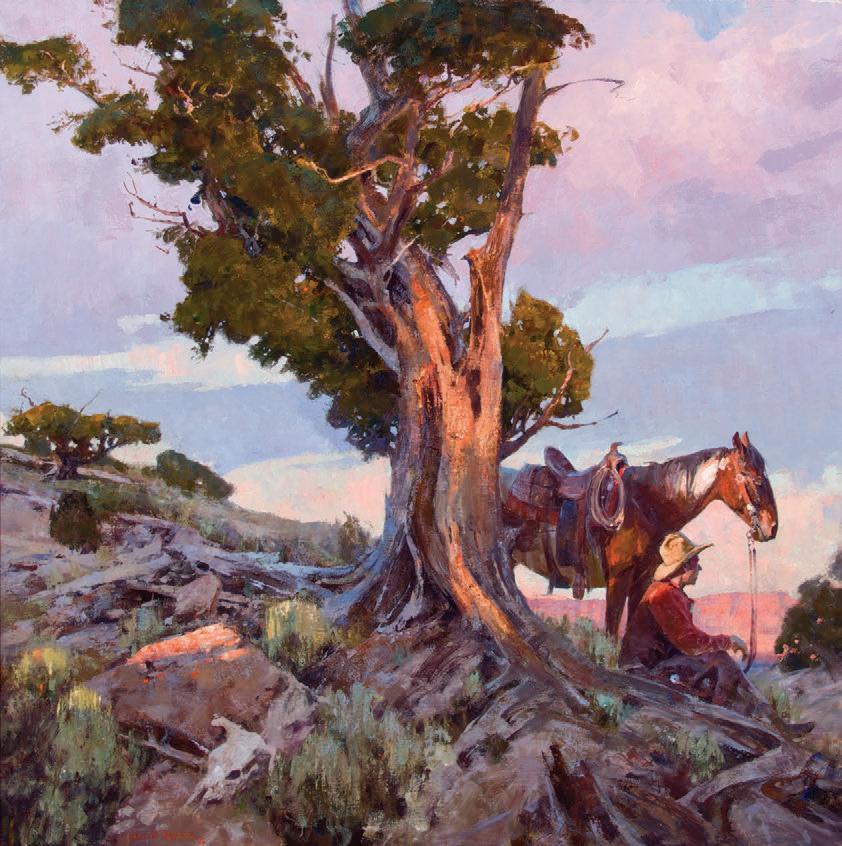
249
Grant Redden b. 1961
Seeking Balance
Oil on linen
40 x 40 inches
Signed/CA lower left; Signed/CA, titled and dated 2022 verso
Estimate: $15,000 - 20,000
Provenance:
Private collection, California
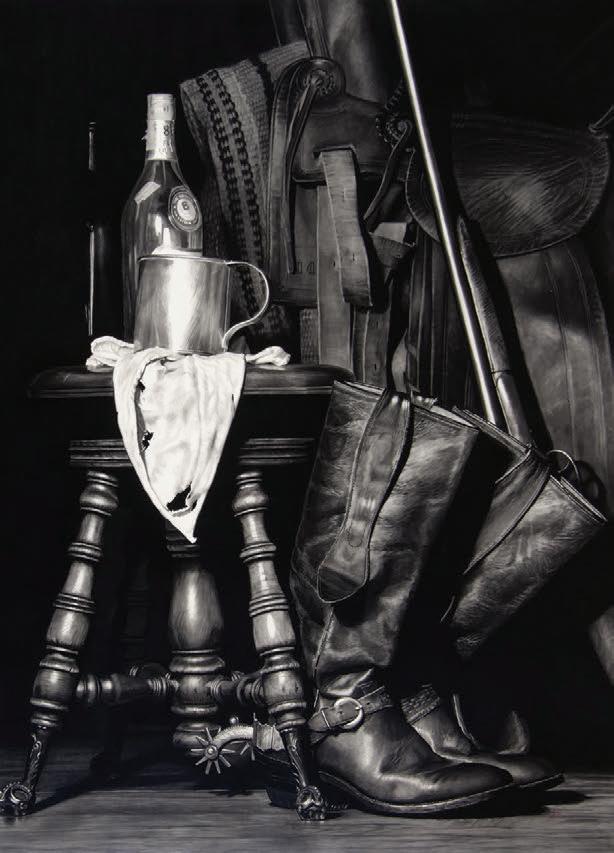
250 Rachel Brownlee b. 1993
Kick Off Your Boots and Rest a Spell
Charcoal
40 x 30 inches
Signed lower right; Signed, titled and dated 2025 verso
Estimate: $14,000 - 18,000
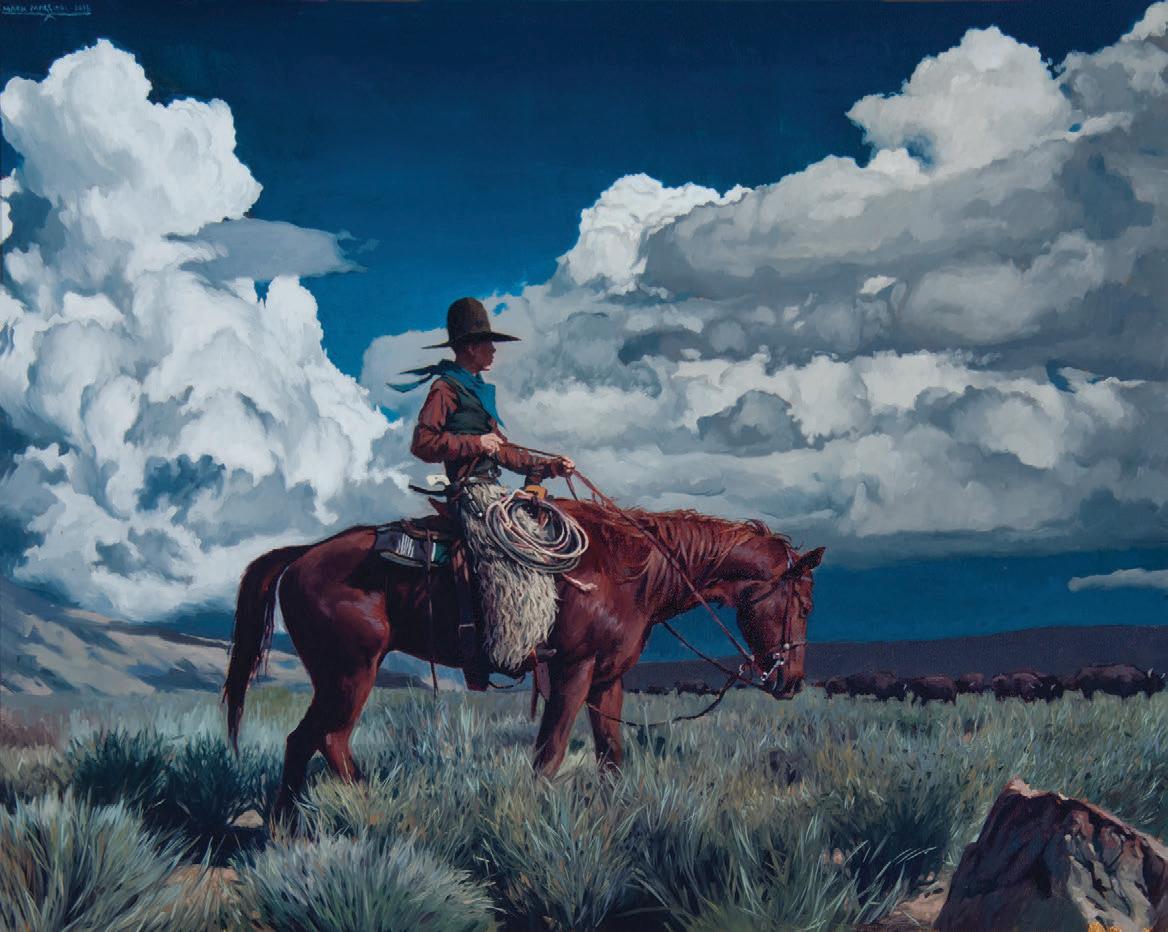
251
Mark Maggiori b. 1977
The Buffalo Herder Oil on canvas
24 x 30 inches
Signed and dated 2015 upper left
Estimate: $60,000 - 90,000
Provenance: Private collection, Texas
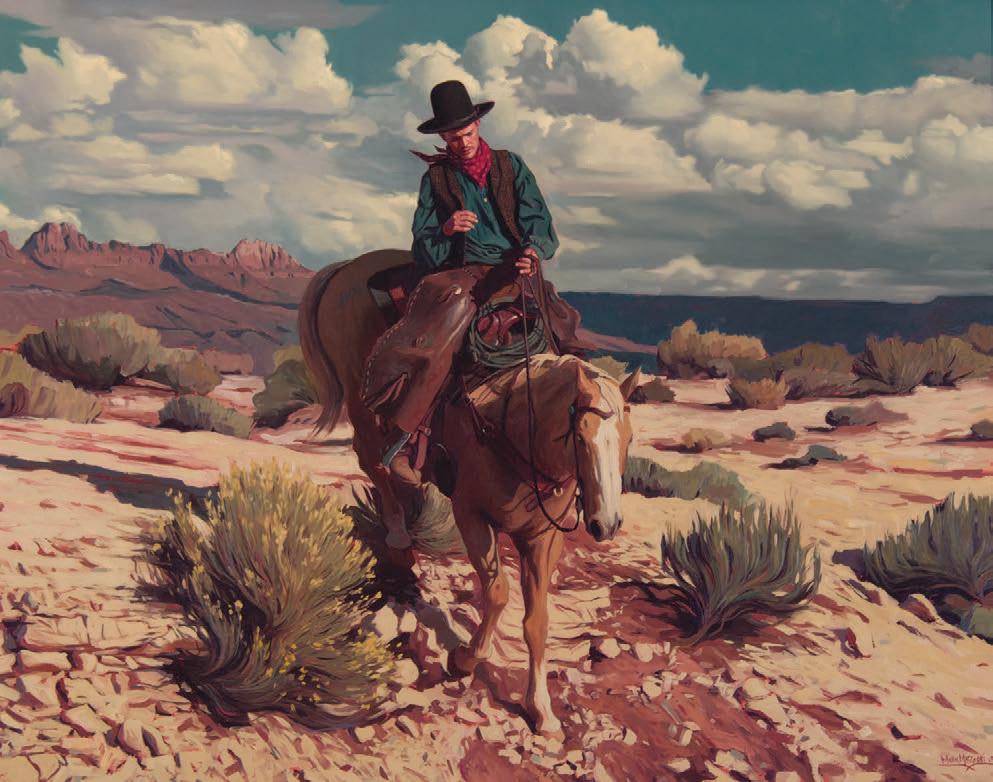
252
Mark Maggiori b. 1977
Rider of the Thunderbird Country Oil on linen 22 x 28 inches
Signed and dated 19 lower right
Estimate: $45,000 - 65,000
Provenance: Private collection, Indiana
Literature: Maynard Dixon's American West: Along the Distant Mesa, Mark Sublette, Just Me Publishing, LLC & Mark Sublette Medicine Man Gallery, Inc, Tucson, AZ, 2018, illustrated pg. 462
Exhibited:
Along the Distant Mesa: An Homage to Maynard Dixon, Mark Sublette Medicine Man Gallery, Tucson, Arizona, March 8-April 30, 2019
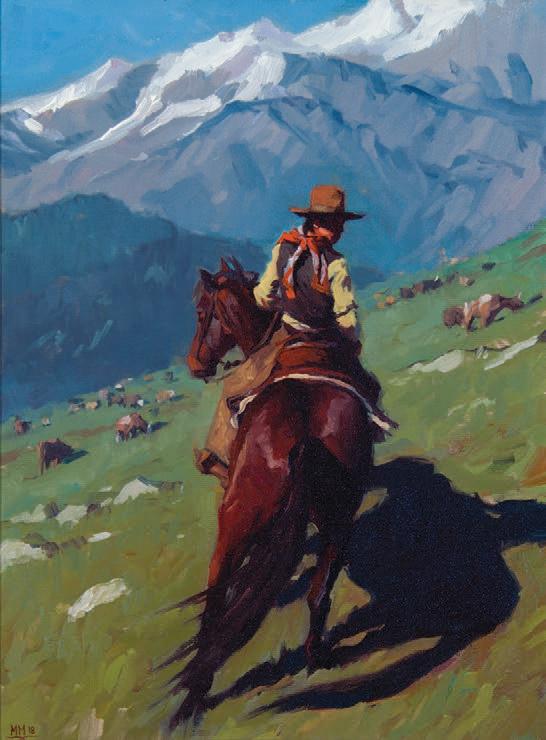
253
Mark Maggiori b. 1977
Up In the Mountains Oil on canvas mounted to board 16 x 12 inches
Signed and dated 18 lower left
Estimate: $20,000 - 30,000
Provenance: Private collection, Indiana
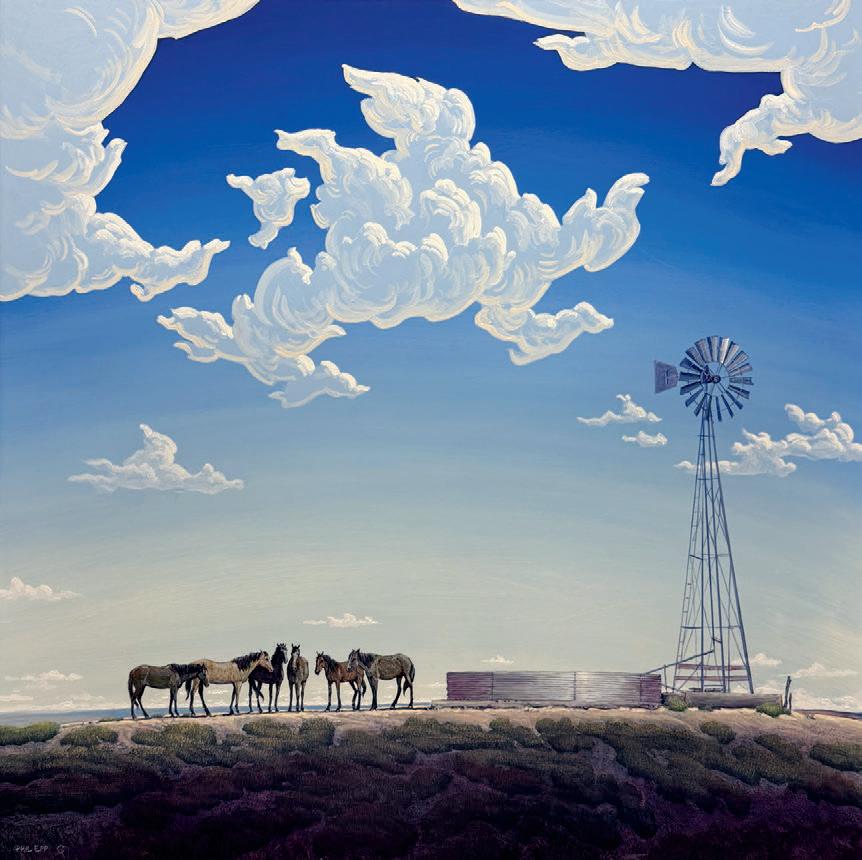
254
Phil Epp b. 1946
Water
Acrylic on board
40 x 40 inches
Signed/CA lower left; Signed/CA and titled verso
Estimate: $12,000 - 18,000
I observed the horses gathered around the stock tank on a quiet afternoon. I titled the work Water since it is at the core of existence on the open western plains. -Phil Epp
255
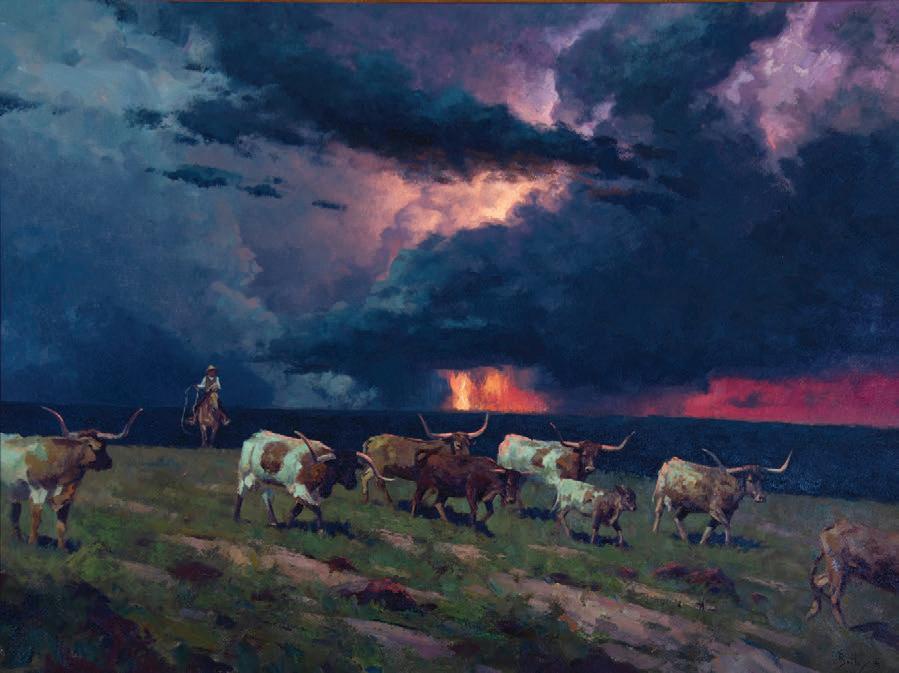
Brandon Bailey b. 1984
Long Drive Beneath a Burning Sky
Oil on board
36 x 48 inches
Signed/CA lower right
Estimate: $16,000 - 22,000
This painting captures the quiet urgency of night herding, when judgment, grit, and timing matter more than speed. It’s a moment of resolve on the open range: man, herd, and weather locked in a fragile balance, moving together toward safety before the sky gives way. -Brandon Bailey
Signed/CA and dated 2005 lower right
Estimate: $250,000 - 350,000
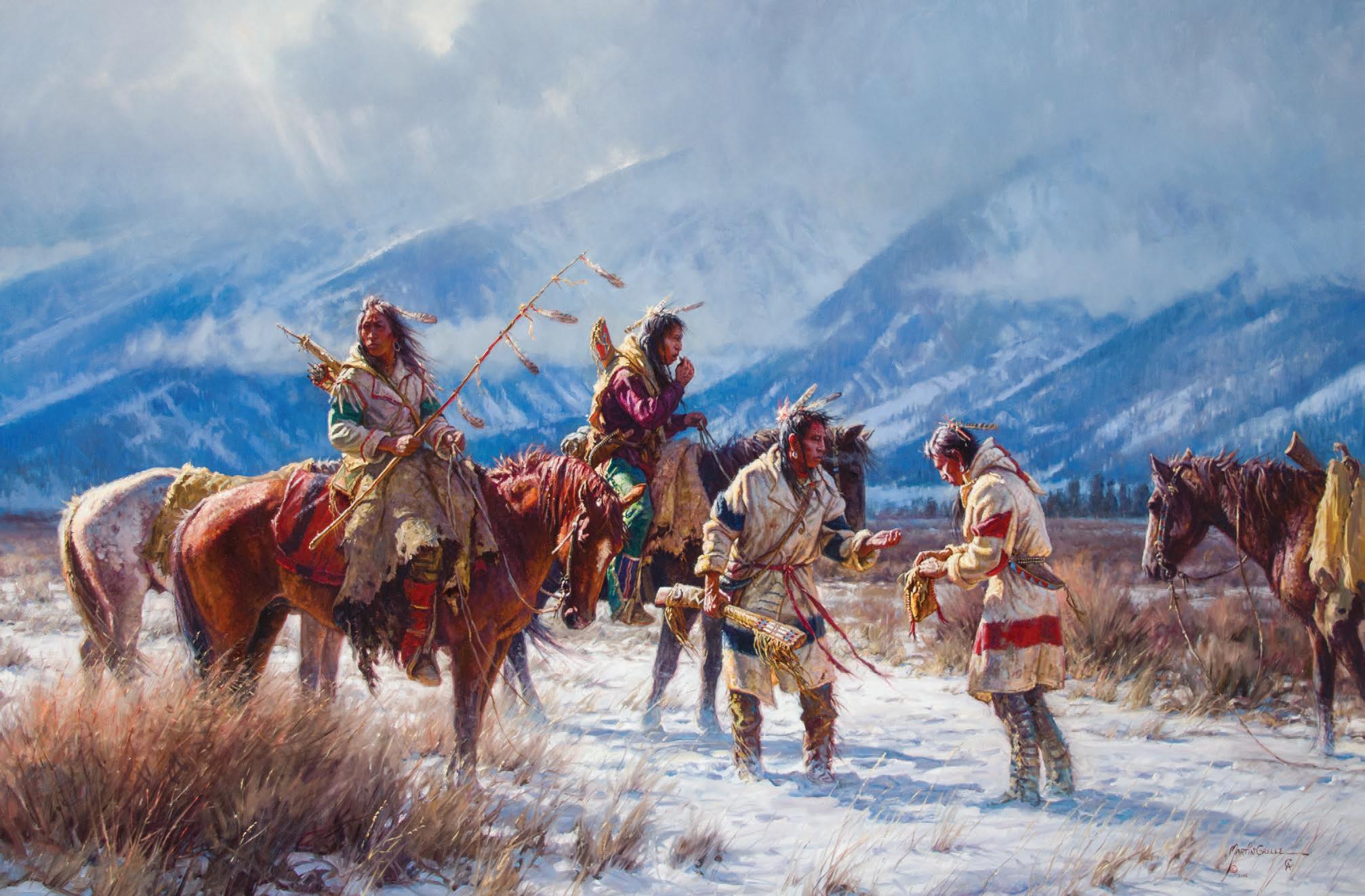
Martin Grelle b. 1954
Last of the Pemmican Oil on canvas
48 x 72 inches
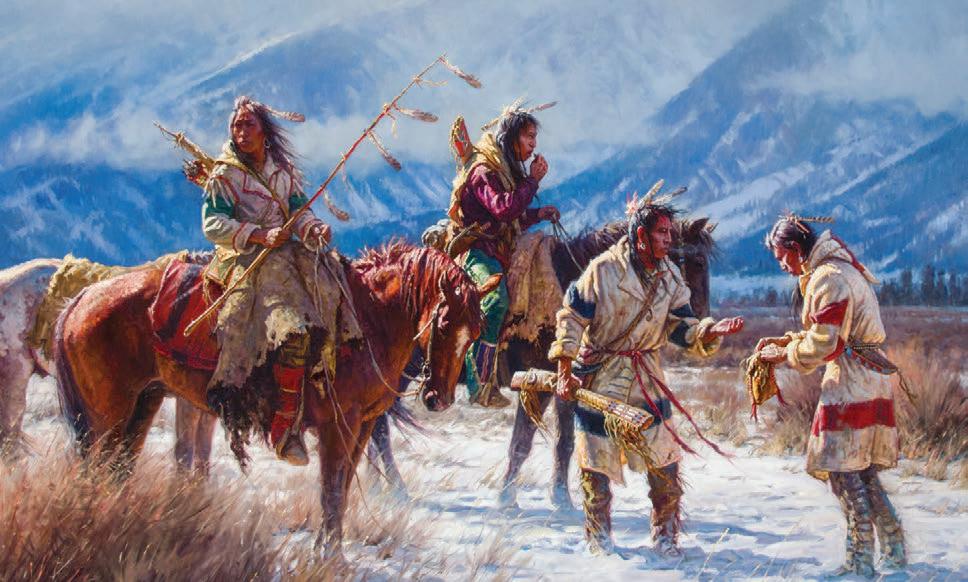
Last of the Pemmican (detail)
Oil on canvas
48 x 72 inches
Signed/CA and dated 2005 lower right
Estimate: $250,000 - 350,000
Provenance: Private collection, Colorado
Although the situation is not yet dire, there is an urgency in Martin Grelle’s Last of the Pemmican, which shows four Native American hunters eating the last of their food rations while on a cold and futile hunt. “There are references to pemmican in many of the books about Native American culture and life,” Grelle says of the work. “Pemmican was a food made by pounding jerked meat into a fine consistency, and combining it with the pulp of pounded chokecherries and suet (hard fat), which was then formed into small cakes that could be stored in rawhide cases, and taken easily on hunts, war parties and horse raids. In one reference, I read that ‘they did their best to preserve their pemmican and dried meat for the direst emergencies.’ This is what I have tried to portray in the painting: cold, weary hunters who have been unsuccessful in finding fresh food, and have gotten down to the last of the food they brought with them—the last of the pemmican.”
257
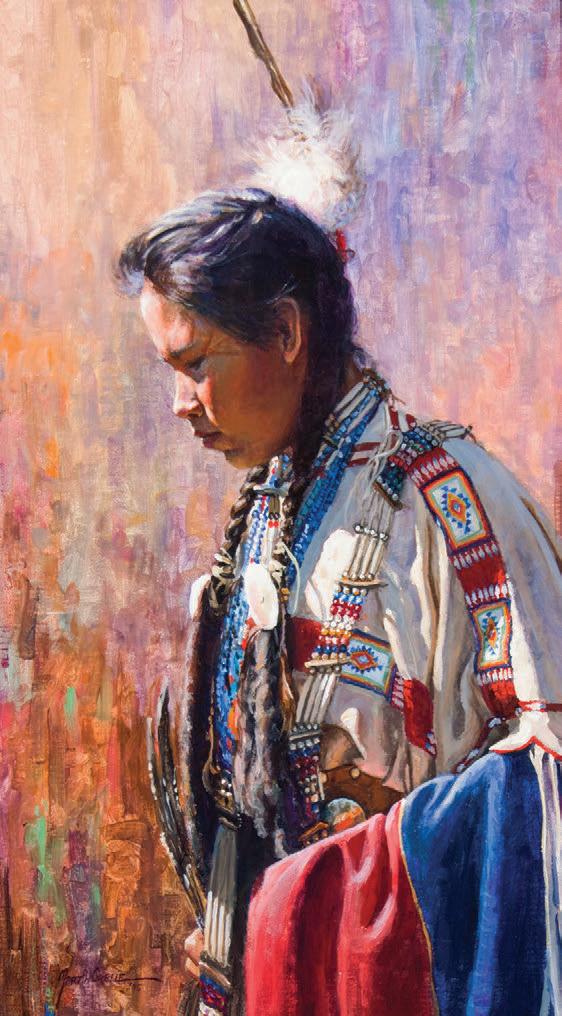
Maiden Dancing
Oil on canvas
28 x 16 inches
Signed and dated 95 lower left
Estimate: $18,000 - 28,000
Provenance: Private collection, Michigan
Exhibited:
Presented at CAA show, when artist was elected, 1995 Kerrville Women of the West show, 1997
Estimate:
Provenance: Private collection, Iowa
256 Martin Grelle b. 1954
Martin Grelle b. 1954
258
Martin Grelle b. 1954 Night Glow Oil on canvas 16 x 20 inches
Signed/CA lower right
$25,000 - 35,000
259 Tom Lovell 1909-1997
Buffalo Tea Oil on canvas
24 x 20 inches
Signed/CA and dated 1977 lower left; Signed and dated 1977 verso
Estimate: $25,000 - 45,000
Provenance:
Regina Giesecke Collection, Ballinger, Texas
Sold by decent in family partnership, Scottsdale, Arizona
Exhibited:
Cowboy Artists of America Exhibition, Phoenix Art Museum, Phoenix, AZ, October 21-November 20, 1977
260 Tom Lovell 1909-1997
The Thaw (Preparatory) Oil on board
7 x 10 inches
Signed and dated 1994 lower right; Signed and titled verso
Estimate: $6,000 - 9,000
261
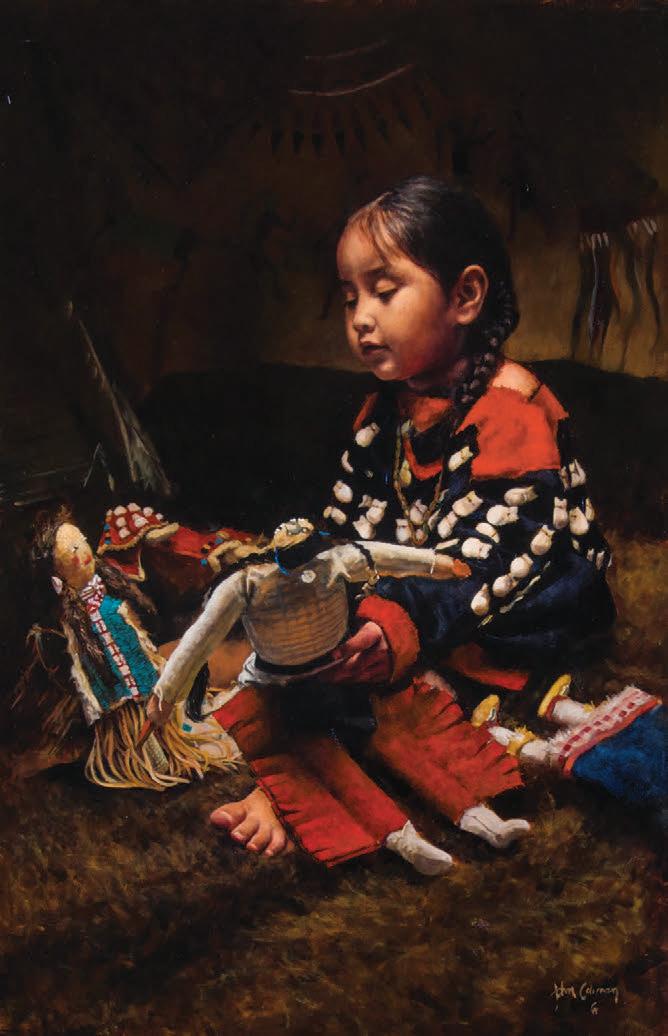
John Coleman b. 1949
Council of the Little People Oil on board
30 x 20 inches
Signed/CA lower right
Estimate: $30,000 - 45,000
Provenance: Private collection, Texas
262
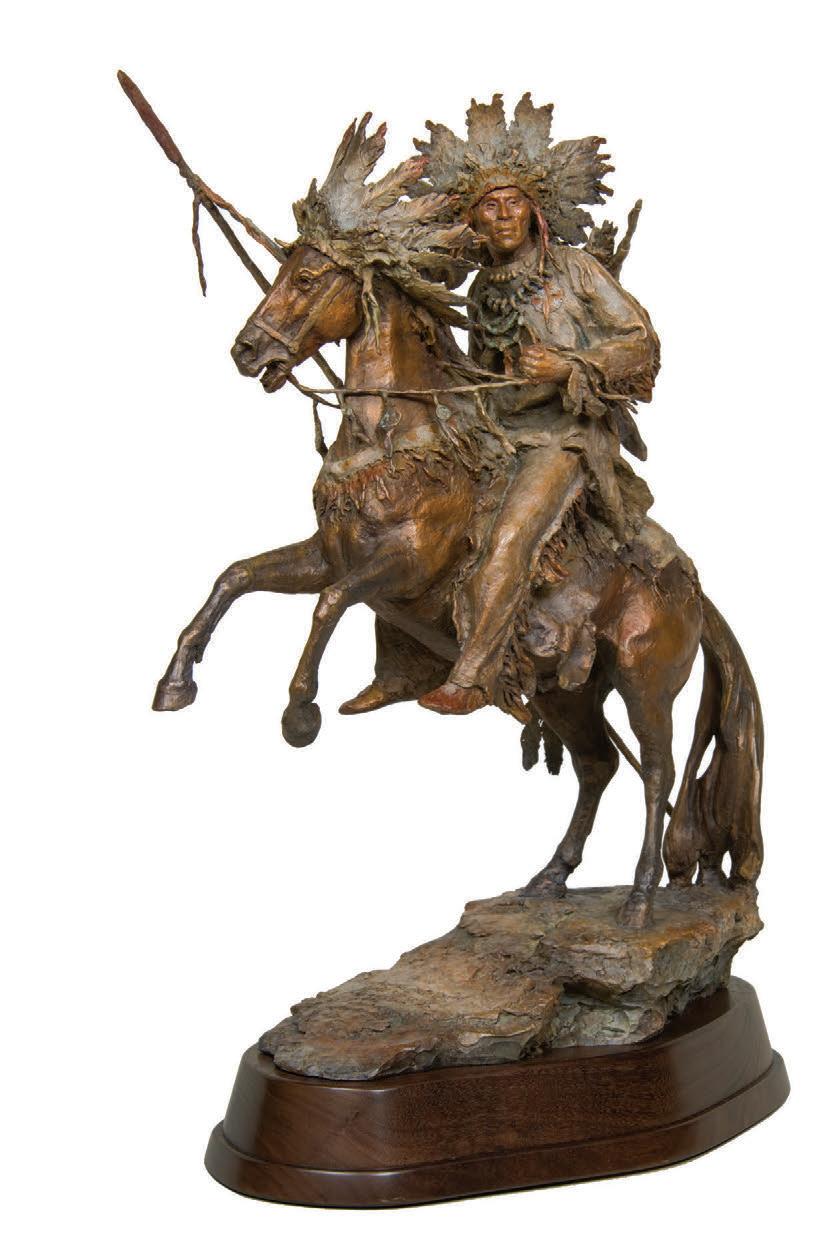
John Coleman b. 1949
Pow Wow Promenade Bronze, cast 17/30
19 ½ inches overall height
Signed/CA, titled and dated 2015
Estimate: $8,000 - 12,000
Literature:
The Art of John Coleman - Spirit - Lives - Legends by Michael Clawson, Published by Sf Design / Fresco Books, Alburquerque, New Mexico 2024; illustrated pg. 234
263
John Coleman b. 1949
He Who Jumps Over Everyone
Bronze, cast 11/20
25 inches overall height
Signed/CA, titled and dated 2016
Estimate: $15,000 - 25,000
Provenance:
Legacy Gallery, Scottsdale, Arizona
Private collection, Arizona circa 2016
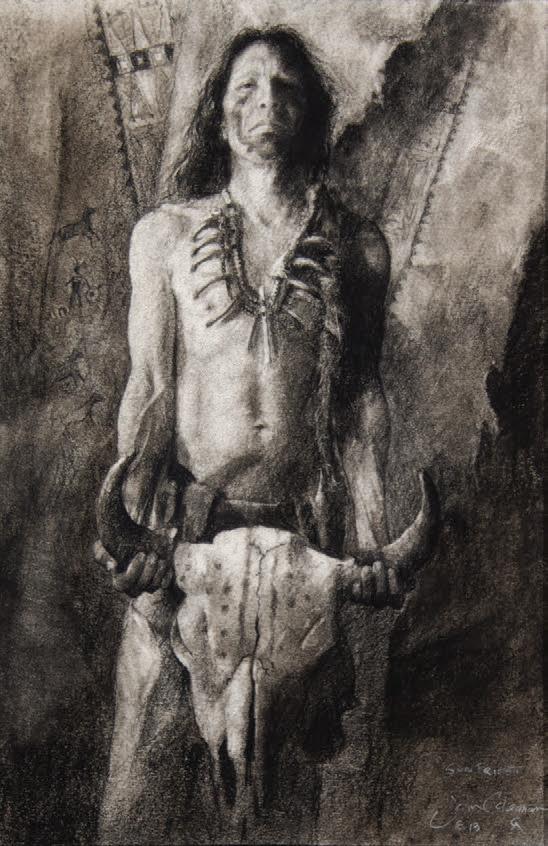
John Coleman b. 1949 Sun Priest
18 x 12 inches
Signed/CA, titled and dated 13 lower right
Estimate: $6,000 - 9,000
264
Charcoal
265
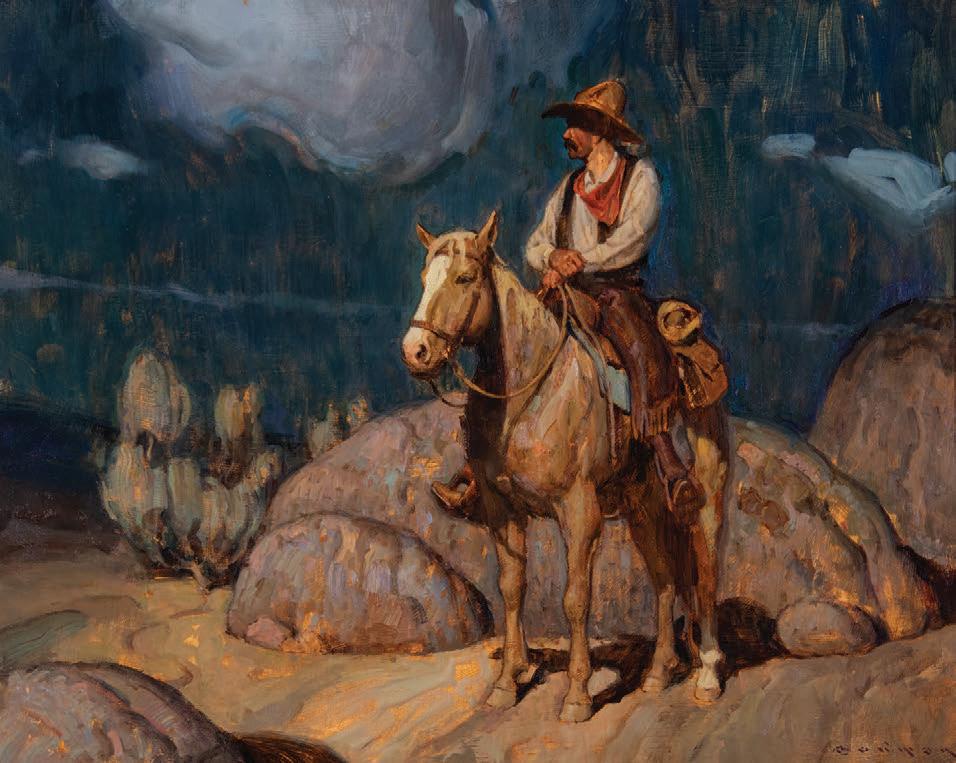
Night Watch Oil on board
16 x 20 inches
Signed lower right; Signed and titled verso
Estimate: $8,000 - 12,000
266
Eric Bowman b. 1960
A Walk in the Woods Oil on canvas
25 x 28 inches
Signed lower left; Signed and titled verso
Estimate: $14,000 - 24,000
Provenance: Private collection, Texas
Eric Bowman b. 1960
40
Signed lower left; Signed and titled verso
Estimate: $40,000 - 60,000
Provenance:
Private collection, New Mexico
267
Eric Bowman b. 1960
Golden Canopy Oil on canvas
x 50 inches
268
Taos
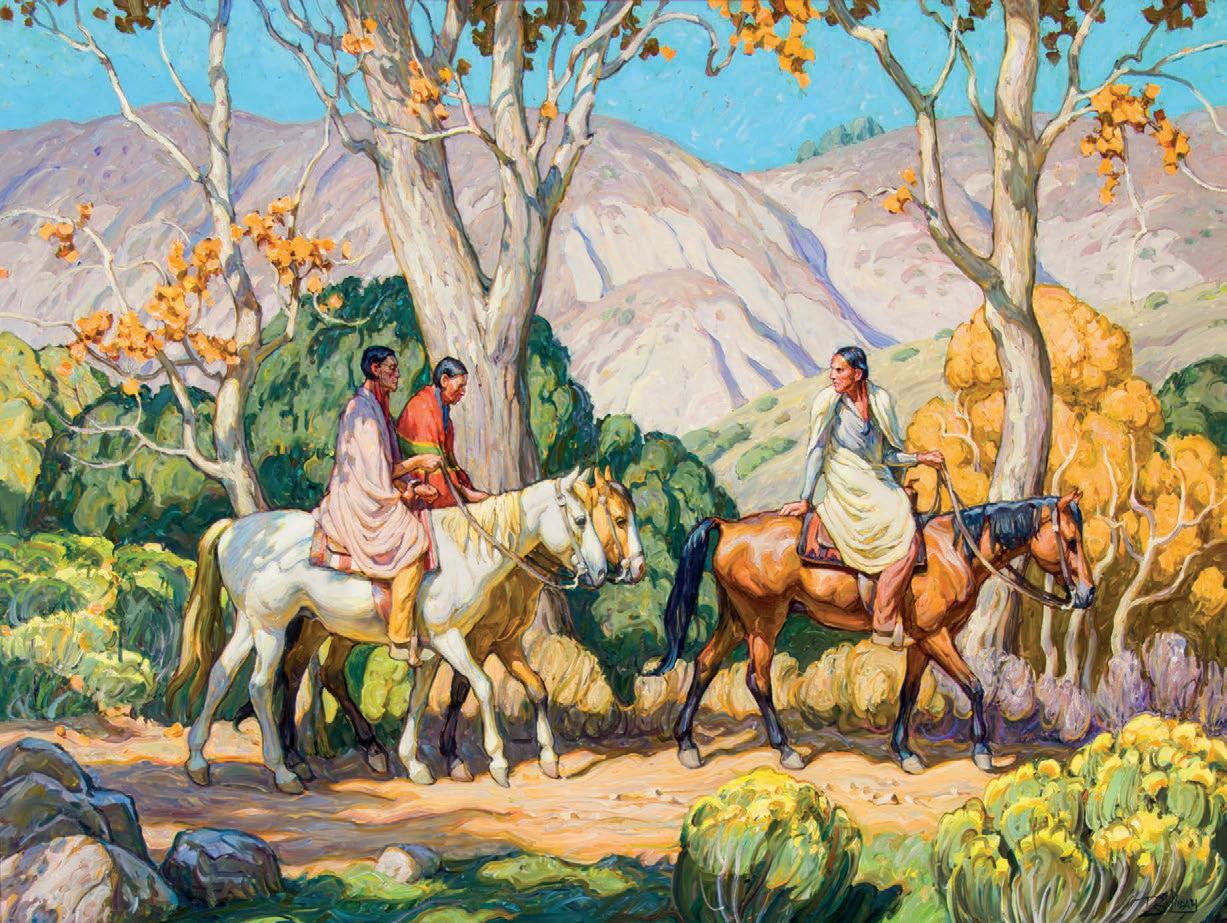
Oil
36 x 48 inches
Signed lower right
Estimate: $30,000 - 45,000
Provenance:
Private collection, New Mexico
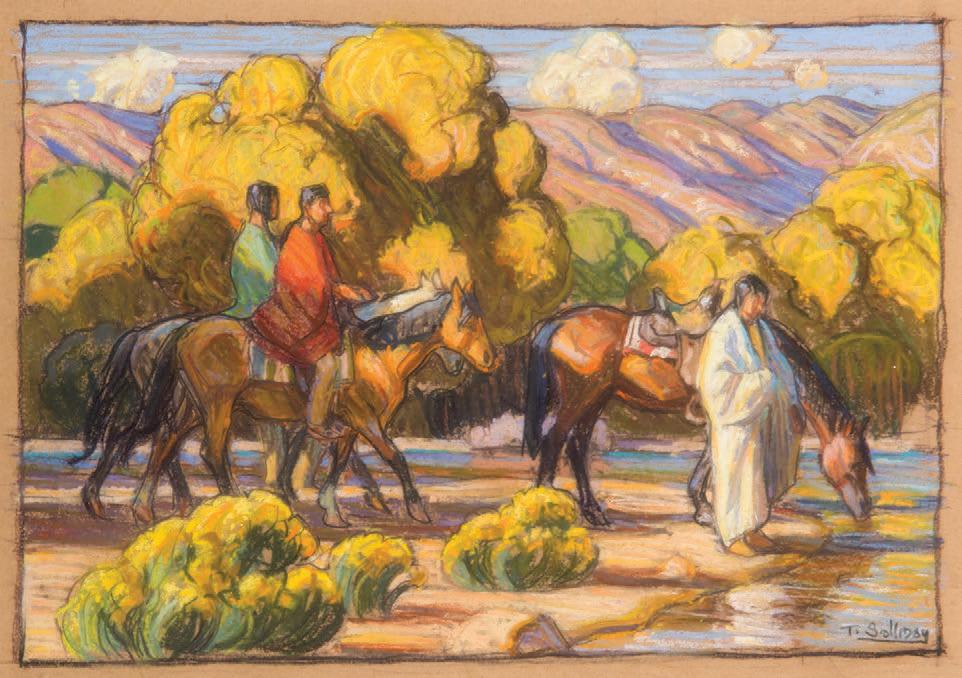
Tim Solliday b. 1952
Travelers
on canvas
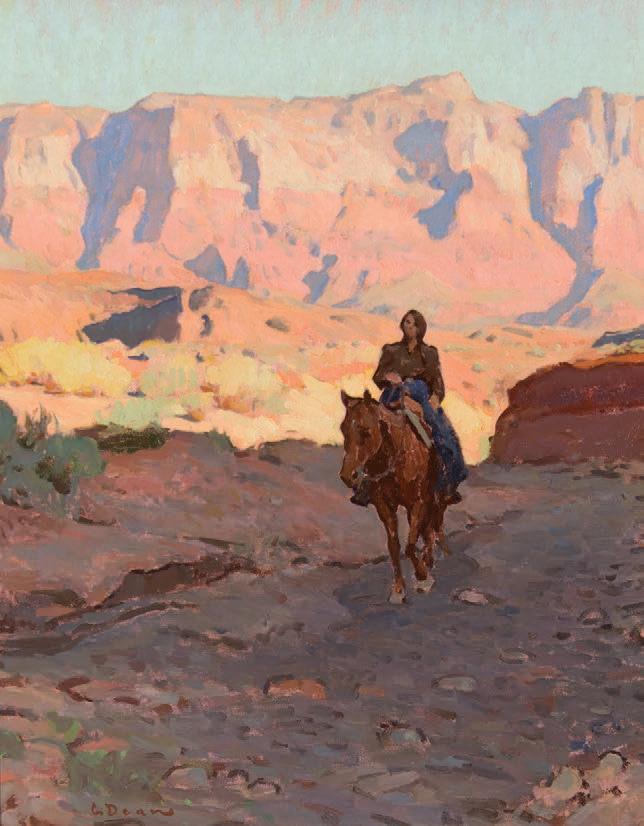
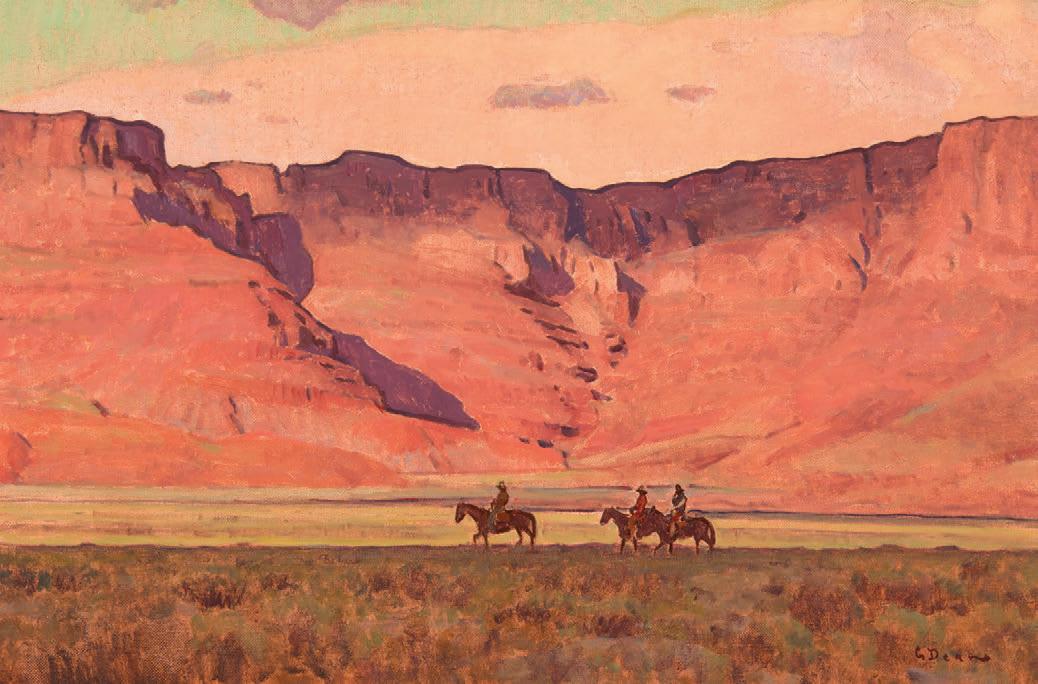
269 Glenn Dean b. 1976
Out of the Sun Oil on canvas mounted to board
20 x 16 inches
Signed lower left; Signed, titled and dated 2024 verso
Estimate: $6,000 - 9,000
270 Glenn Dean b. 1976
20 x 30 inches
Signed lower right; Signed, titled and dated 2024 verso
Estimate: $12,000 - 18,000
Provenance: Private collection, New Mexico
Desert Crossing Oil on canvas
271
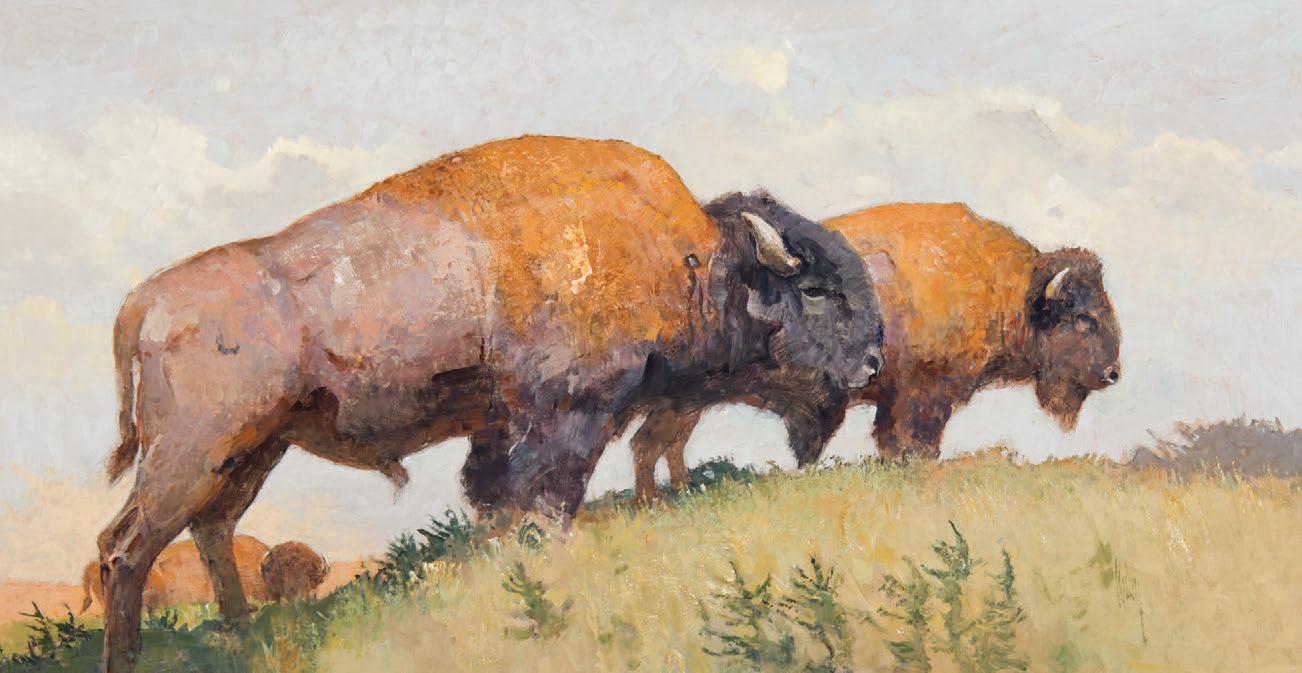
Bob Kuhn 1920-2007
High Plains Lothario
Acrylic on board
18 x 34 inches
Signed lower right; Signed and dated verso 2007 verso
Estimate: $55,000 - 75,000
Provenance:
Collection of M. Anthony Greene, Jackson, WY Santa Fe Art Auction, Santa Fe, NM, 2018 Hindman, Chicago, IL, 2019 Private collection, Texas
Created in the final year of Bob Kuhn’s life, High Plains Lothario is cited as one of the artist’s last works. After his passing in 2007, Western Art & Architecture wrote a tribute to the artist that referenced the painting. “For a genre like ‘wildlife art’ so closely identified with the U.S. West yet extending to every corner of the globe, Bob Kuhn was widely hailed as the greatest living animal painter on the planet,” wrote Todd Wilkinson. “It is worth noting that one of Kuhn’s last classic paintings, High Plains Lothario, portrayed a bison bull trudging toward the top of a lonesome prairie hill past a woolly admirer.”
272
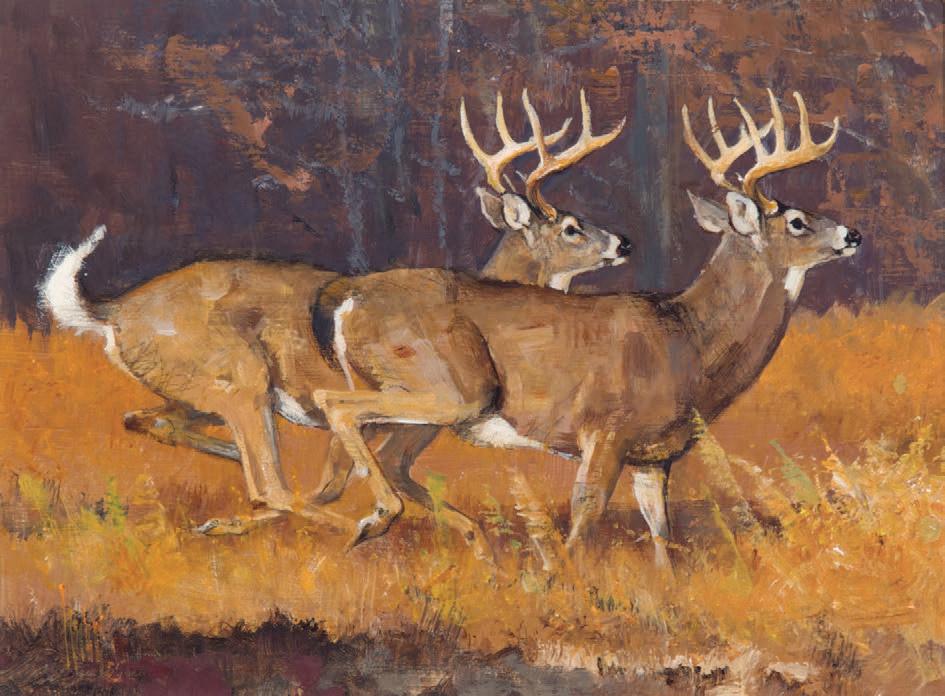
Bob Kuhn 1920-2007
Two Fast Bucks
Acrylic on board
9 ⅜ x 12 ⅜ inches
Signed lower left
Estimate: $30,000 - 40,000
Provenance: Private collection, Texas
273
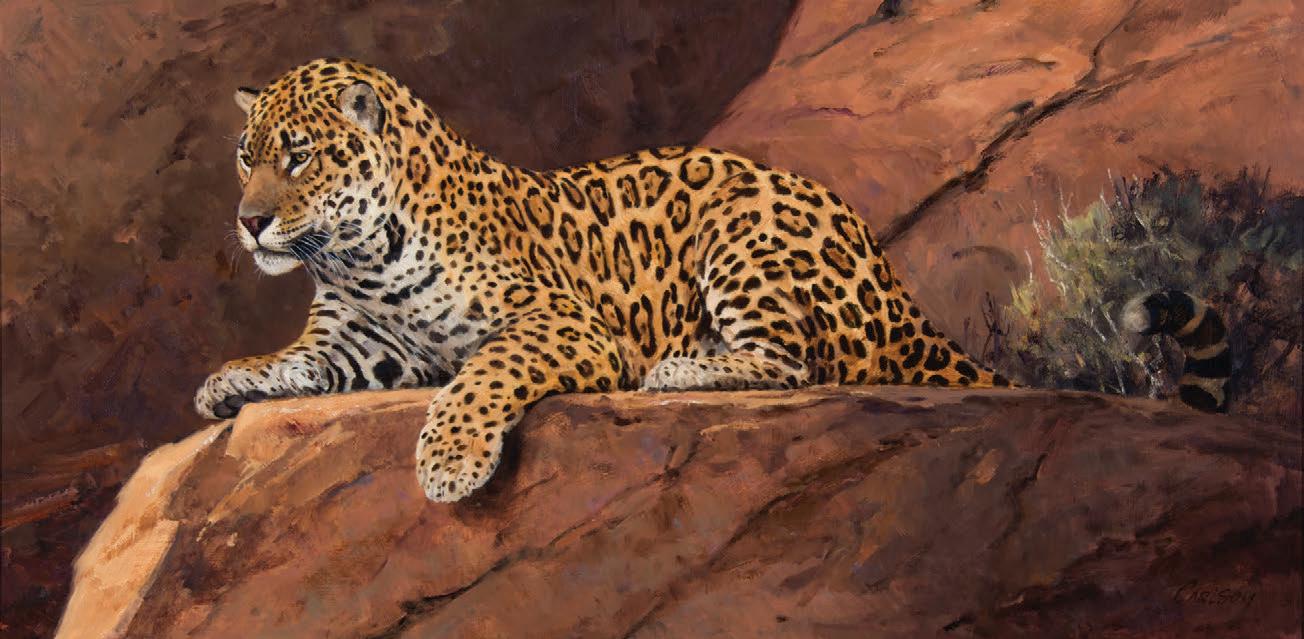
Ken Carlson b. 1937
18 x 36 inches
Signed lower right
Estimate: $25,000 - 35,000
Provenance: Private collection, Texas
Border Cat Oil on board
274
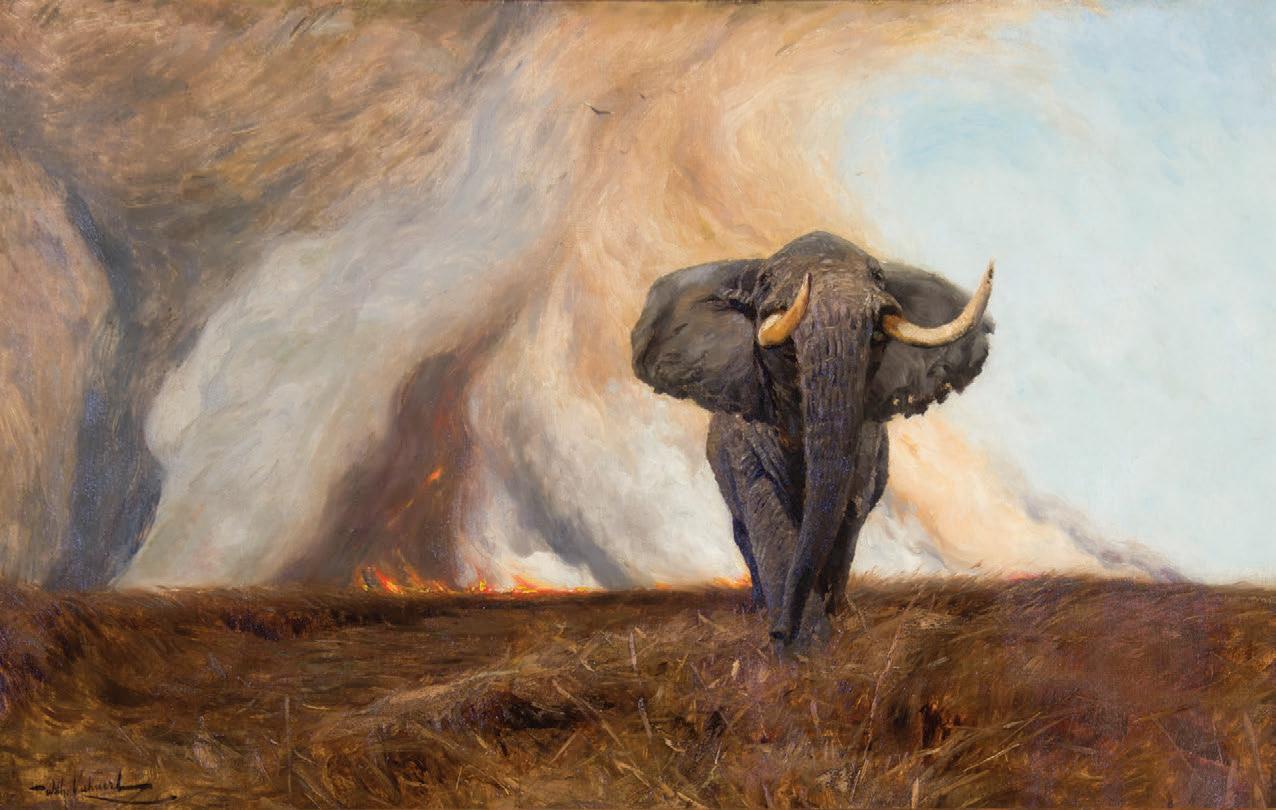
Wilhelm Kuhnert 1865-1926
Steppenbrand
Oil on canvas
21 ¼ x 33 ½ inches
Signed lower left; Troot Lutz Hek verso
Estimate: $50,000 - 70,000
Provenance: Private collection, Texas
The title of this painting, Steppenbrand, is a German word meaning wildfire, specifically steppe fire or prairie fire. Although a great distance from the fire, the large bull elephant in Kuhnert’s painting is seemingly in distress as it flees the encroaching flames. Elephants can outrun most grass fires, but winds can speed up the spread of the fire and rough terrain can slow the pachyderms. Either can result in elephant deaths. The artist must have known this when he painted Steppenbrand, which uses dark smoke as an ominous adversary lurking on the horizon.
Wilhelm Kuhnert is regarded as one of the great wildlife artists, in addition to one of the best painters of large cats, which is how he acquired the nickname Lion. He is part of the “Big Four” of animal artists, which also includes Richard Friese, Bruno Liljefors and Carl Rungius. Born in Germany, Kuhnert studied art in Berlin before traveling to Egypt, East Africa and India. It was on these trips where he honed his skills as an animal painter. Although he painted more than 5,500 paintings, it is thought that less than 1,000 survive today.
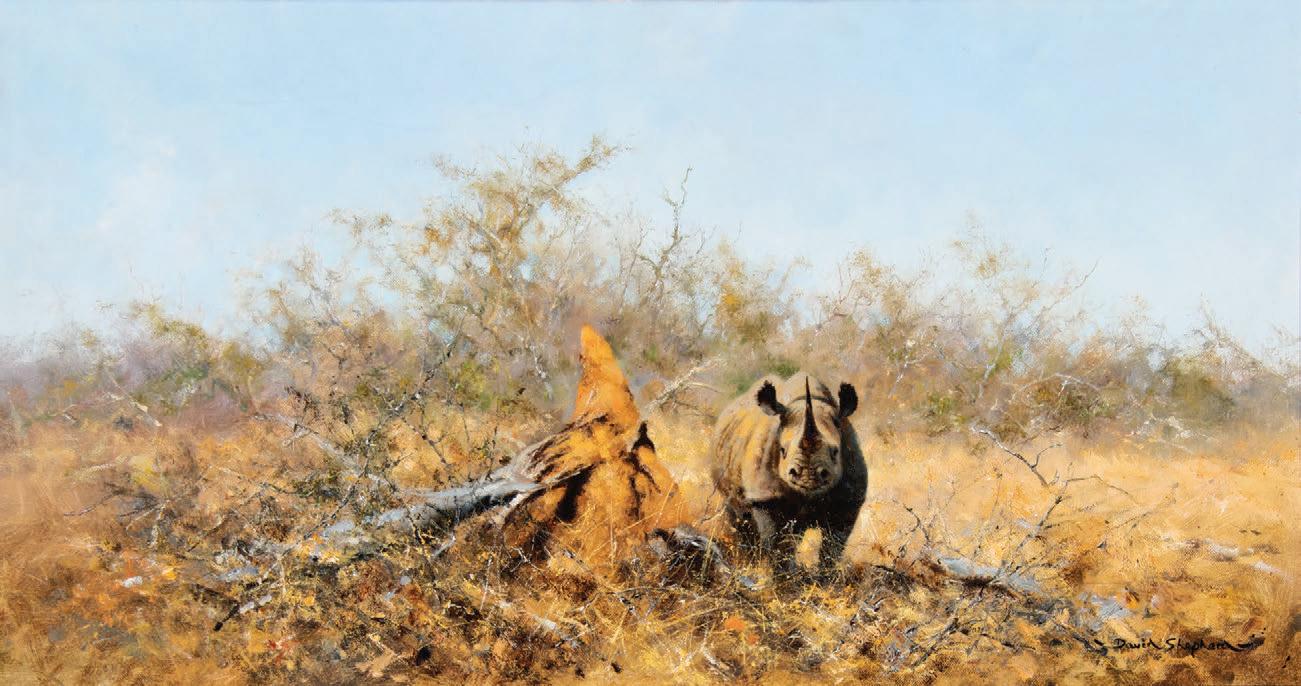
275 David Shepherd 1931-2017 Rhino by a Deadwood Anthill Oil on canvas
18 x 34 inches
Signed lower right
Estimate: $14,000 - 18,000
Provenance: Private collection, Wyoming
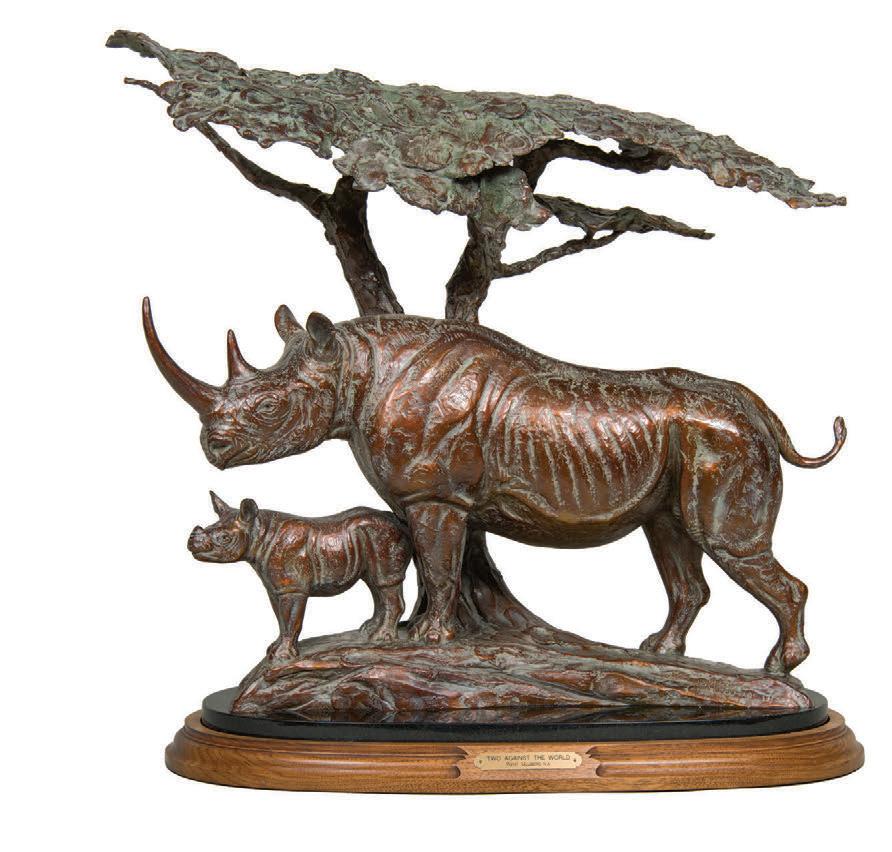
276 Kent Ullberg b. 1945
Two Against the World Bronze, cast 13/30
20 ½ inches overall height
Signed Estimate: $2,500 - 4,500
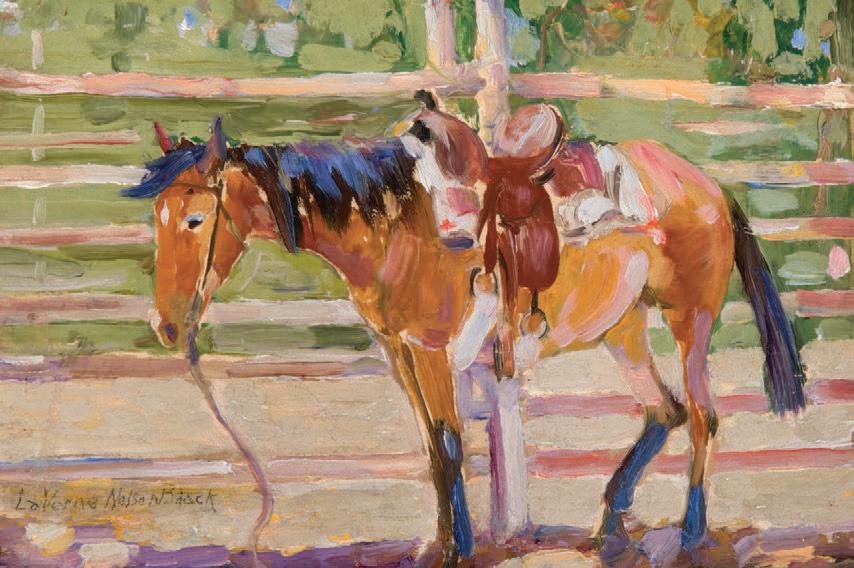
277
Laverne Nelson Black 1887-1938
Autumn at Taos Pueblo
Oil on board
7 ¾ x 10 inches
Signed lower right
Estimate: $35,000 - 55,000
Provenance:
Santa Fe Art Auction, Santa Fe, NM, 2005
Private Collection, Houston, TX
Lone Star Art Auction, Dallas, TX, 2023 Private collection
Painted with large, sumptuous strokes, Laverne Nelson Black’s Autumn at Taos Pueblo is indicative of the kind of work the artist was known for in Northern New Mexico starting in 1925. His initial trips to the West from Chicago were for his health, which needed warm, dry air. Once in Taos, he fell in love with the people and atmosphere. Later, during the Great Depression, he moved to Phoenix and made murals with Oscar E. Berninghaus.
278
Laverne Nelson Black 1887-1938
Saddled Oil on board
6 ⅛ x 9 inches
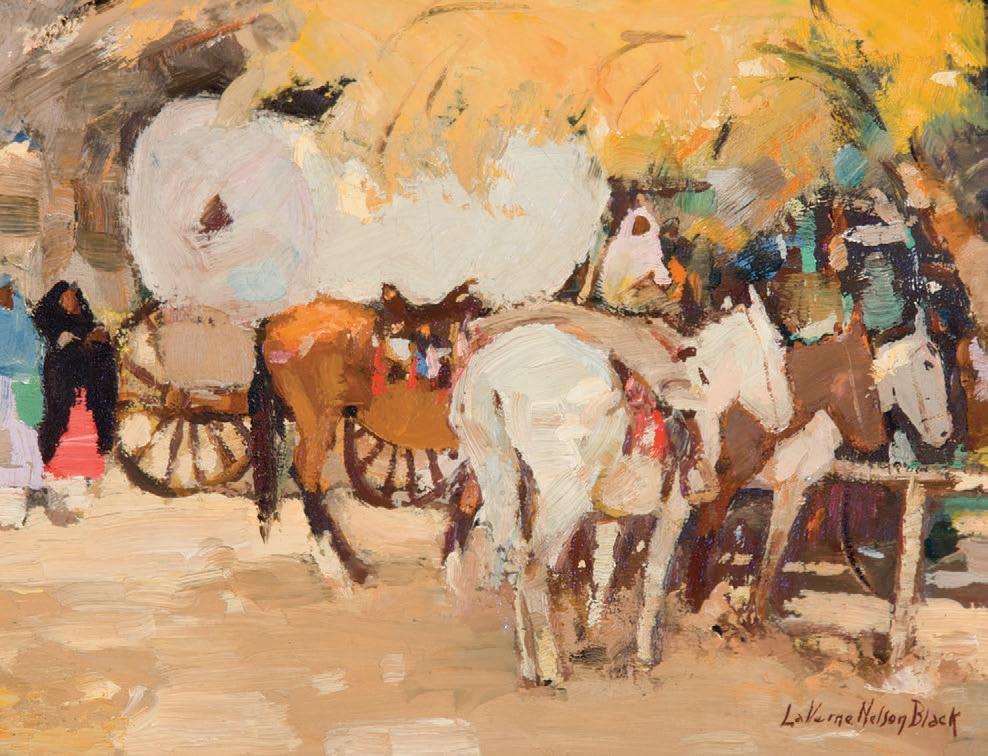
Signed lower left
Estimate: $10,000 - 15,000
Provenance:
J.N. Bartfield Galleries, New York, NY
Private collection, Arizona circa 1987
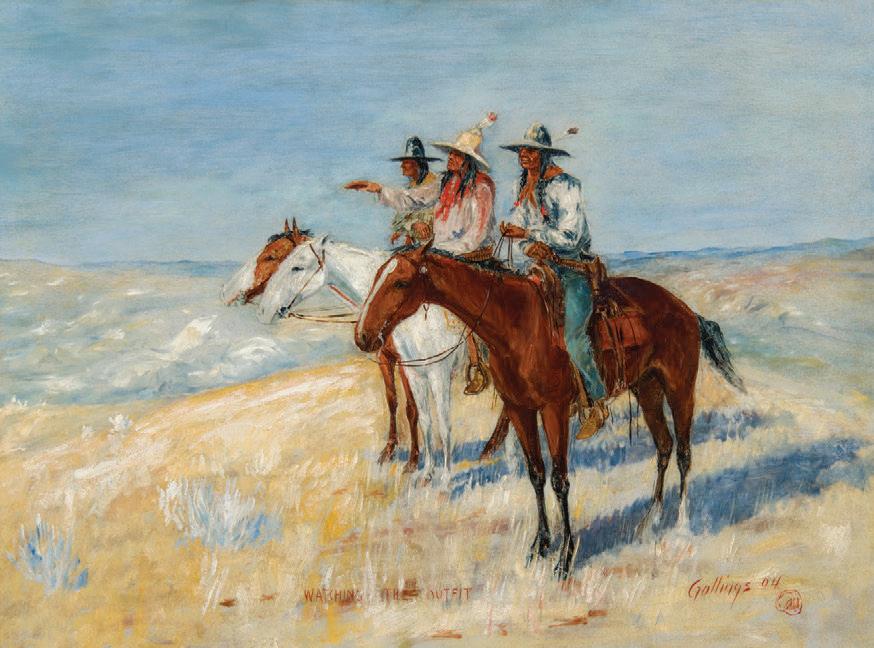
279
William Gollings 1878-1932
Watching The Outfit Oil on canvas
18 ⅛ x 24 ⅛ inches
Signed and dated 04’ lower right, tilted lower middle;
Estimate: $20,000 - 30,000
Provenance:
Artist's Union Gallery, Bozeman, MT Santa Fe Art Auction, Santa Fe, NM, 2006
Private collection, New Mexico
Literature:
Elling William “Bill” Gollings: A Cowboy Artist, William T. Ward and Gary L. Temple, Patagonia Publishing Company, 2007, p. 16.
280
Gerard Curtis Delano 1890-1972
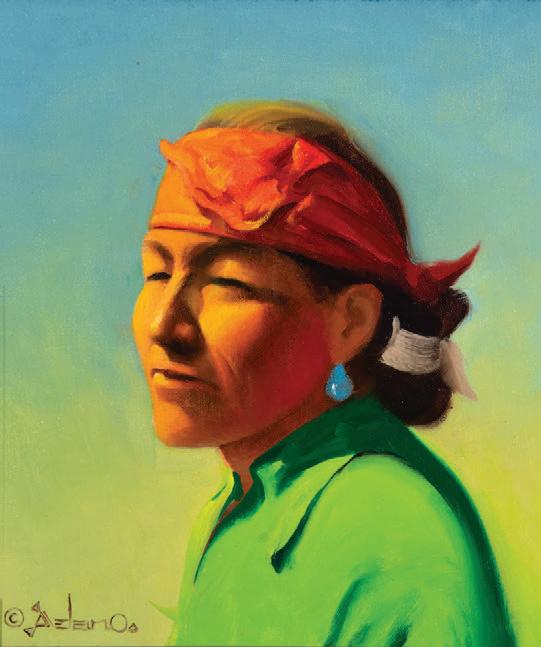
Desert Denizens
Oil on canvas mounted to board 14 x 17 inches
Signed lower left; Signed and titled verso
Estimate: $25,000 - 35,000
Provenance: Private collection, California
281
Gerard Curtis Delano 1890-1972
Set of two (2):
Agnes; Oil on canvas mounted to board; 14 x 12 inches; Signed lower left; Signed and titled verso Hosteen t'sosi; Oil on canvas mounted to board; 14 x 12 inches; Signed lower left; Signed and titled verso
Estimate: $25,000 - 35,000
Provenance: Private collection, Iowa
Literature:
Walking with Beauty: The Art and Life of Gerard Curtis Delano by Richard G. Bowman, Publishers Press Inc, Salt Lake City, UT, 1990; "Hosteentosi" illustrated p.88
282
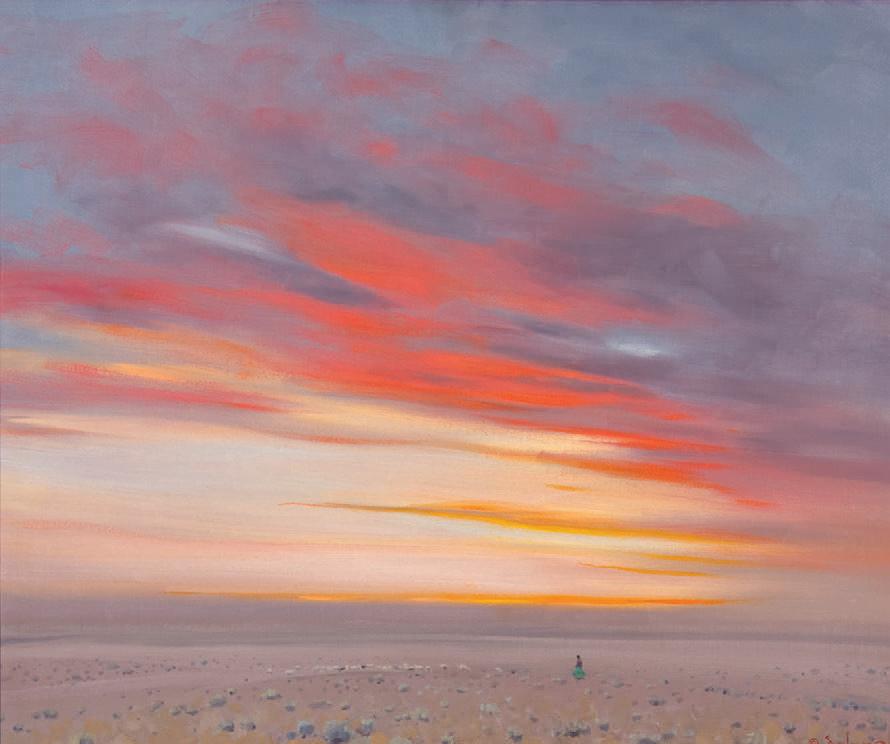
Gerard Curtis Delano 1890-1972
Twilight on the Navajo Reservation Oil on canvas
25 x 30 ¼ inches
Signed lower right; Titled verso
Estimate: $25,000 - 40,000
Provenance: Private collection, Iowa
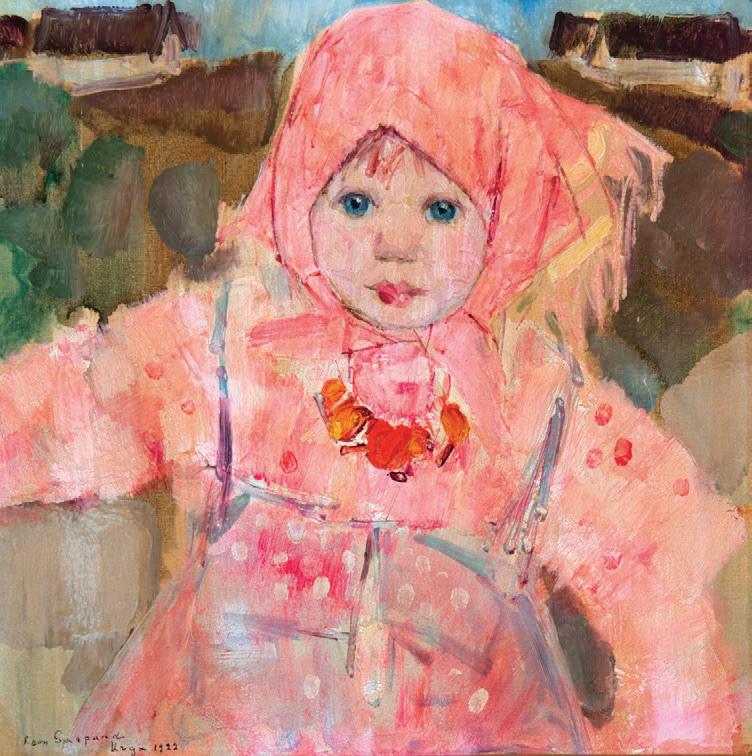
283
Leon Gaspard 1882-1964
Portrait of a Young Girl (Urga, 1922)
Oil on board
11 x 11 inches
Signed and dated 1922 lower left
Estimate: $25,000 - 35,000
Provenance: Private collection, Iowa
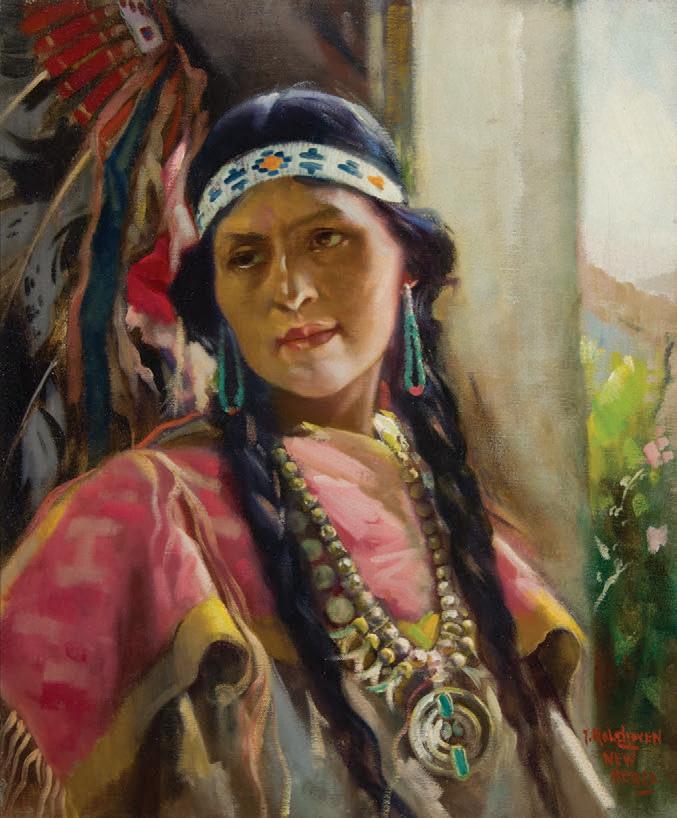
284
Julius Rolshoven 1858-1930
Indian Maiden
Oil on canvas
24 x 20 inches
Signed/ New Mexico lower right
Estimate: $10,000 - 15,000
Provenance: Private collection, Missouri
A rejection could have dissuaded Julius Rolshoven from pursuing art, but it only increased his resolve. After the National Academy of Design rejected his admission in 1876, the artist crossed the Atlantic Ocean to study in Germany. He met Frank Duveneck, spent time in Italy and France, and honed his skill as a painter. By 1885, the National Academy was showing his work in exhibitions. His career shifted greatly in 1916 when he moved to Taos, New Mexico, where he began painting the pueblo people and the landscape.
285
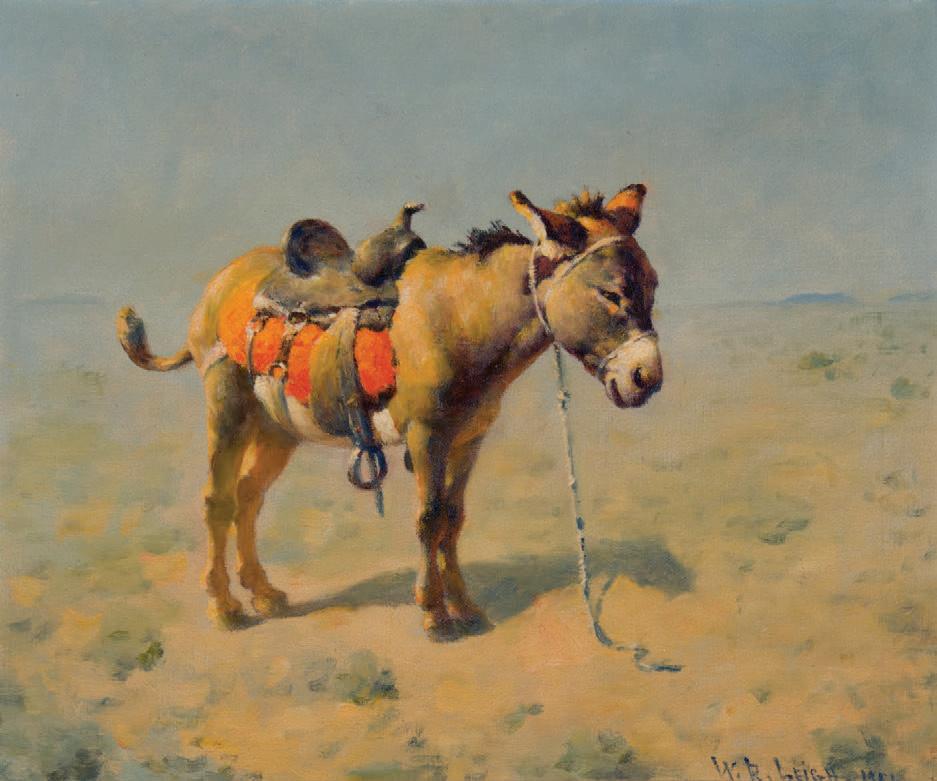
William R. Leigh 1866-1955
Burro
Oil on canvas
20 x 24 inches
Signed and dated lower right
Estimate: $35,000 - 50,000
Provenance: Private collection, Arizona
This sweet little burro is the subject of several paintings by William R. Leigh, including Hopi Burro, The Burro, Navaho Burro and The Good Friend. This painting, titled simply Burro, is the largest at 20 by 24 inches. While the origins of the painting are not known, more information can be gleaned from an unfinished oil painting seen in D.Duane Cummins’ 1980 book William Robinson Leigh: Western Artist. The title of the partially painted image is Hopi Burro, Hopi Reservation, Polacca, Arizona. Leigh visited the Navajo and Hopi people during a 1916 trip to the Southwest. The trip was so successful that the artist used material acquired during the trip in paintings for the next five years. “…Leigh scoured the Navajo reservation lands in an intensive study of their life and customs,” wrote Cummins. “He researched the Hopi with equal thoroughness, visiting their settlements in Walpi, Sipaulovi and Oraibi. Leigh produced literally stacks of sketches on numerous subjects including Indian life, burros, goats, desert scenes, plant life and cloud studies. He even painted the desert by lantern light at two o’clock in the morning in an effort to capture the effects of the moon. Beyond the vast collection of sketches he also acquired scores of photographs.”
286
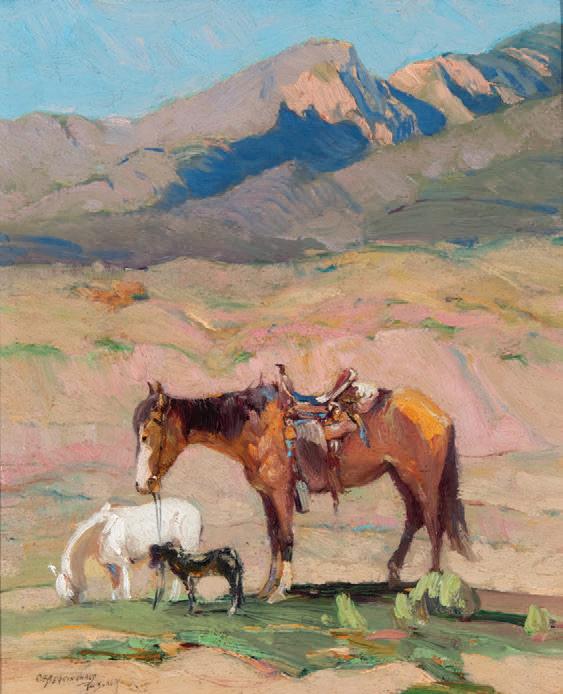
Oscar Berninghaus 1874-1952
Horses Grazing in Taos Mountains, NM
Oil on board
12 x 9 ⅞ inches
Signed “Taos NM” lower left
Estimate: $10,000 - 12,000
Provenance: Private collection, Iowa
287
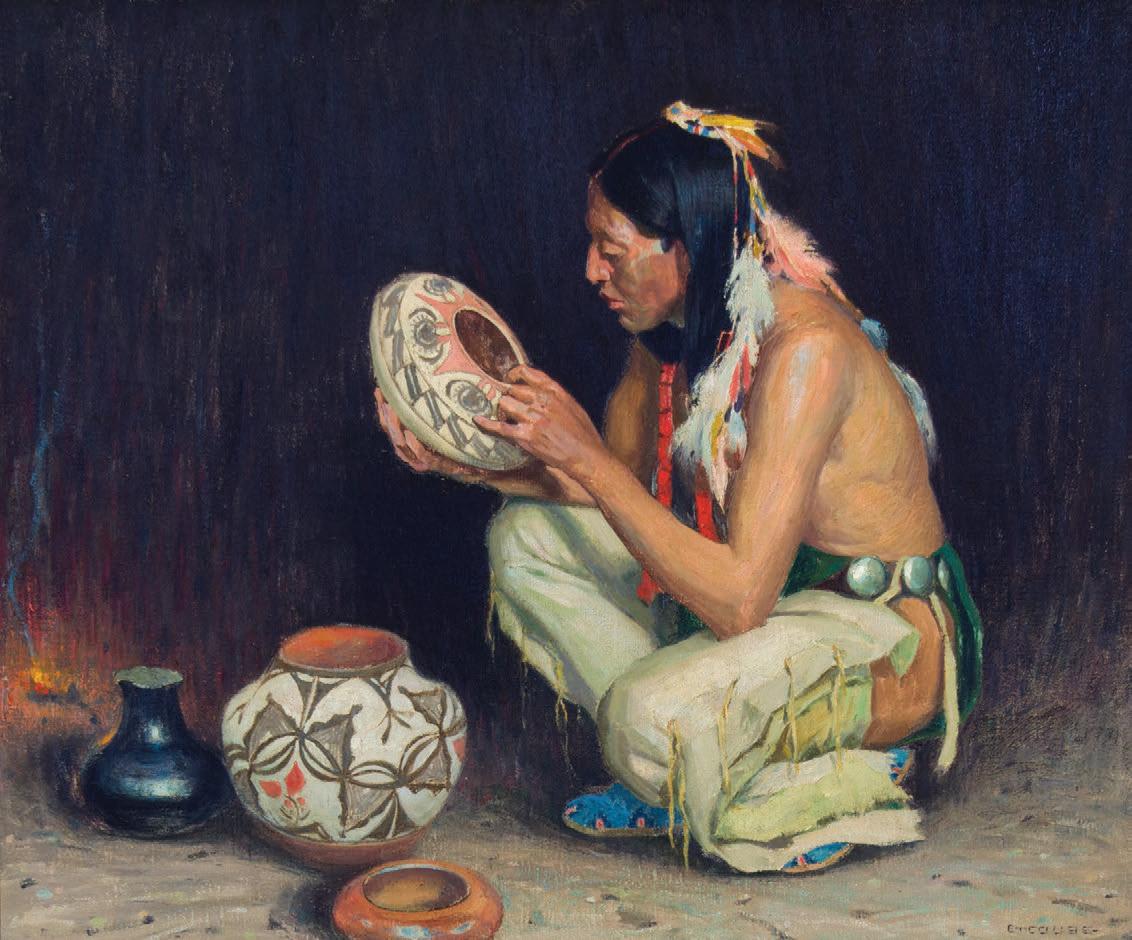
Eanger Irving Couse 1866-1936
The Master Potter Oil on canvas
24 x 29 inches
Signed lower right
Estimate: $150,000 - 250,000
Exhibited:
1921 Southern Art Co.: Southern Art Company, Souther Art Company, Memphis, Tenn., September 15, 1921, as The Master Potter.
Provenance:
The artist, Taos, NM
Frank C. Freyermuth, Chicago, 1921
J. W. Young, Chicago, 1923
D. H. Hatfield, Chicago, 1923
Private Collection
Bonham’s California, San Francisco, CA, 1997
J.N. Bartfield Galleries, New York, NY
Private collection, New York, NY
By descent in family, New York, NY
Private collection, Montana
Some of Eanger Irving Couse’s most masterful works feature Native American figures admiring objects in moody interior scenes. The artist painted his subjects with pueblo carvings, baskets, beadwork and carved flutes, but no other art forms appear in his pieces more than pottery, which he worked into more than a dozen major paintings. In The Master Potter, the figure looks into the opening of an Acoma Pueblo pot, known for its thin and hand-coiled walls, smooth matte-like finish and elaborate designs painted on white clay. Couse designed many of his paintings using photography in the studio, which allowed him to dial in the composition to his liking before turning to his easel. Many of the photographs exist still today at the Couse-Sharp Historic Site and its archives at the Lunder Research Center. One image in the archive shows model Ben Lujan with both pots from The Master Potter. Lujan’s position is reversed and the pose is different, but the image captures Lujan in a nearly identical scene. (Indian Potter, a painting from 1914, shows a more exact depiction of the photo. The work is in the collection of the Bowers Museum in Santa Ana, California.) The photo and subsequent paintings reveal how meticulous Couse was in his studio when it came to staging his scenes and the objects used. The artist first met Lujan during his first stay in Taos in May 1902. Lujan was 10 years old. “No more important event took place that summer than this meeting, as it was the beginning of an enduring association between the artist and this young model,” wrote Virginia Couse Leavitt in Eanger Irving Couse: The Life and Time of An American Artist, 1866-1936
288
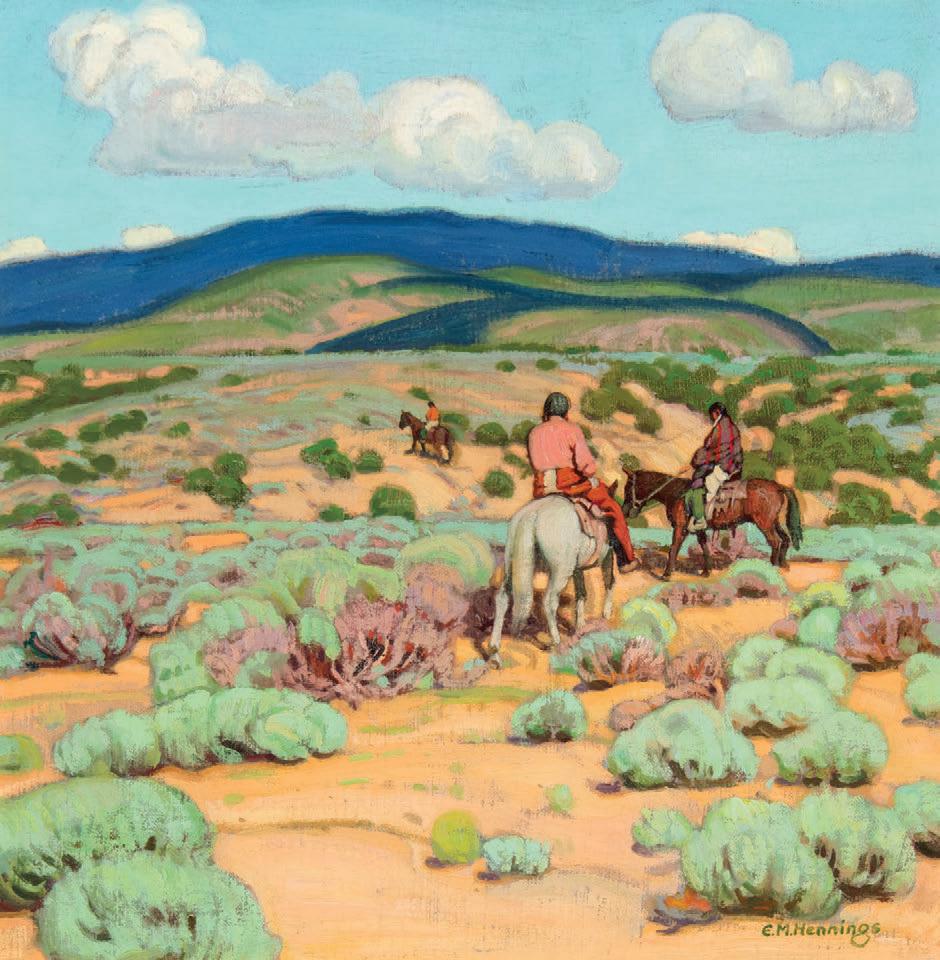
E. Martin Hennings 1886-1956
Homeward Through the Sage Oil on board 14 x 14 inches
Signed lower right;
Titled, “Taos, NM”, and dated 1929 verso
Estimate: $100,000 - 150,000
Provenance:
Fenn Galleries, Santa Fe, NM Arizona West Galleries, AZ Scottsdale Art Auction, Scottsdale, AZ, 2011 Private collection, Iowa
E. Martin Hennings completed at least four paintings with the word “homeward” in the title, including this 1929 painting, Homeward Through the Sage. Each is uniquely composed and painted, although each bears a similar theme of Native American men on horseback traversing through the land to an unseen destination. Hennings, who was raised in Chicago, first came to Taos, New Mexico, in 1917 and moved there permanently in 1921. While other artists came and went from that magical place, Hennings stayed in Northern New Mexico for the rest of his life. For Hennings, “homeward” was always Taos.
289
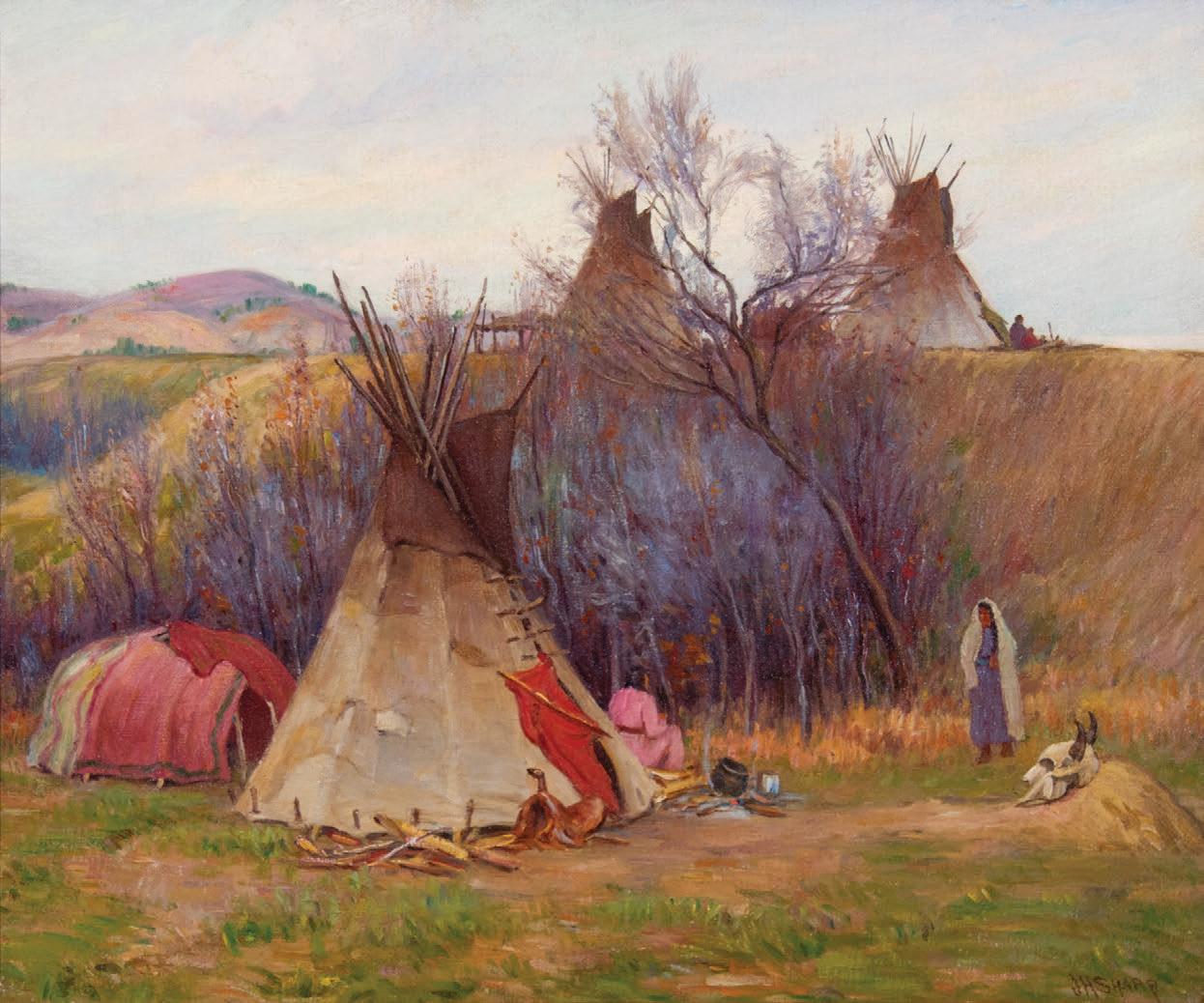
Joseph Henry Sharp 1859-1953
Cheyenne Medicine Tepee
Oil on canvas
20 x 24 inches
Signed lower right; “Cheyenne Medicine Teepe” verso
Estimate: $125,000 - 175,000
Provenance: Jim Fowler's Period Gallery West, Scottsdale, AZ, 1983
Private collection, Iowa
Cheyenne Medicine Tepee, also known as The Medicine Man, is a painting that originated during Joseph Henry Sharp’s frequent and prolonged trips to the Crow Agency in Montana starting in 1901. While Sharp was known for helping start the Taos Art Colony, his work in Montana on the Crow Agency was a significant part of his creative output. Sharp used similar names on many paintings and also retitled paintings, so it’s difficult to track individual works across his long career. This painting’s title and dimensions match an entry in Forrest Fenn’s Teepee Smoke: A New Look Into the Life and Work of Joseph Henry Sharp, which lists the year of its completion as 1923, the final year Sharp spent at the Crow Agency.
290
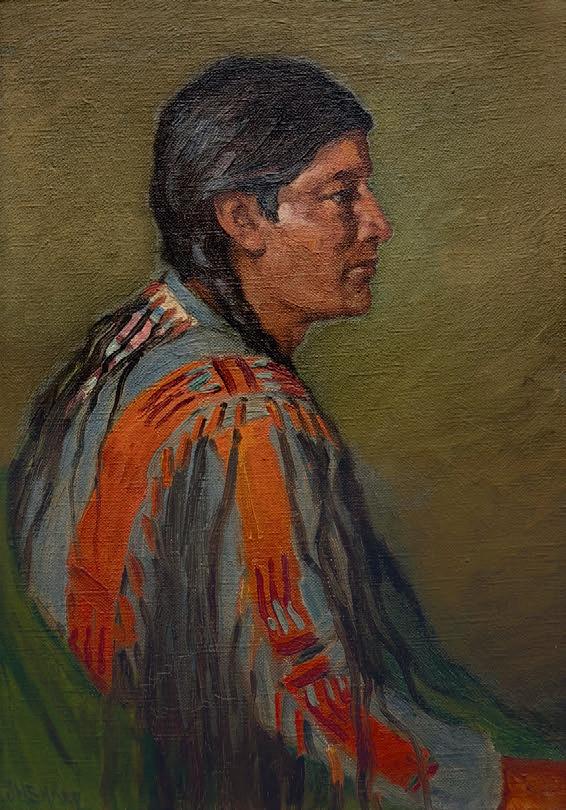
Joseph Henry Sharp 1859-1953
Jerry Oil on canvas
14 x 10 inches
Signed lower left; Titled verso
Estimate: $25,000 - 35,000
Provenance: Private Collection, Arizona
Included with this lot is a photo of what appears to be the model for this painting along with the artist - 20 years later.
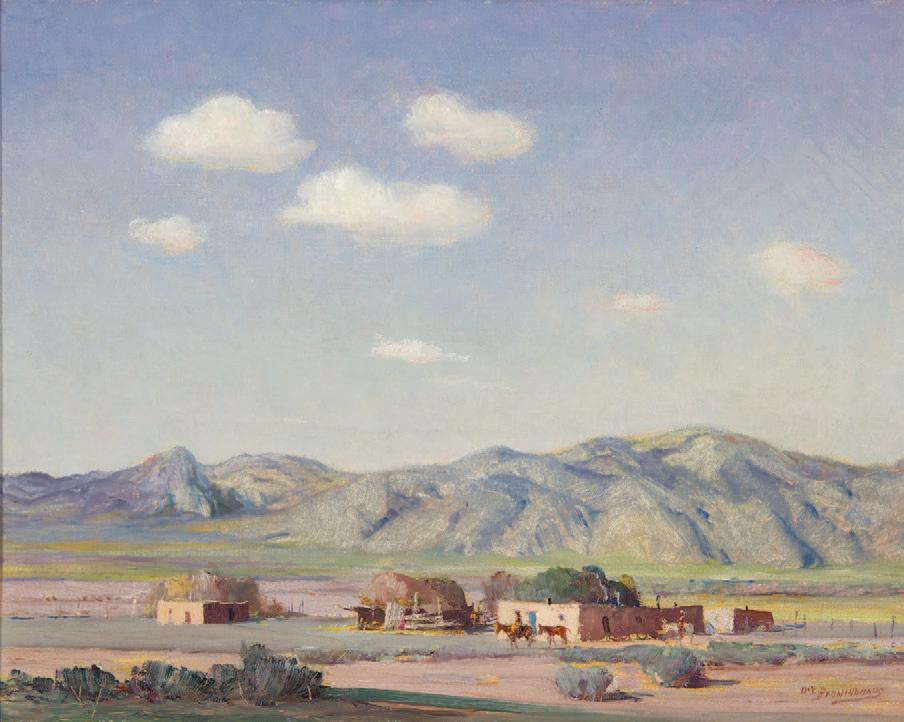
291
Oscar Berninghaus 1874-1952
Ranch House and Mountains, Taos
Oil on canvas
16 ¼ x 20 ¼ inches
Signed lower right; Signed and titled verso
Estimate: $30,000 - 50,000
Provenance:
The Artist, Taos, New Mexico
Arizona West Galleries, Inc., Scottsdale, Arizona
Private Collection, New York, New York
By Descent in Family, New York, New York
Literature: Oscar E. Berninghaus, Taos, New Mexico, Master Painter of American Indians and the Frontier West, Sanders, Gordon E., Taos Heritage Publishing Company, Taos, New Mexico, 1985, 140 pages.
292
Joseph Henry Sharp 1859-1953
Custer Battlefield Oil on canvas
20 x 27 inches
Signed lower right
Estimate: $50,000 - 75,000
Provenance: Private collection, Arizona
Exhibited: Taft Museum Cincinnati, Ohio
293
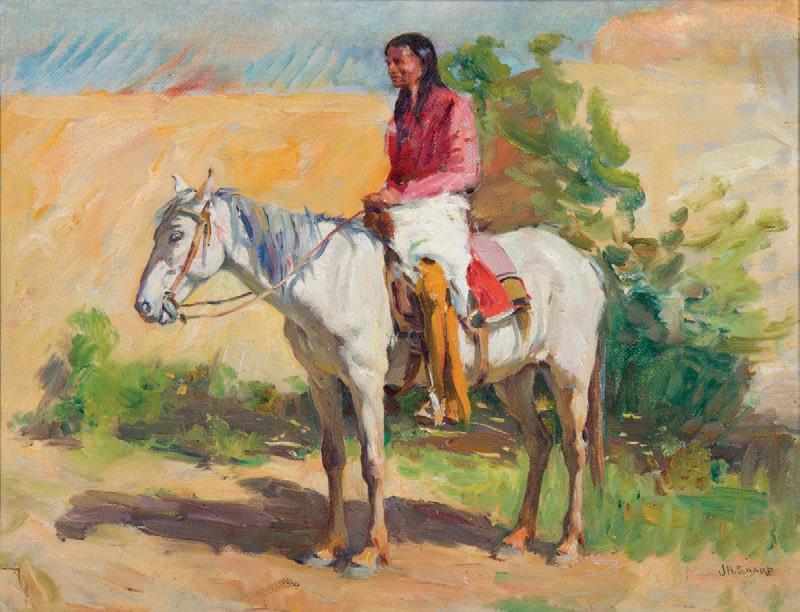
Joseph Henry Sharp 1859-1953 Indian on Horse Oil on canvas mounted to board 14 x 18 inches
Signed lower right
Estimate: $15,000 - 25,000
Provenance: Private collection, California
294
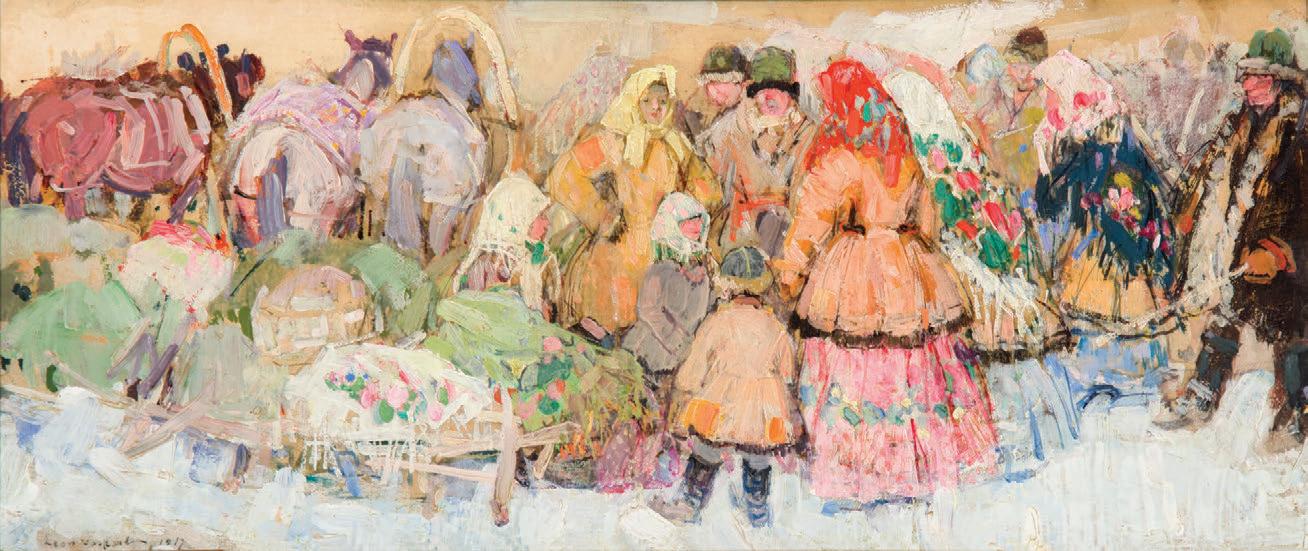
Leon Gaspard 1882-1964
Russian Village Market Oil on board
9 x 20 ¾ inches
Signed lower left and dated 1917
Estimate: $35,000 - 55,000
Provenance:
Private collection, sold to benefit the Wichita Art Museum Hindman, Chicago, IL, 2023
Private collection
Painted with a symphony of delicate color that shines lightly through the snow and the buzzing of moving figures, Leon Gaspard’s Russian Village Market was painted in 1917, one year before the Russian-born painter arrived in Taos, New Mexico. The artist, who had traveled vast distances in Asia and Europe prior to his arrival in America, discovered Taos at a pivotal moment just after the founding of the Taos Society of Artists. He may have been considered for membership except for a TSA rule that required members be American. Although he wasn’t part of the group, Gaspard was close with the founders: he lived near Joseph Henry Sharp and Eanger Irving Couse, played chess with Ernest L. Blumenschein and hunted with William Herbert “Buck” Dunton.
295
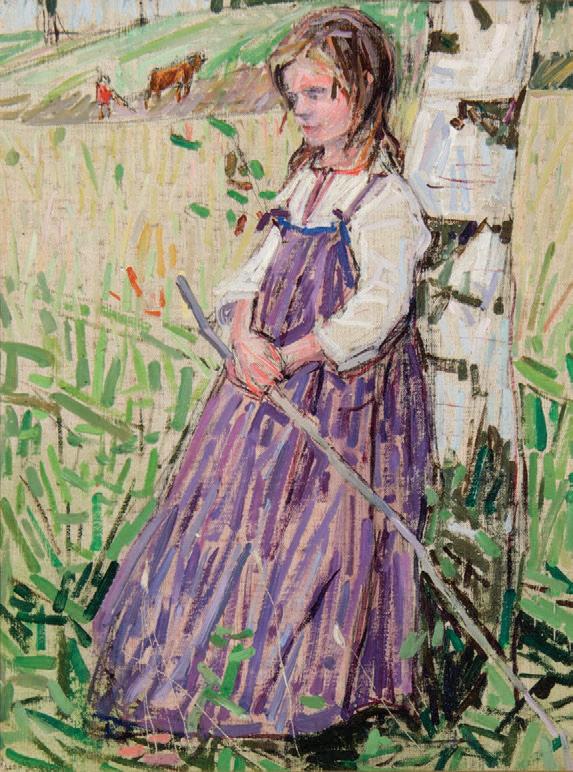
Leon Gaspard 1882-1964
Russian Girl in Apron Oil on board
13 x 10 inches
Signed lower left
Estimate: $15,000 - 25,000
Provenance: Regina Giesecke Collection, Ballinger, Texas
Sold by decent in family partnership, Scottsdale, Arizona
296
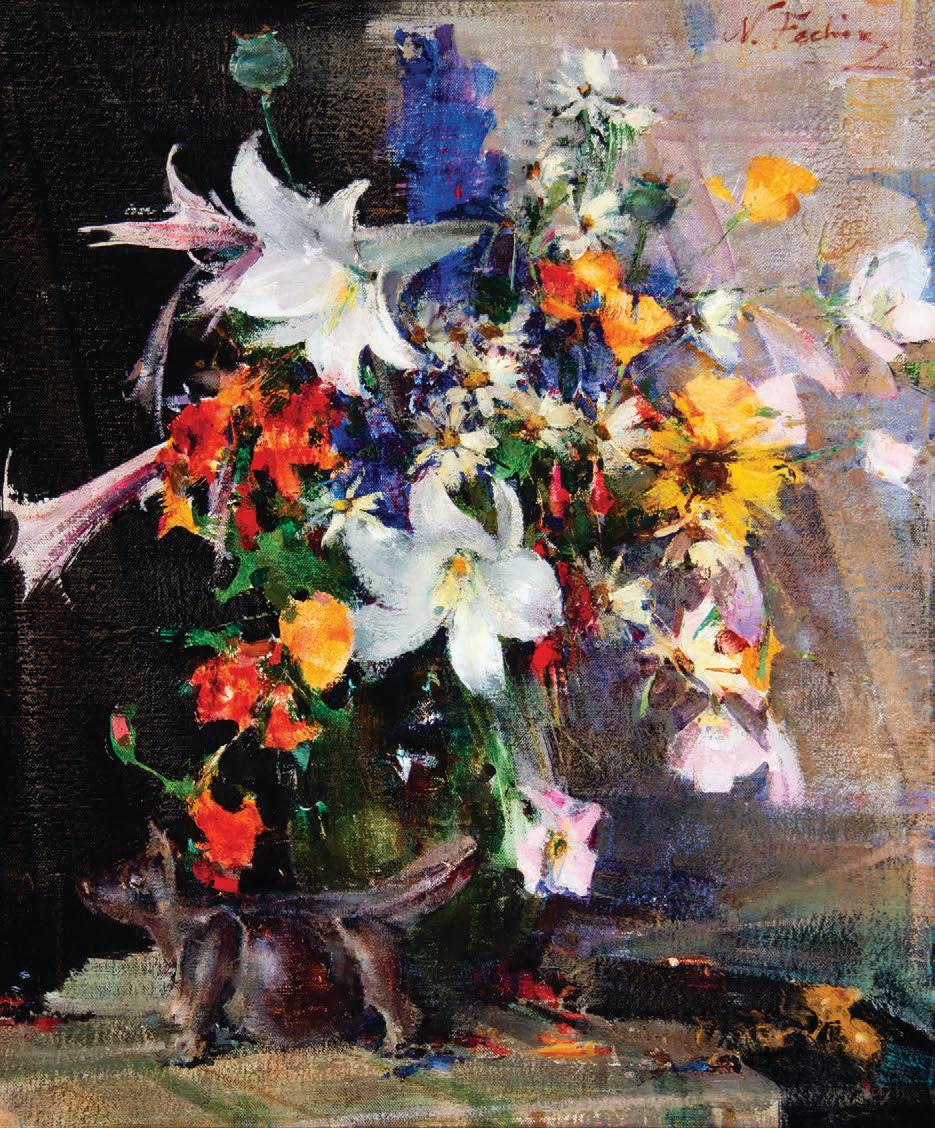
Nicolai Fechin 1881-1955
Still Life, Floral Oil on canvas
24 x 20 inches
Signed upper right
Estimate: $300,000 - 400,000
Provenance: Private collection, Texas
Nicolai Fechin believed in the power and beauty within objects, which is evident in his floral paintings. Like his portraits, Fechin painted objects with loose, evocative brushstrokes that danced freely on the surface of the painting. Recurring still life subjects included fruits, pueblo carvings and various pots and pitchers, although flowers were his most frequent subjects.
When Fechin arrived in New Mexico, by invitation from Mabel Dodge Luhan, he acquired a home in Taos for his wife and daughter. After moving in, the family determined the house was not to their liking, so Fechin began a long and arduous renovation and expansion. The project took five years and included the latest amenities, including the first electric stove, oven and refrigerator in Taos. Fechin also carved custom features throughout the two-story residence, as well as created ingenious storage spaces in nearly every room. The iconic Taos home, which is now the Taos Art Museum, is a love letter to the beauty of objects in the Southwest.
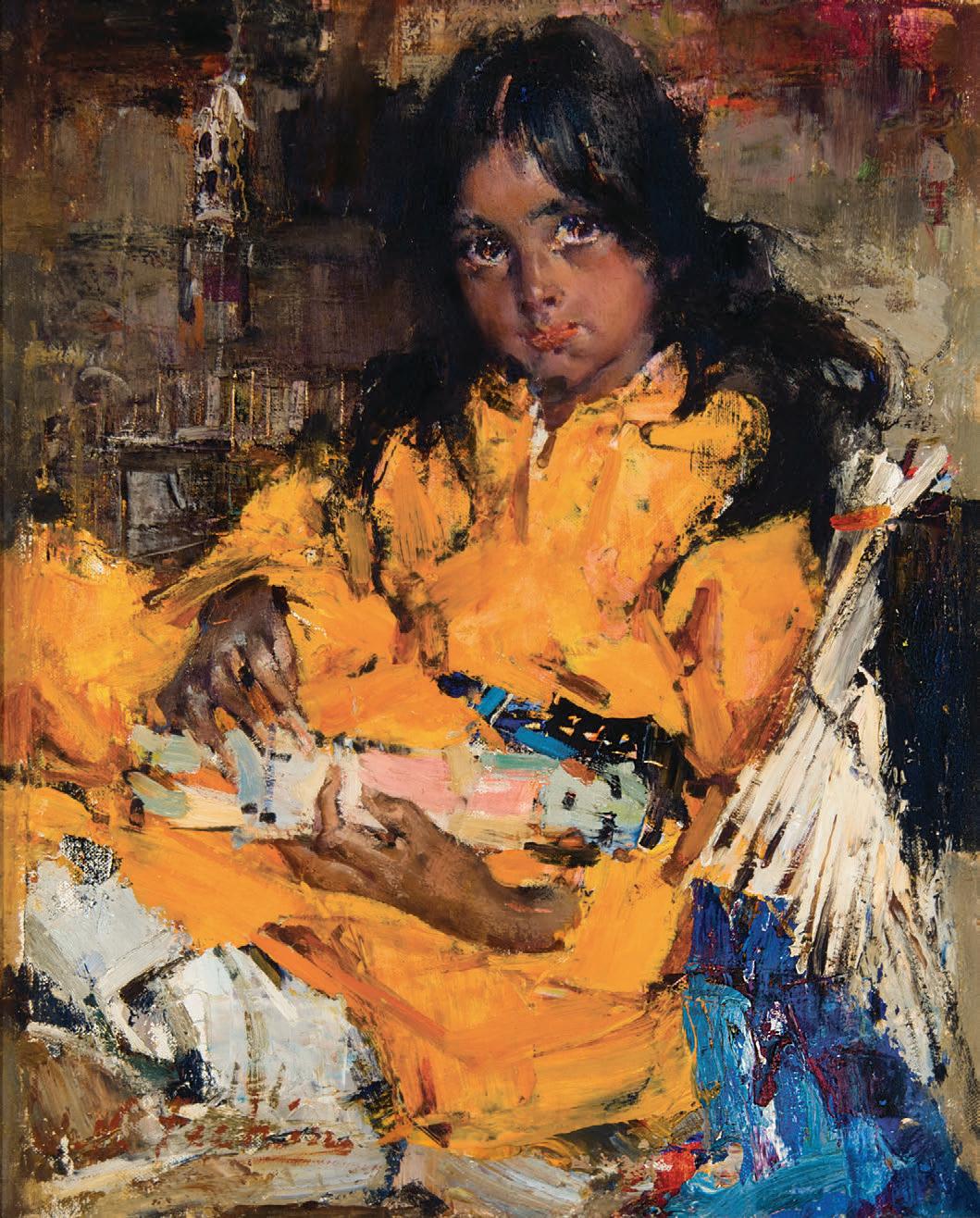
Lot 297
Nicolai Fechin
Carmencita
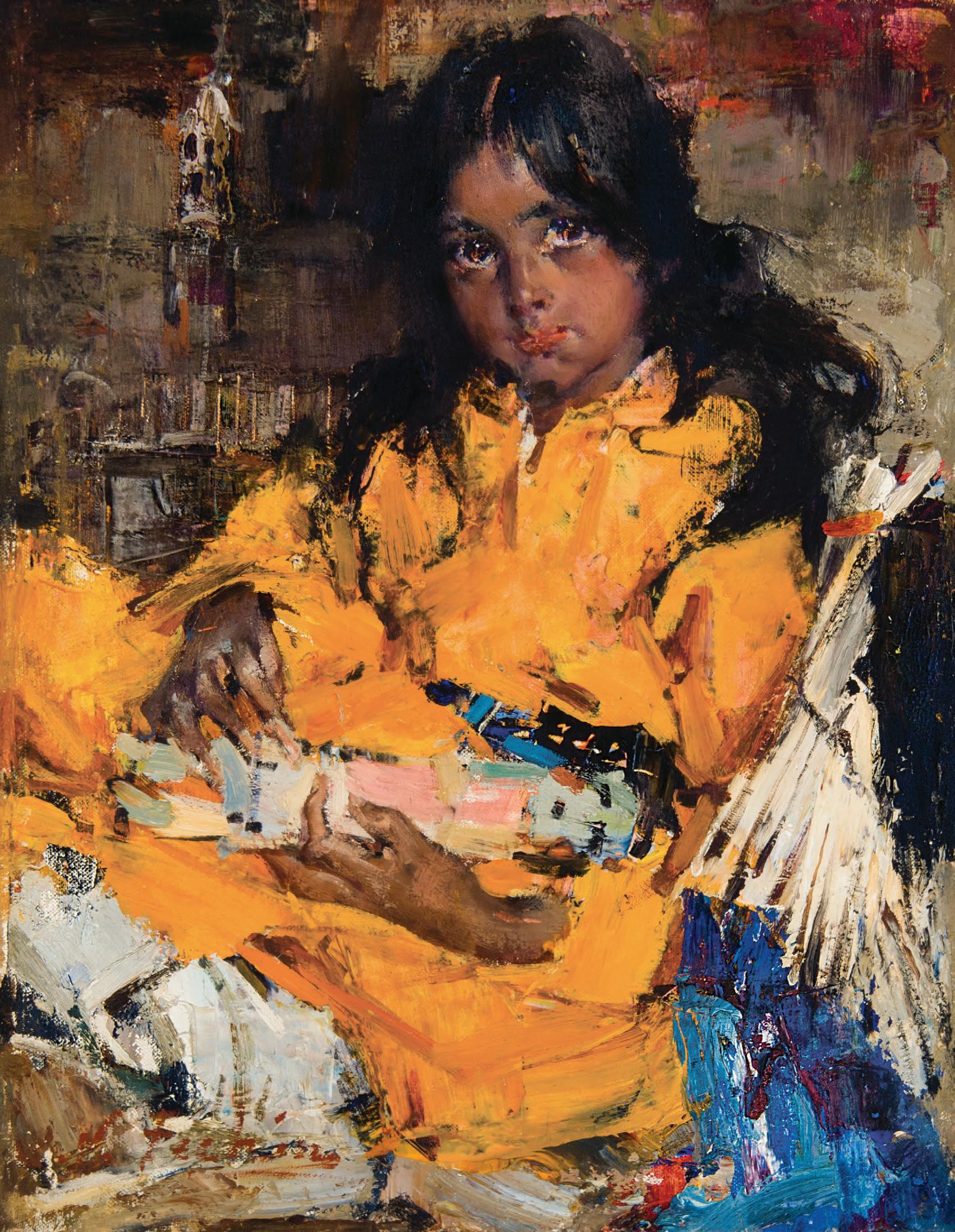
Nicolai Fechin dabbled in landscapes, still lifes, charcoal drawings and, for at least several paintings, non-objective abstraction. The vast majority of his work, though, was in the area of figurative and portrait paintings. Today, he is considered one of the finest portrait painters in the country, and is frequently cited in the same breath as John Singer Sargent, Gilbert Stuart, Robert Henri and others. The power of his portraits is on display here in Carmencita, showing a young girl in a radiant orange dress, her eyes peering delicately from within his powerful brushwork.
Fechin was born in Russia, and moved to New York in 1923 and then Taos, New Mexico, in 1926. The light and people in the high desert had an immediate effect on his studio, which can be seen in nearly every piece created in Northern New Mexico. “The work from Taos is exceptional. The portraits are acutely psychological, compassionate, penetrating studies of character, scrutinizing the soul of man,” writes Mary Balcomb in Nicolai Fechin. “…Fechin's Taos portraits are masterfully executed, timeless. Each is a highly individual study, yet possessing a generalization or universal quality which evokes memories and associations that relate to all people everywhere. In looking at a Fechin portrait people frequently remark, ‘I know him from somewhere.’ It is this subjective quality, too, of the Rembrandts, the Goyas and the Velasquez paintings which after centuries can pose questions or evoke sadness and pleasure within the viewer. We see this characteristic in much of the work Fechin produced, not only in Russia, but as it reached full maturity with the Taos Indian. Much to Fechin’s credit, there was never an exaggerated expression or indication of torment or agony. He restricted himself to ‘depicting a narrow range of emotions,’ and he helped ‘to lift portrait painting out of the status of a mere profession.’”
For the last century, Fechin’s portraits have been celebrated by scholars, collectors and curators who all point to different aspects of his work that stands out: the brilliant color, the vulnerability of the subjects’ eyes, the raw application and looseness of the paint on the canvas, and even the poses, which frequently show subjects unguarded and serene with the artist. None of these are wrong, but for Fechin, it often came down to the drawing. “A high degree of expertness in technique (draughtsmanship) always has had and always will have a predominant place in art,” Fechin wrote. “The subject, by itself, has value only according to the mode of the day: tomorrow it will be superseded by a new one. With the passing of time the subject loses much of its meaning, but the fine execution of it retains its value.”
20 x 16 inches
Signed lower left
Estimate: $600,000 - 900,000
Provenance:
Nedra Matteucci Gallery, Santa Fe, NM
Richard Freeland, Indiana
Private collection, Texas
297
Nicolai Fechin 1881-1955
Carmencita Oil on canvas
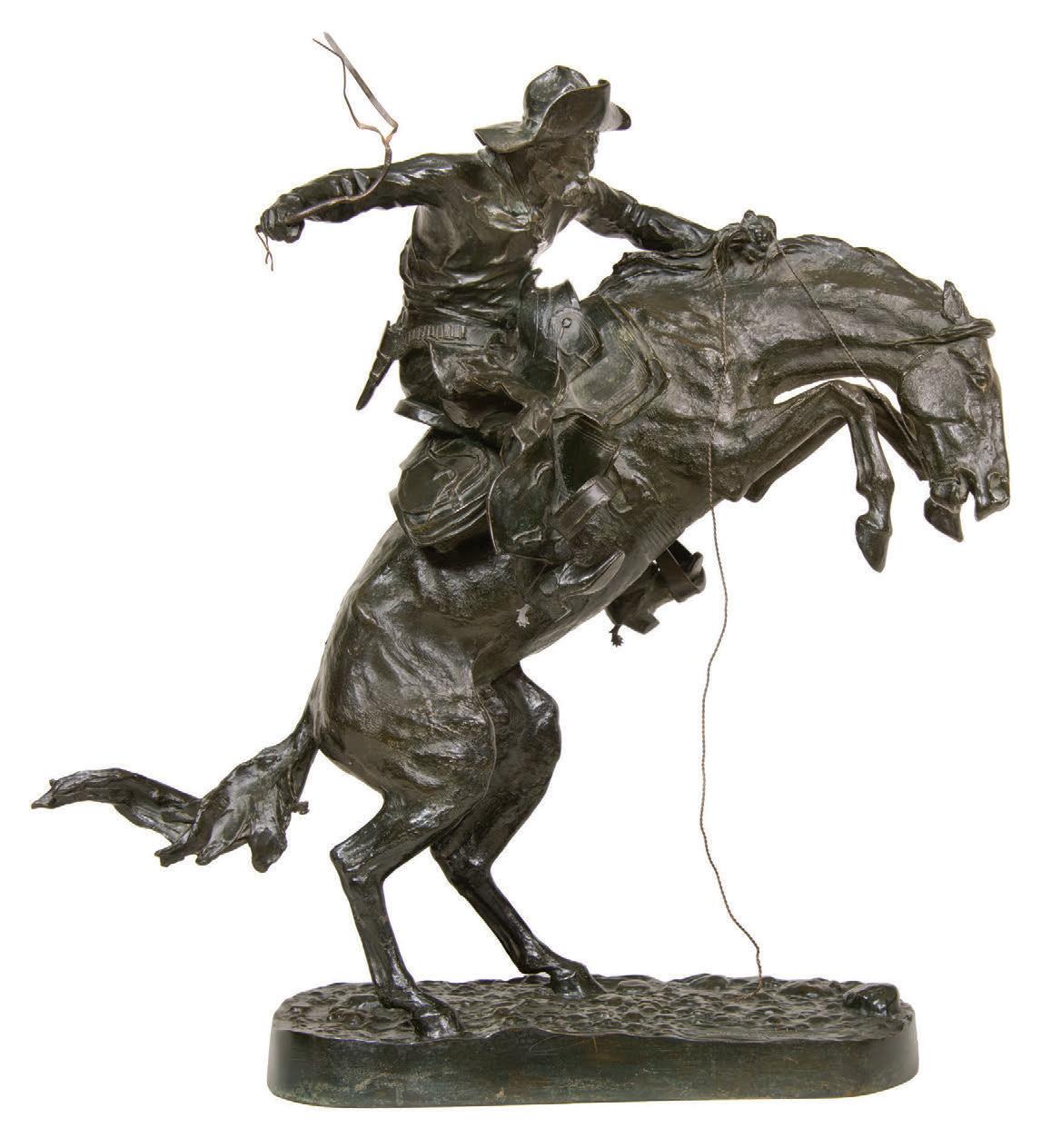
Lot 298
Frederic Remington
The Broncho Buster
It is without overstatement or hyperbole to say that Frederic Remington’s bronze
The Broncho Buster is a singular force in American art. The sculpture, Remington’s first bronze, has remained a part of American culture for generations. It has appeared behind numerous American presidents in the Oval Office. It remains an important part of many museum collections, with some institutions having several versions. And casts of it still appear on desks, mantles and shelves in movies and television, frequently to invoke themes of tradition, ruggedness, grit, determination and American resolve. The Broncho Buster is not only one of the most iconic pieces of Western art, it may also be one of the most ubiquitous pieces of American art ever created.
This edition by Roman Bronze Works is cast №.56, which is listed in the foundry’s ledger as completed on July 30, 1906, which puts it within Remington’s lifetime. (Henry-Bonnard Bronze Co. produced 64 largely identical sand castings from 1895 to 1900, after which Roman Bronze Works produced more than 270 lost-wax casts.) Roman Bronze Works casts were notable for being tweaked periodically by the artist and the foundry. This cast has one notable and sought-after feature, which is the horse’s free-flowing tail. Later casts attached the tail to the horse’s right hind leg, which was likely changed to prevent breaks during production. In addition to the unattached tail, this cast also has unique and sharp detail in the face and hat, a holstered gun and belt that pulls away from the rider’s body, and a well-defined set of stirrups. Casts numbered less than 60 are also considered (at least by many) to be of a higher quality compared to later, posthumous casts.
“Sculpture was new to Remington when he produced The Broncho Buster, but his success with the medium was immediate,” writes Peter Hassrick in Frederic Remington. “The critic Arthur Hoeber recognized that the bronze represented an important new direction for Remington and for the history of American sculpture. ‘Now...the energy and restlessness that actuated the work of Mr. Remington have found another vent, and the transition is not altogether surprising or unexpected. Breaking away from the narrow limits and restraints of pen and ink on flat surface, Remington has stampeded, as it were, to the greater possibilities of plastic form in clay, and in a single experiment has demonstrated his ability adequately to convey his ideas in a new and more effective medium of expression.’”
In The American West in Bronze, the 2013 catalog for the exhibition with the same name at the Metropolitan Museum of Art, Hassrick continued to bestow the bronze with the highest of praise. He called upon an older Remington painting, The Fall of the Cowboy, which shows a rider off his horse opening a fence—“an unhorsed cowboy was an emasculated figure.” That was one story, but The Broncho Buster was a different one, he argued. “In this contest between man and nature, man is positioned to win, with the cowboy virtually guaranteed to stay in the saddle. When the artist wrote to [writer Owen] Wister about it that ‘I am to endure in bronze,’ he was implying that the cowboy would endure as well.”
298
Frederic Remington 1861-1909
The Broncho Buster Bronze, Lifetime cast №.56. ROMAN BRONZE WORKS N.Y. 23 ¼ inches high
Signed
Estimate: $250,000 - 350,000
Provenance:
Private collection
Altermann & Morris Galleries, Houston, TX, 1993
Regina Giesecke Collection, Ballinger, Texas
Sold by decent in family partnership, Scottsdale, Arizona
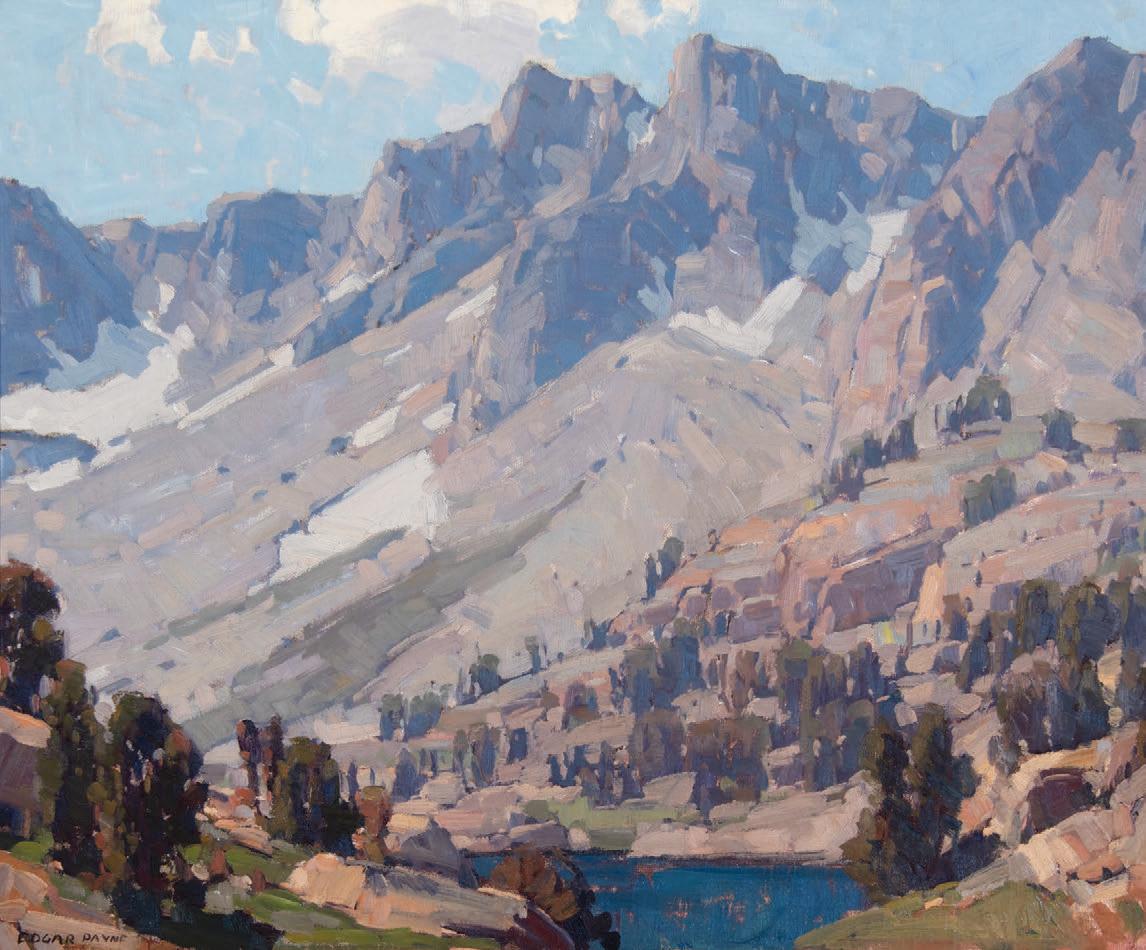
299
Edgar Payne 1883-1947
Rugged Peaks - Sierra Oil on canvas
28 x 34 ⅛ inches
Signed lower left
Estimate: $50,000 - 75,000
Provenance: Private collection, California
Early in his career, Edgar Payne made every attempt to avoid the quintessential California subjects of Yosemite Valley, Mount Shasta and Mount Tamalpais. Fearing those settings were overused, the artist yearned for a new destination that was both grand and largely unexplored—he desired the “feeling of communion with nature,” he wrote. Sometime around 1918, Payne made his artistic discovery with the Sierra Nevada mountain range, which culminated in a deluge of Sierra Nevada paintings in 1921. One of the images from these journeys into nature was Rugged Peaks - Sierra. Payne painted these mountain locations because they were exceptional subjects, but also out of a sense of preservation, as encroaching development threatened pristine views, something he saw firsthand in the Swiss Alps.
“Payne, therefore, like other artists, aimed to preserve what he could of California’s beauty—on canvas if not in reality. The Sierra scenes that he chose to depict were thus an escape from industrialization, development and a burgeoning population,” wrote Scott A. Shields in Edgar Payne: The Scenic Journey. “He portrayed not California’s rapidly changing built environment but the unpopulated and untrammeled Eden of pure nature and wilderness. He also tried to live his aesthetic by communing with nature as often as possible. He was certainly not alone in this, for Californians, more than residents of any other state in the nation, enjoyed a special bond with the outdoors and embraced nature and its healthful attributes as never before…[Payne] depicted the highest locales with the clearest water, the most unblemished terrain, and the purest, most ultracrystalline light as it he were recording these settings for posterity.”
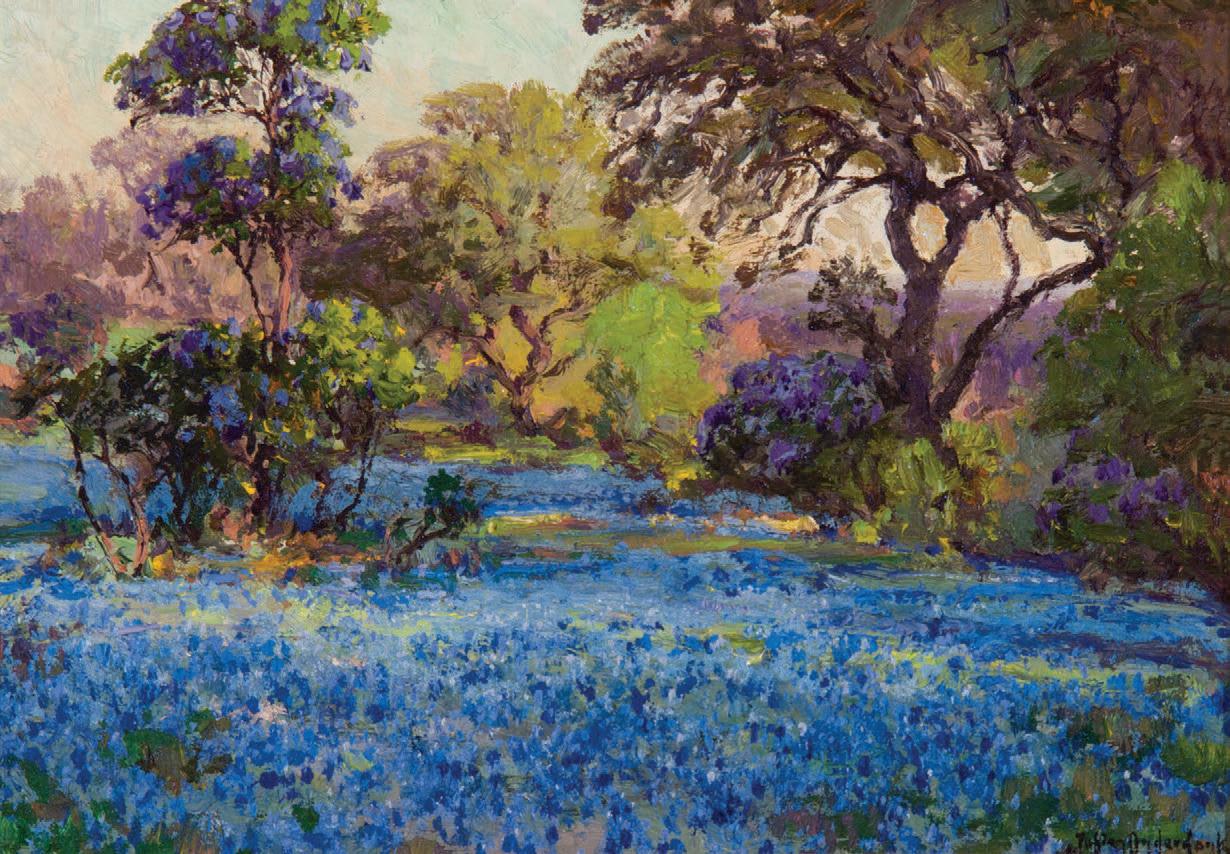
300
Julian Onderdonk 1882-1922
Bluebonnets in Late Afternoon Oil on board
10 x 14 inches
Signed lower right;
Signed, tilted and dated 1919-1920 verso
Estimate: $40,000 - 60,000
Provenance:
Regina Giesecke Collection, Ballinger, Texas
Sold by decent in family partnership, Scottsdale, Arizona
Widely regarded as one of the most important painters of Texas landscapes, Julian Onderdonk lived a short life of only 40 years, but in that time managed to fully capture the beauty and atmosphere of the Lone Star State. He also tapped into imagery before it was considered iconography—most notably Texas’ famous state flower, bluebonnets. The son of painter Robert Jenkins Onderdonk, Robert Julian Onderdonk grew up surrounded by art and was encouraged by his father. At the age of 19, the younger Onderdonk traveled to New York City to attend the Art Students League, where his father went to school more than two decades earlier. His first teacher was Kenyon Cox, followed by figurative painter Frank Vincent DuMond and, later, Robert Henri. But it was a summer class in 1901 taught by William Merritt Chase that changed the way Onderdonk worked. Chase urged his students to work alla-prima, which is a wet-on-wet painting completed in a single session. This new approach allowed the young artist to use direct observation to create an image quickly in the field. It was at that moment Julian decided he wanted to be a landscape painter. By 1906, he was back in Texas painting landscapes, accepting commissions and taking illustration assignments. “While I was still studying...it was my one ambition to return to Texas and to paint some of the things that I remembered as a boy,” Onderdonk said. “I found, however, that my memory had played me false, for it was like stepping into another world, the wonders of which had been read of, never seen.”
301
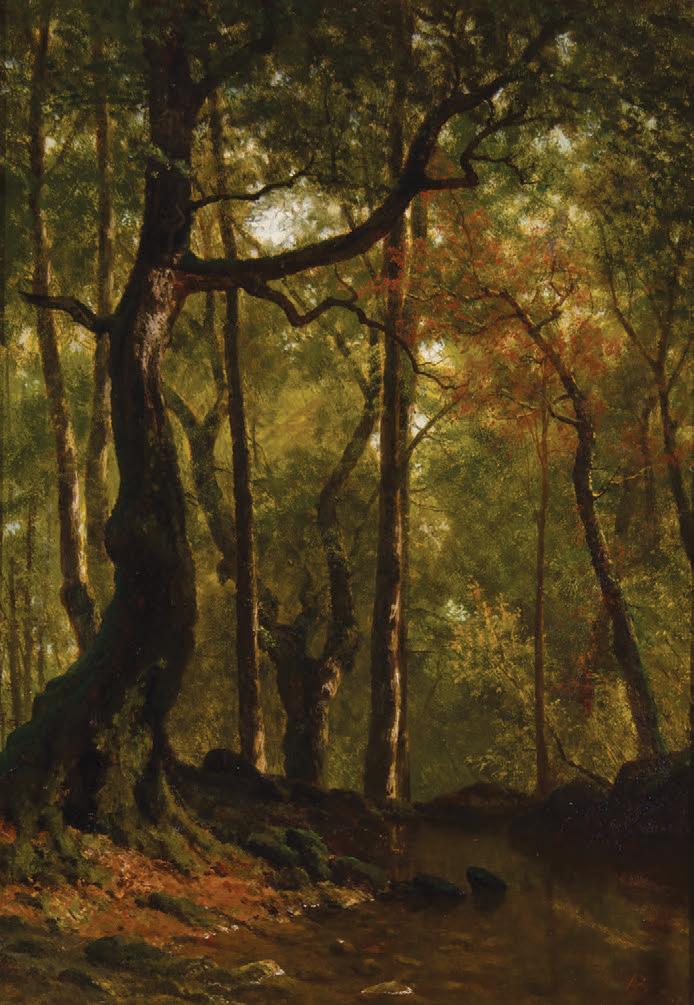
Albert Bierstadt 1830-1902
Forest Pool in Autumn (formerly Woods Interior)
Oil on canvas
19 ½ x 13 ¾ inches
Signed and dated lower right
Estimate: $20,000 - 30,000
Provenance:
Private collection, Arizona
Widely considered to be among the greatest American landscape painters, Albert Bierstadt was not born in the United States but in Germany. His family sailed to Massachusetts when he was still an infant, but he returned to Germany in his twenties to study at the Royal Academy in Berlin. Back in America, he turned his attention to the frontier and its vast untapped beauty. His work, much of which heightened the drama and romance of the landscape and light, was later linked to the origins of the National Park Service. While much of his work was grand in scale, he also frequently painted more intimate landscape scenes, as seen in Forest Pool in Autumn
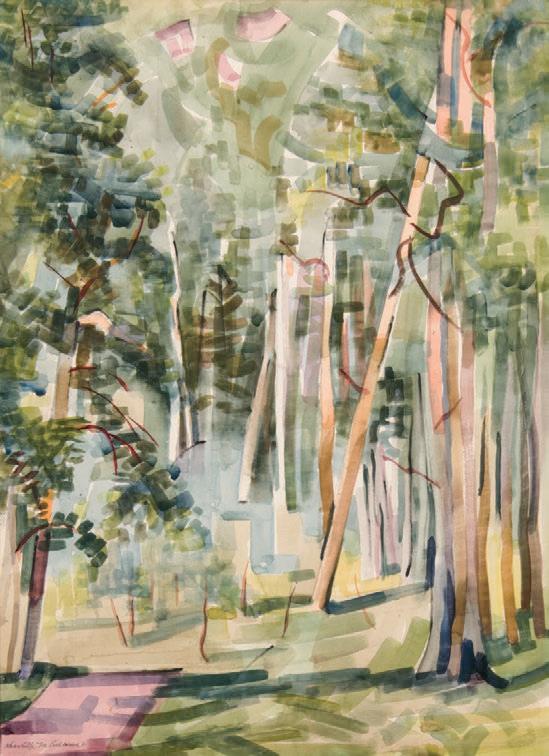
302
Kenneth Adams 1897-1966
Aspen Forest Watercolor
18 x 13 ¼ inches
Signed lower left
Estimate: $3,000 - 5,000
303
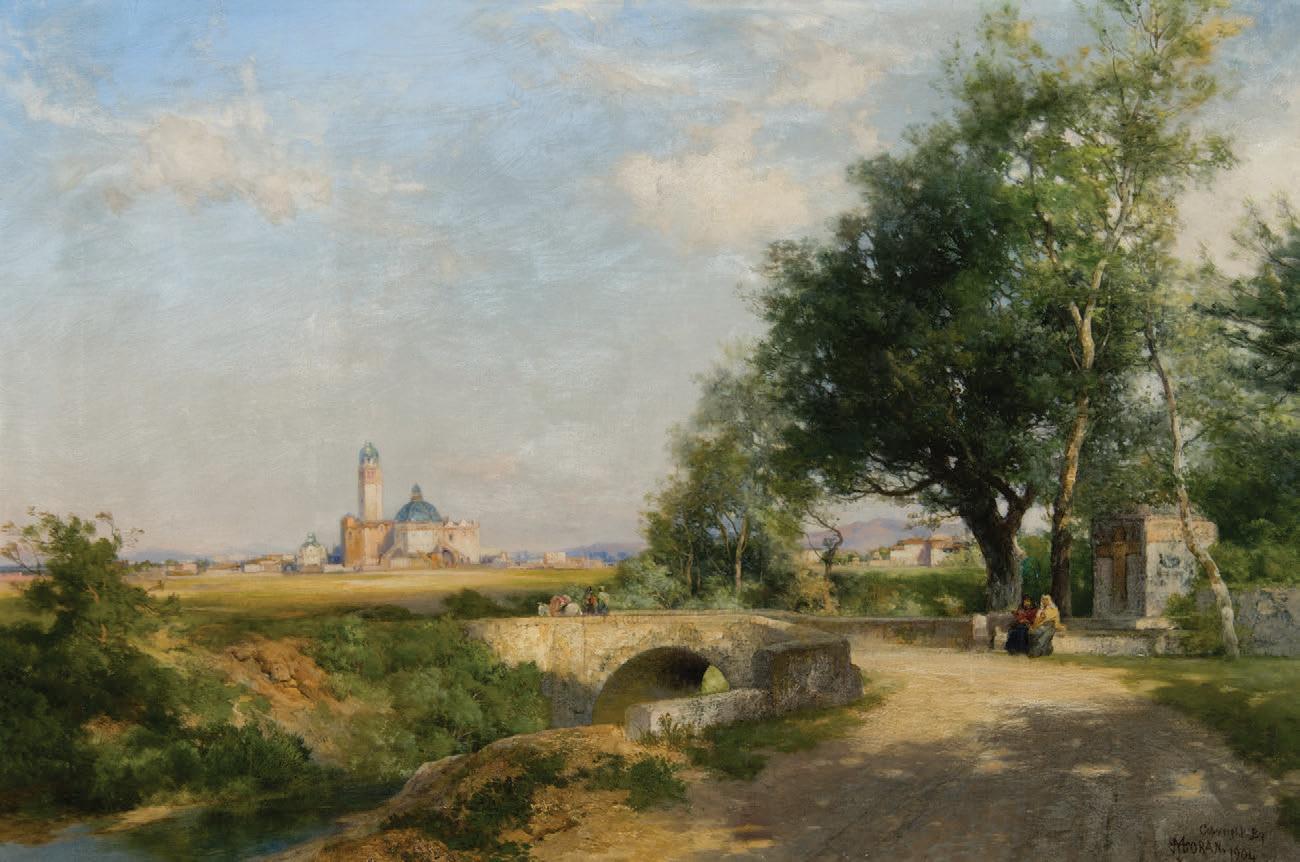
Thomas Moran 1837-1926
Teoloyucan, Mexico (aka Teolaucan)
Oil on canvas
20 x 30 inches
Signed and dated 1904 lower right
Estimate: $75,000 - 125,000
This work will be included in Stephen L.Good and Phyllis Braff's forthcoming Catalogue raisonné.
Provenance: Private collection, Arizona
Painted in 1904, Thomas Moran’s Teoloyucan, Mexico came from reference material gathered during a trip to Mexico in April and May of 1903. Teoloyucan is a small village north of Mexico City. A graphite sketch of this painting—missing the large tree and instead focusing on the church and stone bridge—can be seen in Thomas Moran: The Field Sketches, 1856-1923. The artist first ventured to Mexico in 1882 at the request of the Mexican National Railroad.
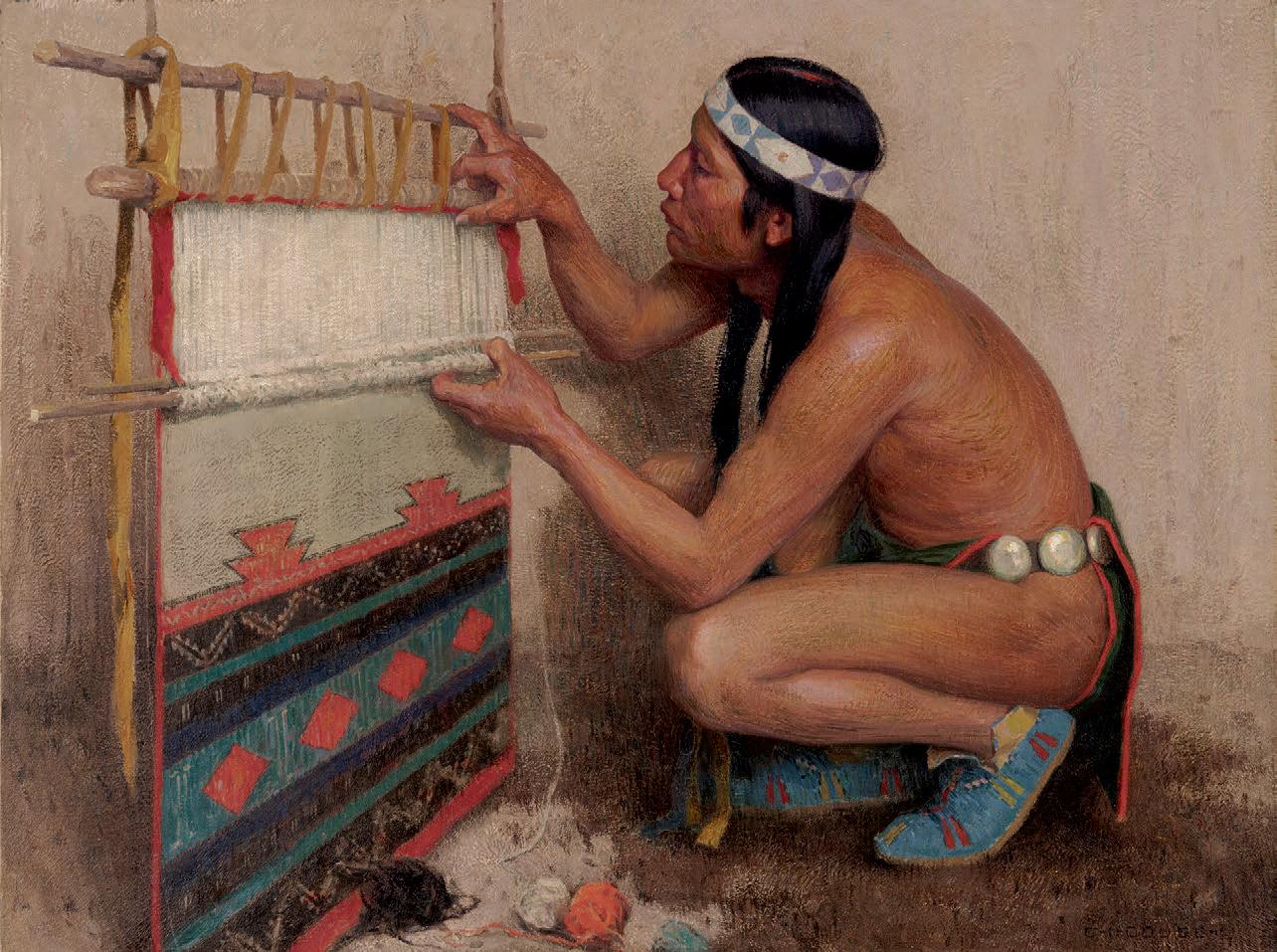
Lot 304
Eanger Irving Couse
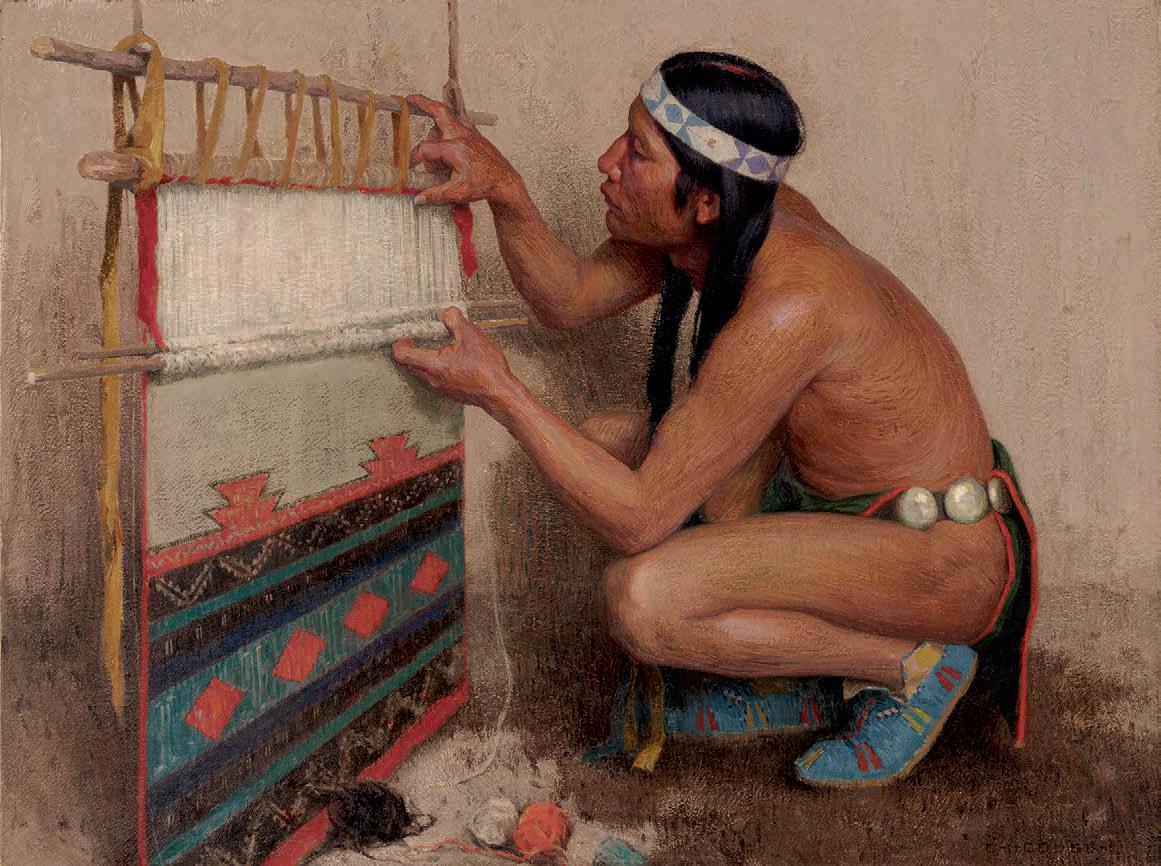
A Weaver
The Taos paintings of Eanger Irving Couse are now considered classics of the region and period, and instantly identifiable to Couse, but it’s important to note that his quiet domestic scenes of Native Americans were relatively unique upon their creation in the early 20th century. In Virginia Couse Leavitt’s book, Eanger Irving Couse: The Life and Time of An American Artist, 1866-1936, the artist’s granddaughter makes the case that American painters of that time favored subject over style as a form of national expression. She quotes Ernest L. Blumenschein: “We were ennuied with the hackneyed subject matter of thousands of painters; windmills in a Dutch landscape; Brittany peasants with sabots; ... lady in negligee reclining on a sumptuous divan; lady gazing in mirror; lady powdering her nose, etc. etc. We felt the need for a stimulating subject.” It’s for this reason that Taos, New Mexico, became a painter’s paradise—artists were looking for something original to paint.
And yet, even within Taos, Couse’s work stood out. “In the first decade of the 20th century, Couse’s interpretation of Indian subjects was unique among painters, a point clearly implied in an article titled ‘Native Material in American Art,’ published in the New York Herald in 1906,” writes Couse Leavitt. “In a brief survey of how the best-known contemporary painters of Native people approached their subject, the author included warlike images of Remington, Schreyvogel and De Cost Smith; the depictions of Indian myths by Edwin Willard Deming; and the portraiture of E. Burbank, [Bert Geer] Phillips, and [Joseph Henry] Sharp. The author singled out Couse's individual approach, touching on both his style and his subject matter, describing his approach as ‘a delicate balance between poetry and realism…depicting the home life and legends of the North American Indian.’ Although this balance between poetry and realism was unique among painters, it had much in common with the work of contemporary photographers like Edward S. Curtis, Adam Clark Vroman, and Carl Moon. Couse’s own use of the camera in preparing studies for his paintings undoubtedly reinforced and perpetuated these elements in his style.” Couse Leavitt goes on to link Couse’s work to the paintings of George de Forest Brush, who also painted Native American figures in peaceful interior settings.
A Weaver encapsulates Couse’s classic style and subject, and shows his interest in other art forms he had become acquainted with after his first visit to Taos in 1902. Although he likely painted pottery more, paintings involving weavings and looms were certainly a favorite subject. It’s important to note that unlike Navajo weavers, which were exclusively women at that time, Taos weavers were frequently men. The model is likely Jerry Mirabal, based on his profile and the patch of hair near his ear, although Couse may have used photographic reference of model Francisco Gomez, who posed for a series of photos around 1908 that include a weaving with a similar design. Couse frequently took pictures of his subjects to use for later paintings. Digital versions of these photos and many others are viewable through the University of New Mexico’s digital collection.
304
Eanger Irving Couse 1866-1936
A Weaver Oil on canvas
35 x 46 inches
Signed lower right
Estimate: $300,000 - 500,000
Provenance: The F.H. Bressler Fine Arts Gallery, Milwaukee, Wisconsin
Private collection, Milwaukee, Wisconsin, by family descent
Literature: E. Irving Couse 1866-1936, Nicholas Woloshuk, Santa Fe Village Art Museum, Santa Fe, NM, 1976, p. 16
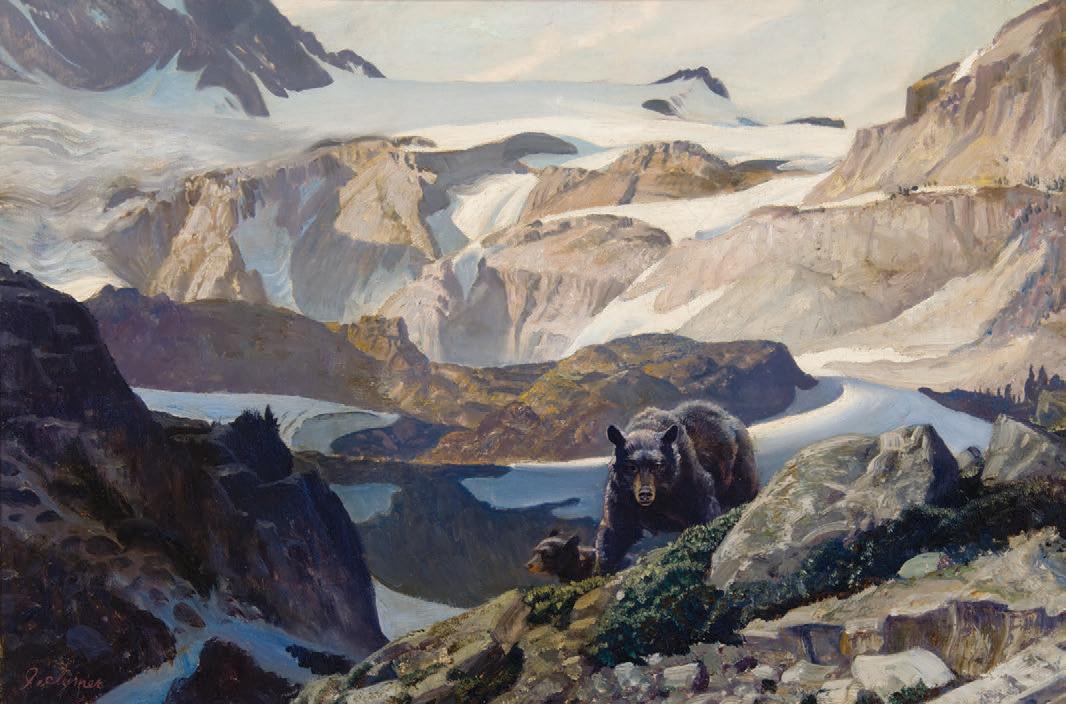
305
John Ford Clymer 1907-1989
Black Bear Oil on canvas
20 x 30 inches
Signed lower left; Titled verso
Estimate: $45,000 - 65,000
Provenance: Private collection, Arizona
John Clymer painted historical paintings in a traditional style, and yet there are modern design elements at play in many of his works, including here in Black Bear. Key to the painting is the upstaging of the wildlife subject by the glacial valley that twists and turns under brilliant light in the far background. Clymer was a master at composition, which shows in his 80-plus Saturday Evening Post covers and his later Western work.
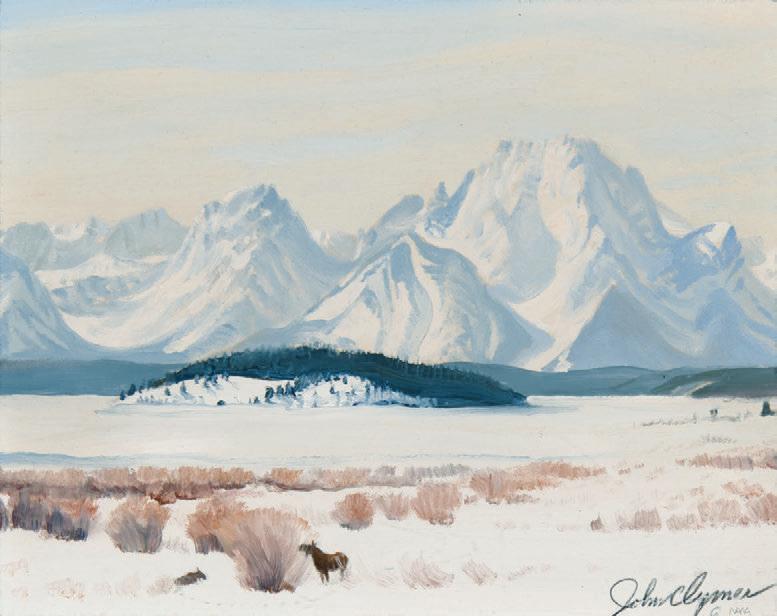
306
John Ford Clymer 1907-1989 Jackson Lake Oil on board
8 x 10 inches
Signed/CA lower right; Titled and dated 1976 verso
Estimate: $6,000 - 9,000
Signed/CA and dated 72 lower right; Titled verso
Estimate: $200,000 - 300,000
307
John Ford Clymer 1907-1989
The Métis Brigade Oil on canvas
20 x 40 inches
307
John Ford Clymer 1907-1989
The Métis Brigade Oil on canvas
20 x 40 inches
Signed/CA and dated 72 lower right
Titled verso
Estimate: $200,000 - 300,000
Provenance:
Eddie Basha Collection, Arizona
Sold by decent
Literature:
John Clymer: An Artist’s Rendezvous with the Frontier West Walt Reed, Northland Press, Flagstaff, AZ, 1976, p. 124
The Western Paintings of John Clymer, Paul Weaver, Peacock Press/Bantam Book, Bearsville, NY, 1977, Plate 40.
Exhibited:
Clymer, Lovell & Teague at the Gilcrease, The Thomas Gilcrease Museum, Tulsa, OK, 1987. People, Places, Predicaments: John Clymer’s West, Western Spirit: Scottsdale’s Museum of the West, Scottsdale, AZ, October 8, 2024-October 26, 2025.
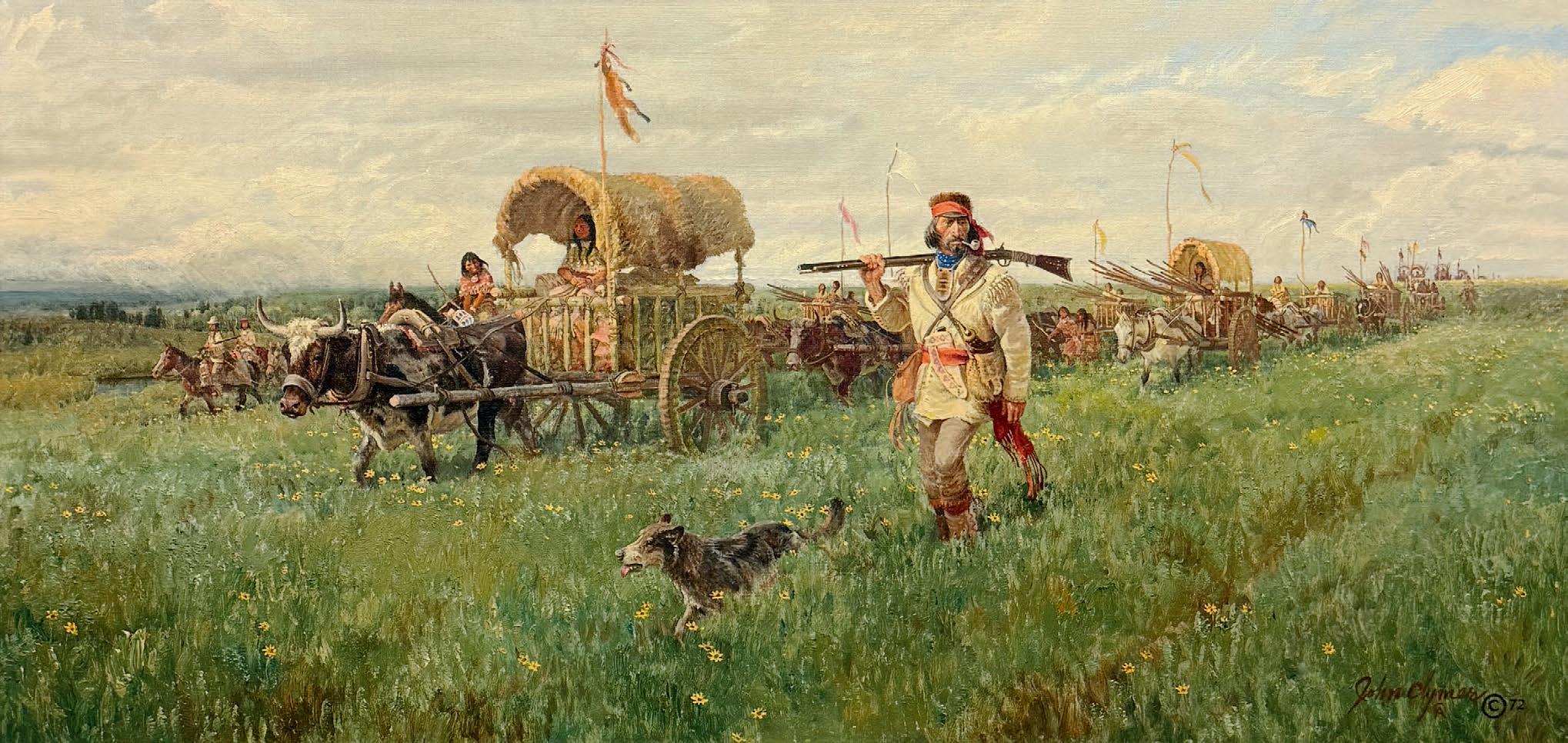
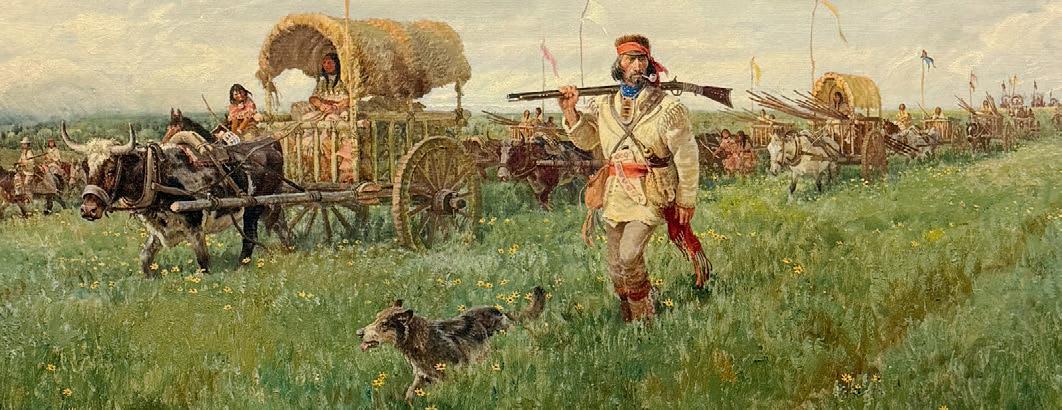
The Métis Brigade is one of John Clymer’s most endearing and reproduced images, and it showcases many of the qualities that the artist was known for throughout his successful career: narrative devices in the painting to maximize its story, historical detail acquired through dedicated research, a compelling composition, complexly rendered figures and a sense of cultural context within the larger canon of Western art. Clymer, who was a student of history, didn’t pull at lowhanging fruit when it came to his subjects. He found unique new angles and offered fresh perspectives from the American frontier. All of this is on display in this 1972 painting.
“The picture shows a band of Métis, descendants of the Hudson Bay employees and their Indian wives, spread out, single file, traveling in their Red River carts from the Red River settlement en route to their annual summer buffalo hunt on the prairies,” writes Walt Reed in John Clymer: An Artist’s Rendezvous with the Frontier West. “Their carts were entirely hand made of wood, fastened together with wooden pins and rawhide. The wooden wheels were wrapped in rawhide, put on wet, which when dried became very hard and durable. In this manner, the wheel was introduced to the Indian culture of the Northern Plains by the early French employees of the fur companies. The women and children rode in the carts, pulled by a single ox or horse, while the hunters traveled alongside..”
308
Howard Terpning b. 1927
The Mighty Blackfoot Oil on board
24 x 18 inches
Signed and dated 76 lower right; Signed and titled verso
Estimate: $70,000 - 100,000
Provenance:
Regina Giesecke Collection, Ballinger, Texas
Sold by decent in family partnership, Scottsdale, Arizona
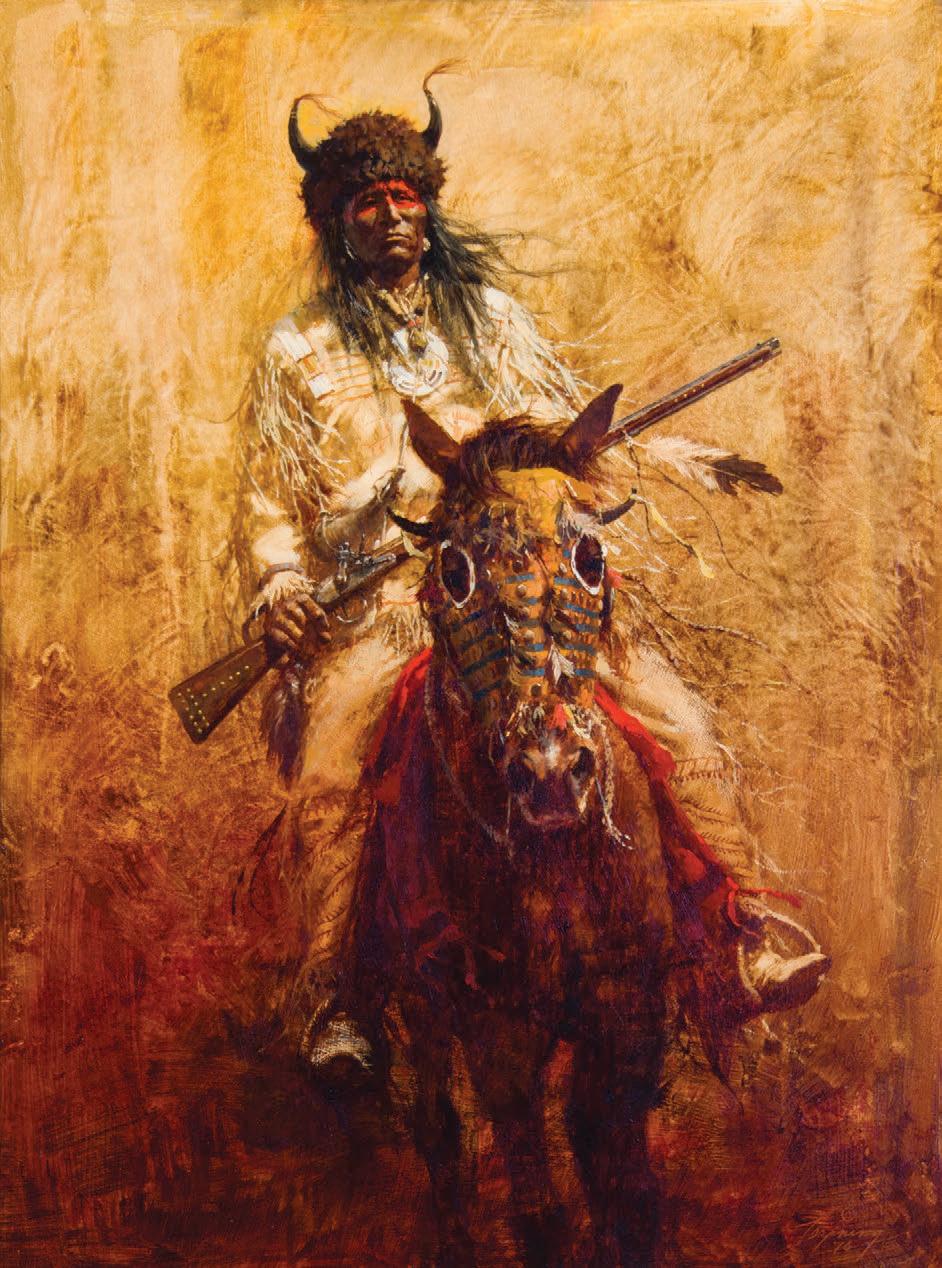
Painted in 1976, The Mighty Blackfoot was created during that brief window when Terpning, the illustrator, was intersecting with Terpning, the fine artist. By 1977, he pulled the trigger and uprooted his life to move to Tucson, Arizona, where he made Western art history. This work is also unique because it is one of the earliest paintings of a Blackfoot warrior by the artist. The tribe remains a favorite subject for Terpning.
309
Howard Terpning b. 1927 Scout from Fort Bowie Oil on canvas
28 x 40 inches
Signed/CA and dated 1985 lower left; Signed and titled verso
Estimate: $250,000 - 350,000
Provenance: Scottsdale Art Auction, Scottsdale, AZ, 2015
Private collection, Arizona
Exhibited: Thomas Gilcrease Institute of American History and Art May 3, 1985-July 7, 1985
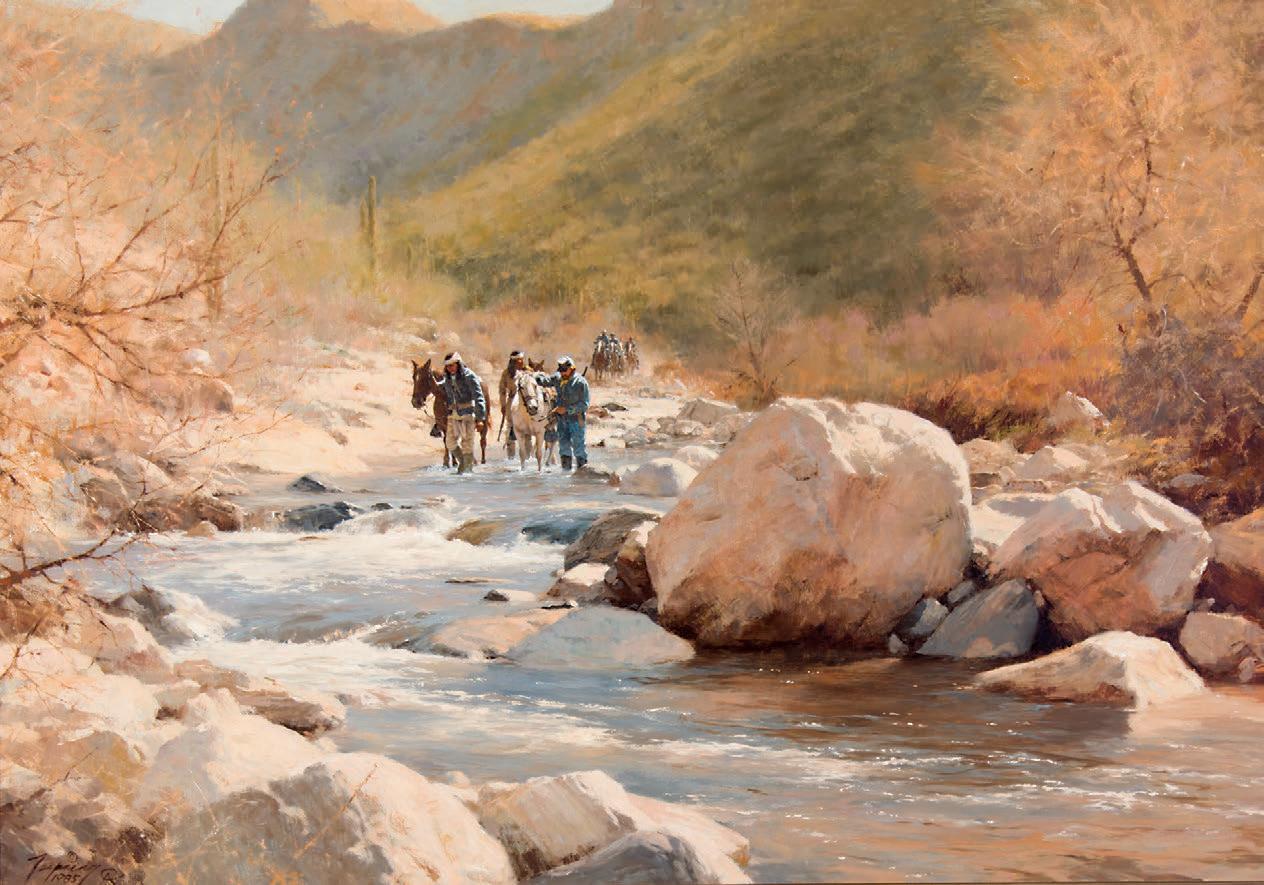
Painted in 1985, Howard Terpning’s Scout from Fort Bowie reflects the artist’s detailed research and commitment to historical accuracy. Built in eastern Arizona in 1862, Fort Bowie was meant to protect Apache Pass and Apache Spring, a vital source of water in the region, from Chiricahua Apache fighters who were active in the area. After the surrender of Geronimo in 1886, the fort was abandoned in 1894. In Terpning’s painting, an Apache scout and soldier wade through the spring, possibly tracking fighters who have fled in the water to hide their tracks. The scenery is unmistakably Arizona, which the Tucson-based artist had easy access to from his studio two hours to the west.
Terpning is no stranger to soldiers and their duty in the face of opposition. The artist, before he was an illustrator, served as a Marine in the Pacific Theater in the final months of World War II. Later, in 1967, he volunteered to be a combat artist in Vietnam, where he saw fierce jungle fighting. “Being in the center of such chaos was another bitter experience as suffering, relieved by moments of kindness and valor, were etched into his memory never to leave,” writes Harley Brown in Howard Terpning: Tribute to the Plains People. “As Howard recalls some incidents, he closes his eyes and goes silent. He’s carried indelible events for many years and we can see that much of his compassion, strength and vulnerability of those memories were released into the soul of his paintings.”
310
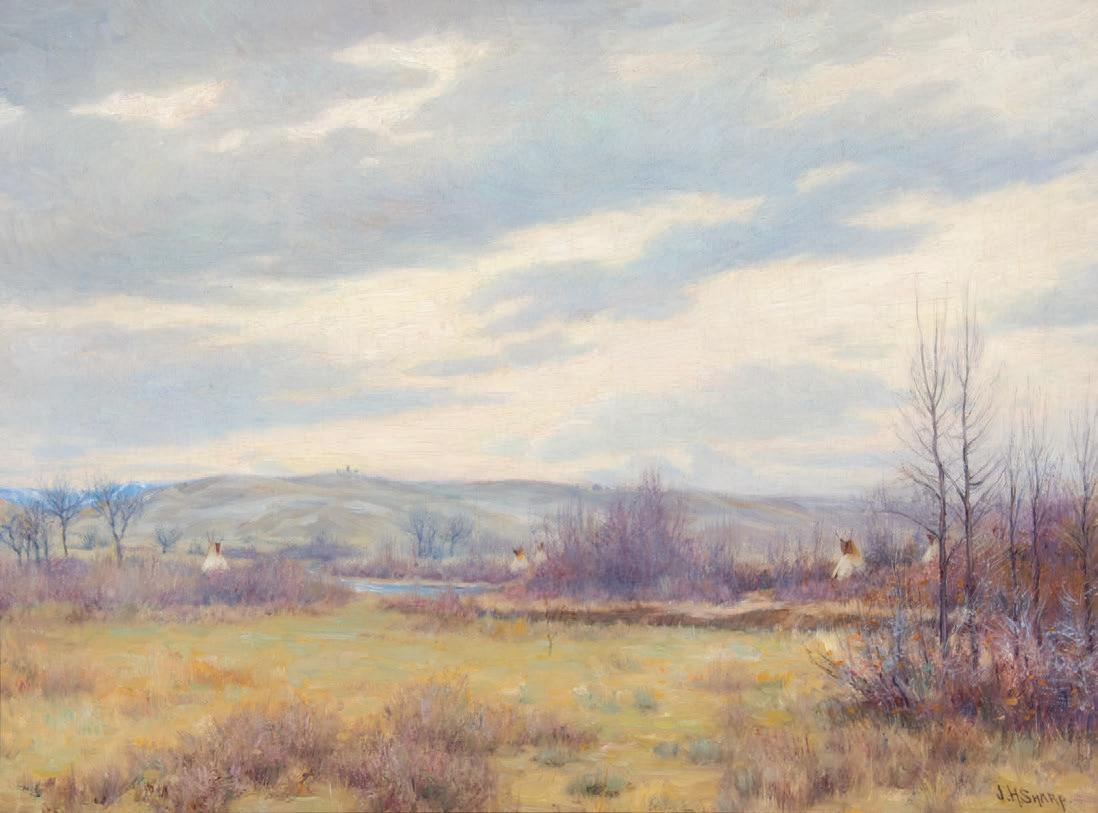
Joseph Henry Sharp 1859-1953
Winter Camp, Montana Oil on canvas
15 ¼ x 22 ¼ inches
Signed and dated 08 lower right
Estimate: $20,000 - 40,000
Provenance: Private collection, Ohio
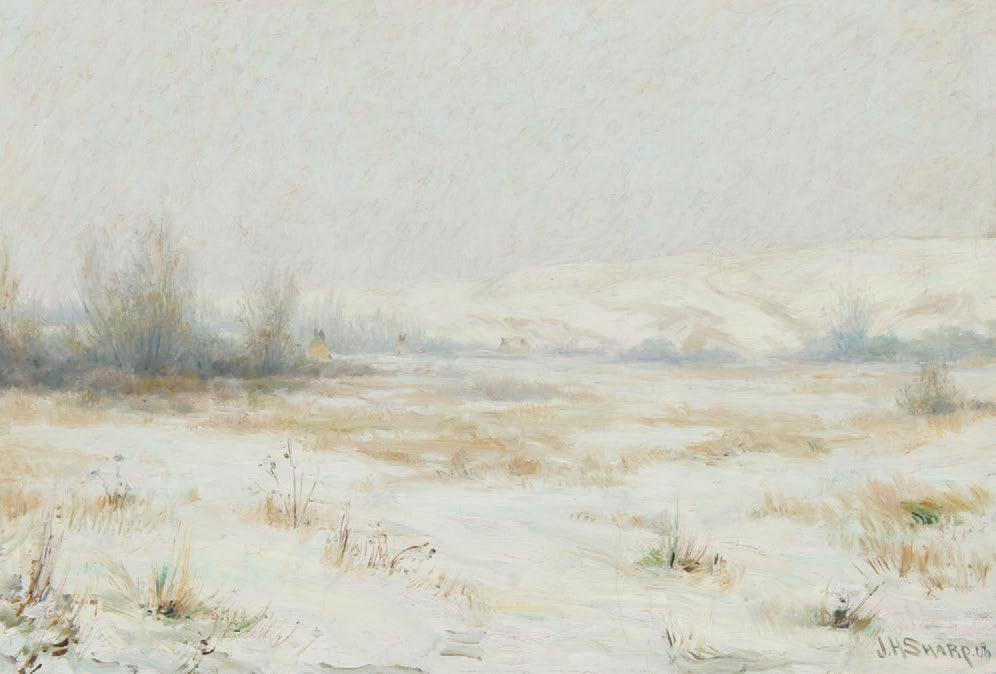
Joseph Henry Sharp’s work is strongly tied to Taos, New Mexico, and yet it also had links to Cincinnati, where he studied art and made connections to Henry Farny, John Henry Twachtman and others. It was in Cincinnati—and also in Munich, Germany—where he was exposed to tonalism, a painting movement defined by its subtle use of colors, depictions of atmosphere and narrow color values. These qualities are on view in Winter Camp, Montana, painted in 1908 during Sharp’s adventures on the Crow Agency in Montana. This painting may have been painted in his mobile sheep wagon studio, the Prairie Dog.
311
Joseph Henry Sharp 1859-1953
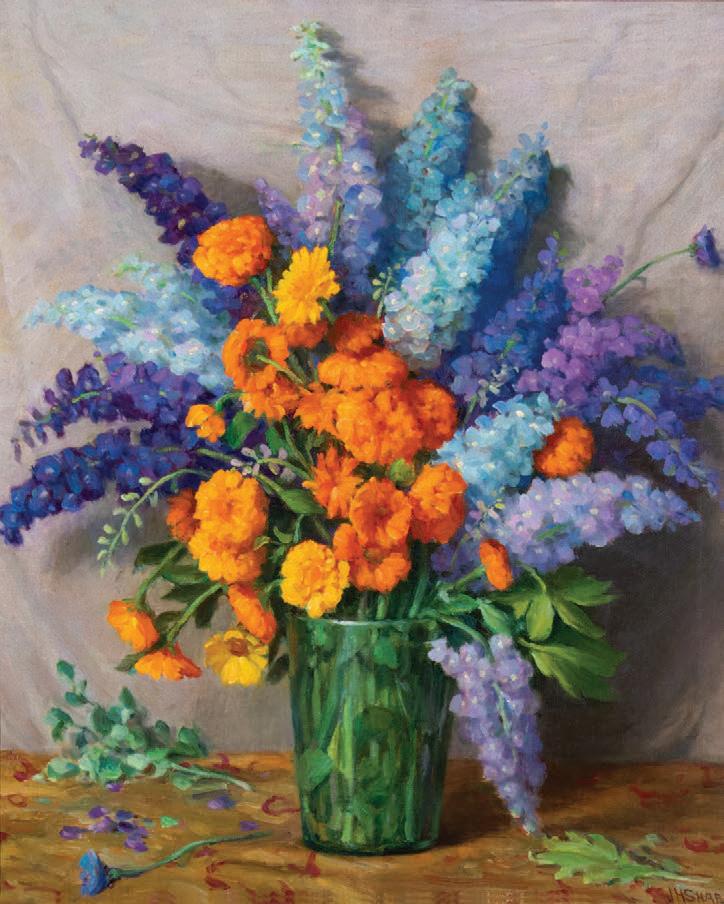
Daffodils and Merigolds
Oil on canvas
30 x 25 inches
Signed lower right
Estimate: $18,000 - 24,000
Provenance: Private collection, Iowa
312
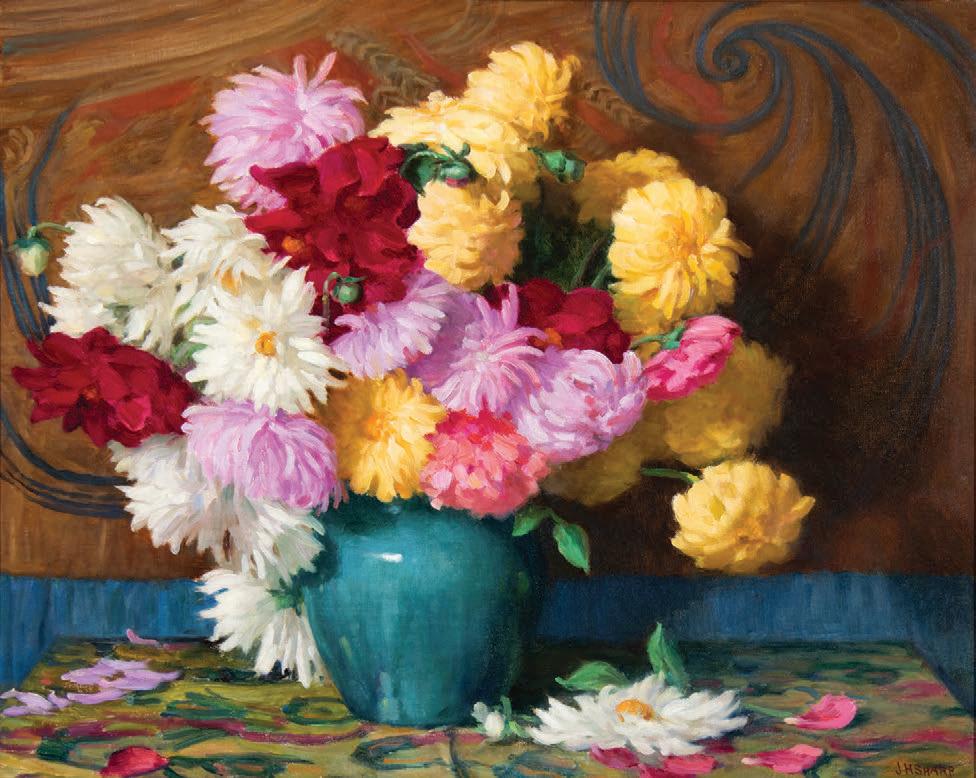
Joseph Henry Sharp 1859-1953
Oil on canvas
24 x 30 inches
Signed lower right; Signed “Taos” and titled verso
Estimate: $18,000 - 24,000
Provenance: Private collection, Iowa
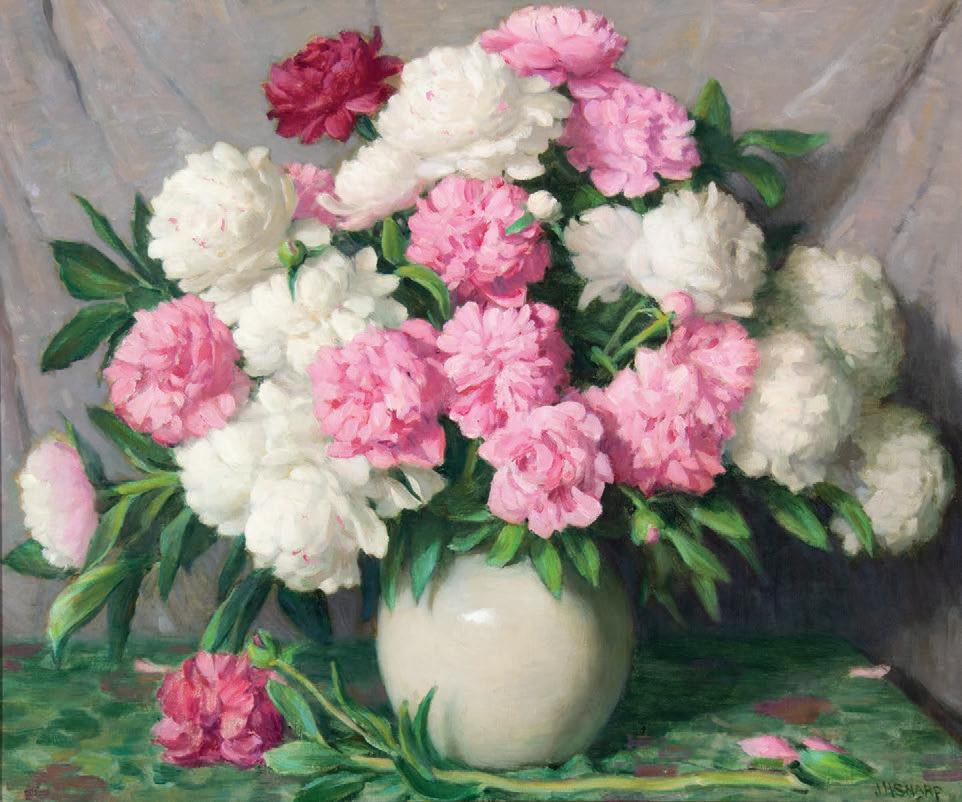
313
Joseph Henry Sharp 1859-1953
25 x 30 inches
Signed lower right; Signed and titled verso
Estimate: $18,000 - 24,000
Provenance:
J.N. Bartfield Galleries, New York, NY Private collection, Iowa
Dahlias
Peonies
Oil on canvas
314
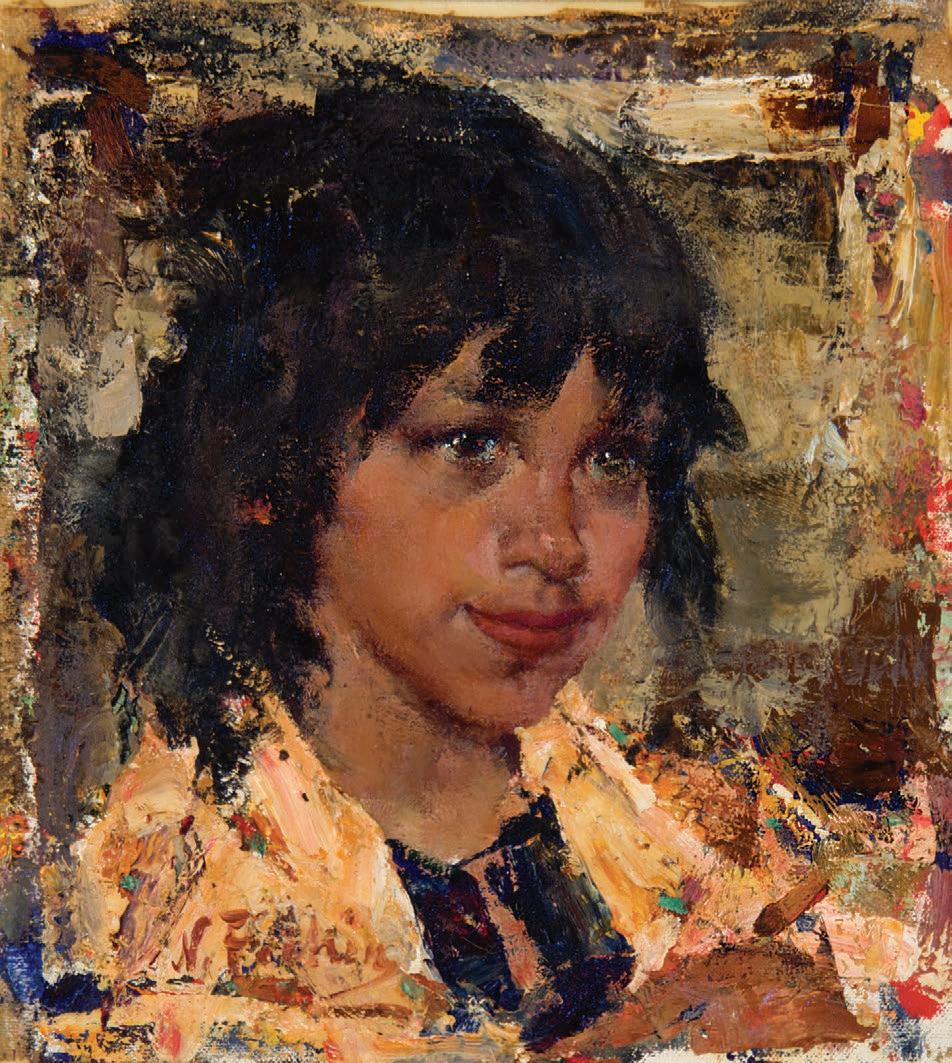
Nicolai Fechin 1881-1955
Consuelo
Oil on canvas
13 x 12 inches
Signed lower left
Estimate: $175,000 - 275,000
Provenance:
Dan May & Associates, Santa Fe, NM, 1989
Altermann & Morris, Santa Fe, NM, 1999
Regina Giesecke Collection, Ballinger, TX
Sold by descent in family partnership, Scottsdale, AZ
Exhibitions:
National Cowboy & Western Heritage Museum, Oklahoma City, OK, 1991.
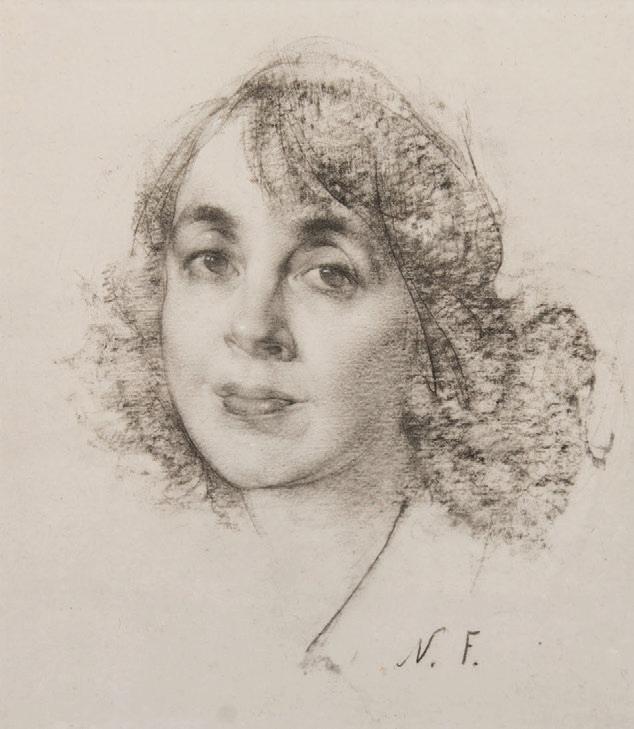
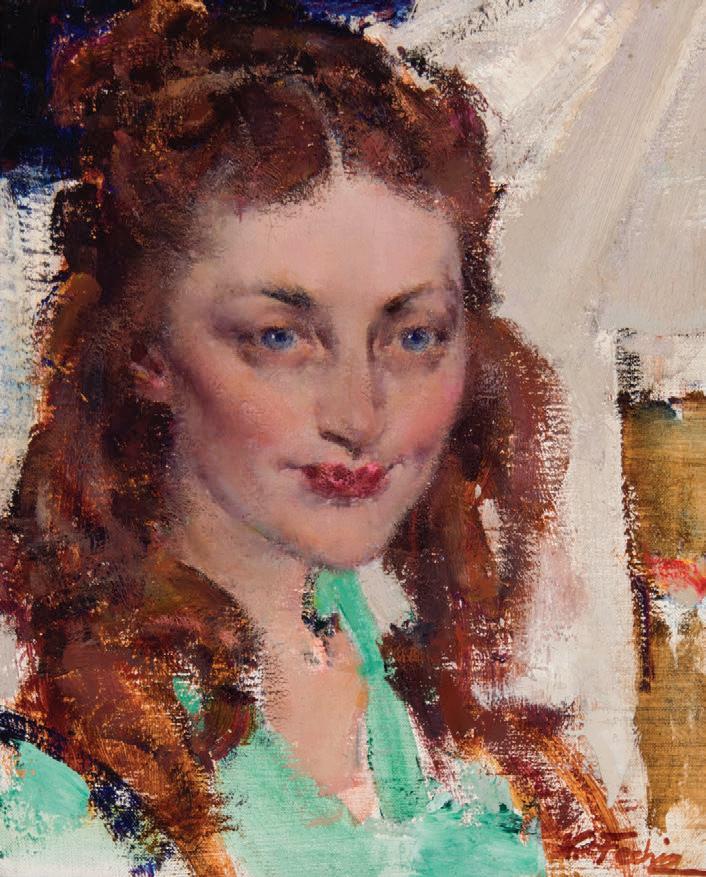
Nicolai Fechin filled his paintings with raw and explosive brushwork, a luminous sense for light and shadow, and faces that could almost pierce the plane between the canvas and the real world. The Taos Art Museum notes, “Fechin is one of the most important portrait painters of the 20th century.” The museum, which is located in his home and studio, may be biased, but his contemporaries of the first half of the 20th century agreed. Often considered an “artist’s artist,” Fechin was taught under famous Russian painter Ilya Repin. In 1923, he moved from Russia to New York City, where he had sponsors who believed in his career and clients who commissioned portraits. Illness made him seek out a warmer climate in 1926, which is how he ended up in Taos, New Mexico. Once in the Southwest, the painter was smitten by the culture and people.
315
Nicolai Fechin 1881-1955
Mrs. Armstrong
Charcoal
15 ¼ x 13 ½ inches
Initialed lower right
Estimate: $8,000 - 12,000
316
Nicolai Fechin 1881-1955
Benepe Oil on canvas
14 ⅜ x 11 ¾ inches
Signed lower right
Estimate: $75,000 - 125,000
Provenance:
Private collection, New Mexico
Illustration: Nicolai Fechin, Harold McCracken, Hammer Galleries, New York, NY, 1961, pl. 198.
One of Nicolai Fechin’s students was Montana painter Katharine Buzzell (Shackelford) Benepe, who is seen here in Benepe. She acquired the name Benepe through marriage in 1940, which dates the painting to that year or later. In addition to Fechin, the model and painter also studied under J. Francis Smith and Elmer Schofield. Fechin painted her at least several times, including in a more formal portrait, Katherine
317
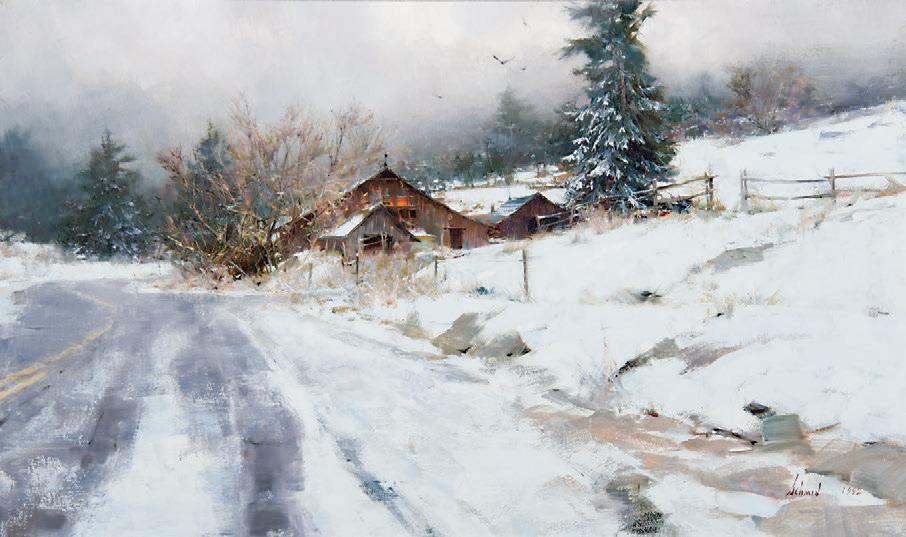
Richard Schmid 1934-2021
Rist Canyon Barns Oil on canvas
18 x 30 inches
Signed and dated 1992 lower right; Signed, titled and dated 1992 verso
Estimate: $25,000 - 35,000
Provenance:
Regina Giesecke Collection, Ballinger, Texas
Sold by decent in family partnership, Scottsdale, Arizona
Literature:
The Landscapes, Richard Schmid, Stove Prairie Press, LLC, p. 140
This 1992 painting was inspired by Rist Canyon near Fort Collins, Colorado. The gray, overcast day could be tricky for his students, especially when colors were muted and dull, and yet Schmid used an overcast day as a teaching tool. “Why overcast? Because sunlight is diffused evenly throughout the cloud layer, and it produces the near ideal color balance…” he wrote in Alla Prima II: Everything I Know About Painting—and More. “Overcast also tends to be stable, providing generous time for painting.” For Schmid, every scenario was a teachable moment.
318
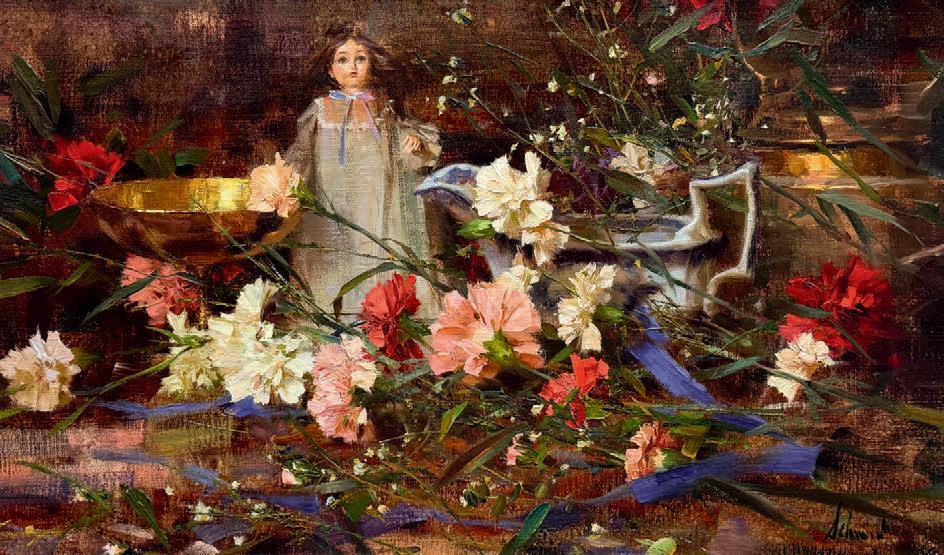
Richard Schmid 1934-2021
Carnation and Gold
Oil on canvas
12 x 20 inches
Signed lower right; Signed, titled and dated 1985 verso
Estimate: $20,000 - 30,000
Provenance: Private collection, Kansas
This lot is accompanied by a signed Artist Proof 28/50 print (11 ¾ x 19 ⅜ inches), 1990, The Greenwich Workshop, Inc. and the chalice used as a subject for this piece.
“Antique dolls are fascinating. You might think I’m rather a bit too old, not to mention the wrong gender, to regard dolls with any interest other than their high value these days,” wrote Richard Schmid in Alla Prima II: Everything I Know About Painting—and More. “However, from both a sociological and artistic point of view, dolls are rich subjects in many ways. Dolls are little versions of people, not so much of ourselves as such, but rather of how we choose to see ourselves. The dolls of any period or place are little idealized renditions of the people who made them. They are also clothed and coiffured according to their contemporaneous status (just as we are)…Though they can sometimes seem spooky, dolls continue to engage me, especially the well-worn ones with one eye left—which I know have been loved by a human child.”
319
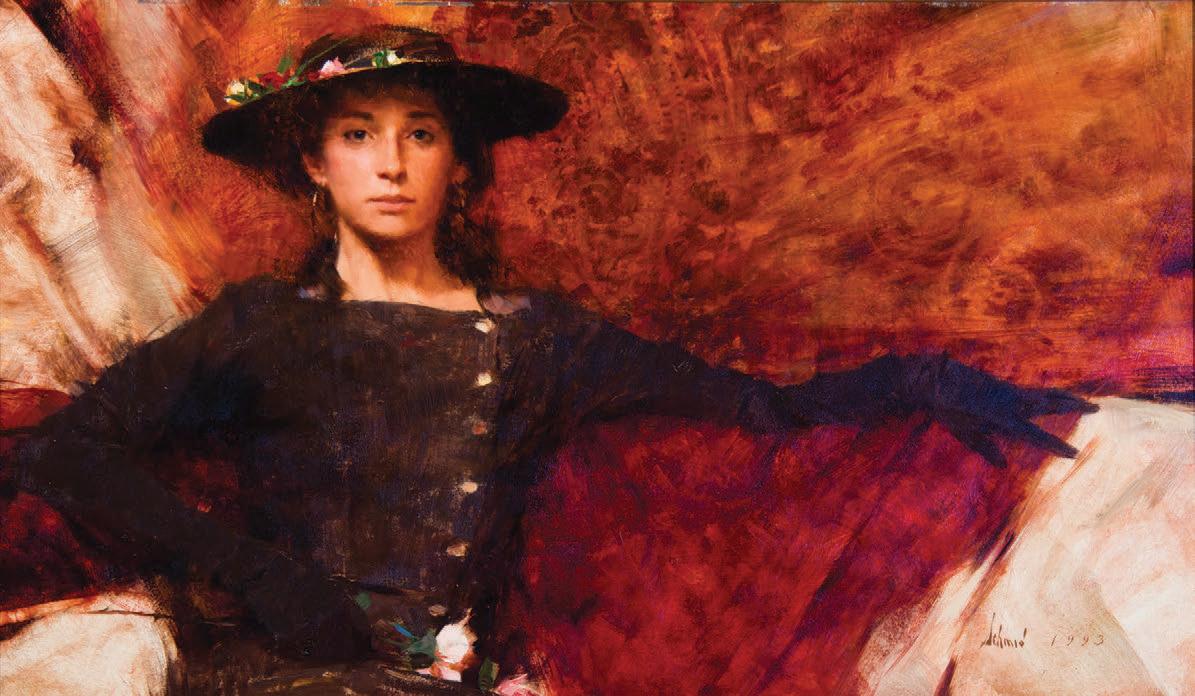
Richard Schmid 1934-2021
Lady In Black Oil on board
20 x 34 inches
Signed and dated 1993 lower right; Signed, titled and dated 1993 verso
Estimate: $30,000 - 50,000
Provenance: The Artist Private collection, California
320
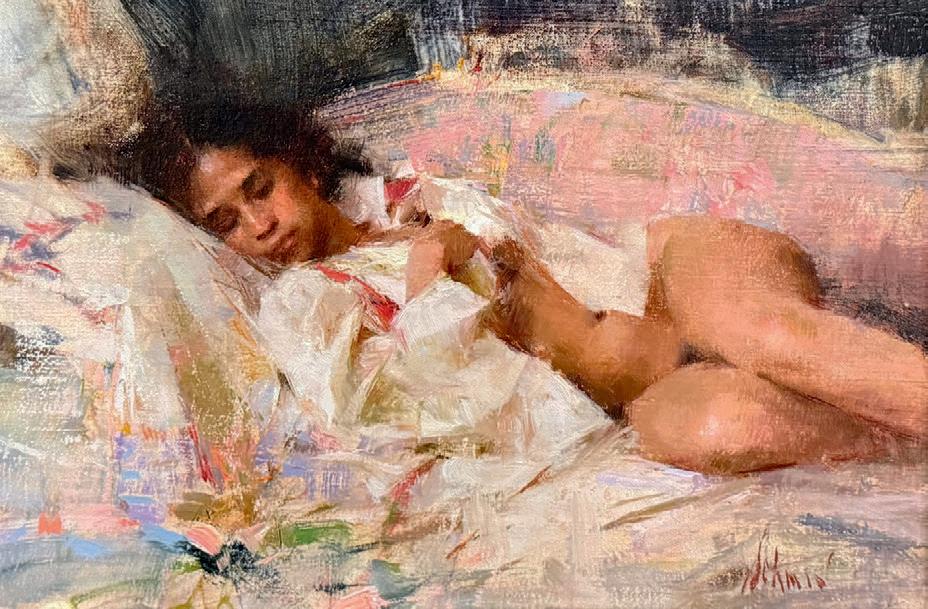
Richard Schmid 1934-2021
The Fainting Couch Oil on linen mounted to board 8 x 12 inches
Signed lower right; Signed, titled, and dated 1994 verso
Estimate: $4,500 - 6,500
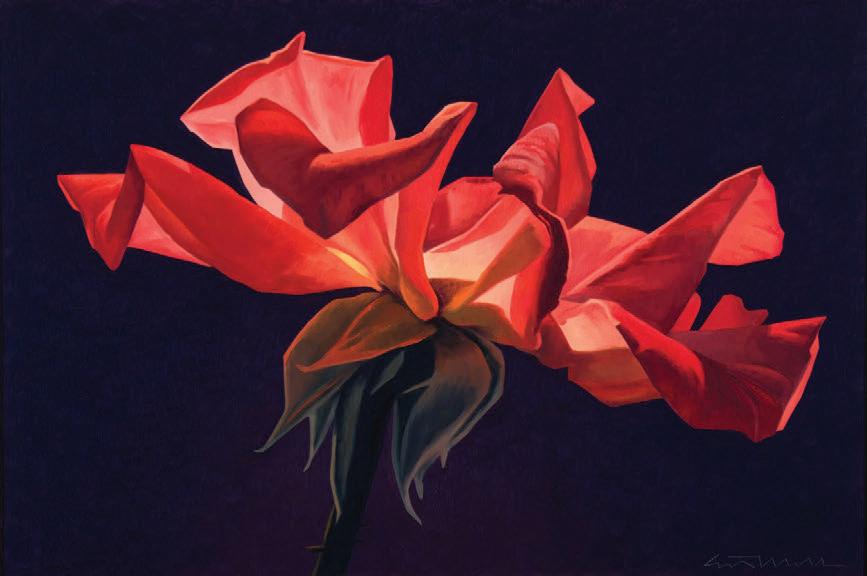
321
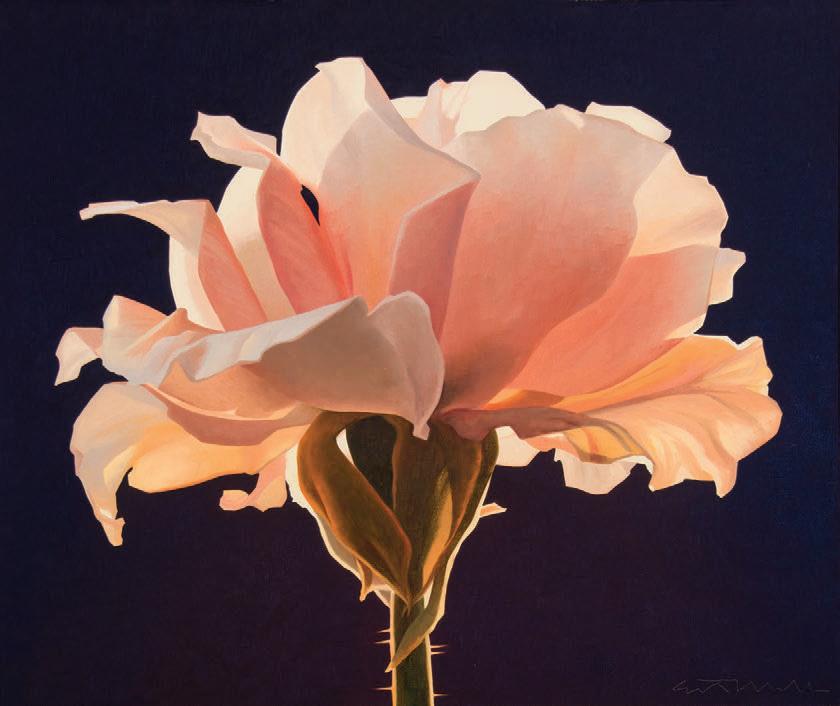
Ed Mell 1942-2024
Peach Rose Oil on linen
30 x 36 inches
Signed lower right; Signed Ed Mell frame
Estimate: $35,000 - 50,000
Provenance:
Private collection, Indiana circa 1995
Although known for his landscapes of the Southwest, Ed Mell also spent considerable time painting floral subjects in his abstracted, modernist style. Beginning in 1988, his subjects included petunias, hollyhocks, carnations and cactus blooms. “The flower that has become one of his favorites is the rose. Roses are different, he says, with their elegant curves and luminosity so apparent as light strikes the petals,” writes Donald Hagerty in Beyond the Visible Terrain: The Art of Ed Mell. “…These paintings are simplified and stylized, not literal, as Mell endowed them with an inner vitality. Without the loss of delicacy and presence, Mell infused the paintings with a strong design, a tension between representation and abstraction. In the designs, he took the curves of the flowers and expanded them, increasing their fluorescence.”
322
Ed Mell 1942-2024
Golden Storm Oil on linen
20 x 36 inches
Signed lower right; Signed, titled and dated 2011 verso; Signed Ed Mell frame
Estimate: $30,000 - 40,000
Provenance: From the Collection of Alvin and Jean Snowiss to benefit the Palmer Museum of Art at Penn State.
323
Ed Mell 1942-2024
Guardo Expanse Oil on canvas
30 x 60 inches
Signed lower right; Signed, titled and dated 2004 verso; Signed Ed Mell frame
Estimate: $55,000 - 85,000
Provenance: Private collection, Arizona
“Within this country are mesas, buttes, spires, pinnacles, alcoves, arches, plateaus and oxbows, not to mention hoodoos, goblins, fins, needles and joints,” writes Donald Hagerty in Beyond the Visible Terrain: The Art of Ed Mell. “The land is a diverse, immense, magical cacophony of topography joined together by colored sandstone. As is the case for all landscape painting, the views Mell chooses for inclusion in his paintings are fragments, for he knows landscapes extend beyond the frame of the canvas. However, through his perception of imagined landscapes rather than actual ones, and through his skill, Mell is able to suggest limitless space in his work by the use of imaginative designs and a selective eye. His landscapes, with their nearly stripped-to-the bone design, make little attempt to detract the eye with realistic detail.”
324
Ed Mell 1942-2024
Red Rose Oil on linen
20 x 30 inches
Signed lower right; Signed Ed Mell frame
Estimate: $25,000 - 35,000
Provenance: Private collection, Indiana circa 1995
325
Tucker Smith b. 1940
Glacier Carved Oil on canvas
24 x 30 inches
Signed and dated 21 lower right
Estimate: $40,000 - 60,000
Provenance: Private collection, Wyoming
When he was 12 years old, Tucker Smith moved with his parents from Minnesota to the foot of the Wind River Range in Pinedale, Wyoming. The experience opened his eyes to the vast beauty of the West and its limitless subjects. He explored painting as a teen, but college and the job market urged him into computers. It would take eight years for him to realize he was destined for the easel. Today, Smith is known for his extraordinary scenes of wildlife and wilderness in the American West.
326
Tucker
Bull
study Oil on board
10 x 12 inches
Signed and dated 15 lower right
Estimate: $12,000 - 18,000
Provenance: Private collection, Wyoming
Provenance: Private collection, Wyoming
12 x 16 inches
Signed and dated 21 lower right
Estimate: $12,000 - 18,000
Smith b. 1940
Moose
327
Tucker Smith b. 1940
Young Bull Oil on canvas
Lot 328
Kyle Polzin
America Endures - 250 Years of Valor and Virtue
I created this painting to mark the 250th anniversary of the United States. Not only to celebrate, but to reflect on what it takes for a nation to endure. Endurance isn’t guaranteed. It depends on virtue, integrity, and the willingness of people to carry those values forward.
In the painting, I included a reference to Emanuel Leutze’s Washington Crossing the Delaware. That image has always stood out to me as a symbol of resilience and courage. Leutze intentionally depicts individuals of different backgrounds, struggling together against adversity and bound by shared purpose. From many people, one goal emerges. The idea that strength comes from unity, and not uniformity, has always felt central to the American story.
I also included the small “Unite or Die” clipping. The image of a segmented snake was famously used by Benjamin Franklin to remind the colonies that they could not survive if they remained divided. It’s not a slogan. It’s a warning. Survival depends on people working together, respecting one another, and holding fast to shared principles.
The drum, worn and weathered, is the heartbeat of the people. I don’t see it as a military tool or a sign of command. It’s the steady rhythm that keeps the nation moving, carried by effort, discipline, and perseverance.
The flag, also weathered and tattered, shows ideals tested over time. They’ve lasted not because they were perfect, but because people worked to uphold, repair, and defend them. The wear tells the story of sacrifice, vigilance, and the responsibility it takes to preserve what matters.
This painting reflects shared responsibility. The flag, the drum, the reference to Leutze, and the ‘Unite or Die’ clipping remind us that these principles endure only through effort—they are not automatic. I hope it invites viewers to reflect on what endurance, unity, and virtue mean to them, and how those ideas continue to shape our story today. – Kyle Polzin
328
Kyle Polzin b. 1974
America Endures - 250 Years of Valor and Virtue
Oil on canvas
64 x 33 inches
Signed and dated 2026 lower right
Estimate: $75,000 - 125,000
329
Tom Lovell 1909-1997
Five Miles Ahead of the Column Oil on board
24 x 36 inches
Signed NAWA and dated 79 lower right; Signed, titled and dated April 79 verso
Estimate: $60,000 - 90,000
Provenance:
Regina Giesecke Collection, Ballinger, Texas
Sold by decent in family partnership, Scottsdale, Arizona
Literature:
The Art of Tom Lovell: An Invitation to History, Text by Don Hedgpeth and Walt Reed, published by William Morrow and Company, Inc, New York, NY, 1993; illustrated p. 94
Painted in 1979, Tom Lovell’s Five Miles Ahead of the Column shows a quiet moment between an officer and two scouts. “Sporadic violence between whites and Indians increased in the decade of the 1850s. Treaties were abrogated as white settlers and miners laid claims to the land of the buffalo range. Reprisals followed, and all-out war seemed a certainty. U.S. Army troops no longer moved with impunity across Indian country,” the artist wrote about this painting in The Art of Tom Lovell: An Invitation to History. “On the Northern Plains, Pawnees and Crows were enlisted by the Army as scouts, as were white frontiersmen who had particular knowledge of the hostile tribes and the country. Here, two scouts have accompanied an officer in advance of the main force. They survey the open terrain in search of enemy movements before showing themselves. The toll of dead soldiers has mounted over the last few months, and a good officer has learned not to underestimate his adversary. Lieutenant John L. Grattan and his entire column of 30 men were wiped out in a fight near Fort Laramie in 1854. Henceforth, the blue-coated columns would proceed with caution in enemy territory.”
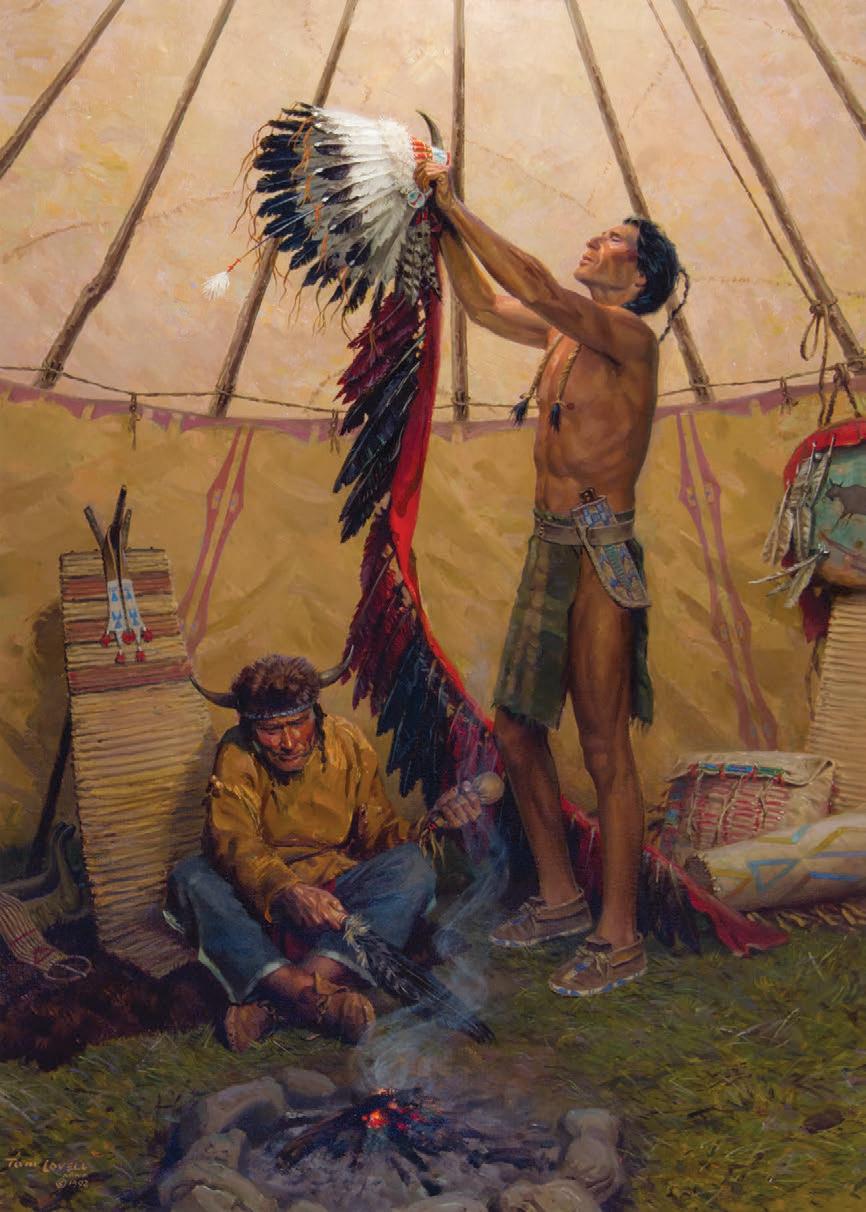
330 Tom Lovell 1909-1997
The War Bonnet Ceremony Oil on canvas
36 x 26 inches
Signed and dated 1992 lower left, Signed and titled verso
Estimate: $75,000 - 125,000
Provenance: Private collection, Arizona
331
James N. Hess 1858-1890
Wrangling a Longhorn Cattle
Oil on canvas
16 x 26 inches
Signed and dated 1879 lower left
Estimate: $20,000 - 30,000
Provenance:
Daniel Hensel (possibly)
C.R. Smith
Private collection, by descent
Sotheby’s, New York, NY, 1982
Private collection, Armonk, NY 1996
Coeur d’Alene Art Auction, Reno, NV, 2018
Private collection, Wyoming
Pennsylvania-born artist James N. Hess studied art at the Pennsylvania Academy of the Fine Arts, where he later exhibited his work in 1878, one year before painting Wrangling a Longhorn Cattle. He also worked as an illustrator and influenced Henry Ossawa Tanner, one of the earlier and most prominent Black painters in American art. He is sometimes attributed incorrectly as John N. Hess.
332
Frank Hoffman 1888-1958
Bucking Bronc
Oil on board
12 x 15 ½ inches
Signed lower left
Estimate: $3,000 - 5,000
Provenance: Scottsdale Art Auction, Scottsdale, AZ, 2008
Raised in the Big Easy, New Orleans, Frank Hoffman discovered his first subject through his father, a horse racer. Being close to these magnificent animals allowed him to draw and paint them with ease. In Chicago, Hoffman became an illustrator and art director at the Chicago American newspaper. Upon the onset of World War I, he tried to enlist but poor eyesight kept him from service. He went to Glacier National Park to serve as the park’s public relations director, and then finally to his Hobby Horse Ranch in Taos, New Mexico. It was in Taos, surrounded by animals, where Hoffman made his best work.
333
Robert Lougheed 1910-1982
Open Range Encounter Oil on canvas
30 ¼ x 60 inches
Signed lower right/NAWA; Titled, signed and dated 1976 verso
Estimate: $55,000 - 75,000
333
Robert Lougheed 1910-1982
Open Range Encounter (detail)
Oil on canvas
30 ¼ x 60 inches
Signed lower right/NAWA; Titled, signed and dated 1976 verso
Estimate: $55,000 - 75,000
Provenance:
Private Collection, Paradise Valley, AZ, by descent Jackson Hole Art Auction, Jackson Hole, WY, 2016 Private collection, Texas
Literature:
Lougheed: A Painter’s Painter, B. Byron Price, Nygard & Elliott Publishing Company, Bozeman, MT, 1991, p. XV (15).
On first viewing, Robert Lougheed’s Open Range Encounter might seem like a pleasant meeting between two strangers. But further examination—including in the title with the ominous word “encounter”—reveals a tense confrontation between a cattle-driving cowboy and a sheepherder with his flock. The man with the sheep has planted his walking stick into the desert soil, a sign of his firm resolve in the matter at hand. The cowboy, who has stood up in the stirrups, seems to suggest a sense of disbelief as he witnesses the sight before him. Even the subjects’ clothing shows the vastly different worlds these men come from: the cowboy is in classic gear with vest, holstered gun and chaps, while the sheepherder is in denim overalls and a short-billed hat. Lougheed underlines the demarcation between the two men by placing a bare border-like patch of dirt that marks the opposing sides. Although the painting’s location is not identified, based on other Lougheed paintings it may be set near San Antonito, New Mexico.
Lougheed started his art career in his native Canada, before moving to New York to study with Frank Vincent Dumond at the Arts Students League. His move to the United States came as advice from friend and fellow illustrator John Clymer. He worked consistently throughout the 1930s through 1950s. In 1960, he was commissioned by National Geographic magazine to paint 13 works showing various horse breeds in America. As part of the assignment, he visited the historic Bell Ranch in New Mexico. It would change his life forever. “Cattle ranching in the West had changed hardly at all in almost one hundred years, and Bob might have believed he had wandered into another world and another time,” wrote Don Hedgpeth in Follow the Sun: Robert Lougheed. “His artistic instincts were stirred at the sight of a panorama of cattle and horses and men moving in a cloak of dust across a landscape uncluttered by any sign of modern civilization. It all seemed so different from the way Western novels and movies had said it was. Bob knew he was seeing something special, something grand and on a scale that could not be translated into art in the ordinary manner. He came away from the Bell Ranch in the fall of 1960 with much more than the material for a horse picture for National Geographic. The way Bob saw it, ‘The West is too big to be confined within the boundaries of the canvas. It is necessary to create the impression of a landscape that moves into the painting from one side and continues on out the other. This is when I started to paint the long proportion—twice the length of the depth.’”
334
Olaf C. Seltzer 1877-1957
Red Robe
Mixed Media
10 ½ x 7 ½ inches
Signed lower right
Estimate: $6,000 - 9,000
Provenance:
Scottsdale Art Auction, Scottsdale, AZ, 2010
Private collection, Massachusetts
It’s possible no other artist was influenced more by Charles M. Russell than Olaf C. Seltzer. This might seem like a backhanded compliment, but to Seltzer, who was enamored with Russell and his work, it is high praise. Seltzer arrived in Great Falls, Montana, in 1897 at 19 years old. He met Russell the same year and later became a pupil of the famous cowboy artist. Although their works have similarities, Seltzer’s paintings have their own unique voice and cadence that allows them to stand out, even next to the work of Russell. This mixed-media portrait was painted in 1913.
335
Henry Balink 1882-1963
Indian with Tom Tom Oil on canvas
30 x 25 inches
Signed Santa Fe New Mexico upper right
Estimate: $15,000 - 25,000
Provenance:
Private collection, Missouri
Henry C. Balink’s life and career could have gone in many directions, including as a professional bicyclist, ice skater or movie stuntman. And yet, the well-trained and multi-talented artist from Amsterdam always had his sights set on painting. He studied in Europe, but fled to America at the start of World War I. He initially came West after seeing a travel poster for Taos, New Mexico, where he first visited in 1917. He moved to Santa Fe, New Mexico, permanently in 1923. He later trained George Phippen and Dwight D. Eisenhower as art students. His primary subject was Native Americans in the Southwest.
336
Roy Andersen 1930-2019
Apache Sentinel Oil on canvas
18 x 24 inches
Signed/CA lower left
Estimate: $8,000 - 12,000
337
Roy Andersen 1930-2019
The Alien Lance Oil on canvas
30 x 48 inches
Signed/CA lower left
Estimate: $16,000 - 24,000
Provenance: Private collection. Colorado
Literature:
Dream Spinner: The Art of Roy Andersen, Jan Adkins, Settlers West Galleries, Tucson, AZ, 2000, p. 46-47.
Known for his authentic portrayals of Native American subjects, Roy Andersen honed his skills as an illustrator in New York and Chicago in the 1970s and 1980s. His illustration went far and wide, including to Time, National Geographic, Sports Illustrated, stamps for the United States Postal Service and, famously, the poster for Clint Eastwood’s The Outlaw Josey Wales. After a trip West, where he was transfixed by the light of the desert, Andersen moved to Arizona. He primarily, with some exception, worked in two styles: portraits with impressionistic, loosely painted backgrounds and, seen here in The Alien Lance, outdoor scenes with intriguing narrative and grand landscapes.
338
Frank McCarthy 1924-2002
In The Land of the Soaring Eagles Oil on canvas
22 x 40 inches
Signed Lower left and dated 1988 CA; Titled, signed and dated verso
Estimate: $40,000 - 60,000
Provenance:
Private collection, Michigan circa 1980s
Known for painting exceptional detail—including anatomy and muscle, rocks, vegetation, water and clouds—and thrilling, high-stakes action, Frank McCarthy came to the West after working in illustration, notably as a poster artist in Hollywood. For those works, McCarthy could amplify the drama and tension, creating explosive pictures of soldiers, spies and outlaws. When the artist turned to Western subjects in 1973, he dialed the action down a little, and yet he still retained much of his narrative edge. Among his favorite new subjects were the Plains Indians. “We still see him today in the collective memory of our national folklore: the proud, bold, graceful warrior-hunter on horseback, the Plains Indian in brilliant panoply of paint and feathers, shouting a blood cry as he charges headlong against his enemy,” Elmer Kelton wrote in The Art of Frank C. McCarthy. “We see him as a mystic soul living close to nature, moving his tepee villages at will to follow the migrations of the buffalo, the life-giving rains, the greening grass, and leaving the land as he found it. The image is real. It flourished during a brief and colorful period in the American past. It is a favorite image of painter Frank McCarthy, whose works evoke its spectacle and drama, its heroism and its tragedy.”
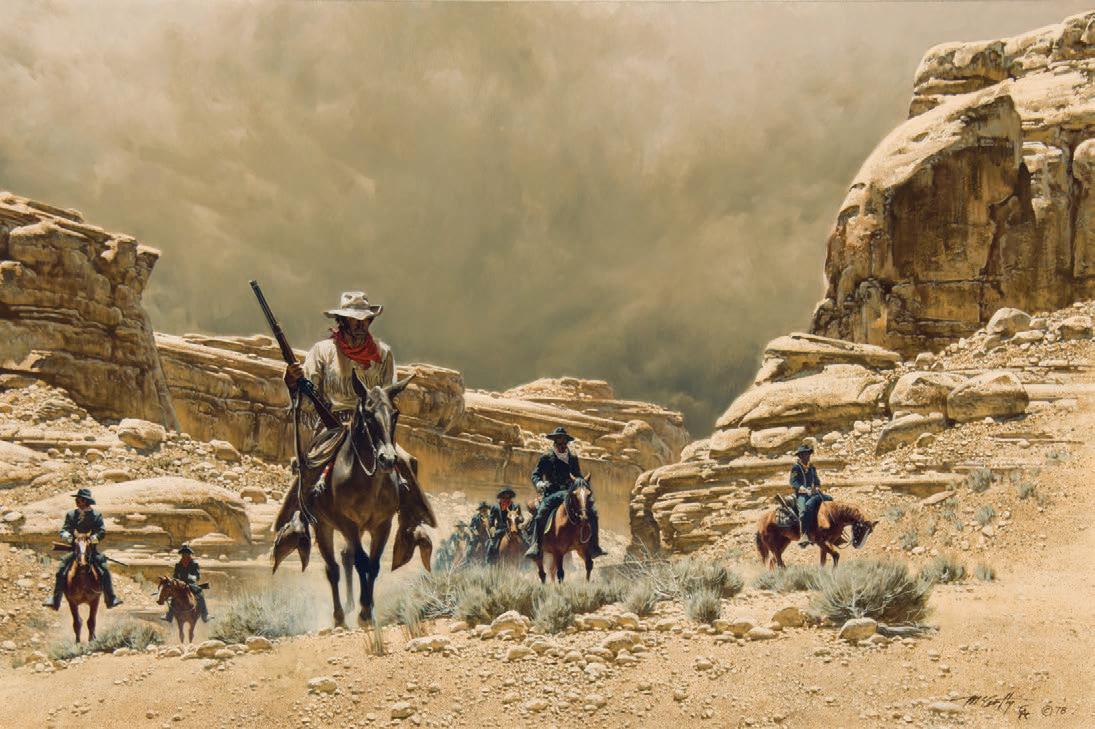
339
Frank McCarthy 1924-2002
Scouts and Flankers Oil on board
24 x 36 inches
Signed/CA and dated 78 lower right; Signed and titled verso
Estimate: $40,000 - 60,000
Provenance: Regina Giesecke Collection, Ballinger, Texas Sold by decent in family partnership, Scottsdale, Arizona
340 Michael Coleman b. 1946
Dust on the Milk River Oil on board
24 x 58 inches
Signed lower left
Estimate: $18,000 - 24,000
Provenance: Private collection, Arizona
341
William Acheff b. 1947
Midnight Drummer Oil on canvas
25 x 30 inches
Signed and dated 2005 lower left
Estimate: $25,000 - 35,000
Provenance: Private collection, Texas
342
Kenneth Riley 1919-2015
Kicking up Dust
Acrylic on board
8 x 12 inches
Signed/CA lower right
Estimate: $10,000 - 15,000
Provenance: Private collection, Massachusetts
343
Kenneth Riley 1919-2015
The Coup Stick Oil on canvas
30 x 24 inches
Signed/CA lower right
Estimate: $40,000 - 60,000
Provenance: Private collection, Texas
The composition of The Coup Stick, with a figure standing in front of a teepee, allowed Kenneth Riley to play with threedimensional space with a two-dimensional backdrop. Here, the main subject and his horse riff off the pictographic representation of a horse on the teepee. Everything is in play: the dots on the edge of the teepee, the thin coup stick on the left, the shadows at the figure’s feet, the horns of his headdress and much more. The effect was so successful that Riley did a whole informal series of these paintings, with titles such as Eternal Circles, The Black Eagle and The Red Tepee
In West of Camelot: The Historical Paintings of Kenneth Riley, author Susan McGarry relates his meticulous design to a form of visual poetry. “The integrity of the two-dimensional surface—the flat rectangle that is completely under control of the artist—is important in all of Riley’s paintings and paramount in this third realm. ‘Everything becomes a design tool,’ he explains. ‘Manipulating viewers is what art is all about... and of course, it is the artist's goal to manipulate them in his favor!’ While relying upon his standard repertoire of people, landscape, animals and artifacts, the inspiration for these paintings is more conceptual than perceptual. They also share an unnatural (even anti-natural) space and an inventive utilization of negative shapes which become as important as the positives. Colors are subjective, chosen less for their fidelity to reality than for their ability to evoke a mood. And the light typically emanates not only from an outside source but seemingly from within the painting itself.”
344
Morgan Weistling b. 1964
Trusted Friends Oil on canvas
30 x 18 inches
Signed and dated 2004 lower left
Estimate: $15,000 - 25,000
Provenance: Private collection, Massachusetts
Literature:
A Brush with History: The Paintings of Morgan Weistling, Vicki Stavig, Blackhammer Press, California, 2018, p. 41.
345
Kyle Polzin b. 1974
Legacy of a Crow Scout Oil on canvas
18 x 34 inches
Signed lower left
Estimate: $50,000 - 75,000
Provenance: Private collection, Colorado
47 ½ x 24 ½ inches
Signed lower right
Estimate: $150,000 - 250,000
Provenance: Scottsdale Art Auction 2022
Private collection, Wyoming
346
Kyle Polzin b. 1974
Strength & Pride Oil on canvas
347
Clark Hulings 1922-2011
Málaga Gossip
Oil on canvas
24 x 36 inches
Signed and dated 1972 lower right
Estimate: $30,000 - 40,000
Provenance: Jack A. Morris, Jr.
Sold by decent
Created after a trip to Málaga, Spain, this work shows how Clark Hulings could find beauty in neighborhoods of all kinds. “My social conscience was pricked by the poverty of the place but I soon became caught up with the intrinsic beauty of the scene,” the artist wrote about Málaga in Hulings: A Gallery of Paintings by Clark Hulings. “…People with scant means had surrounded themselves with what little beauty they could muster. Málaga is not a tourist city with the attractions of Granada and Seville. Many people think of it only as a transit point to Torremolinos and Mar-bella, the beach paradises. But there is beauty there waiting to be discovered.”
348
Clark Hulings 1922-2011
Two Roses
Oil on canvas mounted to board
6 x 8 inches
Signed and dated 1994 lower right
Estimate: $3,000 - 4,000
Provenance: Jack A. Morris, Jr.
Sold by decent
349
Clark Hulings 1922-2011
San Ildefonso After School Oil on board
24 x 36 inches
Signed and dated 69 lower right
Estimate: $35,000 - 50,000
Provenance: Private collection, Oregon
Clark Hulings painted all around the world, from Mexico to France, Egypt to New York, Yugoslavia to Greece, Turkey to the American South. And yet his paintings are uniquely tied to the Southwest due to his home in Santa Fe, New Mexico. Hulings didn’t have to venture far to find subjects: he frequently painted New Mexico destinations such as Taos, Chimayo, Trampas and, seen here, the San Ildefonso Pueblo.
350
James Bama 1926-2022
The Old Ox Yoke Oil on board
22 x 21 inches
Signed and dated 94 lower left; Signed, titled and dated 1994 verso
Estimate: $25,000 - 35,000
Provenance: Private collection, Colorado
Kind eyes, wrinkled faces, gray beards and thousand-yard stares are some of the hallmarks of a James Bama portrait. All of them are on display here in The Old Ox Yoke, painted in 1994. Bama, who started as an illustrator for pulp and adventure magazines before turning to fine art in Cody, Wyoming, also painted younger subjects, including Native Americans, and yet he always circled back to older Western figures. “This was our heritage, people like this,” Bama said.
351
James Bama 1926-2022
Timber Jack Joe Oil on board
24 x 18 inches
Signed and dated 72 lower right; Signed, titled and dated 1972 verso
Estimate: $30,000 - 50,000
Provenance: Private collection, Massachusetts
When James Bama found figures he liked to paint, he returned to them as subjects several times. Timber Jack Joe is one of those subjects. The model’s real name was Joseph Ernest Lynde, and he played a significant role in Bama’s career by introducing him to the modern-day mountain man. “At one time or another Joe had been a sheepherder, farmer, rancher, miner and a timber contractor for the U.S. Forest Service. He was a man who seemed to have been born out of his natural time,” writes Elmer Kelton in The Art of James Bama. “When Bama first met him, he was living out a fantasy of the past in the mountains, trapping, venturing down in beard, beads, colorful buckskins and skunk cap for fairs and parades. He often lectured schoolchildren on the lives of the original mountain men who were the first whites to leave their moccasin prints in many hidden parts of the Rockies. His constant companions were his Appaloosa horse, Papoosie, and a shepherd dog, Tuffy, which rode behind Joe's saddle in countless parades.” Actor Slim Pickens said of Lynde: "I believe the good Lord played an awful trick on Timber Jack Joe by putting him here in this day and age, but thank God he did, 'cause now the rest of us know how a real mountain man looked, dressed and smelled.”
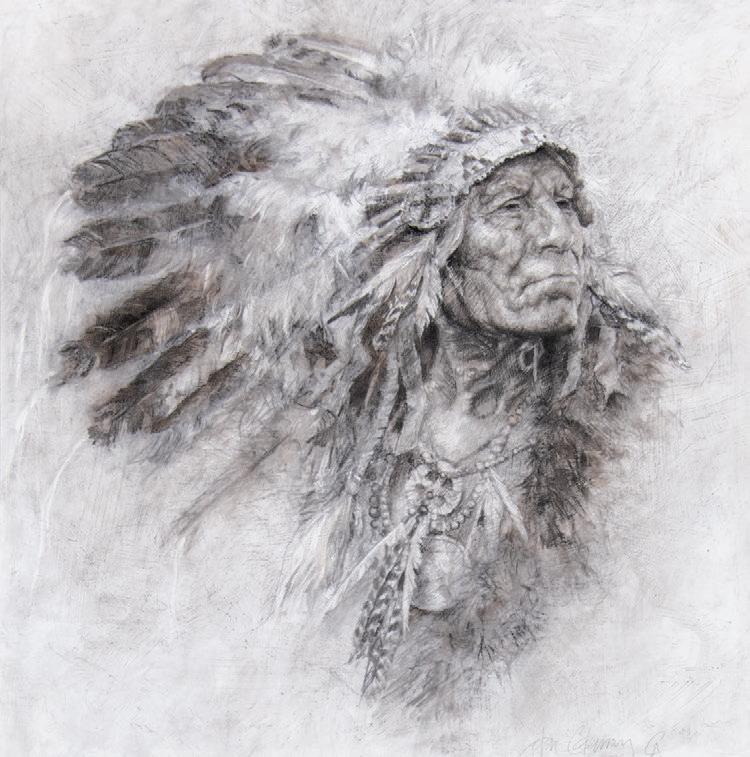
352
John Coleman b. 1949 Lives with Honor Graphite 19 ¼ x 19 ¼ inches
Signed/CA and dated 2009 lower right
Estimate: $7,500 - 10,000
Literature:
The Art of John Coleman - Spirit - LivesLegends by Michael Clawson, Published by Sf Design / Fresco Books, Alburquerque, New Mexico 2024; illustrated pg. 194
353
John Coleman b. 1949 Wahktageli, Big Soldier Bronze, cast 18/35 33 ½ inches overall height
Signed/CA, titled and dated 2009
Estimate: $15,000 - 25,000
Provenance:
From the Collection of Alvin and Jean Snowiss to benefit the Palmer Museum of Art at Penn State.
Literature:
The Art of John Coleman - Spirit - Lives - Legends by Michael Clawson, Published by Sf Design / Fresco Books, Alburquerque, New Mexico 2024; illustrated pg. 129
354
Jerry Jordan b. 1944
The Music We See With Our Eyes Oil on canvas
36 x 48 inches
Signed T.A.O.S. lower right; Signed T.A.O.S. and titled verso
Estimate: $40,000 - 60,000
355
James Reynolds 1926-2010
Wet Goin Oil on canvas
38 x 48 inches
Signed/CA lower right
Estimate: $30,000 - 45,000
Provenance: Private collection, Arizona
James Reynolds led a fascinating life—Navy during World War II, a post-war career in the aircraft industry, sketch artist in Hollywood for 13 years—and yet all he truly wanted to do was paint cowboys. In 1967, he abandoned his life in California to move to Sedona, Arizona. Amid the red rocks of cowboy country, Reynolds brought the American West to life. “I believe that my understanding of Western reality has strengthened my art,” he wrote in Traildust — Cowboys, Cattle and Country: The Art of James Reynolds. “I was, like most people, drawn to cowboys as a result of the myth. But it is the reality that has sustained and held my interest, and been the inspiration for my art.”
356
G. Harvey 1933-2017
Line Shack Cowhands Oil on canvas
24 x 36 inches
Signed lower right; Signed and titled verso
Estimate: $80,000 - 120,000
Provenance: Legacy Gallery
Private collection, California
Texas-born artist G. Harvey linked his Western paintings to history, but they were not bound by it. Instead, his paintings are adventures of the human spirit and all of the drama and romance that spirit embodies. “The essence of G. Harvey’s style conveys the emotion he feels for his subject matter and the inextricable link of its history with his own. The play of broken color allows the viewer to become actively involved in interpretation. The art is impressionistic in that it provides us images of trees, hills, cities and rivers, but we can also feel the invisible cold, howling wind, stifling heat, sadness, joy and longing. Warmly lit windows beckon as we shudder from the mist and chill that penetrate a lonely rider,” writes Randy Best in The Golden Era: A Celebration of Light by G. Harvey. “Through his art, G. Harvey heightens our senses and powers of observation. Inexplicably, we are able to see a sunset beyond the corner of his canvas, the glow which has illuminated the panes in a storefront and rough sideboards on a wagon. We gain an impression of times just beyond the periphery of our memory, but close enough that his illumination warms our fancy.”
357
G. Harvey 1933-2017
A Drippy Day Oil on canvas
20 x 16 inches
Signed lower right; Signed and titled verso
Estimate: $35,000 - 50,000
Provenance: Private collection, Kansas
358
G. Harvey 1933-2017
Soft Lights on Winer Snow Oil on canvas
12 x 16 inches
Signed lower right; Signed, titled and dated 1991 verso
Estimate: $25,000 - 35,000
Provenance: Private collection, New Mexico
359
G. Harvey 1933-2017
Jingle Bells and Powder Snow Oil on canvas
30 x 24 inches
Signed lower right; Signed, titled and dated 1999 verso
Estimate: $50,000 - 75,000
Provenance:
Private collection, Northbrook, IL
Jackson Hole Art Auction, Jackson Hole, WY, 2012
Private collection, Wisconsin
360
Edouard Cortѐs 1882-1969
Le Pantheon
Oil on canvas
24 x 20 inches
Signed lower left
Estimate: $15,000 - 25,000
Provenance:
Regina Giesecke Collection, Ballinger, Texas
Sold by decent in family partnership, Scottsdale, Arizona
361
Edouard Cortѐs 1882-1969
Cafe de la Paix Evening Scene
Oil on canvas
11 x 14 inches
Signed lower left
Estimate: $8,000 - 12,000
Provenance: Private collection, Arizona
362
Edouard Cortѐs 1882-1969
Untitled (street scene)
Oil on canvas
18 ½ x 26 ¾ inches
Signed lower right
Estimate: $18,000 - 24,000
Provenance: Private collection, Austria
One of the most popular and recognizable painters of city scenes, Edouard Cortès is known for his paintings of Paris streets. The artist was born in 1882 and died in 1969, which allowed his life and career to intersect with many magical periods in Paris’ history, from horse-drawn carriages and oil lanterns, to streetcars and gas lamps, to automobiles and the electric lightbulb. His work would frequently bounce back and forth through time as he captured the life and light of Paris. This painting shows the Café de la Paix, which is still in operation across from the Opéra Garnier in Paris.
363
Clark Hulings 1922-2011
Konya Carriage Oil on canvas
20 x 24 inches
Signed lower right
Estimate: $10,000 - 15,000
Provenance: Jack A. Morris, Jr.
Sold by decent
364
Gary Lynn Roberts b. 1953
The Stagecoach Inn Oil on canvas
44 x 62 inches
Signed lower left; Signed, titled, and dated 2026 verso
Estimate: $30,000 - 45,000
One can just feel the excitement of traveling to new places and the opportunities they bring. In this painting I wanted to depict the hustle and bustle of a small town's energy [with] new people arriving while others are moving on. A warm place to stay and a hot meal is always an added pleasure and it is so appreciated when one finds a place like the town’s Stagecoach Inn. - Gary Lynn Roberts
365
Chad Poppleton b. 1976
The Range Detectives - Arizona Strip Oil on canvas
28 x 36 inches
Signed/CA lower right; Signed/CA and titled verso
Estimate: $12,000 - 18,000
366 Todd Connor b. 1964
Free Trapper’s Fire Oil on canvas
48 x 36 inches
Signed lower right; Signed and dated 2008 verso
Estimate: $12,000 - 18,000
Provenance: Private collection, Massachusetts
367 David Mann b. 1948
The Pass Less Travelled Oil on canvas
48 x 36 inches
Signed lower right
Estimate: $12,000 - 18,000
Provenance: Private collection, Massachusetts
Signed, titled and dated June 2019 verso
Estimate: $30,000 - 40,000
Provenance: Private collection, Texas
368
Billy Schenck b. 1947
Big 10 Oil on canvas
45 x 45 inches
369
Billy Schenck b. 1947
Blood on the Horizon Oil on canvas
40 x 50 inches
Signed and dated 14 lower left; Signed, titled and dated 2014 verso
Estimate: $45,000 - 65,000
Provenance: Scottsdale Art Auction Private collection, Texas
370
John Nieto 1936-2018
Set of two (2):
Watching the Ceremonial; Acrylic on canvas; 72 x 60 inches; Signed lower right; Signed, titled, and dated 1995 verso Seated Chief; bronze, cast 2/24; 14 inches overall height; Signed and dated 95
Estimate: $35,000 - 50,000
Provenance: Private collection, California
Created in 1995, this unique pairing of oil and bronze is extraordinarily rare for New Mexico artist John Nieto. The bronze is the only sculpture the artist ever completed, and only two casts were made—one that was kept by the artist and this one. Both painting and bronze depict the same subject: a seated Native American chief with elaborate regalia that includes a hairpipe-bead chestpiece, beaded sash and moccasins, feathered headdress and fringed pants. The painting, set against a tan and burgundy backdrop, is done in Nieto’s style with pure-paint application and a modern design of the figure. The artist’s style was revolutionary when it debuted in the 1970s, and it quickly garnered him accolades from all around the world, including at exhibitions at the Salon d’Automne at the Grand Palais in Paris, as well as in Tokyo, Los Angeles and New York City. Nieto was inspired by the four elements: earth, water, fire and wind, and lived his life according to these elements and their meanings.
371
John Nieto 1936-2018
Dancing in Two Worlds
Acrylic on canvas
44 ¼ x 40 inches
Signed lower right;
Signed, titled and dated 1992 verso
Estimate: $25,000 - 45,000
Provenance: Private collection, California
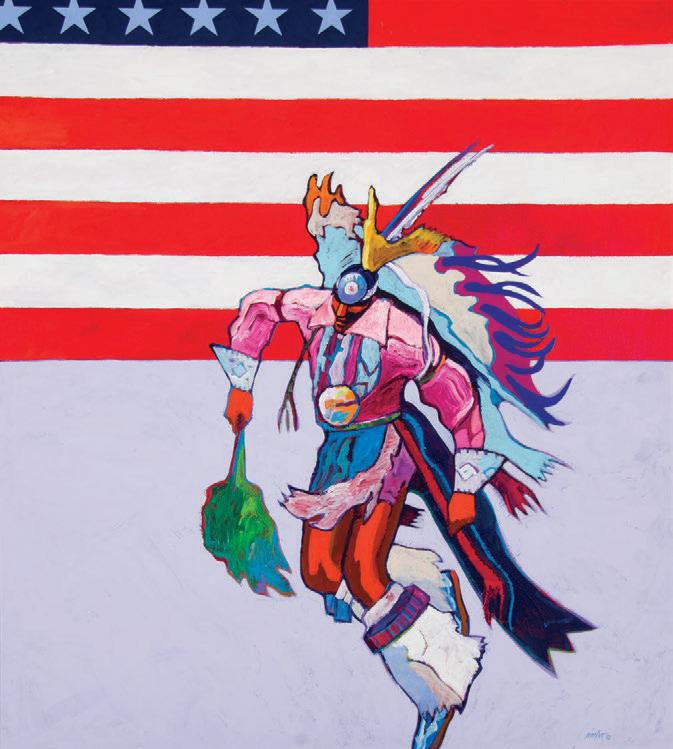
Sometimes titled Fancy Dancer with Flag, this John Nieto work speaks to his appreciation of Native American dancers, regalia and movement. Nieto’s paintings were on the cutting edge of contemporary Western art when they were created in their heyday between the 1970s and 1990s, and are still considered quite modern today as his work has found new admirers amid the surge of the New West renaissance. His work has been frequently compared to Fauvism of the early 20th century, with Nieto’s pieces held up against the paintings of French artist Henri Matisse, who also used pure color and abstracted design to push figures and landscapes away from impressionism and into the avant-garde. While his art is touching new audiences today, Nieto was also celebrated during his lifetime, with numerous exhibitions inside and outside the United States. The artist visited Ronald Reagan and presented him a painting in the Oval Office, and had his work on display at U.S. embassies around the world as part of the Art in Embassies program. Dancing in Two Worlds was previously owned by Nieto, who displayed it above his mantle in his New Mexico home.
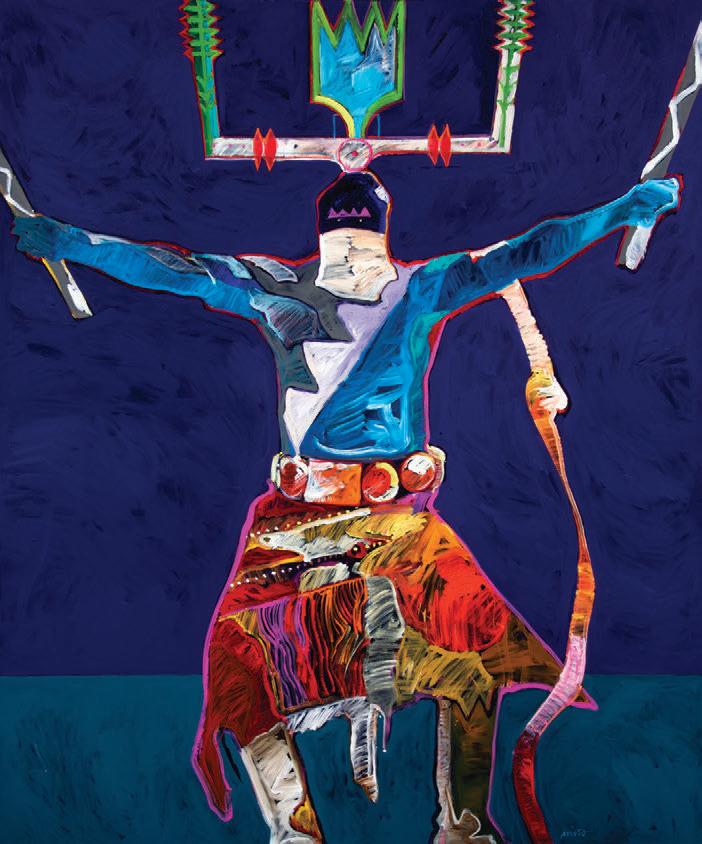
372
John Nieto 1936-2018
Apache Mountain Spirit Dancer
Acrylic on canvas
72 x 60 inches
Signed lower right; Signed and titled verso
Estimate: $30,000 - 50,000
Provenance: Private collection, California
373
Tony Abeyta b. 1965
A Royal Monsoon Oil on linen
18 x 24 inches
Signed lower right
Estimate: $10,000 - 15,000
Provenance: Private collection, Texas
374
Maurice Freedman 1904-1985
Road to Santa Fe Oil on canvas
24 ½ x 29 ½ inches
Signed lower right; Tilted and dated 1934 verso
Estimate: $8,000 - 12,000
Provenance: Private collection, Missouri
Boston-born Maurice Freedman was first a trumpet player in the New England traveling band the Teddy Bears. He later studied art stateside in Massachusetts and New York before traveling to Europe. In 1920s Paris, Freedman was exposed to modernism, which altered the way he observed his subjects for the rest of his career. The Great Depression and then World War II sidelined him for many years, during which time he worked as an art director and designed camouflage for the war effort. Friendships with Marsden Hartley, John Marin and Milton Avery, along with adventures to the Southwest and Cape Cod, helped form his later work, all of it firmly rooted in American modernism.
375 Dave McGary 1958-2013
Point of No Return
Bronze, cast 42/60
30 inches overall height
Signed, fingerprint, and dated 2000
Estimate: $15,000 - 25,000
Provenance:
Private collection, Massachusetts
376
24 x 36 inches
Signed lower left
Estimate: $4,000 - 6,000
Burt Proctor 1901-1980
Pottery Maker Oil on board
36 x 48 inches
Signed/CA and dated 01 lower right
Estimate: $100,000 - 150,000
Provenance: Private collection, Indiana
377 Martin Grelle b. 1954 Winter Crow Oil on canvas
378 Martin Grelle b. 1954
A Western Winter Oil on canvas
36 x 60 inches
Signed lower right
Estimate: $40,000 - 60,000
Provenance: Private collection, Missouri
379 Kenneth Riley 1919-2015
Dancing Drums Oil on canvas
44 ½ x 36 inches
Signed/CA lower right
Estimate: $60,000 - 90,000
Provenance: Private collection, Indiana
Exibited: Eitel Jorg Museum Rediscovering The Old West Cowboy Artist of America 8/26/9510/29/95
380
Kenneth Riley 1919-2015
Untitled (Woman with Parasol)
Acrylic on board
4 x 6 inches
Signed lower right
Estimate: $3,000 - 4,000
381
Kenneth Riley 1919-2015
Frederick Remington and the Buffalo Soldiers study
Acrylic on paper
3 x 5 inches
Signed lower right
Estimate: $2,500 - 4,500
382
Kenneth Riley 1919-2015
The Woodgatherers of Mih-TuttaHang-Hush study
Acrylic on board
4 ¼ x 7 ¼ inches
Signed lower right
Estimate: $3,500 - 5,500
383
Wilson Hurley 1924-2008
Out on the Llano Estacado Oil on board
30 x 48 inches
Signed lower right
Estimate: $18,000 - 28,000
Provenance:
Regina Giesecke Collection, Ballinger, Texas
Sold by decent in family partnership, Scottsdale, Arizona
Literature:
The Life and Art of Wilson Hurley: Celebrating the Richness of Reality, Rosalyn Roembke Hurley, SF Design / Fresco Books, Albuquerque, NM, 2020, p. 61.
Wilson Hurley painted objects as small as flowers in pueblo pots and as grand as the Horsehead Nebula 1,500 light years from Earth. Out on the Llano Estacado fits neatly somewhere between the two. The Llano Estacado is a 3,000-foot mesa located in eastern New Mexico and northwestern Texas. The work was completed in 1997, one year after Hurley delivered the final monumental suite of paintings for the ballroom at the National Cowboy & Western Heritage Museum in Oklahoma City.
384
Wilson Hurley 1924-2008 Point Lobos Oil on board
12 x 18 inches
Signed lower right; Signed verso
Estimate: $3,500 - 5,000
385
Curt Walters b. 1950
Gentled Glow of Dawn Oil on canvas
36 x 36 inches
Signed lower left; Signed and titled verso
Estimate: $12,000 - 18,000
Provenance: Regina Giesecke Collection, Ballinger, Texas
Sold by decent in family partnership, Scottsdale, Arizona
386
Curt Walters b. 1950
Untitled (Grand Canyon) Oil on board
16 x 12 inches
Signed lower left
Estimate: $5,000 - 8,000
48
Signed lower right
Estimate: $25,000 - 35,000
Provenance: Private collection, Wyoming
387 Scott Christensen b. 1962 Miles of Wyoming Oil on canvas
x 72 inches
388 Clyde Aspevig b. 1951 Winter Glow Oil on board
36 x 48 inches
Signed lower right; Signed and titled verso
Estimate: $20,000 - 40,000
Provenance: Private collection, Washington
389 Richard Schmid 1934-2021
Connecticut Oil on board
7 ¾ x 14 ⅝ inches
Signed lower left; Signed, titled, and dated 1960 verso
Estimate: $3,000 - 5,000
390
LeRoy Neiman 1921-2012
32 x 44 inches
Signed and dated 59 lower left
Estimate: $75,000 - 125,000
Provenance: Private collection, New Mexico
Using minimalist design, vibrant color and choppy brushstrokes that emphasized kinetic movement, LeRoy Neiman essentially invented his own art style that merged impressionism with expressionism and then filtered it through American culture starting in the 1950s. His work was ubiquitous in magazines and advertising for decades, including in every issue of Playboy. This 1959 work showing a Las Vegas table game was completed during an active period for the artist, who frequently painted casino subjects through the early 1970s.
Vegas Craps Oil on canvas
391
LeRoy Neiman 1921-2012
Epsom Lawn Parade Oil on board
23 ½ x 36 inches
Signed lower right
Estimate: $40,000 - 60,000
Provenance: Private collection, New Mexico
392
LeRoy Neiman 1921-2012
Bulldogging Oil on board
24 x 34 inches
Signed and dated 77 lower right; Titled verso
Estimate: $40,000 - 60,000
Provenance: Private collection, New Mexico
Bulldogging is classic LeRoy Neiman: pure paint, loose brushwork, bold and bright color. During his heyday, which largely ran from the 1950s to 1990s (and beyond), Neiman was an unstoppable force in illustration. His work was made famous in the pages of Playboy, where Neiman painted Femlin, a curvaceous nude brunette who appeared opposite the magazine’s jokes page. Neiman’s later work included film, television and sports of nearly every variety, including close associations with the Olympics and the Super Bowl. He also painted portraits of Muhammad Ali, Joe Namath, Leonard Bernstein, ballet dancer Suzanne Farrell and Sylvester Stallone, who gave the artist cameos in three Rocky films.
393
Richard Schmid 1934-2021
Nude
Oil on board
16 x 12 inches
Signed lower right; Signed, titled and dated 1979 verso
Estimate: $7,000 - 11,000
Provenance:
Regina Giesecke Collection, Ballinger, Texas
Sold by decent in family partnership, Scottsdale, Arizona
394
Richard Schmid 1934-2021
Carrara Porches
Oil on canvas mounted to board
12 x 8 inches
Signed and dated 1996 lower right; Signed, titled and dated Carrara Italy 1996 verso
Estimate: $5,000 - 8,000
395
Richard Schmid 1934-2021
Pansies Oil on canvas
12 x 24 inches
Signed and dated 1995 lower right; Signed, titled and dated 1995 verso
Estimate: $18,000 - 24,000
Provenance:
Regina Giesecke Collection, Ballinger, Texas
Sold by decent in family partnership, Scottsdale, Arizona
Literature:
Alla Prima II: Everything I Know about Painting - and More, by Richard Schmid, published by Stove Prairie Press, LLC 2013: illustrated p. 108, 109
396
Richard Schmid 1934-2021
Chriss Gouache
12 ¼ x 17 ½ inches
Signed lower right; Signed, titled and dated 1988 verso
Estimate: $4,000 - 6,000
397
Christopher Blossom b. 1956
Down-Easter Oil on board
9 x 12 inches
Signed lower left
Estimate: $3,500 - 5,000
398
Christopher Blossom b. 1956
Clippership Young America
Oil on canvas
20 x 32 inches
Signed lower right
Estimate: $10,000 - 15,000
Provenance: Regina Giesecke Collection, Ballinger, Texas
Sold by decent in family partnership, Scottsdale, Arizona
399
Leon Gaspard 1882-1964
Untitled (Boats and Harbour) Oil on board
6 ½ x 9 inches
Signed lower left
Estimate: $4,000 - 6,000
400
Leon Gaspard 1882-1964
Untitled (Canal)
Oil on board
6 ½ x 9 ¼ inches
Signed and dated 1913 lower left
Estimate: $7,500 - 10,000
401
Ward Lockwood 1894-1963
Taos Plaza
Watercolor
12 ¾ x 17 ¾ inches
Signed lower right
Estimate: $3,000 - 5,000
402
Ward Lockwood 1894-1963
Flying Fish
Watercolor
18 ½ x 26 ½ inches
Signed and dated 41 lower left
Estimate: $4,000 - 6,000
Provenance:
Altermann Galleries, Santa Fe, NM, 2009
Private collection, Arizona
The angular forms and blocks of color in Ward Lockwood’s Flying Fish reveal an artist at ease with modernism in the American West. The Kansas-born painter was introduced to the concept at the Pennsylvania Academy of Fine Arts starting in 1914, and then later in France, where he traveled with Kenneth Adams. In 1926, Lockwood moved to Taos, New Mexico, where he explored the medium of watercolor. He was heavily influenced by the paintings of John Marin and Andrew Dasburg, which is evident in this work.
403
Colt Idol b. 1992
Standing Still Oil on canvas
40 x 72 inches
Signed lower right; Signed, titled and dated 2025 verso
Estimate: $14,000 - 18,000
This scene is very reminiscent of where I was born and raised in northwest Montana. Facing east toward the Salish mountains we see beautiful sunsets often. It’s not too hard to step back in time a bit, and imagine such a beautiful, pristine scene. -Colt Idol
404
Dave McGary 1958-2013
Enemies Past Bronze, cast 38/40
41 ½ inches overall height
Signed and dated 2004; Fingerprint in bronze
Estimate: $10,000 - 14,000
Provenance: Private collection, Arizona
405 Don Oelze b. 1965
When the Pursued Takes A Stand Oil on canvas
42 x 44 inches
Signed lower left
Estimate: $20,000 - 30,000
This painting depicts an Apache army scout sergeant tasked with tracking down a hostile band—often men from related or neighboring Apache groups.
The U.S. Army frequently enlisted Apache from rival bands, knowing that long-standing enmities made them effective trackers. These scouts were unmatched in their knowledge of the land, fiercely brave, and natural fighters, but their role placed them in an impossible position—caught between cultures, loyalties, and survival.
In this moment, the pursuit has reached its breaking point. As the scout relentlessly closes in, the rear warrior of the fleeing band turns back—not in surrender, but in defiance—choosing to confront his pursuer rather than be hunted any longer. It is a split second filled with tension and inevitability, where two warriors shaped by the same land face one another from opposite sides of a brutal and complicated conflict. -Don Oelze
406
48
Signed/CA and dated 05 lower right; Signed/CA, titled and dated 2005 verso
Estimate: $30,000 - 45,000
Provenance: Private collection, New Mexico
John Moyers b. 1958
Pueblo Council
Oil on canvas
x 60 inches
407
Oreland Joe b. 1958
Morning Blessing Marble/Stone
21 ½ inches overall height
Signed/CA and dated 09
Estimate: $8,000 - 12,000
408 Ray Swanson 1937-2004
Indian Lullaby Oil on canvas
30 x 48 inches
Signed lower right
Estimate: $10,000 - 15,000
Provenance: Private collection, Arizona
409
Clark Hulings 1922-2011
The Ringing Bell (Nuestra Señora de la Salud)
Oil on canvas
30 x 25 inches
Signed lower right
Estimate: $25,000 - 35,000
Provenance: Jack A. Morris, Jr.
Sold by decent
This painting depicts Iglesia de Nuestra Señora de la Salud (Church of Our Lady of Health) in San Miguel de Allende, Mexico. The church, built in the 18th century, appeared in several Clark Hulings paintings, including the 1968 work Cloth Vendors–San Miguel de Allende, which offers a wider shot of the church and surrounding streets and plaza. For this work, Hulings turned his attention to the incredible stone facade of the church, which includes depictions of Saint Anne, Saint Joachim, Saint John the Evangelist, the Sacred Heart and the Immaculate Conception.
410
G. Harvey 1933-2017
Children in the Park Oil on canvas
30 x 24 inches
Signed lower right; Signed, titled and dated 2010 verso
Estimate: $50,000 - 75,000
Provenance: Legacy Gallery
Private collection, Wisconsin
Most of his work featured cowboys, cattle and horses, and yet G. Harvey frequently made excursions to major cities, where he allowed his mind (and brush) to be transported back to the late 19th century, when the streets were still filled with horse-drawn carriages and lit with gas lampposts. Recurring destinations from his paintings include Boston; Washington, D.C.; and, most frequently, New York City. No matter where the painting was set, Harvey’s goal was to transport viewers to a place and an emotion. “G. Harvey says his God-given talent would be wasted if he didn’t use it to convey the value system that sustains him. When he puts his brush to canvas, he is communicating feelings, emotions and moods that are the results of his appreciation for God’s order and creation,” writes Randy Best in G. Harvey: The Golden Era — The American Dream. ”A grandfather taking his grandchildren for a wagon ride, a family buying roasted chestnuts from a street vendor, and a jittery young cowboy courting his girlfriend—these are the warm images that touch a responsive chord deep within those who gaze at a G. Harvey painting.”
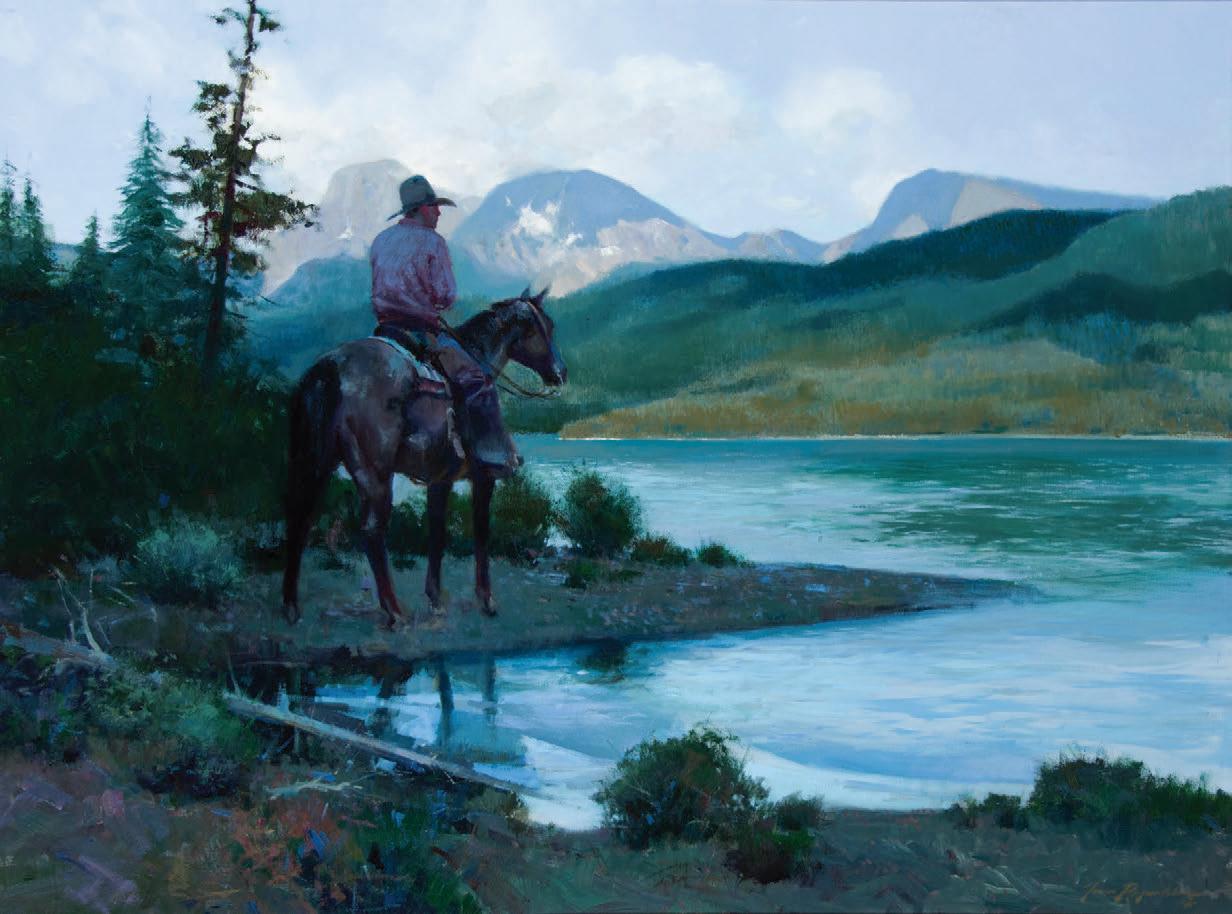
411
James Reynolds 1926-2010
Charlie’s Lake Oil on canvas
36 x 48 inches
Signed/CA lower right
Estimate: $20,000 - 30,000
Provenance: Private collection, Texas
412
Tom Browning b. 1949
Out of the Draw Oil on board
26 x 42 inches
Signed/CA lower left; Signed and titled verso
Estimate: $18,000 - 28,000
Bob Scriver 1914-1999
The Winchester Rider Bronze, cast 20/250 17 ½ inches overall height
Signed and dated 1979
Estimate: $4,000 - 6,000
414
Kenneth Riley 1919-2015
On Foot Oil on board
28 x 44 inches
Signed lower right
Estimate: $20,000 - 40,000
Provenance:
Private collection, Arizona
Guns at the ready, a tense situation is primed to explode in Kenneth Riley’s On Foot, showing soldiers and Native American riders unexpectedly meeting on a hilltop. The artist was no stranger to violent confrontations after serving in World War II as a combat artist in the South Pacific, where he witnessed three separate beach invasions. After the war, Riley was an illustrator and an art teacher before settling in Tucson, Arizona, in 1971. In Southern Arizona, he connected with some old illustrator friends, including Howard Terpning and Bob Kuhn, to start the informal art group the Tucson 7.
415
De Cost Smith 1864-1939
Horse Stealing Oil on canvas
18 ¼ x 26 inches
Signed lower left
Estimate: $15,000 - 20,000
Provenance:
Santa Fe Art Auction, Santa Fe, NV, 2013
Private collection, Nevada
De Cost Smith was the grandson of Reuel Smith, a shipping tycoon and descendant of two Mayflower passengers. In 1890, De Cost traveled with artist Edwin Deming to paint Native American subjects, a trip that greatly influenced the rest of his career. The New York-based artist would go on to have a friendship with Frederic Remington and, like Remington, acquire hundreds of Native American objects that he used in his paintings.
416
Andy Thomas b. 1957
The Alamo Oil on canvas
27 x 38 inches
Signed lower right; Signed, titled and dated 2022 verso
Estimate: $35,000 - 45,000
Provenance: Private collection, New Mexico
Chief and Family Man Oil on canvas
18 x 26 inches
Signed and dated 2010 lower right; Signed, titled and dated 2010 verso
Estimate: $15,000 - 25,000
Provenance: Private collection, Texas
Indian Summer Oil on canvas
20 x 24 inches
Signed and dated 2009 lower left; Signed, titled and dated 2009 verso
Estimate: $18,000 - 24,000
Provenance: Private collection, Iowa
417
William Acheff b. 1947
418
William Acheff b. 1947
419
Jenness Cortez b. 1944
A Tale of Two Cultures
Acrylic on panel
30 x 36 inches
Signed lower right and dated 2005
Estimate: $30,000 - 50,000
Provenance: Private Collection, Texas
Literature: Homage to the Creative Spirit: The Paintings of Jenness Cortez, by Karen Rechnitzer Pope, AMI Publishers, 2011, pg.91
A copy of this book will accompany this lot.
Between the Sage and the Sky Oil on linen mounted to board
30 x 30 inches
Signed lower right;
Signed, titled and dated 2012 verso
Estimate: $40,000 - 60,000
Provenance: Private collection, Colorado
420
Logan Maxwell Hagege b. 1980
421
26 x 26 inches
Signed and dated 20 lower right; Signed, titled and dated Oct 2020 verso
Estimate: $7,000 - 11,000
422
20 x 20 inches
Signed, titled and dated Sept 2024 verso
Estimate: $6,000 - 9,000
Billy Schenck b. 1947 Berkley IV Oil on canvas
Billy Schenck b. 1947 Rider on the Ridge Oil on canvas
423 Carl Brenders b. 1937
Mother of Pearls
Mixed Media
26 ¾ x 38 inches
Signed and dated 93 lower right
Estimate: $50,000 - 70,000
Provenance: Private collection, Arizona
424
Tucker Smith b. 1940
Blacktail Springs Oil on board
10 x 12 inches
Signed and dated 17 lower left
Estimate: $12,000 - 18,000
Provenance: Private collection, Wyoming
Tim Shinabarger b. 1966 Songs of September Bronze, cast 22/35 22 ½ inches overall height
Estimate: $4,000 - 6,000
426
Tucker Smith b. 1940 Still Water Reflections Oil on canvas mounted to board 9 ¼ x 12 ¼ inches Signed and 01 lower right
Estimate: $12,000 - 18,000
Provenance: Private collection, Wyoming
Literature:
The Paintings of Tucker Smith: A Celebration of Nature, Tucker Smith, Graphic Arts Books, Portland, OR, 2004, p. 160
427
Chad Poppleton b. 1976
Date Night Oil on canvas 24 x 48 inches
Signed and dated 05 lower left; Signed and titled verso
Estimate: $14,000 - 18,000
Provenance:
Private collection, Massachusetts
Tim Shinabarger b. 1966
On Barren Lands Bronze, cast 28/35 22 ½ inches overall height
Signed
Estimate: $3,500 - 5,000
429
20 x 30 inches
Signed lower left; Signed verso
Estimate: $5,000 - 8,000
430
James Morgan b. 1947
Sage Grouse Oil on canvas
24 x 18 inches
Signed lower left; Signed and dated 04 verso
Estimate: $3,000 - 5,000
James Morgan b. 1947 Spring Creek Oil on canvas
431
In for the Night
Oil on linen mounted to board
30 x 24 inches
Signed lower left
Estimate: $4,000 - 6,000
Signed lower right
Estimate: $2,000 - 3,000
432
Trevor Swanson b. 1968
Arizona Quail Oil on canvas
24 x 20 inches
Nicholas Coleman b. 1978
433
Luke Frazier b. 1970
In the Thick of It
Oil on board
28 x 36 inches
Signed and dated 26 lower right; Signed, titled, and dated 26 verso
Estimate: $20,000 - 30,000
The joy of painting upland bird dogs hunting quail is best characterized as heart-pounding cinematography. Quail hunting usually occurs in very thick gnarly cover and having a good dog to hunt behind makes all the difference ~ this relationship between the two, can be quite an exhilarating moment. When the dog is still as stone, and a covey blasts out of cover, all hell breaks loose and in a matter of seconds it’s over.
Attempting to paint this scenario usually proves to be quite difficult. My goal is to capture all of that chaos in one moment, a “flash” where time stands still, the blur of the wings, the rigid dog, and an unwavering focus in his gleaming eye. - Luke Frazier
434
10 x 29 inches
Signed lower right; Signed and dated 1996 verso
Estimate: $1,000 - 2,000
Phillip Crowe b. 1947
Lone Star Jr Oil on canvas
435
Bob Kuhn 1920-2007
Fawn Conte
5 ¾ x 7 inches
Signed lower right
Estimate: $2,000 - 3,000
436
Bob Kuhn 1920-2007
Elk
Graphite
7 x 11 inches
Signed lower right
Estimate: $2,500 - 3,500
Literature:
Bob Kuhn: Drawing on Instinct, Bob Kuhn, University of Oklahoma Press, 2012, p. 197
437
Bob Kuhn 1920-2007
Cougar
Conte
10 x 15 ½ inches
Signed and dated 84 lower right
Estimate: $4,500 - 6,500
438
30 x 44 inches
Signed lower right
Estimate: $8,000 - 12,000
439
Richard Loffler b. 1956
Thor’s Hammer
Bronze, cast 6/15
52 inches overall height
Signed and titled
Estimate: $10,000 - 15,000
Provenance: Private collection, Texas
Mark Eberhard b. 1949
Cheetahs Hunting Oil on canvas
Estimate: $28,000 - 38,000
Provenance: Private collection, Arizona
440 Andy Thomas b. 1957
Night Shot
Oil on canvas
40 x 30 inches
Signed lower right
48 x 36 inches
Signed/CA and dated 01 lower right
Estimate: $65,000 - 85,000
Provenance: Private collection, Indiana
441
Martin Grelle b. 1954
She Waits
Oil on canvas
442
Brent Cotton b. 1972
Witness to the Dawn Oil on board
32 x 40 inches
Signed lower left
Signed, titled, and dated; 2026 verso
Estimate: $15,000 - 20,000
This scene was inspired by many a morning I've witnessed while deer hunting. The mist lifting and a lone buck standing quietly watching the dawn break as the land shifts from night toward day. -Brent Cotton
443
Ed Mell 1942-2024
Deep Rain Oil on canvas mounted to board
11 x 14 inches
Signed Lower left; Signed, titled, and dated 2007 verso
Estimate: $10,000 - 15,000
Provenance: Private collection, Arizona
444 Ed Mell 1942-2024
Oil on linen 24 x 18 inches
Signed lower right; Signed, titled and dated 2010 verso; Signed Ed Mell frame
Estimate: $25,000 - 35,000
Provenance: Private collection, Michigan
Sundown Strike
445
G. Russell Case b. 1966
Valley Oil on canvas mounted to board 11 x 14 inches
Signed lower right
Signed, titled and dated 2011 verso
Estimate: $2,500 - 3,500
446
G. Russell Case b. 1966
The Tender Oil on canvas mounted to board 11 x 14 inches
Signed lower right; Signed, titled and dated 2014 verso
Estimate: $1,500 - 2,500
Coyote
447
G. Russell Case b. 1966
Hogan At Montezuma Oil on board
30 x 50 inches
Signed lower right
Signed, titled and dated 2014 verso
Estimate: $15,000 - 25,000
Provenance: Private collection, Arizona
448
G. Russell Case b. 1966
Up Close and Personal Oil on canvas mounted to board 12 x 16 inches
Signed lower right; Signed, titled and dated 2014 verso
Estimate: $1,500 - 2,500
56
Signed and dated 2023 lower right
Estimate: $15,000 - 25,000
Provenance:
Private collection, Texas
449
Xiang Zhang b. 1954
Texas Trail Riders Oil on canvas
x 38 inches
450
Charlie Dye 1906-1972
Set of two (2):
A Comin’ and A Goin’; Oil on board; 24 x 36 inches; Signed/CA with branding emblem lower right; Titled verso Study; Oil on board; 6 ½ x 9 ¾ inches; Initialed lower right
Estimate: $25,000 - 35,000
Provenance:
From the Collection of Alvin and Jean Snowiss to benefit the Palmer Museum of Art at Penn State Western-born painter Charlie Dye left an illustration career in 1960 to become a cowboy painter in Sedona, Arizona. By that time he had already lived a colorful life, including sailing up and down the East Coast in a schooner with his wife and son. He found immediate success in the Southwest and, in 1965, he helped form the Cowboy Artists of America. This 1966 painting is numbered 180 out of 257 works cataloged in Charlie Dye: One Helluva Western Painter. The records were compiled by author Paul Weaver and Steve Dye, the artist’s son, from Charlie’s personal art journal. Dye titled this work in his journal as The Comings and Goings, and it even retains a version of that title (Coming and Going) on the back. The painting bears a strong resemblance to another work, Eastbound Meets Westbound, one of the last paintings Dye ever completed.
451
Tim Solliday b. 1952
The Colorful Hour study
Pastel
8 ½ x 12 ¼ inches
Signed lower right; Signed and titled verso
Estimate: $2,500 - 3,500
452
Logan Maxwell Hagege b. 1980
Native Studies
Mixed Media
14 ½ x 8 ¾ inches
Signed lower left; Signed, titled and dated 2012 verso
Estimate: $2,000 - 4,000
453
R. Brownell McGrew 1916-1994
Navajos On the Way to a Branding Oil on board
30 x 40 inches
Signed lower left
Estimate: $30,000 - 50,000
Provenance: Scottsdale Art Auction, Scottsdale, AZ, 2015
Private collection, Montana
Few artists working in the West had methods as unique and unmistakable as R. Brownell McGrew. The Arizona painter mixed his colors with linseed oil to achieve a wet-style look that allowed him to heighten contrast, luminosity and vibrance. The method allowed him to pull detail out of jet-black shadows, while also creating moody contrasts between light and dark. While this process is best viewed in his portraits, elements of it can be seen here in Navajos on the Way to the Branding, which features a red-rock mountain dappled with brilliant light and shadow.
Two Whistles Oil on panel
48 x 28 inches
Signed lower right; Signed, titled, and dated 2026 verso
Estimate: $10,000 - 14,000
Two Whistles, a Crow Native American leader, is depicted wearing a medicine hawk headdress with his face painted. Among the Crow, he is remembered as a warrior of great stature, courage, and resilience.-Ken Peloke
454
Kenneth Peloke b. 1978
455
Jeremy Winborg b. 1979
A Chance Encounter
Oil on board
34 x 22 inches
Signed lower left; Signed, titled, and dated 2026 verso
Estimate: $10,000 - 15,000
An Apache woman draws her bow to full tension in a high-desert landscape, her focused gaze fixed on an unseen target beyond the frame. The figure’s realism contrasts with the abstracted background of rocky terrain and clear blue sky, drawing the viewer into this moment of quiet intensity. - Jeremy Winborg
456
Curt Walters b. 1950
Oak Creek Crossing Oil on canvas
40 x 30 inches
Signed lower left; Titled verso
Estimate: $6,000 - 9,000
457
Walt Gonske b. 1942
Headwaters of the Arkansas Oil on linen
34 x 30 inches
Signed lower right; Signed and titled verso
Estimate: $6,000 - 9,000
458
Fremont Ellis 1897-1985
The First Snow Oil on canvas
28 x 36 inches
Signed lower left; Signed and titled verso
Estimate: $12,000 - 18,000
Provenance:
Altermann & Morris Galleries, Santa Fe, NM, 1998
Regina Giesecke Collection, Ballinger, Texas
Sold by decent in family partnership, Scottsdale, Arizona
Fremont Ellis was born and died in Virginia City, Montana, and yet he is most known for his landscape paintings of Northern New Mexico. The impressionist painter was enraptured with art after receiving a set of paints for his 10th birthday. Except for three months at the Art Students League, he was entirely self-taught. In 1921, Ellis formed Los Cinco Pintores with fellow painters Will Shuster, Walter Mruk, Jozef Bakos and Willard Nash. The group only lasted five years, but its influence on modernism in the Southwest is immense.
459
David Halbach 1931-2022
Hope Snake Dance Watercolor
21 ¼ x 29 ¼ inches
Signed/CA and dated 05 lower left
Estimate: $6,000 - 9,000
460
Oreland Joe b. 1958
Watching the North Star Marble
30 ½ inches overall height
Signed/CA and dated 08
Estimate: $2,500 - 4,500
461
Ray Swanson 1937-2004
Sioux Princess Oil on canvas
40 x 28 inches
Signed/CA lower right
Estimate: $8,000 - 12,000
462
28 x 30 inches
Signed lower right; Signed, titled, and dated 2024 verso
Estimate: $7,000 - 11,000
Josh Elliott b. 1973
Moonlight Morada Oil on board