SHBT Strategy: Our Future at Fifty

Page 1


SCOTTISH HISTORIC BUILDINGS

TRUST STRATEGY 2026-29: OUR FUTURE AT FIFTY

Conserving the past, building the future

Published January 2026

INTRODUCTION

Since our foundation 50 years ago, Scottish Historic Buildings Trust (SHBT) and our antecedents, Cockburn Conservation Trust and Alba Conservation Trust, have restored over 30 significant buildings at risk in Scotland: conserving the past to build the future.

In these last 50 years, Scotland has changed, much for the better. Historic buildings, often seen as useless artefacts of bygone ages or even obstacles to progress, are now better appreciated, once restored, as vital infrastructure for the Scottish economy, providing valuable civic venues, attractive spaces for business, popular visitor attractions, and desirable homes. What was previously a campaigning movement of dedicated volunteers and erstwhile civil servants is now a professional heritage sector in its own right, employing tens of thousands of people and generating billions of pounds for the Scottish economy.

SHBT has likewise changed and grown: we are a small specialist professional charity with an annual turnover of over £1 million, ownership of a portfolio of commercially active historic buildings, managing multiple large-scale projects simultaneously, delivering engagement work reaching thousands of people, and working with communities across the country, from Eyemouth to Angus, from Kintyre to Caithness. We approach our charitable remit to restore buildings at risk holistically, reflecting the different expectations of funders, stakeholders and communities. We know that building restoration projects have a bigger impact than repaired rhones and restored harling: they help address broader societal issues such as inclusion, skills, nature, opportunity, and participation. Our ambition is to do more. Our strategy outlines how we will achieve this at a national level, led by a new set of values relevant to today, and also as an active partner within the heritage sector, detailing how we will deliver on Scotland’s current national historic environment strategy, Our Past, Our Future. We will ensure our freedom to deliver on our strategic objectives by continuing our entrepreneurial business model and cultivating charitable fundraising to support not only our inspiring projects but the compelling core mission of our charity.

Perhaps most importantly, this strategy centres on our engagement with local communities. The role of local communities as the leading agents for historic building restoration has been the defining trend of the last decade, and a trend now accelerating as a growing number of institutional owners look to others to take on responsibility for historic buildings. SHBT can play a unique role during this period of transition, especially in rural areas, by working in genuine partnership to deliver community-led building restoration projects. Indeed, there is no shortage of demand for our continued efforts and this strategy will help us meet these expectations and unlock our own potential and long-term sustainability.

WHO WE ARE

VISION

MISSION

A Scotland where historic buildings are the foundation of social, economic and cultural prosperity for its people and places.

To restore Scotland’s historic buildings through collaborative partnerships with communities, charities, businesses, and local authorities, ensuring heritage assets remain viable and beneficial while building a more sustainable and inclusive future.

VALUES

Heritage Expertise

We bring proven knowledge, skills, and track record to safeguard Scotland’s historic buildings.

Sustainable Stewardship

We take a pragmatic approach to conservation, balancing environmental responsibility, long-term preservation and practical viability to ensure buildings have sustainable futures.

Community Impact

We work in genuine partnership with communities, making inclusive decisions that empower local voices and achieve lasting change.

Creative Solutions

We approach challenges with innovation and open-mindedness, seeing possibilities where others see problems.

Responsible Practice

We act with integrity and ethics in all our decision-making and implementation, ensuring accountability in our financial, social, and environmental responsibilities.

OUR FUTURE AT FIFTY

Scottish Historic Buildings Trust works across the nation to save at risk historic buildings. We broaden this definition to include not only buildings at risk structurally, but also financially or at risk of being lost to the benefit of their local communities. As we build up to our 50th anniversary in 2028, this strategy outlines the next chapter for Scottish Historic Buildings Trust which addresses new challenges and opportunities in Scotland’s vital heritage sector.

Scottish Historic Buildings Trust’s charitable purpose remains: the Trust’s objects are to promote and encourage, either on its own or in conjunction with others, the protection and preservation of Scotland’s historic, architectural and landscape heritage by any means and in particular by the acquisition of such lands, buildings and monuments of historic or architectural interest as the Trustees may select for the purpose of repair and restoration and sale or lease subject to such legally valid restrictions as will ensure preservation of such lands, buildings and monuments and to further the study of such heritage and make the information obtained available to the general public.

Our Future at Fifty is a two-fold strategy which includes SHBT’s three strategic pillars and SHBT’s response to the Scottish historic environment sector’s Our Past, Our Future

Below: Riddle’s Court during restoration.

STRATEGIC PILLARS

1. We are a truly national charity

We will do this by:

A. Working in partnership with local communities to undertake building preservation activities in their areas, providing advice and support to historic building restoration projects from inception through to completion, supporting the principles of community wealth building.

B. Championing a placebased approach, adding wherever possible capacity, knowledge and expertise via collaboration agreements with local authorities.

C. Providing consultancy services to established charitable organisations and development trusts with historic buildings in their care.

2. We are an outwardfacing charity

We will do this by:

A. Aligning with Our Past, Our Future, Scotland’s historic environment strategy, benchmarking our activities with the national outcomes, and developing over the course of the strategy baseline data for all SHBT’s key activities.

B. Engaging with all heritage sector bodies and organisations, especially other building preservation trusts, to pursue our shared vision for Scotland’s historic built environment.

C. Tackling with others the major issues facing the heritage sector in Scotland today: the traditional building skills crisis, church vacancy, unsustainable business models for existing buildings, and sustainability and energy efficiency of historic buildings.

3. We are an entrepreneurial charity

We will do this by:

A. Delivering our major capital projects of Leith Custom House, Tron Kirk and Bernat Klein Studio with innovative ideas, seeking creative ways to deliver, such as forming coalitions and partnerships.

B. Strengthening our organisational resilience by diversifying income through fundraising for the core charitable aims of SHBT, expanding the consultancy services offered to third sector organisations and local authorities.

C. Increasing the size of commercial activities by growing the incomegenerating arm of SHBT for venue hire and leasing spaces, seeking to work more with our established tenants and commercial partners to find mutually beneficial ways to deliver social impact.

OUR IMPACT

With a small team of 16 staff members and no public funding, we have already restored over 30 significant Scottish buildings and delivered over £50 million of capital investment and revenue funding into Scotland’s built heritage. Our team has specialist skills in historic building preservation, fundraising, project management and property management. We also have expertise in planning, architectural interpretation and in delivering educational programmes, including traditional building skills.

Our portfolio of unique historic buildings has emerged out of the projects we have undertaken. Upon completion of their restoration, some buildings may be fully rented out to long-term tenants, whilst others are divided into individual office suites and event spaces, directly managed by SHBT. From independent artists to visitor attractions, SHBT supports over 200 businesses in the local communities of our properties, ongoing projects, and events.

From left to right: Hamza Anosh (Saltire Scholar), Stephen Dickson (Leith Civic Trust), Antonia Nixon (SHBT), Millie Swan (Saltire Scholar) and Cron Mackay (Leith Civic Trust).

OUR PAST, OUR FUTURE RESPONSE

Priority 1: Delivering the transition to Net Zero

Outcome 1: Reduced emissions from the historic environment

SHBT champions the re-use of existing buildings: our work counters the high levels of dereliction and vacancy within Scotland’s built environment. Unlocking this latent potential is the most impactful way to achieve growth as well as achieving Net Zero targets. Energy efficiency and cleaner energy sources remain among the biggest obstacles to adapting historic buildings for new purposes. To this end, SHBT has committed to researching and developing appropriate retrofit measures for historic buildings, ranging from traditional to concrete constructions, both for SHBT’s existing portfolio and active projects, and include a commitment not to install gas or oil heating systems from 2025. Moreover, SHBT recognises that the historic environment can play a role in supporting nature and reversing biodiversity loss by considering habitat creation as part of every design, such as including nesting boxes and landscaping.

Outcome 2: The historic environment is more climate resilient

SHBT will research, experiment, develop and deliver an approach to appropriately adapt traditional buildings using SHBT’s property portfolio of buildings dating from the 16th to the later 20th century as test cases. Our ‘future proofing’ initiatives will include sensitive adaptations to allow our buildings to withstand the ever-challenging Scottish weather, accepting the need to accommodate more intensive rainfall, wind gusts, and local contexts (e.g., increased coastal erosion and flood risk, and higher drought impacts on buildings in eastern Scotland). SHBT will work with partners within the sector to develop case studies and best practice to be shared widely. SHBT is resolved that climate change is a challenge which can be addressed in any restoration and should not be a justification against conservation.

Outcome 3: Improved pathways for historic environment skills

SHBT has developed a pre-apprenticeship scheme model (Community-embedded Traditional Building Skills based in Eyemouth, Scottish Borders) which will continue to be tested as part of our desire to have a Building Preservation Trust-led approach to place-based traditional skills training as part of multi-building regeneration projects and single projects. SHBT also appreciates the need to balance supply with demand, encouraging other historic building owners to commission accredited conservation specialists. We advocate for digital directories and platforms to better procure work from Scotland’s broad range of traditional skills and specialists, and support the UK-wide campaign to reduce VAT on historic building repair.

Priority 2: Empowering resilient and inclusive communities and places

Outcome 4: Organisations that care for the historic environment have the right skills and are more resilient

SHBT will continue to grow its team, creating opportunities for paid internships, and provide a personal Career Development Plan for each staff member, as well as training in new technologies, allowing for more flexible and smart working to deliver our charitable purposes more effectively. An annual internal skills audit will be conducted to ensure SHBT retains core skills required for historic building preservation, and also identify desirable new and emerging skillsets and how they can be acquired by the charity.

Outcome 5: Communities have more opportunities to participate in decisionmaking about the historic environment

SHBT has a track record of innovative working practices, often working in partnership with local authorities, local communities, and other heritage organisations (noting the success of the Bernat Klein Studio Coalition with National Trust for Scotland and Bernat Klein Foundation).

SHBT will seek funding to further develop this model, termed Historic Building Community Partnerships, in areas currently considered ‘cold spots’ for heritage funding. This will involve building flagship heritage projects in partnership with local communities and delivering placebased restoration projects.

Outcome 6: The historic environment is more diverse and inclusive

SHBT will actively encourage participation at all levels of the organisation – trustees, staff, volunteers, and community representatives –that reflects contemporary Scotland. SHBT’s project-based audience engagement plans will identify all stakeholders (adapting best practice for inclusion and participation, e.g., National Lottery Heritage Fund guidelines, Museums Association’s Working Equitably: A toolkit for museums and community organisations), ensuring that dedicated approaches are outlined to engage with everyone, with additional support for harder-to-reach groups. SHBT is especially interested in end uses for historic buildings which foster civic inclusion and participation.

Priority 3: Building a wellbeing economy

Outcome 7: The historic environment makes a responsible contribution to Scotland’s economy

SHBT undertakes work across Scotland, sourcing, wherever possible, local businesses to support restoration activities. Above all, SHBT is unusual in not receiving core funding from any public source, generating our own income through commercial activities and charitable fundraising. We believe our financial model is both sustainable and can grow further. SHBT will increase the size and range of commercial activities at our nine historic buildings (located from Dumbarton to Kirkcaldy with a significant cluster in Edinburgh) by growing the income-generating arm of SHBT for venue hire and leasing office/studio spaces, seeking to work more with our tenants (some 40 different businesses and enterprises are current tenants) and other partners (e.g., local

business networks) to find mutually beneficial opportunities for business growth. SHBT’s knowledge and experience for both property management and project development can be shared with others, especially in the third sector, where an increasing number of organisations are undertaking the management of a historic building for the first time, by expanding and better advertising our consultancy activity.

Outcome 8: The historic environment provides fair work

SHBT is committed to paying above the Scottish real Living Wage and providing paid internships at National Minimum Wage through established programmes such as Saltire Scholars. We acknowledge the historic low pay within the sector and advocate for fair pay commensurate to level of experience and responsibility, including for any external consultants engaged by SHBT, benchmarking (when information is available) at or above sector standards. We also recognise the value and role of freelancers and specialists who provide advice and services to SHBT – believing that individuals supporting SHBT should be compensated for their time and reimbursed for their expenses. Fair work goes beyond pay. SHBT supports flexible working for staff, accommodating personal circumstances, awards annual inflationary pay increases, pension salary sacrifice scheme, regular staff experiences, and a positive, open and supportive team culture.

Outcome 9: Increased engagement with the historic environment, with a focus on activities that enhance wellbeing

SHBT will include a wellbeing benefit assessment for all SHBT-led projects, as well as provide SHBT-owned spaces at a discounted rate for not-for-profit organisations and activities which enhance wellbeing. While SHBT as a heritage charity is necessarily limited as to the extent to which wellbeing activities can be appropriately delivered as part of our charitable purpose, we endeavour to work with more specialist organisations and charities to provide wellbeing activities at our buildings which have public access (Riddle’s Court, Leith Custom House and Strathleven).

OUR CURRENT PROJECTS

SHBT is the largest Buildings Preservation Trust in Scotland and one of the most active in the UK. We believe passionately in what we do and strive to deliver projects that are both beneficial to the local community and enable long-term, sustainable use. Our current portfolio of ten ongoing projects includes Leith Custom House, a new civic space for Leith centred on an innovative digital museum concept, and Edinburgh’s iconic Tron Kirk.

1. Bernat Klein Studio, Selkirk

2. Custom House, Leith

3. Glenbarr Doocot, Kintyre

4. Futureproofing, Strathleven House (West Dunbartonshire) and Glasite Meeting House (Edinburgh)

5. Harlawhill House, Prestonpans

6. Hawick Conservation Area Regeneration Scheme, Scottish Borders

7. Laidhay Croft Museum, Caithness

8. St Marnock’s Church, Fowlis Easter

9. Traditional Building Skills, Eyemouth

10. Tron Kirk, Edinburgh

Bernat Klein Studio, Selkirk

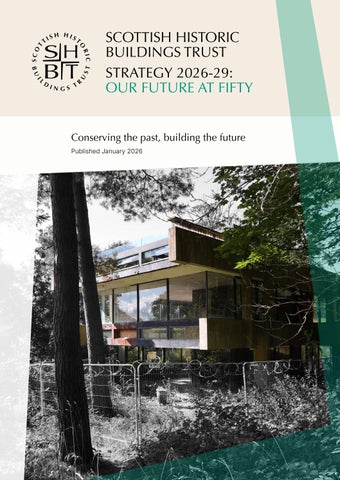
In July 2025, Scottish Historic Buildings Trust joined forces with National Trust for Scotland and the Bernat Klein Foundation in a coalition bid to save for the nation Peter Womersley’s 1972 masterpiece, the Bernat Klein Studio. Overcoming fierce competition and boosted by a public fundraising campaign which raised over £150,000, the coalition successfully purchased the building at auction.

The Studio was once the beating heart of the textile industry in the Scottish Borders. Textile designer Bernat Klein (1922–2014) gained international renown by designing collections here for many famous fashion houses including Chanel and Dior. The Bernat Klein Foundation continues to manage and develop his legacy through its creatively-led projects, demonstrating his continued significance to people both locally, nationally, and internationally.

SHBT will oversee the delivery of a repair and restoration project working in coalition with National Trust for Scotland and the Bernat Klein Foundation. The immediate phase of works to secure the building and develop the designs for its future is being supported by The National Lottery Heritage Fund.

The Studio is currently in a severely dilapidated state and was at risk of being lost forever. Category A listed, the building won a RIBA Design Award and the Edinburgh Architectural Association Centenary Medal in 1973 for its exemplary use and combination of concrete, brick, steel, and glass.

Once complete, it is intended that The Studio will return to its original use as a design studio, as well as providing a permanent base in the Scottish Borders for the Bernat Klein Foundation, whose projects include exhibitions, workshops, and talks.

Such good news after so many years; so much hope for the future of this exquisite building. A project worthy of the memory of both Bernat Klein and Peter Womersley, dear family friends.

- Crowdfund supporter

Saving this important building for the nation is the best possible solution. We are happy to be able to support it, and good luck with the rescue and restoration!

- Crowdfund supporter

Both images: © Mike Bolam Photography

Custom House, Leith

Scottish Historic Buildings Trust is delighted to present a fully developed concept for this iconic historic building, fulfilling the long-held desire for Custom House to provide a venue for telling Leith’s many stories from the past and today.

Built in 1812, Leith Custom House was the first purpose-built Customs House in Scotland. Category A listed, its magnificent internal William Burn staircase will be newly revealed in the design by Richard Murphy Architects.

Our Leith Custom House project promises to transform this landmark historic building into a vibrant civic space and Scotland’s first fully digital museum, creating a ‘town square for the twenty-first century’ that will celebrate Leith’s unique culture and heritage.

Eight dedicated exhibition rooms on the first floor will house Scotland’s first fully digital-led museum with video walls, screens, and projectors, managed by a local community trust to tell the stories that matter to Leith and its people.

On the ground floor, community-creative studios will be available for working artists and makers, along with events and conference space available for hire. Commercial and retail opportunities will ensure a sustainable future for the building, with Custom Lane opened up as a thriving eating and drinking destination, linking the Shore with Dock Place and Victoria Quay.

Really enjoyed the art exhibition in this wonderful space. A really interesting building outside which should be preserved in all its splendour. Thank you!

- Leith local resident

A lovely space for Leith’s community which the locals love and wish to continue.

- Leith local resident

Left: © Richard Murphy Architects
Right: © Jason Baxter Media

Glenbarr Doocot, Kintyre

Following an article in The Herald highlighting our Doocot Diaries campaign, we were contacted by the Glenbarr Community Development Association (GCDA) to advise on the possible restoration of Glenbarr Doocot, on Kintyre’s west coast.

SHBT is working with GCDA to save the 18th-century doocot, which has been on the Buildings at Risk Register since 2009. Owned by the Clan MacAlister Charitable Trust, the Category C-listed stone-built doocot sits in the grounds of the B-listed Glenbarr Abbey, now also on the Register.

In May 2025, SHBT completed a feasibility study in partnership with conservation specialists Limerich, assessing the doocot’s condition and outlining options for stabilisation and future use. The doocot stands at a critical juncture. Its core remains strong, but without urgent action to protect the vulnerable wall heads and control invasive vegetation, it risks further decay and eventual loss.

Following a community presentation in July 2025, GCDA committed funding towards urgent repairs to stabilise the doocot while a longerterm project is developed. Community involvement remains central to the project, with conservation contractor Limerich set to host up to six volunteers on site for traditional skills training. This repair phase will also include weekend events, talks, and site visits to engage the wider community.

SHBT believe doocots can be innovatively repurposed for the future and could provide habitats for bees and pollinators, using many of the redundant structures to actively counter biodiversity loss. Potential uses being explored include a wildlife observation hide and an outdoor learning node for schools to visit and learn about biodiversity.

Left: © Limerich

There is considerable local enthusiasm within Kintyre for a variety of future uses reconnecting the building and the community to the natural environment.

- SHBT

This is an opportunity to be part of saving an important piece of Kintyre’s history and reimagining it for the future.

- Dan Carson, GCDA

Traditional Building Skills, Eyemouth 9

Rural Scotland is suffering from twin crises, in the dereliction of historic buildings and endemic gaps in the traditional construction skills needed to repair them. SHBT is embarking on a new project which aims to tackle both of these issues together.

Taking on several derelict or vacant historic buildings in a rural community, SHBT will explore how a cluster approach of smaller projects, rather than a larger one-off capital renovation, may deliver a greater impact. Furthermore, that these projects can be delivered via a model focussed on working with local businesses and training local people in the crafts and trades to not only save buildings where they live, but provide them with skills and employment for the rest of their lives.

Over the winter of 2024–25, with support from the UK Shared Prosperity Fund, SHBT carried out a feasibility study based in Eyemouth, in the Scottish Borders. With above-average levels of town centre vacancy and several properties on the Buildings at Risk Register, Eyemouth encapsulates the challenges faced by rural towns all over Scotland.

The phased training model proposed by our project, with an initial pre-apprenticeship scheme leading on to Modern Apprenticeships for participants who chose to stay with the project, addresses the identified need in Eyemouth by delivering high-quality traditional construction skills training close to where people live.

This is heritage conservation with purpose: breathing new life into forgotten buildings while empowering communities to shape their own futures through skills, employment, and renewed civic spaces that honour the past.

Left: © Jason Baxter Media

We welcome SHBT’s fresh approach to dealing with some of our historic built environment’s most entrenched issues: skills and rural dereliction. Historic Environment Scotland is delighted to support this important project.

- Colin Tennant, Head of Technical Conservation, HES

The Building Traditional Skills Eyemouth scheme will bring traditional construction skills training to people in Eyemouth, increasing the opportunities available to people on their doorstep.

- Riddell Graham, Chair of the Gunsgreen House Trust

Tron

Kirk, Edinburgh 10

SHBT is leading the revival of the iconic Tron Kirk, one of Edinburgh’s most historically significant landmarks. Closed for worship in 1952 and placed on the Buildings at Risk Register in 2003, the Tron has weathered centuries of change, fire, and neglect. Now, we have a unique opportunity to restore this remarkable building – its majestic open timber roof, intricate stonework, and beautiful stained glass –and provide it with a sustainable future in the heart of the Old Town.

The Tron Kirk, built in the 17th century in the heart of Edinburgh’s Old Town, is a striking blend of history, architecture, and reinvention. Designed by John Mylne in the style of Dutch churches, this A-listed building within the Old Town Conservation Area and the World Heritage Site of the Old and New Towns of Edinburgh has been on the Buildings at Risk Register since 2003.

The Tron Kirk represents a pivotal opportunity to revitalise a significant Edinburgh heritage landmark through collaborative community engagement and strategic conservation. In the years since it closed for active worship, numerous proposals put forward for the Tron’s development have failed to come to fruition. SHBT’s stewardship offers a final chance to transform this historic building into a thriving community asset that honours its past while serving contemporary needs.

Our vision encompasses comprehensive conservation works including stained glass restoration, stonework repair, and re-roofing, while building upon the success of the existing artists’ market. Through meaningful stakeholder collaboration, we aim to co-design solutions that seamlessly integrate the Tron with Hunter Square, creating an interconnected, welcoming civic space in the heart of Edinburgh. Both images: © Colin McLean Photography

Important historical building. Wonderful to hear about its possible development.

- Edinburgh local resident

The Tron Kirk has been a well-loved gathering place on the Royal Mile for centuries and its future is safe in the hands of the Scottish Historic Buildings Trust.

- Councillor Mandy Watt, Finance and Resources Convener, City of Edinburgh Council

SUPPORT OUR WORK

As a charity, we rely on your generosity to ensure that we can continue to restore important and unique buildings for future generations. Each and every contribution you make helps us to continue our work saving historic buildings across Scotland and bringing them back to life.

If you are interested in supporting us, or you would like to find out more about how your donation will be used, please get in touch.

www.shbt.org.uk info@shbt.org.uk 0131 220 1232

Turn static files into dynamic content formats.

Create a flipbook
SHBT Strategy: Our Future at Fifty by Scottish Historic Buildings Trust - Issuu