
Sheila Anderson-Hardy | Wild

Page 1


SHEILA ANDERSON-HARDY

7 - 30 May 2026

WILD

The Scottish Gallery is delighted to present Sheila Anderson-Hardy’s first solo exhibition, Wild, which is a celebration and a testament: a celebration of the wild garden she has shaped over the past decade in the Scottish Borders, and a testament to the transformative power of living within nature’s cycles.

After more than thirty years in London, where Hardy’s career evolved from textile designer and illustrator to full-time painter, she returned to rural Scotland in 2014. The move marked a profound shift in her life and work. Settling in a farmhouse near Jedburgh, Hardy and her husband began restoring both the house and surrounding land. What was once a lawn and paddock has been carefully rewilded into meadow, hedgerow and spinney. Bramble and briar flourish, native trees establish themselves, wildflowers seed and reseed. Birds, insects, and small mammals have returned in abundance.

This cultivated wildness has become the catalyst for Hardy’s practice.

Wild unfolds through the gardener’s year. Each month brings its own focus: ruby hawthorn berries and rosehips in November; skeletal hogweed and thistle in winter; the acid greens of early spring; blossom, birdsong and swelling hedgerows in April; the full-throated bird chorus of May; meadow flowers and goldfinches in high summer; the harvest of apples, blackberries and seeds in autumn. Hardy’s paintings are not literal records but layered compositions, drawn from sketchbooks, photographs and daily walks. They weave together close observation with memory and emotion, capturing the appearance of nature alongside its spirit and energy.

It is not a coincidence that Hardy’s exhibition opens in May, which is arguably the most exuberant point in the gardener’s calendar in Scotland. Vivid white

hawthorn, birds quarrelling noisily in the eaves, returning swallows wheel overhead, and blossom promises of fruit to come. May is a month of optimism, of upward growth and restless vitality. That sense of renewal runs through Wild.

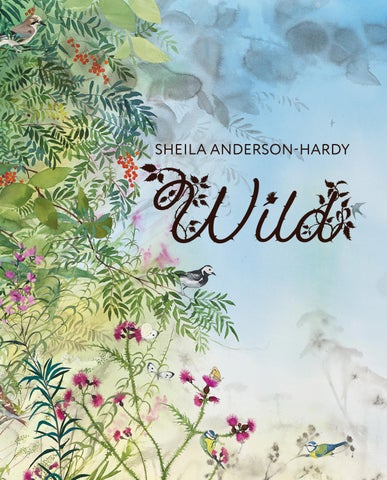
Drawing lies at the heart of Hardy’s paintings. Using Sumi-e ink, watercolour and collage, she builds intricate surfaces that echo the dense networks of hedgerow and meadow. Her training in textile design is evident in her love of pattern and detail; her years of close observation have sharpened her understanding of structure, season and habitat. Umbellifers, bramble arches, lichened trunks, goldfinches feeding on thistledown are not decorative motifs but essential anchors in a living ecosystem.

Hardy’s garden is not just her subject, it also provides sustenance. Apples become cider vinegar; crab apples are transformed into chilli jelly; brambles and walnuts find their way into autumn crumbles; green tomatoes are turned into chutney. The act of tending, harvesting and cooking is inseparable from the act of painting for Hardy. Both are rooted in patience, process and respect for the land’s generosity and in these pages, Hardy has included some of her recipes.

Hardy’s rewilded garden has reshaped her perception of the countryside and our relationship with it and her artistic purpose. Her paintings invites us to look more closely at what might otherwise be overlooked: weeds, the tangle of a hedge, the flash of a bird’s wing.

In these paintings, Hardy makes the ordinary extraordinary. The garden is her world. Through attentive observation and optimism, Sheila Anderson-Hardy offers us not just images of the wild, but an invitation to belong to it.

MY WILD LIFE

When you first encounter my work, you step into a hedgerow.

Not the picturesque countryside of sweeping views and distant hills, but the tangle at your feet. Bramble and briar, nettle and thistle. Mossed trunks, fallen branches softening into decay. Goldfinches clinging to teasels. A hare half hidden in long grass. The life that thrives when we stop tidying.

Allowing our garden to rewild in the Scottish Borders has transformed both the land and my painting practice. Piles of branches and rotting logs, dense areas of bramble and scrub, and the decision not to battle weeds have enabled small trees and wildflowers to flourish. Cow parsley, vetches, red campion, stitchwort, dandelion, and daisies now thrive where once there was clipped lawn and relative silence. In just seven years the abundance and diversity of wildflowers, insects and animal life have increased beyond anything I could have imagined.

The contrast is extraordinary. A former lawn attracted a few blackbirds. The managed chaos of spinney, meadow and field is alive with movement and sound. I now recognise that plants once dismissed as weeds are of intrinsic importance to countless species. Through rewilding I have come to understand the interconnectedness of every element within this small ecosystem. The tangled growth provides food, shelter, and breeding grounds. Each season brings its own arrivals, from the first bumble bees of spring to the moths and bats of late summer.

My painting is driven by what matters to me. My connection to this environment runs deeper than admiration of light or colour. The longer I observe, the more I feel bound to its processes. My work

grows from emotional responses to nature and from an increasing awareness of its fragility. The words of William Morris resonate strongly: protect what is left, recover what is lost of the fair earth.

Living and working in rural Scotland since 2014 has reshaped both my life and my practice. Moving from southeast London, where I painted shop fronts, market scenes, and urban fragments, I was initially overwhelmed by the natural beauty around me. Gradually I found my focus in the intricate life of hedgerows, meadow edges, and woodland margins. Sketchbooks filled with field notes became the foundation for larger works in the studio.

Drawing lies at the core of my practice. I work with charcoal, pencil and particularly Sumi-e ink, applied in varying dilutions to dry or wet paper. Traditional ink, made from soot and binder, has been used for centuries. Its permanence and clarity suit my purpose. The philosophy behind Sumi-e painting aims not simply at accuracy but at capturing the spirit of nature. That is my intention. I prefer natural and recycled papers where possible. Rough Khadi paper, made from cotton rag, absorbs pigment unpredictably and creates a textured surface that feels alive. For more detailed work I use smooth hotpressed papers, building atmosphere with diluted glazes over an ink underdrawing. Final touches of opaque gouache or collage introduce sharp contrast and brightness. Recently I have begun experimenting with ink on canvas, combining its translucence with oil to create depth and detail.

Observation dictates the outcome. I may watch goldfinches picking apart dandelions or lie flat in the meadow studying the diversity beneath the grasses. Quick ink sketches are supported by photographs taken on my phone when a bird or insect will not stay still. Accuracy matters. I

cross reference colour and scale carefully. Yet what I seek is not a scientific record but a sense of presence and vitality. My day in the studio begins with looking. From the window I see cultivated fields stretching towards Peniel Heugh, topped by the Waterloo Monument. Its changing presence under blue sky, fog or snow is quietly reassuring. I begin with coffee, reviewing the previous day’s work, planning how to proceed. In winter I light the wood burner. I go out for a walk before settling at the studio bench, knowing that a shape of branch or a flash of wing will find its way into the painting.

Water based media suits me. The translucency of watercolour allows subtle shifts of light. Timing is crucial. Painting when the paper is neither too wet nor too dry creates soft blurred edges that suggest depth and atmosphere. My palette shifts with the seasons: the acid greens of early spring growth, the layered colours of summer flowers, autumn’s golds and scarlets, winter’s muted tones. Increasingly I work on a larger scale, creating near life size narratives that invite the viewer into this wild world.

Umbellifers recur throughout my paintings. In spring and summer their flower heads are nectar providers for insects. In winter they become delicate skeletal forms. Hedges fascinate me most of all. In winter, their gnarled trunks and lichen covered branches are revealed, wildlife sheltering within. Blackbirds, finches, thrushes, hedge sparrows, hares, and foxes appear again and again in my work. They are a family of characters, essential and interwoven.

My route here was not straightforward. Despite my parents’ reluctance, I studied at Glasgow School of Art in the late 1970s, trained within the textile department and later worked as a colourist in the printed textiles industry in London. After illustration and teaching, and the raising of my two daughters, I returned fully to

painting. The discipline of textile design, with its emphasis on drawing from life and attention to pattern and detail, continues to inform my work.

Over time I re-embraced watercolour, drawn back to its immediacy and versatility. Botanical forms had fascinated me even as a student, hours spent sketching orchids in Glasgow’s Botanic Gardens. Now that fascination has found its true home in the wild margins of Scotland. Recognition has grown steadily. Acceptance into the annual exhibitions of the Royal Scottish Society of Painters in Watercolour encouraged me to think on a larger scale, and in 2024 I was honoured to be elected a member of the RSW. Preparing this body of work for The Scottish Gallery has pushed me to refine and deepen my vision while remaining true to observational drawing.

At the heart of my practice is a desire to share the joy I experience in the wild and to highlight the importance of conservation. I am not a scientist. I am an artist who has witnessed the restorative power of nature. There is clear evidence that time spent outdoors has healing effects. I hope that by drawing attention to species decline and habitat loss, quietly and without didacticism, my paintings may encourage others to cherish what remains. What drives me is the need to paint what I find beautiful and understand to be important. The value lies in the process itself. Through attentive drawing and painting I cultivate awareness, patience, and respect for nature’s rhythms.

It is my hope that those who encounter this exhibition might begin to notice their own hedgerows. To see wonder in what might once have been overlooked. To recognise the richness and resilience present in everyday wild spaces. And perhaps, in some small way, to protect what is left and recover what is lost of this fair earth.

March

OBSERVATIONS

March is a month of transition, the weather still cool. The hedgerow begins to show signs of growth as fading snowdrops are replaced by emerging bluebell foliage and bright green grasses sprout tentatively from the remains of the previous year. Verges and field margins suddenly green, no longer brown. In the greenhouse I plant tomato seeds in trays, hoping they will germinate, wrapped in thick bubble wrap for warmth. Birds are pairing up and their calls grow louder. It is daffodil month and amongst the trees and along the verges a welcome show of golden heads attracts early pollinators.

April

With the arrival of spring everything in the garden turns green. Buds swell and early blossom adds flashes of white. Coltsfoot and primrose bloom on the verge, while pale yellow catkins dangle from alders above. In the wood a chiffchaff joins the chorus of robins, thrushes, sparrows, and wrens. The scent of wood sorrel and wild garlic fills the warming air and insects buzz among the blossoms. Orange tip butterflies are drawn to lilac ladies smock, while bumble bees journey from dandelion to dandelion, rapidly forming a sea of yellow on the verges. Birdsong builds. From the topmost branch of our tallest larch tree a song thrush serenades us all day with a seemingly endless variety of song. Weeks

later, when it stops, we hope he has found a mate. The warmer weather allows me to work outside in short bursts, drawing and painting the blossom, the abundance of which suggests a fruitful harvest ahead. The sight and sound of life in the treetops is extraordinary. Bees drone, birds sing sweetly and wings flash in and out of view. Blue tits and long tailed tits possibly feed on aphids. Blackbirds delight me with their mating songs, fluttering and preening among the branches. In the greenhouse I plant out the small tomato plants, along with cucumber and chillies. Beans, peas and courgettes are germinating and need potting up before they can be planted outside.

May

Early mornings in May are marked by the uproar of wee broon speugs pouring out from the eaves at dawn. Hawthorn is in full flower; trees are in leaf and birdsong surrounds us. The variety is so great that I consult the Merlin birdsong app to distinguish between species, including blackcaps, whitethroats, willow warblers, wrens, and song thrushes. Later in the month house martins and swallows return and the sweet sound of skylarks drifts from behind the hedges along the field margins. Roses begin to bloom and self-sown aquilegia, ox eye daisies, and cow parsley spring up in unlikely crevices in walls and throughout the meadow and flower beds.

1 Awakening

Sumi-e ink, watercolour and collage on watercolour paper

122 x 152 cm

2 Dawn Exaltation

Sumi-e ink, watercolour and collage on watercolour paper

84 x 60 cm

3 All Gold
watercolour and collage on paper
30 x 30 cm
4 Night Blossom
watercolour and collage on paper
30 x 30 cm

5 Morning Alarm Call

watercolour and collage on paper

30 x 21 cm

6 Blossom and Blues

watercolour and collage on paper

30 x 30 cm

7 Long Tails, Blues and Blossom
Sumi-e ink and oil on canvas
61 x 76 cm

8 Beyond the Trees

Sumi-e ink and oil on profile canvas 105 x 105 cm

84

9 Wild Cherry Blossom
Sumi-e ink, watercolour and collage on watercolour paper
x 57 cm

10 First Light

Sumi-e ink and oil on canvas
105 x 105 cm

June

OBSERVATIONS

Using the Merlin app, I confirm that the birdsong from the field margin is indeed skylarks. Willow warblers, treecreepers, and nuthatches are raising young in the spinney, parents making frequent visits to the feeders. Soon the juveniles appear. White cow parsley, sometimes called Queen Anne’s lace, is abundant along the verges and spreads through the meadow with red campion and cranesbill. Rabbits feed on the sweet green shoots at the meadow’s edge and I spot a stoat traversing the lane into the woodpile, likely with young to feed. One morning I glimpse a couple of deer in the far corner of our field. They stand for a few seconds, then flee, dissolving out of sight. No time to sketch them, so I make a mental note of their elegant silhouettes and later add them to a composition I have just started, Beyond the Trees (Cat.8).

July

Everything is in full bloom and the garden and hedgerow change almost daily. Flowers bloom and fade in succession and butterflies are everywhere, more than I have ever seen. Birds, often in pairs, chase each other over the garden, adding to the lively atmosphere. Old climbing roses planted by former owners are in full flower through the spinney, alive with bees. My favourites are the white rambling roses that cascade to the ground. The meadow area is full of flowers, herbs,

and grasses. Looking closely, I see tiny vetches, stitchwort, and many others. I am astonished. Seven years ago, it was mown scrubby grass. I sit amazed at the diversity of insects and birds who visit. I can even hear grasshoppers. I finally stop adding details to my Meadowland (Cat.16) painting and declare it finished. I harvest a crop of spinach before it goes to seed. Washed and added to a curry, it melts down just before serving.

August

Butterflies and day flying moths abound and warm evenings encourage us to stay outside until dusk to watch bats begin their nocturnal hunt. Under the full moon the darkness never fully falls but fades colours to blue. In the half-light a fox crosses the field opposite, inspiring me to include a vixen in my Night Life (Cat.18) painting. The hedgerows fill with thistledown which, on a still day, forms a soft dense quilt attracting a group of goldfinches to feast on the seeds. I am stopped in my tracks by their sweet song and spend a charmed half hour observing and sketching them. This work forms the basis for a larger artwork. The collective noun for goldfinches is a charm. In medieval times and later, goldfinches were kept as caged birds because of their sweet song and distinctive colours. The greenhouse yields an abundance of tomatoes and cucumbers, and the vegetable bed supplies beans, peas, herbs, and courgettes.

11 Rose Bower
watercolour and collage on paper
80 x 69 cm

12 Rambling Rose in Bramble Sumi-e ink, watercolour and collage on watercolour paper

152 x 122 cm

76 x 56 cm

13 Summer Scent and Song
Sumi-e ink and collage on paper

14 After the Rain

Sumi-e ink, watercolour and collage on watercolour paper

78 x 59 cm

Sum-e ink, watercolour and collage on watercolour paper

76 x 57 cm

15 Dawn Mist

Sumi-e ink, watercolour and collage on watercolour paper

75 x 122 cm

16 Meadowland

17 Spring Charm

Sumi-e ink, watercolour and collage on watercolour paper

84.5 x 59 cm

18 Night Life

Sumi-e ink, watercolour and collage on watercolour paper

152 x 122 cm

30 x 30 cm

19 A Lepidopterist’s Dream watercolour and collage on paper

20 Nuthatch Family

watercolour and collage on paper

30 x 30 cm

21 Summers Songs watercolour and collage on paper

60 x 41 cm

22 Down Time

Sumi-e ink, watercolour and collage on paper

76 x 56 cm

23 August Verge

Sumi-e ink, watercolour and collage on watercolour paper

152 x 122 cm

September

OBSERVATIONS

September brings a mix of affection and sadness as summer departs and colours begin to fade. I collect seeds from aquilegia, foxgloves, red campion, and daisies, some to scatter, others to save.

Allowing brambles to run rampant results in an exceptional blackberry harvest. Fetchingly attired in welly boots and thick oversized overalls, sweating in the warm September sun, I set to work. Armed with a walking stick to hook thorny branches and avoid too many scratches, I gather bowlfuls while dodging wasps who are equally keen on the fruit. There is an ancient rowan tree in the spinney, so old that only two main branches grow from its mossy trunk, the others having long since fallen away. Nevertheless, it is covered in leaves now coloured ripe corn gold, set off by bright scarlet berries. A group of thrushes, possibly a family, descends at glowing pink dawn to devour the fruit.

October

Our apple trees produce an abundance of fruit, Bramley, crab apples and three unknown eating varieties. With more apples than we can eat or give away, I fill jars with chopped apple and water, cover them with muslin, and store them in the dark to become apple cider vinegar. Crab apples form the basis for a rich jelly and I

harvest kilos, careful to leave plenty for the blackbirds who seem to adore this fruit and quickly strip the tree.

It seems such a waste not to use fresh apples in crumbles, cakes, and pies, so recipes are sought, puddings made and enjoyed.

November

As November progresses, the hedges surrounding my garden and lining the lanes gradually lose their leaves, revealing a dense network of branches adorned with ruby hawthorn berries and scarlet rosehips. This intricate setting becomes a haven for birds and small mammals, from tiny wrens and blue tits to sparrows, great tits, chaffinches, blackbirds, and thrushes, along with field mice and voles feeding on berries and seed heads. Occasionally flocks of fieldfares and redwings descend to join the feast, only to be momentarily scattered by a bark from our dog before returning once she retreats indoors. Most mornings I rise early to let the dog out and wander, still in my dressing gown and wellies, through the spinney and into the field. I savour the pink and orange sunrises that are especially vibrant at this time of year, complementing the autumnal browns and golds. Later I might carefully gather branches of berries and bright leaves, mindful of sharp thorns, to bring into the studio for further study and inspiration.

24 Spotted Flycatchers

watercolour and collage on paper

30 x 30 cm

25

watercolour and collage on paper

30 x 30 cm

watercolour and collage

30 x 30 cm

Rivals
26 Redwing Rowan
on paper

27 Edge of Autumn

Sumi-e ink, watercolour and collage on watercolour paper

38 x 56 cm

Sumi-e ink, watercolour and collage on watercolour paper

57 x 38 cm

28 Wrens in Bramble
29 An Autumn Breeze Sumi-e ink and watercolour collage on paper
152 x 122 cm

30 Litter Pickers

watercolour and collage on paper

30 x 30 cm

31 Autumn Wren watercolour and collage on paper 30 x 30 cm

32 Rose Dawn Songs

Sumi-e ink, watercolour and collage on watercolour paper

84 x 60 cm

91 x 76 cm

33 The Old Rowan Tree Sumi-e ink, watercolour and collage on paper

34 On the Wild Side

Sumi-e ink, watercolour and collage on paper

80.5 x 59 cm

91 x 76 cm

35 Fruits of Autumn
Sumi-e ink, watercolour and collage on paper

36 One October Morning

Sumi-e ink, watercolour and collage on paper

119.5 x 150 cm

December

OBSERVATIONS

By December, the trees and hedgerows are completely bare, and a thick layer of decomposing leaves underfoot emits a distinctive earthy scent. Bare hedges reveal the wildlife within, blackbirds, robins and wrens, the outlines of discarded nests and the occasional darting vole or mouse. Blackbirds scatter noisily at the sight of the dog; a robin sings from a nearby thicket and corvids call overhead. The subtle colours of winter grasses and the skeletal forms of thistle and hogweed are clearly outlined beneath grey skies. I focus my sketches on the dense, intricate structures of bare hedges, particularly a nearly symmetrical cup shaped section rising from a gnarled trunk that reminds me of the Tree of Life. This marks the beginning of a large artwork, Awakening (Cat.1), completed just as snowdrops appear in the new year.

January

A sparkling frost coats the foliage in the field, illuminated by a weak sun. After lighting my small wood burner in the studio and giving it time to warm the workspace, I take the dog for a walk up the farm track. The views across to the Cheviot Hills and Carter Bar are especially clear, the landscape lightly sprinkled with snow beneath a blue sky. A chill wind blows and sheep huddle in muddy groups, watching blankly as we pass. Small anonymous birds, buffeted by the wind, make perilous flights from hedge to hedge, while a brown hare emerges from behind a tussock and lopes off, pursued half-heartedly by my ten-year-old dog. The striking physical beauty of the full-grown hare captures my attention as it moves effortlessly away from my panting spaniel. On such cold days hats and gloves are essential. I keep my sketchbook and hands in my pockets today, opting instead for quick photos of emerging snowdrops on my phone. I am struck by the silence of this time of year, until dusk when the jackdaws collect and wheel noisily in huge groups before descending to their roosts in the nearby trees. Back in the warmth of my studio, I

continue with another painting, drawing from the memories of my walk. By the end of the month snowdrops are emerging and the stems of honeysuckle show green leaf buds. I hear the unmistakable call of a mistle thrush and a great tit, and deep in a gorse bush I glimpse the flash of a tiny goldcrest. Mating time for foxes brings their distinctive screeches, which emanate eerily from the glen at dusk.

February

Thick snow transforms the landscape, muffling sound and revealing mysterious animal tracks. Blackbirds, stark against the white backdrop, forage in bare patches beneath the hedges. The bird feeder opposite our kitchen window becomes a hub of activity, with an endless procession of birds. During this hungry period even more secretive species, such as greater spotted woodpeckers, nuthatches and long tailed tits, appear. If I sit quietly at the back of the open bay, sheltered from the worst of the weather, I can sketch them. My drawings focus on capturing their energy rather than precise detail, as they are often here and gone in a split second. The more I observe, the more familiar their shapes and habits become. Heeding the latest research from the RSPB, reported by Chris Packham and colleagues on Winter Watch, we dismantle all but the mesh fat block feeders and spread them to isolated spots around the garden. There is now clear evidence that feeding stations attracting large numbers of birds can spread deadly diseases. Planting plenty of teasels for seed heads and not tidying up spent plants in autumn is a real help to wildlife. Nature is not tidy. The snow soon melts, leaving everything muddy, including our little dog who requires rinsing with a bucket of warm water and towel drying after her daily walk, before snoozing in front of the wood burner. It is a dog’s life. Catkin shoots on the alder in the wood are pale purple in the sunshine. Colour also comes from jade and turquoise lichens growing in profusion on hawthorn and other branches. I gather fallen twigs covered in several varieties of lichen to draw back in the studio. Lichens are an indicator of clean air.

37 Moon and Berries

Sumi-e ink, watercolour and collage on watercolour paper

41 x 52 cm

38 The Uncut Version Sumi-e ink and watercolour on paper

75 x 94 cm

Sumi-e ink, watercolour and collage on paper

56.5 x 76 cm

39 Half Light
40 Charm at Down Time
Sumi-e ink and oil on canvas
105 x 105 cm

SHEILA ANDERSON-HARDY B.1956

Sheila Anderson-Hardy is a painter based in the Scottish Borders. Born in Portpatrick in 1956, she studied at The Glasgow School of Art, graduating with a Diploma of Art in 1979. Her work is inspired by close observation of hedgerows, field margins and woodland edges, where she studies the flora and wildlife that inhabit these overlooked spaces. Working with Sumi-e ink washes, watercolour and collage, she builds densely layered, delicately drawn compositions that focus on the small details that shape the wider landscape. Anderson-Hardy has exhibited widely in solo and group exhibitions and her work is regularly selected for national open exhibitions. She is a member of The Scottish Wildlife Trust and was elected a member of the Royal Scottish Society of Painters in Watercolour in 2024.

SELECTED EXHIBITIONS

2026 Wild, The Scottish Gallery, Edinburgh

2024

Amongst the Trees, The Scottish Gallery, Edinburgh Songs of Summer, Jane Newbery Gallery, London

2020 Arcadian Rhapsody, The White Fox Gallery, Coldstream

2019  SBA Annual Exhibition, Central Hall Westminster

2018  Flora Scotia, Royal Botanic Garden Edinburgh

2017  Elusive Moments, Old Gala House, Galashiels

2017-present  RSW Annual Open Exhibitions, RSA, Edinburgh

2016  Scottish Borders Art Fair

2014  Society of South London Women Artists Annual Exhibition, Bankside Gallery, London

2010-2013 Society of Women Artists Annual Exhibition The Mall Galleries, London

RECIPES

CRAB APPLE AND CHILLI JELLY

I had so many crab apples this past year that I repeated this process three times, increasing the amount of chilli with each batch. The recipe below produces a mild to medium heat.

METHOD

Wash the crab apples, quarter them and place in a large pan. Add enough water just to cover the fruit.

Bring to the boil, then simmer gently with the lid on for around 35 to 40 minutes, until the apples have broken down into a soft pulp.

Allow the mixture to cool slightly, then transfer it to a jelly bag or muslin-lined sieve suspended over a bowl. Leave to drip for several hours, or preferably overnight. Avoid squeezing the pulp, as this will make the jelly cloudy.

Measure the strained liquid.

Use the ratio of 1 lb sugar to 1 pint of liquid.

Return the measured juice and sugar to a clean pan and heat gently, stirring until the sugar has dissolved. Add the chilli.

Bring gradually to the boil and maintain a steady rolling boil, skimming off any scum that forms on the surface.

When the thermometer approaches jam setting point, test by spooning a small amount onto a chilled saucer. If the liquid forms a skin that wrinkles when pushed with your finger, it is ready.

Allow to cool slightly, then pour into sterilised jars and seal immediately. Label with the contents and date.

INGREDIENTS

4 lb crab apples

Water

Sugar (1 lb sugar per pint of strained juice)

Chilli flakes or 3 fresh hot chillies, chopped (seeds left in)

EQUIPMENT

Sterilised jars with screw tops

Large saucepan

Jelly bag or sieve lined with clean muslin

Jam thermometer (helpful but not essential)

GREEN TOMATO CHUTNEY

This recipe uses up green tomatoes that will not ripen at the end of the season, along with apples from the autumn harvest.

It follows a recipe from my late mother’s Scottish Women’s Rural Institute Cookbook (c.1960), so the measurements remain in pounds and ounces.

INGREDIENTS

4 lb green tomatoes

4 lb cooking apples (Bramley if available)

1 lb onions

8 oz sultanas

1 teaspoon salt

1 oz ground ginger

1 lb 8 oz brown sugar

1 pint vinegar

2 oz mustard seeds (tied in a muslin bag)

EQUIPMENT

Large sterilised jars

Clean muslin

Elastic bands

METHOD

Prepare the apples and tomatoes and coarsely mince or finely chop them.

Place all ingredients in a large pan, including the muslin bag of mustard seeds.

Simmer gently until the mixture becomes thick and the fruit is tender.

Remove the muslin bag and discard.

Spoon the chutney into sterilised jars while still hot and seal with lids.

Label and date the jars.

Published by The Scottish Gallery to coincide with the exhibition:

Sheila Anderson-Hardy Wild

7 - 30 May 2026

Exhibition can be viewed online at: scottish-gallery.co.uk/sheilaanderson-hardy

ISBN: 978-1-917803-19-9

Designed and Produced by The Scottish Gallery

Photography by John McKenzie

Printed by Pure Print

Cover: August Verge, Sumi-e ink, watercolour and collage on watercolour paper, 152 x 122 cm (Cat.23)

All rights reserved. No part of this catalogue may be reproduced in any form by print, photocopy or by any other means, without the permission of the copyright holders.

16 Dundas Street | Edinburgh | EH3 6HZ | 0131 558 1200 | scottish-gallery.co.uk

Turn static files into dynamic content formats.
Create a flipbook