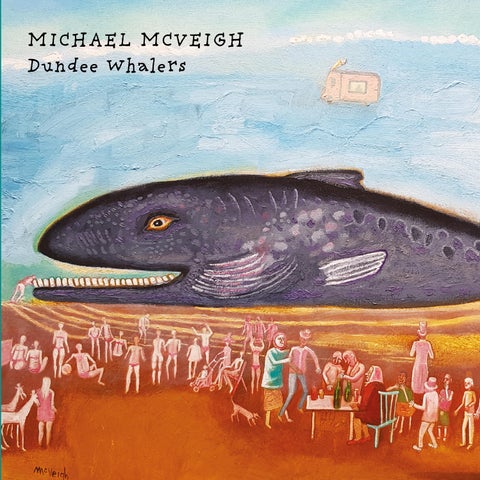
MICHAEL MCVEIGH
Dundee Whalers


MICHAEL MCVEIGH
History and Imagination
Michael McVeigh was born in 1957 in the post-war council estate of Lochee, Dundee. Leaving school without formal qualifications but determined to become an artist, he began attending classes unannounced at Duncan of Jordanstone College of Art until the painter James Morrison recognised his talent and formally accepted him as a full-time student on the strength of his drawings and paintings alone. Since moving to Edinburgh in 1982, McVeigh has become a familiar figure within the city, regularly seen working outdoors and, until recently, selling his distinctive ‘lizard’ prints from a stall on Rose Street. A figurative painter and printmaker, he has been described as a modern-day folk artist and participant observer, chronicling Scotland’s people, places and traditions with a style that moves between folk-art directness, visionary imagination and a late-Realist social awareness. His works are held in both public and private collections, ranging from town halls and municipal institutions to pubs and fishmongers, reflecting the accessibility and honesty of his practice.
Unpretentious and unconcerned with art-world fashions, McVeigh paints with an instinctive, narrative drive, often blending the fantastical, the macabre and the everyday in scenes that are both real and imagined.

Voyage of the Dundee whaler Erik to the Davis Strait and Baffin Bay, 1876

This grounding in personal history and Scottish life finds powerful expression in this exhibition Dundee Whalers, which returns him to the maritime heritage of his birthplace. Inspired by childhood visits to the McManus Gallery and stories of the Tay Whale, alongside historic drawings made by 19thcentury whalers, McVeigh explores Dundee’s once-thriving whaling industry, when ships sailed to the Arctic and Antarctic to harvest whale oil used to light cities such as Edinburgh, and to soften jute fibres used in the once booming Dundee textile trade. The works depict ships crushed in encroaching ice, sailors stranded on frozen seas, encounters with polar bears, and hunting of whales, scenes drawn from archival sources but reimagined through his own distinctive, narrative lens. Some painted on rough, textured wood that enhances their primitive immediacy, the works evoke endurance, hardship and survival, blending documented history with imagination and folklore. In Dundee Whalers, McVeigh once again assumes the role of chronicler, visualising a controversial chapter of Scotland’s industrial past into a raw and compelling human saga.
The Scottish Gallery
Dundee Whalers in the ice, Arctic, 19th Century
Dundee Whalers
Dundee’s whaling industry developed in the mid-18th century, drawing on earlier Dutch Arctic practices and terminology, and was significantly stimulated by the British Government’s 1749 Bounty Act, which offered financial incentives to ships over 200 tons that met strict regulations. These rules required detailed logbooks, navigational records, soundings, and even the recruitment of inexperienced Greenmen, embedding discipline and documentation into the trade. In 1753, the Dundee Whale Fishing Company dispatched its first vessel, Dundee, to the Greenland grounds, signalling the city’s formal entry into Arctic whaling. As whale
stocks declined around Spitzbergen, fleets moved westward to the Davis Strait and Baffin Bay, which became the principal hunting grounds throughout the 19th century. Whale oil was central to Britain’s urban and industrial growthused first for lighting homes and streets before the advent of coal gas, and later as a lubricant for the machinery of the Industrial Revolution - while baleen and sealskins added further commercial value. The trade required vast capital investment, with ships often financed by consortia of local merchants, bankers and professionals, reflecting whaling’s importance to Dundee’s economy.

By the later 19th century, Dundee had become the last remaining whaling port in the United Kingdom, its dominance reinforced by the innovative shipbuilding of Alexander Stephen and his son William. Their yard pioneered the adaptation of steam power to
Docks Aerial, copyright Dundee City Council

Arctic vessels, beginning with the Tay, a 455-ton ship fitted with a 75-horsepower auxiliary engine. Though still rigged for sail, these hybrid vessels had greater manoeuvrability in pack ice, giving Dundee crews a competitive advantage. The Stephens also developed associated industries, including oil storage, sealskin tanning, and processing facilities in Newfoundland, allowing ships to undertake multiple voyages in a season. Yet the industry was marked by extraordinary peril. Crews faced crushing ice, shipwreck, drowning in freezing seas, frostbite, scurvy, and starvation; some disasters resulted in catastrophic loss of life. Logbooks such as T.F. Miller’s 1876 account of the Erik, sailing from Dundee
to Davis Strait and Baffin Bay, document both the awe of Arctic landscapes and the daily hardships of shipboard life, illustrated with photographs of icebergs, wildlife, and encounters with Inuit communities. Departures from the Tay were public spectacles filled with ceremony and emotion, but families often endured months of silence and uncertainty. Overexploitation of whale populations eventually led to severe decline, and by the early 20th century Arctic whaling had largely ceased. Dundee-built vessels such as the Terra Nova - later lost during the Second World War - stand as enduring symbols of a trade that profoundly shaped the city’s maritime identity, industrial expansion, and social history.
Adapted from: Voyage of the Dundee whaler ‘Erik’ to the Davis Strait and Baffin Bay, 1876, by Mark Benson, Library Assistant and The Maritime History of Dundee, Friends of Dundee City Archives
Whaling at Jan Mayen Island, Norwegian Arctic, 18th century etching
By the later 19th century, Dundee had become the last remaining whaling port in the United Kingdom...
1 Home Harbour, oil on stencil paper, 36 x 50 cm

2 The Fisherman, oil on canvas, 45.5 x 61 cm


3
Two Whales I, pencil and pastel on paper, 23 x 31.5 cm

4 Two Whales II, pencil and pastel on board, 19 x 28 cm

5 The Wash, pencil and pastel on paper, 18 x 21.5 cm

6
Newhaven Fisherwives, pencil and pastel on paper, 29 x 35 cm
Departures from the Tay were public spectacles filled with ceremony and emotion, but families often endured months of silence and uncertainty.
7 Fisherwives and Fleet, pencil and pastel on paper, 19.5 x 40.5 cm


8 The Beached Whale, oil on canvas, 49.5 x 69.5 cm

The Tay Whale, known locally as the Monster, was a humpback whale that swam into the Firth of Tay of eastern Scotland in 1883. It was towed into Dundee by a showman, John Woods, and exhibited on a train tour of Scotland and England.
9 Dundee Whaling Exhibit, oil on wood, 40 x 63 cm


10 North Berwick Whale, oil on board, 26.5 x 59.5 cm


The
11
Harvest Home, pencil and pastel on board, 23.5 x 32 cm

12 Whale in Mist, oil on canvas, 46 x 61 cm
Logbooks document both the awe of Arctic landscapes and the daily hardships of shipboard life, illustrated with photographs of icebergs, wildlife, and encounters with Inuit communities.


14 Fishing Fleet, pencil on paper, 25 x 34 cm

15 Arctic Hunt I, oil on stencil paper, 30.5 x 37 cm

16 The Arctic II, oil on hardboard, 45.5 x 122 cm


17 The Captain, oil, pencil and pastel on paper, 19 x 29 cm

18 Arctic Hunt II, oil on stencil paper, 49 x 56 cm
The industry was marked by extraordinary peril. In 1908, the Dundee whaler Snowdrop was wrecked in Frobisher Strait off Baffin Island. The crew reached shore safely and lived among the local Inuit for a year, as news of their stranding did not reach Dundee until September 1909.

Dundee Whalers Trapped in the Ice I, oil on hardboard, 45 x 116 cm


Terra Nova trapped in the ice

20 Dundee Whalers Trapped in the Ice II, oil and pencil on board, 23 x 42 cm
Michael McVeigh (b.1957)

1957
1977-1982
Born in Lochee, Dundee
Duncan of Jordanstone College of Art, Dundee
SELECTED EXHIBITIONS
2026
Dundee Whalers, The Scottish Gallery, Edinburgh 2023 Blue Pussy, The Glasgow Print Studio 2021
A Sense of Place, The Scottish Gallery, Edinburgh 2018 Saints, Souls and Sinners, The Scottish Gallery, Edinburgh 2016
The Romanticism, Folklore and Fantasy of Michael McVeigh, The Scottish Gallery, Edinburgh 2007 Imagine Edinburgh, Scottish Storytelling Centre, Edinburgh
SELECTED PUBLIC COLLECTIONS
Bank of Scotland, Edinburgh City Art Centre, Edinburgh Glasgow Caledonian University
Halliwell’s House Museum & Robson Gallery, Selkirk
Kirkcaldy Galleries, Fife Linlithgow Burgh Halls, Linlithgow Monklands Hospital Maggies Centre, Airdrie NHS Lothian
The Prestoungrange Gothenburg, Prestonpans
The Scottish Parliament, Edinburgh University of Dundee, Duncan of Jordanstone College of Art and Design University of St Andrews
Michael McVeigh, 2021

Published by The Scottish Gallery to coincide with the exhibition:
Michael McVeigh
Dundee Whalers
2 April - 2 May 2026
Exhibition can be viewed online at: scottish-gallery.co.uk/michaelmcveigh
ISBN: 978-1-917803-20-5
Designed and Produced by The Scottish Gallery
Printed by Pure Print
front cover: Whale in Mist, oil on canvas, 46 x 61 cm (cat. 12) back cover: The Arctic I, oil on wood, 47 x 60 cm (cat. 13)
All rights reserved. No part of this catalogue may be reproduced in any form by print, photocopy or by any other means, without the permission of the copyright holders.