
Kate Downie
Introduction Tommy Zyw
On the Wild Side Lynne Green
Dancing with the Wind Kate Downie
Coastal Margins
Field Notes
Banks and Braes
Biography
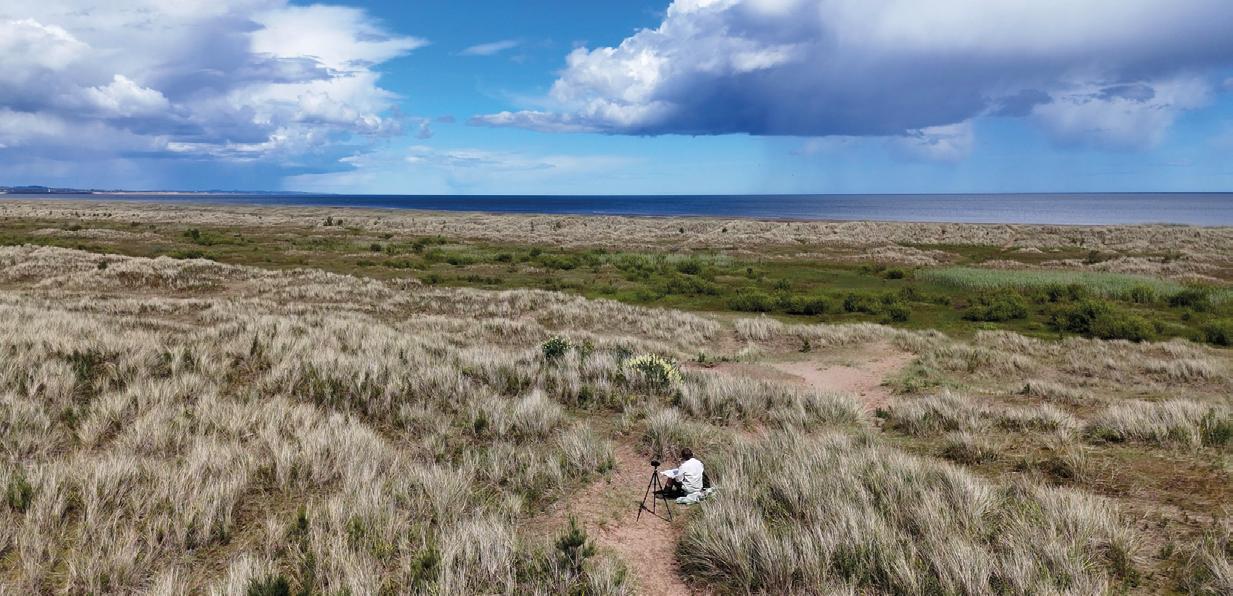
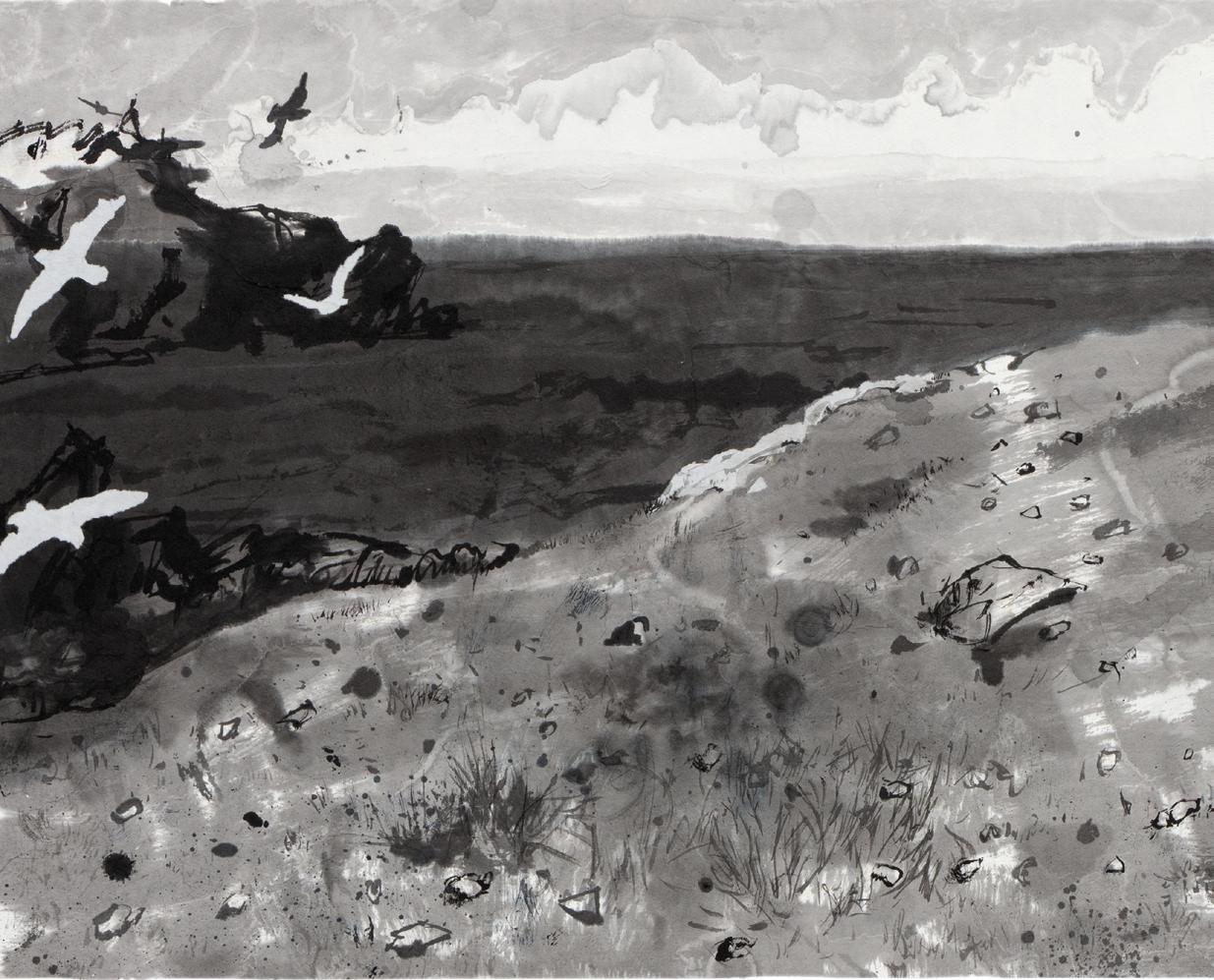
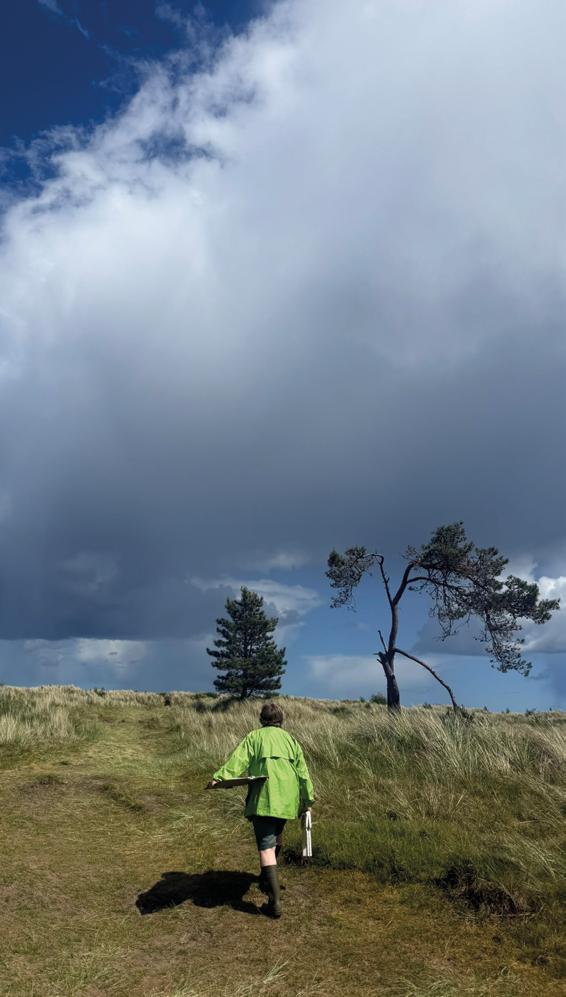
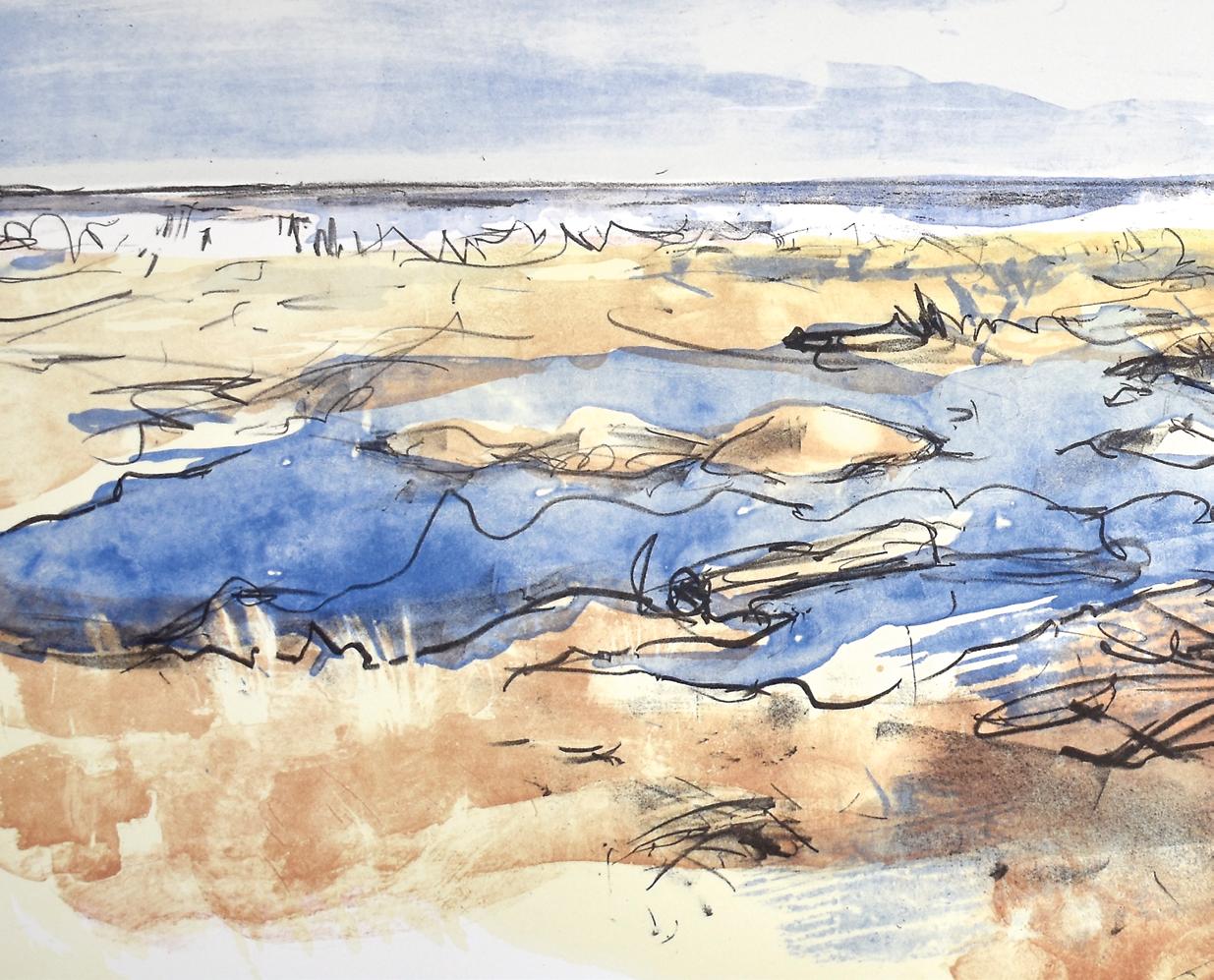
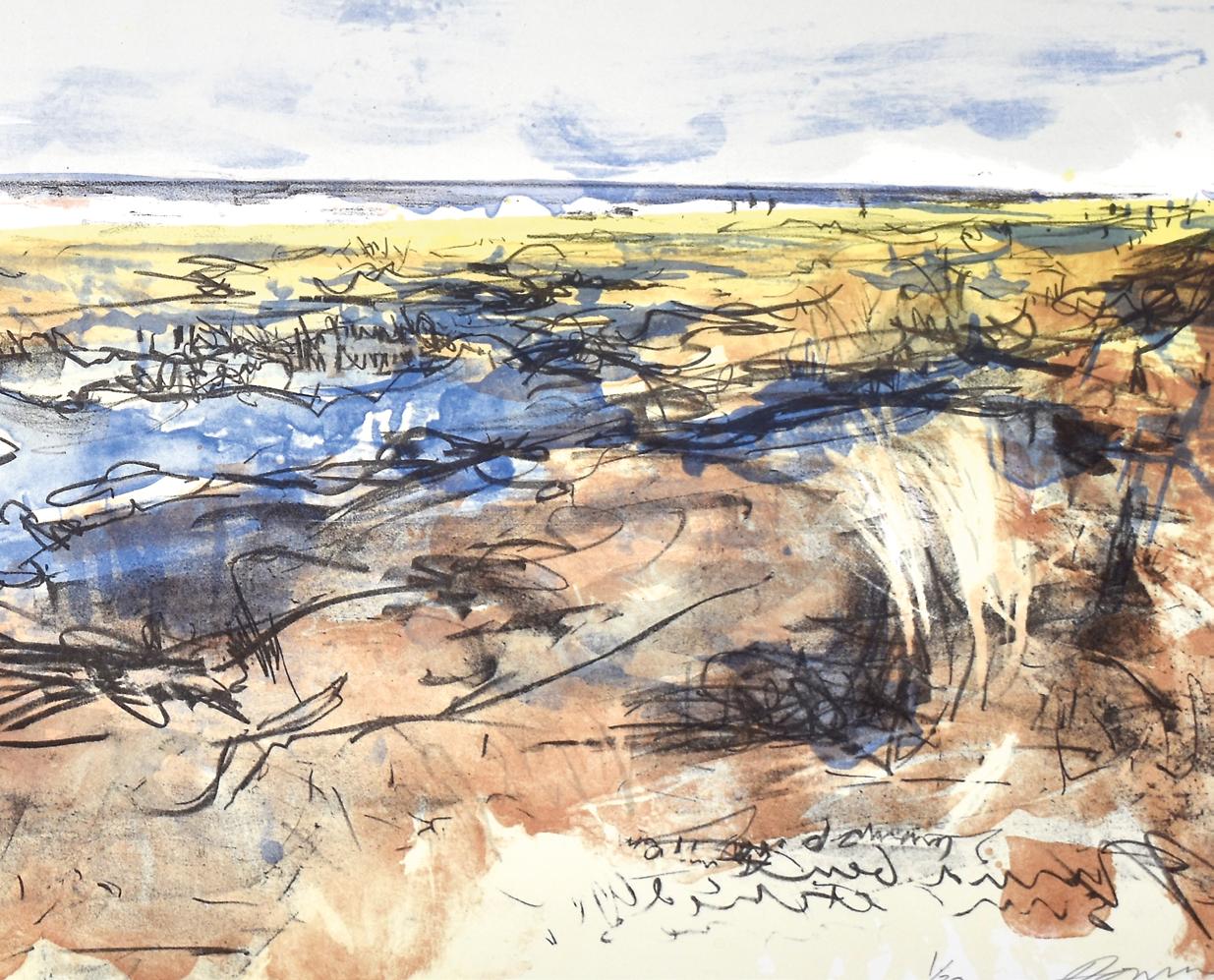
Kate Downie, Tentsmuir

Introduction Tommy Zyw
On the Wild Side Lynne Green
Dancing with the Wind Kate Downie
Coastal Margins
Field Notes
Banks and Braes
Biography
Tommy Zyw
For Edinburgh Art Festival 2026, The Scottish Gallery presents Kate Downie’s exhibition Grasslands. Throughout a career defined by travel, curiosity and experimentation, Downie has repeatedly turned her attention towards what she describes as the “undrawable”; places, industries and landscapes overlooked by our collective consciousness. In Grasslands, we see the culmination of three years of meticulous research into one of the most commonplace yet overlooked subjects, grass. Through her detailed observation and distinctive visual language, Downie invites us to share her fascination through a body of work of remarkable complexity, beauty and significance.
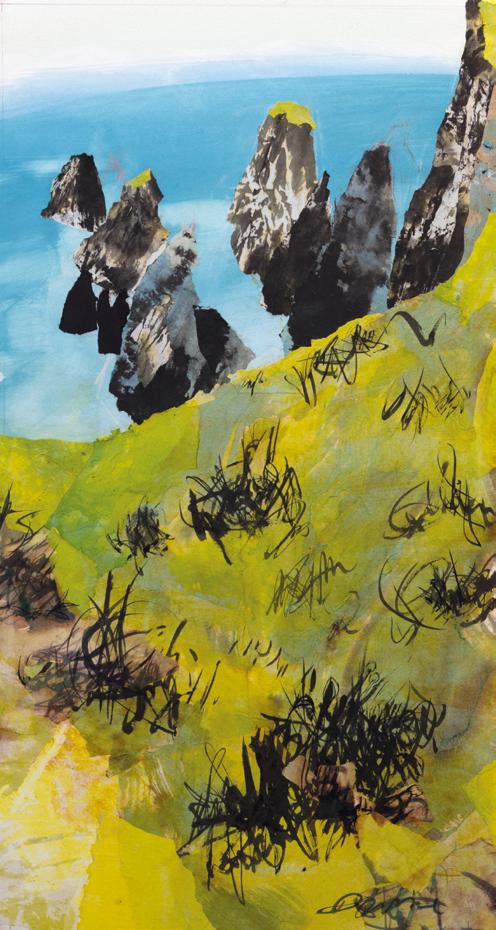
Downie has travelled the length and breadth of the country in pursuit of her subject. Her focus ranges from the cliff-top tufts of Shetland, where grasses cling to nooks and crannies buffeted by the Atlantic storms, to the vast reed beds of Errol on the Tay and the rolling machair of Tentsmuir on the edge of Fife. In these artworks she captures the elemental forces at play and the ways in which grass adapts to its environment, often largely unchanged for centuries. Yet her analysis extends beyond the wild and remote. From roadside verges to the carefully manicured pitch of Hampden Park, Downie presents the full spectrum of grass habitats, revealing them as participants in a shared story of resilience and interconnectedness.
Making something out of nothing. A patch of verge, a section of riverbank: these are not traditionally heroic subjects, yet through sustained observation they become sites of extraordinary richness. Downie calls these overlooked places into being. Long inspired by the largely horizontal landscapes of Scotland’s northeast coastline,
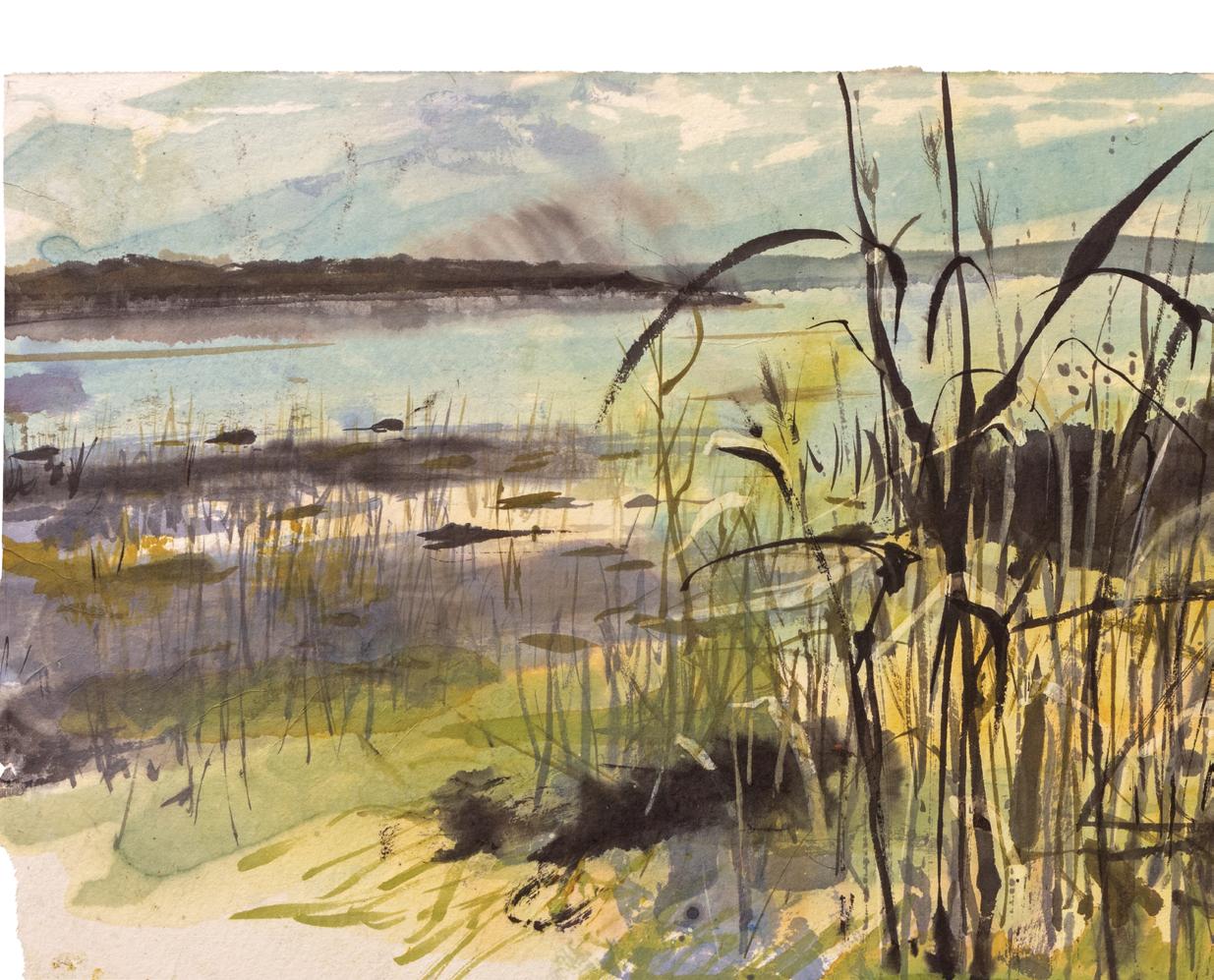
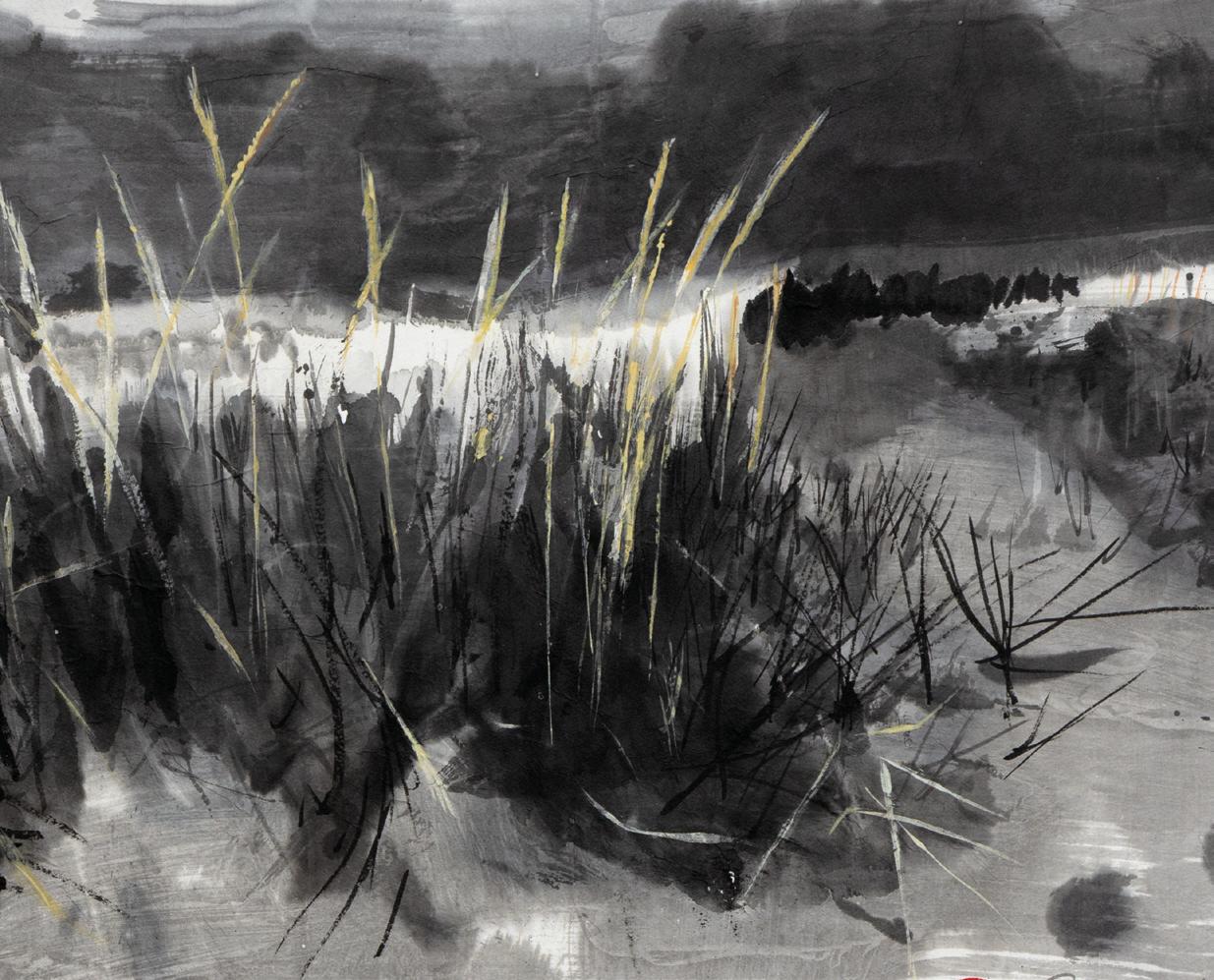
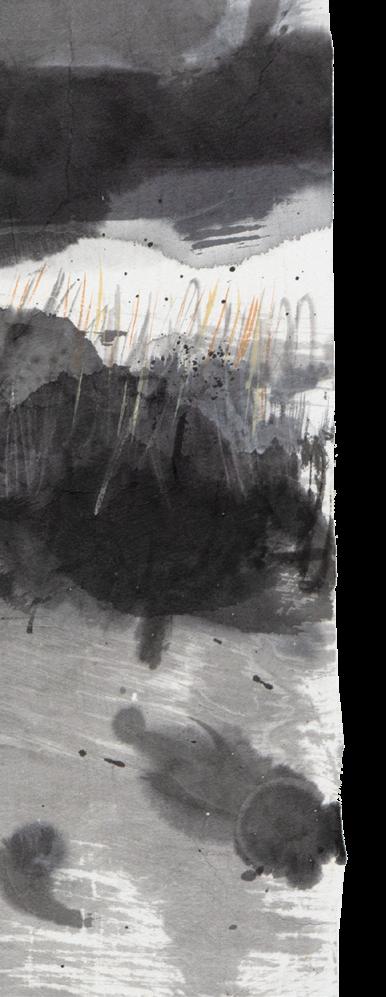
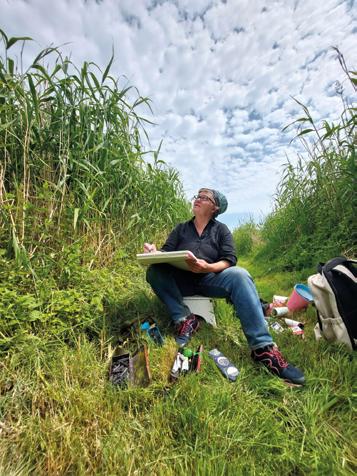
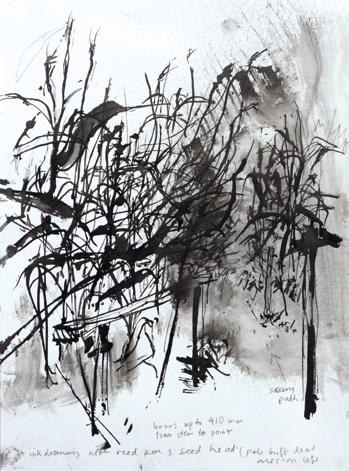
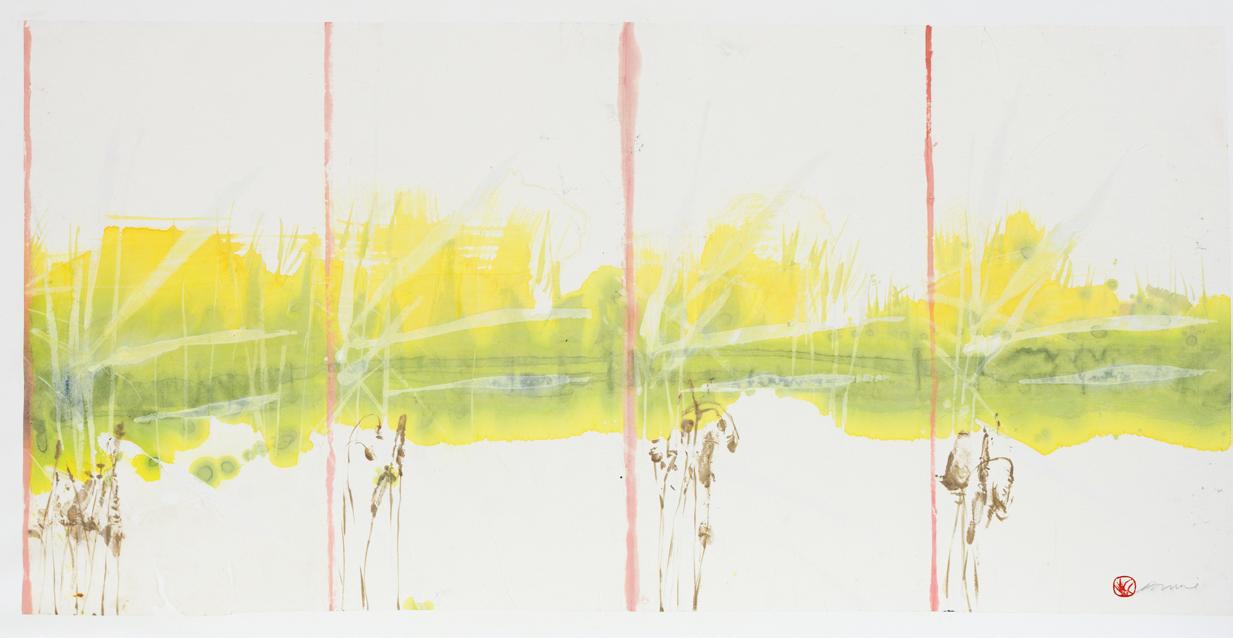
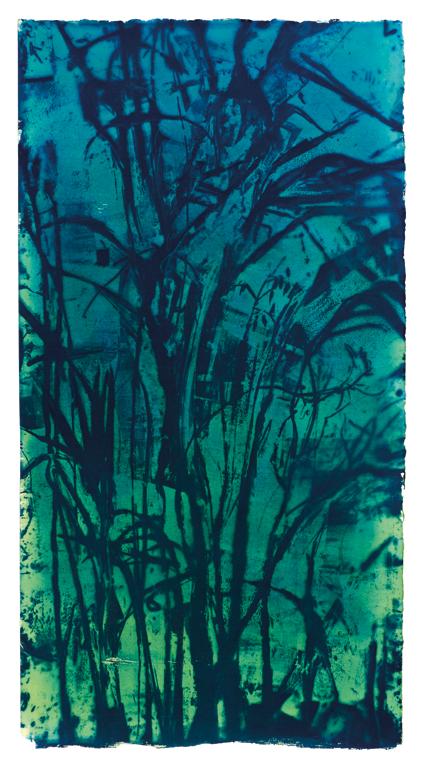
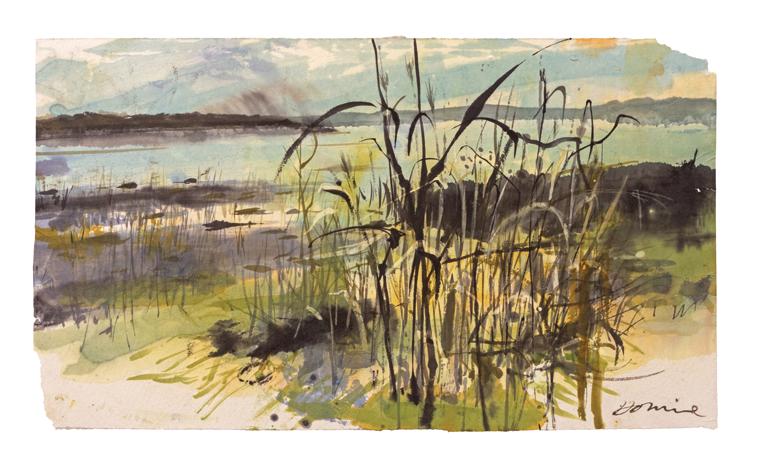
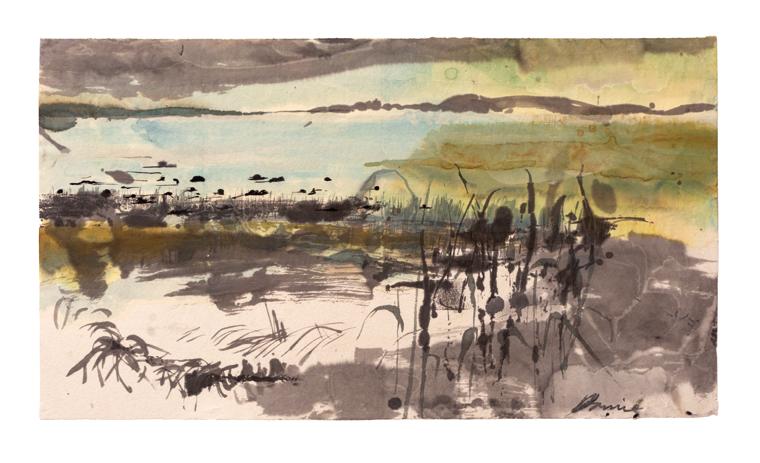
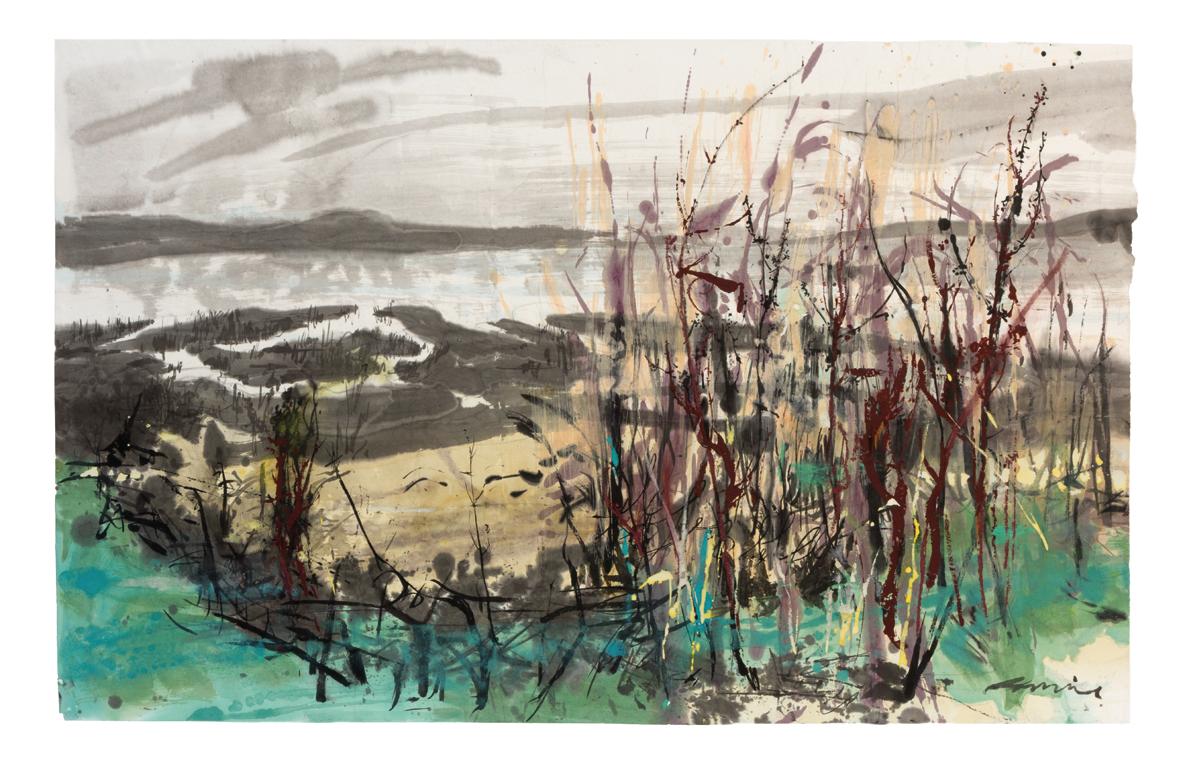
she allows grass to vertically transect field and shoreline with a compositional force that sways in response to the wind that defines this part of the country. Wind becomes legible through the movement of reeds; grass itself becomes a recording device, registering the energies that move through a place. I was lucky enough to join Downie on a research trip in Fife. Among the reed beds of Errol, Downie captured, through varying washes of Chinese ink, the rhythm of wind moving through the reeds as Bearded Reedlings called from their nest sites. Her immersion in this subject comes from a sustained passion for the natural world. Downie’s achievement lies in her ability to translate the texture of her experience into marks and surfaces that feel intensely alive.
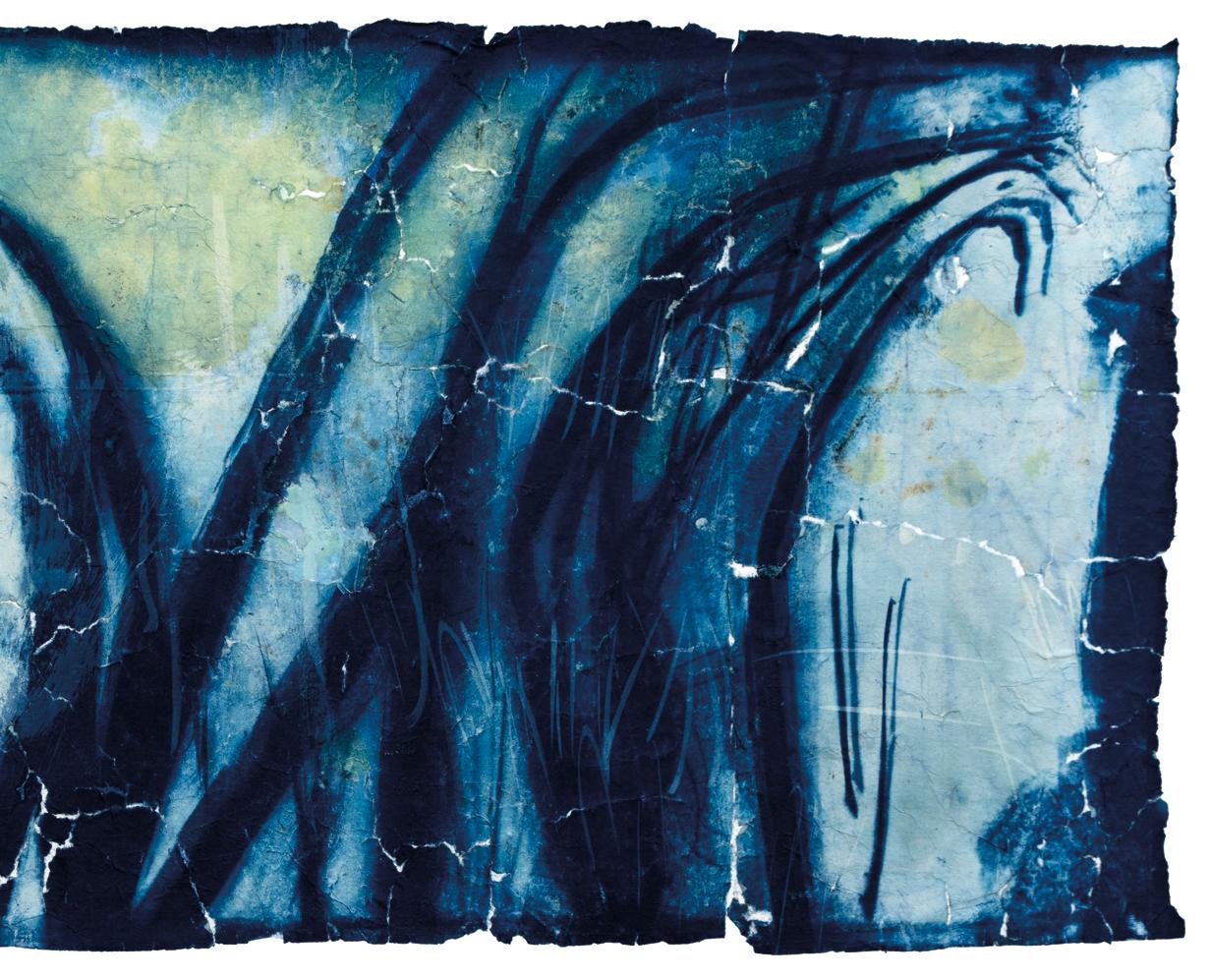
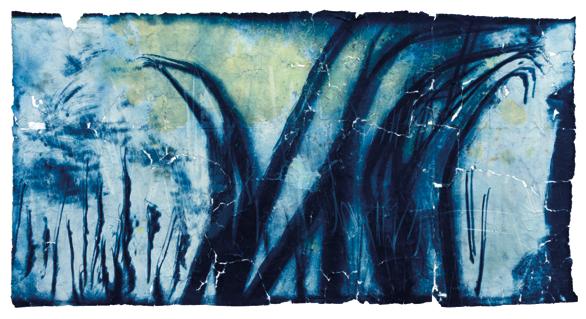
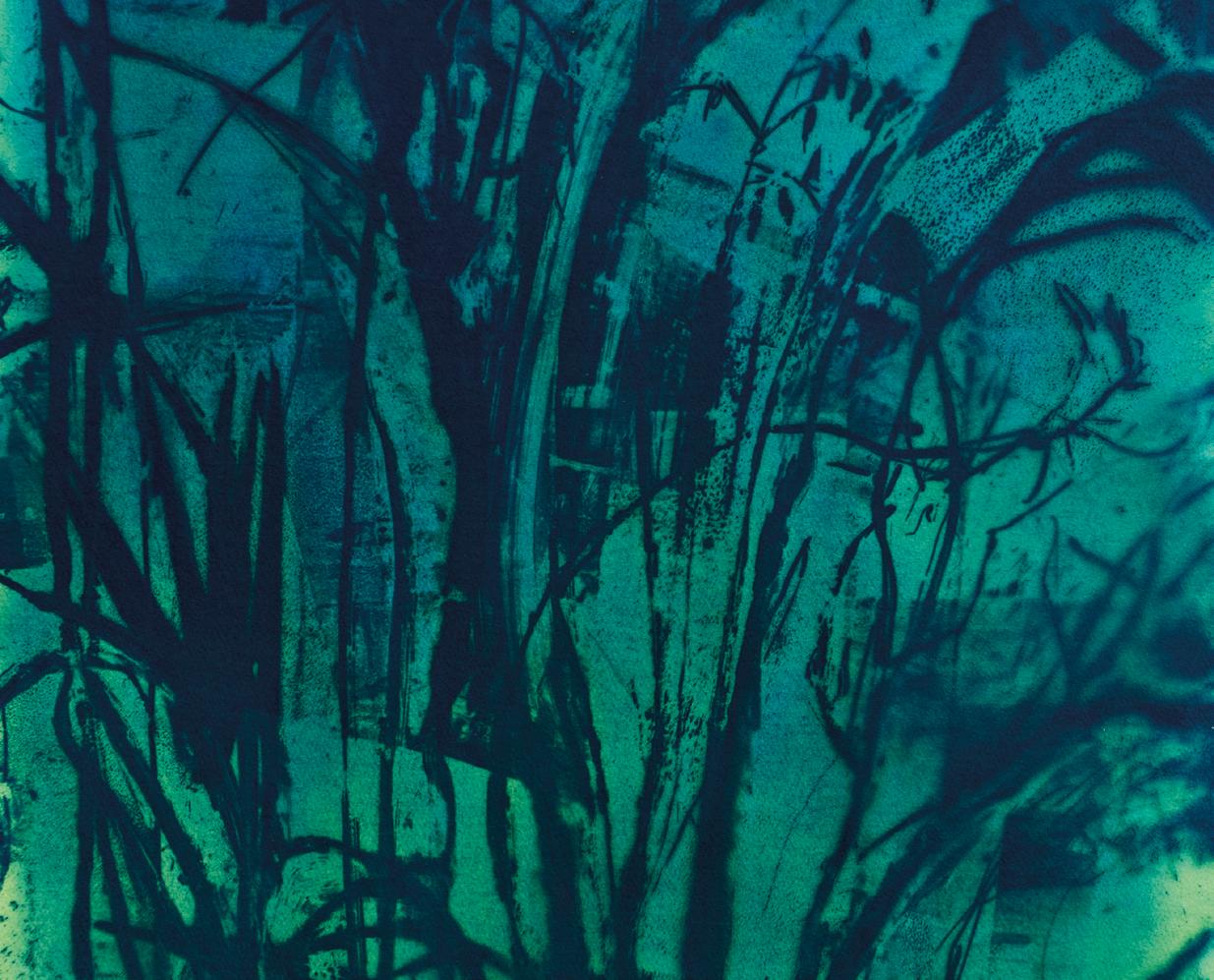
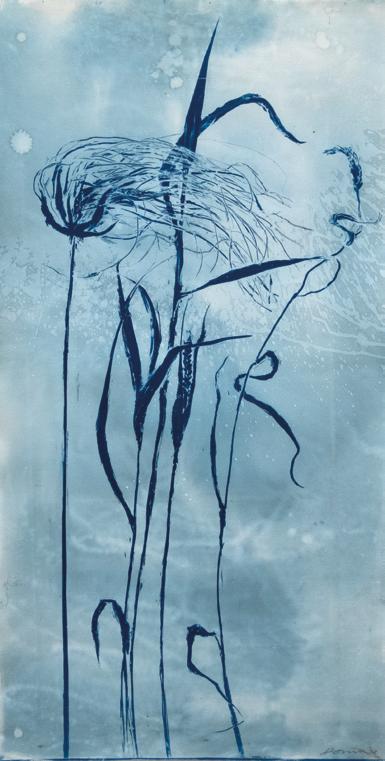
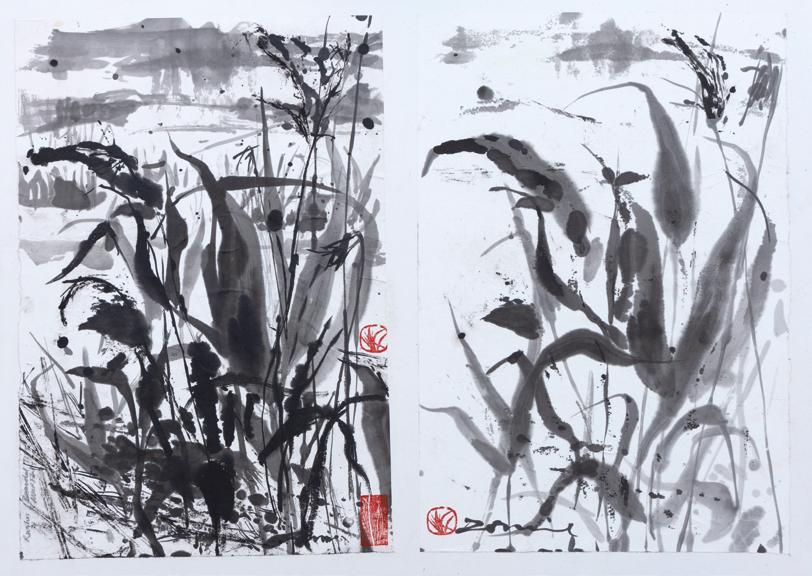
Drawing upon decades of experimentation and informed by a mastery of diverse media, Downie adapts her technique to the demands of each subject. Chinese ink painting, oil, printmaking and cyanotype all form part of her creative arsenal. Xuan paper is stretched, broken and transformed; pigments are absorbed into its fibres, allowing the artwork itself to embody both the fragility and resilience of its subject.
Grass forms the macrocosm of our landscapes: the binding agent that stabilises mountainsides and quietly sustains ecosystems. From pavement cracks to vast moorlands, Downie asks us to pause and look again, to recognise that the extraordinary may not lie on the horizon, but directly beneath our feet. This exhibition, Kate Downie’s eighth with The Scottish Gallery, is a testament to the power of attention, created by an artist whose enduring gift is her ability to reveal the wonder that resides within the world around us.
Lynne Green
Kate Downie always surprises. There is a continuity of her vision, but always an enlargement of her vocabulary.
She’s always exploring, investigating the visual world and the capacity of her chosen materials. She’s a traveller within her work and across the globe, in the process gathering a diversity of cultural, intellectual and visual encounters.
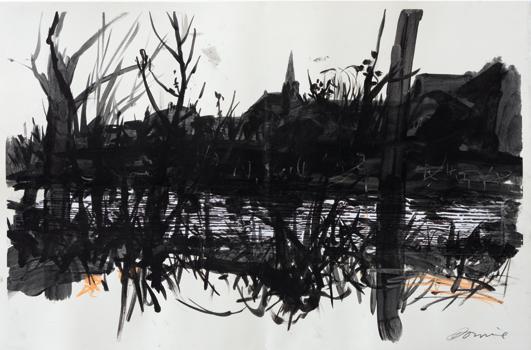
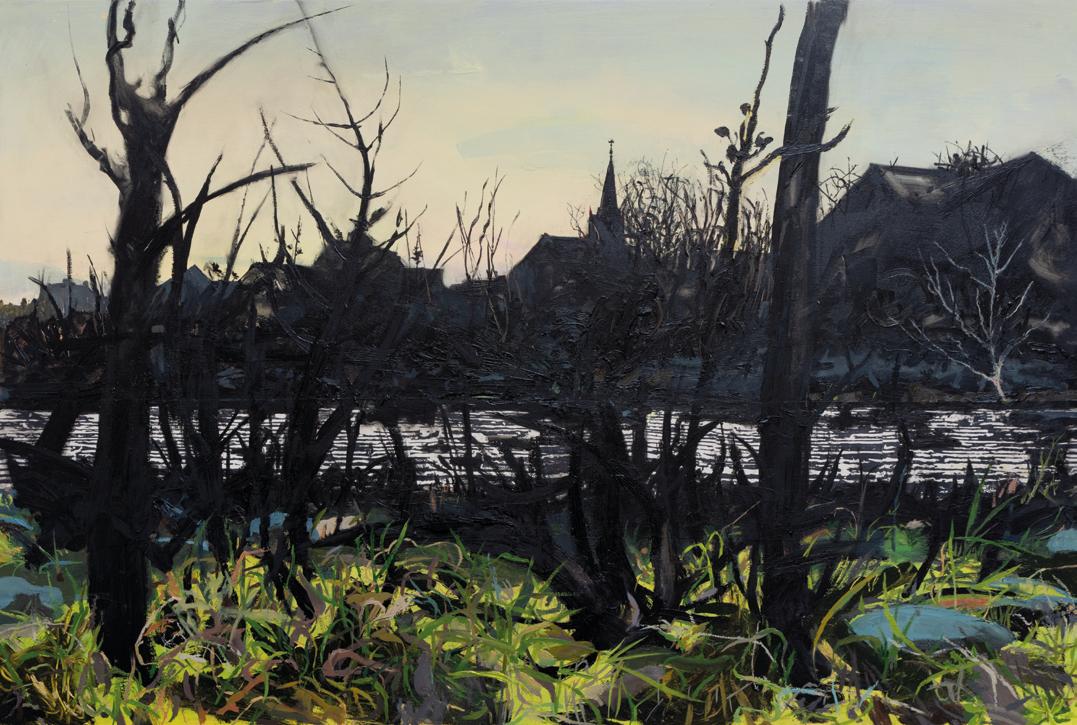
As a visual explorer, experimenter and innovator, she is devoted to pushing her increasingly diverse media as far as they will go. At least a dozen different techniques and materials are used in the work here. Scale is no obstacle. For example, in the monumental Riverbank there is a palpable sensation of Downie having cut a slice from the bank itself. The moving water was conjured by printing the woodgrain of the pews in her local church.
Always inventing, trying something new. Her studio pulsates with energy.
This search has taken her all over the world to meet people who will help her expand her means of making art. China – just one of the countries she has visited – is key to her present investigation. She met with some of her hero ink painters, immersing herself in their ancient, traditional techniques and
materials, and their interpretations for the 21st century. This process was hard and demanding, but in this exhibition we can see how comfortable she has become with this new language. Indeed, she has extended the vocabulary and made it her own. In her conversations with fellow artists in China, it was not only techniques that they shared; they found common ground in their passion
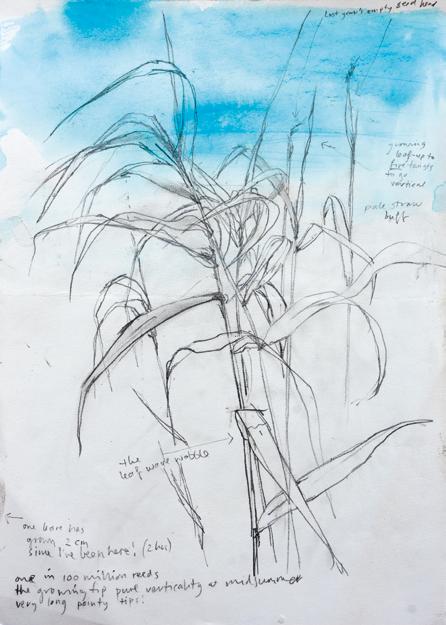
for art-making, although the Chinese artists’ experience of education via the Cultural Revolution and hers of a Scottish Art School in the 1970s were very different!
In many ways it’s an extraordinary story. She is open to other traditions, but in the learning and experiment, what she creates is entirely her own. Downie is always challenging herself, challenging her materials and challenging us. This artist pushes herself, immerses herself in learning from the practice of other traditions which she then makes her own. There is no pastiche here.
Downie has the courage needed to innovate and take risks with her materials – the Xuan paper used in so many of the pieces here is fragile, and she has pushed it to its physical limits and beyond – to the point where the paper falls apart. But this is not its end. Downie
finds it possible to bring the pieces back together and create a new vocabulary. She is engrossed in expanding her practice and in exploring new ways of describing our world.
In this current collection Downie introduces to us something we encounter every day but take little interest in: Grasses. This plant family is varied (around 12,000 species), commonplace and, on the whole, ignored. And yet they are ancient – some 66 million years old –but have been tamed and domesticated by us. Grass is part of the family that feeds us, clothes us and shelters us. We now depend upon them. Think oats!
If you do not know Albrecht Dürer’s watercolour
Das Große Rasenstück (The Large Piece of Turf) 1503; then seek it out for this is one of the most remarkable works of art. It undoubtedly inspired Downie in her new body of work. As did Dürer, she recognises the astonishing beauty and variety, and thus the importance of this humble subject. For who amongst us stops to contemplate the intense nobility of grasses?
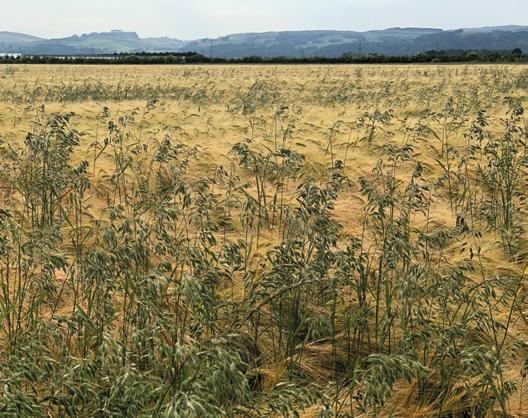
Grasses are not easy to capture. The composition is hard – a conundrum one might say, a challenge. Grasses are alive, animated by gentle breeze to hammering winds. As Downie says, How do we know what the wind looks like until we see a crop of ripening barley in a field, and see the eddies and twirls of the wind as it passes over?
If you pay attention they also have a voice, or rather voices, blown by the winds. Run them through your
fingers – they are tactile: smooth and soft or sharp and hard. Downie has set herself the challenge to capture their animation and diversity. She interrogates her subject with a delicate line.
This artist sees the world as full of life. This is not Still Life, it is Animated Life. Stand in front of these works and you can hear the rushes growing and the wind catching them. They are dancing.
The result of her experiments, journeys and invention spans from the intimate to the epic. She says: I thought I was going to be more epic. I thought I was going to travel to African savannahs. But I ended up drawing the verge on the B797 and the ninth hole of Cupar golf course.
In her sketchbook she notes: Grasses are not purists by nature. Their ability to co-exist is key to their survival and if you leave a field to fallow, soon enough it showers the earth with all manner of plants. Willowherb, dock, thistle and meadowsweet are all a part of this glorious recipe.
Downie’s work is a revelation – not just creatively and artistically, but revealing so much that we overlook or take for granted. We sometimes see grass as a nuisance, but she gives it purpose and personality. Downie gives us a new way of understanding the world and changing the way we see. Art should stop us in our tracks to think more widely and deeply about the world we live in. It should both challenge and delight. Downie says that she has absorbed this work – the focus on grass –probably for evermore.
Walking along the edge of a grassy path, high above a fast-moving river, I suddenly understood the root source of Downie’s journey. I recognised and shared her wonder and delight in seeing the beauty of the disregarded.
As you come to this exhibition, I urge to you stop and look. If you are bewildered that’s fine – continue to look. Really look. It’s a gift. The surfaces and forms are so intriguing there’s plenty to look at. Downie captures movement. Enter her world, which is actually our world. What does it feel like? I can feel the movement in the reeds.
Kate Downie
This exhibition brings together works produced over the past three years, including pieces conceived in various collaborations and residencies, and developed through my studio practice in Fife. These collaborations include environmental projects, working with artist friends, the wider creative community and the local landscape, with grass constantly beneath my feet.
Working primarily in drawing, painting and printmaking I have explored themes of our human relationship with grass, expanding my perceptions of the critical role of monocots in the botanical world. The works emerge through an increasingly research-driven practice, shaped by travel, experimentation, and ongoing investigations into the nature of seasons, as reflected in the cycle of grasses. I may never relinquish my fascination, nor look upon any humble turf with anything but respect from here on in!
Its humble, weed-strewn nature is its attraction for me: it can be rendered invisible to us by its ubiquity, fractals of small moving blades, stems and tiny flowers which are, as infinite multiples, what hold together our soil and bind the world together. Both the tender observed detail and the wider picture are key to my practice.
My first stumble into this specific subject was through early lessons in Chinese ink painting: namely the sublime task to paint bamboo leaf and stem, which multiplied ad infinitum into vast swaying forests of… Grass. Bamboo and all other grasses are hollow stemmed and reach for the sky all the better to catch the breezes with purpose.
They are miraculously anemophilous – that is, fertilised by the wind, each species releasing their pollens at different times of the day.
Although at a local level I feel rooted within a cultural framework of nature workers (gardeners, river experts, ornithologists, botanists, ecologists and a European landscape tradition), when I arrived in Fife eight years ago, I felt at odds with this intensely agricultural environment. These land activists and natural scientists have helped open my eyes to the complex nature we seek to protect. I am an observant but annoyingly dyspraxic artist, so although hyper-aware of species detail and increasingly knowledgeable through observation, less good at taxonomy and I am not lucky enough to have studied Latin at school – the base language of gardeners and botanists alike. Instead, I have focused on habitat, outside forces, and how grasses cope, thrive or adapt in diverse circumstances.
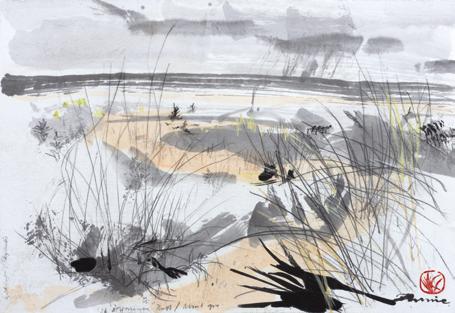
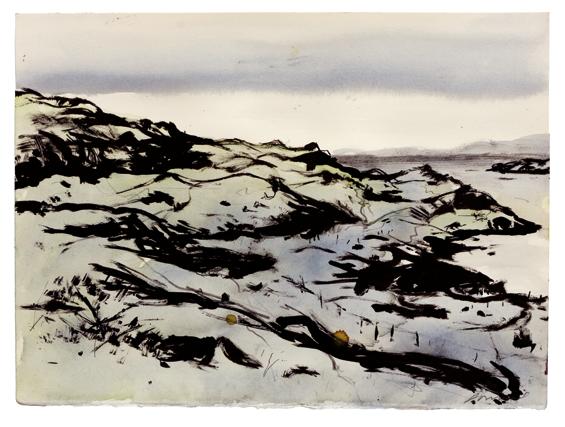
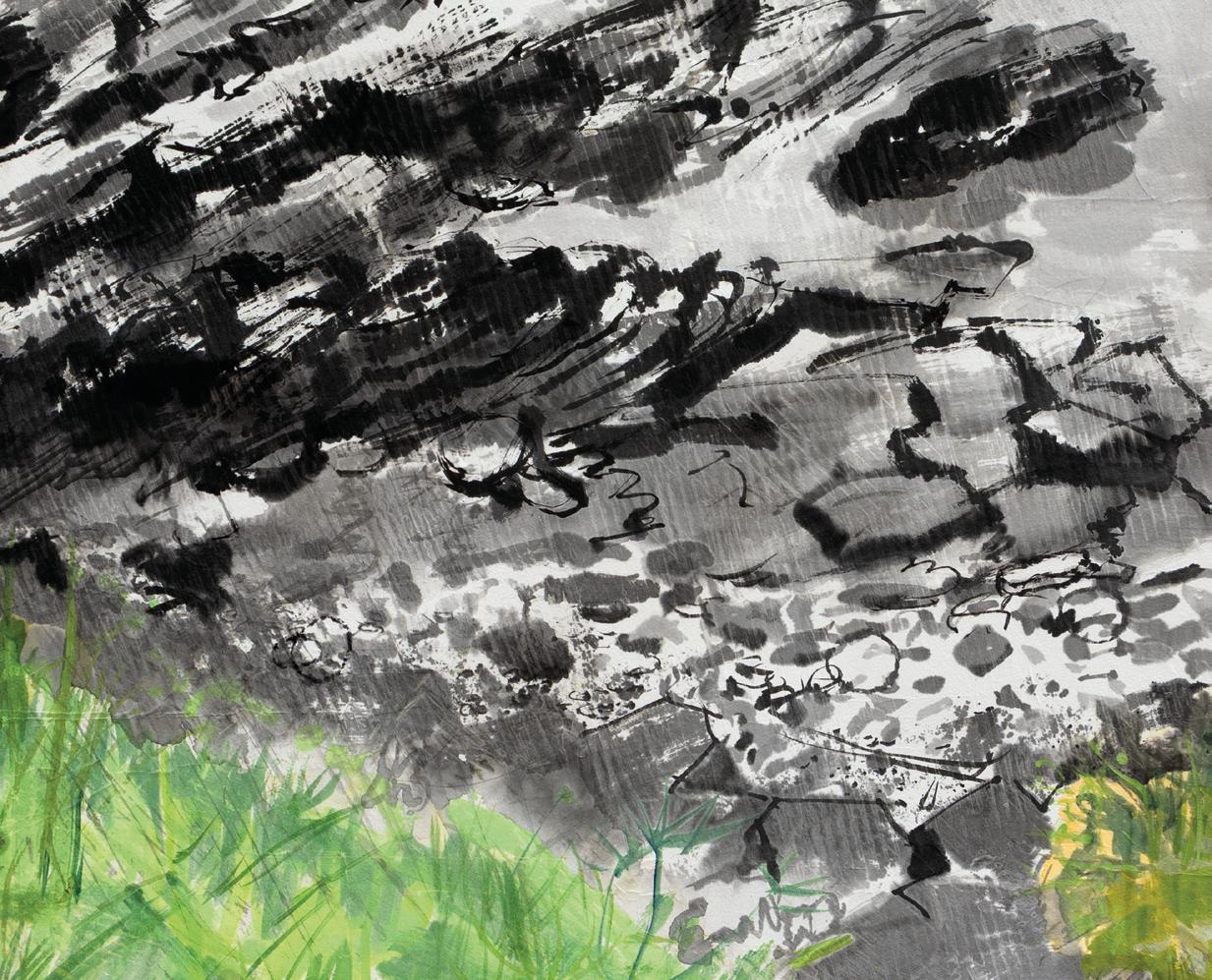
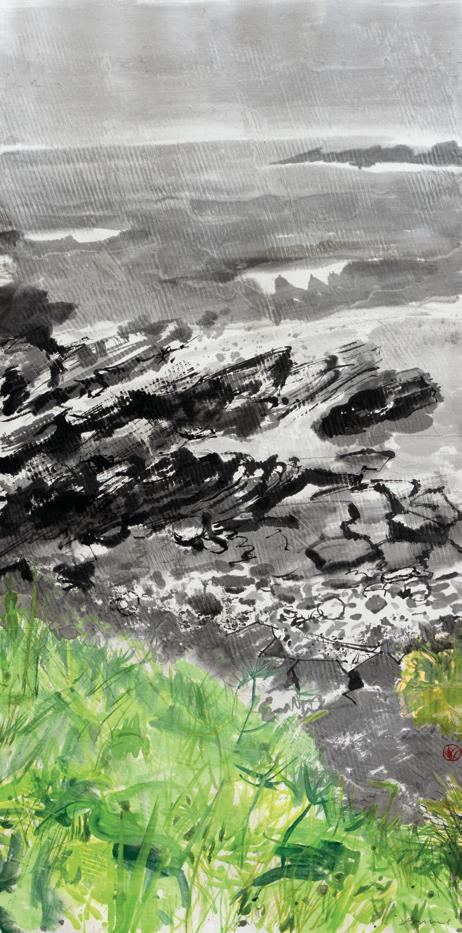
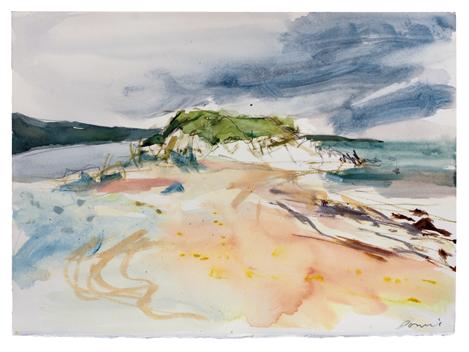
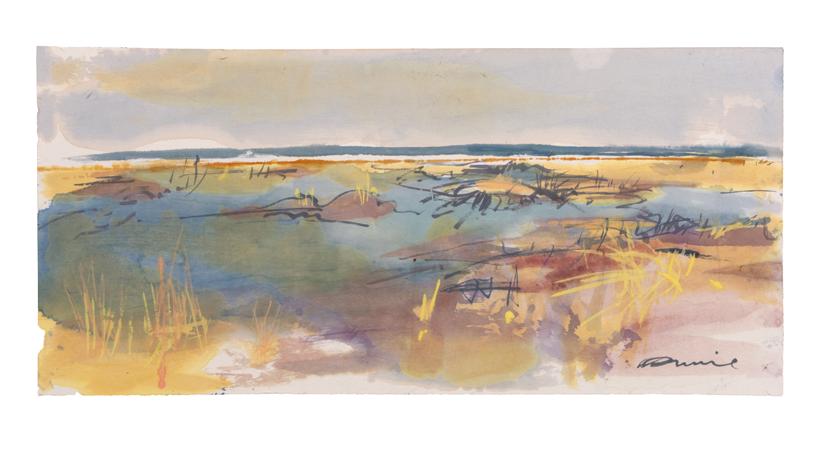
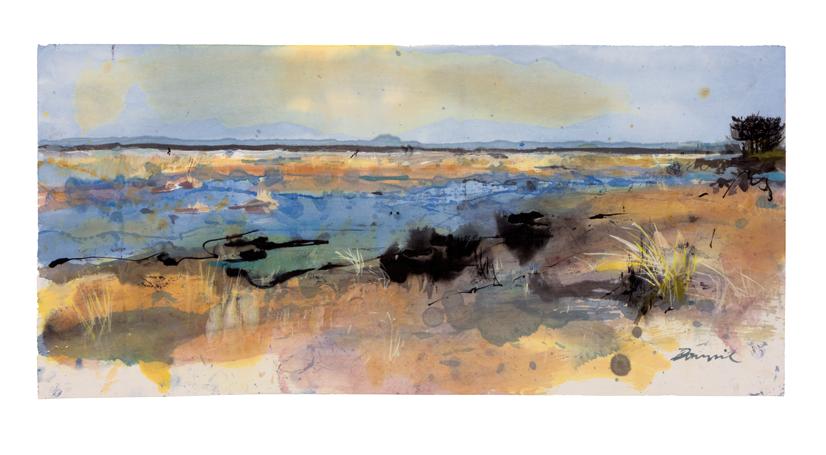
Working directly from life and developed later in the studio, I completed the ‘paper’ series of ink painting in late 2025, set in the Northern Isles of Scotland and around the Tay Estuary – each one revealing not just the species but the importance of location, especially near bodies of water. Salt-Marsh, dune systems, reed beds, cliff tops, pasture, common – all beautiful in their diversity.
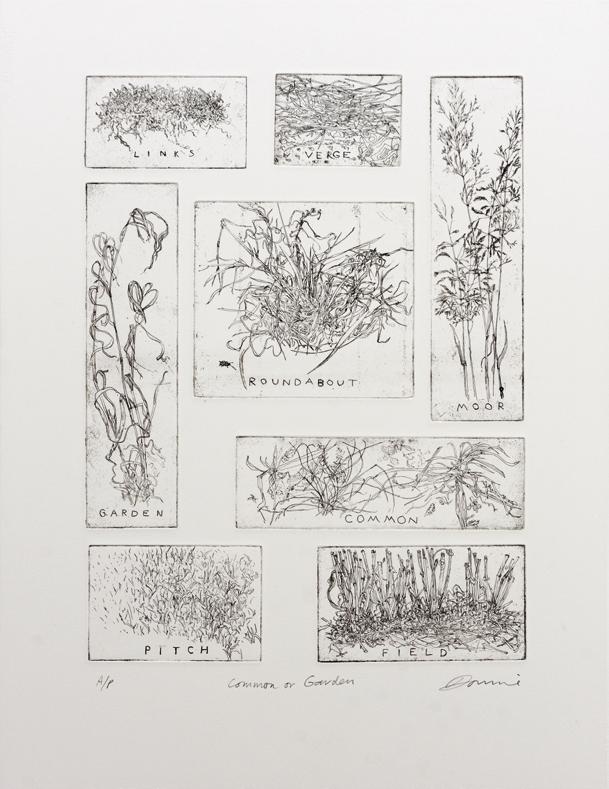
This led into an eight-plate etching project called Common or Garden which has been cathartic for me in finding a way to express the play between botanical verisimilitude and a conceptual playfulness in locating
of place through direct drawing onto prepared copper. As the grass locations were increasingly quirky, variable and prone to failure, so too were the 17th century methods of producing a print. Fruitful collaboration and support from Glasgow Print Studio and Edinburgh Printmakers enabled me to fully realise the two new editions in this exhibition.
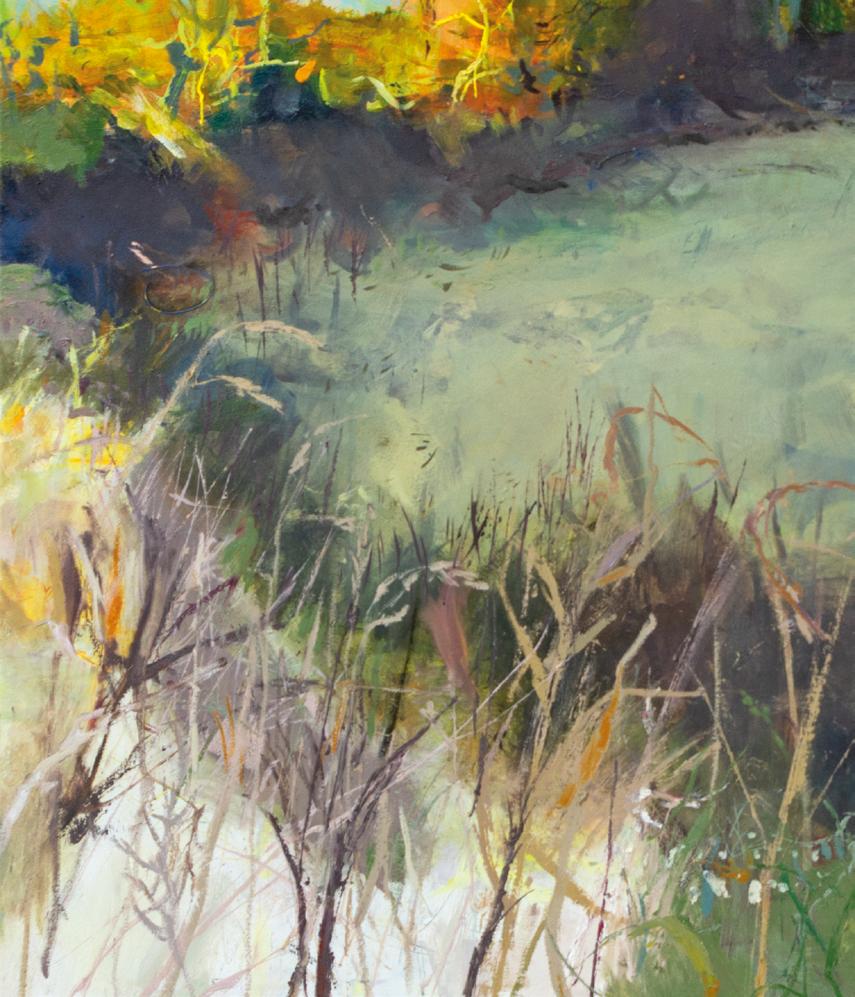
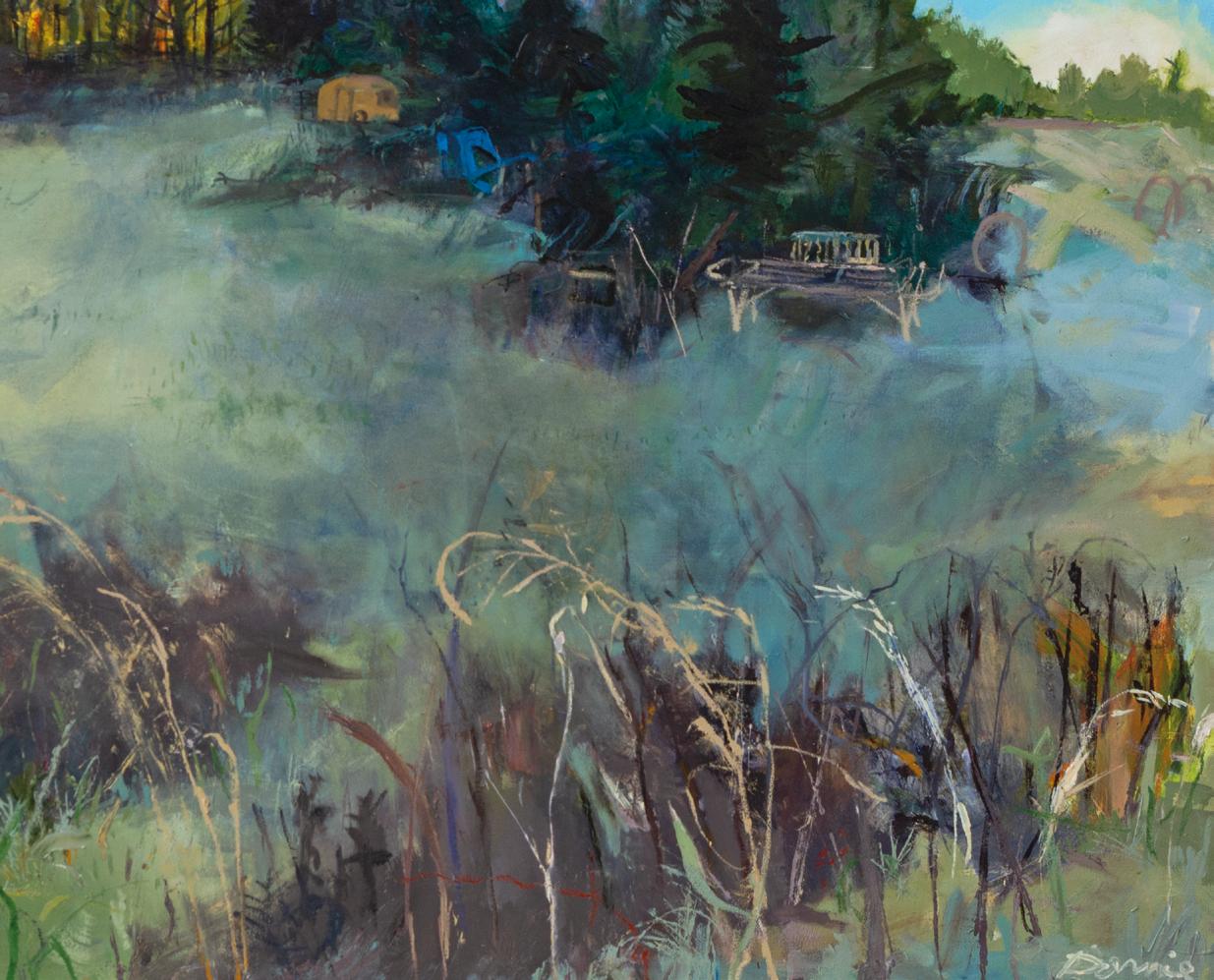
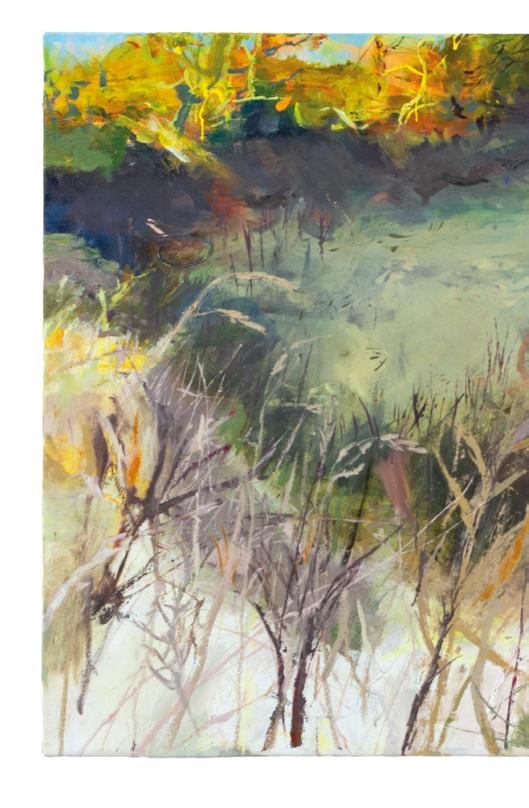
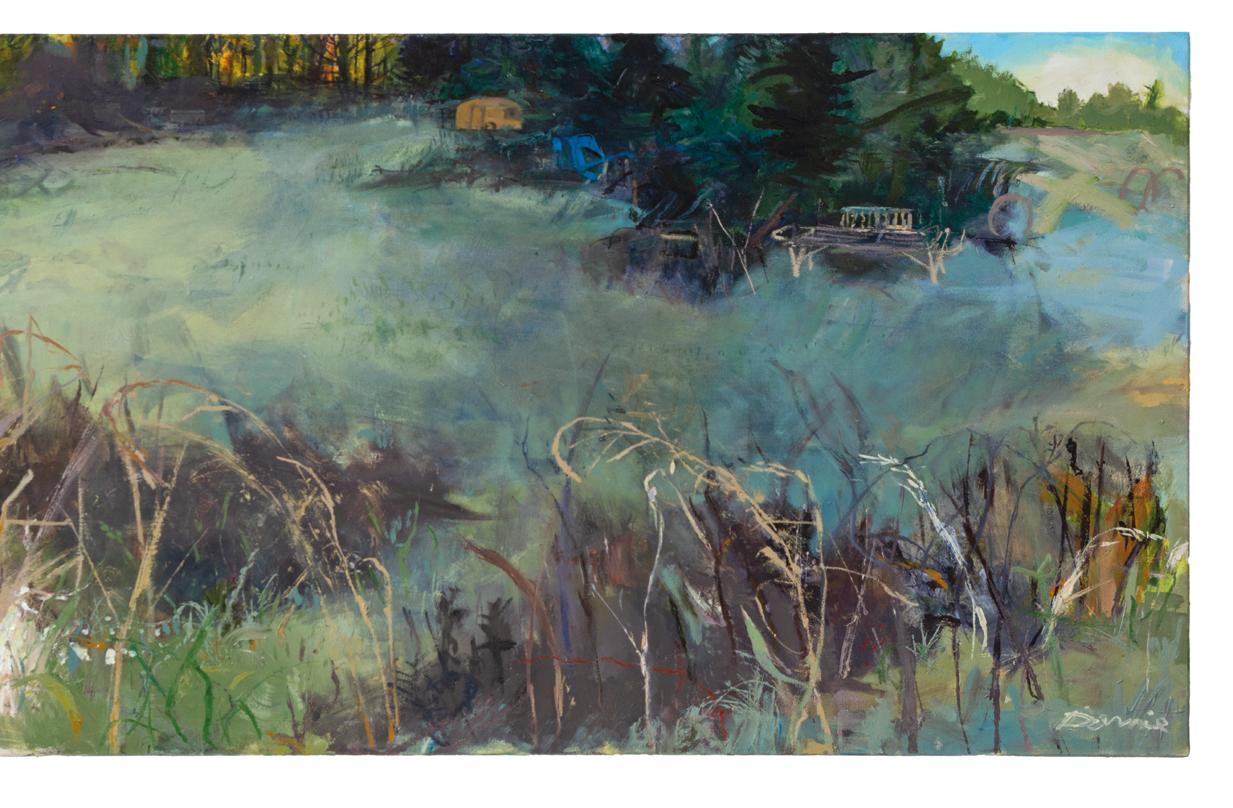
At the centre of this evolving body of work are two key paintings completed in 2026: Riverbank and Noticed Field. They are based on the small internalised grasslands of my village life, for me both atmospheric and poetical settings in the way that Stanley Spencer painted Cookham, but unlike for Spencer over 100 years ago, grasses take foreground and centre stage creating their own complex narratives where I found myself working beyond a single moment, layering, through seasonal changes, the multiple textures and movements of grass.
I sometimes wonder as an artist, how did I get here? Perhaps one of the most unlikely motivators for this body of work was the loss of my mother’s car which we had adopted 6 years before – it broke down irrevocably on the very morning she died, 2 years ago. I accepted our carlessness as part of the mourning process, and learned to move through the landscape differently. This act of letting go moved me further to experience the ground beneath my feet at a slower pace. Fragility and resilience in the grasslands became a metaphor for my own recovery back into society – but it is a story for all of us, as tender humans buffeted by circumstance, just trying to tend our gardens.
Grass may be common but it is continually adaptive, resilient, responsive, and best of all it dances with the wind.
7
8
9
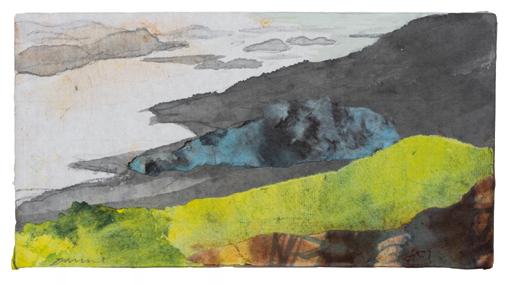
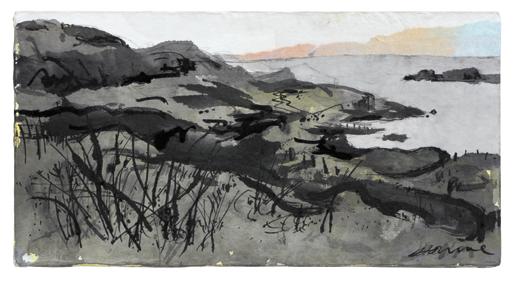
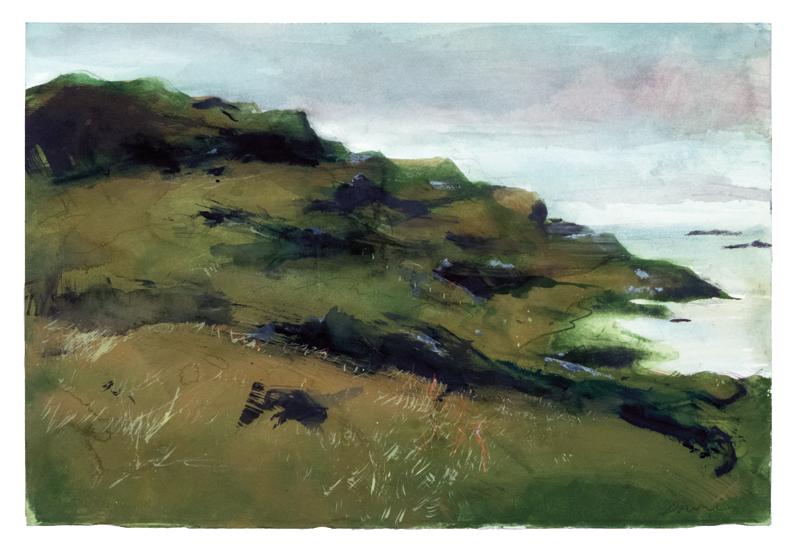
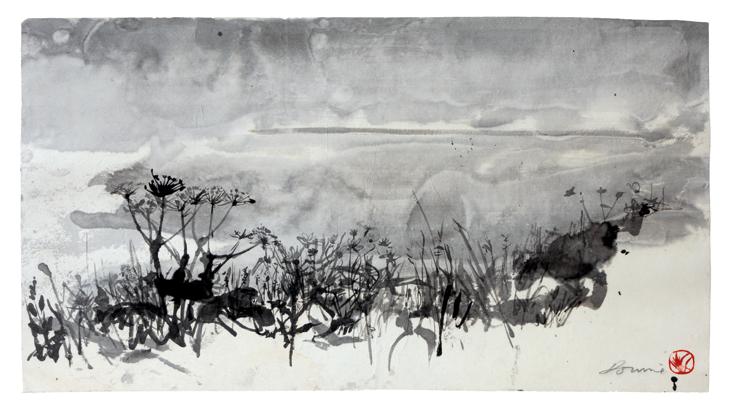
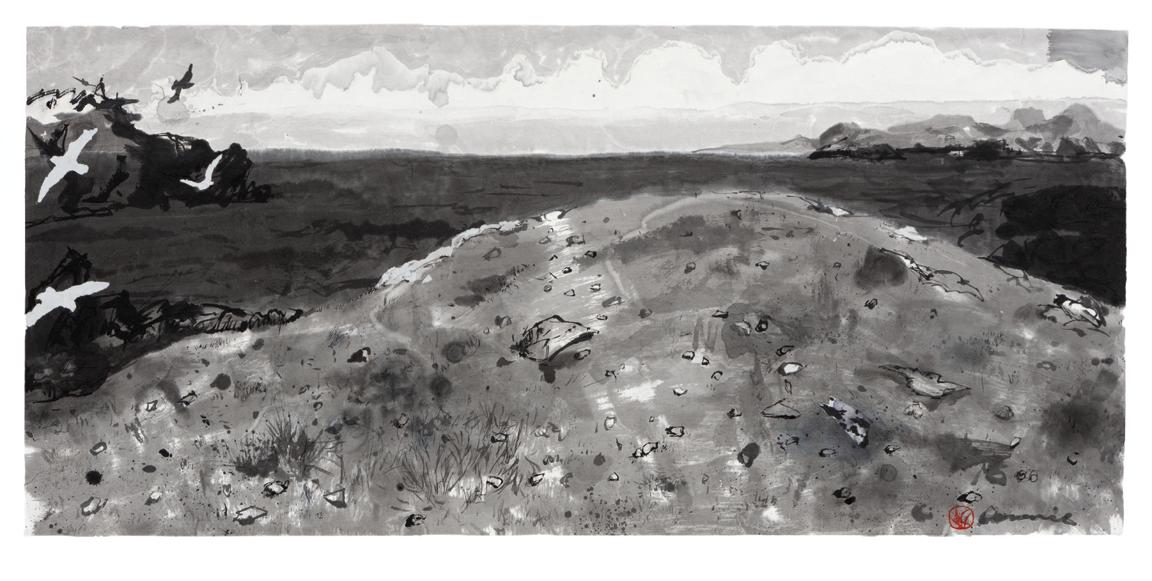
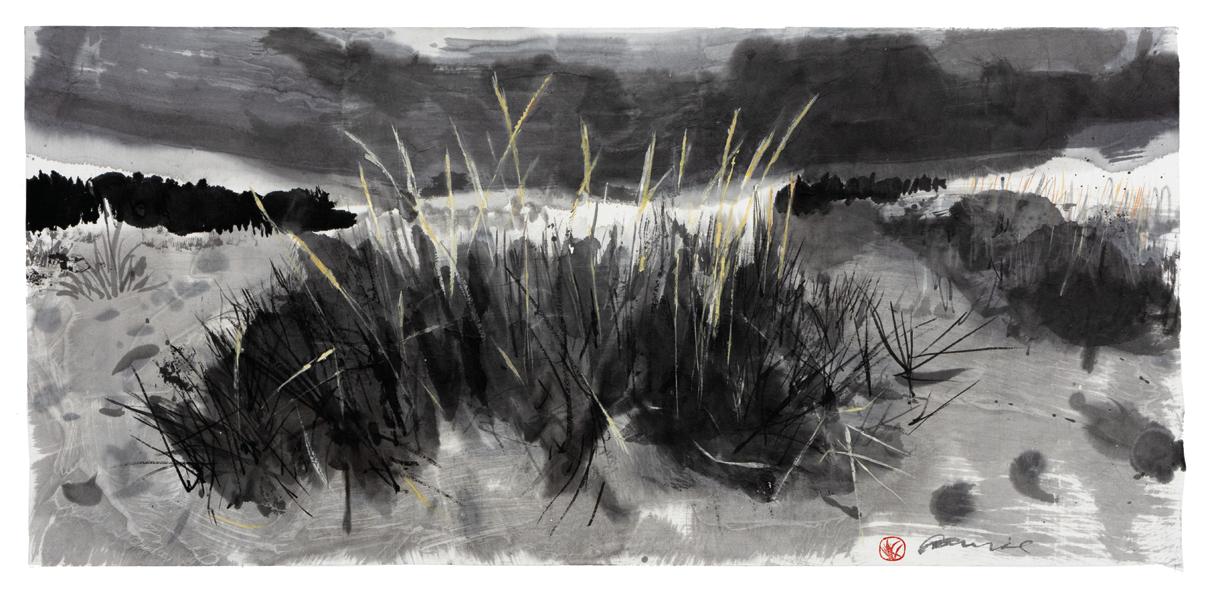
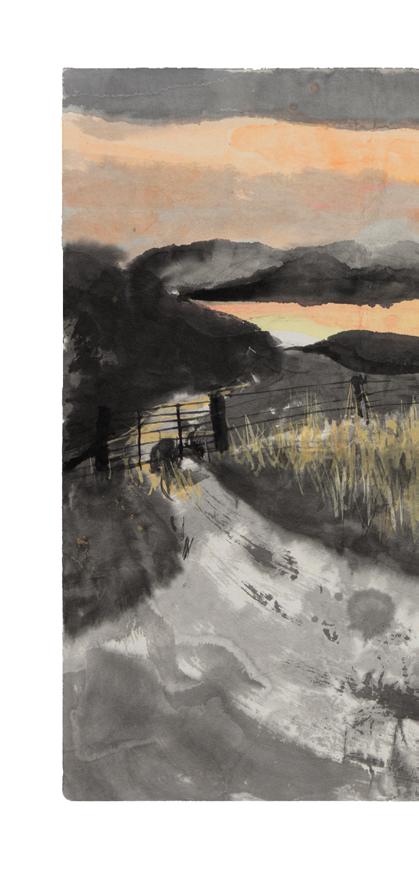
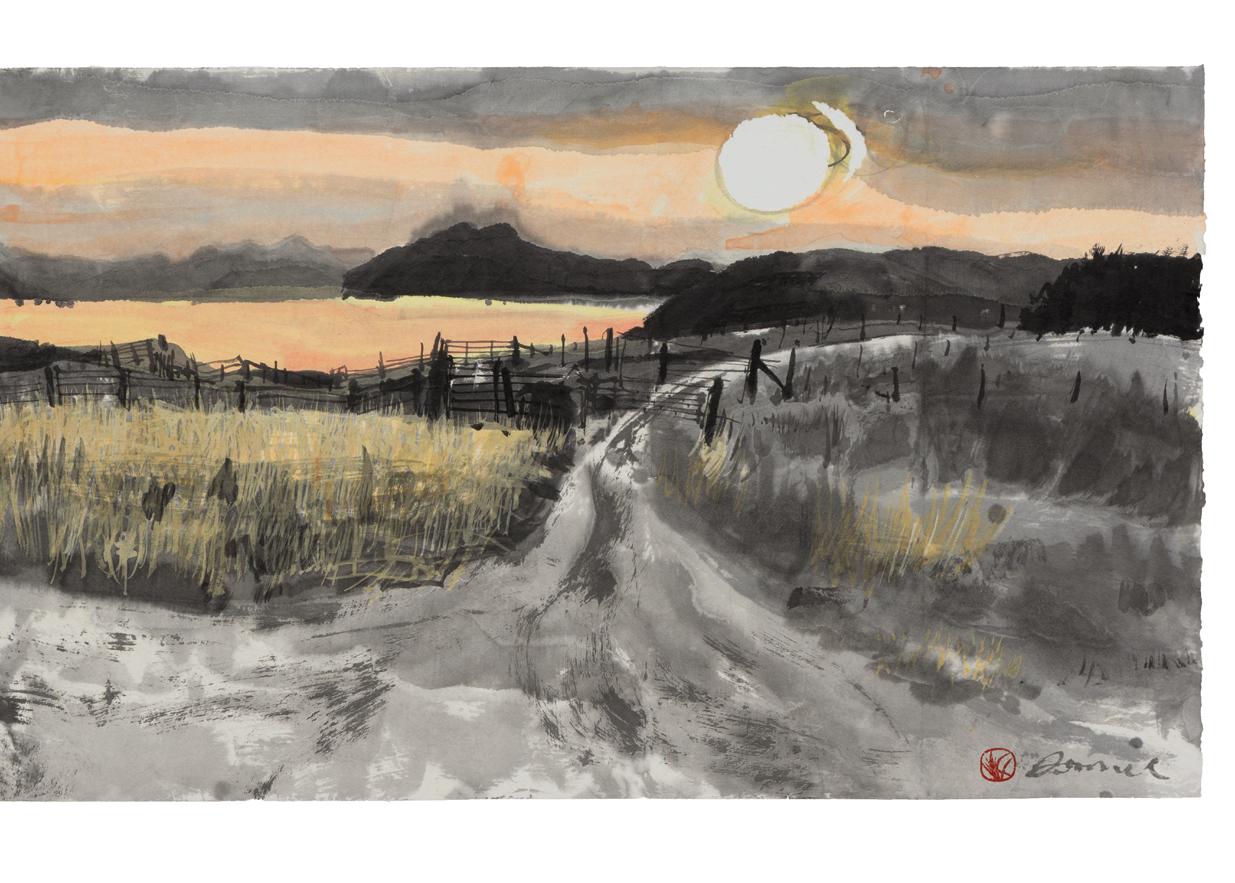
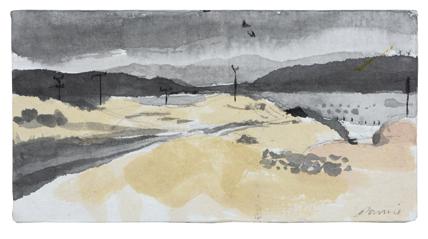
15 The Sculptor’s Garden ink and watercolour on Xuan paper 53 x 114 cm
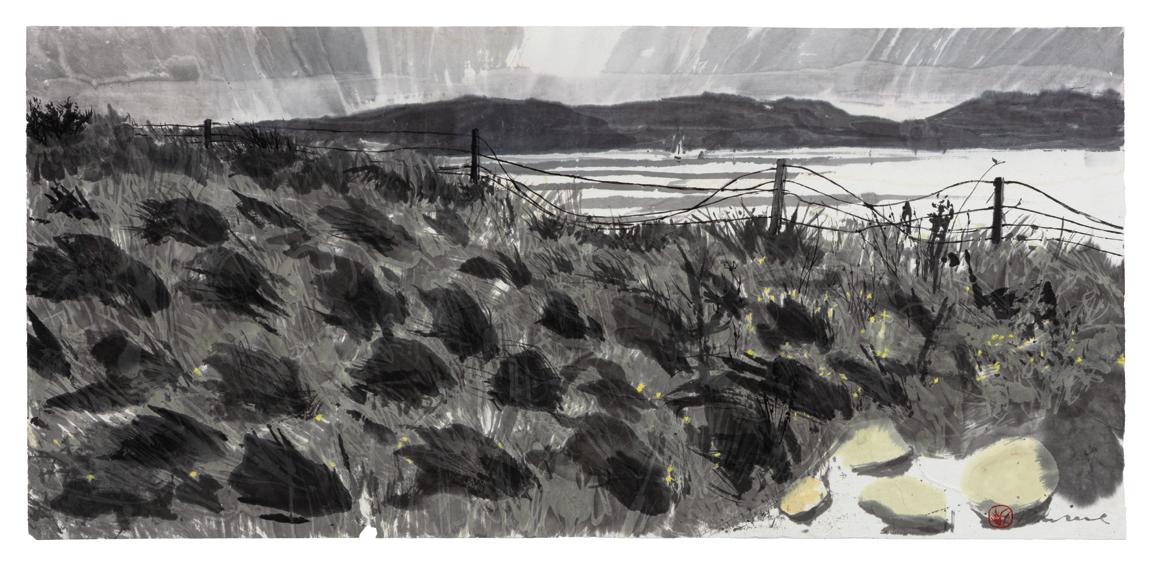
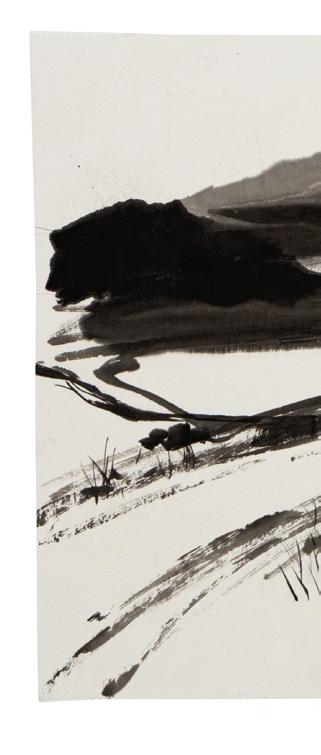
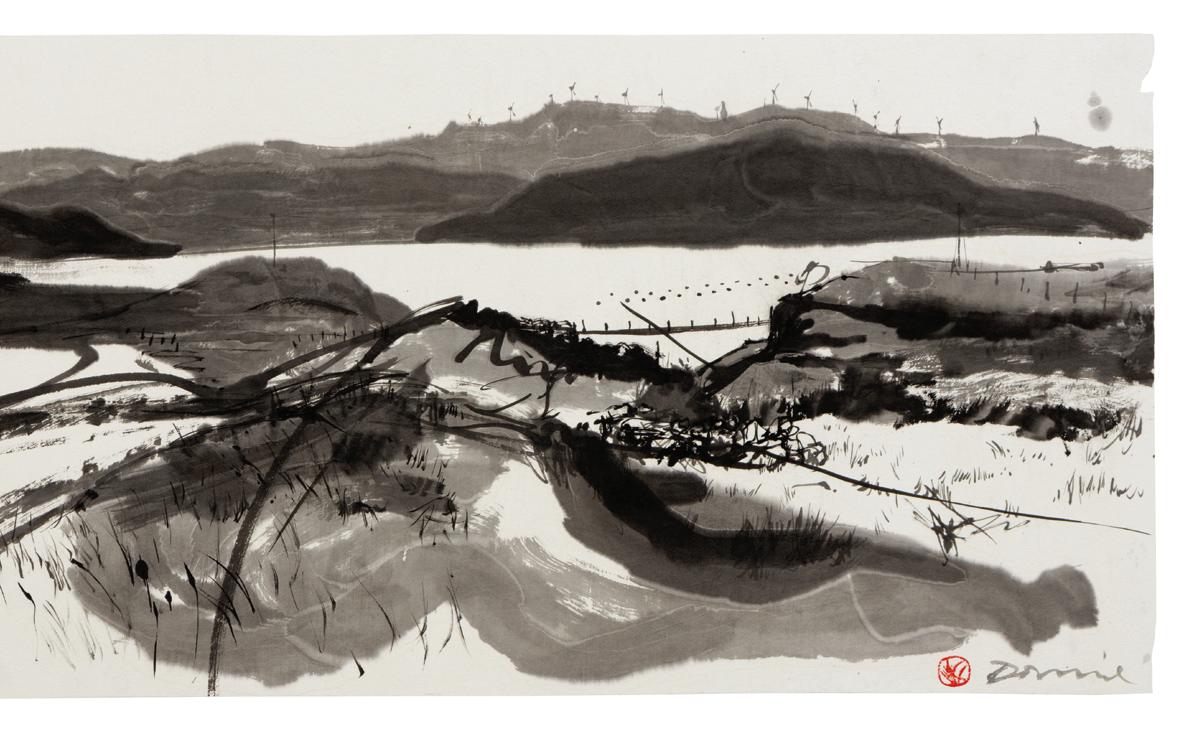
17
18
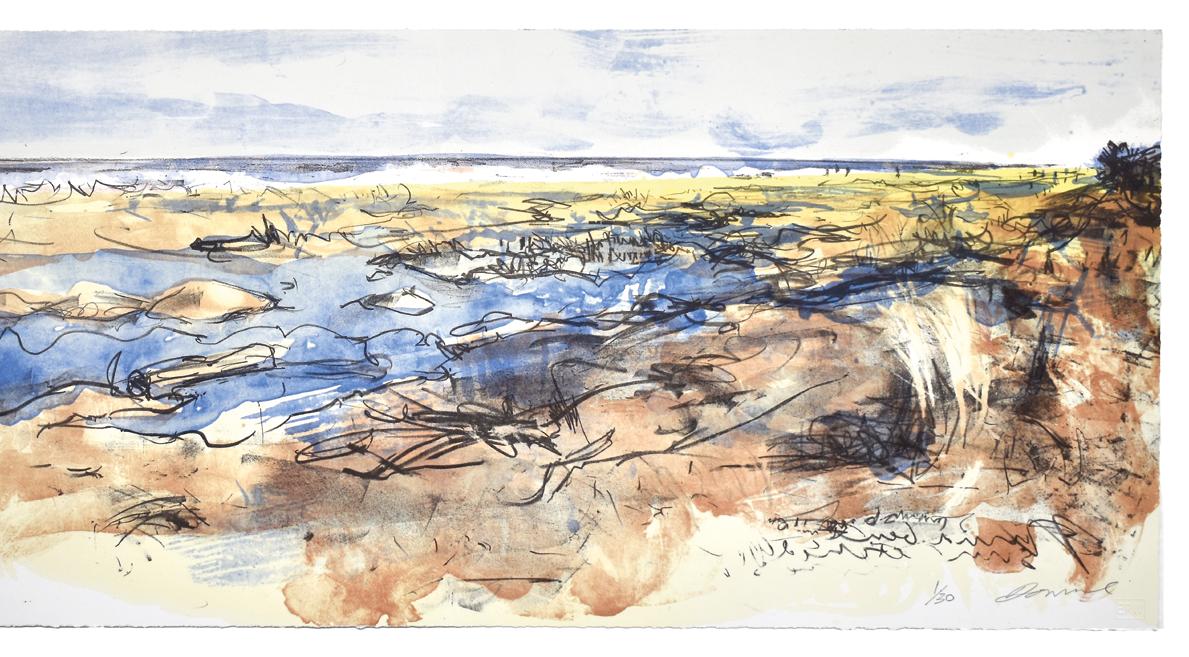
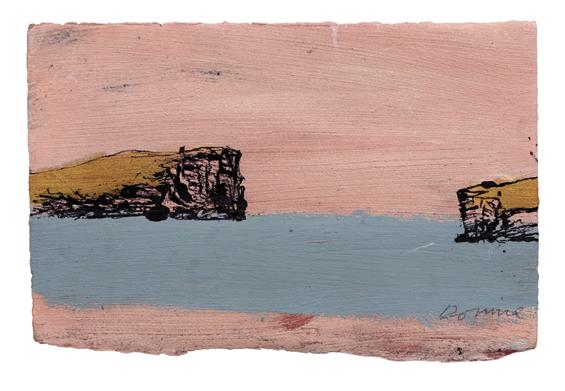
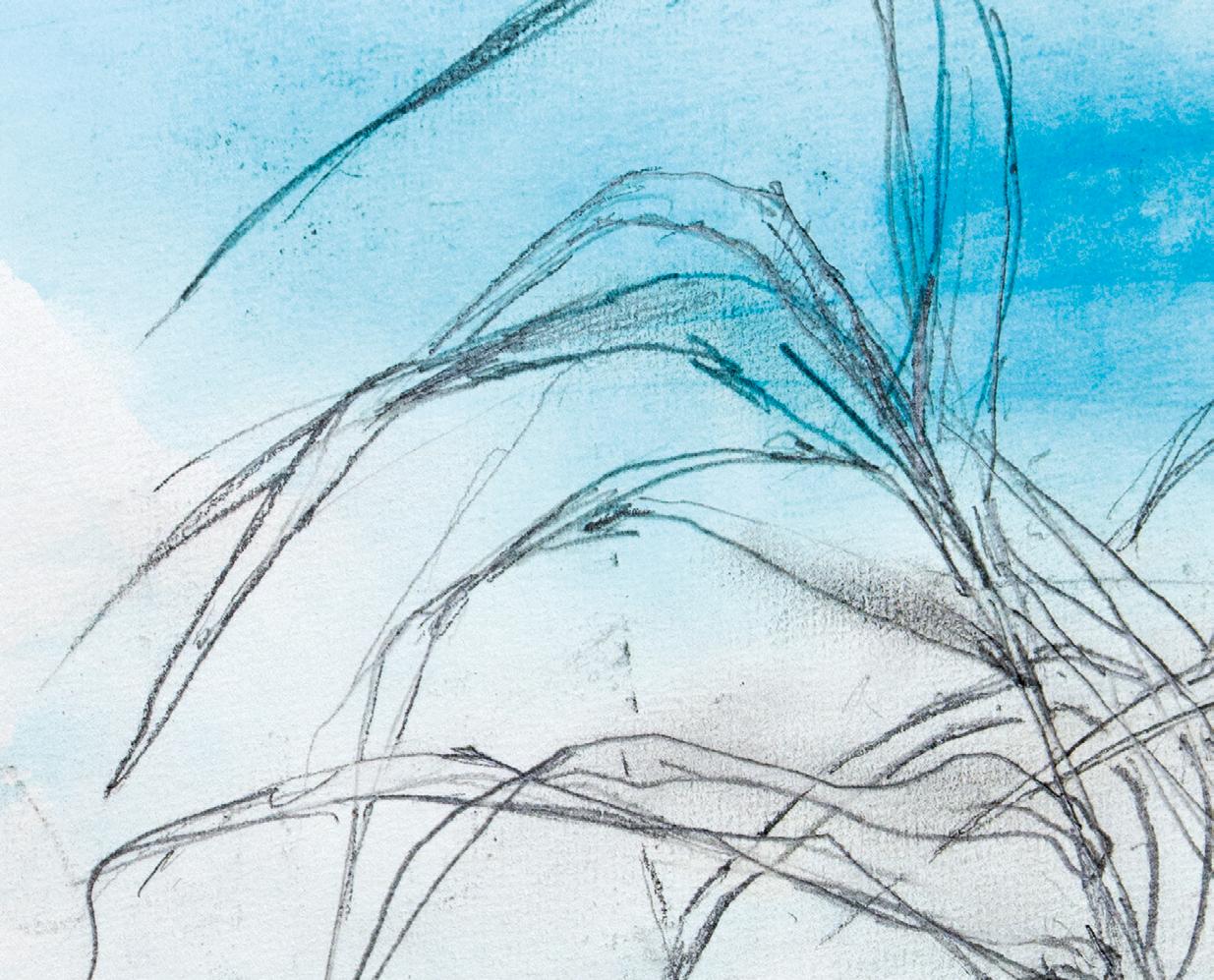
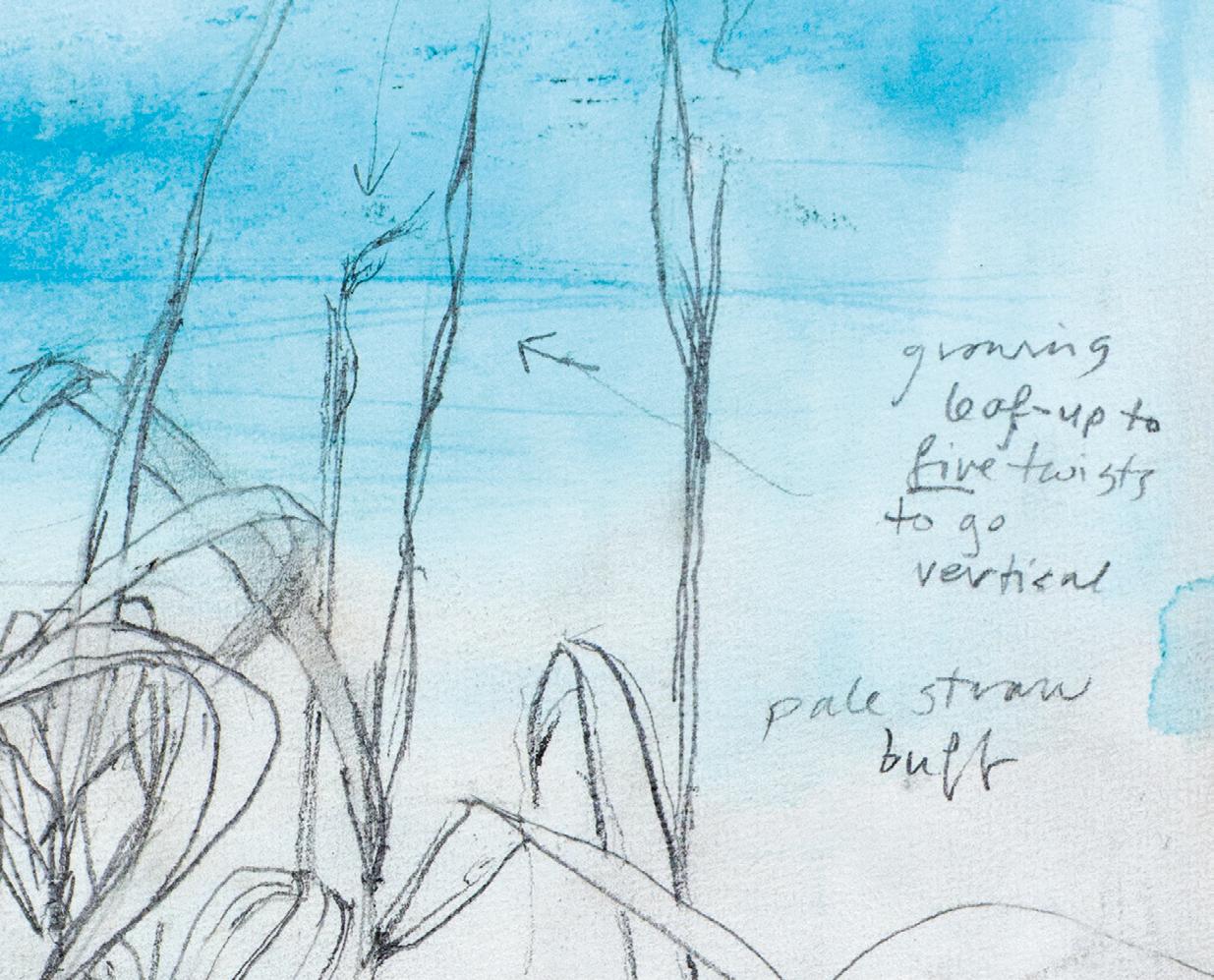
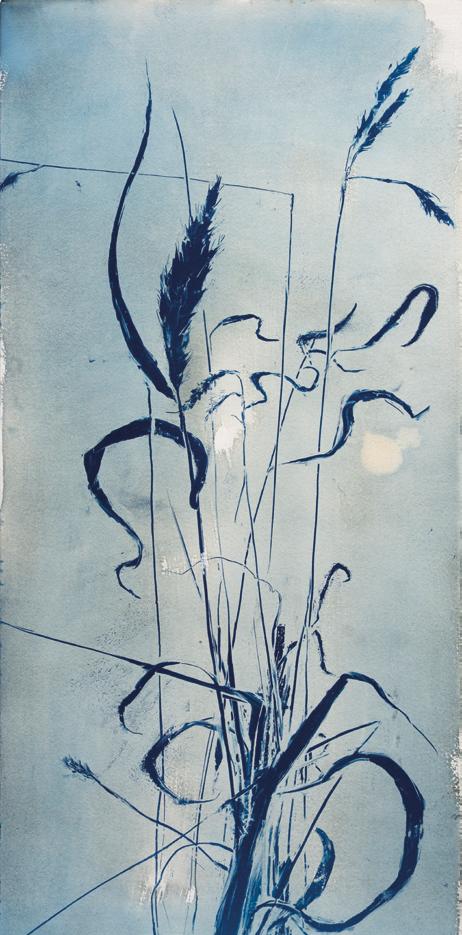
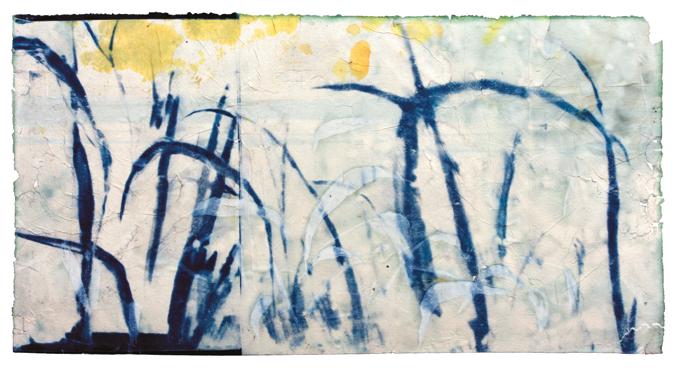
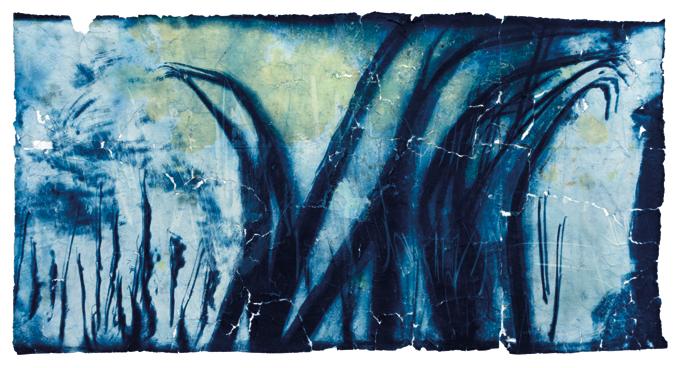
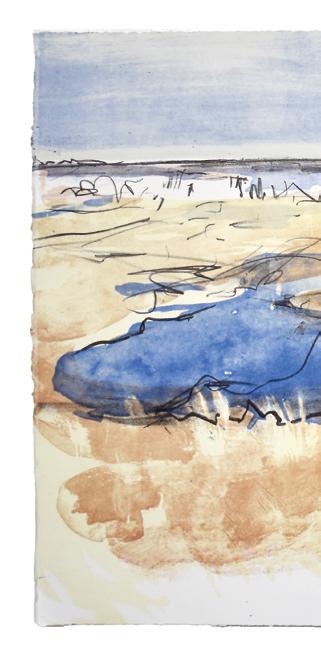
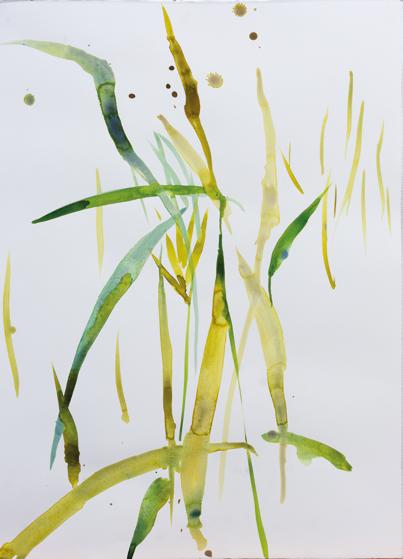
25 Fragility cyanotype and watercolour on Xuan paper, 34 x 66 cm
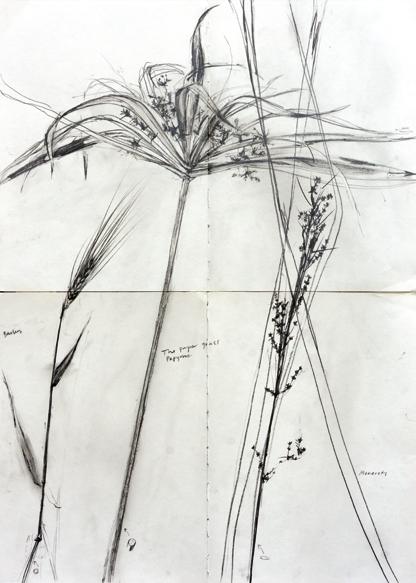
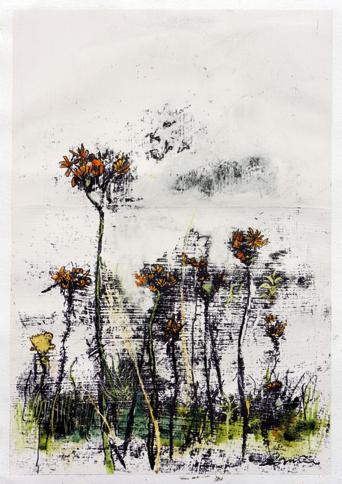
This new print-work, researched mostly in Fife and developed at Glasgow Print Studio, is a key part of my 3-year study of the subject of Grasslands. The 8-piece copper plate etching was technically much harder to achieve than I had imagined, combining 17th century methods with 21st century skills.
Echoing the genre of botanical drawing, for this print each sample is a product of place and also the forces that act upon it: humans, insects, cars, grazing animals, combine-harvesters, golf clubs, and football boots. For example, Auchtermuchty Common is botanically the most diverse, interwoven with different species owing to grazing and lack of pesticides. Links was discovered in a quiet tresspass over the hill onto the 9th hole at Cupar Golf Course. Field, a post-harvest stomp in November on farmland edging the village, and Verge is sampled from the edge of the busy B939 where the grass is squashed horizontal in line with the traffic. I chose to celebrate modern history with Pitch, featuring Hampden Park turf drawn in the exact location where a football crossed the line, kicked by Scott McTominay on November 18th 2025, one of the three goals that qualified the Scottish men’s football team for the 2026 World Cup. Despite the results, worthy of a drawing!
The phrase ‘common or garden’ is a British idiom used as an adjective to describe something that is ordinary, unexceptional, or completely standard. It implies that
the item or situation lacks unique, special, or exotic qualities The phrase has a surprisingly botanical history. It originated in England in the 17th century as a way to classify plants. Botanists and gardeners used it to describe plants that were so abundant they could be found growing wild on public, open ‘commons’ or in any standard ‘garden,’ making them entirely ordinary compared to rare or exotic species. Over time, this evolved to describe everyday non-plant objects, people, and events.
On common lands
Couch Grass Agro pyrum repens
Tall Fescue Lolium arundinaceum
Salt Marsh Grass Puccinellia
Common Reed Phragmites australis
Green Panic Grass Megathyrsus maximus var. pubiglumis.
False Oat grass Arrhenatherun elatius
Silky Bent Grass Apera spica-venti
Common Bent Agrostis capillaris
Rough Meadow Grass Poa trivialis
Sweet Vernal Grass Anthoxanthum odoratum
Yorkshire Fog Holcus lanatus
Perennial Ryegrass Lolium perenne
Brown Beetle Grass Diplachne fusce
Cock’s Foot Agrostis capillaris
29 Common or Garden copperplate etching on paper, 64 x 48 cm
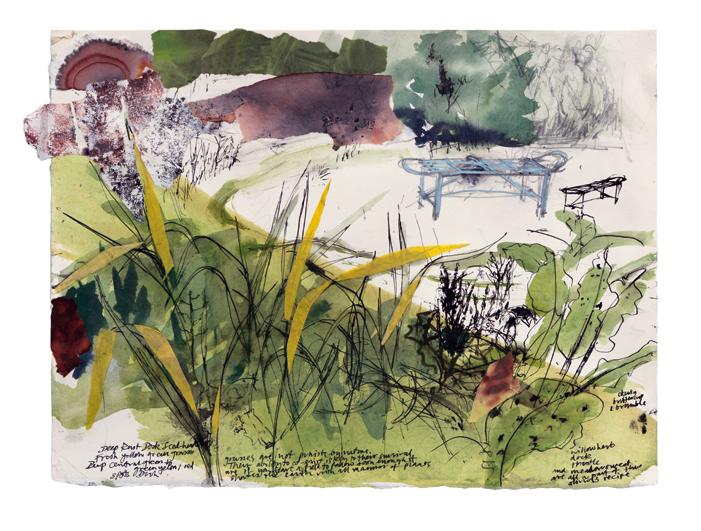
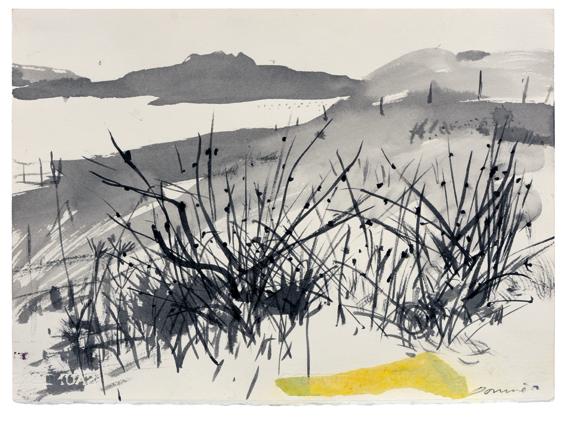
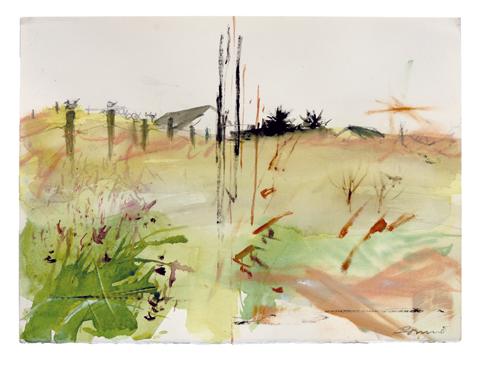
30 Field Notes Study ink, watercolour and collage on paper, 28 x 40 cm
100
112
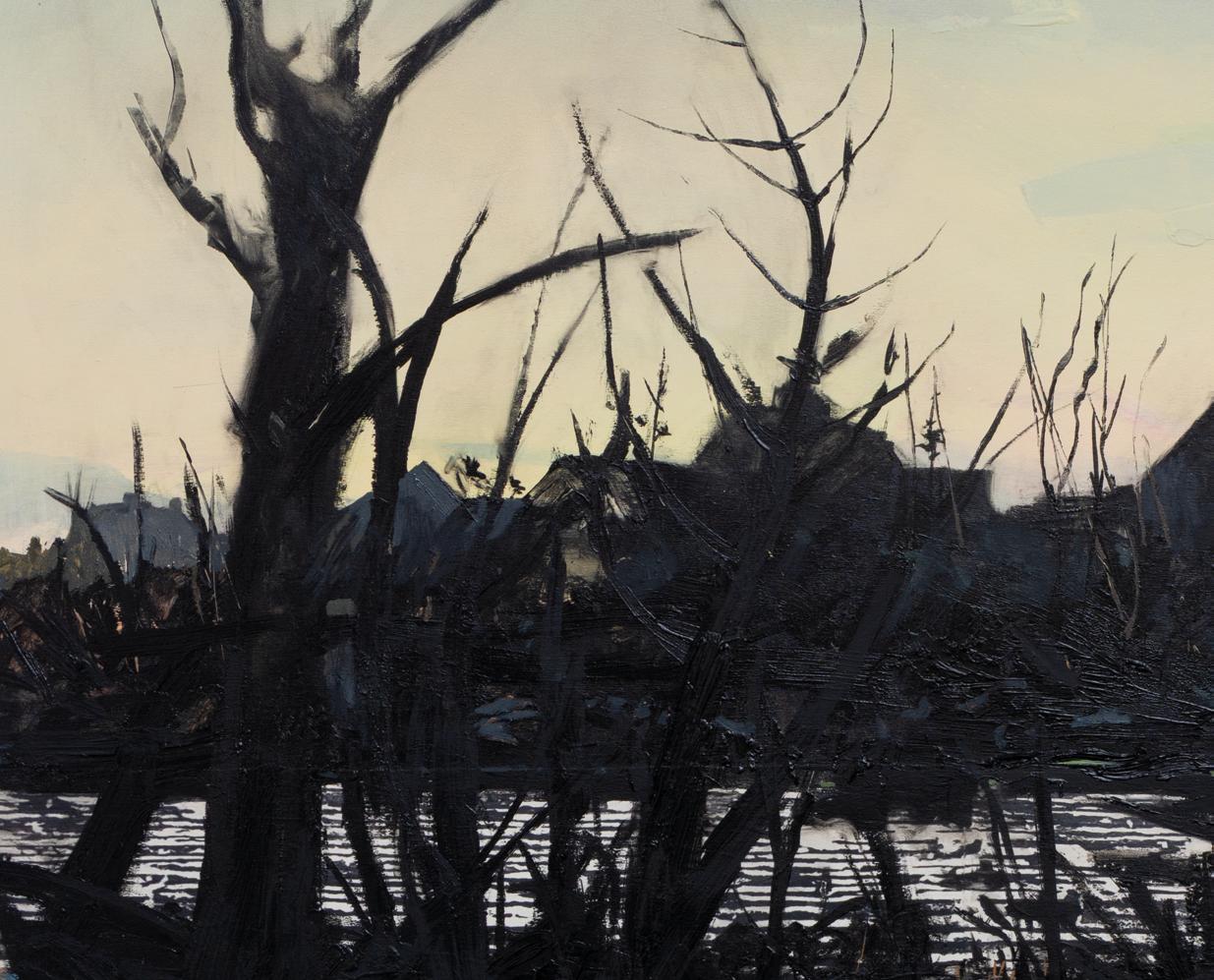
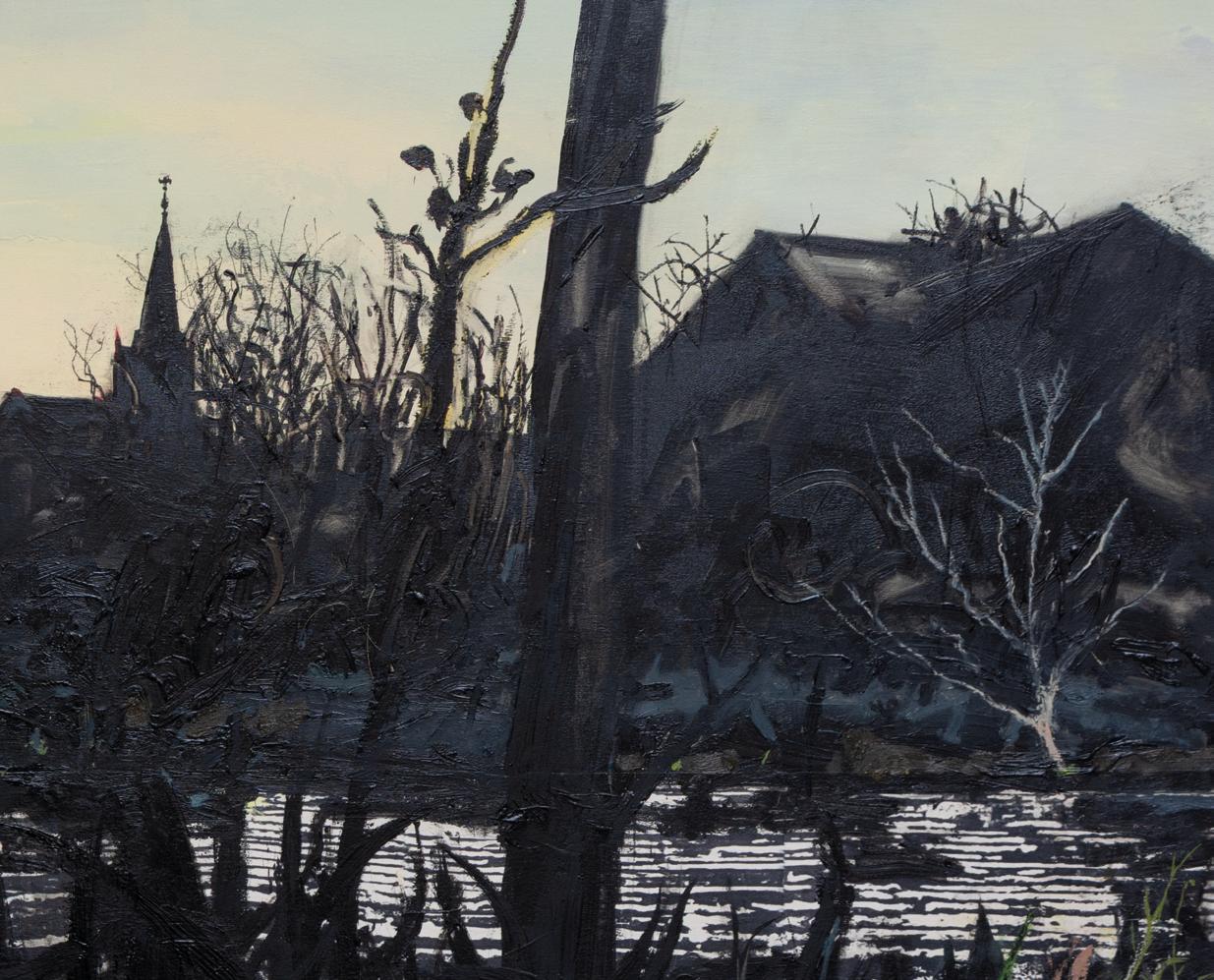
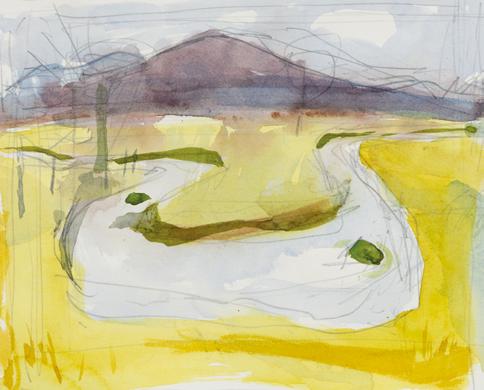
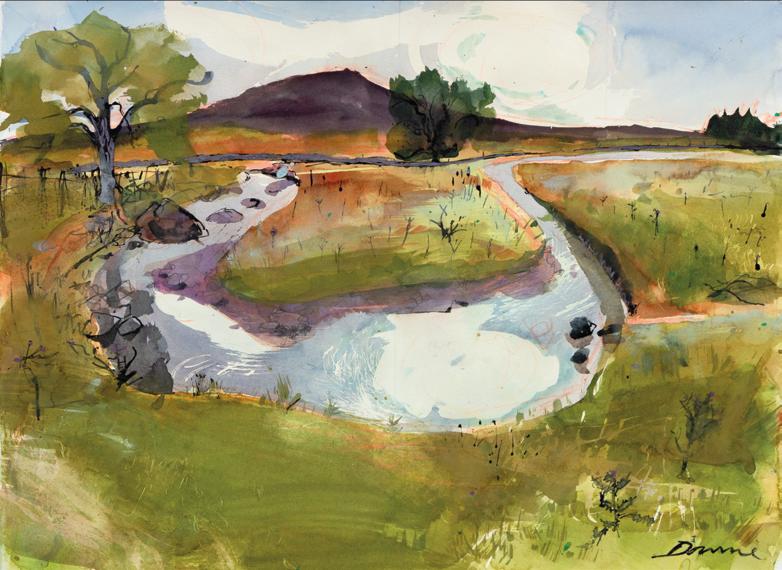
38 Banks and Braes watercolour on paper, 48 x 66 cm
When it looks like nothing is happening, everything is happening. The future is forming under the ground.
Ali Smith
Accept the art of our day as if it were a living thing.
Samuel Beckett
Kate Downie’s prolific art practice spans 45 years, international residencies, and many national awards. She has exhibited both nationally and internationally, and has work in public and private collections worldwide.
Since graduating in Fine Art from Gray’s School of Art in 1980, she has worked in painting, printmaking, performance, moving image and installation, all underpinned by drawing and deeply affected by the environment. She became a member of the Royal Scottish Academy in 2008, having previously worked closely with the Society of Scottish Artists as President, curating Body Parts, an international Performance Art Festival (2003-05), and hosting international artists’ exchange programmes.
Her early career focused on urban and industrial places, with residences in public infrastructure arenas such as a brewery (1984) a ring road in Paris (1989) a drilling and production platform in the North Sea (1988), the Forth Bridges (1999, 2014 and ongoing) and even a maternity hospital (1992-94). This work developed both in the UK and through residencies in Amsterdam, Paris, Corsica, Norway, Japan and China, and has more recently been inspired by the Northern Isles that surround our shores.
As a mid-career artist, she left the city of Edinburgh in 2018 and established a rural practice in Fife, creating Birchtree Studios. This light-filled space, set within a burgeoning garden, was completed in 2019. Creative collaborations, open studio events, mentoring and workshops take root here alongside her art production in all its diversity. Outside Edge, Gillian MacFarland (2022-26) and the art group Poesis have all found sanctuary in Birchtree Studios.
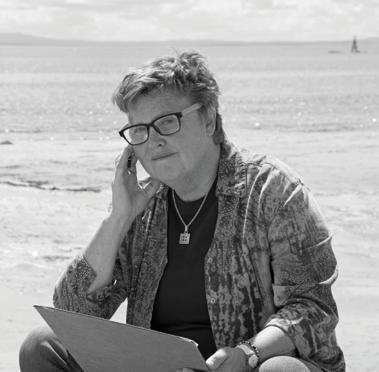
Downie has continued to focus her practice on human coexistence with nature, examining deceptively simple subjects such as trees (Between Seasons, 2021), rivers (Art and Energy, 2025-27), and grass, for a major solo show Grasslands at The Scottish Gallery during the Edinburgh Art Festival.
Recent and forthcoming projects include a major commission for Works on Paper: Art and Energy at Aberdeen Art Gallery (2025–27), examining energy transition through wind and water. Downie’s work also features in the touring exhibition Making Her Mark: A Celebration of Women in Art, organised by Penlee House Gallery & Museum, Worcester City Art Gallery & Museum and Kirkcaldy Galleries, and in a number of exhibitions marking the Royal Scottish Academy’s bicentenary. In 2027, her collaborative exhibition Conversations with Joan, developed with Glasgow Women’s Library, will tour to Aberdeen Art Gallery.
2026 Grasslands, The Scottish Gallery, Edinbuegh
2024/2027 Conversations with Joan, Glasgow Women’s Library; Aberdeen Art Gallery
2022 Printing Bridges 1999-2022, Glasgow Print Studio retrospective of etching, monoprint and lithography
2021 Between Seasons, Rotational Paintings. Exhibition and Performance The Scottish Gallery, Edinburgh, touring to Gracefield Arts Centre, Dumfries
2017 The Anatomy of Haste, The Scottish Gallery, Edinburgh
2016-17 Span - A Tale of Three Bridges, Drawings and Prints 1999-2016, Kirkcaldy Art Gallery, Fife
2016 Gaps, Deceptions and Downright Lies, Drawing Installation Invited Artists at Cupar International Art Festival, Fife
2015 Shared Vision, Stirling University and RGU Aberdeen
2001 East, Paintings/prints/drawing installation and film Talbot Rice Gallery, Edinburgh
1999 The Bridge, Wall Drawing. The Round Room, Talbot Rice Gallery,Edinbugh
1993-96 The Mother Pool, invited artist as a part of From Here to Maternity social history exhibition, curated by Dr Elizabeth Carnegie. The People’s Palace, Glasgow, UK tour of Museums and Galleries
Selected Collections
Aberdeen Art Gallery
Aberdeen Royal Infirmary
Aberdeen University
Aberdeenshire Farming Museum
Allied Breweries
Art in Healthcare, Scotland
British Broadcasting Corporation
City of Edinburgh Council
Cleveland Art Gallery, Middlesbrough
Creswell Maternity Hospital, Dumfries
East and Midlothian NHS Trust
Edinburgh City Arts Centre
Edinburgh University
Glasgow Gallery of Modern Art
Gracefield Museums and Galleries, Dumfries
Grampian Regional Council
Gray’s School of Art, Aberdeen
H M The King
Kelvingrove Art Gallery, Glasgow
Kirkcaldy Art Gallery and Museum
Moray House College of Education
Museum of London
New Hall Art Collection, Cambridge
Rietveld Kunst Academie, Amsterdam
Robert Gordon University, Aberdeen
Royal Bank of Scotland
Royal Collection, Windsor Palace
Royal Scottish Academy
Scottish Maritime Museum, Irvine
Scottish Provident
Scottish Trades Union Congress
Stirling University
Published by The Scottish Gallery to coincide with the exhibition:
Kate Downie Grasslands
30 July - 29 August 2026
Exhibition can be viewed online at: scottish-gallery.co.uk/katedownie
ISBN: 978-1-917803-29-8
Designed and Produced by The Scottish Gallery
Photography by Michael Wolchover
Printed by Pure Print
cover: Noticed Field, oil on canvas, 100 x 200 cm
All rights reserved. No part of this catalogue may be reproduced in any form by print, photocopy or by any other means, without the permission of the copyright holders.
With big thanks to
Michael Wolchover
Photography and everything else
Gillian McFarland ArtMovesFife
Dr Irene Orr
Poesis
Dr Helena Simmons Botanist, Head Gardener at the Forgan Arts Centre, Green Shores Salt-marsh Project, St Andrews University
Dr Clare Maynard
Kate Grenyer
Rachel-Jane Morrison
Derek Robertson
Green Shores Salt-marsh Project
Fife Contemporary
Methil Heritage Centre
Ornithologist and artist
Tommy Zyw Director, The Scottish Gallery
Sophie Lawson Catalogue design with the artist & The Scottish Gallery
Sandy Wood Collections Curator, Royal Scottish Academy
Kit Martin Poesis
Iain Halket
Alistair Clark & Alice Griffith
Alistair Gow & Ian McNicol
Lin Chau
Lois Walpole
W J Stokoe 1870-1950
My friends in The North
Shona Skinner
Janette Kerr
Anne Bevan
Samantha Clark
Peter Davis
Shetland Museums and Archive
16 Dundas Street | Edinburgh | EH3 6HZ | 0131 558 1200 | scottish-gallery.co.uk
FosseKleva Kunstsenter, Norway
Edinburgh Printmakers
Glasgow Print Studio
Glasgow Print Studio
Author of Kushies and Cuddies, Basketry in Shetland
The Observer Book of British Grasses, Sedges and Rushes