DESIGN ARCHIVES
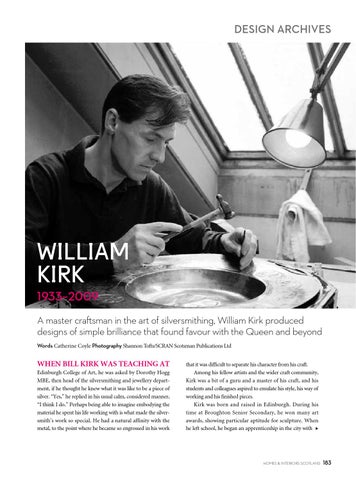
WILLIAM KIRK 1933–2009 A master craftsman in the art of silversmithing, William Kirk produced designs of simple brilliance that found favour with the Queen and beyond Words Catherine Coyle Photography Shannon Tofts/SCRAN Scotsman Publications Ltd
When Bill kirk was teaching at Edinburgh College of Art, he was asked by Dorothy Hogg MBE, then head of the silversmithing and jewellery depart ment, if he thought he knew what it was like to be a piece of silver. “Yes,” he replied in his usual calm, considered manner, “I think I do.” Perhaps being able to imagine embodying the material he spent his life working with is what made the silver smith’s work so special. He had a natural affinity with the metal, to the point where he became so engrossed in his work
that it was difficult to separate his character from his craft. Among his fellow artists and the wider craft community, Kirk was a bit of a guru and a master of his craft, and his students and colleagues aspired to emulate his style, his way of working and his finished pieces. Kirk was born and raised in Edinburgh. During his time at Broughton Senior Secondary, he won many art awards, showing particular aptitude for sculpture. When he left school, he began an apprenticeship in the city with v
Homes & Interiors Scotland
183
DESIGN ARCHIVES
[Opposite] Shannon Tofts spent a day with Kirk, photographing him at work in this studio. His meticulously arranged tool store symbolises his structured, methodical approach to his craft. [Below] Kirk’s work bench, with all his fine tools lined up and ready for use; two of his silver bowls, their lack of adornment allowing their shape and fine hammer marks to speak for themselves; Kirk was commissioned to make ceremonial maces for several universities around the world – here he is about to start work on a wooden model
Charles Creswick, working in sculptural metalwork and bronze founding. He worked hard, immersing himself in the job and developing a unique style of hand-engraving that became one of his trademarks. He did both piece-work and contributed to larger commissioned pieces, such as chargers, maces and quaichs, as well as undertaking letter-cutting and carving, some of which could be seen in Greyfriars church and churchyard and in the Gallery of Modern Art. His role was suspended while he did National Service, but he resumed work thereafter, and remained in the job until he set up his own studio in 1961. Despite his apprenticeship, Kirk was largely self-taught, and as his work developed he focused on the dual crafts of carved lettering and raised hammer work. Christina Jansen, a director of Edinburgh’s Scottish Gallery, championed his work for many years. She hosted a retrospective in 2011 where the breadth of his talent could truly be measured. “William Kirk was a shy, reserved individual who was an exceptional craftsman,” she remembers. “He was a silversmiths’ silver
184
Homes & Interiors Scotland
smith; other silversmiths understood immediately the special quality of his work and some were even intimidated by his craft, especially his engraving and hammer-raising skills. “In some ways, his work is related to musical instruments. His wife, Rita, would say that she knew when things were going well when she could hear the right sounds coming out of his studio. The proportions of his pieces are completely considered, and if you tap the side of one of his works, there is a perfect pitch to it.” Kirk received several prestigious commissions during his career, including one from the Queen to make a communion cup for the Canongate Kirk, as well as maces for several universities and a table centrepiece for Napier University. Alongside his studio work, Kirk took on several teaching posts, first at Glasgow School of Art and then at Edinburgh College of Art, instructing two generations of Scotland’s jewellery and silversmithing students. “I think he preferred being a silversmith,” continues Christina Jansen, “but that’s not to say that he didn’t enjoy the comradeship of teaching
and working with his peers. But he was a self-contained person and his approach was all about self-discipline. If others didn’t share his discipline or vision, I think it would have been difficult for him.” His work was deceptive; the forms appear easy and unfussy but the process he had to go through to make those pieces was anything but simple. Leaving the pieces unembel lished meant that the metal and the marks he made became the focus. There was seldom any adornment; just pure, clean silversmithing where hammer and planishing marks remain, in their simple beauty, for all to see. Kirk was a very cultured man, with an avid interest in music, literature, the natural world and poetry, all of which he subtly wove into his work. “Bill was a risk-taker and occasionally he would have setbacks, just like any other artist. He’d get very cross, but he’d never give up,” recalls Jansen. “His work was completely non-compromising; there was no compromise on perfection. He was organised, disciplined and dedicated. “His contribution was a quiet one but he leaves behind a legacy of perfection and refined craftsmanship.” In 2006, the photographer Shannon Tofts (whose images illustrate these pages) spent the day with Kirk, photographing him as part of a project she was working on called The Face of Craft. It was a rare glimpse into his world, since he rarely gave interviews and seldom let anyone into his private studio. “Listening to the sound of each hammer blow as I photographed was a lesson in itself,” remembers v
Homes & Interiors Scotland
185
DESIGN ARCHIVES
Hard at work in his 70s at home in Edinburgh raising a silver bowl
Tofts. “Each piece would have its own song and rhythm; it sang pure, signalling the exact strength, direction and angle of each hammer strike. I could see that the process of making a bowl or a cup was as much aural as physical.” His deft touch allowed him to switch easily between techniques, and colleagues recall him working in complex solder inlay, then changing to raise a bowl in copper and silver. He could engrave on silver, as well as carving and letter-cutting in stone, often the words of his favourite poems. Like many of the finest artists, Kirk’s modesty and pursuit of perfection surpassed his desire for recognition. As such, his
186
Homes & Interiors Scotland
work is perhaps only being appreciated now, seven years after his death at the age of 76. “All of his work is significant,” believes Christina Jansen, “from the smallest hand-raised beaker all the way up to his larger vessels. His work has presence no matter what the scale. They hold their own and quietly dominate.” The silversmith Michael Lloyd described William Kirk as a guardian of the craft. It is now the responsibility of the craft community in Scotland to be the guardians of his legacy, protecting and promoting his work for future generations to appreciate. �