
Guy Royle | Spring Song

Page 1


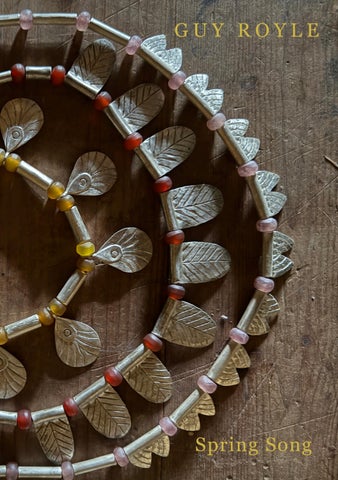
GUY ROYLE

Spring Song

Spring Song

We are delighted to present Guy Royle at The Scottish Gallery as part of our Room of Dreams series, an exhibition that brings together a remarkable body of work spanning jewellery, handwoven rugs, sculpture and printmaking. A quietly compelling and deeply thoughtful maker, Royle is a multidisciplinary artist whose practice unfolds naturally across materials with clarity, integrity and purpose.

For over twenty years, Royle has lived and worked just outside Penzance in West Cornwall. From this place, shaped by landscape, weather and a long tradition of making, he has developed a distinctive visual language grounded in drawing, touch, process and an intimate understanding of materials.

I visited Guy in his studio earlier this year, where I was welcomed into his working environment. Spending time there, surrounded by his tools, materials and objects in progress, offered a rare and immediate insight into the way his work is made. To see the stones being shaped, the surfaces worked, the quiet rhythm of making at close hand, is to understand something essential about his practice, built through patience, intuition and a deep respect for his craft.

This exhibition, Spring Song , offers an opportunity to experience the breadth

of Royle’s work. Jewellery sits alongside woven textiles, prints and sculptural objects, revealing not separate strands but a cohesive way of thinking through making. Whether working in stone, silver, wool or ink, Royle’s approach remains consistent: direct, exploratory, and rooted in the physical act of making.

There is relatively little written about Royle’s work, making personal encounters with the artist all the more valuable. I am therefore especially pleased to share the following text, in which Royle speaks with generosity and candour about his life and practice. From his early years moving between Devon, Hampshire and Cornwall, to his formative collaboration with Breon O’Casey, Royle reflects on a life shaped by work, curiosity, and a commitment to learning through doing.

What emerges is a portrait of an artist for whom making is both method and meaning. His works carry the trace of their making, objects to be held, worn, lived with. They are grounded in place, yet open in interpretation, modest in scale and rich in presence. We invite you to step into Royle’s world, to look closely, and to experience the quiet coherence of a practice built, quite simply, by hand.

Guy Royle | A Life of Material and Making

Guy Royle has lived and worked just outside Penzance in Cornwall for over thirty years. His work resists easy categorisation. Jewellery, printmaking, tapestry and sculpture are not separate disciplines in his practice, but different expressions of a single language shaped through making. Encountering the work together reveals a continuity of thought: line becomes edge, structure becomes rhythm, and material becomes meaning.

That sense of movement between forms is perhaps rooted in Royle’s own early life, which he describes as that of a yo-yo. Born in Kingston in Devon in 1954, he moved as a young child to Fleet in Hampshire, before returning to the southwest and settling in Cornwall in his early teens. These shifts between rural Devon, suburban Hampshire, and later Cornwall created a fractured but formative sense of place. That’s why I call myself a yo-yo person. I was always going backwards and forwards

What remained constant across those moves was drawing, and the presence of individuals who recognised and encouraged it. I was lucky. People noticed I liked drawing . A neighbour in Hampshire, herself from a family of illustrators, invited him to help paint trees across her kitchen walls; her mother would sit with him while he drew. Later, in Cornwall, teachers identified his aptitude and quietly redirected him towards art. These

encounters, informal yet decisive, shaped a way of learning rooted in attention, encouragement, and doing.

Royle did not follow a conventional route into art education. Instead of attending art school, he moved to London, supporting himself through manual work including six years on night shifts in a cold store while attending life drawing classes at Morley College during the day. The arrangement, though physically demanding, offered a kind of freedom. It meant my days were my own. I could draw, go to classes, and work things out for myself.

That independence has remained central to his approach. You still have to become yourself in the end. Rather than a single institutional framework, his education was cumulative: life drawing, observation, practical labour, and the steady acquisition of skill through repetition. Crucially, it established a way of thinking in which making rather than theory leads.

When Royle returned to West Cornwall, settling near Newlyn, that sensibility found its natural environment. Like many artists of his generation, he navigated a patchwork of work and making, supporting himself through a range of jobs while developing his own practice. A period working with adults with learning disabilities introduced weaving into his daily life, and reinforced an approach grounded in process and adaptability.

A pivotal moment came when he was invited to work with Breon O’Casey (1928–2011). What began as a single day of weaving in 1989 developed into a long and formative collaboration. O’Casey, a key figure within the St Ives tradition, had himself come to art through a similarly indirect route. Following National Service, he trained and worked while establishing his practice, supporting himself through assistantships and applied work before becoming fully established as an artist. This was something Royle instinctively recognised. Both artists understood the necessity of labour alongside making, and the idea that a practice is built over time rather than assumed. As Royle recalls, he moved naturally between forms. It all belonged together for him

O’Casey worked fluidly across painting, weaving, jewellery, and sculpture and that permeability between disciplines proved crucial for Royle. Working alongside O’Casey reinforced a mode of learning grounded in experience rather than instruction. He would show you roughly what to do, and then say, work it out yourself. That’s how you really learn. The emphasis was on developing understanding through the hand, through trial, error, and adjustment. Not from books. You make it, you look at it, you alter it.

This philosophy underpins Royle’s entire practice. Whether working in metal, stone, textile or print, the starting point is always material. You can’t really get away from materials. You learn by doing something, making mistakes, undoing it, trying again. Each medium carries its own logic and limitations. You can’t bully materials into being something else. Stone, silver, wool, they each have their own nature.

Nowhere is this more evident than in his jewellery. Royle’s work is often described as sculptural, yet they remain resolutely wearable. Jewellery is a very personal form. It changes with the wearer, with the skin, the handling, the use. For this reason, he avoids high polish, preferring surfaces that evolve over time. I’d rather they acquire their own patina through being lived with.

The apparent simplicity of his forms conceals a deep attention to structure and mark-making. In a necklace, for instance, the unseen decisions are as important as the visible form. The size of the holes, the weight of the beads, how they hang, those things change everything. Royle has often shaped and drilled

Citrine Earrings, 2024, white precious metal, H6.7 x W4.6 cm Scroll Bangle, 2022, white precious metal, D6.8 x W2.5 cm

stones himself, rather than using precut materials, embedding the labour of making directly into the finished piece.

Across his wider practice, similar concerns emerge. In his woodblock printmaking, Royle favours muted colour and visible process, surfaces that retain the grain of the wood or the softness of hand-applied pigment. I’m not interested in making things look over-finished. I like a bit of resistance in things. A bit of life left in them. In textile work, rhythm, and repetition echo both drawing and structure. Each medium becomes a variation on shared concerns: balance, weight, line, and touch.

Colour is rooted in place. Royle has long drawn on materials from the Cornish landscape, stones from quarries and beaches, with tones that reflect the subdued complexity of land and sea. Even when working with semi-precious materials, his palette remains restrained. I try not to make things too colourful. I want them to sit naturally .

This grounding in Cornwall extends beyond material into community. In the 1980s, Royle was involved with Wolf at the Door , an artists’ cooperative in Penzance that brought together makers across disciplines at a time of limited means but considerable energy. It was here that he met the potter Debbie Prosser, his partner, whose own work shares a similar independence and breadth. The cooperative fostered an environment in which experimentation was encouraged and distinctions between disciplines were secondary. People were just trying things. That matters .

Seen together, Royle’s jewellery, prints, textiles, and sculptural objects do not read as separate pursuits, but as variations on a continuous line of enquiry. The early yo-yo movement between places, the self-directed learning, and the formative influence of O’Casey all contribute to a practice that resists conformity while remaining deeply grounded in material and place. None of it feels disconnected to me. Once you’ve spent enough time making, the disciplines stop being separate rooms .

For the viewer, Royle’s work offers a way of looking that moves beyond category. A carved bead may echo a drawn line; a woven structure may inform a sculptural form. What emerges is not a set of distinct works, but a body of thinking made visible through materials.

It’s all one conversation. Different forms, perhaps, but one conversation.

Gold Smoky Quartz Earrings, 2021, 18ct yellow and red gold, H6.5 x W2 cm
Smoky Quartz Earrings, 2024, white precious metal, H5.5 x W3 cm Carnelian Necklace, 2024, white precious metal, L62 cm
Carnelian Necklace with Oval Beads, 2026, white precious metal, L55 cm
Carnelian and Nine Leaves Necklace, 2026, white precious metal, L47 cm
Black Agate Earrings, 2024, white precious metal, H5.5 x W2.5 cm Madagascan Jasper Necklace with Double Beads, 2024, white precious metal, L55 cm

Yellow & Red Gold Teardrop

Earrings, 2019

18ct yellow and red gold

H5.5 x W1.5 cm

Nephrite Jade and Gold Necklace, 2022

18ct yellow gold and nephrite jade, L55 x W2.5 cm

Colour is rooted in place. Royle has long drawn on materials from the Cornish landscape, stones from quarries and beaches, tones that reflect the subdued complexity of land and sea. Even when working with semiprecious materials, his palette remains restrained.

Selection of Earrings, 2026

white precious metal and yellow agate, aquamarine, strawberry quartz, black agate, nephrite jade

Selection of handmade white precious metal necklaces:

Amethyst & Seven Oval Leaf Necklace, 2026, L47 cm

Amethyst & Ribbed Bead Necklace, 2026, L50 cm

Amethyst & Handformed Oval Beads, 2026, L75 cm

Selection of Chains, 2026 handmade chains with white precious metal, yellow agate, carnelian and aquamarine

Selection of handmade white precious metal necklaces:

Amethyst & Seven Oval
Leaf Necklace, 2026, L47 cm
Amethyst & Ribbed
Bead Necklace, 2026, L50 cm
Amethyst & Handformed Oval
Beads, 2026, L75 cm

SCULPTURE

Artemis of Ephesus, 2018, bronze, copper and brass H23 x W15 x D4 cm
Green Agate Necklace with Nine Leaves, 2021, white precious metal, L47 x W5.2 cm
Selection of handmade white precious metal necklaces
Seventeen Petals and Carnelian Necklace, 2026, L44 cm
Light Green Agate and Beaded Necklace, 2026, L50 cm
Large Handformed Beaded Necklace, 2026, L74 cm
Eighteen Double Leaf and White Jade Necklace, 2026, L86 cm
Green Man, 2022, bronze, copper and brass, H25 x W26 x D5 cm
Zingara, 2015, bronze, copper and brass, H23 x W20 x D5 cm
Tennin, 2025, bronze, copper and brass, H23 x W20 x D5 cm

Whether working in metal, stone, textile or print, the starting point is always material. You can’t really get away from materials. You learn by doing something, making mistakes, undoing it, trying again. Each medium carries its own logic and limitations. You can’t bully materials into being something else. Stone, silver, wool, they each have their own nature.

Sukha, 2022, bronze, copper and brass, H23 x W17 x D5 cm

white and yellow precious metals

H4

white and yellow precious metals

H2.5

white, yellow and red precious metals H3 x W5.7 cm

Rectangle Bird Brooch, 2019
x W5.5 cm
Four Leaf Brooch
x W5 cm
Framed Bird Brooch
Brooch with One Bird, 2021 white, yellow and red precious metals, H4 x W5.5 cm
Spring Song woodblock print
Three Birds Ascend woodblock print
Dawn Chorus woodblock print
Dawn Flight woodblock print
Green Aventurine Earrings, 2019, 18ct yellow gold
H5.7 x W2.2 cm
Brooch with One Bird, 2021 white, yellow and red precious metals, H4 x W5.5 cm
Lapis Lazuli & Gold Earrings, 2019, 18ct yellow gold, H5.5 x W1 cm
Hollow Beads and Amazonite Necklace, 2022, white precious metal, L86 cm

WEAVING

I’m not interested in making things look over-finished. I like a bit of resistance in things. A bit of life left in them. In textile work, rhythm, and repetition echo both drawing and structure. Each medium becomes a variation on shared concerns: balance, weight, line, and touch.

Mountain Forms woven rug, wool with cotton fringe H146 x W89 cm
Field of Nine woven rug, wool with cotton fringe, H126 x W93 cm
Bird Forms
woven rug, wool with cotton fringe, H148 x W89 cm
Selection of Bangles, hammer raised and chased, white precious metal, some with yellow precious metal

GUY ROYLE b.1954

Guy Royle (b. 1954, Kingston, Devon) is a British jeweller and artist based in West Cornwall. After early years spent in Devon, Hampshire, and Cornwall, he moved to London, where life drawing and painting became central to his artistic development through study at Morley College and other evening classes. Returning to Cornwall, he began working with the St Ives School artist Breon O’Casey (1928-2011) in 1989, in a collaboration that proved formative to his practice. Working across weaving, jewellery, printmaking, painting and sculpture, Royle has developed a distinctive visual language rooted in structure, material, and process. He is best known for his sculptural jewellery in silver and gold, often incorporating hand-shaped stones, with forms that reflect both the landscape of Cornwall and a lifelong engagement with drawing.

Published by The Scottish Gallery to coincide with the exhibition:

Guy Royle

Spring Song

7 - 30 May 2026

Exhibition can be viewed online at: scottish-gallery.co.uk/guyroyle

ISBN: 978-1-917803-23-6

Designed and Produced by The Scottish Gallery

Photography by Gabriela Silveira and Christina Jansen

All rights reserved. No part of this catalogue may be reproduced in any form by print, photocopy or by any other means, without the permission of the copyright holders and of the publishers.

Turn static files into dynamic content formats.
Create a flipbook
Guy Royle | Spring Song by The Scottish Gallery - Issuu