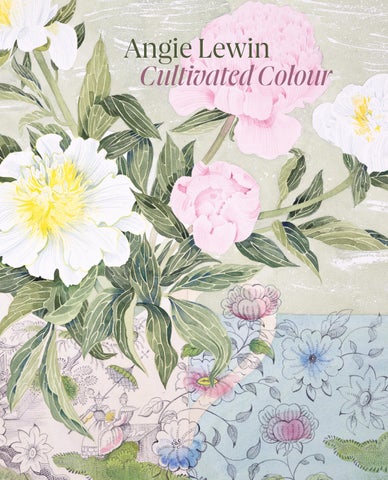
Angie Lewin Cultivated Colour
Angie Lewin Cultivated Colour 1–24 October 2026
16 Dundas Street | Edinburgh | EH3 6HZ | 0131 558 1200 | scottish-gallery.co.uk
INTRODUCTION Christina Jansen
There is something wonderfully apt about the title Cultivated Colour. Angie Lewin has lived in Speyside for more than twenty years with her husband, Simon Lewin, and colour is quite literally cultivated around her. It grows in the garden and polytunnel, fills windowsills and rooms, and changes with the seasons in the wider landscape. But cultivation, in Angie’s work, means something more. Over time she has cultivated an entire visual world: plants and places, ceramics and pattern, artworks and objects, friendships and collaborations, all interconnected through the daily acts of living, looking, and making. I have had the pleasure and privilege of following Angie’s watercolour practice for sixteen years. Her work never stands still. With each exhibition there has been development and experimentation, and Cultivated Colour is another exceptional leap forward. There is an extraordinary confidence in these new paintings, coupled with an increasing willingness to take risks. Angie’s garden is fundamental to her practice. With very few exceptions, the cultivated plants appearing in this exhibition have been grown by her from seed or bulb, while others are wildflowers encountered in the surrounding landscape. Her subjects are therefore governed by the seasons. Winter brings amaryllis and seed heads; then come snowdrops, tulips and anemones, followed by the greater abundance of summer and autumn. Irises have their moment and disappear. Dahlias, asters, marigolds, nasturtiums, and borage tumble into later compositions. More recently, unusual pelargoniums have become a new fascination, grown inside the house and emerging as a distinct group of paintings. This seasonal cycle gives the work its underlying rhythm. Angie does not simply go into the garden to find something to paint. Growing and painting are part of the same process. The plants must be sown, tended, and observed before they ever enter a composition. The year turns and the subjects return, but never quite in the same way. The landscape beyond the garden is equally present. Walking, looking, and gathering visual information remain essential to Angie’s practice. Wild plants and seed heads are examined closely, and the forms and patterns of the natural world are absorbed into a much wider visual vocabulary. Inside the house, another collection is constantly in play.
Angie and Simon live among art and objects gathered over many years: work by friends and peers, former tutors and artists they admire, alongside ceramics, textiles, old books, and patterned papers. These things are not a backdrop to the paintings; they are active participants in them. A still life painting sometimes begins with a particular jug, cup, or vessel, which then suggests the flowers that might accompany it and the patterned surface on which they will sit. Japanese papers, vintage fabrics and the covers of old books introduce another layer of pattern and colour. Angie has described buying books simply because she cannot resist their covers. Eventually these fragments find their way into the work. Friendship is woven through this world too. The pots of fellow makers are used, admired and painted; conversations and visual exchanges become part of the process. Angie’s work is deeply personal in this respect. It grows from relationships accumulated over a lifetime, but the resulting paintings never feel private or closed. Instead, they invite us into a world in which objects, plants and people acquire meaning through association. The medium of watercolour brings its own jeopardy. Angie can work on a painting for days before introducing a new colour that changes everything. Unlike oil, it cannot simply be painted out. A late decision – perhaps an unexpected orange against pink, or red beside another seemingly incompatible colour – can threaten the entire composition. Increasingly, however, that risk feels integral to the vitality of her work. Equally significant is what Angie chooses not to paint. Among the exuberant works in Cultivated Colour are quieter paintings and drawings in which untouched white paper is allowed to breathe. Knowing when to stop can be as difficult as knowing what to add. That balance between abundance and restraint gives this exhibition much of its energy. Over sixteen years I have watched Angie’s visual language become richer while remaining unmistakably her own. The subjects may be familiar – a jug, a flower, a seed head, a patterned cloth – but they are continually renewed through looking and living. There is a life cycle and a pattern to Cultivated Colour: sowing, growing, flowering, fading, gathering, and beginning again. Home feeds the garden; the garden feeds the work; objects carry friendships and memories; paintings lead into prints and prints back into paintings. Everything is connected. Running through Lewin’s practice is colour: lyrical, instinctive, sometimes audacious and increasingly free. Angie Lewin is, above all, a colourist. Her colour is cultivated, experienced and lived. Christina Jansen The Scottish Gallery
GROWTH, COLOUR, PAT TERN THE GARDEN IN THE STUDIO Angie Lewin
The relationship between my garden and my studio has intensified, the distance between them narrowing over the years. My garden now has come to be reflected in my work as much as the wildflowers which I encounter daily in the Speyside landscape. At the same time, gradually, as is in the nature of growing things, I’ve come to realise how significantly my work is now visually echoed in the garden itself. My paintings, each leading to the next in seasonal succession, are changing how I garden these days, how I choose the flowers that I plant around house and studio. As I pore over catalogues of flamboyant tulip and dahlia cultivars it is with paintings in mind. From the pure white of the earliest snowdrops to the deep ultramarine violet of late-summer agapanthus and the glorious dahlias still flowering into early autumn, my paintings trace the natural progression of gardening, drawing and painting through the year. Our cottage and steadings on Speyside have, over almost thirty years, gradually pulled us further and further north from London, via Norfolk and Edinburgh, until it has become our full-time home. The garden, apart from a windbreak of native trees and hedging planted almost three decades ago, is still relatively uncultivated, open and uncluttered leading the eye out to the wider landscape. Close to the house and studio, however, I’ve gardened intensely. I feel that it settles the house and gives a sense of habitation, the property having been derelict for many years before we came here. The writer Penelope Lively once commented that gardeners must be naturally optimistic as the results of their choices and actions will not come to fruition for many months, or often considerably longer. So anticipation is a huge part of gardening: autumn is coming so it’s time to order the spring flowering bulbs. Selecting new dahlia tubers or auricula plants is a beautifully absorbing occupation: listing favourites, choosing a colour palette, narrowing it down to a relatively select few. This seasonal anticipation has become part of my studio life too.
I’ve changed as a gardener, perhaps in a similar way to how the subject matter of my watercolours has evolved. Now I can see how many of my plant choices have been made by considering plants as subjects for my work. I will buy Anemone x hybrida ‘Whirlwind’, with its pure white asymmetrical twisted petals, to sit amongst its fellow Japanese anemone, ‘Honorine Jobert’, with its perfect shallow bowl-shaped blooms. It is ‘Whirlwind’ that I choose to cut and take into the studio as it is the small but vital differences between the two varieties that add a spark to both garden and painting. My garden is a place of experimentation throughout the seasons, beautiful in parts and with other areas less successful at certain times of the year. It will suddenly overwhelm me with inspiring accidental clashes and harmonies. It’s become clear that my garden has evolved into something that frequently surprises me. I now realise that I’ve not consciously designed it, beyond the initial layout near the buildings reflecting the demands of our exposed site. I grow certain plants purely to paint and that are, I’ll admit, out of keeping here. The graphic structure of agapanthus with its umbels of clear blue buds has appeared in my work for many years. The plants themselves have travelled north with me, multiplying as I divide and repot them. Although they need protection in winter, once they emerge after the last frosts their sturdy flexible stems can withstand gale force winds and so they thrive. Planted in pots against the textured grey stone of the steading walls, their intense ultramarine flowers have found their place there and, most definitely, in the studio too. Over five years ago we invested in a Polycrub, a sturdy polytunnel, designed on Shetland, as a space where I could spend time in the long winter months and to extend the growing season. It soon became a home for the less hardy flowers which increasingly appeared in my work. In spring there are smart rows of bright tulips and, from early summer through to November, an incongruous jungle of towering dahlias, ripening figs and tomatoes. Each morning I can select a few stems and take them into house and studio. I deeply love the muted greens, purples and browns of the rolling Morayshire landscape but the contrasting vivid colours in the polytunnel, I also find joyful and uplifting. Indoor plants are important too, as autumn can arrive so suddenly here. Colour, and fragrance, from pelargoniums find their way from house to studio. They carry personal connections and memories too. The long stem of a pale pink Swedish pelargonium from the painter Brita Granström, via our mutual friend, the artist Mark Hearld, is painted in a large Sunderland ware jug. An unstoppable flowerer with strongly variegated leaves from
another friend appears amongst other cut stems in lustreware bowls and cups. A cutting of Pelargonium ‘Mabel Grey’, which smells unmistakably of sherbet lemons, evoking memories of a sweet shop on the way home from school, is a new addition to the many. Once winter approaches, a snapshot of crimson and scarlet amaryllis emerging from bowls of lichened larch branches and pine cones flashes in my mind. I can envisage them in December and January glowing red against the monochrome snowy landscape outside. In my watercolours I try to capture the repetition, layering and self-seeding of flowers and stems in landscape and garden. I see relationships between their colours and patterns and the ceramics, patterned papers, and natural finds assembled on my studio shelves. Images are often inspired by ceramics as readily as by plants, making visual links between a bowl or cup lifted from a shelf and a plant lately come into flower. The form of a piece is important to me but it is the decoration that initially captures my attention. In late summer, studying a large pale blue and white platter decorated with a landscape of boats and islands, I knew that it would be the perfect background for the intense blues of agapanthus. ‘Snowdrops in Ed’s Regency Cup’ features an exquisite teacup from the dresser of the artist Ed Kluz. The handle mended with lead, the cracked bowl held together with staples and its faded lustre show all the signs of a long life, well used and much treasured. As soon as the snowdrops emerged in the February garden I created this painting with the bright scarlet ground reflecting the recent festive season. Sometimes it is many years before a certain bowl or plate, flower, pebble or feather finds its way into a painting or print but there is a time when the connection is made and I can bring them together. Several years ago, from a favourite antique shop in Norfolk, I bought a stained, chipped bowl labelled ‘A Mysterious Bowl c.1850’. How could I resist this! Its elaborate and intriguing decoration was as absorbing to interpret as the infinitely varied dahlia flowers which I picked to place within it. Angie Lewin
1 / Amaryllis and Black Tray 2026, watercolour, 56 x 76 cm
2 / Amaryllis with Dogwood and Lichen 2026, watercolour, 70.5 x 55.5 cm
3 / Crocus in Spring Cup 2026, watercolour, 29 x 26 cm Opposite: 4 / Witch Hazel and Chinese Landscape 2026, watercolour, 73.5 x 49 cm
5 / Venetian Glass with Snowdrops 2026, watercolour, 26 x 31.5 cm
6 / Snowdrops in Ed’s Regency Cup 2026, watercolour, 25.5 x 33.5 cm
7 / Tulips and Late Auricula 2026, watercolour, 75 x 106 cm
8 / Springtime Rothenstein Jug 2026, watercolour, 51 x 54.5 cm
9 / Tulips and Spring Blues 2026, watercolour, 56 x 76 cm
10 / Wally Dugs and Tulips 2023, watercolour, 56 x 76 cm
11 / Tulips and Brunnera 2026, watercolour, 47.5 x 34 cm
12 / Tulip ‘Columbine’ with Forget-Me-Nots 2026, watercolour, 34 x 27 cm
13 / Tulips and Blue China 2025, watercolour, 56 x 76 cm
14 / Iris, Astrantia and Pinks 2025, watercolour, 76 x 56 cm
15 / Iris and Astrantia 2025, watercolour, 59 x 43 cm
16 / By the Track, Knockintorran 2026, watercolour, 41.5 x 31 cm
17 / Horsetail and Vetch 2026, watercolour, 29 x 25.5 cm Opposite: 18 / By the Track, Black Forest 2024, watercolour, 43 x 27.5 cm
19 / Orchids and Bedstraw 2026, watercolour, 30.5 x 19 cm
20 / Three Orchids 2026, watercolour, 30.5 x 20 cm
21 / Agapanthus and Viola 2024, watercolour, 50.5 x 35.5 cm
22 / Agapanthus, Blue Platter 2026, watercolour, 56 x 69 cm
23 / Dahlias in the Mysterious Bowl 2025, watercolour, 76 x 56 cm
24 / ‘Crodino’, Dahlias and Nasturtiums 2025, watercolour, 40 x 27 cm Opposite: 25 / Dahlias and Guyatt Mug 2025, watercolour, 56 x 64 cm
26 / Dahlias and Gardener’s Arms 2025, watercolour, 76 x 56 cm
27 / Dark Dahlia and Teabowl 2025, watercolour, 23 x 28 cm
28 / Astrantia and Marigold Seedhead 2025, watercolour, 28 x 23 cm
29 / New Town Peonies 2025, watercolour, 50.5 x 75.5 cm
30 / Marigolds and Aries Mug 2024, watercolour, 35.5 x 28 cm Opposite: 31 / Moira’s Cup 2025, watercolour, 57 x 37 cm
32 / Autumn Flowers with Rye Coffee Pot 2025, watercolour, 76 x 56 cm
33 / Pelargonium, Knockintorran 2026, watercolour, 29.5 x 33.5 cm Opposite: 34 / Clematis in Shone Mug 2026, watercolour, 53 x 41 cm
35 / Brita’s Pelargonium in Sunderland Jug 2025, watercolour, 76 x 56 cm
36 / The Swedish Pelargonium 2026, watercolour, 47 x 33 cm
37 / Pelargoniums, Lustreware and Birds 2026, watercolour, 75 x 106 cm
38 / ‘Seaweed Shore’ with Limpets and Feathers 2026, watercolour, 48.5 x 35 cm
39 / Honesty and Feathers, Blue Landscape 2026, watercolour, 35 x 35 cm
40 / Cup with Red Stem 2012, watercolour, 30 x 33 cm Opposite: 41 / Honesty, Echinops and Alliums 2026, watercolour, 76 x 56 cm
42 / Winter Sea Holly and Honesty 2026, pen, ink and watercolour, 55.5 x 45 cm
43 / Winter Bird Cup and Teasels 2024, pen, ink and watercolour, 35 x 28 cm
44 / A Festive Piper 2025, watercolour, 30 x 30 cm
45 / December Snow 2025, watercolour, 45.5 x 38 cm
BIOGRAPHY Angie Lewin RWS RE Born 1963, Macclesfield, Cheshire Education 2003–04 2002–03 1997–98 1996–97 1986–87 1983–86 1982–83
Postgraduate Glass and Fine Art - Central St. Martins Postgraduate Glass and Architecture - Central St. Martins City & Guilds Garden Design - Capel Manor RHS General Certificate in Horticulture - Capel Manor Postgraduate Printmaking - Camberwell School of Arts & Crafts BA (Hons) Fine Art Printmaking - Central School of Art & Design Art Foundation - Northwich College of Art
Selected Exhibitions 2026 2025 2024 2023 2022 2020 2019 2018 2018 2017 2017 2017 2016 2015 2015 2014 2014 2013 2012 2012 2011
The Art and Craft of Print, National Trust Mottisfont, Hampshire The Art of Collaboration, St Jude’s at The Scottish Gallery, Edinburgh Patterns of Nature, Watts Gallery, Surrey (solo exhibition) Wild Garden, The Scottish Gallery, Edinburgh (solo exhibition) Bircham Gallery, Holt, Norfolk Nature Assembled, The Scottish Gallery, Edinburgh (solo exhibition) Cambridge Contemporary Art Speypath & Strandline, The Scottish Gallery, Edinburgh (solo exhibition) Nature Table, The Townhouse, Fournier Street, London A Fine Line, City Art Centre, Edinburgh (co-curator) Airs, Reels & Ballads, St Jude’s at The Scottish Gallery, Edinburgh A Printmaker’s Journey, Hampshire (curator) Bluecoat Display Centre, Liverpool (solo exhibition) The Masters – Relief Printmaking, The Bankside Gallery, London (curator) A Natural Selection, The Scottish Gallery, Edinburgh (solo exhibition) Designing The Everyday, Towner, Eastbourne St Jude’s In The City, The Townhouse, Fournier Street, London A Natural Line, Yorkshire Sculpture Park (solo exhibition) Revealed – A Familiar Landscape, The Scottish Gallery, Edinburgh St Jude’s In The City, Bankside Gallery, London Summer Exhibition, The Royal Academy, London
Societies The Royal Watercolour Society The Royal Society of Printmakers The Society of Wood Engravers The Art Workers’ Guild Public Collections and Awards Aberystwyth University London Institute Victoria & Albert Museum Aberystwyth University Purchase Prizes 2008 and 2011. Commissions and Other Achievements Co-founded textile design company St Jude’s in 2005. Illustrations for publishers Penguin, Merrell and Conran Octopus including book jackets for Carol Ann Duffy for Picador, Shelley and Ted Hughes for Faber & Faber and Penelope Lively for Penguin. In 2010, Merrell published ‘Angie Lewin – Plants and Places’. In 2010, the wood engraving ‘Alphabet and Feathers’ was included in the V&A ‘Cherry on the Cake’ collection, and in 2015, a new screenprint, ‘Honesty Blue’, was also created for the V&A. Limited edition prints have also been commissioned by Towner Art Gallery, Eastbourne and Pallant House Gallery, Chichester. Fabric designs for Liberty’s Autumn/Winter 2010 collection. In 2019, Random Spectacular published ‘The Book of Pebbles’, a collaboration with writer Christopher Stocks. Published as a paperback edition by Thames & Hudson in 2020. Thames & Hudson went on to publish ‘The Book of Wild Flowers’ in 2024 and ‘The Book of Garden Flowers’ in 2025.
Opposite: Amaryllis and Black Tray (detail)
Published by The Scottish Gallery to coincide with the exhibition Angie Lewin Cultivated Colour 1–24 October 2026 The exhibition can be viewed online at scottish-gallery.co.uk/angielewin ISBN: 978-1-917803-35-9 Designed by Simon Lewin Photography of Angie by Julie Howden www.juliehowden.com Photography of watercolours by Rebecca Milling at Copystand www.copystand.co.uk Printed by Pureprint Front cover: New Town Peonies (detail), 2025, watercolour, 50.5 x 75.5 cm (cat. 29) Inside front cover: Dahlias and Guyatt Mug (detail), 2025, watercolour, 56 x 64 cm (cat. 25) Inside back cover: Autumn Flowers with Rye Coffee Pot (detail), 2025, watercolour, 76 x 56 cm (cat. 32) All rights reserved. No part of this catalogue may be reproduced in any form by print, photocopy or by any other means, without the permission of the copyright holders and of the publishers. 16 Dundas Street | Edinburgh | EH3 6HZ | 0131 558 1200 | scottish-gallery.co.uk