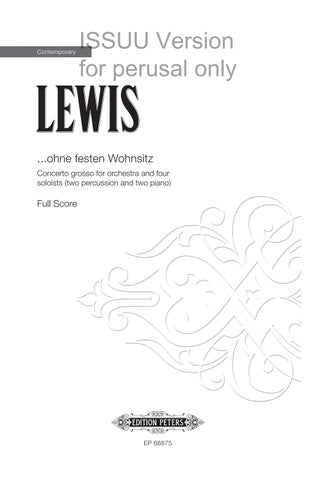
LEWIS
...ohne festen Wohnsitz
Concerto grosso for orchestra and four soloists (two percussion and two piano)
Full Score


ISSUU Version for perusal only
GEORGE LEWIS
…ohne festen Wohnsitz
Concerto grosso
for orchestra and four soloists (two percussion and two piano)
Full Score
Written for Yarn/Wire
Commissioned by the New York Philharmonic and Philharmonie Luxembourg
With the support of the Arlene and Larry Dunn Fund for Afrodiasporic Music
First performed on 8 April 2026 at Lincoln Center, New York, by Yarn/Wire and the New York Philharmonic, conducted by Kwamé Ryan

Instrumentation
3 Flutes in C (Flute III doubling Piccolo)
3 Oboes (Oboe III doubling English horn)
3 Clarinets in B-Flat (Clarinet III doubling Bass Clarinet in B-Flat, Contrabass Clarinet in B-Flat)
3 Bassoons (Bassoon III doubling Contrabassoon or Kontraforte)
4 Horns in F (mutes: straight, Harmon, stopping)
ISSUU Version for perusal only
3 Trumpets in C (mutes: straight, Harmon with stem, plunger)
3 Trombones (mutes: straight, Harmon with stem, plunger)
Tuba (mutes: straight)
Timpani
Orchestra Percussion I
High Bongo
High tom-tom
Lg. Ride Cymbal
Castanets
Vibraphone
Orchestra Percussion II
High Bongo
Medium tom-tom
Crash cymbal
Castanets
Xylophone
Low Bongo
Floor Tom
Lg. Sizzle cymbal
Brake Drum
Flexatone (with bow)
Low Bongo
Bass Drum
China cymbal
Brake Drum
Flexatone (with bow)
Almglocken (Db4, Eb4, Gb4, B4)
Orchestra Percussion III
High Bongo
Low Bongo
Low Tom-Tom Floor tom
Snare drum
Small Triangle
Small Tam-tam
Crotales (2 octaves)
Police Whistle
Sna e drum
Medium Triangle
Lg. Thundersheet
Crotales (2 octaves)
Police Whistle
Snare drum
Lg. Triangle
Lg. Ride Cymbal Lg. Sizzle cymbal Lg. Tam-tam Castanets Brake drum
Police Whistle Flexatone (with bow)
Almglocken (D4, E4, G4, Bb4)
General: Bow, sticks, mallets, brushes, Superball beaters, chopsticks, etc.
Metal percussion: Always let ring unless otherwise notated.

Solo Percussion I
High Bongo
High Log Drum
Lg. Ride Cymbal
Low Bongo
Mid-High Log Drum
China Cymbal
Small Triangle Spring Coils
Police Whistle
Glockenspiel
Solo Percussion II
High Bongo
Mid-Low Log Drum
Lg. Sizzle Cymbal
Snare drum
Med. Talking Drum
Sm. Thundersheet
Brake Drum
Crotales (2 octaves) Xylophone
Flexatone (with bow)
Low Bongo
Low Log Drum
Crash Cymbal
Med. Triangle Spring Coils
Police Whistle
Glockenspiel
Almglocken (E4, G4, Bb3)
Snare drum
Lg. Talking Drum
Med. Thundersheet
Brake Drum
Marimba (4.3 octave) Vibraphone
Flexatone (with bow)
Almglocken (C4, Eb4, Gb4)
ISSUU Version for perusal only

Harp
Solo Keyboard I
Solo Keyboard II
Violin I
Violin II
Viola Cello Contrabass
Symbols
s.t.: sul tasto (arco)
m.s.t., a.s.t.: molto sul tasto (arco)
s.p.: sul ponticello (arco), normal pressurem.s.p., a.s.p.: molto sul ponticello (arco)
c.l.b.: col legno battutom.p.: moderate bow pressure (some pitch)
h.p.: heavy bow pressure (some pitch) bisb.: bisbigliando (in winds, timbre trill) += closed plunger or harmon mute o= open plunger or harmon mute
B = quarter-tone flat
μ = quarter-tone sharp
Bb = three-quarter-tone flat
˜ = three-quarter-tone sharp
m.v.,m.m.v.: molto (molto) vibrato (normal speed, widest pitch range possible)
square or open noteheads: indicates air sound, growls, or other production of indefinite pitch

h.p.: heavy pressure (with some pitch, using approximate indicated pitches)

h.p. (no pitch): heaviest, pure noise (staff position not indicative of pitch level)

M
, multi, multiph: stable, dissonant multiphonic sound on given note
Clusters in indicated register

Create variations on previous passage

The notation “Source:” shows a passage that is the source for performer-created variations. Dynamics are performed as indicated.
ISSUU Version for perusal only

harm. arp.: Harmonic arpeggio. Rhythm and movement trajectories of the left hand are suggested. Create variations as suggested by the indeterminate notation.

Glissando notation
Execution: Single, continuous slide between noteheads and across headless stems. Note that for strings, there are no slurs between notes or across headless stems


highest note possible

Bow pressure specification (relative): high

low
Vibrato: Should match the duration of the first note to which they are attached. Speed is similar to normal vibrato, but pitch range is much wider, similar to Korean nonghyeon


very wide narrow accented fading growing “jeonseong” (grace note-like rise and fall in pitch)


glissando down with vibrato glissando up with vibrato

These signs modify the pitch of a note. Where they are executed corresponds to where they are placed in a given measure.
General performance notes
slowly undulating pitch (all): Like vibrato in pitch range, but much slower. Do not synchronize with other players.
voice grunt, growl (winds): Use rough-textured voice and play at the same time. slap tongue: Produce percussive sounds with some pitch content, which may be indeterminate in pitch. In brass, the technique is analogous to the flutist’s tongue ram.
air sound: Sharp, hissy breath textures are intended.
glissandi: Short, leading toward an attack: Treated like sliding grace notes. Short, trailing a note: Analogous to a short verbal shout. Long, trailing a note: Should not exceed the total duration of the note. Follow approximate pitch curve. Between notes: Follow approximate pitch curve.
The score is transposed, in the customary way:
Piccolo sounds an octave higher than written
B-Flat Clarinet sounds a major 2nd lower than written
B-Flat Bass Clarinet sounds a major 9th lower than written
B-Flat Contrabass Clarinet sounds two octaves and a major 2nd lower than written English Horn sounds a perfect 5th lower than written Kontraforte/Contrabassoon sounds one octave lower than written Horn sounds a perfect 5th lower than written Crotales sound two octaves higher than written Contrabass sounds an octave lower than written
ISSUU Version for perusal only
Specifications as to instruments, bowings, mutes, articulations, etc., are maintained until superseded by a subsequent specification, or by the “ord.” instruction. Accidentals carry through the measure. Trills are always half-step, and are executed with irregular speed, as with tremolos. Specified vibrato is always irregular, unstable, and non-synchronized.
Duration: 28 minutes
ISSUU Version for perusal only


ISSUU Version for perusal only


ISSUU Version for perusal only

George Lewis
George Lewis (b. 1952) is Professor of American Music at Columbia University and Area Chair in Composition. He is a Fellow of the American Academy of Arts and Sciences and the American Academy of Arts and Letters, and a Corresponding Fellow of the British Academy. His other honors include a MacArthur Fellowship (2002) and a Guggenheim Fellowship (2015). A member of the Association for the Advancement of Creative Musicians (AACM) since 1971, Lewis’s work has been documented in more than 150 recordings and has been presented by the BBC Scottish Symphony Orchestra, Ensemble Dal Niente, the London Philharmonia Orchestra, International Contemporary Ensemble, Ensemble Musikfabrik, Mivos Quartet, Spektral Quartet, London Sinfonietta, and others. Lewis holds honorary degrees from the University of Edinburgh, New College of Florida, and Harvard University.
George Lewis (*1952) ist Professor für amerikanische Musik an der Columbia University and Leiter des Fachbereichs Komposition. Er ist Mitglied der American Academy of Arts and Sciences und der American Academy of Arts and Letters sowie korrespondierendes Mitglied der British Academy. Zu weiteren Auszeichnungen zählen ein MacArthur-Stipendium (2002) sowie ein Guggenheim-Stipendium (2015). Seit 1971 ist er Mitglied der Association for the Advancement of Creative Musicians (AACM). Lewis’ Musik ist in über 150 Aufnahmen dokumentiert und wurde u. a. vom BBC Scottish Symphony Orchestra, Ensemble Dal Niente, London Philharmonia Orchestra, International Contemporary Ensemble, Ensemble Musikfabrik, Mivos Quartet, Spektral Quartet und von der London Sinfonietta aufgeführt. Er ist Ehrendoktor der University of Edinburgh, des New College of Florida und der Harvard University.