Contemporary
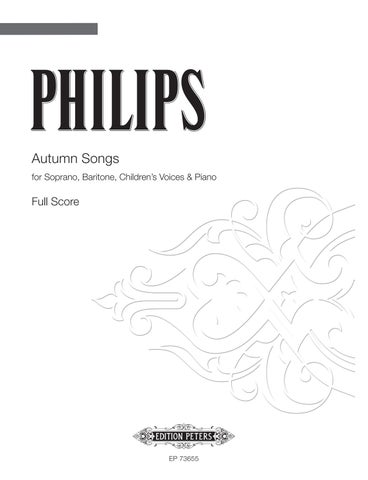
PHILIPS Autumn Songs for Soprano, Baritone, Children’s Voices & Piano
Full Score
EP 73655
JULIAN PHILIPS
Autumn Songs for Soprano, Baritone, Children’s Voices & Piano (2021)
Full Score
POD PETERS on demand ALLE RECHTE VORBEHALTEN
· ALL RIGHTS RESERVED
EDITION PETERS L E I P Z I G · L O N D O N · NEW YORK
AUTUMN SONGS
Poems by Ted Hughes
1. Leaves p. 1 2. The Seven Sorrows p. 26 3. The Defenders p. 38 4. There came a day p. 55 5. The Stag p. 69
Duration: 30 minutes
Commissioned by the Little Missenden Festival with the generous support of the Festival Friends Premiered on the 9th October 2021, by Elizabeth Atherton (soprano), Dominic Sedgwick (baritone) & Iain Burnside (piano)
PROGRAMME NOTE
In 1968, the Little Missenden Festival commissioned Ted Hughes to write a sequence of five poems for children, to be chanted at Harvest Festival by children from the village infant school. Hughes’ response - Five Autumn Songs - are wonderfully varied in tone, register and style, uncompromising in their poetic topics and imagery, while bridging the worlds of children and adults. Ted Hughes attended the session in 1968, and came again in 1973 and 1978 to the festival to speak about children’s poetry and read some of his other work. Over fifty years later, composer Julian Philips was approached to create a musical setting of Hughes’ poems to be performed in the 2020 Little Missenden Festival. Philips response to the variegated nature of Hughes’ poems and their shifts between children’s rhymes and more elaborate poetic text, was to conceive his Autumn Songs as a hybrid work, fusing a song cycle for solo soprano and baritone, with interwoven children’s songs. The relationship between these worlds of adults and children shifts across the piece - in the opening song, ‘Leaves’, the children pose a series of questions with ever increasing urgency, soprano and baritone responding with highly characterised replies. In ‘There came a day’, roles are reversed - soprano and baritone pose the day’s questions, and the children answer in playful rhymes. ‘The Defenders’ is a more collective number, a battle song exploring how autumnal plenty can be deployed against all winter’s armour. The second and fifth songs are perhaps the most complex - ‘The Seven Sorrows’ explores deep autumnal melancholy, in a flowing setting for just soprano and baritone. ‘The Stag’ is the most substantial of the five texts - a dramatic scena that explores the hunting of a stag across a wet Exmoor landscape. The baritone narrates the scene, the soprano embodies the spirit of the stag, and at the close of work, children’s voices sing an epilogue that distils the stag’s dying cries into a wordless lament. Autumn Songs is dedicated in affectionate memory to Alan Hedges, chairman of the Little Missenden Festival from 2010-22, without whom the work would never have come to fruition. It was premiered on the 9th October 2021, with soprano Elizabeth Atherton, baritone Dominic Sedgwick, pianist Iain Burnside and a children’s choir from Great Missenden Primary School, prepared by composer John Webb.
Five Autumn Songs for Children’s Voice Ted Hughes These poems were written for the 1968 Harvest Festival at Little Missenden
I Who’s killed the leaves? Me, says the apple, I’ve killed them all Fat as a bomb or a cannonball. I’ve killed the leaves.
Who’ll toll the bell? Me, said the robin, my song in October Will tell the still gardens the leaves are over. I’ll toll the bell.
Who sees them drop? Me, says the pear, they will leave me all bare So all the people can point and stare. I see them drop.
II The First Sorrow Of Autumn Is the slow goodbye Of the garden who stands so long in the evening A brown poppy head, The stalk of a lily, And still cannot go.
Who’ll catch their blood? Me, me, me, says the marrow, the marrow. I’ll get so rotund that they’ll need a wheelbarrow I’ll catch their blood. Who’ll make their shroud? Me, says the swallow, there’s just time enough Before I must pack all my spools and be off. I’ll make their shroud. Who’ll dig their graves? Me, says the river, with the power of the clouds A brown deep grave I’ll dig under my floods. I’ll dig their grave. Who’ll be their parson? Me, says the Crow, for it is well-known I study the bible right down to the bone. I’ll be their parson. Who’ll be chief mourner? Me, says the wind, I will cry through the grass The people will pale and go cold when I pass. I’ll be chief mourner. Who’ll carry the coffin? Me, said the sunset, and the whole world will weep To see me lower it into the deep. I’ll carry the coffin. Who’ll sing a psalm? Me, says the tractor, with my gear grinding glottle I’ll plough up the stubble and sing through my throttle. I’ll sing the psalm.
The Second Sorrow Is the empty feet Of the pheasant who hangs from a hook with his brothers. The woodland of gold Is folded in feathers With its head in a bag. And the third sorrow Is the slow goodbye Of the sun who has gathered the birds and who gathers The minutes of evening, The golden and holy Ground of the picture. The Fourth sorrow Is the pond gone black Ruined and sunken the city of water¬ The beetle’s palace, The catacombs Of the dragonfly. And the fifth sorrow Is the slow goodbye Of the woodland that quietly breaks up its camp. One day it’s gone. It has left only litter¬ Firewood, tentpoles. And the sixth sorrow Is the fox’s sorrow The joy of the huntsman, the joy of the hounds, The hooves that pound
Till earth closes her ear To the fox’s prayer. And the seventh sorrow Is the slow goodbye Of the face with its wrinkles that looks through the window As the year packs up Like a tatty fairground That came for the children.
III With the apple in his strength, And the Quince, his wise adviser, And the pear his thoughtful brother, With the blackberry and his thorn, So ready to shed his blood, And the plum with his stony bone, With the wheat in his millions, The barley and the rye We shall hold our own Against all winter’s armour. With the pumpkin in reserve The turnip and the marrow We shall hold our fire. We shall go guerrilla Asleep among the squirrels. Over open ground we’ll go In the likeness of a Crow. When the gale comes we shall claw it With a claw like a tree, Then we’ll hide down in the roots. Or in a fox’s footprints Escape across the snow. And nightly underground We’ll prepare the secret hero, The little honey bee, Whose drum, when it begins, Will bring back all the blossom And sink the iceberg winter In the bottom of the sea.
IV There came a day that caught the summer Wrung its neck Plucked it And ate it.
Now what shall I do with the trees? The day said, the day said. Strip them bare, strip them bare. Let’s see what is really there. And what shall I do with the sun? The day said, the day said. Roll him away till he’s cold and small. He’ll come back rested if he comes back at all. And what shall I do with the birds? The day said, the day said. The birds I’ve frightened, let them flit, I’ll hang out pork for the brave tomtit. And what shall I do with the seed? The day said, the day said. Bury it deep, see what it’s worth. See if it can stand the earth. What shall I do with the people? The day said, the day said. Stuff them with apple and blackberry pie – They’ll love me then till the day they die. There came this day and he was autumn. His mouth was wide And red as a sunset. His tail was an icicle.
V While the rain fell on the November woodland shoulder of Exmoor, While the traffic jam along the road honked and shouted Because the farmers were parking wherever they could And scrambling to the bank-top to stare through the treefringe Which was leafless, The stag ran through his private forest. While the rain drummed on the roofs of the parked cars And the kids inside cried and daubed their chocolate and fought And mothers and aunts and grandmothers Were a tangle of undoing sandwiches and screwed-round gos siping heads Steaming up the windows, The stag loped through his favourite valley.
While the blue horsemen down in the boggy meadow Sodden nearly black, on sodden horses, Spaced as at a military parade, Moved a few paces to the right and a few to the left and felt rather foolish Looking at the brown impassable river, The stag came over the last hill of Exmoor. While everybody high-kneed it to the bank-top all along the road Where steady men in oilskins were stationed at binoculars, And the horsemen down by the river galloped anxiously this way and that And the cry of hounds came tumbling invisibly with their echoes down through the draggle of trees, Swinging across the wall of dark woodland, The stag dropped into a strange country. And the stag turned at the river Hearing how the hound-pack smashed the undergrowth, hearing the bell-note Of the voice that carried all the others, Then while his limbs all called different directions to his lungs that only wanted to rest, The blue horsemen on the bank opposite Pulled aside the camouflage of their terrible planet. While the stag doubled back weeping and looking for home up a valley and down a valley While the strange trees struck at him and the brambles lashed him, And the strange earth came galloping after him carrying the hounds and their hanging tongues to fling all over him, While his heart became just a club beating his ribs and his own hooves cried with hound’s voices, The crowd on the road got back into their cars Wet-through and disappointed.
from the Richard GIlbertson edition, 1961
in affectionate memory of Alan Hedges, chairman of the Little Missenden Festival (2010-2022)
I. Leaves Ted Hughes (1930-1998)
Julian Philips (2021)
Brisk (q = c.130)
Children's Voices
Soprano
Baritone
° 4 ¢& 4
∑
∑
∑
° 4 &4
∑
∑
∑
?4 ¢ 4
∑
∑
∑
{
? 4 ‰ # œœ. & ‰ # œœ. ‰ 4
Piano
=
?4 4
w
4
-˙™
-˙™
Edition Peters 73655
“” . b œœ # œœ. . . ‰ b œJ ? ‰ # œœ. & ‰ # œœ ‰ ‰ œœ ? #b -œœ
w ø
1 fmarcato
∑
? ‰ # œœ. ‰ # œœ. Œ & ?
. . ‰ œœ ? ‰ # œœ. & ‰ # œœ Œ
f marcato
° Ch. & ¢
{
# œœ.
Who's
˙™
killed
bœ
mf
-˙™
#b -œœ
w
“” . b œœ # œœ. . . . ‰ b œJ ? ‰ # œœ. & ‰ # œœ ‰ ‰ œœ ? ‰ # œœ. & ‰ # œœ Œ
#b -œœ
w ø
the
“” . b œœ ‰ b œJ ?
Music © 2022 by Peters Edition Limited, London Text © Ted Hughes. Reproduced courtesy of Faber and Faber Limited
° Ch. & ¢ w
2
7
° S. &
Œ
œ
leaves?
∑
3 4
Ó
∑
3 >œ 4
f pesante
∑
Œ
Me,
Bar.
¢
?
{
∑
∑
“” . . b œœ # œœ . . . ? ‰# œœ. & ‰# œœ ‰ ‰ œœ ? ‰# œœ. & ‰# œœ Œ ‰ b œJ ?
w
#b -œœ
-˙™
ø
∑
3 4Œ
Œ
∑
mf leggiero
Œ
#œ 3
œ3 bœ J œ J
œ ‰ J
says the ap-ple,
# >œ. bœ
œœ. œ ‰ Œ J
3 4 3 ™#b œœ R ø
Œ
j # œ ≈ bœ ‰ >. r ? œ œ ‰™ œ Œ œ
mp leggiero
&4 ‰
=
° bœ S. & 11
j ˙™ bœ
# -œ ™
I've killed
Bar.
¢
?
{
Œ
them all
3 > b œ œ œ #œ
Fat as a bomb
Œ
3 8
#œ b œ œ œ œ œ ‰
3 8
œ ‰ J
Œ
f
3
∑
∑
∑
3
or a can - non - ball.
œœ. œ ≈&
# >œ bœ ‰ J
& Œ
?
? Œ
‰ ™ œr Œ œ
r ‰ ™ #œ bœ
#œ bœ
œœj ‰ ? j ‰ Œ œ. #b œœ. œ > ff
j‰ Œ #b œœ. œ > “‘
Œ Œ
j ‰ #b œœ. œ >
Œ
j ‰ #b œœ. œ > “‘
‰ ‰& j œ. œ
ff
&
œ. 3
3
mf
œ.
3 8
?3
8
° 3 &8 15
S.
2
bœ ™ f
∑
I've
Bar.
?3 ¢ 8
{
3 &8 ?3 8
=
“” b œ.
# œ. “‘
° œ S. & ¢ 19
{
b œ.
. #œ. b œ b œ. #œ .
# œ.
Œ
21
b œ.
b œ. #œ .
j #œ.
Ó
{
& ˙™ -
4 4
“ ” œ. #œ ‰ œ
# œ. b œ. ‰
∑
?4 ‰
4
‰ & 44
. # œœ. & ‰ # œœ
‰
# œœ.
w -
∑ . œ # œ ‰ &
‰
# œœ.
w
˙™
“ ”œœ. b œœ. œ. # œ # . . . ‰ b œ ? ‰ # œœ. & ‰ # œœ ‰ ‰ œœ ? ‰ # œœ. & ‰ # œœ ‰ œ Who
œœ. ?
‰
w ø
f marcato
∑
. ‰ œœ ?
f marcato
b œœ. ‰ b œ ? ‰ # œœ. œ #b-œœ
“ ”œœ. # ? ‰ # œœ. ‰ # œœ. ‰ œ &
leaves.
∑
. #œ. b œ
& ˙™ -
° Ch. & ¢
the
∑
? ‰ # œœ. & ‰ # œœ.
=
killed
∑
4w 4
j bœ
#œ
3
sees
bœ
them
b œœ. ‰ bœ ?
mf
œ #b-œœ
w ø
-˙™
œ #b-œœ
° Ch. & ¢ w
4
24
œ
drop?
° S. &
Œ
∑
3 4
Ó
∑ mf leggiero
3 4Œ
∑
∑
Œ #œ ‰b œ ˙
œ ‰ J
3
says the pear,
Bar.
¢
?
∑
{
3 4
∑
“ ”œ. b œœ. œ. # œ # œ ? ‰# œœ. & ‰# œœ. ‰ ‰ œœ. ? ‰# œœ. & ‰ # œœ. ‰ œ ‰ b œ 3 4
-œ
f emphatic
mf
œ J ‰ Œ
Œ
Me,
r œœ œœ ? 43 ‰ ™ œ b # -œ ø
they will
j #œ ‰ Œ b œ.
-˙™
œœ œ
?
mp leggiero
& w ø
Œ
#œ œ j œ & œœ ‰ .
#œ œ œ r ™ ‰ #œ ≈ b œ bœ
=
° S. & 28
Bar.
¢
∑ bœ
œ. J
leave
me
?
{
. œ # œœ & ≈ #œ bœ ? bœ mf
nœ ≈ œ œ
∑ ‰ œœ.
#œ all
. b œ œ œ ≈ bœ
#œ
f
>™ ˙ bare
? ≈
>˙™
bœ œ # œ.
≈ œœ
œ.
. œ # œœ ≈ œ
° & 30
S.
Bar.
¢
∑
{
>œ. ? bœ J
‰
œ # œ œ 3œ œ bœ
bœ J
So
point
all
the peo - ple can
#>œœ. J
Œ
f
? j œ # œ. >
‰
#œ J
Œ
3
? Œ
f
‰
j œ b œ. >
Œ
‰
‰
and
stare.
Œ
Œ
>œ. # ‰ & œ J b >œ. 3 œ ‰ & j œ. J œ
Œ Œ
3 Ϫ 8
œ
‰
3 8 œ.
œ. 3
3 8 ?3
8
mf
5
∑ “œ.”
œ. “‘
# œ. . bœ #œ.
b œ.
=
° S. & 33
Bar.
¢
?
{
& ?
∑
I've
œ. . # œ. bœ
œ.
4 4
∑
Ϫ
#œ.
3
b œ.
∑
bœ
#œ 4 J 4w
seen
them
∑
œ
drop.
œ. #œ. 44 b œ. f . .œ # œ b œ. 4 #œ &4 œ .
œ.
œ.
œ. #œ œ.
#œ œ.
‰
“” # œœ.
Œ œ.
#œÓ œ.
Ó œ. Œ
#œ œ.
” b“œœ. ‰ b œJ
‰ œ # œJ b œœ -
° Ch. & ¢
6
37
∑
{
œ.
&
=
& #œœ . ø
œ.
œ.
‰
∑
“” # œœ.
œ.
∑#œ œ.
#œ œ.
° Ch. & ¢ ˙™
f marcato
#œÓ œ.
w
” b“œœ. ‰ b œJ
œ. Œ
Who'll
œ.
œ.
#œ œ. ø
{
catch
=
& #Óœœ .
” b“œœ. ‰ b œJ
their
œ.
&
œ. Œ
‰ œ # œJ b œœ -
#œ œ.
-˙ emphatic ° 3 mf S. & 4
blood?
œ.
#œ œ. ø
#-œ
43
Me,
œ.
œ. #œ œ.
œ
‰
-˙
mf emphatic
“ ” œ. . œ b œ œ 3 ≈ ≈ &4 ≈ b œ œ. me,
mp
œ b œ. 3 ?≈ œ b œ. ≈ ≈ œ &4 b œ. ø
Œ
œ
“” # œœ.
œ.
Ó œ. Œ
3 4
” b“œœ. ‰ J 43
‰ œ # œJ b œœ -
3 4
#œ œ.
#œÓ œ.
Œ
‰ ‰ œJ #œJ œ
j œ ‰ bœ
4 4
œ J
Œ
bœ
4 4
#œ œ.
leggiero
3
me,
?3 Œ Bar. ¢ 4
{
w
“” # œœ.
#œ œ.
#œ œ.
40
bœ
‰
mf
‰ œ # œJ b œœ -
#œ œ.
œ.
3
the mar - row.
I'll
leggiero
b œ 3 œ #œ 3 J œ ‰ says
‰
Œ
the mar - row,
Œ
Œ
?
Œ
‰™
r œ bœ
I'll
# œœ. J
&
‰
Œ ‰™
œ bœ R
#œœ. J
Œ
4 4
‰ Œ
4 4
° 4 #œ~ S. & 4 œ œ ~ b>˙ 46
3
get
so
Œ
{
so
4 &4 Π?4 Π4
œ
#œ
ro - tund
œ
3
Œ #œ
ro - tund
œ
#œ b -œ # œ bœ mf pesante >
œ œ
œ # -œ
œœ -
œœ
œ b -œ
œœ > “‘
œ
œ
bœ
3
˙
7
3 8
˙
a wheel - bar - row
# œ3
that they'll need
œ -œ
#œ b -œ
#œ 3
that they'll need
3 œ œ # œ~~ b>˙ 4 ? Bar. ¢ 4
get
f
3
œ
f
bœ
3
˙
˙
3 8
a wheel - bar - row
#œ -œ
œ -œ
f
œ bœ
-j œ ‰ #œ œ œ ˙ ™ ‰ J
b œœ -
œ.
œ bœ Œ j œ ‰ & j œ. œ ø
3
Œ
Œ
Œ
Œ
3
œ
f
œ.
?3
8
mf
=
° 3 &8 49
S.
∑
bœ ™ I'll
Bar.
?3 ¢ 8
{
∑
bœ ™ I'll
“ ” # œ. œ. # œ. œ. . . bœ 3 bœ &8 ?3 8 b œ œ. #œ. b œ œ. #œ. . . “‘
> #œ ‰ œ 43 b ˙ ™
4
catch
their
#>œ
œ
catch
‰
their
œ
blood.
3 4
b ˙™
œ
blood.
.j .j b œœ ‰ ‰ nœœ Œ #œ. œ 43 Œ œ b œ. b˙™ b˙ f œ. # œ. b-œ . . . 3 bœ 4 ‰ #nœœJ ‰ b œj j ‰ ‰ #nœœJ ‰ b œj . . b œ. .j b œœ ‰ Œ
3 8
° Ch. & ¢ 54
8
∑
{
=
f marcato
b˙™
∑
make their .j Who'll . .j .j . j j b œœ ‰ ‰ nœœ Œ b œœ ‰ Œ b œœ ‰ ‰ nœœ Œ Œ & b Œ˙ ™ œ œ b˙ b˙™ b˙ mf -œ b . . ? ‰#nœœ. ‰ j j ‰ ‰#nœœ. ‰ j b œ ‰#nœœ ‰ j j ‰ ‰#nœœ ‰ j J J J J b œ. b œ. b œ. b œ. b œ. b œ.
.j b œœ ‰ Œ
° Ch. & ¢ b˙™ 58
° S. &
Œ
œ
shroud?
∑
Œ
∑
¢
=
?
b˙
∑
∑
{
∑
mf più dolce e legato
Œ
∑
Œ
mf leggiero
Me,
Bar.
œ
b˙
Œ
bœ
Œ
3
says
Œ
œ
there's
œ bœ œ J J
˙
3
the swal - low,
.j .j 3 3 b œœ ‰ ‰ nœœ Œ Œ œ œ b œ b œ & b˙™ œ œ œ b˙ mp 3 3 b œ n3œ œ nœ b3œ œ ? ‰ #nœœ. ‰ j j ‰ ‰#nœœ. ‰ j b œ & ‰ ‰ b œ nœ bœ nœ J b œ. J b œ. b œ. ø .j b œœ ‰ Œ
° j S. & ¢ b œ ‰ nœ ™
j ™ œ b˙
62
{
just
time
œb œ
& &
3 3
‰ bœnœ
œ
œ
Œ
e - nough
œ
Be
œ bœ b œ nœ œ b œ œ n œ b œ 3 3
3
œn œ 3
-
bœ
nœ
œ
fore
I
must
3
3
œ b œ nœ œ
nœ b œ œ bœ œ bœ œ 3
? ‰ nœ œ b œ 3
ø
bœ
3
3
&‰ bœ n œ
ø
° bœ S. &
œ J
66
pack
œ
bœ J
n˙
all
my
spools
Œ
∑
mf più dolce e legato
¢
Bar.
?
∑
{
Œ
œ
Œ
œ J
‰
and
& œ bœ œ
3
b œ nœ œ 3
&
mf
bœ
3
b˙ be
nœ b œ œ b œ
bœ œ
3
9
nœ
3 3
‰ œ nœ b œ
3
œ bœ
3
œ nœ b œ œ b œ
ø
3
?
?œ 3œ b œ
ø
=
° S. & 69
2 4
∑
mf
b˙
∑
nœ ™
I'll
Bar.
¢
? b˙™
{
2 4
off.
œ ? J ? œ b œ3
‰
œ
3
2
œ Œ J 3
& 4 3
œ œ bœ œ b œ œ nœ
2 4
ø
∑ “” b œ.
b œ. nœ.
make
b œ.
œ. . . b œ nœ
p
b œ. œ. b œ. n œ.
b œ. œ . nœ b œ. .
3 4
their
∑
3 4
œ b œ. nœ. . œ. b œ. ‰ nœ. J
3 4
∑ œ.
œ J
b œ.
3 4
5
° 3f S. & 4 ™ b˙
10
73
shroud
Bar.
Œ
œ
?3 ¢ 4
Œ
∑
{
∑
∑
∑
∑
∑
.j .j .j 3 3 . . . . b œœ ‰ Œ 3 Œ b œœ œœ ‰ nœœ Œ Œ b œœ œœ ‰ nœœ & 4 b Œ˙ ™ œ œ b˙ b˙™ b˙ f 3 3 b-œ b-œ . ? 3 ‰#nœœ. ‰ j b œ n œ b œ ‰ j ‰# œ ‰ j ‰ j 4 J b œ. J b œ. œ. b œ. œ. b œ. b œ. œ. b œ. œ. = . b œjœ ‰ Œ
° fmarcato Ch. & ¢ b˙™ 77
{
Who'll
b˙™
œ
b˙
dig
their
Œ
œ
graves?
Œ
.j .j .j 3 . 3 . . . œ b œœ œœ ‰ nœ Œ b œœ ‰ Œ b œœ œœ ‰ nœœ ? Œ Œ Œ & b˙™ œ œ b˙ b˙™ b˙ mf 3 3 b-œ b-œ . ? ‰#nœœ. ‰ j b œ n œ b œ ‰ j ‰# œ ‰ j ‰ j J b œ. J b œ. œ. b œ. œ. b œ. b œ. œ. b œ. œ. = ° S. & Œ 81
.j b œœ ‰ Œ
mf
Œ
nœ
3
3
j œ b œJ œ
says the ri - ver,
mf darker
Bar.
¢
?
{
b˙
œ J ‰
bœ ? bœ œ bœ ?
3
mf
3
b œ bœ 3
3
bœ œ
3
bœ
œ bœ
ø
bœ
œ
Œ nœ
Œ
Me,
∑
˙
with the
œ bœ
nœ 3
bœ œ
nœ
œ
b œ bœ 3
3
ø
œ bœ
n ˙™
of
clouds
3
power
œ
∑
œ bœ 3
bœ œ
the
œ
œ
nœ bœ
œ
3
3
mf
ø
œ
œ 3
bœ œ
bœ
3
œ bœ
° S. & 85
¢
Bar.
?
{
?
Ϊ
∑ f œ œ J ‰
œ
3
?
bœ œ
deep
grave
œ ‰ J
˙
bœ
Ϫ
grave
I'll
dig
Œ
œ œ b œ bœ 3
3
b˙
brown
œ
œ
œ œ J
b˙
A
nœ bœ
f
f
bœ
3
œ œ œ bœ œ
bœ 3
bœ œ
ø
3
3
bœ
œ
3
bœ œ
ø
bœ
œ 3
11
∑
œ. œ. nœ J
un - der my
œ œ bœ
3
3
œ
nœ
nœ œ
3
bœ
ø
b œ œb œ
=
°? ˙ ™ ¢
Bar.
mf
˙™
89
2 4
∑
floods.
{
Œ ? ˙™
b˙
I'll
‰
bœ œ b œ œ bœ
3
bœ bœ &
? ‰ 3 b œj ‰ ‰ œ bœ 3
3
bœ œ bœ Œ
3
bœ œ œ & 3
3
œ
2 4
?2
“” b œ. p
. b œ. . œ œ b œ. nœ. b œ. nœ.
b œ. œ 4 bœ . nœ b œ. . œ. . n œ. ø b œ.
ø
Bar.
6
°? nœ ™ ¢
#œ f J 5 œ™ 8
93
12
{
=
dig
their
° fmarcato Ch. & ¢ œ™ 98
{
Who'll
& Œœ ™ -
=
grave
bœ & . b œ nœ œ. . . œ. ? b œ. ‰ nœ. J
5Œ 8 nœ ™ -
.j #œœ Œ œ
f marcato
5 ‰ b œœ. ‰ 8 J n œ.
n œ.
Ϫ
j œ ‰
Œ
∑
∑
.j .j .j .j .j ‰ œ ‰ # œ # œ ‰ # œ #nœœ ‰ #œœ ‰ ‰ Œ Œ #œœ œ # œ œ™ nœJ œ œ™ œ . . . ‰ b œœJ ‰ Œ Œ™ ‰ b œœJ ‰ ‰ b œœJ n œ.
#œ port . œj œ
œ
œ
.j son? . .j their .j par j Œ #œœ ‰œ #œœ ‰ ##œœ ‰ #nœœ ‰ #œ œ™ nœJ œ . . ‰ b œœJ ‰ Œ Œ™ ‰ b œœJ
.j #œœ Œ œ
be
mf
? ‰ b œœ. ‰ J n œ.
n œ.
° 3 ˙™ S. & 4 102
Ϫ
œ
mp più misterioso
Œ
Œ
Me,
#œ
œ J
for
it
‰
#œ
#œ f
#œ
#œ -
‰ Œ
3 4
œ œ œœ ™ -
3 4
œ œ œœ ™ -
j œ ‰
œ
˙™
is
well
known
mp più misterioso
?3 Œ Bar. ¢ 4
{
3 &4 Π?3 Π4
Œ
œ says
nœ œ
3
bœ J
˙™
the
Crow,
nœ œ
p più misterioso
bœ œ
bœ œ
œ œ œ œ
∑ nœ œ #œ nœ ø
nœ œ
œ œ
#œ nœ
œ œ
∑
#˙ #˙
#œj
& ˙ ˙˙
Œ
ø
Œ
n œ.
nœ œ ?b œ
œ
nœ œ bœ œ
3 4
° S. & œ™
‰
?
∑
106
Bar.
¢
{
I
=
Bar.
110
¢
{
down
&
=
œ œ
114
?5 8
bone.
Œ bœ
mf
p
œ.
bœ
˙
mf
œ # œ.
œ. bœ œ # œ. œ.
“”# ˙ r #œ #˙
#œ œ
˙ ˙
‰
# œ. ‰
Œ
nœ
bœ
Ϫ
be
œ.
bœ
œ #œ.
bœ
nœ œ. bœ œ #œ. n œ.
r œ
7
œ #œ. œ bœ
‰
œ #œ œ #œj #œ
-œ
f po r
par
œ
5 8
∑
5 8
˙™
nœ
their
œ œ œ œ
ø
Œ & #œœ
œ.
Œ
right
-˙™
Œ
˙ ˙
ø œ
nœ.
œ œ
∑
#œ
I'll
5 & 8 nœ .
œ
#œ
Œ
∑
?
∑
&œ
the
r #œ
b˙ ˙ ø
#œ œ
13
ble
-
œ #œj ##œœ œ
œ œ
œ
to
n˙ ˙
° 5 S. & 8 ¢
Œ
˙™ ∑
?#œ
Œ
r #œ
& œ œ
{
ø
nœ
Œ
bi
œ #œj##œœ œ
Œ
∑
? œ
the
˙
∑
b˙ & ˙
° S. &
#œ
stu - dy
n˙ r ˙ ˙ # œ œ & œ œ ? œ
Ϫ
œ J
œ
œ
Œ nœ ™ -
œ #œ œ #œj # œ ?
œ œ
t.
nœ œ J
-
son?
#œ œ
.j #œœ Œ œ
f marcato
. ‰ b œœJ ‰
n œ.
n œ.
œ œ
5 8
œ œ #œ œ
ø
Ϫ
Œ
ΠϪ -
.j .j #œœ ‰œ #œœ -
. ‰ b œœJ ‰ Œ
5 8
° Ch. & ¢ 119
14
∑
{
f marcato
∑
˙
. ‰ ##œjœ ‰ #nœ.jœ ‰ #œ.jœ ‰ ‰ Œ & #œ nœ œ œ™ œ J -
=
? Ϊ
. ‰ b œœJ
° Ch. & ¢ œ 124
ΠϪ -
n œ.
n œ.
mf leggiero
Œ
œ
mf Bar.
¢
{
∑
bœ J
3
=
°? Bar. ¢ 127
{
& ?
˙
#œ
œ J
f
#œ
#œ -œ
œ œ?3 4 œœ ™ -
‰
œ
cry
œ
œ
nœ
through the
?
œ œ #œ mp ø
œœ
œ nœ #œ
Œ
nœ #œ œ
Œ
#œ
œ
I
will
nœ #œ œ
& œ #œ œ
Œ
Œ
grass
&œ œ & œ œ #œ
œœ
#œ œ nœ #œ
œ #œ
œ #œ œ
&
# ˙™
> œ œ #œ
#œ
Œ
œ #œ œ
œ #œ œ
œ œ 43 ≈ œ #œ œ œœ ™ mp -
œ bœ
˙
the wind,
Me,
& #œ ?
3 4
n œ.
∑
says
?
chief .j mour .- ner? . .j j j Œ #œœ ‰œ #œœ ‰ ##œœ ‰ #nœœ ‰ #œ nœ œ œ™ -J . . ‰ b œœJ ‰ Œ Œ™ ‰ b œœJ
∑
3 4Œ
∑
. ‰ b œœJ ‰
#œ port . œj œ
œ
be
mf
3 4
‰ Œ
° S. &
. ‰ ‰ b œœJ n œ.
.j #œœ Œ œ
Who'll
Ϫ
‰
#œ œ p
ø
#œ The
œœ
œ #œ n œ œ œ #œ
?
œœ
° & 130
S.
Bar.
¢
∑
? œ
{
&
∑
˙
peo
-
œ œ #œ œ œ
œ
” œ“
#œ œ
‰
∑
œ
and
go
pale
(both staves)
#œ nœ œ œ #œ
œ J
‰
15
˙™
will
#œ n œ œ œ #œ
&
œ #œ ™ J
œ
ple
œ
Œ
mf
nœ #œ œ œ
#œ œ œ
œœœ bœ nœ œ
f
ø
bœ nœ œ
=
° #>˙ S. & 133 f
œ J
cold
Bar.
¢
f pesante n-œ
? ˙
{
& #œ œ œ &
œ
when
?
b œn œ œ
#œ œ
œ
? b œn œ œ
6 8 6 8 #˙ ™
-˙ I
#œ œ œ
pass.
#œ œ bœ œ œ
∑
6 8
œ œœœ “‘
6 8
œ œ#œ œ #œ #œ ø
œ œ#œ œ œ&
œ #œ œ
Julian Philips
Photo © Jamie Smith
Julian Philips (b. 1969) studied music at Emmanuel College, Cambridge, and his compositions have been performed at major festivals and venues including the Proms, the Tanglewood Music Festival, Welsh National Opera and Glyndebourne. A significant composer of operatic music, Philips’ work includes Followers, The Yellow Sofa, and Knight Crew (libretto by Nicky Singer) commissioned by Glyndebourne (2010). Welsh National Opera commissioned two chamber operas, Dolffin and Wild Cat. Other works include two ballets for English National Ballet, Les Liaisons Dangereuses and The Snow Queen. Julian Philips is Honorary Fellow of, and was made Head of Composition at, the Guildhall School of Music in 2004. He has also taught at Cambridge. Julian Philips (*1969) studierte Musik am Emmanuel College in Cambridge. Seine Kompositionen sind bei führenden Festivals und in renommierten Häusern erklungen, darunter die BBC Proms, das Tanglewood Music Festival, Welsh National Opera und das Opernfestival im englischen Glyndebourne. Philips ist ein bedeutender Opernkomponist, und seinen Schaffen umfasst die Bühnenwerke Followers, The Yellow Sofa sowie Knight Crew (2010), ein Auftragswerk für Glyndebourne auf ein Libretto von Nicky Singer. Zwei Kammeropern, Dolffin und Wild Cat, entstanden im Auftrag der Welsh National Opera. Zu weiteren Werken gehören zwei Ballette für das English National Ballet, nämlich Les Liaisons Dangereuses und The Snow Queen. Julian Philips ist „Honorary Fellow“ der Guildhall School of Music, wo er 2004 zum Leiter der Kompositionsabteilung ernannt wurde. Außerdem lehrte er in Cambridge.
EDITION PETERS GROUP L E I P Z I G
·
L O N D O N
·
N E W
w w w . e d i t i o n p e t e r s . c o m
Y O R K