Stuart Greenbaum: Natural Satellite Analysis by the composer
Background
In 2013, I was approached by the Classical Guitar Society of Victoria to write a new work for Slava and Leonard Grigoryan. I had an idea to write a piece about moons; and in the ensuing discussions it was mooted that perhaps we could therefore premiere the work at the Melbourne Planetarium. We were put in touch with Dr Tanya Hill, who was very supportive of the idea and of creating visuals in the Planetarium dome at Scienceworks to match the five movements with DigitalSky Programming. It was subsequently premiered on 15 November 2013 at Melbourne Planetarium (two shows), repeated on 16 February 2014, and then given a further two concert performances at the Melbourne Recital Centre on 17 April 2014. A natural satellite, moon, or secondary planet is a celestial body that orbits a planet or smaller body, which is called its primary. Earth has one large natural satellite, known as the Moon. No "moons of moons" (natural satellites that orbit the natural satellite of another body) are known. In most cases, the tidal effects of the primary would make such a system unstable. The seven largest natural satellites in the Solar System are Jupiter's Galilean moons (Ganymede, Callisto, Io, and Europa), Saturn's moon Titan, Earth's Moon, and Neptune's captured natural satellite Triton.
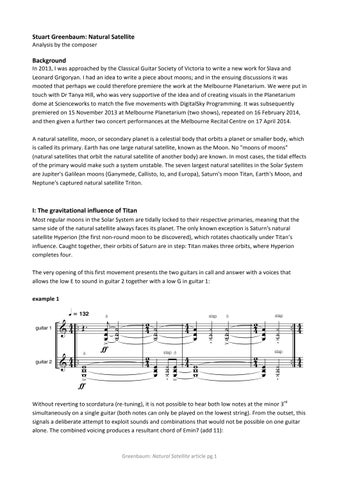
I: The gravitational influence of Titan Most regular moons in the Solar System are tidally locked to their respective primaries, meaning that the same side of the natural satellite always faces its planet. The only known exception is Saturn's natural satellite Hyperion (the first non-‐round moon to be discovered), which rotates chaotically under Titan’s influence. Caught together, their orbits of Saturn are in step: Titan makes three orbits, where Hyperion completes four. The very opening of this first movement presents the two guitars in call and answer with a voices that allows the low E to sound in guitar 2 together with a low G in guitar 1: example 1
Without reverting to scordatura (re-‐tuning), it is not possible to hear both low notes at the minor 3rd simultaneously on a single guitar (both notes can only be played on the lowest string). From the outset, this signals a deliberate attempt to exploit sounds and combinations that would not be possible on one guitar alone. The combined voicing produces a resultant chord of Emin7 (add 11):
Greenbaum: Natural Satellite article pg.1